
Introduction[1]
The United Kingdom has several political parties, each with its distinct ideologies and policies. The most prominent among these are the Conservative Party, the Labour Party, the Liberal Democrats, the Scottish National Party (SNP), and the Green Party.
Here’s a brief overview of their main differences:
Conservative Party (Tories):
- Centre-right to right-wing.
- Traditionally, it supports free market policies, a strong national defence, and reduced state intervention in the economy.
- Advocates for lower taxes, private enterprise, and individual responsibility.
- Historically, it has been more Eurosceptic, with a significant role in Brexit.
Labour Party:
- Centre-left to left-wing.
- Originated from the trade union movement and social democracy.
- Focuses on workers’ rights, social equality, and state provision of public services like health and education.
- Advocates for higher public spending financed through taxation, particularly on the wealthy.
Liberal Democrats:
- Centrist, combining liberal economic policies with social liberalism.
- Advocates for civil liberties, electoral reform, increased public spending on education and healthcare, and environmental sustainability.
- Pro-European Union, advocating for close ties with the EU.
Scottish National Party (SNP):
- Centre-left, focusing on Scottish nationalism and independence.
- Supports social democratic policies similar to Labour.
- Pro-EU, advocating for Scotland to remain in or rejoin the EU, especially post-Brexit.
- Emphasises Scotland’s distinct political identity and the need for more autonomy or complete independence from the UK.
Green Party:
- Left-wing, focusing on environmental issues.
- Advocates for strong action on climate change, environmental protection, social justice, and anti-austerity measures.
- Supports a more significant role for the government in the economy to achieve sustainable development and social equity.

Each party caters to different segments of the UK population and has evolved over time, adapting to changing political, social, and economic landscapes. Their policies and ideologies are influenced by contemporary issues, the needs and aspirations of their constituents, and global trends.
The Whigs and Tories
Before looking at the political parties that exist today, it is interesting to compare the Whigs and Tories – two of the most significant political groups in British history, particularly during the 17th to early 19th centuries. These groups were the precursors to modern political parties.
Historical Context:
- Tories: Originated in the late 17th century. The name was initially used to describe a political faction that supported the royalist and conservative causes, typically favouring the authority of the monarchy and the Anglican Church.
- Whigs: Emerged as a political faction opposed to the Tories. The term “Whig” was initially a term of derision. Whigs were identified with parliamentary supremacy, religious toleration (particularly for Protestant dissenters) and later, the interests of commercial and moneyed classes. The party was founded in 1674 (by Anthony Ashley Cooper, 1st Earl of Shaftesbury) and dissolved in 1859.
Key Political Stances:
- Tories: Advocated for the preservation of traditional institutions, particularly the monarchy and the established church. They were often seen as defenders of the social hierarchy and the landed gentry.
- Whigs: Promoted constitutional monarchism, parliamentary authority, and were more likely to support reforms, including the expansion of the electoral franchise, and limitations on the power of the Crown.
Economic Policies:
- Tories: Generally represented the interests of the rural aristocracy and were more inclined towards protectionist policies.
- Whigs: Tended to represent mercantile and business interests and often favoured free trade and the interests of the emerging industrial and urban sectors.
Religious Views:
- Tories: Strongly associated with the Church of England and opposed to the expansion of religious tolerance beyond the established church.
- Whigs: More open to religious tolerance and were often allied with nonconformist Protestant groups.
Role in Historical Events:
- Tories: Their dominance in the early 18th century gave way to the Whigs, particularly after the Hanoverian succession in 1714. The Tories were often associated with Jacobite sympathies (support for the exiled Stuart dynasty).
- Whigs: Played a key role in the Glorious Revolution of 1688 and the establishment of a constitutional monarchy under William and Mary. They dominated British politics in the mid-18th century.
Evolution into Modern Parties:
- Tories: Evolved into what is now the Conservative Party, especially under the leadership of figures like Sir Robert Peel in the 19th century.
- Whigs: Many of their political positions were subsumed into the Liberal Party, which emerged in the 19th century from a coalition of Whigs, Radicals, and Peelite Tories.
The Whigs were initially formed in opposition to the royal policies of King Charles II and his successor, James II. The name “Whig” is believed to have been derived from “Whiggamore,” a term used to describe western Scottish Covenanters who opposed the King in the 17th century. The Whigs advocated for constitutional monarchism, opposed absolute monarchy, and were at the forefront of the movement that resulted in the Glorious Revolution of 1688. This revolution led to the deposition of James II and the ascension of William III and Mary II, which significantly limited the power of the monarchy and increased the influence of Parliament.
The Whigs were a political faction and then a political party in the Parliaments of England, Scotland, Ireland, Great Britain, and the United Kingdom. Between the 1680s and the 1850s, the Whigs contested power with their rivals, the Tories. The Whigs merged into the Liberal Party with the Peelites and Radicals in the 1850s. Many Whigs left the Liberal Party in 1886 to form the Liberal Unionist Party, which merged into the Conservative Party in 1912.[2] The Whigs opposed absolute monarchy and Catholic emancipation, supporting constitutional monarchism with a parliamentary system. They played a central role in the Glorious Revolution of 1688 and were the standing enemies of the Roman Catholic Stuart kings and pretenders.[3]
The Whigs’ political ideology centred around parliamentary supremacy, religious tolerance (particularly for Protestant dissenters), and opposition to the concentration of power in the hands of the monarch. Over time, the Whigs evolved into the Liberal Party in the 19th century, diverging from the Tory faction, which eventually became the modern Conservative Party.
In summary, the Tories and Whigs represented distinct political, social, and economic philosophies in British history. Their legacies continue to influence the nature of British politics, particularly the Conservative and Liberal parties’ ideologies.
Timeline of British Politics from 1800 to 2021
Providing a detailed timeline of British politics from 1800 to 2021 is a vast undertaking, as this period encompasses numerous significant events, changes in government, and political milestones. Here is a very broad and condensed overview highlighting key political events and trends:
1800-1900:
- 1801: Act of Union unites Great Britain and Ireland.
- 1832: The Great Reform Act expands the electoral system.
- 1846: Repeal of the Corn Laws, significant for the Conservative split.
- 1867 and 1884: Further Reform Acts continue to expand suffrage.
- Late 19th Century: Rise of the Labour movement and decline of the Liberal Party.
1900-1950:
- 1900: Formation of the Labour Party.
- 1914-1918: World War I.
- 1924, 1929, 1945: First Labour governments under Ramsay MacDonald and Clement Attlee.
- 1939-1945: World War II.
- 1945: Clement Attlee’s Labour government initiates the welfare state and the National Health Service.
1950-2000:
- 1950s-1960s: Conservative dominance under leaders like Winston Churchill, Anthony Eden, Harold Macmillan, and Alec Douglas-Home.
- 1964-1970: Labour government under Harold Wilson.
- 1970s: Industrial strife and economic challenges; Conservative government under Edward Heath, followed by Labour under Harold Wilson and James Callaghan.
- 1979-1990: Conservative government under Margaret Thatcher, known for neoliberal reforms.
- 1990-1997: Conservative government under John Major.
- 1997-2007: Labour government under Tony Blair, introducing “New Labour” policies.
2000-2021:
- 2007-2010: Labour government under Gordon Brown.
- 2010-2015: Conservative-Liberal Democrat Coalition under David Cameron and Nick Clegg.
- 2015-2016: Conservative government under David Cameron.
- 2016: Brexit Referendum.
- 2016-2019: Conservative government under Theresa May.
- 2019-2021: Conservative government under Boris Johnson, overseeing Brexit and dealing with the COVID-19 pandemic.
It is emphasised that the above timeline is a simplified version of a complex and nuanced political history. Each era includes numerous additional events, policies, and political shifts that have shaped the course of British politics.
Politics before 1265
Before Simon de Montfort’s Parliament in 1265, the governance in England was less structured in terms of parliamentary representation and was dominated by the monarchy and the king’s council. The key elements of governance during that period were:
- Monarchy: The King was the central figure in governance, with substantial executive, legislative, and judicial powers. The King made decisions with the advice and consent of his council, but ultimately, the monarch had significant authority.
- The King’s Council: This was a body of advisers to the King, typically composed of nobles, senior clergy, and other influential figures. The council advised on matters of state, including law, taxation, and foreign policy.
- Local Governance: Local governance was largely in the hands of local lords, barons, and the clergy. They had considerable control over their lands and could administer justice and collect taxes.
- Feudal System: The feudal system played a crucial role in governance. The King granted lands to nobles, who in turn owed military service and other obligations. These nobles had their own vassals and thus, a hierarchy of authority and loyalty was established, central to governance and social order.
- Early Forms of Parliament: Before Simon de Montfort, there were assemblies, sometimes referred to as parliaments, which were primarily gatherings of nobles and clergy summoned by the King. These were not parliaments in the modern sense but were more like councils or meetings to discuss the affairs of the realm, particularly taxation and legal matters.
Simon de Montfort’s significant contribution was in expanding the representation in these assemblies to include commoners, specifically knights and burgesses, which laid the groundwork for the development of a more representative Parliament, eventually leading to the establishment of the House of Commons. It was a major step towards the parliamentary democracy that developed in England and later the United Kingdom.[4]
The Early Members of Parliament – Who Were They?
Identifying the “first MP” (Member of Parliament) in the British Parliament is challenging because the concept of an MP, as we understand it today, developed gradually over time. The early representatives in the English Parliament were not MPs in the modern sense, and records from the period are not always complete or clear. However, we can look at a few key figures and moments in the development of the role:
- Early Representatives: The first parliaments, such as Simon de Montfort’s in 1265 and Edward I’s Model Parliament in 1295, included commoners. These were knights and burgesses representing local communities, but they were not MPs in the way we think of them now. They were more like envoys or delegates sent to advise the king and discuss matters of taxation and law.
- Recorded Names: The earliest surviving official record of the English Parliament is from 1296, following Edward I’s Model Parliament. The names of some representatives (knights and burgesses) from this and subsequent early parliaments are known, but pinpointing a single “first MP” is not feasible due to the collective and evolving nature of their roles.
- Gradual Evolution: The role of these representatives evolved over time. By the 14th century, the practice of counties and boroughs sending representatives to Parliament was becoming more standardised, leading to the establishment of the House of Commons.
Was there a First MP?
Given the gradual evolution of the role and the lack of complete records from the earliest parliaments, it is not possible to definitively name a “first MP” in the modern sense. The concept of an MP, as an elected representative of a constituency with specific duties and rights, developed over many decades during the late medieval and early modern periods.
The House of Commons[5]
 The House of Commons, as a distinct component of the Parliament of England (and later the Parliament of the United Kingdom), began to take shape in the 13th and 14th centuries. Its development was part of a gradual evolution towards a more representative and inclusive form of governance.
Key milestones in the establishment of the Commons are:
- Simon de Montfort’s Parliament (1265): Often cited as a significant moment, Simon de Montfort, the Earl of Leicester, convened a parliament that, for the first time, included not only lords but also commoners. This included knights from the shires and representatives from the boroughs.
- Model Parliament (1295): King Edward I’s ‘Model Parliament’ is generally regarded as the first official formation of the House of Commons. This Parliament included representatives from counties (knights) and boroughs (burgesses), forming a precursor to the modern House of Commons.
- 14th Century Developments: During the 14th century, the practice of summoning representatives of the shires and boroughs to Parliament became more regular. This period saw the establishment of the two separate Houses of Parliament – the House of Lords and the House of Commons.
- Role and Powers: Initially, the House of Commons primarily dealt with granting taxes and addressing grievances. Over time, it started to play a more significant role in legislation. By the late Middle Ages, it was well established that statutes could only be enacted with the consent of the House.
- Tudor Period: The House of Commons grew in power and influence during the Tudor era (1485-1603). This period saw the Commons assert itself in matters of legislation and taxation.
The House of Commons continued to evolve and expand its powers and influence over the centuries, especially in relation to the monarchy and the House of Lords. Major milestones in its development include the English Civil War[6], the Glorious Revolution, and various acts of Parliament in the 19th and 20th centuries, which reformed both the electoral system and the relationship between the Houses of Parliament.
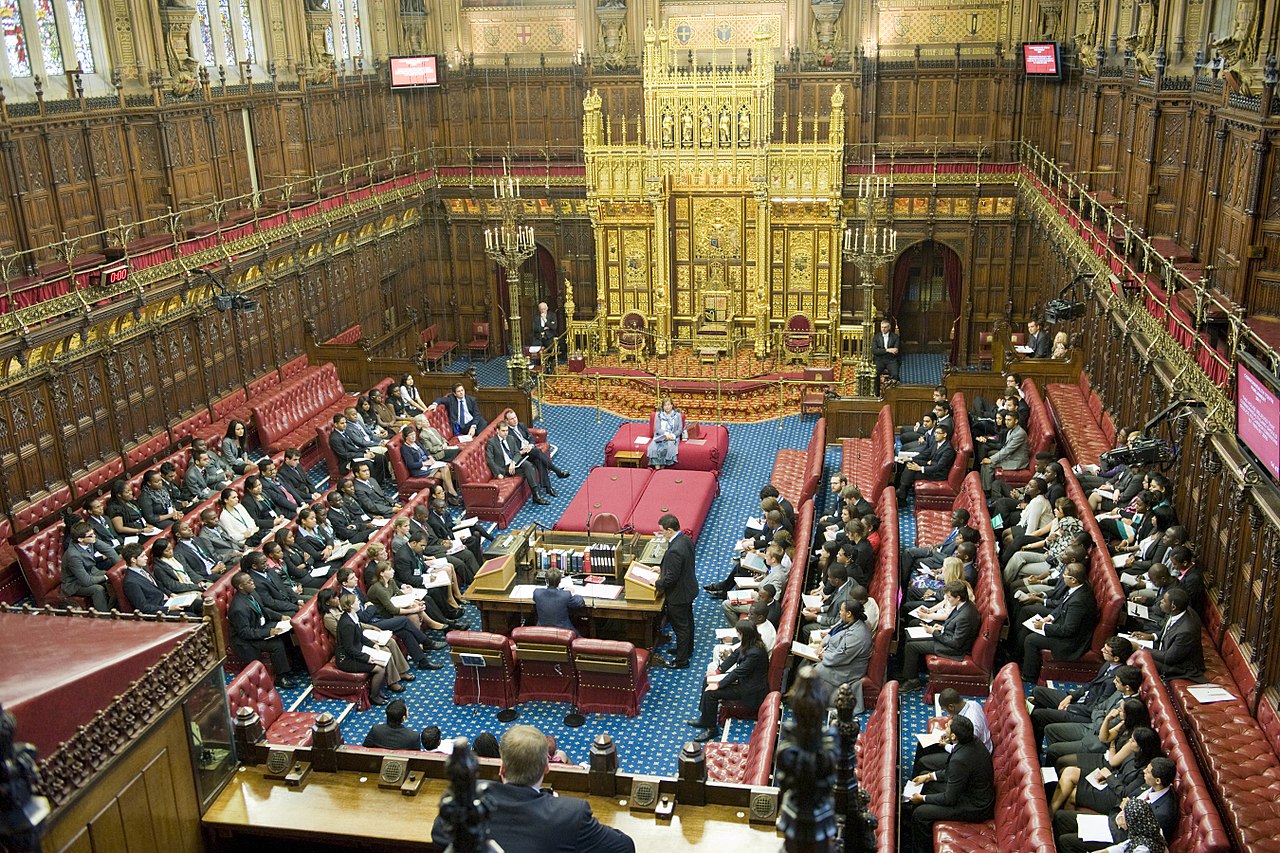
The House of Lords[7]
The House of Lords, as a key component of the Parliament of England (and later the Parliament of the United Kingdom), has its origins in the medieval period. Its beginnings can be traced back to the 11th century, but it started to take a more recognizable form in the 13th century. Here’s a brief overview of its development:
- Early Origins (11th Century): The House of Lords has its roots in the Witenagemot, an Anglo-Saxon council of nobles and clergy that advised the King. After the Norman Conquest in 1066, the concept of a royal council continued to evolve.
- Magna Carta (1215): The Magna Carta, signed by King John, marked a significant step in limiting the power of the monarchy and involving more people in governance. It paved the way for more structured forms of consultation and representation.
- Model Parliament (1295): The Model Parliament, convened by Edward I in 1295, is often cited as an important milestone. It included not only lords and clergy but also representatives from the counties and boroughs. This gathering is considered an early form of what later became the House of Lords and the House of Commons.
- 14th Century: By this time, the Parliament had started to split into two distinct houses. The House of Lords was composed of the nobility and high-ranking clergy, while the House of Commons represented the gentry and the townsfolk.
- House of Lords in Subsequent Centuries: Over the centuries, the House of Lords evolved, with its role and power changing, particularly as the House of Commons grew in authority. The Lords retained considerable power and influence well into the 19th and 20th centuries.

The House of Lords has been an integral part of the British parliamentary system for centuries, although its composition and powers have changed significantly over time, especially with reforms in the 19th and 20th centuries that altered its makeup and reduced its legislative power in favour of the elected House of Commons.
The Conservative Party
The Conservative Party, commonly known as the Tory Party, has its origins in the late 17th century. It began to form during the Exclusion Crisis (1678-1681)[8] and was fully established by the early 19th century. Key figures and milestones in its history include:
Sir Robert Peel (1788–1850)[9] 
- He is regarded as the father of modern British policing, owing to his founding of the Metropolitan Police Service.
- Peel was one of the founders of the modern Conservative Party.
- His Tamworth Manifesto[10] (1834) laid the foundations for the party’s principles, advocating for reform to respond to changing social conditions while maintaining traditional institutions.
Benjamin Disraeli (1804–1881)[11] 
- Prime Minister and a leading figure in the 19th century.
- Known for his rivalry with Liberal leader William Gladstone and for promoting “One Nation Conservatism,” which sought to unite the country across class divides.
- He made the Conservatives the party most identified with the British Empire and military action to expand it, both of which were popular among British voters. He is the only British Prime Minister to have been born Jewish. He was also a novelist, publishing works of fiction even as Prime Minister.
Winston Churchill (1874–1965)[12] 
- Led Britain as Prime Minister during World War II.
- Notable for his leadership during the war and his influence on post-war international politics.
- Apart from two years between 1922 and 1924, he was a Member of Parliament (MP) from 1900 to 1964 and represented a total of five constituencies. Ideologically an adherent to economic liberalism and imperialism, he was a member of the Conservative Party for most of his career, which he led from 1940 to 1955. He was a member of the Liberal Party from 1904 to 1924.
Harold Macmillan (1894-1986)[13] 
- He served with distinction during World War I, which had a profound impact on his views and politics.
- Macmillan was a member of the Conservative Party and was first elected to Parliament in 1924. He served in various ministerial roles, including as Minister of Housing and Local Government and as Chancellor of the Exchequer.
- Prime Minister: Macmillan became Prime Minister in 1957, following the resignation of Anthony Eden due to the Suez Crisis. His tenure as Prime Minister was marked by significant domestic reforms and an emphasis on improving the British economy.
- “Wind of Change” Speech: Macmillan is perhaps best known for his “Wind of Change” speech in 1960, delivered in South Africa, in which he acknowledged the growing national consciousness in Africa and the decline of the British Empire. This speech was a significant moment in the decolonisation process.
- Economic Policies: He presided over a period of economic prosperity and was known for his government’s interventionist economic policies. The era was marked by increased public spending and efforts to maintain full employment. His time as Prime Minister was significant in shaping post-war Britain, and his policies and speeches left a lasting impact on both the domestic and international stages.
Edward Heath (1916-2005)[14] 
- Heath entered politics in 1950, being elected as a Member of Parliament (MP) for Bexley. He held various ministerial positions in the Conservative governments of the 1950s and 1960s, including Chief Whip, Minister of Labour, and Secretary of State for Industry, Trade, and Regional Development.
- He became Prime Minister after the 1970 general election, defeating Harold Wilson’s Labour government.
- One of his most notable achievements was leading the UK into the EEC in 1973, an important step in the UK’s European integration. His government attempted to reform industrial relations, which led to significant conflicts with trade unions. Heath’s government faced economic challenges, including high inflation and the 1973 oil crisis. He oversaw a turbulent period in Northern Ireland, including the introduction of internment without trial and “Bloody Sunday” in 1972.
- After losing two general elections in 1974, Heath was replaced as Conservative leader by Margaret Thatcher in 1975. He remained a Member of Parliament until 2001, often publicly disagreeing with Thatcher’s policies.
Margaret Thatcher (1925–2013)[15] 
- She was the first female British prime minister and the longest-serving of the 20th century. As prime minister, she implemented economic policies that became known as Thatcherism. A Soviet journalist dubbed her the “Iron Lady“, a nickname that became associated with her uncompromising politics and leadership style.
- She was Prime Minister from 1979 to 1990.
- Known for her strong conservative policies, deregulation, privatisation of state-owned companies, and a reduction in the power and influence of trade unions.
John Major (born 1943):[16] 
- John Major served as Prime Minister of the United Kingdom and Leader of the Conservative Party from 1990 to 1997. His tenure followed that of Margaret Thatcher.
- He previously held Cabinet positions under Prime Minister Margaret Thatcher, the last as Chancellor of the Exchequer from 1989 to 1990.
- Major’s government is credited with overseeing a period of economic recovery following the early 1990s recession. He implemented policies that laid the groundwork for a long period of economic growth, although his term was also marked by the economic turbulence of Black Wednesday in 1992 when the UK was forced to withdraw from the European Exchange Rate Mechanism (ERM).
- Major’s government introduced several social reforms, including the National Lottery and the Citizen’s Charter, aimed at improving public services.
- One of Major’s significant legacies is his contribution to the Northern Ireland peace process. His government laid the groundwork for the Good Friday Agreement, which was signed after he left office.
- Major’s term saw the signing of the Maastricht Treaty, which furthered European integration and established the European Union. His tenure was marked by significant divisions within the Conservative Party over Europe, a legacy that continued to influence the party.
- John Major’s legacy is mixed, with notable achievements in the economic sector and the Northern Ireland peace process, counterbalanced by challenges such as party divisions over Europe and the impact of Black Wednesday.
David Cameron (born 1966)[17] 
- He identifies as a one-nation conservative and has been associated with both economically liberal and socially liberal policies.
- Cameron rose through the ranks of the Conservative Party and was elected as its leader in 2005, positioning himself as a moderniser of the party.
- He became Prime Minister in 2010, leading a coalition government with the Liberal Democrats, the first coalition in the UK since World War II.
- Cameron’s government implemented austerity measures aimed at reducing the UK’s budget deficit. He promoted economic policies that favoured tax cuts and reductions in public spending.
- His tenure saw the introduction of several socially liberal policies, including the legalisation of same-sex marriage in England and Wales.
- The austerity program, while intended to reduce fiscal deficit, was controversial and criticised for its impact on public services and welfare programs.
- In 2014, Cameron’s government granted Scotland a referendum on independence, which resulted in Scotland voting to remain in the United Kingdom. The referendum was a significant constitutional moment and had lasting implications for UK politics.
- Arguably the most defining event of his premiership was the 2016 referendum on the UK’s membership in the European Union. Cameron campaigned for the UK to remain in the EU. When that campaign failed, he resigned.
- Cameron is best remembered for calling the Brexit referendum, a decision that led to the UK voting to leave the EU and subsequently to his resignation as Prime Minister. He is also noted for his efforts to modernise the Conservative Party, making it more appealing to a broader section of the electorate with a mix of economically liberal and socially liberal policies.
Theresa May (born 1956):[18] 
- Theresa May served as the leader of the Conservative Party and Prime Minister from July 2016 to July 2019.
- Before becoming Prime Minister, May held various roles in government, including serving as the Home Secretary from 2010 to 2016.
- May became Prime Minister following the resignation of David Cameron after the Brexit referendum. She was elected as the Conservative Party leader unopposed.
- She focused on a number of domestic issues, including addressing mental health, racial disparity, and housing.
- She initiated and led the complex Brexit negotiations process, following the UK’s decision to leave the European Union.
- The central challenge of May’s tenure was navigating the Brexit process. Securing a Brexit deal that was acceptable to both the European Union and her own party proved highly difficult.
- Her leadership was marked by significant divisions within the Conservative Party, especially over Brexit.
- She called a snap general election in 2017, aiming to strengthen her mandate for Brexit negotiations. However, the election resulted in a hung parliament, weakening her position.
- May is best remembered for her efforts to deliver Brexit, a task that dominated her tenure as Prime Minister. Theresa May’s premiership was one of the most turbulent in recent British history, largely defined by the challenge of delivering Brexit. Her tenure highlighted the complexities and divisions surrounding the UK’s decision to leave the EU and the intricate dynamics of party politics in such a contentious context.
Boris Johnson (born 1964):[19] 
- Johnson served as Prime Minister and leader of the Conservative Party from July 2019 until 2022.
- Before becoming Prime Minister, Johnson was a Member of Parliament, Mayor of London (2008-2016), and Foreign Secretary (2016-2018). He has been a prominent and often divisive figure in British politics, known for his charismatic and unconventional style.
- Johnson became Prime Minister following the resignation of Theresa May, winning the Conservative Party leadership election with a campaign focused on delivering Brexit.
- Successfully negotiated a revised Brexit withdrawal agreement and led the UK out of the European Union in January 2020, fulfilling his primary promise of “getting Brexit done.”
- He won a significant majority in the December 2019 general election, strengthening his position in Parliament and within the Conservative Party.
- He led the UK government’s response to the COVID-19 pandemic, including implementing lockdowns and overseeing the rollout of the vaccination program. Nevertheless, he faced criticism for aspects of his government’s handling of the pandemic, including the timing of lockdowns and the impact on the economy and public health.
- Johnson’s leadership style and decisions led to internal disputes within the Conservative Party and a number of high-profile resignations from his government.
- His tenure has been marked by several controversies, including those related to personal conduct and adherence to government guidelines, particularly during the COVID-19 pandemic.
- He is likely to be best remembered for leading the UK out of the European Union, a defining event in recent British history. His handling of the COVID-19 pandemic, including the vaccination rollout, will be a significant part of his legacy.
- Boris Johnson’s leadership style, combined with the circumstances of Brexit and the global pandemic, has made his time in office one of the most tumultuous in recent British political history.
These figures, among others, have shaped the Conservative Party’s evolution and played pivotal roles in British politics, reflecting and influencing the broader social and economic trends of their time.
The Labour Party
The Labour Party in the United Kingdom was officially founded in 1900. It originated as a coalition of trade unions and socialist groups, with the aim of representing the interests of the working class in Parliament. Significant figures in the history of the Labour Party include:
Keir Hardie (1856–1915):[20] 
- One of the founding members of the Labour Party.
- He was the first leader of the party and its first Member of Parliament (MP).
- He advocated for social reforms and workers’ rights.
- Initially, Hardie supported William Gladstone’s Liberal Party but later concluded that the working class needed its own party. He first stood for parliament in 1888 as an independent and, later that year, helped form the Scottish Labour Party. Hardie won the English seat of West Ham South as an independent candidate in 1892 and helped to form the Independent Labour Party (ILP) the following year. He lost his seat in 1895 but was re-elected to Parliament in 1900 for Merthyr Tydfil in South Wales. In the same year, he helped to form the union-based Labour Representation Committee, which was later renamed the Labour Party.
Ramsay MacDonald (1966-1937):[21] 
- Although not a founding member of Labour, MacDonald became a prominent leader in the early Labour Party, eventually becoming its first Prime Minister.
- He led minority Labour governments for nine months in 1924 and again between 1929 and 1931.
- From 1931 to 1935, he headed a National Government dominated by the Conservative Party and supported by only a few Labour members. MacDonald was expelled from the Labour Party as a result.[22]
Clement Attlee (1883–1967):[23] 
- Prime Minister from 1945 to 1951.
- Deputy Prime Minister during the wartime coalition government under Winston Churchill, and served twice as the Leader of the Opposition from 1935 to 1940 and from 1951 to 1955.
- Attlee remains the longest-serving Labour leader and is widely considered by historians and members of the public through various polls to be one of the greatest Prime Ministers of the United Kingdom.
- Oversaw significant social reforms and the establishment of the welfare state, including the creation of the National Health Service (NHS).
Harold Wilson (1916-1995):[24] 
- Served as Prime Minister of the United Kingdom twice, from October 1964 to June 1970 and again from March 1974 to April 1976. He was Party Leader from 1963 to 1976 and was a Member of Parliament from 1945 to 1983.
- Wilson’s government implemented a range of social and educational reforms. These included the abolition of capital punishment, the legalisation of abortion, the decriminalisation of homosexuality in England and Wales, and the introduction of comprehensive education. The Open University was established under Wilson’s leadership, increasing access to higher education.
- Wilson’s time in office was marked by considerable economic difficulties, including high inflation, balance of payment issues, and a struggling British pound. His government attempted various measures, including the devaluation of the pound in 1967 and an unsuccessful bid to join the European Economic Community in 1967.
James (Jim) Callaghan (1912–2005):[25] 
- Served as Prime Minister from 1976 to 1979, succeeding Wilson.
- He was Leader of the Labour Party from 1976 to 1980. Callaghan is the only person to have held all four Great Offices of State, having served as Chancellor of the Exchequer from 1964 to 1967, Home Secretary from 1967 to 1970 and Foreign Secretary from 1974 to 1976. He was a Member of Parliament (MP) from 1945 to 1987.
- His tenure was marked by economic difficulties, including the Winter of Discontent, which led to widespread strikes and, ultimately, the fall of his government.
Anthony (Tony) Blair (born 1953):[26] 
- Blair served as Prime Minister of the United Kingdom from 1997 to 2007 and Leader of the Labour Party from 1994 to 2007.
- He served as Leader of the Opposition from 1994 to 1997 and held various shadow cabinet posts from 1987 to 1994.
- He was appointed to Neil Kinnock’s shadow cabinet in 1988 and was appointed shadow home secretary by John Smith in 1992. Following Smith’s death in 1994, Blair won a leadership election to succeed him. As leader, Blair began a historic rebranding of the party, which became known as “New Labour”.
- Blair is the second-longest-serving prime minister in post-war British history (after Margaret Thatcher) and the longest-serving Labour politician to have held the office.
- Blair’s contribution towards assisting the Northern Ireland peace process by helping to negotiate the Good Friday Agreement (after 30 years of conflict) has been widely recognised.
Gordon Brown (born 1951):[27] 
- Prime Minister and Leader of the Labour Party from 2007 to 2010.
- He previously served as Chancellor of the Exchequer under Tony Blair from 1997 to 2007. He was Member of Parliament (MP) for Dunfermline East from 1983 to 2005 and, following boundary changes, Kirkcaldy and Cowdenbeath from 2005 to 2015.
- Brown is both the most recent Labour Party politician and the most recent Scottish and non-English politician to hold the office of prime minister.
- His time as PM was dominated by the global financial crisis, to which he responded with a bank rescue package and stimulus measures.
Neil Kinnock (born 1942):[28] 
- Led the party from 1983 to 1992 and was instrumental in modernising the party, including efforts to reduce the influence of far-left factions and trade unions.
- Although he never became Prime Minister, his leadership paved the way for the rise of New Labour.
These figures, among others, have shaped the Labour Party’s ideology, policies, and role in British politics throughout its history. Each brought unique perspectives and led the party through different eras, responding to the challenges and opportunities of their times.
Before the Labour Party Existed
Before the formal establishment of the Labour Party in 1900, several movements and organisations existed in Britain that represented left-wing, socialist, or labour-oriented interests. Key among these were:
- Trade Unions: The Industrial Revolution led to the rise of trade unions in the 19th century. These unions were crucial in advocating for workers’ rights and better working conditions. They were instrumental in the labour movement and laid the groundwork for the political representation of the working class.
- The Chartist Movement (1838-1857): This was a working-class movement for political reform, which sought universal suffrage and a more democratic parliamentary system. While not explicitly a party, the Chartists were significant in mobilising and politicising the working class.
- Socialist Societies: Various socialist groups and thinkers emerged during the 19th century. These included the Fabian Society (founded in 1884), which advocated for gradual and reformist approaches to socialism, and the Independent Labour Party (founded in 1893), a socialist political party that later became part of the Labour Party.
- The Co-operative Movement: Started in the mid-19th century, it focused on co-operative ownership and democratic principles in business and commerce. This movement had a significant impact on the economic aspects of the left-wing ideology in Britain.
- Radical Liberalism: Within the Liberal Party, there was a radical faction that supported social reforms, workers’ rights, and poverty alleviation. Some of these radical liberals eventually joined or supported the emerging Labour movement.
- Influence of Marxism: The late 19th century saw the growing influence of Marxist ideas in Britain. The dissemination of these ideas, especially among trade unions and socialist societies, played a role in shaping the ideological direction of the emerging Labour movement.
- The Taff Vale Case (1901): Although this occurred slightly after the formation of the Labour Party, the Taff Vale Railway Co v Amalgamated Society of Railway Servants case had a significant impact on the trade union movement. The ruling against the trade union fuelled the urgency for political representation, consolidating support for the Labour Party.
- Women’s Suffrage Movement: While not exclusively aligned with the Labour movement, the women’s suffrage movement also contributed to the broader push for social reforms and democratic rights during this period.
- International Influences: The influence of international socialist and labour movements, such as those in continental Europe and the United States, also played a role in shaping the ideology and strategies of British left-wing organisations.
These groups and movements were crucial in advancing the cause of the working class and setting the stage for the creation of the Labour Party, which aimed to consolidate these various left-wing and labour interests into a single political entity with greater parliamentary representation.
The Liberal Democrats Party
The Liberal Democrats, often referred to as the Lib Dems, are a political party in the United Kingdom known for their centrist and liberal positions. Here are key aspects of the party’s history, ideology, and political role:
- Formation and Background: The Liberal Democrats were formed in 1988 from a merger of the Liberal Party and the Social Democratic Party (SDP). The merger was the culmination of a period of cooperation between the two parties, known as the Liberal-SDP Alliance, which had been formed in the early 1980s in response to dissatisfaction with the major Labour and Conservative parties.
- Ideological Stance: The party positions itself as centrist, promoting liberal and progressive policies. Key tenets include social liberalism, support for civil liberties, pro-European Union sentiment, environmentalism, and advocacy for electoral reform, particularly the adoption of proportional representation.
- Electoral Performance: The Lib Dems have traditionally been the third-largest party in UK politics, after the Conservative and Labour parties. They have had varying electoral successes, typically doing well in local and European elections and having a significant presence in the House of Commons.
- Coalition Government (2010-2015): A significant moment in the party’s history came after the 2010 general election, which resulted in a hung parliament. The Lib Dems, led by Nick Clegg, formed a coalition government with the Conservative Party, with Clegg serving as Deputy Prime Minister. This period was marked by compromises and controversies, notably the party’s U-turn on university tuition fees, which damaged its reputation among many of its supporters.
- Recent Developments: In recent years, the party has positioned itself as strongly anti-Brexit, advocating for the UK’s remaining in or rejoining the European Union. The party has struggled to regain the level of support it enjoyed prior to its coalition government period.
- Leadership: The party has had several leaders since its formation, with each bringing different focuses and styles. Leaders like Paddy Ashdown, Charles Kennedy, Nick Clegg, and more recently, Jo Swinson and Sir Ed Davey, have sought to carve out distinct political spaces for the party in a landscape dominated by the larger Conservative and Labour parties.
The Liberal Democrats continue to play an influential role in British politics, particularly in local government and as a voice for liberal and centrist perspectives on national issues. The party’s emphasis on civil liberties, social justice, and European integration remains central to its identity and appeal. Key figures in its history are:
David Steel (born 1938):[29] 
- David Steel served as the leader of the Liberal Party, a precursor to the Liberal Democrats, from 1976 to 1988.
- Steel’s leadership coincided with a critical period in British politics. He became the leader of the Liberal Party in 1976 and held this position until 1988, a total of 12 years.
- During his tenure, he was known for his efforts to forge alliances and his willingness to collaborate with other parties.
- One of Steel’s most notable achievements was the formation of the Liberal-SDP Alliance with the Social Democratic Party (SDP) in 1981. This Alliance aimed to offer a centrist alternative to the dominant Labour and Conservative parties. Under his leadership, the Alliance achieved significant success in the 1983 general election, gaining over 25% of the popular vote.
- Steel was also instrumental in advocating for liberal policies, including civil liberties and social reform.
- Despite the initial success of the Alliance, it ultimately failed to break the two-party dominance in British politics. The electoral system worked against them, resulting in a disproportionally low number of seats compared to the vote share. This outcome was seen as a significant setback for Steel’s vision of a strong centrist force in UK politics.
- David Steel’s legacy in British politics is mixed. On the one hand, he is credited with bringing the Liberals back to prominence and for his role in forming the Alliance, which was a bold attempt to reshape the British political landscape. On the other hand, the failure to convert popular support into parliamentary power and the eventual dissolution of the Alliance marked a limitation of his political strategy. His tenure is often remembered for the ambitious attempt to provide a third-way alternative in British politics.
Robert Maclennan (1936-2020):[30] 
- Robert Maclennan was a prominent figure in British politics and a leader of the Social Democratic Party (SDP), which later merged with the Liberal Party to form the Liberal Democrats.
- Maclennan served as the leader of the Social Democratic Party from 1987 to 1988. His leadership was brief but occurred during a pivotal time in the party’s history.
- Maclennan’s most significant achievement was overseeing the merger of the SDP with the Liberal Party, which led to the formation of the Liberal Democrats in 1988. This merger was a crucial step in consolidating the centrist and liberal forces in British politics. Maclennan played a key role in negotiating the terms of the merger and ensuring a smooth transition.
- Whilst Maclennan’s tenure was marked by the successful merger, it also came at a time when the SDP was struggling to maintain its distinct identity and political relevance. The party had faced electoral challenges and internal divisions, which Maclennan had to navigate. The decision to merge was not without its critics, both within the party and among its supporters.
- Bob Maclennan’s legacy is closely tied to the creation of the Liberal Democrats. He is remembered for his pragmatic approach to politics and his commitment to the ideals of social democracy. The merger he facilitated has had a lasting impact on the political landscape of the United Kingdom, providing a unified voice for centrist and liberal values. His leadership, though brief, was crucial in shaping the direction of liberal politics in the UK.
Paddy Ashdown (1941-2018):[31] 
- Ashdown led the Liberal Democrats from the party’s formation in 1988 until 1999. His leadership spanned 11 years, during which he established the party as a significant force in British politics.
- Under Ashdown’s leadership, the Liberal Democrats grew in prominence and influence. He was known for his strong advocacy of civil liberties, environmental issues, and social justice. One of his key achievements was increasing the party’s representation in Parliament. The Liberal Democrats made significant gains in the 1997 general election, nearly doubling their number of seats, partly due to Ashdown’s effective leadership and the party’s clear policy stances. Additionally, he fostered closer relations with the Labour Party, exploring the potential for cooperation in what was known as “the project.”
- Despite these successes, Ashdown also faced challenges. The Liberal Democrats often struggled to assert themselves as a distinct political force against the dominant Labour and Conservative parties. While the party made electoral gains, it was not able to break the two-party dominance in UK politics or significantly influence government policy during Ashdown’s tenure.
- Paddy Ashdown’s legacy is marked by his role in establishing the Liberal Democrats as a credible third force in British politics. His charismatic leadership, commitment to liberal values, and vision for a more equitable society left a lasting impact on the party and its supporters. He is remembered for his dedication to public service, both in politics and in his earlier career in the military and intelligence services. His death in 2018 was widely mourned, and he is respected for his contributions to shaping a more pluralistic political landscape in the UK.
Charles Kennedy (1959-2015):[32] 
- Charles Kennedy was a prominent Scottish politician and leader of the Liberal Democrats in the United Kingdom from 1999 to 2006, during which he became known for his personable style and approachable demeanour.
- One of Kennedy’s most notable achievements was leading the Liberal Democrats to their best election result in decades in the 2005 general election. Under his leadership, the party won 62 seats, capitalising on widespread opposition to the Iraq War, which Kennedy and the Liberal Democrats had strongly opposed. His leadership was marked by a commitment to social justice, civil liberties, and opposition to the centralisation of power.
- Kennedy’s tenure as party leader was also marked by personal struggles, which somewhat overshadowed his political achievements and led to a period of instability within the party.
- Despite the challenges, Charles Kennedy’s legacy in British politics is significant. He is remembered for his principled stand against the Iraq War, his ability to communicate complex issues in a relatable manner, and his contributions to building the Liberal Democrats as a credible political force. His approachable nature and commitment to liberal values resonated with many voters and helped to broaden the appeal of the party. His untimely death in 2015 was met with tributes from across the political spectrum, highlighting his impact and the respect he garnered during his career.
Menzies “Ming” Campbell (born 1941):[33] 
- Campbell served as the leader of the Liberal Democrats from January 2006 to October 2007. His leadership, though relatively brief, occurred during a critical period of transition for the party.
- One of Campbell’s key achievements as leader was maintaining party unity and stability following the resignation of his predecessor, Charles Kennedy. He brought a sense of experience and gravitas to the role, leveraging his extensive background in foreign affairs and defence. Campbell was instrumental in shaping the party’s policies on international issues, particularly its stance against the Iraq War, and advocating for civil liberties and constitutional reform.
- Despite his experience and respected status, Campbell’s tenure as leader faced challenges. He struggled with public perception, particularly concerning his age and media portrayal. Additionally, under his leadership, the Liberal Democrats faced difficulties in significantly increasing their support base or parliamentary representation. His leadership was also marked by some internal party tensions and criticisms over the direction and visibility of the party.
- Ming Campbell’s legacy in the Liberal Democrats and British politics is marked by his expertise in foreign affairs and his dignified approach to leadership. He is respected for his integrity, experience, and commitment to liberal values. Although his time as leader was short, he played a crucial role in steering the party through a challenging period and laying the groundwork for his successors. His subsequent contributions as a senior figure in the party and his ongoing advocacy for liberal and internationalist causes have continued to influence Liberal Democrat politics.
Nick Clegg (born 1967):[34] 
- Clegg served as the leader of the Liberal Democrats from 2007 to 2015, a period marked by significant political events and challenges.
- One of Clegg’s most significant achievements was leading the Liberal Democrats into a coalition government with the Conservative Party following the 2010 general election. This was the first coalition government in the UK since the Second World War and represented a significant moment in British politics.
- During his tenure as Deputy Prime Minister, Clegg and his party were able to influence several key policy areas, including raising the income tax threshold and investing in education through the Pupil Premium.
- The coalition government was also the source of significant challenges and controversies for Clegg and the Liberal Democrats. The decision to form a coalition with the Conservatives was seen as a betrayal by some party supporters, particularly over the issue of university tuition fees. The party had campaigned against any increase in fees, but the coalition government, in which they were a junior partner, increased them significantly. This decision damaged the party’s reputation among its core supporters and led to a significant loss of trust.
- Nick Clegg’s legacy is complex. Whilst he is credited with taking the bold step of leading his party into government and having an influence on national policy, the compromises made during the coalition, particularly on tuition fees, led to a significant decline in support for the Liberal Democrats, culminating in a dramatic loss of seats in the 2015 general election. His tenure illustrates the challenges of smaller parties in coalition governments, balancing influence with the need to maintain distinct party identity and trust among voters, and he has continued to be an influential voice in British and international politics.
Tim Farron (born 1970):[35] 
- Farron led the Liberal Democrats from 2015 to 2017, during which he sought to rebuild the party following its significant losses in the 2015 general election.
- One of Farron’s main achievements was his effort to re-establish the Liberal Democrats as a distinct and viable political force in the aftermath of the coalition government’s unpopularity. He focused on issues such as civil liberties, social justice, and particularly on opposing Brexit, positioning the Liberal Democrats as the leading pro-European Union party in the UK. Under his leadership, the party experienced a surge in membership and a modest increase in vote share and parliamentary seats in the 2017 general election.
- Despite these efforts, Farron faced challenges in significantly increasing the party’s influence and parliamentary representation. His leadership was also marked by controversy over his personal beliefs, particularly concerning issues of gay rights, which became a focal point of media scrutiny and led to questions about his ability to lead a progressive, liberal party.
- Tim Farron’s legacy in the Liberal Democrats is one of stabilisation and reorientation after a period of significant electoral decline. His tenure is marked by his efforts to realign the party’s focus towards civil liberties and pro-EU stance, which became particularly relevant during the Brexit debates. His leadership helped to set the stage for future party growth, although it was also a period of internal reflection and ideological debate within the party. After stepping down as leader, Farron has continued to be an active member of Parliament and voice within the party.
Vince Cable (born 1943):[36] 
- Vince Cable served as the leader of the Liberal Democrats from 2017 to 2019.
- Cable’s leadership of the Liberal Democrats lasted for about two years. His tenure came at a time when the UK was deeply embroiled in the complexities of Brexit negotiations, and he brought significant experience and expertise, particularly in economic matters, to his leadership role.
- One of Cable’s key achievements was his strong advocacy for a second referendum on Brexit, positioning the Liberal Democrats as the leading pro-European Union party in the UK. He focused on rebuilding the party’s support base and policy platform after the 2015 general election and the 2016 Brexit referendum. Under his leadership, the Liberal Democrats made gains in local elections, and the party saw a resurgence in membership.
- Despite these efforts, Cable’s leadership faced challenges in making significant inroads in national polls and in substantially increasing the party’s representation in Parliament. Some critics argued that his leadership lacked visibility and impact in national debates beyond the issue of Brexit.
- Vince Cable’s legacy in the Liberal Democrats is marked by his efforts to steer the party through a turbulent period in UK politics, dominated by Brexit. He is credited with stabilizing the party and beginning the process of rebuilding after significant electoral losses. His emphasis on economic competence and social justice helped to re-establish the Liberal Democrats’ policy credentials. After stepping down as leader, Cable has remained an influential figure in British politics, known for his expertise in economic affairs and his advocacy for liberal and progressive policies.
Jo Swinson (born 1980):[37] 
- Swinson’s leadership of the Liberal Democrats was brief, lasting just a few months in 2019.
- Her tenure was marked by a critical period in British politics, dominated by the Brexit debate and a general election.
- During her short leadership, Swinson sought to position the Liberal Democrats as the foremost pro-European Union party, advocating for a second Brexit referendum and campaigning to stop Brexit. Under her leadership, the party adopted a bold stance of revoking Article 50 if they won a majority in the general election. This period also saw an increase in party membership and a brief surge in the polls.
- The 2019 general election was a significant setback for Swinson and the Liberal Democrats. The party’s strategy and Swinson’s leadership were criticised after they failed to translate the initial surge in support into electoral gains. Contrary to expectations, the Liberal Democrats won fewer seats than they had in the previous Parliament, and Swinson herself lost her seat in the House of Commons. The party’s stance on Brexit, particularly the policy of revoking Article 50 without a referendum, was seen as too extreme by some voters.
- Jo Swinson’s legacy in the Liberal Democrats is marked by her distinction as the first woman to lead the party and her ambitious, albeit risky, political strategy during a tumultuous time in UK politics. Her tenure reflects the challenges faced by the party in navigating the polarized landscape of Brexit and the difficulties in converting strong pro-EU sentiment into electoral success. After her leadership, Swinson continued to be involved in public life and discourse, focusing on issues such as gender equality and climate change.
These leaders, along with numerous MPs, activists, and members, have contributed to the development and evolution of the Liberal Democrats, navigating the challenges of being a centrist party in the UK’s predominantly two-party system.
Scottish National Party (SNP
The Scottish National Party (SNP) is a political party in Scotland that advocates for Scottish independence and operates within the wider context of British politics. The SNP has been a significant force in Scottish and UK politics, particularly in the 21st century. The party was founded in 1934 through the merger of the National Party of Scotland and the Scottish Party. The primary goal of the SNP is to achieve Scottish independence, envisioning Scotland as a sovereign state separate from the United Kingdom. Key Leaders have been:
Andrew Dewar Gibb (1888-1974):[38]
- Andrew Gibb was the second leader of the SNP, serving from 1936 until 1940
- He played a pivotal role in establishing the SNP and setting the foundation for its future growth.
- His leadership period was brief and in the early, formative years of the party.
- He is best remembered as a founding figure of the SNP, setting the ideological and organisational groundwork for the party.
William Power (1873-1951):[39]
- Power led SNP through the challenging early wartime years (1940-1942).
- He served as President of the Scottish Convention between 1942 and 1951.
- Power succeeded Andrew Dewar Gibb as the leader of the SNP. At the SNP Annual Conference in May 1942, he was re-nominated by John MacCormick for the post of leader of the SNP, but he was narrowly defeated (33 votes to 29) by Douglas Young.
- His tenure is less well-documented than others but was crucial in maintaining the continuity of the SNP during a turbulent time.
Douglas Young (1913-1973):[40] 
- Young led the SNPs through the World War II years 1942-1945.
- He was known for his strong stance against conscription.
- Young led a nationalist party during a time of national crisis (WWII), which posed significant challenges.
- He is remembered for his principled stand during the war, particularly regarding conscription.
Bruce Watson (1910-1988):[41]
- Watson’s leadership came immediately after World War II (1945-1947).
- Not much is widely known about his specific achievements and challenges.
- Watson’s leadership is a lesser-known period in the SMP’s history.
Robert McIntyre (1913-1998):[42]
- McIntyre led the SNP for nearly a decade after WWII (1947-1956).
- He was the first SNP candidate to win a Westminster seat (Motherwell, 1945).
- One of his main challenges was building the party’s profile in the post-war period.
- He was known as the “Father of the SNP” and played a crucial role in the party’s early parliamentary breakthroughs.
James Halliday (1927-2013):[43]
- Halliday, when aged only 28, became the chairman (leader) of the Scottish National Party (SNP) in 1956 and held that position until 1960.
- Halliday oversaw the SNP during a period of steady presence in Scottish politics.
- His leadership is seen as a period of consolidation for the SNP.
Arthur Donaldson (1901-1993):[44] 
- Donaldson’s leadership tenure ran from 1960 to 1969 – a period of significant growth for the SNP.
- During his time as leader, he oversaw a surge in party membership and electoral support.
- Donaldson faced scrutiny and was briefly detained in 1940 under suspicion of pro-German sympathies during WWII (before his leadership tenure).
- He is best remembered for expanding the SNP’s influence and membership.
William Wolfe (1924-2010):[45]
- Wolfe’s leadership (1969-1979) saw the SNP’s significant electoral breakthrough in the 1970s.
- The SNP’s strong performance in the October 1974 general election was a highlight moment of his career.
- He faced the challenge of balancing the rapid growth of the party with internal organisational needs.
- Wolfe is remembered for bringing the SNP to a position of significant political relevance.
Gordon Wilson (1938-2017):[46] 
- Wilson led the SNP (1979-1990) during the Thatcher era, a challenging time for Scottish politics.
- He maintained the party’s presence in difficult political circumstances.
- His main challenges were dealing with electoral setbacks and internal party strife.
- His tenure is seen as a period of resilience and persistence for the SNP.
Alex Salmond (born 1954):[47] 
- Salmond has served two terms (1990-2000 and 2004-2014), with the second term marked by significant electoral success and the 2014 independence referendum.
- He was elected to the British House of Commons in 1987, serving as the Member of Parliament (MP) for Banff and Buchan from 1987 to 2010.
- He led the SNP to form its first government in Scotland; the 2014 referendum was a pivotal moment for his party.
- The 2014 referendum did not result in independence, which was a significant setback.
- Salmond led an SNP minority government in his first term. His government passed landmark legislation, including the abolishment of university tuition fees, the scrapping of prescription charges and commitment to renewable energy.
- Salmond is one of the most influential figures in the SNP, known for bringing the party to unprecedented heights.
John Swinney (born 1964):[48] 
- Swinney’s leadership tenure (2000-2004), focused on party consolidation post-1999 Scottish Parliament election.
- He held various Scottish Cabinet roles under First Ministers Alex Salmond and Nicola Sturgeon from 2007 to 2023.
- Under his leadership, the position of SNP was strengthened in the newly established Scottish Parliament.
- His leadership is marked by efforts to build the party’s credibility and readiness for governance.
Nicola Sturgeon (born 1970):[49] 
- Nicola Sturgeon was the first female leader of the SNP. She served as First Minister of Scotland and Leader of the Scottish National Party (SNP) from 2014 to 2023, leading the party in the post-referendum era.
- She oversaw continued electoral successes for the SNP and has been a prominent voice in the Brexit debate.
- A major challenge was navigating the complexities of Brexit and continuing the push for Scottish independence.
- Sturgeon’s leadership was marked by her strong advocacy for Scottish independence and handling of the COVID-19 pandemic.
- She resigned on 28th March 2023.
Each of these leaders has played a crucial role in shaping the SNP’s direction and its position within Scottish and UK politics. The SNP has played a central role in shaping Scottish politics, especially since the devolution era began in 1999, and the party’s push for independence has significantly influenced the political discourse in the UK. In recent years, the SNP has held a majority or been the largest party in the Scottish Parliament, giving it considerable influence over Scottish governance.
The SNP’s future ambitions, particularly regarding Scottish independence, remain a key factor in the political dynamics of both Scotland and the United Kingdom.
Green Party
The Green Party of England and Wales, known for its environmental focus and progressive policies, has had several leaders since its formation. It is important to note that the party has undergone various structural changes over the years, including a period when it did not have a single leader but was led by principal speakers.
The party was formed in 1973. Initially, it was known as the PEOPLE Party, and it was one of the earliest green political parties in the world. The party underwent a few name changes, becoming the Ecology Party in 1975 and then adopting its current name, the Green Party of England and Wales, in 1985. This evolution reflected the party’s growing focus on a broad range of environmental issues and its position in the wider green political movement. Here are the key leaders of the Green Party:
Jonathon Porritt (born 1950):[50] 
- Served as the leader of the UK Green Party (then called the Ecology Party) from 1980 to 1984.
- One of Porritt’s key achievements was significantly raising the profile of environmental issues in the UK during the early 1980s, a time when these issues were not mainstream in political discourse.
- Under his leadership, the Ecology Party saw an increase in its membership and began to gain more media attention, helping to establish a firmer footing in British politics.
- During this period, green politics were still on the fringes of the British political landscape. One of the primary challenges Porritt faced was the struggle to gain serious attention and legitimacy in a political arena dominated by traditional parties.
- Porritt was successful in influencing public opinion and bringing environmental issues to the attention of a broader audience. He played a crucial role in starting conversations about sustainable development and environmental protection at a national level.
- Despite growing awareness and membership, the Ecology Party under Porritt’s leadership did not achieve significant electoral success, largely due to the UK’s electoral system, which favoured larger parties.
- Porritt is best remembered for laying the foundations for the future growth and influence of green politics in the UK.
Sara Parkin (born 1946):[51]
- Served as a leader of the UK Green Party (then the Ecology Party) from 1985 to 1992.
- Parkin was instrumental in the development of the Green Party, particularly in professionalising the party and enhancing its organisational structure.
- She played a significant role in increasing public awareness about environmental issues and the Green Party’s policy platform.
- A major challenge during her tenure was the UK’s political landscape, which was not very conducive to green politics at the time, especially under the dominance of the Conservative government led by Margaret Thatcher.
- Under Parkin’s leadership, the Green Party gained greater visibility and started to be taken more seriously as a political force, especially after the 1989 European Parliament election where the party secured a substantial vote share.
- Parkin contributed to the development of comprehensive policy frameworks that extended beyond traditional environmental issues to include social justice and economic sustainability. But despite increased popularity and visibility, the Green Party struggled to translate this into substantial electoral gains in terms of parliamentary seats, partly due to the electoral system.
- Parkin is best remembered for her role in advancing green politics in the UK, particularly in terms of integrating environmental concerns with broader socio-economic issues.
Jean Lambert (born 1950):[52] 
- Lambert served as the leader of the Green Party of England and Wales from 1992 to 1993.
- Lambert contributed to the ongoing development of the Green Party, helping to stabilise and consolidate its position in the early 1990s.
- She was known for her strong advocacy on environmental issues, as well as social justice and human rights, broadening the party’s appeal beyond traditional green politics.
- Lambert’s tenure was marked by the challenge of making green politics a significant part of the political discourse in the UK, which at the time was still heavily dominated by the major parties.
- The Green Party continued to face difficulties in gaining significant representation in Parliament due to the first-past-the-post electoral system.
- Under Lambert’s leadership, the Green Party maintained its course towards becoming a more recognised political entity in the UK, especially in local government.
- Lambert played a role in influencing policy discussions, particularly in London, where she later served as an MEP.
- Despite efforts, the Green Party still faced limitations in significantly impacting national policy or achieving substantial electoral success during her tenure.
- Although her leadership of the Green Party was brief, Lambert is perhaps best remembered for her subsequent role as a Member of the European Parliament (MEP) for London from 1999 to 2019, where she was a strong advocate for environmental issues, human rights, and social justice.
- Her work both in the Green Party and as an MEP has been influential in shaping green politics in the UK and Europe.
Natalie Bennett (born 1966):[53] 
- Bennett served as the leader of the Green Party from 2012 to 2016.
- Under her leadership, the Green Party experienced a significant increase in membership, particularly during the period known as the ‘Green Surge’ around 2014-2015.
- Bennett played a crucial role in raising the profile of the Green Party, particularly in the run-up to the 2015 general election, where the party achieved its highest-ever vote share in a general election.
- Bennett was instrumental in increasing the party’s presence in national media and debates, advocating for policies on climate change, social justice, and electoral reform.
- The major challenge during her tenure was the first-past-the-post electoral system, which made it difficult to translate increased support into parliamentary seats.
- Bennett faced the challenge of broadening the appeal of the Green Party beyond its traditional base and making it a credible alternative to the major parties.
- Under her leadership, the Green Party saw improved performances in local and national elections, although this did not significantly increase parliamentary representation.
- Bennett helped to shape and communicate the party’s policies, emphasising a broader agenda that included economic and social issues alongside environmental concerns.
- Bennett is best remembered for leading the party during the ‘Green Surge’, a period of rapid growth in membership and public interest in the party. Her strong advocacy for green policies and her efforts to position the Green Party as a viable alternative in the UK political landscape.
Caroline Lucas (born 1960):[54] 
- Lucas first served as leader of the Green Party from 2008 to 2012 and then as co-leader with Jonathan Bartley from 2016 to 2018.
- Lucas became the first-ever Green Party Member of Parliament (MP) in the UK, winning the Brighton Pavilion seat in 2010. This was a historic achievement for the Green Party, significantly raising its profile.
- Under her leadership, the Green Party experienced substantial growth in membership and electoral support, known as the ‘Green Surge’.
- The first-past-the-post electoral system in the UK remained a significant barrier to achieving broader parliamentary representation.
- Lucas faced the ongoing challenge of mainstreaming environmental issues in a political landscape dominated by larger parties.
- Lucas has been successful in bringing environmental and social justice issues to the forefront of political debate, both as a party leader and as an MP.
- She has greatly increased the visibility and credibility of the Green Party, both nationally and internationally.
- Lucas is best remembered as a leading advocate for environmental issues, consistently pushing for action on climate change, sustainable development, and social justice.
- Her election as the first Green MP represents a landmark moment in the history of the Green Party and green politics in the UK.
- Caroline Lucas’ leadership and ongoing work in British politics have had a significant impact on the Green Party and the broader environmental movement. Her role as an MP and a leading voice on green issues has brought greater attention and legitimacy to the party’s policies and objectives.
Jonathan Bartley (born 1971):[55] 
- Bartley served as co-leader of the Green Party, first with Caroline Lucas from 2016 to 2018 and then with Siân Berry from 2018 to 2021.
- Bartley’s tenure was notable for the successful implementation of the co-leadership model in the Green Party. This model was seen as innovative and reflective of the party’s values of inclusivity and shared responsibility.
- Under his co-leadership, the Green Party made significant gains in local elections, increasing their number of councillors and gaining control of more council seats across England and Wales.
- Bartley, along with his co-leaders, played a crucial role in maintaining the party’s media presence and visibility, effectively communicating its policies and vision.
- Despite successes in local elections, the Green Party continued to face challenges in increasing its representation at the national level, partly due to the electoral system.
- The expansion of the Green Party’s presence in local government was a notable success, demonstrating the party’s growing influence at the grassroots level.
- Bartley is best remembered for his strong advocacy on environmental issues, as well as social justice, and for his role in leading the party through a period of growth and increased political relevance.
- His adoption of the co-leadership model, which was seen as embodying the party’s ethos of collaborative and inclusive leadership.
- Jonathan Bartley’s period of co-leadership in the Green Party marks an important phase in the party’s history, characterised by electoral gains at the local level and a continued push to broaden the party’s influence and appeal in UK politics.
Siân Berry (born 1974):[56] 
- Served as co-leader of the Green Party, first with Jonathan Bartley from 2018 to 2021 and then with Carla Denyer starting in 2021.
- Under her co-leadership, the Green Party continued to make significant gains in local government, increasing their representation in local councils.
- Berry has been a strong advocate for environmental issues, housing, and social justice. Her work, particularly in London, where she is a member of the London Assembly, has focused on promoting sustainable urban policies.
- Berry has maintained and increased the visibility of the Green Party, often through her work in London politics and as a mayoral candidate.
- The first-past-the-post electoral system remains a significant barrier for the Green Party in achieving greater representation at the national level.
- Expanding the party’s reach to a wider electorate has been a continual challenge, requiring efforts to balance core environmental issues with broader social and economic policies.
- Berry has played a key role in strengthening the Green Party’s stance on various issues, making it a more comprehensive and appealing option for voters concerned about a range of social and environmental issues. She has been effective in engaging with the public and bringing attention to Green Party policies and campaigns.
- Berry is particularly well-known for her impact in London politics, both as a London Assembly Member and as a mayoral candidate.
Carla Denyer (born 1985):[57] 
- Denyer began serving as co-leader of the Green Party alongside Siân Berry starting in 2021.
- One of Denyer’s most notable achievements before becoming co-leader was her role in initiating the first climate emergency declaration in Europe, which occurred in Bristol and inspired similar declarations across the UK and globally.
- Since becoming co-leader, Denyer has been working to raise her profile and that of the Green Party, particularly on issues of climate change and social justice.
- As a relatively new leader, one of Denyer’s challenges is to build national recognition and influence for the Green Party within the broader UK political landscape.
- Denyer has been active in advocating for green policies and in the development of the party’s approach to various issues, aiming to broaden its appeal and relevance.
- Climate Emergency Advocacy: Denyer is best known for her advocacy on climate action, particularly for her role in the climate emergency declaration in Bristol.
- Her emerging leadership role in the Green Party is marked by a focus on progressive policies and climate action.
- Carla Denyer’s co-leadership of the Green Party represents a new chapter in the party’s development, with a continued emphasis on climate action and expanding the party’s influence in UK politics. Her previous accomplishments and ongoing leadership efforts are contributing to shaping the direction of the party in addressing contemporary environmental and social challenges.
These leaders have helped shape the Green Party into a significant voice in British politics, particularly on environmental issues and progressive social policies.
Current Leaders
The current leaders of the five main political parties in the United Kingdom at the date of this paper are as detailed below:
Conservative Party: Rishi Sunak (born 1980):[58] 
- He became the leader of the Conservative Party in October 2022, succeeding Liz Truss.
- He has served as Prime Minister of the United Kingdom since 2022.
- The first British Asian prime minister, he previously held two cabinet positions under his predecessor, Boris Johnson, latterly as Chancellor of the Exchequer from 2020 to 2022.
- Sunak was elected to the House of Commons for Richmond in North Yorkshire at the 2015 general election.
- As a backbencher, Sunak supported the successful campaign for Brexit in the 2016 European Union membership referendum. Following the 2017 general election, Sunak was appointed to a junior ministerial position in Theresa May’s second government as Parliamentary Under-Secretary of State for Local Government in the 2018 cabinet reshuffle. He voted three times in favour of Theresa May’s Brexit withdrawal agreement, which was rejected by Parliament three times, leading to May announcing her resignation.
Labour Party: Sir Keir Starmer (born 1962):[59] 
- He has been the leader of the Labour Party since April 2020, following the resignation of Jeremy Corbyn.
- He has been the Member of Parliament (MP) for Holborn and St Pancras since 2015.
- Before entering politics, Starmer had a distinguished career as a barrister, specialising in human rights law. He served as the Director of Public Prosecutions and the head of the Crown Prosecution Service from 2008 to 2013. He was knighted in 2014 for his services to law and criminal justice.
- One of Starmer’s significant achievements has been rebranding and repositioning the Labour Party following the 2019 general election loss. He has sought to move the party towards a more centrist position.
- Starmer has focused on developing policies around economic recovery, social justice, and addressing climate change, seeking to appeal to a broader range of voters.
- He has faced challenges in uniting different factions within the Labour Party and dealing with internal disagreements over policy and direction.
- Starmer is likely to be remembered for his efforts to restore credibility and electability to the Labour Party after a period of internal turmoil and electoral losses.
Scottish National Party (SNP): Humza Yousaf (born 1985):[60] 
- Yousaf has been the leader of the SNP since March 2023, succeeding Nicola Sturgeon.
- Yousaf has been a Member of the Scottish Parliament since 2011. He was first elected as a regional MSP for Glasgow before winning a constituency seat.
- Throughout his tenure, Yousaf has held several significant positions in the Scottish Government. Notably, he has served as the Minister for Transport and the Islands and later as the Cabinet Secretary for Justice. These roles have put him at the forefront of key policy areas in Scotland.
- In his ministerial roles, Yousaf has been involved in various policy initiatives, particularly focusing on justice reform, transportation, and addressing issues affecting minority communities in Scotland.
- As one of the most prominent Muslim politicians in Scotland, Yousaf has been a vocal advocate for diversity and inclusion, often speaking out against racism and Islamophobia.
- Yousaf is well-known for his advocacy on issues of social justice, equality, and diversity. He has been a vocal and visible figure in promoting inclusive politics in Scotland.
- His rise to prominence at a relatively young age in Scottish politics has made him a notable figure within the SNP and a representative voice for younger and diverse communities in Scotland.
- Humza Yousaf’s career in Scottish politics, particularly within the SNP, has been marked by his commitment to social justice and his efforts to represent and advocate for diverse communities. His ministerial roles have placed him at the centre of significant policy areas, contributing to the political discourse in Scotland.
Liberal Democrats: Sir Ed Davey (born 1965):[61] 
- Ed Davey has been leading the Liberal Democrats since August 2020, after winning the leadership election following the resignation of the previous leader, Jo Swinson.
- Davey has a long history in politics, having served as a Member of Parliament for Kingston and Surbiton since 1997, with a brief interruption between 2015 and 2017. He has held various positions within the party and has served in governmental roles, including as the Secretary of State for Energy and Climate Change.
- As leader of the Liberal Democrats, Davey has focused on issues such as climate change, mental health, and rebuilding the party following electoral setbacks. He has also been vocal about European relations post-Brexit and the handling of the COVID-19 pandemic.
- The Liberal Democrats, under Davey’s leadership, continue to position themselves as a centrist, socially liberal party, advocating for environmental sustainability, civil liberties, and social justice.
- Davey’s tenure as leader represents a period of stabilization and effort to increase the party’s relevance and influence in UK politics following significant challenges in previous election cycles.
Green Party of England and Wales: Adrian Ramsay (born 1980): [62] 
- Ramsay began serving as co-leader of the Green Party alongside Carla Denyer starting in 2021.
- Ramsay has been involved with the Green Party for many years. He was notably active in local government, serving as a city councillor in Norwich, where he was recognised for his work on environmental and social issues.
- Prior to becoming co-leader, Ramsay served as the Deputy Leader of the Green Party from 2008 to 2012, during which he played a significant role in increasing the party’s profile and electoral success at the local level.
- Ramsay is well known for his success in local government, particularly in Norwich, where he helped to increase the Green Party’s representation on the Norwich City Council.
- Expanding the party’s appeal to a wider electorate while maintaining its core environmental principles is another key challenge.
- He is best remembered so far for his impact in local government, particularly in Norwich, and his work in various leadership roles within the Green Party, contributing to its development and growing influence in UK politics, especially at the local level.
- His tenure as co-leader represents a period of continued advocacy for green and progressive policies in the UK.
Overview of the Electoral System and Reforms in the United Kingdom
Voting Systems
- First-Past-the-Post (FPTP): The UK primarily uses the FPTP system for general elections, where the country is divided into constituencies, and each constituency elects one Member of Parliament (MP). The candidate with the most votes in each constituency wins, regardless of whether they achieve a majority.
- Proportional Representation (PR) Systems: Other electoral systems are used for different elections within the UK:
- Single Transferable Vote (STV): Used for local elections in Scotland and Northern Ireland.
- Additional Member System (AMS): Used for the Scottish Parliament, Welsh Senedd, and London Assembly elections, combining FPTP and a form of PR.
- Local Elections: England and Wales generally use FPTP for local elections, except in some mayoral elections, where the Supplementary Vote system is used.
Critiques of FPTP and Calls for Reform
- Majority vs. Plurality: FPTP often results in a ‘winner takes all’ outcome, where parties can secure a majority of seats without a majority of the national vote.
- Under-representation of Smaller Parties: Smaller parties often struggle to gain representation proportional to their vote share.
- Safe Seats and Tactical Voting: Many constituencies become ‘safe seats’, leading to voter disenfranchisement and tactical voting.
Electoral Reforms and Attempts
- The Jenkins Commission (1998): Proposed a new system (AV+), combining elements of FPTP and PR, but it was not implemented.
- Alternative Vote (AV) Referendum (2011): A national referendum on changing to the AV system for general elections was held, but the proposal was rejected by a significant majority.
- Recent Developments: Continued advocacy from various parties and groups for electoral reform, particularly in light of the Brexit referendum and subsequent elections, has kept the debate alive.
Impact of Electoral Systems on UK Politics
- Party System: The FPTP system has contributed to a predominantly two-party system at the national level, favouring the Conservative and Labour parties.
- Regional Representation: Devolved governments in Scotland, Wales, and Northern Ireland use different systems, resulting in a more diverse representation of political parties.
- Political Strategy: The system influences party strategies, often leading to a focus on swing seats and specific demographics.
Future Prospects and Discussion
- Changing Demographics and Political Landscape: As the UK’s political landscape evolves, there are questions about how well the current system represents the changing demographics and political affiliations of the population.
- Continued Debate: Electoral reform remains a subject of debate, with arguments for and against various systems continuing to be a feature of political discourse.
Devolution in the United Kingdom: Transforming Regional and National Politics
When discussing the impact of devolution on UK politics, it is important to consider the creation and evolution of the Scottish Parliament, Welsh Senedd, and Northern Ireland Assembly, as well as the role of the Scottish National Party (SNP) and the dynamics of regional versus national politics.
Introduction
Devolution, the decentralisation of power from the UK Parliament to regional assemblies, has been a defining feature of British politics since the late 20th century. This text explores the creation and evolution of the Scottish Parliament, Welsh Senedd, and Northern Ireland Assembly, examining their impacts on both regional and national political landscapes.
The Genesis of Devolution
Devolution in the UK began as a response to growing regional demands for greater autonomy. The establishment of the Scottish Parliament, Welsh Senedd, and Northern Ireland Assembly in the late 1990s marked a significant shift in the UK’s governance structure. These bodies were granted varying degrees of legislative power, reflecting the distinct political, cultural, and historical contexts of each region.
The Scottish Parliament and the Rise of the SNP
The Scottish Parliament, with substantial legislative authority, has been a focal point for discussions about national identity and self-governance in Scotland. The Scottish National Party (SNP) has played a pivotal role in these debates. The SNP’s ascendancy in Scottish politics, especially under leaders like Nicola Sturgeon, has pushed for greater autonomy, including calls for a second referendum on Scottish independence.
The Welsh Senedd’s Evolving Powers
Wales’ devolution journey has been marked by a gradual increase in powers for the Senedd. Initially limited in legislative scope, subsequent Acts of Parliament have expanded its responsibilities. This evolving autonomy reflects a growing Welsh political identity and the complexities of balancing regional needs with national unity.
Northern Ireland: A Unique Case
The Northern Ireland Assembly holds a unique place in UK devolution, shaped by the region’s complex political history and the Good Friday Agreement. The Assembly’s role in fostering peace and political cooperation between unionists and nationalists underlines the importance of devolution in maintaining stability and addressing regional specificities.
Devolution and the Dynamics of UK Politics
Devolution has significantly altered the dynamics of UK politics. While it has empowered regional governments, it has also led to new challenges in coordinating national and regional policies, particularly in areas like healthcare, education, and transportation. The distinct political trajectories of Scotland, Wales, and Northern Ireland highlight the diverse political landscapes within the UK.
Conclusion
The devolution of power to the Scottish Parliament, Welsh Senedd, and Northern Ireland Assembly has reshaped the political fabric of the UK. While it has addressed regional demands for self-governance, it has also raised questions about the future of the UK’s constitutional arrangement, especially in the context of the SNP’s push for Scottish independence. As the UK continues to navigate these complex regional and national dynamics, the role of devolved institutions remains central to its political discourse.
Role of Minor Parties
In addition to the major political parties in the UK, several minor parties have played significant roles in shaping certain political periods and issues. Two notable examples are the UK Independence Party (UKIP) and Plaid Cymru. These parties, though smaller in size and electoral representation, have exerted considerable influence on specific national debates, most notably UKIP’s impact on the Brexit referendum.
UK Independence Party (UKIP) and the Brexit Referendum
- Foundation and Ideology: UKIP was founded in 1993 with the primary goal of withdrawing the United Kingdom from the European Union. The party advocated for national sovereignty and was critical of the EU’s influence over UK laws and regulations.
- Rising Popularity: UKIP gained significant momentum in the early 2010s, capitalising on growing Euroscepticism and concerns about immigration. Their success in the European Parliament elections and their influence in local UK politics indicated a shift in public sentiment towards the EU.
- Impact on Brexit: UKIP’s most significant impact was arguably its role in the Brexit referendum. The party’s persistent campaigning for a referendum on EU membership was a major factor in the Conservative government’s decision to hold the referendum in 2016. UKIP’s rhetoric and campaign strategies played a crucial role in shaping public opinion and the eventual decision to leave the EU.
- Post-Referendum Influence: After the referendum, UKIP’s prominence in UK politics declined, as its central aim had been achieved. However, the party’s influence on the Brexit process and its role in bringing about one of the most significant changes in UK political history is undeniable.
Plaid Cymru and Welsh Politics
- Background: Plaid Cymru, meaning “Party of Wales” in Welsh, is a Welsh nationalist and social democratic party. Founded in 1925, it advocates for Welsh independence and the promotion of the Welsh language and culture.
- Influence in Welsh Devolution: Plaid Cymru has been instrumental in the devolution process in Wales. The party’s consistent advocacy for greater Welsh autonomy contributed to the establishment of the Welsh Assembly (now Senedd) in 1999.
- Current Role: While Plaid Cymru does not have a large representation in the UK Parliament, its influence in Welsh politics is significant. The party often holds a balance of power in the Senedd and has been a vocal advocate for further devolution of powers to Wales, as well as various social and environmental issues.
- Broader Impact: Plaid Cymru’s emphasis on regional identity and self-governance has contributed to the broader conversation about the nature of the UK’s union and the distribution of power among its constituent countries.
While they may not have the same level of representation as the major parties, UKIP and Plaid Cymru demonstrate how smaller parties can have a profound impact on specific political issues and periods. UKIP’s role in the Brexit referendum and Plaid Cymru’s influence in Welsh politics highlight the dynamic and multifaceted nature of the UK’s political landscape. These parties illustrate that in the UK’s parliamentary democracy, influence is not solely determined by size but also by the ability to mobilise support around key issues and contribute to national discourse.
European Union and Brexit
The United Kingdom’s relationship with the European Union (EU), culminating in the 2016 Brexit referendum and its subsequent political repercussions, is a pivotal chapter in recent UK political history. This period reflects complex socio-political dynamics, national identity issues, and debates about sovereignty and globalization. An explanation of these events and their implications follows next.
Background of UK-EU Relations
- The UK joined the European Economic Community (EEC), the precursor to the EU, in 1973. This decision was confirmed by a referendum in 1975. The relationship between the UK and the EU has been contentious, with debates over sovereignty, financial contributions, and the extent of political and economic integration.
- Over time, the EU evolved into a more integrated political and economic union, which included the adoption of the Euro by many member states (which the UK opted out of) and the Schengen Agreement (which the UK also did not fully join).
Rise of Euroscepticism and the UK Independence Party (UKIP)
- In the early 21st century, Euroscepticism (opposition to the EU) in the UK gained momentum. This was fuelled by concerns over immigration, sovereignty, and the perceived bureaucratic nature of the EU.
- The UK Independence Party (UKIP), advocating for the UK’s exit from the EU, gained significant support, pressuring the Conservative Party to adopt a more Eurosceptic stance.
The 2016 Brexit Referendum
- In 2013, then-Prime Minister David Cameron promised a referendum on EU membership, partly in response to growing pressure from Eurosceptic factions within his party and the general public.
- The referendum, held on 23rd June 2016, asked voters whether the UK should remain in or leave the EU. The campaign was intense, with “Remain” arguing for economic stability and international influence, and “Leave” emphasising national sovereignty and control over immigration.
- The result was 52% in favour of leaving and 48% for remaining, a decision that shocked many both within the UK and globally.
Political Aftermath and Challenges
- The referendum result led to David Cameron’s resignation and the appointment of Theresa May as Prime Minister. Her tenure was dominated by the challenges of negotiating a Brexit deal with the EU.
- The complexities of these negotiations highlighted the intricacies of EU membership, including trade, citizens’ rights, and the border issue between Northern Ireland (part of the UK) and the Republic of Ireland (an EU member).
- After several failed attempts to pass her Brexit deal through Parliament, May resigned, and Boris Johnson became Prime Minister in 2019. Johnson renegotiated a deal with the EU and won a subsequent general election with a mandate to “get Brexit done.”
Brexit Implementation
- The UK officially left the EU on 31st January 2020, entering a transition period that ended on 31st December 2020. During this period, the UK and EU negotiated their future relationship, particularly concerning trade.
- The eventual agreement, known as the Trade and Cooperation Agreement, came into effect on 1st January 2021. It established new rules for trade, travel, and business between the UK and the EU.
Ongoing Repercussions
- Post-Brexit, the UK has faced several challenges, including trade disruptions, concerns about the status of Northern Ireland, and debates about the future of Scotland, where a majority voted to remain in the EU, fuelling calls for another independence referendum.
- Brexit has also influenced the UK’s approach to international trade and diplomacy, as it seeks to establish itself as an independent global actor.
In summary, the UK’s relationship with the EU, leading to the Brexit referendum and its aftermath, represents a significant realignment of the UK’s political and economic landscape. It reflects deep-seated issues regarding national identity, governance, and the UK’s place in the global order. The long-term impacts of Brexit continue to unfold, shaping the UK’s domestic and international politics.
Impact of Political Scandals and Crises
Major scandals and crises have periodically shaken the political landscape of the United Kingdom, each leaving a distinct mark on its political history. Some notable scandals include the Profumo Affair, the John Stonehouse case, and the MPs’ expenses scandal, while a significant crisis was the financial crisis of 2008. Each of these events had profound implications for public trust in political institutions and the direction of UK politics.
The Profumo Affair (1963)
- Background: The scandal involved John Profumo, the Secretary of State for War, who had an affair with Christine Keeler, a young woman who was also involved with a Soviet naval attaché.
- Impact: The affair raised national security concerns and led to Profumo’s resignation. It contributed to the general perception of immorality and corruption within the ruling Conservative government and is often cited as a factor in their defeat in the 1964 general election.
The John Stonehouse Case (1974)
- Background: John Stonehouse, a Labour MP, faked his own death by drowning to escape financial difficulties and start a new life in Australia.
- Impact: When discovered alive, Stonehouse was arrested and convicted of fraud. The bizarre nature of the case captured public attention and raised questions about the vetting and monitoring of MPs.
MPs’ Expenses Scandal (2009)
- Background: A major political scandal erupted following revelations that Members of Parliament had been making excessive and, in some cases, fraudulent expense claims.
- Impact: The scandal damaged public trust in politicians, leading to a wide range of reforms in the expenses system. Several MPs and Lords faced criminal charges, and many were forced to repay money or stand down at the next election. It also spurred discussions about transparency and accountability in politics.
Financial Crisis of 2008
- Background: The global financial crisis, triggered by the collapse of the U.S. housing market, had a significant impact on the UK economy. British banks were heavily exposed to the crisis, leading to government interventions and bailouts.
- Impact: The crisis led to a major recession in the UK, with significant job losses and a period of austerity measures under subsequent governments. It reshaped public discourse around economic policy, regulation of the banking sector, and public spending. The crisis also contributed to growing distrust in financial institutions and was a factor in the rise of populist and Eurosceptic sentiments.
These events reflect the varied nature of political scandals and crises and their ability to influence public opinion, policy, and electoral outcomes. Scandals like the Profumo Affair and the MPs’ expenses crisis directly undermined public trust in politicians, while the Stonehouse case highlighted the bizarre and unpredictable nature of individual misconduct. The financial crisis of 2008 had more profound and lasting economic and political consequences, reshaping government policy and public attitudes towards economic governance. Each of these events has contributed to the evolving narrative of UK politics, underscoring the importance of accountability, transparency, and ethical conduct in public life.
The Role and Impact of Women in UK Politics
Women have played a transformative role in shaping the political landscape of the United Kingdom. From the pivotal suffrage movement to the present day, their journey reflects broader societal shifts towards gender equality. This overview highlights key milestones, ongoing challenges, and the evolving impact of women in UK politics.
Women’s Suffrage Movement
- Background and Struggle: The women’s suffrage movement, beginning in the late 19th century and gaining momentum in the early 20th century, was a watershed moment in British political history. It arose against a backdrop of broader societal changes, including the industrial revolution and World War I, which altered perceptions of women’s roles.
- Key Organisations: The National Union of Women’s Suffrage Societies (NUWSS), under Millicent Fawcett, pursued peaceful tactics, while the Women’s Social and Political Union (WSPU), led by Emmeline Pankhurst, adopted more militant actions, such as Emily Davison’s dramatic protest at the 1913 Derby.
- Impact and Outcome: The campaign’s climax was the Representation of the People Act 1918, granting voting rights to certain women over 30. This milestone was expanded in 1928, granting equal voting rights to all women over 21.
First Female MPs
- Constance Markievicz (1918): As the first woman elected to the House of Commons, her refusal to take her seat, being a member of Sinn Féin, highlighted the complex intersections of gender and national politics.
- Nancy Astor (1919): The first woman to sit in the Commons, Astor’s presence initiated a slow but steady transformation in parliamentary debates and perceptions of women in politics.
- Progress: The increasing female representation in Parliament, though gradual, has been a testament to the ongoing efforts towards gender parity in politics.
Margaret Thatcher’s Tenure
- First Female Prime Minister (1979-1990): Thatcher’s election as the UK’s first female prime minister was a groundbreaking event.
- Policies and Leadership Style: Dubbed the “Iron Lady,” her tenure was marked by strong leadership and neoliberal policies, including economic reforms and reduced trade union power.
- Impact and Legacy: Thatcher’s leadership had a lasting impact, praised for modernizing the UK economy and critiqued for increasing social inequality, showcasing the complexity of her legacy.
Ongoing Influence and Challenges
- Continued Representation: The proportion of female MPs has been rising, with prominent figures like Theresa May and Nicola Sturgeon influencing major political events.
- Barriers and Challenges: Despite progress, challenges persist, including gender-based discrimination and balancing public and private life demands.
- Future Outlook: Efforts for greater gender equality and representation continue, reflecting an evolving political landscape.
Shaping Policy and Political Culture
- Influence on Social Policies: Women in politics have significantly impacted policies related to women’s rights, child care, and health, bringing previously underrepresented perspectives to the forefront.
- Cultural and Attitudinal Shifts: The success of female politicians challenges traditional gender roles, contributing to a more inclusive understanding of leadership.
Advocacy and Representation
- Representing Women’s Interests: Female politicians advocate for issues like equal pay and reproductive rights, representing interests often marginalized in political discourse.
- Diverse Perspectives: Women from various backgrounds bring diverse perspectives, enriching political discourse and leading to more comprehensive policymaking.
Breaking Barriers and Inspiring Change
- Role Models: Successful women in politics inspire future generations, demonstrating the feasibility of high political achievement for women.
- Institutional Changes: Increased female participation has prompted political institutions to adopt more gender-inclusive policies and practices.
The journey of women in UK politics is a testament to their fundamental role in shaping the country’s political narrative. As barriers continue to be broken and new challenges emerge, the contributions of women in politics remain crucial to the ongoing pursuit of a more equitable and representative political system.
The Impact of Media on British Politics
The role of media in shaping political narratives and public opinion has been a crucial factor in British politics. It is not just a phenomenon unique to British politics but is a global reality. The evolution of media, from traditional newspapers and television to digital and social media, has significantly altered the way political information is disseminated and consumed. This change has had profound implications for political communication, voter behaviour, and public discourse.
Newspapers and Print Media
- Historical Influence: Traditionally, newspapers have been a primary source of political information in the UK. Their editorial stances and coverage choices have influenced public opinion and political debates. For example, the alignment of certain papers with political parties (e.g., The Guardian with Labour, The Telegraph with the Conservatives) has shaped political perceptions among their readers.
- Declining Influence: With the advent of the internet and digital media, the influence of print media has declined. However, major newspapers still play a role in setting the political agenda and influencing public discourse, especially among older demographics.
Television and Broadcast Media
- Impact on Political Engagement: Television has historically played a significant role in political communication. Events like the televised Prime Minister’s Questions, election night coverage, and political interviews have been central to shaping public understanding of politics.
- Regulatory Influence: In the UK, broadcast media is subject to strict regulations regarding impartiality (e.g., by Ofcom), which has helped maintain a balanced presentation of political issues. This contrasts with the often partisan nature of print and digital media.
Digital and Social Media
- Rise and Influence: The rise of digital and social media has revolutionised political communication. It allows political parties, politicians, and interest groups to communicate directly with the public, bypassing traditional media filters.
- Personalisation and Echo Chambers: Digital platforms enable the personalisation of political content, leading to the formation of echo chambers where users are exposed to information that reinforces their existing beliefs.
- Misinformation and Fake News: The spread of misinformation and ‘fake news’ on digital platforms has become a significant issue, influencing public opinion and election outcomes. The Brexit referendum and general elections have seen debates about the role of misinformation in shaping voter choices.
- Mobilisation and Engagement: Digital media has also been a tool for political mobilisation, enabling grassroots movements and smaller political groups to gain visibility and engage with a broader audience.
Changing Political Dynamics
- Shift in Political Campaigning: The way political campaigns are run has changed, with a growing emphasis on digital strategies, social media engagement, and targeted advertising.
- Greater Scrutiny and Accountability: Politicians and political events are under constant surveillance and scrutiny, leading to a faster-paced, more reactive political environment.
- Democratisation of Information: The democratisation of information dissemination has enabled a wider range of voices to contribute to political discourse. However, this has also made it more challenging to discern credible information.
The transformation of the media landscape has profoundly impacted British politics. It has changed how political narratives are crafted and perceived, influencing everything from election campaigns to daily political discourse. As digital media continues to evolve, its impact on political communication and public opinion will remain a critical factor in the shaping of UK politics.
Political Campaigning and Financing in Britain
Political campaigns in the UK are governed by a set of rules and practices that aim to ensure fairness and transparency. These rules cover various aspects of campaigning, including financing, advertising, and the use of digital media. Here’s an overview of how political campaigns are run in the UK, focusing on these key areas:
Campaign Financing
- Regulation: The Electoral Commission, an independent body, regulates political finance in the UK. It sets limits on how much money can be spent during election campaigns and requires parties and candidates to report their spending and sources of funding.
- Spending Limits: There are strict spending limits for both parties and individual candidates during the ‘regulated period’ – the time leading up to an election. These limits are designed to prevent wealthier parties and candidates from gaining an unfair advantage.
- Donations: Parties and candidates must also report donations and loans they receive, and there are rules about who can donate. Donations from anonymous sources or from outside the UK are generally restricted.
Advertising
- Television and Radio: Political advertising on television and radio is strictly controlled in the UK. Paid political advertising is not allowed, but political parties are given slots for party political broadcasts (PPBs), which are allocated based on past electoral performance and other factors.
- Print and Online Advertising: While there are fewer restrictions on print and online advertising, all campaign materials must clearly show who has produced them. This rule is intended to ensure transparency and prevent misleading or anonymous political communications.
Use of Digital Media
- Growing Importance: Digital media has become increasingly important in UK political campaigns. Social media platforms, websites, and email campaigns are used extensively to reach voters, especially younger demographics.
- Regulation Challenges: Regulating digital campaigning is challenging due to its speed, reach, and evolving nature. There are ongoing discussions about how to apply existing electoral laws to digital campaigning, especially concerning transparency and the source of online political advertising.
- Misinformation and Social Media: The rise of digital media has also raised concerns about misinformation and foreign interference in elections. Political parties and candidates are expected to adhere to standards of honesty and integrity in their digital campaigns, but enforcing this in the digital realm is complex.
Campaign Practices
- Canvassing: Traditional methods like door-to-door canvassing, distributing leaflets, and holding rallies and debates continue to play a vital role.
- Media Engagement: Engaging with traditional media through interviews, debates, and press releases remains a key aspect of campaigning.
- Targeted Campaigning: The use of data analytics to target specific voter demographics has grown, leading to more personalised campaigning strategies.
Compliance and Enforcement
- Monitoring: The Electoral Commission monitors compliance with these rules and can impose fines or refer serious breaches to the police.
- Legal Framework: The legal framework governing political campaigns in the UK is set out in various pieces of legislation, including the Political Parties, Elections and Referendums Act 2000 and the Representation of the People Act 1983.
In summary, political campaigns in the UK are subject to a comprehensive set of rules designed to ensure fair play and transparency. The rise of digital media has introduced new challenges in campaign regulation, making the enforcement of these rules an evolving and complex task.
Strange and Interesting Facts about British Politics
British politics, with its long and complex history, has its share of strange and interesting facts. As this paper draws to a close, let me share a few with you.
- The King’s Speech is Not Written by the King: The King’s Speech, which outlines the government’s agenda for the parliamentary session, is actually written by the government of the day, not by the Monarch.
- MPs Cannot Resign: Technically, Members of Parliament (MPs) in the UK are not allowed to resign. To circumvent this, an MP who wishes to resign is appointed to a ceremonial office, which disqualifies them from holding their seat in Parliament. The offices used for this purpose are usually the Crown Steward and Bailiff of the Chiltern Hundreds or the Crown Steward and Bailiff of the Manor of Northstead.
- The Annual Weighing of the Lord Mayor of London: This tradition, although not strictly parliamentary, is a quirky aspect of British political customs. The Lord Mayor of London used to be weighed at the beginning and end of their term to see if they had gained weight at the taxpayer’s expense.
- No Death in Parliament: It’s a widely held belief that it’s illegal to die in the Houses of Parliament. This is more of an urban legend, but it’s rooted in the idea that anyone who dies there is technically entitled to a state funeral.
- Animals in Politics: In Hartlepool, County Durham, a candidate dressed as a monkey, “H’Angus the Monkey”, was elected as mayor in 2002. This was done in protest against the traditional political system.
- The Mace in the House of Commons: The ceremonial mace must be present for the House of Commons to lawfully convene and pass laws. If the mace is removed from the table, the House cannot legally make decisions.
- Black Rod and the State Opening of Parliament: During the State Opening of Parliament, an official known as the Black Rod is responsible for summoning the House of Commons to listen to the Monarch’s Speech. However, as a symbol of the Commons’ independence, the door to their chamber is slammed in Black Rod’s face and only opened after knocking three times.
- The Treasury Bench: In the House of Commons, the first row of seats on the government’s side, where the Prime Minister and senior ministers sit, is called the Treasury Bench. It’s a coveted position symbolising political power and influence.
- The Woolsack in the House of Lords: The Lord Speaker in the House of Lords sits on a large, wool-stuffed cushion known as the Woolsack. This tradition dates back centuries and reflects the historical importance of the wool trade to the British economy.
- The Despatch Boxes: In the House of Commons, members speak from the Despatch Boxes. These boxes are gifts from New Zealand and are made of puriri wood. They have historical significance and are a central part of parliamentary procedure.
- Guy Fawkes Night: While not directly related to the functioning of politics (at least today), Guy Fawkes Night (or Bonfire Night) on 5th November commemorates the Gunpowder Plot of 1605, an attempt to blow up the Houses of Parliament. This event is still widely celebrated across the UK.
- Election of the Speaker: In a rather unique process, when a new Speaker of the House of Commons is elected, the winning candidate is physically dragged to the Speaker’s chair. This tradition harks back to a time when being the Speaker was dangerous and they could be executed if the monarch didn’t like their decisions.
- Portcullis House: Opened in 2001, Portcullis House[63] provides offices for Members of Parliament and their staff. It’s notable for its striking modern architecture, which contrasts sharply with the historic Westminster Palace.
- The Division Lobbies: In the UK Parliament, when a vote is called (a division), MPs vote by walking through one of two corridors (or lobbies) that run alongside the debating chamber – the “Aye” lobby or the “No” lobby. This physical voting process is quite different from electronic voting systems used in many other legislatures throughout the world.
The Magna Carta
The Magna Carta, signed in 1215, is a foundational document in British politics and has had a lasting impact on the development of constitutional and democratic governance, not only in Britain but around the world. Here’s how it’s relevant:
Establishing the Rule of Law
- Limiting Monarchical Power: The Magna Carta was primarily a reaction against the arbitrary use of royal power by King John. It established the principle that the king was subject to the law, not above it. This was a revolutionary concept at the time and laid the groundwork for constitutional monarchy.
- Legal Precedent: It set a precedent for the idea that the monarch’s powers could be limited by a written document, a concept that is central to constitutional law.
Foundation for Individual Rights and Liberties
- Protection of Rights: The Magna Carta contained clauses that protected certain rights of the king’s subjects, mostly the barons. These included protection from illegal imprisonment, access to swift justice, and limitations on feudal payments to the Crown.
- Influence on Future Documents: Elements of the Magna Carta can be seen in other important documents, such as the English Bill of Rights (1689) and the United States Constitution.
Influence on Parliamentary Democracy
- Council of Barons: The Magna Carta proposed a council of barons to ensure the enforcement of its terms. This concept evolved over centuries into a parliament, which would have the power to approve taxes and make laws.
- Democratic Principles: It introduced the idea that the will of the king could be bound by laws and agreements, a principle that underpins modern democratic governance.
Symbolic Significance
- Icon of Liberty: Over time, the Magna Carta has become a symbol of liberty and the fight against tyranny. Its legacy is more about what it has come to represent – the idea that everyone, including the king, is subject to the law.
- Evolution of Meaning: While initially intended to serve the interests of the feudal barons, its interpretation has evolved to symbolize broader principles of justice and human rights.
Modern Legal and Political Implications
- Legal References: The Magna Carta is still cited in legal cases, and its principles continue to inform contemporary legal and constitutional debates.
- Cultural and Educational Impact: As a cornerstone of British constitutional history, it is a crucial part of education in civics and history, shaping the political culture and values.
In summary, the Magna Carta’s significance lies in its role in establishing key legal and constitutional principles, including the rule of law, the limits of executive power, and the protection of individual rights. These principles have profoundly influenced the development of parliamentary democracy and legal systems in Britain and across the world.[64]

Reading List (in Alphabetical Order)
- A History of the British Labour Party, by Professor Andrew Thorpe, 29 April 2015, published by Red Globe Press, available from: https://www.amazon.co.uk/History-British-Labour-Party-Studies/dp/1137409827/
- A History of the Liberal Party since 1900: 50 (British Studies Series), by David Dutton, 26 April 2013, published by Red Globe Press, available from: https://www.amazon.co.uk/History-Liberal-Party-British-Studies/dp/0230361889/
- Age of Hope: Labour, 1945, and the Birth of Modern Britain, by Richard Toye, 12 Oct. 2023., published by Bloomsbury Continuum, available from: https://www.amazon.co.uk/Age-Hope-Labour-Modern-Britain/dp/147299230X/
- British Politics For Dummies, 2nd Edition, by Julian Knight, 24 Apr 2015, published by For Dummies, available from: https://www.amazon.co.uk/British-Politics-Dummies-2e/dp/1118971507/
- British Politics: A Beginner’s Guide, by Richard S. Grayson, 7 April 2016, published by Oneworld Publications, available from: https://www.amazon.co.uk/British-Politics-Beginners-Guide-Guides/dp/1780748787/
- British Politics: A Very Short Introduction, by Tony Wright, 25 Jun 2020, published by OUP Oxford, available from: https://www.amazon.co.uk/British-Politics-Short-Introduction-Introductions/dp/0198827326/
- British Politics: The Basics, by Bill Jones, 4 Nov. 2020, published by Routledge, available from: https://www.amazon.co.uk/British-Politics-Basics-Bill-Jones/dp/0367189542/
- Constitutional Reform: Reshaping the British Political System, by Rodney Brazier, 28 April 2008, published by Oxford University Press, USA, available from: https://www.amazon.co.uk/Constitutional-Reform-Reshaping-British-Political/dp/0199233047/
- From New Jerusalem to New Labour: British Prime Ministers from Attlee to Blair, by Vernon Bogdanor, 24 Feb. 2010, published by Palgrave Macmillan, available from: https://www.amazon.co.uk/New-Jerusalem-Labour-British-Ministers/dp/0230574556/
- Green Parties, Green Future: From Local Groups to the International Stage, Illustrated, by Per Gahrton, 20 Aug. 2015, published by Pluto Press, available from: https://www.amazon.co.uk/Green-Parties-Future-Groups-International/dp/0745333397/
- Housing politics in the United Kingdom: Power, Planning and Protest, by Brian Lund, published by Policy Press (12 Oct. 2016), available from: https://www.amazon.co.uk/Housing-Politics-United-Kingdom-Planning/dp/144732708X/
- How Westminster Works . . . and Why It Doesn’t, by Ian Dunt, 13 April 2023, published by Weidenfeld & Nicolson, available from: https://www.amazon.co.uk/How-Westminster-Works-Why-Doesnt/dp/139960273X/
- Late Soviet Britain: Why Materialist Utopias Fail, by Abby Innes, 28 Sept. 2023, published by Cambridge University Press, available from: https://www.amazon.co.uk/Late-Soviet-Britain-Materialist-Utopias/dp/1009373633/
- Modern British Party System Paperback, by Paul Webb and Tim Bale, 28 Sept. 2021, published by Oxford University Press, available from: https://www.amazon.co.uk/Modern-British-Party-System/dp/0199217246/
- Politics On the Edge, by Rory Stewart. published by Vintage (6 Jun. 2024), available from: https://www.amazon.co.uk/Politics-Edge-instant-bestseller-podcast/dp/1529922860
- Scottish National Party (SNP) Leaders, by James Mitchell and Gerry Hassan, 15 Sept. 2016, published by Biteback Publishing, available from: https://www.amazon.co.uk/Scottish-National-Party-SNP-Leaders/dp/1785900927/
- Thatcherism and British Politics: The End of Consensus?, by Dennis Kavanagh, 1 May 1990, published by Oxford Paperbacks, available from: https://www.amazon.co.uk/Thatcherism-British-Politics-End-Consensus-dp-0198277555/dp/0198277555/
- The Age of Lloyd George: The Liberal Party and British Politics, 1890-1929, by Kenneth O. Morgan, 1 July 2023, published by Rourtedge, available from: https://www.amazon.co.uk/Age-Lloyd-George-1890-1929-Historical/dp/1032043717/
- The British Labour Party in Opposition and Power 1979-2019: Forward March Halted?, by Patrick Diamond, 19 Jan. 2021, published by Routledge, available from: https://www.amazon.co.uk/History-British-Labour-Party-Studies-dp-1137409827/
- The Decline Of The Liberal Party 1910-1931 (Seminar Studies), by Paul Adelman, 19 Jan. 2017, published by Routledge, available from: https://www.amazon.co.uk/Decline-Liberal-1910-1931-Seminar-Studies/dp/113816142X/
- The Future of British Politics, by Frankie Boyle, 12 Nov 2020, published by Unbound, available from: https://www.amazon.co.uk/Future-British-Politics-Frankie-Boyle/dp/1800180101/
- The Greens in British Politics: Protest, Anti-Austerity and the Divided Left, by James Dennison, 28 Nov. 2016, published by Palgrave Macmillan, available from: https://www.amazon.co.uk/Greens-British-Politics-Protest-Anti-Austerity/dp/3319426729/
- The History of Party: From the Rise of the Whig and Tory Factions, in the Reign of Charles II., to the Passing of the Reform Bill, by George Wingrove Cooke, 24 Oct. 2015, published by Arkose Press, available from: https://www.amazon.co.uk/History-Factions-Charles-Passing-Reform/dp/1345292708/
- The Impossible Office?: The History of the British Prime Minister Hardcover, 1 April 2021, by Anthony Seldon (Author), published by Cambridge University Press, available from: https://www.amazon.co.uk/dp/131651532X/
- The Modern British Party System, by Paul D Webb, 26 July 2000, published by SAGE Publications Ltd, available from: https://www.amazon.co.uk/Modern-British-Party-System/dp/0803979444/
- The Modern SNP: From Protest to Power, by Gerry Hassan, 5 Oct. 2009, published by, Edinburgh University Press, available from: https://www.amazon.co.uk/Modern-SNP-Protest-Power/dp/0748639918/
- The Right to Rule: Thirteen Years, Five Prime Ministers and the Implosion of the Tories, by Ben Riley-Smith, 28 Sept 2023, published by John Murray, available from: https://www.amazon.co.uk/Right-Rule-Thirteen-Ministers-Implosion/dp/1399810294/
- The Right to Rule: Thirteen Years, Five Prime Ministers and the Implosion of the Tories, by Ben Riley-Smith, 28 Sept. 2023, published by John Murray , available from: https://www.amazon.co.uk/dp/1399810294/
- The Strange Survival of Liberal Britain: Politics and Power Before the First World War, by Vernon Bogdanor, 20 Oct 2022, published by Biteback Publishing, available from: https://www.amazon.co.uk/Strange-Survival-Liberal-Britain-Politics/dp/178590762X/
- The Tories, by Adam Wordsworth, 17 Nov. 2014, published by Springlands Press, available from: https://www.amazon.co.uk/Tories-Adam-Wordsworth/dp/099297335X/
- The Unfinished Revolution: How New Labour Changed British Politics For Ever, by Philip Gould, 22 Sept. 2011, published by Abacus, available from: https://www.amazon.co.uk/Unfinished-Revolution-Changed-British-Politics/dp/0349138575/
- Who Are Whigs? And Who Are Tories? (Classic Reprint), by Francis Scott, 7 Feb 2019, published by Forgotten Books, available from: https://www.amazon.co.uk/Who-Whigs-Tories-Classic-Reprint/dp/1331579058/
End Notes and Explanations
- Source: Compiled from research using information at the sources stated throughout the text, together with information provided by machine-generated artificial intelligence at: bing.com [chat] and https://chat.openai.com Note: Portraits from Wikipedia are cropped. ↑
- Source: https://en.wikipedia.org/wiki/Whigs_(British_political_party) ↑
- Ibid ↑
- Explanation: Simon de Montfort was a significant figure in English history, known for his role in the development of parliamentary democracy in England. Key aspects of his life and legacy are:
Early Life and Background
Origins: Born in France around 1208, Simon de Montfort belonged to a French noble family. He came to England in 1230.
Inheritance and Title: He inherited the title Earl of Leicester through his mother’s side of the family, which established his position in English nobility.
Role in English Politics
Marriage to English Royalty: De Montfort married Eleanor of England, sister of King Henry III, which further elevated his status and influence in English politics.
Military Leadership: He was initially a loyal supporter of King Henry III and served as a military leader. However, he later became a leader of the baronial opposition to the king.
Rebellion Against King Henry III
Rising Tensions: De Montfort became increasingly critical of King Henry III’s rule, particularly his financial policies and favoritism towards his foreign relatives and advisers.
Baron’s War: This discontent led to the Baron’s War (1263–1267), where de Montfort initially emerged as a victor, capturing the king at the Battle of Lewes in 1264.
Contribution to Parliamentary Development
Summoning the Parliament (1265): Simon de Montfort’s most enduring legacy is his role in the development of the English Parliament. In 1265, while acting as the de facto ruler of England, he summoned a parliament. This parliament was revolutionary for its time because it included not only nobles and bishops but also representatives from towns and shires (commoners).
Foundation for Modern Democracy: This act is considered a foundational moment in the establishment of representative government, laying groundwork for the later development of the English and subsequently British Parliament.
Death and Legacy
Battle of Evesham (1265): De Montfort’s rebellion was short-lived. He was defeated and killed at the Battle of Evesham in 1265 by forces loyal to King Henry III.
Legacy: Despite his defeat, Simon de Montfort is remembered as a pivotal figure in the history of English governance. His efforts in establishing a more representative form of government are seen as an early step towards modern parliamentary democracy.
Simon de Montfort’s influence extended beyond his lifetime, with his actions at the time contributing significantly to the evolution of democratic principles and practices in England. ↑
- House of Commons Picture: From Wikipedia. William Pitt the Younger addressing the Commons on the outbreak of the war with France (1793); painting by Anton Hickel. ↑
- Explanation: The English Civil War, a series of armed conflicts and political machinations, took place between 1642 and 1651. It was primarily fought between the supporters of the monarchy, known as Royalists or Cavaliers, and those supporting the Parliament, known as Parliamentarians or Roundheads. The war can be divided into three main phases:
First English Civil War (1642–1646): This phase saw the initial outbreak of conflict, with significant battles such as the Battle of Edgehill and the Battle of Naseby. It ended with the defeat of the Royalist forces by the Parliamentarians.
Second English Civil War (1648–1649): A shorter phase of the conflict, it was marked by a resurgence of Royalist uprisings, which were swiftly put down by Parliamentary forces. This period concluded with the trial and execution of King Charles I in 1649.
Third English Civil War (1649–1651): This phase involved the battles between the supporters of the newly established Commonwealth of England and those still loyal to the monarchy, including Scottish Royalists. It culminated in the Battle of Worcester in 1651, resulting in a decisive victory for the Parliamentary forces led by Oliver Cromwell.
The English Civil War had profound and lasting effects on the British Isles. It led to the temporary overthrow of the monarchy, the establishment of the Commonwealth under Oliver Cromwell, and significant changes in the political and social landscape of England, Scotland, and Ireland. ↑
- House of Lords Picture: From Wikipedia. House of Lords chamber, Palace of Westminster, London. UK government, OGL 3 <http://www.nationalarchives.gov.uk/doc/open-government-licence/version/3>, via Wikimedia Commons ↑
- Explanation: The Exclusion Crisis ran from 1679 until 1681 in the reign of King Charles II of England, Scotland and Ireland. Three Exclusion Bills sought to exclude the King’s brother and heir presumptive, James, Duke of York, from the thrones of England, Scotland and Ireland because he was Catholic. None became law. Two new parties formed. The Tories were opposed to this exclusion while the “Country Party”, who were soon to be called the Whigs, supported it. While the matter of James’s exclusion was not decided in Parliament during Charles’s reign, it would come to a head only three years after James took the throne, when he was deposed in the Glorious Revolution of 1688. Finally, the Act of Settlement 1701 decided definitively that Catholics were to be excluded from the English, Scottish and Irish thrones, now the British throne. Source: https://en.wikipedia.org/wiki/Exclusion_Crisis ↑
- Sir Robert Peel: From Wikipedia. Portrait of Robert Peel by Thomas Lawrence ↑
- Explanation: The Tamworth Manifesto was a political manifesto issued by Sir Robert Peel in 1834, which laid the foundation for the modern Conservative Party in the United Kingdom. Key points about the Tamworth Manifesto include:
- Context: It was issued following the resignation of the Whig government and King William IV’s invitation to Peel to form a new government. The manifesto was intended as an election address to the constituents of Tamworth, where Peel was standing for re-election.
- Conservative Principles: The manifesto is considered a key document in the development of the Conservative Party, marking its transformation from the Tory Party. Peel sought to appeal to the middle classes who had gained influence after the 1832 Reform Act.
- Reform and Stability: The manifesto advocated for a middle way between reactionary Toryism and radical reform. Peel accepted the 1832 Reform Act as a “final and irrevocable” settlement of a constitutional question. He argued for the necessity of reform to correct evident abuses but opposed radical change.
- Preservation of Established Institutions: While accepting the need for reform, the manifesto emphasized preserving British institutions, including the Church of England, the monarchy, and the social hierarchy.
- Law and Order: Peel, who founded the Metropolitan Police Service while Home Secretary, stressed the importance of law and order and the protection of property rights.
- Responsive Governance: The manifesto highlighted the need for a government that would be responsive to the needs and wishes of the people, while also maintaining societal stability and existing institutions.
- Impact: Although Peel’s government was short-lived, the principles set out in the Tamworth Manifesto influenced British conservatism for generations. It was seen as a move towards modern political campaigning and the articulation of a political platform.
The Tamworth Manifesto is thus seen as a significant step in the evolution of the British Conservative Party, signaling a move away from traditional Toryism towards a more pragmatic, reformist conservatism. ↑
- Benjamin Disraeli: From Wikipedia. Earl of Beaconsfield, K.G. Photographed at Osborne by Command of HM The Queen (Victoria), July 22, 1878 [Benjamin Disraeli (1804–1881)], 1878, Glossy collodion print on card. ↑
- Winston Churchill: From Wikipedia. Karsh called this picture “The Roaring Lion” ↑
- Harold Macmillan: From Wikipedia. National Portrait Gallery, Public domain, via Wikimedia Commons. ↑
- Edward Heath: From Wikipedia. Moshe Milner, Public domain, via Wikimedia Commons ↑
- Margaret Thatcher: From Wikipedia. Portrait of Margaret Thatcher (1925–2013) ↑
- John Major: From Wikipedia. John Major at Chatham House in 2011. Chatham House, CC BY 2.0 <https://creativecommons.org/licenses/by/2.0>, via Wikimedia Commons ↑
- David Cameron: From Wikipedia. Cameron announcing his resignation as Prime Minister following the UK vote to leave EU membership. ↑
- Theresa May: From Wikipedia. Theresa May – Prime Minister of the United Kingdom from 2016 to 2019. By Andrew Parsons, OGL 3 <http://www.nationalarchives.gov.uk/doc/open-government-licence/version/3>, via Wikimedia Commons. ↑
- Boris Johnson: From Wikipedia. Boris Johnson – Prime Minister of the United Kingdom from 2019 to 2022. By Ben Shread / Cabinet Office. ↑
- Keir Hardie: From Wikipedia. By George Charles Beresford, Public domain, via Wikimedia Commons ↑
- Ramsay MacDonald: From Wikipedia. By Walter Stoneman, Public domain, via Wikimedia Commons ↑
- Source: https://en.wikipedia.org/wiki/Ramsay_MacDonald ↑
- Clement Attlee: From Wikipedia. By Winterbergen, CC0, via Wikimedia Commons ↑
- Harold Wilson: From Wikipedia. By Allan Warren, CC BY-SA 3.0, via Wikimedia Commons ↑
- Jim Callagahan: From Wikipedia. © European Communities, 1975 / EC, Photo: Christian Lambiotte ↑
- Tony Blair: From Wikipedia. © European Union, 2010 / EU, Photo: Pavel Golovkin ↑
- Gordon Brown: From Wikipedia. Official portrait of Prime Minister Gordon Brown (high resolution), © Crown copyright. Unknown photographer, OGL 3 <http://www.nationalarchives.gov.uk/doc/open-government-licence/version/3>, via Wikimedia Commons ↑
- Neil Kinnock: From Wikipedia. By George Charles Beresford, Public domain, via Wikimedia Commons ↑
- David Steel: From Wikipedia. The official parliamentary portrait of David Steel (The Lord Steel of Aikwood), taken in February 2020. By Roger Harris, CC BY-SA 3.0 <https://creativecommons.org/licenses/by-sa/3.0>, via Wikimedia Commons. ↑
- Robert Maclennan: From Wikipedia. Official portrait of Lord Maclennan of Rogart (Robert Maclennan). By Chris McAndrew, CC BY 3.0 <https://creativecommons.org/licenses/by/3.0>, via Wikimedia Commons ↑
- Paddy Ashdown: From Wikipedia. Portrait of Paddy Ashdown (1941–2018). By © European Communities, 2005 / EC, Photo: Christian Lambiotte. ↑
- Charles Kennedy: From Wikipedia. Kennedy in October 2007. By Flickr user Steve Punter, CC BY 2.0 <https://creativecommons.org/licenses/by/2.0>, via Wikimedia Commons. ↑
- Menzies Campbell: From Wikipedia. Official portrait of Lord Campbell of Pittenweem. By Roger Harris, CC BY 3.0 <https://creativecommons.org/licenses/by/3.0>, via Wikimedia Commons. ↑
- Nick Clegg: From Wikipedia. Official portrait of Deputy Prime Minister Nick Clegg. By Deputy Prime Minister’s Office (Crown Copyright ©), OGL 3 <http://www.nationalarchives.gov.uk/doc/open-government-licence/version/3>, via Wikimedia Commons. ↑
- Tim Farron: From Wikipedia. Farron in March 2014. By West Berkshire Liberal Democrats from Newbury, England, CC BY 2.0 <https://creativecommons.org/licenses/by/2.0>, via Wikimedia Commons. ↑
- Vince Cable: From Wikipedia. Official portrait of Sir Vince Cable. By Chris McAndrew, CC BY 3.0 <https://creativecommons.org/licenses/by/3.0>, via Wikimedia Commons. ↑
- Jo Swinson: From Wikipedia. Ministerial portrait, 2014. By UK Government, OGL 3 <http://www.nationalarchives.gov.uk/doc/open-government-licence/version/3>, via Wikimedia Commons. ↑
- Andrew Dewar Gibb: No picture immediately available. ↑
- William Power: No picture immediately available. ↑
- Douglas Young: From Wikipedia. Photograph of Douglas Young, Leader of the Scottish National Party, taken from election material, circa 1945. ↑
- Bruce Watson: No picture immediately available. ↑
- Robert McIntyre: No picture immediately available. ↑
- James Halliday: No picture immediately available. ↑
- Arthur Donaldson: From Wikipedia. Photograph of Arthur Donaldson, Leader of the Scottish National Party, taken from election material circa 1945. ↑
- William Woolfe: No picture immediately available. ↑
- Gordon Wilson: From Wikipedia. Gordon Wilson, leader of the Scottish National Party from 1979-90. By Prisoner of Zenda, CC BY-SA 4.0 <https://creativecommons.org/licenses/by-sa/4.0>, via Wikimedia Commons ↑
- Alex Salmond: From Wikipedia. By The Scottish Government – File:Alex Salmond, First Minister of Scotland.jpg[1], OGL v1.0, https://commons.wikimedia.org/w/index.php?curid=44554976 ↑
- John Swinney: From Wikipedia. Official Portrait of John Swinney, Deputy First Minister of Scotland. By Scottish Government, OGL v1.0OGL v1.0, via Wikimedia Commons. ↑
- Nicola Sturgeon: From Wikipedia. Nicola Sturgeon as Deputy First Minister speaking at Fort William, 2011. By the Scottish Government, CC BY 2.0 <https://creativecommons.org/licenses/by/2.0>, via Wikimedia Commons ↑
- Jonathon Porritt: From Wikipedia. Jonathon Porritt, English environmentalist and writer, receiving honorary degree from University of Exeter in 2008. By JK the Unwise, CC BY-SA 3.0 <https://creativecommons.org/licenses/by-sa/3.0>, via Wikimedia Commons. ↑
- Sara Parkin: No picture immediately available. ↑
- Jean Lambert: From Wikipedia. By Foto-AG Gymnasium Melle, CC BY-SA 3.0 <https://creativecommons.org/licenses/by-sa/3.0>, via Wikimedia Commons. ↑
- Natalie Bennett: From Wikipedia. Official portrait Baroness Bennett of Manor Castle crop 2, 2022 – Natalie Bennett – Wikipedia. By By Roger Harris – https://members.parliament.uk/member/4719/portrait, CC BY 3.0, https://commons.wikimedia.org/w/index.php?curid=121076009 ↑
- Caroline Lucas: From Wikipedia. Official portrait of Caroline Lucas MP 3×4 portrait of Caroline Lucas from 2019. By David Woolfall – https://members-api.parliament.uk/api/Members/3930/Portrait?cropType=ThreeFourGallery: https://members.parliament.uk/member/3930/portrait , CC BY 3.0, https://commons.wikimedia.org/w/index.php?curid=8669163 ↑
- Jonathan Bartley: From Wikipedia. Jonathan Bartley, in 2018. By Kelly Hill, CC BY-SA 4.0 <https://creativecommons.org/licenses/by-sa/4.0>, via Wikimedia Commons. ↑
- Siân Berry: From Wikipedia. Siân Berry, in 2018. By Kelly Hill, CC BY-SA 4.0 <https://creativecommons.org/licenses/by-sa/4.0>, via Wikimedia Commons. ↑
- Carla Denyer From Wikipedia. By Bristol Green Party, CC0, via Wikimedia Commons. ↑
- Rishi Sunak: From Wikipedia. 24/11/2022. London, United Kingdom. Portrait of Prime Minister Rishi Sunak in 10 Downing Street. Picture by Simon Walker / No 10 Downing Street. By Simon Walker / No 10 Downing Street. ↑
- Keir Starmer: From Wikipedia. U.S. Department of State from United States, Public domain, via Wikimedia Commons. https://commons.wikimedia.org/wiki/File:Secretary_Pompeo_Meets_with_Labour_Party_Leader_Sir_Starmer_(50137663456).jpg#/media/File:Secretary_Pompeo_Meets_with_Labour_Party_Leader_Sir_Starmer_(50137663456).jpg ↑
- Humza Yousaf: From Wikipedia. First Minister of Scotland, Humza Yousaf, poses for his official portrait in his office in St Andrew House, Edinburgh. By Scottish Government, OGL 3 <http://www.nationalarchives.gov.uk/doc/open-government-licence/version/3>, via Wikimedia Commons. ↑
- Edward Davey: From Wikipedia. Official portrait of Rt Hon Sir Edward Davey MP in 2020. By Richard Townshend, CC BY 3.0 <https://creativecommons.org/licenses/by/3.0>, via Wikimedia Commons ↑
- Adrian Ramsay: From Wikipedia. By Bristol Green Party, CC0, via Wikimedia Commons. ↑
- Explanation: Portcullis House, located in Westminster, London, serves as an office building for members of the UK Parliament (MPs) and their staff. It was opened in 2001 to provide additional office space for MPs and their teams, addressing the shortage of such space within the Palace of Westminster. ↑
- Information: The first words of the Magna Carta, originally written in Latin, are “Johannes Dei gratia rex Angliae, Dominus Hiberniae, dux Normanniae et Aquitanniae, comes Andegaviae.” In English, this translates to “John, by the grace of God, King of England, Lord of Ireland, Duke of Normandy and Aquitaine, and Count of Anjou.” Picture Credit: DALL·E 2 – an AI system that can create realistic images and art from a description in natural language. ↑

.jpg#/media/File:Secretary_Pompeo_Meets_with_Labour_Party_Leader_Sir_Starmer_(50137663456).jpg)