
Introduction[1]
The geographical nature of Britain as an island has been a pivotal factor in shaping its history. Over the centuries, the British Isles have experienced numerous invasions by foreign powers, each of which necessitated a blending of cultures between the invaders and the indigenous populations, eventually leading to a society enriched by both heritages.
The earliest recorded history of invasions of the island dates to around 320 BC with the visit of a Greek sea captain to the Cornish peninsula. The local inhabitants at that time lived in wooden structures, preserved their grain in subterranean storage pits, and consumed a fermented beverage made from corn and honey.
The reference (above) to a Greek sea captain visiting the Cornish peninsula around 320 BC probably pertains to Pytheas of Massalia (now Marseille, France). Pytheas was a Greek geographer and explorer who undertook a voyage from the Mediterranean Sea to the northern regions of Europe, including Britain, towards the end of the 4th century BC. His journey is one of the earliest documented explorations of Britain by a foreign visitor. Pytheas is credited with providing valuable insights into the geography, climate, and cultural practices of the British Isles and the surrounding seas during his time.

Image: Roman campaigns from AD 43 to 60
Citation: Roman conquest of Britain. (2024, February 5). In Wikipedia. https://en.wikipedia.org/wiki/Roman_conquest_of_Britain
Attribution: my work, CC BY-SA 3.0 <https://creativecommons.org/licenses/by-sa/3.0>, via Wikimedia Commons
Attribution: Publisher: Photoplay Publishing page 2, Public domain, via Wikimedia Commons
The Dawn of Neolithic Britain
The story of Britain’s prehistory begins around 12,000 BC. During the Mesolithic era[2], Western Hunter-Gatherers[3] repopulated the British Isles following the retreat of the Younger Dryas ice sheets[4]. Brace et al.’s 2019 study unveiled a dramatic shift around 4,000 BC when these early settlers were largely replaced by Early European Farmers.[5] These newcomers brought agriculture from the continent, significantly changing the British demographic landscape with minimal intermingling with the local foragers.
The Arrival of the Bell Beaker Culture
Fast forward to 2400 BC, the Bell Beaker phenomenon[6] swept into Britain, likely originating from the lower Rhine. This era is marked by distinctive bell-shaped pottery, rich graves with metallurgical and archery artefacts, and a staggering influx of Yamnaya-related[7] ancestry from the Pontic-Caspian steppe[8]. This influx led to a near-complete genetic turnover, reshaping Britain’s ancestral makeup within a few centuries.
 Image: Daggers, arrowheads, and bone artefacts (Yamnaya)
Citation: Yamnaya culture. (2024, February 12). In Wikipedia. https://en.wikipedia.org/wiki/Yamnaya_culture
Attribution: O. Mustafin, CC0, via Wikimedia Commons
Attribution: Publisher: Photoplay Publishing page 2, Public domain, via Wikimedia Commons
Cassidy et al.’s 2015 study[9] echoes this transformation. In Ireland, the end of the Neolithic period saw a “great wave of change,” including the onset of copper mining and distinct Food Vessel pottery. Significantly, this period witnessed the introduction of Indo-European, potentially early Celtic, languages to the British Isles, altering its linguistic and genetic characteristics.
Celtic Influence Before Rome
Prior to the Romans arrival and the beginning of recorded history, Britain was dominated by the Celts. The details of their settlement remain a topic of debate, but they left an indelible mark on the cultural fabric of the isles. While the 11th century Lebor Gabála Érenn[10] recounts the Celtic and pre-Celtic invasions of Ireland, the blend of myth and history makes it a captivating, if uncertain, account of these ancient peoples.
Roman Footprints in Celtic Lands
Julius Caesar’s incursions in 55 BC didn’t conquer Britain, but it did establish it as a key trade partner of Rome. A century later, Emperor Claudius succeeded, where Caesar had laid the groundwork. Using a call for aid from Rome’s Celtic allies, the Atrebates[11], as a pretext, Claudius landed near Richborough and kickstarted the Roman conquest with little initial resistance.
Claudius’s military might, underscored by his war elephants and the Celts’ delayed response under leaders Caratacus and Togodumnus[12] of the Catuvellauni (see below), culminated in the decisive Battle of the River Medway. Despite fierce resistance and Caratacus’s retreat to Wales, Claudius secured a Roman foothold in Britain before returning triumphantly to Rome.

Image: A raid between different continental Celtic tribes.
Citation: Ancient Celtic warfare. (2023, December 20). In Wikipedia. https://en.wikipedia.org/wiki/Ancient_Celtic_warfare
Attribution: Évariste Vital Luminais, Public domain, via Wikimedia Commons
Attribution: Publisher: Photoplay Publishing page 2, Public domain, via Wikimedia Commons
The Catuvellauni were a Celtic tribe that inhabited what is now the southeastern part of England before the Roman invasion. Their origins, like those of many ancient tribes, are not explicitly documented in historical texts. However, it is widely believed that they emerged from the broader Celtic migrations that occurred across Europe in the first millennium BC.
The Catuvellauni’s territory prior to the Roman invasion included areas now known as Hertfordshire, Bedfordshire, and parts of Buckinghamshire. They were one of the most powerful tribes in pre-Roman Britain, with their influence extending over neighbouring tribes through conquest and alliance. Their prominence is particularly noted from the 1st century BC onwards, under the leadership of figures like Tasciovanus and later his son Cunobelinus, known as “King of the Britons” in later Roman literature. The Catuvellauni’s strategic location near the River Thames and their control over trade routes likely contributed to their wealth and power in the period leading up to the Roman conquest of Britain.
The word “Catuvellauni” is of Celtic origin. The names of Celtic tribes and places often reflect the languages spoken by the Celtic peoples, which were part of the larger Indo-European language family. The exact meaning of “Catuvellauni” is not definitively known, as with many ancient Celtic words, due to the lack of written records from the Celts themselves. The Celts did not leave extensive written records, and much of what is known about them, including their names, comes from Roman and Greek sources. The prefix “Catu-” is believed to appear in various Celtic tribal names and might relate to battle or war, a common theme in the naming of Celtic tribes, but the full interpretation and meaning of Catuvellauni remain speculative.
Boudicca’s Rebellion: A Fiery Celtic Spirit
The early AD 60s saw Boudicca, the fierce Iceni queen, incite a significant uprising against Roman oppression. As Governor Gaius Suetonius Paulinus campaigned on Anglesey, Boudicca’s revolt surged through Camulodonum (Colchester), leaving destruction in its wake.
Although the Ninth Legion’s attempt to quell the uprising failed, Suetonius’s strategic retreat from Londinium (London) allowed him to regroup and ultimately defeat Boudicca, reaffirming Roman dominance.
Post-Roman Turmoil and the Scots’ Arrival
After the Romans, the Scoti[13] from Ireland began raiding and settling along the western Scottish and Welsh coastlines. Legends speak of Gwynedd’s foundation by Cunedda Wledig[14], an invader from the Old North, either Pictland or the Romanised territories near Hadrian’s Wall.

Image: The statue Boadicea and Her Daughters near Westminster Pier, London
Citation: Boudica. (2024, February 12). In Wikipedia. https://en.wikipedia.org/wiki/Boudica
Attribution: Paul Walter, CC BY 2.0 <https://creativecommons.org/licenses/by/2.0>, via Wikimedia Commons
Attribution: Publisher: Photoplay Publishing page 2, Public domain, via Wikimedia Commons
The Germanic Wave: Angles, Saxons, and Jutes
With the Roman Empire’s decline, Germanic tribes, notably the Jutes, Angles, and Saxons (see below), began to infiltrate Britain. These invasions weren’t a unified onslaught but a series of incursions that eventually led to control over what is now England.
- Jutes: The Jutes were a Germanic people who are believed to have originated from the Jutland peninsula (now part of Denmark and Germany). According to historical and archaeological evidence, they were among the first groups to migrate to Britain in the 5th and 6th centuries during the Anglo-Saxon settlement. The Jutes primarily settled in Kent, the Isle of Wight, and parts of the Hampshire coast. Their migration significantly contributed to the cultural and ethnic composition of early medieval England.
- Angles: The Angles were a Germanic tribe that is thought to have originated from the region of Angeln, in what is now Schleswig-Holstein, Germany. They migrated to Britain in the 5th and 6th centuries, alongside the Saxons and Jutes. The Angles settled in large areas of England, giving their name to places like East Anglia and England itself (“land of the Angles”). Their language, Old English, became the dominant language of England and is the basis of modern English.
- Saxons: The Saxons were a Germanic people from the North Sea coast of what is now Germany and the Netherlands. They were part of the wave of Anglo-Saxon migration to Britain in the 5th and 6th centuries and settled in areas that became known as Sussex, Essex, and Wessex (“South Saxons,” “East Saxons,” and “West Saxons,” respectively). The Saxons played a crucial role in the early history of England, with their kingdoms eventually uniting to form the heartland of medieval England.
As Roman power waned, these tribes, originating from Jutland and northern Germany, steadily gained ground. The historical record from this period is sparse, but it’s understood that some Anglo-Saxons served as Roman mercenaries against Saxon pirates. Post-Roman Britain saw these mercenaries turn conquerors, sparking a sea-borne migration that shaped the British Isles for centuries to come.
Impact
Of all the invasions of Britain, four stand out and have notably shaped the British Isles. The initial invasion by the Celts in 400 BC saw them conquer Kent and much of Southern England, introducing their language and culture. The Celts, known for their distinctive appearance, culture, and traditions, left a lasting impact on the region, with remnants of their presence still visible in places like Stonehenge and in the survival of Celtic languages such as Welsh, Irish Gaelic, and Scots Gaelic.
Stonehenge remains one of the UK’s most enigmatic prehistoric sites, with various theories about its purpose ranging from astronomical observations to religious functions. Despite these theories, its origins and true purpose remain a subject of speculation, intertwined with local legends and scientific investigations that suggest the stones originated from Wales and north Wiltshire rather than Ireland.
The Roman invasion in the middle of the first century BC marked a significant turning point, with Julius Caesar’s forces easily overcoming the local Celts. The Romans introduced numerous advancements, including paved roads, towns, and architectural innovations. Despite their military and cultural dominance, the Romans faced resistance, most notably from Queen Boadicea, and eventually withdrew in the early 5th century, leaving behind a lasting legacy through infrastructure and linguistic influences.
The Anglo-Saxon invasion in the 5th century brought about profound changes, with the Angles, Saxons, and Jutes establishing control and significantly impacting the cultural landscape. The introduction of Christianity played a pivotal role during this period, with figures like King Arthur symbolising the Christian resistance against pagan invaders.
The Viking invasions introduced another layer of complexity, with Scandinavian warriors establishing settlements and influencing the political landscape. The resistance led by figures like King Alfred the Great was crucial in defending the Anglo-Saxon kingdoms and laying the groundwork for the future unification of England.
The Norman Conquest in 1066 was a watershed moment, marking the end of Anglo-Saxon rule and the beginning of Norman dominance. The Battle of Hastings, where King Harold II was defeated by William the Conqueror, symbolised the last stand of Anglo-Saxon England against Norman influence, which would go on to reshape the English cultural and political landscape in profound ways.
Analysis
Each invasion, from the Celts to the Normans, contributed layers to Britain’s rich historical tapestry, highlighting the island’s strategic importance and its role as a melting pot of cultures and traditions. The history of Britain is marked by several significant invasions, each of which left a lasting impact on the country’s cultural, political, and social landscape. Here’s a quick overview of the major invasions, focusing on who invaded, why, when, and the outcomes:
Roman Invasion (55 BC-AD 410)
- Invaders: Initially led by Julius Caesar, the Roman invasion of Britain began in 55 BC, with subsequent conquests until Britain became a Roman province under Emperor Claudius in AD 43.
- Why: The Romans sought to expand their empire, exploit Britain’s resources (such as metals), and establish military control over strategic territories.
- Making Plans: Initial expeditions in 55 and 54 BC were carried out by Julius Caesar. The full conquest began in AD 43, and Roman control lasted until about AD 410.
- Outcome: The Roman occupation introduced Roman law, urbanisation, infrastructure (roads, baths), and Latin language and culture. Britain was partially Romanised, though remote areas retained distinct cultural practices. The withdrawal of Roman troops around AD 410 left Britain vulnerable to further invasions.
Anglo-Saxon Invasion (5th to 6th centuries)
- Invaders: Germanic tribes, mainly Angles, Saxons, and Jutes, from what is now Denmark and northern Germany.
- Why: After the Roman withdrawal, Britain faced political instability and security threats, making it susceptible to invasion. The Anglo-Saxons were initially mercenaries invited to help defend against other raiders but soon sought land and power for themselves.
- The invasion and settlement period spanned the 5th to the 6th centuries.
- Outcome: The Anglo-Saxons established several kingdoms in Britain, significantly influencing the English language, culture, and territorial divisions. The native Britons were pushed into the western and northern regions (Wales, Cornwall, and Scotland).
Viking Invasions (late 8th to the 11th centuries)
- Invaders: Norse warriors and settlers from Scandinavia, known as Vikings.
- Why: Vikings sought wealth, land, and trading opportunities. Raids initially targeted monasteries and settlements for plunder, evolving into more extensive territorial conquests.
- Initial raids began in the late 8th century, with significant invasions and settlement occurring throughout the 9th to 11th centuries.
- Outcome: The Vikings established several territories in Britain, including the Danelaw in England. Their presence influenced local governance, culture, and the English language. The Viking era in Britain effectively ended with the Norman Conquest in 1066.
The Norman Conquest (1066)
- Invaders: Normans, led by Duke William of Normandy (William the Conqueror).
- Why: William claimed the English throne was promised to him by the previous king, Edward the Confessor. The death of Edward and the subsequent crowning of Harold Godwinson as king led William to invade.
- Consequence: The Normans invaded in 1066, culminating in the Battle of Hastings.
- Outcome: William the Conqueror defeated King Harold II at the Battle of Hastings, leading to Norman control of England. The Normans introduced feudalism, built castles for control, and made significant changes to English society, law, and language. The Norman Conquest was a pivotal event in English history, marking the beginning of Norman rule and significant cultural and administrative changes.
Other Invasions
The list below encompasses a broad spectrum of other invasions and significant military campaigns that shaped the history of Britain. Here’s a brief overview of each, highlighting the context and outcomes where applicable:
The Great Heathen Army (865-878)
- Invaders: A large Viking force from Scandinavia.
- Why: Aimed at conquering the Anglo-Saxon kingdoms.
- Outcome: Led to the establishment of Viking rule over large parts of England, notably the Danelaw region (see below). The campaign ended with the Treaty of Wedmore in 878, which divided England between the Anglo-Saxons and Vikings.
The Danelaw region refers to parts of England where Danish law and governance were established during the late 9th and early 10th centuries. This area roughly encompassed the territory east of a line running from the River Tees to the Thames, including modern-day Eastern England, the East Midlands, and parts of the North. The Danelaw emerged following the Viking invasions and settlements, particularly after the Treaty of Wedmore in 878 and the subsequent Treaty of Alfred and Guthrum, which divided England between the Anglo-Saxons and the Vikings. The Danelaw included significant territories such as Northumbria, East Anglia, and large portions of Mercia. It was characterised by a distinct Scandinavian influence on its culture, legal system, and place names, many of which survive today.
Olaf Guthfrithson (939)
- Invaders: Viking leader from the Kingdom of Dublin.
- Why: Attempted to assert control over Northumbria and expand his influence in the British Isles.
- Outcome: Temporarily occupied Northumbria but did not establish long-term control. His actions contributed to the ongoing conflict in the region.
Eric Bloodaxe (947-954)
- Invaders: Viking leader and former king of Norway.
- Why: Sought to become King of Northumbria.
- Outcome: His reign in Northumbria was marked by instability and conflict, ending with his expulsion and eventual death. His rule is often cited as the end of the independent Viking Kingdom of Northumbria.
Sven Forkbeard (1013-1014)
- Invaders: King of Denmark.
- Why: Invaded England to assert his claim to the English throne, partly in revenge for the St. Brice’s Day massacre of Danes in England (see below).
- Outcome: Successfully conquered England, but he died shortly after in 1014, leading to a brief restoration of Anglo-Saxon rule until his son Cnut conquered England.
The St. Brice’s Day Massacre: The St. Brice’s Day massacre occurred on November 13, 1002. It was ordered by King Æthelred the Unready of England as an attempt to eliminate the Danish settlers whom he viewed as a threat to his realm. This decision was motivated by ongoing Viking raids on England and the perceived disloyalty of the Danes living within English territories, who were suspected of colluding with raiders. The massacre targeted Danish families, including women and children, across many towns and villages in England. The extent of the killings and the exact number of victims are not known, but it was significant enough to provoke a series of retaliatory attacks by Sweyn Forkbeard, the King of Denmark. One of the most notable victims was Gunhilde, who was said to be the sister of Sweyn Forkbeard, along with her husband and child. The event exacerbated the Viking attacks on England, leading to further conflict and eventually the Danish conquest of England in 1013 by Sweyn Forkbeard himself.
The St. Brice’s Day massacre remains a notable example of the violent conflicts between the Anglo-Saxons and the Vikings during this period in English history.
Cnut (1015-1016)
- Invaders: Son of Sven Forkbeard, King of Denmark.
- Why: Continued his father’s campaign to conquer England.
- Outcome: Successfully became king of England, ruling until he died in 1035. His reign is noted for bringing a period of relative peace and prosperity.
Harald Hardrada of Norway (1066)[15]
- Invaders: King of Norway.
- Why: Claimed the English throne, asserting rights through previous Viking connections to England.
- Outcome: Harald was killed at the Battle of Stamford Bridge, marking the end of Viking attempts to conquer England.
Danes under Sweyn II (1069-1070)
- Invaders: Forces led by Sweyn II of Denmark.
- Why: Part of ongoing Viking attempts to regain control or influence in England.
- Outcome: Conducted raids but did not achieve lasting control, marking the decline of Viking influence in England.
Henry Beauclerc, later Henry II of England (1153)
- Invaders: Count of Anjou, later King of England as Henry II.
- Why: Invaded to claim the English throne through his mother Matilda’s claim, against King Stephen.
- Outcome: Led to the Treaty of Wallingford, which recognised Henry as Stephen’s successor, uniting England and Normandy under his rule.
Prince Louis of France, later Louis VIII (unspecified, but relates to 1216-1217)
- Invaders: Louis VIII of France.
- Why: Invaded England at the invitation of English barons during the First Barons’ War against King John.
- Outcome: Initially successful but ultimately failed to capture the throne. Louis withdrew in 1217 after the death of King John and the accession of Henry III, marking the end of French attempts to control England directly.
Each of these invasions and military campaigns reflects the turbulent and often violent history of power struggles in and around Britain. They contributed to the complex tapestry of British history, shaping the nation’s political boundaries, cultural influences, and social structures over centuries.
Britain – An Attractive Destination for Invaders
Despite its wet, cold climate and perceived scarcity of natural resources, Britain has been an attractive destination for invaders throughout history for several reasons:
- Strategic Location: Britain’s location off the coast of mainland Europe made it a strategically valuable asset. It served as a gateway for controlling trade routes across the North Sea and the Atlantic. This strategic importance made it an appealing target for various powers seeking to expand their influence and control over trade and maritime routes.
- Fertile Land: Contrary to the view of Britain having scant natural resources, its climate and geography have been conducive to agriculture, especially in the more temperate and fertile regions. This agricultural potential offered invaders the opportunity to cultivate the land and sustain sizable populations. The country’s various regions are conducive to different types of agriculture, from cereal crops to livestock, providing a relatively diverse agricultural output.
- Mineral Wealth: Over time, Britain has been found to possess significant mineral resources, including coal, tin, lead, and iron. These resources were crucial for the development of metalworking skills among the early inhabitants and later fuelled the Industrial Revolution. The Romans, for example, were attracted by Britain’s mineral wealth, particularly its silver and lead.
- Political Fragmentation: Before the formation of a unified kingdom, Britain was politically fragmented into various tribes and smaller kingdoms. This fragmentation made it easier for invaders to establish footholds, as they could exploit local rivalries and lack of unified resistance.
- Cultural and Economic Contributions: Invaders were also drawn by the potential to integrate Britain into their own cultural and economic spheres. The Roman Empire, for instance, sought to Romanise Britain, introducing Roman law, architecture, and urban planning, while later Norse invaders were attracted by the wealth of monasteries and the opportunity to engage in trade.
- Military Prestige and Expansion: Conquering Britain held significant prestige for foreign leaders, symbolising military might and the extension of their empire’s boundaries. For the Normans, for instance, conquering England was a crowning achievement that elevated their status among European monarchies.
- Control of a Unified Territory: The prospect of ruling a unified territory that was relatively insulated from continental conflicts (due to its island geography) was appealing. This isolation allowed conquerors to establish a secure base from which they could launch further expansions or defend against external threats.
Throughout history, these factors combined to make Britain an attractive proposition for various invaders, despite its weather and initial perceptions regarding its natural resources. Each wave of invasions brought new cultures, technologies, and ideas, significantly shaping Britain’s social, political, and economic landscape.
The Transition from Norman Rule to a Distinct English Identity
The transition from Norman rule to a distinctively English identity and the eventual establishment of an independent Britain was a gradual process influenced by various political, social, and cultural developments over the centuries. The Norman invasion of 1066 fundamentally altered the landscape of England, embedding Norman aristocracy, law, and culture deeply within the fabric of English society. However, over time, these Norman influences melded with existing Anglo-Saxon traditions, contributing to the emergence of a unique English identity. Here’s an overview of how England moved beyond the immediate effects of the Norman invasion:
Integration and Assimilation
- Cultural Fusion: The Normans brought their language (Old Norman, a dialect of Old French), legal systems, and feudal structures to England. Over time, these merged with Anglo-Saxon customs, language, and laws. The English language itself is a testament to this blending, incorporating a significant number of Norman French words, especially in law, government, art, and literature.
- Intermarriage: Inter-marriage between Norman settlers and Anglo-Saxon nobility gradually led to a fusion of cultures. Over generations, the distinctions between Norman conquerors and the conquered English blurred, fostering a more unified identity.
Political Developments
- Magna Carta (1215): The signing of the Magna Carta by King John in 1215 was a pivotal moment in limiting the power of the monarchy and laying the groundwork for constitutional governance. While not immediately establishing independence or democracy, it represented a critical step towards the rule of law and governance by consent.
- Establishment of Parliament: The development of the English Parliament, with its roots in the early council meetings of the Anglo-Saxon period, evolved significantly post-invasion. By the 13th and 14th centuries, Parliament became a bicameral institution, playing a crucial role in governance and the limitation of royal power.
National Identity and Unity
- Wars and External Threats: External threats, such as the series of conflicts with France, notably the Hundred Years’ War (1337–1453), played a significant role in fostering a sense of English nationalism. The need to defend against external enemies helped consolidate a unified national identity.
- Black Death: The Black Death (1347–1351) had a profound impact on England, leading to significant social and economic changes. The resulting labour shortages empowered the peasantry, diminished the feudal system, and contributed to social mobility, altering the social fabric of the country.
The Tudor Period
- Consolidation of Power: The Tudor dynasty, beginning with Henry VII in 1485, further centralized power and strengthened the monarchy. This period saw the establishment of a strong national government, further integration of the nobility, and the promotion of a distinct English culture.
- English Reformation: The English Reformation, initiated by Henry VIII’s break with the Catholic Church in the 1530s, severed religious ties with Rome, establishing the Church of England and asserting the sovereignty of the English monarchy over religious affairs. This move was both a cause and effect of emerging national independence and identity.
Economic and Social Changes
- Economic Expansion and Colonisation: The Elizabethan era and subsequent periods saw the beginning of English exploration and colonisation, laying the groundwork for the British Empire. This expansion was not only a quest for new resources and markets but also an expression of a burgeoning national identity and international ambition.
The process by which Britain shook off the effects of the Norman invasion and developed a distinct national identity was not the result of a single event but rather a series of gradual changes over several centuries. The blending of Norman and Anglo-Saxon cultures, combined with political, economic, and social developments, contributed to the emergence of England, and later Britain, as an independent and unified nation-state. This evolution was characterised by the gradual diminishment of direct Norman influence, the establishment of legal and political institutions, and the fostering of a unique English culture that would later influence the world.
The Medieval Mosaic: Post-Conquest Struggles and the Road to Unity
Magna Carta and the Rise of the English Monarchy
The aftermath of the Norman Conquest saw England grappling with the challenges of governance, integration, and resistance. The Norman rulers implemented feudal systems that reshaped the English social and political landscape, often leading to conflicts with the native Anglo-Saxon populace and among the nobility. The signing of the Magna Carta in 1215 by King John was a watershed moment in English history. It was the result of the increasing discontent among the nobles over heavy taxation and arbitrary royal power. The Magna Carta sought to limit the king’s authority and guarantee certain rights, laying the groundwork for the concept of a constitution and legal protections for subjects. This period also saw the establishment of the English Parliament, which evolved from a royal council to a bicameral legislature, marking the rise of representative governance.
The struggle for power between the monarchy and nobility continued throughout the medieval period, culminating in the Wars of the Roses, a series of dynastic conflicts that further emphasized the need for a strong central monarchy. The eventual victory of Henry Tudor (Henry VII) and the founding of the Tudor dynasty in 1485 heralded a new era of stability and the strengthening of the monarchy, setting the stage for England’s emergence as a major European power.
Defining the Nation: From Tudor Triumphs to a Maritime Empire
The Renaissance of British Sovereignty
The Tudor period (1485–1603) was instrumental in defining the modern nation-state of England, marked by significant achievements in governance, exploration, and culture. Under Henry VIII, England broke away from the Papacy with the Act of Supremacy in 1534[16], establishing the monarch as the head of the Church of England. This move not only asserted English sovereignty over religious matters but also led to the dissolution of the monasteries, redistributing wealth and land to the crown and nobility, and laying the foundations for a centralised state.
The reign of Elizabeth I saw England assert itself on the global stage, challenging Spanish dominance at sea and beginning the establishment of overseas colonies. The defeat of the Spanish Armada in 1588 marked England’s emergence as a premier naval power. This period also witnessed the English Renaissance, a cultural and artistic movement inspired by the broader European Renaissance, which saw the flourishing of English literature, music, and visual arts, epitomised by the works of William Shakespeare.
Industrial Revolution: The Unconquered Isles Forge Ahead
Britain’s Economic Expansion and Global Dominance
The Industrial Revolution, beginning in the late 18th century, transformed Britain into the workshop of the world. Innovations in steam power, textile manufacturing, and metallurgy, coupled with the development of the railway network, revolutionised production and transportation. This economic transformation facilitated the growth of cities, changed patterns of labour, and accelerated the formation of a capitalist economy.
The industrial prowess of Britain not only fuelled its economic dominance but also its imperial ambitions. The 19th century saw the expansion of the British Empire, as it consolidated control over India, parts of Africa, and other territories around the globe, facilitated by its unmatched naval power and the strategic use of trade and military might. This era of British history is marked by contrasts: unprecedented wealth and technological advancement alongside social strife, labour unrest, and the moral and political challenges of imperialism.
Two World Wars: Britain Stands Alone
The 20th Century’s Defence of the British Homeland
The two World Wars of the 20th century tested Britain’s resolve like never before. In both conflicts, Britain stood as a bulwark against tyranny, playing a crucial role in the Allied victories. The Wars prompted significant social change, hastened the end of the British Empire, and reshaped the nation’s role on the world stage. The aftermath saw the emergence of the welfare state and a move towards a more egalitarian society.

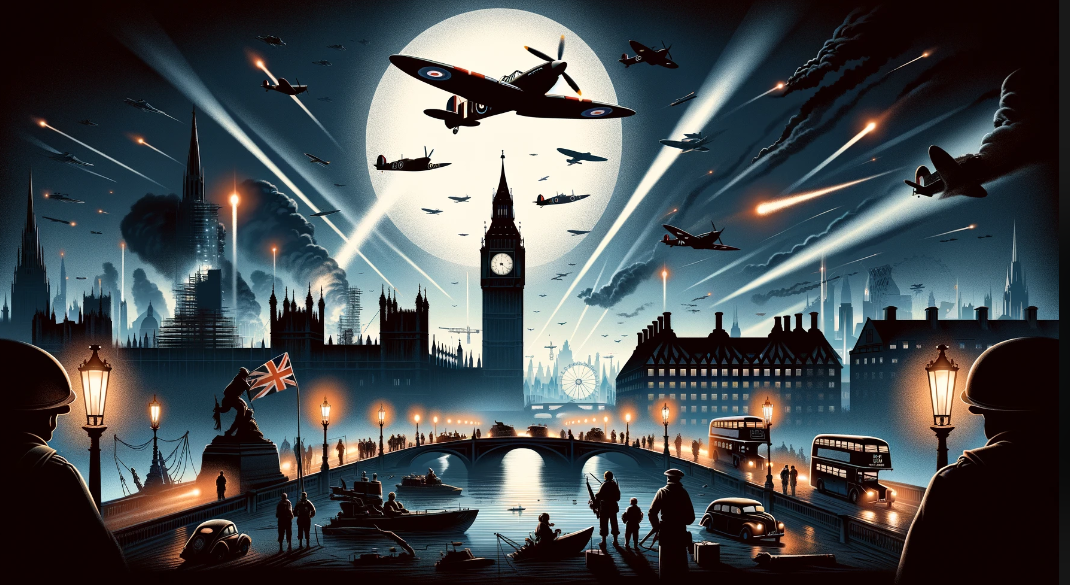
Image capturing the spirit and historical significance of the Blitz and the Battle of Britain during World War II conveying the resilience, courage, and unity of the British people and the RAF pilots amidst the backdrop of war.
Drawn by DALL-E, a subset of ChatGPT, February 2024.
Attribution: Publisher: Photoplay Publishing page 2, Public domain, via Wikimedia Commons
World War II (1939–1945) saw Britain standing almost alone against the Axis powers in the early years of the conflict. The Blitz and the Battle of Britain tested the mettle of the British people, whose resilience in the face of adversity became a defining national trait. The post-war period brought with it the need to rebuild, leading to significant social reforms, including the establishment of the National Health Service and the beginning of the process of decolonisation, as many territories sought independence.
Lesser-known Invasions
The Battle of Fishguard
The Battle of Fishguard, an intriguing yet frequently underestimated chapter in the chronicles of British and French military engagements, unfolded from the 22nd to the 24th of February 1797. This episode stands out as the final invasion attempt on British soil, orchestrated by Colonel William Tate, an American serving under France, along with his unit, La Légion Noire (The Black Legion). Composed of approximately 1,400 soldiers, including a significant number of convicts, this force departed France with the ambitious objective of invading Britain, sparking rebellion, and pressuring the British government into negotiating a peace agreement favourable to France.
The story of this invasion is filled with unexpected setbacks and strategic errors. Originally targeting Bristol, adverse weather redirected Tate’s fleet towards the Welsh coastline, culminating in their disembarkation a few miles west of Fishguard in Wales. Upon landing, the French troops engaged in looting the vicinity, notably stumbling upon a large cache of brandy from a recent shipwreck. The indulgence in this brandy led to a breakdown of discipline, significantly diminishing their military capability. In short, they were drunk.
Jemima Nicholas, a local woman who, armed with nothing more than a pitchfork, is credited with capturing several French soldiers, emerged as a key figure in countering the invasion. Her courage, together with the mobilisation of local militias and volunteers, showcased the community’s resolve and willingness to confront and repel the invaders.
The French forces’ disarray climaxed when they sought refuge in St Gwyndaf’s Church in Llanwnda, where they infamously used pages from the church’s 1620 Parry Bible and parish register for kindling. Despite this act of sacrilege highlighting their dire straits, it did not weaken the local resistance.

Image: 1620 Parry, Welsh Bible
Attribution: ceridwen / Still surviving…
Page URL: https://commons.wikimedia.org/wiki/File:Still_surviving…_-_geograph.org.uk_-_406078.jpg
Attribution: Publisher: Photoplay Publishing page 2, Public domain, via Wikimedia Commons
The invasion effort came to a halt, with Colonel Tate and his surviving men surrendering on the 24th of February 1797, only two days after their arrival. The surrender terms were formalised at the Royal Oak Inn in Fishguard, signalling the conclusion of the rather pathetic invasion attempt.
Despite some pages being lost, the Parry Bible was salvaged and continues to be exhibited at St Gwyndaf’s Church, not just as a relic of those eventful days but also as an emblem of the region’s cultural and historical legacy. A visit to St Gwyndaf’s Church offers a unique insight into this distinctive episode of British and French military history, highlighting the pivotal role played by the bravery of local civilians and the collective spirit of the community in repelling an invasion.
The Glorious Revolution
The Revolution of 1688, famously known as the Glorious Revolution, marks a pivotal moment in British history, leading to the ousting of King James II of England (also James VII of Scotland and James II of Ireland). This event was distinguished by the collaboration between English Parliamentarians and the Dutch Stadtholder[17] William III of Orange-Nassau (William of Orange), who ascended to power. James II, the last Roman Catholic monarch of England, faced significant opposition due to his policies of religious tolerance towards Catholics and his attempts to establish a more autocratic, centralised monarchy.
Key to this historic shift was the Immortal Seven, a group of influential English nobles who invited William to invade England. Their goal was to remove James II and ensure the continuation of Protestant rule amidst fears of a Catholic dynasty following the birth of James’s son. William’s marriage to James’s Protestant daughter, Mary, made their claim to the throne a unifying force for Protestant England.
Precipitating Factors:
- Religious Discord: England’s deep religious divide, with a Protestant majority apprehensive of James II’s Catholicism.
- Political Dissension: James’s disregard for Parliament and governance by decree alienated many, including the nobility and church leaders.
- The Succession Crisis: The birth of James’s son in 1688 heightened fears of a Catholic succession.
In response, William of Orange, armed with an invitation from the English nobility and the promise of a Protestant alliance, launched an invasion. The operation was remarkably bloodless, leading to James’s flight to France and earning the revolution its Glorious epithet. Parliament subsequently offered the throne to William and Mary as co-rulers under the condition they accepted the Declaration of Rights, evolving into the Bill of Rights 1689. This act significantly limited royal authority and bolstered Parliament’s power, heralding a new era of constitutional monarchy.
The legacy of the Glorious Revolution is:
- Parliamentary Supremacy: Cemented Parliament’s superiority over the monarchy.
- Religious Freedom: The Toleration Act of 1689 expanded religious liberties for non-Anglican Protestants, though restrictions remained for Catholics and others.
- Monarchical Succession: Led to the Act of Settlement 1701, ensuring a Protestant line of succession.
- United Kingdom Formation: Contributed to the 1707 Acts of Union, unifying England and Scotland into the United Kingdom of Great Britain.
Modern Reflections: The Legacy of Invasions on Contemporary Britain
Today, Britain is a vibrant tapestry of cultures, a direct legacy of its history of invasions, empire, and global commerce. The post-war era saw waves of immigration that have made Britain one of the most culturally diverse countries in the world. This diversity is celebrated as a strength, contributing to the dynamic and evolving identity of Britain in the 21st century. The challenges and opportunities of this multiculturalism are at the heart of debates on British identity today, reflecting a nation that continues to be shaped by its rich and complex history.

Image representing the vibrant tapestry of cultures in modern Britain, showcasing the harmonious coexistence of various cultural elements, the blend of traditional and modern architecture, and the dynamic, multicultural identity of Britain in the 21st century.
Drawn by DALL-E, a subset of ChatGPT, February 2024
Attribution: Publisher: Photoplay Publishing page 2, Public domain, via Wikimedia Commons
Yet, this transformation has not been without its challenges. Debates over immigration, national identity, and the role of Britain in a rapidly changing global landscape are at the forefront of public discourse. The Brexit referendum of 2016 highlighted deep divisions within British society and raised questions about the future direction of the country.
Despite these challenges, the legacy of Britain’s complex history — marked by invasions, conquests, and the blending of cultures — remains a source of strength. It has fostered a resilience and adaptability that continue to define the British character. As Britain faces the uncertainties of the 21st century, its history of integration, innovation, and adaptation provides a blueprint for navigating the future, emphasising the importance of unity, diversity, and a forward-looking vision.
The invasions and historical upheavals that shaped Britain have created a rich, multifaceted society that is constantly evolving. The lessons of the past, with all their complexity and diversity, offer valuable insights for a nation that is continually redefining itself in an interconnected world, striving to balance the cherished traditions of its past with the inclusive, dynamic vision required for its future.
Conclusion
The tapestry of British history is woven from threads of numerous invasions, each contributing to the rich nature of the nation’s heritage. From the ancient Celts, who left behind mystic sites like Stonehenge, to the Romans, whose architectural and legal influences persist to this day, Britain’s cultural landscape has been indelibly shaped by its past. The linguistic contributions of the Angles and Saxons, the martial prowess of the Vikings, and the administrative genius of the Normans have all left their mark, creating a uniquely diverse cultural identity.
Today, modern Britain reflects this complex lineage, standing as a testament to the resilience and adaptability of its people. The blending of cultures over centuries has not only enriched Britain’s social fabric but also fostered a spirit of innovation and a global outlook that defines the nation. As we walk the streets of Britain, from the ancient Roman roads to the medieval castles and beyond, we tread paths shaped by millennia of history. The story of Britain’s invasions is not just a chronicle of conflict and conquest but a narrative of integration, evolution, and the enduring strength of a society built on the foundations of many.
In embracing this multifaceted heritage, Britain is well-placed to look forward to a future where the lessons of the past inform a continued commitment to diversity, unity, and progress. The invasions of the past, with their challenges and changes, remind us of the ongoing journey of a nation continually shaped by its history as it navigates the complexities of the modern world.

Image: Norman knights and archers at the Battle of Hastings, as depicted in the Bayeux Tapestry
Citation: Battle of Hastings. (2024, February 4). In Wikipedia. https://en.wikipedia.org/wiki/Battle_of_Hastings
Attribution: Myrabella, Public domain, via Wikimedia Commons
Attribution: Publisher: Photoplay Publishing page 2, Public domain, via Wikimedia Commons
CAUTION: This paper is compiled from the sources stated but has not been externally reviewed. Parts of this paper include information provided via artificial intelligence which, although checked by the author, is not always accurate or reliable. Neither we nor any third parties provide any warranty or guarantee as to the accuracy, timeliness, performance, completeness or suitability of the information and materials covered in this paper for any particular purpose. Such information and materials may contain inaccuracies or errors and we expressly exclude liability for any such inaccuracies or errors to the fullest extent permitted by law. Your use of any information or materials on this website is entirely at your own risk, for which we shall not be liable. It shall be your own responsibility to ensure that any products, services or information available through this paper meet your specific requirements and you should neither take action nor exercise inaction without taking appropriate professional advice. The hyperlinks were current at the date of publication.
Sources and Further Reading
Web Resources:
- https://en.wikipedia.org/wiki/Invasions_of_the_British_Isles
- https://en.wikipedia.org/wiki/Roman_conquest_of_Britain
- https://eudocs.lib.byu.edu/index.php/UK:_Wars,_Battles_and_Conquests
- https://interglossa.ru/about-great-britain/the-history-of-invasions-on-the-british-isles/
- https://listverse.com/2019/03/25/10-times-britain-was-successfully-invaded/
- https://warwick.ac.uk/fac/arts/classics/warwickclassicsnetwork/romancoventry/resources/interactions/invasion/
- https://www.britannica.com/place/United-Kingdom/The-period-of-the-Scandinavian-invasions
- https://www.english-heritage.org.uk/learn/story-of-england/romans/invasion/
- https://www.heritagedaily.com/2021/05/caesars-invasion-of-britain/139274
- https://www.parliament.uk/about/living-heritage/evolutionofparliament/parliamentaryauthority/revolution/overview/invasiondesertion
- https://www.historic-uk.com/HistoryUK/HistoryofWales/Julius-Caesar-Invasions-of-Celtic-Britain/
- https://www.historic-uk.com/HistoryUK/HistoryofWales/The-Last-Invasion-of-Britain/
- https://www.historyextra.com/period/roman/caesars-british-gamble/
- https://www.parliament.uk/about/living-heritage/evolutionofparliament/parliamentaryauthority/revolution/overview/invasiondesertion/
- https://www.sutori.com/en/story/british-invasions-timeline–Lk5b1fMz2wMznLPkQEBqxmZK
- https://www.thecollector.com/did-the-anglo-saxon-invasion-happen/
- https://www.visitpembrokeshire.com/articles/the-last-invasion-of-britain
- https://johnlubbock.medium.com/a-history-of-invasions-of-britain-bb88b15bd2f9
- https://www.dailymail.co.uk/news/article-560614/The-1688-invasion-Britain-thats-erased-history.html
YouTube Videos:
- https://www.youtube.com/watch?v=Y10rjw1IOgo
- https://www.youtube.com/watch?v=vvvQuLJtWhU
- https://www.youtube.com/watch?v=-p7rryI5pME
- https://www.youtube.com/watch?v=OyCHtdpymNw
- https://www.youtube.com/watch?v=xCCTJKsLZxE
- https://www.youtube.com/watch?v=35ADlTmF4h8
Books:
- 1066: The Hidden History of the Bayeux Tapestry, by Andrew Bridgeford (2005), published by Walker & Co., available from https://www.amazon.co.uk/1066-Hidden-History-Bayeux-Tapestry/dp/0802714501/
- 1066: The Year of the Conquest, by David Howarth (1981), published by Penguin Books, available from https://www.amazon.co.uk/1066-Conquest-David-Armine-Howarth/dp/0140058508/
- A Brief History of the Anglo-Saxons, by Geoffrey Hindley (2006), published by Robinson, available from https://www.amazon.co.uk/Brief-History-Anglo-Saxons-Histories/dp/1845291611
- Alfred the Great: The Man Who Made England, by Justin Pollard (2006), published by John Murray, available from https://www.amazon.co.uk/Alfred-Great-Justin-Pollard/dp/0719566665/
- Arthur and the Kings of Britain: The Historical Truth Behind the Myths, by Miles Russell (2018), published by Amberley Publishing, available from https://www.amazon.co.uk/Arthur-Kings-Britain-Historical-Behind/dp/1445682826/
- Britain After Rome: The Fall and Rise, 400 to 1070, by Robin Fleming (2011), published by Penguin Books, available from https://www.amazon.co.uk/Britain-After-Rome-Anglo-Saxon-Penguin/dp/014014823X/
- Celtic Britain and Ireland, AD 200-800: The Myth of the Dark Ages, by Lloyd Laing and Jennifer Laing (1990), published by Palgrave Macmillan, available from https://www.amazon.co.uk/Celtic-Britain-Ireland-Ad-200-800/dp/0312047673
- Celtic Myths and Legends, by Peter Berresford Ellis (2003), published by Running Pr Book Pub, available from https://www.amazon.co.uk/Celtic-Myths-Legends-Peter-Berresford/dp/0786711078
- England’s Medieval Navy 1066-1509: Ships, Men & Warfare, by Susan Rose (2013), published by Seaforth Publishing, available from https://www.amazon.co.uk/Englands-Medieval-Navy-1066-1509-Warfare/dp/1848321376/
- Hadrian’s Wall, by Adrian Goldsworthy (2018), published by Basic Books, available from https://www.amazon.co.uk/Hadrians-Wall-Adrian-Goldsworthy/dp/1541644425
- Harold – The Last Anglo-Saxon King, by Ian W. Walker (1997), published by Sutton Publishing, available from https://www.amazon.co.uk/Harold-Anglo-Saxon-Ian-W-Walker/dp/0750913886
- In Search of the Dark Ages, by Michael Wood (2006), published by BBC Books, available from https://www.amazon.co.uk/Search-Dark-Ages-Michael-Wood/dp/0563522763/
- King Arthur: The Making of the Legend, by Nicholas J. Higham (2021), published by Yale University Press, available from https://www.amazon.co.uk/King-Arthur-Nicholas-J-Higham/dp/0300254989/
- Medieval Britain: A Very Short Introduction, by John Gillingham and Ralph A. Griffiths (2000), published by Oxford University Press, available from https://www.amazon.co.uk/Medieval-Britain-Short-Introduction-Introductions/dp/019285402X
- Roman Britain and Early England: 55 B.C.–A.D. 871, by Peter Hunter Blair (1966), published by W.W. Norton & Company, available from https://www.amazon.co.uk/Roman-Britain-Early-England-B-C/dp/0393003612
- Roman Britain: A New History 55 BC-AD 450, by Patricia Southern (2013), published by Amberley Publishing, available from https://www.amazon.co.uk/Roman-Britain-New-History-BC-AD/dp/1445611902/
- Roman Britain: A New History, by Guy de la Bédoyère (2013), published by Thames & Hudson, available from https://www.amazon.co.uk/Roman-Britain-History-Guy-Bédoyère/dp/0500291144/
- Roman Britain: A Very Short Introduction, by Peter Salway (2000), published by Oxford University Press, available from https://www.amazon.co.uk/Roman-Britain-Short-Introduction-Introductions/dp/0192854046
- Saxons, Vikings, and Celts: The Genetic Roots of Britain and Ireland, by Bryan Sykes (2008), published by W.W. Norton & Company, available from https://www.amazon.co.uk/Saxons-Vikings-Celts-Genetic-Britain/dp/0393330753
- The Age of Arthur: A History of the British Isles from 350 to 650, by John Morris (2004), published by Weidenfeld & Nicholson, available from https://www.amazon.co.uk/Age-Arthur-History-British-Isles-dp-1842124773/dp/1842124773/
- The Age of Athelstan: Britain’s Forgotten History, by Paul Hill (2004), published by The History Press, available from https://www.amazon.co.uk/Age-Athelstan-Forgotten-Revealing-Paperback/dp/0752425668/
- The Anglo-Saxon Age: A Very Short Introduction, by John Blair (2000), published by Oxford University Press, available from https://www.amazon.co.uk/Anglo-Saxon-Age-Short-Introduction-Introductions/dp/0192854038/
- The Anglo-Saxon Age: The Birth of England, by Martin Wall (2017), published by Amberley Publishing, available from https://www.amazon.co.uk/Anglo-Saxon-Age-Birth-England/dp/1445660342/
- The Anglo-Saxon Chronicles, translated and edited by Michael Swanton (2000), published by Phoenix Press, available from https://www.amazon.co.uk/Anglo-Saxon-Chronicles-Michael-Swanton/dp/1842120034
- The Anglo-Saxon World, by Nicholas J. Higham and Martin J. Ryan (2015), published by Yale University Press, available from https://www.amazon.co.uk/Anglo-Saxon-World-M-J-Ryan/dp/0300216130/
- The Battle of Agincourt: Sources and Interpretations, by Anne Curry (2000), published by Boydell Press, available from https://www.amazon.co.uk/Battle-Agincourt-Sources-Interpretations-Warfare/dp/0851158021/
- The Battle of Hastings: The Fall of Anglo-Saxon England, by Harriet Harvey Wood (2008), published by Atlantic Books, available from https://www.amazon.co.uk/Battle-Hastings-Fall-Anglo-Saxon-England/dp/1843548070
- The Boudican Revolt Against Rome, by Paul Sealey (2004), published by Shire Publications, available from https://www.amazon.co.uk/Boudican-Revolt-Against-Shire-Archaeology/dp/0747806187/
- The British Isles: A History of Four Nations, by Hugh Kearney (2006), published by Cambridge University Press, available from https://www.amazon.co.uk/British-Isles-History-Four-Nations/dp/0521608503
- The Celtic Empire: The First Millennium of Celtic History, 1000 BC-AD 51, by Peter Berresford Ellis (2001), published by Robinson, available from https://www.amazon.co.uk/Celtic-Empire-Millennium-History-1000BC/dp/1841193968
- The Celtic World, by Miranda Green (1996), published by Routledge, available from https://www.amazon.co.uk/Celtic-World-Routledge-Worlds/dp/0415146275/
- The Celts: A History from Earliest Times to the Present, by Bernhard Maier (2003), published by Edinburgh University Press, available from https://www.amazon.co.uk/Celts-History-Earliest-Times-Present/dp/0748616063
- The Celts: A History, by Peter Berresford Ellis (2003), published by Avalon Publishing Group, available from https://www.amazon.co.uk/Celts-History-Peter-Berresford-Ellis/dp/0786712112
- The Celts: Bronze Age to New Age, by John Haywood (2004), published by Routledge, available from https://www.amazon.co.uk/Celts-Bronze-Age-New/dp/058250578X
- The Empire Stops Here: A Journey Along the Frontiers of the Roman World, by Philip Parker (2010), published by Pimlico, available from https://www.amazon.co.uk/Empire-Stops-Here-Journey-Frontiers/dp/1845950038/
- The English and Their History, by Robert Tombs (2014), published by Allen Lane, available from https://www.amazon.co.uk/English-their-History-Robert-Tombs/dp/1846140188
- The English Civil War: A People’s History, by Diane Purkiss (2007), published by Harper Perennial, available from https://www.amazon.co.uk/English-Civil-War-Peoples-History/dp/0007150628/
- The Fall of Roman Britain, by Neil Faulkner (2001), published by The History Press, available from https://www.amazon.co.uk/Decline-Fall-Roman-Britain/dp/0752419447
- The History of the Kings of Britain, by Geoffrey of Monmouth (Author), Lewis Thorpe (Introduction, Translator) (1973), published by Penguin Classics, available from https://www.amazon.co.uk/History-Kings-Britain-Classics/dp/0140441700/
- The Kings and Queens of Anglo-Saxon England, by Timothy Venning (2013), published by Amberley Publishing, available from https://www.amazon.co.uk/Kings-Queens-Anglo-Saxon-England/dp/1445608979/
- The Last Viking: The Life of King Harald Hardrada, by Don Hollway (2023), published by Osprey Publishing, available from https://www.amazon.co.uk/Last-Viking-Story-Harald-Hardrada/dp/1472846508/
- The Making of the British Landscape: From the Ice Age to the Present, by Nicholas Crane (2017), published by Weidenfeld & Nicholson, available from https://www.amazon.co.uk/Making-British-Landscape-Ice-Present/dp/0753826674/
- The Norman Conquest: A New Introduction, by Richard Huscroft (2009), published by Routledge, available from https://www.amazon.co.uk/Norman-Conquest-New-Introduction/dp/1405811552/
- The Norman Conquest: William the Conqueror’s Subjugation of England, by Teresa Cole (2016), published by Amberley Publishing, available from https://www.amazon.co.uk/Norman-Conquest-William-Conquerors-Subjugation/dp/1445649225
- The Normans: From Raiders to Kings, by Lars Brownworth (2014), published by Crux Publishing, available from https://www.amazon.co.uk/Normans-Raiders-Kings-Lars-Brownworth/dp/1909979082
- The Plantagenets: The Kings Who Made England, by Dan Jones (2012), published by HarperPress, available from
- The Plantagenets: The Warrior Kings and Queens Who Made England, by Dan Jones (2014), published by Penguin, available from https://www.amazon.co.uk/Plantagenets-Warrior-Kings-Queens-England/dp/0143124927
- The Roman Conquest of Britain, by Graham Webster (1993), published by Routledge, available from https://www.amazon.co.uk/Roman-Invasion-Britain-Conquest/dp/0415218284
- The Sea Wolves: A History of the Vikings, by Lars Brownworth (2014), published by Crux Publishing, available from https://www.amazon.co.uk/Sea-Wolves-History-Vikings/dp/1909979120/
- The Story of Britain: From the Romans to the Present: A Narrative History, by Roy Strong (2019), published by W.W. Norton & Company, available from https://www.amazon.co.uk/Story-Britain-Romans-Present/dp/1474607063/
- The Time Traveler’s Guide to Medieval England: A Handbook for Visitors to the Fourteenth Century, by Ian Mortimer (2009), published by Vintage, available from https://www.amazon.co.uk/Time-Travellers-Guide-Medieval-England/dp/1845950992/
- The Viking Wars: War and Peace in King Alfred’s Britain: 789 – 955, by Max Adams (2018), published by Pegasus, available from https://www.amazon.co.uk/Viking-Wars-Alfreds-Britain-789-955/dp/1681777975/
- The Wars of the Roses: The Fall of the Plantagenets and the Rise of the Tudors, by Dan Jones (2014), published by Viking, available from https://www.amazon.co.uk/Wars-Roses-Fall-Plantagenets-Tudors/dp/0670026670/
- The Year 1000: What Life Was Like at the Turn of the First Millennium, by Robert Lacey and Danny Danziger (2000), published by Little, Brown and Company, available from https://www.amazon.co.uk/Year-1000-First-Millennium-Englishmans/dp/B003H4REB4/
- Tudor England, by John Guy (2000), published by Oxford University Press USA, available from https://www.amazon.co.uk/Tudor-England-John-Guy/dp/0192852132/
- Viking Britain: An Exploration, by Thomas Williams (2018), published by William Collins, available from https://www.amazon.co.uk/Viking-Britain-History-Thomas-Williams/dp/0008171955/
- Viking: The Norse Warrior’s [Unofficial] Manual, by John Haywood (2013), published by Thames & Hudson, available from https://www.amazon.co.uk/Viking-Warriors-Unofficial-Manual-Manuals/dp/0500251940/
End Notes and Explanations
- Source: Compiled from my research and from information at the sources stated throughout the text, together with information provided by machine-generated artificial intelligence at: bing.com [chat] and https://chat.openai.com ↑
- Explanation: The Mesolithic era, occurring between 10,000 BC and 5,000 BC, marks the middle part of the Stone Age, characterized by the development of small-scale societies of hunter-gatherers. During this period, humans refined their stone tools and adapted to changing environments following the last Ice Age. ↑
- Explanation: Western Hunter-Gatherers were prehistoric peoples who inhabited western parts of Europe during the Mesolithic era. They lived by hunting, fishing, and foraging for wild plants, adapting their lifestyles to the forests and coastlines of post-glacial Europe. ↑
- Explanation: The Younger Dryas was a period of sudden cooling that occurred approximately 12,900 to 11,700 years ago, marking a brief return to glacial conditions in the Northern Hemisphere after the last Ice Age. It significantly impacted the climate, flora, and fauna, influencing human settlements and activities. ↑
- Source: Brace, Selina; Diekmann, Yoan; Booth, Thomas J.; van Dorp, Lucy; Faltyskova, Zuzana; Rohland, Nadin; Mallick, Swapan; Olalde, Iñigo; Ferry, Matthew; Michel, Megan; Oppenheimer, Jonas (2019). “Ancient genomes indicate population replacement in Early Neolithic Britain”. Nature Ecology & Evolution. 3 (5): 765–771. doi:10.1038/s41559-019-0871-9. ISSN 2397-334X. PMC 6520225. PMID 30988490. Cited at: https://en.wikipedia.org/wiki/Invasions_of_the_British_Isles#cite_note-1 ↑
- Explanation: The Bell Beaker phenomenon, dating from around 2800 BC to 1800 BC, refers to the spread of a distinctive pottery style across western and central Europe. This cultural expression is associated with new burial practices, technological innovations, and possibly the movement of peoples, reflecting a significant period of social and cultural change. ↑
- Explanation: The term “Yamnaya-related” refers to genetic ancestry and cultural practices associated with the Yamnaya culture, which emerged in the Pontic-Caspian steppe around 3300 BC. This culture is known for its role in the spread of Indo-European languages through migration and its significant genetic impact on European populations. ↑
- Explanation: The Pontic-Caspian steppe is a vast region of grassland that stretches from the northern shores of the Black Sea to the Caspian Sea. It was the homeland of the Yamnaya culture and played a crucial role in the spread of the Indo-European languages and cultures during the Early Bronze Age. ↑
- Source: Cassidy, Lara M.; Martiniano, Rui; Murphy, Eileen M.; Teasdale, Matthew D.; Mallory, James; Hartwell, Barrie; Bradley, Daniel G. (12 January 2016). “Neolithic and Bronze Age migration to Ireland and establishment of the insular Atlantic genome”. Proceedings of the National Academy of Sciences. 113 (2): 368–373. Bibcode:2016PNAS..113..368C. doi:10.1073/pnas.1518445113. ISSN 0027-8424. PMC 4720318. PMID 26712024. Cited at: https://en.wikipedia.org/wiki/Invasions_of_the_British_Isles#cite_note-5 ↑
- Explanation: Lebor Gabála Érenn, often translated as “The Book of the Taking of Ireland” or “The Book of Invasions,” is a collection of medieval Irish mythological texts that purports to narrate the history of Ireland from the creation of the world to the Middle Ages. Compiled and written in the 11th century, it blends mythology, folklore, and historical traditions to recount the successive invasions and settlements of Ireland by various mythical peoples and groups. The narrative is structured around six invasions or “takings” of Ireland, starting with the arrival of Cessair and her followers and concluding with the Gaelic Milesians, who are portrayed as the ancestors of the Irish people. The Lebor Gabála Érenn integrates elements of biblical history, classical mythology, and native Irish lore, presenting Ireland’s history in a framework that connects it to the wider world of ancient history and myth.
Though its historical accuracy is debated, the Lebor Gabála Érenn has been influential in shaping Irish identity, literature, and historical consciousness, serving as a foundational text for understanding Ireland’s mythological past. While the Lebor Gabála Érenn is focused on the mythological and semi-historical narrative of Ireland’s past, it differs from the Book of Kells which is a religious document known for its extraordinary artistic and aesthetic beauty. Both are crucial elements of Ireland’s cultural and historical heritage but serve very different purposes. ↑
- Explanation: The Atrebates were a Celtic tribe in ancient Gaul and Britain before and during the Roman era. In Gaul, they inhabited the region that is now modern-day Normandy, France as well as parts of Belgium. After migrating across the English Channel, the British Atrebates settled in what is now southeastern England, particularly in the areas that correspond to modern Hampshire, West Sussex, and Berkshire. Their presence in Britain is marked by their coinage and the Romanisation of their society, especially after the Roman conquest in the 1st century AD. ↑
- Explanation: Caratacus and Togodumnus were two significant figures in the resistance against the Roman invasion of Britain in the 1st century AD. They were brothers, sons of Cunobelinus, a powerful king of the Catuvellauni, a tribe that dominated much of southeastern Britain prior to the Roman conquest:
Togodumnus played a leading role alongside his brother in the initial resistance against the Roman forces led by Emperor Claudius in 43 AD. Historical accounts, particularly those by Roman historian Dio Cassius, indicate that Togodumnus was actively involved in the early battles against the Romans. Unfortunately, Togodumnus died early in the campaign, around the time of the Battle of the Medway.
Caratacus is more widely known due to his prolonged and spirited resistance after the death of his brother. Following Togodumnus’ death, Caratacus continued to lead the resistance, rallying various British tribes against the Romans. His guerrilla tactics and leadership made him a formidable opponent to the Roman forces for nearly a decade. After a series of battles across what is now Wales and the western parts of Britain, Caratacus was eventually captured and taken to Rome. Remarkably, after delivering a defiant speech before Emperor Claudius, he was pardoned and allowed to live in Rome in peace.
The legacy of Caratacus and Togodumnus is emblematic of British resistance to Roman conquest. Caratacus, in particular, is celebrated as one of Britain’s earliest national heroes, symbolising the struggle for freedom and independence against a powerful empire. ↑
- Explanation: The Scoti were an ancient Gaelic-speaking people who in the early Middle Ages inhabited parts of what is now Scotland and Ireland. Initially, the term “Scoti” referred specifically to the Gaelic inhabitants of Ireland. However, from the 5th century onwards, groups of these Gaelic Irish began to migrate and establish settlements in the western parts of modern Scotland, particularly in Dalriada (present-day Argyll and Bute). Over time, the name “Scoti” came to be associated more with Scotland than with Ireland. This migration and settlement played a significant role in the formation of the early Scottish kingdom and the spread of Gaelic culture and language into what would become Scotland. The fusion of the Pictish and Gaelic societies, partly through these migrations and intermarriages, contributed to the foundation of the medieval Kingdom of Scotland. By the High Middle Ages, the term “Scoti” was used predominantly to refer to the people of Scotland, and the Gaelic identity had become central to the Scottish monarchy and nobility. The term “Scotland” itself derives from “Scoti,” reflecting the lasting influence of these early Gaelic settlers. ↑
- Explanation: Cunedda Wledig was a legendary figure and ruler in early medieval Wales. According to Welsh tradition and historical texts, he is credited with the establishment and consolidation of the kingdom of Gwynedd in North Wales. Cunedda, originally from the region that might correspond to modern-day Scotland or Northern England, is said to have led a migration of his people southwards to Wales to push back against the incursions of Irish settlers, particularly the Gaels, in the 5th century. The historical account of Cunedda and his descendants, known as the “Cunedda family,” plays a foundational role in the history of Gwynedd and the formation of Welsh identity. His lineage is considered to be the progenitors of several royal dynasties in medieval Wales. Cunedda’s efforts to secure the territory for his people and his leadership in the early formation of the Welsh kingdoms are celebrated in Welsh lore and history, making him a pivotal figure in the establishment of Welsh medieval states. ↑
- Further Information: Harald Hardrada, the King of Norway, invaded England in 1066, claiming the English throne. His claim was partly based on an agreement supposedly made between the earlier King of England, Harthacnut, and Hardrada’s predecessor, Magnus I of Norway, that if either died without an heir, the other would inherit the throne of England and Norway. Harald’s invasion was part of the tumultuous events of 1066, which also saw the Norman invasion led by William the Conqueror.
Harald Hardrada’s campaign in England culminated in the Battle of Stamford Bridge, where he was defeated and killed by the forces of the English king, Harold Godwinson. This battle indeed marked the end of significant Viking attempts to conquer England, as it was swiftly followed by the successful Norman invasion and the Battle of Hastings, where Harold Godwinson himself was defeated and killed, leading to the Norman conquest of England. ↑
- Further Information: See my blog post at: https://martinpollins.com/2022/12/09/king-henry-the-eighth-and-the-act-of-supremacy/ ↑
- Explanation: A stadtholder is a title used in the Dutch Republic and earlier in the Dutch-speaking regions of the Holy Roman Empire, including the Low Countries. The term originally comes from the Old High German word “statthalter,” which means “place holder,” essentially acting as a governor or deputy. In the context of the Dutch Republic, which existed from the late 16th century until the late 18th century, a stadtholder was the chief military and political officer in each of the United Provinces (the individual provinces that made up the Republic). The role of the stadtholder included leading armies, maintaining order, and representing the province in the absence of the sovereign power. William III of Orange-Nassau, who played a key role in the Glorious Revolution in England in 1688, was a stadtholder in the Dutch Republic. His ascension to the English throne as William III of England (and William II of Scotland) was a unique case of a stadtholder becoming a king, illustrating the significant role these leaders could play beyond the borders of the Dutch Republic. ↑

