
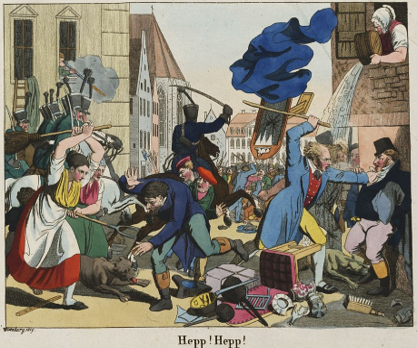
Introduction[1]
This paper focuses on pogroms. It aims to define and explain what they are and provides analytical depth through an exploration of historical examples, causes, mechanisms, and impact. The analysis provides a comprehensive examination of pogroms as both historical events and contemporary issues, situating them within broader discussions of ethnic violence.
Brief Overview of Pogroms
The term “pogrom” originates from Russian and means “to wreak havoc” or “to demolish violently.” Historically, it describes violent assaults carried out by non-Jewish communities against Jewish populations within the Russian Empire and beyond. The first event to be recognised as a pogrom is thought to have been the anti-Jewish riots in Odessa in 1821[2]. However, the term gained widespread use after a series of extensive anti-Jewish riots erupted across the southern and western regions of the Russian Empire between 1881 and 1884 following the assassination of Tsar Alexander II.[3]
Those pogroms were often locally organised, with some receiving backing or encouragement from government authorities and police. The attackers committed acts of rape, murder, and theft against Jewish individuals and their property. In the chaos of the civil war that followed the 1917 Bolshevik Revolution, various groups—including Ukrainian nationalists, Polish forces, and soldiers of the Red Army—perpetrated similar violent outbreaks, particularly in western Belorussia (now Belarus) and Galicia (now western Ukraine), resulting in the deaths of tens of thousands of Jews between 1918 and 1920.
Why Pogroms are important to understand historically and in contemporary discussions
Pogroms are important to understand historically because they offer insight into the systematic and often state-sanctioned persecution of vulnerable minority groups, particularly Jews, within certain political and social frameworks. By studying pogroms, we gain a better understanding of how prejudice, scapegoating, and societal tensions can lead to violent eruptions, often with devastating consequences. Historically, pogroms were not isolated incidents but part of broader patterns of ethnic violence tied to religious intolerance, nationalism, economic stress, and political instability, particularly in the Russian Empire and Eastern Europe.

Pogroms also offer valuable insight into the ways in which state complicity, social tensions, and ethnic prejudice can escalate into violence. Studying these events helps to reveal the dangerous dynamics of unchecked hatred and the devastating consequences of government inaction or encouragement. Furthermore, pogroms played a significant role in shaping global events such as Jewish migration, the rise of Zionism, and the development of modern human rights discussions.
In contemporary discussions, understanding pogroms helps explain how ethnic violence continues to manifest in modern societies. The term, while historically associated with Jewish persecution, is often applied to modern instances of violence against other minority groups, such as Muslims, Sikhs, and Rohingya. The conditions that allowed pogroms to occur in the past—economic inequality, political instability, social scapegoating—are still relevant today, making the study of pogroms a cautionary tale about the fragility of social cohesion and the potential for organised violence.
Moreover, pogroms remind us of the importance of state responsibility in protecting all citizens and the catastrophic results when the state fails to act or, worse, becomes complicit in and encourages such violence. This makes the understanding of pogroms not just a historical necessity but a critical component in human rights debates, discussions about ethnic violence, and policies designed to prevent similar atrocities in the future.
Aims and Scope of this Paper
The purpose of this paper is to provide a detailed analysis of pogroms, examining their historical origins, mechanisms, and the socio-political contexts that allowed them to occur. By exploring key examples and understanding the factors that led to their eruption, this paper aims to deepen the discussion on ethnic violence, highlighting the broader implications for understanding modern-day violence against minority groups. In doing so, the paper not only places pogroms within the historical record but also explores their relevance to contemporary issues of state complicity, human rights, and the ongoing risks of organised violence in societies facing social and political instability.
Definition of Pogrom
Etymology and origins of the term
The word “grom” means thunder, and the word “pogrom” implies a desire to shatter or destroy, as a thunderstorm destroys. A mob assembled for purposes of devastation does not, however, constitute a pogrom unless it follows certain well-established and characteristic rules. Thus, until now, pogroms have only been directed against Jews, though the system could be extended to other sections of the population. The pogrom was first instituted after the assassination of Alexander II in 1881 when anti-Semitism and reaction flourished under General Ignatieff (see below). The pogrom was encouraged as a means of terrorising the Jews.
How has the term evolved?
The definition of a pogrom has evolved significantly over time. Originally, the term was used specifically to describe violent attacks on Jewish communities in the Russian Empire, particularly during the late 19th and early 20th centuries. These pogroms were often marked by mob violence, looting, and killings, sometimes with state complicity or inaction.
Over time, the term expanded beyond its Jewish context to refer to similar outbreaks of violence against other minority groups. In modern usage, it is often applied to any organised, collective violence targeting ethnic or religious minorities, such as the anti-Sikh violence in India in 1984 or attacks against Muslims in Gujarat in 2002. Over time, the term expanded beyond its Jewish context to refer to similar outbreaks of violence against other minority groups.
In modern usage, the word is often applied to any organised, collective violence targeting ethnic or religious minorities, such as the anti-Sikh violence in India in 1984 or attacks against Muslims in Gujarat in 2002. Despite this broader application, the term still retains its strong association with anti-Semitic violence in the way discussions and debates among historians, scholars, and the public talk about, analyse, and interpret the past.
Example of Early Modern European Anti-Semitism
The Fettmilch Uprising was an anti-Semitic revolt that took place in the early 17th century in Frankfurt am Main, Germany. Named after its leader, Vincenz Fettmilch, the uprising began as part of broader unrest driven by economic grievances but soon escalated into violent attacks against the Jewish population of the city.

Background
The revolt started in 1612 during a period of economic difficulty and political tension in Frankfurt. Vincenz Fettmilch, a gingerbread baker and guild leader, capitalised on widespread discontent among artisans and tradespeople, who were frustrated with the local oligarchy’s[4] dominance over city politics and economics. Fettmilch initially led the movement against the city’s wealthy patrician class, accusing them of corruption and demanding reforms.
Anti-Semitic Turn
As the uprising grew, the movement began to scapegoat the Jewish community, who were seen as economically successful and tied to the elites. Fettmilch and his followers demanded the expulsion of Jews from Frankfurt and began raiding Jewish homes and businesses. In 1614, the mob attacked the Jewish ghetto (the Judengasse), plundering it and forcing the expulsion of about 1,300 Jews from the city. The Jews were made to flee, taking refuge in nearby towns under harsh conditions.
Result
The revolt was ultimately suppressed by imperial forces in 1616. Emperor Matthias intervened, recognising the uprising as a threat to the order of the Holy Roman Empire. Fettmilch and six of his main accomplices were captured, tried for treason, and executed. The Jewish community was allowed to return to Frankfurt, and a special ceremony was held to welcome them back into the city.
Significance
The Fettmilch Uprising is significant as an example of early modern European anti-Semitism combined with socio-political revolt. It illustrates how economic grievances and political unrest could be redirected against Jewish populations during times of instability. The event also highlights the precarious position of Jewish communities in medieval and early modern Europe, who were often scapegoated during periods of social and economic upheaval.
Comparisons
Today, pogrom generally describes a violent, mob-driven attack on a minority group, usually with little to no intervention from authorities, and is used to highlight the systematic or socially accepted nature of such violence. Pogroms share similarities with terms like massacres, race riots, and ethnic cleansing, but each has distinct features.
- A massacre typically involves large-scale killing without the organised looting or community-wide destruction seen in pogroms.
- Race riots involve ethnic violence but often lack the one-sided, state-condoned nature of pogroms.
- Ethnic cleansing aims at systematically removing or exterminating a group, usually as part of a broader campaign, while pogroms are more locally organised, spontaneous, and aimed at terrorising rather than permanently displacing a group.
These distinctions help clarify the specific characteristics of pogroms compared to other forms of collective violence.
General Count Nikolay Pavlovich Ignatieff

General Count Nikolay Pavlovich Ignatieff (1832–1908) was a prominent Russian diplomat and statesman known for his role in expanding the Russian Empire’s influence in the Balkans and his involvement in anti-Jewish policies during the late 19th century. Ignatieff held several key positions in the Russian Empire and was instrumental in shaping both foreign and domestic policies under Tsar Alexander II and Alexander III. His name is often associated with fostering anti-Semitic sentiment and encouraging violence against Jews during his tenure. Ignatieff is most famously remembered for two significant aspects of his career:
- Diplomatic Role in the Balkans and Asia: Ignatieff was a skilled diplomat and played a central role in advancing Russian interests in the Ottoman Empire and Central Asia. He negotiated the Treaty of San Stefano in 1878, which ended the Russo-Turkish War and initially created a large Bulgarian state under Russian protection. Although the treaty was revised in the Congress of Berlin, Ignatieff’s actions established him as an ardent supporter of expanding Russian influence in the Balkans and protecting Orthodox Christian populations in the Ottoman Empire. He was known for his aggressive Pan-Slavic policies and his desire to weaken the Ottoman Empire.
- Anti-Semitic Policies and the 1881 Pogroms: As Minister of the Interior from 1881 to 1882, Ignatieff oversaw the Russian government’s response to the assassination of Tsar Alexander II. This period was marked by a wave of pogroms targeting Jewish communities across the Russian Empire. Under Ignatieff’s leadership, the government did little to prevent these attacks and, in some cases, appeared to encourage them. Ignatieff was a staunch supporter of anti-Jewish policies and played a significant role in enacting the May Laws of 1882, which severely restricted Jewish rights and movement within the Empire. These laws confined Jews to the Pale of Settlement, restricted their ability to own property, and prohibited them from settling outside designated areas.
Ignatieff’s policies and actions contributed to an atmosphere of state-sanctioned anti-Semitism, reinforcing the idea that Jews were a scapegoat for the Empire’s social and economic problems. His tenure is often seen as a precursor to later, more formalised anti-Jewish measures in Imperial Russia.
Historical Context and Origins
Early Pogroms in the Russian Empire
As already mentioned, the first significant wave of pogroms in the Russian Empire occurred after the assassination of Tsar Alexander II in 1881. It triggered a widespread backlash against Jewish communities, largely due to the popular belief that Jews were responsible for the Tsar’s death despite no direct involvement. The pogroms that followed—especially in the southern and western regions of the Empire—were marked by mob violence, looting, and murders targeting Jewish populations. These outbreaks of violence were mostly spontaneous but often tolerated or even encouraged by local authorities, who either provided inadequate protection or actively participated in the attacks. The Russian government’s inaction reflected broader social and political issues of the time, including growing nationalism, fear of revolutionary movements, and economic instability. The pogroms were particularly concentrated in areas like Ukraine, Moldova, and Belarus, where anti-Jewish sentiments were already widespread.
Role of Religion, Politics, and Society
The pogroms were deeply rooted in a combination of religious, political, and socio-economic factors:
- Religious prejudice played a major role, as the Russian Orthodox Church and other Christian sects had long fostered anti-Semitic views. The “blood libel” myth, which falsely accused Jews of murdering Christian children for ritual purposes, persisted into the 19th and 20th centuries, fuelling anti-Jewish sentiment.
- Political unrest also contributed to the rise of pogroms, as the Russian Empire was struggling with widespread dissatisfaction among peasants, growing revolutionary movements, and challenges to its autocratic rule. During periods of political instability, Jewish communities were often scapegoated for economic and social woes.
- Socio-economic conditions further exacerbated tensions. Jews were typically restricted to specific occupations, such as money lending, which led to widespread resentment from impoverished peasants and artisans who saw them as exploiters. This animosity was compounded by Jews being more economically successful in some regions, making them easy targets for the frustrations of the broader population. All these factors combined to create a volatile environment ripe for violent outbursts against Jewish communities.

Pale of Settlement and Jewish Confinement
The Pale of Settlement was a region in the western part of the Russian Empire where Jews were allowed to live. Established by Catherine the Great in 1791, the Pale included areas in modern-day Ukraine, Belarus, Lithuania, Poland, and Moldova. It became home to millions of Jews who were barred from settling in most of Russia’s major cities.
To put things into perspective, by 1897, around five million Jews lived within the Pale. The region encompassed the western provinces of the Russian Empire, where Jewish residency was largely permitted. This area represented the largest concentration of Jews at the time. The Pale of Settlement consisted of 25 provinces, known as Guberniia in Russian. Each province was divided into four to 15 districts, called uezd, with a total of 236 districts across the Pale. On average, each district had about 190,000 inhabitants, of whom roughly 21,000 were Jewish.[5]

Within the Pale, Jewish communities were often crowded into shtetls (small towns with large Jewish populations), where they faced significant restrictions on economic activities and movement. The Jewish population was subjected to frequent discrimination and forced to live under harsh economic conditions. This geographical and political confinement created a sense of isolation, making Jews vulnerable to attacks from non-Jewish neighbours during times of unrest.
The 1882 May Laws[6] further restricted Jewish rights within the Pale, banning Jews from rural areas and limiting their ability to rent or own land. This confinement, coupled with the discriminatory legal framework, contributed to the spread of pogroms, as Jews were concentrated in easily targeted communities, and local authorities often turned a blind eye or even participated in the violence.
By limiting Jewish movement and concentrating their population in specific regions, the Pale of Settlement effectively turned Jewish communities into convenient scapegoats for local grievances, allowing pogroms to occur with greater frequency and intensity.
A Paradoxical Place
The Pale of Settlement was a paradoxical place in many ways. It was both a refuge and a trap for the Jewish population. The Russian Empire confined Jews to the Pale from 1791 to 1917, restricting their movements and limiting their rights, essentially segregating them into this designated area. At the same time, it was in this region where Jews were most vulnerable to anti-Semitic violence – organised riots often supported or ignored by local authorities. It’s an unfortunate irony that the Jews were concentrated in a region that was already rife with hostility. The Russian government’s policies were openly discriminatory, yet they corralled Jews into areas where the local populations were often already resentful of them due to economic competition or long-standing prejudices. This isolation made the Jewish communities easier to target and limited their ability to escape persecution.
Despite the hostile environment, the Jews of the Pale maintained strong cultural, religious, and communal traditions, which makes their survival in such an environment both remarkable and tragic.
Historical Examples: 19th and Early 20th Century Pogroms
Kishinev Pogrom (1903)
- Details and Causes: The Kishinev pogrom, one of the most infamous anti-Jewish attacks of the early 20th century, occurred in Chişinău (then part of the Russian Empire, now the capital of Moldova) over two days (6th to 7th April 1903). The violence was incited by anti-Semitic articles published in the newspaper Bessarabets, which propagated the false “blood libel” myth—accusing Jews of murdering Christian children for ritual purposes. The immediate trigger was the death of a Christian boy, who had committed suicide, and a Christian girl, whose death was mistakenly attributed to Jews.
- Characteristics: The pogrom saw mobs of ethnic Romanians and Russians attack Jewish homes and businesses, killing 49 Jews, injuring hundreds, and looting or destroying approximately 1,500 homes and businesses. The violence was brutal, with reports of women being raped and Jewish families savagely beaten. Although local authorities had prior knowledge of the brewing unrest, they did little to prevent the violence, and the police were slow to intervene. In fact, there were indications that government officials may have tacitly supported the violence, reflecting the anti-Semitic climate in the Empire at the time.
- Consequences: The Kishinev pogrom has wide-reaching implications. It shocked the international community, leading to widespread condemnation from Jewish and non-Jewish leaders alike. The violence also accelerated the growth of the Zionist movement, as many Jews began to feel that their only hope for safety lay in establishing a homeland in Palestine. The pogrom also spurred a wave of Jewish emigration to the United States and other countries. Additionally, it catalysed the formation of Jewish self-defence groups in the Russian Empire in an attempt to prevent such attacks in the future.
Odessa Pogroms (1821, 1859, 1871, 1881, 1905)
- Details and Causes: Odessa, a major port city on the Black Sea, witnessed several pogroms throughout the 19th and early 20th centuries, with the most violent occurring in 1905. The causes of these pogroms varied, but they were typically tied to social unrest, economic instability, and widespread anti-Semitism. Ethnic and religious tensions between the local Jewish population and non-Jews—particularly Greeks and Russians—were heightened by economic competition and the false belief that Jews were responsible for many of the social and economic ills facing the Russian Empire. The 1905 pogrom was linked to the broader political unrest that accompanied the Russian Revolution of 1905, where revolutionary sentiments and anti-Semitic scapegoating coalesced.
- Characteristics: The 1905 pogrom in Odessa was particularly violent. During three days in late October, mobs killed about 400 Jews and injured thousands more. Jewish businesses and homes were ransacked and looted, with thousands left homeless. While revolutionary turmoil gripped Russia, the violence in Odessa was exacerbated by police and military forces, who did little to stop the carnage and were often complicit in the attacks. As in Kishinev, the authorities either looked the other way or failed to act decisively.
- Consequences: The repeated pogroms in Odessa contributed to a growing sense of despair among Russian Jews, driving thousands to emigrate to Western Europe, the United States, and Palestine. The Odessa pogroms also reinforced the perception that the Russian government was unwilling or unable to protect its Jewish population, further galvanising the Zionist movement. Odessa, once home to a thriving Jewish community, saw a decline in its Jewish population as a result of repeated violence and emigration.
Kiev Pogroms (1881, 1905)
- Details and Causes: The Kiev pogroms were part of a wave of anti-Jewish violence that spread across the Russian Empire, particularly in the aftermath of Tsar Alexander II’s assassination in 1881. Jews were scapegoated for the rising revolutionary movements, and economic grievances against Jewish merchants and tradespeople were used to stoke mob violence. The 1905 pogrom in Kiev was connected to the failed revolution of that year, with Jews being targeted as scapegoats for both the revolutionary upheaval and the reactionary backlash.
- Characteristics: The 1881 pogrom lasted several days, during which mobs, often incited by local clergy and officials, attacked Jewish homes, businesses, and synagogues. The violence was brutal, with murders, rapes, and widespread looting. In 1905, the pogroms were even more intense, with large mobs descending on Jewish neighbourhoods in Kiev, killing over 100 Jews. As with other pogroms, the police and local authorities either did nothing or actively participated in the violence.
- Consequences: The Kiev pogroms, like others across the Empire, contributed to Jewish emigration and the rise of Jewish self-defence groups. These events also deepened the sense of alienation felt by Russian Jews, many of whom sought refuge in revolutionary movements, Zionism, or emigration. Additionally, the 1905 pogroms, in particular, underscored the deep social divisions in Russian society, as both Jews and revolutionaries became targets of reactionary violence.
Białystok Pogrom (1906)
- Details and Causes: The Białystok pogrom took place in June 1906 in the city of Białystok (then part of the Russian Empire, now in Poland). It occurred against a backdrop of revolutionary unrest and tensions between Jews and non-Jews in the city. Białystok had a large Jewish population, and growing political unrest following the 1905 revolution made it a focal point for anti-Jewish sentiment. A bomb thrown at a Russian police convoy was falsely blamed on Jews, triggering the violence.
- Characteristics: The pogrom lasted two days, during which more than 80 Jews were killed, and many more were wounded. Mobs, sometimes supported by police and soldiers, rampaged through Jewish neighbourhoods, looting homes, shops, and synagogues. The violence was fuelled by pre-existing tensions between the Jewish and Christian populations of the city, exacerbated by political unrest and economic hardship. As with other pogroms, there were credible reports of government involvement or at least tacit approval.
- Consequences: The Białystok pogrom further deepened the despair of the Jewish community in the Russian Empire and fuelled further waves of emigration. It also led to increased efforts by Jewish organisations to form self-defence groups and protect their communities. The brutality of the Białystok pogrom was widely condemned, including by international observers, and it contributed to the growing sense of urgency among Jews to seek safety outside of the Russian Empire, particularly in the United States and Palestine.
Summary
The causes of these pogroms were multifaceted, involving a mix of anti-Semitic sentiment, economic competition, political instability, and government complicity. The pogroms were characterised by their extreme violence, looting, and the lack of protection offered to Jewish communities by authorities. In each case, pogroms resulted in significant Jewish deaths, injuries, and property destruction, and they drove waves of emigration, the rise of Jewish self-defence organisations, and an increased interest in Zionism. These events had lasting impacts on both the Jewish population of the Russian Empire and the broader global Jewish diaspora,[7] as well as on the trajectory of Russian politics and society.
Historical Examples: Post-Russian Empire Pogroms
Lwów Pogrom (1918)
- Details and Causes: The Lwów pogrom (now Lviv, Ukraine) occurred between 21st–23rd November 1918, during the chaotic period following the collapse of the Austro-Hungarian Empire at the end of World War I. Lwów was a multi-ethnic city – home to Poles, Ukrainians, and Jews. Following the disintegration of the Empire, Polish and Ukrainian forces fought for control over the city, as both sides claimed it as part of their national territories. Amidst this political struggle, Jews were scapegoated for purportedly supporting the Ukrainian side, although the Jewish community had largely remained neutral.
- Characteristics: The pogrom took place after Polish forces recaptured the city from Ukrainian control. In the aftermath, mobs—consisting of soldiers and civilians—attacked Jewish homes, shops, and synagogues. The violence resulted in the deaths of 72 Jews, hundreds of injuries, and widespread looting and destruction of property. Many of the atrocities were carried out by Polish soldiers, with some accounts suggesting that local authorities did little to prevent the violence.
- Consequences: The Lwów pogrom shocked the international Jewish community and led to an outcry, particularly from the United States, which sent the Morgenthau Commission to investigate the incident. Though the Polish government condemned the pogrom and sought to punish some of those responsible, tensions between Jews and non-Jews in Eastern Europe remained high. The Lwów pogrom reflected the deep ethnic and political divisions in the region during the early post-imperial period and was a precursor to further violence against Jews during the interwar years.
Kiev Pogroms (1919)
- Details and Causes: The Kiev pogroms of 1919 took place during the chaotic period of the Russian Civil War (1917–1921), which followed the collapse of the Russian Empire. Various factions—including the Red Army, White Army, Ukrainian nationalists, and Polish forces—fought for control over the former imperial territories. Jews were often blamed for supporting Bolshevik forces, as many prominent Jewish figures were involved in the revolutionary movement. Several different groups perpetrated the Kiev pogroms, but the most devastating attacks were carried out by the White Army, Ukrainian nationalist forces, and local militias.
- Characteristics: The 1919 pogroms in Kiev saw extreme violence directed at the Jewish population. Over several months, waves of anti-Jewish violence took place, resulting in the deaths of thousands of Jews. Jewish homes were looted, synagogues were desecrated, and entire neighbourhoods were devastated. The violence was particularly brutal, with widespread reports of rape and torture. Each faction accused Jews of siding with the enemy, making them an easy target in the shifting tides of civil war.
- Consequences: The Kiev pogroms contributed to a broader wave of violence against Jews in Ukraine during the Russian Civil War, where it is estimated that between 30,000 and 50,000 Jews were killed in various pogroms. These events reinforced the perception that Jews were vulnerable to both revolutionary and reactionary forces, leading many to emigrate or turn toward Zionism as a solution. Additionally, the violence cemented deep divisions between Jews and other ethnic groups in Eastern Europe, which would continue to have ramifications throughout the 20th century.
Historical Examples: Nazi-Era Pogroms
Kristallnacht (1938)
- Details and Causes: Kristallnacht, or the “Night of Broken Glass,” was the most infamous pogrom during the Nazi era. It occurred across Germany and Austria on the nights of 9th–10th November 1938. The immediate cause was the assassination of a German diplomat, Ernst vom Rath, by Herschel Grynszpan, a young Jewish man angered by the deportation of his family from Germany. However, Kristallnacht was the culmination of years of escalating anti-Semitic rhetoric and policies under Adolf Hitler’s regime. The Nazi leadership, including Joseph Goebbels, used the assassination as a pretext to incite widespread violence against Jewish communities.

- Characteristics: Kristallnacht saw over 1,400 synagogues and 7,000 Jewish-owned businesses destroyed or damaged, with Jewish homes and schools also being attacked. 91 Jews were killed, and 30,000 Jewish men were arrested and sent to concentration camps. The term “Kristallnacht” refers to the shattered glass from Jewish shop windows that littered the streets. The violence was organised and led by the Nazi paramilitary forces, the SA and SS, while the German police and authorities either stood by or participated in the attacks. It was a clear signal of the state’s endorsement of anti-Semitic violence.
- Consequences: Kristallnacht marked a turning point in Nazi anti-Jewish policies. It signified the transition from economic and social discrimination to state-sanctioned violence, foreshadowing the Holocaust. Following Kristallnacht, the situation for Jews in Nazi-occupied territories rapidly deteriorated, with further restrictions, property confiscation, and an acceleration of emigration efforts by Jews trying to escape persecution. The pogrom also shocked the international community, leading to widespread condemnation, but little concrete action was taken to aid Jews fleeing Europe at the time.
Historical Examples: World War II Pogroms
Iași Pogrom (1941, Romania)
- Details and Causes: The Iași pogrom took place in late June 1941 in the city of Iași, Romania. Romania, under the fascist regime of Ion Antonescu, had aligned itself with Nazi Germany and adopted many of its anti-Semitic policies. The pogrom was sparked by false accusations that Jews were collaborating with the Soviet Union and committing acts of sabotage against the Romanian army. With the full backing of the Romanian government, military forces, and police, anti-Semitic hysteria was whipped into violence.
- Characteristics: The pogrom was one of the deadliest of the Holocaust-era pogroms. Over several days, more than 13,000 Jews were murdered by Romanian soldiers, police, and civilians. Jews were shot in the streets, homes were raided, and survivors were rounded up and forced onto trains, where many suffocated or died from dehydration. The scale of the violence was staggering, and it was clearly organised and condoned by the Romanian authorities.
- Consequences: The pogrom was part of a broader wave of violence against Jews in Romania and Eastern Europe during World War II. It exemplified the brutality of the Axis-aligned regimes in the region and highlighted the complicity of local authorities in the Holocaust. The deaths in Iași were part of the larger campaign of genocide against the Jewish population, and the pogrom became a symbol of Romania’s role in the Holocaust.
Farhud (1941, Iraq)
- Details and Causes: The Farhud was a pogrom against the Jewish population of Baghdad, Iraq, on 1st-2nd June 1941. It occurred in the aftermath of a pro-Nazi coup led by Rashid Ali, which sought to align Iraq with the Axis powers. After the coup failed and British forces regained control of Baghdad, the city’s Jews were scapegoated, and false rumours spread that they had been collaborating with the British. Tensions between Jews and Muslims in Iraq had been simmering for years, fuelled by the rise of Arab nationalism and Nazi propaganda that portrayed Jews as a threat.
- Characteristics: Over two days, Iraqi mobs attacked Jewish homes and businesses, looting and destroying property and murdering between 150 and 180 Jews. Jewish women were raped, and hundreds more Jews were injured. The violence was particularly savage, with reports of mutilation and the desecration of synagogues. The Iraqi police and military, which had been infiltrated by pro-Nazi elements, did little to prevent or stop the violence.
- Consequences: The Farhud had lasting effects on the Jewish community in Iraq. Although Iraqi Jews had lived in the region for over 2,500 years, the pogrom shattered their sense of security. Many Jews began to emigrate in the years following, culminating in the mass emigration to Israel after its establishment in 1948. The Farhud marked a turning point for Iraqi Jews, as it demonstrated that they were no longer safe, even in places where they had deep historical roots.
Historical Examples: Other World War II Pogroms
Jedwabne Pogrom (1941, Poland)
- The Jedwabne pogrom, which took place on 10th July 1941 in Nazi-occupied Poland, was one of the most notorious instances of local participation in anti-Jewish violence during the Holocaust. A mob of Polish villagers, under the encouragement of Nazi forces, rounded up hundreds of Jews from the town of Jedwabne, locked them in a barn, and set it on fire, burning them alive. At least 340 Jews were killed. The pogrom was long attributed solely to Nazi forces, but later investigations revealed significant local complicity, sparking heated debates in Poland about historical memory and responsibility.
A mixture of political instability, ethnic nationalism, and deep-rooted anti-Semitism drove pogroms during and after the collapse of the Russian Empire. The Nazi-era pogroms, particularly Kristallnacht, were state-sponsored attacks that laid the groundwork for the Holocaust. The World War II pogroms, from Romania to Iraq, exemplified the global reach of anti-Jewish violence during this period, often combining local ethnic tensions with Nazi ideology. These pogroms left deep scars on the Jewish communities they targeted and significantly contributed to Jewish emigration and the global response to post-war Jewish persecution.
Historical Examples: Post-WW II Pogroms
Kielce Pogrom (Poland, 1946)
- Details and Causes: The Kielce pogrom occurred on 4th July 1946, in the city of Kielce, Poland. This violent outbreak against the Jewish community happened in the aftermath of World War II, during a period of intense social and political upheaval. Although the Holocaust had devastated the Jewish population of Poland, some Jewish survivors returned to their former homes after the war, hoping to rebuild their lives. However, anti-Semitic sentiment persisted, compounded by economic difficulties, political instability, and deep-rooted distrust. The immediate cause of the pogrom was the false accusation known as the “blood libel,” a myth with long-standing roots in European anti-Semitism.
- Characteristics: The pogrom began when a mob of local Poles, inflamed by rumours that Jews had kidnapped and murdered Christian children, attacked the Jewish population in Kielce. The violence was brutal, resulting in 42 Jews killed and dozens more injured. Jewish homes were looted and destroyed, and the local police and militia, rather than preventing the violence, were complicit in it. This reflected both the persistence of deep-seated anti-Jewish prejudices and the chaotic nature of post-war Poland, which was struggling to transition from Nazi occupation to a communist regime under Soviet influence.
- Consequences: The Kielce pogrom was a devastating blow to Jewish survivors in Poland. It led many Jews to conclude that there was no future for them in post-war Poland, prompting a mass emigration wave. Tens of thousands of Jews left Poland for displaced persons camps in Germany or Austria, eventually resettling in places like the United States, Canada, and the newly established state of Israel. The pogrom also attracted international attention, damaging Poland’s reputation and underscoring the persistence of anti-Semitism even after the atrocities of the Holocaust. In Poland, the Kielce pogrom remains a painful chapter in the country’s post-war history and continues to be a subject of intense historical debate and reflection.
Tripoli Pogrom (1945, Libya)
- Details and Causes: The Tripoli pogrom occurred from 5th to 7th November 1945 in the Libyan city of Tripoli, then under British military administration after the defeat of the Italian colonial forces in World War II. Anti-Jewish sentiment in Libya had been growing due to a combination of Nazi and Fascist propaganda, which had spread anti-Semitic ideologies across North Africa. These tensions were further exacerbated by local economic and political factors, as well as rising Arab nationalism and the Palestinian question, which had started to influence the region’s political dynamics. Rumours of Jewish support for Zionism and the establishment of a Jewish state in Palestine triggered this particular pogrom.
- Characteristics: Over three days, Arab mobs attacked Jewish communities in Tripoli and surrounding areas, killing more than 140 Jews, including women and children. Jewish homes, synagogues, and businesses were looted, and many were set on fire. The British military, which governed Libya at the time, was slow to respond, and the violence raged unchecked for several days before it was finally suppressed. This pogrom devastated the Jewish community in Tripoli, which had existed for centuries.
- Consequences: The Tripoli pogrom marked the beginning of the end for the Jewish community in Libya, which had been a vibrant and integral part of the region. It prompted many Libyan Jews to emigrate, particularly to Israel, after its establishment in 1948. By the early 1960s, almost all of Libya’s Jews had left the country – a trend echoed in other North African and Middle Eastern nations during this period of rising anti-Semitism and Arab nationalism.
Aleppo Pogrom (1947, Syria)
- Details and Causes: The Aleppo pogrom took place in December 1947 in the Syrian city of Aleppo, immediately following the United Nations’ decision to partition Palestine and create a Jewish state. This decision inflamed anti-Jewish sentiments across the Arab world, leading to violent reprisals against Jewish communities. In Aleppo, as in many other Arab cities, Jews had lived for centuries, often in relative peace with their Muslim neighbours. However, with the rise of Arab nationalism and the growing tensions over the future of Palestine, Jews increasingly became targets of mob violence.
- Characteristics: The pogrom saw Arab rioters attack the Jewish quarter of Aleppo, burning synagogues, schools, and homes. Approximately 75 Jews were killed, and hundreds more were injured or displaced. The Great Synagogue of Aleppo, which housed a significant collection of ancient Jewish texts, including the Aleppo Codex, was severely damaged. Jewish-owned businesses were looted, and many Jewish families were forced to flee their homes.
- Consequences: The Aleppo pogrom was part of a broader wave of anti-Jewish violence that swept across the Arab world in the late 1940s, largely in response to the creation of Israel. It led to a mass exodus of Syrian Jews, with many fleeing to Israel, the United States, and other countries. By the mid-20th century, most of Aleppo’s once-thriving Jewish community had been displaced, and the city’s Jewish population had all but disappeared.
Broader Scope: Post-War Attacks on Other Ethnic Groups
Tripolitania Pogrom (1948, Libya)
- Details and Causes: Another significant pogrom occurred in Tripolitania, Libya, in 1948, once again targeting the Jewish community of the region. Like the 1945 pogrom, this attack was fuelled by rising tensions surrounding the creation of the state of Israel and the wider Arab-Israeli conflict. Many Arab nationalists viewed local Jewish populations as proxies for the Zionist movement, leading to widespread violence against Jews in various Arab countries.
- Characteristics: As had happened in 1945, mobs attacked Jewish homes and businesses, killing at least 13 Jews and wounding dozens more. The violence was accompanied by widespread looting and property destruction, with Jewish synagogues and schools also targeted. The British authorities, still in control of Libya at the time, were unable to prevent the violence, and many Jews were forced to flee their homes.
- Consequences: The 1948 pogroms in Libya further accelerated the departure of Jews from North Africa. In Libya, the violence led to an almost complete exodus of Jews, many of whom emigrated to Israel, Italy, or other countries. By 1951, the Jewish community of Libya, which had existed for centuries, had virtually disappeared.
Anti-Armenian and Anti-Assyrian Violence (Mid-20th Century, Middle East)
- Details and Causes: In the mid-20th century, the collapse of the Ottoman Empire and the reordering of the Middle East led to waves of violence against other minority groups, notably Armenians and Assyrians. Both groups had already suffered devastating losses during the Armenian Genocide (1915–1917) and Assyrian massacres, but anti-minority violence continued in the decades following the collapse of Ottoman rule. In countries like Turkey, Iraq, and Iran, Armenians and Assyrians were often scapegoated during periods of political instability and nationalism.
- Characteristics: Violence against these groups took the form of attacks on villages, massacres, forced displacement, and the destruction of property. For example, during the Simmele massacre in Iraq in 1933, Assyrians were targeted by the Iraqi military, leading to the deaths of hundreds of Assyrian men, women, and children. In Turkey, Armenians continued to face harassment and violence long after the genocide, particularly during times of political turmoil.
- Consequences: The post-Ottoman violence against Armenians and Assyrians, like the post-war pogroms against Jews in the Middle East and North Africa, led to a mass exodus of these communities from their ancestral homelands. Many Assyrians fled to Syria, Lebanon, and Western countries, while the Armenian diaspora grew significantly as survivors sought refuge in places like the United States, France, and Soviet Armenia. These events contributed to the permanent reshaping of the ethnic landscape in the Middle East.
Post-World War II pogroms were driven by a complex mix of lingering anti-Semitism, political instability, economic hardship, and the rise of nationalism. In the case of the Kielce pogrom, the persistence of deep-rooted anti-Semitic beliefs in Poland and Eastern Europe manifested violently even after the Holocaust. In the Middle East and North Africa, pogroms like the Farhud, Tripoli, and Aleppo reflected a convergence of anti-Jewish sentiment and geopolitical shifts following the creation of Israel. Similar patterns of violence also emerged against other ethnic groups, such as Armenians and Assyrians, reflecting the broader regional tensions and instability.
These pogroms had devastating effects, driving mass emigration, the collapse of ancient Jewish and minority communities in the Middle East and North Africa, and contributing to the reshaping of the Jewish and minority diasporas in the mid-20th century.
How the Term “Pogram” has been Globalised
The term pogrom has undergone a significant globalisation since its origins in the Russian Empire, where it specifically referred to anti-Jewish violence. Over time, the term has been extended to describe similar acts of violence against other ethnic or religious minorities across different parts of the world. This globalisation of the term pogrom reflects its resonance with specific patterns of organised, one-sided violence that often involve state complicity or inaction. However, there is ongoing debate about whether such events fully align with the historical definition of a pogrom or represent an extension of the concept. See what you think: here’s a closer look at the term’s globalised usage and an analysis of its appropriateness in different contexts.
Globalisation of the Term “Pogrom”
- Attacks on Sikhs in India (1984): The 1984 anti-Sikh violence that erupted following the assassination of Indian Prime Minister Indira Gandhi by her Sikh bodyguards is often referred to as a pogrom. In this instance, mobs targeted Sikh communities, especially in Delhi, with mass killings, arson, looting, and sexual violence. Over 3,000 Sikhs were killed in a matter of days, and many Sikhs were displaced. The violence was not spontaneous but organised, with political leaders from the ruling Congress Party reportedly encouraging the mobs. The complicity of local police and government officials, who were either inactive or actively abetted the violence, closely mirrors the dynamics of a traditional pogrom.
- Muslims in Gujarat, India (2002): In 2002, after a train carrying Hindu pilgrims was set on fire in Godhra, killing 59 people, widespread retaliatory violence erupted across the state of Gujarat. The violence, which was largely directed at Muslim communities, involved brutal killings, sexual violence, and the destruction of homes and businesses. Estimates suggest that between 1,000 and 2,000 Muslims were killed, and tens of thousands were displaced. There is significant evidence that the violence was supported or encouraged by elements within the state government and police, who failed to intervene and, in some cases, were complicit in the attacks. This event has been widely described as a pogrom due to the systematic, targeted nature of the violence against a defenceless minority.
- Rohingya in Myanmar (2017): The Rohingya crisis in Myanmar, which escalated in 2017, saw Myanmar’s military and local Buddhist mobs carry out widespread violence against the Rohingya Muslim minority. This violence included mass killings, sexual violence, the burning of villages, and the forced displacement of hundreds of thousands of Rohingya to neighbouring Bangladesh. While the term “ethnic cleansing” or “genocide” is more commonly applied to this event, some commentators and scholars have referred to it as a pogrom due to the organised, state-sanctioned violence targeting a vulnerable ethnic and religious minority.
Analysis: Do These Events Fit the Historical Definition of Pogroms?
To evaluate whether these globalised uses of the term pogrom fit the historical definition, it is essential to examine the core characteristics that traditionally define a pogrom: organised violence, one-sided attacks, targeting of a minority group, and state complicity or inaction:
- Organised, One-Sided Violence: In all three cases—1984 anti-Sikh violence, 2002 Gujarat violence, and the 2017 Rohingya crisis—the attacks were not spontaneous outbursts but were, to varying degrees, organised, with perpetrators systematically targeting the minority group. This aspect closely aligns with the traditional definition of a pogrom, where mobs, often supported by local authorities, engage in coordinated violence.
- State Complicity or Inaction: A defining feature of historical pogroms, especially in the Russian Empire, was the involvement or tacit approval of the state. In the case of the 1984 anti-Sikh violence, there is substantial evidence of government complicity, as political leaders reportedly incited mobs, and the police failed to protect the Sikh population. Similarly, in the Gujarat violence, the state’s role was highly controversial, with accusations that local government officials and police allowed, or even encouraged, the violence against Muslims. In Myanmar, the Rohingya crisis involved direct action by the state military, making it an even more extreme case of state-sponsored violence. This state involvement, either through active participation or wilful neglect, is a key factor that links these events to the traditional concept of a pogrom.
- Targeting of a Minority Group: All these examples involve the systematic targeting of an ethnic or religious minority—Sikhs in 1984, Muslims in Gujarat in 2002, and Rohingya in Myanmar. In each case, the minority group was portrayed as a threat or “other,” mirroring the dehumanisation that historically occurred in pogroms against Jews. The scapegoating of these groups for broader political or social tensions echoes the motivations behind earlier pogroms, such as those in the Russian Empire.
Broader Aims and Consequences
One potential area where these events may deviate from the historical definition of pogroms is in their scale and broader objectives. For example, the violence against the Rohingya has been described more as an act of ethnic cleansing or genocide because of its aim to displace or eliminate the Rohingya population permanently. In this sense, the term “pogrom” may not fully capture the scope of what happened, as it traditionally describes shorter, more localised outbreaks of violence rather than long-term campaigns of persecution. Similarly, the Gujarat violence had lasting political and social consequences, but it may also fit the framework of a pogrom due to its organised, targeted nature.
Extension or Globalisation of the Term “Pogrom”
While all of these events share key characteristics with traditional pogroms—organised violence, state complicity, and the targeting of a defenceless minority—they also reflect the expansion of the term pogrom to encompass a broader range of ethnic and religious violence. In the context of the Rohingya crisis, for example, the violence could be better described as ethnic cleansing due to its goal of forced displacement. In this case, the use of pogrom extends beyond its historical application to describe broader, more systematic forms of violence.
Similarly, the 1984 anti-Sikh violence and 2002 Gujarat violence fit the traditional model of a pogrom in their structure and state involvement but differ in their larger political contexts. These events occurred in more modern, democratic states where violence against minorities was driven by political motives related to communalism and nationalism. This marks a shift from the original context of pogroms, which were largely driven by older forms of ethnic or religious scapegoating under autocratic regimes.
Pogrom as a term has evolved and globalised to describe organised, one-sided violence against vulnerable minority groups in different regions of the world. While the events in India and Myanmar share many similarities with the traditional pogroms of the Russian Empire—state complicity, organised violence, and targeting of a minority—some of these cases, particularly the Rohingya crisis, represent a significant extension of the term.
The globalisation of pogrom (namely the spread of pogrom-style violence beyond its traditional contexts, such as Eastern Europe or Russia, to other parts of the world) reflects the broader use of the term to address violence that, while still bearing the hallmarks of historical pogroms, often occurs in more modern, complex political and social contexts. This evolution of the term demonstrates its ongoing relevance in understanding the dynamics of ethnic and religious violence in the contemporary world.
Pogroms in Contemporary Discourse
Political Use of the Term
The term pogrom has increasingly been invoked in contemporary political contexts, often as a powerful rhetorical tool to describe violent attacks against ethnic or religious minorities. Its usage has expanded beyond its historical roots, particularly in relation to events in Israel/Palestine and other conflict zones.
Israel/Palestine Conflict:
In recent decades, the term pogrom has been used in relation to the ongoing Israeli-Palestinian conflict. For instance, in 2008, Israeli Prime Minister Ehud Olmert described violent attacks by Israeli settlers on Palestinian civilians in the West Bank as a “pogrom.” This use of the term highlighted the one-sided nature of the violence, where organised groups of settlers attacked defenceless Palestinian civilians, often with little or no intervention from the Israeli military or police. By invoking pogrom, Olmert linked the violence to historical anti-Jewish pogroms, thereby drawing attention to the moral implications of such acts of violence within the Israeli-Palestinian context.
Similarly, in 2023, the term pogrom was used to describe the violent actions of Israeli settlers against Palestinians in the town of Huwara. The term was also invoked in reference to the Hamas attacks on Israeli civilians during the October 2023 conflict, with some Israeli and international commentators labelling the assault as a “pogrom.” These examples demonstrate how the term is employed to emphasise the organised and targeted nature of violence, often suggesting a parallel between past ethnic attacks and present-day conflicts.
Broader Political Contexts:
The term pogrom has also been used in other parts of the world to describe acts of collective violence. For example, during the 2002 Gujarat riots in India, which primarily targeted Muslims, the violence was described as a pogrom in several political and media contexts due to the alleged involvement of state authorities and the one-sided nature of the attacks. Similarly, the 2021 anti-Muslim violence in Myanmar was occasionally referred to as a pogrom, although the term ethnic cleansing was more commonly used.
In these political contexts, using the term pogrom serves as a way to draw attention to the parallels between historical state-sanctioned violence and contemporary incidents of organised attacks against minorities. It frames the events as part of a broader history of ethnic persecution, evoking the moral and political weight of past pogroms.
Media Representations and Public Memory
Media Representations of Pogroms:
In modern media, pogrom is often used as shorthand to describe violent, one-sided attacks against defenceless groups, invoking the historical memory of atrocities such as those in Kishinev, Odessa, and Kiev. In this sense, media outlets use the term pogrom not only to inform but also to evoke a sense of historical continuity, often implying that the violence witnessed today mirrors the organised, state-condoned violence of the past.
For example, news reports covering communal violence, particularly in the Middle East, India, and parts of Eastern Europe, sometimes use the term pogrom to underscore the gravity and historical resonance of the violence. By doing so, media outlets signal that these events are not merely spontaneous outbreaks of violence but are rooted in long-standing patterns of ethnic persecution. This can be seen in the global media coverage of the Hamas attacks and the settler violence in Israel/Palestine, where terms like pogrom are employed to frame the conflict within a broader narrative of organised, ethnic violence.
However, the use of the term in media can also be contentious. Critics argue that applying the term pogrom in contemporary contexts can sometimes oversimplify complex situations or lead to emotional rather than analytical responses. In some cases, the word is used in a politicised way, with different factions applying the term to cast blame or heighten the perceived severity of violence.
Public Memory and Historical Reflection:
The term pogrom occupies a significant place in public memory, especially within Jewish communities, where it is associated with the repeated traumas of the late 19th and early 20th centuries. In places like Israel, the memory of pogroms—particularly in Eastern Europe—is deeply intertwined with the broader Jewish historical experience of persecution and survival. As a result, references to pogroms in contemporary discourse are laden with historical weight and emotional significance.
In Jewish public memory, pogroms are often remembered as a precursor to the Holocaust, representing a long history of violent anti-Semitism that culminated in genocide. Events like Kristallnacht, sometimes referred to as the “November pogrom,” serve as a key example of how pogroms are memorialised in relation to the Holocaust. This collective memory is preserved through museums, commemorative events, and educational programs, which ensure that the historical reality of pogroms remains a living part of Jewish identity and global understanding of anti-Semitic violence.
Similarly, in Eastern Europe, particularly in countries like Poland and Ukraine, pogroms are remembered as part of a complex national history that includes both the persecution of Jews and the broader upheavals of the early 20th century. In places like Kielce, where post-war pogroms occurred, public memory remains divided, with some narratives focusing on the shame and guilt associated with the violence, while others minimise or seek to obscure the events. In this way, the term pogrom plays a crucial role in shaping how national and communal histories are remembered and discussed.
Beyond the Jewish experience, other minority groups have also begun to incorporate the term pogrom into their own historical narratives. For instance, Sikhs have adopted the term to describe the 1984 anti-Sikh violence in India, while in some parts of the Muslim world, the Gujarat violence is framed as a pogrom against Muslims. These groups have integrated the memory of these events into their collective consciousness, creating a broader and more globalised understanding of what constitutes a pogrom.
In contemporary discourse, the term pogrom has been both politicised and globalised, extending its meaning to encompass organised, one-sided violence against minority groups beyond its original context of anti-Jewish violence. In political contexts, the term is used to highlight the organised and often state-condoned nature of ethnic violence, drawing historical parallels to heighten the moral gravity of modern events. In media representations, pogrom is frequently employed to evoke strong emotional and historical associations, framing contemporary violence within a long history of persecution.
Public memory plays a key role in shaping how pogroms are understood today. For Jewish communities, pogroms are remembered as part of a tragic history of anti-Semitism, while other minority groups have similarly adopted the term to describe their own experiences of collective violence. As the term continues to be applied in new contexts, its definition expands, yet the fundamental elements of state involvement, organised violence, and the targeting of vulnerable groups remain central to its usage.
Causes and Mechanisms of Pogroms
Here’s a detailed explanation of the Causes and Mechanisms of Pogroms, broken down by the role of government and authorities, the role of propaganda and rumours, and the social and economic factors that contributed to their occurrence:
Role of Government and Authorities
Pogroms were often either instigated or tacitly permitted by the state and local authorities, particularly in the Russian Empire and other autocratic regimes. The involvement or complicity of the state was a key feature that distinguished pogroms from other forms of mob violence. In many historical pogroms, such as those in the Russian Empire in the late 19th and early 20th centuries, local authorities either openly encouraged violence against Jewish communities or simply ignored what was happening, allowing mobs to operate unchecked.
- Instigation by the State: In some cases, pogroms were directly instigated by government officials. After the assassination of Tsar Alexander II in 1881, anti-Semitic policies gained traction under the influence of conservative officials like General Ignatieff, who used pogroms as a means to channel public unrest away from the state and toward vulnerable minorities like the Jews. Pogroms provided a convenient outlet for social tensions and frustrations, which the government could exploit to deflect blame for economic and political problems. By encouraging violence against Jews, the authorities sought to prevent revolutionary movements and maintain social order, using minority communities as scapegoats.
- Tacit Approval and Inaction: Even when the state did not actively organise pogroms, it often condoned the violence by failing to intervene. In many Russian pogroms, such as the Kishinev pogrom of 1903 and the Odessa pogroms, the police and military either arrived too late to stop the violence or did little to protect the Jewish population. The authorities’ inaction, and sometimes their direct participation, signalled to the perpetrators that they would not face any consequences, thereby emboldening them to continue the attacks. This pattern was also evident in Kristallnacht (1938), where Nazi authorities orchestrated the violence against Jews across Germany, but local law enforcement stood by, effectively sanctioning the pogrom.
- Post-WWII Examples: In the Kielce pogrom (Poland, 1946), the involvement of the local police and militia in the violence against Jewish survivors returning to their homes after the Holocaust demonstrated how local authorities could fuel violence through passive support or direct participation. The inability or unwillingness of governments to protect minorities allowed pogroms to proliferate, reflecting the complicity of the state in these violent outbreaks.
Role of Propaganda and Rumours
Propaganda and rumours played a crucial role in fuelling pogroms by spreading misinformation and inciting hatred against minority groups. In many historical pogroms, false accusations and myths were used to demonise targeted communities, especially Jews, and justify acts of violence against them.
- Blood Libel Accusations: One of the most enduring and damaging myths that fuelled pogroms was the blood libel—the false accusation that Jews kidnapped and murdered Christian children to use their blood in religious rituals. This medieval myth persisted well into the 19th and 20th centuries and was frequently invoked to incite pogroms. For example, in the Kishinev pogrom of 1903, the rumour that Jews had ritually murdered a Christian boy contributed to the outbreak of violence. The blood libel was also a driving force behind the Kielce pogrom in 1946, where returning Jewish survivors were falsely accused of kidnapping a Christian child, sparking deadly attacks.
- Anti-Semitic Propaganda: State-sponsored and grassroots anti-Semitic propaganda also played a key role in legitimising pogroms. In the Russian Empire, the notorious newspaper Bessarabets published inflammatory articles that blamed Jews for societal problems, contributing to the violence in Kishinev. Similarly, Nazi Germany used state-run propaganda to dehumanise Jews, presenting them as subversive enemies of the German people. This propaganda set the stage for Kristallnacht, as the assassination of a German diplomat by a Jewish teenager was exploited to justify the mass attacks on Jewish communities.
- Modern Examples: In the 1984 anti-Sikh violence in India, rumours spread that Sikhs were celebrating the assassination of Prime Minister Indira Gandhi, further inflaming mob violence. Similarly, in 2002 Gujarat, false reports that Muslims had deliberately set fire to a train carrying Hindu pilgrims were used to justify widespread attacks on Muslim communities. In both instances, propaganda and rumours escalated the violence and created a sense of moral legitimacy for the perpetrators.
Social and Economic Factors
Social and economic tensions also played a significant role in the occurrence of pogroms, as minority communities were often scapegoated during periods of economic hardship or social unrest. These factors created fertile ground for violence, as the majority of populations channelled their frustrations toward more vulnerable groups.
- Economic Pressures: Economic competition was a significant factor in many pogroms, particularly in the Russian Empire. Jewish communities were often concentrated in certain trades, such as moneylending, tailoring, or small-scale commerce, leading to resentment from non-Jewish populations, who blamed Jews for their economic struggles. During periods of economic downturn, such as the famines and financial crises in late 19th-century Russia, Jews were frequently scapegoated for broader economic problems. This pattern was evident in the Odessa pogroms, where Jews were blamed for economic woes, leading to violent attacks on Jewish-owned businesses and homes.
- Social Divisions: Pogroms also reflected deep-seated social divisions between minority and majority populations. In the Russian Empire, Jews were legally confined to the Pale of Settlement and subjected to numerous restrictions, creating an environment of segregation and exclusion. These legal and social divisions contributed to the perception that Jews were outsiders or exploiters, making them easy targets for violence during times of political instability. This was particularly evident during the Kiev pogroms of 1919, where Jews were attacked for being perceived supporters of the Bolsheviks, even though they had no unified political allegiance.
- Ethnic and Religious Tensions: In many cases, pogroms were the result of broader ethnic and religious tensions. The rise of nationalism in Eastern Europe in the late 19th and early 20th centuries exacerbated hostility toward Jewish communities, who were seen as both ethnic outsiders and religious minorities. Nationalist movements, whether in Poland, Ukraine, or Romania, often painted Jews as foreign elements that threatened the cultural and political cohesion of the nation. These tensions culminated in violent pogroms, as seen in Lwów (1918) and Białystok (1906).
- Modern Examples: Economic and social divisions have continued to fuel pogrom-like violence in more recent history. In 1984 India, Sikh communities, who were relatively affluent in some areas, were targeted by mobs seeking to settle economic and social grievances. In Gujarat (2002), Muslim communities were scapegoated during a period of rising Hindu nationalism, where religious divisions were exploited to justify violence. In Myanmar (2017), the Rohingya were targeted not only for their religious identity but also for their perceived outsider status in a predominantly Buddhist country, where economic competition and land disputes further fuelled tensions.
The causes and mechanisms of pogroms are rooted in a combination of government involvement or complicity, the spread of propaganda and false rumours, and underlying social and economic tensions. These elements interact to create conditions where violence against minority groups becomes both justified and organised. The state’s role, whether through direct instigation or passive approval, plays a critical part in allowing pogroms to occur, while misinformation fuels the fear and hatred needed to mobilise mobs. Finally, economic pressures and social divisions act as the foundation upon which pogroms are built, making minorities convenient scapegoats for broader societal problems. Understanding these causes is key to understanding why pogroms continue to occur in various forms across the world.
Consequences of Pogroms
The consequences of pogroms are devastating and far-reaching, affecting not only the immediate victims but also entire communities and global populations. Here’s an in-depth look at the immediate impact on victims, the long-term effects, and international reactions to pogroms.
Immediate Impact on Victims
Pogroms inflicted severe and often irreversible harm on Jewish communities, both in terms of human lives and economic devastation. The immediate effects included death, injury, property destruction, and profound psychological trauma.
- Death Tolls: Pogroms were violent outbursts where Jewish lives were lost in significant numbers. For example, during the Kishinev pogrom of 1903, 49 Jews were killed, while more than 2,000 were killed in the 1919 pogroms in Ukraine during the Russian Civil War. The Kiev pogrom of 1905 resulted in around 100 Jewish deaths. In some cases, entire families were murdered, and bodies were desecrated in brutal ways. The psychological shock of such violence deeply scarred survivors.
- Economic Damage: Pogroms often targeted Jewish-owned property—homes, businesses, and synagogues were looted, burned, or destroyed. In cities like Odessa and Kiev, Jewish shops and homes were ransacked, leaving many victims destitute. Economic damage was not just limited to immediate destruction but also had long-term consequences. Jewish businesses were often the economic backbone of these communities, and their destruction weakened local economies and led to impoverishment for both Jewish and non-Jewish populations dependent on their services.
- Psychological Effects: The trauma caused by pogroms had lasting psychological effects on the survivors. Victims often experienced profound fear, anxiety, and a sense of powerlessness. For many Jews, the experience of living under the constant threat of violence created a climate of deep insecurity. The uncertainty and unpredictability of when and where the next pogrom would occur compounded the trauma. In many cases, pogroms led to a loss of faith in local authorities, the state, and non-Jewish neighbours, fostering distrust that would persist for generations. The emotional toll included the disruption of social and communal ties, a sense of exile from one’s own country, and the need to rebuild life from nothing.
Long-Term Effects
The long-term consequences of pogroms shaped the future of Jewish communities worldwide, influencing migration patterns, resilience, and the global Jewish diaspora.
- Migration: One of the most significant long-term effects of pogroms was the mass migration of Jews, particularly from Eastern Europe. The repeated waves of violence, especially in the Russian Empire, led many Jews to conclude that they had no future in their native lands. Between 1881 and 1924, more than 2.5 million Jews fled Eastern Europe, primarily seeking refuge in countries like the United States, Canada, Britain, and Argentina. Many others emigrated to Palestine, contributing to the Zionist movement’s growth. This migration was both a direct response to the violence and a proactive effort to find safety and stability. The Jewish exodus transformed the demographics of Eastern Europe and reshaped the global Jewish community, creating vibrant diaspora communities in the West.
In particular, the Kishinev pogrom of 1903 and the subsequent pogroms in Russia and Ukraine were pivotal in accelerating Jewish migration to the United States. Many Jewish families who settled in cities like New York and Chicago were fleeing persecution and violence, seeking economic opportunities and freedom from anti-Semitism.
- Community Resilience: Despite the devastation, Jewish communities displayed remarkable resilience in the face of pogroms. In many cases, they rebuilt their lives and communities, often with the support of Jewish relief organisations. In the aftermath of the pogroms, Jewish leaders and activists, such as those in the Jewish Labour Bund and Zionist movements, began to organise self-defence units to protect their communities from further attacks. These efforts symbolised the determination of Jewish communities to defend their existence in hostile environments.
Additionally, the pogroms helped to galvanise the Zionist movement, which saw the creation of a Jewish homeland in Palestine as the only solution to ongoing persecution. Pogroms thus played a crucial role in shaping Jewish political consciousness and strategies for survival, fostering a sense of collective identity and the determination to seek safety, either through migration or the establishment of autonomous Jewish institutions.
- Global Jewish Diaspora: Pogroms contributed significantly to the growth and diversity of the global Jewish diaspora. As Jews fled Eastern Europe, they settled in new countries and formed close-knit communities that often maintained connections to their ancestral roots. The influx of Eastern European Jews into Western countries, particularly the United States, transformed these regions’ Jewish populations, leading to a flowering of Jewish culture, political activism, and economic contributions. The experiences of pogroms and migration deeply influenced Jewish identity in the diaspora, where many Jews sought to balance their new lives with the memory of the violence they had escaped.
These new diaspora communities, particularly in the United States, became politically and socially active, advocating for Jewish rights and supporting Jewish causes worldwide. Jewish organisations also played an instrumental role in aiding subsequent waves of Jewish refugees, especially during and after World War II.
International Reactions
The international community’s response to pogroms was often one of outrage, although concrete actions to prevent or stop the violence were rare. Reactions varied from diplomatic protests to public campaigns of solidarity with Jewish victims.
- Diplomatic Protests: In response to major pogroms like those in Kishinev (1903) and Kiev (1919), there were strong protests from Western governments, particularly the United States and Britain. After the Kishinev pogrom, for instance, the American government, under President Theodore Roosevelt, issued a formal protest to the Russian government, condemning the violence and urging them to protect Jewish citizens. Similarly, the British government expressed concern over the treatment of Jews in the Russian Empire. However, these protests rarely led to any meaningful action from the Russian authorities, who continued to condone or allow pogroms.
- Jewish Organisations and Advocacy: International Jewish organisations, such as the Alliance Israélite Universelle and the American Jewish Joint Distribution Committee, played a crucial role in responding to pogroms. These organisations provided relief and financial aid to the victims of pogroms, helping Jewish families rebuild their lives or migrate to safer countries. They also lobbied Western governments to apply pressure on the Russian Empire and other regimes where pogroms occurred.
Jewish advocacy was particularly strong in the United States, where the American Jewish Committee (AJC) and other organisations sought to raise awareness about the plight of Eastern European Jews. They published reports, organised protests, and held fundraising campaigns to support Jewish refugees. These efforts helped shape public opinion in the West and led to increased support for Jewish migration and refugee resettlement.
- International Public Opinion: Pogroms attracted widespread media attention in Western countries, particularly in Britain and the United States. Newspapers like The Times of London and The New York Times covered the violence extensively, leading to public outcry and sympathy for the Jewish victims. In some cases, Western journalists and diplomats provided first-hand accounts of the atrocities, galvanising international support for the Jewish cause. For example, the Kishinev pogrom shocked the world and led to protests and fundraising drives to assist the survivors. The violence against Jews in Eastern Europe became a symbol of the broader struggle for human rights and minority protection, contributing to the growing sense that the international community had a moral responsibility to intervene in such crises.
- Post-World War II Reactions: After World War II, the international community became more aware of the need for laws protecting human rights, partly because of the Holocaust and the earlier history of pogroms. However, while pogroms like the Kielce pogrom (1946) shocked the world in the immediate post-war period, responses were limited by Cold War politics and domestic concerns. Nevertheless, the memory of pogroms and their destructive impact on Jewish communities played a role in shaping post-war Jewish advocacy, particularly in efforts to support the creation of the state of Israel.
The consequences of pogroms were multifaceted and devastating, resulting in loss of life, economic hardship, and deep psychological trauma for the victims. In the long term, pogroms contributed to massive waves of Jewish migration from Eastern Europe, the growth of the global Jewish diaspora, and the emergence of community resilience strategies, including self-defence and political organisation. International reactions, while often sympathetic, were limited in their effectiveness. However, the global awareness generated by pogroms contributed to advocacy for Jewish rights and laid the groundwork for more robust international responses to ethnic and religious violence in later decades.
Historical vs. Modern Pogroms: Key Comparisons
Pogroms, both in their historical and modern forms, share several common features, but they also reflect distinct differences due to the evolving political, social, and technological landscapes.
Similarities
- Organised, One-Sided Violence: In both historical and modern examples, pogroms involve organised, targeted violence against ethnic or religious minorities. Whether it was Jewish communities in the Russian Empire or Muslims in Gujarat, these events were characterised by the systematic destruction of lives, property, and cultural symbols, often with little to no intervention from authorities. This state-sanctioned or state-condoned aspect is a hallmark of both past and present pogroms.
- State Complicity or Inaction: Historically, the Russian government either passively tolerated or actively encouraged pogroms, using them as a means to divert attention from broader social unrest. Similarly, in modern instances like the 1984 anti-Sikh violence or the Rohingya crisis, elements within the government or military were accused of abetting or even orchestrating the violence. This continuity illustrates how governments can weaponise ethnic tensions for political purposes.
- Scapegoating of Minority Groups: In both eras, pogroms are fuelled by the scapegoating of minorities during times of political or economic instability. Jews were blamed for revolutionary movements and economic failures in the Russian Empire, just as Muslims in Gujarat and the Rohingya in Myanmar were falsely accused of threatening national security or religious dominance. These fabricated threats served to justify the ensuing violence in the eyes of the perpetrators.
Differences
- Scale and Duration: While historical pogroms like those in Odessa or Kishinev were often limited in scope and lasted for days or weeks, modern equivalents, such as the Rohingya crisis, have taken on a larger scale and have stretched over months or years, sometimes escalating into what is now classified as ethnic cleansing or genocide. This difference suggests that while the term “pogrom” still applies, modern conflicts may reflect a shift toward more protracted and systematic campaigns of violence.
- Global Media and Human Rights Framework: Unlike the pogroms of the 19th and early 20th centuries, which were largely reported after the fact, modern pogroms occur in a world where global media and human rights organizations play a much larger role. Incidents of ethnic violence, such as in Gujarat or Myanmar, are now documented and scrutinised by international bodies, although this increased attention does not always result in timely intervention.
- Political Contexts: While pogroms in the Russian Empire were carried out under autocratic regimes seeking to preserve social order through violence, modern instances often occur in nominally democratic nations, where ethnic violence may be tied to political motives, such as consolidating power, stirring up nationalist sentiments, or responding to perceived threats to the state’s identity.
These comparisons illustrate both the persistence of ethnic violence across different historical periods and the ways in which political and social contexts have shaped its manifestation. Whether in Tsarist Russia or modern India and Myanmar, pogroms serve as grim reminders of how easily fear and hatred can be mobilised against vulnerable populations.
Pogroms Compared with Ethnic Cleansing
Pogroms and Ethnic Cleansing differ in important ways, although they are both forms of collective violence targeting specific ethnic or religious groups. Here’s a summary of the key distinctions:
Pogrom
- Definition: A pogrom is a sudden, often spontaneous outbreak of violent attacks directed at a particular ethnic or religious group. The term originally referred to mob attacks on Jewish communities, particularly in the Russian Empire, but has since been used to describe similar episodes of mob violence against minorities in various contexts.
- Scale: Pogroms are usually local or regional events, typically lasting from hours to days. They are often confined to a specific town, neighbourhood, or small geographical area.
- Intent: The primary purpose of a pogrom is to terrorize or punish the targeted group. While pogroms involve killing, assault, looting, and destruction of property, they are generally not aimed at the total removal of a population from a particular area.
- Execution: Pogroms are usually carried out by civilian mobs, often with tacit approval from local authorities, though they are not necessarily state-sponsored. They may be fuelled by local grievances, rumours, or longstanding prejudices.
- Examples:
- The Kishinev pogrom (1903) in the Russian Empire.
- The Farhud (1941) against Jews in Baghdad.
- Anti-Sikh pogroms in India (1984).
Ethnic Cleansing
- Definition: Ethnic cleansing refers to the deliberate and systematic attempt to remove an ethnic or religious group from a specific territory through violence, intimidation, forced displacement, or other means. The goal is often to make an area ethnically homogeneous by expelling or eliminating the targeted group.
- Scale: Ethnic cleansing is typically broader and more sustained than pogroms, often involving larger geographical areas, entire regions, or countries. It can last for months or even years and may be part of an organised campaign.
- Intent: The main objective of ethnic cleansing is to eliminate the presence of an ethnic or religious group from a given area. This can be achieved through forced deportation, mass killings, destruction of property, and other forms of persecution.
- Execution: Ethnic cleansing is usually orchestrated or at least heavily supported by state actors, military forces, or paramilitary groups. It often involves coordination at higher levels of government and may be accompanied by systematic efforts to erase cultural or historical presence (e.g., destruction of places of worship, schools, or cultural monuments).
- Examples:
- The Bosnian ethnic cleansing during the Yugoslav Wars (1992-1995).
- The Rohingya crisis in Myanmar (2017).
- The Armenian Genocide (1915-1923) is considered by some scholars as a form of ethnic cleansing.
Summary of Differences:
- Scope: Pogroms are generally localised and short-term, while ethnic cleansing is broader in scope and can be a long-term campaign.
- Intent: Pogroms are about terrorising and harming the targeted group, whereas ethnic cleansing aims to remove the group from a territory permanently.
- State Involvement: Pogroms may involve local authorities passively allowing violence, but ethnic cleansing typically involves direct state involvement and coordination.
- Goal: Pogroms do not necessarily seek to remove a population but focus on violent attacks, whereas ethnic cleansing explicitly aims to expel or eliminate a group from a region.
Whilst both pogroms and ethnic cleansing involve violence against specific groups, ethnic cleansing is generally more systematic, sustained, and aimed at permanently removing an ethnic or religious group from a territory, often with state backing. Pogroms, by contrast, tend to be more sporadic and localised and may not necessarily involve an overarching plan for total expulsion or extermination.


Fiddler on the Roof
In Fiddler on the Roof, pogroms play a significant, though not central, role in the narrative, reflecting the historical realities faced by Jewish communities in the Russian Empire. The story, based on Sholem Aleichem’s Tevye the Dairyman, is set in the fictional shtetl of Anatevka during the early 20th century, a time when pogroms were a constant threat to Jewish life in the Pale of Settlement.
How Pogroms Are Depicted in the Fiddler Story
- Threat of Violence: In Fiddler on the Roof, pogroms are portrayed as a looming threat rather than an immediate catastrophe. Throughout the story, there is an underlying tension between the Jewish residents of Anatevka and the Russian authorities, as well as the non-Jewish villagers. The fear of violence is present but not always explicit, creating an atmosphere of unease. This reflects the broader historical context, where Jewish communities in the Pale lived with the constant anxiety that their lives and livelihoods could be destroyed by anti-Semitic violence at any moment.
- The “Demonstration”: In the story, one of the key moments related to pogroms comes during Tzeitel and Motel’s wedding celebration. A Russian constable, who has a relatively friendly relationship with Tevye, warns him in advance of an upcoming “demonstration” ordered by his superiors. This “demonstration” is a euphemism for an officially sanctioned act of violence—essentially a mini-pogrom—meant to intimidate the Jewish community. During the wedding celebration, Russian soldiers raid the village, disrupt the festivities, and destroy property.
They break windows, overturn tables, and terrorise the wedding guests. While no one is killed during this raid, the destruction is symbolic of the broader, more violent pogroms happening throughout the Empire. This scene illustrates the state’s role in either condoning or directly ordering violence against Jews, in line with the historical realities of pogroms in the Russian Empire.
- Forced Expulsion: The most devastating depiction of anti-Jewish policies comes at the end of the story when the Jews of Anatevka are expelled from their village by a decree from the Tsar’s government. This forced expulsion, while not technically a pogrom, echoes the consequences of pogroms: the uprooting and displacement of entire Jewish communities. Many Jewish families, like Tevye’s, were forced to leave their homes in search of safety and stability elsewhere. In this way, the narrative highlights the historical reality of Jewish communities being targeted not just by violence but by forced removal and displacement, a common outcome of pogroms and anti-Semitic policies of the time.
- The Role of Authorities: The constable’s warning to Tevye before the “demonstration” highlights the complicated relationship between Jewish communities and local authorities. While the constable appears to be sympathetic to Tevye and even expresses regret about the situation, he ultimately follows orders. This reflects a key characteristic of historical pogroms: local officials, while sometimes personally indifferent or even opposed to the violence, often carried out or permitted attacks on Jews because they were following orders from higher authorities or feared for their own positions.
How Pogroms Are Dealt With in Fiddler on the Roof
The response to the pogroms is one of resignation and survival rather than resistance. The Jewish community in Anatevka does not fight back against the violence or their expulsion, reflecting the historical powerlessness of many Jewish communities in the face of overwhelming state authority and military force. Instead, the focus is on the personal and communal resilience of the characters, who choose to survive by leaving their homes and seeking new lives in other lands. Tevye and his family, like many Jews of that era, scatter—some to America, some to Poland—reflecting the broader Jewish migration patterns of the early 20th century, when many Jews fled the violence and oppression of Eastern Europe.
While the film and play do not depict a full-scale pogrom as seen in historical events like the Kishinev pogrom, the threat of such violence is ever-present, shaping the lives and decisions of the characters. The portrayal of this smaller-scale raid and the forced expulsion serves as a microcosm of the larger history of pogroms and anti-Semitic persecution faced by Jews in the Russian Empire.
In conclusion, Fiddler on the Roof deals with pogroms by reflecting the constant threat of anti-Semitic violence and expulsion that Jewish communities faced. The story highlights the passive role of local authorities in permitting violence, the fear and anxiety within the Jewish community, and the ultimate consequence of displacement. Through the experiences of Tevye and his family, the narrative brings to life the broader historical reality of Jewish persecution in Eastern Europe, resonating with the experience of pogroms while focusing more on survival and adaptation than direct confrontation or resistance.
Films Dealing with Pogroms

Pogroms have been depicted in several films across different genres, highlighting the violent persecution and massacres of Jews and other minorities. Some notable films that feature pogroms include:
- Fiddler on the Roof (1971) – As mentioned above, this film depicts a pogrom in the Jewish village of Anatevka towards the end of the story, reflecting the disruption and violence that forced many Jews to flee Eastern Europe.
- Doctor Zhivago (1965) – While not focusing exclusively on Jewish pogroms, this film set during the Russian Revolution and the subsequent Civil War portrays the chaotic and violent upheavals that affected all segments of Russian society, including pogrom-like violence.
- Schindler’s List (1993) – This film portrays the brutal treatment of Jews during the Holocaust, including scenes of violence that resemble pogroms.
- The Pianist (2002) – This film details the life of a Polish Jewish musician surviving the destruction of the Warsaw ghetto during World War II. While it focuses more on the Holocaust, the atmosphere of targeted violence against Jews is similar to that in pogroms.
- Defiance (2008) – This film is about the Bielski partisans, a group of Jewish resistance fighters during World War II who also experienced the type of communal violence seen in pogroms.
- Amu (2005) – Directed by Shonali Bose, this film explores the 1984 anti-Sikh riots through the eyes of a young Indian-American woman who visits India and uncovers dark secrets about her family’s past during the turmoil.
- 31st October (2015) – This film specifically focuses on the day of Indira Gandhi’s assassination and the immediate violent aftermath, where thousands of Sikhs were targeted and killed in retaliatory violence across northern India.
These films often use the historical backdrop of pogroms to provide context for the broader narrative of persecution and resilience experienced by minority communities.
Conclusions
The history of pogroms reveals not just the violent outbursts of mob anger but the dangerous interplay between societal tensions, state complicity, and deep-seated prejudices. From their origins in the Russian Empire, pogroms were often facilitated, or at least tolerated, by governments, making them not just episodes of ethnic violence but tools of broader political strategies. These violent attacks systematically targeted Jewish communities, but the term “pogrom” has since expanded in its application, reflecting a global pattern of ethnic violence that continues today.
The global relevance of pogroms lies in their ability to expose how prejudice, when unchecked by law and order, can escalate into organised atrocities. Modern events such as the anti-Sikh violence in India (1984), the Gujarat riots (2002), and the persecution of the Rohingya in Myanmar (2017) show that while the targets may change, the mechanisms of violence often remain the same. Ethnic and religious minorities continue to be scapegoated during periods of social and political unrest, leading to atrocities that bear striking similarities to historical pogroms.
It seems as if there has been a shift in terminology from “wanton violence” or “massacre” to “pogrom” as an all-encompassing term. But this could be seen as problematic in some ways. The term pogrom specifically refers to organised, often state-sanctioned violence or riots directed against particular ethnic or religious groups, most notably Jews in the Russian Empire. While the word pogrom describes a pattern of violence with ethnic or religious motivations, its usage can sometimes seem to downplay the severity of the atrocities by implying they are merely outbreaks of mob violence, rather than fully acknowledging them as massacres or systemic campaigns of terror.
By creating a distinct label for this kind of violence, there is a risk that pogrom may be perceived as a more technical or historically specific term, potentially masking the brutality of the actions it describes. Referring to such acts as “massacres” or “wanton violence” might better convey the horror and criminality of the events. In some cases, the use of pogrom could unintentionally soften the perception of what was, in reality, violent atrocities often involving large-scale murder, destruction, and displacement.
The challenge lies in striking a balance between using a term that recognises the historical and social contexts of these acts and ensuring the gravity of the violence is not diminished. Calling them pogroms can be useful in recognising the organised, targeted nature of the violence, but it’s important not to let the term obscure the full extent of the harm and terror inflicted. In this sense, some might argue that returning to terms like “massacre” or “wanton violence” would more accurately capture the cruelty of these events without diminishing their impact.
While the use of the term “pogrom” to describe modern acts of violence remains contested, its application underscores the persistent vulnerability of minorities in the face of state inaction or complicity. Studying pogroms reminds us of the catastrophic consequences when governments fail in their duty to protect all citizens. More importantly, it provides a framework to understand better and address modern-day ethnic violence. In a world that still struggles with nationalism, religious extremism, and political manipulation, the lessons of pogroms are not just historical but profoundly relevant today.
Final Words
In The Ukraine Terror and the Jewish Peril,[8] there is a description on page 12 of the ‘Average Pogrom’:
“The gang breaks into the township, spreads all over the streets, separate groups break into the Jewish houses, killing without distinction of age and sex everybody they meet, with the exception of women, who are bestially violated before they are murdered, to give up all there is in the house before being killed. Everything that can be removed is taken away, the rest is destroyed, the walls, doors and windows are broken in search of money. On one group departing, another comes, then a third, until absolutely nothing is left that could possibly be taken away. All clothing and linen is taken, not only from those who escaped death but also from the corpses of the dead. A new administration is established in the place, and a deputation of the Jews miraculously preserved go to them or to the Christians, who are supposed to be friendly to Jews and request protection. As a rule, the new authorities consent to grant the protection on the condition that a certain contribution is paid by the Jews. With great difficulty, a contribution is paid, and then a new claim arrives from the authorities for contributions in kind and it is the duty of the Jews to obtain a certain number of boots and a certain quantity of meat for the soldiers. In the meantime, small groups continue terrorizing the Jews, exact money, murder and violate. Then, the town is occupied by the Soviet troops who often continue the robbery of their predecessors. But soon all the gangs return as the front fluctuates and the place continually changes hands. Thus, for instance, Boguslav was taken five times during one week. Every change of government or administration brings about new pogroms and the end of it is that the terrorised population, ruined and exhausted, naked and bare-footed, without a single coin in their pocket, fly heedless of the climatic condition and risking the dangers of the journey, to the nearest town in the vain hope of getting protection there.’’
CAUTION: This paper is compiled from the sources stated but has not been externally reviewed. Parts of this paper include information provided via artificial intelligence which, although checked by the author, is not always accurate or reliable. Neither we nor any third parties provide any warranty or guarantee as to the accuracy, timeliness, performance, completeness or suitability of the information and materials covered in this paper for any particular purpose. Such information and materials may contain inaccuracies or errors and we expressly exclude liability for any such inaccuracies or errors to the fullest extent permitted by law. Your use of any information or materials on this website is entirely at your own risk, for which we shall not be liable. It shall be your own responsibility to ensure that any products, services or information available through this paper meet your specific requirements and you should neither take action nor exercise inaction without taking appropriate professional advice. The hyperlinks were current at the date of publication.
Sources for Further Information
- https://en.wikipedia.org/wiki/Ethnic_cleansing
- https://en.wikipedia.org/wiki/Pogrom
- https://encyclopedia.ushmm.org/content/en/article/pogroms
- https://www.britannica.com/topic/pogrom
- https://www.history.com/topics/european-history/pogroms
- https://www.myjewishlearning.com/article/what-were-pogroms/
- https://www.psichi.org/blogpost/987366/467479/Here-in-Anatevka-Psychological-Principles-in-Fiddler-on-the-Roof
- https://www.wilsoncenter.org/event/the-1919-pogroms-ukraine-and-poland-one-hundred-years-later
- https://yannayspitzer.net/2012/09/30/jewish-occupations-in-the-pale-of-settlement/
Books on Pogroms and Ethnic Cleansing
- A Report on the Pogroms in Poland (Classic Reprint), by Israel Cohen, published by Forgotten Books, available from https://www.amazon.co.uk/Report-Pogroms-Poland-Classic-Reprint/dp/1332189121
- A Witness to Genocide: First Inside Account of the Horrors of Ethnic Cleansing in Bosnia, by Roy Gutman, published by Element Books, available from https://www.amazon.co.uk/Witness-Genocide-Account-Horrors-Cleansing/dp/1852304650/
- After the Pogrom: 7 October, Israel and the Crisis of Civilisation, by Brendan O’Neill, published by Spiked, available from https://www.amazon.co.uk/After-Pogrom-October-Israel-Civilisation/dp/1068719303/
- Anti-Jewish Violence: Rethinking the Pogrom in East European History, by David Engel and Jonathan Dekel-Chen, published by Indiana University Press, available from https://iupress.org/9780253355201/anti-jewish-violence/ This book is a collection of scholarly essays that explores the nature of pogroms in Eastern Europe, specifically during the time periods relevant to the Russian Civil War and provides broader context and analysis of anti-Jewish violence in Poland and Ukraine.
- Balkan Genocides: Holocaust and Ethnic Cleansing in the Twentieth Century (Studies in Genocide: Religion, History, and Human Rights), by Paul Mojzes, published by RLPG/Galleys, available from https://www.amazon.co.uk/Balkan-Genocides-Holocaust-Cleansing-Twentieth/dp/1442206632
- Cultural pogrom in twenty-first century Hungary, by Miklos Saranszki, available from https://www.amazon.co.uk/Cultural-pogrom-twenty-first-century-Hungary/dp/615019258X/
- Ethnic Cleansing in the Balkans: Nationalism and the Destruction of Tradition, by Cathie Carmichael, published by Routledge, available from https://www.amazon.co.uk/Ethnic-Cleansing-Balkans-Nationalism-Destruction/dp/0415274168/
- Ethnic Cleansing in Western Anatolia, 1912-1923: Ottoman Officials and the Local Christian Population (Edinburgh Studies on the Ottoman Empire), by Umit Eser, published by Edinburgh University Press, available from https://www.amazon.co.uk/Ethnic-Cleansing-Western-Anatolia-1912/dp/139953324X
- Facts and Figures of the Belfast Pogrom, 1920-22, by G.B. Kenna (the pseudonym of Fr John Hassan), available from https://www.amazon.co.uk/Facts-Figures-Belfast-Pogrom-1920-22/dp/1081404094/
- Fires of Hatred: Ethnic Cleansing in Twentieth-century Europe, by Norman N Naimark, published by Harvard University Press, available from https://www.amazon.co.uk/Fires-Hatred-Ethnic-Cleansing-Twentieth-century/dp/0674009940/
- Forms of Collective Violence: Riots, Pogroms, and Genocide in Modern India, by Paul R. Brass, published by Three Essays Collective, available from https://www.amazon.co.uk/Forms-Collective-Violence-Pogroms-Genocide/dp/8188789410/
- From Pogrom to Civil War: Tom Glennon and the Belfast IRA, by Kieran Glennon, published by The Mercier Press Ltd., available from https://www.amazon.co.uk/Pogrom-Civil-War-Glennon-Belfast/dp/1781171467/
- Gathering Clouds: The Roots of Ethnic Cleansing in Kosovo and Macedonia – Early Twentieth-Century Documents: Volume 4 (Albanian Studies), by Robert Elsie, published by CreateSpace Independent Publishing Platform, available from https://www.amazon.co.uk/Gathering-Clouds-Cleansing-Macedonia-Twentieth-Century/dp/1507882084/
- In the Midst of Civilized Europe: The 1918–1921 Pogroms in Ukraine and the Onset of the Holocaust, by Jeffrey Veidlinger, published by Picador, available from https://www.amazon.co.uk/Midst-Civilized-Europe-1918-1921-Holocaust/dp/1509867473/
- In the Shadow of the Holocaust and the Inquisition: Israel’s Relations with Francoist Spain, by Raanan Rein, published by Routledge, available from https://www.amazon.co.uk/Shadow-Holocaust-Inquisition-Relations-Francoist/dp/0714643513/ This work touches on the aftermath of anti-Semitic violence in Spain and its echoes in the 20th century, providing a broader context for understanding inter-communal violence.
- Indian Muslims in the Partition of India, by Ishtiaq Ahmed, published by Simon & Schuster UK, available from https://www.amazon.co.uk/Partition-Indian-independence-creation-Pakistan/dp/1471148033/ This book explores the role of Muslims in the partition, covering the pogrom-like violence that erupted during the mass migrations and displacements of Hindus, Muslims, and Sikhs.
- In the Midst of Civilized Europe: The 1918–1921 Pogroms in Ukraine and the Onset of the Holocaust, by Jeffrey Veidlinger (Author), published by Picador, available from https://www.amazon.co.uk/Midst-Civilized-Europe-1918-1921-Holocaust-dp-1509867473/dp/1509867473/
- Intimate Violence: Anti-Jewish Pogroms on the Eve of the Holocaust, by Jeffrey S. Kopstein and Jason Wittenberg, published by Cornell University Press, available from https://www.amazon.co.uk/Intimate-Violence-Anti-Jewish-Pogroms-Holocaust/dp/1501715259/
- Kristallnacht: Prelude to Destruction, by Martin Gilbert (Author), published by Harper Perennial, available from https://www.amazon.co.uk/Kristallnacht-Prelude-Destruction-Making-History/dp/0007196040/
- Legacy of Blood: Jews, Pogroms, and Ritual Murder in the Lands of the Soviets, by Elissa Bemporad, published by Oxford University Press USA, available from https://www.amazon.co.uk/Legacy-Blood-Pogroms-Ritual-Soviets/dp/0190466456/
- Listening to a Pogrom on the Radio, by Michael Rosen, published by Smokestack Books, available from https://www.amazon.co.uk/Listening-Pogrom-Radio-Michael-Rosen/dp/0995767521/
- Night without End: The Fate of Jews in German-Occupied Poland, by Jan Grabowski (Editor), Barbara Engelking (Editor), Alina Skibińska (Contributor), Jean-Charles Szurek (Contributor), Anna Zapalec (Contributor), Karolina Panz (Contributor), Tomasz Frydel (Contributor), Dagmara Swałtek-Niewińska (Contributor), published by Indiana University Press, available from https://www.amazon.co.uk/Night-without-End-German-Occupied-Poland/dp/0253062861 This book includes detailed accounts of pogroms and anti-Jewish violence in Nazi-occupied Poland during the Holocaust, highlighting the role of local populations in these atrocities.
- On the Religious Frontier: Tsarist Russia and Islam in the Caucasus (International Library of Historical Studies), by Firouzeh Mostashari (Author), published by I B Tauris, available from https://www.amazon.co.uk/Religious-Frontier-Caucasus-International-Historical/dp/178453918X
- Partition: The Long Shadow by Urvashi Butalia, published by Zubaan Books, available from https://www.amazon.co.uk/Partition-Shadow-Zubaan-Urvashi-Butalia/dp/9383074779/
- Prelude to the Holocaust – Pogrom November 1938: Testimonies from ‘Kristallnacht’, by Ruth Levitt, published by Souvenir Press, available from https://www.amazon.co.uk/Pogrom-November-1938-Testimonies-Kristallnacht/dp/028564307X/
- Pogrom: Kishinev and the Tilt of History, by Steven J. Zipperstein, published by Liveright, available from https://www.amazon.co.uk/Pogrom-Kishinev-Steven-J-Zipperstein/dp/1631492691 Separating historical fact from fantasy, the story of Kishinev, a riot that transformed the course of twentieth-century Jewish history, is retold.
- Pogroms, Peasants, Jews: Britain and Eastern Europe’s ‘Jewish Question’, 1867-1925, by S. Johnson, published by Palgrave Macmillan, available from https://www.amazon.co.uk/Pogroms-Peasants-Jews-Question-1867-1925/dp/1403949824/
- Pogroms: A Documentary History, by Eugene M. Avrutin and Elissa Bemporad, published by Oxford University Press USA, available from https://www.amazon.co.uk/Pogroms-Documentary-Eugene-M-Avrutin/dp/0190060093/
- Pogroms: Anti-Jewish Violence in Modern Russian History, by John D. Klier and Shlomo Lambroza, published by Cambridge University Press, available from https://www.amazon.co.uk/Pogroms-Anti-Jewish-Violence-Russian-History/dp/0521405327 This is a key academic text examining pogroms in Russia and Ukraine.
- Riots and Pogroms, by Paul Brass, published by Palgrave Macmillan, available from https://www.amazon.co.uk/Riots-Pogroms-Paul-R-Brass/dp/0333669762
- Russian Pogroms and Jewish Revolution, 1905: Class, Ethnicity, Autocracy in the First Russian Revolution (Routledge Studies in the History of Russia and Eastern Europe), by Gerald D. Surh, published by Routledge, available from https://www.amazon.co.uk/Russian-Pogroms-Jewish-Revolution-1905/dp/1032501057/
- Stalin′s Secret Pogrom – The Post–War Inquisition of the Jewish Anti–Fascist Committee (Annals of Communism), by Joshua Rubenstein, published by Yale University Press, available from https://www.amazon.co.uk/Stalins-Secret-Pogrom-Inquisition-Anti-fascist/dp/0300084862/
- Tears Over Russia: A Search for Family and the Legacy of Ukraine’s Pogroms, by Lisa Brahin, published by Pegasus Books, available from https://www.amazon.co.uk/Tears-Over-Russia-Ukraines-Pogroms/dp/1639361677/
- Terrible Revenge: The Ethnic Cleansing of the East European Germans, by Alfred-Maurice De Zayas, published by Griffin, available from https://www.amazon.co.uk/Terrible-Revenge-Cleansing-European-Germans/dp/1403973083/
- The Balkan Wars: 1912-1913, Prelude to the First World War, by Richard C. Hall, published by Routledge, available from https://www.amazon.co.uk/Balkan-Wars-1912-1913-Prelude-Warfare/dp/0415229472/ This work includes accounts of ethnic pogroms and violence during the Balkan Wars, focusing on inter-ethnic clashes between Bulgarians, Greeks, Serbs, and Turks.
- The Dark Side of Democracy: Explaining Ethnic Cleansing, by Michael Mann, published by Cambridge University Press, available from https://www.amazon.co.uk/Dark-Side-Democracy-Explaining-Cleansing/dp/052183130X
- The Economy of Ethnic Cleansing: The Transformation of the German-Czech Borderlands after World War II, by David Wester Gerlach, published by Cambridge University Press, available from https://www.amazon.co.uk/Economy-Ethnic-Cleansing-Transformation-German-Czech/dp/1107196191/
- The Ethnic Cleansing of Palestine, by Geoff Simons, published by The Palestinian Return Centre, available from https://www.amazon.co.uk/Ethnic-Cleansing-Palestine-Geoff-Simons/dp/1901924653/
- The Ethnic Cleansing of Palestine, by Ilan Pappe, published by Oneworld Publications, available from https://www.amazon.co.uk/Ethnic-Cleansing-Palestine-Ilan-Pappe/dp/1851685553/
- The Fight Against Jew-hatred and Pogroms in the Imperialist Epoch: Stakes for the International Working Class, by Dave Prince, Farrell Dobbs, et al., published by Pathfinder Pr., available from https://www.amazon.co.uk/Fight-Against-Jew-hatred-Pogroms-Imperialist/dp/1604881720/
- The Future of Religious Minorities in the Middle East, by John Eibner (Author), published by Lex, available from https://www.amazon.co.uk/Future-Religious-Minorities-Middle-East/dp/1498561985/
- The Holocaust in the Soviet Union, by Yitzhak Arad, published by the University of Nebraska Press, available from https://www.amazon.co.uk/Holocaust-Soviet-Union-Comprehensive-History/dp/0803220596
- The Iaşi Pogrom, June–July 1941: A Photo Documentary from the Holocaust in Romania, by Radu Ioanid, Elie Wiesel, et al., published by Indiana University Press, available from https://www.amazon.co.uk/Iaşi-Pogrom-June-July-1941-Documentary/dp/0253025834/
- The Mechanism of Catastrophe: The Turkish Pogrom of September 6-7, 1955, and the Destruction of the Greek Community of Istanbul, by Jr. Vryonis, Speros, published by Greekworks.Com Inc., available from https://www.amazon.co.uk/Mechanism-Catastrophe-September-Destruction-Community/dp/0974766038
- The Most Terrible Pogrom in History, by Daniel Farcas, available from https://www.amazon.co.uk/most-terrible-pogrom-history/dp/b0cswy9hzy/
- The Mufti of Jerusalem and the Nazis: The Berlin Years, by Klaus Gensicke, published by Vallentine Mitchell & Co Ltd, available from https://www.amazon.co.uk/Mufti-Jerusalem-Nazis-Berlin-Years/dp/0853038546/
- The Pogroms in Ukraine, 1918-19: Prelude to the Holocaust, by Nokhem Shtif (Author), Maurice Wolfthal (Translator), published by Open Book Publishers, available from https://www.amazon.co.uk/Pogroms-Ukraine-1918-19-Prelude-Holocaust/dp/1783747455 This book provides a detailed account of the pogroms that took place during the Ukrainian Civil War, which targeted Jews in particular but occurred within the wider context of civil strife.
- The Roots of Ethnic Cleansing in Europe (Problems of International Politics), by H. Zeynep Bulutgil, published by Cambridge University Press, available from https://www.amazon.co.uk/Ethnic-Cleansing-Problems-International-Politics/dp/1316501663/
- The Towns of Death: Jewish Pogroms by their Neighbors: Pogroms Against Jews by Their Neighbors, by Miroslaw Tryczyk and Frank Szmulowicz, published by Lexington Books, available from https://www.amazon.co.uk/Towns-Death-Pogroms-Against-Neighbors/dp/1793637652/
- The Truth about the Armenian Christianity Pogrom, by Yuriy Matevosov, available from https://www.amazon.co.uk/Truth-about-Armenian-Christianity-Pogrom/dp/B09C24F9CH/
- The Mechanics of Catastrophe: The Turkish Pogrom of September 6–7, 1955, and the Destruction of the Greek Community of Istanbul, by Speros Vryonis, published by Greekworks.Com Inc., available from https://www.amazon.co.uk/Mechanism-Catastrophe-September-Destruction-Community/dp/0974766038/
- The Ukraine Terror and the Jewish Peril, published by Legare Street Press, an imprint of Creative Media Partners, for the London Federation of Ukrainian Jews, available from https://www.amazon.co.uk/Ukraine-Terror-Jewish-Peril/dp/1016126964/
- To Hell or Barbados: The ethnic cleansing of Ireland, by Sean O’Callaghan, published by Brandon, available from https://www.amazon.co.uk/Hell-Barbados-ethnic-cleansing-Ireland/dp/0863222870
- Year of the Sword: The Assyrian Christian Genocide, A History, by Joseph Yacoub, published by C Hurst & Co Publishers Ltd, available from https://www.amazon.co.uk/Year-Sword-Assyrian-Christian-Genocide/dp/1849046425/
End Notes and Explanations
- Source: Compiled from my research using information available at the sources stated throughout the text, together with information provided by machine-generated artificial intelligence at: bing.com [chat] and https://chat.openai.com. Text used includes that on Wikipedia websites is available under the Creative Commons Attribution-ShareAlike License 4.0; additional terms may apply. By using those websites, I have agreed to the Terms of Use and Privacy Policy. Wikipedia® is a registered trademark of the Wikimedia Foundation, Inc., a non-profit organisation. ↑
- Explanation: Although the 1821 attack in Odessa is sometimes considered to be the first pogrom in the Russian Empire, most historians cite 1881 incidents beginning in Elizavetgrad (in present-day Ukraine) as the beginning of the Russian pogrom phenomenon. The Elizavetgrad violence spread rapidly throughout seven provinces in southern Russia and Ukraine, where peasant attackers looted Jewish stores and homes, destroyed property, and raped women. Source: https://www.myjewishlearning.com/article/what-were-pogroms/ ↑
- Explanation: Although the assassin of Tsar Alexander II was not a Jew, false rumours aroused Russian mobs in more than 200 cities and towns to attack Jews and destroy their property. In the two decades following, pogroms gradually became less prevalent; but from 1903 to 1906 they were commonplace throughout the country. Source: https://www.britannica.com/topic/pogrom ↑
- Definition: Oligarchy: Rule resting with only a few people. ↑
- Source: https://yannayspitzer.net/2012/09/30/jewish-occupations-in-the-pale-of-settlement/ ↑
- Explanation: The 1882 May Laws were anti-Jewish regulations enacted in the Russian Empire under Tsar Alexander III. They restricted Jews from living in rural areas, forcing them into overcrowded cities within the Pale of Settlement. Jews were also prohibited from owning or renting land outside cities and towns, limiting their economic opportunities. The laws restricted Jewish business activities, particularly on Christian holidays, worsening their financial struggles. These measures led to increased poverty, persecution, and mass emigration of Jews from Russia, contributing to a significant wave of Jewish migration to the United States and Europe. ↑
- Explanation: A diaspora refers to a group of people who have spread from their original geographic homeland to other areas, yet maintain a connection to their place of origin. This term is particularly used for communities that, while identifying with a specific geographical area, live outside of it. Historically significant examples of diasporic communities include the Jewish diaspora, which originated after the Babylonian exile; the Assyrian–Chaldean–Syriac diaspora following the Assyrian genocide; and the Greeks who left their homes after the fall of Constantinople, as well as due to the Greek genocide and the Istanbul pogroms. Post-Norman Conquest, many Anglo-Saxons emigrated, primarily to the Byzantine Empire. The 19th and 20th centuries saw large-scale migrations of southern Chinese and Indians, while the Irish diaspora expanded significantly after the Great Famine. Similarly, the Scottish diaspora emerged extensively after the Highland and Lowland Clearances. Other notable diasporas include the Romani originally from the Indian subcontinent, Italians, Mexicans, Circassians post-genocide, Palestinians from the Israeli–Palestinian conflict, Armenians after the Armenian genocide, Lebanese due to the civil war in Lebanon, and Syrians from the ongoing Syrian civil war. The Iranian diaspora increased dramatically from half a million to 3.8 million people between the 1979 revolution and 2019, with many settling in the United States, Canada, and Turkey. According to a 2019 United Nations report, the Indian diaspora is the largest in the world, numbering 17.5 million, followed by the Mexican diaspora with 11.8 million, and the Chinese diaspora with 10.7 million. ↑
- The Ukraine Terror and the Jewish Peril: published by Legare Street Press, an imprint of Creative Media Partners, for the London Federation of Ukrainian Jews, is available from https://www.amazon.co.uk/Ukraine-Terror-Jewish-Peril/dp/1016126964/ ↑

