
Introduction[1]
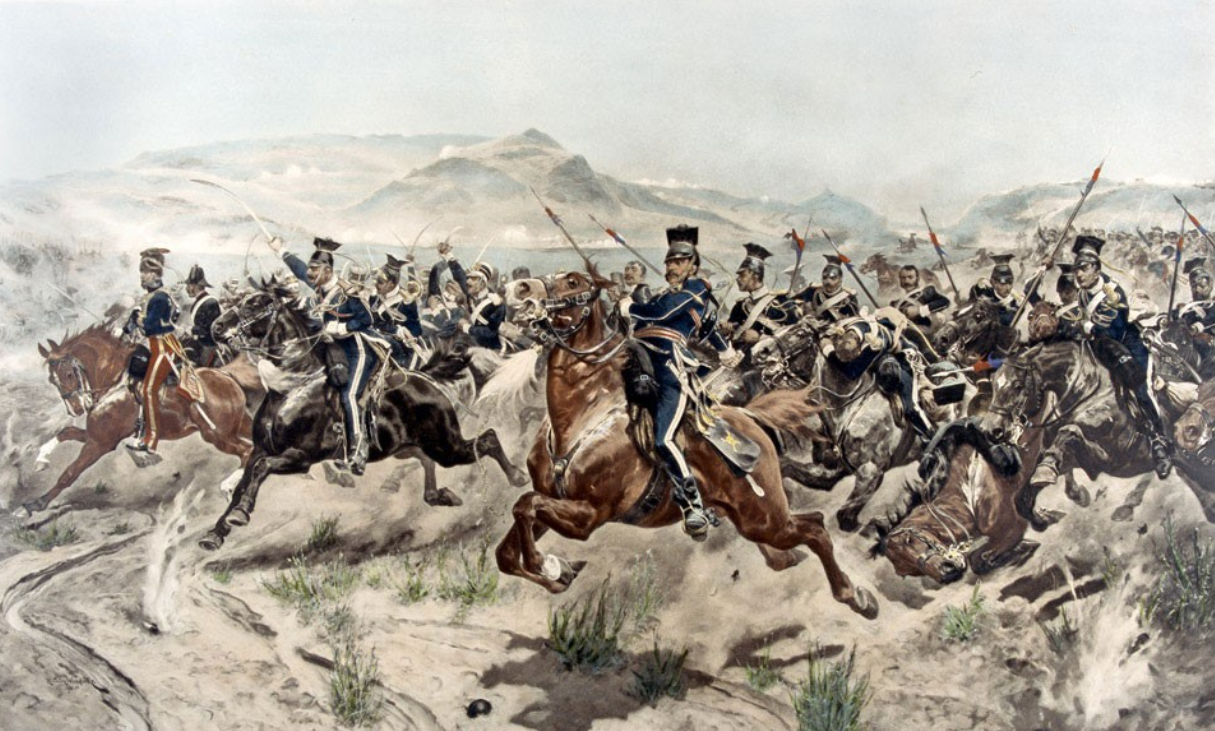
The Charge of the Light Brigade, which took place on Wednesday, 25th October 1854, is a historic example of military mismanagement and raw courage of troops under fire. The event occurred during the Battle of Balaclava, in the Crimean War when the British light cavalry, known as the Light Brigade, made a frontal assault against a well-entrenched Russian artillery battery, leading to severe losses. It should never have happened, but more about that later.
The cavalry charge resulted from a grave miscommunication among the British commanders. Commander-in-chief Lord Raglan had intended for the Light Brigade to intercept the Russians and prevent them from removing captured Turkish artillery pieces.The order was ambiguously drafted by Brigadier Richard Airey, and further muddled by Captain Louis Nolan, who added his oral instructions. Nolan’s gestures during the delivery led Lord Lucan, the cavalry commander, to erroneously direct the Light Brigade to assault the main Russian artillery at the end of the valley, contrary to Raglan’s actual intentions.


The Light Brigade, under the command of Major General James Brudenell, the Earl of Cardigan, comprised approximately 670 men, including units from the 4th and 13th Light Dragoons, the 17th Lancers, and the 8th and 11th Hussars. These troops, ideally suited for rapid, mobile assaults, were primarily armed with sabres and lances. They faced devastating fire from Russian artillery, strategically positioned to dominate the valley, which Alfred Lord Tennyson afterwards would poetically name ‘The Valley of Death‘ following the disaster.
Also present that day was the Heavy Brigade, commanded by Major General James Yorke Scarlett, who was a past Commanding Officer of the 5th Dragoon Guards. The Heavy Brigade was made up of the 4th Royal Irish Dragoon Guards, the 5th Dragoon Guards, the 6th Inniskilling Dragoons and the Scots Greys. The two brigades were the only British cavalry force at the battle.[2]
Unbelievably, despite the intense artillery barrage, the Light Brigade managed to reach the Russian positions and temporarily disperse the gunners. However, they were soon overwhelmed and forced to retreat under relentless fire. The charge resulted in significant British losses, both in human and equine casualties, starkly illustrating the vulnerability of cavalry against well-entrenched artillery.
The aftermath of the charge was a bitter blame game fought among the British high command. Lord Lucan and Lord Cardigan, already at odds due to personal animosities, further disputed each other’s decisions during the charge. Lucan was criticised for misinterpreting the orders, while Cardigan was noted for his straightforward but reckless execution of the given command. The public and official reactions in Britain were mixed, with some praising the bravery of the cavalrymen while criticising the leadership that led to such a disaster.


As we shall see, Alfred, Lord Tennyson’s poem did much to put the events of 25th October 1854 at the forefront in the minds of the British people.
Alfred, Lord Tennyson’s poem, The Charge of the Light Brigade[3]
Alfred, Lord Tennyson’s poem, The Charge of the Light Brigade, which was written just six weeks after the event and published widely in Britain, immortalised the charge. The poem highlighted the valour of the cavalrymen who obeyed their orders despite the dire consequences and underscored the tragic futility of the assault. Tennyson’s portrayal helped cement the charge as a symbol of heroic failure and misdirected martial valour.
The poem is divided into six stanzas, each with a different number of lines, ranging from six to twelve. Each line follows a dimeter structure, meaning it contains two main stressed beats. These stressed beats are followed by two unstressed syllables, creating a dactylic rhythm. This “falling” rhythm—where the emphasis is on the first beat and then “falls off”—mirrors the poem’s theme of the tragic downfall of the British brigade.
The rhyme scheme shifts throughout the poem. Tennyson often repeats the same rhyme or even the same end word across several lines, as in “Flashed all their sabres bare / Flashed as they turned in air / Sab’ring the gunners there.” He also uses anaphora—repeating the same word at the start of consecutive lines, like “Cannon to right of them / Cannon to left of them / Cannon in front of them.” This technique emphasises the relentlessness of the assault; each repetition of “cannon” gives readers a sense of the soldiers’ unyielding exposure to enemy fire.
The poem’s power lies in how it captures the relentless movement and sounds of the charge, using a strong, repetitive meter. The rhythmic, falling pattern of lines like “Half a league, half a league / Half a league onward” mirrors the steady, collective march of the soldiers, creating a sense of inevitable, unified action. Individual soldiers aren’t singled out; instead, Tennyson refers to them collectively as “the six hundred” and later “all that was left of them,” emphasising the anonymity and unity of the brigade.
Even high-ranking figures are obscured, as in the line “someone had blundered,” a subtle nod to Lord Raglan’s mistake. Originally, Tennyson omitted this line in the 1855 version, perhaps to soften the criticism, but later restored it at the urging of writer John Ruskin, who believed it added artistic depth.
Although the poem underwent multiple revisions after its first publication in 1854, it remains a powerful tribute to courage and heroism in the face of catastrophic loss.
The Crimean War – Why Did it Happen?
The Crimean War (1853-1856) was a conflict primarily between Russia and an alliance of the Ottoman Empire, France, Britain, and Sardinia. The war’s origins were complex, but it was mainly driven by power struggles over influence in the declining Ottoman Empire and control of key territories and trade routes.
The main issues at play included:
- Religious Tensions: One of the sparks of the conflict was a dispute over religious rights in the Holy Land (modern-day Israel/Palestine), then part of the Ottoman Empire. Russia claimed to be the protector of Eastern Orthodox Christians in the region, while France claimed to protect Catholics. When the Ottoman sultan granted certain privileges to Catholics, Russia protested and eventually used this as a pretext for war.
- Russian Expansionism: Russia was eager to expand its influence in the Balkans and gain access to warm-water ports, particularly around the Black Sea. Control over the Black Sea would allow Russia easier access to the Mediterranean, which would threaten British and French naval dominance.
- Balance of Power in Europe: Britain and France were concerned about Russia’s growing influence and its potential to upset the balance of power in Europe. They feared that if Russia gained control over the weakening Ottoman Empire, it would become too powerful and disrupt European stability.
The Course of the War
The main theatre of the Crimean War was the Crimean Peninsula, where much of the fighting took place, particularly around the city of Sevastopol, a major Russian naval base. The Siege of Sevastopol[4] was a key event involving brutal trench warfare and significant loss of life. The war also saw the disastrous Charge of the Light Brigade, resulting in forty per cent of the Light Brigade’s soldiers being killed, wounded, captured or rendered unfit for service. Nevertheless, the war was notable for advancements in military technology and logistics, as well as the poor conditions that led to the reform of army medical practices, thanks in part to figures like Florence Nightingale.
Outcome
The war ended with the Treaty of Paris in 1856. Russia was forced to give up some of its territorial ambitions, and the Black Sea was declared neutral, prohibiting any military presence, which weakened Russian influence in the region. The Crimean War also exposed the inadequacies of the Russian military and bureaucracy, leading to internal reforms. In summary, the Crimean War was essentially about controlling influence over territories held by the Ottoman Empire and maintaining the European balance of power, with religious and territorial disputes acting as catalysts. It was one of the first “modern” wars, featuring new technologies like railways and telegraphs, and it had lasting effects on military strategy, international alliances, and national reforms.


Empire, Alliances, and Fear of Russia: Britain’s Path to the Crimean War
Britain’s involvement in the Crimean War was driven by a combination of strategic, political, and ideological factors. At its core, British leaders feared that Russia’s expansionist ambitions threatened the balance of power in Europe and could undermine Britain’s own strategic interests. Here are some of the main reasons why Britain got involved:
Preserving the Balance of Power in Europe
Throughout the 19th century, Britain followed a foreign policy aimed at maintaining a balance of power in Europe. This meant preventing any single country from becoming too dominant, especially one as vast and potentially powerful as Russia. British leaders feared that if Russia successfully expanded its influence over the Ottoman Empire, it would gain control of strategic territories in the Balkans, potentially allowing Russian power to spread into Europe. This would disrupt the delicate balance of power that Britain believed was essential for European stability and for protecting British interests.
Protecting Trade Routes and Access to India
The Crimean Peninsula is strategically located near the Black Sea, and control over this region could give Russia access to the Mediterranean. This was a major concern for Britain because of its empire and, particularly, its interests in India, the “jewel in the crown” of the British Empire. Britain was deeply protective of the trade routes that connected it to India, especially the routes through the Mediterranean and the Suez area (though the Suez Canal was not yet built, Britain already saw Egypt and the surrounding regions as crucial to its imperial ambitions).
British policymakers worried that if Russia gained dominance over the Ottoman Empire and the eastern Mediterranean, it would threaten British access to India. In this context, containing Russia became essential to protecting Britain’s economic interests and its imperial connections to India.
Fear of Russian Expansionism
Russia had long been expanding southward, driven by both strategic and ideological motives. Russian leaders argued that they were the natural protectors of Eastern Orthodox Christians within the Ottoman Empire, which included large populations in the Balkans. Britain, however, saw this as a pretext for Russian expansionism.
British leaders feared that if Russia continued to expand unchecked, it would not stop at the Ottoman Empire but would eventually seek to control other parts of Europe as well. Russia’s growing influence over the Ottoman Empire was seen as a potential “domino effect” that could lead to Russian dominance across Eastern and Central Europe, posing a direct threat to British and French interests.
Concerns Over the Ottoman Empire’s Decline
By the mid-19th century, the Ottoman Empire was in decline, losing control over its territories and facing internal instability. This situation, known as the “Eastern Question,” was a significant diplomatic issue for European powers. The Ottoman Empire’s weakness created a power vacuum in strategic regions like the Balkans, the Caucasus, and the Middle East, and European powers were concerned about who would fill that vacuum if the Ottoman Empire collapsed.
Britain didn’t necessarily want to prop up the Ottoman Empire indefinitely, but it preferred a weakened Ottoman state as a “buffer” between Russia and the Mediterranean. British policymakers feared that if Russia took over Ottoman territories, it would create a powerful, unified Russian front directly south of Europe, which could disrupt European politics and potentially challenge Britain’s dominance in the Mediterranean.
Religious Tensions as a Pretext for War
One of the immediate triggers of the Crimean War was a dispute over religious rights in the Holy Land, which was then under Ottoman rule. Russia claimed it had the right to protect Eastern Orthodox Christians within the Ottoman Empire, while France claimed a similar role as the protector of Catholics. The Ottoman sultan tried to balance these competing interests but eventually granted some privileges to the Catholics, which angered Russia.
Although the dispute over religious rights was a minor issue in itself, it provided a pretext for Russia to pressure the Ottomans and demand greater influence. Britain and France both saw this as an aggressive move by Russia and felt that if they didn’t push back, Russia would continue to escalate its demands on the Ottoman Empire.
Alliance with France and Mutual Interests
Britain’s involvement in the Crimean War was also influenced by its alliance with France. Napoleon III, the French emperor, was eager to assert France’s power and prestige on the European stage, and he saw challenging Russia as an opportunity to do so. Britain and France had often been rivals in the past, but by the 1850s, they shared common interests in curbing Russian expansionism.
Napoleon III and the British government found common ground in opposing Russia, and the alliance helped bring Britain into the conflict. With both Britain and France sharing concerns about Russia’s ambitions, they decided to take a united stand against it.
British Public Opinion and the “Great Game”
The Crimean War occurred in an era when public opinion in Britain was increasingly influential in foreign policy. Newspapers like The Times were widely read and often shaped public sentiment. The British press portrayed Russia as a despotic and expansionist power threatening “civilised” Europe, and there was widespread public support for standing up to Russian aggression.
Additionally, this period marked the height of the “Great Game,” a political and military rivalry between Britain and Russia over influence in Central Asia. Although the Crimean War was separate from the Great Game, both conflicts reflected British anxieties about Russia’s intentions and its potential to challenge British global influence.
The Desire to Project British Power
For Britain, the Crimean War was also an opportunity to project power and demonstrate its commitment to maintaining order in Europe. By intervening, Britain showed that it was willing to act decisively to protect its interests and allies. In this sense, the war was partly about British prestige: showing Europe that Britain would not tolerate aggressive moves by Russia and that it was committed to defending the status quo. Britain was eager to assert itself as a global superpower and to remind the world of its military capabilities. Some British leaders likely believed that a show of force would curb Russia’s ambitions and make other powers think twice before challenging Britain’s interests.
A complex mix of strategic, political, and ideological motives drove Britain’s involvement in the Crimean War. British leaders feared that unchecked Russian expansion would upset the balance of power in Europe, threaten Britain’s access to India, and create a powerful Russian presence in the Mediterranean. The decline of the Ottoman Empire and the broader “Eastern Question” added urgency, as Britain preferred a weakened Ottoman state as a buffer against Russian encroachment.
With France as a willing ally and British public opinion supportive of resisting Russian aggression, Britain joined the war to protect its interests and to send a clear message that it would not tolerate Russian dominance in the region. While the religious disputes in the Holy Land served as an immediate pretext, Britain’s deeper motivations were largely strategic: safeguarding its empire, its trade routes, and its influence on the European stage.
Patriotism, Humanitarianism, and the Demand for Reform during the Crimean War
The Crimean War had a mixed reception in Britain and sparked a range of opinions and emotions among the British public, who were both fascinated and horrified by the conflict. It was one of the first wars to be widely covered by the press, with journalists, photographers, and even early war correspondents like William Howard Russell of The Times sending detailed reports back to Britain. This was a time when news could be relayed with unprecedented speed thanks to the telegraph, and British people were able to follow the war’s progress in almost real time. Different segments of British society reacted to the Crimean War in varying ways:
- Patriotic Support and National Pride: Initially, many Britons supported the war out of patriotic fervour. There was a widespread belief that Britain was defending European stability and freedom by curbing Russian expansionism. People saw the war as a righteous cause, a fight against what was perceived as Russian aggression toward the Ottoman Empire. British pride in the Royal Navy and the military was strong, and many viewed Britain’s participation as a moral duty to protect Europe from Russian domination.
- Disillusionment and Outrage Over Conditions: As reports of the war’s brutal realities came in, however, public opinion began to sour. Journalists like Russell described the horrifying conditions on the front lines: soldiers poorly equipped for the harsh Russian winters, widespread disease, and appalling mismanagement by the British military command. Public outrage grew over the fact that British troops were suffering due to inadequate medical care, lack of proper supplies, and incompetent leadership. This led to demands for government accountability and reforms within the military.
- Humanitarian Concerns and Florence Nightingale: The suffering of British soldiers struck a nerve in British society, sparking a new wave of humanitarian concern. Florence Nightingale became a national hero for her efforts to improve medical conditions for soldiers, and her work inspired a movement to reform army healthcare. Her reports on the terrible conditions in military hospitals highlighted the need for organised, professional medical care. She symbolised a new role for women in wartime and influenced the development of modern nursing, which earned her great respect and admiration in Britain.


- Shock and Bewilderment Over Military Failures: The Crimean War tore to shreds the British public’s confidence in their military leaders. Blunders like the Charge of the Light Brigade—where miscommunication led to a disastrous and nearly suicidal cavalry charge—were seen as examples of the incompetence and outdated tactics of British commanders. Alfred, Lord Tennyson’s poem “The Charge of the Light Brigade” captured the public’s sense of both admiration for the soldiers’ bravery and frustration with the officers who led them into a needless slaughter. This event became emblematic of the needless loss and incompetence that seemed to plague the British command.
- Criticism of the Government and Demand for Reform: The outcry over the handling of the war led to widespread criticism of the British government and military establishment. Many Britons began to question the wisdom of the war and the competence of their leaders. The outpouring of public anger contributed to a political crisis, eventually leading to reforms in the British Army. The experience revealed deep inefficiencies within the British military and bureaucracy, and it led to significant changes in how the army was supplied, trained, and managed.
- A Turning Point in British Media and Public Opinion on War: The Crimean War was one of the first conflicts where the British public saw a stark portrayal of the brutality of war. The reports in newspapers and the visual impact of early war photography by figures like Roger Fenton brought the horrors of war closer to home than ever before. This war marked the beginning of a more critical and sceptical public approach to war, setting the stage for future conflicts where the press would play a major role in shaping public opinion.
While the war began with patriotic enthusiasm and a sense of duty, it eventually led to disillusionment, criticism, and calls for reform. The Crimean War exposed the British public to the harsh realities of military conflict and set the stage for future demands for accountability and humanitarianism in wartime. It marked a shift in how Britons viewed their government’s conduct in war, their military institutions, and the role of the press in holding leaders accountable. The war became a catalyst for significant social and military changes in Britain and reshaped British attitudes toward conflict and empire.
Blunders and Mismanagement in the British Campaign of the Crimean War
The Crimean War is remembered for its significant missteps, particularly regarding planning, logistics, and communication, which resulted in several high-profile blunders beyond the infamous Charge of the Light Brigade. Here are some of the key errors that plagued the British campaign:
- The Siege of Sevastopol (1854-1855): The siege of Sevastopol, which was the main Russian naval base in the Black Sea, became a symbol of mismanagement and suffering. Initially, the British, French, and Ottoman forces failed to surround the city adequately, allowing Russian troops to bring in reinforcements. The Allies underestimated the strength of Russian defences and struggled to coordinate their attacks, leading to repeated and costly assaults with little progress. The prolonged siege resulted in severe troop exhaustion, disease, and high casualty rates on both sides.
- Lack of Winter Supplies and Uniforms: The British military’s preparation for the harsh Crimean winter was alarmingly inadequate. Soldiers were sent into winter with insufficient clothing, shelter, and food, leading to widespread suffering, frostbite, and death from exposure. Poorly managed supply lines meant that essential supplies often failed to reach the front lines, resulting in thousands of preventable deaths during the cold months.
- Failure of the Supply Chain: The management of the British supply chain during the war was disastrous. Supplies frequently piled up at depots far from the front, while soldiers at the battlefront lacked essentials. Although the port of Balaklava was overwhelmed with incoming shipments, poor organisation meant that much of it never reached the troops. Even basic necessities like food and medical supplies were in short supply, leaving soldiers in terrible conditions.
- The Battle of Balaklava (1854): The Battle of Balaklava, where the Charge of the Light Brigade occurred, was marked by several miscommunications and tactical errors. British commanders struggled to coordinate effectively, leading to confusion over orders. For example, during the battle, the Thin Red Line, a small group of Highland infantry, managed to repel a much larger Russian cavalry charge, highlighting inadequate defensive planning.
- Medical and Sanitary Neglect: Medical care for the wounded was shockingly poor, with field hospitals suffering from appalling conditions. The lack of proper sanitation led to massive outbreaks of disease, killing more soldiers than battlefield injuries. Florence Nightingale, who managed the Scutari hospital, found soldiers lying in filthy, overcrowded conditions, emphasising the dire need for organised medical care.
- Miscommunication Between Commanders: The Crimean War was plagued by miscommunication among British commanders, especially between Lord Raglan and his French counterpart. The unclear orders and rivalry contributed to tactical errors and missed opportunities. The infamous Charge of the Light Brigade was just one example of how ambiguous commands led to disastrous outcomes.
- Failure to Use Reconnaissance Effectively: Commanders did not adequately scout Russian positions, leading to poor decisions in battle. The lack of surveillance resulted in underestimating Russian troop movements and defences, making it difficult for British forces to make effective tactical choices.
- Port Mismanagement and the Storm of 1854: In November 1854, a severe storm struck the Black Sea, destroying or damaging many British supply ships anchored at Balaklava. This disaster further crippled logistics, leaving troops without essential supplies such as food, ammunition, and winter clothing. The failure to prepare for adverse weather conditions was a significant oversight.
- Lack of Coordination with Allies: Coordination between the British and their allies, including the French and the Ottoman Empire, was often poor. Different priorities and tactics led to disjointed operations. For example, during the Siege of Sevastopol, British and French forces attacked different parts of the city at different times, failing to present a united front.
The Crimean War revealed serious flaws in British military planning and command. Poor communication, inadequate logistical support, and a lack of basic supplies severely affected troop morale and welfare. The high-profile failures led to public outrage, prompting demands for military and logistical reforms. Ultimately, the war marked a turning point in how the British military approached warfare, highlighting the need for modernisation to prevent similar disasters in the future.


Blame and Accountability: Why Nobody Was Held Responsible
The Charge of the Light Brigade is widely remembered as one of the most tragic and unnecessary blunders in British military history. Despite the immense loss of life and the clear failure of leadership that led to the charge, no one was formally held accountable, and none of the key figures were “cashiered” (dismissed from the army in disgrace). Several factors contributed to this lack of accountability:
The Confusing Chain of Command and Ambiguous Orders
The main reason no single person was held accountable was the confusing series of orders and misunderstandings that led to the charge. The command to attack was issued by Lord Raglan, the British commander-in-chief, who was observing the battlefield from a distant vantage point. Raglan intended the Light Brigade to charge and capture a specific set of Russian artillery guns that were threatening British positions. However, his order was vague and did not specify which guns were the target.
The message was relayed through multiple officers before it reached the Light Brigade’s commander, Lord Lucan (in charge of all British cavalry), and Lord Cardigan (in direct command of the Light Brigade). By the time the order reached them, it was misinterpreted to mean a frontal assault on a heavily fortified Russian gun position at the end of a long valley, which was essentially a suicide mission. The chaotic communication meant that no single officer could be entirely blamed, as the responsibility was diffused among several individuals, each of whom had a plausible defence.
The Role of Captain Nolan
Captain Louis Nolan, the officer who delivered the message from Raglan to Lucan, may have contributed to the misunderstanding. Nolan was known for his aggressive personality and contempt for what he saw as overly cautious British commanders, including Lucan. Some historians believe Nolan’s tone or manner of delivering the order led Lucan to misinterpret the objective. Tragically, Nolan himself was killed early in the charge, so he could neither clarify the order nor be questioned afterwards, further complicating any investigation.
Personal Rivalries Between Lucan and Cardigan
Lucan and Cardigan, the two principal cavalry officers involved, were bitter rivals who openly despised each other. This rivalry may have contributed to the lack of effective communication and coordination. Lucan, who received the order from Nolan, should have clarified it with Raglan or sought further explanation. Instead, he passed the order to Cardigan, who also failed to question its logic. Both officers were known to dislike each other so much that they barely spoke, which hampered their ability to work together in critical moments.
Due to this longstanding animosity, it was difficult to pin the blame on either one. Each officer could argue that they were simply following orders or that their counterpart bore the greater responsibility. Lucan and Cardigan each defended themselves aggressively after the charge, shifting blame and making it politically challenging for any single officer to be held responsible.
The British Military Culture of “Obeying Orders”
At the time, the British military culture placed a strong emphasis on obedience and hierarchy. Once an order was given by a senior officer, it was expected to be followed without question, especially on the battlefield. Although Lucan and Cardigan might have recognised that the charge was tactically questionable, they were both under pressure to follow Raglan’s command. The expectation to obey orders, even when they seemed flawed, was deeply ingrained, and this cultural factor made it difficult to place individual blame after the fact.
This emphasis on following orders contributed to the belief that the tragedy was an unfortunate consequence of miscommunication rather than outright incompetence or insubordination. The military’s reluctance to question orders or allow for tactical flexibility played a significant role in the lack of accountability.
Public and Political Sensitivity
The British public and press were horrified by the losses suffered by the Light Brigade, and the incident quickly became both a symbol of military bravery and a national scandal. Lord Tennyson’s poem immortalised the heroism of the soldiers, which helped shift public focus away from the leadership errors and more toward the valour of the men involved. There was a strong sense of national pride associated with the charge, and any formal investigation might have tarnished the heroism that the public was celebrating.
Politically, it was also risky to pursue a court-martial or dismissal for high-ranking officers, especially in the middle of a war. The Crimean War was already suffering from logistical failures, public criticism, and morale issues, and removing key figures like Raglan, Lucan, or Cardigan could have caused further instability. Leaders were reluctant to worsen the crisis by exposing the full extent of the army’s internal dysfunction.
Lord Raglan’s Influence and Reputation
Lord Raglan, who bore significant responsibility for issuing the vague order in the first place, was a respected figure with strong political connections. As a former aide to the Duke of Wellington (the hero of the Napoleonic Wars), Raglan was part of the British military establishment. He had a powerful network of supporters and was seen as a heroic, albeit somewhat old-fashioned, commander. His connections likely shielded him from scrutiny, as a public inquiry that implicated him might have had wide-reaching political consequences.
Raglan died of dysentery before the end of the war, in 1855, which effectively closed off any possibility of holding him accountable afterwards. His death allowed him to escape the full criticism that might have emerged later and softened public and military opinion on his leadership.
Desire to Maintain Military Unity and Morale
At a time when British forces were still actively engaged in a difficult campaign, any public disciplining or court-martial of high-ranking officers might have weakened morale and unity within the army. The British government and military leadership likely wanted to avoid a scandal that could further damage public confidence in the army and undermine the war effort. By not assigning blame, the army was able to move forward without disrupting the chain of command.
The failure to hold anyone accountable for the Charge of the Light Brigade stemmed from a mix of factors: ambiguous orders, personal rivalries, a rigid culture of obedience, political sensitivities, and the desire to preserve morale during an already troubled war. The chain of events leading to the charge was complex, with responsibility spread across several individuals, making it difficult to single out any one person. Ultimately, the charge became a tragic but celebrated example of bravery rather than a scandal over failed leadership, allowing those involved to avoid formal punishment. The incident did, however, expose deep flaws within the British military hierarchy, and the public outcry over the entire Crimean War eventually led to military reforms. While no one was cashiered over the Charge of the Light Brigade, the lessons learned from these blunders had a lasting impact on British military practices in the years that followed.
A Poignant Study in Military History
The Charge of the Light Brigade remains a poignant study in military history, illustrating the critical importance of clear communication and the perils of hierarchical inflexibility. It also stands as a testament to the courage of soldiers who carry out orders in the face of overwhelming odds.
Responsibility for the miscommunication is disputed, as the order was vague, and Captain Louis Nolan, who delivered the written orders with some oral interpretation, was killed in less than 60 seconds from the first minute of the assault.


The Brigades
- The Light Brigade was the British light cavalry force. It rode unarmoured, light, fast horses. The men were lightly armed with lances and sabres and were expected to harass the enemy rather than engage them in heavy combat. Optimised for maximum mobility and speed, they were intended for quick manoeuvres, reconnaissance, and skirmishing. They were also ideal for cutting down infantry and artillery units as they tried to retreat. The Light Brigade was commanded by Major General James Thomas Brudenell, the 7th Earl of Cardigan.
- The Heavy Brigade under James Scarlett was the British heavy cavalry force. It rode large, heavy chargers. The men were equipped with metal helmets and armed with cavalry swords for close combat. They were intended as the primary British shock force, leading frontal charges to break enemy lines.[5]
The Tactics
Overall command of the British cavalry resided with Lieutenant General George Bingham, 3rd Earl of Lucan. Cardigan and Lucan were brothers-in-law who disliked each other intensely. Lucan received an order from the army commander Lord Raglan stating: “Lord Raglan wishes the cavalry to advance rapidly to the front, follow the enemy, and try to prevent the enemy from carrying away the guns. Troop horse artillery may accompany. French cavalry is on your left. Immediate”.[6]
Raglan wanted the light cavalry to prevent the Russians from successfully withdrawing the naval guns from the redoubts they had captured on the reverse side of the Causeway Heights, the hill forming the south side of the valley. This was an optimal task for the Light Brigade, as their superior speed would ensure the Russians would be forced to act quickly in either abandoning the cumbersome guns or being cut down en masse while they tried to flee with them.
Raglan could see what was happening from his high vantage point on the west side of the valley. However, the lie of the land around the cavalry position stopped Lucan from seeing the Russians’ efforts to remove the guns from the redoubts.[7]
The written order which led to the Charge was drafted by Brigadier Richard Airey and carried by Captain Louis Nolan. Nolan carried the further oral instruction that the cavalry was to attack immediately.[8] By Lucan’s account, when he asked what guns were referred to, Nolan indicated in a most disrespectful way (with a wide sweep of his arm) the mass of Russian guns at the end of the valley: “There, my lord, is your enemy; there are your guns.“[9] His reasons for the misdirection are unknown because he was killed in the ensuing battle.
In response to the order, Lucan instructed Cardigan to lead his command of about 670 troopers of the Light Brigade straight into the valley between the Fedyukhin Heights and the Causeway Heights. (Russell’s report in The Times recorded that just short of 200 men were left behind in camp on the day (either sick or otherwise unable to participate), leaving “607 sabres” to take part in the charge.
The opposing Russian forces were commanded by Pavel Liprandi. According to an estimate by Nicholas Woods, correspondent of The Morning Post, the forces at his disposal amounted to 25,000 infantry and 4,000 cavalry, supported by 30 or 40 cannons.[10] These forces were deployed on both sides and at the opposite end of the valley.
Lucan was to follow with the Heavy Brigade. The Heavy Brigade was intended for frontal assaults on infantry positions, but neither force was anywhere near to being equipped for a frontal assault on a fully dug-in and alerted artillery, much less one with an excellent line of sight over a mile in length and supported on two sides by artillery batteries providing enfilading fire from elevated ground[11].
The Light Brigade’s Charge
The Light Brigade set off down the valley with Cardigan in front, leading the charge on his horse, Ronald.[12] Almost at once, Nolan rushed across the front, passing in front of Cardigan. It may be that he realised that the charge was aimed at the wrong target and was attempting to stop or turn the brigade,[13] but he was killed by an artillery shell. The cavalry continued on its course.
As the Light Brigade set off down the valley, Lord Cardigan led from the front on his horse, Ronald. Almost immediately, Captain Louis Nolan dashed in front of Cardigan, seemingly realising that they were heading toward the wrong target and trying to stop the charge. However, Nolan was killed by an artillery shell, and the Brigade continued forward, unaware of his attempt to redirect them.
Under Fire
Captain Godfrey Morgan, who was riding close to the front, described the chaos as Russian artillery opened fire. Shells burst in the air, and rounds hit men and horses around him. As they advanced from a trot to a canter, the noise of the artillery and the debris from exploding shells made it nearly impossible to see or hear. Morgan vividly recounted riding directly at a cannon, shutting his eyes as he thought he would be shot—only for the shell to hit the soldier beside him instead.
Reaching the Guns
The Brigade eventually reached the Russian guns, but by this point, they had sustained heavy losses. Morgan’s horse was struck, and he found himself tangled in the mêlée with Russian gunners. He managed to strike a gunner with his sword, escaping narrowly, only to realise he was alone among the enemy.
Retreat
After making brief contact with the Russians, the surviving members of the Light Brigade were forced to retreat. Russian artillery, which had initially been abandoned, was re-manned, and the gunners fired grapeshot and canister indiscriminately at both British and Russian troops in the mêlée. Morgan noted that as he rode back, under fire from both sides, the scene was one of complete chaos.
The Role of the Heavy Brigade and French Chasseurs
The Heavy Brigade, led by General Lucan, entered the mouth of the valley but did not advance further, fearing unnecessary losses. Meanwhile, the French Chasseurs d’Afrique, led by General d’Allonville, attacked the Russian forces on the Fedyukhin Heights, providing cover for the remaining elements of the Light Brigade as they withdrew.
Casualties and Aftermath
The charge devastated the Light Brigade, with 113 men killed, 134 wounded, and others taken prisoner. Of the 673 cavalrymen who rode in the charge, only 195 returned with horses. War correspondent William Howard Russell, who witnessed the battle, reported, “Our Light Brigade was annihilated by their own rashness, and by the brutality of a ferocious enemy.”
Controversy and Blame
A public dispute arose afterwards, with commanders blaming each other. Lord Raglan, the British commander, faulted General Lucan for misunderstanding the order, while Lucan criticised Raglan’s unclear instructions and the role of Captain Nolan. Lord Cardigan, who led the charge but did not see the disastrous impact on his men, returned to Britain as a hero, though he faced criticism for failing to rally his troops after the charge.
Legacy
The Charge of the Light Brigade is remembered as a tragic example of bravery and the consequences of miscommunication in warfare. French Marshal Pierre Bosquet famously remarked, “C’est magnifique, mais ce n’est pas la guerre” (“It is magnificent, but it is not war”). The charge continues to be studied by military historians as a cautionary tale of unclear orders and flawed intelligence.
Later Analysis
One research project used a mathematical model to examine how the charge might have turned out if conducted differently. The analysis suggested that a charge toward the redoubt on the Causeway Heights, as Raglan had apparently intended, would have led to even higher British casualties. By contrast, the charge might have succeeded if the Heavy Brigade had accompanied the Light Brigade along the valley, as Lucan had initially directed.[14] This study uses a mathematical model to examine hypothetical outcomes of the Charge of the Light Brigade, analysing how different tactical decisions could have impacted the casualties and success of the charge.
The authors found that if the Light Brigade had charged toward the redoubt on the Causeway Heights, as Lord Raglan had intended, British casualties might have been even higher. In contrast, their model suggested that if the Heavy Brigade had supported the Light Brigade in the valley, as initially ordered by Lord Lucan, the charge might have had a higher chance of success. This study provides an insightful counterfactual analysis, exploring how command decisions influenced the tragic outcome.
According to the author Norman Dixon, 19th century accounts of the charge tended to focus on the bravery and glory of the cavalrymen much more than the military blunders involved, with the perverse effect that it “did much to strengthen those very forms of tradition which put such an incapacitating stranglehold on military endeavour for the next eighty or so years,” i.e., until after World War I.[15]
Remembrance of the Survivors
The fate of the surviving members of the charge was investigated by Edward James Boys, a military historian, who documented their lives from leaving the army to their deaths. His records are described as being the most definitive project of its kind ever undertaken.[16]
In October 1875, survivors of the charge met at the Alexandra Palace in Middlesex to mark its 21st anniversary. The celebrations were fully reported in the Illustrated London News of 30th October 1875,[17] which included the recollections of several of the survivors, including those of Edward Richard Woodham, the Chairman of the Committee that organised the celebration. Although Tennyson was invited, he could not attend. Lord Lucan, the senior commander surviving, was also not present but attended a separate celebration, held later in the day with other senior officers. Reunion dinners were held for a number of years.[18]
On 2nd August 1890, trumpeter Martin Leonard Landfried, from the 17th Lancers, who may have sounded the bugle charge at Balaclava[19], made a recording on an Edison cylinder that can be heard (click here), with a bugle which had been used at Waterloo in 1815.[20]
In 2004, on the 150th anniversary of the charge, a commemoration of the event was held at Balaclava. As part of the anniversary, a monument dedicated to the 25,000 British participants of the conflict was unveiled by Prince Michael of Kent.[21]
A survivor, John Penn, who died in Dunbar in 1886, left a personal account of his military career, including the Charge, written for a friend. This survives and is held by East Lothian Council Archives.[22]
Private William Ellis of the 11th Hussars was erroneously described as the last survivor of the Charge at the time of his funeral at Upper Hale Cemetery in Farnham, Surrey, in 1913 after his death aged 82.[23] A number of individuals who died during 1916–17 were thought to be the ‘last’ survivors of the Charge of the Light Brigade. These include Sergeant James A. Mustard of the 17th Lancers, aged 85, who had his funeral with military honours at Twickenham in early February 1916. In the Abergavenny Chronicle news report published on 11th February 1916, it was stated:
He was one of thirty-eight men of the 145 of the 17th Lancers that came out of the charge led by Cardigan and was always of the opinion that no one sounded the charge at all. He was in the battles of Alma and Mackenzie’s Farm and the storming and taking of Sebastopol, and before leaving for Varna, marched with his regiment from Hampton Court to Portsmouth.[24]
The Cambrian News of 30th June 1916 noted the passing of another ‘last’, Thomas Warr, who had died the previous day at 85.[25]
William Henry Pennington of the 11th Hussars, who embarked on a relatively successful career as a Shakespearean actor after leaving the Army, died in 1923.[26] The last survivor was Edwin Hughes of the 13th Light Dragoons, who died on 18th May 1927, aged 96.[27]
Poet Laureate Alfred, Lord Tennyson, wrote evocatively about the battle in his poem “The Charge of the Light Brigade”. Tennyson’s poem, written on 2nd December 1854 and published a week later in The Examiner, praises the brigade (“When can their glory fade? O the wild charge they made!“) while trenchantly mourning the appalling futility of the charge (“Not tho’ the soldier knew, someone had blunder’d … Charging an army, while all the world wonder’d“). Tennyson wrote the poem inside only a few minutes after reading an account of the battle in The Times, according to his grandson Sir Charles Tennyson. It immediately became hugely popular and even reached the troops in the Crimea, where 1,000 copies were distributed in pamphlet form.[28]
Nearly 36 years later, Kipling wrote “The Last of the Light Brigade” (1890), commemorating a visit by the last 20 survivors to Tennyson (then aged 80) to reproach him gently for not writing a sequel about the way in which England was treating its old soldiers.[29] Some sources treat the poem as an account of a real event, but other commentators class the destitute old soldiers as allegorical, with the visit invented by Kipling to draw attention to the poverty in which the real survivors were living, in the same way that he evoked Tommy Atkins in “The Absent-Minded Beggar” (1899).[30] & [31]
There is a lively description of the cavalry charge in the 1862 novel Ravenshoe by Henry Kingsley.[32]
Anna Sewell’s 1877 novel Black Beauty, written in the first person as if by the horse of the title, includes a former cavalry horse named Captain who describes his experience of being in the Charge of the Light Brigade.
Review: International Reactions and Media Coverage
The Charge of the Light Brigade, occurring within the larger context of the Crimean War, drew widespread attention and scrutiny not only in Britain but also across Europe and beyond. The charge became one of the first military events to be reported on extensively in newspapers, largely due to the work of journalists embedded near the front lines. Reports of the charge—and the broader campaign—reached the public quickly, thanks to the new telegraph system, offering almost real-time updates and shaping public opinion as the war unfolded.
The Role of British War Correspondents
In Britain, The Times newspaper played a critical role in informing the public about the war. As already mentioned, the work of William Howard Russell, regarded as one of the first modern war correspondents, was especially influential. Reporting directly from the front, Russell provided detailed and often harrowing descriptions of the conditions facing British soldiers, from inadequate supplies to poorly coordinated leadership. Russell’s work helped turn the Charge of the Light Brigade from an act of battlefield heroism into a symbol of military mismanagement, prompting public outrage and demands for reform in Britain.
Reactions in France
The French press covered the charge with a mixture of admiration and critique. France, Britain’s main ally in the Crimean War, often highlighted the courage and discipline displayed by the British cavalry but also questioned the leadership decisions behind the charge. French military commentators, drawing on their own experiences in the war, discussed the logistical failures that left the British forces poorly equipped and supplied. The charge, while tragic, reinforced to French readers the risks of a military culture that sometimes valued rigid obedience over adaptability on the battlefield.
The comments from French Marshal Pierre Bosquet became widely quoted in the French press and underscored the sentiment that, while the bravery of the British cavalry was impressive, the command decisions were fundamentally flawed. French newspapers used this statement to critique the rigid hierarchy and inflexible command structures that led to such a tragic result.
Russian Responses and Propaganda
From the Russian perspective, the Charge of the Light Brigade provided an opportunity for propaganda. Russian newspapers highlighted the charge as a foolish and reckless manoeuvre, portraying it as evidence of British overconfidence. While accounts from British and French sources often depicted the Russian forces as caught off-guard by the sudden charge, Russian reports instead emphasised the preparedness and resilience of their troops. Some Russian papers suggested that the British soldiers were driven by desperation or were misled into the valley due to inadequate planning.
Russian authorities used the Charge of the Light Brigade as a symbol of British military incompetence, suggesting that such poor judgment was representative of British leadership overall. This propaganda served to bolster Russian morale by framing the battle as a triumph over an arrogant adversary and helped solidify public support for the war effort within Russia.
Impact of the Telegraph and War Photography
The Crimean War was one of the first conflicts in which the telegraph allowed rapid communication from the front lines to European capitals. Newspapers across Europe published dispatches within days of events, creating a sense of immediacy that was unprecedented for its time. Additionally, early war photography—particularly the work of Roger Fenton—brought images of the war’s aftermath to the public, including the weary faces of soldiers and the rugged, desolate landscapes of Crimea. Although photographs of the charge itself do not exist, Fenton’s images captured the atmosphere of the campaign, adding to the public’s understanding of the soldiers’ hardships.
In Britain, these reports and images helped shift the public view from romantic ideals of war to a harsher, more realistic perspective. For the first time, the British public was able to glimpse the real cost of battle and question the decisions of military leadership. The immediacy of the telegraph and the power of visual documentation combined to make the Crimean War—and specifically, the Charge of the Light Brigade—a subject of scrutiny and debate, influencing how warfare would be reported and understood in future conflicts.
Lasting Influence on Military Reporting
The media coverage of the Charge of the Light Brigade set a precedent for war reporting, showing how journalism could shape public opinion and hold military leaders accountable. Russell’s critical dispatches from Crimea established a standard for investigative war journalism, pushing the public to question not only the heroism of soldiers but also the competence of those who commanded them. In the years that followed, this type of reporting became a powerful force, ensuring that future conflicts would be examined not only for their strategic outcomes but for their human cost and ethical implications.
Britain’s Reputation
The failures of British military leadership during the Charge of the Light Brigade and the wider Crimean War impacted Britain’s reputation in both positive and negative ways on the international stage. While some nations viewed the British military with less admiration due to the apparent incompetence of its leadership, others were impressed by the bravery and resilience of British soldiers despite these challenges.
Loss of Prestige and International Critique
The ineptitude displayed by British leaders during the Crimean War, particularly in the Charge of the Light Brigade, led to considerable criticism and ridicule both domestically and internationally. For example:
- French Allies’ Mixed Reactions: Although the French respected British soldiers’ bravery, their leaders and press were critical of the leadership and tactical errors that led to the Charge of the Light Brigade and other blunders. Marshal Pierre Bosquet’s remark, “It is magnificent, but it is not war,” was a well-known critique, suggesting that while British courage was admirable, the lack of strategic planning and effective command led to needless losses.
- Russian Propaganda: Russia used the Charge as propaganda, portraying British commanders as reckless and highlighting the incident as a foolish, avoidable disaster. This narrative aimed to undermine Britain’s military reputation, casting doubt on British military competence.
- Other European Nations’ Observations: Observing these blunders, other European nations viewed the British Army’s leadership with scepticism. The rigidity and failure to adapt to modern warfare tactics led some to question the effectiveness of Britain’s military institutions. The Times coverage of the campaign, with vivid depictions of the lack of supplies and leadership failures, fed into perceptions that Britain was out of touch with the demands of modern warfare.
Reinforcement of British Prowess and Soldierly Bravery
Despite these critiques, the campaign also enhanced Britain’s reputation in certain respects, focusing on the bravery of individual soldiers and the ability of the British military to persevere under adverse conditions.
- Admiration for British Troops: The heroism shown by the British soldiers during the Charge became a symbol of bravery worldwide. Tennyson’s poem and widespread coverage of their courage turned the event into a rallying point for British national pride, even as it raised questions about the military leadership.
- Influence on British Allies: Britain’s close alliance with France during the Crimean War actually helped to build stronger diplomatic ties. France and Britain found common ground, united in their aim to curb Russian expansion. Napoleon III’s government, in particular, used the alliance to elevate France’s military presence on the international stage.
Long-Term Impact on Britain’s Military Reputation
The widespread awareness of leadership flaws in the British Army did eventually lead to positive change. The outcry over the mismanagement and resulting reforms, such as the Cardwell Reforms[33], demonstrated Britain’s capacity to learn and adapt. This willingness to modernise in response to public and international scrutiny helped Britain rebuild its military reputation over the following decades, especially as it adopted reforms to professionalise and better organise its forces. While the Charge of the Light Brigade and other leadership failures initially tarnished Britain’s reputation and subjected it to international critique, the bravery of British soldiers and the subsequent reforms helped restore and even strengthen Britain’s image. This balance of admiration and criticism shaped a more complex view of British military power among other nations.
Letters from the Front: Temple Godman’s Accounts from the Crimea
The Letters of Temple Godman, 5th Dragoon Guards is a collection of first-hand accounts written by Lieutenant Richard Temple Godman, an officer during the Crimean War (1853–1856). These letters, sent home to family and friends, provide an intimate perspective on the daily experiences, hardships, and reflections of a British cavalryman engaged in one of the 19th century’s most infamous conflicts.
Godman’s letters vividly depict the harsh conditions faced by soldiers in Crimea, from the freezing winters and lack of adequate supplies to the logistical nightmares that plagued the British army. His accounts reveal the constant struggle against disease, malnutrition, and poor sanitation, which affected the morale and health of the troops as much as the combat itself. Often expressing frustration with the British military leadership, Godman adds a personal voice to the broader critique of mismanagement and inefficiencies that led to tragic losses, including disasters like the Charge of the Light Brigade. His perspective from within the cavalry reflects the prevailing sentiment among rank-and-file soldiers who were directly affected by miscommunications and leadership failures.
Beyond the external struggles, Godman’s letters capture the emotional toll of prolonged conflict, describing the isolation, weariness, and mental endurance required of soldiers over the course of the war. Through his reflections, readers gain a window into the resilience and stoicism needed to withstand such bleak circumstances. Yet amid these hardships, Godman’s writings also emphasise the strong sense of camaraderie that bound the soldiers together and kept them motivated. His loyalty to his fellow soldiers and his commitment to his role within the 5th Dragoon Guards show how personal bonds and shared duty helped maintain morale.
As a cavalry officer, Godman witnessed key moments in the Crimean War, including the Battle of Balaclava and the siege of Sevastopol. His first-hand observations offer historians and readers detailed descriptions of cavalry action and the broader strategic landscape of the war, providing a rare soldier’s-eye view of events that are often recorded in formal accounts and official dispatches. Godman’s letters are valued for their candid, personal style, adding depth to our understanding of the war’s impact on individual soldiers. They contribute a contrast to the more official accounts of the time, shedding light on the psychological and physical endurance required, especially of those in the cavalry. The collection remains a vital source for military historians, offering insight into the daily life of a cavalryman and the human experience of one of Britain’s most challenging and transformative wars.
Speculations and Conspiracy Theories Surrounding the Charge of the Light Brigade
Several conspiracy theories and speculative interpretations have emerged around the Charge of the Light Brigade due to the event’s tragic outcome, the confusing orders, and the personalities involved. Here are a few notable theories:
- Deliberate Miscommunication by Captain Nolan: One theory suggests that Captain Louis Nolan, who delivered the order for the charge, deliberately misinterpreted Lord Raglan’s command. Nolan, known for his aggressive stance on cavalry tactics and disdain for British military caution, allegedly wanted the Light Brigade to engage in a bold, full-frontal charge rather than the intended movement to secure the artillery. Some believe that Nolan’s own motivations influenced the way he relayed Raglan’s order to Lucan, who then sent Cardigan and the brigade into the valley. Proponents argue that Nolan’s contempt for Lucan’s cautious style led him to push the Light Brigade into a more dangerous action.
- Internal Sabotage from the Rivalry Between Lucan and Cardigan: Another theory posits that the bitter rivalry between Lord Lucan and Lord Cardigan, who were also brothers-in-law, contributed to the disaster. According to this view, their mutual dislike hindered communication and coordination, and some speculate that Lucan may have deliberately sent Cardigan on a high-risk mission to discredit him or place him in harm’s way. This theory suggests that personal animosities and vendettas, rather than pure miscommunication, played a role in the fatal outcome.
- French Influence or Manipulation: The French were Britain’s allies in the Crimean War, but some conspiracy theories speculate that the French leadership, hoping to assert dominance over the British or even embarrass them, may have indirectly encouraged the ill-fated charge. According to this theory, French commanders could have subtly influenced Raglan’s orders or offered strategic advice that positioned the British cavalry in a dangerous spot, leading to the charge’s tragic outcome. While there’s no evidence supporting this, it reflects the tensions that sometimes accompanied the alliance.
- Raglan’s Intentional Sacrifice: A more speculative theory suggests that Lord Raglan intended for the Light Brigade to act as a sacrificial force to buy time for other troops or achieve a larger strategic aim. Raglan, a veteran of the Napoleonic Wars, reportedly struggled to adapt to modern warfare and was under immense pressure to show decisive action. Some theorists suggest that he issued vague orders to test the cavalry or to achieve an objective he believed justified the risks.
- Pressure from Queen Victoria and British Public Opinion: Some have speculated that the charge was influenced by pressures beyond the battlefield, namely a desire to satisfy Queen Victoria and British public expectations. According to this theory, the British leadership, knowing the Queen and the public were closely following the war, wanted a bold action that would demonstrate British courage and decisiveness. This theory posits that the charge was pushed as a dramatic show of force, even if it meant taking extreme risks.
- Freemasonry Influence and Symbolism: A more fringe and fanciful theory connects the Charge of the Light Brigade to Freemasonry, suggesting that key leaders involved in the charge were part of Masonic orders and that the charge itself may have had symbolic significance. Some conspiracy theorists see the disaster as an event with coded meanings or even a “sacrifice” orchestrated within a secretive framework. Mention of Masonic influence in the Crimean War has appeared in works that focus broadly on secret societies, such as: ‘A Brief History of Secret Societies’ by David V. Barrett[34] – although the book covers a range of secret society theories, some discussions suggest symbolic or ritualistic motives behind certain military actions, including brief mentions of the Charge. The theory lacks evidence but remains part of the broader lore.
- Cover-Up and Suppression of the True Story: Some theorists believe there was a deliberate cover-up of the real story behind the charge. This theory suggests that the British Army and government, embarrassed by the disaster, worked to shift blame away from senior leadership. Some speculate that details were intentionally left vague or distorted to prevent the full truth from emerging and that the British press may have been influenced to portray the event as a heroic tragedy rather than a colossal mistake.
While these theories vary in credibility, they reflect the public’s fascination with the tragic charge and the unsatisfying explanations offered at the time. The chaotic orders, complex personalities, and high-stakes setting of the Crimean War have continued to fuel speculation about what really led to the ill-fated charge into the “valley of death.”
Insights from Letters
Some letters and memoirs from senior officers involved in the Battle of Balaclava and the Charge of the Light Brigade hint at their personal interpretations, frustrations, and, in some cases, theories about how and why the disastrous charge really happened. These letters offer insights into the tensions and conflicts among British officers and occasionally reflect speculative ideas they held about the command decisions that led to the charge.
Here are some examples of themes and theories that appear in officers’ letters from the time:
- Mutual Blame Among Officers: Letters from Lord Lucan and Lord Cardigan—the commanders of the British cavalry—often reflect their personal rivalry and mutual blame for the charge. Both men were quick to absolve themselves of responsibility and place blame on the other. Lucan, in particular, argued in private letters that Captain Nolan, who delivered the order from Lord Raglan, was partly responsible due to the way he conveyed the command. Cardigan, in turn, blamed Lucan for failing to interpret the orders correctly. This exchange of blame hints at the breakdown in communication and personal vendettas that may have contributed to the misinterpretation.
- Criticism of Raglan’s Orders: Some officers privately criticised Lord Raglan’s vague and confusing order, which directed the cavalry to “advance rapidly to the front” without specifying which Russian artillery position they were supposed to target. Lucan and others suggested that Raglan, observing from a distant vantage point, lacked an understanding of the layout on the ground, leading to the charge on the wrong target. In letters, some officers speculated that Raglan’s decision to issue this order without clarification stemmed from overconfidence in his authority or from an outdated understanding of battlefield communication.
- The Role of Captain Nolan’s Enthusiasm: In correspondence, some officers suggested that Captain Louis Nolan, known for his enthusiasm for aggressive cavalry tactics, may have interpreted Raglan’s order in a way that suited his own views. Nolan was known to be critical of what he saw as the overly cautious tactics of British commanders. This belief led some officers to privately speculate that Nolan, in his eagerness, delivered the order with an urgency that may have influenced Lucan to interpret it as a full-scale charge rather than a targeted manoeuvre.
- Personal Frustration and Theories of Sabotage: Some officers, especially those who were subordinate but respected in the chain of command, hinted in letters at possible “sabotage” within the leadership due to the deep-seated rivalries between Lucan, Cardigan, and other officers. While they did not suggest outright sabotage, these hints reflect a sense of distrust and frustration, with officers feeling that the lack of cooperation among senior leaders endangered lives.
- Influence of Public and Government Pressure: Some letters and reflections written after the battle suggest that officers felt intense pressure from both the British public and political figures to demonstrate Britain’s military strength. There is evidence that officers felt the need to “prove” their effectiveness, which some officers privately blamed for the urgency that led to the charge. While not an explicit theory in these letters, this sense of pressure influenced how some officers later justified their actions, suggesting that they acted as they did in response to expectations from home.
- Post-War Reflections and Reputation Protection: In letters and memoirs written after the Crimean War, several officers defended their actions and tried to shape public perception of their roles. Both Lucan and Cardigan later wrote about the battle in ways that distanced themselves from responsibility. Their private correspondence often shows attempts to protect their reputations, leading them to imply that others were at fault or that the disastrous result was due to miscommunication rather than their own decisions.
These letters and reflections were important in shaping the narrative around the Charge of the Light Brigade and contributed to the enduring theories about miscommunication, personality conflicts, and strategic misunderstandings. Primary sources such as these letters provide a glimpse into the personal beliefs and grievances of the officers, but they must be read critically, as the officers were often trying to protect their reputations or justify their actions. For those interested in these personal accounts, collections of letters, as well as biographical and historical studies like Cecil Woodham-Smith’s The Reason Why and Terry Brighton’s Hell Riders (see Bibliography at the end), provide detailed analyses and excerpts from this correspondence.
Conclusions
The Charge of the Light Brigade stands as one of the most memorable—and controversial—events in British military history. Despite the bravery displayed by the British cavalry, the charge was marked by a series of critical errors and miscommunications that resulted in devastating losses. This tragic outcome revealed significant flaws within British military leadership, sparking a national conversation about the competence and accountability of those in command. International reactions to the charge were complex, with both admiration and criticism expressed across Europe.
France, Britain’s ally, praised the courage of the soldiers while questioning the leadership decisions that led to the disaster. In Russia, the event was used as propaganda to underscore British vulnerability and was presented as an example of misguided British overconfidence. The event also marked the changing role of media in wartime, with reports by journalists like William Howard Russell bringing the brutal realities of war into British homes for the first time, challenging traditional, romanticised views of military heroism.
The Charge of the Light Brigade and the broader failures of the Crimean War left an indelible mark on Britain’s military reputation. Initially, the event became a source of national embarrassment, exposing weaknesses in both strategic planning and logistics. However, the courage of the soldiers who charged into near-certain death was soon mythologised, with Alfred, Lord Tennyson’s poem, immortalising their sacrifice and transforming the charge into a symbol of valour and duty.
In response to the widespread criticism, the British government implemented military reforms that profoundly shaped the future of the British Army. The Cardwell Reforms introduced a more merit-based promotion system, improved conditions for soldiers, and established a reserve force, addressing many of the inefficiencies that had contributed to the failures in Crimea. These reforms demonstrated Britain’s ability to adapt and modernise, helping to restore its military reputation over time. Not well-known is that the brutal Crimean War claimed the lives of nearly a million soldiers and untold numbers of civilians. Four mighty empires—the British, French, Turkish, and Russian—became entangled in a fierce struggle that was as much about faith as it was about dominion.


In conclusion, the Charge of the Light Brigade remains a complex historical event, embodying both the tragic costs of poor leadership and the enduring ideals of bravery and loyalty. It serves as a powerful reminder of the human cost of military blunders and the importance of accountability in leadership. The event’s lasting influence on military practices, as well as its impact on media coverage of war, cemented its place not only in British history but also in the collective memory of warfare. Today, the charge endures as a compelling study of courage amid adversity, reminding us of the lessons learned and the sacrifices made in the face of insurmountable odds.
The Poem: The Charge of the Light Brigade by Alfred, Lord Tennyson
(I)
Half a league, half a league,
Half a league onward,
All in the Valley of Death
Rode the six hundred.
“Forward, the Light Brigade!
Charge for the guns!” he said:
Into the Valley of Death
Rode the six hundred.
(II)


“Forward, the Light Brigade!”
Was there a man dismay’d?
Not tho’ the soldier knew
Someone had blunder’d:
Theirs not to make reply,
Theirs not to reason why,
Theirs but to do and die:
Into the Valley of Death
Rode the six hundred.
(III)
Cannon to the right of them,
Cannon to the left of them,
Cannon in front of them
Volley’d and thunder’d;
Storm’d at with shot and shell,
Boldly they rode and well,
Into the jaws of Death,
Into the mouth of Hell
Rode the six hundred.
(IV)
Flash’d all their sabres bare,
Flash’d as they turned in air
Sab’ring the gunners there,
Charging an army, while
All the world wonder’d:
Plunged in the battery-smoke
Right thro’ the line they broke;
Cossack and Russian
Reel’d from the sabre-stroke
Shatter’d and sunder’d.
Then they rode back, but not
Not the six hundred.
(V)
Cannon to the right of them,
Cannon to the left of them,
Cannon behind them
Volleyed and thundered:
Stormed at with shot and shell,
While horse and hero fell,
They that had fought so well
Came through the jaws of death
Back from the mouth of hell,
All that was left of them—
Left of six hundred.
(VI)
When can their glory fade?
Oh, the wild charge they made!
All the world wondered.
Honour the charge they made!
Honour the Light Brigade—
Noble six hundred!
APPENDIX: Media Coverage
Cinematic and TV Films
Several cinematic and TV films have depicted the Crimean War, often focusing on the Charge of the Light Brigade at the Battle of Balaclava. Here are some notable films related to the Crimean War:
- Defence of Sevastopol: This 1911 historical war film about the Siege of Sevastopol during the Crimean War is one of the most important films in the history of Russian cinema and cinema in general. It was the first feature film made in the Russian Empire and premiered on 26th October 1911 at the Livadia Palace of Tsar Nicolas II. It was also the first film in the world recorded using two cameras. The film was also notable for using special “sound effects” (gun and cannon fire) and for using the actual war veterans as consultants.
- The Charge of the Light Brigade: This 1912 American silent historical drama was directed by J. Searle Dawley and produced by Edison Studios. The film dramatises the ill-fated but iconic charge by British light cavalry against Russian artillery at the Battle of Balaclava during the Crimean War. Dawley adapted the story partly from Alfred, Lord Tennyson’s famous 1854 poem, written just weeks after the real event.
- The Charge of the Light Brigade (1936): Directed by Michael Curtiz and starring Errol Flynn and Olivia de Havilland, this Hollywood classic is only loosely based on the real events of the Charge. It focuses on a romanticised and adventurous portrayal rather than historical accuracy, emphasising the bravery and sacrifice of the British cavalry.


- The Charge of the Light Brigade (1968): Directed by Tony Richardson and starring Trevor Howard, John Gielgud, and Vanessa Redgrave, this British film provides a more historically grounded and satirical take on the infamous Charge. It critiques the British military leadership and the political missteps that led to the disaster. Its animated sequences and critical tone set it apart from the 1936 version.
- Florence Nightingale (1985): A made-for-television film starring Jaclyn Smith as Florence Nightingale, this film focuses on the role of the famed nurse during the Crimean War. It depicts the conditions of British soldiers and Nightingale’s efforts to improve healthcare and sanitation for the wounded.
- The Incredible War of Private Walker (1964): Part of the ITV Play of the Week anthology, this British TV film tells the story of a soldier from a working-class background who enlists in the British Army and serves in the Crimean War. It explores the social and class dynamics within the British military at the time.
Documentary
Balaklava: The Great Charge (2005) is a documentary that provides an in-depth exploration of the Battle of Balaklava, particularly focusing on the Charge of the Light Brigade, one of the most famous and tragic episodes in military history. This production examines the broader context of the Crimean War, the strategic significance of the port of Balaklava, and the sequence of events leading up to the ill-fated charge.
The documentary combines historical analysis with eyewitness accounts, military commentary, and often dramatised reenactments to bring the events to life. It delves into the complex web of miscommunication and rivalry among British commanders—particularly between Lord Raglan, Lord Lucan, and Lord Cardigan—that contributed to the confusion and ultimate disaster of the Light Brigade’s charge into a heavily fortified Russian position. Historians featured in the documentary also analyse the military tactics of the time, the limitations of communication on the battlefield, and how the charge became a powerful symbol of both heroism and mismanagement. The documentary uses contemporary illustrations, photographs, and archival resources to portray the harrowing realities faced by British, French, and Turkish troops during the battle. It serves as an educational resource, aiming to provide viewers with a balanced understanding of the human cost, tactical errors, and enduring legacy of the Charge of the Light Brigade and the Crimean War.
Sources and Further Reading
- https://19.bbk.ac.uk/article/id/1683/
- https://allthatsinteresting.com/crimean-war-photos
- https://en.wikipedia.org/wiki/Charge_of_the_Light_Brigade
- https://en.wikipedia.org/wiki/Crimean_War
- https://en.wikipedia.org/wiki/Florence_Nightingale
- https://en.wikipedia.org/wiki/The_Charge_of_the_Light_Brigade_(poem)
- https://poemanalysis.com/alfred-tennyson/the-charge-of-the-light-brigade/
- https://www.bbc.co.uk/bitesize/topics/zprysg8/articles/zkpb8p3
- https://www.bbc.co.uk/history/british/victorians/crimea_01.shtml
- https://www.britannica.com/event/Battle-of-Balaklava
- https://www.britannica.com/event/Charge-of-the-Light-Brigade
- https://www.britannica.com/event/Crimean-War
- https://www.historic-uk.com/HistoryUK/HistoryofBritain/Charge-Of-The-Light-Brigade/
- https://www.history.com/news/the-charge-of-the-light-brigade-160-years-ago
- https://www.history.com/topics/european-history/crimean-war
- https://www.historyextra.com/period/victorian/the-charge-of-the-light-brigade-who-blundered-in-the-valley-of-death/
- https://www.nam.ac.uk/explore/battle-balaklava
- https://www.nam.ac.uk/subjects/crimean-war
- https://www.nationalarchives.gov.uk/education/resources/florence-nightingale/
- https://www.savemyexams.com/gcse/english-literature/aqa/17/revision-notes/4-the-poetry-anthology/power-and-conflict/the-charge-of-the-light-brigade/
- The Battle of Balaklava: The Day that Changed Warfare. Documentary, at https://youtu.be/WJPfhmqcbpg
- The Charge of the Light Brigade” Animated Sequences (from the 1968 Film): https://www.youtube.com/watch?v=u8kIPiyhw4A
- The Crimean War – History Matters (Short Animated Documentary): https://youtu.be/8uqTaELp3qI?t=18
Books
- A Most Desperate Undertaking: The British Army in the Crimea, 1854-56, by Alastair William Massie, published by National Army Museum, available from https://www.amazon.co.uk/Most-Desperate-Undertaking-British-1854-56/dp/0901721387/
- A Near Run Thing: The Story of the Charge of the Light Brigade, by David J. Howarth, published by HarperCollins Distribution Services, available from https://www.amazon.co.uk/Near-Run-Thing-Day-Waterloo/dp/0002111195/
- Armies of the Crimean War, 1853-1856: History, Organization and Equipment of the British, French, Turkish, Piedmontese and Russian forces, by Gabriele Esposito (Author), published by Pen & Sword Military, available from https://www.amazon.co.uk/Armies-Crimean-War-18531856-Organization/dp/1399089854/
- Balaclava 1854: The Charge of the Light Brigade, by John Sweetman, published by Osprey Publishing, available from https://www.amazon.co.uk/Balaclava-1854-Charge-Brigade-Campaign/dp/0850459613
- Battles of the Crimean War, by William Howard Russell, at https://archive.org/details/battlesofcrimean0000russ/page/226/mode/2up (requires subscription/login)
- Britain and the Crimean War, by J. B. Conacher, published by Palgrave Macmillan, available from https://www.amazon.co.uk/Britain-Crimea-1855-56-J-B-Conacher/dp/0333418042/
- British Battles of the Crimean Wars, 1854–1856: Despatches from the Front, by John Grehan and Martin Mace, published by Pen & Sword Military, available from https://www.amazon.co.uk/British-Battles-Crimean-1854-1856-Despatches/dp/1781593302/
- Charge of the Light Brigade (Libraries of the Claremont Colleges, 2009), published by , available from
- Charge! Hurrah! Hurrah! A Life of Cardigan of Balaclava, by Dinald Thomas, published by Routledge Library Editions: Military and Naval History, available from https://www.amazon.co.uk/Charge-Hurrah-Life-Cardigan-Balaclava/dp/1138927090/
- Crimea: The Great Crimean War 1854-1856, by Trevor Royle (Author), published by Abacus, available from https://www.amazon.co.uk/Crimea-Great-Crimean-War-1854-1856/dp/0349112843/
- Crimea: The Last Crusade, by Orlando Figes, published by Penguin, available from https://www.amazon.co.uk/Crimea-Orlando-Figes/dp/0141013508/
- Crimean War at Sea: The Naval Campaigns Against Russia 1854-56, by Peter Duckers (Author), published by Pen & Sword Maritime, available from https://www.amazon.co.uk/Crimean-War-Sea-Campaigns-Against/dp/1848842678/
- Crimean War. Microsoft Encarta Online Encyclopedia, 1999, at http://encarta.msn.com/media_461516726/crimean_war.html
- Crimean War: A Reappraisal, by Philip Warner, published by Wordsworth Military Lib., available from https://www.amazon.co.uk/Crimean-War-Reappraisal-Philip-Warner/dp/1422356027/
- Eyewitness Accounts Battles of The Crimean War, by Sir William H. Russell (Author), published by Amberley Publishing, available from https://www.amazon.co.uk/Eyewitness-Accounts-Battles-Crimean-War/dp/1445637898/
- Eyewitness in the Crimea War, by Michael Hargreave Mawson, published by Frontline Books, available from https://www.amazon.co.uk/Eyewitness-Crimea-Michael-Hargreave-Mawson/dp/1848328389/
- Flashman at the Charge, by George McDonald Fraser, published by HarperCollins, available from https://www.amazon.co.uk/Flashman-Charge-Papers-1854-55/dp/0007217188/
- Florence Nightingale: The Crimean War: Collected Works of Florence Nightingale, by Lynn McDonald, published by Wilfrid Laurier University Press, available from https://www.amazon.co.uk/Florence-Nightingale-Crimean-Collected-Works/dp/0889204691/
- Forgotten Heroes: The Charge of the Light Brigade, by Roy Dutton, published by InfoDial Ltd., available from https://www.amazon.co.uk/Forgotten-Heroes-Charge-Light-Brigade/dp/0992826519/
- Hell Riders: The True Story of the Charge of the Light Brigade, Terry Brighton, published by Penguin, available from https://www.amazon.co.uk/Terry-Brighton-Riders-Charge-Brigade/dp/B002C92LAE/
- Heroes of the Crimea: The Veterans of the Crimean War and Their Legacy, by Philip Warner, published by Pen & Sword Military, available from https://www.amazon.co.uk/Cavalryman-Crimea-Letters-Temple-Dragoon-ebook/dp/B00KTM7GPQ
- Into the Valley of Death: British Cavalry Division at Balaclava 1854, by John Mollo (Author), Boris Mollo (Author), Bryan Fosten (Illustrator), published by Windrow & Greene, available from https://www.amazon.co.uk/Into-Valley-Death-Division-Balaclava/dp/187200475X
- Letters From the Army in the Crimea, Written During the Years 1854, 1855, & 1856, by Anthony Coningham Sterling, published by Naval & Military Press, available from https://www.amazon.co.uk/Letters-Crimea-Written-During-Years/dp/184574005X/
- Letters from the Light Brigade: The British Cavalry in the Crimean War, by Anthony Dawson (Author), published by Pen & Sword Military, available from https://www.amazon.co.uk/Letters-Light-Brigade-British-Cavalry/dp/1783030275/
- On the Psychology of Military Incompetence, by Norman Dixon, published by Basic Books, available from https://www.amazon.co.uk/Psychology-Military-Incompetence-Norman-Dixon-dp-0465097804/dp/0465097804/
- Road to Balaklava: Stumbling into War With Russia, by Alexis S. Troubetzkoy (Author), published by Trafalgar House Pub., available from https://www.amazon.co.uk/Road-Balaklava-Stumbling-into-Russia/dp/0969241704/
- The Charge of the Light Brigade, by John Grehan, published by Frontline Books, available from https://www.amazon.co.uk/Charge-Light-Brigade-Historys-Newspaper/dp/1848329423/
- The Charge: The Light Brigade, the Crimean War and a Military Disaster, by John Harris, published by Canelo, available from https://www.amazon.co.uk/Charge-Brigade-Crimean-Military-Disaster/dp/1804361852/
- The Charge: The Real Reason Why the Light Brigade Was Lost, Mark Adkin, published by Pen & Sword Books Ltd., available from https://www.amazon.co.uk/Charge-Real-Reason-Light-Brigade/dp/0850524695/
- The Crimean War and Its Afterlife, by Lara Kriegel, published by Cambridge University Press, available from https://www.amazon.co.uk/Crimean-War-its-Afterlife-Britain/dp/1108820395/
- The Crimean War: A History, by Orlando Figes, published by Picador USA, available from https://www.amazon.co.uk/Crimean-War-Fellow-Orlando-Figes/dp/1250002524/
- The Crimean War: British Grand Strategy Against Russia 1853-56, by Andrew Lambert, published by Routledge, available from https://www.routledge.com/The-Crimean-War-British-Grand-Strategy-against-Russia-185356/Lambert/p/book/9781409410119
- The Crimean War: British Grand Strategy against Russia, 1853-56, by Andrew Lambert (Author), published by Routledge, available from https://www.amazon.co.uk/Crimean-War-British-Strategy-against/dp/0367669633/
- The Crimean War: Europe’s Conflict with Russia, by Hugh Small (Author), published by The History Press, available from https://www.amazon.co.uk/Crimean-War-Europes-Conflict-Russia/dp/0750985879/
- The Last Charge: The 21st Lancers and the Battle of Omdurman, by Terry Brighton, published by The Crowood Press Ltd., available from https://www.amazon.co.uk/Last-Charge-Victorias-Omdurman-September/dp/1861261896
- The Reason Why, Story of the Fatal Charge of the Light Brigade, by Cecil Woodham-Smith, published by Penguin Publishing Group, available from https://www.amazon.co.uk/Reason-Why-Story-Charge-Brigade/dp/0140012788/
- The Thin Red Line: An Eyewitness History of the Crimean War, by Julian Spilsbury, published by Cassell Military, available from https://www.amazon.co.uk/Thin-Red-Line-eyewitness-Eyewitness/dp/B00IGYNS2Y/
- War and Administration: The Significance of the Crimean War for the British Army, by John Sweetman (Author), published by Scottish Academic Press Ltd., available from https://www.amazon.co.uk/War-Administration-Significance-Crimean-British/dp/070730332X/
CAUTION: This paper is compiled from the sources stated but has not been externally reviewed. Parts of this paper include information provided via artificial intelligence which, although checked by the author, is not always accurate or reliable. Neither we nor any third parties provide any warranty or guarantee as to the accuracy, timeliness, performance, completeness or suitability of the information and materials covered in this paper for any particular purpose. Such information and materials may contain inaccuracies or errors and we expressly exclude liability for any such inaccuracies or errors to the fullest extent permitted by law. Your use of any information or materials on this website is entirely at your own risk, for which we shall not be liable. It shall be your own responsibility to ensure that any products, services or information available through this paper meet your specific requirements and you should neither take action nor exercise inaction without taking appropriate professional advice. The hyperlinks were current at the date of publication.
End Notes and Explanations
- Source: Compiled from my research using information available at the sources stated throughout the text, together with information provided by machine-generated artificial intelligence at: bing.com [chat] and https://chat.openai.com. Text used includes that on Wikipedia websites is available under the Creative Commons Attribution-ShareAlike License 4.0; additional terms may apply. By using those websites, I have agreed to the Terms of Use and Privacy Policy. Wikipedia® is a registered trademark of the Wikimedia Foundation, Inc., a non-profit organisation. ↑
- Source: The Invasion of the Crimea. Vol. 5 (6 ed.), by Alexander Kinglake, Edinburgh: Blackwood. p. 87. Cited at: https://en.wikipedia.org/wiki/Charge_of_the_Light_Brigade ↑
- Source: The text describing the form of Tennyson’s Poem is based on and inspired by the text at: https://www.sparknotes.com/poetry/tennyson/section9/ ↑
- Explanation: The Siege of Sevastopol (October 1854–September 1855) was a key military campaign during the Crimean War in which British, French, and Ottoman forces besieged the major Russian naval base at Sevastopol on the Crimean Peninsula. The Allies aimed to capture this strategic port to cripple Russia’s Black Sea fleet and disrupt its access to the region. The siege involved nearly a year of intense fighting, with both sides facing brutal conditions, disease, and high casualties. Russian forces defended Sevastopol fiercely, constructing elaborate fortifications and counterattacking Allied positions. Despite early Allied optimism, progress was slow, and the harsh winter worsened conditions for soldiers, many of whom suffered from inadequate supplies and shelter. After months of relentless bombardments and assaults, the Allies finally breached Russian defences in September 1855, leading to the fall of Sevastopol. The siege marked a turning point in the war, showcasing the devastating effects of modern artillery and trench warfare, and it eventually led to peace negotiations that ended the Crimean War. ↑
- Source: The Tactics of Cavalry, by Andrew Steinmetz. Journal. 5. Royal United Services Institution: p. 489–490. Cited at: https://en.wikipedia.org/wiki/Charge_of_the_Light_Brigade ↑
- Source: Kinglake (1875) p. 198. Cited at: https://en.wikipedia.org/wiki/Charge_of_the_Light_Brigade ↑
- Explanation: A redoubt (historically redout) is a fort or fort system usually consisting of an enclosed defensive emplacement outside a larger fort, usually relying on earthworks, although some are constructed of stone or brick. It is meant to protect soldiers outside the main defensive line and can be a permanent structure or a hastily constructed temporary fortification. The word means “a place of retreat”. See The Reason Why, by Cecil Woodham Smith (1953), Constable. p. 235. Cited at: https://en.wikipedia.org/wiki/Charge_of_the_Light_Brigade ↑
- Source: “The Cavalry Action at Balaclava 25 October”. The Times. No. 21898. 14th November 1854. pp. 7–8. Although unnamed, the correspondent was William Howard Russell. Cited at: https://en.wikipedia.org/wiki/Charge_of_the_Light_Brigade ↑
- Sources: Kinglake (1875), p. 626, and Woodham Smith, p. 239.Cited at: https://en.wikipedia.org/wiki/Charge_of_the_Light_Brigade ↑
- Source: Nolan, Edward Henry (1855). The illustrated history of the war against Russia. London: James Virtue. p. 533. Cited at: https://en.wikipedia.org/wiki/Charge_of_the_Light_Brigade ↑
- Source: “The Cavalry Action at Balaclava 25 October”. The Times. No. 21898. 14th November 1854. pp. 7–8. Although unnamed, the correspondent was William Howard Russell. Cited at: https://en.wikipedia.org/wiki/Charge_of_the_Light_Brigade ↑
- Sources: Lieutenant-Colonel (later Lieutenant-General) James Thomas Brudenell, 7th Earl of Cardigan, 11th (Prince Albert’s Own) Hussars, 1854″, Online Collection National Army Museum, London, archived from the original on 31 March 2017, retrieved 19 May 2017, and “Earl Cardigan’s Cavalry Horses”, The Era (852), London: Frederick Ledger, 21st January 1855Cited at: https://en.wikipedia.org/wiki/Charge_of_the_Light_Brigade ↑
- Source: Kinglake (1875) p. 218. Cited at: https://en.wikipedia.org/wiki/Charge_of_the_Light_Brigade ↑
- Source: “A Counterfactual Study of the Charge of the Light Brigade”, by D Connors, M J Armstrong, and J Bonnett (2015). Historical Methods. 48 (2): 80–89. Cited at: https://en.wikipedia.org/wiki/Charge_of_the_Light_Brigade ↑
- Source: On the Psychology of Military Incompetence, by Norman Dixon (1976). London: Jonathan Cape. p. 41. Cited at: https://en.wikipedia.org/wiki/Charge_of_the_Light_Brigade ↑
- Source: “The E.J. Boys Archive online”. ChargeofTheLightBrigade.com. Archived from the original on 28th August 2013. Retrieved 14th May 2013. Cited at: https://en.wikipedia.org/wiki/Charge_of_the_Light_Brigade ↑
- Source: “Calaclava” (PDF). Julienco.com. Archived (PDF) from the original on 25th February 2011. Retrieved 13th September 2009. Cited at: https://en.wikipedia.org/wiki/Charge_of_the_Light_Brigade ↑
- Further Information: The survivors of the Charge of the Light Brigade held annual reunion dinners for many years to commemorate their shared experiences and honour the memory of their fallen comrades. These gatherings began in the years after the Battle of Balaclava in 1854, typically taking place on October 25—the anniversary of the charge, also known as Balaclava Day. Initially, the reunions were small and informal, allowing the veterans to reconnect, share memories, and remember the bravery they had witnessed and endured. Over time, these dinners attracted increasing public interest. The Charge of the Light Brigade had grown legendary, immortalised by Alfred, Lord Tennyson’s poem, and the reunions became symbols of British bravery and resilience. Newspapers occasionally covered the events, and the veterans were celebrated as embodiments of courage despite the tragic miscommunication that had led to the charge’s disastrous outcome. As the veterans aged, however, their numbers gradually declined. By the final reunion in 1913, only a few survivors remained. These reunions left a lasting legacy, highlighting both the sacrifices made and the human cost of war. The tradition emphasised the Charge’s place in British history, ensuring that the bravery of the Light Brigade would be remembered for generations to come. ↑
- Further Information: Hilary Greenwood (October 2012). “Martin Leonard Landfried”. Shoreham Fort. Friends of Shoreham Fort. Archived from the original on 10th May 2016. Retrieved 3rd May 2016. Landfried became famous as the man who sounded the charge of the Light Brigade but it is not clear whether this was his responsibility or not. Taking part in the charge were 17 men listed as trumpeters on the muster rolls… including William Brittain who rode with Lord Cardigan in the Charge. […] There is much argument about whether the ‘charge’ was actually sounded at all […] William Brittain, it is agreed, sounded the ‘walk, trot, gallop’ and he may have sounded the ‘charge.’ It may be that one or more of the other trumpeters sounded the charge. Cited at: https://en.wikipedia.org/wiki/Charge_of_the_Light_Brigade ↑
- Source: Hilary Greenwood (22nd June 2004). “Trumpeter Landfrey’s Charge of the Light Brigade”. Internet Archive. Retrieved 3rd May 2016. Martin Landfried retired as bandmaster for the 1st Sussex Artillery Volunteers at Shoreham Fort, West Sussex, UK. He left the army in 1865 […] At the time of his death, he was living in Portland Road Hove and his grave is in Hove Cemetery. The recording was made and distributed by the Light Brigade Relief Fund. The aim was to benefit the remaining veterans and inform the public about the bad times some of them had fallen on. […] Researched by Hilary Greenwood, Shoreham Fort historian. Landfried’s name is misspelt as “Landfrey” at the beginning of the annotations to the recording, and the annotations refer to the instrument as a trumpet, but Landfried twice calls it a bugle. Cited at: https://en.wikipedia.org/wiki/Charge_of_the_Light_Brigade ↑
- Source: “Remembering Together: Sevastopol in the Crimean War“. The quarterly magazine of the British Embassy in Kyiv. Archived from the original on 8th January 2008. Cited at: https://en.wikipedia.org/wiki/Charge_of_the_Light_Brigade ↑
- Source: Penn, John. “John Penn’s Account Of His Life And Military Career, Particularly The Charge Of The Light Brigade”. John Gray Centre. Archived from the original on 5th August 2016. Retrieved 29th December 2016Cited at: https://en.wikipedia.org/wiki/Charge_of_the_Light_Brigade ↑
- Sources: ‘Death of William Ellis, last of the Six Hundred’, Aberdeen Press and Journal, Aberdeenshire, Scotland, 10 June 1913, Page 4, Lawrence W. Crider (2004). In Search of the Light Brigade. Lawrence Crider. p. 169. ISBN 978-1-898763-12-3. Archived from the original on 27 July 2020. Retrieved 17 May 2020, Glenn Christodoulou, ‘Forgotten Men of the Light Brigade’ – The War Correspondent: Journal of the Crimean War Research Society (October 1986) Cited at: https://en.wikipedia.org/wiki/Charge_of_the_Light_Brigade ↑
- Source: (11th February 1916). “Last Balaclava Hero”. Abergavenny Chronicle, Monmouthshire Advertiser, Brynmawr, Blaenavon, Tredegar, Abersychan, Crickhowell, Pontypool, Usk, Raglan, Monmouth, Longtown, Pontrilas, Grosmont and Skenfrith Record, 80. p. 2, c. 3. Archived from the original on 15th November 2016. Retrieved 14th November 2016. Cited at: https://en.wikipedia.org/wiki/Charge_of_the_Light_Brigade ↑
- Source: (30th June 1916). “Brevities”. The Cambrian News, Merionethshire Standard and Welsh Farmers’ Gazette, (2,891). p. 3, c. 5. Archived from the original on 15th November 2016. Retrieved 14 November 2016. Cited at: https://en.wikipedia.org/wiki/Charge_of_the_Light_Brigade ↑
- Sources: Glenn Christodoulou, ‘Forgotten Men of the Light Brigade‘ – The War Correspondent: Journal of the Crimean War Research Society (October 1986) Roy Dutton (2007), Forgotten Heroes: The Charge of the Light Brigade. Infodial Ltd. p. 158. ISBN 978-0-9556554-0-1. Archived from the original on 27th July 2020. Retrieved 17th May 2020. Cited at: https://en.wikipedia.org/wiki/Charge_of_the_Light_Brigade ↑
- Sources: Mark Adkin (30th April 2017). The Charge: The Real Reason Why the Light Brigade Was Lost. Pen and Sword. p. 259. ISBN 978-1-5267-0722-2. Archived from the original on 27th July 2020. Retrieved 17th May 2018, “Edwin Hughes”. BBC. 27th July 2009. Archived from the original on 15th August 2019. Retrieved 24th August 2009. Cited at: https://en.wikipedia.org/wiki/Charge_of_the_Light_Brigade ↑
- Source: Tennyson, Alfred Lord (1908). Tennyson, Hallam Lord (ed.). Poems (2 ed.). London: Macmillan Publishing. p. 369.Cited at: https://en.wikipedia.org/wiki/Charge_of_the_Light_Brigade ↑
- Source: Kipling, Rudyard (28 April 1890). “The Last of the Light Brigade”. St James’s Gazette. London. Cited at: https://en.wikipedia.org/wiki/Charge_of_the_Light_Brigade ↑
- Sources: Brighton, Terry (2004). Hell riders: the true story of the charge of the Light Brigade. New York: Henry Holt. pp. 229–34. ISBN 0-8050-7722-7, Lootens, Tricia (2000). “Victorian poetry and patriotism“. In Bristow, Joseph (ed.). The Cambridge Companion to Victorian poetry, Cambridge, England: Cambridge University Press. pp. 269–70. ISBN 0-521-64115-2. Cited at: https://en.wikipedia.org/wiki/Charge_of_the_Light_Brigade ↑
- Explanation: In The Absent-Minded Beggar by Rudyard Kipling, the character Tommy Atkins represents the average British soldier. The term “Tommy Atkins” had been used colloquially in Britain since the early 19th century as a generic name for a British infantryman, much like “G.I. Joe” for American soldiers. In Kipling’s poem, written during the Second Boer War(1899–1902), Tommy Atkins is portrayed as a loyal, dutiful soldier who selflessly serves his country, often with little recognition or support from the public back home. Kipling’s poem was commissioned to raise money for the families of British soldiers fighting in the Boer War. It highlights the struggles and sacrifices of these ordinary soldiers, urging the British public to support them financially. In The Absent-Minded Beggar, Kipling emphasises that although Tommy Atkins is away at war, he and his family still need the support and goodwill of those at home, making “Tommy” a sympathetic and heroic figure, emblematic of the sacrifices made by British soldiers. ↑
- Source: “Ravenshoe”. The Oxford Companion to English Literature. Oxford University Press. January 2009. ISBN 978-0-19-280687-1. Cited at: https://en.wikipedia.org/wiki/Charge_of_the_Light_Brigade ↑
- Explanation: The Cardwell Reforms were a set of military changes introduced by Edward Cardwell, the British Secretary of State for War, between 1868 and 1874. These reforms aimed to address inefficiencies within the British Army and improve soldiers’ conditions, prompted largely by the logistical failures and public criticism of the Crimean War. A key change was the abolition of the purchase system, which had allowed wealthy individuals to buy officer ranks rather than earn them based on merit. This made promotions dependent on skill and experience, improving the army’s leadership quality. Cardwell also introduced short-service enlistment, allowing soldiers to serve for a shorter active period before joining the reserves. This system provided a trained reserve force that could be mobilised quickly, enhancing Britain’s military flexibility without maintaining a larger standing army.The reforms established a rotation between home and overseas service, giving soldiers more time in Britain, which improved morale and reduced health risks. Additionally, the Localisation of Forces legislation created local regimental depots across the country, helping with recruitment and building local pride in specific regiments. Cardwell also improved conditions for soldiers by increasing pay, reducing harsh punishments, and addressing supply issues, making army life more appealing. The Cardwell Reforms helped professionalise the British Army, making it more efficient and adaptable while improving soldiers’ welfare. These changes laid the groundwork for further modernisation of the British military in the years leading up to World War I. ↑
- Book Reference: ‘A Brief History of Secret Societies’ by David V. Barrett, published by Robinson in 2007, is available for purchase at https://www.amazon.co.uk/Brief-History-Secret-Societies-Histories/dp/184529615X/ ↑
