Introduction[1]
The Anglo-Saxon period in England, spanning from the early 5th century to the Norman Conquest in 1066, was a transformative era that saw the emergence of influential kings who laid the groundwork for the English nation.
Following the Roman withdrawal from Britain around 410 AD[2], waves of Germanic settlers – the Angles, Saxons, and Jutes – migrated to the British Isles. Over time, they established small kingdoms collectively known as the Heptarchy[3], consisting of Wessex, Mercia, Northumbria, East Anglia, Essex, Kent, and Sussex. These early kingdoms formed the stage for the rise of powerful leaders who would shape the destiny of Anglo-Saxon England. Many of these kingdoms had their own king.
One of the first prominent figures was Æthelberht of Kent, who ruled from approximately 589 to 616. His conversion to Christianity, influenced by his Frankish wife, Bertha, and the mission of Augustine of Canterbury in 597, heralded the Christianisation of Anglo-Saxon England. Æthelberht’s adoption of the new faith not only transformed religious life but also established connections with Christian Europe, profoundly influencing Anglo-Saxon culture and governance.
In the following centuries, leaders such as Edwin of Northumbria and Offa of Mercia exemplified the growing power of Anglo-Saxon kingship. Edwin (r. 616–633) united much of northern England, earning recognition as one of the first kings to assert dominance over neighbouring kingdoms. Meanwhile, Offa (r. 757–796) elevated Mercia to unparalleled heights, securing his kingdom’s borders with the construction of Offa’s Dyke and demonstrating his ambition to rival the prestige of continental rulers.
By the 9th century, Wessex emerged as the preeminent power among the Anglo-Saxon kingdoms. King Egbert (r. 802–839) expanded his influence across much of England, earning the title Bretwalda[4] or overlord. His grandson, Alfred the Great (r. 871–899), achieved enduring fame for his defence against Viking invasions and his efforts to promote education, religious reform, and legal codification. Alfred’s vision of a unified England laid the foundations for the future. Full unification would be realised only after his reign.

Picture: The penultimate set of Anglo-Saxon kingdoms was fivefold. The map annotates the names of the peoples of Essex and Sussex taken into the Kingdom of Wessex, which later took in the Kingdom of Kent and became the senior dynasty, and the outlier kingdoms. From Bartholomew’s A literary & historical atlas of Europe (1914)
Attribution: Bartholomew, J. G. (John George), 1860-1920, Public domain, via Wikimedia Commons
File URL: https://upload.wikimedia.org/wikipedia/commons/9/9f/Anglo-Saxon_Heptarchy.jpg
The consolidation of Anglo-Saxon England continued under Alfred’s successors, notably Æthelstan (r. 924–939), often regarded as the first true king of a unified England. Through military victories over the Scots and Vikings, Æthelstan extended control over much of modern England, cementing Wessex’s dominance and securing the legacy of the Anglo-Saxon kings.
Despite challenges from internal strife and repeated Viking invasions, the early Anglo-Saxon rulers laid vital cultural and political foundations for England. Their efforts to unify the kingdom and strengthen its institutions resonated across the centuries, shaping Britain’s identity and contributing to its emergence as a powerful and enduring state.
Definition: The Early Anglo-Saxon Kings
The term Early Anglo-Saxon Kings refers to the rulers of the various kingdoms established by the Anglo-Saxon settlers who migrated to Britain following the Roman withdrawal in the early 5th century. The formation of independent kingdoms characterises this period, the gradual consolidation of power, and the introduction of Christianity to the region. These rulers typically reigned from the 5th century to the late 8th century before the rise of dominant kingdoms like Wessex and the Viking Age shifted the dynamics of Anglo-Saxon England.
Key Characteristics of Early Anglo-Saxon Kings
- Foundational Leadership: These kings were often the first to establish control over territories in Britain, transitioning from tribal chieftains to organised monarchs. Their authority was rooted in both military prowess and lineage.
- Political Fragmentation: The period is marked by a lack of centralised authority. England consisted of multiple small kingdoms, collectively known as the Heptarchy, which frequently competed for dominance.
- Christianisation: Early Anglo-Saxon kings played a pivotal role in the spread of Christianity, with some of the first monarchs converting and fostering missionary activities that shaped the cultural and religious landscape of England.
- Regional Influence: The early kings often exercised power regionally rather than nationally. Titles like Bretwalda suggest temporary or partial supremacy over neighbouring kingdoms rather than a unified England.
Chronological Boundaries
Whilst the exact chronological boundaries are debated, the “early” period generally encompasses:
- 5th and 6th centuries: The migration and settlement of Anglo-Saxon tribes, with leaders like Hengist and Horsa[5] often regarded as mythological or semi-historical figures.
- 7th and early 8th centuries: The rise of identifiable historical kings, such as Æthelberht of Kent, Edwin of Northumbria, and Offa of Mercia, who exerted broader influence and are more reliably documented.
- Ending Point: The early period is often considered to conclude around the late 8th century, with the advent of Viking raids in 793 (Lindisfarne[6]) and the eventual shift toward Wessex’s dominance under leaders like Egbert in the 9th century.
The Early Anglo-Saxon Kings
Æthelberht of Kent (r. 589–616)
Æthelberht, king of Kent, was among the first Anglo-Saxon rulers to gain significant historical prominence. His kingdom benefitted from its proximity to continental Europe, particularly the Frankish realm, which shaped much of Kent’s cultural and political trajectory.
Æthelberht is remembered as the first Anglo-Saxon king to convert to Christianity. This transformation was largely influenced by his wife, Queen Bertha, a Frankish princess who brought Christian practices and a bishop, Liudhard, to Kent when she married Æthelberht. Her Christian faith paved the way for the arrival of Augustine of Canterbury, sent by Pope Gregory the Great in 597 to evangelise the Anglo-Saxons.
Æthelberht’s conversion had far-reaching effects. It established Christianity in Kent and set the stage for its spread across other Anglo-Saxon kingdoms. He maintained ties with the Frankish court, strengthening Kent’s position as a gateway between England and the Continent. Æthelberht’s reign laid the groundwork for Kent’s religious and legal foundations, ensuring its historical significance in Anglo-Saxon England.

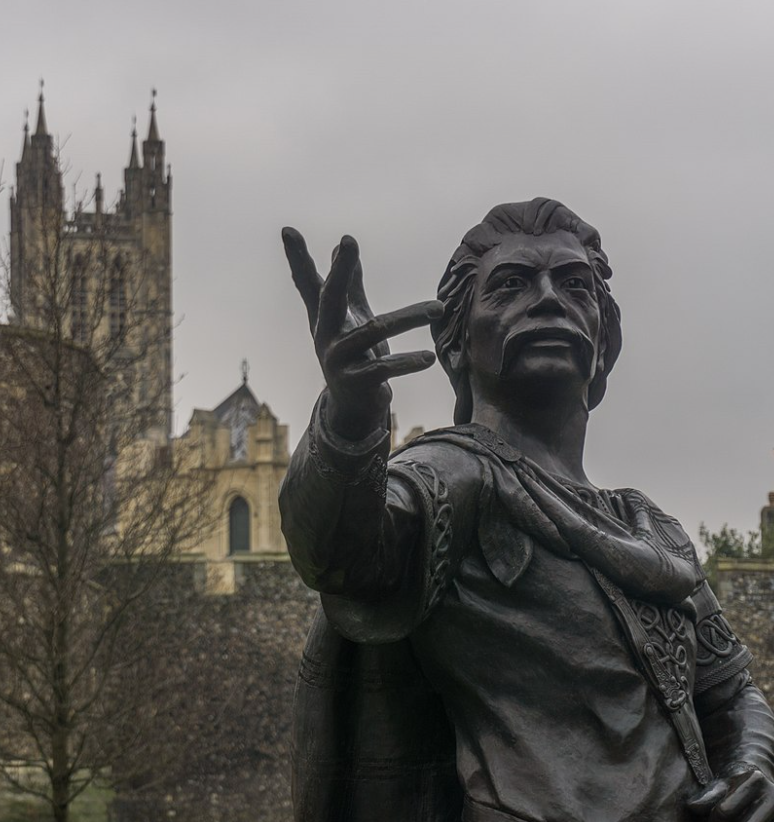
Picture: [Cropped] Statue of Æthelberht with Canterbury Cathedral in the background
Attribution: Sumit Surai, CC BY-SA 4.0 <https://creativecommons.org/licenses/by-sa/4.0>, via Wikimedia Commons
Page URL: https://upload.wikimedia.org/wikipedia/commons/8/81/Ethelbert_King_Kent.jpg
This file is licensed under the Creative Commons Attribution-Share Alike 4.0 International license.
- How Did he Come to the Throne?: Æthelberht likely succeeded his father, Eormenric, as king of Kent around 589. Though historical records about his accession are sparse, Kent’s position as one of the earliest organised Anglo-Saxon kingdoms suggests a relatively stable dynastic succession. His marriage to Bertha, a Frankish princess, further consolidated his authority by linking Kent to the powerful Merovingian dynasty.
- Achievements: Æthelberht is credited with introducing Christianity to the Anglo-Saxon kingdoms through his support of Augustine of Canterbury’s mission in 597. He provided Augustine with land in Canterbury to establish a church, which became the seat of English Christianity. Æthelberht’s law code, the Law of Æthelberht, is the earliest surviving legal text in Old English, blending Germanic customs with Christian ethics. This code laid the foundation for English legal traditions.
- How Was He Viewed?: Æthelberht was highly regarded by his contemporaries as a just and powerful ruler. Bede[7], the 8th century historian, praised him for embracing Christianity and fostering its spread. As one of the first kings to be acknowledged as a Bretwalda, he was seen as a leader capable of exerting influence beyond his own kingdom.
- Legacy: Æthelberht’s reign marked a turning point in the Christianisation of Anglo-Saxon England. His support for Augustine ensured Kent’s prominence as the cradle of English Christianity. The legal and cultural developments during his reign established Kent as a model for other kingdoms, influencing governance and religious practices across England.
- Death and Burial: Æthelberht died in 616. He was likely buried in Canterbury, possibly in the church of St. Martin, the oldest church in England still in use. However, no definitive archaeological evidence confirms his burial site.
Rædwald of East Anglia (r. early 7th century)
Rædwald, king of the East Angles, was a pivotal figure in early Anglo-Saxon history. He ruled during a period of religious transition and political rivalry. Known for his dual adherence to Christianity and paganism, Rædwald reportedly kept altars for both faiths. This reflects the complex religious landscape of his time, as Christianity began to gain a foothold among the Anglo-Saxons.
Rædwald’s most significant political achievement was his role in restoring Edwin of Northumbria to the throne of Deira after Æthelfrith of Bernicia had exiled Edwin. This act of intervention marked Rædwald as a king of considerable influence, extending his reach beyond East Anglia. His victory over Æthelfrith in 616, likely at the Battle of the River Idle[8], cemented his reputation as a powerful and decisive leader.
Rædwald is also widely associated with the Sutton Hoo ship burial, one of the most remarkable archaeological finds in England. The treasures discovered there, including a magnificent helmet and ornate gold items, testify to the wealth and sophistication of his court. While there is no definitive proof that the burial is his, its grandeur aligns with Rædwald’s status as a king of considerable prestige. His reign represents a crucial moment in the fusion of Christian and pagan traditions and the development of early Anglo-Saxon kingship.

Picture: Replica of the Sutton Hoo helmet on display at the British Museum.
Attribution: Mark Ramsay, CC BY 2.0 <https://creativecommons.org/licenses/by/2.0>, via Wikimedia Commons
Page URL: https://upload.wikimedia.org/wikipedia/commons/c/ce/Sutton_Hoo_helmet_%28replica%29.jpg
This file is licensed under the Creative Commons Attribution 2.0 Generic license.
- How Did He Come to the Throne?: Rædwald succeeded his father, Tyttla (see below), as king of the East Angles, although the exact date of his accession is uncertain. East Anglia, consisting of modern-day Norfolk and Suffolk, was a relatively small kingdom, but its location near the coast made it a hub for trade and external influence, particularly from the Frankish kingdoms. Rædwald’s marriage further strengthened his ties with the Frankish world, facilitating the introduction of Christian practices to his court.
- Achievements: Rædwald’s reign is notable for his ability to project power far beyond East Anglia. His most significant achievement was his intervention in Northumbrian politics, where he restored Edwin of Deira to the throne after Edwin had been exiled by Æthelfrith of Bernicia. Rædwald decisively defeated Æthelfrith at the Battle of the River Idle in 616, cementing his reputation as a king capable of influencing the wider Anglo-Saxon world. This victory demonstrated Rædwald’s military and political prowess and marked East Anglia as a kingdom of considerable influence. Rædwald also navigated the complex religious landscape of the time. He reportedly converted to Christianity but maintained pagan practices, symbolised by the presence of dual altars for both faiths in his court. This dual adherence reflected the transitional nature of early Anglo-Saxon religion and Rædwald’s pragmatic approach to maintaining unity among his subjects.
- How Was He Viewed?: Rædwald was respected as a powerful and ambitious ruler. His contemporaries would have recognised his military achievements and political influence, particularly in Northumbria. However, his dual religious practices may have drawn criticism from Christian chroniclers like Bede, who prioritised rulers who fully embraced Christianity. Despite this, Rædwald is remembered as a shrewd and adaptable leader.
- Legacy: Rædwald’s reign represents a turning point in early Anglo-Saxon history. By intervening in Northumbrian affairs, he demonstrated the growing interconnectedness of the Anglo-Saxon kingdoms and set a precedent for overlordship beyond regional borders. His apparent syncretism between Christianity and paganism highlights the complexities of the religious transition in early medieval England. Rædwald is also widely associated with the Sutton Hoo ship burial, a remarkable archaeological find that sheds light on the sophistication and wealth of early Anglo-Saxon rulers. While there is no conclusive evidence that the burial is his, the grandeur of the grave goods, including an ornate helmet, sword, and gold treasures, aligns with his status and influence.
- Death and Burial: Rædwald likely died in the mid-620s, although the exact year is unknown. If the Sutton Hoo burial is indeed his, it suggests a remarkable funerary tradition that combined Anglo-Saxon and Scandinavian elements, reflecting the cultural hybridity of the period. The burial site, with its lavish goods and symbolic ship, underscores Rædwald’s legacy as a king of great wealth and power.
Tyttla, Rædwald’s father, is not commonly listed as an early Anglo-Saxon king because the historical records about him are sparse, and his reign is not associated with significant political, cultural, or military achievements that left a lasting impact on history. The distinction often comes down to historical visibility, documentation, and influence:
- Sparse Historical Records: Tyttla is mentioned in later genealogical sources, but there is no contemporary evidence of his reign. Unlike Rædwald, who features prominently in Bede’s Ecclesiastical History and other sources, Tyttla remains an obscure figure with little surviving detail about his deeds or reign.
- Lack of Broad Influence: While Tyttla may have ruled East Anglia, his reign seems to have been relatively localised and uneventful in the broader Anglo-Saxon context. In contrast, Rædwald expanded East Anglia’s influence significantly, intervening in Northumbrian politics and playing a role in the Christianisation of England.
- Criteria for “Early Anglo-Saxon Kings”: The term is often reserved for rulers who shaped the development of Anglo-Saxon England through significant events, military achievements, religious influence, or territorial expansion. Rædwald fits this description due to his prominent role in early 7th century politics and religion, whereas Tyttla does not appear to have left a comparable legacy.
- Rædwald’s Reputation: Much of what is known about Tyttla comes from his connection to Rædwald. Historians focus on Rædwald because of his prominent achievements and the possibility of his association with the Sutton Hoo burial. Tyttla, by contrast, is mostly a genealogical note, overshadowed by his son’s historical prominence.
- Could Tyttla Be Considered a King?: In genealogical terms, Tyttla was undoubtedly a ruler of East Anglia, but his absence from the narrative of early Anglo-Saxon kings reflects the historiographical focus on impactful reigns. If further archaeological or textual evidence of Tyttla’s rule or accomplishments were to emerge, he might warrant inclusion in discussions of early Anglo-Saxon kings. As it stands, the historical spotlight rests firmly on his son, Rædwald.
Edwin of Northumbria (r. 616–633)
Edwin was one of the most influential kings of Northumbria and a significant figure in the early Anglo-Saxon period. His reign began under challenging circumstances, as he sought refuge in various courts after his father, Ælle of Deira, was deposed by Æthelfrith of Bernicia. Edwin’s fortunes changed when Rædwald of East Anglia defeated Æthelfrith in battle, enabling Edwin to reclaim the throne of Deira and later unite it with Bernicia to form the kingdom of Northumbria.
As king, Edwin expanded his influence across northern and central England, earning recognition as a Bretwalda. His conversion to Christianity in 627 marked a turning point in northern England’s religious landscape. This decision was influenced by his Christian wife, Æthelburh of Kent, and the missionary Paulinus. Edwin’s baptism at York signalled the establishment of Christianity in Northumbria, leading to the foundation of churches and missionary efforts across his kingdom.
However, Edwin’s reign ended tragically in 633 at the Battle of Hatfield Chase, where he was defeated and killed by a coalition of Penda of Mercia and Cadwallon of Gwynedd. His death plunged Northumbria into chaos, but his legacy endured as a pivotal figure in the Christianisation and consolidation of the north.
- How Did he Come to the Throne?: Edwin’s path to kingship was marked by exile and perseverance. Following the conquest of Deira by Æthelfrith of Bernicia, Edwin, the son of Ælle of Deira, fled his homeland. He lived as an exile for many years, seeking refuge in various courts, including those of Gwynedd, Mercia, and East Anglia. Edwin’s fate changed through his alliance with Rædwald of East Anglia. Rædwald, persuaded by Edwin and his allies, chose to support Edwin’s claim to the throne despite Æthelfrith’s threats. In 616, Rædwald defeated Æthelfrith at the Battle of the River Idle, paving the way for Edwin to claim Deira and unite it with Bernicia to form Northumbria.

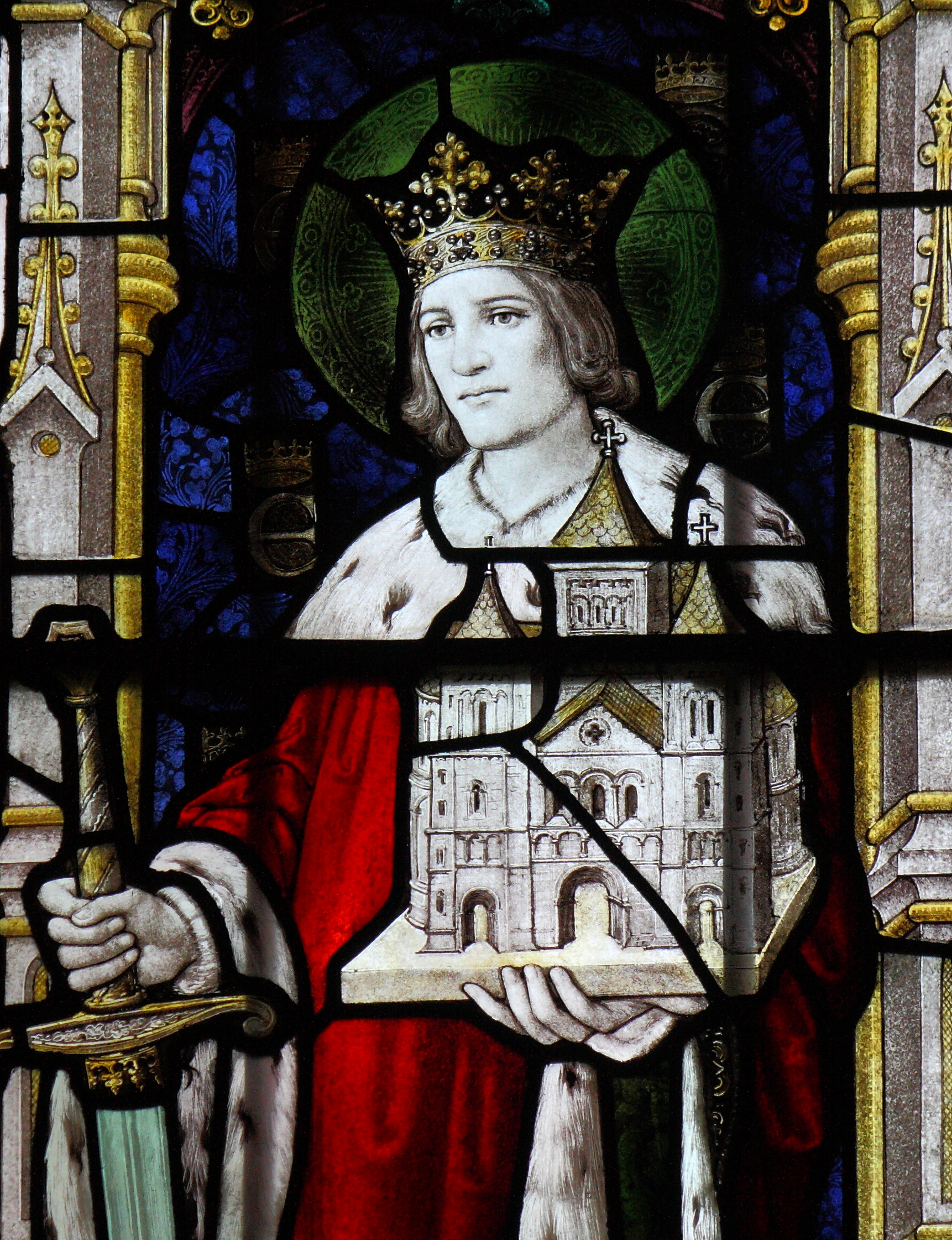
Picture: Saint King Edwin of Northumbria, St Mary, Sledmere, East Riding of Yorkshire, England.
Attribution: DaveWebster14, CC BY 2.0 <https://creativecommons.org/licenses/by/2.0>, via Wikimedia Commons
Page URL: https://upload.wikimedia.org/wikipedia/commons/f/f6/Saint_King_Edwin_of_Northumbria.jpg
This file is licensed under the Creative Commons Attribution 2.0 Generic license.
- How Was He Viewed?: Edwin was widely regarded as a powerful and influential ruler. His ability to unite Deira and Bernicia into a cohesive kingdom and his dominance over other Anglo-Saxon rulers earned him the title of Bretwalda, signifying his overlordship. Bede, the 8th century historian, lauded Edwin for his embrace of Christianity and for fostering peace and prosperity within his kingdom. His rule was considered so just that it was said travellers could move safely throughout Northumbria. Pagan opponents, however, likely viewed Edwin as a threat to their traditions and independence, particularly as he promoted Christianity.
- Legacy: Edwin’s reign left a lasting mark on Northumbria and the broader Anglo-Saxon world. His decision to convert to Christianity and his support for missionary efforts established the faith as a cornerstone of Northumbrian society. The churches and Christian institutions he founded, including the early church at York, helped solidify the kingdom’s religious identity. His reign also contributed to the emergence of Northumbria as a dominant power, influencing the political landscape of northern and central England for decades.
- Death and Burial: Edwin’s defeat and death at the Battle of Hatfield Chase[9] in 633 were a significant blow to Northumbria. Facing a coalition led by Penda of Mercia and Cadwallon of Gwynedd, Edwin was killed, and his kingdom fragmented. His remains were reportedly buried at Whitby Abbey, which later became a major religious centre associated with his dynasty. Edwin’s death marked a period of instability for Northumbria but also cemented his place in history as a foundational figure in its rise. Despite his death, Edwin’s legacy endured. He was later venerated as a saint and martyr, and his story became a model of Christian kingship in early medieval England. The peace and order attributed to his reign set high standards for subsequent rulers of Northumbria.
Penda of Mercia (r. c. 626–655)
Penda, one of the last great pagan kings in Anglo-Saxon England, was a formidable and often feared ruler of Mercia. Unlike many of his contemporaries, Penda resisted the Christianisation of his kingdom and waged wars against neighbouring Christian rulers. His reign was marked by a series of military campaigns that established Mercia as a dominant power.
Penda’s most notable victories included the defeat of Edwin of Northumbria in 633 and Oswald of Northumbria in 642 at the Battle of Maserfield[10]. These victories allowed Penda to assert control over significant territories and maintain Mercia’s independence in a rapidly Christianising world. Despite his paganism, Penda was not entirely opposed to Christianity. Reportedly, he allowed Christian missionaries to operate in Mercia, provided they did not force conversions.
Penda’s death at the Battle of Winwaed[11] marked the end of pagan dominance in Anglo-Saxon England. His defeat by Oswiu of Northumbria was a turning point, leading to the consolidation of Christianity in Mercia and the surrounding regions.

Picture: Stained glass window in the cloister of Worcester Cathedral representing the death of Penda of Mercia
Citation: Penda of Mercia. (2024, August 15). In Wikipedia. https://en.wikipedia.org/wiki/Penda_of_Mercia
Attribution: Violetriga, CC BY-SA 3.0 <http://creativecommons.org/licenses/by-sa/3.0/>, via Wikimedia Commons
This file is licensed under the Creative Commons Attribution-Share Alike 3.0 Unported license.
- How Did He Come to the Throne?: The precise circumstances of Penda’s rise to power are unclear, as contemporary records about the early years of his reign are limited. Penda is believed to have been the son of Pybba, an earlier Mercian king, but his path to kingship was likely contested in view of the fragmented and competitive nature of Anglo-Saxon politics. By the mid-620s, he emerged as the ruler of Mercia, a relatively young kingdom in central England, suggesting that his ascent was due to both his lineage and his military capabilities.
- How Was He Viewed?: Penda was a complex figure in the eyes of his contemporaries. To Christian chroniclers like Bede, he was a symbol of pagan resistance, often portrayed as a violent and unyielding adversary to Christian rulers. Despite this, Penda earned respect – even from his enemies – for his military prowess and strategic acumen. His ability to lead alliances and consistently challenge powerful Christian kingdoms such as Northumbria and Wessex demonstrated his strength as a leader. Interestingly, although Penda remained a staunch pagan, he allowed Christian missionaries to operate in Mercia, provided they did not impose forced conversions, which suggests a level of pragmatism and tolerance.
- Legacy: Penda’s reign marked the peak of Mercian power in the early Anglo-Saxon period. His military campaigns reshaped the political landscape of England, temporarily halting the dominance of Northumbria and expanding Mercian influence over neighbouring kingdoms. His victories against Edwin and Oswald of Northumbria at pivotal battles like Hatfield Chase (633) and Maserfield (642) earned him a reputation as a formidable warrior-king. However, Penda’s death in 655 signalled the decline of paganism among the Anglo-Saxon elite. After his defeat at the Battle of Winwaed, Christianity quickly gained prominence in Mercia, with Oswiu of Northumbria playing a role in consolidating its spread. Despite being one of the last great pagan kings, Penda’s tolerance toward Christianity contributed indirectly to its eventual acceptance in Mercia. His reign is remembered as a final, defiant chapter in the history of pagan Anglo-Saxon kingship.
- Death and Burial: Penda died in 655 at the Battle of Winwaed, a watershed moment in Anglo-Saxon history. Facing Oswiu of Northumbria, Penda led a large coalition of forces but was decisively defeated, ending his military dominance and marking a turning point in the Christianisation of Mercia. The details of Penda’s burial are unknown, and there is no archaeological evidence to suggest a specific site. However, his death marked not just the end of his reign but also the symbolic fall of paganism as a political force in Anglo-Saxon England.

Picture: [Remnants] A 12th century painting of St Oswald in Durham Cathedral
Citation: Oswald of Northumbria. (2024, October 12). In Wikipedia. https://en.wikipedia.org/wiki/Oswald_of_Northumbria
Attribution: Robin Widdison at English Wikipedia, Public domain, via Wikimedia Commons
Oswald of Northumbria (r. 634–642)
Oswald is remembered as a saintly king who restored Northumbrian dominance after the death of Edwin. He spent his early life in exile among the Scots and Picts, where he converted to Christianity. Returning to Northumbria, Oswald defeated the forces of Cadwallon of Gwynedd in 634, reclaiming the throne and reunifying Northumbria.
Oswald established Lindisfarne as a major centre of Christianity, inviting missionaries from Iona, including Aidan, to spread the faith. His reign is characterised by his piety and efforts to integrate Christianity into the fabric of Northumbrian society. Oswald’s death in battle against Penda of Mercia in 642 ended his reign but cemented his legacy as a Christian martyr. He was later venerated as a saint, with his cult spreading widely across Anglo-Saxon and medieval Europe.
- How Did He Come to the Throne?: Oswald’s journey to kingship began in exile. Following the death of his father, Æthelfrith of Bernicia (see below), Oswald fled Northumbria with his family when Edwin of Deira seized the throne. He spent his formative years among the Scots and Picts, during which he converted to Christianity and embraced the monastic teachings of the Irish Church. This period profoundly shaped his character and faith. In 633, after Edwin’s death at the Battle of Hatfield Chase, Northumbria fell into chaos, with the Welsh king Cadwallon ap Cadfan wreaking havoc across the region. Oswald returned to Northumbria in 634 and confronted Cadwallon at the Battle of Heavenfield[12]. Before the battle, Oswald erected a wooden cross and prayed with his troops, a powerful symbol of his Christian faith. His forces defeated and killed Cadwallon, restoring stability to Northumbria and enabling Oswald to claim the throne.
- How Was He Viewed?: Oswald was celebrated as a model Christian king. His contemporaries and later chroniclers, such as Bede, admired his piety, humility, and dedication to spreading Christianity. He was regarded as a unifying figure who embodied both martial prowess and spiritual devotion. Oswald’s efforts to integrate Christian values into his reign and his generosity toward the Church earned him widespread respect, both in Northumbria and beyond. To his enemies, such as Penda of Mercia, Oswald represented the growing Christian challenge to traditional Anglo-Saxon paganism. His role in promoting Christianity undoubtedly made him a polarising figure in regions that still adhered to pagan beliefs.
- Achievements: Oswald’s most enduring achievement was the establishment of Lindisfarne as a major centre of Christianity. Inviting missionaries from the Irish monastery of Iona, including Bishop Aidan, Oswald fostered the spread of Christianity across Northumbria. Lindisfarne became a hub of religious learning and cultural production, influencing the Christianisation of much of England. Oswald also worked to reunify Northumbria, restoring its status as a dominant power after Edwin’s death. By securing alliances and asserting his authority, he stabilised the kingdom and extended its influence over neighbouring regions. His reputation as a just and generous ruler further solidified his position as one of the most respected leaders of his time.
- Legacy: Oswald’s legacy as a saintly king transcended his reign. Following his death, he was venerated as a martyr and saint, and his cult spread widely across Anglo-Saxon and medieval Europe. Churches were dedicated to his memory, and he became a symbol of Christian kingship and virtue. Oswald’s contributions to the Christianisation of Northumbria ensured that his influence endured long after his death. His establishment of Lindisfarne laid the foundation for a flourishing Christian culture in Northumbria, with the monastery becoming a beacon of learning, art, and missionary activity. Oswald’s unification of Northumbria also set the stage for its continued prominence under subsequent rulers.
- Death and Burial: Oswald’s reign came to a dramatic end in 642 at the Battle of Maserfield, where he faced Penda of Mercia. Despite his valiant efforts, Oswald was defeated and killed. According to tradition, his body was dismembered, with his head and limbs displayed as trophies by the pagan Mercian forces. His remains were later recovered and interred at Bardney Abbey in Lincolnshire, a site that became associated with miracles and veneration. His cult as a saint spread rapidly, cementing his reputation as both a martyr and a Christian hero.
Why is Oswald’s Father, Æthelfrith of Bernicia, Not Listed as an Anglo-Saxon King?
Æthelfrith of Bernicia was undoubtedly a significant figure in Anglo-Saxon history, and he is often recognised as a king of Bernicia (r. 593–616) and, later, as a ruler who united Bernicia and Deira into Northumbria. His military prowess, particularly his victory at the Battle of Chester (c. 616), where he defeated the Britons, expanded Bernicia’s influence and weakened the power of the native Britons. This battle also severed the link between the Britons of Wales and those in the north.
However, the reason Æthelfrith is sometimes overlooked in discussions of the “early Anglo-Saxon kings” may stem from:
- Limited Record-Keeping: Contemporary accounts of his reign are sparse, with much of what we know coming from later sources like Bede.
- Focus on Consolidation: Æthelfrith’s contributions, while significant, are overshadowed by later kings like Edwin and Oswald, who consolidated Christianity and centralised power in Northumbria.
- Perspective of Christian Chroniclers: As Æthelfrith ruled during a predominantly pagan era, his achievements are less emphasised by later Christian historians like Bede, who prioritised rulers associated with the spread of Christianity.
That said, Æthelfrith is widely regarded as one of the first kings to unite Bernicia and Deira, and his role in the formation of Northumbria makes him a key figure in early Anglo-Saxon history. If you are focusing on influential rulers, Æthelfrith certainly deserves consideration: Æthelfrith laid the foundations for the powerful kingdom of Northumbria, making him a prime candidate for inclusion as an early Anglo-Saxon king. His military victories and territorial consolidation were critical to the later successes of rulers like Edwin and Oswald.
Offa of Mercia (r. 757–796)
Although slightly later than the earliest kings, Offa represents the apex of Mercian power. His reign saw the construction of Offa’s Dyke, a massive earthwork marking the border with Wales, and the introduction of high-quality coinage that symbolised Mercia’s economic and political strength. Offa’s alliances with Charlemagne and his assertion of dominance over other Anglo-Saxon kingdoms made him one of the most formidable rulers of his era.
- How Did He Come to the Throne?: Offa’s rise to power followed a period of instability in Mercia. After the death of King Æthelbald in 757, Mercia descended into chaos, with rival factions vying for control. Offa, a descendant of earlier Mercian kings, emerged victorious in this struggle. He likely relied on both his military strength and his royal lineage to consolidate his claim. By defeating Beornred, his rival, Offa established himself as king and began rebuilding Mercia’s authority.
- How Was He Viewed?: Offa was regarded as one of the most powerful and ambitious rulers of the Anglo-Saxon period. To his contemporaries, he was both a fearsome leader and a skilled diplomat. He commanded respect from neighbouring kingdoms and foreign powers alike, evidenced by his correspondence and negotiations with Charlemagne, the Carolingian Emperor. Domestically, Offa’s dominance over other Anglo-Saxon kingdoms, such as Kent and East Anglia, solidified his reputation as an overlord. While admired for his administrative and military achievements, Offa’s methods were sometimes ruthless. His actions against rivals and rebellious nobles, including the possible execution of Æthelberht of East Anglia, suggest a ruler who valued power and stability above all else.
- Achievements: Offa’s reign is considered the zenith of Mercian power. His accomplishments include:
- Construction of Offa’s Dyke: This massive earthwork, stretching along the Welsh border, was both a defensive measure and a demonstration of Mercian authority. It symbolised Offa’s efforts to control his western frontier and assert dominance over the Welsh kingdoms.

Picture: Monnaie : Angleterre, Northumbrie, Offa de Mercie, Penny, 737
Citation: Offa of Mercia. (2024, October 30). In Wikipedia. https://en.wikipedia.org/wiki/Offa_of_Mercia
Attribution: Bibliothèque nationale de France (National Library of France), Public domain, via Wikimedia Commons
- Economic Reforms: Offa introduced high-quality coinage, including the silver penny, which became a standard in Anglo-Saxon England. This innovation reflected Mercia’s economic strength and facilitated trade, both domestically and internationally.
- Religious Influence: Offa played a key role in the organisation of the Anglo-Saxon Church. He established a separate archbishopric at Lichfield, temporarily reducing the influence of Canterbury and demonstrating his desire for Mercia’s ecclesiastical independence.
- Diplomatic Relations: Offa’s dealings with Charlemagne[13] underscore his status as a ruler of European significance. Their relationship involved both cooperation and rivalry, with Charlemagne reportedly blocking English merchants in retaliation for Offa’s demands for marriage alliances.
- Legacy: Offa’s reign left an indelible mark on Anglo-Saxon England. He established Mercia as the preeminent kingdom of the Heptarchy, setting a standard for future rulers. His administrative reforms, particularly in coinage, influenced the economic systems of later periods. Offa’s Dyke remains a lasting monument to his reign, symbolising both his ambition and his engineering achievements. Despite his accomplishments, Offa’s dominance began to wane after his death, as Mercia struggled to maintain its supremacy in the face of challenges from Wessex and external threats. Nevertheless, his reign is remembered as a period of unprecedented power and influence for Mercia.
- Death and Burial: Offa died in 796, likely at his palace in Tamworth, the royal centre of Mercia. His burial site is unknown, although it is believed he may have been interred at St. Albans Abbey, which he is credited with founding or significantly supporting. The lack of surviving evidence about his burial has contributed to the mystique surrounding his reign and legacy.
Other Rulers
Æthelfrith of Bernicia (r. c. 593–616)
Æthelfrith was a foundational figure in the creation of Northumbria, uniting the kingdoms of Bernicia and Deira through military conquest. His victory at the Battle of Chester[14] (c. 616) weakened the Britons and solidified Anglo-Saxon control over northern England. Æthelfrith’s reign laid the groundwork for Northumbria’s future prominence despite his eventual defeat by Rædwald of East Anglia.
Cynegils of Wessex (r. c. 611–643)
Cynegils is remembered as one of the earliest Christian kings of Wessex. He converted to Christianity under the influence of Bishop Birinus, who established a bishopric in Dorchester. Cynegils’ conversion marked the beginning of Wessex’s integration into the Christianised Anglo-Saxon world. His reign also saw the strengthening of Wessex’s borders through alliances, such as his partnership with Oswald of Northumbria, who became his son-in-law.
Key Themes in Early Anglo-Saxon Kingship
Overarching Trends: The Impact of Christianisation
Christianisation marked a pivotal transformation in Anglo-Saxon England, altering religious practices, cultural values, and political dynamics. Initially introduced through missionary efforts, such as Augustine of Canterbury’s mission in 597, Christianity offered a unifying ideological framework that transcended tribal divisions. Kings like Æthelberht of Kent and Edwin of Northumbria embraced Christianity partly for spiritual reasons but also to strengthen ties with powerful Christian kingdoms, such as the Franks, and to access the administrative and intellectual benefits of the faith.
The transition from paganism to Christianity enabled the development of written laws, exemplified by Æthelberht’s law code, which integrated Christian ethics with traditional Germanic practices. Furthermore, the Church’s emphasis on literacy and education bolstered state-building efforts by training administrators and scribes. The alliance between the monarchy and the Church solidified the authority of kings, who were increasingly viewed as divinely sanctioned leaders.
The Role of Warfare in Consolidating Power
Warfare was the driver of political change during the early Anglo-Saxon period. Kings established and expanded their territories through military campaigns, often against neighbouring kingdoms or external threats like the Britons, Picts, and later the Vikings. Edwin of Northumbria exemplified this through his campaigns to unite Deira and Bernicia, asserting his dominance as “Bretwalda.”
Warfare also enabled kings to acquire resources, territory, and prestige, reinforcing their legitimacy. For example, Penda of Mercia used military might to counter Northumbrian dominance, asserting Mercian independence and power. However, constant conflict meant that stability was often fleeting, with alliances shifting rapidly. Success in battle could elevate a ruler’s status, while defeat often led to political fragmentation, as seen in Edwin’s death at Hatfield Chase.
The Political Dynamics of the Heptarchy
The Heptarchy, the collective term for the seven main Anglo-Saxon kingdoms, was marked by fluid and competitive relationships. While each kingdom operated independently, power dynamics frequently shifted due to warfare, diplomacy, and religious influence. Kings like Offa of Mercia sought to dominate this fragmented political landscape, employing military campaigns and alliances to assert overlordship.
The title Bretwalda symbolised this fluctuating hierarchy, denoting a king who exercised influence over multiple kingdoms. However, such dominance was often temporary, as rival kingdoms like Northumbria, Mercia, and Wessex competed for supremacy. The political structure of the Heptarchy was thus one of constant flux, where religious alliances, economic resources, and military power determined the balance of influence.
Etymology
The word Heptarchy is derived from the Greek for “seven rulers,” – the collection of seven major Anglo-Saxon kingdoms that dominated England from the 5th to the early 9th centuries. While the term is a later historiographical construct and does not fully reflect the complexity of early Anglo-Saxon politics, it remains a useful framework for understanding the period’s fragmented political landscape.
- Kent: Located in the southeast, Kent was one of the first Anglo-Saxon kingdoms to embrace Christianity, with Æthelberht of Kent converting under the influence of Queen Bertha and Augustine of Canterbury. Kent’s proximity to the Continent facilitated trade and cultural exchange, making Kent a gateway for Roman and Frankish influences.
- Northumbria: Formed by the unification of Bernicia and Deira, Northumbria was a dominant power in the north. It was a centre of learning and religious activity, with monasteries such as Lindisfarne and Jarrow producing key works like the Lindisfarne Gospels and Bede’s Ecclesiastical History. Kings such as Edwin, Oswald, and Oswiu asserted overlordship over neighbouring kingdoms during its peak.
- Mercia: Situated in the Midlands, Mercia emerged as a major power under kings like Penda and Offa. Known for its military strength and territorial ambitions, Mercia frequently contested dominance with Northumbria and Wessex. Offa’s Dyke symbolises its attempts to secure and expand its borders, particularly against the Welsh.
- Wessex: Initially a less dominant kingdom, Wessex grew in prominence under rulers like Cynegils and, later, Egbert (or Ecgberht). Its location in the southwest shielded it somewhat from external threats, allowing it to consolidate power and eventually lead the unification of England under Alfred the Great.
- East Anglia: Known for its connections to the Continent of Europe, East Anglia played a significant role in early Anglo-Saxon Christianity. The Sutton Hoo burial provides a glimpse into the wealth and cultural sophistication of its rulers, such as Rædwald.
- Essex and Sussex: These smaller kingdoms had less political influence compared to their larger neighbours. Essex, with its proximity to Kent, often came under its influence, while Sussex, situated along the south coast, retained a more peripheral role in Heptarchy politics.
Religious Analysis
The Drivers to Move from Paganism
A combination of internal and external factors drove the move from paganism to Christianity in Anglo-Saxon England:
- External Influence: Missionaries like Augustine of Canterbury and Bishop Aidan brought Christian teachings to Anglo-Saxon courts, often supported by Christian wives of pagan kings, such as Queen Bertha of Kent.
- Political Alliances: Conversion strengthened ties with powerful Christian neighbours, such as the Frankish kingdoms, providing access to trade, diplomacy, and cultural exchange.
- Moral Authority: Christianity offered a moral framework that reinforced the divine right of kings, elevating their status above tribal chieftains.
Effect on Governance, Law, and International Relations
- Governance: Christianity introduced new administrative tools, such as written laws and charters, which enhanced governance. The Church also provided a network of educated clerics who served as advisers to kings.
- Law: Christian ethics shaped Anglo-Saxon law codes, incorporating values like justice, mercy, and protection for the weak. This was evident in Æthelberht’s law code.
- International Relations: Conversion aligned Anglo-Saxon kingdoms with the Christian world, enabling alliances and fostering cultural exchange. Offa of Mercia’s relationship with Charlemagne exemplifies the diplomatic benefits of shared faith.
Comparisons
Edwin vs. Oswald
Both Edwin and Oswald were Christian kings of Northumbria who promoted the faith, but their approaches differed:
- Edwin: His conversion was politically motivated, influenced by his Christian wife Æthelburh and the missionary Paulinus. His rule emphasised the integration of Christianity into governance, but his efforts were cut short by his death in battle.
- Oswald: A devout Christian who spent time in exile at Iona, Oswald actively fostered the spread of Christianity through personal devotion and institutional support, such as establishing Lindisfarne.
Penda of Mercia vs. Christian Kings
Penda of Mercia stands out as a pagan leader who coexisted with Christian neighbours. Unlike kings who fully embraced Christianity, Penda tolerated Christian missionaries without converting, allowing Mercia to remain a pagan stronghold longer than other kingdoms. His military success demonstrated that paganism could still thrive politically, even as Christianity became dominant elsewhere.
Roles of Queens and Noblewomen in Early Anglo-Saxon England
While kings dominated the political landscape of early Anglo-Saxon England, queens and noblewomen played significant roles in shaping the cultural, religious, and political fabric of their kingdoms. Their influence often extended beyond the private sphere, as they acted as diplomats, patrons of the Church, and key figures in succession politics.
Queens as Religious Influencers
One of the most visible roles of queens was in promoting Christianity. Queen Bertha of Kent, a Frankish princess married to Æthelberht, was instrumental in the Christianisation of Kent. Her faith paved the way for Augustine of Canterbury’s mission in 597 and the eventual establishment of Canterbury as the spiritual centre of England. Similarly, Æthelburh of Kent, Edwin of Northumbria’s queen, encouraged Edwin’s conversion to Christianity and brought the missionary Paulinus to her husband’s court.
These queens often acted as cultural intermediaries, introducing Christian practices and Continental customs into Anglo-Saxon courts. Their presence lent legitimacy to missionary efforts and facilitated alliances with other Christian powers.
Noblewomen as Patrons of the Church
Noblewomen, particularly abbesses, were central to the religious and intellectual life of the period. Figures like Hilda of Whitby wielded significant influence, not only as spiritual leaders but also as educators and political actors. Hilda presided over the Synod of Whitby in 664, a pivotal moment in determining the alignment of the English Church with Roman rather than Celtic practices. Monastic women often managed vast estates and played a key role in spreading Christian teachings.
Political Roles
Queens and noblewomen also influenced succession politics. For example, alliances formed through marriage strengthened political ties between kingdoms. Æthelburh of Kent’s marriage to Edwin of Northumbria united two powerful dynasties, while Oswald of Northumbria’s marriage to Cynegils’ daughter reinforced ties between Northumbria and Wessex.
In some cases, noblewomen acted as regents or wielded power in their own right. Seaxburh of Wessex ruled as queen after her husband Cenwalh’s death, a rare instance of a woman taking direct control of a kingdom. Though such examples are exceptional, they underscore the potential for women to exert authority in times of political instability.
Legacy of Anglo-Saxon Women
The contributions of queens and noblewomen left a lasting impact on Anglo-Saxon England. Their roles as cultural and religious mediators helped shape the identity of their kingdoms, while their political alliances and influence on succession ensured stability in turbulent times. Though often overshadowed by their male counterparts, these women were vital to the development of early English society.
Cultural Legacy of Early Anglo-Saxon Kingship
The early Anglo-Saxon kings laid the foundational stones for the English monarchy and cultural identity that would evolve over the centuries. Their contributions to governance, religion, and territorial consolidation shaped the trajectory of England, leaving a legacy that resonated far beyond their reigns.
The Concept of Bretwalda and National Unity
The idea of the Bretwalda, a ruler acknowledged as an overlord among the Anglo-Saxon kingdoms, foreshadowed the concept of a unified English monarchy. Although the title signified influence rather than absolute rule, it marked the first steps toward recognising a single leader who could command allegiance across fragmented territories. Kings like Æthelberht of Kent, Edwin of Northumbria, and Offa of Mercia demonstrated the potential for broader unity through military dominance, diplomacy, or religious leadership. This aspiration for unity would later culminate in the unification of England under Alfred the Great and his successors.
The Bretwalda concept also highlighted the interplay between power and legitimacy. By associating their rule with divine sanction or Christian morality, these early kings established principles that future monarchs would embrace, including the divine right of kings.
Christianisation and Cultural Identity
The Christianisation of Anglo-Saxon England was not merely a religious transformation but a cultural revolution. Kings like Æthelberht, Edwin, and Oswald adopted Christianity not only as a spiritual belief but also as a political tool that connected their kingdoms to the wider Christian world. The Church introduced written laws, education, and administrative systems, helping to standardise governance and establish the framework for a literate bureaucracy.
Christianity also shaped England’s cultural identity by fostering artistic, architectural, and intellectual achievements. Monasteries became centres of learning, producing texts like Bede’s Ecclesiastical History and illuminating manuscripts such as the Lindisfarne Gospels. These contributions established a legacy of cultural richness tied to Christian ideals, which would remain integral to England’s identity.
Territorial Foundations
The early kings’ efforts to consolidate power and defend their territories laid the groundwork for the later unification of England. The establishment of defensible borders, the integration of diverse peoples, and the assertion of royal authority over rival factions set a precedent for the territorial integrity that later English monarchs would strive to maintain.
Key Works and Discoveries
The study of early Anglo-Saxon kingship relies on a combination of historical texts, archaeological findings, and modern scholarship. These sources collectively illuminate the political, cultural, and religious transformations of the period, though they also present challenges of interpretation.
Historical Texts
- Bede’s Ecclesiastical History of the English People: Written in the early 8th century, Bede’s work is the most comprehensive account of Anglo-Saxon England’s early history. It provides invaluable insights into the lives of Æthelberht, Edwin, and Oswald, particularly in their roles as Christian kings. However, Bede’s perspective is shaped by his monastic worldview and Christian bias, which often portrays pagan kings like Penda in a negative light.
- Anglo-Saxon Chronicle: Compiled in the late 9th century, this annalistic record provides chronological accounts of key events but is often influenced by Wessex’s perspective.
- Laws of Æthelberht: The earliest recorded legal code in England, these laws offer a glimpse into the blend of Christian and Germanic customs under Æthelberht of Kent.
Archaeological Discoveries
- Sutton Hoo (7th century): The burial site, widely associated with Rædwald of East Anglia, reveals the wealth, craftsmanship, and cultural connections of Anglo-Saxon elites. Artefacts such as the Sutton Hoo helmet, gold buckles, and a reconstructed ship provide evidence of the sophistication of this society.
- Offa’s Dyke (8th century): This massive earthwork, attributed to Offa of Mercia, underscores Mercia’s territorial ambitions and engineering capabilities. It remains one of the most significant boundary markers in Britain.
- Lindisfarne Gospels and Manuscripts: These illuminated texts, produced at Lindisfarne during Oswald’s reign, reflect the fusion of Christian and Celtic artistic traditions.
Modern Scholarship
- Nicholas Higham: Higham’s work, including The Kingdom of Northumbria AD 350–1100, provides a detailed analysis of Northumbria’s political and cultural development, with a focus on kings like Edwin and Oswald.
- Barbara Yorke: Yorke’s Kings and Kingdoms of Early Anglo-Saxon England is a foundational text for understanding the dynamics of the Heptarchy and the role of individual rulers.
- Patrick Wormald: Wormald’s research on Anglo-Saxon law highlights the legal innovations of Æthelberht and other early kings, exploring how Christian values influenced governance.
- Leslie Webster: Webster’s work on Anglo-Saxon art and archaeology, particularly in relation to Sutton Hoo, deepens understanding of the cultural achievements of this period.
Other Sources and Discoveries
- Winchester Excavations: Findings from early Christian sites in Wessex reveal the spread of Romanesque religious architecture.
- St. Albans Abbey: Possible burial site of Offa, reflecting his religious patronage and political ambitions.
Conclusion
The early Anglo-Saxon kings ruled during a time of great political fragmentation and religious transition. Their efforts to consolidate power, whether through warfare, diplomacy, or religious conversion, laid the groundwork for the eventual unification of England. Christianity, introduced and nurtured by leaders like Æthelberht and Edwin, became a unifying force, connecting England to the wider European world. The rise and fall of these early rulers reflect the complexities of early medieval politics, where kings often balanced fragile alliances, religious shifts, and external threats from the Picts, Britons, and later the Viking invaders. These kings were not merely warriors but also cultural and religious pioneers whose legacies have continued to shape English history.
Throughout the first millennium, Anglo-Saxon kings faced constant challenges, including internal strife, Viking invasions, and the complex politics of uniting the various Anglo-Saxon kingdoms. Their efforts laid important cultural and political foundations for the evolving English kingdom. Over the subsequent centuries, through periods of Norman, Plantagenet, and Tudor rule, these foundations would help England emerge as a major player in global affairs.
This evolution continued until the early 20th century, when the British Empire, building on these deep-rooted origins, reached its zenith as the largest empire in history. Often considered one of the most successful empires due to its vast extent and long duration, it was the foremost global power, ruling over about 458 million people, a fifth of the world’s population at the time, and covering more than 33,700,000 square kilometres (13,012,000 square miles), almost a quarter of the Earth’s total land area.
Acknowledging Limitations
This exploration of early Anglo-Saxon kingship relies on sources that, while invaluable, are not without their limitations. Much of our knowledge comes from later chroniclers, particularly Bede’s Ecclesiastical History of the English People. While Bede provides an unparalleled narrative of the period, his perspective is shaped by his Christian worldview. Pagan kings, such as Penda of Mercia, are often portrayed as antagonistic, while Christian rulers are idealised, potentially skewing the historical record.
The archaeological record, though rich in discoveries like Sutton Hoo and Offa’s Dyke, also leaves much to speculation. These finds provide tantalising glimpses into the wealth and sophistication of early Anglo-Saxon society but cannot offer the full picture of their political, social, and cultural complexities.
Furthermore, many events from this period are reconstructed through fragmentary evidence, with significant gaps in contemporary documentation. Oral traditions, later codified by Christian scribes, may have been altered to reflect the values of the time in which they were recorded rather than the realities of the kings’ reigns.
Finally, concepts such as the Heptarchy and Bretwalda are modern constructs that, while useful, may oversimplify the fluid and dynamic nature of early Anglo-Saxon political organisation. These terms should be understood as tools for interpretation rather than definitive historical realities.
Acknowledging these limitations highlights the ongoing challenges in reconstructing the early history of Anglo-Saxon England. Continued archaeological discoveries and advancements in historiography offer the potential for a richer and more nuanced understanding of this formative period.

Extract from Frontispiece of Bede’s Life of St Cuthbert, showing King Æthelstan (924–39) presenting a book to St Cuthbert.
Image Credit: Corpus Christi College Cambridge / Public Domain
File URL: https://upload.wikimedia.org/wikipedia/commons/b/bf/Athelstan.jpg
APPENDIX: Selection of Anglo-Saxon Words and Terms
Old English is the predecessor of modern English and was spoken and written in England ca. 450-1100. Old English (Ænglisc) is the earliest documented stage of the English language, introduced to Britain by Anglo-Saxon settlers. The first recorded literary works in Old English, such as Caedmon’s Hymn, date back to the mid-7th century. Spelling in Old English was not uniform, as it varied significantly across regions and dialects over time, reflecting local linguistic and cultural influences.
The glossary combines essential Old English words with those relevant to Anglo-Saxon culture and history.
Source
The glossary terms are drawn from widely available historical knowledge, compiled from sources including my training data on Anglo-Saxon history, public-domain texts, and reputable secondary sources such as academic works, dictionaries of Old English, and historical glossaries. Since this content is not a direct reproduction of any single source but rather a synthesis of widely understood and public-domain information. The glossary was prepared, in accordance with my instructions, by Artificial Intelligence (ChatGPT).
Number of Words in the Old English Language
The exact number of words in the Old English language is difficult to determine because Old English, like any natural language, evolved over time and had regional variations. However, linguists estimate that the Old English lexicon contained approximately 30,000–50,000 words, depending on the criteria used for counting (e.g., whether inflected forms, compounds, or dialectal variations are included).
Key Points
- Core Vocabulary: Old English had a relatively small core vocabulary, with most words derived from Germanic roots shared with other early Germanic languages.
- Compounding and Derivation: Old English relied heavily on creating new words through compounding (e.g., heofonríce for “kingdom of heaven”) and derivation (adding prefixes or suffixes to modify meanings).
- Loanwords:
- Latin: Many words were borrowed from Latin due to the influence of Christianity (e.g., munuc for “monk”).
- Celtic: A few words were borrowed from the Brittonic languages.
- Old Norse: Scandinavian words entered the language during the Viking Age.
- Dialect Variation: Old English had four main dialects – West Saxon, Mercian, Northumbrian, and Kentish – each contributing unique vocabulary.
Modern English retains many Old English words, particularly those related to everyday life, such as house, bread, man, and woman. However, much of the original lexicon has been replaced or modified through the influence of Middle English and later borrowings from French, Latin, and other languages.
Sources for Old English Glossaries
- https://www.theanglosaxons.com/glossary/
- https://bosworthtoller.com
- https://oldenglish.info/
- https://www.kingsandcastles.uk/more-history/the-anglo-saxon-glossary/
- https://en.wikipedia.org/wiki/Corpus_Glossary
- https://oldenglishthesaurus.arts.gla.ac.uk/
The Bosworth-Toller Anglo-Saxon Dictionary is a public domain resource, and its data is free for any purpose. When the data is used for academic purposes, the creators request that they be cited as the source. For large portions of the dictionary data or specific formats, they offer custom database dumps for researchers upon request.
Old English Glossary (Words and Meanings)
The following list is a glossary of Old English terms and words relevant to Anglo-Saxon England, focusing on language, culture, governance, religion, and society. Where appropriate, Old English spellings are included to enrich the historical feel.
- Æcer: Field or farmland.
- Ælf: Elf or supernatural being.
- Ælfscȳne: Elfin beauty, often used poetically.
- Ælmihtig: Almighty.
- Ænig: Any.
- Ær: Before or early.
- Æsc: Ash tree; also a spear or weapon.
- Æstel: A pointer used for reading manuscripts.
- Æthel: Noble or royal.
- Ætheling: A prince or royal heir.
- Æþeling: Noble youth or prince.
- Beadu: Battle or war.
- Bealdor: Lord or leader.
- Beorht: Bright or shining.
- Beorhtnes: Brightness or glory.
- Beorn: Warrior or hero.
- Biscop: Bishop.
- Bōc: Book.
- Bretwalda: Ruler of Britain – used to describe Anglo-Saxon kings with overlordship over other kingdoms.
- Burg: Fortified town or stronghold.
- Burh: Another spelling for “Burg.”
- Byrn: Mail coat or armour.
- Cēap: Trade or market.
- Ceorl: A free peasant.
- Cild: Child or young noble.
- Cyning: King.
- Cynn: Kin or family.
- Dæg: Day.
- Dōm: Judgement or glory.
- Draca: Dragon.
- Drēam: Joy or mirth.
- Dryht: Army or band of retainers.
- Dryhten: Lord or ruler, often used for God.
- Dūn: Hill or mountain.
- Eadig: Blessed or prosperous.
- Eald: Old or ancient.
- Ealdorman: A noble or regional governor.
- Eorðe: Earth or land.
- Eorl: Nobleman or warrior.
- Eorlcund: Noble or aristocratic.
- Fæger: Fair or beautiful.
- Fæhð: Feud or enmity.
- Fela: Many.
- Feoh: Wealth or cattle.
- Folc: People or folk.
- Frēa: Lord or master.
- Frēols: Festival or celebration.
- Frēond: Friend.
- Fruma: Beginning or origin.
- Fyrd: Army or militia.
- Fyrn: Ancient or old.
- Gāst: Spirit or ghost.
- Gegild: Guild or association.
- Geoguð: Youth or young warriors.
- Giefu: Gift or treasure.
- Grið: Peace or sanctuary.
- Hælend: Saviour, often referring to Christ.
- Hǣlend: Saviour.
- Hām: Home or settlement.
- Heafod: Head or chief.
- Heah: High or exalted.
- Hēah: High or noble.
- Hēahcyning: High king.
- Heall: Hall or great house.
- Hearh: Pagan temple or shrine.
- Helm: Helmet or protector.
- Here: Army or warband.
- Hlæfdige: Lady.
- Hlaf: Loaf or bread.
- Hlafetena: Retainer of bread, a servant.
- Hlāford: Lord.
- Hring: Ring or circle.
- Hūs: House.
- Hwæl: Whale.
- Iren: Iron or weapon.
- Lang: Long.
- Lār: Learning or teaching.
- Lēas: False or deceptive.
- Lēod: People or nation.
- Leōf: Dear or beloved.
- Līf: Life.
- Lind: Shield, often made from limewood.
- Lufu: Love.
- Mæg: Kin or relative.
- Mære: Famous or glorious.
- Man: Man or human.
- Mearc: Border or boundary.
- Meodu: Mead or alcoholic drink.
- Middangeard: The world, literally “middle-earth.”
- Milte: Mercy or kindness.
- Mōd: Mind or spirit.
- Mōna: Moon.
- Mund: Hand or protection.
- Nēah: Near or close.
- Nīð: Enmity or strife.
- Rād: Advice or counsel.
- Rīce: Kingdom or domain.
- Rod: Cross, often referring to the Crucifixion.
- Run: Mystery or rune.
- Sæ: Sea.
- Scēaða: Enemy or robber.
- Scēata: Coin or money.
- Scop: Poet or bard.
- Secg: Man or warrior.
- Seolfor: Silver.
- Sigor: Victory.
- Slæp: Sleep.
- Snāw: Snow.
- Sōþ: Truth.
- Stān: Stone.
- Stede: Place or location.
- Stīþ: Strong or stern.
- Stræt: Road or street.
- Sumor: Summer.
- Sund: Swimming or sea.
- Swefn: Dream.
- Sweord: Sword.
- Swīn: Swine or pig.
- Talu: tale, story, reckoning or account.
- Tēar: Tear.
- Þegn: Alternative spelling of “Thegn.”
- Thegn: Retainer or noble servant.
- Þēod: Nation or people.
- Þēow: Servant or slave.
- Þunor: Thunder or Thor.
- Tīma: Time.
- Tūn: Village or farmstead.
- Tungol: Star.
- Þyle: An orator or spokesperson.
- Wæg: Wave.
- Wæpen: Weapon.
- Wæter: Water.
- Weald: Forest or woodland.
- Weard: Guardian or protector.
- Weorc: Work or deed.
- Weorð: Worth or value.
- Wēsten: Desert or wasteland.
- Wīc: Dwelling or settlement.
- Wīcstōwe: Camp or encampment.
- Wīde: Wide or broad.
- Wīf: Woman or wife.
- Wīfman: Woman.
- Wīg: War.
- Wīsdōm: Wisdom.
- Wita: Wise man or councillor.
- Witan: The king’s council.
- Wund: Wound or injury.
- Wynn: Joy or delight.
- Wyrd: Fate or destiny.
- Wyrm: Serpent or dragon.
- Wyrtha: Creator or maker.
- Yfel: Evil.
- Yrth: Ploughing or farming.
How ‘English’ Has Changed
- Celtic English to Old English: Before the Anglo-Saxon migration, Britain was predominantly inhabited by Celtic-speaking peoples. The arrival of the Anglo-Saxons in the mid-5th century brought Germanic dialects that eventually supplanted most of the native Celtic languages, creating Old English. This language, spoken from roughly 450 to 1100, was rich in Germanic vocabulary and heavily influenced by Latin due to the spread of Christianity.
- Old English to Middle English: The Norman Conquest of 1066 marked a dramatic shift, introducing Norman French as the language of the ruling elite. Over time, this resulted in the blending of Old English with French and Latin vocabulary, forming Middle English (1100–1500). During this period, regional dialects flourished and works like Geoffrey Chaucer’s The Canterbury Tales began to standardise the language.
- The Role of William Caxton: In 1476, William Caxton introduced the printing press to England, a transformative event in the history of English. Printing helped standardise spelling, grammar, and vocabulary by widely disseminating texts, making Middle English more uniform and paving the way for Modern English.
- Middle English to Modern English: By the late 15th century, the Great Vowel Shift – a major phonological change – transformed the pronunciation of English, helping define Modern English. Writers like William Shakespeare enriched the language with thousands of new words, expressions, and stylistic innovations, solidifying English as a versatile and expressive medium.
- Colonialism and Global Influence: The expansion of the British Empire from the 16th century spread English across the world. Colonisation and trade introduced new vocabulary from languages such as Hindi, Arabic, and Swahili, further diversifying English. Today, as a global lingua franca, Modern English reflects centuries of linguistic borrowing and cultural exchange, shaped by its Celtic, Germanic, and colonial past.
Sources and Further Reading
- https://en.wikipedia.org/wiki/Æthelfrith
- https://en.wikipedia.org/wiki/Alfred_the_Great
- https://en.wikipedia.org/wiki/Augustine_of_Canterbury
- https://en.wikipedia.org/wiki/Battle_of_Chester
- https://en.wikipedia.org/wiki/Battle_of_Hatfield_Chase
- https://en.wikipedia.org/wiki/Battle_of_Heavenfield
- https://en.wikipedia.org/wiki/Battle_of_Maserfield
- https://en.wikipedia.org/wiki/Battle_of_the_River_Idle
- https://en.wikipedia.org/wiki/Battle_of_the_Winwaed
- https://en.wikipedia.org/wiki/Beornred_of_Mercia
- https://en.wikipedia.org/wiki/Bertha_of_Kent
- https://en.wikipedia.org/wiki/Bretwalda
- https://en.wikipedia.org/wiki/Cadwallon_Lawhir_ap_Einion
- https://en.wikipedia.org/wiki/Cenwalh_of_Wessex
- https://en.wikipedia.org/wiki/Charlemagne
- https://en.wikipedia.org/wiki/Cynegils
- https://en.wikipedia.org/wiki/Ecgberht,_King_of_Wessex
- https://en.wikipedia.org/wiki/Edwin_of_Northumbria
- https://en.wikipedia.org/wiki/Hengist_and_Horsa
- https://en.wikipedia.org/wiki/Heptarchy
- https://en.wikipedia.org/wiki/Hilda_of_Whitby
- https://en.wikipedia.org/wiki/Lindisfarne
- https://en.wikipedia.org/wiki/Offa_of_Mercia
- https://en.wikipedia.org/wiki/Offa’s_Dyke
- https://en.wikipedia.org/wiki/Oswald_of_Northumbria
- https://en.wikipedia.org/wiki/Oswiu
- https://en.wikipedia.org/wiki/Seaxburh_of_Wessex
- https://primaryfacts.com/8051/anglo-saxon-kingdoms-and-kings/
- https://www.bbc.co.uk/bitesize/articles/zphysk7
- https://www.earlybritishkingdoms.com/articles/advent_saxon01.html
- https://www.historyhit.com/the-anglo-saxon-kings-of-england-in-order/
Books
- Anglo Saxon Art, by Leslie Webster, published by Cornell University Press, available from https://www.amazon.co.uk/Anglo-Saxon-Art-Leslie-Webster/dp/0801477662/
- Anglo-Saxon England, by Sir Frank Stenton, published by Oxford University Press, available from https://www.amazon.co.uk/Anglo-Saxon-England-Oxford-History/dp/0192801392/
- Anglo-Saxon England: 400–790, by Sally Crawford (Author), Dominic Andrews (Illustrator), published by Shire Publications, available from https://www.amazon.co.uk/Anglo-Saxon-England-400-790-Living-Histories/dp/0747808368/
- Anglo-Saxon Kingdoms: Art, Word, War, by Claire Breay and Joanna Story (Author), published by British Library Publishing, available from https://www.amazon.co.uk/Anglo-Saxon-Kingdoms-Art-Word-War/dp/0712352074/
- Anglo-Saxon Kings and Warlords AD 400–1070: 253, by Raffaele D’Amato (Author), Stephen Pollington (Author), Andrei Evgenevich Negin (Illustrator), published by Osprey Publishing, available from https://www.amazon.co.uk/Anglo-Saxon-Kings-Warlords-AD-400-1070/dp/1472855353/
- Anglo-Saxon Word List: A Brief Glossary of 15,000 Old English Words, by Matthew Leigh Embelton, Self Published, available from https://www.amazon.co.uk/Anglo-Saxon-Word-List-Glossary-English/dp/B0B5KJYCDJ
- Arthur and the Anglo-Saxon Wars: Anglo-Celtic Warfare, A.D.410-1066, published by Osprey Publishing, available from https://www.amazon.co.uk/Arthur-Anglo-Saxon-Wars-Anglo-Celtic-D-410-1066/dp/0850455480/
- Crime and Punishment in Anglo-Saxon England, by Andrew Rabin (Author), published by Cambridge University Press, available from https://www.amazon.co.uk/Punishment-Anglo-Saxon-England-Elements-Medieval/dp/1108932037/
- Daily Life in Anglo-Saxon England, by Sally Crawford, published by Greenwood, available from https://www.amazon.co.uk/Daily-Life-Anglo-Saxon-England-2nd/dp/1440859256/
- Heptarchy, by Michael Lapidge, John Blair, Simon Keynes, and Donald Scragg, published by Wiley Blackwell, no availability.
- Kings and Kingdoms of Early Anglo-Saxon England, by Dr Barbara Yorke (Author), published by Routledge, available from https://www.amazon.co.uk/Kings-Kingdoms-Early-Anglo-Saxon-England/dp/041516639X/
- Law and Legislation: From Aethelberht to Magna Carta, by H. G. Richardson (Author), G.O. Sayles (Author), published by Edinburgh University Press, available from https://www.amazon.co.uk/Law-Legislation-Aethelberht-Magna-Carta/dp/0852241186/
- Offa and the Mercian Wars, by Chris Peers (Author), published by Pen & Sword Military, available from https://www.amazon.co.uk/Offa-Mercian-Wars-English-Kingdom/dp/1526711508/
- Offa’s Dyke: Landscape & Hegemony in Eighth-Century Britain, by Keith Ray (Archaeologist) (Author), Ian Bapty (Author), published by Windgather Press, available from https://www.amazon.co.uk/Offas-Dyke-Landscape-Hegemony-Eighth-Century/dp/1905119356/
- Old English and the Anglo-Saxons, four for one: The Anglo-Saxons, Guide to Old English, Sweet’s Anglo-Saxon Primer, Your Book of Anglo-Saxon England (4 Books), by Fred C. Robinson Bruce Mitchell (Author), Patrick Wormald James Campbell, Eric John (Author), David Jones (Author) and Norman Davis (Author), available from https://www.amazon.co.uk/Old-English-Anglo-Saxons-four-one/dp/B0DLGWG1H1/
- Rural Settlements and Society in Anglo-Saxon England, by Helena Hamerow (Author), published by Oxford University Press, available from https://www.amazon.co.uk/Settlements-Society-Anglo-Saxon-Medieval-Archaeology/dp/0198723121/
- The Anglo-Saxon Age: A Very Short Introduction, by John Blair, published by Oxford University Press, available from https://www.amazon.co.uk/Anglo-Saxon-Age-Very-Short-Introduction/dp/0192854038/
- The Anglo-Saxon Chronicle – Illustrated and Annotated, by Bob Carruthers (Editor), published by The Bookzine Company Limited, available from https://www.amazon.co.uk/Anglo-Saxon-Chronicle-Illustrated-Annotated-History/dp/1781580421/
- The Anglo-Saxon Chronicles, translated and edited by Michael Swanton, published by Phoenix, available from https://www.amazon.co.uk/Anglo-Saxon-Chronicles-Michael-Swanton/dp/1842120034/
- The Anglo-Saxon Kingdom of Lindsey, by Kevin Leahy, published by The History Press, available from https://www.amazon.co.uk/Anglo-Saxon-Kingdom-Lindsey-Archaeology/dp/0752441116
- The Anglo-Saxon Kingdoms: The Power Struggles from Hengist to Ecgberht, by Leonard Dutton, published by SPA and Leonard Dutton, available from https://www.amazon.co.uk/Anglo-Saxon-kingdoms-struggles-Hengist-Ecgberht/dp/B00470HYQM
- The Anglo-Saxon World, by Nicholas Higham and Martin Ryan, published by Yale University Press, available from https://www.amazon.co.uk/Anglo-Saxon-World-M-J-Ryan/dp/0300216130/
- The Earliest English Kings, by D. Kirby (2000), published by Routledge, available from https://www.amazon.co.uk/Earliest-English-Kings-D-Kirby/dp/0415242118/
- The Early Anglo-Saxon Kings, by Tony Sullivan (Author), published by Pen & Sword Books, available from https://www.amazon.co.uk/Early-Anglo-Saxon-Kings-Tony-Sullivan/dp/1399084178/
- The Ecclesiastical History of the English People (Oxford World’s Classics), by Bede (Author), Bertram Colgrave (Translator), Judith McClure (Translator), Roger Collins (Translator), published by OUP Oxford, available from https://www.amazon.co.uk/Ecclesiastical-History-English-People-Classics/dp/0199537232/
- The Kingdom of Northumbria, A.D.350-1100, by Nick Higham (Author), published by Sutton Publishing Ltd., available from https://www.amazon.co.uk/Kingdom-Northumbria-D-350-1100-History/dp/0862997305/
- The Kings and Queens of Anglo-Saxon England, by Timothy Venning, published by Amberley Publishing, available from https://www.amazon.co.uk/Kings-Queens-Anglo-Saxon-England/dp/1445608979/
- The Kings of the North: The House of Percy in British History, by Alexander Rose, published by W&N, available from https://www.amazon.co.uk/Kings-North-House-British-History/dp/0297818600
- The Lindisfarne Gospels: Art, History & Inspiration, by Eleanor Jackson, published by British Library Publishing, available from https://www.amazon.co.uk/Lindisfarne-Gospels-Inspiration-Spirituality-Identity/dp/0712354816/
- The Making of England: 55 B.C. to 1399, by C. Warren Hollister, published by D. C. Heath, available from https://www.amazon.co.uk/making-England-55-B-C-1399/dp/B0006CKGME/
- The Sutton Hoo Story: Encounters with Early England, by Martin Carver, published by Boydell Press, available from https://www.amazon.co.uk/Sutton-Hoo-Story-Encounters-England/dp/178327204X/
- Warrior: A Life of War in Anglo-Saxon Britain, by Edoardo Albert (Author), Paul Gething (Author), published by Granta Books, available from https://www.amazon.co.uk/Warrior-Life-War-Anglo-Saxon-Britain/dp/1783784431/
NOTICE: This paper is compiled from the sources stated but has not been externally reviewed. Some content, including image generation and data synthesis, was assisted by artificial intelligence, but all findings were reviewed and verified by us (the author and publisher). Neither we (the publisher and author) nor any third parties provide any warranty or guarantee regarding the accuracy, timeliness, performance, completeness or suitability of the information and materials covered in this paper for any particular purpose. Such information and materials may contain inaccuracies or errors, and we expressly exclude liability for any such inaccuracies or errors to the fullest extent permitted by law. Your use of any information or materials on this website is entirely at your own risk, for which we shall not be liable. It shall be your own responsibility to ensure that any products, services or information available through this paper meet your specific requirements. You should neither take action nor exercise inaction without taking appropriate professional advice. The hyperlinks were current at the date of publication.
End Notes and Explanations
- Source: Compiled from my research using information available at the sources stated throughout the text, together with information provided by machine-generated artificial intelligence at: bing.com [chat] and https://chat.openai.com. Text used includes that on Wikipedia websites is available under the Creative Commons Attribution-ShareAlike License 4.0; additional terms may apply. By using those websites, I have agreed to the Terms of Use and Privacy Policy. Wikipedia® is a registered trademark of the Wikimedia Foundation, Inc., a non-profit organisation. ↑
- Clarification: Unless otherwise stated, all dates shown are anno Domini (AD). ↑
- Explanation: The Heptarchy is the name for the division of Anglo-Saxon England between the sixth and eighth centuries into petty kingdoms, conventionally the seven kingdoms of East Anglia, Essex, Kent, Mercia, Northumbria, Sussex, and Wessex. The term originated with the twelfth-century historian Henry of Huntingdon and has been widely used ever since. However, it has been questioned by historians as the number of kingdoms fluctuated, and there was never a time when the territory of the Anglo-Saxons was divided into seven kingdoms each ruled by one king. The period of petty kingdoms came to an end in the eighth century when England was divided into the four dominant kingdoms of East Anglia, Mercia, Northumbria, and Wessex. Sources: (1) The Earliest English Kings, by D. H. Kirby (2000), published by Routledge. pp. 4–7, 19. I, and (2) Heptarchy, by Michael Lapidge, John Blair, Simon Keynes, and Donald Scragg, published by Wiley Blackwell, availability unknown. Cited at: https://en.wikipedia.org/wiki/Heptarchy ↑
- Explanation: Bretwalda (also brytenwalda and bretenanwealda, sometimes capitalised) is an Old English word. The first record comes from the late 9th -century Anglo-Saxon Chronicle. It is given to some of the rulers of Anglo-Saxon kingdoms from the 5th century onwards who had achieved overlordship of some or all of the other Anglo-Saxon kingdoms. It is unclear whether the word dates back to the 5th century and was used by the kings themselves or whether it is a later, 9th century, invention. The term Bretwalda also appears in a 10th century charter of Æthelstan. The literal meaning of the word is disputed and may translate to either ‘wide-ruler’ or ‘Britain-ruler’. Source: https://en.wikipedia.org/wiki/Bretwalda ↑
- Explanation: Hengist and Horsa are legendary figures in Anglo-Saxon history, often cited as the first leaders of the Germanic tribes to settle in Britain after the Roman withdrawal. According to early medieval sources like Bede and the Anglo-Saxon Chronicle, they were brothers who the Britons invited to help defend against Pictish attacks in the mid-5th century. Instead, they turned on their hosts and established control in what became the kingdom of Kent.Hengist is credited with founding the Kentish royal dynasty, while Horsa is said to have died in battle against the Britons. Although their historicity is debated, they symbolise the Anglo-Saxon migration and the beginning of a new era in Britain’s history. Read more at: https://en.wikipedia.org/wiki/Hengist_and_Horsa ↑
- Explanation: Lindisfarne, or the Holy Island, is a tidal island off the northeast coast of England, historically significant for its role in the Christianisation of Anglo-Saxon England. Founded by King Oswald of Northumbria, who invited missionaries from Iona, Lindisfarne became a key centre for spreading Christianity in the 7th century. It was home to Aidan of Lindisfarne, a missionary bishop who played a crucial role in converting the Northumbrian people.The monastery became renowned for its scholarship and the creation of the Lindisfarne Gospels, a masterpiece of early medieval illuminated manuscripts. It symbolised the fusion of Celtic and Roman Christian traditions and strengthened the authority of Christian kings like Oswald. In 793, Lindisfarne was the site of one of the first major Viking raids, marking the beginning of the Viking Age and highlighting the vulnerability of Anglo-Saxon kingdoms. Lindisfarne’s history illustrates the close relationship between religion, culture, and politics in early Anglo-Saxon England, making it a crucial element in understanding the period. Read more at: https://en.wikipedia.org/wiki/Lindisfarne ↑
- Explanation: Bede, known as the Venerable Bede (c. 672/3–735), was an Anglo-Saxon monk, historian, and scholar who lived at the monastery of Wearmouth-Jarrow in Northumbria. He is widely regarded as one of the greatest intellectual figures of the early Middle Ages and is often called the “Father of English History.” Bede was educated at the monastery from a young age and spent his life devoted to study, teaching, and writing. He was deeply knowledgeable in theology, history, science, and literature. His most famous work, Ecclesiastical History of the English People (Historia Ecclesiastica Gentis Anglorum), written in Latin around 731, provides a comprehensive account of the Christianisation of Anglo-Saxon England and remains a vital primary source for early English history. Bede’s Ecclesiastical History documents the development of Christianity in England, the lives of kings, and the work of missionaries like Augustine of Canterbury. It is one of the first works to use the Anno Domini (AD) dating system. He also wrote extensively on biblical interpretation and theological matters, influencing Christian thought in medieval Europe. In addition, Bede contributed to scientific understanding with treatises on topics like timekeeping and astronomy, shaping early medieval knowledge of the natural world. Bede’s scholarship helped preserve knowledge during a turbulent period in European history. He was venerated as a saint and declared a Doctor of the Church in 1899. His writings remain essential for understanding the cultural and religious transformation of Anglo-Saxon England. ↑
- Explanation: The Battle of the River Idle, fought in 616, was a pivotal conflict between Rædwald of East Anglia and Æthelfrith of Bernicia. Æthelfrith had usurped Deira, forcing Edwin, its rightful heir, into exile. Rædwald, supporting Edwin’s claim, led an army against Æthelfrith near the River Idle, likely in modern Nottinghamshire. Rædwald’s forces decisively defeated and killed Æthelfrith, enabling Edwin to reclaim Deira and unite it with Bernicia, forming the kingdom of Northumbria. The battle marked a significant power shift in Anglo-Saxon England, solidifying Rædwald’s influence and Edwin’s rise as a major king. Read more at: https://en.wikipedia.org/wiki/Battle_of_the_River_Idle ↑
- Explanation: The Battle of Hatfield Chase, fought on 12th October 633, was a significant conflict in early Anglo-Saxon England. It occurred near Doncaster, where King Edwin of Northumbria faced a coalition led by Penda of Mercia and Cadwallon of Gwynedd. The battle occurred due to political rivalry and opposition to Edwin of Northumbria’s growing dominance as a Bretwalda. Penda of Mercia and Cadwallon of Gwynedd sought to curb Edwin’s expansion and reassert their independence. Religious divisions also played a role, with Edwin’s Christianisation of Northumbria clashing with Penda’s paganism and Cadwallon’s hostility toward Anglo-Saxon control. These factors led to a coordinated attack, resulting in Edwin’s death and a temporary collapse of Northumbrian power. Edwin, a prominent Christian king and Bretwalda, was defeated and killed in the battle, along with his son Osfrith. The defeat marked a major setback for Northumbria, plunging the kingdom into chaos and temporarily dividing it into its earlier divisions of Deira and Bernicia. It also demonstrated the rising power of Mercia under the pagan king Penda and highlighted Cadwallon’s hostility toward the Anglo-Saxon kingdoms. Hatfield Chase weakened Northumbria’s dominance and disrupted the Christianisation process Edwin had championed, although stability would later be restored under kings like Oswald. Read more at: https://en.wikipedia.org/wiki/Battle_of_Hatfield_Chase ↑
- Explanation: The Battle of Maserfield, fought on 5th August 642, was a significant conflict between Oswald of Northumbria and Penda of Mercia. The battle likely took place near Oswestry in modern Shropshire. Oswald, a Christian king who had united Northumbria and promoted Christianity, faced Penda, a pagan king seeking to assert Mercian independence and challenge Northumbrian dominance. Penda decisively defeated Oswald, who was killed in the battle. According to tradition, Oswald’s body was dismembered, with parts displayed as trophies by the Mercian forces. His death marked the end of Northumbrian supremacy in central England and solidified Penda’s position as a leading power in Anglo-Saxon England. Oswald’s martyrdom and later veneration as a saint enhanced his legacy, and his death symbolised the continuing struggle between Christian and pagan forces during this period. Read more at: https://en.wikipedia.org/wiki/Battle_of_Maserfield ↑
- Explanation: The Battle of Winwaed, fought on 15th November 655, was a decisive conflict between Oswiu of Northumbria and Penda of Mercia. It occurred near a river, likely in modern Yorkshire, during a period of intense rivalry between the Christian and pagan factions of Anglo-Saxon England. Penda, leading a large coalition, sought to assert Mercian dominance and eliminate Oswiu’s Northumbrian power. However, Oswiu, despite being outnumbered, achieved a stunning victory. Penda was killed in the battle, along with many of his allies. Heavy rains caused the river Winwaed to flood, further devastating the retreating Mercian forces. The battle marked a turning point in Anglo-Saxon history. Penda’s death ended pagan dominance among Anglo-Saxon rulers, solidifying Christianity’s ascendancy. It also re-established Northumbria’s dominance in England, making Oswiu a powerful king and paving the way for further Christian consolidation in Mercia and beyond. Read more at: https://en.wikipedia.org/wiki/Battle_of_the_Winwaed ↑
- Explanation: The Battle of Heavenfield, fought in 633 or 634, was a pivotal conflict between Oswald of Northumbria and Cadwallon of Gwynedd. It took place near Hexham in modern Northumberland. Following the death of Edwin of Northumbria at the Battle of Hatfield Chase, Cadwallon had ravaged Northumbria, leaving the kingdom divided and in chaos. Oswald, returning from exile in Iona, rallied Northumbrian forces to confront Cadwallon. Before the battle, Oswald erected a wooden cross and prayed with his troops, symbolising his Christian faith and resolve. Oswald’s forces decisively defeated and killed Cadwallon, ending his campaign of destruction. Read more at: https://en.wikipedia.org/wiki/Battle_of_HeavenfieldThe victory at Heavenfield restored stability to Northumbria, allowing Oswald to reunify the kingdom and promote Christianity. The battle cemented Oswald’s reputation as a devout and powerful king and marked a turning point in the Christianisation of northern England. ↑
- Explanation: Charlemagne (c. 742–814), also known as Charles the Great, was King of the Franks (768–814), King of the Lombards (774–814), and Emperor of the Carolingian Empire (800–814). He is renowned for uniting much of Western Europe and laying the foundations for the Holy Roman Empire.Charlemagne was the son of Pepin the Short, the first Carolingian king, and Bertrada of Laon. After Pepin’s death in 768, Charlemagne inherited the Frankish kingdom jointly with his brother Carloman. When Carloman died in 771, Charlemagne became the sole ruler and began consolidating his authority.Charlemagne led numerous military campaigns to expand his territory. He defeated the Lombards in 774, becoming their king and extending Frankish control into Italy. His Saxon Wars (772–804) aimed to subjugate the pagan Saxons and convert them to Christianity. He also launched campaigns in Spain, establishing the Spanish March as a buffer zone against Islamic rule. By the end of his reign, Charlemagne’s empire stretched across modern France, Germany, Italy, and parts of Spain. In 800, Charlemagne was crowned Emperor by Pope Leo III, symbolising the revival of the Roman Empire in the West and strengthening ties between the Frankish kingdom and the Church. As Emperor, Charlemagne promoted education, administrative reforms, and religious unity. His court at Aachen became a centre of cultural and intellectual revival known as the Carolingian Renaissance. Charlemagne died in 814 and was succeeded by his son Louis the Pious. His legacy as a unifier and cultural patron endures, and he is often regarded as the “Father of Europe.” Read more at: https://en.wikipedia.org/wiki/Charlemagne ↑
- Explanation: The Battle of Chester, fought around 616, was a significant conflict between the Anglo-Saxons, led by Æthelfrith of Bernicia, and the Britons. It likely took place near the city of Chester in modern Cheshire. Æthelfrith, the powerful king of Bernicia, aimed to expand his territory into British-held lands and weaken the alliance between the Britons and the Welsh kingdoms. Æthelfrith’s forces decisively defeated the Britons, resulting in heavy casualties. According to Bede, Æthelfrith targeted monks from Bangor-on-Dee who had gathered to pray for the British army, killing many of them. This act demonstrated both his military ruthlessness and his hostility toward Christian opposition. The battle had lasting consequences. It severed the connection between the Britons of Wales and those in the north, further consolidating Anglo-Saxon dominance in the region. Æthelfrith’s victory contributed to the expansion of Bernician power, laying the groundwork for the eventual formation of the kingdom of Northumbria under his successors. Read more at: https://en.wikipedia.org/wiki/Battle_of_Chester ↑