
Introduction[1]
Sir Richard Arkwright was a pivotal figure in Britain during the Industrial Revolution. His ingenuity and business acumen reshaped the textile industry and laid the foundations for modern industrial practices. Starting as an apprentice barber and wig-maker, Arkwright’s early experiences shaped his entrepreneurial mindset, fuelling a relentless drive for innovation. His work revolutionised textile production, introducing mechanised processes that transformed the British economy and had far-reaching impacts on global trade and industry.
Arkwright’s inventions, particularly the spinning frame[2] and advancements in carding[3] technology, were instrumental in enabling the mass production of cotton[4] yarn. However, his genius was not limited to technical innovation. He also pioneered the factory system, integrating semi-skilled labour, machinery, and raw materials into an organised and highly efficient model of production. By centralising operations, Arkwright introduced a new era of industrial efficiency that transcended the textile sector and influenced manufacturing worldwide.

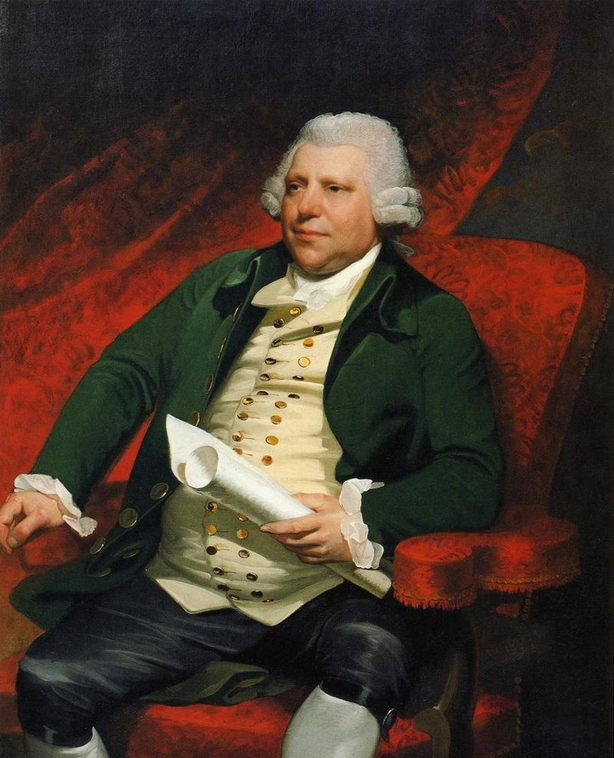
Portrait of Richard Arkwright (1732-1792)
Citation: Richard Arkwright. (2024, November 26). In Wikipedia. https://en.wikipedia.org/wiki/Richard_Arkwright
Attribution: Mather Brown, Public domain, via Wikimedia Commons
His career, however, was not without controversy. Arkwright’s aggressive defence of his patents and his strict labour practices earned him both admiration and criticism. While he became one of the wealthiest and most influential men of his era, his legacy is complex, symbolic of both the promise and the challenges of rapid industrialisation.
Arkwright began working as an apprentice barber and wig-maker, which allowed him to save money and gain business acumen. Eventually, his innovations and the factory system he developed were pivotal in transforming the textile industry and laying the groundwork for modern industrial practices.
This paper explores Richard Arkwright’s journey from modest beginnings to industrial colossus, examining his inventions, the factory system he developed, the challenges he faced, and his lasting impact on industry and society.
Birth and Family Background
Richard Arkwright was born on 23rd December 1732 in Preston, Lancashire, into a family of modest means. He was the youngest of seven surviving children born to Thomas Arkwright, a tailor and member of the Preston Guild, and his wife, Sarah. The Arkwrights’ limited financial resources meant Richard had no access to formal schooling, but he received basic education at home. It was his cousin, Ellen, who taught him to read and write, and as a result, he acquired the foundational literacy and numeracy skills that would later underpin his remarkable career.
Although the Arkwright family lived modestly, Preston’s status as a hub of trade and craftsmanship likely exposed young Richard to the entrepreneurial spirit of the time. This early environment, combined with his family’s practical skills, instilled in him a work ethic and resourcefulness that would serve him well in his later pursuits.
Arkwright’s modest upbringing shaped his pragmatic outlook, driving him to seek opportunities to improve his social and economic position. His eventual rise to prominence serves as a testament to the combination of determination, ingenuity, and hard work that defined his life.
Married Life
Richard Arkwright’s personal life was marked by two marriages, each of which shaped his journey in unique ways. In 1755, he married Patience Holt, with whom he had a son, Richard Arkwright Junior, born the same year. Tragically, Patience passed away in 1756, leaving Richard a widower just a year into their marriage. The loss, however, did not deter his ambitions; instead, it strengthened his resolve to secure a better future for his family.
After five years as a widower, Arkwright remarried in 1761, this time to Margaret Biggins. Together, they had three children, although only their daughter, Susannah, survived into adulthood. Margaret became a stabilising presence in Arkwright’s life, supporting him during the formative years of his entrepreneurial ventures. Despite his demanding professional life, Arkwright remained committed to his family, ensuring their financial security through his growing wealth.
The dynamics of his married life reflect the challenges of balancing personal loss, familial responsibilities, and an unrelenting pursuit of innovation. Both marriages provided Arkwright with the motivation to succeed and leave a lasting legacy, not just for his family but also for society at large.
Early Work Life
Richard Arkwright’s journey into the world of innovation and enterprise began with humble origins in the trade of barbering and wig-making. As an apprentice to Mr Nicholson, a barber in the nearby town of Kirkham, Arkwright honed his craft and learned the intricacies of running a small business. By the early 1760s, he had established his own wig-making shop in Bolton, where he quickly gained a reputation for quality and ingenuity.
Arkwright’s work as a wig-maker coincided with the peak of the periwig fashion[5] trend, which relied heavily on human hair. During his travels across Britain to collect hair, Arkwright developed a waterproof dye that made wigs more durable and vibrant. This innovation brought him considerable financial success and allowed him to save the capital necessary for his later experiments in textile machinery. However, as wig-wearing fell out of fashion, Arkwright began seeking new opportunities, demonstrating his ability to adapt to changing markets.
His interest in textiles likely grew from his fascination with the potential for mechanisation. Recognising the limitations of manual labour and traditional spinning methods, he began to envision ways to revolutionise the industry. The profits from his wig business provided the means to fund his initial experiments, marking the beginning of his transition from a tradesman to an industrial pioneer.
Arkwright’s early work life highlights the resourcefulness and curiosity that defined his career. His ability to identify opportunities, innovate within existing industries, and pivot when necessary laid the foundation for his later success as an inventor and industrialist.
After the decline of the wig industry, Arkwright turned his attention to mechanical inventions in textiles:
- Spinning Frame (Water Frame): Patented in 1769, this machine used water power to spin cotton[6] into yarn, significantly increasing efficiency.
- Rotary Carding Engine: Patented in 1775, this machine combed cotton fibres to prepare them for spinning, further improving efficiency.
- Influence on Other Industrialists: His factory system became a model for other industrialists, spreading across the textile industry and beyond.
Arkwright: Innovation and Establishment of Factories
Richard Arkwright’s contributions to industrialisation extended beyond his inventions; he systematically rethought production processes, revolutionising the textile industry. His work began with the development of the spinning frame. This machine automated the spinning of cotton into strong and consistent yarn, suitable for warp threads, which had previously been made from linen. Unlike the spinning jenny, which relied on human operators to control the process, Arkwright’s spinning frame used wooden and metal rollers to twist fibres with precision. Initially powered by horses, the spinning frame’s full potential was realised when Arkwright harnessed water power, leading to the creation of the water frame.
In 1771, Arkwright established Cromford Mill in Derbyshire, the world’s first water-powered cotton spinning mill. By situating the mill alongside the River Derwent, he was able to use water wheels to drive the machinery, significantly increasing production capacity. This approach marked a departure from the traditional cottage industry model, centralising production and laying the groundwork for the modern factory system.
Arkwright’s factory system was innovative in its integration of machinery and labour. He employed unskilled workers to operate the machines, standardising tasks and increasing efficiency. This model not only boosted productivity but also transformed the social structure as people moved from rural areas to work in factories, leading to urbanisation. The Cromford Mill soon employed more than 1000 people, many of whom had been relocated by Arkwright from outside of the Cromford area.
The success of Cromford Mill inspired the establishment of similar mills across Britain and beyond, cementing Arkwright’s role as a pioneer of industrial manufacturing. His methods set a precedent for factory-based production, influencing various industries and contributing to the broader Industrial Revolution.
Arkwright’s key accomplishment was integrating power, machinery, semi-skilled labour, and the emerging raw material of cotton to enable the mass production of yarn. His exceptional organisational abilities earned him the title “father of the modern industrial factory system,” exemplified by the innovative practices he implemented at his Cromford Mill in Derbyshire, now part of the Derwent Valley Mills World Heritage Site.
Contribution to the Factory System
- Development of the Factory System: Arkwright is credited with developing the first factories that housed both mechanised carding and spinning operations.
- Innovations in Factory Management: Introduced new methods of factory management and labour organisation.
Richard Arkwright was a stand-out figure in the development of the modern factory system. His work revolutionised textile manufacturing through groundbreaking inventions and significant innovations in processes, machinery, and organisational methods.
- Arkwright’s spinning frame represented a significant leap in textile production. This machine automated the spinning process, producing strong and consistent twisted threads suitable initially for warps, which are the longitudinal threads in woven fabrics. Unlike earlier methods relying on human fingers to twist fibres, Arkwright’s design employed a series of wooden and metal cylinders, which allowed for greater precision and reliability. The spinning frame was initially horse-powered, but its real potential was realised when it was adapted to water power, giving rise to the term “water frame.” This innovation drastically reduced the cost of cotton spinning and significantly increased productivity.
- Building on Lewis Paul’s[7] earlier designs for carding machinery, Arkwright transformed the carding process. In 1775, he patented an improved carding engine that efficiently converted raw cotton into a continuous skein, preparing it for spinning. Arkwright’s carding engine employed rollers of varying sizes and speeds to straighten and untangle the cotton fibres progressively. This not only ensured smoother and more uniform rovings but also laid the foundation for producing finer and stronger threads, a critical requirement for creating durable warp threads.
- Beyond his mechanical inventions, Arkwright’s genius lay in his ability to integrate these technologies into a cohesive system. His establishment of the first modern cotton mill in Cromford in 1771 was revolutionary. Powered by water, the Cromford Mill operated as an integrated factory, combining multiple textile processes under one roof. This was a departure from traditional domestic systems, where spinning and weaving was carried out separately in homes or small workshops. By centralising production, Arkwright significantly improved efficiency and control over quality.
Labour Management and Industrial organisation
Arkwright introduced innovative approaches to labour management and industrial organisation. His factories employed a regimented workforce, including entire families, and operated on a strict schedule. This system foreshadowed the modern industrial work environment, with its emphasis on punctuality, discipline, and productivity.
Further extending his influence, Arkwright contributed to the development of machinery maintenance and improvement practices. His emphasis on durable construction and regular upgrades ensured the longevity and effectiveness of his spinning and carding machines. He also secured patents for his innovations, although his aggressive protection of intellectual property sparked legal battles, with some of his patents being overturned.
Arkwright’s combination of invention, innovation, and entrepreneurial vision transformed the textile industry and set the stage for industrialisation on a global scale. His contributions not only revolutionised the production of cotton but also demonstrated the potential of mechanisation and factory organisation to reshape industries, economies, and societies.

Arkwright‘s Water Frame (replica)
Licence: https://creativecommons.org/licenses/by-sa/3.0/
Attribution: Morio, CC BY-SA 3.0 <http://creativecommons.org/licenses/by-sa/3.0/>, via Wikimedia Commons
Arkwright’s Mills
Cromford Mill, established by Richard Arkwright in 1771, holds a distinguished place in industrial history as the world’s first successful water-powered cotton spinning mill. Situated in Derbyshire near the Cromford village, this pioneering facility marked the beginning of the modern factory system. The original mill was powered by the nearby Bonsall Brook, a reliable water source, which allowed continuous operation and set Cromford apart from earlier experiments with horse-driven machinery. Arkwright’s vision was not limited to the machinery but encompassed the entire production process, making Cromford Mill a model of efficiency and innovation.
Arkwright’s first mill, constructed in 1771, integrated both carding and spinning operations under one roof. This was revolutionary, as it streamlined production and improved quality control. The workforce in the first mill numbered about 200 people, a considerable figure for the time, many of whom were entire families. By employing a large labour force and centralising operations, Arkwright laid the foundation for a new industrial working culture.
In 1776, Arkwright expanded his enterprise by building a second, larger mill at Cromford. This facility boasted an impressive five storeys, demonstrating a significant scale for the period. Combined with the original mill, the site employed upwards of 800 workers by the late 1770s, making it a major local employer and a hub of industrial activity. The success of the Cromford site led to further expansion, with mills being established in nearby Bakewell, Wirksworth, and Matlock Bath.
The workforce at Cromford Mills was composed of men, women, and children, with many recruited from surrounding rural areas. Arkwright implemented a system of rigorous discipline and strict schedules, which were new to workers accustomed to the flexibility of a cottage industry. To ensure a steady supply of labour, he even built housing for his employees near the mill, effectively creating one of the first industrial communities. Facilities such as a school and a market were established to cater to workers’ needs, making Cromford a self-sustaining community centred around the mill.
Cromford Mill primarily produced strong, fine cotton yarn suitable for warp threads, which was a significant improvement over earlier products that relied on linen warps. The yarn produced here was in high demand for the burgeoning textile industries across England and later Europe. Customers included weavers and cloth manufacturers who required high-quality materials for making durable and attractive textiles. The mill’s output contributed to the transformation of the British textile industry, enabling mass production of affordable cotton fabrics and fuelling the rapid expansion of global markets.
The Cromford site also served as a showcase for Arkwright’s innovations. It attracted visitors from across Europe who came to observe the machinery and learn from Arkwright’s organisational model. The use of water power and advanced spinning technology at Cromford became a blueprint for industrialisation, with other entrepreneurs replicating his methods.
Samuel Slater (1768-1835), an apprentice of Arkwright’s business partner Jedediah Strutt introduced the Arkwright’s manufacturing system to America. He built a replicated water-powered cotton mill in Rhode Island, which was a major step forward in the industrialisation of the United States. For his contribution to the Industrial Revolution in America, President Andrew Jackson named Slater the father of American manufacturing. The credit, however, should perhaps be given to Richard Arkwright, whose manufacturing model Slater brought to the United States.[8]
By combining innovative technology, an organised workforce, and strategic infrastructure, Cromford Mill became a symbol of the Industrial Revolution. Its success highlighted the potential of mechanised production and the importance of integrating technological and social systems to achieve economic transformation. The legacy of Cromford Mill endures as part of the UNESCO Derwent Valley Mills World Heritage Site, preserving the story of a pivotal chapter in industrial history.
The Factory System
Richard Arkwright’s factory system was revolutionary, laying the foundation for modern industrialisation. At Cromford Mill, he developed a highly organised and disciplined system of production, introducing innovations that transformed the way labour and machinery were managed.
Recognising that the existing population of Cromford was insufficient for the workforce he required, Arkwright actively recruited workers from outside the locality. To accommodate these new arrivals, he constructed a network of cottages near the mill, creating what author Stuart Fisher describes as “the first factory housing development in the world.” These homes, alongside the Greyhound public house that Arkwright built in the market square, helped establish a self-contained industrial community, a model later replicated in many industrial towns across Britain.
Arkwright’s working arrangements were strict and methodical, designed to maximise productivity and ensure that the mill operated efficiently.

Arkwright Masson Mills, Derbyshire
Photographer: User:Justinc
This file is licensed under the Creative Commons Attribution-Share Alike 2.0 Generic license.
Employees worked in two 13-hour shifts daily, with a brief overlap during shift changes. Bells rang at 5 am and 5 pm, signalling the start of the workday and the evening shift, respectively. Gates were locked precisely at 6 am and 6 pm; tardy workers were excluded for the day and docked an additional day’s wages, ensuring punctuality. Such rigorous schedules were a stark departure from the flexible work patterns of the cottage industry and marked a shift towards a more disciplined industrial labour culture.
Arkwright’s factory system relied heavily on family labour, often with entire households employed at the mill. He actively encouraged weavers with large families to move to Cromford, offering steady work for parents and children alike. Initially, children as young as seven were employed, though this minimum age was later raised to ten. By the later years of Arkwright’s operation, children made up nearly two-thirds of the workforce, underscoring the reliance on inexpensive and adaptable child labour. Workers were permitted a single week of holiday annually on the condition that they did not leave Cromford, ensuring a stable and available workforce.
Arkwright’s vision extended beyond Cromford. In 1777, he leased the Haarlem Mill in Wirksworth, Derbyshire, where he pioneered the use of a steam engine in a cotton mill. This engine was not used to power machinery directly but to replenish the millpond that drove the waterwheel, a key step towards integrating steam power into textile production. His innovations spread to Scotland, where he assisted David Dale in establishing the cotton mills at New Lanark, which became a model for industrial communities.
Despite his successes, Arkwright faced significant opposition. At Birkacre in Lancashire, where he had leased a mill, anti-machinery riots in 1779 destroyed the facility[9]. These protests reflected broader societal tensions as traditional hand spinners and weavers saw their livelihoods threatened by the rise of mechanisation and the factory system.
Arkwright’s factory system represented a seismic shift in the organisation of labour and production. By centralising operations, employing a large, regimented workforce, and integrating housing and community facilities, he created a new model of industrial efficiency. His methods were not without criticism, particularly regarding the reliance on child labour and the imposition of strict discipline, but they undeniably set the standard for the factories that would follow. This system not only transformed the textile industry but also had far-reaching effects on industrial practices worldwide, marking the beginning of an era of large-scale manufacturing and urbanisation.
Arkwright formed partnerships and expanded his business operations, becoming one of the wealthiest men in England. He sold grants of his patents to several cotton spinners in the northern and midland counties2F[10]. His success in the textile industry also brought him significant social recognition.
Challenges and Controversies
Richard Arkwright’s career was marked by numerous challenges and controversies, many of which revolved around his groundbreaking inventions and the transformative yet contentious factory system he pioneered.
Battles Over Patent Rights
One of the most prominent issues he faced was a series of legal battles over patent rights. Arkwright’s patents, particularly for the spinning frame, were hotly contested by competitors who sought to benefit from the technologies he developed. Many argued that Arkwright’s innovations were built upon existing ideas, such as those of Thomas Highs and John Kay, rather than being entirely original. In 1785, a landmark trial culminated in the revocation of several of Arkwright’s patents, a significant blow to his efforts to maintain control over the rapidly spreading factory system. Despite this, the revocation ironically contributed to the proliferation of industrialisation as competitors freely adopted and modified his methods.
Criticism Over Treatment of Employees
Arkwright also faced significant criticism for his treatment of workers, particularly in the context of the harsh conditions that characterised early industrial factories. His mills operated on a gruelling schedule, with employees, including children, often working 13-hour shifts six days a week. Although this was not unusual for the era, Arkwright’s strict disciplinary measures and demanding expectations amplified these concerns. Workers were fined for tardiness and could lose an additional day’s wages if they failed to report on time, which placed considerable strain on the labour force. The employment of children as young as seven—later raised to ten—drew further scrutiny, as did the limited opportunities for rest, with workers granted only one week of holiday per year on the condition they did not leave Cromford.
Despite these criticisms, some contemporaries acknowledged that Arkwright’s mills provided steady employment and relatively stable wages at a time when rural workers faced uncertainty. However, his focus on productivity often overshadowed worker welfare, making his factories symbolic of both the promise and perils of industrial progress. The controversies surrounding his practices and patent disputes highlight the complexities of his legacy, portraying him as a figure of both remarkable ingenuity and considerable contention in the annals of industrial history.
Arkwright’s reliance on cotton grown by enslaved people in the Americas linked his industrial success to the exploitation inherent in the transatlantic slave trade. This connection underscores the complex ethical dimensions of his legacy.
Competition
There was no easy rise to fame and fortune. Richard Arkwright faced significant competition from other inventors and industrialists eager to replicate or improve upon his revolutionary inventions. The spinning frame, which he patented in 1769, and his broader factory system quickly became benchmarks for mechanised production, attracting both admiration and rivalry. As industrialisation gained momentum, Arkwright’s innovations were seen as valuable assets, and competitors sought to undermine his control over them by challenging the originality and validity of his patents.
Many contemporaries argued that Arkwright’s inventions were not wholly original. These accusations culminated in a series of legal disputes, most notably in 1785, when the court invalidated Arkwright’s key patents. The judgement ruled that some of his claims lacked sufficient novelty and were based on prior art, effectively opening the door for competitors to use and adapt his designs freely.
The revocation of Arkwright’s patents had profound implications. On one hand, it marked a personal and financial setback for Arkwright, as he lost exclusive control over his inventions. On the other hand, it accelerated the spread of mechanisation across Britain and beyond, as patent restrictions no longer constrained other industrialists. Rival manufacturers quickly adopted and improved upon Arkwright’s methods, leading to rapid advancements in textile production and the growth of the industry as a whole.
Moreover, Arkwright’s competitive environment extended beyond legal battles.
Industrialists such as Samuel Crompton and James Hargreaves developed their own spinning technologies, like Crompton’s spinning mule, which combined the best features of Arkwright’s water frame and Hargreaves’ spinning jenny. These innovations posed direct competition to Arkwright’s system by offering more versatile and efficient machinery. The spinning mule, for instance, was capable of producing finer and stronger yarn, making it particularly suitable for a broader range of textiles.
Despite these challenges, Arkwright’s ability to adapt and expand his operations enabled him to remain a dominant figure in the industry. His organisational prowess, particularly in managing large-scale factories, gave him a competitive edge over many of his rivals. Additionally, his partnerships with influential businessmen, such as Jedediah Strutt and Samuel Need, provided him with the financial and strategic resources to weather periods of intense competition.
In essence, Arkwright’s legacy was shaped not only by his inventions but also by his ability to navigate a highly competitive and often contentious industrial landscape. His struggles with rivals underscore the collaborative and combative nature of the Industrial Revolution, where both individual brilliance and the collective efforts of competing innovators drove progress.
Later Life
In his later life, Richard Arkwright continued to expand his industrial empire and solidify his position as one of the wealthiest and most influential figures of the Industrial Revolution. Despite legal setbacks, such as the invalidation of his patents in 1785, Arkwright’s business acumen and entrepreneurial spirit ensured his success. By the 1780s, his textile operations had grown to include several mills across England and Scotland, and his innovations had become foundational to the burgeoning factory system.
Arkwright’s wealth allowed him to invest in land and property, transforming him into a respected member of the English gentry. He purchased Willersley Castle, a stately home near his Cromford mills, as a symbol of his social ascent, though he did not live to see its completion. Knighted in 1786 by King George III, Arkwright was recognised for his contributions to British industry and commerce, cementing his status as one of the key figures of his age.
Despite his financial success, Arkwright’s later years were marked by ongoing disputes over the originality of his inventions and his methods. Critics accused him of being more of a shrewd organiser and opportunist than an inventor, arguing that he had borrowed heavily from the work of others, such as Thomas Highs and John Kay. Nevertheless, his ability to integrate, improve, and implement these technologies on an unprecedented scale made his contributions undeniably transformative.
Arkwright passed away at the age of 59 on 3rd August 1792 in Cromford, leaving behind a transformed industrial landscape. His life exemplifies the complexities of innovation, highlighting the interplay between technological advancement and its broader societal implications. His wealth was estimated at around £500,000—a staggering fortune for the period. He was buried in the family vault at St. Giles’ Church in Matlock, Derbyshire, leaving behind an industrial legacy that would shape the modern world.
Arkwright’s integration of machinery, labour, and raw materials into a cohesive production process set new standards for efficiency and productivity. His model was emulated across various industries, influencing manufacturing practices worldwide. However, his legacy is multifaceted, encompassing both the technological progress he championed and the social challenges that accompanied rapid industrialisation.
Legacy
Richard Arkwright’s impact on the Industrial Revolution and the modern factory system is profound. His introduction of water-powered spinning technology and the development of a disciplined, large-scale factory workforce revolutionised textile manufacturing. His approach laid the groundwork for mass production, creating a blueprint that would be replicated across industries worldwide.
Arkwright’s innovations and methods played a pivotal role in transforming Britain into an industrial powerhouse, fuelling economic growth and enabling the country to dominate global textile markets for much of the 19th century. His mills at Cromford and elsewhere became symbols of industrial progress, and the integration of housing and community facilities for workers set a precedent for later industrial developments.
Today, Arkwright is remembered as one of the foremost figures of the Industrial Revolution. His achievements are commemorated through the preservation of sites like Cromford Mill. These locations not only celebrate his contributions but also serve as reminders of the complex social and economic transformations that characterised his era.
While debates over the originality of his inventions persist, there is no doubt that Arkwright’s entrepreneurial vision and organisational genius were instrumental in shaping the modern industrial landscape. His legacy endures in the factories, technologies, and systems that continue to define global manufacturing today.
The Arkwright Society
The Arkwright Society is a charitable organisation in the United Kingdom dedicated to preserving and promoting the industrial heritage of Sir Richard Arkwright, one of the pioneers of the Industrial Revolution. Founded in 1972, the Society operates primarily at Cromford Mill in Derbyshire, which was the site of Arkwright’s groundbreaking water-powered cotton spinning mill, built in 1771.
The Arkwright Society focuses on the conservation of historical buildings, education about the Industrial Revolution, and the regeneration of the Cromford area. It also provides learning opportunities for visitors, helping them understand the significant technological, social, and economic changes of the period.
Sources and Further Reading
- http://historyhome.co.uk/people/arkwright.htm
- http://scihi.org/richard-arkwright-industrial-revolution/
- https://derwentvalleymillseducationaltrust.org.uk/the_arkwrights_spinners_of_fortune.php
- https://en.wikipedia.org/wiki/Richard_Arkwright
- https://historylearning.com/great-britain-1700-to-1900/indrevo/richard-arkwright/
- https://hti.osu.edu/sites/hti.osu.edu/files/BBC-History-SirRichardArkwright.pdf
- https://primaryfacts.com/6967/sir-richard-arkwright-facts/
- https://worldhistoryedu.com/richard-arkwright-history-inventions-major-accomplishments/
- https://www.bbc.co.uk/history/historic_figures/arkwright_richard.shtml
- https://www.bbc.co.uk/news/uk-england-derbyshire-60235371
- https://www.britannica.com/biography/Richard-Arkwright
- https://www.cromfordmills.org.uk/
- https://www.cromfordmills.org.uk/about-the-arkwright-society/
- https://www.encyclopedia.com/people/science-and-technology/technology-biographies/sir-richard-arkwright
- https://www.english-heritage.org.uk/visit/blue-plaques/richard-arkwright/
- https://www.heeve.com/modern-history/richard-arkwright-the-father-of-the-modern-factory-system.html
- https://www.historic-uk.com/HistoryUK/HistoryofBritain/Richard-Arkwright/
- https://www.history.co.uk/biographies/richard-arkwright
- https://www.scienceandindustrymuseum.org.uk/objects-and-stories/richard-arkwright
Books
- A Compendious History of the Cotton-Manufacture: With a Disproval of the Claim of Sir Richard Arkwright to the Invention of Its Ingenious Machinery, by Richard Guest, published by Legare Street Press, available from https://www.amazon.co.uk/Compendious-History-Cotton-manufacture-Disproval-Arkwright/dp/1014554616/
- Cotton Mill Handbook: For Superintendents and Overseers in Cotton Yarn and Cloth Mills, published by Legare Street Press, available from https://www.amazon.co.uk/Cotton-Mill-Handbook-Superintendents-Overseers/dp/1020492465/
- From Cromford to Chancery Lane: New Light on the Arkwright Patent Trials, by John Hewish, published by The Johns Hopkins University Press, available from https://muse.jhu.edu/pub/1/article/889444/pdf (requires authentication)
- Memories of the Lancashire Cotton Mills: Incredible Stories of the Unsung Heroes that Powered a Once-Booming Industry, by Ron Freethy, published by Countryside Books, available from https://www.amazon.co.uk/Memories-Lancashire-Cotton-Mills/dp/1846741041/
- Richard Arkwright and Technology, by Jennifer Tann, published by Wilet, availability unknown
- Richard Arkwright and the Scottish Cotton Industry, by A. J. Cooke, published by Taylor & Francis, see: https://www.tandfonline.com/doi/abs/10.1179/004049679793691394
- Richard Arkwright, Master Spinner: [Catalogue of an Exhibition], by The Arkwright Society, available from https://www.amazon.co.uk/Richard-Arkwright-master-spinner-exhibition/dp/0950196703/
- Samuel Oldknow and the Arkwrights: The Industrial Revolution at Stockport and Marple, by George Unwin, published by The University of Manchester, available from https://www.amazon.co.uk/Arkwrights-industrial-revolution-Publications-Manchester/dp/B0018FRVQ2/
- Sir Richard Arkwright and His Patent Granted in 1769, by Richard L. Hills, published by The Royal Society Publishing, details at https://royalsocietypublishing.org/doi/10.1098/rsnr.1970.0017
- The Arkwrights: Spinners of Fortune, by R. S. Fitton, published by Manchester University Press, available from https://www.amazon.co.uk/Arkwrights-Spinners-Fortune-R-S-Fitton/dp/0719027837/
- The Economical and Successful Management of Cotton Mills, by Henry D. Martin, published by Legare Street Press, available from https://www.amazon.co.uk/Economical-Successful-Management-Cotton-Mills/dp/1017807213/
- The Strutts and the Arkwrights, 1758–1830: A Study of the Early Factory System, by R. S. Fitton & A. P. Wadsworth, published by Manchester University Press, available from https://www.amazon.co.uk/Strutts-Arkwrights-1758-1830-Factory-System/dp/B002C7WO4O/
- The Trial of a Cause Instituted by Richard Pepper Arden, Esq; his Majesty’s Attorney General, by Writ of Scire Facias, to Repeal a Patent Granted on 16th of December 1775 to Mr Richard Arkwright, published by Gale ECCO Print Editions, available from https://www.amazon.co.uk/Instituted-Majestys-Attorney-December-Arkwright/dp/138569968X/
- Who Stole the Secret to the Industrial Revolution?: The Real Story behind Richard Arkwright and the Water Frame, by Glynis Cooper, published by Pen & Sword, available from https://www.amazon.co.uk/Who-Stole-Secret-Industrial-Revolution/dp/1473875919/
CAUTION: This paper is compiled from the sources stated but has not been externally reviewed. Parts of this paper include information provided via artificial intelligence which, although checked by the author, is not always accurate or reliable. Neither we nor any third parties provide any warranty or guarantee as to the accuracy, timeliness, performance, completeness or suitability of the information and materials covered in this paper for any particular purpose. Such information and materials may contain inaccuracies or errors, and we expressly exclude liability for any such inaccuracies or errors to the fullest extent permitted by law. Your use of any information or materials on this website is entirely at your own risk, for which we shall not be liable. It shall be your own responsibility to ensure that any products, services or information available through this paper meet your specific requirements and you should neither take action nor exercise inaction without taking appropriate professional advice. The hyperlinks were current at the date of publication.
End Notes and Explanations
- Source: Compiled from my research using information available at the sources stated throughout the text, together with information provided by machine-generated artificial intelligence at: bing.com [chat] and https://chat.openai.com. Text used includes that on Wikipedia websites is available under the Creative Commons Attribution-ShareAlike License 4.0; additional terms may apply. By using those websites, I have agreed to the Terms of Use and Privacy Policy. Wikipedia® is a registered trademark of the Wikimedia Foundation, Inc., a non-profit organisation. ↑
- Explanation: A spinning frame is a mechanical device used to spin fibres into threads or yarn, automating a process that was traditionally done by hand. Richard Arkwright’s version, patented in 1769, was a significant innovation in textile manufacturing and is often referred to as the water frame because it was later powered by water. The spinning frame transformed raw fibres, such as cotton, into consistent, strong, and fine threads suitable for weaving. It employed a system of rollers to stretch and thin the fibres into rovings and then applied a twist to them to create yarn. This process ensured a higher level of uniformity and strength compared to hand-spun threads, making the yarn suitable for warp threads in weaving.Key features of Arkwright’s spinning frame include:
- Rollers: These worked in pairs, with each successive pair rotating faster than the previous one, gradually stretching the fibres to the desired thinness.
- Spindles and Flyers: These twisted the fibres into yarn and wound them onto bobbins.
- Power Source: While initially horse-powered, the spinning frame’s real potential was realised when adapted for water power, leading to its designation as the water frame.
This invention was revolutionary because it drastically increased productivity, reduced labour costs, and made large-scale industrial textile production possible, laying the foundation for the modern factory system. ↑
- Explanation: Carding is a crucial step in the textile production process, where raw fibres—such as cotton or wool—are disentangled, cleaned, and aligned to prepare them for spinning into yarn. The process uses a machine called a carding engine or carder, which separates the fibres and removes impurities, creating a uniform web or sliver of material. Key Aspects of Carding:
- Fibre Preparation: Carding transforms matted, clumped fibres into a more organised state by straightening and aligning them parallel to each other.
- Cleaning: The process removes debris, seeds, and short or damaged fibres from the raw material.
- Output: After carding, the fibres form a continuous web, which is often condensed into a loose strand called a sliver or roving, making it easier to spin into yarn.
- Mechanisation: Before mechanisation, carding was done by hand using tools like carding combs or brushes. Richard Arkwright’s rotary carding engine, patented in 1775, automated the process. His machine used rollers covered with fine wire teeth to disentangle and straighten fibres efficiently, drastically increasing productivity.
Carding is essential because it ensures the quality and consistency of the yarn, influencing the texture, strength, and durability of the final fabric. This step was a significant bottleneck in pre-industrial textile production, and its mechanisation played a pivotal role in the success of the Industrial Revolution. ↑
- Commentary: The cotton industry in and around Manchester and Bolton traces its roots back to Tudor times when refugees from the Netherlands introduced fustian, a coarse fabric made from a blend of cotton and linen. During his travels across the country to procure hair for his wig-making business, Richard Arkwright had the chance to observe and interact with the many spinners and weavers dispersed across the predominantly rural landscape. These encounters likely sparked Arkwright’s interest in creating machinery for carding and spinning, laying the groundwork for his later innovations in processing raw cotton into threads. Until the 18th century, spinning and weaving were primarily cottage industries, where entire families participated in producing textiles by hand using spinning wheels and handlooms. While some individuals operated independently, it was more common for merchants to supply workers with raw materials directly to their homes. Once the finished cloth was produced, merchants would collect it and handle its sale, facilitating a decentralised but interconnected system of textile production. Source: https://www.historic-uk.com/HistoryUK/HistoryofBritain/Richard-Arkwright/ ↑
- Explanation: Periwig fashion refers to the trend of wearing periwigs, elaborate wigs popular primarily between the late 17th and 18th centuries in Europe. Periwigs, also simply called wigs, became a symbol of status, wealth, and sophistication, particularly among men in aristocratic, political, and professional circles. The fashion for wigs originated in France during the reign of King Louis XIII (early 1600s), who began wearing a wig to conceal his baldness. It gained widespread popularity under Louis XIV, whose opulent court set trends across Europe. Periwigs were often large, powdered, and styled into intricate curls, waves, or rolls. They were typically made from human hair, horsehair, or goat hair and treated with pomades and powders for fragrance and a distinctive white or grey appearance. Wearing a periwig conveyed social rank and authority. Judges, barristers, and clergy often wore them as part of formal attire, a tradition that persists in some legal systems today. However, by the late 18th century, periwigs began falling out of favour due to changing tastes and the French Revolution, which promoted simpler, more natural styles. Shorter, less elaborate wigs or natural hair became the norm. ↑
- Commentary: Cotton cloth has been produced globally for thousands of years, but it began to gain prominence in Britain around 500 years ago when merchants first imported it from India. Compared to the heavy woollen fabrics traditionally used in Britain, cotton was lighter, more vibrant, and far easier to wash and dry. Its versatility and appeal made it highly desirable, not only for domestic use but also as a valuable trading commodity. Merchants capitalised on its popularity by exchanging cotton fabrics for goods across the world, further driving its demand and cementing its role in global commerce. See more at https://www.scienceandindustrymuseum.org.uk/objects-and-stories/richard-arkwright ↑
- Commentary: Lewis Paul was the original inventor of roller spinning, the basis of the water frame for spinning cotton in a cotton mill. He was of Huguenot descent. He may have begun work on designing a spinning machine for cotton as early as 1729, but probably did not make practical progress until after 1732 when he met John Wyatt, a carpenter then working in Birmingham for a gun barrel forger. Wyatt had designed a machine, probably for cutting files, in which Paul took an interest. Roller spinning was certainly Paul’s idea, and Wyatt built a machine (or model) for him. Paul obtained a patent for this on 24 June 1738. He then set about trying to license his machine, though some licences were granted in satisfaction of debts. Source: https://en.wikipedia.org/wiki/Lewis_Paul ↑
- Source: https://www.heeve.com/modern-history/richard-arkwright-the-father-of-the-modern-factory-system.html ↑
- Further Information: For details of the anti-machinery riots at the Birkacre mill, see https://lancashirepast.com/2020/10/17/birkacre-mill-yarrow-valley-country-park-near-coppull-and-chorley/ ↑
- Source: http://historyhome.co.uk/people/arkwright.htm ↑
