Prologue
The First Celestial Bodies
In the chronology of our universe, the first substantial celestial objects were likely Population III stars[1] –the inaugural generation of stars that formed approximately 100 to 200 million years after the Big Bang, which occurred roughly 13.8 billion years ago. These primordial stars possessed several distinctive characteristics:
- Composition: They consisted almost exclusively of hydrogen and helium, the primary elements synthesised during the Big Bang, with virtually no “metals” (elements heavier than helium).
- Mass and Lifespan: Theoretical models suggest these stars were extraordinarily massive, possibly ranging from tens to hundreds of times the mass of the Sun. Due to their mass, they were exceptionally hot and short-lived, ending their existence as supernovae or collapsing into black holes.
- Observational Status: Direct observation of Population III stars remains elusive. Their existence is inferred from models of early star formation and the chemical composition of subsequent stellar generations. Recent observations by the James Webb Space Telescope have provided indirect evidence supporting their existence.
Before these first stars illuminated the cosmos, the universe experienced what astronomers term the “cosmic dark ages”: a period characterised by neutral hydrogen gas that was cooling and expanding, devoid of any light-emitting objects.

For Description, Attribution, Citation, see:
https://en.wikipedia.org/wiki/Solar_System#/media/File:Solar_System_true_color_(title_and_caption).jpg
The Universe Before Stars: The Cosmic Dark Ages
From approximately 380,000 years to 100–200 million years after the Big Bang, the universe existed in a state of darkness. During this period:
- Absence of Stars and Galaxies: No stars or galaxies had yet been formed.
- Composition: The universe was filled primarily with neutral hydrogen and helium gas.
- Matter Distribution: Density variations, originating from quantum fluctuations in the early universe, gradually led to the formation of matter concentrations—the foundational structures of future galaxies.
The Recombination Era
Around 380,000 years after the Big Bang, the universe cooled sufficiently for electrons and protons to combine and form neutral hydrogen atoms, marking the end of the ionised plasma state. In this era, the Recombination Era[2], the universe was a hot, dense plasma of particles and radiation. Light could not travel freely as photons constantly scattered off free electrons.
Before recombination, the universe experienced several formative phases:
- Big Bang Nucleosynthesis (First Few Minutes): The universe synthesised hydrogen, helium, and trace amounts of lithium.[3]
- Inflation (10^-36 to 10^-32 Seconds): A brief period of exponential expansion that stretched quantum fluctuations to macroscopic scales.[4]
- Planck Epoch (Up to 10^-43 Seconds): A period where current physics frameworks cannot accurately describe conditions, as the laws of physics as we understand them break down at this singularity.[5]
What Preceded the Big Bang?
Current scientific understanding reaches its limits at the Big Bang itself, where spacetime as we understand it first began. The question of what existed “before” the Big Bang remains beyond the scope of established physics, as our understanding of “before” assumes the existence of time, which may have originated with the Big Bang itself. Several theoretical frameworks propose explanations, including:
- Quantum Gravity Models: Suggesting the Big Bang represented a “bounce” from a preceding universe.
- Multiverse Hypotheses: Proposing our universe is one of many. These theories postulate that beyond our observable universe, there could be countless other universes with potentially different physical laws, constants, or histories, forming a vast cosmic ensemble of separate realities.
- Philosophical Perspectives: Arguing that asking what came “before” the Big Bang is meaningless since time itself began with the Big Bang – similar to asking what’s north of the North Pole. This gets to the heart of the philosophical perspective that the concept of “before” requires time to already exist, and if time began with the Big Bang, then there is no “before” in any conventional sense.
These theories remain speculative approaches to questions at the frontier of contemporary cosmology, where observation, theory, and philosophy intersect in our ongoing quest to understand cosmic origins.
The Evolution of the Earth
Around 4.5 billion years ago, the young Earth was still forming amidst the chaos of the early solar system in which countless rocky bodies and protoplanets drifted and collided, shaping the planets we recognise today. Among these wanderers was a Mars-sized protoplanet named Theia, whose destiny was to collide with Earth in a cataclysmic event that would forever alter the course of planetary evolution and, ultimately, life itself.
The impact was unimaginably violent yet formative. Theia, a fiery, molten world, hurtled toward Earth at a speed that defies comprehension. Upon collision, the energy released was equivalent to billions of nuclear bombs exploding simultaneously. Vast amounts of Earth’s crust and mantle were torn apart and hurled into space, creating a swirling halo of molten debris. This chaotic scene, however, marked not just destruction but the formation of Earth’s most loyal companion: the Moon.
Theia’s collision melted much of the young Earth, allowing its heavier elements, iron and nickel, to sink to the core while lighter materials formed the crust and mantle. This process, known as planetary differentiation, endowed Earth with its layered structure. The core generated a magnetic field that shielded the planet from deadly solar winds, one of the Sun’s less friendly effects, while the dynamic mantle drove plate tectonics. Over billions of years, these tectonic movements have sculpted continents, created mountain ranges, and shaped the deep oceans, forming diverse habitats where life has flourished.
Some scientists speculate that Theia may have been more than an agent of chaos, although this remains a subject of debate. It might have been a cosmic courier, delivering key ingredients for life. If Theia originated from a more water-rich or volatile-rich region of the solar system, it’s possible that it brought water, organic molecules, or rare isotopes during its collision with Earth. These materials could have enriched Earth, making it uniquely suited for hosting life.
Life itself began in the oceans of this transformed Earth more than 3.5 billion years ago, with the emergence of simple, single-celled organisms. The Moon’s stabilising influence helped maintain the climate through tumultuous epochs, providing a steady platform for life to persist. Around 540 million years ago, during the Cambrian Explosion, life underwent a remarkable burst of diversification, with the emergence of many complex organisms, including the first vertebrates and the ancestors of modern fish. Fish thrived in the oceans, while plants began their colonisation of land around 470 million years ago. These early signs of life transformed the Earth’s atmosphere and landscapes, creating new ecosystems that paved the way for the development of terrestrial animals.
Dinosaurs rose to prominence around 230 million years ago during the Triassic period, a geological era that spans approximately 250 million years, and dominated the Earth for over 160 million years. Their reign shaped ecosystems, driving evolutionary innovation in plants and animals alike. But another cataclysmic event, the impact of the Chicxulub asteroid[6], brought their era to an end 66 million years ago, clearing the way for mammals to rise and diversify.
With the dinosaurs gone, mammals became the dominant terrestrial life forms. Among them were primates, the ancestors of apes and eventually humans. Around 6 to 7 million years ago, human ancestors diverged from other primates, and through gradual evolution, modern humans emerged around 300,000 years ago. From the invention of tools to the development of complex societies, humanity’s story has been one of extraordinary adaptability and creativity, traits shaped by billions of years of Earth’s cosmic and biological history.
These same traits: creativity, adaptability, and a thirst for knowledge, would one day launch us into the stars. In less than a heartbeat of cosmic time, we’ve gone from single-celled organisms to creatures who walk on the Moon and dream of reaching Mars.
One of the most iconic moments in our quest to explore the cosmos came on 18th March 1965, when Soviet cosmonaut Alexei Leonov became the first human to step into the vacuum of space. His 12-minute spacewalk during the Voskhod 2 mission marked the first time a human floated freely beyond the bounds of Earth, tethered only by a 5.35-metre cord to his spacecraft. The spacewalk was nearly fatal as his suit ballooned in the vacuum, preventing re-entry. Leonov risked depressurising his suit to squeeze back through the hatch, an act that could have caused decompression sickness. Yet, he survived. Later, the capsule landed far off course in the frozen Ural Mountains, where Leonov and his crewmate spent a night in the wild.
This daring act, at the height of the Space Race, was more than technological bravado—it was symbolic. A lifeform born of ancient stardust had stepped into space, looking back at the world that forged it.
Theia, too, had its origins in this history. It likely formed in the same protoplanetary disk as Earth, where countless rocky bodies were colliding, merging, and jockeying for position in the young solar system. The Sun, a hot and brilliant young star, provided the energy that fuelled these dynamic processes, driving the formation of planets, protoplanets, and all the materials within the solar system. Gravitational interactions between the Sun and these bodies eventually set Theia on a collision course with Earth. What began as a chaotic, violent encounter gave rise to one of the most profound and transformative partnerships in the cosmos.
The Formation of the Moon
The Moon formed from the remnants of Theia and Earth, coalescing over time into a glowing, rocky orb. Its creation was nothing short of monumental for the future of Earth. The Moon’s gravitational pull stabilised Earth’s axial tilt, ensuring relatively consistent seasons and a stable climate over geological timescales. This stability provided Earth with the predictability of seasons and temperate conditions necessary for life to evolve and thrive. The Moon also brought the tides, those rhythmic movements that shaped the oceans and created nutrient-rich tidal pools. These shallow, sunlit pools could have been nature’s crucible, fostering the complex chemistry that led to the origin of life.
The Sun: At the Heart of the Solar System
Yet, none of this would matter without the Sun, the very heart of our solar system. It was the Sun’s gravitational embrace that held Earth in a stable orbit, ensuring it was bathed in just the right amount of energy. The Sun provided the light and warmth necessary for life to flourish and empowered the cycles that have sustained life on Earth. From the first photosynthetic organisms to the grand forests of the Carboniferous period, every living thing owes its existence to the Sun’s life-giving rays. It continues to govern the rhythms of day and night, seasons, and countless biological cycles that define life on Earth.
This Story
This story is not just one of destruction and creation; it is a tale of cosmic balance. Out of chaos came order. Out of devastation came a world uniquely suited to host life. Theia’s collision echoes through every tide that shapes our coasts, through every moonlit night that inspires awe, and through the very atoms that make up our bodies and our civilisation. The Sun’s persistent light and heat continue to sustain Earth, ensuring that life can endure and flourish on this remarkable planet.
As we look up at the Moon at night and feel the warmth of the Sun during the day, we see not just celestial neighbours but the enduring legacies of cosmic events that forged our world. Together, they remind us of the intricate connections between destruction, creation, and the extraordinary journey of life, a journey that is as much a testament to the chaos of the early solar system as it is to the harmony we see today.
Introduction[7]
What is about to unfold is a story tracing the grand narrative of cosmic evolution, from the formation of the first stars to the development of the elements essential to life. Designed as an educational overview, it synthesises current scientific understanding with a didactic aim.
Beyond the planets that dominate our solar system lies a fascinating realm of celestial bodies, structures, phenomena and regions that often escape public attention yet harbour some of the most profound scientific mysteries and possibilities. For example, the moons of our solar system represent not merely satellites but complex worlds in their own right, offering a captivating study in contrast and possibility.

Collage of the most intriguing moons, seamlessly merging their unique features into a cosmic composition.
Drawn in response to the author’s request by DALL-E, a subset of ChatGPT, on 14th March 2025.
What makes these worlds particularly compelling is their remarkable diversity – from the volcanic infernos of Jupiter’s Io to the methane lakes of Saturn’s Titan and the mysterious subsurface oceans of Europa and Enceladus. Unlike the relatively uniform classes of planets or asteroids, each significant moon presents a unique environment shaped by distinct forces and compositions. These lunar worlds have become focal points of our most exciting recent discoveries in space exploration.
The confirmation of subsurface oceans on multiple moons has dramatically expanded our understanding of where liquid water, and potentially life, might exist beyond Earth. The plumes erupting from Enceladus’s south pole, along with evidence of hydrothermal activity beneath its icy crust, have transformed our understanding of habitability in the outer solar system.
Visually, these moons offer some of the most striking and varied landscapes in our cosmic neighbourhood. From the scarred, colourful surface of Io (the most volcanically active body in our solar system) to the eerily Earth-like terrain features of Titan, shrouded in its thick atmosphere, these worlds provide a stunning testament to the creative forces of nature operating in environments radically different from those on Earth.
The focus of missions like Europa Clipper and Dragonfly underscores the scientific community’s recognition of the importance of these moons. These ambitious projects aim to unlock the secrets of these distant worlds, potentially answering one of humanity’s most profound questions: Are we alone in the universe?
Perhaps most compellingly, these moons present some of the most intriguing scientific puzzles in our cosmic backyard. The surprisingly young surface of Europa suggests dynamic processes at work, while the mysterious terrain of Triton, likely a captured Kuiper Belt object, offers glimpses into the outer regions of our solar system. These enigmas continue to challenge our understanding and fuel our curiosity about the true nature and potential of these fascinating worlds within worlds.
Moons
Moons are natural satellites that orbit planets, dwarf planets, or other celestial bodies, such as asteroids. They vary in size, composition, and origin and play significant roles in the dynamics of planetary systems. Many moons are geologically active, with some, such as Europa and Enceladus, possessing subsurface oceans, which raises the possibility of extraterrestrial life.
Timeline: Milestones in the Exploration and Understanding of Moons |
| Prehistory–1600s: The Age of Naked-Eye Observation |
| 🌕 Prehistoric Era: Moon phases were tracked by early civilisations for calendars and rituals. |
| 🔭 1610 – Galileo Galilei discovers Jupiter’s four largest moons (Io, Europa, Ganymede, Callisto) using a telescope. First recorded discovery of moons beyond Earth. |
| 🌒 1655 – Christiaan Huygens discovers Saturn’s largest moon, Titan. |
| 🌓 1671–1684 – Giovanni Cassini discovers several more Saturnian moons, including Iapetus, Rhea, Tethys, and Dione. |
| 1800s: Expanding the Solar System |
| 🪐 1789–1846 – Uranus’s moons Titania and Oberon (William Herschel), and Neptune’s Triton (William Lassell) are discovered. |
| 🪧 1877 – Asaph Hall discovers Mars’s two tiny moons, Phobos and Deimos. |
| 1900–1959: Preparation for the Space Age |
| 🌗 Detailed lunar maps and photographs developed in preparation for space missions. |
| 🌖 1959 – Soviet Luna 2 becomes the first spacecraft to impact the Moon, confirming that direct travel is possible. |
| 1960s–1970s: The Golden Age of Moon Exploration |
| 🚀 1966 – Luna 9 achieves the first successful soft landing on the Moon (Soviet Union). |
| 👨🚀 1969 – Apollo 11 lands humans on the Moon for the first time. Neil Armstrong and Buzz Aldrin conducted surface activities. |
| 🌍 1971 – Discovery that the Moon has a very thin atmosphere and evidence of past volcanic activity. |
| 1980s–1990s: The Moons of the Outer Solar System |
| 🧊 1979–1989 – Voyager missions fly by the outer planets, revealing active volcanoes on Io, icy fissures on Europa, and geysers on Triton. Moons are now recognised as dynamic worlds. |
| 🛰 1997 – NASA launches Cassini-Huygens, a landmark mission to explore Saturn and its moons. |
| 2000s: Confirming Subsurface Oceans |
| 🌊 2005 – Cassini discovers geysers erupting from Enceladus, indicating a subsurface ocean. |
| 🧪 2008 – Cassini’s instruments detect organic compounds in Enceladus’s plumes. |
| 🔍 2009–2010 – Hubble observations hint at water plumes on Europa. |
| 2010s: Rethinking Habitability |
| 🔄 Moons like Europa, Enceladus, and Titan become key targets in the search for life beyond Earth. |
| 🌠 2014 – ESA’s Rosetta mission lands Philae on comet 67P — not a moon, but demonstrates landing on small bodies. |
| 2020s: A New Wave of Exploration |
| 🚀 2023 – ESA launches JUICE (Jupiter Icy Moons Explorer), targeting Ganymede, Callisto, and Europa. |
| 🛰 2024 – NASA launches Europa Clipper, aimed at studying Europa’s subsurface ocean and habitability. |
| 🚁 2027 – NASA to launch Dragonfly, a rotorcraft mission to Saturn’s moon Titan, to investigate organic chemistry and surface conditions. |
| Future Outlook |
| 🧬 Missions to icy moons now focus on detecting biosignatures and analysing potential habitable environments. |
| 🔧 Concept studies are underway for future landers and ice-penetrating probes to explore the oceans beneath Europa and Enceladus. |
| 🌌 Moons are no longer seen as inert bodies – they are central to understanding the solar system’s formation, evolution, and the possibility of life elsewhere. |
Key Characteristics
- Orbits: Moons orbit their parent planets due to gravitational attraction. Some moons have regular orbits, while others have irregular or elliptical orbits.
- Composition: There are Rocky moons (e.g., Earth’s Moon, Io), Icy moons (e.g., Europa, Enceladus) and Gas-rich moons (e.g., Titan, with its thick atmosphere).
- Sizes: Ranging from small asteroid-like bodies to large moons like Ganymede (Jupiter’s largest moon, bigger than Mercury).
Formation
Overview
Moons form through several different mechanisms:
- Formed in situ from the planet’s accretion disk (e.g., Jupiter’s Galilean moons).
- Captured asteroids or Kuiper Belt objects (e.g., Neptune’s Triton).
- Giant impact formation, like Earth’s Moon, which likely formed after a collision between Earth and a Mars-sized body (called Theia).
Origin Theories in Greater Detail
- Accretion Disk Formation: Current models suggest that regular satellites of gas giants formed in situ from circumplanetary disks[8] during planet formation. Recent observations of protoplanetary disks[9] around young stars have revealed evidence of gaps where planets are forming and potential circumplanetary disks, where moons may be forming. The uniform prograde orbits and orderly spacing of the major moons of Jupiter and Saturn support this formation mechanism.
- Giant Impact Evidence: Isotopic analyses of lunar samples revealed that Earth and the Moon share remarkably similar compositions for certain elements, strongly supporting the giant impact hypothesis. Computer simulations suggest that the impact occurred when Earth was approximately 90% of its current size, with the impactor, Theia, being approximately the size of Mars. This collision is estimated to have occurred approximately 4.5 billion years ago, shortly after the Earth’s formation.
- Capture Scenarios: Neptune’s largest moon, Triton, orbits in the opposite direction of Neptune’s rotation (retrograde orbit), with strong evidence of capture rather than in-situ formation. Capture requires a mechanism to dissipate orbital energy, possibly through interactions with Neptune’s original satellite system or a temporary gas drag. Recent studies suggest many irregular satellites of the giant planets were captured from heliocentric orbits during the early solar system’s period of dynamical instability.
Functions in Planetary Systems
Moons serve several important roles:
- Stabilise the host planet’s axial tilt (as our Moon does for Earth, helping maintain our stable climate).
- Influence tidal forces, creating ocean tides and affecting geological processes.
- Act as a protective shield by absorbing impacts that might otherwise hit the planet.
- Potentially serve as natural resources and stepping stones for future space exploration.
- In some cases, provide additional environments where conditions for life might exist.
Examples of Moons in the Solar System
- Earth: The Moon (our only natural satellite, affecting tides and stabilising Earth’s axial tilt).
- Mars: Phobos and Deimos (small, irregularly shaped, possibly captured asteroids).
- Jupiter: Has 95 known moons, including the Galilean moons (Io, Europa, Ganymede, Callisto).
- Saturn: Has over 145 known moons, including Titan (the only moon with a dense atmosphere) and Enceladus (with geysers of water ice).
- Uranus: Has 27 known moons, such as Miranda, Ariel, and Titania.
- Neptune: Has 14 known moons, with Triton being the largest and having a retrograde orbit[10].
- Pluto: Five moons, including Charon, which is so large that Pluto and Charon are sometimes considered a double system.
Notably, the foregoing numbers can change as new moons are discovered through improved observation techniques, some provisional moon discoveries are later confirmed, and occasionally, objects initially classified as moons are later reclassified.
Orbital Dynamics and Resonances
- Tidal Locking: Most major moons in the solar system exhibit tidal locking (also known as synchronous rotation), in which they always show the same face to their parent planet. This occurs when tidal forces gradually slow a moon’s rotation until it matches its orbital period. Earth’s Moon is a well-known example, completing one rotation in the same time it takes to complete one orbit around Earth.
- Orbital Resonances: Many moon systems exhibit orbital resonances where the orbital periods of different moons form simple integer ratios. The most famous example is the Laplace resonance[11] among Jupiter’s moons Io, Europa, and Ganymede, which maintain a 1:2:4 ratio. These resonances can amplify gravitational effects, leading to phenomena such as enhanced tidal heating in Io and orbital stability mechanisms that prevent collisions over billions of years.
- Chaotic Orbits: Some smaller moons, particularly irregular satellites, exhibit chaotic orbital evolution due to competing gravitational influences. For instance, Saturn’s moon Hyperion tumbles chaotically rather than rotating predictably, making it the only known moon to rotate chaotically.
Surface Processes and Geology
- Cryovolcanism: Unlike terrestrial volcanoes that erupt molten rock, cryovolcanoes on icy moons erupt volatile materials like water, ammonia, or methane. Enceladus exhibits spectacular cryovolcanic plumes of water vapour and ice particles from its south polar region, ejecting material that contributes to Saturn’s E ring. Evidence of past or present cryovolcanism has also been found on Europa, Triton, and potentially Pluto’s moon, Charon.
- Impact Cratering: The Moon’s surface records its impact history differently than that of planets due to its lower gravity, lack of atmosphere, and differing geological resurfacing rates. The density and distribution of craters can reveal a moon’s age and geological history. For example, the heavily cratered surfaces of Callisto contrast with the relatively smooth and young surface of Europa, indicating different levels of geological activity.
- Tidal Heating: Moons in elliptical orbits experience varying gravitational pull from their parent planets, causing them to flex and generate internal heat through friction. This tidal heating is the primary energy source driving Io’s extreme volcanism and maintaining subsurface oceans in moons like Europa and Enceladus, despite their distance from the Sun placing them far outside the conventional habitable zone.
Moon-Planet Relationships
- Magnetospheric Interactions: Many moons interact with their parent planets’ magnetic fields in complex ways. Io, for instance, releases about one ton of material per second into Jupiter’s magnetosphere, creating a plasma torus along its orbit. This material forms a vast electrical circuit between Io and Jupiter, generating powerful auroras in Jupiter’s atmosphere.
- Ring System Interactions: Several moons play crucial roles in shaping planetary ring systems. “Shepherd moons”, such as Saturn’s Prometheus and Pandora, confine ring material through gravitational effects. Some moons, such as Enceladus, actively supply material to rings, while others clear gaps or create wave patterns within ring structures.
- Co-orbital Configurations: Some moons share nearly identical orbits in stable configurations. Saturn’s moons, Janus and Epimetheus, exhibit a unique “horseshoe orbit” where they periodically swap positions without colliding. The Trojan moons of Tethys (Telesto and Calypso) occupy stable Lagrange points[12] along Tethys’ orbit around Saturn.
Subsurface Oceans and Habitability
- Ocean Composition: While water is the primary component of these subsurface oceans, they likely contain dissolved salts and other compounds. Europa’s ocean may contain twice the water of all Earth’s oceans combined and is thought to be in direct contact with a rocky seafloor, potentially enabling water-rock interactions that could provide energy and nutrients for any life that may exist. Enceladus’ ocean has been directly sampled through its plumes, revealing the presence of sodium chloride, carbonates, and organic compounds.
- Detection Methods: Scientists confirm subsurface oceans through multiple lines of evidence, including:
- Induced magnetic fields are created when salty, conductive oceans interact with the parent planet’s magnetosphere.
- Surface features like Europa’s “chaos terrain” indicative of interaction between surface ice and underlying liquid.
- Libration measurements showing excess rotational motion consistent with a decoupled icy shell floating on liquid.
- Direct sampling of ejected material, as accomplished at Enceladus.
- Habitability Factors: Beyond liquid water, potential habitability requires energy sources and essential elements (C, H, N, O, P, S)[13]. Tidal heating provides energy, while interactions between water and rocky cores could supply minerals and create chemical gradients similar to those found in Earth’s deep-sea hydrothermal vents, which support thriving ecosystems independent of sunlight.
Comparative Moonology
- System Differences: The terrestrial planets have few or no moons (Mercury and Venus have none; Earth has one large moon; Mars has two small moons), while the giant planets have complex satellite systems with dozens of moons. This pattern reflects fundamentally different formation environments and gravitational dominance. The ice giants, Uranus and Neptune, have medium-sized satellite systems primarily composed of ice-rich bodies, suggesting different formation conditions than those of either terrestrial planets or gas giants.
- Moon-to-Planet Mass Ratios: Earth’s Moon is unusually large relative to its planet (mass ratio of 1:81) compared to typical satellite systems, where this ratio is closer to 1:10,000. This anomalous ratio supports the idea that the Moon formed through a giant impact rather than co-formation or capture. By contrast, Charon’s mass is about 1/8th that of Pluto, making it the largest moon relative to its primary body and leading some astronomers to classify the Pluto-Charon system as a double dwarf planet.
- Moonless Planets: The absence of moons around Mercury and Venus offers insights into the formation and stability of moons. Mercury’s proximity to the Sun creates a small Hill sphere, a region of gravitational dominance, making stable satellite orbits nearly impossible. Venus likely lost any original moons due to its retrograde rotation, causing tidal interactions that would eventually pull moons inward to crash into the planet.
Recent and Future Exploration
Upcoming Missions: Several major missions have recently taken place or are planned to explore ocean-bearing moons:
- NASA’s Europa Clipper (launched in 2024): Will conduct detailed reconnaissance of Europa’s surface and subsurface ocean through close flybys.
- ESA’s JUICE (Jupiter Icy Moons Explorer, launched in 2023): Will study Ganymede, Callisto, and Europa, with a particular focus on Ganymede, the only moon with its own magnetic field.
- NASA’s Dragonfly (launch 2027): A rotorcraft lander that will explore Saturn’s moon Titan to investigate its complex organic chemistry and potential for prebiotic processes.
- Technological Challenges: Exploring icy moons presents unique challenges, including:
- Extreme radiation environments, particularly those surrounding Jupiter, necessitate radiation-hardened electronics. These are designed to withstand high levels of ionising radiation that would damage or destroy conventional electronics.
- Communication and travel time limitations due to vast distances from Earth.
- Power generation in the outer solar system, where solar energy is minimal.
- Development of specialised instruments to detect biosignatures and analyse potential habitable environments.
- Technologies for penetrating ice shells to sample subsurface oceans directly.
- Scientific Priorities: Key questions driving future moon exploration include:
- Confirming and characterising subsurface oceans on numerous moons.
- Determining whether conditions suitable for life exist or have existed in the past.
- Understanding the origin and evolution of satellite systems.
- Using moons as windows into early solar system processes.
- Assessing the potential for resource utilisation to support future human exploration.

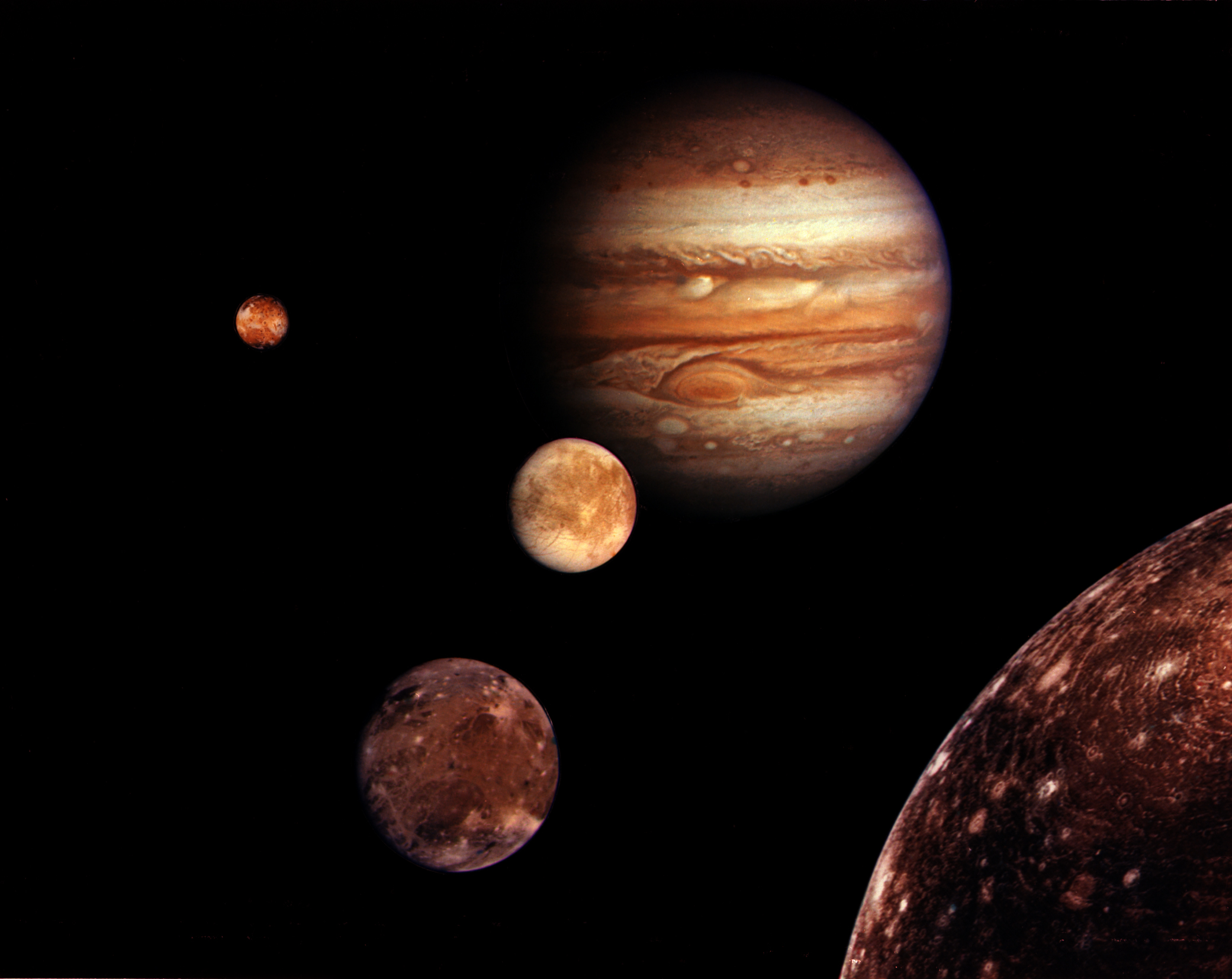
Caption: An image of the Galilean moons: they are Io, Europa, Ganymede, and Callisto.
Attribution: NASA/JPL, Public domain, via Wikimedia Commons
File URL: https://upload.wikimedia.org/wikipedia/commons/8/8a/Jupiter_family.jpg
Planets
A planet is a celestial body that orbits a star, has sufficient mass to assume a nearly round shape due to its own gravity, and has cleared its orbit of other debris. These criteria were formalised by the International Astronomical Union (IAU) in 2006, resulting in the reclassification of Pluto as a dwarf planet. Planets represent the primary building blocks of stellar systems, demonstrating remarkable diversity in their properties, formation histories, and potential for habitability.
Key Characteristics
- Size and Mass: Planets range from small rocky bodies only slightly larger than large moons to massive gas giants many times larger than Earth. The smallest recognised planet is Mercury (4,880 km diameter), while the largest in our solar system is Jupiter (139,820 km diameter).
- Composition: Determined by formation location and history, ranging from predominantly iron-nickel and silicate bodies to hydrogen-helium-dominated worlds with various molecular compounds.
- Orbital Properties: Planets follow elliptical orbits around their stars, with orbital periods ranging from days to centuries depending on their distance and the star’s mass.
- Rotation: Planets rotate on their axes with periods ranging from less than a day to months, influencing day-night cycles, weather patterns, and magnetic field generation.
- Atmosphere: Ranges from essentially none (Mercury) to thick envelopes of various gases (Venus, gas giants), critically affecting surface conditions and potential habitability.
Formation and Evolution
Planets form through a complex, multi-stage process within protoplanetary disks:
- Dust Aggregation: Microscopic dust particles collide and stick together, gradually growing from micron-sized grains to centimetre-sized pebbles.
- Planetesimal Formation: Through mechanisms including streaming instability and gravitational instability, pebbles concentrate and collapse into kilometre-sized bodies called planetesimals.
- Planetary Embryo Growth: Planetesimals collide and merge, growing into planetary embryos (from Moon-sized to Mars-sized bodies) through the gravitational focusing of their collisional cross-section.
- Final Assembly: The final stage involves giant impacts between embryos, creating full-sized terrestrial planets, while the cores of giant planets rapidly accrete gas from the disk before it dissipates.
- Migration: Planets can undergo significant changes in their orbital positions through interactions with the gas disk or with other planets, resulting in the diverse planetary architectures observed today.
- Post-Formation Evolution: After formation, planets continue to evolve through processes such as atmospheric loss or gain, surface modification due to impacts, tectonic activity, erosion, and the potential development of life.
Planetary Classification
Planets are classified based on their physical properties and composition:
Terrestrial (Rocky) Planets
- Small to medium-sized planets with solid surfaces and relatively thin atmospheres.
- Primarily composed of silicate rocks and metals.
- Examples in our solar system:
- Mercury: Smallest planet, heavily cratered, extreme temperature variations, minimal atmosphere.
- Venus: Similar in size to Earth, extremely dense atmosphere, runaway greenhouse effect, surface temperature of 462°C.
- Earth: The only known planet with liquid water oceans and life, diverse surface environments, and a moderate atmosphere.
- Mars: About half Earth’s diameter, thin carbon dioxide atmosphere, evidence of past water activity, and polar ice caps.
Gas Giants
- These are large planets primarily composed of hydrogen and helium.
- They have no solid surface but may have rocky/metallic cores.
- Examples in our solar system include:
- Jupiter: The Largest planet, with prominent bands, the Great Red Spot, a powerful magnetic field, and an extensive moon system.
- Saturn: Known for its spectacular ring system, lower density than water and numerous moons, including Titan.
Ice Giants
- These comprise mid-sized planets with significant amounts of “ices” (water, ammonia, methane) in their composition.
- Examples in our solar system include:
- Uranus: Rotates on its side (axial tilt nearly 98°), faint ring system, relatively featureless atmosphere.
- Neptune: Strong winds and storms, including the Great Dark Spot, the deepest blue colour, which was discovered through mathematical predictions.
Exoplanets and New Classifications
- Hot Jupiters: Gas giants orbiting extremely close to their stars.
- Super-Earths: Planets larger than Earth but smaller than Neptune (not present in our solar system).
- Mini-Neptunes: Planets with significant gas envelopes but smaller than Uranus or Neptune.
- Ocean worlds: Planets potentially covered entirely by deep oceans.
- Lava worlds: Extremely hot planets where the surface rock may be molten.
Planetary Atmospheres
Planetary atmospheres vary dramatically in composition, density and dynamics:
- Formation Sources: Primary atmospheres form from the capture of nebular gases, while secondary atmospheres develop through volcanic outgassing, comet impacts, and biological processes.
- Composition: Range from hydrogen/helium dominated (gas giants) to nitrogen/oxygen (Earth) to carbon dioxide (Venus, Mars), with various trace gases including noble gases, water vapour, and organic compounds.
- Structure: Divided into distinct layers with different temperature profiles, including troposphere (weather occurs), stratosphere, mesosphere, thermosphere, and exosphere.
- Dynamics: Complex circulation patterns driven by solar heating, rotation, and internal heat, leading to phenomena such as jet streams, cyclonic storms, and seasonal variations.
- Atmospheric Loss: Planets can lose their atmospheres through thermal escape (lighter molecules moving fast enough to escape gravity), impact erosion, solar wind stripping, and photodissociation.
Planetary Interiors and Geology
The internal structure of planets determines their long-term evolution:
- Differentiation: Most planets have separated into distinct layers (core, mantle, crust) based on density differences.
- Heat Sources: Include primordial heat from formation, radiogenic heating from decay of radioactive elements, and tidal heating from gravitational interactions.
- Magnetic Fields: Generated by dynamo processes in electrically conductive fluid regions, protecting against solar wind and cosmic radiation.
- Geological Activity: Expressed through volcanism, tectonics, erosion, and impact processes, reshaping surfaces over time.
- Surface Features: Diverse landscapes including impact craters, mountains, valleys, volcanoes, plains, and unique formations specific to each planet’s conditions.
Planetary Habitability
Factors affecting a planet’s potential to host life include:
- Orbit: Distance from the star must allow for an appropriate temperature range (the “habitable zone”).
- Stability: Long-term orbital and rotational stability provides consistent conditions for life to develop.
- Water: The presence of liquid water is considered essential for life as we know it.
- Protection: Magnetic fields and/or atmospheres shield the surface from harmful radiation.
- Energy Sources: Chemical gradients, solar energy, or internal heat must be available to power biological processes.
- Chemistry: Presence of carbon and other key elements (N, H, O, P, S) necessary for building organic molecules.
Planets as Systems
Planets function as integrated systems with complex interactions:
- Sphere Interactions: Atmosphere, hydrosphere, lithosphere, and potential biospheres interact through chemical, physical, and biological processes.
- Feedback Loops: Self-regulating processes that can either stabilise planetary conditions or drive runaway effects (e.g., the carbonate-silicate cycle on Earth or the runaway greenhouse effect on Venus).
- Host Star Relationships: Planets are strongly influenced by their stars through radiation, gravitational effects, and stellar evolution.
- Satellite Systems: Most planets host moons that influence tides, stabilise rotation, and affect long-term evolution.
Future of Planetary Science
Planetary science continues to advance rapidly:
- Exoplanet Characterisation: Increasingly sophisticated techniques are revealing atmospheric compositions, weather patterns, and potential habitability markers on planets around other stars.
- Sample Return Missions: Bringing material from other planets back to Earth enables detailed laboratory analysis impossible with remote instruments.
- Comparative Planetology: Studying different planets as natural experiments provides insights into fundamental processes that shape worlds across the universe.
- Search for Life: Missions to Mars, Europa, Enceladus, and exoplanets aim to find evidence of past or present extraterrestrial life.
- Human Exploration: Plans for human missions to Mars represent the next frontier in planetary exploration, with the potential for a permanent human presence beyond Earth.
The study of planets has evolved from simple astronomical observations to a multidisciplinary field that incorporates geology, atmospheric science, chemistry, biology, and physics. As our understanding deepens and observational capabilities improve, we continue to refine our knowledge of these complex and fascinating worlds.
Timeline: Milestones in the Discovery and Exploration of Planets |
| Antiquity – 1500s: The Naked-Eye Planets |
| 🌍 Prehistoric Observations: Mercury, Venus, Mars, Jupiter, and Saturn are visible to the naked eye, known to ancient civilisations and associated with gods in many cultures. |
| 🧭 2nd Century AD: Ptolemy includes five planets in his geocentric model. |
| 🔭 1543: Copernicus proposes a heliocentric model, placing planets in orbit around the Sun. |
| 1600s: The Telescope Changes Everything |
| 🔭 1609–1610 – Galileo Galilei uses a telescope to observe planets, discovering Jupiter’s moons and the phases of Venus, supporting heliocentrism. |
| 🪐 1659 – Christiaan Huygens observes Saturn’s rings and moon Titan, realising the “handles” seen by Galileo were a ring system. |
| 🌑 Late 1600s – Telescopic observations improve planetary detail, including the discovery of Jupiter’s belts and Mars’s polar caps. |
| 1700s: The Solar System Grows |
| 🔭 1781 – William Herschel discovers Uranus, the first new planet in recorded history, dramatically expanding the known solar system. |
| 📏 Late 1700s – Search for a “missing planet” between Mars and Jupiter begins, leading to the discovery of the asteroid belt. |
| 1800s: Minor Planets and Neptune |
| 🪐 1801 – Ceres was discovered by Giuseppe Piazzi; initially classified as a planet, later reclassified as an asteroid. |
| 🌊 1846 – Neptune was discovered through mathematical predictions by Urbain Le Verrier and John Couch Adams, confirmed by Johann Galle. |
| 🪐 Late 1800s – Numerous asteroids discovered; the term “minor planet” becomes common. |
| 1900–1950s: Pluto and Planetary Classification |
| 🧊 1930 – Clyde Tombaugh discovers Pluto at Lowell Observatory; considered the ninth planet. |
| 🔍 Mid-1900s – Improved telescopes reveal Pluto’s small size and eccentric orbit, but its status remains unchallenged. |
| 1960s–1980s: Planetary Exploration Begins |
| 🚀 1962 – NASA’s Mariner 2 becomes the first successful planetary flyby (Venus). |
| 🪐 1973–1979 – Pioneer & Voyager missions fly past Jupiter and Saturn, revealing their complex atmospheres, ring systems, & moons. |
| 🪨 1976 – Viking landers touch down on Mars, sending back surface images and conducting experiments. |
| 1990s: The Edge of the Solar System |
| 🛰 1990 – Voyager 1 takes the “Pale Blue Dot” photo of Earth from beyond Neptune’s orbit. |
| 🌠 1992 – The First Kuiper Belt Object (after Pluto) was discovered, hinting at a population of Pluto-like bodies. |
| 🔭 1995 – First exoplanet orbiting a main-sequence star discovered (51 Pegasi b), expanding the concept of “planet” beyond our solar system. |
| 2000s: The Planet Definition Debate |
| 🧊 2005 – Eris, a trans-Neptunian object larger than Pluto, is discovered, sparking debate about planetary status. |
| 🪧 2006 – IAU redefines “planet,” reclassifying Pluto, Ceres, Eris, Haumea, and Makemake as dwarf planets. |
| 2010s: Planetary Missions and Revisions |
| 🚀 2011 – NASA’s MESSENGER enters orbit around Mercury. |
| 🪨 2012 – Curiosity rover lands on Mars, beginning a new era of surface exploration. |
| 🧊 2015 – New Horizons flies by Pluto, revealing a surprisingly complex world with glaciers, mountains, and a heart-shaped basin. |
| 🪐 2016 – Juno enters Jupiter’s orbit, delivering unprecedented data on its interior and magnetic field. |
| 2020s: Expanding Horizons |
| 🚀 2021 – Perseverance rover lands on Mars and begins collecting samples for future return. |
| 🧪 2022 – Evidence mounts for potential volcanic activity on Venus, renewing interest in a long-overlooked planet. |
| 🛰 2027 – ESA’s Ariel mission (planned): Will study the atmospheres of hundreds of exoplanets. |
| Looking Ahead |
| 🔭 Ongoing and future missions will explore ocean worlds, study planetary atmospheres, and search for biosignatures on Mars and beyond. |
| 🌌 The definition of “planet” remains scientifically and culturally dynamic, especially as new exoplanets and solar system objects are discovered. |
Stars
A star is a massive, luminous sphere of plasma held together by gravity, primarily composed of hydrogen and helium. It generates energy through nuclear fusion, where hydrogen atoms fuse to form helium, releasing vast amounts of light and heat. Stars are the fundamental building blocks of galaxies and the sources of elements formed through nuclear fusion, making them crucial for the structure and evolution of the universe. Thus, stars serve as the energetic and gravitational engines of stellar systems, shaping their architecture, evolution, and habitability.
Key Characteristics
- Mass: Stars range from about 0.08 to 150+ solar masses. Below the lower limit, nuclear fusion cannot be sustained (resulting in brown dwarfs), whilst above the upper limit, radiation pressure prevents further growth.
- Temperature: Surface temperatures vary dramatically, from around 2,000 Kelvon for the coolest red dwarfs to over 50,000 K for the hottest blue giants. Core temperatures typically range from 4 to over 40 million Kelvin.
- Luminosity: Stars exhibit an enormous range in brightness, from less than 0.0001 to over 1 million times the Sun’s luminosity. Luminosity typically scales with mass raised to a power of approximately 3.5.
- Size: Stellar radii range from about 0.1 solar radii (compact red dwarfs) to over 1,500 solar radii (supergiant stars, which would engulf Jupiter’s orbit if placed in our solar system).
- Lifespan: Inversely related to mass, with the most massive stars living only a few million years while the least massive may shine for over a trillion years.
- Magnetic Activity: Stars generate magnetic fields through internal dynamo processes, resulting in starspots, flares, coronae, and stellar winds.
Formation
Stars are formed through a complex sequence of events:
- Molecular Cloud Collapse: Star formation begins when a portion of a giant molecular cloud, typically triggered by a shock wave from a nearby supernova or collision with another cloud, undergoes gravitational collapse.
- Fragmentation: The collapsing cloud breaks into smaller fragments, each potentially forming individual stars or star systems.
- Protostar Formation: As a fragment continues to collapse, its central region becomes a protostar, surrounded by a rotating disk of gas and dust.
- T Tauri Phase: Young, low-mass stars enter the T Tauri phase, which is characterised by strong stellar winds, variable brightness, and significant mass accretion from their surrounding disks.
- Pre-Main Sequence: The protostar continues to contract, increasing in temperature until its core reaches approximately 10 million Kelvin.
- Main Sequence Birth: When the core temperature and pressure become sufficient to sustain hydrogen fusion, the star achieves hydrostatic equilibrium and officially becomes a main sequence star.
- Multiplicity: About 50% of star formation events result in binary or multiple star systems rather than a single star like our Sun.
Stellar Structure
Most stars have distinct internal layers:
- Core: The central region where nuclear fusion occurs. In main-sequence stars, this is where hydrogen fuses into helium. Temperatures range from four to 40 million Kelvin.
- Radiative Zone: A region where energy moves outward primarily through photon radiation. Photons may take thousands to millions of years to traverse this zone.
- Convective Zone: The outer layer where energy is transported by convection currents, similar to boiling water. In low-mass stars, such as the Sun, this zone is located near the surface; in high-mass stars, it may occur near the core.
The visible photosphere is the “surface” of the star, which emits the light we see. This is not a solid surface but the layer where the star becomes transparent to visible light. Above the photosphere lies the chromosphere and corona, which are hotter than the photosphere and observable during solar eclipses or with specialised instruments.
Stellar Classification
Stars are primarily classified according to their spectral characteristics:
Spectral Types (Temperature Classification)
- O-type (30,000-50,000+ K): Extremely hot, blue stars with strong ultraviolet emission and spectral lines of ionised helium.
- B-type (10,000-30,000 K): Blue-white stars showing neutral helium lines and moderate hydrogen lines.
- A-type (7,500-10,000 K): White stars with strong hydrogen lines and some ionised metal lines.
- F-type (6,000-7,500 K): Yellow-white stars showing weakening hydrogen lines and strengthening metallic lines.
- G-type (5,000-6,000 K): Yellow stars like our Sun with prominent calcium lines and moderate hydrogen lines.
- K-type (3,500-5,000 K): Orange stars with strong metallic lines and weak hydrogen lines.
- M-type (2,000-3,500 K): Red stars showing strong molecular bands, particularly titanium oxide.
Additional Classification Elements
- Luminosity Classes: Roman numerals indicate a star’s luminosity and evolutionary state:
- I: Supergiants.
- II: Bright giants.
- III: Regular giants.
- IV: Subgiants.
- V: Main sequence (dwarf) stars.
- VI: Subdwarfs.
- VII: White dwarfs.
- Peculiarity Codes: Additional letters denote unusual characteristics, such as ‘e’ for emission lines, ‘p’ for peculiar spectra, or ‘n’ for broad spectral lines due to rapid rotation.
- Extended Spectral Classes: Additional classes exist for objects beyond the traditional sequence:
- L, T, and Y classes: For brown dwarfs and very cool objects.
- Carbon stars (C).
- S-type stars (S).
- Wolf-Rayet stars (W).
Brightness Measurement
- Apparent Magnitude: The brightness as seen from Earth, with lower numbers indicating brighter objects. The brightest stars have negative magnitudes.
- Absolute Magnitude: The intrinsic brightness, defined as how bright a star would appear at a standard distance of 10 parsecs (32.6 light-years).
Stellar Lifecycle
A star’s evolutionary path and its ultimate fate depend primarily on its initial mass:
Low-mass stars (0.08-0.8 solar masses)
- Main Sequence: The longest phase, lasting tens to hundreds of billions of years, during which hydrogen fuses to helium in the core via the proton-proton chain.
- Red Dwarf Longevity: The least massive main sequence stars (red dwarfs) are fully convective, allowing them to use nearly all their hydrogen for fusion and potentially shine for over a trillion years.
- Final Fate: After exhausting their hydrogen, these stars will increase slightly in luminosity and eventually cool to become white dwarfs without passing through a true red giant phase.
Solar-Mass Stars (0.8-8 solar masses)
- Main Sequence: Last for 1-10 billion years, depending on mass.
- Subgiant Phase: After core hydrogen exhaustion, the star expands and brightens while hydrogen burning continues in a shell around the inert helium core.
- Red Giant Phase: The star expands dramatically as its core contracts and heats. Eventually, helium fusion begins in the core (the “helium flash” in lower-mass stars).
- Horizontal Branch/Asymptotic Giant Branch: After core helium exhaustion, the star undergoes complex evolutionary phases with shell burning of different elements.
- Planetary Nebula: The outer layers are expelled, forming a colourful expanding shell of gas around the exposed core.
- White Dwarf: The end stage – a hot, dense remnant about Earth-sized but containing up to 1.4 solar masses (the Chandrasekhar limit), gradually cooling over billions of years.
Massive Stars (8-150+ solar masses)
- Main Sequence: They have much shorter lives (2-30 million years) but are vastly more luminous than lower-mass stars.
- Supergiant Phase: Undergoes multiple phases of core and shell burning, synthesising progressively heavier elements up to iron.
- Onion Structure: Develop concentric shells of different fusion products, with iron accumulating in the core.
- Core Collapse: Once an iron core forms, fusion can no longer release energy, resulting in a catastrophic core collapse.
- Supernova Explosion: The collapse triggers a violent explosion that outshines entire galaxies temporarily and disperses heavy elements throughout space.
- Final Remnant: Depending on the progenitor mass, the core becomes either a:
- Neutron Star: For initial masses of roughly 8-20 solar masses.
- Black Hole: For initial masses above approximately 20 solar masses.
Evidence and Validation
The stellar evolution framework is supported by multiple lines of evidence:
- Hertzsprung-Russell Diagram: This shows consistent patterns of stellar evolution, with stars clustered in specific regions based on their evolutionary state.
- Star Cluster Analysis: Stars within clusters formed at approximately the same time, providing “snapshots” of stellar evolution for different masses.
- Direct Observation: Phenomena like supernovae, planetary nebulae, and various types of variable stars provide direct observations of evolutionary transitions.
- Elemental Abundances: The observed distribution of elements in the universe matches predictions from stellar nucleosynthesis models.
- Computer Modelling: Sophisticated simulations successfully predict observed stellar properties and behaviours across the mass spectrum.
Although no scientific model can claim absolute certainty, the consistent agreement between theory and observation provides astronomers with high confidence in their understanding of stellar evolution. Alternative models would necessitate fundamental revisions to established physics, including nuclear physics and general relativity.
The Sun: Our Local Star
The Sun serves as our best-studied example of a star:
- Classification: G2V main sequence star (G-type, yellow dwarf).
- Physical Properties:
- Mass: 1.989 × 10^30 kg (332,950 Earth masses).
- Radius: 695,700 km (109 Earth radii).
- Surface Temperature: 5,772 K.
- Core Temperature: ~15 million K.
- Luminosity: 3.828 × 10^26 watts.
- Composition: Approximately 73% hydrogen, 25% helium, and 2% heavier elements by mass – a perfect cosmic recipe providing Earth with light and energy for billions of years (approximately 10 billion years of total main sequence lifetime).
- Age and Lifespan: Currently about 4.6 billion years old, midway through its approximately 10-billion-year main sequence lifetime.
- Structure: Core (extending to about 0.25 solar radii), radiative zone, convective zone, photosphere, chromosphere, transition region, and corona.
- Activity Cycle: Undergoes an approximately 11-year cycle of magnetic activity, manifesting as sunspots, flares, coronal mass ejections, and variations in solar output.
- Future Evolution: In approximately 5 billion years, the Sun will have exhausted its core hydrogen, expand to become a red giant star (potentially engulfing Mercury, Venus, and possibly Earth), and eventually shed its outer layers as a planetary nebula, ultimately ending as a white dwarf. Some models suggest that Earth might survive but be rendered completely uninhabitable, while others indicate that it may be engulfed. The uncertainty arises from two competing factors: the Sun will lose some mass, which weakens gravity and allows Earth’s orbit to widen; however, this will also create drag as Earth moves through the Sun’s expanded outer layers.
Stellar Systems
Stars frequently exist as part of complex systems:
Binary and Multiple Star Systems
- Prevalence: More than half of all Sun-like stars exist in binary or multiple systems, with multiplicity increasing for higher-mass stars.
- Orbital Configurations:
- Visual binaries: Pairs resolved through telescopes.
- Spectroscopic binaries: Detected through Doppler shifts in spectral lines.[14]
- Eclipsing binaries: Systems where stars periodically eclipse each other.
- Astrometric binaries: Detected through wobbles in proper motion.
- Mass Transfer and Evolution: Close binary systems can exchange mass, dramatically altering their evolutionary paths and producing exotic objects, such as cataclysmic variables, X-ray binaries, and Type Ia supernovae.
Star Clusters
- Open Clusters: Loose groupings of dozens to thousands of stars formed together from the same molecular cloud (examples: Pleiades, Hyades).
- Globular Clusters: Ancient, densely packed spherical collections of hundreds of thousands of stars, primarily residing in the galactic halo (examples: Omega Centauri, 47 Tucanae).
- Stellar Associations: Loose, extended groupings of young stars (examples: Scorpius-Centaurus association).
Stellar Populations
- Population I Stars: Young, metal-rich stars found in the galactic disk, including the Sun.
- Population II Stars: Older, metal-poor stars predominant in the galactic halo and globular clusters.
- Population III Stars: The first generation of stars, theorised to have formed from primordial gas containing only hydrogen, helium, and trace lithium. None have been directly observed, as it is likely that they lived and died billions of years ago.
Stellar Nucleosynthesis
Stars are cosmic factories for creating chemical elements:
- Primordial Elements: The Big Bang produced hydrogen (~75%) and helium (~25%), with trace amounts of lithium.
- Hydrogen Fusion: Main sequence stars convert hydrogen to helium through either:
- The proton-proton chain (dominant in lower-mass stars).
- The CNO cycle (dominant in higher-mass stars).
- Helium Fusion: In red giants and supergiants, three helium nuclei fuse to form carbon (triple-alpha process).
- Advanced Fusion: Massive stars create progressively heavier elements through carbon, neon, oxygen, and silicon burning.
- s-Process: Slow neutron capture in asymptotic giant branch stars creates approximately half of the elements heavier than iron.
- r-Process: Rapid neutron capture during neutron star mergers and certain types of supernovae creates the remaining heavy elements.
- Cosmic Distribution: These newly formed elements are distributed into interstellar space through stellar winds, planetary nebulae, and supernova explosions, thereby enriching future generations of stars and facilitating the formation of planets.
Unusual Stellar Types
Beyond typical main sequence stars, several exotic varieties exist:
- Variable Stars:
- Intrinsic variables: Their brightness changes due to physical processes within the star (Cepheids, RR Lyrae, Mira variables).
- Extrinsic variables: Brightness changes due to external factors like eclipses or rotation (eclipsing binaries, rotating variables).
- Wolf-Rayet Stars: Very hot, massive stars with strong stellar winds that have lost their outer hydrogen layers, exposing helium and heavier elements.
- Blue Stragglers: Stars in clusters that appear younger and bluer than they should be, likely formed through stellar mergers or mass transfer.
- Rapidly Rotating Stars: These are stars that spin so fast they become oblate, with pronounced equatorial bulges (examples: Vega, Achernar).
- Magnetic Stars: Stars with unusually strong magnetic fields, often exhibiting starspots and activity cycles.
- Chemically Peculiar Stars: Stars with anomalous chemical abundances in their atmospheres, often due to diffusion, stellar winds, or mass transfer.
Studying Stars: Observational Methods
Astronomers use numerous ways to study stars:
- Photometry: Measuring the brightness of stars across different wavelengths to determine temperature, variability, and other properties.
- Spectroscopy: Analysing the spectrum of light from stars to determine composition, temperature, rotation rate, and radial velocity.
- Astrometry: Precise measurements of stellar positions and movements, providing data on distances, proper motions, and orbital dynamics.
- Interferometry: Combining light from multiple telescopes to achieve extremely high angular resolution, allowing measurement of stellar diameters and surface features.
- Asteroseismology: Studying oscillations in stars to probe their internal structure, similar to how seismology reveals Earth’s interior.
- Polarimetry: Measuring the polarisation of starlight to detect magnetic fields, circumstellar material, and interstellar dust.

Stellar evolution of low-mass (left cycle) and high-mass (right cycle) stars, with examples in italics. The background image is derived from http://imagine.gsfc.nasa.gov/teachers/lessons/xray_spectra/images/life_cycles.jpg and http://www.nasa.gov/sites/default/files/thumbnails/image/bh_labeled.jpg by NASA’s Goddard Space Flight Center.
Attribution: cmglee, NASA Goddard Space Flight Center, CC BY-SA 4.0 <https://creativecommons.org/licenses/by-sa/4.0>, via Wikimedia Commons
This file is licensed under the Creative Commons Attribution-Share Alike 4.0 International license.
File URL: https://upload.wikimedia.org/wikipedia/commons/f/fe/Star_life_cycles_red_dwarf_en.svg
The Future of Stellar Astronomy
The study of stars continues to advance rapidly:
- Space-Based Observatories: Missions like TESS, JWST, and planned successors provide unprecedented data quality by observing from above Earth’s atmosphere.
- Multi-Messenger Astronomy: Combining electromagnetic observations with gravitational waves and neutrinos provides new insights into stellar processes.
- Computational Advances: Simulation of stellar interiors, activity, and evolution with greater precision through the use of increasingly sophisticated 3D models.
- Population III Hunt: The search for the universe’s first stars continues, with hopes that JWST might detect their supernova remnants.
- Stellar Archaeology: Studying the oldest surviving stars provides clues about the early universe and galactic formation.
- Stellar Engineering: Theoretical work explores how advanced civilisations might potentially modify or use stars as energy sources or for other purposes.
Stars remain central to our understanding of the universe, connecting the microscopic world of nuclear physics to the cosmic scale of galactic evolution. Their study has profound implications for cosmology, planetary science, astrobiology, and fundamental physics.
Stars are the central engines of stellar systems and serve fundamentally different functions:
- Generating energy through nuclear fusion, providing heat and light.
- Creating the gravitational centre around which all other system components orbit.
- Manufacturing heavier elements through nucleosynthesis[15].
- Defining the habitable zone where liquid water might exist on planetary surfaces.
- Determining the overall architecture and evolution of their systems through their mass, radiation, and stellar winds.
Formation
- Stars form from the gravitational collapse of massive clouds of gas and dust (nebulae).
- The material heats up as it collapses until it becomes dense and hot enough to initiate nuclear fusion in the core.
- Once fusion begins, the star reaches an equilibrium between gravitational forces pulling inward and fusion energy pushing outward.
Lifecycle [16]
A star’s fate depends primarily on its mass:
Low-mass stars (like the Sun):
- Spend billions of years on the main sequence.
- Become red giants as they exhaust hydrogen.
- Eventually, it sheds outer layers, forming planetary nebulae.
- Leave behind a white dwarf.
Massive stars:
- Burn through fuel much faster (millions rather than billions of years).
- Can fuse elements up to iron in their cores.
- End in supernova explosions.
- Become neutron stars or black holes.
Phenomena that validate parts of these models include supernovae explosions, neutron stars (as pulsars), white dwarfs with measurable properties that match predictions, and black holes with detectable effects on surrounding matter. Additionally, the Hertzsprung-Russell diagram exhibits consistent patterns of stellar evolution that align with the models mentioned above.
Whilst it cannot be claimed with 100% certainty (as is often the case in science), the consistent agreement between multiple lines of evidence gives astronomers confidence in the general framework of stellar evolution. An alternative explanation would necessitate rejecting a significant portion of our current understanding of nuclear physics and gravity.
Classification
- Stars are classified by size, colour, and temperature: Spectral types (O, B, A, F, G, K, M), from hottest to coolest:
- O-type (blue, hottest).
- B-type (blue-white).
- A-type (white).
- F-type (yellow-white).
- G-type (yellow, like our Sun).
- K-type (orange).
- M-type (red, coolest).
- Brightness is measured in:
- Apparent magnitude (brightness as seen from Earth) and Absolute magnitude (intrinsic brightness).
The Sun: Our Local Star
The Sun is a G-type (G2V) main-sequence star, often called a “yellow dwarf.” With an age of about 4.6 billion years, it is currently in the middle of its life cycle. It will remain in its current stable state for approximately another 5 billion years.
The Sun’s future evolution will follow a predictable path:
- Red giant phase (expanding dramatically as core hydrogen is depleted).
- Planetary nebula formation (outer layers expelled).
- White dwarf (final stage as a dense stellar remnant).
While special to us, the Sun is one of billions of similar stars in our galaxy:
- About 7.6% of main-sequence stars in the Milky Way are G-type stars.
- The closest Sun-like star is Alpha Centauri A, about 4.37 light-years away.
- Sun-like stars are of particular interest in the search for potentially habitable exoplanets.
Stellar Systems
- Stars can form binary or multiple-star systems where two or more stars orbit each other.
- Stars define the architecture of their planetary systems, with planets, moons, asteroids, and comets orbiting in a hierarchical relationship.
- Stars appear in constellations (apparent groupings as viewed from Earth) and can form physical star clusters.
Timeline: Milestones in the Study and Understanding of Stars |
| Antiquity – 1600s: Early Observations |
| 🌌 Prehistoric Civilisations: Constellations identified and tracked across seasons for navigation and agriculture. |
| 📜 ~150 BCE: Hipparchus compiles the first known star catalogue and introduces stellar magnitude (brightness ranking). |
| 🧭 2nd Century CE: Ptolemy’s Almagest includes 1,022 stars and defines 48 constellations. |
| 1600s–1700s: Telescopic Breakthroughs |
| 🔭 1609 – Galileo Galilei observes the Milky Way through a telescope, revealing it is composed of countless faint stars. |
| 🌟 1676 – Ole Rømer measures the speed of light using eclipses of Jupiter’s moons — critical for later stellar distance measurements. |
| 📐 1718 – Edmund Halley discovers proper motion: stars change position over time, proving they are not fixed on a celestial sphere. |
| 1800s: Classification and Physics |
| 📏 1838 – Friedrich Bessel makes the first successful parallax measurement of a star (61 Cygni), determining its distance. |
| 🌠 1860s – Gustav Kirchhoff and Robert Bunsen pioneer spectroscopy, allowing chemical analysis of starlight. |
| 🌈 1863 – Angelo Secchi classifies stars by spectral type (the precursor to modern spectral classification). |
| 🌞 Late 1800s – Hydrogen was identified as the primary element in stellar spectra; stars are understood to be composed of gas. |
| 1900–1950: The Birth of Stellar Astrophysics |
| 🧪 1905–1920s – Quantum mechanics and atomic theory develop, explaining stellar absorption lines. |
| 🔭 1910 – The Hertzsprung–Russell diagram was developed independently by Ejnar Hertzsprung and Henry Norris Russell, linking luminosity and temperature — a cornerstone of stellar evolution theory. |
| 💥 1925 – Cecilia Payne shows that stars are composed mostly of hydrogen and helium, not heavier elements. |
| 🌟 1930s – Theories of stellar interiors emerge: stars maintain stability through gravitational equilibrium and internal pressure. |
| 🔢 1939 – Hans Bethe outlines nuclear fusion as the energy source powering stars (proton-proton chain, CNO cycle). |
| 1950s–1980s: Understanding Stellar Life Cycles |
| 🌠 1957 – Burbidge, Burbidge, Fowler, and Hoyle (B²FH) paper explains stellar nucleosynthesis — how stars produce all elements heavier than helium. |
| 💣 1967 – The first pulsar (rotating neutron star) is discovered by Jocelyn Bell Burnell and Antony Hewish. |
| 🌌 1971 – First evidence of black holes as collapsed massive stars (Cygnus X-1). |
| 🔭 1980s – Detailed models of stellar evolution emerge, including mass loss, supernova mechanisms, and remnant formation (white dwarfs, neutron stars, black holes). |
| 1990s–2010s: Precision Astronomy and New Discoveries |
| 🛰 1990 – The launch of the Hubble Space Telescope allows precise stellar imaging across the galaxy and beyond. |
| 🌍 1995 – First exoplanet discovered around a main-sequence star (51 Pegasi b), shifting views of stellar systems. |
| 🧪 1998–2004 – Evidence for dark energy comes from observing Type Ia supernovae, used as standard candles to measure cosmic expansion. |
| 🔭 2009 – Launch of Kepler Space Telescope, detecting thousands of exoplanets via transits across their parent stars. |
| 🔁 2013 – Gaia mission begins mapping over a billion stars with unprecedented accuracy in position, motion, and brightness. |
| 2020s and Beyond |
| 🧲 2020 – Observations of magnetars (highly magnetic neutron stars) linked to fast radio bursts, deepening the mystery of extreme stellar remnants. |
| 💥 Ongoing – Supernovae and gravitational wave astronomy reveal more about the deaths of massive stars and the formation of binary neutron stars and black hole mergers. |
| 🔍 JWST (2022 launch) – Begins observing early stars and galaxies in infrared, peering into the first billion years after the Big Bang. |
| 🔮 Future missions aim to observe Population III stars (the first stars), refine stellar age-dating, and directly image exoplanetary systems. |
Constellations
A constellation is a group of stars that forms a recognisable pattern in the night sky, often associated with a mythological figure, animal, or object. These patterns are largely arbitrary and are based on human interpretations rather than any physical connection between the stars, which are usually at vastly different distances from Earth. Throughout human history, constellations have played crucial roles as navigational aids, seasonal markers, storytelling frameworks, and foundations for early astronomical study.
Historical Development
The practice of grouping stars into recognisable patterns spans human cultures across millennia:
- Prehistoric Era (30,000+ BC): Cave paintings suggest that early humans recognised star patterns, particularly the Pleiades cluster, which appears in artwork worldwide.
- Mesopotamian Astronomy (3000-500 BC): The earliest documented constellation systems emerged in Sumer and Babylon, with cuneiform texts describing approximately 30 star patterns. The Babylonian MUL.APIN catalogue, dating to around 1000 BC, established several constellations that are still recognised today.
- Egyptian Stargazing (3000-30 BC): Developed their own celestial traditions, with stars and constellations depicted on tomb ceilings and coffin lids. The famous ceiling at the Temple of Hathor at Dendera preserves one of the most complete ancient Egyptian celestial maps.
- Chinese System (1600 BC to the present): Developed independently, the Chinese divided the sky into 28 “lunar mansions” or Xiu along the ecliptic, with additional northern circumpolar asterisms. Chinese constellations remain a vital part of traditional East Asian astronomy.
- Greek Development (800 BC – 200 AD): Greek astronomers, building on Babylonian foundations, formalised the Mediterranean constellation system. Eudoxus of Cnidus (4th century BC) created one of the earliest systematic descriptions, later expanded by Aratus in his poem “Phaenomena.”
- Ptolemy’s Contribution (2nd century AD): In his astronomical treatise, the Almagest, Claudius Ptolemy catalogued 48 constellations, which became the foundation for Western astronomy for over a millennium. These “Ptolemaic constellations” include familiar groupings like Orion, Ursa Major, and Leo.
- Islamic Astronomy (8th -15th centuries): Arab astronomers preserved and expanded upon Greek knowledge, translating constellation names and adding their own stars. The Arabic names of many stars (Aldebaran, Betelgeuse, Rigel) reflect this important era.
- Age of Exploration (16th -18th centuries): European explorers venturing into the Southern Hemisphere discovered stars invisible from Europe. Astronomers, including Keyser, de Houtman, Bayer, and Lacaille, created new southern constellations to fill these gaps.
- Modern Standardisation (20th century): In 1922, the International Astronomical Union (IAU) officially recognised 88 constellations, establishing precise boundaries in 1928 that divided the entire celestial sphere into formally defined regions.
Cultural Significance
Constellations have held profound cultural importance across civilisations:
- Mythological Frameworks: Many Western constellations derive from Greek mythology, which tells stories of heroes (Perseus, Hercules), monsters (Draco, Hydra), and gods (Zeus, as represented by Aquila, his eagle). Similar mythological associations exist in other cultures, with Chinese constellations representing imperial palaces and administrative divisions.
- Agricultural Timekeeping: The heliacal rising (first appearance before sunrise) of specific constellations marked important seasonal events in many cultures. For example, the appearance of Sirius (in Canis Major) signalled the annual flooding of the Nile in ancient Egypt.
- Navigation: Sailors and desert travellers relied on constellation patterns to determine direction, with Polaris (the North Star in Ursa Minor) providing a fixed northern reference point in the Northern Hemisphere.
- Religious Significance: Many ancient cultures incorporated celestial observations into religious practices, with temples and monuments aligned to specific astronomical events tied to constellations.
- Identity and Heritage: Indigenous peoples worldwide developed sophisticated celestial traditions. For example, Aboriginal Australians identify the dark patches in the Milky Way, rather than just the stars, as important constellation figures in their Dreamtime stories.
Astronomical Classification
Modern astronomy has established formal definitions for constellations:
- IAU Recognition: The 88 officially recognised constellations cover the entire celestial sphere without overlap. Each constellation now represents not just a star pattern but a precisely defined region of the sky.
- Constellation Boundaries: The official borders established in 1928 follow lines of right ascension and declination (celestial coordinates), creating a complete mosaic of the sky.
- Historical Origins:
- 48 Ptolemaic constellations from ancient Greek-Babylonian tradition.
- 40 “modern” constellations have been added – primarily in the 16th-18th centuries.
- One constellation (Argo Navis) from Ptolemy’s original list was later divided into three (Carina, Puppis, and Vela).
- Naming Conventions: Stars within constellations are often designated using the Bayer system (Greek letters followed by the constellation’s genitive form, e.g., Alpha Centauri) or the Flamsteed system (numbers followed by the constellation, e.g., 61 Cygni).
Size and Prominence
Constellations vary dramatically in size, visibility, and recognisability:
- Largest Constellations (by area):
- Hydra (1303 square degrees) – The largest constellation, stretching across 1/15th of the entire sky.
- Virgo (1294 square degrees) – Contains the Virgo Cluster of galaxies.
- Ursa Major (1280 square degrees) – Includes the famous Big Dipper pattern.
- Cetus (1231 square degrees) – The celestial sea monster or whale.
- Hercules (1225 square degrees) – Contains the Great Hercules Cluster (M13).
- Smallest Constellations (by area):
- Crux (68 square degrees) – The Southern Cross is small but distinctive.
- Equuleus (72 square degrees) – The Little Horse, which is faint and obscure.
- Scutum (109 square degrees) – The Shield, was created by Hevelius in 1684.
- Sagitta (80 square degrees) – The Arrow, one of the ancient Greek constellations.
- Corona Australis (128 square degrees) – The Southern Crown.
- Brightest Constellations (by number of bright stars):
- Orion (contains 7 stars brighter than magnitude 2.0).
- Centaurus (contains Alpha Centauri, the closest star system to our Sun).
- Crux (despite its small size, contains numerous bright stars).
- Canis Major (contains Sirius, the brightest star in the night sky).
- Carina (contains Canopus, the second-brightest star in the night sky).
Notable Constellations
Several constellations stand out for their visibility, historical importance, or distinctive features:
- Orion: One of the most recognisable constellations, visible worldwide, featuring the bright stars Betelgeuse and Rigel, the famous three-star belt, and the Orion Nebula (M42). It represents a hunter from Greek mythology.
- Ursa Major: Home to the Big Dipper (also known as the Plough), this northern constellation contains seven bright stars that form one of the most distinctive asterisms in the sky. The two rightmost stars of the dipper’s bowl point toward Polaris.
- Crux: The Southern Cross, a compact yet bright constellation in the southern hemisphere, has been used for navigation, much like Polaris in the northern hemisphere. It features prominently on several national flags, including Australia, New Zealand, Brazil, and Papua New Guinea.
- Cygnus: The Swan, featuring a distinctive cross shape (sometimes called the Northern Cross), lies along the Milky Way and contains numerous deep-sky objects, including the North America Nebula and the black hole candidate Cygnus X-1.
- Scorpius: One of the few constellations that genuinely resembles its namesake, with the bright red star Antares marking the scorpion’s heart. It lies along the ecliptic near the centre of the Milky Way.
- Centaurus: A prominent southern constellation containing Alpha Centauri, our nearest stellar neighbour, and Omega Centauri, the largest and brightest globular cluster visible from Earth.
Asterisms
Within or across constellations, certain bright stars form distinctive patterns called asterisms. These are not official constellations but are often more easily recognisable to casual observers:
- The Big Dipper/Plough: The most famous asterism, forming part of Ursa Major.
- The Summer Triangle: Formed by the bright stars Vega (in Lyra), Deneb (in Cygnus), and Altair (in Aquila), this prominent asterism in the northern hemisphere spans three constellations during the summer.
- The Teapot: A distinctive pattern within Sagittarius that resembles a teapot, with the Milky Way appearing as “steam” rising from the spout.
- The False Cross: Sometimes confused with the Crux, this asterism consists of stars from the constellations Carina and Vela.
- The Sickle: A backward question mark in Leo forming the lion’s head and mane.
- The Circlet: A small circular pattern of stars forming the western fish in Pisces.
- The Great Square of Pegasus: Formed by three stars from Pegasus and one from Andromeda.
- The Keystone: A distinctive quadrilateral asterism in Hercules.
- The Kite: A pattern within Boötes that includes the bright star Arcturus.
- The Northern Cross: Another name for the main pattern of Cygnus.
Constellations in Modern Astronomy
While the original purpose of constellations as mythological or navigational aids has diminished, they remain important in contemporary astronomy:
- Location Reference: Astronomers still use constellation names to indicate the general location of celestial objects (e.g., “the Andromeda Galaxy” or “the Carina Nebula”).
- Stellar Designation: The traditional naming system for stars includes the constellation name (e.g., Proxima Centauri, located in Centaurus).
- Meteor Showers: Most meteor showers are named after the constellation from which they appear to radiate (e.g., the Perseids from Perseus, Leonids from Leo).
- Celestial Navigation: Despite technological advances, knowledge of constellations remains valuable for practical navigation in emergency situations.
- Seasonal Sky Guides: Constellations serve as useful markers for amateur astronomers to locate and identify various deep-sky objects.
- Public Outreach: Constellations provide accessible entry points for astronomy education, connecting abstract scientific concepts to cultural heritage and visible patterns.
Deep-Sky Object Identification
Many well-known astronomical catalogues, such as the Messier Catalogue and the New General Catalogue (NGC), list nebulae, star clusters, and galaxies by number. These objects are usually identified and located with reference to the constellation in which they appear. For example, Messier 31 (M31), also known as the Andromeda Galaxy, lies within the boundaries of the constellation Andromeda, whereas NGC 3372, the Carina Nebula, is located in the constellation Carina.
This convention helps astronomers and observers quickly orient themselves and identify targets using the celestial map of constellations.
Studying Constellations
- Modern tools have transformed how we understand and visualise constellations:
- Digital Planetariums: Sophisticated software allows precise modelling of the sky from any location and time, revolutionising constellation study.
- 3D Mapping: Modern astronomical databases and visualisation tools have enabled the three-dimensional modelling of constellations, revealing the true spatial relationships between their component stars.
- Historical Research: Archaeoastronomical studies continue to uncover how ancient cultures observed and interpreted constellations, providing insights into early human civilisation.
- Proper Motion: High-precision measurements reveal that constellation patterns slowly change over time due to stars’ independent motions. Over tens of thousands of years, familiar patterns will become unrecognisable.
- Extra-terrestrial Perspectives: Imagining constellations from other stellar systems provides a powerful illustration of their arbitrary nature, as the same stars would form entirely different patterns when viewed from different locations in the galaxy.
The Future of Constellations
The concept of constellations continues to evolve:
- Stellar Proper Motion: Over tens of thousands of years, the independent movements of stars will dramatically alter familiar constellation patterns. For example, the Big Dipper will gradually distort into unrecognisable shapes.
- New “Constellations”: Modern groups have created new unofficial patterns for educational or promotional purposes, such as the “Fermi Bubbles” (gamma-ray structures) or constellations based on endangered species.
- Cultural Preservation: The increased recognition of non-Western astronomical traditions has led to a renewed interest in indigenous constellation systems from cultures worldwide.
- Extrasolar Perspective: As human exploration extends farther into space, our perspective on the stars will gradually change, potentially requiring new navigational frameworks.
- Digital Augmentation: Smartphone apps and augmented reality technologies have made constellation identification accessible to everyone, democratising knowledge previously limited to experienced observers.
Constellations represent one of humanity’s oldest connections to the cosmos – arbitrary patterns transformed into meaningful stories through imagination, myth and cultural tradition. While modern astronomy has surpassed the need for such patterns, constellations continue to be valuable as cultural heritage, navigational tools, and gateways to deeper astronomical exploration. They bridge our scientific understanding with our innate human tendency to find meaning and patterns in the night sky.
The 88 Constellations
A complete list of all 88 official constellations, organised by their general position in the northern and southern hemispheres and their official abbreviations and common names, is set out below.
Northern Hemisphere Constellations
- Andromeda (And) – The Princess
- Aquila (Aql) – The Eagle
- Aries (Ari) – The Ram
- Auriga (Aur) – The Charioteer
- Boötes (Boo) – The Herdsman
- Cancer (Cnc) – The Crab
- Canes Venatici (CVn) – The Hunting Dogs
- Canis Major (CMa) – The Great Dog
- Canis Minor (CMi) – The Lesser Dog
- Cassiopeia (Cas) – The Queen
- Cepheus (Cep) – The King
- Cetus (Cet) – The Sea Monster/Whale
- Coma Berenices (Com) – Berenice’s Hair
- Corona Borealis (CrB) – The Northern Crown
- Corvus (Crv) – The Crow
- Crater (Crt) – The Cup
- Cygnus (Cyg) – The Swan
- Delphinus (Del) – The Dolphin
- Draco (Dra) – The Dragon
- Equuleus (Equ) – The Little Horse
- Gemini (Gem) – The Twins
- Hercules (Her) – Hercules
- Hydra (Hya) – The Water Serpent
- Lacerta (Lac) – The Lizard
- Leo (Leo) – The Lion
- Leo Minor (LMi) – The Lesser Lion
- Lepus (Lep) – The Hare
- Libra (Lib) – The Scales
- Lynx (Lyn) – The Lynx
- Lyra (Lyr) – The Lyre
- Monoceros (Mon) – The Unicorn
- Ophiuchus (Oph) – The Serpent Bearer
- Orion (Ori) – The Hunter
- Pegasus (Peg) – The Winged Horse
- Perseus (Per) – Perseus
- Pisces (Psc) – The Fish
- Piscis Austrinus (PsA) – The Southern Fish
- Sagitta (Sge) – The Arrow
- Serpens (Ser) – The Serpent
- Taurus (Tau) – The Bull
- Triangulum (Tri) – The Triangle
- Ursa Major (UMa) – The Great Bear
- Ursa Minor (UMi) – The Lesser Bear
- Vulpecula (Vul) – The Fox
Southern Hemisphere Constellations
- Antlia (Ant) – The Air Pump
- Apus (Aps) – The Bird of Paradise
- Aquarius (Aqr) – The Water Bearer
- Ara (Ara) – The Altar
- Caelum (Cae) – The Chisel
- Camelopardalis (Cam) – The Giraffe
- Capricornus (Cap) – The Sea Goat
- Carina (Car) – The Keel
- Centaurus (Cen) – The Centaur
- Chamaeleon (Cha) – The Chameleon
- Circinus (Cir) – The Compass
- Columba (Col) – The Dove
- Corona Australis (CrA) – The Southern Crown
- Crux (Cru) – The Southern Cross
- Dorado (Dor) – The Swordfish/Goldfish
- Eridanus (Eri) – The River
- Fornax (For) – The Furnace
- Grus (Gru) – The Crane
- Horologium (Hor) – The Clock
- Hydrus (Hyi) – The Water Snake
- Indus (Ind) – The Indian
- Lupus (Lup) – The Wolf
- Mensa (Men) – The Table Mountain
- Microscopium (Mic) – The Microscope
- Musca (Mus) – The Fly
- Norma (Nor) – The Level
- Octans (Oct) – The Octant
- Pavo (Pav) – The Peacock
- Phoenix (Phe) – The Phoenix
- Pictor (Pic) – The Painter’s Easel
- Puppis (Pup) – The Stern
- Pyxis (Pyx) – The Compass Box
- Reticulum (Ret) – The Reticle
- Sagittarius (Sgr) – The Archer
- Scorpius (Sco) – The Scorpion
- Sculptor (Scl) – The Sculptor
- Scutum (Sct) – The Shield
- Sextans (Sex) – The Sextant
- Telescopium (Tel) – The Telescope
- Triangulum Australe (TrA) – The Southern Triangle
- Tucana (Tuc) – The Toucan
- Vela (Vel) – The Sails
- Virgo (Vir) – The Virgin
- Volans (Vol) – The Flying Fish
Note: The three-letter abbreviations in parentheses are the official IAU abbreviations used in astronomical references and star charts.
Timeline: Milestones in the Study of Constellations |
| Prehistory (before 3000 BC) – Early Skywatching |
| 🔭 Prehistoric Era – Evidence from archaeological sites (e.g. Lascaux caves, Nabta Playa) suggests early humans tracked celestial patterns for seasonal and ritual purposes. |
| 🌾 ~4000 BC (Mesopotamia) – Early Babylonian skywatchers begin naming star groups for calendrical and mythological purposes, linking them to agriculture and religious life. |
| Ancient Civilisations (3000 BC – AD 500) |
| 🪐 ~3000 BC (Egypt) – Egyptian star charts show constellations aligned with temple architecture and the heliacal rising of Sirius (Sothis) linked to the Nile flood. |
| 📜 ~1300 BC (China) – Chinese astronomers catalogue constellations within the “Three Enclosures and Twenty-Eight Mansions” system — distinct from Western constellations. |
| 🔮 ~1200 BC (Mesopotamia) – The MUL.APIN tablets provide the first known comprehensive list of Babylonian constellations. |
| 🧭 ~1000 BC (India) – Vedic texts describe nakshatras, lunar mansions used for timekeeping and astrology. |
| 🌠 ~750 BC (Greece) – Homeric poems reference named stars and a few constellations (e.g. Orion, Ursa Major, Pleiades). |
| 🧱 ~500 BC (Greece) – Philosophers like Thales and Anaximander use constellations for navigation and cosmological speculation. |
| ✍️ ~150 BC (Greece) – Hipparchus compiles a detailed star catalogue with 48 constellations, later preserved in Ptolemy’s Almagest (around AD 150). |
| Middle Ages (AD 500 – 1500) |
| 🌐 ~AD 800 (Islamic World) – Islamic astronomers translate and expand Greek texts, preserving and refining constellation knowledge in star catalogues and celestial globes. |
| 🪞 AD 964 (Persia & North Africa) – Al-Sufi’s Book of Fixed Stars compares Greek constellations with Arabic star lore and includes visual diagrams. |
| ⛵ AD 1400s (Europe & Asia) – Constellations remain essential for navigation during the Age of Exploration. |
| Early Modern Period (AD 1500 – 1800) |
| 🌍 AD 1603 – Johann Bayer publishes Uranometria, the first star atlas covering both hemispheres, using Greek letters to designate stars (Bayer designation system). |
| 🧭 1600s–1700s – Explorers and astronomers chart southern skies, adding new constellations (e.g. Dorado, Pavo, Telescopium). |
| 📏 AD 1750s – Nicolas-Louis de Lacaille maps the southern skies from South Africa and introduces 14 new constellations. |
| Modern Astronomy (AD 1800 – Present) |
| 🔭 AD 1922 – The International Astronomical Union (IAU) standardises 88 official constellations, based on Greco-Roman patterns plus Lacaille’s southern additions. |
| 🗺 AD 1930 – Belgian astronomer Eugène Joseph Delporte formally defined constellation boundaries by right ascension and declination – giving constellations precise, non-overlapping borders. These boundaries were adopted based on epoch B1875.0 coordinates, which is why constellation borders do not exactly align with current star positions. |
| 📡 20th Century–Present – Constellations become less central to professional astronomy but remain vital for sky orientation, stargazing, and cultural astronomy. |
| 🌌 21st Century – Renewed interest in Indigenous and non-Western constellation systems (e.g. Aboriginal, Polynesian, Chinese, Inca) helps enrich our understanding of how diverse cultures interpret the night sky. |
Galaxies
A galaxy is a vast system of stars, gas, dust, dark matter, and other celestial objects bound together by gravity. These immense cosmic structures represent the fundamental building blocks of the large-scale universe, occupying the intermediate level in the cosmic hierarchy between individual stars and the universe itself. Galaxies range enormously in size, containing anywhere from millions to trillions of stars, along with their planetary systems, nebulae, stellar remnants, and black holes.
Timeline: Milestones in the Study of Galaxies |
| Antiquity – AD 1600: Early Observations and Misunderstandings |
| 🔭 Ancient Civilisations – Faint, nebulous patches in the night sky are noted (e.g. the Andromeda “cloud” in Persian and Arab star catalogues), but their true nature is unknown. |
| 🌌 Milky Way Misconceptions – Ancient Greeks (e.g. Aristotle) propose that the Milky Way is the result of atmospheric phenomena or celestial fire. |
| 1600–1800: Telescopic Discovery of Nebulae |
| 🔭 1610 – Galileo Galilei uses a telescope to resolve the Milky Way into countless stars, suggesting it is a vast star system. |
| 🌫 1781 – Charles Messier compiles a catalogue of “nebulae” and other fuzzy objects, many of which are later identified as galaxies. |
| 🌌 1785 – William Herschel proposes a disk-like model of the Milky Way based on star counts, assuming all stars are within the Galaxy. |
| 💭 1790s – Herschel discovers spiral-shaped nebulae but still interprets them as part of the Milky Way system. |
| 1800–1920: Growing Mystery of the “Spiral Nebulae” |
| 📜 1845 – Lord Rosse’s Leviathan telescope reveals spiral structure in M51 (the Whirlpool Galaxy), intensifying debate over whether such nebulae lie within or beyond the Milky Way. |
| 🌫 Late 1800s – Dozens of spiral nebulae are catalogued; astronomers debate their nature (the “Great Debate”). |
| 🔍 1912 – Vesto Slipher measures redshifts of spiral nebulae, finding most are receding — an early clue to extragalactic distances. |
| 1920–1939: The Extragalactic Revolution |
| 🌌 1920 – The “Great Debate” between Harlow Shapley and Heber Curtis: are spiral nebulae distant galaxies or nearby gas clouds? |
| 🔭 1923–1924 – Edwin Hubble uses Cepheid variables in Andromeda (M31) to determine its distance: far beyond the Milky Way. Spiral nebulae are galaxies. |
| 🌌 1929 – Hubble and Milton Humason discover the linear relationship between galaxy distance and redshift – now known as Hubble’s Law – laying the foundation for the expanding universe model. |
| 1940s–1970s: Classifications and Galaxy Evolution |
| 📚 1936 – Hubble publishes “The Realm of the Nebulae,” outlining the Hubble tuning fork diagram for galaxy classification: ellipticals, spirals, lenticulars, and irregulars. |
| 🌀 1950s–1960s – Radio astronomy detects hydrogen emissions, revealing galaxy rotation curves and leading to the first indirect evidence for dark matter. |
| 🌌 1970s – Vera Rubin and Kent Ford confirm that spiral galaxies rotate too fast to be held together by visible matter alone — strong evidence for dark matter. |
| 1980s–2000s: Galactic Structures and Interactions |
| 🌐 1980s – Simulations show how galactic mergers and collisions can explain many galactic forms and starburst phenomena. |
| 🌟 1990 – The Hubble Space Telescope launches, allowing high-resolution imaging of distant galaxies and their structure. |
| 🧬 Late 1990s – Galaxy surveys (e.g. 2dF, Sloan Digital Sky Survey) map millions of galaxies, revealing the large-scale structure of the universe: filaments, voids, and clusters. |
| 📈 1998 – Supernovae observations in distant galaxies lead to the discovery of dark energy, a mysterious force accelerating cosmic expansion. |
| 2000s–Present: Deep Surveys and Early Galaxies |
| 🔭 2004–2013 – The Hubble Ultra Deep Field images reveal galaxies as they appeared billions of years ago, helping astronomers study galaxy formation. |
| 💡 2012 – ALMA (Atacama Large Millimeter/submillimeter Array) opens, enabling detailed observations of cold gas and dust in galaxies. |
| 🌌 2022 – JWST (James Webb Space Telescope) begins observing the earliest galaxies formed just a few hundred million years after the Big Bang. |
| 🔮 Present and Future – Ongoing surveys, such as Euclid and the Vera C. Rubin Observatory, aim to chart billions of galaxies and unravel the mysteries of cosmic evolution, dark matter, and dark energy. |
Key Characteristics
- Scale: Galaxies typically span tens of thousands to hundreds of thousands of light-years in diameter. The Milky Way spans approximately 100,000 light-years in diameter.
- Mass: Galaxy masses range from millions to many trillions of solar masses, with much of this mass (typically 80-90%) consisting of invisible dark matter.
- Stellar Population: Galaxies contain various generations of stars, from ancient low-metallicity Population II stars to young, metal-rich Population I stars.
- Interstellar Medium: The space between stars contains gas (primarily hydrogen in atomic and molecular forms) and dust, which serve as the raw materials for new star formation.
- Central Black Hole: Most large galaxies host supermassive black holes at their centres, with masses ranging from millions to billions of solar masses.
- Dynamic Nature: Galaxies rotate, evolve chemically, form new stars, and interact with neighbouring galaxies over cosmic timescales.
Galaxy Formation and Evolution
Galaxy formation represents one of the most complex processes in astrophysics, involving multiple scales and physical mechanisms:
- Primordial Beginnings: The first galaxies began forming approximately 400-700 million years after the Big Bang from primordial density fluctuations.
- Dark Matter Foundation: Galaxies initially form within massive dark matter halos, which provide the gravitational scaffolding necessary for gas accumulation.
- Early Assembly: Early protogalaxies were irregular and chaotic, experiencing rapid star formation and multiple mergers with neighbouring structures.
- Hierarchical Growth: The prevailing “bottom-up” model suggests that small galactic structures formed first and gradually merged to create larger galaxies.
- Gas Accretion: Throughout their lifetimes, galaxies continue to accrete gas from the intergalactic medium along cosmic filaments.
- Merger Events: Galaxy collisions and mergers dramatically reshape galaxies, triggering starbursts, feeding central black holes, and transforming morphologies.
- Environmental Effects: A galaxy’s evolution is strongly influenced by its environment—isolated galaxies develop differently from those in dense clusters.
- Feedback Mechanisms: Energy and material expelled by supernovae and active galactic nuclei regulate further star formation and shape galactic evolution.
Morphological Classification
Edwin Hubble established the first systematic galaxy classification system in 1926, which has been refined but remains fundamentally relevant today:
Spiral Galaxies (S)
- Structure: Flat, rotating disks with spiral arms extending from a central bulge.
- Star Formation: Active, especially within spiral arms, where gas is compressed.
- Dust Content: Significant dust lanes often trace spiral structures.
- Subtypes: Based on bulge prominence and spiral arm tightness (Sa, Sb, Sc).
- Barred Variants (SB): Feature a bar-shaped structure of stars cutting across the galactic centre (SBa, SBb, SBc).
- Examples: The Milky Way (SBbc), Andromeda Galaxy (M31), Whirlpool Galaxy (M51).
Elliptical Galaxies (E)
- Structure: Ellipsoidal shape without discernible features, ranging from nearly spherical (E0) to highly elongated (E7).
- Stellar Population: Predominantly older, redder stars with little ongoing star formation.
- Gas Content: Minimal cold gas and dust, limiting new star formation.
- Size Range: From giant ellipticals (over 1 million light-years in diameter) to dwarf ellipticals (a few thousand light-years).
- Formation History: Often the product of multiple galaxy mergers that disrupted any original disk structure.
- Examples: Messier 87 (M87), Messier 49 (M49), and most massive galaxies at the centres of galaxy clusters.
Lenticular Galaxies (S0)
- Hybrid characteristics between spirals and ellipticals.
- Feature a disk and bulge-like spiral galaxies but lack distinct spiral arms.
- Contain little gas for new star formation, similar to ellipticals.
- Likely represent transition objects – spirals that have lost their gas or are in the process of evolving towards elliptical forms.
Irregular Galaxies (Irr)
- Lack of symmetry or regular structure.
- Often rich in gas and dust with active star formation.
- Many result from gravitational interactions or mergers disrupting previously structured galaxies.
- Examples: Large and Small Magellanic Clouds (satellite galaxies of the Milky Way).
Dwarf Galaxies
- Much smaller than typical galaxies, containing between a few million and several billion stars.
- Include multiple morphological types: dwarf ellipticals, dwarf spheroidals, and dwarf irregulars.
- Dwarf galaxies are the most numerous galaxy type in the universe.
- Many dwarf galaxies orbit as satellites around larger galaxies and are being gradually cannibalised, with the larger galaxy stripping away and absorbing stars, gas, and other material through gravitational interactions.
Peculiar Galaxies
- Unusual or distorted shapes not fitting standard classifications.
- Often result from ongoing interactions, mergers, or recent gravitational disturbances.
- Examples: Antennae Galaxies (NGC 4038/4039), Cartwheel Galaxy.
Galactic Structures
Galaxies contain numerous structural components that drive their evolution:
Disk Components
- Thin Disc: Contains most spiral structures, young stars, and star-forming regions. Typically 300-1,000 light-years thick.
- Thick Disc: Older stellar population with greater vertical extent (1,000-3,000 light-years) and higher velocity dispersion.
- Spiral Arms: Self-propagating density waves that trigger star formation as they move through the galactic disc.
- Bars: Elongated structures of stars crossing the galactic centre, found in about two-thirds of spiral galaxies. Bars channel gas towards the centre and create characteristic dust lanes.
Central Components
- Bulge: Spheroidal central concentration of stars, primarily older population. Classical bulges resemble small elliptical galaxies.
- Pseudobulges: Disc-like bulges formed through secular evolution rather than mergers, often showing signs of star formation[17].
- Nuclear Star Clusters: Extremely dense star clusters at the very centres of many galaxies.
- Central Black Hole: Supermassive black holes whose mass correlates with bulge mass and influences galactic evolution through feedback processes.
Outer Components
- Stellar Halo: Extended, sparse distribution of old stars and globular clusters surrounding the main galaxy in a roughly spherical arrangement.
- Dark Matter Halo: The vast, invisible component extending far beyond the visible galaxy, containing most of the galaxy’s total mass.
- Circumgalactic Medium: Hot, diffuse gas extending throughout the dark matter halo, serving as a reservoir for future star formation.
The Milky Way Galaxy
Our home galaxy provides the most detailed case study of galactic structure and evolution:
- Type: Barred spiral galaxy (SBbc) with a thin disk, central bar, and small bulge.
- Size: Approximately 100,000 light-years in diameter and 1,000 light-years thick at the disc.
- Mass: Estimated 1-1.5 trillion solar masses, with roughly 90% being dark matter.
- Stellar Population: Contains approximately 200-400 billion stars.
- Age: Approximately 13.6 billion years old, forming relatively early in the universe’s history.
- Structure:
- The central bar spans about 27,000 light-years.
- Four major spiral arms (Perseus, Scutum-Centaurus, Sagittarius, and Outer) plus several smaller arms and spurs.
- The central bulge is approximately 10,000 light-years in diameter.
- Supermassive black hole (Sagittarius A*)[18] at the centre with 4.3 million solar masses.
- Solar System Location: In the Orion Spur (a minor arm), about 26,000 light-years from the galactic centre.
- Rotation: It completes one rotation at the Sun’s location every 225-250 million years (a “cosmic year”).
- Environment: Part of the Local Group, gravitationally bound with Andromeda (M31), Triangulum Galaxy (M33), and over 50 dwarf galaxies.
- Future: On a collision course with Andromeda Galaxy in approximately 4.5 billion years, which will eventually result in a merged elliptical galaxy sometimes called “Milkomeda.”
Galactic Ecosystems
Galaxies function as integrated systems with complex internal processes:
- Star Formation Cycle: Gas clouds collapse to form stars, which later return enriched material to the interstellar medium through stellar winds and supernovae.
- Chemical Enrichment: Each generation of stars increases the metallicity of the interstellar medium, driving chemical evolution.
- Feedback Mechanisms:
- Stellar feedback: Supernovae and stellar winds regulate star formation by heating the surrounding gas.
- Active Galactic Nucleus (AGN) feedback[19]: Active galactic nuclei, powered by central black holes, inject enormous energy into galactic and extragalactic environments.
- Gas Circulation: Galactic fountains and inflows/outflows create a dynamic cycle of gas movement between the disc, halo, and intergalactic medium.
- Magnetic Fields: Large-scale magnetic fields (typically a few microgauss in strength) influence gas dynamics and cosmic ray propagation.
Galaxy Environments and Clustering
Galaxies rarely exist in isolation:
- Field Galaxies: Relatively isolated galaxies in low-density environments.
- Galaxy Groups: Assemblies of dozens of galaxies bound by gravity. The Local Group, containing the Milky Way and Andromeda, is a typical example.
- Galaxy Clusters: Collections of hundreds to thousands of galaxies spanning 2-10 million light-years. The Coma Cluster contains over 1,000 identified galaxies.
- Superclusters: The largest coherent structures in the universe, containing multiple galaxy clusters and spanning hundreds of millions of light-years. The Laniakea Supercluster includes the Milky Way.
- Cosmic Web: On the largest scales, galaxies arrange themselves in a web-like structure of filaments surrounding vast voids.
Environmental Effects:
-
- Ram pressure stripping: Movement, through the intracluster medium, removes gas from galaxies.
- Tidal stripping: Gravitational forces pull material from galaxies entering clusters.
- Harassment: Multiple high-speed galaxy encounters disrupt the structure.
- Strangulation: Galaxies entering clusters lose their external gas supply.
Active Galactic Nuclei
Some galaxies display extraordinarily energetic central regions:
- Energy Source: Supermassive black holes actively accreting matter, converting gravitational potential energy into radiation with efficiencies up to 40%.
- Types:
- Seyfert galaxies: Spiral galaxies with bright, variable nuclei.
- Radio galaxies: These feature enormous radio-emitting jets extending far beyond the visible galaxy.
- Quasars: The most luminous AGN, outshining their entire host galaxies.
- Blazars: AGN with jets pointed directly at Earth.
- Unified Model: Different AGN types represent the same fundamental phenomenon viewed from different angles.
- Cosmic Importance: AGN activity was much more common in the early universe, affecting galaxy evolution and heating the intergalactic medium.
Observational Approaches
Galaxies are studied through multiple observational techniques:
- Multi-wavelength Astronomy: Different wavelengths reveal different components:
- Radio: Neutral hydrogen, molecular gas, AGN jets.
- Infrared: Dust, embedded star formation, older stellar populations.
- Optical: Stars, ionised gas, dust lanes.
- Ultraviolet: Young, hot stars, recent star formation.
- X-ray: Hot gas, supernova remnants, AGN activity.
- Gamma-ray: Most energetic processes, including AGN and stellar remnants.
- Spectroscopy: Reveals galactic composition, motion, and physical conditions.
- Interferometry: High-resolution radio and submillimetre observations reveal intricate structural details.
- Deep Field Observations: Long-exposure images, such as the Hubble Deep Field[20], reveal extremely distant galaxies as they existed in the early universe.
- Gravitational Lensing: Uses mass concentrations as natural telescopes to observe even more distant galaxies.
Future of Galaxy Research
Galaxy science continues to advance rapidly:
- Technical Advances: Next-generation observatories, such as the James Webb Space Telescope and the Square Kilometre Array, are revealing unprecedented details about galactic structure and evolution.
- Computational Models: Increasingly sophisticated simulations like EAGLE and IllustrisTNG reproduce observed galaxy properties from cosmological initial conditions.
- First Galaxies: Pushing observations to the cosmic dawn when the first galaxies formed.
- Galactic Archaeology: Reconstructing the Milky Way’s formation history through detailed stellar population studies.
- Dark Matter Distribution: Mapping the invisible component that dominates galaxy dynamics.
- Galaxy-Black Hole Co-evolution: Understanding the intertwined growth of galaxies and their central black holes.
Galaxy Interactions and Mergers
Galaxy interactions and mergers are pivotal events in the universe, where gravitational forces cause galaxies to influence or combine with each other, leading to significant structural and evolutionary changes.
Types of Interactions:
- Major Mergers: Occur between galaxies of comparable size, often resulting in the formation of a new, larger galaxy, typically elliptical in shape. These events can trigger intense star formation due to the collision of gas clouds.
- Minor Mergers: These involve a larger galaxy merging with a smaller one, where the larger galaxy remains largely unchanged, while the smaller is assimilated. This process can contribute to the growth of the larger galaxy without drastically altering its structure.
- Tidal Interactions: These occur when galaxies pass close to each other without merging, causing gravitational distortions that can create features such as tidal tails, bridges, and rings. These interactions can also funnel gas toward galactic centers, potentially fuelling active galactic nuclei or starburst activity.
Impact on Galaxies:
Such interactions can lead to bursts of star formation and influence the activity of central supermassive black holes. Over time, these processes play a crucial role in the formation and evolution of galaxies. A notable example is the collision of the Milky Way and Andromeda. The Milky Way is on a collision course with the Andromeda Galaxy, with the merger expected to occur in about 4.5 billion years. This event will likely result in the formation of a new, larger galaxy.
Understanding these interactions is essential for comprehending the dynamic nature of the universe and the evolutionary pathways of galaxies.
Galaxies represent the fundamental organising structures of the visible universe. Their study connects the microscopic physics of atomic processes and stellar evolution with the grand cosmological evolution of the universe itself. As our observational capabilities and theoretical understanding advance, galaxies continue to reveal the complex physical processes that have shaped our cosmos over its 13.8-billion-year history.

This image [Cropped], captured with the NASA/ESA Hubble Space Telescope, is the largest and sharpest image taken of the Andromeda galaxy — otherwise known as M31.
Attribution/Author: NASA, ESA, J. Dalcanton, B.F. Williams, and L.C. Johnson (University of Washington), the PHAT team, and R. Gendler
Dwarf Planets
A dwarf planet is classified as a celestial body that orbits the Sun, has sufficient mass to be shaped by its own gravity (achieving hydrostatic equilibrium), but has not cleared its orbital zone of other debris. This classification was established by the International Astronomical Union (IAU) in 2006, resulting in Pluto’s reclassification from a planet to a dwarf planet.
Dwarf planets occupy an intermediate category in our solar system, larger than typical asteroids or comets but distinct from the eight major planets. The creation of this category represented a significant shift in how we classify solar system objects, recognising that the planets we originally identified are not the only substantial worlds in our cosmic neighbourhood.
A dwarf planet obtains sufficient mass through a process of gradual accretion in the early stages of solar system formation, starting about 4.6 billion years ago. At that time, the region around the Sun was filled with a protoplanetary disk composed of gas, dust, and small rocky and icy particles. These particles began to collide and stick together due to several key mechanisms:
- Gravitational Attraction: As particles became slightly larger, their gravitational pull increased. This allowed them to attract more nearby particles more effectively. It’s a snowball effect – the more mass an object gains, the more easily it can collect additional material.
- Collision and Aggregation: Smaller particles would collide and combine. Initially, these were tiny dust-sized particles, but over time, they formed larger and larger clumps. Some collisions were gentle enough to allow particles to stick together, while others were more violent but still contributed to the accumulation of mass.
- Orbital Dynamics: Objects in the protoplanetary disk were moving in similar orbits, which increased the likelihood of collisions. The closer an object comes to the centre of its orbital region, the more material it could potentially accumulate.
- Planetesimal Formation: As these collections of matter grew larger, they became planetesimals, bodies typically a few kilometres in size. These planetesimals had enough gravitational pull to attract more material more efficiently.
The process is particularly interesting for dwarf planets like Pluto, which formed in the outer solar system where there was more ice and less rocky material. In these colder regions, objects could grow larger before being disrupted by collisions, allowing them to accumulate enough mass to become round under their own gravity. The key is that this is a gradual process spanning millions of years, during which tiny particles slowly accumulate into larger and larger bodies through continuous collisions and gravitational attraction.
Physical Characteristics
Dwarf planets exhibit fascinating physical properties that distinguish them from other solar system objects:
- Size Range: Dwarf planets typically range from approximately 400 kilometres to 2,400 kilometres in diameter. Pluto is currently the largest known dwarf planet at 2,377 kilometres, while Ceres is the smallest officially recognised dwarf planet, with a diameter of only 940 kilometres.
- Mass: These bodies contain sufficient mass (typically 10^19 to 10^22 kilograms) to compress into a roughly spherical shape under their own gravity, unlike smaller, irregularly shaped asteroids and comets.
- Surface Compositions:
- Icy Dwarf Planets: Those in the outer solar system (Pluto, Eris, Haumea, Makemake) possess surfaces dominated by various ices, including nitrogen, methane, carbon monoxide, and water ice.
- Rocky Dwarf Planet: Ceres, located in the asteroid belt, has a surface composed primarily of clay minerals, carbonates, and other rocky materials with water ice beneath.
- Internal Structure: Most dwarf planets likely possess differentiated interiors with rocky cores surrounded by mantles of ice or water. Ceres may have a subsurface ocean, while Pluto is believed to have a rocky core surrounded by a thick mantle of water ice and potentially a subsurface ocean.
- Atmospheric Properties:
- Pluto has a thin atmosphere composed of nitrogen, methane, and carbon monoxide, which expands and contracts as it approaches and recedes from the Sun. As Pluto moves closer to the Sun, solar heat causes its frozen surface materials to sublimate, changing directly from solid to gas and creating a temporary, expanding atmosphere. When it moves further from the Sun, these gases condense back onto the surface, causing the atmosphere to contract. This cyclical process results in the expansion and contraction of Pluto’s atmosphere over its 248-year orbital period.[21]
- Makemake and Eris have extremely thin, transient atmospheres detected only during certain parts of their orbits. A transient atmosphere is a temporary, short-lived atmospheric condition that appears and disappears cyclically. For Makemake and Eris, this means their atmospheres are neither stable nor continuous. They form during the warmer parts of the planet’s orbit when surface ices can sublimate and then dissipate when the temperature drops, causing gases to freeze and fall back to the surface.[22]
- Ceres appears to have a tenuous water vapour exosphere. primarily due to several key mechanisms. For example, as regards surface water ice sublimation, Ceres has significant water ice deposits in its crust and surface. When solar radiation or internal heat causes localised warming, water molecules can directly transition from solid ice to water vapour without passing through a liquid state. The Dawn mission’s observations confirmed the presence of bright, reflective areas that are likely water-ice-rich regions. This tenuous atmosphere suggests potential ongoing geological activity, indicating the presence of subsurface water reservoirs and Ceres’ potential for harbouring primitive organic compounds. It could have implications for understanding water distribution in the early solar system and hints at the possible past or present conditions suitable for simple microbial life.
- Haumea likely has no detectable atmosphere as observations from a stellar occultation in January 2017 revealed abrupt drops in starlight as Haumea passed in front of a star, indicating the absence of a significant atmosphere. Any existing atmosphere would exert a surface pressure of less than 50 billionths of Earth’s sea-level pressure. Additionally, NASA notes that we know very little about Haumea’s atmosphere, suggesting that if one exists, it is extremely tenuous.[23]
- Surface Features:
- Pluto’s surface showcases tremendous diversity, including nitrogen ice plains (Sputnik Planitia), mountain ranges of water ice, ancient heavily cratered terrain, and evidence of cryovolcanism.
- Ceres exhibits bright spots (particularly in Occator Crater) composed of salt deposits, numerous impact craters, and isolated mountains.
- Limited data on the other dwarf planets suggests varying degrees of surface heterogeneity.
Orbital Characteristics
The orbits of dwarf planets provide clues to their formation and evolutionary history:
- Orbital Locations:
- Ceres resides within the asteroid belt between Mars and Jupiter, at a distance of 2.8 AU from the Sun.
- Pluto, Haumea, and Makemake orbit in the Kuiper Belt, a region beyond Neptune from approximately 30 to 50 AU.
- Eris travels in a highly eccentric orbit in the scattered disc, ranging from 38 to 97 AU from the Sun.
- Orbital Eccentricity:
- Ceres: Nearly circular orbit (e = 0.08).
- Pluto: Moderately eccentric (e = 0.25), bringing it occasionally closer to the Sun than Neptune.
- Eris: Highly eccentric (e = 0.44), taking it from the Kuiper Belt to the outer scattered disc.
- Orbital Inclination:
- Pluto: Inclined 17° to the ecliptic plane.
- Eris: Steeply inclined at 44°.
- Haumea: 28° inclination.
- These significant inclinations contrast with the nearly flat orbital plane of the major planets.
- Orbital Resonances:
- Pluto exhibits a 2:3 resonance with Neptune, completing 2 orbits for every 3 of Neptune’s.
- Such resonances have protected some dwarf planets from being ejected from the solar system through gravitational interactions.
Individual Dwarf Planets
Each of the five officially recognised dwarf planets has unique characteristics:
Ceres
- The first asteroid discovered (1801) and the only dwarf planet in the inner solar system.
- Comprises about one-third of the asteroid belt’s total mass.
- Features include the 4 km-high Ahuna Mons (believed to be a cryovolcanic dome) and the bright sodium carbonate deposits in Occator Crater.
- Likely has a rocky core surrounded by an ice-rich mantle and potentially a deep subsurface ocean.
- Has a thin water vapour atmosphere that varies with solar exposure – becoming thicker during “daytime” and over regions with accessible subsurface ice or bright salt deposits. This active water cycle transports molecules across the surface, modifies features, and suggests ongoing geological activity. The Dawn mission confirmed the presence of this atmosphere in 2014.
Pluto
- Discovered in 1930 and considered as the ninth planet until 2006.
- Features a striking heart-shaped region (Tombaugh Regio) composed of nitrogen ice plains.
- Possesses at least five moons, with Charon being so large that the Pluto-Charon system is sometimes considered a double dwarf planet.
- Surface temperatures average about -230°C, with significant seasonal variation due to its eccentric orbit.
- Its surface appears to be surprisingly young in places, indicating recent or ongoing geological activity.
Haumea
- One of the strangest objects in the solar system, with an elongated shape resulting from its rapid rotation (it completes one rotation in about four hours).
- Surrounded by a ring of material discovered in 2017, the first ring found around a dwarf planet.
- The surface appears to be composed almost entirely of crystalline water ice.
- Has two small moons, named Hi’iaka and Namaka.
- The unusual properties suggest Haumea may have formed from a major celestial collision.
Makemake
- The third-largest known dwarf planet, slightly smaller than Pluto.
- The surface appears reddish, indicating the presence of complex organic molecules known as tholins.
- Has at least one small moon – discovered in 2016.
- Lacks a substantial atmosphere most of the time, though may develop a thin one at perihelion.
- Named after the creation deity of the Rapa Nui people of Easter Island.
Eris
- Slightly smaller than Pluto but approximately 27% more massive, making it the most massive known dwarf planet.
- Its discovery in 2005 triggered the debate that led to Pluto’s reclassification.
- Possesses an extremely bright surface (reflecting about 96% of incident light), suggesting a coating of fresh nitrogen or methane frost.
- Has one known moon, Dysnomia.
- Takes 557 Earth years to complete one orbit around the Sun.
Satellite Systems
Many dwarf planets have developed their own miniature satellite systems:
- Pluto’s Five Moons:
- Charon: Discovered in 1978, remarkably large (1,212 km diameter) relative to Pluto, creating a binary system where both bodies orbit a point outside Pluto’s surface.
- Nix and Hydra: Discovered in 2005, small irregular bodies (approximately 50 km and 65 km, respectively).
- Kerberos and Styx: Discovered in 2011 and 2012, even smaller than Nix and Hydra.
- The four smaller moons of Pluto rotate chaotically due to the complex gravitational interactions of the binary Pluto-Charon system.
- Eris’s Moon:
- Dysnomia: About 700 km in diameter, orbiting Eris once every 16 days.
- The moon’s existence was crucial for calculating Eris’s mass.
- Haumea’s Moons:
- Hi’iaka: The larger moon at approximately 310 km in diameter.
- Namaka: The smaller moon at approximately 170 km in diameter.
- Both moons are believed to have formed during the same collision that may have given Haumea its rapid rotation.
- Makemake’s Moon:
- S/2015 (136472) 1: A small, dark moon about 175 km in diameter.
- Discovered in 2016 using the Hubble Space Telescope.
- Ceres: Currently known to have no natural satellites.
The presence of these moons provides valuable information about the masses and densities of dwarf planets, offering clues about their formation history and suggesting that collisions played a significant role in their evolution.
Exploration
The detailed study of dwarf planets has expanded dramatically in recent decades through robotic space missions:
- Dawn Mission to Ceres (2015-2018):
- First spacecraft to orbit a dwarf planet.
- Mapped Ceres’s surface in unprecedented detail.
- Discovered bright deposits of sodium carbonate and other salts.
- Identified evidence of recent cryovolcanic activity.
- Provided data suggesting the presence of a subsurface ocean or layers of briny water.
- New Horizons Mission to Pluto (2015):
- Conducted the first flyby of Pluto in July 2015.
- Revealed unexpected geological diversity, including mountains of water ice up to 4 km high.
- Discovered the nitrogen ice plains of Sputnik Planitia, which lack impact craters, indicating active resurfacing.
- Observed evidence of flowing nitrogen ice glaciers and a complex atmospheric cycle.
- Identified possible cryovolcanoes (ice volcanoes) on Pluto’s surface.
- After Pluto, New Horizons continued to Arrokoth, a Kuiper Belt object, providing context for understanding dwarf planets in this region.
- No dedicated missions have yet visited Eris, Haumea, or Makemake, though these objects have been studied through Earth-based telescopes and the Hubble Space Telescope.
- Future Prospects:
- Various mission concepts have been proposed to revisit Pluto with an orbiter or to explore other dwarf planets.
- Technological advances in propulsion, such as ion drives, nuclear-electric propulsion, and solar sails, may make extended exploration of the outer solar system more feasible.
Potential Dwarf Planets
Beyond the five officially recognised dwarf planets, numerous additional objects likely meet the criteria:
- Strong Candidates:
- Quaoar: Approximately 1,100 km in diameter with a moon named Weywot.
- Sedna: Roughly 1,000 km in diameter, in an extremely elongated orbit taking it up to 937 AU from the Sun.
- Orcus: About 910 km in diameter, often called “the anti-Pluto” because its orbit is similar to Pluto’s but in the opposite phase.
- 2007 OR10: Approximately 1,230 km in diameter, making it potentially larger than Pluto’s moon Charon.
- Gonggong (2007 OR10): Approximately 1,230 km diameter, reddish in colour, with a moon named Xiangliu.
- Measurement Challenges:
- Accurately determining which objects meet the hydrostatic equilibrium criterion is difficult without detailed shape measurements.
- Current estimates suggest there may be over 100 dwarf planets in the Kuiper Belt alone.
- Future space telescopes and observatories will likely identify additional candidates.
The Classification Debate
The creation of the dwarf planet category generated substantial scientific and public controversy:
- IAU Definition Process:
- The 2006 IAU vote that established the dwarf planet category and reclassified Pluto involved only a small fraction of the world’s astronomers (approximately 424 out of thousands).
- The definition has been criticised for being somewhat arbitrary and focused on orbital dynamics rather than physical properties.
- Ongoing Debate:
- Some planetary scientists, notably Alan Stern (Principal Investigator of the New Horizons mission), argue that dwarf planets should be considered a subcategory of planets rather than a separate category.
- Others suggest that hydrostatic equilibrium (being round) should be the primary criterion, which would classify dwarf planets as true planets.
- The debate reflects deeper questions about how objects in the solar system are categorised as more diversity is discovered.
- Cultural Impact:
- Pluto’s reclassification sparked a significant public reaction, underscoring that planetary classifications hold both cultural and scientific significance.
- Some US states (including New Mexico, where Pluto’s discoverer Clyde Tombaugh lived) have passed resolutions declaring Pluto will always be considered a planet within their borders.
- The controversy has had educational benefits, increasing public interest in planetary science and the discovery of new worlds.
Scientific Significance
Dwarf planets serve several crucial scientific functions:
- Windows to the Early Solar System:
- Objects in the Kuiper Belt and beyond have undergone less thermal processing than inner solar system bodies, preserving more of their primordial material.
- The composition of these objects provides clues about the solar nebula from which the planets formed.
- Their distribution helps constrain models of solar system formation and evolution.
- Understanding Planetary Processes:
- Despite their small size, dwarf planets exhibit complex geological processes, including cryovolcanism, glacial flow, and the potential presence of subsurface oceans.
- These processes help us understand how size influences planetary development.
- Ceres provides a critical link between rocky inner planets and icy outer solar system objects.
- Expanding Planetary Science:
- The discovery of diverse dwarf planets has prompted scientists to expand their understanding of what constitutes a “world.”
- These objects challenge simplistic views of active geological processes, which often require large size or internal heat.
- They represent an important category in the continuum of planetary bodies, from asteroids to giant planets.
Dwarf planets occupy a fascinating middle ground in our solar system – substantial enough to have evolved into complex worlds with diverse geological features, atmospheres, and even moons, yet distinct from the dominant major planets that have cleared their orbital neighbourhoods. Their study continues to reveal surprising diversity in our outer solar system, providing crucial insights into the processes that shaped all planets, including Earth.
Timeline: Milestones in the Study and Understanding of Dwarf Planets |
| Ancient to 1800s – Early Planetary Observations |
| 🔭 Antiquity – Mercury, Venus, Mars, Jupiter, and Saturn have been known since ancient times, with no recognition of minor or distant planetary bodies. |
| 📜 1781 – William Herschel discovers Uranus, expanding the known solar system and fuelling interest in potential trans-Uranian objects. |
| 🔍 1801 – Giuseppe Piazzi discovers Ceres, the largest object in the asteroid belt, initially classified as a planet. |
| 1800s – The Rise and Fall of the Asteroid Planets |
| 🌌 1802–1850s – Pallas, Juno, and Vesta are discovered and briefly regarded as planets. As more small objects are discovered in the same region, astronomers begin classifying them as asteroids rather than planets. |
| 📉 Mid-1800s – Ceres loses its planetary status as the concept of “planet” is refined to exclude numerous small bodies. |
| 1900–1990 – Pluto and the Outer Solar System |
| 🧭 1930 – Clyde Tombaugh discovers Pluto, initially hailed as the ninth planet. |
| 📉 1978 – The Discovery of Pluto’s moon, Charon, leads to questions about Pluto’s small size and mass. |
| 🌌 1980s – Improved measurements show Pluto is much smaller than any other planet, but no consensus on reclassification emerges. |
| 1990s to early 2000s – Kuiper Belt and Planetary Reassessment |
| 🌀 1992 – Discovery of the first Kuiper Belt Object (KBO), 1992 QB1, marks the beginning of a new era in solar system exploration. |
| 🔭 1990s–2000s – Dozens of Pluto-like objects are found in the Kuiper Belt, blurring the definition of “planet.” |
| 🌑 2005 – Mike Brown and team discover Eris, a KBO slightly more massive than Pluto, sparking debate about Pluto’s planetary status. |
| 2006 – The IAU Redefines Planets |
| 🏛 August 2006 – The International Astronomical Union (IAU) introduces a formal definition of “planet” and creates a new category of dwarf planet. |
| 🚫 2006 – Pluto is reclassified from planet to dwarf planet, joining Ceres and Eris as the first officially recognised members of this category. |
| 2006–2015 – Expanding the Dwarf Planet Family |
| 🌠 2008 – Makemake and Haumea are officially added to the list of dwarf planets. |
| 📜 2008 – The IAU introduces the term “plutoid” for dwarf planets beyond Neptune. |
| 🛰 2015 – NASA’s Dawn mission visits Ceres, confirming its geological activity and reinforcing its dwarf planet status. |
| 🧊 2015 – NASA’s New Horizons conducts the first flyby of Pluto, revealing a complex and geologically active world, renewing interest in its classification. |
| 2016–Present – Ongoing Discovery and Debate |
| 🔭 Ongoing – Further candidates for dwarf planet status continue to be identified in the Kuiper Belt and beyond (e.g., Gonggong, Sedna, Quaoar). |
| 🌌 2017 – Research suggests Ceres may possess subsurface brines and cryovolcanism, enhancing its astrobiological significance. |
| 📡 2020s – Debate persists over planetary definitions, with some astronomers advocating for broader criteria that could restore Pluto’s planetary status. |
| 🔮 Future Missions – Proposed missions aim to explore other dwarf planets and KBOs, seeking insights into solar system formation and planetary diversity. |
Asteroids
Asteroids are rocky, airless remnants left over from the early formation of our solar system approximately 4.6 billion years ago. They represent primitive material that failed to accrete into planets, offering a unique window into the solar system’s formative period. These celestial bodies range dramatically in size from tiny pebbles to objects several hundred kilometres in diameter, with the vast majority residing in the main asteroid belt between Mars and Jupiter.
Formation and Origins
Asteroids formed during the early solar system’s development through processes of:
- Initial Accretion: In the protoplanetary disk surrounding the young Sun, dust particles collided and stuck together through electrostatic forces, gradually building larger and larger objects.
- Runaway Growth: As objects reached a few kilometres in size, their gravitational influence accelerated the accretion process in a “runaway” manner, allowing some to grow more rapidly than others.
- Orbital Resonances: The gravitational influence of Jupiter, the solar system’s largest planet, prevented material in the asteroid belt from forming a single planet. Jupiter’s gravitational perturbations excited the orbits of protoplanetary bodies, increasing their relative velocities and causing destructive rather than constructive collisions.
- Collisional Evolution: Over billions of years, asteroids have undergone continuous fragmentation and reassembly through collisions, resulting in the formation of families of related objects and contributing to the current size distribution of the asteroid population.
The asteroid belt represents material that was never incorporated into the planets due to Jupiter’s disruptive influence. Had Jupiter not formed, the asteroid belt region might have developed into one or more additional terrestrial planets.
Physical Characteristics
Asteroids exhibit diverse physical properties that reflect their varied compositions and evolutionary histories:
- Size Range: The asteroid population spans from microscopic dust particles to Ceres at 940 kilometres in diameter (now classified as a dwarf planet). The second-largest asteroid, Vesta, measures approximately 525 kilometres across. Most asteroids are much smaller, with millions of objects under 1 kilometre in diameter.
- Shape: Unlike planets and dwarf planets, most asteroids lack sufficient mass to achieve hydrostatic equilibrium (becoming rounded under their own gravity). Consequently, they typically have irregular, elongated, or potato-like shapes. Many larger asteroids (>200 km) are roughly spherical, indicating they may have briefly achieved a molten state during formation.
- Surface Features: Asteroid surfaces display numerous impact craters, fractures, boulder fields, and regolith (loose surface material). Some larger asteroids show evidence of past geologic activity, including lava flows and tectonic features.
- Rotation: Asteroids rotate at various rates, from several rotations per day to periods of weeks. Some small asteroids rotate so rapidly (less than 2.2 hours per rotation) that they must possess significant internal strength to avoid breaking apart from centrifugal forces.
- Binary and Multiple Systems: Approximately 15-16% of near-Earth asteroids and main-belt asteroids are binary or multiple systems, with one or more smaller bodies orbiting a larger primary body.
Compositional Classification
Asteroids are typically classified into three broad categories based on their spectral properties and inferred composition:
- C-type (Carbonaceous):
- Comprise about 75% of known asteroids.
- Dark surfaces with albedos (reflectivity) of 0.03-0.09.
- Rich in carbon compounds, hydrated minerals, and possibly organic molecules.
- Similar composition to carbonaceous chondrite meteorites.
- Located predominantly in the outer asteroid belt.
- Examples: Ceres, Hygiea, Mathilde.
- S-type (Silicaceous):
- Comprise about 17% of known asteroids.
- Moderately bright with albedos of 0.10-0.22.
- Composed primarily of iron and magnesium silicates with some metallic nickel-iron.
- Similar composition to stony and stony-iron meteorites.
- Most common in the inner asteroid belt.
- Examples: Vesta, Eros, Gaspra.
- M-type (Metallic):
- Comprise about 8% of known asteroids.
- Moderately bright with albedos of 0.10-0.18.
- Composed primarily of nickel-iron metal with some silicate materials.
- Likely related to iron meteorites.
- Believed to be fragments of the cores of differentiated bodies.
- Located primarily in the middle asteroid belt.
- Examples: Psyche, Kleopatra.
Additional, but less common, classifications include:
- P-type: Similar to C-type but even darker and showing no water absorption features.
- D-type: Very red in colour, found primarily in the outer asteroid belt and Jupiter Trojan regions.
- V-type: Associated with Vesta and showing evidence of volcanic processes.
- E-type: Highly reflective asteroids with albedos as high as 0.3-0.6.
Orbital Characteristics
Asteroid orbits provide crucial information about their origins and evolution:
- Main Asteroid Belt: Located between Mars and Jupiter (approximately 2.1 to 3.3 AU from the Sun), contains the vast majority of known asteroids. The belt is not uniformly populated but contains gaps called Kirkwood Gaps at specific distances corresponding to orbital resonances with Jupiter.
- Trojans: Asteroids sharing an orbit with a planet, situated at the stable Lagrangian points (L4 and L5) 60° ahead of and behind the planet. Jupiter has the largest population of Trojans, with over 11,000 known Objects, although Neptune, Mars, Earth, and Uranus also have smaller Trojan populations.
- Near-Earth Asteroids (NEAs): Objects whose orbits bring them into proximity with Earth’s orbit (perihelion distance ≤ 1.3 AU). Further subcategories include:
- Amors: Orbits entirely outside Earth’s orbit (1.017 – 1.3 AU).
- Apollos: Earth-crossing orbits with semi-major axes larger than Earth’s (a > 1 AU).
- Atens: Earth-crossing orbits with semi-major axes smaller than Earth’s (a < 1 AU).
- Atiras: Orbits entirely inside Earth’s orbit.
- Centaurs: Objects orbiting primarily between Jupiter and Neptune, likely transitional objects between Kuiper Belt objects and Jupiter-family comets.
- Asteroid Families: Groups of asteroids sharing similar orbital elements and compositions, believed to be fragments from collisions of larger parent bodies. Notable families include the Vesta, Eos, and Themis families.
- Orbital Resonances: Many asteroids exhibit orbital resonances with Jupiter and other planets, which significantly influence their long-term orbital evolution. These resonances can either stabilise orbits (as with Trojans) or destabilise them (as with the Kirkwood Gaps).
Notable Asteroids
Several asteroids have been studied in exceptional detail, either through spacecraft encounters or ground-based telescopic observations:
- 1 Ceres (940 km diameter):
- The largest asteroid, now classified as a dwarf planet.
- The first asteroid was discovered on 1st January 1801 by Giuseppe Piazzi.
- Spherical in shape with evidence of subsurface water ice and a possible subsurface ocean.
- Extensively explored by NASA’s Dawn mission (2015-2018).
- 4 Vesta (525 km diameter):
- The second-largest asteroid and brightest in the night sky.
- Shows evidence of differentiation with a metallic core, mantle, and crust.
- Features a massive impact crater at its south pole.[24]
- Also explored by Dawn mission (2011-2012).
- 21 Lutetia (96 km diameter):
- This is an unusually high-density asteroid that possibly contains significant metallic content.
- Visited by ESA’s Rosetta spacecraft in 2010.
- The surface age is estimated at 3.6 billion years.
- 243 Ida (32 km diameter):
- First asteroid discovered to have a natural satellite (moon Dactyl, 1.5 km diameter).
- Member of the Koronis family of asteroids.
- Imaged by Galileo spacecraft in 1993.
- 433 Eros (34 × 11 × 11 km):
- First near-Earth asteroid discovered and first to be orbited by a spacecraft.
- Target of the NEAR Shoemaker mission (1998-2001).
- S-type asteroid with an ancient, heavily cratered surface.
- 25143 Itokawa (535 × 294 × 209 metres):
- Small S-type near-Earth asteroid.
- The target of JAXA’s Hayabusa mission, which returned samples to Earth in 2010.
- The surface is covered with boulders rather than fine regolith.
- 162173 Ryugu (1 km diameter):
- C-type near-Earth asteroid.
- The target of JAXA’s Hayabusa2 mission, which returned samples to Earth in 2020.
- Exhibits a top-like shape with an equatorial ridge.
- 101955 Bennu (490 metres diameter):
- B-type near-Earth asteroid with a similar top-like shape.
- The target of NASA’s OSIRIS-REx mission, which returned samples to Earth in 2023.
- Estimated to have a 1-in-2,700 chance of impacting Earth in the late 22nd century.
Exploration
Asteroid exploration has accelerated dramatically in recent decades:
- Flybys and Remote Imaging:
- Galileo (1991-1995): Imaged asteroids Gaspra and Ida during its journey to Jupiter.
- NEAR Shoemaker (1997-1998): Flew by Mathilde before reaching Eros.
- Deep Space 1 (1999): Performed a flyby of asteroid Braille.
- Rosetta (2008-2010): Imaged asteroids Šteins and Lutetia en route to comet 67P.
- New Horizons (2006): Observed several small Kuiper Belt objects after its Pluto flyby.
- Orbital Missions:
- NEAR Shoemaker (2000-2001): First spacecraft to orbit and land on an asteroid (Eros).
- Dawn (2011-2018): Orbited both Vesta and Ceres, providing detailed surface maps and compositional data.
- Hayabusa (2005-2007): Orbited and landed on Itokawa.
- Sample Return Missions:
- Hayabusa (2010): Returned microscopic grains from Itokawa.
- Hayabusa2 (2020): Returned samples from Ryugu.
- OSIRIS-REx (2023): Returned samples from Bennu.
- MMX (was planned for a 2024 launch but has been delayed): Will collect samples from Mars’ moon Phobos, which may be a captured asteroid.[25]
- Future Missions:
- NASA’s Psyche mission (launched 2023): Will explore the metallic asteroid Psyche, potentially an exposed planetesimal core.
- DART (2022): Successfully changed the orbit of asteroid Dimorphos in the first planetary defense demonstration.
- ESA’s Hera (launched in October 2024 and is now en route to the binary asteroid system Didymos, with an expected arrival in December 2026): Will study the DART impact site on Dimorphos.
- Lucy (launched 2021): Lucy will visit several Jupiter Trojan asteroids.
Asteroid Mining Potential
Asteroids represent a potential treasure trove of valuable resources:
- Resource Types:
- Precious metals (platinum, gold, iridium) from M-type asteroids.
- Industrial metals (iron, nickel, cobalt) from M-type asteroids.
- Water from C-type asteroids (for fuel, life support, and radiation shielding).
- Rare earth elements for electronics and renewable energy technologies.
- Construction materials for space habitats.
- Potential Targets:
- Near-Earth Asteroids: More accessible in terms of delta-v (change in velocity) requirements.
- M-type Asteroids: Particularly 16 Psyche, potentially containing $10 quintillion worth of metals.
- C-type asteroids: Valuable for water extraction.
- Technical Challenges:
- Developing efficient extraction and processing technologies in microgravity.
- Long-term operations in harsh space environments.
- Returning materials to Earth or lunar orbits economically.
- Legal frameworks for asteroid property rights.
- Current Development:
- Several companies have formed with asteroid mining goals, though commercial viability remains decades away.
- NASA, ESA, and other space agencies continue to develop relevant technologies.
- The 2015 US. Commercial Space Launch Competitiveness Act recognised the right of U.S. citizens to own asteroid resources they extract.
Asteroids and Planetary Defence
Near-Earth asteroids pose both a scientific opportunity and a potential hazard:
- Impact Hazards:
- The Chicxulub impact (66 million years ago), linked to the extinction of dinosaurs, was caused by an asteroid approximately 10-15 km in diameter.
- The 1908 Tunguska event in Siberia, which flattened 2,000 square kilometres of forest, was likely caused by an asteroid 50-60 metres in diameter.
- The 2013 Chelyabinsk meteor (20 metres) caused 1,500 injuries, mostly from shattered windows.
- Size-Frequency Distribution:
- Objects >1 km: Approximately 920 near-Earth asteroids known (estimated >90% discovered).
- Objects >140 m: Approximately 10,000 (estimated 40% discovered).
- Objects >50 m: Hundreds of thousands (small percentage discovered).
- Detection Programs:
- NASA’s Near-Earth Object Observations Program coordinates global efforts.
- Major survey telescopes include Pan-STARRS, Catalina Sky Survey, and ATLAS.
- The upcoming NEO Surveyor space telescope, planned for launch in 2026, will accelerate discovery rates through infrared detection.
- Mitigation Strategies:
- Kinetic impactors: Demonstrated by the DART mission, which altered Dimorphos’s orbit by 32 minutes.
- Gravity tractors: Using a spacecraft’s gravity to slowly alter an asteroid’s trajectory slowly.
- Nuclear standoff detonation: Using radiation pressure from a nuclear explosion to push an asteroid.
- Early detection is crucial, providing years or even decades of warning time for effective mitigation efforts.
Scientific Significance
Asteroids provide valuable scientific insights in several key areas:
- Solar System Formation:
- Represent relatively unaltered remnants from the early solar system.
- Preserve evidence of conditions and processes during planetary formation.
- Their distribution helps constrain models of solar system dynamical evolution.
- Delivery of Earth’s Water and Organic Compounds:
- Isotopic evidence suggests that carbonaceous asteroids delivered a significant portion of Earth’s water.
- It may have contributed organic compounds that served as building blocks for life.
- Impacts likely played a crucial role in the early evolution of Earth.
- Space Weathering:
- Asteroids exhibit the effects of long-term exposure to the space environment.
- Studied to understand how solar wind, cosmic rays, and micrometeorite impacts alter surface properties.
- Internal Structure:
- Insights into Differentiation Processes in Small Bodies.
- Some asteroids appear to be “rubble piles” (loose aggregations held together by gravity).
- Others are monolithic fragments of larger bodies.
- Meteorite Connection:
- Most meteorites found on Earth originate from asteroids.
- Provide physical samples for laboratory analysis that complement remote observations.
- Isotopic dating of meteorites helps establish the timeline of solar system events.
Cultural Significance
Asteroids have made a significant impact on human culture and thinking:
- Naming Traditions:
- Initially named after figures from Classical mythology.
- Later expanded to include scientists, artists, locations, and other cultural references.
- Notable examples include 99942 Apophis (Egyptian god of chaos) and 9969 Braille (inventor of the Braille writing system).
- In Popular Culture:
- Featured prominently in apocalyptic disaster films like “Deep Impact” and “Armageddon”.
- Common settings in science fiction for mining operations and colonies.
- Source of valuable “unobtainium” materials in various fictional universes.
- Public Awareness:
- Asteroids have increased public awareness of both cosmic hazards and opportunities.
- Annual “Asteroid Day” (30th June) promotes education about asteroids.
- Impact hazards have stimulated interest in planetary science and space technology development.
Asteroids represent a fascinating class of solar system objects that bridge the gap between cosmic dust and planets. Their study continues to reveal the complex processes that shaped our solar system whilst offering both challenges and opportunities for humanity’s future in space.
Timeline: Milestones in the Study and Understanding of Asteroids |
| Pre-1800 – Philosophical Speculation |
| 🪐 16th –18th Centuries – Gaps in the spacing of planetary orbits (notably between Mars & Jupiter) spark speculation about a “missing planet.” |
| 📐 1766–1781 – Bode’s Law (Titius–Bode Law) suggests a planet should exist between Mars and Jupiter. |
| 1801–1899 – The Asteroid Belt is Revealed |
| 🔭 1801 – Giuseppe Piazzi discovers Ceres, the first and largest known asteroid, initially classified as a planet. |
| 🪐 1802–1807 – The Discovery of Pallas, Juno, and Vesta, which are also briefly considered planets. |
| 📉 Mid-1800s – As many more small objects are found, astronomers begin referring to them as asteroids, and Ceres and others lose planetary status. |
| 🪐 1868 – Asteroid (69) Hesperia becomes the first asteroid observed during a solar eclipse, used to study solar corona. |
| 1900–1949 – Cataloguing the Swarm |
| 📜 1891–1951 – German astronomer Max Wolf uses astrophotography to discover over 200 asteroids, revolutionising detection. |
| 🔍 1930s – Asteroid families (groups with similar orbits) are identified, suggesting past collisions between larger bodies. |
| 🚦 1949 – Discovery of Icarus, the first asteroid known to come closer to the Sun than Mercury, initiates interest in near-Earth asteroids (NEAs). |
| 1950–1990 – The Rise of NEA Awareness |
| 💥 1950 – Asteroid 1950 DA discovered, later noted as having a potential future Earth impact risk. |
| 🌍 1970s–1980s – Increasing concern about asteroid impacts after the discovery of NEAs with Earth-crossing orbits. |
| 🪨 1980 – Luis and Walter Alvarez propose the theory that an asteroid impact caused the Cretaceous–Paleogene (K–Pg) extinction. |
| 🌌 1989 – Asteroid 4769 Castalia becomes the first NEA imaged by radar. |
| 1990–2010 – Missions and Detailed Observation |
| 🛰 In 1991, the Galileo spacecraft made the first flyby of an asteroid, passing 951 Gaspra, followed by 243 Ida in 1993, which was found to have a small moon. |
| 🧭 1996 – NEAR Shoemaker mission launches, arriving at Eros in 2000 — the first spacecraft to orbit and then land on an asteroid (2001). |
| 🌍 1998 – NASA establishes the Near Earth Object Program to catalogue potentially hazardous asteroids (PHAs). |
| 🔭 2005 – Japan’s Hayabusa mission visits Itokawa, returning samples to Earth in 2010 — the first such retrieval from an asteroid. |
| 💫 2006 – Discovery of (10199) Chariklo, a centaur object with asteroid-like traits and a ring system. |
| 2011–Present – Sample Returns and Planetary Defence |
| 🛰 2011 – NASA’s Dawn mission orbits Vesta (2011–2012), revealing its complex geology before heading to Ceres. |
| 🌍 2013 – Chelyabinsk meteor explodes over Russia, injuring over 1,000 people — the largest impact event since 1908. |
| 🛰 2016 – NASA launches OSIRIS-REx to visit Bennu, collecting samples and returning them to Earth in 2023. |
| 🛰 2020 – Japan’s Hayabusa2 returns samples from Ryugu, including water and organic materials. |
| 🚀 2022 – NASA’s DART mission successfully alters the orbit of asteroid Dimorphos, marking the first test of asteroid deflection. |
| 🔭 Ongoing – ESA’s Hera mission (launching 2024) will follow up on DART’s impact to study the aftermath in detail. |
| 🔮 Future – Missions like Lucy (to Trojan asteroids) and Psyche (to a metal-rich asteroid) promise new insights into the origins and diversity of asteroids. |
Comets
Comets are ancient, icy planetary bodies that orbit the Sun and display a spectacular visual transformation when they approach the inner solar system. Often described as “cosmic snowballs,” these primordial objects consist primarily of frozen gases, rock, and dust. When a comet’s orbit brings it close to the Sun, solar radiation vaporises the volatile materials, creating the distinctive glowing coma and elongated tail that have captured human imagination throughout history. These celestial wanderers serve as pristine remnants from the solar system’s formation, preserving a chemical and physical record of conditions that existed 4.6 billion years ago.
Definition and Structure
Comets exhibit a complex structure that evolves as they approach and recede from the Sun:
- Nucleus:
- The solid, core component of a comet, typically 1-50 kilometres in diameter.
- Composed primarily of water ice, frozen carbon dioxide (dry ice), carbon monoxide, methane, ammonia, and other volatile compounds mixed with silicate dust and organic materials.
- Often described as having a “dirty snowball” or “icy dirtball” composition, depending on the relative proportions of ice and dust.
- Extremely dark surfaces, with albedos (reflectivity) as low as 0.03-0.04, making them among the darkest objects in the solar system due to organic compounds on their surfaces.
- Typically low density (0.3-0.6 g/cm³), suggesting a porous, loosely packed interior structure rather than a solid body.
- Often irregularly shaped, as observed in spacecraft visits to comets Halley, Borrelly, Wild 2, Tempel 1, Hartley 2, Churyumov-Gerasimenko, and others.
- Coma:
- The nebulous, approximately spherical envelope that develops around the nucleus as it approaches the Sun.
- Forms when solar radiation causes the sublimation of ices, releasing gases and dust that expand outward from the nucleus.
- Can reach diameters of 100,000 kilometres or more, making comets among the largest visible objects in the solar system when active.
- Composed of water vapor, carbon dioxide, carbon monoxide, and other gases, along with microscopic dust particles.
- Contains neutral gases, ionised gases, and dust reflecting sunlight.
- Tails:
Comets typically develop two distinct types of tails. The stunning visual appearance of these tails led ancient civilisations to view comets as celestial omens. Both tails always point away from the Sun, not behind the comet in its orbit:
-
- Dust Tail: Composed of microscopic dust particles pushed away from the nucleus by radiation pressure from sunlight. Often curved, yellowish in appearance, and can span tens of millions of kilometres.
- Ion (Gas) Tail: Composed of ionised gases pushed directly away from the Sun by the solar wind. Typically straight, bluish in colour due to carbon monoxide ions, and can extend for hundreds of millions of kilometres.
- Hydrogen Cloud:
- A vast, nearly spherical cloud of hydrogen atoms can surround the entire comet, sometimes reaching diameters of 10 million kilometres or more.
- Formed when ultraviolet radiation breaks down water molecules, releasing hydrogen atoms.
- Typically only detectable in ultraviolet wavelengths by space-based instruments.
Origins and Reservoirs
Comets originate from three primary reservoirs in the outer solar system:
- Oort Cloud:
- A vast, spherical cloud of icy bodies surrounds the solar system at distances of 2,000 to 100,000 astronomical units (AU) from the Sun.
- Estimated to contain trillions of cometary nuclei.
- Provides the source for long-period comets with orbital periods greater than 200 years.
- Named after Dutch astronomer Jan Oort, who hypothesised its existence in 1950.
- Kuiper Belt:
- A doughnut-shaped region beyond Neptune’s orbit, extending from approximately 30 to 50 AU from the Sun.
- Contains millions of icy bodies, including dwarf planets like Pluto.
- Serves as the primary source for short-period comets with orbital periods less than 200 years.
- Named after Dutch-American astronomer Gerard Kuiper.
- Scattered Disk:
- A dynamically active region overlapping with the outer Kuiper Belt.
- Contains objects on more eccentric and inclined orbits than the classical Kuiper Belt.
- Serves as an additional source for short and intermediate-period comets.
- Acts as a transitional population between the Kuiper Belt and Oort Cloud.
Formation Process
Comets formed in the outer regions of the protoplanetary disk where temperatures were sufficiently low for volatile compounds to condense into solid form:
- They represent some of the least processed material left over from the solar system’s formation.
- Their current orbital distributions result from gravitational scattering by the giant planets during the early dynamical evolution of the solar system.
- The “Nice model” and other dynamical models suggest a significant reconfiguration of the outer solar system that scattered cometary bodies into their current reservoirs.
Orbital Characteristics
Comets display diverse orbital behaviours that provide clues to their origins:
Classification by Orbital Period
- Short-period comets: Orbital periods less than 200 years.
- Jupiter-family comets: Periods less than 20 years, low inclinations. Examples include 2P/Encke, 9P/Tempel, and 67P/Churyumov-Gerasimenko.
- Halley-type comets: Periods between 20 and 200 years, with diverse inclinations. Named after the most famous member, 1P/Halley.
- Long-period comets: Orbital periods greater than 200 years, often with highly eccentric orbits. Examples include C/1995 O1 (Hale-Bopp) and C/1996 B2 (Hyakutake).
- Single-apparition comets: Extremely long orbital periods (thousands or millions of years) or hyperbolic trajectories that will never return to the inner solar system.
Orbital Evolution
- Cometary orbits are not stable over long timescales.
- Non-gravitational forces, particularly those resulting from asymmetric outgassing as the nucleus rotates (Whipple’s “rocket effect”), gradually alter orbital parameters.
- Repeated close approaches to the Sun cause progressive loss of volatile materials, eventually leading to dormancy or disintegration.
- Gravitational interactions with planets, especially Jupiter, can dramatically alter orbits, capturing long-period comets into shorter orbits or ejecting them from the solar system entirely.
- Some comets undergo fragmentation due to thermal stress, tidal forces, or rotational instability.
Dynamical End States
- Dormancy: As volatiles are depleted from the surface layers, activity decreases. Many near-Earth asteroids may be dormant comet nuclei.
- Disruption: Some comets break apart due to thermal stresses, rotational forces, or tidal interactions. Comet LINEAR (D/1999 S4) and Shoemaker-Levy 9 (D/1993 F2) are notable examples.
- Impact: Collision with planets or the Sun. The impact of Comet Shoemaker-Levy 9 with Jupiter in 1994 was observed in unprecedented detail.
- Ejection: Gravitational interactions can propel comets out of the solar system entirely.
Meteor Showers
- As comets orbit the Sun, they leave behind trails of dust and debris.
- When Earth’s orbit intersects these trails, the result is a meteor shower.
- Major meteor showers and their parent comets include:
- Perseids (109P/Swift-Tuttle).
- Leonids (55P/Tempel-Tuttle).
- Orionids and Eta Aquariids (1P/Halley).
- Geminids (unusual case, associated with asteroid 3200 Phaethon, likely a dormant comet).
Physical and Chemical Composition
Direct sampling and remote sensing have revealed the complex composition of comets:
Ice Composition:
- Water ice (H₂O) typically constitutes 80% or more of the volatile material.
- Carbon dioxide (CO₂) and carbon monoxide (CO) are the next most abundant ices.
- Other significant frozen compounds include methane (CH₄), ammonia (NH₃), formaldehyde (H₂CO), methanol (CH₃OH), hydrogen cyanide (HCN), and more complex molecules.
- Relative abundances vary significantly between comets, reflecting different formation locations or evolutionary histories.
Dust Composition:
- Silicate minerals (olivine, pyroxene) are similar to those found in primitive meteorites.
- Organic materials, including complex macromolecular compounds.
- Metal sulphides.
- Samples returned from comet Wild 2 by the Stardust mission contained minerals formed at high temperatures, suggesting the mixing of materials across the early solar system.
Organic Compounds:
Comets contain a rich inventory of organic molecules, including:
- Simple hydrocarbons.
- Amino acids (glycine was confirmed in samples from comet Wild 2 and the coma of comet 67P).
- Nucleobases (building blocks of DNA and RNA).
- Polyaromatic hydrocarbons (PAHs).
The presence of these compounds supports the hypothesis that comets may have delivered prebiotic materials to the early Earth.
Isotopic Ratios:
- Deuterium/hydrogen ratios in cometary water vary but generally exceed Earth’s oceanic value, complicating the hypothesis that comets were the primary source of Earth’s water.
- Nitrogen isotope ratios often show significant enrichment in ¹⁵N compared to solar system standards.
These isotopic signatures offer clues about the formation conditions and the relationship between comets and other materials in the solar system.
Physical Structure:
- Spacecraft missions have revealed that cometary nuclei are highly porous (30-80% porosity).
- Many appear to have a layered internal structure, sometimes described as a “rubble pile” of smaller components.
- Surface features include pits, cliffs, smooth plains, and dust-covered regions.
- Activity is often concentrated in specific areas rather than uniformly across the surface.
Notable Comets
Throughout history, certain comets have gained particular scientific or cultural significance:
- 1P/Halley:
- The most famous comet, with a well-documented 75-76 year orbital period.
- The first comet was recognised as periodic by Edmond Halley, who predicted its return in 1758.
- Historical appearances include the 1066 apparition depicted in the Bayeux Tapestry, which occurred before the Battle of Hastings.
- Target of an international armada of spacecraft during its 1986 return, including ESA’s Giotto mission, which provided the first close images of a cometary nucleus.
- The next perihelion passage is scheduled to occur in 2061.
- C/1995 O1 (Hale-Bopp):
- One of the most spectacular comets of the 20th century, visible to the naked eye for 18 months (1996-1997).
- Exceptionally large nucleus estimated at 40-80 kilometres in diameter.
- Displayed distinct dust, gas, and sodium tails.
- Extremely long orbital period of approximately 2,530 years.
- Notable for its high activity at large heliocentric distances, showing outgassing beyond Saturn’s orbit.
- 109P/Swift-Tuttle:
- Parent body of the annual Perseid meteor shower.
- Large nucleus (estimated 26 kilometres in diameter) with a 133-year orbital period.
- Classified as a potentially hazardous object, with a small probability of Earth impact in the distant future (around the year 4479).
- The next perihelion passage is expected to occur in 2126.
- 67P/Churyumov-Gerasimenko:
- The target of ESA’s Rosetta mission, which conducted detailed observations from 2014 to 2016 and deployed the Philae lander to its surface.
- The distinctive “rubber duck” shape with two lobes connected by a neck region suggests either the erosion of a single body or the gentle merger of two separate objects.
- The rotation period is approximately 12.4 hours.
- Surface features include smooth plains, depressions, pits, cliffs, and boulder fields.
- Demonstrated unexpected activity patterns, including periodic outbursts and shifting jet locations.
- Shoemaker-Levy 9 (D/1993 F2):
- Captured into orbit around Jupiter, then broken into at least 21 fragments by tidal forces.
- Fragments impacted Jupiter in July 1994, providing the first directly observed extraterrestrial collision in the solar system.
- Impact events generated enormous fireballs and left Earth-sized atmospheric scars visible for months.
- Dramatically demonstrated the ongoing role of impacts in planetary evolution.
- C/2020 F3 (NEOWISE):
- The brightest comet visible from the Northern Hemisphere since Hale-Bopp, reaching naked-eye visibility in July 2020.
- Discovered by NASA’s NEOWISE space telescope.
- Showed a distinctive split between dust and ion tails.
- The orbital period is approximately 6,800 years.
- Giacobini-Zinner (21P):
- Parent comet of the October Draconid meteor shower.
- The first comet to have its plasma tail explored by spacecraft when the International Cometary Explorer passed through it in 1985.
- Displays notable variation in activity between returns.
- Wild 2 (81P):
- The target of NASA’s Stardust mission, which collected dust samples and returned them to Earth in 2006.
- Before 1974, it orbited between Jupiter and the asteroid belt, but a close encounter with Jupiter shifted it to its current inner solar system orbit.
- Analysis of returned samples revealed unexpected mineral diversity, including materials formed at high temperatures in the inner solar system.
Spacecraft Exploration
Mankind’s understanding of comets has been revolutionised by direct spacecraft observations:
- Early Missions (1980s):
- International Cometary Explorer (ICE): The first spacecraft to pass through a cometary tail (Giacobini-Zinner) in 1985.
- Vega 1 & 2: Soviet missions that encountered Comet Halley in March 1986.
- Giotto: ESA mission that approached within 596 km of Halley’s nucleus in March 1986, providing the first detailed images of a cometary nucleus.
- Suisei and Sakigake: Japanese missions that observed Halley from greater distances.
- These missions revealed the unexpectedly dark surface of Halley’s nucleus and observed its jetting activity.
- Deep Space 1 (1999-2001):
- NASA’s technology demonstration mission, which performed a bonus flyby of comet Borrelly in 2001.
- Provided improved imagery of a cometary nucleus, showing diverse terrain types.
- Stardust (1999-2006):
- Flew through the coma of comet Wild 2 in 2004, collecting dust samples in aerogel.
- Successfully returned samples to Earth in 2006, marking the first time comet material had been brought back to Earth.
- Analysis revealed a surprising mix of both low-temperature and high-temperature minerals, suggesting complex mixing in the early solar system.
- Later performed an extended mission (NExT) to image Comet Tempel 1.
- Deep Impact (2005):
- Launched a 370 kg impactor into the nucleus of comet Tempel 1 on July 4, 2005.
- Observed the impact and resulting ejecta, providing information about the nucleus’s internal composition and structure.
- Revealed that the comet’s surface layer was weaker than expected and highly porous.
- The flyby spacecraft was later repurposed for the EPOXI mission to visit Comet Hartley 2.
- Rosetta (2004-2016):
- ESA’s ambitious mission to rendezvous with and orbit comet 67P/Churyumov-Gerasimenko for an extended period.
- Arrived at the comet in August 2014 and studied it through perihelion and beyond, until September 2016.
- The Philae lander was deployed to the comet’s surface in November 2014, achieving the first soft landing on a cometary nucleus.
- Comprehensive instrument suite characterised:
- The nucleus’s shape, structure, and composition
- The coma’s chemical makeup and evolution
- The comet’s activity patterns and jet mechanisms
- The interaction between the comet and the solar wind
- Discovered numerous organic compounds, including glycine (an amino acid) and phosphorus, supporting the role of comets in delivering prebiotic materials.
- Observed dynamic processes, including cliff collapses, surface fracturing, and changing dust patterns.
- Future Missions:
- Comet Interceptor: ESA mission planned for launch in 2029, designed to encounter a dynamically new comet or interstellar object.
- Various sample return concepts have been proposed but are not yet approved for development.
- Potential cometary nucleus sample return mission, which would bring back pristine material from a comet’s interior.
Scientific Significance
Comets play crucial roles in our understanding of the solar system and beyond:
- Solar System Formation:
- As relatively pristine remnants from the outer protoplanetary disk, comets preserve a record of conditions during the solar system’s formation.
- Their chemical composition provides constraints on temperature, pressure, and mixing processes in the early solar nebula.
- Isotopic ratios in cometary materials help trace the origin and evolution of solar system volatiles.
- The structure of cometary nuclei offers clues about accretion mechanisms for the first planetary building blocks.
- Prebiotic Chemistry and the Origins of Life:
- Comets contain many organic compounds necessary for life, including amino acids, nucleobases, and sugars.
- They may have delivered a significant portion of Earth’s volatile inventory, including water and organic materials.
- The “panspermia” hypothesis suggests comets could potentially transport simple life forms between planetary systems.
- Their role in the origin of Earth’s water remains debated, as isotopic measurements of cometary water show varying compatibility with the composition of Earth’s oceans.
- Planetary Atmospheres:
- Cometary impacts likely contributed to the volatile inventories of all terrestrial planets.
- The D/H ratio in cometary water, compared to that in Earth’s oceans, constrains their contribution to Earth’s water budget.
- Recent evidence suggests comets may have delivered noble gases to Earth’s atmosphere.
- Understanding cometary delivery of volatiles helps explain differences between terrestrial planet atmospheres.
- Dynamic Solar System Evolution:
- The current distribution of comets reflects the gravitational restructuring of the early solar system.
- Cometary orbits preserve evidence of interactions with giant planets and passing stars.
- They serve as tracers for testing models of solar system dynamical evolution, including the Nice model and instability scenarios.
- The existence of the Oort Cloud provides evidence for the Sun’s birth environment and its subsequent encounters with other stars.
- Space Weathering and Interplanetary Material:
- Comets contribute significantly to the interplanetary dust complex.
- Meteoroid streams from comets create meteor showers when they intersect with Earth’s orbit.
- Cometary dust particles have been collected in Earth’s stratosphere and by spacecraft.
- Cometary activity provides a natural laboratory for studying dust-gas interactions, sublimation processes, and plasma physics.
Historical and Cultural Significance
Throughout human history, comets have inspired awe, fear, and scientific curiosity:
- Ancient Observations:
- Records of comet observations date back to ancient civilisations, including those of the Babylonians, Chinese, and Mayans, as documented in their astronomical texts.
- Chinese astronomical records are particularly extensive, with systematic observations of comets dating back to at least 613 BC.
- The appearance of Halley’s Comet in 1066 AD is famously recorded in the Bayeux Tapestry, interpreted as an omen before the Battle of Hastings.
- Harbingers and Omens:
- Historically, comets were often interpreted as portents of disaster, war, or the death of rulers.
- Aristotle’s view that comets were atmospheric phenomena rather than celestial objects persisted into the Renaissance.
- The Great Comet of 1577 was observed by the Danish astronomer Tycho Brahe, who demonstrated it was more distant than the Moon, challenging the Aristotelian view.
- Scientific Revolution:
- Edmund Halley’s prediction of the return of the comet now bearing his name represented a triumph of Newtonian celestial mechanics.
- The development of spectroscopy in the 19th century enabled the first direct observation of the chemical composition of comets.
- Fred Whipple‘s “dirty snowball” model in 1950 correctly predicted the basic structure of cometary nuclei.
- Modern Cultural Impact:
- Comet Hale-Bopp in 1997 was observed by an estimated billion people worldwide, making it one of the most widely viewed comets in human history.
- Fictional depictions of comets as harbingers of disaster persist in popular culture, particularly in films such as “Deep Impact” (1998) and “Armageddon” (1998).
- The Heaven’s Gate cult’s mass suicide coinciding with comet Hale-Bopp’s appearance demonstrated the continuing potential for comets to inspire extreme responses.
- The Rosetta mission’s Philae lander generated widespread public interest, with the anthropomorphised spacecraft “live-tweeting” its mission.
Naming Conventions
Comets are traditionally named after their discoverers (up to three names). The modern designation system is:
- Letter C/ for long-period comets.
- Letter P/ for periodic comets with confirmed returns.
- The year of discovery is followed by a letter indicating the half-month of discovery and a number indicating the order of discovery within that period. Example: C/1995 O1 (Hale-Bopp) – a long-period comet discovered in 1995 during the second half of July (O) and the first comet discovered in that period.
Future Research Directions
Ongoing and future comet studies focus on several key areas:
- Sample Return:
- Analysis of returned samples from Comets Wild 2 (Stardust mission) continues to yield new insights.
- Future missions aim to return larger, more pristine samples, potentially including subsurface material.
- A cryogenic sample return would preserve volatile components that were lost in previous sample returns.
- Nucleus Interior Structure:
- Ground-penetrating radar or seismic experiments could reveal the internal structure of cometary nuclei.
- Understanding whether nuclei are primordial aggregates or processed bodies remains a key question.
- The layering observed on some comets suggests complex evolutionary histories not yet fully understood.
- Dynamic Evolution:
- Improved observational capabilities are expanding the catalog of Oort Cloud and Kuiper Belt objects.
- Theoretical models continue to refine our understanding of how cometary reservoirs formed and evolved.
- The relationships between various small body populations (Comets, Centaurs, Trojans, etc.) remain active areas of investigation.
- Interstellar Comets:
- The discovery of the first confirmed interstellar objects, 1I/’Oumuamua (2017) and 2I/Borisov (2019), opened a new era in cometary science.
- Future observations may reveal the frequency of such objects and their comparison to solar system comets.
- The European Space Agency’s Comet Interceptor mission, planned for launch in 2029, may have the opportunity to study an interstellar object if one is discovered with sufficient advance notice.
- Prebiotic Chemistry:
- Continued laboratory analysis of cometary analogs and returned samples focuses on the complex organic chemistry relevant to the origins of life.
- Understanding the inventory and diversity of prebiotic compounds in comets helps constrain their potential contribution to early Earth.
- Isotopic studies further refine the role of comets in delivering Earth’s volatiles.
- Activity Mechanisms:
- The processes driving cometary outbursts, jet formation, and nucleus evolution remain incompletely understood.
- Multi-wavelength observations of active comets continue to improve models of gas and dust production.
- The relationship between surface features and activity patterns observed by Rosetta presents new questions about how cometary activity works.
Comets remain among the most scientifically valuable objects in the solar system, preserving a record of our cosmic origins while continuing to evolve through dynamic processes. From the spectacular visual displays they create to the profound scientific insights they provide about the formation of planetary systems and potentially the origins of life itself, comets represent a unique intersection of astronomy, planetary science, astrobiology, and human culture.
Timeline: Milestones in the Study and Understanding of Comets |
| Antiquity – AD 1570: Signs and Omens |
| 🌌 Ancient Civilisations – Comets are widely regarded as harbingers of doom or divine messengers across Mesopotamia, China, Greece, and Rome. |
| 📜 ~240 BC (China) – The earliest recorded observation of Halley’s Comet appears in Chinese chronicles. |
| 📚 ~370 BC (Greece) – Aristotle theorises that comets are atmospheric phenomena, not celestial bodies — an idea that persists for nearly two millennia. |
| 🌠 AD 837 – Halley’s Comet makes a spectacular apparition, documented in Europe, China, and the Middle East. |
| 1570–1799: Birth of Celestial Mechanics |
| 🔭 1577 – Tycho Brahe observes a bright comet and concludes it must lie beyond the Moon, helping to disprove the Aristotelian model. |
| 📈 1687 – Isaac Newton’s Principia demonstrates that comets follow predictable elliptical orbits governed by gravity. |
| 📜 1705 – Edmond Halley predicts the return of a comet seen in 1531, 1607, and 1682. He calculated its orbit and correctly forecasted its return in 1758 — later named Halley’s Comet in his honour. |
| 🌠 1758 – Halley’s predicted comet reappears, confirming that comets are periodic and subject to gravitational laws like planets. |
| 1800–1899: Classification and Composition |
| 🧭 1811 – The Great Comet of 1811 becomes visible for 260 days, sparking public and scientific interest. |
| 🔬 1864 – Spectroscopy of comets begins, revealing the presence of gas and confirming they are not solid objects alone. |
| 📚 Late 1800s – Comets are formally classified into long-period and short-period types based on orbital characteristics. |
| 1900–1950: Origins and Scientific Models |
| 📏 1907 – Fred Whipple proposes that comet tails are driven by solar radiation pressure and solar wind. |
| 🧊 1950 – Whipple publishes the “dirty snowball” model, suggesting comets are composed of a nucleus of ice and dust that vaporises near the Sun. |
| 🌌 1950 – Jan Oort proposes the existence of the Oort Cloud, a distant spherical reservoir of long-period comets. |
| 🌐 1951 – Gerard Kuiper suggests that a disk-like region beyond Neptune could be the source of short-period comets — now known as the Kuiper Belt. |
| 1951–1990: Modern Observation and Theory |
| 📡 1970s – Infrared and radio astronomy begin to detect water, carbon monoxide, and complex molecules in comet tails. |
| 🌠 1986 – Halley’s Comet returns; observed by multiple spacecraft, including ESA’s Giotto, which captures the first close-up images of a comet nucleus. |
| 🛰 1980s–1990s – The idea that comets delivered water and organics to early Earth gains scientific traction. |
| 1991–2010: Space Age Encounters and Discoveries |
| 💥 1994 – Comet Shoemaker–Levy 9 crashes into Jupiter, offering a dramatic demonstration of comet-planet interaction. |
| 🧪 1999 – NASA launches the Stardust mission to collect particles from Comet Wild 2. |
| 🚀 2004 – Stardust launches and successfully returns comet dust samples to Earth in 2006 — the first such sample return. |
| 📷 2005 – NASA’s Deep Impact deliberately crashes an impactor into Comet Tempel 1, revealing subsurface composition. |
| 🧊 2009 – Water and organic molecules are definitively identified in cometary material from Stardust and other missions. |
| 2011–Present: Rosetta, Revival, and the Early Solar System |
| 🛰 2014–2016 – ESA’s Rosetta mission becomes the first spacecraft to orbit a comet (67P/Churyumov–Gerasimenko) and deploys the lander Philae. |
| 🧬 2014 – Rosetta detects amino acids, molecular oxygen, and complex hydrocarbons, deepening the link between comets and prebiotic chemistry. |
| 🔭 2017 – Studies confirm some comets are “active” even far from the Sun, likely due to supervolatile substances like CO and CO₂. |
| 💫 2020 – Observations of Comet NEOWISE provide spectacular views and new data on nucleus composition and tail formation. |
| 🔮 Future Missions – ESA’s Comet Interceptor (planned for launch in 2029) will wait in space to intercept a pristine, long-period or interstellar comet. |
Meteoroids/Meteors/Meteorites
Meteoroids, meteors, and meteorites represent three stages in the journey of rocky or metallic material through space and into Earth’s atmosphere. These objects are integral components of our solar system’s ecology, transporting material across vast distances and providing scientists with physical samples of extraterrestrial matter. Although often used interchangeably in popular discourse, each term describes a specific phase in the object’s existence: meteoroids are the objects in space, meteors are the luminous phenomena observed as these objects enter Earth’s atmosphere, and meteorites are the fragments that survive to reach Earth’s surface.
Definitions and Distinctions
The terminology used to describe these objects is specifically defined based on their location and state:
- Meteoroids: Solid objects moving through space that are smaller than asteroids but larger than micrometeoroids or interplanetary dust particles. They typically range from microscopic particles to objects approximately one metre in diameter, though the upper boundary is somewhat arbitrary. Larger objects are generally classified as asteroids or comets.
- Meteors: The luminous phenomena observed when meteoroids enter Earth’s atmosphere at high velocities (typically 11-72 km/s) and burn up due to friction with air molecules. This ionisation of atmospheric gases creates the characteristic “shooting star” or “falling star” effect. Meteors typically begin to glow at altitudes of 80-120 km and are extinguished by altitudes of 50-95 km.
- Meteorites: The solid fragments of meteoroids that survive the passage through Earth’s atmosphere and reach the planet’s surface. Only the largest and most robust meteoroids—or those with favorable entry trajectories—produce meteorites. It is estimated that less than 5% of meteoroids that enter the atmosphere result in meteorites reaching Earth’s surface.
- Bolides are exceptionally bright meteors, often associated with explosive fragmentation events. These are sometimes called “fireballs” and may produce audible sounds (sonic booms or electrophonic sounds) and multiple fragments.
- Micrometeorites: Extremely small meteorites, typically less than 1 mm in diameter, that are so small they decelerate without substantial heating and drift down to Earth’s surface. These constitute the majority (in terms of quantity) of extraterrestrial material reaching Earth, with an estimated 5,000 to 30,000 tons deposited annually.
Origins and Sources
Meteoroids originate from several distinct sources throughout the solar system:
- Asteroid Belt Debris: The majority of meteorites recovered on Earth originate from the asteroid belt between Mars and Jupiter. These objects typically enter Earth-crossing orbits through gravitational perturbations or collisions.
- Cometary Debris: As comets approach the Sun, they release dust and small rocky fragments that form meteoroid streams along their orbital paths. When Earth passes through these streams, meteor showers occur. Cometary material tends to be more fragile and less likely to survive atmospheric entry to become meteorites.
- Lunar and Martian Ejecta: High-energy impacts on the Moon and Mars can eject material with sufficient velocity to escape their gravity and eventually encounter Earth. These rare meteorites provide valuable samples from these planetary bodies.
- Primordial Solar System Material: Some meteorites represent minimally processed material dating back to the formation of the solar system, preserving a record of conditions and processes from 4.6 billion years ago.
- Recent Collision Fragments: Some meteoroids are created during relatively recent collisions between larger bodies in the asteroid belt or elsewhere in the solar system. These events can create meteoroid “families” with similar compositions and orbital characteristics.
- Interstellar Objects: Rarely, objects originating from outside our solar system may pass through and potentially produce meteors. The first confirmed interstellar object, ‘Oumuamua, was observed in 2017, followed by comet 2I/Borisov in 2019.
Physical Characteristics
Meteoroids
The physical properties of meteoroids vary widely depending on their origin:
- Size Distribution: Range from microscopic dust particles to objects approaching one metre in diameter, with the vast majority being smaller than one centimetre.
- Composition:
- Stony meteoroids: Primarily silicate minerals, similar to terrestrial rocks.
- Iron meteoroids: Predominantly iron-nickel alloys.
- Stony-iron meteoroids: Mixtures of silicate and metallic components.
- Icy/cometary meteoroids: Containing significant volatile compounds, primarily associated with cometary origins.
- Structure:
- Some meteoroids are monolithic (solid pieces).
- Others have a “rubble pile” structure (loosely bound aggregates).
- Many contain chondrules (small spherical bodies found in primitive meteorites).
- Orbital Characteristics:
- Heliocentric orbits with various eccentricities and inclinations.
- Earth-crossing orbits bring them into potential collision paths.
- Meteoroid streams follow paths similar to their parent comets or asteroids.
Meteors
Meteors display distinctive characteristics during their atmospheric passage:
- Luminosity: The brightness of meteors is measured on an absolute magnitude scale. Typical visible meteors range from magnitude +4 to -3, while exceptional fireballs can reach -17 or brighter.
- Entry Velocities: Meteors enter Earth’s atmosphere at speeds ranging from 11 km/s (the minimum possible for an object caught by Earth’s gravity) to 72 km/s (the maximum for retrograde orbits). The average meteoroid enters at about 20 km/s.
- Ablation: The process where the meteoroid’s surface heats up and material is removed through vaporisation. This ablative cooling can create distinctive features in meteorites that survive to reach the ground.
- Fragmentation: Many meteors break apart during atmospheric entry due to thermal stress and dynamic pressure. Fragmentation events often appear as sudden increases in brightness.
- Spectral Characteristics: Spectroscopic analysis of meteor light can reveal the composition of the meteoroid based on emission lines of vaporised elements. Common elements detected include iron, magnesium, sodium, calcium, and silicon.
- Trajectory: The path of meteors through the atmosphere can be triangulated using multiple observational stations, enabling precise orbit determination and potentially facilitating the recovery of meteorites.
Meteorites
Meteorites that survive to reach Earth’s surface exhibit several distinctive characteristics:
- Fusion Crust: A thin, glassy black or brown outer layer formed during atmospheric entry, typically 0.5-1 mm thick.
- Regmaglypts: Thumb-print-like depressions on the surface caused by ablation during atmospheric passage.
- Orientation: Many meteorites develop an oriented shape with a rounded leading edge and a more angular trailing edge.
- Density: Typically higher than terrestrial rocks due to metal content. Iron meteorites have densities of about 7-8 g/cm³, while stony meteorites range from 3-4 g/cm³.
- Magnetic Properties: Most meteorites exhibit some degree of attraction to magnets due to their iron-nickel content.
- Chemical Composition: Distinctive elemental abundance patterns that differ from Earth rocks, including higher concentrations of elements like iridium, nickel, and platinum.
- Isotopic Ratios: Unique oxygen isotope ratios and other isotopic signatures that distinguish them from Earth rocks.
Meteorites are classified into three main groups with numerous subgroups:
- Stony Meteorites (Aerolites) – 94% of falls:
- Chondrites (85% of falls): Contain small spherical inclusions called chondrules formed in the early solar nebula.
- Ordinary Chondrites: Most common type, further subdivided based on iron content into H (high iron), L (low iron), and LL (very low iron) groups.
- Carbonaceous Chondrites: Contain carbon compounds and sometimes amino acids. Subdivided into groups (CI, CM, CO, CV, CK, CR) based on composition.
- Enstatite Chondrites: A rare type formed under very reducing conditions.
- Rumuruti (R) and Kakangari (K) Chondrites: Rare classes with distinctive properties.
- Chondrites (85% of falls): Contain small spherical inclusions called chondrules formed in the early solar nebula.
- Achondrites (8% of falls): Igneous rocks lacking chondrules, representing crustal material from differentiated parent bodies.
-
- HED Group (Howardites, Eucrites, Diogenites): Originate from asteroid 4 Vesta.
- Martian Meteorites (SNC – Shergottites, Nakhlites, Chassignites): Ejected from Mars by impacts.
- Lunar Meteorites: Ejected from the Moon by impacts.
- Primitive Achondrites (Acapulcoites, Lodranites, Winonaites): Partially melted materials.
- Angrites, Aubrites, Ureilites: Various achondrites from distinct parent bodies.
-
- Iron Meteorites (Siderites) – 5% of falls:
- Classified based on nickel content and crystalline structure:
- IAB, IC, IIAB, IIC, IID, IIE, IIF, IIG, IIIAB, IIICD, IIIE, IIIF, IVA, IVB groups.
- Exhibit distinctive Widmanstätten patterns (visible after etching with acid) formed by interlocking crystal structures of kamacite and taenite (iron-nickel alloys).
- Primarily composed of 90-95% iron with 5-10% nickel and trace amounts of cobalt, phosphorus, and other elements.
- Classified based on nickel content and crystalline structure:
- Stony-Iron Meteorites (Siderolites) – 1% of falls:
- Pallasites: Consist of olivine crystals embedded in an iron-nickel matrix. Believed to originate from the core-mantle boundary of differentiated asteroids.
- Mesosiderites: Breccias containing approximately equal proportions of silicates and metal. Thought to form from collision-induced mixing of crustal and core materials from differentiated asteroids.
- Unclassified/Ungrouped Meteorites:
- Approximately 2% of meteorites do not fit into established classification schemes.
- These represent unique parent bodies or formation conditions not otherwise represented in the meteorite record.
Notable Meteorite Falls and Finds
Several meteorite events have significantly advanced scientific understanding or captured public attention:
- Allende (Mexico, 1969):
- One of the largest carbonaceous chondrite falls, over 2 tons recovered.
- Contains calcium-aluminum-rich inclusions (CAIs) dated to 4.567 billion years ago, ranking among the oldest solid materials in the solar system.
- Fell just weeks before the first lunar samples were returned by Apollo 11, providing an important comparison.
- Murchison (Australia, 1969):
- Carbonaceous chondrite contains over 70 amino acids, including many used by terrestrial (alien) life.
- Provided crucial evidence for the potential role of meteorites in delivering prebiotic compounds to early Earth.
- A recent analysis has identified nucleobases and other organic compounds essential for life.
- Chelyabinsk (Russia, 2013):
- The largest observed meteor impact in over a century.
- Approximately 18-20 metres in diameter before atmospheric entry.
- Released energy equivalent to about 500 kilotons of TNT.
- Injured over 1,500 people, mostly from shattered windows.
- Provided unprecedented data on large meteoroid atmospheric entry and fragmentation.
- Sikhote-Alin (Russia, 1947):
- Largest observed iron meteorite fall in recorded history.
- Created over 100 impact craters up to 26 metres across.
- Approximately 23 tons of material were recovered.
- Estimated initial mass of 70-100 tons before atmospheric breakup.
- Hoba (Namibia, discovered 1920):
- The largest known intact meteorite at approximately 60 tons.
- Iron meteorite that apparently landed without significant deceleration or fragmentation.
- It has never been excavated – its remains are located at the site of its impact, and it is a National Monument of Namibia.
- Allan Hills 84001 (Antarctica, discovered 1984):
- Martian meteorite gained fame in 1996 when NASA scientists suggested it might contain fossilised microbial life from Mars.
- While the biological interpretation remains controversial, the meteorite demonstrated the potential for interplanetary biological exchange.
- Winchcombe (UK, 2021):
- Rare CM carbonaceous chondrite with minimal terrestrial contamination, recovered within hours of falling.
- Contains organic compounds and water-bearing minerals.
- The first UK meteorite fall in 30 years was recovered, thanks to citizen reports and camera networks.
- Tagish Lake (Canada, 2000):
- Ultra-primitive carbonaceous meteorite that fell onto a frozen lake.
- Recovered while still frozen, minimising contamination.
- Contains some of the most pristine extraterrestrial organic matter ever studied.
Meteor Showers
When Earth passes through streams of debris left by comets (or occasionally asteroids), regular meteor showers occur. These events provide predictable opportunities to observe meteors and study cometary material:
- Major Annual Meteor Showers:
- Perseids (August 11-13): Associated with comet Swift-Tuttle. Typically produces 50-100 meteors per hour under ideal conditions.
- Geminids (December 13-14): Unusually, associated with an asteroid (3200 Phaethon) rather than a comet. Produces up to 120-150 meteors per hour.
- Quadrantids (January 3-4): Brief but intense shower with up to 120 meteors per hour during a short peak period.
- Leonids (November 17-18): Associated with comet Tempel-Tuttle. Produces dramatic meteor storms approximately every 33 years (most recently in 1966, 1999, and 2001).
- Orionids (October 21-22): Debris from Halley’s Comet, producing approximately 20 meteors per hour.
- Characteristics of Meteor Showers:
- Radiant Point: The apparent point in the sky from which shower meteors appear to originate, giving each shower its name (e.g., Perseids from the Perseus constellation).
- Zenithal Hourly Rate (ZHR): The theoretical maximum number of meteors a single observer would see under perfect conditions.
- Velocity: Different showers have characteristic entry velocities. For example, Leonids are among the fastest (71 km/s) whilst Geminids are relatively slow (35 km/s).
- Periodicity: Some showers, like the Leonids, exhibit cyclical variations in intensity corresponding to the orbital period of their parent comet.
- Meteor Train: The persistent trail left behind by some meteors, which can remain visible for several seconds to minutes.
- Meteor Storms:
- Rare events when meteor rates exceed 1,000 per hour.
- Notable examples include the Leonid storms of 1833, 1966, and 1999, as well as the Andromedid storm of 1872.
- They occur when Earth passes through especially dense regions of meteoroid streams, often recently replenished by the parent comet.
Scientific Importance
The study of meteoroids, meteors, and meteorites has provided crucial insights across multiple scientific disciplines:
- Cosmochemistry:
- Meteorites preserve the chemical composition of the early solar system.
- They contain presolar grains (stardust) from before the solar system formed.
- Isotopic analyses of meteorites helped determine the age of the solar system (4.568 billion years).
- The study of organic compounds in carbonaceous chondrites informs theories about the origins of life.
- Planetary Formation and Evolution:
- Chondrites represent primitive, undifferentiated material from the solar nebula.
- Differentiated meteorites provide insights into the processes of planetary core and crust formation.
- HED meteorites offer a glimpse into Vesta’s geological history, while Martian and lunar meteorites extend our knowledge of these bodies.
- Impact events recorded in meteorite structures help us understand the dynamics of solar system evolution.
- Impact Hazard Assessment:
- Meteoroid populations and flux rates help quantify the risk of impacts on Earth.
- Analysis of atmospheric entry behavior informs planetary defense strategies.
- Understanding fragmentation processes improves impact prediction models.
- Historical impact records establish frequency-size distributions for risk assessment.
- Astrobiology:
- The delivery of organic compounds and water to early Earth may have been crucial for the development of life.
- Meteorites demonstrate mechanisms for interplanetary material exchange, supporting the concept of lithopanspermia (transfer of life between planets via meteorites).
- Carbonaceous chondrites contain amino acids, nucleobases, and other bioorganic compounds formed through abiotic processes.
- Space Weathering:
- Micrometeoroid impacts are a primary cause of space weathering on airless bodies.
- A study of meteorite surfaces reveals the effects of cosmic ray exposure and solar wind interaction.
- These processes affect remote sensing interpretations of asteroid and planetary surfaces.
Observation and Recovery
Modern techniques have dramatically improved the observation of meteors and the recovery of meteorites:
- Meteor Camera Networks:
- Professional networks: NASA All-Sky Fireball Network, European Fireball Network, Desert Fireball Network (Australia).
- Citizen science networks: Global Meteor Network, American Meteor Society Camera Network.
- These systems use multiple cameras to triangulate meteor trajectories, calculate orbits, and predict meteorite fall areas.
- Radar and Radio Observations:
- Radar systems can detect meteors too small to be visually observed.
- Forward-scatter radio techniques enable amateur astronomers to detect meteors by reflecting radio signals from the ionisation trails of meteors.
- The Canadian Meteor Orbit Radar (CMOR) and similar systems continuously monitor meteor activity.
- Space-Based Detection:
- Satellites occasionally observe large meteors from above.
- Earth-observing satellites have detected bolide explosions in remote regions.
- Data from infrared defense satellites has provided crucial information on meteoroid energy deposition.
- Recovery Techniques:
- Strewn Field Mapping: Predicting and mapping the distribution of meteorite fragments based on atmospheric trajectory.
- Witness Interviews: Collecting observations from eyewitnesses to refine search areas.
- Magnetic Surveys: Using sensitive magnetometers to detect iron-bearing meteorites.
- Visual Searching: Systematic ground searches in predicted fall areas.
- Desert and Ice Field Recovery: Focused searches in environments where meteorites are naturally concentrated and preserved (Antarctica, Sahara, Nullarbor Plain).
- Curation and Preservation:
- Major meteorite collections are maintained at institutions, including the Natural History Museum (London), the Smithsonian Institution, and NASA’s Antarctic meteorite facility.
- Specialised handling prevents contamination of scientifically valuable specimens.
- Nitrogen cabinets and clean rooms are used for especially sensitive carbonaceous meteorites.
Cultural Significance
Throughout human history, meteoritic phenomena have profoundly influenced cultural, religious, and scientific thinking:
- Historical Records:
- Ancient Chinese observations dating back to 687 BC include detailed records of meteor showers.
- The Ensisheim meteorite (1492) is the oldest meteorite with a recorded fall date in the Western world.
- The L’Aigle meteorite fall (1803) provided crucial evidence that convinced scientists that stones could indeed fall from the sky.
- Religious and Cultural Impact:
- The Black Stone in the Kaaba (Mecca) may be a meteorite and is one of Islam’s most sacred objects.
- Various cultures have attributed divine significance to meteorites, including the ancient Greeks, Romans, and Native American peoples.
- The Willamette meteorite (Oregon) is considered sacred by the Grand Ronde Community of Oregon.
- Origin Theories:
- Until the early 19th century, many scientists rejected the idea that meteorites had an extraterrestrial origin.
- Ernst Chladni’s 1794 publication proposing the cosmic origin of meteorites was initially ridiculed but later vindicated.
- Understanding the origins of meteorites represents a significant milestone in the history of scientific thought.
- Meteorites as Art and Cultural Objects:
- Meteoritic iron was used for tools and ceremonial objects by various cultures, including the Inuit and ancient Egyptians.
- Modern artists and jewellers create works using meteorites, particularly those with distinctive Widmanstätten patterns.
- Meteorites command significant prices in the collector market, with rare types valued at many times their weight in gold.
- In Popular Media:
- Meteors and meteorite impacts are common plot devices in disaster movies and science fiction.
- The destructive potential of large impacts has become part of the public consciousness.
- Media coverage of events like Chelyabinsk has increased public awareness of impact hazards.
Current Research and Future Directions
The study of meteoroids, meteors, and meteorites continues to advance with new technologies and approaches:
- Sample Return Missions:
- The Japanese Hayabusa and Hayabusa2 missions returned samples from asteroids Itokawa and Ryugu, allowing direct comparison with meteorite collections.
- NASA’s OSIRIS-REx mission returned samples from the asteroid Bennu in 2023.
- Future missions may target other potential parent bodies of meteorites.
- Expanded Observation Networks:
- Deployment of more extensive camera networks with improved sensitivity.
- Integration of amateur and professional observations through citizen science platforms.
- Development of automated detection and trajectory calculation systems.
- Advanced Analytical Techniques:
- Atom probe tomography and nanoscale secondary ion mass spectrometry (nanoSIMS) allow isotopic analysis at unprecedented spatial resolution.
- Synchrotron-based techniques provide non-destructive analysis of meteorite components.
- Machine learning approaches facilitate the classification of meteorites and reveal new relationships between groups.
- Planetary Defence Applications:
- The DART (Double Asteroid Redirection Test) mission successfully demonstrated the ability to alter an asteroid’s orbit in 2022.
- Improved understanding of meteoroid fragmentation informs defence strategies.
- Enhanced detection capabilities aim to provide longer warning times for potential impacts.
- Astrobiology Connections:
- Continued search for increasingly complex prebiotic compounds in meteorites.
- Examination of preserved organic matter to understand pre-solar and solar nebula chemistry.
- Investigations into potential biological contamination of meteorites to establish protocols for Mars sample return.
- Commercial Developments:
- Increased private sector involvement in meteorite recovery and collection.
- Potential for asteroid mining technology to build upon meteorite studies.
- Development of meteorite-derived products for commercial applications.
Meteoroids, meteors, and meteorites represent a unique intersection of astronomy, geology, chemistry, and atmospheric science. From the spectacular visual displays of meteor showers to the scientific treasures contained in recovered meteorites, these objects connect humans to the broader cosmic environment, continually yielding valuable insights into the nature and history of our solar system. Yet, of the thousands of meteors observed yearly, only a tiny fraction — less than 1% — ever reach the ground as recoverable meteorites.
Timeline: Milestones in the Study and Understanding of Meteoroids, Meteors, and Meteorites |
| Antiquity – AD 1600: Awe and Myth |
| 🌌 Ancient Civilisations – Meteors (“shooting stars”) are observed worldwide, often interpreted as omens, divine messages, or celestial arrows. |
| 📜 ~467 BC (Greece) – Anaxagoras suggests that meteors are stones falling from the heavens — an idea dismissed for centuries. |
| 🪨 ~1492 – The Ensisheim meteorite falls in Alsace (now France); one of the earliest well-documented meteorite falls in Europe. |
| 1600–1799: First Scientific Consideration |
| 📚 1686 – Edmond Halley speculates that fiery meteors might come from space, but the idea is still controversial. |
| 💥 1794 – German physicist Ernst Chladni publishes a treatise arguing that meteorites originate from outer space — a revolutionary claim. |
| 🪨 1795 – The Wold Cottage meteorite falls in Yorkshire, England, supporting Chladni’s theory with physical evidence. |
| 1800–1899: Acceptance and Collection |
| 🧭 1803 – The L’Aigle meteorite shower in France is investigated by Jean-Baptiste Biot, confirming the extraterrestrial origin of meteorites. |
| 📜 1823 – The term “meteorite” enters scientific vocabulary to describe fallen space rocks. |
| 🪨 1866 – The discovery of organic compounds in carbonaceous chondrites hints at possible prebiotic chemistry. |
| 🌠 Late 1800s – Major meteorite collections established in London, Vienna, and the Smithsonian Institution; interest in classification begins. |
| 1900–1950: Scientific Integration |
| 🔬 1912 – Gustav Tammann analyses iron meteorites, pioneering the study of metallic meteorite structures. |
| 📏 1920s–1930s – Widmanstätten patterns and chondrules are studied in detail, revealing clues about solar system formation. |
| 🌋 1947 – The Sikhote-Alin meteorite creates a massive impact in Russia; thousands of fragments recovered and studied. |
| 1951–1990: Space Age Insights |
| 🧪 1960s – Isotopic analysis confirms that meteorites are among the oldest materials in the solar system (4.5+ billion years). |
| 🌌 1969 – The Murchison meteorite falls in Australia, containing a rich suite of organic compounds and amino acids. |
| 🚀 1970s–1980s – Space missions (e.g. Apollo lunar samples) help compare meteorite chemistry with planetary surfaces. |
| 1991–Present: New Frontiers and Planetary Clues |
| 🧬 1996 – Martian meteorite ALH 84001 is controversially claimed to contain fossil-like microstructures, sparking debate on extraterrestrial life. |
| 🪐 2000s – A growing number of identified meteorites from the Moon and Mars provide insight into other planetary bodies. |
| 📦 2006 – NASA’s Stardust mission returns particles from Comet Wild 2, revealing similarities with meteorite material. |
| 💫 2013 – The Chelyabinsk airburst over Russia injures over 1,000 people, renewing awareness of small body impact risks. |
| 🌍 2019–2020 – Meteorites such as Winchcombe (UK) and Tissint (Morocco) yield pristine carbon-rich samples soon after falling, aiding organic chemistry studies. |
| 🔭 Ongoing – Meteor detection networks and fireball cameras worldwide track meteors in real time and help recover fresh meteorites for study. |
| 🔮 Future – Upcoming missions (e.g. MMX, returning from Martian moon Phobos) and improved sample curation promise to expand our understanding of meteoritic delivery to Earth and early solar system materials. |
Brown Dwarfs
Brown dwarfs are substellar objects that bridge the mass gap between the largest gas giant planets and the smallest stars. They typically possess enough mass to ignite deuterium fusion, a process that begins around 13 Jupiter masses but falls short of the ~80 Jupiter-mass threshold required for sustained hydrogen fusion, the defining feature of true stars. As such, brown dwarfs represent a fascinating middle ground in the cosmic hierarchy, challenging traditional boundaries between stars and planets.
Definition and Nature
Brown dwarfs fall into a mass range of roughly 13 to 80 Jupiter masses (MJ). Above 13 MJ, they can briefly fuse deuterium in their cores, but below ~80 MJ, they lack the necessary mass to initiate long-term hydrogen fusion. Objects with masses below 13 MJ are generally classified as planets, although this threshold remains the subject of ongoing debate.
Unlike main-sequence stars, which generate energy through continuous fusion, brown dwarfs primarily radiate residual heat left over from their formation. Some may undergo limited deuterium or lithium fusion early in life, but these processes contribute only a minor portion of their total luminosity. Once this brief nuclear phase ends, they enter a long cooling period, gradually dimming over time as they radiate away their internal heat.
As brown dwarfs cool, they evolve through a sequence of spectral classes. A relatively hot brown dwarf might initially resemble a late M-type star. Over time, as its temperature falls, it transitions into the L, T, and eventually the Y spectral class, each with distinct atmospheric characteristics. This evolutionary path contrasts sharply with that of hydrogen-fusing stars, which maintain stable temperatures throughout much of their lifespans.
Formation Mechanisms
Although brown dwarfs lack the mass of stars, they form via similar mechanisms, primarily through the gravitational collapse of gas in molecular clouds. The difference lies in scale: the fragments that become brown dwarfs are typically too small to accumulate enough material to trigger sustained fusion.
Several formation scenarios have been proposed: in many cases, brown dwarfs emerge as low-mass fragments within collapsing gas clouds. Turbulence and local density variations prevent them from growing into stars. Some may begin as stellar embryos in multiple-star systems but are ejected prematurely, halting further mass accretion and locking them into substellar status. Others might form through gravitational instability within massive protostellar disks, a process reminiscent of one possible pathway for forming giant planets. Additionally, external influences, such as intense ultraviolet radiation from nearby massive stars, may truncate the accretion process by stripping away the surrounding gas by a mechanism known as photoevaporation.
Despite their elusive nature, brown dwarfs are considered common, with estimates suggesting a population roughly equal to one for every six main-sequence stars. However, due to their low individual masses and intrinsic faintness, they contribute only modestly to the galaxy’s total mass budget.
Spectral Classification
Brown dwarfs are classified according to their temperature and spectral features, which change significantly as they cool:
- L Dwarfs (1,300–2,000 K): These objects show prominent absorption bands of metal hydrides like FeH and CrH, as well as alkali metals (Na, K, Rb, Cs). Titanium oxide (TiO) and vanadium oxide (VO) features—common in M dwarfs—begin to weaken. Many L dwarfs also exhibit lithium absorption, which serves as a diagnostic tool to distinguish them from very low-mass stars.
- T Dwarfs (700–1,300 K): Defined by strong methane (CH₄) absorption in the near-infrared, T dwarfs also show deep water vapor features. The transition from L to T type is marked by major changes in cloud structure, as atmospheric condensates settle below the photosphere.
- Y Dwarfs (below 700 K): These are the coolest and faintest brown dwarfs currently known, with temperatures as low as 250 K, which is comparable to Earth’s surface. Their spectra reveal signs of ammonia (NH₃) and possibly water ice clouds, making them atmospheric laboratories for exotic chemistry.
- Transitional Objects: Brown dwarfs near the M/L boundary (~2,100 K) blur the line between stars and substellar objects. Some straddle spectral types and exhibit characteristics of both.
Brown dwarfs have sufficient mass to trigger deuterium fusion (about 13 times Jupiter’s mass) but insufficient mass to sustain hydrogen fusion (less than about 80 times Jupiter’s mass), which prevents them from becoming proper stars. These celestial objects represent an important bridge in our understanding of the continuum between planets and stars, challenging traditional classification boundaries in astronomy.
Physical Characteristics
Brown dwarfs exhibit a fascinating array of physical traits that distinguish them from both stars and planets. Despite their mass, their size remains surprisingly uniform, typically falling between 0.8 and 1.2 times the radius of Jupiter. This is due to the role of electron degeneracy pressure, a quantum mechanical effect that resists further gravitational contraction. Intriguingly, increasing the mass of a brown dwarf can actually lead to a slight decrease in its radius, a phenomenon not observed in planetary or stellar bodies.
The atmospheres of brown dwarfs are complex and chemically rich. Depending on their temperature, they may contain clouds composed of silicates, iron droplets, methane, ammonia or even water ice. These cloud layers give rise to weather systems, including large-scale bands, vortices and variable cloud patterns. Some brown dwarfs exhibit photometric variability, likely caused by rotating cloud features passing in and out of view, much like Jupiter’s belts and storms.
Brown dwarfs also tend to be rapid rotators, with rotation periods often less than 10 hours. This fast spin can generate strong magnetic fields, even without sustained fusion. Observations have revealed auroral emissions, radio pulses, and occasional flares, all of which indicate significant magnetic activity. Their surface gravity is typically far stronger than that of Jupiter, often ranging between 10 and 100 times higher.
Internally, brown dwarfs are fully convective, transporting heat from the core to the surface with remarkable efficiency. Unlike stars, they do not develop a radiative zone. Some of the more massive brown dwarfs may briefly sustain a small radiative core during their early evolution, but this is quickly overtaken by convection as the object cools.
Brown dwarfs are extremely long-lived. With no ongoing fusion to balance against gravitational collapse, they simply cool and fade over time. If brown dwarfs formed shortly after the Big Bang, they would still exist today – albeit as extremely faint, cold objects that are very difficult to detect.
Detection Methods
Because brown dwarfs emit most of their radiation in the infrared, traditional visible-light telescopes are often inadequate for finding them. Their discovery has largely relied on advances in infrared astronomy, particularly from space-based surveys such as 2MASS, WISE, and the Spitzer Space Telescope.
Ground-based surveys, such as UKIDSS and VISTA, have also made significant contributions. The James Webb Space Telescope now offers the most sensitive tool yet for detecting and characterising the coolest brown dwarfs.
Another effective technique involves studying proper motion. Brown dwarfs in our solar neighbourhood often have high apparent motion across the sky, which can be detected by comparing observations taken at different times. This approach is especially useful for identifying nearby Y dwarfs, which are otherwise very faint.
Gravitational microlensing is another method. When a brown dwarf passes in front of a background star, its gravity can temporarily magnify the star’s light, revealing the presence of the otherwise invisible object. This technique is valuable for probing the population of brown dwarfs at greater distances.
Direct imaging is possible in certain cases, particularly for young, hot brown dwarfs that are wide companions to stars. Using adaptive optics and coronagraphs, astronomers can block out the host star’s glare and reveal faint companions. This method has also allowed for detailed atmospheric studies.
Brown dwarfs can also be detected using the same methods as exoplanets. The radial velocity method reveals their gravitational influence on a host star, while the transit method can detect them as they pass in front of their stars, causing a slight dip in brightness. Once candidates are identified, spectroscopic analysis is essential for confirmation, using the absorption lines of methane, water vapor, and alkali metals to determine temperature and composition. High-resolution spectroscopy also enables measurements of rotation rates through Doppler broadening.
Notable Brown Dwarfs
Over the past few decades, several individual brown dwarfs have played key roles in shaping our understanding of these enigmatic objects. While thousands are now catalogued, a handful stand out for their scientific significance, proximity, or unusual features:
- Teide 1, discovered in 1995 in the Pleiades star cluster, was the first confirmed brown dwarf. With a spectral type of M8 and a mass of around 55 times that of Jupiter, it helped to establish brown dwarfs as a distinct class of object rather than a theoretical curiosity.
- Gliese 229B, also confirmed in 1995, was the first brown dwarf to display a methane-rich spectrum, characteristic of the T class. Orbiting the red dwarf Gliese 229A at a distance of about 44 astronomical units, it provided strong evidence that brown dwarfs could exist as companions to stars, similar to exoplanets.
- Luhman 16, located just 6.5 light-years away, is the closest known brown dwarf system to Earth and the third closest system overall, after Alpha Centauri and Barnard’s Star. It consists of two brown dwarfs, classified as L7.5 and T0.5, orbiting one another. Observations of this system have revealed photometric variability and weather patterns, particularly on Luhman 16B.
- WISE 0855−0714, at a temperature of roughly 250 Kelvin, is among the coldest brown dwarfs yet discovered. It lies about 7.2 light-years from Earth and has a surface temperature comparable to that of our own planet. Spectral analysis suggests the presence of water ice clouds, making it a key target for future atmospheric studies.
- 2MASS J1507-1627 is an L5 brown dwarf notable for its exceptionally powerful auroral activity, with emissions observed at strengths up to 10,000 times greater than those seen on Jupiter. This object has challenged previous assumptions about magnetic activity in cool, low-mass bodies.
- WISE 1828+2650, one of the first Y dwarfs identified, illustrates the extreme lower end of the brown dwarf temperature range, with an estimated temperature below 400 Kelvin. It remains one of the faintest substellar objects known.
- Epsilon Indi B is a binary system of two T-type brown dwarfs orbiting the nearby star Epsilon Indi A. At just under 12 light-years away, it is one of the best-studied brown dwarf systems. Its well-characterised orbital and physical properties provide useful benchmarks for brown dwarf evolutionary models.
- SDSS J1416+1348 is a particularly interesting binary composed of an L7 dwarf and a peculiar T2.5 companion. The secondary object shows evidence of low metallicity and high surface gravity, suggesting it may be a transitional object between brown dwarfs and sub-dwarfs and offering a link to the galaxy’s older population of low-mass objects.
Brown Dwarfs in Context
Brown dwarfs are not merely oddities of classification. They occupy a central position in our broader understanding of stellar formation, planetary evolution, and galactic structure.
One of the more intriguing observational features is the so-called brown dwarf desert. Surveys have found relatively few brown dwarf companions to sun-like stars at close orbital separations (less than about five astronomical units). This scarcity contrasts with the relative abundance of both giant planets and low-mass stars in similar settings. The brown dwarf desert suggests that brown dwarfs may form through different mechanisms from either planets or stars, or that they are less likely to survive close to their host stars. At wider separations, however, the desert becomes less pronounced.
Brown dwarfs also provide an essential extension to the Initial Mass Function (IMF), which describes the distribution of masses among newly formed stars. Including brown dwarfs in this framework allows astronomers to explore how the star formation process operates at the lowest masses. Current evidence suggests that the IMF continues to rise gently into the substellar regime, implying that low-mass brown dwarfs may be quite numerous, even if individually faint.
Their atmospheres make brown dwarfs especially valuable as analogues to gas giant exoplanets. With effective temperatures ranging from about 250 to 2,000 Kelvin, brown dwarfs experience atmospheric chemistry and weather patterns similar to those on hot Jupiters and other giant exoplanets. Unlike exoplanets, however, they can be studied without interference from a nearby, bright host star. This makes them ideal laboratories for investigating cloud formation, molecular absorption, and atmospheric dynamics under extreme conditions.
Although once hypothesised to be a significant contributor to the galaxy’s dark matter budget, brown dwarfs are now understood to play a more modest role. They may constitute between 15 and 25 per cent of stellar number counts, but they comprise only a small fraction of the galaxy’s total mass. Their spatial distribution appears to follow that of low-mass stars, with no strong clustering or exotic structure.
About 10 to 30 per cent of brown dwarfs are found in binary or multiple systems, often with another brown dwarf as a companion. These systems are particularly useful for determining masses and refining theoretical models. Observational data suggest that the binary fraction declines as primary mass decreases, continuing a trend observed among stars.
Finally, some objects with masses below the deuterium-burning limit appear to form through star-like processes rather than within planetary systems. These free-floating planetary mass objects blur the line between large planets and small brown dwarfs. Observations in young star clusters suggest that they are fairly common, raising important questions about how we define a planet.
Current Research and Future Directions
Despite being relatively faint and elusive, brown dwarfs are now recognised as key objects in the broader study of astrophysics. Ongoing research continues to expand our understanding of their behaviour, formation, and role within the galaxy.
One of the most dynamic areas of study involves weather and atmospheric variability. Time-resolved observations using ground-based and space-based telescopes have revealed complex weather systems, including zonal jets, storm bands, and evolving cloud structures.
These features vary not only with rotation but also with temperature and spectral class. In particular, scientists are investigating how clouds change across the L/T transition, where major shifts in atmospheric opacity occur. Sophisticated three-dimensional models are now being developed to simulate the atmospheric dynamics of brown dwarfs in much the same way as weather systems on Earth.
Another major focus is magnetic activity. Although brown dwarfs lack the internal structure of stars, many display signs of strong magnetic fields. Radio telescopes have detected powerful aurorae, sometimes thousands of times stronger than those found on Jupiter. A small number also emit X-rays, suggesting that coronal activity may persist into the substellar regime. However, the exact mechanisms behind this magnetism remain unclear, particularly in cooler brown dwarfs with largely neutral atmospheres. Researchers are currently exploring the boundary between stellar-style coronal emissions and planetary-style auroral activity.
Interest is also growing in the possibility of planets orbiting brown dwarfs. While only a few such systems have been confirmed, theoretical models suggest that brown dwarfs could host miniature planetary systems, especially in their youth. There is even speculation about the habitability of terrestrial planets orbiting within the close-in habitable zones of ultra-cool brown dwarfs, although this remains speculative. The discovery of any such planets would provide a rare opportunity to study planetary formation in an unusual setting.
From a broader perspective, astronomers are working to refine our understanding of the brown dwarf population across different environments. Volume-limited surveys are helping to improve the substellar mass function, while observations in star-forming regions and young clusters are providing insights into how environmental conditions influence brown dwarf formation rates. Some researchers are even searching for extremely faint, metal-poor brown dwarfs that may date back to the early universe, possibly as remnants of the Population III era. Discovering one would provide direct insight into star formation in the primordial cosmos.
Advances in spectroscopy are also opening new windows into the atmospheres of brown dwarfs. High-resolution techniques now allow astronomers to measure elemental abundances, surface gravity, and rotation rates with increasing precision. Doppler imaging is beginning to map atmospheric features, while polarimetric observations are revealing the size, composition, and distribution of dust grains in the clouds of brown dwarfs.
Looking ahead, a new generation of observatories promises to revolutionise brown dwarf science. The James Webb Space Telescope (JWST) is already enabling the detection of cooler and fainter objects than ever before, particularly in the Y dwarf regime. The forthcoming Nancy Grace Roman Space Telescope will conduct large-scale infrared sky surveys, thereby increasing the known population of brown dwarfs across the galaxy. This telescope, developed by NASA, is scheduled to launch into a Sun–Earth L2 orbit by May 2027.
Meanwhile, the Thirty Metre Telescope (TMT) and European Extremely Large Telescope (E-ELT) will provide high-resolution follow-up capabilities, enabling detailed studies of even the faintest nearby brown dwarfs. On the ground, the Vera C. Rubin Observatory is expected to identify many more objects by detecting their high proper motion against the background stars.
Together, these instruments will not only reveal thousands of previously unseen brown dwarfs but also deepen our understanding of the continuum between planets, brown dwarfs, and stars — and, in doing so, they will help clarify the complex processes that govern the formation and evolution of objects throughout the universe.
Brown dwarfs occupy a subtle yet profoundly important position in our cosmic understanding. They challenge rigid definitions, existing not as failed stars or oversized planets but as natural outcomes of the processes that sculpt stars, planets, and everything in between. Invisible to the naked eye, yet present in vast numbers, they whisper stories about how stars begin, how atmospheres behave, and how diverse the outcomes of gravitational collapse can be.
As observational technology continues to improve and theoretical models become more sophisticated, brown dwarfs are poised to reveal more about the intricate workings of the universe —a quiet population with much to say.
Timeline: Milestones in the Study and Understanding of Brown Dwarfs |
| 1960s–1980s – Theoretical Foundations |
| 📍 1963 – Indian astrophysicist Subrahmanyan Chandrasekhar outlines the mass threshold below which hydrogen fusion cannot be sustained, laying the groundwork for brown dwarf theory.
📚 1975 – Jill Tarter coins the term “brown dwarf” to describe these hypothetical objects between planets and stars. 📏 1975 – Theoretical models begin to predict key properties of brown dwarfs, including mass limits, luminosity, and cooling rates. 🔭 1984 – First serious observational searches for brown dwarfs begin using improved infrared detector technology. |
| 1990s – First Confirmations |
| 🔬 1988 – GD 165B is discovered as a cool companion to a white dwarf, later recognised as the prototype for the L dwarf class.
💫 1989 – The lithium test is proposed by Rafael Rebolo as a method to distinguish brown dwarfs from low-mass stars. 🌟 1995 – First widely accepted brown dwarf discovery: Teide 1, in the Pleiades cluster, confirmed via spectroscopy. 🔭 1995 – Brown dwarf Gliese 229B is discovered orbiting a nearby red dwarf; infrared spectra show strong methane absorption — a defining trait of cool brown dwarfs. 📉 1997 – The Sloan Digital Sky Survey (SDSS) begins detecting numerous faint red objects, later confirmed as brown dwarfs. 🛰️ 1997-2001 – The Two Micron All-Sky Survey (2MASS) discovers hundreds of brown dwarf candidates. |
| 2000s – Classification and Surveys |
| 📜 2000 – Astronomers formally introduce L and T spectral classes to categorise brown dwarfs based on temperature and spectral features.
🌌 2001 – Large samples of L and T dwarfs enable the first statistical studies of the brown dwarf population. 🌀 2002 – Observations begin to reveal complex weather patterns and cloud structures in brown dwarf atmospheres. 🧊 2003 – Brown dwarfs with temperatures below 600 K are theorised to form a new class: Y dwarfs. 📡 2006 – The DENIS survey completes its infrared catalogue, adding to the known brown dwarf population. 🔥 2009 – Studies confirm that brown dwarfs can generate strong magnetic fields despite their cool temperatures. 🚀 2009 – NASA’s WISE (Wide-field Infrared Survey Explorer) mission launches, optimised to detect cool brown dwarfs across the sky. |
| 2010s–Present – Diversity and Population Studies |
| 💫 2011 – WISE discovers the first Y dwarf, WISE 1828+2650 — among the coldest known brown dwarfs (~300 K).
🌠 2012-2014 – The discovery of WISE 0855-0714, with a temperature comparable to Earth’s surface (around 250K). 🔭 2012–2019 – Hundreds of brown dwarfs are catalogued; some are found to have masses only a few times that of Jupiter. ☄️ 2013 – First detailed weather maps of brown dwarf atmospheres are created using time-resolved observations. 🌍 2016-2018 – Evidence for auroral activity and radio emissions is detected from several brown dwarfs. 🪐 2020s – Studies suggest brown dwarfs may be as common as stars, blurring the line between planets and stars. 📊 2020 – The Backyard Worlds: Planet 9 citizen science project identifies hundreds of new brown dwarf candidates. 🔮 2022-Present – The James Webb Space Telescope begins studying brown dwarf atmospheres in unprecedented detail. 🧬 Ongoing – Research explores brown dwarf atmospheres, magnetic activity, and the possibility of hosting moons or planetary systems. |
White Dwarfs
White dwarfs are the dense stellar remnants left behind after medium and low-mass stars (up to about 8 to 10 times the mass of the Sun)[26] have exhausted their nuclear fuel and reached the end of their lives. These remarkable objects represent the final evolutionary stage for most stars in our universe, including our Sun. Although they are no longer undergoing nuclear fusion, these stellar remains retain immense scientific importance. They offer insight into the life cycles of stars, the evolution of galaxies, the fate of planetary systems, and even the age and expansion of the universe itself.
Definition and Nature
White dwarfs mark the final stage in the evolution of most stars. Around 97 per cent of stars in the Milky Way, including our Sun, will ultimately become white dwarfs. These compact objects are the exposed cores of stars that have exhausted their nuclear fuel and shed their outer layers.
White dwarfs do not generate energy through fusion. Their luminosity is the result of residual heat retained from their earlier life stages. Over billions of years, they gradually cool and fade.
Their existence is defined by a delicate balance: gravity is counteracted not by thermal pressure, as in main sequence stars, but by electron degeneracy pressure, a quantum mechanical effect that resists further collapse. This physical limit, known as the Chandrasekhar limit, is approximately 1.4 solar masses. A white dwarf exceeding this mass is unable to remain stable and will collapse into a neutron star or black hole.
White dwarfs can be extremely hot when newly formed, with surface temperatures as high as 200,000 Kelvin. However, they cool indefinitely. Although no theoretical lower limit exists, the universe is not yet old enough for any white dwarf to have cooled to invisibility.
It is estimated that white dwarfs make up about 10 per cent of the stellar population in the Milky Way. They are more densely distributed near the galactic centre and in globular clusters, and many date back to the earliest periods of star formation.
Formation Process
The creation of a white dwarf follows a sequence of well-understood evolutionary stages:
Main Sequence Phase
Stars spend most of their lives fusing hydrogen into helium in their cores. This phase can last billions of years, depending on the star’s mass. In stars with initial masses between roughly 0.8 and 8 solar masses, hydrogen fusion eventually ceases, leaving behind a helium-rich core.
Red Giant and Helium Fusion
When hydrogen in the core is depleted, the core contracts and heats up, while the outer layers expand, resulting in the formation of a red giant star. In more massive stars, the core temperature reaches around 100 million Kelvin, triggering helium fusion. This process produces carbon and oxygen, which will make up the core of the future white dwarf.
Mass Loss and Planetary Nebula Formation
During the red giant and asymptotic giant branch (AGB) phases, the star sheds much of its mass via stellar winds. In some cases, more than half the original mass is lost. The expelled material forms a glowing planetary nebula, illuminated by the hot remnant core. These nebulae are short-lived, typically lasting between 10,000 and 50,000 years, and exhibit a wide range of shapes.
Emergence of the White Dwarf
Once the outer layers are fully ejected, the stellar core is left behind as a white dwarf. It begins its long cooling journey with a surface temperature ranging from around 20,000 to 150,000 Kelvin. No further fusion occurs, although rare surface events such as nova outbursts can briefly reignite nuclear processes.
Physical Characteristics
White dwarfs present some of the most extreme physical conditions found in the universe:
Size and Density
Despite having a mass comparable to the Sun, a typical white dwarf is similar in size to Earth, with a radius of roughly 7,000 kilometres. This extreme compactness results in densities around one million times that of water. At the core, densities may reach ten million grams per cubic centimetre.
Internal Structure
White dwarfs are held up by electron degeneracy pressure. Their interiors consist mainly of carbon and oxygen in a dense crystalline lattice. In some cases, especially in more massive progenitor stars, the core may contain oxygen, neon, and magnesium. Lower-mass white dwarfs, often formed in binary systems, may have helium-rich cores.
Atmosphere and Composition
A thin, non-degenerate atmosphere surrounds the core, typically containing hydrogen or helium. Due to strong gravity, heavier elements sink quickly, leaving lighter elements on the surface. Around 80 per cent of white dwarfs have hydrogen-dominated atmospheres (classified as DA), while about 15 to 20 per cent have helium-dominated atmospheres (DB, DO, and related types). Some display traces of heavier elements, often acquired through accretion from the interstellar medium or the disruption of planetary bodies.
Magnetic Fields
Approximately 10 to 20 per cent of white dwarfs exhibit measurable magnetic fields. These range from a few thousand to over a billion gauss. The strongest fields are millions of times more powerful than any magnet produced on Earth. These fields influence atmospheric structure, spectral features, and in extreme cases, even the star’s shape.
Rotation
Most white dwarfs rotate slowly, with periods ranging from hours to days. However, conservation of angular momentum during the progenitor’s collapse can result in much faster spin rates. Some rotate in just minutes.
Cooling and Crystallisation
Newly formed white dwarfs are extremely hot but begin cooling immediately. As they cool, the core begins to crystallise, releasing latent heat that briefly slows the cooling process. A typical white dwarf takes around ten billion years to cool to 5,000 Kelvin.
Classification System
White dwarfs are classified according to their spectral features:
- DA: Hydrogen-dominated atmospheres; show strong hydrogen Balmer lines.
- DB: Helium-dominated; feature neutral helium lines.
- DO: Hotter helium-dominated white dwarfs, showing ionised helium.
- DC: Featureless spectra, often cooler than 10,000 Kelvin.
- DQ: Show carbon features, likely from convection, dredging up carbon from below.
- DZ: Show metal lines, indicating ongoing accretion from debris.
- Hybrid types: Mixed signatures, e.g., DAZ or DBZ.
Additional designations include DAV, DBV, and DOV for pulsating white dwarfs and DH for magnetic types. White dwarfs in binaries are often labelled with companions, such as WD+dM for a white dwarf and an M-dwarf.
Detection Methods
White dwarfs are discovered through a range of observational techniques:
- Spectroscopy: Identifies their characteristic broad absorption lines caused by high gravity.
- Proper Motion Surveys: Their high motion across the sky makes them stand out in long-term surveys.
- Colour-Magnitude Diagrams: White dwarfs occupy a well-defined region, forming a “cooling sequence.”
- Astrometric Binaries: Their presence may be inferred from wobbles in a companion star’s motion.
- Gravitational Microlensing: Detects white dwarfs through the bending of background starlight.
- X-ray Emission: Accreting white dwarfs in binaries often emit X-rays, revealing otherwise invisible systems.
Notable White Dwarfs
- Sirius B: The first white dwarf discovered; companion to Sirius A. Provided early evidence for Einstein’s theory of relativity.
- 40 Eridani B: One of the brightest and most accessible white dwarfs for amateur observation.
- Procyon B: An extremely faint companion to a bright star, with its existence first predicted by astrometry.
- Van Maanen’s Star: The first solitary white dwarf identified and a classic example of a metal-polluted DZ star.
- Stein 2051 B: Used in 2017 to directly confirm gravitational lensing predicted by relativity.
- G29-38: First white dwarf known to possess a debris disk; also a pulsator.
- GD 356: Shows hydrogen emission rather than absorption, with an extremely strong magnetic field.
- ZTF J1901+1458: The smallest and most massive known white dwarf, likely formed through a merger.
White Dwarfs in Binary Systems
White dwarfs in binaries can undergo fascinating interactions:
- Cataclysmic Variables: Accreting systems that display outbursts and novae.
- Type Ia Supernovae: Result from white dwarfs nearing the Chandrasekhar limit, offering critical tools for measuring cosmic distances.
- Double White Dwarfs: May merge to form massive white dwarfs or trigger supernovae.
- Symbiotic Stars: Systems where the white dwarf accretes from a red giant’s wind.
- Post-Common Envelope Binaries: Often evolve into cataclysmic variables.
Scientific Significance
White dwarfs offer insight across multiple areas of astrophysics:
- Cosmic Chronometers: Their cooling rates allow astronomers to estimate the ages of stellar populations and the galaxy.
- Standard Candles: Type Ia supernovae help map cosmic expansion and have revealed the existence of dark energy.
- Extreme Physics: White dwarfs are natural laboratories for studying quantum matter, magnetic fields, and crystallisation.
- Planetary System Evolution: Polluted white dwarfs provide clues about the composition of exoplanets and the long-term fate of planetary systems.
Pulsating White Dwarfs and Asteroseismology
Some white dwarfs pulsate, providing valuable information about their interiors:
- ZZ Ceti Stars (DAV): Hydrogen-atmosphere pulsators, common and well-studied.
- V777 Her Stars (DBV): Helium-atmosphere pulsators at higher temperatures.
- GW Vir Stars (DOV/PNNV): Hot, pre-white dwarfs showing complex pulsations.
- ELMV Stars: Extremely low-mass white dwarfs formed via binary evolution.
Pulsation analysis, also known as asteroseismology, enables the measurement of internal composition, core crystallisation, and evolutionary cooling.
Future Evolution
White dwarfs cool steadily over trillions of years:
- Cooling Process: Influenced by photon emission, neutrinos, and crystallisation.
- Spectral Evolution: As they cool, they change spectral class, eventually becoming invisible DC or theoretical black dwarfs.
- Crystallisation: Slows cooling and leaves a detectable imprint on the white dwarf luminosity function.
- Black Dwarfs: These represent the theoretical final stage of white dwarf evolution. None are expected to exist yet, as it would take longer than the current age of the universe for them to cool to this point.
In some binary systems, alternative fates include nova explosions, mergers, or the collapse of one or both stars to form a neutron star.
Current Research and Future Directions
Modern white dwarf research is rapidly evolving:
- Gaia Mission: Has identified hundreds of thousands of white dwarfs, revealing mass distributions, binaries, and cooling features.
- Gravitational Wave Astronomy: Close white dwarf binaries are prime targets for space-based detectors like LISA.
- Exoplanet Science: Polluted white dwarfs and debris disks offer insights into planetary systems around evolved stars.
- Cosmology: Type Ia supernovae remain essential tools in measuring cosmic acceleration.
- Advanced Modelling: Sophisticated simulations now explore mergers, magnetic fields, and white dwarf atmospheres.
White dwarfs are silent yet powerful witnesses to the universe’s history and future. Our own Sun will one day join their ranks, leaving behind a cooling remnant that continues to shape our understanding of stars, matter, and cosmic time.
Timeline: Milestones in the Study and Understanding of White Dwarfs |
| 18th–19th Century – Early Observations |
| 🔭 1783 – William Herschel observes unusual stars, including 40 Eridani B, later recognised as a white dwarf. |
| 📚 1844 – Friedrich Bessel detects anomalies in Sirius’s motion, suggesting it has an unseen companion. |
| 🌟 1862 – Alvan Graham Clark discovers Sirius B, the first white dwarf to be directly observed. |
| 💡 1915 – Walter Adams analyses Sirius B’s spectrum and finds it extremely hot yet faint — evidence of a dense, compact object. |
| 1920s–1930s – Theoretical Breakthroughs |
| 📏 1926 – Ralph Fowler applies quantum mechanics to explain white dwarf support via electron degeneracy pressure. |
| 🧠 1930 – Subrahmanyan Chandrasekhar, at age 19, calculates the maximum mass (~1.4 solar masses) a white dwarf can have – later named the Chandrasekhar limit. |
| 🌌 1930s – Theoretical understanding of white dwarfs becomes a cornerstone of stellar evolution theory. |
| 1940s–1990s – Observational and Astrophysical Advances |
| 📊 1950s–1970s – White dwarfs are increasingly recognised as the endpoint of stellar evolution for low- and medium-mass stars. |
| 💥 1970s – Type Ia supernovae are linked to binary systems containing white dwarfs — vital for measuring cosmic distances. |
| 📈 1990s – White dwarf cooling curves are used to estimate the age of the Galactic disk and globular clusters. |
| 2000s–Present – Modern Understanding |
| 🧪 2004 – Observations detect planetary debris accreting onto white dwarfs, confirming that planetary systems can survive stellar death. |
| 🛰 2013 – ESA’s Gaia mission improves parallax measurements, yielding precise white dwarf luminosities and temperatures. |
| 🌠 2020s – White dwarfs are studied as potential indicators of past supernovae, planetary disruption, and late-stage binary interactions. |
| 🧲 Ongoing – Studies of magnetic white dwarfs, pulsating white dwarfs (also known as ZZ Ceti stars), and double-degenerate systems continue to shed light on stellar death processes. |
Neutron Stars
Neutron stars are the incredibly dense remnants of massive stars that have ended their lives in violent supernova explosions. Formed under conditions of extreme gravitational collapse, these stellar remnants consist almost entirely of neutrons – subatomic particles packed so tightly that a single teaspoon of neutron star material would weigh more than a billion tonnes. They represent one of the most extreme known states of matter, challenging our understanding of physics at every level.
Although small in size, neutron stars are astrophysical heavyweights. They help astronomers probe the nature of gravity, the limits of nuclear physics, and the origins of heavy elements in the universe. Their extreme density, powerful magnetic fields, and rapid rotation give rise to some of the most energetic and exotic phenomena known to science, including pulsars, magnetars, and kilonovae.
Formation Process
Neutron stars form from the cores of massive stars after a catastrophic supernova event. The process follows a well-defined evolutionary path:
- Core Collapse in Massive Stars: Stars more massive than approximately eight times the mass of the Sun end their lives after exhausting their nuclear fuel. With no further fusion to counteract gravity, the iron core collapses inward under its own weight.
- Supernova Explosion: As the core collapses, densities rise rapidly. Protons and electrons are combined to form neutrons in a process known as electron capture, where electrons are forced into protons, forming neutrons. The sudden halt of collapse by neutron degeneracy pressure triggers a shockwave that blasts the outer layers of the star into space – resulting in a supernova. The remaining neutron-rich core stabilises as a neutron star.
- Mass Thresholds: Stars with cores below about 2.2 solar masses can form neutron stars. Above this limit, even neutron degeneracy pressure is insufficient, and the remnant collapses further to form a black hole.
Physical Characteristics
Neutron stars are defined by their extreme physical properties:
- Mass and Size: Typical neutron stars have masses between 1.1 and 2.2 times that of the Sun, compressed into a sphere only 20 to 25 kilometres in diameter – roughly the size of a small city.
- Density: A neutron star’s interior has densities exceeding those found in atomic nuclei. One teaspoon of material would weigh over one billion tonnes—more than the mass of a mountain.
- Structure: The outer crust consists of atomic nuclei in a sea of electrons. Deeper within, nuclei dissolve into a superfluid of neutrons. The exact structure of the core remains uncertain and may involve exotic states of matter such as hyperons, pion condensates, or even quark matter.
- Temperature: Newly formed neutron stars are extremely hot—over one billion Kelvin. They cool rapidly via neutrino emission, then more slowly through surface photon radiation, eventually reaching temperatures of a few million Kelvin.
- Magnetic Fields: Neutron stars possess the strongest known magnetic fields in the universe—up to 10¹⁵ gauss in the case of magnetars. These fields shape the star’s emissions and drive high-energy processes.
- Rotation: Due to the conservation of angular momentum, neutron stars rotate rapidly. Newly formed neutron stars may spin dozens of times per second. Some millisecond pulsars rotate more than 700 times per second.
Types of Neutron Stars
Neutron stars manifest in a variety of forms depending on their environment and evolutionary history:
- Pulsars: Rapidly rotating neutron stars that emit beams of electromagnetic radiation from their magnetic poles. If these beams sweep past Earth, the star is seen as a periodic source of radio or X-ray pulses.
- Millisecond Pulsars: Old neutron stars that have been “spun up” by accreting matter from a companion star. They exhibit extraordinarily stable rotation rates, making them precise cosmic clocks.
- Magnetars: A rare class of neutron stars with ultra-strong magnetic fields. They produce intense bursts of X-rays and gamma rays, sometimes associated with sudden starquakes in their crust.
- X-ray Pulsars and Accreting Neutron Stars: Found in binary systems, these neutron stars pull matter from a companion star. The infalling gas forms an accretion disk, heating up and emitting powerful X-rays as it spirals inwards.
- Central Compact Objects (CCOs): Neutron stars found at the centres of young supernova remnants. They are faint, thermally emitting X-ray sources with no strong magnetic fields or pulsed emissions.
- Isolated Neutron Stars: Neutron stars not associated with binary systems or supernova remnants. They are faint and hard to detect, often discovered through their thermal X-ray emission.
Notable Neutron Stars
- PSR B1919+21: The first pulsar (discovered in 1967 by Jocelyn Bell Burnell) marking the beginning of neutron star astrophysics.
- The Crab Pulsar: A young, rapidly rotating neutron star at the centre of the Crab Nebula, formed in a supernova explosion recorded in 1054 AD.
- PSR B1257+12: The first known neutron star with confirmed exoplanets, demonstrating that planetary systems can survive stellar death.
- PSR J0737−3039: A double pulsar system providing one of the most precise tests of general relativity.
- SGR 1806−20: A powerful magnetar responsible for the most energetic burst of gamma rays ever recorded from beyond the solar system (2004).
- RX J1856.5−3754: One of the closest known isolated neutron stars to Earth, studied extensively for its thermal emission.
Scientific Significance
Neutron stars are essential to multiple branches of astrophysics:
- Fundamental Physics: Neutron stars provide natural laboratories for studying the behaviour of matter at densities and pressures far beyond what can be achieved on Earth. They help refine our understanding of nuclear physics, particle physics, and the strong force.
- Tests of General Relativity: Binary pulsar systems allow astronomers to test Einstein’s theory of general relativity with exceptional precision, especially in the realm of gravitational wave emission.
- Cosmic Timekeeping: Pulsars exhibit extraordinarily regular spin periods, rivalled only by atomic clocks in stability. They are used for precise timing studies, tests of gravitational waves, and even as navigational beacons for spacecraft.
- Heavy Element Formation: Neutron star mergers produce kilonovae – brilliant explosions powered by radioactive decay – and are now believed to be a primary source of heavy elements like gold, platinum, and uranium in the universe.
- Gravitational Wave Astronomy: The first detection of gravitational waves from a neutron star merger (GW170817, 2017) confirmed decades of theory and opened a new era in multi-messenger astronomy.
Current Research and Future Directions
The study of neutron stars is a rapidly evolving field at the forefront of astrophysics:
- Neutron Star Equation of State (EoS): Determining the internal composition and pressure-density relationship of neutron stars remains a key goal. Recent observations with the NICER mission on the International Space Station are helping constrain this.
- Multi-messenger Astronomy: Combined observations of gravitational waves, light, and neutrinos from neutron star mergers provide a fuller picture of extreme cosmic events.
- Neutron Star Crusts and Interiors: Theoretical and computational models are exploring how superfluidity, superconductivity, and nuclear pasta (exotic nuclear structures) shape neutron star behaviour – recent models suggest the inner crust may form ‘nuclear pasta’ – dense, tangled structures with bizarre names like ‘spaghetti’ and ‘lasagna’, reflecting their shapes.
- Pulsar Timing Arrays: Networks of millisecond pulsars are used to detect low-frequency gravitational waves from supermassive black hole binaries.
- Neutron Stars in Globular Clusters: Observations of millisecond pulsars in dense star clusters reveal information about stellar interactions and black hole formation environments.
Future Evolution
Neutron stars are long-lived and stable, but their ultimate fates depend on their environments:
- In isolation, a neutron star will gradually cool and fade, becoming a cold, invisible object.
- In a binary, it may accrete mass, emit X-rays, and evolve into a millisecond pulsar or collapse into a black hole.
- In double neutron star systems, eventual mergers can produce short gamma-ray bursts, gravitational waves, and heavy element synthesis.
Neutron stars are cosmic laboratories—exotic, compact, and extreme. They provide a vital bridge between stellar evolution, particle physics, and the high-energy universe. From the depths of supernova remnants to the rhythms of millisecond pulsars, these enigmatic remnants continue to illuminate the limits of physical law and the violent beauty of stellar death.
Timeline: Milestones in the Study and Understanding of Neutron Stars |
| 1930s–1950s – Prediction and Discovery |
| 💡 1934 – Baade and Zwicky propose that supernovae leave behind neutron stars — extremely dense remnants composed of neutrons. |
| 📚 1939 – Oppenheimer and Volkoff develop the Tolman–Oppenheimer–Volkoff limit, describing the maximum mass of a stable neutron star (~2–3 solar masses). |
| 🔍 1967 – Jocelyn Bell Burnell and Antony Hewish discover the first pulsar (PSR B1919+21) – rapidly pulsing radio signals from a rotating neutron star. |
| 📡 1968 – Pulsars are confirmed to be rotating neutron stars with intense magnetic fields. |
| 1970s–1990s – Expansion of Neutron Star Astronomy |
| 🧲 1971 – Discovery of the first X-ray binary containing a neutron star (Scorpius X-1). |
| 💫 1982 – Millisecond pulsars are discovered — extremely fast rotators (~1.5 ms), likely spun up by accreting matter in binary systems. |
| 🌀 1990s – Magnetars (neutron stars with ultra-strong magnetic fields) are identified as the sources of soft gamma repeaters and anomalous X-ray pulsars. |
| 2000s–Present – New Techniques and Theories |
| 🌌 2003 – Neutron star–Neutron star mergers are proposed as sources of heavy r-process elements (e.g. gold, platinum). |
| 🧬 2010s – Neutron stars are used as testbeds for fundamental physics, including nuclear matter under extreme conditions. |
| 🌠 2017 – First gravitational wave detection of a neutron star merger (GW170817), accompanied by electromagnetic signals — a landmark moment in multi-messenger astronomy. |
| 📏 2020s – NICER (Neutron Star Interior Composition Explorer) aboard the ISS provides precise measurements of neutron star radii and masses. |
| 🧭 2023 – Astronomers observe the fastest-known spinning neutron star (PSR J0952–0607), spinning at 707 times per second, and the most massive neutron star confirmed to date. |
| 🔮 Ongoing – Observations aim to determine the equation of state of ultra-dense matter, probe neutron star crusts, and understand post-merger remnants (hypermassive neutron stars or black holes). |
Pulsars
Pulsars are rapidly rotating neutron stars that emit beams of electromagnetic radiation from their magnetic poles. These beams sweep through space like the spotlight of a cosmic lighthouse. If Earth lies within the path of one of these beams, the radiation is detected as a series of extremely regular pulses – hence the name.
Discovered in 1967, pulsars have become indispensable tools in astronomy and physics. Despite being only around 20 kilometres in diameter, they possess immense mass, phenomenal spin rates, and magnetic fields among the strongest in the universe. Their pulse regularity rivals and even surpasses the precision of atomic clocks.
Scientific Importance
Pulsars are more than astronomical curiosities. They play vital roles in our understanding of the cosmos:
- Natural timekeepers: Their precise rotational periods make them unmatched clocks in astrophysics.
- Relativity tests: Observations of binary pulsars have confirmed the predictions of Einstein’s theory of general relativity.
- Galactic mapping: Pulsar signals, delayed and dispersed as they travel through space, help chart the interstellar medium.
- Spacecraft navigation: Pulsars are being studied as cosmic beacons for autonomous deep space navigation.
- Gravitational wave detection: Networks of pulsars are used to detect low-frequency gravitational waves from massive black hole mergers.
Discovery and Origins
Pulsars were first detected in 1967 by Jocelyn Bell Burnell and Antony Hewish using the Interplanetary Scintillation Array at the University of Cambridge. The signals – remarkably regular pulses every 1.337 seconds – were initially nicknamed LGM-1 (“Little Green Men”) due to their precision before being identified as a natural phenomenon: a neutron star spinning at an extraordinary speed.
Pulsars form from the remnants of massive stars:
- In the final stage of stellar evolution, a massive star runs out of nuclear fuel and collapses under its own gravity.
- A supernova explosion follows, leaving behind a dense neutron star.
- The collapse compresses magnetic fields and conserves angular momentum, producing a rapidly spinning, magnetised object.
- If the magnetic axis is not aligned with the rotation axis, beams of radiation sweep around. If one of these beams intersects Earth, we detect a pulse.
Physical Characteristics
Pulsars are defined by extreme and unusual physical properties:
Rotation
- Rotation periods range from several seconds to just milliseconds.
- Millisecond pulsars spin at over 700 revolutions per second.
Timing Stability
- Some pulsars vary by less than one part in a quadrillion per day.
- Their reliability exceeds the best terrestrial atomic clocks.
Spin-down and Glitches
- Pulsars gradually lose energy and slow down.
- Occasionally, they exhibit “glitches” – sudden increases in spin rate, caused by internal rearrangements, likely within the superfluid interior.
Emission and Beaming
- Most pulsars emit radio waves, but some emit X-rays or gamma rays.
- Emission forms cone-shaped beams from the magnetic poles.
- Earth-based observers detect a pulse only when the beam crosses our line of sight.
Pulse Profiles
Pulse profiles refer to the distinctive shape of the electromagnetic signal (somewhat similar to a lighthouse beam sweeping past an observer) received from a pulsar when plotted against the rotation phase. These profiles are like fingerprints – unique to each pulsar:
- Characteristic Shapes: Profiles range from simple single peaks to complex structures with multiple components, interpulses, and microstructure.
- Wavelength Dependence: A pulsar’s profile often varies across different frequencies (radio, X-ray, gamma-ray), providing clues about emission mechanisms at different heights above the neutron star surface.
- Stability and Evolution: While generally stable over short timeframes (making pulsars reliable clocks), profiles can evolve over years or decades as magnetic field configurations change.
- Diagnostic Value: Profile shapes enable astronomers to determine the geometry of the pulsar’s magnetic field, the viewing angle, and the size of the emission region.
- Polarisation: The polarisation properties of pulse profiles reveal details about the magnetic field structure and the emission mechanism.
Types of Pulsars
Pulsars are classified by their power source, environment, and rotation rate:
Rotation-powered Pulsars
- The most common type.
- Emit radiation powered by their slowing rotation.
Millisecond Pulsars
- Extremely fast, typically spun up via accretion from a companion star.
- Among the most stable pulsars known.
- Essential for pulsar timing array experiments.
Binary Pulsars
- Orbiting a companion star.
- Especially useful for testing gravitational theories when the companion is another neutron star.
X-ray Pulsars
- Accreting matter from a companion star.
- Emitting powerful X-rays as gas is heated while falling onto the neutron star’s surface.
Magnetars
- Pulsars with ultra-strong magnetic fields (up to 10¹⁵ gauss).
- Known for powerful X-ray and gamma-ray flares and irregular outbursts.
Gamma-ray Pulsars
- Discovered through high-energy gamma-ray emissions.
- Often invisible in other wavelengths.
- Detected by space telescopes such as Fermi.
Notable Pulsars
- PSR B1919+21: The first pulsar discovered (1967), transforming our understanding of stellar remnants.
- PSR B1937+21: The first millisecond pulsar, spinning at 641 times per second.
- PSR B1257+12: The first pulsar found with planets – showing that planetary systems can survive supernovae.
- PSR B1913+16 (Hulse-Taylor Binary): A binary pulsar system offering the first indirect evidence of gravitational waves. Awarded the 1993 Nobel Prize.
- PSR J0737−3039: The only known double pulsar system, ideal for high-precision relativity tests.
- PSR J0337+1715: A triple system with two white dwarfs, providing a unique test of the strong equivalence principle.
Pulsar Timing Arrays and Gravitational Waves
Pulsar Timing Arrays (PTAs) use networks of millisecond pulsars to detect gravitational waves. These waves cause minuscule variations in the arrival times of pulses:
- PTAs act as galaxy-scale gravitational wave detectors.
- Key projects include:
- NANOGrav (North American Nanohertz Observatory for Gravitational Waves)
- EPTA (European Pulsar Timing Array)
- IPTA (International Pulsar Timing Array)
- In 2023, these collaborations reported strong evidence for a persistent gravitational wave background – likely caused by merging supermassive black holes.
Timeline: Milestones in the Study of Pulsars |
| 🔮1934 to 2023: |
| 🔭 1934 – Walter Baade and Fritz Zwicky propose the existence of neutron stars as remnants of supernova explosions, laying the theoretical foundation for the later discovery of pulsars. |
| 📡 1967 – Jocelyn Bell Burnell and Antony Hewish detect a mysterious, highly regular radio signal (CP 1919) while using the Interplanetary Scintillation Array at Cambridge. Initially nicknamed “LGM-1” (for “Little Green Men”), it is soon recognised as a natural phenomenon—the first known pulsar. |
| 🌀 1968 – The term “pulsar” (short for “pulsating radio source”) is introduced. Thomas Gold proposes that these signals originate from rapidly spinning neutron stars with misaligned magnetic axes. |
| 🌌 Late 1960s–1970s – Dozens of pulsars are discovered. The rotating neutron star model gained widespread acceptance. The Vela Pulsar is identified as a young pulsar within a supernova remnant, thereby linking pulsars to the final stages of stellar death. |
| 🧠 1982 – The first millisecond pulsar is discovered: PSR B1937+21, spinning at 642 times per second. It opens the door to the study of recycled pulsars and precision astrophysics. |
| 📚 1974 – Russell Hulse and Joseph Taylor discover the first binary pulsar, PSR B1913+16, a neutron star in orbit with another compact object. It became a laboratory for testing Einstein’s general relativity. |
| 🏆 1993 – Hulse and Taylor are awarded the Nobel Prize in Physics for their work on the binary pulsar, which provides the first indirect evidence of gravitational wave emission. |
| 🛰️ 1990s–2000s – Thousands of pulsars are catalogued through surveys like Parkes Multibeam and Arecibo. New exotic systems are found, including black widow and redback pulsars, where the neutron star ablates its low-mass companion. |
| 🌌 2006–2016 – The Fermi Gamma-ray Space Telescope identifies dozens of gamma-ray pulsars, many invisible in radio wavelengths, expanding our understanding of pulsar populations. |
| 🌀 2013 – The PSR J0337+1715 triple system is discovered, providing a unique laboratory for testing the strong equivalence principle with extraordinary precision. |
| 🛰 2020 – The CHIME radio telescope begins detecting numerous fast radio bursts (FRBs), including repeating sources. In 2020, an FRB is linked for the first time to a galactic magnetar, suggesting pulsars may power at least some FRBs. |
| 📡 2021–2023 – International Pulsar Timing Arrays (IPTA, NANOGrav, EPTA) report evidence for a gravitational wave background using networks of millisecond pulsars as a galactic-scale detector. |
| 🔮 Present and Future – Pulsars remain at the forefront of astrophysics: |
|
|
|
|
Applications and Future Potential
Pulsars offer a range of uses across astrophysics and space science:
- Natural laboratories: Enable studies of matter, gravity, and magnetic fields under extreme conditions.
- Autonomous spacecraft navigation: Their regular pulses can be used for precise positioning in deep space.
- Galactic cartography: Pulse dispersion helps map the distribution of electrons and gas in the Milky Way.
- Exoplanet detection: Precise timing has revealed planets orbiting pulsars.
Current Research and Future Directions
Modern pulsar studies continue to push the boundaries of astrophysics:
- Pulsar-planet systems are being studied to understand planet formation in extreme environments.
- NICER (on the International Space Station) is measuring neutron star sizes and thermal emissions.
- Polarimetry missions, such as IXPE, are investigating how magnetic fields shape the light of pulsars.
- Simulations are revealing how glitch mechanisms and crustal behaviour evolve.
- High-frequency surveys are uncovering new, elusive millisecond pulsars.

Illustration of the “lighthouse” effect produced by a pulsar
Attribution: Michael Kramer, CC BY-SA 3.0 <http://creativecommons.org/licenses/by-sa/3.0/>, via Wikimedia Commons
File URL: https://upload.wikimedia.org/wikipedia/commons/4/4d/Lightsmall-optimised.gif
This file is licensed under the Creative Commons Attribution-Share Alike 3.0 Unported license.
Black Holes
Black holes are regions of spacetime where gravity is so strong that nothing, not even light, can escape once it passes the event horizon. These extraordinary objects represent the most extreme warping of space and time predicted by Einstein’s theory of general relativity.
Black holes serve several important functions in our understanding of the cosmos:
- Testing the limits of our understanding of physics, particularly general relativity and quantum mechanics.
- Driving galactic evolution through their gravitational influence and energy output.
- Providing natural laboratories for studying matter under extreme conditions.
- Potentially connecting different regions of spacetime through their theoretical internal structure.
- Offering insights into the relationship between information, energy, and the fundamental nature of reality.
Formation
Black holes form through several mechanisms:
- Stellar black holes: When massive stars (typically >20 solar masses) exhaust their nuclear fuel, their cores collapse while their outer layers explode as supernovae.
- Primordial black holes: Theoretically, they could have formed from density fluctuations in the early universe.
- Supermassive black holes: Their exact formation mechanism remains uncertain, but they likely grew through accretion and mergers over billions of years.
- Intermediate-mass black holes: May form through the merger of smaller black holes or from the collapse of massive star clusters.
Characteristics
- Event horizon: The boundary beyond which nothing can escape, defined by the Schwarzschild radius.
- Singularity: A theorised point of infinite density at the centre (though quantum gravity may prevent true infinities).
- Mass: Ranges from a few solar masses to billions of solar masses.
- Rotation: Most black holes spin rapidly (Kerr black holes), further distorting spacetime.
- No-hair theorem: Black holes are completely described by just three parameters—mass, angular momentum, and electric charge.
- Hawking radiation: A theoretical quantum process by which black holes gradually lose mass and eventually evaporate[27].
Scale Comparisons
The event horizon size of a black hole scales directly with its mass:
- Stellar Black Holes: Typically 5-10 km across – roughly the size of a small city.
- Intermediate-Mass Black Holes: Hundreds to thousands of kilometers – similar to a small planet.
- Supermassive Black Holes: Millions to billions of kilometers – Sagittarius A* has an event horizon approximately 24 million km across, about 17 times larger than the Sun.
- Comparison: Despite their enormous masses, black hole event horizons are remarkably compact – a supermassive black hole with 10 billion solar masses would have an event horizon smaller than our solar system.
Notable Black Holes
- Sagittarius A*: The supermassive black hole at the centre of our Milky Way galaxy, about 4 million solar masses.
- M87*: The first black hole ever imaged by the Event Horizon Telescope, 6.5 billion solar masses.
- Cygnus X-1: The first stellar black hole ever discovered through its X-ray emissions.
- GW150914: The first black hole merger detected through gravitational waves by LIGO.
- TON 618: One of the most massive known black holes, estimated at 66 billion solar masses.
Scientific Importance
- Black holes represent the frontier of modern physics, where general relativity and quantum mechanics meet.
- The study of black holes has led to theoretical advances like the holographic principle[28] and the black hole information paradox[29].
- Gravitational waves from black hole mergers have opened a new window into the universe.
- Active galactic nuclei powered by supermassive black holes influence the evolution of entire galaxies.
- Recent direct imaging of black holes provides unprecedented tests of Einstein’s theories.
Black holes remain one of the most mysterious and fascinating objects in the universe, challenging our understanding of fundamental physics and the nature of space and time. Despite their forbidding reputation, they are crucial components of the cosmic ecosystem, playing vital roles in the evolution of stars and galaxies.
Cosmic Roles
Black holes play several vital roles in the cosmic ecosystem, particularly in stellar and galactic evolution:
Galactic Evolution:
- Regulating star formation: The energy output from active supermassive black holes can heat surrounding gas, preventing it from cooling and forming new stars. This creates a feedback mechanism that prevents galaxies from growing too large too quickly.
- Shaping galaxy structure: The gravitational influence of supermassive black holes affects the motion of stars and gas in the central regions of galaxies, influencing their overall structure and evolution.
- Powering active galactic nuclei: Black holes drive the most energetic phenomena in the universe, including quasars and radio galaxies, which can affect galaxy evolution across cosmic distances.
Stellar Life Cycles:
- End products of massive stars: Stellar-mass black holes represent a crucial endpoint in stellar evolution, completing the life cycle of the most massive stars.
- Enriching the interstellar medium: The supernovae that create stellar black holes disperse heavy elements into space, providing essential materials for the formation of future generations of stars and planets.
Cosmic Recycling:
- Matter and energy redistribution: Through accretion disks and jets, black holes efficiently convert matter to energy and redistribute it throughout their surroundings.
- Galaxy mergers: When galaxies collide, their central black holes eventually merge, releasing enormous energy through gravitational waves and affecting the newly formed galaxy.
Cosmological Significance:
- Structure formation: Supermassive black holes may have played a role in early universe structure formation, helping to shape the cosmic web of galaxies we see today.
- Mass and energy accounting: Black holes contain a significant fraction of the universe’s mass-energy budget, particularly when considering supermassive black holes at galaxy centres.
- These roles make black holes not just passive cosmic objects, but active participants in the universe’s ongoing evolution.
Detection Methods
Gravitational Effects:
- Motion of visible stars near black holes reveals their presence through Keplerian orbits.
- Stars at the galactic center orbiting Sagittarius A* provided the first strong evidence for its existence.
- Binary systems with black holes show distinctive X-ray emissions and orbital characteristics.
Electromagnetic Radiation:
- Accretion disks produce intense X-ray emissions as matter heats to millions of degrees.
- X-ray binary systems have revealed dozens of stellar-mass black hole candidates.
- Active galactic nuclei and quasars reveal supermassive black holes at galactic centers.
- Jets emit radio waves, X-rays, and gamma rays from the poles of black holes at vast distances.
Direct Imaging:
- The Event Horizon Telescope created the first direct image of a black hole shadow in 2019 (M87*).
- The technique uses very long baseline interferometry across a global network of radio telescopes.
- Subsequent imaging of Sagittarius A* confirmed theoretical predictions about our galaxy’s central black hole.
- Future space-based interferometers may provide even higher-resolution images.
Gravitational Waves:
- LIGO and Virgo detectors have observed gravitational waves from dozens of black hole mergers since 2015.
- These detections confirm that binary black holes are common and can merge within the universe’s lifetime.
- Gravitational wave observations provide measurements of black hole masses, spins, and cosmic distribution.
- Future space-based detectors, such as LISA, will detect supermassive black hole mergers throughout cosmic history.
Accretion Physics
Accretion Disk Structure:
- Matter falling toward a black hole forms a flattened, rotating disk due to the conservation of angular momentum.
- Friction within the disk heats material to millions of degrees, producing intense radiation.
- The inner edge of the disk corresponds to the innermost stable circular orbit (ISCO), which depends on the black hole spin.
- Magnetic fields threading the disk can extract energy from the black hole’s rotation (Blandford-Znajek process).
Relativistic Jets:
- Many accreting black holes produce collimated jets of particles moving at nearly light speed.
- Jets can extend millions of light-years, transporting energy far from the black hole.
- The exact formation mechanism involves magnetic fields, black hole spin, and relativistic effects.
- Jets impact the surrounding environment, creating massive radio lobes and regulating galactic evolution.
Quasi-Periodic Oscillations:
- X-ray emissions from accreting black holes show characteristic oscillation patterns.
- These oscillations provide information about the inner accretion disk and spacetime near the event horizon.
- Different frequencies correspond to orbital and precession effects in strong gravitational fields.
Theoretical Frontiers
Black Hole Thermodynamics:
- Black holes obey laws analogous to those of thermodynamics, with their surface area corresponding to entropy.
- Hawking radiation arises from quantum effects near the event horizon, causing black holes to slowly evaporate.
- A stellar-mass black hole would take approximately 10^67 years to evaporate completely.
- The temperature of a black hole is inversely proportional to its mass – larger black holes are colder.
Information Paradox:
- Quantum information appears to be destroyed in a black hole, contradicting quantum mechanics.
- Proposed resolutions include holographic principles, firewalls, and fuzzballs.
- Recent theoretical work suggests information may be encoded in subtle correlations in Hawking radiation.
- The paradox remains one of the most profound unsolved problems in theoretical physics.
Wormholes and White Holes:
- Theoretical solutions to Einstein’s equations suggest that black holes might connect to white holes or other universes.
- These connections, called Einstein-Rosen bridges or wormholes, would offer potential shortcuts through spacetime.
- Traversable wormholes would require exotic matter with negative energy density to remain stable.
Although fascinating, wormholes remain a speculative solution to Einstein’s equations without empirical support.
Recent Discoveries
Shadow Imaging:
- The Event Horizon Telescope collaboration released the first image of M87*’s shadow in 2019.
- In 2022, they released the image of Sagittarius A*, confirming the presence of an event horizon.
- These images confirmed the size and circular shape predicted by general relativity.
- Polarisation measurements revealed the magnetic field structure around M87*.
Gravitational Wave Astronomy:
- The discovery of unexpectedly massive stellar black holes (30-50 solar masses) through gravitational waves.
- Observation of black holes in the “mass gap” between traditional stellar and intermediate-mass categories.
- Detection of black hole-neutron star mergers, providing insights into extreme matter states.
- Evidence for hierarchical mergers, where previously merged black holes merge again.
Intermediate-Mass Black Holes:
- First definitive detection through gravitational waves (GW190521) of a ~150 solar mass black hole.
- Evidence for IMBHs in dense star clusters and dwarf galaxies.
- HLX-1, an ultra-luminous X-ray source, provides strong evidence for a ~10,000 solar mass black hole.
- These objects may represent the “missing link” between stellar and supermassive black holes.
Black holes continue to captivate both scientists and the public imagination as windows into the most extreme physics in our universe. From their theoretical prediction to direct observation, black holes have repeatedly challenged and expanded our understanding of fundamental physics.
As observational techniques improve and theoretical work advances, these enigmatic objects will remain at the forefront of astronomical research, offering insights into gravity, quantum mechanics, and the nature of spacetime itself. The study of black holes represents one of humanity’s greatest scientific journeys – from mathematical curiosity to observed reality, thereby demonstrating how the most mysterious objects in the cosmos can ultimately become accessible through human ingenuity and persistence.
Timeline: Milestones in the Study of Black Holes |
| 18th–19th Century – Early Speculations and Classical Foundations |
| 📖 1784 – John Michell proposes the idea of “dark stars” whose gravity is so strong that light cannot escape — a prescient description of black holes in Newtonian terms. |
| 🪶 1796 – Pierre-Simon Laplace independently suggests the possibility of invisible stars based on classical gravity. |
| Early 20th Century – Relativity and Theoretical Breakthroughs |
| 📐 1915 – Albert Einstein publishes the General Theory of Relativity, predicting that mass curves spacetime — laying the foundation for black holes. |
| 📊 1916 – Karl Schwarzschild derives the first exact solution to Einstein’s equations, describing the spacetime around a spherical, non-rotating mass (the Schwarzschild radius). |
| 🌀 1930s – Subrahmanyan Chandrasekhar identifies a mass limit for white dwarfs (~1.4 solar masses), implying the possibility of collapse into neutron stars or black holes. |
| 🧠 1939 – Oppenheimer and Snyder model gravitational collapse, showing how a massive star can shrink past its Schwarzschild radius — a true black hole solution. |
| Mid-20th Century – Horizons, Names, and First Observations |
| 🌌 1958 – David Finkelstein describes the Schwarzschild radius as an event horizon, the point of no return. |
| 🔤 1964 – John Wheeler popularises the term “black hole”, shifting the idea into mainstream theoretical physics. |
| 🛰️ 1964 – Cygnus X-1, a powerful X-ray source, is discovered — later confirmed as the first strong black hole candidate in a binary system. |
| 🧪 1965 – Roger Penrose proves that singularities are a natural outcome of gravitational collapse and that they are hidden behind event horizons – foundational work for modern black hole theory. |
| 1970s–1990s – Quantum Theory, Paradoxes, and Supermassive Evidence |
| 📈 1970s – Theoretical understanding expands with rotating (Kerr) and charged (Reissner–Nordström) black hole solutions and the concept of the no-hair theorem. |
| 🧬 1974 – Stephen Hawking introduces Hawking radiation, showing that black holes are not entirely black – they can radiate and eventually evaporate. |
| 🧲 1976 – The black hole information paradox is raised: Does information truly disappear in a black hole? This becomes a central debate in quantum gravity. |
| 📡 1990s – Hubble Space Telescope and others find evidence of supermassive black holes at the centres of most galaxies, including Sagittarius A* in the Milky Way. |
| 21st Century – Observations, Imaging, and Gravitational Waves |
| 🔍 2002 – Observations of stars orbiting the galactic centre provide conclusive evidence of a compact, massive object – supporting the existence of Sagittarius Aas a black hole. |
| 🔬 2015 – LIGO makes the first direct detection of gravitational waves from the merger of two black holes. This confirmed the predictions of general relativity and opened a new era of astronomy. |
| 🌌 2016–2018 – Dozens more gravitational wave events involving black hole mergers are detected by LIGO and Virgo, revealing a population of stellar-mass black holes. |
| 📷 2019 – The Event Horizon Telescope releases the first image of a black hole’s shadow in the galaxy M87, confirming predictions of relativity in extreme conditions. |
| 📏 2020 – Discovery of GW190521, a black hole merger resulting in an object ~142 solar masses — the first confirmed intermediate-mass black hole. |
| 🧭 2021 – LISA Pathfinder paves the way for future space-based gravitational wave detectors, which will study black holes in the low-frequency regime. |
| 🧠 2022 – James Webb Space Telescope (JWST) begins observations that may probe the growth of early supermassive black holes in the infant universe. |
| 🎥 2022 – Event Horizon Telescope releases the image of Sagittarius A, the black hole at the heart of the Milky Way. |
| 📡 2023 – Pulsar timing arrays (NANOGrav, EPTA, PPTA) report possible detection of a stochastic gravitational wave background from supermassive black hole binaries. |
| Present and Future – Theoretical Frontiers |
| 🔮 Ongoing – Black holes remain central to cutting-edge physics, encompassing topics such as quantum gravity, information paradoxes, holographic principles, multi-messenger astronomy, and the formation of cosmic structure. |
White Holes
White holes are theoretical cosmic objects that represent the time-reversed counterparts of black holes. Whereas a black hole pulls matter and light inward, never to return beyond its event horizon, a white hole is a region of spacetime from which matter and light can emerge but into which nothing can enter. In essence, a white hole expels material and prevents anything from crossing its boundary from the outside.
First predicted as a mathematical extension of Einstein’s general relativity equations, white holes are hypothetical solutions to the same field equations that describe black holes. While black holes are well-supported by observational evidence, white holes remain speculative and unconfirmed – yet they continue to attract interest in both theoretical physics and cosmology.
Origins in General Relativity
White holes arise naturally when extending the Schwarzschild solution of Einstein’s equations into negative time. This produces a complete spacetime diagram in which a black hole is matched by a white hole — the two joined at a singularity in the centre. In this formal solution, a white hole ejects material that may eventually fall into the black hole.
For decades, this idea remained purely mathematical, as white holes appeared unphysical: they require finely tuned initial conditions and violate thermodynamic expectations. However, advances in quantum gravity and cosmology have reopened interest in their possible existence.
Unlike black holes, which form naturally from the collapse of massive stars, white holes have no known formation mechanism. They cannot emerge from gravitational collapse but would instead need to be pre-set in the initial conditions of the universe itself – making them far less physically plausible in standard cosmology.
Theoretical Contexts
Several modern theories entertain white holes as real (if rare or short-lived) phenomena:
- Time-reversed black holes: In classical general relativity, a white hole is simply a black hole with time reversed. While mathematically consistent, this interpretation does not yet describe a physically plausible object.
- Wormhole exits: In some speculative models, white holes may serve as the exit points of wormholes — hypothetical tunnels through spacetime. A traveller entering a black hole could emerge from a white hole elsewhere, although such wormholes likely require exotic matter and remain unobserved.
- Quantum bounce models: Loop quantum gravity predicts that black hole singularities may not be the end of a star’s collapse. Instead, quantum effects could cause a “bounce”, converting a black hole into a white hole — a process that might take trillions of years in external time.
- Planck stars: A proposed intermediate state in quantum gravity models. These tiny, dense remnants may exist inside black holes and later explode outward as white holes once quantum pressure overwhelms gravity.
Properties and Predictions
If white holes exist, they would have several strange and distinctive properties:
- Mass: Like black holes, white holes could possess mass, charge, and angular momentum.
- Event horizon: A white hole would have an event horizon that cannot be crossed from the outside.
- Emissions: In contrast to black holes, which consume matter, white holes would expel it. This might occur in brief, energetic bursts.
- Stability: Theoretical models suggest white holes are highly unstable. Any attempt to cross their horizon inward could destabilise the solution, making them transient at best.
- Thermodynamics: White holes seemingly violate the second law of thermodynamics, raising questions about entropy and time symmetry in the universe.
White Holes vs Black Holes |
||
| Feature | Black Hole | White Hole |
| Direction of flow | Inward only | Outward only |
| Event horizon behaviour | Nothing escapes | Nothing enters |
| Observability | Supported by observations | Not yet observed |
| Stability | Stable under realistic conditions | Likely unstable |
| Theoretical origin | Collapse of massive stars | Time-reversed solution, quantum models |
| Role in Universe | Common in galactic centres | Hypothetical, possibly early universe |
Observational Challenges
Detecting a white hole would be extremely difficult. Most models suggest that:
- They may be extremely short-lived.
- They may only occur in the early universe or in rare quantum events.
- Their emissions might resemble other phenomena, such as gamma-ray bursts or fast radio bursts.
Nonetheless, some theorists have speculated that unexplained cosmic events, such as brief but intense bursts of radiation, could represent signs of small white holes expelling matter in a sudden eruption. These interpretations remain unconfirmed but are testable in principle.
Cosmological Speculations
White holes, while unconfirmed, may help address several open questions in cosmology and quantum gravity:
- Bounce cosmologies: Some models of the early universe suggest that our Big Bang may have emerged from a white hole following the collapse of a previous universe. Just as Stephen Hawking once proposed that black holes might spawn baby universes beyond their event horizons, some bounce models view white holes as potential seeds of cosmic rebirth, linking gravitational collapse to the origin of new spacetime.
- Information conservation: If black holes eventually evolve into white holes, this may provide a resolution to the black hole information paradox by returning trapped information to the universe.
- Dark matter candidates: Primordial white holes have been proposed as exotic contributors to dark matter, although no observational support exists.
Scientific Significance
Although no white hole has ever been observed, they remain a compelling theoretical possibility. Their study:
- Challenges our understanding of time, causality, and entropy.
- Links general relativity with quantum theory.
- Pushes the boundaries of what might be physically possible in the universe.
White holes are among the most speculative but intriguing concepts in theoretical physics. As mathematical companions to black holes, they pose profound questions about time, symmetry, and the nature of spacetime. While there is currently no empirical evidence for their existence, future observations, especially in high-energy astrophysics and gravitational wave astronomy, may yet uncover signs of these elusive cosmic exhalations. If black holes represent the universe’s inhaling matter, white holes would be its rarest exhalations. Until then, white holes remain an evocative reminder that the universe may hold surprises not just in what it swallows, but in what it might one day spit back out.
🕰 Timeline: Milestones in the Study of White Holes |
| 1916 – 📐 Karl Schwarzschild derives the first solution to Einstein’s field equations. This solution, extended into negative time, mathematically allows for a white hole as a time-reversed black hole; however, the idea remains purely hypothetical. |
| 1958 – 🌌 David Finkelstein interprets the Schwarzschild radius as an event horizon. This lays the groundwork for treating the white hole region (in the extended Schwarzschild solution) as physically meaningful, although it remains unobserved. |
| 1960s–1970s – 🌀 Penrose diagrams and Kruskal–Szekeres coordinates begin to visualise the full spacetime structure of black holes, including a “white hole region” that’s mathematically distinct from ours but connected in the extended solution. |
| 1974 – 🔥 Stephen Hawking proposes black hole evaporation through quantum effects. Some later interpretations suggest that Hawking radiation might make the formation of white holes from evaporating black holes possible. |
| 1990s – 🧪 In speculative quantum gravity theories, such as loop quantum gravity, white holes are revisited as potential “bounces” from black hole collapse — replacing singularities with expanding phases. |
| 2005 – 🔁 Carlo Rovelli and collaborators explore the idea of “Planck stars” – remnants of black holes that eventually explode into white holes after extremely long timescales (as seen from outside), potentially resolving the information paradox. |
| 2014 – 📚 White holes begin appearing in more mainstream theoretical physics discussions, with papers proposing them as time-reversed black holes, black hole exits in wormholes or endpoints of quantum gravity evolution.[30] |
| 2015–2018 – 🧬 Theoretical work suggests white holes might form as endpoints of black hole evaporation. These scenarios attempt to resolve the black hole information paradox without violating quantum mechanics. |
| 2019–Present – 🔍 Some researchers speculate that certain unexplained cosmic explosions (like fast radio bursts) might be observational signatures of tiny white hole eruptions — still highly conjectural, but testable in principle.[31] |
| Ongoing – 🔮 White holes remain entirely theoretical, but they continue to feature in debates over quantum gravity, the information paradox, and the nature of time. They are increasingly viewed as more than just mathematical oddities and are explored as potential explanations for cosmic inflation, bounce cosmologies, and exotic compact objects. None have yet been detected. |
Quasars
Quasars (quasi-stellar objects) are among the most luminous and energetic objects in the universe. These extremely bright, distant galactic nuclei are powered by supermassive black holes actively consuming surrounding matter. Despite appearing star-like when first discovered, quasars represent the tremendously energetic cores of distant, young galaxies.
Quasars serve several important functions in our understanding of the cosmos by:
- Providing visible markers of the early universe due to their extreme brightness.
- Tracing the evolution of galaxies and supermassive black holes over cosmic time.
- Serving as cosmic “lighthouses” that illuminate intergalactic matter.
- Enabling the study of intervening matter through absorption lines in their spectra.
- Offering insights into the most efficient energy-production mechanisms in the universe.
Discovery and Formation
- First identified in the 1950s as radio sources that appeared star-like in visible light.
- Officially recognised as extremely distant objects after Maarten Schmidt measured the redshift of 3C 273 in 1963.
- They form when enormous amounts of material fall into a supermassive black hole at a galaxy’s centre:
- Gas and dust form an accretion disk around the black hole.
- Friction and magnetic fields heat this material to millions of degrees.
- The energy released can outshine the entire surrounding galaxy.
Historical Confusion
When first discovered in the 1950s, quasars presented a profound astronomical puzzle. Their star-like appearance in optical telescopes (hence “quasi-stellar”) suggested they were nearby objects within our galaxy, but their spectra contained emission lines that couldn’t be matched to any known elements. This led to various exotic theories, including the idea they might be unusual stars with unknown physical properties.
The breakthrough came when Dutch astronomer Maarten Schmidt realised in 1963 that the mysterious spectral lines in quasar 3C 273 were actually ordinary hydrogen lines dramatically redshifted, revealing its true nature as an incredibly distant and luminous object. This discovery fundamentally altered our understanding of the universe, demonstrating the existence of extremely energetic processes at cosmic distances and ultimately leading to our current understanding of supermassive black holes.
Characteristics
- Luminosity: Can be thousands of times brighter than an entire galaxy, emitting up to 10^40 watts.
- Distance: Predominantly found at high redshifts (z > 1), representing the early universe.
- Variability: Their brightness can fluctuate significantly over periods as short as days or hours.
- Spectra: Display broad emission lines and unique spectral signatures.
- Jets: Many quasars produce enormous relativistic jets extending far beyond their host galaxies.
- Lifetime: The active phase typically lasts 10-100 million years before the available fuel is depleted.
Types of Quasars
- Radio-loud quasars: Emit significant energy as radio waves, often featuring powerful jets.
- Radio-quiet quasars: Minimal radio emissions despite strong output at other wavelengths.
- Blazars: Quasars with jets pointed directly at Earth, showing extreme variability and energy.
- Red quasars: Dust-enshrouded quasars that appear red due to absorption and scattering of light.
- BAL quasars: Broad Absorption Line quasars, showing evidence of high-velocity outflows.
Notable Quasars
- 3C 273: The first quasar identified, relatively close at 2.4 billion light-years away.
- TON 618: Powers one of the most massive known black holes (66 billion solar masses).
- ULAS J1342+0928: One of the most distant known quasars, observed when the universe was only 690 million years old.
- APM 08279+5255: One of the most luminous known objects, equivalent to over 10^15 solar luminosities.
- OJ 287: A binary system where two supermassive black holes orbit each other.
Cosmic Evolution
- Quasars were much more common in the early universe, peaking around 10 billion years ago.
- They represent an important phase in galaxy evolution, occurring when massive galaxies were forming.
- Most large galaxies (including our Milky Way) likely went through a quasar phase.
- As the available gas is consumed or expelled, quasars eventually shut down.
- Many nearby galaxies contain dormant supermassive black holes that were once active quasars.
Detection and Observation
Quasars are detected across the electromagnetic spectrum, with each wavelength revealing different aspects of their structure and activity:
- Optical and Ultraviolet Surveys: Early quasars were discovered through optical spectroscopy, which revealed broad emission lines and large redshifts. Surveys such as the Sloan Digital Sky Survey (SDSS) have since catalogued hundreds of thousands of quasars.
- Radio Observations: Radio-loud quasars were the first type identified, thanks to powerful radio telescopes. Their jets produce strong synchrotron emission visible across vast distances.
- Infrared Telescopes: Infrared observatories, such as WISE, Spitzer, and JWST, can detect quasars obscured by dust, particularly those with a red color and high redshift.
- X-ray and Gamma-ray Instruments: Space-based missions, such as Chandra, XMM-Newton, and Fermi, detect the high-energy output near the black hole, including that from the accretion disk and corona.
- Variability Monitoring: Time-domain studies reveal brightness fluctuations over days to years, helping map the inner disk structure and identify binary black hole systems.
- Spectroscopy: Spectral analysis provides redshifts, estimates of black hole masses (from line widths), and evidence of outflows and feedback.
Quasars and Their Host Galaxies
Although quasars were originally thought to be isolated, star-like points, high-resolution imaging has shown that they reside at the centres of massive galaxies, often amid transformation:
- Triggering Mechanisms: Quasar activity is frequently associated with galaxy mergers or tidal interactions, which funnel gas toward the nucleus and fuel the black hole.
- Star Formation: Many quasar host galaxies exhibit signs of vigorous starburst activity, indicating a close connection between black hole growth and stellar evolution.
- Feedback and Regulation: The energy output from quasars, including winds and radiation pressure, can heat, expel, or ionise surrounding gas, regulating or quenching further star formation.
- Black Hole–Galaxy Scaling: Observations reveal a tight correlation between the mass of the central black hole and the properties of the host galaxy’s bulge, implying co-evolution over billions of years.
Quasars as Cosmic Probes
Quasars serve as powerful background light sources that illuminate the universe along their line of sight, allowing astronomers to study otherwise invisible material:
- Absorption Line Systems: Gas clouds between Earth and the quasar absorb specific wavelengths of light, leaving characteristic patterns in the spectrum. These studies trace the chemical composition, temperature, and dynamics of intervening galaxies and their surrounding gas.
- Lyman-alpha Forest: At high redshifts, a dense series of hydrogen absorption lines (the so-called Lyman-alpha forest) maps the distribution of neutral hydrogen in the early intergalactic medium.
- Reionisation Studies: The most distant quasars (z > 6) shine through the tail end of the cosmic reionisation era, offering clues about the first stars and galaxies that ionised the universe.
- Large-Scale Structure: Quasar surveys help trace the cosmic web of dark matter and galaxies, revealing the distribution of matter on gigaparsec scales.
- Gravitational Lensing: Some quasars are gravitationally lensed, their light bent and magnified by intervening massive objects. This provides unique views of distant quasars, aiding in the study of dark matter in the lensing galaxy.
Unified Model of Active Galactic Nuclei (AGN)
Quasars are part of a broader family of objects known as active galactic nuclei (AGN) – galaxies with luminous cores powered by accretion onto a central supermassive black hole. The unified model of AGN proposes that different types of AGN (including quasars, Seyfert galaxies, radio galaxies, and blazars) are fundamentally the same kind of object viewed from different angles:
- When the AGN is viewed face-on and the central engine is unobscured, we observe a quasar or blazar.
- When viewed edge-on, a dusty torus may block the brightest regions, revealing a Seyfert galaxy or radio galaxy.
- This model explains the variety of AGN appearances without requiring fundamentally different structures.
The unified model helps link quasars to other galactic phenomena, suggesting that many galaxies may host active nuclei at various stages of their evolution.
Quenching and Galaxy Transformation
Quasars are not just luminous markers of galactic activity – they also play a direct role in shaping galaxy evolution. During their most active phases, quasars can generate powerful outflows and radiation that heat or expel the cold gas needed for star formation.
- This process, known as quenching, helps explain why massive galaxies eventually stop forming stars and transition from blue, star-forming spirals into red, elliptical galaxies.
- Quasar-driven winds can reach speeds of thousands of kilometres per second, disrupting star-forming regions throughout the host galaxy.
- Feedback from the central black hole regulates both black hole growth and galaxy growth, linking the two processes over cosmic time.
In this way, quasars act not only as signposts of galactic activity but also as active agents of galaxy transformation, contributing to the observed diversity of galaxies in the universe today.
High-Redshift Quasars and Early Black Holes
Some quasars have been found at extremely high redshifts, corresponding to a time when the universe was less than a billion years old. These distant quasars are among the earliest known objects powered by supermassive black holes:
- Quasars such as ULAS J1342+0928 (z ≈ 7.5) are observed today, but their light was originally emitted when the universe was only about 690 million years old.
- These high-redshift quasars help probe the cosmic reionisation era, illuminating the end of the universe’s “dark ages” and the emergence of the first stars and galaxies.
- Infrared telescopes like the James Webb Space Telescope (JWST) are now uncovering even more distant quasars, offering new insight into the first generations of black holes.
These extreme high-redshift quasars are both astrophysical enigmas and invaluable tools for studying the earliest epochs of cosmic history.
Quasars remain vital tools in astronomy, enabling scientists to probe the distant universe and understand how galaxies and their central black holes co-evolved over cosmic time. Their extreme energy output and visibility across vast cosmic distances make them invaluable for mapping the large-scale structure of the universe and understanding its early history.
Timeline: Milestones in the Study of Quasars |
| 🔭 1950s – Radio telescopes detect numerous bright radio sources in the sky, many without obvious optical counterparts. |
| 🧩 1963 – Maarten Schmidt identifies the redshifted optical spectrum of 3C 273, proving that it is a distant object emitting enormous energy — the first quasar. |
| 💥 1960s – Dozens of quasars are discovered, showing high redshifts and indicating they are among the most distant and energetic objects in the universe. |
| 🧠 1970s – Quasars are recognised as a type of active galactic nucleus (AGN) powered by accretion of matter onto supermassive black holes. |
| 🌠 1980s – Unified models of AGN emerge, suggesting quasars, Seyfert galaxies, and radio galaxies are the same phenomena viewed from different angles. |
| 🛰 1990s – Hubble and ground-based telescopes observe host galaxies of quasars, supporting the black hole accretion model. |
| 🔍 2000s – Sloan Digital Sky Survey (SDSS) and other surveys identify hundreds of thousands of quasars, enabling statistical studies of quasar evolution. |
| 🌌 2018 – The most distant quasar discovered to date, ULAS J1342+0928, is observed at a redshift of 7.54, formed just 690 million years after the Big Bang. |
| 🔮 Present and Future – Quasars continue to serve as beacons for probing the early universe, the growth of black holes, and the reionisation epoch. |

Artist’s rendering of the accretion disc in ULAS J1120+0641, a very distant quasar containing a supermassive black hole with a mass two billion times that of the Sun
Attribution: ESO/M. Kornmesser, CC BY 4.0 <https://creativecommons.org/licenses/by/4.0>, via Wikimedia Commons
File URL: https://upload.wikimedia.org/wikipedia/commons/3/38/Artist%27s_rendering_ULAS_J1120%2B0641.jpg
This file is licensed under the Creative Commons Attribution 4.0 International license.
Exoplanets
Exoplanets are planets that orbit stars other than our Sun. Since the first confirmed discovery in 1992, astronomers have identified thousands of these worlds, revealing an astonishing diversity of planetary systems throughout our galaxy and fundamentally changing our understanding of planetary formation and evolution.
Exoplanets serve several important functions in our understanding of the cosmos by:
- Providing crucial context for understanding our own solar system’s formation and uniqueness.
- Offering potential habitats for extraterrestrial life beyond Earth.
- Revealing the tremendous diversity of planetary systems and formation mechanisms.
- Testing and refining theories of planetary formation and evolution.
- Serving as targets for future exploration and the search for biosignatures.
Discovery Methods
- Transit method: Detecting the slight dimming of a star as a planet passes in front of it.
- Radial velocity (Doppler spectroscopy): Measuring the “wobble” of a star caused by a planet’s gravitational pull.
- Direct imaging: Capturing actual images of planets by blocking the light of their host stars.
- Gravitational microlensing: Observing how a planet’s gravity affects light from a background star.
- Astrometry: Measuring the precise position of a star as it moves due to a planet’s gravitational influence.
- Timing variations: Detecting changes in predictable signals (like pulsar pulses) caused by orbiting planets.
Classification
Exoplanets are classified primarily by their physical characteristics:
- Gas giants: Jupiter-like planets composed predominantly of hydrogen and helium.
- Ice giants: Uranus/Neptune-like planets with substantial amounts of ices (water, methane, ammonia).
- Super-Earths: Planets with masses between Earth’s and Neptune’s (approximately 1-10 Earth masses).
- Terrestrial planets: Rocky worlds similar in composition to Earth, Venus, Mars, and Mercury.
- Mini-Neptunes: Planets with thick atmospheres but smaller than Neptune.
- Hot Jupiters: Gas giants orbiting extremely close to their stars.
- Ocean worlds: Planets potentially covered entirely by deep oceans.
- Lava worlds: Extremely hot planets where surface rock may be molten.
Notable Exoplanetary Systems
- TRAPPIST-1: A system of seven Earth-sized planets, several in the habitable zone.
- Proxima Centauri b: The closest known exoplanet to Earth, orbiting our nearest stellar neighbour.
- Kepler-452b: Often called “Earth’s cousin” due to its similarity to our planet and orbit around a Sun-like star.
- HR 8799: A system with multiple directly imaged planets.
- PSR B1257+12: The first confirmed exoplanetary system, orbiting a pulsar.
- 51 Pegasi b: The first exoplanet discovered around a main-sequence star.
- TOI-1338b: A circumbinary planet that orbits two stars.
Habitability
The habitable zone (or “Goldilocks zone”) is the region around a star where temperatures might allow liquid water. Factors affecting habitability include:
- Stellar activity and radiation levels.
- Planetary magnetic field strength.
- Atmospheric composition and pressure.
- Orbital stability and eccentricity.
- Planetary mass and gravity.
Today’s telescopes can detect some atmospheric components, with next-generation instruments designed to search for biosignatures.
Habitability Metrics
Scientists have developed several indices to quantify the potential habitability of exoplanets:
- Earth Similarity Index (ESI): Measures how physically similar a planet is to Earth (0-1 scale).
- Planetary Habitability Index (PHI): This index considers broader factors, including atmospheric composition and energy flux.
- Habitable Zone Distance (HZD): Calculates a planet’s position within its star’s habitable zone.
- Biological Complexity Index (BCI): Estimates the potential to support complex life rather than just microbial life.
These metrics help prioritise targets for further study but remain limited by our Earth-centric understanding of habitability. Many scientists caution that novel biochemistries might thrive in conditions we consider “uninhabitable” by Earth standards.
Formation Processes
Exoplanets form through several mechanisms, each leaving distinctive imprints on the resulting planetary systems:
Core Accretion
- The dominant formation process for most planetary systems.
- Begins with dust particles in the protoplanetary disk sticking together to form planetesimals.
- These planetesimals grow through collisions until they reach a critical mass, approximately 10 Earth masses.
- At this point, they can rapidly attract gas from the surrounding disk, potentially growing into gas giants.
- Rocky planets like Earth form in regions where temperatures are too high for volatile materials to condense.
Gravitational Instability
- An alternative model where parts of the protoplanetary disk become dense enough to collapse directly into planets.
- Can potentially form gas giants rapidly, especially in massive disks.
- More likely to occur in the outer regions of planetary systems.
- May explain some of the directly imaged planets at large orbital distances.
Planetary Migration
- Planets rarely stay where they form.
- Interaction with the gas disk causes planets to drift inward or outward (Type I and Type II migration).
- Hot Jupiters are thought to have formed beyond the snow line and migrated inward.
- Migration can cause planets to become trapped in orbital resonances.
- Late-stage migration can occur through planet-planet scattering events.
System Architecture Evolution
- Gravitational interactions between planets can dramatically reshape systems after formation.
- Planet-planet scattering can eject worlds from systems entirely.
- Many systems likely had more planets initially than are currently observed.
- Distant stellar encounters may perturb outer planets in some systems.
- Our own solar system shows evidence of past migration events.
Physical Characteristics
Exoplanets exhibit remarkable diversity in their physical properties:
Size and Mass Relationships
- Planets below 1.6 Earth radii tend to be rocky (super-Earths).
- Those between 1.6-3.5 Earth radii typically have substantial gaseous envelopes (mini-Neptunes).
- A mysterious “radius gap” exists around 1.8 Earth radii, where few planets are found.
- Planets with the same mass can have vastly different radii depending on composition and atmosphere.
- Some super-puffs have unexpectedly large radii for their mass, suggesting extremely low-density atmospheres.
Composition
- Terrestrial planets likely have iron cores, silicate mantles, and thin atmospheres.
- Sub-Neptunes may have substantial water layers beneath hydrogen-rich atmospheres.
- Gas giants are primarily composed of hydrogen and helium, with heavier elements concentrated in their cores.
- Exotic compositions include carbon planets, iron planets, and water worlds.
- Composition depends strongly on formation location and migration history.
Atmospheres:
- Range from virtually non-existent to extending thousands of kilometers.
- Hot Jupiters often show evidence of cloud decks and atmospheric circulation.
- Rocky exoplanets may have secondary atmospheres produced by volcanic activity.
- Atmosphere retention depends on planetary mass, temperature, and stellar activity.
- The boundary between mini-Neptunes and super-Earths likely reflects atmospheric loss processes.
Orbital Characteristics
- Orbital periods range from less than a day to thousands of years.
- Many systems show compact architectures with multiple planets in resonant chains.
- Eccentricities vary widely, with some planets on highly elliptical orbits.
- Orbital inclinations suggest some systems are more three-dimensionally distributed than our solar system.
- Tidal forces can lock planets in synchronous rotation, where one side permanently faces the star.
Detection Technologies and Missions
The discovery and characterisation of exoplanets rely on increasingly sophisticated technologies:
Space-Based Observatories
- Kepler/K2 (2009-2018): Revolutionized the field by discovering over 2,600 confirmed exoplanets through precise transit monitoring.
- TESS (Transiting Exoplanet Survey Satellite, 2018 to the present): Conducting an all-sky survey focusing on bright, nearby stars.
- CHEOPS (CHaracterising ExOPlanet Satellite, 2019 to the present): Measuring precise radii of known exoplanets.
- James Webb Space Telescope (2021 to the present): Providing unprecedented infrared observations of exoplanet atmospheres.
- Planned missions: ESA’s PLATO (2026), NASA’s Nancy Grace Roman Space Telescope (2027).
Ground-Based Programs
- HARPS (High Accuracy Radial Velocity Planet Searcher): Discovered numerous planets through precision radial velocity measurements.
- ESPRESSO (Echelle SPectrograph for Rocky Exoplanet and Stable Spectroscopic Observations): Can detect Earth-mass planets in habitable zones of Sun-like stars.
- Extremely Large Telescope (under construction): This telescope will combine adaptive optics with coronography for direct imaging.
- TRAPPIST: Specialised in monitoring ultracool dwarf stars, leading to the discovery of the TRAPPIST-1 system.
- Automated Planet Finder: Dedicated to nightly precision radial velocity measurements.
Technical Advancements
- Adaptive optics systems compensate for atmospheric distortion in direct imaging.
- Coronagraphs block starlight to reveal orbiting planets.
- Precision spectroscopy can now detect stellar wobbles of less than 1 m/s.
- Novel data analysis techniques combine multiple observation methods (transit timing variations, radial velocity, direct imaging).
- Machine learning algorithms help identify planetary signals in noisy data.
Exoplanet Atmospheres
The study of exoplanet atmospheres has emerged as a crucial field:
Observational Techniques
- Transmission spectroscopy: Analyzing starlight filtered through a planet’s atmosphere during transit.
- Emission spectroscopy: Measuring the difference in infrared emission when a planet passes behind its star.
- Phase curve analysis: Observing temperature variations across a planet’s day and night sides.
- High-resolution cross-correlation spectroscopy: Detecting specific molecular species in atmospheres.
- Direct imaging spectroscopy: Obtaining spectra directly from the light of resolved planets.
Detected Atmospheric Components
- Hot Jupiters: Water vapor, carbon monoxide, sodium, potassium, titanium oxide.
- Warm Neptunes: Water vapor, hydrogen cyanide, methane, ammonia.
- Super-Earths: Initial detections of water vapor and carbon dioxide in some cases.
- Evidence for clouds on numerous worlds across different planet types.
- Atmospheric escape is observed on highly irradiated planets.
Climate and Weather
- Extreme temperature gradients between day and night sides on tidally locked planets.
- Global circulation patterns redistribute heat through atmospheric dynamics.
- Exotic precipitation potentially includes iron, glass, or rock rain on ultra-hot worlds.
- Cloud formation varies dramatically with planetary temperature and composition.
- Seasonal variations are detectable on planets with significant axial tilts or eccentric orbits.
Biosignature Research
- Developing frameworks to identify combinations of gases that could indicate life.
- Oxygen, methane, and carbon dioxide in specific combinations as potential biosignatures.
- Addressing false positives from non-biological processes.
- JWST’s capability to detect some potential biosignatures in favourable targets.
- Future observatories designed specifically to search for biosignatures in Earth-like exoplanets.
Exoplanet Population Statistics
Statistical patterns in the exoplanet population reveal key insights:
Occurrence Rates
- Small planets (1-4 Earth radii) are the most common in the galaxy.
- At least 25% of Sun-like stars host potentially habitable Earth-sized planets.
- M-dwarf stars have even higher occurrence rates of small planets.
- Hot Jupiters are relatively rare, occurring around only about 1% of Sun-like stars.
- Multiple-planet systems are common, with many stars hosting complex planetary systems.
System Architectures
- Compact systems of multiple small planets are common around lower-mass stars.
- Many systems show orbital resonances with period ratios of small integers.
- Planetary system architectures correlate with stellar mass and metallicity.
- Most systems do not resemble our solar system’s distinct inner rocky/outer giant structure.
- Evidence for hidden outer planets in many systems based on dynamical considerations.
Host Star Correlations
- Giant planets are more common around metal-rich stars.
- Small rocky planets appear less dependent on stellar metallicity.
- Star-planet compositional relationships suggest connected formation processes.
- Stellar radiation and activity strongly influence planetary atmospheric retention.
- Binary star systems can host planets in circumstellar (around one star) or circumbinary (around both stars) orbits.
Research Frontiers
Current cutting-edge exoplanet research focuses on several exciting areas:
Exomoons and Exorings
- Several exomoon candidates have been proposed, but none have been definitively confirmed.
- Theoretical models suggest moons could be habitable even if their host planets are not.
- Ring systems may exist around many exoplanets but remain challenging to detect.
- Future instruments like the Extremely Large Telescope may enable direct detection.
- Moons may be crucial to the habitability of planets in the habitable zone.
Free-floating Planets
- Planets without host stars, either formed in isolation or ejected from their systems.
- Microlensing surveys suggest they may be numerous in the galaxy.
- Some may retain heat through internal processes, potentially supporting subsurface oceans.
- The JWST and Roman Space Telescope will significantly advance detection capabilities.
- These planets challenge traditional definitions and formation theories.
Exotic System Configurations
- Planets in triple and quadruple star systems.
- Circumbinary planets orbiting two stars rather than one.
- Planets around stellar remnants like white dwarfs and neutron stars.
- Ultra-short period planets with orbits measured in hours.
- Disintegrating planets losing mass through tidal forces or extreme stellar irradiation.
Future Characterisation Targets
- Earth 2.0 candidates: Potentially habitable worlds around Sun-like stars.
- Nearby rocky planets that could be targets for biosignature searches.
- Young, forming planets that can reveal planetary evolution processes.
- System correlations between planets and debris disks.
- Post-main sequence planetary systems that survived their star’s evolution.
Comparison with Our Solar System
Our solar system differs from many observed exoplanetary systems in several key ways:
- Architectural difference: Our distinct arrangement of inner rocky planets and outer gas giants appears relatively uncommon.
- Orbital spacing: Many exoplanet systems are more compact, with planets packed closer together than in our solar system.
- Hot Jupiters: Unlike our distant gas giants, many systems feature massive planets orbiting extremely close to their stars.
- Super-Earths gap: The most common exoplanet size class (super-Earths/mini-Neptunes) is entirely absent in our solar system.
- Migration evidence: While our planets show signs of modest migration, many exoplanet systems exhibit more dramatic orbital rearrangement.
These differences have prompted scientists to reconsider whether our solar system is unusual or if observational biases affect the current catalogue of exoplanets.
Current Understanding
- Over 5,000 confirmed exoplanets have been discovered as of 2024.
- Statistical analyses suggest most stars host planets.
- Planetary systems show tremendous diversity in architecture and composition.
- Small planets (Earth to Neptune-sized) appear to be the most common.
- Many systems differ dramatically from our solar system, challenging early formation theories.
- The Milky Way likely contains billions of Earth-sized planets in habitable zones.
The study of exoplanets remains one of the most rapidly evolving fields in astronomy, with the continuous development of new space telescopes and ground-based observatories expanding our understanding of these distant worlds and their potential to host life.

Comparison of the size of exoplanets orbiting Kepler-37 to Mercury, Mars and Earth
Attribution: NASA/Ames/JPL-Caltech, Public domain, via Wikimedia Commons
File URL: https://upload.wikimedia.org/wikipedia/commons/b/bd/A_Moon-size_Line_Up.jpg
🕰️ Timeline: From Ancient Speculation to Exoplanet Exploration |
| Ancient Times to 19th Century – Speculation without Detection |
| 🌍 Antiquity – Philosophers like Epicurus and Giordano Bruno proposed that other worlds may exist beyond Earth. |
| 🪐 1600s – Galileo and others observe moons orbiting Jupiter, reinforcing the idea of celestial bodies orbiting objects other than Earth. |
| 📚 1686 – Isaac Newton suggests in Principia that fixed stars could have planetary systems. |
| 🔭 1784 – John Michell proposes using stellar wobbles to detect unseen companions. |
| 1900–1989 – Theoretical Foundations and First Attempts |
| 💡 Mid-20th Century – Advances in spectroscopy and stellar motion lead to speculation about detecting planets via Doppler shifts. |
| 🔍 1943 – K. Strand claims a planet around 61 Cygni — later disputed. |
| 🌟 1952 – Otto Struve suggests using radial velocity and transit methods for planet detection. |
| 📉 1988 – Canadian astronomers announce a planet around Gamma Cephei — later confirmed after a decade. |
| 1990s – First Confirmed Discoveries |
| 🌟 1992 – Wolszczan and Frail detect the first confirmed exoplanets around a pulsar (PSR B1257+12). |
| 🔭 1995 – Mayor and Queloz confirm 51 Pegasi b, the first exoplanet orbiting a Sun-like star. |
| 🪐 1999 – First transiting exoplanet (HD 209458 b) is detected, enabling atmospheric studies. |
| 2000s – Detection Techniques Expand |
| 📊 2002 – First exoplanet atmosphere (HD 209458 b) detected, and sodium is found. |
| 🌌 2004 – HARPS spectrograph begins operation, improving radial velocity precision. |
| 🌠 2005 – Light is directly detected from an exoplanet via infrared. |
| 🛰️ 2006 – COROT satellite launches — first space mission for exoplanet discovery. |
| 🪐 2008 – First directly imaged exoplanets (HR 8799 and Fomalhaut). |
| 2009–2018 – The Kepler Revolution |
| 🚀 2009 – NASA’s Kepler launches, revolutionising transit-based detection. |
| 🌊 2011 – Kepler-22b is announced as the first potentially habitable exoplanet. |
| 📊 2013 – Thousands of Kepler planet candidates are found, including Earth-size worlds. |
| 🧪 2014 – Transit spectroscopy began revealing exoplanet atmospheres. |
| 🌍 2015 – Kepler-452b discovered, Earth-like and in a habitable zone. |
| 💫 2016 – Proxima Centauri b, the nearest exoplanet to Earth, is discovered. |
| 🌌 2017 – TRAPPIST-1 system is revealed with seven Earth-sized planets. |
| 2018–Present – New Generation of Exploration |
| 🔍 2018 – NASA’s TESS mission begins surveying nearby bright stars. |
| 🌌 2019 – Exoplanet count surpasses 4,000 confirmed worlds. |
| 🌍 2020 – ESA’s CHEOPS mission launched to characterise known exoplanets. |
| 🚀 2021 – JWST launches, opening a new era of exoplanet atmosphere studies. |
| 🧬 2023 – JWST detects carbon dioxide and sulphur dioxide in WASP-39b’s atmosphere. |
| 🔭 2024 – Over 5,500 confirmed exoplanets are catalogued, spanning vast system diversity. |
| 🔮 Future Horizons |
| 2026–2030 – ESA’s PLATO and NASA’s Roman Space Telescope will probe exoplanet demographics and biosignatures. |
| 🌌 2030s – Extremely large ground-based telescopes may directly image habitable exoplanets around nearby stars. |
Nebulae
Nebulae are vast clouds of gas, dust, and plasma in interstellar space. These magnificent cosmic structures range from dense, star-forming regions to the beautiful remnants of dying stars, spanning light-years across and often displaying spectacular colours and shapes when viewed through telescopes.
The history of observing nebulae dates back to the early telescopic discoveries by Galileo, who initially mistook these faint objects for star clusters. It was not until astronomers like William Herschel catalogued many nebulae and developed a theory of their role in stellar evolution that their true significance began to be understood. Edwin Hubble further revolutionised our understanding in the 1920s by identifying that some nebulae, such as the Andromeda Nebula, were actually distant galaxies.
Nebulae serve several important functions in the cosmic ecosystem:
- Acting as stellar nurseries where new stars and planetary systems form.
- Recycling matter from deceased stars back into the interstellar medium.
- Enriching the universe with heavy elements created in stellar deaths.
- Serving as visible markers of stellar evolution stages.
- Providing the raw materials for future generations of stars and planets.
Formation and Types
Nebulae form through several distinct processes, resulting in different types:
Emission Nebulae
- Consist primarily of ionised hydrogen gas (H II regions).
- Glow with their own light when ultraviolet radiation from nearby hot stars excites the gas.
- Appear reddish due to hydrogen’s dominant spectral emission.
- Examples: Orion Nebula (M42), Eagle Nebula (M16), Lagoon Nebula (M8).
Reflection Nebulae
- Composed of dust that reflects the light of nearby stars.
- Appear blue due to the same light-scattering effect that makes Earth’s sky blue.
- Often found near hot, young stars that are not energetic enough to ionise the surrounding gas.
- Examples: Pleiades Nebula, Witch Head Nebula, Trifid Nebula (blue portions).
Dark Nebulae
- Dense clouds of dust that block light from objects behind them.
- Appear as silhouettes against a brighter background.
- Often contain molecules and can be sites of star formation.
- Examples: Horsehead Nebula, Coal Sack, Barnard 68.
Planetary Nebulae
- Shell-like structures are created when dying low-mass stars expel their outer layers.
- Despite the name, it has no connection to planets.
- Typically display symmetrical shapes and complex structures.
- Examples: Ring Nebula (M57), Helix Nebula (NGC 7293), Cat’s Eye Nebula (NGC 6543).
Supernova Remnants
- The expanding debris of exploded massive stars.
- Often display filamentary structures and shock fronts.
- Sites of intense energy, accelerating cosmic rays and creating heavy elements.
- Examples: Crab Nebula (M1), Veil Nebula, Cassiopeia A.
In terms of star formation, nebulae play a crucial role through the process known as the Jeans Instability, where disturbances within the cloud cause regions to collapse under their own gravity, leading to the birth of stars. Nebulae are integral components of the interstellar medium, contributing to the galactic ecology by recycling and redistributing matter and energy throughout galaxies.
It is appropriate to delve deeper into the formation processes of nebulae. Molecular clouds, often the birthplace of stars, form in the colder, denser regions of the galaxy. Gravitational forces, coupled with disturbances such as shock waves from nearby supernovae, initiate the collapse of these clouds, leading to the formation of stars. Supernova remnants, on the other hand, represent the cataclysmic end of a star’s life cycle. When a massive star exhausts its nuclear fuel, it undergoes a dramatic collapse and subsequent explosion, dispersing its enriched materials into space, thus contributing to the formation of new stars and planets.
The ionisation in nebulae, particularly in emission nebulae, occurs when ultraviolet light from nearby young, hot stars excites the atoms within the gas. These atoms emit light at characteristic wavelengths as electrons return to lower energy states, a process which not only gives these nebulae their brilliant hues but also provides astrophysicists with clues about the nebula’s composition and density.
Composition
- Hydrogen (70-90%): The primary component, particularly in emission nebulae.
- Helium (10-28%): The second most abundant element.
- Dust (1-2%): Tiny solid particles of carbon, silicates, and metals.
- Heavier elements: Including oxygen, nitrogen, carbon, and iron in varying proportions.
- Molecules: In cooler regions, complex molecules can form, including organic compounds.
Significance in Stellar Evolution
- Star formation: Dense regions within molecular clouds collapse under gravity to form new stars.
- Stellar feedback: Newly formed stars affect their parent nebulae through radiation and stellar winds.
- Element creation: Supernova remnants and planetary nebulae enrich the interstellar medium with heavy elements.
- Recycling: The material from nebulae will eventually form new stars, continuing the stellar life cycle.
Modern studies of nebulae use a variety of observational techniques across multiple wavelengths. Infrared observations uncover hidden star-forming activities shrouded by dust, while X-ray observations reveal the dynamics of shock waves in supernova remnants. Spectroscopy provides detailed information about the physical conditions within nebulae, including their chemical compositions, temperatures, densities, and even the presence of magnetic fields.
Recent studies, such as the detailed examination of the Orion Nebula’s star-forming activities or the analysis of the Crab Nebula’s expanding shock waves, highlight the dynamic and varied nature of nebulae. These case studies not only deepen our understanding but also demonstrate the practical applications of theoretical astrophysics in deciphering the mysteries of stellar and galactic evolution.
In terms of contemporary research, advancements in spectroscopy and high-resolution imaging have been pivotal. For instance, studies using the Atacama Large Millimeter/submillimeter Array (ALMA) have enabled astronomers to observe the cold, dense regions of molecular clouds with unprecedented detail, revealing the initial conditions and processes that lead to star formation. Moreover, the deployment of the James Webb Space Telescope offers new prospects for observing the fine details of nebular structures in infrared light, potentially revealing previously hidden aspects of nebular formation and evolution.
Beyond their scientific importance, nebulae have also significantly impacted human culture and philosophy, inspiring a myriad of artworks, literature, and spiritual reflections on the nature of the universe. The ethereal beauty and profound mystery of nebulae often evoke deep philosophical questions about the origins and the vastness of space, influencing both ancient and modern perspectives on our place in the universe.
The future of nebula research appears promising, thanks to advancements in telescope technology and observational methods. Upcoming missions and next-generation observatories are expected to provide deeper insights into the complex life cycles of nebulae, potentially uncovering new phenomena and improving our understanding of the universe’s evolutionary processes.
Notable Nebulae
- Orion Nebula (M42): The closest massive star-forming region to Earth, visible to the naked eye.
- Crab Nebula (M1): The remnant of a supernova observed by Chinese astronomers in 1054 AD.
- Eagle Nebula (M16): Contains the famous “Pillars of Creation” photographed by the Hubble Space Telescope.
- Helix Nebula (NGC 7293): One of the closest planetary nebulae, nicknamed the “Eye of God”.
- Horsehead Nebula: A dark nebula with a distinctive equine silhouette against a bright emission nebula.
Nebulae represent both the beginning and end points of stellar evolution, playing a crucial role in the cosmic cycle of star birth, life, and death. Their study provides valuable insights into stellar processes, interstellar chemistry, and the ongoing evolution of galaxies.
Timeline: Milestones in the Study of Nebulae |
| Pre-1600 – Early Recognition of Fuzzy Objects |
| 🌌 Antiquity – Some bright nebulae (e.g. Orion) are visible to the naked eye and noted in ancient sky records. |
| 📜 964 AD – Persian astronomer Al-Sufi describes the Andromeda Galaxy as a “small cloud” (long before it was known as a galaxy). |
| 1600–1800 – Telescopic Discoveries Begin |
| 🔭 1610 – Galileo observes the Milky Way as composed of many faint stars. |
| 🌠 1659 – Christiaan Huygens sketches the Orion Nebula, one of the first depictions of a nebula through a telescope. |
| 📝 1784 – William Herschel begins cataloguing nebulae, eventually identifying thousands of “nebulae and clusters.” |
| 1800–1900 – Classification and Speculation |
| 📚 1845 – Lord Rosse discovers spiral structures in some nebulae (e.g. M51), leading to speculation about “island universes.” |
| 🔍 1864 – William Huggins uses spectroscopy to show that some nebulae (e.g. the Orion Nebula) are gaseous, while others are composed of stars. |
| 1900–1950 – Understanding Nebulae Types |
| 🧪 1910s–1920s – Nebulae are classified into emission, reflection, and dark nebulae. |
| 📷 1920s – Spectroscopy and astrophotography reveal chemical composition and internal structure. |
| 📖 1930s – Barnard and others catalogue dark nebulae as regions of opaque dust blocking starlight. |
| 1950s–1990s – Expanding Horizons |
| 🌠 1950s – Theoretical models of stellar birth and death link nebulae to star formation and supernova remnants. |
| 🌌 1970s–1980s – Infrared and radio observations reveal hidden star-forming regions in dark nebulae. |
| 2000s–Present – High-Resolution Studies |
| 🔭 2000s – Hubble Space Telescope produces iconic images of nebulae (e.g. “Pillars of Creation” in the Eagle Nebula). |
| 🧬 2010s – Multi-wavelength observations (radio, X-ray, IR) deepen understanding of nebular dynamics and chemical evolution. |
| 🌌 2020s – JWST begins observing nebulae in unprecedented detail, including protostars and complex molecular clouds. |
Globular Clusters
Globular clusters are dense, spherical collections of ancient stars that orbit the centres of galaxies. These spectacular stellar gatherings contain hundreds of thousands to millions of stars, tightly bound by gravity, forming some of the oldest and most stable structures in the universe.
Functions in Astronomy
Globular clusters serve several important functions in our understanding of the cosmos:
- Stellar Laboratories: They provide natural laboratories for studying stellar evolution and dynamics, allowing astronomers to observe the life cycles of stars in a controlled environment.
- Cosmic Archaeology: These clusters preserve ancient stellar populations, offering a glimpse into the conditions of the early universe.
- Cosmic Timekeepers: Their well-understood star populations make them excellent for dating galaxies and investigating the early stages of galactic formation.
- Structural Probes: They trace the structure and evolution of galactic halos, helping to map the distribution of dark matter.
- Galactic Formation Insights: Observations of globular clusters offer insights into the processes of galaxy formation and the early dynamical history of galaxies.
Formation
Globular clusters formed primarily in the early universe, approximately 11-13 billion years ago. Their exact formation mechanism remains a topic of active research, with several prevailing theories:
- Giant Molecular Clouds: Some suggest they formed directly from giant molecular clouds during the early stages of galaxy assembly.
- Starburst Events: Others propose they were created during intense periods of star formation that were triggered by the mergers of galaxies.
- Dwarf Galaxy Cores: Many globular clusters may have originated as the cores of dwarf galaxies that were later cannibalised by larger galaxies.
- Pre-Galactic Structures: Their formation is believed to predate the flattening of proto-galaxies into disk-shaped structures, explaining their spherical distribution and orbits around galactic centres.
Characteristics
- Structure: Globular clusters are highly concentrated, with densities increasing dramatically towards their centres.
- Star Population: They typically contain between 100,000 and several million stars.
- Age: Among the oldest objects in the universe, most are 10-13 billion years old.
- Metallicity: They are generally metal-poor, reflecting the composition of the early universe.
- Stellar Content: Dominated by old, low-mass stars, with a notable absence of young, massive stars.
- Dynamics: Characterized by minimal gas and dust with little to no ongoing star formation.
- Distribution: Predominantly found in the halo regions of galaxies, often in highly inclined orbits relative to the galactic plane.
Stellar Evolution in Globular Clusters
The stellar populations within globular clusters are notably old and have distinct features on the Hertzsprung-Russell diagram:
- Main Sequence Turnoff: Provides a precise indicator of the cluster’s age.
- Red Giant Branch: Prominent in clusters, showcasing late stages of stellar evolution.
- Horizontal Branch: Features helium-burning stars.
- Multiple Stellar Populations: Many clusters show evidence of having stars from different generations, suggesting a more complex formation history than previously thought.
- Exotic Stellar Phenomena: They contain blue stragglers, millisecond pulsars, and low-mass X-ray binaries, offering unique insights into stellar evolution and end-stage stellar phenomena.
Notable Globular Clusters
- Omega Centauri (NGC 5139): The largest and most massive globular cluster in the Milky Way, it is believed to be the core of a disrupted dwarf galaxy.
- 47 Tucanae (NGC 104): Known for its spectacular brightness and dense core.
- M13 (Great Hercules Cluster): A prominent feature in the northern sky, known for its striking appearance.
- M15 (NGC 7078): Known for its extremely dense core and potential central black hole.
- Terzan 5: Notable for its rich chemical diversity and multiple stellar populations, indicating a complex accumulation history.
Significance in Cosmology
- Galactic History: Globular clusters are pivotal in tracing the assembly and growth of galaxies.
- Galaxy Mergers: Their compositions and dynamics can reveal past interactions and mergers between galaxies.
- Distance Measurements: Used as standard candles in establishing distances across the cosmos.
- Evolutionary Models: They are critical in refining stellar evolution models across cosmic timescales.
Globular clusters are extraordinary cosmic phenomena, standing as living fossils from the universe’s formative years. Their continued study not only enlightens us about the past but also shapes our understanding of the fundamental processes governing the evolution of stars and galaxies.
Timeline: Milestones in the Study of Globular Clusters |
| Antiquity–1700s – Early Observations |
| 🔭 1600s – Omega Centauri and 47 Tucanae are noted as unusual star groupings by early astronomers. |
| 📚 1665 – Abraham Ihle discovers M22, one of the first recorded globular clusters. |
| 🌟 1746 – Philippe Loys de Chéseaux catalogues several globular clusters, including M4 and M5. |
| 🧭 1782 – William Herschel begins a systematic survey and coins the term “globular cluster.” |
| 1800s – Identification and Classification |
| 📜 1833 – John Herschel catalogues many southern clusters during observations from South Africa. |
| 🔭 1888 – Dreyer includes many globular clusters in the first edition of the New General Catalogue (NGC). |
| 1900–1950 – Scientific Understanding Emerges |
| 📏 1915 – Harlow Shapley uses variable stars (Cepheids) in globular clusters to estimate distances, revealing the Milky Way’s true size. |
| 🌌 1920 – Shapley proposes that globular clusters form a spherical halo around the Milky Way’s centre. |
| 🧬 1940s – Population II stars (old and metal-poor) identified in globular clusters, distinguishing them from younger stellar populations. |
| 1950s–1990s – Structure, Evolution, and Metallicity |
| 💡 1950s – Theories of cluster dynamics and core collapse begin to form. |
| 🔬 1970s – Colour-magnitude diagrams of clusters help trace stellar evolution. |
| 📡 1990s – Hubble reveals central density and structural variation in cluster cores. |
| 2000s–Present – Detailed Modelling and Cosmological Role |
| 🔭 2000s – Spectroscopy reveals multiple stellar populations within clusters, challenging the idea of single-age clusters. |
| 🧪 2010s – Improved age dating shows clusters formed over 12 billion years ago, among the oldest structures in the universe. |
| 🌠 2020s – JWST and Gaia provide high-resolution studies of individual stars in clusters, offering insights into early galactic assembly. |
Open Star Clusters
Open star clusters (also called galactic clusters) are loosely bound groups of stars that formed together from the same giant molecular cloud. Unlike their ancient cousins, globular clusters, open clusters are relatively young, contain fewer stars, and are found primarily in the spiral arms of galaxies within the galactic disk.
These clusters serve several important functions in our understanding of the cosmos:
- Providing laboratories for studying stellar evolution among stars of the same age.
- They serve as distance indicators within our galaxy.
- Tracing the spiral structure of the Milky Way and other spiral galaxies.
- Illustrating ongoing star formation processes in galactic disks.
- Offering insights into stellar mass distribution and initial mass functions.
Historical Observations and Discovery
The brightest open clusters have been observed since antiquity, with several visible to the naked eye. However, their scientific understanding evolved gradually:
- Ancient civilisations noted the Pleiades and Hyades as distinct celestial features.
- Galileo Galilei first observed that nebulous patches resolved into stars when viewed through a telescope.
- The French astronomer Charles Messier included numerous open clusters in his famous catalogue (1771-1781).
- William Herschel began systematic studies, distinguishing between open and globular clusters.
- By the early 20th century, astronomers recognised open clusters as essential for understanding stellar evolution.
The distinction between open and globular clusters became clearer and better understood as astronomers realised they represented different stellar populations, ages, and locations within galaxies.
Formation
Open clusters form when a giant molecular cloud undergoes gravitational collapse:
- Turbulence in the cloud creates regions of higher density that become gravitationally unstable.
- The densest parts of the cloud fragment into hundreds or thousands of stars.
- Star formation typically occurs in a sequence, with the most massive stars forming first.
- As the young stars begin to shine, their radiation and stellar winds disperse the remaining gas.
- This gas removal affects the cluster’s gravitational binding, determining whether it will remain stable.
- Most open clusters disperse within a few hundred million years due to their loose gravitational binding.
The formation process typically spans several million years, during which stars form in groups and subgroups within the larger molecular cloud complex. Observations of embedded clusters still surrounded by their birth material provide insights into these early stages.
Physical Characteristics
Open clusters display a wide range of properties that distinguish them from other stellar groupings:
- Population: Typically contain dozens to a few thousand stars, far fewer than globular clusters.
- Size: Usually 3-20 light-years in diameter, with lower stellar densities than globular clusters.
- Mass: Range from a few hundred to several thousand solar masses, with the most massive approaching 10,000 solar masses.
- Age: Generally young by cosmic standards, ranging from just a few million to several billion years.
- Distribution: Located in the spiral arms and disc of galaxies where star formation is active.
- Metallicity: Usually higher in metals than globular clusters, reflecting more recent formation from already-enriched interstellar material.
- Appearance: Irregular or loosely spherical arrangements with no strong central concentration.
- Stellar content: Often include bright, massive blue stars that indicate youth.
- Lifespan: Most gradually disperse over time due to galactic tidal forces and interactions with other clusters.
Classification
Open clusters are classified primarily using the Trumpler system, which categorises them based on three criteria:
- Concentration and detachment: From highly concentrated (I) to loose, barely detached from the surrounding field stars (IV).
- Range in brightness: From small difference between brightest and faintest members (1) to large range (3).
- Richness: From poor (p, fewer than 50 stars) to rich (r, more than 100 stars).
For example, the Pleiades are classified as I3r (concentrated, with a wide brightness range and rich detail). Additional classifications include:
- OB associations: Loose groupings of O and B-type stars, often considered precursors to open clusters.
- Moving groups: Dispersed former clusters that still share similar motion through space.
- Embedded clusters: Very young clusters still surrounded by their natal gas and dust.
Cluster Dynamics and Evolution
Open clusters evolve through several distinct stages:
- Embedded phase: Stars still surrounded by their birth cloud, often detectable only in infrared light.
- Exposed phase: After gas dispersal, when the cluster consists primarily of young stars.
- Mature phase: As stars evolve off the main sequence, with the most massive stars already reaching their end stages.
- Dissolution phase: When the cluster begins to merge with the general field star population.
The evolution is shaped by several physical processes:
- Mass segregation: More massive stars tend to sink toward the cluster centre due to gravitational interactions.
- Stellar evaporation: Stars can gain enough energy through encounters to escape the cluster.
- Tidal stripping: The galaxy’s gravitational field pulls stars from the outer regions of clusters.
- Disc crossings: Passages through the galactic disc subject clusters to additional tidal stresses.
Most open clusters eventually dissolve completely, their stars becoming part of the general galactic disc. Only the most massive open clusters may survive for billions of years. Our Sun likely formed in an open cluster that dispersed billions of years ago.
Observational Methods
Astronomers use multiple techniques to study open clusters:
- Photometry: Measuring brightness in different wavelengths helps determine stellar types and cluster ages.
- Proper motion studies: Measuring the collective movement of cluster stars distinguishes members from field stars.
- Spectroscopy: Reveals chemical composition, rotation rates, and radial velocities of cluster stars.
- Isochrone fitting: Comparing observed colour-magnitude diagrams to theoretical models to determine ages.
- Astrometric satellites: The Gaia mission has revolutionised cluster studies by providing precise distances and 3D motion for millions of stars.
The Hertzsprung-Russell diagrams of open clusters are particularly valuable as they show all cluster stars on a single snapshot of stellar evolution. The main-sequence turnoff point – where stars begin to evolve away from the main sequence – provides a precise age indicator.
Notable Open Clusters
- Pleiades (M45): One of the most famous and recognisable clusters, visible to the naked eye at about 440 light-years away. Only about 100 million years old, it contains hot blue stars surrounded by reflection nebulosity.
- Hyades: The nearest open cluster to Earth (153 light-years), forming the face of Taurus the Bull. At about 625 million years old, its proximity has made it crucial for establishing the cosmic distance scale.
- Beehive Cluster (M44): A large, bright cluster visible to the naked eye in Cancer, about 600 million years old and containing over 1,000 stars.
- Double Cluster in Perseus (NGC 869 and NGC 884): A spectacular pair of young open clusters, both about 13 million years old and located in the Perseus spiral arm.
- Jewel Box Cluster (NGC 4755): Famous for its colourful stars resembling a jewellery box, this young cluster (about 14 million years old) features a notable red supergiant.
- Westerlund 1: One of the most massive open clusters in the Milky Way, containing numerous rare, evolved stars, including Wolf-Rayet stars and yellow hypergiants.
- NGC 6791: One of the oldest known open clusters at approximately 8 billion years, unusually metal-rich and massive, challenging theories of cluster survival.
- NGC 2264 (The Christmas Tree Cluster): A very young cluster still associated with its birth nebula, showing stars in the process of forming.
Scientific Importance
Open clusters provide “stellar chronometers” since all member stars formed at roughly the same time from the same material. This makes them invaluable for:
- Stellar evolution studies: Testing theoretical models by observing stars of different masses but identical ages and compositions.
- Cosmic distance measurements: These serve as standard candles for measuring distances within our galaxy.
- Galactic structure mapping: Their distribution reveals the spiral arm structure of the Milky Way.
- Chemical evolution: Tracing how element abundances change across the galaxy and over time.
- Exoplanet research: Studying how planet formation is affected by stellar environment and age.
- Stellar multiplicity: Investigating how binary and multiple star frequencies vary with environment.
Recent studies have used open clusters to investigate stellar rotation rates, magnetic activity, and even the search for habitable planets around Sun-like stars.
The Milky Way contains an estimated 20,000-30,000 open clusters, although only about 1,500 have been catalogued and a few hundred studied in detail. As transient structures in our galaxy, open clusters represent active regions of recent star formation and provide crucial insights into the ongoing stellar birth processes shaping our galaxy.
Timeline: Milestones in the Study of Open Star Clusters |
| Antiquity–1700s – Visible and Recognised |
| 🌌 Antiquity – The Pleiades and Hyades (Taurus constellation) are known to many ancient cultures and appear in myth, agriculture, and navigation. |
| 📜 130 AD – Ptolemy includes open clusters such as Praesepe (Beehive Cluster) in his Almagest. |
| 🔭 1600s – Galileo identifies open clusters like M44 and M41 as collections of individual stars through his telescope. |
| 1700s–1800s – Cataloguing and Descriptions |
| 📚 1771 – Charles Messier includes open clusters in his catalogue (e.g. M45, M36, M37). |
| 🌟 1780s – William Herschel records dozens of open clusters and distinguishes them from globular clusters. |
| 📖 1864 – Open clusters are listed in the New General Catalogue. |
| 1900–1950 – Scientific Analysis Begins |
| 📏 Early 1900s – Open clusters used as standard candles for distance measurements. |
| 🧪 1910s–1920s – Colour-magnitude diagrams applied to study cluster evolution. |
| 📐 1930s – Studies of cluster proper motions provide insight into Galactic rotation. |
| 1950s–1990s – Astrophysical Tools |
| 🔬 1950s – Open clusters used to calibrate the zero-age main sequence (ZAMS). |
| 💡 1970s–1980s – Photometry and spectroscopy refine the understanding of stellar ages and metallicities in clusters. |
| 📡 1990s – High-resolution observations reveal stellar variability and early stellar development. |
| 2000s–Present – Evolution and Exoplanets |
| 🌌 2000s – Open clusters serve as testbeds for stellar evolution, star formation history, and binary frequency. |
| 🚀 2010s – Kepler and TESS detect exoplanets in open clusters (e.g. NGC 6811), showing planetary formation in diverse environments. |
| 🌠 2020s – Gaia mission revolutionises cluster membership studies, revealing hundreds of new clusters and precise 3D motion. |
Supernovae
Supernovae are among the most profound and transformative events in the universe—cosmic explosions that fundamentally reshape our understanding of stellar evolution, chemical composition, and the very mechanisms of cosmic creation. Far more than mere stellar deaths, these extraordinary events are the primary mechanism through which the universe creates and distributes elements heavier than iron. A supernova happens when a star attains the end of its life cycle and undergoes a catastrophic explosion, causing the release of an unimaginable amount of energy.
Cosmic Impact in Numbers
- Total energy release: Approximately 10^44 joules
- Peak luminosity: Equivalent to 10 billion suns
- Ejection velocities: Up to 30,000 km/s (10% of light speed)
- Core temperatures: Billions of degrees Celsius
Types
There are two primary types:
- Type Ia Supernova (Thermonuclear Runaway)
- Occurs in binary star systems where a white dwarf siphons material from a companion star.
- Once it reaches a critical mass (Chandrasekhar limit, ~1.4 times the Sun’s mass), runaway nuclear fusion obliterates the star.
- Used as “standard candles” by astronomers to measure cosmic distances.
- Core-Collapse Supernova (Type II, Ib, Ic)
- Happens when a massive star (8+ solar masses) exhausts its nuclear fuel.
- The core collapses under gravity, triggering a shockwave that blows apart the outer layers.
- Leaves behind a neutron star or, if massive enough, a black hole.
Fundamental Roles in Cosmic Evolution
Supernovae serve as critical cosmic processes that:
- Create and disperse heavy elements throughout space.
- Trigger the formation of new stars through shock waves.
- Accelerate cosmic rays to nearly the speed of light.
- Generate exotic stellar remnants like neutron stars and black holes.
- Provide essential “standard candles” for measuring cosmic distances.
Astrophysical Foundations of Stellar Explosions
Quantum Mechanical Origins
The path to a supernova begins deep within stellar cores, where quantum mechanical processes govern nuclear interactions. As massive stars exhaust their nuclear fuel, they confront a fundamental quantum challenge: electron degeneracy pressure can no longer counteract gravitational collapse.
Quantum Degeneracy and Stellar Collapse
- Electron degeneracy pressure emerges from the Pauli exclusion principle[32].
- Increasing core density forces electrons into higher energy states.
- Beyond the Chandrasekhar limit, quantum mechanics dictates catastrophic collapse.
Comprehensive Supernova Classification
Type Ia: Thermonuclear Precision Explosions
- Occurs in binary star systems with white dwarfs.
- Triggered by carbon-oxygen fusion during mass accretion.
- Mathematically defined by the Chandrasekhar limit (see above).
- Uniquely consistent peak luminosity.
- Critical for cosmological distance measurements.
Core-Collapse Supernovae: Gravitational Drama
Different subtypes reflect the star’s compositional journey:
- Type II: Hydrogen envelope intact.
- Type Ib: Hydrogen stripped, helium remaining.
- Type Ic: Both hydrogen and helium are stripped away.
Detection and Observational Techniques
Ground-Based Observations
- Large survey telescopes (e.g., Vera C. Rubin Observatory).
- Wide-field astronomical cameras.
- Automated transient detection systems.
- Comparative imaging techniques.
Space-Based Observatories
- Hubble Space Telescope:
- High-resolution optical and ultraviolet imaging.
- Detailed spectroscopic capabilities.
- Observation of distant cosmic explosions.
- Chandra X-ray Observatory
- Captures high-energy emissions from supernova remnants.
- Traces shock wave dynamics.
- Reveals complex interstellar interactions.
- James Webb Space Telescope
- Revolutionary infrared observational capabilities.
- Unprecedented sensitivity to distant cosmic events.
- Potential to observe primordial stellar explosions.
Mathematical and Computational Modelling
Simulating Stellar Apocalypse
Supernova modeling represents one of the most complex computational challenges in astrophysics, integrating:
- Relativistic hydrodynamics.
- Neutrino transport equations.
- Quantum mechanical nuclear physics.
- Extreme state equations of matter.
Computational Techniques
- Adaptive mesh refinement algorithms.
- Particle-in-cell simulation methods.
- Advanced Boltzmann transport equation solvers.
Research Frontiers and Open Questions
Unresolved Scientific Mysteries
- Supernova Progenitor Uncertainty
- Challenges in predicting precise stellar explosion conditions.
- Gaps in understanding stellar evolution models.
- Neutrino Physics Enigmas
- Detailed role of neutrino emissions in explosion mechanisms.
- Energy transport dynamics in ultra-dense stellar cores.
- Gravitational Wave Frontiers
- Potential detection of supernova gravitational signatures.
- Insights into fundamental collapse processes.
Potential Terrestrial Implications
- Nearby Supernova Risks
- Extremely low probability of close (< 50 light-years) event.
- Potential environmental impacts:
- Potential ozone layer disruption.
- Increased cosmic radiation exposure.
- Theoretical biological consequences.
Philosophical and Existential Perspective
Supernovae transcend mere astronomical events—they are:
- Cosmic recycling mechanisms.
- Creators of chemical complexity.
- Fundamental drivers of stellar and planetary evolution.
Cosmic Significance
Why Are Supernovae Important?
- Element Factories: They forge and scatter heavy elements (iron, gold, uranium) into space—essential for planets and life.
- Cosmic Recycling: Explosions enrich interstellar gas, fuelling new star formation.
- Neutron Stars and Black Holes: Their remnants shape galaxies and produce extreme phenomena like pulsars and gamma-ray bursts.
Supernovae are responsible for creating most elements heavier than iron. The elements in our bodies, carbon, oxygen, nitrogen, and heavier elements, were forged in stars and dispersed by supernovae. Observations of distant Type Ia supernovae led to the discovery of cosmic acceleration and the existence of dark energy. In the Milky Way, supernovae occur approximately once every 50 years, although most are obscured by dust.
Supernovae represent one of the most significant processes in cosmic evolution, transforming the universe from its initial composition, which was mainly hydrogen and helium, to the chemically rich cosmos we inhabit today. Without these stellar explosions, the complex chemistry necessary for planets and life would not exist.
Could a Supernova Threaten Earth?
Fortunately, no nearby stars are poised to explode soon. Betelgeuse, a red supergiant (~640 light-years away), may go supernova within the next 100,000 years. But even then, although spectacular, it would likely be harmless. Supernovae remind us of the universe’s dynamic nature—where destruction fuels creation, and the death of one star gives birth to countless others.
🕰️ Timeline: Supernovae – Explosive Beacons in the Cosmos |
| Ancient to Early Modern Observations |
| 🌌 185 AD – Chinese astronomers record the earliest known supernova, SN 185, documented in the “Book of Later Han.” |
| 🌟 1006 AD – SN 1006, the brightest supernova in recorded history, is observed and documented by astronomers across the globe, from China to Europe. |
| 🌠 1054 AD – The Crab Nebula supernova (SN 1054) is extensively observed by Chinese and Islamic astronomers; its remnants are still studied today. |
| 🔭 1572 – Tycho Brahe observes SN 1572, a Type Ia supernova in Cassiopeia, challenging the notion of the immutability of the heavens. |
| 🌑 1604 – Johannes Kepler documents SN 1604, the last Milky Way supernova observed with the naked eye, spurring further debate on celestial changes. |
| 20th Century – Theoretical Advances |
| 📜 1934 – Walter Baade and Fritz Zwicky propose the term “supernova” and theorise that these events are the source of cosmic rays and neutron stars. |
| 🌌 1960s – The connection between supernovae and neutron stars is confirmed with the discovery of pulsars, which are understood to be rapidly rotating neutron stars. |
| 💥 1987 – Supernova 1987A explodes in the Large Magellanic Cloud, the closest observed supernova since Kepler’s. It becomes a pivotal event for modern supernova research, being well-documented across the electromagnetic spectrum. |
| 21st Century – Cutting-Edge Discoveries |
| 🔭 2008 – The Supernova Legacy Survey concludes, providing detailed light curves and redshifts of distant supernovae, enhancing the use of supernovae as standard candles for cosmology. |
| 🌟 2013 – The discovery of SN 2013fs, observed within hours of its explosion, offers unprecedented insights into the early stages of supernova evolution. |
| 🌌 2016 – ASASSN-15lh, a superluminous supernova, is recorded as the most luminous supernova ever discovered, challenging existing models of stellar death. |
| 🔭 2020s – Ongoing missions such as the Transiting Exoplanet Survey Satellite (TESS) and the Vera C. Rubin Observatory continue to detect and study supernovae, further refining our understanding of their mechanisms and uses in measuring cosmic distances. |
Interstellar Medium
The Interstellar Medium (ISM) is the vast, complex network of matter and energy that fills the space between stars within a galaxy. Far from being empty, this cosmic environment is a dynamic, intricate system crucial to stellar evolution, galaxy formation, and the broader processes of cosmic creation.
Composition of the Interstellar Medium
The ISM consists of several key components:
Gas
- Primarily hydrogen and helium.
- Exists in multiple states: atomic, molecular, and ionised.
- Contains trace amounts of heavier elements.
Dust
- Microscopic solid particles.
- Composed of carbon, silicates, and metals.
- Critical for star formation and chemical processes.
Cosmic Rays
- High-energy charged particles.
- Originate from supernovae, solar winds, and distant cosmic events.
- Interact with and influence ISM dynamics.
Physical States and Phases
The ISM exists in multiple distinct phases:
Cold Molecular Clouds
- Temperatures: 10-20 Kelvin.
- Dense regions where star formation occurs.
- Composed primarily of molecular hydrogen.
Atomic Hydrogen Regions
- Temperature: Around 100 Kelvin.
- Detected through 21-cm radio emission.
- Crucial for understanding galactic structure.
Warm Ionised Medium
- Temperatures: 6,000-10,000 Kelvin.
- Partially ionised.
- Often associated with young, hot stars.
Hot Ionised Medium
- Temperatures: Millions of Kelvin.
- Highly ionised plasma.
- Created by supernova explosions and stellar winds.
Cosmic Significance
- Star Formation: The ISM serves as the primary reservoir for stellar birth. The gravitational collapse of dense molecular clouds forms new stars, and the composition of the ISM directly influences stellar and planetary formation.
- Chemical Evolution: The ISM acts as a chemical processing system, recycling elements through stellar life cycles and creating complex molecules, including potential precursors to life.
Interactions and Dynamics
Stellar Feedback Stars continuously modify the ISM through:
- Stellar winds.
- Supernova explosions.
- Radiation pressure.
- Mixing of chemical compositions.
Magnetic Fields
- Permeate the entire ISM.
- Influence gas dynamics.
- Play a crucial role in star formation processes.
- Affect cosmic ray propagation.
Observational Techniques
Radio Astronomy
- 21-cm hydrogen line observation.
- Mapping galactic structure.
- Detecting molecular clouds.
Infrared Observation
- Penetrates dust clouds.
- Reveals hidden stellar formations.
- Detects cold dust and molecular regions.
X-ray and Gamma-ray Observations
- Detect high-energy phenomena.
- Observe hot ionised medium.
- Track supernova remnants and cosmic ray interactions.
Research Challenges
Current limitations include:
- Complexity of the multi-phase system.
- Difficulty in direct observation.
- Technological constraints.
- Vast scales involved.
Philosophical Perspective
The Interstellar Medium represents more than a scientific subject – it’s a testament to the universe’s interconnectedness. It illustrates how matter is continuously recycled, transformed, and repurposed across cosmic timescales.
Every atom in our bodies has likely traversed the complex landscape of the interstellar medium, making it not just a scientific concept but a profound reflection of our cosmic origins.
📘 Timeline: Major Milestones in the Study of the Interstellar Medium |
| 🔴 Ancient Observations and Early Scientific Understanding |
| 🗓 185 AD – First recorded supernova observation by Chinese astronomers |
| 🌟 1006 AD – Brightest historical supernova (SN 1006) observed globally |
| 🦀 1054 AD – Crab Nebula supernova extensively documented by Chinese and Islamic astronomers |
| 🟠 Renaissance and Early Modern Period |
| 🔭 1572 – Tycho Brahe observes SN 1572 in Cassiopeia |
| ⚖️ Challenges the prevailing notion of unchanging heavens |
| 💡 Critically important Type Ia supernova observation |
| 📜 1604 – Johannes Kepler documents SN 1604 |
| 👁️ The Last Milky Way supernova was observed with the naked eye |
| 🧠 Sparks significant astronomical debate |
| 🔵 20th Century Theoretical Breakthroughs |
| 🔬 1920s – The development of quantum mechanics and atomic theory deepens understanding of interstellar atoms and radiation |
| ☁️ 1930s – The discovery of interstellar dust through its effects on starlight (reddening and extinction) |
| 💥 1944 – Hendrik van de Hulst predicts the 21-cm line of neutral hydrogen, a key method to study the ISM |
| 📡 1951 – 21-cm line of neutral hydrogen is first observed by Ewen and Purcell, revolutionising radio astronomy |
| 🌌 1950s–60s – The discovery of molecular clouds and interstellar molecules like CO (carbon monoxide) |
| 🧪 1960s–70s – The development of the theory of the hot interstellar medium (three-phase model) by Spitzer and McKee-Ostriker |
| 🚀 1972 – The launch of Copernicus satellite, enabling UV spectroscopy of interstellar gas |
| 🟢 21st Century Advances |
| 🛰️ 2003 – The launch of the Spitzer Space Telescope, enhancing infrared observations of dust and molecular clouds |
| 🌠 2010s – ALMA (Atacama Large Millimeter/submillimeter Array) provides high-resolution views of star-forming regions and molecular gas |
| 🌍 2014 – ESA’s Gaia mission begins mapping the Milky Way with unprecedented precision, improving understanding of ISM structure |
| ☄️ 2015–2020 – The discovery of interstellar objects (‘Oumuamua, Borisov) stimulates new interest in ISM composition and dynamics |
| 🔭 2022 – James Webb Space Telescope (JWST) launches, allowing detailed infrared study of cold ISM, star formation, and early galaxies |
| ⚛️ 2020s – Advances in computational simulations and machine learning enable the modeling of turbulence, magnetic fields, and gas dynamics in the ISM |
| 🚀 Present and Future Directions |
| 🤖 AI-driven analysis of large-scale surveys (e.g. SDSS, LSST) is transforming ISM mapping and classification |
| 🌌 Next-gen radio arrays like the Square Kilometre Array (SKA) will probe hydrogen in the early universe and refine our understanding of the ISM’s evolution |
| 🧭 Ongoing work connects ISM processes to galaxy evolution, star formation, and cosmic chemical enrichment |
Protoplanetary Disks
Protoplanetary disks are rotating circumstellar disks of dense gas and dust surrounding newly formed stars. These remarkable structures represent the birthplaces of planetary systems, including our own solar system, and provide the raw materials from which planets, moons, asteroids and comets ultimately form.
Protoplanetary disks serve several crucial functions in cosmic evolution:
- Providing the material reservoir for planet formation.
- Enabling the growth of planetary bodies through accretion processes.
- Facilitating the chemical processing of primordial materials.
- Establishing the initial architecture of emerging planetary systems.
- Transferring angular momentum during star and planet formation.
Formation
- Protoplanetary disks form as a natural consequence of star formation: A molecular cloud core collapses under gravity.
- Conservation of angular momentum causes the material to flatten into a rotating disc.
- The central protostar forms from matter that loses angular momentum and falls inward.
- The surrounding disk contains 1-10% of the system’s mass.
- This process typically begins within the first 100,000 years of a star’s life
Physical Characteristic
- Size: Typically 100-1,000 astronomical units in diameter.
- Mass: Usually 1-10% of the central star’s mass (approximately 0.01-0.1 solar masses).
- Thickness: Relatively thin structures that flare outward from the star.
- Temperature: Decreases with distance from the central star, creating distinct zones:
- Inner disk (>1,000 K): Too hot for most compounds to condense.
- Midrange (300-1,000 K): Rocky materials can condense.
- Outer disk (<150 K): Cold enough for ices to form (beyond the “snow line”).
- Lifetime: Typically survives for 1-10 million years before dissipation.
Structure and Composition
- Gas component (99% by mass): Primarily hydrogen and helium.
- Various molecular species, including water, carbon monoxide, methane, and ammonia.
- Dust component (1% by mass):
- Silicates (rock-forming minerals).
- Carbonaceous materials.
- Ices in the outer regions.
- Vertical structure:
- Midplane: Highest density region where larger particles settle.
- Surface layers: Less dense regions directly exposed to stellar radiation.
- Radial structure: Often features gaps, rings, and spiral patterns formed by the gravitational interactions of planets.
Planet Formation Processes
- Dust grains begin to stick together through electrostatic forces. These aggregates grow into centimetre to metre-sized objects. Further growth occurs through two main pathways:
- Core accretion: The continued aggregation of material forms planetesimals, then planetary embryos, and ultimately planets.
- Gravitational instability: The direct collapse of disk material in the outer regions may form giant planets.
- As planets form, they interact with the disk:
- Clearing gaps along their orbits.
- Migrating inward or outward due to torques from the disc.
- Potentially capturing gas to form atmospheres.
Evolutionary Stages
- Class 0/I: Embedded phase with infalling envelope, disk beginning to form.
- Class II: Classical T Tauri phase with well-developed disk actively accreting onto the star.
- Transitional disks: Systems showing gaps and clearings as planets form.
- Debris disks: Evolved systems where gas has dissipated, leaving only dust and planetesimals.
Notable Examples
- HL Tauri: Revealed spectacular concentric rings and gaps by ALMA, indicating possible planet formation.
- TW Hydrae: The closest observed protoplanetary disk to Earth.
- Beta Pictoris: A well-studied system that has transitioned to a debris disk with at least two confirmed planets.
- HD 163296: Shows evidence of multiple forming planets clearing gaps.
- PDS 70: Contains the first directly imaged forming planets within disk gaps.
Observational Methods
- Radio/submillimetre observations (ALMA): Reveal disk structure and molecular composition.
- Infrared observations: Detect thermal emission from dust.
- Direct imaging: Captures scattered light from the disk surface.
- Spectroscopy: Provides information about chemical composition.
Protoplanetary disks represent a critical phase in the formation of planetary systems. Their study has extended our understanding of how the solar system formed and has revealed the incredible diversity of planetary system architectures throughout the galaxy. These cosmic cradles of planet formation continue to yield new insights as observational technologies improve.
Computational Modelling of Protoplanetary Disks
Computational approaches have revolutionised our understanding of protoplanetary disk formation and evolution. Advanced simulation techniques allow scientists to model complex interactions that cannot be directly observed:
- Simulation Methodologies
- Magnetohydrodynamic (MHD) simulations.
- N-body gravitational interaction models.
- Dust-gas coupled evolution codes.
- Machine learning-assisted predictive modelling.
These computational techniques integrate multiple physical processes:
- Gravitational dynamics.
- Thermal radiation transfer.
- Chemical reaction networks.
- Turbulent mixing.
- Electromagnetic interactions.
Interdisciplinary Connections
Planetary Science Interfaces
Protoplanetary disk research bridges multiple scientific domains:
- Geochemistry: Understanding material composition and transformation.
- Planetary formation mechanics.
- Atmospheric chemistry development.
Protoplanetary disk research represents a dynamic scientific frontier, combining observational astronomy, computational physics, chemistry, and planetary science. As technological capabilities advance, our understanding continues to evolve, revealing the intricate processes that transform cosmic dust into planetary systems.
📘 Timeline: Major Milestones in the Study of Protoplanetary Disks |
| 🔴 Ancient Philosophy and Proto-Theories |
| 🌌 Around 400 BC, the Greek philosopher Anaxagoras speculates that the Sun and celestial bodies formed from swirling cosmic matter – an early echo of accretion theory. |
| 🔁 In the 18th century, Immanuel Kant and Pierre-Simon Laplace proposed the Nebular Hypothesis, suggesting that the solar system formed from a rotating disc of gas and dust. Though lacking observational evidence, this idea became the conceptual forerunner of modern protoplanetary disc theory. |
| 💭 Throughout the 19th century, the nebular hypothesis is debated, refined, and slowly accepted as astronomy and physics progress. |
| 🟠 Early Observations and Theoretical Foundations (20th Century) |
| 🔍 In the 1930s and 1940s, astronomers studying young stars observed surrounding material that hints at circumstellar environments, though the details remain elusive. |
| 🌀 By the 1950s, the concept of accretion discs was formalised in the context of binary stars and compact objects, laying the groundwork for understanding disc dynamics more broadly. |
| 💡 During the 1960s and 70s, theorists proposed that dust and gas around young stars could form planetary systems – a revival of the nebular idea, now backed by physics. |
| 🔵 Late 20th Century Observational Breakthroughs |
| 📷 In 1983, NASA’s Infrared Astronomical Satellite (IRAS) detected infrared excess around young stars – interpreted as thermal emission from warm dust in circumstellar disks. |
| 🪐 By 1984, the term “protoplanetary disc” entered regular usage in studying young stellar objects such as T Tauri stars. |
| 🌠 In the 1990s, the Hubble Space Telescope captured iconic images of discs around stars in the Orion Nebula, including so-called proplyds – providing direct visual confirmation of protoplanetary discs. |
| 🔬 In 1995, the first exoplanet orbiting a Sun-like star (51 Pegasi b) was discovered, fuelling global interest in the mechanisms of planet formation. |
| 🧪 Throughout the 1990s and early 2000s, increasingly detailed simulations modelled dust growth, turbulence, and planet-disk interactions, making protoplanetary discs a key field in astrophysics. |
| 🟢 21st Century Advances |
| 🛰️ From 2003, NASA’s Spitzer Space Telescope maps thousands of discs in infrared light, revealing complex inner structures and “transitional disks” with inner gaps. |
| 🔭 Between 2004 and 2010, submillimetre observatories such as the Submillimetre Array (SMA) and James Clerk Maxwell Telescope (JCMT) provided views of cold dust and gas in discs. |
| 🌍 In the 2010s, disk chemistry became a focal point — astronomers detected organic molecules and prebiotic compounds in planet-forming regions. |
| 🌀 In 2011, astronomers captured the first direct image of a forming planet embedded in a disc (LkCa 15), providing visual evidence of planet formation in action. |
| 🌌 In 2014, ALMA (Atacama Large Millimeter/submillimetre Array) released its now-iconic image of the young star HL Tau, revealing extraordinary rings and gaps — signs of planets already forming at an early age. |
| 🪐 Throughout the late 2010s, ALMA continued to revolutionise the field, revealing diverse disk structures, including spirals, vortices, asymmetries, and sharply defined edges that challenge existing models. |
| 🧬 Present Day Discoveries and Leading-Edge Research |
| 🧫 In the 2020s, the James Webb Space Telescope (JWST) opens a new infrared window, capturing unprecedented details of the dust and gas chemistry in protoplanetary disks. |
| 🔎 High-resolution imaging reveals that many discs are not smooth but intricately structured — sculpted by forming planets, magnetic fields, and instabilities within the gas. |
| 🌐 With new computational models and machine learning, astronomers simulate entire disc lifecycles, from collapse to planet formation and eventual dispersal, in striking detail. |
| 🚀 Future Directions and The Coming Era |
| 🔭 The next generation of telescopes — including the Extremely Large Telescope (ELT), Thirty metre Telescope (TMT), and Nancy Grace Roman Space Telescope — promises to resolve disc structures at finer scales than ever before. |
| 🧠 Artificial intelligence is being harnessed to sort and interpret petabytes of disk data from ongoing and future sky surveys. |
| 🪐 Protoplanetary disc studies are now deeply entwined with exoplanet research, astrochemistry, and stellar evolution, making this field a cornerstone in the story of how planetary systems, including our own, came into being. |
Galaxy Clusters and Superclusters
Galaxy clusters and superclusters represent the largest gravitationally bound structures in the universe. These cosmic titans consist of hundreds to thousands of galaxies bound together by gravity, along with vast amounts of hot gas and dark matter, forming the fundamental building blocks of the universe’s large-scale structure.
Galaxy clusters and superclusters serve several crucial functions in cosmic evolution:
- Providing laboratories for studying galaxy evolution in dense environments.
- Tracing the distribution of dark matter across cosmic scales.
- Revealing the large-scale structure and expansion history of the universe.
- Acting as cosmic “cauldrons” where galaxies transform through interactions.
- Offering powerful gravitational lenses for studying more distant objects.
Galaxy Clusters
Formation and Structure
- Galaxy clusters form at the intersections of cosmic filaments in the large-scale structure.
- They grow hierarchically, with smaller groups merging to form progressively larger structures.
- A typical cluster contains:
- Hundreds to thousands of galaxies (3-10% of the total mass).
- Hot intracluster medium (ICM) – gas heated to 10⁷-10⁸ K (10-30%).
- Dark matter (70-80% of the total mass).
- Most clusters have a mass range of 10¹⁴-10¹⁵ solar masses, with their gravitational influence typically extending several megaparsecs.
Classification
- Regular clusters: Symmetrical structure with concentration toward the centre (e.g., Coma Cluster).
- Irregular clusters: Less organised, often showing substructure (e.g., Virgo Cluster).
- Rich vs. poor clusters: Classified by their galaxy content.
- Clusters are also classified by their morphology in the Bautz-Morgan and Rood-Sastry systems[33].
Notable Galaxy Clusters
- Virgo Cluster: The nearest major cluster to Earth, containing about 1,500 galaxies.
- Coma Cluster: A rich, dense cluster containing thousands of galaxies.
- Perseus Cluster: Contains one of the most massive known black holes.
- Bullet Cluster: Famous for providing direct evidence of dark matter through gravitation lensing.
- Phoenix Cluster: One of the most massive and luminous known clusters.
Superclusters
Structure and Scale
Superclusters are loosely bound associations of galaxy clusters and groups. They form the largest known structures in the universe, spanning tens to hundreds of megaparsecs. Unlike clusters, most superclusters are not gravitationally bound entities and will disperse over cosmic time. They form part of the “cosmic web” – a network of filaments separated by vast voids.
Notable Superclusters
- Laniakea Supercluster[34]: Our home supercluster, it contains the Local Group and approximately 100,000 galaxies.
- Shapley Supercluster[35]: The largest known concentration of galaxies in our local universe.
- Hercules-Corona Borealis Great Wall[36]: Possibly the largest structure in the observable universe.
- Sloan Great Wall[37]: One of the largest coherent structures observed.
- Saraswati Supercluster[38]: A massive supercluster discovered in 2017.
Physical Processes
Clusters are dominated by important physical processes:
- Ram pressure stripping: Galaxies lose gas as they move through the ICM.
- Galaxy harassment: Multiple high-speed encounters alter the structure of galaxies.
- Strangulation: Galaxies lose their gas supply when entering the cluster environment.
- Galaxy mergers: More common in group environments feeding into clusters.
- The intracluster medium is primarily heated by:
- Gravitational compression during cluster formation.
- Active galactic nuclei (AGN) feedback.
- Supernova heating within cluster galaxies.
Observational Methods
Studying galaxy clusters requires a multifaceted approach, leveraging diverse observational techniques that probe different aspects of these complex cosmic structures. Scientists employ a range of electromagnetic and gravitational observation methods to unravel the intricate physics of galaxy clusters, each technique revealing unique insights into their composition, dynamics, and evolution:
- Optical observations: Reveal the galaxy populations.
- X-ray astronomy: Shows the hot intracluster medium.
- Radio observations: Reveal synchrotron emission from cluster peripheries.
- Sunyaev-Zel’dovich effect[39]: Distortion of the cosmic microwave background by hot cluster gas.
- Gravitational lensing: Reveals the distribution of dark matter.
Theoretical and Computational Modelling
Computational approaches have revolutionised our understanding of galaxy clusters and superclusters, enabling scientists to simulate complex cosmic structures that cannot be directly observed.
Simulation Techniques
- Adaptive mesh refinement simulations.
- Particle-based cosmological models.
- Magnetohydrodynamic (MHD) cluster evolution codes.
- Machine learning-assisted predictive modelling.
Computational Challenges
Galaxy cluster simulations integrate multiple complex physical processes:
- Gravitational dynamics.
- Dark matter distribution.
- Thermal radiation transfer.
- Chemical enrichment processes.
- Magnetic field interactions.
Advanced Modelling Approaches
- Cosmological hydrodynamic simulations.
- High-resolution N-body computational methods.
- Multi-scale modeling techniques.
- Artificial intelligence-driven predictive models.
Cosmological Significance
Galaxy clusters serve as critical cosmic laboratories, offering unprecedented insights into fundamental cosmological processes:
Cosmic Structure Formation
Galaxy clusters serve as critical windows into the universe’s fundamental architectural principles. By studying these massive structures, astronomers can:
- Reveal the large-scale architecture of the universe.
- Trace dark matter distribution.
- Provide empirical evidence for cosmic web theories.
Cosmological Model Implications
At the forefront of fundamental physics, galaxy clusters provide unique laboratories for testing and refining our understanding of cosmic mechanics. Researchers use these massive structures to:
- Test standard models of cosmology.
- Measure cosmic expansion rates.
- Investigate dark energy properties.
- Constrain fundamental physical constants.
Dark Matter and Dark Energy Research
The enigmatic nature of dark matter and dark energy continues to challenge our understanding of cosmic physics. Galaxy clusters offer unprecedented opportunities to:
- Provide direct observational constraints.
- Study Gravitational lensing.
- Measure cluster mass distributions.
- Probe fundamental physics beyond standard models.
Unresolved Scientific Mysteries
Cluster Formation Mechanisms
The origins and development of galaxy clusters remain a complex puzzle at the frontier of cosmological research. Scientists are increasingly focused on understanding the intricate processes that govern cluster formation, seeking to unravel:
- Precise dynamics of initial cluster assembly.
- Role of primordial quantum fluctuations.
- Evolutionary pathways of different cluster types.
Dark Matter Interactions
Despite decades of research, dark matter remains a challenge to our fundamental understanding of cosmic physics. Researchers are pursuing critical investigations to illuminate its mysterious nature, focusing on:
- Detailed interaction mechanisms.
- Potential alternative gravitational theories.
- Detection of dark matter substructures.
Chemical Evolution
The transformation and distribution of chemical elements within galaxy clusters represent a crucial narrative of cosmic evolution. Astronomers are meticulously exploring the complex processes that shape the chemical landscape of the universe to investigate:
- Precise mechanisms of chemical enrichment.
- Tracing heavy element distribution.
- Understanding galactic transformation processes.
Emerging Observational Technologies
The frontier of astronomical research is being rapidly transformed by groundbreaking technological innovations. As our ability to observe and analyse cosmic phenomena becomes increasingly sophisticated, scientists are developing cutting-edge tools that promise to revolutionise our understanding of the universe, including:
- Next-generation space telescopes.
- Advanced gravitational wave detectors.
- Multi-wavelength observation platforms.
- Quantum-enhanced detection methods.
Detailed Chemical and Evolutionary Processes
Chemical Enrichment Mechanisms
- Supernova-driven metal distribution.
- Galactic merger chemical mixing.
- Intracluster medium chemical evolution.
- Trace element distribution pathways.
Galactic Transformation
- Mechanisms of galaxy morphological changes.
- Environmental influences on galactic evolution.
- Interaction-driven structural modifications.
- Lifecycle of galaxies within cluster environments.
Interdisciplinary Research Opportunities
- Connecting astrophysics with particle physics.
- Computational method innovations.
- Quantum mechanics applications.
- Advanced machine learning techniques.
Philosophical and Existential Perspective
Galaxy clusters represent more than astronomical structures – they are cosmic narratives of creation, transformation, and interconnectedness:
Cosmic Architecture
- Revealing the universe’s fundamental organisational principles.
- Demonstrating complex emergent behaviours.
- Illustrating cosmic evolutionary mechanisms.
Existential Implications
- Our cosmic context within vast structural networks.
- Understanding the human scale against immense cosmic structures.
- Philosophical insights from large-scale cosmic observations.
Future Research Directions
Technological Frontiers
- Extremely Large Telescopes (ELT).
- Advanced space-based observatories.
- Quantum sensing technologies.
- Artificial intelligence-driven cosmic mapping.
Galaxy clusters and superclusters represent the pinnacle of cosmic structure formation, serving as monumental testaments to the universe’s complexity and evolutionary processes. These vast cosmic conglomerations are far more than mere collections of galaxies – they are dynamic, interconnected systems that reveal fundamental principles of cosmic organisation. From tracing dark matter distribution to providing insights into the universe’s large-scale architecture, galaxy clusters continue to challenge and expand our understanding of cosmic evolution. As observational technologies advance and interdisciplinary research techniques evolve, these cosmic titans promise to unlock ever-deeper mysteries about the nature of our universe, its formation, and its future.
📘 Timeline: Major Milestones in the Study of Galaxy Clusters and Superclusters |
| 🔴 Foundations: Early Observations and Conceptual Seeds |
| 🌌 In 1781, Charles Messier compiled a catalogue of “nebulae,” unaware that many of these fuzzy patches are actually distant galaxies and clusters of galaxies. These objects will later prove vital in understanding large-scale cosmic structures. |
| 🔭 In 1784, William Herschel observed numerous nebulae grouped together in regions of the sky, hinting — though not yet recognising — that galaxies may be clustered. |
| 🧠 By the late 1800s, advances in telescopes allow clearer views of spiral nebulae. Astronomers debate whether these are part of the Milky Way or separate “island universes.” |
| 🌠 In 1920, the Great Debate between Harlow Shapley and Heber Curtis centres on the scale of the universe and the nature of spiral nebulae — a crucial stepping stone toward understanding extragalactic structure. |
| 🟠 Discovery of Extragalactic Clustering (20th Century Begins) |
| 🌌 In 1923–24, Edwin Hubble confirmed that galaxies lie beyond the Milky Way, proving the universe is vastly larger than previously thought. |
| 📷 In 1931, Hubble published a catalogue of galaxy clusters, showing that galaxies are not evenly distributed but often grouped in dense systems such as the Virgo Cluster. |
| 👁️ In 1933, Fritz Zwicky studied the Coma Cluster and found that the visible matter cannot account for the galaxies’ motion – leading him to propose the existence of “dark matter”. This becomes one of the earliest clues to the invisible mass governing galaxy clusters. |
| 🔵 Refining Cluster Theory and Mapping the Cosmic Web |
| 🧪 In the 1950s, astronomers began studying galaxy morphology within clusters, identifying that elliptical galaxies were more common in dense environments – the start of understanding environmental effects on galaxy evolution. |
| 💥 In 1962, Maarten Schmidt identified quasars – extremely luminous, distant objects often found in galaxy clusters – which help trace the large-scale structure of the cosmos. |
| 📡 In 1972, the launch of Uhuru, the first X-ray astronomy satellite, detected hot intracluster gas emitting X-rays – providing crucial evidence that clusters are bound by massive dark matter haloes. |
| 🌐 By the 1980s, redshift surveys expand dramatically. The CfA Redshift Survey (1986) reveals massive cosmic structures, including walls, filaments, and voids — the earliest true glimpse of the cosmic web. |
| 🌍 In 1989, the Great Wall was discovered – one of the largest known structures in the universe at the time, composed of galaxy superclusters stretching over 500 million light-years. |
| 🟢 Modern Era: Superclusters, Simulations, and the Cosmic Web |
| 🌀 In the 1990s, cosmological simulations such as the Millennium Simulation began modelling the formation and growth of galaxy clusters and superclusters under the influence of dark matter and dark energy. |
| 🔭 In 2005, the Sloan Digital Sky Survey (SDSS) provided a detailed 3D map of galaxies and clusters, revealing vast filamentary structures and enormous voids in between – supporting the Lambda Cold Dark Matter (ΛCDM) model of the universe. |
| 🛰️ In 2013, ESA’s Planck satellite refined measurements of the Cosmic Microwave Background, offering precise parameters for how galaxy clusters formed over time through gravitational collapse. |
| 🌌 In 2014, scientists defined the Laniakea Supercluster, a vast structure over 500 million light-years across that includes our Milky Way — providing a new, flow-based definition of superclusters based on galactic motion. |
| 💫 Ongoing studies show that clusters are not isolated systems but nodes in a larger cosmic web of dark matter filaments, traced by galaxies and hot gas, evolving over billions of years. |
| 🚀 Future Directions in Cluster and Supercluster Research |
| 🔎 The Euclid mission (launched 2023) and the Vera C. Rubin Observatory (operational soon) will map galaxies and dark matter on an unprecedented scale, deepening our understanding of cluster formation, dark energy, and cosmic acceleration. |
| 🧠 Advanced simulations, including AI-enhanced models, are now reproducing realistic clusters and superclusters – aiding predictions and linking observations with theoretical physics. |
| 🧲 Upcoming gravitational wave and neutrino observatories may offer entirely new ways to probe massive cosmic structures and the invisible scaffolding of the universe. |
| 🌠 Galaxy clusters and superclusters remain key to solving cosmology’s greatest mysteries — from the identity of dark matter to the ultimate fate of the universe. |
Gravitational Lenses
Gravitational lenses are cosmic phenomena in which the gravitational field of a massive object, such as a galaxy or galaxy cluster, bends and magnifies light from more distant sources. This remarkable effect, predicted by Einstein’s general theory of relativity, creates multiple images, arcs, rings, and magnifications of background objects, providing astronomers with a powerful natural telescope.
Gravitational lenses serve several crucial functions in modern astronomy:
- Magnifying distant objects that would otherwise be too faint to observe.
- Revealing the distribution of dark matter in lensing objects.
- Enabling precise measurements of cosmic distances and the expansion rate of the universe.
- Providing multiple sight lines to the same source for detailed study.
- Allowing glimpses of the earliest galaxies and structures in the universe.
Physical Principles
According to general relativity, mass curves spacetime, causing light to follow this curved path. The bending of light is proportional to the mass of the lensing object. Different light paths around the lens can reach the observer, creating multiple images. Time delays between different image paths provide useful cosmological constraints. The effect is conceptually similar to that of an optical lens but with crucial differences in geometry and physics.
Types of Gravitational Lensing
Strong Lensing
- Occurs when a massive object is precisely aligned with a distant light source.
- Creates multiple images, arcs, or complete Einstein rings.
- Typically produced by galaxies or galaxy clusters.
- Provides the most visually dramatic examples of gravitational lensing.
Weak Lensing
- Subtle distortions in the shapes of background galaxies.
- Requires statistical analysis of many galaxies to detect.
- Can map dark matter distribution over large cosmic scales.
- Particularly valuable for cosmological studies.
Microlensing
- Temporary brightening of a background star as an object passes in front of it.
- Typically caused by stars or planets within our galaxy.
- Useful for detecting otherwise invisible objects, including exoplanets.
- Events typically last hours to weeks.
Notable Gravitational Lenses
- Einstein Cross (Q2237+030): A quasar lensed into four images by a foreground galaxy.
- Cosmic Horseshoe: A nearly complete Einstein ring formed by a massive elliptical galaxy.
- Abell 2218: A galaxy cluster creating multiple arcs from different background galaxies.
- MACS J1149+2223 Lensed Star 1 (“Icarus”): The most distant individual star ever observed, visible only through gravitational lensing.
- SDP.81: A distant galaxy lensed by a foreground galaxy, revealing unprecedented detail in a galaxy from the early universe.
Applications in Astronomy
- Studying dark matter:
- Mapping its distribution in galaxies and clusters.
- Testing alternative gravity theories.
- Cosmological measurements:
- Determining the Hubble constant through time delays.
- Constraining dark energy properties.
- Early universe exploration:
- Observing galaxies from the first billion years after the Big Bang.
- Studying star formation in the early universe.
- Exoplanet detection:
- Finding planets through microlensing events.
- Potentially detecting planets in other galaxies.
Observational Techniques
- Space-based observations (Hubble, James Webb Space Telescope) provide high-resolution imaging.
- Adaptive optics on ground-based telescopes enhance lensing studies.
- Radio interferometry reveals lensed structures invisible at optical wavelengths.
- Time-domain astronomy monitors brightness variations in lensed images.
- Spectroscopic analysis confirms multiple images of the same source.
Historical Significance
- First predicted by Einstein in 1915, although he thought it would never be observed.
- First detected in 1979 with the discovery of the Twin Quasar (Q0957+561).
- The observation of gravitational lensing provides one of the most powerful confirmations of general relativity.
- Has evolved from a curiosity to a crucial tool in modern astronomy.
Gravitational lenses represent the universe’s own magnifying glasses, allowing astronomers to see further and with greater detail than would otherwise be possible. They illustrate how Einstein’s century-old theories continue to open new windows onto the cosmos, revealing both the most distant objects in the universe and the invisible dark matter that shapes it.
📘 Timeline: Major Milestones in the Study of Gravitational Lensing |
| 🔴 Early Predictions and Theoretical Foundations |
| 💡 In 1915, Albert Einstein formulated the general theory of relativity, which predicted that mass curves spacetime, bending the path of light. This was the theoretical foundation for gravitational lensing, though Einstein himself doubted it would ever be observable. |
| 🌕 In 1919, Arthur Eddington led an expedition during a total solar eclipse and observed the deflection of starlight by the Sun’s gravitational field. Though this was a case of gravitational deflection rather than true lensing, it provided the first experimental confirmation of Einstein’s theory. |
| 📄 In 1936, Einstein published a short paper at the request of Czech engineer Rudi W. Mandl, describing how a star could act as a lens and produce a ring-like structure – the theoretical Einstein Ring. However, Einstein dismissed the idea as unobservable in practice. |
| 🟠 From Theory to Discovery (Mid–Late 20th Century) |
| 🔭 In 1979, the first confirmed case of strong gravitational lensing was discovered: the Twin Quasar (Q0957+561) appeared as two identical quasar images, separated by 6 arcseconds, caused by a foreground galaxy lensing the light. This marked the beginning of gravitational lensing as an observational field. |
| 📡 In the 1980s, further lensed quasars and galaxies were identified, and the first gravitational arcs were observed in galaxy clusters such as Abell 370, revealing the lensing power of massive structures. |
| 🧠 During the 1990s, gravitational lensing was increasingly used to study the distribution of dark matter. The technique of weak lensing — subtle distortions in the shapes of background galaxies — was developed and applied statistically to measure the mass distribution in galaxy clusters. |
| 🔍 In 1993, the Einstein Cross (Q2237+030) was studied extensively — a single quasar lensed into four distinct images by a foreground galaxy. It became an iconic example of strong lensing and time-delay analysis. |
| 🔵 The Era of High-Resolution Surveys and Cosmology |
| 🛰️ In the 2000s, space-based telescopes such as the Hubble Space Telescope enabled the discovery of numerous gravitational lenses with unprecedented clarity. These included complex Einstein rings, multiple arcs, and “giant arcs” produced by massive galaxy clusters. |
| 🌀 In 2006, the Cosmic Horseshoe was identified — a nearly complete Einstein ring formed by a luminous red galaxy lensing a star-forming background galaxy, offering a visually striking example of strong lensing. |
| 🌌 Throughout the 2010s, large-scale surveys such as the Sloan Digital Sky Survey (SDSS) and the CFHTLenS (Canada-France-Hawaii Telescope Lensing Survey) mapped weak lensing signals across vast areas of the sky, revealing the underlying cosmic web and testing cosmological models. |
| 💫 In 2014, gravitational lensing was used to discover the most distant individual star ever observed — MACS J1149 Lensed Star 1, nicknamed Icarus. This observation pushed the limits of what could be seen in the early universe. |
| 🔭 In 2015, the Hubble Frontier Fields project released deep images of galaxy clusters acting as cosmic lenses, enabling the detection of galaxies from the first few hundred million years after the Big Bang. |
| 🟢 Recent Developments and Current Frontiers |
| 🧪 In 2018, time delays measured between multiple images of lensed quasars were used to estimate the Hubble constant, contributing to the ongoing debate over the rate of cosmic expansion. |
| 🌠 In the early 2020s, the James Webb Space Telescope (JWST) began capturing exquisitely detailed infrared images of lensed galaxies, revealing star formation in the early universe and fine structure within high-redshift galaxies. |
| 🔁 In 2022, JWST observations of gravitational lensing were used to study galaxies as they existed less than 500 million years after the Big Bang, offering new insight into galaxy evolution during the cosmic dawn. |
| 📈 Modern techniques now use gravitational lensing to test alternative theories of gravity, constrain the nature of dark matter, and study transient phenomena such as lensed supernovae and potential lensed gravitational waves. |
| 🚀 Future Directions in Gravitational Lensing |
| 🔎 Upcoming missions such as Euclid (ESA) and the Nancy Grace Roman Space Telescope (NASA) are designed to study dark energy and cosmic structure using gravitational lensing as a primary observational tool. |
| 🧠 Artificial intelligence and machine learning are increasingly employed to identify and classify lensing systems in vast datasets, accelerating discovery and refining mass models of lenses. |
| 🌐 As surveys expand and instrumentation improves, gravitational lensing is expected to play a central role in precision cosmology, revealing not only what is visible in the universe but also the invisible scaffolding of dark matter that shapes it. |
Planetary Rings
Planetary rings are flat, circular collections of particles orbiting around planets in thin disc-shaped formations. These magnificent structures range from the spectacular rings of Saturn to the faint, ephemeral rings surrounding Jupiter, Uranus, and Neptune. Composed primarily of ice, dust, and rock fragments, rings showcase the complex interplay of gravity, orbital mechanics, and collision dynamics. Planetary rings serve several important functions in our understanding of the solar system:
- Providing insights into the processes of disk formation and evolution.
- Revealing the dynamics of orbital resonances and gravitational interactions.
- Preserving material from the early solar system. Serving as natural laboratories for studying complex physical systems.
- Offering clues about the formation and history of their parent planets.
Formation and Evolution
Several mechanisms may create and maintain planetary rings:
- Disruption of moons: Rings may form when a moon strays too close to a planet and is torn apart by tidal forces (within the Roche limit).
- Failed moon formation: Material within the Roche limit that could not accrete into moons.
- Impact debris: Material ejected from moons by asteroid or comet impacts.
- Captured material: Debris captured from passing comets or asteroids.
- Planetary formation remnants: Leftover material from the planet formation process.
Rings evolve through several processes:
- Spreading due to particle collisions.
- Confinement by shepherd moons[40].
- Sculpting by orbital resonances with moons.
- Darkening through radiation exposure.
- Material loss to the planet or space.
Composition and Structure
- Particle sizes: Range from microscopic dust to house-sized boulders.
- Composition: Varies by system, but typically includes:
- Water ice (especially in the outer solar system).
- Silicate rocks.
- Organic compounds.
- Iron-rich materials.
- Thickness: Remarkably thin (as little as ten metres) compared to their width (tens of thousands of kilometres).
- Structure: Often divided into thousands of individual ringlets with gaps and bands.
- Dynamics: Particles orbit according to Keplerian mechanics, with complex wave patterns and perturbations[41].
Planetary Ring Systems
Saturn’s Rings
- The most extensive and spectacular ring system in the solar system.
- Main rings (from the planet outward):
- D Ring: Tenuous innermost ring.
- C Ring: Broad but relatively dim.
- B Ring: Brightest and most opaque.
- Cassini Division: Prominent gap.
- A Ring: Bright outer ring containing the Encke Gap.
- F Ring: Narrow, braided ring shepherded by Prometheus and Pandora.
- G Ring: Faint, narrow ring.
- E Ring: Broad, diffuse ring fed by cryovolcanic activity on Enceladus.
- Primarily composed of water ice (>90%).
- Likely young in astronomical terms (perhaps 100 million years old).
Jupiter’s Rings
- Faint, tenuous system discovered by Voyager 1 in 1979.
- Components:
- Halo Ring: Innermost, thick, toroidal cloud.
- Main Ring: Thin, bright primary component.
- Gossamer Rings: Outer, very faint rings.
- Composed primarily of dust-sized particles.
- Continuously replenished by material ejected from moons.
Uranus’s Rings
- Narrow, dark rings discovered in 1977.
- Thirteen distinct rings, including:
- Epsilon Ring: Brightest ring.
- Delta Ring: Broad, faint.
- Lambda Ring: Prominent ring.
- Composed of larger particles (boulder-sized) with little dust.
- Appear to be geologically young structures.
Neptune’s Rings.
- A faint, clumpy system discovered in 1989.
- Components:
- Galle Ring: Innermost ring.
- Le Verrier Ring: Narrow, distinct.
- Lassell Ring: Broad, faint.
- Arago Ring: Narrow ring.
- Adams Ring: The outermost ring with prominent arcs.
- Contain high percentages of dust.
- Feature unique “arc” structures maintained by resonances with moons.
Scientific Significance
Planetary Rings provide natural laboratories for studying:
- Orbital dynamics and chaos theory.
- Wave propagation in flattened systems.
- Accretion disk physics (relevant to planet formation and galaxies).
- Their study has led to discoveries about:
- Gravitational resonances.
- Shepherding mechanisms.
- Self-organising systems.
- Modern theories suggest most ring systems are temporary features rather than primordial structures.
Planetary rings represent some of the most beautiful and complex structures in our solar system. Their delicate patterns reveal the subtle interplay of gravitational forces, while their composition offers insights into the history of their parent planets. As transient features on astronomical timescales, they provide a glimpse of ongoing processes that shape our dynamic solar system.
📘 Timeline: Major Milestones in the Study of Planetary Rings |
| 🔴 Early Observations and Misconceptions |
| 🔭 In 1610, Galileo Galilei first observed Saturn through his newly improved telescope. He noted strange appendages on either side of the planet, describing them as “ears” or “handles.” Lacking resolution, he could not identify them as rings. |
| 🪐 In 1655, Christiaan Huygens, using a more advanced telescope, correctly proposed that Saturn was surrounded by a thin, flat ring. He famously wrote: “Saturn is surrounded by a thin, flat ring, nowhere touching, and inclined to the ecliptic.” |
| 🌗 In 1675, Giovanni Domenico Cassini observed that Saturn’s ring was not solid but composed of multiple rings, separated by gaps. He identified what is now known as the Cassini Division, the largest and most visible gap in Saturn’s rings. |
| 🟠 The Enlightenment to the 19th Century: Structure and Stability |
| 📚 During the 18th and 19th centuries, the nature of Saturn’s rings continued to be debated. Some believed they were solid structures, while others proposed that they were composed of small particles. |
| 🧠 In 1859, James Clerk Maxwell demonstrated mathematically that Saturn’s rings could not be solid, as they would be unstable. He proved they must consist of numerous small particles orbiting the planet — a profound theoretical breakthrough that remains central to ring science. |
| 🔍 In the late 1800s, astronomers refined observations of Saturn’s rings and began to study their changing appearance, which varies with the planet’s tilt and position relative to Earth. |
| 🔵 20th Century Discoveries: Beyond Saturn |
| 🌌 In 1977, rings were discovered around Uranus by astronomers using a stellar occultation method — the planet passed in front of a star, and the star’s light blinked several times, revealing the presence of rings. This was the first time rings were discovered around a planet other than Saturn. |
| 🪐 In 1979, the Voyager 1 spacecraft flew past Jupiter and discovered a faint ring system, invisible from Earth. This confirmed that planetary rings were more common than previously thought. |
| 🚀 In 1981, Voyager 2 provided detailed imagery of Saturn’s ring system, revealing complex structures, spokes, ringlets, and interactions with Saturn’s moons. |
| 🌠 In 1989, Voyager 2 flew past Neptune and confirmed a ring system around the planet, previously suspected through ground-based occultation observations. Neptune’s rings were found to be incomplete arcs, rather than continuous bands. |
| 📡 Throughout the 1990s, the Hubble Space Telescope and ground-based observations continued to study planetary rings, particularly those of Uranus and Neptune, in greater detail. |
| 🟢 Modern Exploration and Refinement |
| 🛰️ In 2004, NASA’s Cassini spacecraft entered orbit around Saturn and revolutionised our understanding of ring dynamics. Cassini captured unprecedented images of ring structure, fine-scale features, and interactions with shepherd moons. |
| 🌌 In 2009, Saturn’s rings were observed edge-on from Earth, an event that occurs roughly every 15 years. This alignment provided a unique opportunity to study the vertical structure and thinness of the rings. |
| 🧪 In 2018, during its final orbits, Cassini passed between Saturn and its rings, measuring their mass and offering clues to their age. These findings suggested that Saturn’s rings may be relatively young — perhaps only 100 to 200 million years old — rather than primordial as once believed. |
| 🚀 The Future of Ring Science |
| 🔍 Planetary rings remain key to understanding disc dynamics, applicable to protoplanetary discs, accretion systems, and galactic structures. They provide a nearby laboratory for studying gravitational interactions, resonance, and dust physics. |
| 🧠 Future missions to the outer solar system, such as potential ice giant orbiters, may target Uranus and Neptune’s ring systems in more detail than ever before. |
| 🌌 Observations of exoplanetary rings — ring-like features around distant exoplanets — are beginning to emerge, hinting that ring systems may be common throughout the galaxy. |
| 🪐 The rings of Saturn, still unmatched in splendour, continue to raise questions about origin, longevity, and eventual fate — a celestial dance both delicate and grand, circling the edges of planetary majesty. |
Magnetospheres
A magnetosphere is a region surrounding a planet or other astronomical body where its magnetic field dominates the behaviour of charged particles, deflecting and trapping them. These vast, invisible protective shields extend far beyond the physical body of the planet, creating complex structures that interact with the solar wind and cosmic radiation.
Magnetospheres serve several crucial functions in planetary systems:
- Protecting planets from harmful solar and cosmic radiation.
- Shielding atmospheric gases from erosion by the solar wind.
- Creating conditions for unique phenomena such as auroras and radiation belts.
- Influencing space weather and satellite operations.
- Potentially contributing to the habitability of planets.
Formation and Structure
Magnetospheres form around bodies with:
- Internal magnetic dynamos (Earth, Jupiter, Saturn, etc.).
- Crustal magnetism (Mars, lunar regions).
- Induced fields from electrical currents (Venus, comets).
- The structure is shaped by interaction with the solar wind:
- Bow shock: Where the supersonic solar wind first encounters the magnetosphere.
- Magnetopause: The boundary between the magnetosphere and solar wind.
- Magnetotail: An elongated region stretching away from the Sun.
- Polar cusps: Funnel-shaped regions near the magnetic poles.
- Plasmasphere: The Inner region of dense, cold plasma.
- Radiation belts: Regions of trapped, high-energy charged particles.
Planetary Magnetospheres
Earth’s Magnetosphere
- Generated by the geodynamo in Earth’s liquid outer core.
- Extends about 10 Earth radii toward the Sun and hundreds of radii in the magnetotail.
- Features include:
- Van Allen radiation belts: Inner and outer zones of trapped particles.
- Plasmasphere: Region of dense, cold plasma extending several Earth radii.
- Ring current: Circulating charged particles creating a secondary magnetic field.
- Undergoes dynamic changes during geomagnetic storms.
- Auroras are produced when solar particles interact with the upper atmosphere.
Jupiter’s Magnetosphere.
- The largest magnetic structure in the solar system (extends up to 100 Jupiter radii).
- Generated by metallic hydrogen in Jupiter’s interior.
- About 20,000 times stronger than Earth’s magnetic field.
- Strongly influenced by volcanic material from Io.
- Contains intense radiation belts that would be lethal to humans.
- Creates powerful auroras and radio emissions.
Saturn’s Magnetosphere
- Smaller than Jupiter’s but still much larger than Earth’s.
- Uniquely shaped by the planet’s rings and icy moons.
- Particularly influenced by Enceladus, which injects water vapour.
- Features daily “breathing” expansions and contractions.
Other Planetary Magnetospheres
- Mercury: Weak but detectable field, unusual in proportion to planet size.
- Mars: Lost its global field but retains crustal magnetic anomalies.
- Uranus and Neptune: Oddly tilted magnetic fields not aligned with rotation axes.
- Ganymede: Only moon with a self-generated magnetosphere.
Physical Processes
- Reconnection: Magnetic field lines break and reconnect, releasing energy.
- Particle acceleration: Charged particles gain energy from electric fields.
- Wave-particle interactions: Plasma waves transfer energy to particles.
- Current systems:
- Large-scale electrical currents flow through the magnetosphere.
- Substorms: Explosive releases of stored magnetic energy.
- Ion outflow: Atmospheric particles escape along magnetic field lines.
Scientific Significance
- Magnetospheres provide natural laboratories for studying:
- Plasma physics under conditions impossible to recreate on Earth.
- Particle acceleration mechanisms.
- Magnetic field dynamics.
- Their study informs understanding of:
- Space weather forecasting.
- Exoplanet habitability.
- Stellar and astrophysical magnetic phenomena.
- Earth’s magnetosphere likely played a critical role in our planet’s habitability:
- Protecting the atmosphere from erosion by the solar wind.
- Shielding the surface from harmful radiation.
- Potentially influencing atmospheric chemistry.
Observational Methods
- In-situ spacecraft measurements (Cluster, MMS, Juno).
- Remote sensing of auroras and radiation.
- Radio observations of cyclotron emissions.
- Magnetometer networks on planetary surfaces.
Magnetospheres represent remarkable examples of how planets extend their influence far beyond their visible surfaces. These dynamic, complex systems protect planetary environments while creating unique phenomena that bridge the disciplines of planetary science, plasma physics, and astrophysics. Their study continues to reveal the intricate interactions between stars and their planetary systems throughout the cosmos.
📘 Timeline: Major Milestones in the Study of Magnetospheres |
| 🔴 Foundations in Terrestrial Magnetism |
| 🧭 In 1600, English physician and natural philosopher William Gilbert published De Magnete, in which he proposed that Earth itself was a giant magnet. This work marked the birth of geomagnetism and laid the conceptual foundation for future studies of planetary magnetic fields. |
| 🌍 By the 18th and 19th centuries, scientists such as Carl Friedrich Gauss refined methods to measure Earth’s magnetic field, identifying its strength, orientation, and secular variation. |
| ⚡ In 1859, the Carrington Event — a powerful solar flare and geomagnetic storm — disrupted telegraph systems and produced aurorae at unusually low latitudes. This dramatic event highlighted the interaction between solar activity and Earth’s magnetic environment. |
| 🟠 The Birth of Space Plasma Physics and Theoretical Models |
| 🌌 In the 1950s, physicists including Sydney Chapman and Vincent Ferraro developed the first theoretical models of Earth’s magnetic field interacting with the solar wind. They introduced the concept of a magnetosphere — a protective bubble of magnetic influence deflecting charged particles from the Sun. |
| 🚀 In 1958, the launch of Explorer 1, the first successful American satellite, led to the discovery of the Van Allen radiation belts by James Van Allen and his team. These doughnut-shaped zones of trapped particles confirmed the dynamic nature of Earth’s magnetosphere. |
| 🛰️ During the 1960s, missions such as IMP (Interplanetary Monitoring Platform) and OGO (Orbiting Geophysical Observatory) mapped magnetic fields and plasma populations, revealing the structure and variability of the magnetosphere in more detail. |
| 🔵 Discovery of Magnetospheres Beyond Earth |
| 🪐 In 1974, NASA’s Pioneer 10 became the first spacecraft to detect the magnetosphere of Jupiter, identifying it as the largest structure in the solar system. Its vast magnetic field extended millions of kilometres, far beyond the planet’s physical size. |
| 🌠 During the late 1970s and 1980s, the Voyager 1 and 2 spacecraft flew past the outer planets, discovering magnetospheres around Saturn, Uranus, and Neptune, each with distinct characteristics. Notably, Uranus and Neptune exhibited tilted and offset magnetic fields, adding complexity to planetary magnetic theory. |
| 🔭 In 1995, NASA’s Galileo spacecraft entered orbit around Jupiter and provided extended observations of its magnetosphere, including the powerful interaction with its volcanic moon Io, which generates a torus of plasma within the magnetic field. |
| 🟢 Modern Exploration and Refined Understanding |
| 🛰️ In 2000, the Cluster mission, a constellation of four ESA spacecraft, was launched to study Earth’s magnetosphere in three dimensions. It revealed fine-scale structures and the dynamic behaviour of magnetic reconnection and plasma flows. |
| 🌌 In 2004, Cassini entered orbit around Saturn and spent over a decade studying its magnetosphere. Cassini revealed how Saturn’s magnetic field interacts with its icy moons, especially Enceladus, which emits water vapour and ice into the magnetic environment. |
| ⚡ In 2015, NASA launched the Magnetospheric Multiscale (MMS) mission, designed to investigate the process of magnetic reconnection — a fundamental energy transfer mechanism within magnetospheres and other plasma systems. The mission achieved the highest resolution measurements of plasma ever recorded. |
| 🌍 Throughout the 2010s and 2020s, continuous monitoring by satellites such as THEMIS, GOES, and Swarm deepened our understanding of space weather, aurorae, and the impact of solar storms on Earth’s magnetic shield. |
| 🚀 The Future of Magnetospheric Science |
| 🔮 As interest grew in space weather forecasting, magnetospheric research became increasingly relevant to protecting satellites, astronauts, and ground-based technologies from solar storms. |
| 🧭 Future missions to Jupiter’s moon Ganymede (via ESA’s JUICE mission) and to Uranus and Neptune (as recommended by planetary science decadal surveys) will probe exotic magnetospheres and their moons. |
| 🧠 New simulations and data fusion techniques are being developed to unify magnetic field models across planetary systems, from Earth to exoplanets. |
| 🌠 The study of exoplanetary magnetospheres, though still in its infancy, may one day reveal which distant worlds have protective magnetic fields — a key factor in assessing their potential habitability. |
Stellar Nurseries
Stellar nurseries are magnificent cosmic cradles where new stars are born from the collapse of vast clouds of gas and dust. These extraordinary regions of active star formation represent the beginning of the stellar life cycle, transforming the raw materials of the interstellar medium into the dazzling stars that illuminate our galaxy and countless others throughout the universe.
Stellar nurseries serve several vital functions in the cosmic ecosystem:
- Creating new generations of stars to replenish stellar populations.
- Processing primordial elements into more complex forms through nucleosynthesis.
- Triggering the formation of planetary systems around young stars.
- Driving the chemical evolution of galaxies through stellar feedback.
- Providing laboratories for understanding the earliest stages of stellar and planetary evolution.
Structure and Environments
Molecular clouds represent complex, dynamic systems where the intricate interplay of gravity, thermal dynamics, and chemical processes sets the stage for stellar birth. Understanding their structure provides crucial insights into the initial conditions of star formation:
- Molecular clouds: The primary sites of star formation.
- Giant molecular clouds (GMCs): Massive complexes spanning tens to hundreds of light-years.
- Dark nebulae: Dense, opaque clouds visible as silhouettes against brighter backgrounds.
- Bok globules: Small, isolated dark clouds often containing protostars.
- H II regions: Areas where newly formed hot stars ionise surrounding hydrogen.
- OB associations: Loose groupings of young, massive stars.
- T associations: Regions containing many T Tauri stars (young, low-mass stars).
- Young stellar objects (YSOs): Protostars at various evolutionary stages.
Star Formation Process
Star formation is a multi-stage process that transforms diffuse molecular clouds into dense, gravitationally collapsing cores, which ultimately give birth to stellar objects. This process involves a delicate balance of gravitational attraction, thermal pressure, and magnetic field interactions:
- Initial conditions: Dense, cold (10-20 K) molecular clouds composed primarily of molecular hydrogen.
- Triggering mechanisms:
- Gravitational instabilities within molecular clouds.
- Shock waves from nearby supernovae.
- Cloud collisions.
- Spiral density waves in galaxies.
- Compression by expanding H II regions.
- Evolutionary stages:
- Cloud fragmentation: Molecular cloud breaks into smaller clumps.
- Core collapse: Dense cores become gravitationally unstable.
- Protostar formation: Hydrostatic cores form at the centre of collapsing regions.
- Accretion phase: Material continues falling onto the protostar.
- Pre-main sequence: Young stars contract before reaching stable nuclear fusion.
- Main sequence: Hydrogen fusion begins, marking the birth of a true star.
Physical Properties
The physical characteristics of molecular clouds define the parameters of stellar formation, determining everything from the mass and type of stars that will emerge to the potential for the development of planetary systems. These properties include density, temperature, chemical composition, and magnetic field strength:
- Temperature: Cold molecular regions (10-20 K) to hot ionised regions (10,000+ K).
- Density: From ~100 particles/cm³ in diffuse regions to >10⁶ particles/cm³ in dense cores.
- Magnetic fields: These play crucial roles in regulating collapse and outflow processes.
- Turbulence: Provides support against collapse but also triggers fragmentation.
- Chemistry: Complex molecules form, including organic compounds.
- Energetics: Dominated by gravity, thermal pressure, magnetic fields, and radiation.
Notable Stellar Nurseries
Stellar nurseries are cosmic crucibles where the most fundamental process of galactic evolution occurs. These regions represent unique laboratories allowing astronomers to observe the mechanisms of star birth across different environmental conditions directly:
- Orion Nebula (M42): The closest region of massive star formation to Earth.
- Eagle Nebula (M16): Contains the famous “Pillars of Creation”.
- Carina Nebula: Home to some of the most massive stars in our galaxy.
- Trifid Nebula (M20): Distinctive nebula featuring both emission and reflection components.
- Rho Ophiuchi Cloud Complex: A nearby region forming primarily low-mass stars.
- 30 Doradus (Tarantula Nebula): The largest and most active star-forming region in our Local Group.
Scientific Importance
The study of star formation bridges multiple scientific disciplines, offering insights into fundamental astrophysical processes that connect galactic evolution, planetary system formation, and the chemical enrichment of the universe. Stellar nurseries provide insights into:
- Initial mass function (IMF): Distribution of stellar masses at birth.
- Star formation efficiency: Rate at which gas converts to stars.
- Stellar multiplicity: Formation of binary and multiple star systems.
- Protoplanetary disk evolution: How planetary systems form.
- Stellar feedback: How young stars affect their birth environments.
Observational Methods
Unveiling the secrets of star formation requires sophisticated, multi-wavelength observational techniques that can penetrate the dense, opaque regions where stars are born. These methods range from radio and infrared observations to advanced computational modelling:
- Infrared astronomy: Penetrates dust to reveal embedded young stars.
- Radio/submillimetre observations: Detects cold molecular gas and dust.
- X-ray astronomy: Reveals high-energy processes in young stellar objects.
- Optical studies: Shows beautiful emission nebulae around hot young stars.
- Polarimetry: Maps magnetic field structures.
Stellar nurseries represent cosmic wonders where we witness the continuous renewal of the universe. From these magnificent clouds emerge the stars that will shine for millions or billions of years, many nurturing their own planetary systems. Studying these stellar birthplaces connects us to the grand cycle of matter and energy that has produced all the stars, planets, and ultimately life itself in our vast and dynamic cosmos.
📘 Timeline: Major Milestones in the Study of Stellar Nurseries |
| 🔴 Foundations: Nebulae and the Early Imagination |
| 🔭 In 1610, Galileo Galilei turned his telescope to the night sky and observed that the hazy band of the Milky Way was composed of countless stars. Though he did not yet understand stellar birthplaces, his work initiated the close study of diffuse celestial light. |
| 🌌 In 1786, William Herschel published his catalogue of nebulae and clusters, describing faint, cloud-like objects. He coined the term “nebula” for what were then thought to be unresolved star clouds — many of which would later prove to be stellar nurseries. |
| 📚 By the mid-19th century, John Herschel and others began to distinguish between different types of nebulae — some glowing with their own light, others reflecting starlight. These distinctions laid the groundwork for understanding emission and reflection nebulae, key environments for star formation. |
| 🟠 The Rise of Astrophysics and Star Formation Theory |
| 💡 In 1904, Vesto Slipher recorded the spectrum of the Orion Nebula and showed that it emitted its own light, not merely reflected starlight. This discovery confirmed that at least some nebulae were composed of ionised gas, hinting at energetic processes. |
| 🧪 In 1920, the Great Debate between Shapley and Curtis addressed whether spiral nebulae were part of the Milky Way or separate galaxies. Although not directly about stellar nurseries, this event clarified the scale of the universe and, by extension, the scope of star-forming regions. |
| 🌠 During the 1930s, Bengt Strömgren and others modelled ionised gas surrounding young, hot stars, defining Strömgren spheres — a vital concept in the structure of H II regions, which are among the most active stellar nurseries. |
| 🔬 In 1944, Lyman Spitzer proposed that the interstellar medium was dynamic and shaped by feedback from stars, predicting the existence of large molecular clouds where star formation could occur. His insights would be validated in the decades to come. |
| 🔵 Molecular Clouds and the True Nature of Nurseries |
| ☁️ In the 1950s and 60s, radio astronomy revealed that interstellar space was filled with cold, dense molecular clouds, composed mainly of hydrogen. These clouds were found to be the birthplaces of stars, collapsing under gravity to ignite nuclear fusion. |
| 📡 In 1970, the molecule carbon monoxide (CO) was detected in space, offering astronomers a reliable tracer for mapping molecular clouds. CO surveys soon revealed vast star-forming complexes across the Milky Way. |
| 🪐 In the 1970s and 80s, infrared observations from missions such as IRAS (1983) allowed astronomers to peer into dusty regions that blocked visible light, revealing thousands of protostars and young stellar objects (YSOs) within dark clouds. |
| 🔭 In 1995, the Hubble Space Telescope captured iconic images of the Pillars of Creation in the Eagle Nebula (M16). These towering columns of gas and dust have become a visual symbol of stellar nurseries, showcasing stars being born at their tips. |
| 🟢 Modern Observations and Expanding Horizons |
| 🛰️ In 2003, NASA’s Spitzer Space Telescope began delivering detailed infrared imagery of stellar nurseries, identifying protoplanetary discs and clusters of young stars embedded deep in dust clouds. |
| 🌌 During the 2010s, the Atacama Large Millimetre/submillimetre Array (ALMA) began resolving fine structures in molecular clouds, including discs around forming stars and the earliest stages of fragmentation in collapsing gas. |
| 🌠 In 2014, observations of HL Tauri by ALMA revealed ringed protoplanetary discs far earlier in a star’s life than expected — transforming theories of planet formation within stellar nurseries. |
| 💫 In the early 2020s, the James Webb Space Telescope (JWST) began to reveal rich details of star formation within the Orion Nebula, Carina Nebula, and other nurseries — capturing images of protostellar jets, shock fronts, and delicate filaments of gas and dust. |
| 🚀 The Future of Stellar Nursery Studies |
| 🔍 Stellar nurseries continue to be at the heart of research into star and planet formation, stellar evolution, and galactic structure. Their study connects the smallest scales of stardust to the largest structures in the cosmos. |
| 🧪 Next-generation telescopes, including the Extremely Large Telescope (ELT) and future radio arrays, are expected to resolve the formation of the smallest stars and possibly even the first stars in the early universe. |
| 🌌 Stellar nurseries also guide our search for life — as the sites of planetary formation and the mixing bowls of cosmic chemistry, they help answer the question of how stars, planets, and potentially life, begin. |
Accretion Disks
Accretion disks are rotating structures of gas, dust, and plasma that form when material falls toward a central massive object but possesses too much angular momentum to fall directly onto it. These dynamic structures channel matter from the outer regions to the central object, converting gravitational energy into heat and radiation in the process.
Accretion disks serve several important functions in the cosmic ecosystem:
- Facilitating the growth of central objects through controlled material inflow.
- Converting gravitational potential energy into thermal and radiative energy.
- Creating some of the most luminous sources in the universe.
- Generating jets and outflows that affect surrounding environments.
- Providing laboratories for studying extreme physics under conditions impossible to recreate on Earth.
Formation and Structure
Accretion disks emerge through a complex interplay of gravitational dynamics and angular momentum. The fundamental principles governing their formation reveal the intricate ways matter behaves in gravitational fields. The form whenever infalling matter has significant angular momentum:
- Conservation of angular momentum prevents direct collapse.
- Friction and viscosity cause orbital energy to dissipate as heat.
- Material gradually spirals inward in a flattened rotating structure.
- Basic structure from outside to inside:
- The outer disk is the cooler region where material is captured.
- Main disk: Primary accretion region with decreasing temperature toward the centre.
- Inner disk: Hot region where most energy is released.
- Boundary layer: Transition between disk and central object.
Types of Accretion Disks
Accretion disks manifest in various astronomical environments, each with unique characteristics and profound astrophysical implications. These diverse systems showcase the versatility of matter’s behaviour around massive central objects:
Protostellar Accretion Disks
- Form around young stellar objects.
- Eventually evolve into protoplanetary disks where planets form.
- Drive stellar growth and determine final stellar mass.
- Often produce bipolar outflows and jets.
Compact Object Accretion Disks
- Form around white dwarfs, neutron stars, and black holes.
- Can reach extreme temperatures (millions of degrees).
- Often produce high-energy radiation (X-rays and gamma rays).
- In binary systems, material transfers from a companion star.
Galactic Accretion Disks
- Form around supermassive black holes at galactic centres.
- Power active galactic nuclei, quasars, and blazars.
- Can extend over thousands of light-years.
- Often associated with relativistic jets spanning millions of light-years.
Physical Processes
The internal dynamics of accretion disks represent a complex laboratory of extreme physics, where multiple fundamental processes interact simultaneously. These intricate mechanisms drive the remarkable energy conversion and radiation characteristics of accretion systems:
- Viscosity and turbulence:
- Transport angular momentum outward.
- Generate heat through friction.
- Magnetorotational instability (MRI) is a key mechanism.
- Radiation processes: Thermal emission across the electromagnetic spectrum.
- Synchrotron radiation from relativistic electrons.
- Comptonisation of photons by hot electrons.
- Relativistic effects:
- Frame-dragging near rotating black holes.
- Light bending in strong gravitational fields.
- Relativistic Doppler effects.
Notable Examples
Specific astronomical systems provide distinct illustrations of the remarkable phenomena described in theoretical discussions. These notable examples demonstrate the diverse manifestations of accretion disk physics across different cosmic scales:
- Cygnus X-1: The first identified black hole with an accretion disc.
- SS 433: Microquasar with precessing jets from its accretion disc.
- M87: Galaxy with a massive accretion disk powering a prominent relativistic jet.
- Cataclysmic variables: Binary systems where white dwarfs accrete from companion stars.
- Quasars: Distant galaxies with supermassive black holes consuming matter at prodigious rates.
Accretion disks represent one of nature’s most efficient energy conversion mechanisms, transforming up to 40% of rest mass energy in the case of spinning black holes. They provide windows into extreme physics and play crucial roles in the birth of stars and planets, the evolution of binary systems, and the most energetic phenomena in the universe.
📘 Timeline: Major Milestones in the Study of Accretion Disks |
| 🔴 Early Theoretical Foundations |
| 💡 In the 18th century, physicists such as Immanuel Kant and Pierre-Simon Laplace proposed the nebular hypothesis to explain the formation of the solar system – a rotating disk of gas and dust contracting under gravity. Although rudimentary, this model foreshadowed the concept of accretion disks as structures formed through the conservation of angular momentum. |
| 🧭 By the 19th century, fluid dynamics and celestial mechanics had matured, allowing scientists to model the behaviour of material under gravitational influence. Though accretion disks were not yet fully recognised, the groundwork for understanding rotating systems was laid. |
| 🧪 In 1944, Lyman Spitzer explored how gas in binary star systems might transfer from one star to another. His work anticipated the idea of gas forming a rotating disk around a central mass – the first glimmers of what would become a formal theory of accretion. |
| 🟠 Key Observational Discoveries |
| 🔭 In the 1960s, X-ray astronomy emerged, revealing that compact objects – neutron stars and black holes – emit intense radiation. These emissions hinted at the presence of matter heating up as it spiralled inward. Systems such as Cygnus X-1, discovered in 1964, became leading candidates for harbouring accretion disks around black holes. |
| 🌠 In 1973, the theoretical model of Shakura and Sunyaev provided the first comprehensive mathematical framework for accretion disk behaviour. Their α-disk model explained how viscosity within the disk allows angular momentum to be transferred outward, enabling matter to spiral inward. |
| 📡 By the 1980s, astronomers confirmed that cataclysmic variable stars – binary systems with a white dwarf – showed signs of accretion disks. Observations of flickering light and spectral line broadening provided strong evidence of gas orbiting and heating as it fell inward. |
| 🔵 Technological Advances in Detection |
| 🛰️ The Einstein Observatory, launched in 1978, was the first fully imaging X-ray telescope. It provided spatial resolution of X-ray sources, including accreting systems, and offered insights into the hot inner regions of accretion disks. |
| 🌌 In 1990, the Hubble Space Telescope launched and enabled ultraviolet and optical studies of accretion disks in young stellar objects, quasars, and binary stars. Its clarity revealed the structure and variability of disks with unprecedented precision. |
| 🔬 Advances in spectroscopy during the 1990s and 2000s allowed astronomers to detect Doppler shifts in disk emission lines, enabling the mapping of disk rotation and internal flows. |
| 🌠 In 2002, the Very Large Telescope (VLT) captured detailed images of disks around young stars, including gaps likely carved by forming planets – a major link between accretion disks and planetary formation. |
| 🟢 Significant Astronomical Observations |
| 🪐 Throughout the early 2000s, observations of protoplanetary disks in the Orion Nebula and elsewhere confirmed that stars form from accreting material in disks. These disks often exhibited features such as jets, gaps, and spiral arms, providing signatures of dynamic internal processes. |
| 💫 In 2014, the Atacama Large Millimeter/submillimeter Array (ALMA) imaged the disk around HL Tauri with stunning clarity, revealing concentric rings and gaps. This observation became one of the most iconic in accretion disk science, showing planet formation in action around a star less than one million years old. |
| 🌀 Accretion disks were also observed around supermassive black holes at the centres of galaxies. Variability in quasars, changes in brightness, and emission spectra all pointed to disks feeding the black holes — powering active galactic nuclei and relativistic jets. |
| 🔬 Theoretical Breakthroughs |
| 📘 Building on Shakura and Sunyaev’s work, theorists developed magnetohydrodynamic (MHD) models in the 1990s and 2000s, showing how magnetic fields within disks drive turbulence and enable angular momentum transport — a solution to the long-standing viscosity problem. |
| ⚡ The discovery and modelling of magnetorotational instability (MRI) provided a mechanism by which even weak magnetic fields could destabilise discs, driving accretion efficiently. MRI is now seen as a central engine in many types of accretion discs. |
| 📈 The development of general relativistic simulations enabled scientists to model accretion flows around black holes, including near the event horizon. These simulations helped interpret X-ray and gamma-ray observations from accreting compact objects. |
| 🧬 Modern Research Frontiers |
| 🔭 In 2019, the Event Horizon Telescope collaboration released the first image of the shadow of a black hole in Messier 87. While not a direct image of the accretion disk, the surrounding emission structure reflected the dynamics of infalling matter. |
| 🧠 Recent advances in computational astrophysics have produced simulations that model entire disk lifetimes – from collapse and disk formation to planet formation and disk dispersal. |
| 🪐 Studies of circumplanetary disks – small accretion disks around forming planets began, offering insight into how moons might form in tandem with their host planets. |
| 🌠 Observations with the James Webb Space Telescope (JWST) are beginning to probe the chemistry, temperature, and structure of accretion disks in the earliest star-forming regions and around black holes in the early universe. |
| 🚀 The Future of Accretion Disc Research |
| Accretion discs remain central to our understanding of star formation, black hole growth, galactic evolution, and the development of planetary systems. From the gentle spiralling of dust around a protostar to the violent feeding of matter into a supermassive black hole, accretion disks offer a window into the processes that shape the cosmos.
Forthcoming telescopes such as the Extremely Large Telescope (ELT) and the next generation of X-ray observatories will probe disc physics at higher resolutions and across longer wavelengths. Combined with increasingly sophisticated simulations, the next chapter in accretion disk science promises not only clarity but also elegance. |
Cosmic Microwave Background (CMB)
The Cosmic Microwave Background (CMB) is the residual thermal radiation from the early universe, specifically from the epoch of recombination, which occurred approximately 380,000 years after the Big Bang. This ancient light fills all of space and provides the oldest observable electromagnetic radiation, offering a glimpse of the infant universe. It serves several crucial functions in modern cosmology:
- Providing powerful evidence for the Big Bang theory.
- Revealing the conditions and composition of the early universe.
- Constraining fundamental cosmological parameters.
- Mapping the seeds of structure formation.
- Serving as a backlight for studying more recent cosmic structures.
Origin and Nature
The formation of the Cosmic Microwave Background represents a pivotal moment in cosmic history, marking the universe’s transition from an opaque, dense state to a transparent, expansive realm. This critical epoch reveals the fundamental processes of cosmic evolution during the recombination era when:
- The universe cooled enough for electrons to combine with protons.
- Matter became neutral, allowing photons to travel freely.
- The universe became transparent to radiation.
- It represents the surface of the last scattering – the furthest we can directly observe using light.
- Initially emitted as high-energy radiation with a temperature of about 3,000 K.
- Has since cooled to 2.725 K as the universe expanded.
- Remarkably uniform in all directions (isotropic) to about 1 part in 100,000.
Key Properties
The physical characteristics of the Cosmic Microwave Background provide a precise scientific snapshot of the early universe, offering unprecedented insights into its fundamental nature. These properties represent crucial measurements that connect theoretical cosmology with observable phenomena:
- Spectrum: A nearly perfect blackbody spectrum, the most precise ever measured.
- Temperature: 2.72548 ± 0.00057 K based on modern measurements.
- Anisotropies: Tiny temperature fluctuations of about 1 part in 100,000.
- Polarisation: Subtle patterns in the polarisation of CMB photons.
- Dipole anisotropy: The largest variation due to Earth’s motion relative to the CMB rest frame.
Scientific Significance
The Cosmic Microwave Background serves as a cosmic Rosetta Stone, encoding fundamental information about the universe’s composition, history, and structure. By carefully decoding its subtle variations, scientists can unlock profound insights into the most fundamental questions of cosmic existence. Anisotropies in the CMB reveal:
- Density fluctuations in the early universe.
- Seeds of later structure formation (galaxies, clusters).
- Evidence of inflation – the theorised rapid expansion shortly after the Big Bang.
- CMB measurements determine key cosmological parameters:
- Age of the universe (13.8 billion years).
- Composition of the universe (68% dark energy, 27% dark matter, 5% normal matter).
- Geometry of space (flat).
- Hubble constant (rate of expansion).
- The CMB provides evidence for:
- Big Bang cosmology.
- Cosmic inflation.
- Dark energy and dark matter.
Observational Milestones
The discovery and progressive understanding of the Cosmic Microwave Background represent a remarkable journey of scientific detection and technological innovation. These key moments trace humanity’s evolving capacity to observe and interpret the universe’s oldest light:
- 1965: Accidental discovery by Arno Penzias and Robert Wilson (Nobel Prize 1978).
- 1989-1993: COBE satellite confirmed the blackbody spectrum and detected anisotropies.
- 2001-2010: WMAP satellite mapped the CMB in unprecedented detail.
- 2009-2013: Planck mission provided the most precise measurements to date.
- Ongoing: Ground-based experiments (SPT, ACT, BICEP) search for specific signals in polarisation.
Future Directions
The study of the Cosmic Microwave Background remains a dynamic frontier of scientific exploration, promising to reveal increasingly subtle and profound insights into the nature of our universe. Emerging research aims to push the boundaries of our cosmological understanding:
- Search for primordial gravitational waves in CMB polarisation.
- Higher resolution mapping of temperature anisotropies.
- Studying CMB spectral distortions.
- Using the CMB to probe cosmic neutrinos and other relic particles.
The Cosmic Microwave Background radiation represents the oldest light in the universe and serves as a direct image of the cosmos when it was just 380,000 years old. As our most distant observable horizon, it continues to provide fundamental insights into the origin, evolution, and ultimate fate of our universe.
📘 Timeline: Major Milestones in the Study of the Cosmic Microwave Background (CMB) |
| 🔴 Theoretical Foundations and Early Predictions |
| 🧪 In 1948, physicists Ralph Alpher, Robert Herman, and George Gamow developed the theory of Big Bang nucleosynthesis, predicting that if the universe began in a hot, dense state, a faint remnant of that heat would still exist as low-energy radiation—the cosmic microwave background. |
| 🧠 By the 1950s, Alpher and Herman estimated that this residual radiation should have cooled to a few Kelvins and permeated all of space. Their prediction, though accurate, initially gained little attention, as technology to detect such faint microwaves was not yet in place. |
| 🌌 In 1964, astrophysicists Robert Dicke and Jim Peebles at Princeton independently revisited the idea, preparing to build a radiometer to search for the relic radiation of the Big Bang. Their work laid the groundwork for the imminent discovery. |
| 🟠 The Accidental Discovery and Confirmation |
| 📡 In 1965, Arno Penzias and Robert Wilson, working at Bell Labs, accidentally detected a persistent, isotropic microwave signal while calibrating a radio antenna. Unaware of its cosmological significance, they contacted Dicke’s team, who immediately recognised it as the predicted CMB. |
| 📰 That same year, both groups published companion papers in The Astrophysical Journal — one reporting the detection, the other explaining its theoretical origin. This discovery provided the strongest empirical support yet for the Big Bang theory. |
| 🏅 In 1978, Penzias and Wilson were awarded the Nobel Prize in Physics for their detection of the cosmic microwave background radiation. |
| 🔵 Mapping and Measuring the CMB |
| 🌠 In 1989, NASA launched the Cosmic Background Explorer (COBE) satellite, designed to study the spectrum and temperature variations of the CMB. It confirmed the CMB had a near-perfect blackbody spectrum at 2.725 K, and in 1992, COBE revealed the first tiny anisotropies — temperature fluctuations on the order of one part in 100,000. |
| 📉 These anisotropies were crucial. They represented the seeds of cosmic structure — the earliest imprints of galaxies and clusters, etched into the radiation field just 380,000 years after the Big Bang. |
| 🏅 In 2006, John Mather and George Smoot received the Nobel Prize in Physics for their work on COBE, recognising the importance of the CMB’s spectrum and structure. |
| 🛰️ In 2001, NASA launched the Wilkinson Microwave Anisotropy Probe (WMAP), which mapped the CMB with greater resolution and full-sky coverage. WMAP refined measurements of the universe’s age, composition, and curvature — solidifying the ΛCDM model (Lambda Cold Dark Matter) as the standard cosmological model. |
| 🟢 Precision Cosmology and Modern Observations |
| 🔭 In 2009, the European Space Agency (ESA) launched the Planck satellite, which measured the CMB with unprecedented sensitivity and angular resolution. Planck’s data, released in stages between 2013 and 2018, provided the most detailed map of the early universe ever created. |
| 📊 Planck confirmed and refined key cosmological parameters: the universe was determined to be 13.8 billion years old, composed of approximately 4.9% ordinary matter, 26.8% dark matter, and 68.3% dark energy. |
| 🌌 The data also constrained theories of inflation, the rapid exponential expansion of the universe in its first fractions of a second, by examining the statistical properties of CMB fluctuations on various angular scales. |
| 🔍 Observations from ground-based experiments, such as the Atacama Cosmology Telescope, South Pole Telescope, and BICEP/Keck, complemented Planck by targeting polarisation features in the CMB — including the elusive B-modes, which may one day confirm primordial gravitational waves. |
| 🚀 Frontiers and the Future of CMB Research |
| 🧠 The cosmic microwave background continues to serve as a pillar of modern cosmology, offering a snapshot of the universe at its earliest visible moment — a cosmic fossil encoded in temperature, polarisation, and spectrum. |
| 🔮 Future missions, including proposed space-based observatories such as LiteBIRD (JAXA) and CMB-S4 (a next-generation ground-based observatory), aim to detect the subtle primordial B-mode polarisation patterns that could offer direct evidence for inflation and the quantum nature of gravity. |
| 💫 Ongoing analysis of CMB lensing — the bending of CMB photons by intervening matter — is also refining our understanding of dark matter distribution and the growth of cosmic structure over time. |
| 🌐 With each refinement, the CMB offers clearer insight into the origin, evolution, and fate of the cosmos. Though it hails from the ancient past, it continues to shape the most modern questions in science. |
Dark Matter and Dark Energy
Dark Matter and Dark Energy are two mysterious components constituting approximately 95% of the universe’s total energy content. Despite their profound influence on cosmic structure and evolution, neither has been directly detected, making them among the greatest enigmas in modern physics and astronomy.
These invisible components serve several crucial functions in the cosmic ecosystem:
- Dark matter provides the gravitational scaffolding for galaxies and larger structures, whilst Dark energy drives the accelerating expansion of the universe. Together, they determine the ultimate fate of the cosmos.
- Their study bridges particle physics and cosmology.
- They challenge our understanding of fundamental physics.
Dark Matter
Dark Matter represents one of the most profound mysteries in modern astrophysics, challenging our fundamental understanding of cosmic structure and interactions. The evidence for its existence emerges from multiple independent observational techniques:
Evidence and Properties
- First proposed by Fritz Zwicky in the 1930s to explain galaxy cluster dynamics.
- Further evidence includes:
- Galaxy rotation curves (stars orbit too fast for visible matter alone).
- Gravitational lensing observations.
- Structure formation in the early universe.
- Cosmic microwave background patterns.
- Bullet Cluster observations show the separation of dark and normal matter.
- Key properties:
- Constitutes approximately 27% of the universe.
- Interacts primarily through gravity.
- Extremely weak interaction with electromagnetic force (if any).
- Forms halos around galaxies, extending far beyond visible matter.
Theoretical Candidates
The quest to understand the fundamental nature of dark matter drives cutting-edge research in both particle physics and cosmology. Scientists have proposed several intriguing theoretical candidates that might explain this invisible cosmic component:
- Weakly Interacting Massive Particles (WIMPs): Leading candidates from particle physics.
- Axions: Hypothetical particles originally proposed to solve problems in quantum chromodynamics.
- Primordial black holes: Formed in the early universe rather than from collapsed stars.
- Modified gravity theories: Alternative explanations that adjust gravitational laws rather than adding new matter.
Dark Energy
Evidence and Properties
Dark energy emerged as a revolutionary concept that fundamentally altered our understanding of cosmic dynamics, revealing an unexpected and mysterious force driving universal expansion. Its discovery and subsequent investigation have profound implications for cosmological theory:
- Discovered in 1998 through observations of distant Type Ia supernovae.
- Additional evidence includes:
- Cosmic microwave background measurements.
- Baryon acoustic oscillations.Integrated Sachs-Wolfe effect.
- Large-scale structure evolution.
- Key properties:
- Constitutes approximately 68% of the universe.
- Exhibits negative pressure, causing accelerating expansion.
- Appears constant throughout space (homogeneous).
- The effect grows stronger as the universe expands.
Theoretical Models
The nature of dark energy continues to challenge physicists, inspiring innovative theoretical approaches that aim to elucidate its fundamental properties. These models represent creative attempts to understand a phenomenon that defies conventional physical description:
- Cosmological constant (Λ): Einstein’s “greatest blunder” reinterpreted.
- Quintessence: A dynamic field that varies in space and time.
- Modified gravity: Adjustments to general relativity at cosmic scales.
- Quantum vacuum energy: Zero-point energy of quantum fields.
Cosmic Implications
Dark matter and dark energy represent more than scientific curiosities – they are fundamental architects of cosmic evolution, shaping the universe’s past, present, and potential future. Their influence extends across multiple cosmic epochs:
- Structure formation:
-
- Dark matter enables galaxies and clusters to form.
- Dark energy eventually halts the growth of structures on the largest scales.
-
- Cosmic evolution:
- The early universe was dominated by radiation.
- The middle phase is dominated by matter (including dark matter).
- The current and future universe is dominated by dark energy.
- Ultimate fate:
- Continued acceleration suggests a “Big Freeze” or “Heat Death” scenario.
- Structures become increasingly isolated as expansion accelerates.
Detection Efforts
Unveiling the mysteries of dark matter and dark energy requires sophisticated, multi-disciplinary approaches that push the boundaries of technological and scientific innovation. These detection strategies represent humanity’s most ambitious attempts to comprehend the invisible components of our universe:
- Dark matter detection:
- Direct detection: Underground detectors seeking rare interactions.
- Indirect detection: Searching for decay or annihilation products.
- Particle colliders: Attempting to produce dark matter particles.
- Dark energy investigations:
- Precision cosmology measurements (DES, DESI, Euclid).
- Gravitational wave standard sirens.
- Next-generation CMB experiments.
Dark matter and dark energy represent frontier areas in physics where astronomy, cosmology, and particle physics converge. Despite constituting the vast majority of the universe’s content, their fundamental nature remains one of the greatest scientific mysteries of our time, driving ambitious theoretical and experimental efforts across multiple disciplines.
Dark Energy’s Potential Decline: Implications for the Universe
For over two decades, dark energy has been one of the most perplexing and dominant forces in cosmology, driving the universe’s accelerating expansion. This acceleration, once thought to be governed by a constant and unchanging energy density permeating space, has formed the backbone of the standard cosmological model. Yet, recent observations suggest a profound twist: dark energy may not be as constant as previously believed.
Mounting evidence suggests that its strength may be diminishing over time, prompting scientists to reassess the long-term fate of the cosmos. What follows is an in-depth examination of this potential shift, its implications, and how it may alter our understanding of cosmic evolution and the fundamental laws of physics. This challenges the longstanding notion of dark energy as a constant force, introducing new complexities to our understanding of the cosmos. The Dark Energy Spectroscopic Instrument (DESI), located at Arizona’s Kitt Peak National Observatory, has played a pivotal role in this discovery.
Over the space of three years, DESI has meticulously mapped nearly 15 million galaxies and quasars, constructing the most detailed three-dimensional representation of the universe to date. Analysis of this extensive dataset indicates that the influence of dark energy peaked when the universe was approximately 70% of its current age and has since waned by about 10%.[42]
Traditionally, dark energy has been considered a cosmological constant, being a uniform force that causes the perpetual acceleration of cosmic expansion. However, DESI’s findings suggest that this force is evolving, resulting in a deceleration of the acceleration rate. If this trend persists, it could signify a future scenario where the universe’s expansion halts and reverses, culminating in a “Big Crunch”: a theoretical collapse of the cosmos back into a singular state.[43]
The implications of variable dark energy are profound, potentially necessitating revisions to the standard cosmological model that has been foundational for decades. While these findings are compelling, they have yet to achieve the five-sigma threshold, the gold standard for statistical certainty in physics. Consequently, further data collection and analysis are essential to substantiate these observations. Upcoming projects, such as the European Space Agency’s Euclid mission and the Vera C. Rubin Observatory (formerly known as the Large Synoptic Survey Telescope, or LSST, located on Cerro Pachón, a mountain in the Coquimbo Region in northern Chile), are poised to provide additional insights into this cosmic mystery.[44]
This emerging evidence suggests that dark energy has a dynamic nature, potentially weakening over time. This revelation challenges existing cosmological theories and opens new avenues for understanding the universe’s ultimate fate.[45] If it is the case that dark energy is declining, there are several other significant potential implications:
- Modified Cosmological Timeline: If dark energy isn’t constant, we may need to recalculate the universe’s age and revise our understanding of cosmic evolution phases.
- Quintessence Models Validation: This finding could support “quintessence” theories, which propose that dark energy is a dynamic field rather than a constant, potentially helping to resolve conflicts in quantum field theory.
- Cyclic Universe Possibilities: A declining dark energy could support cyclic universe models where expansion and contraction occur repeatedly rather than a one-time Big Bang followed by eternal expansion.
- Implications for Multiverse Theories: Variable dark energy might influence theories about potential parallel universes or a multiverse structure.
- Fundamental Physics Revisions: This could necessitate revisions to our understanding of vacuum energy and fundamental forces, potentially leading to new and innovative connections between quantum mechanics and general relativity.
- Alternate Dark Energy Decay Products: If dark energy is declining, it may be converting into something else: possibly new particles or fields that could be detectable.
- Gravitational Wave Background: A changing dark energy field could potentially produce a distinctive gravitational wave signature that future detectors might identify.
- Structure Formation Reassessment: The formation and evolution of galaxies and larger cosmic structures would need reconsideration if the expansion rate has varied differently than previously thought.
These implications highlight why this potential discovery is so significant – it could fundamentally reshape our understanding of cosmic evolution and the underlying physics of our universe.
📘 Timeline: Major Milestones in the Study of Dark Matter and Dark Energy |
| 🔴 Early Clues: Unseen Mass and Cosmic Motions |
| 🪐 In the 1930s, Swiss astronomer Fritz Zwicky studied the Coma Cluster of galaxies and found that the visible matter could not account for the high velocities of the galaxies within it. He coined the term dunkle Materie, “dark matter”, to describe the invisible substance needed to hold the cluster together. |
| 🌌 Around the same time, British astrophysicist James Jeans and others also considered the possibility of unseen mass in galactic systems, though the idea remained largely speculative for decades. |
| 🌀 In the 1970s, American astronomer Vera Rubin, along with Kent Ford, measured the rotation curves of spiral galaxies and found that stars in the outer regions rotated much faster than Newtonian physics predicted. The implication was that galaxies were embedded in vast haloes of unseen mass — strengthening the case for dark matter. |
| 🟠 Building the Dark Matter Paradigm |
| 🔭 By the 1980s, evidence from galaxy clusters, gravitational lensing, and large-scale structure simulations increasingly supported the existence of dark matter. Astronomers concluded that most of the universe’s mass was not in stars, gas, or dust, but in an unknown, non-luminous form. |
| 🧪 Theorists developed the idea that dark matter must be non-baryonic — not made of protons or neutrons — and proposed candidates such as WIMPs (Weakly Interacting Massive Particles), axions, and sterile neutrinos. These particles would interact gravitationally but not electromagnetically, making them effectively invisible. |
| 🌐 Throughout the 1990s, cosmological simulations using dark matter helped to explain the filamentary structure of the cosmic web – the vast network of galaxies and voids. Models with cold dark matter (CDM) matched observations well, especially when combined with the idea of a cosmological constant. |
| 🔵 The Rise of Dark Energy: An Unexpected Acceleration |
| 📉 In 1998, two independent teams – the Supernova Cosmology Project and the High-Z Supernova Search Team – observed distant Type Ia supernovae and discovered that the universe’s expansion was accelerating. This profound and unexpected result implied the existence of a repulsive force or energy permeating space. |
| 🌌 The term “dark energy” was adopted to describe this unknown component. It appeared to act in opposition to gravity, driving galaxies apart with increasing speed. |
| 📊 These observations suggested that the universe was not only filled with dark matter but also dominated by dark energy – a strange, smooth component comprising nearly 70% of the total energy density of the cosmos. |
| 🏅 In 2011, the Nobel Prize in Physics was awarded to Saul Perlmutter, Brian Schmidt, and Adam Riess for their discovery of the accelerating expansion of the universe – a triumph of observational cosmology, and the birth of a new mystery. |
| 🟢 Refining the Cosmic Balance |
| 📡 The Wilkinson Microwave Anisotropy Probe (WMAP), launched in 2001, and later the Planck satellite, launched in 2009, mapped the cosmic microwave background with great precision. These observations provided strong evidence for a universe composed of roughly 5% ordinary matter, 27% dark matter, and 68% dark energy. |
| 🧠 Dark matter and dark energy became essential components of the ΛCDM model – the standard model of cosmology – where Λ (Lambda) represents dark energy as a cosmological constant, and CDM stands for cold dark matter. |
| 🔍 Gravitational lensing, large-scale structure surveys, galaxy cluster studies, and baryon acoustic oscillations were all employed to probe the distribution and behaviour of dark matter and dark energy across cosmic time. |
| 🧪 Despite decades of research, direct detection experiments for dark matter particles, such as XENON, LUX, and LZ, yielded no confirmed results. Dark energy, too, remained elusive in nature, though its effects were well measured. |
| 🚀 Modern Frontiers and the Dark Unknown |
| 🪐 As of the 2020s, the true identity of dark matter and dark energy remained among the most profound unanswered questions in physics. Alternative theories, such as modified gravity, have been proposed, but none has yet matched the observational success of ΛCDM. |
| 🌌 The Euclid mission, launched by ESA in 2023, and NASA’s upcoming Nancy Grace Roman Space Telescope aim to study the geometry of the universe and the growth of structure – key tools for distinguishing between dark energy models and testing general relativity on cosmic scales. |
| 🧬 The search for dark matter continues in underground laboratories, collider experiments, astrophysical observations, and new theoretical models. If discovered, it could open a window to physics beyond the Standard Model and perhaps even to a deeper understanding of spacetime itself. |
| The universe, it seems, is built not only of what we can see but of what we cannot – dark matter, which binds, and dark energy, which unbinds. Together, they shape a cosmos that is as mysterious as it is majestic. |
Cosmic Rays
Cosmic rays are high-energy particles, primarily protons, atomic nuclei, and electrons, that travel through space at nearly the speed of light. These energetic particles bombard Earth from all directions, originating from sources both within and beyond our galaxy, and can reach energies far greater than those achievable in human-made particle accelerators. Cosmic rays serve several important functions in the cosmic ecosystem:
- Influencing the chemistry and ionisation of interstellar and intergalactic media.
- Contributing to the energy balance of the galactic environment.
- Providing information about remote cosmic accelerators.
- Affecting planetary atmospheres and potentially biological systems.
- Serving as messengers from some of the most energetic events in the universe.
Composition and Energies
Cosmic rays comprise a complex spectrum of particles with diverse origins and varying energy levels. Understanding their composition provides crucial insights into the most energetic processes in the universe:
- Primary cosmic rays (before atmospheric interaction):
- Protons (~90%).
- Alpha particles (helium nuclei, ~9%). Heavier nuclei (~1%).Electrons and positrons (~1%).
- Other particles (neutrinos, gamma rays).
- Energy spectrum:
- Low energy (below 10^10 eV): Mainly from the Sun.
- Medium energy (10^10-10^15 eV): Primarily galactic sources.
- High energy (10^15-10^18 eV): The “knee” region, likely still galactic.
- Ultra-high energy (above 10^18 eV): The “ankle” region, likely extragalactic.
- Extreme energy: Particles above 10^20 eV, origin still mysterious.
Origins and Acceleration Mechanisms
The sources of cosmic rays span from our solar neighborhood to the most distant reaches of the cosmos. These acceleration mechanisms reveal the powerful and often violent processes that generate these high-energy particles:
- Solar cosmic rays: Generated by solar flares and coronal mass ejections.
- Relatively low energy but high flux during solar events.
- Galactic cosmic rays:
- Supernova remnants (primary accelerators).
- Pulsar wind nebulae.
- Binary systems with compact objects.
- Extragalactic cosmic rays:
- Active galactic nuclei.
- Gamma-ray bursts.
- Galaxy mergers and starburst galaxies.
- Acceleration mechanisms:
- Diffusive shock acceleration (Fermi first-order).
- Stochastic acceleration (Fermi second-order).
- Magnetic reconnection.
- Unipolar induction in rapidly rotating objects.
Propagation and Interactions
Cosmic rays do not travel in isolation but interact dynamically with magnetic fields, interstellar media, and other cosmic environments. Their journey through space reveals intricate physical processes:
- Galactic propagation:
- Deflected by magnetic fields, obscuring point of origin.
- Interaction with interstellar medium.
- Confinement within galactic magnetic “halo”.
- Extragalactic propagation:
- Limited by GZK cutoff (interaction with CMB photons).
- Subject to energy losses over vast distances.
- Atmospheric interactions:
- Create extensive air showers of secondary particles.
- Produce atmospheric muons, neutrons, and neutrinos.
- Generate radio, optical, and X-ray emissions.
Effects and Significance
Beyond their intrinsic scientific interest, cosmic rays play critical roles in astrophysical and terrestrial systems. Their impacts extend from fundamental particle physics to potential biological and atmospheric interactions:
- Astrophysical impacts:
- Ionisation of interstellar and intergalactic media.
- Influence on star formation processes.
- Production of light elements through spallation.
- Terrestrial effects:
- Atmospheric ionisation.
- Production of cosmogenic nuclides (C-14, Be-10).
- Potential climate influence.
- Radiation exposure, especially at high altitudes.
- Computer and satellite errors (single event upsets).
Detection Methods
Unveiling the secrets of cosmic rays requires sophisticated, multi-platform observational techniques. These detection methods represent humanity’s most advanced attempts to capture and understand these elusive cosmic messengers:
- Direct detection (space-based):
- Balloon experiments.
- Satellites (AMS-02, PAMELA, CALET).
- Indirect detection (ground-based):
- Air shower arrays (Pierre Auger Observatory, HAWC).
- Atmospheric Cherenkov telescopes (HESS, MAGIC, VERITAS).
- Neutrino detectors (IceCube, ANTARES).
Cosmic rays represent nature’s most powerful particle accelerators, reaching energies millions of times greater than achievable on Earth. Their study bridges particle physics, astrophysics, and atmospheric science, offering unique insights into some of the most energetic processes in the universe and potentially even the nature of dark matter.
|
Timeline: Major Milestones in the Study of Cosmic Rays |
| 🔴 Early Discoveries: An Unknown Radiation from Above |
| 🌍 In the late 19th century, scientists observed that electroscopes would spontaneously discharge even in sealed containers, suggesting the presence of penetrating ionising radiation. The origin of this mysterious energy remained uncertain and was initially attributed to radioactive materials in the Earth’s crust. |
| 🎈 In 1912, Austrian physicist Victor Hess conducted a series of high-altitude balloon flights to investigate the nature of this radiation. He found that ionisation increased with altitude rather than decreased, indicating that the source came from above rather than below. This marked the true discovery of what he called “Höhenstrahlung” or high-altitude radiation, now known as cosmic rays. |
| 🏅 In 1936, Victor Hess was awarded the Nobel Prize in Physics for this discovery, which opened a new field in astrophysics and atmospheric science. |
| 🟠 Identification and Understanding of Particle Nature |
| 🔬 During the 1920s and 1930s, physicists investigated the composition of cosmic rays using cloud chambers and early detectors. In 1932, Carl Anderson discovered the positron while studying cosmic ray tracks in a cloud chamber. This was the first known antiparticle and a direct confirmation of Paul Dirac’s theoretical predictions. |
| 🧪 In 1936, Anderson and Seth Neddermeyer observed a particle more massive than the electron but lighter than a proton. This particle was the muon, which added complexity to the subatomic landscape and further demonstrated the richness of cosmic ray interactions. |
| ⚛️ By the 1940s, the study of cosmic rays had led to the identification of several new particles and played a major role in the development of particle physics. Before the construction of particle accelerators, cosmic rays were the only means of studying high-energy particle interactions. |
| 🔵 Technological Advances and High-Energy Physics |
| 🚀 In the post-war era, advances in balloon, aircraft, and satellite technology allowed scientists to measure cosmic rays beyond the atmosphere. Detectors carried into the stratosphere and later into orbit provided clearer data on the energy spectrum and composition of cosmic radiation. |
| 🌌 In the 1950s and 1960s, researchers began to identify the primary sources of cosmic rays, including supernova remnants, active galactic nuclei, and shock waves from massive stellar events. These findings suggested that cosmic rays were accelerated by powerful astrophysical processes. |
| 📈 In 1962, the first extensive air shower array was constructed in Volcano Ranch, New Mexico, to detect ultra-high-energy cosmic rays. These facilities enabled researchers to study rare but extremely energetic particles striking the Earth from space. |
| 🟢 Modern Observations and the Ultra-High-Energy Frontier |
| 🔭 In 1991, the Fly’s Eye experiment in Utah detected what was then the most energetic cosmic ray ever observed, with an energy of over 300 exa-electronvolts. This particle, sometimes referred to as the Oh-My-God particle, challenged existing models of cosmic acceleration and propagation. |
| 🛰️ In 2004, the Pierre Auger Observatory in Argentina became operational, combining surface detectors with fluorescence telescopes to study ultra-high-energy cosmic rays. It provided crucial data on the energy spectrum, arrival directions, and mass composition of the most powerful particles in the universe. |
| 🌠 In the 2010s, data from the Alpha Magnetic Spectrometer aboard the International Space Station contributed to the precise measurement of cosmic ray fluxes, including positrons and antiprotons. These results hinted at possible contributions from dark matter annihilation, although alternative astrophysical explanations remained viable. |
| 🌐 Throughout the early 21st century, international collaborations and observatories such as IceCube, HAWC, and Telescope Array expanded the study of cosmic ray origins and their connections to neutrinos, gamma rays, and gravitational wave sources. |
| 🚀 Future Directions and Cosmic Connections |
| As of the 2020s, the origin of the highest-energy cosmic rays remains partially unresolved. Research continues into their acceleration mechanisms, possible extragalactic sources, and the role of magnetic fields in their trajectories. |
| Multi-messenger astronomy now links cosmic ray science with observations of gravitational waves, high-energy neutrinos, and gamma-ray bursts. These combined approaches offer a more complete view of the universe’s most energetic events. |
| Cosmic rays, once a mysterious radiation from the sky, have become essential messengers of the energetic processes shaping the cosmos. They bridge the smallest particles and the largest structures, revealing how violence and beauty coexist in the physics of the heavens. |
Multi-Messenger Astronomy
Multi-messenger astronomy is a revolutionary approach to studying the cosmos that combines observations across different “messengers” – electromagnetic radiation (light), gravitational waves, neutrinos, and cosmic rays. By integrating these diverse information carriers, astronomers gain unprecedented insights into the most energetic and extreme events in the universe. Multi-messenger astronomy serves several crucial functions in modern astrophysics:
- Providing complementary information about cosmic phenomena.
- Breaking observational degeneracies present in single-messenger approaches.
- Enabling the study of otherwise invisible or obscured processes.
- Allowing more precise localisation and characterisation of transient events.
- Opening entirely new windows onto extreme physics and cosmology.
Cosmic Messengers
Cosmic messengers represent nature’s most sophisticated channels of information transmission, each conveying unique insights into the universe’s fundamental processes. These diverse information carriers reveal cosmic phenomena through distinct physical characteristics:
Electromagnetic Waves
- Traditional astronomy spanning radio to gamma rays.
- Carried by photons travelling at light speed.
- Interact strongly with matter, limiting penetration through dense regions.
- Provide detailed spectral, temporal, and spatial information.
- Subject to absorption, scattering, and redshift.
Gravitational Waves
- Ripples in spacetime caused by accelerating massive objects.
- Travel at light speed with minimal interaction with matter.
- Generated by compact object mergers, supernovae, and cosmic strings.
- Carry information about mass, distance, orientation, and orbital dynamics.
- First directly detected in 2015 (Nobel Prize 2017).
Neutrinos
- Nearly massless subatomic particles with extremely weak interactions.
- Escape from dense environments like supernovae cores and black hole vicinities.
- Travel essentially at light speed across cosmic distances.
- Provide information about nuclear and particle processes.
- First cosmic detection from SN 1987A, with high-energy neutrinos detected by IceCube.
Cosmic Rays
- High-energy particles, primarily protons and nuclei.
- Carry information about particle acceleration mechanisms.
- Deflected by magnetic fields, obscuring their origins.
- Sensitive to extreme acceleration environments.
- Highest energy particles known in the universe.
Breakthrough Observations
- GW170817/GRB 170817A (2017):
- A neutron star merger was detected in gravitational waves by LIGO/Virgo.
- Gamma-ray burst observed by Fermi and INTEGRAL satellites.
- Followed by optical, infrared, radio, and X-ray observations.
- First multi-messenger observation with gravitational waves.
- Confirmed neutron star mergers as sources of short GRBs and heavy element production.
- TXS 0506+056 (2017):
- High-energy neutrino detected by IceCube.
- Coincident with gamma-ray flaring blazar.
- First identification of a likely cosmic neutrino source.
- Provided insights into particle acceleration in active galaxies.
- SN 1987A (1987):
- Core-collapse supernova in the Large Magellanic Cloud.
- Detected in neutrinos before optical light emerged.
- Observed across the electromagnetic spectrum.
- First multi-messenger observation beyond our solar system.
Scientific Impact
- Fundamental physics:
- Tests of general relativity.
- Constraints on neutrino properties.
- Exploration of matter under extreme conditions.
- Astrophysics:
- Understanding compact object mergers.
- Probing the engines of gamma-ray bursts.
- Studying particle acceleration mechanisms.
- Cosmology:
- Independent measurements of the Hubble constant.
- Insights into the formation of heavy elements.
- Tests of the distance scale.
Observational Networks
Electromagnetic observatories
Electromagnetic radiation has been the traditional backbone of astronomical observation, providing a rich tapestry of information about celestial objects. These waves offer a comprehensive view of cosmic phenomena across multiple spectral ranges:
- Space-based (Swift, Fermi, JWST, etc.).
- Ground-based (VLA, ALMA, VLT, Rubin Observatory, etc.).
Gravitational wave detectors
Gravitational waves represent a revolutionary messenger, offering unprecedented insights into the most dynamic and energetic cosmic events. These ripples in spacetime provide a fundamentally new way of observing the universe:
- LIGO, Virgo, KAGRA (operational).
- LISA, Einstein Telescope, Cosmic Explorer (future).
Neutrino observatories
Neutrinos are perhaps the most elusive and penetrating cosmic messengers, capable of escaping environments impenetrable to other forms of radiation. Their unique properties allow them to carry information from the most extreme cosmic environments:
- IceCube, Super-Kamiokande, ANTARES.
- KM3NeT, Hyper-Kamiokande (future).Cosmic ray facilities:
- Pierre Auger Observatory, HAWC, CTA.
Multi-messenger astronomy represents a paradigm shift in observational astrophysics, combining different information carriers to construct a more complete picture of cosmic phenomena. As detector sensitivities improve and coordination between facilities enhances, this approach continues to reveal new insights into the most extreme and energetic processes in the universe, often challenging existing theoretical frameworks.
📘 Timeline: Major Milestones in the Study of Multi-Messenger Astronomy |
| 🔴 Foundations in Light and Theory |
| 🔭 Since antiquity, astronomy had been rooted in a single messenger – light. From visible stars to invisible X-rays, all knowledge of the cosmos came through electromagnetic radiation. Yet the idea that other carriers of information might reach Earth travelled quietly beneath the surface of 20th-century physics. |
| 🧠 In the early 1900s, Albert Einstein’s general theory of relativity predicted the existence of gravitational waves, subtle distortions in spacetime caused by massive accelerating objects. At the same time, discoveries of cosmic rays and neutrinos began to hint that particles, too, could serve as cosmic messengers. |
| By the mid-20th century, theorists envisioned an astronomy that could one day unify these disparate signals. Yet the instruments to receive them did not yet exist. |
| 🟠 Emergence of the Messengers: Cosmic Rays, Neutrinos, and Light |
| 💡 In the 1930s, cosmic rays and neutrinos were detected and studied as exotic visitors from beyond Earth. These particles carried immense energy, but their sources were difficult to trace due to magnetic deflection and their ghost-like interaction with matter. |
| 🔬 In 1987, a pivotal moment occurred. Supernova 1987A erupted in the Large Magellanic Cloud and was observed in optical light by telescopes across the globe. At nearly the same time, neutrino detectors such as Kamiokande and IMB registered a burst of neutrinos. This was the first confirmed case of multi-messenger detection from the same astrophysical event, demonstrating that neutrinos can act as direct carriers of information from deep within stellar interiors. |
| 🧪 This event marked the beginning of a new observational philosophy — that light alone was no longer sufficient to tell the whole cosmic story. |
| 🔵 Gravitational Waves and the New Age of Listening |
| 📡 In the early 2000s, advanced interferometers such as LIGO and Virgo were constructed to detect gravitational waves. These facilities were built to sense changes in spacetime smaller than the width of a proton. |
| 🌠 On 14 September 2015, LIGO detected gravitational waves from the merger of two black holes. Although no electromagnetic counterpart was observed, this marked the first direct detection of gravitational waves and opened a new window on the universe. |
| 💫 On 17 August 2017, a neutron star merger, designated GW170817, produced gravitational waves that were detected by LIGO and Virgo. Just 1.7 seconds later, a burst of gamma rays was observed by the Fermi Gamma-ray Space Telescope, followed by observations in ultraviolet, optical, infrared, X-ray, and radio wavelengths. |
| 🌍 For the first time in history, a single astrophysical event had been observed through gravitational waves, gamma rays, light across the spectrum, and later by measurements of radioactive decay in the kilonova remnant. Over 70 observatories participated in the follow-up, marking the true birth of modern multi-messenger astronomy. |
| 🟢 Neutrinos, Cosmic Rays, and the High-Energy Frontier |
| 🧭 In 2013, the IceCube Neutrino Observatory at the South Pole detected the first high-energy neutrinos of astrophysical origin. Their arrival from outside the solar system marked a turning point in the use of neutrinos as cosmic messengers. |
| 🌌 In 2017, IceCube detected a high-energy neutrino coinciding with a gamma-ray flare from a blazar known as TXS 0506+056. This association linked a specific particle event with a known extragalactic source and marked the first step toward neutrino-based source identification. |
| 🚀 Observatories such as the Pierre Auger Observatory and Telescope Array continued to trace ultra-high-energy cosmic rays. Although their exact sources remained elusive, these messengers helped shape models of cosmic acceleration and galactic magnetic structure. |
| 🚀 Present Day and Future Horizons |
| 📊 In the 2020s, multi-messenger astronomy entered a new phase of strategic coordination. Telescopes, neutrino detectors, gravitational wave observatories, and gamma-ray monitors began working in tandem, sharing triggers and alerts across continents in real time. |
| 🔍 Missions such as LISA, set to launch in the 2030s, aim to observe gravitational waves from supermassive black hole mergers and exotic objects that current instruments cannot yet detect. These signals will offer insight into cosmic evolution, galaxy mergers, and the growth of black holes. |
| 🌠 Future observatories, such as the Vera C. Rubin Observatory, the Einstein Telescope, and the next-generation IceCube-Gen2, will deepen our reach across all messengers. They will improve localisation, sensitivity, and temporal resolution, bringing more precision to the study of catastrophic cosmic events. |
| 🧬 Multi-messenger astronomy has already begun to unify previously isolated disciplines. It connects astrophysics with particle physics, general relativity with quantum theory, and the briefest explosions with the slow arc of cosmic history. |
| The universe no longer speaks in light alone. Now, we hear its vibrations, feel its particles, trace its rays. What once was a silent film has become a symphony. |
Exotic Matter
Exotic matter encompasses unusual forms of matter that exist under extreme conditions rarely or never found on Earth. These extraordinary states range from dense nuclear matter in neutron stars to theoretical forms with bizarre properties. The study of exotic matter provides crucial insights into fundamental physics and the behaviour of the universe under the most extreme circumstances. Exotic matter manifests in extraordinary states that challenge our fundamental understanding of physical reality. These diverse forms reveal the profound complexity of matter under extreme conditions:
- Revealing the behaviour of ordinary matter under extraordinary conditions.
- Testing the limits of known physical laws.
- Potentially explaining cosmic mysteries like dark matter.
- Providing insights into the earliest moments of the universe.
- Challenging and extending theoretical physics frameworks.
Forms of Exotic Matter
Degenerate Matter
Degenerate matter represents the first glimpse into how matter behaves under unimaginably dense conditions, pushing the boundaries of known physical laws. These extreme states emerge when matter is compressed beyond conventional limits:
- Found in white dwarfs and neutron stars. Types include:
- Electron-degenerate matter: Supported by electron degeneracy pressure in white dwarfs.
- Neutron-degenerate matter: Core material of neutron stars.
- Strange quark matter: Hypothetical ultra-dense state in neutron star cores.
- Densities range from 10^6 to 10^15 times water’s density.
Quark Matter
Quark matter offers a window into the fundamental building blocks of existence, revealing how subatomic particles interact in the most extreme environments. These exotic states provide crucial insights into the early moments of the universe:
- Quark-gluon plasma (QGP):
- A state where quarks and gluons move freely rather than being confined in hadrons.
- Existed microseconds after the Big Bang.
- Recreated in heavy-ion collisions at RHIC and LHC.
- Strange quark matter:
- Matter containing strange quarks in addition to up and down quarks.
- Potentially more stable than ordinary nuclear matter under extreme conditions.
- Might form “strange stars” even denser than neutron stars.
Superfluids and Superconductors
Superfluids and superconductors represent quantum phenomena that blur the lines between microscopic and macroscopic behavior. These extraordinary states manifest remarkable properties that challenge the traditional understanding of matter:
- Neutron superfluid: Likely exists in neutron star interiors.
- Proton superconductor: May coexist with neutron superfluid in neutron stars.
- Helium superfluids: Laboratory examples that may help understand cosmic counterparts.
- Properties include:
- Zero viscosity (superfluids).
- Zero electrical resistance (superconductors).
- Quantised vortices and other quantum effects at macroscopic scales.
Exotic Theoretical Forms
Theoretical exotic matter pushes the boundaries of physical imagination, proposing forms of matter that exist only in the realm of mathematical possibility. These hypothetical states challenge our most fundamental assumptions about the nature of reality:
- Negative mass/energy matter: Material with negative mass or energy density.
- Tachyonic matter: Hypothetical particles that travel faster than light.
- Mirror matter: A hidden sector of particles that interact mainly through gravity.
- Primordial black holes: Formed in the early universe rather than from stellar collapse.
- Axions and axion-like particles: Ultralight particles proposed to solve theoretical problems.
Cosmic Environments
Exotic matter finds its most dramatic expression in the universe’s most extreme environments, from the cores of neutron stars to the primordial moments of cosmic creation. These extraordinary settings reveal matter’s most profound transformations:
- Neutron star interiors:
- Densities up to 10^15 g/cm³.
- Multiple layers with different exotic states.
- Superfluidity and superconductivity likely present.
- Black hole vicinity:
- Extreme gravitational fields.
- Potential for quantum effects near the event horizon.
- Early universe:
- Quark-gluon plasma phase.
- Potential for topological defects like cosmic strings.
- Core of large gas giants:
- Metallic hydrogen under extreme pressure.
- Potential superfluidity and other quantum effects.
Scientific Significance
The study of exotic matter represents a critical frontier in scientific understanding, bridging multiple disciplines and challenging existing theoretical frameworks. These investigations provide unprecedented insights into the fundamental nature of physical reality:
- Testing quantum chromodynamics under extreme conditions.
- Constraining the equation of state for dense nuclear matter.
- Understanding phase transitions in the early universe.
- Exploring potential dark matter candidates.
- Investigating exotic compact objects (quark stars, gravastars, etc.).
Observational and Experimental Approaches
Probing exotic matter requires ingenious experimental techniques that push technological and scientific boundaries. These approaches represent humanity’s most sophisticated attempts to understand matter under extreme conditions:
- Neutron star observations:
- Mass-radius measurements.
- Cooling curves.
- Pulsar glitches indicate superfluidity.
- Heavy-ion colliders:
- RHIC (Brookhaven).
- Large Hadron Collider (CERN).
- Laboratory high-pressure physics:
- Diamond anvil cells.
- Laser compression experiments.
- Gravitational wave detections:
- Neutron star merger signals.
- Potential exotic compact object signatures.
Exotic matter represents the frontier of our understanding of the physical world, challenging the boundaries between nuclear physics, particle physics, condensed matter physics, and astrophysics. Its study continues to yield surprises, driving theoretical innovations and inspiring new observational and experimental approaches to probe the most extreme conditions in the universe.
📘 Timeline of Major Milestones in the Study of Exotic Matter |
| 🔴 Theoretical Roots and the Breaking of Familiar Symmetries |
| 🧠 In the early 20th century, as quantum mechanics and relativity emerged in parallel, physicists began to realise that the known forms of matter might be only a subset of what was possible. The idea of matter having exotic phases or properties was still speculative, but the stage had been set for a more complex taxonomy of the universe’s ingredients. |
| ⚛️ In 1928, Paul Dirac formulated the relativistic quantum theory of the electron. This led to the theoretical prediction of antimatter, a mirror form of ordinary matter with opposite electric charge. Though antimatter is not considered exotic by modern definitions, its discovery introduced the concept that nature might produce fundamentally different counterparts to familiar particles. |
| 🧪 In 1932, Carl Anderson detected the positron in cosmic rays, confirming Dirac’s theory and demonstrating that particles could indeed exist with properties inverse to those of normal matter. This discovery opened the conceptual space in which more exotic forms of matter could be imagined. |
| 🟠 Strange Quarks and the Rise of Particle Complexity |
| 🌌 In the 1960s and 1970s, the development of the quark model led to the realisation that matter might exist in many more configurations than previously thought. Theorists proposed that combinations of up, down, and strange quarks could form novel composite particles beyond the stable protons and neutrons that make up everyday matter. |
| 🔍 The discovery of strange matter, a hypothetical stable form of matter made from up, down, and strange quarks, was proposed as early as the 1970s. This led to the concept of strange stars, or quark stars, which are compact astrophysical objects denser than neutron stars but composed of deconfined quark matter. |
| 🧪 During the same period, theoretical physics introduced the possibility of tachyons, hypothetical particles that travel faster than light and violate conventional causality. Though still unobserved, these ideas contributed to the landscape of what might count as exotic. |
| 🔵 Antimatter and Beyond: Experimental Efforts and High-Energy Frontiers |
| ⚛️ Theoretical physicists have developed models of negative mass and repulsive gravity, concepts that, although not realised in experiment, have found new relevance in discussions about wormholes, warp drives, and quantum field effects in curved spacetime. |
| 🌠 In 1995, researchers at CERN created the first antihydrogen atoms, a key step in understanding how antimatter behaves under gravity and whether it conforms to the equivalence principle. This opened a new line of investigation into the relationship between antimatter and gravity, a domain where exotic matter might reveal itself. |
| 🟢 Condensed Matter Breakthroughs and Laboratory Analogues |
| 🧪 In the early 2000s, experiments with Bose-Einstein condensates and superfluid helium revealed states of matter with exotic quantum properties. These systems displayed negative effective mass and frictionless flow, behaviours once thought to exist only in theory. |
| 🔬 The creation of time crystals in 2016, structures that repeat in time rather than space, provided an example of a quantum state that breaks temporal symmetry. While not matter in the traditional sense, time crystals contributed to the growing catalogue of exotic phases with no classical analogue. |
| 💡 Throughout this period, exotic matter became not only a tool for exploring high-energy cosmology but also a playground for experimental quantum physics, where the rules of the macroscopic world were routinely broken. |
| 🚀 Modern Theories, Astronomical Hints, and Future Prospects |
| 🧬 In the 2020s, attention turned again to the cosmos. Observations of neutron stars, fast radio bursts, and the mass-radius relationships of compact stellar remnants revived interest in the possibility of exotic cores composed of quark matter or other ultra-dense forms. |
| 🌌 In theoretical physics, exotic matter remained central to speculative models involving traversable wormholes, cosmic strings, and Alcubierre-like space-time geometries. These constructs require matter with negative energy density, which is still hypothetical but not strictly forbidden by the mathematics of general relativity and quantum field theory. |
| 🔭 Meanwhile, high-energy experiments at the Large Hadron Collider, along with efforts at Fermilab and other particle physics institutions, continued the search for signatures of new exotic particles, including those associated with supersymmetry, extra dimensions, and dark sector interactions. |
| 🧪 Laboratory efforts such as the GBAR experiment sought to measure whether antimatter falls up or down in a gravitational field, a question that could if answered in the unexpected, redefine our understanding of mass and spacetime symmetry. |
Fast Radio Bursts: A New Frontier in Cosmic Discovery
Fast Radio Bursts (FRBs)[46] are brief, intense flashes of radio waves from distant cosmic sources. Lasting mere milliseconds, they release enormous amounts of energy — as much as the Sun emits in days or years. Since their discovery in 2007, FRBs have emerged as one of the most compelling mysteries in modern astronomy, challenging our understanding of high-energy astrophysical processes and offering powerful new tools for probing the cosmos.
FRBs serve several important functions in contemporary astronomy:
- Probing the intergalactic medium through dispersion and scattering measurements.
- Constraining cosmological parameters, including the universe’s baryon content.
- Potentially revealing extreme astrophysical processes.
- Providing a new window into transient phenomena across cosmic distances.
- Driving innovation in radio astronomy instrumentation and techniques.
Key Characteristics
Fast Radio Bursts represent cosmic whispers of extraordinary energy, challenging our understanding of high-energy astrophysical processes. These enigmatic signals reveal their nature through a set of remarkable and puzzling properties:
- Duration: Extremely brief, typically lasting 0.1-10 milliseconds.
- Energetics: Extraordinary luminosities, releasing as much energy in milliseconds as the Sun produces in days or years.
- Frequency: Primarily detected in radio wavelengths (400 MHz to 8 GHz).
- Dispersion: Higher-frequency components arrive earlier than lower-frequency components due to their passage through ionised media.
- Rate: Current estimates suggest thousands occur across the sky daily.
- Origins: Both extragalactic sources (majority) and galactic sources (minority) have been confirmed.
Phenomenology and Classification
The diversity of Fast Radio Bursts mirrors the complexity of their cosmic origins, presenting a rich tapestry of observational characteristics. Their properties reveal a landscape of astronomical phenomena more intricate than initially imagined:
Repetition Patterns
- One-off FRBs: The majority of detected bursts appear to be single events with no observed repetition.
- Repeating FRBs: Approximately 5-10% of known FRB sources emit multiple bursts:
- Some show periodic or quasi-periodic activity windows.
- Others repeat with no discernible pattern.
- Repeating bursts often exhibit different spectral and temporal characteristics from non-repeating ones.
Emission Characteristics
- Frequency structure: Many show complex frequency patterns or “sub-bursts.”
- Polarization: Often highly polarised, indicating strong magnetic fields at the source.
- Spectral index: Varies significantly between sources.
- Temporal structure: Some show millisecond substructure or “scattering tails.”
Source Localisation and Host Galaxies
Pinpointing the origins of Fast Radio Bursts has been a transformative effort in modern astronomy, gradually revealing the diverse cosmic environments from which these mysterious signals emerge. Precise localisations have revealed:
- Host galaxies across diverse types:
- Massive galaxies with low star formation rates.
- Dwarf galaxies with active star formation.
- Globular clusters attached to nearby galaxies.
- Positions within host galaxies:
- Both central regions and outer reaches of galaxies.
- Both star-forming regions and more quiescent environments.
- Detected at distances ranging from within our own Milky Way to galaxies billions of light-years away.
Proposed Progenitor Models
The quest to understand Fast Radio Bursts has given rise to a remarkable array of theoretical models, each attempting to explain these enigmatic cosmic flashes. These proposed mechanisms range from the plausible to the speculative:
Neutron Star Models
- Magnetar flares: Currently the leading model, where magnetic reconnection events on highly magnetised neutron stars produce intense radio emissions.
- Pulsar lightning: Discharge events in neutron star magnetospheres.
- Neutron star mergers: Although likely too rare to explain most FRBs.
Other Compact Object Models
- Black hole interactions: Such as accretion events or black hole-neutron star mergers.
- Cosmic strings: Theoretical topological defects in spacetime.
- White dwarf mergers or collapses.
Exotic Models
- Alien transmissions: While considered unlikely, the artificial origin hypothesis has been seriously discussed.
- Primordial black hole evaporation or interactions.
- Axion star conversions or other exotic physics.
Scientific Applications
Despite their fleeting nature, Fast Radio Bursts have evolved from astronomical curiosities to powerful scientific instruments, offering unprecedented insights into the cosmic medium:
- Cosmic Rulers:
- The dispersion measure of FRBs provides a direct measurement of the integrated electron density along the line of sight.
- This can constrain the distribution of ionised gas in the universe, addressing the “missing baryon problem.”
- Cosmological Probes:
- The relationship between dispersion measure and redshift could potentially serve as a new cosmological distance measure.
- Statistical properties of FRB populations may constrain cosmological parameters.
- Intergalactic Medium Studies:
- Scattering, scintillation, and Faraday rotation measurements reveal properties of the magnetised plasma between galaxies.
Major Observatories and Discoveries
- Parkes Radio Telescope (Australia): Site of the first FRB discovery.
- Canadian Hydrogen Intensity Mapping Experiment (CHIME): Has detected hundreds of FRBs, revolutionising the field.
- Australian Square Kilometre Array Pathfinder (ASKAP): Precisely localised several FRBs to their host galaxies.
- Five-hundred-metre Aperture Spherical Telescope (FAST): Detected the faintest known FRBs.
- Survey for Transient Astronomical Radio Emission 2 (STARE2): Detected the first Galactic FRB from magnetar SGR 1935+2154.
Fast Radio Bursts represent one of the most dynamic and rapidly evolving fields in modern astronomy. Since their discovery less than two decades ago, they have transitioned from mysterious anomalies to valuable astrophysical tools, even as their fundamental nature remains incompletely understood. Ongoing and planned observations promise to further unravel this cosmic enigma in the coming years.
Fast Radio Bursts (FRBs)[47] are brief, intense flashes of radio waves from distant cosmic sources that last for mere milliseconds yet release enormous amounts of energy. First discovered in 2007, these enigmatic phenomena have emerged as one of the most compelling mysteries in modern astronomy, challenging our understanding of high-energy astrophysical processes and providing new tools for probing the cosmos.
FRBs serve several important functions in contemporary astronomy:
- Probing the intergalactic medium through dispersion and scattering measurements.
- Constraining cosmological parameters, including the universe’s baryon content.
- Potentially revealing extreme astrophysical processes.
- Providing a new window into transient phenomena across cosmic distances.
- Driving innovation in radio astronomy instrumentation and techniques.
Key Characteristics
Fast Radio Bursts represent cosmic whispers of extraordinary energy, challenging our understanding of high-energy astrophysical processes. These enigmatic signals reveal their nature through a set of remarkable and puzzling properties:
- Duration: Extremely brief, typically lasting 0.1-10 milliseconds.
- Energetics: Extraordinary luminosities, releasing as much energy in milliseconds as the Sun produces in days or years.
- Frequency: Primarily detected in radio wavelengths (400 MHz to 8 GHz).
- Dispersion: Higher-frequency components arrive earlier than lower-frequency components due to their passage through ionised media.
- Rate: Current estimates suggest thousands occur across the sky daily.
- Origins: Both extragalactic sources (majority) and galactic sources (minority) have been confirmed.
Phenomenology and Classification
The diversity of Fast Radio Bursts mirrors the complexity of their cosmic origins, presenting a rich tapestry of observational characteristics. Their properties reveal a landscape of astronomical phenomena more intricate than initially imagined:
Repetition Patterns
- One-off FRBs: Most detected bursts appear to be single events with no observed repetition.
- Repeating FRBs: Approximately 5-10% of known FRB sources emit multiple bursts:
- Some show periodic or quasi-periodic activity windows.
- Others repeat with no discernible pattern.
- Repeating bursts often exhibit different spectral and temporal characteristics from non-repeating ones.
Emission Characteristics
- Frequency structure: Many show complex frequency patterns or “sub-bursts.”
- Polarization: Often highly polarised, indicating strong magnetic fields at the source.
- Spectral index: Varies significantly between sources.
- Temporal structure: Some show millisecond substructure or “scattering tails.”
Source Localisation and Host Galaxies
Pinpointing the origins of Fast Radio Bursts has been a transformative effort in modern astronomy, gradually revealing the diverse cosmic environments from which these mysterious signals emerge.
Precise localisations have revealed:
- Host galaxies across diverse types:
- Massive galaxies with low star formation rates.
- Dwarf galaxies with active star formation.
- Globular clusters attached to nearby galaxies.
- Positions within host galaxies:
- Both central regions and outer reaches of galaxies.
- Both star-forming regions and more quiescent environments.
- Detected at distances ranging from within our own Milky Way to galaxies billions of light-years away.
Proposed Progenitor Models
The quest to understand Fast Radio Bursts has given rise to a remarkable array of theoretical models, each attempting to explain these enigmatic cosmic flashes. These proposed mechanisms range from the plausible to the speculative:
Neutron Star Models
- Magnetar flares: Currently the leading model, where magnetic reconnection events on highly magnetised neutron stars produce intense radio emissions.
- Pulsar lightning: Discharge events in neutron star magnetospheres.
- Neutron star mergers: Although likely too rare to explain most FRBs.
Other Compact Object Models
- Black hole interactions: Such as accretion events or black hole-neutron star mergers.
- Cosmic strings: Theoretical topological defects in spacetime.
- White dwarf mergers or collapses.
Exotic Models
- Alien transmissions: While considered unlikely, the artificial origin hypothesis has been seriously discussed.
- Primordial black hole evaporation or interactions.
- Axion star conversions or other exotic physics.
Scientific Applications
Despite their fleeting nature, Fast Radio Bursts have evolved from astronomical curiosities to powerful scientific instruments, offering unprecedented insights into the cosmic medium:
- Cosmic Rulers:
- The dispersion measure of FRBs provides a direct measurement of the integrated electron density along the line of sight.
- This can constrain the distribution of ionised gas in the universe, addressing the “missing baryon problem.”
- Cosmological Probes:
- The relationship between dispersion measure and redshift could potentially serve as a new cosmological distance measure.
- Statistical properties of FRB populations may constrain cosmological parameters.
- Intergalactic Medium Studies:
- Scattering, scintillation, and Faraday rotation measurements reveal properties of the magnetised plasma between galaxies.
Major Observatories and Discoveries
- Parkes Radio Telescope (Australia): Site of the first FRB discovery.
- Canadian Hydrogen Intensity Mapping Experiment (CHIME): Has detected hundreds of FRBs, revolutionising the field.
- Australian Square Kilometre Array Pathfinder (ASKAP): Precisely localised several FRBs to their host galaxies.
- Five-hundred-metre Aperture Spherical Telescope (FAST): Detected the faintest known FRBs.
- Survey for Transient Astronomical Radio Emission 2 (STARE2): Detected the first Galactic FRB from magnetar SGR 1935+2154.
Fast Radio Bursts represent one of the most dynamic and rapidly evolving fields in modern astronomy. Since their discovery less than two decades ago, they have transitioned from mysterious anomalies to valuable astrophysical tools, even as their fundamental nature remains incompletely understood. Ongoing and planned observations promise to further unravel this cosmic enigma in the coming years.
🌠 Timeline: Fast Radio Bursts – From Mystery to Cosmic Tool |
||||||||
| 2007 — Discovery of the First FRB | ||||||||
| A burst was detected in archival data from 2001 at the Parkes Observatory. | ||||||||
| Named the “Lorimer Burst” after Duncan Lorimer. | ||||||||
| Lasted only milliseconds but released enormous energy. | ||||||||
| Initial confusion: Real or artefact? | ||||||||
| 2013 — Recognition of a New Class | ||||||||
| Several more bursts were identified in archival data. | ||||||||
| Patterns emerge: high dispersion measures suggest extragalactic origin. | ||||||||
| Term “Fast Radio Burst (FRB)” enters scientific vocabulary. | ||||||||
| 2015 — First Repeating FRB Discovered (FRB 121102) | ||||||||
| Challenge to assumptions: Not all FRBs are cataclysmic one-off events. | ||||||||
| Leads to the idea of different subclasses: repeaters vs. non-repeaters. | ||||||||
| First evidence that at least some FRBs originate from neutron stars or magnetars. | ||||||||
| 2018–2020 — Localisations and Host Galaxies | ||||||||
| Telescopes like ASKAP and CHIME start pinpointing FRB sources. | ||||||||
| FRBs are observed in diverse galactic environments, including dwarf galaxies, spiral galaxies, and star-forming regions. | ||||||||
| Notably, FRB 180916 shows a regular 16-day cycle, adding another layer of intrigue. | ||||||||
| 2020 — First Galactic FRB Detected | ||||||||
| SGR 1935+2154, a known magnetar in the Milky Way, emits an FRB-like burst. | ||||||||
| Confirms magnetars as one likely source of (at least some) FRBs. | ||||||||
| Opens up the idea that multiple mechanisms may produce FRBs. | ||||||||
| 2021–2023 — CHIME Revolution & Rapid Growth | ||||||||
|
||||||||
| 2024–Present — FRBs as Cosmological Probes | ||||||||
| Ongoing efforts to use FRBs as “cosmic rulers” by mapping dispersion measure to redshift. | ||||||||
| Search for correlations with galaxy types, environments, and host characteristics. | ||||||||
| Next-gen telescopes (e.g., SKA, DSA-2000) promise even more localisations. |
Current Issues
This section looks into two current issues:
- The fascinating world of rogue planets.
- The crowding of celestial bodies in the Cosmos.
Rogue Planets
Rogue planets drift through space without a star to orbit. Once the stuff of science fiction, rogue planets are now very real and have captured the attention of astronomers. Sometimes called “free-floating planets, they are celestial bodies that exist outside of a star’s orbit. While some may have always wandered alone, forming directly from gas and dust like stars, others are thought to have been ejected from their original planetary systems. This ejection usually happens when gravitational interactions with other planets destabilise their orbits, flinging the smaller planet into interstellar space.
Detection
Rogue planets are hard to spot because they don’t emit much light and are often very distant. Astronomers mostly detect them through microlensing, a method where the planet’s gravity acts like a magnifying lens, temporarily brightening the light from a background star.
Recent Research
A team of astronomers from the Technion–Israel Institute of Technology has been investigating how frequently planets are ejected from their original star systems. Using N-body simulations, computer models that mathematically simulate planetary dynamics, they studied the interactions of planetary systems containing three to ten planets. By running these computational models to simulate planetary interactions over a period equivalent to one billion years, they gained statistical insights into the likelihood of planetary ejections.
The Bigger Picture
This research offers a glimpse into the chaotic nature of planetary systems, showing how gravitational interactions can dramatically reshape them. It also highlights the silent, mysterious journeys of rogue planets drifting through the dark expanses of the universe.
Purpose
The researchers aimed to understand how often and why some planets are ejected from their star systems to become rogue planets. This helps us learn more about the chaotic nature of planetary systems and how they evolve.
The findings could improve how scientists and astronomers detect and study exoplanets, especially those in unstable systems. In particular, it provides valuable knowledge about how gravitational forces within a system can influence planetary movement and structure.
This study highlights just how unpredictable the universe can be and offers new ways to explore the incredible dynamics of space.
Celestial Body Crowding
Astronomers face challenges due to the rising number of satellites in Earth’s orbit. These satellites can interfere with observations by creating bright streaks in images, disrupting radio signals, and adding pollution to the atmosphere.
Why It’s Happening:
The number of satellites has surged dramatically in recent years, driven by companies such as SpaceX and OneWeb. Their constellations aim to provide global internet connectivity, especially to remote areas, leading to tens of thousands of satellites planned for the near future.
According to the latest available data, there are approximately 7,500 to 8,000 artificial satellites currently orbiting Earth. This number includes:
- Active communication satellites.
- Navigation satellites (like GPS).
- Earth observation satellites.
- Scientific research satellites.
- Military and reconnaissance satellites.
- Space debris and non-functional satellites.
The number constantly changes as new satellites are launched and old ones are decommissioned. For example:
- SpaceX is rapidly increasing the number of satellites with its Starlink constellation, which alone comprises over 5,000 satellites as of 2024.
- Organisations like the United Nations Office for Outer Space Affairs (UNOOSA) and the North American Aerospace Defense Command (NORAD) track these satellites. However, the exact number can vary depending on the source and the specific criteria used for counting.
It’s worth noting that not all of these satellites are operational. A significant portion represents space debris or defunct satellites that continue to orbit the Earth.
This satellite boom is impacting astronomy by reducing the quality of astronomical data, making it harder to study distant celestial objects. Radio telescopes face interference, and ground-based surveys like those by the Vera C. Rubin Observatory risk losing valuable information.
Action
Astronomers and satellite companies are beginning to collaborate to mitigate the impacts. They are working on measures to reduce interference, such as altering satellite designs and improving observation techniques.
What Could Happen
Without effective solutions, the increasing number of satellites could pose a serious threat to astronomy, potentially making it harder to explore the cosmos. It also raises concerns about environmental impact and the risk of overcrowding in space.
What Could Go Wrong?
Data Loss for Astronomy: Bright streaks on telescope images and radio signal interference could compromise crucial astronomical data. This might hinder our ability to discover or study phenomena like supernovae, exoplanets, or even asteroids that could pose a risk to Earth.
- Scientific Setbacks: Ground-based observatories may become less effective, forcing science to rely more on expensive space-based telescopes.
- Space Congestion and Collisions: As the number of satellites grows, so does the risk of collisions. This could create debris that endangers other satellites or spacecraft, potentially setting off a chain reaction known as the “Kessler Syndrome,” where debris generates even more collisions.
- Environmental Impact: The burning of satellites during re-entry can release particles and chemicals into the atmosphere, potentially altering its composition and impacting Earth’s climate.
- Loss of Dark Skies: Bright satellite streaks could diminish the night sky’s natural beauty, affecting cultural and recreational experiences for people worldwide.
Possible Control Measures
- Regulate Satellite Launches: Governments and international organisations can establish stricter rules for launching and managing satellites to prevent overcrowding in space.
- Design Better Satellites: Engineers can design satellites with anti-reflective coatings, shielded antennas, or other features to minimise their impact on astronomy.
- Develop Advanced Tools: Astronomers are working on software that can predict and remove satellite streaks from images, helping to salvage data.
- Foster Collaboration: Partnerships between scientists and satellite companies can lead to innovations that balance technological progress and scientific needs.
- Explore Space-Based Astronomy: Increasing reliance on space telescopes could bypass the issue of satellite interference altogether.
What Could We Learn?
- Deeper Understanding of the Universe: The Vera C. Rubin Observatory and similar projects could still provide ground-breaking insights into dark matter, galaxy formation, and cosmic expansion if challenges are managed effectively.
- The Value of Collaboration: This situation could be a model for how industries, governments, and scientists can work together to solve global issues.
- Better Space Stewardship: Tackling this issue could lead to improved practices in managing space as a shared resource, ensuring sustainability for future generations.
Collaborative Efforts
Listed below are some specific, real-world examples of collaborative efforts between astronomers and satellite companies:
- SpaceX’s Dark Satellite Initiative: SpaceX has worked directly with astronomers to reduce the reflectivity of Starlink satellites. After initial concerns from the astronomical community, they developed a “DarkSat” prototype with an anti-reflective coating and experimental positioning to minimise interference with ground-based telescopes.
- OneWeb’s Astronomical Consultation: OneWeb has engaged with the International Astronomical Union to adjust satellite designs and orbital configurations. They’ve implemented software-based solutions to make satellites less visible to telescopes and more predictable in their movements.
- ESA’s Space Debris Mitigation Guidelines: The European Space Agency has developed collaborative guidelines with satellite manufacturers to reduce space debris. This includes designing satellites with better end-of-life disposal mechanisms and creating more precise orbital tracking systems.
- Vera C. Rubin Observatory’s Satellite Tracking Project: The observatory is developing advanced software to predict and remove satellite streaks from astronomical images. They’re working directly with satellite companies to create more effective mitigation strategies.
- NASA’s Satellite-Astronomy Interference Working Group: This collaborative initiative brings together satellite operators, technology companies, and astronomers to develop comprehensive strategies for minimising astronomical interference while maintaining satellite communication networks.
These examples demonstrate how proactive communication and collaborative problem-solving can help balance technological advancement with scientific observation needs. It’s an exciting and challenging moment for science, but one filled with opportunities to innovate and collaborate.
Expanding the Cosmic Picture: Additional Frontiers in Astrophysics
Beyond the celestial bodies and phenomena already discussed throughout the foregoing text, several additional concepts and structures expand our understanding of the cosmos. These topics represent either cutting-edge areas of research, transitional regions between better-studied domains, or perspectives that connect previously discussed concepts.
The following matrix summarises nine advanced topics in contemporary astrophysics. Each cell distills a complex idea into its role, mechanisms, and significance within the context of cosmic structure and evolution.
| 🌌 | ||
| Cosmic Voids | Dark Flow | Primordial Black Holes |
| Vast underdense regions forming the majority of cosmic volume. They help test dark energy, structure formation, and gravity at large scales. | Hypothesised large-scale motion of galaxy clusters possibly influenced by structures beyond our observable universe. Still debated. | Hypothetical black holes from the early universe. Possible dark matter candidates and seeds for supermassive black holes. |
| 🌠 | ||
| ISM vs. IGM | Galaxy Evolution | Stellar Populations |
| Comparing the interstellar medium (ISM) and intergalactic medium (IGM) reveals how matter cycles through cosmic structures. ISM is denser, dustier; IGM is more diffuse. | Traces galaxies from chaotic early stages to mature structures. Covers mergers, star formation, feedback, and morphological transformations. | Classifies stars into Pop I (young, metal-rich), II (old, metal-poor), and theoretical Pop III (first stars). Used to trace galactic history. |
| 🌍 | ||
| Hubble’s Law & Expansion | Cosmological Principle | Epoch of Reionisation |
| v = H₀ × d. The further away a galaxy, the faster it recedes. This underpins the Big Bang model and the concept of dark energy. | Assumes large-scale homogeneity and isotropy. Foundational to cosmological models and observational interpretation. | The universe’s transition from opaque to transparent as early galaxies reionised hydrogen. Reveals the birth of cosmic structure. |
Together, these topics offer a lens into the vast and dynamic architecture of the universe – one that continues to challenge and refine our understanding of space, time, and cosmic origins.
While the above overview provides a glimpse into these fascinating frontiers of astrophysics, each concept merits deeper exploration. The following sections examine these phenomena in greater detail, highlighting their formation mechanisms, observational evidence, and significance within our broader understanding of cosmic structure and evolution.
Cosmic Voids
Cosmic voids are vast, nearly empty regions of the universe that constitute the largest structures in the cosmic web, complementing galaxy clusters and superclusters. These under-dense regions serve several crucial functions in our understanding of the cosmos:
- Providing constraints on cosmological models and the distribution of dark matter.
- Offering “clean” environments for studying the effects of dark energy with minimal contamination from matter.
- Revealing insights into structure formation through their boundaries and evolution.
- Serving as cosmic laboratories for testing theories of gravity on the largest scales.
- They contain rare, isolated galaxies that evolve differently from those in denser environments.
Formation and Structure
Cosmic voids emerge naturally from the same process of structure formation that creates clusters and filaments:
- Initial density fluctuations in the early universe were amplified by gravity.
- Slightly under-dense regions became increasingly empty as matter flowed toward denser regions.
- This process created a “cosmic web” structure with dense filaments surrounding vast empty voids.
- Voids grew larger over cosmic time as the universe expanded and matter continued to evacuate.
- They now occupy approximately 80% of the volume of the universe.
Physical Characteristics
- Size: Typically 30-150 megaparsecs in diameter (100-500 million light-years).
- Density: It contains less than 10% of the average cosmic matter density.
- Shape: Approximately polyhedral or spheroidal, becoming more spherical as they evolve.
- Content: A Sparse population of dwarf and isolated galaxies, diffuse gas, and dark matter.
- Evolution: Expand faster than the cosmic average due to the repulsive effect of dark energy.
Void Ecosystem
- Void hierarchy:
- Supervoids: Enormous under-dense regions spanning hundreds of megaparsecs.
- Standard voids: The most common size class (50-100 Mpc).
- Subvoids: Smaller under-dense regions within larger voids.
- Boundaries:
- Void walls: Thin sheets of galaxies between adjacent voids.
- Filaments: Dense strings of galaxies at the intersections of multiple void walls.
- Nodes: Galaxy clusters found at the intersections of multiple filaments.
Scientific Significance
Voids provide several unique opportunities for cosmological research:
- The Alcock-Paczynski test: Using the expected spherical nature of voids to measure cosmic expansion.
- Weak lensing studies: Mapping dark matter distribution through its gravitational effects.
- Tests of modified gravity: Some alternative gravity theories predict different void properties than standard cosmology.
- Void galaxies: Studying galaxy evolution in isolated environments with minimal external influences.
Notable Cosmic Voids
- Boötes Void: One of the largest known voids, approximately 250 million light-years in diameter.
- Local Void: A large under-dense region adjacent to our Local Group of galaxies.
- KBC Void: A proposed supervoid surrounding our local supercluster, potentially affecting measurements of the Hubble constant.
- CMB Cold Spot: A large temperature depression in the cosmic microwave background potentially associated with an exceptionally large void.
Cosmic voids highlight the interconnected nature of structure formation. They are not merely empty spaces but dynamic systems that evolve in concert with the denser regions of the cosmic web. Their study continues to provide crucial insights into fundamental cosmological questions, including the nature of dark energy, dark matter, and the universe’s large-scale structure.

A Map of Galaxy Voids
Attribution: Base image is from Azcolvin429, cropped by Zeryphex, improved by Astronom5109, CC BY-SA 3.0 <https://cr eativecommons.org/licenses/by-sa/3.0>, via Wikimedia Commons
File URL: https://upload.wikimedia.org/wikipedia/commons/2/22/Galaxy_superclusters_and_galaxy_voids.png
This file is licensed under the Creative Commons Attribution-Share Alike 3.0 Unported license.
Dark Flow
Dark flow represents one of the most controversial and intriguing phenomena in modern cosmology—an apparent coherent motion of galaxy clusters in a specific direction that challenges our understanding of the universe’s large-scale structure and evolution. This phenomenon serves several important functions in cosmological research:
- Testing the cosmological principle (assuming the universe is homogeneous and isotropic on large scales).
- Potentially revealing structures beyond our observable universe.
- Constraining models of cosmic inflation and multiverse theories.
- Challenging standard cosmological models and assumptions.
- Driving innovations in observational techniques and data analysis.
Discovery and Observations
- Initially reported in 2008 by a team led by Alexander Kashlinsky using data from NASA’s Wilkinson Microwave Anisotropy Probe (WMAP).
- Detected through the kinematic Sunyaev-Zel’dovich (kSZ) effect, where galaxy clusters’ motion through the cosmic microwave background (CMB) creates a distinctive signal.
- Observations suggested hundreds of galaxy clusters were moving at approximately 600-1000 km/s toward a specific point in the sky in the constellation Centaurus.
- This motion appeared to extend beyond 2.5 billion light-years, with no apparent decrease in velocity with distance.
- The direction roughly aligns with the CMB dipole (the pattern created by our Local Group’s motion through space).
Proposed Explanations
Extracosmic Structures
- The gravitational influence of massive structures beyond the observable universe might be pulling galaxy clusters in a specific direction.
- These could be primordial density fluctuations from before the inflationary period of the early universe.
- This explanation would have profound implications for our understanding of cosmic structure and the totality of existence beyond our observable universe.
Systematic Errors
- The effect might result from systematic errors in data analysis or interpretation.
- The Planck satellite team reported in 2013 that they found no evidence of dark flow in their more sensitive data.
- Methodological differences between research groups have led to continuing debate about the reality of the phenomenon.
Other Theoretical Proposals
- Modified gravity theories could explain apparent coherent motion without requiring external structures.
- Anisotropic cosmic expansion (different expansion rates in different directions) might produce similar observational effects.
- Large-scale inhomogeneities in dark energy density could create directional acceleration effects.
Scientific Controversy
The dark flow hypothesis remains highly controversial in the scientific community:
- The Planck collaboration’s failure to detect the signal cast significant doubt on its existence.
- Follow-up studies have produced conflicting results, with some supporting and others refuting the original claim.
- The effect, if real, would challenge the standard cosmological model’s assumption of statistical isotropy on large scales.
- Methodological differences in data analysis techniques have complicated efforts to reach a scientific consensus.
Significance for Cosmology
Whether dark flow proves to be a real phenomenon or an observational artefact, its study has important implications:
- If confirmed, it would provide evidence for structures beyond our cosmological horizon, potentially supporting some multiverse theories.
- It has stimulated the development of improved methods for analysing the kinematic Sunyaev-Zel’dovich effect and other subtle signals in CMB data.
- The debate highlights the challenges of extracting weak signals from complex cosmological datasets.
- It reminds us that even our most successful cosmological models remain works in progress, subject to revision as observational techniques improve.
Dark flow remains one of the most tantalising possibilities in modern cosmology – a potential window into the greater cosmos beyond our observable universe. While the scientific community has not reached a consensus on its existence, the investigation continues, demonstrating how frontier science operates at the edge of our observational capabilities.
Primordial Black Holes
Primordial black holes (PBHs) represent a theoretical class of black holes that formed not from stellar collapse but directly from extremely dense regions in the early universe, potentially seconds, minutes, or years after the Big Bang. Unlike their stellar counterparts, these ancient objects could span an enormous range of masses, from microscopic to supermassive, and may provide answers to several persistent cosmic mysteries.
These hypothetical objects serve several important functions in our understanding of the cosmos:
- Potentially accounting for some or all of the universe’s dark matter.
- Providing seeds for supermassive black hole formation.
- Offering insights into conditions in the very early universe.
- Testing theories of high-energy physics and inflation.
- Explaining certain gravitational wave events that challenge conventional formation scenarios.
Formation Mechanisms
Several processes could have generated primordial black holes in the early universe:
Density Fluctuations During Inflation
- Quantum fluctuations during cosmic inflation could create regions with extreme density.
- Regions exceeding a critical density threshold would collapse into black holes immediately after inflation.
- The spectrum of PBH masses would reflect the spectrum of inflationary density fluctuations.
Phase Transitions
- Cosmic phase transitions, like the quantum chromodynamics (QCD) transition, could create density inhomogeneities.
- Bubble collisions during first-order phase transitions might concentrate enough energy to form black holes.
- These mechanisms would produce PBHs with characteristic mass scales related to the transition energy.
Cosmic Strings and Domain Walls
- Topological defects formed during symmetry-breaking events in the early universe could collapse to form black holes.
- Such mechanisms might produce PBHs with distinctive mass functions or spatial distributions.
Collapse of Scalar Field Fluctuations
- Fields such as the inflaton or curvaton could develop large inhomogeneities that subsequently collapse.
- This mechanism could occur somewhat later than those tied directly to inflation.
Mass Spectrum and Properties
Primordial black holes could theoretically exist across an unprecedented mass range:
- Microscopic PBHs: As small as the Planck mass (~10⁻⁵ g), though these would have evaporated via Hawking radiation long ago.
- Asteroid-mass PBHs (~10¹⁵-10²² g): Small enough to produce detectable Hawking radiation but large enough to survive until today.
- Lunar to stellar mass PBHs (~10²³-10³³ g): Potential dark matter candidates, challenging to distinguish from stellar black holes.
- Supermassive PBHs (>10³⁵ g): Possible seeds for supermassive black holes observed at high redshifts.
Unlike stellar black holes, PBHs:
- Need not respect the minimum mass limit (~2.5 solar masses) of stellar black holes.
- Would not contain significant “pollution” from heavy elements.
- Might exist in isolation rather than in binary systems.
- Could have formed before the emission of the cosmic microwave background.
Observational Constraints and Evidence
Various observations constrain the abundance of PBHs in different mass ranges:
- Evaporating PBHs (<10¹⁵ g): Limited by the observed gamma-ray background.
- Asteroid-mass PBHs (10¹⁵-10²⁰ g): Constrained by microlensing surveys and neutron star capture.
- Stellar-mass PBHs (~10³⁰-10³⁴ g): Limited by microlensing observations and dynamical effects on stellar systems.
- Supermassive PBHs (>10³⁶ g): Constrained by their effects on cosmic structure formation.
Potential observational evidence includes:
- Unexplained microlensing events consistent with compact objects of ~0.5 solar masses.
- Gravitational wave events involving black holes in the “mass gap” between neutron stars and conventional stellar black holes.
- Gravitational wave events with unusual spin alignments that might be difficult to explain through stellar evolution channels.
- The existence of supermassive black holes at very high redshifts, challenging conventional growth timescales.
Primordial Black Holes as Dark Matter
One of the most intriguing possibilities is that PBHs could constitute some or all of dark matter:
- Unlike particle dark matter candidates, PBHs require no new physics beyond general relativity.
- The “asteroid-mass window” (~10¹⁷-10²³ g) and “stellar-mass window” (~10³⁰-10³⁴ g) remain viable for significant PBH dark matter contributions.
- Mixed scenarios with both PBHs and particle dark matter remain possible.
- PBHs would naturally explain the apparently collisionless and dissipationless nature of dark matter.
Primordial black holes remain hypothetical, but they represent a fascinating convergence of early universe physics, black hole science, and the dark matter puzzle. Their detection or stringent constraints on their existence would provide valuable insights into conditions in the earliest moments of cosmic history.
Interstellar vs. Intergalactic Medium
The space between stars and galaxies is not empty but filled with diffuse gas, dust, cosmic rays, and magnetic fields. Though often discussed separately, the interstellar medium (ISM) and intergalactic medium (IGM) represent different scales of a continuous cosmic ecosystem. Comparing these media provides crucial insights into:
- The cycling of matter between different cosmic environments.
- The processes that regulate star formation across cosmic scales.
- The mechanisms of metal enrichment and distribution throughout the universe.
- The evolution of galaxies and larger structures.
- The detection and mapping of otherwise invisible cosmic material.
Comparative Composition
Interstellar Medium (ISM)
- Hydrogen states: Atomic (H I), molecular (H₂), and ionised (H II) in roughly equal proportions in typical spiral galaxies.
- Helium: About 25% by mass.
- Metals (elements heavier than helium): Typically 1-2% by mass in the Milky Way’s ISM.
- Dust: Approximately 1% by mass, composed of silicates, carbonaceous materials, and ices.
- Density: Highly variable, from ~10⁻⁴ particles/cm³ in hot ionised regions to >10⁶ particles/cm³ in dense molecular clouds.
Intergalactic Medium (IGM)
- Predominantly ionised hydrogen and helium due to the cosmic ultraviolet background.
- Extremely metal-poor in cosmic voids (as low as 0.01% of solar metallicity).
- Higher metallic content in galaxy cluster environments (up to 30% of solar metallicity).
- Virtually no dust in most regions except near galaxy outflows.
- Density: Extremely tenuous, ~10⁻⁶ particles/cm³ in filaments to ~10⁻⁸ particles/cm³ in voids.
Temperature Regimes
Interstellar Medium
- Cold: Molecular clouds (10-20 K).
- Cool: Neutral atomic medium (50-100 K).
- Warm: Neutral and ionised gas (8,000-10,000 K).
- Hot: Supernova-heated regions (10⁶-10⁷ K).
- Organised in distinct but interacting phases with approximate pressure equilibrium.
Intergalactic Medium
- Warm-hot: Cosmic filaments (10⁵-10⁷ K).
- Hot: Galaxy cluster medium (10⁷-10⁸ K).
- Cool: Denser regions in cosmic filaments (10⁴-10⁵ K).
- Temperature generally correlates with density and proximity to galaxies.
- No distinct phase structure as found in the ISM.
Dynamics and Cycles
Interstellar Medium
- Actively participates in a galactic “fountain” cycle:
- Supernova-driven outflows eject material from the galactic disc.
- The material cools and falls back, creating a circulation pattern.
- Driven by localised energy inputs (stellar winds, supernovae, etc.).
- Contains turbulent structures across many scales.
- Subject to both small-scale self-gravity (star formation) and large-scale galactic rotation.
Intergalactic Medium
- Follows the large-scale cosmic web structure:
- Matter flows along filaments toward galaxy clusters.
- Galaxy outflows enrich the surrounding intergalactic space.
- Energy is primarily regulated by gravitational collapse and active galactic nuclei.
- Dominated by smooth laminar flows on large scales.
- Evolution is primarily determined by cosmic expansion and gravity.
Observational Methods
Interstellar Medium
- Radio: 21 cm line for atomic hydrogen, molecular lines (CO, etc.).
- Infrared: Dust emission and absorption features.
- Optical: Emission lines from ionised regions, dust absorption.
- X-ray: Hot ionised gas from supernova remnants.
Intergalactic Medium
- Absorption lines in quasar spectra (Lyman-alpha forest).
- X-ray emission from hot gas in galaxy clusters.
- Sunyaev-Zel’dovich effect in the cosmic microwave background.
- Ultraviolet absorption lines tracing metals in the IGM.
Interface Regions: Circumgalactic Medium
The circumgalactic medium (CGM) represents the transition between the ISM and IGM:
- Extends 100-300 kiloparsecs from galaxy centres.
- Contains multiple gas phases, from cool (10⁴ K) to hot (10⁶ K).
- Enriched by galactic outflows but less metal-rich than the ISM.
- Serves as both a reservoir for future star formation and a repository for galactic waste.
- Plays a crucial role in galactic evolution through gas accretion and feedback processes.
Evolutionary Connections
The ISM and IGM are linked through various processes:
- Galaxy formation draws material from the IGM into protogalactic ISM.
- Supernovae and AGN eject processed material from the ISM into the IGM.
- Galactic mergers mix circumgalactic environments.
- Galaxy clusters accrete and heat intergalactic gas.
- Over cosmic time, the IGM has become progressively more enriched with metals originating in stellar processes within galaxies.
An understanding of the connections between interstellar and intergalactic environments is essential for tracing the cosmic history of baryonic matter from the primordial universe to the complex structures we observe today. These media represent different scales of the same fundamental processes that govern the evolution of cosmic structure.
Galaxy Evolution Across Cosmic Time
The evolution of galaxies from the early universe to the present day represents one of the most comprehensive narratives in modern astrophysics. This cosmic story connects the primordial density fluctuations after the Big Bang to the rich diversity of galaxy types and structures observed in the contemporary universe.
Understanding galaxy evolution serves several crucial functions in our model of the cosmos:
- Revealing how structure emerges and organises across cosmic time.
- Tracing the conversion of gas into stars and the chemical enrichment of the universe.
- Connecting dark matter dynamics to observable galactic properties.
- Demonstrating environmental effects on galaxy development.
- Providing a framework for understanding our own Milky Way’s history and future.
Cosmic Timeline of Galaxy Evolution
The First Galaxies (z > 10, < 500 million years after Big Bang)
- Formed in the densest dark matter halos after recombination.
- Likely small, irregular, and intensely star-forming.
- Population III stars gave way to more metal-enriched stellar populations.
- James Webb Space Telescope has begun to reveal galaxies at z > 10.
- UV radiation from these galaxies contributed to cosmic reionisation.
Cosmic Noon (z ≈ 1-3, 2-6 billion years after Big Bang)
- Peak era of cosmic star formation, about 10 times higher than today.
- Rapid assembly of galaxy mass through both star formation and mergers.
- Formation of massive compact ellipticals (“red nuggets”).
- Establishment of the galaxy color bimodality (blue star-forming vs. red quiescent).
- Era when many galaxies developed stable disks with regular rotation.
Mature Evolution (z < 1, last 8 billion years)
- Gradual decline in cosmic star formation rate.
- Growth of galaxy groups and clusters as dominant environments.
- Increasing importance of secular (internal) evolution processes.
- Environmental quenching becomes a major factor in galaxy evolution.
- Assembly of extended stellar halos around massive galaxies.
Major Evolutionary Processes
Gas Accretion and Star Formation
- Cold flows: Filamentary streams of cool gas feed galaxies directly.
- Hot-mode accretion: Gas cooling from a shock-heated halo.
- Star formation is regulated by gas density, turbulence, and feedback processes.
- Gradual depletion of gas reservoirs in many galaxies over cosmic time.
- “Inside-out” galaxy growth as star formation progresses outward.
Mergers and Interactions
- Major mergers: Collisions between galaxies of similar mass.
- Minor mergers: Accretion of satellites and smaller companions.
- Tidal interactions: Gravitational distortions creating bars, tails, and bridges.
- Harassment: Multiple high-speed encounters in dense environments.
- Group and cluster processes: Ram pressure stripping, strangulation, etc.
Feedback Mechanisms
- Stellar feedback: Supernovae and stellar winds regulate star formation.
- AGN feedback: Supermassive black hole activity heats or expels gas.
- Preventive feedback: Processes that keep gas from cooling and forming stars.
- Ejective feedback: Processes that remove gas from galaxies.
- Metal enrichment: Distribution of newly-synthesized elements throughout galaxies.
Galaxy Transformation Pathways
From Blue to Red
- Rapid quenching: Sudden shutdown of star formation, often associated with mergers or AGN.
- Slow quenching: Gradual exhaustion of gas supplies over several billion years.
- Environmental quenching: External processes removing or heating gas.
- Morphological transformation: Often accompanies quenching, transforming disks to spheroids.
Morphological Evolution
- Disk formation: Acquisition of angular momentum from tidal torques in the cosmic web.
- Bulge growth: Through mergers, violent disk instabilities, or secular processes.
- Bar formation: Instabilities in the stellar disk re-distributing angular momentum.
- Thickening of disks: Through heating processes and minor mergers.
- Development of extended halos: Built primarily through accretion of satellite galaxies.
Environmental Effects
Field Galaxies
- Evolution dominated by internal processes and occasional major mergers.
- Typically maintain higher gas fractions and star formation rates.
- More isolated, with evolutionary timescales set mainly by initial conditions.
Group Environments
- Intermediate density enhances merger rates.
- Mix of internal and external evolutionary drivers.
- Pre-processing prepares galaxies for eventual cluster environments.
Cluster Environments
- High-velocity encounters prevent mergers but cause harassment.
- Hot intracluster medium strips gas through ram pressure.
- Gravitational potential prevents new gas accretion (strangulation).
- Accelerated morphological transformation and quenching.
Contemporary Understanding
Modern galaxy evolution models integrate multiple physical processes:
- Hierarchical structure formation within the ΛCDM cosmological framework.
- Baryon cycling between galaxies and the circumgalactic/intergalactic medium.
- Co-evolution of galaxies and their central supermassive black holes.
- The role of the environment in accelerating or modifying evolutionary processes.
- Feedback-regulated star formation maintains galaxy populations in quasi-equilibrium states.
Observations from ground and space-based telescopes continue to refine this picture, with particular emphasis on the earliest phases of galaxy formation, the detailed physics of feedback processes, and the complex interplay between galaxies and their environments. The study of galaxy evolution represents a remarkable synthesis of astrophysical processes across vastly different scales, from the cosmic web to individual star-forming regions.
Stellar Populations
The concept of stellar populations provides a framework for understanding the evolutionary history of galaxies through their stellar content. This classification system, originally developed by Walter Baade in the 1940s and later refined, categorises stars based on their age, metallicity, and spatial distribution within galaxies. Understanding stellar populations serves several crucial functions in astronomy:
- Tracing galactic formation and evolution across cosmic time.
- Revealing the chemical enrichment history of the universe.
- Constraining star formation histories in different galactic environments.
- Providing chronometers for dating various components of galaxies.
- Connecting observable stellar properties to the underlying physics of galaxy evolution.
The Three Population Classification
Population I Stars
- Young to intermediate-age stars (typically <10 billion years old).
- Metal-rich, with metallicities near or above solar values (Z ≥ 0.1-1.0 Z☉).
- Concentrated in galactic disks and spiral arms.
- Exhibit ordered, circular orbital patterns around galactic centres.
- Examples: The Sun, most visible stars in the Milky Way disc, and stars in the spiral arms of galaxies.
- Formed from gas already enriched by previous generations of stars.
Population II Stars
- Old stars (typically >10 billion years old).
- Metal-poor, with metallicities significantly below solar values (Z ≈ 0.001-0.1 Z☉).
- Concentrated in galactic halos, globular clusters, and galactic bulges.
- Exhibit more eccentric, inclined orbital patterns.
- Examples: Stars in globular clusters, halo stars like HD 140283 (the “Methuselah star”).
- Formed earlier in galactic history when the interstellar medium contained fewer heavy elements.
Population III Stars (Theoretical)
- The first generation of stars formed from primordial material after the Big Bang.
- Extremely metal-poor or metal-free (Z < 0.000001 Z☉).
- Existed only in the early universe (formed within the first few hundred million years).
- Believed to have been exceptionally massive (tens to hundreds of solar masses).
- No definitive direct observation to date, though evidence for their existence is strengthening.
- Theorised to have been crucial for cosmic reionisation and early chemical enrichment.
Refined Population Concepts
Modern astronomy has refined this classification to reflect the continuous nature of stellar populations:
Intermediate Populations
- Thick disk population: Properties between thin disk (Pop I) and halo (Pop II).
- Bulge populations: Often showing a mixture of old metal-poor and metal-rich stars.
- Ongoing accretion: Stars from dwarf galaxies create population gradients.
Detailed Chemical Classification
- α-enhanced stars: Enriched in elements like O, Mg, Si, and Ca (produced in core-collapse supernovae).
- s-process enhanced stars: Showing enrichment from slow neutron capture processes.
- r-process enhanced stars: Bearing signatures of rapid neutron capture processes.
- Carbon-enhanced metal-poor stars (CEMP): With distinctive carbon enrichment patterns.
Observational Diagnostics
Stellar populations are identified through several observable properties:
- Color-magnitude diagrams: Different populations create distinctive features.
- Spectroscopic metallicity indicators: Absorption line strengths for iron and other elements.
- Kinematics: Velocity dispersion and rotational properties.
- Spatial distribution: Location within galactic structures.
- Age indicators: Main sequence turnoff points, white dwarf cooling sequences.
Population Transitions and Evolution
The transition between stellar populations reflects fundamental changes in galactic evolution:
- From Population III to Population II: The first supernovae enriched the pristine gas with metals, enabling the formation of less massive stars.
- From Population II to Population I: Continued star formation and enrichment, along with dynamical processes that established galactic disks.
- Ongoing evolution: Star formation today continues to increase metallicity in galactic disks.
Scientific Significance
Understanding stellar populations provides insights into numerous astrophysical questions:
- Galaxy formation scenarios: Top-down (monolithic collapse) vs. bottom-up (hierarchical assembly).
- Star formation efficiency across cosmic time and environments.
- Chemical evolution models and nucleosynthetic sources.
- The initial mass function in different environments and epochs.
- Connections between stellar populations and galactic dynamics.
The study of stellar populations continues to evolve as observational capabilities improve, allowing astronomers to detect ever-fainter stars and more distant galaxies. This framework provides one of our most powerful tools for reconstructing the history of our galaxy and understanding the broader narrative of cosmic evolution.
Hubble’s Law and Cosmic Expansion
The expansion of the universe represents one of the most profound discoveries in modern science. First empirically established by Edwin Hubble in 1929, the systematic recession of galaxies revealed that we inhabit an expanding cosmos rather than a static one. This fundamental observation, formalised as Hubble’s Law, serves as a cornerstone of contemporary cosmology and provides crucial insights into the origin, evolution, and ultimate fate of our universe.
Hubble’s Law and cosmic expansion serve several vital functions in our understanding of the cosmos:
- Providing the empirical foundation for Big Bang cosmology.
- Enabling measurements of cosmic distances across vast scales.
- Revealing the age of the universe through the expansion rate.
- Constraining fundamental cosmological parameters.
- Offering evidence for dark energy through the acceleration of expansion.
Hubble’s Law: The Empirical Foundation
Hubble’s Law describes the relationship between a galaxy’s distance and its recession velocity:
- Mathematically expressed as v = H₀ × d, where:
- v: Recession velocity (measured by redshift).
- d: Distance to the galaxy.
- H₀: Hubble constant, the current expansion rate.
- Key observational features:
- Applies statistically to galaxies across all directions.
- Local deviations occur due to peculiar velocities within galaxy clusters.
- More distant galaxies recede faster, in proportion to their distance.
- Confirmed through multiple independent measurement techniques.
- Contemporary value of H₀:
- Approximately 67-74 km/s/Mpc (kilometres per second per megaparsec).
- The current tension between different measurement methods suggests the possibility of new physics.
Conceptual Framework
The expansion of the universe is often misunderstood and requires careful conceptualisation:
- Space itself is expanding, not objects moving through space.
- No central point of expansion; the universe expands everywhere.
- Analogous to raisin bread rising, where raisins (galaxies) move apart as the dough (space) expands.
- Gravitationally bound systems (galaxies, clusters) do not themselves expand.
- Not an explosion into pre-existing space but the expansion of spacetime itself.
Cosmic Scale Factor
Modern cosmology describes expansion using the cosmic scale factor a(t):
- Represents the relative size of the universe compared to some reference time.
- By convention, a = 1 at the present day and smaller in the past.
- Related to redshift by: 1 + z = 1/a
- The Hubble parameter H(t) = ȧ/a (the rate of change of a divided by a).
- The current value H(t₀) is the Hubble constant H₀.
Cosmological Redshift
As the universe expands, light travelling through space is stretched:
- Light waves emitted from distant sources are stretched to longer wavelengths.
- This stretching creates a redshift proportional to the scale factor change during the light’s journey.
- Distinguishable from Doppler shifts because it represents the stretching of space itself.
- Observed in absorption and emission lines of distant sources.
- Provides a direct measure of the universe’s expansion history.
Expansion History and Dark Energy
The rate of cosmic expansion has not been constant:
- Early universe: Expansion was slowing due to gravity.
- Over the last ~5 billion years, expansion has begun accelerating, attributed to dark energy.
- This acceleration was discovered in 1998 (Nobel Prize 2011) through observations of Type Ia supernovae.
- Future expansion: Likely to continue accelerating if dark energy remains a persistent phenomenon.
The expansion rate at different cosmic epochs is governed by the contents of the universe:
- Matter (both ordinary and dark) tends to slow expansion.
- Radiation dominated the early universe and also slowed expansion.
- Dark energy drives the acceleration of expansion.
- The transition points between these regimes reveal fundamental cosmological parameters.
Measuring Cosmic Expansion
Multiple methods provide complementary constraints on the expansion rate:
Local Universe Measurements
- Cepheid variables and Type Ia supernovae: The “distance ladder” approach.
- Tip of the Red Giant Branch (TRGB): Alternative stellar standard candle.
- Maser galaxies: Water megamasers in galaxy nuclei.
- Surface brightness fluctuations in galaxies.
Early Universe Probes
- Cosmic Microwave Background (CMB): Patterns in the early universe radiation.
- Baryon Acoustic Oscillations (BAO): Imprint of sound waves in the distribution of galaxies.
- Time-delay cosmography: Light taking different paths around gravitational lenses.
- Standard sirens: Gravitational wave events with electromagnetic counterparts.
Implications and Frontiers
The study of cosmic expansion connects to numerous fundamental questions:
- The Hubble tension: Different methods yield expansion rates that disagree by up to 10%.
- The fate of the universe: Continued acceleration suggests a “Big Freeze” scenario.
- The nature of dark energy: Is it a cosmological constant, a dynamic field, or modified gravity?
- Inflation: Did the universe undergo exponential expansion in its first fraction of a second?
- The multiverse: Could our expanding region be one of many in a greater cosmic structure?
The cosmic expansion represents one of the most transformative discoveries in the history of science, fundamentally changing our conception of the universe from a static, eternal entity to a dynamic, evolving system with a definite beginning and ongoing development. Its study continues to drive innovation in observational and theoretical cosmology as astronomers seek to resolve existing tensions and connect the empirical expansion history to underlying physical processes.
Cosmological Principle
The Cosmological Principle represents one of the most fundamental conceptual foundations of modern cosmology. It asserts that, on sufficiently large scales, the universe is both homogeneous (the same in all locations) and isotropic (the same in all directions). This principle, although seemingly simple, has profound implications for our understanding of cosmic structure, evolution, and the mathematical frameworks used to describe the universe.
The Cosmological Principle serves several crucial functions in our scientific worldview:
- Providing a philosophical foundation for cosmological theories.
- Enabling mathematical simplification of complex cosmological models.
- Offering testable predictions about large-scale structures.
- Connecting observable regions to the broader universe.
- Establishing a framework for interpreting cosmological observations.
Historical Development
The concept evolved through several stages in scientific thought:
- Ancient cosmologies: Often depicted Earth at the centre of the cosmos.
- Copernican Revolution: Removed Earth from a privileged position in the Solar System.
- Early 20th century: Edwin Hubble demonstrated that our galaxy is just one among many.
- 1930s-1940s: Hermann Bondi, Thomas Gold, and Fred Hoyle formalised the Cosmological Principle.
- Modern era: Cosmic microwave background observations provided strong empirical support.
Philosophical Foundations
The principle has deep philosophical roots:
- Copernican principle: We do not occupy a special or privileged position in the universe.
- Principle of mediocrity: Our location is typical rather than exceptional.
- Principle of sufficient reason: There is no reason for the universe to vary in its basic properties from place to place on large scales.
- Occam’s Razor: The simplest explanation (uniformity) is preferred without evidence to the contrary.
Mathematical Formulation
In mathematical terms, the Cosmological Principle imposes specific constraints:
- The universe’s spacetime geometry can be described by the Friedmann-Lemaître-Robertson-Walker metric.
- This metric depends only on time and a single spatial curvature parameter.
- The stress-energy tensor in Einstein’s field equations must take the form of a perfect fluid.
- Solutions yield a universe that can expand or contract but must do so uniformly.
- These simplifications make the equations of general relativity tractable for cosmological applications.
Observational Evidence
Several lines of evidence support the Cosmological Principle:
Supporting Evidence
- Cosmic Microwave Background: Remarkably uniform in temperature to one part in 100,000 across the entire sky.
- Large-scale galaxy distribution: Becomes increasingly homogeneous at scales above ~300 megaparsecs.
- Isotropic expansion: Galaxies recede in all directions according to Hubble’s law.
- X-ray background: Nearly uniform across the sky.
- Isotropy of cosmic ray arrivals at the highest energies.
Potential Challenges
- Large-scale structures like the Sloan Great Wall (~1.4 billion light-years).
- Potential statistical anomalies in the CMB, including alignment of low-order multipoles.
- The “Cold Spot” and other possible large-scale anomalies.
- Some studies suggest large-scale flows or alignments of quasar polarisations.
- These challenges may be statistical fluctuations rather than true violations of the principle.
Scales of Applicability
The Cosmological Principle applies only above certain scales:
- Below ~100 megaparsecs: The universe is clearly inhomogeneous (galaxies, clusters, voids).
- 100-300 megaparsecs: Transitional scale where homogeneity begins to emerge.
- Above ~300 megaparsecs: Strong evidence for statistical homogeneity and isotropy.
- The principle describes statistical properties, not perfect uniformity.
- Modern surveys continue to refine our understanding of these transition scales.
Extended Versions
Several extended or modified versions of the principle exist:
- Perfect Cosmological Principle: The universe is homogeneous and isotropic in both space and time (the basis for the now-defunct Steady State theory).
- Conditional Cosmological Principle: Homogeneity applies when viewed by observers moving with the cosmic expansion.
- Cosmological Principle of Relativity: Laws of physics are the same throughout the universe.
- Weak Anthropic Principle: Observations are constrained by requirements for observer existence.
Theoretical Implications
The Cosmological Principle has far-reaching consequences:
- Enables definition of a universal cosmic time coordinate.
- Ensures that cosmic expansion affects all unbound regions equally.
- Permits meaningful definition of global cosmological parameters.
- Suggests our observable universe is representative of the whole.
- Provides the theoretical basis for standard cosmological models (ΛCDM).
Contemporary Relevance
Modern cosmology both relies on and tests the Cosmological Principle:
- Precision cosmology: Increasingly sensitive tests look for potential violations.
- Cosmic variance: Fundamental limitation on cosmological measurements due to having only one observable universe.
- Inflation theory: Provides a mechanism explaining the observed homogeneity.
- Multiverse concepts: May relegate the Cosmological Principle to a property of our observable universe rather than all existence.
The Cosmological Principle remains one of the most fundamental ideas in cosmology, striking a balance between philosophical simplicity and observational support. While it may eventually require refinement at some level, it continues to provide the essential framework within which we interpret the cosmos and our place within it.
Reionisation Era
The Epoch of Reionisation represents a fundamental cosmic transition when the neutral hydrogen atoms that formed during recombination (approximately 380,000 years after the Big Bang) were reionised by the first luminous sources in the universe. This transformative period, occurring roughly between 300 million and 1 billion years after the Big Bang (redshifts z ≈ 6-20), marks the end of the “cosmic dark ages” and the emergence of the structured, transparent universe we observe today.
This epoch serves several crucial functions in our understanding of cosmic evolution:
- Revealing the emergence and nature of the first stars and galaxies.
- Providing insights into the process of structure formation in the early universe.
- Connecting primordial conditions to the observable universe.
- Influencing subsequent galaxy evolution and intergalactic medium properties.
- Offering a probe of cosmological parameters and fundamental physics.
Cosmic Context
The Epoch of Reionisation should be understood within the broader sequence of early universe evolution:
- Big Bang (13.8 billion years ago): Initial extremely hot, dense state.
- Cosmic Inflation: Exponential expansion of the early universe.
- Primordial Nucleosynthesis: Formation of the lightest elements.
- Recombination (z ≈ 1100): Electrons and protons combine to form neutral hydrogen atoms.
- Dark Ages (z ≈ 1100-30): Universe filled with neutral hydrogen, no stars or galaxies.
- First Star Formation (z ≈ 20-30): Population III stars begin to form in primordial gas.
- Reionisation (z ≈ 6-20): Radiation from early objects ionises the intergalactic hydrogen.
- End of Reionisation (z ≈ 6): The universe becomes largely transparent to ultraviolet light.
Physical Process
The reionisation process involves several stages and mechanisms:
Ionisation Mechanics
- Ultraviolet photons from hot stars or accreting black holes excite and ionise neutral hydrogen.
- Each ionising source creates a bubble of ionised hydrogen around itself.
- These bubbles gradually expand and merge as more sources form.
- Eventually, most of the volume of the intergalactic medium becomes ionised.
Pattern of Progression
- Initially “inside-out”: Reionisation begins in overdense regions where the first sources form.
- Proceeds in a “Swiss cheese” pattern: Ionised bubbles surrounded by neutral filaments.
- Patch-like structure due to clustering of ionising sources.
- Final phase: Remaining neutral islands in underdense regions finally ionised.
Sources of Ionising Radiation
Several types of objects likely contributed to reionisation:
Population III Stars
- The first generation of stars, formed from primordial gas.
- Extremely massive (tens to hundreds of solar masses) and hot.
- Highly efficient producers of ionising photons.
- Short-lived and rare, likely insufficient to complete reionisation alone.
Early Galaxies
- Dwarf galaxies with active star formation.
- More numerous than Population III stars.
- Current leading candidates for the primary sources of reionisation.
- The escape fraction of ionising photons from these galaxies is a key parameter.
Accreting Black Holes
- Early quasars and active galactic nuclei.
- Produced harder radiation that could travel further than stellar radiation.
- Likely important for heating the intergalactic medium.
- May have played a substantial role in late-stage reionisation.
Exotic Sources
- Decaying or annihilating dark matter particles.
- Primordial black holes.
- Cosmic defects like cosmic strings.
Observational Evidence
Detecting and characterising reionisation involves multiple observational approaches:
Quasar Absorption Spectra
- Gunn-Peterson trough: Complete absorption of quasar light at wavelengths corresponding to Lyman-alpha absorption.
- Observed in quasars beyond z ≈ 6, indicating the tail end of reionisation.
- Patchy absorption patterns in z ≈ 5.5-6.5 quasars suggest the final stages of reionisation.
Cosmic Microwave Background (CMB)
- Thomson scattering of CMB photons by free electrons produces polarisation signals.
- The CMB optical depth parameter constrains the integrated electron column density.
- Current measurements suggest a midpoint of reionisation around z ≈ 7-8.
21-cm Hydrogen Line
- Neutral hydrogen emits/absorbs at a characteristic 21-cm wavelength.
- Global signal: Overall change in brightness temperature of the universe.
- Spatial fluctuations: Pattern of neutral and ionised regions.
- Current and upcoming experiments, such as HERA and SKA, aim to map this signal.
Early Galaxy Studies
- James Webb Space Telescope observations of high-redshift galaxies.
- Presence of Lyman-alpha emission indicates local ionised regions.
- Luminosity functions constrain the available ionising photon budget.
Scientific Significance
Understanding reionisation has broad implications for astrophysics and cosmology:
- Feedback effects on galaxy formation: Reionisation heated the intergalactic medium, suppressing gas accretion onto small dark matter halos.
- Constraints on early star formation: The timing and duration of reionisation inform models of Population III stars and early dwarf galaxies.
- Cosmological parameter estimation: Observations of reionisation help constrain the primordial power spectrum and other cosmological parameters.
- Intergalactic medium thermal history: Reionisation established the temperature floor of the cosmic web.
The Epoch of Reionisation represents a crucial frontier in observational cosmology. While significant progress has been made in constraining when reionisation occurred, many questions remain about its detailed progression, dominant sources, and impact on subsequent cosmic evolution. The coming decade promises significant advances in this field as new observatories probe deeper into the cosmic dawn, revealing the transformative period when the universe first began to resemble its current state.
Concluding Words: The Cosmic Journey from Energy to Life
Our exploration of celestial bodies reveals a remarkable cosmic journey that began with the Big Bang – not as an explosion in pre-existing space but as the emergence of spacetime itself from an extraordinarily hot, dense state of pure energy. This initial state, approximately 13.8 billion years ago, expanded and cooled, allowing energy to convert into the first elementary particles.
During the first few minutes, these particles formed the simplest atomic nuclei – primarily hydrogen (75%) and helium (25%), with trace amounts of lithium. For approximately 380,000 years, the universe remained too hot for electrons to bond with these nuclei. Once it cooled sufficiently, the first neutral atoms formed, creating a universe filled with primordial gas but devoid of cosmic dust.
The cosmic evolution toward dust followed a remarkable sequence: Primordial gas clouds condensed under gravity, forming the first generation of stars, known as Population III stars. Within these stellar furnaces, nuclear fusion created heavier elements, carbon, oxygen, silicon, and iron – elements that had never before existed. When these first stars died in spectacular supernovae, they expelled these newly formed elements into space. For the first time, roughly a few hundred million years after the Big Bang, these heavier elements cooled and condensed into solid particles – the first cosmic dust.
This cosmic dust, composed of elements forged in stellar cores, became the essential building material for subsequent generations of stars, planetary systems, and eventually, the complex chemistry that enabled life. Every atom in our bodies heavier than lithium was created inside a star and scattered through space before becoming part of our solar system and, ultimately, ourselves.
This cosmic narrative extends to the evolution of habitability itself. Earth’s initial environment—with its liquid water oceans and primitive atmosphere provided the essential conditions for the emergence of the earliest life forms. But what followed was a profound co-evolution: as primitive organisms adapted to Earth’s environment, they simultaneously transformed it. Photosynthetic bacteria released oxygen that fundamentally altered our atmosphere; plants colonised land and modified weather patterns; animals shaped ecosystems through complex interactions. This continuous feedback loop between life and the environment has gradually enhanced Earth’s habitability for increasingly complex organisms over billions of years. Our planet thus represents a remarkable case study in cosmic evolution—where the elements forged in ancient stars combined to form not only a habitable world but also life forms capable of modifying that world to sustain even greater complexity and diversity.
It should be noted that much of our understanding of the cosmos exists in a realm between direct observation and theoretical inference. From the birth of the universe to the life cycles of stars spanning billions of years, we cannot directly witness these processes in their entirety. Instead, our knowledge emerges from the careful study of the evidence available to us: light from distant galaxies, radiation patterns, elemental compositions, and snapshots of celestial bodies at various stages of their evolution.
What distinguishes our scientific understanding from mere speculation is its foundation in observable evidence, its internal consistency, and its ability to make testable predictions. Our cosmic narrative represents humanity’s most disciplined collective endeavour—a framework constructed from elements of observed data, mathematical modelling, and logical inference.
As we contemplate the celestial bodies described throughout this work, we should appreciate both the remarkable precision of modern astronomy and its inherent limitations. The universe reveals itself to us gradually, and each new discovery simultaneously expands our knowledge and reveals clarity in the answers we receive, but at the same time, new mysteries emerge. This tension between knowing and questioning drives the scientific enterprise forward, reminding us that our cosmic understanding, while built on solid evidence, remains a work in progress: one that future generations will continue to refine as they inherit our enduring fascination with the universe.
From the fundamental questions of cosmic origins to the intricate details of planetary rings, magnetospheres, and exoplanetary systems, our study of celestial bodies represents humanity’s ongoing quest to understand not only the universe around us but also our place within it: a universe where we are, as Carl Sagan famously noted, “star stuff contemplating the stars.”[48]
Epilogue
When we look at the vast expanse of the night sky, we are witnesses to both history and prophecy. The celestial bodies that illuminate our darkness, from the familiar glow of the Moon to the distant shimmer of galaxies, represent not just our cosmic past but also our inevitable future. The story that began with Theia’s collision and the Sun’s nurturing warmth continues to unfold in predictable yet awe-inspiring ways.
Our companion Moon, born from ancient violence, is slowly but steadily drifting away from us. Each year, it recedes by approximately 3.8 centimetres, its orbit gradually expanding as Earth’s rotation slows. In the far distant future, perhaps 50 billion years hence, the Moon would reach a stable orbit, with Earth showing the same face to the Moon as the Moon does to us today. However, the Sun’s evolution will intervene long before this cosmic dance comes to a conclusion.
The Sun, our seemingly eternal beacon, lives on borrowed time. In about five billion years, having consumed much of its hydrogen fuel, the Sun will begin to swell, transforming into a red giant. Its outer layers will expand beyond the orbit of Mercury and perhaps reach Earth itself. Our home planet may be engulfed or may survive as a scorched, lifeless rock, stripped of its atmosphere and oceans. The Moon, too, will bear witness to this stellar metamorphosis, its grey surface bathed in the ruddy light of a dying star.
After its brief but spectacular red giant phase, the Sun will shed its outer layers in a magnificent planetary nebula, one of the very structures we’ve examined in this exploration of celestial bodies. These expelled gases, enriched with elements forged in the Sun’s nuclear furnace, will disperse into the interstellar medium, perhaps one day forming part of new stars, new planets, and possibly new life. Meanwhile, the Sun’s core will contract into a white dwarf, a dense, Earth-sized remnant that will slowly cool over trillions of years until it becomes a black dwarf, a cold, dark ember in the cosmic night.
Our solar system is not merely subject to these internal changes; it exists within the broader context of the Milky Way galaxy. Currently, we orbit the galactic centre at a distance of about 26,000 light-years, completing one revolution every 225–250 million years. In about 4.5 billion years, ironically close to the Sun’s red giant transformation, our galaxy is predicted to collide and merge with the approaching Andromeda galaxy. The night sky of any surviving worlds will be transformed, filled with new patterns of stars and illuminated by bursts of star formation triggered by this galactic collision.
Yet even these monumental changes represent just moments in cosmic time. The universe itself continues to accelerate its expansion, with galaxies receding from one another at ever-increasing speeds due to the mysterious force known as dark energy. In the unimaginably distant future, trillions upon trillions of years hence, observers in our galaxy (if any remain) would see only darkness beyond the merged Milky Way and Andromeda galaxies, all other galaxies having disappeared beyond the cosmic horizon.
Yet even before the Sun expands and the Earth is reduced to ash, more immediate challenges confront us. Our species, still young on a cosmic scale, faces limits far closer to home. The Earth, abundant though it may seem, is finite. Population growth, environmental degradation, and resource scarcity are already pressing concerns. We cannot remain here indefinitely, not because the Sun demands it billions of years from now, but because our own collective impact may render Earth inhospitable within centuries.
The search for an “Earth 2.0”, a habitable planet orbiting another star, is thus not merely a scientific curiosity but a growing necessity. And here lies the paradox: the nearest candidate worlds are likely so distant that, with current technology, any journey to them would outlast a human lifetime. To survive, humanity must either find a way to thrive sustainably here or overcome the extraordinary challenge of interstellar travel, perhaps by redefining what it means to be human, extending our reach through robotics, artificial intelligence, or generational starships. Our future, like our past, will be shaped by the stars, but our survival depends on how wisely we choose to navigate the space between them.
What of humanity in this grand celestial narrative? Our species, barely 300,000 years old, has already begun reaching beyond Earth. We have left footprints on the Moon, deployed robots to Mars, and sent spacecraft to every planet in our solar system. The Voyager probes continue their journey into interstellar space, silent ambassadors carrying messages from a young civilisation.
The elements that compose our bodies were forged in the hearts of stars long extinct. The iron in our blood, the calcium in our bones, and the carbon that forms the basis of our biology were all synthesised through stellar nucleosynthesis and scattered through space by supernova explosions billions of years ago. We are, in the most literal sense, children of the cosmos.
This perspective recalibrates our understanding of time and significance. The brief span of human civilisation, roughly 10,000 years, represents merely a cosmic instant. Yet in that instant, we have developed the capacity to comprehend the birth of stars, the collision of galaxies, and the eventual fate of our Sun. We have learned to read the light from distant quasars and the radiation echoing from the Big Bang itself.
As we continue to observe and explore, we extend humanity’s consciousness further into space and time. The study of celestial bodies is not merely an academic pursuit; it is an act of self-discovery, revealing our origins, context, and possible futures. The same forces that shaped the celestial bodies – gravity, nuclear fusion, electromagnetic radiation – also shaped us. Our consciousness, our curiosity, our capacity for wonder: these too are expressions of cosmic evolution, the universe’s way of experiencing itself.
Looking up at the night sky, we are connected to both past and future. The starlight that reaches our eyes began its journey years, centuries, or millennia ago. Through our understanding of celestial bodies and the cosmic processes that govern them, we participate in this grand narrative. Our consciousness adds meaning to the universe’s physical processes, transforming hydrogen fusion into wonder, orbital mechanics into poetry, and stellar lifecycles into metaphors for our own existence.
Appendix 1: Cosmic Bodies and Phenomena
This appendix provides concise definitions and classifications of a wide range of astronomical objects and phenomena — including stars, planets, stellar remnants, galactic cores, and other exotic or large-scale cosmic structures. While not exhaustive, it covers the most significant and commonly discussed categories in modern astronomy. Entries are organised thematically and alphabetically within each group.
Stars and Stellar Phenomena
🌟 Stellar Life Cycle Stages
- Giant Stars – Evolved stars with expanded outer layers; cooler and brighter than main sequence stars.
- Herbig Ae/Be Stars – Pre-main-sequence stars of intermediate mass, often surrounded by circumstellar disks.
- Hypergiants – Extremely massive and rare stars losing mass rapidly (e.g. VY Canis Majoris).
- Main Sequence Stars – Stars that fuse hydrogen in their cores (e.g., the Sun and Sirius).
- Protostars – Collapsing gas clouds in early star formation; not yet undergoing fusion.
- Stellar Remnants – End-of-life products of stars (white dwarfs, neutron stars, black holes).
- Supergiants – Massive, luminous stars near the end of their lifespans.
- T Tauri Stars – Young, pre-main-sequence stars with strong magnetic activity and stellar winds.
☀️ Main Sequence Spectral Types (by temperature)
- O-type – Hottest, massive, blue stars; short-lived.
- B-type – Blue-white, very luminous.
- A-type – White stars (e.g. Vega).
- F-type – Yellow-white stars.
- G-type – Yellow stars like the Sun.
- K-type – Orange, cooler stars (e.g. Arcturus).
- M-type – Red dwarfs; coolest and most common.
💥 Giant and Supergiant Stars
- Red Giants – Evolved, cooler stars expanding after exhausting core hydrogen.
- Blue Giants – Hot, luminous giants not yet supergiants.
- Yellow Giants – Rare intermediate-color giants.
- Red Supergiants – Massive, cool stars (e.g. Betelgeuse).
- Blue Supergiants – Extremely hot and bright stars (e.g. Rigel).
- Yellow Supergiants – Transitional massive stars (e.g. Polaris).
- Hypergiants – Massive stars nearing instability limits.
🌬️Exotic and Evolved Star Types
- Variable Stars – Stars with brightness change over time.
- Wolf-Rayet Stars – Hot, massive stars with intense mass loss via stellar winds.[49]
Subtypes:
- Cataclysmic Variables – Explosive variations, often in binary systems.
- Cepheid Variables – Pulsating giants used as distance indicators.
- Eclipsing Binaries – Brightness dips as stars eclipse each other.
- Mira Variables – Red giants with long-period pulsations.
- RR Lyrae Variables – Older, less luminous than Cepheids.
🌌 Binary and Multiple Star Systems
- Contact Binaries – Stars sharing outer layers (e.g. W Ursae Majoris stars).
- Eclipsing Binaries – Brightness variations caused by one star passing in front of the other.
- Spectroscopic Binaries – Identified by Doppler shifts in spectral lines.
- Visual Binaries – Both stars can be visually distinguished from each other.
- X-ray Binaries – One star is compact (white dwarf, neutron star, or black hole) accreting material.
⚫ Stellar Remnants
- White Dwarfs – Dense, Earth-sized remnants of low/intermediate-mass stars.
- Neutron Stars – Extremely dense cores left after a supernova.
- Pulsars – Rotating neutron stars emitting beams of radiation.
- Magnetars – Neutron stars with ultra-powerful magnetic fields.
- Black Holes
- Stellar Black Holes – Formed from the collapse of massive stars.
- Intermediate-mass Black Holes – 100–100,000 solar masses; harder to detect.
- Supermassive Black Holes – Millions to billions of solar masses; found at galactic centres.
- White Holes (Hypothetical) – Time-reversed black holes from which matter can only exit. There has been no observational evidence.
🌑 Substellar Objects
- Brown Dwarfs – Objects too massive to be planets but not massive enough for hydrogen fusion.
Spectral types:
-
- L-type – Cooler than M stars; dusty atmospheres.
- T-type – Show methane absorption; cooler still.
- Y-type – Extremely cool brown dwarfs with temperatures between ~250 and 500 Kelvin, making them the coldest substellar objects known.
🌠 Transient and Cataclysmic Phenomena
- Supernovae – Explosive deaths of massive stars; can outshine entire galaxies.
- Hypernovae – Exceptionally powerful supernovae – often linked to gamma-ray bursts.
🌌 Quasars / AGN (contextual)
- Quasars / Active Galactic Nuclei (AGN) – These are the luminous centres of galaxies powered by accreting supermassive black holes. Quasars are one of several types of AGN, depending on orientation and luminosity.
Planetary Bodies
Includes planets and planet-like objects found in both solar and extrasolar systems, as well as the stages and structures involved in planetary formation and evolution.
🌍 Major Planet Types
- Dwarf Planets – Planet-like bodies massive enough to be rounded by gravity but not dominant in their orbits (e.g., Pluto, Ceres, Eris).
- Gas Giants – Large planets with deep atmospheres of hydrogen and helium and likely no solid surface (e.g., Jupiter, Saturn).
- Ice Giants – Planets with a rocky/icy core and thick atmospheres of water, ammonia, and methane ices (e.g., Uranus, Neptune).
- Terrestrial (Rocky) Planets – Solid-surfaced planets primarily composed of rock and metal (e.g., Mercury, Venus, Earth, Mars).
🌌 Exoplanet Classes
- Exoplanets – Planets orbiting stars beyond the Solar System.
Subtypes:
- Circumbinary Planets – Planets orbiting two stars instead of one (e.g., Kepler-16b).
- Cold Jupiters – Gas giants in wide, cold orbits, similar to Jupiter’s position in our Solar System.
- Hot Jupiters – Large, gas-giant exoplanets with short orbital periods and high temperatures.
- Lava Worlds – Rocky planets so hot they have molten surfaces (e.g., K2-141b).
- Mini-Neptunes – Sub-Neptune-mass planets with thick atmospheres and possibly icy cores.
- Ocean Worlds – Exoplanets (or moons) with global liquid water oceans, potentially habitable.
- Rogue (Free-floating) Planets – Planetary-mass objects not gravitationally bound to any star.
- Super-Earths – Rocky exoplanets more massive than Earth but smaller than ice giants.
- Ultra-hot Jupiters – Even hotter Jupiters, often tidally locked and radiating intense heat.
🌀 Planetary System Formation
- Circumstellar Disks – Rotating disks of gas and dust around young stars, where planets form.
- Debris Disks – Rings of dust and rock leftover from planet formation; may form asteroid belts or moons.
- Embryonic Worlds – Transitional objects between planetesimals and full-sized planets, often used synonymously with large protoplanets.
- Exozodiacal Dust – Warm dust in the inner regions of planetary systems, often a sign of ongoing planetary formation or dynamic interactions.
- Planetesimals – Small rock or ice bodies that are the building blocks of planets.
- Protoplanets – Young, growing planetary bodies formed by the accumulation of planetesimals.
🌓 Moons and Natural Satellites
Natural satellites that orbit planets, dwarf planets, and small bodies. They vary widely in size, origin, activity, and surface features.
🌕 Types of Moons by Orbit and Origin
- Captured Moons – Moons believed to have been gravitationally captured, not formed in place (e.g., Triton around Neptune).
- Irregular Moons – Often small, distant, and captured. Their orbits are eccentric, inclined, or retrograde (e.g., Phoebe, Nereid).
- Regular Moons – Orbit in the planet’s equatorial plane and direction of rotation. Likely formed from the same material as their parent planet (e.g., Moon, Io, Titan).
- Temporary Moons – Small objects briefly captured by a planet’s gravity (e.g., 2006 RH120 around Earth for a year).
- Trojan Moons – Moons sharing a planet’s orbit at stable Lagrange points (e.g., Telesto and Calypso for Saturn).
🌋 Moons by Geological Activity and Composition
- Atmospheric Moons – Moons with substantial atmospheres (e.g., Titan, with a nitrogen-rich atmosphere and hydrocarbon lakes).
- Icy Moons – Dominated by ice, often heavily cratered or geologically shaped by tidal forces (e.g., Tethys, Rhea).
- Rocky Moons – Comprised mostly of silicate rock, similar to terrestrial planets (e.g., Moon, Phobos).
- Subsurface Ocean Moons – Thought to host underground oceans beneath icy crusts, possibly habitable (e.g., Europa, Enceladus, Ganymede).
- Volcanic Moons – Show active or past volcanism. Io is the most volcanically active body in the Solar System.
🌍 Notable Examples
- Enceladus (Saturn) – Active geysers and a global subsurface ocean; top astrobiology target.
- Ganymede (Jupiter) – The largest moon in the Solar System. It may have a magnetic field and subsurface ocean.
- Io (Jupiter) – Volcanically hyperactive; surface constantly reshaped by eruptions.
- Phobos & Deimos (Mars) – Small, irregular moons likely captured asteroids.
- The Moon (Earth) – Only natural satellite of Earth; tidally locked; a key subject in planetary science and human exploration.
- Titan (Saturn) – Thick atmosphere, methane lakes, and complex organic chemistry.
- Triton (Neptune) – Its retrograde orbit suggests capture; it features geysers and a thin atmosphere.
🌌 Other Cosmic Objects and Structures
Includes celestial bodies, dynamic systems, and large-scale cosmic structures not specifically classified under stars, planets, or moons. This section captures both the remnants of stellar evolution and the vast architecture of the universe itself.
☄️ Small Solar System Bodies
- Asteroids – Rocky remnants from the early Solar System, primarily found in the asteroid belt.
- Comets – Icy bodies that release gas and dust when nearing the Sun, forming tails.
- Dwarf Planets – Planet-like bodies orbiting the Sun that are not dominant in their region (e.g. Pluto, Haumea, Eris).
- Meteorites – Meteoroids that survive their fall and land on Earth.
- Meteoroids – Small rocky or metallic fragments travelling through space.
- Meteors – Meteoroids that burn up upon entering Earth’s atmosphere.
🌀 Disks and Fields
- Accretion Disks – Rotating matter spiralling into compact objects like black holes or protostars.
- Magnetospheres – Regions dominated by a planet’s magnetic field, influencing space weather and protecting atmospheres.
- Planetary Rings – Thin, flat bands of particles encircling planets like Saturn.
- Protoplanetary Disks – Dusty disks around young stars where planets begin to form.
🌠 Nebulae and Stellar Explosions
- Nebulae – Vast clouds of gas and dust, often star nurseries or remnants of stellar death.
- Supernovae – Cataclysmic explosions marking the death of massive stars.
🧲 Compact and High-Energy Objects
- Black Holes – Objects with gravity so intense that nothing can escape once past the event horizon.
- Neutron Stars – The dense cores left behind after a supernova.
- Pulsars – Rapidly spinning neutron stars emitting beams of radiation.
- Quasars – Extremely luminous galactic cores powered by accreting supermassive black holes.
- White Holes – Hypothetical time-reversed black holes that expel matter but do not allow entry.
🧩 Large-Scale Structures
- Constellations – Patterns of stars as seen from Earth, historically used for navigation and storytelling.
- Galaxies – Massive systems of stars, gas, dust, and dark matter, bound by gravity.
- Galaxy Clusters – Groups of galaxies held together by gravity.
- Globular Clusters – Dense, spherical collections of ancient stars orbiting a galactic core.
- Superclusters – Vast cosmic structures consisting of multiple galaxy clusters.
Appendix 2: Directory of Notable Astronomers and their Discoveries
This resource includes: Ancient astronomers from various civilisations, early modern astronomers who revolutionised our understanding of the cosmos, 19th century pioneers who expanded observational capabilities, and 20th and 21st century researchers across various astronomical specialties. There are also specialised sections on:
- Galaxy discoverers and mappers
- Planetary scientists
- Stellar researchers and variable star experts
- Cosmologists and universe structure researchers
- Radio astronomers
- High-energy astrophysicists
- Amateur astronomers with significant contributions
- Telescope and instrument designers
- Computational astronomers
- Notable women throughout astronomical history
- Space mission scientific leaders
- Observatory directors
- Collaborative research teams
- Space-based observatories and their discoveries
Ancient Astronomers (Pre-1500 AD)
- Aristarchus of Samos (310-230 BC): He proposed the first known heliocentric model of the solar system with the Earth revolving around the Sun once a year and rotating about its axis once a day. This Greek astronomer calculated the relative distances of the Sun and the Moon from Earth and estimated the Moon’s size relative to Earth.
- Eratosthenes (276-194 BC): This ancient Greek polymath was a mathematician, geographer, poet, astronomer, and music theorist. He is credited with having calculated Earth’s circumference with remarkable accuracy and created a map of the known world using latitude and longitude. He also devised a method for finding prime numbers – known as the Sieve of Eratosthenes[50].
- Zhang Heng (78-139 AD): A Chinese polymathic scientist and statesman who lived during the Eastern Han dynasty. He created one of the world’s first celestial globes, catalogued approximately 2,500 stars and 124 constellations, and recognised that the Moon’s light reflected the Sun’s. His seismoscope for registering earthquakes was apparently cylindrical in shape, with eight dragons’ heads arranged around its upper circumference, each with a ball in its mouth.
- Hypatia of Alexandria (c. 350-415 AD): A remarkable Greek philosopher, mathematician, and astronomer who stands out as a pivotal intellectual figure of the late classical period. As the first well-documented woman astronomer in history, Hypatia made extraordinary contributions to scientific and philosophical thought in Alexandria, then a global centre of learning. She wrote detailed commentaries on astronomical works, interpreting and preserving critical scientific knowledge from earlier scholars. Hypatia developed sophisticated astronomical instruments, including advanced astrolabes that enabled more precise celestial observations. Her intellectual prowess extended beyond astronomy, encompassing mathematics and philosophy, making her a respected teacher and scholar in a male-dominated academic environment. Tragically, she was murdered by a religious mob, symbolising the violent intellectual suppression of her time. Despite her brutal death, Hypatia remains a powerful symbol of scholarly excellence, scientific inquiry, and intellectual courage in the face of profound social challenges.
- Aryabhata (476-550 AD): One of the first mathematicians and astronomers in the golden age of Indian mathematics, he defined trigonometric functions and accurately calculated the value of π. He also correctly explained that the Earth rotates on its axis and calculated the length of the sidereal year, which is the time it takes for the Earth or another planetary body to orbit the Sun once with respect to the fixed stars.
- Hipparchus (190-120 BC): Another Greek astronomer, geographer, and mathematician, he is the founder of trigonometry and is most famous for his incidental discovery of the precession of the equinoxes (two points in the year when the Sun is directly above the Earth’s equator, resulting in nearly equal day and night lengths across the planet. They occur around 20th March 20 (vernal equinox) and 22nd September (autumnal equinox). He also created the first comprehensive star catalogue, which included ~850 stars, and developed the magnitude system for measuring star brightness, still used today.
- Ptolemy (circa 100-170 AD): Claudius Ptolemy was a Greco-Roman mathematician, astronomer, astrologer, geographer, and music theorist who wrote approximately a dozen scientific treatises, three of which were influential in later Byzantine, Islamic, and Western European science. In particular, he compiled the Almagest, the most influential astronomical text for over 1,000 years, cataloguing 1,022 stars and their positions. He developed the geocentric model of the universe that dominated Western astronomy until the time of Copernicus.
- Al-Sufi (903-986): Abd al-Raḥmān al-Ṣūfī was a Persian astronomer. His work Kitāb ṣuwar al-kawākib, written in 964, included both textual descriptions and illustrations. He discovered the Andromeda Galaxy (the first recorded observation) and created the Book of Fixed Stars, translating Ptolemy’s work and incorporating his own observations. He also identified numerous stars not visible from Greece or Rome.
- Ibn al-Haytham (Alhazen) (965-1040): Alhazen was a medieval mathematician, astronomer, and physicist of the Islamic Golden Age from present-day Basra, Iraq. He is referred to as “the father of modern optics, having made significant contributions to the principles of optics and visual perception in particular. He provided the first correct explanation of vision and the camera obscura, making significant contributions to observational astronomy, and proposed that the Milky Way was a collection of countless distant stars.
- Ibn Yunus (950-1009): Created the influential Hakemite Tables astronomical handbook. Made highly accurate observations of eclipses and conjunctions and developed mathematical techniques for astronomical calculations.
- Ulugh Beg (1394-1449): Mīrzā Muhammad Tarāghāy bin Shāhrukh, better known as Ulugh Beg, was a Timurid sultan, astronomer, and mathematician. As a dedicated scientist, he measured the length of the sidereal year to within seconds of the currently accepted value. The sultan became notable for his work in astronomy-related mathematics, such as trigonometry and spherical geometry. Under his direction, the Great Observatory was constructed in Samarkand, where Ulugh Beg created the Zij-i Sultani star catalogue, one of the most accurate compilations before the advent of the telescope.
- Nicholas Copernicus (1473-1543): Nicolaus Copernicus was a Renaissance-era polymath from Royal Prussia who formulated a model of the universe placing the Sun rather than the Earth at its centre (known as the heliocentric model of the solar system). His work, “De revolutionibus orbium coelestium,” published just before his death in 1543, revolutionised astronomy and is considered a major event in the history of science, triggering the Copernican Revolution and making a pioneering contribution to the Scientific Revolution.
Early Modern Astronomers (1500-1800)
- Tycho Brahe (1546-1601): Brahe was the Danish astronomer and alchemist known for his comprehensive and unprecedentedly accurate astronomical observations. He worked to combine what he saw as the geometrical benefits of Copernican heliocentrism with the philosophical benefits of the Ptolemaic system. This led him to devise the Tychonic system, his own model of the Universe – with the Sun orbiting the Earth and the planets orbiting the Sun. Brahe discovered the supernova SN 1572 (Tycho’s Supernova) and made the most accurate pre-telescope observations of planetary positions. His observations of the Great Comet of 1577 proved that comets were beyond Earth’s atmosphere.
- Galileo Galilei (1564-1642): This Italian astronomer, physicist and engineer made groundbreaking contributions to observational astronomy. Although he did not invent the telescope, Galileo significantly improved upon existing designs, creating instruments with much better magnification (up to 30x) than the original Dutch versions (typically 3x). Using his improved telescopes, he discovered the four largest moons of Jupiter (Io, Europa, Ganymede, Callisto) and observed the phases of Venus, providing crucial evidence in support of the Copernican heliocentric model. Galileo also discovered sunspots and observed Saturn’s rings, though he initially misinterpreted them as “handles” or companion bodies. In addition to his astronomical work, he invented the thermoscope, an early temperature-measuring device that was a precursor to the thermometer, demonstrating his wide-ranging contributions to scientific instrumentation.
- Johannes Kepler (1571-1630): Johannes Kepler was a German astronomer, mathematician, astrologer, natural philosopher and writer on music. He formulated the three laws of planetary motion[51] and discovered the supernova SN 1604 (Kepler’s Supernova). Kepler also published the 6, the most accurate planetary tables of the time. He is considered a key figure in the 17th century Scientific Revolution, best known for his laws of planetary motion and his books Astronomia Nova, Harmonice Mundi, and Epitome Astronomiae Copernicanae, which influenced Isaac Newton, among others, providing one of the foundations for his theory of universal gravitation. The variety and impact of his work made Kepler one of the founders and fathers of modern astronomy, the scientific method, and natural and modern science. He has been described as the “father of science fiction” for his novel Somnium. In addition, he conducted fundamental work in the field of optics, earning the title “father of modern optics,” particularly for his Astronomiae pars optica. He also invented an improved version of the refracting telescope, known as the Keplerian telescope, which laid the foundation for the modern refracting telescope.
- Jeremiah Horrocks (1618-1641): This English astronomer (sometimes known as Jeremiah Horrox) made remarkable contributions to astronomy despite his short life. Horrocks was the first to demonstrate that the Moon followed an elliptical orbit around the Earth, challenging the prevailing circular orbit theories. His most significant achievement was accurately predicting the transit of Venus in 1639, a rare event in which Venus passes directly between the Earth and the Sun. Horrocks and his friend William Crabtree were the only people to observe and record this phenomenon (on 24 November 1639). He also greatly improved the accuracy of Kepler’s Rudolphine Tables through his careful observations and mathematical work.
- Christiaan Huygens (1629-1695): This Dutch mathematician, physicist, and astronomer was a key figure in the Scientific Revolution. Huygens made seminal contributions to optics and mechanics in the field of physics. His astronomical achievements include discovering Titan, Saturn’s largest moon, in 1655 and being the first to correctly identify Saturn’s rings as a flat, ring-shaped structure. Huygens invented the pendulum clock in 1656, dramatically improving the timekeeping accuracy for astronomical observations. He also significantly improved telescope design, creating more powerful instruments that enabled his planetary discoveries.
- Ole Rømer (1644-1710): This Danish astronomer made history in 1676 as the first person to measure the speed of light. Rømer made this breakthrough by observing the eclipses of Jupiter’s moon Io, noting that these eclipses appeared to occur earlier when Earth was moving toward Jupiter and later when Earth was moving away. From these observations, he calculated that light travels at a finite speed rather than instantaneously, as was commonly believed. Although his calculated value was lower than the modern measurement, his methodology was sound and revolutionary for its time. Rømer also created one of the first transit instruments for precisely measuring star positions, invented the meridian circle, and developed temperature scales that preceded Fahrenheit and Celsius.
- Giovanni Domenico Cassini (1625-1712): Cassini was an Italian-French mathematician, astronomer, astrologer and engineer. He discovered four satellites of Saturn and noted the division of its rings, later named the Cassini Division. Cassini was also the first member of his family to undertake the project of creating a topographic map of France. In addition, he was the first to observe the rotation of Jupiter and Mars and created the first scientific map of the Moon. The Cassini space probe, launched in 1997, was named after him and became the fourth to visit Saturn and the first to orbit it.
- Edmond (or Edmund) Halley (1656-1742): Halley was an English astronomer, mathematician and physicist. He was the second Astronomer Royal in Britain. From an observatory he constructed on Saint Helena between 1676 and 1677, Halley catalogued the southern celestial hemisphere and recorded a transit of Mercury across the Sun. He realised that a similar transit of Venus could be used to determine the distances between Earth, Venus, and the Sun. The Comet that now bears his name periodically returns to the inner Solar System and has been observed and recorded by astronomers around the world since at least 240 BC. It was not until 1705 that Edmond Halley understood that these appearances were reappearances of the same comet. Halley encouraged and helped fund the publication of Isaac Newton’s influential Philosophiæ Naturalis Principia Mathematica (1687). From his observations in September 1682, Halley used Newton’s law of universal gravitation to compute the periodicity of Halley’s Comet in his 1705 Synopsis of the Astronomy of Comets. In 1718, he discovered the proper motion of the “fixed” stars
- Charles Messier (1730-1817): This French astronomer gained fame for creating a systematic catalogue of nebulae and star clusters that became known as the “Messier Catalogue.” Initially, Messier’s motivation was rather practical—as a dedicated comet hunter who discovered or co-discovered 13 comets, he compiled his catalogue to help astronomers distinguish between permanent celestial objects and transient comets. His list of 110 objects, with regular additions until 1781, served as the foundation for the study of deep-sky objects and remains widely used by astronomers today. Objects in his catalogue are still referred to by their “M” numbers (such as the Andromeda Galaxy, designated as M31). Despite having limited formal education and modest equipment, Messier’s meticulous observations and record-keeping established him as one of the most dedicated astronomical observers in history.
- Nevil Maskelyne (1732-1811): This English clergyman and astronomer served as the fifth Astronomer Royal of Britain from 1765 until his death. Maskelyne made significant contributions to nautical astronomy and navigation through his creation of the Nautical Almanac, first published in 1766, which became an essential tool for maritime navigation. He performed the Schiehallion experiment[52] in 1774. Maskelyne’s work on lunar distances helped sailors determine longitude at sea, a crucial advancement in maritime safety and exploration. He also made substantial improvements to the accuracy of astronomical observations at the Royal Observatory in Greenwich. Maskelyne’s scientific contributions were substantial, including his observations of the 1761 and 1769 transits of Venus, which helped determine the scale of the solar system, and his cataloguing of 36 fundamental stars that became known as the “Maskelyne Stars.
- Pierre-Simon Laplace (1749-1827): This French mathematician, physicist, and astronomer is remembered as one of the greatest scientists of all time. Laplace formulated the nebular hypothesis of solar system formation, proposing that the planets formed from a spinning, flattened cloud of gas around the young Sun. His monumental five-volume work “Traité de Mécanique Céleste” (Treatise of Celestial Mechanics), published between 1799 and 1825, consolidated and extended the work of his predecessors, particularly Newton, and transformed the geometric study of mechanics to one based on calculus. Laplace made fundamental contributions to celestial mechanics by demonstrating the stability of the solar system and explaining the observed perturbations in planetary orbits. He also developed Laplace’s equation and the Laplace transform, mathematical tools that remain essential in physics and engineering to this day. Beyond astronomy, he made pioneering contributions to probability theory, mathematics, and physics, including the formulation of Bayes’ theorem as it is used today.
- William Herschel (1738-1822): This German-born British astronomer, composer, and telescope maker revolutionised our understanding of the cosmos through his meticulous observations. Herschel made history in 1781 when he discovered Uranus, the first new planet identified since antiquity, initially mistaking it for a comet before recognising its planetary nature. This discovery doubled the known size of the solar system and earned him appointment as King George III’s personal astronomer. With telescopes largely built by hand with his sister Caroline’s assistance, Herschel discovered two moons of Uranus (Titania and Oberon) and two moons of Saturn. He catalogued over 2,500 deep-sky objects and was the first to observe infrared radiation in 1800, when he measured heat beyond the visible red portion of the spectrum. He also determined the direction of the Sun’s movement through space, made the first accurate measurement of Mars’s axial tilt, and theorised correctly about the structure of the Milky Way as a disk-shaped collection of stars. His systematic surveys of the night sky fundamentally changed observational astronomy, while his custom-built 40-foot telescope remained the world’s largest for fifty years.
- Caroline Herschel (1750-1848): This German-born British astronomer was the first woman officially recognised as a professional astronomer. Initially, Caroline assisted her brother but soon became an accomplished astronomer in her own right. While supporting her brother’s observations by performing complex calculations and helping to build telescopes, she became a skilled observer who discovered eight comets between 1786 and 1797, including the periodic comet 35P/Herschel-Rigollet. She also identified several deep-sky objects, including the NGC 253 (Sculptor Galaxy) and NGC 205 (a companion to the Andromeda Galaxy). In 1798, Caroline presented an Index to Flamsteed’s Observations of the Fixed Stars to the Royal Society, which included nearly 560 stars that had been omitted from previous catalogues. Her remarkable contributions were acknowledged when she became the first woman to receive a Gold Medal from the Royal Astronomical Society in 1828.
- John Herschel (1792-1871): This English mathematician, astronomer, chemist, and experimental photographer continued the astronomical legacy of his father, William Herschel. Born into scientific prominence as the son of the discoverer of Uranus, John Herschel became a distinguished scientist in his own right. He conducted a comprehensive survey of the southern celestial hemisphere from the Cape of Good Hope in South Africa between 1834 and 1838, cataloguing over 10,000 deep-sky objects and essentially completing his father’s work by extending astronomical observations to the southern skies. During this expedition, he was the first to observe and name the seven satellites of Saturn, and he produced detailed studies of the Magellanic Clouds. Herschel made important contributions to photography, coining the terms “positive” and “negative” images, as well as the term “photograph.” His astronomical work earned him the prestigious Copley Medal of the Royal Society, and he served as president of the Royal Astronomical Society three times. Beyond astronomy, he translated the Iliad, wrote on meteorology and physical geography, and made influential contributions to the philosophy of science. His publication “Outlines of Astronomy” became a standard scholarly text and was translated into multiple languages.
19th Century Astronomers
- Giuseppe Piazzi (1746-1826): Giuseppe Piazzi was an Italian astronomer, mathematician, and Catholic priest born in 1746 in Lombardy. He dedicated his life to astronomical research and scientific discovery. Piazzi’s most significant achievement was discovering Ceres on 1st January 1801, the first asteroid ever identified, while working as director of the Royal Observatory of Palermo. This groundbreaking find dramatically expanded scientific understanding of the solar system and demonstrated the possibility of finding new celestial bodies. As a professor of mathematics at the University of Palermo and director of the observatory, Piazzi made substantial contributions to positional astronomy. He created precise star catalogues and improved astronomical measurement techniques, becoming a respected member of scientific academies across Europe. His meticulous work and the discovery of Ceres established Piazzi as a pivotal figure in early 19th century astronomy.
- Urbain Le Verrier (1811-1877): Le Verrier was a distinguished French mathematician and astronomer who made revolutionary contributions to celestial mechanics during the 19th century. He is most famous for his mathematical prediction of the existence of Neptune, calculating its precise position based on observed irregularities in Uranus’s orbit. In 1846, his calculations led astronomers Johann Galle and Heinrich d’Arrest to discover Neptune, marking one of the most remarkable predictive achievements in astronomical history. Le Verrier made significant contributions to the study of planetary motions, developing complex mathematical models that explained the orbital mechanics of planets in the solar system. He served as director of the Paris Observatory, making substantial improvements to its scientific operations and astronomical research. Beyond his work on Neptune, Le Verrier made important contributions to understanding the motions of Mercury and the dynamics of planetary systems. His mathematical approach to astronomy represented a pinnacle of celestial mechanics in the mid-19th century, demonstrating the power of mathematical prediction in scientific discovery.
- Friedrich Wilhelm Bessel (1784-1846): Bessel was a pioneering German mathematician, astronomer, and physicist who made fundamental contributions to science during the early 19th century and became one of the most influential scientists of his time. Bessel is renowned for his groundbreaking work in astronomy, particularly in positional astronomy[53] and stellar parallax[54]. He was the first scientist to measure the distance to a star other than the Sun, determining the parallax of 61 Cygni in 1838, which was a monumental achievement in astronomical science. As a mathematician, he developed the Bessel functions, a class of mathematical functions essential for solving differential equations in physics and engineering. Bessel worked at the Königsberg Observatory, where he made precise observations and created comprehensive star catalogues. He is considered one of the founders of modern astrometry and made substantial contributions to the mathematical and observational foundations of modern astronomy.
- Johann Galle (1812-1910): Galle was a prominent German astronomer who played a crucial role in the discovery of the planet Neptune. Working at the Berlin Observatory, he became the first person to observe Neptune on 23rd September 1846, following mathematical predictions by Urbain Le Verrier. This observation confirmed Le Verrier’s groundbreaking calculations, marking a landmark moment in astronomical science. Throughout his career, Galle made significant contributions to astronomical research, serving as a professor at the University of Breslau and conducting extensive studies in celestial observation. He is also known for his work on comets and his contributions to astronomical mapping. Galle’s keen observational skills and commitment to precise astronomical research made him one of the most respected astronomers of the 19th century, with an impressive career of over eight decades.
- John Couch Adams (1819-1892): Adams was a British mathematician and astronomer who independently predicted the existence and position of Neptune through mathematical calculations before Le Verrier. Working at the University of Cambridge, he developed complex mathematical models to explain the unexplained orbital variations of Uranus. In 1845, he completed calculations identifying the location of an unknown planet, predicting its position with remarkable precision. Despite his groundbreaking work, Adams did not receive immediate recognition, as his calculations were not promptly published or acted upon. The discovery of Neptune ultimately involved Urbain Le Verrier’s similar mathematical predictions and Johann Galle’s observational confirmation. Adams also conducted pioneering research on the Leonid meteor shower, providing important scientific insights into the nature and periodicity of meteor streams. He also made significant contributions to celestial mechanics and mathematical astronomy, becoming a respected figure in 19th century scientific circles. He later served as the Lowndean Professor of Astronomy and Geometry at Cambridge, where he continued his important astronomical research.
- William Lassell (1799-1880): Lassell was a prominent British astronomer and telescope maker who made significant contributions to planetary astronomy despite being an amateur scientist. A successful Liverpool brewer, he used his wealth to pursue astronomical research and develop advanced telescope technologies. In 1854, he relocated to Malta and established an observatory there, drawn by the island’s clear skies, excellent atmospheric conditions, and proximity to the equator, which offered superior opportunities for astronomical observations. Lassell is best known for discovering Triton, the largest moon of Neptune, in 1846, just days after Neptune itself was discovered. He also co-discovered Hyperion, a moon of Saturn, with William and George Bond in 1848, and in 1851 discovered Ariel and Umbriel, two moons of Uranus. Lassell was the first to observe and sketch the planetary systems of Uranus and Neptune with considerable accuracy. Lassell pioneered the use of equatorial mounted telescopes and developed innovative techniques for grinding and polishing telescope mirrors. His astronomical observations were crucial in expanding the scientific understanding of the solar system during the mid-19th century, with his observatory in Malta playing a key role in his continued research and discoveries.
- William Cranch Bond (1789-1859): Bond was an American astronomer who founded the Harvard College Observatory and served as its first director. A clockmaker by profession, he transformed his passion for precision instruments into groundbreaking astronomical research. Bond made significant contributions to astronomical observation, including the first daguerreotype of a star (Vega) taken in the United States. Together with his son George Phillips Bond and William Lassell, he co-discovered Hyperion, a moon of Saturn, in 1848. He was instrumental in establishing the Harvard College Observatory as a leading astronomical research institution, making substantial improvements to telescope technology and astronomical methodologies.
- George Phillips Bond (1825-1865): A pioneering American astronomer, George Phillips Bond followed in his father’s footsteps at the Harvard College Observatory, succeeding him as director. He made remarkable contributions to astronomical science, including important observations of double stars, comets, and planetary systems. Bond co-discovered Hyperion, Saturn’s moon, with his father William Cranch Bond and William Lassell in 1848. He was a leader in astrophotography, making significant advances in capturing astronomical images and developing techniques for celestial photography. Despite his short life, Bond made substantial contributions to understanding stellar and planetary observations, establishing himself as one of the most innovative astronomers of the mid-19th century.
- Angelo Secchi (1818-1878): Secchi was an Italian Jesuit priest, astronomer, and physicist who made groundbreaking contributions to astronomical science. He is widely recognised as a pioneer of stellar spectroscopy, developing the first comprehensive stellar classification system based on spectral characteristics. At the Vatican Observatory in Rome, Secchi conducted extensive research on stellar spectra, creating a classification scheme that divided stars into distinct types according to their spectral patterns. His work laid the foundation for modern stellar classification and significantly advanced the scientific understanding of stellar composition and evolution. Beyond stellar spectroscopy, Secchi made important contributions to meteorology, terrestrial magnetism, and solar physics. He was one of the first scientists to systematically study the sun’s surface and develop techniques for solar observation. Secchi’s innovative approach to astronomical research established him as a leading scientific figure of the mid-19th century, bridging the gap between observational astronomy and emerging spectroscopic technologies.
- Asaph Hall (1829-1907): Hall was an American astronomer who made a significant astronomical discovery by identifying the two moons of Mars, Phobos and Deimos, in 1877. Working at the United States Naval Observatory, he systematically searched for Martian moons using advanced telescope techniques. His discovery resulted from careful and persistent observations, resolving a long-standing astronomical question about whether Mars has any moons. Hall’s meticulous work demonstrated the importance of patient and methodical astronomical research. Beyond his discovery of the Mars moon, he made significant contributions to positional astronomy, including precise calculations of planetary and stellar positions. Hall was recognised for his exceptional astronomical observations and computational skills, establishing himself as a leading American astronomer of the late 19th century.
- Maria Mitchell (1818-1889): Mitchell was a pioneering American astronomer who broke significant barriers in scientific research during the 19th century. She became the first American woman to work as a professional astronomer, achieving remarkable milestones in a field traditionally dominated by men. In 1847, Mitchell discovered a comet, which became known as “Miss Mitchell’s Comet”, earning her international recognition and a gold medal from the King of Denmark. Her discovery established her reputation as a skilled astronomer and paved the way for women in the field of scientific research. Mitchell served as a professor of astronomy at Vassar College, where she was a dedicated educator and advocate for women’s education in science. Beyond her astronomical work, she was a prominent social reformer, supporting women’s rights and racial equality. Mitchell’s legacy extends far beyond her scientific discoveries, as she inspired generations of women to pursue careers in astronomy and scientific research.
- Johann Friedrich Julius Schmidt (1825-1884): Schmidt was a prominent German astronomer who made significant contributions to lunar observation and mapping. He dedicated much of his career to creating detailed maps of the Moon’s surface, producing an extensive and highly precise selenographic chart that was considered the most accurate of his time. Schmidt notably discovered changes in the appearance of the lunar crater Linné, challenging existing understanding of lunar surface stability. He catalogued over 4,000 nebulae, making substantial contributions to deep-sky astronomical research. Schmidt conducted extensive observations of lunar features, carefully documenting changes and characteristics of the Moon’s topography. He worked at various observatories, including the Athens Observatory in Greece, where he continued his lunar research. His work was instrumental in advancing the scientific understanding of lunar geography and helped establish more systematic approaches to astronomical observation and mapping.
- Williamina Fleming (1857-1911): This Scottish-American astronomer rose from humble beginnings to make remarkable contributions to astronomy. Initially employed as a maid in the household of Edward Charles Pickering, director of the Harvard College Observatory, Fleming was hired to work at the observatory after Pickering recognised her intelligence and aptitude. As part of the team of women astronomers and mathematicians at Harvard who analysed stellar spectra, she developed a star classification system based on hydrogen absorption that became the foundation for the Harvard spectral classification still used today. Fleming discovered the Horsehead Nebula in 1888 when examining photographic plates and catalogued over 10,000 stars using her system. She identified more than 300 variable stars, 10 novae, and 59 gaseous nebulae and was among the first to identify white dwarfs. In 1898, she was appointed Curator of Astronomical Photographs at Harvard, making her the first woman to hold a corporation appointment at the university. Her work, “A Photographic Study of Variable Stars” (1907), established her as a pioneer in the field, and in 1906, she became the first woman born in Scotland to be elected a Fellow of the Royal Astronomical Society of London.
- Annie Jump Cannon (1863-1941): This American astronomer revolutionised stellar classification through her extraordinary work at Harvard College Observatory. Cannon developed the Harvard Classification Scheme for stars (O, B, A, F, G, K, M), organising stars by their spectral characteristics and temperatures, a system still used by astronomers today, commonly remembered through the mnemonic “Oh Be A Fine Girl/Guy, Kiss Me.” With remarkable speed and accuracy, she personally classified over 350,000 stars during her career, sometimes at a rate of three stars per minute. Her meticulous observations also led to the discovery of more than 300 variable stars and 5 novae. Deaf for most of her adult life after suffering from scarlet fever, Cannon overcame significant barriers to become one of astronomy’s most influential figures. In recognition of her contributions, she became the first woman to receive an honorary doctorate from Oxford University in 1925, and in 1938, she was appointed William Cranch Bond Astronomer at Harvard, the first woman to hold that title. She was also the first woman to receive the Henry Draper Medal from the National Academy of Sciences. Her monumental work was published in the Henry Draper Catalogue and its extensions, becoming fundamental reference works in astronomy.
- Solon Irving Bailey (1854-1931): This American astronomer made significant contributions to our understanding of variable stars. While working at Harvard College Observatory, Bailey discovered numerous variable stars in globular clusters during his observations in Peru and Arequipa at Harvard’s southern station. His meticulous studies of these variable stars led to the identification of RR Lyrae stars, which became crucial “standard candles” for measuring astronomical distances. These stars have consistent luminosity, allowing astronomers to determine the distances to globular clusters and other celestial objects with unprecedented accuracy. Bailey’s work in Peru also included extensive studies of ancient Peruvian astronomy, documenting the astronomical knowledge and practices of pre-Columbian civilisations. He conducted comprehensive surveys of southern hemisphere stars and clusters that significantly expanded astronomical knowledge beyond what was observable from northern observatories. His dedicated observations of variable stars in globular clusters helped establish the relationship between period and luminosity that became fundamental to modern cosmology and our understanding of the universe’s scale.
- Edward Emerson Barnard (1857-1923): This American astronomer rose from humble beginnings to become one of the most acute visual observers in astronomical history. Born into poverty and largely self-taught, Barnard made his first significant contribution in 1881 when he discovered his first comet, eventually finding a total of 16 comets throughout his career. In 1892, he discovered Amalthea, Jupiter’s fifth moon and the first Jovian satellite found since Galileo’s observations in 1610. Perhaps his most famous discovery came in 1916, when he identified what became known as Barnard’s Star, a red dwarf notable for having the highest proper motion of any known star, moving noticeably against the background stars over a human lifetime. Barnard was also a pioneer in astronomical photography, creating Barnard’s Catalogue of Dark Nebulae, which identified 370 dark nebulae, clouds of interstellar dust that obscure light from stars and galaxies behind them. His photographic atlas of the Milky Way revealed the intricate structure of our galaxy. Barnard’s extraordinary visual acuity and patient observational skills earned him numerous awards, including the Gold Medal of the Royal Astronomical Society in 1897 and the naming of both a lunar crater and a crater on Mars in his honour.
Early 20th Century Astronomers
- Percival Lowell (1855-1916): This American astronomer and mathematician founded the Lowell Observatory in Flagstaff, Arizona in 1894, selecting the site for its high elevation and clear viewing conditions. Born into the wealthy Lowell family of Boston, he devoted his considerable resources to astronomy after becoming fascinated with Mars. Lowell conducted extensive studies of Mars, mapping what he believed were artificial canals, theorising they were built by an intelligent civilisation to transport water—a view later disproven. His most significant contribution was initiating the search for “Planet X” beyond Neptune, which eventually led to Clyde Tombaugh’s discovery of Pluto in 1930 at the Lowell Observatory. Though Pluto’s discovery was somewhat serendipitous rather than directly resulting from Lowell’s calculations, his work significantly advanced our understanding of the outer solar system.
- Antonia Maury (1866-1952): This American astronomer made significant contributions to stellar classification while working at Harvard College Observatory. Maury developed an innovative stellar classification system that, unlike other systems of the time, distinguished between giant and dwarf stars of the same temperature based on the width of spectral lines. Although initially overlooked, her classification approach was recognised by Danish astronomer Ejnar Hertzsprung as crucial evidence for stellar evolution, becoming a foundational element in the development of the Hertzsprung-Russell diagram, a vital tool that plots stars by temperature and luminosity. Maury also identified several spectroscopic binary stars, including Beta Aurigae and Mizar, by observing the periodic doubling of lines in their spectra. Her careful observations and independent thinking eventually earned her the Annie Jump Cannon Award from the American Astronomical Society in 1943, acknowledging her pioneering work in stellar spectroscopy.
- Henrietta Swan Leavitt (1868-1921): This American astronomer made one of the most significant discoveries in the history of astronomy while working as a “computer” at Harvard College Observatory. In 1908, Leavitt discovered the period-luminosity relationship in Cepheid variable stars, noting that brighter Cepheids in the Small Magellanic Cloud had longer pulsation periods. This revelation became known as “Leavitt’s Law” and provided astronomers with a crucial “standard candle” for measuring vast cosmic distances. Her discovery enabled later astronomers, such as Edwin Hubble, to determine that spiral nebulae were actually distant galaxies and that the universe is expanding. Although her career was hampered by gender barriers and periods of illness that left her partially deaf, Leavitt catalogued over 2,400 variable stars, approximately half of all known variables at that time. Her groundbreaking work fundamentally changed our understanding of the universe’s scale and structure.
- George Ellery Hale (1868-1938): Hale, an American solar astronomer, revolutionised observational astronomy by building four successive world-record-breaking telescopes: the 40-inch refractor at Yerkes Observatory, the 60-inch and 100-inch reflectors at Mount Wilson, and the 200-inch at Palomar Observatory, which he did not live to see completed. Hale made the groundbreaking discovery of magnetic fields in sunspots in 1908, marking the first detection of magnetic fields beyond Earth. He founded major astronomical research institutions, including the Mount Wilson and Palomar observatories, and co-founded the California Institute of Technology (Caltech). Hale was also instrumental in establishing the International Astronomical Union and the American Astronomical Society. His development of the spectroheliograph allowed astronomers to study the Sun’s chromosphere in unprecedented detail, advancing our understanding of solar phenomena and stellar physics.
- Ejnar Hertzsprung (1873-1967): This Danish astronomer made fundamental contributions to our understanding of stellar evolution. Hertzsprung independently discovered the relationship between stars’ spectral types and their absolute magnitudes, recognising the distinction between giant and dwarf stars. Building on Antonia Maury’s stellar classification work, he created a graphical representation of stars by temperature and luminosity that later became half of the famous Hertzsprung-Russell diagram, which plots stars by temperature against luminosity, revealing clear patterns in stellar evolution. He also developed methods to determine stellar distances and was the first to use Cepheid variables as distance indicators following Leavitt’s discovery. Hertzsprung discovered numerous double stars and determined the distances to several star clusters. Although initially working in relative isolation as a chemical engineer, his astronomical insights eventually earned him directorship of the Leiden Observatory and membership in scientific academies worldwide.
- Henry Norris Russell (1877-1957): This American astronomer and astrophysicist transformed astronomy through theoretical and observational work. Russell created a diagram plotting stars’ spectral types against their absolute magnitudes, which, combined with Hertzsprung’s work, became the Hertzsprung-Russell diagram, a fundamental tool that shows stellar evolutionary stages. His research clarified the relationship between spectral classification and stellar properties. Russell developed methods for determining the masses of binary stars and was among the first to apply atomic physics to the study of stellar atmospheres. He made important contributions to understanding the chemical composition of stars and the sun, confirming that hydrogen is the most abundant element in stars. As director of the Princeton University Observatory, Russell shaped American astronomy through both his research and his mentorship of an entire generation of astronomers.
- Vesto Slipher (1875-1969): Slipher, an American astronomer, revolutionised cosmic understanding through pioneering spectroscopic measurements at the Lowell Observatory. His groundbreaking research focused on measuring the radial velocities of spiral nebulae, revealing that most galaxies were moving away from Earth. Between 1912 and 1925, Slipher discovered significant redshifts in the spectra of galaxies, demonstrating that these objects were receding at extraordinary speeds. His meticulous observations provided critical evidence that would later support Edwin Hubble’s theory of an expanding universe. By systematically studying the spectral shifts of distant celestial objects, Slipher laid the fundamental groundwork for modern cosmology. His work fundamentally transformed astronomical thinking, showing the universe was far more dynamic and expansive than originally understood.
- Harlow Shapley (1885-1972): An American astronomer who dramatically reshaped our understanding of the Milky Way’s structure and scale. Working at Mount Wilson Observatory, Shapley conducted pioneering research that revolutionised cosmic perspective. He determined the true size of our galaxy by measuring the distances to globular star clusters, proving they were not evenly distributed but concentrated around a central point. This work revealed that Earth was not at the centre of the Milky Way, but located far from its core in a peripheral region. Shapley’s research on the Magellanic Clouds provided crucial insights into galactic structure and stellar populations. His meticulous calculations expanded humanity’s comprehension of cosmic geography, fundamentally challenging previous assumptions about our place in the universe and establishing himself as a transformative figure in astronomical research.
- Heber Curtis (1872-1942): An American astronomer who played a critical role in understanding the nature of spiral nebulae. During the famous 1920 Great Debate with Harlow Shapley, Curtis argued passionately that spiral nebulae were distant galaxies existing outside the Milky Way, a controversial view at the time. His observational work provided compelling evidence for this hypothesis, which was later definitively confirmed by Edwin Hubble. Curtis made significant astronomical observations, notably detecting the jet in the galaxy M87, an important feature of galactic structure. He also discovered several novae in the Andromeda Galaxy, contributing to our understanding of stellar phenomena. His keen observational skills and theoretical insights were instrumental in expanding scientific comprehension of the universe’s vast scale and complexity, challenging contemporary astronomical orthodoxies and helping to reshape our cosmic perspective.
- Cecilia Payne-Gaposchkin (1900-1979): Payne-Gaposchkin was a pioneering British-American astronomer who fundamentally transformed our understanding of stellar composition. In her groundbreaking doctoral thesis, she demonstrated that stars are predominantly composed of hydrogen and helium, challenging the prevailing scientific consensus of her time. By meticulously analysing stellar spectra, Payne-Gaposchkin was the first scientist to accurately connect spectral characteristics with stellar temperatures, revealing the relationship between a star’s chemical composition and its physical properties. Her revolutionary work initially faced significant scientific scepticism but was ultimately vindicated. Despite facing substantial gender discrimination in academic science, she became the first woman to achieve full professorship at Harvard University, breaking critical barriers for women in astronomical research. Her insights laid the groundwork for modern astrophysics and stellar science.
- Clyde Tombaugh (1906-1997): An American astronomer who made a remarkable astronomical discovery while working at the Lowell Observatory. Despite lacking a formal university degree, Tombaugh’s meticulous photographic plate comparisons led to the detection of Pluto in 1930, expanding our understanding of the solar system. His systematic search for the proposed “Planet X” involved carefully examining and comparing photographic images of the night sky to identify any celestial objects moving against the background of fixed stars. Tombaugh’s discovery was celebrated worldwide and represented a significant achievement in planetary astronomy. For decades, Pluto was considered the ninth planet until it was reclassified as a dwarf planet in 2006. His groundbreaking work demonstrated that careful observation and dedication could lead to extraordinary scientific discoveries, regardless of traditional academic credentials.
- Edwin Hubble (1889-1953): Hubble was an American astronomer who revolutionised our understanding of the cosmos. Using the massive telescope at Mount Wilson Observatory, Hubble provided definitive proof that the universe extended far beyond the Milky Way, demonstrating that spiral nebulae were actually distinct galaxies existing outside our own. His groundbreaking observations revealed that galaxies were systematically moving away from Earth, with their recession velocities proportional to their distance—a relationship now known as Hubble’s Law. This critical discovery provided the fundamental evidence for an expanding universe, challenging previous astronomical paradigms. Hubble also developed a comprehensive classification system for galaxies, creating the Hubble sequence that categorised galaxies by their visual structure. His work profoundly transformed astronomical thinking, establishing the foundation for modern cosmology and dramatically expanding humanity’s understanding of the universe’s vast scale and dynamic nature.
- Gerard Kuiper (1905-1973): A Dutch-American astronomer who made pivotal contributions to planetary science and observational astronomy. His astronomical discoveries included Miranda, a moon of Uranus, and Nereid, a moon of Neptune, expanding our understanding of the solar system’s celestial bodies. Kuiper was a visionary scientist who theoretically predicted the existence of a region beyond Neptune’s orbit containing numerous icy objects, now known as the Kuiper Belt. This prescient hypothesis was confirmed decades after his death, revealing a critical component of our solar system’s structure. A pioneer in infrared astronomy, he developed sophisticated techniques for observing celestial objects across a range of wavelengths. His research bridged multiple disciplines, significantly advancing planetary science and our comprehension of the solar system’s complex dynamics.
- Karl Jansky (1905-1950): An American physicist and engineer who fundamentally transformed astronomical observation by founding radio astronomy. Working for Bell Laboratories, Jansky made a groundbreaking discovery in 1931 when he detected radio waves emanating from the centre of the Milky Way galaxy. Using a custom-built rotating antenna, he systematically studied atmospheric and cosmic static, identifying a persistent radio signal that originated beyond Earth’s atmosphere. His pioneering work revealed that celestial objects could be studied through radio emissions, not just visible light. This revolutionary finding opened up an entirely new field of astronomical research, enabling scientists to observe cosmic phenomena that were previously invisible to traditional optical telescopes. Jansky’s research laid the crucial groundwork for understanding the universe through radio wave detection, ultimately inspiring generations of astronomers and astrophysicists to explore the cosmos through multiple electromagnetic wavelengths.
- Grote Reber (1911-2002): An American engineer and amateur astronomer who pioneered radio astronomy following Karl Jansky’s initial discoveries. Inspired by Jansky’s work, Reber constructed the world’s first dedicated radio telescope in his backyard in Illinois during the 1930s. Using a parabolic dish design of his own creation, he systematically mapped radio emissions across the sky, producing the first comprehensive maps in radio astronomy. His meticulous research significantly advanced the understanding of celestial radio sources and cosmic radiation. Reber developed innovative techniques in radio interferometry, creating methodologies that would become fundamental to future astronomical research. Despite lacking formal institutional support, his independent scientific work was crucial in establishing radio astronomy as a legitimate and powerful method of studying the universe. His contributions significantly enhanced our ability to observe and understand celestial phenomena, surpassing the limitations of optical astronomy.
- Walter Baade (1893-1960): A German-American astronomer who made revolutionary contributions to stellar classification and cosmic understanding. During his work at Mount Wilson Observatory, Baade distinguished two fundamentally different stellar populations: Population I (younger, metal-rich stars found in spiral galaxy discs) and Population II (older, metal-poor stars concentrated in galactic cores and globular clusters). Using advanced telescopic techniques during the dark conditions of the Second World War blackout, he became the first astronomer to resolve individual stars in the Andromeda Galaxy. His most significant achievement was recalibrating the cosmic distance scale, demonstrating that previous measurements were incorrect. This critical revision effectively doubled the estimated size of the universe, dramatically expanding our comprehension of cosmic scale. Baade’s meticulous research transformed astronomical understanding, providing crucial insights into stellar evolution and the structural complexity of galaxies.
- Jan Oort (1900-1992): A preeminent Dutch astronomer who fundamentally transformed our understanding of galactic structure and dynamics. His pioneering research revealed the Milky Way’s rotational characteristics, demonstrating that our galaxy moves as a complex, interconnected system with regions rotating at different velocities. Oort proposed the revolutionary concept of the Oort Cloud, a hypothetical spherical region of icy objects surrounding the solar system’s outermost periphery, which has become a cornerstone of planetary formation theory. He identified the galactic halo, a vast spherical region encompassing the galaxy’s visible disk, composed of older stars and dark matter. Beyond these landmark discoveries, Oort made significant contributions to stellar kinematics, galactic structure, and interstellar medium research, establishing himself as one of the most influential astronomers of the twentieth century.
- Fred Hoyle (1915-2001): A brilliant British astrophysicist renowned for groundbreaking contributions to stellar physics and cosmology. Ironically, he coined the term “Big Bang” during a dismissive radio broadcast, intending to ridicule the expanding universe theory, despite ultimately opposing the concept. Hoyle’s most significant scientific achievement was the development of the theory of stellar nucleosynthesis, which explains how chemical elements are created through nuclear reactions within stars. He demonstrated that complex elements are forged in stellar cores and during supernova explosions, revolutionising the understanding of elemental origins. His work on stellar evolution theory provided crucial insights into how stars form, generate energy, and ultimately die. Although his views were controversial, Hoyle transformed our understanding of cosmic chemical processes and stellar life cycles, making fundamental contributions to astrophysical knowledge.
Modern Astronomers (Late 20th-21st Century)
- Jocelyn Bell Burnell (b. 1943): A Northern Ireland astrophysicist who made a groundbreaking discovery of pulsars while a doctoral student. In 1967, she detected a repeated radio signal that initially puzzled researchers, eventually revealing a new class of rapidly rotating neutron stars. Despite initial dismissal, Bell Burnell’s meticulous observations proved crucial to understanding these extraordinary celestial objects. Her discovery was pivotal in astronomical research, though she was controversially overlooked when her supervisor received the Nobel Prize. Bell Burnell has since become a prominent advocate for women in science, using her platform to support diversity and inclusion in scientific research.
- Vera Rubin (1928-2016): An American astronomer who provided compelling evidence for dark matter through her revolutionary observations of galactic rotation. Working at the Carnegie Institution, Rubin discovered that galaxies rotate in ways that cannot be explained by visible matter alone. Her precise measurements of stellar motion in galaxy edges revealed that galaxies contain significantly more mass than could be observed, providing the first substantial proof of dark matter’s existence. Despite facing considerable gender discrimination in astronomy, Rubin persistently challenged scientific orthodoxies and fundamentally transformed our understanding of cosmic structure.
- Margaret Burbidge (1919-2020): Burbidge was a pioneering British-American astrophysicist who made fundamental contributions to understanding stellar nucleosynthesis. With her husband Geoffrey Burbidge and colleagues, she developed groundbreaking research explaining how elements are created within stars. Her work on the Burbidge-Fowler-Hoyle theory demonstrated how nuclear reactions in stellar cores produce progressively heavier elements. Burbidge challenged significant scientific barriers, becoming one of the first women to gain prominence in the field of astrophysics. She made crucial observations about the chemical composition of stars and galaxies, significantly advancing our comprehension of cosmic elemental origins.
- Frank Drake (1930-2022): An American astronomer who pioneered the scientific search for extraterrestrial intelligence. He created the famous Drake Equation, a probabilistic formula for estimating the number of communicative civilisations in the Milky Way galaxy. Drake conducted the first systematic scientific search for extraterrestrial signals with Project Ozma in 1960, using radio telescopes to listen for potential intelligent communication from space. As a founder of the SETI Institute, he played a key role in designing the Arecibo message, a landmark interstellar radio transmission sent towards the globular star cluster M13 in 1974, carrying encoded information about human biology, our solar system, and fundamental scientific concepts. Drake established fundamental protocols for interstellar communication research. His equation provided a structured approach to contemplating the potential existence of alien civilisations, breaking down the complex problem into estimable scientific parameters. His work transformed humanity’s approach to understanding potential cosmic intelligence, bridging astronomical research with profound philosophical questions about our place in the universe.
- Thomas Gold (1920-2004): An Austrian-British-American astrophysicist renowned for proposing revolutionary scientific theories. Together with Fred Hoyle and Hermann Bondi, Gold developed the steady-state theory of the universe, challenging the emerging Big Bang model. He correctly hypothesised that pulsars were rotating neutron stars, a breakthrough interpretation later confirmed by scientific evidence. Gold made significant contributions across multiple scientific disciplines, including astronomy, geophysics, and cosmology, often challenging prevailing scientific consensus. He proposed controversial hypotheses about planetary formation, stellar processes, and cosmic phenomena. His interdisciplinary approach and willingness to challenge established scientific thinking made him a distinctive and influential figure in twentieth-century scientific research, pushing the boundaries of astronomical understanding.
- Maarten Schmidt (1929-2022): A Dutch-American astronomer who revolutionised the understanding of distant celestial objects through groundbreaking spectroscopic research. In 1963, Schmidt made a crucial discovery by measuring the redshift of the quasar 3C 273, demonstrating that these extraordinary objects were incredibly distant and luminous. His work provided fundamental evidence supporting the expanding universe theory and helped establish quasars as among the most energetic phenomena in the cosmos. Schmidt’s precise spectroscopic techniques allowed astronomers to measure vast cosmic distances and understand the evolution of distant galaxies. His research at the Palomar Observatory and later at Caltech significantly advanced our comprehension of cosmological structures and the universe’s large-scale organisation.
- Carolyn Shoemaker (1929-2021): An extraordinary American astronomer who became a prolific discoverer of celestial objects later in life. Beginning her astronomical research in her fifties, she became one of the most successful comet and asteroid hunters in scientific history. Working alongside her husband Eugene Shoemaker, she discovered over 800 asteroids and 32 comets, making remarkable contributions to understanding solar system dynamics. Her most famous discovery was Comet Shoemaker-Levy 9, which she co-discovered with her husband. This particular comet gained worldwide attention when it dramatically impacted Jupiter in 1994, providing scientists with unprecedented insights into planetary collision processes. Shoemaker’s work exemplified how passion, dedication, and meticulous observation could lead to significant scientific breakthroughs, regardless of traditional career trajectories.
- Eugene Shoemaker (1928-1997): An American geologist and astronomer who fundamentally transformed our understanding of planetary science. He pioneered the field of astrogeology, establishing it as a rigorous scientific discipline. Shoemaker played a crucial role in NASA’s lunar exploration programme, helping to train Apollo astronauts in geological observation and sample collection techniques. His research on impact craters provided fundamental insights into planetary formation and geological processes. With his wife Carolyn, he co-discovered Comet Shoemaker-Levy 9, which spectacularly impacted Jupiter in 1994. In a final testament to his lifelong passion for space exploration, Shoemaker became the first person to have his remains intentionally sent to the Moon, with the Lunar Prospector lunar landing module carrying his ashes, thereby fulfilling his dream of reaching the lunar surface.
- David Levy (b. 1948): A Canadian-American amateur astronomer who made significant contributions to astronomical discoveries and science communication. Renowned for his collaborative work with Eugene and Carolyn Shoemaker, Levy co-discovered the famous Comet Shoemaker-Levy 9, which dramatically impacted Jupiter in a massive collision in 1994. Throughout his career, he discovered or co-discovered 22 comets, establishing himself as one of the most successful amateur comet hunters in the history of science. Beyond his observational work, Levy became a prolific astronomy writer and science communicator, authoring numerous books and articles that helped bring complex astronomical concepts to the public’s understanding. His passionate approach to astronomy demonstrated how dedicated amateur scientists can make meaningful contributions to scientific research, bridging professional astronomical research with public scientific literacy.
- Charles Kowal (1940-2011): An American astronomer who made groundbreaking discoveries in solar system exploration. Working at Palomar Observatory, Kowal discovered Chiron in 1977, the first known Centaur object – a celestial body orbiting between Jupiter and Neptune that shares characteristics of both asteroids and comets. He also discovered Jupiter’s moon Leda and made numerous additional discoveries of asteroids and comets. Kowal’s work significantly expanded the scientific understanding of small solar system bodies, revealing the complex and dynamic nature of planetary neighbourhoods. His precise observational techniques and systematic research contributed crucial insights into the diverse population of celestial objects beyond the main planetary orbits, helping astronomers appreciate the intricate complexity of our solar system’s structure.
- Alan Hale (b. 1958): This American astronomer gained worldwide recognition as the co-discoverer of Comet Hale-Bopp, one of the brightest comets visible from Earth, in the 20th century. A professional astronomer with a PhD from New Mexico State University, Hale spotted the comet on 23rd July 1995 while observing from his driveway in New Mexico. He immediately recognised it as a previously unrecorded object and reported his finding to the Central Bureau for Astronomical Telegrams. Hale was particularly qualified to make this discovery, having observed about 200 comets previously. Beyond his famous cometary discovery, Hale researched sunlike stars and planetary systems. He founded the Southwest Institute for Space Research and has worked to promote science education. His coincidental discovery alongside amateur astronomer Thomas Bopp created one of astronomy’s most interesting stories of simultaneous scientific discovery.
- Thomas Bopp (1949-2018): This American amateur astronomer achieved lasting fame as the co-discoverer of Comet Hale-Bopp, one of the most spectacular comets of the 20th century. Unlike his co-discoverer, Bopp had no formal astronomical training when he spotted the comet on 23 July 1995 while observing deep-sky objects with friends in the Arizona desert. Using a borrowed telescope, Bopp noticed an unusual fuzzy object near the globular cluster M70 in Sagittarius and immediately recognised it as potentially significant. Despite his amateur status, Bopp followed proper scientific protocol by carefully documenting his observation and promptly reporting it to the Central Bureau for Astronomical Telegrams. His discovery, made independently and virtually simultaneously with professional astronomer Alan Hale, demonstrates how amateur astronomers can make meaningful contributions to science. Bopp later became an astronomical speaker and advocate for amateur astronomy.
- Michel Mayor (b. 1942): This Swiss astrophysicist revolutionised astronomy when he and his doctoral student, Didier Queloz, discovered 51 Pegasi b in 1995, the first confirmed exoplanet orbiting a main-sequence star similar to our Sun. Using the radial velocity method, which detects slight wobbles in a star’s movement caused by the gravitational pull of orbiting planets, Mayor identified this Jupiter-sized planet orbiting remarkably close to its host star. This discovery challenged existing theories of planetary formation and launched the modern era of exoplanet research. Mayor continued his pioneering work, developing increasingly precise instruments including the HARPS spectrograph, which has discovered hundreds of additional exoplanets. For his groundbreaking contribution to astronomy, Mayor was awarded the Nobel Prize in Physics in 2019, shared with Queloz and James Peebles. His work fundamentally altered our understanding of planetary systems and their diversity throughout the universe.
- Didier Queloz (b. 1966): This Swiss astronomer made history as a young doctoral student when he and his supervisor, Michel Mayor, discovered 51 Pegasi b in 1995, the first confirmed exoplanet orbiting a Sun-like star. Queloz developed the sophisticated data analysis techniques needed to detect the subtle radial velocity shifts in the star’s spectrum, revealing the presence of a planet that astronomers dubbed a “hot Jupiter”—a gas giant orbiting surprisingly close to its host star. This discovery challenged prevailing planetary formation theories and opened the floodgates for exoplanet research. Queloz continued his pioneering work by developing improved detection methods and discovering dozens more exoplanets. He received the Nobel Prize in Physics in 2019, shared with Mayor, recognising how their discovery fundamentally changed our perspective on planetary systems and sparked a new field of astronomy focused on worlds beyond our solar system.
- Geoffrey Marcy (b. 1954): This American astronomer played an important role in the early days of exoplanet discovery. Marcy, along with his colleague Paul Butler, confirmed the existence of 51 Pegasi b shortly after Mayor and Queloz’s initial detection, providing crucial validation of the first exoplanet found orbiting a main-sequence star. Using the radial velocity technique with high-precision spectroscopy, Marcy and Butler discovered approximately 70 of the first 100 exoplanets identified. Their team found several notable planetary systems, including the first multiple-planet system around a Sun-like star and the first transiting exoplanet. Marcy helped develop key instrumentation for the Keck Observatory that increased the sensitivity of exoplanet detection. His career significantly advanced our understanding of the prevalence and diversity of planetary systems.
- Paul Butler (b. 1961): This American astronomer established himself as one of the pioneers of exoplanet discovery while working with Geoffrey Marcy. Butler developed the innovative iodine cell technique for precisely measuring stellar velocity shifts, enabling the detection of the subtle gravitational influence of orbiting planets. After confirming Mayor and Queloz’s discovery of 51 Pegasi b, Butler and Marcy discovered dozens of additional exoplanets using telescopes at Lick and Keck Observatories. Butler’s technical expertise was crucial to increasing measurement precision from 15 metres per second to below 3 metres per second, allowing for detecting smaller and more distant planets. He later joined the Carnegie Institution for Science, where he continued his exoplanet survey work. Butler’s meticulous approach to instrumentation and data analysis helped transform exoplanet hunting from a speculative venture to a mainstream astronomical field.
- Steven Vogt (b. 1949): This American astronomer and instrument builder has made significant contributions to exoplanet discovery through both observational work and technological innovation. Vogt designed the Hamilton spectrometer for Lick Observatory and the High Resolution Echelle Spectrometer (HIRES) for the Keck Observatory, instruments that have been crucial in detecting exoplanets using the radial velocity method. As leader of the Lick-Carnegie Exoplanet Survey, he co-discovered numerous exoplanets, including several potentially habitable worlds. His most notable discovery came in 2010 when his team identified Gliese 581g, which at the time was considered one of the most promising candidates for a habitable exoplanet, although its existence was later contested. Vogt’s dual expertise in astronomical instrumentation and observational astronomy has been instrumental in advancing our ability to detect and characterise worlds beyond our solar system.
- Debra Fischer (b. 1953): This American astronomer has established herself as a leading figure in exoplanet research, particularly in discovering multiple planetary systems. She played a key role in identifying some of the first known multi-planet systems, helping to reveal that many stars host multiple worlds rather than single planets. As a pioneer in the search for Earth-like planets, she has focused on developing increasingly precise detection methods capable of finding smaller, potentially habitable worlds. Fischer led the development of EXPRES (the EXtreme PREcision Spectrometer), an innovative instrument designed to achieve the extraordinary precision needed to detect Earth-sized planets around Sun-like stars. She has also been instrumental in the 100 Earths Project, which aims to find habitable worlds in our stellar neighbourhood. Throughout her career, Fischer has combined cutting-edge technology development with observational astronomy to expand our understanding of planetary systems.
- Sara Seager (b. 1971): This Canadian-American astrophysicist has pioneered the field of exoplanet atmospheres, developing groundbreaking methods to characterise distant worlds. Seager created theoretical models for detecting potential biosignatures—chemical markers that might indicate the presence of life—in exoplanet atmospheres. Her “biosignature equation,” a modified version of the Drake equation, provides a framework for estimating the number of detectable planets with signs of life. Seager has been a major contributor to NASA’s Transiting Exoplanet Survey Satellite (TESS) mission, which has discovered thousands of exoplanet candidates. Her work spans both theoretical and observational approaches, including developing novel space telescope designs like starshades to block stellar light for better exoplanet imaging. A recipient of the MacArthur “Genius” Fellowship, among numerous other honours, Seager continues to push boundaries in the search for potentially habitable worlds and signs of extraterrestrial life.
- William Borucki (b. 1939): This American space scientist led one of the most successful planet-hunting missions in history as the Principal Investigator of NASA’s Kepler mission. After proposing the concept in the 1980s, Borucki spent nearly two decades persistently advocating for his vision, overcoming numerous rejections before NASA finally approved the mission in 2001. Launched in 2009, the Kepler space telescope has revolutionised our understanding of exoplanets by using the transit method to monitor over 150,000 stars simultaneously. Under Borucki’s leadership, Kepler discovered more than 2,600 confirmed exoplanets and revealed that planets are remarkably common throughout our galaxy. His work demonstrated the prevalence of super-Earths and mini-Neptunes, planet types not found in our solar system. Borucki’s tenacity and scientific vision earned him the Shaw Prize in Astronomy and the prestigious NASA Distinguished Service Medal for fundamentally changing our perspective on worlds beyond our solar system.
- Aleksander Wolszczan (b. 1946): This Polish-American astronomer made a groundbreaking discovery in 1992 that opened a new chapter in astronomy. Wolszczan detected the first confirmed planets outside our solar system—two worlds orbiting the pulsar PSR B1257+12, located about 2,300 light-years from Earth. Using the Arecibo radio telescope in Puerto Rico, he measured tiny variations in the pulsar’s extraordinarily regular radio pulses, revealing the gravitational influence of orbiting planets. This discovery was particularly surprising as pulsars, the remnants of supernova explosions, were considered hostile environments for planetary formation. Wolszczan later identified a third planet in the same system. Although these planets orbit a dead star and cannot support life, his discovery provided the first definitive proof that planets exist beyond our solar system, predating the detection of planets around Sun-like stars by three years and launching the modern era of exoplanet astronomy.
- Andrea Ghez (b. 1965): This American astronomer revolutionised our understanding of the Milky Way by providing compelling evidence for a supermassive black hole at its centre. Using the Keck Observatory in Hawaii, Ghez pioneered adaptive optics techniques to overcome atmospheric distortion, allowing her team to track the orbits of stars around an invisible object at the galactic centre known as Sagittarius A*. Their meticulous observations revealed stars moving at extraordinary speeds around this mysterious object, demonstrating it contains approximately four million solar masses concentrated in a remarkably small space—compelling evidence for a supermassive black hole. For this groundbreaking work, Ghez was awarded the 2020 Nobel Prize in Physics, becoming only the fourth woman to receive this honour in physics. A professor at UCLA, she continues to develop innovative observational techniques to study the extreme physical conditions near black holes.
- Reinhard Genzel (b. 1952): This German astrophysicist has dedicated much of his career to studying the centre of our Milky Way galaxy. Working primarily with the European Southern Observatory’s Very Large Telescope in Chile, Genzel and his team meticulously tracked the motions of stars orbiting around Sagittarius A*, the compact radio source at our galaxy’s centre. Their observations spanning several decades revealed stars moving at tremendous velocities around an invisible object containing approximately four million solar masses—providing compelling evidence for a supermassive black hole. This work, conducted independently but parallel to Andrea Ghez’s research, earned Genzel the 2020 Nobel Prize in Physics, shared with Ghez and theoretical physicist Roger Penrose. As director of the Max Planck Institute for Extraterrestrial Physics, Genzel continues to develop advanced instrumentation and observational techniques to study galactic centres.
- Katie Bouman (b. 1989): This American computer scientist and engineer played a key role in creating the first-ever image of a black hole. As a postdoctoral researcher at the Harvard-Smithsonian Center for Astrophysics, Bouman led the development of a crucial algorithm that made it possible to process data from the Event Horizon Telescope (EHT), a global network of radio telescopes functioning as an Earth-sized virtual observatory. Her computational method helped solve the enormous challenge of combining disparate data from telescopes around the world to generate a coherent image. In April 2019, the iconic first image of the supermassive black hole at the centre of galaxy M87 was revealed to the world, confirming Einstein’s theories of general relativity. Now an assistant professor at the California Institute of Technology, Bouman continues her work at the intersection of computer science and astronomy, developing innovative techniques for computational imaging.
- Michael Brown (b. 1965): This American astronomer, nicknamed “Pluto Killer,” has transformed our understanding of the outer solar system through his discoveries of numerous trans-Neptunian objects. Brown and his team identified several large bodies beyond Neptune, including Eris, Sedna, Quaoar, Orcus, and Haumea. His 2005 discovery of Eris was particularly significant, as this object appeared to be larger than Pluto, prompting the International Astronomical Union to reconsider the definition of a planet. This led to the controversial 2006 decision to reclassify Pluto as a dwarf planet. Brown’s systematic survey of the outer solar system revealed a rich population of distant icy worlds and helped establish the Kuiper Belt as a fundamental region of our planetary system. A professor at the California Institute of Technology, Brown continues his work as a leading expert on the outer solar system, documenting his discoveries in his memoir “How I Killed Pluto and Why It Had It Coming”.
- Jane Luu (b. 1963): This Vietnamese-American astronomer made a groundbreaking discovery that revolutionised our understanding of the solar system’s structure. In 1992, Luu and her colleague David Jewitt identified the first Kuiper Belt Object (designated 1992 QB1) after an extensive five-year search using the University of Hawaii’s telescope. This discovery confirmed the existence of the Kuiper Belt, a vast region beyond Neptune populated by icy bodies that had been theoretically predicted by Gerard Kuiper in 1951. Luu continued to discover numerous additional Kuiper Belt Objects, establishing this region as a fundamental component of our solar system. Her research has provided crucial insights into the formation and evolution of planetary systems. For her pioneering work, Luu has received prestigious recognitions, including the Shaw Prize and the Kavli Prize in Astrophysics, confirming her significant contributions to the understanding of the outer solar system.
- David Jewitt (b. 1958): This British-American astronomer transformed planetary science by co-discovering the Kuiper Belt. After a persistent five-year search with colleague Jane Luu, Jewitt identified the first Kuiper Belt Object (1992 QB1) in 1992, confirming the existence of a vast population of icy bodies beyond Neptune. This discovery fundamentally altered our understanding of the solar system’s architecture and provided key insights into its formation history. Jewitt has continued to make significant contributions to the study of small solar system bodies, including research on comets, asteroids, and centaurs. His work has helped establish the Kuiper Belt as the source region for short-period comets and a crucial area for understanding planetary formation processes. A professor at UCLA, Jewitt has received numerous honours for his groundbreaking research, including the Shaw Prize and the Kavli Prize in Astrophysics.
- Chad Trujillo (b. 1973): This American astronomer has made significant discoveries in the outer reaches of our solar system through systematic survey work. Collaborating primarily with Michael Brown, Trujillo co-discovered numerous important trans-Neptunian objects, including Eris, whose identification ultimately led to Pluto’s reclassification as a dwarf planet. He also co-discovered Sedna, a distant object with an unusual orbit suggesting the presence of unseen perturbations, and Quaoar, a large Kuiper Belt object approximately half of Pluto’s size. Trujillo’s ongoing surveys have revealed the complex structure of the Kuiper Belt and scattered disc. In 2014, he and Scott Sheppard published evidence regarding the orbital clustering of distant trans-Neptunian objects, suggesting the possible existence of a massive “Planet Nine” in the outer solar system. Currently an associate professor at Northern Arizona University, Trujillo continues his pioneering exploration of the solar system’s distant frontiers.
- Scott Sheppard (b. 1977): This American astronomer has dramatically expanded our catalogue of solar system objects, particularly moons of the giant planets. Sheppard has discovered numerous previously unknown satellites orbiting Jupiter, Saturn, Uranus, and Neptune, significantly increasing the total known moon count. His team identified 20 new moons around Saturn in 2019 and an additional 12 around Jupiter in 2018, bringing Jupiter’s total to a record-breaking 79 known moons at that time. Working with Chad Trujillo, Sheppard found evidence for the possible existence of “Planet Nine,” a hypothetical large planet in the outer solar system, based on the unusual orbital clustering of distant trans-Neptunian objects. A staff scientist at the Carnegie Institution for Science, Sheppard continues his systematic surveys of the outer solar system, contributing significantly to our understanding of the formation and evolution of the solar system’s most distant regions.
- Tabetha Boyajian (b. 1980): This American astronomer gained widespread attention for her work on KIC 8462852, a star exhibiting unprecedented irregular dimming patterns. The object, nicknamed “Boyajian’s Star” or “Tabby’s Star,” defied conventional explanations, with light output dropping by up to 22% at unpredictable intervals. Initially discovered through the Planet Hunters citizen science project that Boyajian led, this mysterious star sparked intense scientific debate and public interest, with proposed explanations ranging from comet swarms to alien megastructures. Boyajian’s work exemplifies the valuable role that citizen science can play in astronomical discoveries, engaging thousands of volunteers to analyse data from NASA’s Kepler mission. An associate professor at Louisiana State University, she continues to investigate this enigmatic star system while developing innovative approaches to astronomical research that combine professional analysis with public participation. Her 2016 TED Talk[55] on the subject has been viewed millions of times.
- Guillem Anglada-Escudé (b. 1979): This Spanish astronomer made headlines in 2016 when he led the team that discovered Proxima Centauri b, the closest known exoplanet to Earth. Located just 4.2 light-years away, this potentially rocky planet orbits in the habitable zone of our nearest stellar neighbour. Anglada-Escudé led the innovative Pale Red Dot project, which combined intensive observations from the HARPS spectrograph with a unique public outreach approach that shared the discovery process in real time. He has pioneered techniques to enhance the precision of the radial velocity method for exoplanet detection, particularly for low-mass stars. His work has expanded our understanding of planetary systems around red dwarf stars, the most common stellar type in our galaxy. Now a professor at the Institute of Space Sciences in Barcelona, Anglada-Escudé continues to develop new methods for detecting and characterising nearby exoplanets.
Galaxy Discoverers and Mappers
- Fritz Zwicky (1898-1974): A Swiss-American astronomer of extraordinary vision, Zwicky revolutionised cosmic understanding through several groundbreaking discoveries. In 1933, he first proposed the existence of dark matter, suggesting invisible mass explaining galactic cluster dynamics. He coined the term “supernova” and discovered over 120 of these stellar explosions, significantly advancing astrophysical knowledge. Zwicky was the first scientist to propose that galaxies could function as gravitational lenses, a concept that was decades ahead of its time. He pioneered theoretical work on neutron stars and developed innovative scientific methodologies. His morphological approach to problem-solving challenged conventional scientific thinking, making him a true maverick of twentieth-century astronomy. Despite initial scepticism from contemporaries, Zwicky’s radical ideas have been subsequently validated, cementing his legacy as a visionary researcher who fundamentally transformed our understanding of the universe.
- Bart Bok (1906-1983): A distinguished Dutch-Australian-American astronomer who made important contributions to our understanding of stellar evolution and galactic structure. Bok is most renowned for discovering Bok globules, small dense clouds of cosmic dust and gas where star formation occurs. His extensive research on the Milky Way’s structure provided crucial insights into galactic morphology and stellar populations. Working primarily at Harvard and the Mount Stromlo Observatory, he pioneered computational techniques for mapping stellar distribution and studying molecular cloud regions. Bok’s meticulous research significantly advanced stellar astronomy, particularly in understanding how stars are born from interstellar matter. His scientific legacy includes fundamental work on stellar statistics, galactic structure, and intricate star formation processes.
- Gérard de Vaucouleurs (1918-1995): A French-American astronomer who revolutionised our understanding of cosmic structure through groundbreaking galactic research. He developed the influential de Vaucouleurs classification system, providing a sophisticated method for categorising galaxy morphologies that became a standard tool in astronomical research. De Vaucouleurs discovered the Local Supercluster and mapped significant portions of the nearby universe, revealing complex large-scale cosmic structures. Working primarily at the University of Texas, he made key contributions to the understanding of galactic distribution and cosmic architecture. His meticulous work bridged observational astronomy with theoretical cosmology, offering unprecedented insights into the organisation of galaxies and their relationships within vast cosmic networks.
- Margaret Geller (b. 1947) and John Huchra (1948-2010): A renowned astronomical partnership that dramatically transformed our understanding of cosmic structure. Working together at the Harvard-Smithsonian Center for Astrophysics, they pioneered revolutionary techniques for mapping the universe’s large-scale structure through innovative redshift surveys. Their most significant discovery was the “Great Wall,” one of the largest known structures in the universe, which revealed unprecedented insights into galaxy distribution. Their collaborative research fundamentally challenged previous assumptions about cosmic organisation, demonstrating that galaxies are not randomly distributed but form intricate, massive structures. Geller and Huchra’s work opened new frontiers in understanding the universe’s fundamental architectural principles.
- Amy Mainzer (b. 1974): A prominent American astronomer and planetary scientist who has made extraordinary contributions to space exploration and astronomical research. As the principal investigator of the NEOWISE mission, she has been instrumental in discovering thousands of asteroids, significantly advancing our understanding of near-Earth objects. Her expertise in infrared astronomy has led to groundbreaking discoveries of numerous brown dwarfs and ultra-cool stars. Working at NASA’s Jet Propulsion Laboratory, Mainzer has become a leading expert in tracking potentially hazardous asteroids and studying the coolest and faintest celestial bodies. Her innovative research has profound implications for planetary defence and our comprehension of stellar evolution.
- Halton Arp (1927-2013): An iconoclastic American astronomer who profoundly challenged conventional cosmological thinking. His meticulously compiled Atlas of Peculiar Galaxies became a foundational resource for understanding galactic morphology and interactions. Working primarily at Mount Wilson and Palomar Observatories, Arp made significant contributions to studying interacting galaxies, documenting unusual celestial phenomena that contradicted mainstream astronomical theories. His controversial challenges to the Big Bang theory sparked intense scientific debate, challenging the established cosmological paradigm. Despite facing considerable professional resistance, Arp remained committed to his observations, arguing that existing models failed to explain the complex relationships between galaxies he had documented throughout his research career.
Planetary Scientists and Solar System Explorers
- Carl Sagan (1934-1996): A visionary scientist who transformed public understanding of astronomy and planetary exploration. As a pioneering planetary scientist, he played crucial roles in landmark space missions, including Voyager, Viking, and Galileo, significantly advancing our knowledge of the solar system. Sagan’s groundbreaking work revealed the greenhouse effect on Venus, providing critical insights into planetary atmospheres. A passionate advocate for scientific literacy, he was a key contributor to the Search for Extraterrestrial Intelligence (SETI). Through his extraordinary ability to communicate complex scientific concepts, Sagan inspired millions, bridging the gap between academic research and public imagination and promoting a profound appreciation for cosmic exploration.
- Eugene Parker (1927-2022): A revolutionary astrophysicist who fundamentally transformed our understanding of solar physics. He predicted the existence of solar wind, a breakthrough that explained how charged particles flow from the Sun’s surface into space. Parker theorised the distinctive spiral shape of the solar magnetic field, now known as the Parker spiral. In a remarkable testament to his scientific legacy, he became the first living person to have a NASA mission named after him: the Parker Solar Probe. His revolutionary insights have been crucial to understanding solar dynamics and space weather.
- James Van Allen (1914-2006): A pioneering space scientist who made fundamental contributions to our understanding of Earth’s space environment. He discovered the radiation belts surrounding our planet, now known as the Van Allen belts, which protect Earth from harmful solar radiation. As a key figure in early space exploration, Van Allen developed critical scientific instruments for Explorer 1, the first successful United States satellite. His groundbreaking research fundamentally changed our comprehension of planetary magnetic fields and space radiation, establishing him as an important architect of space science.
- Harold Urey (1893-1981): An American physical chemist who made transformative contributions to planetary science. He discovered deuterium and pioneered groundbreaking research on isotope ratios, providing crucial insights into prehistoric Earth temperatures. As a Nobel Prize-winning scientist, Urey mentored Stanley Miller in the famous Miller-Urey experiment exploring the origins of life. His meticulous work fundamentally advanced our understanding of chemical processes in planetary formation and early biological systems, establishing him as a pivotal figure in both chemistry and planetary research.
- Harold Masursky (1923-1990): An American geologist who revolutionised planetary exploration through his exceptional mapping and geological studies. A key figure in planetary science, he played critical roles in the geological mapping of the Moon, Mars, and Venus. Masursky was instrumental in selecting landing sites for pivotal space missions, including Apollo, Viking, and Voyager. His comprehensive research significantly enhanced our understanding of planetary geological processes, making profound contributions to space exploration and planetary geology.
- Cecilia Payne-Gaposchkin (1900-1979): A British-American astronomer who made a revolutionary breakthrough in understanding stellar composition. She discovered that stars primarily comprise hydrogen and helium, fundamentally transforming our comprehension of stellar physics. Payne-Gaposchkin was the first scientist to connect stellar spectra with their actual temperatures, providing crucial insights into stellar evolution. Her groundbreaking research on variable stars significantly advanced astrophysical understanding, establishing her as a pioneering figure in astronomical research despite facing considerable gender-based professional barriers.
- Leslie Peltier (1900-1980): An American amateur astronomer renowned for his extraordinary contributions to astronomical observation. He discovered 12 comets and 6 novae, making over 132,000 variable star observations throughout his lifetime. Widely considered one of the greatest amateur astronomers in history, Peltier’s meticulous and passionate work demonstrated that significant scientific discoveries can be made outside professional academic institutions, inspiring generations of amateur astronomers.
- Otto Struve (1897-1963): A Russian-American astronomer who made groundbreaking contributions to our understanding of cosmic structures. He discovered interstellar matter in the galaxy and made significant advances in studying stellar rotation and binary star systems. Struve was a pioneer in the search for exoplanets, proposing the radial velocity method that remains crucial in modern astronomical research. As a leading astronomer of his time, he directed major observatories and significantly advanced our comprehension of stellar dynamics and galactic composition.
- Jacobus Kapteyn (1851-1922): A Dutch astronomer who revolutionised the understanding of galactic structure. He discovered galactic rotation and created the influential Kapteyn Universe model, which was an early attempt to map our galaxy’s structure. A pioneer in statistical astronomy, Kapteyn developed innovative methods for studying stellar populations and galactic distribution. His meticulous research laid crucial groundwork for future astronomical investigations, demonstrating the power of mathematical approaches in understanding cosmic phenomena.
- Subrahmanyan Chandrasekhar (1910-1995): An Indian-American astrophysicist who revolutionised our understanding of stellar physics. He determined the Chandrasekhar limit, a critical concept explaining the maximum mass a white dwarf star can attain before catastrophic collapse. Chandrasekhar made profound contributions to stellar structure and evolution, pioneering research into black holes and neutron stars. Working primarily at the University of Chicago, he transformed theoretical astrophysics through mathematical rigour and innovative thinking. His groundbreaking work fundamentally changed our comprehension of stellar life cycles, earning him the Nobel Prize and establishing him as one of the most influential astrophysicists of the twentieth century.
- Dimitri Mihalas (1939-2013): An American astrophysicist who revolutionised the study of stellar atmospheres. A pioneer in radiative transfer, he developed sophisticated computer models that significantly advanced our understanding of stellar physics. His comprehensive textbooks on stellar atmospheres became foundational resources in the field, establishing him as a leading authority in astrophysical research. Mihalas’s computational approaches transformed how scientists model and comprehend the complex physical processes occurring in stellar environments.
- Martha Liller (1924-2022): An American astronomer who made significant contributions to stellar research. She discovered numerous variable stars in globular clusters and pioneered using image intensifiers in astronomical observations. Liller’s work on symbiotic stars and recurrent novae provided crucial insights into stellar evolution and rare astronomical phenomena. Her meticulous research expanded our understanding of complex stellar systems and observational techniques.
Cosmologists and Universe Structure Researchers
- Georges Lemaître (1894-1966): A Belgian priest and physicist who pioneered revolutionary cosmological theories. He first proposed the Big Bang theory, originally termed the “primeval atom” hypothesis, which fundamentally transformed our understanding of the universe’s origins. Lemaître independently derived what would later be known as Hubble’s Law, discovering the universe’s expansion before Edwin Hubble. His groundbreaking work laid the theoretical foundation for modern cosmology, bridging scientific observation with profound philosophical insights about the universe’s beginning.
- Arno Penzias (b. 1933) and Robert Wilson (b. 1936): American physicists who made a landmark discovery in cosmology. They detected cosmic microwave background radiation, providing crucial empirical evidence for the Big Bang theory. Their meticulous research revealed the universal electromagnetic radiation left over from the early universe, a finding that transformed our understanding of cosmic origins. Recognised for their extraordinary contribution, they were awarded the Nobel Prize in Physics in 1978, solidifying their place in scientific history.
- John Wheeler (1911-2008): An American theoretical physicist who profoundly transformed modern physics. He coined revolutionary scientific terms, including “black hole,” “wormhole,” and “quantum foam,” fundamentally reshaping scientific language and conceptual understanding. Wheeler made groundbreaking contributions to general relativity and quantum gravity, working at Princeton University and developing innovative approaches to understanding fundamental physical processes. As a legendary mentor, he guided numerous prominent theoretical physicists, most notably Richard Feynman, and played a crucial role in developing quantum mechanics and relativity theory. His extraordinary ability to conceptualise complex physical phenomena made him one of the most influential physicists of the twentieth century.
- Ralph Alpher (1921-2007): An American physicist who made substantial contributions to cosmological theory. He co-authored the seminal Alpher-Bethe-Gamow paper on Big Bang nucleosynthesis, providing critical insights into the early universe’s formation. Alpher predicted the cosmic microwave background radiation, a breakthrough that helped substantiate the Big Bang theory. Working at General Electric and NASA, he developed sophisticated models explaining the universe’s earliest moments. His meticulous research bridged theoretical predictions with observational evidence, significantly advancing our understanding of cosmic origins and the fundamental processes that shaped the early universe.
- Sandra Faber (b. 1944): An American astronomer who revolutionised galactic research through groundbreaking discoveries. She developed the Faber-Jackson relation, a critical method for understanding the properties of elliptical galaxies, and co-discovered the Great Attractor, a massive concentration of galaxies that challenged existing cosmological models. Working at the University of California, Santa Cruz, Faber led the team that identified the “Seven Samurai” galaxies, revealing complex large-scale cosmic structures. Her comprehensive research has been instrumental in comprehending galactic dynamics, distribution, and the fundamental mechanisms governing cosmic evolution. Faber’s work has greatly expanded our understanding of the universe’s large-scale architecture.
- George Smoot (b. 1945): An American physicist who made groundbreaking contributions to cosmological research. Leading the COBE satellite team, he discovered crucial anisotropies in the cosmic microwave background radiation, providing pivotal evidence for the formation of cosmic structures in the early universe. His meticulous research fundamentally transformed our understanding of the universe’s earliest moments. Smoot’s exceptional work was recognised with the Nobel Prize in Physics in 2006, cementing his status as a pivotal figure in modern cosmology. His discoveries offered profound insights into the universe’s initial conditions and large-scale structure formation.
- Brian Schmidt (b. 1967) and Adam Riess (b. 1969): American astrophysicists who revolutionised our understanding of cosmic expansion. Working independently, they discovered the universe’s accelerating expansion, providing crucial evidence for the existence of dark energy. Their groundbreaking research challenged existing cosmological models and revealed a fundamental mystery about the universe’s fundamental dynamics. Using observations of distant supernovae, they demonstrated that the universe’s expansion is not slowing down but actually increasing in speed. Recognised for their extraordinary contribution, they were awarded the Nobel Prize in Physics in 2011, fundamentally transforming our comprehension of cosmic evolution.
Radio Astronomers and Pulsars Discoverers
- Bernard Lovell (1913-2012): A British physicist and radio astronomer who revolutionised astronomical observation by constructing the iconic Jodrell Bank radio telescope. A pioneering figure in radar and radio astronomy, Lovell made significant contributions to understanding meteors and cosmic rays. His remarkable telescope became a crucial instrument for tracking space missions and observing celestial phenomena. Working at the University of Manchester, Lovell transformed radio astronomy from an experimental technique to a fundamental scientific discipline, enabling unprecedented observations of the cosmos and contributing significantly to our understanding of astronomical research methodologies.
- Anthony Hewish (1924-2021): A British radio astronomer who made fundamental contributions to astronomical research. He developed the innovative technique of interplanetary scintillation and co-discovered the first pulsar alongside Jocelyn Bell Burnell, a breakthrough that fundamentally transformed our understanding of stellar physics. Recognised with the Nobel Prize in Physics in 1974, Hewish’s work opened new frontiers in understanding neutron stars and their complex electromagnetic emissions. His research at the Cavendish Laboratory provided crucial insights into the nature of compact stellar objects and advanced radio astronomical techniques.
- Paris Pişmiş (1911-1999): A Turkish-Mexican astronomer who became a pioneering figure in Latin American astronomical research. As the first professional woman astronomer in Mexico, she made significant contributions to understanding stellar systems and galactic structures. Working primarily at the National Autonomous University of Mexico (UNAM), Pişmiş discovered three globular clusters and several planetary nebulae, expanding our knowledge of cosmic objects. Her meticulous research on star clusters provided crucial insights into stellar evolution and galactic composition. Pişmiş overcame substantial professional barriers to establish herself as a respected researcher, developing sophisticated techniques for studying complex astronomical phenomena. Her work was instrumental in advancing astronomical understanding in Mexico and Latin America, inspiring future generations of scientists and demonstrating the importance of rigorous observational research in understanding the universe’s intricate structures.
- Ruby Payne-Scott (1912-1981): A Australian physicist and pioneer in radio astronomy who made groundbreaking contributions despite significant professional challenges. She was the first scientist to use interferometric techniques in radio astronomy, developing sophisticated methods for studying celestial radio emissions. Payne-Scott discovered Type I and Type III solar radio bursts, providing crucial insights into solar activity and radiation. Working at the Commonwealth Scientific and Industrial Research Organisation (CSIRO), she overcame substantial gender barriers in scientific research, becoming a trailblazing figure in radio astronomy and solar physics.
- Joseph Taylor (b. 1941) and Russell Hulse (b. 1950): American physicists who made extraordinary contributions to astrophysical research. They discovered the first binary pulsar, a remarkable astronomical system that provided unprecedented opportunities for testing Einstein’s theory of general relativity. Their meticulous observations allowed them to indirectly detect gravitational waves, a breakthrough that fundamentally transformed our understanding of cosmic physics. Recognised with the Nobel Prize in Physics in 1993, their research demonstrated the potential of precise astronomical measurements to test fundamental physical theories and explore complex cosmic phenomena.
- Antony Hewish (1924-2021) and Jocelyn Bell Burnell (b. 1943): British radio astronomers who made a landmark discovery in astronomical research. While working at the University of Cambridge, they discovered the first pulsar, an extraordinary celestial object that revolutionised the understanding of stellar evolution. Bell Burnell, a graduate student at the time, played a crucial role in identifying the first pulsar’s distinctive radio signals. Despite Hewish receiving the Nobel Prize in 1974, the scientific community widely acknowledges Bell Burnell’s fundamental contribution to this groundbreaking discovery, which opened new frontiers in understanding neutron stars and stellar physics.
- Martin Ryle (1918-1984): A British physicist and radio astronomer who revolutionised astronomical observation through groundbreaking technological innovations. He developed revolutionary radio telescope systems that dramatically improved the precision and capabilities of astronomical research. Ryle pioneered aperture synthesis techniques, a method that allows multiple radio telescopes to work together to create high-resolution images of celestial objects. His innovative approach transformed radio astronomy, enabling unprecedented detailed observations of the universe. Working at the Cavendish Laboratory and later becoming the first astronomer to be appointed Astronomer Royal, Ryle made fundamental contributions to understanding cosmic radio sources and advanced astronomical instrumentation. His scientific achievements significantly expanded our ability to explore and comprehend distant celestial phenomena.
High-Energy Astrophysicists and Gamma Ray Discoveries
- Riccardo Giacconi (1931-2018): An Italian-American physicist who fundamentally transformed astronomical observation through his pioneering work in X-ray astronomy. Widely considered the father of X-ray astronomy, Giacconi made groundbreaking discoveries that opened entirely new windows of cosmic exploration. He discovered the first X-ray source outside the Solar System, Scorpius X-1, a breakthrough that revolutionised our understanding of celestial phenomena. Leading the development of critical space observatories, including the Einstein Observatory and Chandra X-ray Observatory, Giacconi created revolutionary instruments that dramatically expanded humanity’s ability to study the universe. His meticulous research and technological innovations transformed astronomical observation, allowing scientists to detect and analyse cosmic X-ray emissions with unprecedented precision. Recognised with the Nobel Prize in Physics in 2002, Giacconi’s work fundamentally changed how we explore and comprehend astronomical objects and processes.
- Ray Davis Jr. (1914-2006): An American physicist who made extraordinary contributions to neutrino astronomy and fundamental physics. He became the first scientist to detect solar neutrinos successfully, a groundbreaking achievement that challenged the existing understanding of solar physics and particle interactions. Working in deep underground laboratories to shield his experiments from cosmic interference, Davis developed innovative detection techniques that allowed measurement of these elusive subatomic particles originating from the Sun’s core. His pioneering research provided crucial insights into stellar processes and nuclear reactions. Despite initial scepticism from the scientific community, his persistent research ultimately demonstrated significant discrepancies between theoretical predictions and actual neutrino observations, leading to important discoveries about neutrino oscillations and solar physics. Recognised with the Nobel Prize in Physics in 2002, Davis’s work fundamentally transformed our understanding of particle physics and stellar processes.
- Herbert Friedman (1916-2000): An American physicist and pioneer in X-ray astronomy who made fundamental contributions to our understanding of solar and cosmic radiation. He discovered X-ray emissions from the Sun, becoming the first scientist to detect extraterrestrial X-ray sources beyond our solar system. Friedman’s innovative research at the Naval Research Laboratory developed sophisticated rocket-based instruments that could detect and measure X-ray emissions from celestial objects. His groundbreaking work opened new frontiers in astronomical observation, demonstrating that the universe could be studied through wavelengths beyond visible light. By developing advanced detection technologies and conducting systematic observations, Friedman transformed our ability to explore cosmic phenomena, providing crucial insights into stellar processes, solar activity, and the complex radiation environments of celestial objects.
- Susan Jocelyn Bell Burnell (b. 1943): A British astrophysicist who made revolutionary discoveries that fundamentally transformed multiple branches of astronomical research. As a graduate student, she discovered the first radio pulsars, an achievement that opened entirely new fields of stellar physics research. Her meticulous observations and innovative detection techniques revealed these remarkable rotating neutron stars, providing unprecedented insights into stellar evolution and exotic astronomical objects. Beyond her pulsar discovery, Bell Burnell made significant contributions to X-ray astronomy and gamma-ray burst research, consistently pushing the boundaries of astronomical observation. Despite being initially overlooked for the Nobel Prize for her pulsar discovery, she has become a celebrated figure in science, recognised for her extraordinary contributions to astrophysics and her advocacy for diversity in scientific research.
- Neil Gehrels (1952-2017): An American astrophysicist who was a leading pioneer in gamma-ray astronomy and space-based observations. As the principal investigator of the Swift Gamma-Ray Burst Mission, Gehrels made extraordinary contributions to understanding these most energetic events in the universe. His innovative research dramatically expanded our knowledge of gamma-ray bursts, providing crucial insights into stellar deaths, black hole formations, and the most violent processes in the cosmos. Working at NASA’s Goddard Space Flight Center, Gehrels developed sophisticated space-based observatories that could rapidly detect and study these fleeting but incredibly powerful cosmic events. His systematic approach to studying gamma-ray bursts helped scientists understand their origins, mechanisms, and significance in cosmic evolution, transforming our comprehension of the most extreme astronomical phenomena.
- Chryssa Kouveliotou (b. 1953): A Greek-American astrophysicist who made groundbreaking contributions to our understanding of extreme cosmic phenomena. She distinguished between short and long gamma-ray bursts, a crucial discovery that fundamentally transformed our comprehension of these powerful astronomical events. Working at NASA’s Marshall Space Flight Center, Kouveliotou became a leading expert on gamma-ray bursts and neutron stars. Her meticulous research on magnetars—highly magnetised neutron stars—provided unprecedented insights into the most extreme magnetic environments in the universe. Kouveliotou’s innovative work has been instrumental in understanding the life cycles of massive stars, the origins of cosmic explosions, and the complex physics of compact stellar objects.
- Victoria Kaspi (b. 1967): A Canadian astrophysicist who has made extraordinary contributions to the study of exotic stellar objects. Working at McGill University, she has become a world-leading expert on neutron stars and pulsars, providing crucial insights into some of the most extreme objects in the universe. Kaspi discovered the first magnetar in our galaxy, a breakthrough that significantly advanced our understanding of these incredibly dense and magnetically powerful stellar remnants. Her pioneering research on fast radio bursts has been instrumental in unravelling the mysteries of these intense, brief cosmic radio emissions. Kaspi’s meticulous work has fundamentally transformed our comprehension of the most extreme astronomical phenomena, pushing the boundaries of astrophysical research.
Amateur Astronomers with Significant Discoveries
- Robert Evans (b. 1937): An Australian amateur astronomer who revolutionised supernova discovery through visual observation. Holding the remarkable record for most visual supernova discoveries by an individual, Evans has identified an extraordinary 42 supernovae through careful and persistent sky monitoring. His exceptional observational skills have been widely recognised, earning him the Order of Australia for his significant contributions to astronomical research. Evans demonstrated that dedicated amateur astronomers could make substantial scientific contributions, challenging the notion that groundbreaking astronomical discoveries are limited to professional researchers.
- William Bradfield (1927-2014): An Australian amateur astronomer renowned for his exceptional comet discoveries. Bradfield distinguished himself as one of the most successful visual comet hunters in modern times, discovering 18 comets entirely through solo observations. He became the first amateur astronomer in the modern era to discover 10 comets, a testament to his extraordinary observational skills and dedication. Bradfield’s achievements highlighted the potential for amateur astronomers to make significant contributions to astronomical research, inspiring countless other sky watchers to pursue systematic celestial observations.
- Don Machholz (1952-2022): An American amateur astronomer who made significant contributions to comet research and astronomical outreach. He discovered 12 comets, including the notable 96P/Machholz, and became a pioneer in promoting comet-hunting techniques. Machholz developed the innovative “Messier Marathon” observing program, which encouraged amateur astronomers to systematically observe a comprehensive list of celestial objects. His work bridged the gap between amateur enthusiasm and scientific exploration, inspiring a generation of sky watchers to engage more deeply with astronomical research.
- Robert Burnham Jr. (1931-1993): An American amateur astronomer who profoundly influenced astronomical reference materials. Working at the Lowell Observatory as a proper motion surveyor, he created “Burnham’s Celestial Handbook,” a seminal three-volume guide that became an essential resource for amateur and professional astronomers alike. Beyond his publication, Burnham discovered numerous comets and variable stars, demonstrating the potential for individual researchers to make meaningful scientific contributions. His comprehensive handbook provided unprecedented detailed information about celestial objects, becoming a treasured reference for generations of astronomers.
- Anthony Wesley (b. 1961): An Australian amateur astronomer who made remarkable planetary observations. He discovered the significant 2009 Jupiter impact event and made numerous observations of storms and impacts on the planet. Wesley’s advanced planetary imaging techniques have influenced amateur astronomy worldwide, demonstrating how sophisticated technology and careful observation can lead to important scientific discoveries. His work exemplifies the potential for amateur astronomers to contribute meaningful research to our understanding of planetary dynamics.
- Terry Lovejoy (b. 1966): An Australian amateur astronomer who pioneered digital astrophotography techniques. He discovered six comets, including the first SOHO comet detected through ground-based observations. Lovejoy became the first astronomer to discover a Kreutz Sungrazer comet from ground-based observations, a significant achievement that expanded our understanding of these fascinating celestial objects. His innovative approaches to astronomical imaging and observation have inspired numerous amateur astronomers and contributed to scientific research.
- Tim Puckett (b. 1961): An American amateur astronomer who transformed supernova research through technological innovation. Through his Puckett Observatory World Supernova Search, he discovered over 300 supernovae, a remarkable achievement that significantly contributed to astronomical knowledge. Puckett developed robotic telescope systems that helped bridge the gap between amateur and professional astronomy, demonstrating how technological innovation could democratise scientific research. His work exemplified the increasing potential for amateur astronomers to make substantial contributions to our understanding of the universe.
Telescope and Instrumentation Pioneers
- George Willis Ritchey (1864-1945): An American astronomer and optical engineer who made fundamental contributions to telescope design and astrophotography. He developed the revolutionary Ritchey-Chrétien telescope design, which is now used in most modern research telescopes worldwide. Ritchey built many of the world’s largest telescopes of his time, pushing the boundaries of astronomical observation technologies. His innovative optical designs dramatically improved the ability to capture clear, wide-field astronomical images, establishing him as a pivotal figure in developing precision astronomical instrumentation.
- Bernhard Schmidt (1879-1935): A German optical engineer who revolutionised astronomical imaging through his groundbreaking telescope design. He invented the Schmidt telescope and camera, creating an optical system that enabled wide-field, low-distortion astronomical imaging. Schmidt’s innovative design fundamentally transformed astronomical survey capabilities, allowing scientists to capture unprecedented views of large areas of the sky. His work provided astronomers with a powerful new tool for exploring and documenting celestial phenomena, significantly advancing our ability to map and understand the universe.
- James Gregory (1638-1675): A Scottish mathematician and astronomer who made crucial early contributions to telescope design and optics. In 1663, he designed the Gregorian telescope, becoming the first to describe a reflecting telescope using mirrors. Gregory’s innovative optical concepts were fundamental to the development of modern astronomical instrumentation. Despite his short life, his mathematical and scientific contributions laid critical groundwork for future astronomical research, demonstrating remarkable insight into optical systems and celestial observation techniques.
- Lyman Spitzer (1914-1997): An American astrophysicist who was a visionary in space-based astronomy and plasma physics. In 1946, he proposed the revolutionary concept of space-based astronomy, long before such technology was feasible. Spitzer was the driving force behind the Hubble Space Telescope, playing a critical role in conceptualising and advocating for space-based observatories. His significant contributions to plasma physics and star formation theory fundamentally transformed our understanding of astronomical processes and cosmic phenomena.
- Nancy Grace Roman (1925-2018): An American astronomer known as the “Mother of Hubble” who was NASA’s first Chief of Astronomy. She was instrumental in planning and funding the Hubble Space Telescope, a project that would revolutionise our understanding of the universe. Roman was a pioneering leader for women in astronomy and NASA, overcoming significant professional barriers to become a pivotal figure in space exploration. Her vision and leadership were crucial in developing space-based astronomical observation capabilities.
- John Dobson (1915-2014): An American amateur astronomer who democratised telescope design and astronomical observation. He invented the Dobsonian telescope mount, revolutionising amateur astronomy by making large aperture telescopes affordable and accessible. Dobson founded the San Francisco Sidewalk Astronomers, an organisation dedicated to public astronomical education and outreach. His innovative design allowed amateur astronomers to build powerful telescopes at a fraction of the previous cost, inspiring countless individuals to explore the night sky.
- Jerry Nelson (1944-2017): An American astronomer and optical engineer who pioneered revolutionary telescope design innovations. As the chief designer of the Keck Observatory telescopes, Nelson developed the groundbreaking segmented mirror telescope design. His innovations enabled the construction of much larger telescopes with unprecedented imaging capabilities. Nelson’s work fundamentally transformed astronomical observation technologies, allowing scientists to create massive telescopes that could capture extraordinarily detailed views of the cosmos.
Astronomical Computer Scientists and Computational Astronomers
- Katherine Johnson (1918-2020): An African American mathematician whose extraordinary calculations were fundamental to NASA’s early space exploration success. Working at NASA’s Langley Research Center, Johnson calculated critical trajectories for Mercury and Apollo space missions, providing the precise orbital mechanics calculations that ensured mission safety and success. As a pioneering African American woman in STEM, she overcame significant racial and gender barriers to become a vital contributor to the United States space program. Her remarkable mathematical skills were instrumental in some of humanity’s most significant space achievements, including John Glenn’s orbital flight and the Apollo moon landings. Johnson’s work demonstrated the crucial role of mathematical precision in space exploration.
- Margaret Hamilton (b. 1936): An American computer scientist who revolutionised software engineering during the Apollo space missions. As director of the Software Engineering Division at MIT’s Instrumentation Laboratory, Hamilton led the team that developed the groundbreaking onboard flight software for NASA’s Apollo missions. Her innovative approaches to software design and error prevention were critical to the success of the lunar landings. Hamilton coined the term “software engineering” and developed rigorous software development practices that became standard in the field. Her work demonstrated the essential role of computational systems in complex technological endeavours, fundamentally transforming our understanding of software’s importance in critical missions.
Astronomical Observers and Deep Sky Cataloguers
- John Dreyer (1852-1926): An Irish astronomer who revolutionised astronomical documentation through his extraordinary cataloguing efforts. Working at Armagh Observatory, he compiled the New General Catalogue (NGC) and Index Catalogues (IC), which contain over 13,000 deep sky objects. Dreyer’s comprehensive cataloguing system became the definitive standard for identifying and referencing galaxies, nebulae, and star clusters. His meticulous work transformed astronomical research by providing a systematic approach to documenting celestial objects. Drawing from extensive observations by predecessors like William Herschel, Dreyer created a comprehensive reference that would become fundamental to astronomical research. His catalogues continue to be used by astronomers worldwide, providing a crucial framework for understanding the vast complexity of cosmic objects and their distributions.
- Heinrich Louis d’Arrest (1822-1875): A German astronomer who made remarkable contributions to astronomical discovery during the mid-19th century. He achieved international recognition as a co-discoverer of Neptune, one of the most significant planetary discoveries of his era. D’Arrest’s astronomical pursuits extended far beyond this landmark achievement, as he discovered asteroid 76 Freia and extensively catalogued numerous nebulae and star clusters. Working at the Leipzig Observatory and later the Copenhagen Observatory, he developed a reputation for meticulous observation and systematic research. His contributions went beyond individual discoveries, as he consistently advanced astronomical knowledge through careful, methodical study of the night sky. D’Arrest exemplified the scientific rigour of the 19th century astronomical research, bridging observational techniques and theoretical understanding.
- Albert Marth (1828-1897): A German astronomer who made substantial contributions to astronomical observation during a period of rapid scientific advancement. Collaborating closely with William Lassell, a prominent British astronomer, Marth discovered over 600 NGC objects and numerous nebulae. His professional partnership with Lassell allowed him to conduct extensive observations using advanced telescopes of the time. Marth’s systematic approach to planetary and stellar observation significantly expanded the astronomical knowledge of the 19th century. He meticulously studied double stars and planetary bodies, providing crucial data that helped astronomers better understand the complexity of celestial systems. His work demonstrated the importance of careful, persistent observation in expanding scientific understanding of the cosmos.
- Alan Sandage (1926-2010): A American astronomer who fundamentally transformed our understanding of the universe through groundbreaking cosmological research. He calculated the first reasonably accurate value for the Hubble constant, a critical parameter in understanding cosmic expansion. Sandage discovered the first quasar and published the comprehensive Hubble Atlas of Galaxies, providing unprecedented insights into galactic structures and cosmic evolution. Working primarily at the Carnegie Observatories, he dedicated his career to unravelling the mysteries of cosmic distance and galactic formation. His research challenged and refined existing cosmological models, demonstrating the dynamic nature of astronomical understanding. Sandage’s work bridged observational astronomy with theoretical cosmology, making him one of the most influential astronomers of the 20th century.
- Sidney van den Bergh (1929-2023): A Canadian astronomer who made significant and lasting contributions to galactic research and astronomical classification. He created the innovative DDO (David Dunlap Observatory) classification system for galaxies, providing a sophisticated method for understanding galactic structures and evolution. Van den Bergh conducted extensive studies of the Milky Way’s globular clusters and Local Group galaxies, offering crucial insights into the formation and development of cosmic structures. Working at the Dominion Astrophysical Observatory, he developed sophisticated approaches to studying galactic systems. His research went beyond simple classification, exploring the complex interactions and evolutionary processes of galaxies. Van den Bergh’s systematic approach and innovative thinking helped astronomers develop a more nuanced understanding of our cosmic neighbourhood and the broader universe.
Appendix 3: Directory of Notable Space Missions & Their Scientific Leaders
This resource encompasses major space missions from the early satellite era to contemporary deep space exploration. It highlights missions that have fundamentally transformed our understanding of the solar system, cosmic structure, and astronomical phenomena. The directory includes pioneering missions that expanded our observational capabilities, breakthrough explorations of planets and celestial bodies, and critical scientific endeavours that have revealed unprecedented insights into the universe’s complexity and diversity.
- Mercury Program (1958-1963): The United States’ first human spaceflight program, which played a crucial role in developing the technologies and understanding necessary for future space exploration. The program’s primary objective was to put an American astronaut into space, competing directly with the Soviet space program during the height of the Cold War. Astronauts like Alan Shepard and John Glenn became national heroes, making historic flights that captured the world’s imagination. The program developed critical technologies for human spaceflight, including spacecraft design, life support systems, and mission control capabilities. It demonstrated humanity’s ability to survive and work in space, providing essential knowledge about human physiological responses to spaceflight. Mercury missions proved that humans could survive in space, operate spacecraft, and conduct scientific observations, paving the way for more complex future missions.
- Luna Program (Soviet, 1959-1976): A pioneering Soviet space exploration initiative that achieved numerous historic firsts in lunar exploration. The program successfully completed multiple groundbreaking missions, including the first spacecraft to reach the Moon, the first to photograph the Moon’s far side, and the first to land successfully on the lunar surface. Luna missions returned the first lunar samples to Earth, providing critical scientific insights into lunar geology and formation. These missions demonstrated the Soviet Union’s advanced space capabilities during the Space Race, achieving multiple milestones that were crucial to understanding lunar science. Luna 1 first flew past the Moon in 1959, Luna 2 became the first human-made object to impact the lunar surface, and Luna 3 captured the first images of the Moon’s far side. The program’s scientific achievements laid the groundwork for future lunar exploration, including the subsequent Apollo missions.
- Explorer Program (ongoing since 1958): A long-running series of scientific satellites designed to study Earth and space environments, representing one of the longest-running and most diverse space research initiatives. Launched by NASA and continuing to this day, the Explorer missions have made critical contributions to understanding solar physics, Earth’s magnetosphere, cosmic radiation, and astronomical phenomena. Early Explorer satellites like Explorer 1 discovered the Van Allen radiation belts, fundamentally changing our understanding of Earth’s space environment. The program has encompassed numerous scientific disciplines, including solar wind research, cosmic ray detection, atmospheric studies, and astronomical observations. Explorer missions have been crucial in developing miniaturised scientific instruments and providing cost-effective platforms for scientific research. The program continues to be a cornerstone of NASA’s scientific exploration, launching sophisticated instruments that advance our understanding of Earth and the universe.
- Ranger Program (1961-1965): A critical NASA mission series designed to obtain close-up images of the lunar surface in preparation for the Apollo moon landings. The Ranger missions were specifically developed to provide detailed photographic reconnaissance of potential landing sites, addressing the crucial need to understand the Moon’s surface characteristics. Earlier missions encountered significant challenges, but Rangers 7, 8, and 9 successfully achieved their objectives, transmitting thousands of high-resolution images of the lunar surface moments before intentionally crashing into the Moon. These images provided unprecedented detail about lunar geology, revealing a complex landscape of craters, rock formations, and surface textures. The Ranger program was essential in developing imaging technologies, understanding lunar surface conditions, and preparing for human lunar exploration. Despite initial failures, the program demonstrated critical problem-solving and technological adaptation in space exploration.
- Mariner Program (1962-1973): A revolutionary series of NASA space missions that fundamentally transformed our understanding of inner solar system planets. Mariner 2 achieved the first successful planetary flyby in 1962, revealing Venus’s incredibly hot surface and lack of a magnetic field. Mariner 4 provided the first close-up images of Mars in 1964, dramatically changing our perception of the Red Planet. Mariner 9 became the first spacecraft to orbit another planet, mapping Mars’s surface in unprecedented detail and discovering its massive volcanoes and complex geological features. The program systematically explored Mercury, Venus, and Mars, providing critical scientific data about planetary atmospheres, surface conditions, and magnetic environments. These missions demonstrated the potential of robotic space exploration, developing technologies that would become standard in future planetary missions. Mariner’s achievements were crucial in understanding planetary formation, atmospheric dynamics, and the potential for extraterrestrial environments.
- Gemini Program (1965-1966): A pivotal NASA space program that developed critical technologies and techniques essential for the subsequent Apollo moon missions. The program focused on solving fundamental challenges of human spaceflight, including long-duration missions, spacecraft rendezvous and docking, and extravehicular activities (spacewalks). Gemini missions proved that humans could survive extended periods in space and perform complex scientific and technical tasks outside their spacecraft. Astronauts like Ed White conducted the first American spacewalk, demonstrating human capability to work in the extreme environment of space. The program developed crucial technologies for spacecraft navigation, life support, and mission management. Gemini missions tested orbital rendezvous techniques, spacecraft modification capabilities, and human physiological responses to extended spaceflight, providing essential knowledge that would be directly applied to lunar exploration.
- Apollo Program (1961-1972): Humanity’s most ambitious space exploration endeavour, culminating in the historic moon landings. Initiated by President John F. Kennedy’s bold challenge to land humans on the Moon and return them safely to Earth, the program represented the pinnacle of technological and scientific achievement. The Apollo missions landed humans on the lunar surface and conducted extensive scientific research, collected geological samples, and deployed sophisticated scientific instruments. Apollo 11’s historic first lunar landing in 1969 marked a defining moment in human history, with Neil Armstrong becoming the first human to walk on another celestial body. Subsequent missions expanded scientific understanding of lunar geology, planetary formation, and the potential for human space exploration. The program developed unprecedented technological capabilities, pushed the boundaries of human achievement, and inspired generations of scientists and explorers.
- Surveyor Program (1966-1968): A NASA mission series that played a crucial role in preparing for the Apollo lunar landings by conducting soft landings on the Moon and providing detailed surface information. The Surveyor missions were designed to investigate the lunar surface’s ability to support spacecraft landings and collect scientific data about lunar geology. Of the seven Surveyor missions, five successfully landed on the Moon, sending back detailed images and conducting scientific experiments. These missions demonstrated the feasibility of soft landings on another celestial body and provided critical information about the Moon’s surface composition and structure. Surveyor landers conducted soil mechanics experiments, analysed surface properties, and captured detailed images that were essential for selecting Apollo landing sites. The program was instrumental in developing landing technologies and understanding lunar surface conditions.
- Venera Program (Soviet, 1961-1984): A remarkable series of Soviet space missions that achieved unprecedented exploration of Venus, providing the first direct observations of the planet’s extremely hostile surface environment. The Venera missions successfully landed spacecraft on Venus, overcoming extraordinary technological challenges posed by the planet’s extreme temperatures and crushing atmospheric pressure. Venera 7 became the first spacecraft to land successfully on another planet in 1970, while Venera 9 and 10 provided the first images from the surface of Venus in 1975. These missions revealed a scorching, inhospitable world with surface temperatures around 460°C and atmospheric pressures 90 times stronger than Earth’s. The program made crucial contributions to understanding planetary formation, atmospheric dynamics, and the extreme conditions possible on rocky planets. Venera’s achievements demonstrated the Soviet Union’s advanced space exploration capabilities.
- Viking Program (1975): A groundbreaking NASA mission that conducted the first successful landings on Mars, dramatically transforming our understanding of the Red Planet. The Viking 1 and 2 missions consisted of orbiters and landers that provided un-precedented detailed images and scientific data about Mars’s surface and atmosphere. Most notably, the missions conducted the first scientific search for life on another planet, using sophisticated biological experiments designed to detect potential microbial life. Although the results were ultimately inconclusive, the Viking missions provided crucial insights into Martian geology, atmospheric composition, and potential habitability. The landers captured detailed color images of the Martian surface, analysed soil samples, and conducted extensive scientific measurements. Viking represented a significant leap in planetary exploration, demonstrating the capability to land sophisticated scientific instruments on another planet and conduct complex research.
- Skylab (1973-1979): The United States’ first space station, representing a critical milestone in long-duration human spaceflight and scientific research. Skylab provided an unprecedented opportunity to conduct extended scientific experiments in space, hosting three successive crews who conducted extensive research in solar observation, microgravity experiments, and human adaptation to space environments. The station featured sophisticated solar telescopes, Earth observation instruments, and medical research facilities. Astronauts conducted groundbreaking research in fields including solar astronomy, materials science, and human physiology. Despite challenges, including damage during launch and limited resources, Skylab crews demonstrated the human capability to live and work in space for extended periods. The station’s scientific achievements provided crucial knowledge about long-duration spaceflight, solar dynamics, and human adaptation to space environments, directly informing future space station designs.
- Pioneer Program (1958-1978): A groundbreaking series of robotic space missions that dramatically expanded humanity’s understanding of the solar system. Pioneer 10 and 11 achieved extraordinary milestones by becoming the first spacecraft to traverse the asteroid belt and conduct close-up explorations of Jupiter and Saturn. These missions provided unprecedented scientific data about the outer planets, their moons, and the interplanetary environment. Pioneer 10 was the first spacecraft to achieve escape velocity from the solar system, carrying a golden plaque designed to communicate human existence to potential extraterrestrial intelligences. The missions collected crucial information about planetary magnetic fields, radiation environments, and the composition of planetary atmospheres. Their technological innovations paved the way for future deep space exploration, demonstrating humanity’s ability to send sophisticated scientific instruments beyond Earth’s immediate vicinity. The Pioneer program represented a pivotal moment in space exploration, pushing the boundaries of human scientific knowledge.
- Voyager Program (Launched 1977): A groundbreaking NASA mission that fundamentally transformed our understanding of the outer solar system. Led by Chief Scientist Edward Stone since 1972, the Voyager spacecraft provided the first detailed images of Jupiter, Saturn, Uranus, and Neptune, revolutionising planetary science. The mission discovered numerous new moons and intricate ring systems around the outer planets, revealing the extraordinary complexity of our solar system. Beyond planetary exploration, Voyager 1 and 2 became humanity’s most distant emissaries, crossing into interstellar space and continuing to send back unprecedented scientific data. These remarkable spacecraft have expanded our comprehension of planetary dynamics, solar system formation, and the vast cosmic environment beyond our planetary neighbourhood. Their longevity and continued scientific contributions represent one of the most successful space exploration missions in human history.
- Galileo Mission (1989-2003): A pioneering NASA mission that revolutionised our understanding of Jupiter and its complex system of moons. As the first spacecraft to orbit Jupiter, Galileo provided unprecedented detailed observations of the gas giant and its diverse lunar environment. The mission made groundbreaking discoveries, including evidence of potential subsurface oceans on Europa, suggesting the possibility of extraterrestrial life. Galileo’s sophisticated instruments studied Jupiter’s atmospheric composition, magnetic field, and intricate ring system. The spacecraft conducted multiple close flybys of Jupiter’s largest moons, revealing their geological complexity and potential for harboring liquid water. Despite challenges, including a damaged main antenna, the mission transmitted crucial scientific data that fundamentally transformed our comprehension of Jupiter’s planetary system. Galileo’s scientific legacy continues to influence our understanding of planetary formation and the potential for life beyond Earth.
- Hubble Space Telescope (Launched 1990): A transformative orbital observatory that revolutionised astronomical observation and our understanding of the universe. Championed by Nancy Roman, the “Mother of Hubble,” the telescope overcame significant developmental challenges to become a cornerstone of modern astronomical research. Robert Williams led the groundbreaking Hubble Deep Field observations, while Mario Livio made critical discoveries related to dark energy. The telescope has provided unprecedentedly clear images of distant galaxies, nebulae, and cosmic phenomena, allowing scientists to peer deeper into the universe than ever before. Its ability to capture high-resolution images across multiple wavelengths has fundamentally changed our comprehension of cosmic structures, stellar evolution, and the vast complexity of the universe. Hubble has become an iconic symbol of scientific exploration and human curiosity.
- Spitzer Space Telescope (2003-2020): A revolutionary infrared space observatory that dramatically expanded our view of the universe. Developed by NASA, Spitzer provided unique insights into cosmic phenomena invisible to optical telescopes. The mission made groundbreaking discoveries, including the detection of exoplanets, studies of distant galaxies, and observations of cosmic dust and planetary formation processes. Spitzer’s infrared capabilities allowed scientists to peer through cosmic dust clouds, revealing hidden astronomical structures and phenomena. The telescope discovered entire galaxies previously undetectable, studied the formation of planetary systems, and provided crucial data about the early universe. Its sensitive instruments detected faint heat signatures from some of the most distant and oldest objects in the cosmos. Spitzer’s scientific contributions fundamentally transformed our understanding of astronomical processes, planetary formation, and the universe’s complex structures.
- Cassini-Huygens Mission (1997-2017): A groundbreaking international space exploration endeavour jointly developed by NASA, the European Space Agency (ESA), and the Italian Space Agency. This extraordinary mission provided unprecedented insights into Saturn, its intricate ring system, and its diverse moons. The Cassini spacecraft spent 13 years exploring the Saturnian system, conducting detailed observations and making numerous revolutionary discoveries. The Huygens probe successfully landed on Titan, Saturn’s largest moon, becoming the first spacecraft to land on a moon in the outer solar system. Cassini revealed complex geological activities on moons like Enceladus, discovering potential subsurface oceans and hydrothermal vents that could support microbial life. The mission captured stunning images of Saturn’s rings, studied the planet’s atmospheric dynamics, and provided crucial data about the formation and evolution of planetary systems. Its scientific contributions dramatically expanded our understanding of planetary science and solar system dynamics.
- Mars Rovers (Spirit, Opportunity, and Curiosity) (2003 onwards): A series of groundbreaking robotic exploration missions revolutionising our understanding of Mars. Spirit and Opportunity, twin rovers launched in 2003, far exceeded their planned 90-day missions, with Opportunity operating for an incredible 14 years. These rovers provided detailed geological evidence of Mars’s watery past, discovering mineral formations that suggested the planet once had conditions suitable for microbial life. Curiosity, launched in 2011 and still operational, is a more advanced rover that has been exploring the Gale Crater, conducting sophisticated chemical analyses of Martian rocks and soil. The rovers have discovered evidence of ancient water flows, analysed the Martian atmosphere and geology, and provided unprecedented insights into the planet’s potential habitability. These missions have transformed Mars from a distant, mysterious planet into a world with a complex geological history, dramatically advancing our understanding of planetary evolution and the potential for life beyond Earth.
- Dawn Mission (2007-2018): A pioneering NASA mission that achieved the extraordinary feat of orbiting two different extraterrestrial bodies in the asteroid belt. Dawn explored the asteroid Vesta and the dwarf planet Ceres, providing unprecedented insights into the early formation of our solar system. Using innovative ion propulsion technology, the spacecraft conducted detailed scientific investigations of these two distinct celestial bodies. Dawn revealed Vesta’s complex geological history, including massive impact craters and evidence of volcanic processes. At Ceres, the mission discovered mysterious bright spots, potential cryovolcanoes, and evidence of ongoing geological activity. The spacecraft’s detailed mapping and compositional studies provided crucial information about the formation and evolution of planetary bodies in the early solar system. Dawn’s mission demonstrated the potential of long-duration, innovative space exploration techniques.
- Mars Reconnaissance Orbiter (2005-present): A sophisticated NASA mission that has revolutionised our understanding of Mars through detailed observations and scientific investigations. Equipped with advanced imaging and spectral analysis instruments, the orbiter has conducted comprehensive mapping and scientific studies of the Martian surface. Its high-resolution cameras have captured detailed images revealing intricate geological features, potential water sources, and evidence of past and present geological processes. The mission has been crucial in identifying potential landing sites for future Mars missions, including rover and potential human exploration missions. Mars Reconnaissance Orbiter has discovered evidence of liquid water, studied Mars’s atmospheric dynamics, and provided continuous monitoring of the planet’s surface changes. Its scientific contributions have been fundamental in understanding Mars’s geological history and potential for supporting life.
- STEREO Mission (2006-present): A NASA solar observation mission that has provided unprecedented insights into solar activity and space weather. The Solar Terrestrial Relations Observatory consists of two nearly identical spacecraft positioned at different points in Earth’s orbit, allowing stereoscopic observations of the Sun. STEREO has revolutionised our understanding of solar dynamics, tracking solar storms, coronal mass ejections, and other solar phenomena with remarkable precision. The mission’s comprehensive observations have improved space weather prediction capabilities, crucial for protecting satellite communications and power grids. By providing three-dimensional views of solar activities, STEREO has enhanced our comprehension of the Sun’s complex magnetic field interactions and energy transfer processes. The mission continues to provide critical data about solar physics and potential space weather impacts.
- Rosetta Mission (2004-2016): A groundbreaking European Space Agency mission that achieved the unprecedented feat of landing a spacecraft on a comet. The Rosetta mission, developed through international collaboration, studied Comet 67P/Churyumov-Gerasimenko in extraordinary detail. Its Philae lander became the first spacecraft to soft-land on a comet’s surface, providing direct scientific measurements of a cometary environment. Rosetta studied the comet’s composition, structure, and behaviour as it approached the Sun, revealing crucial insights into the early solar system’s formation. The mission tracked the comet’s changes during its solar approach, studying gas and dust emissions, surface transformations, and complex chemical interactions. Rosetta’s scientific instruments provided unprecedented data about cometary composition, potentially offering clues about the origins of water and organic compounds in our solar system.
- Juno Mission (2011-present): A groundbreaking NASA mission exploring Jupiter’s complex planetary system with unprecedented scientific depth. Launched to study Jupiter’s composition, gravity field, magnetic field, and polar magnetosphere, Juno has provided extraordinary insights into the gas giant’s internal structure and atmospheric dynamics. The spacecraft uses a unique polar orbit to avoid most of Jupiter’s intense radiation, allowing for detailed scientific observations. Juno has revealed Jupiter’s intricate atmospheric patterns, discovered unexpected magnetic field characteristics, and provided new understanding of the planet’s core structure. The mission has challenged previous theories about Jupiter’s formation and composition, showing a more complex internal environment than previously imagined. Juno’s scientific contributions continue to transform our understanding of gas-giant planetary systems.
- Chandra X-ray Observatory (Launched 1999): A revolutionary space telescope that opened up the universe of X-ray astronomy. Proposed by Riccardo Giacconi, the father of X-ray astronomy, and first directed by Harvey Tananbaum, Chandra has provided extraordinary detailed images of some of the most energetic and violent processes in the universe. The observatory has captured unprecedented views of supernovae remnants, black holes, and other high-energy cosmic phenomena. By detecting X-ray emissions from celestial objects, Chandra has revealed complex interactions in galaxy clusters, studied the aftermath of stellar explosions, and provided insights into the most extreme environments in the cosmos. Its sophisticated X-ray detection capabilities have allowed scientists to observe phenomena invisible to optical telescopes, dramatically expanding our understanding of astronomical processes and cosmic evolution.
- WMAP (Wilkinson Microwave Anisotropy Probe, 2001-2010): A landmark mission that provided unprecedented insights into the early universe. Led by Principal Investigator Charles Bennett and Chief Theorist David Spergel, WMAP mapped the cosmic microwave background radiation with extraordinary precision. The mission made one of the most significant cosmological discoveries of the early 21st century by precisely determining the age of the universe at 13.77 billion years. WMAP’s detailed measurements of temperature variations in the cosmic microwave background provided crucial evidence supporting the Big Bang theory and the standard model of cosmology. The mission’s data revealed the composition of the universe, confirming the existence of dark matter and dark energy and offering unprecedented insights into the universe’s fundamental structure and evolution.
- New Horizons (Launched 2006): A pioneering mission that explored the outer reaches of our solar system, led by Principal Investigator Alan Stern. The spacecraft made history by providing the first detailed images of Pluto in 2015, transforming our understanding of this dwarf planet and the Kuiper Belt. Beyond its Pluto flyby, New Horizons visited the Kuiper Belt object Arrokoth (2014 MU69), offering unprecedented insights into the earliest building blocks of planet formation. The mission revealed Pluto as a complex, geologically active world with surprising surface features, mountains, plains, and potential subsurface oceans. New Horizons expanded our understanding of the outer solar system, challenging previous assumptions about planetary bodies and providing a comprehensive view of these distant, mysterious regions.
- OSIRIS-REx Mission (2016-present): A pioneering NASA asteroid sample return mission designed to explore and collect samples from asteroid Bennu. The mission represents a critical step in understanding the early solar system’s formation and the potential origins of life. OSIRIS-REx successfully collected samples from Bennu’s surface in 2020, making it the first US mission to return samples from an asteroid. The spacecraft used sophisticated navigation and sampling techniques to collect material from the asteroid’s surface carefully. Beyond sample collection, the mission conducted detailed scientific investigations of Bennu’s composition, structure, and orbital dynamics. OSIRIS-REx’s observations have provided crucial insights into asteroid formation, potential planetary defence strategies, and the early solar system’s chemical composition. The mission continues to advance our understanding of these ancient cosmic bodies.
- Kepler Space Telescope (2009-2018): A transformative mission dedicated to discovering exoplanets, conceived and championed by Principal Investigator William Borucki and led by mission scientist Natalie Batalha. Kepler revolutionised our understanding of planetary systems by discovering over 2,600 confirmed exoplanets. The telescope used the transit method to detect planets orbiting other stars, providing unprecedented insights into planetary formation and the potential for life beyond our solar system. Kepler’s observations demonstrated that planetary systems are far more diverse and numerous than previously imagined, finding planets in habitable zones and revealing the remarkable variety of planetary configurations. The mission fundamentally changed our comprehension of planetary science, suggesting that potentially habitable planets are far more common than scientists had previously believed.
- TESS (Transiting Exoplanet Survey Satellite, launched 2018): A cutting-edge mission continuing the exoplanet search initiated by the Kepler Space Telescope. Led by Principal Investigator George Ricker and Deputy Science Director Sara Seager, TESS focuses on discovering exoplanets around stars closer to Earth. The satellite employs an innovative survey strategy, systematically scanning the sky to identify potential planetary systems. Unlike Kepler’s fixed view, TESS can observe a much larger portion of the sky, discovering thousands of exoplanet candidates. The mission represents a significant advancement in exoplanet research, providing crucial data about planetary systems in our cosmic neighbourhood. TESS continues to expand our understanding of planetary diversity and the potential for habitable worlds beyond our solar system.
- Parker Solar Probe (Launched 2018): A groundbreaking mission named after solar physicist Eugene Parker, who first predicted the existence of solar wind. Project Scientist Nicola Fox leads this extraordinary exploration of our star. The spacecraft is the first to “touch” the Sun, flying through the solar corona and providing unprecedented direct measurements of solar conditions. Designed to study solar wind, space weather, and the Sun’s outer corona, the probe is helping scientists understand the fundamental processes that generate solar wind and influence space weather. By approaching closer to the Sun than any previous spacecraft, Parker Solar Probe reveals critical insights into solar physics, magnetic field interactions, and the processes that drive solar activity. The mission represents a new frontier in our understanding of stellar dynamics.
- James Webb Space Telescope (Launched 2021): The most powerful space telescope ever developed, representing a quantum leap in astronomical observation capabilities. Senior Project Scientist John Mather and Interdisciplinary Scientist Heidi Hammel have been instrumental in the mission’s development and scientific direction. Specialising in infrared observations, Webb provides unprecedented views of distant galaxies, exoplanets, and the early universe. The telescope can peer through cosmic dust and gas, revealing details invisible to previous observatories. Its advanced instruments allow scientists to study the formation of the first galaxies, analyse the atmospheres of exoplanets, and explore the most distant and oldest structures in the universe. Webb represents the pinnacle of current astronomical observation technology, promising to revolutionise our understanding of cosmic evolution.
Appendix 4: Men on the Moon[56]
Twelve human beings have walked on the surface of another celestial body—a feat unparalleled in human history. Between 1969 and 1972, these astronauts explored the lunar landscape, conducted scientific experiments, collected geological samples, and expanded humanity’s understanding of our closest celestial neighbour. Each mission represented a pinnacle of human technological achievement, scientific curiosity, and exploratory spirit.
Apollo 11 Mission (July 20, 1969)
- Neil Armstrong (1930-2012): Commander of the Apollo 11 mission and the first human to set foot on the Moon. An aeronautical engineer and naval aviator, Armstrong uttered the immortal words, “That’s one small step for man, one giant leap for mankind“, as he stepped onto the lunar surface. Before becoming an astronaut, he was a test pilot and had previously flown the X-15 rocket plane. Armstrong’s calm demeanour and technical expertise made him an ideal choice for this historic mission.
- Edwin “Buzz” Aldrin (b. 1930): Lunar Module Pilot on Apollo 11, Aldrin was the second person to walk on the Moon. A West Point graduate and US Air Force fighter pilot, he held a doctoral degree in astronautics from MIT. Aldrin developed the rendezvous techniques used in spacecraft docking, which were crucial to the success of the lunar missions. His scientific background and engineering skills were instrumental in the mission’s success.
Apollo 12 Mission (November 1969)
- Charles “Pete” Conrad (1930-1999): Commander of Apollo 12, Conrad was known for his humorous and irreverent personality. A US naval aviator and test pilot, he was the third person to walk on the Moon. Conrad was smaller in stature than Armstrong and reportedly won a wager that he could make people laugh during the mission. He was deeply committed to scientific exploration and conducted extensive geological investigations during his lunar walk.
- Alan Bean (1932-2018): Lunar Module Pilot on Apollo 12, Bean was a US naval aviator and test pilot. After his NASA career, he became a full-time artist, creating paintings that depicted his lunar experiences using lunar dust and tools from his mission. Bean was passionate about capturing the essence of space exploration through his art, providing a unique perspective on humanity’s lunar adventure.
Apollo 14 Mission (February 1971)
- Alan Shepard (1923-1998): Commander of Apollo 14 and the first American in space during the Mercury program. Shepard famously hit a golf ball on the Moon, demonstrating human adaptability in extraordinary environments. Despite suffering from an inner ear disorder that initially grounded him, he underwent surgery and returned to space, becoming the oldest person to walk on the Moon at that time.
- Edgar Mitchell (1930-2016): Mitchell was the Lunar Module Pilot on Apollo 14. He was a US naval aviator and aeronautical engineer. Whilst on the lunar surface, he conducted extensive scientific experiments and was known for his interest in consciousness and paranormal research. Mitchell’s lunar experience profoundly changed his worldview, leading him to explore the intersection of science, consciousness, and spirituality.
Apollo 15 Mission (July-August 1971)
- David Scott (b. 1932): Commander of Apollo 15, Scott was a test pilot and aeronautical engineer. He conducted the most extensive scientific exploration of the Moon up to that point, using the lunar rover to explore a greater area than previous missions. Scott famously demonstrated Galileo’s theory of gravitational acceleration by dropping a feather and hammer simultaneously on the lunar surface.
- James Irwin (1930-1991): Lunar Module Pilot on Apollo 15, Irwin was a deeply religious individual who saw his lunar mission as a spiritual experience. After retiring from NASA, he founded a Christian ministry and led several expeditions searching for Noah’s Ark. His lunar experience profoundly influenced his later life and perspective.
Apollo 16 Mission (April 1972)
- John Young (1930-2018): Commander of Apollo 16, Young was one of NASA’s most experienced astronauts, flying on Gemini, Apollo, and Space Shuttle missions. He was the ninth person to walk on the Moon and is known for his playful smuggling of a corned beef sandwich onto a Gemini mission. Young was a passionate advocate for space exploration and continued to work with NASA long after his lunar mission.
- Charles Duke (b. 1935): Lunar Module Pilot on Apollo 16, Duke was a test pilot and Air Force officer. He was the tenth person to walk on the Moon and became known for leaving a family photo on the lunar surface—a testament to the personal and human side of space exploration. Duke later became an active Christian speaker, sharing his lunar experiences through a spiritual lens.
Apollo 17 Mission (December 1972)
- Eugene Cernan (1934-2017): Commander of Apollo 17 and the last person to walk on the Moon. Known as “The Last Man on the Moon,” Cernan was a US naval aviator and engineer. Before leaving the lunar surface, he wrote his daughter’s initials in the lunar dust, symbolising the personal and emotional dimension of space exploration. Cernan was a passionate advocate for continued lunar and space exploration throughout his life.
- Harrison Schmitt (b. 1935): Lunar Module Pilot on Apollo 17 and the only professional geologist to walk on the Moon. Schmitt was a key scientific voice in the Apollo program, bringing extensive geological expertise to lunar exploration. After his NASA career, he served as a United States Senator from New Mexico, continuing to advocate for scientific research and space exploration.
Legacy
These twelve men represent humanity’s most extraordinary journey of exploration. Their lunar walks were not just scientific missions but profound moments of human achievement, demonstrating the capacity of Homo Sapiens for curiosity, technological innovation, and collective endeavour.
Despite the Space Race between the United States and the Soviet Union, the Soviet Union never successfully landed humans on the lunar surface. They did have an extensive lunar exploration program with robotic missions (like the Luna program), but no Soviet cosmonauts ever set foot on the Moon.
To date, the Apollo missions remain the only human lunar landings in history. While other countries like China, India, and Russia have sent robotic missions to the Moon, no other nation has achieved a crewed lunar landing.
Scientific Achievements
Each Apollo mission contributed unique scientific data and experiments, greatly advancing our understanding of the Moon. Notably, the Apollo Lunar Surface Experiments Package (ALSEP) deployed on missions Apollo 12 through 17 provided vital information on lunar seismic activity, heat flow, and the lunar atmosphere. Apollo 14’s mission, for instance, included an experiment to study the solar wind, collecting particles emitted by the sun to understand the composition of the solar wind and its interaction with the lunar surface. Apollo 17’s Lunar Rover, which significantly extended the range astronauts could explore, allowed for collecting a greater variety of geological samples, including the famous orange soil discovered by Harrison Schmitt, indicating volcanic activity on the Moon.
Impact on Earth
The technological advancements and scientific discoveries of the Apollo missions have had profound impacts on Earth. Materials developed for space suits and spacecraft have been adapted for use in firefighting gear and high-performance athletic wear. Computer technology also saw rapid advancement due to the needs of the space program, including the development of miniaturised circuits and software engineering practices that would become foundational to the tech industry. Moreover, the drive to overcome the challenges of lunar exploration spurred innovations in fields as diverse as life support systems, water purification technologies, and solar energy.
Comparative Analysis
The Apollo missions marked a significant contrast to the Soviet Union’s manned space exploration efforts during the same period. While the Apollo program was aimed at landing humans on the Moon and bringing them safely back to Earth, the Soviet Union focused on low Earth orbit missions, such as those conducted under their Vostok and Soyuz programs. The Vostok program achieved the first human spaceflight with Yuri Gagarin’s orbit in 1961. The Soyuz missions, which began in 1967 and continue to this day, have focused on long-duration spaceflight and are integral to the operation of the International Space Station. The technological rivalry and differing strategic goals of the U.S. and Soviet space programs during the Cold War drove significant advancements in space technology and exploration methodologies.
Final Words
All 12 humans who have walked on the Moon were American men, specifically NASA astronauts from the Apollo program. No woman has yet walked on the Moon. In fact, no woman has even been part of a lunar landing mission. To date, all lunar surface exploration has been conducted exclusively by male American astronauts during the Apollo missions between 1969 and 1972. This lack of diversity is now being addressed by current space exploration plans. NASA’s Artemis program aims to land the first woman and the next man on the Moon, with plans to establish a sustainable human presence on the lunar surface.
Books
- 14 Fun Facts About The Kuiper Belt And The Oort Cloud, by Jeannie Meekins, published by LearningIsland.com, available from https://www.amazon.co.uk/Facts-About-Kuiper-Cloud-15-Minute-ebook/dp/B00AMO49P6/
- 15 Million Degrees: A Journey to the Centre of the Sun, by Professor Lucie Green, published by Penguin, available from https://www.amazon.co.uk/15-Million-Degrees-Journey-Centre/dp/0241963559/
- A Brief History of Earth: Four Billion Years in Eight Chapters, by Andrew H. Knoll, published by Mariner Books, available at: https://www.amazon.co.uk/Brief-History-Earth-Billion-Chapters/dp/0062853910
- A Brief History of Time and the Universe in a Nutshell, by Stephen W. Hawking, published by Bantam Dell Publishing Group, available from https://www.amazon.co.uk/Brief-History-Time-Universe-Nutshell/dp/0307291227/
- A Dictionary of Geology and Earth Sciences (Oxford Quick Reference), by Michael Allaby, published by OUP Oxford, available from https://www.amazon.co.uk/Dictionary-Geology-Sciences-Oxford-Reference/dp/0198839030/
- A Man on the Moon: The Voyages of the Apollo Astronauts, by Andrew Chaikin, published by Penguin, available from https://www.amazon.co.uk/Man-Moon-Voyages-Astronauts-Collection/dp/0141041838
- Accessory to War: The Unspoken Alliance Between Astrophysics and the Military, by Neil deGrasse Tyson and Avis Lang, published by W. W. Norton & Company, available from https://www.amazon.co.uk/Accessory-War-Unspoken-Alliance-Astrophysics/dp/0393064441/
- African Cultural Astronomy, by Jarita C. Holbrook, R. Thebe Medupe, and Johnson Urama, published by Springer, available from https://www.amazon.co.uk/African-Cultural-Astronomy-Archaeoastronomy-Ethnoastronomy-ebook/dp/B001AUOIQ6/
- After the Dinosaurs: The Age of Mammals, by Donald R. Prothero, published by Indiana University Press, available from https://www.amazon.co.uk/After-Dinosaurs-Mammals-Life-Past/dp/0253347335
- Alien Oceans: The Search for Life in the Depths of Space, by Kevin Peter Hand, published by Princeton University Press, available from https://www.amazon.co.uk/Alien-Oceans-Search-Depths-Space/dp/0691179514/
- Allen’s Astrophysical Quantities, by Clabon W. Allen and Arthur N. Cox, published by Springer, available from https://www.amazon.co.uk/Allen-Astrophysical-Quantities-Arthur-Cox/dp/0387987460/
- Almagestum Novum: History of Astronomy, by Fr. Giovanni Battista Riccioli SJ (Author), Michal J A Paszkiewicz (Translator), published by Cricetus Cricetus, available from https://www.amazon.co.uk/Almagestum-Novum-Giovanni-Battista-Riccioli/dp/1739314565/
- An Acre of Glass – A History and Forecast of the Telescope, by J B Zirker, published by Johns Hopkins University Press, available from https://www.amazon.co.uk/Acre-Glass-History-Forecast-Telescope/dp/0801882346/
- Anaerobic Digestion – Making Biogas – Making Energy: The Earthscan Expert Guide, by Tim Pullen, published by Routledge, available from https://www.amazon.co.uk/Anaerobic-Digestion-Making-Biogas-Earthscan/dp/0367606143/
- Apollo 11: The Inside Story (The People’s History), David Whitehouse, published by Icon Books Ltd., available from https://www.amazon.co.uk/Apollo-11-Inside-David-Whitehouse/dp/1785786180/
- Apollo 11: The NASA Mission Reports, (Volume 1), by Robert Godwin, published by Apogee Books, available from https://www.amazon.co.uk/APOLLO-11-VOL-Mission-Reports/dp/189652253X/
- Apollo 12: On the Ocean of Storms, by David M. Harland, published by Praxis, available from https://www.amazon.co.uk/Apollo-12-Ocean-Storms-Exploration/dp/144197606X/
- Apollo 13: The NASA Mission Reports, by Robert Godwin, published by Collector’s Guide Publishing (CA), available from https://www.amazon.co.uk/Apollo-13-NASA-Mission-Reports/dp/1896522556/
- Apollo 14: NASA Mission Reports, by Robert Godwin, published by Collector’s Guide Publishing (CA), available from https://www.amazon.co.uk/Apollo-14-NASA-Mission-Reports/dp/1896522564/
- Apollo 15: The NASA Mission Reports, by Robert Godwin, published by Collector’s Guide Publishing (CA), available from https://www.amazon.co.uk/Apollo-15-NASA-Mission-Reports/dp/1896522572/
- Apollo 16: The NASA Mission Reports, by Robert Godwin, published by Collector’s Guide Publishing (CA), available from https://www.amazon.co.uk/Apollo-16-NASA-Mission-Reports/dp/1896522580/
- Apollo 17: The NASA Mission Reports, by Robert Godwin, published by Apogee Books, available from https://www.amazon.co.uk/Apollo-17-NASA-Mission-Reports/dp/1896522599/
- Apollo 8: The Thrilling Story of the First Mission to the Moon, by Jeffrey Kluger, published by Picador, available from https://www.amazon.co.uk/Apollo-8-Jeffrey-Kluger/dp/1250182514
- Apollo’s Legacy: Perspectives on the Moon Landings, by Roger D. Launius, published by Smithsonian Books, available from https://www.amazon.co.uk/Apollos-Legacy-Perspectives-Moon-Landings/dp/1588346498/
- Asteroids (Kosmos), by Clifford J. Cunningham (Author), published by Reaktion Books, available from https://www.amazon.co.uk/Asteroids-Kosmos-Clifford-J-Cunningham/dp/1789143586/
- Asteroids III, edited by William F. Bottke Jr., Alberto Cellino, Paolo Paolicchi and Richard P. Binzel, published by University of Arizona Press, available from https://www.amazon.co.uk/ASTEROIDS-Space-Science-William-Bottke/dp/0816522812
- Astronomy 2e, by Andrew Fraknoi, David Morrison and Sidney Wolff, available from https://www.amazon.co.uk/Astronomy-2e-hardcover-full-color/dp/1738998495/
- Astronomy and the Imagination: A New Approach to Man’s Experience of the Stars, by Norman Davidson, published by Law Books of Australasia, available from https://www.amazon.co.uk/Astronomy-Imagination-Approach-Experience-Stars/dp/0710203713/
- Astronomy: The Evolving Universe, by Michael Zeilik, published by Cambridge University Press, available from https://www.amazon.co.uk/Astronomy-Evolving-Universe-Michael-Zeilik/dp/0521800900/
- Atmospheric Methane: Its Role in the Global Environment, by Mohammad Aslam Khan Khalil, published by Springer, available from https://www.amazon.co.uk/Atmospheric-Methane-Role-Global-Environment/dp/3540650997/
- Babylon to Voyager and Beyond: A History of Planetary Astronomy, by David Leverington, published by Cambridge University Press, available from https://www.amazon.co.uk/Babylon-Voyager-Beyond-Planetary-Astronomy/dp/0521808405
- Beginner’s Guides of Astronomy 4 Books Collection Box Set (Stargazing, Moongazing, Northern Lights & Observing our Solar System), by Tom Kerss (Author), Royal Observatory Greenwich, Radmila Topalovic (Author), Collins Astronomy (Author), published by Collins Limited, available from https://www.amazon.co.uk/Beginners-Astronomy-Collection-Stargazing-Moongazing/dp/0008706034/
- Beyond Earth: Our Path to a New Home in the Planets, by Charles Wohlforth and Amanda R. Hendrix, published by Pantheon, available from https://www.amazon.co.uk/Beyond-Earth-Path-Home-Planets/dp/0804172420/
- Beyond Pluto: Exploring the Outer Limits of the Solar System, by John Davies, published by Cambridge University Press, available from https://ww.amazon.co.uk/Beyond-Pluto-Exploring-Limits-System/dp/0521800196/
- Beyond The Oort Cloud: To the edge of Space and Time, by Tuan Son Dang Vu (Author), available from https://www.amazon.co.uk/Beyond-Oort-Cloud-edge-Space/dp/B0DGQHPB3Q/
- Carrying the Fire: An Astronaut’s Journeys (Apollo 11), by Michael Collins, published by Pan, available from https://www.amazon.co.uk/Carrying-Fire-Astronauts-Michael-Collins/dp/1509896570/
- Catastrophes and Lesser Calamities: The Causes of Mass Extinctions, by Tony Hallam, published by Oxford University Press, available from https://www.amazon.co.uk/Catastrophes-Lesser-Calamities-Causes-Extinctions/dp/0192806688/
- Catastrophes: Earthquakes, Tsunamis, Tornadoes, and Other Earth-Shattering Disasters, by Donald R. Prothero, published by Johns Hopkins University Press, available from https://www.amazon.co.uk/Catastrophes-Earthquakes-Tornadoes-Earth-Shattering-Disasters/dp/0801896924
- Celestial Shadows: Eclipses, Transits, and Occultations, by John Westfall and William Sheehan, published by Springer, available from https://www.amazon.co.uk/Celestial-Shadows-Eclipses-Occultations-Astrophysics/dp/1493939718/
- Chasing New Horizons: Inside the Epic First Mission to Pluto, by Alan Stern and David Grinspoon, published by Picador, available from https://www.amazon.co.uk/Chasing-New-Horizons-Alan-Stern/dp/1250098963/
- Chasing the Moon: How America Beat Russia in the Space Race, by Robert Stone and Alan Andres, published by William Collins UK, available from https://www.amazon.co.uk/CHASING-MOON-PB-America-Russia/dp/0008307881/
- Chasing Venus: The Race to Measure the Heavens, by Andrea Wulf, published by Windmill Books, available from https://www.amazon.co.uk/Chasing-Venus-Race-Measure-Heavens/dp/0099538326/
- Climate Change Science: A Modern Synthesis, by G. Thomas Farmer and John Cook, published by Springer, available from https://www.amazon.co.uk/Climate-Change-Science-Synthesis-Physical/dp/940079732X/
- Colonizing the Lunar Frontier: The Case for Building Humanity’s First World Beyond Earth, by Gareth Morgan Thomas, available from https://www.amazon.co.uk/Colonizing-Lunar-Frontier-Building-Humanitys/dp/B0DQBRHBXM/
- Comets II, edited by M.C. Festou, H.U. Keller, and H.A. Weaver, published by University of Arizona Press, available from https://www.amazon.co.uk/COMETS-Space-Science-Michel-Festou/dp/0816524505
- Cosmic Rays and Particle Physics, by Thomas K. Gaisser, Ralph Engel and Elisa Resconi, published by Cambridge University Press, available from https://www.amazon.co.uk/Cosmic-Particle-Physics-Thomas-Gaisser-ebook/dp/B01GG0954Y/
- Cosmogenic Radionuclides: Theory and Applications in the Terrestrial and Space Environments, by J. Beer, K. McCracken, and R. von Steiger, published by Springer, available from https://www.amazon.co.uk/Cosmogenic-Radionuclides-Applications-Terrestrial-Environments/dp/3642146503/
- Cradle of Life: The Discovery of Earth’s Earliest Fossils, by J. William Schopf, published by Princeton University Press, available from https://www.amazon.co.uk/Cradle-Life-Discovery-Earliest-Fossils-ebook/dp/B09C2RWC1R/
- Dangerous Earth: What We Wish We Knew About Volcanoes, Hurricanes, Climate Change, Earthquakes, and More, by Ellen J. Prager, published by University of Chicago Press, available at: https://www.amazon.co.uk/Dangerous-Earth-Volcanoes-Hurricanes-Earthquakes/dp/022654169X
- Darwin’s Ghosts: The Secret History of Evolution, by Rebecca Stott, published by Spiegel & Grau, available from https://www.amazon.co.uk/Darwins-Ghosts-Secret-History-Evolution/dp/1400069378/
- Deadly Companions: How Microbes Shaped Our History, by Dorothy H. Crawford, published by Oxford University Press, available from https://www.amazon.co.uk/Deadly-Companions-Microbes-History-Landmark/dp/0198815441/
- Deep Time Reckoning: How Future Thinking Can Help Earth Now, by Vincent Ialenti, published by MIT Press, available from https://www.amazon.co.uk/Deep-Time-Reckoning-One-Planet/dp/0262539268/
- Deep Time: Cladistics, The Revolution in Evolution, by Henry Gee, published by Fourth Estate, available from https://www.amazon.co.uk/Deep-Time-Cladistics-Revolution-Evolution/dp/1857029860/
- Dinosaurs: The Most Complete, Up-to-Date Encyclopedia for Dinosaur Lovers of All Ages, by Thomas R. Holtz Jr., published by Random House, available from https://www.amazon.co.uk/Dinosaurs-Complete-Up-Date-Encyclopedia/dp/0375824197/
- Dinosaurs: The Textbook, by Spencer G. Lucas, published by Brown (William C.) Co. US, available from https://www.amazon.co.uk/Dinosaurs-Textbook-Spencer-G-Lucas/dp/0697279952/
- Early Astronomy, by Hugh Thurston, published by Springer-Verlag New York Inc., available from https://www.amazon.co.uk/Early-Astronomy-Springer-Statistics-Thurston/dp/038794107X
- Earth History: Stories of Our Geological Past, by Peter Copeland and Janok P. Bhattacharya, published by Cambridge University Press, available from https://www.amazon.co.uk/Earth-History-Stories-Geological-Past/dp/1108724159
- Earth System History, by Steven M. Stanley and John A. Luczaj, published by W. H. Freeman, available from https://www.amazon.co.uk/Earth-System-History-Steven-Stanley/dp/1319154026/
- Earth: Over 4 Billion Years in the Making, by Chris Packham and Andrew Cohen, published by William Collins, available from https://www.amazon.co.uk/Earth-Over-Billion-Years-Making/dp/0008507228/
- Earthmasters: The Dawn of the Age of Climate Engineering, by Clive Hamilton, published by Yale University Press, available from https://www.amazon.co.uk/Earthmasters-Dawn-Age-Climate-Engineering/dp/030020521X/
- Earthrise: How Man First Saw the Earth, by Robert Poole, published by Yale University Press, available from https://www.amazon.co.uk/Earthrise-How-Man-First-Earth/dp/0300164033/
- Earth’s Crust and Its Evolution: From Pangea to the Present Continents, edited by Mualla Cengiz and Sava Karabulut, published by IntechOpen, available from https://www.amazon.co.uk/Earths-Crust-Its-Evolution-Continents/dp/1839690771
- Earth’s Deep History: How It Was Discovered and Why It Matters, by Martin J. S. Rudwick, published by University of Chicago Press, available from https://www.amazon.co.uk/Earths-Deep-History-Discovered-Matters/dp/022642197X
- Earth-Shattering Events: Volcanoes, earthquakes, cyclones, tsunamis and other natural disasters, by Robin Jacobs (Author) and Sophie Williams (Illustrator), published by Cicada, available from https://www.amazon.co.uk/Earth-Shattering-Events-Volcanoes-earthquakes-disasters/dp/1908714700
- Edwin Hubble, the Discoverer of the Big Bang Universe, by Aleksandr Sergeevich Sharov and Igor Dmitrievich Novikov, published by Cambridge University Press, available from https://www.abebooks.com/9780521416177/Edwin-Hubble-Discoverer-Big-Bang-0521416175/plp
- Empire of the Stars: Obsession, Friendship, and Betrayal in the Quest for Black Holes, by Arthur I. Miller, published by Mariner Books, available from https://www.amazon.co.uk/Empire-Stars-Obsession-Friendship-Betrayal/dp/061834151X/
- Enceladus and the Icy Moons of Saturn, by Paul M. Schenk, Roger N. Clark and Carly J. A. Howett, published by University of Arizona Press, available from https://www.amazon.co.uk/Enceladus-Moons-Saturn-Space-Science/dp/0816537070/
- Encyclopedia of the Solar System, by Paul Weissman, Lucy-Ann McFadden, and Torrence Johnson, published by Academic Press, available from https://www.amazon.co.uk/Encyclopedia-Solar-System-Lucy-Ann-McFadden/dp/0120885891/
- Energy Systems and Sustainability, by Bob Everett, Godfrey Boyle, Stephen Peake and Janet Ramage (covers methane in energy systems), published by OUP Press, available from https://www.amazon.co.uk/Energy-Systems-Sustainability-Sustainable-Future/dp/0199593744/
- Europa, by Robert T. Pappalardo, William B. McKinnon, and K. Khurana, published by University of Arizona Press, available from https://www.amazon.com/Europa-Space-Science-Robert-Pappalardo/dp/0816528446
- Evolution in Four Dimensions: Genetic, Epigenetic, Behavioral, and Symbolic Variation, by Eva Jablonka and Marion J. Lamb, published by MIT Press, available from https://www.amazon.co.uk/Evolution-Four-Dimensions-Epigenetic-Behavioral/dp/0262525844/
- Evolution’s Witness: How Eyes Evolved, by Ivan R. Schwab, published by Oxford University Press USA, available from https://www.amazon.co.uk/Evolutions-Witness-How-eyes-evolved/dp/0195369742/
- Evolutionary Responses to Mass Extinctions, by David Jablonski and Marion J. Lamb, published by MIT Press, available from https://www.amazon.co.uk/Evolution-Four-Dimensions-Epigenetic-Behavioral/dp/0262525844/
- Evolutionary Theory and Processes: Modern Horizons, by Solomon P. Wasser, published by Springer, available from https://www.amazon.co.uk/Evolutionary-Theory-Processes-Horizons-Eviatar/dp/9048164575/
- Exoplanetary Atmospheres: Theoretical Concepts and Foundations, by Kevin Heng (Author), published by Princeton University Press, available from https://www.amazon.co.uk/Exoplanetary-Atmospheres-Theoretical-Foundations-Astrophysics-ebook/dp/B01IFYRIIE/
- Exoplanets: Diamond Worlds, Super Earths, Pulsar Planets, and the New Search for Life beyond Our Solar System, by Michael Summers and James Trefil, published by Smithsonian Books, available from https://www.amazon.co.uk/Exoplanets-Diamond-Planets-beyond-System/dp/1588345947/
- Exploring the Moon Through Binoculars and Small Telescopes, by Ernest H. Cherrington Jr., published by Dover Publications, available from https://www.amazon.co.uk/Exploring-Through-Binoculars-Telescopes-Astronomy/dp/0486244911/
- Exploring the Moon: The Apollo Expeditions, by David M. Harland, published by Praxis, available from https://www.amazon.co.uk/Exploring-Moon-Expeditions-Springer-Exploration/dp/0387746382/
- Extinction and Radiation: How the Fall of Dinosaurs Led to the Rise of Mammals, by J. David Archibald, published by Johns Hopkins University Press, available from https://www.amazon.co.uk/Extinction-Radiation-Fall-Dinosaurs-Mammals/dp/0801898056/
- Extinction in Our Times: Global Amphibian Decline, by James P. Collins and Martha L. Crump, published by Oxford University Press, available from https://www.amazon.co.uk/Extinction-Our-Times-Amphibian-Decline/dp/0195316940/
- Extinction: Bad Genes or Bad Luck?, by David M. Raup, published by W.W. Norton & Company, available from https://www.amazon.co.uk/Extinction-Bad-Genes-Luck/dp/0393309274/
- Extinction: How Life on Earth Nearly Ended 250 Million Years Ago, by Douglas H. Erwin, published by Princeton University Press, available from https://www.amazon.co.uk/Extinction-Million-Princeton-Science-Library/dp/0691165653/
- Extraterrestrial Intelligence and the Catholic Faith: Are We Alone in the Universe with God and the Angels, by Paul Thigpen, published by TAN Books, available from https://www.amazon.co.uk/Extraterrestrial-Intelligence-Catholic-Faith-Universe/dp/1505120136/
- Eyes on the Sky: A Spectrum of Telescopes, by Francis Graham Smith, published by Oxford University Press, available from https://www.amazon.co.uk/Eyes-Sky-Telescopes-Francis-Graham-Smith/dp/0198734271/
- Eyes on the Universe: A History of the Telescope, by Isaac Asimov, published by Quartet Books, available from https://www.amazon.co.uk/Eyes-Universe-Isaac-Asimov/dp/0704331977/
- First Light: The Search for the Edge of the Universe, by Richard Preston, published by Atlantic Monthly Press, available from https://www.amazon.co.uk/First-Light-Search-Edge-Universe/dp/0871132001/
- First on the Moon, by Neil Armstrong, published by Little Brown & Co., available from https://www.amazon.co.uk/Voyage-Armstrong-Michael-Collins-Aldrin/dp/0316051608/
- Footprints on the Moon: Apollo 11 and the Man’s First Lunar Landing, by Rod Pyle, available from https://www.worldofbooks.com/en-gb/products/first-on-the-moon-book-rod-pyle-9781454931973
- Fossil Men: The Quest for the Oldest Skeleton and the Origins of Humankind, by Kermit Pattison, published by William Morrow Paperbacks, available from https://www.amazon.co.uk/Fossil-Men-Skeleton-Origins-Humankind/dp/0062410296/
- Fossils: The Key to the Past, by Richard Fortey, published by Comstock Publishing Associates, available from https://www.amazon.co.uk/Fossils-Past-Richard-Fortey/dp/1501700537/
- From Dust To Life: The Origin and Evolution of Our Solar System, by John Chambers and Jacqueline Mitton, published by Princeton University Press, available from www.amazon.co.uk/Dust-Life-Origin-EvolutionSystem-ebook/dp/B01M2DDTCI/
- Full Moon, by Michael Light, published by Jonathan Cape Ltd., available from https://www.amazon.co.uk/Full-Moon-Michael-Light/dp/0224063049/
- Galileo at Work: His Scientific Biography, by Stillman Drake, published by University of Chicago Press, available from https://www.amazon.co.uk/Galileo-Work-His-Scientific-Biography/dp/0226162265/
- Galileo: A Very Short Introduction, by Stillman Drake, published by OUP USA, available from https://www.amazon.co.uk/Galileo-Very-Short-Introduction-Introductions/dp/0192854569/
- Galileo’s Glassworks: The Telescope and the Mirror, by Eileen Reeves, published by Harvard University Press, available from https://www.amazon.co.uk/Galileos-Glassworks-Telescope-Mirror-Jan-2008/dp/B00LKMMWS0/
- Galileo’s Telescope: A European Story, by Massimo Bucciantini, Michele Camerota, Franco Giudice and Catherine Bolton, published by Harvard University Press, available from https://www.amazon.co.uk/Galileos-Telescope-Massimo-Bucciantini/dp/0674736915/
- Geoengineering: The Gamble, by Gernot Wagner, published by Polity, available from https://www.amazon.co.uk/Geoengineering-Gamble-Gernot-Wagner/dp/1509543066/
- Global Warming and Agriculture: Impact Estimates, by Country, by William R. Cline, published by Center for Global Development Peterson Institute for International Economics, available from https://www.amazon.co.uk/Global-Warming-Agriculture-Estimates-2007-06-30/dp/B01N5JDDCH/
- Gorgon: Paleontology, Obsession, and the Greatest Catastrophe in Earth’s History, by Peter Ward, published by Viking, available from https://www.amazon.co.uk/Gorgon-Paleontology-Obsession-Greatest-Catastrophe/dp/0670030945/
- Greenhouse Gas Emission and Mitigation in Agriculture, by Howard Keech, published by Syrawood Publishing House, available from https://www.amazon.co.uk/Greenhouse-Gas-Emission-Mitigation-Agriculture/dp/1647403510/
- Guide to the Sun, by K. J. H. Phillips, published by Cambridge University Press, available from https://www.amazon.co.uk/Guide-Sun-Kenneth-J-Phillips/dp/052139788X
- Handbook of Space Astronomy and Astrophysics, by Martin V. Zombeck, Third Edition, published by Cambridge University Press, available from https://www.amazon.co.uk/Handbook-Space-Astronomy-Astrophysics-Sstrophysicists/dp/0521782422/
- Heavenly Intrigue: Johannes Kepler, Tycho Brahe, and the Murder Behind One of History’s Greatest Scientific Discoveries, by Joshua Gilder and Anne Lee Gilder, published by Doubleday, available from https://www.amazon.co.uk/Heavenly-Intrigue-Johannes-Scientific-Discoveries/dp/0385508441/
- How to Build a Habitable Planet: The Story of Earth from the Big Bang to Humankind, by Charles H. Langmuir and Wally Broecker, published by Princeton University Press, available from https://www.amazon.co.uk/How-Build-Habitable-Planet-Humankind/dp/0691140065/
- Ices in the Solar-System: A Volatile-Driven Journey from the Inner Solar System to its Far Reaches, by Richard Soare (Editor), Jean-Pierre Williams (Editor), Caitlin Ahrens (Editor), Frances Butcher (Editor), Mohamed Ramy El-Maarry (Editor), published by Elsevier, available from https://www.amazon.co.uk/Ices-Solar-System-Volatile-Driven-Journey-Reaches/dp/0323993249/
- Imagined Life: A Speculative Scientific Journey among the Exoplanets, by James Trefil and Michael Summers, published by Smithsonian Books, available from https://www.amazon.co.uk/Imagined-Life-Speculative-Scientific-Exoplanets/dp/1588346641/
- In the Shadow of the Moon, by Francis French and Colin Burgess, published by Bison Books, available from https://www.amazon.co.uk/Shadow-Moon-Challenging-Tranquility-Spaceflight/dp/0803229798/
- Infinite Wonder: An Astronaut’s Photographs from a Year in Space, by Scott Kelly, published by Doubleday, available from https://www.amazon.co.uk/Infinite-Wonder-Astronauts-Photographs-Space/dp/0857524771/
- Introduction to Modern Climate Change, by Andrew Dessler, published by Cambridge University Press, available from https://www.amazon.co.uk/Introduction-Modern-Climate-Change-Dessler/dp/1108793878/
- Introduction to the Maths and Physics of the Solar System, by Lucio Piccirillo, published by CRC Press, available from https://www.amazon.co.uk/Introduction-Maths-Physics-Solar-System/dp/0367022710
- Journey from the Center of the Sun, by Jack B. Zirker, published by Princeton University Press, available from https://www.amazon.co.uk/Journey-Center-Princeton-Science-Library/dp/0691057818/
- Jupiter (Kosmos): Illustrated, by William Sheehan (Author), Thomas Hockey (Author), published by Reaktion Books, available from https://www.amazon.co.uk/Jupiter-Kosmos-William-Sheehan/dp/1789147050/
- Keywords & Concepts in Evolutionary Developmental Biology, by Brian K. Hall and Wendy M. Olson, published by Harvard University Press, available from https://www.amazon.co.uk/Keywords-Evolutionary-Developmental-University-Reference/dp/0674022408/
- Life in the Universe, by Jeffrey Bennett and Seth Shostak, published by Pearson, available from https://www.amazon.co.uk/Life-Universe-5th-Jeffrey-Bennett/dp/0134089081/
- Life on a Young Planet: The First Three Billion Years of Evolution on Earth, by Andrew H. Knoll, published by Princeton University Press, available from https://www.amazon.co.uk/Life-Young-Planet-Evolution-Princeton/dp/069116553X/
- Lunar and Planetary Rovers: The Wheels of Apollo and the Quest for Mars, by Anthony Young, published by Springer, available from https://www.amazon.co.uk/Lunar-Planetary-Rovers-Wheels-Springer-ebook/dp/B00177OVRS/
- Lunar Impact: The NASA History of Project Ranger, by R.C. Hall, published by Dover Publications Inc., available from https://www.amazon.co.uk/Lunar-Impact-History-Project-Astronomy/dp/0486477576
- Lunar Science: A Post-Apollo View, by Stuart Ross Taylor, available from https://www.amazon.co.uk/Lunar-Science-Scientific-Results-Insights/dp/1483128474/
- Magnificent Desolation: The Long Journey Home from the Moon, by Buzz Aldrin, published by Bloomsbury Paperbacks, available from https://www.amazon.co.uk/Magnificent-Desolation-Long-Journey-Home/dp/1408804166
- Mapping and Naming the Moon: A History of Lunar Cartography and Nomenclature, by Ewen A. Whitaker, published by Cambridge University Press, available from https://www.amazon.co.uk/Mapping-Naming-Moon-Cartography-Nomenclature/dp/0521544149/
- Mapping the Deep: The Extraordinary Story of Ocean Science, by Robert Kunzig, published by Sort Of Books, available from https://www.amazon.co.uk/Mapping-Deep-extraordinary-story-science/dp/0953522717/
- Mass Extinctions and Their Aftermath, by A. Hallam and P.B. Wignall, published by Oxford University Press, available from https://www.amazon.co.uk/Extinctions-Their-Aftermath-Cambridge-Philosophy/dp/0198549164/
- Measuring Methane Production from Ruminants, by Harinder P.S. Makkar (Editor) and Philip E. Vercoe (Editor), published by Springer, available from https://www.amazon.co.uk/Measuring-Methane-Production-Ruminants-Harinder/dp/904817547X/
- Methane and Climate Change, by Dave Reay, Pete Smith, and Andre van Amstel, published by Routledge, available from https://www.amazon.co.uk/Methane-Climate-Change-Dave-Reay/dp/1138866938/
- Methane Production from Agricultural and Domestic Wastes, by P.N. Hobson and R. Summers, available from https://www.amazon.co.uk/Methane-Production-Agricultural-Domestic-Wastes/dp/085334924X/
- Methane: Global Warming and Production by Animals, by Angela R. Moss, published by Chalcombe Publications, available from https://www.amazon.co.uk/Methane-Global-Warming-Production-Animals/dp/0948617292/
- Micrometeorites and the Mysteries of Our Origins, by M. Maurette (Author), published by Springer, available from https://www.amazon.co.uk/Micrometeorites-Mysteries-Advances-Astrobiology-Biogeophysics/dp/3540258167/
- Minding the Heavens: The Story of Our Discovery of the Milky Way, by Leila Belkora, published by Routledge, available from https://www.amazon.co.uk/Minding-Heavens-Story-Discovery-Milky/dp/0750307307/
- Mineral Systems, Earth Evolution, and Global Metallogeny, by David Ian Groves and M. Santosh, published by Elsevier, available from https://www.amazon.co.uk/Mineral-Systems-Evolution-Global-Metallogeny/dp/0443216843
- Modern Cosmology, by Scott Dodelson, published by Academic Press, available from https://www.amazon.co.uk/Modern-Cosmology-Anisotropies-Inhomogeneities-Universe/dp/0122191412/
- Moon Dust: In Search of the Men Who Fell to Earth, by Andrew Smith, published by Bloomsbury Publishing PLC, available from https://www.amazon.co.uk/Moondust-Search-Men-Fell-Earth/dp/1408802384
- Moon: A Brief History, by Bernd Brunner, published by Yale University Press, available from https://www.amazon.co.uk/Moon-Bernd-Brunner-ebook/dp/B004G5Z78K/
- Moon: An Illustrated History, by David Warmflash, published by Sterling, available from https://www.amazon.co.uk/Moon-Illustrated-Colonies-Tomorrow-Histories/dp/1454931981/
- Moon: Art, Science, Culture, by Alexandra Loske and Robert Massey, published by Ilex, available from https://www.amazon.co.uk/Moon-Science-Culture-Alexandra-Loske/dp/1781575711/
- Moonbound: Apollo 11 and the Dream of Spaceflight, by Jonathan Fetter-Vorm, published by Hill & Wang, available from https://www.amazon.co.uk/Moonbound-Apollo-11-Dream-Spaceflight-ebook/dp/B07RNFXFMP/
- Moondust: In Search of the Men Who Fell to Earth, by Andrew Smith, published by Bloomsbury Publishing PLC, available from https://www.amazon.co.uk/Moondust-Search-Men-Fell-Earth/dp/1526611570/
- Moons of the Solar System, by T W Hamilton, published by Strategic Book Publishing, available from https://www.amazon.co.uk/Moons-Solar-System-Revised-Second/dp/1949483223/
- Natural Disasters: Hazards of the Dynamic Earth, by Neil Johnson, Robert Rauber, and Stephen Marshak, published by W. W. Norton & Co., available from https://www.amazon.co.uk/Natural-Disasters-Virginia-University-Johnson/dp/0393532593
- Natural Hazards: Earth’s Processes as Hazards, Disasters, and Catastrophes, by Edward A. Keller and Duane E. DeVecchio, published by Routledge, available from https://www.amazon.co.uk/Natural-Hazards-Processes-Disasters-Catastrophes/dp/0321939964/
- Nature’s Mutiny: How the Little Ice Age Transformed the West and Shaped the Present, by Philipp Blom, published by Picador, available from https://www.amazon.co.uk/Natures-Mutiny-Little-Transformed-Present/dp/1509890432/
- New Horizons: Reconnaissance of the Pluto-Charon System and the Kuiper Belt, by C.T. Russell, published by Springer, available from https://www.amazon.co.uk/New-Horizons-Reconnaissance-Pluto-Charon-System-ebook/dp/B004N3B090/
- Observing the Moon: The Modern Astronomer’s Guide, by Gerald North, published by Cambridge University Press, available from https://www.amazon.co.uk/Observing-Moon-Modern-Astronomers-Guide/dp/110768871X/
- On the Origin of Species, by Charles Darwin, published by The Natural History Museum, available from https://www.amazon.co.uk/Origin-Species-Charles-Darwin/dp/0565095021/
- Origin of the Earth and Moon, by Robin M. Canup and Kevin Righter, published by the University of Arizona Press, available from https://www.amazon.co.uk/ORIGIN-EARTH-MOON-Space-Science/dp/0816520739/
- Our Moon: A Human History, by Rebecca Boyle, published by Sceptre, available from https://www.amazon.co.uk/Our-Moon-Celestial-Companion-Transformed/dp/1529342783/
- Out of Thin Air: Dinosaurs, Birds, and Earth’s Ancient Atmosphere, by Peter D. Ward (Author) and David W. Ehlert (Illustrator), published by National Academy Press, available from https://www.amazon.co.uk/Out-Thin-Air-Dinosaurs-Atmosphere/dp/0309100615
- Paleoclimate and Evolution, With Emphasis on Human Origins, by Elisabeth S. Vrba et al., published by Yale University Press, available from https://www.amazon.com/dp/0300063482/
- Patrick Moore on The Moon, by Patrick Moore, published by Cassell, available from https://www.amazon.co.uk/Patrick-Moore-Moon-CBE-FRAS/dp/1844035360/
- Physics and Chemistry of the Solar System, by John Lewis, published by Academic Press, available from https://www.amazon.co.uk/Physics-Chemistry-Solar-System-Lewis/dp/0124467415
- Planets and Life: The Emerging Science of Astrobiology, edited by Woodruff T. Sullivan III and John A. Baross, published by Cambridge University Press, available from https://www.amazon.co.uk/Planets-Life-Emerging-Science-Astrobiology/dp/0521531020/
- Planets Beyond: Discovering the Outer Solar System, by Mark Littmann, published by John Wiley & Sons Inc., available from https://www.amazon.co.uk/Planets-Beyond-Discovering-Science-Editions/dp/047161128X/
- Prehistoric Journey: A History of Life on Earth, by Kirk Johnson and Richard Stucky, published by Chicago Review Press, available from https://www.amazon.co.uk/Prehistoric-Journey-History-Life-Earth/dp/1555915531/
- Principles of Geology, by Sir Charles Lyell, published by Pantianos Classics, available from https://www.amazon.co.uk/Principles-Geology-Inhabitants-Considered-Illustrative/dp/1789870453/
- Protostars and Planets VI, edited by Henrik Beuther (Editor), Ralf S. Klessen (Editor), Cornelis P. Dullemond (Editor) and Thomas Henning (Editor), published by University of Arizona Press, available from https://www.amazon.co.uk/Protostars-Planets-VI-Space-Science/dp/0816531242/
- Quakes, Eruptions and Other Geologic Cataclysms: Revealing the Earth’s Hazards, by Jon Erickson, published by Facts on File Inc., available from https://www.amazon.co.uk/Quakes-Eruptions-Other-Geologic-Cataclysms/dp/081604516X
- Rare Earth: Why Complex Life is Uncommon in the Universe, by Peter Douglas Ward and Don Brownlee, published by Springer-Verlag New York Inc., available from https://www.amazon.co.uk/gp/product/0387987010/
- Return to the Moon: Exploration, Enterprise, and Energy in the Human Settlement of Space, by Harrison Schmitt, published by Copernicus, available from https://www.amazon.co.uk/Return-Moon-Exploration-Enterprise-Settlement/dp/1441920250/
- Rocket Men: The Daring Odyssey of Apollo 8 and the Astronauts Who Made Man’s First Journey to the Moon, Robert Kurson, Headline Book Publishing UK, www.amazon.co.uk/dp/147117111X
- Rocket Men: The Epic Story of the First Men on the Moon, by Craig Nelson, published by Penguin Publishing Group, available from https://www.amazon.co.uk/Rocket-Men-Epic-Story-First/dp/0143117165/
- Saturn (Kosmos), by William Sheehan (Author), published by Reaktion Books, available from https://www.amazon.co.uk/Saturn-Kosmos-William-Sheehan/dp/1789141532/
- Sea Change: A Message of the Oceans, by Sylvia A. Earle, published by Texas A&M University Press, available from https://www.amazon.co.uk/Sea-Change-Institute-Sponsored-University-Corpus/dp/1648432727/
- Seeing and Believing: The Story of the Telescope, or how we found our place in the universe, by Richard Panek, published by Fourth Estate, available from https://www.amazon.co.uk/Acre-Glass-History-Forecast-Telescope/dp/0801882346/
- Seeing Further: The Story of Science and the Royal Society, edited by Bill Bryson, published by HarperCollins, available from https://www.amazon.co.uk/Seeing-Further-Story-Science-Society/dp/000830162X/
- Skeleton Keys: The Secret Life of Bone, by Brian Switek, published by Penguin Putnam Inc., available from https://www.amazon.co.uk/Skeleton-Keys-Brian-Switek/dp/0399184902/
- Space Atlas: Mapping the Universe and Beyond, Illustrated, by James Trefil (Author), published by National Geographic, available from https://www.amazon.co.uk/Space-Atlas-Mapping-Universe-Beyond/dp/1426219695/
- Space Physics: An Introduction to Plasmas and Particles in the Heliosphere and Magnetospheres, by May-Britt Kallenrode, published by Springer, available from https://www.amazon.co.uk/Space-Physics-Introduction-Heliosphere-Magnetospheres/dp/3642058299/
- Space: A thrilling human history by Britain’s beloved astronaut Tim Peake, by Tim Peake (Author), published by Penguin, available from https://www.amazon.co.uk/Space-thrilling-history-Britains-astronaut/dp/1804946265/
- Spherical Astronomy, by Robin M. Green, published by Cambridge University Press, available from https://www.amazon.co.uk/Spherical-Astronomy-Robin-M-Green/dp/0521239885/
- Stargazer: The Life and Times of the Telescope, by Fred Watson, published by Da Capo Press, available from https://www.amazon.co.uk/Stargazer-Times-Telescope-Fred-Watson/dp/0306814323/
- Stargazing with Binoculars, by Robin Scagell and David Frydman, published by Philip’s, available from https://www.amazon.co.uk/Philips-Stargazing-Binoculars-Robin-Scagell/dp/1849073007/
- Stellar Interiors: Physical Principles, Structure, and Evolution, by C. J. Hansen, S. A. Kawaler and V. Trimble, published by Springer, available from https://www.amazon.co.uk/Stellar-Interiors-Principles-Structure-Astrophysics/dp/0387200894
- Structure of the Moon’s Surface, by Gilbert Fielder, published by Pergamon Press, available from https://www.amazon.co.uk/Structure-Moons-Surface-Gilbert-Fielder/dp/1483117227/
- Sun, Moon and Earth, by Robin Heath, published by Wooden Books, available from https://www.amazon.co.uk/Moon-Earth-Wooden-Books-Gift/dp/1904263461/
- Supercontinent – Ten Billion Years in the Life of Our Planet, by Ted Nield, published by Harvard University Press, available from https://www.amazon.co.uk/Supercontinent-Billion-Years-Life-Planet-dp-0674032454/dp/0674032454/
- T. Rex and the Crater of Doom, by Walter Alvarez, published by Princeton University Press, available from https://www.amazon.co.uk/Crater-Doom-Princeton-Science-Library/dp/0691169667/
- The 2023 Report on Methane: World Market Segmentation by City, by Prof Philip M. Parker Ph.D., published by Icon Group International Inc., available from https://www.amazon.co.uk/2023-Report-Methane-Market-Segmentation/dp/B0B5KQR519/
- The Age of the Earth, by G. B. Dalrymple, published by Stanford University Press, available from https://www.amazon.co.uk/Age-Earth-G-Brent-Dalrymple/dp/0804723311/
- The Ancestor’s Tale: A Pilgrimage to the Dawn of Evolution, by Richard Dawkins and Yan Wong, published by W&N, available from https://www.amazon.co.uk/Ancestors-Tale-Pilgrimage-Dawn-Life/dp/1474606458/
- The Asteroid Belt: Remnants of Solar System Formation, by Yvette Lapierre (Author), published by Brightpoint Press, available from https://www.amazon.co.uk/Asteroid-Belt-Our-Solar-System/dp/1678204021/
- The Beak of the Finch: A Story of Evolution in Our Time, by Jonathan Weiner, published by Vintage, available from https://www.amazon.co.uk/Beak-Finch-Story-Evolution-Time/dp/0099468719/
- The Book of the Moon, by Maggie Aderin-Pocock, published by Harry N Abrams Inc., available from https://www.amazon.co.uk/Book-Moon-Guide-Closest-Neighbor/dp/1419738496/
- The Cambrian Explosion: The Construction of Animal Biodiversity, by Douglas H. Erwin and James W. Valentine, published by Roberts and Company Publishers, available from https://www.amazon.com/Cambrian-Explosion-Construction-Animal-Biodiversity/dp/1936221039/
- The Cambridge Atlas of Astronomy, by Jean Audouze and Guy Israel (eds.), published by Cambridge University Press, available from https://www.amazon.co.uk/Cambridge-Atlas-Astronomy-Adouze-Israel/dp/0521434386/
- The Cambridge Concise History of Astronomy, by Michael Hoskin (ed.), published by Cambridge University Press, available from https://www.amazon.co.uk/Concise-History-Astronomy-Michael-Hoskin/dp/0521576008/
- The Cambridge Guide to the Solar System, by Kenneth R Lang, published by Cambridge University Press, available from https://www.amazon.co.uk/Cambridge-Guide-Solar-System/dp/0521198577/
- The Changing Earth: Exploring Geology and Evolution, by James S. Monroe and Reed Wicander, published by Brooks/Cole, available from https://www.amazon.co.uk/Changing-Earth-Exploring-Geology-Evolution/dp/0495554812/
- The Cosmic Code: A Journey to the Origin of the Universe (Cutting-Edge Sciences), by Sophie Domingues-Montanari, available from https://www.amazon.co.uk/COSMIC-CODE-Universe-Cutting-Edge-Sciences/dp/B0D4Z6HPHX/
- The Cosmic Perspective, by Jeffrey O. Bennett, Megan Donahue, Nicholas Schneider, and Mark Voit, published by Pearson, available from https://www.amazon.co.uk/Cosmic-Perspective-Jeffrey-Bennett/dp/0134059069/
- The Cradle of Humanity: How the Changing Landscape of Africa Made Us So Smart, by Mark Maslin, published by Oxford University Press, available from https://www.amazon.co.uk/Cradle-Humanity-changing-landscape-Africa/dp/0198704534/
- The Dark Side of the Moon: The Magnificent Madness of the American Lunar Quest, by Gerard DeGroot, published by Vintage Digital UK, available from https://www.amazon.co.uk/Dark-Side-Moon-Magnificent-American/dp/1844138313
- The Day We Found the Universe, by Marcia Bartusiak, published by Pantheon, available from https://www.amazon.co.uk/Day-We-Found-Universe/dp/0375424296/
- The Dinosaur Heresies, by Robert T. Bakker, published by Penguin, available from https://www.amazon.co.uk/Dinosaur-Heresies-Penguin-Non-fiction/dp/0140100555/
- The Earth Transformed: An Untold History, by Peter Frankopan, published by Bloomsbury Publishing, available at: https://www.amazon.co.uk/Earth-Transformed-Untold-History/dp/1526622564
- The Ecology of Fossils, by W.S. McKerrow, published by Gerald Duckworth, available from https://www.amazon.co.uk/Ecology-Fossils-William-Stuart-McKerrow/dp/0715612980/
- The Emerald Planet: How Plants Changed Earth’s History, by David Beerling, published by OUP Oxford, available from https://www.amazon.co.uk/Emerald-Planet-changed-history-Landmark/dp/0198798326/
- The Ends of the World: Volcanic Apocalypses, Lethal Oceans, and Our Quest to Understand Earth’s Past Mass Extinctions, by Peter Brannen, published by Oneworld Publications, available from https://www.amazon.co.uk/Ends-World-Apocalypses-Understand-Extinctions/dp/1786073986/
- The Evolution of Plants, by Kathy Willis and Jennifer McElwain, published by Oxford University Press, available from https://www.amazon.co.uk/Evolution-Plants-Kathy-Willis/dp/019929223X/
- The Exoplanet Handbook, by Michael Perryman (Author), published by Cambridge University Press, available from https://www.amazon.co.uk/Exoplanet-Handbook-Michael-Perryman/dp/1108419771/
- The Far Side of the Moon: A Photographic Guide, by Charles J. Byrne, published by Springer, available from https://www.amazon.co.uk/Far-Side-Moon-Photographic-Guide/dp/1489988068/
- The Feynman Lectures on Physics, by Richard P. Feynman, Robert B. Leighton, and Matthew L. Sands, published by Basic Books, available from https://www.amazon.co.uk/Feynman-Lectures-Physics-Vol-Millennium/dp/0465024939/
- The First Men in the Moon, by H.G. Wells, published by SeaWolf Press, available from https://www.amazon.co.uk/First-Moon-100th-Anniversary-Collection/dp/1950435873/
- The Gas Giants: Jupiter, Saturn, Uranus, and Neptune (Our Solar System), by K. S. Mitchell (Author), published by Brightpoint Press, available from https://www.amazon.co.uk/Gas-Giants-Jupiter-Saturn-Neptune/dp/1678204048/
- The Glass Universe: How the Ladies of the Harvard Observatory Took the Measure of the Stars, by Dava Sobel, published by Thorndike Press, available from https://www.amazon.co.uk/Glass-Universe-Thorndike-Biographies-Memoirs/dp/141049571X/
- The Goldilocks Planet: The Four Billion Year Story of Earth’s Climate, by Jan Zalasiewicz and Mark Williams, published by OUP Oxford, available from https://www.amazon.co.uk/Goldilocks-Planet-billion-Earths-climate/dp/0199683506/
- The Great Dying: Cosmic Catastrophe, Dinosaurs, and the Theory of Evolution, by Kenneth J. Hsü, published by Harcourt, available from https://www.amazon.com/Cosmic-Catastrophe-Dinosaurs-Theory-Evolution/dp/0151369046/
- The History of Life: A Very Short Introduction, by Michael J. Benton, published by Oxford University Press, available from https://www.amazon.co.uk/History-Life-Short-Introduction-Introductions/dp/0199226326/
- The History of the Telescope, by Henry C. King, published by Dover Publications Inc., available from https://www.amazon.co.uk/History-Telescope-Dover-Books-Astronomy/dp/0486432653/
- The Holocene: An Environmental History, by Neil Roberts, published by Wiley-Blackwell, available from https://www.amazon.co.uk/Holocene-Environmental-History-Neil-Roberts/dp/1405155213
- The Inner Limits of Outer Space, by John C. Baird, published by Dartmouth College Press, available from https://www.amazon.co.uk/Inner-Limits-Outer-Space/dp/0874514223/
- The International Atlas of Lunar Exploration, by Philip J. Stooke, published by Cambridge University Press, available from https://www.amazon.co.uk/International-Exploration-Philip-Stooke-2007-12-20/dp/B01HC9KCZY/
- The Last Man on the Moon, by Eugene Cernan, published by Griffin, available from https://www.amazon.co.uk/Last-Man-Moon-Astronaut-Americas/dp/0312263511/
- The Last Man Who Knew Everything, by Thomas Young and Andrew Robinson, published by Open Book Publishers, available from https://www.amazon.co.uk/Last-Man-who-Knew-Everything/dp/1805110187/
- The Late Devonian Mass Extinction, by George R. McGhee Jr., published by Columbia University Press, available from https://www.amazon.co.uk/Late-Devonian-Mass-Extinction-Paleobiology/dp/0231075049/
- The Life and Death of Planet Earth: How the New Science of Astrobiology Charts the Ultimate Fate of Our World, by Peter D. Ward and Donald Brownlee, published by Holt, available from https://www.amazon.com/Life-Death-Planet-Earth-Astrobiology/dp/0805075127
- The Life and Death of Stars, by Kenneth R. Lang, published by Cambridge University Press, available from https://www.amazon.com/Life-Death-Stars-Kenneth-Lang/dp/110701638X
- The Lunar Base Handbook, by Peter Eckart, published by Lunis, available from https://www.amazon.co.uk/CPSP-Lunar-Base-Handbook-Brown-Churchill/dp/0072401710/
- The Mass-Extinction Debates: How Science Works in a Crisis, by William Glen, published by Stanford University Press, available from https://www.amazon.co.uk/Mass-Extinction-Debates-Science-Works-Crisis/dp/0804722862/
- The Moon Book: Lunar Magic to Change Your Life, Sarah Faith Gottesdiener, published by St. Martin’s Essentials, available from https://www.amazon.co.uk/Moon-Book-Lunar-Magic-Change/dp/1250206189/
- The Moon in Close-up: A Next Generation Astronomer’s Guide (The Patrick Moore Practical Astronomy Series), published by Springer, available from https://www.amazon.co.uk/Moon-Close-up-Generation-Astronomers-Practical/dp/3642148042
- The Moon: A Biography, by David Whitehouse, published by Headline Review, available from https://www.amazon.co.uk/Moon-Biography-David-Whitehouse/dp/0747264953/
- The Moon: A Celebration of Our Celestial Neighbour, Royal Observatory Greenwich, published by Collins, available from https://www.amazon.co.uk/Moon-Royal-Observatory-Greenwich/dp/0008282463/
- The Moon: A History for the Future, by Oliver Morton, published by The Economist Books, available from https://www.amazon.co.uk/Moon-History-Future-Oliver-Morton/dp/1788162552/
- The Moon: Discover the Mysteries of Earth’s Closest Neighbour, by Dr Sanlyn Buxner, Dr Pamela Gay and Dr Georgiana Kramer, published by DK Publishing, available from https://www.amazon.co.uk/Book-Moon-Discover-Mysteries-Neighbour/dp/0241529069/
- The Moon: Our Sister Planet, by Peter H. Cadogan, published by Cambridge University Press, available from https://www.amazon.co.uk/Moon-Our-Sister-Planet/dp/0521281520
- The Moon: Resources, Future Development, and Settlement, by David Schrunk, Burton Sharpe, Bonnie L. Cooper and Madhu Thangavelu, published by Springer-Praxis, available from https://www.amazon.co.uk/Moon-Development-Settlement-Colonization-Exploration/dp/0387360557/
- The NASA Archives, by Piers Bizony (Author), Andrew Chaikin (Author), Roger Launius (Author), published by TASCHEN, available from https://www.amazon.co.uk/NASA-Archives-Years-Space-40th/dp/3836588080/
- The New Dinosaurs: An Alternative Evolution, by Dougal Dixon, published by Salem House, available from https://www.amazon.co.uk/New-Dinosaurs-Alternative-Evolution/dp/0881623016/
- The New Solar System, by J. K. Beatty and A. Chaikin, published by Cambridge University Press, available from https://www.amazon.co.uk/New-Solar-System-Kelly-Beatty/dp/0933346557/
- The Once and Future Moon, by Paul D. Spudis, published by Smithsonian Books, available from https://www.amazon.co.uk/Future-Smithsonian-Library-Solar-System/dp/1560986344/
- The Origin of Stars, by Michael David Smith, published by Imperial College Press, available from https://www.amazon.co.uk/Origin-Stars-Michael-D-Smith/dp/1860944892
- The Paleobiological Revolution, by David Sepkoski and Michael Ruse, published by University of Chicago Press, available from https://www.amazon.co.uk/Paleobiological-Revolution-Essays-Growth-Paleontology-ebook/dp/B002U0KL98/
- The Perfect Machine: Building the Palomar Telescope, by Ronald Florence, published by Harper Perennial, available from https://www.amazon.co.uk/Perfect-Machine-Building-Telescope-1995-08-04/dp/B01JPSQ4WA/
- The Permian Extinction and the Tethys: An Exercise in Global Geology, by A.M. Celâl Sengör and Saniye Atayman, published by Geological Society of America, available from https://store.geosociety.org/Bookstore/GSA/_iCore/Store/StoreLayouts/Item_Detail.aspx?iProductCode=SPE448
- The Physical Universe: An Introduction to Astronomy, by F. H. Shu, published by University Science Books, available from https://www.amazon.co.uk/Physical-Universe-Introduction-Astronomy-Books/dp/0935702059
- The Planet Factory: Exoplanets and the Search for a Second Earth, by Elizabeth Tasker, published by Bloomsbury Sigma, available from https://www.amazon.co.uk/Planet-Factory-Exoplanets-Search-Second/dp/147291774X/
- The Planet Remade: How Geoengineering Could Change the World, by Oliver Morton, published by Princeton University Press, available from https://www.amazon.co.uk/Planet-Remade-Geoengineering-Could-Change/dp/0691148252
- The Planets: The Definitive Visual Guide to Our Solar System, by DK (Author), Maggie Aderin-Pocock (Consultant Editor), published by DK, available from https://www.amazon.co.uk/Planets-Definitive-Visual-System-Eyewitness/dp/1409353052/
- The Resilient Earth: Science, Global Warming, and the Fate of Humanity, by Allen Simmons and Doug L. Hoffman, published by Booksurge Publishing, available from https://www.amazon.co.uk/Resilient-Earth-Science-Warming-Humanity/dp/143921154X/
- The Rise of Birds: 225 Million Years of Evolution, by Sankar Chatterjee, published by Johns Hopkins University Press, available from https://www.amazon.co.uk/Rise-Birds-Million-Years-Evolution/dp/1421415909/
- The Secret Life of the Universe: An Astrobiologist’s Search for the Origins and Frontiers of Life, by Nathalie A. Cabrol (Author), published by Simon & Schuster, available from https://www.amazon.co.uk/Secret-Life-Universe-Astrobiologists-Frontiers/dp/1398531286/
- The Shadow of the Telescope: A Biography of John Herschel, by Günther Buttman, published by Lutterworth Press, available from https://www.amazon.co.uk/Shadow-Telescope-Biography-John-Herschel/dp/0718895274/
- The Sirens of Mars: Searching for Life on Another World, by Sarah Stewart Johnson, published by Penguin, available from https://www.amazon.co.uk/Sirens-Mars-Searching-Another-World/dp/014198158X/
- The Sixth Extinction (10th Anniversary Edition): An Unnatural History, by Elizabeth Kolbert, published by Holt Paperbacks, available from https://www.amazon.co.uk/Sixth-Extinction-10th-Anniversary-Unnatural/dp/1250887313/
- The Sixth Extinction: Biodiversity and Its Survival, by Richard Leakey and Roger Lewin, published by Weidenfeld & Nicholson, available from https://www.amazon.co.uk/Sixth-Extinction-Biodiversity-Its-Survival/dp/1857994736/
- The Sleepwalkers: A History of Man’s Changing Vision of the Universe, by Arthur Koestler, published by Penguin Classics, available from https://www.amazon.co.uk/Sleepwalkers-History-Changing-Universe-Classics/dp/0141394536/
- The Solar System (3rd Edition), by Therese Encrenaz, Jean-Pierre Bibring, Michel Blanc, Antonella Barucci, Francois Roques and Philippe Zarka, published by Springer, available from https://www.amazon.co.uk/Solar-System-Astronomy-Astrophysics-Library/dp/3540002413
- The Space Telescope: A Study of NASA, Science, Technology, and Politics, by Robert W. Smith, Paul A. Hanle, et al., published by Cambridge University Press, available from https://www.amazon.co.uk/Space-Telescope-Science-Technology-Politics/dp/0521457688/
- The Story of Earth’s Climate in 25 Discoveries: How Scientists Found the Connections Between Climate and Life, by Donald R. Prothero, published by Columbia University Press, available at: https://www.amazon.co.uk/Story-Earths-Climate-Discoveries-Connections/dp/B0CJHRS9DM/
- The Story of Methane: Five Atoms that Changed the World, by Geoffrey A. Ozin, Jessica Ye, published by Royal Society of Chemistry, available from https://www.amazon.co.uk/Story-Methane-Atoms-Changed-World/dp/183767101X/
- The Story of the Solar System: A Visual Journey, by Dr Maggie Aderin-Pocock (Author), Simon Guerrier (Author), Emma Price (Illustrator), published by BBC Books, available from https://www.amazon.co.uk/Story-Solar-System-Visual-Journey/dp/1785949209/
- The Sun in Myth and Art, by Madanjeet Singh, published by Thames & Hudson Ltd., available from https://www.amazon.co.uk/Sun-Myth-Art-Madanjeet-Singh/dp/0500015988/
- The Sun in the Church: Cathedrals as Solar Observatories, by J. L. Heilbron, published by Harvard University Press, available from https://www.amazon.co.uk/Sun-Church-Cathedrals-Solar-Observatories/dp/0674854330/
- The Sun: A Very Short Introduction (Very Short Introductions), by Philip Judge, published by OUP Oxford, available from https://www.amazon.co.uk/Sun-Very-Short-Introduction-Introductions/dp/0198832699/
- The Sun: Beginner’s guide to our local star, including solar and lunar eclipses, by Dr Ryan French, Royal Observatory Greenwich, et al., published by Collins, available from https://www.amazon.co.uk/Sun-Beginners-guide-closest-star/dp/0008580235
- The Sun: Royal Observatory Greenwich Illuminates: 4, by Brendan Owens, published by Royal Observatory Greenwich, available from https://www.amazon.co.uk/Sun-Royal-Observatory-Greenwich-Illuminates/dp/1906367868/
- The Telescope in the Ice: Inventing a New Astronomy at the South Pole, by Mark Bowen, published by St. Martin’s Press, available from https://www.amazon.co.uk/Telescope-Ice-Mark-Bowen/dp/1137280085/
- The Telescope: Its History, Technology, and Future, by Geoff Andersen, published by Princeton University Press, available from https://www.amazon.co.uk/Telescope-History-Technology-Andersen-Hardcover/dp/B010WF64SE/
- The Triumph of Evolution and the Failure of Creationism, by Niles Eldredge, published by W.H. Freeman & Co., available from https://www.amazon.co.uk/Triumph-Evolution-Failure-Creationism/dp/0716744783/
- Things That Go Bump in the Universe: How Astronomers Decode Cosmic Chaos, by C. Renée James, published by Johns Hopkins University Press, available from https://www.amazon.co.uk/Things-That-Bump-Universe-Astronomers/dp/1421446936/
- This View of Life: Completing the Darwinian Revolution, by David Sloan Wilson, published by Knopf Doubleday Publishing Group, available from https://www.amazon.co.uk/This-View-Life-Completing-Revolution/dp/1101872810/
- Three Hundred and Sixty-Five Starry Nights: An Introduction to Astronomy for Every Night of the Year, by Chet Raymo, published by Touchstone, available from https://www.amazon.co.uk/Three-Hundred-Sixty-Starry-Nights/dp/0671766066/
- Totality: Eclipses of the Sun, by Mark Littmann, Fred Espenak, and Ken Willcox, published by Oxford University Press Inc., available from https://www.amazon.co.uk/Totality-Eclipses-Sun-Mark-Littmann/dp/0195131797/
- Twilight of the Mammoths: Ice Age Extinctions and the Rewilding of America, by Paul S. Martin, published by University of California Press, available from https://www.amazon.co.uk/Twilight-Mammoths-Extinctions-Rewilding-Environments/dp/0520231414/
- Two Sides of the Moon, by David Scott and Alexei Leonov, published by Griffin, available from https://www.amazon.co.uk/Two-Sides-Moon-David-Scott/dp/0312308663/
- Understanding Earth, by John Grotzinger and Tom Jordan, published by W. H. Freeman, available from https://www.amazon.co.uk/Understanding-Earth-John-Grotzinger-dp-131905532X/
- Universe: The Definitive Visual Guide, by DK (Author), Martin Rees (Consultant Editor), published by DK, available from https://www.amazon.co.uk/dp/0241412749?ref=emc_s_m_5_i_atc
- Unknown Universe: Discover hidden wonders from deep space unveiled by the James Webb Space Telescope, by Tom Kerss (Author), Dr Mark McCaughrean, published by Collins, available from https://www.amazon.co.uk/Universe-Discover-wonders-unveiled-Telescope/dp/000871102X/
- Unweaving the Rainbow: Science, Delusion and the Appetite for Wonder, by Richard Dawkins, available from https://www.amazon.co.uk/Unweaving-Rainbow-Delusion-Appetite-2006-04-06/dp/B01K0TBWSY/
- Uranus and Neptune (Kosmos): Illustrated, by Carolyn Kennett (Author), published by Reaktion Books, available from https://www.amazon.co.uk/Uranus-Neptune-Kosmos-Carolyn-Kennett/dp/1789146410/
- Uranus, Neptune, Pluto, and the Outer Solar System, by Linda T. Elkins-Tanton, published by Facts on File Inc., available from https://www.amazon.co.uk/Uranus-Neptune-Pluto-System-Chelsea/dp/0816051976
- Venus (Kosmos): Illustrated, by William Sheehan (Author), Sanjay Shridhar Limaye (Author), published by Reaktion Books, available from https://www.amazon.co.uk/Venus-Kosmos-William-Sheehan/dp/1789145856/
- Vertebrate Palaeontology, by Michael J. Benton, published by Wiley, available from https://www.amazon.co.uk/Vertebrate-Palaeontology-Michael-J-Benton/dp/1394195087/
- Visions III: Inside the Kuiper Belt, edited by Carrol Fix, W A Fix, Ami L Hart, Jeremy Lichtman, Bruce Davis, Kara Race-Moore, Ellen Denton, Mark Mellon, Eric T Reynolds and Mike Rimar, published by Lillicat Publishers, available from https://www.amazon.co.uk/Visions-III-Inside-Kuiper-Belt/dp/0996625526
- Webb’s Universe: The Space Telescope Images That Reveal Our Cosmic History, by Dr Maggie Aderin-Pocock, published by Michael O’Mara, available from https://www.amazon.co.uk/Unseen-Universe-Telescope-Images-History/dp/1789295726/
- What Bugged the Dinosaurs?: Insects, Disease, and Death in the Cretaceous, by George Poinar Jr. and Roberta Poinar, published by Princeton University Press, available from https://www.amazon.com/What-Bugged-Dinosaurs-Insects-Cretaceous/dp/0691124310/
- Why Evolution is True, by Jerry A. Coyne, published by OUP, available from https://www.amazon.co.uk/Evolution-True-Oxford-Landmark-Science/dp/0199230854/
- Wonderful Life: The Burgess Shale and the Nature of History, by Stephen Jay Gould, published by Vintage, available from https://www.amazon.co.uk/Wonderful-Life-Burgess-Nature-History/dp/0099273454/
- Wonders of the Solar System: A Sunday Times bestselling guide to the wonders of the solar system, by Professor Brian Cox (Author), Andrew Cohen (Author), published by Collins, available from https://www.amazon.co.uk/Wonders-Solar-System-Professor-Brian/dp/0007386907/
- Worldviews: An Introduction to the History and Philosophy of Science, by Richard DeWitt, published by Wiley-Blackwell, available from https://www.amazon.co.uk/Worldviews-Introduction-History-Philosophy-Science/dp/1119118891/
NOTICE: This paper is compiled from the sources stated but has not been externally reviewed. Some content, including image generation and data synthesis, was assisted by artificial intelligence, but all findings were reviewed and verified by us (the author and publisher). Neither we (the publisher and author) nor any third parties provide any warranty or guarantee regarding the accuracy, timeliness, performance, completeness or suitability of the information and materials covered in this paper for any particular purpose. Such information and materials may contain inaccuracies or errors, and we expressly exclude liability for any such inaccuracies or errors to the fullest extent permitted by law. Your use of any information or materials on this website is entirely at your own risk, for which we shall not be liable. It shall be your own responsibility to ensure that any products, services or information available through this paper meet your specific requirements. You should neither take action nor exercise inaction without taking appropriate professional advice. The hyperlinks were current at the date of publication.
End Notes and Explanations
- Further Information: These sources provide an introduction to Population III stars, describing them as the first generation of stars formed from primordial gas, consisting mainly of hydrogen and helium. https://astronomy.swin.edu.au/cosmos/*/Population%2BIII, https://arxiv.org/abs/2303.12500, and https://www.reuters.com/science/webb-telescope-spots-galaxy-pivotal-moment-early-universe-2025-03-26/ ↑
- Explanation: The Recombination Era refers to the period in the early universe, approximately 380,000 years after the Big Bang, when the universe had cooled enough for free electrons and protons to combine and form neutral hydrogen atoms. Before recombination, the universe was a hot, dense plasma where photons (light particles) constantly scattered off free electrons, making the universe opaque. During recombination, as electrons joined with protons, the number of free electrons dropped dramatically. This allowed photons to travel freely for the first time, resulting in the release of the Cosmic Microwave Background (CMB) radiation we can still detect today. The universe became transparent, marking the end of the opaque early stage and the beginning of a more structured cosmos. In short, the Recombination Era marked a pivotal turning point as the universe transitioned from an opaque plasma to a transparent space filled with neutral atoms, thereby setting the stage for the formation of stars and galaxies. ↑
- Explanation: Protons and neutrons came together to form the first atomic nuclei. This process is what is meant by “synthesised” — the first elements were created. Most of the matter became hydrogen, some became helium, and a tiny amount became lithium. As the universe cooled, these reactions ceased, and the universe’s basic chemical composition was established. ↑
- Explanation: The Inflation phase was a brief but critical period of exponential expansion, during which the universe increased in size by a factor of at least 10^26 in just a fraction of a second. During this phase, quantum fluctuations in the primordial energy field were stretched to macroscopic scales, creating the density variations that would later seed the formation of galaxies and large-scale cosmic structures. This rapid expansion also explains the remarkable uniformity of the cosmic microwave background radiation observed today, as regions now far apart were once in close contact before inflation drove them apart. ↑
- Explanation: The notation “10^-43 seconds” means 0.0000000000000000000000000000000000000000001 seconds – it’s the scientific notation for 1 divided by 10 with 43 zeros. The Planck Epoch covers the period from the very beginning of the universe to this incredibly tiny fraction of a second after the Big Bang. This incredibly brief period is named after Max Karl Ernst Ludwig Planck, a German theoretical physicist who established some of the foundations of quantum theory. ↑
- Explanation: The Chicxulub asteroid struck Earth approximately 66 million years ago, impacting what is now Mexico’s Yucatán Peninsula. This massive collision, creating a crater over 150 kilometres wide, triggered catastrophic global environmental changes, including tsunamis, wildfires, and a prolonged “impact winter” from atmospheric dust. The event is widely regarded as the primary cause of the Cretaceous-Paleogene extinction event, which resulted in the elimination of roughly 75% of Earth’s species, including non-avian dinosaurs. The discovery of the impact crater in the late 20th century provided compelling evidence for the asteroid impact theory of dinosaur extinction, revolutionising our understanding of Earth’s biological history. ↑
- General Sources: Compiled from my research using information available at the sources stated throughout the text, together with information provided by machine-generated artificial intelligence at: bing.com [chat], https://chat.openai.com, https://claude.ai/new and https://www.perplexity.ai/. Text used includes that on Wikipedia websites is available under the Creative Commons Attribution-ShareAlike License 4.0; additional terms may apply. By using these websites, I agree to the Terms of Use and Privacy Policy. Wikipedia® is a registered trademark of the Wikimedia Foundation, Inc., a non-profit organisation. ↑
- Explanation: Circumplanetary disks are rotating disks of gas and dust that form around young planets during their formation process. They are miniature versions of the larger protoplanetary disks that surround young stars. These disks serve as the birthplaces of moons, as material within them can clump together through accretion. They’re particularly important around gas giants, where they contribute to both a planet’s growth and the formation of regular satellite systems. Recent observations from telescopes like ALMA have provided direct evidence of these disks around exoplanets. ↑
- Explanation: Protoplanetary disks are dense, rotating discs of gas and dust surrounding newly formed stars, the sites where planets are believed to form through the accretion of disk material. ↑
- Explanation: A retrograde orbit is an orbit in which a celestial body moves in the direction opposite to the rotation of its primary (the object it orbits). This contrasts with a prograde orbit, where the orbital motion follows the same direction as the primary’s rotation. Typically, retrograde orbits occur through capture, when objects are gravitationally snared while approaching from certain angles, or through major impacts that dramatically alter rotation or orbital dynamics, or gravitational perturbations that cause gradual changes due to external influences. These orbits are less stable and relatively rare because they work against the system’s overall angular momentum, creating stronger tidal interactions that gradually drain orbital energy. ↑
- Explanation: Laplace resonance is an orbital configuration where multiple orbiting bodies exert regular, periodic gravitational influences on each other because their orbital periods form a simple integer ratio. The most famous example is among Jupiter’s moons Io, Europa, and Ganymede, which maintain a 1:2:4 resonance (Io completes four orbits for every two of Europa and one of Ganymede). This arrangement creates predictable gravitational interactions that stabilise their orbits while also intensifying tidal effects, particularly the volcanic activity on Io. Named after the mathematician Pierre-Simon Laplace, who first described this phenomenon, these resonances play a crucial role in the long-term stability of many orbital systems. ↑
- Explanation: Lagrange Points are five stable positions in space where the gravitational forces of two large bodies, such as the Earth and the Sun, balance with the centripetal force of a smaller object, allowing it to remain in a fixed position relative to the larger bodies. These points, labelled L1 to L5, are used for space telescopes, satellites, and deep-space missions. For example, the James Webb Space Telescope is positioned at L2, where it can remain stable with minimal fuel usage. ↑
- Explanation: Beyond liquid water, potential habitability requires energy sources and essential elements (C, H, N, O, P, S),” the letters standing for the chemical elements considered essential for life as we know it: C – Carbon H – Hydrogen N – Nitrogen O – Oxygen P – Phosphorus S – Sulphur. These six elements form the fundamental building blocks for organic molecules and biological processes. Carbon forms the backbone of organic compounds, hydrogen and oxygen are essential for water and numerous biological molecules, nitrogen is crucial for proteins and DNA, phosphorus is vital for DNA/RNA and energy transfer (ATP), and sulphur is important for certain amino acids and proteins. ↑
- Explanation: Spectroscopic binaries are pairs of stars orbiting each other that we can’t see as separate stars even with telescopes. Instead, we detect them by analysing the light they emit. As the stars orbit each other, they alternately move toward and away from Earth. This movement causes their light to shift slightly toward blue (when moving toward us) or red (when moving away) – somewhat similar to how an ambulance siren sounds higher as it approaches and lower as it moves away. By measuring these regular shifts in the light spectrum, astronomers can determine that what appears to be a single star is actually two stars orbiting each other. ↑
- Explanation: Nucleosynthesis is the process by which stars create heavier elements from lighter ones through nuclear fusion. During a star’s life, it fuses hydrogen into helium in its core. As stars evolve, particularly more massive ones, they can produce progressively heavier elements—carbon, oxygen, silicon, and so on—up to iron. Elements heavier than iron cannot be produced through regular stellar fusion (as these reactions would require energy rather than release it) but are instead created during supernova explosions. Stellar nucleosynthesis is responsible for creating most elements in the universe beyond hydrogen and helium, including those essential for the formation of planets and the development of life. The famous quote by Carl Sagan: “We are made of star stuff” refers to this process – the elements in our bodies were forged inside ancient stars. ↑
- Further Information: Low-mass stars (less than about eight solar masses) follow the path explained below and end as white dwarfs. Intermediate and high-mass stars (above eight solar masses) live shorter lives, become red supergiants, end their lives in spectacular supernova explosions and leave behind either neutron stars (typically eight-20 solar masses) or black holes (typically >20 solar masses). The evidence for these different stellar fates comes from:
- Theoretical models of stellar evolution based on nuclear physics.
- Observations of stars at different evolutionary stages.
- Supernova observations.
- Detection of neutron stars (as pulsars) and black holes.
- Studies of stellar remnants in our galaxy.
- Further Information: The signs of star formation in pseudobulges include:
- Blue optical colours (indicating the presence of young, hot stars).
- Detection of emission lines from HII regions where young stars are ionising surrounding gas.
- Presence of dust lanes and molecular gas concentrations.
- Infrared emission indicating ongoing dust-enshrouded star formation.
- Nuclear star clusters containing young stellar populations.
- Patchy ultraviolet emission characteristic of recent star formation activity.
These observational signatures contrast with classical bulges, which typically show redder colours, absence of emission lines, little gas and dust, and older stellar populations with minimal ongoing star formation. ↑
- Clarification: The asterisk in M87 and Sagittarius A* is part of their standard astronomical designation, indicating a compact radio source. For Sagittarius A*, the “A” refers to it being the brightest radio source in the Sagittarius constellation (with other sources in the region labeled B, C, etc.), and the asterisk specifically denotes the compact source at the center, distinguishing it from the larger Sagittarius A radio complex.
Similarly, M87* refers specifically to the compact radio source at the center of the M87 galaxy (which is the 87th entry in the Messier catalogue), where the supermassive black hole resides. The asterisk notation has become particularly common when referring to these black holes, especially following the Event Horizon Telescope imaging campaigns that focused on these specific compact radio sources rather than their host galaxies or surrounding regions. ↑ - Further Information: Active Galactic Nucleus feedback refers to the process by which an active galactic nucleus (the central region of a galaxy containing a supermassive black hole that is actively accreting matter) releases enormous amounts of energy back into its host galaxy and surrounding environment. This energy is released in various forms, including:
- Radiation across the electromagnetic spectrum.
- Powerful jets of material ejected at near-light speed.
- Winds of hot gas flow outward from the accretion disk.
AGN feedback plays a crucial role in galaxy evolution by regulating star formation, often suppressing it through heating or expelling gas, which in turn influences the galaxy’s growth and affects the temperature and distribution of gas in both the galaxy and its surrounding intergalactic medium. ↑
- Explanation: The Hubble Deep Field is a famous astronomical image captured by the Hubble Space Telescope in December 1995, showing an extremely small patch of apparently empty sky (about the size of a grain of sand held at arm’s length). By pointing at this tiny area for 10 consecutive days, the telescope revealed over 3,000 previously unseen galaxies at various stages of evolution, some more than 12 billion light-years away. This revolutionary image fundamentally changed our understanding of the universe by demonstrating the immense number of galaxies that exist and providing a glimpse into the early universe. Subsequent, deeper observations, such as the Ultra Deep Field and eXtreme Deep Field, have extended this work, revealing even more distant galaxies. ↑
- Source: Royal Museums Greenwich https://www.rmg.co.uk/stories/topics/dwarf-planets-pluto-ceres-haumea-makemake-eris ↑
- Sources: ESO — The European Southern Observatory https://www.eso.org/public/news/eso1246/ and Wikipedia https://www.eso.org/public/news/eso1246/ ↑
- Sources: https://www.mpg.de/11545645/ring-around-a-dwarf-planet-detected, https://science.nasa.gov/dwarf-planets/haumea/, and https://www.science.org/content/article/astronomers-spot-first-ring-around-distant-dwarf-planet ↑
- Further Information: The impact crater feature at Vesta’s south pole is actually a complex impact basin known as Rheasilvia. Here are the key details:
- Size and Scale: Rheasilvia is approximately 500 kilometres (310 miles) in diameter, which is remarkably large considering Vesta itself is only about 525 kilometres across. This makes it one of the largest impact structures in the solar system, proportionally speaking—it spans roughly 90% of Vesta’s diameter.
- Central Peak: The crater features a massive central peak or mountain that rises approximately 22-23 kilometres (14 miles) from the crater floor, making it one of the tallest mountains known in the solar system relative to its parent body’s size.
- Age: Rheasilvia is relatively young in geological terms, estimated to be about 1 billion years old based on crater counting methods applied to images from the Dawn mission.
- Formation Impact: Scientists estimate that the impact that created Rheasilvia involved a projectile approximately 30-40 kilometres in diameter. The collision is believed to have delivered enough energy to remove about 1% of Vesta’s total volume.
- Vestan Meteorites: This impact is thought to be the source of the Howardite-Eucrite-Diogenite (HED) meteorites found on Earth. These meteorites represent about 6% of all meteorite falls and provide valuable samples of Vesta’s crust and upper mantle.
- Underlying Structure: Beneath Rheasilvia lies an older impact basin called Veneneia, approximately 400 kilometres across and estimated to be at least 2 billion years old, indicating that Vesta has experienced multiple major impacts throughout its history.
- Topography: The impact created enormous troughs around Vesta’s equator, some extending nearly 360° around the asteroid. These features are likely fractures resulting from the shock of the Rheasilvia impact.
- The Dawn mission’s detailed study of this region significantly advanced our understanding of impact processes on large asteroids and provided context for the HED meteorites that scientists had been studying for decades.
The following peer-reviewed papers from the Dawn mission science team provide the authoritative sources for the information about Vesta’s south polar impact basin:
- For the crater’s general characteristics and measurements: Jaumann, R., et al. (2012). “Vesta’s Shape and Morphology.” Science, 336(6082), 687-690. DOI: 10.1126/science.1219122
- For the central peak height and crater dimensions: Schenk, P., et al. (2012). “The Geologically Recent Giant Impact Basins at Vesta’s South Pole.” Science, 336(6082), 694-697. DOI: 10.1126/science.1223272
- For age estimation and connection to HED meteorites: Marchi, S., et al. (2012). “The Violent Collisional History of Asteroid 4 Vesta.” Science, 336(6082), 690-694. DOI: 10.1126/science.1218757
- For the relationship between Rheasilvia and Veneneia basins: Scully, J.E.C., et al. (2014). “Geomorphology and structural geology of Saturnalia Fossae and adjacent structures in the northern hemisphere of Vesta.” Icarus, 244, 23-40. DOI: 10.1016/j.icarus.2014.01.013
- For comprehensive Dawn mission findings: Russell, C.T., et al. (2012). “Dawn at Vesta: Testing the Protoplanetary Paradigm.” Science, 336(6082), 684-686. DOI: 10.1126/science.1219381
- Further Information: The Martian Moons eXploration (MMX) mission, initially scheduled for launch in 2024, has been postponed to 2026. This delay is primarily due to the need for additional testing of the H3 launch vehicle following its inaugural flight failure in March 2023. The Japan Aerospace Exploration Agency (JAXA) has rescheduled the launch to ensure the reliability of both the spacecraft and its launcher. Source: https://spacenews.com/japanese-mars-mission-launch-delayed-to-2026/ ↑
- Explanation: Stars that begin their lives with masses between 0.08 solar masses (the minimum needed to sustain fusion) and approximately 8-10 solar masses will eventually become white dwarfs after going through their evolutionary stages. This mass range is significant because:
- Stars less massive than 0.08 solar masses never achieve sufficient core temperatures to fuse hydrogen and instead become brown dwarfs.
- Stars with initial masses up to about 8-10 solar masses will eventually shed their outer layers through stellar winds and planetary nebulae, leaving behind a core that becomes a white dwarf.
- Stars with initial masses above this 8-10 solar mass threshold follow a different evolutionary path – they become massive enough to fuse carbon in their cores and eventually end their lives as either neutron stars (if between roughly 8-20 solar masses) or black holes (if above roughly 20 solar masses).
The slight uncertainty in the exact boundary (8-10 solar masses) reflects that the precise transition point depends on factors such as the star’s metallicity (the proportion of elements heavier than hydrogen and helium) and rotation. ↑
- Explanation: Whilst it might seem strange to use a term typically associated with liquids turning to gas, physicists specifically chose this word to describe the process by which black holes gradually lose their mass through Hawking radiation and eventually disappear completely. Stephen Hawking himself used this terminology in his papers on the subject. The term effectively conveys how the black hole slowly dissipates its mass energy into space over extremely long timescales until nothing remains of the original black hole. For a stellar-mass black hole, this process would take approximately 10^67 years under current cosmological models. ↑
- Explanation: The Holographic Principle suggests that all information contained in a three-dimensional volume of space can be encoded on its two-dimensional boundary surface. Originating from black hole physics research by ‘t Hooft and Susskind, it revealed that a black hole’s entropy is proportional to its surface area, not its volume. This counterintuitive finding suggests that our seemingly three-dimensional universe might be fundamentally describable by information stored on a distant two-dimensional surface, much like a hologram creates a three-dimensional image from a two-dimensional surface. This principle has become crucial in theoretical physics, particularly in efforts to reconcile quantum mechanics with general relativity. ↑
- Explanation: The black hole information paradox is a fundamental conflict between quantum mechanics and general relativity. According to quantum mechanics, information cannot be destroyed – the quantum state of particles must be preserved. However, Stephen Hawking discovered that black holes emit radiation and eventually evaporate completely, seemingly destroying all information about what fell into them. This creates a paradox: if information is truly lost when objects fall into a black hole that later evaporates, quantum mechanics is violated. If information somehow escapes, it challenges our understanding of how black holes work under general relativity. Proposed solutions include information leaking out through Hawking radiation, information being stored in remnants, or, most promisingly, the holographic principle, which suggests that information is preserved on the black hole’s event horizon rather than truly lost. The paradox remains one of the most significant unresolved problems in theoretical physics, representing a crucial junction where our two most successful physical theories appear incompatible. ↑
- Citation: The 2014 milestone reflects a growing interest among theoretical physicists in re-examining white holes, not as whimsical time-reversed solutions, but as potentially meaningful components of quantum gravity or black hole models.Key examples:
- Carlo Rovelli & Francesca Vidotto (2014)
Paper: Planck Stars
Published in: International Journal of Modern Physics D
arXiv: arXiv:1401.6562
Rovelli and Vidotto propose that the core of a black hole might undergo a quantum bounce and re-emerge as a white hole — forming what they call a Planck star. This presents a way to resolve the information paradox and avoid singularities using loop quantum gravity. - Hal Haggard & Carlo Rovelli (2015)
Paper: Quantum-gravity effects outside the horizon spark black to white hole tunneling
arXiv: arXiv:1407.0989
Haggard & Rovelli (2015)
Paper: Quan
They extended the idea, proposing that black holes might tunnel into white holes via quantum gravitational processes, potentially producing observable signatures.
These papers helped renew legitimate, peer-reviewed discussion about white holes as plausible physical phenomena in the context of quantum gravity. ↑
- Carlo Rovelli & Francesca Vidotto (2014)
- Citation: This speculative connection arises from the idea that small white hole “explosions” could appear as brief, intense flashes of radiation – similar in character to fast radio bursts (FRBs), which still lack a definitive origin in some cases.Key proponents:
- Niayesh Afshordi & Francesca Vidotto (2016)
Paper: Echoes from the Abyss: Evidence for Planck-scale structure at black hole horizons
arXiv: arXiv:1602.04888
While not directly related to FRBs, this paper discusses observable quantum gravity signals from black hole horizons — the type of mechanism white hole proponents suggest might explain transient events. - Eckart Hackmann & Valerio Faraoni (2020s) — more recent papers explore white holes as part of non-singular black hole models, occasionally suggesting that eruptive phenomena like FRBs could be consistent with white hole-like behaviour, though no direct claim is made.
A version of the idea was widely disseminated following a 2014 essay by Carlo Rovelli in Scientific American and subsequent public lectures and conferences, where he speculated that some FRBs might originate from small white holes if such objects exist. ↑
- Niayesh Afshordi & Francesca Vidotto (2016)
- Explanation: The Pauli exclusion principle was established by Austrian physicist Wolfgang Pauli in 1925. In quantum mechanics, the Pauli exclusion principle states that no two identical fermions (particles with half-integer spin, such as electrons) can occupy the exact same quantum state simultaneously. In simpler terms, no two electrons in an atom can have exactly the same set of quantum numbers. Key details:
- Discoverer: Wolfgang Pauli, during the early development of quantum mechanics
- Original publication: In a letter to colleagues, describing the behaviour of electrons in atomic systems
Pauli proposed this principle to explain the observed behaviour of electrons in atoms, particularly why electrons do not all collapse to the lowest energy state. It essentially explains (a) why matter has structure, (b) why atoms have distinct electron configurations, and (3) why different elements have different chemical properties. The principle applies to all fermions, including electrons, protons, neutrons, and quarks. This fundamental quantum mechanical principle is crucial in understanding atomic structure, chemical bonding, stellar evolution, and solid-state physics. ↑
- Explanation: The Bautz-Morgan and Rood-Sastry systems are two classification schemes for galaxy clusters based on their visual appearance and structural properties: Bautz-Morgan Classification categorises clusters based on the dominance of the brightest cluster galaxy (BCG):
- Type I: Dominated by a single, very bright cD galaxy
- Type II: Intermediate dominance of the brightest galaxy
- Type III: No dominant galaxy; cluster contains galaxies of similar brightness
Rood-Sastry Classification groups clusters based on the spatial distribution of their brightest members:
- cD: Dominated by a single supergiant galaxy
- B: Binary (two dominant galaxies)
- L: Line (three or more bright galaxies arranged linearly)
- F: Flattened (galaxies arranged in a flattened configuration)
- C: Core-halo (concentrated core with surrounding halo)
- I: Irregular (no clear pattern in galaxy distribution)
These systems help astronomers in studying cluster evolution and dynamics. Both classification systems are named after the astronomers who developed them:
- The Bautz-Morgan classification was developed by Laura P. Bautz and William W. Morgan in the 1970s. Morgan was a well-known American astronomer who also co-created the MK stellar classification system.
- The Rood-Sastry classification was developed by Herbert J. Rood and George C. Sastry, also in the 1970s. Both were astronomers who studied galaxy clusters and their properties.
- Explanation: The Laniakea Supercluster is an immense cosmic structure that encompasses the Milky Way galaxy along with approximately 100,000 other galaxies. Spanning about 520 million light-years, it serves as our galactic neighborhood within the universe. The name “Laniakea” is derived from Hawaiian, meaning “immense heaven,” honouring the Polynesian navigators who used celestial knowledge for oceanic voyages. This supercluster was defined in 2014 by a team of astronomers, including R. Brent Tully and Hélène Courtois. They introduced a novel method to delineate superclusters based on the relative velocities of galaxies, leading to the identification of Laniakea. This reclassification incorporated the previously recognised Virgo Supercluster, Hydra-Centaurus Supercluster, and other regions into a single, more extensive structure. At the core of Laniakea lies the Great Attractor, a gravitational focal point influencing the motion of galaxies within the supercluster. This gravitational centre affects the movement of our Local Group of galaxies and others throughout Laniakea. Despite its vastness, studies suggest that Laniakea is not gravitationally bound as a single entity and is expected to disperse over time due to the expansion of the universe. Sources: https://en.wikipedia.org/wiki/Laniakea_Supercluster, https://public.nrao.edu/news/supercluster-gbt/ and https://arxiv.org/abs/1502.0458 ↑
- Explanation: Harlow Shapley (1885-1972) was a renowned American astronomer who made significant contributions to our understanding of the universe. He is best known for his work on determining the size and structure of the Milky Way galaxy and for demonstrating that our solar system is not at the centre of the galaxy but rather in its outer regions. The Shapley Supercluster (also known as Shapley Concentration) is named after him. It is one of the largest known structures in the universe, a massive concentration of galaxy clusters located about 650 million light-years away in the constellation Centaurus. Shapley noticed this remarkable concentration of galaxies in the 1930s, although the full extent and significance of this structure was not fully appreciated until decades later. The supercluster comprises approximately 25 galaxy clusters and is notable for its immense mass, which exerts a substantial gravitational influence in our local universe. It’s thought to be partially responsible for the motion of our Local Group of galaxies through space, contributing to what astronomers call the “Great Attractor” effect. ↑
- Explanation: Hercules-Corona Borealis Great Wall: Discovered in 2013 by a team led by István Horváth, Jon Hakkila, and Zsolt Bagoly through analysis of gamma-ray burst data. This massive structure spans approximately 10 billion light-years across, making it one of the largest known structures in the observable universe, located in the direction of the Hercules and Corona Borealis constellations. ↑
- Explanation: Sloan Great Wall: Discovered in 2003 by J. Richard Gott III and Mario Jurić, along with their colleagues, using data from the Sloan Digital Sky Survey. This enormous wall-like structure stretches approximately 1.4 billion light-years in length and is located about 1 billion light-years from Earth, containing numerous galaxy superclusters arranged in a filamentary pattern. ↑
- Explanation: The Saraswati Supercluster was discovered in 2017 by a team of Indian astronomers led by Joydeep Bagchi and colleagues from the Inter-University Centre for Astronomy and Astrophysics. Located about 4 billion light-years away, this massive supercluster spans over 600 million light-years and contains several galaxy clusters and groups. ↑
- Explanation: Sunyaev-Zel’dovich effect: Predicted in 1969 by Russian physicists Rashid Sunyaev and Yakov Zel’dovich. This effect describes the interaction between high-energy electrons in the hot gas of a galaxy cluster and photons from the cosmic microwave background, resulting in detectable distortions that astronomers now use to study distant galaxy clusters and the expansion of the universe. ↑
- Explanation: Shepherd moons are small satellites that orbit near the edges of planetary rings, helping to maintain the rings’ structure through their gravitational influence. Their name comes from the way they “herd” or “shepherd” ring particles, similar to how sheepdogs keep flocks together. These moons orbit just inside or outside a ring’s edge and serve several important functions:
- They create and maintain sharp ring edges by gravitationally pushing particles back into the ring when they stray.
- They can clear gaps within ring systems through resonance effects.
- They prevent ring material from dispersing over time.
Saturn’s rings provide the best examples, with moons like Prometheus and Pandora acting as inner and outer shepherds for the F ring. Similarly, Saturn’s moons Atlas, Daphnis, and Pan help maintain various ring edges and gaps. Other gas giants also have shepherd moons. For example, Uranus has Cordelia and Ophelia, which confine its narrow Epsilon ring. The discovery of shepherd moons helped solve the mystery of how planetary rings maintain their well-defined structures over astronomical timescales. ↑
- Explanation: In astronomy, “perturbations” are small changes or disturbances in a celestial body’s expected orbit or motion caused by outside gravitational forces. These can come from other planets, moons, or a non-spherical central body, causing orbits to shift slightly over time. Perturbations explain why real orbits deviate from perfect mathematical models, and they play important roles in phenomena like ring gaps, orbital resonances, and long-term orbital stability. ↑
- Source: https://apnews.com/article/26563b383986692e1244af11dde77d42 ↑
- Sources: https://www.livescience.com/physics-mathematics/dark-energy/the-universe-has-thrown-us-a-curveball-largest-ever-map-of-space-reveals-we-might-have-gotten-dark-energy-totally-wrong and https://apnews.com/article/26563b383986692e1244af11dde77d42 ↑
- Sources: https://www.theguardian.com/science/2025/mar/19/dark-energy-mysterious-cosmic-force-weakening-universe-expansion and https://apnews.com/article/26563b383986692e1244af11dde77d42 ↑
- Source: https://apnews.com/article/26563b383986692e1244af11dde77d42 ↑
- Explanation: While there’s no established link between Fast Radio Bursts (FRBs) and Number Stations, there are some intriguing parallels worth considering:
- a) Both FRBs and Number Stations share certain characteristics:
- They both involve mysterious radio transmissions.
- Both were initially unexplained phenomena.
- Both have generated speculation about possible artificial origins.
- b) However, there are fundamental differences:
- Origin: Number Stations are definitively human-made, typically attributed to intelligence agencies transmitting coded messages to field agents. FRBs are astronomical phenomena originating from distant galaxies.
- Signal characteristics: Number Stations transmit at much lower frequencies (shortwave radio), have longer durations (minutes), and follow human-designed patterns. FRBs are millisecond-long bursts of high-energy radio waves with specific dispersion patterns consistent with traversing vast cosmic distances.
- Energy scale: FRBs release enormous amounts of energy – equivalent to what the Sun produces over days or years but compressed into milliseconds. This energy scale far exceeds what human technology could produce, especially from sources billions of light-years away.
- While some researchers initially considered the possibility of artificial origins for FRBs (as mentioned in the “Exotic Models” section of this paper), the scientific consensus has shifted strongly toward natural explanations, particularly magnetar flares. The detection of an FRB from within our own galaxy in 2020 (from magnetar SGR 1935+2154) further strengthened the case for a natural astrophysical origin.
Number stations were first discovered much earlier than Fast Radio Bursts. These mysterious shortwave radio broadcasts were first noticed shortly after World War I, in the 1920s. They became more prevalent during the Cold War era (1950s-1980s), when shortwave radio monitoring became more common among both government agencies and civilian hobbyists.
Importantly, the history of science reveals that unusual phenomena sometimes prompt us to make unexpected connections that can be thought-provoking, even if they don’t typically represent the most likely explanation. ↑
- Explanation: While there’s no established link between Fast Radio Bursts (FRBs) and Number Stations, there are some intriguing parallels worth considering:
- c) Both FRBs and Number Stations share certain characteristics:
- They both involve mysterious radio transmissions.
- Both were initially unexplained phenomena.
- Both have generated speculation about possible artificial origins.
- d) However, there are fundamental differences:
- Origin: Number Stations are definitively human-made, typically attributed to intelligence agencies transmitting coded messages to field agents. FRBs are astronomical phenomena originating from distant galaxies.
- Signal characteristics: Number Stations transmit at much lower frequencies (shortwave radio), have longer durations (minutes), and follow human-designed patterns. FRBs are millisecond-long bursts of high-energy radio waves with specific dispersion patterns consistent with traversing vast cosmic distances.
- Energy scale: FRBs release enormous amounts of energy – equivalent to what the Sun produces over days or years but compressed into milliseconds. This energy scale far exceeds what human technology could produce, especially from sources billions of light-years away.
- While some researchers initially considered the possibility of artificial origins for FRBs (as mentioned in the “Exotic Models” section of this paper), the scientific consensus has shifted strongly toward natural explanations, particularly magnetar flares. The detection of an FRB from within our own galaxy in 2020 (from magnetar SGR 1935+2154) further strengthened the case for a natural astrophysical origin.
Number stations were first discovered much earlier than Fast Radio Bursts. These mysterious shortwave radio broadcasts were first noticed shortly after World War I, in the 1920s. They became more prevalent during the Cold War era (1950s-1980s), when shortwave radio monitoring became more common among both government agencies and civilian hobbyists.
Importantly, the history of science reveals that unusual phenomena sometimes prompt us to make unexpected connections that can be thought-provoking, even if they don’t typically represent the most likely explanation. ↑
- Citation: The quote “star stuff contemplating the stars” comes from Carl Sagan’s influential 1980 television series “Cosmos: A Personal Voyage” and the accompanying book. It elegantly captures the idea that humans are made from elements created in stars, and we’ve developed the consciousness to study and understand those same stars. You can read more about Carl Sagan at https://en.wikipedia.org/wiki/Carl_Sagan ↑
- Explanation: Some Wolf-Rayet stars may exhibit irregular variability due to stellar winds or binarity, but they are not classified as traditional variable stars. ↑
- Explanation: The Sieve of Eratosthenes identifies all prime numbers up to a given number nnn by repeatedly marking the multiples of each prime starting from 2. Unmarked numbers in the list after completion are primes. ↑
- Explanation: The three laws of planetary motion, attributed to Johannes Kepler, describe the motion of planets around the Sun, highlighting that their orbits are elliptical, they sweep out equal areas in equal times, and there is a precise mathematical relationship between their orbital periods and distances from the Sun. The laws are:
- First Law (Law of Ellipses): Each planet moves in an elliptical orbit with the Sun at one of the two foci.
- Second Law (Law of Equal Areas): A line connecting a planet to the Sun sweeps out equal areas in equal intervals of time.
- Third Law (Law of Harmonies): The square of a planet’s orbital period is proportional to the cube of the semi-major axis of its orbit.
- Explanation: The Schiehallion experiment, conducted in 1774, was an early attempt to measure the Earth’s density. By observing the deflection of a pendulum due to the gravitational pull of the mountain Schiehallion in Scotland, scientists aimed to determine the gravitational constant and, hence, the density of the Earth. This experiment was significant in the field of geophysics, as it provided insights into the Earth’s composition. ↑
- Explanation: Positional astronomy is a branch of astronomy that involves the precise measurement and calculation of the positions and movements of celestial bodies. It focuses on charting the location of stars, planets, and other objects in the sky, relative to each other and to various celestial coordinate systems. The data from positional astronomy are crucial for navigation, timekeeping, and understanding the dynamics of celestial mechanics. ↑
- Explanation: Stellar parallax is the apparent shift in the position of a star observed from Earth as our planet orbits around the Sun. This shift results from viewing the star from slightly different angles at different times of the year. Stellar parallax measures the distance to nearby stars, with the amount of shift indicating the star’s distance. The smaller the shift, the further away the star. This measurement is a fundamental basis for the astronomical distance scale. ↑
- TED Talk: Available at: https://www.ted.com/talks/tabetha_boyajian_the_most_mysterious_star_in_the_universe ↑
- Citations: A specific source from NASA for Men on the Moon is: NASA. “Apollo Missions”, NASA, n.d. NASA’s Apollo Missions. This source includes detailed mission profiles and information about each astronaut who walked on the Moon – https://www.nasa.gov/mission_pages/apollo/missions/index.htmlThe source for the sections on Scientific Achievements, Impact on Earth and Comparative Analysis is a synthesis of common knowledge about the Apollo missions and their broader context, rather than direct quotations or specific paraphrased information from a single source, and it does not need direct citation to a specific source. However, for academic rigour or deeper research, some sources are: NASA’s Official Website – Provides comprehensive details on the Apollo missions, including technological innovations and scientific experiments (Link: NASA Apollo Missions – https://www.nasa.gov/mission_pages/apollo/missions/index.html), The Smithsonian National Air and Space Museum – Offers extensive archives and articles on the history of space exploration, including the Apollo program and its impacts (Link: Smithsonian Air and Space Museum – https://airandspace.si.edu/, and Books and Scholarly Articles, such as:
-
- “A Man on the Moon” by Andrew Chaikin – This book provides detailed narratives of the Apollo missions based on interviews with the astronauts and extensive research. Available from: https://www.amazon.co.uk/Man-Moon-Voyages-Apollo-Astronauts/dp/0241363152/
- “Moon Lander: How We Developed the Apollo Lunar Module” by Thomas J. Kelly – This offers insights into the technological innovations developed for the Apollo moon landings. Available from: https://www.amazon.co.uk/Moon-Lander-Developed-Smithsonian-Spaceflight/dp/1588342735/
-

.jpg)