Abstract[1]
The search for habitable environments beyond Earth represents one of humanity’s most profound scientific endeavours, driven by the quest to understand our cosmic context and the practical need to ensure humanity’s long-term survival. This paper evaluates potential habitable environments within and beyond our solar system, establishing a comprehensive framework for assessing habitability potential. Using comparative analysis of Earth’s life-supporting parameters, scientists have examined data from Mars rovers, the Cassini mission[2], and Earth-based observations to assess conditions on Mars and the ocean worlds of Europa and Enceladus. Their analysis reveals that while Mars has limited current habitability potential, the subsurface oceans of Europa[3] and Enceladus[4] offer more promising conditions for potential life. Beyond our solar system, several exoplanets have been identified with characteristics suggesting possible habitability. The paper concludes that while no Earth-identical environments have been found so far, several locations merit intensive further investigation with next-generation technologies, particularly the ocean worlds within our solar system.

Picture: Image representing humanity’s search for habitable worlds beyond Earth
Drawn by DALL-E, a subset of ChatGPT, on 23rd February 2025
Introduction
For centuries, humans have gazed at the stars, wondering whether life exists beyond Earth. Today, advanced telescopes, planetary missions, and AI-driven analyses are transforming speculation into science, offering our first tangible insights into habitable worlds. From the harsh deserts of Mars to the ice-covered oceans of Europa, from gas giants’ tempestuous atmospheres to distant exoplanets orbiting other stars, some environments challenge and expand our understanding of where life might exist and also where humanity might one day establish new homes. Beyond curiosity, this search holds immense implications for humanity’s survival. As Earth faces environmental crises and resource depletion, identifying and understanding habitable environments elsewhere has become much more than an academic pursuit—it is a necessity.
The Need for New Habitable Environments
Humanity’s search for habitable environments beyond Earth is driven by necessity and survival. Climate change, resource depletion, natural disasters, and growing population pressures highlight Earth’s immediate vulnerabilities. Moreover, Earth’s habitability has a cosmic time limit: in approximately 1.2 billion years, the Sun’s steadily increasing luminosity will raise Earth’s temperature beyond the threshold for liquid water, making our planet uninhabitable[5].
While efforts to address Earth’s current environmental challenges – from reducing carbon emissions to restoring ecosystems – continue developing off-Earth habitats provides an additional pathway for humanity’s long-term survival. Early efforts at space colonisation, from the International Space Station to planned Moon bases and Mars missions, represent the first steps in humanity’s attempt at expansion beyond Earth. The quest for new habitable worlds thus represents not just a scientific endeavour but a potential insurance policy for human civilisation, ensuring our species’ long-term survival through diversification across multiple worlds.
The search for a new human habitat presents two fundamental challenges:
- First, finding an Earth-like planet that could support human life without major technological intervention appears increasingly difficult. While we have discovered many exoplanets, none so far match Earth’s precise conditions. For example, Proxima Centauri b is within its star’s habitable zone, but its host star’s intense radiation flares could strip its atmosphere, making habitability questionable.
- Second, and perhaps more critically, the vast distance to even the nearest potentially habitable worlds presents an overwhelming obstacle. With current technology, reaching even the closest star system would take thousands of years, making human emigration to other solar systems practically impossible without radical advances in propulsion technology.
These challenges suggest that while searching for habitable worlds remains crucial for understanding life’s potential in the universe, developing habitats within our own solar system may be humanity’s more practical near-term focus.
Are We Alone?
The question of whether life exists elsewhere stands as one of science’s most profound mysteries. This query has evolved from ancient philosophical speculation to a rigorous scientific investigation driven by advances in astronomy, biology, and planetary science. Finding even microbial life beyond Earth would revolutionise our understanding of biology, suggesting life might emerge wherever conditions permit. It would provide new insights into life’s origins, potentially revealing alternative biochemistries or evolutionary pathways.
Current searches range from examining Mars’s soil for organic molecules to analysing exoplanet atmospheres for biosignatures. The absence of clear evidence raises three intriguing possibilities: life might be incredibly rare, making Earth exceptional; we haven’t yet looked in the right places with the right tools; or we may have already seen evidence of life but misinterpreted its significance.
Defining Habitability
An environment’s habitability depends on several crucial factors: the presence of liquid water, available energy sources, protection from harmful radiation, and a suitable chemical inventory for life processes. While Earth’s conditions represent our primary model for habitability, we must remain open to environments that might support life in forms different from those we know. Understanding these requirements helps focus our search for potentially habitable locations.
Expanding Our Search and the Need for Open-Mindedness
An environment’s habitability – its potential to support life – depends on several crucial factors. The presence of liquid water appears fundamental, as it provides an essential medium for biological processes and chemical reactions. However, habitability requires more than just water: Environments must offer stable energy sources to power potential life processes, whether from sunlight, chemical reactions, or other sources. Protection from harmful radiation through magnetic fields, atmospheres, or other shielding is essential for complex molecular structures to persist. Additionally, habitable environments must maintain a suitable chemical inventory, particularly the elements crucial for life as we know it: carbon, hydrogen, nitrogen, oxygen, phosphorus, and sulphur.
While Earth’s conditions represent our primary model for habitability, the discovery of extremophiles (organisms thriving in conditions we once thought impossible) has expanded our understanding. From super-heated deep-sea vents to highly acidic or alkaline environments, life demonstrates remarkable adaptability. This suggests we must be open-minded about what constitutes a habitable environment beyond Earth.
The Evolution of Our Understanding of the Universe
The search for habitable environments beyond Earth is built on centuries of scientific inquiry, yet its foundations trace back to the earliest attempts to understand the cosmos. Over two thousand years ago, Democritus, a Greek philosopher, introduced the concept of atomism—the idea that all matter consists of tiny, indivisible particles called atoms, moving through an infinite void. He speculated that the universe contained countless worlds, some possibly teeming with life. Though purely philosophical at the time, his ideas foreshadowed modern scientific theories about the universe’s structure.
Today, advancements in cosmology offer a vastly more detailed picture of how the material universe formed. As C. Renée James describes in Things That Go Bump in the Universe[6], the early universe was an extreme environment—hotter than any stellar interior and denser than a neutron star. Within a fraction of a second, it expanded at an extraordinary rate, smoothing out irregularities in spacetime while leaving behind tiny density fluctuations. These primordial variations served as the scaffolding upon which galaxies, stars, and planets—including those that may now host life—formed.

Picture: Image depicting the early universe, showcasing its extreme heat, density, and chaotic cosmic activity. Drawn by DALL-E, a subset of ChatGPT, on 26th February 2025
Gravity, acting on these early fluctuations, gathered matter into dense regions, pulling in protons, electrons, and eventually entire star systems. But this process was not uniform. The interplay of ordinary matter and dark matter shaped the large-scale structure of the universe, forming vast clusters of galaxies separated by immense voids. By around 380,000 years after the Big Bang, the universe cooled enough for atoms to form, allowing light to travel freely—an event recorded in the cosmic microwave background, one of the strongest pieces of evidence for the Big Bang theory.
In some ways, modern cosmology has validated Democritus’ vision of a universe composed of fundamental particles moving through space, but with complexities he could never have imagined. What was once a purely philosophical question—what the universe is made of—has become a precise science. Just as his atomist theory sought to explain the structure of matter, today’s search for habitable worlds builds upon our understanding of how the cosmic environment evolved to produce conditions suitable for life. The transition from ancient speculation to empirical science underscores the intellectual arc that has led us to the present search for habitability in the Solar System and beyond.
Learning From Earth
Life on Earth provides our only proven example of a habitable world. Earth maintains a complex balance of conditions that make it habitable: its distance from the Sun keeps temperatures moderate, its strong magnetic field and atmosphere protect against harmful radiation, and its active geology helps regulate essential chemical cycles. The planet’s size and mass are sufficient to retain an atmosphere and liquid water on its surface, and its orbital stability ensures relatively consistent conditions over long periods.
Crucially, Earth’s large Moon plays several vital roles in maintaining habitability. Its gravitational influence stabilises Earth’s axial tilt, preventing chaotic climate variations. The Moon’s tidal effects help drive ocean circulation, contribute to the mixing of chemicals essential for life, and may have played a role in life’s early evolution in tidal pools. The Moon-forming impact also gave Earth its iron core and strong magnetic field.
Any search for an “Earth 2” must consider planetary conditions and the presence and characteristics of any moons.
Are Tidal Effects Necessary?
If there were no tidal effect from the Moon, Earth’s oceans would experience significantly reduced movement, leading to stagnant conditions over time. However, complete stagnation is unlikely due to other factors influencing ocean circulation.
- Loss of Lunar Tides and Reduced Mixing: The Moon’s gravitational pull creates the dominant tides on Earth. Without the Moon, the only tides would be generated by the Sun, which are less than half as strong as lunar tides. Tidal movements are crucial in mixing ocean layers, transporting nutrients, and distributing heat. Without them, ocean stratification would increase, meaning surface waters would remain nutrient-poor while deep waters would become oxygen-deprived.
- Weakening of Coastal and Deep-Sea Ecosystems: Many marine species, especially those in intertidal zones, depend on tidal cycles for reproduction, feeding, and nutrient circulation. Deep-sea currents, partially driven by tides, help transport oxygen-rich surface waters to deeper layers. Without strong tides, deep waters would gradually become oxygen-depleted, harming deep-sea ecosystems.
- Disruption of Global Ocean Circulation (Thermohaline Circulation): Ocean currents, like the Gulf Stream, are primarily driven by differences in temperature and salinity (thermohaline circulation). While these currents would still function, the lack of tides would reduce vertical mixing, slowing global oceanic circulation over time. This would lead to uneven heat distribution, causing more extreme climate variations between equatorial and polar regions.
- Longer-Term Climate Impacts: Tides help moderate global temperatures by distributing heat between the equator and the poles. Without lunar tides, polar regions could become colder, while equatorial waters could become hotter and more stagnant. Coastal regions, which rely on tides to flush out pollutants, could experience increased stagnation, leading to more hypoxic (low-oxygen) zones.
Would Earth’s Oceans Become Completely Stagnant?
Not entirely. Other forces still drive ocean movement, including:
✅ Solar tides (though weaker than lunar tides).
✅ Wind-driven currents, such as the trade winds and westerlies.
✅ Density-driven currents (thermohaline circulation).
✅ Earth’s rotation (Coriolis effect), helps move ocean currents.
Without the Moon, Earth’s oceans would not become completely stagnant, but they would experience weaker circulation, reduced nutrient mixing, more oxygen-depleted waters, and increased climate extremes. Over geological timescales, these changes could lead to profound shifts in marine ecosystems and global climate patterns.
Replicating Tidal Effects in Earth 2
To maintain ocean circulation and prevent stagnation, Earth 2 would need to replicate at least 70% of Earth’s current tides, as the Moon contributes ~70% and the Sun ~30% of tidal forces. Without a large moon, alternative solutions would be required on Earth 2:
- Artificial Moon or Large Orbital Body: A moon-sized object (~7.35 × 10²² kg) at a similar distance (~384,400 km) would effectively replicate Earth’s tides. The major challenges are construction, orbital stability, and energy requirements.
✅ Most effective, but highly resource-intensive.
- Artificial Tidal Generators: Orbital satellites or gravitational tethers could induce ocean movement via controlled gravitational influence. Electromagnetic tidal generators could use magnetohydrodynamics (MHD) to create artificial currents.
✅ Feasible for localised control but complex on a planetary scale.
- Boosting Ocean Circulation Without Tides: Faster planetary rotation could enhance Coriolis-driven currents. A denser atmosphere and stronger winds could drive surface currents. Geothermal & hydrothermal activity could sustain deep-water mixing.
⚠ Would help but not fully replace tidal effects.
Best Approach for Earth 2
The most effective solution would be a large artificial moon, but a hybrid approach—combining artificial tidal forces, planetary rotation adjustments, and enhanced ocean currents—could sustain habitable conditions without complete lunar dependence.
Key Conditions for Life as We Know It
Despite their remarkable diversity, all known life forms share certain fundamental requirements. Primary among these is liquid water, which serves as both a medium for biological processes and a reactant in crucial biochemical reactions. Water’s unique properties – its role as a universal solvent, its thermal properties, and its ability to transport dissolved materials – make it particularly suited for supporting life processes.
Energy availability represents another essential requirement. On Earth, life harnesses energy through various means: photosynthetic organisms capture sunlight directly, while others derive energy from chemical reactions. In deep-sea hydrothermal vents, for example, organisms thrive on chemical energy from minerals, completely independent of sunlight.
The presence and cycling of key chemical elements are crucial for life. The six essential elements – carbon, hydrogen, nitrogen, oxygen, phosphorus, and sulphur – form the building blocks of all known life. Carbon’s ability to form complex molecules makes it particularly important, while the others play vital roles in energy storage, structural support, and information storage through DNA.
Protection from harmful radiation represents a final key requirement. Earth’s magnetic field and atmosphere shield life from solar and cosmic radiation that could damage complex organic molecules. This protection allows organisms to develop and thrive at the surface, while also permitting the existence of the ozone layer that makes land-based life possible.
Earth as a Reference Model
Using Earth as our template for habitability has both advantages and limitations. While Earth demonstrates a proven set of conditions that can support life, we must be careful not to make our search overly Earth-centric. Earth’s current conditions differ markedly from those when life first emerged some 3.5 billion years ago, when the atmosphere lacked oxygen and radiation levels were higher. This reminds us that life can survive and emerge under conditions very different from today’s Earth.
The discovery of extremophiles[7] has further expanded our understanding of life’s potential range. These organisms thrive in conditions we once thought impossible: in nearly boiling water, in highly acidic or alkaline environments, under extreme pressure, or in the presence of toxic chemicals. Some bacteria survive in the vacuum of space, while others flourish in rocks kilometres beneath Earth’s surface. This remarkable adaptability suggests that life, once started, can evolve to inhabit an extraordinary range of environments.
These insights help us recognise potentially habitable environments that might not mirror Earth’s current conditions. The subsurface oceans of Europa or Enceladus, while drastically different from Earth’s surface, might harbour conditions similar to our deep-sea hydrothermal vents. Mars’s subsurface, though cold and radiation-exposed, might parallel some of Earth’s extreme environments. Understanding the full range of conditions that can support life on Earth thus broadens our search criteria while maintaining scientific rigour.
Available Technology
The search for habitable environments beyond Earth relies on an increasingly sophisticated array of technologies. These tools, representing decades of technological advancement, allow us to observe, analyse, and understand environments throughout and beyond our solar system.
Telescopes and Observatories
Ground-based observatories form our first line of observation. Giant telescopes like the Very Large Telescope array in Chile and the Keck Observatory in Hawaii use adaptive optics to counteract atmospheric distortion, enabling detailed planetary observations. Radio telescope arrays, such as ALMA (Atacama Large Millimeter Array), can detect molecular signatures in space and study planetary atmospheres.
Space-based observatories provide another crucial dimension: the Hubble Space Telescope has revolutionised our understanding of the cosmos, while the James Webb Space Telescope’s infrared capabilities allow us to analyse exoplanet atmospheres with unprecedented detail. The upcoming generation of extremely large telescopes promises even greater capabilities for detecting and studying potentially habitable worlds.
Example: Multi-wavelength Astronomy – Revealing the Hidden Galaxy
Little is known about the part of the Milky Way lying beyond the Galactic centre at distances of more than 9 kiloparsecs (approximately 29,000 light-years) from the Sun. These regions are opaque at optical wavelengths because of absorption by interstellar dust, and distances are very large and hard to measure.
Technological advances in observational astronomy have dramatically expanded our view beyond Earth’s immediate cosmic neighbourhood. While optical telescopes effectively observe nearby stars and structures using visible light, pervasive cosmic dust obscures more distant objects in the galaxy’s centre and far side.
Recent innovations in multi-wavelength astronomy have overcome this limitation by developing sophisticated radio, microwave, infrared, and X-ray detectors.[8]
These instruments exploit the physical properties of different wavelengths to penetrate cosmic dust barriers. Radio waves (with their longer wavelengths) and X-rays (with their shorter wavelengths) pass through interstellar dust more effectively than visible light. Maser emissions—light between radio and infrared wavelengths—from distant gas clouds have revealed details of our galaxy’s spiral arm structure previously hidden from view.
This technological approach has unveiled remarkable discoveries, including detailed observations of Sagittarius A*, the supermassive black hole at our galaxy’s centre; the Dragonfish Nebula, a massive star-forming region 31,000 light-years from Earth; and G1.9+0.3, a distant supernova remnant 27,000 light-years away. These capabilities are crucial for comprehensive surveys of potentially habitable planetary systems throughout the Milky Way, particularly in regions previously rendered invisible by intervening dust.

Astronomers used the James Webb Space Telescope to image the warm dust around a nearby young star, Fomalhaut, in order to study the first asteroid belt ever seen outside of the Solar System in infrared light.
Author: NASA, ESA, CSA, A. Pagan (STScI), A. Gáspár (University of Arizona)
This file is licensed under the Creative Commons Attribution-Share Alike 4.0 International license.
The same multi-wavelength approach proves invaluable for characterising exoplanet atmospheres, with different wavelengths revealing specific atmospheric components that might indicate habitability or even biological activity.
Space Probes and Rovers
Robotic explorers provide direct investigation of other worlds. Mars rovers – from the pioneering Sojourner to Curiosity and Perseverance – carry increasingly sophisticated laboratories for analysing soil composition, atmospheric conditions, and potential biosignatures. Orbital probes serve multiple functions: the Mars Reconnaissance Orbiter maps surface features and subsurface structures, while missions like Cassini have revealed the complex environments of Saturn and its moons.
Future missions like Europa Clipper[9] will carry specialised instruments for investigating potentially habitable ocean worlds. Sample return missions, exemplified by OSIRIS-REx[10] and Mars Sample Return (MSR)[11], represent the next step in direct material analysis.
Since the return of the Bennu samples via MSR in September 2023, scientists have made several significant discoveries:
- Presence of Life’s Building Blocks: Analyses have identified all five nucleobases—adenine, thymine, cytosine, guanine, and uracil—which are the essential components of DNA and RNA. Additionally, 14 of the 20 amino acids used to build proteins in terrestrial life were found.[12]
- Evidence of Ancient Water: The samples contain minerals that suggest Bennu’s parent body once harboured liquid water. The detection of salts resembling those found in Earth’s dry lakebeds indicates that water evaporated, leaving behind these minerals.[13]
- High Ammonia Content: Researchers found about 230 parts per million of ammonia in the samples, significantly higher than natural levels in Earth’s soils. This suggests that Bennu’s material may have originated from the colder, outer regions of the Solar System.[14]
These findings support the theory that asteroids like Bennu could have delivered essential organic compounds to early Earth, potentially contributing to the emergence of life.
For a more detailed overview, you can watch NASA’s media teleconference discussing these discoveries: https://youtu.be/TLmJYgUHTD8

Animation of 101955 Bennu’s position relative to the Earth, as both orbit the Sun, in the years 2128 to 2138. 2135 close approach is shown near the end of the animation. Earth 101955 Bennu
File URL https://en.wikipedia.org/wiki/101955_Bennu#/media/File:Animation_of_101955_Bennu_orbit_around_Earth_2128-2138.gif
This file is licensed under the Creative Commons Attribution-Share Alike 4.0 International license.
Analytical Technologies
Modern analytical tools have transformed our ability to study potential habitable environments. Mass spectrometers can identify complex organic molecules with extraordinary sensitivity. Various forms of spectroscopy – from infrared to X-ray – reveal detailed chemical compositions of atmospheres and surfaces. Magnetometers measure protective magnetic fields, while radar systems probe beneath planetary surfaces to reveal hidden oceans and geological structures.
On Mars, sophisticated weather stations monitor atmospheric conditions, and seismometers detect planetary internal activity. Laboratory technologies on Earth complement these space-based tools, allowing scientists to simulate and study extreme environments.
Data Analysis Capabilities
The processing and interpretation of data has evolved dramatically. Artificial intelligence and machine learning algorithms help scientists process enormous data volumes from multiple sources, identifying patterns and correlations that human observers might miss. Advanced computer modelling can simulate complex planetary systems, from atmospheric circulation to internal dynamics.
These tools help predict where habitable conditions might exist and how they might evolve over time. Distributed computing networks allow researchers worldwide to collaborate on data analysis, while quantum computing promises new capabilities for modelling complex chemical and biological systems.
This comprehensive suite of tools continues to expand our ability to search for and understand potentially habitable environments throughout the universe. Each new technological advance brings fresh insights and capabilities to this fundamental quest.
Methods for Assessing Habitability
Evaluating the habitability of other worlds requires systematic approaches that combine multiple lines of evidence. Scientists have developed frameworks that assess key parameters essential for life while acknowledging the limitations of our Earth-based understanding.
Methodological Framework
Scientists and geologists employ a comprehensive methodological framework to evaluate whether environments beyond Earth could potentially support life. This framework examines four critical dimensions of habitability through systematic analysis:
- The first dimension focuses on water availability and its physical state. Researchers assess the stability of water phases under local temperature and pressure conditions, quantify the total volume of water present, and determine how it is distributed throughout the environment. Crucially, they examine whether any available water would be accessible to potential biological processes.
- Energy availability forms the second key dimension of the analysis. This includes measuring rates of solar energy input at the location, evaluating the potential for chemical energy from various reactions, and calculating the heating effects generated by tidal forces. These energy sources could potentially power biological processes.
- The third dimension examines protection from harmful radiation, which is essential for any life to survive. Scientists measure the strength of any magnetic fields that could deflect charged particles, analyse the density of atmospheric gases or ice layers that could block radiation, and investigate how deep any potentially habitable regions extend beneath the surface.
- The final dimension involves analysing the chemical inventory of the environment. This includes confirming the presence of the fundamental building blocks of life – carbon, hydrogen, nitrogen, oxygen, phosphorus, and sulphur. Researchers also examine the complexity of any organic molecules present and assess whether the environment contains both electron donors and acceptors that could support metabolic processes.[15]
Through this methodical approach, scientists and geologists can systematically evaluate the potential habitability of different environments in our solar system and beyond.
Measurement Techniques
Scientists employ diverse techniques to gather habitability data. Spectroscopic analysis reveals atmospheric and surface composition. Radar and seismic measurements probe internal structures. Temperature measurements across different wavelengths help understand thermal environments. Magnetic field detectors assess radiation protection. Each technique provides specific insights while facing unique challenges in data collection and interpretation.
Data Analysis Approaches
The raw data collected from various instruments must undergo sophisticated processing through multiple analytical layers before it becomes meaningful. Scientists employ statistical methods to separate genuine signals from noise in complex spectroscopic data, particularly when searching for trace elements or compounds. Advanced computer modelling integrates these multiple data streams to create comprehensive environmental models that simulate conditions on distant worlds. These models gain context through comparative analysis with Earth analogues, helping researchers interpret findings within known biological frameworks. As datasets grow increasingly complex, machine learning algorithms have become valuable tools for identifying subtle patterns and correlations that might otherwise remain hidden.
Validation Methods
Scientific rigour demands that all findings undergo thorough validation processes. Researchers conduct laboratory simulations replicating observed extraterrestrial conditions to test theoretical predictions about chemical reactions and potential biological processes. Critical findings need confirmation through multiple independent measurements, often using different techniques or instruments. Earth-analogue studies in extreme environments provide essential ground-truth[16] for interpretation methods, offering tangible examples of how life adapts to challenging conditions. Throughout this process, peer review and reproducibility testing serve as the final safeguards ensuring scientific integrity.
Limitations of Current Methodologies
Despite impressive technological advances, current assessment methods face significant challenges. The vast distances to even nearby planets limit the resolution of our observations, making detailed surface analysis difficult. Various technical constraints affect measurement precision, particularly when attempting to detect low concentrations of potential biosignatures. Perhaps most importantly, our inherently Earth-centric assumptions may blind us to alternative forms of habitability that differ substantially from terrestrial models. The limited physical sampling of other worlds—restricted thus far to a few locations on Mars and some cometary material—severely restricts our understanding of environmental variations across and within planetary bodies. These limitations necessitate careful consideration when interpreting results and making claims about habitability potential.
Challenges and Limitations
The search for habitable environments beyond Earth faces substantial challenges despite remarkable technological advances. These challenges shape not only our current understanding but also the direction of future exploration efforts.
Technical Constraints
Current technology significantly limits our ability to detect and analyse potential habitable environments. Even our most sophisticated instruments struggle to detect biosignatures at the concentrations likely to exist on other worlds. Spectroscopic analysis, while powerful, cannot yet distinguish with certainty between biological and non-biological origins for many chemical signatures. Additionally, spacecraft power constraints limit the operational lifespan of missions to distant worlds, while planetary protection protocols necessarily restrict where and how we can explore to prevent contamination in both directions.
Detection Limitations
The subtle nature of potential habitability markers presents fundamental detection challenges. Atmospheric biosignatures may exist in concentrations of just a few parts per billion, requiring extraordinary instrument sensitivity.
Surface features indicating potential life might be microscopic or exist in isolated regions, making them easy to miss even with high-resolution imagery. Many promising environments, like subsurface oceans, remain hidden beneath kilometres of ice, necessitating specialised detection technologies that can penetrate these barriers while preserving the delicate signals within.
Distance and Time Factors
The vast distances involved in space exploration create perhaps the most formidable challenges. Even within our solar system, communication delays range from minutes to hours, complicating real-time adjustments to observation parameters. Light from the nearest potentially habitable exoplanets takes years to reach us, providing only historical snapshots. The time required for spacecraft to reach promising destinations – decades for the outer solar system, centuries or millennia for other stars using current propulsion technology – means we must design missions with extraordinary longevity and autonomy.
Resource Constraints
Limited resources shape every aspect of habitability research. Space missions face strict mass and volume limitations, restricting instrument capabilities and redundancy. Financial constraints dictate how many missions can operate simultaneously and their operational lifespans. Computational resources, while expanding rapidly, still struggle with the complex modelling required to fully simulate potential habitable environments. Even human expertise represents a constrained resource, with specialised knowledge required across multiple scientific and engineering disciplines.
Verification Challenges
Perhaps most fundamentally, verifying habitability conclusively presents profound challenges. Definitive evidence likely requires physical samples or in-situ analysis that remains technically challenging or impossible for most targets. Even with samples, distinguishing between biological and non-biological origins for potential biosignatures requires extraordinary analytical precision. False positives due to contamination or misinterpreted chemical processes remain a significant concern. The ultimate verification challenge – detecting actual life rather than merely habitable conditions – represents one of science’s most daunting frontiers.
These multifaceted challenges necessitate both technological innovation and interdisciplinary approaches. While they currently limit our understanding, they also drive the development of new methodologies and technologies that continually expand our capacity to search for habitable environments throughout the cosmos.
Potential Candidates for Earth 2
The search for a true successor (or more than one successor) to Earth – a world that could genuinely support human civilisation – reveals several candidates within and beyond our solar system. While none currently offers Earth’s full habitability, each provides different pathways toward potentially becoming humanity’s second home.
Mars: Our Most Accessible Option
Mars represents humanity’s most immediately accessible candidate for a second Earth. Its relatively close proximity (the nearest planet with a solid surface) makes it the most practical target for human missions. Mars offers several Earth-like qualities: a day length similar to Earth’s at 24.6 hours, familiar landscapes with mountains and valleys, seasonal patterns, and gravity approximately 38% of Earth’s.
While today’s Mars is inhospitable, evidence suggests it once possessed conditions remarkably similar to early Earth. Ancient Mars featured flowing rivers, standing lakes, and possibly a northern ocean. The planet retained a thicker atmosphere and warmer temperatures that could have supported microbial life. This history suggests Mars has the fundamental capacity to host Earth-like conditions, making it a prime candidate for terraforming – the process of deliberately modifying a planet to become more Earth-like.
Current conditions present significant challenges for establishing Earth 2. The thin atmosphere provides minimal protection from radiation and cannot support liquid surface water. Temperature extremes, dust storms, and oxidising soil compounds create a hostile environment for Earth’s life. However, Mars possesses essential resources that could support human settlement: subsurface water ice deposits have been confirmed at multiple locations, and the atmosphere, though thin, contains carbon dioxide that could be processed for oxygen and building materials.
Future research focuses on determining whether Mars can be transformed into a second Earth. Key questions include the extent of accessible water resources, the feasibility of large-scale atmospheric enhancement, radiation mitigation approaches, and the potential for self-sustaining agriculture. The presence of usable local resources makes Mars our most practical candidate for establishing humanity’s first foothold beyond Earth, even if complete terraforming would take centuries.
Ocean Worlds: Hidden Potential
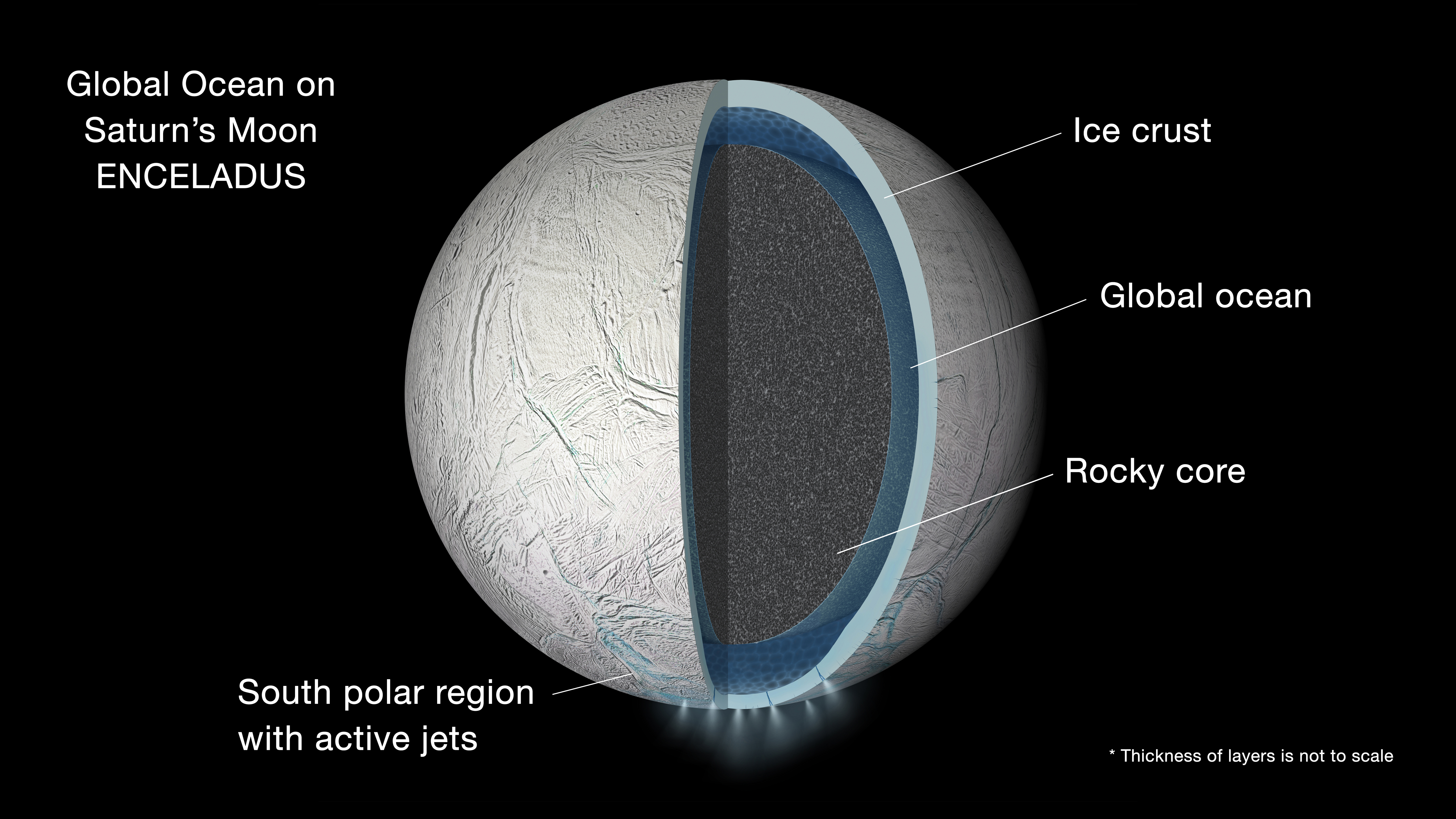
Europa and Enceladus present a fundamentally different model for Earth 2 – one where habitable environments might exist beneath ice shells rather than on the surface. Both moons harbour vast liquid water oceans larger than all of Earth’s oceans combined, maintained by tidal heating from their parent planets.

An artist’s impression of a global subsurface ocean of liquid water on Saturn’s Monn, Enceladus.
This illustration is based on NASA’s Cassini spacecraft data showing a global liquid water ocean between its rocky core and icy crust.
Source: http://photojournal.jpl.nasa.gov/figures/PIA19656_fig1.jpg Public Domain
Author: NASA/JPL-Caltech
These ocean worlds offer a unique advantage: their liquid water environments already exist and are naturally maintained without requiring terraforming. Protected beneath ice shells, these oceans remain stable despite their distance from the Sun. The water-rock interactions at their ocean floors likely create chemical environments somewhat similar to Earth’s deep oceans.
Creating human habitats in these environments would require fundamentally different approaches than Mars colonisation. Rather than terraforming a surface, human habitation would likely involve subsurface habitats accessing ocean waters for resources. The substantial pressures, limited solar energy, and ice barriers present enormous engineering challenges. However, if humanity developed advanced subsurface habitation technology, these worlds could potentially support larger populations than Mars due to their extensive ocean volumes.
The greatest unknown for these worlds is the composition of their oceans – whether they contain the dissolved minerals and elements necessary to support Earth-like life or human settlement. Future missions aim to characterise these ocean compositions to determine their potential as habitable environments.
Beyond Our Solar System
The ultimate Earth 2 may lie among the exoplanets orbiting other stars. Astronomical surveys have discovered numerous rocky planets with masses and sizes similar to Earth orbiting within their stars’ habitable zones – the region where temperatures could support liquid water.
Planets like Proxima Centauri b (just 4.2 light-years away) and the TRAPPIST-1 system (containing several Earth-sized worlds) offer tantalising possibilities. Unlike Mars, which has lost much of its atmosphere, or the ocean moons with their ice barriers, some of these exoplanets may already possess Earth-like conditions: appropriate temperatures, substantial atmospheres, and liquid surface water.
The profound challenge is distance. Even the nearest potentially habitable exoplanets would take decades or centuries to reach with foreseeable technology. This makes them long-term prospects rather than immediate solutions for expanding humanity beyond Earth.
Advanced observation techniques under development aim to characterise exoplanet atmospheres, searching for oxygen, water vapour, and other indicators of Earth-like conditions. These observations will help identify which distant worlds most closely resemble our home planet, guiding the long-term vision for humanity’s expansion into the galaxy.
The search for Earth 2 thus progresses along multiple timescales – from near-term Mars exploration and potential habitation, to medium-term investigation of ocean worlds, to long-term characterisation of exoplanets that might truly replicate Earth’s hospitable conditions.
Beyond Our Solar System: The Search for Distant Earths
Despite our solar system offering several candidates for potential habitability, the most Earth-like worlds may orbit distant stars. Recent advances in observational astronomy have revolutionised our understanding of planetary systems throughout the galaxy, revealing thousands of exoplanets with diverse characteristics and habitability potential.
What We’ve Learned About Exoplanet Habitability
The study of exoplanets has transformed our understanding of planetary formation and habitability. Perhaps most significantly, we’ve discovered that planets are common throughout the galaxy—most stars host planetary systems, with small rocky worlds like Earth particularly abundant. This prevalence suggests that potentially habitable planets may exist in large numbers.
The concept of the habitable zone—the orbital region around a star where temperatures could support liquid surface water—has evolved through exoplanet discoveries. We now recognise that this zone varies dramatically based on factors beyond simple distance from the host star. Atmospheric composition can create greenhouse effects that extend habitability outward or lead to runaway warming that renders closer planets uninhabitable. Planetary mass influences atmospheric retention, with more massive worlds better able to maintain the gases necessary for life support.
Perhaps most importantly, exoplanet research has revealed remarkable diversity in planetary systems. From “hot Jupiters” orbiting perilously close to their stars to compact systems with multiple Earth-sized worlds, this variety far exceeds what our solar system alone suggests. This diversity extends to potentially habitable worlds, ranging from water-rich “ocean planets” to slightly more massive “super-Earths” with stronger gravity than our home world.
How Our Solar System Studies Inform the Search
Our detailed understanding of solar system worlds provides crucial context for interpreting distant exoplanet observations. Mars teaches us how planets can lose habitability over time through atmospheric loss and climate change. Venus demonstrates how greenhouse effects can transform a potentially Earth-like world into an uninhabitable inferno. These cautionary examples help scientists assess which exoplanets might maintain long-term habitability.
The study of Earth itself through “earthshine” and spacecraft observations has established critical baselines for detecting biosignatures—the chemical fingerprints of life—on distant worlds. By understanding what makes Earth’s atmosphere distinctive, particularly the combination of oxygen and methane that would rapidly disappear without biological replenishment, scientists have developed frameworks for identifying potentially life-bearing worlds.
Ocean worlds like Europa have expanded our concept of habitability beyond the traditional notion of surface environments, suggesting that exomoons—satellites of gas giant exoplanets—might harbour subsurface oceans with habitability potential. This recognition has broadened the search to include not just planets but their moons as potential habitats.
Promising Candidates
Several exoplanets stand out as particularly intriguing candidates for Earth 2:
- Proxima Centauri b, orbiting the nearest star to our Sun at just 4.2 light-years distance, resides within its star’s habitable zone. Though slightly more massive than Earth, its proximity makes it the most accessible exoplanet for potential future study or even travel. However, its orbit around a red dwarf star subjects it to intense stellar flares that might compromise habitability.
- The TRAPPIST-1 system, approximately 40 light-years away, contains seven Earth-sized planets, with several (particularly TRAPPIST-1e) orbiting within the star’s habitable zone. These planets are likely tidally locked—with one side perpetually facing their star—creating permanent day and night hemispheres. While this arrangement differs from Earth’s day-night cycle, the boundary between hemispheres could maintain temperatures suitable for liquid water.
- Kepler-442b, a super-Earth approximately 1,200 light-years distant, orbits a Sun-like star in what might be a near-ideal habitable zone position. Based on its size and orbital characteristics, some habitability models rank it among the most Earth-like worlds yet discovered. Similarly, TOI-700d represents one of the first Earth-sized planets discovered in the habitable zone of a small, cool star by the TESS mission.
Detection Challenges and Solutions
Identifying and characterising potentially habitable exoplanets presents extraordinary challenges. Current detection methods favour finding large planets or those orbiting very close to their stars, potentially biasing our understanding. The tiny fraction of starlight intercepted by an Earth-sized planet makes direct imaging nearly impossible with current technology, while variations in star activity can mask or mimic planetary signals.
Determining habitability presents even greater obstacles. Current telescopes cannot directly observe surface features or conclusively detect liquid water. Atmospheric composition measurements remain at the edge of technical feasibility, with only the most dramatic features detectable. The vast distances mean we observe these worlds as they existed years or decades ago, adding temporal uncertainty to our assessments.
Science has developed innovative solutions to these challenges. The transit spectroscopy technique—measuring how starlight filtered through a planet’s atmosphere changes during transit—can reveal atmospheric components. Improved coronagraph technology, which blocks a star’s light to reveal orbiting planets, continues to advance. Future space telescopes specifically designed for exoplanet characterisation will use multiple observational methods to provide more definitive habitability assessments.
The forthcoming generation of extremely large ground-based telescopes, with primary mirrors exceeding 30 metres in diameter, will dramatically enhance our ability to study potentially habitable worlds. Concepts for space-based telescopes with advanced starlight-suppression technologies could potentially image Earth-like planets directly and analyse their atmospheric composition in detail.
The search for Earth 2 beyond our solar system thus continues along dual tracks: identifying the most promising candidates with current technology while developing new observational capabilities that will reveal these distant worlds in greater detail. Though interstellar distances make these planets inaccessible for human settlement in the foreseeable future, they represent the ultimate reservoir of potentially Earth-like worlds—and perhaps our species’ most promising long-term homes.
The Path Forward
The search for Earth 2 stands at a promising but challenging frontier. Future progress will require strategic technological developments, carefully planned missions, and a systematic approach to answering key outstanding questions about potential habitable environments.
Technological Developments Needed
Advancing our search for and possible utilisation of habitable environments requires breakthrough technologies across multiple domains. Advanced propulsion systems represent perhaps the most critical development area. Chemical rockets, while reliable, impose severe limitations on travel time and payload capacity to distant worlds. Promising alternatives include nuclear thermal propulsion, offering twice the efficiency of chemical rockets; solar electric propulsion for sustained acceleration; and more speculative technologies like fusion drives that could dramatically reduce travel times to Mars and the outer planets.
For the much greater distances to even the nearest exoplanets, theoretical approaches like light sails pushed by Earth-based lasers offer potential solutions.
Detection methods must evolve to provide more definitive habitability assessments. Next-generation spectrometers with significantly improved sensitivity will enable detailed atmospheric analysis of distant worlds. Advanced coronagraphs and starshades for space telescopes promise to block stellar light with unprecedented precision, potentially allowing direct imaging of Earth-like exoplanets. Within our solar system, penetrating radar systems capable of mapping subsurface oceans in detail would revolutionise our understanding of ocean worlds.
Sample return capabilities will provide ground truth for habitability assessments. The planned Mars Sample Return mission represents a crucial step, but technologies for sampling subsurface environments on Mars and the ocean worlds present greater challenges. Cryogenic sample preservation systems, sterilisation technologies that protect samples from Earth contamination and Earth from potential extraterrestrial microbes, and advanced drilling systems capable of penetrating kilometres of ice represent critical development areas.
Life detection instruments with increased sensitivity and specificity will prove essential for definitively identifying biological activity. Next-generation mass spectrometers capable of detecting complex organic molecules at parts-per-trillion concentrations, instruments that can distinguish between biological and abiotic[17] chemical signatures, and microscopy systems that can identify cellular structures in situ would transform our ability to assess habitability and detect life. Technologies that can function in extreme environments—under high pressure, in corrosive chemical conditions, or at extreme temperatures—will be particularly valuable.
Enceladus: A Prime Target for Future Exploration
The 2016 discovery of molecular hydrogen in Enceladus’s plumes by the Cassini mission provided compelling evidence of hydrothermal activity and potential energy sources for life within its subsurface ocean. Subsequent analysis of Cassini data revealed complex organic compounds, including some containing nitrogen and oxygen, further strengthening the case for Enceladus as one of the solar system’s most promising habitable environments.
Despite this potential, no dedicated mission to Enceladus has yet been approved.[18] The proposed Enceladus Life Finder (ELF) and Orbilander concepts remain in the planning stages. Meanwhile, NASA’s Dragonfly mission, scheduled to launch in 2027, will target Titan—another of Saturn’s moons—with a nuclear-powered rotorcraft designed to sample materials and evaluate habitability conditions. While Dragonfly will not visit Enceladus, exploring Titan’s complex organic chemistry will provide valuable context for understanding ocean worlds throughout the Saturn system.
The scientific community continues to advocate for a dedicated Enceladus mission, arguing that its active plumes offer a unique opportunity to sample subsurface ocean material without drilling through miles of ice. Such a mission would require specialised instruments capable of detecting amino acids, analysing chirality (the “handedness” of organic molecules), and identifying potential biosignatures in plume material.
Most Promising Near-Term Discoveries
The coming decade offers several promising opportunities for significant discoveries about potential habitable environments. The Mars Sample Return mission, planned for completion in the early 2030s, will provide unprecedented insight into Mars’s past habitability and potential biological signatures. Laboratory analysis of these samples with instruments too large and complex to send to Mars will reveal details about past environmental conditions and potential biosignatures impossible to detect with in-situ instruments.
The Europa Clipper mission, launched in October 2024, is now en route to conduct a detailed reconnaissance of Jupiter’s ocean-bearing moon. Set to arrive in Jupiter’s system in 2030, its advanced radar and spectrometers will characterise the thickness of Europa’s ice shell, the depth and salinity of its subsurface ocean, and the presence of any surface compounds that might indicate exchange between the surface and subsurface. The spacecraft’s successful launch and early trajectory adjustments have already demonstrated the feasibility of precision targeting for ocean world exploration. These findings will significantly advance our understanding of this potential habitat and inform future missions.
The next generation of exoplanet characterisation, led by new space telescopes and extremely large ground-based observatories, promises the first detailed atmospheric analyses of potentially habitable worlds. These observations may reveal biosignature gases like oxygen and methane in combination, water vapour distributions indicating oceans, or other indicators of Earth-like conditions. Such discoveries would dramatically refine our understanding of exoplanet habitability frequency.
Key Questions Still to Answer
Despite remarkable progress, several fundamental questions remain unanswered. Perhaps most crucially, we still do not know if life has ever emerged beyond Earth. This question drives much of the exploration of Mars and ocean worlds, with implications that extend far beyond these specific environments to our understanding of life’s prevalence throughout the universe.
The long-term sustainability of potentially habitable environments remains poorly understood. We have limited knowledge about how Mars’s climate evolved from potentially habitable to its current state, how stable the subsurface oceans of Europa and Enceladus remain over geological timescales, or how exoplanet habitability might evolve over billions of years. Understanding these temporal dynamics is crucial for identifying environments that could serve as long-term habitats.
The relationship between habitability and actual biological presence also requires clarification. Environments may meet all theoretical requirements for habitability yet remain sterile if life never emerged or cannot reach them. Conversely, life may adapt to conditions we currently consider uninhabitable. Resolving this relationship requires both theoretical advances in understanding life’s requirements and empirical evidence from multiple worlds.
The practicality of adapting or engineering environments for human habitability—whether through terraforming Mars, creating habitats in subsurface oceans, or other approaches—remains speculative.
Determining the feasibility, timeframes, and resource requirements for such endeavours represents a crucial research direction combining environmental science, engineering, and biological research.
Future Missions and Observations
A systematic programme of future missions will address these questions through increasingly sophisticated exploration. Beyond Mars Sample Return and Europa Clipper, proposed missions like the Enceladus Life Finder would directly sample and analyse the plumes of Saturn’s active moon for complex organic compounds and potential biosignatures. A Europa Lander concept would place instruments directly on Europa’s surface, potentially sampling recently upwelled material from the subsurface ocean.
Advanced Mars exploration would focus on accessing the subsurface environment where liquid water and protection from radiation might enable contemporary habitability. Missions to Venus could investigate whether its cloud layers, with more moderate temperatures than the surface, might harbour microbial life, providing insights into the boundaries of habitability.
For exoplanet research, space-based observatories specifically designed for atmospheric characterisation will provide unprecedented detail about distant worlds. The proposed Habitable Worlds Observatory concept, currently under development, would specifically target Earth-like planets orbiting Sun-like stars, offering our best near-term opportunity to identify truly Earth-like worlds beyond our solar system.
Earth-based investigations of extreme environments—from deep subsurface ecosystems to highly acidic or alkaline settings—will continue informing our understanding of life’s adaptability and potential to thrive in seemingly hostile conditions. These studies provide crucial context for interpreting observations of other worlds and expanding our conception of habitability.
This coordinated approach—combining technological development, strategic missions, and systematic investigation of key questions—offers the most promising path toward identifying and potentially utilising habitable environments beyond Earth. While the challenges remain substantial, the scientific and technological trajectory suggests significant advances in our understanding of habitability throughout the universe in the coming decades.
A Dual-Track Future
Humanity faces a crossroads in its cosmic future: should we reshape worlds to suit our needs, or reshape ourselves to suit new worlds? While our search for habitable environments has largely concentrated on finding Earth-like exoplanets, the immense distances and inhospitable conditions of most candidates make colonisation improbable in the near future. Rather than endlessly searching for an ideal new home, we must consider two parallel approaches: planetary engineering (creating or modifying worlds to support human life) and human adaptation (reengineering ourselves to flourish in non-Earth-like conditions).
At first glance, these proposals may seem like pages from a science fiction thriller rather than serious academic consideration. Indeed, many of these concepts have been explored extensively in speculative fiction long before appearing in scientific journals. However, the line between science fiction and scientific innovation has always been permeable, with yesterday’s fictional speculations often becoming tomorrow’s research priorities. The concepts discussed here warrant serious examination despite their speculative nature.
Modifying existing planetary bodies represents our most conventional approach. Mars, with NASA’s ongoing habitability investigations, remains the primary candidate due to its proximity and evidence of past liquid water. Proposed terraforming methods include releasing greenhouse gases from the polar ice caps to warm the planet, introducing extremophile microorganisms to alter atmospheric composition, and constructing artificial magnetic fields—similar to those being researched for spacecraft protection—to shield against solar radiation.
When terraforming proves too slow or energy-intensive, constructing habitable structures offers complementary alternatives. Shell worlds (enclosing a small planetary body in an artificial shell) and O’Neill Cylinders (rotating space habitats that generate artificial gravity) might serve as stepping stones towards larger-scale planetary engineering. Current International Space Station research already provides insights into closed-loop life support systems that such habitats would require.
What if, instead of adapting existing worlds, we built new ones? A more radical concept involves engineering an entirely new planet using asteroid and moon debris. This would necessitate gathering raw materials from the asteroid belt or Kuiper Belt, employing advanced robotics to construct a massive rocky body, and seeding it with water, gases, and biological components to establish a stable biosphere. How might such an enormous undertaking transform our understanding of planetary formation and evolution? While current asteroid mining initiatives only hint at the technologies required, they represent first steps toward manipulating celestial resources.
As humanity potentially advances toward greater energy utilisation—approaching what theoretical physicist Nikolai Kardashev defined as Type II or III civilisations—we might manipulate entire star systems. Star lifting (extracting matter from stars to control their energy output) and developing Dyson Swarms (constellations of solar collectors) could capture stellar energy for creating and sustaining new habitable environments. These approaches would transform humanity from a planetary species into cosmic architects, fundamentally altering our relationship with astronomical objects we currently only observe.
Rather than solely focusing on modifying environments, should we also consider modifying ourselves to thrive in harsh conditions, but more of that later. Contemporary genetic research already explores radiation resistance in organisms like tardigrades, while synthetic biology continues to expand the boundaries of biological capabilities. Future applications might include genetic engineering to enhance human tolerance for extreme conditions, synthetic biology creating humans capable of metabolising different atmospheric compositions, cybernetic enhancements integrating artificial intelligence for survival functions, and potentially the transfer of consciousness to artificial substrates. Each approach presents profound ethical considerations that parallel our current debates about genetic modification and artificial intelligence integration.
A hybrid strategy combining partial terraforming with human adaptation might prove most practical. Instead of making a planet exactly like Earth, we could alter it just enough to support a redesigned version of humanity. Worlds with thin atmospheres and low gravity—currently uninhabitable for humans—might become viable for people with oxygen-efficient respiratory systems and reinforced skeletal structures. This co-evolutionary approach connects with the habitability assessment frameworks discussed earlier, suggesting that habitability exists on a spectrum rather than as a binary condition.
If we can successfully modify our biology, dependence on planetary bodies themselves may diminish in importance. Future humans might evolve into space-adapted beings, surviving in interstellar vessels or habitats orbiting various stars. The development of hibernation capabilities, radiation-resistant cellular structures, or microgravity-optimised physiologies could enable indefinite space travel. AI-human integration might create entities capable of exploring space over timescales currently inconceivable, establishing habitable environments throughout their journeys.
The concept of post-human evolution raises profound questions that extend beyond technology to the core of our identity: Would post-humanity still be human? Might some factions choose to remain unmodified, creating multiple branches of our species—some designed for space, others for planetary life? How would this transform cultural, legal, and philosophical perspectives on identity and survival? These questions connect directly with our current understanding of habitability as discussed in previous sections, suggesting that our definition of “habitable” may evolve alongside humanity itself.
Ultimately, combining planetary engineering with human adaptation may provide the only realistic long-term survival strategy. Rather than seeking the perfect celestial home or forcing harsh environments to accommodate our current biological limitations, humanity’s future might involve co-evolving with the cosmos itself. This brings us full circle to the habitability assessment frameworks examined earlier: are we searching for environments that suit human life as we know it today, or are we evolving into something that defines habitability in entirely new terms?
Terraforming Mars
Mars, now cold and dry, once had a warm and wet environment, indicated by the many river-like structures on its surface. This warmer climate is thought to have resulted from a significant greenhouse effect caused by a dense atmosphere rich in CO2. Over time, Mars cooled when much of this CO2 was converted into carbonate rocks through interactions with water. But some scientists believe that enough CO2 might still be present—either absorbed in the soil or frozen at the south pole—to generate an atmosphere with a pressure between 300 and 600 millibars. If Mars were to warm up, this CO2 could be released, potentially thickening the atmosphere and triggering a cycle of increased warming.
The idea of terraforming was popularised in fiction before it became a mainstream scientific possibility.
In Science Fiction
Kim Stanley Robinson‘s “Mars Trilogy” is a landmark work of hard science fiction that chronicles the terraforming and settlement of Mars in extraordinary scientific and sociological detail. The trilogy consists of three novels: “Red Mars” (1992), “Green Mars” (1993), and “Blue Mars” (1996). The narrative spans about two centuries, beginning with the first hundred colonists arriving on Mars in 2026.
What makes the trilogy particularly notable is Robinson’s meticulous attention to scientific accuracy and detail regarding the terraforming process. He consulted with NASA scientists and Mars experts to create a credible, step-by-step account of how humans might transform Mars from a cold, barren planet to one with a breathable atmosphere, flowing water, and sustainable ecosystems. Key terraforming methods depicted in the trilogy include:
- Releasing powerful greenhouse gases to trap heat and warm the planet.
- Drilling and melting Martian polar ice caps to release water and CO₂.
- Introducing genetically engineered microorganisms to produce oxygen.
- Using orbital mirrors to direct additional sunlight to specific regions.
- Creating a planetary magnetic field to protect against solar radiation.
Beyond the science, the trilogy explores political, economic, and ethical dimensions of colonisation. The characters debate whether humans have the right to transform Mars, with some advocating for preserving its natural state (“Red Mars”), while others push for full transformation to an Earth-like planet. This political conflict leads to revolutions and the establishment of new social systems specifically adapted to Martian conditions.
Robinson’s work is significant because it bridged the gap between purely speculative fiction and scientific discourse. Many of the terraforming techniques he described in detail later appeared in serious scientific papers as researchers began to consider the practical possibilities of Martian transformation. His work helped inspire a generation of scientists and engineers currently working on Mars exploration and has been cited in discussions about potential future Mars missions.
In the seminal science fiction novel “Rendezvous with Rama”, fiction pioneer Arthur C. Clarke described rotating space habitats (1973) and introduced many readers to the concept of massive rotating space habitats before they were formalised in scientific literature. The novel centres on a mysterious cylindrical alien spacecraft (named “Rama”) that enters our solar system, and the human expedition sent to investigate it. Clarke’s detailed description of Rama serves as a compelling fictional prototype for what would later be known as O’Neill cylinders:
- Rama is depicted as a hollow cylindrical structure approximately 50 kilometres (31 miles) long and 16 kilometres (10 miles) in diameter.
- The interior surface of the cylinder forms a complete habitable world, with simulated gravity created through rotation. As the cylinder spins, centrifugal force pushes everything against the inner surface, creating artificial gravity.
- The habitat contains distinct geographical features, including a circumferential sea (“Cylindrical Sea”) that divides the interior space, along with artificial structures, lighting systems, and climate control.
- Clarke describes in scientific detail how such a rotating habitat would function, including the physics of movement inside such a structure and the Coriolis effects[19] that would result from the rotation.
What makes Clarke’s work particularly significant is that it was published just before physicist Gerard K. O’Neill began publishing his formal scientific proposals for space colonies in 1974[20]. While rotating habitats had appeared in earlier science fiction (including works by Konstantin Tsiolkovsky in the early 1920s), Clarke’s detailed and scientifically grounded treatment in “Rendezvous with Rama” brought the concept to mainstream attention when serious scientific consideration began.
Gerard O’Neill, after whom these habitats are now named, cited science fiction as an inspiration for his work. His technical specifications published in Physics Today built upon the general concepts that Clarke and others had already explored in fiction, demonstrating the interplay between speculative literature and scientific development.
In Scientific Literature
The terraforming concept entered peer-reviewed discourse with Christopher McKay and Robert Zubrin‘s paper “Technological Requirements for Terraforming Mars” in the Journal of the British Interplanetary Society (1993).[21]
NASA-funded research in planetary science journals now regularly discusses theoretical Martian atmospheric modification (Nature Astronomy, 2018).[22]
The Journal of the British Interplanetary Society[23] and Acta Astronautica[24] now publish technical specifications for large-scale habitats.
Genetic Modification for Space
In Science Fiction
James Blish’s “Seedling Stars” (1957) featured genetically engineered humans adapted for different planets. He pioneered the concept of “pantropy” – genetically modifying humans to survive on alien worlds rather than terraforming planets. The book follows various “adapted men” engineered for different extreme environments, from microscopic aquatic humans in “Surface Tension” to colonists modified for gas giants and ice worlds. Blish presented scientifically informed speculation about genetic adaptation decades before the discovery of DNA’s structure and modern genetic engineering. His work explored both the biological possibilities and the philosophical questions about human identity when the human form is radically altered. These concepts appeared in scientific literature only in the early 2000s, when space agencies began seriously examining human physiological limitations for long-duration space missions and potential genetic adaptations for space environments.
Olaf Stapledon described star-enclosing structures in “Star Maker” (1937), which presented remarkably advanced concepts of stellar engineering decades before they entered scientific discourse. In this philosophical science fiction novel, Stapledon describes advanced civilisations that construct artificial structures around their stars to capture energy. These include “every solar system… surrounded by a gauze of light traps, which focused the escaping solar energy for intelligent use.” This visionary concept predated physicist Freeman Dyson’s formal scientific proposal by 23 years. Stapledon’s civilizations progressed from planetary to stellar-scale engineering, creating what we would now recognize as primitive Dyson spheres or swarms. “Star Maker” is particularly significant in its scientific foresight at a time when nuclear energy was barely understood, and space travel remained theoretical. Stapledon’s concepts of stellar-scale engineering influenced later science fiction and eventually entered scientific literature when Dyson cited similar ideas in his 1960 Science paper “Search for Artificial Stellar Sources of Infrared Radiation“, which is available online[25].
In Scientific Literature
In scientific literature, the concept of adapting humans through biotechnology for space conditions appeared in Space Policy and Astrobiology journals in the early 2000s. Current research by NASA’s GeneLab platform (2018) now studies genetic adaptation to space conditions, with findings published in npj Microgravity, an open-access, peer-reviewed journal published by Nature Publishing Group.[26]
Freeman Dyson, a theoretical physicist and mathematician known for his work in quantum electrodynamics, nuclear engineering, and astronomy, formalised the concept of Dyson Spheres/Swarms in Science (1960). Building on earlier fictional speculations, Dyson proposed that advanced civilisations would inevitably face energy constraints and might construct swarms of orbiting structures to capture most of their star’s energy output. Unlike the solid sphere often depicted in science fiction, Dyson proposed a “swarm” of individual satellites or habitats encircling a star. He suggested such megastructures would be detectable through their infrared emissions, as they would absorb visible light from their star and re-emit it as heat.
Dyson’s concept became a serious astronomical search parameter, with recent studies in The Astrophysical Journal examining stars with unusual infrared signatures as potential Dyson structure candidates.
Astronomical searches for Dyson structures have been published in The Astrophysical Journal (2015-present).[27]
Consciousness Transfer
In Science Fiction
Frederik Pohl’s “Man Plus” (1976) and Greg Egan‘s “Permutation City” (1994) explored mind uploading. Mind uploading is a hypothetical process where human consciousness or mental content is transferred from a biological brain to a non-biological substrate, typically a computer system. The process involves scanning and mapping the brain’s neural connections and activities in sufficient detail to create a functional digital copy or emulation of a person’s mind.
Frederik Pohl explored cybernetic enhancement rather than complete mind uploading. It featured a protagonist who undergoes extensive physical modifications to survive on Mars, including neural interfaces that blend human and machine cognition. Greg Egan more directly addressed mind uploading, depicting a future where human consciousness can be digitally copied and run as software. Egan explored profound questions about the nature of identity, consciousness, and reality when minds exist purely as information, and his novel examined whether these digital copies are truly continuous with their biological originals and what it means to exist as a pattern of information rather than a physical entity. Both works preceded serious scientific discussion of mind uploading technologies by years or decades.
In Scientific Literature
Contemporary journals like the Journal of Consciousness Studies and Frontiers in Neuroscience now publish theoretical frameworks addressing consciousness transfer and digital mind emulation. Research has progressed from purely philosophical discussions to computational neuroscience approaches that consider practical requirements for mind uploading. These include developing methods to accurately map the brain’s approximately 86 billion neurons and their trillions of connections, preserving the dynamic electrochemical properties of neural networks, and addressing the complex integration of memory, personality, and sensory processing. Despite these advances, most researchers acknowledge that current technology remains decades or centuries away from practical implementation.
The concept entered neuroscience discussions in the Journal of Consciousness Studies (early 2000s) when the Journal of Consciousness Studies began publishing theoretical papers on mind uploading in the early 2000s, marking a significant shift from purely speculative fiction to rigorous academic inquiry. Notable contributions included Susan Blackmore‘s work examining the philosophical implications of consciousness transfer and Antonio Damasio‘s research on the embodied nature of consciousness. These early discussions raised fundamental questions about whether consciousness could exist independent of biological substrates[28] and what would constitute a “successful” transfer of mind. The journal’s interdisciplinary approach brought together neuroscientists, computer scientists, philosophers, and cognitive psychologists to examine assumptions underlying mind uploading theories, helping establish the conceptual foundation for later empirical research.
Leading scientific publications, including Nature Human Behaviour and Frontiers in Neuroscience, have recently featured sophisticated theoretical frameworks for modelling consciousness. These models range from Kenneth Hayworth‘s proposals for preserving neural connectivity through advanced preservation techniques to Christof Koch‘s integrated information theory that quantifies consciousness mathematically. Recent papers discuss technological approaches like whole-brain emulation, which would require both advanced brain mapping technologies and exponential increases in computing power.
Research teams at institutions including Harvard, MIT, and the Human Brain Project in Europe are developing simulation platforms that model increasingly complex neural networks, though even the most advanced projects can only replicate tiny fractions of the neural complexity found in the human brain. These frameworks represent stepping stones toward understanding consciousness at a level that might eventually permit its transfer or emulation.
Concluding Words
Not One, But Many: The Need for Multiple New Worlds
The search for habitable environments takes on greater urgency when we consider not only the Sun’s evolution but also humanity’s more immediate population challenges. Earth’s current population is over 8.2 billion people[29], with projections suggesting growth to around 10 billion by the century’s end. However, if we were to apply historical growth rates from the past half-century over longer timeframes, the mathematical impossibility becomes immediately apparent – such growth would yield a physically impossible population of trillions within 500 years.
This simple calculation reveals a fundamental truth: Earth faces capacity constraints long before our Sun makes the planet uninhabitable in 1.2 billion years. Even with stabilising birth rates, technological advances, and more efficient resource utilisation, our planet has finite space and resources. This recognition transforms our search for habitable environments from a distant astronomical concern to an immediate practical imperative.
The implications are profound. We require not just a single “Earth 2” but potentially multiple habitable worlds to ensure humanity’s long-term survival and prosperity. This understanding should inform our evaluation of potential habitable environments – factors such as size, resource availability, and capacity to support significant populations become as critical as the basic conditions for habitability.
Moreover, the vast distances between star systems and the challenges of interstellar travel suggest that developing habitable environments within our solar system may be humanity’s most practical near-term focus. Technologies to terraform Mars or create self-sustaining habitats on moons like Europa may prove more feasible than reaching even the nearest potentially habitable exoplanets, which remain several light-years distant.
This population perspective adds urgency to our technological development for space exploration, resource utilisation, and habitat creation. The window for establishing humanity as a multi-world species may be measured in centuries rather than the 1.2 billion years remaining until Earth becomes naturally uninhabitable due to the Sun’s evolution.
While mathematical extrapolations of historical growth rates suggest an unsustainable population trajectory, it’s important to note that many scientific projections from organisations like the UN actually predict Earth’s population will likely peak around 10-11 billion people by 2100 before beginning to decline. These models assume continuing trends of declining fertility rates as countries develop economically. However, such projections involve significant uncertainties related to factors including global fertility trends, medical advances, climate change impacts, resource availability, potential global health crises, and social policy decisions. Even with population stabilisation, the finite nature of Earth’s resources and habitable space remains a compelling driver for expanding beyond our planet. The search for additional habitable worlds represents both a prudent insurance policy against unforeseen catastrophes and an opportunity for humanity’s continued development, regardless of which population scenario ultimately unfolds.
The Dynamic Nature of Potential New Earths
A critical consideration in our search for Earth 2 is that celestial bodies are not static environments. The worlds we observe today may undergo significant changes by the time human settlement becomes feasible.
Mars presents a clear example of planetary evolution. The habitable world with flowing rivers and lakes that existed billions of years ago transformed into today’s cold, arid planet. Similar transformations could occur in reverse through natural processes or deliberate human intervention. Climate change on Mars could be triggered by asteroid impacts releasing subsurface volatiles, by increased solar output as our Sun evolves, or through terraforming efforts. Mars, where humans might eventually settle, could differ substantially from the one we observe today.
Ocean worlds like Europa and Enceladus also experience change. Tidal interactions can evolve as orbital parameters shift, potentially affecting the heat energy that maintains their subsurface oceans. Evidence suggests periodic changes in the activity of Enceladus’s plumes, indicating dynamic processes beneath its surface. By the time we develop technology capable of exploring or utilising these oceans, their composition and conditions may have undergone measurable changes.
For exoplanets, the uncertainty is even greater. The light we observe from these distant worlds has travelled for years, decades, or centuries, showing us these planets as they existed in the past. Additionally, exoplanets may experience more dramatic climate variations than Earth due to differences in atmospheric composition, orbital dynamics, or stellar activity.
This temporal dimension adds complexity to the search for Earth 2, but also opportunity. Worlds that appear marginally habitable today might become more accommodating through natural processes. Conversely, seemingly ideal candidates might deteriorate through asteroid impacts, solar flare activity, or other catastrophic events.
Human settlement capabilities will also evolve dramatically. Technologies that seem impossibly futuristic today—advanced bioengineering, artificial gravity generation, or fusion power—may become standard elements of space settlement within centuries.
These advances could transform currently inhospitable environments into viable habitats or enable humans to adapt to conditions once considered incompatible with life.
This dynamic relationship between changing worlds and evolving technology means that today’s assessments of habitability potential represent only a starting point. Long-term monitoring of candidate worlds, combined with predictive modelling of their future states, must complement our current observations if we are to identify the most promising candidates for humanity’s future homes.
Appendix 1: The Drake Equation and Astrobiology
The search for habitable environments beyond Earth raises one of the most profound questions in science: Are we alone in the universe?
While scientists explore planets and moons for conditions that could support life, the broader question of how many civilisations might exist has been approached through a famous scientific model known as the Drake Equation.
The Origins of the Drake Equation
In 1961, Dr Frank Drake formulated an equation to estimate the number of technologically advanced civilisations in the Milky Way capable of communication. The equation considers multiple factors, including the number of stars with planets, the fraction of those planets that could support life, and the likelihood of life evolving into intelligent beings. While these variables remain largely uncertain, they provide a structured way to approach the search for extraterrestrial intelligence.
The Drake Equation is not meant to give a definitive answer but serves as a framework for scientific discussion. Some early estimates suggested that thousands to millions of civilisations could exist, while others argue that intelligent life may be exceedingly rare. The uncertainty in its values is part of what makes the question of extraterrestrial life so compelling.
Historical Perspectives on Extraterrestrial Life
Speculation about life beyond Earth is not new—it dates back thousands of years. Ancient Greek philosopher Democritus proposed that the universe contained innumerable worlds, some of which could be inhabited. The idea was later echoed by Epicurus, who imagined “boundless immensity” filled with planets like Earth.
During the Middle Ages and the Renaissance, scholars debated whether extraterrestrial beings could exist within a religious framework. In the 15th century, William Vorilong considered whether Jesus might have visited extraterrestrial civilisations to redeem their inhabitants. Nicholas of Cusa (1440) suggested that all celestial bodies—including the Sun—could be inhabited by men, plants, and animals. Even René Descartes wrote that it was impossible to disprove the existence of intelligent life elsewhere, though such speculation lacked empirical evidence.
As telescopes improved in the 17th and 18th centuries, the idea of life on Mars, Venus, and even the Moon became popular. However, by the 20th century, scientific discoveries about planetary atmospheres and extreme environments began reshaping the debate, moving it from philosophy to observational science.
Extreme Environments and the Possibility of Life
For much of history, the assumption was that other worlds would need Earth-like conditions to support life. However, modern research suggests that life may adapt to extreme environments, much as it has on Earth.
Microbial life[30] has been found thriving in highly acidic lakes, hydrothermal vents, and volcanic hot springs—places once thought too hostile to support life. These extremophiles provide clues about how organisms might survive on planets and moons with harsh conditions, such as:
- Mars, with its dry, radiation-bathed surface but potential subsurface water.
- Europa and Enceladus, which have subsurface oceans beneath icy crusts, possibly warmed by hydrothermal activity.
- Titan, Saturn’s largest moon, which has lakes of liquid methane and ethane, raising the possibility of life based on a different biochemistry.
The discovery of complex organic molecules on comets, asteroids, and interstellar dust clouds suggests that the building blocks of life are widespread. This leads to speculation about panspermia—the idea that life might spread between planets via meteorites or cosmic dust.
The Fermi Paradox: If Life is Common, Where is Everyone?
A major challenge in assessing extraterrestrial life is the Fermi Paradox—the contradiction between the high probability of intelligent life and the lack of evidence for it. Some possible explanations include:
- Self-destruction: Advanced civilisations may destroy themselves before becoming interstellar (e.g., war, environmental collapse, AI risks).
- Undetectable communication: Alien civilisations might use communication methods beyond our understanding (e.g., quantum signals, neutrinos).
- Rare intelligence: While microbial life may be common, intelligent civilisations may be rare or short-lived.
- The Zoo Hypothesis: Advanced civilisations could be observing us but not interfering, much like humans avoid disrupting wildlife in nature reserves.
The Cultural Impact of Extraterrestrial Life
Beyond scientific inquiry, the concept of extraterrestrial life has had a profound influence on human culture. The idea of alien worlds has been a central theme in mythology, philosophy, and science fiction, shaping public perception and even influencing scientific exploration.
- Self-destruction: Advanced civilisations may destroy themselves before becoming interstellar (e.g., war, environmental collapse, AI risks).
- Undetectable communication: Alien civilisations might use communication methods beyond our understanding (e.g., quantum signals, neutrinos).
- Rare intelligence: While microbial life may be common, intelligent civilisations may be rare or short-lived.
- The Zoo Hypothesis: Advanced civilisations could be observing us but not interfering, much like humans avoid disrupting wildlife in nature reserves.
Implications for Humanity and Future Research
The final term of the Drake Equation, L, represents the lifespan of civilisations—a crucial unknown. If civilisations tend to self-destruct quickly, then intelligent life may be fleeting. Conversely, if civilisations can survive for millions of years, the galaxy could be teeming with life.
As technology advances, astronomers are refining estimates for several terms in the Drake Equation. New missions, such as the JWST, Europa Clipper, and future space telescopes, may provide concrete evidence of alien life—whether microbial or intelligent. Until then, the question remains one of the greatest mysteries of science.
Appendix 2: Earth’s History and Potential Parallels with Other Planets
The study of Earth’s history offers a valuable framework for exploring the formation, evolution, and habitability of other planets. By comparing Earth’s unique characteristics with those of other celestial bodies, scientists will uncover parallels, differences, and potential insights into the conditions required to sustain life. This paper draws a comparison between Earth and Mars, as shown below.
Formation and Early History
| Earth | Mars |
| Formed ~4.54 billion years ago through accretion from the solar nebula.
|
Formed around the same time as Earth (~4.6 billion years ago).
|
| Differentiation into layers (core, mantle, crust) occurred due to the Iron Catastrophe.
|
Mars also experienced heavy bombardment, but it lacks evidence of tectonic activity to recycle surface materials like Earth.
|
| Frequent bombardments during the Late Heavy Bombardment (~4.1 to 3.8 billion years ago) shaped Earth’s surface and possibly delivered water and organic molecules. | Mars likely had a molten phase but cooled more rapidly than Earth due to its smaller size.
|
Key Comparison: Both planets were formed under similar processes, but Earth’s larger size retained more internal heat, supporting prolonged tectonic activity and a geodynamo for a magnetic field – critical for long-term habitability.
Atmosphere and Climate Evolution
| Earth | Mars |
| Earth’s early atmosphere formed from volcanic outgassing and was rich in carbon dioxide, methane, and water vapour.
|
Mars’ early atmosphere was thicker and likely supported liquid water on the surface (evidenced by ancient riverbeds and deltas).
|
| Photosynthetic microorganisms (cyanobacteria) eventually introduced oxygen, triggering the Great Oxidation Event.
|
Loss of magnetic field caused atmospheric stripping by solar winds, leading to a thin, carbon dioxide-dominated atmosphere.
|
| Stable greenhouse conditions allowed liquid water and moderated temperatures. | Today, Mars is cold, dry, and inhospitable. |
Key Comparison: While Earth retained a stable climate and atmosphere conducive to life, Mars experienced catastrophic atmospheric loss, making it an example of what might have happened to Earth under different circumstances.
Presence of Water
| Earth | Mars |
| Oceans formed ~4.4 billion years ago as water vapour condensed during cooling.
|
Evidence of liquid water billions of years ago, with signs of ancient lakes and potential oceans.
|
| Plate tectonics and volcanic activity helped recycle water, maintaining a hydrological cycle. | Today, water exists mainly as ice at the poles and subsurface brines. |
Key Comparison: Both planets likely had early water, but Earth’s plate tectonics[31] and atmosphere allowed it to persist, while Mars lost its surface water due to cooling and atmospheric thinning.
Magnetic Field
| Earth | Mars |
| A strong magnetic field, generated by convection in the liquid outer core, protects the planet from solar winds and radiation.
|
Once had a magnetic field but lost it early in its history (~4 billion years ago).[32]
|
| This field has been critical in preserving Earth’s atmosphere and supporting life. | Without protection, the atmosphere eroded, leading to the planet’s current desolate state. |
Key Comparison: The loss of Mars’ magnetic field highlights the importance of Earth’s geodynamo in sustaining conditions for habitability.
Potential for Life
| Earth | Mars |
| Life on Earth emerged ~3.5 billion years ago, with conditions supporting its evolution to complexity.
|
There is no confirmed evidence of life, but ancient water and organic molecules suggest potential for microbial life in the past.
|
| Plate tectonics, a dynamic atmosphere, and a stable climate were key contributors. | Subsurface environments might still support extremophiles today. |
Key Comparison: Earth’s dynamic systems fostered diverse life forms, while Mars’ environmental changes likely prevented life from evolving beyond microbial stages (if it ever existed).
Exoplanets: Parallels and Prospects
The search for habitable exoplanets[33] draws heavily from Earth’s history:
- Protoplanetary Disks: Similar processes of accretion and differentiation are expected for rocky exoplanets in habitable zones.
- Atmospheric Signatures: Scientists look for biosignatures (e.g., oxygen, methane) similar to those arising on Earth during the Great Oxidation Event.
- Water and Climate Stability: Liquid water remains a key indicator of habitability, as demonstrated by Earth’s long-term hydrological cycle.
Key Insight: Earth’s history provides a blueprint for identifying potentially habitable exoplanets and understanding the environmental conditions necessary for sustaining life.
In comparison with Mars, Earth can be considered more fortunate in several critical ways that allowed it to become a thriving, life-supporting planet:
- Earth’s larger size and stronger gravity enabled it to retain a thick atmosphere, while Mars, being smaller, lost much of its atmosphere over time, making it difficult to support liquid water and, consequently, life.
- Earth’s molten core generates a magnetic field that protects the planet from harmful solar wind. In contrast, Mars lacks a strong magnetic field, and as a result, its atmosphere was eroded by solar winds, further diminishing its habitability.
- Earth’s atmosphere is rich in nitrogen and oxygen, which supports complex life, whereas Mars has a thin atmosphere primarily composed of carbon dioxide, unsuitable for sustaining life as we know it.
- Earth’s position within the “habitable zone” allows for temperatures that support liquid water, while Mars, being farther from the Sun, is colder and less hospitable. Earth retained vast quantities of liquid water, which is essential for life, whereas Mars, despite likely having liquid water in the past, lost it due to atmospheric thinning and lower surface pressure, leaving only ice today.
- Geological activity on Earth, such as plate tectonics, recycles carbon and nutrients, stabilising the climate over geological timescales. Earth’s climate has remained relatively stable over billions of years, enabling life to evolve and adapt, while Mars’ climate became extreme as it lost its atmosphere, water, and geological activity. Mars, however, is geologically inactive, with no plate tectonics or significant internal activity.
In essence, Earth’s “fortune” lies in a combination of its size, magnetic field, distance from the Sun, geological activity, and ability to retain water and a stable atmosphere. Mars, although it may have been more Earth-like in its early history, lacked these advantages, ultimately hindering its potential to sustain life as we know it.
The comparison between Earth, Mars, and exoplanets highlights the delicate balance of factors required for a planet to become and remain habitable. Earth’s unique combination of size, magnetic field, atmosphere, and water has allowed it to support life, while Mars serves as a cautionary tale of how small changes in planetary systems can lead to vastly different outcomes. Beyond deepening our appreciation of Earth’s history, scientific studies are increasingly relevant as we face challenges like overpopulation, resource scarcity, and climate change. They guide our search for habitable worlds, driven not only by curiosity but also by the need to explore potential options for humanity’s future.
Final Observation:
Mars provides a glimpse of what can happen – showing how a planet can transition from potentially life-supporting to barren through loss of magnetic field and atmosphere. Earth may face different challenges, but Mars serves as a reminder that planetary habitability can be lost through various mechanisms.
Appendix 3: Glossary of Astronomical Terms and Words
This glossary provides a comprehensive reference of key astronomical terms, ranging from basic concepts like ‘solar diameter’ to advanced topics such as ‘magnetohydrodynamics’ and ‘Kelvin-Helmholtz instability.’ Designed as an essential resource, it offers students, researchers, and astronomy enthusiasts scientific precision alongside detailed contextual explanations. The terms are crucial for understanding celestial mechanics, planetary science, and the Solar System’s structure, covering the formation, evolution, and characteristics of planets, moons, minor bodies, and icy objects in our cosmic neighbourhood.
The glossary connects definitions to broader astronomical processes, exploring topics from giant planet migration to long-period comets and trans-Neptunian objects. It bridges technical astronomical language with practical understanding, serving as a valuable reference for anyone studying the universe. While comprehensive, it does not claim to be exhaustive, and some astronomical terms may not be included.
For sources, see End Note[34]
- Abiogenesis: The scientific study of how life on Earth could have arisen from inanimate matter. It suggests that life could have originated through a series of chemical reactions involving simple organic compounds, which eventually led to the formation of more complex structures capable of self-replication and metabolism. This concept is fundamental in biogenesis theories and helps explain the transition from chemical precursors to early life forms on the primordial Earth.
- Ablation: The process by which material is gradually removed from the surface of an object due to extreme heat and friction. In astronomy, Ablation most commonly refers to the burning away of a meteoroid’s surface as it passes through a planetary atmosphere, generating a bright streak of light known as a meteor.
- Absolute Dating: A technique used to determine the exact age of geological material, especially lunar rocks, through radiometric dating methods. These methods measure the decay of radioactive isotopes within the rocks, which allows scientists to calculate the time elapsed since the rock was formed. Absolute dating provides a numerical age or range in contrast with relative dating, which places events in order without measuring the age between events.
- Absolute Magnitude: A measure of the intrinsic brightness of a celestial object, independent of its distance from the observer. It is defined as the apparent magnitude an object would have if it were placed exactly 10 parsecs (32.6 light-years) away from Earth. Lower values indicate brighter objects. For example, the Sun has an absolute magnitude of +4.8, whereas its apparent magnitude is -26.7 due to its proximity to Earth.
- Absolute Zero: The lowest possible temperature at which all atomic and molecular motion ceases, and no thermal energy remains in a substance. It is defined as 0 Kelvin (K), -273.15°C, or -459.67°F. Absolute zero is a theoretical limit that cannot be reached, though temperatures close to it have been achieved in laboratory conditions.
- Accretion Disk: A rotating, disk-shaped structure of gas, dust, or plasma that orbits around a massive central object, such as a young star, white dwarf, neutron star, or black hole. As the material in the disk spirals inward due to gravitational and frictional forces, it heats up and emits energy across the electromagnetic spectrum, often producing intense X-ray or ultraviolet radiation.
- Accretion: The gradual accumulation of dust, gas, and other particles due to gravity, leading to the formation of larger celestial bodies such as stars, planets, and moons. Accretion occurs in protoplanetary disks, where small solid particles collide and stick together, eventually forming planetary embryos.
- Achondrite: A type of stony meteorite that does not contain chondrules, the small spherical mineral grains typically found in chondrites. Achondrites originate from differentiated planetary bodies that underwent geological processing, including melting and crust formation.
- Active Galactic Nucleus (AGN): The central region of a galaxy that is extraordinarily luminous. The brightness is believed to be a result of the accretion of material by a supermassive black hole located at the core of the galaxy. As the material falls into the black hole, it heats up and emits a tremendous amount of radiation, which can be observed across great distances. AGNs are responsible for some of the highest-energy phenomena in the universe and are critical to the study of galactic evolution and black hole growth.
- Active Region (AR): Areas on the Sun that are sites of intense magnetic activity, which appear as bright patches in ultraviolet and X-ray wavelengths due to the high-energy processes occurring there. These regions are often associated with other solar phenomena, such as sunspots, solar flares, and coronal mass ejections. In visible light, active regions are identifiable by the dark spots called sunspots due to their cooler temperature compared to the surrounding photosphere.
- Aculae: Bright, point-like features visible in the Sun’s photosphere, which are closely associated with sunspots and magnetic activity. These areas stand out more prominently when observed near the edge, or limb, of the solar disk, where they appear as small, bright spots due to the scattering of light by the Sun’s atmosphere. Aculae indicate complex and intense magnetic fields and are often studied to understand the Sun’s magnetic dynamics.
- Age of the Moon: The time elapsed since the last new moon.
- Albedo Feature: A bright or dark marking on the surface of a celestial object that may or may not be related to geological structures. These features are often observed on planets, moons, and asteroids and help astronomers infer differences in surface composition.
- Albedo: A measure of how much sunlight is reflected by a celestial object’s surface. Albedo is expressed as a fraction or percentage, where a perfect mirror would have an albedo of 100% and a completely absorbing object, such as a black hole, would have an albedo of 0%. Earth’s average albedo is about 30%, while icy moons like Enceladus have albedos above 90%. The Moon’s albedo is 0.12, reflecting 12% of the sunlight that hits it.
- Alfvén Waves: Waves in the Sun’s plasma that occur due to the interaction between magnetic fields and ionised particles. These waves help transfer energy through the Sun’s atmosphere and play a role in heating the corona and driving the solar wind.
- Altitude: The angular height of an object above the horizon, measured in degrees. At 0° altitude, an object is on the horizon, while at 90° altitude, it is directly overhead at the zenith.
- Andromeda Galaxy: Also known as M31, the Andromeda Galaxy is the closest spiral galaxy to the Milky Way and is situated approximately 2.5 million light-years from Earth. It is the largest galaxy in our local group and is on a collision course with the Milky Way, with an expected merger occurring in about 4.5 billion years.[35]
- Annular Eclipse: A type of solar eclipse occurring when the Moon is too far from Earth to completely cover the Sun. This distance causes the Moon to appear smaller than the Sun, resulting in a bright ring, or annulus, of sunlight surrounding the Moon’s dark silhouette.
- Anomalous Cosmic Rays (ACRs): Energetic particles originating from the interstellar medium that are accelerated by the heliosphere’s termination shock. These are a component of cosmic radiation characterised by lower-energy particles originating from the interstellar medium. Unlike galactic cosmic rays that are generated outside the solar system, ACRs are thought to be the result of neutral atoms from outside the solar system that enter the heliosphere, become ionised, and are then accelerated by the solar wind’s termination shock—the boundary at which the solar wind slows down abruptly upon encountering the interstellar medium.
- Anoxia: This term refers to a condition in aquatic environments where oxygen levels become severely depleted, often to near zero. Anoxia can result from natural processes or human activities such as nutrient pollution, leading to excessive algal blooms. Oxygen depletion in these environments can cause massive die-offs of marine life and disrupt normal ecological functioning.
- Anthropocene: A proposed[36] geological epoch that recognises the profound and often adverse impacts humans have had on the Earth’s geology and ecosystems. The term suggests that human activity has become the dominant influence on climate and the environment, visibly evident through massive changes in land use, biodiversity, and global temperatures.
- Anthropogenic: This term is used to describe changes or phenomena that are directly caused by human activities. Examples include climate change due to emissions of greenhouse gases, pollution of air and water bodies, deforestation, and urbanisation, all of which significantly alter the natural environment.
- Antimatter: A form of matter composed of particles with opposite charges compared to normal matter. In antimatter, protons have a negative charge (antiprotons), and electrons have a positive charge (positrons). When matter and antimatter collide, they annihilate each other, releasing energy through gamma rays.
- Antipodal (or Antipodal Point(s)): Relating to points on opposite sides of the Moon (or any celestial body). If you drew a line through the Moon’s centre, antipodal points would be where that line intersects the surface. It is the exact opposite point on the surface of a celestial body relative to a given location. For example, the antipodal point of a location in the United Kingdom would be somewhere in the Pacific Ocean.
- Antumbra: In celestial events, the antumbra is the area that extends beyond the umbra (the darkest part of a shadow during an eclipse) during an annular eclipse. In this region, the observer sees a ring-like shape around the Sun as the Moon, appearing smaller than the Sun, does not completely cover it, creating what is known as an “annular eclipse.”
- Apastron: This is the point in the orbit of a binary star system where the two stars are at their maximum separation from each other. The opposite of periastron (the closest approach), apastron occurs because the orbits of the stars are elliptical, with one star at one focus of the ellipse. The dynamics of these orbits are influenced by the masses of the stars and the total energy of the system.
- Aperture: The diameter of the opening in an optical instrument, such as a telescope or camera, through which light passes. Larger apertures collect more light, allowing for better resolution and the ability to observe fainter objects.
- Apex (Solar): The point in space toward which the Sun moves relative to nearby stars, located in the constellation Hercules. This motion occurs at approximately 20 kilometres per second relative to the local standard of rest.
- Aphelion: The point in the orbit of a planet or other celestial body where it is furthest from the Sun. For Earth, aphelion occurs around early July, when it is about 152.1 million km (94.5 million miles) from the Sun. While this primarily relates to planetary orbits, it affects the Earth-Moon system’s overall motion.
- Apogee: The point in the Moon’s orbit where it is furthest from Earth, approximately 405,500 kilometres (252,000 miles) away. In the case of the Moon, apogee occurs about every 27.5 days, resulting in the smallest apparent size of the Moon in the sky.
- Apollo Missions: NASA’s series of spaceflight missions (1961-1972) that successfully landed humans on the Moon, with Apollo 11 achieving the first lunar landing in 1969.
- Apparent Magnitude: A measure of how bright an astronomical object appears from Earth. The lower the number, the brighter the object. The Sun has an apparent magnitude of -26.7, Venus around -4.4, and the faintest stars visible to the naked eye about +6.0. This differs from absolute magnitude, which measures intrinsic brightness.
- Archaea: Archaea are a group of microorganisms that are genetically distinct from bacteria and eukaryotes. They are known for their ability to thrive in extreme environments such as hot springs, salt lakes, and deep-sea hydrothermal vents. Archaea play vital roles in various ecological processes, including the carbon and nitrogen cycles. They are characterised by unique biochemical pathways and structural features that enable them to survive and adapt to harsh conditions.
- Ashen Light: Ashen Light refers to the faint, ghostly illumination of the unlit portion of the Moon’s disk during its crescent phases. This phenomenon is believed to be caused by earthshine—light reflected from the Earth’s surface and atmosphere that falls onto the Moon. Observations of Ashen Light have been reported for centuries, though its visibility and intensity can vary, making it a subject of ongoing study in observational astronomy.
- Asteroid Belt: The Asteroid Belt is a circumstellar disc in the solar system located roughly between the orbits of the planets Mars and Jupiter. It is composed of a great many solid, irregularly shaped bodies of various sizes, known as asteroids or minor planets. This region is thought to be remnants from the solar system’s formation, consisting of material that never coalesced into a planet due to the gravitational disturbances of Jupiter.
- Asteroid: A small, rocky body that orbits the Sun, generally between Mars and Jupiter in the asteroid belt. Asteroids range in size from a few metres to hundreds of kilometres in diameter. To be classified as an asteroid, the object must not be large enough for its gravity to have pulled it into a spherical shape (as is the case with dwarf planets) and must not have the characteristics of a comet, such as a visible coma or tail. Some asteroids, known as near-Earth objects (NEOs), have orbits that bring them close to Earth and are monitored for potential impact risks. They are remnants of the early formation of our solar system. For instance, the largest known asteroid, Ceres, has a diameter of about 940 kilometres (approximately 584 miles), which is much smaller than Earth’s diameter of about 12,742 kilometres (7,918 miles).
- Astrochemistry: The study of chemical elements, molecules, and reactions in space, particularly within interstellar clouds, planetary atmospheres, and cometary comas. Astrochemistry helps explain the formation of planetary systems and the origins of complex organic molecules.
- Astronaut: A person trained to travel in a spacecraft. American space travellers are called astronauts, while Russian space travellers are called cosmonauts.
- Astronomical Unit: The astronomical unit (AU) is a way of measuring distances in space. It represents the average distance between the Earth and the Sun, which is about 149.6 million kilometres (93 million miles). Scientists use this unit mainly to describe distances within our Solar System and sometimes for objects around other stars. In 2012, the AU was officially defined as exactly 149,597,870.7 kilometres. For comparison, light takes about eight minutes to travel one AU. The AU also helps define another space measurement called the parsec.
- Astronomy: Astronomy is the scientific study of celestial objects, space, and the universe as a whole. It encompasses the observation and analysis of planets, stars, galaxies, and other celestial phenomena. The field uses principles from physics and mathematics to understand the origin and evolution of the universe, the behaviour of celestial bodies, and the fundamental laws that govern the cosmos.
- Atmosphere: The gaseous envelope surrounding a celestial body. In stars, it includes the photosphere, chromosphere, and corona. In planets, it ranges from Earth’s life-supporting nitrogen-oxygen mix to Venus’s dense CO2 layer and Jupiter’s thick hydrogen-helium bands. Some moons (like Titan) and even some large asteroids can retain thin atmospheres. The composition, density, and structure of atmospheres vary greatly depending on the body’s mass, temperature, and magnetic field.
- Aurora: A luminous atmospheric phenomenon, also known as the northern lights (aurora borealis) in the northern hemisphere and southern lights (aurora australis) in the southern hemisphere, caused by interactions between Earth’s magnetic field and charged solar particles. These glowing lights typically appear in the polar regions and vary in colour and complexity, reflecting the dynamic nature of Earth’s magnetosphere. It is known as the aurora borealis (northern lights) in the northern hemisphere and the aurora australis (southern lights) in the southern hemisphere.
- Auroral Kilometric Radiation (AKR): Intense radio waves[37] generated by energetic particles interacting with Earth’s magnetosphere, often associated with auroras.
- Auroral Oval: The Auroral Oval is a region around the geomagnetic poles where auroras are most frequently observed. These are natural light displays that occur when the Earth’s magnetosphere is disturbed by the solar wind. As charged particles from the sun collide with atoms and molecules in Earth’s atmosphere, they excite these atoms, causing them to light up. The auroral oval expands and contracts in response to solar activity.
- Axis: An imaginary line around which a celestial body rotates. Earth’s axis is tilted at 23.5°, which causes seasonal variations. The Moon’s axis is tilted about 1.5 degrees relative to its orbital plane.
- Azimuth: The angular measurement of a celestial object’s position along the horizon, measured clockwise from the north. An object at 0° azimuth is due north, 90° is east, 180° is south, and 270° is west.
- Babcock Model: The Babcock Model, formulated by Horace Babcock in 1961, offers an explanation for the Sun’s 11-year magnetic and sunspot cycle. The model highlights the role of the Sun’s differential rotation in twisting and warping its magnetic field lines. As the Sun rotates, its equatorial regions move more rapidly than the poles, leading to a magnetic field distortion. This distortion causes the magnetic field lines to stretch and twist, forming sunspots and ultimately leading to the periodic reversal of the Sun’s magnetic poles. The model is a foundational concept in understanding solar magnetic phenomena and their effects on solar activity.
- Baily’s Beads: A phenomenon observed during a solar eclipse where beads of sunlight shine through valleys on the Moon’s surface just before totality.
- Bar: A unit of pressure measurement. One bar is approximately equal to 100 kilopascals (kPa), 0.987 atmospheres (atm), 1.02 kg/cm², or 14.5 pounds per square inch (psi). The standard atmospheric pressure at sea level on Earth is 1.013 bar.
- Barred Spiral Galaxy: A spiral galaxy with a central bar-shaped structure of stars (e.g., Milky Way).
- Barycentre: The common centre of mass around which the Earth and Moon orbit. It lies about 4,671 km from Earth’s centre.
- Basalt Mare: See Lunar Mare.
- Beta Parameter: The ratio of plasma pressure to magnetic pressure in the Sun’s atmosphere. This dimensionless value helps determine whether plasma or magnetic forces dominate in a given region.
- Big Bang: The prevailing theory describing the universe’s origin, proposing that it began as a singular point of infinite density and temperature approximately 13.8 billion years ago, followed by rapid expansion. Evidence supporting the Big Bang includes the cosmic microwave background radiation and the observed redshift of galaxies, indicating cosmic expansion.
- Binary Star: A system consisting of two stars that orbit a common centre of mass due to their mutual gravitational attraction. Some binary stars can be seen separately with telescopes, while others can only be detected through their combined spectral lines or variations in brightness as they eclipse one another.
- Binary System: A system in which two celestial objects, such as stars or Kuiper Belt Objects (KBOs), orbit a common centre of mass due to their gravitational interaction.
- Biofilm: A biofilm is a structured community of microorganisms encapsulated within a self-produced matrix of extracellular polymeric substance (EPS). Biofilms adhere to each other and surfaces, such as rocks, teeth, and industrial pipes. The EPS, a gooey substance, protects the cells within it and facilitates communication among them through biochemical signals. Biofilms are significant in natural environments and in human health, where they can contribute to the spread of infections and increase resistance to antibiotics.
- Biomarker/Biosignature: A biomarker (or biosignature) is a substance, pattern, or phenomenon that provides scientific evidence of past or present life. In astrobiology, common biosignatures include specific atmospheric gases (e.g., oxygen, methane, ozone in disequilibrium), organic molecules, and microbial activity detectable on exoplanets or in extraterrestrial environments.
- Biomineralisation: Biomineralisation is the process by which living organisms produce minerals, often to harden or stiffen existing tissues. Examples include the formation of bone, teeth, and shells. This process is controlled genetically and often involves the deposition of calcium carbonate or silica. Organisms use biomineralisation to create skeletal structures and protective shells, among other functions, contributing significantly to the geological record by forming fossils.
- Black Body Radiation: A fundamental concept explaining how objects emit electromagnetic radiation, crucial for understanding stellar temperatures and colours.
- Black Hole: A region of space where gravity is so strong that nothing, not even light, can escape. Black holes form from the remnants of massive stars after they collapse under their own gravity. They are classified into stellar black holes, supermassive black holes (such as Sagittarius A* at the centre of the Milky Way), and intermediate-mass black holes. Black holes are detected by observing their effects on nearby objects and radiation emitted from accreting matter.
- Black Smoker: A black smoker is a type of hydrothermal vent found on the seabed, typically along mid-ocean ridges. These vents emit jets of particle-laden fluids so hot that they appear as dark, smoke-like plumes. Black smokers are rich in minerals such as sulfides, precipitating upon contact with cold ocean water. These vents are important for their role in supporting unique ecosystems, which thrive in extreme conditions without sunlight, relying instead on chemosynthesis.
- Blue Moon: The second full moon occurring within a single calendar month or the third full moon in a season containing four full moons.
- Blueshift: The shortening of the wavelength of light from an astronomical object due to its motion toward the observer. It is the opposite of redshift and is used in Doppler shift measurements to determine movement within galaxies.
- Bolide: A bolide is a large meteor that explodes in the atmosphere, often with a brilliant flash of light and sometimes accompanied by a sonic boom. Bolides are notable for their intensity and the energy released during their explosion. If pieces of a bolide survive their fiery passage through Earth’s atmosphere and land as meteorites, they can provide valuable scientific information about the early solar system.
- Bow Shock: The boundary formed where the solar wind meets Earth’s magnetosphere, similar to the wave created by a ship moving through water. This boundary slows and heats the supersonic solar wind before encountering Earth’s magnetic field. The bow shock is located upstream of Earth’s magnetosphere and is a protective barrier, preventing the solar wind from directly impacting the planet. The specific characteristics of the bow shock, such as its thickness and distance from Earth, can vary depending on solar wind conditions.
- Breakthrough Starshot: A privately funded space initiative aiming to develop and launch light-powered nanocraft to reach Proxima Centauri b, an exoplanet orbiting the closest star to the Sun. Using laser propulsion, these tiny spacecraft could travel at 20% the speed of light, potentially providing humanity’s first close-up look at an exoplanet.
- Bright Points: Small, short-lived areas of increased brightness on the Sun’s surface, often linked to magnetic field interactions and minor energy releases.
- Buck Moon: The Buck Moon is the traditional name for the full moon in July. This name originates from the observation that male deer, or bucks, begin to regrow their antlers at this time of year. Their new antlers are covered in a fuzzy coating called velvet, which is highly vascularised to support the rapid growth of bone beneath.
- Butterfly Cluster (Messier 6): The Butterfly Cluster, or Messier 6, is an open star cluster located in the constellation of Scorpius. It is named for its resemblance to a butterfly, visible through binoculars or a small telescope. This cluster contains many bright, young stars and is a popular object for amateur astronomers due to its striking shape and relative brightness.
- Caldera: A caldera is a large, depression-like feature formed when a volcano erupts so violently that the emptied magma chamber collapses under the weight of the Earth’s surface above it. Calderas are significant geological features on Earth and other planetary bodies, indicating powerful volcanic activity. They are often the site of lakes, new volcanic activity, or geothermal phenomena.
- Cambrian Explosion: The Cambrian Explosion refers to a period approximately 541 million years ago when most major animal phyla[38] first appeared in the fossil record. This event is characterised by a sudden and dramatic increase in the diversity and complexity of life forms, marking a profound change in the history of life on Earth.
- Cannibal CME: A powerful solar event where two coronal mass ejections (CMEs) erupt from the Sun close together. If the second CME catches up to and merges with the first, they combine into a larger, more intense eruption. These “cannibal” CMEs carry tangled magnetic fields and compressed plasma, often leading to strong geomagnetic storms on Earth.
- Carbon Cycle: The carbon cycle is the biogeochemical cycle by which carbon is exchanged among the biosphere, pedosphere, geosphere, hydrosphere, and atmosphere of the Earth. This cycle includes various processes such as photosynthesis, respiration, decomposition, and carbon sequestration. Understanding the carbon cycle is essential for assessing climate change and managing its effects.
- Carrington Rotation: Named after the British astronomer Richard Carrington, the Carrington Rotation is a system used to measure the longitudinal rotation of the Sun. It is defined as the time taken for the Sun’s magnetic features to complete one full rotation relative to the Earth, about 27.2753 days. This measurement is crucial for tracking solar activity and understanding its impact on space weather.
- Catena: A catena is a linear chain of crater-like features that typically form on the surface of a planet or moon. These chains are usually the result of impact events where a fragmented comet or asteroid strikes the surface in succession, or they can form due to volcanic or tectonic processes that create fissures and pits along a straight line.
- Centaur: Centaurs are small Solar System bodies that exhibit characteristics of asteroids and comets. Orbiting the sun between Jupiter and Neptune, centaurs are icy, rocky bodies that occasionally exhibit cometary activity, such as outgassing and developing a coma and tail when their orbits bring them close to the sun.
- Central Peak: A central peak in a crater is a prominent geological feature that forms due to the rebound and subsequent uplift of the surface following the impact of a meteorite. When a meteorite strikes a planetary surface, it compresses the surface materials at the impact site. After the initial compression, the materials rebound, and in larger craters, this rebound can form a central peak. These peaks are typically composed of rock from the lower crust that has been pushed upwards, and they can provide valuable insights into the subsurface geology of the impacted body. Central peaks are common in larger craters found on the Moon, Mars, and other bodies in the solar system, offering clues about the past geological processes and the composition of the crust.
- Cepheid Variable: A Cepheid variable is a type of pulsating star whose brightness varies in a predictable cycle due to internal changes in its size and temperature. These stars are important as “standard candles” in astronomy because their pulsation period is directly related to their intrinsic luminosity. By measuring their period and apparent brightness, astronomers can determine their distances, making them crucial for measuring cosmic distances and understanding the scale of the universe.
- Ceres: Ceres is the largest object in the asteroid belt between Mars and Jupiter and is classified as a dwarf planet. Discovered in 1801, it was the first asteroid ever identified. Ceres is composed of rock and ice, and evidence suggests it may contain subsurface liquid water. NASA’s Dawn spacecraft revealed that Ceres has bright spots, which are believed to be deposits of sodium carbonate, hinting at past hydrothermal activity.
- Chandrasekhar Limit: The maximum mass (~1.4 solar masses) that a white dwarf star can have before electron degeneracy pressure fails to support it against gravitational collapse. This is a crucial concept in stellar evolution.
- Charging: Charging refers to the accumulation of electric charge on the surface of celestial bodies, such as the Moon, due to exposure to solar wind and cosmic radiation. In airless environments, like the Moon or asteroids, charged particles from the Sun can cause localised electric fields, influencing the movement of dust particles and potentially affecting spacecraft operations.
- Chicxulub Impact: The Chicxulub Impact is the asteroid or comet collision that occurred approximately 66 million years ago on what is now the Yucatán Peninsula in Mexico. This impact is widely believed to have caused the mass extinction on Earth that marked the end of the Cretaceous Period, wiping out about 75% of all species, including the non-avian dinosaurs. The impact generated massive tsunamis, wildfires, and a prolonged period of global cooling due to dust and aerosols blocking sunlight, marking the K-Pg boundary.
- Chondrite: Chondrites are a class of stony meteorites characterised by the presence of chondrules, which are small, round grains composed primarily of silicate minerals. These chondrules are believed to be among the oldest solid materials in the solar system, forming around 4.6 billion years ago during the early solar nebula phase. Studying chondrites provides critical insights into the conditions and processes that prevailed in the early solar system and the mechanisms of planetary formation.
- Chromosphere: The chromosphere is a thin layer of the Sun’s atmosphere situated between the photosphere and the corona. Visible as a red or pink rim during a solar eclipse, it is characterised by a complex structure often described as resembling grass blades due to the presence of spicules—short-lived, jet-like features. Despite its lower temperature than the corona, the chromosphere is hotter than the photosphere below, with temperatures rising from about 6,000 to about 20,000 Kelvin.
- Circumpolar Star: A circumpolar star is one that, from a given latitude on Earth, does not set below the horizon due to its close proximity to one of the celestial poles. Circumpolar stars continuously orbit around the pole and are visible in the night sky throughout the entire year. These stars maintain a constant visibility above the horizon, making them significant for celestial navigation and as fixed points in the night sky from which other celestial objects’ movements are gauged. The visibility of circumpolar stars depends on the observer’s latitude; the closer to the poles, the more stars remain circumpolar.
- Cislunar Space: Cislunar space refers to the volumetric space lying between the Earth and the Moon’s orbit, encompassing various orbital paths and regions, including where satellites may operate. It is an area of increasing interest for space missions due to its potential for space exploration, satellite deployment, and as a staging point for deeper space missions.
- Classical Kuiper Belt Object: A Kuiper Belt Object (KBO) with a stable orbit that is not strongly influenced by Neptune’s gravity, often referred to as a ‘cubewano’.
- Clementine Mission: The Clementine mission, conducted in 1994, was a joint project between the BMDO (Ballistic Missile Defense Organization) and NASA designed primarily to test spacecraft and sensor technology. The mission succeeded in delivering detailed maps of the Moon’s surface, identifying water ice in permanently shadowed craters at the poles, and providing valuable geological data on the Moon’s composition.
- Cluster: In astronomy, a cluster refers to a collection of galaxies bound together by gravity. These clusters can contain hundreds to thousands of galaxies, which themselves may be bound to larger structures called superclusters. Galaxy clusters are important for studying the distribution of galaxies in the universe and the characteristics of dark matter.
- Comet: A comet is a celestial object made primarily of ice, dust, and rock that orbits the Sun. Often described as ‘cosmic snowballs,’ comets originate in the outer regions of the solar system and are thought to be remnants of its formation around 4.6 billion years ago. When a comet nears the Sun, heat causes its volatile materials to sublimate, forming a glowing coma and a tail.
- Constellation: A constellation is a recognised pattern typically named after mythological figures, animals, or objects, such as Orion or Ursa Major. While these patterns appear fixed from Earth, the stars in a constellation can be vast distances apart in space and are not physically related. Constellations are used primarily for navigation and for organising astronomical observations. The number of recognised constellations is fixed at 88, as standardised by the International Astronomical Union (IAU). This comprehensive list of constellations is universally accepted and used for celestial mapping and navigation. No new constellations are being discovered or added to this official list; the current 88 have been set since the early 20th century to provide complete and systematic mapping of the night sky globally.[39]
- Continental Drift: A theory proposing that continents slowly move across Earth’s surface over geological time. This concept, introduced by Alfred Wegener in 1912, explained matching rock formations and fossils on different continents, leading to our modern understanding of plate tectonics.
- Convection Zone: The outermost third of the Sun’s interior, where energy is transported by the movement of hot gases rising and cooler gases sinking, similar to bubbles in boiling water. This process helps carry heat from the Sun’s interior to its surface.
- Core: The core is the central, typically densest region of a celestial object. In stars like our Sun, it is where nuclear fusion occurs, converting hydrogen into helium under extreme temperatures and pressures to generate energy. In terrestrial planets like Earth, Mars, and Mercury, the core is primarily composed of iron and nickel, often existing in both solid and liquid states, and can generate magnetic fields through dynamo processes. Gas giants like Jupiter and Saturn have cores of rocky and metallic materials beneath their thick gaseous layers, while ice giants like Uranus and Neptune have cores containing “icy” materials such as water, ammonia, and methane under high pressure. Even smaller bodies like large moons and asteroids can have cores, though their composition and properties vary. The core’s properties – including its composition, temperature, pressure, and dynamics – play crucial roles in the object’s formation, evolution, heat distribution, and overall structure.
- Corona: The Sun’s outer atmosphere, consisting of superheated plasma with temperatures exceeding one million degrees centigrade. The corona extends far into space and is visible to the naked eye during a total solar eclipse.
- Coronagraph: A specialised telescope that uses a disk to block the Sun’s bright light, allowing astronomers to study the faint corona and solar activity.
- Coronal Bright Point: Small, intense X-ray regions and extreme ultraviolet emission in the solar corona, associated with magnetic field interactions. These features typically last for several hours and are indicators of small-scale magnetic activity.
- Coronal Holes: Dark areas in the Sun’s corona, usually found at the poles, where the magnetic field lines extend into space. These holes are a source of high-speed solar wind.
- Coronal Jets: Coronal jets are transient, collimated eruptions observed in the solar corona, comprising plasma that is propelled by magnetic forces. They are associated with magnetic reconnection events and contribute to the heating of the corona and the acceleration of the solar wind.
- Coronal Loops: Coronal loops are structures in the Sun’s corona that are shaped by the magnetic field lines emerging from the solar surface. Filled with hot, glowing plasma, these loops trace the closed magnetic lines that connect magnetic regions on the Sun’s surface, often seen in regions of active sunspots.
- Coronal Mass Ejection (CME): A coronal mass ejection is a significant release of plasma and accompanying magnetic field from the solar corona, often following solar flares and other magnetic activities. CMEs can propel billions of tons of coronal material into space at high speeds, impacting Earth’s magnetosphere and triggering geomagnetic storms.
- Coronal Rain: Coronal rain involves the condensation of hot plasma in the corona that then descends back to the solar surface, guided by magnetic field lines. It appears as bright, glistening arcs following the trajectory of magnetic loops and is an essential aspect of the mass and energy cycle within the Sun’s atmosphere.
- Coronal Streamers: Coronal streamers are large, bright, elongated features extending outward from the Sun’s corona, shaped by the Sun’s magnetic field. They are often associated with slow solar wind and can be seen during total solar eclipses, forming the iconic ‘solar crown’ appearance around the eclipsed Sun.
- Co-rotating Interaction Region (CIR): A structure that forms when fast solar wind catches up with slow solar wind, creating a region of compressed plasma that co-rotates with the Sun. These regions can cause geomagnetic disturbances on Earth.
- Cosmic Microwave Background (CMB): The Cosmic Microwave Background (CMB) is a relic radiation from the early universe, often called the afterglow of the Big Bang. This faint microwave radiation fills the entire universe and provides a snapshot of the cosmos only 380,000 years after the Big Bang, when the universe cooled enough for electrons and protons to combine into hydrogen atoms, making it transparent to radiation for the first time. The CMB has a temperature of approximately 2.7 Kelvin and is remarkably uniform in all directions, with slight variations that provide critical clues about the composition, density, and rate of expansion of the early universe.
- Cosmic Ray: Cosmic rays are high-energy particles originating outside the Solar System and sometimes even from distant galaxies. They can be protons, atomic nuclei, or electrons travelling through space at nearly the speed of light. When these particles enter Earth’s atmosphere, they collide with atmospheric molecules, creating cascades of secondary particles in an event called an air shower. These secondary particles can be detected by ground-based instruments and are used to study high-energy processes in the universe.
- Cosmic Web: The cosmic web describes the large-scale structure of the universe, which appears as a complex network of interconnected filaments of galaxies yet separated by vast voids. These filaments are primarily made up of dark matter and are where galaxies and galaxy clusters are predominantly found. The structure of the cosmic web results from the gravitational collapse of dark matter and gas into elongated filaments, with galaxies forming at the densest points where filaments intersect.
- Cosmology: Cosmology is the scientific study of the large-scale properties of the universe as a whole. It endeavours to understand the fundamental questions about its formation, structure, evolution, and eventual fate. Cosmology involves the examination of theories about the cosmos’s origins, such as the Big Bang theory, and investigates properties of components like dark matter, dark energy, and cosmic microwave background radiation. It heavily utilises mathematical models and observations from astronomy to explore the principles that govern the universe’s birth and its dynamic behaviour over time.
- Crater Counting: Crater counting is a technique used in planetary science to estimate the age of a planetary surface. The method is based on the assumption that a surface accumulating more impact craters over time is older. By counting the number and observing the distribution of impact craters within a specific area, scientists can infer the relative ages of different surface units and construct a chronology of surface events such as volcanic activity or tectonics.
- Crater: A crater is a bowl-shaped indentation found on the surface of planets, moons, and other celestial bodies, typically formed by the high-speed impact of a meteoroid, asteroid, or comet. However, craters can also result from volcanic activity when material from the planet’s interior is explosively ejected, leaving a similar depression. Impact craters typically have raised rims and floors that sit below the surrounding terrain. They can provide valuable information about the geological history of the surface and the nature of the impacting body.
- Crescent Moon: The crescent phase of the Moon occurs when only a small portion of the Moon’s visible surface is illuminated by the Sun, giving it a crescent shape. This phase appears just before and after the new moon when the Moon is positioned at an angle to Earth that allows us to see only a thin slice of the daylight side. The visibility of the crescent Moon grows from a very thin sliver to a larger arc as it approaches the first quarter phase and diminishes as it approaches the new moon phase again.
- Crustal Thickness: The crustal thickness of the Moon varies significantly, with depths ranging from about 30 kilometres to as much as 100 kilometres. This variation in thickness can provide insights into the Moon’s thermal and geological history. The thinner areas are typically associated with the Moon’s maria—large, dark basaltic plains formed by ancient volcanic eruptions—while the thicker crust corresponds to the highlands, which are composed of anorthosites and are the oldest parts of the lunar surface.
- Cryosphere: The cryosphere encompasses all the frozen water components of the Earth system, including snow, sea ice, glaciers, ice caps, ice sheets, and frozen ground (permafrost). The cryosphere plays a crucial role in the Earth’s climate system by reflecting solar radiation into space (albedo effect) and regulating surface temperatures. It also critically impacts global sea levels and the habitats of polar and mountainous regions.
- C-Type Asteroids: C-Type Asteroids, or carbonaceous asteroids, are the most common variety within the Asteroid Belt. Characterised by their high carbon content, these asteroids also contain abundant organic compounds and hydrated minerals, hinting at the presence of water in their past. This composition makes them interesting for studies on the solar system’s formation and the origin of organic compounds in space.
- Cyanobacteria: Cyanobacteria are a group of photosynthetic microorganisms, formerly known as blue-green algae. They played a crucial role in shaping the Earth’s atmosphere and environment by producing oxygen as a byproduct of photosynthesis. This oxygenation of the atmosphere, known as the Great Oxidation Event, occurred around 2.4 billion years ago and was pivotal in the development of aerobic life forms.
- Dark Energy: Dark energy is a hypothetical form of energy that permeates all of space and tends to accelerate the universe’s expansion. First postulated[40] to explain observations that the universe is expanding at an accelerating rate, dark energy constitutes about 68% of the total energy content of the universe, yet its nature remains one of the most profound mysteries in modern cosmology.
- Dark Flow: A controversial observed pattern of galaxy cluster movement that might suggest a pull from beyond the observable universe.
- Dark Matter Halo: A dark matter halo refers to a theoretical, spherical component of a galaxy that extends beyond its visible limits, composed predominantly of dark matter. Dark matter halos are believed to surround galaxies and galaxy clusters, providing the necessary gravitational framework that binds stars within galaxies and galaxies within clusters. These halos are invisible to direct observation but are inferred from gravitational effects on visible matter, such as the rotation rates of galaxies.
- Dark Matter: A form of matter that does not emit or interact with electromagnetic radiation, making it invisible. It is known to exist due to its gravitational effects on galaxies and galaxy clusters. Scientists believe dark matter makes up most of the universe’s mass.
- Dark Side of the Moon: The far side of the Moon, which is not visible from Earth.
- Debris Disk: A circumstellar disk of dust and small particles left over from planetary formation, found in young star systems.
- Density: “Density” has a broad meaning in science, being a fundamental property of all materials. It is defined as mass per unit volume. It’s typically expressed in grams per cubic centimetre (g/cm³) or kilograms per cubic metre (kg/m³). This measure helps describe how compact the substance is. For instance, in geology, the density of rocks influences their buoyancy and stability in the Earth’s crust. In physics, it is critical for understanding fluid dynamics and the principles that govern whether objects will float or sink. In astronomy, the density of planets, stars, and other celestial bodies can provide insights into their composition and structure.[41]
- Detached Object: These distant solar system bodies have orbits so far from Neptune that they are largely free from its gravitational influence. Unlike typical Kuiper Belt objects, their perihelia (the points in the orbit of a planet, asteroid, or comet at which it is closest to the sun) are beyond 40 AU. The most famous example is Sedna, whose highly elongated orbit takes it from 76 AU to over 900 AU from the Sun, suggesting possible perturbation by a passing star or undiscovered planet in the early solar system.
- Diamond Ring Effect: This spectacular phenomenon appears seconds before and after a total solar eclipse’s totality phase. It occurs when a single point of sunlight shines through a valley on the Moon’s limb while the Sun’s corona becomes visible, creating a brilliant “diamond” set in a glowing ring. This effect is critical for eclipse timing and marks the limits of safe viewing without eye protection.
- Differential Rotation: The Sun’s equator completes one rotation in about 25 days, while its poles take about 35 days. This differential rotation stretches magnetic field lines, contributing to solar activity cycles and the formation of sunspots. Similar effects are observed in Jupiter’s atmosphere, creating its distinctive banded appearance.
- Differentiation: A crucial process in planetary evolution where denser materials sink toward the centre while lighter materials rise. This created Earth’s layered structure with an iron core, silicate mantle, and lightweight crust. The process requires sufficient heat and mass – smaller bodies like asteroids may remain undifferentiated.
- Dome Field: A volcanic feature where multiple lava domes form in close proximity. These steep-sided mounds of viscous lava create distinctive terrain patterns. The Mono-Inyo Craters in California form a notable dome field, demonstrating how magma composition affects volcanic landforms.
- Doppler Shift: This effect is fundamental to modern astronomy, enabling measurement of celestial object velocities and rotation rates. For stars and galaxies, redshift indicates motion away from Earth, while blueshift shows approach. In solar physics, it reveals plasma flows and oscillations in the Sun’s atmosphere. The technique has been crucial in discovering exoplanets through the wobble of their host stars.
- Draconic Month: The 27.21-day period between the Moon’s crossings of its orbital nodes (where its orbit intersects Earth’s orbital plane). This cycle is crucial for predicting eclipses – they can only occur when node crossings coincide with new or full moons. The term derives from the ancient belief that a dragon caused eclipses by swallowing the Sun.
- Drake Equation Variables: The Drake Equation is a formula used to estimate the number of active, communicative, intelligent civilisations in the Milky Way. It takes into account factors such as the rate of star formation, the fraction of stars with planets, the number of planets that could support life, the likelihood of life forming and evolving intelligence, the probability of civilisations developing communication technology, and the length of time they remain detectable. Although speculative, the equation provides a framework for assessing the potential for extraterrestrial intelligence.
- Dust Levitation: The suspension of lunar dust particles above the surface due to electrostatic forces.
- Dwarf Planet: A classification created in 2006 that fundamentally changed our view of the solar system. Beyond the five recognised dwarf planets (Pluto, Ceres, Eris, Haumea, Makemake), dozens more potential candidates exist in the Kuiper Belt. Each has unique characteristics – Ceres contains significant water ice, while Haumea has an unusual elongated shape due to rapid rotation.
- Dynamo Effect (Solar Dynamo): A complex magnetohydrodynamic process that generates magnetic fields in rotating, electrically conducting fluids. In the Sun, the interaction between differential rotation and convection creates a self-sustaining magnetic field that cycles every 11 years. This process drives solar activity, including sunspots, flares, and coronal mass ejections. Similar dynamos operate in Earth’s liquid outer core and other planets.
- Earth Similarity Index (ESI): A scale that measures (ranging from 0 to 1) how physically similar a planetary body is to Earth, based on factors such as size, density, temperature, and atmospheric composition. A higher ESI value (closer to 1) suggests a greater likelihood of habitability. ESI is often used in exoplanet research.
- Earthlit: Another term for earthshine, when Earth’s reflected light illuminates the Moon. This subtle illumination of the Moon’s dark portion demonstrates Earth’s high reflectivity (albedo). When visible, it provides twice-reflected sunlight: first from Earth to the Moon, then back to Earth. Leonardo da Vinci first explained this phenomenon scientifically in the 16th century. Modern measurements of Earthshine help track changes in Earth’s albedo and climate.
- Earth-Moon Distance / Moon’s Orbit: Moon’s Orbit and Distance: The Moon follows an elliptical orbit around Earth, taking approximately 27.3 days to complete one revolution (a sidereal month). The average Earth-Moon distance is 384,400 kilometres (238,855 miles), though this varies between 363,300 km (perigee) and 405,500 km (apogee). This varying distance affects the Moon’s apparent size in the sky.
- Earthquake: Seismic events that reveal Earth’s internal structure and tectonic processes. Modern seismology uses global networks of sensors to create detailed images of the Earth’s interior through seismic tomography. Earthquakes on the Moon (moonquakes) and Mars (marsquakes) provide comparative data about other planetary bodies’ internal structures.
- Earthshine: See Earthlit.
- Eclipse Duration: The length of time an eclipse lasts, varying from a few seconds to several minutes for total solar eclipses. The theoretical maximum possible duration of totality is 7 minutes and 32 seconds. The longest total solar eclipse in recorded history occurred on 15th June 743 BC, lasting about 7 minutes and 28 seconds. The longest total solar eclipse of the 21st century occurred on 22nd July 2009, with a maximum duration of 6 minutes and 39 seconds. The next total solar eclipse exceeding seven minutes in duration is expected on 25th June 2150.
- Eclipse Magnitude: The fraction of the Sun’s diameter covered by the Moon during an eclipse.
- Eclipse Saros Cycle: A sophisticated pattern enabling eclipse prediction, discovered by ancient Babylonian astronomers. Each saros consists of 71 eclipses over 18 years, 11 days, and 8 hours. Multiple saros cycles operate simultaneously, creating complex but predictable patterns of solar and lunar eclipses.
- Eclipse Season: A period during which the Sun, Moon, and Earth are aligned in such a way that solar and lunar eclipses can occur.
- Eclipse: An astronomical event where one celestial body moves into the shadow of another. A solar eclipse occurs when the Moon blocks sunlight from reaching Earth, while a lunar eclipse happens when the Moon moves into Earth’s shadow.
- Ecliptic: The plane of Earth’s orbit around the Sun, which serves as a reference for defining the positions of celestial objects in the Solar System.
- Edgeworth-Kuiper Belt: An alternative name for the Kuiper Belt, recognising early theorists Kenneth Edgeworth and Gerard Kuiper.
- Ejecta: See Lunar Ejecta and Ray Systems.
- El Niño-Southern Oscillation (ENSO): Cyclical climate patterns impacting global weather.
- Elliptical Galaxy: A galaxy with a smooth, oval shape and little or no spiral structure. Elliptical galaxies contain older stars and have less interstellar gas and dust compared to spiral galaxies.
- Elliptical Orbit: The slightly oval-shaped path the Moon follows around Earth, causing variations in its distance (perigee and apogee).
- Envelope: In the context of astronomy, an “envelope” typically refers to the outer layers of a star or other celestial body. It’s essentially the part of the star or celestial body that extends from the outer edge of its core to its outermost layer, which is observable from a distance. In stars, for instance, the envelope includes all the gas and plasma that lies above the star’s core and can influence the star’s luminosity, spectral type, and mass loss. This envelope can play a significant role in the stages of a star’s life, particularly as it evolves into later stages like red giants or supergiants, where the envelope can expand significantly.
- Epoch: A specific moment in time used as a reference point for celestial coordinates or events.
- Erosion: The process by which rock, soil, and other materials are broken down and moved by natural forces such as water, wind, ice, and gravity.
- Escape Velocity: The minimum speed needed for an object to break free from the gravitational attraction of a celestial body without further propulsion. This speed varies by planet; for example, Earth’s escape velocity is approximately 11.2 km/s, while the Moon’s is about 2.38 km/s.
- Eukaryotes: Organisms composed of complex cells that contain a nucleus and other membrane-bound organelles. Exclusive to Earth, eukaryotes encompass all protists, fungi, plants, and animals. This cellular complexity allows for advanced biological functions and processes. Protists play crucial roles in ecological systems, such as producing oxygen through photosynthesis, as seen in algae or being part of the food web. Protists can be photosynthetic, like algae, or heterotrophic, like amoebas. They can also cause diseases, such as malaria, caused by the protist Plasmodium spp.
- Evection: The largest orbital perturbation of the Moon caused by the Sun’s gravitational influence.[42]
- Event Horizon: The boundary at which the escape velocity equals the speed of light. Within this boundary, the gravitational pull of the black hole is so intense that nothing, not even light, can escape, effectively rendering this boundary the point of no return. This concept is crucial in studying black holes, as it delineates the observable limits of these objects. The physics at and within the event horizon are dictated by general relativity, which describes the event horizon as a surface of infinite time dilation, where time appears to stand still to an external observer.
- Exomoon: An exomoon, or extrasolar moon, is a natural satellite that orbits an exoplanet—a planet located outside our Solar System. While thousands of exoplanets have been discovered, the detection of exomoons remains challenging due to their relatively small size and the limitations of current observational technologies. As of now, no exomoons have been definitively confirmed, although several candidates have been proposed. For instance, observations from missions like Kepler have identified potential exomoon candidates, such as a possible large moon orbiting the exoplanet Kepler-1625b. The study of exomoons is significant because they can offer insights into the formation and evolution of planetary systems. Additionally, some exomoons may possess conditions conducive to life, especially if they have atmospheres and liquid water. The search for exomoons continues to be an exciting frontier in astronomy, with advancements in telescope technology and detection methods bringing scientists closer to potential discoveries.[43]
- Exoplanets: Planets that orbit stars outside our Solar System. They vary widely in size, composition, and distance from their host stars. Exoplanets are studied for their potential to support life, particularly those in the “habitable zone,” where conditions might allow for liquid water. Detection methods include the transit method (monitoring dips in a star’s brightness), radial velocity (measuring star “wobbles”), and direct imaging with advanced telescopes. Thousands of exoplanets have been discovered, some of which may have conditions suitable for life.
- Exosphere: See Lunar Exosphere.
- Extreme Trans-Neptunian Object (ETNO): A distant Solar System object with a highly elongated orbit that suggests possible gravitational influence from an unseen planet.
- Extremophiles: Extremophiles are microorganisms that can survive and thrive in extreme environmental conditions that are detrimental to most other life forms. These include habitats with extreme temperatures, acidity, salinity, or radiation levels. Extremophiles are important for astrobiology because they help scientists understand the potential for life in similar extreme environments on other planets.
- False Dawn: False Dawn, or zodiacal light, is a phenomenon that appears as a faint, diffuse glow in the sky, visible in the east before dawn or in the west after dusk. It is caused by sunlight reflecting off interplanetary dust particles that are concentrated in the plane of the solar system. This phenomenon provides insights into the distribution and properties of interplanetary matter.
- Filament Eruption: A filament eruption on the Sun involves the sudden release of a filament—a long, dense thread of cooler plasma suspended by magnetic fields above the Sun’s surface—into space. These eruptions are significant because they can lead to coronal mass ejections, powerful bursts of plasma and magnetic field from the Sun’s corona, which can impact Earth’s space weather.
- Filament: A mass of gas suspended over the photosphere by magnetic fields, appearing as dark lines on the solar disk. When seen at the Sun’s edge, they are called prominences. They are long, thread-like structures of galaxies and dark matter in the cosmic web, forming the large-scale structure of the universe.
- Flare Classification: The system for categorising solar flares based on their X-ray brightness, using letters A, B, C, M, and X, with each letter representing a 10-fold increase in energy output. An X-class flare is the most intense. This classification system is instrumental in assessing the potential impact of solar flares on Earth, as more powerful flares can significantly affect satellite communications, power grids, and other technologies.
- Flood Basalt: Flood basalts describe extensive formations of basalt, a type of volcanic rock that forms from the rapid cooling of lava rich in iron and magnesium. These geological features result from immense volcanic eruptions that cover large areas with thick layers of lava, which can significantly affect climate and biological diversity by releasing volcanic gases.
- Floor Fractured Crater: Floor fractured craters are impact craters on the Moon and other celestial bodies that have been modified by volcanic or tectonic processes after their initial formation. The floors of these craters exhibit fractures and sometimes uplifts, indicating the presence of subsurface forces that reshape the crater’s interior post-impact.
- Flux Emergence: The process where magnetic fields rise through the solar interior and break through the photosphere, often leading to the formation of active regions and sunspots.
- Fossilisation: The process through which the remains of organisms are preserved in rock.
- Fraunhofer Lines: Dark absorption lines in the solar spectrum, caused by elements in the Sun’s outer layers absorbing specific wavelengths of light. These lines are crucial for studying the Sun’s composition and dynamics. See YouTube video at: https://youtu.be/Y1Td_FRKZbY.
- Full Moon: The Full Moon phase occurs when the Moon is fully illuminated by the Sun, with the Earth positioned directly between the Sun and the Moon. This alignment allows observers on Earth to see the Moon’s full disc at night. It occurs approximately once every 29.5 days when the Moon’s orbit brings it into alignment with the Earth and Sun.
- Fusion: The process occurring in the Sun’s core (and other stars) where lighter elements, primarily hydrogen, fuse to form heavier elements, such as helium. This process releases vast amounts of energy, which powers the Sun and produces the heat and light essential for life on Earth.
- Galactic Disk: The galactic disk is a major component of spiral galaxies like the Milky Way, comprising most of the stars, gas, and dust in a flat, rotating formation. This structure includes the spiral arms where new stars are born and is the dynamic region contributing to the galaxy’s luminous appearance.
- Galactic Tide: Gravitational forces exerted by the Milky Way galaxy that can influence the orbits of objects in the outer Solar System, such as those in the Oort Cloud.
- Galaxy: A galaxy is a massive, gravitationally bound system consisting of stars, stellar remnants, interstellar gas, dust, and dark matter. Galaxies range in size and type, from dwarf galaxies with as few as a few billion stars to giants with one hundred trillion stars, all orbiting a common centre of mass. Our galaxy is the Milky Way.
- Gamma-Ray Bursts: Gamma-ray bursts are the most energetic and luminous events in the universe, observed as intense, short-lived bursts of gamma-ray light. These bursts can last from milliseconds to several hours and are thought to result from catastrophic events such as supernovae or the merger of neutron stars.
- Geochronology: The science of dating Earth’s materials and events.
- Geoengineering: Geoengineering involves the deliberate large-scale intervention in the Earth’s climate system, aiming to counteract climate change. Methods include solar radiation management, which reflects sunlight to reduce global warming, and carbon dioxide removal techniques, which reduce the level of CO2 in the atmosphere.
- Geomagnetic Reversal: A geomagnetic reversal is a change in a planet’s magnetic field such that the positions of magnetic north and magnetic south are interchanged. On Earth, these reversals occur irregularly over geological timescales and are recorded in the iron-rich minerals in rocks, providing important data about Earth’s magnetic field history.
- Geomagnetic Storm: A temporary disturbance of Earth’s magnetosphere caused by solar wind interactions, often triggered by CMEs or high-speed solar wind streams.
- Geothermal Gradient: The geothermal gradient is the rate at which Earth’s temperature increases with depth, reflecting the heat emanating from the Earth’s core. This gradient varies by location but generally increases about 25-30 degrees Celsius per kilometre of depth in the continental crust.
- Ghost Crater: A ghost crater is an impact crater on the Moon or other planetary bodies that has been heavily eroded or buried by later geological processes, such as lava flows. These craters can be difficult to discern but may be identifiable by their circular outlines or slight topographical variations from the surrounding terrain.
- Gibbous Moon: A gibbous moon occurs when more than half of the Moon’s visible surface is illuminated, but it is not yet fully illuminated. This phase occurs twice during the lunar cycle: once between the first quarter and the full moon and again between the full moon and the last quarter.
- Golden Handle: The Golden Handle effect on the Moon occurs when the Sun illuminates the Jura Mountains, which border the Moon’s Sinus Iridum, or Bay of Rainbows, creating a bright, handle-like appearance against the darker, shadowed regions of the lunar surface.
- Goldilocks Zone: A colloquial term for the habitable zone, this is the region around a star where conditions are just right for liquid water to exist on a planet’s surface—neither too hot nor too cold. This makes it a prime location for the search for life, as water is essential for known biological processes.
- Graben: A graben is a type of geological feature characterised as a depressed section of the Earth’s crust that is bordered by parallel faults. It forms due to the extension and subsequent sinking of a block of crust between two faults, typically in areas of tectonic rifting. Grabens can be seen in various scales and are key indicators of crustal stretching and tectonic activity. They can also be found on other planets, indicating similar geological processes beyond Earth.
- Grand Tack Hypothesis: A model describing the early migration of Jupiter and Saturn, which influenced the formation and distribution of the asteroid and Kuiper belts. The hypothesis suggests that Jupiter initially migrated inward toward the Sun but later reversed course (“tacked”) and moved outward due to its gravitational interaction with Saturn. This movement had a profound effect on the inner Solar System, shaping the formation of Mars, the asteroid belt, and the early distribution of material. The term “Grand Tack” refers to a sailing manoeuvre in which a ship changes direction—Jupiter is imagined as making a similar change in its path.
- Granulation: A pattern of small, cell-like structures visible on the Sun’s photosphere, caused by convective currents of plasma. Hot plasma rises in the bright central regions of granules, while cooler plasma sinks along the darker edges. Each granule typically lasts for about 10 minutes and can be up to 1,500 kilometres in diameter. The granulation process helps transport heat from the Sun’s interior to its surface.
- Gravitational Locking: See Tidal Locking.
- Gravitational Microlensing: The bending of light from a distant star due to the gravitational influence of an intervening celestial body, used to detect exoplanets and distant objects.
- Great Attractor: A gravitational anomaly pulling galaxies toward it, located in the Laniakea Supercluster.
- Greenhouse Effect: The trapping of heat in Earth’s atmosphere by greenhouse gases.
- Hadean Eon: The earliest period in Earth’s history when the planet was forming.
- Halo: A spherical region surrounding a galaxy, composed of older stars, globular clusters, and dark matter.
- H-alpha: A specific wavelength of light (656.3 nanometres) emitted by hydrogen atoms, commonly used for observing solar features like prominences, filaments, and flares. See YouTube video at: https://youtu.be/CH880_VrxxU.
- Heliographic Latitude and Longitude: A coordinate system used to locate positions on the Sun’s surface, similar to Earth’s latitude and longitude system.
- Heliopause: The boundary where the solar wind meets the interstellar medium, marking the outermost region of the Sun’s influence.
- Helioseismology: The study of the Sun’s interior by analysing surface vibrations caused by acoustic waves. These waves travel through the Sun, providing valuable insights into its internal structure and dynamics, similar to how ultrasound is used to image the human body. The Sun is largely transparent to neutrinos and acoustic waves, allowing scientists to probe its inner layers.
- Heliosphere: The heliosphere is a vast, bubble-like region of space that surrounds the Sun and extends well beyond the orbits of the outer planets, including Pluto. It is filled with the solar wind, a stream of charged particles ejected from the Sun’s atmosphere. The heliosphere acts as a shield, protecting the planets from interstellar radiation and cosmic rays, extending to the heliopause, where it meets the interstellar medium.
- Hertzsprung–Russell Diagram: The Hertzsprung–Russell diagram is a fundamental tool in astrophysics, plotting stars according to their brightness against their surface temperatures. Commonly referred to as an HR diagram, it reveals patterns that help astronomers understand the life cycles of stars, showing how stars evolve from one stage to another over millions to billions of years. The Hertzsprung-Russell Diagram was independently developed by two astronomers, Ejnar Hertzsprung of Denmark and Henry Norris Russell of the United States, around 1910-1913.
- Highlands: See Lunar Highlands.
- Hilda Family: The Hilda asteroids are a dynamic group found in a 3:2 orbital resonance with Jupiter, meaning they complete three orbits of the Sun for every two orbits completed by Jupiter. These asteroids are located beyond the main Asteroid Belt and are thought to have stable orbits due to this resonant relationship with Jupiter, which helps protect them from close gravitational encounters. The Hilda asteroids were named after the asteroid 153 Hilda, which was discovered by Johann Palisa at the Austrian Naval Observatory on 2nd November 1875. The name “Hilda” was chosen by the astronomer Theodor von Oppolzer, who named it after one of his daughters. This naming convention reflects the common practice of the time, where discoverers had the privilege of naming celestial bodies, often choosing names from mythology or personal connections.
- Hill Sphere: The Hill sphere defines the region around a celestial body in which its gravitational influence is dominant over that of a larger body it orbits. For the Moon, this means the space in which its gravity overpowers the Earth’s pull, governing the orbits of satellites or debris around the Moon.
- Hills Cloud: A hypothetical region of the Solar System extending beyond the Kuiper Belt and scattered disc, believed to be a reservoir for comets and other icy bodies.
- Holocene Extinction: The Holocene extinction, also called the Sixth Extinction, is an ongoing event resulting from human activities. It is characterised by the significant loss of plant and animal species at rates much higher than natural extinction due to habitat destruction, pollution, climate change, and overexploitation of species for human use.
- Hot Jupiter(s): Hot Jupiters are a class of exoplanets that closely resemble Jupiter in mass and composition but orbit very close to their host stars. This proximity leads to extreme surface temperatures. Their discovery challenged previous models of planetary system formation due to their unexpected proximity to their stars and high temperatures, suggesting a dynamic migration process after formation.
- Hubble’s Law: The observation that galaxies are moving away from each other at a speed proportional to their distance. This discovery, made by Edwin Hubble, provided strong evidence for the expansion of the universe and the Big Bang theory.
- Hurricane: A tropical cyclone characterised by strong winds and heavy rain.
- Hybrid Solar Eclipse: A rare type of eclipse that shifts between annular and total as the Moon’s shadow moves across the Earth’s surface.
- Hydrostatic Equilibrium: The balance between gravity and internal pressure within celestial bodies, determining their shape (usually spherical).
- Hydrothermal Vent: Deep-sea volcanic springs supporting unique ecosystems.
- Hypersaline Lakes: Water bodies with extremely high salinity, often hosting extremophiles.
- Igneous, Sedimentary, and Metamorphic Rocks: The three main types of rocks that make up Earth’s crust.[44]
- Impact Basin: An impact basin is a large, circular depression on the surface of a planet, moon, or other celestial body resulting from the collision with a comet, asteroid, or other large space object. These basins are typically several hundred kilometres across and can be surrounded by concentric rings of elevated material. An example is the Moon’s South Pole–Aitken basin, one of the largest and oldest impact features in the solar system.
- Impact Cratering: This geological process involves the creation of craters on the surface of planets, moons, or asteroids due to high-speed collisions with smaller celestial bodies like meteoroids, asteroids, or comets. The energy from the impact excavates a bowl-shaped depression and often throws up a rim of displaced material around the edge.
- Impact Gardening: This term refers to the continual reshaping of a celestial body’s surface by meteorite impacts. It involves both the excavation and redistribution of surface materials, which can expose subsurface layers and mix them with materials from the impactor, thereby gradually altering the chemical and physical properties of the surface.
- Impact Winter: A theoretical scenario where dust and debris thrown into the atmosphere by a large asteroid or comet impact block sunlight, leading to a significant drop in global temperatures. This can result in extended periods of cold and darkness, potentially leading to ecological disasters, including mass extinctions. An impact winter can affect any planet with a substantial atmosphere if it experiences a significant enough collision with an asteroid, comet, or other celestial body. On Earth, this phenomenon is linked to past mass extinction events, such as the one that is believed to have led to the demise of the dinosaurs.
- Inclination: In celestial mechanics, inclination is the tilt of a planet’s or moon’s orbital plane in relation to the plane of the equator of the primary body it orbits, expressed in degrees. The Moon’s orbital inclination to Earth’s equatorial plane is approximately 5.14 degrees, affecting the visibility of lunar phases and eclipses from Earth.
- Industrialisation: The transition to industrial societies, driving CO₂ emissions and biodiversity loss.
- Inner Oort Cloud: The hypothesised inner region of the distant Oort Cloud, which is thought to be a spherical shell of icy objects surrounding our solar system. Objects in the inner Oort Cloud are more strongly gravitationally bound to the Sun than those in the outer regions, thereby making them less susceptible to perturbation by passing stars.
- Insolation: The measure of solar radiation energy received on a given surface area in a given time, typically expressed in watts per square metre. Insolation affects Earth’s climate and weather patterns by influencing temperature and atmospheric circulation patterns.
- Intergalactic Medium: The matter, primarily composed of ionised hydrogen, that exists in the vast spaces between galaxies within a galaxy cluster. This medium is sparse but occupies a significant universe volume and plays a crucial role in galaxy formation and evolution.
- Interplanetary Magnetic Field (IMF): The component of the solar magnetic field that is carried into interplanetary space by the solar wind. It plays a vital role in shaping the structure of the solar wind and influences space weather events by interacting with planetary magnetic fields.
- Interstellar Medium: The matter, consisting of gas, dust, and cosmic rays, that fills the space between stars in a galaxy. This medium provides the raw material from which new stars and planetary systems are formed and through which electromagnetic signals from distant stars travel.
- Interstellar Object: A celestial object that originates outside our solar system and passes through it, such as ‘Oumuamua and 2I/Borisov. These objects are of great interest because they provide insights into the conditions and processes occurring in other star systems.
- Irregular Galaxy: A galaxy without a distinct shape, often chaotic in appearance.
- Isostasy: The equilibrium between Earth’s crust and mantle, where the crust “floats” on the denser mantle.
- Isotropic Universe: The principle that the universe looks the same in all directions (homogeneity) from any point, fundamental to cosmological models.
- Jan Oort: The Dutch astronomer who proposed the existence of the Oort Cloud to explain the origin of long-period comets.
- Jovian Planets: The gas giants Jupiter, Saturn, Uranus, and Neptune, which are known for their large sizes, thick atmospheres, and numerous moons. In astronomical contexts, “Jovian” refers to qualities or phenomena related to Jupiter or, more broadly, to any of the gas giants in the solar system—Jupiter, Saturn, Uranus, and Neptune—known for their large sizes, thick atmospheres, and numerous moons.
- Kardashev Scale: A method of classifying civilisations based on their energy consumption and technological advancement. A Type I civilisation harnesses all the energy available on its home planet, while a Type II civilisation controls energy from its entire star, potentially through structures like a Dyson Sphere. A Type III civilisation is capable of utilizing energy on a galactic scale, manipulating entire star systems. Humanity is currently below Type I, at approximately 0.73 on the scale, as it has yet to fully harness planetary energy resources.
- KBO (Kuiper Belt Object): Any celestial body residing in the Kuiper Belt, ranging from small icy fragments to dwarf planets like Pluto and Makemake.
- Kelvin-Helmholtz Instability: The Kelvin-Helmholtz instability is named after Lord Kelvin (William Thomson) and Hermann von Helmholtz, who independently studied this fluid dynamics phenomenon in the late 19th century. Lord Kelvin discussed it in the context of atmospheric and oceanic motions around 1871, and Helmholtz analysed similar instabilities in 1868. Their work described how differing velocities between two fluid layers or across the interface of two fluids can result in the formation of waves or vortices, a principle now widely applicable in both astrophysical and terrestrial contexts. Kelvin also developed the Kelvin temperature scale, which is based on absolute zero, the theoretical temperature at which particles have the minimum possible energy.
- Kirkwood Gaps: These are gaps or regions within the main Asteroid Belt where the distribution of asteroids shows significant depletions. Named after Daniel Kirkwood, who first noticed them in 1866, these gaps are caused by orbital resonances with Jupiter. The gravitational influence of Jupiter perturbs the orbits of asteroids near these resonances, leading to higher probabilities of collisions or ejections from the belt.
- K-Pg Boundary: Formerly known as the K-T boundary, the Cretaceous-Paleogene (K-Pg) boundary marks the geological time about 66 million years ago when a mass extinction of some three-quarters of the Earth’s plant and animal species occurred, including the dinosaurs. This boundary is associated with a significant platinum-rich clay layer found worldwide, which supports the theory that the extinction was caused by a large asteroid impact.
- Kuiper Belt: A region beyond Neptune with many small, icy bodies, including dwarf planets such as Pluto. It is thought to be the source of short-period comets.
- Kuiper Cliff: This refers to the sudden drop-off in the number and brightness of objects in the Kuiper Belt at a distance of about 50 astronomical units from the Sun, suggesting the outer edge of the Kuiper Belt.
- Lacus: In lunar geology, a lacus is a term used to describe a “lake”— an area of smooth plains on the Moon’s surface, usually of basaltic lava, named for their serene, lake-like appearance. Examples include Lacus Felicitatis (Lake of Happiness) and Lacus Somnii (Lake of Dreams).
- Lagrange Points: These are positions in space where the gravitational forces of a two-body system, like the Earth and the Moon, create enhanced regions of attraction and repulsion. These can be used by spacecraft to reduce fuel consumption needed for orbit corrections. There are five such points, denoted as L1 through L5.
- Lahar: A lahar is a type of mudflow or debris flow composed of a slurry of pyroclastic material, rocky debris, and water. This mixture originates from the slopes of a volcano, typically triggered by the melting of snow and ice by volcanic activity, heavy rainfall, or the rapid release of water from a crater lake. Lahars are extremely dangerous because they flow rapidly down volcanic slopes, often following river valleys, and can bury, crush, or sweep away virtually anything in their path. Their destructive power is so significant that they can devastate entire landscapes, burying towns and altering topography. The term is traditionally used to describe these events on Earth. The presence of water and active volcanoes in the right conditions makes lahars a distinctive and studied geological phenomenon here.
- Lambda Scorpii (Shaula): A multiple-star system in the constellation Scorpius, representing the stinger of the scorpion.
- Laser Ranging: Precise distance measurement using retroreflectors on the Moon.
- Late Devonian Extinction: Occurred ~375 million years ago, affecting marine ecosystems.
- Libration: A slight oscillation that allows observers to see slightly more than half of the Moon’s surface over time.
- Light-Year: A unit of distance equal to the distance that light travels in one year, approximately 9.46 trillion kilometres (5.88 trillion miles). Light-years are used to measure vast distances between stars and galaxies.
- Limb (of the Sun): The apparent edge of the Sun’s visible disk.[45]
- Long-Period Comet: A comet with an orbit that takes it thousands or even millions of years to complete a single trip around the Sun, often originating from the Oort Cloud.
- Lunar Calendar: A calendar system based on the Moon’s phases. The invention of the lunar calendar dates back to ancient Mesopotamia about the 3rd millennium BCE. It was probably first developed by the Sumerians, who used the phases of the Moon to divide time into units that suited societal needs. This early calendar was primarily lunar but made occasional adjustments to align with the solar year through intercalation—a practice of adding an extra month periodically to maintain seasonal accuracy. The Mesopotamians’ system involved starting each month with the first visible crescent of the new moon. Over time, the structure of the lunar calendar was refined and influenced other ancient cultures’ calendar systems.[46]
- Lunar Eclipse: An event that occurs when Earth passes between the Sun and the Moon, casting a shadow on the Moon and causing it to darken.
- Lunar Ejecta and Ray Systems: Ejecta refers to material that is blasted out from the Moon’s surface during meteorite impacts. These debris fragments spread radially outward from the impact site, forming bright streaks known as ray systems. The most prominent ray systems, such as those around the crater Tycho, extend for hundreds of kilometres and provide clues to the age and history of lunar impacts.
- Lunar Exosphere (also called Lunar Atmosphere): The Moon’s extremely thin and tenuous atmosphere, composed primarily of helium, neon, and hydrogen. Unlike Earth’s atmosphere, the Moon’s exosphere is so sparse that individual gas molecules rarely collide, making it almost a vacuum. It offers no protection from solar radiation or meteoroid impacts.
- Lunar Gateway: A planned space station to orbit the Moon as part of NASA’s Artemis programme.
- Lunar Gravity: The Moon’s gravitational force – about 1/6th of Earth’s gravity.
- Lunar Halo: An optical phenomenon caused by moonlight refracting through ice crystals in Earth’s atmosphere.
- Lunar Highlands: Elevated, rugged regions of the Moon that are lighter in colour and heavily cratered. They consist mainly of anorthosite, a rock rich in aluminium and calcium. The highlands are among the Moon’s oldest surfaces, dating back over four billion years, contrasting with the darker, younger lunar maria.
- Lunar Lander: A spacecraft designed to land on the Moon’s surface.
- Lunar Mare / Lunar Maria (plural)/ Basalt Maria: Large, dark basaltic plains on the Moon formed by ancient volcanic eruptions that filled vast impact basins. These areas, composed primarily of solidified basaltic lava, were named mare (Latin for “sea”) by early astronomers who mistook them for lunar seas. Lunar maria cover about 16% of the Moon’s surface and are more commonly found on the near side due to their thinner crust.
- Lunar Module: The Apollo spacecraft component that landed astronauts on the Moon.
- Lunar Month: The period it takes for the Moon to complete one full cycle of phases, roughly 29.5 days, also known as a synodic month.
- Lunar Orbit: The path followed by a spacecraft or natural satellite around the Moon.
- Lunar Perigee (also called Perigee): The point in the Moon’s elliptical orbit where it is closest to Earth, at an average distance of 363,300 kilometres (225,000 miles). At perigee, the Moon appears slightly larger and brighter in the sky, a phenomenon often referred to as a “supermoon.”
- Lunar Phases (Also called Phases of the Moon): The changing appearance of the Moon as seen from Earth, caused by the varying positions of the Earth, Moon, and Sun. The cycle, known as the lunar month (29.5 days), includes eight main phases: new moon, waxing crescent, first quarter, waxing gibbous, full moon, waning gibbous, last quarter, and waning crescent. These phases influence tidal patterns on Earth.
- Lunar Reconnaissance Orbiter (LRO): A NASA mission that maps the Moon’s surface.
- Lunar Regolith (also called Lunar Soil): A layer of loose, fragmented material covering the Moon’s surface, composed of fine dust, broken rock, and debris from constant meteoroid impacts. Unlike Earth’s soil, the lunar regolith lacks organic material and moisture. In some regions, it can be several metres deep, presenting challenges for future lunar exploration.
- Lunar Rover: A vehicle designed to travel across the Moon’s surface.
- Lunar Soil: See Lunar Regolith.
- Lunar South Pole: A region of interest for future missions due to the presence of water ice.
- Lunar Surface: The Moon’s terrain composed of rocky plains, craters, and mountains formed by ancient volcanic activity and asteroid impacts.
- Lunar Volcanism: Evidence of ancient volcanic activity on the Moon, forming features like lava tubes.
- Lunar Water: Water ice discovered in permanently shadowed craters at the Moon’s poles.
- Lunar X: A visual effect briefly appearing as a bright X-shaped feature due to crater lighting.
- Lunation Number: A count of new moons, used to identify specific lunar months.
- Magnetar: A neutron star with an extremely powerful magnetic field.
- Magnetic Field: A region of magnetic force generated by moving electrical charges within celestial objects. Stars produce complex magnetic fields through plasma motion. Planets can generate fields through liquid metal core dynamics (like Earth) or induced fields from solar wind interaction (like Venus). Magnetic fields play crucial roles in atmospheric retention, radiation protection, and space weather. See Interplanetary Magnetic Field for details on the Sun’s extended magnetic influence.
- Magnetic Flux Tube: A bundle of magnetic field lines that behave as a coherent structure in the solar plasma, often associated with sunspots and active regions. These structures play a crucial role in solar magnetism and are key to understanding various solar phenomena.
- Magnetic Reconnection: Process where magnetic field lines break and reconnect, releasing energy.
- Magnetogram: An observational map showing the strength and polarity of magnetic fields on the Sun’s surface, crucial for studying solar activity and predicting space weather events. Magnetograms are produced by instruments called magnetographs, which measure the magnetic field strength and polarity by exploiting the Zeeman effect. These measurements are essential for understanding various solar phenomena, including sunspots, solar flares, and coronal mass ejections, all of which can influence space weather and impact Earth’s technological systems.
- Magnetohydrodynamics (MHD): The study of the interaction between magnetic fields and electrically charged fluids, such as the Sun’s plasma, helping to explain solar activity.
- Magnetometry: Measurement of magnetic fields associated with lunar rocks.
- Magnetopause: The boundary separating Earth’s magnetic field from the solar wind.
- Magnetosheath: The region between Earth’s bow shock and magnetopause where the solar wind is slowed and deflected around Earth’s magnetic field. This region acts as a buffer zone protecting Earth from direct solar wind impact. The magnetosheath plays a crucial role in mediating the interaction between the solar wind and Earth’s magnetosphere, influencing space weather phenomena that can affect satellite communications and power systems on Earth.
- Magnetosphere: The Moon lacks a strong magnetosphere, making it vulnerable to the solar wind.
- Magnetotail: The region of a planet’s magnetosphere that is pushed away from the sun by the solar wind, extending on the night side of the planet.
- Main Belt Asteroid: An asteroid that resides within the main Asteroid Belt between Mars and Jupiter, distinct from near-Earth asteroids or trans-Neptunian objects.
- Main Sequence Star: A star in the stable phase of its life, fusing hydrogen into helium in its core.
- Mantle Plume: A rising column of hot mantle material that creates volcanic activity.
- Mare Crisium: One of the Moon’s prominent dark, flat plains.
- Mare Imbrium: A large, circular impact basin on the Moon.
- Mare Serenitatis: Mare Serenitatis, or the Sea of Serenity, is indeed a prominent lunar mare on the Moon’s surface, easily visible from Earth. It is known for its relatively flat basaltic plains formed by ancient volcanic eruptions, making it a significant point of interest in lunar geology. The mare provides insights into the Moon’s volcanic past and the processes that have shaped its surface over billions of years.
- Mascon: Mass concentration beneath the lunar surface, creating local gravitational anomalies.
- Mass Extinction: An event where many of Earth’s species are wiped out within a short period.
- Mass Wasting: The downslope movement of soil and rock under gravity, including landslides.
- Mass: The amount of matter in a celestial object, ranging from tiny asteroids to supermassive stars. Mass determines an object’s gravitational influence, internal pressure, and ability to retain an atmosphere. It affects everything from planetary composition to stellar evolution and can be measured through gravitational effects on other bodies.
- Massive: In astronomical terms, refers to the amount of mass an object has rather than its physical size. A planet can be more massive than another despite being smaller in diameter.
- Maunder Minimum: A period from approximately 1645 to 1715 when sunspots became exceedingly rare, coinciding with a mini ice age on Earth. There is no officially recognised Maunder Maximum. However, the opposite of a minimum (a period of low solar activity) would generally be referred to as a solar maximum, which is the peak of the Sun’s 11-year solar cycle when sunspot activity and solar radiation are at their highest. The closest historical equivalent would be the Modern Maximum or the Medieval Solar Maximum, which occurred roughly from 1100 to 1250.
- Mega-Tsunami: The term mega-tsunami describes an exceptionally large wave often caused by significant disturbances such as massive underwater earthquakes, landslides, or other geologic events. Although typically associated with Earth due to its geological activity, the concept of a mega-tsunami is not exclusive to our planet. Theoretically, any celestial body with a substantial body of liquid and sufficient geological activity, such as oceans or large lakes, could experience similar phenomena if the conditions allow. For example, scientists have speculated about the possibility of similar events occurring on moons like Titan, where there are large bodies of liquid methane and ethane.
- Meteor: A meteoroid that burns up upon entering Earth’s atmosphere, producing a streak of light commonly known as a shooting star. If it survives and reaches the ground, it is called a meteorite.
- Meteorite: A meteoroid that survives its journey through Earth’s atmosphere and lands on the surface.
- Meteoroid: A small rocky or metallic object travelling through space, smaller than an asteroid.
- Metonic Cycle: A 19-year period (specifically 235 lunar months) during which the Moon’s phases return to nearly the same calendar dates. Named after ancient Greek astronomer Meton of Athens, this cycle was crucial for early calendar systems and remains important in determining religious dates like Easter. The cycle works because 235 lunar months almost exactly equal 19 solar years, with only a 2-hour difference. Ancient cultures used this cycle to reconcile lunar and solar calendars, and it is still used in the Hebrew and Chinese calendars today.
- Micrometeorites: These cosmic particles, typically smaller than 1mm, continuously bombard all planetary bodies. On the Moon, they create microscopic craters and break down surface rocks into fine lunar regolith. Studies of micrometeorites recovered from the Earth’s Antarctic ice reveal diverse compositions, including primitive solar system materials and fragments of asteroids. They deliver an estimated 5-300 tons of material to Earth daily, playing a significant role in delivering organic compounds to early Earth.
- Microspheres: Laboratory-created vesicles (small holes in volcanic rocks) that self-assemble from lipids or other organic molecules in water. These structures are crucial to origin-of-life research as they demonstrate how primitive cell membranes might have formed. Modern experiments show microspheres can concentrate organic molecules, undergo division, and maintain chemical gradients – all essential features of living cells. They have been created under conditions mimicking early Earth environments.
- Milankovitch Cycles: These cycles, named after Serbian geophysicist and astronomer Milutin Milanković during the early 20th century, describe the collective effects of changes in the Earth’s movements on its climate over thousands of years. Milanković proposed that variations in the Earth’s orbit around the sun could influence climatic patterns, including ice ages. He identified three principal cycles: axial tilt, orbital eccentricity, and precession. These orbital variations occur over periods of approximately 21,000, 41,000, and 100,000 years. Each cycle affects Earth’s climate differently: precession alters seasonal intensity, axial tilt changes affect seasonal contrast, and orbital eccentricity modulates the other cycles’ impacts. These cycles correlate strongly with historical glacial-interglacial periods and have been confirmed through geological evidence like ice cores and ocean sediments. Current understanding suggests we are in a period where these cycles would naturally be cooling Earth, but anthropogenic warming is overwhelming this effect.
- Minor Planet: A term used to describe celestial objects that orbit the Sun but are not classified as primary planets or comets. This broad category encompasses diverse objects, including asteroids, dwarf planets (a specific subset of minor planets), and many trans-Neptunian objects. Each object is assigned a number upon discovery (e.g., 1 Ceres or 433 Eros) and may also be given a name. The size of these objects can vary significantly, ranging from rocks just meters in diameter to bodies as large as Ceres, which is nearly 1000 km in diameter. The study of minor planets provides insights into the processes that shaped the formation of the solar system and poses questions about potential Earth impact hazards. Some, like 16 Psyche, are particularly interesting as they appear to be exposed cores of early planets.
- Mons: The Latin word for “mountain,” used in planetary geology to describe prominent mountainous features on the Moon, Mars, and Venus as well as on Earth. These features vary in their origins; they can be volcanic, formed through impact processes, or, in Earth’s case, also through plate tectonics. For example, Mons Huygens on the Moon, part of the Apennine range, rises approximately 5.5 km above the lunar surface and is formed primarily through volcanic activity and impacts. In contrast, Earth’s mountains can result from the collision and subduction of tectonic plates, leading to a different set of geological characteristics. Studying mons across different planets and moons, including Earth, helps reveal insights into the diverse geological histories and processes that shape these features across the Solar System.
- Moon (Natural Satellite): A body that orbits a planet (e.g., Earth’s Moon).
- Moon Phases Cycle: The sequence of changes in the Moon’s appearance from new moon to full moon and back, due to its position relative to Earth and the Sun.
- Moonbase: A proposed permanent human settlement on the Moon’s surface, designed for long-term habitation and scientific research. Current concepts include using lunar resources to construct habitats, potentially building them underground for radiation protection, and utilising polar regions where water ice deposits could provide essential resources. Moonbases could serve as testing grounds for Mars mission technologies, astronomical observatories, and facilities for mining lunar resources like helium-3 for potential future fusion reactors.
- Moonquakes: Seismic events on the Moon that differ significantly from earthquakes. They come in four types: deep moonquakes (700 km below the surface, tied to tidal forces), shallow moonquakes (20-30 km deep), thermal moonquakes (from extreme temperature variations), and impact events. Unlike Earth, the Moon lacks tectonic plates, and its rigid, dry crust causes moonquakes to last longer than earthquakes – sometimes for hours – as seismic waves bounce around with little dampening.
- Moonrise: The daily appearance of the Moon above the horizon, varying in timing due to the Moon’s orbital motion and Earth’s rotation. Unlike sunrise, moonrise occurs about 50 minutes later each day due to the Moon’s orbital motion around Earth. The Moon’s appearance at moonrise can vary dramatically depending on atmospheric conditions, phase, and position in its orbit, sometimes creating the “moon illusion” where it appears larger near the horizon.
- Moon’s Gravitational Influence: The Moon’s gravitational force exerts a significant pull on Earth, most notably affecting our oceans. This force creates two bulges in Earth’s oceans: one facing the Moon and one on the opposite side of Earth. As Earth rotates, these bulges cause the daily cycle of high and low tides. The Moon’s gravity also affects Earth’s rotation, gradually slowing it down over millions of years, and influences Earth’s axial tilt, helping to stabilise our climate.
- Moon’s Orbit: The Moon follows an elliptical path around Earth, completing one sidereal orbit in 27.3 days. However, because Earth is simultaneously orbiting the Sun, it takes 29.5 days for the Moon to complete one synodic month (the cycle of lunar phases). The Moon’s orbit is tilted about 5.1 degrees relative to Earth’s orbital plane around the Sun, which explains why we don’t have solar and lunar eclipses every month. The Moon is also gradually moving away from Earth at a rate of about 3.8 centimetres per year due to tidal interactions.
- Moonscape: The distinctive terrain of the Moon’s surface, characterised by impact craters, mountain ranges, vast lava plains (maria), and regolith (loose surface material). The landscape lacks erosion from wind or water, preserving billions of years of impact history. Features include rilles (channel-like depressions), dome structures from ancient volcanic activity, and ejecta blankets around major impact sites. The surface is covered in a layer of fine dust created by continuous micrometeorite bombardment.
- M-Type Asteroids: Metallic asteroids primarily composed of iron and nickel, believed to be fragments of the cores of destroyed protoplanets. These rare objects comprise about 8% of known asteroids and are particularly valuable for potential space mining due to their high metal content. They often contain significant amounts of precious metals like platinum and gold. Their surfaces are highly reflective, and they typically have higher density than other asteroids.
- Near Side: The hemisphere of the Moon that always faces Earth. See also Sub-Earth Point.
- Nebula: A vast interstellar cloud composed of gas (primarily hydrogen and helium) and cosmic dust. Nebulae come in several distinct types: emission nebulae glow with their own light when energised by stars (like the Orion Nebula); reflection nebulae shine by reflecting light from nearby stars (like the Pleiades); planetary nebulae form when dying stars eject their outer layers (like the Ring Nebula); and dark nebulae appear as shadows against bright backgrounds (like the Horsehead Nebula). These cosmic clouds serve as stellar nurseries where gravitational collapse leads to the formation of new stars and potentially planetary systems. They can span hundreds of light-years and their shapes are sculpted by stellar winds, radiation pressure, and magnetic fields.
- Neptune Trojan: A celestial object occupying one of Neptune’s stable Lagrange points (L4 or L5), located 60 degrees ahead of or behind Neptune in its orbital path around the Sun. These points represent gravitational equilibrium zones where the combined gravitational forces of Neptune and the Sun create stable regions that can trap and hold objects for billions of years. Currently, over 30 Neptune Trojans have been confirmed, though scientists estimate thousands may exist. These objects are thought to be remnants from the early solar system, providing crucial information about planetary formation and migration. The largest known Neptune Trojan is 2013 KY18, approximately 100 kilometres in diameter.
- Neptune’s Resonance: A complex gravitational relationship between Neptune and other objects in the outer solar system, particularly in the Kuiper Belt. The most famous example is the 2:3 resonance with Pluto, where Pluto completes two orbits for every three of Neptune’s. This resonance protects Pluto from being ejected from its orbit despite crossing Neptune’s path. Similar resonances affect many other Kuiper Belt Objects, creating distinct populations called “resonant objects.” These orbital relationships provide evidence for the early migration of Neptune outward from its formation location, which helped shape the current architecture of the outer solar system. The resonances create stable zones that have preserved primitive solar system material for billions of years.
- Neutrinos: Fundamental particles produced in enormous quantities during nuclear fusion reactions in stellar cores, including our Sun. These ghostlike particles interact so weakly with matter that they can pass through entire planets almost unimpeded. Every second, trillions of neutrinos pass through each square centimetre of the Earth’s surface. They come in three varieties (electron, muon, and tau) and can oscillate between these forms. The detection of solar neutrinos provided crucial confirmation of our understanding of stellar fusion processes and led to the discovery of neutrino oscillations, showing that neutrinos have tiny but non-zero masses. Modern neutrino detectors use massive underground tanks of pure water or other materials to catch the extremely rare interactions between neutrinos and normal matter.
- Neutron Star: The extraordinarily dense remnant of a massive star (typically 8-20 solar masses) that has exploded as a supernova. These stellar corpses pack more mass than our Sun into a sphere only about 20 kilometres in diameter, with densities comparable to an atomic nucleus (around 10^17 kg/m^3). Their surface gravity is so intense that a marshmallow dropped on them would hit with the force of thousands of nuclear bombs. Neutron stars spin extremely rapidly (up to hundreds of times per second) and possess magnetic fields up to a trillion times stronger than Earth’s. Special types include pulsars, which emit radiation beams from their magnetic poles, and magnetars, with even more extreme magnetic fields. Binary neutron star mergers are now known to produce gravitational waves and create many heavy elements through r-process nucleosynthesis (a set of nuclear reactions in astrophysics that is responsible for the creation of approximately half of the heavy elements beyond iron in the periodic table).
- New Horizons: A NASA spacecraft launched on 19th January 2006, with the primary mission to perform a flyby study of the Pluto system. On 14th July 2015, it made its closest approach to Pluto, providing the first detailed images and scientific data of the dwarf planet and its moons. Following this historic encounter, New Horizons continued its journey into the Kuiper Belt, the region of the solar system beyond Neptune populated with numerous small icy bodies. On New Year’s Day 2019, it conducted a flyby of Arrokoth (formerly known as 2014 MU69), a contact binary object, offering unprecedented insights into the early stages of planetary formation. This mission has significantly enhanced our understanding of Kuiper Belt Objects and the outer regions of our solar system.
- New Moon: The phase where the Moon is between Earth and the Sun, and its dark side faces Earth.
- Nodal Precession: The slow change in the orientation of the Moon’s orbital plane.
- Nuclear Fusion: The process in the Sun’s core where hydrogen atoms combine to form helium, releasing tremendous amounts of energy.
- Nuclear Moonbase: Theoretical future moon bases powered by nuclear energy.
- Nucleosynthesis: The process of creating new atomic nuclei from pre-existing nucleons in stars. This is fundamental to understanding how elements heavier than hydrogen are created.
- Observable Universe: The part of the universe we can see, limited by the speed of light and the universe’s age.
- Ocean Acidification: The decrease in pH levels of Earth’s oceans due to CO₂ absorption.
- Ocean Dead Zones: Areas with low oxygen levels, often caused by agricultural runoff.
- Oceanus: A vast plain of basaltic lava (example: Oceanus Procellarum).
- Oort Cloud: The Oort Cloud is a theoretical, vast spherical shell of icy objects surrounding our solar system, extending from about 2,000 to 100,000 astronomical units (AU) from the Sun. An AU is the average distance between Earth and the Sun, approximately 93 million miles or 150 million kilometres. This distant region is believed to be the source of long-period comets that occasionally enter the inner solar system. Due to its extreme distance, the Oort Cloud has not been directly observed; its existence is inferred from the behaviour of these comets.[47]
- Opposition Effect: The brightening of the lunar surface when the Sun is directly behind the observer.
- Orbit Decay: The gradual reduction in the Moon’s orbital altitude due to gravitational forces.
- Orbit: The path one celestial body takes around another under gravitational influence. This includes planets orbiting stars, moons orbiting planets, stars orbiting galactic centres, and binary star systems orbiting each other. Orbital characteristics like eccentricity, period, and stability vary widely across different systems.
- Orbital Eccentricity: The concept of orbital eccentricity is a fundamental aspect of celestial mechanics that quantifies the deviation of an orbit from a perfect circle. An eccentricity of 0 represents a perfectly circular orbit, while values approaching 1 indicate increasingly elongated elliptical orbits. The Moon’s orbit deviates from circular (approximately 0.0549). When the measure of orbital eccentricity is greater than 1, the orbit is hyperbolic. This occurs when an object gains enough velocity, typically through gravitational interactions or propulsion, to not only overcome the gravitational pull of the body it is passing but also to continue moving away indefinitely. Such orbits are not bound and signify that the object will escape into space, not returning to the vicinity of the body it was passing. Hyperbolic trajectories are commonly observed in some high-speed comets and are used in space travel for missions where spacecraft need to leave the gravitational influence of a planet or moon to travel to other destinations.
- Orbital Resonance: A phenomenon in which two or more orbiting bodies exert a regular, periodic gravitational influence on each other, typically because their orbital periods are related by a ratio of small whole numbers. This relationship can lead to enhanced effects, such as increased orbital stability or the opposite, where orbits can become destabilised due to the gravitational forces. An example is the resonance between Pluto and Neptune, where Pluto orbits the Sun twice for every three orbits of Neptune.
- Orion Arm: Also known as the Orion-Cygnus Arm, it is a minor spiral arm of the Milky Way galaxy, located between the larger Perseus and Sagittarius arms. Our Solar System resides within this arm, approximately 26,000 light-years from the Galactic Center. It contains various nebulae, star clusters, and young stars and is characterised by less stellar density compared to the major arms of the galaxy.
- Outer Oort Cloud: The Outer Oort Cloud is the most distant region of the Oort Cloud. It is a theoretical construct proposed to explain the origin of long-period comets and remains largely unobserved due to its extreme distance and the faintness of its objects. This region is estimated to begin at around 20,000 astronomical units (AU) from the Sun and may extend as far as 100,000–200,000 AU, roughly 3.2 light-years away. It lies beyond the Inner Oort Cloud, which extends from about 2,000 to 20,000 AU. The Outer Oort Cloud is thought to consist of trillions of icy bodies composed primarily of water ice, ammonia, and methane, similar to the nuclei of comets. The objects in this region are only weakly bound to the Sun, making them highly susceptible to external gravitational disturbances. Unlike the relatively flat Kuiper Belt and scattered disc, the Outer Oort Cloud is believed to form a nearly spherical shell around the Solar System. Its shape results from the scattering of planetesimals outward by the gravitational influence of the giant planets early in the Solar System’s history.
- Outgassing: The process of releasing trapped gases from within the Moon’s interior, which can occur through geological activity such as volcanic eruptions or through seismic activity. Outgassing on the Moon creates a very thin atmosphere, known as the lunar exosphere, composed primarily of hydrogen, helium, and other volatile elements.
- Pale Moonlight: The faint illumination of the Moon seen from Earth. This light is sunlight reflected off the lunar surface and diffused through Earth’s atmosphere, providing minimal illumination compared to direct sunlight.
- Paleontology: The study of fossils and ancient life.
- Palus: Plural paludes, these are relatively small, flat regions on the Moon’s surface, characterised by their dark, basaltic lava flows which give them a smooth appearance. They are often found within larger lunar maria and are thought to have formed from ancient volcanic activity.
- Panspermia: A hypothesis suggesting that life—or the building blocks of life—can be transferred between planets, moons, or even star systems via meteorites, comets, or space dust. This theory proposes that life on Earth may have originated elsewhere in the cosmos.
- Pan-STARRS (Panoramic Survey Telescope and Rapid Response System): An astronomical observatory located in Hawaii, equipped with a powerful telescope designed to continuously scan the sky for a variety of targets, including asteroids, comets, supernovae, and other celestial bodies. Its primary mission is to detect and characterise objects that could potentially threaten Earth, along with comprehensive astronomical surveys to map faint structures across the sky.
- Parallax: A method used to measure the distance to nearby stars by observing the apparent shift in the star’s position against more distant background stars as Earth orbits the Sun. This shift occurs because of Earth’s movement across two points of its orbit, providing a baseline for triangulation. Parallax measurement is fundamental in astrometry and helps astronomers determine stellar distances within a few thousand light-years from Earth.
- Parasitic Moon: Often referred to in the context of lunar or solar halos, a parasitic moon is an optical phenomenon where a bright spot appears alongside a larger halo. This spot is caused by the refraction of light through ice crystals in the Earth’s atmosphere, appearing as a secondary, smaller halo or a bright spot near the primary halo.
- Parker Spiral: Named after the astrophysicist Eugene Parker, it describes the shape of the solar magnetic field as it extends through the solar system. Due to the Sun’s rotation, the magnetic field is twisted into a spiral form, resembling the pattern of a garden hose. This spiral structure influences the solar wind plasma as it travels through the solar system, affecting space weather and the environments of planetary bodies.
- Parsec: A parsec is a unit of distance used in astronomy to measure vast stretches of space beyond our Solar System. The name comes from “parallax of one arcsecond” because it is based on the way nearby stars appear to shift against the background of more distant stars as Earth orbits the Sun. One parsec is about 3.26 light-years, or roughly 31 trillion kilometres (19 trillion miles). It is calculated using the apparent movement of a star viewed from Earth at opposite points in its orbit, six months apart. If a star appears to shift by one arcsecond (1/3,600 of a degree) due to this effect, it is said to be one parsec away. Astronomers prefer parsecs over light-years for measuring distances to stars and galaxies because it directly relates to observations made from Earth. For example, Proxima Centauri, the closest known star beyond the Sun, is about 1.3 parsecs away, or roughly 4.24 light-years.
- Partial Lunar Eclipse: When only a portion of the Moon enters Earth’s shadow.
- Partial Solar Eclipse: Occurs when the Moon covers only a portion of the Sun’s disk, making the Sun appear as a crescent.
- Path of Totality: The narrow track on Earth’s surface where the total eclipse is visible. Outside this path, observers experience a partial eclipse.
- Penumbra (Eclipse): The outer region of Earth’s shadow during a lunar eclipse or the outer region of the Moon’s shadow during a solar eclipse. In this region, only part of the Sun’s light is blocked. During a lunar eclipse, a moon in the penumbra is partially illuminated by the Sun and appears slightly dimmed. During a solar eclipse, observers in the penumbral shadow on Earth see a partial eclipse, where the Moon covers only a portion of the Sun’s disk.
- Penumbra (Sunspot): The lighter Planet 9 outer region of a sunspot surrounding the darker umbra. This area is cooler than the surrounding photosphere (about 4500K compared to 5800K) but warmer than the central umbra (3700K). The penumbra appears lighter because it is warmer than the umbra and shows a distinctive filamentary structure due to complex magnetic field interactions in the Sun’s atmosphere.
- Perigee: See Lunar Perigee.
- Perihelion: The point in an object’s orbit where it is closest to the Sun, resulting in its highest orbital speed due to increased gravitational influence.
- Phases of the Moon: Different appearances of the Moon throughout the lunar cycle.
- Photon: The fundamental particle of light and all electromagnetic radiation, carrying the Sun’s energy through space. Photons take thousands of years to travel from the Sun’s core to its surface, but only 8 minutes to reach Earth. See YouTube video at: https://youtu.be/79SG_2XHl_I.
- Photosphere: The visible surface of the Sun, where most of the Sun’s electromagnetic radiation is emitted.
- Plage: Bright regions in the chromosphere near sunspots, visible in H-alpha light.
- Planet Nine: A hypothesised but unconfirmed massive planet in the outer Solar System, proposed to explain unusual orbital patterns of distant trans-Neptunian objects.
- Planet: A celestial body that orbits a star and is massive enough for its gravity to have caused it to become spherical in shape. According to the definition adopted by the International Astronomical Union (IAU), a planet must also have cleared its orbit of other debris, meaning it is gravitationally dominant and there are no other bodies of comparable size other than its own satellites or those otherwise under its gravitational influence. This category includes bodies like Earth and Jupiter, which meet all these criteria in our solar system.
- Planetary Differentiation: A process that occurs during the early stages of a planet’s formation when it is still molten or partially molten. Density and gravitational forces cause the planet to separate into distinct layers. Heavier materials, such as iron and nickel, sink to the centre to form the core, while lighter materials, such as silicon, oxygen, and other elements, form the mantle and crust. This process results in a planet with a stratified internal structure, typically comprising a core, mantle, and crust.
- Planetesimal: Small, solid objects thought to have formed in the early solar system from dust and gas. These bodies, ranging in size from a few kilometres to several hundred kilometres in diameter, are the building blocks of planets. Through a process called accretion, planetesimals collide and stick together, gradually growing larger to form protoplanets and eventually full-sized planets. This process is fundamental to the current theories of planet formation in the nebular hypothesis.
- Plasma: A state of matter where the gas phase is energised until atomic electrons are separated from nuclei, creating a mixture of charged particles: ions and electrons. Plasma is often considered the fourth state of matter, distinct from solid, liquid, and gas. It makes up the Sun and stars and is the most abundant form of visible matter in the universe. Plasma’s unique properties include high conductivity, magnetic field interactions, and complex collective dynamics, which play a crucial role in solar phenomena like solar flares and coronal mass ejections.
- Plastic Pollution: Refers to the accumulation of plastic products in Earth’s environment that adversely affects wildlife, wildlife habitat, and humans. Plastics that enter the natural environment can take centuries to decompose, resulting in long-lasting pollution. Common sources include consumer products and industrial waste that enter ocean currents and collect in large patches in the oceans, harming aquatic life, and enter the food chain. This pollution is a global concern due to its ability to spread across borders via oceans and other waterways and its significant impact on ecosystems and human health.
- Plate Tectonics: The scientific theory that explains the large-scale movements and features of Earth’s lithosphere, which is the rigid outermost shell of the planet. This theory posits that the lithosphere is divided into several large and some smaller plates that float on the semi-fluid asthenosphere beneath them. These tectonic plates move relative to each other at rates of a few centimetres per year, driven by forces such as mantle convection, gravity, and the Earth’s rotation. Plate movements are responsible for a wide range of geological phenomena, including the formation of mountain ranges, earthquakes, and volcanoes. This theory not only provides insights into the dynamic nature of Earth’s surface but also helps explain the distribution of fossils, the formation of certain rock formations, and the historical changes in climate and ocean patterns. It is a central principle in geology and Earth sciences, offering a unifying model that has profoundly influenced our understanding of the geological and geographical history of the planet.
- Plutino: A subset of Kuiper Belt Objects that share a 2:3 orbital resonance with Neptune, meaning they complete two orbits around the Sun for every three orbits of Neptune. Pluto is the most well-known example.
- Plutoid: A term that describes dwarf planets that reside beyond Neptune, such as Pluto, Eris, Haumea, and Makemake.
- Plutonism: A geological theory stating that rocks form primarily through the cooling and crystallisation of magma beneath Earth’s surface. This theory, developed by James Hutton, established that gradual, continuous processes shape Earth’s features over immense periods, challenging previous beliefs in sudden catastrophic events.
- Polar Craters: These are craters located in the Moon’s polar regions that are permanently shadowed and extremely cold, thus evading direct sunlight. This unique environment allows them to trap volatile materials, including water ice. These ice deposits are scientifically significant as they may provide insights into the history of water in the solar system and could serve as a resource for future lunar exploration.
- Polar Plumes: Long, thin, and bright plasma structures emanating from the Sun’s polar regions. They extend outward into the solar corona and are most easily observed in extreme ultraviolet and X-ray images during solar minimum when the Sun’s magnetic field is less intense. Polar plumes contribute to the understanding of coronal heating and solar wind acceleration processes.
- Precession: The slow and conical movement of the rotation axis of a spinning body, such as the Earth, which is akin to the wobble of a spinning top. Earth’s precession, part of a larger motion known as the precession of the equinoxes, causes the celestial poles to trace out circles in the sky, completing one cycle approximately every 26,000 years. This movement affects astronomical coordinates and calendar systems over long periods.
- Prokaryotes: These unicellular organisms lack a distinct nucleus and other membrane-bound organelles. Prokaryotes, which include bacteria and archaea, have a simple cell structure, which allows them to adapt to a wide variety of environments. Their genetic material is typically organised in a single circular DNA molecule. They are fundamental to Earth’s ecology, being major agents of biodegradation and nutrient recycling.
- Prominence: A large, bright feature extending outward from the Sun’s surface, composed of cooler plasma suspended by magnetic fields.
- Proton-Proton Chain: The primary nuclear fusion process occurring in the core of the Sun and other stars of similar size, where four hydrogen nuclei (protons) combine through a series of reactions to form a helium nucleus, releasing energy in the form of gamma rays and neutrinos. This energy eventually reaches the solar surface and is emitted as sunlight.
- Protoplanet: A large body of matter in orbit around the Sun or another star, believed to be developing into a planet. These bodies form during the early stages of a solar system through the process of accretion, where dust and particles in a protoplanetary disk begin to clump together under gravity, gradually growing in size. Protoplanets are key stages in planetary formation, providing insights into the composition and dynamics of emerging planetary systems.
- Protoplanetary Disk Dynamics: The physical processes and interactions occurring within the disk of gas and dust surrounding a newly formed star. These dynamics are critical for understanding planet formation, as they determine how material accumulates to form planets and influences their final compositions and orbits.
- Protostar: A very young star still in the process of formation before nuclear fusion begins in its core. Protostars form from the gravitational collapse of dense regions within molecular clouds, known as Bok globules. As the protostar contracts, it heats up, and material from the surrounding gas and dust disk continues to accrete onto it, increasing its mass until it reaches the main sequence stage of stellar evolution.
- Pulsar: A highly magnetised, rotating neutron star that emits beams of electromagnetic radiation. As the star rotates, these beams sweep across space, similar to a lighthouse, producing periodic pulses of radiation detectable across vast distances.
- QBITO: QBITO was a 2-unit CubeSat mission launched on 18th February 2017, from Cape Canaveral as part of the cargo resupply to the International Space Station (ISS). This CubeSat was designed for a specific set of scientific experiments or technology demonstrations in space. Launched aboard a commercial resupply service mission, QBITO took advantage of the infrastructure and logistics of transporting payloads to the ISS, allowing it to be deployed into orbit from the ISS itself. Such CubeSat missions are often part of educational or research initiatives aimed at studying various aspects of space science, such as Earth observation, atmospheric research, or new technology validation in the microgravity environment of space. Deploying from the ISS provides these small satellites with a cost-effective launch opportunity and an ideal platform for conducting scientific research in a low Earth orbit.
- QSAT-EOS: QSAT-EOS (Quasi-Zenith Satellite System – Earth Observation Satellite) is a type of small satellite used primarily for Earth observation purposes. These satellites are often part of a constellation designed to provide data for weather forecasting, environmental monitoring, and disaster response. The term could be specifically associated with a project involving small satellites that use the Quasi-Zenith Satellite System, a Japanese satellite system intended to provide enhanced GPS and location services by complementing existing systems like GPS.
- Quasar: An extremely bright and distant active galactic nucleus, with a supermassive black hole at its centre. As matter falls into the black hole, it emits massive amounts of energy across the electromagnetic spectrum, making quasars some of the universe’s most luminous and energetic objects.
- QuikSCAT: QuikSCAT (Quick Scatterometer) was a satellite designed and launched by NASA in 1999 to measure the speed and direction of winds near the ocean surface. The primary instrument aboard QuikSCAT was the SeaWinds scatterometer, a specialised microwave radar that measures the scattering effect produced by the interaction between the radar signal and the surface elements it encounters, such as waves on the ocean. These measurements were critical for meteorology and climatology, particularly for improving the accuracy of weather forecasting and tracking storms. Although QuikSCAT’s mission was officially completed in 2009 after a failure in its main antenna, the data it collected remains valuable for atmospheric and oceanic studies.
- Radiation Environment: This term refers to the complex interplay of various types of radiation, including solar radiation (solar wind, solar energetic particles) and cosmic rays, with a celestial body’s surface, atmosphere, or surrounding space. On the Moon, the radiation environment is particularly intense due to the absence of a protective atmosphere and magnetic field. This environment poses challenges for both unmanned missions and potential human exploration, as the high-energy particles can cause damage to equipment and biological tissues.
- Radiation Exposure: The Moon’s surface is exposed to a continuous barrage of cosmic radiation, which includes particles such as protons, electrons, and heavy ions from outside the solar system, and solar radiation from the Sun. The lack of a significant atmospheric shield or a strong magnetic field allows these high-energy particles to reach the lunar surface virtually unimpeded, increasing the risk of radiation damage to DNA and electronic equipment. This exposure is a critical consideration for the safety and design of missions and habitats intended for the Moon.
- Radiative Equilibrium: The balance between energy absorbed and emitted by the Sun, maintaining a steady temperature over time. If the energy produced in the core were to exceed the energy radiated, the Sun’s temperature would increase, leading to expansion. Conversely, if the radiated energy surpassed the generated energy, the Sun would cool and contract. Maintaining radiative equilibrium is crucial for the Sun’s stability and long-term evolution.
- Radiative Pressure: The pressure exerted by photons on matter, particularly important in the Sun’s outer layers and solar wind acceleration. This pressure plays a crucial role in stellar evolution and stability. In the Sun’s outer layers, such as the photosphere and corona, radiation pressure is relatively small compared to gas pressure and magnetic forces. Consequently, it has a limited direct effect on processes like solar wind acceleration. The solar wind is primarily driven by thermal pressure from the corona’s high temperatures, which cause particles to escape the Sun’s gravity.
- Radiative Transfer: The process by which electromagnetic radiation moves through the solar interior and atmosphere, accounting for absorption, emission, and scattering effects. Understanding radiative transfer is crucial for interpreting solar observations and modelling the Sun’s behaviour.
- Radiative Zone: The layer/region of the Sun between the core and the convection zone, where energy is transferred primarily by radiation. In this zone, energy generated in the core moves outward as electromagnetic radiation, with photons being absorbed and re-emitted by particles in the plasma. This process is distinct from the convective energy transport that occurs in the outer layers of the Sun.
- Radiometric Dating: A method used to date materials like rocks or carbon, based on comparing the observed abundance of a naturally occurring radioactive isotope and its decay products, using known decay rates. By measuring the ratio of different isotopes in rocks and other materials, scientists can determine how long ago an event occurred. This technique is crucial for establishing the timing of geological events and the age of fossils on Earth and other planets.
- Ray System: See Lunar Ejecta and Ray Systems.
- Rayleigh: The term ‘Rayleigh’ is associated with several scientific concepts, all named after the British physicist Lord Rayleigh (John William Strutt, 1842–1919). One notable example is ‘Rayleigh scattering’, which explains why the sky appears blue. This occurs because tiny particles in Earth’s atmosphere scatter sunlight, and blue light is scattered more than other colours due to its shorter wavelength. During sunrise and sunset, sunlight passes through a greater thickness of the atmosphere, causing more scattering of shorter wavelengths and allowing the longer red and orange wavelengths to dominate, giving the sky its reddish hues at those times.
- Recession: In an astrological context. Recession is when the Moon gradually moves away from Earth at an average rate of about 3.8 centimetres per year. This movement is primarily due to the tidal interactions between the Earth and the Moon, where the Earth’s rotation, slightly faster than the Moon’s orbital period, transfers energy to the Moon, pushing it into a higher orbit. Measurements of the lunar recession are made using laser ranging experiments with reflectors left on the Moon’s surface by the Apollo missions.
- Reconnection Event: This is a highly dynamic and complex process occurring in the Sun’s atmosphere, where the magnetic field lines from different magnetic domains converge, rearrange, and sever, releasing vast amounts of magnetic energy as heat, light, and kinetic energy of charged particles. These events are key drivers of solar activity, including solar flares and coronal mass ejections (CMEs). The sudden release of energy can significantly affect space weather, impacting satellite operations, communications, and power grids on Earth.
- Red Giant: A late-stage evolved star that has exhausted hydrogen in its core and expands dramatically, becoming cooler and redder. Examples include Betelgeuse and Aldebaran. The Sun will become a red giant in about 5 billion years’ time. As explained by blackbody radiation, a star appears red at lower temperatures due to the relationship between temperature and the colour of emitted light[48]. Hotter objects emit more energy at shorter wavelengths, producing blue and white light, while cooler objects emit more energy at longer wavelengths, producing red light.
- Redshift: The stretching of light waves from distant galaxies, indicating they are moving away, evidence of the expanding universe.
- Regolith: See Lunar Regolith.
- Relative Dating: Determining age relationships between lunar features based on superposition.
- Resonant KBO: A Kuiper Belt Object that orbits the Sun in synchronisation with Neptune, meaning its orbital period is an exact fraction as that of Neptune’s.
- Retroreflector: Devices that are specifically designed to reflect light back to its source with minimal scattering. Retroreflectors were placed on the Moon’s surface during the Apollo missions to allow precise measurements of the distance between the Earth and the Moon. Scientists on Earth send laser beams to these retroreflectors and measure the time it takes for the light to return. This experiment has been critical for tests of general relativity and measurements of the lunar recession.
- Rille: A feature on the Moon’s surface that appears as a long, narrow depression or valley. Rilles can be several kilometres wide and hundreds of kilometres long. They are believed to have formed in several ways: through volcanic activity, where molten lava flows create channels, or through geological faults where the surface has collapsed. These structures provide insights into the Moon’s geological past and its volcanic activity.
- Roche Limit: The minimum distance at which a celestial body, held together only by its own gravity, can approach a larger body without being torn apart by tidal forces exerted by the primary body. This concept is critical in planetary science for understanding the formation and destruction of rings and moons around planets. For instance, a moon that orbits a planet too closely within this limit would likely disintegrate to form a ring system around the planet.
- Rogue Planet: A rogue planet is a planetary-mass object that does not orbit a star but instead travels through interstellar space unattached. These planets may form around a star and then be ejected from the planetary system, or possibly form in isolation within a star-forming cloud. The existence of rogue planets suggests a dynamic and complex nature of planetary systems beyond the stable orbits typically observed.
- Rotation: The spinning motion of a celestial body around its axis. Stars, planets, moons, and asteroids all rotate, though at varying speeds and sometimes in different directions. Rotation influences day length, weather patterns, magnetic field generation, and object shape through centrifugal forces. Some bodies exhibit differential rotation, where different latitudes rotate at different speeds.
- Runaway Greenhouse Effect: A process where a planet’s atmosphere becomes thick with greenhouse gases, trapping an increasing amount of solar radiation and causing the planet’s temperature to rise uncontrollably. This phenomenon is hypothesised to have occurred on Venus, leading to its extremely hot surface conditions. The concept is crucial in studies of planetary habitability and climate change, illustrating the potential for catastrophic climate shifts.
- Rupes: A term used in planetary geology to describe a significant fault scarp or cliff on the surface of a celestial body, such as the Moon. These features are typically formed by tectonic forces—either from internal processes or impact events—that cause the crust to break and move vertically. Studying these features helps scientists understand the stress and strain the lunar surface has undergone over geological time.
- Sagittarius A*: The supermassive black hole located at the centre of the Milky Way galaxy, approximately 26,000 light-years from Earth. It has a mass of about 4.3 million times that of the Sun.
- Saros Cycle: An approximately 18-year cycle of lunar and solar eclipses. The term “Saros” originates from ancient Babylonian astronomy, where it was used to describe repetitive cycles linked to lunar eclipses. The cycle itself was later recognised by the ancient Greeks and used extensively for eclipse predictions.[49]
- Scattered Disc: A region of the Solar System overlapping with the Kuiper Belt, populated by icy bodies with highly elongated and inclined orbits, often influenced by Neptune’s gravity.
- Scorpius: A prominent constellation in the southern hemisphere, visible during summer months, resembling the shape of a scorpion.
- Seafloor Spreading: The creation of new oceanic crust at mid-ocean ridges as tectonic plates move apart.
- Secondary Crater: A smaller crater formed by ejecta from a larger impact event.
- Sedna: Named after the Inuit goddess of the sea, Sedna is a distant trans-Neptunian object discovered in 2003[50]. It has one of the most elongated and distant orbits known, taking approximately 11,400 years to complete a single orbit around the Sun. Its perihelion (closest approach to the Sun) is 76 AU (astronomical units), and its aphelion (farthest distance from the Sun) reaches about 937 AU. Sedna’s discovery has significant implications for our understanding of the solar system’s boundary and the hypothesised inner Oort Cloud, suggesting a population of similar distant objects influenced by gravitational interactions with unseen bodies or past events in the solar system’s history.
- Seismic Activity on the Moon: Weak tremors and vibrations detected on the Moon. Unlike Earth, the Moon’s seismic activity is not driven by tectonic plates but primarily results from tidal stresses due to its gravitational interaction with Earth. This activity includes “moonquakes”, which can be detected and measured by seismometers left on the lunar surface by the Apollo missions. The Moon experiences several types of quakes, including deep moonquakes, thermal quakes, and shallow moonquakes, providing insights into its internal structure and geological activity.
- Seismometry: This field involves the study of seismic waves generated by moonquakes and meteorite impacts on the Moon. By analysing the propagation of these waves through the Moon’s interior, seismometry helps scientists understand its internal structure, composition, and geological history. The seismometers deployed by Apollo missions have provided valuable data, revealing that the Moon has a thinner crust and a core smaller than previously thought.
- Selenology (also called Selenography): The scientific study of the Moon’s geology, structure, and formation. Selenology encompasses aspects such as lunar composition, volcanic activity, and impact craters. Traditionally, selenography referred to mapping the Moon’s surface features, but today the term “selenology” is more commonly used for lunar science as a whole.
- Shadow Transit: This astronomical phenomenon occurs during solar eclipses when the Moon passes between the Earth and the Sun, casting its shadow over the Earth. The shadow comprises two distinct parts: the umbra, where the Sun is completely obscured, resulting in a total eclipse, and the penumbra, where the Sun is partially obscured, resulting in a partial eclipse. This event allows for unique scientific studies, such as observations of the Sun’s corona and atmospheric effects on Earth.
- Shepherd Moon: These are small moons that orbit near the edges of planetary rings, using their gravitational force to herd the particles and maintain the sharp definition of the rings. Prominent examples in our solar system include Prometheus and Pandora, which act as shepherds to Saturn’s F ring. Their gravitational interactions prevent ring particles from spreading out and contribute to the long-term stability of the ring structures.
- Short-Period Comet: A comet that completes an orbit around the Sun in less than 200 years is classified as a short-period comet. These comets are believed to originate from the Kuiper Belt, a region of icy bodies beyond Neptune. Famous examples include Halley’s Comet and Comet Encke. Their orbits are often influenced by gravitational interactions with the giant planets, which can alter their paths and bring them into the inner solar system.
- Sidereal Month: The time it takes for the Moon to orbit the Earth with respect to the distant stars, approximately 27.3 days. It represents the true orbital period of the Moon around Earth, independent of the Sun’s influence, and is used by astronomers to track the Moon’s position against the backdrop of the stars.
- Snowball Earth: A hypothesis that suggests there have been periods in Earth’s history, particularly during the Proterozoic Eon, when the entire planet was covered with ice, extending from the poles to the equator. This global glaciation could have drastically affected Earth’s climate system, oceanic and atmospheric chemistry, and the evolution of life. Evidence supporting this hypothesis includes glacial tillites and cap carbonates found in sedimentary rocks worldwide.
- Sodium Tail: The Moon possesses a faint tail composed of sodium atoms, which is not visible to the naked eye but can be detected with specialised instruments. These sodium atoms are ejected from the lunar surface by micrometeoroid impacts and photon-stimulated desorption, creating a thin atmosphere that extends into space. The behaviour of this sodium tail provides insights into the Moon’s exosphere and surface-exosphere interactions.
- Solar Atmosphere: The entire gaseous envelope surrounding the Sun, including the photosphere, chromosphere, transition region, and corona. Each layer has distinct characteristics and temperatures: The Chromosphere is a layer above the photosphere, characterised by a reddish glow observable during solar eclipses; the Transition Region is a thin, irregular layer separating the chromosphere from the corona, where temperatures rise rapidly; and the Corona, the Sun’s outermost layer, extending millions of kilometres into space, with temperatures exceeding a million degrees Celsius. Each of these layers plays a crucial role in solar dynamics and has unique properties that are essential for understanding solar phenomena.
- Solar Constant: The average amount of solar radiation received per unit area at the top of Earth’s atmosphere, approximately 1,366 watts per square meter. It is measured perpendicular to the incoming sunlight and varies slightly over time due to solar cycles.
- Solar Core Temperature: The temperature at the Sun’s centre, approximately 15 million degrees Celsius, where nuclear fusion occurs. This extreme temperature is necessary to maintain nuclear fusion reactions.
- Solar Coronal Heating Problem: The unexplained phenomenon where the Sun’s corona is hundreds of times hotter than its surface (photosphere), contradicting the expectation that temperature should decrease with distance from the core. Ongoing missions, such as NASA’s Parker Solar Probe, aim to gather data to help solve this enduring mystery.
- Solar Cycle: The solar cycle is an approximately 11-year cycle that describes the periodic change in the Sun’s activity and appearance, including variations in the levels of solar radiation and a number of sunspots, flares, and other solar phenomena. This cycle is driven by the Sun’s magnetic field, which undergoes periodic changes in its configuration, reversing polarity approximately every 11 years. The cycle affects space weather, Earth’s climate, and the behaviour of the Earth’s ionosphere[51].
- Solar Day: The time between successive solar noons at a given location on Earth, averaging 24 hours. This differs slightly from a sidereal day due to Earth’s orbit around the Sun. A sidereal day, which is the time it takes for Earth to complete one full rotation relative to distant stars, is about 23 hours, 56 minutes, and 4 seconds. The difference arises because, as Earth orbits the Sun, it needs to rotate a bit more than one full turn for the Sun to appear at the same position in the sky on consecutive days. This additional rotation accounts for the approximately 4-minute difference between a solar day and a sidereal day.
- Solar Diameter: The diameter of the Sun is about 1.39 million kilometres (864,000 miles), which is roughly 109 times greater than Earth’s diameter. This vast size means that the volume of the Sun is about 1.3 million times that of Earth, highlighting the immense scale of our central star.
- Solar Eclipse: An extremely bright and distant active galactic nucleus, with a supermassive black hole at its centre. As matter falls into the black hole, it emits massive amounts of energy across the electromagnetic spectrum, making quasars some of the universe’s most luminous and energetic objects.
- Solar Energetic Particles (SEPs): These are high-energy particles, primarily protons, electrons, and heavy nuclei, which are ejected by the Sun during solar flare events and coronal mass ejections (CMEs). SEPs can reach extremely high energies and travel through space at nearly the speed of light. When these particles interact with Earth’s magnetosphere, they can pose risks to satellites, astronauts, and air travellers and can contribute to auroral activities.
- Solar Facula: (singular). See Faculae (plural).
- Solar Flare: A solar flare is a sudden, rapid, and intense variation in brightness on the Sun’s surface. This phenomenon occurs when magnetic energy that has built up in the solar atmosphere is suddenly released. Radiation from radio waves to x-rays and gamma rays is emitted across the entire electromagnetic spectrum. Solar flares impact Earth’s ionosphere and can disrupt communications and navigation systems, and increase radiation exposure to astronauts and high-altitude pilots.
- Solar Granules: See Granulation.
- Solar Irradiance: This is the power per unit area received from the Sun in the form of electromagnetic radiation in the wavelength range of the measuring instrument. Solar irradiance is measured in watts per square meter (W/m²) in the Earth’s atmosphere. It varies slightly as the Earth orbits the Sun, peaking when the Earth is closest to the Sun during perihelion and dipping during aphelion. Solar irradiance is a crucial factor in determining Earth’s climate and is used to gauge the energy input driving Earth’s weather systems and climate patterns.
- Solar Limb Darkening: The effect where the Sun appears darker near its edges due to the angle of observation, which makes light pass through more atmospheric layers.
- Solar Luminosity: Solar luminosity is the total amount of energy emitted by the Sun per unit of time. It measures the Sun’s power output and is estimated to be about 3.828 x 10^26 watts. Solar luminosity is a key characteristic of the Sun that helps astronomers understand its impact on the solar system and provides a baseline for comparing the brightness of other stars.
- Solar Magnetic Field: The magnetic field generated by the movement of conductive plasma inside the Sun, which drives various solar phenomena.
- Solar Mass Ejection: A broader term encompassing various types of mass loss from the Sun, including CMEs and other eruptive events. These events contribute to the evolution of the Sun’s mass over time. It should be noted that in solar physics, the term “Solar Mass Ejection” is not commonly used. The specific term “Coronal Mass Ejection” (CME) refers to significant expulsions of plasma and magnetic field from the Sun’s corona.
- Solar Mass: The mass of the Sun (approximately 2 × 10³⁰ kilograms), used as a fundamental unit of mass in astronomy. This value is used as a reference point for measuring the mass of other celestial objects. For instance, the mass of Jupiter is about 0.09% of the solar mass, while Earth’s mass is approximately 0.0003% of the solar mass.
- Solar Maximum: This term describes the peak phase of the solar cycle, where solar activity, including the frequency and intensity of phenomena like sunspots, solar flares, and coronal mass ejections, reaches its highest. During solar maximum, the Sun’s magnetic field is the most distorted due to the magnetic poles reversing positions. This period is associated with increased solar radiation and enhanced geomagnetic disturbances on Earth.
- Solar Minimum: This phase occurs when solar activity is at its lowest point in the solar cycle. Sunspot and solar flare activity diminish significantly, leading to decreased solar radiation and a quieter geomagnetic environment on Earth. Despite the reduced activity, interesting phenomena such as the formation of coronal holes and increased galactic cosmic rays can still occur, impacting space weather in different ways.
- Solar Nebula Hypothesis: This is the prevailing theory about the formation of the Solar System. It suggests that the Solar System formed from a giant cloud of molecular gas and dust. According to this hypothesis, the solar nebula gravitationally collapsed under its own weight, which led to the formation of a spinning disk with the Sun forming at the centre from the collapsing material and the remaining material flattening into a protoplanetary disk from which the planets, moons, and other Solar System bodies coalesced.
- Solar Neutrinos: These are elementary particles produced by the nuclear reactions that power the Sun, particularly during the proton-proton chain reaction in the core. Neutrinos are unique in that they interact very weakly with matter, enabling them to escape the Sun’s core and reach Earth almost unimpeded. Studying solar neutrinos provides crucial information about the Sun’s internal processes that cannot be obtained by observing electromagnetic radiation.
- Solar Parallax: The apparent change in position of the Sun when viewed from different points on Earth, used historically to determine the Earth-Sun distance. This measurement was crucial in establishing the scale of the solar system. Accurate measurements of solar parallax have been achieved through various methods, including observations of transits of Venus and the parallax of asteroids like Eros. These measurements have been instrumental in refining our understanding of the scale of the solar system.
- Solar Physics: This branch of astrophysics focuses on studying the Sun. It covers a wide range of topics, such as the Sun’s composition, structure, dynamics, and the processes occurring in its interior and in its atmosphere, including energy generation, magnetic fields, and solar eruptions. Insights gained from solar physics are essential for understanding the broader context of stellar physics and the impact of solar activity on space weather and Earth’s environment.
- Solar Probe: A spacecraft designed to travel close to the Sun to gather data on its atmosphere, magnetic fields, and plasma environment. A prime example is the Parker Solar Probe, launched in 2018, which is set to approach within 4 million miles of the Sun’s surface to study phenomena such as the solar wind, solar flares, and coronal mass ejections, providing unprecedented insights into solar physics and helping improve space weather forecasts.
- Solar Prominence Cavity: This is a large, low-density region that appears as a dark area around a brighter solar prominence when observed in the solar corona. The cavity is part of a larger magnetic structure that holds the cool, dense prominence material off the Sun’s surface. Understanding these structures helps scientists gain insights into solar magnetic field configurations and stability, which are important for predicting solar activity.
- Solar Radiation: The energy emitted from the Sun in the form of electromagnetic waves, including visible light, ultraviolet light, infrared, radio waves, and X-rays, as well as particle radiation such as the solar wind. This radiation is the primary energy source for Earth’s climate system and drives various atmospheric processes.
- Solar Radius: A standard unit of measurement in astronomy used to express the size of stars in relation to the radius of the Sun, which is about 696,340 kilometres. It is commonly used to describe the size of other stars compared to the Sun.
- Solar Rotation: The Sun exhibits differential rotation, which means different parts of the Sun rotate at different rates. The equatorial regions rotate approximately once every 25 days, while the polar zones rotate more slowly, completing a rotation approximately every 35 days. This differential rotation is due to the Sun’s gaseous state and is crucial in generating its magnetic field.
- Solar Spectrum: The range of electromagnetic radiation emitted by the Sun. It includes a wide spectrum from the shortest gamma rays to the longest radio waves, primarily comprising ultraviolet, visible light, and infrared radiation. The solar spectrum is vital for understanding the Sun’s surface temperature, composition, and energy output.
- Solar System: The collection of eight planets and their moons, along with asteroids, comets, and other space debris that orbit the Sun. The Sun’s immense gravity holds these bodies in their orbits. Our Solar System is located in the Milky Way galaxy and provides a local context for understanding planetary science and the characteristics of other stellar systems.
- Solar Wind Shock: This occurs when the solar wind encounters a sudden change in the medium through which it is travelling, such as when a fast solar wind stream overtakes a slower stream or when it impacts the magnetic field of a planet. This interaction creates a shock wave where the properties of the solar wind change abruptly, affecting space weather conditions and potentially leading to disturbances in planetary magnetospheres and atmospheres.
- Solar Wind: A continuous stream of charged particles, primarily protons and electrons, released from the Sun’s corona. This solar wind influences the entire Solar System, affecting planetary magnetospheres, shaping comet tails, and contributing to phenomena such as auroras on Earth. The solar wind varies in intensity and is a key component of space weather, impacting the heliosphere—the vast bubble-like region of space dominated by the Sun’s influence.
- Space Weather: This term describes the conditions in space that arise from solar activities and their interactions with the Earth’s magnetic field. It focuses on how solar emissions, such as solar flares, coronal mass ejections (CMEs), and solar wind, can impact space-borne and ground-based technological systems, such as satellites, communications systems, and electrical grids. Additionally, it addresses the potential risks to astronauts due to increased radiation exposure during solar events.
- Space Weathering: This term specifically addresses the changes that occur on the surfaces of airless bodies like the Moon and asteroids due to exposure to the space environment, including impacts from micrometeorites and exposure to solar and cosmic radiation. Space weathering affects the optical and chemical properties of the surface materials, influencing the appearance and measurements taken by remote sensing instruments.
- Spectral Lines: These are distinct wavelengths of light that are either emitted or absorbed by elements when electrons transition between energy levels. In the context of the Sun, these lines are critical for solar spectroscopy, allowing scientists to determine the Sun’s composition by analysing the light it emits or absorbs. Each element has a unique set of spectral lines known as its atomic fingerprint, which can be used to identify the presence of specific elements in the solar atmosphere.
- Spectrometry: A technique used to analyse the composition of lunar material by measuring the intensity and wavelength of light reflected off the Moon’s surface. This method provides valuable insights into the mineralogy and elemental composition of the lunar soil, aiding in geological studies and helping to assess the Moon’s resource potential for future missions.
- Spicule: Small, needle-like jets observed in the solar chromosphere; these structures are dynamic and transient, typically lasting just a few minutes. Spicules eject jets of hot plasma that rise rapidly from the photosphere into the chromosphere and can reach heights of several thousand kilometres. They are thought to play a crucial role in heating the solar atmosphere and in the mass and energy transfer between the Sun’s surface and its corona.
- Spiral Galaxy: A type of galaxy characterised by a flat, rotating disk containing stars, gas, and dust, and a central concentration of stars known as the bulge. These galaxies are distinguished by their spiral structures, which are dense arms that wind outward from the centre. The Milky Way, our galaxy, is a classic example of a spiral galaxy, featuring several prominent arms that contain much of its young stars and nebulae.
- Sputtering: A process by which atoms are ejected from a solid target material due to bombardment by energetic particles, such as those in the solar wind. This phenomenon is significant in the context of planetary bodies without atmospheres, such as the Moon or Mercury, where the impact of solar wind particles can lead to the slow erosion of surface materials and contribute to the alteration of their surface chemical composition.
- Star Formation: The process by which dense parts of molecular clouds collapse under their own gravity to form stars. This collapse begins within colder cloud regions, often triggered by disturbances such as the shock waves from nearby supernovae. As the cloud collapses, it fragments into clumps that further condense to form protostars. Over time, these protostars accumulate mass from their surroundings and become hot and dense enough to initiate nuclear fusion, thereby becoming full-fledged stars.
- Star: A luminous celestial body made of plasma, primarily hydrogen and helium, that generates energy through nuclear fusion reactions in its core. This energy production shines brightly across the electromagnetic spectrum. Stars vary widely in their characteristics, including size, temperature, and brightness, and their lifecycle—from formation to eventual demise—is determined by their initial mass.
- Statherian: A geological period within the Paleoproterozoic Era, lasting from 1.8 to 1.6 billion years ago. It marks a time when Earth’s continental crust became more stable, leading to the formation of large land masses. The supercontinent Nuna (Columbia) was fully assembled during this period. Oxygen levels continued to rise following the Great Oxygenation Event, influencing Earth’s climate and early life. Some of the earliest eukaryotic cells (complex cells with nuclei) are believed to have appeared during this time, marking a significant step in the evolution of life.
- Stellar Evolution: The process by which a star undergoes changes throughout its life cycle, driven primarily by changes in its core as it exhausts its nuclear fuel. The life cycle of a star begins with its formation from a collapsing cloud of gas and dust and progresses through various stages: main sequence, red giant or supergiant, and ultimately leading to its end stage as a white dwarf, neutron star, or black hole, depending on the star’s initial mass.
- Stellar Wind: A stream of charged particles, mostly protons and electrons, that are continuously ejected from the upper atmosphere of a star, including the Sun. This wind plays a significant role in shaping the interstellar medium and can profoundly affect the atmospheres of planets orbiting the star, influencing their magnetic fields and contributing to space weather phenomena.
- Stratigraphy: The branch of geology concerned with studying rock layers (strata) and layering (stratification). In lunar geology, stratigraphy involves the analysis of the sequence of rock layers on the Moon to understand its geological history, the timing of lunar surface processes, and the environment in which these rocks were deposited.
- Strawberry Moon: A traditional name given to the full moon in June, originating from the Algonquin tribes of North America who used it to mark the beginning of the strawberry picking season. It is one of several traditional full moon names that link lunar phases to natural seasonal changes.
- Streaming Instability: A mechanism where gas-particle interactions in a protoplanetary disk concentrate solid particles into dense clumps. This process helps explain how dust particles overcome growth barriers to form planetesimals, the kilometre-sized building blocks of planets.
- Stromatolites: Layered bio-chemical accretionary structures formed in shallow water by the trapping, binding, and cementation of sedimentary grains by biofilms of microorganisms, primarily cyanobacteria. Stromatolites provide some of the oldest records of life on Earth and are important for understanding the early biosphere.
- S-Type Asteroids: These are silicate-rich asteroids that are primarily found in the inner asteroid belt. They are characterised by their relatively bright surfaces and consist mainly of iron- and magnesium-silicates. S-type asteroids are one of the most common types of asteroids and provide insights into the early solar system’s conditions.
- Subduction Zone: A region of Earth’s crust where two tectonic plates meet, and one plate is forced underneath the other. This process results in intense geological activity, including earthquakes, volcanic eruptions, and the formation of mountain ranges. Subduction zones are fundamental to understanding plate tectonics and the recycling of Earth’s crust.
- Sub-Earth Point: The “Sub-Earth Point” is a term used in planetary science to describe the point on a celestial body’s surface that is closest to and directly aligned with Earth at any given moment. It’s analogous to the concept of the “sub-solar point,” which refers to the location on a planet or moon that is directly underneath the Sun. For celestial bodies in synchronous rotation with Earth, like the Moon, the sub-Earth point remains relatively fixed. On the Moon, this point is always within the region we call the Near Side—the hemisphere that constantly faces Earth due to the Moon’s synchronous rotation. For other celestial bodies that do not exhibit synchronous rotation, the sub-Earth point can shift across their surfaces as they rotate and as their orbital positions relative to Earth change.
- Subsurface Ice: Water ice located beneath the surface layer of soil or rock on a planet or moon. This ice can exist in permanently shadowed regions that trap water ice and other volatiles. On the Moon and Mars, subsurface ice deposits are of great interest for their potential for in-situ resource utilisation by future explorers and colonists.
- Sunquake: A seismic event on the Sun’s surface triggered by the sudden release of energy from solar flares or other solar phenomena. These quakes generate waves that ripple across the Sun’s surface, similar to earthquakes on Earth, providing solar scientists with insights into the Sun’s interior structure and the dynamics of solar flares.
- Sun’s Barycentric Motion: The movement of the Sun relative to the centre of mass of the entire Solar System, which includes the Sun, planets, and other objects. This motion is influenced by the gravitational pull of the major planets, especially Jupiter and Saturn, causing the Sun to follow a small orbit around the barycenter of the Solar System, located just outside the Sun’s surface at times.
- Sunspot Cycle: The approximately 11-year cycle during which the frequency and quantity of sunspots on the Sun’s surface increase to a maximum and then decrease to a minimum. Known as the solar cycle, its length can vary from about 9 to 14 years and is associated with the Sun’s magnetic activity cycle.
- Sunspot Number: A quantitative measure of the number of sunspots and groups of sunspots on the Sun’s surface at any given time. This index is used to assess the level of solar activity and to track the solar cycle’s progression from minimum to maximum activity and back. The index is called the Wolf number or Zurich number. It was introduced by the Swiss astronomer Rudolf Wolf in 1848. It was developed when he was the director of the Bern Observatory, and later at the Zurich Observatory. He began the systematic observation and recording of sunspot activity, which laid the foundation for our understanding of the solar cycle and its effects on solar and geomagnetic activities. The Wolf number has been continuously recorded and is considered one of the longest-running scientific data series in astronomy, providing valuable information for studying the Sun’s activity over many decades.
- Sunspots: Temporary, dark areas observed on the Sun’s photosphere that are cooler than the surrounding areas. They result from intense magnetic activity, which inhibits convection and results in reduced surface temperature. Sunspots are often precursors to solar phenomena such as flares and coronal mass ejections.
- Supercluster: A massive structure consisting of tens to thousands of galaxies and galaxy clusters bound together by gravity, representing the largest coherent structures in the observable universe. The Local Group, which includes the Milky Way, is part of the Laniakea Supercluster. The Laniakea Supercluster was named “Laniakea,” which means “immense heaven” in Hawaiian. This name was chosen to honour the Hawaiian navigators who used knowledge of the stars to navigate the Pacific Ocean, reflecting the vastness and significance of this supercluster. The name was proposed by the team of astronomers who identified and defined the supercluster in a 2014 study led by R. Brent Tully, a researcher at the University of Hawaii.
- Super-Earth: A type of exoplanet with a mass larger than Earth’s but significantly less than that of gas giants like Neptune and Uranus, often used to describe the hypothesised Planet Nine.
- Supergranulation: The pattern of convection cells on the Sun’s surface, larger than granules, typically about 30,000 kilometres in diameter. These cells involve the movement of plasma in the Sun’s photosphere for about 24 hours, playing a role in the Sun’s magnetic field distribution across the surface.
- Supermoon: This phenomenon occurs when the full moon or new moon coincides with the moon being at or near its closest approach to Earth in its orbit (perigee). This results in the moon appearing larger and brighter than usual from Earth.
- Supernova Remnants: The expanding cloud of gas and dust that is left behind after a supernova explosion. These remnants can expand and interact with the surrounding interstellar medium, forming structures that may last thousands of years and are often observed as nebulae.
- Supernova: A cataclysmic explosion of a star, occurring at the end of its lifecycle, especially for massive stars. This explosion can briefly outshine entire galaxies and radiate more energy than our sun will in its entire lifetime. Supernovae are key sources of heavy elements in the universe.
- Supervoids: Enormous regions in the universe where the density of galaxies is significantly lower than the average. These voids are among the largest-scale structures observed in the universe and affect the cosmic microwave background radiation through the Integrated Sachs-Wolfe effect[52].
- Supervolcano: A volcano capable of producing an eruption with ejecta greater than 1,000 cubic kilometres, significantly larger than those of ordinary volcanoes. Eruptions from supervolcanoes can result in significant climate changes and have been responsible for mass extinctions in the past. While it primarily describes a type of volcano on Earth capable of producing extremely large and explosive eruptions, the concept can apply to any celestial body with volcanic activity. For instance, the study of supervolcanoes could extend to other planets and moons within our solar system that exhibit volcanic features.
- Surface: The visible or detectable outer layer of a celestial object. For rocky bodies like Earth or Mars, it is the solid outer crust. Stars have a visible surface called the photosphere. Gas giants have no solid surface but transitional zones where atmospheric pressure increases dramatically. Different bodies exhibit unique surface features, from impact craters to volcanic formations.
- Switchbacks: Recently discovered phenomena in the solar wind where the magnetic field lines temporarily reverse direction, potentially providing insights into solar wind acceleration and heating mechanisms. These phenomena have been observed by spacecraft such as NASA’s Parker Solar Probe and ESA’s Solar Orbiter.
- Symbiosis: A biological interaction where two different biological organisms form a relationship that is mutually beneficial. This association can be essential for survival, evolutionary development, or providing certain physiological benefits to one or both parties.[53]
- Synchronous Rotation: See Tidal Locking.
- Synodic Month: The time it takes for the Moon to return to the same phase, such as from a full moon to a full moon, lasting about 29.5 days.
- Synodic Period: The time between successive similar configurations of Earth, Moon, and Sun.
- Tectonic Activity: Refers to the movement and deformation of the lithosphere, which is the rigid outermost shell of a planet. On Earth, tectonic activity is driven by the movement of tectonic plates and includes processes such as earthquakes, volcanic eruptions, and mountain-building, which reshape the planet’s surface over geological timescales. This activity is crucial for the recycling of crustal material and plays a significant role in the carbon cycle and climate.[54]
- Telescope: An optical instrument used to observe distant celestial objects. Telescopes can be ground-based or space-based and use lenses or mirrors to collect and magnify light.
- Terminator Region: In solar physics, the terminator region can refer to the boundary between areas of opposite magnetic polarity on the Sun, which is significant in the study of solar dynamics and the solar cycle. This region can be highly active and is often associated with changes in solar magnetic fields that can affect solar flares and coronal mass ejections.
- Terminator: The line or boundary on a celestial body (like the Moon or a planet) that separates the illuminated day side from the dark night side. It is the point at which the sunlight reaches and ceases to reach the surface, due to the body’s rotation relative to the Sun. Observing features along the terminator can provide enhanced contrasts in the terrain.
- Terraforming: The hypothetical process of modifying a planet’s environment to make it habitable for Earth-like life. This involves altering atmospheric composition, temperature, and surface conditions—such as warming Mars by releasing greenhouse gases or creating artificial magnetospheres.
- Terrestrial Planets: The inner planets of our solar system—Mercury, Venus, Earth, and Mars—are classified as terrestrial because they have solid rocky surfaces with metal cores and are composed largely of silicate rocks and metals. These planets are characterised by their dense, compact structure and few or no moons relative to their size.
- The Great Dying: Another name for the Permian–Triassic extinction event.[55]
- The Sea of Tranquillity (or Mare Tranquillitatis in Latin): One of the most well-known and historically significant regions on the Moon.
- Theia: According to the Giant Impact Hypothesis, Theia was a hypothetical Mars-sized body that collided with the early Earth around 4.5 billion years ago. This monumental collision is thought to have blasted material into Earth’s orbit, eventually coalescing to form the Moon. The hypothesis helps explain many aspects of the Earth-Moon system, such as their isotopic similarities and the Moon’s relatively small iron core.
- Thermal Cycling: Thermal Cycling refers to the repeated temperature fluctuations that occur on the surface of celestial bodies like the Moon, which lack significant atmospheres. These daily temperature variations, from extreme heat to extreme cold, can cause rocks and other surface materials to expand and contract, gradually breaking them down mechanically.
- Thermal Inertia: A measure of a material’s ability to conduct and store heat. In celestial bodies, high thermal inertia means the surface heats up and cools down slowly, influencing temperature regulation through the day/night cycles. The Moon’s surface, for example, exhibits varying degrees of thermal inertia, which affects its surface temperature profiles and has implications for the survival of future lunar missions.
- Thermal Maximum: Specific periods in Earth’s history when global temperatures reached an extreme high. One notable example is the Paleocene-Eocene Thermal Maximum (PETM), which occurred approximately 56 million years ago and saw significant increases in global temperatures, profound environmental changes, and mass extinctions, likely triggered by massive releases of carbon into the atmosphere.
- Tidal Acceleration: A dynamic effect of gravitational interactions between the Earth and the Moon, resulting in the gradual acceleration of the Moon away from Earth and the corresponding slowing of Earth’s rotational speed. This process is caused by the transfer of Earth’s rotational momentum to the Moon’s orbital momentum through tidal forces, increasing the Moon’s orbital radius over time.
- Tidal Disruption Event (TDE): A TDE happens when a star wanders close to a supermassive black hole and is pulled apart by its tidal forces, typically within its Roche Limit[56]. The star’s material forms an accretion disk around the black hole, releasing a bright flare of energy as it is consumed. TDEs provide unique opportunities to study black holes in otherwise inactive galaxies.
- Tidal Locking (Also called Gravitational Locking or Synchronous Rotation): The gravitational interaction between Earth and the Moon that causes the Moon to rotate at the same rate it orbits Earth, resulting in the same hemisphere always facing Earth. This effect, known as synchronous rotation, means the Moon completes one rotation in 27.3 days, the same time it takes to orbit Earth.
- Total Solar Eclipse: This dramatic celestial event occurs when the new Moon passes directly between the Earth and the Sun, completely obscuring the Sun’s disk as viewed from a specific area on Earth’s surface. During totality, the Sun’s corona, its outer atmosphere, becomes visible, providing a rare opportunity for scientific study and public viewing. Observers in the path of totality experience darkness as if it were night, often accompanied by a noticeable drop in temperature and changes in animal behaviour.
- Total Solar Irradiance (TSI): The measure of solar power over all wavelengths per unit area incident on Earth’s upper atmosphere. TSI is a crucial parameter for climate science as it represents the amount of solar energy that influences Earth’s climate and weather systems. It varies slightly due to changes in the Sun’s output associated with the solar activity cycle.
- Transient Lunar Phenomena (TLP): Observations of temporary flashes of light, colour, or other changes on the lunar surface. These phenomena are poorly understood but are thought to be caused by outgassing, impacts, or changes in the sunlight angle affecting the appearance of the surface.
- Transit: The passage of a celestial body across the face of a larger body, most commonly observed as planets like Mercury or Venus passing in front of the Sun from our vantage point on Earth. Transits provide important opportunities to study the atmosphere of the transiting body and refine orbital details.
- Transition Region: In solar physics, this refers to the narrow area between the Sun’s chromosphere and corona. Within this region, the temperature rises dramatically from about 20,000 Kelvin to over 1 million Kelvin. The transition region is not uniformly smooth but structured and dynamic, greatly influenced by magnetic fields.
- Trans-Neptunian Object (TNO): Any celestial object that orbits beyond Neptune, including Kuiper Belt Objects, scattered disc objects, and detached bodies.
- TRAPPIST-1 System: A star system containing seven Earth-sized planets orbiting an ultra-cool dwarf star, located 39 light-years from Earth. This system is significant for exoplanet research as several of its planets lie within the habitable zone, making them prime targets for studying potentially life-supporting conditions.
- Triassic–Jurassic Extinction: A major extinction event occurred ~201 million years ago, marking the boundary between the Triassic and Jurassic periods. This event led to the extinction of about 80% of species at the time, clearing ecological niches for dinosaurs to dominate during the Jurassic.
- Triton: Neptune’s largest moon, notable for its retrograde orbit, suggesting it was captured by Neptune’s gravity rather than forming in place. Triton is geologically active, with cryovolcanoes and a young surface, and is believed to be a former Kuiper Belt Object.
- Trojan Asteroids: Asteroids that share an orbit with a planet, typically positioned at the Lagrange points[57] L4 and L5, where the gravitational forces of the planet and the Sun interact to create stable locations. The most famous Trojans are those that orbit in Jupiter’s path, though Trojans have been found with other planets as well.
- Tropical Month: The Moon’s orbital period relative to the vernal equinox[58].
- Twotino: A type of trans-Neptunian object in a 1:2 orbital resonance with Neptune, completing one orbit around the Sun for every two orbits of Neptune.
- Ultraviolet Radiation: A type of electromagnetic radiation with wavelengths shorter than visible light but longer than X-rays. Ultraviolet radiation from the Sun can cause sunburns and is absorbed by Earth’s ozone layer.
- Umbra (Solar Eclipse): The umbra is the innermost and darkest part of the Moon’s shadow during a solar eclipse, where the entirety of the Sun’s disk is obscured by the Moon. Observers located within the umbra, experience a total solar eclipse, a dramatic celestial event where the sky darkens completely for a brief period. This darkness occurs because the umbra blocks all direct sunlight, and the only light seen is from the solar corona surrounding the obscured Sun.
- Umbra (Sunspot): In the context of a sunspot, the umbra is the central, darkest region where the magnetic field is very strong and inhibits the convective transport of heat from below. As a result, the temperature in the umbra is significantly lower than in the surrounding areas of the sunspot, which makes it appear darker than the rest of the Sun’s surface. The typical temperature in a sunspot umbra is about 3,700 to 4,200 Kelvin, compared to the 5,800 Kelvin of the surrounding photosphere.
- Vallis: In planetary geology, a ‘Vallis’ refers to elongated depressions or valleys often formed by geological processes different from those on Earth due to the absence of liquid water. On the Moon, valleys such as Vallis Alpes (Alpine Valley) may be formed by tectonic cracks or the collapse of underground lava tubes. These features provide insights into the Moon’s geologic activity and its crust’s structural properties.
- Variable Star: Variable stars are stars that exhibit changes in luminosity. These changes can be due to intrinsic factors, such as pulsations (seen in Cepheids and RR Lyrae stars) that periodically expand and contract the star’s outer layers, or extrinsic factors, like eclipses in binary systems where one star periodically blocks the light of another. The study of variable stars helps astronomers understand stellar evolution and the physical properties of stars.
- Variation: In celestial mechanics, Variation refers to the change in the orientation of the Moon’s elliptical orbit around the Earth, primarily caused by the gravitational pull of the Sun. This gravitational force affects the Moon’s longitude within its orbit, causing it to oscillate or “vary” around its mean position. Understanding this variation is crucial for accurate lunar navigation and the prediction of eclipses.
- Vesta: Vesta is one of the largest asteroids in the Solar System and the brightest asteroid visible from Earth. Located in the asteroid belt, Vesta has a unique geological history that is reflected in its differentiated structure, which includes a crust, mantle, and core, similar to terrestrial planets. Vesta is especially interesting to scientists because it exhibits features such as ancient lava flows and a large impact basin that exposes its mantle, offering a window into the early solar system’s conditions.
- Void: A vast, nearly empty region in the large-scale structure of the universe, surrounded by filaments of galaxies.
- Volcanic Domes: Lunar features created by past volcanic activity.
- Voyager Probes: Launched in 1977, the Voyager 1 and Voyager 2 spacecraft were designed for the detailed study of Jupiter and Saturn. After their initial planetary missions, they continued on trajectories that took them to Uranus and Neptune (Voyager 2) and eventually out of the solar system. As part of the Voyager Interstellar Mission, they are now providing valuable data about the outer boundaries of the solar system and the properties of interstellar space.
- Waxing and Waning: These terms describe the phases of the Moon as it transitions through its monthly cycle. “Waxing” refers to the period during which the visible portion of the Moon’s surface illuminated by the Sun is increasing, moving from the new Moon towards the full Moon. “Waning” is when the illuminated part decreases, moving from the full Moon back towards the new Moon. These changes occur due to the relative positions of the Earth, Moon, and Sun.
- White Dwarf: The final evolutionary stage of low- to medium-mass stars, including stars like our Sun. After exhausting the nuclear fuel in their cores, these stars shed their outer layers, leaving behind a hot, dense core that no longer undergoes fusion. White dwarfs gradually radiate away their stored thermal energy, cooling over billions of years. An example is Sirius B, part of the Sirius star system, which is visible in the night sky.
- White-Light Flare: A solar flare that is exceptionally intense, emitting a significant amount of visible light in addition to other wavelengths. These flares involve the rapid release of magnetic energy in the solar atmosphere, which can increase the Sun’s brightness significantly. White-light flares are rare and can impact Earth’s space environment, affecting satellites, communications, and power grids.
- Wolf Moon: This is the name given to the first full moon of the new year, traditionally occurring in January. The name originates from Native American and colonial European traditions, where the howling of wolves was often heard outside villages during this time of the year, a symbol of the deep winter and a time of heightened hunting.
- Yarkovsky Effect: A subtle but important force affecting the orbits of small bodies, such as asteroids and meteoroids, due to how they absorb sunlight and re-emit it as heat. This anisotropic thermal emission[59] can lead to changes in the object’s trajectory over time, significantly influencing its orbital path and posing challenges for predicting asteroid orbits long-term.
- Zeeman Effect: A phenomenon observed in spectroscopy where spectral lines are split into multiple components in the presence of a magnetic field. This effect is critical for studying the magnetic fields of the Sun and other stars, providing insights into the strength and configuration of these fields, which influence various stellar phenomena.
- Zenith: The point directly overhead an observer on Earth. It represents the highest point in the sky relative to one’s position. The zenith is a pivotal reference in navigation and astronomy for aligning telescopes and tracking celestial objects.
- Zircon Crystals: These minerals are among the oldest and most durable on Earth. Zircons contain traces of uranium, which allow them to be dated using radiometric methods. As such, they are invaluable in providing insights into the early geological history of the Earth, including information about the conditions under which they formed.
- Zodiac: A band of the sky extending about eight degrees on either side of the ecliptic, within which the paths of the Sun, Moon, and principal planets fall. Traditionally divided into 12 constellations or signs, the zodiac is a fundamental component of astrological systems, used both in horoscopes and as a means to track celestial positions throughout the year.
- Zodiacal Light: A faint, diffuse glow seen in the night sky, emanating from the direction of the Sun along the ecliptic.[60]
Appendix 4: Theological & Historical Perspectives on Extraterrestrial Life[61]
The Idea of Life Beyond Earth in Ancient Thought
The question of whether we are alone in the universe has intrigued philosophers, theologians, and scientists for over 2,500 years. In ancient Greece, philosophers debated the plurality of worlds, a concept that suggested the existence of multiple universes or planets that might host life.
- The Atomists (5th to 4th century BC) – Thinkers like Democritus, Epicurus, and Lucretius argued that the universe contained countless worlds, some inhabited, some barren. They believed natural laws applied universally, making life beyond Earth probable.
- Plato and Aristotle – In contrast, Plato suggested that stars were living, intelligent beings, while Aristotle rejected multiple worlds, asserting that the Earth was the unique centre of the cosmos. This Aristotelian model became dominant in Christian thought for centuries.
Early Christian scholars were aware of these debates. St. Clement of Rome (1st century AD) referenced “worlds beyond the ocean,” a phrase later theologians interpreted as possibly referring to other planets or celestial realms. Origen (3rd century AD) speculated about the existence of other inhabited worlds within the universe, though he left the question open-ended.
Medieval Theology and the Limits of Cosmology
During the Middle Ages, Aristotelian cosmology, which placed Earth at the centre of a single, enclosed universe, became deeply embedded in Christian philosophy. As a result, discussion of extraterrestrial intelligence (ETI) was rare, though some thinkers challenged the prevailing views.
- St. Augustine (4th to 5th century AD) – While not directly addressing ETI, Augustine dismissed speculative pagan myths about non-human intelligent beings, though he acknowledged that God could create life beyond Earth if He wished.
- St. Thomas Aquinas (1225–1274) – A key figure in medieval thought, Aquinas upheld Aristotle’s single-world cosmology but argued that God’s power is unlimited, meaning multiple worlds were possible. However, he reasoned that a singular universe best reflected the unity of God.
By the late Middle Ages, some scholars began challenging Aristotelian geocentrism, paving the way for new cosmological perspectives.
- Nicholas of Cusa (1401–1464) – A revolutionary thinker, he argued that the universe was boundless and that all celestial bodies could be inhabited. He suggested that Earth was not uniquely special, a radical break from previous theological views.
- William Vorilong (1392–1463) – He was one of the first theologians to ask: If extraterrestrials exist, are they affected by original sin? He concluded that they would not be descendants of Adam and therefore might not require redemption through Christ. However, he also argued that if they had fallen into sin, Christ’s sacrifice on Earth might be sufficient for all intelligent beings in the cosmos.
The Renaissance and Early Modern Period: The Plurality of Worlds Debate
The 16th and 17th centuries saw radical shifts in cosmology, largely due to heliocentrism (the idea that the Earth orbits the Sun), which challenged Aristotle’s single-world model. This sparked renewed theological debate about extraterrestrial life.
- Giordano Bruno (1548–1600) – A Dominican friar and philosopher, Bruno fully embraced the idea of an infinite universe filled with inhabited planets. He argued that it was theologically logical for an omnipotent God to create countless worlds. His views, however, were seen as heretical, contributing to his execution in 1600.
- Galileo Galilei (1564–1642) – Galileo’s telescopic discoveries (mountains on the Moon, moons orbiting Jupiter) suggested that other celestial bodies were not “perfect”, but he did not speculate about extraterrestrial life. His conflict with the Church was more about scriptural interpretation than ETI.
- René Descartes (1596–1650) – Descartes suggested that the laws of nature apply universally, meaning that planets around other stars might develop life in ways similar to Earth.
By the 18th century, belief in extraterrestrial life had become widespread among European intellectuals. The principle of plenitude—the idea that God’s creation must be as diverse and abundant as possible—was commonly invoked to support theological arguments for ETI.
The 18th to 19th Centuries: Growing Theological Acceptance
By the Enlightenment and 19th century, the idea that other planets might be inhabited became mainstream. Catholic and Protestant scholars alike saw ETI as fully compatible with Christian doctrine.
- Jesuit scientist Roger Boscovich (1711–1787) theorised that multiple universes could exist, each possibly containing intelligent beings.
- Pope Benedict XIV (1740–1758) encouraged scientific exploration and acknowledged that ETI was not a threat to Catholic theology.
- Comte Joseph de Maistre (1753–1821) argued that if extraterrestrials exist, they must be part of God’s plan and reflect His glory.
By this time, many theologians fully accepted the possibility of intelligent extraterrestrials, believing they could either:
- Be free from sin (and therefore not require redemption).
- Be fallen beings who might still be redeemed through Christ’s sacrifice on Earth.
This period also saw an explosion of speculative fiction about intelligent alien civilisations, further embedding the idea in popular culture and scientific imagination.
Modern Catholic Thought on Extraterrestrial Life
In the 20th and 21st centuries, the Catholic Church has remained open to the possibility of ETI:
- Pope Saint John Paul II – When asked by a child whether aliens exist, he replied: “Always remember: They are children of God as we are.”
- The Vatican Observatory – Led by Fr. George Coyne, SJ, and later Fr. José Funes, SJ, the observatory has actively engaged with astrobiology and stated that ETI would not contradict Catholic theology.
- Sol Foundation (2023) – A research initiative including religious scholars to explore UFOs, ETI, and the implications of non-human intelligence (NHI).
Key Theological Considerations Today:
- Would ETI be fallen beings? – If so, would they require Christ’s redemption?
- Are humans unique in God’s plan? – If intelligent aliens exist, does that change humanity’s special relationship with God?
- Might ETI possess a different spiritual understanding? – Could extraterrestrials have their own relationship with God, distinct from ours?
The Church has never condemned the belief in extraterrestrial life. Instead, it encourages scientific inquiry while maintaining that all intelligent beings—human or alien—would ultimately be part of God’s creation.
A Long and Ongoing Conversation
The idea of extraterrestrial intelligence is not new; it has been debated for centuries by philosophers, theologians, and scientists. As astrobiology advances, these discussions will continue, shaping not just scientific inquiry but also theological understanding.
The Catholic tradition, far from being resistant to ETI, has shown remarkable openness and engagement with the possibility of intelligent life beyond Earth. Future discoveries may not only reshape our understanding of the cosmos but also deepen our appreciation of the divine mystery of creation.
Appendix 5: Our Ultimate Dilemma: Extinction or Survival?[62]
For all of human history, our species has been confined to Earth, the only home we have ever known. However, this home is not permanent. While Earth has sustained life for billions of years, it will not do so indefinitely. The Sun, the source of life, is undergoing an inexorable transformation. In approximately 1.2 billion years, it will become so luminous that Earth’s surface temperatures will rise to levels that make complex life impossible. In 4.2 billion years, the Sun will have exhausted its nuclear fuel, expanded into a red giant, and finally collapsed into a white dwarf. Long before that final stage, Earth will have become uninhabitable.
This reality presents humanity with a stark choice: extinction or survival. If we do nothing, our descendants will perish. If we act, humanity may endure. The question is not whether we should seek to leave Earth but how to do so. Space exploration is not merely a pursuit of curiosity; it is an existential necessity.
The Need for Adaptation
Distance presents another major challenge. Whilst there may be planets that could theoretically support human life, most of them are located many light-years away. The nearest known potentially habitable exoplanet, Proxima Centauri b, is 4.24 light-years away—a journey that, with current technology, would take tens of thousands of years.
Even if we discover a world suitable for human habitation, reaching it requires advances in propulsion technology, such as nuclear fusion, antimatter propulsion, or theoretical concepts like the Alcubierre warp drive. Without such breakthroughs, interstellar travel remains impractical, meaning that humanity’s survival may depend on adapting to worlds within our own solar system.
Moving beyond Earth is not a simple matter of transportation. The human body is finely tuned to Earth’s gravity, atmosphere, and environmental conditions. Any other planet or celestial body presents extreme challenges, from unbreathable atmospheres and lethal radiation to crushing gravity or complete microgravity. If humanity is to thrive beyond Earth, we must either modify these environments to suit us or modify ourselves to suit them.
Terraforming: Engineering Other Worlds
Terraforming involves modifying the environments of other planets to make them more Earth-like, providing a long-term solution for sustaining human life. While theoretical, the concept has been explored extensively in scientific literature, particularly regarding Mars and Venus.
Mars: A Prime Candidate
Mars is often considered the most viable candidate for terraforming due to its proximity and geological similarities to Earth. However, its thin atmosphere, composed mostly of carbon dioxide, provides little insulation or protection from radiation. Several methods have been proposed to thicken Mars’ atmosphere and increase surface temperatures, including:
- Releasing Greenhouse Gases: Injecting methane or fluorinated gases into the Martian atmosphere could trap heat and gradually raise temperatures, though this would require vast amounts of material.
- Melting Polar Ice Caps: The polar ice caps on Mars contain frozen carbon dioxide and water. If released, they could contribute to atmospheric thickening and warming.
- Magnetic Field Restoration: Without a protective magnetic field, Mars is vulnerable to solar winds that strip away its atmosphere. Proposals for artificial magnetic shields at Lagrange points could provide some protection.
Despite these strategies, terraforming Mars would be an immensely slow process, taking centuries or longer. Additionally, sustaining a breathable oxygen-rich atmosphere remains a major obstacle.
Venus: An Alternative Approach
Venus presents the opposite challenge. Its thick, toxic atmosphere, composed primarily of carbon dioxide, creates a runaway greenhouse effect, raising surface temperatures to over 450°C. Proposed terraforming solutions include:
- Removing Excess CO₂: Cooling the planet and breaking down CO₂ into oxygen and solid carbon would be necessary. This could be achieved through chemical reactions using introduced microorganisms or large-scale technological interventions.
- Sunlight Shields or Reflectors: Reducing solar input using orbital mirrors could help cool Venus over time.
- High-Altitude Habitats: Rather than modifying the surface, floating cities in Venus’ upper atmosphere, where conditions are more temperate, could provide an alternative.
Titan: A More Distant Prospect
Terraforming Titan, Saturn’s largest moon, has also been considered. With a dense atmosphere and surface lakes of liquid methane, Titan’s environment is drastically different from Earth’s. While the abundance of organic compounds presents opportunities for resource extraction, the extreme cold (averaging -179°C) would require substantial technological intervention.
Ultimately, terraforming remains a long-term vision, requiring engineering capabilities far beyond our current technology. For immediate survival, humanity may need to focus on contained habitats or biological adaptation rather than planetary-scale modification.
Planetary Engineering vs. Terraforming: What’s the Difference?
Planetary engineering and terraforming are closely related but not identical concepts:
Planetary Engineering:
Planetary engineering refers to the broad field of modifying a celestial body’s environment, including planets, moons, or even asteroids, to achieve specific goals. These goals might include making a planet more habitable, extracting resources, or altering atmospheric conditions to serve human needs. It does not necessarily mean making the planet Earth-like. Examples:
- Altering Mars’ atmosphere to make it thicker but not necessarily breathable.
- Deploying mirrors to reflect sunlight to cool down Venus.
- Creating underground or enclosed habitats on inhospitable planets rather than changing the entire planet.
Terraforming:
Terraforming is a specific subset of planetary engineering focused on making a planet more like Earth, with breathable air, suitable temperatures, and liquid water. It aims to create an open, sustainable biosphere where humans and Earth-based life can thrive without artificial life-support systems. Examples:
- Mars Terraforming: Releasing greenhouse gases to warm the planet and melt polar ice caps.
- Venus Terraforming: Removing CO₂ from the atmosphere to cool the planet.
- Titan Terraforming: Introducing heat sources to stabilise water in liquid form.
| Key Differences | ||
| Feature | Planetary Engineering | Terraforming |
| Scope
|
Broad modifications to celestial bodies.
|
Specific changes to make a planet Earth-like.
|
| Goal
|
Can include resource extraction, habitat construction, or climate adjustment.
|
Creating a fully habitable biosphere for humans and Earth life.
|
| Examples | Atmospheric thickening, orbital adjustments, controlled climate modifications.
|
Making Mars warm and wet, removing CO₂ from Venus to cool it.
|
Modifying Humans for Survival
If other suitable planets cannot be found or made to resemble Earth, then humans must change to survive in alien conditions. Advances in genetics, biotechnology, and cybernetics may allow us to enhance our bodies to withstand new environments.
- Radiation Resistance: Without Earth’s magnetic field, space radiation poses a major health risk. Genetic modifications inspired by extremophiles, such as tardigrades, could enhance DNA repair mechanisms, reducing the likelihood of cancer and radiation-induced mutations.
- Bone and Muscle Adaptation: In low-gravity environments like Mars or the Moon, human bones weaken and muscles atrophy. Genetic modifications or pharmaceutical treatments that promote bone density and muscle retention could counteract these effects.
- Oxygen Efficiency: Some humans, such as Tibetan populations, have evolved to thrive in low-oxygen conditions. Enhancing similar genetic traits could help future settlers survive on planets with thin atmospheres.
- Metabolic Adjustments: In resource-scarce environments, altered metabolism could enable humans to extract nutrients more efficiently or even enter states of hibernation for long-duration space travel.
- Neural and Psychological Enhancements: Adapting to extreme isolation and confined environments will require mental resilience. Neural interfaces or cognitive training could improve adaptability, reducing stress and psychological deterioration.
Final Words
The fate of humanity is not predetermined. It is a defining moment in our species’ history, facing a choice to determine whether we remain an Earth-bound civilisation or expand beyond our home planet to secure our survival. Unlike previous existential challenges, this one is inevitable, dictated by the cosmic forces that govern the universe. If we do not act, we are ultimately doomed to extinction. If we do, the possibilities for our future are boundless.
Humanity has always been driven by a spirit of exploration and adaptation. The next step—venturing beyond Earth—is the most profound challenge we have yet faced. It requires unprecedented scientific advancements, cooperation on a planetary scale, and the courage to embrace change. To succeed, we must harness our collective intelligence, resources, and ingenuity, pushing the boundaries of what is possible.
This is not a distant concern for some future generation; the foundation for survival must be laid today. Research into space travel, planetary science, and human adaptation is already underway. The choices we and our descendants make in the coming centuries will determine whether humanity endures as a spacefaring species or fades into cosmic oblivion.
While the road ahead is uncertain, our history demonstrates our ability to overcome challenges through innovation, resilience, and determination. Whether through terraforming, genetic adaptation, or advancements in artificial intelligence, the future of humanity is not yet written. It is up to us to decide whether we will seize the opportunity to thrive beyond Earth or accept our eventual demise.

Image: Besides Earth, Mars, Europa and Enceladus are the most likely places in the Solar System to find life.
Source: File: Habitable Worlds.jpeg Public Domain
Author: NASA/JPL-Caltech/Lizbeth B. De La Torre
Appendix 6: Earth’s Possible Fate in Cosmic Endings
Planet Earth faces numerous potential endings over different timescales. While immediate concerns like climate change and asteroid impacts threaten near-term habitability, the ultimate fate of Earth encompasses far more dramatic cosmic scenarios.
Earth will inevitably become uninhabitable within approximately 1-1.2 billion years as our Sun’s gradually increasing luminosity triggers a runaway greenhouse effect. The Sun’s eventual evolution into a red giant in 5-7 billion years will likely destroy Earth entirely. However, these solar-driven events represent only the beginning of possible cosmic endings.
Beyond our solar system’s evolution, theoretical physics and cosmology suggest several fascinating scenarios for the universe’s fate, each with profound implications for whatever might remain of our planet. From the slow cooling of Heat Death to the instantaneous reconfiguration of Vacuum Decay, these cosmic endpoints operate on timescales ranging from billions to trillions of years or could theoretically occur at any moment.
The following scenarios represent the current understanding of how Earth and the universe might ultimately meet their end:
The Big Crunch
Earth’s habitability will end long before any universal contraction. In about 1-1.2 billion years, increasing solar luminosity will trigger a runaway greenhouse effect, evaporating our oceans and making Earth uninhabitable for complex life. In 5-7 billion years, the Sun will fully enter its red giant phase, either engulfing Earth or rendering it a scorched, barren world. Shortly after, the Sun will shed its outer layers and become a cooling white dwarf. If the universe then began contracting, Earth’s remains would eventually experience increasing background radiation and gravitational disturbances as galaxies begin to merge. These planetary remains would ultimately be torn apart by tidal forces as all matter compresses toward the final singularity. The term “Big Crunch” was popularised in physics literature in the 1960s and 1970s, notably by John Archibald Wheeler, as an intuitive opposite to the “Big Bang,” describing the universe’s potential contraction.
Heat Death/Big Freeze
Earth becomes uninhabitable to complex life in about 1-1.2 billion years as the Sun gradually brightens, causing a runaway greenhouse effect. In 5-7 billion years, the Sun enters its red giant phase, potentially engulfing Earth or at minimum reducing it to a charred, molten rock. The Sun then becomes a white dwarf, cooling over billions of years alongside Earth’s remains. Long after Earth’s destruction, the universe continues expanding while stars gradually burn out. Even if humanity established colonies elsewhere, they would face a universe of increasing darkness as usable energy becomes increasingly scarce in the cooling, expanding universe. “Heat Death” is a term with origins in 19th century thermodynamics, particularly in the work of physicists William Thomson (Lord Kelvin) and Hermann von Helmholtz, who applied entropy (the measure of disorder or randomness in any system – think of it as nature’s tendency to move from order to chaos) principles to cosmological timescales.
Vacuum Decay
A bubble of true vacuum could emerge anywhere and expand at the speed of light with no warning. Earth and everything on it would be instantly transformed as the laws of physics fundamentally change within the bubble. This could happen at any time, including within the next 1.2 billion years while Earth remains habitable or billions of years later when only Earth’s remains orbit a white dwarf Sun. “Vacuum Decay” is a standard term from quantum field theory, significantly developed in the 1970s and 1980s by theoretical physicists, including Sidney Coleman and Frank De Luccia, describing the theorised process of a false vacuum transitioning to a true vacuum state.[63]
The Big Rip
Earth becomes uninhabitable within 1-1.2 billion years due to solar warming. By 5-7 billion years, the Sun becomes a red giant, likely destroying Earth, before becoming a white dwarf. These solar system remains would witness the accelerating universe’s effects as distant galaxies disappear beyond our observable universe. What remains of our solar system would eventually disintegrate as planets’ remnants are ripped from their orbits. In the final moments, any remaining fragments of Earth would be torn apart into their subatomic components. This process could begin in earnest billions of years after Earth’s natural destruction. The term “Big Rip” was formally introduced in 2003 by physicists Robert R. Caldwell, Marc Kamionkowski, and Nevin Weinberg to vividly describe how space itself would tear apart in this scenario.
The Big Bounce
Earth’s habitability ends within 1-1.2 billion years, with likely complete destruction during the Sun’s red giant phase 5-7 billion years from now. Long after Earth is gone, the universe would eventually contract (Big Crunch) or tear apart (Big Rip), leading to the bounce. The matter that once comprised Earth would be completely transformed but might eventually form new planets in the next universal cycle. The “Big Bounce” terminology has become standard in scientific literature discussing cyclical universe models. This concept was first significantly developed by physicists John Wheeler and Robert Dicke in the 1960s. It gained wider recognition through Martin Bojowald‘s work in the early 2000s when he applied loop quantum gravity to cosmology.
The Big Slurp
This scenario would arrive without warning at any point – possibly while Earth is still habitable (within the next 1.2 billion years) or long after it has been destroyed by the Sun’s evolution. The effect would be the instantaneous reconfiguring of all matter according to different physical laws as another universe bubble collides with ours. “Big Slurp” is a more colloquial term used in popular science; in technical literature, this concept appears under more formal terms such as “false vacuum metastability event,” “bubble nucleation cosmology,” “domain wall collision,” “cosmic phase transition,” or in string theory as “brane collision with vacuum restructuring.”
The Big Snap
This sudden spacetime transformation could occur at any point – either during Earth’s habitable period or after solar evolution has destroyed it. If it happened while Earth still exists, the consequences would be profound and instantaneous. As fundamental forces potentially change strength or disappear, atomic bonds could immediately break or transform. Earth and everything on it might disintegrate or reorganise into exotic matter states unknown to our current physics. Unlike gradual scenarios, there would be no progressive destruction – just an immediate transition to a universe operating under entirely different rules. “Big Snap” is a popularised term for describing certain phase transitions in spacetime theories rather than a standardised scientific classification.
The Big Lurch
Earth faces natural uninhabitability at 1-1.2 billion years and likely destruction when the Sun becomes a red giant at 5-7 billion years. During its habitable period or afterward, unpredictable cosmic “lurches” could cause gravitational anomalies potentially affecting Earth’s orbit or structure. The consequences would vary with intensity: mild lurches might only be detectable through precise astronomical measurements, while severe lurches could trigger solar system instability, causing planets to experience orbital perturbations or even ejection from the solar system. At the extreme end, powerful lurches could temporarily affect fundamental forces, causing brief but catastrophic physics anomalies. The term “Big Lurch” is a descriptive phrase used to communicate the concept of irregular cosmic acceleration patterns.
The Big Divide
Earth becomes uninhabitable within 1-1.2 billion years and is likely destroyed during the Sun’s red giant phase. Long afterward, as regions of the universe become causally disconnected, whatever remains of our solar system would find itself in an increasingly isolated cosmic island. The location where Earth once existed would remain within an increasingly isolated cosmic pocket as more and more distant galaxies accelerate beyond our observable universe, eventually becoming completely undetectable. “Big Divide” is a term used in popular science communication to describe this concept of cosmic fragmentation. The “Big Divide” terminology likely emerged as a simplified way to communicate this complex concept in popular science contexts, similar to how “Big Crunch” and “Big Freeze” provide intuitive descriptors for more technical cosmological models. However, there is no clear academic paper or scientist associated with first using this specific term.
The Big Crackup
This brane collision could occur at any time – either during Earth’s 1.2 billion-year remaining habitable period or after it has been destroyed by the Sun. The effect would be the total destruction of Earth or its remains as space itself is reconfigured by the collision of Universe branes. In string theory and theoretical physics, a “brane” (short for “membrane”) represents a dynamical, multi-dimensional object that can propagate through spacetime according to quantum mechanical rules. Branes can possess mass, charge, and other physical attributes. Our universe could exist as one such brane within a higher-dimensional space, with other universe-branes potentially existing nearby. “Big Crackup” is a simplified term for braneworld collision scenarios discussed in theoretical physics. The term “brane” has a specific origin in theoretical physics. It was coined by physicists Michael Duff, Paul Howe, Takeo Inami, and Kellogg (Kelly) Stelle in a 1987 scientific paper. The term is a play on words, being both a shortening of “membrane” and alluding to the “brain” since these complex objects require significant mental effort to comprehend. The concept gained significant popularity in the late 1990s through the work of physicists like Joseph Polchinski, Edward Witten, Juan Maldacena, and others who developed various “brane-world” scenarios where our universe might exist as a brane within a higher-dimensional space.
The Big Recycle
Earth becomes uninhabitable in 1-1.2 billion years and faces destruction when the Sun becomes a red giant in 5-7 billion years. While our planet ends, quantum fluctuations elsewhere could create new expanding regions with the potential for new planet formation. Earth’s matter would not participate in this recycling; instead, entirely new regions would form elsewhere in the cosmos with their own potential for developing Earth-like planets. “Big Recycle” is a descriptive term rather than a formal scientific classification and is used to communicate the concept of localised cosmic renewal.
Summing Up
Based on the cosmic ending scenarios listed above, they can be categorised into three distinct groups:
Category 1: Solar System Evolution Dominates Earth’s Fate
- Heat Death/Big Freeze: Earth is destroyed by the Sun’s evolution long before universal cooling becomes relevant.
- Big Divide: Earth is destroyed by solar evolution before cosmic isolation effects occur.
- Big Recycle: Earth ends with solar evolution, independent of cosmic recycling elsewhere.
Category 2: Universal Processes Eventually Affect Earth’s Remains
- The Big Crunch: The Sun destroys the Earth first, then the universal contraction affects the Earth’s remains.
- The Big Rip: The Sun destroys the Earth first, then accelerating expansion tears apart any remnants.
- The Big Bounce: The Sun destroys the Earth, the universe contracts/expands, and matter reconfigures in the next cycle.
- The Big Lurch: The Earth is destroyed by the Sun first, then cosmic lurches affect the remaining particles.
Category 3: Could Happen At Any Time, Potentially Before Solar Destruction
- Vacuum Decay: Could occur instantly at any moment with no warning.
- The Big Slurp: A universe bubble collision could happen at any time.
- The Big Snap: A sudden spacetime transformation could occur at any time.
- The Big Crackup: Brane collision could happen before or after solar destruction.
In all scenarios, Earth faces a fundamental habitability crisis in about 1-1.2 billion years due to increasing solar luminosity, long before most cosmic endings would directly affect our planet. The Sun’s evolution to a red giant in 5-7 billion years would likely destroy Earth entirely, meaning that most cosmic endings would affect only the scattered remains of our once-habitable world.
Appendix 7: Possible Signs of Life on Exoplanet K2‑18b: Excitement & Scepticism

This artist’s impression shows what exoplanet K2-18 b could look like based on science data. K2-18 b, an exoplanet 8.6 times as massive as Earth, orbits the cool dwarf star K2-18 in the habitable zone and lies 120 light years from Earth. A new investigation with NASA’s James Webb Space Telescope into K2-18 b, an exoplanet 8.6 times as massive as Earth, has revealed the presence of carbon-bearing molecules, including methane and carbon dioxide. The abundance of methane and carbon dioxide, and the shortage of ammonia, support the hypothesis that there may be a water ocean underneath a hydrogen-rich atmosphere in K2-18 b. In this illustration, the exoplanet K2-18 c is shown between K2-18 b and its star. Credits are:
Illustration: NASA, ESA, CSA, Joseph Olmsted (STScI), and Science: Nikku Madhusudhan (IoA)
Introduction
This appendix presents a recent and widely discussed case study relevant to the broader themes of this volume. The tentative detection of potential biosignature gases in the atmosphere of K2‑18b exemplifies the scientific and methodological complexities inherent in assessing planetary habitability beyond the Solar System. It illustrates the interplay between observational data, theoretical modelling, and the interpretive challenges posed by both instrumental limitations and incomplete chemical understanding. As such, it offers a pertinent reflection on the evolving frontier of astrobiology and underscores the need for cautious interpretation in the search for life elsewhere in the universe.
The exoplanet K2‑18b has emerged as a significant point of interest in recent astrobiological research, following the tentative identification of molecules in its atmosphere that may suggest biological activity. Observations conducted with the James Webb Space Telescope (JWST) have indicated the presence of methane, carbon dioxide, and, most notably, possible traces of dimethyl sulphide (DMS) and dimethyl disulphide (DMDS), compounds that on Earth are predominantly associated with biological processes.
In late 2023, a team led by Nikku Madhusudhan (University of Cambridge) reported that observations with JWST had revealed methane (CH₄) and carbon dioxide (CO₂) in K2‑18b’s atmosphere and, tantalisingly, a possible trace of dimethyl sulphide (DMS).[64] DMS is intriguing because on Earth it is exclusively produced by living organisms, primarily marine phytoplankton.[65] The prospect that DMS, and a related compound, dimethyl disulphide (DMDS), might be present in significant quantities on this habitable-zone exoplanet has been hailed by some as the “strongest evidence yet that there is possibly life out there.”[66] At the same time, these claims have sparked healthy scientific scepticism, with experts emphasising that extraordinary claims demand extraordinary evidence, and that more data are needed for confirmation.[67]
What is K2-18b?
K2‑18b is a sub-Neptune exoplanet (~2.6 times Earth’s radius, ~8.6 Earth masses) that orbits within the habitable zone of a cool M-dwarf star[68] about 124 light-years away.[69] It has been studied as a possible “Hycean” planet – essentially a warm, ocean-covered world with a hydrogen-rich atmosphere.[70]
In 2019, the Hubble telescope found water vapour in K2‑18b’s air, raising interest in its habitability[71]. Building on that, JWST observed K2‑18b in 2023 using its near-infrared spectrographs (NIRISS and NIRSpec). This initial observation confirmed clear signs of methane and carbon dioxide in the atmosphere[72]. The abundance of CH₄ and CO₂, combined with a notable lack of ammonia (NH₃), was consistent with predictions for a water-ocean planet beneath a hydrogen atmosphere – i.e. a Hycean world[73]. Alongside those gases, the JWST near-infrared spectra also showed a weak spectral feature that the team tentatively identified as dimethyl sulphide[74].
However, the significance of that DMS signal was very low: barely a ~2σ result[75] (roughly a 5% chance the data could be random noise[76]).[77] In other words, it was merely a hint of DMS, and the instrumentation and wavelength range made it hard to distinguish DMS from other molecules (it could easily have been an artefact of methane or other compounds).[78] Team member Måns Holmberg later acknowledged: “We didn’t have much statistical evidence” for DMS in that first round of data.[79]
To further investigate, Madhusudhan et al. obtained follow-up JWST observations in 2024 using a different instrument: JWST’s Mid-Infrared Instrument (MIRI), which covers longer wavelengths (6-12 μm).[80] This offered an independent view of K2‑18b’s atmosphere within a spectral region where sulphur-bearing molecules display distinct features, separate from those in earlier data[81]. The new MIRI transmission spectrum indeed revealed multiple absorption features between ~6 and 11 μm that are best explained by a combination of dimethyl disulphide (DMDS) and dimethyl sulphide (DMS) in the atmosphere[82], according to Madhusudhan.[83]
Notably, DMS and DMDS have overlapping spectral signatures in this wavelength range, so the MIRI data cannot yet tell them apart – it’s likely a mixture of both gases.[84] Nevertheless, detecting these organosulphur molecules with two different instruments (JWST NIRSpec/NIRISS and now MIRI) strengthens the case that the detections are real and not a fluke.[85] The findings were formally reported by Madhusudhan et al. in The Astrophysical Journal Letters in 2025.[86]
Dimethyl Sulphide and DMDS as Potential Biosignatures
The excitement surrounding DMS (and by extension DMDS) on K2‑18b stems from their status as potential biosignature gases. Dimethyl sulphide (DMS) is a volatile organic sulphur compound that, on modern Earth, is only known to be produced by life, primarily by marine phytoplankton (single-celled algae) as a metabolic by-product. When plankton die or are consumed, DMS is released and enters the atmosphere, where it contributes to the characteristic smell of the sea and plays a role in cloud formation. Because no abiotic process on Earth emits DMS, its detection in an exoplanet’s atmosphere has long been proposed as a strong indicator of life if found alongside other supporting signs.[87]
Dimethyl disulphide (DMDS) is a chemically related compound (similar to two DMS molecules bonded together) and can result from the oxidation or combination of DMS. It is also associated with biological activity and has been suggested as a potential biosignature on Hycean worlds.[88] The presence of these reduced sulphur compounds alongside methane on K2‑18b is tantalising because it hints at an environment where biological processes might be continuously replenishing such gases.[89] Crucially, the inferred quantity of DMS/DMDS on K2‑18b is enormous compared to Earth. Spectral models suggest around 10 parts per million (ppm) of DMS/DMDS in K2‑18b’s atmosphere.[90] On Earth, atmospheric DMS exists only at parts-per-billion levels: roughly a million times weaker. In fact, the concentrations on K2‑18b would be “thousands of times stronger” than those on Earth. Because DMS is broken down by sunlight relatively quickly, such high levels would require a substantial and continuous source to maintain them.[91]
If that source is biological, it implies an ecosystem far more productive, per area, than Earth’s oceans. One estimate suggests that life on K2‑18b would need to produce around 20 times more DMS than the total biological output of Earth’s biosphere to reach the levels inferred from JWST data.[92] Is that plausible? Perhaps K2‑18b could host a deep global ocean with abundant microbial life, or some kind of algae-like organisms thriving beneath its hazy skies.
Interestingly, prior theoretical work by Madhusudhan’s group had predicted that Hycean planets, if teeming with life, might indeed accumulate extremely high concentrations of sulphur compounds like DMS and DMDS in their atmospheres.[93] The new observations, he noted, are “in line with what was predicted.” Given all that is currently known about K2‑18b, Madhusudhan argues that “a Hycean world with an ocean that is teeming with life is the scenario that best fits the data we have.” In other words, the biological interpretation — an ocean biosphere producing DMS/DMDS is, in his view, the most compelling explanation for the atmospheric signals observed.[94]
At the same time, Madhusudhan and his colleagues are quick to temper their excitement with caution. “We are not currently claiming that it is due to life,” Holmberg said plainly in an interview.[95] The team emphasises that further observations are needed before any definitive claim can be made. “It’s vital to obtain more data before claiming that life has been found on another world,” Madhusudhan told the press, adding that while he is cautiously optimistic, there could be “previously unknown chemical processes” on K2‑18b capable of producing DMS and DMDS without requiring a biological source.[96]
The researchers are now conducting theoretical and laboratory studies to explore whether non-biological mechanisms could plausibly account for the observed concentrations.[97] This balanced approach, considering a biological explanation while actively exploring alternatives, illustrates the scientific rigour underlying the current excitement.
Statistical Confidence: How Solid Is the Detection?
Even if DMS and DMDS are potentially biosignature gases, one key question is how reliable the detection is. Scientists generally require a very high statistical confidence (at least 5σ, or 99.99994% certainty) to claim a true discovery. In the case of K2‑18b, the JWST team’s latest analysis brings the DMS/DMDS signal to about a 3σ significance.[98] This is encouraging evidence, but it falls short of the usual discovery threshold. As the University of Cambridge press release noted, “three-sigma” is still an indication that “there is a 0.3% probability (the signals) occurred by chance,” whereas 5σ would reduce that probability to virtually zero (0.00006%).[99] In other words, the DMS result is promising but not ironclad. With an additional 16 to 24 hours of JWST observing time, the team estimates they could reach 5σ confidence for DMS/DMDS on K2‑18b, something they hope to achieve in the next year or two.
It is worth noting that statistical confidence alone does not guarantee that an identification is correct. Model assumptions play a role as well. The 3σ figure comes from how well the data fit a model that includes DMS and DMDS, meaning that there is a chance that what looks like a DMS signal might be caused by a different compound or combination of compounds that produce similar spectral features. Sara Seager, an exoplanet scientist at MIT, cautions that with such challenging data, one must be careful. “With thousands of exoplanets in view, the temptation to overinterpret is strong… When it comes to K2‑18b, enthusiasm is outpacing evidence,” she said. Urging patience, she notes that some previous spectral claims did not survive credible scrutiny, citing as an example an earlier apparent detection of water on K2‑18b that was later reinterpreted as a different signal.[100]
Laura Kreidberg at the Max Planck Institute echoed this sceptical view, invoking the maxim that “extraordinary claims require extraordinary evidence” and stating: “I’m not sure we’re at the extraordinary evidence level yet.”[101] It is also important to recognise that JWST’s exoplanet observations are at the cutting edge of precision. “This is an insanely difficult measurement,” Kreidberg notes, referring to the task of extracting faint molecular signatures from a tiny fraction of starlight that passes through a distant planet’s atmosphere.[102]
Put bluntly, while the data so far are intriguing, they are not yet conclusive, and the margin for error, or misinterpretation, remains significant.
Sceptical Perspectives and Alternative Explanations
Beyond the statistical questions, a major point of scepticism is whether DMS (or DMDS) truly implies life in this case. On Earth, DMS is biological, but could something non-biological be generating it on K2‑18b? Recent research suggests the answer is yes. In the past couple of years, scientists have found DMS in places with no life at all:
- In 2024, a team analysing data from the Rosetta spacecraft reported the detection of DMS emanating from the Jupiter-family comet 67P/Churyumov-Gerasimenko[103]. A comet is certainly not alive, so this demonstrated that abiotic processes can produce DMS (likely through chemical reactions on or below the comet’s surface). In fact, DMS was one of several organic molecules discovered in Rosetta’s comet data.
- In another study, researchers experimentally showed that simulated exoplanet atmospheres can generate DMS. By shining ultraviolet light on a mix of gases (meant to imitate a hazy, methane-rich atmosphere), they were able to produce DMS, DMDS and other organosulphur compounds photochemically.[104] This suggests that a planet with the right chemistry and UV radiation could naturally generate a small amount of DMS in its atmosphere without any biology, purely through sunlight-driven reactions[105].
- Most surprisingly, in early 2025, radio astronomers announced DMS detections in the interstellar medium, i.e. in clouds of gas and dust floating between the stars[106]. Clearly, deep space is not teeming with life; instead, ordinary chemistry (perhaps on dust grain surfaces) can form DMS there.
All of these results “challenge the idea that DMS is a clear sign of life”.[107] They underscore that DMS is not a smoking gun for biology – it can arise through other means. Sceptics argue that non-biological sources on K2‑18b must be ruled out before jumping to the conclusion of life. For instance, it is conceivable that a geochemical process on K2‑18b, such as undersea volcanism or hydrothermal vents in a global ocean, could be emitting DMS or DMDS abiotically. Or if K2‑18b is geologically active, perhaps volcanic eruptions or atmospheric chemistry could produce sulphur compounds. The truth is, we don’t know all the possible chemistry on such an exotic world. “The inference of these biosignature molecules poses profound questions concerning the processes that might be producing them,” remarked sub-team member Subhajit Sarkar.[108] In other words, if not life, what else could be making DMS on K2‑18b? At present, no fully convincing abiotic explanation exists for producing ~10 ppm of DMS on a warm sub-Neptune, and whilst comet impacts, for example, could deliver some organics, they seem insufficient by orders of magnitude.[109] The Cambridge team contends that neither photochemistry nor comet-like delivery could account for the abundance of DMS they infer.[110] Still, this is an open question, and one they and others are actively exploring in the lab and via models.
Another angle of scepticism concerns the habitability of K2‑18b itself. The excitement around DMS assumes that K2‑18b has an ocean and conditions suitable for life to thrive (albeit likely microbial life). But some researchers doubt that K2‑18b is actually a benign water world. Alternative models for the planet suggest it might be far less clement:
- A recent study (posted as a preprint in parallel with Madhusudhan’s work) argued that K2‑18b’s atmosphere could be consistent with a “global magma ocean” scenario: essentially a planet with a surface of molten rock, outgassing volatiles, rather than a water ocean.[111] MIT’s Sara Seager, commenting on that idea, said such a hot, molten state would be “about as inhospitable as it gets” for life.[112] Another possibility is that K2‑18b is more like a mini-Neptune with a deep gaseous envelope and no real surface at all (just a gradual transition from gas to high-pressure ice) – again, not a friendly environment for life.
- Even if K2‑18b does have an ocean, it might be too hot. Raymond Thomas Pierrehumbert, the Halley Professor of Physics at the University of Oxford, has argued that a planet as massive as K2‑18b, so close to its star (it orbits every 33 days), would likely experience an intense greenhouse effect or internal heating that would make any ocean “hellishly hot” – perhaps hundreds of degrees Celsius, more like Venus’s pressure-cooker conditions than Earth’s temperate seas.[113] He quipped that oceans of lava are more plausible there than oceans of liquid water.[114] If he were right, even a confirmed DMS detection might be coming from a lifeless crucible of a planet, and not an Earth-like haven.
- Additionally, K2‑18b’s nature is hard to pin down because we have no direct analogues in our solar system. It lies in a size regime between Earth and Neptune, with a substantial hydrogen atmosphere. Our models for such sub-Neptunes are still being refined, and small changes in assumptions can lead to very different predictions for climate and composition.[115] For instance, cloud/haze formation could drastically affect the spectral interpretation.[116] A model might predict a temperate cloud deck, but if the real planet has high-altitude photochemical hazes (as one 2021 study by Renyu Hu, a planetary scientist and exoplanet researcher at NASA’s Jet Propulsion Laboratory (JPL), suggested)[117], the observed spectrum could be misleading. In short, sceptics caution that we shouldn’t automatically assume K2‑18b is a scaled-up Earth; it could be a fundamentally alien environment where our intuitive markers of life (like certain gas ratios) don’t apply in the usual way.[118]
The scientific discourse around K2‑18b’s possible biosignatures thus features a push-and-pull between intriguing evidence and prudent doubt. The table below summarises some of the key points raised by proponents of the biological interpretation versus the counterpoints raised by sceptics:
| Potential Biosignature Evidence on K2‑18b | Sceptical Counterarguments |
|---|---|
| Tentative DMS/DMDS detection (~3σ): the JWST data show spectral features consistent with dimethyl sulphide and disulphide in the atmosphere.[119] This could indicate the presence of life-related gases.
|
Not yet a confirmed detection: The signal is below the 5σ “gold standard” for discovery (only ~99.7% confidence).[120] It could be a statistical fluctuation or noise. More observations are required to reach definitive confidence.[121]
|
| DMS is biogenic on Earth and is only produced by living organisms (e.g. marine phytoplankton), so finding it on K2‑18b is seen as a potential sign of life.[122] DMDS is likewise associated with biological activity.
|
DMS can form without life – DMS/DMDS are not unequivocal biosignatures. They have been detected in non-biological contexts (e.g. Comet 67P) and created in laboratory simulations via abiotic chemistry.[123] Thus, their presence is not conclusive proof of life.
|
| High DMS abundance (~10 ppm) – The inferred concentration of DMS/DMDS is thousands of times higher than on Earth.[124] If produced by a biosphere, it suggests K2‑18b’s ocean could be extremely biologically productive, continuously replenishing these short-lived gases.[125]
|
Unknown abiotic source? – We lack a full understanding of K2‑18b’s chemistry. It’s conceivable that some non-biological process (photochemistry, volcanism, etc.) could generate high levels of DMS/DMDS. Even the discovery team admits “previously unknown processes” might account for the observations without life.[126]
|
| Consistent with Hycean habitat – The gas mix (CH₄, CO₂ present; NH₃ scarce) fits the profile of a Hycean water-world with a temperate ocean under a hydrogen atmosphere.[127]
This environment could support marine microbial life emitting DMS, analogous to Earth’s oceans.
|
Planet may be uninhabitable – Some models suggest K2‑18b might be far from Earth-like. It could have a magma ocean or be “hellishly hot”, with conditions inimical to life.[128] If the planet’s ocean (if it exists) is too hot or the surface is not solid, the presumed biological source of DMS may not be viable.
|
| Detected with multiple instruments – The DMS/DMDS signal was observed in two independent JWST datasets (first hints in near-infrared, then a stronger confirmation in mid-infrared).[129] This reduces the chance of an instrumental glitch or single-observation error. | Need independent verification – So far, the data have been analysed by the same team. The spectral features might still be interpreted differently by others. Until independent researchers confirm the DMS/DMDS signal (or identify an alternate culprit), one must remain cautious.[130] |
Summary [131]
The possible detection of dimethyl sulphide and dimethyl disulphide on K2‑18b has electrified the exoplanet community – it represents perhaps the most compelling hint of extraterrestrial life yet observed, outside our Solar System. Unlike previous biosignature “false alarms” that were often one-off observations, here we have a confluence of factors: a habitable-zone planet, multiple known habitability markers (water vapour, methane, CO₂), and now the tentative presence of a molecule uniquely tied to life on Earth. It is no surprise that Madhusudhan and colleagues are excited by what they found – one member described the moment of seeing the DMS signal emerge from the data as “a shock to the system… potentially one of the biggest landmarks in the history of science.” The discovery team has even speculated that “decades from now, we may look back at this point in time and recognise it was when the living universe came within reach”, calling it potentially a ‘tipping point’ in our search for life beyond Earth.
And yet, caution remains the order of the day. The researchers themselves are “deeply sceptical” of their results, insisting on thorough testing and verification before any extraordinary claims. The data, while promising, are not yet conclusive – a fact no one is ignoring. In the coming year, additional JWST observing time has been allocated to K2‑18b, which should help firm up (or refute) the DMS/DMDS detection with higher confidence. Other teams around the world will be poring over the publicly released JWST spectra to provide independent analyses. Meanwhile, laboratory chemists and planetary modellers will continue exploring whether non-biological processes could explain the findings, or whether the presence of these gases truly points to an alien biosphere.
In conclusion, the claims of possible life signs on K2‑18b beautifully illustrate the scientific process at work: bold hypotheses confronted by careful scrutiny. While the detection of DMS (and DMDS) is not yet proof of life, it opens a new chapter in exoplanet exploration. Even the sceptics find it remarkable that we can now analyse the atmospheres of distant worlds in such detail, a feat that was science fiction not long ago. With JWST and future telescopes, the coming years will likely bring many more such clues (and debates) about life in the cosmos. Whether or not K2‑18b ultimately proves to host alien life, it has already taught us how to better search for biosignatures on exoplanets, and it has reminded us to approach extraordinary findings with both open-minded wonder and rigorous doubt. The mystery of K2‑18b, whether it is an ocean-bearing haven of life or a lifeless world with a peculiar atmosphere, is one that science can resolve, given time and persistence. As Madhusudhan optimistically put it, thanks to powerful tools like JWST, answering the age-old question “are we alone?” is no longer a matter of speculation but a tangible pursuit within our reach.
Further Study
- http://earthsci.org/
- http://palaeos.com/evolution/glossary.html
- http://www.ccsenet.org/journal/index.php/esr
- http://www.earthsciencefrontiers.net.cn/
- http://www.earthscienceireland.org/
- http://www.earthscienceliteracy.org/
- https://agupubs.onlinelibrary.wiley.com/doi/full/10.1029/2005GL022375
- https://agupubs.onlinelibrary.wiley.com/doi/full/10.1029/2024GL109144
- https://agupubs.onlinelibrary.wiley.com/hub/journal/21699100/journal-overview
- https://arxiv.org/abs/1410.3509
- https://arxiv.org/abs/1610.07202
- https://arxiv.org/abs/2102.06173
- https://arxiv.org/abs/2109.07790
- https://arxiv.org/abs/2207.08156
- https://arxiv.org/abs/2407.03520
- https://arxiv.org/abs/astro-ph/0510684
- https://catholicscientists.org/articles/extraterrestrial-intelligence-and-the-catholic-faith-a-brief-history-of-an-ancient-conversation/
- https://earthathome.org/glossary/
- https://earthdata.nasa.gov/
- https://earthobservatory.nasa.gov/
- https://earthsky.org/space/complex-organics-on-enceladus-ocean-moons-cassini-astrobiology/
- https://en.wikipedia.org/wiki/Accretion_%28astrophysics%29
- https://en.wikipedia.org/wiki/Alastair_G._W._Cameron
- https://en.wikipedia.org/wiki/Cosmic_dust
- https://en.wikipedia.org/wiki/Donald_R._Davis_(astronomer)
- https://en.wikipedia.org/wiki/Extraterrestrial_life
- https://en.wikipedia.org/wiki/Forest_Ray_Moulton
- https://en.wikipedia.org/wiki/Fred_Hoyle
- https://en.wikipedia.org/wiki/Giant-impact_hypothesis
- https://en.wikipedia.org/wiki/Glossary_of_genetics_and_evolutionary_biology
- https://en.wikipedia.org/wiki/Glossary_of_geology
- https://en.wikipedia.org/wiki/Hannes_Alfv%C3%A9n
- https://en.wikipedia.org/wiki/Harold_Jeffreys
- https://en.wikipedia.org/wiki/History_of_Earth
- https://en.wikipedia.org/wiki/History_of_Solar_System_formation_and_evolution_hypotheses
- https://en.wikipedia.org/wiki/Immanuel_Kant
- https://en.wikipedia.org/wiki/James_Jeans
- https://en.wikipedia.org/wiki/List_of_natural_disasters_by_death_toll
- https://en.wikipedia.org/wiki/Nebular_hypothesis
- https://en.wikipedia.org/wiki/Otto_Schmidt
- https://en.wikipedia.org/wiki/Pangaea
- https://en.wikipedia.org/wiki/Pierre-Simon_Laplace
- https://en.wikipedia.org/wiki/Planetary_science
- https://en.wikipedia.org/wiki/Plutonism
- https://en.wikipedia.org/wiki/Protoplanet
- https://en.wikipedia.org/wiki/Reginald_Aldworth_Daly
- https://en.wikipedia.org/wiki/Thomas_Chrowder_Chamberlin
- https://en.wikipedia.org/wiki/Timeline_of_Cassini%E2%80%93Huygens
- https://en.wikipedia.org/wiki/William_Kenneth_Hartmann
- https://en.wikipedia.org/wiki/William_McCrea_(astronomer)
- https://epod.usra.edu/
- https://eswnonline.org/
- https://faculty.ucr.edu/~krice/coreacc.html
- https://geographical.co.uk/science-environment/the-worlds-top-ten-deadliest-natural-disasters
- https://geology.com/
- https://global.oup.com/academic/category/science-and-mathematics/earth-sciences/
- https://home.liebertpub.com/publications/astrobiology/99
- https://iopscience.iop.org
- https://iopscience.iop.org/article/10.3847/2041-8213/abac66/pdf
- https://journals.aas.org/astrophysical-journal-letters/
- https://link.springer.com/journal/12145
- https://naturalhistory.si.edu/
- https://nypost.com/2025/01/08/science/scientists-stunned-after-learning-pluto-and-its-biggest-moon-collided-billions-of-years-ago-raises-a-lot-of-interesting-questions/
- https://onlinelibrary.wiley.com/subject/code/000047
- https://royalsocietypublishing.org/doi/10.1098/rspa.1964.0247
- https://science-data.larc.nasa.gov/GEO-CAPE-presentations/Key_MissionStudyOverview.pdf
- https://spiral.imperial.ac.uk/server/api/core/bitstreams/98b7256d-b31a-4bdd-b637-76cf71a6d15d/content
- https://ucmp.berkeley.edu/
- https://ui.adsabs.harvard.edu/abs/1978orss.book…75M/abstract
- https://ui.adsabs.harvard.edu/abs/2019BAAS…51b0302C/abstract
- https://www.annualreviews.org/content/journals/earth
- https://www.bgs.ac.uk/
- https://www.britannica.com/science/earth-sciences
- https://www.businessinsider.com/origins-asteroid-killed-dinosaurs-help-prevent-future-mass-extinction-2024-8
- https://www.cambridge.org/core/what-we-publish/collections/earth-and-environmental-science
- https://www.cfa.harvard.edu/news/sun-may-have-started-its-life-binary-companion
- https://www.dapla.org/electric-universe-theory-2/
- https://www.earthscienceeducation.com/
- https://www.earthsciencewa.com.au/
- https://www.earthscienceworld.org/imagebank/
- https://www.earthsciweek.org/
- https://www.esipfed.org/
- https://www.esta-uk.net/
- https://www.gaia.com/article/electric-universe-theory-the-science-models-and-controversy
- https://www.geolsoc.org.uk/
- https://www.geolsoc.org.uk/ks3/gsl/education/resources/rockcycle/page3451.html
- https://www.geosociety.org/
- https://www.journals.elsevier.com/earth-science-reviews
- https://www.jpl.nasa.gov/news/complex-organics-bubble-up-from-enceladus/
- https://www.livescience.com/earth
- https://www.nasa.gov/earth
- https://www.nasa.gov/solar-system/collision-may-have-formed-the-moon-in-mere-hours-simulations-reveal/
- https://www.nationalgeographic.com/environment/
- https://www.nature.com/articles/s41586-023-06143-z
- https://www.nature.com/natastron/
- https://www.nature.com/subjects/earth-sciences
- https://www.nhm.ac.uk/
- https://www.noaa.gov/
- https://www.nps.gov/subjects/fossils/glossary-of-paleontological-terms.htm
- https://www.pbs.org/wgbh/evolution/library/glossary/index.html
- https://www.priweb.org/
- https://www.reuters.com/science/fast-forming-alien-planet-has-astronomers-intrigued-2024-11-22/
- https://www.sciencedirect.com/science/earth-and-planetary-sciences
- https://www.sciencedirect.com/search?qs=Statistical%20methods%20in%20planetary%20habitability%20assessment
- https://www.scientificamerican.com/article/excitement-builds-for-the-possibility-of-life-on-enceladus/
- https://www.scientificamerican.com/article/whats-on-the-milky-ways-far-side/
- https://www.scientificamerican.com/earth-science/
- https://www.shaktiiasacademy.com/blog/gaseous-hypothesis-of-kant
- https://www.springer.com/gp/earth-sciences
- https://www.theatlantic.com/science/archive/2024/07/mass-extinction-species-humans-earth/678897/
- https://www.thoughtco.com/glossary-of-evolution-terms-1224596
- https://www.usgs.gov/
- https://www.windows2universe.org/
- https://www.worldometers.info/
Books
- A Brief History of Earth: Four Billion Years in Eight Chapters, by Andrew H. Knoll, published by Mariner Books, available from https://www.amazon.co.uk/Brief-History-Earth-Billion-Chapters/dp/0062853910
- A Dictionary of Geology and Earth Sciences (Oxford Quick Reference), by Michael Allaby, published by OUP Oxford, available from https://www.amazon.co.uk/Dictionary-Geology-Sciences-Oxford-Reference/dp/0198839030/
- Accessory to War: The Unspoken Alliance Between Astrophysics and the Military, by Neil deGrasse Tyson and Avis Lang, published by W. W. Norton & Company, available from https://www.amazon.co.uk/Accessory-War-Unspoken-Alliance-Astrophysics/dp/0393064441/
- Alien Oceans: The Search for Life in the Depths of Space, by Kevin Peter Hand, published by Princeton University Press, available from https://www.amazon.co.uk/Alien-Oceans-Search-Depths-Space/dp/0691179514/
- Catastrophes: Earthquakes, Tsunamis, Tornadoes, and Other Earth-Shattering Disasters, by Donald R. Prothero, published by Johns Hopkins University Press, available from https://www.amazon.co.uk/Catastrophes-Earthquakes-Tornadoes-Earth-Shattering-Disasters/dp/0801896924
- Dangerous Earth: What We Wish We Knew About Volcanoes, Hurricanes, Climate Change, Earthquakes, and More, by Ellen J. Prager, published by University of Chicago Press, available from https://www.amazon.co.uk/Dangerous-Earth-Volcanoes-Hurricanes-Earthquakes/dp/022654169X
- Deep Time Reckoning: How Future Thinking Can Help Earth Now, by Vincent Ialenti, published by MIT Press, available from https://www.amazon.co.uk/Deep-Time-Reckoning-One-Planet/dp/0262539268/
- Earth History: Stories of Our Geological Past, by Peter Copeland and Janok P. Bhattacharya, published by Cambridge University Press, available from https://www.amazon.co.uk/Earth-History-Stories-Geological-Past/dp/1108724159
- Earth System History, by Steven M. Stanley and John A. Luczaj, published by W. H. Freeman, available from https://www.amazon.co.uk/Earth-System-History-Steven-Stanley/dp/1319154026/
- Earth: Over 4 Billion Years in the Making, by Chris Packham and Andrew Cohen, published by William Collins, available from https://www.amazon.co.uk/Earth-Over-Billion-Years-Making/dp/0008507228/
- Earth’s Crust and Its Evolution: From Pangea to the Present Continents, edited by Mualla Cengiz and Sava Karabulut, published by IntechOpen, available from https://www.amazon.co.uk/Earths-Crust-Its-Evolution-Continents/dp/1839690771
- Earth’s Deep History: How It Was Discovered and Why It Matters, by Martin J. S. Rudwick, published by University of Chicago Press, available from https://www.amazon.co.uk/Earths-Deep-History-Discovered-Matters/dp/022642197X
- Earth-Shattering Events: Volcanoes, earthquakes, cyclones, tsunamis and other natural disasters, by Robin Jacobs (Author) and Sophie Williams (Illustrator), published by Cicada, available from https://www.amazon.co.uk/Earth-Shattering-Events-Volcanoes-earthquakes-disasters/dp/1908714700
- Enceladus and the Icy Moons of Saturn, by Paul M. Schenk, Roger N. Clark and Carly J. A. Howett, published by University of Arizona Press, available from https://www.amazon.co.uk/Enceladus-Moons-Saturn-Space-Science/dp/0816537070/
- Exoplanets: Diamond Worlds, Super Earths, Pulsar Planets, and the New Search for Life beyond Our Solar System, by Michael Summers and James Trefil, published by Smithsonian Books, available from https://www.amazon.co.uk/Exoplanets-Diamond-Planets-beyond-System/dp/1588345947/
- Extraterrestrial Intelligence and the Catholic Faith: Are We Alone in the Universe with God and the Angels, by Paul Thigpen, published by TAN Books, available from https://www.amazon.co.uk/Extraterrestrial-Intelligence-Catholic-Faith-Universe/dp/1505120136/
- How to Build a Habitable Planet: The Story of Earth from the Big Bang to Humankind, by Charles H. Langmuir and Wally Broecker, published by Princeton University Press, available from https://www.amazon.co.uk/How-Build-Habitable-Planet-Humankind/dp/0691140065/
- Imagined Life: A Speculative Scientific Journey among the Exoplanets, by James Trefil and Michael Summers, published by Smithsonian Books, available from https://www.amazon.co.uk/Imagined-Life-Speculative-Scientific-Exoplanets/dp/1588346641/
- Life in the Universe, by Jeffrey Bennett and Seth Shostak, published by Pearson, available from https://www.amazon.co.uk/Life-Universe-5th-Jeffrey-Bennett/dp/0134089081/
- Life on a Young Planet: The First Three Billion Years of Evolution on Earth, by Andrew H. Knoll, published by Princeton University Press, available from https://www.amazon.co.uk/Life-Young-Planet-Evolution-Princeton/dp/069116553X/
- Minding the Heavens: The Story of our Discovery of the Milky Way, by Leila Belkora, published by CRC Press, available from https://www.amazon.co.uk/Minding-Heavens-Story-Discovery-Milky/dp/0367415666/
- Mineral Systems, Earth Evolution, and Global Metallogeny, by David Ian Groves and M. Santosh, published by Elsevier, available from https://www.amazon.co.uk/Mineral-Systems-Evolution-Global-Metallogeny/dp/0443216843
- Moons of the Solar System, by Thomas Hamilton, published by Strategic Book Publishing, available from https://www.amazon.co.uk/gp/product/1949483223/
- Natural Disasters: Hazards of the Dynamic Earth, by Neil Johnson, Robert Rauber, and Stephen Marshak, published by W. W. Norton & Co., available from https://www.amazon.co.uk/Natural-Disasters-Virginia-University-Johnson/dp/0393532593
- Natural Hazards: Earth’s Processes as Hazards, Disasters, and Catastrophes, by Edward A. Keller and Duane E. DeVecchio, published by Routledge, available from https://www.amazon.co.uk/Natural-Hazards-Processes-Disasters-Catastrophes/dp/0321939964/
- Out of Thin Air: Dinosaurs, Birds, and Earth’s Ancient Atmosphere, by Peter D. Ward (Author) and David W. Ehlert (Illustrator), published by National Academy Press, available from https://www.amazon.co.uk/Out-Thin-Air-Dinosaurs-Atmosphere/dp/0309100615
- Principles of Geology, by Sir Charles Lyell, published by Pantianos Classics, available from https://www.amazon.co.uk/Principles-Geology-Inhabitants-Considered-Illustrative/dp/1789870453/
- Quakes, Eruptions and Other Geologic Cataclysms: Revealing the Earth’s Hazards, by Jon Erickson, published by Facts on File Inc., available from https://www.amazon.co.uk/Quakes-Eruptions-Other-Geologic-Cataclysms/dp/081604516X
- Rare Earth: Why Complex Life is Uncommon in the Universe, by Peter Douglas Ward (Author) and Don Brownlee (Author), published by Springer-Verlag New York Inc., available from https://www.amazon.co.uk/Future-Universe-Jack-Meadows/dp/0387987010
- Supercontinent – Ten Billion Years in the Life of Our Planet, by Ted Nield, published by Harvard University Press, available from https://www.amazon.co.uk/Supercontinent-Billion-Years-Life-Planet-dp-0674032454/dp/0674032454/
- The Age of the Earth, by G. B. Dalrymple, published by Stanford University Press, available from https://www.amazon.co.uk/Age-Earth-G-Brent-Dalrymple/dp/0804723311/
- The Changing Earth: Exploring Geology and Evolution, by James S. Monroe and Reed Wicander, published by Brooks/Cole, available from https://www.amazon.co.uk/Changing-Earth-Exploring-Geology-Evolution/dp/0495554812/
- THE COSMIC CODE: A Journey to the Origin of the Universe (Cutting-Edge Sciences), by Sophie Domingues-Montanari, available from https://www.amazon.co.uk/COSMIC-CODE-Universe-Cutting-Edge-Sciences/dp/B0D4Z6HPHX/
- The Earth Transformed: An Untold History, by Peter Frankopan, published by Bloomsbury Publishing, available from https://www.amazon.co.uk/Earth-Transformed-Untold-History/dp/1526622564
- The Emerald Planet: How Plants Changed Earth’s History, by David Beerling, published by OUP Oxford, available from https://www.amazon.co.uk/Emerald-Planet-changed-history-Landmark/dp/0198798326/
- The Ends of the World: Volcanic Apocalypses, Lethal Oceans, and Our Quest to Understand Earth’s Past Mass Extinctions, by Peter Brannen, published by Oneworld Publications, available from https://www.amazon.co.uk/Ends-World-Apocalypses-Understand-Extinctions/dp/1786073986/
- The Goldilocks Planet: The Four Billion Year Story of Earth’s Climate, by Jan Zalasiewicz and Mark Williams, published by OUP Oxford available from https://www.amazon.co.uk/Goldilocks-Planet-billion-Earths-climate/dp/0199683506/
- The Holocene: An Environmental History, by Neil Roberts, published by Wiley-Blackwell, available from https://www.amazon.co.uk/Holocene-Environmental-History-Neil-Roberts/dp/1405155213
- The Inner Limits of Outer Space, by John C. Baird, published by Dartmouth College Press, available from https://www.amazon.co.uk/Inner-Limits-Outer-Space/dp/0874514223/
- The Life and Death of Planet Earth: How the New Science of Astrobiology Charts the Ultimate Fate of Our World, by Peter D. Ward and Donald Brownlee, published by Holt, available from https://www.amazon.co.uk/Life-Death-Planet-Earth-Astrobiology/dp/0805075127
- The Planet Factory: Exoplanets and the Search for a Second Earth, by Elizabeth Tasker, published by Bloomsbury Sigma, available from https://www.amazon.co.uk/Planet-Factory-Exoplanets-Search-Second/dp/147291774X/
- The Sirens of Mars: Searching for Life on Another World, by Sarah Stewart Johnson, published by Penguin, available from https://www.amazon.co.uk/Sirens-Mars-Searching-Another-World/dp/014198158X/
- The Sixth Extinction (10th Anniversary Edition): An Unnatural History, by Elizabeth Kolbert, published by Holt Paperbacks, available from https://www.amazon.co.uk/Sixth-Extinction-10th-Anniversary-Unnatural/dp/1250887313/
- The Story of Earth’s Climate in 25 Discoveries: How Scientists Found the Connections Between Climate and Life, by Donald R. Prothero, published by Columbia University Press, available from https://www.amazon.co.uk/Story-Earths-Climate-Discoveries-Connections/dp/B0CJHRS9DM/
- Things That Go Bump in the Universe: How Astronomers Decode Cosmic Chaos, by C. Renée James, published by Johns Hopkins University Press, available from https://www.amazon.co.uk/Things-That-Bump-Universe-Astronomers/dp/1421446936/
- Understanding Earth, by John Grotzinger and Tom Jordan, published by W. H. Freeman, available from https://www.amazon.co.uk/Understanding-Earth-John-Grotzinger-dp-131905532X/
NOTICE: This paper is compiled from the sources stated but has not been externally reviewed. Some content, including image generation and data synthesis, was assisted by artificial intelligence, but all findings were reviewed and verified by us (the author and publisher). Neither we (the publisher and author) nor any third parties provide any warranty or guarantee regarding the accuracy, timeliness, performance, completeness or suitability of the information and materials covered in this paper for any particular purpose. Such information and materials may contain inaccuracies or errors, and we expressly exclude liability for any such inaccuracies or errors to the fullest extent permitted by law. Your use of any information or materials on this website is entirely at your own risk, for which we shall not be liable. It shall be your own responsibility to ensure that any products, services or information available through this paper meet your specific requirements. You should neither take action nor exercise inaction without taking appropriate professional advice. The hyperlinks were current at the date of publication.
End Notes and Explanations
- Source: Compiled from my research using information available at the sources stated throughout the text, together with information provided by machine-generated artificial intelligence at: bing.com [chat], https://chat.openai.com, https://claude.ai/new and https://www.perplexity.ai/. Text used includes that on Wikipedia websites is available under the Creative Commons Attribution-ShareAlike License 4.0; additional terms may apply. By using those websites, I have agreed to the Terms of Use and Privacy Policy. Wikipedia® is a registered trademark of the Wikimedia Foundation, Inc., a non-profit organisation. ↑
- Explanation: The Cassini-Huygens mission, a collaboration between NASA, the European Space Agency (ESA), and the Italian Space Agency (ASI), was launched on 15th October 1997, to study Saturn and its system. The mission consisted of the Cassini orbiter and the Huygens probe. Cassini entered Saturn’s orbit on 1st July 2004, and Huygens landed on Titan, Saturn’s largest moon, on 14th January 2005. The mission concluded on 15th September 2017, when Cassini was intentionally directed into Saturn’s atmosphere to prevent contamination of its moons. Key discoveries include the detection of water-rich plumes on Enceladus, revealing subsurface oceans, and the identification of hydrocarbon lakes on Titan. Source: https://en.wikipedia.org/wiki/Timeline_of_Cassini%E2%80%93Huygens ↑
- Explanation: Europa, one of Jupiter’s largest moons, is a prime candidate for extraterrestrial life due to its subsurface ocean beneath an icy crust. The Galileo spacecraft provided evidence of a salty, global ocean that could be in contact with the rocky mantle, potentially allowing for hydrothermal activity—a key energy source for life. Observations from the Hubble Space Telescope suggest plumes of water vapour erupting from the surface, indicating possible exchanges between the ocean and the surface. The upcoming Europa Clipper mission will investigate its habitability in greater detail. ↑
- Explanation: Enceladus, a small moon of Saturn, is another top target in the search for life. NASA’s Cassini spacecraft discovered water-rich plumes erupting from its south pole, containing complex organic molecules, hydrogen, and salts—all ingredients for life. This suggests an ice-covered ocean beneath the surface, possibly warmed by tidal heating and hydrothermal vents. Unlike Europa, Enceladus’ plumes provide a direct way to study its ocean, making it a key target for future missions, such as Dragonfly and potential life-detection probes. ↑
- Citation: Kasting, 1988; Schroeder & Smith, 2008; O’Malley-James et al., 2013. ↑
- Source: Things That Go Bump in the Universe: How Astronomers Decode Cosmic Chaos, by C. Renée James, published by Johns Hopkins University Press, pages 237-239. ↑
- Explanation: Extremophiles are organisms that thrive in extreme environments inhospitable to most life. They adapt to high heat (thermophiles), extreme cold (psychrophiles), high salt (halophiles), acidity (acidophiles), alkalinity (alkaliphiles), radiation (radiophiles), and deep-sea pressure (barophiles).
Why They Matter:-
- Offer insights into the origins of life.
- Help in the search for extraterrestrial life.
- Have applications in biotechnology (e.g., DNA amplification, industry).
-
- Source: Scientific American, 24th February 2025: “Far Side of the Milky Way”, at https://www.scientificamerican.com/article/whats-on-the-milky-ways-far-side/ ↑
- Explanation: Europa Clipper, OSIRIS-REx, and Mars Sample Return are three major NASA missions designed to explore our Solar System in unprecedented ways. Details are provided in this and the next two End Notes.
The Europa Clipper mission aims to investigate Jupiter’s moon Europa, which is believed to have a subsurface ocean beneath its icy crust, potentially harbouring conditions for life. It was launched on 14th October 2024 and is expected to arrive at Europa in the early 2030s. Its primary goal is to assess Europa’s habitability by studying its ice shell, subsurface ocean, and geological activity. The spacecraft carries nine scientific instruments, including ice-penetrating radar, spectrometers, and a magnetometer, to study the moon’s structure, chemistry, and potential for life. If Europa has liquid water, the right chemistry, and energy sources, it could be one of the best places to search for extraterrestrial life in the Solar System. ↑ - Explanation: The OSIRIS-REx mission was launched in September 2016 with the objective of studying and returning a sample from asteroid Bennu, a carbon-rich near-Earth asteroid that may hold clues to the origins of life and the early Solar System. The Bennu sample was collected in October 2020 and returned to Earth on 24th September 2023. The mission’s primary goal was to analyse Bennu’s material to understand the role asteroids may have played in delivering organic molecules and water to Earth. OSIRIS-REx used spectrometers, cameras, and a robotic arm to collect and analyse the sample before returning it to Earth. The returned samples will help scientists understand the building blocks of the Solar System and the possibility of life-forming compounds in space. ↑
- Explanation: The Mars Sample Return (MSR) mission is designed to collect rock and soil samples from Mars and return them to Earth for detailed laboratory analysis, which could provide definitive evidence of past microbial life. The mission is part of a multi-mission effort involving the Perseverance Rover, a Sample Retrieval Lander, and an Earth Return Orbiter. The Perseverance Rover is already on Mars, collecting and caching samples in sealed tubes. In the late 2020s, a lander will retrieve the samples and launch them into Mars orbit, where an orbiter will capture them and return them to Earth in the early 2030s. The mission’s primary goal is to allow scientists to analyse Martian soil and rock with sophisticated Earth-based instruments, potentially confirming signs of past life. MSR could be the most significant step in understanding whether Mars once hosted life and could provide insights for future human exploration. ↑
- Source: https://en.wikipedia.org/wiki/101955_Bennu ↑
- Source: https://www.nhm.ac.uk/press-office/press-releases/first-in-depth-analysis-of-nasa-s-bennu-sample-return-reveals-co.html ↑
- Source: https://www.space.com/the-universe/asteroids/nasa-finds-key-molecules-for-life-in-osiris-rex-asteroid-samples-heres-what-that-means ↑
- Explanation: Examples of potential biological processes that depend on chemical availability include:
-
- Photosynthesis – requires carbon, hydrogen, oxygen, and often metals like magnesium.
- Respiration – needs electron donors and acceptors (like oxygen or sulfur compounds).
- DNA/RNA synthesis – requires phosphorus, nitrogen, and carbon.
- Metabolism – various chemical reactions that convert energy and materials.
- Cell membrane formation – needs lipids or similar molecules.
These processes might occur differently in other worlds, but would still require specific chemical ingredients to be accessible in usable forms. ↑
-
- Explanation: “Ground-truth” refers to direct, on-site measurements or observations used to verify remote sensing data or theoretical models. In habitability research, studying Earth environments that resemble other worlds (like deserts for Mars or deep-sea vents for Europa) allows scientists to directly measure what they can only observe remotely elsewhere. This creates reliable reference points for interpreting data from other planets. ↑
- Explanation: Abiotic means relating to or characterised by the absence of life or living organisms. It refers to non-living physical and chemical components or processes in an environment, such as temperature, light, water, minerals, and atmospheric conditions. In contrast to biotic factors (which involve living organisms), abiotic factors are the non-biological aspects of ecosystems that influence and interact with living organisms. ↑
- Commentary: At present, no dedicated mission to Saturn’s moon Enceladus has been officially approved. The proposed Enceladus Life Finder (ELF) and Enceladus Orbilander missions remain in the conceptual and planning stages.
Enceladus Life Finder (ELF):-
- Proposal History: First proposed in 2015 for NASA’s Discovery Mission 13 and later in 2017 for the New Frontiers program, but it was not selected in either instance. See: https://en.wikipedia.org/wiki/Enceladus_Life_Finder
- Mission Objective: Designed to analyze the plumes of water vapor and organic compounds ejected from Enceladus’s south polar region to search for biosignatures and assess the moon’s habitability. See: https://en.wikipedia.org/wiki/List_of_proposed_missions_to_the_outer_planets
Enceladus Orbilander:
- Mission Concept: A flagship mission concept that combines both orbiter and lander capabilities. The spacecraft would spend approximately 1.5 years orbiting Enceladus, sampling its plumes, followed by a two-year surface mission to analyse materials for signs of life. See: https://en.wikipedia.org/wiki/List_of_proposed_missions_to_the_outer_planets
- Proposed Timeline: If endorsed and selected, the mission could launch in the late 2030s, with arrival at Enceladus in the early 2050s. See: https://www.planetary.org/articles/meet-orbilander-enceladus-mission
While these mission concepts have garnered significant interest within the scientific community due to Enceladus’s potential for harbouring life, they have not yet received official approval or funding for development. ↑
-
- Explanation: The Coriolis effect refers to the apparent deflection of objects (such as airplanes, wind, ocean currents) moving in a straight path relative to the Earth’s surface. This deflection is due to the Earth’s rotation. It’s not an actual force acting on the objects but a result of the Earth rotating beneath them. In the Northern Hemisphere, this deflection is to the right of the object’s direction of travel, while in the Southern Hemisphere, it’s to the left. This effect is crucial for understanding and predicting the paths of large-scale atmospheric and oceanic circulation patterns, such as trade winds, jet streams, and hurricanes. ↑
- Explanation: Gerard K. O’Neill’s formal proposal appeared in Physics Today (1974), following inspiration from science fiction. See: https://nss.org/the-colonization-of-space-gerard-k-o-neill-physics-today-1974/ ↑
- Source/Further Information: https://www.academia.edu/126113653/Technological_requirements_for_terraforming_Mars ↑
- Further Information: Inventory of CO2 available for terraforming Mars, at: https://www.nature.com/articles/s41550-018-0529-6 ↑
- Reference: The Journal of the British Interplanetary Society (JBIS) at: https://www.bis-space.com/publications/jbis/ ↑
- Further Information: https://www.sciencedirect.com/journal/acta-astronautica ↑
- Online Availability: At: https://www.science.org/doi/10.1126/science.131.3414.1667 ↑
- Further Information: See npj Microgravity at https://www.nature.com/npjmgrav/ ↑
- Citation: Wright, J.T., Mullan, B., Sigurdsson, S., & Povich, M.S. (2014). “The Ĝ Infrared Search for Extraterrestrial Civilizations with Large Energy Supplies. I. Background and Justification.” The Astrophysical Journal, 792(1), 26. DOI: 10.1088/0004-637X/792/1/26. It was the first paper in a series that directly addressed searches for Dyson structures in modern astronomical observations. The paper explicitly discusses Dyson’s original concept and outlines methodologies for detecting such structures through infrared signatures. It’s a well-regarded, peer-reviewed publication that demonstrates the concept’s transition from theoretical speculation to a subject of serious scientific investigation. ↑
- Explanation: “Independent of biological substrates” means consciousness or mental processes existing without requiring a physical biological foundation like the brain, neurons, or organic tissue. In the context of mind uploading, it refers to the question of whether consciousness could exist on a non-biological platform (like a computer or silicon-based system) rather than being inherently tied to the carbon-based brain tissue and neurochemistry found in living organisms. The concept raises fundamental philosophical questions about the nature of mind: Is consciousness something that emerges specifically from biological processes that cannot be replicated in other materials? Or is consciousness more like information or a pattern that could theoretically run on different physical platforms, not too dissimilar to how software can run on different computer hardware?The phrase represents a key theoretical hurdle in consciousness transfer research: determining whether the mind is fundamentally inseparable from the specific biological mechanisms that generate it in humans, or whether it could potentially be recreated in an entirely different physical medium. ↑
- Source: Worldometer – real-time world statistics at https://www.worldometers.info/ ↑
- Explanation: In astrobiology, microbial life refers to microscopic, single-celled organisms that could potentially exist beyond Earth. These microbes—such as bacteria and archaea—are considered the most likely form of extraterrestrial life due to their ability to survive extreme environments. On Earth, microbial extremophiles thrive in conditions similar to those found on other planets and moons, such as:
-
- Deep-sea hydrothermal vents (analogous to suspected ocean environments on Europa and Enceladus).
- Acidic hot springs (similar to Mars’ past environment).
- Frozen permafrost (potential for life beneath Mars’ surface or in Titan’s icy crust).
- High-radiation environments (suggesting microbes could endure space travel or survive on exoplanets with thin atmospheres).
Astrobiologists study these microbes on Earth to understand how life might originate and persist elsewhere. Missions like Perseverance (Mars), Europa Clipper, and Dragonfly (Titan) are designed to look for microbial biosignatures—chemical or physical traces of past or present life.
Sources:
-
- NASA Astrobiology Institute: https://astrobiology.nasa.gov/
- Rothschild, L. J., & Mancinelli, R. L. (2001). “Life in extreme environments.” Nature, 409(6823), 1092–1101.
- Cockell, C. S. (2014). Astrobiology: Understanding Life in the Universe. Wiley.
-
- Explanation: Plate tectonics is the scientific theory that explains the movement and interaction of Earth’s lithospheric plates – the rigid outer shell of the Earth, comprising the crust and the uppermost mantle. These plates float atop the semi-fluid asthenosphere beneath them and are in constant, albeit slow, motion. Their interactions are fundamental to many geological processes and features observed on Earth’s surface.
Key Concepts of Plate Tectonics:
Plate Boundaries: The edges where two plates meet are known as plate boundaries, and they are categorised into three main types:
- Divergent Boundaries: At these boundaries, plates move away from each other, leading to the formation of new crust as magma rises to the surface. This process is evident at mid-ocean ridges, such as the Mid-Atlantic Ridge.
- Convergent Boundaries: Here, plates move toward one another. This can result in one plate being forced beneath another in a process called subduction, forming deep oceanic trenches and volcanic arcs. Alternatively, the collision of two continental plates can create extensive mountain ranges, like the Himalayas.
- Transform Boundaries: At these boundaries, plates slide horizontally past each other. This lateral movement can cause earthquakes along faults, with the San Andreas Fault in California being a prime example.
Plate Movements: The movement of tectonic plates is driven by forces such as mantle convection, slab pull, and ridge push. These movements are typically slow, occurring at rates of a few centimetres per year, comparable to the growth rate of human fingernails.
Significance of Plate Tectonics:
The theory of plate tectonics has revolutionised our understanding of Earth’s geological history and processes. It explains the distribution of earthquakes, volcanoes, mountain-building events, and the formation of ocean basins. Additionally, plate tectonics plays a crucial role in the carbon cycle and has been linked to the evolution of life on Earth. For instance, the breakup of supercontinents and the formation of mountains have been associated with increased biodiversity and significant evolutionary events. Understanding plate tectonics is essential for comprehending the dynamic nature of our planet, predicting geological hazards, and exploring the processes that have shaped Earth’s surface over millions of years.
- Explanation: Mars has a much weaker magnetic field than Earth, and it lacks a global magnetic field generated by a dynamo in its core. Instead, Mars exhibits localised magnetic fields that are remnants of a once-active dynamo that ceased billions of years ago.
Key Points About Mars’ Magnetism:- Global Magnetic Field: Unlike Earth, Mars does not have a strong, unified magnetic field to protect its atmosphere and surface from solar wind and cosmic radiation.
- Crustal Magnetism: Mars’ magnetism is localised and originates from magnetised minerals in its crust. These crustal magnetic fields are strongest in the southern hemisphere, particularly in ancient, heavily cratered regions. The intensity of these magnetic anomalies is much weaker than Earth’s global magnetic field but can still be detected by orbiting spacecraft.
- Historical Dynamo: It is likely that Mars had a global magnetic field early in its history, generated by a dynamo effect within its liquid iron core. However, this dynamo ceased about 4 billion years ago, leading to the loss of a protective magnetic shield.
- Effects of Weak Magnetism: The lack of a strong magnetic field has contributed to the erosion of Mars’ atmosphere by solar wind, making it difficult for the planet to retain heat and water over geological timescales.
- Magnetometer Measurements: Missions like NASA’s Mars Global Surveyor have provided detailed maps of Mars’ crustal magnetic anomalies, highlighting regions with higher magnetisation.
While Mars’ current magnetism is faint and patchy, its past dynamo suggests that it might once have supported a more Earth-like environment. Studying Mars’ magnetic properties helps scientists understand the planet’s geological and atmospheric evolution. ↑
- Explanation: Exoplanets are planets that orbit stars outside our Solar System. They are a key focus of modern astronomy as scientists search for planets with conditions that might support life.
Types of Exoplanets- Gas Giants: Similar to Jupiter or Saturn, these are large planets composed mostly of hydrogen and helium.
- Terrestrial Planets: Rocky planets similar to Earth, potentially with solid surfaces.
- Super-Earths: Planets larger than Earth but smaller than gas giants, possibly rocky or icy.
- Hot Jupiters: Gas giants orbiting very close to their stars, with extremely high surface temperatures.
Significance
- Studying exoplanets helps us understand planetary formation and diversity.
- Scientists focus on finding planets in the “habitable zone,” where conditions might allow liquid water – a key ingredient for life.
Methods of Detection
- Transit Method: Detecting a planet as it passes in front of its star, causing a dip in the star’s brightness.
- Radial Velocity: Measuring the “wobble” of a star caused by the gravitational pull of an orbiting planet.
- Direct Imaging: Using advanced telescopes to capture images of planets near their stars.
- Sources: The glossary explanations have been compiled from various astronomy and solar physics textbooks, research papers, and educational materials, such as NASA’s Solar Physics Glossary, ESA’s Solar Science Glossary, The IAU (International Astronomical Union) definitions, Peer-reviewed solar physics textbooks, Academic databases like NASA ADS (Astrophysics Data System), Solar and Space Physics publications from major observatories, The Astrophysical Journal: A peer-reviewed journal that publishes original research across the range of astrophysics, Annual Reviews of Astronomy and Astrophysics, Books by Renowned Astrophysicists: such as Stephen Hawking, Carl Sagan, or Neil deGrasse Tyson, Cambridge Astrophysics Series: A series of books that cover a wide range of topics in astronomy, astrophysics, and cosmology, which are well-regarded for academic use, Sky & Telescope’s Glossary of Astronomy Terms, JPL (Jet Propulsion Laboratory) Educational Resources, ArXiv.org, Google Scholar, Relevant Wikipedia websites, https://tidjma.tn/en/astro/, The Oxford Dictionary of Geology and Earth Sciencesby Michael Allaby, and via Internet searches. ↑
- Commentary: The Andromeda Galaxy is the closest spiral galaxy to the Milky Way and is situated approximately 2.5 million light-years from Earth. It is the largest galaxy in our local group and is on a collision course with the Milky Way, with an expected merger occurring in about 4.5 billion years:
- Spiral galaxy refers to a type of galaxy characterised by a central bulge surrounded by a disk of stars, gas, and dust in a spiral pattern. Like a cosmic pinwheel, spiral arms wind out from the centre, containing regions of active star formation. Both the Milky Way and Andromeda are spiral galaxies.
- The local group is the galaxy cluster that includes the Milky Way, Andromeda, and about 50 other smaller galaxies bound together by gravity. Think of it as our cosmic neighbourhood, spanning about 10 million light-years across.
The collision’s effect on Earth:
Planet Earth is unlikely to be directly impacted. Despite the dramatic term “collision,” the vast distances between stars mean that actual stellar collisions will be rare. However, there will be significant changes:
- The night sky will gradually become dramatically brighter as Andromeda grows larger in our view over millions of years.
- The gravitational interactions will distort both galaxies, creating long tidal tails of stars and gas.
- The Solar System will likely be pushed into a different orbit around the merged galaxies’ centre.
- By the time of the collision, Earth is likely to have become uninhabitable anyway, as the Sun will be nearing its red giant phase, making our planet too hot for life as we know it.
The final result will be a new, larger elliptical galaxy that astronomers sometimes playfully call “Milkomeda” or “Andromilky Way.” ↑
- Explanation: The term “Anthropocene” was first proposed by atmospheric chemist Paul Crutzen and biologist Eugene Stoermer in 2000. They suggested that the Holocene epoch had ended and been succeeded by a new era dominated by human-induced changes. ↑
- Explanation: Radio emissions refer to the release of energy in the form of radio waves, which are a type of electromagnetic radiation with wavelengths longer than infrared light. These emissions can originate from various natural and artificial sources. In the natural world, celestial bodies such as stars, including our Sun, emit radio waves due to various astrophysical processes. For instance, solar radio emissions result from interactions between high-energy particles and the Sun’s magnetic fields. Artificially, radio emissions are produced by human-made devices like radio and television transmitters, mobile phones, and radar systems, which utilise specific frequencies to transmit information. The study of natural radio emissions, particularly from astronomical objects, is a key aspect of radio astronomy, providing insights into the universe’s structure and behaviour. Conversely, managing artificial radio emissions is crucial in telecommunications to ensure clear signal transmission and to minimise interference between different communication systems. Sources: https://en.wikipedia.org/wiki/Types_of_radio_emissions, https://en.wikipedia.org/wiki/Solar_radio_emission,https://radiojove.gsfc.nasa.gov/education/educationalcd/RadioAstronomyTutorial/Workbook%20PDF%20Files/Chapter6.pdf, https://library.fiveable.me/key-terms/exoplanetary-science/radio-emissions, and https://www.arpansa.gov.au/understanding-radiation/radiation-sources/more-radiation-sources/reducing-exposure-to-mobile-phones/radio-waves-frequently-asked-questions ↑
- Explanation: In biological classification, “phyla” is the plural form of “phylum.” A phylum is one of the primary divisions of the animal kingdom, grouping together organisms that share a basic structural organisation. Each phylum contains one or more classes, representing a significant level of morphological or developmental similarity among its members. For example, the phylum Chordata includes all animals with a notochord at some stage of their development, such as mammals, birds, reptiles, amphibians, and fish. ↑
- Sources: See https://www.go-astronomy.com/constellations.htm and https://www.go-astronomy.com/constellations.htm ↑
- Explanation: The concept of Dark Energy was first introduced by Michael Turner in 1998 to describe the mysterious force causing the universe’s accelerated expansion. This was based on observations by astronomers including Adam Riess, Saul Perlmutter, and Brian Schmidt, who noted that distant supernovae were dimmer than expected, suggesting the universe’s expansion was accelerating rather than slowing down due to gravity. These observations led to significant revisions in cosmological theories, indicating that dark energy constitutes about 68% of the total energy content of the universe. Source: Dark energy – New World Encyclopedia at: https://www.newworldencyclopedia.org/entry/Dark_energy ↑
- Examples: Examples of Density are: Earth: 5.51 g/cm³, Moon: 3.34 g/cm³, Jupiter: 1.326 g/cm³, Saturn: 0.687 g/cm³ (notably less dense than water), Uranus: 1.27 g/cm³, Neptune: 1.64 g/cm³, Sun: 1.41 g/cm³ and Mercury: 5.43 g/cm³. These densities help us understand the composition and internal structure of each celestial body. For instance, the lower density of the gas giants (Jupiter and Saturn) compared to terrestrial planets (like Earth and Mercury) indicates their makeup of lighter elements like hydrogen and helium. ↑
- Explanation: Evection is a term used to describe a significant perturbation in the Moon’s orbit that occurs due to the gravitational pull of the Sun. This phenomenon affects the eccentricity of the Moon’s orbit, causing it to vary over a period, which in turn can alter the Moon’s speed and position relative to the Earth. This change can lead to variations in the timing of the lunar phases and has implications for our understanding of lunar and solar eclipses as well. Sources: https://www.tidjma.tn/en/astro/evection–of–moon/ and https://www.definitions.net/definition/evection
The concept was first thoroughly documented by Ptolemy and is crucial for precise astronomical calculations and understanding the complex gravitational interactions between the Earth, Moon, and Sun. ↑ - Further Information: See more at: https://en.wikipedia.org/wiki/Exomoon ↑
- Explanation: Igneous Rocks are formed by the cooling and solidification of magma or lava. Igneous rocks are categorised based on where they solidify: if they cool slowly beneath the Earth’s surface, they form intrusive (plutonic) rocks like granite, characterised by large, visible mineral crystals. If they solidify quickly on the surface after a volcanic eruption, they form extrusive (volcanic) rocks like basalt, which typically have a much finer grain due to rapid cooling. Igneous rocks often contain minerals like quartz, feldspar, and mica.
Sedimentary Rocks are formed through the deposition and solidification of sediment, which can include fragments of other rocks, remains of organisms, or mineral crystals. Sedimentary rocks often form in layers called strata and are less dense than igneous rocks. They can provide valuable insights into Earth’s history, as they often contain fossils and are linked to environments such as rivers, lakes, and oceans. Common types include sandstone, limestone, and shale.
Metamorphic Rocks are transformed from pre-existing rocks due to high temperatures and pressures within Earth’s crust. The process, known as metamorphism, alters the mineral composition and structure of the rock without melting it. Metamorphic rocks often exhibit distinct foliation or banding, which results from the reorientation of minerals as they recrystallise. Examples include slate (from shale), marble (from limestone), and gneiss (from granite).Rocks similar to those on our planet, including basaltic compositions resembling those of Earth’s oceanic crust, have been identified on the Moon, Mars, and some meteorites. These findings suggest that processes similar to those shaping Earth’s geological landscape also occur elsewhere in the solar system. ↑ - Note: Watch the YouTube video at: https://youtu.be/ur0fATmsVoc ↑
- Further Information: See https://www.britannica.com/science/lunar-calendar and https://www.britannica.com/science/calendar/Ancient-and-religious-calendar-systems ↑
- Source: https://science.nasa.gov/solar-system/oort-cloud/facts/ ↑
- Explanation: Blackbody radiation is the electromagnetic radiation emitted by an ideal object that absorbs all incoming radiation without reflecting any. The radiation it emits depends only on its temperature. As an object heats up, it radiates energy across a continuous spectrum, with the peak wavelength shifting toward shorter wavelengths as temperature increases. Cooler objects emit mostly infrared radiation, which is invisible to the human eye. As temperature rises, the emitted light moves into the visible spectrum, causing objects to glow red, then orange, yellow, and eventually white as they become hotter. This principle explains the colour changes in stars and heated materials. ↑
- Explanation: The Saros cycle is approximately 18 years, 11 days, and 8 hours long. This period is significant because it corresponds to nearly an exact alignment of three important lunar cycles:
- Synodic month (new moon to new moon): About 29.5 days.
- Draconic month (node-to-node passage, points where the Moon’s orbit crosses the ecliptic): About 27.2 days.
- Anomalistic month (perigee to perigee, the closest point of the Moon’s orbit to Earth): About 27.55 days.
After one Saros cycle, the Sun, Earth, and Moon return to approximately the same relative geometry, and a nearly identical eclipse will occur. However, due to the extra 8 hours in the cycle, each subsequent eclipse shifts westward by about 120 degrees in longitude, making it visible from different parts of the Earth.
The Saros cycle is named so because of its historical usage in predicting eclipses, a practice that dates back thousands of years, highlighting its significance in the study of celestial mechanics and its practical application in astronomy. ↑
- Explanation: Sedna was discovered by Michael Brown of Caltech, Chad Trujillo of the Gemini Observatory, and David Rabinowitz of Yale on 14th November 2003. They were part of a team using the Samuel Oschin telescope at Palomar Observatory near San Diego, California. This discovery was significant as Sedna is one of the most distant known objects in the solar system, and its unusual orbit offers clues about the outer reaches of our solar system and possibly about the existence of other distant, icy bodies in a region known as the inner Oort Cloud. ↑
- Explanation: The ionosphere is a dynamic region of Earth’s upper atmosphere, extending from about 50 to 400 miles (80 to 640 kilometres) above the surface. It overlaps with the mesosphere, thermosphere, and exosphere, forming the boundary between Earth’s atmosphere and space. This layer contains a high concentration of ions and free electrons, created when solar radiation ionises atmospheric gases. Source: https://science.nasa.gov/earth/10-things-to-know-about-the-ionosphere/ ↑
- Explanation: The Integrated Sachs-Wolfe (ISW) effect is a cosmological phenomenon where cosmic microwave background (CMB) radiation gains or loses energy when passing through changing gravitational fields caused by the universe’s large-scale structure. Named after Rainer K. Sachs and Arthur M. Wolfe, who predicted it in 1967, this effect occurs in two scenarios:
- Classic ISW Effect: Happens in matter- or radiation-dominated universes where photons from the CMB lose energy while escaping gravitational potential wells or gain energy when entering them, due to the universe’s expansion.
- Late-time ISW Effect: More relevant in a universe with dark energy, like ours, where accelerated expansion causes gravitational potentials to decay over time. As a result, photons gain net energy as they pass through these decaying potentials.
The ISW effect helps in the study of dark energy and the large-scale structure of the universe by linking fluctuations in the CMB with the distribution of matter. ↑
- Examples: Some classic examples of symbiotic relationships are:
- Lichens: This is a symbiotic partnership between a fungus and an alga or a cyanobacterium. The fungus provides a structure and protection, while the algae or cyanobacteria perform photosynthesis, providing nutrients for both.
- Coral and Zooxanthellae: Coral reefs are built from corals that have a symbiotic relationship with tiny photosynthetic algae called zooxanthellae. The algae live within the coral’s tissues and provide the coral with food through photosynthesis, while the coral provides the algae with a protected environment and the compounds they need to perform photosynthesis.
- Nitrogen-Fixing Bacteria and Leguminous Plants: Many plants, particularly legumes (like peas and beans), have a symbiotic relationship with nitrogen-fixing bacteria (such as Rhizobium). These bacteria live in nodules on the plant’s roots and convert atmospheric nitrogen into a form the plant can use for growth. In return, the plant supplies the bacteria with carbohydrates produced from photosynthesis.
- Mycorrhizal Fungi and Plants: Many plants have symbiotic associations with fungi known as mycorrhizae. The fungi colonise the plant roots and extend far into the soil. They help the plant absorb water and nutrients (like phosphorus) more efficiently, while the plant supplies the fungi with carbohydrates derived from photosynthesis.
- Cleaning Symbiosis: Observed in various marine and terrestrial species, where one organism removes and eats parasites and dead tissue from another. A well-known marine example involves cleaner fish, such as wrasses, which remove parasites from larger fish. In return, cleaner fish gain protection and a steady food supply.
- Humans and Gut Microbiota: Humans have a symbiotic relationship with billions of bacteria living in their intestines. These gut bacteria aid in digesting food, synthesising essential nutrients like vitamin K, and protecting against pathogenic bacteria. In return, they receive a warm environment and a steady supply of nutrients.
These examples illustrate the wide range of symbiotic relationships that play crucial roles in ecological systems, affecting nutrient cycles, population dynamics, and the evolutionary trajectories of the interacting species. ↑
- Commentary: The concept of tectonic activity, particularly as described involving the movement and interaction of tectonic plates, primarily applies to Earth within the current understanding of planetary geology in our solar system. Earth is unique in having a well-defined system of plate tectonics that leads to significant geological phenomena such as earthquakes, volcanoes, and mountain-building. However, the broader concept of tectonic activity can also apply to other celestial bodies, though it may manifest differently. For example:
- Mars: Mars shows evidence of ancient tectonic activity, such as the giant rift valley Valles Marineris, which may have been formed by stretching and cracking of the Martian crust. Current tectonic activity is minimal, but Mars does experience quakes, which are thought to be driven by the continuing cooling and contraction of the planet rather than by plate tectonics.
- Venus: Venus exhibits signs of tectonic activity, such as folding and faulting of the crust, but like Mars, it does not show evidence of active plate tectonics. The surface of Venus is thought to be periodically resurfaced by volcanic activity.
- Europa: Jupiter’s moon Europa displays what could be considered a form of ice tectonics, where its icy surface shows patterns that suggest movement similar to Earth’s tectonic plates. This movement is likely driven by tidal heating due to Europa’s orbit around Jupiter.
- Titan: Saturn’s moon Titan might also have tectonic-like features on its icy surface, driven by processes different from Earth’s, possibly including the freezing and thawing of subsurface water or other volatile materials.
In summary, while Earth uniquely displays tectonic activity driven by the movement of rigid lithospheric plates, the concept of tectonic activity in a broader sense—referring to the deformation and movement of a planetary body’s outer shell—can apply to other planets and moons, each with mechanisms suited to their environmental and internal conditions. ↑
- Explanation: The Permian–Triassic extinction event, or “Great Dying,” occurred about 252 million years ago and is Earth’s most severe mass extinction. It led to the loss of approximately 90% of all species, including 96% of marine species and 70% of terrestrial vertebrate species. Encyclopedia Britannica https://www.britannica.com/science/Permian-extinction
Cause:
The exact causes are complex, but significant factors include:
– Volcanic Activity: Massive eruptions in the Siberian Traps released large amounts of lava and gases, such as carbon dioxide and sulfur dioxide, leading to global warming, ocean acidification, and reduced oxygen in marine environments. Source: Stanford Doerr School of Sustainability https://sustainability.stanford.edu/news/what-caused-earths-biggest-mass-extinction
– Methane Release: Warming may have triggered the release of methane from ocean sediments, intensifying global warming due to methane’s potency as a greenhouse gas.
– Ocean Anoxia: Warmer ocean waters held less oxygen, causing widespread anoxic conditions harmful to marine life. Source: Stanford Doerr School of Sustainability https://sustainability.stanford.edu/news/what-caused-earths-biggest-mass-extinction
Impact on Life:
Biodiversity drastically declined, with entire groups like trilobites going extinct. Ecosystems took millions of years to recover their previous diversity and complexity. Encyclopedia Britannica https://www.britannica.com/science/Permian-extinction. Studying the Permian–Triassic extinction offers insights into the potential effects of rapid environmental changes and aids scientists in evaluating current biodiversity challenges. ↑ - Explanation: The Roche limit is a concept in celestial mechanics defining the minimum distance at which a celestial body, held together only by its own gravity, can orbit a larger body without being torn apart by tidal forces exerted by the larger body. This limit is particularly relevant for understanding the disintegration of satellites and the formation of planetary rings. The concept is named after the French astronomer Édouard Roche, who first formulated the concept in the 19th century. The actual distance of the Roche limit depends on the density, composition, and rigidity of the orbiting body and the mass of the primary body it orbits. The Roche limit is particularly applicable to scenarios such as:
– Planetary Rings: Many of the rings around the giant planets (such as Saturn) exist inside the Roche limit of the planet. The tidal forces within this limit prevent moonlets or other forms of debris from coalescing into larger bodies, maintaining the structure of the rings.
– Tidal Disruption Events: When a star or planet gets too close to a black hole or another much larger body, it can be ripped apart if it crosses within the Roche limit of that larger mass.
Understanding the Roche limit helps astronomers predict and explain the distribution and behaviour of rings and moons around planets and the outcomes of close encounters between celestial bodies in various orbital dynamics scenarios. ↑ - Explanation: Lagrange points are positions in space where the gravitational forces of two large bodies, such as the Earth and the Sun, balance with the centrifugal force experienced by a smaller object. This balance allows the object to remain in a stable or semi-stable position relative to the two larger bodies. There are five Lagrange points, labelled L1 to L5. The first three, L1, L2, and L3, lie along the line connecting the two large bodies and are unstable, meaning objects placed there require small adjustments to maintain their position. The remaining two, L4 and L5, form equilateral triangles with the two large bodies and are stable, meaning objects can remain there naturally. Lagrange points are useful for placing satellites and space observatories, such as the James Webb Space Telescope at L2, where they can maintain their position with minimal fuel use. ↑
- Explanation: The vernal equinox, also known as the spring equinox, is one of two moments each year when the Sun is exactly above Earth’s equator, resulting in nearly equal day and night lengths across the globe. This event marks the beginning of astronomical spring in the Northern Hemisphere and occurs around the 20th or 21st of March each year. Source: https://www.wonderopolis.org/wonder/what-is-the-vernal-equinox ↑
- Explanation: Anisotropic thermal emission refers to the uneven release of heat in different directions from an object. This is significant in astrophysics, particularly for small celestial bodies like asteroids:
– Directional Variation: Anisotropy in thermal emission means heat is not emitted uniformly. Variations in surface material, texture, and rotation affect how heat is emitted as the body rotates.
– Influence on Motion: This uneven heat emission, particularly noticeable in the vacuum of space, can produce a small but cumulative force on an asteroid, altering its trajectory over time.
– Yarkovsky Effect: This effect demonstrates how anisotropic thermal emission can change an asteroid’s orbit. As an asteroid rotates, the side warmed by the Sun cools down and emits heat when it rotates away from the Sun. If this cooling is asymmetric, it results in a net thrust, gradually shifting the orbit.
This concept is crucial for understanding how small bodies in space move and interact over long periods and has practical implications for predicting asteroid paths and planning space missions. The thermal emission from isolated neutron stars is not well understood, according to a paper submitted to Cornell University: see https://arxiv.org/abs/astro-ph/0510684 ↑ - Explanation: Zodiacal light is caused by sunlight scattering off interplanetary dust particles that are concentrated in the plane of the Solar System. The zodiacal light is best observed in the western sky after sunset or the eastern sky before sunrise during clear, dark conditions away from city lights. ↑
- Source/Citation: Based upon an article by Paul Thigpen, a retired Professor of Theology and the author of “Extraterrestrial Intelligence and the Catholic Faith: Are We Alone in the Universe with God and the Angels?” (TAN Books, 2022). The article can be accessed at: https://catholicscientists.org/articles/extraterrestrial-intelligence-and-the-catholic-faith-a-brief-history-of-an-ancient-conversation/ ↑
- Citations and Sources for Appendix 5:
The Sun’s Lifecycle and Earth’s Future- Schröder, K.-P., & Smith, R. C. (2008). Distant future of the Sun and Earth revisited. Monthly Notices of the Royal Astronomical Society, 386(1), 155–163. DOI: 10.1111/j.1365-2966.2008.13022.x
- Kasting, J. F. (1988). Runaway and moist greenhouse atmospheres and the evolution of Earth and Venus. Icarus, 74(3), 472-494. DOI: 10.1016/0019-1035(88)90116-9
Terraforming and Planetary Engineering
- Fogg, M. J. (1995). Terraforming: Engineering planetary environments. SAE Technical Paper. Source: https://www.researchgate.net/publication/235292305_Terraforming_Engineering_planetary_environments
- Zubrin, R., & Wagner, R. (2011). The Case for Mars: The Plan to Settle the Red Planet and Why We Must. Simon & Schuster. ISBN: 978-1451608113
Human Adaptation to Space Environments
- Cucinotta, F. A., Kim, M. Y., & Chappell, L. J. (2013). Space Radiation Cancer Risk Projections and Uncertainties—2012. NASA Technical Report. Source: https://ntrs.nasa.gov/api/citations/20140003022/downloads/20140003022.pdf
- Nicogossian, A. E., Huntoon, C. L., & Pool, S. L. (1994). Space Physiology and Medicine. NASA and Williams & Wilkins. Source: https://ntrs.nasa.gov/api/citations/19950020972/downloads/19950020972.pdf
- Afshinnekoo, E., Scott, R. T., MacKay, M. J., Pariset, E., Cekanaviciute, E., Barker, R., & Mason, C. E. (2020). Fundamental biological features of spaceflight: Advancing the field to enable deep-space exploration. Cell, 183(5), 1162-1184. DOI: 10.1016/j.cell.2020.10.022
Genetic and Cybernetic Adaptations
- Krishnan, V. V., & Bateman, R. M. (2022). Potential for genetic adaptation to space travel and radiation resistance. Journal of Human Evolution, 163, 103155. DOI: 10.1016/j.jhevol.2021.103155
- Kennedy, B. K., Berger, S. L., Brunet, A., Campisi, J., & Guarente, L. (2014). Geroscience: Linking aging to chronic disease. Cell, 159(4), 709-713. DOI: 10.1016/j.cell.2014.10.039
- Clynes, M., & Kline, N. (1960). Cyborgs and Space. Astronautics, 5, 26–27.
Artificial Intelligence, Robotics, and Propulsion
- Long, K. F. (2011). Deep Space Propulsion: A Roadmap to Interstellar Flight. Springer. DOI: 10.1007/978-1-4419-9833-8
- Forward, R. L. (1984). Roundtrip interstellar travel using laser-pushed lightsails. Journal of Spacecraft and Rockets, 21(2), 187-195. DOI: 10.2514/3.8636
- Alcubierre, M. (1994). The warp drive: Hyper-fast travel within general relativity. Classical and Quantum Gravity, 11(5), L73-L77. DOI: 10.1088/0264-9381/11/5/001
- NASA’s Breakthrough Propulsion Physics Program (2001). Propulsion challenges for interstellar travel. NASA Technical Report. Source: https://ntrs.nasa.gov/api/citations/20020087523/downloads/20020087523.pdf
Ethical and Philosophical Considerations
- Bostrom, N. (2003). Are you living in a computer simulation? Philosophical Quarterly, 53(211), 243–255. DOI: 10.1111/1467-9213.00309
- Savulescu, J., & Bostrom, N. (2009). Human Enhancement. Oxford University Press. ISBN: 978-0199217315
- Sandberg, A. (2014). Morphological freedom: Ethical implications of human augmentation. Journal of Evolution and Technology, 24(1), 5–14.
Astrobiology and Exoplanets
- Seager, S. (2013). Exoplanet Habitability. Science, 340(6132), 577-581. DOI: 10.1126/science.1232226
- Lingam, M., & Loeb, A. (2018). Implications of tides for life on exoplanets. The Astrophysical Journal, 857(1), 15. DOI: 10.3847/1538-4357/aab2a1
Human Adaptation to Spaceflight
- Horneck, G., & Comet, B. (2006). Space radiation protection: Destination Mars. Radiation Protection Dosimetry, 120(1-4), 491-496. DOI: 10.1093/rpd/nci542
- Patel, Z. S., Brunstetter, T. J., Tarver, W. J., & Whitmire, A. M. (2020). Risk of Adverse Cognitive or Behavioral Conditions and Psychiatric Disorders in Spaceflight. NASA Human Research Program. Source: https://ntrs.nasa.gov/citations/20205008000
Terraforming and Space Colonisation
- Green, J. L., & Fondren, W. M. (2021). Terraforming Mars: A review of key processes and technologies. Acta Astronautica, 180, 515-525. DOI: 10.1016/j.actaastro.2020.12.018
- Zubrin, R. (2019). The Case for Space: How the Revolution in Spaceflight Opens Up a Future of Limitless Possibility. Prometheus Books. ISBN: 978-1633885349
Artificial Intelligence and Automation in Space
- Crawford, K., & Joler, V. (2018). Anatomy of an AI System: The Amazon Echo as an anatomical map of human labor, data and planetary resources. AI & Society, 34(4), 857–872. DOI: 10.1007/s00146-018-0843-3
- Scharre, P. (2018). Army of None: Autonomous Weapons and the Future of War. W. W. Norton & Company. ISBN: 978-0393608984
Ethical Considerations in Space Expansion
- Genta, G., & Rycroft, M. J. (2003). Space: The Final Frontier? The Ethical Implications of Space Exploration and Colonisation. Space Policy, 19(3), 221-229. DOI: 10.1016/S0265-9646(03)00039-4
- Cockell, C. S. (2020). Extraterrestrial Liberty: An Enquiry into the Nature and Causes of Tyranny and Freedom Beyond Earth. Oxford University Press. ISBN: 978-0198853392
- Further Information: See article (“Vacuum decay: the ultimate catastrophe”) at https://cosmosmagazine.com/science/physics/vacuum-decay-the-ultimate-catastrophe/↑
- Source: https://www.cbsnews.com/news/k2-18b-planet-life-evidence-scientists/#:~:text=They%20found%20much%20stronger%20signs,scientists%20seek%20for%20such%20discoveries ↑
- Source: https://www.nasa.gov/universe/exoplanets/webb-discovers-methane-carbon-dioxide-in-atmosphere-of-k2-18-b/#:~:text=the%20hypothesis%20that%20there%20may,from%20phytoplankton%20in%20marine%20environments ↑
- Source: https://www.cbsnews.com/news/k2-18b-planet-life-evidence-scientists/#:~:text=match%20at%20L140%20,within%20one%20to%20two%20years ↑
- Source: https://www.cam.ac.uk/stories/strongest-hints-of-biological-activity#:~:text=%E2%80%9CIt%E2%80%99s%20important%20that%20we%E2%80%99re%20deeply,%E2%80%9D ↑
- Explanation: An M-dwarf star (also called a red dwarf) is the smallest and coolest type of main-sequence star (see explanation below). These stars have low mass (about 0.08-0.6 times the Sun’s mass) and are cooler and redder than our Sun with surface temperatures of 2,500-3,900 K. They emit most of their radiation in the red and infrared spectrum and are extremely common, making up about 75% of all stars in our galaxy. M-dwarfs have extremely long lifespans, potentially lasting trillions of years, and often host planets, including many rocky worlds in close orbits. M-dwarfs are significant in exoplanet research because their small size makes planet detection easier, and their abundance makes them important targets in the search for habitable worlds.
A main-sequence star is a star in the most stable and longest phase of its life cycle, where it generates energy by fusing hydrogen into helium in its core. This phase is called the “main sequence” because when plotted on a Hertzsprung-Russell diagram (which shows the relationship between stars’ temperature and luminosity), most stars fall along a diagonal line known as the main sequence. Earth’s Sun is a typical main-sequence star, roughly in the middle of its 10-billion-year main-sequence lifetime. The smallest main-sequence stars are M-dwarfs, and the largest are O-type stars. Stars spend about 90% of their existence on the main sequence before evolving into giants, supergiants, or white dwarfs, depending on their mass.
Main-sequence stars are classified using the spectral classification system, in order of decreasing temperature: O, B, A, F, G, K and M. ↑ - Source: https://en.wikipedia.org/wiki/K2-18b#:~:text=In%202019%2C%20the%20presence%20of,or%20%20133%20than%20Earth ↑
- Source: https://en.wikipedia.org/wiki/K2-18b#:~:text=carbon%20dioxide%20%20and%20,132%20or%20Neptune%20than%20Earth ↑
- Source: https://en.wikipedia.org/wiki/K2-18b#:~:text=In%202019%2C%20the%20presence%20of,or%20%20133%20than%20Earth ↑
- Source: https://www.astronomy.com/science/k2-18-b-could-have-dimethyl-sulfide-in-its-air-but-is-it-a-sign-of-life/#:~:text=The%20JWST%20observations%20that%20Madhusudhan%E2%80%99s,or%20a%20mostly%20gaseous%20makeup ↑
- Source: https://www.nasa.gov/universe/exoplanets/webb-discovers-methane-carbon-dioxide-in-atmosphere-of-k2-18-b/#:~:text=The%20abundance%20of%20methane%20and,from%20phytoplankton%20in%20marine%20environments ↑
- Source: https://www.astronomy.com/science/k2-18-b-could-have-dimethyl-sulfide-in-its-air-but-is-it-a-sign-of-life/#:~:text=At%20the%20time%2C%20the%20team,statistical%20gold%20standard%20in%20science ↑
- Explanation: The scientific notation ~2σ means “approximately 2 standard deviations,” which generally corresponds to about a 95% confidence interval in statistical analysis. ↑
- Explanation: “Random Noise” refers to unpredictable signal fluctuations that do not represent actual astronomical phenomena. Sources include thermal vibrations in equipment, the quantum nature of light (photon noise), background radiation, and instrumental imperfections. Astronomers reduce noise through longer exposures, multiple observations, and statistical techniques to improve the signal-to-noise ratio and reveal genuine astronomical data. ↑
- Source: https://www.astronomy.com/science/k2-18-b-could-have-dimethyl-sulfide-in-its-air-but-is-it-a-sign-of-life/#:~:text=At%20the%20time%2C%20the%20team,statistical%20gold%20standard%20in%20science ↑
- Source: https://www.npr.org/2025/04/16/nx-s1-5364805/signs-life-alien-planet-biosignatures-exoplanet#:~:text=The%20team%20announced%20this%20possible,up%2C%20it%20didn%27t%20pan%20out ↑
- Source: https://www.npr.org/2025/04/16/nx-s1-5364805/signs-life-alien-planet-biosignatures-exoplanet#:~:text=The%20team%20announced%20this%20possible,up%2C%20it%20didn%27t%20pan%20out ↑
- Source and Explanation: https://www.cam.ac.uk/stories/strongest-hints-of-biological-activity#:~:text=The%20earlier%2C%20tentative%2C%20inference%20of,12%20micron%29%20range The scientific notation μm stands for micrometre (or micron), which is one millionth of a metre (10⁻⁶ metres). It’s commonly used in astronomy and physics to measure wavelengths of infrared radiation, sizes of microscopic particles, and thicknesses of thin films. ↑
- Source: https://www.cam.ac.uk/stories/strongest-hints-of-biological-activity#:~:text=The%20earlier%2C%20tentative%2C%20inference%20of,12%20micron%29%20range ↑
- Source: https://en.wikipedia.org/wiki/K2-18b#:~:text=doi%3A10.3847%2F2041,Sulfide%2C%20and%20Other%20Organosulfur%20Gases ↑
- Source: https://www.cam.ac.uk/stories/strongest-hints-of-biological-activity#:~:text=%E2%80%9CThis%20is%20an%20independent%20line,%E2%80%9D ↑
- Source: https://www.cam.ac.uk/stories/strongest-hints-of-biological-activity#:~:text=DMS%20and%20DMDS%20are%20molecules,differentiate%20between%20the%20two%20molecules ↑
- Source: https://www.cam.ac.uk/stories/strongest-hints-of-biological-activity#:~:text=%E2%80%9CThis%20is%20an%20independent%20line,%E2%80%9D ↑
- Source: https://en.wikipedia.org/wiki/K2-18b#:~:text=doi%3A10.3847%2F2041,Sulfide%2C%20and%20Other%20Organosulfur%20Gases ↑
- Source: https://www.astronomy.com/science/k2-18-b-could-have-dimethyl-sulfide-in-its-air-but-is-it-a-sign-of-life/#:~:text=Even%20if%20the%20detection%20is,DMS%20is%20produced%20on%20Earth ↑
- Source: https://www.cam.ac.uk/research/news/methane-and-carbon-dioxide-found-in-atmosphere-of-habitable-zone-exoplanet ↑
- Sources: https://en.wikipedia.org/wiki/K2-18b and https://www.nasa.gov/feature/webb-discovers-methane-carbon-dioxide-in-atmosphere-of-k2-18b ↑
- Source: https://www.cam.ac.uk/research/news/methane-and-carbon-dioxide-found-in-atmosphere-of-habitable-zone-exoplanet ↑
- Source: https://en.wikipedia.org/wiki/K2-18b ↑
- Source: Ibid. ↑
- Source: https://www.cam.ac.uk/research/news/methane-and-carbon-dioxide-found-in-atmosphere-of-habitable-zone-exoplanet ↑
- Source: Ibid. ↑
- Source: https://www.npr.org/2025/04/16/are-there-signs-of-life-on-alien-planet-k2-18b-or-is-it-just-a-lot-of-hot-air ↑
- Source: https://www.cam.ac.uk/research/news/methane-and-carbon-dioxide-found-in-atmosphere-of-habitable-zone-exoplanet ↑
- Source: Ibid. ↑
- Source:https://www.astronomy.com/science/k2-18-b-could-have-dimethyl-sulfide-in-its-air-but-is-it-a-sign-of-life/ ↑
- Source:https://www.cam.ac.uk/research/news/methane-and-carbon-dioxide-found-in-atmosphere-of-habitable-zone-exoplanet ↑
- Source: https://www.cbsnews.com/news/strongest-evidence-yet-of-life-on-k2-18b-but-still-below-5-sigma-confidence-and-with-possible-abiotic-origins ↑
- Source: https://www.npr.org/2025/04/16/are-there-signs-of-life-on-alien-planet-k2-18b-or-is-it-just-a-lot-of-hot-air ↑
- Source:https://www.astronomy.com/science/k2-18-b-could-have-dimethyl-sulfide-in-its-air-but-is-it-a-sign-of-life/ ↑
- Source: Ibid. ↑
- Source: Ibid. ↑
- Source: Ibid. ↑
- Source: Ibid. ↑
- Source: https://www.cam.ac.uk/stories/strongest-hints-of-biological-activity ↑
- Source: https://www.astronomy.com/science/k2-18-b-could-have-dimethyl-sulfide-in-its-air-but-is-it-a-sign-of-life/ ↑
- Source: Ibid. ↑
- Source: Ibid. ↑
- Source: Ibid. ↑
- Source: Ibid. ↑
- Source: https://www.cbsnews.com/news/k2-18b-planet-life-evidence-scientists/ ↑
- Source: Ibid. ↑
- Source: Ibid. ↑
- Source: https://en.wikipedia.org/wiki/K2-18b ↑
- Source: Ibid. ↑
- Source: Ibid. ↑
- Source: https://www.astronomy.com/science/k2-18-b-could-have-dimethyl-sulfide-in-its-air-but-is-it-a-sign-of-life/ ↑
- Source: Ibid. ↑
- Source: https://www.cam.ac.uk/stories/strongest-hints-of-biological-activity ↑
- Source: https://www.nasa.gov/universe/exoplanets/webb-discovers-methane-carbon-dioxide-in-atmosphere-of-k2-18-b/ ↑
- Source: https://www.astronomy.com/science/k2-18-b-could-have-dimethyl-sulfide-in-its-air-but-is-it-a-sign-of-life/ ↑
- Source: https://www.cam.ac.uk/stories/strongest-hints-of-biological-activity ↑
- Source: https://en.wikipedia.org/wiki/K2-18b ↑
- Source: https://www.cam.ac.uk/stories/strongest-hints-of-biological-activity ↑
- Source: https://www.nasa.gov/universe/exoplanets/webb-discovers-methane-carbon-dioxide-in-atmosphere-of-k2-18-b/ ↑
- Sources: https://www.astronomy.com/science/k2-18-b-could-have-dimethyl-sulfide-in-its-air-but-is-it-a-sign-of-life/ and https://www.cbsnews.com/news/k2-18b-planet-life-evidence-scientists/ ↑
- Source: https://www.cam.ac.uk/stories/strongest-hints-of-biological-activity ↑
- Sources: https://www.astronomy.com/science/k2-18-b-could-have-dimethyl-sulfide-in-its-air-but-is-it-a-sign-of-life/ and https://www.npr.org/2025/04/16/nx-s1-5364805/signs-life-alien-planet-biosignatures-exoplanet ↑
- Sources: https://www.npr.org/2025/04/16/nx-s1-5364805/signs-life-alien-planet-biosignatures-exoplanet, https://www.cbsnews.com/news/k2-18b-planet-life-evidence-scientists/ and https://www.cam.ac.uk/stories/strongest-hints-of-biological-activity ↑