
Introduction[1]
King Thutmose IV was a significant figure in ancient Egyptian history, known for his reign during the 18th Dynasty of Egypt. He ruled in the New Kingdom period, which is recognised as a time of great prosperity and international power for Egypt. Thutmose IV (sometimes read as Thutmosis, Tuthmosis IV or Thothmes in older history works in Latinised Greek) was the 8th Pharaoh of the 18th Dynasty of Egypt, who ruled in approximately the 14th century BC. His prenomen or royal name, Menkheperure, means ‘Established in forms is Re.’[2] He was the son of Amenhotep II and Tiaa. But, before looking at Thutmose IV, some background on other matters may help.

Granite bust of Thutmose IV, by Louvre Museum, CC BY-SA 2.0 <https://creativecommons.org/licenses/by-sa/2.0>, via Wikimedia Commons
What’s a Pharaoh?
A Pharaoh was the title used for the monarch of ancient Egypt. The term ‘pharaoh‘ comes from the Egyptian word ‘per-aa’, which means ‘Great House.’ Originally, this term referred to the royal palace and was not exclusively used for the king himself. However, over time, it evolved to denote the ruler. Pharaohs were seen as more than just kings; they were regarded as divine or semi-divine beings, often considered incarnations or representatives of the gods on Earth.
The concept of the pharaoh was central to Egyptian society and religion. The pharaoh was responsible for maintaining order and harmony in the land, which was believed to be necessary for the stability of the universe itself.
Their duties included making laws, waging war, collecting taxes, overseeing all land and resources, and conducting religious rituals. As religious and political leaders, they played a crucial role in both the temporal and spiritual aspects of Egyptian life.
The reverence for pharaohs is evident in the grand structures they built, such as the pyramids and temples, which were not only symbols of their power but also served as places of worship and as tombs to ensure their immortality after death. The pharaohs of Egypt left a lasting legacy through their monumental architecture, inscriptions, and the central role they played in shaping ancient Egyptian civilisation.
The 18th Dynasty of Ancient Egypt
The 18th Dynasty of ancient Egypt is one of the best-known and most significant periods in Egyptian history. It marked the beginning of the New Kingdom, which is often considered the high point of Egyptian civilisation in terms of power, wealth, and cultural development. The 18th Dynasty lasted from approximately 1550 BC to 1292 BC. Some key aspects of this period are:
- End of Hyksos Rule and Reunification: The Dynasty began after the Egyptian pharaoh Ahmose I successfully drove out the Hyksos, a foreign Semitic people who had taken control of Lower Egypt. His victory and subsequent campaigns reunified Egypt, ending the Second Intermediate Period and starting the New Kingdom era.
- Period of Expansion: This Dynasty is known for its expansive foreign policy. Egyptian armies pushed beyond traditional boundaries, leading to the creation of an empire that extended into Nubia (to the south), the Levant (to the northeast), and parts of the Near East.
- Major Pharaohs: Some of the most famous pharaohs in history ruled during the 18th Dynasty. These include Ahmose I, Hatshepsut (one of the few female pharaohs), Thutmose III (often called the Napoleon of ancient Egypt), Amenhotep III, Akhenaten (noted for his religious reforms), Tutankhamun (famous for his intact tomb), and Horemheb.
- Cultural Flourishing: The 18th Dynasty saw a great flourishing of art, architecture, and literature. It was during this period that some of the most famous Egyptian monuments were constructed, including the temples at Karnak and Luxor, and the tombs in the Valley of the Kings.
- Religious Developments: Significant religious changes occurred during this period, most notably under Akhenaten, who attempted to shift Egyptian religion to monotheism (or perhaps henotheism), with the worship of the sun disk, Aten, as the central deity. This was a drastic departure from the traditional polytheistic Egyptian religion centred around the god Amun.
- International Relations: The 18th Dynasty was marked by extensive diplomatic relations. Pharaohs of this Dynasty often married foreign princesses as part of diplomatic strategies, and there was significant trade with neighbouring regions.
- Artistic Innovations: Art from the 18th Dynasty is characterised by more realistic and expressive styles compared to the formal and rigid styles of earlier periods. This is particularly evident in the Amarna period under Akhenaten.
- Economic Prosperity: The expansion of the empire led to increased wealth as the Egyptians gained access to new resources, trade routes, and tribute from conquered lands.
- Decline and Transition: The Dynasty eventually declined due to factors like internal strife, economic problems, and weakening central authority. It ended with the death of Horemheb, who had no heir, leading to the rise of the 19th Dynasty under Ramses I.
The 18th Dynasty is a critical period for understanding ancient Egyptian history, as it encapsulates some of the most intriguing and pivotal moments in the development of Egyptian civilisation.
Key Aspects of the Reign and Legacy of King Thutmose IV
Here are some key aspects of the reign and legacy of King Thutmose IV:
- Ascension to the Throne: Thutmose IV was not originally the crown prince, but he ascended to the throne under somewhat mysterious circumstances. His rise to power is associated with the famous “Dream Stele[3]” story, where he claimed that the Sphinx at Giza, representing the god Horemakhet[4], promised him kingship if he cleared away the sand engulfing it. According to legend, it was during a hunting expedition that he found the Sphinx, half-buried and forgotten[5].
- Military Campaigns: Like his predecessors, Thutmose IV was also a warrior king. He led several successful military campaigns, particularly in the Levant region, which helped to maintain Egypt’s power and influence in the area.
- Diplomacy and International Relations: Thutmose IV is notable for his diplomatic efforts. He established peaceful relations with neighbouring countries, especially Mitanni, which was a major rival state to Egypt. This period is marked by increased exchange of gifts and diplomatic marriages, like his marriage to a Mitanni princess, which was a significant political move.
- Building Projects and Monuments: He continued the tradition of monumental building, although his contributions are not as extensive as those of his father, Amenhotep II, or his son, Amenhotep III. He did, however, leave his mark on several temples and structures across Egypt.
- Religious Developments: Thutmose IV continued to uphold and develop the religious practices of his time, including the worship of Amun, a major deity in the Egyptian pantheon.
- Death and Succession: His reign, which lasted about ten years, was followed by the ascension of his son, Amenhotep III, who became one of the most powerful and celebrated pharaohs of the New Kingdom.
- Legacy: Thutmose IV’s legacy is primarily remembered through the Dream Stele and his role in maintaining Egypt’s power through both military and diplomatic means. His reign is considered a part of the golden age of the New Kingdom, a period of wealth, power, and cultural development in ancient Egypt.
Thutmose IV’s life and reign are significant chapters in the rich tapestry of ancient Egyptian history, illustrating the complexity and grandeur of this ancient civilisation.
Early Life and Ascension to the Throne
Thutmose IV, a prominent pharaoh of ancient Egypt’s 18th Dynasty, had an intriguing life and ascension to the throne, marked by a notable family background and a unique story of his rise to power.
Family Background
- Dynastic Lineage: Thutmose IV was a member of the 18th Dynasty, which is part of the New Kingdom period in Egyptian history. This Dynasty is particularly famous for its powerful pharaohs and extensive building projects.
- Father – Amenhotep II: His father was Amenhotep II, a well-known pharaoh renowned for his military prowess and building activities. Amenhotep II continued the policies of his predecessors, maintaining Egypt’s power and wealth.
- Mother: His mother’s identity is not as well-documented as his father’s. However, she was likely a lesser wife or concubine of Amenhotep II, given the succession story of Thutmose IV.
- Sibling Rivalry: It is believed that Thutmose IV was not the original crown prince. His older brother[6], born to a principal wife, would have been first in line for the throne.
Ascension to the Throne
Thutmose IV’s ascension to the throne is one of the most fascinating tales in Egyptian history, primarily due to the famous “Dream Stele” narrative:
- The Dream Stele: This stele, erected between the paws of the Great Sphinx at Giza, narrates a remarkable story. According to this story, as a young prince, Thutmose IV fell asleep near the Sphinx, which at the time was almost completely buried in sand. In his dream, the Sphinx, seen as a manifestation of the sun god Horemakhet, promised Thutmose IV the throne of Egypt if he would clear away the sand that engulfed it.

Frontal view of the great Sphinx of Giza with the Dream stela, by Chanel Wheeler, CC BY-SA 2.0 <https://creativecommons.org/licenses/by-sa/2.0>, via Wikimedia Commons

Dream Stele as recorded by Lepsius by Carl Richard Lepsius, Public domain, via Wikimedia Commons
- Fulfilling the Sphinx’s Request: Thutmose IV undertook the task of excavating the Sphinx, an act that not only fulfilled a divine mandate but also served as a symbol of his restoration and protection of ancient monuments and gods.
- Legitimacy of Rule: This story, whether true or a clever piece of political propaganda, helped legitimise his rule, especially if he was not the initial heir to the throne.
Significance
- Divine Endorsement: The Dream Stele and its narrative served as a divine endorsement of Thutmose IV’s rule, a crucial element in a society where the pharaoh was seen as both a king and a god.
- Continuation of Dynasty: Despite possibly not being the first choice for the throne, Thutmose IV successfully continued the lineage of the 18th Dynasty, maintaining its traditions and power.
Thutmose IV’s life story, particularly his ascension to the throne, is an excellent example of how mythology and politics often intertwined in ancient Egyptian culture to legitimise and glorify the reign of pharaohs. His connection to Amenhotep II and the subsequent narrative of his rise to power highlight the complexities and intrigues of royal succession in ancient Egypt.
Reign and Achievements
King Thutmose IV is known for both his military campaigns and diplomatic efforts, although his reign was less militaristic than some of his predecessors, like Thutmose III. Overall, his reign was characterised by a combination of maintaining military strength and pursuing diplomatic avenues to ensure the stability and prosperity of Egypt’s empire.
Length of Reign and Key Events
Thutmose IV reigned for about nine to ten years, though the exact duration is a subject of some debate among historians. His reign likely began around 1400 BC. A key event of his reign is the Dream Stele (mentioned previously), erected between the Sphinx’s paws. This stele recounts a dream in which the Sphinx, considered a form of the sun god Ra, promises Thutmose IV the throne if he clears the sand around the Sphinx (see the text below about the Sphinx).
Military Campaigns
While Thutmose IV led some military campaigns, they were not as expansive or aggressive as those of his predecessors or successors. He maintained the empire’s existing borders rather than seeking significant expansions. His campaigns were largely aimed at maintaining stability and suppressing minor rebellions in regions like Nubia and possibly in the Near East. Detailed records of specific battles or campaigns during his reign are scarce compared to other pharaohs.
Diplomatic Efforts
Thutmose IV’s reign is particularly notable for his diplomatic efforts. He established peaceful relations with Mitanni, a powerful kingdom in the Near East. This was a significant shift from the previous military confrontations with Mitanni under Thutmose III. One of his key diplomatic achievements was his marriage to a Mitannian princess, which was part of a peace treaty with Mitanni. This treaty and marriage symbolised a strong alliance and represented a major diplomatic success, promoting stability and peace in the region. These diplomatic efforts were crucial in maintaining the balance of power and securing Egypt’s borders during his reign. Thutmose IV’s approach to foreign policy, favouring diplomacy over military conquest, contributed significantly to the prosperity and stability of Egypt during this period.
The Great Sphinx of Giza
In ancient Egyptian culture, the term “Sphinx” refers to a mythical creature with the body of a lion and the head of a human. This iconic image is deeply rooted in Egyptian mythology and art, symbolising strength, wisdom, and royal power. The Sphinx is best known from the Great Sphinx of Giza, which is one of the most famous and enduring symbols of ancient Egypt. Here are some key aspects of the Sphinx in ancient Egyptian context:
- Symbolism: The Sphinx combined the physical strength and prowess of a lion with the intelligence and authority of a human, typically a pharaoh. This combination symbolised the pharaoh’s power as both a leader and a warrior. It was also seen as a guardian figure, protecting sacred spaces and tombs.
- The Great Sphinx of Giza: The most famous Sphinx is the Great Sphinx, located on the Giza Plateau near the Great Pyramids. It is one of the largest and oldest statues in the world, dating back to the reign of Pharaoh Khafre (c. 2558–2532 BC) during the Old Kingdom. The Sphinx here is believed to represent Khafre, watching over and guarding his tomb and the larger pyramid complex.
- Connection to the Sun God: Sphinxes were often associated with the sun god Ra (or Re). This connection is particularly evident in the case of the Great Sphinx, which was also known as “Horus of the Horizon” (Horus being a sky god closely linked to the sun). The Sphinx was thus seen as a divine protector.
- Architectural and Decorative Motif: Sphinxes were commonly used in Egyptian architecture and art, often lining the avenues leading to temples or guarding important religious sites. These sphinxes might have the heads of pharaohs or sometimes of other creatures like rams, connecting them to specific deities.
- Cultural and Religious Significance: The Sphinx held significant religious importance. It was not just a royal symbol but also had spiritual connotations, often forming part of the complex religious iconography of ancient Egypt.
- Dream Stele of Thutmose IV: The story of Thutmose IV and the Great Sphinx of Giza is one of the most famous tales involving a Sphinx. According to the Dream Stele placed between the paws of the Great Sphinx, Thutmose IV, as a prince, had a dream in which the Sphinx promised him the throne if he cleared away the sand covering its body.
- Variations Across Cultures: While the Egyptian Sphinx is the most well-known, similar creatures have appeared in the mythologies of other cultures, such as Greek and South Asian. However, these often have different meanings and symbolism.
The Sphinx, therefore, in ancient Egyptian culture, was much more than just a monumental statue; it was a symbol of royal authority, a protector of sacred spaces, and an important part of the religious and cultural identity of Egypt.
Cultural and Religious Contributions

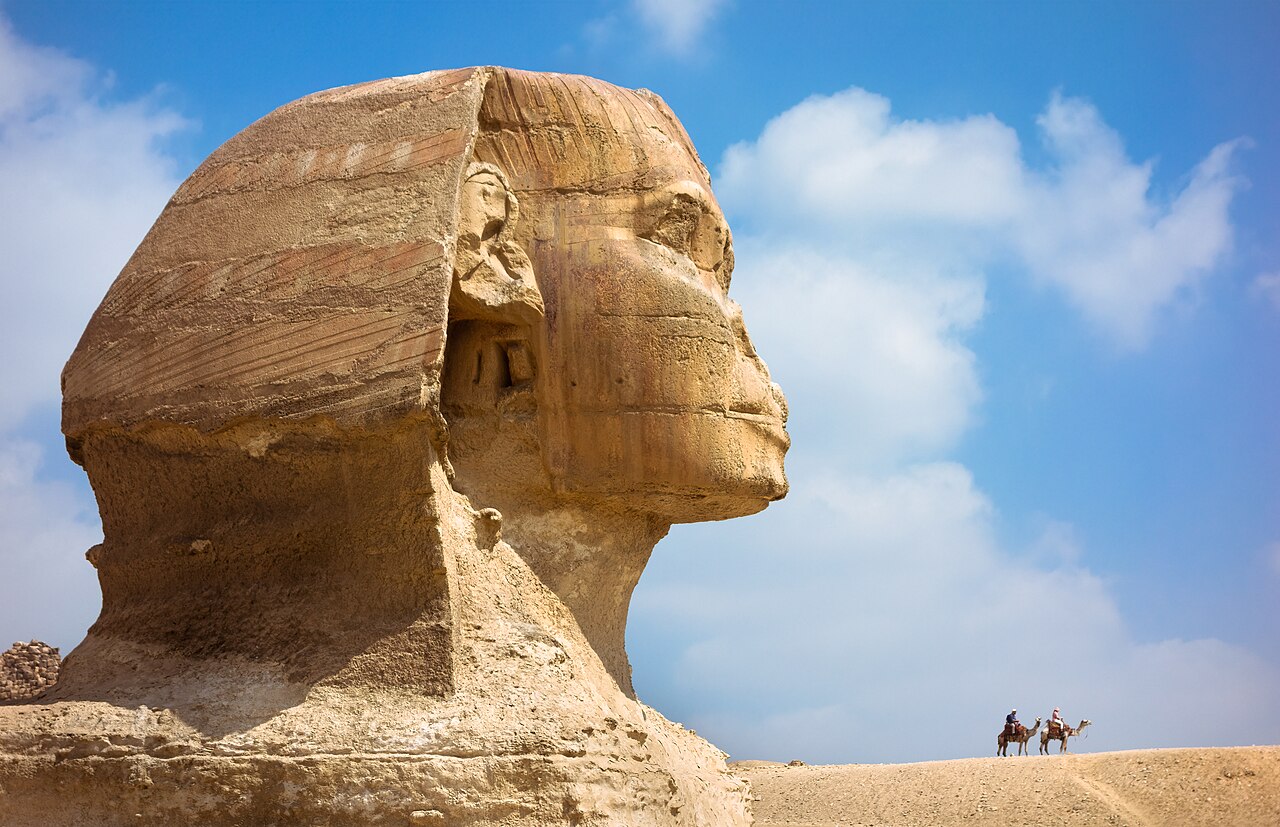
The Sphinx in profile (2023), by Petar Milošević, CC BY-SA 4.0 <https://creativecommons.org/licenses/by-sa/4.0>, via Wikimedia Commons
King Thutmose IV’s reign, albeit brief, had a notable impact on Egyptian art, culture, and religion. His contributions in these areas were significant, reflecting the broader cultural and religious dynamics of the New Kingdom period[7].
Cultural Contributions
- Art and Architecture: King Thutmose IV continued the artistic traditions of the 18th Dynasty, which were characterised by a blend of elegance and realism. He commissioned various construction projects and artworks that exemplified the refined style of this period. This included the completion or enhancement of structures at Karnak and Luxor, which were central religious sites in Thebes.
- Literature and Inscriptions: His reign saw the continuation of the rich literary tradition of ancient Egypt. The Dream Stele, which he erected between the paws of the Great Sphinx at Giza, is not only significant for its historical content but also as a piece of Egyptian literary and cultural heritage. This stele blends historical narrative with religious symbolism, reflecting the sophisticated literary culture of the time.
- Sphinx Reparation and Symbolism: His work in clearing and restoring the Great Sphinx was also a cultural contribution. This act not only had religious significance but also reflected the importance placed on preserving and venerating ancient monuments, a key aspect of Egyptian culture.
Religious Significance
- Promotion of the Sun God, Amun-Ra: Thutmose IV continued the religious policies of his predecessors, particularly the worship of Amun-Ra, the chief deity in the Egyptian pantheon. His building projects in Karnak, a major cult centre of Amun-Ra, reflect this emphasis.
- Religious Innovations: While there is no evidence of radical religious reforms during his reign, like those of Akhenaten[8], Thutmose IV’s reign did see a continuation and possible deepening of the theological ideas surrounding the sun god and the pharaoh’s divine role. His Dream Stele reinforced the notion of divine selection and approval, emphasising the pharaoh’s unique relationship with the gods.
- Integration of Foreign Religious Practices: Thutmose IV’s marriage to a Mitannian princess might have introduced some foreign religious elements into the Egyptian court, reflecting a degree of religious and cultural syncretism. This was part of a broader trend in the New Kingdom of incorporating foreign gods and practices into the Egyptian religious landscape.
King Thutmose IV’s contributions to Egyptian art and culture maintained and enhanced the rich traditions of the New Kingdom. In the religious sphere, while he did not initiate major reforms, he reinforced and possibly expanded the existing religious practices and beliefs, particularly those centred around Amun-Ra and the divine nature of the pharaoh. His reign thus represents a period of cultural and religious continuity and enrichment in ancient Egypt.
Building Projects and Monuments
King Thutmose IV was not as prolific in building and construction as some of his predecessors or successors but still contributed significantly to Egypt’s architectural landscape, particularly on temple construction and restoration. His reign, part of the prosperous New Kingdom period, saw continued development in Egyptian architecture and art.
- Expansion and Decoration: Thutmose IV’s contributions to the Karnak temple complex in Thebes are perhaps his most significant architectural achievements. He undertook the expansion and decoration of parts of the temple, continuing the work of his forebears.
- Obelisks and Statuary: He erected obelisks and statues within the temple complex, adding to its grandeur. These additions would have been intricately carved and possibly gilded, demonstrating the craftsmanship and resources available during his reign.
- Temple of Amen-Re: Thutmose IV is known to have made contributions to the Temple of Amen-Re. This work would have been part of the ongoing effort to honour and glorify the chief deity of the Egyptian pantheon.
- Restoration Works: He was involved in the restoration and maintenance of existing temples and monuments, a common practice among Egyptian pharaohs who sought to both honour the gods and assert their piety and legitimacy.
- Small-Scale Constructions: While large-scale constructions like those of his grandfather Thutmose III were less prominent during his reign, Thutmose IV did commission smaller temples and structures, particularly in Upper Egypt.
Thutmose IV’s architectural contributions, although not as grandiose as those of some other pharaohs, were still significant. They reflected the continued emphasis on religious and cultural traditions during his reign. His works at Karnak and his association with the Sphinx at Giza are lasting testaments to his rule and his place within the rich tapestry of ancient Egyptian history.
Death and Succession
The end of King Thutmose IV’s reign and the circumstances surrounding his death are not entirely clear, but this is often the case with events from ancient history. However, based on the available historical and archaeological evidence, some understanding of this period can be pieced together.
End of Reign and Death
- Duration of Reign: Thutmose IV’s reign lasted for about 9 to 10 years, which is relatively short compared to some of his predecessors and successors in the 18th Dynasty. Manetho credits him with a reign of nine years and eight months[9].
- Circumstances of Death: The exact cause of Thutmose IV’s death is unknown. There is no definitive record detailing how or why he died. Some speculation, based on examinations of his mummy, suggests he may have had health issues that contributed to an early death. However, this remains conjectural. The condition of his mummified body also provides insights into the mummification process and health conditions during his time.
- The Tomb: Thutmose IV’s tomb in the Valley of the Kings (KV43) provides valuable archaeological insights. It was discovered in 1903 and has given archaeologists a glimpse into the burial practices and artistic styles of the time. Tomb KV43 has a dog-leg shape, typical of the layout of early 18th Dynasty tombs. KV43 was rediscovered in 1903 by Howard Carter, excavating on behalf of Theodore M. Davis.
- Solar Boat Pits: Near his mortuary temple, two boat pits were discovered. These pits are similar to those found beside the Great Pyramid of Khufu. The boats were meant for the Pharaoh’s use in the afterlife, symbolising his journey with the sun god Ra.
Succession
- Amenhotep III: Thutmose IV was succeeded by his son, Amenhotep III, who became one of the most prosperous and celebrated pharaohs of the New Kingdom. Amenhotep III’s reign is known for its peace, wealth, and artistic achievements rather than military conquests.
- Peaceful Transition: The transition of power from Thutmose IV to Amenhotep III appears to have been smooth and uneventful, suggesting a stable and uncontested succession. This stability was a hallmark of much of the 18th Dynasty.
Notable Aspects of Amenhotep III’s Reign
- Lengthy and Prosperous Reign: Amenhotep III ruled for nearly four decades, a period marked by considerable wealth, architectural projects, and international diplomacy.
- Architectural Achievements: He is well-known for his extensive building programs, including the construction of the Luxor Temple and significant additions to the Karnak Temple.
- International Relations: Amenhotep III’s reign is notable for its emphasis on diplomacy rather than military conquest. He maintained peaceful relations with neighbouring states and married several foreign princesses as part of diplomatic alliances.
The end of Thutmose IV’s reign marked a transition to a period of great prosperity and cultural achievement under Amenhotep III. While the details of Thutmose IV’s death remain obscure, his legacy was carried on by his son, who presided over one of the most affluent and stable periods in ancient Egyptian history.

Wall decorations from KV43 (tomb of Thutmose IV) Valley of the Kings, Luxor, Egypt
Photo taken by Hajor, Dec.2002.
Review and Conclusion
Thutmose IV’s role and legacy within the 18th Dynasty and broader Egyptian history, when analysed in the context of his predecessors and successors, presents a nuanced picture. Additionally, modern archaeological discoveries have significantly enhanced our understanding of his reign.
Role and Legacy in the 18th Dynasty
- Continuity and Stability: Thutmose IV’s reign represented a period of continuity and stability in the 18th Dynasty. Following the expansive military campaigns of Thutmose III, his reign was characterised more by consolidation of the empire’s gains rather than further expansion. This helped to maintain the empire’s boundaries and ensure internal stability.
- Diplomatic Approach: He is often noted for his diplomatic efforts, particularly in contrast to the military conquests of his grandfather, Thutmose III. His marriage to a Mitannian princess and the subsequent peace treaty with Mitanni were significant diplomatic achievements that contributed to a period of relative peace and stability.
- Cultural and Religious Contributions: Though less prolific in monumental construction than some of his dynasty members, Thutmose IV’s contributions to temple building and restoration, especially at Karnak, were significant. His Dream Stele at the Sphinx is a notable cultural and religious artefact that highlights the pharaoh’s role as a protector and restorer of ancient monuments.
Context in Broader Egyptian History
- Middle Phase of the New Kingdom: Thutmose IV’s reign can be seen as part of the middle phase of the New Kingdom, a period marked by a balance between military prowess and diplomatic engagement, cultural richness, and architectural achievements.
- Preceding Major Transformations: His reign preceded the Amarna Period under Akhenaten, a time of significant religious and cultural upheaval. In this context, Thutmose IV’s reign can be seen as part of the last phases of traditional Egyptian religious and cultural practices before these major changes.
Impact of Modern Discoveries and Archaeology
- Insights from the Tomb and Mummy: The discovery and analysis of Thutmose IV’s tomb and mummy in the Valley of the Kings have provided insights into his health, possible cause of death, and funerary practices of the time. Such discoveries have helped to piece together aspects of his life and reign.
- Reevaluation of His Reign: Modern archaeology and historical research have led to a reevaluation of Thutmose IV’s reign. Initially overshadowed by the more famous pharaohs like Thutmose III and Amenhotep III, recent scholarship has highlighted the importance of his diplomatic achievements and his role in maintaining the empire’s stability.
- Deciphering Inscriptions and Artefacts: The study of inscriptions, reliefs, and other artefacts from his reign, including the Dream Stele, has shed light on the religious beliefs, artistic styles, and political dynamics of the period.
Speculation
The circumstances surrounding Thutmose IV’s ascent to the throne of Egypt remain a subject of some speculation and debate among historians and Egyptologists. However, it’s important to note that there is no concrete evidence of any wrongdoing or nefarious actions in his rise to power. The speculation mainly arises from the following:
- The Dream Stele Narrative: The Dream Stele Narrative: The Dream Stele, erected by Thutmose IV between the paws of the Great Sphinx at Giza, narrates a story where the Sphinx, seen as a manifestation of a solar deity, promises Thutmose IV the throne of Egypt if he clears away the sand engulfing it. The stele reflects the ancient Egyptian practice of associating the Sphinx with solar deities and royal authority. Some scholars interpret this story as a piece of political propaganda crafted by Thutmose IV to legitimise his rule, particularly if he was not the original heir to the throne. This interpretation stems from the broader Egyptian tradition of pharaohs using divine symbols and narratives to reinforce their sovereignty and divine right to rule.
- Succession Order: In many ancient Egyptian dynasties, the throne typically passed to the eldest son of the pharaoh. There is some indication that Thutmose IV might not have been the original crown prince. His older brother, born to a principal wife, would have been first in line. The lack of clear historical records about the transition from Amenhotep II to Thutmose IV leads to questions about how Thutmose IV ultimately became pharaoh.
- Historical Precedents: There were instances in Egyptian history where succession was contentious, involving court intrigue or even foul play. However, it is crucial to emphasise that there is no direct evidence suggesting that Thutmose IV engaged in any illicit activities to gain the throne.
In the absence of definitive historical records, these aspects remain speculative. Many ancient narratives, like the one found on the Dream Stele, often served dual purposes of both religious/cultural significance and political justification. They can be challenging to interpret in modern terms, especially when considering the symbolic and ritualistic nature of Egyptian royal culture.
Thus, while there are intriguing questions about the exact nature of Thutmose IV’s rise to power, it is more a matter of historical interpretation and speculation rather than evidence of wrongdoing.
Final Words
In summary, Thutmose IV’s reign, while not as dramatic or transformative as some other pharaohs of the 18th Dynasty, played a crucial role in maintaining the stability and prosperity of the New Kingdom. His diplomatic initiatives and cultural contributions are increasingly recognised as integral to the understanding of this key period in Egyptian history. Modern archaeological and historical research continues to enhance our understanding of his reign and its significance within the broader tapestry of ancient Egyptian civilisation.

Head of Thutmose IV wearing the blue crown. 18th Dynasty. State Museum of Egyptian Art, Munich, by Osama Shukir Muhammed Amin FRCP(Glasg), CC BY-SA 4.0 <https://creativecommons.org/licenses/by-sa/4.0>, via Wikimedia Commons
Reading (in Alphabetical Order)
- A History of Ancient Egypt: Volume 2: From the Great Pyramid to the Fall of the Middle Kingdom, by John Romer (7 Mar. 2017), published by St. Martin’s Griffin, available from: https://www.amazon.co.uk/History-Ancient-Egypt-Pyramid-Kingdom/dp/1250833493/
- Amarna Sunrise: Egypt from Golden Age to Age of Heresy, by Aidan Dodson (30 Sep. 2016), published by The American University in Cairo Press, available from: https://www.amazon.co.uk/Amarna-Sunrise-Egypt-Golden-Heresy/dp/9774167740/
- Ancient Egypt: Anatomy of a Civilization, by Barry J. Kemp (18 Jun. 2018), published by Routledge, available from: https://www.amazon.co.uk/Ancient-Egypt-Civilization-Barry-Kemp/dp/0415827264/
- Chronicle of the Pharaohs: The Reign-by-Reign Record of the Rulers and Dynasties of Ancient Egypt, by Peter A. Clayton (6 Nov. 2006, published by Thames & Hudson Ltd, available from: https://www.amazon.co.uk/Chronicle-Pharaohs-Reign-Reign-reign/dp/0500286280/
- Egypt’s Golden Empire: The Age of the New Kingdom, by Joyce Tyldesley (1 Nov. 2001), published by Headline, available from: https://www.amazon.co.uk/Egypts-Golden-Empire-Age-Kingdom/dp/0747251606/
- Luxor Illustrated: With Aswan, Abu Simbel, and the Nile, by Michael Haag (1 Jan. 2010), published by The American University in Cairo Press, available from: https://www.amazon.co.uk/Luxor-Illustrated-Simbel-Paperback-Common/dp/B00FBBPKQC/
- Pharaohs of the Sun: Akhenaten, Nefertiti, Tutankhamen, by Rita E. Freed, Yvonne J. Markowitz, and Sue H. D’Auria (4 May 2000), published by Import US, available from: https://www.amazon.co.uk/Pharoahs-Sun-Freed-Daria/dp/0821226207/
- Temples, Tombs, and Hieroglyphs: A Popular History of Ancient Egypt, by Barbara Mertz (28 Oct 2010), published by Constable & Robinson, available from: https://www.amazon.co.uk/Temples-Hieroglyphs-History-Ancient-Histories/dp/1849012806/
- The Complete Gods and Goddesses of Ancient Egypt, by Richard H. Wilkinson (12 Jan. 2017), published by Thames & Hudson Ltd, available from: https://www.amazon.co.uk/Complete-Gods-Goddesses-Ancient-Egypt/dp/0500284245
- The Complete Royal Families of Ancient Egypt, by Aidan Dodson and Dyan Hilton (20 Sep. 1994,) published by Thames & Hudson, available from: https://www.amazon.co.uk/Complete-Families-Ancient-20-Sep-2004-Hardcover/dp/B011T7TR8S/
- The Complete Temples of Ancient Egypt, by Richard H. Wilkinson (30 May. 2000), published by Thames & Hudson, available from: https://www.amazon.co.uk/Complete-Temples-Ancient-Egypt/dp/0500051003/
- The Egyptians: An Introduction (Peoples of the Ancient World), by Robert Morkot (7 Feb. 2005), published by Routledge, available from: https://www.amazon.co.uk/Egyptians-Introduction-Peoples-Ancient-World/dp/0415271037/
- The Oxford History of Ancient Egypt, by Ian Shaw (19 Feb. 2004), published by OUP USA, available from: https://www.amazon.co.uk/Oxford-History-Ancient-Egypt/dp/0192804588/
- The Pharaohs of Ancient Egypt, by Elizabeth Payne (12 Feb. 1981), published by Landmark Books, available from: https://www.amazon.co.uk/Landmark-Books-Elizabeth-Payne/dp/0394846990/
- The Rise and Fall of Ancient Egypt, by Toby Wilkinson (1 Aug. 2011), published by Bloomsbury Paperbacks, available from: https://www.amazon.co.uk/Rise-Fall-Ancient-Egypt/dp/1408810026/
- The Sphinx Mystery: The Forgotten Origins of the Sanctuary of Anubis, by Robert Temple (15 Feb. 2009), published by Inner Traditions, available from: https://www.amazon.co.uk/Sphinx-Mystery-Forgotten-Origins-Sanctuary/dp/1594772711/
- The Woman Who Would Be King: Hatshepsut’s Rise to Power in Ancient Egypt, by Kara Cooney (2 Jul. 2015), published by Oneworld Publications, available from: https://www.amazon.co.uk/Woman-Who-Would-King-Hatshepsuts/dp/1780747667/
- Thebes in Egypt: A Guide to the Tombs and Temples of Ancient Luxor, by Nigel Strudwick (11 May 1999), published by Cornell University Press, available from: https://www.amazon.co.uk/Thebes-Egypt-Guide-Temples-Ancient/dp/0801436931/
CAUTION: This paper is compiled from the sources stated but has not been externally reviewed. Parts of this paper include information provided via artificial intelligence which, although checked by the author, is not always accurate or reliable. Neither we nor any third parties provide any warranty or guarantee as to the accuracy, timeliness, performance, completeness or suitability of the information and materials covered in this paper for any particular purpose. Such information and materials may contain inaccuracies or errors and we expressly exclude liability for any such inaccuracies or errors to the fullest extent permitted by law. Your use of any information or materials on this website is entirely at your own risk, for which we shall not be liable. It shall be your own responsibility to ensure that any products, services or information available through this paper meet your specific requirements and you should neither take action nor exercise inaction without taking appropriate professional advice. The hyperlinks were current at the date of publication.
End Notes and Explanations
- Source: Compiled from research using information at the sources stated throughout the text, together with information provided by machine-generated artificial intelligence at: bing.com [chat] and https://chat.openai.com ↑
- Source: Peter Clayton, (1994). Chronicle of the Pharaohs. Thames & Hudson Ltd. ISBN 9780500050743. ↑
- Explanation: A stele (occasionally stela), when derived from Latin, was a stone or wooden slab, generally taller than it is wide, erected in the ancient world as a monument. The surface of the stele often has text, ornamentation, or both. These may be inscribed, carved in relief, or painted. Stelae were created for many reasons. Grave stelae were used for funerary or commemorative purposes. A stele would have been a slab of stone and would also be used as ancient Greek and Roman government notices or as boundary markers to mark borders or property lines. Stelae (plural) were occasionally erected as memorials to battles. For example, along with other memorials, there are more than half-a-dozen steles erected on the battlefield of Waterloo at the locations of notable actions by participants in battle. Source: https://en.wikipedia.org/wiki/Stele ↑
- Explanation: Haremakhet (also Horemakhet or, in Greek, Harmakhis) was an ancient Egyptian prince and High Priest of Amun during the 25th Dynasty. This puts Thutmose’s dream explanation into doubt as the 25th Dynasty can long after the 18th Dynasty in which Thutmose IV ruled. ↑
- Source: https://www.ancient-origins.net/videos/thutmose-iv-sphinx-discovery-0019693 ↑
- Explanation: The identity of Thutmose IV’s older brother, who would have been the original crown prince during the reign of their father, Amenhotep II, is not definitively known. Ancient Egyptian records, especially from this period, often do not provide complete details about royal family dynamics, especially regarding princes who did not ascend to the throne. In the case of Thutmose IV, historical and archaeological records do not clearly mention his elder brother’s name or fate. This lack of information has led to various speculations and theories:
Unnamed and Unrecorded: It’s possible that the older brother died young or was otherwise deemed unsuitable for the throne, and as a result, did not leave a significant mark on the historical records.
Speculations and Theories: Some Egyptologists speculate that the older brother could have served in a different capacity within the royal court or priesthood, but this remains conjectural without concrete evidence.
Focus on Successors: Ancient Egyptian historical records often emphasise the reigning pharaoh and their successor, especially when the successor was a notable ruler, as was the case with Thutmose IV. This focus can sometimes lead to other family members being less documented or entirely omitted from the records.
Therefore, while it is acknowledged that Thutmose IV had an older brother who was the original heir, specific details about this brother, including his name and what happened to him, remain one of the many mysteries of ancient Egyptian history. Source: various, including ChatGPT. ↑
- Explanation: The New Kingdom of Egypt, approximately spanning the period from 1550 to 1070 BC, is the third and most prosperous era of ancient Egyptian history, following the Old and Middle Kingdoms. This period is known for its powerful pharaohs, expansive empire, and rich cultural developments. Key highlights include:
Territorial Expansion: The New Kingdom is marked by significant territorial expansion, making Egypt one of the most powerful states of the ancient world. Pharaohs like Thutmose III and Ramses II extended Egyptian influence into Nubia, the Levant, and parts of the Near East.
Wealth and International Relations: The era saw immense wealth, partly due to trade with neighbouring regions like the Levant, Nubia, and the Mediterranean. International diplomacy flourished, including marital alliances with foreign powers.
Prominent Pharaohs: Famous pharaohs like Hatshepsut (one of the few female pharaohs), Akhenaten (noted for his religious reforms), Tutankhamun (famous for his intact tomb), and Ramses II (known for his military campaigns and building projects) reigned during this period.
Art and Culture: The New Kingdom is renowned for its architectural, artistic, and literary achievements. Monumental temples like those at Karnak and Luxor were built, and tomb painting reached new heights in the Valley of the Kings.
Religious Developments: There were significant religious developments, including the temporary monotheistic worship of Aten under Akhenaten and the continued prominence of the cult of Amun.
End of the New Kingdom: The period eventually declined due to factors like internal strife, weakening of central authority, and foreign invasions, leading to the Third Intermediate Period.
The New Kingdom is often viewed as being the height of Egyptian civilisation in terms of power, cultural achievements, and international influence. ↑
- Explanation: Akhenaten, originally named Amenhotep IV, was a revolutionary and somewhat controversial pharaoh of the 18th Dynasty of Egypt, ruling for approximately 17 years in the mid-14th century BC. His reign is most notable for his religious reformations, which drastically altered the religious and cultural landscape of ancient Egypt.
Religious Reformation
Monotheistic Shift: Akhenaten is best known for his establishment of what is often described as one of the earliest forms of monotheism. He elevated the worship of the sun god Aten above all other deities, effectively demoting the traditional pantheon of Egyptian gods. This was a radical departure from the polytheistic religious practices that had been central to Egyptian culture for centuries.
Atenism: The worship of Aten under Akhenaten was unique. Unlike the traditional sun god Ra, Aten was worshiped as a singular, universal deity, represented by the sun disk. Akhenaten’s religious reforms included the closure of temples dedicated to other gods and redirecting the state’s wealth and resources to the worship of Aten.
Cultural and Political Impact
Artistic Changes: Akhenaten’s reign also brought about significant changes in Egyptian art. The artistic style became more naturalistic and less rigid, with an emphasis on depicting the royal family in a more realistic, sometimes almost unflattering, manner. This was a stark contrast to the idealised forms common in Egyptian art before and after his reign.
Capital Relocation: He moved the capital from Thebes to a new city he built, named Akhetaten (modern-day Amarna). This city was dedicated exclusively to Aten and served as the center of Aten’s worship.
Posthumous Treatment
Legacy: After his death, Akhenaten’s successors, particularly Tutankhamun and Horemheb, worked to restore the old religious order. Akhenaten’s name and images were often defaced or removed, an act known as “damnatio memoriae,” which aimed to erase him from historical records.
Amarna Period: The period of his reign is often referred to as the Amarna Period, named after the modern site of his capital city. It is characterised by its unique artistic style and religious experimentation.
Akhenaten remains one of the most studied and debated figures in Egyptian history. His reign represents a singular episode in the long history of ancient Egypt, marked by significant religious and cultural upheaval. His attempts to radically transform Egyptian religion, while ultimately short-lived, offer a unique insight into the complexities of religious and political power in ancient Egypt. ↑
- Source: https://ancientegypt.fandom.com/wiki/Thutmose_IV ↑
