
Introduction[1]
When discussing Jews, Christians (which includes Catholics) and Muslims, it’s important to understand both their differences and similarities. These religious groups have complex and intertwined histories, which have shaped their beliefs, practices, and relationships. The key figure is Abraham, and the Abrahamic religions are the group of religions that are centred around the worship of the God of Abraham. Abraham, a Hebrew patriarch, is extensively mentioned in the religious scriptures of the Hebrew and Christian Bibles, as well as the Quran. It’s important to clarify that Catholicism is a denomination within Christianity, not a distinct religion separate from Christianity. This distinction is crucial to avoid any misunderstanding.

“Abraham – Banishment of Hagar and Ishmael”, by Guercino, Public domain, via Wikimedia Commons
Similarities
- Abrahamic Roots: Jews, Christians, Catholics and Muslims all trace their spiritual heritage back to Abraham, a central figure in all their faith, and he is regarded as a patriarch and a prophet. The Kaaba in Mecca[2], a focal point of Islamic worship, is believed to have been built by Abraham and his son Ishmael. This common ancestry is a significant point of similarity.
- Shared Scriptures: The Jewish Tanakh[3] (Hebrew Bible) forms the Old Testament of the Christian Bible. Catholics and Christians regard these texts as sacred, though they interpret them differently. The Quran[4], the holy book of Islam, acknowledges the Torah (part of the Jewish Tanakh) and the Gospels (part of the Christian New Testament) as scriptures revealed by God. However, Muslims believe that the Quran, revealed to Prophet Muhammad, is the final and most complete revelation, superseding previous scriptures.
- Ethical Principles: Judaism, Christianity and Catholicism emphasise moral conduct, charity, and the importance of community. Principles like the Golden Rule (Do unto others as you would have them do unto you) are fundamental in all three. Islamic teachings also emphasise ethical conduct, charity (known as Zakat, one of the Five Pillars of Islam), and community solidarity. The concept of doing unto others as you would have them do unto you is also echoed in Islamic teachings.
- Belief in One God: Judaism, Christianity and Catholicism are monotheistic religions that believe in the existence of a single, all-powerful God. Islam is also strictly monotheistic, emphasising the belief in a single, all-powerful, and merciful God (Allah in Arabic). The oneness of God (Tawhid) is a fundamental concept in Islam.
- Historical Interactions: Throughout history, Jews, Christians and Catholics have interacted in various ways, influencing each other’s development, culture, and practices. Islam has historically interacted with both Judaism and Christianity. These interactions have ranged from theological debates to cultural exchanges and have occurred in various geographical and historical contexts.
- Prophets and Religious Figures: Many of the prophets and figures revered in Judaism and Christianity, such as Moses, David, Jesus, and Mary, are also respected in Islam, albeit with different interpretations and roles.
- Jerusalem: Jerusalem holds significant religious importance in Islam, as it does in Judaism and Christianity. It is home to the Al-Aqsa Mosque and the Dome of the Rock, sites associated with Prophet Muhammad’s miraculous night journey and ascension to heaven.
Differences
Jesus Christ
- Jews: Do not believe in Jesus as the Messiah or a divine being. He is seen as a teacher or prophet at most.
- Christians: Believe Jesus is the Son of God, the Messiah prophesied in the Old Testament, and the saviour of humanity.
- Catholics: As a branch of Christianity, they share the same belief in Jesus as other Christians but have specific doctrines and practices within this broader belief.
- Muslims: Regard Jesus (Isa in Arabic) as a prophet and a messenger of God, but not divine. Muslims do not believe in the concept of Jesus as the Son of God or in his crucifixion and resurrection.
Scriptures
- Jews: Only the Tanakh.
- Christians: The Bible, consisting of the Old and New Testaments.
- Catholics: The Catholic Bible, which includes additional books in the Old Testament not found in Protestant versions.
- Muslims: The Quran is considered the final and most complete revelation from God, and it recognises earlier scriptures (Torah and Gospels) but believes they have been altered or misinterpreted over time.
Religious Practices and Beliefs
- Jews: Practices and beliefs based on Jewish law (Halakha[5]), including dietary laws (Kosher), Sabbath observance, and various rituals.
- Christians: Practices vary widely but generally include baptism, Eucharist (Communion), and observance of Christian holidays like Easter and Christmas.
- Catholics: Specific practices include the sacraments (like Confession and Holy Communion), veneration of saints, and adherence to the authority of the Pope.
- Muslims: Practices include the Five Pillars of Islam (profession of faith, prayer, almsgiving, fasting during Ramadan, and pilgrimage to Mecca). Islamic beliefs are based on the Quran and the Hadith.
Messiah Concept (see more below)
- Jews: Awaiting the coming of a Messiah, a human leader who will restore Israel and bring peace.
- Christians and Catholics: They believe the Messiah has already come in the person of Jesus Christ.
- Muslims: They believe in Jesus as a Messiah but in a different context than Christianity. Islam also has a belief in the Mahdi, a figure who will appear in the end times to restore righteousness before the Day of Judgment.
Authority Structures
- Jews: Diverse, with Rabbinical leadership in various communities.
- Christians: Diverse denominational structures with varying degrees of hierarchy.
- Catholics: Highly structured, with the Pope as the highest earthly authority.
- Muslims: There is no central religious authority like the Papacy; religious scholars (ulama) and leaders (imams) provide guidance, but their authority is not hierarchical in the same way as in some branches of Christianity.
Understanding these similarities and differences is crucial in appreciating the unique characteristics and shared heritage of Jews, Christians, Catholics and Muslims. Each group has a rich and complex tradition that has evolved over millennia, reflecting both distinct identities and common roots.
Diverse Sects and Interpretations
The three Abrahamic religions – Judaism, Christianity, and Islam – have a rich history that has given rise to a variety of sects and interpretations within each faith. Here’s an overview:
Judaism
- Orthodox Judaism: Adheres strictly to traditional beliefs and practices as dictated by the Torah and Talmud. Orthodox Jews strictly observe dietary laws, Sabbath, and religious festivals.
- Conservative Judaism: Seeks a balance between adherence to traditional Jewish laws and adapting to modern life. They hold many traditional beliefs but are more flexible in interpretation than Orthodox Jews.
- Reform Judaism: Emphasizes the evolving nature of the faith, adapting Jewish traditions and practices to fit contemporary life. Reform Judaism is more liberal in theology and practices.
- Reconstructionist Judaism: Focuses on Judaism as a progressively evolving civilisation. It emphasises culture and community over strict religious observance.
Christianity
- Roman Catholicism: Centers around the Pope as the spiritual leader. It upholds church tradition and the sacraments as essential to salvation and faith.
- Eastern Orthodoxy: Maintains traditions and practices dating back to Christianity’s earliest days, with emphasis on mysticism and continuity of the faith.
- Protestantism: A diverse branch that originated from the Reformation; key beliefs include justification by faith alone and the authority of Scripture. Includes denominations like Baptists, Lutherans, Methodists, and Pentecostals.
- Anglicanism: Balances Protestant and Catholic traditions. The Church of England and its global counterparts fall under this category.
Islam
- Sunni Islam: The largest branch of Islam, Sunnis emphasize the importance of the Sunnah (traditions of the Prophet Muhammad) and consensus among Muslims for guiding principles.
- Shia Islam: Focuses on the leadership of Imams, whom they consider to be divinely appointed successors of Prophet Muhammad. Shia Islam is prominent in countries like Iran and Iraq.
- Sufism: A mystical Islamic belief and practice in which Muslims seek to find divine love and knowledge through direct personal experience with God. Sufism is more about spiritual journeys and less about legalistic interpretations.
- Ibadi Islam: Predominantly found in Oman, emphasises a strict adherence to the Quran and Hadith and has its own unique interpretations.
These diverse sects and interpretations highlight the rich and complex tapestry of Abrahamic faiths. They reflect the dynamic nature of religious belief and practice, shaped by historical, cultural, and social influences. Despite their differences, these sects share core tenets rooted in their common Abrahamic heritage, while their diversity illustrates the vibrant and evolving nature of religious expression and identity.
Jewish disbelief in Jesus as the Messiah or a Divine Being
Jewish disbelief in Jesus as the Messiah or a divine being stems from several key theological and scriptural reasons rooted in Jewish interpretations of the Hebrew Bible (Tanakh) and expectations of the Messiah.
Concept of the Messiah in Judaism
- Jewish Expectations: In Jewish thought, the Messiah (Mashiach) is expected to be a human leader, not a divine being. He is prophesied to fulfil specific tasks such as rebuilding the Temple in Jerusalem, gathering all Jews back to the Land of Israel, ushering in an era of world peace, and promoting a universal knowledge of the God of Israel. Jews base their expectations on interpretations of biblical prophecies, particularly in the books of Isaiah, Jeremiah, and Ezekiel.
- Jesus’ Life and Actions: From a Jewish perspective, Jesus did not fulfil these messianic prophecies – the Temple was not rebuilt, there was no lasting peace during or after his lifetime, and the Jewish people were not gathered back to Israel.

The Nature of God and Monotheism
- Strict Monotheism: Judaism is strictly monotheistic. The concept of God as a singular, indivisible entity is central to Jewish belief. This is encapsulated in the Shema, a foundational prayer in Judaism (Deuteronomy 6:4): “Hear, O Israel: the Lord our God, the Lord is one.”
- Divinity of Jesus: The Christian claim of Jesus’ divinity and the concept of the Trinity are inconsistent with Jewish monotheism. For Jews, God does not take human form, and the notion of a subdivided deity or a divine incarnation is incompatible with Jewish theology.
Interpretation of Biblical Texts
- Differing Interpretations: Jews and Christians interpret the Hebrew Bible differently. Passages that Christians see as prophecies about Jesus are often interpreted by Jewish scholars as referring to other things – for example, as relating to the people of Israel collectively or to events or figures of their time.
- Context and Continuity: Jews maintain that any new revelation or teaching, like those in Christianity, must be consistent with the laws and teachings of the Torah. They believe that the teachings of Jesus, as presented in the New Testament, diverge significantly from those laws.
Historical and Cultural Context
- Early Jewish-Christian Relations: In the early centuries AD, as Christianity emerged and began to separate from Judaism, theological differences became more pronounced. Disputes over the messiahship of Jesus were part of a broader divergence in beliefs and practices.
Tradition and Identity
- Community and Continuity: Over the centuries, the Jewish community has maintained its traditions and interpretations, solidifying its distinct religious identity. Accepting Jesus as the Messiah would represent a fundamental shift in Jewish theology and identity.
Jewish rejection of Jesus as the Messiah and a divine being is based on their understanding of biblical prophecy, the nature of God, and the requirements for the Messiah – all of which differ significantly from Christian interpretations and beliefs.
Muslims’ Belief in Jesus as a Messiah but not a Divine Being
Muslims have a distinct perspective on Jesus, which differs significantly from Christian views. In Islam, Jesus is indeed recognised as the Messiah, but his role and nature are understood differently. Here are the key reasons why Muslims do not believe in Jesus as a divine being or in the same way that Christians do:
Jesus as a Prophet and Messiah in Islam
- Prophet and Messenger: In Islam, Jesus (known as Isa in Arabic) is revered as one of the major prophets and messengers sent by God. However, he is not seen as divine or the son of God. His role is to guide people to the monotheistic worship of the one true God, Allah.
- Messiah in Islam: Jesus is indeed acknowledged as the Messiah (Al-Masih) in Islam. However, the concept of Messiah in Islam is different from Christianity. He is seen as a prophet who was sent to guide the Children of Israel with a new scripture, the Injil (Gospel).
Monotheism and the Nature of God
- Strict Monotheism: Islam emphasises strict monotheism (Tawhid). The idea that God is One and unique is fundamental. The Quran, the holy book of Islam, repeatedly emphasises the oneness and uniqueness of God.
- No Divine Incarnation: Islam rejects the notion that God had a son or can incarnate in human form. The Quran refutes the divinity of Jesus, asserting that Jesus was a human being, a creation of God, not part of God Himself.
The Crucifixion and Resurrection
- Different Account of the Crucifixion: Islam challenges the Christian narrative of the crucifixion and resurrection of Jesus. The Quran states that Jesus was not crucified but was raised to Heaven by God. It suggests that it appeared to people that he was crucified, but this was not the case.
Continuation of Prophethood
- Prophet Muhammad’s Role: Muslims believe that Muhammad is the final prophet, sent to all humanity with the final revelation, the Quran. While Jesus is highly respected, Muhammad is seen as the ‘Seal of the Prophets‘ – the last in a line that includes Jesus and other prophets of the Abrahamic traditions.
Quranic Teachings
- Quranic Verses: The Quran discusses Jesus in various verses, affirming his miraculous birth, his prophethood, and his role as the Messiah, but it consistently denies his divinity. Muslims consider the Quran to be the direct word of God and the ultimate authority on religious matters.
Consistency with Previous Prophets
- Alignment with Prophetic Tradition: In Islam, Jesus is viewed in line with previous prophets like Moses and Abraham. This continuity reinforces Islamic teachings of consistent monotheistic worship throughout human history.
Muslims deeply respect Jesus as a prophet and Messiah, but they do not believe in his divinity, crucifixion, or resurrection, adhering instead to the Islamic teachings of strict monotheism and the prophetic mission of Jesus as presented in the Quran.
Respect for Jesus in Diverse Theological Traditions
Both Judaism and Islam hold distinct and deeply rooted theological views about Jesus that differ significantly from Christian beliefs. While Judaism does not recognise Jesus as the Messiah or a divine being, primarily due to differing interpretations of messianic prophecies and a strict adherence to monotheism, it acknowledges Jesus as a historical figure. Islam, on the other hand, reveres Jesus as a significant prophet and “the Messiah,” but strictly within the bounds of Islamic monotheism, rejecting any notions of his divinity and the crucifixion and resurrection narrative.
Despite these differences, it is important to note that both religions demonstrate a profound respect for Jesus. In Judaism, while Jesus is not a central religious figure, there is an acknowledgement of his influence and role in religious history. Islam expresses deep reverence for Jesus as a prophet and messenger of God, aligning him with other revered prophets in the Islamic tradition.
This respect for Jesus across Judaism and Islam highlights the rich diversity of Abrahamic religious traditions. Each religion, while sharing common roots, has developed its own unique theological understanding and interpretation of Jesus’ life and role, contributing to a broad tapestry of religious thought and belief in the shared history of monotheistic faiths.
Abrahamic Roots and why is that the ‘starting point’ for so many Religions
Abraham is traditionally considered to be the first Jew and to have made a covenant with God. Because Judaism, Christianity, and Islam all recognise Abraham as their first prophet, they are also called the Abrahamic religions. In addition to those religions, there are other religions with Abrahamic roots. Here’s a brief overview of the Abrahamic religions and the significance of Abraham in their traditions:
Islam
- Islam is the other major Abrahamic faith. Muslims believe in the same monotheistic God (called Allah in Arabic) as Jews and Christians.
- Prophet Muhammad, the founder of Islam, is considered the last prophet in a line that includes prophets of the Jewish and Christian traditions, such as Abraham, Moses, and Jesus.
- Abraham (Ibrahim in Islam) is a key figure in Islam. He is revered as a prophet and a patriarch. The Quran recounts his trials, his unwavering faith in God, and his role in establishing the Kaaba in Mecca as a centre of worship.
- In Islam, Abraham’s willingness to sacrifice his son (Ishmael, not Isaac, as in the Jewish and Christian narratives) at God’s command is celebrated during Eid al-Adha, a major Islamic festival.
Baha’i Faith
- The Baha’i Faith recognises Abraham as a prophet, alongside figures from other world religions. This religion, founded in the 19th century in Persia, emphasises the spiritual unity of all humankind. It is not regarded as an Abrahamic religion.
- Abraham’s Role: In Baha’i teachings, Abraham, like other prophets or “Manifestations of God,” is seen as part of a progressive revelation from a single God.
Abraham’s Covenant
Abraham’s story and his covenant with God form a critical juncture in the religious narratives of these faiths, marking a transition from polytheism to monotheism and setting the foundation for their respective beliefs and practices.
Abraham (originally Abram) is a man in the Book of Genesis and the Qur’an. There, he is said to be the father of all Jews. This is because he is their ancestor. Abraham is part of the Jewish, Christian and Islamic religions and is considered the father of these three religions, which are called Abrahamic religions.
With his wife Sarah, Abraham is the father of Isaac. He also has Ishmael with Hagar, Sarah’s handmaid, and he has other children with Keturah, whom he marries after Sarah’s death. Abraham was the grandfather of Jacob and Esau. Abraham was the son of Terah and the grandson of Nahor (son of Serug). Abraham’s older brothers were named Nahor (son of Terah) and Haran. Abraham is believed to be the founding patriarch of the Israelites, Ishmaelites and Edomites.
- Historical and Theological Significance: Abraham is a seminal figure in these religions (Judaism, Christianity, and Islam due to his role in establishing the worship of one God. This monotheism was a significant departure from the polytheistic practices prevalent in his time and region.
- Covenant and Faith: Abraham’s covenant with God, where he was promised numerous descendants and a special relationship with God, is foundational to Jewish, Christian, and Islamic theology.
- Symbol of Faith and Obedience: In all these religions, Abraham is seen as a paragon of faith and obedience to God, exemplifying the virtues that followers are encouraged to emulate.
- Shared Narrative: The story of Abraham and his family forms a common narrative thread that links these religions despite their later theological divergences.
The story of Abraham, primarily derived from the Book of Genesis in the Bible and supplemented by various traditions and Midrash (see below), is a foundational narrative in Judaism, Christianity, and Islam:
Early Life and the Covenant
- Origins: Abraham, originally named Abram, lived in Mesopotamia.
- Divine Call: God told Abraham to leave for Canaan, promising to make him the ancestor of a great nation.
- Covenant with God: God commanded Abram to circumcise himself and his descendants as a sign of their covenant. Abram obeyed, and his name was changed to Abraham.
Birth of Isaac
- Promise of a Son: Despite being elderly, Abraham was told by God that his wife Sarah would bear a son.
- Visit of Angels: Three angels visited Abraham, reaffirming that Sarah would have a son. Sarah, overhearing this and aware of their old age, laughed.
- Isaac’s Birth: Sarah gave birth to a son named Isaac, which means “laughter” in Hebrew.
The Binding of Isaac
- Divine Test: God tested Abraham by asking him to sacrifice Isaac.
- Obedience and Intervention: Abraham prepared to obey, but at the last moment, an angel intervened.
- A Substitute Sacrifice: Abraham sacrificed a ram instead, and the place was named Yireh (meaning “The Lord will provide”).
Later Life
- Sarah’s Death: Sarah died at 127 years old and was buried in the Cave of Machpelah.
- Marriage for Isaac: Abraham sent a servant to find a wife for Isaac, who married Rebekah.
- Second Marriage and Death: Abraham later married Keturah and had more children. He died at 175 years old and was buried beside Sarah.
Abraham – from the Idol Shop (Midrash) to Canaan
- Background: As a young man, Abraham worked in his father Terah’s idol shop.
- Iconoclasm: Abraham destroyed the idols, leaving only the largest, and challenged his father’s belief in them.
- Confrontation with Nimrod: King Nimrod, hearing of Abraham’s actions, tried to kill him in a furnace, but Abraham miraculously survived.
- Haran’s Death: Abraham’s brother Haran, after declaring his faith in Abraham’s God, was killed in the furnace.
- Departure: Following these events, God instructed Abraham to leave for Canaan.
This narrative presents Abraham as a pivotal figure in the history of monotheism, showcasing his deep faith, obedience to God, and his role in establishing the covenant between God and his descendants. Abraham’s selection by God and his journey to Canaan are central elements of his narrative in the Abrahamic religions, and they symbolise key theological and spiritual principles.
Why God chose Abraham
- Faith and Righteousness: Abraham is portrayed as a man of profound faith and righteousness. In biblical narratives and religious interpretations, his willingness to leave his homeland and his unwavering trust in God’s promises, even in the face of significant challenges, demonstrate a deep commitment to God. This level of faith and obedience is often cited as the reason God chose Abraham.
- Moral Integrity: In various texts and traditions, Abraham is depicted as a person of strong moral character. His ethical behaviour and sense of justice, such as arguing with God for the righteous in Sodom and Gomorrah, highlight his integrity.
Abraham’s role was to establish a new covenant between God and his descendants. This covenant, marked by the act of circumcision, set the stage for the development of monotheism and the formation of a people with a unique relationship with God.
Why Abraham left for Canaan
- Divine Command: The primary reason Abraham left for Canaan was that God commanded him to do so. This command is seen as a test of Abraham’s faith, asking him to leave his homeland, family, and familiar surroundings based solely on divine instruction.
- Promise of a Great Nation: God promised Abraham that he would become the ancestor of a great nation. This promise was linked to the land of Canaan, where this nation was to be established.
- Symbolic Significance: Canaan, in the biblical context, represented more than just a physical location. It symbolised a promised land, a place where the covenant between God and Abraham’s descendants would be fulfilled. The journey to Canaan thus represents a journey of faith, from the known to the unknown, trusting in God’s promises.
- Historical and Cultural Context: From a historical perspective, such migrations were not uncommon in the ancient Near East. People often moved to new regions in search of better opportunities or to escape conflicts or natural disasters.
Abraham’s selection by God and his journey to Canaan are foundational stories that represent themes of faith, obedience, divine promise, and the establishment of a special relationship between God and a chosen people. These narratives have profound religious and cultural significance in Judaism, Christianity, and Islam.

Abraham’s Journey to Canaan according to the Book of Genesis.-Topographic map: SémhurDerivative work: DEGA MD, CC BY-SA 4.0 <https://creativecommons.org/licenses/by-sa/4.0>, via Wikimedia Commons
The Historicity of Abraham
The historicity of Abraham and the narratives surrounding him have been subjects of ongoing debate among historians and archaeologists. The main points of contention and discussion include:
- Lack of Direct Evidence: There’s a consensus that no unambiguous archaeological or historical evidence directly points to Abraham’s existence, especially not from the 2nd millennium BC. Biblical scholar John Van Seters, in his book Abraham in History and Tradition,[6] argues that arguments based on reconstructing the patriarch’s way of life, personal names in Genesis, social customs in the stories, and correlations with archaeological data from the Middle Bronze Age are insufficient to demonstrate an origin for the Abraham tradition in the second millennium BC.
- Tradition vs. History: The debate also encompasses the distinction between Abraham as a historical figure and Abraham as a part of religious tradition. The narratives in the Bible, particularly in Genesis, have been analysed for historical accuracy, but many scholars contend that these stories serve more as theological and cultural foundations rather than historical accounts.
- Archaeological Interpretations: The interpretations of archaeological findings related to the time and place mentioned in the biblical narratives of Abraham have varied. While some parallels have been drawn between the biblical accounts and Mesopotamian records, there’s no concrete evidence directly linking these to Abraham.
- Biblical Archaeology and Critiques: The field of biblical archaeology has faced its own evolution, with early theories often driven by attempts to validate biblical narratives. However, over time, the discipline has become more critical and focused on objective analysis of archaeological findings, regardless of their relation to biblical accounts.
- Impact on Biblical Scholarship: The discussions about Abraham have significantly impacted the study of the Bible, challenging earlier views that relied heavily on archaeological and historical evidence to confirm biblical narratives. The shift towards understanding these stories as primarily theological rather than historical has been a major outcome of these debates.
- Documentary Hypothesis and Authorship of Genesis[7]: Van Seters’s work also challenges the Documentary Hypothesis – the idea that the books of the Torah, including Genesis, were based on four independent sources and combined by a redactor. He proposes a supplemental model where Genesis was an essentially literary work based on supplementation by successive authors rather than a redactorial process.
Although Abraham is a central figure in Jewish, Christian, and Islamic traditions, his historicity remains a complex and debated subject with no definitive archaeological or historical evidence confirming his existence as described in the religious texts. The discussions around Abraham often reflect broader questions about the relationship between faith, history, and archaeology.
Midrash
A “Midrash” is a type of Jewish literature that provides commentary, explanation, or elaboration on the texts of the Hebrew Bible, also known as the Tanakh. The word “Midrash” comes from a Hebrew term meaning “to seek out” or “to inquire,” reflecting the practice of delving deeply into the biblical text.
Here are some key points about Midrash:
- Expanding on Biblical Stories: Midrash often fills in gaps or answers questions raised by the biblical text. For example, if a story in the Bible seems incomplete or raises questions, Midrash might provide additional details or background information.
- Interpretation and Explanation: Midrash includes interpretations of the biblical text. These interpretations can offer moral, philosophical, or spiritual insights into the scriptures.
- Different Forms: Midrash comes in various forms. Some are like stories or parables, while others are more like sermons or legal discussions.
- Purpose: The main purpose of Midrash is to make the ancient biblical texts more relevant and understandable to contemporary readers. It connects the teachings of the Bible to everyday life and helps to explore the deeper meanings of the scriptures.
- Not a Single Document: Midrash is not just one book; it’s a collection of various writings compiled over centuries by different rabbis and scholars.
In essence, Midrash is a way of engaging with the Bible that goes beyond the literal text to explore deeper meanings, moral lessons, and spiritual insights. It’s a key part of Jewish tradition and learning.
The concept of Midrash, as a form of biblical interpretation and narrative expansion primarily found in Jewish tradition, is viewed differently by Christians and Muslims, reflecting the unique perspectives and scriptural traditions of each religion.
Christian Perspective on Midrash
- Awareness and Respect: Many Christians are aware of Midrash and respect it as a part of Jewish tradition. Scholars and theologians often recognise its value in providing historical and cultural context to the Hebrew Bible, which is also part of the Christian Old Testament.
- Influence on Biblical Interpretation: Some Christian scholars may use Midrashic interpretations to gain deeper insights into Old Testament texts. This is more common in academic or theological studies rather than in general Christian teachings.
- Differences in Approach: Christian interpretation of the Bible, especially the New Testament, typically doesn’t follow the Midrashic method. Instead, Christians have developed their own methods of scriptural interpretation, such as exegesis and hermeneutics.
- Selective Adoption: In some cases, Christians may adopt ideas from Midrash that are seen as consistent with Christian theology, but they generally do not consider Midrash authoritative in the same way that the Bible is.
Muslim Perspective on Midrash
- Acknowledgement as Part of Jewish Tradition: Muslims recognise Midrash as part of Jewish scholarly tradition. Since Islam shares some common roots with Judaism, there is an acknowledgement of its historical significance.
- Indirect Influence: Some stories and interpretations from Midrashic literature might indirectly influence Islamic narratives. The Quran and Hadith[8] (sayings of Prophet Muhammad) contain stories of biblical figures that sometimes parallel those found in Jewish texts, including Midrash.
- Non-Canonical View: Midrash is not considered a religious authority in Islam. Muslims rely on the Quran as the primary source of divine guidance, supplemented by Hadith for additional context and interpretation.
While Midrash is a distinctly Jewish form of scriptural interpretation, it is recognised and sometimes referenced by Christian and Muslim scholars for its historical and cultural insights. However, it does not hold a canonical or authoritative status in Christian and Muslim religious teachings. Scholars interested in comparative religious studies might study Midrash to understand the differences and similarities between Jewish, Christian, and Islamic narratives of biblical figures.

Crimean Tatar Muslim students (1856) – By Carlo Bossoli, Public domain, via Wikimedia Commons
The ‘King of the Jews’
The title ‘King of the Jews’ used in reference to Jesus is primarily a Christian perspective and is not recognised in the same way in Judaism. The reasons why Jews do not revere Jesus as the Messiah or as a king are rooted in Jewish religious beliefs and expectations regarding the Messiah:
- Messiah Expectations: In Jewish thought, the Messiah (Mashiach) is expected to be a human leader, not divine, who will fulfil specific prophecies outlined in the Hebrew Bible. These include rebuilding the Temple in Jerusalem, gathering all Jews back to the Land of Israel, ushering in an era of world peace, and spreading universal knowledge of the God of Israel. Jews do not believe that Jesus fulfilled these prophecies.
- Divinity of Jesus: One of the core beliefs in Christianity is the divinity of Jesus. In contrast, Judaism strongly maintains that God is indivisible and that no human can be divine. The concept of the Trinity, central to Christian theology, is incompatible with Jewish monotheistic belief.
- Role and Nature of the Messiah: In Judaism, the role of the Messiah is not seen as one of a spiritual saviour who provides salvation from sin, as it is in Christianity. Rather, the Jewish Messiah is viewed as a future political and spiritual leader who will bring about certain changes in the world.
- Scriptural Interpretation: Jews interpret the Hebrew Bible (Tanakh) differently from Christians. Passages in the Old Testament that Christians interpret as prophecies about Jesus are often understood differently in Jewish tradition.
- Historical Context: During Jesus’ time, there were various claimants to the title of Messiah, as it was a period of great turmoil and expectation among the Jewish people. However, from a Jewish perspective, none, including Jesus, fulfilled the messianic prophecies of the Hebrew Bible.
- Religious Authority and Tradition: Jewish religious authority, based on the Tanakh and the Talmud, does not recognise Jesus as the Messiah. Jewish tradition and teachings, which have developed over thousands of years, hold a distinct set of beliefs that do not incorporate Jesus as a religious figure.
The concept of Jesus as the ‘King of the Jews’ or as the Messiah is a Christian interpretation and belief. Judaism has its own set of beliefs and expectations regarding the Messiah that Jesus did not meet according to Jewish teachings and interpretation of the scriptures.
Catholics are Christians
Catholics are Christians, sharing many core beliefs with other Christian denominations. The key differences between Catholicism and other branches of Christianity typically involve church structure, traditions, and certain theological beliefs. Here are some distinctions:
- Authority of the Pope: Catholics recognise the Pope as the successor of St. Peter, holding a unique position of authority in the Church. Other Christian denominations do not accept the Pope’s authority.
- Sacraments: Catholics believe in seven sacraments (Baptism, Confirmation, Eucharist, Penance, Anointing of the Sick, Holy Orders, and Matrimony) as essential to spiritual life, whereas other Christians might recognise fewer sacraments or interpret them differently.[9]
- The Virgin Mary and Saints: Catholics hold a special reverence for the Virgin Mary and the saints, believing in their intercession. Other Christian denominations may honour these figures, but not to the same extent.
- Tradition and Scripture: Catholicism places a strong emphasis on the tradition of the Church alongside the Bible. Other Christian denominations may emphasise the Bible as the sole source of religious authority.
- Eucharist: Catholics believe in the doctrine of transubstantiation, where the bread and wine become the actual body and blood of Christ. Other Christians may view Communion as symbolic.
- Confession: In Catholicism, confession to a priest is a regular practice for the forgiveness of sins. Other denominations might confess directly to God or in a more communal setting.
- Views on Salvation: Catholics often emphasise both faith and good works as necessary for salvation. Some other Christian denominations, like many Protestants, emphasise salvation by faith alone.
- Role of the Church: Catholic doctrine sees the Church as a vital, divinely instituted means of dispensing grace and guiding believers. In contrast, some other Christian groups may view the church more as a community of believers without the same level of doctrinal authority.

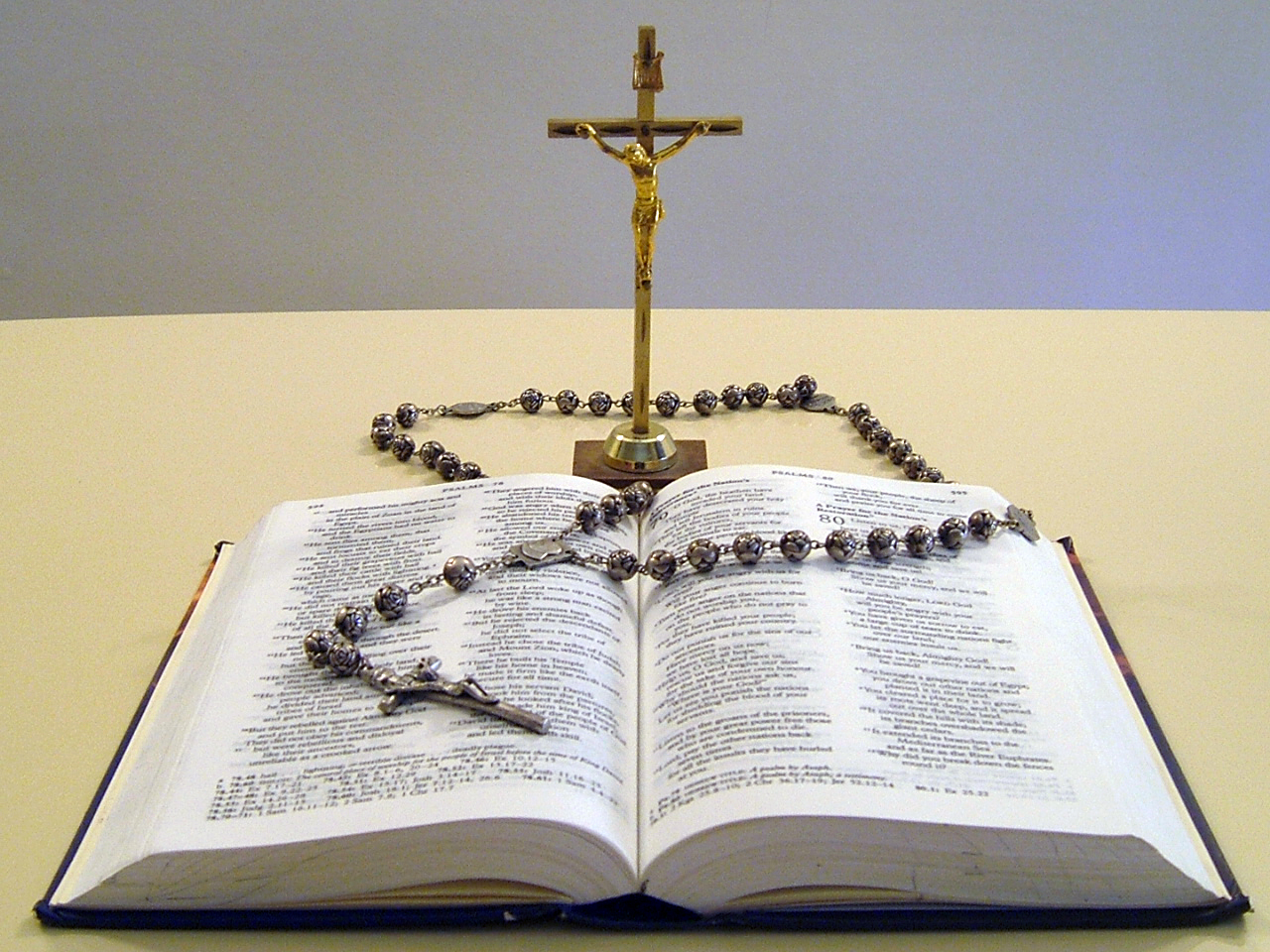
Catholic religious objects – Holy Bible, crucifix and rosary.
Issagm at en.wikipedia, CC BY-SA 3.0 <http://creativecommons.org/licenses/by-sa/3.0/>, via Wikimedia Commons
- Papal Infallibility: Catholics believe that the Pope when speaking ex-cathedra (from the chair) on matters of faith and morals, is infallible. This belief isn’t shared by other Christian denominations.
- Veneration of Relics and Images: In Catholicism, the veneration of relics of saints and sacred images is common. Other Christian denominations may view this practice with caution or even consider it a form of idolatry.
- Canon Law: The Catholic Church has a complex system of laws and guidelines, known as Canon Law, which governs many aspects of Church life and organisation. Other Christian denominations may have different organisational structures and guidelines.
- Liturgy and Mass: The Catholic Mass, with its specific rituals and liturgical structure, is unique, especially in its emphasis on the Eucharistic celebration. Other Christian denominations have different forms and styles of worship.
- Original Sin and Baptism: The Catholic Church teaches that all humans are born with original sin, which is cleansed through baptism. The understanding and emphasis on original sin can vary in other Christian traditions.
- Celibacy of the Clergy: In the Roman Catholic Church, priests and bishops are generally expected to remain celibate. This is not a requirement in many other Christian denominations, where clergy can marry.
- Emphasis on Church Fathers and Councils: Catholics place significant weight on the teachings of the early Church Fathers and the decisions of Ecumenical Councils. While these are also respected in other denominations, they may not hold the same authoritative weight.
- The Magisterium: The Catholic Church’s teaching authority, known as the Magisterium, which includes the Pope and the bishops, plays a central role in interpreting Scripture and tradition. Other Christian denominations may rely more on individual or congregational interpretation of the Bible.
- Liturgy of the Hours: Catholics often participate in the Liturgy of the Hours, a set of daily prayers marking the hours of each day. This practice is less common in other Christian denominations.
- Emphasis on Church History: Catholicism has a strong emphasis on its historical continuity, tracing its roots directly back to the Apostles[10]. Other Christian denominations might focus more on the Bible or recent revival movements.
- Holy Orders and Clerical Structure: The Catholic Church has a hierarchical structure with ordained clergy (deacons, priests, bishops). Other Christian communities might have different forms of church leadership or a more egalitarian structure.
- Annulments: The Catholic Church has a unique process for declaring a marriage null (annulment) if it’s found to be invalid according to Church law. Other denominations may have different views on divorce and remarriage.
- Use of Latin in Liturgy: The traditional use of Latin in Catholic liturgies, especially in the Roman Rite, is distinct. Most other Christian churches use local (common) vernacular languages in their services.
- Feast Days and the Liturgical Calendar: Catholics observe a detailed liturgical calendar with various feast days dedicated to saints, events in the life of Jesus, and Marian observances. Other denominations may not follow this calendar as closely.
- Fasting and Abstinence: The Catholic Church has specific guidelines for fasting and abstinence, particularly during Lent. Other Christian groups may approach fasting differently or not emphasise it as much.
- Church Architecture and Symbols: Catholic churches are often designed and decorated in specific ways, incorporating certain symbols, statues, and sacramentals. Other denominations might have simpler worship spaces without these elements.
- Ecumenism: The Catholic Church has a specific approach to ecumenism[11] and dialogue with other religions and Christian denominations, influenced by its view of itself as the ‘one true Church.’
It is important to remember that the matters listed above are generalisations, and beliefs can vary widely even within a single denomination.

The Christchurch Gate with the new (1990) bronze statue of Christ; the original was destroyed in 1643.
By Peter K Burian, CC BY-SA 4.0 <https://creativecommons.org/licenses/by-sa/4.0>, via Wikimedia Commons
See: End Note[12]
Comparing Christianity with Judaism
Comparing Christianity, in its broadest sense[13], with Judaism reveals both shared roots and significant differences. Here’s a general overview:
Shared Roots and Commonalities
- Monotheism: Both Christians and Jews believe in one God, a foundational monotheistic belief.
- Old Testament/Hebrew Bible: Christianity and Judaism share many sacred texts. Christians refer to these as the Old Testament, while Jews call them the Tanakh or Hebrew Bible.
- Ethical Teachings: Both religions emphasise ethical living, compassion, justice, and the moral laws as outlined in the Hebrew Bible.
Key Differences
- Jesus Christ: The most significant difference is the belief in Jesus Christ. Christians believe Jesus is the Messiah (Christ) and the Son of God, central to salvation and human redemption. Judaism does not recognise Jesus as the Messiah or divine.
- The New Testament: Christians have an additional set of scriptures — the New Testament — which includes the teachings of Jesus and the apostles. This is not part of Jewish scripture.
- Concept of Messiah: In Judaism, the Messiah is a future figure, a human leader who will restore Israel, bring peace, and spread knowledge of God. Christians believe this role has already been fulfilled in Jesus.
- Salvation and Afterlife: Christianity puts a strong emphasis on faith in Jesus Christ as the path to salvation and eternal life. In Judaism, beliefs about the afterlife are varied and generally focus more on living a righteous life according to the Torah.
- Religious Law (Halakha): Judaism emphasises living according to Halakha, a comprehensive set of religious laws and commandments. Christianity, especially in its Protestant forms, often emphasises faith and grace over adherence to religious law.
- Rituals and Practices: Jewish religious life includes a rich tapestry of rituals, holidays, and practices deeply rooted in the Torah and Jewish tradition, such as circumcision, dietary laws (Kashrut), and Sabbath (Shabbat) observance. Christian rituals and practices, like baptism and Communion, are centred around the life and teachings of Jesus.
- Worship and Prayer: The forms and structures of worship and prayer differ. Synagogue services and Jewish prayers, conducted in Hebrew, have distinct features like the Torah reading. Christian worship varies widely among denominations but typically includes reading from the Old and New Testaments, hymns, and a sermon.
- Role of Clergy: The roles and functions of religious leaders differ. In Judaism, rabbis are teachers and interpreters of Jewish law, while in Christianity, roles like priests, pastors, or ministers have different functions, including leading worship and administering sacraments.
- Community and Identity: Judaism is both a religion and an ethnic identity, encompassing a wide range of cultural and communal traditions. Christianity is predominantly a faith identity, with adherents from diverse ethnic and cultural backgrounds.
- Origin and History: Christianity emerged from within Judaism in the 1st century AD, with Jesus and his early followers being Jewish. However, over time, Christianity became distinct and developed its own identity and traditions.
- Scriptural Interpretation: Jewish interpretation of the Bible (Tanakh) includes the Talmud, an extensive body of writings that explain and expound upon the Torah. Christians do not use the Talmud and often interpret the Old Testament through the lens of the New Testament.
- The Nature of God: While both religions are monotheistic, Christianity often emphasise the concept of the Trinity — Father, Son (Jesus Christ), and Holy Spirit as one God in three persons. Judaism strictly maintains a singular, indivisible concept of God.
- Covenant and Law: Judaism centres around the idea of a covenant between God and the Jewish people, with the Torah’s laws guiding daily life. In Christianity, particularly in Protestantism, there is an emphasis on the New Covenant established by Jesus, focusing on faith and grace rather than adherence to the Mosaic Law[14].
- Sabbath Observance: The Jewish Sabbath (Shabbat) is observed from Friday evening to Saturday evening, involving rest and spiritual reflection. Most Christian denominations observe Sunday as their day of worship and rest in commemoration of Jesus’ resurrection.
- Holy Days and Festivals: Judaism has its own set of religious holidays like Passover, Rosh Hashanah[15], Yom Kippur, and Hanukkah, which are distinct from Christian holidays such as Easter and Christmas.
- Role of Tradition: In Judaism, tradition plays a significant role in interpreting scripture and guiding religious practice. In Christianity, the role of tradition varies widely among denominations, with some heavily relying on it and others focusing more on individual interpretations of the Bible.
- Views on Proselytisation: Traditionally, Judaism does not actively seek converts and places more emphasis on practice within the community. In contrast, many Christian denominations actively engage in missionary work and evangelism.
- Dietary Laws and Ritual Purity: Orthodox Judaism adheres to specific dietary laws (Kashrut) and concepts of ritual purity. Most Christian denominations do not observe these dietary rules or concepts of ritual purity.
- Views on the Holy Land and Jerusalem: Jerusalem and the Land of Israel have special significance in both religions, but their religious interpretations and political implications are different. Judaism has a historical and religious connection to the land, while Christianity views the region as significant primarily due to events in the life of Jesus.
- Art and Iconography: Christian churches often feature elaborate iconography and images of Jesus, saints, and biblical scenes. Traditional Jewish synagogues avoid images of God and focus more on symbolic art and decoration.
These points illustrate the complexities and nuances in the relationship and differences between Christianity and Judaism. The comparisons show both the deep connections between Judaism and Christianity, as well as the profound theological and cultural differences that distinguish them.
Holidays and Celebrations
The major religious holidays in Judaism, Christianity (including Catholicism), and Islam include a variety of celebrations, commemorations, and observances, each with unique significance in their respective faiths:
Judaism
- Rosh Hashanah: The Jewish New Year, a time of prayer, self-reflection, and renewal. Usually in September or October.
- Yom Kippur: The Day of Atonement, considered the holiest day in Judaism, is dedicated to repentance and fasting. Typically, it comes ten days after Rosh Hashanah.
- Sukkot: A week-long festival commemorating the sheltering of the Israelites in the wilderness. Starts five days after Yom Kippur and lasts for seven days.
- Shemini Atzeret/Simchat Torah: Celebrations marking the conclusion of the annual cycle of public Torah readings and the beginning of a new cycle. Immediately follows the conclusion of Sukkot.
- Hanukkah: The Festival of Lights, celebrating the rededication of the Second Temple in Jerusalem. Usually in December.
- Passover (Pesach): Commemorates the Exodus of the Israelites from slavery in Egypt. Typically, it takes place in April or May.
Christianity
- Easter: Celebrating the resurrection of Jesus Christ from the dead. The date varies but is usually in March or April.
- Christmas: Commemorating the birth of Jesus Christ. 25th December.
- Advent: The period of preparation for the celebration of the birth of Jesus. Begins the fourth Sunday before Christmas and lasts until Christmas Eve.
- Palm Sunday: Commemorates Jesus’ triumphal entry into Jerusalem. Held on the Sunday before Easter.
- Good Friday: Observing the crucifixion of Jesus Christ. The Friday before Easter.
- Pentecost: Celebrating the descent of the Holy Spirit upon the Apostles and other followers of Jesus. Fifty days after Easter.
Catholicism (specific observances in addition to general Christian holidays)
- Feast of the Assumption of Mary: Commemorates the assumption of Mary into Heaven. 15th August.
- All Saints Day: Honouring all the saints, known and unknown. 1st November.
- Feast of the Immaculate Conception: Celebrating the conception of Mary free from original sin. 8th December
- Feast of Our Lady of Guadalupe: Honouring the appearance of the Virgin Mary near Mexico City. 12th December.
- Feast of the Holy Family: Celebrating Jesus, Mary, and Joseph as a family. The Sunday between Christmas and New Year’s Day, or 30th December, if no such Sunday exists.
Islam
- Eid al-Fitr: Marks the end of Ramadan, the Islamic holy month of fasting. Celebrated at the end of Ramadan. The exact date varies.
- Eid al-Adha: Commemorates the willingness of Ibrahim (Abraham) to sacrifice his son as an act of obedience to God. Approximately two months and ten days after Eid al-Fitr.
- Ramadan: A month of fasting, prayer, reflection, and community. The ninth month of the Islamic calendar, the exact dates vary.
- Ashura: For Sunni Muslims, it marks the day Moses was saved from the Egyptians; for Shia Muslims, it commemorates the martyrdom of Husayn ibn Ali. Typically, it falls on the 10th day of Muharram, the first month in the Islamic calendar.
- Mawlid al-Nabi: Celebrating the birth of the Prophet Muhammad. The celebration date varies in the Islamic calendar.
The dates of these religious holidays vary, and some are determined by lunar calendars, making their dates shift each year in the Gregorian calendar. Here’s a general guide to when these holidays are typically celebrated.
For precise dates, especially for Islamic holidays that depend on moon sightings, and for holidays in the Jewish calendar that change annually in the Gregorian calendar, it’s recommended to check a current religious calendar. For example, you can refer to Xavier University’s multi-faith calendar or the religious holidays page at Gettysburg College for more detailed information for the current year (refer to the Multi-Faith Calendar of Religious Holy Days[16]. These holidays play a central role in the religious, cultural, and social life of their respective communities, providing times for reflection, celebration, and communal gathering.
The Role of Women
The role of women in Judaism, Christianity (including Catholicism), and Islam has evolved and varies across different sects and cultural contexts within these religions:
- In Judaism, the role of women is shaped by the Hebrew Bible, the Oral Law (rabbinic literature), customs, and cultural factors. Women have historically played crucial roles in family and religious life, such as being the primary caregivers and educators in the faith. There has been a growing movement advocating for increased inclusion of women in positions such as rabbis, cantors, and communal leaders, challenging historically exclusionary practices. Jewishness is traditionally passed down through the mother, although the father’s name is used to describe sons and daughters in the Torah and in traditional Hebrew names.
- In Christianity, women’s roles have varied significantly since the religion’s founding. Women have played key roles, especially in marriage and in formal ministry positions within certain denominations and parachurch organizations. Many leadership roles in the organized church were historically prohibited to women, but the majority of churches now hold an egalitarian view regarding women’s roles. In Roman Catholic and Orthodox churches, only men may serve as priests or elders, but women can serve as abbesses and consecrated virgins. Many Protestant denominations have started ordaining women as ministers. Christian traditions that officially recognise saints venerate many women as saints, with Mary, the mother of Jesus, being highly revered, particularly in Roman Catholicism and Eastern Orthodoxy.
- In Islam, the role of women varies across different cultural and national contexts. The religion teaches equality of men and women before God, but cultural practices can influence how this is interpreted and implemented. Women play significant roles in family and community life, and in some Muslim-majority countries, women have taken on leadership roles within religious and academic contexts. The extent to which women engage in mosque and community leadership can vary widely depending on regional practices and interpretations of Islamic law.
Overall, there’s a significant variation in how each religion views and incorporates women into their religious and social structures. This variation can depend on numerous factors, including geography, culture, and the specific sect of the religion. Additionally, there is a growing trend in many of these religions to reevaluate and expand the roles of women, reflecting broader social changes regarding gender equality.
Shifts in the roles women occupy
In the context of Abrahamic religions, there have been notable shifts in the roles women occupy, especially in areas that were historically resistant to change. These include:
- Religious Leadership: Women are increasingly occupying roles such as priests, pastors, and rabbis in various denominations of Christianity and Judaism. This is a significant shift, particularly in traditions that historically only permitted men in these positions.
- Scholarly and Theological Roles: Women are more involved in theological scholarship, interpreting religious texts, and contributing to religious academia. This involvement is changing the landscape of religious scholarship, which was predominantly male-dominated.
- Religious Decision-Making Bodies: Women are participating in governing bodies of religious institutions, contributing to decision-making processes that affect the entire community.
- Spiritual Mentorship and Counseling: Roles in spiritual guidance and counselling, which may have been informally held by women in the past, are now being formally recognised in many religious communities.
- Public Religious Discourse: Women are more visible in public religious discourse, including preaching, teaching, and media appearances, bringing female perspectives to discussions that were once male-dominated.
- Advocacy and Social Justice Roles: In many religious communities, women are leading social justice initiatives, advocating for change both within and outside their religious institutions.
- Interfaith Leadership: Women are increasingly prominent in interfaith dialogue and leadership, fostering understanding and cooperation between different religious traditions.
These changes are not uniform across all denominations or regions, and in some conservative or traditionalist segments of these religions, resistance to such changes persists. However, the overall trend shows an increasing acceptance and integration of women into roles that were traditionally closed to them.
Dietary Laws and Fasting
Dietary laws and fasting are important aspects of Judaism, Christianity (including Catholicism), and Islam, each with its own unique practices and guidelines:
Judaism
- Dietary Laws (Kashrut): Jewish dietary laws specify foods that are permissible (kosher) and those that are forbidden. These laws prohibit the consumption of certain animals and seafood and the mixing of meat and dairy. Animals must be slaughtered in a specific manner, and certain parts of permitted animals cannot be eaten.
- Spiritual Purity: Kosher laws are seen as a means to maintain spiritual purity and discipline, reinforcing a unique Jewish identity.
- Divine Commandment: Observing kosher is considered a direct commandment from God, fostering a sense of obedience and devotion.
- Fasting: The most significant fast day is Yom Kippur, the Day of Atonement, a complete fast lasting about 25 hours. Other fast days include Tisha B’Av, the Fast of Gedaliah, the 10th of Tevet, the 17th of Tammuz, and the Fast of Esther.
- Holistic Well-being: These laws are also interpreted as guidelines for physical and spiritual health, connecting the body and soul.
Christianity
- Dietary Laws: Most branches of Christianity do not have strict dietary laws. However, some Christian denominations, like Eastern Orthodoxy and some Protestant groups, may observe dietary restrictions during specific liturgical seasons or on certain days.
- Fasting: Fasting practices vary widely. The season of Lent in many Christian denominations involves some form of fasting or abstention, particularly on Ash Wednesday and Good Friday. The nature and extent of the fast can vary between denominations and individual believers.
- Remembrance and Reflection: Fasting in Christianity, especially during Lent, is a time for reflection on Jesus’ sacrifices and teachings.
- Compassion and Charity: Fasting is often linked with increased acts of charity and kindness, emphasising empathy and connection with those who are less fortunate.
Catholicism
- Dietary Laws: Similar to other Christian denominations, there are no specific dietary laws, but there are traditions of abstinence, such as avoiding meat on Fridays during Lent.
- Fasting: Catholics traditionally observe fasting and abstinence during Lent, particularly on Ash Wednesday and Good Friday. Fasting usually involves eating one full meal and two smaller meals that do not add up to a full meal.
Islam
- Dietary Laws (Halal): Islamic dietary laws dictate permissible (halal) and forbidden (haram) foods. Forbidden items include pork, alcohol, and any meat not slaughtered in the name of Allah. Animals must be healthy at the time of slaughter and killed in a specific way.
- Fasting: Fasting during the month of Ramadan is one of the Five Pillars of Islam. Muslims fast from dawn to sunset, abstaining from food, drink, smoking, and marital relations. The fast is broken each day with a meal known as iftar. The practice of breaking the fast together promotes a sense of community and equality as people from all walks of life share a meal.
- Spiritual Cleansing: Observing halal dietary laws and fasting during Ramadan is seen as a path to spiritual cleansing, fostering a deeper connection with God.
- Self-Discipline and Patience: Fasting during Ramadan teaches self-control, discipline, and empathy for the less fortunate, as it allows Muslims to experience hunger and thirst.
- Reflection and Prayer: Ramadan is a time for increased prayer, reflection, and reading of the Quran, reinforcing spiritual growth and devotion.
In all these religions, dietary laws and fasting practices are not merely about food restrictions; they are deeply intertwined with spiritual discipline, community building, moral teachings, and a sense of connectedness to the divine. Each practice serves as a tangible expression of faith and devotion, and they often go hand in hand with periods of intensified prayer, meditation, and charitable acts, reflecting a holistic approach to spirituality that involves both the body and the soul.
Contemporary Inter-Religious Relations and Dialogue among the Abrahamic Religions
In today’s world, where diverse religious communities often live side by side, inter-religious relations and dialogues among Jews, Christians, and Muslims—the followers of the Abrahamic religions—have become increasingly important. Here are some key aspects of these interactions:
- Common Ground and Shared Values: Jews, Christians, and Muslims share many core values, such as the importance of compassion, charity, and justice. These common ethical teachings provide a foundation for mutual understanding and respect. Across the globe, members of these faiths often work together on community service projects, emphasizing their shared values.
- Interfaith Initiatives and Dialogues: Various interfaith initiatives, such as conferences, seminars, and dialogue groups, have been established worldwide. These initiatives bring together religious leaders and community members to discuss common issues and understand each other’s beliefs better. For instance, the Parliament of the World’s Religions and local interfaith councils play a significant role in such dialogues.
- Challenges and Successes in Interfaith Relations: While there are challenges in inter-religious dialogues, such as differences in beliefs and historical conflicts, there have been many successful outcomes. These include joint statements on peace, collaborative community projects, and united stands against religious extremism.
- Role of Religious Leaders: Religious leaders play a crucial role in promoting interfaith dialogue. They lead by example, showing how different faiths can coexist peacefully and respectfully. Many religious leaders actively condemn intolerance and extremism, encouraging their followers to embrace a spirit of understanding and cooperation.
- Impact on Global Peace and Social Harmony: Positive inter-religious relations contribute significantly to global peace and social harmony. For example, when religious communities jointly address societal problems or humanitarian crises, it not only helps solve these issues but also builds bridges of friendship and cooperation.
- Influence of Modern Technology and Globalisation: Modern communication technology and globalization have made it easier for religious communities to interact and learn about each other. Online interfaith forums, social media groups, and virtual conferences have opened new avenues for dialogue and understanding.
- Educational and Cultural Exchanges: Educational programs and cultural exchanges are vital in fostering a deeper understanding of different faiths. Schools, universities, and cultural institutions often organize interfaith events, workshops, and courses that help dismantle stereotypes and build knowledge about each religion’s traditions and beliefs.
- The Role of the Youth: Young people are increasingly involved in interfaith activities, bringing fresh perspectives and energy. Youth-led interfaith groups and university societies are common, showing promise for the future of religious coexistence and understanding.
In summary, the ongoing dialogue and cooperation among Jews, Christians, and Muslims reflect a shared commitment to harmony, understanding, and the common good. These efforts not only enhance mutual respect among the Abrahamic faiths but also contribute to a more peaceful and cohesive global society.
The Significance of Jerusalem
Jerusalem is an old city located in West Asia, situated on a plateau between the Mediterranean Sea and the Dead Sea. It’s one of the world’s oldest cities and is sacred to the three major Abrahamic religions: Judaism, Christianity, and Islam. Both Israelis and Palestinians claim Jerusalem as their capital. Israel has its main government buildings there, and the State of Palestine sees it as its future centre of power, but these claims are not widely recognised internationally.
Jerusalem has a long and turbulent history. It has been destroyed twice, besieged 23 times, captured and recaptured 44 times, and attacked 52 times. The area known as the City of David showed early signs of people living there around 4,000 BC with nomadic shepherds. During the Canaanite period around the 14th century BC, it was called Urusalim, likely named after a Canaanite god. In the Israelite period, major building started in the 10th century BC, and by the 9th century BC, Jerusalem had become an important religious and administrative centre for the Kingdom of Judah. The last major construction of the city walls was in 1538 under Suleiman the Magnificent of the Ottoman Empire.
Jerusalem holds profound religious significance for all three Abrahamic faiths – Judaism, Christianity, and Islam – each for unique reasons:
Judaism
- Ancient Capital: Jerusalem is the ancient capital of the Jewish kingdom and the site of the First and Second Temples, central to Jewish worship and identity.
- Western Wall: The Western Wall, a remnant of the Second Temple, is the holiest site where Jews can pray.
- Spiritual Centre: Jerusalem is seen as the spiritual epicentre of Judaism, playing a central role in Jewish prayers and eschatology.
Christianity
- Life of Jesus: Jerusalem is significant as the place where many pivotal events in the life of Jesus Christ, including his crucifixion and resurrection, took place.
- Holy Sepulchre: The Church of the Holy Sepulchre, believed to be the site of Jesus’ crucifixion and burial, is a major pilgrimage destination for Christians.
- Pentecost: Jerusalem is also where the Holy Spirit descended upon the apostles at Pentecost, marking the birth of the Christian Church.
Islam
- Al-Aqsa Mosque: The Al-Aqsa Mosque, located in the Old City, is the third holiest site in Islam.
- Night Journey: According to Islamic tradition, Prophet Muhammad ascended to heaven from Jerusalem during the Isra and Mi’raj (Night Journey and Ascension).
- Historical and Religious Legacy: Jerusalem was the first Qibla (direction of prayer) for Muslims before it was changed to Mecca.
For all these faiths, Jerusalem is more than just a city; it’s a symbol of faith, a focal point of religious history, and a centre for spiritual reflection and pilgrimage. Its significance is deeply embedded in the religious consciousness and traditions of Jews, Christians, and Muslims worldwide. The city’s shared religious importance also makes it a key factor in geopolitical and interfaith dialogues.

1844 daguerreotype by Joseph-Philibert Girault de Prangey (the earliest photograph of the city). By Girault de Prangey (1804-1892), Public domain, via Wikimedia Commons
Examples of Contemporary Inter-Religious dialogue among the Abrahamic religions
- The King Abdullah Bin Abdulaziz International Centre for Interreligious and Intercultural Dialogue (KAICIID): This organization, based in Vienna, Austria, was founded by Saudi Arabia, Austria, and Spain, with the Holy See as a Founding Observer. It aims to facilitate dialogue among followers of different religions and cultures. KAICIID has been involved in various programs, including peace initiatives in the Central African Republic, where religious leaders from Muslim, Catholic, and Protestant communities work together to promote reconciliation. https://www.kaiciid.org/
- The Interfaith Encounter Association (IEA) in Israel and Palestine: This grassroots organisation facilitates more than 250 dialogue groups, bringing together Jews, Muslims, Christians, and Druze to foster mutual understanding and respect. One notable initiative is the “Youth Interfaith Encounter,” where young people from different faiths engage in dialogue and community projects. https://interfaith-encounter.org/en/
- The Elijah Interfaith Institute: Based in Jerusalem, this institute brings together world-renowned religious leaders and scholars from Jewish, Christian, Muslim, Buddhist, Hindu, and other faiths for dialogue and educational projects. One of their notable initiatives is the “Elijah Board of World Religious Leaders,” which has led to influential joint statements and interfaith events. https://elijah-interfaith.org/
- Scriptural Reasoning: This is a practice where Jews, Christians, and Muslims read and reflect on their scriptures together, promoting deeper understanding. This form of dialogue is unique because it involves text study and allows participants to appreciate and respect each other’s religious texts and traditions. It is not about seeking agreement but rather exploring the texts and their possible interpretations across faith boundaries and learning to ‘disagree better’. http://www.scripturalreasoning.org/
- ‘A Common Word Between Us and You’: This is an open letter issued in 2007 from leaders of the Islamic faith to leaders of the Christian religion. It calls for peace and understanding between Muslims and Christians, based on the commandments to love God and one’s neighbour. This initiative has led to numerous conferences and dialogues worldwide.
- The Marrakesh Declaration (2016): This is a statement made by Muslim scholars and dignitaries that reaffirms the principles of the Charter of Medina, an early Islamic document that guarantees religious freedom. It aims to protect the rights of religious minorities in predominantly Muslim countries.
- The Assisi World Day of Prayer for Peace: Initiated by Pope John Paul II in 1986, this event brought together religious leaders from around the world to pray for peace. It was a groundbreaking event for interfaith dialogue and has had subsequent gatherings.
- Interfaith Family Networks: In many communities, there are networks or support groups for interfaith families (especially Jewish-Christian families). These groups often engage in dialogues and educational activities that provide personal insights into how different faiths can coexist harmoniously within a family.
- ‘Dignity of Difference’: this is the title of the book written by the former Chief Rabbi, Jonathan Sacks. The tragedy of 11th September intensified the danger caused by religious differences around the world. As the politics of identity began to replace the politics of ideology, he asked if religion could become a force for peace. It was the first major statement by a Jewish leader on the ethics of globalisation and marked a paradigm shift in the approach to religious coexistence.[17]
These examples[18] illustrate the practical applications of inter-religious dialogue and cooperation, demonstrating how these efforts contribute to peace, understanding, and mutual respect among the Abrahamic religions.
Closing Words
The first 12 books of Genesis hold a special place in the Abrahamic religions, but it’s important to clarify the context and extent of their “agreement” or acknowledgement of these texts.
In Judaism, the entire book of Genesis (known as “B’reishit” in Hebrew) is part of the Torah, the foundational religious text. The first 12 chapters of Genesis cover the creation of the world, the story of Adam and Eve, the Great Flood, the Tower of Babel, and begin the story of Abraham, the first patriarch. These narratives form the basis of Jewish understanding of the world’s creation, the nature of humanity, and the beginnings of their relationship with God.
Christians also revere the book of Genesis, as it is part of the Old Testament in the Christian Bible. The stories in the first 12 chapters are foundational to Christian beliefs about creation, sin, and humanity’s early relationship with God. These chapters also set the stage for Christian beliefs in the need for salvation, which is central to the faith.
While the Quran, the holy book of Islam, does not contain the book of Genesis as such, it includes stories and characters that are very similar to those in the first 12 chapters of Genesis. For example, figures like Adam, Noah, and Abraham are significant in Islamic teachings. The Quranic narratives of these figures share key themes with the Genesis accounts, such as the creation of the world and humanity, the Great Flood, and the early history of Abraham’s lineage.
The reasons for this shared recognition can be traced to:
- Shared Ancient Roots: The Abrahamic religions have common historical and spiritual origins in the ancient Near East. The narratives in the book of Genesis, or their equivalents in the Quran, reflect these shared roots.
- Abraham’s Central Role: Abraham, who first appears in Genesis 12, is a central figure in all three religions. Judaism and Christianity trace their roots through his son Isaac, while Islam traces its lineage through his son Ishmael.
- Theological Foundations: These early stories in Genesis provide foundational theological concepts, such as the nature of God, the nature of humanity, the concept of sin, and the beginnings of God’s relationship with humanity, all of which are key elements in the theology of all three religions.
It’s important to note, however, that while there is a general acknowledgement of these stories, the interpretation and emphasis can differ significantly between the religions. For example, the Christian interpretation of the “fall” in the Garden of Eden and the concept of original sin is not shared in the same way in Judaism and Islam. Likewise, the Quranic accounts of these early figures and events sometimes differ from the Biblical narrative in key aspects.

Reading (in Alphabetical Order)
- Abraham in History and Tradition, by John Van Seter, 11 Mar. 2014, published by Echo Point Books & Media, available from: https://www.amazon.co.uk/Abraham-History-Tradition-John-Seter/dp/1626549109
- A History of Christianity: The First Three Thousand Years, by Diarmaid MacCulloch, 2 Sept 2010, published by Penguin, available from: https://www.amazon.co.uk/History-Christianity-First-Three-Thousand/dp/0141021896/
- A History of God, by Karen Armstrong, 30 Jun 2011, published by Vintage, available from: https://www.amazon.co.uk/History-God-Karen-Armstrong/dp/0099273675/
- A History of the Bible: The Book and Its Faiths, by Dr John Barton, 26 Mar. 2020, published by Penguin, available from: https://www.amazon.co.uk/History-Bible-Book-Its-Faiths/dp/0141978503/
- An Illustrated Encyclopedia of Jewish History and Judaism, by Dan Cohn-Sherbok and Lawrence Joffe, 14 Oct 2022, published by Lorenz Books, available from: https://www.amazon.co.uk/Jewish-History-Judaism-Illustrated-Encyclopedia/dp/0754835448/
- Books of God: The Three Abrahamic Religions, Their Common Truths, and Why They Need to Unite, by Michael HagHighat and Madeline Haghighat, 28 Dec 2021, published by Truth Spiritual Publishing LLC, available from: https://www.amazon.co.uk/Books-God-Abrahamic-Religions-Common/dp/1662921810/
- Catholicism All-in-One For Dummies, by Rev. John Trigilio Jr., Rev. Kenneth Brighenti, et al., 9 Mar 2023, published by For Dummies, available from: https://www.amazon.co.uk/Catholicism-Dummies-Rev-John-Trigilio/dp/1119855713/
- Christian History: An Introduction, by Alister E. McGrath, 15 Feb. 2013, published by Wiley-Blackwell, available from: https://www.amazon.co.uk/Christian-History-Introduction-Alister-McGrath/dp/1118337808/
- Comparative Religion For Dummies, by William P. Lazarus and Mark Sullivan,14 Apr 2008 published by For Dummies, available from: https://www.amazon.co.uk/Comparative-Religion-Dummies-William-Lazarus/dp/0470230657/
- Dietary Laws In Abrahamic Religions: A discussion of permitted and prohibited foods and related practices in Judaism, Christianity and Islam, by Mr Khalid Z Syed, 28 Aug 2023, independently published, available from: https://www.amazon.co.uk/DIETARY-LAWS-ABRAHAMIC-RELIGIONS-Christianity/dp/B0CHL9N3ZC/
- Dignity of Difference, by Jonathan Sacks, 1 Jul. 2004, published by Continuum, available from: https://www.amazon.co.uk/Dignity-Difference-Avoid-Clash-Civilizations/dp/0826468500
- Dreams and Divination from Byzantium to Baghdad, 400-1000 CE (Oxford Studies in the Abrahamic Religions), by Bronwen Neil, 14 Jan 2021, published by OUP Oxford, available from: https://www.amazon.co.uk/Divination-Byzantium-400-1000-Abrahamic-Religions/dp/0198871147/
- Faith in Markets? Abrahamic Religions and Economics by Benedikt Koehler, 30 Mar 2023, published by IEA Publishing, available from: https://www.amazon.co.uk/Faith-Markets-Abrahamic-Religions-Economics/dp/0255368240/
- Female Power and Religious Change in the Medieval Near East (Oxford Studies in the Abrahamic Religions), by Uriel Simonsohn, 23 Mar 2023, published by OUP Oxford, available from: https://www.amazon.co.uk/Religious-Medieval-Studies-Abrahamic-Religions/dp/0192871250/
- God of Love: A Guide to the Heart of Judaism, Christianity, and Islam, by Mirabai Starr, 15 Jan 2015, published by Monkfish Book Publishing, available from: https://www.amazon.co.uk/God-Love-Christianity-15-Jan-2015-Paperback/dp/B011T75HIW/
- Goy: Israel’s Multiple Others and the Birth of the Gentile (Oxford Studies in the Abrahamic Religions), by Adi Ophir and Ishay Rosen-Zvi, 28 Aug 2018, published by Oxford University Press, available from: https://www.amazon.co.uk/Goy-Israels-Multiple-Abrahamic-Religions/dp/0198744900/
- Great Cosmic Mother: Rediscovering the Religion of the Earth, by Monica Sjoo and Barbara Mor, 7 Nov 1991, published by Bravo Press Ltd, available from: https://www.amazon.co.uk/Great-Cosmic-Mother-Rediscovering-Religion/dp/0062507915/
- Holy Lands of Abrahamic Religions: A Brief History and Pilgrimage, by K Ravindran, 12 Dec 2022, published by Notion Press, available from: https://www.amazon.co.uk/Holy-Lands-Abrahamic-Religions-Pilgrimage/dp/B0BPTFZH2D/
- Islam and Christianity: The Choice, by Deedat Ahmed,1 Mar 2009, published by Islamic Book Service, available from: https://www.amazon.co.uk/Islam-Christianity-Choice-Deedat-Ahmed/dp/8172311761/
- Islam and its Past: Jahiliyya, Late Antiquity, and the Qur’an (Oxford Studies in the Abrahamic Religions), by Carol Bakhos and Michael Cook,15 Jun 2017, published by OUP Oxford, available from: https://www.amazon.co.uk/Islam-its-Past-Jahiliyya-Antiquity/dp/0198748493/
- Islam Explained, by Tahar Ben Jelloun and Franklin Philip, 21 Nov 2002, published by The New Press, available from: https://www.amazon.co.uk/Islam-Explained-Tahar-Ben-Jelloun/dp/1565847814/
- Islam Explained: A series of the most common questions about Islam and its principles, simply and precisely answered, by Malik Semroun, 21 Mar. 2022, independently published, available from: https://www.amazon.co.uk/Islam-Explained-questions-principles-precisely/dp/B09W5FSL52/
- Judaism For Dummies, 2nd Edition, by Ted Falcon and David Blatner, 23 Aug. 2019, published by For Dummies, available from: https://www.amazon.co.uk/Judaism-Dummies-2nd-Falcon/dp/1119643074/
- Judaism, Sufism, and the Pietists of Medieval Egypt: A Study of Abraham Maimonides and His Times (Oxford Studies In Abrahamic Religions), by Elisha Russ-Fishbane, 30 Jul 2015, published by OUP Oxford, available from: https://www.amazon.co.uk/Judaism-Sufism-Pietists-Medieval-Egypt/dp/019872876X/
- Judaism: Belief & Practice: An Introduction to the Jewish Religion, Faith and Traditions, Including 300 Paintings and Photographs, by Dan Cohn-Sherbok, 31 Jan 2017, published by Southwater, available from: https://www.amazon.co.uk/Judaism-Introduction-Traditions-Including-Photographs/dp/1780195095/
- Leading with Faith: 20 Leadership Lessons from Abrahamic Religions, by George Novak,18 Aug 2023, independently published, available from: https://www.amazon.com/Leading-Faith-Leadership-Abrahamic-Religions/dp/B0CFZG3D26
- Levant, Cradle of Abrahamic Religions: Studies on the Interaction of Religion and Society from Antiquity to Modern Times (Studien Zur Orientalischen Kirchengeschichte), by Catalin-Stefan Popa, 1 Apr 2023, published by Lit Vertag, available from: https://www.amazon.co.uk/Levant-Cradle-Abrahamic-Religions-Interaction/dp/3643914261/
- Living a Jewish Life, Revised and Updated: Jewish Traditions, Customs, and Values for Today’s Families, by Anita Diamant and Howard Cooper, 9 Nov 2023, published by William Morrow Paperbacks, available from: https://www.amazon.co.uk/Living-Jewish-Life-Revised-Updated/dp/0063255790
- MisGod’ed: A Roadmap of Guidance and Misguidance in the Abrahamic Religions, by Dr Laurence B. Brown, 22 Feb 2008, available from: https://www.amazon.co.uk/MisGoded-Misguidance-Abrahamic-Religions-22-Feb-2008/dp/B012HUUYVA/
- Muslim and Jew: Origins, Growth, Resentment (Routledge Focus on Religion), by Aaron W Hughes, 30 Jun. 2020, published by Routledge, available from: https://www.amazon.co.uk/Muslim-Jew-Origins-Growth-Resentment/dp/0367606623/
- Nature and Scripture in the Abrahamic Religions: 1700 – Present v. 1 (Brill’s Series in Church History): 37, by Scott Mandelbrote and Jitse Van Der Meer, 15 Jan 2009, published by Brill, available from: https://www.amazon.co.uk/Nature-Scripture-Abrahamic-Religions-Religious/dp/9004171916/
- Philosophy and the Abrahamic Religions: Scriptural Hermeneutics and Epistemology, by Rahim Acar, Bilal Bas, et al., 9 Nov 2012, published by Cambridge Scholars Publishing, available from: https://www.amazon.co.uk/Philosophy-Abrahamic-Religions-Hermeneutics-Epistemology/dp/1443840432/
- Religion for Atheists: A non-believer’s guide to the uses of religion, by Alain de Botton, 7 Feb. 2013, published by Penguin, available from: https://www.amazon.co.uk/Religion-Atheists-non-believers-guide-religion/dp/0141046317/
- Satan’s Shadow in Abrahamic Religions: Clerics’ defiance of God’s Creation Sabbath Day mandate in celebrating Charles Darwin’s Evolution Day in their places of worship, by Michael Ebifegha, 3 Aug 2022, published by The Media Reviews, available from: https://www.amazon.co.uk/Satans-Shadow-Abrahamic-Religions-celebrating/dp/1958091499/
- Story of Christianity, Volume 1: The Early Church to the Dawn of the Reformation, by Justo L. Gonzalez, 1 Aug 2010, published by Bravo Ltd, available from: https://www.amazon.co.uk/Story-Christianity-Early-Church-Reformation/dp/006185588X/
- String Theory and Abrahamic Religions: Part 1: The Holy Quran, by Housam Safadi, 19 Jun 2018, independently published, available from: https://www.amazon.co.uk/String-Theory-Abrahamic-Religions-Quran/dp/1983153664/
- The ABCs of Abrahamic Religions: 5 (The ABCs of World Religions), by Thomas E Keefe, 23 Jul 2017, published by Createspace Independent Publishing Platform, available from: https://www.amazon.co.uk/ABCs-Abrahamic-Religions-Thomas-Keefe/dp/1973865890/
- The Abrahamic Archetype: Conceptual and Historical Relationships Between Judaism, Christianity and Islam, by Samuel Zinner, 18 Nov 2011, published by Archetype, available from: https://www.amazon.co.uk/Abrahamic-Archetype-Conceptual-Relationships-Christianity/dp/1901383415/
- The Abrahamic Covenant: Treasures of Truth, by George Hawtin, 29 Sept 2023, independently published, available from: https://www.amazon.co.uk/Abrahamic-Covenant-Treasures-Truth/dp/B0CK3ZHCQC/
- The Abrahamic Faiths: Judaism, Christianity, and Islam: Similarities & Contrasts, by Jerald Dirks M.DIV. Psy.D.,1 Dec 2004, published by Amana Publications, available from: https://www.amazon.co.uk/Abrahamic-Faiths-Christianity-Similarities-Contrasts/dp/1590080319/
- The Abrahamic Religions: A Very Short Introduction (Very Short Introductions) by Charles L. Cohen, 23 Apr. 2020, published by Oxford University Press USA, available from: https://www.amazon.co.uk/Abrahamic-Religions-Short-Introduction-Introductions/dp/0190654341/
- The Abrahamic Religions: The Hidden Secrets of Judaism, by Hamma Mirwaisi, 11 Dec 2017, published by CreateSpace Independent Publishing Platform, available from: https://www.amazon.co.uk/Abrahamic-Religions-Hidden-Secrets-Judaism/dp/1981643559/
- The Canaanite Connection: True Origins of Abrahamic Religion, by Bandele Yobachi El-Amin, 19 Oct 2022, independently published, available from: https://www.amazon.co.uk/Canaanite-Connection-Origins-Abrahamic-Religion/dp/B0BJYD526T/
- The Golden Calf between Bible and Qur’an: Scripture, Polemic, and Exegesis from Late Antiquity to Islam (Oxford Studies in the Abrahamic Religions), by Michael Pregill, 30 Jul 2020, published by OUP Oxford, available from: https://www.amazon.co.uk/Golden-Calf-between-Bible-Quran/dp/0198852428/
- The Good News for Muslims: Quranic Quotations from the Four Gospels: 1 (The Abrahamic Family Bible Series), by Ahmed Joktan, 13 Oct 2023, published by Proclaim Publishers, available from: https://www.amazon.co.uk/Good-News-Muslims-Quotations-Abrahamic/dp/1954858418/
- The History of Christianity in Britain and Ireland: From the First Century to the Twenty-First, by Gerald Bray, 17 Jun 2021, published by Apollos, available from: https://www.amazon.co.uk/History-Christianity-Britain-Ireland-Twenty-First/dp/1789741203/
- The History of Islam, by Akbar Shah Najeebabadi, 1 Jan. 2002, published by DARUSSALAM, available from: https://www.amazon.co.uk/HISTORY-ISLAM-Akbar-Shah-Najeebabadi/dp/9960892867/
- The Making of the Abrahamic Religions in Late Antiquity (Oxford Studies In Abrahamic Religions) by Guy G. Stroumsa, 6 Sep. 2017, published by Oxford University Press, available from: https://www.amazon.co.uk/Making-Abrahamic-Religions-Antiquity-Studies/dp/019878600X/
- The Oxford Handbook of the Abrahamic Religions (Oxford Handbooks) by Adam J. Silverstein and Guy G. Stroumsa, 8 Feb 2018, published by OUP Oxford, available from: https://www.amazon.co.uk/Oxford-Handbook-Abrahamic-Religions-Handbooks/dp/0198783019/
- The Qur’ān’s Legal Culture: The Didascalia Apostolorum as a Point of Departure, by Holger Michael Zellentin, 16 Dec. 2013, published by JCB Mohr (Paul Siebeck), available from: https://www.amazon.co.uk/Qurans-Legal-Culture-Didascalia-Apostolorum/dp/3161527208/
- The Theology of Divine Presence in Ezekiel (1-3; 8-12; 40-48): Thirdspacing the Exile and its Implications to the Abrahamic Religions, by Malachy Theophilus, 22 May 2023, published by LAP Lambert Academic Publishing, available from: https://www.amazon.co.uk/Theology-Divine-Presence-Ezekiel-40-48/dp/6206165728/
- The Three So-Called Abrahamic Religions: The three claimed “Abrahamic” faiths or religions from the Middle East, by Alhaji McDikkoh,12 Mar 2023, published by Xulon Press, available from: https://www.amazon.co.uk/Three-So-Called-Abrahamic-Religions-Middle-East/dp/1662859694/
- Theology of Migration in the Abrahamic Religions (Christianities of the World), by E. Padilla and P. Phan, 2 Oct 2014, published by Palgrave Macmillan, available from: https://www.amazon.co.uk/Theology-Migration-Abrahamic-Religions-Christianities/dp/1349433535/
- There Is But One God: The Foundational Truth of All Abrahamic Religions, by Sterlin L Blackman, 14 Jun 2020, independently published, available from: https://www.amazon.co.uk/There-But-One-God-Foundational/dp/B08B35X5G2/
- Three Religions – One God: A Compendium of Historical Accounts of the Three Abrahamic Religions, by Eugene Schwartz, 18 Sept 2018, independently published, available from: https://www.amazon.co.uk/Three-Religions-Compendium-Historical-Abrahamic/dp/1720281211/
- Understanding Catholicism, by Hugh Murray, 19 Jul. 2018, independently published, available from: https://www.amazon.co.uk/Understanding-Catholicism-Explanations-Non-Catholic-Christians/dp/1983383554/
- Unity, Prophecy and Eschatology in the Abrahamic Religions, by Abdul B Shaikh, 27 Oct 2017, published by Noor Publishing, available from: https://www.amazon.co.uk/Unity-Prophecy-Eschatology-Abrahamic-Religions/dp/620234590X/
CAUTION: This paper is compiled from the sources stated but has not been externally reviewed. Parts of this paper include information provided via artificial intelligence which, although checked by the author, is not always accurate or reliable. Neither we nor any third parties provide any warranty or guarantee as to the accuracy, timeliness, performance, completeness or suitability of the information and materials covered in this paper for any particular purpose. Such information and materials may contain inaccuracies or errors and we expressly exclude liability for any such inaccuracies or errors to the fullest extent permitted by law. Your use of any information or materials on this website is entirely at your own risk, for which we shall not be liable. It shall be your own responsibility to ensure that any products, services or information available through this paper meet your specific requirements and you should neither take action nor exercise inaction without taking appropriate professional advice. The hyperlinks were current at the date of publication.
End Notes and Explanations
- Source: Compiled from research using information at the sources stated throughout the text, together with information provided by machine-generated artificial intelligence from: bing.com [chat] and https://chat.openai.com ↑
- Explanation: The Kaaba, also spelled Ka’ba, Ka’bah or Kabah, sometimes referred to as al-Ka’ba al-Musharrafa, is a stone building at the centre of Islam’s most important mosque and holiest site, the Masjid al-Haram in Mecca, Saudi Arabia. Source: https://en.wikipedia.org/wiki/Kaaba ↑
- Explanation: The Tanakh is the canonical collection of Jewish texts, which is also a significant part of Christian religious scriptures. The word “Tanakh” is an acronym derived from the names of the three divisions within the text:Torah (תורה): Often translated as “Law,” the Torah, also known as the Pentateuch, is the first part of the Tanakh. It consists of the first five books of the Hebrew Bible – Genesis, Exodus, Leviticus, Numbers, and Deuteronomy. These books, traditionally attributed to Moses, lay down the legal, moral, and religious foundations of Judaism.
Nevi’im (נביאים): This is the second part, translated as “Prophets.” It contains historical accounts and the teachings of the prophets of ancient Israel. This section is divided into two parts: the Former Prophets (including the books of Joshua, Judges, Samuel, and Kings) and the Latter Prophets (including the books of Isaiah, Jeremiah, Ezekiel, and the Twelve Minor Prophets).
Ketuvim (כתובים): The third part, translated as “Writings,” is a diverse collection of texts. It includes poetic books like Psalms and Proverbs, philosophical works like Ecclesiastes, historical records such as the Book of Daniel and Esther, and other writings.
Together, the Tanakh represents the complete Jewish scripture and forms the basis of Jewish religious thought and practice. It’s a fundamental text not only in Judaism but also provides important context for Christianity and Islam, as it includes many stories and figures recognised in these religions. The term “Tanakh” itself reflects the organisation and the scope of Jewish scripture, encompassing law, prophecy, and a wide range of literary styles and themes. Source ChatGPT ↑
- Explanation: The Quran (sometimes spelled as Qur’an or Koran) is the central religious text of Islam, which Muslims believe to be a revelation from God. It is widely regarded as the finest work in classical Arabic literature. Here are some key aspects of the Quran:Divine Revelation: Muslims believe that the Quran is the literal word of God (Allah in Arabic) as revealed to the Prophet Muhammad over a period of approximately 23 years, beginning in 610 CE, when Muhammad was 40, and concluding in 632 CE, the year of his death.
Composition and Structure: The Quran is composed of verses (Ayahs) in 114 chapters (Surahs), which vary in length. The chapters are not arranged chronologically but rather approximately in order of descending length, with the longest chapters at the beginning and the shortest ones at the end.
Language: It is written in classical Arabic and is known for its unique style and eloquence. The Quranic Arabic is considered the highest standard of classical Arabic, and the text has not changed since its revelation.
Content: The Quran covers various topics, including theology, guidance for personal conduct, moral principles, stories of past prophets, the relationship between God and humans, and more. It lays out the creed, moral code, laws of society, and standards of human interaction for Islam.
Purpose: It serves as a guide for living a life that is pleasing to God, providing directions for personal salvation and the foundations of Islamic law (Sharia). It is also meant to be recited as an act of worship, and its verses are often memorized and recited during prayers and other religious observances.
Preservation: Muslims believe that the Quran has been preserved in its original form since its revelation. Oral recitation and memorization have played a significant role in its transmission. The written text was compiled into a single volume soon after the death of Muhammad.
Interpretation: While the Quran itself is considered unchangeable, its interpretation, called Tafsir, is an important scholarly and theological activity within Islam. Different interpretations help to apply Quranic teachings to varying contexts over time.
Significance in Worship: The recitation of the Quran is a fundamental part of Islamic worship, especially during the prayers (Salah) and in the month of Ramadan.
For Muslims, the Quran is the ultimate source of spiritual guidance and law, and it plays a central role in every aspect of Muslim faith and practice. ↑
- Explanation: Halakha is the collective body of Jewish religious laws derived from the written and Oral Torah. It includes a wide range of religious rules and practices governing aspects of day-to-day life, such as dietary laws, rituals, worship practices, and ethical conduct. Halakha is central to traditional Jewish life, guiding not just religious activities but also many aspects of daily behaviour and decision-making. Source: https://en.wikipedia.org/wiki/Halakha ↑
- Book: Abraham in History and Tradition. This book, by biblical scholar John Van Seters, is divided into two parts, Abraham in History and Abraham in Tradition. In Part I, Van Seters argues that there is no unambiguous evidence pointing to an origin for the stories in the 2nd millennium BC. Part II forms a critique of “tradition-history” or “tradition-analysis”, the theory current at the time that Genesis retained traces of oral traditions dating from the 2nd millennium. Source: https://en.wikipedia.org/wiki/Abraham_in_History_and_Tradition ↑
- Explanation: The Documentary Hypothesis is a scholarly theory concerning the authorship and composition of the first five books of the Old Testament (or Hebrew Bible), commonly known as the Torah or Pentateuch. This hypothesis suggests that these books were not the work of a single author (traditionally believed to be Moses in Jewish and Christian traditions), but were instead compiled from several sources of differing origins, dates, and viewpoints. The theory primarily focuses on explaining inconsistencies and variations in the text. Key aspects of the Documentary Hypothesis include:Multiple Sources: The hypothesis proposes that the Pentateuch was derived from at least four main sources, traditionally labeled as J (Yahwist), E (Elohist), P (Priestly), and D (Deuteronomist). Each of these sources is thought to have its own distinctive characteristics, theology, and historical context.
J (Yahwist): Believed to be the oldest source, it uses the name Yahweh (Jehovah) for God and is characterised by a vivid, earthy style of writing. It is thought to have originated in the southern Kingdom of Judah in the 10th century BC.
E (Elohist): Uses Elohim as the name for God and is thought to have originated in the northern Kingdom of Israel in the 9th century BC.
P (Priestly): Emphasises ritual, law, and the role of the priesthood. This source is believed to have been written by a group of priests during or after the Babylonian Exile in the 6th century BCE.
D (Deuteronomist): Associated mainly with the Book of Deuteronomy and is characterised by its sermon-like style and focus on law. It is believed to have been composed in the 7th century BCE.
Historical and Social Context: Each source reflects the concerns and circumstances of different times and places in ancient Israelite history. The Documentary Hypothesis provides a framework for understanding how various historical, political, and religious factors influenced the development of the Torah.
Editing Process: The hypothesis also suggests that these sources were later combined and edited by one or more redactors (editors). This process was not seen as a mere compilation but as a creative, theological act that produced the Torah in its final form.
Critical Analysis: The development of the Documentary Hypothesis was part of a broader movement of biblical criticism that began in the Enlightenment. Scholars used linguistic, literary, and historical analysis to study the Bible as a human document of religious history.
Impact on Biblical Studies: The Documentary Hypothesis has had a significant impact on how scholars and some religious communities approach the Pentateuch. It has opened up new ways of understanding the origins, composition, and meaning of these biblical texts.
Contemporary Views: While the Documentary Hypothesis has been foundational in biblical scholarship, it has been revised and challenged over time.
Some scholars argue for different sources or editing processes, and others question the extent of the fragmentation of the sources. However, the basic idea that the Pentateuch is a composite work remains widely accepted. Source ChatGPT ↑
- Explanation: The Hadith is a collection of sayings, actions, and approvals attributed to the Prophet Muhammad in Islam. Alongside the Quran, which is considered the word of God, Hadiths are a crucial part of Islamic theology and jurisprudence. They play a key role in guiding Muslims’ religious, social, and moral conduct. Key aspects of Hadith include:Definition and Composition: A Hadith consists of two parts: (1) Matn (Text): This is the actual text of the saying, action, or approval, and (2) Isnad (Chain of Reporters): This is a chain of narrators who have transmitted the Hadith through generations. The reliability of a Hadith often depends on the credibility of its Isnad (see below).
Importance in Islam: Hadiths are considered essential for understanding the Quran and Islamic law (Sharia). They provide context and details for many aspects of Islamic worship and law that are not fully detailed in the Quran.
Compilation and Authentication: After the death of Muhammad, his sayings and actions were collected and recorded. Scholars like Al-Bukhari, Muslim, Abu Dawood, Tirmidhi, Al-Nasa’i, and Ibn Majah compiled the most authoritative collections. These compilers used rigorous methods to verify each Hadith’s authenticity, including the reliability of the narrators and the consistency of the reports.
Categories of Hadith:
Sahih (Authentic): These are Hadiths considered to be most reliable.
Hasan (Good): These are acceptable Hadiths but with less strong Isnad than Sahih.
Da’if (Weak): These are Hadiths with weak Isnads and are not considered very reliable.
Mawdu (Fabricated): These are false Hadiths attributed to Muhammad.
Role in Islamic Law and Theology: Hadiths are used along with the Quran as sources for Islamic jurisprudence. They are essential for understanding the context of Quranic revelations and for details on religious practices such as prayer, fasting, pilgrimage, and charity.
Sunni and Shia Differences:
Both Sunni and Shia Muslims rely on Hadiths, but they have different collections and interpretations. Shia Muslims have their own unique collections of Hadiths, which include sayings of the Imams, whom they regard as rightful successors of Muhammad.
Modern Perspectives:
In contemporary Islam, the role and interpretation of Hadiths continue to be a subject of debate. Some reformist movements argue for a re-evaluation of the reliance on Hadiths, while traditional scholars maintain their centrality in Islamic practice and law.
The Hadiths, therefore, are an indispensable part of Islamic tradition, providing insights into the life and teachings of Muhammad and serving as a guide for the daily life and spiritual practice of Muslims around the world.
Isneads
Isnads are the chains of narrators that accompany each Hadith, representing the lineage of people who have transmitted the saying or action from the Prophet Muhammad to the compiler. They are crucial for establishing the authenticity of a Hadith, as the reliability and integrity of these narrators are meticulously evaluated to determine the Hadith’s credibility. ↑
- Explanation: The development of the seven sacraments in Catholicism has its roots in the teachings of Jesus Christ and the practices of the early Christian Church, evolving over time through theological reflection and Church councils:Historical Basis and Development: The sacraments originated from various actions and teachings of Jesus, as recorded in the New Testament. For example, Baptism and the Eucharist (Communion) were instituted by Jesus himself, as seen in his baptism by John the Baptist and the Last Supper with his disciples. The other sacraments developed over time as the Church reflected on the full scope of Jesus’ life, teachings, and the apostolic tradition.
Theological Elaboration: Early Church Fathers and theologians, like Augustine of Hippo and Thomas Aquinas, contributed to understanding the sacraments’ nature and significance. They defined sacraments as outward signs instituted by Christ to give grace, bringing about spiritual realities through physical symbols and rituals.
Formalisation in Church Councils: The number and understanding of the sacraments were formalized over several centuries. It was the Council of Trent (1545-1563), during the Counter-Reformation, that definitively declared the list of seven sacraments and affirmed their importance in response to Protestant challenges.
Sacramental Theology: Each sacrament was seen as a means of grace, a way in which God’s grace is conveyed to the faithful. The sacraments were categorised into those of initiation (Baptism, Confirmation, Eucharist), healing (Penance, Anointing of the Sick), and service (Holy Orders, Matrimony).
Continued Evolution and Understanding: Throughout history, the understanding and practice of the sacraments have continued to evolve, with the Church providing ongoing guidance on their theological and pastoral dimensions.
In essence, the seven sacraments in Catholicism emerged from a combination of biblical precedent, theological reflection, and ecclesiastical tradition, forming a core part of Catholic faith and practice. ↑
- Explanation: The Apostles were the primary disciples of Jesus Christ during his ministry. According to the Christian tradition, Jesus chose twelve men to be his closest followers and to carry on his teachings. These Apostles played a crucial role in the early spread of Christianity following Jesus’ crucifixion and resurrection. They are often considered the founding figures of the Christian Church. The most well-known Apostles include Peter, James, John, and Matthew. Additionally, Paul, although not one of the original twelve, is also commonly referred to as an Apostle due to his significant role in spreading Christian teachings. Source: ChatGPT ↑
- Explanation: Ecumenism is the movement or effort aimed at promoting unity and cooperation among different Christian denominations. It seeks to overcome historical and theological differences to foster a greater sense of shared Christianity. This movement often involves dialogues, joint worship services, and collaborative social or humanitarian projects, emphasizing common beliefs and values while respecting each denomination’s distinct traditions. The word “ecumenism” derives from the Late Latin term “oecumenicus,” which in turn comes from the Greek “oikoumenikos.” This Greek word means “worldwide” or “general” and is derived from “oikoumene,” which means “the whole inhabited world.” The term originally referred to the Roman Empire’s ecumenical councils, which aimed to unify church doctrine across the empire. Over time, the meaning of “ecumenism” evolved to refer to efforts promoting unity and cooperation among different Christian denominations worldwide. Source: ChatGPT ↑
- Explanation: The Christchurch Gate is a historic entrance gate located in Canterbury, England. It serves as the primary entrance to the precincts of the Canterbury Cathedral, a UNESCO World Heritage Site. The gate, which dates back to the early 16th century, is an excellent example of Tudor architecture and features intricate stone carvings and a large heraldic sculpture. The Canterbury Cathedral itself is one of the oldest and most famous Christian structures in England and has been a significant site of pilgrimage, famously depicted in Geoffrey Chaucer’s “The Canterbury Tales.” The Christchurch Gate is an iconic symbol of the city of Canterbury and its rich religious and cultural history. See also: https://en.wikipedia.org/wiki/Canterbury_Cathedral ↑
- Clarification: Christianity includes both Christians and Catholics.It should be emphasised that Catholoics are Christians but not all Christians are Catholic. ↑
- Explanation: The Law of Moses (Hebrew: תֹּורַת מֹשֶׁה Torat Moshe), also called the Mosaic Law, is the law said to have been revealed to Moses by God. The term primarily refers to the Torah or the first five books of the Hebrew Bible. These laws include the Ten Commandments and numerous other rules governing religious observance, moral conduct, civil law, and ritual cleanliness for the Jewish people. Mosaic Law forms the foundation of Jewish religious and ethical practices. Sources: ChatGPT and https://en.wikipedia.org/wiki/Law_of_Moses ↑
- Explanation: Rosh HaShanah (Hebrew: רֹאשׁ הַשָּׁנָה, Rōʾš hašŠānā, literally “head of the year”) is the Day of Judgment and the Jewish New Year. The Mishnah contains the second known reference to Rosh Hashanah as the “day of judgment” (Yom haDin). Source: https://en.wikipedia.org/wiki/Rosh_Hashanah ↑
- Web URL: https://www.gettysburg.edu/offices/religious-spiritual-life/religious-holidays/ ↑
- Commentary: The Dignity of Difference is Rabbi Jonathan Sacks’ radical proposal for reconciling hatreds. The first major statement by a Jewish leader on the ethics of globalization, it also marks a paradigm shift in the approach to religious coexistence. Rabbi Sacks argued that we must do more than search for values common to all faiths; we must also reframe the way we see our differences. Source: https://www.rabbisacks.org/books/the-dignity-of-difference/ That website also says: ‘Following the publication of a revised version of The Dignity of Difference in 2003, Rabbi Sacks published a pamphlet on Judaism’s attitude towards other faiths and cultures. A Clash of Civilizations? Judaic Sources on Co-existence in a World of Difference includes some 30 pages of biblical and rabbinic sources and 70 pages of commentary by Rabbi Sacks.’ The pamphlet can be downloaded from: https://media.rabbisacks.org/20231122115214/Download-the-Dignity-of-Difference-book-A-Clash-of-Civilizations-Jonathan-Sacks.pdf Jonathan Sacks, who passed away in November 2020, was a prominent British rabbi, philosopher, and scholar of Judaism. He served as the Chief Rabbi of the United Hebrew Congregations of the Commonwealth from 1991 to 2013. Rabbi Sacks was widely respected for his intellectual contributions to Jewish thought and his efforts in promoting interfaith dialogue. He authored numerous books on Jewish theology, philosophy, and ethics, and was known for his ability to explain complex religious and moral issues in a way that resonated with a broad audience. His work often addressed the challenges faced by modern society, emphasizing the relevance of religious values and ethics in contemporary life. ↑
- Sources: The information provided about the examples and case studies in inter-religious dialogue among the Abrahamic religions is sourced from a combination of general knowledge about interfaith initiatives and organizations, as well as specific details that are publicly available and widely recognised in the field of interfaith dialogue and religious studies. Each example mentioned, such as KAICIID, the Interfaith Encounter Association, The Elijah Interfaith Institute, Scriptural Reasoning, “A Common Word Between Us and You”, The Marrakesh Declaration, The Assisi World Day of Prayer for Peace, and Interfaith Family Networks, are well-established and documented in various public domains including their official websites, religious studies literature, and news articles covering interfaith activities. For the most accurate and detailed information, it’s advisable to refer directly to the websites and publications of these specific organizations or initiatives. They often provide comprehensive resources, official statements, and updates on their activities and impact. ↑
