
Introduction[1]
Abraham, a central figure in the Hebrew Bible, is revered as the founding patriarch of the Israelites. According to biblical tradition, he is celebrated for his unwavering faith in God, notably demonstrated when he was called to leave his homeland and promised to become the father of a great nation. His story, which includes the covenant with God and the near-sacrifice of his son Isaac, is foundational in Jewish tradition and is also significant in Christianity and Islam.
With the exception of Moses, no Old Testament character is mentioned more in the New Testament than Abraham. This paper starts by introducing Abraham’s story and its broader context within the Abrahamic religions.

Image Credit: Abraham counting the stars, drawn by DALL-E, a sub-set of ChatGPT, January 2024
Abraham’s Story
The story of the life of Abraham, as told in the narrative of the Book of Genesis in the Hebrew Bible, revolves around the themes of posterity and land. Abraham is said to have been called by God to leave the house of his father, Terah, and settle in the land of Canaan, which God promised to Abraham and his progeny. This promise is subsequently inherited by Isaac, Abraham’s son, by his wife Sarah, while Isaac’s half-brother Ishmael is also promised that he will be the founder of a great nation.[2]
The Importance of Abraham
Abraham is a pivotal figure in the three major monotheistic religions: Judaism, Christianity, and Islam, often referred to as the Abrahamic faiths. His importance and role differ slightly across these religions, but he is universally recognised for his faith and obedience to God. Here’s a brief overview of his significance in each religion:
- Judaism: Abraham is considered the first patriarch of the Jewish people. He is revered as the founding father of the covenant between God and the Israelites, as described in the Hebrew Bible or Tanakh. His story, which includes his call by God, his journey to Canaan, and his willingness to sacrifice his son Isaac (though ultimately prevented by God), underlines the themes of faith, obedience, and the promise of God to make his descendants a great nation.
- Christianity: In Christianity, Abraham is esteemed as a model of faith. His life is recounted in the Old Testament, and he is often referenced in the New Testament, particularly in the context of faith and salvation. The Apostle Paul, in his letters, highlights Abraham’s faith as an example for Christians, emphasising that righteousness comes through faith, not merely through adherence to the law.
- Islam: Abraham, known as Ibrahim in Islam, is a prophet and a messenger of God. He is considered one of the most important figures in Islam, second only to Muhammad. His life and submission to God’s will are celebrated, particularly his willingness to sacrifice his son (believed in Islam to be Ishmael, not Isaac). The story of Ibrahim and his son is commemorated annually during the festival of Eid al-Adha. He is also credited with building the Kaaba in Mecca, the holiest site in Islam.
In all these faiths, Abraham’s story exemplifies unwavering faith in God and obedience to His commands. His life is seen as a journey of moral and spiritual growth, and his legacy is one of devotion, sacrifice, and the establishment of a covenant relationship with God. His example continues to inspire and guide followers of these religions today.

Image Credit: Abraham is about to sacrifice his son Isaac, but is stopped by an angel, drawn by DALL-E, a sub-set of ChatGPT, January 2024
Origins and Early Life
Abraham, originally named Abram, is a figure whose origins and early life are primarily recounted in the Hebrew Bible, particularly in the Book of Genesis. The historical and cultural setting of Abraham’s early life is generally believed to be in Mesopotamia, around the second millennium BC, although the exact historical details are a matter of faith and interpretation rather than definitive historical fact. Here’s an overview:
- Origins in Mesopotamia: Abraham’s story begins in the city of Ur in Mesopotamia, present-day Iraq. Ur was one of the most important Sumerian city-states in ancient Mesopotamia, known for its advanced culture and significant religious practices. It was a centre of commerce, culture, and religion.
- Family Background: Abraham was born to Terah, a descendant of Shem, who was one of Noah’s sons. Abraham had two brothers, Nahor and Haran. Haran was the father of Lot, who later became a significant figure in Abraham’s journey. Not much detail is given about his mother in the biblical texts.
- Marriage to Sarah: Abram was married to Sarai (later renamed Sarah by God), who was initially barren. Sarah’s inability to bear children is a crucial element in the narrative, particularly with the subsequent birth of Isaac, a foundational story in the understanding of the Abrahamic covenant.
- Cultural Setting: The cultural setting of Abraham’s early life was polytheistic, with various deities worshipped in Mesopotamia. The call of Abram by God to leave his homeland and go to a land that God would show him (Canaan) represents a significant departure from the prevailing culture and religion of his time.
- Departure from Ur: According to the biblical account, Abram’s father, Terah, initially took the family from Ur to Haran. After the death of Terah, God called Abram to leave Haran and journey to Canaan, promising to make him the father of a great nation. This migration is seen as a pivotal moment in the establishment of the Israelite lineage and the monotheistic faith tradition.
- Covenant with God: The journey from Ur to Canaan was not just a physical relocation, but it also symbolised a spiritual journey. In Canaan, God established a covenant with Abram, promising him descendants as numerous as the stars and that through him all nations of the earth would be blessed.
Abraham’s origins and early life are enveloped in a narrative that blends historical context with theological significance. His journey from a polytheistic culture in Mesopotamia to becoming the patriarch of monotheism is central to understanding his role and significance in Judaism, Christianity, and Islam.
The Call of Abraham
The Call of Abraham, as described in Genesis 12 of the Hebrew Bible, is a foundational moment not only in Abraham’s life but also in the establishment of the Jewish, Christian, and Islamic faiths. This event marks a significant turning point, emphasising themes of faith, obedience, and divine promise.
The Divine Call: In Genesis 12, the Lord speaks to Abram[3], commanding him to leave his country, his people, and his father’s household and go to a land that God would show him. This command is accompanied by profound promises:
- Making of a Great Nation: God promises to make Abram into a great nation. This is significant as Abram and his wife Sarai were childless at the time, making the promise seem impossible from a human perspective.
- Blessing and Great Name: Abram is promised blessings and a great name. This promise extends beyond personal prosperity; it implies a legacy that would impact the world.
- Blessing and Curse: The Lord declares that those who bless Abram will be blessed, and those who curse him will be cursed. This establishes Abram as a figure through whom the moral order of the world is mediated.
- Blessing to All Nations: Perhaps the most significant part of the promise is that all peoples on earth would be blessed through Abram. This universal scope of the blessing indicates the broad impact Abram’s faithfulness would have on the world.
Abram’s response to this call is immediate and obedient. Despite his advanced age[4] and the comfort of his homeland, he departs as the Lord had instructed, taking his wife Sarai, his nephew Lot, and all their possessions. This act of obedience is seen as a foundational example of faith, particularly in Christian theology, where it’s often cited as an exemplar of faith in God’s promises.
- Significance in Abraham’s Life: The call and subsequent journey significantly change the trajectory of Abraham’s life. It sets him on a path of continuous faith, trials, and interactions with God. This journey is marked by various events, including the establishment of the covenant of circumcision, the birth of Isaac, and the test of faith with the near-sacrifice of Isaac.
- Theological and Historical Importance: Theologically, Abraham’s call and response are seen as a paradigm of faith and trust in God, especially in situations where the promise seems humanly impossible. Historically, this moment is considered the beginning of the Hebrew people’s journey towards becoming a nation and the start of monotheistic faith.

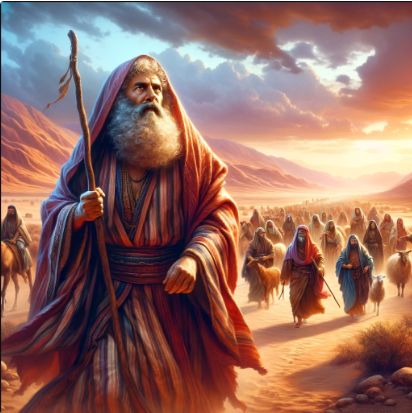
Image Credit: Artistic representation of Abraham on his journey to Canaan. The image captures Abraham leading his group through an ancient desert landscape, symbolising the significant journey towards the promised land, drawn by DALL-E, a sub-set of ChatGPT, January 2024
In summary, the call of Abraham in Genesis 12 is a pivotal event that highlights themes of faith, obedience, promise, and blessing. It sets the stage for the unfolding of the biblical narrative and the development of the Abrahamic faiths, with Abraham’s response serving as a timeless example of unwavering faith in God’s promises.
The Abraham Cycle in the Bible
There are several key events in Abraham’s life, starting with his journey alongside Sarai (who was later renamed Sarah) and his nephew Lot, form a narrative rich in challenges, faith, and pivotal moments. These events are foundational to the understanding of Abraham in Judaism, Christianity, and Islam. Exploring some of these key events:
- The Journey to Canaan: Following God’s call, Abraham, along with Sarai and Lot, leaves Haran and travels to Canaan. Upon arrival, God appears to Abraham and promises to give the land to his offspring. Abraham builds an altar there, marking his acknowledgement of God’s promise.
- Sojourn in Egypt: Faced with a severe famine in Canaan, Abraham and his family travel to Egypt for refuge. Fearful that the Egyptians will kill him to take his beautiful wife Sarai, Abraham asks her to say she is his sister. Pharaoh, taken by Sarai’s beauty, brings her into his palace but later returns her to Abraham after realising the truth, and Abraham leaves Egypt enriched by Pharaoh.
- Separation from Lot: Due to the land’s inability to support both their flocks, Abraham and Lot agree to part ways to avoid conflict. Lot chooses to settle in the fertile Jordan valley near Sodom, while Abraham remains in Canaan.
- Separation from Lot and Events with Chedorlaomer: After separating from Abraham, Lot settles near Sodom. Later, when Sodom is conquered by King Chedorlaomer and other kings, Lot is taken captive. Abraham leads a successful rescue mission to save Lot and his family. This event demonstrates Abraham’s loyalty and bravery and sets the stage for his meeting with Melchizedek.
- Rescue of Lot and Melchizedek’s Blessing: When Lot is captured during a battle involving the kings of the region, Abraham leads a rescue mission to save him. Following this, he is blessed by Melchizedek, the king of Salem and priest of God Most High. This event is significant in both Jewish and Christian traditions, with Melchizedek seen as a figure of priestly righteousness and peace.
- Covenant of the Pieces: In a vision, God makes a covenant with Abraham, promising him numerous descendants and the land for his people. In a ceremony involving the splitting of animals (Genesis 15), God reaffirms His promise, signifying a deep, unbreakable commitment. This event is theologically significant as it represents God’s unwavering promise to Abraham and his descendants.
- Birth of Ishmael: Due to Sarah’s barrenness, she offers her Egyptian maidservant, Hagar, to Abraham to bear a child. Hagar gives birth to Ishmael. This event leads to tension in the family, especially after the birth of Isaac, and is pivotal in Islamic tradition, where Ishmael is considered an ancestor of Muhammad.
- Covenant of Circumcision: God establishes a covenant with Abraham, signifying it with circumcision. This covenant includes the promise of numerous descendants and the gift of the land of Canaan. At this time, Abram’s name is changed to Abraham and Sarai’s to Sarah, signifying their roles in the covenant.
- Visitation of the Three Angels and Announcement of Isaac’s Birth: Abraham receives three visitors, traditionally interpreted as angels, who announce that Sarah will bear a son, Isaac. This event reinforces the theme of divine promise and miracle, as Sarah is beyond the usual age of childbearing.
- Promise and Birth of Isaac: God reiterates His promise of a son to Abraham and Sarah in their old age. Despite their initial disbelief, Sarah gives birth to Isaac, underscoring the theme of faith and the fulfilment of God’s promises.
- Complex Relationship with King Abimelech: Abraham has a complicated interaction with Abimelech, king of Gerar[5]. Similar to his earlier deception in Egypt, Abraham presents Sarah as his sister, leading Abimelech to take her. God intervenes in a dream, preventing Abimelech from sinning. This narrative highlights the ongoing challenges and moral dilemmas Abraham faces.
- Near Sacrifice of Isaac (The Binding of Isaac): In a profound test of faith, God commands Abraham to sacrifice Isaac. Abraham’s willingness to obey, halted only by divine intervention at the last moment, is a central theme in all Abrahamic faiths, symbolising ultimate faith and obedience to God.
- The Binding of Isaac: Known as the Akedah in Judaism, this event involves God commanding Abraham to sacrifice his son Isaac as a test of faith. Abraham’s willingness to comply, halted by God at the last moment, is interpreted variously across religions: in Judaism, as a test of faith and commitment; in Christianity, as a foreshadowing of Christ’s sacrifice; and in Islam, with Ishmael in Isaac’s place, as a demonstration of complete submission to God’s will.
- Abraham’s Later Years and Legacy Through Isaac and Ishmael: After Sarah’s death, Abraham marries Keturah and has more children, but Isaac remains his primary heir. Abraham’s legacy is continued through both Isaac and Ishmael. Isaac becomes the father of Jacob and Esau, continuing the Jewish lineage. Ishmael is traditionally considered the ancestor of the Arab peoples. Abraham’s faith and the covenant with God became central to the narrative of the Jewish people and significantly influenced Christian and Islamic traditions.
Each of these events in Abraham’s life is loaded with theological significance and varying interpretations across the Abrahamic faiths. They not only chronicle his journey of faith but also lay the foundational narratives for major world religions. They are imbued with deep theological significance, representing themes of faith, obedience, divine testing, and fulfilment of promises. They have shaped the religious perspectives of Judaism, Christianity, and Islam and continue to be a source of inspiration and instruction for believers.
Historicity and Narrative Development

Image Credit: An artistic rendition of the encounter between Abraham (standing and looking concerned) and King Abimelech (seated on the throne) and includes Sarah in the background.drawn by DALL-E, a sub-set of ChatGPT, January 2024
Evidence and Archaeology concerning Abraham’s existence
The discussion of archaeological findings and historical debates regarding Abraham’s existence is a complex and multifaceted topic, intertwining archaeology, history, and religious studies. Here’s an overview:
- Archaeological Evidence: There is no direct archaeological evidence that conclusively proves the existence of Abraham as a historical figure. The primary challenge is the lack of contemporary written records or artefacts that can be directly linked to Abraham or the specific events of his life. This is partly due to the ancient time period in which he is believed to have lived (around the second millennium BC), a time from which few detailed historical records survive.
- Historical Context: Archaeological findings have provided a rich context for understanding the world in which Abraham would have lived. Discoveries from ancient Mesopotamia and the Levant have shed light on the culture, religion, and social structures of the time. These findings, including city ruins, artefacts, and ancient texts, help historians and archaeologists to build a picture of the era’s life, although they cannot confirm specific biblical narratives.
- Historical Debates: Scholars are divided on the question of Abraham’s historicity. Some view the biblical narratives as largely symbolic or theological texts rather than historical accounts. Others argue that while the specific events of Abraham’s life as described in the Bible might not be historically verifiable, the character of Abraham could be based on the amalgamation of stories about different tribal leaders or figures from that era.
- Textual Analysis: Some historians and archaeologists turn to the Bible itself as a historical document, analysing it alongside other ancient texts. While the Bible contains historical information, its primary purpose is theological. As such, it presents challenges for historians trying to extract historical facts, as the narratives are interwoven with religious and moral teachings.
- Interpretations and Conclusions: The absence of direct archaeological evidence of Abraham does not necessarily disprove his existence. Rather, it highlights the challenges of verifying historical details from such an ancient time. The question of Abraham’s existence may be less about archaeological evidence and more about faith and interpretation of religious texts.
- Influence of Archaeology on Religious Understanding: Archaeological findings have sometimes reshaped our understanding of the biblical world, leading to new interpretations of the texts. This has had an impact on how religious communities understand their scriptures and the historical contexts in which these stories are set.
The question of Abraham’s historicity remains a topic of debate among scholars. While archaeological evidence provides context for the time and place in which Abraham is said to have lived, it does not offer direct proof of his existence. The interpretation of the Abraham narrative often depends on the intersection of faith, historical analysis, and archaeological discoveries.
Narrative Origins
The development of the Abraham narrative in the biblical text is a subject of considerable scholarly interest and debate. Various hypotheses have been proposed regarding its origins, reflecting different perspectives on how these stories came to be and what they might represent. Among these is the “Palestine Origin Hypothesis.” Here’s an overview of the main theories:
- Palestine Origin Hypothesis: This hypothesis suggests that the Abraham narratives originated in Palestine. Proponents argue that these stories reflect the geographical, cultural, and social context of early Israel and were developed as the Israelite identity formed. This view posits that the stories of Abraham were part of the early oral traditions of the Israelites, which were later written down as part of the broader effort to record and codify the religious and historical traditions of the Jewish people.
- Mesopotamian Influence: Another perspective is that the Abraham narrative was influenced by Mesopotamian culture and stories, reflecting Abraham’s origin in Ur of the Chaldees (in Mesopotamia). This theory suggests that elements of the narrative, such as the journey from Ur to Canaan, were influenced by Mesopotamian myths and legends, which were then adapted into the Hebrew context.
- Etiological Purpose: Some scholars view the Abraham story as etiological, meaning it was written to explain certain practices, beliefs, or phenomena. For instance, the binding of Isaac (Akedah) has been interpreted as a story to explain the shift from human to animal sacrifice or to establish the lineage and divine promises to the Jewish people.
- Documentary Hypothesis: This well-known hypothesis proposes that the Pentateuch (the first five books of the Bible, including Genesis) was derived from multiple sources, each with its unique perspective and historical context. The Abraham narrative, according to this theory, may have been a composite of these various traditions and sources, edited and compiled over time.
- Historical-Critical Perspective: From this viewpoint, the Abraham narrative is seen through the lens of historical and critical analysis, examining the text’s literary and historical context. This approach might consider the narrative’s origins in the context of the history of the Jewish people, looking at how it might have served to unify and provide a shared history and identity.
- Theological Development: Some theologians and scholars argue that the Abraham narrative evolved as a theological construct, reflecting the evolving understanding of God and the relationship between God and humanity in Jewish religious thought.
- Comparative Mythology: This approach compares the Abraham story with myths and legends from other cultures to understand its origins and development. It looks for common themes, motifs, and story structures that might indicate a shared cultural heritage or mutual influence.
Each of these hypotheses offers a different lens through which to view the Abraham narrative, reflecting the richness and complexity of biblical scholarship. It’s important to note that these theories are not mutually exclusive and can overlap, offering a multifaceted understanding of how these ancient and influential stories came to be.
Abraham’s Legacy in Religious Traditions
Abraham’s legacy in various religious traditions is vast and multifaceted, with each tradition offering a unique perspective on his role and significance:
Judaism: Abraham as the Patriarch
- Founding Figure: In Judaism, Abraham is revered as the founding patriarch of the Israelites, a key figure in the covenant with God. He represents the beginning of the Jewish people’s relationship with God.
- Symbol of Faith and Obedience: Abraham’s willingness to leave his homeland and travel to an unknown land on God’s command and his readiness to sacrifice Isaac, are seen as ultimate acts of faith and obedience.
- Jewish Identity and Continuity: Abraham’s covenant with God, involving the promise of land and numerous descendants, is central to Jewish identity. His story is integral to understanding Jewish history and spirituality.
Christianity: Abraham’s Faith as a Model for Believers
- Exemplar of Faith: In Christianity, Abraham is celebrated as a model of unwavering faith. His trust in God’s promises, even when they seemed impossible, is seen as an example for Christians to emulate.
- Pauline Theology: The Apostle Paul uses Abraham’s story, especially his faith being credited as righteousness, as a foundation for Christian teachings on justification by faith, not by works.
- Spiritual Ancestry: Abraham is revered not just as a historical figure but also as a spiritual ancestor. His faithfulness makes him a father figure in the faith of Christians.
Islam: Abraham (Ibrahim) as a Prophet and a Model of Submission to God
- Prophet and Messenger: In Islam, Ibrahim (Abraham) is recognised as a prophet and a messenger of God. He is one of the most important prophets in Islam, second only to Muhammad.
- Model of Tawhid (Monotheism): Ibrahim is celebrated for his staunch monotheism, rejecting idolatry prevalent in his society and his commitment to Allah.
- Eid al-Adha and Hajj: Ibrahim’s willingness to sacrifice his son (believed to be Ishmael in Islamic tradition) is commemorated during Eid al-Adha. The Kaaba in Mecca, which he is credited with building along with Ishmael, is a central focus of the Islamic pilgrimage, Hajj.
Druze and Mandaeism: Unique Perspectives on Abraham’s Role and Significance
- Druze: In the Druze faith, Abraham is respected as a major prophet. The Druze view incorporates elements of Abraham’s story from Islamic and Judeo-Christian traditions but is interpreted through their unique theological lens.
- Mandaeism: In Mandaeism, Abraham’s role is more complex. Mandaeans generally view biblical figures in a different light compared to other Abrahamic faiths, often reversing their roles. Abraham, therefore, might not be seen in the same venerable position as in Judaism, Christianity, or Islam.
Abraham’s legacy, spanning across various religious traditions, illustrates the profound impact of his narrative. Each tradition not only venerates him in its unique way but also draws from his story core aspects of its faith and practice. His story, thus, serves as a bridge between these faiths, highlighting common roots while also underscoring the diversity of religious thought and practice.
It is important to note that in various religious traditions, there are figures besides Abraham who claimed to have made pacts or covenants with God. These pacts are often foundational to the beliefs and practices of these faiths. Here are a few examples:
- Noah: In the Abrahamic traditions, God made a covenant with Noah after the great flood, promising never to destroy the earth with a flood again. The rainbow is considered a sign of this covenant.
- Moses: In Judaism, Moses is a central figure who made a covenant with God on behalf of the Israelites. This is known as the Mosaic Covenant, where the Israelites received the Ten Commandments and other laws at Mount Sinai.
- David: The Davidic Covenant in the Hebrew Bible is a promise from God to David, ensuring a royal lineage from his descendants and an eternal kingdom, ultimately fulfilled in Christian theology with the coming of Jesus Christ.
- Jesus Christ: In Christianity, Jesus is believed to have established a New Covenant through his death and resurrection, superseding the Old Covenant and offering salvation to all humanity.
- Muhammad: In Islam, the Prophet Muhammad is seen as the last and final prophet, through whom God transmitted the Quran and established a covenant with the Muslim community.
These covenants play crucial roles in the respective religions, shaping their beliefs, practices, and understanding of the relationship between God and humanity.
Cultural Impact
Abraham’s portrayal in art, spanning across painting and sculpture, reflects the significant impact of his narrative on various cultures and artistic traditions. Here’s an overview of how Abraham has been depicted in art:
Early Christian and Byzantine Art
- Iconography: Early Christian and Byzantine art often depicted Abraham in mosaics and frescoes, particularly scenes like the Hospitality of Abraham (showing Abraham hosting three angels) and the Sacrifice of Isaac.
- Symbolic Representation: These artworks were rich in symbolism, with Abraham often representing faith and obedience.
Medieval and Gothic Art
- Manuscript Illumination: In medieval Europe, Abraham’s stories were frequently illustrated in illuminated manuscripts. These depictions focused on his role as a patriarch and prophet.
- Gothic Sculptures: Gothic cathedrals often featured sculptures of biblical figures, including Abraham, typically emphasising his role in salvation history.
Renaissance Art
- Dramatic Interpretations: Renaissance artists, with their focus on humanism and realism, brought dramatic interpretations to scenes from Abraham’s life. Notable works include the “Sacrifice of Isaac” by Caravaggio and “The Sacrifice of Isaac” by Rembrandt.
- Focus on Emotion and Humanity: These works often highlighted the emotional aspects of Abraham’s story, particularly the conflict and resolution in the sacrifice narrative.
Baroque Art
- Theatricality and Drama: Baroque artists, with their penchant for drama and grandeur, depicted Abraham in a more theatrical style. The use of light, shadow, and dynamic poses characterised these depictions.
- Example: Caravaggio’s “Sacrifice of Isaac” is a quintessential Baroque piece, emphasising the dramatic moment of the sacrifice.
Modern and Contemporary Art
- Diverse Interpretations: Modern and contemporary artists have approached Abraham’s story from various perspectives, often abstract or symbolic.
- Exploring Themes: These works might explore themes of faith, sacrifice, and obedience in a more abstract or conceptual manner, reflecting modern sensibilities and philosophical inquiries.
Islamic Art
- Calligraphic and Abstract Representations: Due to Islam’s aniconism (the avoidance of images of sentient beings), Abraham is rarely depicted figuratively in Islamic art. Instead, his story might be represented through calligraphy or abstract forms.
- Architectural Elements: Islamic architecture, particularly in places related to Abraham, like the Kaaba in Mecca, often incorporates inscriptions and designs that reference his story and significance.
Jewish Art
- Narrative Scenes: In Jewish art, particularly in more modern times, Abraham’s story is depicted in various narrative scenes, such as the binding of Isaac, his conversation with God, and his journey to Canaan.
- Synagogue Decorations: Some synagogues feature artistic depictions of Abraham, often focusing on key moments of his biblical narrative.
Throughout art history, Abraham’s portrayal has evolved, reflecting the artistic styles and cultural contexts of the periods. From early iconography to modern abstract interpretations, these depictions of Abraham have served to express and explore profound themes of faith, obedience, and divine interaction. The diversity in artistic representation of Abraham is a testament to his enduring significance in cultural and religious history.
Abraham in Literature and Music
Abraham’s influence on literature and music is substantial, spanning centuries and encompassing a wide range of genres and styles. His story has inspired poets, playwrights, novelists, and composers, often serving as a rich source of exploration for themes of faith, sacrifice, and divine-human relationships. Here’s an overview:
Literature
- Classical and Medieval Literature: Abraham appears in various classical and medieval texts. Dante Alighieri, in his “Divine Comedy,” places Abraham in Paradise, highlighting his significance in Christian theology. In medieval Islamic literature, stories of Ibrahim (Abraham) are common, emphasising his role as a prophet and a model of faith.
- Shakespeare and Early Modern Literature: William Shakespeare references Abraham in his plays, using him as a symbol of faith and righteousness. In other early modern literary works, Abraham’s narrative is often explored for its moral and ethical implications.
- 19th and 20th Century Literature: Abraham’s story has been a subject in the works of many poets and novelists. For instance, Søren Kierkegaard’s philosophical work “Fear and Trembling” deeply explores the story of Abraham and Isaac, focusing on the themes of faith and ethics.
- Contemporary Literature: Modern authors have reinterpreted Abraham’s story in various contexts, sometimes using it as an allegory for contemporary issues. His narrative continues to inspire novels, poems and plays that explore religious, ethical, and existential themes.
Music
- Classical and Baroque Music: Abraham’s story has been set to music by several classical composers. Notable examples include Handel’s oratorio “Abraham and Isaac” and Stravinsky’s opera “Abraham and Isaac,” both of which focus on the sacrifice narrative.
- Romantic Music: In the Romantic era, composers used Abraham’s story to convey deep emotions and spiritual quests. Mendelssohn’s “Elijah” contains references to Abraham and his faith journey.
In modern times, Abraham’s influence extends to genres like opera, gospel, and even popular music. His story is used symbolically to discuss themes of faith, commitment, and divine will:
- Spirituals and Hymns: Abraham figures prominently in Christian hymns and spirituals, often symbolizing the journey to the promised land or the faith required to follow God’s command. These songs are a staple in religious and cultural traditions, particularly in the context of worship and spiritual reflection.
- World Music and Folk Traditions: Across various cultures, Abraham’s story has influenced folk songs and traditional music, reflecting his universal appeal and the diverse ways in which his story resonates across different cultures and beliefs.
In both literature and music, Abraham’s story offers a rich tapestry of themes and motifs for artists and composers to explore. His narrative, transcending time and culture, speaks to fundamental human experiences of faith, doubt, obedience, and the quest for understanding the divine. This universal appeal ensures his continued presence and relevance in the worlds of literature and music.
Abraham’s Ethical and Moral Legacy
Abraham’s ethical and moral legacy, as interpreted through various texts, provides a rich ground for analysis, debate, and reflection. His life choices, as recorded in religious scriptures and examined in philosophical and theological works, raise significant ethical and moral questions. Here’s an overview:
Faith and Obedience vs. Ethical Dilemmas
- Sacrifice of Isaac (Akedah): Perhaps the most intensely debated ethical aspect of Abraham’s life is his willingness to sacrifice Isaac in obedience to God’s command. This story, found in Genesis 22, is interpreted in various ways.
- Judaism: Often seen as the ultimate test of faith and obedience. The Jewish tradition generally views it as a demonstration of Abraham’s unwavering faith in God.
- Christianity: Interpreted as a foreshadowing of God’s sacrifice of Jesus Christ. The moral of absolute faith and trust in God’s plan is emphasised.
- Islam: In Islamic tradition, the story (involving Ishmael instead of Isaac in many interpretations) is seen as a model of submission to the will of Allah, celebrated during Eid al-Adha.
- Philosophical Perspectives: Philosophers like Søren Kierkegaard, in “Fear and Trembling,” explore the tension between religious obedience and moral duty. Kierkegaard discusses the concept of a “teleological suspension of the ethical,” suggesting that Abraham’s act transcends conventional ethics due to his relationship with God.
Truthfulness and Deception
- Sarah as Sister: Abraham twice claims that his wife Sarah is his sister to protect himself, once in Egypt and once with Abimelech. This raises ethical questions about lying and deception, even in the face of danger.
- Ethical Analysis: These incidents are sometimes seen as moral failings or pragmatic choices in a complex and threatening world. They offer a basis for discussions on situational ethics and the conflict between personal safety and truthfulness.
Treatment of Hagar and Ishmael
- Expulsion of Hagar: Abraham’s decision to expel Hagar and Ishmael, at Sarah’s insistence, raises questions about justice, responsibility, and the treatment of the vulnerable.
- Moral Interpretations: This act has been viewed through various lenses, from a necessary action to preserve Isaac’s lineage to an example of moral weakness or societal norms of the time.

Image Credit: Banishment of Hagar and Ishmael by Guercino, Public domain, via Wikimedia Commons.
Page URL: https://commons.wikimedia.org/wiki/File:Guercino_Abramo_ripudia_Agar.jpg
Hospitality and Righteousness
- Hospitality to Angels: The episode of Abraham’s hospitality to the three visitors (angels) is often cited as a model of righteous behaviour and the duty of hospitality to strangers.
- Moral Lessons: This story is used to highlight virtues such as generosity, hospitality, and the importance of doing good without expectation of reward.
Negotiation with God for Sodom
- Intercession for Sodom: Abraham’s negotiation with God to spare Sodom if righteous people are found there is seen as an act of compassion and justice.
- Ethical Reflection: This incident is often discussed in the context of theodicy, justice, and the role of human agency in divine decisions.
Abraham’s life, as narrated in various religious and philosophical texts, presents a complex picture of ethical and moral decisions. His actions and choices have been interpreted in multiple ways, reflecting changing moral perspectives over time. His legacy, therefore, offers a profound opportunity for ethical reflection and discussion, highlighting the enduring relevance of these ancient narratives in contemporary moral discourse.
The Abraham Accords
The Abraham Accords are a series of agreements that were signed in 2020 between Israel and several Arab countries. These accords marked a significant shift in the diplomatic landscape of the Middle East, representing the first such normalisation of relations in over a quarter-century. The name “Abraham Accords” symbolically refers to the shared patriarch Abraham in the Jewish, Christian, and Islamic faiths, highlighting the common heritage and a spirit of cooperation among these religions.
Key Points about the Abraham Accords:
- Participants: The primary countries involved in the Abraham Accords are Israel, the United Arab Emirates (UAE), Bahrain, Sudan, and Morocco. The United States played a significant role in brokering these agreements under the administration of President Donald Trump.
- Normalisation of Relations: The core of the accords is the normalisation of diplomatic relations between Israel and the participating Arab nations. This includes the establishment of embassies, initiation of direct flights, and cooperation in various sectors like trade, technology, health, and security.
- The United Arab Emirates and Bahrain: The UAE and Bahrain were the first to sign the accords with Israel in a ceremony held at the White House in September 2020. These agreements were historic as they represented a shift in Arab-Israeli relations, with countries recognising and establishing formal ties with Israel.
- Sudan and Morocco: Following the UAE and Bahrain, Sudan and then Morocco also agreed to normalise relations with Israel. These agreements included various bilateral deals and, in Morocco’s case, also involved US recognition of Moroccan sovereignty over the disputed Western Sahara region.
- Impact on the Israeli-Palestinian Conflict: The accords did not directly address the Israeli-Palestinian conflict, although they were seen as a potential step toward a more comprehensive peace in the region. The Palestinian Authority initially criticised the accords, viewing them as a betrayal of the Arab Peace Initiative’s stance that Arab states should normalise relations with Israel only after a resolution of the Palestinian issue.
- Economic and Strategic Significance: The agreements opened up significant economic opportunities between Israel and the Arab nations, particularly in technology, tourism, and trade. They also have strategic implications, as the countries involved share concerns about Iran’s influence in the region.
- Future Expansion: There has been speculation and hope that other Arab or Muslim-majority countries might join the Abraham Accords, further changing the dynamics of Middle Eastern diplomacy.
The accords were named the “Abraham Accords” to symbolise the shared ancestral and spiritual heritage of Judaism, Christianity, and Islam in the figure of Abraham. Abraham is a central patriarch in all three of these Abrahamic religions. In Judaism, Abraham is the founding father of the Covenant, the special relationship between the Jewish people and God. In Christianity, he is the prototype of all believers, Jewish or Gentile. In Islam, Ibrahim (Abraham) is recognised as a prophet and messenger of God and an ancestor of Muhammad.
By invoking the name of Abraham, the accords aim to underscore the common ground and shared history among these faiths. The name is intended to reflect a spirit of interfaith harmony and mutual respect, illustrating the potential for peaceful coexistence and cooperation among the diverse nations and religions of the Middle East. The Abraham Accords are considered a landmark in the history of Arab-Israeli relations, potentially paving the way for a new era of cooperation and diplomatic engagement in the Middle East.
The Abraham Accords, signed in 2020, are a significant set of agreements in the context of Middle Eastern diplomacy and are unique in their scope and the specific countries involved. There have been other significant peace treaties and accords in the region’s history, but none quite like the Abraham Accords.
Prior to the Abraham Accords, key agreements in the region included the Camp David Accords between Egypt and Israel in 1979 and the peace treaty between Jordan and Israel in 1994. These were landmark agreements that established peace between Israel and individual Arab nations. However, the Abraham Accords were different as they involved multiple Arab nations—namely the United Arab Emirates, Bahrain, Sudan, and Morocco—normalising relations with Israel within a short period.
One of the distinctive features of the Abraham Accords is their multilateral nature, involving several Arab countries and Israel, with the United States playing a central role in brokering the agreements. This approach represents a significant shift in the diplomatic landscape of the Middle East, emphasising normalisation of relations and cooperation across a range of sectors.
In the context of Middle Eastern peace processes and accords, the Abraham Accords stand out due to their broader scope, involving multiple Arab nations and Israel, and their focus on normalisation and cooperation rather than solely on resolving specific conflicts. This sets them apart from earlier peace agreements in the region, which were primarily bilateral and often centred around conflict resolution, such as the peace treaties between Israel and Egypt, and Israel and Jordan. Whilst there have been other important accords and treaties in the Middle East, the Abraham Accords are unique in their format and the breadth of their diplomatic impact.
Lesser Known Facts
Abraham is well-known for his role as a patriarch and a key figure in Judaism, Christianity, and Islam, but there are lesser-known aspects of his story and its impact. Some have already been mentioned, but a summary is as follows:
- Abraham and Astronomy: Jewish tradition in the Midrash suggests that Abraham was knowledgeable in astronomy, having studied the stars. This ties into the narrative that Abraham rejected the idolatrous practices of his father and his society after contemplating the natural world.
- Abraham in Art and Culture: Throughout history, Abraham’s story has inspired countless works of art, literature, and music across various cultures, each offering unique interpretations and reflections on his life and faith. Example: One of the most famous depictions of Abraham in art is Caravaggio’s painting “The Sacrifice of Isaac,” which powerfully captures the emotional intensity of the moment before Abraham is stopped from sacrificing Isaac.
- Abraham in Education: The story of Abraham is used in religious and moral education across various cultures, teaching themes of faith, covenant, and moral integrity. Example: In Christian Sunday schools, the story of Abraham’s faith is often taught to children as an example of trust and obedience to God, especially through the story of God’s promise to Abraham about numerous descendants.
- Abraham in Interfaith Dialogue: Abraham serves as a common figure in interfaith dialogue, providing a shared narrative for discussions between Jewish, Christian, Muslim, and Baha’i communities.
- Abraham in Islamic Tradition: In Islam, Abraham (Ibrahim) is recognised as a prophet and a messenger of Allah. He is also credited with having rebuilt the Kaaba in Mecca with his son Ishmael.
- Abraham’s Advocacy for Sodom: In Genesis 18, Abraham pleads with God to spare the city of Sodom if righteous people can be found there. This episode showcases Abraham’s sense of justice and his willingness to challenge God, marking a significant moment of moral and theological dialogue in the Bible.
- Abraham’s Father, Terah: In the Bible, Abraham’s father, Terah, was an idol maker, according to Jewish tradition. This background sets a stark contrast between Abraham’s monotheistic beliefs and his father’s occupation, highlighting the revolutionary nature of Abraham’s faith.
- Abraham’s Influence on Law and Ethics: Abraham’s life and decisions have been subjects of discussion in the context of legal and ethical studies, particularly in religious law where his actions are often analyzed for moral and ethical guidance. Example: In Jewish ethics, Abraham’s argument with God over the fate of Sodom and Gomorrah (Genesis 18:23-32) is often cited as an example of the importance of justice and mercy in legal and ethical discussions.
- Abraham’s Journey: His journey from Ur to Canaan was a significant distance, covering approximately 1,000 miles, a monumental undertaking in the ancient world.
- Abraham’s Well: In Beersheba, Israel, there’s a well traditionally considered to be the one Abraham dug and over which he swore an oath with Abimelech, hence the name Beersheba (“Well of the Oath” or “Seven Wells”).
- Archaeological Debates and Evidence: The historicity of Abraham and the patriarchal narratives continue to be subjects of debate among archaeologists and historians, with discussions focusing on what can be known about the historical reality behind these stories. There is little direct archaeological evidence for Abraham’s existence, as his life predates historical records. The stories of Abraham are thus often seen as a blend of history, myth, and religious belief. Example: The historicity of Abraham is debated among archaeologists, particularly in relation to the evidence (or lack thereof) for large migratory movements of people as described in the Abraham story during the Bronze Age.
- Archetypal Faith Figure: In broader religious and philosophical discussions, Abraham is often used as an archetype of faith, especially in existentialist philosophy, which explores themes of faith, choice, and obedience in the context of a seemingly indifferent universe.
- Comparative Religious Studies: Scholars in comparative religion examine how Abraham is portrayed differently in Jewish, Christian, Islamic, and Baha’i scriptures, and what these variations tell us about each religion’s beliefs and practices. Example: In Islam, Abraham (Ibrahim) is considered a prophet and a model of submission to God, and his story is notably different in the Quran where it’s Ishmael, not Isaac, who is nearly sacrificed.
- Covenant of the Pieces: In a lesser-known episode called the “Covenant of the Pieces” in Genesis 15, God makes a covenant with Abraham in a dramatic and mystical ceremony involving the splitting of animals and a divine presence passing between them. This event is significant in Jewish thought and is considered a foundational moment in the establishment of the relationship between God and the Jewish people.
- Genetic Studies: Some genetic studies have attempted to trace the lineage of populations back to figures like Abraham, though such studies are often speculative and symbolic rather than definitive. Example: The “Cohen Modal Haplotype” study aimed to trace the priestly lineage (Cohanim) in Jewish populations back to a common ancestor, traditionally believed to be Aaron, the brother of Moses, and ultimately linked to Abraham.
- Influence in the Baha’i Faith: In the Baha’i Faith, Abraham is considered one of the many prophets or “Manifestations of God,” a series of messengers who have appeared throughout history to found different religious systems.
- Influence on Islamic Practices: Abraham’s legacy in Islam is profound. His willingness to sacrifice his son (Ishmael, in Islamic tradition) is commemorated during the Islamic festival of Eid al-Adha. Moreover, his rebuilding of the Kaaba in Mecca with Ishmael is a cornerstone of Islamic history.
- Interfaith Symbol: Abraham is often used as a symbol of interfaith dialogue and unity. His story is seen as a unifying narrative in discussions among Jews, Christians, and Muslims. Example: The “Abraham Path Initiative”[6] is an interfaith project that seeks to build bridges between cultures and faiths by retracing the journey of Abraham across the Middle East.
- Ishmael and Isaac: In Islamic tradition, it is Ishmael (not Isaac, as in the Jewish and Christian traditions) who is nearly sacrificed by Abraham. This event is commemorated annually during Eid al-Adha.
- Jewish Mysticism: In Kabbalistic tradition, Abraham is associated with the sefirah (attribute) of Chesed, which represents kindness, love, and generosity. This aspect is seen as a fundamental part of his character.
- Journeys Beyond Canaan: While Abraham is primarily known for his journey to and life in Canaan, he also travelled to Egypt to escape a famine. This journey is significant as it introduces a recurring theme in the Bible, where Abraham’s descendants, the Israelites, later go to Egypt and eventually escape slavery there.
- Kabbalistic Interpretations: In Jewish mysticism (Kabbalah), Abraham is associated with the attribute (sefirah) of Chesed, which represents kindness, love, and generosity.
- Midrashic Stories: Jewish Midrash (rabbinic literature that explores the deeper meanings in the Torah) contains various stories about Abraham’s early life. One famous story describes a young Abraham smashing his father’s idols and suggesting that the idols destroyed each other, as a way to demonstrate their powerlessness and the folly of idol worship.
- Name Change: In the Hebrew Bible, Abraham was originally named Abram, which means ‘exalted father.’ His name was changed to Abraham, meaning ‘father of multitudes,’ by God to reflect the promise that he would be the ancestor of many nations.
- Possible Historical Context: Some scholars suggest that Abraham could have lived around 2000 BC, during a time of significant cultural and social change in Mesopotamia. This was a period marked by the transition from city-states to empires and the emergence of new religious ideas.
- Psychological and Philosophical Interpretations: Abraham’s story, particularly the binding of Isaac, has been the subject of psychological and existential analysis, exploring themes of faith, sacrifice, and obedience. Example: Søren Kierkegaard’s philosophical work “Fear and Trembling”[7] explores the story of Abraham and Isaac to discuss the nature of faith and the concept of a “leap of faith.”
- Sarah’s Name Change: Similarly, Abraham’s wife was originally named Sarai, which was changed to Sarah (meaning ‘princess’) by God, signifying her role as the mother of nations and kings.
- Sarah’s Relationship to Abraham: Sarah, Abraham’s wife, was also his half-sister. According to the biblical account, they shared the same father but different mothers.
- Symbol of Hospitality: Abraham is often cited as a model of hospitality in religious traditions, especially in the episode of welcoming three angels who appeared as men.
- The Binding of Isaac: Known as the Akedah in Judaism and as the sacrifice in Islam, this story is known for its dramatic tension and moral complexity. However, an interesting point is that in Islamic tradition, the son involved in this story is often thought to be Ishmael, not Isaac.
- The Scrolls of Abraham: (Arabic: صحف إبراهيم, Ṣuḥuf ʾIbrāhīm) are a part of the religious scriptures of Islam. These scriptures are believed to have contained the revelations of Abraham received from the God of Abrahamic religions, which were written down by him as well as his scribes and followers.[8]
- The Tombs of Abraham: According to tradition, Abraham is buried in the Cave of the Patriarchs (Machpelah Cave) in Hebron, along with Sarah, Isaac, Rebecca, Jacob, and Leah. This site is revered in Judaism, Christianity, and Islam.
- Ur of the Chaldeans: Abraham’s birthplace is traditionally identified as “Ur of the Chaldeans.” Ur was an important Sumerian city-state in ancient Mesopotamia, suggesting that Abraham’s background was steeped in the Mesopotamian culture.
These aspects of Abraham’s life and legacy enrich our understanding of his role in religious traditions and how he has been perceived and interpreted over time. The depth of Abraham’s story allows for endless exploration and discovery, with new perspectives and interpretations continually emerging in religious studies, academic research, and cultural expressions. These aspects provide a more nuanced understanding of Abraham’s role and significance in religious traditions and cultural narratives. Each of these examples illustrates how the story and character of Abraham permeate various facets of culture, religion, and academic discourse, making him a figure of enduring significance and relevance.
Review and Clarification
Ethical Implications of Abraham’s Actions
- Treatment of Hagar and Ishmael: Abraham’s decision to expel Hagar and Ishmael, at the behest of Sarah, presents a complex ethical dilemma. This act, while seemingly harsh, reflects the societal norms and family dynamics of the time. Ethically, it raises questions about the treatment of the vulnerable and the moral responsibilities within family structures. Some interpretations view this as a necessary step to preserve the lineage through Isaac, highlighting the challenging nature of decisions that can have far-reaching consequences. This episode invites readers to explore the tension between cultural norms, personal ethics, and divine mandates in ancient contexts.
- Deception About Sarah’s Identity: Abraham’s representation of Sarah as his sister, a strategy employed for self-preservation in foreign lands, underscores the moral ambiguity inherent in some of his decisions. This act of deception, while providing immediate safety, raises ethical questions about truthfulness and the protection of loved ones. It reflects the complexities faced by individuals in precarious situations where moral choices are not clear-cut. This narrative element encourages a deeper exploration of the themes of trust, fear, and ethical decision-making in times of crisis.
Clarifying Archaeological Evidence
- Understanding the distinction between the lack of direct archaeological evidence for Abraham and the broader historical context of his era is crucial. While there is no concrete archaeological proof confirming Abraham’s individual existence, archaeological discoveries have illuminated the cultural, social, and religious backdrop of the time period traditionally associated with him.
These findings include insights into ancient Mesopotamian civilisation, nomadic lifestyles, and early Semitic cultures, providing a richer context for interpreting the biblical narratives. Thus, while the specific historical existence of Abraham remains a matter of faith, the general historical milieu in which his story is set has gained clarity through archaeological research.
Understanding Anthropology and Comparative Religion
- Taking perspectives from anthropology and comparative religion can provide a deeper understanding of Abraham’s story. Anthropology, with its focus on cultural practices and societal structures, can shed light on the nomadic lifestyle, family dynamics, and social norms of Abraham’s time. This helps in contextualising Abraham’s decisions and actions within the framework of ancient Near Eastern life.
- Comparative religion offers insights into how the figure of Abraham is perceived and venerated differently across Judaism, Christianity, and Islam. It allows for an exploration of shared themes and divergent interpretations, revealing the dynamic ways in which religious narratives evolve and influence diverse faith communities. This interdisciplinary approach enriches the understanding of Abraham not just as a historical or religious figure but as a symbol of interfaith connections and evolving theological concepts.
Films
There have been several cinematic and TV films that depict the story of Abraham. These films often explore his life and significance within the context of Abrahamic religions. Here are a few notable examples:
- “The Bible: In the Beginning…” (1966): Directed by John Huston, this film is an epic religious drama that covers several stories from the Book of Genesis, including the story of Abraham. The film portrays key events in Abraham’s life, such as his call by God, the promise of a son, and the near-sacrifice of Isaac.
- “Abraham” (1993): This is a television film that was part of a series of films produced by Lux Vide in Italy, depicting various biblical characters. Directed by Joseph Sargent, it stars Richard Harris as Abraham and Barbara Hershey as Sarah. The film focuses on the life of Abraham, his journey to Canaan, and his relationship with God.
- “Sarah and Abraham” (1994): This is another film that focuses specifically on the story of Abraham and Sarah. It explores their journey, the challenges they face, and their interactions with God.
- “In the Beginning” (2000): This is a television miniseries that includes a portrayal of Abraham’s story. It presents various stories from the Book of Genesis and the Book of Exodus.
- “The Story of Abraham” (2008): This film is a more recent depiction, focusing on the life and trials of Abraham, including his faith and obedience to God.

Image Credit: The Bible: In the Beginning (2023, December 19). Theatrical poster for John Huston’s The Bible… In the Beginning (1966), posted by a user on LucyWho.com.
In Wikipedia. https://en.wikipedia.org/wiki/The_Bible:_In_the_Beginning
These films vary in their approach to the biblical narrative, with some taking a more historical perspective and others focusing on the spiritual and religious elements of the story. They often provide a visual and dramatic interpretation of Abraham’s life and his role as a key figure in the Jewish, Christian, and Islamic traditions.
The portrayal of Abraham in cinema contributes to the understanding and interpretation of his character and the impact of his story in different cultural and religious contexts.
Conclusion
Abraham, a foundational figure in the Hebrew Bible, occupies a central place in the religious consciousness of billions, spanning Judaism, Christianity, and Islam. This paper has explored the multifaceted dimensions of Abraham’s life, delving into his origins, his call, the significant events of his life cycle, and the profound impact he has had on faith, culture, ethics, historical narratives, and literature. As we reflect on the various aspects of Abraham’s story and its interpretations across time and cultures, we uncover a tapestry rich in spiritual depth, ethical complexity, and cultural influence.
Abraham’s enduring impact on faith is monumental. In Judaism, he stands as the first patriarch, a symbol of faith and obedience, and a foundational figure in the establishment of the covenant with God. Christianity venerates him as an exemplar of faith, a spiritual ancestor whose trust in God is a model for believers. In Islam, as Ibrahim, He is revered as a prophet and a model of submission to Allah, with his story forming a central part of Islamic tradition and practice. The Druze and Mandaeans offer unique perspectives on Abraham, further illustrating the diverse ways in which this ancient figure is revered and understood.

Image Credit: Abraham with his son Isaac, drawn by DALL-E, a sub-set of ChatGPT, January 2024
Culturally, Abraham’s influence is vast and varied. His story has been depicted in art, from early Christian mosaics to Renaissance paintings, each era reinterpreting his narrative to reflect contemporary values and artistic styles. In literature and music, Abraham’s journey has inspired poets, novelists, and composers, who have found in his story a rich source for exploring themes of faith, sacrifice, and divine-human relationships. These cultural creations not only reflect the historical context of their creators but also contribute to the ongoing dialogue about Abraham’s significance.
From an ethical standpoint, Abraham’s story raises profound questions. The Akedah, or the binding of Isaac, is a particularly contentious narrative, challenging our understanding of faith, obedience, and morality. Abraham’s willingness to sacrifice his son, whether seen as a test of faith or a moral dilemma, continues to be a source of theological and philosophical debate. This story, along with other aspects of Abraham’s life, such as his treatment of Hagar and Ishmael and his interactions with Abimelech, offers fertile ground for discussions on ethics, justice, and human behaviour in the face of divine command.
The historical and narrative development of Abraham’s story is equally fascinating. The lack of direct archaeological evidence for Abraham’s existence and the debate over the historicity of the biblical narratives reflect the complex interplay between faith, history, and archaeology.
The various hypotheses about the origins and development of the Abraham narrative, from the Palestine Origin Hypothesis to the Documentary Hypothesis, illustrate how religious narratives are shaped by cultural, historical, and theological contexts. These discussions are not merely academic; they speak to the heart of how religious traditions evolve and how historical narratives are constructed and understood.
The universal themes in Abraham’s story – faith in the face of uncertainty, obedience to a higher call, ethical dilemmas, and the search for a covenantal relationship with the divine – continue to resonate today. In a world where moral ambiguity, spiritual searching, and religious diversity are more pronounced than ever, Abraham’s story offers valuable insights. It serves as a reminder of the enduring human quest to find meaning, purpose, and connection with something greater than ourselves. The way Abraham’s story has been reinterpreted over time also reveals much about our changing understanding of faith, divine engagement, and the human condition.
In conclusion, the narrative of Abraham, rich in spiritual, ethical, and cultural dimensions, remains a cornerstone in the understanding of monotheistic faiths and has profoundly influenced cultural and ethical thought. His story, evolving through centuries of interpretation, continues to hold a mirror to our own struggles, aspirations, and quests for understanding. As a figure of faith, obedience, and moral complexity, Abraham stands as a timeless example of the human journey towards understanding and relating to the divine. His legacy, therefore, is not only of historical or religious significance but also deeply relevant to ongoing conversations about the complexities of faith, the nuances of ethics, and the overarching human condition in our interconnected world.

Image Credit: Abraham’s Journey to Canaan according to the Book of Genesis.
Attribution: Topographic map: SémhurDerivative work: DEGA MD, CC BY-SA 4.0 <https://creativecommons.org/licenses/by-sa/4.0>, via Wikimedia Commons
Page URL: https://commons.wikimedia.org/wiki/File:Abraham%27s_Journey_(en).svg
Web Resources and Relevant Reading
Web Resources
- https://www.thegospelcoalition.org/themelios/article/a-paragon-of-faith-doubting-abraham/
- https://www.christiandivinity.com/blogs/light-of-christ-blog/a-story-of-faith-abraham
- https://en.wikipedia.org/wiki/Abraham
- Abraham’s family tree – Wikipedia: https://en.wikipedia.org/wiki/Abraham%27s_family_tree
- https://digitalcommons.liberty.edu/cgi/viewcontent.cgi?article=1017&context=will_know
- https://www.britannica.com/biography/Abraham
- https://www.thenivbible.com/blog/7-surprising-things-about-the-story-of-abraham-in-the-bible/
- https://martinpollins.com/2023/10/23/the-land-of-canaan-stolen-or-reclaimed/
Books
These books offer a wide range of perspectives on Abraham, exploring his life, his religious significance, and his impact on history and culture.
- Abraham, by Charles R. Swindoll (Author) (2014), published by Tyndale House Publishers, available from https://www.amazon.co.uk/Abraham-Charles-R-Swindoll/dp/1496401069
- Abraham and His Son: The Story of a Story, by James Goodman (2015), published by Sandstone Press, available from https://www.amazon.co.uk/Abraham-his-Son-story/dp/191012415X
- Abraham on Trial: The Social Legacy of Biblical Myth, by Carol Delaney (2000), published by Princeton University Press, available from https://www.amazon.co.uk/Abraham-Trial-Social-Legacy-Biblical/dp/0691070504
- Abraham: A Journey Through Lent, by Meg Warner (2015), published by SPCK Publishing, available from https://www.amazon.co.uk/Abraham-Journey-Through-Lent-Book/dp/0281074895
- Abraham: A Journey to the Heart of Three Faiths, by Bruce Feiler (2005), published by HarperCollins USA, available from https://www.amazon.co.uk/Abraham-Journey-Heart-Three-Faiths/dp/0060838663
- Abraham: A Sign of Hope for Jews, Christians, and Muslims, by Karl-Josef Kuschel (2015), published by SCM Press, available from https://www.amazon.co.uk/Abraham-Symbol-Hope-Christians-Muslims/dp/0334025672 https://www.amazon.co.uk/Abraham-Symbol-Hope-Christians-Muslims/dp/0334025672
- Abraham: One Nomad’s Amazing Journey of Faith, by Charles R. Swindoll (2015), published by Tyndale Momentum, available from https://www.amazon.co.uk/Abraham-Nomads-Amazing-Journey-Faith/dp/141438064X
- Abraham: The First Historical Biography, by David Rosenberg (2007), published by Basic Books, available from https://www.amazon.co.uk/Abraham-Historical-Biography-David-Rosenberg/dp/0465070957
- Abraham the Pilgrim: An Islamic Perspective, by Peter Oborne (2023), published by Simon & Schuster UK, available from https://www.amazon.co.uk/Fate-Abraham-Wrong-about-Islam/dp/1398501050/
- Abraham: The Story of a Life, by Joseph Blenkinsopp (2015), published by Eerdmans, available from https://www.amazon.co.uk/Abraham-Story-Life-Joseph-Blenkinsopp/dp/0802872875
- Abraham: The World’s First (But Certainly Not Last) Jewish Lawyer, by Alan Dershowitz (2015), published by Bravo Ltd, available from https://www.amazon.co.uk/Abraham-Worlds-Certainly-Jewish-Encounters/dp/0805242937
- Abraham’s Ashes: The Absurdity of Monotheism, by Peter Heinegg (2012), published by University Press of America, available from https://www.amazon.co.uk/Abrahams-Ashes-Monotheism-Peter-Heinegg/dp/0761859659
- Abraham’s Children: Liberty and Tolerance in an Age of Religious Conflict, edited by Kelly James Clark (2012), published by Yale University Press, available from https://www.amazon.co.uk/Abrahams-Children-Tolerance-Religious-Conflict/dp/0300179375
- Abraham’s Curse: The Roots of Violence in Judaism, Christianity, and Islam, by Bruce Chilton (2008), published by Doubleday Religion, available from https://www.amazon.co.uk/Abrahams-Curse-Child-Sacrifice-Legacies/dp/0385520271
- Abraham’s Dice: Chance and Providence in the Monotheistic Traditions, edited by Karl W. Giberson (2016), published by Oxford University Press, available from https://www.amazon.co.uk/Abrahams-Dice-Providence-Monotheistic-Traditions/dp/0190277165
- Children of Abraham: An Introduction to Islam for Jews, by Khalid Duran (Author) (2001), published by Ktav Pub & Distributors Inc, available from https://www.amazon.co.uk/Children-Abraham-Introduction-Islam-Jews/dp/0881257230
- Claiming Abraham: Reading the Bible and the Qur’an Side by Side, by Michael Lodahl (Author) (2010), published by Brazos Press, available from https://www.amazon.co.uk/Claiming-Abraham-Reading-Bible-Quran/dp/1587432390/
- Inheriting Abraham: The Legacy of the Patriarch in Judaism, Christianity, and Islam, by Jon D. Levenson (2012), published by Princeton University Press, available from https://www.amazon.co.uk/Inheriting-Abraham-Patriarch-Judaism-Christianity/dp/0691155690/
- Sons of Abraham: A Candid Conversation about the Issues That Divide and Unite Jews and Muslims, by Marc Schneier (Author), Shamsi Ali (Author) (2013), published by Beacon Press (MA), available from https://www.amazon.co.uk/Sons-Abraham-Candid-Conversation-Muslims/dp/0807033073/
- The Bible’s Cutting Room Floor: The Holy Scriptures Missing from Your Bible, by Joel M. Hoffman (2014), published by Thomas Dunne Books, available from https://www.amazon.co.uk/Bibles-Cutting-Room-Floor-Hoffman/dp/125004796X/
- The Children of Abraham: Judaism, Christianity, Islam, by F. E. Peters (2018), published by Princeton University Press, available from https://www.amazon.co.uk/Children-Abraham-Christianity-Princeton-Classics/dp/0691181039/
- The God of Abraham, Isaac, and Jacob, Kindle Edition, by Watchman Nee (1980), published by Christian Fellowship Publishers, available from https://www.amazon.co.uk/Abraham-Isaac-Jacob-Collected-Watchman-ebook/dp/B00CO7AX9K
- The Origins of Jewish Mysticism, by Peter Schafer (2009), published by Mohr Siebeck, available from https://www.amazon.co.uk/Origins-Jewish-Mysticism-Peter-Schäfer/dp/0691142157/
- The Oxford Handbook of the Abrahamic Religions (Oxford Handbooks), by Adam J. Silverstein (Editor), Guy G. Stroumsa (Editor) (2018), published by OUP Oxford, available from https://www.amazon.co.uk/Oxford-Handbook-Abrahamic-Religions-Handbooks/dp/0198783019/
- The Promise of the Land: The Inheritance of the Land of Canaan by the Israelites, by Moshe Weinfeld (1993), published by the University of California Press, Out of Print – limited availability at https://www.amazon.com/gp/product/0520075102
- The Tent of Abraham: Stories of Hope and Peace for Jews, Christians, and Muslims, by Joan Chittister, Saadi Shakur Chishti, and Rabbi Arthur Waskow (2006), published by Beacon Press, available from https://www.amazon.co.uk/Tent-Abraham-Stories-Christians-Muslims/dp/0807077291/
- The Testament of Abraham: Translated from the Greek Text with Introduction and Notes: With an Appendix Containing a Translation from the Coptic Version of the Testaments of Isaac and Jacob, by G. H. Box and S. Gaselee (2021), published by Wipf and Stock, available from https://www.amazon.co.uk/Testament-Abraham-Translated-Introduction-Translation/dp/1666734748
- The Trials of Abraham: The Making of a National Patriarch, by Martin Sicker (2004), published by iUniverse, available from https://www.amazon.co.uk/Trials-Abraham-Making-National-Patriarch/dp/0595337538
CAUTION: This paper is compiled from the sources stated but has not been externally reviewed. Parts of this paper include information provided via artificial intelligence which, although checked by the author, is not always accurate or reliable. Neither we nor any third parties provide any warranty or guarantee as to the accuracy, timeliness, performance, completeness or suitability of the information and materials covered in this paper for any particular purpose. Such information and materials may contain inaccuracies or errors and we expressly exclude liability for any such inaccuracies or errors to the fullest extent permitted by law. Your use of any information or materials on this website is entirely at your own risk, for which we shall not be liable. It shall be your own responsibility to ensure that any products, services or information available through this paper meet your specific requirements and you should neither take action nor exercise inaction without taking appropriate professional advice. The hyperlinks were current at the date of publication.
End Notes and Explanations
- Source: Compiled from research using information at the sources stated throughout the text, together with information provided by machine-generated artificial intelligence at: bing.com [chat] and https://chat.openai.com ↑
- Source: https://en.wikipedia.org/wiki/Abraham ↑
- Explanation: In Genesis 12, the figure is correctly referred to as Abram. It is later in Genesis, specifically in Genesis 17:5, that God changes his name to Abraham as part of the covenantal promise. The name change signifies Abram’s transformation into the “father of many nations.” Thus, when discussing events that occur in Genesis 12, using “Abram” is appropriate and accurate according to the biblical narrative. ↑
- Explanation:
Advanced Ages at the Time of Death
– Abraham died at the age of 175 years old. This is detailed in the Bible, specifically in the Book of Genesis, Chapter 25, Verse 7. The verse reads: “Then Abraham gave up the ghost, and died in a good old age, an old man, and full of years; and was gathered to his people.” This passage indicates that Abraham lived a long and full life before passing away.
– Sarai, later named Sarah, Abraham’s wife, died at the age of 127 years old. This information is found in the Bible in the Book of Genesis, Chapter 23, Verse 1. The verse states: “Sarah lived to be a hundred and twenty-seven years old; she died at Kiriath Arba (that is, Hebron) in the land of Canaan.” This chapter goes on to describe Abraham’s mourning for Sarah and his efforts to secure a burial place for her, which leads to the purchase of the Cave of Machpelah.
– Noah, Abraham’s ancestor, died at the age of 950 years. This is recorded in the Book of Genesis, Chapter 9, Verse 29, which states: “And all the days of Noah were nine hundred and fifty years: and he died.”
These ages reflect the narrative and symbolic context of the Biblical text rather than historical or biological accuracy according to modern understanding. In the Bible, especially in the book of Genesis, many of the patriarchs are described as living extraordinarily long lives. For instance, Methuselah is noted for living 969 years. A figure from the Bible, Methuselahis often recognised for his exceptionally long lifespan. He is mentioned in the Book of Genesis as the son of Enoch and the grandfather of Noah. There are several interpretations and theories as to why these long lifespans are recorded in the Bible:
– Symbolic Significance: Some scholars suggest that these ages are symbolic. Long lifespans could be a way to honor these figures or indicate their importance and virtue.
– Numerological Interpretations: The numbers may hold numerological significance in the context of ancient Hebrew culture.
– Different Timekeeping: It’s also been hypothesized that the way time was counted or years were measured in the ancient world could be different from the modern Gregorian calendar system.
– Literal Interpretation: Some people of faith may accept these ages as literal truth, seeing them as miraculous signs of divine favor or intervention.
– Mythological Elements: These long lifespans are consistent with many mythologies and ancient texts worldwide, where supernatural lifespans are attributed to heroes, kings, or important figures.
– Historical Contextualisation: Historians and archaeologists often understand these texts in the context of the time and culture in which they were written, where storytelling, oral traditions, and myth-making were integral to the society’s worldview.
In summary, the ages described in Genesis is best understood within the literary, cultural, and theological context of the Biblical narrative, rather than as a historical or scientific statement about human lifespans. ↑
- Explanation: Gerar was an ancient city located in the region that is now the southern part of Israel. ↑
- Explanation: The “Abraham Path Initiative” is an interfaith and cultural project that was established to honor the journey and spirit of Abraham (Ibrahim in Arabic), a figure revered in Judaism, Christianity, and Islam. The project’s primary goal is to promote cultural tourism and interfaith dialogue by retracing the footsteps of Abraham across the Middle East. Here are some key aspects of the initiative:
Route of the Path: The path aims to retrace the legendary journey of Abraham across the Middle East, covering areas in present-day Turkey, Syria, Jordan, Palestine, Israel, and Iraq. The route connects significant historical and religious sites associated with Abraham’s life and journey.
Cultural and Interfaith Dialogue: The initiative fosters interfaith understanding and dialogue by highlighting Abraham’s role as a common figure in the three Abrahamic faiths. The path serves as a meeting ground for people of different backgrounds and beliefs to engage in cultural exchange and mutual understanding.
Economic Development and Ecotourism: By promoting sustainable tourism along the path, the initiative aims to bring economic benefits to the local communities. This approach encourages the preservation of cultural heritage and natural landscapes along the route.
Educational Programs: The Abraham Path Initiative also has an educational aspect, providing resources and materials for learning about the history, culture, and religious significance of the regions along the path. It aims to educate both locals and visitors about the shared heritage and values symbolized by Abraham.
Peacebuilding Efforts: The path is seen as a symbol of peace and cooperation in a region often troubled by conflict. By focusing on shared heritage and mutual respect, the initiative contributes to peacebuilding efforts in the Middle East.
Community Involvement: Local communities play a crucial role in the development and maintenance of the path. The initiative involves these communities in route planning, hospitality services, and cultural activities, ensuring that they have a stake in the project’s success.
Global Recognition: The Abraham Path has gained recognition from various international organizations and has been featured in major global publications, highlighting its importance as a cultural and interfaith project.
Diverse Experiences: Travellers on the path can experience a wide range of activities, from hiking and exploring ancient ruins to engaging with local traditions, foods, and crafts.
The Abraham Path Initiative is not just a physical trail but also a metaphorical journey that encourages exploration, understanding, and respect among followers of different faiths and cultures. It represents a step towards peace and cooperation in a region deeply connected to Abraham’s story. ↑
- Explanation: Søren Kierkegaard’s “Fear and Trembling,” published in 1843 under the pseudonym Johannes de Silentio, is a seminal work in existentialist philosophy. In this book, Kierkegaard delves deeply into the biblical story of Abraham’s willingness to sacrifice his son Isaac as commanded by God, a story known in religious tradition as the Akedah or the Binding of Isaac. Key Aspects are:
Knight of Faith: Kierkegaard introduces the concept of the “knight of faith.” This is a person who displays absolute faith in God, even when God’s commands seem ethically or rationally indefensible. Abraham is portrayed as the quintessential knight of faith because he is willing to obey God’s command without doubt or hesitation.
Teleological Suspension of the Ethical: A central theme in the book is what Kierkegaard calls the “teleological suspension of the ethical.” This is the idea that one’s ethical obligations can be suspended in deference to a higher divine command. In Abraham’s case, his ethical duty not to kill his son is suspended because of his duty to obey God’s command.
The Three Movements of Faith: Kierkegaard discusses the concept of faith through what he calls the “three movements.” First, there is the movement of infinite resignation, where Abraham prepares to give up what he holds most dear (his son). Then, there is the movement of faith, where he believes that he will not lose Isaac despite preparing for the sacrifice. Finally, there is the movement of renewed faith, where Abraham receives Isaac back, which for Kierkegaard symbolises the return to normal life after a trial of faith.
Existential Dilemma: Kierkegaard uses Abraham’s story to illustrate the existential dilemma faced by individuals when their faith or personal beliefs conflict with societal or ethical norms.
Leap of Faith: The work is famous for its discussion of the “leap of faith,” the idea that belief in God or the divine involves a leap beyond rational evidence and into the realm of faith.
Individual vs. Universal: Kierkegaard contrasts the individual’s personal relationship with God to the universal ethical standards held by society. He argues that true faith requires a personal and individual commitment that goes beyond general ethical norms.
Silence and Isolation: Abraham’s silence throughout the narrative is emphasised by Kierkegaard as significant. It represents the isolation and inwardness of the knight of faith, who is often misunderstood or cannot be understood by those who do not share the same faith experience.
“Fear and Trembling” is not just a religious discourse but also a philosophical exploration of faith, ethics, and the human condition. It remains a profoundly influential work in both philosophy and theology, challenging readers to consider the nature of faith and what it means to believe. ↑
- Source: https://en.wikipedia.org/wiki/Scrolls_of_Abraham ↑

.jpg#/media/File:Guercino_Abramo_ripudia_Agar.jpg)

.svg)