
Introduction[1]
This paper is about the Philistines, an ancient people primarily known through biblical texts. They lived on the southern coast of Canaan from around the 12th century BC until 604 BC. They are most famous for their conflicts with the Israelites, as depicted in the Hebrew Bible. They were a tribe or a confederation of city-states generally referred to as Philistia and inhabited the southern portion of the Land of Canaan, or the Promised Land to the Jewish people that sits in modern-day Israel, but more specifically on and near the western coast[2]. The Philistines are a subject of ongoing archaeological and historical research, with new findings occasionally challenging earlier understandings, but they may be among the most maligned peoples of ancient history.

Image Credit: depicting Goliath, the giant Philistine warrior, as described in the biblical story before he fights David. He is shown in full battle armour, exuding strength and menace, set against a rugged landscape suggestive of the region of Philistia.
Drawn by DALL-E, a sub-set of ChatGPT, January 2024
Key points about them are set out below and expanded upon through this paper:
- Origins: Their exact origins are debated, but they are believed to be part of the ‘Sea Peoples’ who migrated from the Aegean Sea region.
- Cities: They established and controlled the Pentapolis: Gaza, Ashkelon, Ashdod, Ekron, and Gath.
- Culture and Society: The Philistines were known for their distinct pottery, architecture, and religious practices. They were also skilled in metalwork and weaving.
- Language and Writing: Their language was part of the Semitic family, but little of it has survived. They used a derivative of the Cuneiform script.
- Conflict with Israelites: The biblical narrative, especially in the books of Samuel, details numerous conflicts between the Philistines and Israelites. The most famous story is David’s battle with the Philistine giant, Goliath.
- Economy and Trade: The Philistines were accomplished traders and seafarers. Their strategic location along the coast facilitated trade with other Mediterranean cultures, contributing to their wealth and cultural diversity.
- Military and Warfare: They were known for their military prowess and are often depicted in the biblical texts as formidable adversaries of the Israelites. Their military strength was partly due to their use of iron, which was advanced for the time.
- Art and Craftsmanship: The Philistines had a rich artistic tradition, particularly in pottery. Their ceramics, known for their distinctive designs and motifs, provide valuable insights into their culture and daily life.
- Religion and Deities: The Philistine religion included the worship of a pantheon[3] of gods, similar to other ancient Near Eastern cultures. The chief deity was Dagon[4], and other gods included Ashtoreth[5] and Baal-Zebub[6]. Temples and religious artefacts found in their cities offer glimpses into their religious practices.
- Diet and Cuisine: Archaeological evidence suggests a diet rich in cereals, fruits, vegetables, and meat, including pork and seafood, setting them apart from neighbouring cultures with dietary restrictions on these foods.
- Interactions with Other Cultures: The Philistines interacted with various neighbouring cultures, including the Egyptians, with whom they had both hostile and peaceful relations. These interactions greatly influenced their culture and political landscape.

Philistine Bichrome ware. (2023, March 30). In Wikipedia. https://en.wikipedia.org/wiki/Philistine_Bichrome_ware
Attribution: Peter Hagyo-Kovacs, CC BY-SA 3.0 <https://creativecommons.org/licenses/by-sa/3.0>, via Wikimedia Commons
- Archaeological Discoveries: Excavations[7] of Philistine cities have uncovered significant artefacts, including weaponry, jewellery, and inscriptions. These discoveries have been crucial in understanding their society and debunking some of the myths around their culture.
- Legacy and Influence: Despite their eventual decline, the Philistines left a lasting impact on the region. The name ‘Palestine,’ used to describe the region in various historical and modern contexts, is derived from the name Philistines.
- Misconceptions and Portrayal: Historically, the Philistines have been portrayed negatively, especially in biblical narratives. Modern archaeological findings have challenged these portrayals, revealing a complex, culturally rich, and technologically advanced society.
- End of the Philistine Kingdoms: Their decline began with the invasions of the Neo-Assyrian Empire[8] and their final defeat by Babylon[9] in 604 BC.
The Philistines originated as an immigrant group from the Aegean that settled in Canaan[10] circa 1175 BC during the collapse of the Late Bronze Age[11]. Over time, they gradually assimilated elements of the indigenous Levantine Semitic societies[12] while preserving their own unique culture.[13] Although primarily known through biblical narratives, modern archaeological findings often present a contrasting view of the Philistines, highlighting the complexities in understanding their true historical and cultural identity.
History[14]
The Philistines’ story begins with the Sea Peoples’ mysterious appearance during the Late Bronze Age collapse. These maritime warriors, hailing from Southern Europe and West Asia, famously clashed with ancient Egypt and other Mediterranean powers. Notably, Pharaoh Ramesses III repelled their formidable invasions, as recorded in Egyptian texts and the Medinet Habu[15] inscriptions.
Among these Sea Peoples were the Peleset[16], identified by many scholars as the Philistines due to their possible Aegean origins and relocation to southern Canaan by Ramesses III[17].
However, archaeological evidence of this settlement remains elusive. By the 12th century BC, distinct Philistine artefacts, particularly pottery, began surfacing in Canaan, though their presence outside their core territories, like the Jezreel Valley[18], was limited and assimilated into the local Canaanite culture.
Contrary to earlier narratives of conquest, archaeological sites like Ashdod, Ashkelon, Gath, and Ekron show little sign of violent Sea Peoples’ incursions. Their settlement appears more peaceful, integrating into existing Canaanite societies. The same can be said for Aphek[19], where an Egyptian garrison was destroyed, likely in an act of warfare at the end of the 13th century, which was followed by a local Canaanite phase, which was then followed by the peaceful introduction of Philistine pottery.
Whether or not historians are inclined to accept the historicity of the old canonical books of the Hebrew nation, their writers describe a series of conflicts between the Philistines and the Israelites during the period of the Judges[20], and, allegedly, the Philistines exercised lordship over Israel in the days of Saul and Samuel the prophet, forbidding the Israelites from making iron implements of war.
The lack of destruction by the Sea Peoples in the southern Levant should not be surprising as Canaan was never mentioned in any text describing the Sea Peoples as a target of destruction or attack by the Sea Peoples. Other sites, such as Tell Keisan, Acco, Tell Abu Hawam, Tel Dor, Tel Mevorak, Tel Zeror, Tel Michal, Tel Gerisa, and Tel Batash, have no evidence of a destruction ca. 1200 BC.
By the Iron Age II, the Philistines had established a pentapolis[21], forming an ethnic state with Gaza, Ashdod, Ashkelon, Ekron, and Gath as its pillars.

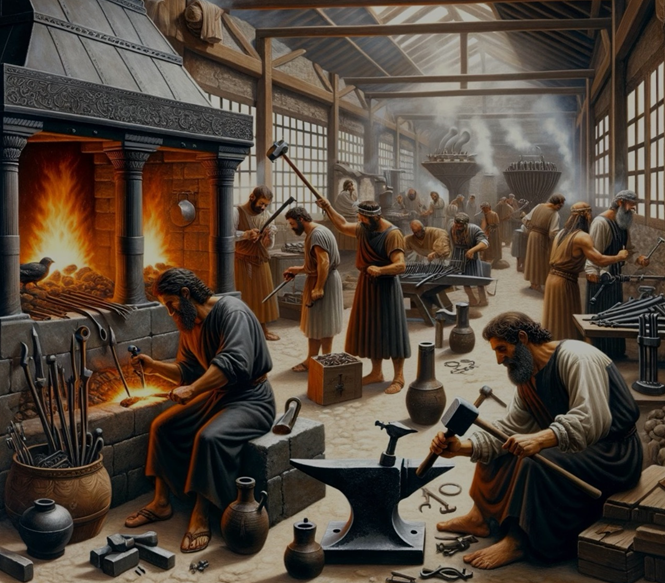
Image Credit:An illustration depicting the iron working skills in an ancient forge or blacksmith shop.
Drawn by DALL-E, a sub-set of ChatGPT, January 2024
The Iron Age Effect
The Iron Age marks a pivotal chapter in the history of the Philistines, setting the stage for their emergence as a formidable power in the ancient Near East. This era, characterised by technological advancements and sociopolitical transformations, saw the Philistines harness the innovative use of iron, a factor that significantly contributed to their military and economic strength.
Iron technology allowed the Philistines to produce superior weapons and tools, giving them an edge in warfare and agriculture. This technological advantage not only bolstered their military prowess, as seen in their conflicts with neighbouring cultures, including the Israelites but also supported their economic development through improved agricultural practices and craftsmanship.
Moreover, the Iron Age was a period of cultural flourishing for the Philistines. Their cities, part of the famed Pentapolis (Gaza, Ashkelon, Ashdod, Ekron, and Gath), became centres of trade and cultural exchange. The era saw the Philistines absorbing and integrating influences from various neighbouring civilisations, which is evident in their distinctive pottery and art that blend Aegean, Egyptian, and Levantine styles.
However, the Iron Age also brought challenges. The Philistines’ expansion and technological advancements inevitably led to increased conflicts with emerging powers, notably the Israelites, setting the stage for the legendary biblical narratives. These conflicts, coupled with the pressures from expanding empires such as Assyria and Babylon, eventually led to the decline of Philistine autonomy and their gradual assimilation into the broader tapestry of ancient Near Eastern cultures.
In essence, the Iron Age was a period of both zenith and transition for the Philistines, characterised by significant advancements and cultural achievements but also by increasing geopolitical challenges that shaped their ultimate historical trajectory.
Philistine Artefacts
Typically, “Philistine” artefacts begin appearing in Canaan by the 12th century BC. Pottery of Philistine origin has been found far outside of what would later become the core of Philistia, including at the majority of Iron Age I sites[22] in the Jezreel Valley; however, because the quantity of said pottery finds is light, it is assumed that the Philistines’ presence in these areas was not as strong as in their core territory and that they probably were a minority which had assimilated into the native Canaanite population by the 10th century BC.
Relationships with Israel, the Assyrians and the Egyptians
The history of the Philistines is intertwined with Israel, marked by conflicts and domination as vividly described in biblical texts. However, the accuracy of these accounts, including the Philistines’ subjugation by David, remains debated among scholars.
By the mid-8th century BC, the Philistines’ autonomy waned under Assyrian expansion, with kings like Tiglath-Pileser III[23], the king of the Neo-Assyrian Empire, annexing much of the Levant. Subsequent revolts against the Assyrian rule, often with Egyptian backing, led to harsh repercussions, including the annexation of Philistine territories.
Decades later, Egypt began agitating its neighbours to rebel against Assyrian rule. A revolt in Israel was crushed by Sargon II[24] in 722 BC, resulting in the kingdom’s total destruction. In 712 BC, a Philistine named Iamani[25] ascended to the throne of Ashdod and organised another failed uprising against Assyria with Egyptian aid. The Assyrian King Sargon II invaded Philistia, which effectively became annexed by Assyria, although the kings of the five cities, including Iamani, were allowed to remain on their thrones as vassals. In his annals concerning the campaign, Sargon II singled out his capture of Gath in 711 BC. Ten years later, Egypt once again incited its neighbours to rebel against Assyria, resulting in Ashkelon, Ekron, Judah, and Sidon revolting against Sargon’s son and successor, Sennacherib[26]. Sennacherib crushed the revolt, defeated the Egyptians, and destroyed much of the cities in southern Aramea, Phoenicia, Philistia, and Judah, and entered the northern Sinai, though he was unable to capture the Judahite capital, Jerusalem, instead forcing it to pay tribute. As punishment, the rebel nations paid tribute to Assyria, and Sennacherib’s annals report that he exacted such tribute from the kings of Ashdod, Ashkelon, Gaza, and Ekron, but Gath is never mentioned, which may indicate that the city was actually destroyed by Sargon II.
The final chapters of Philistine autonomy were written in the 7th and 6th centuries BC. Egyptian occupation briefly preceded Nebuchadnezzar II’s[27] Babylonian conquest, leading to the destruction of key Philistine cities and the eventual loss of their distinct ethnic identity. By the late 5th century BC, under Persian rule, the Philistines, though retaining some cultural elements like language, had largely assimilated into the broader regional cultures.
Political and Religious Life
The Philistines’ political and religious life was quite distinct, and here’s a closer look at their leaders and the gods they worshipped:
Leaders
The Philistines were organised into city-states, each governed by a ruler known as a “seren” (plural “seranim”)[28]. This term appears in the Hebrew Bible and is akin to a lord or prince. Each city-state was independent, but the seranim could convene as a council for matters affecting all the Pentapolis[29] – the five major Philistine cities of Gaza, Ashkelon, Ashdod, Ekron, and Gath.
Information about individual Philistine leaders is sparse, mainly coming from external sources like the Hebrew Bible or Egyptian records. Specific names and details of these rulers are not well-documented in surviving texts or archaeological finds. As a result, we know more about their collective actions and the city-states they led than about individual leaders.
Gods
The Philistines worshipped a pantheon of gods, many of which they likely adopted from the local Canaanite culture and other neighbouring civilisations. Key deities included:
- Dagon: Often considered the chief deity, Dagon was associated with fertility and agriculture. He is notably mentioned in the Hebrew Bible in the story of Samson.
- Ashtoreth (Astarte): A goddess of fertility, love, and war, Ashtoreth was widely worshipped in the ancient Near East. The Philistines may have incorporated her into their pantheon from the Canaanite religion.
- Baal-Zebub: Known from the biblical text as the deity of Ekron. The name “Baal-Zebub” (Lord of the Flies) was likely a derogatory version of “Baal-Zebul” (Exalted Lord), used in the Hebrew Bible.
- Baal: A common deity across the Levant, Baal was associated with storms and rain, playing a significant role in agriculture and fertility rites.
- Anat: A warrior goddess, also associated with fertility and often linked with the goddess Ashtoreth.
- Ptah, Hathor, and Bes: Evidence suggests the Philistines also worshipped Egyptian gods, likely due to the influence of their interactions with Egypt.
Philistine religious practices included temple rituals and possibly ritual feasting. They used altars, cult stands, and religious icons in their worship. However, their religious texts, if any existed, have not survived, limiting our understanding of their rituals and beliefs.
The Philistine pantheon reflects a blend of their Aegean origins and the influence of neighbouring cultures, illustrating a complex and interconnected religious life.
Enemies and Allies
The Philistines, situated in a strategically important and contested region, had various interactions—both hostile and amicable—with several neighbouring peoples:
Enemies
- Egyptians: The Philistines initially clashed with the Egyptians. They were part of the Sea Peoples who invaded Egypt during the reign of Pharaoh Ramesses III in the 12th century BC. However, their relationship evolved over time, with periods of both conflict and cooperation.
- Assyrians: During the Neo-Assyrian Empire’s expansion in the 8th and 7th centuries BC, the Philistines came into conflict with the Assyrians. This conflict eventually led to the decline of Philistine cities.
- Babylonians: The final blow to the Philistine city-states was dealt by the Neo-Babylonian Empire under Nebuchadnezzar II, which led to the ultimate demise of those states around 604 BC.
- Israelites: The Philistines’ most documented adversaries were the Israelites. The conflict between these two peoples is a recurrent theme in biblical narratives and archaeological records. Their rivalry, primarily over territory and control of trade routes, led to numerous battles and skirmishes. The most famous of these encounters is perhaps the battle of David and Goliath, symbolic of the struggle between the two. While primarily antagonistic, the nature of this relationship varied over time and was influenced by the region’s shifting power dynamics. Beyond the well-known biblical narratives, archaeological evidence suggests a more complex relationship between the Philistines and Israelites than just perpetual hostility. For example, periods of peace and indirect cooperation are indicated during times of common threats, such as the Assyrian expansion.
Allies
- Phoenicians: There is evidence suggesting trade and cultural exchanges between the Philistines and the Phoenicians. Their proximity and mutual commercial interests likely fostered a peaceful coexistence.
- Other Sea Peoples: The Philistines might have maintained alliances with other groups of the Sea Peoples, as they shared similar origins and perhaps faced common adversaries.
- Local Canaanite City-States: At times, the Philistines may have formed alliances with various Canaanite city-states against common enemies, such as during conflicts with larger empires.
It’s important to note that alliances and enmities in the ancient world were often fluid and were influenced by changing political, economic, and military circumstances. The Philistines’ relationships with other groups were no exception, shifting over time due to various regional dynamics.
Also, much of what is known about these relationships comes from external sources, like Egyptian and Hebrew texts, which can have their own biases and perspectives. Archaeological evidence provides additional insights, but it can be limited in detailing specific political alliances and conflicts.
Biblical References to the Philistines
The Philistines are frequently mentioned in the Hebrew Bible, often portrayed as adversaries of the Israelites. These references, primarily in the books of Samuel, Judges, and Kings, offer insights into their portrayal from a biblical perspective:
- Samson’s Conflicts with the Philistines (Judges 13-16): The narrative of Samson, a judge of Israel, includes his battles against the Philistines and his tragic involvement with Delilah, a Philistine woman, highlighting a period of hostility and intrigue.
- Saul and David’s Wars Against the Philistines (1 Samuel, 2 Samuel): King Saul and, later, David engage in numerous battles against the Philistines. David’s rise to fame begins with his victory over Goliath, a Philistine giant, symbolising the struggle between the Israelites and the Philistines. The ongoing conflict under Saul’s and David’s reigns epitomizes the long-standing hostilities between the two groups.
- The Philistine Pentapolis (Joshua, Judges, 1 Samuel): The Bible often mentions the five major Philistine cities – Gaza, Ashkelon, Ashdod, Ekron, and Gath. These cities are central to many narratives, indicating their importance in Philistine civilisation.
- Philistine Culture and Religion (Various References): While the Bible primarily focuses on conflicts, there are indirect references to Philistine culture and religion. For example, the worship of Dagon, a Philistine deity, is notably mentioned in the context of Samson’s story.
- The Decline of Philistine Power (Books of Amos and Zephaniah): The prophets, particularly Amos[30] and Zephaniah[31], predict the downfall of Philistine cities. These prophecies reflect the historical tensions between the Israelites and the Philistines and provide a perspective on the eventual decline of Philistine power in the region.

Image Credit: An illustration depicting the biblical scene of the Philistines capturing the Ark of the Covenant from the Israelites.
Drawn by DALL-E, a sub-set of ChatGPT, January 2024
- The Ark of the Covenant (1 Samuel 4-6): This account describes the capture of the Ark of the Covenant by the Philistines after defeating the Israelites at the Battle of Aphek. The narrative then follows the Ark’s calamitous journey through Philistine territory, bringing misfortune to its captors until its eventual return to the Israelites, signifying the Philistines’ recognition of the power associated with the Ark and the God of Israel.
The Biblical portrayal of the Philistines provides valuable historical and cultural insights, though it is important to note that these accounts are written from an Israelite perspective and thus contain inherent biases. The Philistines are often depicted as the principal antagonists in the narrative of Israel’s formation and early years as a nation. These references not only reflect the historical conflicts between the two peoples but also underscore the cultural and religious differences that were perceived to exist between them.
Battles between the Israelites and the Philistines: A Chronological Overview
The history of the Philistines is inextricably linked with their frequent and fierce conflicts with the Israelites, as vividly depicted in biblical narratives. These battles, ranging from minor skirmishes to major engagements, played a pivotal role in shaping the political and military landscape of the region during that era. The tumultuous relationship between the Israelites and the Philistines is a defining element of their shared history. Here are some of the key conflicts, along with their estimated dates:
- The Battle of Shephelah (11th century BC): A strategic confrontation highlighting the ongoing struggle for territorial dominance in the region.
- Battle of Aphek (c. 1050 BC): A significant Philistine victory where the Israelites were defeated, and the Ark of the Covenant was captured, underscoring the Philistines’ military capabilities.
- Battle of Eben-Ezer (c. 1050 BC): Marking a retaliatory victory for the Israelites, illustrating the ebb and flow of power between these two nations.
- Philistine Disarmament Regime (Early 11th century BC): As described in 1 Samuel 13:19-2, following some military successes, the Philistines imposed a disarmament regime on the Israelites, a move that underscores their temporary upper hand. This period saw restrictions on Israelite blacksmiths, forcing them to rely on Philistine services for sharpening their weapons and tools.
- Battle of Michmash (c. 1050 BC): A notable victory for the Israelites, where Jonathan and his men routed the Philistines, demonstrating the Israelites’ resilience and tactical prowess.
- David and Goliath (c. 1025 BC): Perhaps the most iconic encounter, where young David[32] defeated the giant Goliath in single combat near the Valley of Elah, symbolising the triumph of the underdog and marking a turning point in the Israelite-Philistine relations.

Image Credit: An illustration depicting the historical and biblical scene of David using a sling to fight the giant Philistine Goliath.
Drawn by DALL-E, a sub-set of ChatGPT, January 2024
- Battle of Mount Gilboa[33] (c. 1004 BC): A tragic defeat for the Israelites, where King Saul[34] and his three sons, including Jonathan, were killed, leading to significant political repercussions for the Israelite kingdom.
- Hezekiah’s Campaigns[35] (Late 8th century BC): King Hezekiah’s military campaigns against the Philistines pushed their influence back as far as Gaza, indicating a period of Israelite resurgence and territorial expansion.
These battles, as recorded in the Bible, offer an insight into the tumultuous relationship between the Philistines and the Israelites, characterised by a constant struggle for supremacy. They reflect not only the military strategies and tactics of the time but also the broader geopolitical and cultural tensions that defined the era.
It should be remembered that the dates provided are approximations and can vary based on different historical interpretations and sources. This narrative gives a chronological perspective to the conflicts and is broadly correct.
Social and Cultural Aspects of Philistine Life
The social and cultural aspects of Philistine life, such as marriage, family, children, pets, and burial practices, can be partly understood through archaeological discoveries, though much remains unknown due to the lack of direct written records from the Philistines themselves. Here’s what is generally inferred:
Marriage and Family Life
- Marriages: Likely similar to other ancient Near Eastern societies, with arranged marriages for political or economic reasons. Marital practices might have included dowries and bride-price traditions.
- Family Structure: The family was probably the basic social unit, with extended families living together or in close proximity. Patriarchal structures were likely prevalent.
- Children: Children were undoubtedly an integral part of society. Their upbringing and education would have been in line with their roles in society, with boys and girls likely having different paths in terms of education and training.
Pet Animals
- Domestic Animals: Archaeological evidence suggests the Philistines kept domestic animals such as dogs, cats, and birds. Dogs might have been used for hunting and protection, while cats could have been valued for controlling pests.
- Animals in Society: Animals likely played important roles in agricultural and domestic life. Their depiction in art and artefacts also indicates a cultural significance.
Burial Practices
- Graves and Tombs: Archaeological excavations have uncovered various types of burials, including simple pits, ash pits, and more elaborate tombs for the elite.
- Funerary Goods: Graves often contained pottery, personal ornaments, weapons, and sometimes food and drink offerings, suggesting beliefs in an afterlife where such items would be useful.
- Cremation and Inhumation: Both practices were used, with cremation becoming more popular in later periods. The choice between cremation and inhumation may have been influenced by cultural changes over time.
Cultural Practices
- Influence from Other Cultures: The Philistines were influenced by their Aegean origins and the local Canaanite culture. This blend is visible in their pottery, architecture, and possibly in their social customs.
- Role of Women: While specific details are limited, women likely had defined roles, which could have included domestic responsibilities and participation in religious rituals.
The distinct Philistine art and craftsmanship, particularly in pottery, exhibit a blend of Aegean and local influences. These artistic expressions provide valuable insights into their daily life and cultural exchanges with neighbouring civilisations.
Despite the scarcity of direct records, recent archaeological discoveries, such as temple structures and sacrificial altars in Philistine cities, offer new insights into their religious practices and the role these played in their societal structure. The understanding of Philistine social customs is primarily derived from archaeological evidence and comparative studies with contemporary cultures. As such, interpretations can vary, and new discoveries can significantly alter our understanding of their societal norms. The absence of direct written records from the Philistines themselves means that much of their social and cultural life remains a subject of scholarly interpretation and debate.
The Origins of the Philistines: A Multifaceted Perspective
The origins of the Philistines have long been a subject of scholarly debate, with various theories and historical records offering different insights. These theories draw upon biblical texts, archaeological findings, genetic studies, and ancient inscriptions to piece together the story of these enigmatic people.
- Biblical References: The Hebrew Bible suggests two origins for the Philistines. First, it mentions a geographical region called Caphtor, which is possibly identified with Crete or Minoa. Second, it traces their lineage to Casluhim[36], a descendant of Ham, suggesting a Near Eastern origin. The Septuagint further connects the Philistines with groups like the Caphtorim, Cherethites, and Pelethites, often associated with Crete, supporting theories of an Aegean origin.
- Genetic Studies: A groundbreaking discovery came with the excavation of a Philistine cemetery near Ashkelon in 2016. Genetic analysis of the remains revealed a European-related admixture in the early Iron Age population, distinct from the local Semitic-speaking Levantine gene pool. This admixture suggests a migration event, possibly from regions like Crete, Iberia, or even Sardinia, during the Bronze to Iron Age transition.
- Archaeological Similarities: The material culture unearthed in Philistine sites shows striking resemblances to Aegean-Greek artefacts, including pottery and figurines. This similarity has led most scholars to lean towards a Greek origin, particularly from areas around Crete and the Aegean Islands. However, a minority view argues that these cultural similarities might be the result of acculturation over the Philistines’ 575-year existence among Canaanite, Israelite, and other seafaring peoples.
- The “Peleset” from Egyptian Inscriptions: Since the mid-19th century, scholars have linked the biblical Philistines with the Peleset[37] mentioned in Egyptian records. These inscriptions from the era of Ramesses III depict the Peleset among the Sea Peoples. This connection is reinforced by the cessation of references to Canaan in Egyptian texts coinciding with the appearance of the Peleset.
- Luwian Inscriptions and the Name ‘Palistin’: Luwian texts[38] mention a kingdom called Walistina or Palistin, located in the region of the Amuq plain. The discovery of inscriptions in Aleppo referring to a king of Palistin has led some scholars to hypothesize a connection between this Syro-Hittite state and the Philistines. This theory, however, is subject to debate, with some arguing against an Aegean origin based on the archaeological and linguistic evidence from Palistin.
- The ‘Phyle Histia’ Theory: Proposed by Allen Jones[39], this theory suggests that the name ‘Philistine’ derives from the Greek phyle histia[40] (‘tribe of the hearth’), pointing to the unique hearth constructions found at Philistine archaeological sites. While this theory mainly speculates on linguistic grounds, it adds another dimension to the discussion of Philistine origins.
The origins of the Philistines remain a complex puzzle, with evidence pointing to a mix of Aegean, Near Eastern, and local influences. This multifaceted origin story reflects the dynamic nature of ancient civilisations and the intricate web of cultural and genetic exchanges that occurred in the ancient Near East. The Philistines, therefore, emerge not just as a distinct group but as a people shaped by a confluence of various regional influences, underscoring the interconnectedness of the ancient world.
Sea Peoples
The “Sea Peoples” refers to a confederation of seafaring raiders who are thought to have originated from various regions around the Aegean Sea, including Anatolia (modern-day Turkey), the Greek islands, and possibly Cyprus. They are most famously known for their invasions and attacks on the civilisations of the Eastern Mediterranean during the late Bronze Age[41], particularly in the 13th and 12th centuries BC.
Key Aspects of the Sea Peoples:
- Mysterious Origins: The exact origins and composition of the Sea Peoples remain somewhat mysterious. They are believed to be a diverse group made up of several different tribes or peoples.
- Major Incursions: The Sea Peoples are noted for their role in the Late Bronze Age collapse, a period of major upheaval where several ancient civilisations, including the Hittites[42], Mycenaeans[43], and Egyptians, either fell or underwent significant hardship.
- Encounters with Egypt: The most detailed accounts of the Sea Peoples come from Egyptian sources, particularly from the reigns of Pharaohs Ramesses II and Ramesses III. These pharaohs fought off invasions by these groups, as depicted in Egyptian temple reliefs, especially in the Medinet Habu[44] temple inscriptions.
- Impact on Civilisations: Their invasions and settlements led to significant changes in the political and cultural landscapes of the Eastern Mediterranean. Some scholars suggest that the disruptions caused by the Sea Peoples contributed to the end of the Bronze Age and the transition to the Iron Age.
- Connection to the Philistines: Among the Sea Peoples, a group known as the Peleset is commonly identified with the Philistines. They settled along the southern coast of Canaan and established the Philistine Pentapolis (the five cities of Gaza, Ashkelon, Ashdod, Ekron, and Gath).
- Archaeological Evidence: Archaeology has provided some insights into the material culture of the Sea Peoples, including distinctive pottery styles and weaponry. These findings support the notion of a cultural blend, indicating origins from different regions.
- Theories and Debates: There are various theories about why the Sea Peoples migrated and invaded other territories. These include economic hardship, overpopulation, climatic changes, or disruptions from other invasions in their homelands.
The Sea Peoples played a crucial role in the history of the Late Bronze Age Mediterranean[45], marking a period of significant cultural and political change. Their legacy is particularly remembered for the challenges they posed to established civilisations of the time, like Egypt, and for their role in the emergence of new groups like the Philistines.
Archaeological Evidence of the Philistines
The Philistines, known for their distinct identity in the ancient Levant, have left behind rich archaeological evidence that sheds light on their origins, culture, and interactions with neighbouring civilisations:
- Philistia and the Pentapolis: The land of the Philistines, referred to as Philistia in the Bible, was a pentapolis comprising the five city-states of Gaza, Ashdod, Ashkelon, Ekron, and Gath. These cities, stretching from Wadi Gaza to the Yarqon River, formed the heartland of Philistine civilisation.
- Northern Frontier and Settlements: Tell Qasile and Aphek, located on the northern border of Philistine territory, show evidence of Philistine habitation. Tell Qasile, in particular, may have been a cosmopolitan settlement shared by Philistines and other groups.
- Location of Key Cities: The exact location of some Philistine cities, such as Gath, remains uncertain, but Tell es-Safi is currently favoured as the most likely site. The city of Ziklag, mentioned in the Bible[46] as marking the border between Philistine and Israelite territories, has an uncertain location.
- Philistine Expansion and Pottery: In the western Jezreel Valley, evidence of typical Philistine pottery from the 12th to 10th centuries BC suggests their presence, possibly as Egyptian mercenaries or through trade and expansion. The presence of Philistine pottery at sites like Tel Megiddo indicates their cultural influence even in regions outside their core territory.
- Egyptian Inscriptions and Connections: The Philistines are linked to the Peleset[47] in Egyptian inscriptions, a group among the Sea Peoples who attacked Egypt during the reign of Ramesses III. These inscriptions and the Papyrus Harris I[48] describe the resettlement and subjugation of the Peleset, supporting theories of Philistine settlement in Canaan. Medinet Habu temple reliefs and other texts depict the Peleset, suggesting their involvement in the events that shaped the end of the Bronze Age.
- Material Culture and Aegean Connections: Archaeological finds, especially pottery, indicate strong similarities between Philistine and Aegean cultures, pointing to a possible origin from regions like Crete or Cyprus. Excavations in cities like Ashdod, Ekron, and Gath have unearthed artefacts that resonate with Aegean-Mycenaean styles[49], though some scholars argue these may reflect acculturation rather than direct migration.
- Burial Practices and Genetic Evidence: The discovery of a Philistine cemetery in Ashkelon with over 150 burials dating from the 11th to 8th century BC provides vital clues about their burial customs and genetic makeup. Genetic analysis shows European-related admixture, supporting theories of Aegean origins, but also indicates significant intermarriage with local populations over time.
- Peleset and Sherden Captives: The depiction of Peleset and Sherden captives in Egyptian art[50] from the era of Ramesses III provides further insights into the appearance and military aspects of the Philistines, including their clothing and weaponry, revealing a distinct cultural identity that stood out from their neighbours in the Levant.
- Aegean Origin and Historical Evolution: The archaeological evidence strongly suggests a large-scale migration of peoples from the Aegean region to southern Canaan in the 12th century BC. This hypothesis is bolstered by similarities in pottery, architectural styles, and burial practices found at various Philistine archaeological sites.
- Geographic Evolution: The Philistines initially settled in the southern coastal plain, with their influence later spreading inland. This expansion is evident in the archaeological record, showing a gradual evolution of Philistine material culture over several centuries.
In summary, the archaeological evidence paints a picture of the Philistines as a complex, culturally rich, and dynamic society. Their interactions with neighbouring civilisations, especially the Egyptians and Israelites, as well as their possible Aegean origins, highlight the interconnectedness and diversity of the ancient Near Eastern world. The combination of material culture studies, genetic analysis, and historical texts offers a multifaceted view of the Philistines, contributing significantly to our understanding of their role in ancient history.
The Story of Samson and Delilah
The Story of Samson and Delilah is a story from the Biblical Book of Judges, primarily in the 16th chapter. It narrates the saga of Samson, an Israelite judge with immense strength which, according to the narrative, was derived from his uncut hair, a vow to God as a Nazirite[51].
Samson falls in love with Delilah, who is enticed by the Philistine rulers to discover the source of Samson’s strength. After several attempts, she finally coaxes the secret from him while he sleeps on her lap—his strength will leave him if his seven locks of hair are cut. Delilah then summons the Philistines who cut his hair, rendering him weak. They capture him, gouge out his eyes, and imprison him. In captivity, Samson’s hair begins to grow back. During a public spectacle where the Philistines gather to mock him, he prays to God for strength one last time. Granted this wish, he pulls down the pillars of the temple, killing himself along with his captors. This act of final defiance against the Philistines is seen as both a personal revenge and a deliverance for the Israelites.
In the film about Samson and Delilah, made in 1949 and directed by Cecil B. DeMille, Victor Mature played the role of Samson. The film is a classic Hollywood epic, known for its lavish costumes, set designs and for being one of the highest-grossing films of its time. It tells the Biblical story of Samson, his supernatural strength, and his ill-fated romance with Delilah, played by Hedy Lamarr.
The movie emphasises the dramatic and tragic elements of the Biblical narrative, with a focus on the betrayal that leads to Samson’s downfall. It remains a significant work in the genre of biblical epics that were popular during the golden age of Hollywood.

Image Credit: Samson (Victor Mature) and Delilah (Hedy Lamarr) inside Delilah’s tent at the Valley of Sorek.
Attribution: eBay listing, Public domain, via Wikimedia Commons
Page: URL:
https://commons.wikimedia.org/wiki/File:Color_photograph_of_Victor_Mature_and_Hedy_Lamarr_as_Samson_and_Delilah.jpg
Conclusions: The Philistine Legacy
The Philistines’ story is a compelling testament to the complexity and dynamism of ancient Near Eastern history. Reflecting on the journey of the Philistines from their enigmatic emergence as part of the Sea Peoples to their eventual assimilation under imperial powers, a complex tapestry of cultural, political, and technological interactions unfolds. The Philistines, initially distinguished by their unique identity and advances during the Iron Age, faced a gradual erosion of their autonomy and cultural distinctness in the face of expanding empires.
The shift in Philistine fortunes was marked by the Assyrian and Babylonian conquests, which significantly altered the political landscape of the Near East. Under Assyrian rule, particularly during the reigns of Tiglath-Pileser III and Sargon II, Philistine cities experienced a dilution of their cultural and political independence. Assyrian administrative systems, military strategies, and cultural influences permeated Philistine society, initiating a process of cultural blending and loss of distinct identity.
This process was further accelerated by the Babylonian conquest under Nebuchadnezzar II. The destruction wrought upon Philistine cities, coupled with population displacements, disrupted their cultural continuity. Under subsequent Persian rule, the Philistines, like many ancient cultures engulfed by imperial powers, found their unique identity increasingly subsumed into a broader regional amalgamation. By the late 5th century BC, the Philistines had largely been assimilated, their distinct language, art, and religious practices becoming echoes in the annals of history.
Detailed Aspects of Philistine Civilisation
The following aspects highlight the complexity and sophistication of Philistine society. Their religious practices, urban planning, and industries, particularly in olive oil production and fermented beverages, point to a well-organized and prosperous civilisation. Moreover, their advanced metalworking skills, especially in iron, played a crucial role in their economic and military strength. These findings contribute to a deeper understanding of the Philistines beyond their portrayal in historical texts, revealing them as a dynamic and influential culture in the ancient world.
- Religious Artefacts: Goddess Figurines/Chairs (Ashdoda): Archaeological finds from Philistine sites frequently include goddess figurines and ceremonial chairs, commonly referred to as Ashdoda[52]. These artifacts suggest the veneration of a dominant female deity, echoing religious practices in Ancient Aegean cultures. The prevalence of such figurines indicates the importance of female figures in Philistine religious beliefs and practices.
- Economy and Town Planning: Excavations of Philistine cities reveal evidence of advanced urban planning, including distinct industrial zones. A notable example is Ekron’s extensive olive industry, which boasted around 200 olive oil installations. The scale of production, estimated to be over 1,000 tons, reflects not only advanced agricultural practices but also a sophisticated understanding of trade and economy.
- Breweries and Wineries: The Philistines exhibited a significant investment in the production of fermented drinks. Archaeological sites have yielded breweries, wineries, and retail shops dedicated to beer and wine. The prevalence of beer mugs and wine kraters[53] among pottery finds further underscores the importance of these industries in Philistine society, both economically and culturally.
- Metalworking and Weaponry: The Philistines were skilled metalworkers, as evidenced by the discovery of intricate gold, bronze, and iron wares dating as early as the 12th century BC. This craftsmanship extended to the production of artisanal weaponry. The Hebrew Bible even suggests that the Israelites, despite being frequent adversaries, depended on Philistine blacksmiths for iron tools and weapons. This reliance indicates not only the Philistines’ expertise in metallurgy but also their dominance in the regional metallurgical market. Their ability to produce and work with iron, a skill highly valued and relatively rare in the region during this period, gave the Philistines a significant strategic and economic advantage.
The story of the Philistines, therefore, is not just one of a people known for their conflicts with the Israelites or their portrayal in biblical narratives; it is also a story of cultural resilience and adaptability in the face of changing political tides. Their legacy, preserved in archaeological remains and historical records, offers valuable insights into the dynamics of ancient civilisations. It reminds us of the impermanence of political entities and the enduring impact of cultural and technological exchanges.
In conclusion, the history of the Philistines encapsulates the ebbs and flows of ancient Near Eastern civilisations. Their rise, struggles, and eventual assimilation reflect broader patterns of cultural interaction and transformation in the region. While their distinct identity may have faded, the Philistines’ contributions to the cultural and historical landscape of the ancient world continue to intrigue and inform scholars and enthusiasts alike.
CAUTION: This paper is compiled from the sources stated but has not been externally reviewed. Parts of this paper include information provided via artificial intelligence which, although checked by the author, is not always accurate or reliable. Neither we nor any third parties provide any warranty or guarantee as to the accuracy, timeliness, performance, completeness or suitability of the information and materials covered in this paper for any particular purpose. Such information and materials may contain inaccuracies or errors and we expressly exclude liability for any such inaccuracies or errors to the fullest extent permitted by law. Your use of any information or materials on this website is entirely at your own risk, for which we shall not be liable. It shall be your own responsibility to ensure that any products, services or information available through this paper meet your specific requirements and you should neither take action nor exercise inaction without taking appropriate professional advice. The hyperlinks were current at the date of publication.
Relevant Reading
- Biblical Peoples And Ethnicity: An Archaeological Study of Egyptians, Canaanites, Philistines, And Early Israel 1300-1100 B.C.E., by Ann E. Killebrew (2009), published by SBL Press, available from https://www.amazon.co.uk/Biblical-Peoples-Ethnicity-Archaeological-B-C/dp/1628370661
- David and the Philistine Woman, by Paul Boorstin (2017), published by Top Hat Books, available from https://www.amazon.co.uk/David-Philistine-Woman-Paul-Boorstin/dp/1785355376
- Minoans, Philistines and Greeks: B.C. 1400–900 (Routledge Library Editions: The Ancient World), by Andrew Robert Burn (2024), published by Routledge, available from https://www.amazon.co.uk/Minoans-Philistines-Greeks-1400-900-Routledge/dp/1032773456/
- Palestine: A Four Thousand Year History, by Nur Masalha (2022), published by I. B. Tauris, available at: https://www.amazon.co.uk/Palestine-Four-Thousand-Year-History/dp/0755649427/
- People of the Sea: Search for the Philistines, by Trude Dothan (Author), Moshe Dothan (Author) (1992), published by Prentice Hall & IBD, available from https://www.amazon.co.uk/People-Sea-Philistines-Trude-Dothan/dp/0025322613
- Philistine and Palestinian The Ideological Conflict between Israel and the Philistines in the Past and Today, by Matityahu Glazerson (1994), published by Lev Eliyahu, available from https://www.amazon.co.uk/PHILISTINE-PALESTINIAN-Ideological-Conflict-Philistines/dp/B002AQIVIK
- Philistine-2: The Great Deception, by Ramon Bennett (2016), published by Shekinah Books LLC, available from https://www.amazon.co.uk/Philistine-2-Great-Deception-Ramon-Bennett/dp/1943423164
- Philistines in the Bible: An Ancient People’s Biblical, Cultural, and Modern-Day Echoes, by Samuel S. Han (2023), Kindle Edition, available from https://www.amazon.com/Philistines-Bible-Biblical-Cultural-Modern-Day-ebook/dp/B0CLL24FMS
- Philistines: History of the Ancient People, by Andrew Tikhomirov (2020), published by Scholars’ Press, available from https://www.amazon.co.uk/Philistines-History-ancient-Andrew-Tikhomirov/dp/6138929004
- Philistine-To-Palestine: Exposing the World’s Biggest Deception, by Mr. Joseph D. Shellim (2016), published by Self, available from https://www.amazon.co.uk/Philistine-Palestine-Deception-Political-Historical/dp/0994201893
- The Archaeology of Society in the Holy Land, by Thomas E. Levy (1998), published by Leicester University Press, available at https://www.amazon.co.uk/Archaeology-Society-approaches-anthropological-archaeology/dp/0718501659/
- The Canaanites and Philistines: The History and Legacy of the Ancient Israelites’ Enemies in the Land that Became Israel, by Charles River Editors (2017), available from https://www.amazon.co.uk/Canaanites-Philistines-History-Ancient-Israelites/dp/B078MV6J4C
- The Mythology of David, the Philistine Years: Mythology: Volume 9, by Christopher Alan Byrne (2010), published by CreateSpace Independent Publishing Platform, available from https://www.amazon.co.uk/Mythology-David-Philistine-Years/dp/1456398873
- The Philistines and Aegean Migration at the End of the Late Bronze Age, by Assaf Yasur-Landau (2014), published by Cambridge University Press, available from https://www.amazon.co.uk/Philistines-Aegean-Migration-Late-Bronze/dp/1107660033/
- The Philistines and Aegean Migration at the End of the Late Bronze Age, by Assaf Yasur-Landau (2014), published by Cambridge University Press, available at https://www.amazon.co.uk/Philistines-Aegean-Migration-Late-Bronze/dp/1107660033/
- The Philistines and the Old Testament, by Edward E. Hindson (1972), published by Baker Publishing Group, available from https://www.amazon.co.uk/Philistines-Old-Testament-Edward-Hindson/dp/0801040345
- The Philistines and Their Material Culture, by Trude Dothan (1982), published by Yale University Press, available from https://www.amazon.co.uk/Dothan-philistines-DOTHAN/dp/0300022581/
- The Philistines Came Also, by Norman Enlow Jr. (2013), published by HSS Ministries, available from https://www.amazon.co.uk/Philistines-Also-Came-Norman-Enlow/dp/0989590402
- The Philistines in Transition: A History from ca. 1000-730 BC., published by E.J. Brill, available from https://www.amazon.co.uk/Philistines-Transition-History-ca-1000-730-B-C/dp/9004104267
- The Philistines, by Arlo Bates (2023), published by Legare Street Press, available from https://www.amazon.co.uk/Philistines-Arlo-Bates/dp/1019777974/
- The Philistines, by Pamela Hansford Johnson (1949), published by M Joseph, available from https://www.amazon.co.uk/Philistines-Pamela-Hansford-Johnson/dp/B0006EUK6E
- The Philistines, Their History and Civilization, by R. A. S. Macalister (2023), published by Zinc Read, available from https://www.amazon.co.uk/Philistines-Their-History-Civilization/dp/9358583479/
- The Philistines: The History of the Ancient Israelites’ Most Notorious Enemy, by Charles River Editors (Author) (2015), published by CreateSpace Independent Publishing Platform, available from https://www.amazon.co.uk/Philistines-History-Ancient-Israelites-Notorious/dp/1514105594
End Notes and Explanations
- Source: Compiled from my research and from information at the sources stated throughout the text, together with information provided by machine-generated artificial intelligence at: bing.com [chat] and https://chat.openai.com ↑
- Source: https://en.wikipedia.org/wiki/Philistines ↑
- Explanation: The term “pantheon” has a couple of related meanings, both of which are commonly used in the context of history, mythology, and religion:
Collection of Gods: In the context of religion and mythology, a pantheon refers to the particular set of all gods and goddesses in a specific religious or mythological tradition or culture. For instance, the Ancient Greek pantheon includes deities like Zeus, Hera, Poseidon, Athena, and Apollo. Similarly, the Roman pantheon includes Jupiter, Mars, Venus, and others. Each culture’s pantheon reflects its religious beliefs and practices, often representing different aspects of life, nature, and the cosmos.
Temple Dedicated to All Gods: The term ‘pantheon’ can also refer to a physical temple or monument dedicated to all gods of a particular religion. The most famous example of this is the Pantheon in Rome, originally built as a temple to all the gods of Ancient Rome. Over time, the term has been used more broadly to refer to any temple or sacred building dedicated to multiple gods or a representation of the divine.
In both uses, the term embodies the idea of encompassing a wide range of divine entities or aspects, whether in a figurative sense (as in a group of gods) or a literal sense (as in a temple). ↑
- Explanation and Source: Dagon was a major deity in ancient Mesopotamia and the Levant, particularly among the Philistines, Amorites, and Canaanites. He is typically associated with fertility and agriculture. The name ‘Dagon’ is thought to derive from the Semitic word for grain. While some believe he had a fish-like form, this is debated and not widely supported by direct evidence. In the Hebrew Bible, Dagon is mentioned in stories involving the Philistines, including Samson’s destruction of Dagon’s temple and the Ark of the Covenant being placed in his temple in Ashdod. Temples dedicated to Dagon, significant cultural and religious sites, were located in cities like Ashdod and Gaza. Overall, Dagon’s worship indicates the shared religious themes of ancient Near Eastern cultures, especially around agriculture and fertility. See also: https://en.wikipedia.org/wiki/Dagon ↑
- Explanation: Ashtoreth, also known as Astarte, was a prominent deity in ancient Near Eastern religions, worshipped especially in Canaanite, Phoenician, and Philistine cultures. She represented fertility, love, and war. Often equated with goddesses like Ishtar and Isis from neighbouring pantheons, Ashtoreth’s worship was marked by temples and rituals across the region, reflecting her importance in these societies. ↑
- Explanation and Source: Baʿal Zebub or Beelzebub (also spelled Beelzebul or Belzebuth, and occasionally known as the Lord of the Flies, is a name derived from a Philistine god, formerly worshipped in Ekron, and later adopted by some Abrahamic religions as a major demon. The name Beelzebub is associated with the Canaanite god Baal. In theological sources, predominantly Christian, Beelzebub is another name for Satan. He is known in demonology as one of the seven deadly demons or seven princes of Hell, Beelzebub representing gluttony and envy. The Dictionnaire Infernal describes Beelzebub as a being capable of flying, known as the “Lord of the Flyers”, or the “Lord of the Flies”. Source: https://en.wikipedia.org/wiki/Beelzebub ↑
- Information about Excavation of Philistine Cities: Overview of significant archaeological discoveries from Philistine cities:
Philistine Pottery: Distinctive pottery, especially the bichrome ware with red and black decorations on a white slip, was uncovered in various Philistine sites like Ashdod, Ashkelon, and Gath. These findings date back to the Iron Age I period (12th to 10th centuries BC). Philistine Bichrome ware is an archaeological term coined by William F. Albright in 1924 which describes pottery production in a general region associated with the Philistine settlements during the Iron Age I period in ancient Canaan (ca. 1200 – 1000 BC). Source: https://en.wikipedia.org/wiki/Philistine_Bichrome_ware
Gath (Tell es-Safi): Gath, identified with the site of Tell es-Safi, has been a key location for understanding Philistine culture. Excavations have revealed evidence of large buildings, fortifications, and a siege system from around the 9th century BC.
Ekron (Tel Miqne): In Ekron, modern-day Tel Miqne, significant finds include a large olive oil production facility and a dedicatory inscription to the goddess Ptgyh from the 7th century BC.
Ashkelon: The first known Philistine cemetery was discovered in Ashkelon in 2016, dating from the 11th to 8th centuries BC. It provided valuable insights into Philistine burial practices and genetic makeup.
These discoveries across various Philistine cities have significantly enhanced our understanding of their culture, economy, and social practices. ↑
- Explanation: The Neo-Assyrian Empire refers to a major Mesopotamian kingdom that emerged around 911 BC and lasted until 609 BC. It was the largest empire of its time and is known for its advanced military organisation, extensive use of brutal warfare, and the efficient administration of its diverse territories. The empire’s heartland was in present-day northern Iraq, and at its peak, it stretched from Egypt to parts of modern-day Iran and Turkey. For further information, see: https://en.wikipedia.org/wiki/Neo-Assyrian_Empire ↑
- Explanation: Babylon was an ancient city-state in Mesopotamia, located in present-day Iraq. It rose to prominence in the 18th century BC under King Hammurabi, who is famous for the Code of Hammurabi, one of the earliest written legal codes. Babylon became a major political, cultural, and religious center, renowned for its grand architecture, notably the Hanging Gardens (one of the Seven Wonders of the Ancient World) and the Tower of Babel. The city reached its zenith under the rule of Nebuchadnezzar II (605-562 BC) and was an important cultural hub of the ancient world until its decline after the Persian conquest in the 6th century BC. ↑
- Explanation: Canaan was an ancient region located in the Levant, roughly corresponding to present-day Israel, Palestine, Lebanon, and parts of Jordan and Syria. Historically, it was a crossroads of civilisations and trade routes, inhabited by various Semitic-speaking peoples. Canaan is significant in ancient history and religious texts, including the Bible, where it’s often referred to as the Promised Land for the Israelites. The region was known for its fertile lands and strategic coastal ports, making it a valuable territory for ancient empires. Canaanite culture was rich and influential, contributing significantly to the development of writing and religious practices in the ancient Near East. For more information, see: https://en.wikipedia.org/wiki/Canaan ↑
- Explanation: The Late Bronze Age is a period in ancient history that roughly spanned from about 1550 BC to 1200 BC. This era was characterized by the growth of powerful empires, extensive international trade networks, and significant cultural exchanges across the Eastern Mediterranean and Near East regions. It ended with widespread societal changes and disruptions known as the Late Bronze Age collapse. ↑
- Explanation: Levantine Semitic societies refer to the groups of people living in the Levant region who spoke Semitic languages. The Levant is a historical geographical term referring to an area in the Eastern Mediterranean, which today includes modern-day Israel, Lebanon, Jordan, Syria, and parts of Turkey and Iraq. These societies, which existed particularly in ancient times, were interconnected through language, culture, and trade. The term “Semitic” comes from the language family these groups spoke, which includes Hebrew, Aramaic, Phoenician, and several ancient languages like Akkadian and Ugaritic. These societies were diverse but shared certain cultural and religious traits, and they significantly influenced the history and development of the Near East, particularly in areas like writing systems (with the development of alphabets), religious traditions, and urban civilisation. Examples of Levantine Semitic societies include ancient Israelites, Phoenicians, Arameans, and various Canaanite city-states. ↑
- Source: Aaron J. Brody; Roy J. King (2013). “Genetics and the Archaeology of Ancient Israel”. Human Biology. 85 (6): 925. doi:10.13110/humanbiology.85.6.0925. ISSN 0018-7143. Cited in https://en.wikipedia.org/wiki/Philistines ↑
- Source: Largely from https://en.wikipedia.org/wiki/Philistines ↑
- Explanation: The Medinet Habu inscriptions are a series of detailed and well-preserved ancient Egyptian texts and reliefs found at the Mortuary Temple of Ramesses III at Medinet Habu, near Luxor in modern-day Egypt. These inscriptions are significant for their historical and artistic value. They date back to the 12th century BC, during the reign of Pharaoh Ramesses III, and are particularly famous for depicting the military campaigns and battles of Ramesses III, including his conflicts with the Sea Peoples. One of the most notable aspects of these inscriptions is their depiction of the Sea Peoples, a confederation of maritime raiders who attacked Egypt and other regions of the Eastern Mediterranean. Among these Sea Peoples were groups identified as the Philistines. The inscriptions provide valuable insights into the equipment, attire, and ships of these raiders and are key sources for understanding the political and military history of the period, including the broader context of the Late Bronze Age collapse. For more information on Medinet Habu, see: https://en.wikipedia.org/wiki/Medinet_Habu ↑
- Explanation: The Peleset were one of the groups of the Sea Peoples, a confederation of maritime raiders who appeared in the Eastern Mediterranean region during the Late Bronze Age collapse around the 12th century BC. They are particularly notable for their conflicts with ancient Egypt, as depicted in Egyptian records and inscriptions, especially during the reign of Pharaoh Ramesses III. Historians and archaeologists often identify the Peleset with the Philistines, who later settled in the region of the southern Levant, an area corresponding to modern-day Gaza, southern Israel, and parts of western Jordan. This identification is based on similarities between the names ‘Peleset’ in Egyptian texts and ‘Philistines’ in biblical and other Near Eastern sources. The Medinet Habu inscriptions and other Egyptian records provide valuable insights into the appearance, weaponry, and ships of the Peleset, contributing significantly to our understanding of this period in ancient history. ↑
- Explanation: Ramesses III was a significant pharaoh of ancient Egypt’s Twentieth Dynasty, ruling from around 1186 to 1155 BC. Known for defending Egypt against the Sea Peoples during their invasions, his military victories are well-documented at Medinet Habu. Despite facing economic challenges, he was a prolific builder and completed several important construction projects, including the Medinet Habu temple. His reign ended with internal turmoil, including a harem conspiracy that led to his assassination. Ramesses III is remembered as one of the last great monarchs of the New Kingdom, maintaining Egypt’s stability during a period of regional upheaval. Usermaatre Meryamun Ramesses III was the second Pharaoh of the Twentieth Dynasty in Ancient Egypt. He is thought to have reigned from 26 March 1186 to 15 April 1155 BC and is considered to be the last great monarch of the New Kingdom to wield any substantial authority over Egypt. Source: https://en.wikipedia.org/wiki/Ramesses_III ↑
- Explanation: The Jezreel Valley is a fertile plain in northern Israel, historically a significant agricultural and strategic crossroads. It’s known for its rich soil and has been a site of numerous biblical events and key battles throughout history. ↑
- Explanation: Aphek is an ancient city located in the biblical region of Canaan, identified with modern archaeological sites in Israel. It was an important city due to its strategic location on trade routes. Aphek is mentioned in the Bible as the site of significant battles, including one where the Philistines captured the Ark of the Covenant from the Israelites. ↑
- Explanation: The Book of Judges in the Bible is a historical narrative covering the period between the death of Joshua and the establishment of the monarchy in Israel. It recounts the stories of various leaders, known as judges, who rise to deliver the Israelites from oppression and lead them in times of crisis. The book is characterized by a cycle of sin, suffering, supplication, and salvation, where the Israelites repeatedly turn away from God, face conquest and hardship, cry out for help, and are delivered by a judge. Judges include figures like Deborah, Gideon, and Samson, each playing a unique role in Israel’s history. The book highlights themes of faithfulness, the consequences of disobedience, and the mercy and deliverance offered by God. ↑
- Explanation: “Pentapolis” refers to a geographic grouping of five cities. The term is Greek in origin, with “penta” meaning five and “polis” meaning city. Historically, it has been used to describe various regions where five cities formed an alliance or a federation, sharing cultural, economic, or political ties. A notable example is the Philistine Pentapolis, consisting of the five cities of Gaza, Ashkelon, Ashdod, Ekron, and Gath, which played a significant role in the history of the ancient Near East. ↑
- Explanation: “Iron Age I” refers to a period in the history of the ancient Near East, typically dated from around 1200 BC to 1000 BC. This era followed the collapse of the Bronze Age civilisations and is characterized by the widespread use of iron for tools and weapons, which marked a significant technological advancement. “Iron Age I sites” are archaeological sites that date to this period. These sites often show evidence of the cultural, technological, and societal changes that occurred during this time. For example, in the context of the Levant region (including modern-day Israel, Jordan, Palestine, Lebanon, and parts of Syria), Iron Age I sites might include:
Remains of Settlements: These could be new settlements or continuations of Bronze Age cities, showing changes in urban planning and architecture.
Ceramics and Pottery: Distinct styles of pottery emerge during this period, often used to date and understand cultural influences at these sites.
Metal Artefacts: Increased use of iron for tools and weapons, often found in archaeological digs.
Cultural Artifacts: Items reflecting the religious, economic, and social life of the people living during this time.
Studying Iron Age I sites provides valuable insights into the early stages of Iron Age cultures, including shifts in political power, migration patterns, and the development of new technologies and social structures. ↑
- Explanation: Tiglath-Pileser III was a prominent king of Assyria in the 8th century BC, known for transforming Assyria into a powerful empire through military conquests and administrative reforms. He reigned from 745-727 BC. ↑
- Explanation: King Sargon II was a ruler of the Neo-Assyrian Empire from 722 to 705 BC. He is known for consolidating Assyrian power, expanding the empire through military campaigns, and relocating conquered peoples. Sargon II notably captured Samaria, ending the Kingdom of Israel and leading to the Lost Tribes of Israel. His reign was significant in Assyrian history for its military successes and administrative advancements. ↑
- Explanation: Iamani, also known as Iadna, was a Philistine king of Ashdod during the reign of the Neo-Assyrian emperor Sargon II in the 8th century BC. His names suggest possible Greek origins, indicating he might have been a foreigner among the Philistines. Iamani came to power after the Hittites placed him on the throne, succeeding Azuri and Ahi-Miti. However, he did not maintain allegiance to Assyria, leading to Sargon II’s invasion around 712 BC. Iamani fled to Egypt, and Sargon captured Ashdod, Ashdod-Yam, and Gath, marking the end of independent Philistia. Iamani’s ultimate fate is unclear, but he may have been allowed to return to the throne. ↑
- Explanation: Sennacherib was the king of Assyria from 705 BC to 681 BC, known for his military campaigns, architectural projects, and the siege of Jerusalem. He expanded and consolidated the Assyrian Empire, but faced rebellions and internal dissent. Sennacherib is also notable for rebuilding the Assyrian capital of Nineveh and creating the famous gardens there. His reign ended with his assassination, a turbulent period reflected in both historical and biblical accounts. ↑
- Explanation: Nebuchadnezzar II was a prominent Babylonian king who reigned from 605 BC to 562 BC. He is best known for his conquests, including the destruction of Jerusalem in 586 BC, and for his role in the Babylonian captivity of the Jews. Nebuchadnezzar II is also noted for his extensive building projects in Babylon, most famously the Hanging Gardens, one of the Seven Wonders of the Ancient World. His reign marked a high point in the Neo-Babylonian Empire’s power and cultural achievements. ↑
- Explanation: The term “seranim” in the context of ancient Philistine society refers to the rulers or lords of the Philistine city-states. Each of the five main Philistine cities (Gaza, Ashkelon, Ashdod, Ekron, and Gath) had its own seren (singular for seranim), who acted as the city’s leader or king. The seranim played a crucial role in the governance and military affairs of their respective city-states and collectively represented the ruling class in Philistine society. This term is often mentioned in historical and biblical texts in reference to Philistine leadership. ↑
- Pentapolis: See End Note 21. ↑
- Explanation: Active around the 8th century BC, Amos was a prophet in the Hebrew Bible. He is known for preaching in the northern Kingdom of Israel. Amos’ messages focused on social justice and divine judgment, emphasising the need for ethical behaviour and warning against complacency and injustice. ↑
- Explanation: Zephaniah: A prophet of the 7th century BC in the Hebrew Bible, Zephaniah’s ministry occurred during the reign of King Josiah of Judah. His prophecies include warnings of judgment against Judah and other nations, but also speak of a future restoration and blessing for the faithful. ↑
- Explanation: David, a young shepherd, is a central figure in the Hebrew Bible, is best known for defeating Goliath, a giant Philistine warrior. This event, symbolising the triumph of faith and courage over brute force, led to David’s rise as a leader and eventually the King of Israel. His reign is marked by significant military conquests, cultural developments, and the establishment of Jerusalem as a religious and political centre. David’s story also includes complex moral and personal challenges, making him a pivotal and multifaceted figure in biblical history. ↑
- Explanation: The Battle of Mount Gilboa, described in the Hebrew Bible, was a significant conflict between the Israelites (led by King Saul), and the Philistines. This battle, taking place on Mount Gilboa, resulted in the defeat of the Israelites and the deaths of Saul and his three sons, including Jonathan. Saul’s death led to the end of his reign and the rise of David as his successor. The battle is notable for its dramatic and tragic elements, highlighting the complex and often turbulent period of Israelite history during the transition from the era of Judges to the establishment of the monarchy. ↑
- Explanation: King Saul was the first king of Israel, anointed by the prophet Samuel according to the Hebrew Bible. His reign, marked by military campaigns against various enemies including the Philistines, was initially successful. However, Saul’s disobedience to God’s commands led to his downfall. His conflict with David, who would succeed him, and his eventual defeat and death in the Battle of Mount Gilboa are key events of his reign. Saul’s story reflects themes of power, divine favour, and the complexities of leadership. ↑
- Explanation: Hezekiah’s campaigns were a series of military actions undertaken by King Hezekiah of Judah, primarily against the Philistines. These campaigns were driven by Hezekiah’s efforts to secure Judah’s borders and assert independence, especially in light of the growing Assyrian threat. They resulted in significant territorial expansion and fortification for Judah. Key areas targeted included Philistine cities like Gaza, as well as a focus on reinforcing Judah’s own defenses. These campaigns are notable for their strategic importance in bolstering Judah’s position in a region dominated by larger empires. ↑
- Explanation: Casluhim is a group mentioned in the Hebrew Bible, specifically in the Table of Nations in the Book of Genesis. They are traditionally considered descendants of Ham, through Mizraim (Egypt), indicating a possible connection to Egypt or a nearby region. The Casluhim are sometimes associated with the Philistines, suggesting a link or origin related to them. However, the exact historical and geographical identity of the Casluhim remains uncertain and is subject to various interpretations and scholarly debates. ↑
- Explanation: The Peleset were one of the Sea Peoples, a group of maritime raiders who emerged in the Eastern Mediterranean during the Late Bronze Age collapse around the 12th century BC. They are prominently featured in Egyptian records, particularly during the reign of Ramesses III. Historically, the Peleset are often identified with the Philistines, who settled in the southern Levant, a region encompassing parts of modern-day Israel and Gaza. This identification is based on similarities between the names and archaeological evidence. The Peleset’s interactions with Egypt and other regional powers are crucial to understanding the geopolitical shifts of that era. ↑
- Explanation: Luwian texts are ancient inscriptions written in the Luwian language, which was used primarily in the western part of Anatolia (modern-day Turkey) during the 2nd millennium BC. These texts are significant for the study of the history and culture of the Hittite Empire and its neighbouring regions. Luwian, part of the Anatolian branch of Indo-European languages, was written in both hieroglyphic and cuneiform scripts. The texts provide insights into the political, social, and religious aspects of the region during the Late Bronze Age and early Iron Age. ↑
- Explanation: Allen Jones is an academic known for proposing a theory regarding the name “Philistine.” In his theory, he suggests that the name “Philistine” is a corruption of the Greek phrase “phyle histia,” which translates to “tribe of the hearth.” This idea, presented in his works in 1972 and 1975, implies a connection between the Philistines and hearth-related practices or identities. However, this theory is speculative and primarily based on analogy, with some scholars critiquing it for lacking direct evidence. Despite this, the theory offers an interesting perspective on the possible origins and identity of the Philistines, integrating Greek cultural elements into their history. References: Allen H. Jones (1975). Bronze Age Civilisation: The Philistines and the Danites. Public Affairs Press. pp. VI. ISBN 978-0-685-57333-4, cited at: https://en.wikipedia.org/wiki/Philistines ↑
- Explanation: The term “Phyle Histia” comes from a speculative theory proposed by Allen Jones (see above). He suggested that the name “Philistine” might derive from this Greek phrase, meaning “tribe of the hearth.” This idea posits a possible Greek influence on the Philistine culture, linking their name to a concept associated with community and domestic life. However, this theory is not widely accepted in academic circles and is considered more of an interesting hypothesis rather than a proven fact. ↑
- Explanation: The Late Bronze Age spanned approximately from 1550 BC to 1200 BC. This period is noted for its significant advancements in technology, international trade, and cultural exchange in the ancient Near East and Mediterranean regions. It ended with the Late Bronze Age collapse, a period of societal decline and disruption across these areas. See also: https://en.wikipedia.org/wiki/Bronze_Age ↑
- Explanation: The Hittites were an ancient group of Indo-Europeans who moved into Asia Minor and formed an empire at Hattusa in Anatolia (modern-day Turkey) around 1600 BC. The Hittite Empire reached great heights during the mid-1300s BC, spreading across Asia Minor, into the northern Levant and Upper Mesopotamia. They manufactured advanced iron goods, ruled over their Kingdom through government officials with independent authority over various branches of government, and worshipped storm gods. The Hittites’ ongoing conflicts with Egypt produced the world’s first known peace treaty. Source: https://martinpollins.com/2023/02/08/the-hittites-who-were-they/ ↑
- Explanation: The Mycenaeans were an ancient civilisation based in mainland Greece during the Late Bronze Age, approximately from 1600 BC to 1100 BC. They are known for their rich culture, which included palatial centres like Mycenae and Pylos, advanced bronze metalwork, and distinctive pottery. The Mycenaeans played a significant role in the Aegean and Mediterranean trade and are often linked with the legendary Trojan War. Their Linear B script, an early form of Greek, provides insight into their society. The decline of the Mycenaean civilisation around 1100 BC remains a topic of scholarly debate, often attributed to a combination of natural disasters and societal upheavals. Source: ChatGPT. ↑
- Explanation: See End Note 15 ↑
- Explanation: The Late Bronze Age in the Mediterranean region broadly spanned from approximately 1550 BC to 1200 BC. This era is characterised by significant developments in trade, arts, and international relations among ancient civilisations in the Mediterranean basin, including Egypt, the Levant, the Aegean, and Anatolia. It was an era marked by the flourishing of cultures and the establishment of complex societal structures before the period’s decline around 1200 BC. ↑
- Explanation: Ziklag is a biblical location, traditionally believed to have marked the border between Philistine and Israelite territories. Its exact historical and geographical location remains uncertain, with several archaeological sites proposed as possible matches. In the Bible, Ziklag is notably associated with David, who was given the town by the Philistine king Achish of Gath. David used it as a base for various operations. Despite its importance in biblical narratives, Ziklag’s precise identification continues to be a subject of archaeological and scholarly debate. ↑
- Explanation: See End Note 37. ↑
- Explanation: Papyrus Harris I is one of the largest and most significant papyri from ancient Egypt. At 41 metres long, it is “the longest known papyrus from Egypt, with some 1,500 lines of text.” Created during the reign of Pharaoh Ramesses III (1186–1155 BC), it details the king’s achievements and contributions, notably his military victories over foreign invaders, including the Sea Peoples. The papyrus also describes Ramesses III’s religious donations and various construction projects. Its content provides valuable insights into the political, religious, and socio-economic conditions of Egypt during the late 20th Dynasty, particularly under Ramesses III’s rule. Sources: ChatGPT and https://en.wikipedia.org/wiki/Papyrus_Harris_I ↑
- Explanation: Aegean-Mycenaean styles refer to the artistic and cultural characteristics associated with the Mycenaean civilisation from the Aegean region, which thrived during the Late Bronze Age (circa 1600-1100 BC). These styles are particularly noted in pottery, architecture, and art, characterised by their geometric designs, elaborate frescoes, and advanced metalwork. Mycenaean art often includes motifs from nature and mythology, showcasing intricate craftsmanship. This style had a significant influence on the surrounding regions and is a key indicator of cultural exchange during this period. Sources: Chat GPT, https://en.wikipedia.org/wiki/Mycenaean_Greece and https://en.wikipedia.org/wiki/Aegean_civilisation ↑
- Explanation: Egyptian art, particularly from the reign of Ramesses III, often depicts the Peleset and Sherden, two of the Sea Peoples, as captives. These representations are found in temple reliefs, such as those at Medinet Habu, and provide a visual record of Egypt’s conflicts with these groups. The captives are typically shown in a subdued state, symbolising Egyptian victory and dominance. These images are important for understanding the interactions between Egypt and the Sea Peoples, including the Philistines (Peleset), during the Late Bronze Age. Source: ChatGPT. For more information, go to: https://www.metmuseum.org/art/collection/search/548357 ↑
- Explanation: Not to be confused with Nazarene (sect) or Nazarene (disambiguation). In the Hebrew Bible, a nazirite or a nazarite is a man or woman who voluntarily took a vow which is described in Numbers 6:1–21. This vow required the nazarite to:
- Abstain from wine and all other grape products, such as vinegar and grapes.
- Refrain from cutting the hair on their head.
- Not to become ritually impure by contact with corpses or graves, even those of family members.
After following these requirements for a designated time period (which would be specified in the individual’s vow), the nazirite would offer a specific animal sacrifice; along with it, the nazarite’s hair was to be shorn and burned. The nazarite is described as “holy” and “holy unto God”, yet at the same time, he or she must bring a sin offering. This has led to divergent approaches to the nazirite in the Talmud, and later authorities, with some viewing the nazarite as an ideal, and others viewing the nazarite as a sinner. Source: https://en.wikipedia.org/wiki/Nazirite ↑
- Explanation: Ashdoda refers to a type of terracotta figurine commonly found in archaeological sites in the ancient Philistine city of Ashdod and other Philistine areas. These figurines, dating back to the Iron Age, typically depict a woman, often interpreted as a goddess or a symbolic representation of fertility. They are notable for their characteristic style and provide insights into the religious and cultural practices of the Philistine people. Source: ChatGPT ↑
- Explanation: A wine krater or crater was a large two-handled type of vase in Ancient Greek pottery and metalwork, mostly used for the mixing of wine with water. At a Greek symposium, kraters were placed in the centre of the room. They were quite large, so they were not easily portable when filled. Thus, the wine-water mixture would be withdrawn from the krater with other vessels, such as a kyathos. In fact, Homer’s Odyssey describes a steward drawing wine from a krater at a banquet and then running to and fro pouring the wine into guests’ drinking cups. The modern Greek word now used for undiluted wine, krasi (κρασί), originates from the krasis (κράσις, i.e., mixing) of wine and water in kraters. Source: https://en.wikipedia.org/wiki/Krater ↑

