
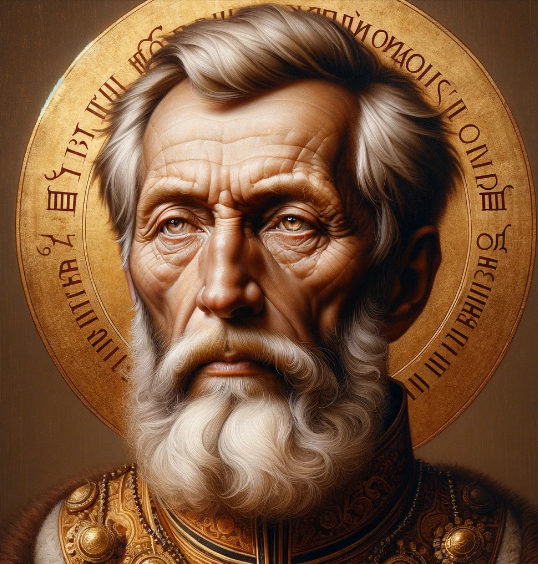
Introduction[1]
Throughout history, the name Ivan has resonated across the corridors of power and culture, especially within Eastern European and Russian contexts. This name, steeped in tradition and history, has been borne by rulers and visionaries, artists and scientists, each leaving an indelible mark on their respective fields. From the grandeur of Tsarist Russia to the nuanced realms of literature and science, Ivans have shaped the course of history and influenced the fabric of cultural heritage.

Image Credit: portrait depicts Ivan IV of Russia, known as Ivan the Terrible, with an intense and warlike demeanor. His attire is disheveled and battle-worn, reflecting his ferocious reputation, and his expression is menacing, capturing the darker aspects of his character. The background is designed to be ominous, with elements that suggest the turbulence of his reign, adding to the overall formidable portrayal. Drawn by DALL-E, a sub-set of ChatGPT, January 2024
In this exploration, I look into the lives and legacies of several men named Ivan, tracing their contributions, triumphs, and challenges. While some of these figures, like Ivan the Terrible, are enshrined in the annals of history, others remain lesser-known yet equally fascinating in their contributions to the heritage of Eastern Europe and Russia.
This story is not just about the shared name but about the diverse paths they carved, reflecting the rich and complex mosaic of Russian and near-Russian history. In navigating through their stories, the myriad ways in which these men have shaped, challenged, and defined their worlds are uncovered, leaving a legacy that continues to echo through time.
These Ivans have left their mark on various fields, including leadership, literature, science, and culture, each contributing significantly to their respective domains and beyond. Each Ivan featured below offers a unique window into the past, providing insights into the cultural, political, and intellectual currents that have defined Eastern Europe and Russia. Join me as we journey through the lives of these remarkable individuals, uncovering the narratives that have woven their names into the rich fabric of history.
Etymology[2]
Ivan, often affectionately called “Ivo” by close friends, has charming nicknames like “Vanya” in Russian, “John” in English, and “Juan” in Spanish. These variations reflect the diverse and endearing ways people address him across different cultures.
Ivan is a common Slavic name with variants like Иван in Bulgarian, Russian, Macedonian, Serbian, and Montenegrin, and Іван in Belarusian and Ukrainian.
The name is derived from the New Testament Greek Ἰωάννης (Iōánnēs), which itself comes from Hebrew יוֹחָנָן (Yôḥānān), meaning “YHWH (God) is gracious.”
Common patronymics[3] from Ivan include Ivanović (Serbian and Croatian), Ivanov (Russian and Bulgarian), and Ivanovich (Russian)[4].
Popularity and Usage of Ivan[5]
Ivan is a prevalent name among many Slavic nationalities, including Slovenes, Croats, Russians, Ukrainians, Bulgarians, Belarusians, Macedonians, Serbs, Bosnians, and Montenegrins.
- It is the most common male name in Bulgaria and Croatia as of 2013.
- In Serbia, it ranked within the top 10 most common male names from 1971 to 2000.
- The name was the most popular in Croatia between 1930 and 1940 and was the most common masculine given name until 1959, and between 1980 and 1999.
Ivan has also seen increased popularity in Romance-speaking countries, including Italy (Ivano), Spain (Iván), and Portugal (Ivã).
Forms
- Female forms of Ivan include Ivana (West and South Slavic) and Ivanna (East Slavic). Diminutives include Ivanka and Iva.
- Male diminutives include Vanya or Vanja, Ivaniš, Ivanko, Ivanča, and Ivanče. A shorter form of the name is Ivo.
These details highlight the widespread use and cultural significance of the name Ivan across various Eastern European nations, reflecting its deep roots in Slavic tradition and language.
Royal Ivans in Eastern Europe[6]
- Ivan Vladislav, Bulgarian emperor (1015–1018)
- Ivan Asen I, Bulgarian emperor (1189–1196)
- Kaloyan (also known as Ivan I, Ioannitsa or Johannitsa the Romanslayer), Bulgarian emperor (1197–1207)
- Ivan Asen II, Bulgarian emperor (1218–1241)
- Ivan II, Bulgarian emperor (1298-1299)
- Ivan Stephen, Bulgarian emperor (1330–1331)
- Ivan Alexander, Bulgarian emperor (1331–1371)
- Ivan Shishman, Bulgarian emperor in Tarnovo (1371–1395)
- Ivan Stratsimir, Bulgarian emperor in Vidin (1356–1396)
- Ivan I, “The Moneybag”, Grand Duke of Moscow (1325–1340)
- Ivan II, “The Fair”, Grand Duke of Moscow (1353–1359)
- Ivan III, “The Great”, Grand Prince of Moscow (1462–1505)
- Ivan IV, “The Terrible”, Russian emperor (1547–1584)
- Ivan V, Russian emperor (1682–1696)
- Ivan VI, Russian emperor (1740–1741)
Ivan I, “The Moneybag”, Grand Duke of Moscow (1288–1340, reigned from 1325)
Ivan I was nicknamed “Kalita” or “The Moneybag” and ruled as the Grand Duke of Moscow from 1325 to 1340. He came to prominence during a time when the principalities of Rus’ were under the yoke of the Mongol Empire (the Golden Horde). He gained favour with the Mongols, which allowed him to increase his influence.
- Status: Ivan I is a pivotal figure in the rise of Moscow as a political centre.
- Economic Acumen: Ivan I earned his nickname “The Moneybag” due to his skill in enriching Moscow and his principality, partly through acting as a tax collector for the Mongols. His wealth was used to increase Moscow’s influence and to purchase titles and lands, expanding the power of Moscow. His wealth was also used to construct key buildings and patronise the Orthodox Church, thereby increasing Moscow’s prestige.
- Church and State: Ivan Kalita is also noted for moving the seat of the Metropolitan, the head of the Russian Orthodox Church, from Vladimir to Moscow, which significantly boosted the religious standing of Moscow.
- Religious Influence: Moving the seat of the Metropolitan to Moscow was a significant step in making the city a religious centre, which would later contribute to Moscow’s claim as the ‘Third Rome’.
- Legacy: His reign marked the beginning of Moscow’s rise as a political and economic centre in Russia. His shrewd dealings with the Mongols and his financial acumen set the stage for the future grandeur of Moscow. His political tactics included strategic marriages and alliances, helping to expand Moscow’s territory and influence.

Image Credit: Ivan I, also known as “The Moneybag”, depicted in the style of a medieval Russian Orthodox icon.
Drawn by DALL-E, a sub-set of ChatGPT, January 2024
Ivan II, “The Fair”, Grand Duke of Moscow (around 1326–1359, reigned from 1353)
Ivan II’s reign is characterised by a relatively peaceful period. He was not known for military exploits and preferred diplomatic approaches.
- Internal Affairs: His rule focused more on internal affairs, managing his state and dealing with domestic issues.
- Relations with Neighbours: Ivan II maintained peaceful relations with neighbouring principalities and the Golden Horde, continuing the policy of non-confrontation and vassalage.
- Family and Legacy: Ivan II was married to Alexandra Vasilyevna Velyaminova, and they had several children. His reign, though short and less eventful compared to others, helped maintain stability in the region.
- Diplomatic Relations: Ivan II’s diplomatic relations with other Rus[7] princes and the Mongol rulers, maintained vassalage while preserving Moscow’s interests.
- Succession: His death in 1359 led to a period of uncertainty and brief power struggles before the ascension of his brother, Dmitry Ivanovich, to the grand ducal throne.
- Legacy: Despite a less eventful reign, Ivan II’s peaceful rule contributed to the continuity of Moscow’s growth and stability.
Ivan III of Russia (1440–1505, reigned from 1462)
Also known as Ivan the Great, he was the Grand Duke of Moscow and Grand Prince of all Rus. He brought the independent republics of Novgorod and Tver under the control of the Grand Duchy of Moscow. Ivan the Great was a transformative figure in Russian history, ending Mongol dominance and beginning the centralisation of the Russian state.
He overthrew the Mongol Yoke[8], centralised the Russian state, and laid the foundations for the future Russian empire. His diplomatic marriages, including that to Sophia Palaiologina of Byzantium, helped elevate the cultural and political standing of Russia in Europe. Ivan III also commissioned the construction of the Kremlin’s current walls and towers, symbolising Moscow’s growing power.
Ivan III was a visionary ruler who played a pivotal role in transforming Moscow into the heart of a growing Russian state. His reign was characterised by a series of strategic moves to consolidate power and extend Moscow’s authority over other Russian principalities. He carefully negotiated and, when necessary, fought to bring these territories under Moscow’s control, significantly expanding the Grand Duchy’s borders. Ivan’s astute political manoeuvres helped lay the groundwork for a unified Russian state.
- The overthrow of the Mongol Yoke: One of Ivan III’s most significant achievements was the overthrow of the Mongol yoke, marking a turning point in Russian history. His refusal to pay tribute to the Mongol Khan symbolised the end of Mongol dominance and asserted Moscow’s sovereignty. This bold act not only liberated Moscow from Mongol control but also inspired other Russian regions to rally behind Moscow’s leadership. Ivan’s defiance against the Mongols was a crucial step towards the independence and national identity of Russia.
- Diplomatic Marriages: Ivan III’s reign was also notable for his diplomatic marriages, which were used to forge important alliances and elevate Moscow’s status on the European stage. His marriage to Sophia Palaiologina, a niece of the last Byzantine emperor, was particularly significant. This alliance brought not only political prestige but also cultural and religious influence, as Sophia introduced Byzantine customs, art, and architecture to Moscow. Through these marriages, Ivan III not only strengthened his own rule but also enhanced Moscow’s international stature.
- Architectural Legacy: Ivan the Great’s influence extended to the architectural development of Moscow, most notably through the expansion and fortification of the Kremlin. Under his rule, Italian architects were brought to Moscow, leading to the construction of the Kremlin’s current walls and towers. These architectural projects were not only defensive measures but also symbols of Moscow’s growing power and Ivan’s ambition to make Moscow a centre of political and religious authority. The Kremlin, as it stands today, is a lasting testament to Ivan III’s vision and legacy.
Ivan III’s reign was a defining period in Russian history, marking the rise of Moscow as a dominant power in Eastern Europe. His leadership laid the foundations for the future Russian empire and left an indelible mark on the nation’s political, cultural, and architectural landscape.
The destruction of the Novgorod veche by Ivan III
The destruction of the Novgorod veche by Ivan III, also known as Ivan the Great, was a significant event in the history of Russia that occurred in 1478. The veche was a form of assembly practiced by East Slavic peoples and was an important institution in Novgorod, symbolising the city’s relative autonomy and republican traditions within the medieval feudal hierarchy of Russia.
Novgorod was one of the largest and most prosperous cities in the region, known for its unique form of republican governance. The veche operated as a town hall meeting where the free citizens of Novgorod would gather to make important decisions regarding the city’s affairs, including matters of war, peace, and foreign policy.
Ivan III sought to consolidate power and bring the various Russian principalities under the centralised rule of Moscow. His policies were aimed at diminishing the power of the boyars (nobility) and subjugating the previously autonomous regions. Novgorod’s independence and the veche’s authority were seen as obstacles to his ambitions.
The destruction of the Novgorod veche was both literal and symbolic. Ivan III’s forces took the city of Novgorod after a series of conflicts and political maneuvers. Upon capturing the city, Ivan’s troops physically dismantled the veche bell, which was used to call the citizens to assembly, and took it back to Moscow. This act signified the end of the veche system and the independence of Novgorod. Many of the leading citizens and nobles of Novgorod were arrested, executed, or exiled, and their properties were confiscated.
This event effectively ended the Republic of Novgorod and marked a critical step in Ivan III’s consolidation of the Russian lands, leading to the rise of the centralised Russian state and the expansion of Moscow’s power. It also established a precedent for the autocratic rule that would characterise the Tsardom of Russia and later the Russian Empire.

Ivan’s destruction of the Novgorod veche, painting by Klavdy Lebedev (1889) Citation: Ivan III of Russia. (2024, January 11).
In Wikipedia: https://en.wikipedia.org/wiki/Ivan_III_of_Russia
Attribution: Klavdy Lebedev, Public domain, via Wikimedia Commons
Ivan IV “the Terrible” of Russia (1530–1584, reigned from 1547)
He was the Grand Prince of Moscow from 1533 to 1547 and the first Tsar of Russia from 1547 to 1584. He ascended the throne as the Grand Prince of Moscow at the age of three.
Ivan the Terrible is known for his complex personality, expansion of the Russian Empire, the introduction of new legal codes, and the establishment of the Oprichnina (see below). He is also remembered for his ruthless leadership.
- Territorial Expansion: Under Ivan IV, Russia saw significant territorial expansion. He successfully conquered the Khanates of Kazan, Astrakhan, and Siberia, pushing the boundaries of Russian territory eastward. These conquests not only expanded the Russian Empire but also opened up new trade routes and access to valuable resources. This period was crucial in shaping the geopolitical landscape of Eurasia.
- The Oprichnina: Perhaps the most controversial aspect of Ivan IV’s reign was the establishment of the Oprichnina, a policy that created a state within a state-controlled exclusively by the Tsar. This period was marked by a campaign of terror against the nobility, including mass repressions, public executions, and confiscation of property. The Oprichnina represented Ivan’s ruthless effort to consolidate power but ultimately led to widespread fear and instability.
- Legal and Administrative Reforms: Ivan IV introduced significant legal reforms, including the 1550 Sudebnik, which modernised the legal code and centralised the judicial system. He also established the Zemsky Sobor[9], a form of national assembly, which was a pioneering step towards a more participatory form of governance.
- Personal Life and Legacy: Ivan’s personal life was tumultuous and tragic, including the accidental killing of his son. His later years were characterised by paranoia and bouts of rage, contributing to his infamous legacy. Despite his notoriety, Ivan the Terrible was a pivotal figure in Russian history, responsible for significant state-building efforts but also remembered for his tyrannical rule.
- Legacy: Ivan IV’s reign, particularly his later years, was marked by bouts of rage and paranoia, and his legacy is one of both state-building and ruthless tyranny.
Ivan V of Russia (1666–1696, reigned from 1682)
Ivan V was a co-ruler of Russia with his younger half-brother Peter the Great. His reign was largely nominal due to his poor health and intellectual disability. His sister Sophia acted as regent during his early reign, but Peter eventually overshadowed Ivan V and effectively ruled alone. Ivan’s time as a co-ruler is often considered a transitional period that paved the way for the significant reforms and modernisation efforts of Peter the Great.
Ivan V, often overshadowed by his illustrious half-brother Peter the Great, was a less prominent figure in Russian history. His reign is largely seen as a transitional period that set the stage for the transformative rule of Peter the Great.
- Nominal Co-Ruler: Ivan V was co-ruler of Russia with Peter the Great. However, his role was largely nominal due to his poor health and intellectual disability. The actual governance was first in the hands of his sister, Sophia, as regent, and later dominated by Peter.
- Sophia’s Regency: During the early years of his reign, Ivan V’s sister, Sophia, acted as the regent. This period saw Sophia assert considerable influence, but her rule was marked by internal strife and power struggles within the court.
- Transition to Peter the Great: As Peter the Great came of age, he gradually overshadowed Ivan in terms of political and military prowess. Peter’s ambitious visions for Russia and his dynamic leadership style contrasted sharply with Ivan’s passive presence.
- Legacy: Ivan V’s reign, though lacking in notable achievements of its own, was significant for paving the way for the reforms and modernisation efforts undertaken by Peter the Great. Ivan’s time as a co-ruler represents a bridge between the old Muscovite state and the new Russian Empire that emerged under Peter’s rule.
Ivan VI of Russia (1740–1764, reigned from birth until 1742)
Ivan VI was an infant emperor who came to the Russian throne at just two months old after the death of Empress Anna. His reign was short-lived, as a coup led by Elizabeth, the daughter of Peter the Great, deposed him before his second birthday. He spent the rest of his life in captivity, largely in solitary confinement, and was killed by his guards during an escape attempt when he was 23 years old. His tragic life is sometimes seen as a symbol of the brutality and volatility of the Russian imperial succession.
Ivan VI Antonovich of Russia (Ivan VI) was thrust onto the throne as an infant, his reign becoming a poignant symbol of the turbulent era of palace coups and the fragility of royal succession in 18th century Russia. Born on 23rd August 1740, his ascent to the throne at merely two months old, following the death of Empress Anna, was the result of complex court politics and familial power struggles.
- Early Reign and Overthrow: Ivan’s reign was under the regency of his mother, Anna Leopoldovna, and other nobles. However, his time as emperor was brief and figurehead in nature. In 1741, a coup d’état led by Elizabeth, Peter the Great’s daughter, dramatically ended his reign. Elizabeth, with considerable support from the Russian Imperial Guard and nobility, seized the throne, leading to the imprisonment of young Ivan VI and his family.
- Life in Captivity: The coup marked the beginning of a long, tragic period of Ivan’s life spent in captivity. He was held in various fortresses and locations, often in isolation, to prevent any attempts to restore him to the throne. The secrecy surrounding his imprisonment meant that Ivan grew up in confinement, largely cut off from the outside world and the intricacies of court life that he was born into.
- Tragic End and Legacy: Ivan’s life ended in tragedy in 1764. During an escape attempt orchestrated by one of his jailers, who sought to use him as a pawn in yet another power play, Ivan was killed by his guards. This followed secret orders issued by the then-ruling Empress Catherine II, which decreed that Ivan should be killed if any rescue attempt was made.
The short and tragic life of Ivan VI highlights the volatility of the Russian imperial succession and the ruthlessness of court politics during this period. His story is often seen as symbolic of the harsh realities of 18th century Russian royalty, where the throne was a perilous seat, and even an infant emperor could not escape the machinations of power.

Mirovich Standing over the Corpse of Ivan VI (1884) by Ivan Tvorozhnikov
Caption: Ivan VI of Russia. (2024, January 1). In Wikipedia. https://en.wikipedia.org/wiki/Ivan_VI_of_Russia
Ivan Turgenev (1818–1883)
Ivan Turgenev was a prominent Russian novelist, poet, and playwright, renowned for his profound influence on Russian literature. His works are celebrated for their intricate character development, exploration of social issues, and poetic realism.
- Major Works: His most famous novel, “Fathers and Sons” (1862), is a pivotal work in 19th century fiction. It introduces the character Bazarov, a nihilist conflicting with the older generation, encapsulating the societal shifts in Russia at that time.
- Literary Influence: Turgenev’s narratives often explored the rifts in Russian society between the aristocracy and the serfs, and the conflicts between Westerners and Slavophiles.
- Style and Themes: His writing is known for its elegant prose, introspective characters, and the portrayal of Russian life and landscapes.
- Legacy: Turgenev was a major figure in Russian Realism, and his works significantly influenced not only Russian but also Western literature. His humane, liberal views and the lyrical, restrained quality of his prose continue to attract readers.

Battle of Çeşme at Night (1856), By Ivan Aivazovsky – scan of painting, Public Domain, https://commons.wikimedia.org/w/index.php?curid=6883304
Attribution: Ivan Aivazovsky, Public domain, via Wikimedia Commons
Ivan Konstantinovich Aivazovsky (1817–1900)
Ivan Aivazovsky was a celebrated Russian Romantic painter known primarily for his seascapes, which are considered among the finest in the world. Here are some key aspects of his life and work:
- Background: Aivazovsky was born in Feodosia, Crimea, to an Armenian family. His talent for art was recognised early, and he went on to study at the Imperial Academy of Arts in Saint Petersburg.
- Seascapes: Aivazovsky is best known for his seascapes, which capture the beauty and power of the sea. His paintings are characterised by a masterful use of light and a romantic portrayal of the water, often set against dramatic skies.
- Technique and Style: Aivazovsky had a unique ability to depict light and movement, which brought his seascapes to life. He often painted from memory, reflecting his deep understanding of the sea and its moods.
- Legacy: Aivazovsky left behind a vast body of work, with over 6,000 paintings, contributing significantly to Russian and world art. His paintings are displayed in many major museums around the world, and he remains a revered figure in art history, particularly for his contributions to maritime painting.
Ivan Pavlov (1849–1936)[10]
Pavlov’s most famous experiments involved dogs, where he demonstrated what is now known as the “Pavlovian response”. In these experiments, Pavlov initially presented a neutral stimulus (a bell) along with an unconditioned stimulus (food), which naturally and reliably elicited an unconditioned response (salivation in dogs). Over time, the dogs began to associate the neutral stimulus with the food, leading them to salivate at the sound of the bell alone. This conditioned reflex was a profound discovery, illustrating the process of learning through association, a foundational concept in behavioural psychology.
The significance of Pavlov’s research extends far beyond these well-known experiments. His work laid the critical groundwork for the scientific study of behaviour, offering invaluable insights into the learning process. It opened the door to a new understanding of how environmental factors can influence behaviour, a concept that has had far-reaching implications in various fields.
In recognition of his significant contributions, Pavlov was awarded the Nobel Prize in Physiology or Medicine in 1904. However, it’s noteworthy that this recognition was not for his work on classical conditioning, but rather for his research on digestion, specifically his studies on the physiology of the digestive glands. His work in this area was equally pioneering and contributed to our understanding of the digestive system.
Pavlov’s legacy is immense. His concepts of conditioning have been widely applied across various disciplines, including behavioural psychology, education, and behaviour therapy. His ideas have helped shape modern approaches to understanding and modifying behaviour, demonstrating the extensive influence of his work on both scientific thought and practical applications. Pavlov’s theories continue to be a fundamental part of psychological education and remain influential in various therapeutic and educational strategies to this day.
Ivan the Fool
A common character in Russian folklore, Ivan the Fool, is depicted as a simple yet wise man who triumphs over more powerful adversaries through his ingenuity and good luck.
- Folkloric Role: Often portrayed as the youngest son of a peasant family, Ivan the Fool typically succeeds where his “smarter” brothers fail, using common sense, kindness, and a straightforward approach.
- Symbolism: He represents the triumph of innocence and inherent goodness over cunning and deceit. His character often symbolises the strength and virtue of the common people.
- Cultural Impact: Ivan the Fool has been the subject of numerous Russian folk tales, literary works, and artistic representations. He embodies the idea that wisdom and success do not always come from conventional intelligence but can also arise from pure-hearted simplicity.
Ivan Laid Bare [11]
- Ivan is described as a likeable, fair-haired and blue-eyed youth.
- The approximate setting of Ivan the Fool’s adventures is 15th or 16th century Russia.
- Ivan the Fool usually appears in stories either as a peasant or as the son of a poor family. He is usually the youngest of three brothers; his older siblings appear much smarter than he, but are sometimes unkind to and envious of him.
- In contrast to typical heroes, Ivan’s simplicity and lack of guile turn out to help him in his adventures. For example, he listens to his heart rather than to his mind, and he easily forgets offence and endeavors to help others even at his own expense. His naivety, kindness, and daring help him fight villains, make friends, and win princesses’ hearts, and ultimately he is rewarded with half a kingdom or some similar accomplishment.
- The moral of these stories is that Ivan the Fool is rarely the fool, but is merely perceived as such by others owing to his simple nature and joviality.
Ivan, German codename of Serbian spy Duško Popov OBE (1912-1981)
Popov was born on 10th July 1912 in Titel, Austria-Hungary. He came from a wealthy Serbian family. He was well-educated, fluent in multiple languages, and led a luxurious lifestyle. His higher education included law studies at the University of Belgrade and the University of Freiburg.

Dušan Popov, a MI5 double agent code-named TRICYCLE, photographed in New York in 1941.
Citation: Duško Popov. (2024, January 11). In Wikipedia. https://en.wikipedia.org/wiki/Du%C5%A1ko_Popov
- World War II Involvement: Popov was a notable Serbian double agent during World War II, working for both MI6 and the Abwehr. He infiltrated the Abwehr in 1940, leveraging his business contacts in France and the UK. While providing misleading information to the Germans, he also worked for the Yugoslav government-in-exile in London.
- Key Contributions: Popov played a critical role in Operation Fortitude, deceiving the Germans about the location of the Allied invasion of Europe (D-Day). He successfully convinced them that the invasion would occur in Calais instead of Normandy.
- Personal Life: Known for his promiscuous lifestyle, Popov was also a ladies’ man with connections to various women, including actress Simone Simon. He was nicknamed Tricycle by the British MI5 due to leading a group of three double agents.
- Post-War Life and Legacy: After the war, Popov authored his autobiography, “Spy/Counterspy,” where he recounted his espionage activities. He is considered one of the inspirations for Ian Fleming’s character, James Bond. Popov passed away on 10th August 1981, leaving a legacy that includes being featured in documentaries and biographies and as a part of James Bond’s 007 lore.
Conclusion
This paper has examined the significant impact of various historical and cultural figures named Ivan in Eastern Europe and Russia. The diversity of their contributions spans from the realms of politics and science to literature and art, each Ivan leaving a unique imprint on the fabric of Eastern European history.
The royal Ivans, such as Ivan the Terrible and Ivan the Great, played crucial roles in shaping the political landscape of Eastern Europe, expanding territories and centralising power. Their reigns, marked by both progressive and tyrannical actions, highlight the complexities of leadership and governance during their times.
In the sphere of science, Ivan Pavlov’s groundbreaking research in behavioural psychology introduced new ways of understanding learning and reflexes, impacting various scientific and educational fields. His work, notably different in nature and scope from the political Ivans, underscores the wide-ranging influence that individuals sharing this common name have had across different sectors.
The contributions of Ivan Turgenev in literature and Ivan Aivazovsky in art enriched Russian culture, reflecting the social and aesthetic sensibilities of their eras. Their works continue to be celebrated for their artistic and narrative qualities, contributing significantly to the cultural heritage of the region.
Even in folklore, the character of Ivan the Fool illustrates the cultural values and societal norms of the time, offering insights into the historical and moral fabric of Eastern European societies.
To conclude, the Ivans discussed in this paper have not only shaped their immediate environments and eras but have also left enduring legacies. Their varied paths highlight the rich and multifaceted history of Eastern Europe, reminding us of the significant roles individuals can play in the broader context of regional and world history.
Selected Relevant Reading
- A History of the First Bulgarian Empire, by Steven Runciman (2018), published by Lulu.com, available from https://www.amazon.co.uk/History-First-Bulgarian-Empire/dp/0359041434/
- Aivazovsky: Painting, Drawing and Watercolour, by Gianni Caffiero and Ivan Samarine (2012), published by Laurence King Publishing, available from https://www.amazon.co.uk/Light-Water-Sky-Paintings-Aivazovsky/dp/1780670575
- Byzantium and Bulgaria, 775-831, by Panos Sophoulis (1985), published by Harvard University Press, available from https://www.amazon.co.uk/Late-Byzantine-Slavonic-Communion-Cycle/dp/0884021343
- Chronicle of the Russian Tsars: The Reign-by-Reign Record of the Rulers of Imperial Russia (Chronicles), by David Warnes (1999), published by Thames & Hudson, available from https://www.amazon.co.uk/Chronicle-Russian-Tsars-Reign-Reign/dp/0500050937
- Into the Lion’s Mouth: The True Story of Dusko Popov: World War II Spy, Patriot, and the Real-Life Inspiration for James Bond, by Larry Loftis (2022), published by Penguin Publishing Group, available from https://www.amazon.co.uk/Into-Lions-Mouth-Real-Life-Inspiration/dp/0593473973/
- Ivan the Great of Moscow, by John Fennell (2021), published by Hassell Street Press, available from https://www.amazon.co.uk/Ivan-Great-Moscow-1918-1992-Fennell/dp/1013936701/
- Ivan the Terrible, by Isabel de Madariaga (2006), published by Yale University Press, available from https://www.amazon.co.uk/Ivan-Terrible-Isabel-Madariaga/dp/0300119739
- Medieval Russia, 980-1584, by Janet Martin (2007), published by Cambrdge University Press, available from https://www.amazon.co.uk/Medieval-Russia-980-1584-Cambridge-Textbooks/dp/0521676363
- Pavlov’s Dogs and Schrödinger’s Cat: Scenes from the Living Laboratory, by Rom Harré (2009), published by OUP Oxford, available from https://www.amazon.co.uk/Pavlovs-Dogs-Schr%C3%B6dingers-Cat-Laboratory/dp/0199238561
- Peter the Great: His Life and World, by Robert K. Massie (2022), published by Apollo, available from https://www.amazon.co.uk/Peter-Great-Massie/dp/1801102775/
- Romanovs: 1613-1918, by Simon Sebag Montefiore (2017), published by W&N, available from https://www.amazon.co.uk/Romanovs-1613-1918-Simon-Sebag-Montefiore/dp/1474600875/
- The Balkans (Universal History), by Mark Mazower (2002), published by Phoenix, available from https://www.amazon.co.uk/Balkans-UNIVERSAL-HISTORY-Mark-Mazower/dp/1842125443
- The Palgrave Concise Historical Atlas of Eastern Europe, by Dennis P. Hupchick and Harold E. Cox (1996), published by Palgrave Macmillan, available from https://www.amazon.co.uk/Concise-Historical-Atlas-Eastern-Europe/dp/0312158955
- Turgenev: A Biography, by Leonard Schapiro (1982), published by Harvard University Press, available from https://www.amazon.co.uk/Turgenev-Life-Times-Leonard-Schapiro/dp/0674912977
CAUTION: This paper is compiled from the sources stated but has not been externally reviewed. Parts of this paper include information provided via artificial intelligence which, although checked by the author, is not always accurate or reliable. Neither we nor any third parties provide any warranty or guarantee as to the accuracy, timeliness, performance, completeness or suitability of the information and materials covered in this paper for any particular purpose. Such information and materials may contain inaccuracies or errors and we expressly exclude liability for any such inaccuracies or errors to the fullest extent permitted by law. Your use of any information or materials on this website is entirely at your own risk, for which we shall not be liable. It shall be your own responsibility to ensure that any products, services or information available through this paper meet your specific requirements and you should neither take action nor exercise inaction without taking appropriate professional advice. The hyperlinks were current at the date of publication.
End Notes and Explanations
- Source: Compiled from research using information at the sources stated throughout the text, together with information provided by machine-generated artificial intelligence at: bing.com [chat] and https://chat.openai.com ↑
- Source: https://en.wikipedia.org/wiki/Ivan as adapted by ChatGPT ↑
- Explanation: Patronymics are a component of a personal name based on the given name of one’s father, grandfather, or an even earlier male ancestor. This form of naming is found in cultures around the world and can be seen as a way of conveying lineage and family heritage. In many cultures, a patronymic is typically used as a middle name. For instance, in Russian and other Slavic cultures, a patronymic is commonly used between the first name and the family name. For example, if a man named Ivan has a father named Nikolay, his full name would be Ivan Nikolayevich, with “Nikolayevich” indicating “son of Nikolay.” Similarly, for a woman named Anna with the same father, her full name would be Anna Nikolayevna, with “Nikolayevna” indicating “daughter of Nikolay.”
This naming convention is prominent in various cultures with local variations. It helps to identify a person not only individually but also in the context of family and ancestry. Patronymics are not only a means of identification but also carry a sense of familial pride and continuity from generation to generation. ↑
- Explanation: Ivanovich , in Russian, is used as middle name), corresponding to “Ivan’s son”. see more at: https://en.wikipedia.org/wiki/Patronymic#Russian ↑
- Source: https://en.wikipedia.org/wiki/Ivan as adapted by ChatGPT ↑
- Source: https://en.wikipedia.org/wiki/Ivan ↑
- Explanation: “Rus” refers to a historical region and group of territories in Eastern Europe inhabited by the East Slavs. The term has several interconnected meanings, often related to the early medieval history of Eastern Europe:
Kievan Rus’: This is the most common and significant reference of “Rus.” Kievan Rus’ was a federation of Slavic and Finno-Ugric peoples in Eastern Europe from the late 9th to the mid-13th century, under the reign of the Rurik dynasty. It was a precursor to the modern nations of Belarus, Russia, and Ukraine. The state adopted Christianity from the Byzantine Empire in 988, leading to the synthesis of Byzantine and Slavic cultures. The capital of this federation was Kiev (now in Ukraine), and it played a crucial role in the development of the cultural, political, and religious foundations of Eastern Slavic civilisation.
Ethnolinguistic Identity: The term “Rus” also referred to the people of Kievan Rus’, who were East Slavs and ancestors of the modern Belarusians, Russians, and Ukrainians. The self-identity of these people was based on a common culture, language, and shared history.
Geographical Area: Geographically, “Rus” described the land inhabited by these East Slavic tribes, encompassing parts of modern-day Russia, Ukraine, and Belarus.
The term “Rus” itself likely has Scandinavian origins, as the early political elite of Kievan Rus’ were Varangians (Vikings), who came from Scandinavia and played a pivotal role in establishing the state. Over time, the cultural and political influence of these Norse settlers blended with that of the local Slavic and Finno-Ugric populations. Understanding Kievan Rus’ is crucial for comprehending the historical development of the East Slavic nations and the complex relationships between them throughout history. Source ChatGPT. More about the Rus people at: https://en.wikipedia.org/wiki/Rus%27_people ↑
- Explanation: The “Mongol Yoke” refers to the period when parts of Russia and Eastern Europe were under the rule or influence of the Mongol Empire. This period began with the Mongol invasion in the early 13th century and lasted until the late 15th century. It was characterised by Mongol domination over many Russian principalities, including the most prominent one, Kievan Rus’. During this time, the Mongol Empire, led initially by Genghis Khan and later by his descendants, conquered and ruled over a vast territory that extended from Asia to Eastern Europe. The Mongol rulers imposed tributes and taxes on the conquered territories, controlled trade routes, and influenced local politics and society. Despite their control, the Mongols often allowed local princes to govern, as long as they paid tribute and maintained loyalty to the Mongol Khans. The Mongol Yoke had significant impacts on the development of Russian and Eastern European history, culture, and politics. It isolated these regions from Western Europe during a time of significant change and development (like the Renaissance), which had lasting effects on their historical trajectory. The period ended with the gradual decline of Mongol power and the rise of the Grand Duchy of Moscow, which eventually became the Tsardom of Russia. See more at: https://en.wikipedia.org/wiki/Mongol_invasion_of_Kievan_Rus%27 ↑
- Explanation: The Zemsky Sobor, often translated as “Assembly of the Land,” was a major political institution in Russia during the late 16th and 17th centuries. It can be compared to a parliamentary body, although with significant differences from the modern concept of a parliament. Key aspects of the Zemsky Sobor include:
Composition: The Zemsky Sobor was composed of representatives from various social classes and regions of Russia, including boyars (nobles), clergy, merchants, and sometimes even peasants. This inclusive representation was significant for its time, as it provided a platform for different societal groups to participate in governance.
Function and Authority: The Sobor’s primary functions were to advise the Tsar on important state matters, to legitimize major political decisions, and occasionally to participate in the selection of a new Tsar. It was not a standing institution but convened by the Tsar’s decree, often in times of crisis or when major decisions needed public approval.
Historical Significance: The Zemsky Sobor played a crucial role in several key events in Russian history. For instance, it was instrumental in the election of Mikhail Romanov as Tsar in 1613, ending the Time of Troubles and establishing the Romanov dynasty that ruled Russia until 1917.
Limitations: Despite its inclusive nature, the Zemsky Sobor’s power was limited. It did not have the authority to convene itself or to enforce its decisions independently. Its role was largely advisory, and the final decision-making power rested with the Tsar.
Legacy: The Zemsky Sobor is significant for its role in the development of Russian statehood and governance. It represented an early form of collective decision-making in Russia, although it was far from a democratic institution by modern standards.
By the mid-17th century, the Zemsky Sobor gradually declined in importance and was eventually replaced by more centralized forms of governance. However, its role in Russian history is often cited as an early example of broader political participation in the governance of the state. ↑
- Explanation: Classical conditioning, also known as Pavlovian conditioning, is a type of learning where a neutral stimulus (like a musical triangle sound) is paired with a biologically significant stimulus (like food) to produce a reflexive response (like salivation in dogs). This was extensively studied by Russian physiologist Ivan Pavlov through experiments with dogs, notably observing that dogs would start to salivate when presented with meat. Pavlov published his findings in 1897. Classical conditioning is different from operant conditioning, where voluntary behaviour is modified through rewards or punishments. However, classical conditioning can influence operant conditioning, as conditioned stimuli can reinforce voluntary behaviours. This concept became a fundamental part of behaviourism, a dominant school of psychology in the mid-20th century. It has applications in various fields, such as psychology, psychoactive drug response, hunger regulation, and the study of learning and memory. It also plays a role in understanding certain social phenomena. ↑
- Source: https://en.wikipedia.org/wiki/Ivan_the_Fool ↑
