
Introduction[1]
His full name was Jean William Fritz Piaget, but he is known to the world simply as Jean Piaget. This paper tells the story of an extraordinary man with an extraordinary mind.
Jean Piaget (1896–1980) was a Swiss psychologist and epistemologist[2] known for his pioneering work in child development. Piaget’s theory of cognitive development and epistemological view are together called “genetic epistemology.” He proposed that children progress through four stages of cognitive development, each characterised by different ways of thinking and understanding the world:
- Sensorimotor Stage (Birth to 2 years): During this stage, infants learn about the world through their sensory experiences and actions (e.g., looking, touching, mouthing). Piaget believed that children develop an understanding of object permanence at this stage, which is the recognition that objects continue to exist even when they cannot be seen, heard, or touched.
- Preoperational Stage (2 to 7 years): In this stage, children start to use language to explore and understand their worlds rather than relying solely on sensory and motor interactions. They develop memory and imagination, which allows them to comprehend the difference between past and future and engage in make-believe. However, their thinking is not yet logical; they cannot, for instance, perform operations, or reversible mental processes.
- Concrete Operational Stage (7 to 11 years): Children begin to think logically about concrete events. They gain a better understanding of the concept of conservation (the idea that quantity remains the same despite changes in shape or appearance), and can classify objects according to several features and order them in series along a single dimension such as size.
- Formal Operational Stage (12 years and upwards): Adolescents enter this stage when they start to think abstractly and reason about hypothetical problems. Abstract thought enables them to use deductive logic or reasoning from a general principle to specific information.
Piaget’s work emphasised how children actively construct their understanding of the world through their experiences and interactions. He proposed that learning is a process of accommodation and assimilation, where individuals adapt and refine their mental models of the world based on new experiences. His theories have had a profound influence on developmental psychology, education, and related fields. His work led to the creation of more interactive and discovery-based learning methods, emphasising the importance of the environment and active exploration in learning. Despite criticism and modifications by later researchers, those theories remain a cornerstone in the understanding of child development.

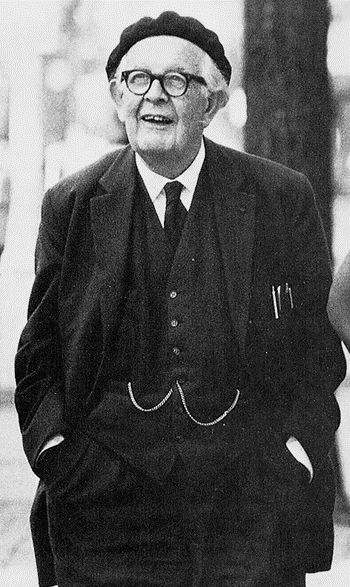
Jean Piaget at the University of Michigan campus in Ann Arbor
Citation: Piaget’s theory of cognitive development. (25 December 2023).
In Wikipedia. https://en.wikipedia.org/wiki/Piaget%27s_theory_of_cognitive_development
Personal Life
Jean Piaget was born on 9th August 1896, in Neuchâtel, Switzerland, into a family with a keen interest in the natural sciences. His father, Arthur Piaget, was a professor of medieval literature, and his mother, Rebecca Jackson, was intelligent but had a neurotic temperament that influenced Piaget’s interest in psychology. From an early age, Piaget displayed a curiosity for biology and the natural world and was particularly interested in molluscs. At age 11, he published a scientific paper (in the Journal of Natural History of Neuchâtel) on an albino sparrow, marking the beginning of a prolific career in scientific research.
Piaget’s early exposure to the natural sciences deeply influenced his intellectual development and career path. He studied at the University of Neuchâtel, where he received a degree in natural sciences. He later moved to Zurich and then to Paris, where he worked at the Binet Institute, focusing on standardising a French version of an intelligence test created by Alfred Binet. This experience was pivotal, as it sparked Piaget’s interest in cognitive development and led to his lifelong study of the intellectual growth of children.
Throughout his career, Piaget held several academic positions, including serving as a professor of psychology, sociology, and the philosophy of science at the University of Neuchâtel and later at the University of Geneva. He was also a director at the International Bureau of Education and founded the International Center for Genetic Epistemology in Geneva in 1955, dedicating it to the study of the development of human knowledge.
Piaget married Valentine Châtenay in 1923, and they had three children, whom Piaget observed closely from infancy. These observations of his own children’s development provided empirical material that influenced his theories on cognitive development and child psychology. Piaget’s children followed paths that intersected with science and academia, continuing the intellectual legacy of their father in various ways.
- Jacqueline Piaget became involved in her father’s research, contributing to the field of child psychology. Her work, especially in the early years, helped in the development of her father’s theories, particularly through observations and research collaborations.
- Lucienne Piaget chose a career that, while less publicised, still reflected the intellectual milieu in which she was raised. Though specific details about her career and contributions are less commonly known, it is understood that she also engaged in academic and intellectual pursuits.
- Laurent Piaget, perhaps the most directly influenced by Jean Piaget’s work, contributed to the field of psychology. His early participation in his father’s experiments, notably those involving cognitive and developmental stages in children, showcased the practical application of Jean Piaget’s theories. Laurent’s experiences and observations were instrumental in the development and refinement of some of Jean Piaget’s ideas.
The Piaget family environment was intellectually rich, with Jean Piaget himself acknowledging the role his children played in his research. Their involvement in his studies provided unique insights into child development, underscoring the practical and empirical foundations of Piaget’s theories. While not all of Piaget’s children pursued careers with the same level of public recognition in the sciences, their contributions, particularly in their early years, were significant to the development and validation of their father’s groundbreaking work in understanding human cognitive development.
Throughout his life, Piaget received numerous honours for his work, including the Balzan Prize for Social and Political Sciences in 1979. He was also a member of several prestigious societies, reflecting his significant contributions to psychology and epistemology.
Jean Piaget passed away on 16th September 1980 in Geneva, Switzerland, leaving behind a rich legacy in the field of developmental psychology. His theories on cognitive development have had a profound impact on education, psychology, and related fields, influencing how generations of scholars, educators, and psychologists understand the process of human learning and intellectual growth.
Contributions to Learning
Jean Piaget’s contribution to learning extends beyond his theories of cognitive development. His work has deeply influenced various areas, including education, cognitive psychology, and developmental psychology, with several key concepts worth highlighting:
Research Methodology
Piaget was innovative in his research methods with children. He used what he called a “clinical method,” a conversational approach that allowed him to explore the reasoning behind children’s answers to questions, going beyond surface responses to understand the depth of their cognitive processes. This method helped reveal the qualitative differences in thinking between age groups.
Influence on Education
Piaget’s theories have had a significant impact on educational practices. His emphasis on the stages of cognitive development led to the development of educational curricula and practices that are more aligned with children’s developmental stages. This approach advocates for active learning, where children engage with materials and ideas to construct knowledge rather than passively receiving information. It supports the notion that education should be child-centred, with learning experiences tailored to a child’s current stage of cognitive development.
Moral Development
Piaget also studied the development of moral reasoning in children. He proposed that children’s moral understanding evolves from a rigid acceptance of rules imposed by authority figures to a more flexible understanding based on mutual respect and cooperation. He identified two stages of moral development: the “heteronomous” stage, where rules are seen as unchangeable and morality is dictated by consequences, and the “autonomous” stage, where rules can be negotiated, and morality is based on mutual respect and principles of fairness.
Influence on Other Theories
Maria Montessori, Jean Piaget and Abraham Maslow are seminal figures in the field of education and developmental psychology, and their ideas, often intersecting in discussions about child development and education, are worth closer analysis and comparison.

Image Credit: A computer-generated picture to show a Montessori teacher guiding and engaging with the children in a Montessori classroom setting. It is rather too colourful and busier than an authentic setting.
Drawn by DALL-E, a sub-set of ChatGPT, January 2024
Maria Montessori
Maria Montessori (1870-1952) was an Italian physician and educator best known for developing the educational philosophy known as the Montessori Method, which emphasises hands-on, individualised learning within a mixed age group, often using specially designed materials. Her work predates that of Piaget, and while there is no direct indication that Piaget learned from Montessori, both were part of a broader early 20th century movement that began to see children as unique individuals with their own developmental paths.
Jean Piaget’s Paradigm
Jean Piaget was primarily a developmental psychologist known for his theory of cognitive development in children. He proposed that children go through four universal stages of cognitive growth, and he believed that children learn through interacting with their environment and through problem-solving experiences. Piaget did not directly learn from Montessori, but both educators believed in the importance of observing children to understand their development and in creating learning environments that supported their natural development process.
Piaget viewed children as active builders of their own cognitive world, evolving from basic actions to complex reasoning. He mapped this progression across four developmental stages. Initially, in the sensorimotor stage, infants learn about their environment and develop a sense of self and object permanence.
As toddlers enter the preoperational stage, they use symbols, like language, to think and explore. By the concrete operational stage, children start to think logically, sort objects, and understand time and numbers. Adolescents reach the formal operational stage, where they think abstractly and hypothesise.
Piaget’s insights stemmed from close observation and thoughtful questioning of children, including his own, as they interacted with the problems he presented. By analysing their errors, he gained profound insights into their unique thought processes. This understanding of cognitive development led to a shift in educational perspectives, emphasising that children must be developmentally ready to learn certain concepts. Therefore, educators are not just knowledge providers but facilitators of a child’s journey of discovery.
Abraham Maslow and his Hierarchy of Needs
Abraham Maslow (1908-1970), on the other hand, was an American psychologist best known for creating Maslow’s hierarchy of needs, a theory in psychology proposed in his 1943 paper A Theory of Human Motivation. Maslow’s theory did not focus specifically on child development but rather on human motivations broadly. His hierarchy of needs theory posits that individuals are motivated to fulfil basic needs before moving on to more advanced needs. While Maslow’s work is more general and not specific to educational settings, educators often use his hierarchy to understand the importance of meeting children’s basic needs (such as safety and security) before expecting them to achieve higher-level cognitive tasks.

Image Credit: Abraham Harold Maslow (1 April 1908 – 8 June 1970), American professor of psychology who created Maslow’s hierarchy of needs. Citation: Abraham Maslow. (2024, January 10). In Wikipedia. https://en.wikipedia.org/wiki/Abraham_Maslow

Citation: Maslow’s hierarchy of needs. (2024, January 25). In Wikipedia. https://en.wikipedia.org/wiki/Maslow%27s_hierarchy_of_needs
Attribution: Androidmarsexpress, CC BY-SA 4.0 <https://creativecommons.org/licenses/by-sa/4.0>, via Wikimedia Commons
Montessori, Piaget and Maslow are often mentioned together because they all made significant contributions to understanding human development and education. They each offer a unique perspective:
- Montessori focused on child-led learning and the importance of a prepared environment.
- Piaget introduced the idea of developmental stages and the active role children play in their own learning process.
- Maslow provided a framework for understanding the importance of meeting a child’s basic needs to support their overall growth and potential.
Educators and psychologists often draw from these three theorists to create holistic educational experiences that address children’s cognitive development (Piaget), create supportive learning environments (Montessori), and ensure that children’s basic needs are met (Maslow). This interdisciplinary approach benefits from the collective wisdom of all three despite their different focal points and contributions.
But the story of how children learn doesn’t end there.
Lev Vygotsky (1896-1934) was a Soviet psychologist whose work became widely known after his death and provided critical insights into cognitive development. His social development theory emphasises the fundamental role of social interaction in the development of cognition. Vygotsky believed that community plays a central role in the process of ‘making meaning,’ and unlike Piaget, who saw children as solitary learners, Vygotsky proposed that learning is inherently a social process. His concept of the Zone of Proximal Development (ZPD) is particularly influential, being a concept in educational psychology. It represents the space between what a learner can do unsupported and what the learner cannot do even with support. It is the range where the learner can perform, but only with support from a teacher or a peer with more knowledge or expertise (a ‘more knowledgeable other’). The concept was introduced, but not fully developed, by Vygotsky during the last three years of his life.
Following Vygotsky, some educators believe that the role of education is to give children experiences that are within their zones of proximal development, thereby encouraging and advancing their individual learning, such as skills and strategies. The concept of the zone of proximal development was originally developed by Vygotsky to argue against the use of academic, knowledge-based tests to gauge students’ intelligence. He also created ZPD to develop further Jean Piaget’s theory of children being lone and autonomous learners.[3] Whilst Vygotsky agreed with Piaget on many aspects of cognitive development, he also argued that Piaget underestimated the importance of a child’s social environment on their cognitive growth.
Lawrence Kohlberg (1927-1987)[4] extended Piaget’s work on cognitive development to the realm of moral development. His theory of moral development was based on the stages of moral reasoning, which he believed to be the basis for ethical behaviour. Kohlberg’s theory holds that moral development is a continual process that occurs throughout the lifespan. He outlined six stages of moral development, which are grouped into three levels: pre-conventional, conventional, and post-conventional. These stages are planes of moral adequacy conceived to explain the development of moral reasoning. Created while studying psychology at the University of Chicago, the theory was inspired by the work of Jean Piaget and a fascination with children’s reactions to moral dilemmas. Kohlberg proposed a form of “Socratic” moral education and reaffirmed John Dewey‘s idea that development should be the aim of education.
These thinkers are often mentioned in the same breath because they each contributed to the understanding of different domains of development:
- Vygotsky contributed the social-cultural dimension, emphasising that children learn through interactions and the social context.
- Kohlberg contributed to understanding how children develop moral reasoning and a sense of justice.
- Piaget provided a foundation for understanding the stages of cognitive development.
- Montessori developed educational methods and philosophies to nurture a child’s natural development.
- Maslow offered a broader psychological perspective on human needs and motivation, which applies to both children and adults.
Each of these theorists has influenced educational practices and developmental psychology in significant ways. Their theories are sometimes combined or contrasted to give a more comprehensive understanding of children’s learning and development. When studying child development and education, it’s not uncommon for these names to crop up frequently, as their theories provide different lenses through which to understand and support the growth and learning of children.
Criticisms and Revisions
While Piaget’s theories have been foundational, they have also faced criticism. Some researchers argue that Piaget underestimated children’s cognitive abilities and that his stages of development are not as rigid or universal as he proposed. Advances in technology and methodology have provided new insights into cognitive development, revealing that even very young children possess more complex cognitive abilities than Piaget identified. Furthermore, cultural factors are seen as more influential in cognitive development than Piaget accounted for, as shown below.
Whilst Jean Piaget’s work on cognitive development has been foundational in the field of developmental psychology, as with any scientific theory, subsequent research has led to new insights and revisions. Here are the main areas where recent advances have expanded or criticised Piaget’s theories:
- Underestimation of Children’s Abilities: Piaget proposed several stages of cognitive development (sensorimotor, preoperational, concrete operational, and formal operational) and posited that children must pass through these stages in a fixed order, and each stage is characterised by certain types of abilities. However, later research, particularly with the aid of new technology like eye-tracking and non-invasive brain imaging, suggests that children may have more advanced cognitive skills at earlier ages than Piaget recognized. For example, infants have been shown to have a rudimentary understanding of physics and mathematics, such as object permanence, basic concepts of numbers, and cause and effect, earlier than Piaget proposed.
- Overlooking the Role of Cultural Context: Piaget’s theory was developed based on observations of a relatively homogenous group—primarily Swiss children from European, middle-class backgrounds. This limitation has led critics to argue that Piaget’s stages of development do not account for the wide variation in cognitive development seen across different cultures. Subsequent research has indicated that cultural practices, tools, and social interactions play a significant role in cognitive development, which can lead to different developmental trajectories. For example, children in some cultures develop certain cognitive and motor skills much earlier due to specific cultural practices and expectations.
- Variable Rate of Development: Piaget’s theory suggests a uniform progression through the stages of cognitive development, but longitudinal studies have shown that the rate at which children progress can vary widely. Some children may advance more quickly in certain domains while slower in others, and this variability is influenced by a combination of factors, including individual differences, educational practices, and social interactions.
- Social Interactions and Cognitive Development: Piaget focused on the individual child’s development through self-discovery and problem-solving. However, Vygotsky and other theorists have emphasized the importance of social interactions in cognitive development. According to Vygotskian theory, cognitive abilities develop through social interactions with more knowledgeable others, such as parents, teachers, and peers. These interactions introduce the child to cultural tools and ways of thinking that significantly shape cognitive development.
- Continuous vs. Discontinuous Development: Piaget’s theory is a stage theory that views development as a discontinuous process, with qualitative differences between each stage. However, some researchers argue that cognitive development is a more continuous process, with gradual improvements in cognitive abilities rather than sudden leaps.
- The Role of Education and Instruction: Piaget saw spontaneous discovery as the primary way children learn, but subsequent research has shown that structured learning and direct instruction can also be very effective, particularly when they align with the child’s current cognitive stage. This has implications for educational practices and how best to support children’s learning.
These criticisms and expansions of Piaget’s work do not diminish the significant contributions he made to understanding child development. Instead, they reflect the natural progression of scientific inquiry, where theories evolve as new evidence and methodologies emerge. Piaget’s work laid the groundwork for much of the subsequent research in developmental psychology, and current theories of cognitive development build upon and refine his original ideas, considering the complexities and nuances that could not have been foreseen. Despite these criticisms, Jean Piaget’s work remains a cornerstone of developmental psychology. His theories continue to inform research, education, and practice, illustrating the complexity and richness of human cognitive development.
Limitations
Jean Piaget’s theory of cognitive development is one of the most influential theories in the field of developmental psychology, providing a comprehensive framework for understanding how children’s thinking evolves from infancy through adolescence. However, like any theory, it has its limitations, some of which Piaget himself recognised. The concept of horizontal and vertical décalage, as well as the theory’s stage-like progression, are among these acknowledged limitations.
Horizontal and Vertical Décalage
- Horizontal décalage refers to the observation that children might achieve understanding or skills in one cognitive domain but not in another, even though both domains are within the scope of the same developmental stage. This suggests that development within a stage is not uniform across different tasks or types of reasoning.
- Vertical décalag refers to the variations in the time it takes for children to apply a newly acquired cognitive ability across different contexts or to understand different aspects of the same concept. For instance, a child might grasp the idea of conservation of quantity before understanding conservation of weight or volume, even though all are considered achievements of the concrete operational stage.
Piaget’s acknowledgement of décalage indicates an awareness that cognitive development is not as uniformly stage-bound as his original theory might suggest. This recognition points to the complexity of cognitive development and the influence of experience and specific learning opportunities on children’s cognitive growth.
Stage-Like Progression
Piaget’s theory is also critiqued for its emphasis on stage-like progression, where children are thought to move through four distinct stages of cognitive development. Critics argue that this view does not account for the continuous and often uneven nature of cognitive growth, where development can be more gradual and less clearly delineated than the theory suggests.
Other Limitations Acknowledged by Piaget
While Piaget’s work was groundbreaking, he was also reflective about the limitations of his theory:
- Underestimation of Young Children’s Abilities: Subsequent research has shown that children are capable of understanding concepts and performing tasks at earlier ages than Piaget proposed. This suggests that Piaget may have underestimated the cognitive abilities of young children, particularly in terms of their understanding of physical properties and the perspectives of others.
- Social and Cultural Factors: Piaget’s theory primarily focuses on the individual child’s development and may not fully account for the influence of social interactions and cultural context on cognitive development. Although Piaget acknowledged the role of social interactions to some extent, later theorists, notably Lev Vygotsky, placed a greater emphasis on the social and cultural dimensions of cognitive development.
- Methodological Limitations: Some of Piaget’s experiments and observational studies have been critiqued for their methodological approaches, including the ways in which tasks were presented to children and how children’s responses were interpreted. These limitations might have influenced his observations and conclusions about the nature and timing of cognitive development.
Despite these limitations, Piaget’s theory remains a cornerstone of developmental psychology, providing valuable insights into the processes of learning and thinking. His willingness to engage with the complexities and nuances of cognitive development, including recognising the limitations of his own work, underscores the depth and enduring relevance of his contributions to the field.
Psychology and Education
Jean Piaget’s legacy extends into areas of psychology and education that continue to influence contemporary research and application:
Constructivism
Piaget is often considered a principal architect of constructivist theory, which posits that learners construct knowledge through interactions with their environment rather than merely absorbing information. This theory underlines the importance of active engagement and experiential learning in educational settings. It has led to the development of constructivist pedagogies, where learners are encouraged to explore, question, and engage in problem-solving activities to construct their understanding.
Developmental and Educational Psychology
Piaget’s impact on developmental psychology is unparalleled, but his work also significantly affects educational psychology. His insights into how children think and process information have helped educators design teaching methods and curriculums that accommodate the cognitive abilities of learners at different ages. For instance, Piaget’s stages of development suggest that teaching strategies should be adapted to the learner’s cognitive stage to be most effective.
Cognitive Development Research
Piaget’s work paved the way for further research into cognitive development. His theories have been expanded and refined as new methodologies have provided a deeper understanding of the brain and cognitive processes. Neuroscientific advances have enabled researchers to explore the biological underpinnings of cognitive development, offering a more nuanced understanding that complements Piaget’s primarily observational and behavioural approach.
International Influence and Piagetian Studies
Piaget’s influence extends globally, with his theories being incorporated into educational systems around the world. The International Centre for Genetic Epistemology in Geneva, which Piaget founded, continues to promote research in the field. Moreover, Piagetian tasks, designed to study cognitive processes as described in his theories, are used widely in psychological research to explore how children and adults think about problems.
Technology and Piaget’s Theories
In the digital age, Piaget’s theories have implications for how children interact with technology. Educational technologies, including software and applications designed for learning, are often grounded in constructivist principles, supporting active and personalised learning experiences. Researchers explore how digital tools can support developmental stages, offering insights into how technology can enhance learning in line with Piagetian theory.
Piaget’s work continues to provoke debate and stimulate research that tests, refines, or challenges his theories. Some modern researchers focus on the variability of cognitive development, suggesting that it may not proceed in the stage-like manner that Piaget proposed. Others explore the socio-cultural aspects of mental development, emphasising the role of language, culture, and social interaction, areas that Piaget acknowledged but did not emphasise in his theory.
Legacy
Jean Piaget’s legacy is not just in his specific theories but in the broader approach he championed: viewing children as active participants in their own cognitive development, capable of constructing knowledge from their experiences. His work has encouraged a more interactive, participatory approach to education and has broadened our understanding of the human mind’s development from infancy through adulthood.
Piaget’s legacy is monumental and has left a lasting impact on educational practices. His theories led to a transformation in classroom dynamics, moving away from rote memorisation to active learning strategies. Classrooms around the world now emphasise exploration, discovery, and hands-on learning, a direct result of his influence.
But that’s not all:
- Influence on Parenting and Child Rearing: Piaget’s insights have also extended to parenting, providing a lens through which parents understand and nurture their children’s intellectual and emotional growth.
- Foundation for Future Research: Many cognitive developmental researchers have built upon Piaget’s work, using his stages of cognitive development as a starting point for new theories and studies.
- Multidisciplinary Reach: Beyond psychology, Piaget’s ideas have permeated fields like neurology, where his stages of development are considered in understanding brain growth and function, and education technology, where his principles guide the design of child-friendly learning applications.
- Global Educational Reform: Piaget’s ideas have influenced educational policies and reforms, leading to a global shift in how children’s learning processes are supported by institutions and education systems.
- Critique and Progression of Scientific Thought: Piaget’s theories, while sometimes critiqued for their rigidity or Western-centric viewpoint, have played a critical role in the evolution of developmental psychology. His work has been foundational for debates and advancements in understanding cognitive development.
- Enduring Relevance: Despite the progression of the field and emerging alternative viewpoints, Piaget’s theories continue to be taught in psychology programs worldwide, evidencing their enduring relevance.
- Piagetian Tasks in Psychological Assessment: The tasks Piaget developed for his research on cognitive development stages are still used as assessment tools for understanding cognitive abilities in children.
Piaget’s work not only represents a significant historical contribution to developmental psychology and education but also continues to be a touchstone for ongoing discussion, research, and practice in these fields. Even as new theories emerge and the field of developmental psychology evolves, Piaget’s work remains a fundamental reference point, illustrating the complexity of cognitive development and the enduring power of curiosity and exploration in human learning.
Conclusion
Reflecting on Jean Piaget’s indelible legacy reveals the profound influence his research has wielded over developmental psychology and education. His detailed observations of children led to revolutionary theories on cognitive development, laying the groundwork for educational reforms that champion the learner’s active role and inherent potential. Piaget’s constructivist theory, which posits that knowledge emerges through interaction and experience, remains pivotal in shaping pedagogical strategies that favour discovery and adaptive learning environments.
While later research has built upon, and at times even contested, Piaget’s theories—introducing nuanced insights into early cognitive capabilities, the impact of cultural contexts, and the fluidity of developmental stages—his core principles persist as guiding lights. The ongoing dialogue around his work, marked by critical analysis and refinement, epitomises his enduring quest to understand through observation and the active construction of knowledge.
Integrating Piaget’s insights with those from figures like Vygotsky, Kohlberg, Montessori, and Maslow enriches our comprehension of human development. This collective wisdom enables a holistic approach to education, one that nurtures cognitive, social, and moral growth.
As the exploration of cognitive development progresses, Piaget’s legacy continues to enlighten, encouraging a view of learners as unique individuals on their own intricate paths of development. This perspective is invaluable for educators aiming to cultivate environments where children flourish, emphasising creativity, analytical thinking, and ethical understanding.
Piaget’s narrative—a testament to curiosity, meticulous inquiry, and profound revelations about the human psyche—remains a source of inspiration for those dedicated to deciphering the complexities of learning and development. Despite critiques and enhancements by subsequent scholars, Piaget’s contributions stand as foundational, albeit recognising that his framework does not fully encapsulate the roles of emotion, relationships, and spiritual values in cognitive development. Acknowledging these gaps, his work is celebrated as pioneering, though inherently incomplete, mapping a journey of discovery that continues to evolve. Therefore, his work may be viewed by scholars as trailblazing but partial in its exploration of human cognitive growth.[5]

Image Credit: A computer-generated picture visually representing the impact of Jean Piaget on developmental psychology and education, including elements relating to the themes of discovery, adaptive learning environments, creativity, analytical thinking, and holistic education, alluding to the contributions of Piaget and other theorists.
Drawn by DALL-E, a sub-set of ChatGPT, January 2024
Selection of Relevant Web Resources and Books
Web Resources
- https://piaget.org/
- https://en.wikipedia.org/wiki/Jean_Piaget
- https://www.britannica.com/biography/Jean-Piaget
- https://www.biography.com/scientists/jean-piaget
- https://www.verywellmind.com/piagets-stages-of-cognitive-development-2795457
- https://educationlibrary.org/jean-piaget-biography-theory-and-cognitive-development/
- https://www.healthline.com/health/piaget-stages-of-development
- https://en.wikipedia.org/wiki/Piaget%27s_theory_of_cognitive_development
- https://www.newworldencyclopedia.org/entry/Jean_Piaget
- https://www.webmd.com/children/piaget-stages-of-development
- https://online-learning-college.com/knowledge-hub/education/jean-piaget-profile/
- https://theeducationhub.org.nz/piagets-theory-of-education/
Books
- A Theory of Human Motivation, by Abraham Maslow (2022), published by Wilder Publications, available from https://www.amazon.co.uk/Theory-Human-Motivation-Abraham-Maslow/dp/162755467X/
- Child’s Conception of Geometry, by Jean Piaget, Bärbel Inhelder and Alina Szeminska (1999), published by Routledge, available from https://www.amazon.co.uk/Conception-Geometry-International-Library-Psychology/dp/0415209994
- Critical Assessments of Leading Psychologists: Jean Piaget, edited by Leslie Smith (1992), published by Routledge, available from https://www.amazon.co.uk/Jean-Piaget-Critical-Assessments-Psychologists/dp/0415044081
- Education and Peace, by Maria Montessori (1992), published by ABC Clio, available from https://www.amazon.co.uk/Education-Peace-Clio-Montessori-Maria/dp/1851091688
- Genetic Epistemology, by Jean Piaget (1970) Translated by Eleanor Duckworth, published by Columbia University Press, available from https://www.degruyter.com/document/doi/10.7312/piag91272/html
- Hierarchy of Needs: A Theory of Human Motivation, by Abraham Maslow (2013), published by Martino Fine Books, available (used) from https://www.abebooks.co.uk/servlet/BookDetailsPL?bi=31757290220
- Jean Piaget and Neuchâtel: The Learner and the Scholar, by Anne-Nelly Perret-Clermont and Jean-Marc Barrelet (2007), published by Psychology Press, available from https://www.amazon.co.uk/Jean-Piaget-Neuch%C3%A2tel-Learner-Scholar/dp/1841696579
- Jean Piaget: The Man and His Ideas, by Richard I. Evans (1973), published by E.P. Dutton, available from https://www.amazon.co.uk/Jean-Piaget-man-his-ideas/dp/0525136606
- Lawrence Kohlberg – An Introduction, by Prof. Dr. Detlef Garz (Author), Uta Nitschke-Joseph (Translator) (2009), published by, published by Routledge, available from https://www.amazon.co.uk/Handbook-Moral-Development-Melanie-Killen-dp-0367497549/dp/0367497549/
- Maria Montessori: A Biography, by Rita Kramer (1988), published by Da Capo Press, available from https://www.amazon.co.uk/Maria-Montessori-Biography-Radcliffe/dp/0201092271/
- Maslow on Management, by Abraham Maslow (1998), published by John Wiley & Sons, available from https://www.amazon.co.uk/Maslow-Management-Abraham-Harold/dp/0471247804
- Maslow’s Hierarchy of Needs: Gain Vital Insights into How to Motivate People, by 50Minutes.com (2015), available from https://www.amazon.co.uk/Maslows-Hierarchy-Needs-Understand-foundations/dp/2806269342
- Mind in Society: The Development of Higher Psychological Processes, by Lev Vygotsky (1978), published by Harvard University Press, available from https://www.amazon.co.uk/Mind-Society-Development-Psychological-Processes/dp/0674576292
- Montessori: The Science Behind the Genius, by Angeline Stoll Lillard (2016), published by Oxford University Press, available from https://www.amazon.co.uk/Montessori-Angeline-Stoll-Lillard-dp-0199981523/dp/0199981523/
- Motivation and Personality, by Abraham Maslow (1997), published by Pearson, available from https://www.amazon.co.uk/Motivation-Personality-Abraham-H-Maslow/dp/0060419873
- Piaget and His School: A Reader in Developmental Psychology, by Bärbel Inhelder and Harold H. Chipman (1976), published by Springer-Verlag, available from https://www.amazon.co.uk/Piaget-His-School-Developmental-Psychology/dp/3540072489/
- Piaget’s Theory of Cognitive and Affective Development, by Barry J. Wadsworth (2003), published by Pearson, available from https://www.amazon.co.uk/Piagets-Theory-Cognitive-Affective-Development/dp/0205406033
- Play, Dreams and Imitation in Childhood, by Jean Piaget (1962), published by W.W. Norton & Company, available from https://www.amazon.co.uk/Play-Dreams-Imitation-Piaget-Jean/dp/0393001717
- Structuralism, by Jean Piaget (1970), published by Harper & Row, available from https://www.amazon.co.uk/Structuralism-Jean-Piaget/dp/0060904992
- The Absorbent Mind, by Maria Montessori (2009), published by BN Publishing, available from https://www.amazon.co.uk/Absorbent-Mind-Maria-Montessori/dp/1607960931/
- The Child’s Conception of Number, by Jean Piaget (1952), published by Routledge & Kegan Paul, available from https://www.amazon.co.uk/Childs-Conception-International-Library-Psychology/dp/0710031424
- The Construction of Reality in the Child, by Jean Piaget (2013), published by The International Library of Psychology, available from https://www.amazon.co.uk/Construction-Reality-International-Library-Psychology/dp/0415846757
- The Early Growth of Logic in the Child, by Jean Piaget and Bärbel Inhelder (1964), published by Routledge & Kegan Paul, available from https://www.amazon.co.uk/Early-Growth-Logic-Child-Piaget/dp/0710019491
- The Equilibration of Cognitive Structures: The Central Problem of Intellectual Development, by Jean Piaget and Terrance Brown(1985), published by The University of Chicago Press, available from https://www.abebooks.co.uk/9780226667812/Equilibration-Cognitive-Structures-Piaget-0226667812/plp
- The Farther Reaches of Human Nature, by Abraham Maslow (1993), published by Penguin, available from https://www.amazon.co.uk/Farther-Reaches-Human-Nature-Arkana/dp/0140194703
- The Grasp of Consciousness: Action and Concept in the Young Child, by Jean Piaget (1976), published by Harvard University Press, available from https://www.amazon.co.uk/Piaget-Grasp-Consciousness-Jean/dp/0674360346
- The Mechanisms of Perception, by Jean Piaget (1969), published by Basic Books, available from https://www.amazon.co.uk/Mechanisms-Perception-translated-Seagrim-Piaget/dp/B0023AXXPE
- The Montessori Method: The Origins of an Educational Innovation: Including an Abridged and Annotated Edition of Maria Montessori’s The Montessori Method, by Gerald Lee Gutek (2004), published by Rowman & Littlefield Publishers, Inc., available from https://www.amazon.co.uk/Montessori-Method-Educational-Innovation-Montessoris/dp/0742519120
- The Montessori Reader, by Maria Montessori (2009), published by Wilder Publications, available from https://www.amazon.co.uk/Montessori-Reader-Montessoris-Handbook-Absorbent/dp/1604595795/
- The Origins of Intelligence in Children, by Jean Piaget (1971), published by W W Norton & Co., available from https://www.amazon.co.uk/Origins-Intelligence-Children-Jean-Piaget/dp/0393002020
- The Psychology of Intelligence, by Jean Piaget (1950), published by Routledge & Kegan Paul, available (used) from https://www.amazon.com/Psychology-Intelligence-International-Library/dp/071003136X
- The Psychology of Moral Development: The Nature and Validity of Moral Stages, by Lawrence Kohlberg (1984), published by Harper & Row, available (used) from https://biblio.co.uk/book/psychology-moral-development-nature-validity-moral/d/1250600717
- The Psychology of the Child, by Jean Piaget and Bärbel Inhelder (1969), published by Basic Books, available from https://www.amazon.co.uk/Psychology-Child-Piaget/dp/0465067352
- The Secret of Childhood, by Maria Montessori (2009), published by Orient Blackswan Pvt. Ltd, available from https://www.amazon.co.uk/Secret-Childhood-Maria-Montessori/dp/8125038280/
- The Vygotsky Reader, edited by René van der Veer and Jaan Valsiner (1994), published by John Wiley, available from https://www.amazon.co.uk/Vygotsky-Reader-Rene-Van-Veer/dp/0631188975/
- Thought and Language, by Lev Vygotsky (1986), published by MIT Press, available from https://www.amazon.co.uk/Thought-Language-Lev-S-Vygotsky/dp/0262720108
- Tools of the Mind: The Vygotskian Approach to Early Childhood Education, by Elena Bodrova and Deborah J. Leong (1995), published by Pearson, available from https://www.amazon.co.uk/Tools-Mind-Vygotskian-Childhood-Education/dp/0023698748
- Toward a Psychology of Being, by Abraham Maslow (1998), published by Wiley, available from https://www.amazon.co.uk/Toward-Psychology-Abraham-Harold-Maslow/dp/0471293091
- Understanding Montessori: A Guide for Parents, by Maren Schmidt (2009), published by Dog Ear Publishing, available from https://www.amazon.co.uk/Understanding-Montessori-Maren-Schmidt-M-Ed/dp/1598589741
- Understanding Piaget, by Mary Ann Pulaski (1980), published by Harper & Row, available from https://www.amazon.co.uk/Understanding-Piaget-Mary-Spencer-Pulaski/dp/0060134542
- Vygotsky’s Educational Theory in Cultural Context, edited by Alex Kozulin et al. (2003), published by Cambridge University Press, available from https://www.amazon.co.uk/Vygotskys-Educational-Cultural-Context-Learning/dp/0521528836
CAUTION: This paper is compiled from the sources stated but has not been externally reviewed. Parts of this paper include information provided via artificial intelligence which, although checked by the author, is not always accurate or reliable. Neither we nor any third parties provide any warranty or guarantee as to the accuracy, timeliness, performance, completeness or suitability of the information and materials covered in this paper for any particular purpose. Such information and materials may contain inaccuracies or errors and we expressly exclude liability for any such inaccuracies or errors to the fullest extent permitted by law. Your use of any information or materials on this website is entirely at your own risk, for which we shall not be liable. It shall be your own responsibility to ensure that any products, services or information available through this paper meet your specific requirements and you should neither take action nor exercise inaction without taking appropriate professional advice. The hyperlinks were current at the date of publication.
End Notes and Explanations
- Source: Compiled from my research using information at the sources stated throughout the text, together with information provided by machine-generated artificial intelligence at: bing.com [chat] and https://chat.openai.com ↑
- Explanation: Epistemology is a branch of philosophy concerned with the theory of knowledge. It explores the nature, origin, scope, and limits of human knowledge. Essentially, epistemology asks questions like: What is knowledge? How is knowledge acquired? What do people know? How do we know what we know? It deals with issues related to belief, truth, and justification, examining how we construct and validate our understanding of the world.
Epistemology addresses various types of knowledge, including propositional knowledge (knowledge of “facts”), know-how (knowledge of “how to do things”), and acquaintance knowledge (knowledge of “familiarity with someone or something”). It also investigates the criteria for knowledge, differentiating between true belief and justified true belief, and explores concepts such as rationality, scepticism, and the reliability of cognitive faculties like perception, memory, and reasoning.
One of the central debates in epistemology is between rationalism and empiricism:
- Rationalism argues that reason is the primary source of knowledge and that certain truths exist that can be known innately, independent of sensory experience.
- Empiricism contends that knowledge comes primarily from sensory experience, emphasising the role of observation and experimentation in understanding the world.
Epistemology is foundational to many other disciplines, including science, history, and law, as it underpins how these fields justify their methods and claims to knowledge. Philosophers from Plato and Aristotle to modern thinkers like Descartes, Kant, and contemporary philosophers have contributed to the development of epistemological theories, each offering different perspectives on how knowledge is formed, validated, and communicated. ↑
- Source: https://en.wikipedia.org/wiki/Zone_of_proximal_development ↑
- Further Information: Lawrence Kohlberg was an American psychologist best known for his theory of stages of moral development. He served as a professor in the Psychology Department at the University of Chicago and at the Graduate School of Education at Harvard University. Even though it was considered unusual in his era, he decided to study the topic of moral judgment, extending Jean Piaget‘s account of children’s moral development from 25 years earlier. Cited at: https://en.wikipedia.org/wiki/Lawrence_Kohlberg#cite_note-Rest-1 ↑
- Source: https://www.newworldencyclopedia.org/entry/Jean_Piaget ↑
