
Introduction[1]
Alfred P. Sloan Jr. was a renowned American business executive and philanthropist. He is best known for his long tenure as the President and CEO and later as Chairman of General Motors Corporation. Although covered in detail later on, here are some key aspects of his life and career:
- Early Life: Alfred Sloan was born on 23rd May 1875, in New Haven, Connecticut, the first of five children of Alfred Pritchard Sloan Sr. and Katherine Mead Sloan.
- Education: He studied electrical engineering at the Massachusetts Institute of Technology (MIT).
- Career at General Motors (GM): Sloan joined GM in 1918 when the corporation acquired United Motors Corporation, of which he was then president. He became the President of GM in 1923 and served in that role until 1937, when he became the Chairman of the Board, a position he held until retirement in 1956.
- Management Practices: Sloan is credited with establishing modern corporate management practices. He developed and implemented concepts such as annual model change (planned obsolescence), brand architecture (having vehicles for each “step” up the economic ladder), and a decentralised organisation structure which became known as “federal decentralisation“.
- Financial Innovations: Under his leadership, GM introduced new financial products like consumer credit for automobile purchases and dealer financing, which significantly boosted car sales.
- Philanthropy: Sloan’s philanthropic efforts were significant. In 1934, he established the Alfred P. Sloan Foundation[2], a nonprofit philanthropic organisation that supports research and education in science, technology, engineering, mathematics, and economics.
- Authorship: He penned a memoir titled “My Years with General Motors,” which has become a seminal text in the field of management.
- Legacy: Sloan’s influence on the automotive industry and corporate America was profound. His approaches to management and business operations have been studied and emulated by generations of business leaders.
- Death: Sloan died on 17th February 1966, leaving behind a legacy as a pioneering businessman who had played a crucial role in shaping the American automotive industry and set standards for corporate governance and managerial excellence.
Alfred Sloan’s Early Life
Alfred Pritchard Sloan Jr. was a towering figure in the American automotive industry, best known for his long tenure as the president and CEO of General Motors (GM). Sloan came from a background that equipped him with the skills and mindset that would later define his career. His family, education, and early years laid the basis for his eventual rise to prominence in the business world. His early exposure to business through his father’s trade influenced his future management style and business ethics.

Image: Cropped photograph of Alfred P. Sloan meeting with U.S. government officials to settle auto strike in 1937.
Citation: Alfred P. Sloan. (2024, February 19). In Wikipedia. https://en.wikipedia.org/wiki/Alfred_P._Sloan
Attribution: This work is from the Harris & Ewing collection at the Library of Congress. According to the library, there are no known copyright restrictions on the use of this work.
Family Background
Alfred Sloan’s father, Alfred Pritchard Sloan Sr., was a successful businessman involved in the import trade, specifically dealing with coffee and tea. This activity provided the family with a comfortable and prosperous lifestyle. Sloan Jr. was exposed to the world of business and trade from a young age, which likely influenced his later career choices and business acumen. The values of hard work, innovation, and strategic thinking were instilled in him early on, setting the stage for his future achievements.
Education
Sloan’s education played a significant role in shaping his analytical and managerial skills. He attended the Massachusetts Institute of Technology (MIT), one of the leading technical institutes in the United States, which was known for its rigorous curriculum and emphasis on practical skills. Sloan chose to study electrical engineering, a field that was gaining prominence at the turn of the century due to the burgeoning electrical industry and the advent of the automotive era.
Early Years and Time at MIT
Sloan enrolled at MIT at the age of 17, which was quite young by the standards of the time. His choice of electrical engineering was forward-thinking, reflecting his interest in the emerging technologies of the day. During his time at MIT, Sloan excelled academically, and his education there provided him with a strong foundation in engineering principles, problem-solving skills, and an understanding of the technological advancements of the era.
His years at MIT were not just about academic achievements; they also helped him develop a network of contacts and a reputation for being a diligent and innovative thinker. These qualities would serve him well in his later career. Sloan graduated from MIT with a degree in electrical engineering in 1895, ready to embark on a career that would eventually lead him to the peak of the American and then the world’s automotive industry.
After graduation, Sloan’s career took a trajectory that saw him leveraging his engineering background and strategic mindset to make significant contributions to the automotive industry. In 1899, he joined Hyatt Roller Bearing Company, a firm that made bearings for the automotive industry. His work at Hyatt and his strategic vision led to the company’s growth and its eventual acquisition by General Motors. Sloan’s rise through the ranks at GM, culminating in his leadership of the company, was marked by his innovative management practices, including the concept of decentralised operations with coordinated control, which revolutionised the corporate world.
Alfred Sloan’s family background, education, and early experiences provided a solid foundation for his illustrious career. His time at MIT, in particular, equipped him with the technical knowledge and innovative thinking that would define his approach to business and leadership. Through his work at General Motors, Sloan became a symbol of American ingenuity and the transformative power of strategic corporate leadership.
Career at General Motors
Alfred Sloan’s tenure at General Motors (GM) from 1918 to his retirement in 1956 marked a period of unprecedented growth and innovation for the company and had a lasting impact on the automotive industry as a whole. His leadership and management philosophies transformed not only GM but also set standards for corporate management practices globally. Here are some key aspects and contributions of Sloan’s career during his time at GM:
Decentralised Organisation
One of Sloan’s most significant contributions to GM and the corporate world was his implementation of a decentralised organisational structure. This approach allowed each of GM’s divisions (such as Chevrolet, Buick, Oldsmobile, Cadillac, and Pontiac) to operate with a degree of autonomy, making decisions that were best for their individual brands while adhering to overall corporate objectives and policies. This balance between decentralisation and central control enabled GM to respond more flexibly to market demands and to foster innovation within its ranks.
Market Segmentation and the “Car for Every Purse and Purpose”
Sloan introduced the concept of market segmentation to the automotive industry, positioning each of GM’s divisions to target specific market segments, from the entry-level Chevrolet to the luxury Cadillac. This strategy, summarised by Sloan’s motto “a car for every purse and purpose,”[3] allowed GM to offer products that appealed to a broad spectrum of consumers, effectively competing with Ford’s single-model strategy at the time (the Model T) and leading to GM surpassing Ford in sales.

Image: Computer-generated comparison of 1908 GM Cadillac and Model T Ford.
Drawn by DALL-E, a subset of ChatGPT, February 2024.
Annual Model Change
Under Sloan’s leadership, GM pioneered the practice of planned obsolescence, or the annual model change. This strategy involved making regular, often cosmetic, changes to car models every year to encourage consumers to purchase the latest version. This approach not only spurred sales but also became standard practice in the automotive industry and beyond, driving consumer demand and fostering a culture of innovation.
Financial Controls and Performance Measurement
Sloan was instrumental in developing sophisticated financial controls and performance measurement systems within GM. These systems allowed for the monitoring of each division’s performance, ensuring that decisions were data-driven and aligned with corporate objectives. This approach to corporate finance and management accounting set new standards for corporate governance and operational efficiency.
Business Legacy
Sloan’s business legacy also includes his work on promoting higher education in science and technology, as well as his influential book, “My Years with General Motors,” which became a seminal work in the field of management.
His strategies were innovative at the time and have since become foundational principles in corporate management, influencing a wide range of industries beyond automotive manufacturing. Sloan’s emphasis on strategic management, market awareness, and organisational flexibility contributed significantly to GM’s dominance in the automotive industry during his tenure and has left a lasting legacy in the world of business management.
Challenges and Controversies
Despite his successes, Sloan’s tenure at GM was not without controversy. The company faced criticism for its aggressive business practices, including efforts to monopolise the market and its slow response to safety and environmental concerns. Sloan’s strategies, while innovative, also contributed to a corporate culture that, in later years, would struggle with flexibility and adaptability in the face of new challenges.
Alfred Sloan’s career at General Motors is a study in leadership, innovation, and the complexities of managing a sprawling corporate empire. His strategies and philosophies left an indelible mark on GM and the broader business landscape, influencing generations of corporate leaders and managers.
Financial Innovations
Alfred Sloan’s time at General Motors was marked not only by innovations in management and manufacturing but also by significant advancements in the area of automotive finance. These financial innovations played a vital role in GM’s growth and in making automobile ownership accessible to a broader segment of the American population. Here are some key financial strategies implemented under Sloan’s leadership:
Consumer Credit for Automobile Purchases
One of the most transformative financial innovations under Sloan was the introduction and expansion of consumer credit for automobile purchases. In the early 20th century, buying a car was a significant financial commitment, and the ability to pay in full and upfront limited the market to relatively affluent individuals. To broaden its customer base, GM, through the General Motors Acceptance Corporation (GMAC), established in 1919, began offering instalment payment plans. This made car ownership accessible to a wider range of consumers by allowing them to spread the cost of a vehicle over several months or years. The concept of consumer credit for automobile purchases was revolutionary at the time and significantly boosted GM’s car sales, as it removed the primary financial barrier for many potential buyers.

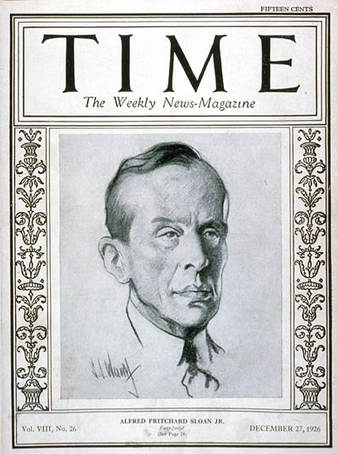
Image: Cover of Time magazine (December 27, 1926)
Citation: Alfred P. Sloan. (2024, February 19). In Wikipedia. https://en.wikipedia.org/wiki/Alfred_P._Sloan
Attribution: Artist: S. J. Woolf (Samuel Johnson Woolf, 1880-1948), Public domain, via Wikimedia Commons
Dealer Financing
Dealer financing was another innovative financial product introduced by GM under Sloan’s leadership. This system provided financing to dealers for the purchase of inventory from the manufacturer. Prior to this innovation, dealers often struggled with liquidity issues and were unable to purchase new vehicles to sell without first selling their existing inventory. By offering financing, GM enabled dealers to maintain a larger inventory, thus ensuring that potential buyers had a variety of models to choose from at any given time. This not only helped dealers grow their businesses but also supported GM’s sales volume and market penetration objectives.
Diversification and Expansion of Financial Services
Beyond consumer and dealer financing, GMAC expanded its financial services to include insurance products and mortgage loans over time. This diversification allowed GM to capitalise on its existing customer and dealer relationships, offering a broader range of financial products and services. The expansion into insurance, for instance, provided a convenient option for buyers to insure their new vehicles, further streamlining the purchasing process.
These financial innovations were integral to GM’s strategy under Sloan stewardship, contributing significantly to the company’s growth and the widespread adoption of automobiles in the United States. By making car ownership financially accessible to a larger segment of the population and supporting dealers in expanding their inventory and sales capabilities, Sloan’s financial strategies helped cement GM’s position as a leader in the global automotive industry. These practices not only transformed the automotive market but also had a lasting impact on consumer finance, setting the stage for the modern credit system.
Long-Term Impact of Sloan’s Financial Innovations
Alfred Sloan’s financial strategies, particularly the introduction of consumer credit for automobile purchases and dealer financing options, had profound and lasting effects on consumer behaviour and the automotive industry. Before these innovations, purchasing a car was a significant financial barrier for many, limiting the market to a relatively affluent segment of the population. By implementing consumer credit and financing options, Sloan effectively democratised car ownership, making it accessible to a broader demographic. This shift not only expanded the market for General Motors but also catalysed a cultural transformation, embedding the automobile into the fabric of American life and fostering a new era of mobility and freedom.
The introduction of consumer credit also had a lasting impact on consumer behaviour, encouraging a shift from a culture of saving and purchasing to one of financing and repaying. This change extended beyond the automotive industry, laying the groundwork for the contemporary consumer credit system that underpins a wide range of purchases today, from household appliances to real estate.
Moreover, Sloan’s dealer financing options revolutionised the dealership model, providing dealers with the liquidity needed to stock a diverse range of vehicles. This not only bolstered sales and profitability for dealers but also increased consumer choice, further stimulating demand. The dealership financing model has since become a standard practice in the automotive industry worldwide, supporting the industry’s growth and facilitating the spread of automotive culture across the globe.
In summary, Alfred Sloan’s financial innovations had a ripple effect that extended far beyond the initial boost in sales for General Motors. These strategies transformed the automotive industry’s approach to sales and financing, reshaped consumer behaviour towards credit and consumption, and played a pivotal role in making the automobile a central element of modern life. Sloan’s visionary approach to financial accessibility not only secured GM’s dominance in the automotive market but also contributed to the shaping of the modern consumer economy.
Relevance of Sloane’s Philosophies to 21st Century Management Practices
Sloan’s management philosophies, such as the decentralised organisational structure and strategic planning, laid the groundwork for modern corporate management. These practices are still taught in business schools worldwide and implemented in various industries, demonstrating their timeless utility in managing complex organisations. Sloan anticipated market demands and technological changes – ideas that are still used in today’s fast-paced business environment. In addition:
- Adaptability and Innovation: Sloan’s emphasis on innovation, adaptability, and consumer-focused product development were the genesis of today’s agile management techniques and the lean startup methodology.
- Consumer Credit and Financial Accessibility: Sloan’s introduction of consumer credit for automobile purchases revolutionised not just the automotive industry but also established a model for consumer finance that underpins modern economies.
- Corporate Philanthropy and Social Responsibility: Sloan’s philanthropic efforts, particularly through the Alfred P. Sloan Foundation, predate and arguably helped shape the modern concept of corporate social responsibility (CSR). Current expectations of corporate contributions to societal welfare, demonstrate Sloan’s impact on contemporary business ethics and practices.
- Influence on Global Business Practices: Sloan’s strategies helped General Motors become a global leader, setting standards for international business operations and global market segmentation, providing an enduring legacy particularly relevant in today’s globalised economy, where businesses must navigate diverse markets and consumer preferences.
Sloan’s Forward-Thinking Management Practices
In the early 20th century, the prevailing management practices were largely influenced by the principles of scientific management, as proposed by Frederick W. Taylor. This approach emphasised efficiency and productivity through time studies, standardised tasks, and a top-down management structure. The focus was on optimising individual tasks and direct managerial control over workers. Henry Ford’s assembly line is a prime example of this approach, emphasising mass production and efficiency without substantial regard for market segmentation or consumer preferences.
Alfred Sloan’s management practices at General Motors, however, marked a significant departure from these norms. While Taylorism and Fordism prioritised operational efficiency and standardised production, Sloan introduced a nuanced understanding of market dynamics and organisational structure that was revolutionary at the time.
Decentralised Organisational Structure
Unlike the rigid, hierarchical structures prevalent in businesses of his era, Sloan implemented a decentralised approach to management at GM. This allowed for greater flexibility and responsiveness to market changes, enabling each of GM’s divisions to operate with a certain degree of autonomy while still aligning with the company’s overall objectives. This contrasted sharply with the centralised control seen in companies like Ford, where decisions were made at the top and uniformly applied across the organisation.
Market Segmentation and Brand Differentiation
Sloan’s strategy of market segmentation and brand differentiation was also ahead of its time. While the automotive industry was dominated by a focus on production and cost reduction, Sloan recognised the importance of catering to diverse consumer needs and preferences. By positioning each of GM’s brands to target specific market segments, Sloan moved away from the one-size-fits-all approach of his contemporaries towards a more nuanced, consumer-focused strategy.
Financial Innovations
Furthermore, Sloan’s introduction of consumer credit for automobile purchases and dealer financing options was a master-stroke that broke new ground in making car ownership accessible to a broader audience. This was a significant shift from the cash-only sales models that were standard at the time, showcasing Sloan’s innovative approach to expanding the market.
Emphasis on Strategic Planning
At a time when many companies were focused on short-term gains and operational efficiencies, Sloan introduced strategic planning as a core aspect of GM’s management. This involved long-term visioning, forecasting, and the development of coordinated strategies to ensure the company’s growth and adaptation to future challenges.
In summary, Alfred Sloan’s management practices represented a significant evolution from the prevailing approaches of his time. His strategies introduced concepts of organisational flexibility, market responsiveness, strategic planning, and consumer finance that not only transformed General Motors but also had a lasting impact on global business practices. Sloan’s vision and innovative management principles set a new standard, demonstrating the importance of adaptability, strategic foresight, and customer orientation in corporate success.
Sloan’s Philanthropic Vision
Alfred Sloan’s philanthropic legacy extends well beyond the establishment of the Alfred P. Sloan Foundation in 1934, although that remains a cornerstone of his contributions to society.
The world’s first university-based executive education program—the Sloan Fellows—was created in 1931 at MIT under Sloan’s sponsorship. A Sloan Foundation grant established the MIT School of Industrial Management in 1952 with the charge of educating the “ideal manager”, and the school was renamed in Sloan’s honor as the Alfred P. Sloan School of Management, one of the world’s premier business schools.[4]
The Alfred P. Sloan Foundation itself has been instrumental in fostering advances in science, technology, engineering, mathematics (STEM), and economics through grants, scholarships, and funding for various projects and research initiatives. Here are additional dimensions and impacts of Sloan’s philanthropy:
Focus on Higher Education and Research
The Alfred P. Sloan Foundation has played a pivotal role in promoting higher education and research, particularly in the fields of science and technology. It has supported numerous educational institutions, research projects, and individual scholars, aiming to enhance the quality and accessibility of scientific education and research. The Foundation’s grants have helped to establish new academic programs, fund groundbreaking research, and support the development of policies that foster innovation and public understanding of science and technology.
Support for Public Understanding and Engagement with Science
Sloan believed in the importance of the public understanding of science and has supported initiatives that bridge the gap between scientific communities and the general public. This includes funding for books, radio programs, films, and television series that make complex scientific concepts accessible and engaging to non-specialists. The Foundation’s efforts in this area have helped to raise public awareness and appreciation of science and its impact on society.
Economic Research and Policy Development
Understanding the complexity of modern economies and their impact on society was another area of interest for Sloan and the Foundation. The Alfred P. Sloan Foundation has funded research aimed at improving economic policy and understanding economic phenomena, such as market behaviour, the impact of technological change on economies, and workforce development. This work has contributed to the development of economic policies that support sustainable growth and equitable access to resources.
Support for Diversity in STEM Fields
The Foundation has also been committed to increasing diversity in science, technology, engineering, and mathematics fields. It has supported programs aimed at encouraging underrepresented groups to pursue and succeed in STEM careers. These initiatives have included scholarships, mentorship programs, and research grants designed to remove barriers to entry and success in these critical fields.
Legacy and Impact
Alfred Sloan’s philanthropic vision has had a lasting impact, with the Alfred P. Sloan Foundation continuing to support a wide range of initiatives that align with his original goals. The Foundation’s work has contributed significantly to scientific advancement, economic understanding, and the promotion of education and public engagement with science and technology. Sloan’s philanthropy reflects his belief in the power of knowledge to improve the world, a legacy that continues to influence and inspire.
Authorship
Alfred P. Sloan’s “My Years with General Motors” is his most well-known and influential work, widely regarded as a seminal text in the field of business management. Published in 1964, the book provides an insider’s perspective on the development of General Motors and outlines the management practices and strategies that Sloan implemented to transform GM into one of the world’s leading corporations. Its insights into corporate strategy, leadership, and organisational structure have made it a key resource for business students, managers, and executives alike.

In addition to his seminal work “My Years with General Motors,” Alfred P. Sloan Jr. also authored “Adventures of a White-Collar Man” in collaboration with Boyden Sparkes in 1941. This book offers a compelling narrative of Sloan’s personal and professional journey, providing valuable insights into the early automotive industry and the strategic decisions that propelled General Motors to its leading position. Together, these works not only underline Sloan’s pivotal role in shaping the modern automotive industry but also highlight his profound influence on business management and corporate strategy.
Sloan’s ideas and principles have been extensively discussed and analysed in various business and management texts, articles, and case studies. His legacy in management practices and corporate strategy continues to be a subject of study and admiration in business circles.
Sloan’s impact is also reflected in the numerous articles, speeches, and correspondences he produced during his lifetime, which have been studied by historians and business scholars. These materials, while not formal books, contribute to understanding his philosophy on management and the automotive industry.
The Alfred P. Sloan Foundation has also funded a vast array of research and publications in various fields, including economics, science, and technology, which indirectly contributes to the body of knowledge influenced by Sloan’s interests and philanthropic goals.
A Monumental Legacy
Alfred P. Sloan’s legacy is monumental, extending well beyond the automotive industry and the realm of corporate management to influence the broader landscape of American business practices, education, and philanthropy. Here are several aspects to consider when discussing his enduring impact:
Pioneering Modern Corporate Management
Sloan is often credited with laying the groundwork for modern corporate management. His strategies for decentralisation, strategic planning, and market segmentation have become foundational principles in business schools and are widely implemented in corporations around the world. These practices not only helped General Motors thrive but also set a benchmark for how large, complex organisations could be effectively managed.
Influence on Business Education
Sloan’s management philosophies and practices have heavily influenced the curriculum of business education. His book, “My Years with General Motors,” is considered essential reading in many business schools, offering valuable lessons on leadership, strategy, and organisational behaviour. Furthermore, his contributions to the field have inspired case studies and research that continue to shape the development of business theory and practice.
Philanthropic Contributions
The Alfred P. Sloan Foundation, established by Sloan, has had a significant impact on research and education in science, technology, and economics. Through its support of numerous projects and initiatives, the Foundation has advanced the public’s understanding of science, supported economic research, and promoted STEM education, reflecting Sloan’s commitment to the betterment of society through knowledge and innovation.
Influence on Corporate Philanthropy and Social Responsibility
Sloan’s philanthropic efforts set a precedent for corporate leaders, highlighting the role of private wealth in public advancement. His approach to philanthropy has inspired many in positions of wealth and influence to consider how they can contribute to societal progress, leading to a broader acceptance and practice of corporate social responsibility.
Shaping the Global Automotive Industry
Sloan’s strategies for brand differentiation and consumer financing revolutionised the automotive industry, setting standards for product development, marketing, and customer engagement that are still followed today. His emphasis on innovation and responsiveness to consumer needs helped establish the automotive industry as a key driver of economic growth and technological advancement.
Legacy of Innovation and Adaptation
Sloan’s legacy is not just in the structures and practices he implemented but also in the ethos of innovation and adaptation he championed. He demonstrated the importance of continually evolving business models in response to technological advancements and changing market demands, a principle that remains relevant in today’s fast-paced global economy.
In sum, Alfred P. Sloan’s influence extends across the spheres of business management, education, philanthropy, and beyond, marking him as one of the most pivotal figures in the development of modern corporate practices and philanthropic engagement. His vision and strategies continue to resonate, underscoring the lasting impact of his leadership and thought on both the automotive industry and the broader business world.
About General Motors
By sales, General Motors was the largest automaker in the United States in 2022, and was the largest in the world for 77 years before losing the top spot to Toyota in 2008[5]. The General Motors Corporation was established in 1908 by William C. Durant, who combined the Buick, Oldsmobile, and Oakland companies and, later, Cadillac, to form GM. From the 1920s onwards, GM grew from a firm that accounted for about 10% of new car sales in the US to become the largest producer of cars and trucks in the world.[6]
Alfred P. Sloan is often hailed as the architect of the contemporary corporation. Steering General Motors from 1923 to 1946, Sloan’s innovative management techniques left an indelible mark on American and Western management philosophies. His leadership approach, considered revolutionary for its time, played a pivotal role in shaping the principles of modern corporate management. The remarkable achievements of General Motors under his guidance sparked extensive research and analysis into Sloan’s management theories, significantly contributing to the field of management studies.[7]
Conclusion: The Enduring Legacy of Alfred P. Sloan Jr.
Alfred P. Sloan Jr. stands as a colossus in the annals of American industry, not merely for his transformative leadership of General Motors but for his indelible contributions to the fabric of corporate management and the automotive industry. Through his innovative management practices, financial strategies, and philanthropic efforts, Sloan left a legacy that transcends generations, influencing contemporary business practices and shaping the global automotive landscape.
Sloan’s introduction of decentralised organisational structures and strategic planning heralded a new era of corporate governance, emphasising flexibility, responsiveness, and strategic foresight. These principles, once revolutionary, are now foundational to modern business education and practice, illustrating Sloan’s profound understanding of the complexities of managing large, multifaceted organisations.
Sloan’s financial innovations, including consumer credit for automobile purchases and dealer financing, transformed the economic landscape, making car ownership accessible to the masses and fostering a culture of mobility that defined the 20th century. These strategies not only bolstered GM’s dominance but also laid the groundwork for the consumer credit system that underpins today’s economy.
Sloan’s philanthropic vision, embodied in the Alfred P. Sloan Foundation, continues to support scientific, technological, and economic research, reflecting his belief in the power of knowledge to advance society. Through this work, Sloan’s legacy extends beyond the realms of business and industry, contributing to the betterment of humanity through education and research.
In conclusion, Alfred P. Sloan Jr.’s impact on the automotive industry and corporate management is immeasurable. His forward-thinking approaches to business operations, market strategy, and financial innovation have become staples of modern management theory and practice. Sloan’s legacy is not just in the vehicles that bear GM’s brands or the management practices that guide corporations worldwide but in the very ethos of innovation, adaptability, and social responsibility that he championed. As we navigate the complexities of the 21st century, Alfred P. Sloan Jr.’s principles remain as relevant and instructive as ever, a testament to the enduring power of visionary leadership.

The Latest Car Experience
Image: 2023 Cadillac Lyriq in Satin Steel Metallic.
Citation: Cadillac Lyriq. (2024, February 20). In Wikipedia. https://en.wikipedia.org/wiki/Cadillac_Lyriq
Attribution: Mr.choppers, CC BY-SA 3.0 <https://creativecommons.org/licenses/by-sa/3.0>, via Wikimedia Commons
Further Information
YouTube Videos
- Alfred P Sloan interview on Running a Successful Business (1954): https://www.youtube.com/watch?v=w52SYCtG94o
- Business Legends: Alfred P. Sloan: https://www.youtube.com/watch?v=HLOuNK9_-Do
- General Motors Around the World 1927: https://www.youtube.com/watch?v=B1ZpbCYL4ek
- General Motors – The History Of Creation In Detail: https://www.youtube.com/watch?v=OpkVpgfGCHY
- SLOAN FiLM PROGRAM | The Alfred P. Sloan Foundation & Film Independent: https://www.youtube.com/watch?v=Hf_wPKpQOjo
Websites
- https://en.wikipedia.org/wiki/Alfred_P._Sloan
- https://en.wikipedia.org/wiki/General_Motors and https://en.m.wikipedia.org/wiki/General_Motors
- https://en.wikiquote.org/wiki/Alfred_P._Sloan
- https://hbr.org/1964/09/the-great-gm-mystery
- https://sloan.org/about
- https://sloan.org/about/who-was-alfred-p-sloan-jr
- https://sloanlongway.org/alfred-p-sloan-jr/
- https://wikicars.org/en/Alfred_P._Sloan
- https://www.automotivehalloffame.org/honoree/alfred-p-sloan-jr/
- https://www.britannica.com/topic/General-Motors-Corporation
- https://www.encyclopedia.com/education/economics-magazines/sloan-alfred-jr
- https://www.gm.com/heritage
- https://www.sundance.org/blogs/who-was-alfred-p-sloan/
- https://www.theguardian.com/business/2009/apr/30/general-motors-gm-history
- https://www.u-s-history.com/pages/h1837.html
Books
- Adventures of a White Collar Man, by Alfred P. Sloan Jr. (Author), Boyden Sparkes (Collaborator) (1941), published by Doubleday Press, available from https://www.amazon.com/Adventures-White-Collar-Alfred-Sloan/dp/B002CC31DM
- Alfred P. Sloan – Critical Evaluations in Business and Management, Edited By John C. Wood, Michael C. Wood, published by Routledge, available from https://www.routledge.com/Alfred-P-Sloan-Critical-Evaluations-in-Business-and-Management/Wood-Wood/p/book/9780415248327#
- Alfred Sloan Jr., Volume 1, by John C. Wood and Michael C. Wood (2004), published by Routledge, available from https://www.amazon.co.uk/Alfred-Sloan-Jr-Evaluations-Management/dp/0415248299/
- General Motors: A Photographic History: by Michael W. R. Davis (1999), published by Arcadia Publishing Library Editions, available from https://www.amazon.co.uk/General-Motors-Photographic-Michael-Davis/dp/1531600131/
- My Years with General Motors, by Alfred Sloan (Author) (1996), published by Crown Currency, available from https://www.amazon.co.uk/Years-General-Motors-Alfred-Sloan/dp/0385042353/
- Sloan Rules – Alfred P Sloan & the Triumph of General Motors, by David Farber (Author) (2002), published by the University of Chicago Press, available from https://www.amazon.co.uk/Sloan-Rules-P-Sloan-Triumph-General/dp/0226238040/
- The Leadership Genius of Alfred P. Sloan: Invaluable Lessons on Business, Management, and Leadership for Today’s Manager, by Allyn Freeman (2005), published by McGraw-Hill Education, available from https://www.amazon.co.uk/Leadership-Genius-Alfred-Sloan-Invaluable/dp/0071457968/
CAUTION: This paper is compiled from the sources stated but has not been externally reviewed. Parts of this paper include information provided via artificial intelligence which, although checked by the author, is not always accurate or reliable. Neither we nor any third parties provide any warranty or guarantee as to the accuracy, timeliness, performance, completeness or suitability of the information and materials covered in this paper for any particular purpose. Such information and materials may contain inaccuracies or errors and we expressly exclude liability for any such inaccuracies or errors to the fullest extent permitted by law. Your use of any information or materials on this website is entirely at your own risk, for which we shall not be liable. It shall be your own responsibility to ensure that any products, services or information available through this paper meet your specific requirements and you should neither take action nor exercise inaction without taking appropriate professional advice. The hyperlinks were current at the date of publication.
End Notes and Explanations
- Source: Compiled from my research and information at the sources stated throughout the text, together with information provided by machine-generated artificial intelligence at: bing.com [chat] and https://chat.openai.com ↑
- Information: The endowment was $2 billion. See: https://sloan.org/ ↑
- Information: The slogan, “A car for every purse and purpose” was the reason that GM was once the world’s most successful company. The book review of My Years with General Motors says Alfred Sloan succintly detailed how he directed the company to take not only financial considerations, but also product planning into account. His hierachy of models, ie Chevrolet, Pontiac, Oldsmobile, Buick, and Cadillac, in that order, was stroke of genius, virutally guaranteeing that the entry level buyer who started out with an economical Chevy would continue to buy more expensive GM brands as his income increased. Only now in present times is GM moving back to that mantra, albeit with unfortunate hesitation. Had GM kept each of brands as a distinct marque, there is no doubt the company would still command at least a 50% share of the North American market share. Cited on Amazon at: https://www.amazon.co.uk/gp/aw/review/0385042353/R2EO66FLKHVQ4W ↑
- Source: https://wikicars.org/en/Alfred_P._Sloan ↑
- Sources: (1) Bunkley, Nick (January 21, 2009). “Toyota Ahead of G.M. in 2008 Sales”. The New York Times, and (2) “U.S. light vehicle market share by automotive manufacturers”. Statista. Both cited at https://en.m.wikipedia.org/wiki/General_Motors ↑
- Source: General Motors: A Photographic History Hardcover – 18 Nov. 1999, by Michael W. R. Davis, cited at: https://www.amazon.co.uk/General-Motors-Photographic-Michael-Davis/dp/1531600131/↑
- Source: https://www.routledge.com/Alfred-P-Sloan-Critical-Evaluations-in-Business-and-Management/Wood-Wood/p/book/9780415248327# ↑
