
Introduction[1]
In terms of direct impact and recognition, the queens and queen consorts named Elizabeth[2] remain the most prominent within the historical narrative of the British Isles, including both England and Scotland, until the unification of the crowns under James VI of Scotland (James I of England) and beyond. After the union of the crowns in 1603, Elizabeth I’s death marked the end of the Tudor dynasty and began the Stuart era, where the Scottish and English thrones were united under a single monarch, albeit the kingdoms remained legally separate until the Acts of Union in 1707[3].
The histories of England and Scotland are richly adorned with the narratives of queens and queen consorts named Elizabeth, whose reigns and deeds have profoundly shaped the course of these nations. From the strategic alliances of the Wars of the Roses[4] to the pivotal moments of the modern monarchy, the name Elizabeth has become emblematic of leadership, resilience, and transformative change.

Image: Elizabeth Woodville, queen consort to Edward IV
Copyright information and licence terms for this image can be found on the Art UK website at http://www.artuk.org/artworks/194554
Credit/Provider: Photo Credit: Queens’College, University of Cambridge
The story in England begins with Elizabeth Woodville, whose marriage to Edward IV introduced the name into the annals of English royalty. This marked the dawn of an era in which Elizabeths, including Elizabeth of York, Elizabeth I, and Elizabeth II, would emerge as central figures in the unfolding saga of the British Isles. In Scotland, the story of Elizabeth de Burgh, queen consort during the First War of Scottish Independence[5], weaves into this rich tapestry, highlighting the shared and distinct paths of these nations under the influence of their Elizabeths.
These remarkable women did not merely navigate the challenges of their times; they laid the foundations and provided the pathway for remembering their legacies. As the impact of their lives are traced, subtle yet profound influences that extend far beyond their earthly reigns, resonating through the ages and continuing to shape the cultural and political landscapes of England and Scotland, are revealed.
In the pages that follow, you can glimpse into the lives of these iconic Elizabeths, starting with brief profiles to outline their historical significance. If you delve deeper, you can explore the detailed pathways they crafted, revealing how their legacies endure, woven into the very fabric of British history and identity.
Brief Profiles
Elizabeth de Burgh (1289–1327)
Elizabeth de Burgh was the queen consort of Robert the Bruce, King of Scots, and played a significant role in Scotland’s history during the First War of Scottish Independence. She was captured by the English and held in captivity for several years, becoming a notable figure in Scottish history for her endurance and the political implications of her captivity and release.
Elizabeth Woodville (c. 1437 – 1492)
Elizabeth Woodville was the queen consort of England as the spouse of King Edward IV from 1464 until his death in 1483. She was a commoner and a widow when she married Edward IV, a union that caused considerable controversy due to her Lancastrian background amidst the ongoing Wars of the Roses, the series of civil wars for control of the throne of England. Elizabeth was the mother of the two Princes in the Tower, Edward V and Richard of Shrewsbury, whose mysterious disappearance remains one of England’s most enduring historical mysteries. She was also the grandmother of Henry VIII and great-grandmother of Elizabeth I through her daughter Elizabeth of York, who married Henry VII.
Elizabeth of York (1466 – 1503)
Elizabeth of York was the queen consort of England as the wife of Henry VII, effectively uniting the Houses of York and Lancaster and ending the Wars of the Roses. Her marriage to Henry VII in 1486 symbolised the unification of the warring factions, making her a key figure in the establishment of the Tudor dynasty. Elizabeth of York was the mother of Henry VIII and the grandmother of Edward VI, Mary I, and Elizabeth I, thus playing a pivotal role in the lineage of English monarchs.
Elizabeth I (1533 – 1603)
Elizabeth I, known as the Virgin Queen, was the Queen of England and Ireland from 1558 until her death in 1603. The daughter of Henry VIII and Anne Boleyn, Elizabeth’s reign is known as the Elizabethan era, famous for the English Renaissance, an age of English cultural flourishing, and the defeat of the Spanish Armada in 1588. Elizabeth’s rule established Protestantism in England and saw the country through a period of domestic prosperity and international prestige. She never married or had children, which led to the end of the Tudor dynasty upon her death.

Image: Elizabeth I and the Spanish Armada; the Apothecaries painting,[77] sometimes attributed to Nicholas Hilliard.[78] A stylised depiction of key elements of the Armada story: the alarm beacons, Queen Elizabeth at Tilbury, and the sea battle at Gravelines.[79] Links shown as [ ] are to https://en.wikipedia.org/wiki/Spanish_Armada
Citation: Spanish Armada. (2024, February 18). In Wikipedia. https://en.wikipedia.org/wiki/Spanish_Armada
Attribution: Nicholas Hilliard, Public domain, via Wikimedia Commons
Elizabeth Bowes-Lyon (1900 – 2002)
Although not a reigning queen of England, Elizabeth Bowes-Lyon, known as the Queen Mother, was the queen consort of King George VI and the mother of Queen Elizabeth II. She became queen consort in 1936 when her husband unexpectedly became king after the abdication of his brother, King Edward VIII. Elizabeth was beloved for her role during World War II, where she famously refused to evacuate from London during the Blitz, insisting on sharing the hardships of the British people. Her daughter, Elizabeth II, ascended to the throne in 1952, making Elizabeth Bowes-Lyon the Queen Mother, a title she held until her death in 2002 at the age of 101.
Elizabeth II (1926 – 2022)
Elizabeth II was the Queen of the United Kingdom and other Commonwealth realms from 1952 until her death in 2022. Her reign was the longest of any British monarch and the second-longest recorded of any monarch of a sovereign country. Elizabeth II saw the UK through significant political, social, and technological changes, including the decolonization of Africa, the accession of the UK to the European Communities (later the European Union), and the Brexit referendum. She was a figure of stability and continuity for the UK and the Commonwealth throughout her reign.
Detailed Profiles
Elizabeth de Burgh (1289–1327)
Elizabeth de Burgh was a pivotal figure in medieval Scotland, both as the wife of Robert the Bruce and for her own resilience in the face of adversity during the First War of Scottish Independence. She was the second wife and the only queen consort of Robert the Bruce. Her life intersected with some of the most dramatic events in Scottish history, underscoring her importance beyond her role as queen.
Elizabeth was born into the Anglo-Irish nobility, the daughter of Richard Óg de Burgh, 2nd Earl of Ulster, one of the most powerful Irish nobles of the time. Her marriage to Robert the Bruce in 1302 was not just a union of two individuals but also a strategic alliance that bolstered Robert’s claim to the Scottish throne through her Anglo-Norman connections and lineage.
After Robert the Bruce was crowned King of Scots in 1306, Elizabeth became queen consort. However, her time as queen was immediately challenged by the turbulent circumstances of Robert’s rebellion against English rule. The early years of her queenship were marked by the hardships of war, including her husband’s initial defeats and the precarious state of Scottish independence.

Image: Robert the Bruce and Elizabeth de Burgh
Citation: Elizabeth de Burgh. (2023, September 29). In Wikipedia. https://en.wikipedia.org/wiki/Elizabeth_de_Burgh
Attribution: Author Unknown.
The English capture of Elizabeth in 1306, following her husband’s coronation, marked the beginning of her eight-year captivity. Initially held in England under severe conditions, her imprisonment was a strategic move by Edward I of England (Longshanks) to undermine Robert the Bruce’s claim and morale. Her captivity became a symbol of the sacrifices made by the Scottish leadership in their struggle for independence. Despite the personal toll, Elizabeth’s dignity and resilience throughout her captivity inspired contemporaries and later generations.
Elizabeth’s release in 1314, following the decisive Scottish victory at the Battle of Bannockburn, was not just a personal triumph but also a significant political event. Her return to Scotland and reunion with Robert the Bruce symbolised the consolidation of his reign and the Scottish victory in the War of Independence. Elizabeth’s captivity and subsequent release underscored the intertwined fates of royal women and national politics during the medieval period.
As queen consort, Elizabeth played a crucial role in stabilising and legitimising Robert the Bruce’s kingship during the formative years of Scotland’s renewed independence. She bore him four children, ensuring the succession of the Bruce dynasty. Elizabeth’s death in 1327 was mourned as the loss of a queen who had endured much for the Scottish cause.
Elizabeth de Burgh’s life story is a testament to the personal sacrifices entailed in the broader struggle for Scottish independence. Her endurance and the political implications of her captivity and release highlight the integral role she played in the tumultuous early 14th-century Scotland. Her legacy is remembered as one of resilience and steadfast support in the face of adversity, embodying the spirit of the Scottish fight for sovereignty.
Elizabeth Woodville (c. 1437 – 1492)
Elizabeth Woodville[6], born around 1437, emerged as a pivotal figure in England’s tumultuous 15th century, her life intertwining with the dynastic struggles that marked the Wars of the Roses. Her marriage to Edward IV, a union that bridged the divide between the warring houses of Lancaster and York, stands as a testament to her influence and the controversy she inspired in a period dominated by noble lineage and political alliances.
Edward was the first king of England since the Norman Conquest in 1066, to marry one of his subjects, a commoner, and Elizabeth was the first such consort to be crowned queen.[7]
Before her marriage to Edward IV, Elizabeth was the widow of Sir John Grey of Groby, a Lancastrian supporter who died at the Second Battle of St. Albans in 1461. This marriage produced two sons, Thomas and Richard Grey, integrating Elizabeth into the fabric of England’s noble families. Her marriage to Edward in 1464 was conducted in secret, a fact that underscores both the personal nature of their relationship and the political risks Edward assumed by marrying a Lancastrian widow with no substantial dowry or political connections.

Image: Illuminated miniature depicting the marriage of Edward IV and Elizabeth Woodville, Anciennes Chroniques d’Angleterre by Jean de Wavrin, 15th century
Citation: Elizabeth Woodville. (2023, December 20). In Wikipedia. https://en.wikipedia.org/wiki/Elizabeth_Woodville
Attribution: Wikipedia states: ‘Unknown Scribe’.
Elizabeth’s life was marked by her resilience and determination in navigating the court’s political intricacies. Her marriage to Edward IV brought her family to prominence, with her brothers and sons from her first marriage receiving titles and lands, reshaping the power dynamics at court and engendering resentment among the established nobility, notably the Earl of Warwick, once an ally of Edward IV.
As queen consort, Elizabeth was noted for her piety and dedication to charitable causes, but her life was punctuated by periods of sanctuary and struggle, especially during the readeptions of Henry VI and the political turbulence that followed Edward IV’s temporary ousting from power. Despite these challenges, she bore Edward IV ten children, solidifying their dynastic claim.
The end of Edward IV’s reign and his subsequent death in 1483 plunged Elizabeth and her children into a political maelstrom[8]. Her youngest son, Richard of Shrewsbury, and her son from her marriage to Edward, Edward V, were placed in the Tower of London by their uncle, Richard, Duke of Gloucester, who declared himself Richard III. The disappearance of the two princes is a mystery that has echoed through history, casting a long shadow over Richard III’s reign and Elizabeth’s legacy.
Following the death of her sons, Elizabeth’s strategic acumen came to the fore as she navigated the treacherous waters of Tudor ascension. Her alliance with Margaret Beaufort, mother of Henry Tudor (later Henry VII), was instrumental in the eventual defeat of Richard III at the Battle of Bosworth Field in 1485. This alliance was sealed through the marriage of her daughter, Elizabeth of York, to Henry VII, uniting the houses of Lancaster and York and ending the Wars of the Roses.
Elizabeth Woodville’s later years were spent in relative obscurity, retiring to Bermondsey Abbey, where she died in 1492. Despite her withdrawal from public life, her legacy persisted through her children, particularly in the reign of her granddaughter, Elizabeth I, whose successful rule brought stability and prosperity to England.
Elizabeth Woodville’s life story is a narrative of survival, influence, and the enduring power of maternal legacy. Her role as queen consort during one of England’s most volatile periods highlights her unique position within the historical tapestry of the monarchy, embodying the complexities of dynastic marriage, the machinations of power, and the personal tragedies that often accompanied royal life in the Middle Ages.
Elizabeth of York (1466 – 1503)
Elizabeth of York, born on 11th February 1466, was a central figure in the transition from the Wars of the Roses to the Tudor era, embodying the reconciliation between the warring houses of Lancaster and York. As the eldest daughter of King Edward IV and Elizabeth Woodville, her lineage placed her at the heart of England’s dynastic struggles.
Elizabeth’s early life was marked by the instability of the Wars of the Roses, a series of conflicts for control of the throne of England. Her father’s reign saw interruptions by the Lancastrian challenge, which at times forced her family into sanctuary. The death of Edward IV in 1483 plunged Elizabeth into a precarious position, particularly with the usurpation of the throne by her uncle, Richard III, which led to the disappearance and presumed murder of her two younger brothers, the Princes in the Tower.

Image: Copy in oils of the 1536–37 Hans Holbein Whitehall mural, commissioned by Charles II, 1667. Left to right: Henry VIII, Henry VII, Elizabeth of York, Jane Seymour.
Citation: Elizabeth of York. (2024, February 18). In Wikipedia. https://en.wikipedia.org/wiki/Elizabeth_of_York
Attribution: Remigius van Leemput, Public domain, via Wikimedia Commons
Elizabeth’s marriage to Henry Tudor (Henry VII) on 18th January 1486, was more than a personal union; it was a political masterstroke that symbolised the end of the Wars of the Roses. Henry, a Lancastrian claimant, had pledged to marry Elizabeth to unite the rival factions. Their marriage merged the white rose of York and the red rose of Lancaster, giving rise to the Tudor rose, a symbol of peace and unity. This alliance was vital in legitimising Henry VII’s claim to the throne and stabilising the realm.
As queen consort, Elizabeth was known for her gentle and compassionate nature, which endeared her to the people and provided a stabilising influence on the Tudor court. She fulfilled her dynastic duties with the birth of several children, including Arthur, Prince of Wales; Margaret, who would become the grandmother of Mary, Queen of Scots; Henry VIII; and Mary, Queen of France.
Elizabeth’s role extended beyond mere ceremonial duties; she was involved in charitable works and the patronage of religious institutions, reflecting the pious nature of the Tudor court. Her personal piety and dedication to family and duty were characteristics that left a lasting impression on the Tudor dynasty.
Elizabeth’s death on 11th February 1503, her 37th birthday, after giving birth to her last child, who died shortly after, was a profound loss for Henry VII, who deeply mourned her passing. She was buried in Westminster Abbey, in a chapel that would later become the resting place for other Tudor monarchs.
Elizabeth of York’s legacy is inseparable from the establishment and consolidation of the Tudor dynasty. As the mother of Henry VIII and the grandmother of Edward VI, Mary I, and Elizabeth I, her lineage ensured the continuation of the Tudor line, which would oversee significant transformations in English history, including the English Reformation. Her marriage to Henry VII not only ended decades of civil strife but also heralded the beginning of a new era marked by relative peace, the strengthening of the monarchy, and the exploration and expansion that characterised the Tudor period.
Elizabeth of York remains a fascinating historical figure, embodying the complexities of medieval and early modern queenship. Her life and legacy continue to captivate historians and the public alike, symbolizing the transition from medieval England to the Renaissance and Reformation that would define the Tudor era.
Elizabeth I (1533 – 1603)
Elizabeth I, reigning from 1558 until her death in 1603, was one of England’s most iconic monarchs, with a legacy that has endured through the centuries. Her reign, known as the Elizabethan era, stands out as a golden age of English achievement, particularly in literature, theatre, and exploration, underpinned by the stability she brought to the realm after the tumultuous reigns of her predecessors.
Born on 7th September 1533, Elizabeth was the second daughter of King Henry VIII and his second wife, Anne Boleyn. Her early life was marked by the political and religious upheavals of her father’s reign, including her mother’s execution in 1536. Declared illegitimate and removed from the line of succession, Elizabeth’s path to the throne was neither direct nor assured. However, the deaths of her half-siblings, Edward VI and Mary I, eventually cleared the way for her ascension.

Image: Portrait commemorating the defeat of the Spanish Armada, depicted in the background. Elizabeth’s hand rests on the globe, symbolising her international power. One of three known versions of the “Armada Portrait“.
Citation: Elizabeth I. (2024, February 13). In Wikipedia. https://en.wikipedia.org/wiki/Elizabeth_I
Attribution: Formerly attributed to George Gower, Public domain, via Wikimedia Commons
Elizabeth ascended to the throne on 17th November 1558, following the death of her half-sister Mary I. Her reign began amidst great religious division and financial difficulties, inherited from previous Tudor monarchs. Elizabeth’s skillful navigation of these challenges defined her reign.
One of Elizabeth’s earliest and most significant acts was the Elizabethan Religious Settlement of 1559, which aimed to resolve the religious discord that had gripped England. This settlement re-established the Church of England’s independence from the Roman Catholic Church and positioned Elizabeth as its Supreme Governor. While it aimed to be a moderate compromise between Protestantism and Catholicism, it laid the foundation for the English Reformation and contributed to the enduring establishment of Protestantism in England.
Elizabeth’s foreign policy was marked by diplomatic cunning and a pragmatic approach to international relations. Her reign saw increasing tensions with Catholic Spain, culminating in the attempted invasion of England by the Spanish Armada in 1588. The defeat of the Armada was a defining moment in Elizabeth’s reign, celebrated as a miraculous victory and establishing Elizabeth as a formidable ruler on the European stage.
Elizabeth was a great patron of the arts, and her reign witnessed an unparalleled flourishing of English literature and drama, with figures such as William Shakespeare, Christopher Marlowe, and Edmund Spenser defining the era. The period also saw significant achievements in exploration, with figures like Sir Francis Drake and Sir Walter Raleigh expanding English horizons and contributing to the early foundations of the British Empire.

Elizabeth’s personal life, particularly her decision never to marry, was a source of endless speculation and negotiation throughout her reign. Her status as the “Virgin Queen” was a key aspect of her public image, and it played a strategic role in her diplomatic relations. Upon her death on 24th March 1603, she left no direct heir, bringing the Tudor dynasty to an end and paving the way for the Stuart succession in the person of James VI of Scotland, who became James I of England.
Elizabeth I’s legacy is vast, encompassing the stabilisation and consolidation of the English Reformation, the defeat of the Spanish Armada, and the sponsorship of a cultural renaissance that made her reign synonymous with the zenith of English Renaissance and exploration. Her leadership style, marked by political acumen, cautious diplomacy, and a strong will, has made her one of the most studied and admired monarchs in history.
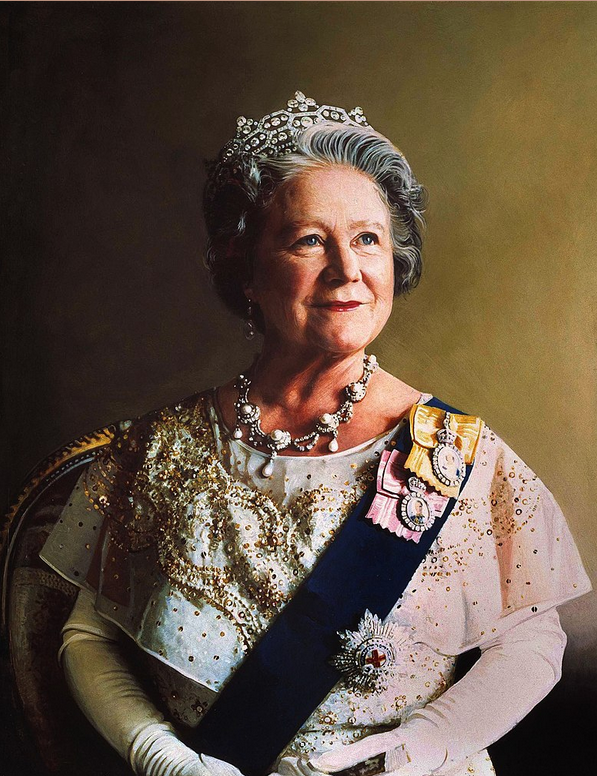
Elizabeth Bowes-Lyon (1900 – 2002)
Elizabeth Bowes-Lyon (full name Elizabeth Angela Marguerite Bowes-Lyon), known affectionately as the Queen Mother, was a pivotal figure in the British monarchy during a period of significant change and challenge for the United Kingdom. Her life spanned the entirety of the tumultuous 20th century, witnessing two world wars, the decline of the British Empire, and the transition into the modern era.

Image: Portrait of Queen Elizabeth (1900–2002)
Citation: Queen Elizabeth The Queen Mother. (2024, February 19). In Wikipedia. https://en.wikipedia.org/wiki/Queen_Elizabeth_The_Queen_Mother
Attribution: Richard Stone, Public domain, via Wikimedia Commons
Born on 4th August 1900, to the Earl and Countess of Strathmore and Kinghorne at their English estate, St. Paul’s Walden Bury, Elizabeth was the ninth of ten children. Her upbringing was comfortably aristocratic, imbued with a sense of duty and service. Elizabeth was educated at home, receiving the kind of upbringing typical for young women of her class at that time, focusing on the arts, language, and social graces.
Elizabeth married Prince Albert, Duke of York (later King George VI), on 26th April 1923, in Westminster Abbey. Their marriage was a love match, unusual in royal circles at the time. The couple had two daughters, Elizabeth (the future Queen Elizabeth II) and Margaret. In December 1936, following the abdication of Edward VIII, Albert ascended the throne as George VI, and Elizabeth became queen consort. Her support was crucial to her husband, who was not prepared for the role of king and struggled with a severe stammer.
Elizabeth’s steadfastness during World War II earned her the enduring love and respect of the British people. She and King George VI remained in London throughout the Blitz, despite the danger. The royal couple regularly visited bombed areas across the UK, displaying solidarity with the British public. Elizabeth famously said she could “look the East End in the face” after Buckingham Palace was bombed in September 1940.
After the war, Elizabeth continued her public duties and was a stabilising influence during the transition from empire to Commonwealth. Upon the death of George VI in 1952, and the ascension of her daughter, Elizabeth II, to the throne, she assumed the title of Queen Mother to avoid confusion with the new queen. Her later years were devoted to her charitable work, particularly concerning children’s welfare and the preservation of historic buildings.
The Queen Mother was known for her vivacious spirit and enduring public popularity. She was a symbol of continuity and tradition, representing a link between the pre-war and modern eras of British history. Her longevity allowed her to become a familiar figure to multiple generations within the United Kingdom and the Commonwealth. Elizabeth Bowes-Lyon passed away on 30th March 2002, at the age of 101. Her life and service left a lasting legacy on the British monarchy, characterised by her resilience, her commitment to duty, and her deep connection with the people of the UK. Her century-spanning life witnessed profound changes, yet she remained a beloved figure, embodying a sense of continuity amidst the evolving landscape of the 20th century.
Elizabeth II (1926 – 2022)
Queen Elizabeth II, born Elizabeth Alexandra Mary Windsor on 21st April 1926, was a monumental figure in the history of the British monarchy, embodying the evolution of the institution in the modern era. Her reign, commencing on 6th February 1952, following the death of her father, King George VI, spanned over seven decades, during which she witnessed and influenced pivotal moments in British and world history.

Image: Greeting NASA employees at the Goddard Space Flight Center, Maryland, USA, May 2007.
Citation: Elizabeth II. (2024, February 20). In Wikipedia. https://en.wikipedia.org/wiki/Elizabeth_II
Attribution: Bill Ingalls, Public domain, via Wikimedia Commons
Elizabeth was the first child of the Duke and Duchess of York, later King George VI and Queen Elizabeth (the Queen Mother). Her early life was marked by a close-knit family environment and a strong sense of duty. Educated privately at home, she received lessons in history, language, literature, and music, and was also instructed in constitutional history and law, preparing her for her future role.
During World War II, Elizabeth, then Princess, served in the Auxiliary Territorial Service, where she trained as a driver and mechanic. This period of service reinforced her reputation for resilience and dedication to duty, qualities that would define her reign.
On 20th November 1947, Elizabeth married Philip Mountbatten, Duke of Edinburgh, a union that lasted until his death in 2021, making it one of the longest royal marriages in history. Together, they had four children: Charles, Anne, Andrew, and Edward, further solidifying the lineage of the Windsor family.
Ascending the throne at a time when the British Empire was transitioning into the Commonwealth, Elizabeth II’s reign was characterised by significant political, social, and technological transformations. She adeptly navigated the monarchy through these changes, modernizing the institution while maintaining its historical traditions and relevance. Her reign saw the decolonisation of Africa and the Caribbean, the expansion of the Commonwealth, and the UK’s complex relationship with the European Union, from accession to Brexit.
Elizabeth II was deeply committed to public service, undertaking numerous domestic and international engagements annually. She was particularly dedicated to the Commonwealth, seeing it grow from a group of seven countries to a diverse global network of 54 nations. Her Christmas broadcasts and state visits became symbols of her dedication to her role and the unity of the Commonwealth.
Queen Elizabeth II’s legacy is multifaceted, encompassing her role as a symbol of stability and continuity, her contributions to national and international diplomacy, and her support for countless charitable causes. Her reign was marked by her unwavering sense of duty, her ability to adapt to the changing times, and her commitment to her people.
Passing away on 8th September 2022, Elizabeth II left behind a monarchy that had significantly evolved during her tenure. Her son, Charles III, succeeded her, inheriting the legacy of a reign that shaped the course of British and world history in the 20th and early 21st centuries. Elizabeth II’s influence extended beyond the realms of politics and governance, touching the lives of people around the world and leaving an indelible mark on the institution of the monarchy.
Thematic Connections Between the Elizabeths
Thematic Connections
The reigns of the Elizabeths, spanning from medieval Scotland to modern Britain, present a fascinating study in contrasts and continuities. Despite the centuries and contexts that separate them, these monarchs shared challenges and triumphs in warfare, internal politics, cultural patronage, and personal trials, each shaping her legacy in distinct yet interconnected ways.
- Warfare and Defence: From Elizabeth de Burgh’s support for Robert the Bruce in the Scottish Wars of Independence to Elizabeth I’s strategic leadership against the Spanish Armada, the theme of national defence and military engagement is a prominent thread. Elizabeth II’s reign, though not marked by direct military leadership, was defined by her role as a symbol of resilience during times of conflict, including World War II and the Falklands War.
- Internal Politics: Each Elizabeth navigated the treacherous waters of internal politics with a unique blend of diplomacy and resolve. Elizabeth Woodville and Elizabeth of York played pivotal roles in the dynastic struggles of the Wars of the Roses, their marriages forging alliances and securing peace. Elizabeth I’s masterful handling of the volatile religious politics of her time and Elizabeth II’s steady presence through decades of political change underscore their adeptness in maintaining stability and unity.
- Cultural Patronage: Cultural flourishing was a hallmark of these reigns, particularly under Elizabeth I, whose support of the arts heralded the Elizabethan Age, a golden era of English literature and drama. Elizabeth II’s patronage extended to a broad range of cultural and educational institutions, reflecting the evolving nature of monarchy as a custodian of national heritage and promoter of cultural diversity.
- Personal Challenges: The personal lives of these queens often mirrored the complexities of their public roles. Elizabeth Woodville and Elizabeth of York faced the uncertainties and tragedies of the Wars of the Roses, while Elizabeth I’s decision to remain unmarried was a strategic choice that influenced the political landscape of her reign. Elizabeth II navigated the challenges of modern media scrutiny and the evolving expectations of monarchy in a democratic society.
In examining these thematic areas, you’ll find styles of leadership that, while varied in approach and era, exhibit a remarkable resilience and adaptability. The reigns of the Elizabeths not only reflect their individual responses to the demands of their times but also reveal the enduring strengths and challenges of monarchical rule.
Conclusion: Synthesis and Reflection
The Elizabeths of England and Scotland stand as towering figures in the annals of British history, their reigns spanning the spectrum of human experience from medieval warfare to the complexities of modern governance. Through their stories, we can glimpse the evolving role of the monarchy and its enduring impact on the cultural, political, and social fabric of the nation.
Their collective legacy is a testament to the power of leadership to inspire, unify, and adapt. Whether through the consolidation of power, the promotion of cultural renaissance, or the navigation of political upheaval, each Elizabeth has contributed to a legacy that transcends her individual reign. Together, they embody the monarchy’s capacity for continuity and change, serving as both guardians of tradition and agents of progress.
The name Elizabeth itself has become symbolic within the monarchy, representing a lineage of strong, capable rulers who have faced the challenges of their times with courage and foresight. It signifies not just a personal name but a legacy of resilience, adaptability, and enduring influence that continues to resonate in contemporary society.
Reflecting on the histories of these remarkable women, we are reminded of the monarchy’s unique place in the British Isles’ history and its ongoing dialogue with the present and future. The Elizabeths, through their distinct yet interconnected legacies, offer us insights into the timeless qualities of leadership and the enduring significance of the monarchy in shaping the nation’s destiny.
CAUTION: This paper is compiled from the sources stated but has not been externally reviewed. Parts of this paper include information provided via artificial intelligence which, although checked by the author, is not always accurate or reliable. Neither we nor any third parties provide any warranty or guarantee as to the accuracy, timeliness, performance, completeness or suitability of the information and materials covered in this paper for any particular purpose. Such information and materials may contain inaccuracies or errors and we expressly exclude liability for any such inaccuracies or errors to the fullest extent permitted by law. Your use of any information or materials on this website is entirely at your own risk, for which we shall not be liable. It shall be your own responsibility to ensure that any products, services or information available through this paper meet your specific requirements and you should neither take action nor exercise inaction without taking appropriate professional advice. The hyperlinks were current at the date of publication.
Further Reading
The books are listed in line with order in which the Queens and Queen Consorts appear in the paper.
- For Her Good Estate: The Life of Elizabeth de Burgh, Lady of Clare, by Frances A. Underhill (Author), Jennifer Ward (Contributor), Margaret M. Smith (Contributor) (2020), published by Moonwort Publishers, available from https://www.amazon.co.uk/Her-Good-Estate-Elizabeth-Burgh/dp/1916376800
- Elizabeth de Burgh, Lady of Clare (1295-1360): Household and Other Records (Suffolk Records Society), by Jennifer C Ward (Editor) (2014), published by Suffolk Records Society, available from https://boydellandbrewer.com/9781843838913/elizabeth-de-burgh-lady-of-clare-1295-1360/
- Elizabeth Woodville (1437-1492). Her Life and Times, by David MacGibbon (Author) (1938), published by Barker, available (Used) from https://www.amazon.co.uk/Elizabeth-Woodville-1437-1492-Life-Times/dp/B001322KH0
- Elizabeth Woodville: Mother of the Princes in the Tower, by David Baldwin (Author) (2010), published by The History Press, available from https://www.amazon.co.uk/Elizabeth-Woodville-Mother-Princes-Tower/dp/0750938862/
- Edward IV & Elizabeth Woodville: A True Romance, by Amy Licence (2016), published by Amberley Publishing, available from https://www.amazon.co.uk/Edward-IV-Elizabeth-Woodville-Romance/dp/1445654938/
- The Woodvilles: The Wars of the Roses and England’s Most Infamous Family, by Susan Higginbotham (2015), published by The History Press, available from https://www.amazon.co.uk/Woodvilles-Higginbotham/dp/0750960787/
- The Women of the Wars of the Roses: Elizabeth Woodville, Margaret Beaufort & Elizabeth of York, by Alicia Carter (2013), published by CreateSpace Independent Publishing Platform, available from https://www.amazon.co.uk/Women-Wars-Roses-Elizabeth-Woodville/dp/1491280093/
- Elizabeth of York (Queenship and Power) – Illustrated, by Arlene Naylor Okerlund (2011), published by Palgrave Macmillan, available from https://www.amazon.co.uk/Elizabeth-Queenship-Arlene-Naylor-Okerlund/dp/0230120482/
- Elizabeth of York: The First Tudor Queen, by Alison Weir (2014), published by Vintage, available from https://www.amazon.co.uk/Elizabeth-York-First-Tudor-Queen/dp/0099546477/
- Elizabeth of York: The Forgotten Tudor Queen – Illustrated, by Amy Licence (2014), published by Amberley Publishing, available from https://www.amazon.co.uk/Elizabeth-York-Forgotten-Tudor-Queen/dp/1445633140/
- Elizabeth of York and Her Six Daughters-in-Law: Fashioning Tudor Queenship, 1485–1547 (Queenship and Power), by Retha M. Warnicke (2017), published by Palgrave Macmillan, available from https://www.amazon.co.uk/Elizabeth-York-Her-Daughters-Law/dp/3319563807/
- Elizabeth I and Her Circle, by Susan Doran (2018), published by OUP Oxford, available from https://www.amazon.co.uk/Elizabeth-Her-Circle-Susan-Doran/dp/019881657X/
- 1603: The Death of Queen Elizabeth I, the Return of the Black Plague, the Rise of Shakespeare, Piracy, Witchcraft and the Birth of the Stuart Era, by Christopher Lee (2004), published by St Martins Press, available from https://www.amazon.co.uk/1603-Elizabeth-Return-Shakespeare-Witchcraft/dp/0312321392
- Elizabeth’s Bedfellows: An Intimate History of the Queen’s Court, by Professor Anna Whitelock (2014), published by Bloomsbury Paperbacks, available from https://www.amazon.co.uk/Elizabeths-Bedfellows-Intimate-History-Queens/dp/1408833646/
- The Virgin Queen: A Personal History of Elizabeth I, by Christopher Hibbert (2010), published by Barbara Ward & Associates, available from https://www.amazon.co.uk/Virgin-Queen-Personal-History-Elizabeth/dp/1848855559/
- Elizabeth, the Queen Mother, by Hugo Vickers (2006), published by Arrow, available from https://www.amazon.co.uk/Elizabeth-Queen-Mother-Hugo-Vickers/dp/0099476622/
- The Untold Life of Queen Elizabeth The Queen Mother, by Lady Colin Campbell (2013), published by Dynasty Press, available from https://www.amazon.co.uk/Untold-Life-Queen-Elizabeth-Mother/dp/0992816157/
- Queen Elizabeth the Queen Mother: The Official Biography – Unabridged, by William Shawcross (2010), published by Pan, available from https://www.amazon.co.uk/Queen-Elizabeth-Mother-Official-Biography/dp/0330434306/
- The Times Queen Elizabeth II: Commemorating her life and reign 1926 – 2022, by James Owen (2022), published by Times Books, available from https://www.amazon.co.uk/Times-Queen-Elizabeth-II-Commemorating/dp/0008581487/
- Queen of Our Times: The Life of Elizabeth II, 1926-2022, by Robert Hardman (2023), published by Pan, available from https://www.amazon.co.uk/Queen-Our-Times-Life-Elizabeth/dp/1529063450/
- The Wicked Wit of Queen Elizabeth II, by Karen Dolby (2015), published by Michael O’Mara, available from https://www.amazon.co.uk/Wicked-Wit-Queen-Elizabeth-II/dp/1782433651/
- Queen Elizabeth II: A Glorious 70 Years – Illustrated, by Alison James and Juliette O’Neill (2022), published by Sona Books, available from https://www.amazon.co.uk/Queen-Elizabeth-II-Glorious-Years/dp/1912918870/
- Armada: The Spanish Enterprise and England’s Deliverance in 1588, by Colin Martin and Geoffrey Parker (2022), published by Yale University Press, available from https://www.amazon.co.uk/Armada-Spanish-Enterprise-Englands-Deliverance/dp/0300259867/
- England and the Spanish Armada – The Necessary Quarrel, by James Mcdermott (2005), published by Yale University Press, available from https://www.amazon.co.uk/England-Spanish-Armada-Necessary-Quarrel/dp/030010698X/
End Notes and Explanations
- Source: Compiled from my research which includes information at the sources stated throughout the text, together with information provided by machine-generated artificial intelligence at: bing.com [chat] and https://chat.openai.com ↑
- Explanation: The name Elizabeth has a rich and ancient etymology, tracing its roots back through several languages and cultures over the centuries. Its origin lies in the Hebrew name אֱלִישֶׁבַע (Elisheva), which is composed of two elements: אֵל (‘el) meaning “God” and שֶׁבַע (sheva) meaning “oath” or “seven.” The name thus means “my God is an oath” or “my God is abundance.” The name entered the Greek language of the New Testament as Ἐλισάβετ (Elisabet), and from there, it was adopted into Latin as Elisabeth. In the form Elisabeth, it spread throughout Christian Europe, becoming Elizabeth in English, Élisabeth in French, Elisabetta in Italian, and so on. Elizabeth became a popular name in England in the 16th century, particularly due to Queen Elizabeth I (1533–1603), who was named after her grandmother, Elizabeth of York. The name has remained popular in English-speaking countries and beyond, with various spellings and forms existing across different cultures. ↑
- Explanation: The Acts of Union (Scottish Gaelic: Achd an Aonaidh) were two Acts of Parliament: the Union with Scotland Act 1706 passed by the Parliament of England, and the Union with England Act 1707 passed by the Parliament of Scotland. They put into effect the terms of the Treaty of Union that had been agreed on 22nd July 1706, following negotiation between commissioners representing the parliaments of the two countries. By the two Acts, the Kingdom of England and the Kingdom of Scotland—which at the time were separate states in a personal union—were, in the words of the Treaty, “United into One Kingdom by the Name of Great Britain”. Cited at: https://en.wikipedia.org/wiki/Acts_of_Union_1707 ↑
- Explanation: The Wars of the Roses were a series of dynastic conflicts that took place in England between 1455 and 1487. The wars were fought between two rival branches of the House of Plantagenet: the House of Lancaster, associated with a red rose, and the House of York, associated with a white rose. The main causes of the wars were disputes over the rightful succession to the English throne, as well as deep-seated political, economic, and social tensions. The conflict saw several shifts in power between the two houses, leading to periods of instability and turmoil across the country. It eventually culminated in the victory of Henry Tudor (Henry VII) of the House of Lancaster at the Battle of Bosworth Field in 1485, which effectively ended the wars. Henry’s marriage to Elizabeth of York unified the two houses, symbolically ending the feud and marking the beginning of the Tudor dynasty. Source: ChatGPT ↑
- Explanation: The First War of Scottish Independence was the first of a series of wars between English and Scottish forces. It lasted from the English invasion of Scotland in 1296 until the de jure restoration of Scottish independence with the Treaty of Edinburgh–Northampton in 1328. Source: https://en.wikipedia.org/wiki/First_War_of_Scottish_Independence ↑
- Background Information: I recently completed a paper about Lady Jane Grey (see: https://martinpollins.com/2024/02/22/a-brief-reign-the-tragic-tale-of-lady-jane-grey/). Elizabeth Woodville was connected to Lady Jane Grey through a complex web of familial relationships characteristic of the English nobility in the 15th and 16th centuries. Lady Jane Grey, known as the “Nine Days’ Queen” for her brief reign in July 1553, was a great-granddaughter of Elizabeth Woodville. This connection placed Lady Jane Grey within the line of succession, albeit distantly, and was part of the justification used for her brief proclamation as queen, amidst the power struggles following the death of Edward VI, Henry VIII’s son and Queen Elizabeth I’s half-brother. Lady Jane’s claim was supported by those who sought to prevent the accession of Mary I, Henry VIII’s Catholic daughter by Catherine of Aragon, due to religious and political reasons. However, Mary I’s support proved stronger, leading to Jane’s deposition and eventual execution. ↑
- Sources: (1) A Complete History of England with the Lives of all the Kings and Queens thereof; London, 1706. p. 486, and (2) Kennett, White; Hughes, John; Strype, John; Adams, John; John Adams Library (Boston Public Library) BRL (16 June 2019). “A complete history of England: with the lives of all the kings and queens thereof; from the earliest account of time, to the death of His late Majesty King William III. Containing a faithful relation of all affairs of state, ecclesiastical and civil”. Both cited at: https://en.wikipedia.org/wiki/Elizabeth_Woodville ↑
- Explanation: The word “maelstrom” can be traced back to Dutch and Norse origins that relate to turbulent or whirlpool-like conditions. It directly originates from early modern Dutch “maalstroom” (or “maalstrom”), a compound of “malen” (to grind or whirl around) and “stroom” (stream). It was used to describe powerful whirlpools in the sea, particularly the Moskstraumen off the coast of Norway, known for its strong tidal currents and whirlpools. Over time, the term has come to metaphorically describe any turbulent situation or state of confused movement or violent turmoil. The Old Norse influence is seen in the word “malen,” related to “mala,” meaning “to grind,” which reflects the grinding action of a whirlpool. This Norse influence permeated several languages of the region due to the extensive Norse navigation, trade, and settlement across the North Atlantic during the Viking Age. ↑
