
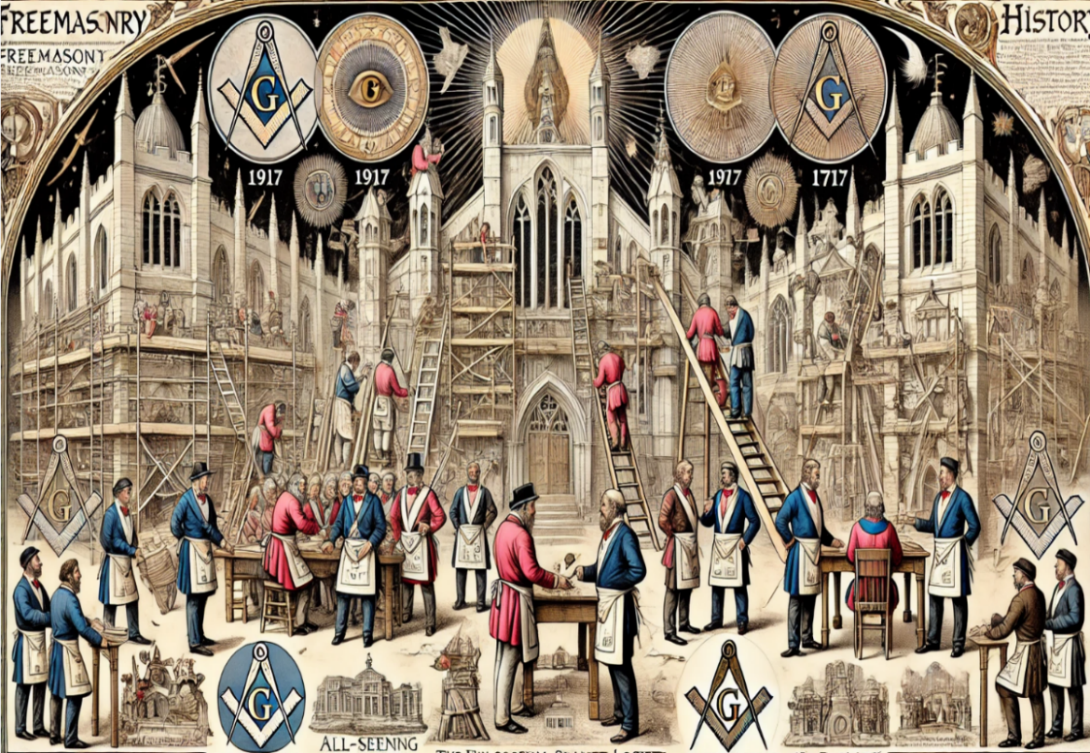
Introduction[1]
This paper is about the history of Freemasonry: how and when it started, what it does and what it stands for. Its history is often shrouded in mystery and controversy, dates back to the establishment of the Grand Lodge in London in 1717. Since then, Freemasons have played a pivotal role within the nation, weathering opposition from entities like the Catholic Church, Hitler, and widespread public scrutiny. Over more than three centuries, they have been influential at crucial historical junctures, yet often amidst claims of conspiracy. However, the true story of how a stonemasons’ guild evolved into the World’s largest secret society is more a narrative of Enlightenment thinking than of covert dealings. Many say it is not a secret society but a society that has secrets, like rituals and handshakes – those are not covered here.

Origins and Evolution
Freemasonry’s origins trace back to the medieval stonemasons’ guilds of Europe, which were responsible for building significant architectural works like cathedrals and castles. These operative masons’ guilds laid the groundwork for what would become modern Freemasonry. By the late 16th and early 17th centuries, these organisations began admitting non-stonemason members, transitioning to “speculative Freemasonry” focused on philosophical and ethical discussions.
The history of Freemasonry traces its origins, evolution, and key developments across three main stages. Initially, during the Middle Ages, organised lodges of operative masons emerged, followed by the inclusion of lay members as “accepted” or “speculative” masons, reflecting the ceremonial process of integrating non-stone masons into operative lodges.
This shift culminated in the formal establishment of modern Freemasonry on 24th June 1717, when four London lodges united[2] to form the first Grand Lodge of England, marking the organised beginning of modern Freemasonry. From then, the movement spread to other countries, adapting to different cultural and political contexts.[3]
Development Through the Ages
Historians face challenges due to the scarce written records available until the 19th century and the spread of misinformation by both masons and non-masons from early on. The transition from operative to speculative lodges introduced a new era of Freemasonry, with the first Grand Lodge in London becoming a model that soon spread internationally.
Early Masonic texts like the Halliwell Manuscript[4] (also known as the Regius Poem) and the Matthew Cooke Manuscript[5] mix Masonic history with myths, tracing its roots back to biblical figures and asserting its establishment in England during King Athelstan’s reign. Post-1717, figures like James Anderson played significant roles in shaping Freemasonry by reorganising Masonic laws and integrating biblical and chivalric elements, as seen in his celebrated “Constitutions of the Free-Masons.”[6]

Notably, Chevalier Ramsay[7] (1737) connected Freemasonry to the Crusaders, suggesting that masonry was revitalised in the Holy Land under the Knights Hospitaller[8]. These speculative narratives were enriched by subsequent Masonic scholars and allegories, with some tracing Freemasonry’s origins to ancient civilisations like Egypt.
After the formation of the Premier Grand Lodge of England, James Anderson was tasked to reorganise these Gothic Constitutions[9] into a modernised format. His works, along with others, wove masonry’s history with biblical roots and linked it to various historical figures and myths, including Euclid[10] and the Knights Templar.
Modern Masonic Studies and Speculative Narratives
By the 19th century, a more rational approach to Masonic history emerged, with scholars such as Georg Kloss[11] and A. F. A. Woodford[12] contributing to Masonic research, leading to the establishment of research lodges like Quatuor Coronati Lodge[13]. Despite various origin myths linking Freemasonry to ancient and medieval institutions, concrete connections remain elusive.
This shift towards scholarly inquiry did not merely refine the historical understanding of Freemasonry; it also reshaped its cultural and ritualistic practices. Contemporary Masonic scholarship continues to wrestle with balancing these romanticised narratives with factual accuracy. The work of modern historians and archaeologists, who bring new evidence to light through both documentary research and physical findings, frequently stimulates the re-evaluation of accepted Masonic histories.
For instance, recent archaeological discoveries have prompted debates on the veracity of long-standing Masonic traditions, fostering a dynamic dialogue within the community.
The evolution of Masonic studies not only informs the fraternity’s perception of its own history but also enhances its cultural significance in the modern World. By critically examining its past, Freemasonry continues to evolve, adapting its rich traditions in the context of contemporary values and historical understanding.
How Freemasonry Evolved[14]
Freemasonry, like other trades or mysteries from the medieval period, recognised three levels of craftsmen: the apprentice, the journeyman, and the master. An apprentice, after learning the craft for seven years, could either pay to join a lodge as an “entered apprentice” or continue working independently on lower-grade building projects as a “Cowan.” The journeymen were known as “fellows” or “fellows of the craft,” and lodge members were referred to as “Brithers” (brothers), denoting their oath-bound relationship. The master was the lead mason in charge of the lodge or a past holder of the position.
From as early as 1696, records like the Edinburgh Register House manuscript begin to detail the rituals involved in Masonic lodges, particularly the oath-taking of an Entered Apprentice, who was given specific signs and a catechism. This period also saw the fellowcraft take additional oaths and learn the “five points of fellowship,” which emphasised physical closeness as a symbol of their bond. However, the distinction between a fellowcraft and a master was not always clear, with some documents using the terms interchangeably.
By the early 18th century, as revealed in Pritchard’s 1730 text “Masonry Dissected,” Freemasonry began to formalise what is now recognised as the three degrees of the craft: Entered Apprentice, Fellowcraft, and Master Mason, with additional degrees available in systems like the Scottish Rite and York Rite. The role of an Installed Master involved overseeing the lodge for a year and was marked by its own set of rituals and responsibilities.
The development of these degrees, particularly the emergence of the Master Mason degree, was not simply an innovation but rather a reorganisation of existing Masonic practices. The “Mason word,” originally given at the first degree, shifted to the third degree during this reorganisation. This degree centred around the myth of Hiram Abiff, consisting of three parts: his role in building Solomon’s Temple, his murder, and the subsequent discovery of his body, which tied into the Masonic “five points of fellowship.”
This evolution reflects a significant structuring within Freemasonry, documenting its shift from a purely operative craft to a more speculative fraternity with complex rituals and an expanding membership base.
United Grand Lodge of England (‘UGLE’)
Since 1775, English Freemasonry’s address has been on Great Queen Street, London: widely recognised as an Art Deco masterpiece, Freemasons’ Hall is the home of the United Grand Lodge of England. It was originally built as a peace memorial to honour the thousands of Freemasons who fought during the First World War.
Merger and Expansion
After nearly 63 years of separation, the two Grand Lodges in England merged on 27th December 1813, forming the United Grand Lodge of England. This merger brought significant standardisation in rituals, procedures, and regalia. By 1900, 2,800 Lodges existed under its jurisdiction. In the three years following the First World War, over 350 new Lodges were established, and in the three years after the Second World War, nearly 600 new Lodges emerged. Often, these Lodges were started by servicemen who aimed to preserve the sense of camaraderie experienced during their time in service and sought a tranquil haven in a world that was vastly different and continually changing.
Guided by the core values of Brotherly Love, Relief, and Truth, which are now articulated through the principles of Integrity, Respect, Friendship, and Service, English Freemasonry drew members from diverse backgrounds and expanded globally. Initially, in the absence of a welfare state, it established charities to support the well-being of its members and their families. Over time, however, it has grown into a significant benefactor for various charities and community causes beyond the scope of Freemasonry itself, impacting local communities across the nation.
The two Grand Lodges in England that merged were known as the ‘Antients’ and the ‘Moderns’. The “Antients” was officially titled the “Grand Lodge of England According to the Old Institutions,” formed by Irish Freemasons in 1751. They referred to the existing Grand Lodge, established in 1717, as the ‘Moderns’ because of their newer practices and regulations. These two bodies operated separately until their union in 1813, which led to the formation of the United Grand Lodge of England.
However, influential figures like Elias Ashmole, the English antiquary who was one of the first recorded non-operative Freemasons, and James Anderson, who wrote the Constitutions of the Freemasons in 1723, played key roles in shaping the institution. Freemasonry has become a highly influential fraternal organisation – known for its rituals, symbols, and teachings focused on moral and ethical principles.
Elias Ashmole wrote about his initiation in a Lodge in Warrington in 1646, the first recorded evidence of the initiation of an English speculative mason – notwithstanding the fact that those present and listed would have certainly been initiated at an earlier date. Anthony Sayer was elected the first Grand Master. This was the founding of the Premier Grand Lodge, the first of its kind anywhere in the World and the origins of the United Grand Lodge of England.[15]
Scotland
The Grand Lodge of Scotland was established in 1736.
Conspiracy theories often centre around Freemasonry, but Scotland’s true Masonic history has long been overlooked, even though some parts of it are visible for those who seek it out. One such site is the Lodge of Edinburgh (Mary’s Chapel) No. 1 on Hill Street. Although its name might suggest a place of worship, it’s actually the oldest documented Masonic lodge in the World, with records dating back to 1599. This predates the foundation of the Grand Lodge of England in 1717, the event most commonly associated with the start of modern Freemasonry.
Freemasonry in Scotland has deep roots, with lodges like Mary’s Chapel tracing their origins to the Middle Ages, when stonemasons formed guilds to protect their craft. By the late 1500s, there were several established lodges across Scotland, making it the birthplace of many of the traditions that shaped modern Freemasonry.
One key figure in the development of the movement was William Schaw, Master of Works for King James VI. In 1598, he introduced regulations to standardise how lodges functioned, leading to the formal recording of minutes and creating a national network. Though Scotland’s role in Freemasonry’s origins has often been overshadowed by England’s Grand Lodge, historical records preserved in Edinburgh, some dating back over 400 years, reveal a rich and often forgotten Scottish Masonic legacy.[16]
Freemasonry’s history in Scotland is notable for its early establishment and unique developments. By 1535, records indicate the existence of two Scottish masonic lodges in France, located in Paris and Lyon. In Scotland itself, the lodges were organized under the oversight of two crown-appointed positions, the Warden General and the Principal Master of Work to the Crown, established by at least 1539. William Schaw, who held both positions towards the end of the 16th century, played a pivotal role in shaping Scottish Freemasonry.[17]
In 1598, Schaw, collaborating with lodge masters from southeast Scotland, issued the Schaw Statutes[18], foundational regulations for masons and their lodges. These statutes emphasised fraternity and charity among masons, introducing roles such as wardens and deacons and distinguishing between entered apprentices and non-masons, known as cowans. A subsequent statute in 1599 included representatives from the west of Scotland, notably from the Lodge of Kilwinning, which was designated as having jurisdiction over the region. However, neither King James nor the master of Kilwinning ratified these statutes, leaving them unofficial.
The emergence of speculative masonry in Scotland is marked by several key developments. The Schaw Statutes’ 1599 directive for lodges to employ a notary to record transactions ensured better documentation of lodge activities, including the admission of non-operative, or “accepted,” masons. This practice is exemplified by the 1634 admission of prominent figures such as Sir Anthony Alexander into the Lodge of Edinburgh (Mary’s Chapel) No. 1.
The transition from operative to speculative masonry in Scotland remains partly speculative. As architectural responsibility shifted from master masons to architects during the 16th century, architects likely began joining masonic lodges. Additionally, there is speculation that lodges started to admit wealthy and influential individuals as a strategy to enhance their financial status and improve working conditions. This period of Freemasonry in Scotland highlights its unique developmental path compared to other regions, underpinned by documented statutes and notable historical figures.
Ireland
The Grand Lodge of Ireland, established in 1725, is one of the oldest Grand Lodges in the World, after the Grand Lodge of England (1717) and before the Grand Lodge of Scotland (1736). It plays a crucial role in the development and administration of Freemasonry in Ireland. The Grand Lodge of Ireland has overseen the growth and activities of Irish Freemasonry for nearly three centuries, exerting a significant influence not just within Ireland but among Irish lodges overseas, particularly in countries with strong Irish diaspora, such as the United States, Canada, Australia, and New Zealand.
Historically, the Grand Lodge of Ireland has been integral in shaping the Masonic ritual and traditions unique to Irish Freemasonry. Unlike the more centralised structure seen in other countries, Irish Freemasonry traditionally allowed a degree of autonomy to individual lodges, especially in matters of ritual practice, which has resulted in a rich variety of customs among Irish lodges.
The headquarters of the Grand Lodge of Ireland is located at Freemasons’ Hall in Dublin, which is also a significant architectural and historical site. The building, completed in 1869, houses not only the administrative offices of the Grand Lodge but also serves as a ceremonial space and a museum with artefacts related to the history of Irish Freemasonry.
The Grand Lodge of Ireland also maintains a strong tradition of charity and community service, which is a hallmark of Masonic activity worldwide. Irish Freemasons have been involved in various philanthropic activities, including support for educational initiatives, healthcare projects, and other community services. Throughout its history, the Grand Lodge of Ireland has had to navigate various social and political changes in Ireland, adapting its role and activities accordingly. Today, it remains a pivotal institution in the cultural and social landscape of Irish fraternal life.
Freemasonry in the United States
Freemasonry in the United States traces its origins to the early 18th century, with the first Masonic lodge established in Philadelphia in 1730 under the jurisdiction of the Grand Lodge of England. Freemasonry quickly spread across the American colonies, particularly among the educated and influential. By the time of the American Revolution, many prominent figures, including George Washington[19], Benjamin Franklin, and Paul Revere, were known as Freemasons. The fraternity played an important, though not official, role in the formation of the new nation, with its ideals of liberty, fraternity, and equality resonating with the founding principles of the United States.

The American Revolution and Beyond
During the Revolutionary War, Freemasonry acted as a bridge between individuals from different colonies. Several founding fathers were active members, and Masonic lodges provided a space for leaders to meet in private. Although the fraternity itself did not take a political stance, its values of freedom and brotherhood were aligned with the emerging American identity.
Post-independence, American Freemasonry grew significantly. In 1787, the Grand Lodge of Pennsylvania was formed, followed by the Grand Lodge of Massachusetts and other states. As the country expanded westward, so did Freemasonry, helping to shape communities across the growing nation. By the 19th century, Freemasonry had become a well-established part of American society.
The Anti-Masonic Movement
One of the most notable events in the history of American Freemasonry occurred in the 1820s with the rise of the Anti-Masonic Movement. This political movement was sparked by the mysterious disappearance of William Morgan in 1826, a man who was allegedly abducted and murdered for threatening to expose Masonic secrets. The incident led to widespread public distrust of Freemasonry, with accusations of elitism, secrecy, and undue influence in politics. The Anti-Masonic Party, founded in 1828, became the first third party in American politics, though it eventually faded from prominence.
Freemasonry in the 19th and 20th Centuries
Despite the Anti-Masonic sentiment, the fraternity rebounded by the mid-19th century. It grew particularly strong in the post-Civil War era as veterans seeking camaraderie joined lodges. Freemasonry’s charitable efforts, including the establishment of hospitals and orphanages, also helped restore its reputation.
By the early 20th century, Freemasonry had millions of members across the United States. The fraternal organisation became especially popular among middle-class men, particularly in small towns where it was a significant part of community life. The Shriners, an appendant body of Freemasonry known for its charitable work, was founded in the US in 1870, further expanding the reach and influence of the Masonic family.
Modern Freemasonry in the US
Today, Freemasonry remains a significant but somewhat less prominent force in American society, with a strong focus on charity, moral philosophy, and fellowship. The number of Masons has declined since the mid-20th century, but the fraternity still maintains a strong presence, particularly in local communities across the United States. Masonic symbols, like the Square and Compasses, can be seen in various public spaces, reflecting the deep-rooted connection between the fraternity and the country’s history.
The World’s Largest Secret Society
Freemasonry is a fraternal organisation known as the largest secret society in the World, dedicated to fellowship, moral principles, and mutual support. While many of its rituals and practices are kept from the public, Freemasonry does not hide its existence or membership. Its spread was largely driven by the expansion of the British Empire, with the order remaining most popular in Britain and former British colonies. By the early 21st century, global membership was estimated at between two and six million[20].

Today, Freemasonry is known throughout the World (for example, see the above picture of Polish Freemasons) as a fraternal organisation that promotes moral and ethical principles, mutual support, and charitable work. Freemasonry remains particularly strong in Britain and its former colonies. The organisation has consistently faced opposition from organised religions and various governments but continues to promote a philosophy of morality, charity, and legal respect.
From its early days, Freemasonry has faced opposition from organised religion, especially the Roman Catholic Church, as well as from various governments. Although not a Christian organisation, Freemasonry promotes morality, charity, and respect for the law. Members are required to believe in a Supreme Being (in Masonic terms, The Great Architect of the Universe) and the immortality of the soul, and the organisation has faced accusations of prejudice against Jews, Catholics, and non-whites.
In Latin countries, Freemasonry has attracted critics of religious authority, while in Anglo-Saxon countries, its membership has traditionally been white Protestants. A notable exception is the French tradition of Co-Freemasonry, established in the 19th century, which admits both men and women.
Freemasons are generally divided into three key degrees: entered apprentice, fellow craft, and master mason. Some lodges, however, have additional degrees, which can number in the hundreds. The structure of Freemasonry varies from country to country.
Affiliated Groups
Alongside the main lodges, several affiliated groups exist, particularly in the United States, where they often focus on social or charitable activities. One well-known group is the Shriners, recognised for their charitable work. While there are women-only lodges in Britain and elsewhere, female relatives of masons may also join the Order of the Eastern Star, which admits both men and women. Boys and girls can participate in Masonic-affiliated youth organisations like the Order of DeMolay and the Order of Job’s Daughters. In England, masons are prohibited from joining any recreational Masonic groups under threat of suspension.[21]
Degrees
In Freemasonry, the main degrees universally recognised are the three core degrees, often referred to as “Blue Lodge” or “Craft” Freemasonry:
- Entered Apprentice – The first degree, which represents a candidate’s initiation into Freemasonry, symbolising the beginning of their journey towards moral and intellectual development.
- Fellow Craft – The second degree, which reflects a mason’s progress in knowledge and learning, with a focus on moral and ethical teachings.
- Master Mason – The third degree, representing the highest rank within the traditional lodge system, symbolising maturity and mastery over oneself and the values of Freemasonry.
Beyond these core degrees, some lodges, particularly in the Scottish Rite and York Rite, offer additional degrees known as “higher” or “appendant” degrees. The most notable examples include:
- Scottish Rite Freemasonry: This system offers a progression of degrees, typically from the 4th to the 32nd degree. The 33rd degree is honorary and rarely bestowed. The Scottish Rite is known for its elaborate rituals and philosophical teachings.
- York Rite Freemasonry: The York Rite consists of additional bodies, each offering its own set of degrees, the key ones being:
- Chapter of Royal Arch Masons, which confers degrees beyond the Master Mason degree, including the Royal Arch degree.
- Cryptic Council (or Council of Royal and Select Masters), offering degrees like the Royal Master and Select Master.
- Commandery of Knights Templar, which confers chivalric orders such as the Order of the Red Cross, Order of Malta, and Order of the Temple.
Each of these rites or systems builds upon the basic Craft degrees but varies in structure and emphasis across different countries and jurisdictions. While the Craft degrees remain foundational, the Appendant degrees offer further exploration of the symbolic and philosophical aspects of Freemasonry.
Mark Masonry
Mark Masonry is an important additional branch of Freemasonry. Mark Masonry, or the Mark Master Masons degree, is often considered an extension of the Fellow Craft degree within the Craft system and is part of many Masonic jurisdictions, though it is treated as a separate order in others. The Mark Master Masons degree focuses on the symbolism of the building of King Solomon’s Temple, particularly the role of stonemasons in marking their work with a distinctive symbol or “mark” to ensure quality and accountability.
The degree teaches lessons about honesty, integrity, and the value of hard work, using the metaphor of the Stonemasons’ craft. In the York Rite system, the Mark Master degree is part of the Chapter of Royal Arch Masons. However, in places like England and Scotland, Mark Masonry operates as an independent body with its own lodges and ceremonies.
The Mark degree is highly regarded, and it is a prerequisite for advancing to certain other Masonic degrees, such as the Royal Arch. The rationale behind this is that the teachings and symbolism of the Mark Master Masons degree complement those of the Royal Arch, enriching the understanding of Masonic principles and history. The Mark degree expands on the work of the stonemasons at King Solomon’s Temple, which is further explored in the Royal Arch, making the degrees feel interconnected in their lessons and symbolism.
In contrast, in the York Rite system as practised in the United States, the Mark Master degree is part of the Chapter of Royal Arch Masons and is one of the degrees conferred before the Royal Arch degree, but it’s not necessarily seen as a standalone requirement.
Thus, while not universally required, in many regions, completing the Mark Master Masons degree is an important step towards fully engaging with the Royal Arch and its deeper symbolic teachings.
Royal Arch (‘Chapter’) Degree
The term “Chapter” is used to refer to the Royal Arch within Freemasonry primarily because it signifies a distinct convening or assembly of its members, which is somewhat akin to how chapters function in books—each representing a separate but connected section of a larger story.
In Masonic terms, a Royal Arch Chapter operates as a separate body within the wider framework of Freemasonry, specifically focused on the Royal Arch degree, which is considered a continuation of the journey begun in Craft Masonry.
The use of the term highlights the organisational structure and the ceremonial distinctiveness of this part of Freemasonry. It marks a new phase or chapter in the Masonic journey of its members, emphasising progression and a deeper understanding of Masonic teachings.
Antients
In 1751, a new Grand Lodge emerged in London, founded by Scottish and Irish Freemasons who had different practices from the existing Grand Lodge. They dubbed the original Grand Lodge as ‘Moderns’ and referred to themselves as ‘Antients’. These two factions operated concurrently, both domestically and internationally, for nearly 63 years without recognising each other as legitimate.
Celebrations
In 1723, the nascent Grand Lodge had released its initial rulebook, titled The Constitutions of the Free-Masons, and had established a routine of holding and documenting quarterly meetings.
On 14th June 1967, the Grand Lodge marked its 250th anniversary with celebrations at the Royal Albert Hall. A highlight of the event was the installation of HRH The Duke of Kent as Grand Master, a position he continues to hold. The Duke of Kent comes from a distinguished line of Royal Grand Masters, including his father, George, King Edward VII, the Duke of Sussex, and King George IV. He was initiated as a Freemason in Royal Alpha Lodge No. 16 in London on 16th December 1963. He completed his Second Degree on 30th January 1964 and his Third Degree on 5th June that same year and served as Master of the Lodge in 1965.
On 10th June 1992, over 12,500 Freemasons and their guests convened at Earl’s Court in West London to commemorate the 275th anniversary of the Grand Lodge. This occasion marked the first time that the press and television were allowed to attend a Grand Lodge meeting, and the event was featured in television newscasts globally.
In 2017, the 300th anniversary of the Grand Lodge was celebrated with grandeur throughout the year, reaching a climax with a special meeting at the Royal Albert Hall, presided over by the Grand Master, HRH The Duke of Kent, and attended by representatives from sovereign Grand Lodges worldwide. As part of the celebrations, the North Gallery in the Museum of Freemasonry was inaugurated. This gallery showcases the history of three centuries of English Freemasonry through various displays and public tours.
In 2023, the United Grand Lodge of England commemorated the 300th anniversary of the 1723 Constitutions, which lay down the Enlightenment principles that underpin contemporary Freemasonry. This milestone was celebrated with various events across England, America, and Europe.
Are Claims of Freemasonry Being Conspiratorial Unfair?
Freemasonry has often been at the centre of conspiracy theories due to its secretive nature, use of symbols, and the influential roles that many of its members have held in politics, business, and society. While the fraternity itself emphasises moral teachings, fraternity, and charity, several aspects of its structure and history have led to suspicions of hidden agendas or undue influence on global affairs. Here are a few ways Freemasonry has engendered (or continues to) a societal influence that can be perceived as conspiratorial[22]:
Secrecy and Elite Membership
Freemasonry has a long-standing tradition of secrecy, particularly around its rituals and symbols, which fuels conspiracy theories. Throughout history, many powerful figures—including US presidents, European monarchs, and other high-ranking officials—have been Freemasons. This has led to suspicions that Freemasons form a hidden network of elites who wield influence over political decisions, economic policy, and global events. Some conspiracy theories suggest that Freemasonry serves as a shadow government or influences major institutions behind the scenes.
Political and Revolutionary Movements
Freemasonry’s principles of liberty, equality, and fraternity have often aligned with revolutionary movements, such as the American and French revolutions. Many of the American Founding Fathers were Freemasons, leading to speculation that Freemasonry played a covert role in the formation of the United States. In France, Freemasonry was linked to revolutionary ideas that contributed to the French Revolution, adding to the perception that Freemasons promote radical change through clandestine means.
The Anti-Masonic Movement
In the 19th century, the disappearance of William Morgan[23], who threatened to publish Masonic secrets, sparked widespread fears that Freemasons were engaged in unlawful activities. This led to the Anti-Masonic Party in the United States, the first third political party in the country, which was founded on the belief that Freemasonry was a secretive group exerting dangerous control over the government. This movement was based on the idea that Freemasons were protecting each other from the law and subverting democratic processes.
Religious Opposition
Freemasonry has often faced opposition from religious groups, particularly the Catholic Church, which has long viewed the organisation with suspicion. In several papal decrees, the Church condemned Freemasonry for promoting secularism, rationalism, and moral relativism. This religious opposition has contributed to conspiracy theories suggesting that Freemasonry is anti-Christian or that it aims to undermine traditional religious institutions. Some theories even propose that Freemasonry is part of a larger occult or satanic plot.
Connection to Other Conspiracy Theories
Freemasonry is frequently linked to other broader conspiracy theories, such as the New World Order or Illuminati. In these narratives, Freemasons are depicted as part of a global elite aiming to establish a one-world government that controls all aspects of human life. The symbols of Freemasonry, such as the Eye of Providence (depicted on the US dollar bill), are often interpreted as evidence of this supposed plan for global domination. These theories claim that Freemasons control banks, media, and governments, working behind the scenes to manipulate world events.
Cultural Influence and Symbolism
Freemasonry’s use of symbols—such as the Square and Compasses, the All-Seeing Eye, and architectural references to Solomon’s Temple—are often woven into conspiracy theories. The visibility of these symbols in public spaces, on currency, and in art, architecture, and media has led to beliefs that Freemasons exert covert cultural influence. These symbols are often interpreted as markers of hidden power or secret codes, reinforcing the notion that Freemasonry operates within and shapes society from the shadows.
Judiciary and Law Enforcement Influence
In some countries, Freemasonry has been accused of influencing the judiciary and law enforcement. Critics argue that Freemasons protect each other through a network of connections, allowing members to avoid legal scrutiny or rise through the ranks in law enforcement and the courts. This has given rise to fears of a Masonic “state within a state,” where loyalty to the fraternity supersedes the rule of law.
Human Psychology and History
While many of these ideas are rooted in speculation and have little to no concrete evidence, the secretive nature of Freemasonry and the prominent positions held by some of its members in society have long made it a target for conspiracy theories. The organisation’s influence on historical events and its ties to powerful individuals continue to fuel perceptions of hidden agendas, even though most scholars and Masons themselves refute these claims.
It is generally true that when people don’t understand something—especially if it is secretive or complex—they often become suspicious and may create or believe in plausible but unfounded explanations. This phenomenon is rooted in human psychology and history. Here are a few key reasons why this happens:
- Fear of the Unknown: When people don’t have enough information about something, especially something that seems exclusive or hidden, their minds tend to fill the gaps with speculation. This can lead to distrust or suspicion because people often fear what they don’t understand. Freemasonry, with its secretive rituals and symbols, is a classic example of how a lack of understanding breeds suspicion and fuels conspiracy theories.
- Pattern Recognition and Storytelling: Humans are wired to seek patterns and meaning in the World, even where there may be none. If something is complex or ambiguous, the brain tends to create narratives to explain it. These narratives can seem logical or “plausible,” even if they are not based on fact. People might connect unrelated dots to form a cohesive story that explains their fear or mistrust.
- Confirmation Bias: Once people have a suspicion or belief, they tend to seek out information that supports it while dismissing evidence to the contrary. This cognitive bias helps entrench suspicions and conspiracies when there’s a lack of clear understanding. In the case of secret societies, people might selectively focus on the secretive nature and ignore charitable or community aspects of the organisation, reinforcing their rejection.
- Social Influence and Misinformation: Throughout history, misunderstandings about complex or secretive subjects have often been amplified by social networks, rumours, or misinformation. These suspicions can spread quickly, especially when plausible-sounding explanations or conspiracy theories circulate, whether in print, media, or online. If influential figures or communities reject something they don’t understand, it becomes easier for others to adopt the same stance.
There are many historical examples where things not understood were met with suspicion. For instance:
- Scientific Discoveries: Early scientific advancements were often misunderstood and rejected by society, leading to the persecution of scientists (e.g., Galileo’s defence of heliocentrism).
- New Technologies: The introduction of technologies like electricity or the internet was initially met with scepticism and fears about their impact on society.
- Cultural Differences: Foreign customs, religious practices, or even philosophical ideas have historically been misunderstood and met with suspicion, leading to prejudice or rejection.
A natural reaction to ambiguity, secrecy, or complexity, especially when it affects things they value, like safety, control, or community, often happens when something is not fully understood. Yet, despite these claims and suspicions, the true history of Freemasonry, based on its principles of fraternity, morality, and service, is far less mysterious yet equally fascinating in its impact on society.
Sources: The information I provided draws on widely known historical events, scholarly works, and documented conspiracy theories about Freemasonry. While I didn’t cite specific sources directly in that response, here are some key sources and types of literature that cover these topics in depth:
Questions and Conclusions
Were ancient Masonic scrolls containing the secret teachings of Jesus hidden beneath Herod’s Temple just before its destruction by the Romans in 70 AD? Did the Knights Templar, often linked to the origins of modern Freemasonry, uncover those scrolls during their excavations in Jerusalem in the 12th century? Could these documents have then been secretly relocated to Scotland and buried beneath Rosslyn Chapel, a structure speculated by some to be a symbolic reconstruction of Herod’s Temple? Are these mysterious scrolls still lying in wait under Rosslyn Chapel, awaiting their eventual discovery?
Furthermore, what connection, if any, exists between these alleged scrolls and the teachings or symbols of Freemasonry? How did the legend of Rosslyn Chapel as a repository for ancient Christian secrets arise, and what evidence, if any, supports these claims? Could the chapel’s architecture and carvings hold cryptic clues to this hidden history, or are they simply the product of medieval artistry and imagination?
These questions, inspired by The Hiram Key: Pharaohs, Freemasons, and the Discovery of the Secret Scrolls of Jesus[24] by Christopher Knight and Robert Lomas, continue to captivate readers. While they fuel endless debate and imagination, the true history of Freemasonry is equally fascinating, if less shrouded in myth.
From its humble beginnings to its current status as a globally influential organisation, Freemasonry has played a significant role in shaping social and cultural landscapes across the World. Despite its secretive aspects, the organisation’s impact on historical and modern societal structures is undeniable, making it a fascinating subject of study and discussion.
As Freemasonry continues to adapt to contemporary societal values, its enduring principles of fraternity, morality, and service ensure that it remains a vital part of global culture. The organisation’s ability to navigate both public scrutiny and internal reform suggests that its role in shaping social structures is far from over.
In reflecting on Freemasonry’s historical foundations, as I noted in my 2023 paper Secret Societies: The Ties of Brotherhood[25], the organisation has maintained its roots in the local guilds of stonemasons dating back to the 13th century. The structure of Freemasonry, with its three core degrees—Entered Apprentice, Fellowcraft, and Master Mason—has remained a constant, preserving its traditions while adapting to different localities and jurisdictions. This blend of continuity and evolution continues to define the essence of Freemasonry today.


Appendix: The Five Noble Orders of Architecture[26]
The Five Noble Orders of Architecture hold significant relevance to the history of Freemasonry. In Freemasonry, these orders are often referenced in rituals and teachings to symbolise the progression of architectural knowledge and the evolution of building techniques. The orders represent different stages of architectural development, from the simplest (Tuscan) to the most elaborate (Composite), mirroring the journey of a Freemason’s personal and moral development.
The five noble orders of architecture are classical architectural styles that originated in ancient Greece and Rome. They provide a standardised system for designing columns and entablatures which are key elements in classical structures. The five orders are:
- Doric: Simple and sturdy, with plain capitals.
- Ionic: More slender and elegant, with scroll-like volutes on the capitals.
- Corinthian: elaborate and ornate, with acanthus leaves on the capitals.
- Tuscan: A simplified version of the Doric order, without fluting.
- Composite: a combination of Ionic and Corinthian features, with both volutes and acanthas leaves.
The concept of the “Five Orders of Architecture” is attributed to the Italian Renaissance architect Giacomo da Vignola (born Barozzi). Vignola outlined these five orders in his influential book, Regola delli cinque ordini d’architettura (The Rule of the Five Orders of Architecture), first published in 1562.[27] This work systematically describes the architectural styles that have been foundational in classical and Western architecture.
Vignola was a pupil of Michelangelo, one of the most influential figures of the Italian Renaissance. Michelangelo’s teachings and artistic philosophy deeply influenced Vignola, particularly in terms of the grandeur and harmony of architectural design. Vignola’s work, especially his codification of the classical orders of architecture, reflects the Renaissance ideals of balance, proportion, and beauty that were central to Michelangelo’s work.
Vignola’s codification of these orders provided a clear and comprehensive guide for architects and builders, greatly influencing architectural practice and education in the following centuries. His work helped to standardise the use of classical architecture across Europe and the Americas during the Renaissance and beyond.
Freemasonry has its roots in the stonemasons’ guilds of medieval Europe, and the architectural orders are an acknowledgement of the craft’s historical connection to building and construction. The incorporation of these orders into Masonic symbolism marks the importance of craftsmanship, learning, and the pursuit of excellence in both the physical and moral realms.
The Five Orders of Architecture, as defined by Vignola and other architects of the Renaissance, have a significant symbolic and practical role in Freemasonry. In Masonic tradition, these orders are not only architectural principles but also convey moral and ethical teachings, each representing a different aspect of Masonic philosophy and the personal development of its members.
Symbolic Significance in Freemasonry
- Tuscan Order: Representing strength and simplicity, it is often associated with the Entered Apprentice, the first degree of Freemasonry, symbolising the foundations of Masonic knowledge and the building of character.
- Doric Order: Known for its sturdiness and lack of ornamentation, it symbolises strength and is associated with the Fellowcraft, the second degree of Freemasonry, reflecting the development of moral and ethical fortitude.
- Ionic Order: Associated with wisdom and learning, the Ionic order reflects the pursuits of the Freemason in seeking knowledge and understanding.
- Corinthian Order: The most ornate, representing beauty, it is often linked to the mastery of the Masonic arts and the attainment of grace, both in architecture and in personal conduct.
- Composite Order: Combining elements of the Ionic and Corinthian orders, it symbolises the combination of wisdom and beauty, representing the culmination of the Masonic journey.
Practical Application in Lodge Architecture
In Masonic lodges, the use of these architectural orders often reflects the hierarchical and educational structure of Freemasonry. Lodge rooms may feature columns or architectural motifs based on these orders, each reinforcing the layered meanings and the progress of Masons through different degrees.
By integrating these architectural principles into both their physical spaces and symbolic teachings, Freemasonry aligns itself with the broader heritage of Western architectural and philosophical thought, emphasising the role of personal and moral development in achieving higher degrees of understanding and societal harmony. This connection to Renaissance principles, including those laid out by figures like Vignola, highlights the enduring influence of classical ideas on modern institutions like Freemasonry.

Useful Sources for Further Reading
- http://www.freemasons-freemasonry.com/regius.html
- https://digitalcommons.unl.edu/cgi/viewcontent.cgi?article=1028&context=libraryscience
- https://en.wikipedia.org/wiki/Andrew_Michael_Ramsay
- https://en.wikipedia.org/wiki/History_of_Freemasonry
- https://en.wikisource.org/wiki/Matthew_Cooke_Manuscript
- https://martinpollins.com/2023/06/29/secret-societies-the-ties-of-brotherhood/
- https://martinpollins.com/2023/11/10/the-templars-hospitallers-and-the-crusaders/
- https://www.britannica.com/topic/Freemasonry
- https://www.ugle.org.uk/discover-freemasonry/history-freemasonry
- https://www.ugle.org.uk/discover-freemasonry/history-freemasonry
Relevant Reading
- Freemasonry and Its Ancient Mystic Rites, by C.W. Leadbeater, published by Lushena Books, available from https://www.amazon.co.uk/Freemasonry-its-Ancient-Mystic-Rites/dp/1639231501/
- Freemasonry: A Journey Through Ritual and Symbol, by W. Kirk MacNulty, published by Thames & Hudson Ltd, available from https://www.amazon.co.uk/Freemasonry-Journey-Through-Ritual-Imagination/dp/0500810370/
- Freemasonry: Symbols, Secrets, Significance, by W. Kirk MacNulty, published by Thames & Hudson Ltd, available from https://www.amazon.co.uk/Freemasonry-Significance-W-Kirk-MacNulty/dp/0500513023/
- Proofs of a Conspiracy, by John Robison (1798), published by Western Islands, available from https://www.amazon.co.uk/Proofs-Conspiracy-1798-John-Robison/dp/B000VFTGIQ/
- Revolutionary Brotherhood: Freemasonry and the Transformation of the American Social Order, 1730-1840, by Steven C. Bullock, published by University of North Carolina Press, available from https://www.amazon.co.uk/Revolutionary-Brotherhood-Freemasonry-Transformation-Williamsburg/dp/B01NH01TY8/
- Sworn in Secret: Freemasonry and the Knights Templar, by Sanford Holst, published by Santorini Publishing, available from https://www.amazon.co.uk/Sworn-Secret-Freemasonry-Knights-Templar/dp/0983327939/
- The Builders: A Story and Study of Freemasonry, by Joseph Fort Newton, published by Pantianos Classics, available from https://www.amazon.co.uk/Builders-Freemasonry-Masonic-Philosophy-Complete/dp/178987193X/
- The Craft and Its Symbols: Opening the Door to Masonic Symbolism, by Allen E. Roberts, published by Macoy Publishing and Masonic Supply, available from https://www.amazon.co.uk/craft-its-symbols-Opening-symbolism/dp/B0000EEP39/
- The Freemasons: A History of the World’s Most Powerful Secret Society, by Jasper Ridley, published by Arcade Publishing, available from https://www.amazon.co.uk/Freemasons-History-Worlds-Powerful-Society/dp/1611450101/
- The Freemasons: Unlocking the Secrets of the Symbolic Society, by Michael Johnstone, published by Lorenz Books, available from https://www.amazon.co.uk/FREEMASONS-Unlocking-1000-year-mysteries-Brotherhood/dp/0754835235/
- The Hiram Key: Pharaohs, Freemasons and the Discovery of the Secret Scrolls of Jesus, by Christopher Knight and Robert Lomas, published by Arrow, available from https://www.amazon.co.uk/Hiram-Key-Pharoahs-Freemasons-Discovery/dp/0099699419/
- The History of Freemasonry: Its Legends and Traditions (Vol. I), by Albert G. Mackey, published by Masonica, available from https://www.amazon.co.uk/History-Freemasonry-Vol-I/dp/8418379456/
- The History of Freemasonry: Its Legends and Traditions (Vol. II), by Albert G. Mackey, published by Masonica, available from https://www.amazon.co.uk/History-Freemasonry-Vol-II/dp/8418379464/
- The History of Freemasonry: Its Legends and Traditions (Vol. III), by Albert G. Mackey, published by Masonica, available from https://www.amazon.co.uk/History-Freemasonry-Vol-III/dp/8418379472/
- The Lost Keys of Freemasonry, by Manly P. Hall, published by Penguin Publishing Group, available from https://www.amazon.co.uk/Lost-Keys-Freemasonry-Manly-Hall/dp/1585425109/
- The Meaning of Masonry, by WL Wilmshurst, published by Zinc Read, available from https://www.amazon.co.uk/Meaning-Masonry-W-L-Wilmshurst/dp/9358588195/
- The New World Order, by A. Ralph Epperson, published by African Tree Press, available from https://www.amazon.co.uk/New-World-Order-Ralph-Epperson/dp/1592324789/
- The Secret Architecture of Our Nation’s Capital: The Masons and the Building of Washington, DC, by David Ovason, published by Harper Perennial, available from https://www.amazon.co.uk/Secret-Architecture-Our-Nations-Capital/dp/0060953683/
- The Secret History of Freemasonry: Its Origins and Connection to the Knights Templar, by Paul Naudon, published by Inner Traditions, available from https://www.amazon.co.uk/Secret-History-Freemasonry-Origins-Connection/dp/159477028X/
CAUTION: This paper is compiled from the sources stated but has not been externally reviewed. Parts of this paper include information provided via artificial intelligence which, although checked by the author, is not always accurate or reliable. Neither we nor any third parties provide any warranty or guarantee as to the accuracy, timeliness, performance, completeness or suitability of the information and materials covered in this paper for any particular purpose. Such information and materials may contain inaccuracies or errors and we expressly exclude liability for any such inaccuracies or errors to the fullest extent permitted by law. Your use of any information or materials on this website is entirely at your own risk, for which we shall not be liable. It shall be your own responsibility to ensure that any products, services or information available through this paper meet your specific requirements and you should neither take action nor exercise inaction without taking appropriate professional advice. The hyperlinks were current at the date of publication.
End Notes and Explanations
- Source: Compiled from my research using information available at the sources stated throughout the text, together with information provided by machine-generated artificial intelligence at: bing.com [chat] and https://chat.openai.com. Text used includes that on Wikipedia websites is available under the Creative Commons Attribution-ShareAlike License 4.0; additional terms may apply. By using those websites, I have agreed to the Terms of Use and Privacy Policy. Wikipedia® is a registered trademark of the Wikimedia Foundation, Inc., a non-profit organisation. ↑
- Explanation: The four London lodges that came together to form the first Grand Lodge of England on 24th June 1717 were: (1) The Goose and Gridiron Alehouse Lodge, located in St. Paul’s Churchyard. (2) The Crown Alehouse Lodge, situated in Parker’s Lane, near Drury Lane. (3) The Apple Tree Tavern Lodge, based in Charles Street, Covent Garden. (4) The Rummer and Grapes Tavern Lodge, located in Channel Row, Westminster. These lodges, which were initially independent entities, agreed to unite under a Grand Lodge to provide some organisational structure to Freemasonry. This was the beginning of what became known as “speculative” Freemasonry, as it moved away from its operative origins in stonemasonry and focused more on philosophical and moral teachings. ↑
- Source: https://www.ugle.org.uk/discover-freemasonry/history-freemasonry ↑
- Explanation: The Halliwell Manuscript is the oldest known document associated with Freemasonry. It dates back to around the late 14th or early 15th century, roughly between 1390 and 1425. This manuscript is significant because it is the earliest poetic manuscript that details the constitution of Freemasonry. The Halliwell Manuscript is written in Middle English verse and comprises 64 pages. It presents a legendary history of the craft of Masonry and outlines moral duties and procedures for conducting masonic rites. It begins by describing how geometry was founded in Egypt and then traces the spread of Masonry to England during the reign of King Athelstan, who is presented as a central figure in the formal organisation of Masonry in England. The document also includes fifteen articles and fifteen points for the moral and practical regulation of masons, along with a series of poems related to social, moral, and religious conduct. Its significance lies in providing a window into the moral and ethical framework that shaped the early masonic tradition and its emphasis on values such as honesty, integrity, and loyalty. Overall, the Halliwell Manuscript is not only important for understanding the historical roots of Freemasonry but also for its insights into medieval craft guilds and their cultural context. The Manuscript has been digitised and made available by various libraries and scholarly resources. One of the most accessible places to find it is through the British Library’s website, where it is catalogued and available for viewing. Additionally, several Masonic websites and academic databases may also offer transcriptions or scanned images of the manuscript.A detailed explanation is available online at: http://www.freemasons-freemasonry.com/regius.html ↑
- Explanation: The Matthew Cooke Manuscript, also known as the Cooke Manuscript, is one of the oldest known Masonic documents, dating from the mid-15th century. It is a significant piece of evidence in the study of the early history of Freemasonry, particularly because it provides a detailed narrative of the craft and its moral and operational guidelines. This manuscript looks at the history of the craft of masonry, tracing its origins to biblical figures and classical antiquity, and outlines the duties and regulations for freemasons. It is considered to be one of the “Old Charges” or “Gothic Constitutions,” a group of manuscripts that form the foundation of Masonic traditions and laws. The manuscript is the oldest of a class of about one hundred early documents known as Freemasonry’s Gothic Constitutions, and the second oldest known manuscript in Masonic history. It was published by R. Spencer, London, 1861 and edited by Mr Matthew Cooke. In the British Museum’s catalogue it is listed as “Additional M.S.23,198“, and has been dated by Hughan at 1450 or thereabouts. Further details are at: https://en.wikisource.org/wiki/Matthew_Cooke_Manuscript ↑
- Explanation: James Anderson was a Scottish Presbyterian minister and Freemason, best known for compiling the Constitutions of the Free-Masons, which he published in 1723. This work is a significant historical document in the study of Freemasonry, as it laid down the guidelines and the framework that have governed the practice and organisation of modern Freemasonry. Born around 1680, Anderson was educated at the University of Aberdeen, after which he moved to London, where he served as a minister at a Presbyterian church. His role in Freemasonry began to take prominence when the newly formed Grand Lodge of London and Westminster sought someone to organise and codify the constitution of Freemasonry. Anderson was chosen for this task due to his scholarly background and his standing in the Masonic community. The Constitutions of the Free-Masons was a seminal work for several reasons: It provided, albeit embellished, a history of the craft of Masonry from biblical times to the 18th century. It set out the duties, regulations, and ethics of Freemasons. Anderson’s work helped to standardise Masonic practices and rituals across the various lodges, thus fostering a more unified identity for Freemasonry at a time when it was still forming as a modern fraternal organisation. Anderson’s constitutions were revised and expanded in a second edition published in 1738. His work not only influenced Freemasonry in England but also had a broad impact on Freemasonry internationally as the movement spread across Europe and to the Americas. Anderson’s contributions to Freemasonry are still recognised today, and his constitutions continue to be a fundamental part of Masonic heritage and scholarship. An electronic edition is available at: https://digitalcommons.unl.edu/cgi/viewcontent.cgi?article=1028&context=libraryscience ↑
- Explanation: Sir Chevalier Andrew Michael Ramsay was a Scottish-born writer, philosopher, and freemason who played a notable role in the history of Freemasonry, particularly in its expansion and ideological development in continental Europe. Born in 1686 in Ayr, Scotland, Ramsay initially began his career in a theological and academic setting, later becoming involved in the political and intellectual circles of his time. Ramsay was educated at the University of Edinburgh and later converted to Catholicism after spending time in France, where he became a tutor in the household of the exiled James Francis Edward Stuart, the “Old Pretender” to the British throne. His conversion led him to move to France permanently, where he continued his intellectual pursuits.Ramsay is best known for his “Oration”, delivered in 1737, which purported to trace the origins of the Freemasons back to the crusading knights, thus providing Freemasonry with a chivalric and historical foundation that linked the fraternity to earlier historical and religious traditions. His oration suggested that Freemasons were spiritual descendants of the Crusader knights, which was a significant deviation from the more commonly accepted origins related to medieval stonemasons’ guilds. This narrative provided by Ramsay had a considerable influence on the development of Freemasonic rites and degrees, especially in France and other European countries, where the appeal to chivalric and Christian traditions resonated with the prevailing cultural and intellectual currents. It contributed to the development of higher degrees in Freemasonry and the establishment of rites such as the Scottish Rite.Ramsay’s contributions helped Freemasonry to gain a foothold among the European nobility by aligning its symbolic and ritualistic elements with the romantic and religious sentiments of the time. His ideas fostered the growth of what would become known as “high-degree” Freemasonry, which elaborated on the basic three degrees with more complex ceremonial practices and narratives. Ramsay’s Oration and his subsequent activities significantly shaped the way Freemasonry developed in the 18th century, particularly in how it was perceived and practised beyond its British origins. Despite his embellishments and the creation of a mythical past, Ramsay’s influence remains a pivotal chapter in the history of Freemasonry. See more at: https://en.wikipedia.org/wiki/Andrew_Michael_Ramsay ↑
- Information: Commentary about The Templars, Hospitallers and the Crusaders is available at: https://martinpollins.com/2023/11/10/the-templars-hospitallers-and-the-crusaders/↑
- Explanation: The term “Gothic Constitutions” in relation to Freemasonry is generally attributed to James Anderson, who used it in the 1723 and 1738 editions of the “Constitutions of the Free-Masons.” Anderson used the term to refer to the medieval documents that were purported to outline the regulations of the stonemasons’ guilds, which he and others in the early 18th century believed were the predecessors of modern Freemasonry. These documents, later known as the “Old Charges,” were seen as a link to the fraternity’s storied past, which Anderson romantically associated with the Gothic period of architecture, hence the name “Gothic Constitutions.” This term helped frame the narrative that Freemasonry had origins dating back to the Gothic era, aligning the fraternity with a rich historical and architectural tradition. ↑
- Explanation: Euclid was an ancient Greek mathematician, often referred to as the “father of geometry.” He is most famous for his work “Elements,” which is one of the most influential works in the history of mathematics. “Elements” is a comprehensive compilation of the knowledge of geometry of his time and served as the main textbook for teaching mathematics, especially geometry, from its publication around 300 BC until the early 20th century. Little is known about Euclid’s life, including exact dates for his birth and death. He is believed to have lived in Alexandria, Egypt, during the reign of Ptolemy I. There is some ambiguity about his exact identity, with some historical sources confusing him with Euclid of Megara, a philosopher who lived about a century earlier.In the context of Freemasonry, Euclid is revered not just for his contributions to geometry but as a symbol of universal wisdom and the power of logical reasoning. His name and teachings are often invoked in Masonic rituals and lore, emphasising the importance of geometry as a metaphorical tool for building and understanding both moral and physical structures in the universe. ↑
- Explanation: Georg Kloss was a German physician, historian, and Freemason, born in the late 18th century. He is particularly renowned for his scholarly work on the history of Freemasonry. Kloss was an avid collector of Masonic books and manuscripts, which made him one of the foremost Masonic bibliographers of his time. His meticulous research and publications, including a comprehensive bibliography of Freemasonry, contributed significantly to the study and understanding of Masonic history and rituals. ↑
- Explanation: Albert Frederick Arthur Woodford (A. F. A. Woodford) was an English clergyman and Freemason in the 19th century. He was a founding member of the Quatuor Coronati Lodge No. 2076, the premier Masonic research lodge, established in London in 1886. Woodford contributed significantly to Masonic scholarship, particularly through his editorial work on early Masonic manuscripts and his efforts in the translation and publication of Masonic texts. His contributions helped promote a more scholarly and historical approach to the study of Freemasonry. ↑
- Explanation: Quatuor Coronati (Latin: meaning Four Crowned Ones) Lodge No. 2076 is a Masonic Lodge in London dedicated to Masonic research. Founded in 1886, the Lodge meets at Freemasons’ Hall, Great Queen Street. The name of the Lodge was taken from lines 497 – 534 of the Regius Poem, see Halliwel Manuscript above. Nine Masons (Charles Warren, William Harry Rylands, Robert Freke Gould, The Revd. Adolphus Frederick Alexander Woodford, Walter Besant, John Paul Rylands, Major Sisson Cooper Pratt, William James Hughan, and George William Speth), dissatisfied with the way the history of Freemasonry had been expounded in the past, founded the Lodge, obtaining a warrant in 1884. Today, the Lodge is primarily one of research land is often described as a correspondent Lodge due to its unique role in Freemasonry. Founded with the intent to transition from speculative to more scholarly, historical research on Freemasonry, it has members worldwide who engage primarily through correspondence. This allows Masonic scholars and researchers from various parts of the globe to share insights, findings, and debates on Masonic history and symbolism without the need to meet regularly in person. ↑
- Source: https://www.ugle.org.uk/discover-freemasonry/history-freemasonry ↑
- Source: https://www.ugle.org.uk/discover-freemasonry/history-freemasonry ↑
- Source: https://www.bbc.com/travel/article/20161209-secret-history-of-the-freemasons-in-scotland ↑
- Source: https://en.wikipedia.org/wiki/History_of_Freemasonry ↑
- Explanation: The Schaw Statutes were a set of regulations issued in Scotland in the late 16th century that played a foundational role in shaping the structure and practices of early Freemasonry. They were introduced by William Schaw, who was the Master of Works and Warden General to King James VI of Scotland. Schaw is considered one of the key figures in organising and standardising Scottish masonry, which laid the groundwork for what later became speculative Freemasonry. There are two key sets of Schaw Statutes:The First Statutes (1598): These established rules for how stonemasons’ lodges in Scotland were to operate, aiming to regulate their conduct and improve the quality of their craft. The statutes also laid out the duties of lodge members and officers, required proper documentation of lodge activities, and promoted fraternity and charity among the masons. It also introduced roles like Wardens and Deacons to help in and oversee the running of lodges.The Second Statutes (1599): These extended the first statutes and were aimed specifically at the Lodge of Kilwinning, giving it jurisdiction over the lodges in the west of Scotland. These statutes further underscored the importance of keeping proper records, which helped preserve the history of Scottish Freemasonry.One of the key innovations of the Schaw Statutes was the directive that each lodge should employ a Notary to keep minutes of their meetings, which greatly improved the documentation and historical record of Freemasonry in Scotland. The statutes also made a distinction between entered apprentices and cowans (non-masons or unskilled workers), helping to establish formal rules for membership and qualification.The Schaw Statutes are significant because they helped transform operative masons’ lodges into more structured and regulated organisations, contributing to the development of Speculative Freemasonry, which focuses on moral and philosophical teachings rather than the craft of stonemasonry. ↑
- Information: George Washington joined the Masonic Lodge in Fredericksburg, Virginia, at the age of 20 in 1752. During the War for Independence, General Washington attended Masonic celebrations and religious observances in New York, New Jersey and Pennsylvania. He also supported Masonic lodges that formed within army regiments. The George Washington Masonic National Memorial is a Masonic building and memorial located in Alexandria, Virginia, outside Washington, D.C. It is dedicated to the memory of George Washington, first president of the United States and charter Master of Alexandria Lodge No. 22 (now Alexandria-Washington Lodge, No. 22) ↑
- Explanation: The wide range in the membership estimate for Freemasonry globally—from two to six million—reflects several factors which make it challenging to pinpoint a more precise figure. This variability is not uncommon in large, global, and historically private organisations like Freemasonry. The factors include:Decentralised Structure: Freemasonry is not a centrally governed organisation but rather consists of many independent Grand Lodges and other Masonic bodies that govern their own jurisdictions. Each has its own records and membership counting methods, which can vary significantly. This decentralisation makes it challenging to consolidate accurate global numbers.Private Nature: Despite being a society that does not hide its existence, many aspects of Freemasonry, including detailed membership data, are not always publicly disclosed. This adds to the difficulty in obtaining a precise count of active members worldwide.Fluctuating Membership: Membership numbers in many fraternal organisations, including Freemasonry, have fluctuated over time due to various social, economic, and cultural factors. These fluctuations can be difficult to track consistently across different regions and time periods.Diverse Affiliations: There are many different forms of Freemasonry, and some members may belong to multiple lodges or branches, which can complicate membership tallies. Furthermore, some Masonic-like orders may be counted by some statisticians while excluded by others, depending on their criteria for what constitutes “regular” Freemasonry. ↑
- Source: https://www.britannica.com/topic/Freemasonry ↑
- Sources: For the section headed, Are Claims of Freemasonry Being Conspiratorial Unfair? the following sources provide a foundation for understanding how Freemasonry has been perceived historically, both as a fraternal organisation with real societal influence and as the subject of conspiratorial thinking:Historical Context of Freemasonry:
- The Freemasons: A History of the World’s Most Powerful Secret Society, by Jasper Ridley: This book covers the role of Freemasonry in historical events, including the American and French revolutions, and its relationship with power and politics.
- Freemasonry: Symbols, Secrets, Significance, by W. Kirk MacNulty: Offers a comprehensive look into the symbolism and philosophical foundations of Freemasonry and how they have been interpreted both within the fraternity and by critics.
Anti-Masonic Movement and William Morgan:
- Revolutionary Brotherhood: Freemasonry and the Transformation of the American Social Order, 1730-1840, by Steven C. Bullock: This source covers the rise of Freemasonry in America and the impact of the Anti-Masonic Party, which was the first third-party movement in US politics.
- The Morgan Affair and the Anti-Masonic Party (various historical texts): Numerous works document the disappearance of William Morgan and how it fueled anti-Masonic sentiment in the 1820s and 1830s.
Religious Opposition and Papal Decrees:
- In Eminenti Apostolatus Specula (1738): The first papal bull issued by Pope Clement XII condemning Freemasonry, which accused the organisation of being incompatible with the Catholic faith.
- Humanum Genus (1884) by Pope Leo XIII: Another encyclical warning against Freemasonry, accusing it of promoting secularism and undermining religious institutions.
Conspiracy Theories (New World Order, Illuminati):
- The New World Order, by A. Ralph Epperson: Explores the popular conspiracy theory linking Freemasonry to a secret global elite that aims to create a one-world government.
- Proofs of a Conspiracy, by John Robison (1798): An early work that helped spread the idea that Freemasonry and the Illuminati were conspiring to overthrow governments and establish a secular world order.
Freemasonry and Cultural Influence:
- The Secret History of Freemasonry: Its Origins and Connection to the Knights Templar, by Paul Naudon: Discusses how Freemasonry’s symbols and traditions have been interpreted as evidence of its hidden influence in global affairs.
- The Secret Architecture of Our Nation’s Capital: The Masons and the Building of Washington, D.C., by David Ovason: This book looks at Masonic symbols in American architecture, particularly in Washington, DC, and the cultural influence of Freemasonry.
- Explanation: The disappearance of William Morgan in 1826 is a key event in American history that sparked widespread suspicion of Freemasonry. Morgan, a resident of Batavia, New York, threatened to publish a book revealing the secret rituals of Freemasonry, but shortly after his plans became public he was arrested on dubious charges and mysteriously disappeared. It is widely believed that Morgan was abducted and possibly murdered by Freemasons to prevent the publication of his book, although his body was never found. The incident led to the formation of the Anti-Masonic Movement, which accused Freemasons of operating as a secretive and dangerous organisation. This movement gained significant political traction, even forming the Anti-Masonic Party, the first third-party in US history. The controversy surrounding Morgan’s disappearance fueled decades of mistrust toward Freemasonry in America. ↑
- Note: Published by Arrow, available from https://www.amazon.co.uk/Hiram-Key-Pharoahs-Freemasons-Discovery/dp/0099699419/ ↑
- Secret Societies: The Ties of Brotherhood – by Martin Pollins, at: https://martinpollins.com/2023/06/29/secret-societies-the-ties-of-brotherhood/↑
- Further Information: Freemasonry and Architecture: https://www.freemasonryandarchitecture.com and The History of Freemasonry at: https://www.historyoffreemasonry.org ↑
- Availability: The book (hardcover, Italian only) can be purchased from https://www.amazon.co.uk/Regola-Delli-Cinque-Ordini-Darchitettura/dp/1015841597/ ↑

