Introduction[1]
Throughout history, religions have played a defining role in shaping societies, cultures, and political systems. One of the most significant religious transformations was the shift from polytheism—the worship of many gods—to monotheism, the belief in a single, all-powerful deity. This transition marked a profound turning point in human thought, influencing not only spiritual beliefs but also social and political structures.
The emergence of monotheism, with its emphasis on a single, unified divine authority, transformed the religious and social landscapes of ancient societies. This move from polytheism, where different gods governed various aspects of life, had profound implications for culture, governance, and interpersonal relationships. Monotheism introduced a singular ethical framework that sought to unify and regulate communities, challenging established social hierarchies and reshaping political power. The history of God beliefs can be traced back to the earliest evidence of religious behaviour, which dates back to the Middle Paleolithic era, approximately 45,000 to 200,000 years ago. The earliest evidence of religious thought is based on the ritual treatment of the dead.
Even today, the legacy of this transformation is evident in the way modern societies structure their legal and moral codes. Many contemporary legal systems, particularly in Western nations, are rooted in the ethical frameworks established by monotheistic traditions. From concepts of justice to individual rights, the shift towards monotheism has continued to influence how communities define moral behaviour, govern societies, and address ethical dilemmas.

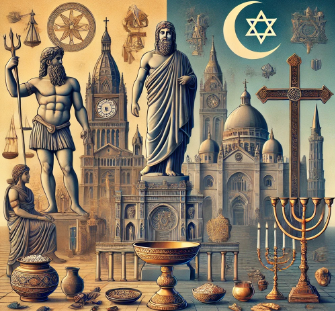
Credit: Drawn by Dalle-E, a subset of ChatGPT, 16/10/2024
This paper will explore the impact of monotheism on historically polytheistic societies, focusing on how this religious transformation disrupted traditional governance and societal norms. By comparing the core tenets of monotheism and polytheism, this study will demonstrate how monotheism reshaped human relationships with the divine, society, and the state. Through case studies from ancient Egypt, Persia, and the Roman Empire, this paper will show why the rise of monotheism had such a profound and lasting effect on the course of history.
Image Depiction
The image contrasts elements of monotheistic and polytheistic religions through symbolic representations. On the left, a statue of Zeus, the king of the gods in ancient Greek mythology, symbolises polytheism, while Hindu ritual objects like the puja thali further represent the diverse pantheon in polytheistic belief systems. On the right, monotheism is portrayed through iconic symbols like the Christian cross and the Islamic crescent, emphasising the singular divine figure central to these faiths. In the background, the architectural contrast between a Gothic cathedral and an ancient Egyptian temple emphasises the differing worship environments associated with monotheism and polytheism. The inclusion of a Jewish Menorah ties in another key monotheistic religion, Judaism, further showcasing the contrast between these religious approaches. The image illustrates the key differences in theology, symbols, and religious practices, highlighting the diversity in how humans have conceptualised the divine.

Picture depicting early men in a natural setting, reflecting the mystery and awe of their environment.
Credit: Drawn by Dalle-E, a subset of ChatGPT, 16/10/2024
How God Beliefs Started
In the earliest stages of human history, survival depended on a deep connection with nature. The natural world, both awe-inspiring and terrifying, held mysteries that early humans could neither explain nor control. As they encountered powerful forces – like storms, the movement of the sun, the change of seasons, and the ever-present reality of death – they began to seek explanations for these unknowns.
It was in this search for meaning that the seeds of religious belief were first sown.
Early humans were quick to recognise that nothing seemed to happen without a cause or reason. The sun rising each morning and disappearing every night, or when a thunderstorm struck, or if a flood destroyed a settlement – it seems reasonable to believe that these forces were driven by unseen entities. These natural occurrences, often life-threatening or incomprehensible, needed explanations, and the idea of gods or spirits – forces that governed the world began to emerge.
Religion, in its earliest form, may have started as a way to accept and cope with the unknown. The need to explain the unexplainable, to give order to the randomness of nature, became central to the development of early belief systems. Lightning, fire, sickness, and death – events beyond the understanding of early humans were interpreted as the will of supernatural beings or forces. By attributing these phenomena to gods, early man could find a sense of meaning and control in an otherwise unpredictable world. If the harvest failed or a hunt was unsuccessful, they could appeal to these gods through rituals and sacrifices, hoping to influence the outcome.
Of course, life and death would have posed some of the greatest mysteries. The death of a loved one likely inspired early humans to question what lay beyond, perhaps leading to beliefs in an afterlife or the idea that spirits persisted after death. Fire, which could both nurture and destroy, symbolised these dualities and might have become sacred in many early belief systems. As humans developed more sophisticated tools and social structures, these spiritual beliefs evolved, forming the basis of what would eventually become organised religions.
These early religious ideas also helped create social cohesion. Shared rituals and practices reinforced a community’s sense of identity and belonging. Believing in gods or spirits gave people a common framework for interpreting the world and their place within it. Over time, as societies grew more complex, so too did their religious systems. Animism – where spirits inhabited animals, objects, and natural phenomena gave way to more formal polytheistic systems, where gods were assigned specific roles, such as those governing the harvest, war, or fertility.
In essence, early religion provided a way to bridge the gap between the known and the unknown. It offered explanations for the mysteries of life, death, and the workings of the natural world. As human societies evolved, these religious ideas shaped the way people lived, forming the foundation for some of the earliest civilisations. Religion was born out of a need to understand, to survive, and to give meaning to the profound and sometimes terrifying forces that shaped early human existence.
Monotheism and Polytheism
The emergence of monotheism, the belief in a single, all-powerful god, was a life-changing event affecting the religious and social landscapes of ancient societies. Changing from a belief in multiple Gods had profound implications on culture, governance, and interpersonal relationships within these societies.

Alabaster sunken relief depicting Akhenaten, Nefertiti, and daughter Meritaten. Early Aten cartouches on king’s arm and chest. From Amarna, Egypt. 18th Dynasty. The Petrie Museum of Egyptian Archaeology, London.
Osama Shukir Muhammed Amin FRCP(Glasg) – Own work
Amarna. (2024, June 27). In Wikipedia. https://en.wikipedia.org/wiki/Amarna
The term theism, first introduced by Ralph Cudworth (1617-1688), derives from the Greek word theos, meaning ‘God’. It refers to any belief system that incorporates the existence of a deity (a preternatural or supernatural human or non-human being or entity, or an object that possesses miraculous or supernatural attributes, powers or superpowers – e.g. a god or goddess). The two words ‘Monotheism’ and ‘Polytheism’ are not ancient words but recent – not older than the 17th century AD, and they have different statuses.
History
The history of monotheism involves complex developments across various cultures and epochs:
Early Developments
- Late Bronze Age: Quasi-monotheistic ideas appear, such as in Egypt under Akhenaten during the 14th century BC. Akhenaten’s Great Hymn to the Aten praises a singular sun god, Aten, as a universal deity. This period marks one of the earliest expressions of monotheistic thought, though it was short-lived and reverted to polytheism after his reign.
- Iron Age South Asia: The Vedic period (the period in the late Bronze Age and early Iron Age of the history of India) introduces ideas that edge toward monotheism. The Rigveda, particularly its later books, discusses the concept of Brahman, the singular unifying principle behind the universe. Though the Vedic texts do not depict an exclusively monotheistic viewpoint, they set the stage for later philosophical evolutions that conceptualise a single divine reality expressed through various deities.
Ancient China
| Monotheism and Polytheism Compared | ||
| Feature | Monotheism | Polytheism |
| Belief in Deity | Single, all-powerful deity | Multiple gods and goddesses |
| Worship Practices | Prayer, meditation, rituals | Prayer, rituals, sacrifices |
| Religious Texts | Holy books (e.g., Bible, Quran)[2] | Mythologies, epics, scriptures |
| Concept of Divine Intervention | Belief in God’s direct involvement | Belief in Gods’ direct involvement |
| Origin of the Universe | Creation by a single deity | Creation by multiple gods/goddesses |
- Shang Dynasty onward: Traditional Chinese religion includes worship of Shangdi (meaning, ‘Above Sovereign’ or ‘Lord Above’), seen as a supreme god overseeing lesser gods and spirits. While not strictly monotheistic, as the worship of other deities continued, certain philosophies like Mohism (around 470 BC) propose a more monotheistic view, suggesting other deities are subordinate to Shangdi – much like angels in Abrahamic religions.

Atash Behram at the Fire Temple of Yazd in Iran
Attribution: Photo by Adam Jones, Ph.D./Global Photo Archive/Flickr, CC BY-SA 2.0 <https://creativecommons.org/licenses/by-sa/2.0>, via Wikimedia Commons: Public Domain
https://commons.wikimedia.org/wiki/File:Zoroastrian_Fire_Temple,_Yazd_(2).jpg
Zoroastrianism
- 6th century BC: Zoroastrianism, founded by the Prophet Zoroaster in what is now Iran, posits Ahura Mazda as the supreme creator and a morally good deity in contrast to Ahriman, the evil spirit. While scholars debate whether Zoroastrianism should be classified as monotheistic, henotheistic, or dualistic, it’s clear that it emphasises the pre-eminence of Ahura Mazda as the ‘Maker of All.’
Development in Jewish Thought
- Post-Exilic Period: After their return from Babylonian exile in the late 6th century BC, Jewish monotheism takes a more defined shape. This period solidifies the worship of Yahweh as the sole divine authority, encapsulating a monistic understanding of God in a personal and ethical framework. This evolution marks a critical juncture in the development of ethical monotheism, where moral law is seen as deriving from a single god.
Greek Philosophical Monotheism
- 6th century BC onwards: Greek thinkers like Thales and later philosophers such as Xenophanes and Plato propose ideas of a singular divine principle organising the cosmos. Plato’s demiurge[3] and Aristotle’s unmoved mover[4] (or ‘prime mover’) are pivotal concepts that influenced later monotheistic thought in Mediterranean and Near Eastern cultures.
Evolutionary Theories of Religion
- 19th and 20th centuries: Scholars debate the origins and evolution of religious beliefs. Early theories suggested a progression from animism through polytheism to monotheism. This view has been challenged and refined over time. Notably, Wilhelm Schmidt, in the early 20th century, postulated an ‘original monotheism,’ theorising that early human religion started as monotheistic. More recent scholars like Karen Armstrong suggest a progression from animism[5] to polytheism, then to henotheism[6] and monolatry[7], and finally to monotheism.
The historical trajectory of monotheism shows it as a complex and varied development rather than a straightforward or uniform evolution. Different cultures and thinkers have contributed to the concept of monotheism over millennia, with influences crisscrossing between philosophical, religious, and cultural lines. This rich tapestry of religious thought shows that monotheism, as understood today in religions like Judaism, Christianity, Islam, and others, has roots that are deep and wide-ranging, incorporating and reinterpreting earlier belief systems and philosophies.
Emergence of Monotheism: Key Points
- Origins in the Ancient Near East: Monotheism is most notably traced back to the Hebrews in the ancient Near East, with the religious reforms attributed to figures like Abraham and Moses, who emphasised the worship of one God, Yahweh. This shift is chronicled in religious texts such as the Torah.
- Pharaoh Akhenaten: Another early instance of monotheism is seen in Ancient Egypt under Pharaoh Akhenaten during the 14th century BC, who promoted the worship of the sun god Aten over other traditional Egyptian gods. This was one of the first recorded instances of state-sponsored monotheism.
- Zoroastrianism: In ancient Persia, the Prophet Zoroaster introduced a form of monotheism that centred around a single god, Ahura Mazda, promoting concepts of heaven, hell, and judgment that influenced later Abrahamic religions.
As monotheism emerged across different regions, it gradually began to reshape the religious landscape. However, the influence of monotheism was not confined to spiritual belief; it had far-reaching consequences on how societies organised themselves, interacted, and governed. The shift from polytheistic worship, which allowed for a more pluralistic view of divinity, to monotheism, which centred on a singular deity, profoundly impacted social norms, cultural values, and political systems.
Impact on Polytheistic Societies: Suppression, Absorption, and Transformation
Overview
- Cultural and Religious Tensions: Monotheism often challenged the existing religious order, leading to conflicts and divisions within societies. In many cases, the transition provoked resistance from adherents of established polytheistic traditions.
- Social and Political Changes: In societies that adopted monotheism, there were often significant changes in governance and social structures. Monotheistic religions typically emphasised a set of moral codes or laws believed to be divinely ordained, which could be used to strengthen the central authority and unify the populace under a single religious and legal framework.
- Influence on Art and Literature: The shift to monotheism also influenced cultural expressions, evidenced by changes in art, literature, and public rituals. Monotheistic religions often discouraged the depiction of divine figures and promoted literature that reflected monotheistic values.
- Long-term Religious Evolution: The adoption of monotheism in some societies often led to the marginalisation or transformation of polytheistic religions. Over time, many polytheistic practices and deities were absorbed into the monotheistic framework or relegated to the status of folklore.
Expanded Impact on Polytheistic Societies: Case Studies
As monotheism spread across different regions, its rise often led to the suppression, absorption, or transformation of entrenched polytheistic practices. This process was not uniform and varied greatly depending on the region and the religious, political, and cultural contexts. The historical examples of the Roman Empire, Persia, and Arabia show how polytheism, which had dominated religious life for centuries, was gradually displaced as monotheistic religions gained ground.
The Roman Empire: Suppression of Polytheism
In the Roman Empire, polytheism had long been central to both civic and religious life. The Roman pantheon, which included gods such as Jupiter, Mars, and Venus, was integrated into the daily activities of citizens and the political legitimacy of the empire. Emperors were often deified after their deaths, and religious rituals were seen as vital to the well-being of the state.
The spread of Christianity, however, fundamentally challenged this system. Early Christians refused to participate in state-sponsored rituals, which honoured Roman gods and included emperor worship. This refusal was seen as both religious heresy and political dissent, leading to widespread persecution of Christians under emperors such as Nero and Diocletian. Despite these attempts to suppress Christianity, the religion continued to spread, particularly among the lower classes and marginalized groups.
The turning point came with the conversion of Emperor Constantine in the early 4th century AD. By issuing the Edict of Milan in 313 AD, Constantine legalised Christianity, and his conversion gave the religion immense political and cultural legitimacy. Under Emperor Theodosius I, Christianity was declared the official religion of the Roman Empire in 380 AD, and the worship of traditional Roman gods was banned. Temples dedicated to Roman deities were destroyed or repurposed as Christian churches and many polytheistic practices were forcibly suppressed. The destruction of the Serapeum in Alexandria in 391 AD is a well-documented example of this suppression, as the temple dedicated to the Egyptian-Greek god Serapis was demolished by Christian mobs under the approval of Theodosius. The transition to Christianity thus marked the end of Roman polytheism, which had dominated for centuries, and ushered in a new era of monotheistic dominance.
Persia: Absorption and Transformation
In Persia, the rise of Zoroastrianism introduced one of the earliest forms of monotheism. Under the Achaemenid Empire (550-330 BC), Zoroastrianism became the state religion centred around the worship of Ahura Mazda. However, unlike the Roman experience, Zoroastrianism did not eliminate polytheism but rather absorbed certain elements of it. The older Indo-Iranian deities were reinterpreted as aspects or attributes of Ahura Mazda rather than independent gods. This allowed Zoroastrianism to gain acceptance among the populace without fully alienating those who still held on to older beliefs.
Zoroastrianism’s dualistic worldview, which posited a cosmic battle between good (Ahura Mazda) and evil (Angra Mainyu), also led to the transformation of certain polytheistic deities into demonic figures associated with the forces of evil. This transformation allowed Zoroastrianism to both integrate and suppress polytheistic practices, reshaping the religious landscape of Persia while maintaining a degree of continuity with the past.
When Islam emerged in the 7th century AD, it absorbed certain Zoroastrian traditions, but like Christianity in Rome, Islam eventually replaced Zoroastrianism as the dominant faith in Persia. However, elements of Zoroastrianism persisted, influencing Islamic thought, particularly in areas of ethics and cosmology.
Arabia: The Transformation of the Kaaba

The Ka’ba, Great Mosque of Mecca, Saudi Arabia (4). Photo taken by Richard Mortel in December 2020.
Citation: Kaaba. (2024, October 12). In Wikipedia. https://en.wikipedia.org/wiki/Kaaba
File URL: https://upload.wikimedia.org/wikipedia/commons/8/89/The_Ka%27ba%2C_Great_Mosque_of_Mecca%2C_Saudi_Arabia_%284%29.jpg
This file is licensed under the Creative Commons Attribution 2.0 Generic license.
Before the rise of Islam, the Arabian Peninsula was home to a variety of polytheistic traditions. The Kaaba (or Ka’ba) in Mecca housed idols representing the gods of different tribes, and the region’s polytheistic practices were deeply tied to tribal identities and social structures. Islam, with its strict monotheism, presented a radical break from these traditions.
The Prophet Muhammad’s message of Tawhid (the oneness of God) called for the complete rejection of polytheism. Over the course of Muhammad’s lifetime, Islam gradually gained followers, and after his conquest of Mecca in 630 AD, the idols housed in the Kaaba were destroyed, symbolising the definitive triumph of monotheism over polytheism in the region. The Kaaba was then rededicated to Allah, becoming the central pilgrimage site for Muslims, as it remains today.
Unlike in Rome, where polytheistic practices were largely suppressed, in Arabia, Islam’s rise involved both suppression and transformation. While polytheistic idols were destroyed, certain pre-Islamic practices—such as pilgrimage to the Kaaba and the Hajj rituals—were reinterpreted within an Islamic framework. This allowed Islam to root itself in the cultural and social fabric of the region while still establishing monotheism as the dominant religious paradigm.
Egypt: Akhenaten’s Monotheistic Experiment
A notable but short-lived monotheistic revolution occurred in ancient Egypt under the pharaoh Akhenaten in the 14th century BC. Akhenaten attempted to replace the traditional polytheistic worship of Egyptian gods, particularly Amun-Ra, with the exclusive worship of the sun god Aten. This monotheistic experiment was revolutionary, but it also met with fierce resistance from the Egyptian priesthood and populace, who remained deeply attached to the traditional pantheon.
Akhenaten’s religious reforms were reversed after his death, and his successor, Tutankhamun, restored the old polytheistic order. Akhenaten’s failure to impose monotheism reveals the deep entrenchment of polytheistic beliefs in Egyptian society, where the gods were not only spiritual entities but also symbols of political power and stability. The brief experiment with monotheism, however, demonstrated the potential for religious innovation to disrupt established social and political norms.
These historical examples show the varied impact of monotheism on polytheistic societies, from outright suppression in the Roman Empire to the transformation and absorption of older beliefs in Persia and Arabia. The shift to monotheism often involved a complex interplay of cultural, political, and religious forces, as monotheistic religions sought to replace or reinterpret deeply ingrained polytheistic traditions. In many cases, this transition was marked by conflict, but it also paved the way for new forms of governance, societal organisation, and religious identity that would have lasting effects on the development of these civilisations.
Monotheism’s Philosophical and Ethical Revolution
The rise of monotheism introduced not only a theological shift but also a profound philosophical transformation in how societies understood the universe, morality, and governance. In polytheistic systems, where gods governed specific domains (such as love, war, or agriculture), human interaction with the divine was largely transactional. Monotheism, however, centred on a singular, omnipotent deity responsible for all aspects of life, creating a more unified worldview that emphasized divine justice, universal morality, and ethical responsibility.
At the heart of this transformation was the belief that a single god governed all of creation and imposed a coherent moral order. This was a departure from polytheistic beliefs, where conflicting deities might represent opposing forces. In monotheism, human suffering and misfortune were no longer seen as arbitrary acts of capricious gods but rather as part of a singular divine plan. This idea of divine justice introduced the concept of moral responsibility humans were not just participants in rituals to appease gods but were held accountable for their actions according to universal ethical principles.
Monotheism also introduced a covenantal relationship between humanity and the divine, where followers were bound by a set of moral and ethical obligations (in this context, ‘covenantal’ refers to a solemn agreement that outlines mutual commitments between God and his followers). In Judaism, this covenant was outlined in the Ten Commandments, which provided a legal and moral framework governing both religious worship and social behaviour. In Christianity, the ethical teachings of Jesus Christ, particularly concepts like compassion, forgiveness, and love, offered a radical rethinking of social and moral obligations. In Islam, the idea of Tawhid (the oneness of God) was paired with Sharia, a comprehensive legal and ethical system that governed not only spiritual life but also politics, economics, and law.
Monotheistic ethical frameworks reshaped societal norms by providing a universal moral code that applied to all members of society, transcending tribal or regional identities. This universalism contrasted sharply with polytheistic systems, where local gods often reflected regional concerns. As monotheism spread, it provided a cohesive worldview that laid the foundation for more centralised governance and the development of legal systems rooted in divine authority.
This philosophical and ethical shift had long-lasting effects, influencing the development of modern concepts of justice, human rights, and moral responsibility that continue to shape societies today.
Cultural Tensions: The Struggle Between Monotheism and Polytheism
The rise of monotheism often led to intense cultural and religious tensions, especially in societies where polytheism had long been the dominant belief system. These tensions were not just about religious differences but also about power, politics, and cultural identity. Monotheistic religions often challenged the social structures and traditions that had been built around polytheistic worship, leading to resistance, conflict, and sometimes violent clashes.
One of the earliest and most dramatic examples of this tension occurred during the reign of Pharaoh Akhenaten in ancient Egypt (the 14th century BC). Akhenaten introduced the worship of a single deity, Aten, and sought to dismantle the traditional Egyptian pantheon, which had been deeply embedded in the political and cultural fabric of the empire. Akhenaten’s religious reforms were met with strong resistance from the Egyptian priesthood, particularly the powerful cult of Amun-Ra, which had long been associated with the ruling elite. Akhenaten’s radical monotheism destabilized the religious and political order, alienating key factions of society. After his death, the Egyptian people and subsequent rulers quickly restored the old polytheistic order, effectively erasing Akhenaten’s religious revolution from official memory. This episode illustrates the difficulty of imposing monotheism in a society with entrenched polytheistic beliefs and highlights the deep cultural tensions such shifts could provoke.
In the Persian Empire, the rise of Zoroastrianism also sparked tensions with polytheistic traditions. Zoroastrianism, a monotheistic religion centred on the worship of Ahura Mazda, emphasised a clear moral dualism between good and evil, leaving little room for the polytheistic deities of Persia’s conquered peoples.
As Zoroastrianism became the state religion under the Achaemenid dynasty, polytheistic practices were often suppressed or marginalised. In regions like Babylonia, where polytheism was deeply rooted, this shift created friction between the ruling class and the local populations. The cultural tensions between Zoroastrians and polytheists were emblematic of the larger struggles that accompanied the imposition of monotheism in diverse, multi-ethnic empires.
A similar conflict arose in the Roman Empire with the spread of Christianity. The Roman state religion was deeply polytheistic, with gods representing different aspects of life, and civic religion was tied to the unity and strength of the empire. Early Christians refused to worship the Roman gods or participate in state rituals, seeing these practices as idolatry. This refusal was not just a religious disagreement – it was seen as an act of defiance against Roman authority. As a result, Christians were often persecuted, especially under emperors like Nero and Diocletian, who viewed Christian monotheism as a threat to the social order. Over time, as Christianity gained more followers, these tensions intensified, culminating in the Constantinian shift, where Christianity became the dominant religion of the empire, replacing Roman polytheism. The suppression of pagan practices and the destruction of temples followed, symbolising the deep cultural rift that the rise of monotheism had created.
In Arabia, the emergence of Islam in the 7th century AD created similar tensions. The Arabian Peninsula had long been a centre of polytheistic worship, with various tribes venerating different gods, often symbolised by idols kept in the Kaaba in Mecca. Muhammad’s message of strict monotheism directly challenged the tribal leaders, who derived social and economic power from maintaining the Kaaba as a pilgrimage site for polytheistic worshippers. This led to a violent backlash against Muhammad and his followers, with the ruling Quraysh tribe viewing Islam as a threat to the existing social order. However, after Muhammad’s victory and the subsequent spread of Islam, polytheism was systematically eliminated in the region, with the idols in the Kaaba being destroyed as a powerful symbol of the triumph of monotheism over polytheism.
The Transition from Polytheism to Monotheism
To fully understand the transformative power of monotheism, it is essential to examine how its emergence affected various ancient societies. Each of these societies, whether already steeped in polytheistic traditions or politically fragmented, experienced the transition to monotheism differently.
The following case studies explore how monotheism impacted the Hebrew Kingdoms, ancient Egypt, and Persia, reshaping their religious practices, social structures, and political systems in unique ways. Looking into the transition to monotheism through case studies can provide deep insights into the complex interactions between religion, society, and governance, as can be seen in each of these instances:
The Hebrew Kingdoms
Among the earliest examples of a fully monotheistic society, the Hebrew Kingdoms of Israel and Judah represent a critical starting point for understanding the development of monotheism. Rooted in the covenantal relationship between Yahweh and the Israelites, the Hebrew Kingdoms established a theocratic framework in which religious law became intertwined with governance. This case study will explore how the Hebrews’ exclusive worship of Yahweh set them apart from neighbouring polytheistic cultures and provided the foundation for later Abrahamic religions.
The Hebrews’ adoption of monotheism is a central narrative of the Old Testament. Key figures include Abraham, who is traditionally regarded as the first to advocate for the worship of one God, and Moses, who is credited with defining monotheism through the Ten Commandments.
- Historical Context: The transformation to monotheistic belief is thought to have solidified during the Babylonian Exile (6th century BC). During this period, the Israelites, removed from their homeland and exposed to different cultures and religions, emphasised their unique identity through strict monotheism.
- Philosophical and Ethical Implications: Monotheism in Hebrew thought introduced a unique covenant relationship between God and His followers, entailing not only worship but also a set of moral and ethical obligations, which were revolutionary at the time. This concept emphasised justice, compassion, and exclusivity in worship.

Pharaoh Akhenaten (centre) and his family worshiping the Aten, with characteristic rays seen emanating from the solar disk. Later such imagery was prohibited.
Citation: Akhenaten. (2024, October 11). In Wikipedia. https://en.wikipedia.org/wiki/Akhenaten
Akhenaten’s Egypt
Ancient Egypt, a civilisation long known for its rich pantheon of gods, underwent a brief but significant experiment with monotheism under Pharaoh Akhenaten. His revolutionary attempt to elevate the sun god Aten as the sole deity marked a radical departure from the polytheistic traditions of his predecessors. The case study of Egypt explores the societal and political challenges posed by Akhenaten’s religious reforms and the eventual restoration of traditional polytheism after his death.
In Egypt, the brief monotheistic revolution under Akhenaten didn’t just alter religious practices; it was an attempt to centralise power under the pharaoh. By making Aten the sole God, Akhenaten undermined the powerful priesthoods of other gods, particularly that of Amun, which had wielded significant political influence.
This shift shows how monotheism can be used as a tool for political centralisation, consolidating authority under a single divine source and, by extension, a single ruler.
Pharaoh Akhenaten’s reign (around 1353–1336 BC) introduced a monotheistic cult centred on the worship of the Aten, the sun disk, radically altering Egyptian religion.
- Implementation and Reforms: Akhenaten closed temples dedicated to other gods and redirected religious, artistic, and state resources to honour Aten. He established a new capital, Akhetaten (modern-day Amarna), as the centre for Aten’s worship.
- Consequences and Legacy: The Amarna Period, as it is now known, saw significant resistance from the priesthood and the populace who were devoted to traditional polytheistic worship. After Akhenaten’s death, his successors, including Tutankhamun, quickly restored the old gods and diminished the legacy of Aten’s worship.
Zoroastrianism in the Persian Empire
The Persian Empire, particularly under the influence of Zoroastrianism, presents another key example of the emergence of monotheism in a polytheistic world. Zoroastrianism’s dualistic cosmology, with Ahura Mazda as the supreme deity, influenced not only Persian religious practices but also the empire’s legal and political systems. This case study will examine how Zoroastrianism shaped Persian governance and its long-lasting impact on the region.
In Persia, Zoroastrianism’s emphasis on Ahura Mazda as the supreme being transformed governance by linking the ruler’s legitimacy to divine justice. The king was seen not only as a political leader but as the protector of cosmic order, tasked with upholding the principles of truth and righteousness. This dual role of king and divine enforcer shows how monotheistic ideologies can reshape the responsibilities of rulers and their relationship with their subjects.
Zoroastrianism was founded by the Prophet Zoroaster (or Zarathustra) in ancient Persia, is one of the world’s oldest monotheistic religions, dating back to at least the 6th century BC.
- Doctrine and Beliefs: The religion focuses on the worship of Ahura Mazda, viewed as the supreme God and creator, embodying good against the evil spirit Angra Mainyu. It introduced concepts of heaven, hell, and a final judgment that were later influential in other major religions.
- Impact and Spread: Zoroastrianism became the state religion under the Achaemenid Empire and continued influencing Persian society through successive empires. Its ethical dualism of good versus evil and the eschatological elements profoundly impacted the development of later religious thought, including Judaism, Christianity, and Islam.
Ancient Rome
Roman polytheism was deeply ingrained in the empire’s social and political fabric, with gods and goddesses tied to every aspect of life, from agriculture and war to family and governance. The shift toward monotheism began gradually as new religious ideas, including Judaism and early Christianity, spread throughout the Roman world. However, it was the conversion of Emperor Constantine to Christianity in the early 4th century AD that marked a turning point. By issuing the Edict of Milan in 313 AD, Constantine legalised Christianity, which had previously been persecuted under Roman law. This decision not only protected Christians but also elevated their religion to a new status within the empire.
In the Roman Empire, the rise of Christianity brought about profound social and political changes. As Christianity spread, it undermined traditional Roman religious and cultural practices, which were deeply intertwined with the state. The adoption of Christianity by Emperor Constantine in the 4th century not only marked the end of Roman polytheism but also paved the way for a unified state religion, which would later be used to legitimize imperial power and governance.
Over the next several decades, Christianity’s influence grew, culminating in Emperor Theodosius I declaring it the official religion of the empire in 380 AD. Theodosius also banned the worship of traditional Roman gods, effectively ending centuries of polytheistic practices. This transition had profound implications: temples dedicated to Roman gods were either destroyed or repurposed, and pagan rituals were outlawed.
The Roman Empire’s adoption of Christianity marked the end of its polytheistic era and the beginning of a new chapter where the religious and political authority became unified under one God.
Early Christianity
Early Christianity, emerging from the Jewish tradition, was monotheistic from its inception, rejecting the pantheons of Gods worshipped by the surrounding Roman, Greek, and other polytheistic cultures. The early Christians faced significant persecution from the Roman state due to their refusal to participate in civic and religious ceremonies, which honoured the Roman gods and the emperor as divine figures. By rejecting these practices, Christians were seen as a threat to the social and political order.
A key feature of early Christian theology was the demonisation of other Gods. Early Christian writers such as Tertullian and Origen argued that the gods of polytheistic religions were not merely false but were demons intent on leading humanity astray. This theological stance helped to solidify Christianity’s monotheistic exclusivity, setting it apart from other religions that were more syncretic or tolerant of other deities.
As Christianity gained followers and eventually state sponsorship under Constantine, this idea of one true God became central to Christian identity, reinforcing the rejection of all other gods and religious practices. The Council of Nicaea in 325 AD further unified Christian belief, establishing orthodox doctrines that emphasized the singularity of the Christian God and laid the foundation for the church’s future authority over religious matters.
Islam
Islam emerged in the 7th century AD in the Arabian Peninsula, a region characterised by a mix of polytheistic, Jewish, and Christian communities. The founder of Islam, the Prophet Muhammad, proclaimed a message of strict monotheism, emphasising the worship of Allah as the one and only God. The Quran, Islam’s holy book, explicitly rejected the polytheistic practices common in pre-Islamic Arabia, where tribes worshipped a pantheon of gods, with the Kaaba in Mecca housing idols representing these deities.
One of Islam’s core principles, Tawhid, is the absolute oneness and indivisibility of God. The Quran, which Muslims believe to be the direct word of God as revealed to Muhammad, states in Surah Al-Ikhlas (112:1-4): ‘Say, He is Allah, [who is] One, Allah, the Eternal Refuge. He neither begets nor is born, Nor is there to Him any equivalent.‘ This declaration not only established a clear theological distinction from polytheism but also aimed to unify the tribes of Arabia under one religious and political banner.
As Islam rapidly spread beyond Arabia, this monotheistic worldview profoundly impacted the regions it reached. Polytheistic practices were systematically eradicated, and Islamic rule introduced a unified legal and religious framework. The spread of Islam across North Africa, the Middle East, and parts of Asia further solidified the dominance of monotheism over polytheistic traditions, reshaping the religious landscape of these regions.
Through the rise of Christianity in the Roman Empire and the spread of Islam across Arabia and beyond, monotheism increasingly replaced polytheistic practices. This transformation not only altered religious beliefs but also had profound implications for the social, cultural, and political structures of these civilisations. The shift to monotheism often led to the consolidation of power, changes in governance, and the suppression of older, more pluralistic traditions.
Each of these societies – despite their distinct political and cultural contexts demonstrates the profound impact that monotheism had on the way people conceived of power, authority, and the divine. As we have seen, monotheism not only restructured religious practices but also challenged the very foundations of social and political life.
Philosophical, Ethical, and Existential Narratives
The transition to monotheism brought with it new philosophical ideas about the nature of deity and existence. It raised questions about theodicy (the problem of evil), divine justice, and human autonomy.
- Monotheism and Philosophy: It challenged the existing worldview by positing a universe governed by a single, omniscient, omnipotent, and morally upright deity.
- Ethical Shifts: Monotheism often emphasised individual morality and accountability, linking personal salvation to ethical conduct, which was a transformative concept for many societies.
- Existential Impact: The shift also influenced personal and societal identity, fostering a sense of election or special favour from the divine, which has been a powerful motivator in both personal faith and collective action throughout history.
Syncretism: The Merging of Beliefs in Polytheistic and Monotheistic Contexts
Syncretism refers to the blending of religious and cultural traditions, often occurring when different societies come into contact. This phenomenon was common in polytheistic societies, where new gods, rituals, or myths could easily be incorporated into an existing pantheon. For example, in the Roman Empire, the gods of conquered peoples were often merged with Roman deities. The Romans, known for their flexible religious practices, would adopt foreign gods, identify them with their own, and integrate these new divinities into state worship. Similarly, in ancient Egypt, after interactions with Greek and Roman cultures, certain Egyptian gods were associated with Greek and Roman gods, creating hybrid religious practices.
In monotheistic religions, however, syncretism posed a challenge. The central belief in one exclusive God left little room for the incorporation of other deities. For instance, in the Hebrew Bible, the prophets condemned the worship of foreign gods, emphasizing the exclusive covenant between the Israelites and their one God. This resistance to syncretism was a defining feature of monotheism, as adopting foreign deities was seen as a direct violation of faith. Similarly, as Christianity spread through the Roman Empire, early Christians rejected the polytheistic and syncretic practices of the Roman state, emphasising the worship of Christ as the one true path to salvation.

Picture: The gods Persephone–Isis and Hades–Serapis, an example of Greco–Egyptian syncretism.
Citation: Syncretism. (2024, July 30). In Wikipedia. https://en.wikipedia.org/wiki/Syncretism
Attribution: Heraklion Archaeological Museum, CC0, via Wikimedia Commons
File URL: https://upload.wikimedia.org/wikipedia/commons/9/9c/Pluto_Serapis_and_Persephone_Isis_Heraklion_museum.jpg
This file is made available under the Creative Commons CC0 1.0 Universal Public Domain Dedication
Islam, too, was strongly opposed to syncretism, as seen in its strict monotheism and rejection of idols. The early spread of Islam in Arabia was marked by the destruction of polytheistic idols and the consolidation of religious practices under the worship of Allah alone.
Despite this resistance, some instances of cultural and religious blending did occur in monotheistic societies. For example, early Christianity adopted certain pagan festivals and customs, reinterpreting them within a Christian framework, as seen in the adaptation of Roman festivals into Christmas and Easter.
Syncretism, therefore, represents a key difference between the flexibility of polytheistic systems and the exclusive nature of monotheism, with the latter often leading to tensions and cultural clashes as societies transitioned from one system to the other.
Cultural Tensions: The Clash Between Monotheism and Polytheism
The emergence of monotheism often led to cultural tensions, as it challenged the long-established polytheistic traditions of various societies. These tensions manifested in several ways, from religious conflicts to political upheavals, as monotheistic belief systems frequently rejected the legitimacy of polytheistic gods.
In Egypt, the radical religious reforms of Pharaoh Akhenaten during the 14th century BC provide a notable example. Akhenaten introduced the worship of a single deity, Aten, and attempted to abolish the traditional Egyptian pantheon. His reforms sparked resistance among the priesthood and common people, who remained loyal to the conventional gods like Amun-Ra. After Akhenaten’s death, his successors swiftly restored the old religious order, underscoring the difficulty of imposing monotheism in a deeply polytheistic society.
Similarly, when Zoroastrianism, one of the earliest monotheistic religions, became the state religion of the Persian Empire, it clashed with the various polytheistic and animistic traditions of the conquered peoples. Zoroastrian priests sought to suppress these practices, viewing them as heretical. This led to tensions, especially in areas like Babylonia, where older traditions remained deeply rooted.
The spread of Christianity through the Roman Empire also heightened cultural tensions. Early Christians refused to participate in the Roman state religion, which venerated a pantheon of gods and required citizens to perform religious rituals as part of their civic duties. This refusal often led to persecution, as the Roman authorities saw Christian monotheism as a threat to the unity of the state. Similarly, the rise of Islam in the 7th century AD created cultural tensions as it displaced local polytheistic traditions in Arabia. The Kaaba, originally a site of pilgrimage for various Arabian tribes with different gods, was repurposed for Islamic monotheism under the leadership of the Prophet Muhammad.
Cultural tensions between monotheism and polytheism were not only religious but also deeply political, as the consolidation of monotheistic power often involved the suppression of traditional belief systems, reshaping the social and cultural landscape of these regions.
Monotheism’s Influence on Legal Systems
The rise of monotheism did more than reshape religious practices; it profoundly influenced the development of legal systems in the societies where it took root. Monotheistic religions, particularly Judaism, Christianity, and Islam, introduced new legal frameworks that were closely tied to their religious doctrines, offering a more unified and ethically driven approach to governance.

Picture: Moses Breaking the Tablets of the Law (1659) by Rembrandt
Citation: Ten Commandments. (2024, October 16). In Wikipedia. https://en.wikipedia.org/wiki/Ten_Commandments
Attribution: Rembrandt, Public domain, via Wikimedia Commons
https://upload.wikimedia.org/wikipedia/commons/3/3d/Rembrandt_-_Moses_with_the_Ten_Commandments_-_Google_Art_Project.jpg
In Judaism, the Ten Commandments formed a foundational legal code, not only governing religious behaviour but also establishing ethical and moral standards for the entire community. These commandments addressed issues like theft, murder, and perjury, intertwining religious principles with civil law. This integration of divine commandments into the legal system was a shift from the more transactional or ritual-based laws found in polytheistic societies, where laws were often focused on maintaining favour with a variety of gods.
With the advent of Christianity, the emphasis on moral law continued, particularly through teachings found in the New Testament, such as the Sermon on the Mount. While the early Christian community did not immediately create its own civil legal code, Christian moral teachings eventually influenced the legal systems of many European countries after the Roman Empire embraced Christianity. Over time, Christian ethics became the backbone of laws regarding family life, property rights, and social justice in medieval Europe.
Islam, from its inception, integrated religious belief with the law through the Sharia, a legal system derived from the Quran and the sayings of the Prophet Muhammad (Hadith). Sharia law encompasses both religious obligations and civil matters such as contract law, inheritance, and criminal justice. This merging of religious and civil law created a cohesive legal framework that governed all aspects of life, emphasizing the role of divine authority in maintaining justice and order. The legal systems in Islamic caliphates were thus both a reflection of the religion’s ethical teachings and a practical guide for daily life.
Monotheistic legal systems often sought to create moral coherence, contrasting with the more fragmented legal practices of polytheistic societies, where each city or region might have its own patron gods and corresponding laws. Monotheism’s emphasis on a single, omnipotent god allowed for the development of universal laws applicable to the entire community, reshaping governance and creating lasting influences that continue in many legal systems today.
God Beliefs in Simple Terms

Artistic impression of a young teacher.
Drawn by DALL-E, a subset of ChatGPT, March 2024.
A long, long time ago, people believed in many different gods. They thought that each God had a special job—like making it rain, helping the crops grow, or keeping the sun shining. These people would pray to different gods depending on what they needed. This is called polytheism, which means believing in many gods.
But over time, some people started to think that maybe there was just one big God who was in charge of everything. This idea of believing in just one God is called monotheism. People thought this one God made the entire world, helped people and cared about how they acted.
When people started believing in just one God, it changed how they lived. They created new rules about being kind, fair, and honest because they believed their one God wanted them to do so. They also stopped worshipping all the old gods, which sometimes made people argue because not everyone wanted to change their beliefs.
In some places, like Egypt and Persia, leaders tried to make everyone believe in one God. In other places, like the Roman Empire, people were used to worshipping many gods, so it took a long time for monotheism to spread. Eventually, more and more people started to believe in one God, and that’s why today, Jews, Christians, and Muslims believe in their version of God and follow their own special rules and traditions.
Conclusion
In a scholarly paper, God against the Gods: Monotheism versus Polytheism, Dr Madan Lal Goel (Professor Emeritus of Political Science at the University of West Florida), wrote:
‘Man is a worshipping animal. From the earliest times, man has turned to a higher power for salvation and support. Something deep in human psyche impels us to offer reverence to a power greater than ourselves. The idea of God is literally hard-wired into human anatomy. Homo sapiens are also Homo religious.’[8]
The emergence of monotheism was a pivotal transformation in the history of religious thought, reshaping not only theological beliefs but also the cultural, social, and political landscapes of the societies it touched. From the polytheistic pantheons of the ancient world to the singular devotion of monotheistic faiths, this shift marked a profound reorientation of how humans understood the divine, morality, and their place in the universe.
Monotheism introduced a new level of ethical universalism, in which a single deity provided a coherent and consistent moral framework that transcended regional boundaries and cultural differences. This universal moral order challenged the more localised, transactional nature of polytheism, where different gods governed distinct aspects of life. In its place, monotheism offered a more unified vision of divine justice and human responsibility, which, over time, reshaped governance, social norms, and law.
However, this transformation was far from smooth or peaceful. As monotheistic beliefs spread, they often clashed with deeply entrenched polytheistic traditions, leading to cultural tensions, resistance, and even violent conflict. The transition in societies such as ancient Rome, Persia, and Egypt highlighted the complexities of this shift. In some cases, monotheism led to the suppression of polytheistic practices; in others, elements of polytheism were absorbed or transformed within monotheistic frameworks. The rise of Christianity in the Roman Empire and Islam in Arabia, for instance, exemplified both the violent suppression of older religious practices and the strategic incorporation of certain pre-existing traditions.
Although this transformation occurred thousands of years ago, its effects are still felt today. The emergence of monotheism shaped the way many societies define justice, morality, and governance. Even in a modern, pluralistic world, the monotheistic worldview that developed during this period continues to influence contemporary ethical debates, legal frameworks, and cultural identities.
Despite the challenges and resistance, the spread of monotheism had long-term impacts on the development of civilisations. It contributed to the consolidation of political authority, as rulers claimed divine endorsement from a single god, and it laid the foundation for legal and ethical systems rooted in a universal moral code. Monotheistic religions not only reshaped religious practices but also influenced art, literature, and public life, creating a lasting legacy that continues to shape modern societies.
Ultimately, the rise of monotheism represents a significant chapter in the evolution of human belief systems. Its impact on polytheistic societies was complex, involving suppression, adaptation, and transformation, but its long-term influence is undeniable. By unifying religious belief under a single god, monotheism helped to create more centralised forms of governance and a shared ethical framework that transcended local boundaries shaping the trajectory of human history in ways that still resonate today.
Appendix: Glossary of Terms for Different Beliefs in One or Many Gods
This glossary of terms covers different beliefs in one God or many Gods. It can help clarify the various religious and theological concepts across different cultures and philosophical systems, providing a framework for understanding the diversity of religious thought regarding the divine. The list is provided in alphabetical order.
- Agnosticism: The belief that the existence of God, of the divine or the supernatural, is unknown or unknowable.
- Animism: The belief that objects, places, and creatures all possess a distinct spiritual essence. Predominantly found in indigenous tribal religions around the world.
- Atenism: An ancient monotheistic religion from Egypt, introduced by Pharaoh Akhenaten in the 14th century BC. It focused exclusively on the worship of the Aten, the sun disk, marking a drastic shift from traditional Egyptian polytheism. The religion, centred in the capital, Akhetaten, was short-lived, reverting to polytheism after Akhenaten’s death.
- Atheism: In the broadest sense, atheism is an absence of belief in the existence of deities. Less broadly, atheism is a rejection of the belief that any deities exist. In an even narrower sense, atheism is specifically the position that there are no deities.
- Brahmanism: An early form of Hinduism that developed in ancient India, centred around the worship of Brahman, the universal spirit, and detailed in the Vedas, the oldest sacred texts of Hinduism. Brahmanism laid the foundations for later Hindu practices and beliefs, emphasising rituals and the performance of sacrifices (yajna) conducted by priests (Brahmins). It later evolved into classical Hinduism, which integrated the worship of deities like Vishnu and Shiva and embraced philosophical concepts such as dharma and karma.
- Deism: The belief that a creator god does exist but does not interfere with the universe or the lives of humans after creation. Deism was particularly popular during the Enlightenment among intellectuals who rejected the supernatural aspects of religion.
- Dualism: The belief that two fundamental and often opposing forces (such as good and evil) exist in the universe, which are both divine or semi-divine in nature. Classic examples are found in Zoroastrianism and Manichaeism.
- Gnosticism: a group of ancient religious ideas that teach that the physical world we live in isn’t the real, good world. Instead, there’s a hidden, spiritual world that’s much better. People who followed these ideas believed that by learning special knowledge, or secrets, about this spiritual world, they could find their way back to it, escaping the less perfect physical world. They thought that understanding these secrets was the key to reaching the real, good world where a true, kind and hidden God exists, different from the gods people usually think of who run our current world.
- Henotheism: A form of belief in which one God is considered supremely significant while acknowledging the existence or the possibility of other deities. This concept is seen in some Rigvedic hymns, where one God at a time is said to be supreme.
- Kathenotheism: A term coined to describe the practice of worshipping one God at a time while acknowledging the existence of other gods. This term is used to describe certain practices in the Vedic religion, where different gods are invoked supremely in different hymns.
- Manichaeism: An ancient, dualistic religion founded by the Prophet Mani in the 3rd century AD in the Sassanian Empire (modern-day Iran). It posits a cosmic struggle between a spiritual world of light, representing good, and a material world of darkness, representing evil. Followers sought spiritual salvation by gaining esoteric knowledge that enabled the liberation of light (the soul) from the darkness (the material world). Despite its initial spread across the Roman Empire, Central Asia, and China, Manichaeism was largely suppressed by the late Middle Ages.
- Mohism or Moism: an ancient Chinese philosophy of ethics and logic, rational thought, and scientific technology developed by the scholars who studied under the ancient Chinese philosopher Mozi (c. 470 BC – c. 391 BC), embodied in an eponymous book: the Mozi. Among its major ethical tenets were altruism and universal, unbiased respect and concern for all people regardless of relations or affiliations.
- Monism: A philosophical and metaphysical stance which posits that all of reality is unified under a single, indivisible substance or principle. Monism can be split into two main types: (1) idealistic monism, which sees consciousness or spirit as the fundamental reality, and (2) materialistic monism, which views matter as the fundamental reality. It contrasts with dualism and pluralism, which argue for two fundamentally different types of existence or more, respectively.
- Monolatry: The worship of one God without denial of the existence of other gods. Ancient Egyptian religion during certain periods (like the worship of Aten under Akhenaten) is an example.
- Monotheism: Belief in the existence of one God who is the creator and ruler of the universe, without denying the existence of other beings that might receive veneration. Examples are Christianity, Islam, and Judaism[9].
- Monotheistic Pantheism: A less common belief that while only one God exists, this God is equivalent to the universe and everything within it. Baruch Spinoza’s philosophy is a noted example.
- Panentheism: The belief that God encompasses and interpenetrates the universe but also extends beyond it in time and space. This is often a feature of certain Hindu philosophies and modern theological and philosophical discussions.
- Pantheism: The belief that God or divine reality is identical with the universe; everything is part of an all-encompassing, immanent God. Examples can be found in some interpretations of Hinduism and in philosophical beliefs such as Spinoza’s.
- Polytheism: The belief in or worship of more than one God. These gods are often seen as specialised deities with particular areas of influence. Examples include the ancient Greek, Roman, and Hindu religions.
- Syncretism: The blending of different religious, cultural, or philosophical traditions, especially seen in polytheistic societies where new gods or beliefs are merged into existing systems. Monotheistic religions typically resist syncretism to preserve the exclusivity of their faith.
- Yahwism: Refers to the worship of Yahweh as the sole deity, primarily associated with ancient Israelite religion before evolving into monotheistic Judaism. This religious practice centred on Yahweh as the national God of the Israelites, distinguished from the broader Canaanite pantheon where Yahweh originally appeared. Over time, as religious reforms took place, particularly under influential leaders and prophets, Yahweh became understood not just as the most important God but as the only God, leading to the strict monotheism found in later Jewish tradition.
- Yazidism: A monotheistic and syncretic religion native to the Kurdish regions of Iraq, Syria, and Turkey, centred around the worship of Melek Taus (the Peacock Angel). Yazidism incorporates elements from Zoroastrianism, Islam, Christianity, and local Kurdish beliefs. Its followers, known as Yazidis, believe in a creator god who has delegated the world’s management to seven holy beings or angels, the chief among them being Melek Taus.
Encyclopedias that might provide further depth or alternative presentations of similar concepts to this Glossary are:
- The Oxford Dictionary of World Religions, edited by John Bowker – This resource is known for its extensive and detailed entries on various religious terms and concepts, including historical contexts and nuanced explanations. https://www.amazon.co.uk/Oxford-Dictionary-World-Religions/dp/0192139657/
- HarperCollins Concise Guide to World Religions: The A-To-Z Encyclopedia of All the Major Religious Traditions, edited by Mircea Eliade et al. This is a classic in the field of religious studies and covers a wide range of topics in great depth, including all the major and many minor religions. https://www.amazon.co.uk/HarperCollins-Concise-Guide-World-Religions/dp/0060621516/
- The Routledge Companion to the Study of Religion, edited by John Hinnells. This book offers a comprehensive overview of the key topics in the study of religion, including theoretical approaches and contemporary issues. It is a major resource in Religious Studies. https://www.amazon.co.uk/Routledge-Companion-Study-Religion-Companions/dp/0415473284/
- The Cambridge Companion to Religious Studies, edited by Robert A. Orsi. This collection provides essays on major topics in the study of religion, written by leading experts, and is useful for understanding complex religious concepts in context. https://www.amazon.co.uk/Cambridge-Companion-Religious-Companions-Religion/dp/0521710146
- The Oxford Handbook of the Abrahamic Religions, by Adam J. Silverstein (Editor), Guy G. Stroumsa (Editor). This handbook includes authoritative yet accessible studies on a wide variety of topics dealing comparatively with Judaism, Christianity, and Islam, as well as with the interactions between the adherents of these religions throughout history. https://www.amazon.co.uk/Oxford-Handbook-Abrahamic-Religions-Handbooks/dp/0198783019/
- Encyclopedia of African Religions and Philosophy, edited by V. Y. Mudimbe, Kasereka Kavwahirehi. This comprehensive encyclopedia presents African thinkers, concepts and traditions, with a focus on African religious and philosophical practices. This encyclopedia considers all religious and philosophical systems of Africa, both indigenous and non-indigenous. https://link.springer.com/referencework/10.1007/978-94-024-2068-5
- Encyclopaedia of Religion and Religions, by E. Royston Pike. Considered to be an essential historical resource for scholars and researchers of religion. https://www.routledge.com/Encyclopaedia-of-Religion-and-Religions/Pike/p/book/9781032614830
- Merriam-Webster’s Encyclopedia of World Religions, by M. Webster (Author). The encyclopaedia provides in-depth information about the religions of the world and features over 3,500 entries and 32 pages of colour art and maps. Developed in cooperation with Encyclopedia Britannica. https://www.amazon.co.uk/Merriam-Websters-Encyclopedia-World-Religions-Webster/dp/0877790442/
- Encyclopedia of World Religions. The Britannica’s Encyclopedia of World Religions provides an authoritative and comprehensive guide to the religions of the world and to the concepts, movements, people, and events that have shaped them. https://www.amazon.co.uk/Encyclopedia-World-Religions-Encyclopaedia-Britannica/dp/1593392664/
- Zoroastrianism: One of the world’s oldest monotheistic religions, founded by the Prophet Zoroaster (or Zarathustra) in ancient Persia, possibly around the 6th century BC. It centres on the worship of Ahura Mazda, the Wise Lord, who represents good and opposes Angra Mainyu (or Ahriman), the destructive spirit. Zoroastrianism teaches a dualistic cosmology of good and evil and predicts the ultimate triumph of good. Adherents are expected to uphold the principles of truth and righteousness, helping to maintain the balance of the physical and spiritual worlds. Zoroastrianism was the state religion of various Persian empires until the 7th century AD, by which time Muslim conquests significantly diminished its practice.
Sources and Further Information
- https://core.ac.uk/download/pdf/45268676.pdf
- https://digitalcommons.liberty.edu/cgi/viewcontent.cgi?article=1276&context=lts_fac_pubs
- https://digitalcommons.liberty.edu/lts_fac_pubs/277/
- https://en.wikipedia.org/wiki/Brahman
- https://en.wikipedia.org/wiki/Evolutionary_origin_of_religion
- https://en.wikipedia.org/wiki/Monotheism
- https://en.wikipedia.org/wiki/Polytheism
- https://en.wikipedia.org/wiki/Ralph_Cudworth
- https://en.wikipedia.org/wiki/Shangdi
- https://en.wikipedia.org/wiki/Timeline_of_religion
- https://en.wikipedia.org/wiki/Vedic_period
- https://etheses.dur.ac.uk/3806/1/3806_1367.pdf
- https://uwf.edu/media/university-of-west-florida/colleges/cassh/departments/government/goel-bio-/God-Against-the-Gods—Monotheism-V.-Polytheism.pdf
- https://www.bbc.co.uk/bitesize/guides/zcyvxfr/revision/2 https://en.wikipedia.org/wiki/Mohism
- https://www.britannica.com/topic/existence-of-God
- https://www.britannica.com/topic/monotheism
- https://www.britannica.com/topic/monotheism/The-spectrum-of-views-monotheisms-and-quasi-monotheisms
- https://www.reddit.com/r/DebateReligion/comments/15b5bzz/polytheism_is_superior_to_monotheism/
- https://www.worldhistory.org/article/1454/monotheism-in-the-ancient-world/#google_vignette
Books
- A History of God, by Karen Armstrong, published by Ballantine Books, available from https://www.amazon.co.uk/History-God-000-Year-Judaism-Christianity/dp/0345384563
- A History of Greek Religion, by Martin P. Nilsson, published by Praeger, available from https://www.amazon.co.uk/History-Greek-Religion-Martin-Nilsson/dp/0313224668
- Akhenaten and the Religion of Light, by Erik Hornung (translated by David Lorton), published by Cornell University Press, available from https://www.amazon.co.uk/Akhenaten-Religion-Light-Erik-Hornung/dp/0801487250
- Ancient Egyptian Religion, by Henri Frankfort, published by Harper & Brothers, available from https://www.abebooks.co.uk/Ancient-Egyptian-Religion-Henri-Frankfort-Harper/30594055704/bd
- Athenian Religion: A History, by Robert Parker, published by Oxford University Press USA, available from https://www.amazon.co.uk/Athenian-Religion-History-Robert-Parker/dp/019815240X
- Cosmos, Chaos, and the World to Come, by Norman Cohn, published by Yale University Press, available from https://www.amazon.co.uk/Cosmos-Chaos-World-Come-Apocalyptic/dp/0300090889/
- God Against the Gods, by Jonathan Kirsch, published by Viking, available from https://www.amazon.co.uk/God-Against-Gods-Monotheism-Polytheism/dp/0965916774/
- God in Translation, by Mark S. Smith, published by Wm. B. Eerdmans Publishing Co, available from https://www.amazon.co.uk/God-Translation-Cross-cultural-Recognition-Biblical/dp/0802864333/
- God Is Not One, by Stephen Prothero, published by HarperOne, available from https://www.amazon.co.uk/God-Not-One-Eight-Religions/dp/0061571288/
- Gods and the One God, by Robert M. Grant, published by Westminster Press, available from https://www.amazon.co.uk/Gods-One-Library-Early-Christianity/dp/0664219055/
- Greek Religion: Archaic and Classical, by Walter Burkert, published by Wiley-Blackwell, available from https://www.amazon.co.uk/Greek-Religion-Archaic-Classical-Ancient/dp/0631156240/
- Hellenistic Religions: An Introduction, by Luther H. Martin, published by Oxford University Press USA, available from https://www.amazon.co.uk/Hellenistic-Religions-Introduction-Luther-Martin/dp/019504391X
- In Search of the Indo-Europeans: Language, Archaeology, and Myth, by J. P. Mallory, published by Thames and Hudson Ltd., available from https://www.amazon.co.uk/Search-Indo-Europeans-Language-Archaeology-Myth/dp/0500276161/
- Monotheism and Tolerance, by Robert Erlewine, published by Indiana University Press, available from https://www.amazon.co.uk/Monotheism-Tolerance-Recovering-Religion-Philosophy/dp/0253221560/
- Monotheism Between Pagans and Christians in Late Antiquity: 12 (Interdisciplinary Studies in Ancient Culture and Religion), by P Van Nuffelen (Editor), S Mitchell (Editor), published by Peeters, available from https://www.amazon.co.uk/Monotheism-Christians-Antiquity-Interdisciplinary-Religion/dp/9042922427/
- Myth and Reality, by Mircea Eliade, published by Waveland Press Inc., available from https://www.amazon.co.uk/Myth-Reality-Religious-Traditions-World/dp/1577660099
- Myth, Religion, and Mother Right, by Johann Jakob Bachofen, published by Princeton University Press, available from https://www.amazon.co.uk/Myth-Religion-Mother-Right-Bollingen/dp/0691017972/
- Paganism: A Very Short Introduction, by Owen Davies, published by OUP Oxford, available from https://www.amazon.co.uk/Paganism-Very-Short-Introduction-Introductions/dp/0199235163/
- Polytheism and Society at Athens, by Robert Parker, published by Oxford University Press, available from https://www.amazon.co.uk/Polytheism-Society-Athens-Robert-2007-05-10/dp/B01A0BANNC/
- Religion and the Decline of Magic, by Keith Thomas, published by Penguin, available from https://www.amazon.co.uk/Religion-Decline-Magic-Sixteenth-Seventeenth-Century/dp/0140137440/
- Religions of Ancient Israel: A Synthesis of Parallactic Approaches, by Ziony Zevitv, published by Continuum, available from https://www.amazon.co.uk/Religions-Ancient-Israel-Parallactic-Approaches/dp/0826463398
- Roman Religion: The Classical Era, by Clifford Ando, published by Edinburgh University Press, available from https://edinburghuniversitypress.com/book-roman-religion.html
- The Ancient Gods Speak, by Donald Redford, published by Oxford University Press Inc., available from https://www.amazon.co.uk/Ancient-Gods-Speak-Egyptian-Religion/dp/0195154010
- The Bible Among the Myths, by John N. Oswalt, published by Study Resources, available from https://www.amazon.co.uk/Bible-among-Myths-Revelation-Literature/dp/0310285097/
- The Bible Unearthed: Archaeology’s New Vision of Ancient Israel and the Origin of Its Sacred Texts, by Israel Finkelstein and Neil Asher Silberman, published by Free Press, available from https://www.amazon.co.uk/Bible-Unearthed-Archaeologys-Vision-Ancient/dp/0684869136/
- The Birth of Monotheism, by André Lemaire, published by Biblical Archaeology Society, available from https://www.amazon.co.uk/Birth-Monotheism-Rise-Disappearance-Yahwism/dp/1880317990
- The Birth of the Gods, by Guy E Swanson, published by University of Michigan Press, available from https://www.amazon.co.uk/Birth-Gods-Primitive-Beliefs-Paperbacks/dp/0472060937
- The Complete Gods and Goddesses of Ancient Egypt, by Richard H Wilkinson, published by Thames and Hudson Ltd., available from https://www.amazon.co.uk/Complete-Gods-Goddesses-Ancient-Egypt/dp/0500284245/
- The Dawn of Christianity, by Robert Knapp, published by Profile Books, available from https://www.amazon.co.uk/Dawn-Christianity-People-Magic-Miracles/dp/1781252084/
- The Early History of God: Yahweh and the Other Deities in Ancient Israel, by Mark S. Smith, published by William B Eerdmans Publishing Co., available from https://www.amazon.co.uk/Early-History-God-Biblical-Resource/dp/080283972X/
- The Evolution of God: The Origins of Our Beliefs, by Robert Wright, published by Little, Brown, available from https://www.abebooks.co.uk/book-search/title/evolution-god/author/wright-robert/
- The Gnostic Gospels, by Elaine Pagels, published by W & N, available from https://www.amazon.co.uk/Gnostic-Gospels-Elaine-Pagels/dp/0753821141/
- The God Delusion, by Richard Dawkins, published by Black Swan, available from https://www.amazon.co.uk/God-Delusion-10th-Anniversary/dp/1784161926/
- The Gods of Egypt, by E. A. Wallis Budge, published by Dover Publications Inc., Vol 1 available from https://www.amazon.co.uk/Egyptians-Studies-Egyptian-History-Mythology/dp/0486220559 Vol 2 available from https://www.amazon.co.uk/Gods-Egyptians-Wallis-Budge/dp/0486220567
- The Gods of Olympus: A History, by Barbara Graziosi, published by Profile Books, available from https://www.amazon.co.uk/Gods-Olympus-History-Barbara-Graziosi/dp/184668322X/
- The Gods of the Celts, by Miranda Green, published by Sutton Publishing, available from https://www.amazon.co.uk/Gods-Celts-Green/dp/0750934794/
- The Gods of the Greeks, by Karl Kerenyi, published by Thames and Hudson Ltd., available from https://www.amazon.co.uk/Gods-Greeks-C-Kerényi/dp/0500270481/
- The Idea of the Holy, by Rudolf Otto, published by Oxford University Press USA, available from https://www.amazon.co.uk/Idea-Holy-Galaxy-Books/dp/0195002105/
- The Many Faces of Christ, by Philip Jenkins, published by Basic Books, available from https://www.amazon.co.uk/Many-Faces-Christ-Thousand-Year-Influence/dp/0465066925/
- The Monotheists: Jews, Christians, and Muslims in Conflict and Competition, by F. E. Peters, published by Princeton University Press, available from https://www.amazon.co.uk/Monotheists-Christians-Muslims-Conflict-Competition/dp/069112373X/
- The Myths and Gods of India: The Classic Work on Hindu Polytheism from the Princeton Bollingen Series, by Alain Daniélou, available from https://www.amazon.co.uk/Myths-Gods-India-Polytheism-Princeton/dp/0892813547
- The Origins of Biblical Monotheism: Israel’s Polytheistic Background and the Ugaritic Texts, by Mark S. Smith, published by Oxford University Press, available from https://www.amazon.co.uk/Origins-Biblical-Monotheism-Polytheistic-Background/dp/019513480X
- The Oxford Handbook of Ancient Greek Religion, by Esther Eidinow and Julia Kindt, published by Oxford University Press, available from https://www.amazon.co.uk/Oxford-Handbook-Ancient-Religion-Handbooks/dp/0198810172/
- The Pagan Christ, by Tom Harpur, published by Thomas Allen, available from https://www.amazon.co.uk/Pagan-Christ-Recovering-Lost-Light/dp/0887621953/
- The Pagan Dream of the Renaissance, by Joscelyn Godwin, published by Phanes Press, available from https://www.amazon.co.uk/Pagan-Dream-Renaissance-Joscelyn-Godwin/dp/1890482846/
- The Pagan Religions of the Ancient British Isles, by Ronald Hutton, published by Wiley, available from https://www.amazon.co.uk/Pagan-Religions-Ancient-British-Isles/dp/0631189467
- The Paganism Reader, by Chas S. Clifton and Graham Harvey, published by Routledge, available from https://www.amazon.co.uk/Paganism-Reader-Chas-Clifton/dp/0415303532/
- The Power of Myth, by Joseph Campbell with Bill Moyers, published by Anchor, available from https://www.amazon.co.uk/Power-Myth-Joseph-Campbell/dp/0385418868/
- The Religious Experience of Mankind, by Ninian Smart, published by Fount, available from https://www.amazon.co.uk/Religious-Experience-Mankind-Ninian-Smart/dp/0006425844/
- The Rise of Christianity, by Rodney Stark, published by Harper San Fransisco, available from https://www.amazon.co.uk/Rise-Christianity-Rodney-Stark/dp/0060677015
- The Sacred and the Profane, by Mircea Eliade, published by Harcourt Brace Jovanovich, available from https://www.amazon.co.uk/Sacred-Profane-Nature-Religion-Harvest/dp/015679201X/
- The Triumph of Christianity, by Bart D. Ehrman, published by OneWorld Publications, available from https://www.amazon.co.uk/Triumph-Christianity-Forbidden-Religion-Swept/dp/1786074834/
- The Way of the Gods: Polytheism(s) Around the World, by Edward P. Butler, published by Notion Press, available from https://www.amazon.co.uk/Way-Gods-Polytheism-Around-World/dp/B0BBQXVZKJ
- Zeus: a study in ancient religion (Volume I) Zeus God of the Bright Sky, by A. B. Cook, published by Alpha Editions, available from https://www.amazon.co.uk/Zeus-study-ancient-religion-Bright/dp/9354040888
NOTICE: This paper is compiled from the sources stated but has not been externally reviewed. Some content, including image generation and data synthesis, was assisted by artificial intelligence, but all findings were reviewed and verified by us (the author and publisher). Neither we (the publisher and author) nor any third parties provide any warranty or guarantee regarding the accuracy, timeliness, performance, completeness or suitability of the information and materials covered in this paper for any particular purpose. Such information and materials may contain inaccuracies or errors, and we expressly exclude liability for any such inaccuracies or errors to the fullest extent permitted by law. Your use of any information or materials on this website is entirely at your own risk, for which we shall not be liable. It shall be your own responsibility to ensure that any products, services or information available through this paper meet your specific requirements. You should neither take action nor exercise inaction without taking appropriate professional advice. The hyperlinks were current at the date of publication.
End Notes, Explanations and Further Information
- Source: Compiled from my research using information available at the sources stated throughout the text, together with information provided by machine-generated artificial intelligence at bing.com [chat] and https://chat.openai.com. Text used includes that on Wikipedia websites is available under the Creative Commons Attribution-ShareAlike License 4.0; additional terms may apply. By using those websites, I have agreed to the Terms of Use and Privacy Policy. Wikipedia® is a registered trademark of the Wikimedia Foundation, Inc., a non-profit organisation. ↑
-
- Torah – Also known as the Five Books of Moses, the Torah is the central reference of the Judaic faith, comprising the books of Genesis, Exodus, Leviticus, Numbers, and Deuteronomy.
- Bhagavad Gita – A 700-verse Hindu scripture that is part of the Indian epic Mahabharata, the Bhagavad Gita consists of a conversation between Prince Arjuna and the god Krishna, who serves as his charioteer.
- Vedas – The oldest scriptures of Hinduism, composed in Vedic Sanskrit. There are four Vedas: Rigveda, Yajurveda, Samaveda, and Atharvaveda, which contain hymns, chants, and ritualistic teachings.
- Tripitaka – Also known as the Pali Canon, it is the traditional term for the Buddhist scriptures. These texts are divided into three “baskets” (pitaka): the Vinaya Pitaka (disciplinary rules), the Sutta Pitaka (discourses), and the Abhidhamma Pitaka (philosophical teachings).
- Guru Granth Sahib – The primary scripture of Sikhism, which is a collection of teachings and writings by the ten Sikh Gurus and various other saints from different religions including Hinduism and Islam.
- Avesta – The holy book of Zoroastrianism, which includes the liturgical and mystical writings attributed to the prophet Zoroaster (Zarathustra).
- Book of Mormon – An additional scripture of the Latter-day Saint movement, which complements the Bible and contains writings of ancient prophets who lived on the American continent.
- Talmud – An important text in Judaism, the Talmud is a record of rabbinic discussions pertaining to Jewish law, ethics, customs, and history. It supplements the Torah and has two versions: the Babylonian Talmud and the Jerusalem Talmud.
- Upanishads – A collection of ancient Sanskrit texts that form the philosophical basis of Hinduism. They are considered the end part of the Vedas and primarily discuss meditation, philosophy, and spiritual knowledge. Further Information: In addition to the Bible and the Quran, several other holy books are central to various religions around the world. Here are some of the major ones:↑
- Explanation: Plato’s Demiurge is a concept introduced in his work Timaeus. The Demiurge is a divine craftsman or creator who organises the universe. According to Plato, the Demiurge does not create the universe out of nothing but rather shapes and orders pre-existing chaotic matter into a harmonious and rational cosmos, following an eternal model or blueprint (the realm of Forms). The Demiurge is seen as benevolent, intending to make the world as good and perfect as possible. Unlike later interpretations (such as in Gnosticism), Plato’s Demiurge is not an evil or malevolent figure but a force for good, aiming to bring order and reason to the universe. See more at: https://en.wikipedia.org/wiki/Demiurge ↑
- Explanation: The term “unmoved mover” is associated with Aristotle and is a fundamental concept in his metaphysical framework. Aristotle introduced the concept of the “unmoved mover” in his work on metaphysics to explain the cause of motion and change in the universe. According to Aristotle, while everything in the physical world is in a state of motion and change (and therefore requires a cause or mover), the prime mover itself is “unmoved” or unchanged. This prime mover is purely actual, without any potentiality, which means it cannot itself be moved or changed. Aristotle’s prime mover is conceived as the first cause of all motion and is necessarily existent, eternal, and a source of all activity. It causes motion not through direct intervention or physical action but as the ultimate object of desire and purpose; everything in the cosmos moves or changes, aiming towards the perfection embodied by the prime mover.
See more at: https://en.wikipedia.org/wiki/Unmoved_moverConnection to Monotheistic Thought
Although Aristotle’s concept is metaphysical and does not describe a personal god involved in the world, it laid the groundwork for later monotheistic and theological interpretations, particularly in the context of Medieval Scholasticism. Thinkers such as Thomas Aquinas in the Christian tradition adapted Aristotle’s concept to fit with Christian theology. Aquinas, for example, identified the unmoved mover as the Christian God, arguing that God’s existence and attributes could be logically demonstrated through reason, particularly through the Aristotelian framework of causality and movement. Thus, the “unmoved mover” is pivotal in that it influenced the way monotheistic thinkers conceived of God’s nature, particularly regarding divine causality and the ontological foundations of existence. It’s a concept that transcends the boundaries between philosophy and theology, contributing to a rationalistic approach to understanding the divine, which was a significant development in both Medieval Christian and Islamic philosophical traditions. ↑ - Explanation: Animism is the belief that objects, places, and creatures all possess a distinct spiritual essence. Practically, this means that everything in nature can be seen as animated and alive, potentially possessing an individual spirit. This belief is common in many indigenous religions around the world, reflecting a deeply integrated view of nature. ↑
- Explanation: Henotheism is a religious belief in which one deity is considered supreme while recognising the existence or possible worship of other deities. Unlike monotheism, which acknowledges only one god, henotheism accepts a hierarchy of gods but focuses worship on one as the most significant or powerful. ↑
- Explanation: Monolatry is the worship of a single god while acknowledging the existence of other gods that can also be worthy of worship. This term is often used to describe the beliefs in some stages of ancient Egyptian and Hebrew religions, where a primary god (like Yahweh in early Israelite religion) is worshipped exclusively, even though the existence of other gods is not denied. ↑
- Source: https://uwf.edu/media/university-of-west-florida/colleges/cassh/departments/government/goel-bio-/God-Against-the-Gods—Monotheism-V.-Polytheism.pdf ↑
- Further Information: Additional monotheistic religions include:
- Sikhism: Founded in the 15th century in the Indian subcontinent by Guru Nanak and continued by successive Gurus, Sikhism emphasises the belief in one God, who is eternal, creator, and sustainer of the world.
- Baha’i Faith: Established in the 19th century in Persia by Bahá’u’lláh, this religion teaches the unity of all religious philosophies and the belief in one God who progressively reveals His will through divine messengers, including Abraham, Moses, Jesus, Muhammad, and Bahá’u’lláh himself as the latest prophet.
- Zoroastrianism: Although sometimes debated between monotheistic and dualistic interpretations due to the presence of both a supreme creator God, Ahura Mazda, and an evil spirit, Angra Mainyu, the essential teachings of Zoroaster emphasise the worship of Ahura Mazda as the one uncreated God.
- Atenism: Although ancient and no longer practised, Atenism was a form of monotheism that flourished briefly in ancient Egypt under Pharaoh Akhenaten. It centred around the worship of the Aten, the sun disk.
- Rastafarianism: Emerging in Jamaica in the 1930s, this religion views Haile Selassie I, the former emperor of Ethiopia, as a manifestation of God or the living God. It incorporates the Hebrew Bible and the New Testament in its teachings and focuses on a singular conception of God, referred to as Jah.
These religions represent different cultural and historical contexts in which monotheism has developed and underscores the diverse ways in which the belief in one supreme being can manifest across different societies. ↑

.jpg)