
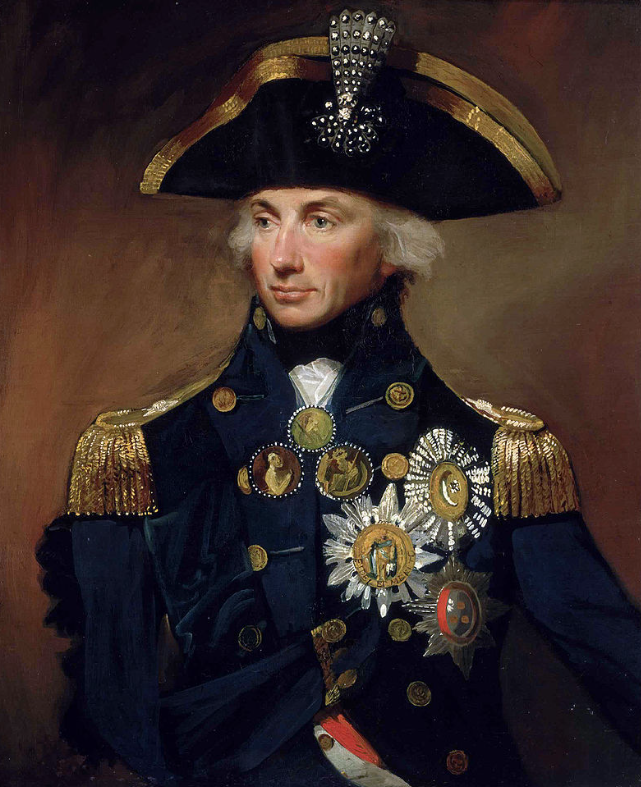
Introduction[1]
The Battle of Trafalgar, fought on Monday, 21st October 1805, is one of the most significant naval engagements in British history. It was a decisive battle during the Napoleonic Wars, in which the British Royal Navy, under the command of Vice-Admiral Horatio Nelson[2], faced off against the combined fleets of France and Spain. The battle took place off the southwest coast of Spain, near Cape Trafalgar, and marked a turning point in naval warfare.
Nelson’s triumph not only shaped the course of the Napoleonic Wars but also solidified his place as a cultural and military icon in British history. His innovative tactics and leadership played a key role in securing a stunning victory for the British despite being outnumbered. He famously divided his fleet into two columns and attacked the enemy head-on, in a risky but ultimately successful strategy that shattered the Franco-Spanish fleet’s formation. The victory ensured Britain’s maritime dominance for generations and safeguarded it from the threat of invasion by Napoleon Bonaparte’s forces.
The Napoleonic Wars were a series of conflicts that saw revolutionary France pitted against coalitions of European powers, with Britain emerging as a principal adversary to Napoleon’s imperial ambitions. Napoleon sought to isolate Britain economically through the Continental System[3] and weaken its global influence, but Trafalgar decisively underscored the critical role of naval power in determining the fate of empires.
Despite the triumph, the battle was also marked by tragedy. Nelson was mortally wounded by a French sharpshooter during the battle and died aboard his flagship, HMS Victory, shortly after learning of his victory. His death elevated him to legendary status, enshrining him as one of Britain’s most revered military figures. The Battle of Trafalgar itself became a lasting symbol of British naval supremacy.
In this paper, I explore the significance of the Battle of Trafalgar in shaping the geopolitical landscape of Europe, its revolutionary impact on naval tactics, and the enduring legacy of Horatio Nelson[4] as a national hero. I also examine the wider context of the Napoleonic Wars and how the battle contributed to Napoleon’s inability to invade Britain, securing Britain’s dominance at sea for years to come.

Picture: Rear-Admiral Sir Horatio Nelson, 1758-1805
Citation: Horatio Nelson, 1st Viscount Nelson. (2024, November 11). In Wikipedia. https://en.wikipedia.org/wiki/Horatio_Nelson,_1st_Viscount_Nelson
Attribution: Lemuel Francis Abbott, Public domain, via Wikimedia Commons
Quick Overview
In late September 1805, French Admiral Villeneuve received orders to leave Cádiz and support the French campaign in southern Italy by landing troops at Naples. On 19th to 20th October, his fleet slipped out of Cádiz, aiming to avoid battle and reach the Mediterranean. However, Nelson intercepted him off Cape Trafalgar on 21st October. Villeneuve formed his fleet into a single northward line, while Nelson divided his British fleet into two squadrons, advancing to attack at right angles from the west.

Picture: A broadside from the 1850s recounts the story.
Citation: Battle of Trafalgar. (2024, October 28). In Wikipedia. https://en.wikipedia.org/wiki/Battle_of_Trafalgar
Attribution: Printed by James Lindsay, Public domain, via Wikimedia Commons
Vice-Admiral Cuthbert Collingwood, commanding the southern squadron aboard HMS Royal Sovereign, engaged the rear 16 ships of the Franco-Spanish fleet by late morning. Shortly before noon, Nelson, aboard HMS Victory, signalled his iconic message: “England expects that every man will do his duty.” Leading the northern squadron of 12 ships, Nelson struck the centre and van[5] of Villeneuve’s line, where the French admiral commanded aboard Bucentaur. The British squadrons broke through the Franco-Spanish formation, unleashing chaos in the melee that followed.
Six French and Spanish ships under Vice-Admiral Pierre Dumanoir, positioned at the van and initially unengaged, turned back around 1:00 pm to support their fleet. However, their counterattack failed, and they were driven off. Meanwhile, Collingwood completed the destruction of the rear, bringing the battle to a close by early afternoon. Villeneuve was captured, and the Franco-Spanish fleet suffered catastrophic losses – 19 or 20 ships were taken, and approximately 14,000 men were killed, wounded, or captured. British casualties were far lighter, numbering around 1,500 to 1,700, and no British ships were lost.
The battle unfolded with over five hours of intense fighting, beginning with early manoeuvres around 6:40 am and culminating in a decisive British victory by the afternoon.
The fiercest fighting centred on HMS Victory, where Nelson was mortally wounded by a French sniper as he engaged the French ship Formidable. Struck in the shoulder and chest, he was carried below deck, where he died at 4:30 pm, assured of his fleet’s triumph. His death marked the crowning moment of the Battle of Trafalgar, which decisively ended Napoleon’s plans to invade Britain and secured British naval dominance for generations, reshaping global maritime power.
Battle Timeline
- Around 6:00 am – The opposing fleets spotted each other. The British fleet was outnumbered, the enemy totalling nearly 30,000 men with 2632 guns to Nelson’s 18,000 men and 2148 guns[6].
- Around 6:40 am – The fleets began manoeuvring as Nelson’s fleet closed in on the Franco-Spanish forces. This phase involved strategic positioning under light winds, with the British maintaining formation despite challenging conditions. This marked the official start of the battle preparations.
- Around 11:00 am – The British squadrons began engaging the Franco-Spanish fleet. Vice-Admiral Cuthbert Collingwood, aboard HMS Royal Sovereign, led the southern squadron into action, targeting the rear of the enemy line and initiating combat. However, The Gazette published on 6th November 1805[7] reports that ‘The Action began at Twelve o’Clock’.
- 11:50 am – Nelson signalled his famous message from HMS Victory: “England expects that every man will do his duty.” Shortly afterwards, Victory led the northern squadron into the centre and van of Villeneuve’s line, striking where the French admiral himself commanded aboard Bucentaur.
- 12:00 pm to 1:00 pm – Nelson’s column broke through the centre and van of the Franco-Spanish line, shattering their formation. Fierce close-range combat ensued across the fleet, with British ships exploiting their superior training and gunnery to overwhelm the enemy.
The phrase “five hours of fierce fighting” likely refers to the entire battle, encompassing the initial manoeuvring from 6:40 am to the effective end of combat in the early afternoon. Close-range engagements between ships, however, only began in earnest around 11:00 am, with Collingwood’s squadron making the first contact and Nelson’s column following shortly afterwards.
The battle highlighted the precision and discipline of the British fleet, whose gradual but relentless approach under light winds set the stage for a decisive victory. By early afternoon, the British had devastated the enemy fleet, solidifying their naval dominance for generations.
Historical Context
The Battle of Trafalgar, a defining moment in the Napoleonic Wars, was deeply intertwined with the broader conflict between Napoleonic France and a coalition of European powers, especially Britain. The Napoleonic Wars, an extension of the revolutionary conflicts of the late 18th century, saw revolutionary France pitted against monarchies seeking to contain its influence. Napoleon Bonaparte, with his military genius and imperial ambitions, sought to establish French dominance over Europe, envisioning a continental empire free from British interference.
For Britain, Napoleon’s ambitions posed an existential threat. As an island nation, Britain’s power rested on its unrivalled navy, which safeguarded its shores, sustained its burgeoning empire, and protected trade routes critical to its economy. Napoleon’s enforcement of the Continental System, aimed at economically isolating Britain, underscored the necessity for British naval supremacy. Control of the seas was not only a means of defence but also the very foundation of Britain’s economic and geopolitical power.
Napoleon recognised that Britain’s Royal Navy was the cornerstone of its strength. To challenge it, he allied with Spain, whose fleet bolstered his maritime ambitions. Together, the French-Spanish fleet aimed to achieve naval superiority, a prerequisite for Napoleon’s most audacious goal: the invasion of Britain. However, the combined fleet faced significant challenges, including language barriers, differing naval traditions, and poor coordination, which limited their effectiveness.
Napoleon’s ambitions extended beyond Britain to securing dominance over continental Europe. In October 1805, as Austria declared war, Napoleon sought to fortify his campaign by instructing the Franco-Spanish fleet under Vice-Admiral Pierre Villeneuve to sail from Cádiz into the Mediterranean. Their objective was to attack Naples, diverting Austrian forces to Italy and disrupting their operations in Central Europe. Villeneuve’s fleet posed an immediate threat to British control of the seas, prompting the Royal Navy to intercept and neutralise this danger. Nelson, having shadowed Villeneuve’s movements throughout the summer, prepared to deliver a decisive blow.
The Pre-Trafalgar Situation
Napoleon’s primary objective in 1805 was to secure the English Channel, enabling his invasion force, the Armée d’Angleterre, to cross from Boulogne. This required the Franco-Spanish fleet to break the British naval blockade and dominate the Channel waters temporarily. Villeneuve’s fleet, however, struggled to achieve this, as poor coordination, inexperienced crews, and logistical difficulties plagued their efforts. Additionally, British intelligence closely monitored the fleet’s movements, allowing the Royal Navy to anticipate their actions.
Vice-Admiral Horatio Nelson, commanding Britain’s Mediterranean fleet, pursued the Franco-Spanish fleet across the Atlantic and back to Europe, ultimately forcing their concentration at Cádiz. Villeneuve’s reluctance to engage the British reflected his recognition of their naval superiority and his fleet’s unreadiness, further complicating Napoleon’s plans. Napoleon’s impatience and insistence on action eventually pressured Villeneuve to attempt a breakout in October 1805.
Despite commanding a fleet of only 27 ships against Villeneuve’s 33, Nelson’s strategy rested on the superior skill and discipline of the Royal Navy. Stationed 40 miles off Cádiz, he transformed his fleet into a unified force, ensuring that his captains understood the bold plan he called “The Nelson Touch.” By dividing his fleet into two columns, Nelson intended to disrupt the enemy’s formation, with one column, led by Nelson himself, targeting the centre and flagship, and the other, under Vice-Admiral Collingwood, attacking the rear. This daring tactic, which relied on close-range combat and British gunnery, was designed to overwhelm the Franco-Spanish fleet decisively.
The stage was set for a decisive confrontation as the two fleets prepared to meet off Cape Trafalgar. Nelson, commanding a smaller but highly disciplined and innovative fleet, was ready to deliver a blow that would not only thwart Napoleon’s ambitions but also redefine naval warfare for generations.
Tactics and Strategy
Nelson’s tactics at the Battle of Trafalgar revolutionised naval warfare and demonstrated his unparalleled strategic ingenuity. Traditionally, naval battles of the era were fought in parallel lines, with fleets engaging broadside to broadside in a methodical exchange of fire. Admirals prioritised maintaining formation and discipline, avoiding manoeuvres that might disrupt their line. However, Nelson boldly rejected this convention at Trafalgar.
Nelson’s Naval Innovations
Nelson divided his fleet into two columns rather than adopting the standard line-ahead formation. These columns sailed perpendicularly toward the Franco-Spanish line, breaking their formation and engaging them at close quarters. Known as “breaking the line,” this tactic disorganised the enemy fleet, nullifying their numerical advantage and exposing their ships to devastating crossfire from British broadsides. By targeting the sterns and bows of enemy ships – areas less fortified and harder to defend – Nelson exploited critical weaknesses.
Although risky, this manoeuvre succeeded due to the superior discipline, gunnery, and training of the Royal Navy. The two columns were led by Nelson aboard HMS Victory and Vice-Admiral Collingwood aboard HMS Royal Sovereign. Nelson aimed for the enemy’s centre and rear, while Collingwood struck the rear, creating chaos and isolating sections of the Franco-Spanish fleet. Nelson’s willingness to defy convention transformed the battle into a decisive victory, establishing his reputation as one of history’s greatest naval commanders.
Franco-Spanish Strategy
The Franco-Spanish fleet, under French Admiral Pierre-Charles Villeneuve, aimed to break out of Cádiz and link up with other French squadrons in the Mediterranean. However, Villeneuve hesitated to engage the British, aware of his fleet’s disadvantages. His Spanish counterpart, Admiral Federico Gravina, shared concerns about their readiness. Although the combined fleet outnumbered the British (33 ships to 27), it suffered from poor coordination, inexperienced crews, and logistical challenges.
Villeneuve’s plan relied on a crescent formation to maximise broadside firepower. However, this defensive stance failed under the pressure of Nelson’s tactics, which caught the enemy fleet off guard. Vice-Admiral Dumanoir’s belated attempt to rally unengaged ships highlighted the fleet’s disorganisation, as his counterattack was easily driven off.
Why the Franco-Spanish Defence Failed
Several factors contributed to the Franco-Spanish defeat:
- Poor Coordination: Language barriers, differing naval traditions, and lack of communication hindered unified action.
- Inferior Training: The crews lacked the experience and rigorous training that defined the Royal Navy, leaving them vulnerable in combat.
- Strategic Surprise: Nelson’s unexpected tactics disrupted the fleet’s formation and created confusion.
- Superior British Seamanship: The Royal Navy’s gunnery, manoeuvrability, and discipline decisively outclassed their opponents.
Despite their numerical advantage, the Franco-Spanish fleet suffered catastrophic losses. Nelson’s innovative tactics, combined with British naval superiority, ended Napoleon’s hopes of challenging British control of the seas and ensured Britain’s dominance for the remainder of the Napoleonic Wars.
Admiral Gravina was mortally wounded during the battle, and Admiral Villeneuve was captured[8].
The Battle
The Battle of Trafalgar unfolded on 21st October 1805 off the southwest coast of Spain, with the Franco-Spanish fleet arrayed in a crescent formation under Admiral Pierre-Charles Villeneuve. The British fleet, led by Vice-Admiral Viscount Horatio Nelson, advanced in two perpendicular columns, a daring manoeuvre designed to break the enemy’s line and sow chaos. As the British fleet approached, they endured heavy fire from the Franco-Spanish ships, but Nelson’s confidence in his tactics and the discipline of his crews prevailed.
Nelson’s flagship, HMS Victory, led one column directly toward the centre of the enemy line. HMS Royal Sovereign, under Vice-Admiral Collingwood, led the second column, aiming at the rear. Around noon, HMS Victory broke through the line between the French flagship Bucentaur and the Spanish Holy Trinity. This created a devastating crossfire, disabling several enemy ships. HMS Victory engaged Bucentaur at close range, crippling the French flagship while targeting other ships with precise broadsides.
Collingwood’s HMS Royal Sovereign executed a similar manoeuvre at the rear of the line, causing havoc among the less-prepared ships. Ship-to-ship combat erupted across the battlefield, with British crews demonstrating superior training and gunnery. HMS Temeraire provided critical support, engaging multiple enemy vessels and solidifying the British advance. The Franco-Spanish fleet, disorganised and unable to coordinate effectively, suffered heavy losses.
By late afternoon, the British had decisively turned the tide. Around 20 Franco-Spanish ships were captured, and many others were severely damaged. The British lost no ships, cementing their dominance despite being outnumbered. The victory ensured British control of the seas and thwarted Napoleon’s plans to invade Britain, marking a defining moment in the Napoleonic Wars.
Nelson’s Leadership
Nelson’s leadership style was a blend of charisma, tactical brilliance, and an ability to inspire loyalty and confidence. Known for his personal courage, Nelson often exposed himself to danger alongside his sailors, earning their admiration and trust. His strategic mind and willingness to innovate set him apart, while his trust in his captains, a practice known as the “Nelson Touch,” ensured coordinated action even amid the chaos of battle.
The morale of the British sailors under Nelson was extraordinarily high, bolstered by their trust in his leadership and confidence in their training and ships. Before Trafalgar, Nelson famously signalled, “England expects that every man will do his duty,” a message that resonated deeply with his men and became a rallying cry for their determination.
Nelson’s reputation for understanding the human element of warfare contributed to his enduring esteem. His men viewed him as both a master tactician and a compassionate leader, someone who shared their hardships and valued their sacrifices. His leadership not only inspired his fleet at Trafalgar but also set a standard for naval command that continues to resonate in military history.
Nelson’s Death
Nelson’s death at the height of his triumph added profound emotional weight to the victory at Trafalgar. HMS Victory was locked in fierce combat with the French ship Formidable when a sharpshooter in the rigging struck Nelson with a musket ball. The shot hit his shoulder, passed through his spine, and left him paralysed. He was carried below deck, where he clung to life long enough to learn of his fleet’s triumph. His last words, “Thank God I have done my duty,” embodied his unwavering devotion to Britain and his men. The enemy sharpshooter was likely killed as he attempted to escape from the rigging[9].
Nelson’s death overshadowed the victory, with sailors openly mourning the loss of their revered leader. News of his death reverberated across Britain, sparking a wave of national grief. His state funeral in January 1806 became a grand occasion, reflecting the nation’s deep admiration for its fallen hero.
Nelson’s body was preserved in alcohol (said to be brandy) for the journey first to Gibraltar and then back to Britain, arriving at the Royal Hospital for Seamen at Greenwich (now the Old Royal Naval College) on Christmas Eve, 24th December 1805.

Picture: Painter Denis Dighton’s imagining of Nelson being shot on the quarterdeck of HMS Victory
Citation: “Battle of Trafalgar.” Wikipedia, Wikimedia Foundation, 28 Oct. 2024, en.wikipedia.org/wiki/Battle_of_Trafalgar. Accessed 17 Nov. 2024.
Credit: National Maritime Museum – Wikipedia Public Domain
Despite the cold and rainy weather, preparations were made for a dignified lying-in-state. Initially placed in the former records room at the back of the Painted Hall, now called the Nelson Room, the body was later moved to the Upper Hall, which was draped entirely in black for the occasion. In the three days, 5th to 7th January 1806, thousands of mourners came to pay their respects, marking an outpouring of national grief. Nelson’s grand state funeral culminated in his burial at St. Paul’s Cathedral, ensuring that his passing was commemorated with the highest honours.
Recognition for those who fought at Trafalgar, however, was neither immediate nor uniform. While King George III awarded medals to senior officers and captains soon after the battle, junior officers and lower-ranking sailors were overlooked. It was only in 1847, under Queen Victoria, that the Naval General Service Medal was issued to commemorate naval victories between 1793 and 1840. Trafalgar veterans who were still alive could finally wear this medal with a ‘TRAFALGAR’ clasp, belatedly acknowledging their contributions to one of Britain’s greatest naval triumphs.
Nelson’s memory was immortalised in monuments like Nelson’s Column in Trafalgar Square, his tomb in St. Paul’s Cathedral, and the countless ships and landmarks bearing his name.
In death, as in life, Nelson exemplified the ideals of leadership and sacrifice. His passing added profound weight to Trafalgar’s victory, elevating it from a military success to a moment of national unity and pride. The Royal Navy’s dominance, secured under Nelson’s leadership, remained unchallenged for over a century, shaping the global balance of power.
Aftermath and Legacy
Immediate Consequences of the Battle
The Battle of Trafalgar decisively ended any realistic chance of Napoleon invading Britain. The destruction of 19 or 20 ships and the heavy casualties inflicted on the Franco-Spanish fleet shattered their naval power, leaving them incapable of challenging the British Royal Navy. This ensured that the English Channel remained firmly under British control, rendering Napoleon’s plans for an invasion fleet assembled at Boulogne obsolete.
Geopolitically, Trafalgar solidified Britain’s position as the dominant maritime power in Europe. Freed from the immediate threat of invasion, Britain could focus its resources on supporting coalitions against Napoleon on the continent. The French and Spanish navies, crucial elements of Napoleon’s strategy, were now relegated to defensive roles, unable to mount significant operations. Trafalgar also reinforced Britain’s ability to enforce naval blockades, which strangled French trade and disrupted Napoleon’s Continental System, ultimately contributing to his downfall.
Although the victory at Trafalgar was met with widespread celebration in Britain, it was tempered by the sombre reality of Nelson’s death, which added a profound sense of sacrifice and heroism to the triumph.
Long-Term Impact
The British victory at Trafalgar established unchallenged naval dominance, shaping the global balance of power throughout the 19th century. This supremacy played a critical role in maintaining
and expanding the British Empire. With control of the seas, Britain could project power globally, protect its colonies, and secure vital trade routes. British merchant ships, operating without fear of interception, bolstered the economy and reinforced Britain’s status as the “workshop of the world” during the Industrial Revolution.
Trafalgar also ensured Britain’s security from invasion. The Royal Navy’s dominance acted as a powerful deterrent to adversaries, enabling Britain to maintain a smaller standing army compared to continental powers. This freedom from direct military threats allowed the nation to concentrate on overseas ventures and diplomacy, shaping European affairs from a position of strength.
The principles established during Trafalgar – decisive engagement, discipline, and innovative leadership -became a foundational naval doctrine for generations. These lessons influenced naval strategies in subsequent conflicts, ensuring that Britain’s maritime dominance remained unchallenged well into the 20th century.
Nelson’s Legacy
Vice-Admiral Horatio Nelson’s death at Trafalgar immortalised him as a national hero and a symbol of British naval supremacy. His courage, leadership, and innovative tactics earned him a lasting place in British cultural and military history. Known for his ability to inspire loyalty and confidence, Nelson was both a brilliant strategist and a beloved commander, a reputation solidified by his ultimate sacrifice.
News of Nelson’s death reverberated throughout Britain, sparking national mourning. His state funeral in January 1806 was a grand occasion, reflecting the deep admiration he commanded. He was interred in St. Paul’s Cathedral in a tomb constructed from the timbers of a captured French ship.
Nelson’s Column in Trafalgar Square, completed in the 1840s, remains one of the most enduring tributes to his memory. The column, crowned with his statue, stands as a testament to his contributions to Britain’s maritime legacy. Other memorials, such as his tomb and the naming of naval vessels and landmarks, further ensured his enduring legacy.
Nelson’s leadership at Trafalgar has become a benchmark for military excellence, celebrated in art, literature, and naval traditions. His story continues to inspire, symbolising the ideals of courage, innovation, and sacrifice that defined Britain’s role as a maritime superpower.
Reflections
Ship Design, Cannons, and Weaponry: Influence on the Outcome
The outcome of the Battle of Trafalgar was heavily influenced by the design of British ships, the power and accuracy of their cannons, and the weaponry employed by their crews. British ships were renowned for their robust construction, speed, and manoeuvrability. These advantages enabled them to maintain formation under adverse conditions and to execute complex tactics such as Nelson’s bold perpendicular assault. The sturdy hulls of British ships also withstood enemy fire better than those of their French and Spanish counterparts.
The Royal Navy’s cannons were pivotal in determining the battle’s result. British ships boasted long-range and highly accurate guns mounted on advanced carriages, which allowed for faster reloading. British crews, meticulously trained, could fire three broadsides in five minutes – vastly outpacing their opponents. This superior firepower overwhelmed the Franco-Spanish fleet, as seen in the devastating broadsides from HMS Victory and HMS Royal Sovereign, which shattered the enemy’s line. The vulnerability of French and Spanish ships to such concentrated fire contributed significantly to their defeat.
Close-combat weaponry, including muskets and sharpshooters, also played a role. The sharpshooters aboard the French ship Formidable famously killed Nelson, illustrating the dangers of close-quarter combat. However, British discipline and training ensured their superiority in boarding actions and skirmishes on deck.
Diaries, Letters, and Accounts from Sailors
Personal accounts from those who participated in the battle provide vivid insights into the experiences of the sailors and officers:
- John Pasco, Nelson’s Signal Officer aboard HMS Victory, recorded the sending of the famous signal, “England expects that every man will do his duty,” describing its immediate impact on morale.
- William Beatty, Nelson’s surgeon, documented Nelson’s final hours, detailing his injuries and the grief of the crew, offering a poignant view of the human cost of war.
- An anonymous sailor aboard HMS Temeraire described the intensity of close combat and the chaos of battle, highlighting the discipline and bravery of British sailors under fire.
- French and Spanish letters provide contrasting perspectives, with some officers lamenting the disorganisation and inexperience of their crews, which contributed to their inability to repel the British attack.
These personal narratives not only humanise the battle but also underscore the dedication and sacrifices of those who fought.
The Battle as Featured in Art, Literature, and Popular Culture
The Battle of Trafalgar has been celebrated and immortalised in art, literature, and popular culture, reflecting its enduring legacy:
- In visual art, J.M.W. Turner’s The Battle of Trafalgar (1822) stands out for its dramatic portrayal of the engagement, emphasising the chaos and heroism of the moment. Nicholas Pocock’s detailed marine paintings provide historically accurate depictions of the ships and battle formations, capturing the technical aspects of naval warfare. Nelson’s Column in Trafalgar Square remains a prominent cultural landmark, its bas-reliefs depicting key moments from the battle.
- In literature, Robert Southey’s The Life of Nelson (1813) established Nelson’s image as a national hero. Fictional works such as Patrick O’Brian’s Aubrey-Maturin series vividly recreate the atmosphere of the Napoleonic Wars, often drawing inspiration from Trafalgar. Poetry and ballads celebrating Nelson and his fleet further entrenched their legacy in popular memory.
- In popular culture, Trafalgar has been explored in films like That Hamilton Woman (1941), which dramatise Nelson’s life and the significance of his victory. Folk songs, historical reenactments, and strategy games continue to keep the memory of Trafalgar alive, engaging new generations with its historical importance.
Surprisingly, few cinematic films have focused directly on the Battle of Trafalgar or Horatio Nelson, despite their historical significance. However, several films and television series have depicted the Napoleonic Wars, with Trafalgar occasionally referenced or forming part of the narrative. Here are some notable examples:
Films:
- Victory (1928)[10]: A silent film directed by Maurice Elvey, this is one of the earliest cinematic depictions of Nelson and Trafalgar. It portrays Nelson’s naval career, culminating in his triumph and death at Trafalgar. While not widely remembered today, it reflects early cinematic attempts to capture British naval heroics.
- Nelson (1926): A British historical drama also directed by Maurice Elvey, this film focused more broadly on Nelson’s life and career. Trafalgar features prominently as the climactic moment in the narrative.
- Bequest to the Nation (1973)[11]: Based on Terence Rattigan’s play, this film focuses on Nelson’s romantic relationship with Emma Hamilton. Trafalgar serves as the backdrop to the personal drama, though it is not the central focus.
Television:
- HMS Defiant (1962): Whilst not specifically about Trafalgar, this film depicts the Napoleonic Wars and the naval culture of the time. It captures the challenges of maintaining discipline and morale aboard British ships.
- Sharpe’s Trafalgar (2000): A television adaptation of Bernard Cornwell’s Sharpe novels, this episode portrays Richard Sharpe witnessing the Battle of Trafalgar. Though fictional, it integrates Trafalgar into the wider narrative of the Napoleonic Wars.
- Master and Commander: The Far Side of the World (2003): Whilst not explicitly about Trafalgar, this critically acclaimed film set during the Napoleonic Wars showcases the naval tactics, ship design, and culture that defined the era. Its atmosphere and visuals evoke Trafalgar’s period and significance.
The relative scarcity of films explicitly about Trafalgar might reflect the challenges of portraying large-scale naval battles cinematically. However, advances in special effects and the enduring popularity of historical dramas make the subject ripe for renewed exploration.
A Few Words about Lady Emma Hamilton: Nelson’s Love and Scandal
Lady Emma Hamilton, born Amy Lyon, was a celebrated beauty and the wife of Sir William Hamilton, the British Ambassador to Naples. She became romantically involved with Horatio Nelson in 1798 after his victory at the Battle of the Nile. Their relationship caused considerable scandal in British society, as both were married at the time. Despite public disapproval, Nelson and Emma shared a profound devotion, and their affair became one of the most famous love stories in British history.

Picture: Emma Hart/Lady Hamilton (1765-1815), née Amy Lyon, mistress of Lord Nelson, posing for The Spinstress.
Artist: George Romney (1734–1802)
https://commons.m.wikimedia.org/wiki/File:Emma_Hart,_aka_Lady_Hamilton,_posing_for_The_Spinstress,_by_George_Romney.jpg
Emma played a significant role in Nelson’s life beyond their romantic bond. During Nelson’s Mediterranean campaigns, she acted as an intermediary between him and the Neapolitan court, using her political connections to further British interests. Her loyalty to Nelson remained steadfast, shaping his personal and professional life during his most triumphant years.
Nelson’s Wife: Frances Nisbet
Nelson married Frances Nisbet, a widow from Nevis, in 1787. While their marriage began affectionately, it grew strained as Nelson’s career demanded long absences at sea. Frances struggled with her husband’s increasing fame and his relationship with Emma Hamilton. Though Nelson never formally divorced Frances, their estrangement in later years reflected the growing distance between them.
Nelson’s Child: Horatia Nelson
Nelson and Emma Hamilton had a daughter, Horatia, born in 1801. Defying societal conventions of the time, Nelson acknowledged Horatia as his child in personal letters and ensured her well-being. After Nelson’s death, Horatia lived with Emma, though financial difficulties and social ostracism plagued their lives. Horatia eventually married and lived a long life, dedicating herself to preserving her father’s legacy while distancing herself from the scandals surrounding her mother.
Conclusions
The Battle of Trafalgar was a pivotal moment in the Napoleonic Wars and a defining event in the history of naval warfare. The victory not only thwarted Napoleon Bonaparte’s ambitions to invade Britain but also secured Britain’s maritime dominance for more than a century. It underscored the strategic importance of naval power in shaping the geopolitical landscape of Europe and established the Royal Navy as an unassailable force, capable of protecting the British Isles and sustaining an expanding global empire.
At the heart of this victory was Vice-Admiral Horatio Nelson, whose innovative tactics and leadership redefined naval strategy and inspired generations. His decision to break with conventional tactics, dividing his fleet into two perpendicular columns to attack the Franco-Spanish line, demonstrated unparalleled strategic ingenuity. This manoeuvre, though fraught with risk, shattered the enemy formation, proving the value of audacity and discipline in naval engagements.
The aftermath of Trafalgar resonated far beyond the battlefield. By crippling the combined Franco-Spanish fleet, Britain ensured its security from invasion and maintained control over critical trade routes that fuelled its burgeoning economy. The lessons of Trafalgar shaped the Royal Navy’s doctrine for generations, reinforcing the principles of decisive engagement, superior training, and cohesive leadership.

Picture: The Sandstone Statue of Nelson by Edward Hodges Baily
Citation: Nelson’s Column. (2024, November 11). In Wikipedia. https://en.wikipedia.org/wiki/Nelson%27s_Column
Attribution: Beata May, CC BY-SA 3.0 <https://creativecommons.org/licenses/by-sa/3.0>, via Wikimedia Commons
Beata May, CC BY-SA 3.0 <https://creativecommons.org/licenses/by-sa/3.0>, via Wikimedia Commons
Nelson’s death during the battle added an emotional depth to the victory, elevating him to the status of a national hero. His legacy continues to inspire, not only as a symbol of courage and sacrifice but also as a benchmark of military excellence. Monuments like Nelson’s Column, his tomb in St. Paul’s Cathedral, and countless tributes in art and literature reflect the enduring reverence for his contributions.
Trafalgar’s significance extends beyond Britain, serving as a reminder of the transformative power of innovation, leadership, and the human element in war. It reshaped maritime warfare and set a precedent for the role of naval power in global strategy. For Britain, Trafalgar was not merely a triumph on the seas; it was a foundation for a century of stability, prosperity, and influence, securing its place as a dominant global power during a critical period in world history.
In understanding Trafalgar, we not only recognise the brilliance of Nelson and the Royal Navy but also gain insight into the enduring relationship between naval strength and national security. The lessons of Trafalgar remain as relevant today as they were in 1805, illustrating the timeless interplay of strategy, innovation, and leadership in the pursuit of victory.
Appendix: Unusual and Lesser-Known Events and Facts about Horatio Nelson and the Battle of Trafalgar
Here are some unusual and lesser-known events and facts surrounding Horatio Nelson and the Battle of Trafalgar that may surprise readers:
Nelson’s Famous Signal Had a Practical Twist
Nelson’s iconic message, “England expects that every man will do his duty,” was chosen partly for its brevity and simplicity. The original message Nelson considered was longer, but his signal officer, John Pasco, suggested rephrasing it to use pre-existing signal flags for ease and speed of transmission.
Preservation of Nelson’s Body
To transport Nelson’s body back to England after the battle, as previously mentioned, his corpse was preserved in a cask of brandy (often called “rum,” though it was likely brandy). This macabre method ensured his body remained intact during the long sea voyage. The practice gave rise to the myth that sailors drank from the barrel, coining the term “Nelson’s blood,” but there is no evidence to support this.
The “Cheating” Weather Gauge
Nelson’s plan to approach the Franco-Spanish fleet relied on a disadvantageous weather position, with the wind favouring the enemy. His ability to turn this to his advantage showcased not only boldness but also his fleet’s superior seamanship and training.
Santísima Trinidad: The Titanic of its Time
The Spanish flagship Santísima Trinidad was the largest warship in the world at the time, with four gun decks and 140 cannons. Despite its size and firepower, it was severely damaged during the battle and eventually captured, only to sink while being towed as a prize by the British.
Nelson’s Life Insurance Policy
Unusually for the time, Nelson had taken out a life insurance policy worth £6,000. Following his death, his family benefited significantly, demonstrating his forward-thinking approach to ensuring their financial security.
The Double Shot Technique
British gunners employed a lethal technique called “double-shotting,” where two cannonballs were loaded into a single cannon. This tactic caused devastating damage to enemy ships at close range, a key factor in their overwhelming firepower.
Nelson’s Attention to Propaganda
Nelson understood the power of public perception. Before Trafalgar, he invited artists to paint portraits of him and even carefully curated accounts of his battles to secure his legacy. This deliberate self-promotion contributed to his mythos.
Nelson’s Missing Arm: A Symbol of Courage
Nelson’s injuries, including the loss of his right arm in 1797, became symbols of his bravery and resilience. He often joked about his missing limb, using it to inspire confidence in his sailors by showing that even grievous injuries would not deter him.
Collingwood’s Dog on the Royal Sovereign
Vice-Admiral Cuthbert Collingwood, commanding the British southern column, brought his dog, Bounce, aboard HMS Royal Sovereign during the battle. The loyal hound remained at his master’s side throughout Trafalgar, becoming an endearing footnote to the historic event.
The Myth of “Victory’s” Oak Decking
It’s often claimed that HMS Victory’s decking was made from timbers taken from British forests. However, much of the wood came from regions as far afield as the Baltic and North America, highlighting the global reach of the Royal Navy’s supply chains.
Nelson and the Disobedient Captain
Captain Thomas Foley, commanding HMS Téméraire, famously deviated from Nelson’s battle plan to provide critical support to HMS Victory. This act of initiative, while unorthodox, contributed significantly to the British success and demonstrated Nelson’s ability to inspire decisive action among his officers.
Trafalgar Square: It Could Have Been Named Something Else
London’s iconic Trafalgar Square, completed decades after the battle, was nearly named “King William the Fourth’s Square.” The name Trafalgar was chosen as a tribute to Nelson and the battle’s legacy.

Picture: Title Unknown. Artist’s conception of HMS Sandwich fighting the French flagship Bucentaure (completely dismasted) at Trafalgar. Bucentaure is also fighting HMS Temeraire (on the left) and being fired into by HMS Victory (behind her). In fact, this is a mistake by Auguste Mayer, the painter; HMS Sandwich never fought at Trafalgar.
Collection: Collections of Musee national de la Marine de Paris.
Attribution: Auguste Étienne François Mayer, Public domain, via Wikimedia Commons
Sources and Further Reading
- https://en.wikipedia.org/wiki/Battle_of_Trafalgar
- https://en.wikipedia.org/wiki/Emma,_Lady_Hamilton
- https://en.wikipedia.org/wiki/Naval_Gold_Medal
- https://ornc.org/stories/the-battle-of-trafalgar/
- https://www.britannica.com/event/Battle-of-Trafalgar-European-history
- https://www.britishbattles.com/napoleonic-wars/battle-of-trafalgar/
- https://www.nationalarchives.gov.uk/trafalgarancestors/
- https://www.onthisday.com/articles/horatio-nelson-from-frail-boy-to-national-hero
- https://www.rmg.co.uk/stories/topics/battle-trafalgar-background
- https://www.rmg.co.uk/stories/topics/who-shot-nelsons-killer
- https://www.royalmarineshistory.com/post/royal-marines-at-the-battle-of-trafalgar-death-of-nelson-21st-october-1805
- https://www.thegazette.co.uk/awards-and-accreditation/content/100305
- https://www.thegazette.co.uk/London/issue/15858/page/1365
Books
- A Portrait of Lord Nelson, by Oliver Warner, published by Chatto & Windus, available from https://www.amazon.co.uk/PORTRAIT-LORD-NELSON-Oliver-Warner/dp/B0007IZXK2/
- Admiral Lord Nelson: Context and Legacy, by D Cannadine, published by Palgrave Macmillan, available from https://www.waterstones.com/book/admiral-lord-nelson/d-cannadine/9781349519453
- Admiral Lord Nelson: Context and Legacy, by David Cannadine, published by Palgrave Macmillan, available from https://www.amazon.co.uk/Admiral-Lord-Nelson-Context-Legacy/dp/1349519456/
- British Battles and Medals, by E.C. Joslin, E.C. Litherland, and B.T. Simpkin, published by Spink & Son Ltd., available from https://www.amazon.co.uk/British-Battles-Medals-Richard-Bishop/dp/1902040775/
- England Expects, by Dudley Pope, published by Weidenfeld & Nicolson, available from www.amazon.co.uk/England-expects-Dudley-Pope/dp/B0000CKG37
- Eyewitness to Trafalgar, by Thomas Huskisson, published by Ellisons’ Editions, available from www.amazon.co.uk/Eyewitness-Trafalgar-Thomas-Huskisson/dp/0946092095/
- For God and Glory: Lord Nelson and His Way of War, by Joel S. A. Hayward, published by Naval Institute Press, available from https://www.amazon.co.uk/God-Glory-Joel-Hayward-author/dp/161251779X/
- Horatio Nelson and His Times, by Alfred Thayer Mahan, archive details at: https://archive.org/details/The_Life_Of_Nelson_2nd_edition
- Horatio Nelson, by Tom Pocock, published by Pimlico, available from https://www.amazon.co.uk/Horatio-Nelson-Tom-Pocock/dp/0712661239
- Horatio Nelson: The Complete Letters, by Colin White, published by Boydell Press, available from https://www.amazon.co.uk/Nelson-New-Letters-Colin-White/dp/1843832992
https://www.amazon.co.uk/British-Battles-Medals-Litherland-Simpkin/dp/B000J6ZWJY
https://www.worldofbooks.com/en-gb/products/the-life-of-nelson-rare-book-geoffrey-callender-1714661792CAB
- Memoirs of the Life of Vice Admiral Lord Nelson (Vol. 1), by Thomas Joseph Pettigrew, published by Legare Street Press, available from https://www.amazon.co.uk/Memoirs-Vice-Admiral-Viscount-Nelson-Bronté/dp/B0BQ7MHXWV/
- Naval Battles of the Napoleonic Wars: Cape St. Vincent, the Nile, Cadiz, Copenhagen, Trafalgar & Others (Naval & Maritime), Illustrated, by W. H. Fitchett, published by Leonaur, available from https://www.amazon.co.uk/Naval-Battles-Napoleonic-Wars-Copenhagen/dp/1846773148/
- Navies of the Napoleonic Era, by Otto von Pivka, published by David & Charles, available from https://www.amazon.co.uk/Pivka-Navies-Napoleonic-First-Hardcover/dp/B00RWN31D6/
- Nelson and Emma, by Roger Hudson, published by The Folio Society, available from https://www.amazon.co.uk/Nelson-Emma-Roger-ed-Hudson/dp/B000NY9NOM/
- Nelson and Napoleon: The Long Haul to Trafalgar, by Christopher Lee, published by Headline Books, available from https://www.amazon.co.uk/Nelson-Napoleon-Long-Haul-Trafalgar/dp/0755310411/
- Nelson, by Arthur Bryant, published by HarperCollins, available from https://www.amazon.co.uk/Nelson-Arthur-Bryant/dp/0006330207/
- Nelson, by Clennell Wilkinson, published by George G. Harrap, available from https://www.amazon.co.uk/Nelson-CLENNELL-WILKINSON/dp/B000858306/
- Nelson, The Admiral, by Colin White, published by The History Press, available from https://www.amazon.co.uk/Nelson-Colin-White/dp/075245305X/
- Nelson: A Dream of Glory, by John Sugden, published by Pimlico, available from https://www.amazon.co.uk/Nelson-Dream-Dr-John-Sugden/dp/1845951913/
- Nelson: A Personal History, by Christopher Hibbert, published by Da Capo Press, available from https://www.amazon.co.uk/Nelson-Personal-History-Christopher-Hibbert/dp/0201408007/
- Nelson: Britannia’s God of War, by Andrew Lambert, published by Faber and Faber, available from https://www.amazon.co.uk/Nelson-Britannias-God-Andrew-Lambert/dp/0571212271/
- Nelson: The Essential Hero, by Ernle Bradford, published by Wordsworth Military Library, available from https://www.amazon.co.uk/Nelson-Essential-Ernle-Bradford-2014-08-19/dp/B01K14NV7I/
- Nelson: The Immortal Memory, by David Howarth and Stephen Howarth, published by Viking, available from https://www.amazon.co.uk/Lord-Nelson-David-Armine-Howarth/dp/0670817295/
- Nelson: The Man and the Legend, by Terry Coleman, published by Bloomsbury Publishing Plc., available from https://www.amazon.co.uk/Nelson-Man-Legend-Terry-Coleman/dp/0747559007
- Nelson: The Sword of Albion, by John Sugden, published by Bodley Head, available from https://www.amazon.co.uk/Nelson-Albion-Dr-John-Sugden/dp/0224060988/
- Nelson’s Band of Brothers: Lives and Memorials, by Captain Peter Hore, published by Seaforth Publishing, available from https://www.amazon.co.uk/Nelson-Band-Brothers-Lives-Memorials/dp/184832779X/
- Nelson’s Battles: The Triumph of British Seapower, by Nicholas Tracy, published by Seaforth Publishing, available from https://www.amazon.co.uk/Nelsons-Battles-Triumph-British-Seapower/dp/1848320094/
- Nelson’s Navy: The Ships, Men, and Organization, 1793–1815, by Brian Lavery, published by Osprey Publishing, available from https://www.amazon.co.uk/Nelsons-Navy-Ships-Organisation-1793/dp/1472841352/
- Nelson’s Trafalgar Captains and Their Battles, by T.A. Heathcote, published by Leo Cooper Ltd., available from https://www.amazon.co.uk/Nelsons-Trafalgar-Captains-Their-Battles/dp/1844151824/
- Nelson’s Trafalgar: The Battle That Changed the World, by Roy Adkins, published by Penguin, available from https://www.amazon.co.uk/Nelsons-Trafalgar-Battle-Changed-World/dp/0143037951/
- Nelson’s Ships: A History of the Vessels in Which He Served: 1771–1805, by Peter Goodwin, published by Conway Maritime Press, available from https://www.amazon.co.uk/Nelsons-Ships-History-Vessels-Served/dp/0851777422/
- Nelson’s Victory: 101 Questions and Answers about HMS Victory, Nelson’s Flagship at Trafalgar, by Peter Goodwin, published by Naval Institute Press, available from https://www.amazon.co.uk/Nelsons-Victory-Questions-Flagship-Trafalgar/dp/1591146151/
- The Age of Nelson: The Royal Navy, 1793-1815, by G. J. Marcus published by George, Allen & Unwin, available from https://www.amazon.co.uk/age-Nelson-Royal-Navy-1793-1815/dp/0670109657/
- The Battle of Trafalgar, by Geoffrey Bennett, published by Batsford, available from https://www.amazon.co.uk/battle-Trafalgar-Geoffrey-Bennett/dp/0713431717/
- The Campaign of Trafalgar, 1803–1805, by Robert Gardiner, published by Mercury Books, available from https://www.amazon.co.uk/Campaign-Trafalgar-1803-1805-Robert-Gardiner/dp/1845600088/
- The Command of the Ocean: A Naval History of Britain 1649–1815, by N. A. M. Rodger, published by Penguin, available from https://www.amazon.co.uk/Command-Ocean-History-Britain-1649-1815/dp/0141026901/
- The Death of Lord Nelson, by William Beatty, available from https://www.amazon.co.uk/Authentic-Narrative-Death-Horatio-Nelson/dp/1508625093/
- The Dispatches and Letters of Vice Admiral Lord Viscount Nelson (Vol. 1), by Horatio Nelson, published by Legare Street Press, available from https://www.amazon.co.uk/Dispatches-Letters-Admiral-Viscount-Nelson/dp/1016286341/
- The Life of Nelson, by Robert Southey, published by East India Publishing company, available from https://www.amazon.co.uk/Life-Horatio-Lord-Nelson/dp/1774263939/
- The Life of Nelson: The Embodiment of the Sea Power of Great Britain (Two Volumes), by A. T. Mahan, published by Little, Brown & Co , available from https://www.abebooks.co.uk/servlet/BookDetailsPL?bi=31689856342
- The Naval Campaign of 1805: Trafalgar, translated by Eastwick, by Edouard Desbrière, published by Clarendon Press, Rare Book, rarely available, Collectible.
- The Nelson Almanac by David Harris, published by Conway Maritime Press, available from https://www.amazon.co.uk/NELSON-ALMANAC-Recording-Nelsons-Events/dp/0851777554/
- The Nelson Encyclopedia, by Colin White, published by Chatham Publishing, available from https://www.amazon.co.uk/Nelson-Encyclopaedia-Colin-White/dp/1861761856/
- The Nelson Touch: An Anthology of Lord Nelson’s Letters, by Clemence Dane, published by William Heinemann, available from https://www.amazon.co.uk/Nelson-Touch-Anthology-Compiled-Clemence/dp/B00124SO2O/
- The Pursuit of Victory: The Life and Achievement of Horatio Nelson, by Roger Knight, published by Penguin, available from https://www.amazon.co.uk/Pursuit-Victory-Achievement-Horatio-Nelson/dp/0141007613/
- The Trafalgar Captains: Their Lives and Memorials, by Colin White, published by Naval Institute Press, available from https://www.amazon.co.uk/Trafalgar-Captains-Their-Lives-Memorials/dp/159114874X/
- The Trafalgar Chronicle (new Series 5), by Sean Heuvel, published by Seaforth Publishing, available from https://www.amazon.co.uk/Trafalgar-Chronicle-Dedicated-History-Nelson/dp/1526759624/
- The Trafalgar Companion: A Guide to History’s Most Famous Sea Battle and the Life of Admiral Lord Nelson, by Mark Adkin, published by Aurum Press, available from https://www.amazon.co.uk/Trafalgar-Companion-Complete-Historys-Admiral/dp/1845130189/
- The Trafalgar Roll: The Ships and the Officers, by Robert Holden Mackenzie, published by Greenhill Books, available from https://www.amazon.co.uk/Trafalgar-Roll-Ships-Officers/dp/1853670219/
- The Victory of Seapower: Winning the Napoleonic War 1806-1814, by Richard Woodman, published by Mercury Books London, available from https://www.amazon.co.uk/Victory-Seapower-Winning-Napoleonic-1806-1814/dp/1845600126/
- Trafalgar and the Spanish Navy, by John D. Harbron, published by Conway Maritime Press, available from https://www.amazon.co.uk/Trafalgar-Spanish-Navy-Experience-Power/dp/0851774776/
- Trafalgar, by Oliver Warner, published by B. T. Batsford Ltd., available from https://www.amazon.co.uk/Trafalgar-Oliver-Warner/dp/B0016RRPNQ/
- Trafalgar: An Eyewitness History, by Tom Pocock, available from https://www.amazon.co.uk/Trafalgar-Eyewitness-History-Pococks-Nelson/dp/B091WM5X26/
- Trafalgar: Countdown to Battle 1803–1805, by Alan Schom, available from https://www.amazon.co.uk/Trafalgar-Countdown-1803-1805-Alan-Schom/dp/1099344131/
- Trafalgar: The Biography of a Battle, by Roy Adkins, published by Abacus, available from https://www.amazon.co.uk/Trafalgar-Biography-Battle-Roy-Adkins/dp/0349116326/
- Trafalgar: The Nelson Touch, by David Howarth, published by W&N, available from https://www.amazon.co.uk/Trafalgar-Nelson-Touch-Great-Battles/dp/1900624036/
- Voices from the Battle of Trafalgar, by Peter Warwick, published by David & Charles Publishing, available from https://www.amazon.co.uk/Voices-Battle-Trafalgar-Peter-Warwick/dp/0715325566/
- War at Sea in the Age of Sail (1650 -1850), by Andrew Lambert, published by HarperCollins, available from https://www.amazon.co.uk/War-Sail-Smithsonian-History-Warfare/dp/0060838558/
NOTICE: This paper is compiled from the sources stated but has not been externally reviewed. Some content, including image generation and data synthesis, was assisted by artificial intelligence, but all findings were reviewed and verified by us (the author and publisher). Neither we (the publisher and author) nor any third parties provide any warranty or guarantee regarding the accuracy, timeliness, performance, completeness or suitability of the information and materials covered in this paper for any particular purpose. Such information and materials may contain inaccuracies or errors, and we expressly exclude liability for any such inaccuracies or errors to the fullest extent permitted by law. Your use of any information or materials on this website is entirely at your own risk, for which we shall not be liable. It shall be your own responsibility to ensure that any products, services or information available through this paper meet your specific requirements. You should neither take action nor exercise inaction without taking appropriate professional advice. The hyperlinks were current at the date of publication.
End Notes and Explanations
- Source: Compiled from research using information available at the sources stated throughout the text, together with information provided by machine-generated artificial intelligence at: bing.com [chat], https://chat.openai.com, https://claude.ai/new and https://www.perplexity.ai/. Text used includes that on Wikipedia websites is available under the Creative Commons Attribution-ShareAlike License 4.0; additional terms may apply. By using those websites, we have agreed to the Terms of Use and Privacy Policy. Wikipedia® is a registered trademark of the Wikimedia Foundation, Inc., a non-profit organisation. ↑
- Clarification: At the time of the Battle of Trafalgar in 1805, Vice-Admiral Horatio Nelson was in command of the British fleet, but the rank of Admiral within the British Navy’s chain of command did not equate to an operational position in that specific engagement. Nelson himself was the strategic and tactical leader at Trafalgar, even though he held the title of Vice-Admiral of the White, one of the Royal Navy’s divisions of rank. The official Admiral of the Fleet, the highest rank in the British Navy, was not present at Trafalgar. This position at the time was held by Admiral of the Fleet John Jervis, Earl of St Vincent, who was stationed elsewhere and not directly involved in the battle. Thus, while Nelson was technically a Vice-Admiral, he was the senior officer in charge at Trafalgar, and his leadership was central to the British victory. ↑
- Explanation: The Continental System was Napoleon’s economic blockade, established by the Berlin (1806) and Milan (1807) Decrees to isolate Britain by banning European nations under French control from trading with it. The goal was to cripple Britain’s economy and war efforts, but it failed due to smuggling, resistance from neutral nations, and Britain’s naval dominance, which allowed it to sustain global trade. Ultimately, the blockade hurt Europe’s economies more than Britain’s, contributing to Napoleon’s downfall. ↑
- Further Information: Horatio Nelson became a Lord in 1798, following his victory at the Battle of the Nile (also known as the Battle of Aboukir Bay).After this decisive naval triumph against Napoleon’s fleet, Nelson was created Baron Nelson of the Nile and of Burnham Thorpe on 6th October 1798 in recognition of his achievements. This elevated him to the British peerage, granting him the title of “Lord.” However, he wasn’t entirely satisfied with the rank of Baron, as he believed his contributions deserved a higher title. He was later promoted to Viscount Nelson in 1801 after further distinguished service. ↑
- Explanation: In this context, “van” refers to the front or leading part of a fleet in a naval formation. During the Battle of Trafalgar, the Franco-Spanish fleet was arranged in a single line, and its “van” was the foremost group of ships, followed by the centre and the rear (or aft). The term derives from “vanguard,” historically denoting the leading position in a military or naval force. ↑
- Source: https://www.rmg.co.uk/stories/topics/battle-of-trafalgar ↑
- Source: https://www.thegazette.co.uk/London/issue/15858/page/1365 ↑
- Explanation: After French Admiral Pierre-Charles Villeneuve was captured at the Battle of Trafalgar, he was taken as a prisoner of war to Britain. Initially treated with the customary respect accorded to high-ranking officers, Villeneuve was held at Bishop’s Waltham in Hampshire. Despite his captivity, he was not poorly treated and was eventually released on parole. Villeneuve returned to France in late 1806, but his situation was far from settled. Napoleon was reportedly furious with Villeneuve for his perceived failures leading up to Trafalgar and had decided to replace him as commander of the French fleet. However, the order to replace him with Admiral François Rosily arrived too late, and Villeneuve remained in command during the battle.Villeneuve’s cautious approach and reluctance to engage the British had already drawn Napoleon’s ire, and his capture only compounded the humiliation for France. In April 1806, Villeneuve died under mysterious circumstances in Rennes. Officially, it was reported that he committed suicide by stabbing himself multiple times in the chest with a dining knife at an inn. However, the nature of his death has led to speculation that he may have been assassinated to prevent further disgrace or criticism of Napoleon’s regime. No definitive evidence has ever confirmed this theory, but Villeneuve’s tragic end highlights the immense pressures and political consequences faced by military leaders in Napoleonic France. ↑
- Source and Speculations: See: https://www.rmg.co.uk/stories/topics/who-shot-nelsons-killer ↑
- Details: See: https://en.wikipedia.org/wiki/Victory_(1928_film) ↑
- Details: See: https://en.wikipedia.org/wiki/Bequest_to_the_Nation_(film) ↑

