
Introduction[1]
Napoleon Bonaparte (1769–1821) was a French military leader and emperor whose actions reshaped Europe in the late 18th and early 19th centuries. Born on the island of Corsica shortly after it became a French territory, he rose rapidly through the ranks of the French army during the French Revolution. His military genius, political acumen, and ambition propelled him to power, leading to a legacy marked by both extraordinary achievements and profound controversies.
Early Life and Rise to Power
Napoleon was born into a modest Corsican family and educated at French military academies. His skills as an artillery officer became evident early in his career. During the Revolution, he distinguished himself at the Siege of Toulon, earning promotion to brigadier general at the age of 24. A series of successful campaigns in Italy from 1796 to 1797 showcased his strategic brilliance and consolidated his reputation as a military leader.
In 1799, amidst political chaos, Napoleon staged a coup d’état, overthrowing the Directory[2] and establishing the Consulate. As First Consul, he effectively became the ruler of France. By 1804, he crowned himself Emperor, signalling his transformation from revolutionary hero to monarch.

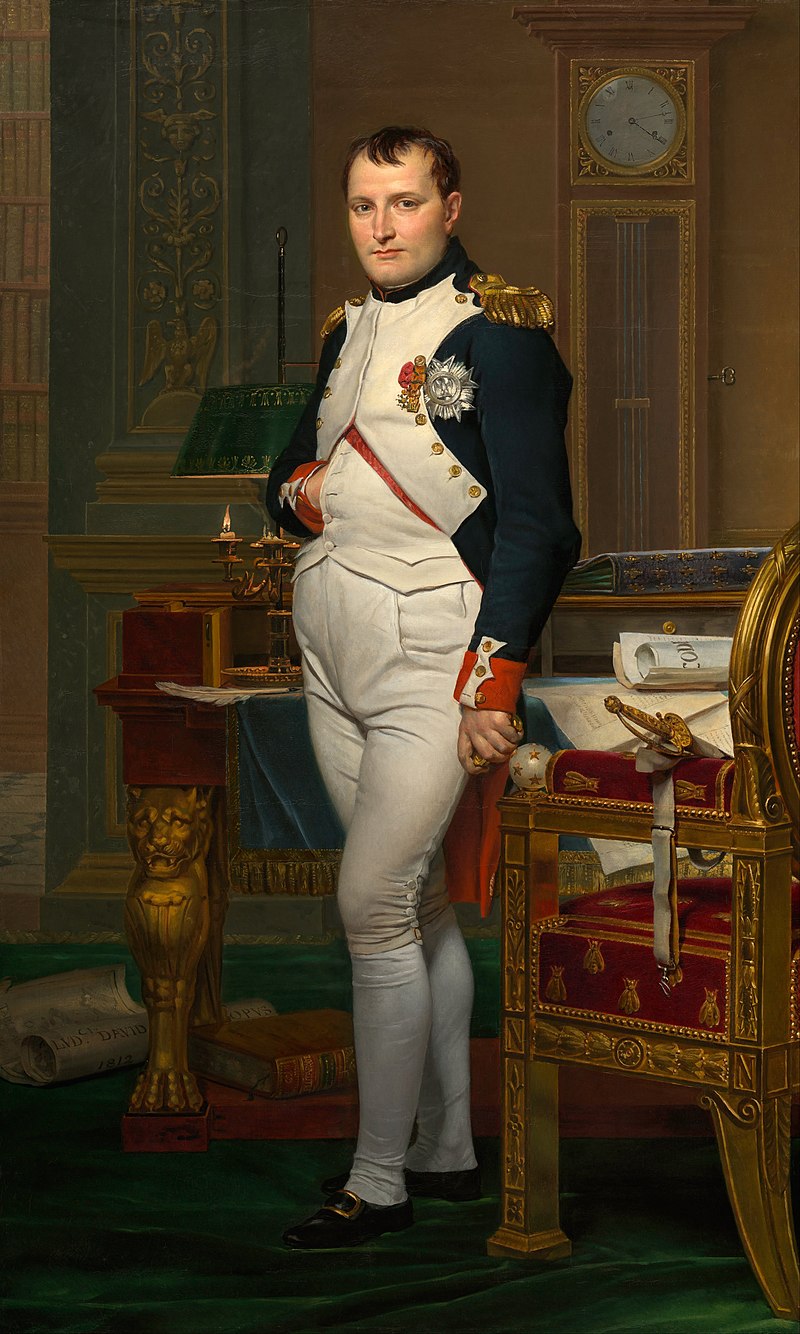
The Emperor Napoleon in His Study at the Tuileries
Citation: Napoleon. (2024, December 7). In Wikipedia. https://en.wikipedia.org/wiki/Napoleon
Attribution: Jacques-Louis David, Public domain, via Wikimedia Commons
Achievements and Reforms
Napoleon’s impact extended beyond the battlefield. Domestically, he implemented a range of reforms that stabilised France and modernised its institutions. The Napoleonic Code[3], introduced in 1804, was a comprehensive legal framework that influenced civil law in France and beyond. It emphasised equality before the law, property rights, and secular authority.
He also reformed the education system, centralised administration, and improved infrastructure, laying the groundwork for a modern state. His Concordat[4] with the Catholic Church in 1801 restored religious stability while maintaining the secular gains of the Revolution.
Napoleon’s Marriages and Children
Napoleon Bonaparte’s personal life included two marriages and several children, both legitimate and illegitimate. His first marriage was to Joséphine de Beauharnais on 9th March 1796. Joséphine (full name Marie Josèphe Rose Tascher de La Pagerie), was a widow with two children from her previous marriage to Alexandre de Beauharnais, who had been executed during the Reign of Terror[5]. Napoleon was passionately in love with Joséphine, though their relationship faced difficulties due to her infidelities and their inability to have children together. Despite his deep affection, Napoleon annulled their marriage in 1810 to ensure he could have an heir.
Napoleon’s second marriage was to Marie Louise of Austria on 1st April 1810. Marie Louise was the daughter of Emperor Francis I of Austria, and this union was largely political, designed to solidify alliances between France and Austria. Unlike his marriage to Joséphine, this relationship quickly produced a legitimate heir, Napoleon François Charles Joseph Bonaparte, who was born on 20th March 1811. Known as the King of Rome during Napoleon’s reign, his son’s future was cut short after Napoleon’s fall, and he lived most of his life in exile in Austria, dying at the young age of 21.
In addition to his legitimate son, Napoleon had several illegitimate children through extramarital affairs. Among them, the most notable were Charles Léon, born to Napoleon’s mistress Eléonore Denuelle de La Plagne, and Alexandre Colonna-Walewski, born to Marie Walewska, a Polish noblewoman. These children did not play significant roles in Napoleon’s dynastic ambitions but were acknowledged to varying degrees.
Napoleon’s relationships and offspring reflected his personal and political complexities, blending passion, pragmatism, and ambition, all of which influenced his private and public life.
Religiosity
Napoleon Bonaparte’s relationship with religion was complex and pragmatic. Raised as a Roman Catholic, he approached faith not as a deeply personal matter but as a political tool and a means to unify and stabilise his empire. His policies and actions regarding religion reflected his strategic and utilitarian mindset.
Napoleon’s Religious Background
He was baptised into the Roman Catholic Church. Corsica, at the time under French control, had a strong Catholic tradition, and this cultural environment influenced Napoleon’s early life. However, his time in French military academies and exposure to Enlightenment ideas[6] likely contributed to a more sceptical and secular outlook.
Napoleon is often described as a deist[7], influenced by Enlightenment thinkers like Voltaire and Rousseau. He believed in a Supreme Being but had little regard for religious dogma or institutional control.
How Religion Shaped His Policies
Napoleon’s approach to religion was characterised by his desire to reconcile the conflicting forces of revolution and tradition in post-Revolutionary France. His policies toward religion were primarily pragmatic:
Through the Concordat of 1801:
- Napoleon negotiated the Concordat of 1801 with Pope Pius VII, which re-established the Catholic Church in France after the Revolutionary period of de-Christianisation.
- The agreement declared Catholicism as “the religion of the majority of French citizens,” but not the state religion, maintaining religious tolerance.
- The Concordat allowed Napoleon to control church appointments and regulate its activities, ensuring the church remained subordinate to the state.
- This move helped stabilise France by reconciling religious conservatives and Revolutionary secularists.
Religious Tolerance:
- Napoleon was not exclusively committed to Catholicism. He promoted religious tolerance, granting freedom of worship to Protestants, Jews, and Muslims within his empire.
- In 1807, he convened the Grand Sanhedrin, a council of Jewish leaders, to integrate Jews into French society and grant them full civil rights. However, he also imposed restrictions on Jewish moneylending practices, reflecting a mix of progressive and pragmatic policies.
Symbolism and Legitimacy:
- Napoleon used religion to bolster his legitimacy. In 1804, during his coronation as Emperor, he invited Pope Pius VII to officiate the ceremony but famously crowned himself, symbolising his independence from ecclesiastical authority.
- This act reinforced his image as a ruler who respected religious tradition while asserting his supreme authority.
Religion in Conquered Territories
In regions he conquered, Napoleon often adapted his religious policies to local contexts. For example, during his campaign in Egypt, he portrayed himself as a friend of Islam, issuing proclamations praising the Prophet Muhammad and presenting himself as a liberator of Muslims.
How His Religion Showed
Napoleon’s actions demonstrated a highly strategic use of religion:
- Restoring Stability: By reconciling the Catholic Church with the state, he pacified conservative forces in France.
- Uniting the Empire: His emphasis on religious tolerance helped unify the diverse populations of his empire, which included Catholics, Protestants, Jews, and Muslims.
- Controlling the Church: Through measures like the Concordat, Napoleon ensured that the church served his political aims rather than opposing him.
- Symbolic Acts: His coronation and interactions with religious leaders displayed his ability to balance respect for tradition with his assertion of personal power.
Despite his political use of religion, Napoleon’s personal beliefs were less devout. He once remarked, “Religion is excellent stuff for keeping common people quiet.” His scepticism about religious dogma was consistent with Enlightenment rationalism[8], yet he recognised the social and political power of faith.
Religious Legacy
Napoleon’s religious policies left a lasting impact:
- The Concordat of 1801 shaped church-state relations in France for decades.
- His emphasis on religious tolerance set a precedent for modern secular governance.
- His pragmatic use of religion influenced later rulers who sought to balance traditional faith with modern statehood.
In summary, Napoleon’s relationship with religion was not deeply personal but profoundly political. He saw faith as a tool to stabilise society, unify his empire, and consolidate his rule, and his policies reflected this calculated and pragmatic approach.
Military Training and Early Campaigns
Napoleon Bonaparte’s military training and early campaigns were pivotal in shaping his rise to power and laid the groundwork for his extraordinary career. He attended military school in Brienne-le-Château at the age of nine and later graduated from the École Militaire in Paris in 1785. Specialising in artillery, he became a second lieutenant at the age of sixteen. His education emphasised mathematics, science, and military strategy, disciplines that later became critical in his revolutionary approach to warfare.

Picture: Bonaparte at the Siege of Toulon, by Édouard Detaille
Citation: Siege of Toulon (1793). (2024, November 26).
In Wikipedia. https://en.wikipedia.org/wiki/Siege_of_Toulon_(1793)
Attribution: Édouard Detaille, Public domain, via Wikimedia Commons
Napoleon’s early campaigns brought him to prominence. His first major success occurred during the Siege of Toulon in 1793, where his strategic brilliance in positioning artillery forced the British to abandon the port. This victory earned him a promotion to brigadier general at the age of twenty-four. He further solidified his reputation during the 1795 uprising in Paris, where his swift suppression of royalist insurgents with “a whiff of grapeshot” demonstrated his decisiveness and tactical acumen. Napoleon’s Italian campaigns from 1796 to 1797 were particularly notable, showcasing his mastery of rapid manoeuvres and concentration of force. His victories against Austrian and Piedmontese[9] forces not only enhanced his reputation but also brought wealth and resources to France.
The French Revolution
The French Revolution, which began in 1789, had a profound impact on Napoleon’s career. The political upheaval dismantled the old feudal order, allowing talented individuals like Napoleon to rise through the ranks based on merit rather than aristocratic privilege. The Revolution also led to widespread wars across Europe, creating opportunities for ambitious officers to distinguish themselves. Napoleon aligned himself with the revolutionary ideals of equality and republicanism, though his later actions often betrayed these principles. The instability of the revolutionary government and its reliance on military success allowed Napoleon to emerge as a figure who could promise order and stability.
The Coup of 18 Brumaire
Occurring on 9th November 1799 (18 Brumaire in the French Revolutionary calendar), the coup was orchestrated to overthrow the faltering Directory, which had become ineffective and widely unpopular. Napoleon played a central role in this coup, working alongside key political allies such as Emmanuel-Joseph Sieyès, one of the architects of the plan. The Directory faced immense pressure due to internal corruption, economic instability, and ongoing military conflicts, creating the ideal conditions for a seizure of power. Napoleon’s military reputation and the loyalty of the army were crucial to the coup’s success.
The operation unfolded over two days. On the first day, the legislature, under the guise of a supposed Jacobin conspiracy[10], agreed to move its sessions to the Château de Saint-Cloud, away from Paris. This move allowed Napoleon and his supporters to isolate the government. On the second day, with troops loyal to Napoleon surrounding the legislature, he addressed the Council of Five Hundred, the lower house of the Directory. However, his speech was met with resistance and chaos, forcing his brother, Lucien Bonaparte, to intervene and declare that the legislature was under threat.
Napoleon’s forces subsequently dispersed the legislature, and the Directory was formally dissolved. In its place, the Consulate[11] was established, with Napoleon named First Consul, granting him near-total authority. This coup not only ended the French Revolution but also paved the way for Napoleon’s eventual coronation as Emperor in 1804. It stands as a critical moment in both French and world history, demonstrating Napoleon’s political acumen and his ability to manoeuvre through chaotic circumstances to secure dominance.
The Napoleonic Wars
The Napoleonic Wars, spanning from 1803 to 1815, were a series of conflicts involving Napoleon Bonaparte’s French Empire and a shifting coalition of European powers. These wars reshaped Europe, showcasing Napoleon’s military skill and his capacity for innovation. Central to this period were his major campaigns and battles, his evolution of military strategies, and the implementation of the corps system, which transformed warfare.
Military Strategies
Napoleon’s evolution of military strategies was a hallmark of his success. He revolutionised warfare through the corps system, which divided his army into semi-independent units capable of operating autonomously while supporting each other. Each corps had its own infantry, cavalry, and artillery, enabling greater flexibility and rapid response to changing battlefield conditions. This innovation allowed Napoleon to achieve a level of operational efficiency unmatched by his contemporaries.
Additionally, Napoleon emphasised the concentration of force at decisive points, often using feints and manoeuvres to mislead his opponents and exploit their weaknesses. He prioritised speed and mobility, relying on well-organised logistics to sustain his campaigns over long distances. His ability to adapt traditional tactics to the emerging realities of modern warfare ensured his dominance for much of his career.
Napoleon also understood the importance of morale and the human element of warfare. His charismatic leadership and ability to inspire loyalty among his troops played a crucial role in his success. Soldiers revered him, believing they fought not only for France but also for the glory Napoleon embodied.
The Battle of Austerlitz
Napoleon’s campaigns were characterised by rapid manoeuvres, decisive engagements, and the ability to adapt to changing circumstances. Among his most celebrated victories was the Battle of Austerlitz in 1805, often referred to as the “Battle of the Three Emperors.” Napoleon faced a combined Austro-Russian force and employed deceptive tactics, feigning weakness to lure his enemies into a vulnerable position. His subsequent counter-attack shattered the coalition forces, securing one of the most brilliant victories in military history.
The Peninsular War
Another significant campaign was the Peninsular War (1808–1814), where Napoleon faced Spanish guerrillas and British forces under the Duke of Wellington. While initially successful, the protracted conflict drained French resources and demonstrated the limitations of Napoleon’s strategies when facing unconventional warfare and sustained resistance. This campaign contributed to the weakening of Napoleon’s empire and foreshadowed his eventual decline.
The Russian Campaign
The Russian campaign of 1812 marked a turning point in the Napoleonic Wars. Napoleon assembled the Grande Armée, the largest force he had ever commanded and invaded Russia to compel Tsar Alexander I to rejoin the Continental System[12]. However, the Russian strategy of scorched earth, combined with the brutal winter, devastated the French army. The retreat from Moscow became a symbol of Napoleon’s vulnerability, leading to the coalition’s resurgence against him.
The Battle of Waterloo
The final chapter of the Napoleonic Wars culminated at the Battle of Waterloo in 1815. Facing the Duke of Wellington and a Prussian army under Gebhard Leberecht von Blücher, Napoleon’s forces were defeated in a decisive confrontation. The battle marked the end of Napoleon’s rule and his military career, resulting in his exile to Saint Helena. The Hundred Days Campaign and the Battle of Waterloo are covered in detail in a later section of this paper.
The Napoleonic Wars were transformative, not just for France but for Europe as a whole. They marked the transition from 18th century linear warfare to a more dynamic and strategic approach that would influence military doctrine for generations. Despite his eventual defeat, Napoleon’s campaigns and innovations left an indelible mark on the art of war.
Napoleon as a Statesman
Napoleon Bonaparte’s statesmanship was as transformative as his military leadership. He reshaped French society through sweeping reforms in governance, education, law, and religion, laying the foundations of the modern state. His domestic policies sought to consolidate power, centralise administration, and stabilise a nation recovering from the chaos of the Revolution.
Napoleon’s reorganisation of government was central to his vision of an efficient, merit-based state. He streamlined France’s bureaucratic system, creating a hierarchy of prefects to administer departments and ensuring direct control over provincial affairs. This system centralised authority under the state and provided a model for modern governance in Europe. He also introduced the Légion d’honneur, an order of merit that rewarded individuals for service to the nation, promoting loyalty and excellence.
Education was a priority for Napoleon, as he believed it was key to cultivating a skilled and loyal citizenry. He established a centralised system of public education, creating primary schools, lycées (secondary schools), and specialised institutions such as the École Polytechnique. These institutions focused on producing trained professionals, particularly in science and engineering, to serve the state. Napoleon’s reforms standardised curricula and brought education under state control, ensuring that it aligned with his political goals.
The Napoleonic Code, arguably his most enduring legacy, provided a uniform legal framework that replaced the patchwork of feudal and regional laws in France. It codified principles of equality before the law, property rights, and secular authority, embodying the ideals of the Revolution while consolidating Napoleon’s control. Though covered in greater detail in Appendix 3, it is worth noting that this legal system influenced jurisdictions worldwide and remains a cornerstone of modern civil law.
Napoleon’s relationship with the Catholic Church underwent a dramatic transformation with the Concordat of 1801. Recognising the need to reconcile with the Church to stabilise France, Napoleon negotiated an agreement with Pope Pius VII that restored the Church’s influence while subordinating it to the state. The Concordat re-established Catholicism as the religion of the majority in France, but Napoleon retained the power to appoint bishops and regulate Church finances. This pragmatic approach pacified religious tensions while ensuring that the Church could not challenge his authority.
In his role as a statesman, Napoleon displayed an extraordinary ability to consolidate and modernise French institutions while balancing revolutionary ideals with practical governance. His reforms in government, education, and religion not only stabilised France during his reign but also left a lasting legacy that continues to shape modern administrative and legal systems.
Cultural and Economic Impact
Napoleon Bonaparte’s reign extended beyond military conquests and political reforms, leaving a profound cultural and economic legacy that continues to shape Europe and the wider world. His patronage of the arts and architecture, ambitious economic reforms, and extensive infrastructure projects transformed French society and resonated across the continent.
Napoleon was an ardent patron of the arts and architecture, viewing them as tools to glorify his regime and cement his legacy. He commissioned grand projects that celebrated French achievements and promoted national pride. Notable examples include the Arc de Triomphe, commemorating the victories of his Grande Armée, and the transformation of Paris into a modern imperial capital with wide boulevards, bridges, and public squares. Napoleon also supported the preservation and expansion of the Louvre Museum, turning it into a symbol of French cultural supremacy by filling it with treasures acquired during his military campaigns. This patronage not only elevated France’s global standing but also set a precedent for state sponsorship of the arts.
Economically, Napoleon introduced reforms that stabilised post-revolutionary France and laid the groundwork for modern financial systems. The establishment of the Bank of France in 1800 was a cornerstone of his economic policy, ensuring a stable currency and fostering investor confidence. He implemented taxation reforms that were more equitable and efficient, helping to fund his ambitious projects and military campaigns. Napoleon’s policies supported industrial growth, particularly in textiles and armaments, and encouraged commerce by simplifying trade laws and eliminating internal tariffs.
Infrastructure development was another hallmark of Napoleon’s economic strategy. Recognising the importance of connectivity, he expanded France’s network of roads and canals, facilitating trade and strengthening the central authority’s reach into rural areas. Projects such as the construction of the Saint-Quentin Canal exemplify his commitment to improving transportation and commerce. These efforts not only modernised France but also served as models for infrastructure development in other European countries.
Napoleon’s influence extended far beyond France’s borders. His legal, cultural, and economic reforms through the Napoleonic Code reshaped much of Europe, particularly in regions under French control or influence. His emphasis on meritocracy inspired administrative reforms across Europe, while his infrastructure projects set standards for modernisation. However, these changes often came at a high cost, as heavy taxation and conscription imposed significant burdens on conquered and allied territories.
In summary, Napoleon’s cultural and economic impact was profound and multifaceted. His patronage of the arts and architecture enhanced France’s cultural prominence, while his economic reforms and infrastructure projects laid the foundations for modern state-building. Though his rule ended in defeat, the legacy of his ambitions continues to shape the political and cultural fabric of Europe and beyond.
Weaknesses and Shortcomings
Napoleon is renowned for his military innovations, including his use of combined arms tactics, rapid manoeuvres, and the concentration of forces at decisive points. His ability to outthink and outmanoeuvre opponents made him a formidable commander. However, his ambition led to critical mistakes.
The Peninsular War in Spain and Portugal also drained French resources. Guerrilla warfare, combined with British support under the Duke of Wellington, inflicted heavy losses on French forces and undermined Napoleon’s hold on the Iberian Peninsula.
Napoleon, whilst undoubtedly a brilliant military strategist and a transformative political leader, nevertheless had several key weaknesses that ultimately contributed to his downfall:
- Overambition: Napoleon’s ambition led him to overextend his resources and undertake military campaigns that were logistically unsustainable. His invasion of Russia in 1812 is the most notable example, where the harsh winter and vast distances stretched his army beyond its capabilities, leading to devastating losses. The invasion ended in disaster due to logistical failures, harsh winters, and scorched-earth tactics employed by the Russians. Of the 600,000 soldiers who entered Russia, fewer than 100,000 returned.
- Underestimating his adversaries: Napoleon often underestimated the resilience and capabilities of his enemies. This underestimation was evident in his dealings with Russia and later with the coalition forces in the later stages of the Napoleonic Wars. His initial successes may have led to a sense of invincibility, clouding his judgment.
- Centralisation of power: Napoleon’s governance style involved centralising power and making himself indispensable. While this allowed for efficient decision-making in the short term, it created a system overly dependent on his personal leadership, without a sustainable structure for succession or delegation.
- Economic management: The Continental System, intended to weaken Britain by prohibiting European nations from trading with the British, was not only unsuccessful but also harmed European economies, including France’s. This policy strained his relationships with allied and subjugated states, contributing to widespread discontent.
- Alienation of allies: Napoleon’s diplomatic strategies often involved manipulating and coercing allied states, which, while initially successful, eventually led to resentment and resistance from these countries. His marriage alliances and installation of relatives in positions of power in conquered states were seen as acts of imperial overreach.
- Public sentiment: Napoleon’s rule, particularly after reinstating the monarchy and crowning himself Emperor, alienated many of his republican supporters in France. His autocratic style and suppression of civil liberties also eroded public support over time.
- Overreliance on military solutions: His preference for military solutions to diplomatic problems often led to prolonged conflicts, draining French resources and goodwill among other nations. This approach also made sustained peace difficult to achieve.
These weaknesses, coupled with the growing strength and coordination of his adversaries, culminated in his ultimate defeat and the restoration of the monarchy in France.
Downfall and Exile
Napoleon’s military career is defined by the Napoleonic Wars, the series of conflicts from 1803 to 1815 involving nearly all European powers. His early victories, such as at Austerlitz (1805) and Jena-Auerstedt (1806), cemented his dominance over continental Europe. He created the Confederation of the Rhine, dissolved the Holy Roman Empire, and spread revolutionary ideals across conquered territories. However, his campaigns were not without setbacks. The Peninsular War (1808–1814) drained French resources, and his invasion of Russia in 1812 proved catastrophic, with his Grand Army decimated by harsh weather, logistical failures, and Russian resistance.
Napoleon’s decline began with his defeat at the Battle of Leipzig in 1813, also known as the Battle of Nations. By 1814, his enemies invaded France, forcing him to abdicate and accept exile on the island of Elba. He escaped in 1815, returning to power for a brief period known as the Hundred Days before his decisive defeat at the Battle of Waterloo.
After Waterloo, Napoleon was exiled to the remote island of Saint Helena in the South Atlantic, where he lived under British supervision until he died in 1821. The cause of his death remains debated, with theories[13] ranging from stomach cancer to arsenic poisoning.
Consolidation of Power
Napoleon’s transformation from military general to emperor was marked by political shrewdness. After the coup of 1799, he used the title of First Consul to consolidate authority, presenting himself as a leader who could restore stability after the chaos of the French Revolution. He employed propaganda and staged plebiscites to legitimise his power, though these were often manipulated in his favour. His self-coronation as Emperor in 1804 was symbolic of his belief in personal destiny, bypassing the Pope’s authority to crown himself.
European Domination and Reorganisation
Napoleon redrew the map of Europe, dismantling feudal structures and replacing them with more centralised, modern systems. He abolished serfdom in many regions, introduced the Napoleonic Code to conquered territories, and promoted meritocracy. While many of these reforms were welcomed, they often came at the cost of heavy taxation and conscription.
His creation of the Continental System, an economic blockade against Britain aimed to weaken British trade, had mixed results. It caused significant economic hardship in Europe, particularly in allied and occupied territories, leading to resentment.
Personal Life and Relationships
Napoleon’s personal life was as dynamic as his public one. His marriage to Joséphine de Beauharnais, a widow with strong political connections, helped solidify his position early in his career. However, their marriage was childless, and in 1810, he divorced Joséphine to marry Marie Louise of Austria, securing an alliance with the Habsburg dynasty. Marie Louise bore him a son, Napoleon II, who was given the title King of Rome but never ruled.
Napoleon’s relationships with his family also played a significant role in his rule. He placed his siblings on various thrones across Europe, such as Joseph in Spain, Louis in Holland, and Jérôme in Westphalia, though their governance often lacked the skill or authority of their brother.
The Hundred Days Campaign and Battle of Waterloo
The Hundred Days Campaign and the Battle of Waterloo marked the dramatic final chapter of Napoleon Bonaparte’s career. The “Hundred Days” refers to the period from 20th March 1815 (when Napoleon returned to power in France) to 8th July 1815 (when King Louis XVIII was restored to the throne after Napoleon’s defeat).
A year after being exiled to Elba, Napoleon escaped on 26th February 1815 with a small group of loyal followers. Landing in the south of France on 1st March, he marched toward Paris, gathering support from soldiers and civilians along the way. By the time he reached Paris on 20th March, Louis XVIII had fled, and Napoleon was restored as Emperor. To reassure both the French people and Europe, Napoleon promised reforms and peace. However, his return reignited fears among European powers, and the Seventh Coalition—comprising Britain, Prussia, Austria, Russia, and other nations—formed to oppose him. Napoleon, recognising the urgency of striking before the Coalition could fully unite, mobilised an army of approximately 200,000 men, known as the Armée du Nord, and launched a campaign to secure his rule.
The Battle of Waterloo, fought on 18th June 1815 near the village of Waterloo in modern-day Belgium, was the climactic and final battle of Napoleon’s career. Napoleon’s strategy was to defeat the British and Prussian forces in Belgium, led by the Duke of Wellington and Marshal Gebhard Leberecht von Blücher before they could merge. Two days prior to Waterloo, Napoleon achieved a tactical victory at the Battle of Ligny, forcing the Prussians to retreat. However, his failure to decisively destroy the Prussian army allowed them to regroup and later rejoin the fight. Meanwhile, Marshal Ney engaged Wellington’s forces at the Battle of Quatre Bras but failed to prevent their withdrawal to a strong defensive position at Waterloo.
On the day of the battle, Napoleon commanded approximately 73,000 troops, including seasoned veterans and the elite Imperial Guard. Wellington’s coalition force numbered 68,000 men, while Blücher’s Prussian reinforcements brought an additional 50,000 troops to bear. The battle began around 11:30 am, delayed as Napoleon waited for the wet ground to dry, a decision that gave the Prussians precious time to advance.
The French assault on the fortified farmhouse of Hougoumont turned into a protracted and costly engagement without achieving a breakthrough. By midday, Napoleon directed a major attack on Wellington’s centre at La Haye Sainte, supported by a powerful artillery barrage. Despite some initial gains, the British forces held their ground.
In the afternoon, Marshal Ney launched a massive cavalry charge against Wellington’s infantry. However, the British squares—a defensive formation designed to repel cavalry—held firm, inflicting heavy losses on the French. Meanwhile, the Prussian army began arriving on Napoleon’s right flank, turning the tide of the battle. By early evening, the combined British and Prussian forces launched a coordinated assault. Napoleon’s Imperial Guard, his final reserve and a symbol of French military might, made a desperate charge but was repelled. With his forces in disarray and retreating, Napoleon fled the battlefield, marking the end of his rule.
The significance of Waterloo extends far beyond the battlefield. It resulted in approximately 25,000 French casualties, with an additional 9,000 captured, while the Coalition suffered around 24,000 casualties. For France, Waterloo marked the collapse of Napoleon’s empire and the restoration of the Bourbon monarchy under Louis XVIII. For Europe, the battle represented the culmination of years of war and the triumph of coalition warfare. The Congress of Vienna, interrupted by Napoleon’s return, was completed, restoring monarchies and establishing a balance of power that shaped European diplomacy for decades.
Waterloo also revealed the human and strategic dimensions of Napoleon’s downfall. His delayed start to the battle and inability to decisively pursue the Prussians after Ligny exemplify how even a military genius can falter. The battle became a symbol of ultimate defeat, immortalised in art, literature, and historical memory. Today, “Waterloo” stands as a metaphor for irrevocable loss, marking the end of an extraordinary era and the rise of a more stable and unified Europe.
Napoleon’s Last Chapter
The following elements combine to paint a full picture of Napoleon’s tumultuous career and enduring influence on history.
The Coalition Wars
The Coalition Wars refer to the series of conflicts between revolutionary and Napoleonic France and the various coalitions of European powers that opposed it. These wars spanned from 1792 to 1815 and can be divided into several phases:
- First and Second Coalitions (1792–1802): These were fought primarily against Revolutionary France, with countries like Austria, Prussia, Britain, and Russia seeking to restore the monarchy. Napoleon’s rise to prominence began during these wars, particularly with his successes in Italy and Egypt.
- Third Coalition (1805): The coalition, which included Britain, Austria, and Russia, was formed to challenge Napoleon’s growing power. Key engagements included the Battle of Trafalgar, where Britain secured naval dominance, and the Battle of Austerlitz, Napoleon’s masterpiece, which ended the coalition’s efforts.
- Fourth Coalition (1806–1807): Prussia and Russia joined forces with Britain but suffered defeats at Jena-Auerstedt and Friedland, resulting in the Treaties of Tilsit.
- Fifth Coalition (1809): Austria, with British support, challenged Napoleon again but was defeated at the Battle of Wagram.
- Sixth Coalition (1812–1814): The disastrous Russian campaign in 1812 weakened Napoleon, leading to his defeat at Leipzig in 1813, the largest battle in Europe before World War I. The coalition forces captured Paris in 1814, forcing Napoleon to abdicate and go into exile on Elba.
- Seventh Coalition (1815): Formed during the Hundred Days after Napoleon’s return from Elba, it culminated in the Battle of Waterloo, where the Duke of Wellington and Prussian forces decisively defeated Napoleon, ending his rule.
These wars were interconnected through the overarching aim of containing France’s expansion and removing Napoleon from power. They defined the geopolitical landscape of Europe during this period, showcasing Napoleon’s military brilliance and his eventual overreach.
Napoleon in Exile
Napoleon faced two exiles during his life. The first, following his abdication in 1814, saw him confined to the island of Elba, off the coast of Italy. During his time there, Napoleon attempted to govern Elba effectively, reorganising its administration and infrastructure, demonstrating his inability to remain idle. However, he escaped less than a year later, returning to France to reclaim power during the Hundred Days.
After his final defeat at Waterloo in 1815, Napoleon was exiled to the remote island of Saint Helena in the South Atlantic, a British territory chosen for its isolation to prevent any further escape. He arrived in October 1815 and remained there until he died in 1821. Unlike his time on Elba, Saint Helena was a far more restrictive environment, where Napoleon was closely monitored by British authorities under the governorship of Sir Hudson Lowe.
Reflections and Writings During Exile
During his exile on Saint Helena, Napoleon turned to reflection and writing, focusing on shaping his legacy. He dictated memoirs to his companions, including General Henri Bertrand and Count Emmanuel de Las Cases, who recorded his thoughts in The Memorial of Saint Helena. In these writings, Napoleon portrayed himself as a misunderstood genius and martyr, a victim of British oppression and European jealousy. He sought to justify his actions as leader of France and to frame his legacy as that of a visionary who modernised Europe and spread the ideals of the French Revolution.
Napoleon also spent time revisiting military campaigns, analysing his victories and defeats in great detail. His writings reveal a man grappling with his failures, particularly his disastrous Russian campaign and his missteps during the Hundred Days. These reflections have since become important historical sources, offering insights into Napoleon’s mindset and his views on governance, war, and power.
Interconnectivity
The Coalition Wars, Napoleon’s exiles, and his reflections are deeply interconnected, as they represent the arc of his rise, fall, and legacy:
- The Coalition Wars led directly to his two exiles. The Sixth Coalition forced his abdication and exile to Elba, while the Seventh Coalition, after Waterloo, sent him to Saint Helena.
- The Coalition Wars shaped Napoleon’s reflections during exile. These conflicts were the backdrop against which he defined his role as a leader, portraying himself as a revolutionary hero and military genius who was ultimately undone by betrayal and misfortune.
- Legacy and Memory: Napoleon’s exile writings aimed to reinterpret the Coalition Wars and his rule for posterity, ensuring that his impact on Europe was seen as transformative despite his defeats.

Picture: Painter Denis Dighton’s imagining of Nelson being shot on the quarterdeck of HMS Victory
Citation: “Battle of Trafalgar.” Wikipedia, Wikimedia Foundation, 28 Oct. 2024, https://en.wikipedia.org/wiki/Battle_of_Trafalgar, Accessed 17 Nov. 2024.
Credit: National Maritime Museum – Wikipedia
Saint Helena and Death
After his defeat at Waterloo in 1815, Napoleon was exiled to Saint Helena, a remote island in the South Atlantic. Isolated and closely monitored by the British, he spent his final years dictating his memoirs, reflecting on his life, and attempting to shape his legacy as a misunderstood hero. He famously said, “History is the version of past events that people have decided to agree upon.”
Napoleon died on 5th May 1821, likely from stomach cancer, though theories of arsenic poisoning have persisted. His remains were later returned to France in 1840 and interred at Les Invalides in Paris, where they remain a site of pilgrimage for admirers.
Napoleon once said, “My downfall raises me to infinite heights.” This sentiment captures the paradox of his life: a man who both built and destroyed empires, leaving an indelible mark on the world.
Legacy
Napoleon Bonaparte’s legacy remains one of the most debated and multifaceted in history. He is celebrated as a military genius whose strategies transformed the art of war and as a visionary reformer whose legal and administrative innovations shaped the modern state. His introduction of the Napoleonic Code established a legal framework that upheld equality before the law, protected property rights, and influenced judicial systems worldwide. His reorganisation of education and governance, as well as his infrastructure projects, modernised France and inspired reforms across Europe.
However, Napoleon’s relentless pursuit of power came at an immense cost. His campaigns ravaged Europe, leaving millions dead and countless lives disrupted. Economies were strained under the weight of taxation and conscription, and his empire ultimately collapsed under the pressures of resistance and overreach. His ambition, while undeniably remarkable, exemplifies both the potential and peril of extraordinary leadership.
Napoleon’s family also played a role in extending his legacy, most notably through his nephew, Napoleon III, who became Emperor of France in 1852. Yet, the end of his legitimate line with the death of Napoleon II underscored the fragility of dynastic ambitions. Despite this, Napoleon’s influence transcended his biological descendants, shaping European political landscapes and inspiring generations to grapple with the dualities of his reign.
Ultimately, Napoleon embodies the paradoxes of power: a liberator and a conqueror, a reformer and a despot, a visionary and a cautionary tale. His legacy endures as a testament to the complexities of leadership and the lasting impact of one individual on history.
Napoleon’s Place Among Military Strategists: a Top 10[14]
Napoleon Bonaparte is widely regarded as one of the greatest military strategists and leaders in history. While rankings in a list of “top 10 military strategists” are inherently subjective and vary depending on criteria such as innovation, success, and influence, Napoleon consistently ranks near the top, often within the top three. Here’s a broader perspective:
Napoleon is often placed at first or second position on many lists, alongside figures like Alexander the Great and Genghis Khan. His mastery of strategy, ability to inspire troops, and revolutionary tactics have secured his position as a legend in military history. Here’s why:
- Revolutionary Tactics: Napoleon pioneered the concept of the “corps system,” which divided his armies into semi-independent units capable of operating separately but supporting each other in battle. This innovation allowed for greater flexibility and speed.
- Operational Genius: His use of rapid manoeuvres, surprise attacks, and concentration of force at critical points made him a master of operational warfare. His campaigns in Italy and his victories at Austerlitz (1805) and Jena-Auerstedt (1806) are textbook examples of strategic brilliance.
- Influence on Modern Warfare: Napoleon’s strategies and reforms influenced military doctrine well into the 19th and 20th centuries. His emphasis on meritocracy, logistics, and mobility reshaped how wars were fought.
- Longevity and Success: Despite ultimately losing power, Napoleon’s military career saw an unparalleled string of victories. His campaigns reshaped Europe, spreading revolutionary ideas and altering the balance of power.
Comparison with Other Great Leaders
Here’s how Napoleon compares to some of the other legendary figures often included in the “top 10” lists:
- Alexander the Great: Often compared to Napoleon for his ability to inspire loyalty and achieve decisive victories. Alexander’s conquests were larger in scope, but Napoleon’s innovations in modern warfare set him apart.
- Genghis Khan: Known for his strategic use of mobility and psychological warfare. While Genghis built one of the largest empires in history, Napoleon’s influence on military strategy is more direct in modern terms.
- Julius Caesar: Like Napoleon, Caesar combined political acumen with military brilliance. However, Napoleon’s campaigns and battles were fought on a larger scale.
- Hannibal Barca: Renowned for his audacious crossing of the Alps and his victory at Cannae, Hannibal is often seen as an innovator like Napoleon, but his ultimate failure to secure long-term success contrasts with Napoleon’s initial dominance.
- Sun Tzu: As a theoretician of war, Sun Tzu’s influence on strategy is timeless, but he is not directly comparable to practitioners like Napoleon.
Top 10 List Example
Napoleon often appears in lists like this (unordered):
- Alexander the Great
- Genghis Khan
- Napoleon Bonaparte
- Julius Caesar
- Hannibal Barca
- Sun Tzu
- Frederick the Great
- Arthur Wellesley (Duke of Wellington)
- George Washington
- Erwin Rommel
Napoleon Bonaparte’s revolutionary tactics, operational genius, and profound influence on military strategy ensure his place near the very top of any list of great military leaders. While the exact ranking depends on the criteria, his ability to dominate Europe for over a decade makes him unparalleled in the modern era. Most scholars and military historians would agree that he belongs in the top three, if not at the very pinnacle.
Concluding Words
Napoleon Bonaparte remains one of the most compelling figures in history, a man whose ambition, intellect, and determination reshaped Europe and left an indelible mark on the modern world. His life’s arc, from a young Corsican outsider to Emperor of the French, illustrates the transformative potential of extraordinary vision and capability. Through his military conquests, legal reforms, and governance, Napoleon not only altered the political landscape of his time but also laid the groundwork for principles and systems that endure today.
His achievements, however, were not without cost. The brilliance of his campaigns and the innovations of his rule were accompanied by widespread devastation and suffering. His pursuit of power led to immense human and economic losses, and his ultimate defeat serves as a sobering reminder of the limits of ambition. Yet, his exiles to Elba and Saint Helena reflect the resilience of a man who, even in defeat, sought to frame his story and secure his place in history.
Napoleon’s legacy transcends his failures, standing as a complex symbol of human potential and its consequences. He continues to inspire admiration and criticism, his life serving as both a blueprint for visionary leadership and a cautionary tale of the dangers of unbridled ambition.
In the end, Napoleon’s story is not just one of power and conquest but also one of reform, innovation, and enduring influence. He is a figure who defies simple categorisation—military genius, visionary reformer, ambitious autocrat—and whose life continues to provoke thought and reflection. Napoleon’s legacy is a reminder of the complexities of leadership and the lasting impact of a single individual on the course of history.
Appendix 1: Quotations by Napoleon Bonaparte
Napoleon’s insights often combine philosophical reflections with the practical lessons he learned from his extraordinary life. His quotes reflect his insights on leadership, warfare, and human nature. Winston Churchill greatly admired Napoleon Bonaparte and frequently drew upon the Emperor’s quotes and ideas, incorporating them into his speeches, writings, and leadership philosophy. Napoleon’s aphorisms, known for their sharp insights into human nature, power, and strategy, resonated deeply with Churchill, who recognised their enduring relevance to leadership and statesmanship.[15]
Napoleon’s Influence on Churchill’s Rhetoric
Churchill, a master of oratory and prose, found inspiration in Napoleon’s concise and impactful language. Napoleon’s quotes often reflected the realities of leadership, the psychology of warfare, and the dynamics of ambition—themes that Churchill frequently addressed during his career. By referencing or paraphrasing Napoleon’s words, Churchill added gravitas and historical resonance to his own speeches and writings. For example:
- On Leadership: Napoleon famously said, “A leader is a dealer in hope.” Churchill echoed this sentiment during Britain’s darkest hours in World War II as he rallied the nation with messages of resilience and optimism, emphasising hope as a critical element of leadership.
- On Preparedness: Napoleon’s warning that “An army marches on its stomach” underscored the importance of logistics, a lesson Churchill understood deeply. During World War II, he ensured that Britain’s supply chains were robust, recognising that strategic victories depended on meticulous preparation.
- On Courage and Resolve: Napoleon’s belief that “Courage is like love; it must have hope for nourishment” aligns with Churchill’s efforts to keep the British public motivated during the Blitz, reminding them that perseverance would lead to eventual triumph.
Napoleon’s Strategic Wisdom in Churchill’s Writings
In his historical works, Churchill often quoted or alluded to Napoleon’s insights into warfare and strategy. For instance, Napoleon’s assertion that “The moral is to the physical as three to one” influenced Churchill’s emphasis on morale as a decisive factor in both military and political conflicts. Churchill understood that maintaining public confidence was as critical as the physical resources of war.
Napoleon as a Mirror for Churchill’s Leadership
Churchill saw in Napoleon a model of boldness and innovation, tempered by cautionary lessons of hubris and overreach. Napoleon’s reflections on power and ambition provided Churchill with a framework for navigating his own challenges. For instance:
- Napoleon’s view that “Victory belongs to the most persevering” resonated with Churchill’s unwavering resolve to fight on despite immense adversity, particularly during the early years of World War II.
- Napoleon’s famous words, “Impossible is a word to be found only in the dictionary of fools,” reflect the spirit of determination Churchill channelled in his refusal to consider defeat an option.
Use of Napoleon’s Quotes as Inspiration
Churchill often infused his speeches and writings with the essence of Napoleon’s quotes, sometimes directly and sometimes as thematic undercurrents. This not only highlighted Churchill’s historical awareness but also lent his words a sense of continuity with the great leaders of the past. By invoking Napoleon, Churchill linked his leadership to a legacy of transformative figures who shaped history through vision and action.
Legacy of Influence
Through Napoleon’s insightful quotes, Churchill found a repository of wisdom that complemented his own understanding of leadership, strategy, and human nature. The Emperor’s words provided Churchill with powerful tools to articulate his vision, inspire his nation, and navigate the complexities of wartime leadership. This admiration for Napoleon’s intellect and eloquence reflects the profound and enduring connection between two of history’s most iconic leaders.
Allow yourself to enjoy this selection of Napoleonic quotations:
- “A leader is a dealer in hope.”
- “A picture is worth a thousand words.”
- “A revolution is an idea which has found its bayonets.”
- “A soldier will fight long and hard for a bit of coloured ribbon.”
- “A true man hates no one.”
- “A woman laughing is a woman conquered.”
- “Ability is nothing without opportunity.”
- “Ambition never is in a greater hurry than I; it merely keeps pace with circumstances and with my general way of thinking.”
- “An army marches on its stomach.”
- “An order that can be misunderstood will be misunderstood.”
- “Anarchy is the stepping stone to absolute power.”
- “Circumstances—what are circumstances? I make circumstances.”
- “Courage isn’t having the strength to go on – it is going on when you don’t have strength.”
- “Death is nothing, but to live defeated and inglorious is to die daily.”
- “Glory is fleeting, but obscurity is forever.”
- “He who does not advance goes backwards.”
- “He who fears being conquered is sure of defeat.”
- “He who knows how to flatter also knows how to slander.”
- “History is a set of lies agreed upon.”
- “History is written by the winners.”
- “If the art of war were nothing but the art of avoiding risks, glory would become the prey of mediocre minds.”
- “If you want a thing done well, do it yourself.”
- “If you wish to be a success in the world, promise everything, deliver nothing.”
- “Imagination governs the world.”
- “Impossible is a word to be found only in the dictionary of fools.”
- “In politics, stupidity is not a handicap.”
- “In victory, you deserve champagne; in defeat, you need it.”
- “In war, the moral is to the physical as three is to one.”
- “It requires more courage to suffer than to die.”
- “Men are more easily governed through their vices than through their virtues.”
- “Men are Moved by two levers only: fear and self-interest.”
- “Men take only their needs into consideration, never their abilities.”
- “Never interrupt your enemy when he is making a mistake.”
- “Nothing is lost as long as courage remains.”
- “Nothing is more difficult, and therefore more precious, than to be able to decide.”
- “Order marches with weighty and measured strides. Disorder is always in a hurry.”
- “Power is founded upon opinion.”
- “Power is my mistress. I have worked too hard at her conquest to allow anyone to take her away from me.”
- “Public opinion is the thermometer a monarch should constantly consult.”
- “Religion is excellent stuff for keeping common people quiet. Religion is what keeps the poor from murdering the rich.”
- “Riches do not consist in the possession of treasures, but in the use made of them.”
- “Show me a family of readers, and I will show you the people who move the world.”
- “Take time to deliberate, but when the time for action comes, stop thinking and go in.”
- “Ten people who speak make more noise than ten thousand who are silent.”
- “The art of war consists of knowing how to estimate the right moment for striking.”
- “The battlefield is a scene of constant chaos. The winner will be the one who controls that chaos, both his own and the enemy’s.”
- “The battlefield is the market where fortune sells her wares.”
- “The best cure for the body is a quiet mind.”
- “The best way to keep one’s word is not to give it.”
- “The extent of your success depends on your belief in yourself.”
- “The first virtue in a soldier is endurance of fatigue; courage is only the second.”
- “The human race is governed by its imagination.”
- “The most dangerous moment comes with victory.”
- “The only victories which leave no regret are those which are gained over ignorance.”
- “The reason most people fail instead of succeed is they trade what they want most for what they want at the moment.”
- “The strong are always free by the strength of their will.”
- “The strong man is the one who can stand up for his rights without necessarily trampling on the rights of others.”
- “The strong man is the one who is able to intercept at will the communication between the senses and the mind.”
- “The surest way to remain poor is to be an honest man.”
- “The truest wisdom is a resolute determination.”
- “The world suffers a lot. Not because of the violence of bad people. But because of the silence of the good people.”
- “There are but two powers in the world, the sword and the mind. In the long run, the sword is always beaten by the mind”
- “There is only one step from the sublime to the ridiculous.”
- “To do all that one is able to do is to be a man; to do all that one would like to do is to be a god.”
- “Victory belongs to the most persevering.”
- “When small men attempt great enterprises, they always end by reducing them to the level of their mediocrity.”
- “You don’t reason with intellectuals. You shoot them.”
- “You must not fight too often with one enemy, or you will teach him all your art of war.”
Sources:
- https://www.brainyquote.com/authors/napoleon-bonaparte-quotes
- https://www.goodreads.com/author/quotes/210910.Napol_on_Bonaparte
- https://www.azquotes.com/author/1621-Napoleon_Bonaparte
Appendix 2: Timeline of Napoleon Bonaparte’s Life and the Major Events Associated With Him
- 1769: Born on 15th August in Ajaccio, Corsica, shortly after the island became part of France.
- 1779: At age nine, he was sent to mainland France to attend the Collège d’Autun and later the Royal Military School at Brienne-le-Château.
- 1784: Admitted to the École Militaire in Paris, where he trained as an artillery officer.
- 1785: Graduated as a second lieutenant in the artillery at age 16.
- 1793: Distinguished himself at the Siege of Toulon during the French Revolutionary Wars, leading to his promotion to brigadier general.
- 1795: Suppressed the Royalist uprising in Paris with his “whiff of grapeshot,” gaining political and military prominence.
- 1796: Appointed commander of the French Army of Italy. Married Joséphine de Beauharnais on 9th March. Launched the Italian Campaign, defeating Austrian forces and securing French control over northern Italy.
- 1798: Began the Egyptian Campaign, aiming to disrupt British trade routes. Won the Battle of the Pyramids but suffered defeat at the Battle of the Nile against the British navy under Admiral Nelson.
- 1799: Returned to France amidst political instability. Staged a coup d’état on 9th November (18 Brumaire), overthrowing the Directory and establishing the Consulate.
- 1800: Crossed the Alps and won the Battle of Marengo, reasserting French control over Italy.
- 1804: Crowned Emperor of the French on 2nd December, in a ceremony where he famously crowned himself.
- 1804: Promulgated the Napoleonic Code, a comprehensive civil legal framework.
- 1805: Won the Battle of Austerlitz, also known as the “Battle of the Three Emperors,” against Austria and Russia. Suffered defeat at the Battle of Trafalgar, ensuring British naval dominance.
- 1806: Dissolved the Holy Roman Empire and established the Confederation of the Rhine. Defeated Prussia at the Battle of Jena-Auerstedt.
- 1807: Signed the Treaty of Tilsit with Russia, marking the peak of his power in Europe.
- 1808: Began the Peninsular War, attempting to install his brother Joseph as king of Spain, leading to prolonged resistance and British intervention.
- 1812: Launched the ill-fated invasion of Russia, suffering catastrophic losses during the retreat from Moscow.
- 1813: Defeated at the Battle of Leipzig (Battle of the Nations), marking a turning point against him.
- 1814: Forced to abdicate on 6th April after Allied forces captured Paris. Exiled to the island of Elba but retained the title of Emperor.
- 1815: Escaped from Elba and returned to France, beginning the Hundred Days. Defeated decisively at the Battle of Waterloo on 18th June by the Duke of Wellington and Prussian forces. Abdicated again on 22nd June and surrendered to the British.
- 1815–1821: Exiled to the remote island of Saint Helena in the South Atlantic.
- 1821: Died on 5th May at age 51, likely from stomach cancer, though theories of poisoning persist.
- 1840: His remains were returned to France and interred in Les Invalides, Paris, where they remain today.
This chronology highlights the rapid rise, extraordinary achievements, and dramatic fall of one of history’s most influential figures.
Appendix 3: The Napoleonic Code
The Napoleonic Code (also known as the Civil Code of 1804) is one of Napoleon Bonaparte’s most enduring legacies. It was a comprehensive system of laws that aimed to consolidate and modernise French civil law after the upheavals of the French Revolution.
The code not only had a profound impact on France but also influenced legal systems across Europe and beyond. Before the Napoleonic Code, French law was a fragmented patchwork of local customs, feudal traditions, royal edicts, and ecclesiastical rules. The French Revolution had abolished feudal privileges and introduced new principles such as equality before the law and the protection of property rights. However, there was no unified legal framework to enforce these principles. Napoleon, recognising the need for a coherent legal system to unify and stabilise the nation, initiated the drafting of the code shortly after coming to power as First Consul in 1799.
The drafting of the Napoleonic Code began in 1800 under the guidance of a commission of four jurists: Jean-Étienne-Marie Portalis, Jacques de Maleville, François Denis Tronchet, and Félix-Julien-Jean Bigot de Préameneu. Napoleon himself played a significant role in its development, presiding over several sessions and ensuring it aligned with his vision for France. The code was promulgated on 21st March 1804, and was initially called the Civil Code of the French. It later became known as the Napoleonic Code in recognition of Napoleon’s influence.
The Napoleonic Code was revolutionary in its approach to civil law and introduced several key principles:
- It enshrined equality before the law, abolishing feudal privileges and declaring that all citizens were equal, regardless of birth, class, or religion.
- It established secular authority, removing the influence of the Catholic Church from civil matters like marriage and inheritance, reflecting the secular ideals of the Revolution.
- It protected private property, a principle highly valued by the emerging bourgeoisie class. It emphasised freedom of contract, allowing individuals to conduct business without undue interference.
- The code reinforced the patriarchal family structure, granting significant authority to the male head of the household while limiting the rights of women and children.
Additionally, it introduced uniformity and simplicity, replacing the complex and varied legal systems of the ancien régime with a clear, unified set of laws applicable throughout France. Structurally, the Napoleonic Code was divided into three books:
- Book I covered Persons (family law, marriage, divorce, and legal status) and
- Book II addressed Property (ownership, transfer, and protection) and
- Book III detailed Modes of Acquiring Ownership (contracts, obligations, inheritance, and wills).
Impact
The Napoleonic Code had a profound impact both within France and globally. Domestically, it provided legal stability and fairness after years of Revolutionary turmoil and became the foundation of modern French civil law. Internationally, Napoleon exported the code to territories he conquered, such as Belgium, the Netherlands, Italy, Spain, and parts of Germany and Poland. Many of these regions adopted the code permanently, even after Napoleon’s defeat. Globally, it influenced legal systems in Latin America, the Middle East, and Africa, and inspired civil codes in countries like Italy, Egypt, and Japan. In Louisiana, US, a version of the code became the foundation of its civil law system, distinguishing it from other US states.
While groundbreaking, the Napoleonic Code has been criticised for certain limitations. It reinforced male dominance in family and society, severely limiting women’s rights in areas like property ownership and divorce. Its uniform application sometimes ignored local customs and complexities. Critics also argue that it prioritised property owners, particularly the bourgeoisie, over other social groups. Despite these criticisms, Napoleon regarded the code as one of his greatest achievements, famously stating, “My true glory is not that I have won forty battles… Waterloo will erase the memory of so many victories. But what nothing will destroy, what will live forever, is my Civil Code.” The Napoleonic Code remains a monumental achievement in legal history, symbolising the transition from feudal traditions to modern governance. Its emphasis on equality before the law, secularism, and property rights continues to resonate in contemporary legal systems worldwide.
Appendix 4: Fascinating and Lesser-Known Facts
There are many fascinating and lesser-known aspects of Napoleon Bonaparte’s life and character that provide a richer understanding of the man behind the legend. Here are some intriguing facts about Napoleon that are often overlooked:
- His Height Was Average for His Time: Contrary to the popular myth of Napoleon being exceptionally short, he was of average height for a Frenchman of his era, standing around 5 feet 6 inches (1.68 metres). The misconception likely arose from a mix-up between French and British measurement systems, as well as British propaganda mocking him as “The Little Corporal.”
- He Was an Avid Reader and Intellectual: Napoleon was a voracious reader, particularly interested in history, philosophy, and military strategy. He admired figures like Julius Caesar, Alexander the Great, and Charlemagne. Even during his military campaigns, he carried a portable library containing hundreds of books. His intellectual curiosity greatly influenced his policies and vision for governance.
- He Was Terrified of Cats: Napoleon reportedly had an irrational fear of cats (ailurophobia). Although the origins of this fear are unclear, it is a peculiar detail about such a bold and fearless military leader.
- He Wrote a Romantic Novel: Before his rise to power, Napoleon wrote a sentimental novel titled Clisson et Eugénie, a story reflecting his youthful ideals of love and duty. While it was never published in his lifetime, it provides a glimpse into his romantic and emotional side.
- He Had a Complex Relationship with Corsica: Born in Corsica shortly after it became a French territory, Napoleon initially identified strongly with his Corsican heritage and even supported Corsican independence. However, after falling out with Corsican nationalist leader Pasquale Paoli, Napoleon embraced his French identity and ambitions, leaving Corsica behind.
- He Survived an Assassination Attempt by Pure Luck: In 1800, a plot against Napoleon nearly succeeded when a bomb planted in a cart exploded as he was travelling to the opera. The blast killed several bystanders but left Napoleon unharmed. The incident strengthened his resolve to consolidate power.
- He Was Responsible for the Metric System’s Adoption: Napoleon played a crucial role in promoting the metric system, which had been introduced during the French Revolution. Although he briefly allowed traditional measurements to coexist with the metric system to appease rural populations, his efforts ensured its lasting adoption, influencing global standards.
- He Had an Unusual Sleeping Pattern: Napoleon famously slept very little, often just four to five hours per night. He believed sleep was a waste of time and instead worked tirelessly, often dictating multiple letters or decrees simultaneously to different secretaries.
- He Had an Exceptional Memory: Napoleon’s memory was legendary. He could recall the names of thousands of his soldiers, details of past battles, and even obscure administrative facts. This ability enhanced his leadership, as it allowed him to make quick decisions and inspire loyalty among his troops.
- He Was Obsessed with Personal Hygiene: Unlike many of his contemporaries, Napoleon was meticulous about personal hygiene. He bathed daily, insisted on clean clothes, and disliked strong odours. This attention to cleanliness was unusual for his time and likely contributed to his commanding presence.
- He Sold Louisiana to Fund His Wars: Napoleon’s decision to sell the vast Louisiana Territory to the United States in 1803 is often overshadowed by his military exploits. The sale, known as the Louisiana Purchase, was driven by his need for funds to support his European campaigns and his abandonment of colonial ambitions in the Americas after the Haitian Revolution.
- He Attempted to Build the Suez Canal: Long before the modern Suez Canal was constructed, Napoleon considered building a canal to connect the Mediterranean and the Red Sea during his Egyptian campaign. While his plans did not materialise, they foreshadowed the eventual completion of the canal in the 19th century.
- He Respected Islam During His Egyptian Campaign: During his campaign in Egypt, Napoleon sought to win over the local population by showing respect for Islam. He even issued proclamations declaring his admiration for the Prophet Muhammad and portrayed himself as a liberator of Muslims from Ottoman oppression.
- His Marriage to Marie Louise Was Not a Love Match: While his first marriage to Joséphine was based on mutual affection (though fraught with infidelity), his second marriage to Marie Louise of Austria was a political alliance. Despite this, the union produced his only legitimate heir, Napoleon II.
- His Stomach Problems and Possible Addiction: Napoleon suffered from chronic stomach pain, which some historians believe was caused by an ulcer or stomach cancer. To manage the pain, he relied on medications like laudanum, which could have led to dependency.
- He Inspired Beethoven’s ‘Eroica’ Symphony—Then Lost the Honour: Beethoven initially dedicated his Third Symphony (‘Eroica’) to Napoleon, whom he admired as a champion of revolutionary ideals. However, when Napoleon crowned himself Emperor, Beethoven was disillusioned and angrily erased the dedication, calling him a tyrant.
- His Death Mask Became a Historical Curiosity: After his death on Saint Helena, a death mask was created. This macabre artefact became a collector’s item, with several versions displayed in museums and private collections worldwide.
- He Left a Huge Influence on 19th Century Nationalism: Napoleon’s conquests inadvertently spread the seeds of nationalism. By dismantling feudal systems and promoting modern governance, he inspired nationalist movements across Europe, even in areas that resisted him, such as Germany and Italy.
These lesser-known details add depth to Napoleon’s character and illuminate the complex, multifaceted nature of his legacy as both a revolutionary hero and a controversial figure.

Picture: Napoleon Addressing the 2nd Corps of his Army at the Bridge over the Lech at Augsburg, Germany, on October 12, 1805 (Claude Gautherot).jpg
Citation: “Claude Gautherot.” Wikipedia, Wikimedia Foundation, 6 Nov. 2024, https://en.wikipedia.org/wiki/Claude_Gautherot Accessed 10 Dec. 2024.
Attribution: Pierre-Claude Gautherot, Public domain, via Wikimedia Commons
Appendix 5: Notable Military Engagements
Napoleon Bonaparte’s military career was marked by over 60 battles, of which he lost only seven, a testament to his extraordinary strategic skill and adaptability. Below is an overview of some of the most notable engagements, including their locations, reasons for being fought, and outcomes.
Siege of Toulon (28th August – 19th December 1793)
- Location: Toulon, France
- Reason: Republican forces aimed to recapture the city from Royalist forces and their British allies during the French Revolutionary Wars.
- Outcome: French victory. Napoleon’s effective artillery strategies led to the city’s recapture, boosting his military reputation.
Battle of Lodi (10th May 1796)
- Location: Lodi, Italy
- Reason: Part of Napoleon’s Italian campaign to push Austrian forces out of Italy.
- Outcome: French victory. The defeat of the Austrian rearguard allowed French forces to advance, enhancing Napoleon’s standing among his troops.
Battle of the Pyramids (21st July 1798)
- Location: Near Cairo, Egypt
- Reason: To weaken British influence by disrupting their trade routes to India and to expand French territory.
- Outcome: French victory; Mamluk forces were defeated, leading to French control over Cairo.
Battle of Marengo (14th June 1800)
- Location: Marengo, Italy
- Reason: To reassert French dominance in Italy against Austrian forces.
- Outcome: French victory. A surprise counterattack led to the Austrian retreat, solidifying Napoleon’s political power in France.
Battle of the Nile (1st –3rd August 1798)
- Location: Aboukir Bay, near Alexandria, Egypt
- Reason: To protect the French Mediterranean fleet and secure supply lines for Napoleon’s campaign in Egypt, aimed at undermining British influence in the region and threatening their trade routes to India.
- Outcome: Decisive British victory. Admiral Horatio Nelson destroyed the French fleet, stranding Napoleon’s army in Egypt and securing British naval dominance in the Mediterranean.
Battle of Trafalgar (21st October 1805)
- Location: Off the southwest coast of Spain
- Reason: To establish naval superiority over the British Royal Navy.
- Outcome: Decisive British victory. The French and Spanish fleets were defeated, ensuring British control of the seas and thwarting Napoleon’s invasion plans for Britain.
Battle of Austerlitz (2nd December 1805)
- Location: Austerlitz (now in the Czech Republic)
- Reason: To confront the Third Coalition forces of Austria and Russia threatening French hegemony in Europe.
- Outcome: Decisive French victory; the battle, also known as the “Battle of the Three Emperors,” led to the Treaty of Pressburg and the dissolution of the Holy Roman Empire.
Battle of Jena-Auerstedt (14th October 1806)
- Location: Jena and Auerstedt, Prussia (modern-day Germany)
- Reason: To subdue Prussian opposition during the War of the Fourth Coalition.
- Outcome: French victory; the dual battles resulted in the occupation of Berlin and the weakening of Prussian military power.

Picture: Orient explodes at the Battle of the Nile. Franklin is the ship on the extreme left of the picture and was almost set on fire herself by falling debris.
Citation: Battle of the Nile. (2024, December 8). In Wikipedia. https://en.wikipedia.org/wiki/Battle_of_the_Nile
Attribution: George Arnald, Public domain, via Wikimedia Commons
Battle of Eylau (7th–8th February 1807)
- Location: Eylau, East Prussia (now Bagrationovsk, Russia)
- Reason: To engage Russian forces allied with Prussia during the War of the Fourth Coalition.
- Outcome: Inconclusive; both sides suffered heavy casualties, but it demonstrated the resilience of Russian forces against Napoleon.
Battle of Friedland (14th June 1807)
- Location: Friedland, East Prussia (now Pravdinsk, Russia)
- Reason: To decisively defeat Russian forces and end the War of the Fourth Coalition.
- Outcome: French victory. It led to the Treaties of Tilsit, with Russia becoming an ally of France.
Battle of Wagram (5th–6th July 1809)
- Location: Wagram, Austria
- Reason: To counter Austrian attempts to regain territory during the War of the Fifth Coalition.
- Outcome: French victory. It resulted in the Treaty of Schönbrunn, imposing harsh terms on Austria.
Battle of Borodino (7th September 1812)
- Location: Borodino, Russia
- Reason: Part of Napoleon’s invasion of Russia, aiming to force a decisive engagement.
- Outcome: Pyrrhic French victory. Although the French army captured Moscow, they suffered significant losses, leading to a disastrous retreat.
Battle of Leipzig (16th–19th October 1813)
- Location: Leipzig, Germany
- Reason: To defend against the Sixth Coalition’s efforts to liberate German territories from French control.
- Outcome: A decisive Coalition victory. Also known as the “Battle of the Nations,” it marked a turning point leading to Napoleon’s eventual downfall.
Battle of Waterloo (18th June 1815)
- Location: Waterloo, Belgium
- Reason: Napoleon’s attempt to regain power during the Hundred Days after his exile to Elba.
- Outcome: A decisive defeat for Napoleon. It led to his second abdication and exile to Saint Helena, ending his rule and the Napoleonic Wars.
These battles highlight Napoleon’s military strategies and the shifting fortunes of his campaigns, which had lasting impacts on European geopolitics.
Sources:
- All Military Operations: Key Battles of the Napoleonic Wars
- Emperor Napoleon: Great Battles of the Napoleonic Wars
- Encyclopedia Britannica: Napoleon’s Major Battles
- Historiana: Key Moments in the Napoleonic Wars
- Historic Mysteries: Napoleon Bonaparte: A Life on the Battlefield
- History Chronicler: Napoleon’s Greatest Military Victories and Defeats
- History Hit: 10 Key Battles in the Napoleonic Wars
- History Skills: Napoleon’s Victories and Defeats
- Listorati:10 Important Battles of the Napoleonic Wars
- Napoleon Online: Historical Timeline for Napoleon Bonaparte
- War History Online: Napoleon’s Greatest Victories
- Wikipedia: Military Career of Napoleon
- Wikipedia: Napoleonic Wars
- World History Encyclopedia: 17 Campaigns & Battles of Napoleon
- WorldAtlas: Major Battles Of The Napoleonic Wars

Picture: [Cropped] Battle of Waterloo 1815
Citation: Battle of Waterloo. (2024, December 9). In Wikipedia. https://en.wikipedia.org/wiki/Battle_of_Waterloo
Attribution: William Sadler, Public domain, via Wikimedia Commons
Sources and Further Reading
- https://edu.rsc.org/feature/poisoned-or-not-napoleons-death/3007400.article
- https://ehistory.osu.edu/biographies/napoleon-bonaparte
- https://en.chateauversailles.fr/discover/history/great-characters/napoleon-i
- https://en.wikipedia.org/wiki/Napoleon
- https://history.howstuffworks.com/historical-figures/napoleon.htm
- https://history.state.gov/milestones/1801-1829/napoleonic-wars
- https://www.bartleby.com/topics/Essay-on-Napoleon-Bonaparte
- https://www.battlefields.org/learn/biographies/napoleon-bonaparte
- https://www.bbc.co.uk/history/historic_figures/bonaparte_napoleon.shtml?basic=1
- https://www.biography.com/political-figures/napoleon
- https://www.britannica.com/biography/Napoleon-I
- https://www.history.com/topics/european-history/napoleon
- https://www.historyextra.com/period/georgian/napoleon-bonaparte-facts-death-life-exile-elba-military-battle-waterloo-childhood-france/
- https://www.napoleon.org/en/history-of-the-two-empires/
- https://www.napoleon.org/en/history-of-the-two-empires/articles/napoleons-death-new-findings-from-his-autopsy/
- https://www.ngv.vic.gov.au/napoleon/napoleon-and-josephine/who-was-napoleon.html
- https://www.pbs.org/newshour/health/how-napoleons-death-in-exile-became-a-controversial-mystery
- https://www.rmg.co.uk/stories/topics/napoleon-bonaparte
- https://www.royal-irish.com/events/death-of-napoleon-bonaparte
- https://www.theguardian.com/world/2021/jul/07/death-of-napoleon-bonaparte-archive-1821
- https://www.worldhistory.org/Napoleon_Bonaparte/
YouTube Videos
- https://youtu.be/Pd6E38FfuMg
- https://youtu.be/2DYGKkFPuto
- https://youtu.be/oIRerv_lsOM
- https://youtu.be/U0vPCPnm59c
- https://youtu.be/9l21Mbhnguk
- https://youtu.be/PdpHBNBovto
- https://youtu.be/uC8TK7GH85o
- https://youtu.be/b0i7khEWZb8
Books
- Citizen Emperor: Napoleon in Power 1799-1815, by Philip Dwyer, published by Bloomsbury Paperbacks, available from https://www.amazon.co.uk/Citizen-Emperor-Napoleon-Power-1799-1815/dp/1408843242/
- Napoleon Against Himself: A Psychobiography, by Avner Falk, published by Pitchstone Publishing, available from https://www.amazon.co.uk/Napoleon-Against-Himself-Avner-Falk/dp/0972887563/
- Napoleon and His Collaborators: The Making of a Dictatorship, by Isser Woloch, published by W. W. Norton & Company, available from https://www.amazon.co.uk/Napoleon-His-Collaborators-Making-Dictatorship/dp/0393323412/
- Napoleon and Wellington: The Long Duel, by Andrew Roberts, published by Weidenfeld & Nicholson, available from https://www.amazon.co.uk/Napoleon-Wellington-Long-Andrew-Roberts/dp/1842127403/
- Napoleon Bonaparte: A Life, by Alan Schom, published by Harper Perennial, available from https://www.amazon.co.uk/Napoleon-Bonaparte-Life-Alan-Schom/dp/0060929588/
- Napoleon, by Vincent Cronin, published by Harper Collins, available from https://www.amazon.co.uk/Napoleon-Vincent-Cronin/dp/000732958X/
- Napoleon: A Biography, by Frank McLynn, published by Arcade Publishing, available from https://www.amazon.co.uk/Napoleon-Biography-Frank-McLynn/dp/1951627547/
- Napoleon: A Concise Biography, by David Avrom Bell, published by Oxford University Press USA, available from https://www.amazon.co.uk/Napoleon-Concise-Biography-David-Bell/dp/0190262710/
- Napoleon: The Man Behind the Myth, by Adam Zamoyski, published by William Collins, available from https://www.amazon.co.uk/Napoleon-Behind-Myth-Adam-Zamoyski/dp/0008116091/
- Napoleon: A Life, by Andrew Roberts, published by Penguin Books, available from https://www.amazon.co.uk/Napoleon-Life-Andrew-Roberts/dp/0143127853/
- Napoleon: Penguin Lives, by Paul Johnson, published by Viking, available from https://www.amazon.co.uk/Napoleon-Penguin-Lives-Biographies-Johnson/dp/0670030783/
- Napoleon: A Political Life, by Steven Englund, published by Simon & Schuster Ltd, available from https://www.amazon.co.uk/Napoleon-Political-Life-Steven-Englund/dp/0684871424/
- Napoleon: Passion, Death, and Resurrection 1815–1840, by Philip Dwyer, published by Bloomsbury Publishing, available from https://www.amazon.co.uk/Napoleon-Passion-Death-Resurrection-1815-1840/dp/1408891727/
- Napoleon: Soldier of Destiny, by Michael Broers, published by Faber & Faber, available from https://www.amazon.co.uk/Napoleon-Soldier-Destiny-Michael-Broers/dp/0571273459/
- Napoleon: The Decline and Fall of an Empire 1811–1821, by Michael Broers, published by Pegasus Books, available from https://www.amazon.co.uk/Napoleon-Decline-Fall-Empire-1811-1821/dp/163936465X/
- Napoleon: The End of Glory, by Munro Price, published by OUP Oxford, available from https://www.amazon.co.uk/Napoleon-End-Glory-Munro-Price/dp/0198766238/
- Napoleon: The Myth of the Saviour, by Jean Tulard, published by Routledge, available from https://www.amazon.co.uk/Napoleon-Myth-Saviour-Jean-Tulard/dp/0416395104/
- Napoleon: The Path to Power 1769–1799, by Philip Dwyer, published by Bloomsbury Publishing, available from https://www.amazon.co.uk/Napoleon-Path-Power-1769-1799/dp/0747566771/
- Napoleon: The Spirit of the Age, by Michael Broers, published by Faber & Faber, available from https://www.amazon.co.uk/Napoleon-2-Spirit-Michael-Broers/dp/0571301541/
- Napoleon’s Wars: An International History 1803–1815, by Charles Esdaile, published by Penguin, available from https://www.amazon.co.uk/Napoleons-Wars-International-History-1803-1815/dp/0141014202/
- The Age of Napoleon, by J. Christopher Herold, published by American Heritage Publishing, available from https://www.amazon.co.uk/AGE-NAPOLEON-J-Christopher-Herold/dp/B001MYWFPG/
- The Campaigns of Napoleon, by David G. Chandler, published by Scribner, available from https://www.amazon.co.uk/Campaigns-Napoleon-Historys-Greatest-Soldier/dp/0025236601/
NOTICE: This paper is compiled from the sources stated but has not been externally reviewed. Some content, including image generation and data synthesis, was assisted by artificial intelligence, but all findings were reviewed and verified by us (the author and publisher). Neither we (the publisher and author) nor any third parties provide any warranty or guarantee regarding the accuracy, timeliness, performance, completeness or suitability of the information and materials covered in this paper for any particular purpose. Such information and materials may contain inaccuracies or errors, and we expressly exclude liability for any such inaccuracies or errors to the fullest extent permitted by law. Your use of any information or materials on this website is entirely at your own risk, for which we shall not be liable. It shall be your own responsibility to ensure that any products, services or information available through this paper meet your specific requirements. You should neither take action nor exercise inaction without taking appropriate professional advice. The hyperlinks were current at the date of publication.
End Notes and Explanations Etc.
- Source: Compiled from my research using information available at the sources stated throughout the text, together with information provided by machine-generated artificial intelligence at: bing.com [chat] and https://chat.openai.com. Text used includes that on Wikipedia websites is available under the Creative Commons Attribution-ShareAlike License 4.0; additional terms may apply. By using those websites, I have agreed to the Terms of Use and Privacy Policy. Wikipedia® is a registered trademark of the Wikimedia Foundation, Inc., a non-profit organisation. ↑
- Explanation: The Directory was the governing body of France from 1795 to 1799. It was established after the fall of the radical Jacobin government during the French Revolution. It was a reaction to the excesses of the Reign of Terror (see below) and aimed to stabilise the nation through moderate policies.The Directory consisted of two key institutions:
- Executive Branch: A five-member committee known as the Directory, tasked with enforcing laws and managing state affairs.
- Legislative Branch: A bicameral legislature comprising the Council of Five Hundred (proposing laws) and the Council of Ancients (approving or rejecting laws).
The Directory faced significant challenges, including economic hardship, ongoing wars, and political instability. It struggled to balance the demands of royalists and radical revolutionaries, often resorting to authoritarian measures to maintain control. Corruption and inefficiency further weakened its legitimacy. Ultimately, the Directory’s inability to address France’s pressing issues paved the way for Napoleon Bonaparte’s rise. He overthrew the Directory in the Coup of 18 Brumaire (1799), replacing it with the Consulate and became its First Consul, marking the end of the French Revolution and the beginning of his rule. See more at: https://en.wikipedia.org/wiki/French_Directory ↑
- Explanation: Napoleonic Code – see Appendix 3 of this paper. Officially, the Civil Code of the French, it was established during the French Consulate in 1804 and is still in force in France, although heavily and frequently amended since its inception. Napoleon was not directly involved in the drafting of the Code, as it was drafted by a commission of four eminent jurists, but he chaired many of the commission’s plenary sessions, and his support was crucial to its passage into law. See more at: https://en.wikipedia.org/wiki/Napoleonic_Code ↑
- Explanation: The Concordat of 1801 was an agreement between Napoleon Bonaparte and Pope Pius VII to reconcile the Catholic Church with France following the French Revolution. It recognised Catholicism as the religion of the majority while maintaining religious tolerance. The state retained control over clergy appointments, ensuring the Church’s subordination to the government. In return, the Pope regained some authority over Church matters, but confiscated Church lands were not returned. This agreement stabilised French society, bolstered Napoleon’s political legitimacy, and ended years of religious strife. Read more at: https://en.wikipedia.org/wiki/Concordat_of_1801 ↑
- Explanation: The Reign of Terror was a period of extreme violence and radical political upheaval during the French Revolution, lasting from September 1793 to July 1794. It was led by the Jacobins under Maximilien Robespierre, who sought to defend the Revolution from internal and external enemies. The Revolutionary Tribunal prosecuted suspected “counter-revolutionaries,” resulting in mass executions by guillotine, including high-profile figures like Queen Marie Antoinette and revolutionary leaders such as Georges Danton. Approximately 16,000 people were executed, and thousands more were imprisoned.The Reign of Terror aimed to consolidate the Revolution by eliminating opposition, but its increasing brutality and Robespierre’s autocratic rule alienated many. It ended with Robespierre’s arrest and execution in July 1794, ushering in a more moderate phase of the Revolution. Read more at: https://en.wikipedia.org/wiki/Reign_of_Terror ↑
- Explanation: Enlightenment Ideas significantly influenced the French Revolution, providing the ideological foundation for many of its key principles and actions. During this period, these ideas challenged the legitimacy of absolute monarchy, the feudal system, and the dominance of the Church, inspiring calls for liberty, equality, and fraternity. The notion of natural rights (as articulated by John Locke) was central to revolutionary demands, driving the Declaration of the Rights of Man and of the Citizen in 1789, which proclaimed freedom, equality before the law, and protection of property. The concept of the social contract, particularly Jean-Jacques Rousseau’s idea that legitimate authority arises from the consent of the governed, underpinned the demand for a constitutional government and the rejection of divine-right monarchy. Montesquieu’s advocacy for the separation of powers influenced calls for governmental reform, while Voltaire’s emphasis on freedom of speech and religion shaped the revolutionaries’ efforts to reduce the Church’s power. Economic ideas from thinkers like Adam Smith also fed into critiques of feudal privileges and promoted free-market principles.Thus, the French Revolution can be seen as both a product and an application of Enlightenment ideas, as revolutionaries sought to dismantle traditional structures and build a society based on reason, justice, and equality. However, the practical implementation of these ideals often diverged from their original philosophical intent, particularly during periods like the Reign of Terror, when ideals of liberty were overshadowed by political violence. ↑
- Explanation: Napoleon Bonaparte is often considered to have been a Deist, believing in a supreme being and natural order while rejecting organised religion as a source of authority. His views aligned with Enlightenment principles that emphasised reason and natural law, and he saw religion primarily as a tool for maintaining social order. This pragmatism is evident in actions like the Concordat of 1801, which reconciled the Catholic Church with the French state to ensure stability rather than reflect deep personal piety. Napoleon valued religion’s societal role but adhered to a deist perspective, viewing God as a distant creator rather than an active force in human affairs. ↑
- Explanation: Enlightenment Rationalism was a philosophical movement during the Enlightenment era (17th and 18th centuries) that emphasised reason as the primary source of knowledge and authority, challenging traditional reliance on religion, superstition, and inherited power. It argued that through logic, critical thinking, and empirical observation, humans could understand the natural world, solve societal problems, and progress toward greater justice and equality. At its core, Enlightenment Rationalism sought to replace dogma and tradition with evidence-based understanding. Philosophers like René Descartes, whose famous dictum “I think, therefore I am” encapsulated the idea of self-evident truth, laid the groundwork for this intellectual shift. Thinkers such as Voltaire, Montesquieu, and Kant expanded these ideas, applying reason to governance, ethics, and the structure of society.In the context of the French Revolution, Enlightenment Rationalism played a pivotal role. It inspired efforts to dismantle feudal hierarchies, question divine-right monarchy, and establish systems based on liberty, equality, and secular governance. Rationalism’s influence extended to areas such as education, law, and science, promoting the idea that human progress was achievable through intellectual inquiry and reasoned debate rather than tradition or divine revelation. Read more at: https://en.wikipedia.org/wiki/Age_of_Enlightenment ↑
- Explanation: Piedmontese refers to the people, culture, or region of Piedmont, located in northwest Italy. The region’s capital is Turin, and it borders France, Switzerland, and other Italian regions. Historically, Piedmont was significant in the unification of Italy, particularly through the Kingdom of Sardinia, which was based there. The term also refers to the Piedmontese language, a Romance language distinct from standard Italian, as well as the region’s unique cultural and historical identity. ↑
- Explanation: The Jacobin Conspiracy typically refers to plots or revolutionary activities attributed to the radical Jacobin faction during and after the French Revolution. The Jacobins, originally a political club advocating for equality and republicanism, were associated with the Reign of Terror under leaders like Robespierre. After their fall in 1794, Jacobin influence waned, but their name became synonymous with radicalism. In post-Revolutionary France, particularly under the Directory (1795–1799), Jacobin conspiracies were alleged to involve attempts to overthrow the government and restore radical revolutionary ideals. These conspiracies often reflected the lingering tensions between moderates, royalists, and radicals. While some conspiracies were genuine, others were exaggerated or fabricated by political opponents to discredit the Jacobins or justify crackdowns on dissent.One notable instance was the “Conspiracy of the Equals” in 1796, led by François-Noël Babeuf, a Jacobin-inspired plot aiming to abolish private property and establish economic equality. Though suppressed, it highlighted the ongoing struggle between revolutionary ideals and the Directory’s attempts to stabilise France. The Jacobin Conspiracy, as a broader concept, underscores the volatile political landscape of post-revolutionary France. ↑
- Explanation: The Consulate was the government of France from 1799 to 1804, established following the Coup of 18 Brumaire, which overthrew the Directory. It marked a transitional period between the instability of the French Revolution and the rise of Napoleon Bonaparte as Emperor. The Consulate was led by three consuls, with Napoleon as First Consul, holding the most power. This structure was ostensibly republican, but in practice, it concentrated authority in Napoleon’s hands. Under the Consulate, Napoleon enacted reforms to stabilise France, including:
- Administrative Reforms: Centralising government and introducing prefects to govern regions.
- Economic Stability: Establishing the Bank of France and reforming taxation.
- Legal Reforms: Drafting the Napoleonic Code, which standardised laws and promoted equality before the law.
- Religious Reconciliation: Signing the Concordat of 1801 with the Catholic Church to restore religious stability.
The Consulate ended in 1804 when Napoleon declared himself Emperor, transforming the republic into the First French Empire. The period is often seen as pivotal in consolidating the achievements of the Revolution while curbing its excesses under Napoleon’s authoritarian rule. ↑
- Explanation: The Continental Blockade, or Continental System, was a large-scale embargo by French emperor Napoleon I against the British Empire from 21st November 1806 until 11th April 1814, during the Napoleonic Wars. Napoleon issued the Berlin Decree on 21 November 1806 in response to the naval blockade of the French coasts enacted by the British government on 16th May 1806. The embargo was applied intermittently, ending on 11th April 1814 after Napoleon’s first abdication. Source and further details at: https://en.wikipedia.org/wiki/Continental_System ↑
- Explanation: The cause of Napoleon Bonaparte’s death on 5th May 1821 on the island of Saint Helena has been the subject of debate and speculation. Theories range from natural causes to poisoning, each supported by varying degrees of evidence. The most prominent theories include:Stomach Cancer: The official autopsy report stated that Napoleon died of stomach cancer, which was also suggested by his family’s history, as his father had died of the same illness. Symptoms such as severe abdominal pain, vomiting, and weight loss support this theory.Arsenic Poisoning: A controversial theory suggests that Napoleon was poisoned with arsenic. This idea gained traction in the 1960s when high levels of arsenic were detected in samples of Napoleon’s hair. Some propose deliberate poisoning by enemies or even his household. Others argue that the arsenic could have come from environmental factors, such as contaminated wallpaper or other materials on Saint Helena.Environmental Factors: The harsh conditions of Napoleon’s exile, including the damp climate and possible exposure to toxic materials like arsenic-laced wallpaper, may have contributed to his death. Chronic stress and inadequate medical care might have exacerbated his condition.Gastrointestinal Ulcer or Infection: Some researchers suggest that chronic ulcers or gastrointestinal infections could have progressed to cancer or caused fatal complications, especially given the limited medical knowledge of the time.
Accidental Overdose of Medications: Napoleon’s treatments included calomel, a mercury-based compound used as a laxative. Mercury toxicity from excessive doses could have contributed to his decline.
While stomach cancer remains the most widely accepted cause, uncertainty persists due to conflicting evidence and the potential for multiple contributing factors. Advances in forensic science may offer new insights, but the mystery surrounding Napoleon’s death adds to his enduring mystique. ↑
- Further Information: The information in the text is a synthesis of information from various sources. A credible and well-supported discussion of Napoleon’s ranking among military strategists, typical sources might include:
Biographies and Analyses of Napoleon:
– Mark Adkin’s The Waterloo Companion, for tactical analysis. (https://www.amazon.co.uk/Waterloo-Companion-Complete-185410764X-1-85410-764-X/dp/B003TOWGPQ/)- David G. Chandler’s The Campaigns of Napoleon, for detailed assessments of his strategies. (https://www.amazon.co.uk/Campaigns-Napoleon-Historys-Greatest-Soldier/dp/0025236601/)- Andrew Roberts’ Napoleon: A Life, for a broader historical view. (https://www.amazon.co.uk/Napoleon-Life-Andrew-Roberts/dp/0143127853/)Military Theory and Strategy:
– General Carl von Clausewitz’s On War, which reflects on Napoleonic tactics and their implications for modern military doctrine. (https://www.amazon.co.uk/War-Gen-Carl-von-Clausewitz/dp/1453732144/)– Antoine-Henri Jomini’s works, especially The Art of War, which are influenced by and discuss Napoleon’s methods. (https://www.amazon.co.uk/War-Gen-Carl-von-Clausewitz/dp/1453732144/)
Comparative Studies:
– Professor Richard A. Gabriel’s Great Captains of Antiquity and The Great Armies of Antiquity, which compare historical military leaders, including Napoleon. (https://www.amazon.co.uk/Captains-Antiquity-Contributions-Military-Studies/dp/0313312850/ and https://www.amazon.co.uk/Great-Armies-Antiquity-Richard-Gabriel/dp/0275978095/)– Geoffrey Parker’s The Cambridge Illustrated History of Warfare for a broader historical perspective. (https://www.amazon.co.uk/Cambridge-History-Warfare-Geoffrey-Parker/dp/1316632768/)
Historical Rankings and Commentaries:
– Articles and essays by prominent military historians like John Keegan or Basil Liddell Hart, who have ranked and analysed leaders across military history, such as https://archive.org/details/faceofbattl00keeg, https://archive.org/details/strategyofindire035126mbp and https://archive.org/details/strategy-b.-h.-liddell-hart ↑ - Further Information: https://winstonchurchill.org/publications/finest-hour/finest-hour-157/france-and-the-french-a-tale-of-two-statesmen-churchill-and-napoleon/ ↑

.jpg)