
Introduction[1]
Akhenaten, also known as the Heretic Pharaoh, was an ancient Egyptian ruler of the 18th Dynasty who reigned from approximately 1353 to 1336 BC. His reign is considered one of the most controversial and revolutionary in Egyptian history due to his religious reforms, artistic innovations, and his break with traditional Egyptian polytheism. Not well known is that he was the father of King Tutankhamun.

Picture: Head of Akhenaten
Citation: Akhenaten. (2024, November 17). In Wikipedia. https://en.wikipedia.org/wiki/Akhenaten
Attribution: Paul Mannix;Muntuwandi at en.wikipedia, CC BY 2.0 <https://creativecommons.org/licenses/by/2.0>, via Wikimedia Commons
This file is licensed under the Creative Commons Attribution 2.0 Generic license.
Religious Reforms
- Akhenaten abandoned Egypt’s long-standing polytheistic religion, which centred around worshipping a pantheon of gods, most prominently Amun-Ra.
- Suppression of Traditional Deities: He actively suppressed the worship of traditional Egyptian gods, particularly targeting Amun. Akhenaten ordered the erasure of Amun’s name and images from monuments and temples, aiming to diminish the deity’s prominence.[2]
- Elevation of Aten as the Sole Deity: He introduced the worship of Aten, the sun disk, as the sole deity, effectively establishing a form of monotheism.[3]
- Relocation of the Capital: In the fifth year of his reign, Akhenaten established a new capital city, Akhetaten (modern-day Amarna), dedicated to Aten. This move symbolised a physical and ideological break from traditional religious centres like Thebes.[4]
- Centralisation of Religious Practices: Akhenaten positioned himself as the sole intermediary between Aten and the people, thereby centralising religious authority within the monarchy. This shift reduced the influence of the established priesthoods and redefined the relationship between the state and religion.[5]
- Impact on Art and Culture: The religious transformation under Akhenaten led to significant changes in artistic expression, known as the Amarna style. Art became more naturalistic, depicting the royal family in intimate and informal settings, reflecting the new religious ideology.[6]
- Posthumous Reversal: After Akhenaten’s death, his religious reforms were swiftly undone. The traditional polytheistic practices were reinstated, and efforts were made to erase his legacy, including the abandonment of Akhetaten and the restoration of Amun’s prominence.[7]
Artistic, Architectural, and Other Innovations
Akhenaten’s reign marked a profound departure from the traditions of ancient Egypt, not only in art but also in architecture, religion, and governance. Together, these innovations reflected his revolutionary vision, which sought to reshape Egyptian society in accordance with his devotion to Aten.
Art
Art from Akhenaten’s reign marked a sharp break from the highly idealised and rigid styles of traditional Egyptian art. The era’s creations portrayed Akhenaten and his family in a manner that was at once naturalistic and exaggerated, featuring elongated features, rounded bellies, and intimate family scenes such as depictions of Akhenaten with his wife, Nefertiti, and their daughters.

Picture: Two of Akhenaten’s daughters, Nofernoferuaton and Nofernoferure, c. 1375–1358 BC. This comfortable and intimate family setting is repeated in other pieces of Amarna art
Citation: Amarna art. (2024, October 7). In Wikipedia. https://en.wikipedia.org/wiki/Amarna_art
Attribution: Ägyptischer Maler um 1360 v. Chr., Public domain, via Wikimedia Commons
Early in Akhenaten’s reign, artistic expression became a key tool to highlight his revolutionary approach. The colossal statues and wall carvings at the Karnak Aten Temple display exaggerated and almost surreal forms, which sharply contrast the formal, restrained styles that had defined Egyptian royal and elite art for over a millennium. While these artworks appear striking and intriguingly beautiful to modern viewers, they must have profoundly shocked an audience accustomed solely to the conventions of traditional Egyptian art.
The royal family is depicted with elongated skulls, slender torsos, and pear-shaped bodies—features that became hallmarks of the Amarna style. This stylisation reflected not only a break from artistic norms but also Akhenaten’s broader ideological shift.
With the court’s relocation to Amarna, the artistic style softened its extreme distortions. Though often described as “naturalistic,” it retained a heavily stylised approach. The royal family continued to be portrayed with exaggerated proportions, including elongated skulls, narrow torsos and arms, and fuller hips, stomachs, and thighs. Artistic themes shifted as well. While formal scenes of the king worshipping Aten remained prevalent, there was an increased emphasis on intimate, everyday moments. These included depictions of Akhenaten and Nefertiti playing with their daughters under the sun’s rays. In the royal tomb, animals and birds are shown frolicking in the morning light. Traditional Egyptian art, which often emphasised eternal ideals and divine permanence, gave way in the Amarna period to a focus on life’s fleeting details, all tied to the light and life-giving energy of the sun.
- Introduction of the Amarna Style: Akhenaten’s reign saw the emergence of the Amarna style, characterised by a departure from traditional Egyptian artistic conventions. This style emphasised naturalism and depicted the royal family in informal, intimate settings, highlighting their humanity.
- Architectural Innovations: The construction of Akhetaten (modern-day Amarna) introduced architectural advancements, including open-air temples dedicated to Aten. These structures featured extensive use of light and open spaces, reflecting the new religious ideology.
- Changes in Religious Iconography: Anthropomorphic depictions of deities were replaced with symbolic representations of Aten as a sun disk with rays ending in hands, symbolising the god’s direct interaction with the world. This transformation influenced artistic portrayals, focusing on the sun disk and its life-giving properties.
- Impact on Sculpture and Relief Work: Sculptures from this period leaned toward realism, showcasing detailed portrayals of physical imperfections and ageing. Relief work became more dynamic, capturing movement and daily life scenes, marking a significant departure from the static representations of earlier periods.
- Influence on Subsequent Art: Although the Amarna style was short-lived, its emphasis on realism and individualism left a lasting impact on the evolution of Egyptian art, influencing later artistic developments.[8]
The Amarna period’s art, though brief, reflected Akhenaten’s revolutionary approach to religion and governance. By embracing naturalism and informality, it disrupted millennia of rigid artistic conventions. Despite its transience, the Amarna style’s focus on realism and human emotion left an enduring influence on Egyptian art and culture, highlighting the boldness of Akhenaten’s vision.
Architectural Advancements
- Akhenaten’s founding of Akhetaten (modern-day Amarna) was not only a religious statement but also an architectural marvel. Unlike previous capitals such as Thebes, Akhetaten was constructed from scratch in a remote desert location. This allowed Akhenaten to design a city that embodied his religious beliefs and broke from tradition.

Picture: Villa from the Main City area of Amarna. It is similar to other large houses built by Akhenaten’s officials.
Attribution: isawnyu, CC BY 2.0 <https://creativecommons.org/licenses/by/2.0>, via Wikimedia Commons. This file is licensed under the Creative Commons Attribution 2.0 Generic license.
File URL: https://upload.wikimedia.org/wikipedia/commons/d/d7/Main_City_Amarna_%28I%29.jpg
- Urban Design: Akhetaten was organised around open spaces and axial layouts, with temples and administrative buildings placed to maximise exposure to sunlight. Residential areas were arranged systematically, indicating a planned urbanisation effort unusual for ancient Egyptian cities.
- Open-Air Temples: The temples in Akhetaten were designed without roofs, an architectural innovation that allowed the rays of Aten to illuminate the sanctuaries. This departure from the dark, enclosed spaces of traditional Egyptian temples was a physical manifestation of Atenism’s emphasis on light and life.
- Symbolic Spaces: The Great Temple of Aten, the city’s central religious site, was constructed to include expansive courtyards and towering altars. These spaces symbolised direct communion with Aten, aligning with the pharaoh’s role as the god’s intermediary.
- Practical Innovations: Akhetaten’s rapid construction employed talatat blocks—small, uniformly shaped stone blocks that facilitated quicker building compared to traditional large stonework. This technique demonstrated efficiency while reflecting the urgency of Akhenaten’s reforms.
Although abandoned after Akhenaten’s death, the city’s design influenced subsequent Egyptian and possibly later Mediterranean urban planning.
Religious Innovations

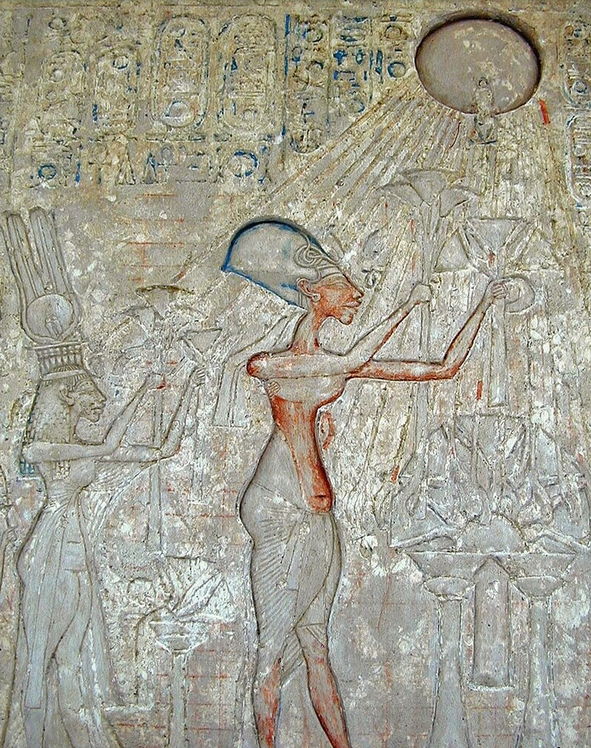
Picture: Pharaoh Akhenaten and his family adoring the Aten.
Citation: Great Hymn to the Aten. (2024, October 20). In Wikipedia. https://en.wikipedia.org/wiki/Great_Hymn_to_the_Aten
Attribution: Egyptian Museum, Public domain, via Wikimedia Commons
Akhenaten’s religious reforms marked one of the most significant ideological shifts in ancient history. He introduced Atenism, a monotheistic system centred on Aten, the sun disk, as the sole deity.
- Revolutionary Monotheism: Atenism replaced the long-standing polytheistic tradition of Egypt, elevating Aten above all other gods. Akhenaten proclaimed himself Aten’s sole representative on Earth, consolidating spiritual authority under the monarchy. This shift blurred the lines between divine and royal power in an unprecedented way.
- Erasure of the Old Gods: Akhenaten ordered the systematic removal of references to other deities, particularly Amun, from temples and monuments. This defacement extended to inscriptions and images, aiming to erase the influence of rival priesthoods and deities.
- Hymns to Aten: The Great Hymn to Aten, attributed to Akhenaten, showcases a poetic celebration of Aten’s life-giving power. It reflects a more personal and emotional connection to the divine than traditional Egyptian religious texts, emphasising nature’s dependence on sunlight. The Great Hymn to the Aten was discovered in the ruins of Akhetaten in the early 20th century. It was inscribed on the walls of the temple dedicated to the Aten and was one of the few surviving texts from Akhenaten’s reign. The hymn was a significant discovery for Egyptologists because it offered a unique perspective on Akhenaten’s religious beliefs and his attempts to create a new religion.
- Ritual Simplification: Atenism de-emphasised complex rituals conducted by a vast priesthood, replacing them with straightforward acts of worship centred on the sun’s rays. This reduced the role of the clergy and placed more spiritual power in the hands of the king and his immediate family.
Governance and Social Shifts
Akhenaten’s reforms extended into governance, challenging entrenched social and political structures.
- Centralisation of Power: By relocating the capital to Akhetaten and consolidating religious practices under Aten, Akhenaten weakened the power of the priesthood, particularly the influential priests of Amun. This shift not only disrupted religious hierarchies but also undermined economic systems tied to traditional temples.
- Diplomatic Adjustments: The Amarna Letters, a trove of correspondence between Egypt and other Near Eastern powers, reveal a diplomatic approach focused more on negotiation than on military expansion. This suggests that Akhenaten prioritised maintaining peace over territorial conquest, a significant departure from his predecessors’ practices.
- Societal Upheaval: The exclusion of traditional gods alienated many segments of society, especially those who depended on temple economies for their livelihoods. This contributed to growing dissatisfaction among the elite and commoners alike.
Philosophical and Ideological Shifts
Akhenaten’s worldview introduced a new philosophical emphasis in Egyptian culture, departing from timeless cycles and emphasising the here and now.
- Focus on Light and Life: Atenism celebrated the sun’s visible rays as the ultimate source of life, highlighting daily renewal rather than eternal continuity. This philosophy influenced not just religious practices but also the artistic and architectural choices of the period.
- Humanising the Divine: Unlike previous pharaohs depicted as stoic and eternal, Akhenaten and his family were shown in vulnerable, affectionate moments. This approach humanised the royal family and reshaped the perception of kingship.
- A New Narrative: The glorification of Aten introduced a creation narrative focused on the sun’s tangible effects on the Earth, departing from the mystical cosmogonies of earlier Egyptian religion.
Economic Consequences
The economic implications of Akhenaten’s reforms were profound, destabilising the foundations of Egypt’s prosperity.
- Temple Closures: By diverting resources from temples dedicated to traditional gods to Aten’s cult, Akhenaten disrupted regional economies that depended on temple production, trade, and employment. The resulting financial strain likely affected public support for his regime.
- Redistribution of Wealth: Wealth concentrated in Amun’s temples was redirected to fund the construction of Akhetaten and the Great Temple of Aten. This redistribution alienated powerful priestly classes, further weakening Akhenaten’s political stability.
- Trade and Diplomacy: Akhenaten’s focus on internal religious reforms may have weakened Egypt’s economic ties with neighbouring states, as the Amarna Letters suggest occasional neglect of foreign policy.
Religious Innovations
Akhenaten’s religious reforms marked one of the most significant ideological shifts in ancient history. He introduced Atenism, a monotheistic system centred on Aten, the sun disk, as the sole deity.
- Akhenaten moved Egypt’s capital from Thebes to a new city he built called Akhetaten. The city was dedicated to Aten and became the centre of his religious and political reforms.
- The city was designed to embody his new religious ideology, with open-air temples that allowed direct sunlight to illuminate the sanctuaries.
- Akhenaten’s religious reforms alienated the powerful priesthood of Amun, which had immense influence in Egypt.
- His focus on Aten and neglect of Egypt’s traditional gods disrupted the societal and political structures of the time.
- Monotheistic Shift: Akhenaten’s elevation of Aten as the sole deity marked a significant departure from Egypt’s traditional polytheistic beliefs. This shift centralised religious practices around Aten, diminishing the roles of other gods and their associated temples.[9]
- Suppression of Traditional Deities: The worship of traditional Egyptian gods, particularly targeting Amun, was actively suppressed. Akhenaten ordered the erasure of Amun’s name and images from monuments and temples, aiming to diminish the deity’s prominence.[10]
- Centralisation of Religious Authority: By positioning himself as the sole intermediary between Aten and the people, Akhenaten centralised religious authority within the monarchy. This move reduced the influence of established priesthoods and redefined the relationship between the state and religion.[11]
- Impact on Art and Culture: The religious transformation under Akhenaten led to significant changes in artistic expression, known as the Amarna style. Art became more naturalistic, depicting the royal family in intimate and informal settings, reflecting the new religious ideology.[12]
- Posthumous Reversal: After Akhenaten’s death, his religious reforms were swiftly undone. The traditional polytheistic practices were reinstated, and efforts were made to erase his legacy, including the abandonment of Akhetaten and the restoration of Amun’s prominence.[13]
The innovations introduced during Akhenaten’s reign in art, architecture, religion, and governance were as ambitious as they were polarising. While many of his changes were swiftly reversed after his death, their boldness left a lasting mark on history. Akhenaten’s focus on Aten, light, and life not only reshaped Egyptian culture during his time but also ensured his place as one of the most enigmatic and revolutionary figures in antiquity.
Birth and Ascension to the Throne
- Birth: Akhenaten was born in 1380 BC and named Amenhotep IV. He was the second son of Pharaoh Amenhotep III and Great Royal Wife, Queen Tiye. While the exact location of his birth is not definitively recorded, he was likely born in Thebes, which was the capital of Egypt during his father’s reign.[14]

Picture: Pharoah Akhenaten, Queen Nefertiti and their children.
Citation: Akhenaten. (2024, November 17). In Wikipedia. https://en.wikipedia.org/wiki/Akhenaten
Attribution: Neoclassicism Enthusiast, CC BY-SA 4.0 <https://creativecommons.org/licenses/by-sa/4.0>, via Wikimedia Commons
This file is licensed under the Creative Commons Attribution-Share Alike 4.0 International license.
- Education and Upbringing: Raised in the royal palace, Akhenaten likely received an education befitting a prince, which would have included instruction in governance, religious rituals, and military training.[15]
- Succession: Following the death of his elder brother, Crown Prince Thutmose, Amenhotep IV became the heir apparent. He ascended the throne after the death of his father, Amenhotep III, around 1353 BC and ruled during the 18th Dynasty of the New Kingdom period of Ancient Egypt. Initially, he followed traditional religious and cultural practices honouring the established pantheon of Egyptian deities.[16]
- Marriage: About the time of his accession, Amenhotep married the chief queen of his reign, Nefertiti[17]. Queen Nefertiti played a prominent role in his religious reforms and is often depicted alongside him in artistic representations[18]. He also had other consorts, including Kiya, who bore him a son, Tutankhaten (later Tutankhamun)[19].
- New God – In the fifth year of his reign, he underwent a religious transformation when he established a new cult dedicated to the Aton (or Aten), the sun’s disk (hence his new name, Akhenaten, meaning “beneficial to Aton”)[20], reflecting his devotion[21]. Aton was a solar deity declared by Amenhotep IV to be the only god, represented as a solar disk with rays ending in human hands[22]. Over the next 12 years, he became renowned—and often criticised—as the ‘heretic king’ for abolishing Egypt’s longstanding religious practices and establishing what is considered the world’s first known monotheistic state religion. Some scholars even regard this as the inception of monotheism itself.[23]
- New Capital City – He founded a new capital city, Akhetaten (modern-day Amarna), dedicated to the worship of his new God, Aten, marking a significant shift in religious and political focus.[24]
Coregency
The potential co-regency between Pharaoh Amenhotep III and his son, Amenhotep IV (later known as Akhenaten), has been a subject of scholarly debate for decades. Some Egyptologists propose that the two rulers shared power for a period, while others argue against this notion.[25]
Arguments Against a Co-Regency:
- Historical Records: Critics argue that there is a lack of definitive contemporary records confirming a co-regency. Documents such as Amarna Letter EA 27[26], dated to the second year of Amenhotep IV’s reign, imply that if a co-regency occurred, it was brief, lasting no more than a year.[27]
- Interpretation of Inscriptions: Some scholars contend that the inscriptions in Vizier Amenhotep-Huy’s tomb merely indicate that the tomb’s construction began under Amenhotep III and concluded under Akhenaten without necessarily proving a co-regency.[28]
Arguments Supporting a Co-Regency:
- Epigraphic Evidence: In 2014, inscriptions in the tomb of Vizier Amenhotep-Huy[29] were interpreted by some as indicating a co-regency lasting at least eight years. The cartouches[30] of both pharaohs were carved side by side, suggesting simultaneous rule.[31]
- Artistic Developments: Proponents of the co-regency theory note that the artistic styles of Amenhotep III’s later years and Akhenaten’s early reign share similarities, possibly indicating overlapping reigns.[32]
Conclusion:
The existence and duration of a co-regency between Amenhotep III and Amenhotep IV remain unresolved. While certain archaeological and artistic evidence suggests a possible overlap in their reigns, the absence of unequivocal historical records leaves the matter open to interpretation.
The Heretic Pharaoh – Decline and Legacy
Pharaoh Akhenaten, originally known as Amenhotep IV, is often regarded as a controversial figure in ancient Egyptian history due to several significant actions during his reign:
- Religious Reforms: Akhenaten introduced Atenism, a form of monotheism centred on the worship of Aten, the sun disk. This shift disrupted the traditional polytheistic practices that had been integral to Egyptian society for centuries. He actively suppressed the worship of traditional Egyptian gods, particularly targeting Amun. Akhenaten ordered the erasure of Amun’s name and images from monuments and temples, aiming to diminish the deity’s prominence.[33]
- Political and Social Upheaval: By relocating the capital from Thebes to Akhetaten (modern-day Amarna), Akhenaten distanced himself from the established political and religious centres. This move alienated the powerful priesthood of Amun, which had immense influence in Egypt and disrupted the societal and political structures of the time.[34]
- Economic Impact: The closure of temples dedicated to other deities led to economic instability. These temples were not only religious centres but also hubs of economic activity, providing employment and resources to the populace. Their closure likely resulted in economic hardship for many Egyptians.[35]
- Cultural Changes: Akhenaten’s reign saw a departure from traditional artistic styles, favouring more naturalistic and unconventional representations. While innovative, these changes may have been unsettling to those accustomed to the established cultural norms.[36]
The term, Too Much, Too Soon, comes to mind. The factors listed above contributed to widespread dissatisfaction among various segments of Egyptian society, leading to efforts by his successors to erase his legacy and restore traditional practices. After Akhenaten’s death[37] around 1336 BC, his successor (likely Smenkhkare or Neferneferuaten, and later Tutankhamun) restored the traditional polytheistic religion. Akhenaten’s city of Akhetaten was abandoned, and his monuments were defaced or dismantled in an effort to erase his legacy.
Akhenaten’s actions were perceived as heretical by his contemporaries and later generations, leading to his designation as the Heretic Pharaoh and his name was omitted from king lists.
Akhenaten’s Historical Significance
Religious Experimentation
Akhenaten’s attempt to centralise religious worship around the Aten was unprecedented in Egyptian history. While it failed to last, it has been interpreted by some scholars as an early form of monotheism. His religious reforms disrupted Egypt’s political and social systems, demonstrating the interconnectedness of religion and state in ancient Egypt.
Artistic and Cultural Legacy
The unique artistic style developed during his reign influenced Egyptian art for years, even after the restoration of traditional practices. His depictions of family life and vulnerability broke with rigid norms and provided insights into royal life. Akhenaten’s enigmatic reign has inspired various works across literature, opera, and film, reflecting his enduring mystique as the Heretic Pharaoh:
- Akhenaten: Dweller in Truth by Naguib Mahfouz: This novel presents a fictionalised account of Akhenaten’s life and religious reforms, exploring the complexities of his character and the impact of his monotheistic beliefs on Egyptian society.
- Nefertiti by Michelle Moran: While focusing on Nefertiti, Akhenaten’s queen, this historical novel delves into the political and religious upheavals of their reign, providing insights into Akhenaten’s radical changes.
-
-
- Akhnaten by Philip Glass: Premiered in 1984, this opera is part of Glass’s trilogy of “portrait” operas, which includes Einstein on the Beach and Satyagraha. Akhnaten explores the life and religious convictions of the pharaoh, using texts drawn from ancient hymns, prayers, and inscriptions sung in their original languages. Details Here
- La Reine Soleil (The Sun Queen): This 2007 French animated film, directed by Philippe Leclerc, is based on Christian Jacq’s novel. It follows the adventures of Akhesa, a 14-year-old princess, during Akhenaten’s reign, highlighting the religious and political challenges of the era. Details Here
- The Egyptian (1954): This film, directed by Michael Curtiz, this historical drama is set during Akhenaten’s reign and portrays the religious transformation of Egypt. The film has a stellar cast. Leading roles were played by Edmund Purdom, Bella Darvi, Jean Simmons, Victor Mature, Gene Tierney, Peter Ustinov, and Michael Wilding. Cinematographer Leon Shamroy was nominated for an Oscar in 1955. Details Here
Conclusions
Akhenaten’s reign has fascinated historians, theologians, and writers. Some have drawn parallels between his monotheism and later Abrahamic faiths, although these connections remain speculative. His story has inspired numerous works of fiction, including novels, operas, and films, highlighting his enduring mystique as the Heretic Pharaoh (see above).
Akhenaten remains a symbol of radical change and its risks. His designation as the “Heretic Pharaoh” reflects the cultural rejection of his reforms posthumously. His efforts to centralise power and introduce monotheism were unprecedented but ultimately alienated powerful institutions. This duality—an ambitious visionary and a disruptive force—is what cements his historical intrigue.
Akhenaten remains a polarising figure in Egyptian history, remembered for his bold reforms and the dramatic changes he attempted to bring to one of the ancient world’s most powerful and enduring civilisations. Akhenaten’s reign represents a unique chapter in ancient Egyptian history. His attempts to revolutionise religious practices and artistic conventions, even though they were largely reversed after his death, have left an indelible mark on history. The ongoing fascination with his life and reforms underscores the complexity and enduring significance of his legacy.
Recent archaeological discoveries have shed new light on Akhenaten’s era. For instance, analyses of artefacts from Tutankhamun’s tomb suggest that some items, including the famous golden death mask, may have been repurposed during Akhenaten’s reign. This indicates a complex relationship between Akhenaten’s legacy and
subsequent rulers.[38] Furthermore, the artistic innovations of the Amarna period, characterised by naturalistic and intimate depictions, have left a lasting impact on Egyptian art. These stylistic changes, though short-lived, influenced subsequent artistic expressions and continue to be studied for their uniqueness.[39]
APPENDIX: Egyptian Solar Deities
Egyptian mythology, deeply intertwined with the religion and culture of ancient Egypt, comprises a rich tapestry of stories that sought to explain natural phenomena, divine power, and humanity’s place in the cosmos. These myths were not only spiritual and cultural narratives but also pragmatic tools that helped the ancient Egyptians navigate their complex world. This mythology is evident in a variety of Egyptian writings and art forms, including short stories, hymns, ritual texts, funerary texts, and elaborate temple decorations. However, despite their abundance, these sources rarely present complete versions of myths. Instead, they provide glimpses—fragments of a grander, often elusive mythological tapestry.
Among the most significant elements of ancient Egyptian mythology was the worship of the Sun and its representation through solar deities. Solar deities personified the Sun or aspects of it, reflecting its perceived power, vitality, and omnipresence. Sun worship was central to the Egyptian understanding of the divine order, the natural world, and the cycle of life and death. The Sun’s daily journey across the sky and its renewal each morning resonated with themes of creation, destruction, and rebirth, making it a potent symbol in religious practices and beliefs.
The following is an exploration of notable Egyptian solar deities, each embodying unique aspects of the Sun and its significance in Egyptian culture:
- Amun: Originally a creator deity, Amun was sometimes identified as a Sun god, particularly in his fusion with Ra, forming Amun-Ra. This syncretised deity symbolised the omnipresence and creative power of the Sun, often depicted as a majestic figure radiating light and life.[40]
- Aten: Representing the visible disc of the Sun, Aten was elevated to unparalleled prominence during the reign of Pharaoh Akhenaten. This monotheistic shift focused worship exclusively on Aten, whose rays were depicted as hands extending blessings and vitality to humanity.[41]
- Atum: Known as the “finisher of the world,” Atum personified the Sun as it sets, symbolising completion and the cyclical nature of existence. As a creator god, Atum also represented the origins of life, often depicted as emerging from the primordial waters of chaos.[42]
- Bast: Associated with the Sun in her feline form, Bast was a protective goddess linked to both the nurturing and fierce aspects of solar power. Her fiery eyes were thought to ward off evil forces, reflecting the Sun’s protective strength.[43]
- Hathor: As the mother of Horus and Ra, Hathor embodied the nourishing and life-sustaining qualities of the Sun. A goddess of music, dance, and joy, she was often depicted as a cow or a woman with cow horns cradling the solar disc, signifying her nurturing connection to the Sun.[44]
- Horus: The god of the sky, Horus was intimately linked to the celestial bodies. His right eye, representing the Sun, symbolised clarity, vision, and strength, while his left eye, representing the Moon, embodied balance and reflection.[45]
- Khepri: As the god of the rising Sun, Khepri symbolised creation and the renewal of life. Often depicted as a scarab beetle, his image evoked the daily rebirth of the Sun and the transformative power of its light.[46]
- Ptah: Though primarily a god of craftsmanship, the arts, and fertility, Ptah was sometimes associated with the Sun at night. This connection highlighted the Sun’s concealed, regenerative phase, aligning with themes of hidden creativity and renewal.[47]
- Ra: The quintessential solar deity, Ra was the god of the Sun and a central figure in Egyptian mythology. Travelling across the sky by day and through the underworld by night, Ra embodied the eternal cycle of life, death, and rebirth, ensuring cosmic order.[48]
- Sekhmet: A fierce goddess of war, Sekhmet also represented the Sun’s scorching heat and its potential for destruction. Her fiery nature was both feared and revered, as it was believed to cleanse and protect, as well as to devastate.[49]
- Sopdu: Associated with war and the scorching heat of the summer Sun, Sopdu symbolised the Sun’s intense, unyielding power during the harshest seasons. His role emphasised the Sun’s dual capacity to sustain and challenge life.[50]
Each of these deities reflects the multifaceted nature of the Sun in Egyptian thought. From nurturing and creation to destruction and renewal, the Sun’s role in the ancient Egyptian worldview underscores its unparalleled significance as a source of life, order, and divine presence. These solar deities, while distinct, collectively illuminate the profound reverence the ancient Egyptians held for the Sun and its enduring influence on their civilisation.
Sources and Further Reading
- http://www.thoughtco.com/akhenaten-4769554
- https://africame.factsanddetails.com/article/entry-116.html
- https://ancientegyptonline.co.uk/akhenaten/
- https://arce.org/resource/akhenaten-mysteries-religious-revolution/
- https://discoveringegypt.com/ancient-egyptian-kings-queens/akhenaten/
- https://egyptmythology.com/akhenatens-reforms-the-transformation-of-egyptian-society/
- https://egyptmythology.com/the-artistic-innovations-of-the-amarna-period/
- https://en.wikipedia.org/wiki/Akhenaten
- https://en.wikipedia.org/wiki/Amarna_letter_EA_27
- https://en.wikipedia.org/wiki/Amenhotep_III
- https://en.wikipedia.org/wiki/Atenism
- https://en.wikipedia.org/wiki/Royal_Tomb_of_Akhenaten
- https://nypost.com/2024/11/13/science/king-tuts-famous-tomb-likely-wasnt-his-new-research-reveals/
- https://the-past.com/feature/breaking-maat-akhenaten-and-the-battle-for-egyptian-tradition-and-identity/
- https://www.archaeology.wiki/blog/2014/02/07/new-evidence-on-the-amenhotep-iii-and-amenhotep-iv-co-regency/
- https://www.britannica.com/art/Amarna-style
- https://www.britannica.com/biography/Akhenaten
- https://www.dailyhistory.org/How_did_Akhenaten_Radically_Change_Egyptian_Religion_and_Culture
- https://www.ducksters.com/history/ancient_egypt/akhenaten.php
- https://www.egyptianhistorypodcast.com/134-the-death-of-akhenaten/
- https://www.metmuseum.org/toah/hd/amar/hd_amar.htm
- https://www.thecollector.com/akhenaten-ancient-egypts-revolutionary-pharaoh/
- https://www.thecollector.com/amarna-egypt-art/
- https://www.thefamouspeople.com/profiles/akhenaten-5495.php
- https://www.worldhistory.org/Akhenaten/
- https://www.worldhistory.org/article/1110/the-art-of-the-amarna-period
Books
- Akhenaten and Nefertiti, by Cyril Aldred, published by Studio, available from https://www.amazon.co.uk/Akhenaten-Nefertiti-Cyril-Aldred/dp/0670111392/
- Akhenaten and the Origins of Monotheism, by James K. Hoffmeier, published by Oxford University Press, available from https://www.amazon.co.uk/Akhenaten-Origins-Monotheism-James-Hoffmeier/dp/0199792089/
- Akhenaten and the Religion of Light, by Erik Hornung, published by Cornell University Press, available from https://www.amazon.co.uk/Akhenaten-Religion-Light-Erik-Hornung/dp/0801487250/
- Akhenaten and Tutankhamun: Revolution and Restoration, by David P. Silverman and others, published by the University of Pennsylvania Museum of Archaeology and Anthropology, available from https://www.amazon.co.uk/Akhenaten-Tutankhamun-Restoration-David-Silverman/dp/1931707901/
- Akhenaten: Egypt’s False Prophet, by Nicholas Reeves, published by Thames & Hudson Ltd., available from https://www.amazon.co.uk/Akhenaten-Egypts-Prophet-Nicholas-Reeves/dp/0500294690/
- Akhenaten: History, Fantasy and Ancient Egypt, by Dominic Montserrat, published by Routledge, available from https://www.amazon.co.uk/Akhenaten-History-Fantasy-Ancient-Egypt/dp/0415301866/
- Akhenaten: Son of the Sun, by Moyra Caldecott, published by Bladud Books, available from https://www.amazon.co.uk/Son-Sun-Akhenaten-Nefertiti-Egyptian/dp/184319497X/
- Akhenaten: The Heretic King, by Donald B. Redford, published by Princeton University Press, available from https://www.amazon.co.uk/Akhenaten-Heretic-Donald-B-Redford/dp/0691035679/
- Amarna Diplomacy: The Beginnings of International Relations, by Raymond Cohen and Raymond Westbrook, published by Johns Hopkins University, available from https://www.amazon.co.uk/Amarna-Diplomacy-Beginnings-International-Relations/dp/0801871034/
- Amarna Sunset: Egypt from Golden Age to Age of Heresy, by Aidan Dodson, published by The American University in Cairo Press, available from https://www.amazon.co.uk/Amarna-Sunrise-Egypt-Golden-Heresy/dp/9774167740/
- Amarna Sunset: Nefertiti, Tutankhamun, Ay, Horemheb, and the Egyptian Counter-Reformation, by Aidan Dodson, published by The American University in Cairo Press, available from https://www.amazon.co.uk/Amarna-Sunset-Nefertiti-Tutankhamun-Counter-Reformation/dp/9774168593/
- Exploring Religion in Ancient Egypt, by Stephen Quirke, published by Wiley-Blackwell, available from https://www.amazon.co.uk/Exploring-Religion-Ancient-Blackwell-Religions/dp/1444332007/
- For the Love of Aten, by V. Ann Catherall – Penttilä, published by Brown Dog Books, available from https://www.amazon.co.uk/Love-ATEN-Ann-Catherall-Penttil%C3%A4/dp/1839525312
- Nefertiti and Akhenaten: An Artistic Biography, by Christina Riggs: This is a forthcoming book by Professor Christina Riggs, a distinguished Egyptologist and art historian. The book is scheduled for publication on 16th January 2025 by UCL Press.
- Pharaohs of the Sun: Akhenaten, Nefertiti, Tutankhamen, by Rita E. Freed, published by Thames & Hudson Ltd., available from https://www.amazon.co.uk/Pharaohs-Sun-Akhenaten-Nefertiti-Tutankhamen/dp/0500050996
- The Akhenaten Colossi of Karnak, by Lise Manniche, published by The American University in Cairo Press, available from https://www.amazon.co.uk/Akhenaten-Colossi-Karnak-Lise-Manniche/dp/9774163494/
- The Amarna Period: History and Literature, by William J. Murnane, published by the Society of Biblical Literature, available from https://www.amazon.co.uk/Writings-Ancient-Society-Biblical-Literat/dp/1555409660/
- The City of Akhenaten and Nefertiti: Amarna and Its People, by Barry Kemp, published by Thames & Hudson Ltd., available from https://www.amazon.co.uk/City-Akhenaten-Nefertiti-Aspects-Antiquity/dp/0500291209/
- The Civilisation of Ancient Egypt, by Paul Johnson, published by W&N, available from https://www.amazon.co.uk/Civilization-Ancient-Egypt-Paul-Johnson/dp/184188068X/
- The Search for Nefertiti, by Joann Fletcher, published by Hodder Paperbacks, available from https://www.amazon.co.uk/Search-Nefertiti-Joann-Fletcher/dp/0340831723/
NOTICE: This paper is compiled from the sources stated but has not been externally reviewed. Some content, including image generation and data synthesis, was assisted by artificial intelligence, but all findings were reviewed and verified by us (the author and publisher). Neither we (the publisher and author) nor any third parties provide any warranty or guarantee regarding the accuracy, timeliness, performance, completeness or suitability of the information and materials covered in this paper for any particular purpose. Such information and materials may contain inaccuracies or errors, and we expressly exclude liability for any such inaccuracies or errors to the fullest extent permitted by law. Your use of any information or materials on this website is entirely at your own risk, for which we shall not be liable. It shall be your own responsibility to ensure that any products, services or information available through this paper meet your specific requirements. You should neither take action nor exercise inaction without taking appropriate professional advice. The hyperlinks were current at the date of publication.
End Notes and Explanations
- Source: Compiled from my research using information available at the sources stated throughout the text, together with information provided by machine-generated artificial intelligence at: bing.com [chat] and https://chat.openai.com. Text used includes that on Wikipedia websites is available under the Creative Commons Attribution-ShareAlike License 4.0; additional terms may apply. By using those websites, I have agreed to the Terms of Use and Privacy Policy. Wikipedia® is a registered trademark of the Wikimedia Foundation, Inc., a non-profit organisation. ↑
- Source: https://arce.org/resource/akhenaten-mysteries-religious-revolution/ ↑
- Source: https://www.britannica.com/biography/Akhenaten ↑
- Source: https://www.dailyhistory.org/How_did_Akhenaten_Radically_Change_Egyptian_Religion_and_Culture ↑
- Source: https://www.worldhistory.org/Akhenaten/ ↑
- Source: https://www.dailyhistory.org/How_did_Akhenaten_Radically_Change_Egyptian_Religion_and_Culture ↑
- Source: https://www.britannica.com/biography/Akhenaten ↑
- Source: https://egyptmythology.com/the-artistic-innovations-of-the-amarna-period/ ↑
- Source: https://en.wikipedia.org/wiki/Atenism ↑
- Source: https://arce.org/resource/akhenaten-mysteries-religious-revolution/ ↑
- Source: https://the-past.com/feature/breaking-maat-akhenaten-and-the-battle-for-egyptian-tradition-and-identity/ ↑
- Source: https://www.dailyhistory.org/How_did_Akhenaten_Radically_Change_Egyptian_Religion_and_Culture ↑
- Source: https://egyptmythology.com/akhenatens-reforms-the-transformation-of-egyptian-society/ ↑
- Source: https://www.ducksters.com/history/ancient_egypt/akhenaten.php ↑
- Source: www.thoughtco.com/akhenaten-4769554 ↑
- Sources: https://www.ducksters.com/history/ancient_egypt/akhenaten.php and https://en.wikipedia.org/wiki/Akhenaten ↑
- Source: https://www.britannica.com/biography/Akhenaten ↑
- Source: https://www.britannica.com/biography/Akhenaten ↑
- Source: https://www.worldhistory.org/Akhenaten/ ↑
- Explanation: The terms “Aten” and “Aton” both refer to the same ancient Egyptian deity, the sun disk worshipped during Pharaoh Akhenaten’s reign. The variation in spelling arises from different transliterations of the original Egyptian hieroglyphs into the Latin alphabet. In ancient Egyptian, the deity’s name was written as “jtn,” which lacks vowels. As a result, scholars have interpreted and vocalised the name in various ways, leading to both “Aten” and “Aton” being used in English. Both spellings are considered correct and are used interchangeably in academic and popular literature. Source: https://www.collinsdictionary.com/dictionary/english/aton ↑
- Reference: See https://www.thefamouspeople.com/profiles/akhenaten-5495.php ↑
- Source: https://www.collinsdictionary.com/dictionary/english/aton ↑
- Source: https://www.worldhistory.org/Akhenaten/ ↑
- Source: https://en.wikipedia.org/wiki/Akhenaten ↑
- Source: https://www.britannica.com/biography/Akhenaten ↑
- Explanation: The Amarna letter EA 27 is a letter addressed to Amenhotep IV and concerns “The Missing Gold Statues Again”. See: https://en.wikipedia.org/wiki/Amarna_letter_EA_27 The Letter was addressed to Pharaoh Amenhotep IV (Akhenaten) and came from Tushratta, the king of Mitanni. In this letter, Tushratta expresses dissatisfaction that Akhenaten has not fulfilled a promise made by his father, Amenhotep III, to send gold statues as part of a marriage agreement involving Tushratta’s daughter, Tadukhepa. The letter is dated to the second regnal year of Amenhotep IV. This correspondence is significant in the debate over a potential co-regency between Amenhotep III and Amenhotep IV. The fact that Tushratta addresses his complaint directly to Amenhotep IV without acknowledging a shared rule with Amenhotep III, suggests that by the second year of Amenhotep IV’s reign, his father was no longer in power. This implies that if a co-regency did occur, it was brief, likely lasting no more than a year. Thus, Amarna Letter EA 27 serves as evidence against the theory of a prolonged co-regency between Amenhotep III and Amenhotep IV, indicating instead a direct succession. ↑
- Source: https://en.wikipedia.org/wiki/Amenhotep_III ↑
- Source: Ibid ↑
- Explanation: Vizier Amenhotep-Huy was a prominent official during Egypt’s 18th Dynasty, serving under Pharaoh Amenhotep III (reigned c. 1390–1352 BC). His responsibilities included overseeing both Upper and Lower Egypt and managing the king’s works throughout the nation. He succeeded Thutmose in the vizierate (see below) and was later followed by Aperel. Amenhotep-Huy’s tomb, designated K028, is located in El-Assasif, Thebes. Source: https://en.wikipedia.org/wiki/Amenhotep-HuyThe term “vizierate” refers to the office, authority, or period of service of a vizier. A vizier is a high-ranking political advisor or minister in various Muslim countries, notably in the Ottoman Empire. The vizierate encompasses the duties and responsibilities associated with this position, which often include overseeing government administration, advising the sovereign, and implementing state policies. Source: https://www.merriam-webster.com/dictionary/vizierate ↑
- Explanation: A cartouche is an oval or oblong figure in ancient Egyptian hieroglyphs that encloses characters representing the names or epithets of royal or divine personages. This distinctive shape signifies that the text within pertains to a royal name, serving both as a protective emblem and a means of identification. The term “cartouche” was first applied by French soldiers who fancied that the symbol they saw so frequently repeated on the pharaonic ruins they encountered resembled a muzzle-loading firearm’s paper powder cartridge (cartouche in French). Source: https://en.wikipedia.org/wiki/Cartouche Beyond its Egyptian context, the Cambridge Dictionary defines the word cartouche as ‘an ornamental or decorative frame, often in the form of a scroll with rolled-up ends, used in architecture and design to surround inscriptions or heraldic devices’. ↑
- Source: https://www.archaeology.wiki/blog/2014/02/07/new-evidence-on-the-amenhotep-iii-and-amenhotep-iv-co-regency/ ↑
- Source: https://ancientegyptonline.co.uk/akhenaten/ ↑
- Source: https://arce.org/resource/akhenaten-mysteries-religious-revolution/ ↑
- Source: https://the-past.com/feature/breaking-maat-akhenaten-and-the-battle-for-egyptian-tradition-and-identity/ ↑
- Source: https://www.dailyhistory.org/How_did_Akhenaten_Radically_Change_Egyptian_Religion_and_Culture ↑
- Source: https://discoveringegypt.com/ancient-egyptian-kings-queens/akhenaten/ ↑
- Commentary: Akhenaten, the tenth pharaoh of Egypt’s Eighteenth Dynasty, died in the 17th year of his reign, around 1336 BC (Egyptian History Podcast). He was initially interred in the Royal Tomb at Amarna, the city he established as the centre of his religious reforms (Wikipedia). However, following his death, Egypt underwent significant political and religious changes. The subsequent rulers sought to restore traditional polytheistic practices and distance themselves from Akhenaten’s monotheistic Atenism. As part of this restoration, Akhenaten’s remains were likely relocated to the Valley of the Kings in Thebes. Tomb KV55, which was discovered in 1907, contained a mummy that some scholars believe to be Akhenaten’s, based on the artefacts and inscriptions found within it (Africa Me). However, the identification of the mummy remains a subject of debate among Egyptologists. ↑
- Source: https://nypost.com/2024/11/13/science/king-tuts-famous-tomb-likely-wasnt-his-new-research-reveals/ ↑
- Source: https://www.thecollector.com/akhenaten-ancient-egypts-revolutionary-pharaoh/ ↑
- Further Information: https://www.worldhistory.org/amun/ ↑
- Further Information: https://en.wikipedia.org/wiki/Aten ↑
- Further Information: https://link.springer.com/referenceworkentry/10.1007/978-3-031-38971-9_1260-1 ↑
- Further Information: https://www.ancient-egypt.co.uk/people/the-Aten.htm ↑
- Further Information: Ibid ↑
- Further Information: Ibid ↑
- Further Information: Ibid ↑
- Further Information: https://www.worldhistory.org/amun/ ↑
- Further Information: https://www.ancient-egypt.co.uk/people/the-Aten.htm ↑
- Further Information: Ibid ↑
- Further Information: Ibid ↑

