
Introduction[1]
Count Dracula is most famously known as the titular character in Bram Stoker’s 1897 novel. This character, Count Dracula, is a vampire who originates from Transylvania, a region in Romania and has become one of the world’s most famous literary figures associated with vampires and the horror genre. Stoker’s Count Dracula is a centuries-old vampire who uses his supernatural powers to move to England and spread his curse, facing resistance from a group of people led by Professor Abraham Van Helsing.
The character of Dracula is often associated with Vlad III, also known as Vlad the Impaler (Vlad Țepeș in Romanian), who was a 15th century prince of Wallachia, a historical and geographical region of Romania. Vlad III earned his nickname due to his favourite method of executing his enemies, which involved impaling them on a wooden stake. He was also known as Vlad Dracula, the word Dracula meaning “son of Dracul,” referencing his father Vlad II Dracul, who was inducted into the Order of the Dragon, which was tasked with defending Christianity against the Ottoman Empire.

Vlad III, more commonly known as Vlad the Impaler
Citation: Dracula. (2024, January 23). In Wikipedia. https://en.wikipedia.org/wiki/Dracula
While Vlad III was a real historical figure known for his brutal tactics against the Ottomans and his own people alike, his connection to the vampire myth is mostly a creation of literature and folklore inspired by his reputation for cruelty. Stoker’s novel, while it may have drawn inspiration from the history and name of Vlad III, primarily contributed to the fictional and mythical image of Count Dracula as the archetypical vampire, blending elements of folklore with the author’s imagination to create a story that has captured the public’s imagination for over a century.
Bram (shortened from Abraham) Stoker’s novel Dracula, published in 1897, is a foundational work of the horror and gothic literature genres, notable for introducing Count Dracula and establishing many conventions of vampire fantasy. The novel is structured as a series of diary entries, letters, newspaper articles, and a ship’s log, creating a multi-perspective tale that adds to its suspense and complexity.[2]
What is a Vampire? [3]

Image Credit: A computer-generated picture depicting a vampire faced with and affected by various apotropaic elements.
Drawn by DALL-E, a sub-set of ChatGPT, January 2024
A vampire is a mythical creature from folklore that subsists by feeding on the life essence (typically in the form of blood) of the living. In most depictions, vampires are revenants of evil beings but can also be created if bitten by another vampire. The characteristics of vampires vary widely across different cultures and folklore, but common traits include heightened senses, superhuman strength, the ability to transform into bats, wolves, or mist, and immortality but with a vulnerability to sunlight, garlic, holy symbols, and wooden stakes.
Apotropaics[4] are common in vampire folklore. Apart from garlic, a branch of wild rose and hawthorn were sometimes associated with causing harm to vampires. Other apotropaics include sacred items, such as the crucifix, rosary, or holy water. Some folklore also states that vampires are unable to walk on consecrated ground, such as that of churches or temples, or to cross running water.
Vampires are often depicted as residing in isolated castles, graveyards, or other remote places. In Eastern European folklore, where much of the vampire myth originates, they are often associated with the Carpathian Mountains, particularly in areas surrounding Transylvania, a region in modern-day Romania.
The word vampire (as vampyre) first appeared in English in 1732, in news reports about vampire ‘epidemics’ in eastern Europe. After Austria gained control of northern Serbia and Oltenia with the Treaty of Passarowitz in 1718, officials noted the local practice of exhuming bodies and ‘killing vampires’. These reports, prepared between 1725 and 1732, received widespread publicity.
The notion of vampirism has existed for millennia. Cultures such as the Mesopotamians, Hebrews, Ancient Greeks, Manipuri and Romans had tales of demons and spirits, which are considered precursors to modern vampires. Despite the occurrence of vampiric creatures in these ancient civilisations, the folklore for the entity known today as the vampire originates almost exclusively from early 18th century southeastern Europe, when verbal traditions of many ethnic groups of the region were recorded and published. In most cases, vampires are revenants of evil beings, suicide victims, or witches, but they can also be created by an evil spirit possessing a corpse or by being bitten by a vampire. Belief in such legends became so pervasive that, in some places, it caused mass hysteria and even public executions of people believed to be vampires.
The notion of where vampires “live” has evolved in literature, film, and other media, with settings ranging from rural villages to bustling cities. In contemporary stories, vampires often blend into human society, hiding their true nature to live among their prey. This flexibility in the vampire myth allows these creatures to be adapted and reimagined in various cultural contexts, serving as a versatile element in horror and fantasy fiction.
In European folklore, vampires are undead creatures who often visited loved ones and caused mischief or deaths in the neighbourhoods they inhabited when they were alive. They wore shrouds and were often described as bloated and of ruddy or dark countenance, markedly different from today’s gaunt, pale vampire, which dates from the early 19th century. Vampiric entities have been recorded in cultures around the world; the term vampire was popularised in Western Europe after reports of an 18th century mass hysteria of a pre-existing folk belief in Southeastern and Eastern Europe that sometimes resulted in corpses being staked and people being accused of vampirism. Local variants in Southeastern Europe were also known by different names, such as shtriga in Albania, vrykolakas in Greece and strigoi in Romania, cognate to the Italian ‘Strega‘, meaning Witch.
Stoker was not the first – the charismatic and sophisticated vampire of modern fiction was born with the publication of the highly successful ‘The Vampyre’ by the English writer John Polidori in 1819 and Irish author Joseph Sheridan Le Fanu’s 1872 novel Carmilla. But it’s Bram Stoker’s 1897 Dracula that is remembered as the quintessential vampire novel and has provided the basis of the modern vampire legend, spawning a distinctive vampire genre that’s still popular today. The good news is that, in modern times, the vampire is generally held to be a fictitious entity, although belief in similar vampiric creatures (such as the chupacabra) persists in some cultures.
Bram Stoker’s Story
The story written by Bram Stoker begins with Jonathan Harker, a young English solicitor, travelling to Count Dracula’s castle in the Carpathian Mountains of Transylvania to assist the Count with his plans to purchase an estate in England. Harker’s experiences at the castle reveal the supernatural horrors that surround Dracula, including the Count’s vampirism. Despite his initial imprisonment by Dracula, Harker escapes, setting the stage for the Count’s move to England.
Upon his arrival in England, Dracula preys upon Lucy Westenra, leading to her eventual transformation into a vampire. This event draws together a group of characters, including Lucy’s suitor Arthur Holmwood, her friends Mina Harker (Jonathan’s wife) and John Seward (a psychiatrist), Quincey Morris (an American), and the Dutch professor Abraham Van Helsing, who specialises in obscure diseases. Van Helsing becomes the leader of this group, guiding them in the fight against Dracula and his growing influence.
The novel then shifts focus to their efforts to protect Mina from Dracula and to destroy the vampire. This quest takes them across England and back to Transylvania, incorporating themes of science versus superstition, the nature of evil, and the dynamics of Victorian society, especially in terms of sexuality and technology.

Citation: Bran Castle. (2023, December 29). In Wikipedia. https://en.wikipedia.org/wiki/Bran_Castle
Attribution: Vislupus, CC BY-SA 4.0 <https://creativecommons.org/licenses/by-sa/4.0>, via Wikimedia Commons
Dracula’s Castle
Bran Castle is a castle in Bran, 25 kilometres (16 miles) southwest of Brașov, in Romania. The castle was built by Saxons in 1377, who were given the privilege to do so by Louis I of Hungary. It is a national monument and landmark in Transylvania. The fortress is on the Transylvanian side of the historical border with Wallachia.
Commonly known outside Transylvania as Dracula’s Castle, it is marketed as the home of the title character in Bram Stoker‘s Dracula. There is no evidence that Stoker knew anything about this castle, which has only tangential associations with Vlad the Impaler, voivode of Wallachia, who shares his name with Dracula. Stoker’s description of Dracula‘s crumbling fictional castle also bears no resemblance to Bran Castle.
Analysis
Stoker’s inspiration for the novel came from various sources, including Eastern European folklore and the historical figure Vlad III the Impaler. However, the character of Dracula is more closely associated with myths of vampirism than with any specific historical person. Stoker’s depiction of Transylvania and vampire lore has had a lasting impact on popular culture’s view of vampires.
Critics have explored Dracula from numerous angles, including its commentary on racial and sexual anxieties of the Victorian era, the role of women in society, and the fears surrounding the breakdown of traditional gender roles. The novel also touches on themes of invasion and the unknown, with Dracula’s arrival in England representing a clash of cultures and the introduction of ancient superstitions into the modern world.
Since its publication, Stoker’s book Dracula has never been out of print, demonstrating its enduring appeal. The novel has been adapted into countless films, television shows, theatrical productions, and other literary works, solidifying its status as a keystone of horror literature. These adaptations have varied in their faithfulness to the original text, with some portraying Dracula as a more sympathetic character while others focus on the horror and erotic aspects of the story. Regardless of interpretation, Stoker’s Dracula remains a powerful influence on the horror genre and the archetype of the vampire in the collective imagination.
In the Media
Bram Stoker’s Dracula has been a significant source of inspiration across various forms of media since its publication in 1897. The story of Dracula and the themes within the novel have been adapted and reimagined in numerous films, plays, operas, and other cultural productions, each bringing a unique interpretation to Stoker’s original work.
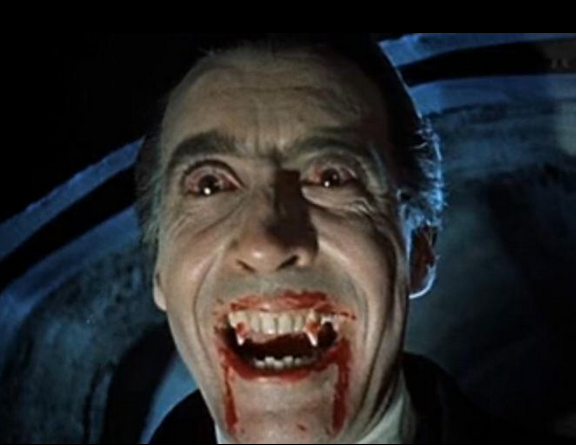
- Films: Dracula’s most famous cinematic adaptation is perhaps the 1931 film directed by Tod Browning and starring Bela Lugosi as Dracula, which cemented the image of Dracula as a sophisticated and charismatic count in popular culture. Since then, there have been numerous adaptations and reinterpretations in cinema, including the Hammer Film Productions series starring Christopher Lee as Dracula, which added a new level of intensity and colour to the story. Francis Ford Coppola’s 1992 film, Bram Stoker’s Dracula, sought to return to the novel’s roots while adding a romantic dimension to the Count’s character. The character of Dracula has also been featured in various genres beyond horror, including comedy and action.

Picture Credit: Christopher Lee as Count Dracula.
Citation: Dracula. (2023, December 20). In Wikipedia. https://en.wikipedia.org/wiki/Dracula_(1958_film)
Attribution: Screenshot from “Internet Archive” of the movie Dracula (1958), Public domain, via Wikimedia Commons
- Plays: The story of Dracula has been adapted for the stage numerous times. The first authorised adaptation was performed in 1924, and the most notable early version was the 1927 Broadway play that starred Bela Lugosi, leading directly to his casting in the 1931 film. Contemporary theatre has seen innovative adaptations, including those that highlight the novel’s erotic and psychological dimensions.
- Opera: Dracula has also inspired operatic adaptations, such as Dracula: Between Love and Death, composed by Simon Leclerc and premiered in Montreal in 2006. Opera allows for a dramatic and musical exploration of the novel’s themes, adding a layer of emotional depth and complexity to the story.
- Ballet and Dance: The story has been interpreted through dance, with several ballet companies producing their versions of Dracula. These adaptations often emphasise the story’s Gothic atmosphere and the characters’ emotional turmoil, using the expressive power of dance to tell the story without words.
- Television: Dracula has appeared in many television shows, either as adaptations of Stoker’s novel or as part of larger narratives involving vampires. Recent examples include the 2013 NBC series Dracula, which reimagines the story in a new context, and the 2020 Netflix/BBC series Dracula, which offers a modern retelling of the classic tale.
- Other Media: Beyond these traditional forms, Dracula has influenced video games, graphic novels, and even animation, each medium offering new ways to explore the character and his legacy.
Each adaptation of Dracula reflects the concerns and interests of its time, whether focusing on the horror and supernatural aspects, exploring themes of sexuality and power, or using the character to comment on social and cultural issues. Despite the vast differences in interpretation and medium, the enduring appeal of Dracula lies in its ability to be reimagined and relevant to each new generation.
The Connection between the Dracula and the Gothic Genres
The connection between the Dracula genre (centred around Bram Stoker’s 1897 novel Dracula) and the Gothic tradition is profound and multifaceted, rooted in the shared themes, motifs, and aesthetic sensibilities that characterise Gothic literature. This relationship not only highlights the influence of Gothic elements on vampire fiction but also underscores how Stoker’s work has contributed to the evolution of the Gothic genre itself.
Historical Context and Gothic Origins
The Gothic genre emerged in the late 18th century, with Horace Walpole’s The Castle of Otranto (1764) often cited as the first Gothic novel. Gothic literature is marked by its focus on mystery, horror, and the supernatural, often set against dark, medieval, or otherwise eerie backdrops like haunted castles, monasteries, and gloomy landscapes. It explores themes of madness, decay, death, and the uncanny, frequently delving into the psychological torment of its characters.
Dracula and Gothic Elements
Bram Stoker’s Dracula incorporates many quintessential elements of the Gothic genre, making it a seminal work within the tradition:
- Atmospheric Setting: The novel begins in the remote Carpathian Mountains of Transylvania, with Dracula‘s castle epitomising the Gothic setting—ancient, crumbling, and shrouded in mystery and terror.
- Supernatural Elements: The character of Count Dracula as a vampire introduces the supernatural into the narrative, embodying Gothic preoccupations with death, the undead, and otherworldly forces.
- Exploration of Fear and Horror: “Dracula” delves into primal fears—of the unknown, of death, and of the loss of one’s soul or humanity—central concerns of Gothic fiction.
- Psychological Depth: The novel examines the psychological effects of terror and the supernatural on its characters, from Jonathan Harker’s imprisonment in the castle to the group’s pursuit of Dracula, reflecting the Gothic interest in the human mind under duress.
- Isolation and Entrapment: Characters in Dracula often find themselves isolated or trapped, physically or psychologically, mirroring the Gothic motif of entrapment in haunted or oppressive environments.
- Moral Ambiguity: Dracula, while clearly the antagonist, is a complex character whose motivations and history invite sympathy as well as fear, embodying the Gothic trait of blurring lines between good and evil, victim and villain.
Contribution to the Gothic Tradition
While Dracula draws heavily on Gothic traditions, it also contributes to the genre’s evolution. Stoker’s novel popularised the figure of the vampire as a central Gothic antagonist, inspiring a subgenre of vampire fiction within the Gothic tradition. It expanded the settings and themes of Gothic literature, moving from the isolated castles and rural landscapes of earlier works to include modern, urban environments, thereby reflecting contemporary societal anxieties about science, technology, and social change.
Legacy and Influence
The legacy of Dracula within the Gothic genre is immense, influencing not only literature but also film, television, and other media. It has shaped the portrayal of vampires and the supernatural in popular culture, cementing the connection between the Gothic and the horror genre. The novel’s enduring popularity attests to the fascination with Gothic themes and their capacity to explore the darker aspects of human nature and the unknown.
In summary, the connection between the Dracula genre and the Gothic is characterised by a shared emphasis on horror, the supernatural, and the exploration of psychological depths, set against a backdrop of dark and foreboding settings. Dracula both exemplifies and expands the Gothic tradition, highlighting its enduring appeal and adaptability. Stoker’s Dracula not only aligns with but also significantly evolves Gothic conventions. A key element of this evolution is its reflection of Victorian societal anxieties, particularly in the realms of sexuality, gender roles, and the clash between emerging scientific rationalism and traditional superstitions. The novel’s portrayal of women, like Mina Harker and Lucy Westenra, is especially noteworthy. They embody the era’s complex views on femininity, oscillating between traditional purity and emerging independence, thus challenging typical Gothic tropes.
Moreover, Dracula has significantly influenced modern horror genres, transcending literature to inspire films, TV shows, and video games. This has cemented Dracula as an archetypal figure in horror, reshaping the vampire myth into a form that resonates deeply within Western culture. Through these facets, Dracula exemplifies and expands the Gothic tradition, reflecting its enduring appeal and adaptability.
Comparative Analysis with Other Gothic Literature
Gothic Traditions
Dracula stands as a pinnacle within the Gothic tradition, encapsulating the essence of fear and the unknown that characterises the genre. Unlike Mary Shelley’s Frankenstein, which delves into the terror of man’s ambition gone awry, or Edgar Allan Poe’s exploration of the human psyche’s darker recesses, Stoker’s novel weaves a narrative deeply entrenched in folklore and the supernatural. The interplay of the exotic and terrifying landscape of Transylvania with the familiar Victorian setting highlights Stoker’s ingenuity in blending traditional Gothic motifs with new, unsettling elements of horror.
Influence on Later Gothic Works
The shadows of Count Dracula loom large over the landscape of horror and Gothic literature that followed. Stoker’s novel has not only set a template for vampire fiction but has also influenced broader horror narratives, encouraging authors to explore themes of invasion, the other, and the battle between modernity and ancient evil. The enduring fascination with vampires in literature can trace its roots back to Dracula, inspiring works that range from Anne Rice’s The Vampire Chronicles[5] to Stephenie Meyer’s Twilight series[6], each reflecting their times’ societal concerns as Stoker did.
Dracula‘s Symbolism in Cultural Context
Victorian Era Concerns
The figure of Dracula serves as a potent symbol for the anxieties of the Victorian era, embodying fears of the foreign other threatening the British Empire’s stability and purity. The novel’s engagement with themes of sexuality—through the vampirisation of Lucy and Mina—reflects Victorian anxieties about female sexuality and the potential disruption of societal norms. Stoker’s portrayal of Dracula as a corrupting foreign influence speaks to broader fears of degeneration and the impact of colonial encounters.
Modern Interpretations
In contemporary interpretations, Dracula can be seen as a figure navigating identity and existential crises, mirroring modern society’s exploration of these themes. The adaptability of Dracula‘s mythos allows for a reflection on current issues, such as the alienation wrought by globalization and the ongoing negotiation of consent and power dynamics in relationships.
Psychological Interpretation
Freudian Analysis
A Freudian lens reveals Dracula as a narrative rich with symbolic representations of repressed desires and the uncanny. The act of vampirism can be interpreted as a metaphor for forbidden sexual desires, with the exchange of blood mirroring intimate relations that Victorian society deemed unacceptable. Characters like Lucy and Mina become battlegrounds for these repressed urges, embodying the conflict between societal expectations and hidden desires.
The Monster Within
Dracula embodies the darker aspects of the human psyche that civilisation attempts to repress. This monstrous other within us is a recurring theme in Gothic literature, representing the fear of losing control and succumbing to our base instincts. Stoker’s novel invites readers to confront the monster within, questioning the nature of evil and the duality of man.
Technological and Scientific Reflections
The Role of Science and Technology
Dracula showcases a fascinating interplay between emerging technologies of the 19th century and ancient supernatural forces. The novel’s protagonists use modern science and technology, such as blood transfusions and phonographs, as weapons against the seemingly invincible Count. This juxtaposition highlights the novel’s commentary on the limitations of modernity in the face of timeless evil, suggesting that some truths lie beyond the reach of science.
Medicine and Psychiatry
Through characters like Dr John Seward and his patient Renfield, Dracula engages with Victorian medicine and psychiatry, revealing contemporary beliefs about mental illness and its treatment. The novel’s depiction of Renfield’s obsession with consuming life to gain life reflects then-emerging theories about mental illness and deviance, illustrating the novel’s grounding in the scientific knowledge of its time.
Global Impact and Legacy
Worldwide Influence
The global impact of Dracula is evident in the myriad cultural adaptations and reinterpretations of the vampire myth, from Eastern European folklore to Hollywood films. Each adaptation reflects the cultural and societal concerns of its time, showcasing the story’s universality and adaptability.
Legacy in Horror Genre
Dracula has cemented its status as a cornerstone of the horror genre, influencing not only the portrayal of vampires but also the development of horror narratives. The novel’s exploration of fear, the unknown, and the monstrous other continues to resonate, inspiring creators across mediums to explore the depths of human fear and fascination with the darkness.
Is Dracula really Vlad III?
According to historians and literary scholars, such as Elizabeth Miller[7], who has studied the link between Stoker’s character and Vlad III, the two Draculas don’t really have much in common except the fear and horror they invoke in the imagination of their audiences. Exploring the nuanced understanding of the relationship—or lack thereof—between Bram Stoker’s fictional Count Dracula and the historical figure of Vlad III (known frighteningly as Vlad the Impaler) reveals vast dissimilarities between the gruesome duo.
Despite the popular conflation of Bram Stoker’s Count Dracula with the historical figure Vlad III Dracula or Vlad the Impaler, in-depth research and analysis by historians and literary scholars have clarified that the connections between the two are minimal. Stoker’s iconic vampire and the 15th century Wallachian prince share little beyond the name and a vague geographical backdrop, challenging the widespread assumptions about the novel’s historical underpinnings.
Literary Creation vs. Historical Reality
Bram Stoker’s Dracula, published in 1897, introduced the world to a character that has become synonymous with the archetype of the vampire. The novel’s Count Dracula is a figure of profound evil and supernatural power whose characteristics and actions define the modern perception of vampires. Stoker’s Dracula is a character born from the author’s imagination, an amalgamation of various sources of inspiration ranging from European folklore to Victorian anxieties.
In contrast, Vlad III, known as Vlad the Impaler, was a 15th century prince of Wallachia, part of modern-day Romania. His nickname, “the Impaler,” derives from his preferred method of executing his enemies—a brutal testament to his reign’s cruelty. Vlad III earned a reputation for his fierce defence of Wallachia against the Ottoman Empire, employing terror as a warfare tactic. His historical legacy is complex, viewed by some as a cruel tyrant and by others as a national hero.
The Name and Nothing More
Elizabeth Miller’s research highlights that Stoker’s knowledge of Vlad III was likely superficial, based on brief references in historical texts. The name “Dracula” in Stoker’s notes suggests that he was intrigued by the phonetic qualities of the name rather than its historical bearer. Miller points out that there is no evidence to suggest Stoker was deeply knowledgeable about Vlad III’s life or deeds. The use of the name Dracula and the setting of Transylvania were choices that added an exotic and mysterious flavour to his novel rather than attempts to draw a direct line to Vlad the Impaler.
The Impact of Misconceptions
The misconception linking Stoker’s vampire to Vlad III has spurred a variety of cultural and literary explorations, intertwining the factual and the fictional in public consciousness. This blending has enriched the Dracula mythos but has also led to misunderstandings about the novel’s historical accuracy and intentions. Scholars like Miller advocate for a separation of these narratives, encouraging the reading of Stoker’s Dracula as a work of fiction that stands apart from the historical figure of Vlad III.
Such a separation allows for a deeper appreciation of Stoker’s literary craft and the cultural impact of his work. It underscores the novel’s exploration of themes such as fear of the unknown, the clash between modernity and ancient superstitions, and the complexities of human nature—themes that resonate with readers far beyond the historical specifics of Vlad III’s reign.
The distinction between Bram Stoker’s Count Dracula and Vlad III Dracula is crucial for understanding the novel’s place in literary and cultural history. While the allure of connecting fiction with historical figures is understandable, the insights of scholars remind us of the importance of recognising Dracula for what it truly is—a masterpiece of horror fiction whose strength lies not in historical accuracy but in its ability to captivate and terrify generations of readers.
Conclusion
In examining Bram Stoker’s Dracula, I have traversed a narrative that is as much a reflection of Victorian anxieties and the Gothic imagination as it is a timeless exploration of the human condition’s darker facets. Stoker’s masterpiece, through its intricate narrative structure and profound thematic depth, has not only established the foundations for modern horror literature but has also become a critical lens through which we can explore the complexities of identity, fear, and the other.
The character of Dracula, a sophisticated amalgamation of historical allusions, folklore, and Stoker’s creative genius, continues to haunt the collective imagination more than a century after its inception. The novel’s ability to adapt and resonate across generations speaks to its complexity and versatility, embodying universal themes of life, death, and the eternal struggle between good and evil. Stoker’s Count Dracula, in his enduring allure and menace, serves as a mirror reflecting societal fears and desires, evolving with each adaptation to confront the prevailing cultural zeitgeist.
Through this paper, I have attempted to untangle the intricate web of influences that shaped Dracula, from the historical Vlad III to the myths that permeate Eastern European folklore. By dissecting the novel’s thematic concerns and narrative strategy, we gain insight into Stoker’s critique of his own society, as well as the enduring appeal of the vampire myth. The adaptations and reinterpretations of Dracula across various media underscore the character’s versatility and the narrative’s capacity to explore new contexts and themes, from the exploration of sexuality and power to the negotiation of modernity and tradition.
Moreover, the scholarly work surrounding Dracula, including the critical analyses by figures such as the late Elizabeth Miller, has enriched our understanding of the novel’s place within literary and cultural history. These contributions have not only clarified misconceptions but have also highlighted the novel’s rich layers of meaning and its impact on subsequent generations of writers and creators.

1947 re-issue poster for ”Dracula” (1931). Several ”Dracula” adaptations draw from the look and imagery of the 1931 film. Attribution: English: Illustrator unknown. “Copyrighted 1947 – Universal Pictures Corp.”, Public domain, via Wikimedia Commons
As I conclude this paper, it becomes evident that Dracula is not merely a novel about a Transylvanian count with a penchant for blood. It is a complex narrative that challenges readers to question the nature of evil, the boundaries of science and superstition, and the intricate dance of death and desire. Stoker’s Dracula remains a cornerstone of Gothic literature, its themes and characters endlessly fascinating for their ability to adapt and reflect the human psyche’s deepest fears and desires.
In the final analysis, Dracula stands as a testament to the enduring power of storytelling and its capacity to explore the perennial questions of humanity. Bram Stoker’s novel, more than a century after its publication, continues to captivate, terrify, and inspire, securing its place not just in the annals of horror literature, but as a pivotal exploration of the shadowy depths of the human condition. Other characteristics have been added or altered in subsequent popular fictional works, including films, cartoons and even breakfast cereals.
Here’s a sobering and frightening thought: you could say that Dracula is still around. One of the Count’s most iconic powers is his ability to turn others into vampires by biting them and infecting them with the vampiric disease.
Web Sources and Relevant Reading
Web Sources
- https://www.livescience.com/40843-real-dracula-vlad-the-impaler.html
- https://www.britannica.com/topic/Dracula-novel
- https://en.wikipedia.org/wiki/Count_Dracula_in_popular_culture
- https://en.wikipedia.org/wiki/Vampire
- https://www.nationalgeographic.co.uk/history-and-civilisation/2021/11/vlad-the-impalers-thirst-for-blood-was-an-inspiration-for-count-dracula
- https://www.history.com/news/was-dracula-a-real-person
- https://time.com/5411826/bram-stoker-dracula-history/
- https://www.independent.co.uk/news/science/vlad-impaler-letters-count-dracula-b2394534.html
Books
The following list aims to provide a diverse range of perspectives on the horror genre, from academic analyses to seminal literary works that have shaped the portrayal of vampires and the supernatural in popular culture.
- Dracula, by Bram Stoker (2022), published by Fingerprint! Publishing, available from https://www.amazon.co.uk/Dracula-Bram-Stoker/dp/160444262X
- A Dracula Handbook, by Elizabeth Miller (2005), published by Xlibris Corporation, available from https://www.amazon.co.uk/Dracula-Handbook-Elizabeth-Miller/dp/1413480942/
- A History of Horror, by Wheeler Winston Dixon (2010), published by Rutgers University Press, available from https://www.amazon.co.uk/History-Horror-Wheeler-Winston-Dixon/dp/0813547962
- Blood Read: The Vampire as Metaphor in Contemporary Culture, edited by Joan Gordon and Veronica Hollinger (1997), published by University of Pennsylvania Press, available from https://www.amazon.co.uk/Blood-Read-Vampire-Metaphor-Contemporary/dp/0812216288
- Bram Stoker and the Gothic: Formations to Transformations, edited by Catherine Wynne (2016), published by Palgrave Gothic, available from https://www.amazon.co.uk/Bram-Stoker-Gothic-Palgrave/dp/1137465034
- Bram Stoker’s Dracula: A Documentary Journey into Vampire Country and the Dracula Phenomenon, by Elizabeth Miller (2009), published by Pegasus, available from https://www.amazon.co.uk/Bram-Stokers-Dracula-Documentary-Phenomenon/dp/1605980528
- Breaking Dawn, by Stephenie Meyer (2008), published by Little, Brown Book Group, available from https://www.amazon.co.uk/Breaking-Dawn-Stephenie-Meyer/dp/B005VCL4PW
- Dracula in Visual Media: Film, Television, Comic Book and Electronic Game Appearances, 1921-2010, by John Edgar Browning and Caroline Joan (Kay) Picart (2010), published by McFarland & Co, available from https://www.amazon.co.uk/Dracula-Visual-Media-Television-Appearances/dp/0786433655
- Dracula: Sense and Nonsense, by Elizabeth Miller (2000), published by Desert Island Books Limited, available from https://www.amazon.co.uk/Dracula-Nonsense-Desert-Island-Library/dp/1874287244
- Dracula: The Un-Dead, by Dacre Stoker and Ian Holt (2009), published by Harper Fiction, available from https://www.amazon.co.uk/Dracula-Dead-Dacre-Stoker/dp/000731034X/
- Dracula’s Guest: A Connoisseur’s Collection of Victorian Vampire Stories, edited by Michael Sims (2011), published by Bloomsbury Paperbacks, available from https://www.amazon.co.uk/Draculas-Guest-Connoisseurs-Collection-Collections/dp/1408809966
- Draculas, Vampires, and Other Undead Forms: Essays on Gender, Race, and Culture, edited by John Edgar Browning and Caroline Joan (Kay) Picart (2009), published by Scarecrow Press, available from https://www.amazon.co.uk/Draculas-Vampires-Other-Undead-Forms/dp/081086696X
- Frankenstein: Or the Modern Prometheus, by Mary Shelley (Author), Maurice Hindle (Editor) (2003), published by Penguin, available from https://www.amazon.co.uk/Frankenstein-Modern-Prometheus-Penguin-Classics/dp/0141439475/
- Gothic Horror: A Guide for Students and Readers, by Clive Bloom (2007), published by Red Grove Press, available from https://www.amazon.co.uk/Gothic-Horror-Guide-Students-Readers/dp/0230001777
- Gothic Realities: The Impact of Horror Fiction on Modern Culture, by L Andrew Cooper (2010), published by McFarland & Co., available from https://www.amazon.co.uk/Gothic-Realities-Impact-Fiction-Culture/dp/0786448350
- Horror Stories: Classic Tales from Hoffmann to Hodgson, edited by Darryl Jones (2018), published by Oxford University Press, available from https://www.amazon.co.uk/Horror-Stories-Classic-Hoffmann-Classics/dp/0199685444/
- In Search of Dracula: The History of Dracula and Vampires, by Raymond T McNally and Radu Florescu (1994), published by Houghton Mifflin Harcourt, available from https://www.amazon.co.uk/Search-Dracula-Raymond-T-McNally/dp/0395657830
- Interview with the Vampire, by Anne Rice (1976), published by Knopf, available from https://www.amazon.co.uk/Interview-Vampire-Novel-Chronicles/dp/0394498216
- Monsters in America: Our Historical Obsession with the Hideous and the Haunting, by W Scott Poole (2014), published by Baylor University Press, available from https://www.amazon.co.uk/Monsters-America-W-Scott-Poole/dp/1602584664
- Reading the Vampire, by Ken Gelder (1994), published by Routledge, available from https://www.amazon.co.uk/Reading-Vampire-Popular-Fictions-Gelder/dp/0415080134
- The Cambridge Companion to Gothic Fiction, edited by Jerrold E Hogle (2002), published by Cambridge University Press, available from https://www.amazon.co.uk/Cambridge-Companion-Fiction-Companions-Literature/dp/0521794668
- The Castle of Otranto, by Horace Walpole (in 1764), latest edition (2017) available from https://www.amazon.co.uk/Castle-Otranto-Walpole-Original-Classics/dp/1977925235
- The Complete Vampire Chronicles 12-Book Bundle, by Anne Rice (1993), published by Ballantine Books, available from https://www.amazon.co.uk/Complete-Vampire-Chronicles-4-1/dp/0345385403/
- The Essential Dracula, by Bram Stoker, edited by Leonard Wolf (1993), published by Plume, available from https://www.amazon.co.uk/Essential-Dracula-Definitive-Annotated-Stokers/dp/0452269431
- The Gothic World of Anne Rice, edited by Gary Hoppenstand and Ray B Browne (1996), published by Bowling Green State University Popular Press, available from https://www.amazon.co.uk/Gothic-World-Anne-Hoppenstand-Browne/dp/0879727071
- The Gothic: A Very Short Introduction, by Nick Groom (2012), published by Oxford University Press, available from https://www.amazon.co.uk/Gothic-Very-Short-Introduction-Introductions/dp/0199586799
- The Hammer Story, by Marcus Hearn (Author), Alan Barnes (Author) (2024), published by Titan, available from https://www.amazon.co.uk/Hammer-Story-Revised-Expanded/dp/1803365145/
- The Horror Film, by Peter Hutchings (2015), published by Routledge, available from https://www.amazon.co.uk/Horror-Film-Inside/dp/1138130575/
- The Jewel of Seven Stars, by Bram Stoker (2018), independently published, available from https://www.amazon.co.uk/Jewel-Seven-Stars-Horror-novel/dp/172920080X
- The Living Dead: A Study of the Vampire in Romantic Literature, by James Twitchell (1987), published by Duke University Press, available from https://www.amazon.co.uk/Living-Dead-Vampire-Romantic-Literature/dp/0822307898
- The Mammoth Book of Vampires, edited by Stephen Jones (2004), published by Robinson Publishing, available from https://www.amazon.co.uk/Mammoth-Book-Vampires-New-Books/dp/1841199265
- The New Annotated Dracula, by Bram Stoker, annotated by Leslie S Klinger (2009), published by WW Norton & Company, available from https://www.amazon.co.uk/New-Annotated-Dracula-Books/dp/0393064506
- The Philosophy of Horror, by Noel Carroll (1990), published by Routledge, available from https://www.amazon.co.uk/Philosophy-Horror-Noel-Carroll/dp/0415902169
- The Twilight Saga: New Moon, by Stephenie Meyer (2008), published by Little, Brown Books for Young Readers, available from https://www.amazon.co.uk/Moon-Twilight-Saga-Stephenie-Meyer/dp/0316024961
- The Vampire Book: The Encyclopedia of the Undead, by J Gordon Melton (2010), published by Visible Ink Press, available from https://www.amazon.co.uk/Vampire-Book-Gordon-Melton-PhD/dp/157859281X
- The Vampire Lestat, by Anne Rice (2008), published by Sphere, available from https://www.amazon.co.uk/Vampire-Lestat-Number-Chronicles/dp/0751541966/
- The Vampire: A New History, by Nick Groom (2018), published by Yale University Press, available from https://www.amazon.co.uk/Vampire-New-History-Nick-Groom/dp/0300232233
- Twilight, by Stephenie Meyer (2007), published by Atom, available from https://www.amazon.co.uk/Twilight-Book-Saga/dp/1904233651/
- Vampires, Burial, and Death: Folklore and Reality, by Paul Barber (1990), published by Yale University Press, available from https://www.amazon.co.uk/Vampires-Burial-Death-Folklore-Reality/dp/0300048599
- Vampires: Myths and Metaphors of Enduring Evil, edited by Peter Day (2006), published by Editions Rodopi B.V., available from https://www.amazon.co.uk/Vampires-Metaphors-Enduring-Interface-Boundaries/dp/9042016698
CAUTION: This paper is compiled from the sources stated but has not been externally reviewed. Parts of this paper include information provided via artificial intelligence which, although checked by the author, is not always accurate or reliable. Neither we nor any third parties provide any warranty or guarantee as to the accuracy, timeliness, performance, completeness or suitability of the information and materials covered in this paper for any particular purpose. Such information and materials may contain inaccuracies or errors and we expressly exclude liability for any such inaccuracies or errors to the fullest extent permitted by law. Your use of any information or materials on this website is entirely at your own risk, for which we shall not be liable. It shall be your own responsibility to ensure that any products, services or information available through this paper meet your specific requirements and you should neither take action nor exercise inaction without taking appropriate professional advice. The hyperlinks were current at the date of publication.
End Notes and Explanations
- Source: Compiled from my research using information at the sources stated throughout the text, together with information provided by machine-generated artificial intelligence at: bing.com [chat] and https://chat.openai.com ↑
- About Bram Stoker: Bram Stoker (1847-1912), born Abraham Stoker in Clontarf, Dublin, Ireland, was a late 19th century author best known for his seminal gothic horror novel “Dracula,” published in 1897. Before becoming one of the most famous names in horror literature, Stoker had a varied career, showing the breadth of his interests and talents across different fields.Stoker was the third of seven children, and he suffered from an unidentified illness in his early childhood, which left him bedridden until the age of seven. Despite his early health challenges, he made a complete recovery and went on to excel academically and athletically at Trinity College, Dublin, where he studied mathematics. After college, Stoker worked as a civil servant at Dublin Castle and continued to write, publishing his first book, “The Duties of Clerks of Petty Sessions in Ireland,” a handbook in administrative duties, in 1879. However, it was his interest in the arts and his friendship with the actor Henry Irving that would dramatically change the course of his life and career. In 1878, Stoker married Florence Balcombe, who had previously been courted by Oscar Wilde. Stoker and Florence moved to London, where Stoker became the business manager of Irving’s Lyceum Theatre, a position he held for nearly three decades. During this time, Stoker began writing novels, starting with “The Primrose Path” in 1875, and continuing with works like “The Snake’s Pass” in 1890 and “The Watter’s Mou’” in 1895. However, it was “Dracula” that cemented his place in literary history. The novel tells the story of Count Dracula’s attempt to move from Transylvania to England to spread the undead curse and the battle between Dracula and a small group of people led by Professor Abraham Van Helsing. Although “Dracula” did not gain immediate fame upon publication, over time, it became a classic of the gothic horror genre, inspiring countless adaptations and interpretations in various media forms. The character of Dracula has become iconic, representing the archetype of the vampire in popular culture. “Dracula” remains a staple of literary curriculums around the world, testament to its timeless appeal and the imaginative genius of Bram Stoker. ↑
- Source: Mainly derived from https://en.wikipedia.org/wiki/Vampire ↑
- Explanation: Apotropaic magic or protective magic is a type of magic intended to turn away harm or evil influences, as in deflecting misfortune or averting the evil eye. Source: https://en.wikipedia.org/wiki/Apotropaic_magic ↑
- Availability: Anne Rice’s The Vampire Chronicles, at: https://www.amazon.co.uk/Vampire-Chronicles-Collection-Interview-Memnoch/dp/9124281166/ ↑
- Availability: The Twilight Saga Series by Stephenie Meyer, at: https://www.amazon.co.uk/Twilight-Stephenie-Collection-Breaking-Midnight/dp/0478304587/ ↑
- About Elizabeth Miller: Elizabeth Miller (1939-2022) was a prominent Canadian scholar and professor emerita at Memorial University of Newfoundland, who was especially renowned for her extensive research on Bram Stoker’s novel Dracula and the mythology surrounding vampires in literature and folklore. She is considered one of the leading authorities on the subject of Dracula and vampire fiction, contributing significantly to the academic and popular understanding of these topics.Miller’s work often focused on dispelling myths and misconceptions about the connections between Stoker’s fictional Count Dracula and the historical figure Vlad III Dracula, also known as Vlad the Impaler. She argued against the popularly held belief that Stoker based his vampire count directly on Vlad III, showing through meticulous research that Stoker’s inspirations were more aligned with Victorian concerns, folklore, and the creative imagination rather than historical figures.
Elizabeth Miller published numerous books and articles on Dracula and vampire literature, including titles like “Dracula: Sense & Nonsense” and “A Dracula Handbook,” which provide insights into the creation, themes, and cultural impact of Stoker’s novel. Her work was characterised by rigorous scholarship and a passion for uncovering the truth behind enduring literary myths. Through her research, Miller contributed to a deeper understanding of “Dracula” as a work of fiction and its place within the broader context of gothic and horror literature. Her passing on 2nd January 2022, marks the loss of a significant voice in literary scholarship, but her work continues to influence and inform scholars, students, and enthusiasts of vampire fiction and gothic literature. ↑
