Introduction[1]
Throughout human history, our species has gazed upwards with a mixture of wonder, reverence, and curiosity. From ancient civilisations mapping constellations to explain mythological narratives, to early philosophers and astronomers interpreting celestial movements as divine omens or complex mathematical patterns, we have always been captivated by the mysteries in the skies above. Yet these observations were fundamentally limited by the naked eye’s capabilities, constrained by atmospheric distortion, darkness, and the biological limitations of human vision. The telescope emerged as a transformative technological breakthrough, supplanting speculation and mythology with empirical observation. No longer were celestial bodies mere points of light or subjects of philosophical speculation; telescopes revealed them as complex, dynamic worlds with intricate structures, providing hard scientific evidence that systematically dismantled centuries of conjecture and fundamentally reshaped humanity’s understanding of our place in the universe.
This paper traces the historical development of the telescope from its invention in the early 17th century to the advanced astronomical instruments of today. It begins with the earliest refracting telescopes, pioneered by figures such as Hans Lippershey and Galileo Galilei, and examines major technological breakthroughs, including reflecting telescopes, adaptive optics, and space-based observatories. By analysing the contributions of key astronomers and scientists, such as Isaac Newton, Edwin Hubble, and those involved in the development of the Hubble Space Telescope, this research highlights how continuous innovation in optical and radio telescopes has expanded humanity’s ability to observe distant celestial phenomena. Beyond technological advancements, we explore the scientific impact of telescopes, from Galileo’s confirmation of the heliocentric model to modern discoveries of exoplanets and cosmic background radiation. The evolution of telescope technology represents one of science’s most consequential progressions, transforming astronomy from a discipline reliant on naked-eye observation to one capable of probing the furthest reaches of space and time. Understanding the historical trajectory of these instruments provides insight into the ever-growing human quest to unravel the universe’s mysteries.

Early depiction of a “Dutch telescope” from 1624.
Attribution: Adriaen van de Venne, Public domain, via Wikimedia Commons
File URL: https://upload.wikimedia.org/wikipedia/commons/5/51/Emblemata_1624.jpg
How Telescopes Work[2]
Early telescopes used curved glass lenses to focus light, but most modern telescopes rely on curved mirrors to collect and concentrate light from distant objects. Mirrors are preferred over lenses because they are lighter, easier to manufacture with precision, and more effective for large-scale instruments. The optical components of a telescope, whether mirrors or lenses, must be nearly flawless, as even the smallest imperfection can distort the observed image.
Refracting telescopes use lenses to bend and focus light, magnifying distant objects. However, large lenses are heavy, difficult to manufacture, and can absorb some of the light passing through them. Additionally, their surfaces must be exceptionally smooth to prevent image distortion.
Reflecting telescopes, which use mirrors instead of lenses, offer several advantages. Unlike lenses, mirrors can be large without becoming excessively heavy, and they only require a precisely shaped surface on one side. However, mirrors also introduce image inversion, which must be corrected using additional optical components.
Because of their efficiency and reduced weight, mirrors are the preferred choice for large telescopes, particularly those used in space. Instruments such as the Hubble Space Telescope and the James Webb Space Telescope use advanced mirror systems to capture detailed images of distant celestial objects, enabling astronomers to study the universe on an unprecedented scale.
Appendix 5 provides more information about how telescopes work.
Origins and Early Development: The Dutch Invention
The telescope was invented in the Netherlands around 1608. While several people were involved in early development, Hans Lippershey, a Dutch eyeglass maker, is most commonly credited with the first patent application for a telescope. Documentary evidence indicates that on 2nd October 1608, Lippershey demonstrated his device to the States General of the Netherlands, requesting a patent for an instrument “for seeing things far away as if they were nearby.[3]
A few weeks later, another Dutch instrument maker, Jacob Metius, also applied for a patent. The Dutch States General did not award a patent since knowledge of the device already seemed widespread, but the Dutch government awarded Lippershey with a contract for copies of his design. The original Dutch telescopes comprised a convex and a concave lens – an arrangement that does not invert the image. Lippershey’s original design had only 3x magnification.
The invention likely stemmed from experiments with combining lenses in spectacle-making shops. News of the invention spread rapidly across Europe through diplomatic channels, including a report on an embassy from the Kingdom of Siam to Prince Maurice that mentioned Lippershey’s patent application. This report was distributed across Europe in October 1608, leading to interest and experiments by other scientists.
Prior and Competing Claims
The proliferation of competing claims highlights the challenge of definitively attributing the telescope’s invention to a single individual. When evaluating these claims, historians must consider several factors. First, the distinction between theoretical descriptions and practical implementations is crucial; many early descriptions lacked the technical specificity required for actual construction. Secondly, eyewitness accounts and testimonies often emerged decades after the purported invention, introducing reliability concerns due to memory distortion and potential nationalistic biases.
Several historical accounts suggest that the telescope might have been invented earlier than 1608. In 1655, Dutch diplomat William de Boreel investigated the origins of the telescope and recorded testimony from Johannes Zachariassen, who claimed his father Zacharias Janssen had invented both the telescope and microscope as early as 1590. This testimony, though adopted by Pierre Borel in his 1656 book “De vero telescopii inventore,” contains discrepancies that have led historians to consider the claim as dubious.
English claims arose in 1682 when Robert Hooke noted that Thomas Digges‘ 1571 “Pantometria” mentioned his father Leonard Digges having a “fare (sic) seeing glass” in the mid-1500s, purportedly based on ideas by Roger Bacon, the medieval English polymath. Digges claimed this device could read letters and count coins at great distances, even observe private activities seven miles away. However, the optical performance required seems far beyond the capability of 16th century technology.
Other claims include Juan Roget (proposed by Simon de Guilleuma in 1959)[4] and even Leonardo da Vinci, the Italian polymath of the High Renaissance, whose drawings have been interpreted by some scholars as depicting a telescope-like arrangement.
The Juan Roget claim deserves particular attention. Initially proposed by Simon de Guilleuma in 1959 and later expanded by historian Nick Pelling[5], this theory suggests that Roget, a Spanish spectacle-maker from Gerona, may have developed working telescopes for merchants before 1608. Pelling’s research, published in History Today, attempts to reconstruct a chain of evidence linking early telescopic devices to Spanish commercial networks. While intriguing, this theory still faces the challenge of limited contemporary documentation that explicitly describes a functional telescope prior to the Dutch patent applications.
What makes attribution particularly difficult is the convergent nature of optical innovation in early modern Europe. The fundamental components, lenses of varying focal lengths, were increasingly available through the spectacle-making trade, creating conditions where multiple craftsmen might independently discover the telescopic effect through experimentation. The principles of magnification through curved glass had been understood since antiquity, but at the time, precision lens-grinding techniques had only recently developed to a point where practical telescopes became possible.
Galileo’s Contributions
Galileo Galilei heard about the “Dutch perspective glass” in Venice in June 1609 and quickly made his own improved version, becoming the first person to use the telescope for systematic astronomical observations. Despite never seeing the Dutch telescope, Galileo constructed his own based solely on descriptions, eventually creating an instrument with approximately 23x magnification – a significant improvement over Lippershey’s original 3x device.

19th century painting depicting Galileo Galilei displaying his telescope to Leonardo Donato in 1609.
Attribution: Henry-Julien Detouche, Public domain, via Wikimedia Commons
File URL: https://upload.wikimedia.org/wikipedia/commons/9/93/Galileo_Donato.jpg
In 1610, Galileo published his groundbreaking observations in Sidereus Nuncius[6] (Starry Messenger), which documented:
- The mountainous surface of the Moon.
- Four satellites orbiting Jupiter (now known as the Galilean moons).
- Countless stars invisible to the naked eye.
- The phases of Venus.
These observations provided crucial evidence supporting the Copernican heliocentric model of the solar system, challenging the prevailing Aristotelian cosmology and forever changing our understanding of the universe.
The publication of Sidereus Nuncius in 1610 generated mixed and significant reactions:
- Among scholars and astronomers, many initially questioned or dismissed his findings, particularly Aristotelian philosophers who were committed to the geocentric model. Some disbelievers refused to even look through his telescope, claiming the instrument itself created optical illusions. However, Johannes Kepler, already a Copernican, enthusiastically supported Galileo’s observations, and the Jesuit astronomers at the Roman College eventually confirmed Galileo’s observations of Jupiter’s moons in 1611, lending important credibility.
- From the Church, initially, Cardinal Robert Bellarmine indicated that if Galileo’s observations were proven true, interpretations of the holy scripture might need reconsideration. The Catholic Church had not formally condemned Copernicanism at this time, a stance that would change later in 1616. Galileo was actually celebrated in Rome during his 1611 visit, although tensions would grow in subsequent years.
- Among the nobility, the Grand Duke of Tuscany was impressed enough to appoint Galileo as court mathematician and philosopher. Galileo’s naming of Jupiter’s moons as the “Medicean Stars” (after the Medici family) helped secure this patronage.
The publication made Galileo famous across Europe, but the more significant conflicts with religious authorities developed later, particularly after his 1632 “Dialogue Concerning the Two Chief World Systems,” which eventually led to his famous trial in 1633.
Galileo’s instrument was the first to be named ‘telescope.’ The name was ‘invented’ by Greek poet and theologian Giovanni Demisiani at a banquet held on 14th April 1611 given by Prince Federico Cesi to make Galileo a member of the Accademia dei Lincei (Academy of the Lynx-Eyed), one of the earliest scientific academies. Demisiani conjured the term “telescope” from the Greek words “tele” (far) and “skopein” (to look or see), aptly describing the function of Galileo’s revolutionary instrument.
By 1626, knowledge of the telescope had spread to China when German Jesuit and astronomer Johann Adam Schall von Bell published “Yuan jing shuo” (遠鏡說, Explanation of the Telescope) in Chinese and Latin.
The initial motivation for developing telescopes was primarily practical and included:
- Military applications (spotting enemy ships and troops from a distance).
- Navigation at sea.
- Merchant activities (identifying approaching ships).
However, once Galileo pointed his telescope towards the heavens, the scientific potential became immediately clear, shifting the emphasis toward astronomical discovery.
The Evolution of Telescope Designs
Refinements in Refracting Telescopes
The Keplerian Design
The earliest telescopes were refractors, using lenses to gather and focus light. Galileo’s telescope was a refracting telescope (see picture) with a convex objective lens and a concave eyepiece lens. In 1611, Johannes Kepler[7] first explained the theory and practical advantages of a telescope constructed with two convex lenses in his Catoptrics[8].” This design provided a wider field of view, albeit with an inverted image. The first person to actually construct a telescope of Kepler’s design was Jesuit Christoph Scheiner, who described it in his Rosa Ursina[9] (1630). William Gascoigne later discovered a chief advantage of the Keplerian design: a small material object could be placed at the common focal plane of the objective and eyepiece, leading to his invention of the micrometer[10] and application of telescopic sights to precision astronomical instruments.

It wasn’t until the mid-17th century that Kepler’s telescope came into general and widespread use. The first powerful Keplerian telescopes were made by Christiaan Huygens with the assistance of his older brother Constantijn. With an objective diameter of 2.24 inches (57 mm) and a 12 foot focal length, Huygens discovered Saturn’s brightest satellite (Titan) in 1655 and published the first true explanation of Saturn’s ring in his 1659 Systema Saturnium[11].
Long Focal Length Refractors
The sharpness of images in Kepler’s telescope was limited by chromatic aberration (the tendency of lenses to focus different colours at different points). The only way to overcome this limitation at high magnifying powers was to create objectives with long focal lengths. Giovanni Domenico Cassini discovered Saturn’s fifth satellite (Rhea) in 1672 with a telescope 35 feet (11 metres) long. Astronomers such as Johannes Hevelius (the so-called founder of lunar topography) constructed telescopes with focal lengths as long as 150 feet (46 metres).
These extremely long telescopes presented practical challenges, requiring scaffolding or masts and cranes to support them. Their value as research tools was minimal since the telescope’s frame “tube” flexed and vibrated in the slightest breeze and sometimes collapsed altogether.
Aerial Telescopes
After 1675, some very long refracting telescopes dispensed with tubes altogether. These aerial telescopes attributed to Christiaan Huygens and his brother Constantijn Huygens, Jr., featured objectives mounted on swiveling ball joints on the top of poles or other structures. The eyepiece was handheld or mounted on a stand at the focus, and the image was found by trial and error.
Christiaan Huygens and his brother made objectives up to 8.5 inches (220 mm) in diameter and 210 feet (64 metres) in focal length. Others, like Adrien Auzout, made telescopes with focal lengths up to 600 feet (180 metres). Despite the difficulties in using such instruments, several astronomers employed them successfully. Cassini discovered Saturn’s third and fourth satellites in 1684 with aerial telescope objectives made by Giuseppe Campani that were 100 and 136 feet (30 and 41 metres) in focal length.
The Development of Reflecting Telescopes
Early Concepts and Prototypes
The ability of curved mirrors to form images was known since ancient times and had been extensively studied by Alhazen[12] in the 11th century. Galileo, Giovanni Francesco Sagredo (a close friend of Galileo and also a friend and correspondent of English scientist William Gilbert), and others discussed the idea of building a telescope using mirrors instead of lenses.

In 1616, Niccolò Zucchi, an Italian Jesuit astronomer, tried replacing the lens of a refracting telescope with a bronze concave mirror, looking into the mirror with a handheld concave lens. He failed to achieve a satisfactory image, possibly due to the poor mirror quality, the tilt angle, or because his head partially obstructed the image. In 1636, Marin Mersenne, a French polymath, proposed a telescope with a paraboloidal primary mirror and a paraboloidal secondary mirror[13], bouncing the image through a hole in the primary mirror. James Gregory expanded on these ideas in his 1663 book Optica Promota[14], describing a reflecting telescope (later called the “Gregorian telescope”) with mirrors shaped like parts of a conic section to correct spherical aberration. Gregory, however, appears to have lacked the practical skill to realise his design.
Newton’s First Practical Reflector
In 1666, Isaac Newton, based on his theories of refraction and colour, concluded that light could not be refracted through a lens without causing chromatic aberrations. From experiments with mirrors showing they did not suffer from these chromatic errors, Newton set out to build a reflecting telescope. He completed his first telescope in 1668, the earliest known functional reflecting telescope. After much experimentation, he chose an alloy (speculum metal) of tin and copper for his objective mirror. He opted for a spherical rather than parabolic shape to simplify construction. The hallmark of Newton’s design was a secondary “diagonal” mirror near the primary mirror’s focus to reflect the image at a 90° angle to an eyepiece mounted on the side of the telescope, allowing minimal obstruction of the objective mirror.
Newton’s first compact reflecting telescope had a mirror diameter of 1.3 inches and a focal ratio of f/5. With it, he could see Jupiter’s four Galilean moons and Venus’s crescent phase. Encouraged by this success, he made a second telescope with a magnifying power of 38x, which he presented to the Royal Society of London in December 1671.
The Cassegrain Design
A third form of reflecting telescope, the “Cassegrain reflector,” was probably devised in 1672 by Laurent Cassegrain. It solved the problem of viewing an image without obstructing the primary mirror by using a convex hyperboloidal secondary mirror on the optical axis to bounce the light back through a hole in the primary mirror, thus permitting the light to reach an eyepiece.
Reflecting Telescope Technology
Hadley’s Breakthroughs
No significant practical advances were made in reflecting telescope design for about 50 years after Newton’s invention until John Hadley (best known as the inventor of the octant[15]) developed methods to make precision aspheric and parabolic speculum metal mirrors[16]. In 1721, he showed the first parabolic Newtonian reflector to the Royal Society. It had a 6 inch (15 cm) diameter, 62¾ inch (159 cm) focal length speculum metal objective mirror. The instrument was examined by James Pound and James Bradley, who championed Newton’s telescope design, suggesting it had been neglected for nearly fifty years[17]. They compared its performance with that of a 7.5 inch (190 mm) diameter aerial telescope originally presented to the Royal Society by Constantijn Huygens, Jr. and found that Hadley’s reflector matched its magnification while representing objects as distinctly, although not as bright or clear.

A replica of the reflecting telescope Newton presented to the Royal Society in 1672.
Attribution: The Science Museum UK, CC BY 4.0 <https://creativecommons.org/licenses/by/4.0>, via Wikimedia Commons
File URL: https://upload.wikimedia.org/wikipedia/commons/d/db/Newton_telescope_replica_1668.jpg
Used under the Creative Commons Attribution 4.0 International License.
James Bradley and Samuel Molyneux (an amateur astronomer and Irish politician), having learned about Hadley’s methods of polishing speculum metal[18], succeeded in producing large reflecting telescopes of their own, including one with an 8 foot focal length. Scottish mathematician and optician James Short independently developed exceptional skill in grinding and polishing speculum metal, establishing himself in Edinburgh and later in London as a premier manufacturer of reflecting telescopes from the 1730s onwards. During his 35-year career as a telescope-maker, he produced approximately 1,360 scientific instruments.
Short’s Gregorian Reflectors
James Short began experimenting with Gregory’s designs in the 1730s. He first attempted to make mirrors from glass, as Gregory suggested, but later switched to speculum metal, creating Gregorian telescopes with parabolic and elliptical figures. Short adopted telescope-making as his profession. All his telescopes were of the Gregorian form. Short died in London in 1768, having made a considerable fortune selling telescopes.
Lomonosov’s Design
Since speculum metal secondary mirrors significantly reduced the light reaching the eyepiece, several designers tried to eliminate them. In 1762, Mikhail Vasilyevich Lomonosov, a Russian polymath and scientist, presented a reflecting telescope with its primary mirror tilted at a small angle to the telescope’s axis, allowing the image to be viewed via an eyepiece at the front of the tube without the observer’s head blocking incoming light. This innovation wasn’t widely published or recognised in Western Europe until later, so the design came to be called the Herschelian telescope after William Herschel’s similar approach, which he independently developed and popularised in the 1770s and 1780s.
Herschel’s Massive Reflectors
Around 1774, William Herschel, a German-British astronomer and composer (although initially a music teacher in Bath, England), began making reflector telescope mirrors in his leisure hours. By 1778, he had selected the best mirror from some 400 he had made and built a 7-foot (2.1 m) focal length telescope. Using this telescope, he made his early astronomical discoveries. In 1783, Herschel completed a reflector approximately 18 inches (46 cm) in diameter with a 20 ft (6.1 m) focal length. He observed the heavens with this telescope for some twenty years, replacing the mirror several times. In 1789, he completed building his largest reflecting telescope, featuring a 49-inch (120 cm) mirror and a focal length of 40 feet (12 metres), at his home in Slough, England. To reduce light loss from the poor reflectivity of the speculum mirrors, Herschel eliminated the small diagonal mirror and tilted his primary mirror to view the formed image directly.
Herschel discovered Saturn’s sixth known moon, Enceladus, on the first night he used his 40-foot telescope (18th August 1789), and Mimas, Saturn’s seventh known moon, on 17th September of that year. This telescope remained the world’s largest for over 50 years, though it was difficult to handle and less used than his favourite 18.7-inch reflector.

Lord Rosse’s Great Reflecting Telescope, at Parsonstown, Ireland Coloured cotton wall hanging, showing the so-called Leviathan of Parsonstown, a large reflecting telescope erected at Birr Castle in Ireland.
Attribution: Working Men’s Educational Union, Public domain, via Wikimedia Commons
File URL: https://upload.wikimedia.org/wikipedia/commons/0/07/Lossy-page1-6940px-Lord_Rosse%27s_Great_Reflecting_Telescope%2C_at_Parsonstown%2C_Ireland_RMG_F8661_%28cropped%29.jpg
In 1845, William Parsons, 3rd Earl of Rosse, the English engineer and astronomer, built his 72 inch (180 cm) Newtonian reflector, called the “Leviathan of Parsonstown, with which he discovered the spiral structure of certain nebulae. These objects weren’t recognised as external galaxies until Edwin Hubble‘s work. Rosse identified the spiral form, while Hubble later proved these were distant galaxies and formally classified them as “spiral galaxies” in his 1936 publication The Realm of the Nebulae.
Spiral structures are distinct arm-like patterns that wind outward from the centre of certain astronomical objects, forming a pinwheel-like appearance.
Key Technical Developments
Aperture
The diameter of the primary light-gathering element (lens or mirror) determines the telescope’s light-collecting ability. Larger apertures collect more light and reveal fainter objects, enabling deeper views into space.
Focal Length and Magnification
Focal length determines the telescope’s magnification capabilities. Magnification is calculated by dividing the focal length of the telescope by the focal length of the eyepiece.
Resolution
The ability to distinguish fine details in observed objects has improved dramatically through innovations in optics and mounting systems.
Mountings and Tracking Systems
Advancements in how telescopes are supported and moved have enabled longer observation periods and more precise targeting.
The Achromatic Revolution and Modern Refractors
The Development of Achromatic Lenses
Since the invention of the telescope, opticians have faced challenges with chromatic aberration in lenses, a problem stemming from the fundamental properties of light and glass. Isaac Newton’s discovery in 1666 that chromatic colours arose from the uneven refraction of light passing through glass led him to believe this problem could not be solved with lenses, pushing him to develop reflecting telescopes instead.
However, in the 1730s, the British lawyer and inventor Chester Moor Hall took a different approach. After studying how the human eye’s different humours refract light to produce colour-free images on the retina, he reasoned that combining lenses of different refracting media might achieve similar results. In 1733, he successfully constructed telescope lenses with greatly reduced chromatic aberration by combining two lenses of different glass types. One of his instruments had a 2½ inch (6.4 cm) objective with a relatively short focal length of 20 inches (51 cm). Later, John Dollond further developed and commercialised achromatic lenses, revolutionising refracting telescope design.

In 1747, Leonhard Euler proposed that combining lenses of different media could correct both chromatic and spherical aberration, drawing inspiration from the human eye’s structure. Although initially sceptical of Euler’s ideas, Dollond later confirmed through experiments that different glass types had varying dispersive properties, enabling him to construct effective achromatic lenses.
Following these theoretical advancements, John Dollond independently developed and patented achromatic lenses in 1758, unaware of Chester Moor Hall’s earlier work. Despite Hall being acknowledged as the original inventor during the patent trial (Watkin v. Dollond), Lord Mansfield’s ruling favoured Dollond. He stated that ‘it was not the person who locked his invention in his scrutoire who ought to profit from such invention, but the one who brought it forth for the benefit of mankind‘.
Peter Dollond, John Dolland’s son, further advanced this technology in 1765 with the triple objective, combining two convex crown glass lenses with a concave flint glass lens between them, achieving even better image quality. Dollond telescopes, for sidereal or terrestrial use, were amongst the most popular in both Great Britain and abroad for a period of over one and a half centuries. Admiral Lord Nelson himself owned one. Another had sailed with Captain Cook in 1769 to observe the Transit of Venus. The Peter Dollond compound chest microscope is based on improvements to the Cuff-style microscope introduced by British scientific instrument designers Edward Nairne and Thomas Blunt around 1780. Another design was for the Peter Dollond compound monocular Eriometer around 1790 used to accurately measure the thickness and size of wool fibres.
The Era of Great Refractors (19th Century)
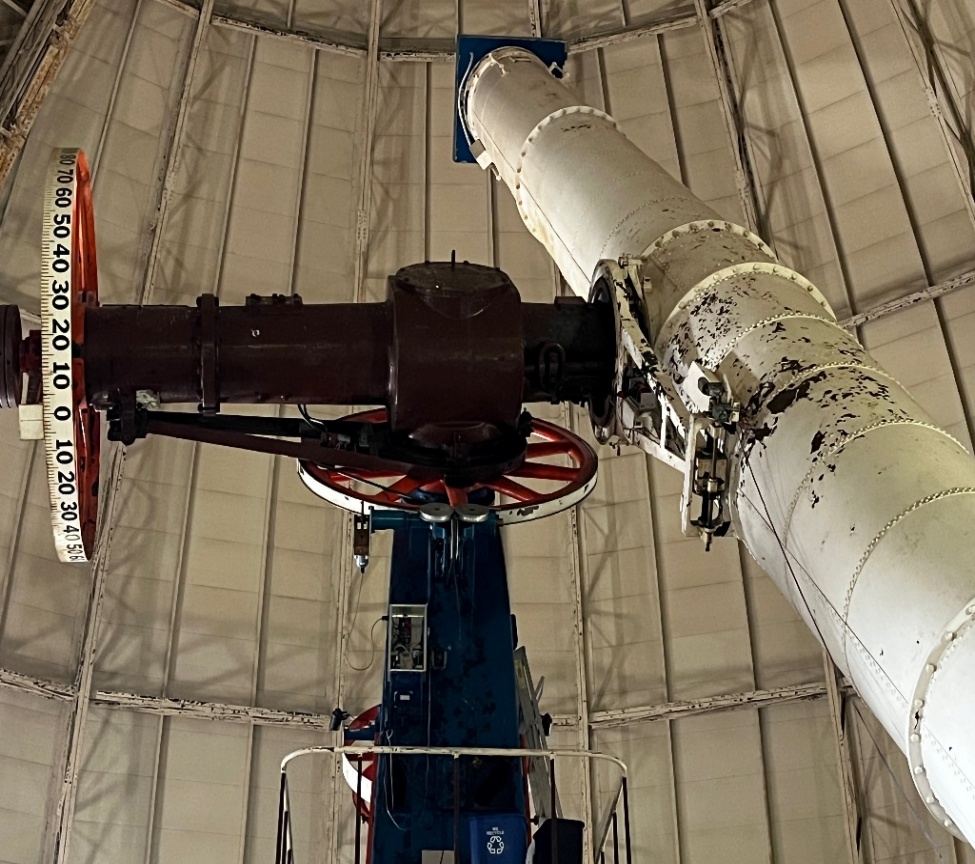
The difficulty of producing large disks of optical flint glass of suitable quality initially limited the size of achromatic telescopes. Despite these challenges, by 1866, refracting telescopes had reached 18 inches (46 cm) in aperture.
 https://upload.wikimedia.org/wikipedia/commons/a/a5/Yerkes_observatory_telescope.jpg
Attribution: Wickanninish, CC BY-SA 4.0 <https://creativecommons.org/licenses/by-sa/4.0>, via Wikimedia Commons
Used under the Creative Commons Attribution-Share Alike 4.0 International license
The late 19th century saw the emergence of increasingly large “Great Refractors”:
- Yerkes Observatory’s 40 inch refractor (1897) remains the largest successfully operated refracting telescope.
- A larger 49.2 inch (1.25 m) refractor was temporarily exhibited at the Paris 1900 Exposition.
- These instruments revealed new details of planetary surfaces and discovered numerous double stars.
The refractor reached its practical limit around this time due to the effects of gravity on large lenses – glass has inherent elasticity limits. No matter how perfect the glass composition, any large lens will deform under its own weight. Unlike mirrors, which can be supported across their entire back surface, lenses require light to pass through them, so they can only be supported around their edges. This creates an inherent structural weakness for large-diameter lenses.
The Rise of Modern Reflectors
Silver- on- Glass Revolution
All large reflectors suffered from the poor reflectivity and rapid tarnishing of speculum metal mirrors, requiring frequent removal and re-polishing that often changed the mirror’s curve. In 1856-57, Karl August von Steinheil and Léon Foucault introduced a process of depositing silver on glass telescope mirrors. The silver layer was more reflective and longer-lasting and could be removed and redeposited without altering the glass substrate’s shape. This innovation led to the construction of very large silver-on-glass reflecting telescopes by the end of the 19th century.
Early 20th Century Research Reflectors
The early 20th century saw the construction of the first modern large research reflectors, designed for precision photographic imaging and located at high-altitude sites with clear skies:
- The 60-inch Hale Telescope (1908) at Mount Wilson Observatory.
- The 100-inch (2.5 m) Hooker Telescope (1917), also at Mount Wilson, was used by Edwin Hubble to prove the existence of galaxies beyond the Milky Way.
These telescopes required provisions for removing their main mirrors every few months for resilvering. In 1932, John Donavan Strong, a physicist at Caltech, developed a technique for coating mirrors with much longer-lasting aluminium using thermal vacuum evaporation. By 1935, the major Mount Wilson telescopes had been “aluminised,” revolutionising mirror maintenance.
Mid-Century Giants
The 200-inch (5.1 m) Hale reflector at Mount Palomar was completed in 1948 and remained the world’s largest telescope until the 605 cm (238 in) BTA-6 in Russia was built 27 years later. The Hale reflector introduced several technical innovations used in future telescopes:
- Hydrostatic bearings for very low friction.
- The Serrurier truss for equal deflections of the two mirrors as the tube sags under gravity.
- The use of Pyrex low-expansion glass for the mirrors.
Between 1975 and 1985, numerous 4 metre class (160 inch) telescopes were built at superior high-altitude sites in Hawaii and the Chilean desert.
Modern Observatory Telescopes
Active and Adaptive Optics
The 1980s introduced two transformative technologies:
- Active optics: An image analyser senses aberrations in a star image several times per minute, and a computer adjusts support forces on the primary mirror and secondary mirror position. First pioneered by the ESO New Technology Telescope, this enables thin single mirrors up to 8 m diameter or larger segmented mirrors.
- Adaptive optics: Similar to active optics but operating hundreds of times per second to compensate for atmospheric turbulence. First envisioned by Horace W. Babcock in 1953, but not widely used until computer and detector advances in the 1990s made real-time calculations possible.
Giant Telescopes of the 1990s and Beyond
The 1990s saw a new generation of giant telescopes using active optics:
- Keck telescopes: Two 10 metre (390 inch) telescopes on Mauna Kea, Hawaii (1993/1996).
- Very Large Telescope (VLT): Array of four 8.2 metre telescopes in Chile.
- Gemini Observatory: Twin 8.1 metre telescopes in Hawaii and Chile.
- Subaru Telescope: 8.2 metre telescope in Hawaii.
Contemporary ground-based observatories feature massive reflectors with computer-controlled adaptive optics:
- Gran Telescopio Canarias: 10.4 telescope in Spain’s Canary Islands.
- Extremely Large Telescope (ELT): 39 telescope under construction by ESO.
- Thirty Meter Telescope (TMT): 30 metre telescope planned for Mauna Kea.
- Giant Magellan Telescope (GMT): 25 metre equivalent telescope under construction in Chile.
Beyond Visible Light: Multi: Wavelength Astronomy
The twentieth century saw the development of telescopes capable of producing images using wavelengths beyond visible light, vastly expanding our observational capabilities.
Radio Telescopes
Radio astronomy began in 1931 when Karl Guthe Jansky discovered that the Milky Way was a source of radio emission while researching terrestrial static with a directional antenna. Building on Jansky’s work, Grote Reber built a more sophisticated purpose-built radio telescope in 1937 with a 31.4 foot (9.6 metre) dish, discovering various unexplained radio sources in the sky.
Interest in radio astronomy grew after World War II, leading to the construction of progressively larger instruments:
- The 250 foot (76 metre) Jodrell Bank telescope (1957).
- The 300 foot (91 metre) Green Bank Telescope (1962).
- The 1,000 foot (300 metre) Arecibo telescope (1963).
- The 100 metre (330 foot) Effelsberg telescope (1971).
Not all radio telescopes use dish designs. The Mills Cross Telescope (1954) pioneered the array approach with two perpendicular 1,500 foot (460 metre) lines of antennae.
The discovery of cosmic microwave background radiation in 1964 highlighted the importance of microwave astronomy. The Cosmic Background Explorer satellite (1989) revolutionised this field.
Radio telescopes pioneered interferometry techniques, allowing multiple widely separated instruments to observe simultaneously for improved resolution. Very Long Baseline Interferometry extended this technique over thousands of kilometres, achieving resolutions of a few milli-arcseconds.
Infrared Telescopes
Infrared astronomy at certain wavelengths can be conducted from high mountains with little absorption by atmospheric water vapour. Many optical telescopes at high altitudes also image in infrared wavelengths.
Some telescopes are dedicated to infrared observations, such as the 3.8 metre (150 in) UKIRT and the 3 metre (120 in) IRTF on Mauna Kea. The IRAS satellite, launched in 1983, revolutionised space-based infrared astronomy, operating for nine months until its liquid helium coolant was depleted. It surveyed the entire sky and detected 245,000 infrared sources – more than 100 times the number previously known.
Ultraviolet Telescopes
While optical telescopes can image the near ultraviolet, the ozone layer blocks shorter wavelengths, necessitating space-based observation. Ultraviolet telescopes use specialised coatings, such as magnesium fluoride or lithium fluoride, instead of conventional aluminium mirrors.
The Orbiting Solar Observatory conducted ultraviolet observations as early as 1962. The International Ultraviolet Explorer (1978) systematically surveyed the sky for eighteen years with a 45-centimetre (18 in) aperture telescope equipped with two spectroscopes. The Extreme Ultraviolet Explorer (1992) specialised in the 10 to 100 nm wavelength range.

Engineering model of the Advanced Orbiting Solar Observatory
Attribution: GeneralNotability, CC BY-SA 4.0 <https://creativecommons.org/licenses/by-sa/4.0>, via Wikimedia Commons
This file is licensed under the Creative Commons Attribution-Share Alike 4.0 International licence.
The Orbiting Solar Observatory (OSO) Program consisted of a series of American space telescopes, launched by NASA between 1962 and 1975, to study the Sun, particularly focusing on the 11-year sunspot cycle in UV and X-ray spectra. This study was crucial for understanding the solar dynamics that influence space weather affecting Earth. Eight OSOs were successfully placed into low Earth orbit using Delta rockets, and they also carried out significant non-solar experiments.
Each satellite featured a distinctive design with two main sections: the ‘Wheel,’ a rotating part that provided gyroscopic stability, and the ‘Sail,’ which was electrically driven in opposition to the Wheel’s rotation and stabilised to point continuously at the Sun.
The Sail housed solar instruments and the solar photovoltaic cells that powered the spacecraft. A critical component of the OSO design was the bearing between the Wheel and the Sail, which facilitated the transfer of power and data while operating smoothly for extended periods in the hard vacuum of space without conventional lubrication.
In addition to solar observations, the Wheel section contained additional science instruments that scanned the sky and across the Sun every few seconds, contributing to a broader understanding of the celestial environment.
The OSO program advanced both the technology of space-based solar observation and also laid the groundwork for subsequent solar missions, enhancing our ability to forecast solar activity and its effects on Earth.
X-ray Telescopes
X-rays from space cannot penetrate Earth’s atmosphere, so space-based observation platforms are required. The first X-ray detections from space occurred on suborbital rocket flights, identifying X-rays from the Sun (1948) and later from galactic sources, such as Scorpius X-1 and the Crab Nebula (1962). Modern X-ray telescopes (Wolter telescopes) use nested grazing incidence mirrors to deflect X-rays to detectors. Key X-ray observatories include:
- Uhuru (1970), which discovered 300 sources.
- EXOSAT (1983).
- ROSAT (1990).
- Chandra and XMM: Newton (both 1999).
Gamma-ray Telescopes
Gamma rays are also[19] absorbed by Earth’s atmosphere and primarily observed with satellites. Gamma-ray telescopes use scintillation counters, spark chambers, and, more recently, solid-state detectors, although angular resolution is typically poor.
Early observations came from balloon experiments in the 1960s, with the first satellite detection by OSO 3 in 1967. Dedicated gamma-ray satellites include SAS B (1972), Cos B (1975), the Compton Gamma Ray Observatory (1991), INTEGRAL (2002), Swift (2004), and the Fermi Gamma-ray Space Telescope (2008). These instruments have detected gamma-ray bursts, active galactic nuclei, gamma-ray emissions from pulsars, and other high-energy phenomena. Modern gamma-ray telescopes use advanced detection technologies like coded aperture masks[20] and Compton scattering techniques[21] to improve imaging capabilities, though their angular resolution remains lower than telescopes operating at longer wavelengths.
Applications and Scientific Contributions
Astronomical Applications
Telescopes have enabled numerous breakthroughs in our understanding of the cosmos, such as:
- Observing planets, moons, stars, galaxies, and other celestial objects.
- Discovering new astronomical bodies (exoplanets, asteroids, etc.).
- Studying cosmic phenomena (supernovae, black holes, etc.).
- Mapping the universe and understanding its structure.
- Tracking potentially hazardous near-Earth objects.
Terrestrial Applications
Beyond astronomy, telescopes serve various practical purposes:
- Wildlife observation and research.
- Surveillance and security.
- Navigation.
- Land surveying.
- Bird watching and nature observation.
Scientific Research Techniques
Telescopes support diverse research methodologies:
- Spectroscopy (analysing light to determine chemical composition).
- Measuring stellar distances and movements.
- Testing theories of physics (like Einstein’s General Relativity).
- Studying cosmic background radiation.
- Searching for signs of extraterrestrial life.
Sociocultural Impact
The telescope has had profound effects beyond scientific discovery:
- Challenging religious and philosophical beliefs about Earth’s centrality in the cosmos.
- Inspiring artistic and literary works exploring humanity’s place in the universe.
- Democratising astronomy through amateur telescope making and stargazing.
- Fostering international cooperation through large-scale observatory projects.
Future Directions in Telescope Technology
Extremely Large Telescope (ELT)
The European Southern Observatory’s 39 metre telescope will collect 100 million times more light than the human eye, making it four times larger than any existing optical telescope. Other features include:
- Current Progress: As of early 2025, construction of the ELT has reached approximately 50% completion. The project has faced challenges, including delays caused by the COVID-19 pandemic, but progress has resumed.
- Key Innovations: The ELT will use adaptive optics to counteract atmospheric distortion, providing images 16 times sharper than the Hubble Space Telescope.
- Scientific Goals: It aims to revolutionise exoplanet research, directly imaging Earth-like planets in habitable zones and analysing their atmospheres for signs of life. It will also study dark matter, dark energy, and the formation of the first galaxies.
- Projected Timeline: The first scientific observations are expected by 2028, with full operations beginning in the 2030s.
Space-based Interferometry
Interferometry is a technique that combines light from multiple telescopes to simulate a much larger telescope, increasing resolution dramatically. While this technique has been successfully implemented in radio astronomy (for example, the Event Horizon Telescope, which captured the first image of a black hole in 2019), future advancements will expand its use in space-based telescopes:
- Why Space? Earth’s atmosphere distorts light, limiting how finely we can resolve distant objects. Placing interferometers in space eliminates this issue.
- Proposed Projects:
- LISA (Laser Interferometer Space Antenna): A space-based gravitational wave observatory set to launch in the 2030s, using three spacecraft separated by 2.5 million km to detect low-frequency gravitational waves.
- NASA’s proposed “Hypertelescope”: A flotilla of small telescopes in space, working together to achieve extremely high-resolution imaging of exoplanets.
- The James Webb successor: Future space telescopes may incorporate multiple mirrors working in tandem, vastly increasing the ability to study faint, distant objects.
- Combining light from multiple telescopes to achieve resolution equivalent to much larger telescopes.
Gravitational Wave Observatories
Gravitational wave astronomy, first confirmed with LIGO’s discovery in 2015, has opened a new way to study cosmic events such as black hole mergers, neutron star collisions, and even early universe phenomena. Future observatories will increase sensitivity and detection range, allowing us to observe more distant and weaker signals:
- LISA (Laser Interferometer Space Antenna): Instead of detecting ground-based ripples, LISA will be positioned in space, able to detect much lower frequency waves from supermassive black hole mergers and primordial gravitational waves from the Big Bang.
- Einstein Telescope (ET): A proposed next-generation ground-based gravitational wave detector, expected to be ten times more sensitive than LIGO[22] and Virgo[23]. Planned for operation in the 2030s, it will enable continuous gravitational wave observation.

A schematic diagram of a laser interferometer.
Attribution: Ligo.gif: The original uploader was MOBle at English Wikipedia.derivative work: Malyszkzlanguage-switch: RothwildChinese: YinweichenGerman: MfbMacedonian: B. JankuloskiRussian: ЭээPolish: MbejgerUkrainian: Kirsim, Public domain, via Wikimedia Commons
This file is licensed under the Creative Commons Attribution-Share Alike 4.0 International licence.
Neutrino Telescopes
Observing neutrino particles[24] to study high-energy cosmic events. Neutrinos are nearly massless, chargeless particles that interact extremely weakly with matter, making them difficult to detect but invaluable for studying high-energy cosmic events. Unlike optical telescopes, neutrino observatories can “see” through dust clouds and distant cosmic environments, revealing insights into supernovae, gamma-ray bursts, and the mysterious origins of cosmic rays:
- IceCube Neutrino Observatory (Antarctica): Currently the largest neutrino telescope, IceCube detects neutrinos by observing Cherenkov radiation[25] produced when neutrinos interact with the ice deep below the Antarctic surface.
- KM3NeT (Mediterranean Neutrino Telescope): A next-generation deep-sea neutrino observatory, KM3NeT will monitor neutrino interactions in the ocean, probing the most extreme astrophysical sources.
- Proposed Future Developments:
- Larger neutrino observatories in space or moon-based detectors.
- More sensitive detection methods for dark matter neutrino interactions.
- Joint observations with gravitational wave detectors to study multi-messenger astrophysics, combining signals from different cosmic messengers (light, gravitational waves, and neutrinos).
The Telescope: Applications Beyond the Stars
Quick Overview
- Microscopy and Optical Instruments: The principles of the telescope were adapted to create microscopes, allowing scientists to observe tiny, microscopic organisms and structures. This laid the groundwork for advancements in biology, medicine, and materials science.
- Surveillance and Security: Telescopic technology is widely used in security and defense, such as in binoculars, spotting scopes, and sniper scopes, providing long-range observation capabilities.
- Marine and Naval Navigation: Telescopes have been integral in navigation, enabling sailors to spot distant land, ships, or hazards on the horizon, ensuring safer sea journeys.
- Geographic Exploration and Land Surveying: Surveying tools like theodolites, which are used for land mapping and construction, rely on telescopic technology for accurate angle measurements.
- Communication Systems: Telescopic principles contributed to the development of optical systems in fiber optics and satellite communication, enhancing long-distance data transmission.
- Amateur and Professional Photography: Telephoto lenses in cameras allow photographers to capture distant subjects in great detail, leveraging concepts from telescope optics.
- Cinematography and Entertainment: Modern telescopic technology influences high-quality zoom lenses used in filming, aiding in capturing stunning long-range shots.
- Space Exploration and Observatories: Advanced telescopes like the Hubble Space Telescope or the James Webb Space Telescope are crucial for studying the universe beyond Earth’s atmosphere, including exoplanets, galaxies, and cosmic phenomena.
- Medical Applications: Telescopic systems are used in endoscopes and surgical equipment, enabling minimally invasive procedures by visualising internal organs.
- Amateur Hobbies: Telescopes have become a staple for amateur astronomers and birdwatchers, fostering hobbies that involve observing celestial objects or wildlife.
The telescope was first documented in the Netherlands around 1608 and subsequently refined by Galileo Galilei in 1609. It has revolutionised our understanding of the cosmos and has since permeated numerous fields of science, technology, and everyday life. This section of my paper considers how this revolutionary optical instrument has moved from its original purpose to transform countless aspects of human endeavour. Each of these adaptations builds upon the core principles of lenses, mirrors, and light refraction.
Historical Context
Before examining modern applications, it’s worth reminding ourselves about the telescope’s journey from a rudimentary spyglass to sophisticated optical systems:
1608: Hans Lippershey, a Dutch eyeglass maker, applied for the first telescope patent.
1609: Galileo improved the design and turned it skyward, revolutionising astronomy.
1668: Isaac Newton invented the reflecting telescope, using mirrors instead of lenses.
1733: Chester Moore Hall invented the achromatic lens, reducing colour aberration.
1931: Karl Jansky invented the radio telescope, extending observation beyond visible light.
1990: The Hubble Space Telescope was launched, beginning the era of space-based telescopes.
This evolution of telescopic technology has continuously expanded its potential applications, creating a ripple effect across numerous disciplines.
Astronomical Applications
Space Exploration and Observatories
- Space-Based Telescopes: Instruments like the Hubble Space Telescope (HST), James Webb Space Telescope (JWST), and Chandra X-ray Observatory operate above Earth’s atmosphere, eliminating atmospheric distortion.
- The HST has made over 1.5 million observations and generated 169 terabytes of data since 1990.
- The JWST can observe objects that are up to 100 times fainter than Hubble, peering back to the earliest stages of the universe.
- Ground-Based Observatories: Facilities like the Very Large Telescope (VLT), Keck Observatory, and the upcoming Extremely Large Telescope (ELT) push the boundaries of ground-based observation.
- The ELT’s primary mirror will span 39 metres, collecting 13 times more light than the largest existing optical telescopes

Artist’s impression of the Extremely Large Telescope
Attribution: Swinburne Astronomy Productions/ESO, CC BY 4.0 <https://creativecommons.org/licenses/by/4.0>, via Wikimedia Commons
This file is licensed under the Creative Commons Attribution-Share Alike 4.0 International licence.
- The ELT’s primary mirror will span 39 metres, collecting 13 times more light than the largest existing optical telescopes
- Radio Astronomy: Arrays like the Very Large Array (VLA) and the Square Kilometre Array (SKA) detect radio waves from celestial objects, revealing phenomena invisible in other wavelengths.
- Multi-Messenger Astronomy: Modern observatories coordinate observations across the electromagnetic spectrum and with gravitational wave detectors to provide comprehensive data on cosmic events.
Scientific Applications
Microscopy and Optical Instruments
- Telescope-Microscope Relationship: Both microscopy and optical instruments share core optical principles, but focus on opposite scales. Antoni van Leeuwenhoek, a Dutch microbiologist, was inspired by telescopes and developed early microscopes in the 17th century.
- Confocal Microscopy: Used telescopic focusing principles to create high-resolution images of specimens.
- Scanning Electron Microscopes: While using electrons instead of light, these incorporate telescopic principles for focusing and magnification.
- Super-Resolution Microscopy: Advanced techniques like STED (Stimulated Emission Depletion) microscopy overcome traditional optical limitations, allowing the visualisation of structures as small as 20 nanometers.
- X-ray Crystallography: Uses telescopic focusing principles to analyse molecular and atomic structures.
Environmental Monitoring
- Climate Research: Specialised telescopes monitor atmospheric conditions, track pollution dispersion, and measure changes in environmental parameters.
- Forest Fire Detection: Early warning systems employ telescopic infrared sensors to detect forest fires before they spread extensively.
- Wildlife Conservation: Telescope-equipped drones and observation posts monitor endangered species without human intrusion.
- Glacier and Ice Sheet Monitoring: Specialised telescopes track changes in polar regions, providing critical data on climate change.
- Ocean Observation: Telescopic systems monitor ocean currents, temperatures, and marine ecosystem health from satellites and coastal stations.
Geological Applications
- Volcanic Activity Monitoring: Specialised telescopes observe volcanic activity from safe distances, tracking thermal signatures and gas emissions.
- Landslide Prediction: Ground-based radar telescopes monitor minute movements in unstable terrain.
- Seismic Research: Telescopic instruments help in identifying and monitoring geological fault lines and tectonic activity.
- Mining and Resource Exploration: Hyperspectral telescopic imaging identifies mineral deposits and natural resources from aircraft or satellites.
Military and Security Applications
Defence and Intelligence
- Reconnaissance Systems: Military satellites with telescopic cameras provide high-resolution imagery for intelligence purposes. Modern spy satellites can reportedly resolve objects as small as 10 centimetres from hundreds of kilometres in orbit.
- Missile Defence: Tracking systems use telescopic technology to detect and target incoming projectiles.
- Border Surveillance: Long-range observation systems monitor borders and sensitive installations.
- Counter Terrorism: Specialised telescopic equipment enables observation of potential threats from safe distances.
- Night Vision Technology: Many night vision devices incorporate telescopic principles combined with light amplification.
Surveillance and Security
- Law Enforcement: Police use telescopic equipment for observation during operations and stakeouts.
- Critical Infrastructure Protection: Telescopic cameras monitor dams, power plants, and other vital facilities.
- Traffic Monitoring: Motorway and traffic management systems use telescopic cameras to observe traffic flow and detect incidents.
- Search and Rescue: Telescopic thermal imaging helps locate missing persons in wilderness areas or disaster zones.
- Corporate Security: Businesses use telescopic surveillance systems to protect facilities and monitor perimeters.
Navigation and Transportation
Marine and Naval Navigation
- Maritime Safety: Telescopic rangefinders determine distances to other vessels and potential hazards.
- Lighthouse Operations: Historical use of telescopes by lighthouse keepers to spot ships in distress.
- Modern Bridge Equipment: Advanced telescopic systems with digital enhancement aid captains in navigation.
- Port Security: Telescopic systems monitor shipping channels and port approaches.
- Collision Avoidance: Integrated systems combining radar and telescopic imaging prevent maritime accidents.
Aviation and Aerospace
- Air Traffic Control: Long-range optical systems supplement radar for visual confirmation of aircraft.
- Runway Monitoring: Telescopic cameras observe runways for debris or unauthorised access.
- Pilot Training: Telescope-based simulators create realistic visual environments for training.
- Aircraft Inspection: Telescopic borescopes inspect aircraft engines and components without disassembly.
- Space Debris Tracking: Specialised telescopes monitor orbital debris that could threaten satellites or spacecraft.
Geographic Applications
- Cartography and Surveying: Theodolites and total stations incorporate telescopic sights for precise angle measurements. Modern digital theodolites can measure angles with precision better than 0.5 arc- seconds (about 1/7200 of a degree).
- Land Management: Telescopic systems assist in boundary determination and property surveying.
- Urban Planning: Aerial telescopic imaging helps city planners design infrastructure and monitor development.
- Archaeology: Telescopic instruments aid in site surveys and artefact documentation.
- Geographic Information Systems (GIS): Telescopically obtained imagery forms the basis for many mapping applications.
Motoring Technologies
- Adaptive Cruise Control Sensors: Precise distance and speed measurement technologies.
- Autonomous Vehicle Sensing: Advanced optical systems provide critical environmental perception for self-driving vehicles.
- Collision Avoidance: Telescopic and optical sensors detect potential collision risks.
- Infrared and Thermal Imaging: Detecting objects in low-visibility conditions.
- Lane Departure Warning: Optical systems track vehicle position relative to road markings.
- LiDAR (Light Detection and Ranging) Systems: 3D mapping technologies using laser-based optical scanning.
- Pedestrian Detection: Advanced imaging systems identify and track human movement.
- Stereoscopic Camera Systems: Multiple cameras creating depth perception similar to human binocular vision.
Optical Diagnostics
- Engine Inspection: Telescopic borescopes allow internal engine component examination without disassembly.
- Manufacturing Quality Control: High precision optical systems inspect vehicle components during production.
- Advanced Alignment and Calibration: Optical measurement systems ensure precise vehicle geometry.
Future Automotive Optical Technologies
- AI Enhanced Vision Systems: Machine learning improves object recognition and environmental interpretation.
- Augmented Reality Windscreens: Projecting navigation and safety information using advanced optical technologies.
- Adaptive Lighting Systems: Smart headlights that adjust beam patterns based on driving conditions.
Communication Technology
Telecommunications
- Free Space Optical Communication: Telescopic technology systems transmit data via light beams between buildings or satellites. These systems can achieve data rates exceeding 10 Gbps over several kilometres.
- Laser Communication: Telescopic optics focus laser beams for high-bandwidth, secure communications.
- Satellite Communications: Ground stations use telescope-based systems to communicate with satellites.
- Deep Space Communication: NASA’s Deep Space Network uses large telescope-like antennas to communicate with distant spacecraft.
- Optical Fibre Development: Telescope principles influenced the development of fibre optic communication technology.
Media and Entertainment
Photography and Imaging
- Telephoto Lenses: Camera lenses based on telescopic principles bring distant subjects into the frame. Modern super-telephoto lenses can exceed 800mm focal length, equivalent to 16× magnification.
- Sports Photography: Specialised telescopic lenses capture action from stadium sidelines.
- Wildlife Photography: Long-range lenses allow observation without disturbing natural behaviour.
- Astrophotography: Dedicated telescopes and camera adaptors capture stunning images of celestial objects.
- Portrait Photography: Telephoto lenses create flattering perspective compression for portraits.
Cinematography and Film
- Zoom Lenses: Cinema cameras use variable focal length lenses based on telescopic principles.
- Aerial Cinematography: Telescopic systems on drones and helicopters capture sweeping landscape shots.
- Nature Documentaries: Long-range lenses capture intimate wildlife behaviour from non-intrusive distances.
- Sports Broadcasting: Telescopic camera systems bring viewers close to the action.
- Special Effects: Telescopic principles influence specialised cinematography techniques like miniature photography.
Live Event Coverage
- Sports Events: Telescopic broadcast cameras provide close-ups of athletes and action.
- Concert Videography: Long-range lenses capture performer expressions from the back of venues.
- Political Coverage: News agencies use telescopic lenses to document public appearances and events.
- Wildlife Observation: Nature reserves offer telescopic viewing stations for visitors.
- Astronomy Outreach: Public observatories provide telescopic views of celestial objects to visitors.
Medical Applications
Clinical Medicine
- Surgical Telescopes: Operating microscopes use telescopic principles for precise visualisation during surgery.
- Ophthalmology: Specialised telescopic instruments examine eye structures and diagnose conditions. Slit lamps combine microscope and telescopic elements to examine the anterior segment of the eye.
- Endoscopy: Flexible and rigid endoscopes incorporate telescopic optics for minimally invasive procedures.
- Dermatology: Dermatoscopes use telescopic magnification to examine skin lesions and conditions.
- ENT (Ear, Nose, Throat): Specialised telescopic instruments allow examination of these difficult-to-access areas.
Assistive Technology
- Low Vision Aids: Telescopic glasses help individuals with visual impairments read and navigate.
- Surgical Loupes: Surgeons use telescopic eyewear for magnification during procedures.
- Dental Telescopes: Dentists use telescopic loupes for precision work.
- Prosthetic Development: Telescopic principles inform the design of certain prosthetic eyes and vision aids.
- Rehabilitation Tools: Specialised telescopic devices assist in physical and occupational therapy.
Consumer and Recreational Applications
Sports and Recreation
- Binoculars/Monoculars: Compact telescopes for sporting events, concerts, and general observation.
- Spotting Scopes: Portable telescopes for target shooting, hunting, and nature observation.
- Rangefinders: Golf and hunting rangefinders use telescopic optics to determine distances.
- Rifle Scopes: Telescopic sights provide magnification and precision aiming for shooting sports.
- Bird Watching: Specialised telescopes and binoculars optimise for avian observation.
Hobbyist Astronomy
- Amateur Telescopes: Range from simple refractors to sophisticated computerised models.
- Star Parties(or similar names): Community gatherings where enthusiasts share telescopic views of celestial objects.
- Citizen Science: Amateur astronomers with telescopes contribute to scientific research.
- Astrophotography: Hobbyists capture stunning images of celestial objects using specialised telescopes.
- Educational Outreach: Schools and community groups use telescopes for science education.
Home Security
- Doorbell Cameras: Modern video doorbells incorporate wide-angle telescopic lenses.
- Home Surveillance: Consumer security cameras use telescopic principles for zooming capabilities.
- Baby Monitors: Advanced monitors use telescopic lenses for detailed viewing.
- Pet Cameras: Specialised cameras with zoom functions monitor pets while owners are away from home.
- Property Monitoring: Long-range security cameras observe larger properties and approaches.
Industrial Applications
Manufacturing and Quality Control
- Industrial Inspection: Telescopic systems examine products for defects on production lines.
- Precision Machining: Telescopic measuring devices ensure component accuracy.
- Remote Monitoring: Telescopic cameras observe dangerous industrial processes from safe distances.
- Semiconductor Fabrication: High-precision telescopic systems inspect microchips and circuit boards.
- Automotive Manufacturing: Specialised telescopic systems check vehicle assembly and components.
Energy Sector
- Power Line Inspection: Telescopic systems, helicopter or drone-mounted to inspect transmission lines.
- Solar Panel Arrays: Telescopic thermal imaging identifies malfunctioning panels in large solar farms.
- Wind Turbine Maintenance: Telescopic systems inspect turbine blades and components from the ground.
- Oil and Gas Infrastructure: Telescopic cameras monitor pipelines and offshore platforms.
- Nuclear Facilities: Remote telescopic monitoring systems observe reactor components and radioactive areas.
Agriculture and Forestry
- Precision Agriculture: Drone-mounted telescopic systems monitor crop health and growth.
- Irrigation Management: Thermal telescopic imaging detects areas of water stress in crops.
- Livestock Monitoring: Long-range observation systems track herd health and movement.
- Forestry Management: Telescopic systems assess forest health and monitor logging operations.
- Pest Detection: Specialised telescopic imaging identifies pest infestations before visible damage occurs.
Future Developments
Emerging Technologies
- Quantum Telescopes: Theoretical systems using quantum entanglement could surpass classical limitations.
- Gravitational Lensing Telescopes: Using massive objects like stars as natural “lenses” to observe extremely distant objects.
- Neural-Enhanced Telescopes: AI systems that process and enhance telescopic data in real time.
- Neutrino Telescopes: Detecting neutrino particles to observe phenomena invisible to conventional telescopes.
- Metamaterial Superlenses: Theoretical lenses that could overcome the diffraction limit using engineered materials.
Space-Based Applications
- Asteroid Mining Reconnaissance: Telescopic systems will identify and characterise valuable asteroids.
- Planetary Defence: Networks of telescopes monitor potential Earth-impacting objects.
- Interstellar Probe Navigation: Future interstellar missions will rely on telescopic systems for navigation.
- Space Debris Remediation: Telescopic tracking systems will guide the cleanup of orbital debris.
- Extraterrestrial Colonisation Support: Telescopic systems will aid in mapping and monitoring potential settlement sites.
Educational Impact
Science Education
- STEM Programs: School telescope programs inspire students to pursue science careers.
- Online Observatories: Remote telescopes allow students worldwide to conduct astronomical observations.
- Science Centres: Public telescopes in museums and science centres provide hands-on learning.
- Citizen Science Initiatives: Projects like Galaxy Zoo and SETI@home[26] engaged the public in telescope-based research.
- Astronomy Clubs: Community organisations promote telescopic observation and education.

SETI@home custom background and logo screensaver
Attribution: Al Piskun, CC BY-SA 4.0 <https://creativecommons.org/licenses/by-sa/4.0>, via Wikimedia Commons
This file is licensed under the Creative Commons Attribution-Share Alike 4.0 International licence.
To activate the screensaver link, click HERE
Concluding Words
The telescope, originally a simple combination of lenses developed to observe distant objects more clearly, has evolved into one of humanity’s most transformative technologies. Its principles have been adapted to peer into the furthest reaches of the universe and the tiniest structures of matter. From revolutionising our understanding of the cosmos to enabling modern telecommunications, from enhancing security to advancing medicine, the influence of telescopic technology pervades modern civilisation.
As telescope technology continues to advance, we are on the brink of discoveries that could reshape our understanding of the universe. From Earth-based giants like the ELT to space observatories detecting gravitational waves and exoplanet atmospheres, each innovation brings us closer to answering fundamental questions about our origins and our place in the cosmos. These breakthroughs set the stage for the next great era of astronomical exploration, which may redefine what we know about life beyond Earth and the nature of the universe itself. From Galileo’s simple instrument to the massive observatories of today, telescopes have expanded our understanding of the universe dramatically since their invention over 400 years ago. They have revealed that Earth is just a tiny part of an immense and complex cosmos, fundamentally transforming our comprehension of reality and our place within it. The continuing evolution of telescope technology promises to unveil ever more profound insights into the nature of the universe.
The future of telescope technology is set to revolutionise astronomy, enabling us to peer deeper into the universe than ever before. With the ELT unlocking visible and infrared observations, interferometry expanding spatial resolution, and gravitational wave and neutrino telescopes offering new cosmic perspectives, we are entering a golden age of discovery.
These advancements could ultimately answer some of the biggest questions in science: Are we alone in the universe? What happened moments after the Big Bang? How do galaxies and black holes evolve? By the mid-to-late 21st century, telescopes may image exoplanets in detail, detect biosignatures on distant worlds, and map the cosmic web of dark matter and energy—forever reshaping our place in the cosmos.
Appendix 1: Citizen Science and Collaborative Astronomy
The 21st century has witnessed a remarkable convergence of professional and amateur astronomical research through citizen science initiatives spanning the globe. While the American Association of Variable Star Observers (AAVSO) has a long history dating back to 1911, Europe and the UK have developed equally robust collaborative astronomy networks.
In the UK, organisations like the British Astronomical Association (BAA), founded in 1890, coordinate thousands of amateur observers across more than a dozen specialised observing sections. The BAA’s meticulous records of planetary, lunar, and variable star observations represent one of the longest continuous datasets in astronomy. Their Pro-Am collaborations with institutions like University College London and the Royal Observatory Greenwich have yielded numerous publications in peer-reviewed journals.
The European space community has been particularly innovative in citizen science development. The European Space Agency’s Gaia mission involves thousands of volunteers through projects like Gaia Alerts, where amateurs follow up on transient events identified by the spacecraft. Similarly, Zooniverse, originally founded at Oxford University, today hosts dozens of astronomy projects where participants analyse data from advanced telescopes, with European projects studying everything from solar storms to gravitational lenses.
National astronomy societies across Europe make significant contributions. The Société Astronomique de France coordinates extensive amateur networks, while Germany’s Vereinigung der Sternfreunde connects over 4,000 amateur astronomers in collaborative research. Organisations like EAAE (European Association for Astronomy Education) bridge educational and research communities across the continent.
Remote telescope networks have flourished in Europe as well. The GLORIA project (GLObal Robotic: telescopes Intelligent Array), led by Universidad Politécnica de Madrid, connects robotic telescopes across four continents with a focus on European facilities. The Bradford Robotic Telescope and the Open University’s PIRATE facility have pioneered remote telescope access for both education and research in the UK.
These international networks highlight how modern astronomy transcends national boundaries, with data and discoveries flowing freely between professional and amateur communities worldwide. Whether through the Faulkes Telescope Project based in the UK, which gives students access to research-grade telescopes in Hawaii and Australia, or pan-European initiatives like EU-HOU (Hands On Universe, Europe), collaborative astronomy creates pathways for public participation in cutting-edge science.
Astronomy Education and Inclusive Outreach
Telescope technology and astronomical knowledge have become increasingly accessible through targeted educational programs designed for all ages, creating pathways for lifelong engagement with the cosmos.
School-Based Astronomy Initiatives
In schools across Europe, programs like EU-HOU (Hands-On Universe) provide teachers with curriculum resources and access to remote telescope networks. The UK’s National Schools’ Observatory, operated by Liverpool John Moores University, gives students controlled access to the 2 metre Liverpool Telescope in the Canary Islands, with over 3,000 schools participating. Students can request observations and analyse real astronomical data, often contributing to actual research projects.
The European Space Education Resource Office (ESERO), a collaboration between ESA and national partners, operates in 18 European countries. Their “Space for UK” and similar country-specific programs train primary and secondary teachers to use space themes in STEM education, reaching hundreds of thousands of students annually. These initiatives often include telescope workshops and classroom planetariums.
Germany’s Haus der Astronomie (House of Astronomy) in Heidelberg runs programs connecting school students directly with Max Planck Institute researchers, while France’s AstroJeunes network links schools with local astronomical societies. Italy’s successful Telescopi in Rete (Telescopes Network) connects classrooms with multiple observatory facilities.
Inclusive Astronomy for Older Learners
For adult and senior learners, universities across Europe have developed innovative astronomy engagement programs. The University of the Third Age (U3A) movement, particularly strong in the UK and France, includes dedicated astronomy groups where retirees learn observational techniques and telescope operation. Many U3A astronomy sections maintain their own community observatories.
The Open University’s OpenSTEM Labs provide remote access to telescopes and astronomical equipment for distance learners of all ages. Similar initiatives like Spain’s Universidad Nacional de Educación a Distancia (UNED) astronomy programs enable lifelong learning regardless of location or mobility.
Public observatories have developed specialised programs for older enthusiasts. The Royal Observatory Greenwich runs “Silver Stargazing” events designed for senior visitors, while Germany’s Stiftung Planetarium Berlin offers “Astronomy 60+” courses. These programs recognise that astronomy interest often peaks later in life when people have more leisure time for nighttime observation and complex learning.
Accessible Astronomy Initiatives
Significant efforts have been made to make astronomy accessible to people with disabilities. The Tactile Universe project, developed at the University of Portsmouth, creates 3D-printed models of galaxies that allow visually impaired students to “see” astronomical structures through touch. Similar initiatives include the “Meeting Venus” program at Vienna’s Natural History Museum, which developed multi-sensory astronomy experiences.
For those with mobility limitations, remote telescope programs like the Sierra Stars Observatory Network and iTelescope provide web-based access to research-grade instruments. The European Astronomical Society’s working group on Equity, Diversity, and Inclusion has developed best practices for making star parties and public viewing events accessible to wheelchair users and those with other mobility needs.
These diverse educational initiatives demonstrate how modern telescope technology can be leveraged to inspire scientific interest across generations, creating multiple entry points to astronomy regardless of age, location, or physical ability. From classroom robotic telescopes to senior citizen star parties, the democratisation of astronomical observation continues to expand in ever more inclusive directions.
Appendix 2: Amateur Astronomy Revolution
The democratisation of telescope technology has been one of the most significant developments in modern astronomy. In the 1960s, John Dobson, an amateur astronomer and former monk, revolutionised accessible astronomy by developing what became known as the Dobsonian telescope. This design combined a simple alt-azimuth mounting system with a Newtonian optical tube, allowing for large-aperture telescopes that were both affordable and portable.
Dobson’s innovation emerged from necessity during his tenure with the San Francisco Sidewalk Astronomers, which he co-founded in 1967. Working with limited resources, he pioneered using porthole glass and concrete forming tubes to create telescopes with apertures of 12 to 24 inches at a fraction of commercial costs. His design principles – simplicity, affordability, and portability – directly challenged the prevailing notion that serious astronomy required complex, expensive equipment.
US Perspective
By the mid-1970s, Dobson’s designs began appearing in amateur astronomy publications like Sky & Telescope. Companies such as Coulter Optical commercialised the concept, with their 13.1 inch “Odyssey” Dobsonian selling for under $400 in the early 1980s, which was approximately one-fifth the cost of equivalent aperture telescopes on traditional mounts. This price breakthrough coincided with the publication of popular amateur telescope-making guides like Richard Berry’s “Build Your Own Telescope” (1985) and Albert Ingalls’ updated “Amateur Telescope Making” series.
The impact was transformative. Amateur astronomers who once struggled to afford even modest 6-inch telescopes could now access instruments capable of viewing detailed planetary features, thousands of deep-sky objects, and even extragalactic phenomena. The Riverside Telescope Makers Conference and similar gatherings saw a surge in massive amateur-built Dobsonians, some exceeding 30 inches in aperture. David Kriege’s Obsession Telescopes, founded in 1989, pushed commercial Dobsonians to even larger apertures with premium materials and features while maintaining relative affordability.
The amateur revolution extended beyond hardware to observation techniques. Stephen O’Meara demonstrated that visual observers using modest equipment could discover details previously thought to require photography, while amateurs like David Levy (co-discoverer of Comet Shoemaker-Levy 9) showed that backyard astronomers could make significant scientific contributions. Organisations like the International Occultation Timing Association coordinated amateur observers to refine asteroid orbits and shapes through the precise timing of stellar occultations.
The digital revolution of the 1990s and 2000s further transformed amateur astronomy. Introducing affordable CCD cameras and later CMOS technology put digital imaging capabilities in amateur hands. Amateur astrophotographers like Robert Gendler and Adam Block began producing images rivalling professional observatories of previous decades. The development of sophisticated image stacking software like RegiStax allowed amateurs to achieve unprecedented planetary detail, while programs like PixInsight brought professional-grade processing capabilities to the amateur market.
Today’s amateur astronomy landscape continues to evolve rapidly. Mass-produced computerised “GoTo” systems from manufacturers like Meade and Celestron have made celestial navigation accessible to beginners, while premium manufacturers like Astro-Physics and Takahashi serve the high-end market with research-grade instruments. The recent emergence of “smart telescopes” like those from Unistellar and Vaonis incorporate automated object recognition, image stacking, and network connectivity, allowing even urban observers to capture deep-sky objects from light-polluted locations.
Perhaps most significantly, amateur astronomers are increasingly integrated into professional research networks. The American Association of Variable Star Observers (AAVSO) coordinates thousands of amateur observations, while projects like the Center for Backyard Astrophysics engage amateurs in monitoring cataclysmic variable stars. The TESS (Transiting Exoplanet Survey Satellite) Follow-up Observing Program explicitly incorporates amateur astronomers with modest equipment to confirm potential exoplanet discoveries.
European Perspective
While Dobson’s revolution was taking hold in America, European amateur astronomy was undergoing its own renaissance.
In the UK, the tradition of amateur telescope making had deep roots through organisations like the British Astronomical Association (BAA), founded in 1890. The BAA’s Instruments and Imaging Section provided crucial support for telescope builders, while publications like Patrick Moore‘s “Amateur Telescope Making” offered distinctly European approaches to instrument construction.
European manufacturers made significant contributions to democratising telescope technology. The Russian company Intes, later Intes Micro, pioneered affordable Maksutov-Cassegrain designs in the 1980s, bringing compact high-contrast telescopes to the European market. UK-based Orion Optics (founded in 1984) and Germany’s Astro-Physics competitor Baader Planetarium developed premium instruments that rivalled their American counterparts. Perhaps most significantly, Synta Optical Technology of Taiwan established the Skywatcher brand, which became one of Europe’s dominant telescope suppliers, making quality instruments accessible at lower price points through their extensive European distribution network.
The European amateur community developed distinctive gathering traditions. The UK’s Astrofest, established in 1992, became Europe’s largest annual astronomy show, while France’s Rencontres Astronomiques du Ciel (RAP) and Germany’s Internationales Teleskoptreffen Vogelsberg (ITV) emerged as premier star parties. The International Amateur Telescope Making Convention, held biennially in Belgium since 1980, showcased European innovation in telescope design and construction techniques.
European amateurs have made remarkable scientific contributions. The French amateur Christian Buil pioneered affordable spectroscopy techniques in the 1990s, developing the IRIS software that enabled amateurs worldwide to conduct spectroscopic studies.
UK amateur Ron Arbour has discovered over 30 supernovae using modest equipment from his garden observatory. In planetary observation, Italian amateur astronomers like Paolo Tanga and Claudio Lopresti developed advanced imaging techniques that have influenced amateur practices globally, while German observer Bernd Gährken’s work on lunar impact flashes has complemented professional studies.
The digital revolution found unique expressions in Europe, with British astrophotographer Damian Peach setting new standards for planetary imaging from the challenging skies of southern England. French software developer Sylvain Weiller created IRIS, one of the first comprehensive astronomical image processing programs designed specifically for amateurs. Meanwhile, Dutch innovator Jan van Gastel‘s Astromechanics business developed advanced telescope drive systems that brought professional-grade tracking precision to amateur instruments.
The European Space Agency (ESA) has actively engaged amateur astronomers through citizen science initiatives. Their Comet Interceptor mission specifically incorporates amateur comet discoveries, while their Gaia mission relies on amateur follow-up observations of transient phenomena. The Europlanet Society’s annual European Planetary Science Congress regularly includes sessions dedicated to amateur contributions, recognising the valuable data provided by European backyard astronomers.
Educational outreach has been particularly strong in Europe, with organisations like the UK’s Society for Popular Astronomy (founded 1953) and Germany’s Vereinigung der Sternfreunde creating programs to lower barriers to astronomical participation. France’s Association Française d’Astronomie established “Nuits des étoiles” (Nights of the Stars) in 1991, an annual event where thousands of amateur astronomers share telescopes with the public at hundreds of locations across France and French-speaking regions.
The Future
Looking ahead, the boundary between amateur and professional astronomy continues to blur. New developments such as remote telescope networks, advanced image processing algorithms, and affordable spectroscopy equipment are expanding amateur capabilities into realms previously reserved for professional observatories. As light pollution increases globally, many amateurs are pioneering narrowband imaging techniques that can extract detail even from compromised skies.
The future likely holds further democratisation through smart telescope systems with increasingly sophisticated automation, continued improvements in affordable imaging technology, and deeper integration of citizen scientists into professional research programs. Dobson’s simple wooden mount has evolved into a worldwide movement that has fundamentally altered how humanity interacts with the night sky, making astronomy one of the few scientific fields where amateurs regularly make meaningful contributions to research.
Appendix 3: Computer-Assisted Telescopes & Astronomical Observation
The integration of computing technology with telescope systems has fundamentally transformed observational astronomy, ushering in an era of unprecedented precision, efficiency, and discovery. This technological revolution has democratised astronomical research, enabling both professional scientists and amateur enthusiasts to explore the cosmos in ways previously unimaginable.
Historical Evolution
The Rise of GoTo Mounting Systems
In the 1990s, a pivotal innovation emerged with “GoTo” mounting systems. These sophisticated technological marvels allowed telescopes to automatically slew to any of thousands of celestial objects stored in their embedded databases. This breakthrough eliminated the need for complex star-hopping techniques and intricate celestial coordinate calculations, making deep-sky observation accessible to a much broader audience.
Software-Driven Observational Capabilities
Modern research telescopes have evolved into complex computational systems that integrate multiple layers of advanced software. These systems now handle a wide range of critical functions:
- Adaptive Optics Control: Dynamically correcting atmospheric distortions in real time.
- Observation Scheduling: Optimising telescope time through intelligent target selection.
- Atmospheric Condition Analysis: Automatically identifying optimal observing windows.
- Data Collection and Processing: Capturing and preliminary processing of astronomical data.
Remote and Autonomous Observation
The paradigm of telescope operation has shifted dramatically. Remote operation capabilities have become standard, allowing astronomers to control sophisticated instruments from thousands of miles away. This technological advancement has several profound implications:
- Reduced need for physical presence at remote observatories.
- Increased efficiency in global astronomical research.
- Lower operational costs.
- Enhanced collaboration across international research institutions.
Robotisation and Transient Event Detection
The robotisation of telescope networks represents a quantum leap in astronomical observation. Systems like the Asteroid Terrestrial-impact Last Alert System (ATLAS) and the Zwicky Transient Facility demonstrate the extraordinary capabilities of modern computer-assisted telescopes:
- ATLAS: Scans the entire visible sky multiple times per night.
- Zwicky Transient Facility: Processes over 100,000 astronomical events nightly.
- Rapid Response Mechanisms: Automated detection and tracking of transient events such as:
- Gamma-ray bursts
- Supernovae
- Near-Earth asteroids
- Gravitational wave event follow-ups
Future Trajectories
Looking ahead, computer-assisted telescopes are poised for even more revolutionary developments:
Artificial Intelligence Integration
Machine learning algorithms are increasingly being developed to:
- Automatically classify celestial objects.
- Detect anomalous astronomical phenomena.
- Predict optimal observation strategies.
- Perform real-time data analysis and filtering.
Global Telescope Networks
Emerging technologies will likely enable:
- Seamless integration of ground-based and space-based telescopes.
- Instantaneous data sharing across continental and global networks.
- Collaborative, distributed observation projects.
Quantum Computing and Computational Astronomy
Quantum computing promises to revolutionise astronomical data processing by:
- Handling exponentially complex computational tasks.
- Simulating intricate cosmic phenomena.
- Processing massive datasets with unprecedented speed and accuracy.
Challenges and Considerations
Despite these remarkable advancements, computer-assisted telescopes face ongoing challenges:
- Ensuring cybersecurity for critical research infrastructure
- Managing the enormous data volumes generated
- Continuous software and hardware upgrades
- Training astronomers in rapidly evolving computational skills
Computer-assisted telescopes represent a remarkable convergence of astronomical science and computational technology. From the early GoTo systems to today’s sophisticated, AI-enhanced observatories, these instruments have dramatically expanded our understanding of the universe, democratised astronomical research, and opened new frontiers of cosmic exploration. As technology continues to advance, the symbiosis between computational power and astronomical observation will undoubtedly yield discoveries that we can scarcely imagine today.
Appendix 4: The Economics of Big Telescope Science
The economics of big telescope science is a complex interaction of technological innovation, international cooperation, and financial planning. By sharing costs and risks, the global scientific community can push the boundaries of human knowledge in ways that no single nation could achieve alone.
Contextual Analysis of Telescopic Research Expenditure
The economic landscape of contemporary astronomical research represents a critical paradigm shift in scientific infrastructure funding. The escalating capital requirements for advanced telescopic systems have fundamentally transformed the mechanisms of scientific investment and collaborative research methodologies.
The traditional model of national scientific investment has been supplanted by a complex multinational consortium approach. This structural reconfiguration emerges from the prohibitive economic barriers associated with cutting-edge astronomical instrumentation. Empirical evidence demonstrates the magnitude of financial commitment, with projects like the James Webb Space Telescope requiring an aggregate investment exceeding $10 billion, the Extremely Large Telescope demanding €1.3 billion, and the Thirty Metre Telescope projecting expenditures of $2.4 billion.
Institutional Funding Mechanisms
The European Southern Observatory (ESO) exemplifies the emergent model of collaborative scientific infrastructure. Through a multilateral funding approach involving 16 member nations, the organisation has developed a sophisticated mechanism for collectively underwriting research capabilities and distributing both financial and intellectual resources.
Economic Imperatives and Structural Constraints
The economic calculus of major astronomical facilities extends far beyond initial construction costs. Operational expenditures typically exceed construction budgets, encompassing a complex array of ongoing investments. These include continuous technological maintenance, advanced data management infrastructures, and sustained computational and analytical capabilities that are essential to modern astronomical research.
Economic constraints have precipitated innovative approaches to astronomical research infrastructure. Researchers and institutions have responded by developing modular design methodologies, implementing phased construction strategies, and creating flexible funding allocation mechanisms that can adapt to changing scientific and financial landscapes.
Broader Scientific Valuation
Despite substantial financial investments, astronomical research demonstrates remarkable cost-effectiveness. The field generates a disproportionate scientific discovery yield, creates significant public engagement potential, serves as a catalyst for technological innovation, and fundamentally expands human epistemological boundaries. These outcomes provide substantial justification for the considerable resources devoted to astronomical research infrastructure.
Theoretical and Pragmatic Implications
The contemporary economic model of astronomical research represents more than a mere funding strategy. It constitutes a sophisticated mechanism for distributed scientific capability, transnational intellectual collaboration, and risk mitigation. By aggregating global scientific expertise, this approach allows for the pursuit of research objectives that would be unattainable through traditional, nationally bounded scientific funding models.
Concluding Theoretical Synthesis
The economic dynamics of contemporary astronomical infrastructure reflect a complex institutional adaptation to technological complexity, financial constraints, and the inherently collaborative nature of advanced scientific inquiry. This model represents a nuanced approach to managing the escalating capital requirements of cutting-edge scientific research while maximising collective intellectual potential. It demonstrates how scientific ambition can transcend national boundaries, creating a global framework for exploration and discovery that was previously inconceivable.
Appendix 5: How Telescopes Work

Illustration by Claude AI
Legend: The yellow lines represent the incoming light rays from distant celestial objects. In both the refracting and reflecting telescope designs, these yellow lines show how light travels from a distant source (represented by the small white dots symbolising stars) and is then manipulated by the telescope’s optical system.
In the refracting telescope, the light passes through the lens and converges to a focal point.
In the reflecting telescope, the light hits the primary mirror and is reflected to a focal point, typically with the help of a secondary mirror. The key difference is how the light is controlled – through refraction (bending) in the first design and reflection (bouncing) in the second.
The simple yellow lines elegantly demonstrate the fundamental optical principle that allows telescopes to gather and focus light from distant objects, enabling us to see much more detail than possible with the naked eye.
Telescopes represent a sophisticated optical system designed to overcome the fundamental limitations of human visual perception. The primary scientific objective of a telescope is to aggregate and concentrate electromagnetic radiation from distant celestial sources, thereby enabling visual and analytical observation beyond the capabilities of the unaided human eye.
Fundamental Optical Mechanisms
The core functionality of a telescope is predicated on two principal optical processes – light gathering and angular magnification. These processes are achieved through precise manipulation of electromagnetic radiation using carefully configured optical elements.
Light Gathering Capacity
The primary optical element, whether a lens (in refracting telescopes) or a mirror (in reflecting telescopes), serves a critical function of light collection. The effectiveness of this process is directly proportional to the optical element’s aperture. A larger aperture captures significantly more electromagnetic radiation, exponentially increasing the telescope’s capacity to resolve faint celestial objects.
Angular Magnification
Magnification is accomplished through the strategic interaction between the telescope’s objective (primary light-gathering element) and its eyepiece. This optical configuration effectively increases the angular size of distant objects, transforming imperceptible celestial phenomena into observable images.
Typological Variations
Refractive Telescopes
Characterised by glass lens systems, refractive telescopes manipulate light through controlled refraction. The primary lens concentrates incoming light, which is then processed by subsequent optical elements to generate an enlarged image. These instruments are particularly effective for observing relatively proximate celestial bodies with high contrast.
Reflective Telescopes
Employing curved mirror configurations, reflective telescopes redirect electromagnetic radiation through precise geometric interactions. This design offers several advantages, including reduced chromatic aberration and the capacity to construct significantly larger light-gathering surfaces without the mass limitations inherent in lens-based systems.
Beyond Visible Spectrum
Contemporary telescopic technologies extend observational capabilities beyond visible light. Advanced instruments can now capture and analyse electromagnetic radiation across multiple wavelengths, including radio, infrared, ultraviolet, X-ray, and gamma-ray spectra, fundamentally expanding human observational capabilities.
Technological Implications
The progression of telescopic technology represents a continuous refinement of optical principles, manifesting humanity’s persistent drive to transcend perceptual limitations. Each technological advancement incrementally expands our capacity to comprehend cosmic phenomena, transforming abstract celestial observations into precise scientific understanding.
Appendix 6: Comprehensive Telescope Glossary
This glossary is focused strictly on telescope design, operation, and observational techniques. It covers key terminology related to the construction, function, and use of telescopes in astronomy. It is presented by category and then alphabetically.
Telescope Design & Types
- Achromatic Refractor: A refractor with a two-element objective lens (typically crown and flint glass) that reduces chromatic aberration by bringing two wavelengths to the same focus.
- Adaptive Optics Telescope: A telescope equipped with deformable mirrors controlled by computers to correct atmospheric turbulence in real time.
- Apochromatic Refractor: A high-end refractor using three or more lens elements with special dispersion properties to minimise chromatic aberration across the visible spectrum.
- Binocular Telescope: A telescope that uses two parallel optical tubes, allowing for viewing with both eyes simultaneously.
- Cassegrain Reflector: A compact reflector where light reflects from a concave primary mirror to a convex secondary mirror, which sends light back through a central hole in the primary mirror to the eyepiece.
- Catadioptric Telescope: A hybrid optical system combining mirrors and lenses to fold the light path, creating compact instruments with long focal lengths.
- Dobsonian Telescope: A Newtonian reflector mounted on a simple, sturdy altazimuth base, designed by John Dobson to maximise aperture and affordability.
- Infrared Telescope: A telescope designed to detect and observe infrared radiation from celestial objects.
- Maksutov Cassegrain: A catadioptric design featuring a thick meniscus corrector lens, spherical primary mirror, and convex secondary mirror. Known for excellent contrast and minimal aberrations but longer cooldown times.
- Newtonian Reflector: A reflecting telescope designed by Isaac Newton, featuring a concave primary mirror and a flat diagonal secondary mirror that directs light to a side-mounted eyepiece.
- Radio Telescope: A telescope that detects radio frequency emissions from celestial sources using large dish antennas. Interferometric arrays, such as ALMA and the VLA, use multiple linked dishes to improve resolution.
- Reflecting Telescope: A telescope that uses curved mirrors instead of lenses to collect and focus light, eliminating chromatic aberration inherent in lenses.
- Refracting Telescope: A telescope that uses lenses to gather and focus light, with the objective lens at the front and the eyepiece at the rear.
- Ritchey Chrétien Telescope: An advanced reflector design using hyperbolic mirrors to eliminate coma, producing a flat, well-corrected field ideal for astrophotography.
- Schmidt Cassegrain: A catadioptric telescope with a thin aspheric corrector plate, spherical primary mirror, and convex secondary mirror, making it compact, versatile, and popular for both visual and astrophotographic use.
- Solar Telescope: A specialised telescope with hydrogen alpha or calcium K filters for safely observing solar features.
- Space Telescope: A telescope placed in orbit above Earth’s atmosphere to eliminate distortion from Earth’s atmosphere and observe wavelengths that are blocked from reaching the ground.
- Transit Telescope: A telescope fixed to rotate only in the meridian plane, used primarily for precise timing of celestial objects crossing the meridian.
Telescope Components & Mechanics
- Airy Disk: The central bright spot in the diffraction pattern of a star image. The size depends on the aperture and seeing conditions.
- Altazimuth Mount: A simple two axis mount that moves in altitude (up/down) and azimuth (left/right). Requires dual-axis tracking for astrophotography.
- Aperture: The diameter of a telescope’s primary optical component, which determines light-gathering ability and resolution.
- Baffles: Internal light-absorbing structures that reduce stray light and improve contrast.
- Barlow Lens: A diverging lens placed before the eyepiece to increase magnification by effectively extending the focal length.
- Collimation Screws: Adjustment screws used to align the optical elements in a telescope. In some designs, secondary mirror collimation is the primary adjustment.
- Corrector Plate: A lens element in catadioptric telescopes that reduces spherical aberration in the mirror system.
- Crayford Focuser: A precision focuser design using rollers against a smooth tube for smooth, non-rotating focus adjustment.
- Dew Shield: A cover that prevents moisture condensation on the telescope’s optics.
- Diagonal Mirror/Prism: A device that redirects light at an angle, making viewing more comfortable.
- Diffraction Limit: The theoretical resolution limit due to the wave nature of light.
- Equatorial Mount: A mount with one axis aligned parallel to Earth’s rotation axis, allowing single-axis tracking of celestial objects.
- Eyepiece: A removable optical assembly that magnifies the image formed by the objective lens or primary mirror.
- Finderscope: A small, wide-field auxiliary telescope mounted parallel to the main telescope for locating objects.
- Focal Length: The distance from the objective lens or primary mirror to the focal point where light rays converge to form an image.
- Focal Ratio (f: number, f/): The ratio of focal length to aperture; lower numbers provide a wider field of view and brighter images, while higher numbers offer greater magnification potential.
- Focus Knob: A precision mechanism that moves the eyepiece or secondary mirror to achieve sharp focus.
- Focuser: The mechanism that allows precise movement of the eyepiece to achieve sharp focus.
- Fork Mount: A U-shaped mount that cradles the telescope tube on both sides, often used in Schmidt-Cassegrain telescopes.
- German Equatorial Mount (GEM): A T-shaped equatorial mount with a counterweight system for stability and precise tracking.
- GoTo Mount: A computerised mount with encoders and motors that automatically locates and tracks celestial objects from an internal database.
- Magnification: The enlargement factor, calculated by dividing the telescope’s focal length by the eyepiece’s focal length.
- Mount: The mechanical structure that supports and moves the telescope.
- Objective Lens: The primary light-gathering lens in a refracting telescope.
Optical Concepts & Performance
- Coma: An optical aberration where point sources appear comet-shaped toward the edge of the field.
- Dawes Limit: A formula that estimates the resolving power of a telescope based on its aperture size.
- Field Curvature: An aberration where the focal plane is curved rather than flat.
- Light Pollution Filter: A filter that blocks specific wavelengths associated with artificial lighting.
- Optical Tube Assembly (OTA): The main body of the telescope containing the optical elements.
- Primary Mirror: The concave mirror in a reflecting telescope that collects and concentrates incoming light.
- Resolution: The ability to distinguish fine details, theoretically limited by aperture. Defined by the formula: 1.22 × λ / D.
- Secondary Mirror: A smaller mirror that redirects the light path within certain telescope designs.
- Spider Vanes: The thin supports that hold the secondary mirror in reflecting telescopes.
- Strehl Ratio: A metric comparing the peak intensity of an observed star’s Airy disk to an ideal optical system.
- Tracking Motor: A motorised system that rotates the mount at the sidereal rate to compensate for Earth’s rotation.
- Tube Currents: Internal air turbulence inside a telescope, which affects image clarity.
- Vignetting: Darkening of the image toward the edges of the field of view.
- Wavefront Error: A measure of how well a telescope’s optics focus light. Values of λ/4 or better indicate high optical quality.
Observational Techniques
- Autoguiding: The use of a secondary camera and software to detect and correct tracking errors in real time.
- Averted Vision: Looking slightly to the side of faint objects to use the more sensitive peripheral vision.
- Extinction: The dimming of celestial objects when viewed near the horizon.
- Field Rotation: The apparent rotation of the field of view over time when using an altazimuth mount for long exposures.
- GoTo Alignment: Calibrating a computerised mount by centring reference stars. Some systems use plate-solving to determine position automatically.
- Guiding: A technique used in long-exposure astrophotography to keep an object precisely centred.
- Photometry: The measurement of an astronomical object’s brightness using telescopes and detectors.
- Polar Alignment: The process of aligning an equatorial mount’s polar axis with Earth’s rotational axis.
- Seeing Conditions: The atmospheric stability that affects image clarity. Adaptive optics can mitigate poor seeing in professional observatories.
- Star Hopping: A navigation technique using visible stars as reference points to locate faint objects.
- Star Testing: Evaluating optical quality by examining the diffraction patterns of defocused stars.
Telescope Accessories & Enhancements
- Bahtinov Mask: A focusing aid that produces a diffraction pattern for precise focus, especially useful for astrophotography.
- CCD/CMOS Camera: Electronic imaging devices for astrophotography. CMOS sensors are now dominant due to high sensitivity and low noise.
- Cooling Fan: A device that helps large telescopes reach thermal equilibrium quickly, reducing internal turbulence.
- Dew Heater: A device that prevents condensation on optics. Dew controllers allow independent power regulation for multiple heaters.
- Field Flattener: An optical accessory that corrects field curvature, especially important for astrophotography.
- Focal Reducer: An optical accessory that shortens the effective focal length, providing a wider field of view.
- Off-Axis Guider: An accessory that uses a small portion of the light cone for guiding, preferred over guide scopes in long focal-length astrophotography.
- Parfocal: A set of eyepieces that remain in focus when switched without refocusing.
- Smartphone Telescope Adapter: A mechanical device that allows a smartphone to be attached to a telescope’s eyepiece, enabling digital photography and astrophotography using the smartphone’s camera.
- Star Diagonal: A mirror or prism device that provides more comfortable viewing positions.
- Telrad Finder: A non-magnifying reflex sight that projects a bullseye pattern onto the sky.
Telescope Maintenance & Setup
- Collimation: The process of aligning a telescope’s optical elements for peak performance.
- Thermal Equilibration: The process of allowing a telescope to reach ambient temperature before observation. Large telescopes may require several hours.
- Vibration Suppression Pads: Placed under tripod legs to reduce transmitted vibrations, particularly useful on hard surfaces.
Astronomical Observation Terms
- Aperture: The diameter of the primary lens or mirror of a telescope, which determines how much light the telescope can gather.
- Field of View: The extent of the observable world that is seen at any given moment through a telescope.
- Light Pollution: Unwanted artificial light that reduces the visibility of celestial objects.
- Magnification: The factor by which a telescope increases the apparent size of an object.
- Limiting Magnitude: The faintest object a telescope can detect under ideal conditions.
- Resolution: The ability of a telescope to distinguish between two close objects in the sky, typically measured in arcseconds.
- Seeing: A term used to describe the quality of atmospheric conditions regarding how much they distort astronomical images.
- Zenith: The point directly overhead in the sky, often referenced in telescope observations.
Spectroscopic Terminology
- Spectrograph: An instrument that splits light into its component colours (spectrum) to measure properties like chemical composition, temperature, density, and motion.
- Emission Lines: Bright lines in a spectrum caused by the emission of photons from atoms or molecules.
- Absorption Lines: Dark lines in a spectrum where light has been absorbed by material between a light source and the observer.
- Redshift: The phenomenon where the wavelength of light from an object is stretched, usually due to the Doppler effect or the universe’s expansion.
- Doppler Shift: The change in frequency or wavelength of light due to the relative motion of the source and the observer.
Historical Telescope Designs
- Refractor Telescope: A type of telescope that uses lenses to form an image. The first telescopes, like those used by Galileo, were refractors.
- Reflector Telescope: A telescope that uses a single or a combination of curved mirrors to reflect light and form an image.
- Newtonian Telescope: A type of reflector telescope designed by Sir Isaac Newton, using a concave primary mirror and a flat diagonal secondary mirror.
- Cassegrain Telescope: A reflector telescope with a parabolic primary mirror and a hyperbolic secondary mirror, designed to fold the optical path and provide a shorter, more manageable tube length.
Advanced Optical Physics Terms
- Adaptive Optics: A technology used to improve the performance of optical systems by reducing the effect of wavefront distortions.
- Chromatic Aberration: The failure of a lens to focus all colors to the same point, resulting in a blurred image.
- Diffraction Limit: The fundamental limit to the resolution of any optical system due to the diffraction of light.
- Interferometry: A technique in which waves, usually electromagnetic, are superimposed to extract information about waves by observing the resulting interference pattern.
Emerging Telescope Technologies
- Extremely Large Telescopes (ELTs): A class of telescopes with apertures larger than 20 metres, designed to provide significant advancements in resolving power and light collection.
- Integrated Field Units (IFUs): Devices used in modern spectroscopy that allow observation of a two-dimensional area of the sky at multiple wavelengths simultaneously.
- Liquid Mirror Telescopes: Telescopes that use a rotating liquid to form the primary mirror’s reflective surface, useful for specific applications like sky surveys.
- Photon Sieves: A novel type of diffractive element composed of millions of tiny holes positioned to focus light with high precision, potentially useful for high-resolution imaging.
Appendix 7: The Historical Development of Optical Theory
Ancient Foundations
The telescope’s development in the early 17th century represents the culmination of optical knowledge accumulated over two millennia. In antiquity, the chief concern of optics had been explaining the phenomenon of visual perception rather than creating optical instruments. In response, the ancient Greeks developed two competing theories of vision:
- the “emission theory”, which held that visual rays emanated from the eyes to perceive objects, and
- the “intromission theory”, which proposed that objects emitted physical forms that entered the eyes. (Smith, 2015).[27]
Euclid (4th century BC), in his work Optica, restricted himself primarily to the problem of direct vision. Working within the emission theory framework, he established the foundational principle that light travels in straight lines and introduced the concept of the visual cone. Euclid’s geometric approach to optics would influence scholars for centuries, even as the underlying theory of vision it supported would eventually be disproven.
Claudius Ptolemy (2nd century AD) significantly expanded optical knowledge in his work Optics. He extended the study of vision to include the reflection of “visual rays” on mirror-like surfaces and their refraction through surfaces separating two transparent media. Ptolemy conducted systematic experiments on reflection and refraction, establishing tables of angles of incidence and refraction for different media.
Although Ptolemy’s mathematical formulation of refraction was imprecise by modern standards, his experimental approach was remarkably advanced for its time.
Islamic Contributions to Optics
The classical optical knowledge preserved through the late Roman and Byzantine periods found new life and development in the medieval Islamic world. The most significant figure in this development was Ibn al-Haytham (965-1039 AD), known in the West as Alhazen, whose comprehensive seven-volume work Kitab al-Manazir (Book of Optics) revolutionised the field.
Ibn al-Haytham’s most significant contribution was dismantling the ancient emission theory of vision. Through careful experiments and reasoning, he established that light enters the eye rather than emanating from it, a conceptual shift that placed optics on a more scientifically sound foundation. He demonstrated that light travels in straight lines and proposed the principle of least time in reflection (although not in the mathematically rigorous form later developed by Pierre de Fermat). As noted by Sabra (1989), Ibn al-Haytham’s experimentally-based criticisms of earlier theories marked a crucial turning point in the history of optics.[28]
Beyond theoretical advances, Ibn al-Haytham’s work was notable for its rigorous experimental methodology and mathematical approach. He conducted detailed studies on:
- The camera obscura phenomenon (the pinhole camera effect).
- The magnification effect of the plano-convex lens.
- Atmospheric refraction causing apparent displacement of celestial objects.
- The anatomy and physiology of the eye.
His work also included studies of spherical and parabolic mirrors, establishing a foundation for understanding the optical properties that would later be crucial to telescope design.
Other important Islamic scholars who contributed to optics included:
- Al-Kindi (801-873 AD), who wrote about the rectilinear propagation of light.
- Al-Farisi (1267-1319 AD), who explained the rainbow through refraction and reflection in water droplets.
- Ibn Sahl (940-1000 AD), who discovered the law of refraction (Snell’s Law[29]) centuries before European scientists.
Kitab al-Manazir was translated into Latin in the late 12th or early 13th century under the title De aspectibus or Perspectiva and became the foundational text for what would become known as the “perspectivist tradition” in European optical studies.
The Perspectivist Tradition in Medieval Europe
In 13th century Europe, scholars built upon Ibn al-Haytham’s work to establish what historians call the “perspectivist tradition.” Key figures included:
- Robert Grosseteste (c. 1175-1253) emphasised the importance of mathematics in understanding optics and proposed that light was the fundamental substance from which all matter was formed. Crombie (1953) identifies Grosseteste as crucial in importing Arab optical knowledge into European natural philosophy and establishing the experimental approach that would characterise the later Scientific Revolution.[30]
- Roger Bacon (c. 1219-1292), whose work Opus Majus contained extensive sections on optics, including discussing magnification through lenses. Bacon described the use of segments of glass spheres to magnify writing and suggested the possibility of combining lenses for greater effect – ideas that anticipated the development of spectacles and, eventually, the telescope.
- John Pecham (c. 1230-1292), whose Perspectiva communis became a standard university textbook on optics that disseminated perspectival theories widely across Europe.
- Witelo (c. 1230-1275), whose Perspectiva was a comprehensive treatment of optics that synthesised the work of Ibn al-Haytham and added original contributions on the structure of the eye and the perception of depth.
Like the ancients, these perspectivists were primarily interested in the perception of images through mirrors and glass spheres as a way to understand vision itself. Their work was largely theoretical rather than practical, focused on understanding natural phenomena rather than creating new optical technologies.
The Transition to Practical Optics in the Renaissance
The Renaissance period marked a crucial transition from theoretical optical science to practical applications. This shift occurred along several parallel tracks:
The Development of Spectacles
The invention of spectacles in the late 13th century in Northern Italy (c. 1286-1289) represents the first major practical application of optical principles for vision enhancement. Initially, these were convex lenses mounted in frames to correct presbyopia (farsightedness due to aging). By the mid-15th century, concave lenses for correcting myopia (nearsightedness) had also been developed. The spectacle-making industry established in Italian cities, particularly Florence and Venice, created a cadre of skilled craftsmen who understood lens grinding and polishing techniques, though they worked largely through empirical knowledge rather than theoretical understanding.[31]
The Study of “Burning Mirrors”
The study of “burning mirrors” was urgently pursued in the 16th century, especially in view of potential military applications. This research was inspired by stories of Archimedes (287-212 BC) using concentrated sunlight to set enemy ships alight during the Siege of Syracuse.
Notable studies included:
- Giovanni Battista della Porta’s (1535-1615) experiments with mirrors are described in his Magia Naturalis (Natural Magic, 1558). Della Porta also described the camera obscura in detail and suggested improvements using a convex lens to create a brighter, clearer image.
- Leonardo da Vinci’s (1452-1519) notebooks contained numerous observations on optics, including studies of the eye, reflection, and refraction. His drawings included designs for parabolic mirrors that could concentrate light for heating or burning.
Significantly, this study of burning mirrors was conducted independently of research concerned with images perceived in mirrors or glass spheres. The practical and theoretical strands of optical knowledge remained largely separate throughout the 16th century.
The Camera Obscura and Perspective
Artists and architects of the Renaissance became increasingly interested in the mathematical principles of linear perspective, which had significant overlap with optical theories. Filippo Brunelleschi (1377-1446) demonstrated practical methods for rendering perspective, while Leon Battista Alberti (1404-1472) formalised these techniques in his treatise Della Pittura (On Painting, 1435).
The camera obscura (literally “dark chamber”), a darkened room or box with a small hole that projects an inverted image of the outside scene on the opposite wall, became an important tool for understanding perspective and optics. This device, described by Ibn al-Haytham centuries earlier, gained new prominence through the work of Renaissance artists and natural philosophers who used it for accurate drawing and for studying the behaviour of light.
Theoretical Advances in the 16th Century
The 16th century saw important theoretical advances that would eventually enable the invention of the telescope:
- Francesco Maurolico (1494-1575) produced the first correct explanation of vision with spectacle lenses in his Photismi de lumine et umbra (Theorems on Light and Shadow), composed in 1521 but not published until 1611. He correctly described how concave lenses correct myopia by diverging light rays before they enter the eye and how convex lenses correct presbyopia by converging them.
- Giambattista della Porta, in addition to his practical experiments, published influential theoretical works. His De refractione (On Refraction, 1593) provided a comprehensive treatment of refraction and lenses, though his understanding of image formation was still incomplete.
- Johannes Kepler (1571-1630) would later build on this foundation in his Astronomiae Pars Optica (The Optical Part of Astronomy, 1604) and Dioptrice (1611), providing the first correctly detailed account of how the eye forms images on the retina and how lenses correct vision. Kepler’s work, coming just after the invention of the telescope, provided the theoretical understanding that explained why telescopes worked.
The Convergence of Theory and Practice
By the late 16th century, the conditions for the invention of the telescope were gradually coming together:
- The theoretical understanding of how lenses bend light was improving, though still incomplete.
- Technical skill in grinding and polishing lenses had advanced considerably through the spectacle-making industry.
- Materials science had progressed, making clearer glass available in Venice and other glassmaking centres.
- Experimental culture was growing, with natural philosophers increasingly interested in practical demonstrations and devices.
Despite these advances, the invention of the telescope around 1608 appears to have been more accidental than theoretical. Hans Lipperhey, Zacharias Janssen, and Jacob Metius, all of whom were associated with the spectacle-making trade, independently discovered that specific combinations of lenses could magnify distant objects. Their discovery represented the convergence of practical craft knowledge with the availability of appropriate materials – rather than the direct application of optical theory. Van Helden (1977) provides the most authoritative account of this process, documenting how the telescope emerged from the workshop rather than the academy.[32]
This history illustrates an important pattern in scientific and technological development: major innovations often emerge not from the direct application of theory but from the practical experimentation of craftsmen who may have limited theoretical understanding but extensive empirical knowledge. The telescope, one of the most transformative scientific instruments ever created, emerged from the workshop of craftsmen rather than the study of scholars. Only after its invention did theoretical optical science fully explain how and why it worked, a task accomplished most completely by Johannes Kepler in his 1611 Dioptrice.
The Separation and Reunification of Theory and Practice
Throughout much of history, the theoretical understanding of optics and the practical creation of optical devices developed along largely separate paths. The perspectivists of the 13th century were concerned with understanding vision and perception, not with creating instruments. Conversely, the spectacle-makers of the 15th and 16th centuries had practical knowledge of lens-making but limited theoretical understanding of how their lenses worked.
The invention and refinement of the telescope in the early 17th century began to bring these separate traditions together. Galileo, who made significant improvements to the early telescope despite having no formal training in optics, represents an important bridge figure. His practical improvements to the telescope were guided by trial and error rather than optical theory, yet his use of the instrument for astronomical observation transformed both astronomy and optics.
Kepler’s theoretical work explaining how the telescope functioned marked an important step in reunifying practical and theoretical optics. This convergence would continue throughout the 17th century as natural philosophers increasingly designed and used optical instruments while also developing more sophisticated optical theories. As Straker (1981) argues, the telescope became a crucial site for integrating craft knowledge and scientific theory that characterised the Scientific Revolution.[33]
The telescope thus marks a pivotal moment in the history of science – not just for what it revealed about the heavens but for how it helped bring together the previously separate domains of theoretical knowledge and practical craft. This pattern of interaction between theory and practice would become increasingly important in the Scientific Revolution and continues to characterise modern scientific and technological development.
Appendix 8: The Galileo Project: Modern Historical Scholarship
Before his revolutionary work with telescopes, the scientific journey of Galileo Galilei began in 1581 at the University of Pisa, where he was initially expected to study medicine. It was there that he first observed pendulum motion while watching a suspended lamp in the cathedral, although his key insight about pendulum isochronism (that the period remains constant regardless of the arc) didn’t come until 1602. This early work on time measurement and precise observation foreshadowed his methodical approach to astronomical observation that would later transform our understanding of the cosmos through the telescope.

Galileo Galilei (1564-1642): A half-length portrait, in old age, of the Italian mathematician, philosopher and astronomer, who was appointed court mathematician to the Medici dukes of Tuscany at Florence in 1610. He is dressed in black, wears a white beard and is seated in a chair holding a telescope in his right hand. His left hand rests on the arm of the chair, and he wears a ring with a clear stone on his fourth finger. He faces forward towards the viewer.
Attribution: Justus Sustermans (1597–1681) – Artist
Image URL: https://en.wikipedia.org/w/index.php?title=File:Galileo_Galilei_(1564-1642)_RMG_BHC2700.tiff
The Galileo Project, hosted by Rice University, represents one of the most comprehensive digital resources on Galileo and the scientific culture of his time. Founded in 1995 under the direction of Dr Albert Van Helden, the project serves as both an educational platform and a scholarly repository documenting the scientific revolution of the 17th century.
The project’s extensive work on the history of the telescope provides crucial context for understanding not only Galileo’s contributions but also the broader technological and social environments that influenced the telescope’s development. Drawing on primary sources and rigorous historical scholarship, the Galileo Project challenges simplified narratives about scientific discovery, illustrating how innovations like the telescope emerged from complex networks of craftsmen, scholars, and patrons rather than from isolated moments of genius.
Particularly valuable is the project’s emphasis on the telescope as an instrument that bridges the worlds of craftsmen and natural philosophers. As their research demonstrates, the telescope’s origins among spectacle-makers in the Netherlands exemplify how practical technology often precedes scientific theory, a pattern that would become increasingly important throughout the Scientific Revolution.
Modern scholars studying the history of astronomy and optics have found the Galileo Project to be an essential resource, providing not only historical narratives but also reproductions of primary documents, illustrations, and contextual information about the social and intellectual climate in which early telescopic observations were made. The project draws on significant scholarly sources, including Edward Rosen’s work on the invention of eyeglasses, Vincent Ilardi’s research on concave lenses in Renaissance Florence and Milan, and Albert van Helden’s comprehensive studies on the invention and development of the telescope. These include van Helden’s The Invention of the Telescope (Transactions of the American Philosophical Society, 1977), The Astronomical Telescope, 1611-1650 (Annali dell’Istituto e Museo di Storia della Scienza di Firenze, 1976), and The Development of Compound Eyepieces, 1640-1670 (Journal for the History of Astronomy, 1977). For general reference on telescopic development, the project recommends Henry King’s The History of the Telescope (London: Griffin, 1955).
Reference Sources (in addition to those cited in the Paper)
- http://galileo.rice.edu/sci/instruments/telescope.html
- http://news.bbc.co.uk/1/hi/sci/tech/7617426.stm
- https://archive.org/details/constructionofla0000unse/page/n7/mode/2up
- https://brunelleschi.imss.fi.it/telescopiogalileo/etel.asp?c=50004
- https://en.wikipedia.org/wiki/Johannes_Kepler
- https://en.wikisource.org/wiki/1911_Encyclop%C3%A6dia_Britannica/Telescope
- https://home.ifa.hawaii.edu/users/meech/mp/A_Brief_History.pdf
- https://spaceplace.nasa.gov/telescopes/en/
- https://web.archive.org/web/20100425134409/http:/www.inventionofthetelescope.eu/400y_telescope/component/option,com_frontpage/Itemid,1/lang,en
- https://www.antiquetelescopes.org/history.html
- https://www.historytoday.com/archive/who-invented-telescope
- https://www.worldhistory.org/article/2270/the-telescope–the-scientific-revolution/
- https://en.wikipedia.org/wiki/History_of_the_telescope
Books
- An Acre of Glass – A History and Forecast of the Telescope, by J B Zirker, published by Johns Hopkins University Press, available from https://www.amazon.co.uk/Acre-Glass-History-Forecast-Telescope/dp/0801882346/
- Beyond Earth: Our Path to a New Home in the Planets, by Charles Wohlforth and Amanda R. Hendrix, published by Pantheon, available from https://www.amazon.co.uk/Beyond-Earth-Path-Home-Planets/dp/0804172420/
- Chasing New Horizons: Inside the Epic First Mission to Pluto, by Alan Stern and David Grinspoon, published by Picador, available from https://www.amazon.co.uk/Chasing-New-Horizons-Alan-Stern/dp/1250098963/
- Chasing Venus: The Race to Measure the Heavens, by Andrea Wulf, published by Windmill Books, available from https://www.amazon.co.uk/Chasing-Venus-Race-Measure-Heavens/dp/0099538326/
- Empire of the Stars: Obsession, Friendship, and Betrayal in the Quest for Black Holes, by Arthur I. Miller, published by Mariner Books, available from https://www.amazon.co.uk/Empire-Stars-Obsession-Friendship-Betrayal/dp/061834151X/
- Eyes on the Sky: A Spectrum of Telescopes, by Francis Graham: Smith, published by Oxford University Press, available from https://www.amazon.co.uk/Eyes-Sky-Telescopes-Francis-Graham-Smith/dp/0198734271/
- Eyes on the Universe: A History of the Telescope, by Isaac Asimov, published by Quartet Books, available from https://www.amazon.co.uk/Eyes-Universe-Isaac-Asimov/dp/0704331977/
- First Light: The Search for the Edge of the Universe, by Richard Preston, published by Atlantic Monthly Press, available from https://www.amazon.co.uk/First-Light-Search-Edge-Universe/dp/0871132001/
- Galileo at Work: His Scientific Biography, by Stillman Drake, published by University of Chicago Press, available from https://www.amazon.co.uk/Galileo-Work-His-Scientific-Biography/dp/0226162265/
- Galileo’s Glassworks: The Telescope and the Mirror, by Eileen Reeves, published by Harvard University Press, available from https://www.amazon.co.uk/Galileos-Glassworks-Telescope-Mirror-Jan-2008/dp/B00LKMMWS0/
- Galileo’s Telescope: A European Story, by Massimo Bucciantini, Michele Camerota, Franco Giudice and Catherine Bolton, published by Harvard University Press, available from https://www.amazon.co.uk/Galileos-Telescope-Massimo-Bucciantini/dp/0674736915/
- Galileo’s Telescope: A European Story, by Massimo Bucciantini, Michele Camerota, et al., published by Harvard University Press, available from https://www.amazon.co.uk/Galileos-Telescope-Massimo-Bucciantini/dp/0674736915/
- Heavenly Intrigue: Johannes Kepler, Tycho Brahe, and the Murder Behind One of History’s Greatest Scientific Discoveries, by Joshua Gilder and Anne Lee Gilder, published by Doubleday, available from https://www.amazon.co.uk/Heavenly-Intrigue-Johannes-Scientific-Discoveries/dp/0385508441/
- Seeing and Believing: The Story of the Telescope, or how we found our place in the universe, by Richard Panek, published by Fourth Estate, available from https://www.amazon.co.uk/Acre-Glass-History-Forecast-Telescope/dp/0801882346/
- Seeing Further: The Story of Science and the Royal Society, edited by Bill Bryson, published by HarperCollins, available from https://www.amazon.co.uk/Seeing-Further-Story-Science-Society/dp/000830162X/
- Stargazer: The Life and Times of the Telescope, by Fred Watson, published by Da Capo Press, available from https://www.amazon.co.uk/Stargazer-Times-Telescope-Fred-Watson/dp/0306814323/
- The Day We Found the Universe, by Marcia Bartusiak, published by Pantheon, available from https://www.amazon.co.uk/Day-We-Found-Universe/dp/0375424296/
- The Glass Universe: How the Ladies of the Harvard Observatory Took the Measure of the Stars, by Dava Sobel, published by Thorndike Press, available from https://www.amazon.co.uk/Glass-Universe-Thorndike-Biographies-Memoirs/dp/141049571X/
- The History of the Telescope, by Henry C. King, published by Dover Publications Inc., available from https://www.amazon.co.uk/History-Telescope-Dover-Books-Astronomy/dp/0486432653/
- The Last Man Who Knew Everything, by Thomas Young and Andrew Robinson, published by Open Book Publishers, available from https://www.amazon.co.uk/Last-Man-who-Knew-Everything/dp/1805110187/
- The Perfect Machine: Building the Palomar Telescope, by Ronald Florence, published by Harper Perennial, available from https://www.amazon.co.uk/Perfect-Machine-Building-Telescope-1995-08-04/dp/B01JPSQ4WA/
- The Shadow of the Telescope: A Biography of John Herschel, by Günther Buttman, published by Lutterworth Press, available from https://www.amazon.co.uk/Shadow-Telescope-Biography-John-Herschel/dp/0718895274/
- The Space Telescope: A Study of Nasa, Science, Technology, and Politics, by Robert W. Smith, Paul A. Hanle, et al., published by Cambridge University Press, available from https://www.amazon.co.uk/Space-Telescope-Science-Technology-Politics/dp/0521457688/
- The Telescope in the Ice: Inventing a New Astronomy at the South Pole, by Mark Bowen, published by St. Martin’s Press, available from https://www.amazon.co.uk/Telescope-Ice-Mark-Bowen/dp/1137280085/
- The Telescope: Its History, Technology, and Future, by Geoff Andersen, published by Princeton University Press, available from https://www.amazon.co.uk/Telescope-History-Technology-Andersen-Hardcover/dp/B010WF64SE/
- Unweaving the Rainbow: Science, Delusion and the Appetite for Wonder, by Richard Dawkins, available from https://www.amazon.co.uk/Unweaving-Rainbow-Delusion-Appetite-2006-04-06/dp/B01K0TBWSY/
- Webb’s Universe: The Space Telescope Images That Reveal Our Cosmic History, by Dr Maggie Aderin-Pocock, published by Michael O’Mara, available from https://www.amazon.co.uk/Unseen-Universe-Telescope-Images-History/dp/1789295726/
NOTICE: This paper is compiled from the sources stated but has not been externally reviewed. Some content, including image generation and data synthesis, was assisted by artificial intelligence, but all findings were reviewed and verified by us (the author and publisher). Neither we (the publisher and author) nor any third parties provide any warranty or guarantee regarding the accuracy, timeliness, performance, completeness or suitability of the information and materials covered in this paper for any particular purpose. Such information and materials may contain inaccuracies or errors, and we expressly exclude liability for any such inaccuracies or errors to the fullest extent permitted by law. Your use of any information or materials on this website is entirely at your own risk, for which we shall not be liable. It shall be your own responsibility to ensure that any products, services or information available through this paper meet your specific requirements. You should neither take action nor exercise inaction without taking appropriate professional advice. The hyperlinks were current at the date of publication.
End Notes and Explanations
- Source: Compiled from my research using information available at the sources stated throughout the text, together with information provided by machine-generated artificial intelligence at: bing.com [chat], https://chat.openai.com, https://claude.ai/new and https://www.perplexity.ai/. Text used includes that on Wikipedia websites and is available under the Creative Commons Attribution-ShareAlike License 4.0; additional terms may apply. By using those websites, I have agreed to the Terms of Use and Privacy Policy. Wikipedia® is a registered trademark of the Wikimedia Foundation, Inc., a non-profit organisation. ↑
- Source: based on information at: https://spaceplace.nasa.gov/telescopes/en/ ↑
- Source: Albert Van Helden (1977). The Invention of the Telescope. Transactions of the American Philosophical Society, 67(4), 1-67. ↑
- Source: http://news.bbc.co.uk/1/hi/sci/tech/7617426.stm ↑
- Further Information: Nick Pelling published an article in the magazine History Today, supporting a previous attribution of the invention of the telescope to a Gerundian named Juan Roget in 1590 and published a 2006 book on the Voynich manuscript, claiming it was written by 15th century North Italian architect Antonio Averlino (also known as “Filarete”). Cited at: https://en.wikipedia.org/wiki/Nick_Pelling The History Today article is available at: https://www.historytoday.com/archive/who-invented-telescope ↑
- Explanation: Sidereus Nuncius is a short astronomical treatise (or pamphlet) published in Neo-Latin by Galileo Galilei on 13th March 1610. It was the first published scientific work based on observations made through a telescope, and it contains the results of Galileo’s early observations of the imperfect and mountainous Moon, of hundreds of stars not visible to the naked eye in the Milky Way and in certain constellations, and of the Medicean Stars (later Galilean moons) that appeared to be circling Jupiter. Source: https://en.wikipedia.org/wiki/Sidereus_Nuncius ↑
- Further Information: Johannes Kepler is a key figure in the 17th century Scientific Revolution, best known for his laws of planetary motion and his books Astronomia nova, Harmonice Mundi, and Epitome Astronomiae Copernicanae, influencing among others Isaac Newton, providing one of the foundations for his theory of universal gravitation. Cited at: https://en.wikipedia.org/wiki/Johannes_Kepler ↑
- Explanation: Catoptrics is the branch of optics that deals with light reflection. It studies how light bounces off mirrors and other reflective surfaces, the laws of reflection (angle of incidence equals angle of reflection), and the formation of images by reflected light. This knowledge is applied in the design of devices like reflecting telescopes, periscopes, and other mirror-based optical instruments. ↑
- Explanation: Rosa Ursina (The Rose of Orsini) is a scientific treatise published in 1630 by the Jesuit astronomer Christoph Scheiner. It presents his detailed observations of sunspots conducted over many years. The work includes Scheiner’s method for safely observing the sun using a telescope with projected images, his documentation of sunspot movements proving the sun’s rotation, and his arguments against Galileo’s interpretations of sunspots. Named in honour of his patron, the Orsini family, it represents one of the first comprehensive studies of solar phenomena. ↑
- Explanation: A micrometer is a precision measuring instrument used to obtain highly accurate measurements of small distances, typically in the range of thousandths or ten-thousandths of an inch (or hundredths to thousandths of a millimeter). In astronomy, a micrometer refers to a specialised eyepiece device used to measure small angular distances between celestial objects or the apparent diameters of planets and other astronomical features. The astronomical micrometer often incorporates fine threads, wires, or a reticle that can be adjusted precisely to measure tiny angular separations within the telescope’s field of view. This tool was historically essential in astrometry before the advent of CCD cameras and digital imaging. ↑
- Explanation: Systema Saturnium (1659) was Christiaan Huygens’ groundbreaking treatise that correctly identified Saturn’s rings as a flat, detached structure encircling the planet. It also announced his discovery of Titan, Saturn’s largest moon. This work resolved the mystery of Saturn’s changing appearance, which had puzzled astronomers since Galileo’s first observations. It also included detailed measurements of the ring system’s proportions relative to the planet. ↑
- Explanation: Alhazen (full name Abu Ali al-Hasan ibn al-Haytham) was a pioneering Arab scientist, mathematician, and polymath who lived from around 965 to 1040 AD. Born in Basra (modern-day Iraq), he spent much of his productive years in Cairo, Egypt. Alhazen is widely regarded as the father of modern optics. His seven-volume “Book of Optics” (Kitab al-Manazir) revolutionised the understanding of vision, light, and optics. He rejected the ancient Greek theory that vision worked by rays emanating from the eyes, correctly proposing instead that vision occurs when light reflects from objects and enters the eyes. He conducted extensive experiments with mirrors and lenses, describing reflection and refraction mathematically. Alhazen’s work with curved mirrors was particularly groundbreaking – he described how concave mirrors could focus light to a point and form images, laying the foundations for later optical instruments. Beyond optics, Alhazen made significant contributions to astronomy, mathematics, and the scientific method itself, emphasising systematic experimentation over pure theory. His work influenced later European scientists like Roger Bacon, Leonardo da Vinci, and Johannes Kepler. ↑
- Explanation: In the context of Mersenne’s 1636 telescope design, the two paraboloidal references indicate a reflecting telescope with two specifically shaped mirrors. The “paraboloidal primary mirror” is the main, larger mirror that initially captures and reflects incoming light, focusing parallel light rays to a precise point. The “paraboloidal secondary mirror” is a second, smaller mirror that intercepts light from the primary mirror and redirects it. This dual-paraboloid arrangement was an early attempt to create an improved optical system with better image quality by using mathematically precise curved surfaces for both mirrors. ↑
- Explanation: Optica Promota (1663) was a groundbreaking optical treatise written by Scottish mathematician James Gregory. In this work, Gregory introduced the design for the first reflecting telescope using mirrors rather than lenses (now known as the Gregorian telescope). He described a system with a concave primary mirror and a smaller concave secondary mirror that would eliminate chromatic aberration problems found in refracting telescopes. The book also contained important theoretical work on optics, including studies of reflection, refraction, and the mathematics of conic sections as applied to telescope design. ↑
- Explanation: An octant is a navigational tool. John Hadley, an English mathematician and inventor in the early 18th century, invented it. This device was a crucial development in the field of navigation. The octant, also known as “Hadley’s quadrant,” was used to measure the angle between the horizon and a celestial body, typically the sun or a star. This measurement could then be used to determine a ship’s latitude at sea, which was vital for navigation before the advent of more modern technologies like GPS. The octant improved over earlier instruments like the cross-staff and the backstaff because it could take more accurate measurements, was easier to use, and could be employed in poorer viewing conditions. The invention significantly improved the safety and efficiency of sea travel, contributing to the expansion of exploration and trade during the Age of Sail. ↑
- Explanation: An Aspheric Mirror is an optical mirror with a non-spherical surface profile specifically designed to reduce spherical aberration and other optical errors. Unlike spherical mirrors, aspheric mirrors have a surface that gradually changes curvature from center to edge, allowing them to focus light more precisely to a single point. A Parabolic Speculum Metal Mirror is a mirror with a parabolic curvature made from speculum metal—a highly polished alloy primarily of copper and tin. These mirrors were used in early reflecting telescopes before glass mirrors with silver or aluminum coatings became standard. The parabolic shape perfectly focuses parallel light rays to a single point, eliminating spherical aberration, while the speculum metal provided the best reflective surface available before modern coating technologies. ↑
- Background: Isaac Newton’s reflecting telescope design using a concave primary mirror was not widely adopted or developed for approximately 50 years after he introduced it in the early 1670s. Notwithstanding Newton being highly respected in the scientific community, his innovation in telescope design was largely overlooked or underutilised for decades. Pound and Bradley (notable astronomers in the early 18th century) reevaluated Newton’s design and saw value in it that others had missed. Following their examination, there was renewed interest in Newton’s approach to telescope design, possibly marking a turning point in the history of reflecting telescopes. ↑
- Explanation: Speculum metal is a reflective alloy composed primarily of copper (about 67%) and tin (about 33%), sometimes with small additions of arsenic, zinc, or silver. It was the primary material used for telescope mirrors from the late 17th to mid-19th centuries. When freshly polished, it could reflect up to 66% of light, but it was brittle, difficult to work with, and tarnished quickly, requiring frequent repolishing. Notable astronomers like Newton and Herschel used speculum mirrors in their telescopes before the development of silver-coated glass mirrors, which eventually replaced them. The term is derived from the Latin word for “mirror.” ↑
- Explanation: In this context, “also” refers to the fact that gamma rays, like other types of high-energy radiation discussed previously (likely X-rays, ultraviolet radiation, or infrared), are absorbed by Earth’s atmosphere. The word “also” indicates that gamma rays share this characteristic of atmospheric absorption with these other wavelengths of light, which is why gamma-ray observations, like observations in these other wavelengths, must primarily be conducted from space using satellites rather than from ground-based observatories. ↑
- Explanation: Coded aperture masks are patterned arrays of opaque and transparent elements placed in front of gamma-ray detectors. Since gamma rays cannot be focused with traditional lenses or mirrors, these masks create a shadow pattern on the detector when gamma rays pass through. Each source in the sky creates a unique shadow pattern based on the mask design (often using mathematical patterns like Modified Uniformly Redundant Arrays). By analysing these complex shadow patterns mathematically, astronomers can reconstruct the original gamma-ray image with better angular resolution than a simple pinhole camera would allow, while maintaining sensitivity by allowing multiple “pinholes” worth of light to reach the detector. ↑
- Explanation: Compton scattering techniques leverage the physics of how gamma rays interact with matter. When a gamma ray undergoes Compton scattering in a detector, it transfers some energy to an electron and continues at a different angle with reduced energy. By using multiple detector layers and precisely measuring both the energy deposited in each interaction and the positions of these interactions, scientists can reconstruct the original direction of the gamma ray within a cone of possible arrival directions. Combining data from multiple gamma rays allows astronomers to triangulate sources with improved precision. This technique works particularly well for mid-energy gamma rays (around 0.5-30 MeV) and is used in instruments like the Compton Gamma Ray Observatory. ↑
- Explanation: LIGO’s 2015 discovery was the first direct detection of gravitational waves, which were ripples in spacetime created by the merger of two black holes approximately 1.3 billion light-years away. This momentous finding confirmed a major prediction of Einstein’s general theory of relativity from 1915. The gravitational waves were detected by measuring incredibly tiny distortions in space—smaller than the width of a proton—using laser interferometry at two LIGO (Laser Interferometer Gravitational-Wave Observatory) facilities in Washington and Louisiana. This breakthrough opened a new field of gravitational wave astronomy, allowing scientists to observe cosmic events that emit no electromagnetic radiation, and earned the project’s leaders the 2017 Nobel Prize in Physics. ↑
- Explanation: Virgo is a gravitational wave detector located near Pisa, Italy, that operates alongside the LIGO facilities. In August 2017, Virgo joined LIGO in making the first three-detector observation of gravitational waves, marking a significant advancement in gravitational wave astronomy. This collaboration enabled much more precise localisation of gravitational wave sources in the sky – reducing the search area by a factor of about 20 compared to two-detector observations. The addition of Virgo to the network was crucial for the detection of GW170817, the first observation of gravitational waves from a neutron star merger, which was also observed across the electromagnetic spectrum by dozens of telescopes. This event, known as a “multi-messenger” observation, revolutionised our understanding of neutron star physics, heavy element formation, and cosmic expansion. ↑
- Further Information: Neutrinos are tiny particles that don’t have an electric charge and are very light—almost having no mass at all. They are extremely common in the universe but are hard to detect because they hardly ever interact with anything else. Here are a few simple points about neutrinos:Types: There are three kinds of neutrinos, each linked to a different particle (like the electron, but even lighter).
Where They Come From: Neutrinos are made in the sun, during nuclear reactions, and when cosmic rays hit atoms.
Detection: Detecting neutrinos is tough. Scientists use special detectors deep underground or underwater to catch them.
Why They Matter: Neutrinos help scientists understand processes in stars and other parts of the universe. They can tell us about things happening far away or in places we can’t otherwise see.
In short, neutrinos are like tiny, mysterious messengers travelling through space, hardly touching anything along the way. ↑
- Explanation: Cherenkov radiation is a distinctive blue glow produced when charged particles travel through a medium faster than the speed of light in that medium. Although nothing can exceed the speed of light in a vacuum, light travels more slowly through materials like water or glass. When high-energy particles (typically electrons) move through such media at speeds greater than light’s reduced speed, they produce a shock wave of electromagnetic radiation—similar to a sonic boom but with light. This phenomenon, discovered by Pavel Cherenkov in 1934, is utilised in particle physics detectors, neutrino observatories, and some telescopes to detect cosmic rays and other high-energy particles, allowing astronomers to study some of the most energetic processes in the universe. ↑
- Explanation: Galaxy Zoo: A pioneering citizen science project launched in 2007 that invited the public to classify galaxies from the Sloan Digital Sky Survey. By engaging hundreds of thousands of volunteers to visually categorize millions of galaxies by shape, the project helped astronomers process enormous datasets that computers couldn’t effectively analyse at the time. Galaxy Zoo’s success has led to numerous similar “Zooniverse” projects and demonstrated the power of crowdsourcing in scientific research, resulting in several significant discoveries including the identification of rare galaxy types like “green pea” galaxies.SETI@home: A distributed computing project that ran from 1999 to 2020, allowing people worldwide to donate their computers’ idle processing power to analyse radio telescope data for signs of extraterrestrial intelligence. Participants downloaded software that processed small chunks of data from the Arecibo Observatory, creating the world’s largest virtual supercomputer at the time. Though no alien signals were confirmed, SETI@home revolutionised distributed computing for scientific research and engaged millions of people in the search for extraterrestrial life, establishing a model later used by numerous other scientific computing projects.
Both projects have evolved, or have been superseded in different ways:
- Galaxy Zoo: While the original Galaxy Zoo project has completed its initial mission, it evolved into a larger platform called Zooniverse that hosts numerous citizen science projects across various scientific disciplines. Galaxy Zoo itself has gone through multiple iterations (Galaxy Zoo 2, Galaxy Zoo: Hubble, etc.) using newer and more specialised datasets. The project continues today with modern data and is still considered active, though in an evolved form from its 2007 origins.
- SETI@home: SETI@home officially stopped distributing new work to users in March 2020. The project’s scientific team announced they would focus on analysing the collected data rather than continuing to distribute new processing tasks. SETI research continues through other projects and methods, including new dedicated radio telescope arrays and more sophisticated AI-based signal analysis. SETI@home has been superseded by more advanced computing methods and dedicated SETI instruments, though its distributed computing approach influenced many other scientific projects that still operate today.
- Smith, A. Mark. (2015). From Sight to Light: The Passage from Ancient to Modern Optics. University of Chicago Press. ↑
- Sabra, A. I. (1989). The Optics of Ibn al-Haytham, Books I-III: On Direct Vision. The Warburg Institute. ↑
- Explanation: Snell’s Law (named after the Dutch astronomer Willebrord Snellius) explains how light bends when it moves from one material to another. When light travels from air into water or glass, it changes direction. Snell’s Law describes this change precisely. The law tells us that:
- Light bends more when entering a denser material (like going from air to water).
- Light bends less when entering a less dense material (like going from water to air).
- Light doesn’t bend at all if it hits the boundary straight-on (perpendicular to the surface).
This bending of light is why a straw appears “broken” when placed in a glass of water. It is the fundamental principle that makes lenses in glasses, cameras, and telescopes work. ↑
- Crombie, A. C. (1953). Robert Grosseteste and the Origins of Experimental Science 1100-1700. Oxford University Press. ↑
- Ilardi, Vincent. (2007). Renaissance Vision from Spectacles to Telescopes. American Philosophical Society. ↑
- Van Helden, Albert. (1977). The Invention of the Telescope. Transactions of the American Philosophical Society, 67(4), 1-67. ↑
- Straker, Stephen. (1981). Kepler, Tycho, and the ‘Optical Part of Astronomy’: The Genesis of Kepler’s Theory of Pinhole Images. Archive for History of Exact Sciences, 24(4), 267-293. ↑