
Introduction[1]
Throughout history, Empires have played a pivotal role in shaping our world. Their stories, marked by the rise and fall, conquest and governance, stretch across time and geography, offering a multifaceted view of human progress and its consequences. This paper embarks on a straightforward, analytical examination of some of the most influential empires, tracing their impacts on civilisation and global dynamics.
Our focus will span diverse landscapes, from the ancient river valleys of Mesopotamia to the Andean highlands and from the Central Asian steppes to the Mediterranean islands. Each Empire, whether sprawling across continents or ruling over smaller regions, has left a unique imprint on history. We will look at the forces behind their expansion, the nature of their governance, and the legacies they left behind.
In exploring these empires, the full spectrum of their existence: the strategic leadership of rulers, the economic and cultural exchanges under their reign, and the socio-political dynamics within their territories, will be examined. I will also address the more challenging aspects of their history, such as conflicts, societal upheavals, and the impact on subjugated peoples.

The British Empire (red) and Mongol Empire (blue) were the largest and second-largest empires in history, respectively. The precise extent of the Mongol Empire at its greatest territorial expansion is a matter of debate among scholars. By Amitchell125, CC BY-SA 4.0 <https://creativecommons.org/licenses/by-sa/4.0>, via Wikimedia Commons
This exploration is not just a recounting of past glories and failures but an analytical journey into how these empires have shaped the modern world. Through a balanced and objective lens, we will gain insights into the complexities of empire-building and its long-term effects on global history. Join me in this exploration to understand how the echoes of these past empires continue to resonate in our contemporary world.
What is an “Empire”?
The word “Empire” typically refers to an extensive group of states or countries under a single supreme authority, historically an emperor, a King (or Queen) or a charismatic Military Leader.
An Empire[2] is a political unit made up of several territories and peoples, “usually created by conquest, and divided between a dominant centre and subordinate peripheries”.[3] The centre of the Empire (sometimes referred to as the metropole) exercises political control over the peripheries.[4] Within an Empire, different populations have different sets of rights and are governed differently.[5] An Empire is an aggregate of many separate states or territories under a supreme ruler or oligarchy[6], in contrast to a federation, which is an extensive state voluntarily composed of autonomous states and peoples. An empire is a large polity which rules over territories outside of its original borders.
A Selection of Major Empires
The history of civilisation is marked by the rise and fall of numerous empires, each contributing to cultural, political, and social developments. Here’s a brief overview of some major empires and their approximate time periods:
Ancient Empires:
- Egyptian Empire (3100 BC – 30 BC): Known for its pyramids and pharaohs, ancient Egypt was a significant early civilisation in northeastern Africa. It had a sophisticated system of writing, art, and religion. Its pharaohs are legendary, and the civilisation made significant contributions in medicine, astronomy, and agriculture.
- Akkadian Empire (c. 2334-2154 BC): The first Empire in Mesopotamia, founded by Sargon of Akkad. It is often considered the world’s first empire. It unified various city-states under a centralised government and spread the Akkadian language and culture throughout the region.
- The Mitanni (c. 1500 -1300 BC): Also known as Hanigalbat in Assyrian sources, they were an ancient people who established a powerful and influential kingdom in the Near East during the Late Bronse Age, roughly around 1500-1300 BC. Their kingdom was situated in what is now southeastern Turkey, northern Syria, and northern Iraq.
- Babylonian Empire (c. 1894-539 BC): Known for the Code of Hammurabi and the Hanging Gardens, which was a key centre of Mesopotamian civilisation. Its contributions to mathematics and astronomy were significant.
- Assyrian Empire (c. 2025–605 BC): A powerful Mesopotamian empire known for its military prowess and cultural achievements. A dominant force in Mesopotamia, with a powerful army and sophisticated siege warfare. The Assyrians were also pioneers in engineering and governance.
- Achaemenid Persian Empire (c. 550–330 BC): Founded by Cyrus the Great, it spanned three continents at its peak. The Empire was notable for its tolerance and respect for the cultures and religions of its subject peoples. The empire had an extensive road system and a postal service, and it influenced future governance structures.
Classical Antiquity:
- Greek Empire (c. 800-146 BC): Not a single empire but a collection of city-states (like Athens, Sparta) and later the Macedonian Empire under Alexander the Great. It’s known for its philosophy, democracy, art, and architecture.
- Roman Empire (27 BC – 476 AD in the West, 330-1453 AD in the East): It was one of the most extensive empires in history, known for its legal and architectural innovations. It was influential in law, politics, language, engineering, and architecture. The Roman Empire significantly shaped Western civilisation.
Middle Ages:
- Byzantine Empire (330-1453 AD): Byzantine Empire (330-1453 AD): The Eastern Roman Empire was known for its rich culture, art, and Orthodox Christianity. It preserved much of Roman law and Greek cultural heritage.
- Islamic Caliphates (632-1517 AD): Including the Umayyad, Abbasid, and Ottoman Caliphates, they played a crucial role in the spread of Islam and Islamic culture, including advancements in science, mathematics, and literature.
- Holy Roman Empire (800-1806 AD): A multi-ethnic complex of territories in central Europe. It was a multi-ethnic conglomerate of states. It was neither holy, Roman, nor an empire in the traditional sense, but it played a significant role in European history.
Pre-Columbian Americas:
- Mayan Empire (c. 250-900 AD): Known for its hieroglyphic script and architectural achievements, as well as mathematics and its astronomical system. The Mayans were based in modern-day Mexico and Central America.
- Astec Empire (c. 1345-1521 AD): A Mesoamerican culture in modern-day Mexico. It was known for its complex social structure, religion, and monumental architecture, including the famous pyramids.
- Inca Empire (c. 1400-1533 AD): The largest Empire in pre-Columbian America, located in western South America. It had a sophisticated system of roads, bridges, and terraces and was known for its masonry.
Asian Empires:
- Chinese Empires: Various dynasties like Han (206 BC – 220 AD), Tang (618-907 AD), and Ming (1368-1644 AD). They made significant contributions in areas like philosophy, technology, and governance. The Great Wall of China is a prominent symbol of these empires.
- Mongol Empire (1206-1368 AD): The largest contiguous land empire in history, founded by Genghis Khan. It was the largest contiguous land empire in history, known for its military might and the promotion of trade along the Silk Road.
- Mughal Empire (1526-1857 AD): A significant empire in the Indian subcontinent, known for its rich culture and architecture, including the Taj Mahal. It was a significant empire in the Indian subcontinent with a blend of Persian, Indian, and Islamic influences.
Modern Empires:
- British Empire (16th century-20th century): At its height, it was the largest Empire in history and had a major global impact in terms of politics, economics, and culture.
- Spanish Empire (16th-19th centuries): Notable for its conquests in the Americas. The Spanish Empire was one of the first global empires, leaving a lasting cultural and linguistic legacy.
- French Colonial Empire (16th-20th centuries): Spanned several continents, including parts of Africa, the Americas, and Asia. It had a significant influence on global affairs.
Late Modern and Contemporary:
- Soviet Union (1922-1991): A federal socialist state in Eurasia, significant as a major player in the 20th century, particularly during the Cold War.
Others Not Listed Above (in alphabetical order)
- Ancient Armenians: The Kingdom of Armenia, at its peak under Tigranes the Great (95–55 BC), controlled a region that included parts of modern-day Turkey, Iran, and Syria.
- Carthaginian Empire: Originating from a Phoenician colony in North Africa, it became a major power in the Western Mediterranean. Known for its conflicts with Rome, especially the Punic Wars (264-146 BC).
- Hellenistic States: These emerged after Alexander the Great’s death in 323 BC and include the Seleucid Empire, the Ptolemaic Empire in Egypt, and the Attalid dynasty in Anatolia.
- Hittites: Established in Anatolia around 1600-1178 BC, the Hittites[7] are known for their advanced legal system and battles against Egypt, particularly the Battle of Kadesh.
- Huns: A nomadic group that moved into Eastern Europe around the 4th century AD, the Huns[8] played a crucial role in the fall of the Western Roman Empire.
- Hurrians: An ancient people of the Near East, they established several small kingdoms in Anatolia and Northern Mesopotamia around 2300-1100 BC. They played a major role in the history of the Hittites and Mitanni.
- Kingdom of Aksum: An ancient kingdom in Ethiopia and Eritrea, it existed from approximately 100 AD to 940 AD. Aksum was a major trading nation and one of the first to adopt Christianity.
- Kush: An ancient kingdom in Nubia, located south of Egypt, known for its pyramids and unique culture. It existed from around 1070 BC to 350 AD.
- Macrobia: Referred to in ancient Greek accounts, it was said to be a prosperous kingdom in what is now Somalia, known for its tall and long-lived residents.
- Phoenicians: A maritime trading culture that spread across the Mediterranean between 1550 BC and 300 BC. They are known for developing an alphabet that influenced many later alphabets.
- Sarmatia: An empire of Iranic peoples from around the 5th century BC to the 4th century AD, it spanned from the Caspian Sea to the Vistula River.
- Scythia: Occupying areas of modern-day Eastern Europe and Central Asia, Scythians were known as skilled horsemen and warriors from the 7th century BC to the 3rd century AD.
- Thracian States: The Thracians inhabited an area in Southeast Europe from the 12th century BC to the 3rd century AD. They were known for their skill in horsemanship and metalwork.
- Xiongnu: A confederation of nomadic tribes from Central Asia, they were prominent from the 3rd century BC to the late 1st century AD and were a significant threat to the Han Dynasty in China.
In various ways, each of these empires left a lasting impact on the world, shaping cultures, languages, borders, and histories. This list is not exhaustive but covers some of the most influential empires in human history. They demonstrate the vast diversity and richness of human civilisations throughout history.
Below, you will find detailed explanations for:
- Ancient Empires
- Classical Antiquity
- Middle Ages
- Pre-Columbian Americas
- Asian Empires
- Modern Empires
- Late Modern and Contemporary
Providing Clarity
The categorisation of the Roman Empire (27 BC – 476 AD in the West), Roman Empire (330-1453 AD in the East), and the Byzantine Empire (330-1453 AD) as Classical Antiquity Empires but also as an empire in the Middle Ages. Then there is the Holy Roman Empire (800-1806 AD) in the Middle Ages. It can seem a bit complex and confusing due to the overlapping timelines and transformations they underwent. The following breaks it down for clarity:
Classical Antiquity
- Roman Empire (27 BC – 476 AD in the West): This period marked the phase of Roman history when it was an imperial autocracy centred on the city of Rome. It began with the end of the Roman Republic and Augustus’ establishment as the first Emperor. The Western Roman Empire’s traditional end date is 476 AD, when the last Roman Emperor was deposed, marking the beginning of the Middle Ages in Western Europe.
- Roman Empire (330-1453 AD in the East): Also known as the Byzantine Empire, particularly during its later period. The Eastern Roman Empire had a different trajectory from its western counterpart. It survived the collapse of the Western Roman Empire and continued to exist throughout the Middle Ages. It’s often included in studies of Classical Antiquity due to its direct continuity from the ancient Roman Empire and its preservation of Roman law, culture, and governance, albeit with significant Greek and Christian influences.
Middle Ages
- Byzantine Empire (330-1453 AD): While the Byzantine Empire began in the period of Classical Antiquity, it was also a crucial part of the medieval world. It played a significant role in the politics, culture, and religion of the Middle Ages, especially as a bulwark of Christianity and a centre of learning and art during periods when Western Europe was fragmented and facing various invasions.
- Holy Roman Empire (800-1806 AD): Established in Central Europe, the Holy Roman Empire was a multi-ethnic complex of territories that evolved over the early Middle Ages. It was neither a continuation of the Roman Empire in a direct sense nor an empire in the traditional understanding, but rather a complex feudal entity. It was significant in the medieval political landscape of Europe.
Overlapping and Distinctions
The Byzantine Empire’s timeline overlaps both the Classical Antiquity and Middle Ages because it was essentially the continuation of the Roman Empire in the east, maintaining Roman legal and administrative traditions well into the medieval period.
The Holy Roman Empire, despite its name, was a distinctly medieval entity with a different structure and cultural background from the Roman Empire.
In summary, while the Roman Empire (both its eastern and western parts) is rooted in Classical Antiquity, the Byzantine Empire’s long history makes it a bridge between the classical and medieval worlds. The Holy Roman Empire, on the other hand, is squarely within the context of the Middle Ages, representing the complex political and feudal landscape of medieval Europe.
Ancient Empires
Egyptian Empire (3100 BC – 30 BC)
Ancient Egypt’s civilisation began around 3100 BC with the unification of Upper and Lower Egypt under the first pharaoh. It was a complex society deeply rooted in the fertile Nile River Valley, with a rich cultural heritage that evolved over millennia.
- Political Structure: The pharaoh, considered a god-king, was the supreme ruler of Egypt. The empire was highly centralised, with an administration that included visiers, governors, and other officials. Pharaohs wielded absolute power over the land and its resources.
- Culture and Religion: Egyptian culture was rich in art, architecture, and religious beliefs. The Egyptians are renowned for their monumental architecture, including pyramids, temples, and tombs. They believed in a pantheon of gods and an afterlife, which greatly influenced their burial practices and art. Hieroglyphics were the writing system used for religious and administrative texts.
- Diplomatic Relations: Egypt engaged in trade and diplomacy with neighboring regions like Nubia, the Levant, and the Mediterranean. During various periods, Egyptian influence extended into these areas through conquest or alliance. Diplomatic marriages were also common, especially during the New Kingdom.
- Military and Chariotry: The Egyptian military was a crucial tool for maintaining control over territories and protecting against invasions. They were one of the early civilisations to incorporate chariots into their military, particularly during the New Kingdom era.
- Decline and Fall: The decline of the Egyptian Empire was a gradual process influenced by factors like internal strife, economic difficulties, and foreign invasions. The last native dynasty fell to the Persians in 341 BC, and later, Egypt became a province of the Roman Empire in 30 BC after the defeat of Queen Cleopatra VII.
- Legacy: Ancient Egypt’s legacy is immense, particularly in fields like architecture, art, and religion. Their monumental constructions, such as the Pyramids of Gisa and the Great Sphinx, remain iconic. The civilisation’s detailed record-keeping has provided valuable insights into ancient life and has continued to captivate people worldwide.
The Egyptian Empire’s history spans over three millennia, leaving a profound and lasting impact on the world’s cultural and historical landscape. Their advancements in various fields set a foundation for future civilisations and continue to be studied and admired today.
Akkadian Empire (c. 2334-2154 BC)
The Akkadian Empire, established by Sargon of Akkad around 2334 BC, is often regarded as the world’s first empire. It unified various city-states in Mesopotamia under a central authority and extended its influence into parts of the Levant and Iran.
- Political Structure: The empire was highly centralised under the rule of a king, who held absolute power. Sargon of Akkad and his successors controlled a vast territory through a network of administrators and governors. They also implemented a standardised system of administration across the empire.
- Culture and Religion: The Akkadian Empire was a melting pot of Sumerian and Akkadian cultures. The Akkadian language became the lingua franca of the region and was used for administration and literature. The empire was polytheistic, worshipping Sumerian and Semitic deities. Akkadian art and architecture reflected a blend of Sumerian and new Akkadian elements.
- Diplomatic Relations: The Akkadian Empire engaged in trade and diplomatic relations with neighbouring states, including Elam, Egypt, and various city-states in the Levant. Diplomacy often involved marriages between the Akkadian royal family and other royal families.
- Military and Chariotry: The military was crucial for establishing and maintaining the empire. The Akkadians are noted for their innovations in warfare, including the probable use of the composite bow and early forms of chariots.
- Decline and Fall: The decline of the Akkadian Empire began around the end of Sargon’s grandson Naram-Sin’s reign. Contributing factors included internal rebellions, economic troubles, and invasions by Gutian tribes from the Sagros Mountains. By around 2154 BC, the empire had fragmented into smaller states.
- Legacy: The Akkadian Empire had a lasting influence on Mesopotamian culture and governance. It set precedents in empire-building, administration, and cultural integration that influenced subsequent empires in the region. The Akkadian language remained a diplomatic and cultural language in the Near East for centuries after the empire’s fall.
The Akkadian Empire’s contributions to the political, cultural, and military traditions of the ancient Near East are significant. It stands as a testament to the complexity and sophistication of early urban civilisations in Mesopotamia.
The Mitanni (c. 1500 -1300 BC)
The Mitanni, also known as Hanigalbat in Assyrian sources, were an ancient people who established a powerful and influential kingdom in the Near East during the Late Bronse Age, roughly around 1500-1300 BC. Their kingdom was situated in what is now southeastern Turkey, northern Syria, and northern Iraq. Here are some key aspects of the Mitanni:
- Origins and Composition: The Mitanni kingdom was a hybrid state, with a ruling class that was likely of Indo-Aryan origin, as evidenced by the names of their kings and the gods they worshipped, which were typically Indo-Aryan. However, the majority of the population were Hurrian, a people native to the region.
- Political Structure: The Mitanni kingdom was a feudal state with a centralised monarchy. The king was the supreme ruler, and beneath him were various levels of nobility who owed allegiance and provided military support.
- Culture and Religion: The Mitanni are noted for the synthesis of Hurrian and Indo-Aryan elements in their culture and religion. Their pantheon included Indo-Aryan deities like Mitra, Varuna, Indra, and Nasatya, alongside Hurrian gods. This unique blend of cultural elements is reflected in their art and administrative practices.
- Diplomatic Relations: The Mitanni were a significant regional power and engaged in diplomacy and marriage alliances with other major powers of the time, including Egypt, Babylonia, and the Hittites. Notably, there were marriages between Mitanni princesses and Egyptian pharaohs, which were part of diplomatic alliances.
- Military and Chariotry: The Mitanni are credited with being among the first to use chariots effectively in warfare. Their chariots, lighter and faster, played a crucial role in their military successes.
- Decline and Fall: The decline of the Mitanni kingdom began in the 14th century BC. They faced internal revolts and external pressures, particularly from the Hittites and later the Assyrians. By around 1300 BC, their territory was absorbed into the Assyrian Empire.
- Legacy: Although the Mitanni kingdom did not last long compared to other ancient civilisations, it played a significant role in the cultural and political landscape of the Near East during the Late Bronse Age. Their influence, particularly in the realm of chariot warfare, was notable across the region.
The Mitanni are a fascinating example of the cultural and political complexities of ancient Near Eastern civilisations, demonstrating the interplay of different ethnic and cultural groups in shaping a kingdom’s identity and history.
Babylonian Empire (c. 1894-539 BC)
The Babylonian Empire, centred around the city of Babylon in Mesopotamia, rose to prominence under the rule of King Hammurabi (c. 1810-1750 BC). It was a successor state to earlier Mesopotamian empires like the Akkadian and Sumerian civilisations.
- Political Structure: Babylon was governed by a centralised system under the king, who was both a political and religious leader. Hammurabi, the sixth king of the First Babylonian Dynasty, is particularly famous for his legal code, the Code of Hammurabi, which was one of the earliest and most comprehensive written legal codes in history.
- Culture and Religion: Babylonian culture was a continuation and development of Sumerian culture, with significant influences from the Akkadian Empire. The Babylonians made great strides in astronomy, mathematics, and literature. Their religious system was polytheistic, worshipping a pantheon of gods with Marduk as their chief deity.
- Diplomatic Relations: The Babylonian Empire engaged in diplomatic relations and trade with neighbouring states and empires, including Assyria, Elam, and the Hittite Empire. They often engaged in regional politics through warfare, alliances, and marriages.
- Military and Chariotry: The military strength of Babylon varied over time, but they were known for their chariots and infantry. The empire engaged in numerous military campaigns, both defensive and expansionist, under different rulers.
- Decline and Fall: The First Babylonian Empire’s power waned after Hammurabi’s death, eventually falling to the Hittites and later to the Kassites. The city of Babylon rose to prominence again under the Neo-Babylonian Empire (626-539 BC), which is known for King Nebuchadnessar II and the Hanging Gardens. The Neo-Babylonian Empire fell to the Achaemenid Persian Empire in 539 BC.
- Legacy: The Babylonian Empire left a lasting legacy in the fields of law, literature, and science. The Code of Hammurabi influenced legal thought for millennia. Babylonian mathematics and astronomy contributed significantly to the scientific developments in the ancient world.
The Babylonian Empire, with its rich cultural and scientific contributions and its famous rulers like Hammurabi and Nebuchadnessar II, played a central role in the history of the ancient Near East and continues to be a subject of fascination and study in the modern world.
Assyrian Empire (c. 2025–605 BC)
The Assyrian Empire originated in the city of Ashur in northern Mesopotamia. It rose to prominence in the early 2nd millennium BC and became a major power in the Near East, particularly during the Neo-Assyrian period (911–605 BC).
- Political Structure: The empire was highly centralised, with the king holding supreme power and seen as a representative of the gods on earth. The Assyrian government was known for its effective administration, with provinces ruled by governors and a well-developed bureaucracy.
- Culture and Religion: Assyrian culture was influenced by Sumerian, Akkadian, and Babylonian traditions. They spoke Akkadian and later a dialect known as Assyrian. Their religion was polytheistic, worshipping a pantheon of Mesopotamian deities, with Ashur as the chief god. Assyrian art and architecture were characterised by grandeur and detailed relief sculptures.
- Diplomatic Relations: The Assyrians engaged in diplomacy with various states and empires, often using marriage alliances, treaties, and vassal states to maintain control over a vast area. Diplomacy was frequently accompanied by military campaigns to subjugate rebellious regions or expand the empire’s borders.
- Military and Chariotry: The Assyrian military was one of the most effective and feared fighting forces in the ancient world. They were pioneers in the use of iron weaponry, cavalry, and siege techniques. Chariots played a crucial role in their warfare, along with skilled infantry and archers.
- Decline and Fall: The fall of the Assyrian Empire was due to a combination of internal strife, overextension, and uprisings by subject peoples. The empire was eventually conquered by a coalition of Babylonians and Medes in 609 BC, with the sacking of Nineveh.
- Legacy: The Assyrian Empire is remembered for its military prowess, architectural achievements, and contributions to Mesopotamian culture. They also played a significant role in the development of imperial administration and warfare techniques.
The Assyrian Empire’s history is marked by its aggressive expansionism, effective governance, and cultural achievements, making it a key player in the history of the ancient Near East and a subject of enduring interest in the study of ancient civilisations.
Achaemenid Persian Empire (c. 550–330 BC)
Founded by Cyrus the Great, it spanned three continents at its peak. The Achaemenid Empire, founded by Cyrus the Great around 550 BC, was based in Persis (modern-day Iran). It rapidly expanded to become one of the largest empires in history, encompassing areas of the modern Middle East, parts of Central Asia, the Caucasus, Egypt, and parts of the Balkans and India.
- Political Structure: The Achaemenid Empire was known for its efficient administration and respect for the cultures and traditions of its diverse subjects. It was divided into provinces, each ruled by a governor (satrap). The emperor, while an absolute monarch, practised a policy of relative tolerance and diplomacy.
- Culture and Religion: The empire was a melting pot of various cultures, including Persian, Median, Mesopotamian, Egyptian, and Greek. Soroastrianism was the predominant religion, but the empire was known for its religious tolerance. The Achaemenids made significant contributions to art, architecture, and infrastructure, including the construction of the Royal Road and the postal system.
- Diplomatic Relations: The Achaemenid Empire maintained extensive diplomatic relations with various states and peoples, including the Greek city-states, Indian kingdoms, and nomadic tribes of Central Asia. They often used marriage alliances as a diplomatic tool.
- Military and Chariotry: The Persian military was diverse, comprising units from different parts of the empire. They were known for their cavalry and archers. The use of chariots declined over time, being replaced by the effectiveness of the cavalry.
- Decline and Fall: The empire began to decline due to internal conflicts, heavy taxes, and revolts. Alexander the Great of Macedonia dealt the final blow, conquering the empire by 330 BC after a series of decisive battles.
- Legacy: The Achaemenid Persian Empire is remembered for its model of governance, respect for cultural diversity, architectural achievements (such as Persepolis), and influence on the subsequent development of empires. Its administrative innovations and policy of tolerance had a lasting impact on the region and beyond.
The Achaemenid Empire represents a pinnacle in the ancient world for its governance, cultural synthesis, and the creation of a model that influenced many empires that followed. The Empire was notable for its tolerance and respect for the cultures and religions of its subject peoples. The empire had an extensive road system and a postal service, and it influenced future governance structures.
Classical Antiquity Empires
Greek Empire (c. 800-146 BC)
The Greek Empire was known for its philosophy, democracy, art, and architecture. The term “Greek Empire” is a bit of a misnomer as it suggests a unified state, which was not the case for most of Greek history. Instead, the Greek world was made up of independent city-states (poleis) and later the Macedonian Empire under Alexander the Great.
- Origins and Composition: Ancient Greece consisted of city-states like Athens, Sparta, Thebes, and Corinth, each with its own government and customs. The period saw the rise of democracy, philosophy, science, and the arts. The Macedonian Empire, established by Philip II and expanded by his son Alexander the Great, unified these city-states for a time and created an empire that stretched into Asia and Egypt.
- Political Structure: Each Greek city-state had its own form of government, ranging from democracies in Athens to military oligarchies in Sparta. The Macedonian Empire was a monarchy, with Alexander the Great and his successors wielding absolute power.
- Culture and Religion: Greek culture was characterised by a strong emphasis on philosophy, arts, and sciences. The Greeks were polytheistic, worshipping a pantheon of gods. The Hellenistic period (post-Alexander the Great) saw the spread of Greek culture throughout the Mediterranean and Near East, significantly influencing Roman and subsequent Western cultures.

Alexander fighting and riding his horse Bucephalus. By Luis García, CC BY-SA 3.0 <https://creativecommons.org/licenses/by-sa/3.0>, via Wikimedia Commons
- Diplomatic Relations: Greek city-states often engaged in alliances and conflicts with each other (e.g., the Peloponnesian War). Alexander the Great’s conquests led to interactions and exchanges with various cultures across three continents.
- Military and Chariotry: Greek military prowess was renowned, especially the phalanx formation. While chariots played a role in Mycenaean Greece, by the Classical period, hoplite infantry and later the Macedonian phalanx were the dominant military forces. Alexander’s use of cavalry was also notable.
- Decline and Fall: The city-states’ power declined due to internal conflicts and invasions by Macedonia. After Alexander’s death, his empire fragmented into successor states (the Diadochi). Greece eventually fell to Roman domination after the Battle of Corinth in 146 BC.
- Legacy: The legacy of ancient Greece is immense, laying the foundations of Western philosophy, science, literature, and politics. The Hellenistic period spread Greek culture and ideas far beyond its original borders, influencing many subsequent civilisations.
The “Greek Empire” reflects a diverse and culturally rich civilisation with profound impacts on Western people that are still felt today.
Roman Empire (27 BC – 476 AD in the West)
The Roman Empire evolved from the Roman Republic, which was established in 27 BC when Octavian (later Augustus) became the first Roman Emperor. At its height, the empire encompassed vast territories across Europe, North Africa, and the Middle East.
- Political Structure: The Roman Empire was an autocratic state with the Emperor holding supreme authority. This period saw a shift from the republican system of the Roman Republic to a more centralised imperial rule. The Senate still existed but with diminished powers compared to the Emperor.
- Culture and Religion: Roman culture was heavily influenced by Greek traditions, especially in arts, literature, and philosophy. Latin was the primary language. The early Roman religion was polytheistic, but with the spread of Christianity, it eventually became the dominant faith and was officially adopted in the 4th century AD.

Roman relief fragment depicting the Praetorian Guard, c. 50 AD. By Christophe Jacquand, CC BY-SA 4.0 <https://creativecommons.org/licenses/by-sa/4.0>, via Wikimedia Commons
- Diplomatic Relations: Rome engaged in extensive diplomatic relations with other states and tribes, often using client kingdoms and treaties to exert influence. Diplomacy was frequently complemented by military campaigns to expand or secure the empire’s borders.
- Military and Chariotry: The Roman military was renowned for its discipline, organisation, and innovative tactics. While the Romans used chariots for ceremonial purposes, their military strength was in the legions, which were composed of heavy infantry supported by auxiliary troops and cavalry.
- Decline and Fall: The decline of the Western Roman Empire was a gradual process influenced by various factors, including economic troubles, overreliance on mercenaries, internal strife, and barbarian invasions. The traditional date for the fall of the Western Roman Empire is 476 AD, when the last Roman emperor, Romulus Augustulus, was deposed.
- Legacy: The Roman Empire’s legacy is profound, influencing law, language, engineering, architecture, and government in Western civilisation. Roman law and political ideas, such as the concept of citizenship, have had a lasting impact. Architectural feats like aqueducts, roads, and monumental buildings set standards in engineering and urban planning.
The Roman Empire’s history and its impact on the course of Western civilisation are immense, with its innovations in governance, law, and culture continuing to influence the modern world.
Roman Empire (330-1453 AD in the East)
The Byzantine Empire, also known as the Eastern Roman Empire, originated in 330 AD when Emperor Constantine I relocated the capital of the Roman Empire to Bysantium (later renamed Constantinople, modern-day Istanbul). It comprised mainly the eastern Mediterranean regions, including parts of the Balkans, the Near East, and North Africa.
- Political Structure: The Byzantine Empire inherited the Roman administrative system but evolved into a more centralised and autocratic state. The Emperor held absolute power, influenced by Christian theocratic ideas. The bureaucracy was complex and highly developed.
- Culture and Religion: Byzantine culture was a continuation and evolution of Roman and Hellenistic traditions, deeply infused with Christian elements. Greek was the dominant language. The Byzantine Church (Eastern Orthodox Church) played a central role in society and politics. Byzantine art and architecture, such as the Hagia Sophia, are renowned for their grandeur and beauty.
- Diplomatic Relations: The Byzantines engaged in intricate diplomacy with various powers, including the Sassanian Empire, Islamic Caliphates, Western European states, and various Slavic and Steppe peoples. They often used marriage alliances, treaties, and religious influence as tools of diplomacy.
- Military and Chariotry: The Byzantine military was known for its strategic defensive tactics, use of Greek fire, and the theme system[9] (military-administrative districts). Chariots were not used in warfare; instead, they had well-trained infantry and cavalry, including the famous cataphract heavy cavalry[10].
- Decline and Fall: The decline of the Byzantine Empire was gradual, marked by internal strife, military setbacks, and the loss of territories. The Fourth Crusade’s sack of Constantinople in 1204 was a devastating blow. The final fall came with the Ottoman conquest of Constantinople in 1453.
- Legacy: The Byzantine Empire’s legacy lies in its preservation of Greco-Roman and Christian traditions during the Middle Ages. It was a beacon of learning, art, and Christian theology. Its legal codes and statecraft significantly influenced the development of modern Europe and the Orthodox world.
The Byzantine Empire, enduring for over a millennium, played a crucial role in the preservation and transmission of classical knowledge and in shaping the religious and cultural landscape of Europe and the Near East.
Empires in the Middle Ages
Byzantine Empire (330-1453 AD)
The Eastern Roman Empire (see above) was known for its rich culture, art, and Orthodox Christianity. It preserved much of Roman law and Greek cultural heritage.
Islamic Caliphates (632-1517 AD)
The Islamic Caliphates began after the death of Prophet Muhammad in 632 AD, starting with the Rashidun Caliphate and followed by the Umayyad, Abbasid, and Ottoman Caliphates. These caliphates expanded rapidly, at various times controlling vast regions in the Middle East, North Africa, parts of Europe, and Asia. The Islamic Caliphates played a crucial role in the spread of Islam and Islamic culture, including advancements in science, mathematics, and literature.
- Political Structure: The Caliphates were theocratic Islamic states under the leadership of a Caliph, considered the political and religious successor to Prophet Muhammad. The Caliphates varied in their governance structures, with some being more centralised (like the Umayyads and Abbasids) and others more feudal (like the Ottomans).
- Culture and Religion: Islam was the central unifying factor of the Caliphates. These empires were crucibles of Islamic culture, advancing art, architecture, science, and literature. Arabic was the lingua franca and primary language of administration, although local languages were also used. The Islamic Golden Age, particularly under the Abbasids, saw significant intellectual and cultural achievements.
- Diplomatic Relations: The Caliphates engaged in extensive diplomatic relations with other states and empires, both Muslim and non-Muslim. These included trade treaties, military alliances, and intellectual exchanges. The Caliphates often interacted with European states, the Byzantine Empire, Persian states, Indian kingdoms, and various Asian empires.
- Military and Chariotry: The Caliphate armies were known for their cavalry, including both light and heavy horsemen. Chariots were not a significant part of their military strategy. The Islamic military excelled in swift cavalry raids and sieges, with a focus on mobility and tactical superiority.
- Decline and Fall: The decline of the Caliphates was gradual and varied. The Rashidun and Umayyad Caliphates were succeeded by the Abbasids due to internal conflicts and revolts. The Abbasid Caliphate gradually lost power to various sultanates and Mongol invasions. The Ottoman Empire, the last caliphate, declined due to military defeats, administrative inefficiency, and the rise of European powers, eventually dissolving in 1922.
- Legacy: The Islamic Caliphates had a profound impact on the cultural, scientific, and political development of the regions they governed. They played a key role in preserving and contributing to knowledge and cultural exchange during the Middle Ages. Their architectural and artistic contributions, like the development of Islamic calligraphy, architecture (e.g., Alhambra, Hagia Sophia), and contributions to science and philosophy, had a lasting influence on the world.
The Islamic Caliphates represent a crucial era in world history, marked by significant contributions to culture, science, and global political landscapes.
Holy Roman Empire (800-1806 AD)
A multi-ethnic complex of territories in central Europe. It was a multi-ethnic conglomerate of states. It was neither holy, Roman, nor an empire in the traditional sense, but it played a significant role in European history. It originated when Charlemagne was crowned Emperor by the Pope in 800 AD, symbolising the continuation of the Roman imperial tradition in a Christian context. The Empire encompassed various territories that are now part of Germany, Austria, Switserland, Italy, the Csech Republic, and other regions.
- Political Structure: The Holy Roman Empire was a loose federation of territories, each with its own prince, duke, bishop, or other ruler. The Emperor was elected by a group of these rulers, known as electors. Despite its name, the Empire’s governance was not highly centralised; local rulers held significant power and autonomy.
- Culture and Religion: The Holy Roman Empire was predominantly Christian, with the Catholic Church playing a crucial role in its early period and the Protestant Reformation significantly impacting it later. Its culture was a blend of Germanic, Latin, and Christian elements, contributing to the development of medieval European art, architecture, and literature.
- Diplomatic Relations: The Empire was involved in European politics, often entangled in conflicts with the Papacy, neighbouring kingdoms like France and Poland, and internally among its constituent states. It played a significant role in the balance of power within Europe.
- Military: The military structure of the Holy Roman Empire was decentralised. Local lords maintained their own armies, and the Emperor could call upon these forces in times of war. The Empire saw many internal conflicts and wars with external foes, especially during the Crusades and the Thirty Years’ War.
- Decline and Fall: The Empire’s decline was gradual, marked by the rise of powerful territorial states within it, religious conflicts, and external pressures. The Peace of Westphalia (1648) marked a significant step in its decline, limiting the Emperor’s power. The Empire was officially dissolved in 1806 by Francis II in response to Napoleon Bonaparte’s reorganisation of German states.
- Legacy: The Holy Roman Empire played a crucial role in the medieval history of Europe. It was a key player in the Christianisation of Central Europe and in the development of feudalism. While not a “Roman” empire in the classical sense, it represented a continuity of the idea of a unified Christian Empire in Europe and significantly influenced the region’s political and cultural history.
The Holy Roman Empire’s complex structure and its role in European history make it a unique and fascinating historical entity, embodying the intricacies of medieval European politics and society.
Empires of the Pre-Columbian Americas
Mayan Empire (c. 250-900 AD)
Known for their hieroglyphic script and architectural achievements, as well as their mathematics and astronomical system, the Mayans were based in modern-day Mexico and Central America. The Maya civilisation was not an empire in the traditional sense but a collection of city-states in Mesoamerica, primarily in what is now Mexico, Guatemala, Belise, and parts of Honduras and El Salvador. The Classic period of Maya civilisation, from around 250 to 900 AD, is considered its height.
- Political Structure: Each Mayan city-state was independent and governed by a ruling class, typically led by a king or ‘K’uhul Ajaw’ (Holy Lord). These city-states often competed with each other for resources and power. The political system was heavily intertwined with religion.
- Culture and Religion: The Maya are known for their sophisticated writing system (the most advanced in pre-Columbian Americas), impressive architectural achievements like pyramids and palaces, and significant developments in mathematics and astronomy. Their religion was polytheistic, involving a rich pantheon of deities, rituals, and ceremonies, including human sacrifices.
- Diplomatic Relations: Interactions between Mayan city-states included trade, alliances, and warfare. The Mayans engaged in extensive trade networks that spanned much of Mesoamerica. Political alliances were often cemented through marriages and dynastic unions.
- Military: Warfare played a significant role in Mayan society, often connected to rituals, religion, and the capturing of prisoners for sacrifice. Mayan warriors used weapons like spears, bows, and blowguns and wore body armour made from quilted cotton.
- Decline and Fall: The reasons for the decline of the Mayan civilisation during the post-Classic period (after 900 AD) are still debated. Potential factors include environmental degradation, overpopulation, warfare, and societal collapse. However, it’s important to note that Mayan culture continued in various forms well after this period, and Mayan people and their descendants still live in the region today.
- Legacy: The Mayan civilisation is renowned for its contributions to mathematics, astronomy, art, and architecture. The Maya were among the first to use the concept of sero in mathematics. Their calendar system was highly sophisticated, and their architectural and artistic achievements remain impressive to this day.
The Maya civilisation represents a pinnacle of cultural and scientific achievement in the pre-Columbian Americas, with a lasting impact on the region’s history and culture.
Astec Empire (c. 1345-1521 AD)
The Astec Empire was a Mesoamerican culture known for its complex social structure, religion, and monumental architecture, including the famous pyramids. It was based in the Valley of Mexico, founded on the site of modern-day Mexico City, and the Empire grew from the alliance of three city-states: Tenochtitlán, Texcoco, and Tlacopan. At its peak, it extended over much of central Mexico.

Codex Ascatitlan depicting the Spanish army, with Cortés and Malinche in front.
Page URL: https://commons.wikimedia.org/wiki/File:Codex_ascatitlan222.jpg
- Political Structure: The Empire was a loose alliance of city-states (altepetl), each ruled by a local lord (tlatoani), with the ruler of Tenochtitlán being the supreme leader or ‘Huey Tlatoani’ (Great Speaker). The Astec state was highly stratified, with a complex system of tributes and vassalage.
- Culture and Religion: The Astecs had a rich and complex culture, with advanced knowledge in architecture, art, and mathematics. Their religion was polytheistic, featuring a pantheon of gods, with human sacrifice playing a central role in religious rituals. They also had a sophisticated calendar system and writing in the form of pictograms and ideograms.
- Diplomatic Relations: The Astec Empire’s expansion was largely through military conquest, but it also engaged in trade and tributary relationships with neighbouring states. Political marriages were also a tool for forming alliances and securing power.
- Military: The Astec military was powerful and well-organised, key to the empire’s expansion. Military service was mandatory for Astec males. Warriors were highly esteemed in Astec society, and military success was a path to social advancement.
- Decline and Fall: The Astec Empire fell to Spanish conquistadors led by Hernán Cortés, who arrived in 1519. The conquest was facilitated by the Empire’s internal dissent, disease brought by Europeans, and alliances between the Spanish and other indigenous peoples who were enemies of the Astecs.
- Legacy: The Astecs left a significant legacy in terms of their architectural achievements (like the grand city of Tenochtitlán), art, and agricultural innovations. Their cultural practices, mythology, and language (Nahuatl) have influenced Mexican culture and are studied for their contributions to our understanding of pre-Columbian American civilisations.
The Astec Empire is remembered for its architectural grandeur, complex social structure, and the dramatic end it met with the arrival of the Europeans, marking a significant event in the history of the Americas.
Inca Empire (c. 1400-1533 AD)
The Inca Empire, also known as Tawantinsuyu, was the largest Empire in pre-Columbian America. Originating in the Peruvian highlands in the early 13th century, it expanded to include large parts of what is now Peru, western Ecuador, western and south central Bolivia, northwest Argentina, north and north-central Chile, and southern Colombia.
- Political Structure: The empire was a highly centralised autocracy. The Inca Emperor, known as the ‘Sapa Inca’, was the ultimate authority, considered a god and the son of the sun. The Empire was divided into four provinces, each governed by a ‘Viceroy’ or ‘Governor’ and further subdivided into smaller administrative units.
- Culture and Religion: Inca culture was rich and sophisticated, with impressive achievements in architecture, agriculture, and engineering. Their religion was polytheistic, worshipping a pantheon of gods, with Inti, the sun god being the most important. They did not have a written language but used a system of knotted strings called quipu for keeping records.
- Diplomatic Relations: The Incas expanded their Empire through a combination of military conquest and peaceful assimilation. They incorporated a wide range of ethnic groups and languages, allowing a degree of cultural autonomy while imposing their own administrative and economic systems.
- Military: The Inca military was a well-organised and effective force, crucial in the rapid expansion of the Empire. Young men were required to serve in the army, and offerings and rituals often accompanied military campaigns to the gods.
- Decline and Fall: The empire was weakened by a civil war between the brothers Atahualpa and Huáscar, as well as diseases introduced by Europeans. The Spanish conquistadors, led by Francisco Pisarro, took advantage of this disarray, eventually capturing Atahualpa and conquering the Empire by 1533.
- Legacy: The Inca Empire is known for its unique and impressive architectural structures like Machu Picchu, its advanced road system, and agricultural terraces. Despite the lack of a written language, their cultural and technological achievements provide significant insights into pre-Columbian Andean societies.
The Inca Empire’s sophisticated society, monumental architecture, and the tragic story of its rapid fall with the arrival of the Europeans make it a subject of great interest and importance in the history of the Americas.
Chinese Empires
Various dynasties like the Han (206 BC – 220 AD), Tang (618-907 AD), and Ming (1368-1644 AD) made significant contributions in areas like philosophy, technology, and governance. The Great Wall of China is a prominent symbol of these empires.
Han Dynasty (206 BC – 220 AD)
- Origins and Composition: The Han Dynasty followed the short-lived Qin Dynasty and was a period of cultural and technological advancement in China. It solidified the structure of imperial China and expanded its boundaries significantly.
- Political Structure: The Han Dynasty was characterised by a strong, centralised bureaucracy based on Confucian ideals. The emperor wielded absolute power, aided by a complex structure of government officials.
- Culture and Religion: This era saw the flourishing of Confucianism and Taoism and advancements in literature, history, and the arts. The Silk Road trade routes were established during this period, spreading Chinese culture and goods.
- Diplomatic Relations: Han China engaged in extensive trade and diplomatic relations along the Silk Road and with various kingdoms and states. They had military campaigns against nomadic tribes and expanded into Korea, Vietnam, and Central Asia.
- Military: The Han Dynasty maintained a large, well-organised army. The military was instrumental in expanding the empire’s borders and defending against invasions, especially from the Xiongnu nomads.
- Decline and Fall: The Han Dynasty fell due to a combination of internal strife, natural disasters, and economic problems, leading to the period of disunity known as the Three Kingdoms.
- Legacy: The Han Dynasty’s impact on Chinese culture is profound, comparable to the Roman Empire in the West. The term “Han” is still used to refer to the ethnic majority in China.
Tang Dynasty (618-907 AD)
- Origins and Composition: The Tang Dynasty is often considered the golden age of Chinese civilisation, known for its cultural, artistic, and religious flowering.
- Political Structure: The Tang implemented an efficient and expansive bureaucratic system. The government was structured with a balance of central and local authorities.
- Culture and Religion: This period saw great achievements in poetry, painting, and sculpture. Buddhism reached its peak in China during the Tang, alongside Confucianism and Taoism.
- Diplomatic Relations: The Tang Dynasty was an era of extensive trade and cultural exchanges along the Silk Road. They maintained diplomatic relations with various Asian states, the Islamic Caliphate, and even the Byzantine Empire.
- Military: The Tang military was powerful and versatile, protecting and expanding the empire’s frontiers. They had significant conflicts with nomadic tribes and were involved in Korea and Central Asia.
- Decline and Fall: The decline of the Tang Dynasty was marked by internal rebellions, regional warlordism, and weakening central control, culminating in the fragmentation of the empire.
- Legacy: The Tang Dynasty’s cultural and artistic influences are deeply embedded in Chinese heritage and are revered in East Asian cultures.
Ming Dynasty (1368-1644 AD)
Origins and Composition: The Ming Dynasty was established after the fall of the Mongol-led Yuan Dynasty. It is known for its trade expansion, cultural renewal, and strengthening of the Great Wall.
- Political Structure: The Ming Dynasty saw the strengthening of autocratic rule. The civil service and examination system were expanded, solidifying the role of scholar-officials.
- Culture and Religion: The period was marked by significant developments in literature, philosophy, and the arts. Confucianism was the dominant ideology.
- Diplomatic Relations: The Ming engaged in significant maritime expeditions under Sheng He, reaching as far as Africa. They also maintained trade relations through the Silk Road and had tributary relationships with various Asian states.
- Military: The Ming military was large and employed advanced weaponry, including firearms. They faced threats from Mongol tribes and Japanese pirates.
- Decline and Fall: The fall of the Ming Dynasty was due to a combination of internal corruption, peasant rebellions, fiscal crises, and the Manchu invasion, leading to the establishment of the Qing Dynasty.
- Legacy: The Ming Dynasty is known for its architecture, including the Forbidden City and its blue-and-white porcelain, which became highly prised around the world.
Each of these dynasties contributed significantly to the cultural, political, and social fabric of China, leaving legacies that have shaped not only Chinese history but also world history.
Other Asian Empires
Mongol Empire (1206-1368 AD) [11]
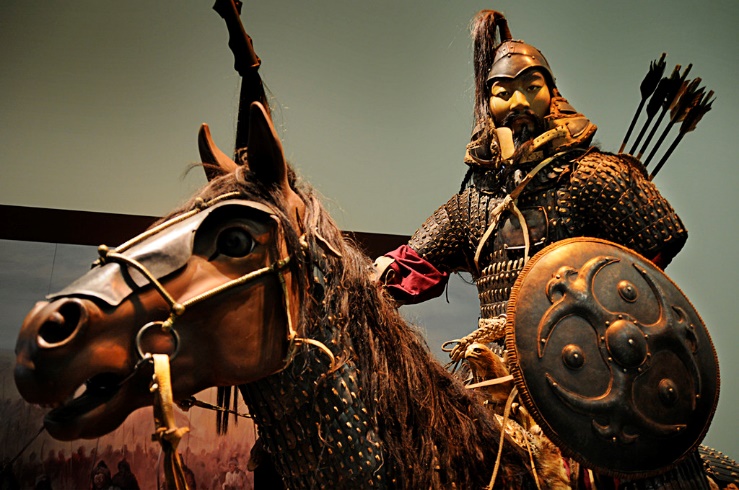
Founded by Genghis Khan in 1206 AD, the Mongol Empire was known for its military might and the promotion of trade along the Silk Road. It originated in the Mongolian Plateau and rapidly expanded to become the largest contiguous land empire in history, spanning from Eastern Europe to the Sea of Japan and from Siberia to the Indian subcontinent and the Middle East.
- Political Structure: The Mongol Empire was initially governed by Genghis Khan with absolute authority. After his death, it was divided into several khanates ruled by his descendants. The empire was known for its meritocratic system and religious tolerance.
- Culture and Religion: The Mongols had a nomadic lifestyle with their own language and script, which was created during Genghis Khan’s reign. They practiced Tengrism and shamanism, but were generally religiously tolerant, allowing various faiths within their empire.
- Diplomatic Relations: The Mongols engaged in extensive trade and diplomatic exchanges across Eurasia, including the famous Silk Road. They also used marriage alliances and tributary systems to manage their vast empire.
- Military: The Mongol military was renowned for its mobility, discipline, and innovative tactics, including the use of composite bows and expert horsemanship. They were adept at siege warfare and psychological warfare, often intimidating enemies into surrender.
- Decline and Fall: The decline of the Mongol Empire began with internal strife and fragmentation into different khanates. These khanates eventually became independent and were absorbed by emerging powers like the Ming Dynasty in China and the Muscovite Rus’ in Russia.
- Legacy: The Mongol Empire had a profound impact on the geopolitics of Eurasia, facilitating trade and cultural exchange across the continent. They are also known for their role in the spread of technologies, ideas, and even diseases (like the Black Death) across the vast areas they conquered.
The Mongol Empire, under the leadership of Genghis Khan and his successors, reshaped the political and cultural landscape of Eurasia in the 13th and 14th centuries, leaving a significant and lasting legacy on world history.

Picture Credit: “Genghis Khan: The Exhibition” by williamcho is licensed under CC BY-SA 2.0
Khmer Empire
The Angkor Civilisation was also known as the Khmer Empire. It was a powerful and influential kingdom in Southeast Asia. It flourished from approximately the 9th to the 15th centuries AD.
- Origins and Composition: The Angkor Civilisation emerged in the area of modern-day Cambodia. Its origins can be traced back to the early 9th century when King Jayavarman II declared himself a universal monarch (chakravartin) and established his capital at Hariharalaya, near present-day Roluos.
- Political Structure: The Khmer Empire was a highly centralised kingdom that was ruled by a series of god-kings who wielded absolute power. The king was considered divine, a living god on earth, often associated with Hindu deities like Shiva or Vishnu and later with Buddhist concepts.
- Culture and Religion: The Angkor Civilisation is renowned for its stunning architecture and art, exemplified by the magnificent temple complexes such as Angkor Wat and Bayon. Initially, Hinduism (particularly Shaivism and Vaishnavism) was the dominant religion, later giving way to Mahayana and Theravada Buddhism. The Khmer script, derived from Indian scripts, was used for inscriptions.
- Diplomatic Relations: The Khmer Empire engaged in trade and political relations with neighbouring kingdoms and faraway states. It was an integral part of the maritime Silk Road and had contacts with China, Champa, Java, and even distant India.
- Military: The Khmer military was powerful and capable of both defensive and extensive military campaigns, as evidenced by their territorial expansions and the construction of large-scale infrastructure for defence and water management.
- Decline and Fall: The decline of the Angkor Civilisation in the 15th century is attributed to various factors, including religious transformation, ecological challenges, and pressure from neighbouring kingdoms, particularly Siam (modern-day Thailand).
- Legacy: The legacy of the Angkor Civilisation is most visible in the monumental temple complexes, intricate art, and hydraulic engineering (like barays and canals). It played a crucial role in the cultural, architectural, and political history of Southeast Asia.
The Angkor Civilisation represents one of the most significant and grandiose achievements in Southeast Asian history, known for its architectural splendour, cultural richness, and advanced understanding of hydraulic engineering. Its period of prominence, particularly marked by the construction of Angkor Wat in the 12th century, remains a highlight of historical and archaeological study.
Mughal Empire (1526-1857 AD)
The Mughal Empire was a significant empire in the Indian subcontinent with a blend of Persian, Indian, and Islamic influences. The Mughal Empire was established in 1526 when Babur, a descendant of Timur and Genghis Khan, defeated the Sultan of Delhi at the Battle of Panipat. The empire initially comprised parts of today’s Afghanistan, Pakistan, and North India, eventually covering almost the entire Indian subcontinent.
- Political Structure: The Mughal Empire was an absolute monarchy with the Emperor at its head. It had a complex bureaucracy and a system of administration that incorporated elements from the local Indian polity. The empire was divided into provinces, each governed by a viceroy or governor appointed by the emperor.
- Culture and Religion: The Mughals were known for their contribution to art, architecture, and culture. They were Muslims, but the empire was characterised by a relative degree of religious tolerance. Hinduism, Buddhism, Jainism, and other religions coexisted and flourished. The Mughals were patrons of the arts, and the blending of Persian and Indian art forms led to the development of a distinctive Mughal style, evident in architecture (like the Taj Mahal), miniature painting, and literature.
- Diplomatic Relations: The Mughal Empire maintained diplomatic relations with other contemporary powers, including the Ottoman Empire, Safavid Empire, and various European powers. It was a significant period of trade and cultural exchange between India and the rest of the world.
- Military: The Mughal military was a formidable force, comprising infantry, cavalry, and advanced artillery. The military was central to the expansion and maintenance of the empire, utilising both traditional and innovative tactics.
- Decline and Fall: The decline of the Mughal Empire began in the late 17th century and was attributed to a range of factors, including administrative inefficiencies, corruption, internal rebellions, and external invasions, particularly by the Marathas, and later, incursions by the British East India Company. The formal end of the empire was marked by the British declaration of the end of the Mughal period and the establishment of British rule after the Indian Rebellion of 1857.
- Legacy: The Mughal Empire left a lasting legacy in South Asia, particularly in architecture, art, and cuisine. Mughal rule significantly shaped the region’s history, culture, and social structure, and its influence is still evident in various aspects of life in present-day India, Pakistan, and Bangladesh.
The Mughal Empire, with its rich cultural contributions, sophisticated administration, and significant impact on the Indian subcontinent, remains one of the most studied and celebrated empires in South Asian history.
Modern Empire
British Empire (16th century-20th century)
The British Empire began in the late 16th and early 17th centuries with English overseas possessions and trading posts. It expanded to become one of the largest empires in history, encompassing territories on every continent, including significant parts of North America, the Caribbean, Africa, Asia, and Australasia.
- Political Structure: The British Empire was governed from London, with colonies, dominions, mandates, and other territories under varying degrees of control. It combined direct colonial rule with indirect control through local rulers or self-governing dominions.
- Culture and Religion: The British Empire facilitated the spread of the English language, British cultural practices, and legal systems. It was also instrumental in spreading Christianity in many parts of the world. The cultural impact of the empire was complex, with both assimilation and resistance in various territories.
- Diplomatic Relations: The British Empire was involved in global diplomacy and often engaged in conflicts with other Empires and local populations. It played a central role in major global conflicts, including both World Wars.

Robert Clive‘s victory at the Battle of Plassey established the East India Company as both a military and commercial power, by Francis Hayman, Public domain, via Wikimedia Commons
- Military: The British Empire had one of the most powerful navies in the world, which was crucial for its expansion and maintenance. The British Army and local forces in various colonies also played significant roles in the empire’s military endeavours.
- Decline and Fall: The decline of the British Empire began in the early 20th century and was hastened by the World Wars and the rise of nationalist movements in various colonies. The process of decolonisation accelerated after World War II, leading to the independence of most of the British colonies between the 1940s and the 1960s.
- Legacy: The legacy of the British Empire is complex and multifaceted, with significant cultural, political, and economic impacts on the modern world. The English language and British cultural influences remain pervasive. The empire’s history also includes controversial aspects like economic exploitation, cultural destruction, and the subjugation of indigenous peoples.
The British Empire played a critical role in shaping global history and the modern world, with its influence extending far beyond the formal end of the empire. Its impact on international trade, global politics, and cross-cultural exchanges is both profound and enduring.
Spanish Empire (16th-19th centuries)
Notable for its conquests in the Americas, the Spanish Empire was one of the first global empires, leaving a lasting cultural and linguistic legacy. The Spanish Empire emerged in the late 15th and early 16th centuries following the voyages of Christopher Columbus. It became one of the first global empires, extending across the Americas, parts of Europe, Africa, Asia, and Oceania.
- Political Structure: The empire was governed from Spain, with the monarch holding ultimate authority. It had a complex administrative structure, with viceroys governing large territories in the Americas and other regions. These territories were further divided into smaller administrative units.
- Culture and Religion: The Spanish Empire was instrumental in spreading the Spanish language and culture. A key aspect of its policy was the Christianisation of indigenous populations, predominantly carried out by Catholic missionary orders. The empire left a significant cultural and linguistic legacy in the Americas and the Philippines.
- Diplomatic Relations: Spain was a dominant maritime power and engaged in frequent conflicts with other European powers, such as Portugal, England, France, and the Netherlands, over colonial territories and trade routes. The Treaty of Tordesillas (1494) was a notable agreement with Portugal to divide the world’s territories outside Europe.
- Military: The Spanish Empire’s military prowess was based largely on its powerful navy, the Armada, and its experienced infantry, the Tercios. These forces were crucial in both protecting the empire’s overseas territories and engaging in European conflicts.
- Decline and Fall: The decline of the Spanish Empire began in the 17th century, hastened by military defeats, economic problems, and rising competition from other European powers. The independence movements in the Americas in the 19th century significantly reduced its global influence, with the Spanish-American War (1898) marking the end of its major colonial holdings.
- Legacy: The Spanish Empire had a profound impact on the global landscape, particularly in the Americas and the Philippines. Its legacy includes the widespread Spanish language and culture, significant architectural and artistic contributions, and the introduction of new crops and goods across the world. The empire’s history also encompasses controversial aspects such as the exploitation and decline of indigenous populations.
The Spanish Empire, with its vast territorial reach and significant cultural impact, played a crucial role in the history of European colonialism and the shaping of the modern world.
French Colonial Empire (16th-20th centuries)
The French Colonial Empire began in the 16th century with the exploration and settlement of the New World, parts of Africa, and Asia. It became the second-largest colonial empire after the British, with major holdings in North America (New France), the Caribbean, Africa, and Southeast Asia.
- Political Structure: The empire was governed from France, with colonies administered by appointed governors. The political structure varied from direct rule in some colonies to more autonomous arrangements in others (like French Indochina or French West Africa).
- Culture and Religion: French colonial policy often emphasised the assimilation of colonial subjects to French culture and language, a policy known as “assimilation.” Catholicism was the main religion promoted, but in practice, local religions often persisted. The French language and culture had a lasting impact on many areas of the world.
- Diplomatic Relations: France’s colonial ambitions often brought it into conflict with other European powers, notably the British Empire, leading to numerous colonial wars. The French also established complex relationships with local rulers in their colonies.
- Military: The French military played a crucial role in establishing and maintaining the empire, particularly the navy and colonial armies. Military campaigns were often part of the expansion and defence of the empire’s territories.
- Decline and Fall: The decline of the French Colonial Empire began after World War I, accelerated by World War II. The process of decolonisation saw many colonies gaining independence in the 1950s and 1960s, with significant conflicts such as the Algerian War of Independence.
- Legacy: The legacy of the French Colonial Empire is mixed. On the one hand, it led to the spread of the French language and elements of French culture. On the other hand, it also left behind issues stemming from colonial exploitation and cultural suppression. Many former French colonies have maintained strong linguistic and cultural ties to France.
The French Colonial Empire had a profound influence on the areas it controlled, with its effects still visible in global politics, language, and culture. The empire’s history is an integral part of the broader narrative of European colonialism and its impacts on the world.
Late Modern and Contemporary Empire
Soviet Union (1922-1991)
A federal socialist state in Eurasia, significant as a major player in the 20th century, particularly during the Cold War. The Soviet Union, officially known as the Union of Soviet Socialist Republics (USSR), was established in 1922 after the Russian Revolution of 1917. It was a union of multiple subnational Soviet republics, covering a vast area of Eastern Europe and Northern Asia.
- Political Structure: The Soviet Union was a one-party state governed by the Communist Party. It was highly centralised, with political power concentrated in Moscow. The government was structured according to Marxist-Leninist principles, with the Communist Party holding ultimate authority over the state and its policies.
- Culture and Religion: The Soviet regime promoted a culture of socialism and atheism, with a strong emphasis on science, technology, and education. Religion was suppressed, and the arts were used as a tool for propagandist purposes. Russian was the dominant language, but the USSR recognised over 100 different languages across its republics.
- Diplomatic Relations: The USSR was a major player in international politics, especially during the Cold War era. It had complex relationships with Western capitalist countries, particularly the United States, and supported communist and socialist movements worldwide. The Soviet Union was a founding member of the United Nations and a permanent member of the UN Security Council.
- Military: The Soviet Union had one of the world’s largest and most powerful military forces, including a significant nuclear arsenal. The Red Army played a pivotal role in World War II, and the Soviet military was a key element of its Cold War strategy.
- Decline and Fall: The decline of the Soviet Union began in the 1980s, marked by economic stagnation, political corruption, and a loss of faith in the communist ideology. The reform policies of perestroika and glasnost under Mikhail Gorbachev aimed to revitalise the system but ultimately contributed to its dissolution. The Soviet Union officially ceased to exist in 1991, breaking into 15 independent republics.
- Legacy: The legacy of the Soviet Union is complex and remains a subject of debate. It was influential in shaping global politics during the 20th century, particularly through its role in World War II and the Cold War. The USSR also made significant contributions to science, technology, and space exploration. However, its history is also marked by authoritarianism, suppression of dissent, and economic inefficiencies.
The Soviet Union’s existence and its eventual dissolution had a profound impact on the course of global history, significantly influencing international relations, geopolitical boundaries, and ideological discourse in the 20th century and beyond.
The United States of America: A Different Historical Trajectory
The United States of America, indeed a major global power, has a different historical trajectory compared to traditional empires or colonial powers. The USA’s influence and power, especially in the 20th and 21st centuries, are significant, but its role in world history has been distinct from the empires discussed earlier. Here are a few key points to consider:
- Formation and Expansion: The USA was formed in 1776 following the Declaration of Independence by thirteen British colonies in North America. Its territorial expansion across the North American continent during the 19th century was not characterised as an Empire in the traditional sense but rather as a nation-state expanding its borders.
- Manifest Destiny: This 19th century doctrine held that the expansion of the US across the American continents was both justified and inevitable. While not imperialistic in the traditional European sense, it was a form of continental expansionism.
- Global Influence in the 20th Century: The USA emerged as a major global power after World War I and especially following World War II. Its influence expanded significantly during the Cold War in a global competition with the Soviet Union. This period saw the USA involved in various international conflicts and initiatives to counter the spread of communism.

US astronaut Buss Aldrin saluting the flag on the Moon during the 1969 Apollo 11 mission. The United States is the only country that has sent crewed missions to the lunar surface. Soerfm, Public domain, via Wikimedia Commons
- Economic and Cultural Influence: The USA’s global influence has been strongly characterised by its economic and cultural impact, including the spread of American businesses, technology, and popular culture. The concept of “soft power” – the ability to attract and co-opt rather than coerce – has been significant in the American global presence.
- Military Presence: The United States maintains a significant military presence around the world, with numerous bases in various countries. This global military reach, coupled with its leading role in international organisations like NATO and the United Nations, contributes to its status as a current superpower.
- Contemporary Role: In the contemporary world, the United States is often involved in international politics, global economics, technological innovation, and cultural trends. Its role in global governance, international trade agreements, and as a hub for technological and scientific advancement is significant.
The USA’s position in world history is marked more by its economic, cultural, and political influence as a modern nation-state and less by the traditional model of Empire seen in earlier periods of history. Its status as a superpower and a central player in global affairs makes it a unique and influential entity in the contemporary world.
Largest Empires by Share of World Population
Because of the trend of increasing world population over time, absolute population figures are, for some purposes, less relevant for comparison between different empires than their respective shares of the world population at the time.[12] For the majority of the time since roughly 400 BC, the two most populous empires’ combined share of the world population has been 30–40%. Most of the time, the most populous empires have been located in China[13].

Source: https://en.wikipedia.org/wiki/List_of_largest_empires#cite_note-OxfordPopulation-50 [14]
Largest Empires by Land Area
The Table shown below is part of a more detailed and longer Table on Wikipedia[15]. For context, the land area of the Earth, excluding the continent of Antarctica, is 134.74 million sq km (52.023 million sq mi).[16]
Empires at their greatest extent
Empire Sizein this list is defined as the dry land area it controlled at the time, which may differ considerably from the area it claimed. For example: in the year 1800, European powers collectively claimed approximately 20% of the Earth’s land surface that they did not effectively control.[17] Where estimates vary, entries are sorted by the lowest estimate. Where more than one entry has the same area, they are listed alphabetically.
| MAXIMUM LAND AREA COVERED AND WHEN | |||
| Empire | Million Sq. Miles | Percentage of the World | Year (AD, unless specified as BC) |
| British Empire[18] | 13.71 | 26.35% | 1920[19] |
| Mongol Empire[20] | 9.27 | 17.81% | 1270[21] or 1309[22] |
| Russian Empire[23] | 8.8 | 16.92% | 1895[24] |
| Qing Dynasty[25] | 5.68 | 10.91% | 1790[26] |
| Spanish Empire | 5.29 | 10.17% | 1810[27] |
| Second French Colonial Empire | 4.44 | 8.53% | 1920[28] |
| Abbasid Caliphate | 4.29 | 8.24% | 750[29] |
| Umayyad Caliphate | 4.29 | 8.24% | 720[30] |
| Yuan Dynasty | 4.25 | 8.16% | 1310[31] |
| Xiongnu Empire | 3.47 | 6.68% | 176 BC[32] |
| Empire of Brasil[33] | 3.22 | 6.19% | 1889[34] |
| Empire of Japan | 2.86 to 3.285[35] | 5.49%–6.32% | 1942[36] |
| Eastern Han Dynasty | 2.51 | 4.82% | 100[37] |
| Ming Dynasty | 2.51 | 4.82% | 1450[38] |
| Rashidun Caliphate | 2.47 | 4.75% | 655[39] |
| First Turkic Khaganate | 2.32 | 4.45% | 557[40] |
| Golden Horde Khanate | 2.32 | 4.45% | 1310[41] |
| Western Han Dynasty | 2.32 | 4.45% | 50 BC[42] |
| Achaemenid Empire | 2.12 | 4.08% | 500 BC[43] |
| Second Portuguese Empire[44] | 2.12 | 4.08% | 1820[45] |
| Tang Dynasty | 2.08 | 4.01% | 715[46] |
| Macedonian Empire | 2.01 | 3.86% | 323 BC[47] |
| Ottoman Empire | 2.01 | 3.86% | 1683[48] |
| Northern Yuan Dynasty | 1.93 | 3.71% | 1368[49] |
| Roman Empire | 1.93 | 3.71% | 117[50] |
| Xin Dynasty | 1.81 | 3.49% | 10[51] |
| Tibetan Empire | 1.78 | 3.41% | 800[52] |
| Xianbei State | 1.74 | 3.34% | 200[53] |
| First Mexican Empire | 1.71 | 3.29% | 1821[54] |
| Timurid Empire | 1.7 | 3.27% | 1405[55] |
| Fatimid Caliphate | 1.58 | 3.04% | 969[56] |
| Eastern Turkic Khaganate | 1.54 | 2.97% | 624[57] |
| Hunnic Empire | 1.54 | 2.97% | 441[58] |
| Mughal Empire | 1.54 | 2.97% | 1690[59] |
| Great Seljuq Empire | 1.51 | 2.89% | 1080[60] |
| Seleucid Empire | 1.51 | 2.89% | 301 BC[61] |
| Italian Empire | 1.48 | 2.84% | 1941[62] |
| Ilkhanate | 1.45 | 2.78% | 1310[63] |
Comparative Analysis
As I approach the conclusion of this paper, it’s an interesting exercise to explore commonalities and differences among the Empires, shedding light on how similar challenges were addressed across diverse historical and cultural contexts. A striking similarity across most empires was the central role of military power in establishing and maintaining their dominance. From the disciplined legions of Rome to the swift cavalry of the Mongols, the nature of military organisation and strategy often dictated the extent and duration of an empire’s influence. Yet, how they wielded this power varied significantly. While the Assyrians used intimidation and brutality, the Achaemenid Persians are remembered for their respect for local customs and administrative acumen.
Trade and cultural exchange served as other unifying threads. The Silk Road under the Mongol Empire and the maritime trade routes during the Age of Discovery under the Portuguese and Spanish Empires facilitated unprecedented cultural and economic exchanges. However, the motivations differed – where the Mongols sought to establish a vast and inclusive trade network, the European powers were often driven by mercantilist and colonial ambitions.
Religious and ideological propagation has also played a pivotal role. The spread of Buddhism during the Ashoka era in the Maurya Empire and the Christianisation efforts of the Spanish Empire illustrate how empires used religion both as a tool for unifying diverse populations and for justifying expansion.
From Historical Empires to Modern Societies
This section explores how the historical empires have shaped contemporary global dynamics. The political and legal systems of many modern nations owe a great deal to Roman and British legal traditions. Concepts such as republicanism, legal codification, and administrative frameworks were pioneered by these empires and continue to influence modern governance.
Culturally, the impact of empires has been profound and lasting. Languages such as English and Spanish, spread by the British and Spanish empires, are now spoken globally, facilitating international communication but also reflecting a history of cultural dominance. Similarly, the artistic and architectural styles developed in empires from the Byzantine to the Mughal have been integrated into the global cultural heritage, influencing aesthetics far beyond their original borders.
Moreover, the contemporary geopolitical landscape, with its nation-states and boundaries, has been significantly shaped by the actions of historical empires. The modern map of the Middle East, for instance, reflects the territorial divisions and decisions made by the Ottoman and British Empires.
In summary, the paragraphs above provide a deeper understanding of how Empires have not only shaped their eras but also continue to influence our present in profound and multifaceted ways. The study of Empires, therefore, is not just a look back into the past but a key to understanding the complexities of the contemporary world.
Conclusion
In the journey through the annals of history, examining the rise and fall of various empires, we have traversed a vast landscape of human endeavour. These Empires, from the ancient sands of Egypt to the modern political machinations of the British and Spanish dominions, represent more than mere political entities; they are the embodiments of human aspiration, complexity, and often, overreach. The legacies of these empires are not mere footnotes in history books but are etched into the very fabric of our contemporary world, influencing everything from language and law to culture and international borders.
This paper has underscored the transient nature of power and the inevitability of change. Empires, regardless of their might and glory, have risen and fallen, leaving behind lessons on governance, cultural integration, and the human cost of expansion. The impacts of these empires are multifaceted – while they contributed to advancements in arts, science, and administration, they also brought about conflicts, societal disruptions, and significant human tragedies.
In reflecting upon these great empires, we find recurring themes: the quest for power, the challenges of governance across diverse cultures, and the delicate balance between progress and preservation. Time and time again, we find that Empires have self-destructed through internal disputes. The tapestry of history woven by these empires serves not only as a testament to human achievement but also as a cautionary tale about the limits of power and the importance of ethical stewardship.
As we turn the pages from past to present, it becomes evident that the echoes of these historical empires continue to resonate in our modern political and cultural landscapes. Their stories are reminders of our shared human heritage, a heritage that continues to shape our world in profound and enduring ways. In studying these empires, we gain not only knowledge of the past but also insights into the present and, perhaps, the future. For in the grand narrative of history, each empire has contributed a verse to the enduring story of humanity’s quest for order, meaning, and legacy in the vast tapestry of time.

Victoria, the single ship to have completed the first world circumnavigation. (Detail from Maris Pacifici by Ortelius, 1589.) By Ortelius, Public domain, via Wikimedia Commons
Further Reading (arranged Alphabetically)
SOURCES
- List of largest Empires – Wikipedia: https://en.wikipedia.org/wiki/List_of_largest_empires
- Eight of the Largest Empires in History | Britannica: https://www.britannica.com/list/8-of-the-largest-empires-in-history
BOOKS
- A Companion to the Achaemenid Persian Empire, 2 Volume Set (Blackwell Companions to the Ancient World), by Bruno Jacobs and Robert Rollinger (27 Nov. 2024), published by Wiley-Blackwell, available from https://www.amazon.co.uk/Companion-Achaemenid-Persian-Empire-Companions/dp/1119113679/
- A History of Ancient Persia: The Achaemenid Empire (Blackwell History of the Ancient World), by Maria Brosius (30 Nov. 2020), published by Wiley-Blackwell, available from https://www.amazon.co.uk/History-Ancient-Persia-Achaemenid-Blackwell/dp/1444350927/
- A History of the Later Roman Empire, AD 284-700, (Blackwell History of the Ancient World), by Stephen Mitchell and Geoffrey Greatrex (26 Jun. 2023), published by Wiley-Blackwell, available from https://www.amazon.co.uk/History-Empire-284-700-Blackwell-Ancient-dp-1119768551/dp/1119768551/
- A Thirst for Empire: How Tea Shaped the Modern World, by Erika Rappaport (5 Mar. 2019), published by Princeton University Press, available from https://www.amazon.co.uk/Thirst-Empire-Erika-Rappaport/dp/0691192707/
- Alexander the Great: An Enthralling Guide to the Rise of the Macedonian Empire, Its Ruler, and His Conquests (Greek Mythology and History), by Billy Wellman (8 Apr. 2023), published by the author, available from https://www.amazon.co.uk/Alexander-Great-Enthralling-Macedonian-Conquests/dp/B0C1JBC4F7/
- Atlas of Empires: The World’s Civilizations from Ancient Times to Today, by Peter Davidson (22 Mar. 2018), published by CompanionHouse Books, available from https://www.amazon.co.uk/Atlas-Empires-Worlds-Powers-Ancient/dp/162008287X/
- Cultural Treasures of the World: From the Relics of Ancient Empires to Modern-Day Icons (DK Wonders of the World), by DK (1 Sept. 2022), published by DK, available from https://www.amazon.co.uk/Cultural-Treasures-World-Ancient-Modern-Day/dp/0241508924/
- Decline and Fall of the Roman Empire: Vol. 1: World’s Classics, by Edward Gibbon (20 Apr. 2018), published by Gale ECCO, Print Editions, available from https://www.amazon.co.uk/History-Decline-Empire-Edward-Gibbon/dp/1379843634/
- Decline and Fall of the Roman Empire Vol. 2: World’s Classics, by Edward Gibbon (31 Aug. 2012), published by Ulan Press, available from https://www.amazon.co.uk/history-decline-fall-Roman-Empire/dp/B00AEUSL8O
- Decline and Fall of the Roman Empire: Vol. 3: World’s Classics, by Edward Gibbon (29 Jul. 2022), published by East India Publishing Company, available from https://www.amazon.co.uk/Decline-Fall-Roman-Empire-III/dp/1774266075/
- Decline and Fall of the Roman Empire: Vol. 4: World’s Classics, by Edward Gibbon (7 Sept 2021), independently published, available from https://www.amazon.co.uk/Decline-Fall-Roman-Empire-Classics/dp/B09FNR1JL2/
- Decline and Fall of the Roman Empire: Vol. 5: World’s Classics, by Edward Gibbon (7 Sept. 2021), independently published, available from https://www.amazon.co.uk/Decline-Fall-Roman-Empire-Vol/dp/B09FNLMDJ8/
- Decline and Fall of the Roman Empire: Vol. 6: World’s Classics, by Edward Gibbon (28 Jul. 2022), published by East India Publishing Company, available from https://www.amazon.co.uk/Decline-Fall-Roman-Empire-VI/dp/1774265842/
- Empire Ascendant: The British World, Race, and the Rise of Japan, 1894-1914, by Cees Heere (24 Feb. 2020), published by Oxford University Press, available from https://www.amazon.co.uk/Empire-Ascendant-British-World-1894-1914/dp/0198837399/
- Empire: A Very Short Introduction, by Stephen Howe (2002), published by Oxford University Press, available from https://www.amazon.co.uk/Empire-Very-Short-Introduction-Introductions/dp/0192802232/
- Empire: How Britain Made the Modern World, by Niall Ferguson (7 Jun. 2018), published by Penguin, available from https://www.amazon.co.uk/Empire-Britain-Made-Modern-World/dp/014198791X/
- Empire: What Ruling the World Did to the British, by Jeremy Paxman (7 Jun. 2012), published by Penguin, available from https://www.amazon.co.uk/Empire-What-Ruling-World-British/dp/0670919594/
- Empires in World History – Power and the Politics of Difference, by Jane Burbank and Frederick Cooper (26 Jul. 2011), published by Princeton University Press, available from https://www.amazon.co.uk/Empires-World-History-Politics-Difference/dp/0691152365/
- Empireworld: How British Imperialism Has Shaped the Globe, by Sathnam Sanghera (25 Jan. 2024), published by Viking, available from https://www.amazon.co.uk/Empireworld-British-Imperialism-Shaped-Globe/dp/0241600413/
- Forgotten Empire: The World of Ancient Persia, by J.E. Curtis and Nigel Tallis (1 Jan. 2005), published by British Museum Press, available from https://www.amazon.co.uk/Forgotten-Empire-Ancient-J-Sep-2005/dp/B00FBZY30M/
- Greek, Mesopotamia, Egypt & Rome: Fascinating Insights, Mythology, Stories, History & Knowledge From The World’s Most Interesting Civilizations & Empires: 4 books, by History Brought Alive, independently published, available from https://www.amazon.co.uk/Greek-Mesopotamia-Egypt-Rome-Civilizations/dp/B09MDSXLL6/
- Imperialism: From the Colonial Age to the Present, by Harry Magdoff (1 Jan. 1978), published by Monthly Review Press, US, available from https://www.amazon.co.uk/Imperialism-Colonial-Present-Harry-Magdoff/dp/0853454264/
- Making Empire: Ireland, Imperialism, and the Early Modern World, by Jane Ohlmeyer (9 Nov. 2023), published by OUP Oxford, available from https://www.amazon.co.uk/Making-Empire-Ireland-Imperialism-Modern/dp/0192867687/
- Outsourcing Empire: How Company-States Made the Modern World, by Sharman, Phillips, et al. (14 Jun. 2022), published by Princeton University Press, available from https://www.amazon.co.uk/Outsourcing-Empire-Company-States-Modern-World/dp/0691206198/
- Rise and Fall: A History of the World in Ten Empires, by Paul Strathern (9 Jul. 2020), published by Hodder Paperbacks, available from https://www.amazon.co.uk/dp/1473698669/
- The Ancient Assyrians: Empire and Army, 883–612 BC, by Mark Healy (20 Jul. 2023), published by Osprey Publishing, available from https://www.amazon.co.uk/Ancient-Assyrians-Empire-Army-883-612/dp/1472848098/
- The Cults of the Roman Empire (Ancient World), by Robert Turcan (15 Dec. 1996), published by Wiley-Blackwell, available from https://www.amazon.co.uk/Cults-Roman-Empire-Ancient-World/dp/0631200479/
- The Empire Project: The Rise and Fall of the British World-System, 1830–1970, by John Darwin (7 Jul. 2011), published by Cambridge University Press, available from https://www.amazon.co.uk/Empire-Project-John-Darwin/dp/0521317894/
- The First World Empire: Portugal, War and Military Revolution (Warfare and History), by Hélder Carvalhal, André Murteira, et al. (6 Apr. 2021), published by Routledge, available from https://www.amazon.co.uk/First-World-Empire-Portugal-Revolution/dp/0367365480/
- The Great Empires of the Ancient World, by Thomas Harrison (29 Apr. 2021), published by Thames & Hudson, available from https://www.amazon.co.uk/Great-Empires-Ancient-World/dp/0500295883/
- The Great Imperial Hangover: How Empires Have Shaped the World, by Samir Puri (9 Jul. 2020), published by Atlantic Books, available from https://www.amazon.co.uk/Great-Imperial-Hangover-Empires-Shaped/dp/1786498324
- The Inca Empire: An Enthralling Overview of the Incas, Their Civilization in Ancient Peru, and the Spanish Conquest (Mesoamerica), by Billy Wellman (15 Apr. 2023), available from https://www.amazon.co.uk/Inca-Empire-Enthralling-Civilization-Mesoamerica/dp/B0C1JGTVT9/
- The Later Roman Empire (Fontana History of the Ancient World), by Averil Cameron (26 Feb. 2010), available from https://www.amazon.co.uk/Fontana-History-Ancient-26-Feb-2010-Paperback/dp/B012HU4SB2/
- The Origin of Empire: Rome from the Republic to Hadrian (264BC – AD 138) (The Profile History of the Ancient World Series), by David Potter (1 Apr. 2021), published by Profile Books, available from https://www.amazon.co.uk/Origin-Empire-Republic-Hadrian-Profile/dp/1846683882/
- The Oxford World History of Empire: Volume Two: The History of Empires: 2, by Peter Fibiger Bang, C. A. Bayly, et al. (3 Mar. 2021), published by OUP USA, available from https://www.amazon.co.uk/Oxford-World-History-Empire-Empires/dp/0197532764/
- The Parthians: The Forgotten Empire (Peoples of the Ancient World), by Uwe Ellerbrock (25 Mar. 2021), published by Routledge, available from https://www.amazon.co.uk/Parthians-Forgotten-Empire-Peoples-Ancient/dp/0367473097/
- The Persians: An Enthralling Guide to the History of Persia and the Persian Empire (Exploring the Middle East), by Billy Wellman (23 May 2023), available from https://www.amazon.co.uk/Persians-Enthralling-History-Persian-Exploring/dp/B0C642FSBT/
- The Roman Empire and the Indian Ocean: The Ancient World Economy & the Kingdoms of Africa, Arabia & India, by Raoul McLaughlin (1 Nov. 2014), published by Pen & Sword Maritime, available from https://www.amazon.co.uk/Roman-Empire-Indian-Ocean-Kingdoms/dp/1783463813/
- The Roman Empire and the Silk Routes: The Ancient World Economy & the Empires of Parthia, Central Asia & Han China, by Raoul McLaughlin (20 Feb. 2019), published for Kindle, available from https://www.amazon.co.uk/Roman-Empire-Silk-Routes-Ancient-ebook/dp/B01MA3TAQ5/
- The Roman Empire at Bay, AD 180-395 (The Routledge History of the Ancient World), by David Potter (24 Dec. 2013), published by Routledge, available from https://www.amazon.co.uk/Empire-180-395-Routledge-History-Ancient/dp/0415840554/
- The Spanish Conquest of the Americas: An Enthralling Overview of the Conquistadors and Their Conquests of the Aztec and Inca Empires (Mesoamerica). by Billy Wellman (17. Jun. 2023), available from https://www.amazon.co.uk/Spanish-Conquest-Americas-Enthralling-Conquistadors/dp/B0C87C11K3/
- The Sumerian Civilization: An Enthralling Overview of Sumer and the Ancient Sumerians (History of Mesopotamia), by Enthralling History (2 Jul. 2022), available from https://www.amazon.co.uk/Sumerian-Civilization-Enthralling-Sumerians-Mesopotamia/dp/B0B5KKBCJN/
- The World’s War, by David Olusoga, Nigel Carrington, et al. (11 Jul. 2019), published by Apollo, available from https://www.amazon.co.uk/Worlds-War-David-Olusoga/dp/1789544491/
- Underground Empire: How America Weaponized the World Economy, by Henry Farrell, Abraham Newman, et al. (7 Sep. 2023), published by Allen Lane, available from https://www.amazon.co.uk/Underground-Empire-America-Weaponized-Economy/dp/0241624517/
- Visions of Empire – How Five Imperial Regimes Shaped the World, by Krishnan Kumar (9 Jul. 2019), published by Princeton University Press, available from https://www.amazon.co.uk/Visions-Empire-Krishan-Kumar/dp/0691192804/
CAUTION: This paper is compiled from the sources stated but has not been externally reviewed. Parts of this paper include information provided via artificial intelligence which, although checked by the author, is not always accurate or reliable. Neither we nor any third parties provide any warranty or guarantee as to the accuracy, timeliness, performance, completeness or suitability of the information and materials covered in this paper for any particular purpose. Such information and materials may contain inaccuracies or errors and we expressly exclude liability for any such inaccuracies or errors to the fullest extent permitted by law. Your use of any information or materials on this website is entirely at your own risk, for which we shall not be liable. It shall be your own responsibility to ensure that any products, services or information available through this paper meet your specific requirements and you should neither take action nor exercise inaction without taking appropriate professional advice. The hyperlinks were current at the date of publication.
End Notes and Explanations
- Source: Compiled from research using information at the sources stated throughout the text, together with information provided by machine-generated artificial intelligence at: bing.com [chat] and https://chat.openai.com ↑
- Source: https://en.wikipedia.org/wiki/Empire ↑
- Source: Howe, Stephen (2002). Empire: A Very Short Introduction. Oxford University Press. ISBN 978-0-19-280223-1. Cited at: https://en.wikipedia.org/wiki/Empire ↑
- Source: Reus-Smit, Christian (2013). Individual Rights and the Making of the International System. Cambridge University Press. p. 4. ISBN 978-0-521-85777-2. Cited at: https://en.wikipedia.org/wiki/Empire ↑
- Source: Burbank, Jane; Cooper, Frederick (2010). Empires in World History: Power and the Politics of Difference. Princeton: Princeton University Press. ISBN 978-0-691-12708-8. Cited at: https://en.wikipedia.org/wiki/Empire ↑
- Source: “Oxford Dictionary Online”. Retrieved 2020-06-30.”An extensive territory under the control of a supreme ruler (typically an emperor) or an oligarchy, often consisting of an aggregate of many separate states or territories. In later use also: an extensive group of subject territories ultimately under the rule of a single sovereign state.” Cited at: https://en.wikipedia.org/wiki/Empire ↑
- Further Information: See Martin Pollins’ Blog about the Hittites at: https://martinpollins.com/?s=hittites ↑
- Further Information: See Martin Pollins’ Blog about Attila the Hun at: https://martinpollins.com/2022/11/01/attila-the-hun/ ↑
- Explanation: The themes or thémata were the main military and administrative divisions of the middle Bysantine Empire. They were established in the mid-7th century in the aftermath of the Slavic invasion of the Balkans and Muslim conquests of parts of Bysantine territory, and replaced the earlier provincial system established by Diocletian and Constantine the Great. In their origin, the first themes were created from the areas of encampment of the field armies of the East Roman army, and their names corresponded to the military units that had existed in those areas. The theme system reached its apogee (meaning senith or highest point) in the 9th and 10th centuries, as older themes were split up and the conquest of territory resulted in the creation of new ones. The original theme system underwent significant changes in the 11th and 12th centuries, but the term remained in use as a provincial and financial circumscription until the very end of the Empire. Source: https://en.wikipedia.org/wiki/Theme_(Bysantine_district) ↑
- Explanation: The cataphract was a type of heavy cavalry used by several ancient and medieval civilisations, including the Bysantine Empire, Sassanian Persians, and later by various European and Asian cultures. Here are some key characteristics of cataphracts:
Armour: Cataphracts were known for their extensive armour. Both the horse and rider were often completely covered in scale armour or chainmail, providing excellent protection against arrows and melee weapons. This made them one of the most heavily armoured military units of the ancient world.
Weapons: Cataphract riders typically carried long lances for charging and melee combat, as well as swords or maces for close-quarters fighting. The long lance, especially, was effective for breaking enemy lines and combatting foot soldiers.
Tactics: The primary tactic of cataphracts was the charge. They would build momentum to break through enemy lines, relying on their armour for protection against counter-attacks. Their presence on the battlefield was both a physical and psychological asset, as they could intimidate and overrun lighter and less organised enemy troops.
Mobility: Despite their heavy armour, cataphracts were surprisingly mobile for their time. However, their speed and maneuverability were not comparable to lighter cavalry units. They were best used in open fields where they could maximise the impact of their charge.
Impact on Warfare: Cataphracts had a significant impact on the tactics of ancient and medieval warfare. Their use required opponents to develop new strategies and weapons, such as the development of anti-cavalry infantry formations and the increased use of ranged weapons.
Cultural Significance: The use of cataphracts was a symbol of military strength and elite status. The heavy investment in their armour and training made them a prestigious unit, often associated with the wealth and power of the ruling elite. ↑
- Further Information: Further information is available on Martin Pollins’ Blog: Kublai Khan – https://martinpollins.com/2023/10/11/the-emperor-of-mongolia-kublai-khan/, Ghengis Khan – https://martinpollins.com/2023/10/30/the-man-who-almost-conquered-the-world/, The Mongol Empire – https://martinpollins.com/2023/06/06/from-nomads-to-conquerers-the-rise-of-the-mongol-empire/, and Attila the Hun – https://martinpollins.com/2022/11/01/attila-the-hun/ ↑
- Source: Scheidel, Walter (2020). “The Scale of Empire: Territory, Population, Distribution”. In Bang, Peter Fibiger; Bayly, C. A.; Scheidel, Walter (eds.). The Oxford World History of Empire: Volume One: The Imperial Experience. Oxford University Press. p. 102. ISBN 978-0-19-977311-4. ↑
- Source: Myrdal, Janken (2013). “Empire: The comparative study of imperialism”. In Hornborg, Alf; Clark, Brett; Hermele, Kenneth (eds.). Ecology and Power: Struggles over Land and Material Resources in the Past, Present and Future. Routledge. p. 43. ISBN 978-1-136-33529-7. ↑
- Source: https://en.wikipedia.org/wiki/List_of_largest_empires#cite_note-OxfordPopulation-50 ↑
- Source: https://en.wikipedia.org/wiki/List_of_largest_empires ↑
- Source: “World”, The World Factbook, Central Intelligence Agency, 18 July 2022, archived from the original on 20 June 2022, retrieved 24 July 2022, land: 148.94 million sq km […] Antarctica 14,200,000 sq km. ↑
- Source/Reference: Magdoff, Harry (1979). Imperialism: From the Colonial Age to the Present. NYU Press. p. 29. ISBN 978-0-85345-498-4. Archived from the original on 19 July 2020. Retrieved 19 July 2020. In 1800 Europe and its possessions, including former colonies, claimed title to about 55 percent of the earth’s land surface: Europe, North and South America, most of India, and small sections along the coast of Africa. But much of this was merely claimed; effective control existed over a little less than 35 percent, most of which consisted of Europe itself. By 1878—that is, before the next major wave of European acquisitions began—an additional 6,500,000 square miles (16,800,000 square kilometers) were claimed; during this period, control was consolidated over the new claims and over all the territory claimed in 1800. Hence, from 1800 until 1878, actual European rule (including former colonies in North and South America), increased from 35 to 67 percent of the earth’s land surface. ↑
- Comment/Source: The largest peak areas of its former colonies following independence were Canada‘s 9.98 million km2 in 1945, the United States‘ 9.67 million km2 in 1899, and Australia‘s 7.68 million km2 in 1945. See also Taagepera, Rein (September 1997). “Expansion and Contraction Patterns of Large Polities: Context for Russia” (PDF). International Studies Quarterly. 41 (3): 492–502. doi:10.1111/0020-8833.00053. JSTOR 2600793. Archived (PDF) from the original on 7 July 2020. Retrieved 7 July 2020. ↑
- Source: Taagepera, Rein (September 1997). “Expansion and Contraction Patterns of Large Polities: Context for Russia” (PDF). International Studies Quarterly. 41 (3): 492–502. doi:10.1111/0020-8833.00053. JSTOR 2600793. Archived (PDF) from the original on 7 July 2020. Retrieved 7 July 2020. ↑
- Comment/Source: The Mongol Empire eventually fractured into four separate khanates: the Yuan dynasty, Chagatai Khanate, Ilkhanate, and Golden Horde. These are listed separately in the Table. ↑
- Source: Taagepera, Rein (September 1997). “Expansion and Contraction Patterns of Large Polities: Context for Russia” (PDF). International Studies Quarterly. 41 (3): 492–502. doi:10.1111/0020-8833.00053. JSTOR 2600793. Archived (PDF) from the original on 7 July 2020. Retrieved 7 July 2020. ↑
- Source: Taagepera, Rein (September 1997). “Expansion and Contraction Patterns of Large Polities: Context for Russia” (PDF). International Studies Quarterly. 41 (3): 492–502. doi:10.1111/0020-8833.00053. JSTOR 2600793. Archived (PDF) from the original on 7 July 2020. Retrieved 7 July 2020. ↑
- Comment/Source: Its successor state the USSR and its successor in turn, the Russian Federation, reached maximum extents of 22.3 million km2in 1945 and 17.1 million km2 in 1991, respectively. Taagepera, Rein (September 1997). “Expansion and Contraction Patterns of Large Polities: Context for Russia” (PDF). International Studies Quarterly. 41 (3): 492–502. doi:10.1111/0020-8833.00053. JSTOR 2600793. Archived (PDF) from the original on 7 July 2020. Retrieved 7 July 2020. ↑
- Source: Taagepera, Rein (September 1997). “Expansion and Contraction Patterns of Large Polities: Context for Russia” (PDF). International Studies Quarterly. 41 (3): 492–502. doi:10.1111/0020-8833.00053. JSTOR 2600793. Archived (PDF) from the original on 7 July 2020. Retrieved 7 July 2020. ↑
- Comment/Source: Its successor state the Republic of China (1912–1949) and its successor in turn, the People’s Republic of China (since 1949), reached maximum extents of 7.7 million km2 in 1912 and 9.7 million km2 in 1950, respectively. See also: Taagepera, Rein (September 1997). “Expansion and Contraction Patterns of Large Polities: Context for Russia” (PDF). International Studies Quarterly. 41 (3): 492–502. doi:10.1111/0020-8833.00053. JSTOR 2600793. Archived (PDF) from the original on 7 July 2020. Retrieved 7 July 2020. ↑
- Sources: (1) Taagepera, Rein (September 1997). “Expansion and Contraction Patterns of Large Polities: Context for Russia” (PDF). International Studies Quarterly. 41 (3): 492–502. doi:10.1111/0020-8833.00053. JSTOR 2600793. Archived (PDF) from the original on 7 July 2020. Retrieved 7 July 2020., and (2)
Turchin, Peter; Adams, Jonathan M.; Hall, Thomas D. (December 2006). “East-West Orientation of Historical Empires” (PDF). Journal of World-Systems Research. 12 (2): 222–223. ISSN 1076-156X. Archived (PDF) from the original on 7 July 2020. Retrieved 7 July 2020. ↑
- Source: Taagepera, Rein (September 1997). “Expansion and Contraction Patterns of Large Polities: Context for Russia” (PDF). International Studies Quarterly. 41 (3): 492–502. doi:10.1111/0020-8833.00053. JSTOR 2600793. Archived (PDF) from the original on 7 July 2020. Retrieved 7 July 2020. ↑
- Source: Taagepera, Rein (September 1997). “Expansion and Contraction Patterns of Large Polities: Context for Russia” (PDF). International Studies Quarterly. 41 (3): 492–502. doi:10.1111/0020-8833.00053. JSTOR 2600793. Archived (PDF) from the original on 7 July 2020. Retrieved 7 July 2020. ↑
- Source: Taagepera, Rein (September 1997). “Expansion and Contraction Patterns of Large Polities: Context for Russia” (PDF). International Studies Quarterly. 41 (3): 492–502. doi:10.1111/0020-8833.00053. JSTOR 2600793. Archived (PDF) from the original on 7 July 2020. Retrieved 7 July 2020. ↑
- Source: Taagepera, Rein (September 1997). “Expansion and Contraction Patterns of Large Polities: Context for Russia” (PDF). International Studies Quarterly. 41 (3): 492–502. doi:10.1111/0020-8833.00053. JSTOR 2600793. Archived (PDF) from the original on 7 July 2020. Retrieved 7 July 2020. ↑
- Source: Taagepera, Rein (September 1997). “Expansion and Contraction Patterns of Large Polities: Context for Russia” (PDF). International Studies Quarterly. 41 (3): 492–502. doi:10.1111/0020-8833.00053. JSTOR 2600793. Archived (PDF) from the original on 7 July 2020. Retrieved 7 July 2020. ↑
- Sources: (1) Turchin, Peter; Adams, Jonathan M.; Hall, Thomas D. (December 2006). “East-West Orientation of Historical Empires” (PDF). Journal of World-Systems Research. 12 (2): 222–223. ISSN 1076-156X. Archived (PDF) from the original on 7 July 2020. Retrieved 7 July 2020., and (2) Taagepera, Rein (1979). “Size and Duration of Empires: Growth-Decline Curves, 600 B.C. to 600 A.D.”. Social Science History. 3 (3/4): 121–122, 124–129, 132–133. doi:10.2307/1170959. JSTOR 1170959. ↑
- Comment/Source: The reason the Empire of Brasil is listed as having a larger area in 1889 than the Portuguese Empire had in 1820, despite Brasil having been a Portuguese colony, is that the Portuguese settlers only had effective control over approximately half of Brasil at the time of Brasilian independence in 1822. Taagepera, Rein (September 1997). “Expansion and Contraction Patterns of Large Polities: Context for Russia” (PDF). International Studies Quarterly. 41 (3): 492–502. doi:10.1111/0020-8833.00053. JSTOR 2600793. Archived (PDF) from the original on 7 July 2020. Retrieved 7 July 2020. ↑
- Source: “Área Territorial Brasileira”. http://www.ibge.gov.br (in Portuguese). Brasilian Institute of Geography and Statistics. Archived from the original on 23 October 2016. Retrieved 16 October 2016. A primeira estimativa oficial para a extensão superficial do território brasileiro data de 1889. O valor de 8.337.218 km2 foi obtido a partir de medições e cálculos efetuados sobre as folhas básicas da Carta do Império do Brasil, publicada em 1883. [The first official estimate of the surface area of the Brasilian territory dates from 1889. The figure of 8,337,218 km2 was obtained from measurements and calculations made on drafts of the Map of the Empire of Brasil, published in 1883.] ↑
- Source: Taagepera, Rein (September 1997). “Expansion and Contraction Patterns of Large Polities: Context for Russia” (PDF). International Studies Quarterly. 41 (3): 492–502. doi:10.1111/0020-8833.00053. JSTOR 2600793. Archived (PDF) from the original on 7 July 2020. Retrieved 7 July 2020. ↑
- Sources: (1) Conrad, Sebastian (2014). “The Dialectics of Remembrance: Memories of Empire in Cold War Japan” (PDF). Comparative Studies in Society and History. 56 (1): 8. doi:10.1017/S0010417513000601. ISSN 0010-4175. JSTOR 43908281. S2CID 146284542. Archived (PDF) from the original on 8 July 2020. Retrieved 7 July 2020. In 1942, at the moment of its greatest extension, the empire encompassed territories spanning over 7,400,000 square kilometres., and (2) James, David H. (1 November 2010). The Rise and Fall of the Japanese Empire. Routledge. ISBN 9781136925467. Archived from the original on 6 July 2019. Retrieved 11 September 2018. by 1942, this ‘Empire’ covered about 3,285,000 square miles. ↑
- Source: Taagepera, Rein (1979). “Size and Duration of Empires: Growth-Decline Curves, 600 B.C. to 600 A.D.”. Social Science History. 3 (3/4): 121–122, 124–129, 132–133. doi:10.2307/1170959. JSTOR 1170959. ↑
- Source: Taagepera, Rein (September 1997). “Expansion and Contraction Patterns of Large Polities: Context for Russia” (PDF). International Studies Quarterly. 41 (3): 492–502. doi:10.1111/0020-8833.00053. JSTOR 2600793. Archived (PDF) from the original on 7 July 2020. Retrieved 7 July 2020. ↑
- Source: Taagepera, Rein (September 1997). “Expansion and Contraction Patterns of Large Polities: Context for Russia” (PDF). International Studies Quarterly. 41 (3): 492–502. doi:10.1111/0020-8833.00053. JSTOR 2600793. Archived (PDF) from the original on 7 July 2020. Retrieved 7 July 2020. ↑
- Sources: (1) Turchin, Peter; Adams, Jonathan M.; Hall, Thomas D. (December 2006). “East-West Orientation of Historical Empires” (PDF). Journal of World-Systems Research. 12 (2): 222–223. ISSN 1076-156X. Archived (PDF) from the original on 7 July 2020. Retrieved 7 July 2020., and (2) Taagepera, Rein (1979). “Size and Duration of Empires: Growth-Decline Curves, 600 B.C. to 600 A.D.”. Social Science History. 3 (3/4): 121–122, 124–129, 132–133. doi:10.2307/1170959. JSTOR 1170959. ↑
- Sources: (1) Taagepera, Rein (September 1997). “Expansion and Contraction Patterns of Large Polities: Context for Russia” (PDF). International Studies Quarterly. 41 (3): 492–502. doi:10.1111/0020-8833.00053. JSTOR 2600793. Archived (PDF) from the original on 7 July 2020. Retrieved 7 July 2020., and (2)
Turchin, Peter; Adams, Jonathan M.; Hall, Thomas D. (December 2006). “East-West Orientation of Historical Empires” (PDF). Journal of World-Systems Research. 12 (2): 222–223. ISSN 1076-156X. Archived (PDF) from the original on 7 July 2020. Retrieved 7 July 2020. ↑
- Sources: (1) Turchin, Peter; Adams, Jonathan M.; Hall, Thomas D. (December 2006). “East-West Orientation of Historical Empires” (PDF). Journal of World-Systems Research. 12 (2): 222–223. ISSN 1076-156X. Archived (PDF) from the original on 7 July 2020. Retrieved 7 July 2020., and (2) Taagepera, Rein (1979). “Size and Duration of Empires: Growth-Decline Curves, 600 B.C. to 600 A.D.”. Social Science History. 3 (3/4): 121–122, 124–129, 132–133. doi:10.2307/1170959. JSTOR 1170959. ↑
- Source: Ibid ↑
- Source: Ibid ↑
- Source: Taagepera, Rein (September 1997). “Expansion and Contraction Patterns of Large Polities: Context for Russia” (PDF). International Studies Quarterly. 41 (3): 492–502. doi:10.1111/0020-8833.00053. JSTOR 2600793. Archived (PDF) from the original on 7 July 2020. Retrieved 7 July 2020. ↑
- Sources: (1) Turchin, Peter; Adams, Jonathan M.; Hall, Thomas D. (December 2006). “East-West Orientation of Historical Empires” (PDF). Journal of World-Systems Research. 12 (2): 222–223. ISSN 1076-156X. Archived (PDF) from the original on 7 July 2020. Retrieved 7 July 2020., and (2) Taagepera, Rein (September 1997). “Expansion and Contraction Patterns of Large Polities: Context for Russia” (PDF). International Studies Quarterly. 41 (3): 492–502. Archived (PDF) from the original on 7 July 2020. Retrieved 7 July 2020. ↑
- Sources: (1) Turchin, Peter; Adams, Jonathan M.; Hall, Thomas D. (December 2006). “East-West Orientation of Historical Empires” (PDF). Journal of World-Systems Research. 12 (2): 222–223. ISSN 1076-156X. Archived (PDF) from the original on 7 July 2020. Retrieved 7 July 2020., and (2) Taagepera, Rein (1979). “Size and Duration of Empires: Growth-Decline Curves, 600 B.C. to 600 A.D.”. Social Science History. 3 (3/4): 121–122, 124–129, 132–133. doi:10.2307/1170959. JSTOR 1170959. ↑
- Sources: (1) Taagepera, Rein (September 1997). “Expansion and Contraction Patterns of Large Polities: Context for Russia” (PDF). International Studies Quarterly. 41 (3): 492–502. doi:10.1111/0020-8833.00053. JSTOR 2600793. Archived (PDF) from the original on 7 July 2020. Retrieved 7 July 2020., and (2)
Turchin, Peter; Adams, Jonathan M.; Hall, Thomas D. (December 2006). “East-West Orientation of Historical Empires” (PDF). Journal of World-Systems Research. 12 (2): 222–223. ISSN 1076-156X. Archived (PDF) from the original on 7 July 2020. Retrieved 7 July 2020. ↑
- Source: Taagepera, Rein (September 1997). “Expansion and Contraction Patterns of Large Polities: Context for Russia” (PDF). International Studies Quarterly. 41 (3): 492–502. doi:10.1111/0020-8833.00053. JSTOR 2600793. Archived (PDF) from the original on 7 July 2020. Retrieved 7 July 2020. ↑
- Source: Ibid ↑
- Source: Taagepera, Rein (1979). “Size and Duration of Empires: Growth-Decline Curves, 600 B.C. to 600 A.D.”. Social Science History. 3 (3/4): 121–122, 124–129, 132–133. doi:10.2307/1170959. JSTOR 1170959. ↑
- Sources: (1) Taagepera, Rein (September 1997). “Expansion and Contraction Patterns of Large Polities: Context for Russia” (PDF). International Studies Quarterly. 41 (3): 492–502. doi:10.1111/0020-8833.00053. JSTOR 2600793. Archived (PDF) from the original on 7 July 2020. Retrieved 7 July 2020., and (2)
Turchin, Peter; Adams, Jonathan M.; Hall, Thomas D. (December 2006). “East-West Orientation of Historical Empires” (PDF). Journal of World-Systems Research. 12 (2): 222–223. ISSN 1076-156X. Archived (PDF) from the original on 7 July 2020. Retrieved 7 July 2020. ↑
- Source: Bang, Peter Fibiger; Bayly, C. A.; Scheidel, Walter (2 December 2020). The Oxford World History of Empire: Volume One: The Imperial Experience. Oxford University Press. pp. 92–94. ISBN 978-0-19-977311-4. ↑
- Source: Rodrígues, Jaime; Vincent, Kathryn (1997). “The Colonisation and Loss of Texas: A Mexican Perspective”. Myths, Misdeeds and Misunderstandings: The Roots of Conflict in US-Mexican Relations (First ed.). Wilmington, DE, USA: Scholarly Resources Inc. p. 47. ISBN 0-8420-2662-2. Archived from the original on 15 June 2020. Retrieved 14 May 2020. When it was founded in 1821, the Mexican Empire extended over 4,429,000 km2 (not including the 445,683 km2 temporarily added by the short-lived union of the Central American provinces). ↑
- Sources: (1) Taagepera, Rein (September 1997). “Expansion and Contraction Patterns of Large Polities: Context for Russia” (PDF). International Studies Quarterly. 41 (3): 492–502. doi:10.1111/0020-8833.00053. JSTOR 2600793. Archived (PDF) from the original on 7 July 2020. Retrieved 7 July 2020., and (2)
Turchin, Peter; Adams, Jonathan M.; Hall, Thomas D. (December 2006). “East-West Orientation of Historical Empires” (PDF). Journal of World-Systems Research. 12 (2): 222–223. ISSN 1076-156X. Archived (PDF) from the original on 7 July 2020. Retrieved 7 July 2020. ↑
- Source: Ibid ↑
- Source: Taagepera, Rein (1979). “Size and Duration of Empires: Growth-Decline Curves, 600 B.C. to 600 A.D.”. Social Science History. 3 (3/4): 121–122, 124–129, 132–133. doi:10.2307/1170959. JSTOR 1170959. ↑
- Sources: (1) Turchin, Peter; Adams, Jonathan M.; Hall, Thomas D. (December 2006). “East-West Orientation of Historical Empires” (PDF). Journal of World-Systems Research. 12 (2): 222–223. ISSN 1076-156X. Archived (PDF) from the original on 7 July 2020. Retrieved 7 July 2020., and (2) Taagepera, Rein (1979). “Size and Duration of Empires: Growth-Decline Curves, 600 B.C. to 600 A.D.”. Social Science History. 3 (3/4): 121–122, 124–129, 132–133. doi:10.2307/1170959. JSTOR 1170959. ↑
- Sources: (1) Taagepera, Rein (September 1997). “Expansion and Contraction Patterns of Large Polities: Context for Russia” (PDF). International Studies Quarterly. 41 (3): 492–502. doi:10.1111/0020-8833.00053. JSTOR 2600793. Archived (PDF) from the original on 7 July 2020. Retrieved 7 July 2020., and (2)
Turchin, Peter; Adams, Jonathan M.; Hall, Thomas D. (December 2006). “East-West Orientation of Historical Empires” (PDF). Journal of World-Systems Research. 12 (2): 222–223. ISSN 1076-156X. Archived (PDF) from the original on 7 July 2020. Retrieved 7 July 2020. ↑
- Source: Ibid ↑
- Sources: (1) Turchin, Peter; Adams, Jonathan M.; Hall, Thomas D. (December 2006). “East-West Orientation of Historical Empires” (PDF). Journal of World-Systems Research. 12 (2): 222–223. ISSN 1076-156X. Archived (PDF) from the original on 7 July 2020. Retrieved 7 July 2020., and (2) Taagepera, Rein (1979). “Size and Duration of Empires: Growth-Decline Curves, 600 B.C. to 600 A.D.”. Social Science History. 3 (3/4): 121–122, 124–129, 132–133. doi:10.2307/1170959. JSTOR 1170959. ↑
- Source: Soldaten-Atlas (Tornisterschrift des Oberkommandos der Wehrmacht, Heft 39). Leipsig: Bibliographisches Institut. 1941. pp. 8, 32. ↑
- Sources: (1) Taagepera, Rein (September 1997). “Expansion and Contraction Patterns of Large Polities: Context for Russia” (PDF). International Studies Quarterly. 41 (3): 492–502. doi:10.1111/0020-8833.00053. JSTOR 2600793. Archived (PDF) from the original on 7 July 2020. Retrieved 7 July 2020, and (2) Turchin, Peter; Adams, Jonathan M.; Hall, Thomas D. (December 2006). “East-West Orientation of Historical Empires” (PDF). Journal of World-Systems Research. 12 (2): 222–223. ISSN 1076-156X. Archived (PDF) from the original on 7 July 2020. Retrieved 7 July 2020. ↑

