
Introduction[1]
The Romans invaded Britain in 43 AD on a mission that was as much political as it was strategic. Their arrival marked the beginning of nearly four centuries of Roman rule on the island—a period that profoundly shaped Britain’s history. The legacy of Roman Britain endures, influencing its culture, infrastructure, and national identity even today. Yet the reasons for Rome’s initial conquest were complex, reflecting the ambitions of an expanding empire.
The Roman departure in 410 AD, occurring amidst the empire’s broader decline, left Britain vulnerable to new challenges, including invasions by Saxons and other tribes. It also raised enduring questions: Why did the Romans come to Britain in the first place? What were they hoping to achieve, and how successful were they in meeting their goals? And, most importantly, how did nearly four centuries of Roman rule transform life for the native Britons?
This paper explores the motivations behind the Roman invasion, the extent of their achievements and challenges, and the long-term consequences of their rule. By doing so, it aims to uncover why this period remains one of the most significant chapters in British history.
The Roman conquest and occupation from 43 to 410 AD represents a transformative chapter in Britain’s history. What began as a military campaign under Emperor Claudius evolved into nearly four centuries of integration into the Roman Empire. This period saw Britain become a vital province, marked by thriving trade, military fortifications, urban development, and cultural blending between Roman settlers and native Britons. The Romanisation of Britain brought lasting changes, from roads and towns to legal frameworks and religious practices, many of which resonate in Britain’s cultural identity today.

Picture: Roman Britain — Levels of Romanisation and Approximate Limits of Civil Boundaries
Citation: Roman conquest of Britain. (2024, December 6). In Wikipedia. https://en.wikipedia.org/wiki/Roman_conquest_of_Britain
Attribution: my work, CC BY-SA 3.0 <https://creativecommons.org/licenses/by-sa/3.0>, via Wikimedia Commons
This file is licensed under the Creative Commons Attribution-Share Alike 3.0 Unported license.
However, Roman rule was not without its challenges. Rebellions such as Boudica’s revolt underscored the tensions between conquerors and the native population, while economic demands like taxation created friction. Collaboration with Roman authorities allowed some Britons to thrive, yet others experienced displacement or marginalisation. As the Roman Empire weakened in the 4th century, Britain faced growing insecurity, culminating in the withdrawal of Roman legions in 410 AD.
The legacy of Roman Britain is complex. It laid the groundwork for a hybrid Romano-British culture, blending Roman and native traditions in a way unique to this province. Roads and forts remain visible reminders of Rome’s influence, while archaeological finds – like inscriptions, villas, and coin hoards – offer glimpses of a society shaped by both conquest and cooperation. In many ways, Roman Britain serves as a microcosm of the empire itself: an amalgamation of peoples, ideas, and innovations that would echo through history long after Rome’s decline.
It is important to clarify why the term ‘Romans’ was used for the invaders rather than ‘Italians,’ reflecting the cultural and political identity of the era.
Rome as the Foundation of Identity
The people called “Romans” were named after the city of Rome, the heart of the Roman Empire, rather than the region of Italy (Italian peninsular), which was just one part of the vast empire they ruled. Rome was the birthplace of the Roman Republic (founded in 509 BC) and later the Roman Empire (27 BC). The identity of the people ruling the empire was tied to the city of Rome, not the broader geographic region of the Italian peninsular.
Roman citizenship was intrinsically tied to the city of Rome, which served as the epicenter of political, cultural, and military power. For centuries, Roman citizenship symbolised prestige, reflecting an individual’s inclusion within the legal and political framework of the empire. Even as the Roman Empire expanded to encompass much of Europe, the Mediterranean, and parts of the Middle East and North Africa, “Roman” remained a political and cultural identity, not a geographic one.
Italy as a Geographic Region
In ancient times, the area we now call Italy was a fragmented region made up of many independent tribes, city-states, and cultures. When Rome began its rise to power, much of the Italian peninsula was inhabited by non-Roman groups such as the Etruscans, Samnites, and Greeks in the south.
Italy was not unified under Roman control until the 3rd century BC, during the Roman Republic’s expansion. Even after unification, “Italy” was considered a geographic term rather than a cohesive political or cultural identity. The term “Italian” in the modern sense did not exist because Italy as a nation-state did not form until much later (in the 19th century).
Roman Citizenship and Its Expansive Identity
The term “Roman” transcended ethnic or geographic origins. Initially, only people born in Rome or its immediate territories could claim Roman citizenship. However, as the Roman Republic and Empire expanded, Roman citizenship was extended to people from conquered regions who pledged their loyalty to Rome. This process culminated in the Edict of Caracalla[2] (212 AD), when Emperor Caracalla granted Roman citizenship to nearly all free inhabitants of the empire. By then, being “Roman” was more about allegiance to the empire, its laws, and its culture than about being born in the city of Rome.
Roman vs. Italian in the Ancient World
The concept of being “Italian” did not exist in the Roman world as it does today. The idea of Italy as a unified political or national entity was foreign to the Romans. To them, Rome was the political and cultural centre of their identity. “Italy” referred only to the geographic peninsula where Rome was located, and it was just one part of the larger Roman Empire. Roman identity was inclusive of people from all over the empire who adopted Roman customs, language (Latin), and laws. For example, someone born in Britain, North Africa, or Gaul could become Roman by acquiring citizenship and assimilating into Roman society. In contrast, the modern idea of being “Italian” is based on ethnicity and geography, which did not define Roman identity.
Legacy of the Name “Roman”
Following the fall of the Western Roman Empire in 476 AD, the designation “Roman” retained its cultural and political significance. In the Byzantine Empire, individuals continued to identify as Romans, despite adopting Greek as their primary language and living far from the historical city of Rome.
The Catholic Church, centred in Rome, preserved the legacy of Roman culture and law during the Middle Ages. The term “Roman” also influenced titles like the Holy Roman Empire, which existed in central Europe long after the fall of ancient Rome. In contrast and as previously mentioned, the modern idea of “Italy” and “Italians” only emerged during the 19th century with the unification of Italy (the Risorgimento) – more than a thousand years after the fall of the Roman Empire.
So, as you can see, the people called “Romans” derived their name from the city of Rome because it was the cultural, political, and military heart of their identity. Italy was just a geographic region composed of various peoples unified under Roman rule. Being Roman was a broader political and cultural identity that could include people from across the vast Roman Empire, regardless of their geographic origins.
The Roman period is one of the most significant chapters in British history because it marked the first time Britain became integrated into a larger global empire. The period of Roman rule profoundly influenced Britain’s culture, economy, infrastructure, and governance, laying foundations that shaped its development long after the Romans departed. It bridged the ancient and medieval worlds, introducing innovations and ideas that transformed Britain.
The Significance of the Roman Invasion
Introduction of Urbanisation and Infrastructure
Roman Britain saw the establishment of towns, roads, and public works on an unprecedented scale. Cities like Londinium (London), Camulodunum (Colchester), and Eboracum (York) became centres of trade, administration, and culture. The Roman road network connected previously isolated regions, facilitating commerce and communication and influencing Britain’s layout for centuries. Roman engineering feats, such as road, aqueducts and baths, brought advanced infrastructure to Britain, elements of which remain visible today.
Aquaducts and Viaducts
The Romans were accomplished builders, renowned for their advanced engineering, including the construction of monumental structures. However, in Roman Britain, the infrastructure was somewhat different compared to other parts of the empire like Gaul, Hispania, and the Italian Peninsular, where large-scale aqueducts were common. While the Romans built a sophisticated infrastructure in Britain, including roads, forts, and towns, evidence of aqueducts and viaducts is more limited and was undertaken on a much smaller scale than in other provinces.
Most towns in Roman Britain relied on wells, rivers, and springs for their water supply, but some urban centres had aqueducts to bring fresh water to public baths, fountains, and private homes. For example, at Chester (Deva Victrix), there is evidence of an aqueduct that carried water from a spring approximately four kilometres away to supply the Roman fortress and baths. Similarly, in Dorchester (Durnovaria), a short aqueduct carried water into the town, showing that Roman engineers adapted their methods to cope with local conditions. In Bath (Aquae Sulis), while there was no aqueduct in the traditional sense – the Romans constructed a sophisticated system of lead pipes to channel the hot mineral spring water into the town’s famous baths, demonstrating their mastery of hydraulic engineering.
Viaducts, the bridges built to carry roads or transport infrastructure over valleys or other obstacles, are less evident in Britain. The Romans constructed smaller-scale bridges over rivers, such as those in London (Londinium), Corbridge, and along Hadrian’s Wall. While no large viaducts like those in southern Gaul or Hispania have been found in Britain, the Roman bridge-building expertise was evident in timber and stone structures that facilitated their extensive road network. For example, in London, the London Bridge was originally a Roman timber construction that connected the city across the Thames, crucial for trade and movement.

Picture: Reconstruction of a Roman carriage as shown in the Römisch-Germanisches Museum, Cologne, Germany.
File URL: https://upload.wikimedia.org/wikipedia/commons/0/0c/R%C3%B6mischer_Reisewagen.JPG
Attribution: Nicolas von Kospoth (Triggerhappy), CC BY-SA 3.0 <http://creativecommons.org/licenses/by-sa/3.0/>, via Wikimedia Commons
This file is licensed under the Creative Commons Attribution-Share Alike 3.0 Unported license.
Roads
The Romans’ preoccupation with building roads, despite lacking modern transportation, had profound practical, military and administrative reasons. The roads they built were key to their ability to conquer, control, and administer such a vast empire:
- Military Efficiency: The primary reason for Roman roads was to allow the rapid movement of troops, supplies, and equipment across the empire. Roman legions could march more quickly on well-built roads, allowing for faster responses to rebellions, invasions, or other threats. In Britain, for example, roads like Watling Street and Fosse Way[3] connected key forts and allowed soldiers to patrol and maintain control over distant provinces. Roads were as much a tool of conquest as were swords and shields.
- Administrative Control: The roads allowed Roman governors, officials, and messengers to travel efficiently between towns, forts, and outposts. The Cursus Publicus (the imperial postal system)[4] relied on these roads for delivering messages, laws, and decrees. Couriers could use relay stations (mutationes) along the roads to switch horses and maintain high speeds, ensuring that the central government in Rome stayed connected to its far-flung provinces, including Britain.
- Romanisation and Urban Development: By building roads, the Romans imposed their order and infrastructure on conquered territories. Roads radiated from key towns like Londinium (London), Camulodunum (Colchester), and Verulamium (St Albans), linking settlements and encouraging the development of towns along the routes. These roads symbolised Roman authority and civilisation, spreading Roman culture, language, and customs deep into local communities.
- Durability and Planning: Roman roads were built to last, with layers of stone and drainage systems. This allowed year-round travel regardless of weather, a significant improvement over the muddy tracks used by native Britons before the conquest. Roads also had a standardised design and were straight whenever possible, reflecting Roman efficiency and engineering precision.
The Roman road network facilitated the movement of goods and people across Britain. These roads allowed for faster military deployment but also became trade routes that supported economic activity in the province. Though they lacked modern means, the Romans used other forms of transport that benefited greatly from their roads. Soldiers and officials travelled quickly on foot or horseback, with a marching legion covering about 20 miles a day. Carts and wagons pulled by oxen moved goods and supplies over long distances, while chariots—primarily for racing or ceremonial purposes—also used these roads. Roman roads were far more than pathways; they were the arteries of the empire, facilitating military dominance, administrative cohesion, and economic prosperity. However, these advancements were not without cost. The construction of roads often displaced local communities, disrupted traditional landscapes, and imposed significant labour burdens on native populations.
Cultural Integration
The Roman period introduced a blend of Roman culture and native traditions. Latin became the dominant language of administration, law, and trade, and Roman practices such as baths, amphitheatres, and villa estates became symbols of civilisation. While Roman Britain retained much of its Celtic heritage, the integration of Roman and native elements created a unique cultural identity.
Legal and Political Systems
Roman governance introduced a more centralised system of administration, law, and taxation. The concept of Roman citizenship brought new rights and obligations for certain Britons, while the legal framework laid the groundwork for future systems of governance.
Economic Transformation
The Romans revolutionised agriculture in Britain, introducing new farming techniques, crops (like grapes and olives), and trading networks that linked Britain to the rest of the Roman Empire. Britain became a vital source of goods such as metals (especially tin, lead, and silver) and grain for the empire.
Religion and Christianity
The Roman period witnessed the introduction of Christianity, which would become a defining element of British culture. While Roman Britain initially adhered to polytheistic Roman gods alongside native Celtic deities, the adoption of Christianity by the 4th century AD reflected the empire’s broader religious transformation and its willingness to embrace change.
Intermarriage
Intermarriage between Romans and Britons was a notable feature of life during the Roman occupation of Britain (43–410 AD). While such unions were never formally encouraged or legally recognised under early Roman law, they were relatively common in practice, especially in the provinces. These relationships contributed significantly to the cultural blending that defined Roman Britain.
Under Roman law, Roman citizens could marry other Roman citizens in a formal legal arrangement called coniugium iustum (lawful marriage). However, marriage to non-citizens (peregrini, which included most native Britons) was not legally permitted unless the emperor granted special permission. This restriction began to ease with the Constitutio Antoniniana (Edict of Caracalla) in 212 AD, which granted Roman citizenship to nearly all free inhabitants of the empire, including many Britons. This legal shift made intermarriage both more formalised, more commonplace and socially acceptable. Roman soldiers stationed in Britain faced additional restrictions. They were initially forbidden from marrying while serving in the legions. Despite this prohibition, many formed informal unions or relationships with local women, particularly in frontier regions near military forts such as along Hadrian’s Wall. These relationships often resulted in families. Archaeological evidence, such as tombstones and inscriptions, shows the presence of children born to Roman soldiers and native Britons. Upon retirement, soldiers were granted Roman citizenship, which extended to their families, effectively legitimising these unions after their military service.
These inter-marriages and relationships blended Roman and Briton traditions. Roman men marrying British women (and, less commonly, Roman women marrying Britons) created hybrid households where customs, languages, and religious practices merged. Archaeological finds, including inscriptions and domestic artefacts, reveal this blending. For instance, Roman men worshipping local Celtic gods alongside traditional Roman deities, reflecting the influence of their Briton spouses. Conversely, Britons often adopted Roman dress, language, and customs through such unions.
The Vindolanda Tablets, wooden writing tablets discovered near Hadrian’s Wall, provide glimpses into daily life in Roman Britain. They include references to relationships between Roman soldiers and Britons, highlighting the role of local women within Roman households. Similarly, tombstones commemorate Briton women who married Roman soldiers or settlers. For example, an epitaph found in York honours a Roman soldier named Sextus Valerius and his wife, Verecunda, a native Briton. While Britons embraced Roman customs, Romans living in Britain absorbed elements of local traditions. These unions exemplify the broader cultural exchange that occurred across the empire, ensuring that Roman Britain was not merely a copy of Rome but a unique fusion of identities.
Lasting Legacy
The Roman influence didn’t end with their withdrawal in 410 AD. Roman roads continued to shape Britain’s transportation network; Roman towns and villas formed the basis of medieval settlements; and Roman ideas about governance, engineering, and culture influenced the island long after the empire’s collapse. Even Hadrian’s Wall, built to defend the northern frontier, remains as a testament to the Roman presence.
The end of Roman rule in Britain was a pivotal moment in its history. The departure of Roman administrators and soldiers created a power vacuum that paved the way for the Anglo-Saxon invasions and Britain’s eventual evolution into medieval kingdoms. This transitional period is key to understanding how Britain moved from antiquity to the early medieval period.
The Roman Period and Britain’s Early History
The Roman period serves as a cornerstone for understanding Britain’s early history, its integration into a global empire, and the transformative legacy of Roman innovation. From physical remnants like Hadrian’s Wall and Roman baths to abstract contributions such as urban planning, governance, and law, Roman Britain shaped the island’s identity in profound ways. This legacy is not merely a relic of the past; it continues to influence Britain’s culture, infrastructure, and systems, leaving an indelible mark that resonates in contemporary society.
Connection to a Global Empire
Roman Britain was Britain’s first experience of being part of a vast, interconnected empire. The integration of the island into the Roman world linked Britain to distant regions such as Italy, North Africa, and the Middle East. This connection fostered the exchange of goods, ideas, and technologies. It introduced Britain to the concept of globalisation long before the modern era, offering lessons about the economic and cultural benefits—and challenges—of being part of a larger geopolitical system.
Modern Britain continues to engage with its Roman past as a way to reflect on its broader role in the world. The Roman Empire set a precedent for Britain’s later experiences as part of other global systems, including its own vast empire. The idea of shared citizenship, trade networks, and multiculturalism under Roman rule echoes in Britain’s present-day identity as a hub of global exchange.
Physical Remnants of Roman Britain
The material legacy of Roman Britain is among the most visible and accessible reminders of this period’s significance. Landmarks such as Hadrian’s Wall, the Roman Baths in Bath, and the remnants of Roman roads and Palaces continue to draw visitors and serve as key historical and cultural touchstones:
- Hadrian’s Wall: The wall, stretching across northern England, not only represents Roman military ingenuity but also the farthest northern frontier of the empire. Its preservation as a UNESCO World Heritage Site makes it a tangible reminder of Britain’s role within a global power and its history of defending against external threats.
- Roman Roads: The Roman road network formed the backbone of Britain’s infrastructure for centuries. Even today, many modern roads follow the routes originally laid out by Roman engineers, showing the enduring practical value of their innovations.
- Baths and Villas: Sites like the Roman Baths and excavated villa estates provide a glimpse into the daily lives of people living in Roman Britain, connecting contemporary society to a shared past of urbanisation, leisure, and cultural integration.
- Roman Palaces: The Roman palace at Fishbourne, located in West Sussex, stands as one of the most remarkable examples of elite Roman architecture in Britain. Built in the 1st century AD, it features intricate mosaics, elaborate gardens, and advanced engineering such as underfloor heating (hypocausts), reflecting the wealth and Romanisation of local elites. Other notable examples include the villa-palace at Woodchester in Gloucestershire, renowned for its exceptional mosaic pavements, and the Lullingstone villa in Kent, which provides insights into the luxurious lifestyles of Romanised Britons. These sites collectively demonstrate the cultural and economic integration of Britain into the Roman Empire.
These physical remnants are not just archaeological artefacts but are embedded in Britain’s cultural landscape, serving as sources of national pride and historical inquiry.

The Great Bath — the entire structure above the level of the pillar bases is a later construction.
Citation: Roman Baths (Bath). (2024, June 24). In Wikipedia. https://en.wikipedia.org/wiki/Roman_Baths_(Bath)
Attribution: Diego Delso, CC BY-SA 4.0 <https://creativecommons.org/licenses/by-sa/4.0>, via Wikimedia Commons
Urban Planning and Infrastructure
Roman innovations in urban planning and infrastructure created the foundation for many modern British towns and cities. Cities like London, York, and Colchester owe their origins to Roman planning, with their layouts and central locations still influencing their structure and significance today.
- The Roman grid system introduced the concept of planned urban spaces, a principle that informs modern city planning.
- Public infrastructure projects, such as aqueducts, sewers, and baths, set standards for urban living and hygiene that persisted long after the Romans departed.
- Modern Britain’s transportation networks also owe much to the Roman roads, which provided enduring connections between settlements, facilitating trade and communication.
By introducing advanced urban planning and infrastructure, the Romans laid the groundwork for the evolution of Britain’s urban and rural landscapes, creating models that continued to evolve through the Middle Ages and into modernity.
Governance, Law, and Citizenship
Roman governance and legal systems provided a model for administrative efficiency, centralised authority, and codified laws—elements that continue to influence British institutions today.
- Centralised Authority: The Roman system of provincial governance, with governors overseeing regions and reporting to a central authority, set a precedent for later systems of government in Britain.
- Law and Justice: Roman law introduced ideas like written codes, the protection of property rights, and structured courts. These principles influenced English common law, which in turn shaped the legal systems of much of the modern world. The very concept of citizenship, with its associated rights and responsibilities, resonates in contemporary Britain.
- Military Legacy: The Roman emphasis on disciplined military structures and defensive strategies informed later British approaches to national security and fortifications.
The legacy of Roman governance is a key element of Britain’s identity as a nation built on the rule of law and strong administrative traditions.
Cultural and Religious Legacy
Roman Britain was a crucible of cultural exchange, introducing ideas and practices that continue to shape Britain’s identity.
- Romanisation: The Roman period introduced a blending of cultures, where native traditions coexisted with Roman customs. This cultural hybridity created a foundation for Britain’s openness to external influences, a trait that remains a hallmark of its national identity.
- Christianity: The Romans brought Christianity to Britain, which became the dominant religion during the late Roman Empire. The spread of Christianity laid the foundations for the spiritual and cultural fabric of medieval Britain and its continued religious traditions. Prominent figures like St. Alban, Britain’s first Christian martyr, symbolise this pivotal transformation.
The Roman introduction of Christianity not only shaped Britain’s religious history but also connected it to the broader Christian world, with cultural and spiritual implications lasting into the present day.
Economic Influence and Trade
The Romans integrated Britain into a vast imperial economy, connecting it to Mediterranean trade networks and introducing new goods, crops, and technologies.
- Agriculture and Industry: Roman innovations in farming, mining, and manufacturing boosted Britain’s economy. Crops such as grapes and olives, along with advanced tools and techniques, transformed the agricultural landscape.
- Currency and Trade: The Roman monetary system, with standardised coins, laid the groundwork for the economic systems that followed. Trade routes established during the Roman period helped integrate Britain into a global economy, fostering economic activity that persisted even after Roman rule ended.
Coin hoards—collections of coins that were intentionally buried—are among the most significant archaeological finds in Roman Britain. These hoards often reflect moments of social or political upheaval, as people buried their wealth for safekeeping during times of uncertainty. Many coin hoards have been linked to periods of rebellion, such as the Boudican Revolt (60/61 AD), when Roman cities were sacked by the Iceni and other tribes. Examples include:
- The Mildenhall Hoard (buried c. 60–61 AD): A large hoard from Norfolk that reflects the panic caused by Boudica’s uprising.
- The Frome Hoard (buried c. 290 AD): A hoard of over 52,000 coins buried during the late Roman period, highlighting continued monetary activity even as the Roman Empire began to decline.
- The Hoxne Hoard (buried c. 5th century AD): Found in Suffolk, this late Roman hoard contains coins and luxury items, suggesting Britain still participated in high-status trade shortly before the Roman withdrawal.
Roman coins were a powerful symbol of Roman authority. They were minted to circulate within Britain, connecting the province to the broader Roman economy. Coins found in Britain reflect extensive trade links, with Roman imports such as wine, olive oil, and pottery flowing into Britain, while exports such as tin, lead, wool, and slaves moved out. The spread of Roman coins also illustrates the Romanisation of Britain, as native Britons adopted Roman systems of exchange.
Other artefacts, such as amphorae, pottery, and imported luxury goods, highlight Britain’s integration into the Roman Empire’s trade network:
- Amphorae: Large jars used to transport goods like wine, olive oil, and fish sauce (garum), found across Britain, indicate the steady import of Roman staples.
- Samian Ware: A type of fine red Roman pottery widely used in Britain, particularly for tableware, reflects the Romanisation of dining practices.
- Jewellery and Brooches: Artefacts such as Roman fibulae (brooches) found in Britain highlight how native Britons adopted Roman-style clothing and accessories.
Coin hoards and artefacts reveal that Roman Britain was deeply integrated into the empire’s trade network. They provide evidence of a booming economy, cultural exchange, and the adoption of Roman systems of commerce by the native Britons and show how Britain’s role in international trade and innovation can trace its roots to the Roman period. Further information on the discovery of Roman Art is given later in this paper.
Historical and Educational Foundation
The Roman period represents a pivotal chapter in Britain’s history, offering insight into its early connection to a global empire and the profound changes that shaped the island’s identity. It introduced foundational concepts like governance, law, urban planning, and cultural exchange, leaving a legacy that continues to resonate today. This era also serves as a source of pride and reflection for modern Britain, drawing parallels to the nation’s later role as an empire and its ongoing place in a globalised world. Through museums, archaeological sites, and educational programs, Roman Britain remains a vital part of public engagement, reminding future generations of how this transformative era shaped the island’s past, present, and future.
The Roman Invasion of 43 AD
The Roman invasion of Britain in 43 AD was driven by a combination of political, economic, and military motives, reflecting the broader ambitions of the Roman Empire. For Emperor Claudius, conquering Britain was a strategic opportunity to bolster his prestige, expand Rome’s borders, and secure valuable resources that would enrich the empire.
While Julius Caesar had conducted two expeditions to Britain in 55 and 54 BC, these were largely of an exploratory nature. Claudius’ decision, influenced by political advisors and military commanders like Aulus Plautius, aimed to bring Britain fully under Roman control, transforming it into a profitable province.
Caesar’s initial encounter with Britons did not go well, forcing him to quickly reorganise his forces to avoid a complete defeat. On his second expedition to Britain, accompanied by five legions, Caesar advanced further north, crossing the Thames River to confront the Briton chieftain Cassivellaunus. Though he was joined in battle by several local chieftains, Caesar, concerned about the worsening weather conditions for crossing the Channel, claimed that urgent issues in Gaul required his attention. To secure his departure, he negotiated a peace treaty with Cassivellaunus and returned to the European mainland without leaving a garrison behind.
While many Romans celebrated Caesar’s venture across the Channel as a bold accomplishment, his fiercest political rival, Marcus Porcius Cato Uticensis (aka Cato the Younger), was outraged. The Greek historian Strabo, a contemporary of the late Republic, dismissed Britain as offering little of value beyond hunting dogs and slaves. However, for Caesar, the more pressing concerns lay in Gaul, where failed harvests and potential rebellion posed serious threats to his ambitions. After Caesar’s departure, Rome would not return to Britain until 43 AD.[5]
The conquest of Britain shares both similarities and differences with Roman campaigns in other regions, such as Gaul, Germania, or Hispania. These comparisons help us understand the issues of Roman presence in Britain:
- Motivations for Conquest: Like Gaul and Hispania, Britain offered valuable resources (e.g., tin, lead, and slaves) and strategic importance. Conquering Britain enhanced Rome’s prestige, just as Caesar’s conquest of Gaul had solidified his reputation.
- Gradual Romanisation: In Gaul, Hispania, and Britain, Roman culture slowly permeated local traditions. Over time, native elites adopted Roman clothing, language (Latin), and architectural styles. In Britain, elite families were co-opted into the Roman system, similar to the process in Hispania and Gaul, where local aristocracies were granted Roman citizenship to ensure loyalty.
- Resistance to Rome: In all regions, native tribes initially resisted conquest. In Britain, the Iceni and Catuvellauni tribes were prominent opponents of Roman rule, much like the Aquitani in Gaul or the Lusitanians in Hispania.
There were key differences compared with other regions:
- Geography and Logistics: Britain’s status as an island nation presented logistical challenges unique to this conquest. Troops, supplies, and reinforcements had to cross the Channel, making campaigns slower and riskier. In contrast, Gaul and Hispania were directly accessible by land, making their conquest logistically simpler.
- Scope of Control: Britain was never fully conquered; the Romans chose to halt their campaigns at Hadrian’s Wall and never fully subdued Scotland. In contrast, Rome achieved greater territorial control in Hispania and Gaul, fully incorporating these regions into the empire.
- Economic Value: While Hispania and Gaul became economically vital to the Roman Empire, producing wine, olive oil, and grain, Britain was more marginal. Its resources, such as tin and lead, were valuable but not as central to the empire’s economy.
- Military Commitment: Britain required a significant military presence throughout Roman rule due to frequent uprisings and threats from the unconquered northern tribes (Picts). In contrast, Hispania and Gaul were largely pacified within a few decades of conquest.
The conquest of Britain was slower and less comprehensive than Rome’s campaigns in Gaul or Hispania. Its geographic isolation and marginal economic importance made it a unique and more tenuous part of the empire.
Political Motives
At the heart of the invasion were political ambitions, particularly for Emperor Claudius, who sought to consolidate his power and demonstrate his strength as a ruler. Following a series of domestic challenges and the unstable transition of power after Emperor Caligula’s assassination, Claudius needed a significant military victory to solidify his reputation. Conquering Britain—a land that had long resisted Roman expansion—offered a dramatic and symbolic achievement. The invasion not only showcased the emperor’s ability to extend Rome’s influence but also reinforced the empire’s dominance over the western world.
The Perils of Becoming Emperor of Rome
Given the high rate of assassination and political instability, becoming emperor was undoubtedly perilous. Yet several factors made the position irresistibly alluring to ambitious individuals:
- Absolute Power: The Roman emperor had unparalleled authority, holding supreme control over the military, administration, and economy of one of the largest empires in history. This immense power was a major incentive, despite the risks.
- Immense Wealth: The emperor had access to the empire’s vast resources, including taxes, tributes, and control over provincial wealth. The position brought extraordinary personal and familial enrichment, often ensuring luxury for one’s descendants (if they survived).
- Legacy and Prestige: Being emperor offered the chance to leave a lasting mark on history. Many sought to emulate the glory of leaders like Augustus or Trajan, striving to be remembered as builders, reformers, or great military conquerors.
- Loyalty of the Military: The emperor’s position was often rooted in military power. The military was both the pathway to power and the greatest threat to an emperor’s stability. The support of the army was often their best chance to claim the throne. While reliance on military loyalty was a double-edged sword, many believed they could secure and maintain it through charisma, rewards (e.g., donatives), and effective leadership.
- Lack of Alternatives: For individuals of prominence, declining the throne could mark them as threats to the reigning emperor, often leading to exile or death. Accepting the role of the emperor became a way to consolidate personal safety and influence.
- Roman Ideals of Glory: Roman culture emphasised glory, honour, and ambition as virtues. The allure of achieving immortality through deeds and leadership made many willing to risk their lives for the ultimate prize.
While the role of emperor came with immense dangers, it also offered a unique opportunity to wield unmatched power, shape history, and secure a place among the most influential figures of the ancient world. For many, the rewards far outweighed the risks. However, for some, the risks might have been unacceptable—for example, an unsuccessful bid for power often ended in death, exile, or execution.
Claudius’s conquest of Britain—a distant, defiant land—offered an opportunity to consolidate his authority and achieve a legacy of imperial expansion. The invasion not only showcased the emperor’s ability to extend Rome’s influence but also reinforced the empire’s dominance over the western world. Claudius’s decision to invade Britain was not merely a military strategy but also a calculated political gamble, reflecting the broader perils and enticements of Roman emperorship. Ultimately, Claudius’s success in Britain not only consolidated his power but also exemplified the delicate balance of ambition and danger that defined Roman leadership.

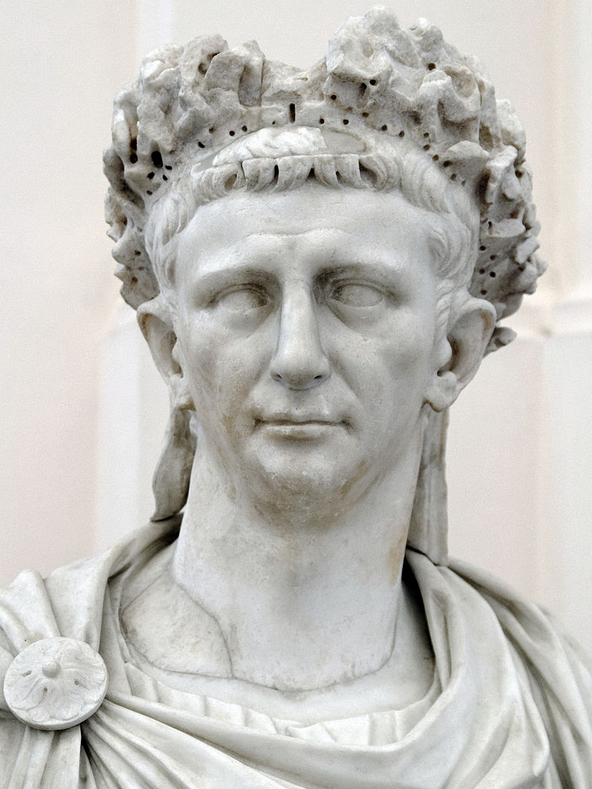
Picture: Bust of Emperor Claudius.
Citation: Claudius. (2024, December 26). In Wikipedia. https://en.wikipedia.org/wiki/Claudius
Attribution: Naples National Archaeological Museum, CC BY 2.5 <https://creativecommons.org/licenses/by/2.5>, via Wikimedia Commons
Economic Reasons
Britain’s wealth of natural resources made it an enticing target for Roman expansion. The island was rich in tin, gold, lead, and other metals essential for the empire’s economy. Fertile agricultural land and vast forests provided additional opportunities for exploitation. By incorporating Britain into the Roman Empire, Rome could access these resources directly while integrating the island into its vast trade networks, further strengthening its economic power. The region’s strategic position also made it a gateway for trade with other parts of the Atlantic world.
Military Strategy
From a military perspective, controlling Britain was vital for securing Rome’s western frontier. The island had long been a refuge for rebellious tribes and a base for anti-Roman resistance, particularly during earlier campaigns in Gaul. By establishing a presence in Britain, Rome could eliminate this threat and create a defensive buffer zone, extending its influence over the surrounding territories.
Military control over Britain also provided an opportunity to project Roman power across the region and deter future uprisings within the empire’s western provinces.
The Roman invasion of Britain was far more than an isolated campaign; it was a calculated decision that reflected the empire’s political ambitions, economic needs, and strategic priorities. By conquering the island, Rome secured valuable resources, expanded its borders, and reinforced its dominance as a global power. These motivations underscore why Britain, once a distant and defiant land, became a key province in the Roman Empire, leaving a legacy that endures to this day.
How was the Invasion Planned and Executed?
The Roman invasion of Britannia in 43 AD was a well-planned and large-scale military operation aimed at securing Roman control over the island. The invasion was led by General Aulus Plautius, acting under orders from Emperor Claudius, who sought to demonstrate Roman power and gain prestige.
Here’s a synopsis of how the Romans executed the invasion: The Romans began by amassing a large invasion force, including four legions (Legio II Augusta, IX Hispana, XIV Gemina, and XX Valeria Victrix), auxiliaries, and cavalry, totalling approximately 40,000 soldiers. The troops were transported across the English Channel from Gaul (modern-day France) in ships, landing at Richborough (Rutupiae) in Kent. Richborough’s natural harbour and proximity to mainland Europe made it an ideal beachhead for the invasion.
The Romans achieved military success in Britain relatively quickly during their invasion in 43 AD due to a combination of superior organisation technology, strategic planning, and the exploitation of local weaknesses. The Roman legions were highly disciplined, professional, and equipped with advanced military technology. Their soldiers excelled in formation fighting, siege warfare, and adapting to different terrains.
In contrast, the Britons often fought as disorganised tribal warbands, relying on guerrilla tactics or individual bravery rather than cohesive strategy. Roman soldiers also carried standardised weapons and armour, such as the gladius (short sword) and scutum (large shield), which gave them a significant advantage in close combat. They employed sophisticated battlefield formations, such as the testudo (tortoise formation)[6], which provided superior defence against missiles and melee attacks, countering the Britons’ reliance on chariots and guerrilla warfare.
The Romans’ advanced naval capabilities also played a crucial role in their success. Their well-developed navy ensured the safe transport of troops, supplies, and war machines across the English Channel. This maritime superiority allowed them to maintain steady resupply lines and cut off potential reinforcements for the Britons from across the water. Additionally, the invasion drew upon the lessons from Rome’s first interaction with Britain. Julius Caesar’s earlier expeditions in 55 and 54 BC, while not leading to conquest, had provided valuable intelligence about the terrain, native tribes, and political dynamics of the region. Rome’s ongoing trade relations with Britain further enhanced its knowledge of the island’s resources, defences, and tribal rivalries before the invasion.
Another factor in the Romans’ success was their overwhelming manpower and resources. This scale of force dwarfed any single tribal army the Britons could muster, especially given their fragmented society. Britain at the time was not a unified nation but a patchwork of competing tribes. The Romans exploited this disunity by employing a “divide and conquer” strategy. They formed alliances with certain tribes, such as the Trinovantes, who resented the domination of stronger tribes like the Catuvellauni. This strategy minimised resistance and allowed the Romans to isolate key opposition.
The swift pace of Roman military campaigns also played a role. After landing on the southeastern coast, they quickly captured strategic locations, such as Camulodunum (modern Colchester), the capital of the Catuvellauni. The Romans were adept at establishing infrastructure as they advanced, including roads, forts, and supply depots, which ensured steady reinforcements and supply chains. Their logistical efficiency contrasted sharply with the Britons’ lack of comparable systems.
Psychological factors also contributed to the Romans’ success. The sheer scale, discipline, and technological superiority of the Roman forces intimidated the Britons. Emperor Claudius himself arrived during the campaign, accompanied by war elephants, which undoubtedly would have had a demoralising psychological impact. Claudius’s involvement also highlights the political motives behind the invasion. The conquest of Britain was a way for Claudius to bolster his political legitimacy, demonstrating Rome’s power and his own leadership abilities. This ensured that the campaign received ample resources and attention from the Roman state.
Lastly, the Romans’ use of auxiliary troops from across the empire provided them with specialised skills, such as cavalry, archery, and slinging, which were crucial in countering the Britons’ tactics. Combined with the Britons’ reliance on less systematic approaches to warfare—such as heroic combat and sporadic raids—the Romans’ cohesive strategy and professional military system gave them a decisive edge.
In summary, the Romans’ quick success in Britain in 43 AD was due to their superior military organisation, technology, logistics, and ability to exploit political and social divisions among the Britons. Their pre-invasion intelligence, naval control, and overwhelming force, coupled with strategic alliances and psychological tactics, ensured a rapid and decisive conquest.
Landing in Kent
Richborough, known as Rutupiae to the Romans, was a crucial site in Roman Britain and served as the main landing point for the Roman invasion in 43 AD. Its location in Kent, near the Wantsum Channel[7], made it an ideal choice for logistical and strategic reasons. At the time, the Wantsum Channel separated the Isle of Thanet from the mainland, creating a natural harbour that provided safe anchorage for the Roman invasion fleet. Its proximity to Gaul (modern France) also ensured that supplies, reinforcements, and communication lines could be maintained efficiently across the English Channel.
Richborough’s flat, open terrain made it well-suited for disembarking large numbers of troops, cavalry, and heavy equipment. Upon landing, the Romans quickly fortified the area to create a secure beachhead. Archaeological evidence, such as early defensive ditches, indicates that the site was used as a staging point for further campaigns inland, particularly against the powerful Catuvellauni tribe. The site’s accessibility to the agriculturally rich and densely populated regions of southeastern Britain further cemented its strategic importance. Richborough also held symbolic significance. It was more than just a military outpost—it became a visible marker of Roman authority in Britain. Later in the 1st century AD, a triumphal arch was built at the site, likely commemorating the successful conquest of Britain by Emperor Claudius. The foundations of this arch have been uncovered by archaeologists, and it is believed to have stood as a monumental gateway to the new Roman province of Britannia.
Upon landing, the Romans immediately secured their position by fortifying the area and establishing a supply base. From this initial stronghold, they began their advance inland, targeting key tribal strongholds and regions. The native tribes of southeastern Britain, including the Catuvellauni—one of the most powerful tribes—offered resistance. However, the Roman legions, with their superior discipline, advanced weaponry, and organised tactics, overwhelmed the less cohesive tribal forces.
Over time, Richborough evolved from a temporary invasion base into a thriving port and supply hub for Roman Britain. It became a key part of the Classis Britannica[8], the Roman fleet responsible for controlling the Channel and ensuring trade and military logistics. Throughout the Roman occupation, Richborough remained vital for the transport of goods, troops, and supplies between Britain and the rest of the empire.
In the late Roman period, Richborough became part of the Saxon Shore defence system, built to protect Britain from increasing raids by Saxon pirates. A large stone fort was constructed at the site in the 3rd century AD, and its imposing remains can still be seen today. This transition highlights how Richborough adapted to the changing military needs of the Roman Empire as it began to decline.
The archaeological excavations at Richborough have uncovered significant evidence of its role in the invasion and its evolution as a Roman settlement. Findings include military defences, civilian buildings, the triumphal arch’s foundations, and artefacts such as coins, pottery, and tools, all of which underscore its importance.
The Battle of the Medway: Rome’s Breakthrough in Britain
One of the first major battles occurred along the River Medway, where the Romans fought a large British force led by Togodumnus and Caratacus, leaders of the Catuvellauni. The Romans used coordinated infantry and cavalry attacks to secure a decisive victory. Following this, they pursued the British forces across the River Thames, further breaking their resistance. Togodumnus was killed, while Caratacus fled westward to continue resistance in Wales.[9]
After Resistance was Subdued…
With southeastern Britain subdued, Emperor Claudius himself arrived with reinforcements, including the terrifying war elephants, to make a symbolic entry into Camulodunum (modern Colchester), the capital of the Catuvellauni. This city was taken and became the first Roman provincial capital in Britannia. The Romans celebrated their conquest with ceremonies and likely established a temple to Claudius as a demonstration of imperial authority.
Over the next few years, the Romans consolidated their control over southeastern Britain by establishing roads, forts, and garrisons. They used a “divide and conquer” strategy, forming alliances with some tribes while subjugating others. The resistance led by Caratacus in western Britain (modern Wales) continued for years, but he was eventually captured and taken to Rome. Roman expansion continued under subsequent governors, with campaigns reaching into Wales and northern England.
In summary, the Romans executed their invasion of Britannia with careful planning, superior military force, and strategic use of fortifications and alliances. They gradually expanded their control through a combination of military victories, infrastructure-building, and political manipulation, laying the foundation for Roman rule in Britain for nearly four centuries.

War Elephants carrying Roman archers, chasing terrified Britons
Drawn by DALL-E, a subset of ChatGPT, 28th December 2024.
What Did the Romans Hope to Achieve?
The Roman invasion of Britain was not merely an act of conquest; it was a carefully planned initiative aimed at achieving long-term strategic, political, and cultural goals. By bringing Britain into the fold of the Roman Empire, the Romans sought to consolidate power and wealth, spread Roman culture, and secure the loyalty of a newly annexed province.
Consolidation of Power and Wealth
A key objective of the Roman invasion was to consolidate the empire’s power and secure its economic stability. By annexing Britain, Rome could exploit its rich natural resources, such as tin, gold, and lead, which were vital for trade and production. The fertile lands of Britain also provided opportunities for agriculture, enabling the production of grain and other staples to support the empire’s growing population.
Additionally, as previously mentioned, the conquest enhanced Rome’s prestige and reinforced Emperor Claudius’s authority. A successful campaign in Britain not only solidified Claudius’s image as a powerful ruler but also showcased the strength and reach of Roman power, sending a message of dominance to other provinces and foreign powers.
Britain’s importance to the Romans lay in its resources, its role as a military frontier, and the symbolic value of adding a remote and challenging territory to the Roman world.
Spreading Roman Culture and Securing Loyalty
The Romans aimed to transform Britain into a fully integrated part of their empire by spreading Roman culture and fostering loyalty among its inhabitants. This process, known as Romanisation, involved the introduction of Roman laws, governance, language (Latin), and customs. The construction of towns, roads, and infrastructure served both practical and symbolic purposes, demonstrating the benefits of Roman rule while consolidating control over the region. By integrating the local elites into the Roman administrative system, the Romans sought to secure the loyalty of Britain’s ruling classes. Offering privileges such as Roman citizenship and economic incentives encouraged these elites to align themselves with Roman authority, helping to maintain stability and reduce the likelihood of rebellion.
Establishing Britain as a Valuable Province of the Empire
Britain was seen as a promising addition to the empire’s network of provinces. Its strategic position on the western frontier allowed Rome to project its power further into the Atlantic world, expanding trade routes and securing new opportunities for economic and military expansion.
Transforming Britain into a prosperous province required the establishment of efficient administration, taxation, and infrastructure. By doing so, the Romans hoped to turn the island into a self-sustaining and profitable region that contributed to the empire’s wealth and stability. The province’s resources, combined with its ability to serve as a defensive outpost, made Britain a valuable asset within the empire.
The Romans’ ambitions in Britain went far beyond military conquest. They sought to consolidate power and wealth, integrate the region into the cultural and administrative fabric of the empire, and transform it into a valuable and loyal province. These goals not only highlight the strategic importance of Britain to Rome but also explain the enduring legacy of Roman rule on the island.
How Did Things Work Out for the Romans?
Introduction:
The Roman conquest of Britain was a pivotal chapter in the empire’s expansion, marked by both triumphs and profound challenges. As the invaders sought to incorporate the island into their vast dominion, they succeeded in establishing Britain as a Roman province and spreading their culture. However, this process was far from smooth, as the Romans faced fierce resistance, major revolts, and the intricate task of Romanising a diverse and often defiant population.
While the Romans transformed Britain with their laws, infrastructure, and cultural influences, the occupation was not a one-way exchange. Stationed in this distant province, the Romans themselves were shaped by the unique environment, adopting local religious practices, adapting their military strategies, and engaging in a cultural fusion that left a lasting mark on their identity.
Challenges and Tribal Resistance
The Romans faced determined resistance from native tribes, many of whom viewed the invasion as a grave threat to their autonomy and way of life. Prominent tribes such as the Iceni in the east and the Silures[10] in Wales led prolonged and often fierce campaigns against Roman forces, highlighting the difficulty of subjugating the region.
Wales, with its rugged terrain and fiercely independent tribes, emerged as a stronghold of defiance. The Silures, in particular, posed a significant challenge, requiring sustained military efforts under capable Roman leaders such as Sextus Julius Frontinus[11]. Despite the construction of forts and roads designed to secure the region, resistance in Wales endured for decades, forcing the Romans to divert considerable resources and manpower to maintain control.

Picture: [Cropped] The statue Boadicea and Her Daughters near Westminster Pier, London
Citation: Boudica. (2024, December 25). In Wikipedia. https://en.wikipedia.org/wiki/Boudica
Attribution: Paul Walter, CC BY 2.0 <https://creativecommons.org/licenses/by/2.0>, via Wikimedia Commons
This file is licensed under the Creative Commons Attribution 2.0 Generic license.
Revolts and Boudica’s Rebellion
Resistance to Roman rule reached a dramatic peak with the revolt led by Queen Boudica of the Iceni in 60–61 AD. Sparked by the mistreatment of her people—including the confiscation of Iceni lands, the flogging of Boudica, and the assault on her daughters—the rebellion became a unifying cause for several tribes. Boudica’s forces unleashed a wave of destruction across Roman Britain, razing key settlements such as Londinium (London), Camulodunum (Colchester), and Verulamium (St. Albans). The scale of the uprising was immense, with tens of thousands of Roman citizens and allies killed in a rebellion that shook the foundations of Roman authority.
Although Governor Suetonius Paulinus ultimately crushed Boudica’s forces in a decisive battle, the rebellion laid bare the vulnerabilities of Roman rule in Britain. It revealed the fierce and enduring resistance among the native tribes and underscored the immense challenges of governing a distant and often volatile province. The revolt also prompted Rome to reconsider its strategies for controlling Britain, leading to an increased military presence and reforms aimed at preventing future uprisings.
Coexistence: The Vanquished and the Conquerors
After conquering Britain in 43 AD, the Romans faced the critical challenge of transitioning from military domination to coexistence with the Britons.
- Establishing Military Control: To maintain control, the Romans established a strong military presence, constructing forts and outposts to suppress rebellion and deter resistance. They also recruited local Britons into auxiliary units, providing them with a stake in Roman stability and fostering loyalty among certain segments of the population.
- Divide and Rule: By exploiting tribal divisions, the Romans weakened unified resistance. They formed alliances with compliant tribes and rewarded loyal leaders, such as Togidubnus of the Regni, with status and protection. Tribes that resisted Roman rule faced harsh reprisals, including the destruction of strongholds and forced resettlements, demonstrating Rome’s capacity for both diplomacy and ruthlessness.
- Infrastructure Development: To win over the population, the Romans introduced transformative infrastructure. Roads like Watling Street facilitated trade and movement, while towns such as Londinium became economic and administrative hubs. Public works, including bathhouses, amphitheatres, and aqueducts, symbolised Roman prosperity and improved the quality of life for many Britons.
- Romanisation: Assimilation was key to Roman governance. Latin became the language of administration, and local elites were integrated into Roman political systems. Over time, many Britons gained Roman citizenship, particularly after the Edict of Caracalla in 212 AD, incentivising loyalty. A unique Romano-British identity emerged, blending Roman and Celtic traditions in religion, art, and architecture.
- Economic Integration: Britain became a vital part of Rome’s trade networks, exporting resources like tin and lead while importing luxury goods such as wine and olive oil. Land redistribution to Roman settlers and veterans established agricultural estates that fuelled local economies.
- Displays of Power and Diplomacy: The Romans balanced demonstrations of military strength with gestures of diplomacy. Temples and public ceremonies honoured Roman and local deities, such as Sulis Minerva, blending spiritual traditions. Sparing defeated leaders like Caratacus reinforced Rome’s image of clemency and authority, strengthening ties with conquered populations.
This multifaceted approach allowed the Romans to turn former adversaries into collaborators. While resistance persisted in areas like Wales and Scotland, much of Britain became a relatively stable province. Over time, many Britons adopted Roman ways, contributing to the empire’s administration, military, and culture, ultimately integrating into the fabric of Roman civilisation.
The Gradual Romanisation of Britain
Despite ongoing resistance and challenges, the Romans gradually Romanised Britain through a combination of their military presence, infrastructure development, and cultural integration. The construction of towns, roads, and villas established Roman administrative and economic systems, and created a framework for governance and commerce. Cities like Londinium (London), Eboracum (York), and Verulamium (St. Albans) emerged as vital centres of trade, administration, and culture, fostering economic prosperity and social transformation.
Romanisation extended to religion, where native deities were assimilated into the Roman pantheon. Temples were constructed to honour gods that combined Roman and local traditions, such as Sulis Minerva at Bath, reflecting a fusion of spiritual beliefs. By the 4th century, Christianity had begun to take root, symbolising not only the evolving religious landscape of Britain but also its connection to the broader transformations within the Roman Empire.
However, the process of Romanisation was not without its drawbacks. Critics argue that it contributed to the erosion of native traditions and an increase in economic disparity. Heavy taxation placed a burden on rural and tribal communities, while forced cultural assimilation marginalised many Britons who were unable or unwilling to adopt Roman practices. This marginalisation created long-term resentment among segments of the population, even as others benefitted from the new economic and social structures.
Romanisation was thus a complex and uneven process. It left an enduring legacy in Britain, evident in its infrastructure, urban planning, and hybrid cultural practices, but it also exposed deep tensions between progress and the preservation of local identities.
Legacy and Ongoing Challenges
The Romans succeeded in establishing Britain as a Roman province, but certain regions, such as the Scottish Highlands, remained beyond their reach. Hadrian’s Wall, constructed in the early 2nd century AD under Emperor Hadrian, symbolised the strength and ambition of the empire while marking the practical limits of Roman control in the north. Despite this boundary, the region beyond the wall continued to be a source of raids and unrest, underscoring the persistent challenges faced by Roman forces.
Maintaining control over Britain demanded continuous military and economic investment. The province’s location on the empire’s periphery made it particularly vulnerable to internal uprisings, such as Boudica’s revolt, and external threats, including incursions from Picts and other tribes beyond Roman borders. Periodic skirmishes along the frontier strained resources, while the heavy cost of maintaining roads, fortifications, and garrisons further burdened the imperial treasury.
By the time of the Roman withdrawal in 410 AD, the province’s economic and military foundations had significantly eroded. The empire, weakened by internal strife and external pressures elsewhere, could no longer sustain its hold on Britain. The withdrawal marked the end of Roman rule and paved the way for new waves of invasions by Saxons, Angles, and other groups. Over time, Britain gradually returned to local rule, with many Roman institutions and structures either abandoned or adapted by successor kingdoms.
Although the Romans departed, their influence endured. The legacy of Roman Britain is evident in its roads, cities, and the introduction of concepts like centralized governance and urban planning, which continued to shape the island’s development long after the fall of the empire.
How Britons Changed the Romans
While the Romans profoundly shaped Britain, the process of Romanisation was far from one-sided. The unique environment, customs, and challenges of Britain influenced the Romans stationed there, fostering a dynamic interplay between conquerors and the conquered. This cultural exchange reshaped Roman identity and practices, creating a hybrid Romano-British culture that left an enduring impact on both the province and the empire.
- Adopting Local Religious Practices: The Romans incorporated native Celtic deities into their worship, blending local and Roman traditions. Temples along Hadrian’s Wall honored figures like Cocidius, a war god, and Sulis Minerva, a fusion of the Roman goddess Minerva and the Celtic deity Sulis.
- Hybrid Identities in Daily Life: Villas combined Roman architectural styles with local materials, while pottery and jewelry often fused Roman and British designs. Archaeological evidence reveals how everyday life reflected a blending of cultural influences.
- Military Adaptations: Roman soldiers stationed in Britain adapted to the unique terrain and challenges of the province. They constructed fortifications like Hadrian’s Wall and often formed relationships with local women, resulting in mixed families and hybrid identities.
- Dietary and Agricultural Changes: Roman settlers integrated British staples such as barley and oats into their diets while introducing Mediterranean staples like olives and wine. Agricultural practices adapted to the British climate, showcasing innovation and a practical exchange of techniques.
- Administrative Adjustments: Governing Britain often required collaboration with local tribal leaders, who were co-opted as client kings. Roman officials adapted taxation and legal systems to maintain order in this diverse and challenging province.
These adaptations illustrate the extent to which the Romans were influenced by the Britons. The Roman occupation of Britain was not merely an imposition of culture but a mutual exchange that fostered innovation and transformation. The insurgent’s experience in Britain was a mixture of success and struggle. While they faced significant challenges—most notably tribal resistance and major revolts like Boudica’s rebellion—they established a province that became deeply integrated into the empire’s administrative, economic, and cultural systems. This gradual Romanisation left a legacy visible in Britain’s development long after the Romans departed. However, the persistent challenges and eventual decline of Roman authority highlight the complexities of maintaining control over such a distant and diverse territory.
The Romans in Britain were influenced as much as they influenced the Britons. From religion to governance, their prolonged occupation fostered a hybrid Romano-British culture that left a lasting impact on both the province and the empire. The Roman experience in Britain illustrates a dynamic interplay of conquest, resistance, and cultural integration. While Rome imposed its systems and traditions, it was equally shaped by the unique environment and people of Britain. This mutual exchange not only defined the province’s place within the empire but also left an enduring legacy of innovation and transformation that persisted long after the Roman departure.
How Did Things Work Out for Britons?
The Roman occupation of Britain brought profound changes to the lives of its inhabitants. While some Britons embraced Roman rule and benefited from the new infrastructure, trade opportunities, and cultural integration, others resisted, suffering displacement, exploitation, and repression. The impact of Roman rule on native Britons was complex, with both opportunities and challenges shaping their experience over nearly four centuries.
Opportunities Under Roman Rule
For many Britons, Roman rule brought significant advancements that transformed their daily lives:
- Urbanisation and Infrastructure: Roman towns became centres of commerce and governance, introducing Britons to advanced amenities such as aqueducts, public baths, and paved roads. Cities like Londinium, Camulodunum, and Eboracum became hubs of activity, offering new opportunities for trade, employment, and social mobility.
- Economic Growth: Roman Britain became part of a vast imperial economy, providing access to trade networks that stretched across Europe, North Africa, and the Middle East. Britons gained exposure to new goods, such as wine, olive oil, and luxury items, and some locals found wealth through trade and land ownership.
- Romanisation and Social Advancement: The adoption of Roman customs, language, and governance enabled certain Britons—primarily elites—to integrate into the Roman administrative system, gaining prestige through participation in imperial politics. However, this integration often came at the expense of traditional customs and autonomy, as native languages and cultural practices were marginalised in favour of Roman models, creating a cultural divide between the elite and the broader population. The granting of Roman citizenship, particularly after the Edict of Caracalla in 212 AD, allowed certain Britons to enjoy the rights and protections of Roman law.
Challenges and Exploitation
While some Britons thrived under Roman rule, many faced significant hardships, especially in the early years of the conquest, through:
- Loss of Autonomy: The Roman conquest meant the loss of political independence for Britain’s tribes. Local rulers were either replaced or co-opted into the Roman system, and native systems of governance were subordinated to imperial authority.
- Taxation and Economic Exploitation: Roman governance imposed heavy taxes and requisitions on the local population, funneling wealth to the imperial treasury and straining poorer Britons. While these measures supported the development of infrastructure and urban centers that benefited many communities, they also entrenched economic disparities, exacerbating tensions between native Britons and Roman authorities.
- Displacement and Resistance: Tribes that resisted Roman rule, such as the Iceni, Silures, and Brigantes, often faced harsh reprisals, including the destruction of settlements and forced resettlement. The construction of Roman forts and roads frequently displaced local communities, disrupting traditional and established ways of life.
- Cultural Erosion: While Romanisation introduced new customs and technologies, it also led to the decline of native traditions, languages, and religious practices. Temples to native deities were replaced by Roman-style shrines, and Celtic art and culture were gradually subsumed by Roman influences.
Britons Collaborating with the Romans
Some Britons actively collaborated with the Romans to further their own power and position. These collaborators played crucial roles in the conquest and administration of Roman Britain, and their actions often determined the success of Roman campaigns.
Notable Collaborators were:
- Togidubnus (Tiberius Claudius Cogidubnus): A client king of the Regni tribe, Togidubnus is one of the most famous examples of British collaboration. He was granted Roman citizenship and significant power in southern Britain as a reward for his loyalty. Evidence from the Chichester inscription[12] suggests he helped the Romans secure local stability by governing on their behalf.
- Cartimandua (Queen of the Brigantes): Cartimandua ruled the powerful Brigantes tribe in northern Britain. She allied with the Romans and handed over the British resistance leader Caratacus to them in 51 AD. Her collaboration ensured the Romans’ support for her rule, though it also led to civil war within her tribe when her ex-husband Venutius rebelled against her.
- Commius, a king of the Atrebates, a Belgic tribe with settlements in both Gaul and Britain. Initially, Commius was an ally of Julius Caesar during his campaigns in Gaul and even acted as an intermediary between Caesar and the Britons. However, he later turned against Rome, joining the anti-Roman rebellion led by Vercingetorix in 52 BC. After his defeat, Commius fled to Britain, where he likely established a kingdom among the Atrebates. His descendants, such as Verica, appear to have maintained close ties with Rome. Verica is thought to have been one of the leaders who invited Roman intervention in Britain, providing a pretext for Claudius’s invasion in 43 AD.
The motivations for collaboration included:
- Protection and Power: Collaborators sought Roman support to secure their own authority, often using Roman military backing to suppress rival tribes.
- Material Benefits: Roman alliances brought material rewards, such as wealth, luxury goods, and Roman citizenship.
- Romanisation: Many native elites saw collaboration as a way to modernise their territories and integrate into the Roman system of governance.
Collaboration was a pragmatic strategy for many Britons who sought to protect or expand their power. These alliances were critical to Rome’s success in consolidating control over Britain, as collaborators provided local knowledge, manpower, and legitimacy to Roman rule.
Imagine being a Briton living in a Romanised villa, benefiting from trade and new technologies, but witnessing your ancestral traditions fade. Would you embrace the change or resist it?
Resistance and Repression: Anglesey, Boudicca, and the Northern Frontier
For those who continued to resist Romanisation, life was marked by ongoing struggles to preserve their cultural identity and independence. Tribes in remote regions, such as Wales and Scotland, maintained much of their traditional way of life, often clashing with Roman forces along the empire’s frontiers.
The Attack on the Druids’ Stronghold on Anglesey
The attack on the Druids’ stronghold on Anglesey in 60 AD was a major Roman military campaign led by Governor Gaius Suetonius Paulinus. Anglesey, known as Mona to the Romans, was the spiritual and cultural heart of Druidic power in Britain, serving as a sanctuary for refugees and a centre of resistance against Roman rule. Suetonius aimed to eliminate the Druids’ influence and solidify Roman control by destroying this stronghold. To reach the island, the Romans crossed the Menai Strait, possibly using temporary bridges or boats, while facing fierce resistance from Britons lining the shore. According to the historian Tacitus, the defenders included Druids performing curses and women in black robes chanting, creating a terrifying scene for the Romans. However, Roman discipline prevailed, and they massacred the defenders, destroyed sacred groves, and dismantled altars.
The campaign symbolised the suppression of native spiritual resistance, but it was cut short by news of Boudicca’s rebellion, forcing Suetonius to withdraw.
Boudica’s Rebellion and the Struggle for Autonomy
As already mentioned, the challenges faced by Britons under Roman rule were epitomised by Boudica’s rebellion in 60–61 AD. Boudicca’s rebellion, which occurred in 60/61 AD, was one of the largest uprisings against Roman rule in Britain. Boudicca, queen of the Iceni tribe, led the revolt after suffering grave injustices. Following the death of her husband, King Prasutagus, the Romans seized Iceni lands, flogged Boudicca, and raped her daughters.
This outrage united the Iceni and neighbouring tribes, such as the Trinovantes, in a violent rebellion. Boudicca’s forces first targeted Camulodunum (modern Colchester), the provincial capital, destroying the city and slaughtering its Roman inhabitants. Next, they sacked Londinium (modern London) and Verulamium (modern St Albans), killing tens of thousands of Roman citizens and allies. Tacitus estimated the death toll at 70,000–80,000, with Roman cities burned to the ground.
However, Governor Suetonius Paulinus regrouped his forces and confronted Boudicca in a final battle, where Roman discipline and tactics overcame the larger but poorly organised British forces. Boudicca either died in battle or took her own life to avoid capture. The rebellion, while a temporary crisis for the Romans, led to reforms in their administration of Britain to prevent further uprisings.

This map shows the location of Hadrian’s Wall and the Antonine Wall in Scotland and Northern England.
Citation: Hadrian’s Wall. (2024, October 30). In Wikipedia. https://en.wikipedia.org/wiki/Hadrian%27s_Wall
Attribution: Hadrians_Wall_map.png: Created by NormanEinstein, September 20, 2005 derivative work: Talifero, CC BY-SA 3.0 <http://creativecommons.org/licenses/by-sa/3.0/>, via Wikimedia Commons
This file is licensed under the Creative Commons Attribution-Share Alike 3.0 Unported license.
Hadrian’s Wall
Hadrian’s Wall, built between 122 and 128 AD during Emperor Hadrian’s reign, marked the northernmost boundary of Roman Britain. Stretching 73 miles (117 kilometres) across northern England, it ran from the River Tyne near Newcastle to the Solway Firth. Its purpose was to control movement across the border, prevent raids by northern tribes like the Picts, and assert Roman power.
The wall consisted of a stone or turf structure with ditches, milecastles, forts, and watchtowers along its length. It served not just as a defensive barrier but also as a customs and trade checkpoint, where Roman officials monitored goods and people moving in and out of the empire. The wall was manned primarily by auxiliary troops drawn from across the Roman Empire, reflecting its multicultural nature. While it was a frontier, it also facilitated economic and cultural exchange between Roman and native communities.
The diversity of Hadrian’s Wall is evident in the archaeological record. Troops stationed there came from provinces such as Gaul, Spain, North Africa, and Syria, bringing their languages, religions, and customs to Britain. Inscriptions and altars found along the wall show that soldiers worshipped a wide range of deities, including Roman gods like Jupiter, local Celtic gods like Cocidius, and even eastern deities like Mithras.
Vindolanda, a fort just south of Hadrian’s Wall, has yielded letters and artefacts that reveal the lives of soldiers, their families, and local traders. The presence of women and children, as well as evidence of trade and marriage between Romans and Britons, highlights the cultural blending that occurred on the frontier. This diversity challenges the view of Roman Britain as a homogenous society and demonstrates the global nature of the Roman Empire.
The Gradual Integration of Britons
Over time, many Britons adapted to Roman rule, resulting in a blending of Roman and native cultures. This process of Romanisation was uneven, with elites adopting Roman customs more readily than rural communities, where traditional practices persisted.
- Religion: Roman religious practices initially coexisted with native Celtic beliefs, but by the 4th century, Christianity had become the dominant faith in Roman Britain. The adoption of Christianity reflected both the broader religious transformation of the empire and the integration of Britons into its cultural framework.
- Cultural Synthesis: The fusion of Roman and native traditions created a unique provincial culture. Roman villas often incorporated Celtic motifs, and local deities were worshipped alongside Roman gods. This blending of cultures allowed Roman Britain to develop a distinct identity within the empire.
Legacy for Britons
The end of Roman rule in 410 AD marked a turning point for Britons. With the withdrawal of Roman administration and military forces, local communities were left to fend for themselves, facing invasions from Saxons and other tribes. While some of the benefits of Roman rule, such as roads and urban centres, remained, the island descended into a period of political fragmentation and uncertainty.
However, the legacy of Roman Britain endured in the form of governance, law, and cultural practices that influenced the development of medieval Britain. For Britons, the Roman period was a time of both profound disruption and lasting transformation, shaping how Britain’s history evolved for centuries to come. But Roman occupation was a double-edged sword – while it introduced opportunities for economic growth, infrastructure development, and cultural exchange, it also brought challenges such as exploitation, displacement, and the erosion of native traditions.
Carausius’s Rebellion: The Britannic Empire (286–296 AD)
Carausius’s rebellion in 286 AD represents one of the most intriguing episodes in Roman Britain’s history. For a decade, Britain and parts of northern Gaul were severed from the Roman Empire, ruled as an independent breakaway state under Carausius and later his successor, Allectus. This rebellion posed a significant challenge to Roman authority and demonstrated the fragility of imperial control over distant provinces during the tumultuous period of the late 3rd century. It also highlighted the strategic and economic importance of Britain to the empire.
Who Was Carausius?
Carausius was a Roman naval commander of Menapian origin (from modern Belgium or the Netherlands). He rose to prominence as the commander of the Classis Britannica, the Roman fleet tasked with patrolling the waters of the English Channel and the North Sea to protect the empire from Saxon and Frankish pirates. Carausius was a skilled military leader, but his career became clouded by accusations of corruption.
According to historical sources, Carausius was accused of allowing pirate ships to raid coastal settlements, waiting until the pirates had looted their targets, and then seizing the stolen goods for himself. This led to charges of embezzlement, and Emperor Maximian, co-ruler under Diocletian, ordered Carausius’s execution.
The Causes of the Rebellion
Facing imminent punishment, Carausius staged a rebellion in 286 AD and declared himself emperor of Britain and northern Gaul. Several factors contributed to the rebellion:
- Britain’s Strategic and Economic Importance: Britain was a wealthy province that supplied the Roman Empire with essential resources, including grain, tin, lead, and other minerals. Its location also made it a key base for controlling the Atlantic trade routes and defending the empire’s northern frontier. Losing control of Britain posed both economic and strategic risks to Rome.
- Carausius’ Control of the Fleet: As commander of the Classis Britannica, Carausius had direct control over the Roman navy in the region, giving him a crucial advantage. His fleet allowed him to dominate the Channel and defend Britain against Roman counterattacks.
- Weakness in the Roman Empire: The Roman Empire in the late 3rd century was recovering from the Crisis of the Third Century (235–284 AD), a period marked by internal rebellions, invasions, and political instability. Carausius exploited these vulnerabilities, particularly the division of imperial authority under the newly established Tetrarchy.
- Local Support in Britain: Carausius gained support from the Roman legions stationed in Britain, as well as local elites and merchants who may have benefited from his rule. His ability to mint coins and maintain economic stability helped secure loyalty from various groups.
What Happened: The Breakaway Britannic Empire
After declaring himself emperor, Carausius established a breakaway state that controlled Britain and parts of northern Gaul. This is often referred to as the Britannic Empire, though it was never formally recognised by Rome. Key events of the rebellion include:
- Minting Coins: Carausius minted his own coins, a critical step in asserting his legitimacy as emperor. These coins often bore slogans like “Restitutor Britanniae” (“Restorer of Britain”) and “Genius Britanniae” (“The Spirit of Britain”), appealing to British pride and Roman tradition. The high quality of the coins suggests an economically stable administration.
- Repelling Maximian’s Invasion: In 289 AD, Maximian launched an expedition to reclaim Britain, but Carausius successfully repelled the invasion, likely using his naval superiority to block the crossing of the Channel. This defeat forced Rome to acknowledge Carausius’s rule temporarily.
- Consolidation of Power: Carausius fortified his position by securing Britain’s borders and possibly negotiating alliances with Saxon and Frankish tribes. His administration maintained relative stability and prosperity during his rule, though his position in northern Gaul was more precarious.
The Fall of Carausius
Despite his initial success, Carausius’s rule began to unravel around 293 AD when Constantius Chlorus was appointed Caesar under the Tetrarchy and tasked with reclaiming Britain. Constantius launched a methodical campaign to isolate Carausius by targeting his holdings in northern Gaul.
- The Loss of Bononia (Boulogne): In 293 AD, Constantius captured Bononia, a key port city on the northern Gallic coast. This victory cut off Carausius’s access to the continent and weakened his position significantly.
- Assassination of Carausius: Shortly after losing Bononia, Carausius was assassinated by his finance minister, Allectus, who then declared himself emperor and took control of the Britannic Empire. Allectus’s rule, however, would prove short-lived.
The Resolution: Constantius’s Invasion of Britain
In 296 AD, Constantius Chlorus launched a coordinated invasion to reclaim Britain and end the rebellion. The campaign was carefully planned:
- The Two-Pronged Attack: Constantius divided his forces, sending one fleet under his general Asclepiodotus to land in southern Britain while another fleet prepared to cross the Channel. This approach ensured a swift and decisive invasion.
- The Death of Allectus: Allectus was killed in battle near Silchester (Calleva Atrebatum) by Asclepiodotus’ forces. Constantius’s army then entered Londinium (modern London) in triumph, where he was hailed as the restorer of Roman rule.
The Aftermath and Significance
Reintegration of Britain: Constantius’s victory restored Roman control over Britain, bringing it back into the fold of the empire. The campaign was commemorated with coins bearing slogans like “Redditor Lucis Aeternae” (“Restorer of Eternal Light”), symbolising the reunification of the province. Such appeals to restoration echo a timeless rhetorical device employed by leaders across eras, from the Roman Empire to modern political campaigns like “Make America Great Again.” Both evoke a vision of renewal tied to unity and strength, reflecting the enduring power of restoration as a political and cultural ideal.
- Impact on the Tetrarchy: The successful resolution of the rebellion bolstered the legitimacy of the Tetrarchic system, showcasing its ability to respond to challenges and maintain the unity of the empire.
- Legacy of Carausius: Carausius is remembered as a figure who briefly challenged Roman dominance, creating a unique moment in Britain’s history when the province operated as an independent entity. His coins and administrative policies reflect his ambition and ability to govern effectively, even in defiance of Rome.
Carausius’s rebellion was a remarkable episode in the history of Roman Britain, illustrating the challenges of maintaining control over distant provinces in an era of political and military upheaval. While his breakaway Britannic Empire was ultimately short-lived, it highlighted the strategic and economic importance of Britain to the Roman Empire and demonstrated the resilience of imperial power under the Tetrarchy. The resolution of the rebellion by Constantius Chlorus not only restored stability but also reinforced the unity of the empire during a critical period of reform.
Transition from “Britannia” to “Britain”
The transition of name from “Britannia” to “Britain” is part of the evolution of language and cultural identity, rather than a specific moment in time. Here’s a breakdown of how the name changed and what it represents historically:
Roman “Britannia” (43 AD–5th Century AD)
- Origins of the Name: The Romans adopted the name “Britannia” from the Greek term Prettanike or Brettaniai, which referred to a group of islands, including Great Britain and Ireland. The name likely derived from the Celtic word Pritani, which the native Britons used to describe themselves.
- Roman Use: After the Roman conquest of Britain in 43 AD, “Britannia” was the official name for the province that comprised much of modern-day England and Wales. It referred specifically to the lands the Romans controlled.
Decline of Roman Britannia (5th Century)
- With the Roman withdrawal from Britain around 410 AD, “Britannia” as a Roman province ceased to exist. The name, however, persisted in historical and ecclesiastical texts written in Latin.
Early Medieval Period (5th to 11th Centuries)
- During the early medieval period, as Anglo-Saxon kingdoms began to emerge, the Roman name “Britannia” was no longer widely used. Instead, different regions were known by the names of their ruling kingdoms (e.g., Wessex, Mercia, Northumbria). The land of the native Britons, especially in areas like modern Wales and Cornwall, was referred to as “Briton” or “Britons” by the Anglo-Saxons.
- The Old English term “Bryten” or “Breoton” began to be used to describe the island more broadly, reflecting the influence of the native Brittonic language and evolving Anglo-Saxon usage.
Norman Conquest and Middle English (11th to 15th Centuries)
- After the Norman Conquest of 1066, Latin remained the language of the church and administration. In this context, “Britannia” still appeared in formal or historical writing, but in everyday speech, Middle English versions of the name, like “Breteyne” or “Bretayne,” began to emerge.
- By this time, “Britain” referred to the island as a whole, but it was not a political entity. England, Scotland, and Wales remained distinct realms.
-
-
Early Modern Period (16thto 18th Centuries)
- The term “Britain” became more formalised during the Tudor period. Under Henry VIII (1491–1547), there was a growing sense of unity between England and Wales. By the 16th century, “Great Britain” started to be used to distinguish the island of Britain from Brittany in France.
- The name “Britannia” saw a revival in this period as a poetic and symbolic term for the island, often used in art, literature, and national identity.
-
-
Creation of the Kingdom of Great Britain (1707)
- The Act of Union in 1707 formally united the kingdoms of England and Scotland into a single political entity: the Kingdom of Great Britain. This marked a key moment when “Britain” became an official political term.
- The use of “Britain” as shorthand for the entire island became more common, and “Britannia” continued to be used as a cultural and symbolic term, especially in the context of the British Empire.
-
-
Modern Use
- Today, “Britain” typically refers to the island that comprises England, Scotland, and Wales. The term “United Kingdom” (full name: United Kingdom of Great Britain and Northern Ireland) is the formal name for the modern sovereign state, but “Britain” is often used informally to refer to it.
Why Did the Romans Leave?
In 410 AD, the decision to withdraw Roman forces from Britain was made during the reign of Emperor Honorius. However, the situation was more complex than a single, clear decision to “leave Britain”, as explained below.
Background
By the early 5th century, the Western Roman Empire was in decline. Repeated barbarian invasions, including those by the Visigoths and Vandals, were threatening the empire’s heartlands. Honorius faced immense pressure, especially as the Visigoths under Alaric I sacked Rome in 410 AD. This forced the Emperor to prioritise defending homeground and other key parts of the empire over distant provinces like Britain.
The Situation In Britain
Roman Britain was under increasing attack from Saxons, Picts, and Scots. The local Romanised population appealed to Honorius for military assistance. However, Honorius, preoccupied with defending Rome itself, is said to have sent a message to the cities of Britain, advising them to “look to their own defenses“. This is referred to in the Rescript of Honorius[13], a letter recorded by the historian Zosimus.
Roman Withdrawal
The Roman military presence in Britain had been declining for decades. By 410, the remaining Roman forces were either withdrawn to deal with other crises or had largely disbanded, leaving the Romano-British population to fend for themselves. This effectively marked the end of Roman rule in Britain.
While Honorius did not explicitly “decide” to abandon Britain, his inability, and unwillingness, to send help and his redirection of resources to defend Italy marked the de facto withdrawal of Roman authority from the province.
Cultural Transformation
The Roman invasion of Britain in AD43 marked the beginning of a profound cultural transformation. Roman art was not merely an aesthetic endeavour; it was a medium for spreading Roman values, consolidating power, and demonstrating the benefits of Roman civilisation. From elaborate mosaics to intricate jewellery, Roman art left an enduring legacy in Britain. The evidence of this influence is vast and diverse, revealing how Roman and native British cultures blended over the centuries.
Mosaics
One of the most striking forms of Roman art in Britain is the mosaic. These intricate floor decorations adorned the homes of wealthy Romans and Britons who adopted Roman customs. Mosaics served both decorative and symbolic purposes, often depicting scenes from Roman mythology, geometric patterns, and daily life.
Key examples include:
- Fishbourne Roman Palace in Sussex boasts some of the earliest and most elaborate mosaics in Britain, featuring floral designs and mythological figures such as Cupid and dolphins.
- Chedworth Roman Villa in Gloucestershire contains mosaics with intricate geometric patterns and depictions of animals, showcasing the skill of Roman artisans.
- The mosaic at Hinton St. Mary in Dorset is particularly significant, as it features one of the earliest known depictions of Christ in Roman Britain, reflecting the growing influence of Christianity.
These mosaics highlight not only the artistry of Roman craftsmen but also the wealth and Romanised tastes of their owners.
Sculptures and Reliefs
Roman sculptures in Britain included monumental statues, funerary monuments, and smaller decorative pieces. They often served as public displays of loyalty to Rome or as private expressions of status and belief. These works of art were not just decorative; they were deeply symbolic, reinforcing Roman power and values.
Notable finds include:
- The Claudius Relief from Colchester (Camulodunum), thought to depict Emperor Claudius, celebrates the conquest of Britain and reinforces the presence of Roman authority.
- Funerary sculptures, like the tombstone of a Roman soldier found in Chester, combine Roman artistic styles with local elements, such as Celtic knotwork.
- Statues of deities like Jupiter, Mercury, and Minerva have been uncovered, often in temple sites, reflecting the integration of Roman religion into Britain.
Wall Paintings (Frescoes)
Although relatively rare due to Britain’s damp climate, fragments of Roman wall paintings have been discovered, particularly in villas and bathhouses. These frescoes used bright pigments and often depicted landscapes, mythological scenes, or architectural illusions (a style known as trompe-l’œil).
Key sites include:
- Lullingstone Roman Villa in Kent contains frescoes that are remarkable for their dual religious significance. Pagan symbols are present alongside early Christian iconography, such as the Chi-Rho symbol, showing the coexistence of old and new beliefs.
- At Silchester (Calleva Atrebatum), fragments of wall paintings reveal colourful depictions of columns and other architectural details, creating the illusion of grandeur.
These frescoes highlight the extent to which Roman artistic traditions were adapted to British contexts, blending functionality with aesthetics.
Metalwork and Jewellery
Roman metalwork in Britain provides some of the finest examples of the blending of Roman and Celtic artistic traditions. Items like brooches, necklaces, and ceremonial objects were crafted with incredible skill and often incorporated Roman symbols such as eagles, gods, or military insignia.
Famous finds include:
- The Great Chesterford Bowl, a silver vessel decorated with intricate designs, showcases the fusion of Roman and local artistry.
- Roman brooches, such as the Hod Hill type found north-west of Blandford Forum, Dorset, combine practical use with decorative appeal.
- The Snettisham Treasure, though predominantly Iron Age, includes Roman-influenced gold torcs and jewellery, demonstrating the interaction between Roman and native styles.
Such artefacts reveal not only the artistic skills of Roman Britain but also the way art was used to signify wealth, power, and identity.
Architecture and Decorative Stonework
Roman architecture in Britain is itself a form of art, blending functionality with beauty. Buildings like villas, temples, and bathhouses often featured decorative stonework, columns, and friezes. Even in defensive structures, Roman art served to project power and sophistication.
Significant examples include:
- The Roman Baths in Bath are a masterpiece of Roman engineering and art, featuring carved stone pediments and decorative inscriptions.
- The Corinium Museum in Cirencester houses remnants of Roman architectural decorations, including friezes and carved reliefs that adorned public buildings and private homes.
- Military sites such as Hadrian’s Wall incorporated artistic flourishes, such as altars dedicated to Roman gods and carved stone inscriptions.
How Roman Art Spread in Britain
- Military and Administrative Centres: Roman forts, such as those along Hadrian’s Wall, became hubs of Roman culture. Soldiers and officials brought artistic traditions with them, commissioning sculptures, altars, and inscriptions to decorate these sites.
- Urbanisation: As Roman towns like Londinium (London), Verulamium (St Albans), and Eboracum (York) developed, they became centres for Roman art. Public buildings, temples, and private homes featured artistic elements that reflected Roman tastes.
- Trade and Connectivity: Britain’s integration into the Roman trade network facilitated the import of luxury goods and artistic materials like marble and glass. Local artisans learned new techniques, producing works that combined Roman styles with British themes.
- Cultural Assimilation: The blending of Roman and Celtic traditions created unique hybrid styles. For example, Celtic motifs such as spirals and knotwork appeared alongside Roman designs in jewellery and metalwork.
- Religion: The introduction of Roman gods and, later, Christianity had a significant impact on art. Temples and early churches featured Roman artistic styles, while new iconography, such as the Chi-Rho, began to appear in mosaics and wall paintings.
The Roman invasion brought an artistic revolution that left an indelible mark on Britain. From mosaics and sculptures to jewellery and architecture, Roman art reflected the power, sophistication, and adaptability of the Roman Empire. Evidence of this rich artistic legacy can still be seen today in archaeological sites and museums across Britain, offering a window into a dynamic period of cultural transformation. By blending Roman and native traditions, the art of Roman Britain tells a story of conquest, adaptation, and enduring influence.

“The Colchester Vase, around 175 AD, Colchester Castle Museum, Camulodunum (Roman Colchester)” by Following Hadrian is licensed under CC BY-SA 2.0
Via Openverse.Org

“The Circus Maximums” by failing_angel is licensed under CC BY-NC-SA 2.0
Via Openverse.Org
Concluding Words
The Roman invasion in AD 43 and their eventual withdrawal in AD 410 represent a pivotal chapter in Britain’s history. It was an era that fundamentally reshaped Britain’s societal structures, culture, and connections to the wider world. However, to imagine a Britain untouched by Rome is to explore the profound consequences of their conquest and to consider how the island’s historical trajectory might have unfolded differently.
Had the Romans bypassed Britain, Britain would likely have continued as a mish-mash of tribal territories, governed by independent chieftains and kings. The Celts, known for their artistry, craftsmanship, and warrior traditions, were resourceful and resilient. However, without a unifying political or economic structure, their society was vulnerable to fragmentation and external threats. While this tribalism would not have precluded cultural and technological progress, it might have limited Britain’s ability to centralise power, develop infrastructure, or engage with broader European and Mediterranean networks.
The Roman invasion disrupted this isolation. By introducing roads, urban centres such as Camulodunum (Colchester), Londinium (London), and Eboracum (York), and an integrated monetary economy, Rome connected Britain to the vast imperial system that spanned three continents. However, two of Rome’s most enduring legacies were the establishment of law and order and the seeds of an educational tradition.
The Roman’s Impact on Law and Order
The Roman legal system was one of the empire’s most transformative contributions to Britain. The imposition of Roman law provided a framework for resolving disputes, enforcing contracts, and maintaining public order across a diverse and previously fragmented society. Courts, legal officials, and codified laws introduced a sense of predictability and fairness, albeit within the context of Roman imperial authority. These principles were revolutionary for a land accustomed to tribal law, where justice often depended on the strength of the claimant or the whims of chieftains.
Even after the fall of Rome, echoes of this legal tradition persisted, influencing the development of common law and later legal systems. Roman emphasis on the rule of law laid a foundational principle: that society functions best when governance is not arbitrary but structured and consistent.
The Roman’s Impact on the English Language
The Romans deserve considerable credit for contributing foundational elements to the richness and breadth of the English language, though their influence is indirect and nuanced. An analysis of how much credit is due and why is covered below.
The Introduction of Latin
Latin, as the language of administration, law, and religion, was introduced to Britain during Roman rule. Although Latin was not widely spoken by the general population, it left an enduring legacy:
- Place Names: Numerous English place names originate from Latin, such as Chester, Lancaster, and Gloucester, derived from the Latin “castrum” (fort).
- Technical and Legal Vocabulary: Many legal, military, and administrative terms entered early English through Latin, either directly or via Norman French later on (e.g., justice, court, military).
- Linguistic Prestige: Latin’s status as the language of scholarship, religion, and governance during and after Roman rule established it as a model for intellectual discourse.
The Latin Legacy in Old English
After the Roman withdrawal, the Anglo-Saxons adopted some Latin vocabulary, particularly for concepts tied to Christianity, which had been introduced during Roman rule. Words like church (ecclesia), bishop (episcopus), and altar (altare) came into Old English during the Christianisation of England in the 6th and 7th centuries.
The Renaissance of Latin Influence
The Roman contribution to the English language became more pronounced during the Norman Conquest (1066) and later the Renaissance:
- Norman French: Many Latin-derived words entered Middle English through Norman French, expanding the English lexicon with terms for government, law, art, and science (e.g., government, art, science).
- Renaissance and Scientific Revolution: The revival of classical learning brought thousands of Latin (and Greek) words directly into Early Modern English, especially in fields like medicine, science, and philosophy (e.g., biology, philosophy, anatomy).
Latin’s Role in Modern English
Today, nearly 60% of English words have Latin or Romance language roots, either through direct borrowing or mediated by French. These words are often polysyllabic (that is, having more than one syllable) and formal, contributing to the language’s depth, versatility, and ability to express complex ideas.
Credit Due to the Romans
While the Romans did not directly create the English language (which has its roots in the Germanic languages of the Anglo-Saxons), their contribution was foundational in several ways:
- Setting a Linguistic Framework: The Romans introduced Latin vocabulary and linguistic structures that later influenced Middle and Modern English.
- Preserving Latin through the Church: After Rome’s fall, the Church preserved Latin as the language of education, ensuring its influence endured into the medieval and modern periods.
- Cultural and Educational Standards: The Roman emphasis on literacy and record-keeping laid the groundwork for intellectual traditions in Britain.
Limitations of Roman Influence
It’s important to stress that the core structure of the English language—its grammar and syntax—remains fundamentally Germanic, not Latin. This is due to the Anglo-Saxon invasions after the Roman departure, which introduced Old English as the dominant tongue. However, the breadth of vocabulary, especially in abstract, intellectual, and technical domains, owes a significant debt to Rome.
The Romans’ contribution to the English language lies in their introduction of Latin as a cultural and intellectual foundation. While they did not directly shape Old English, their legacy is evident in the vocabulary and intellectual traditions that enrich English today. Thus, the Romans deserve considerable credit for the linguistic diversity and expressive power that have become hallmarks of the English language.
Education
Education, while not institutionalised in the Roman sense in Britain, was another transformative force. The Romans introduced literacy, primarily in Latin, and made it a valuable skill for administration and commerce. Knowledge of Latin allowed Britons to access the vast corpus of Roman literature, law, and technical manuals, integrating them into a world of ideas that stretched from Africa to the Middle East. Education became a tool for social mobility and cultural assimilation, with Romanised Britons adopting the language, customs, and intellectual traditions of their conquerors.
This legacy continued long after Rome’s departure, as Latin remained the language of the Church and learning throughout the Middle Ages. Britain’s later embrace of classical education for its elites—rooted in the study of Roman texts—would have a profound impact on its imperial administrators, shaping the ethos of the British Empire itself.
The Roman departure in 410 AD did not erase these legacies. Although Britain entered a turbulent period of Saxon and Viking invasions, the remnants of Roman infrastructure and ideas proved instrumental in maintaining continuity. Roads facilitated communication and defence, while the cities and administrative systems left behind became focal points for later political consolidation. These Roman contributions laid a foundation that would be built upon by Anglo-Saxon kings, the Normans, and beyond.
Yet, Britain’s eventual emergence as the world’s largest empire cannot be attributed solely to Roman influence. The Roman conquest was one among many factors that shaped Britain’s trajectory. Britain’s geographic position as a seafaring nation, its abundant natural resources, and its later embrace of industrialisation and maritime exploration were all crucial. While Rome offered a model of imperial governance and infrastructure, Britain’s imperial strategies were tailored to its unique circumstances and the changing dynamics of the post-medieval world.
It is, however, reasonable to suggest that the Roman model provided inspiration for British imperial administrators. The classical education of British elites often included the study of Rome’s rise and fall, instilling a sense of continuity with the ancient empire. Roads, legal systems, and governance structures exported to British colonies echoed Roman precedents. While this parallel was not a direct replication, it demonstrates how deeply Roman ideas permeated British thought and practice.
Religion
Christianity’s introduction during Roman rule also played a critical role in Britain’s later imperial identity. Although its adoption as the dominant faith occurred after Rome’s departure, the early seeds sown by Roman missionaries provided a starting point. By the time of Augustine’s mission in 597 AD, Christianity had become a cornerstone of British culture. Later, this faith served as both a justification and a unifying ideology for British imperial expansion, influencing how the empire perceived its role in the world.
A counterfactual scenario in which Britain was never invaded by Rome is intriguing but inherently speculative. Without Roman law and education, Britain might have remained a collection of tribal societies, relying on oral traditions and local justice systems. While these systems were effective in their own context, they lacked the unifying and universalising tendencies of Roman governance and intellectual traditions. Alternatively, Britain might have followed a wholly unique path, forging an identity unshaped by Roman ideas.
Nonetheless, the legacy of Rome is undeniable. By connecting Britain to the wider world, introducing advanced technologies, and fostering cultural exchange, the Roman occupation fundamentally altered the island’s trajectory. While Britain’s rise to global prominence required many additional factors, Rome’s influence laid a foundation that facilitated later developments.
Were Roman Emperors a Model for Mafia Power Struggles?
The frequent assassinations of Roman emperors and the internal power struggles of the Mafia share notable parallels, though their contexts differ. In both systems, leadership was unstable, and betrayal often led to murder as a means of seizing power or resolving disputes.
In the Roman Empire, particularly during the Crisis of the Third Century, emperors depended on military loyalty to maintain control. Betrayal by soldiers, the Praetorian Guard, or rivals frequently led to assassinations. Roman Britain was not immune to these dynamics; local governors and military commanders often exploited imperial instability to declare independence or usurp power, as seen in Carausius’s rebellion. Such episodes mirrored the broader chaos of imperial politics.
Both Roman emperors and Mafia bosses relied on patronage networks, loyalty, and force to maintain their rule, and both lacked clear systems of succession, leading to power vacuums and violent rivalries. While emperors like Pertinax and Aurelian were killed by their own troops, Mafia leaders often fall victim to similar betrayals within their inner circles.
However, Roman emperors governed vast territories like Britain with formal institutions, while the Mafia operates as a clandestine criminal network. Roman assassinations often stemmed from political ambition or military dissatisfaction, while Mafia killings are more tied to profit and control of criminal enterprises. Still, both systems reflect the fragility of leadership based on personal loyalty and the constant threat of treachery.
To Sum Up: The Legacy of Roman Britain
The Roman occupation left an indelible mark on the history of Britain, influencing its infrastructure, governance, and culture in ways that resonate even today. While the Roman presence brought advancements, it also disrupted native traditions, leaving a legacy of both progress and conflict. Reflecting on this era offers valuable insights into how empires shape—and are shaped by—the lands they conquer. The lessons of Roman Britain continue to echo in modern discussions about cultural integration, imperialism, and the balance between innovation and tradition.
The Roman invasion was not merely a chapter in British history but a transformative event that shaped the island’s future. It introduced Britain to new ideas, technologies, and connections that enabled it to adapt, absorb, and innovate in ways that prepared it for eventual global prominence. While Britain’s later dominance as an empire was the product of diverse influences and historical circumstances, the Roman model of law, governance, education, and cultural exchange played a foundational role.
Had the Romans not invaded, Britain might never have developed the cohesion, resilience, and ambition that enabled it to become the centre of the largest empire the world has ever seen. By conquering Britain, Rome set the stage for the island’s future conquests—not through direct inheritance, but by demonstrating the enduring power of law, education, and the transformative potential of cultural exchange.
NOTE: There now follows several appendices which provide further information.

Picture: The Praetorians Relief from the Arch of Claudius, once part of the Arch of Claudius erected in 51 AD to commemorate the conquest of Britain in 43 AD, Louvre Lens, France
The relief depicts three soldiers in high relief in the foreground, while two others in the background, accompanied by a standard bearer, are made in bas-relief. The standard-bearer holds an Aquila standard, where the eagle grasps a thunderbolt in its talons. The soldiers have been identified as Praetorians due to the richness of the apparel, particularly the helmets, the ceremonial dress and oval shields. The lower half of the left-hand figure, portions of the middle two and the heads of all three foreground figures are modern restorations.
Attribution: Carole Raddato from FRANKFURT, Germany, CC BY-SA 2.0 <https://creativecommons.org/licenses/by-sa/2.0>, via Wikimedia Commons
Carole Raddato from FRANKFURT, Germany, CC BY-SA 2.0 <https://creativecommons.org/licenses/by-sa/2.0>, via Wikimedia Commons
This file is licensed under the Creative Commons Attribution-Share Alike 2.0 Generic license.
Appendix 1: Conquest and Occupation of Britain: Timeline (43 AD–410 AD)
A detailed timeline of the Roman occupation of Britain, with expanded context for each event, including planning, logistics, troop movements, and consequences, follows below.
43 AD: The Invasion of Britain
Years of Planning:
- Emperor Claudius revived the idea of conquering Britain shortly after his accession in 41 AD. The plan built upon intelligence gathered during Julius Caesar’s expeditions in 55 and 54 BC, which had mapped key coastal regions and assessed tribal alliances.
- Strategic goals included economic exploitation (tin, gold, and fertile lands), securing Rome’s western frontier, and enhancing Claudius’s prestige. The invasion was also driven by reports of increasing British support for anti-Roman resistance movements in Gaul.
The Army and Fleet:
- The invasion force consisted of approximately 40,000 troops, divided into four legions.
1. Legio II Augusta (commanded by Vespasian).
2. Legio IX Hispana.
3. Legio XIV Gemina.
4. Legio XX Valeria Victrix. - These legions were supported by an equal number of auxiliary troops—non-Roman soldiers recruited from across the empire who specialised in archery, cavalry, and engineering.
- The fleet, assembled at Boulogne-sur-Mer (Latin: Gesoriacum or Bononia), included hundreds of flat-bottomed transports and warships, capable of carrying infantry, cavalry, siege equipment, and supplies. A small naval squadron also ensured the safety of the crossing.
The Landing and Initial Battles:
- The fleet crossed the Channel in the late spring of 43 AD, landing at Richborough (Rutupiae) Kent, a natural harbour. The Romans encountered little resistance at the landing site, probably due to careful planning and reconnaissance.
- As the army advanced inland, they clashed with the Catuvellauni, led by Caratacus and Togodumnus. Early victories forced the tribes to retreat toward the Thames.
Claudius Joins the Campaign:
- After initial resistance was subdued, Emperor Claudius arrived in Britain with additional troops and war elephants, which likely intimidated local tribes. Claudius entered Camulodunum (modern Colchester) in triumph, where the Catuvellauni formally surrendered.
Key Achievements:
- The southeast was secured, and Camulodunum was established as the first Roman colonia, a settlement for retired soldiers who would help consolidate Roman control.
44–47 AD: Consolidation of Roman Rule
Fortifications and Roads:
- To maintain control, the Romans built a network of forts and roads, allowing rapid troop movement.
- Key roads constructed during this period include:
-
- Watling Street (connecting Richborough to London and Chester).
- Ermine Street (linking London to York).
- Fosse Way (from Exeter to Lincoln).
-
The Establishment of Londinium (London):
- Londinium was founded as a strategic trading hub on the Thames. Its location allowed easy access for supplies from Gaul and served as a staging ground for further campaigns.
Military Challenges:
- Governor Aulus Plautius faced guerrilla resistance from local tribes, including the Durotriges in Dorset and the Silures in Wales. Forts such as Deva Victrix (Chester) and Venta Silurum (Caerwent) were built to pacify these regions.
47–60 AD: Expansion and Resistance
The Push into Wales:
- Under Governor Ostorius Scapula, the Romans launched campaigns into Wales, targeting the Silures and Ordovices, tribes skilled in ambush tactics and mountain warfare.
- The construction of fortresses and garrisons, such as at Glevum (Gloucester) and Isca (Exeter), ensured supply lines were protected.
Romanisation Begins:
- Roman influence began spreading among the native elite. Tribal leaders who cooperated with Rome were granted Roman citizenship and allowed to govern under Roman oversight.
- Villas and farms were built in Roman styles, and Latin began replacing local dialects in administration and trade.
60–61 AD: Boudica’s Rebellion
Background:
- The death of Prasutagus, king of the Iceni, left the tribe vulnerable to Roman exploitation. The Romans confiscated land, flogged Prasutagus’s widow Boudica, and enslaved her daughters, sparking widespread outrage.
- Boudica united several tribes, raising an army of 100,000. This dwarfed the initial Roman invasion force of 40,000 men.
Destruction of Roman Towns:
- The rebels razed Camulodunum (Colchester), slaughtering its inhabitants and destroying the temple of Emperor Claudius.
- Londinium was abandoned by Governor Suetonius Paulinus, who regrouped his forces. Boudica’s army destroyed the city, killing an estimated 70,000 Roman civilians and allies.
The Roman Response:
- At an unknown location, Suetonius Paulinus’s 10,000 soldiers defeated Boudica’s vastly larger force using superior tactics and discipline. Boudica reportedly took her own life after the defeat.
- Rome tightened its control, stationing more troops in key regions and building fortifications to prevent future revolts.
70–84 AD: The Campaigns of Agricola
Northern Expansion:
- Governor Gnaeus Julius Agricola launched campaigns into northern England and Scotland, defeating tribes like the Brigantes and Caledonians.
- In 83 AD, Agricola won a decisive victory at the Battle of Mons Graupius[14], killing over 10,000 Caledonians and forcing their retreat.
Infrastructure Development:
- Agricola promoted Romanisation by encouraging the construction of towns, villas, and public buildings. He also introduced Roman agricultural techniques to rural areas.
122–142 AD: Hadrian’s Wall and the Antonine Wall
Hadrian’s Wall:
- Emperor Hadrian ordered the construction of a wall to define the northern boundary of Roman Britain and protect the province from Pictish raids.
- The wall spanned 73 miles, with 17 forts and numerous milecastles. It was garrisoned by 9,000 auxiliary troops.
The Antonine Wall:
- In 142 AD, Emperor Antoninus Pius temporarily expanded the frontier by building the Antonine Wall in southern Scotland. This shorter wall was abandoned within 20 years due to the difficulty of maintaining control over the territory.

Picture: End of Roman Rule in Britain, 383–410
Citation: End of Roman rule in Britain. (2024, December 3). In Wikipedia. https://en.wikipedia.org/wiki/End_of_Roman_rule_in_Britain
Attribution: “my work”, CC BY-SA 3.0 <https://creativecommons.org/licenses/by-sa/3.0>, via Wikimedia Commons
This file is licensed under the Creative Commons Attribution-Share Alike 3.0 Unported license.
3rd Century: Instability and Defences
The Saxon Shore Forts:
- To counter Saxon pirate raids, the Romans built a network of fortified coastal outposts, including Richborough, Portchester, and Brancaster.
Economic Decline:
- Rising taxes and administrative corruption weakened the economy of Roman Britain, leading to unrest among the local population.
367–410 AD: Decline and Withdrawal
The Great Conspiracy (367–369 AD):
- A coordinated invasion by Picts, Scots, and Saxons, combined with internal mutinies, temporarily overwhelmed Roman defences. General Theodosius restored order but at great cost.
Withdrawal in 410 AD:
- Facing barbarian invasions on the continent, Emperor Honorius withdrew Roman troops and administration from Britain. In his famous Rescript of Honorius, he instructed the cities of Britain to defend themselves, marking the end of Roman rule.
Appendix 2: The Roman Dynasties and Emperors
Julio-Claudian Dynasty (27 BC–68 AD)
Augustus (27 BC–14 AD) Full Name: Gaius Octavius Thurinus
Major Achievements:
Augustus, originally Octavian, was Rome’s first emperor and the founder of the principate, a system that combined monarchical authority with the appearance of Republican traditions. Following Julius Caesar’s assassination in 44 BC, Octavian emerged victorious in a series of civil wars, defeating rivals like Mark Antony and Cleopatra at the Battle of Actium[15] in 31 BC. Declared “Princeps” (First Citizen) in 27 BC, Augustus ushered in the Pax Romana[16], a 200-year period of relative peace and stability.
His reforms touched nearly every aspect of Roman governance. He reorganised the military into a standing army loyal to the emperor, created the Praetorian Guard, and standardised provincial administration and taxation. Economically, Augustus stabilised Rome’s finances and initiated vast building projects, such as the Ara Pacis, his Mausoleum, and the Forum of Augustus. His famous quote, “I found Rome a city of bricks and left it a city of marble,” underscores his transformative legacy.
Failures and Controversies:
Augustus’s personal life was marred by tragedy. His inability to secure a lasting male heir forced him to adopt successors, most of whom (Marcellus, Agrippa, Gaius, and Lucius) died young. His stepson and ultimate heir, Tiberius, was unpopular. Militarily, his failure to recover the legions lost at the Battle of Teutoburg Forest[17] (9 AD) in Germania was a significant setback.
Manner of Death:
Augustus died in 14 AD in Nola, Campania, likely of natural causes, though rumours circulated that his wife Livia may have poisoned him. He was deified after his death, cementing his legacy as one of Rome’s greatest leaders.
Tiberius (14–37 AD) Full Name: Tiberius Claudius Nero
Major Achievements:
Tiberius, Augustus’s stepson and reluctant heir, was a capable but unpopular ruler. A skilled general, he expanded Rome’s borders, particularly in Germania and the East, consolidating Augustus’s gains. Tiberius also improved administrative efficiency, particularly in the provinces, and avoided unnecessary military campaigns, preserving the empire’s resources.
Initially promising, Tiberius maintained a strong Senate and delegated authority effectively. His reign stabilised the transition from Augustus’s long rule, preserving the Pax Romana.
Failures and Controversies:
Tiberius’s later reign was marked by paranoia, withdrawal, and cruelty. Following the death of his son Drusus in 23 AD, he became increasingly reclusive, eventually retreating to Capri in 26 AD, leaving day-to-day governance to his Praetorian prefect, Sejanus[18], who orchestrated a reign of terror in Rome. Political purges and treason trials alienated the Senate and populace, tarnishing his legacy.
Manner of Death:
Tiberius died in 37 AD, likely of natural causes, though some sources suggest he was smothered on orders of Caligula or the Praetorian Guard. His death was greeted with celebration in Rome.
Caligula (37–41 AD) Full Name: Gaius Julius Caesar Germanicus
Major Achievements:
Caligula began his reign with immense popularity. The son of the beloved general Germanicus, he was welcomed as a saviour after Tiberius’s harsh rule. Early in his reign, Caligula granted bonuses to soldiers, ended treason trials, and completed public works started under Tiberius.
Failures and Controversies:
Caligula’s reign quickly descended into chaos. After a severe illness in 37 AD, his behaviour became erratic and tyrannical. He declared himself a god, wasted Rome’s treasury on lavish games and eccentric projects (like attempting to build a bridge across the Bay of Baiae), and reportedly tried to make his horse a consul. His cruelty extended to the Senate, whom he humiliated, and to the people, whom he terrorised. His bizarre actions and financial recklessness alienated nearly everyone in Rome, and conspiracies against him multiplied.
Manner of Death:
Caligula was assassinated in 41 AD by the Praetorian Guard in a palace conspiracy, ending his short, chaotic reign.
Claudius (41–54 AD)[19] Full Name: Tiberius Claudius Caesar Augustus Germanicus
Born on 1st August 10 BC, he was the Roman emperor from 41 AD to 54 AD. He was born in Lugdunum (modern-day Lyon, France). Claudius was the son of Nero Claudius Drusus, a Roman general, and Antonia Minor, who was the niece of Emperor Augustus. Despite his noble lineage, Claudius faced many challenges due to his physical disabilities, which included a limp, partial deafness, and possibly some form of speech impediment. These conditions led his family to keep him out of the public eye, viewing him as an embarrassment, which meant he spent much of his early life in scholarly pursuits rather than politics or military service.
Claudius’s ascension to the role of emperor was unexpected. After the assassination of his nephew, Emperor Caligula, in 41 AD, the Praetorian Guard declared Claudius emperor. His rise to power was partly due to the fact that he was overlooked by conspirators who had not considered him a threat. Despite being largely excluded from public duties, Claudius’s fortunes changed dramatically with his declaration as emperor by the Praetorian Guard.
As emperor, Claudius proved to be an able and efficient administrator. He expanded the imperial bureaucracy by incorporating freedmen into key administrative roles, a move that was both innovative and controversial. These freedmen, often former slaves, included figures such as Narcissus, his secretary, and Pallas, his treasurer, who wielded considerable influence in his administration. Claudius took an active role in judicial matters, often presiding over trials and being directly involved in legal proceedings. He passed many edicts and laws that aimed at improving the daily lives of Roman citizens, such as better water supply systems and building public works.
Claudius was known for his ambitious building projects. Some of his notable achievements include the construction of aqueducts, roads, and canals. The Aqua Claudia[20] and the Anio Novus[21] aqueducts were significant engineering feats that improved the water supply to Rome. He also initiated the construction of the Port of Ostia[22], which facilitated trade and commerce.
Claudius’s reign saw significant military activity. In 43 AD, he launched the Roman invasion of Britain, which resulted in the conquest of much of the island and the establishment of the Roman province of Britannia. This campaign was a notable military success and extended Rome’s influence further into Northern Europe. Claudius also annexed Mauretania, a region in North Africa, after quelling a local rebellion. His military expansions helped secure Roman borders and opened new areas for Romanisation and economic exploitation.
Claudius implemented several legal reforms aimed at creating a more equitable society. He passed laws that protected the rights of slaves, such as requiring a master’s permission before a slave could be executed. He also granted Roman citizenship to various provincial communities and promoted the integration of non-Romans into the empire. This policy helped to strengthen loyalty to Rome and facilitated the spread of Roman culture. Claudius showed a personal interest in the administration of justice, often taking on judicial responsibilities himself. He was known for his fairness and dedication to the legal process, although his decisions sometimes caused controversy among the Roman elite.
Claudius’s personal life was turbulent, marked by several marriages and familial intrigues. His first marriage to Plautia Urgulanilla ended in divorce. His second marriage to Aelia Paetina also ended in divorce. His third wife, Valeria Messalina, was notorious for her infidelity and conspiracies, which ultimately led to her execution in 48 AD after a plot against Claudius was uncovered. Claudius’s fourth and most controversial marriage was to his niece, Agrippina the Younger. This union was partly political, designed to secure the line of succession for Agrippina’s son, Nero. Agrippina wielded significant influence over Claudius and the court, which caused tensions among the Roman elite.
Major Achievements:
Initially dismissed as a weak, bumbling figure, Claudius surprised many by becoming an effective ruler after the assassination of Caligula. He expanded the empire significantly, annexing Britain in 43 AD, and strengthened Rome’s hold on the provinces. He implemented major legal reforms, improving judicial processes, and invested in infrastructure, building aqueducts, roads, and harbors. Claudius also reformed the bureaucracy, employing freedmen as key administrators.
Failures and Controversies:
Claudius struggled with palace intrigue, particularly from his wives. His third wife, Messalina, engaged in scandals that embarrassed the emperor until her execution. His fourth wife, Agrippina the Younger, likely manipulated Claudius into naming her son, Nero, as his heir.
Manner of Death:
Claudius died in 54 AD, reportedly poisoned by Agrippina to ensure Nero’s ascension. Some sources suggest that Claudius had begun to favour his biological son, Britannicus, over Nero, which may have prompted Agrippina to act.
Nero (54–68 AD) Full Name: Nero Claudius Caesar Augustus Germanicus
Major Achievements:
Nero’s early reign was guided by capable advisors like Seneca and Burrus, during which Rome enjoyed peace and prosperity. He supported the arts, hosted lavish games, and oversaw significant urban projects, including rebuilding Rome after the Great Fire of 64 AD, during which he allegedly “fiddled” (a myth).
Failures and Controversies:
As Nero grew older, his reign became increasingly tyrannical. He executed his mother, Agrippina, and his wife, Octavia, alienating the Senate and the aristocracy. His wasteful spending emptied the treasury, and his persecution of Christians after the Great Fire made him widely despised. Revolts erupted across the empire, from Britannia to Judaea, and the Praetorian Guard abandoned him.
Manner of Death:
Facing rebellion, Nero fled Rome and committed suicide in 68 AD, marking the end of the Julio-Claudian dynasty. His last words were reportedly, “What an artist dies in me!”
End of the Julio-Claudian Dynasty
The Julio-Claudian dynasty established the imperial system, but its later rulers’ mismanagement, cruelty, and paranoia led to its downfall. The death of Nero plunged Rome into chaos, resulting in the Year of the Four Emperors. This period was a tumultuous and chaotic chapter in Roman history, marked by rapid turnovers of power as four emperors vied for control of the empire in just over a year. Each emperor’s reign was shaped by rebellion, military conflict, and the shifting allegiances of Rome’s armies and provinces. Below are detailed biographies of each ruler during the Year of the Four Emperors.
Year of the Four Emperors (68–69 AD)
Galba (June 68 AD–January 69 AD) Full Name: Servius Sulpicius Galba
Major Achievements:
Galba was a seasoned politician and general, known for his loyalty to Rome during crises. He became emperor after Nero’s death in 68 AD, thanks to his support from the Senate and the Praetorian Guard. Galba’s rise to power was initially welcomed as a return to Republican virtues after Nero’s excesses. Galba’s early reign was notable for his attempt to restore financial stability to the empire. He implemented strict austerity measures and sought to address the fiscal chaos left by Nero. Galba also made efforts to root out corruption and punish those who had benefited from Nero’s tyranny.
Failures and Controversies:
While Galba’s intentions were honourable, his frugality and harshness made him deeply unpopular. His refusal to pay the Praetorian Guard the promised donative (a bribe in exchange for loyalty) alienated the very troops who had elevated him to power. Galba also angered the provinces by refusing to reward their loyalty during the civil war. His decision, which faile, to adopt a successor, Lucius Calpurnius Piso, further upset powerful rivals such as Otho, who had ambitions himself for the throne.
Manner of Death:
Galba’s reign ended after only seven months when Otho staged a coup. Abandoned by his own troops, Galba was assassinated in the Roman Forum in January 69 AD, his severed head displayed as a trophy.
Otho (January–April 69 AD) Full Name: Marcus Salvius Otho
Major Achievements:
Otho, once a close ally of Nero, seized power by exploiting the Praetorian Guard’s discontent with Galba. He quickly gained the support of Rome and the Senate and sought to stabilise the empire during this chaotic period. Otho attempted to portray himself as a capable and moderate ruler.
His most significant achievement was his diplomatic approach to the provinces, particularly by appeasing the Senate and the aristocracy after Galba’s divisive rule. Otho also issued coins emphasising peace and stability, signalling his desire to end civil war.
Failures and Controversies:
Otho’s short reign was consumed by his conflict with Vitellius, a rival emperor proclaimed by the legions in Germania. Despite his initial successes in securing Italy, Otho’s forces were decisively defeated at the Battle of Bedriacum[23] (April 69 AD). Unable to rally sufficient support, Otho faced growing pressure from Vitellius’s advancing forces.
Manner of Death:
Rather than prolong civil war and cause further bloodshed, Otho committed suicide in April 69 AD after just three months as emperor. His self-sacrifice was widely praised, and even his enemies admired his dignity in death.
Vitellius (April–December 69 AD) Full Name: Aulus Vitellius Germanicus
Major Achievements:
Vitellius was declared emperor by the legions in Germania in early 69 AD. After defeating Otho at the Battle of Bedriacum, he entered Rome as the new ruler. He initially sought to restore stability by reducing taxes and granting amnesty to political enemies. Vitellius also held elaborate public games and banquets to win favour with the Roman people.
Failures and Controversies:
Vitellius’s indulgent and corrupt lifestyle quickly tarnished his reputation. His excessive feasting, spending, and favouritism toward his Germanic legions alienated Rome’s elites and the general populace. Moreover, his reliance on brutal reprisals against Otho’s supporters fuelled resentment.
As his rule became increasingly unstable, Vitellius faced a new challenge: Vespasian, a respected general in the East, was proclaimed emperor by his legions. Vitellius tried to negotiate a settlement but lost support when Vespasian’s forces, led by Marcus Antonius Primus, marched on Rome.
Manner of Death:
After a brutal street battle in December 69 AD, Vitellius was captured and executed by Vespasian’s supporters. His lifeless body was thrown into the Tiber River, marking the violent end of his chaotic reign.
Vespasian (December 69 AD–79 AD) Full Name: Titus Flavius Vespasianus
Major Achievements:
Vespasian’s rise to power marked the end of the Year of the Four Emperors (69 AD), a chaotic period of civil war following Nero’s death. Proclaimed emperor by his legions in Egypt and Judaea, Vespasian defeated his rival, Vitellius, and established the Flavian Dynasty, restoring stability to the empire.
Vespasian focused on repairing Rome’s shattered economy through prudent fiscal policies, including the introduction of new taxes and the expansion of provincial revenues. Although unpopular at times, these measures revived public confidence in the imperial treasury. He also initiated significant public works projects, most notably the construction of the Colosseum (then called the Flavian Amphitheatre), which became a lasting symbol of Roman engineering and entertainment. Militarily, his forces, led by his son Titus, brought the Jewish Revolt to an end with the destruction of Jerusalem in 70 AD, securing Roman authority in Judaea.
Failures and Controversies:
While Vespasian’s financial policies were essential for stabilising the empire, some were met with resistance, such as his tax on public toilets (which inspired the phrase “money does not stink“). He also faced criticism for nepotism, as he promoted family members and close allies to influential positions within the administration.
Manner of Death:
Vespasian died of natural causes in 79 AD after a decade of steady and effective rule, likely from an intestinal illness. On his deathbed, he reportedly joked, “I think I am becoming a god,” humorously referencing the Roman tradition of deifying emperors after their death.
End of the Year of the Four Emperors
The Year of the Four Emperors (69 AD) marked a turning point in Roman history, exposing the fragility of imperial power based solely on military loyalty. Vespasian’s victory brought an end to this instability, ushering in the Flavian Dynasty and restoring order and prosperity to the empire.
Flavian Dynasty (69–96 AD)
This dynasty marked a recovery period for the Roman Empire after the chaos of the Year of the Four Emperors. Below are detailed biographies of the Flavian emperors, focusing on their achievements, challenges, and manner of death.
Vespasian (69–79 AD) Full Name: Titus Flavius Vespasianus
See previous dynasty.
Titus (79–81 AD) Full Name: Titus Flavius Vespasianus
Major Achievements:
Titus, the eldest son of Vespasian, had a short but eventful reign. As a general, he played a key role in crushing the Jewish Revolt, culminating in the destruction of Jerusalem and the looting of the Temple in 70 AD. Upon becoming emperor in 79 AD, he was well-prepared, having served in administrative and military roles under his father.
Titus’s reign is notable for his handling of major disasters. Just months after his accession, Mount Vesuvius erupted, destroying Pompeii and Herculaneum. Titus provided immediate aid to the affected areas, earning him praise as a compassionate and generous ruler. In 80 AD, Rome was struck by a devastating fire, and once again, Titus organised relief efforts and reconstruction.
Titus also completed the Colosseum, inaugurating it with a grand series of games and gladiatorial contests lasting 100 days. Despite his short reign, he was widely admired for his fairness, generosity, and accessibility to the Roman people.
Failures and Controversies:
While Titus himself was well-regarded, his association with the Praetorian Prefect Aulus Caecina Alienus, who had a reputation for corruption, was a blemish on his rule. Some senators also resented his elevation, though his reign was largely free from major controversies.
Manner of Death:
Titus died unexpectedly in 81 AD, after just two years on the throne. The exact cause is unclear, though some suggest illness or poisoning. Ancient sources hint that his younger brother Domitian, who succeeded him, may have been involved in his death.
Domitian (81–96 AD) Full Name: Titus Flavius Domitianus
Major Achievements:
Domitian, Titus’s younger brother, ruled for 15 years, making him the longest-reigning emperor of the Flavian Dynasty. He strengthened the empire’s borders by fortifying the Limes Germanicus (the German frontier) and successfully waging campaigns against the Dacians and other tribes. Domitian also focused on centralising imperial authority, declaring himself Dominus et Deus (“Lord and God”), a title that symbolised his autocratic rule. Domitian’s reign saw significant improvements to Rome’s economy and infrastructure. He revalued Roman currency, increasing silver purity in coins, and initiated extensive public works, including rebuilding temples, stadiums, and aqueducts. He also completed the Arch of Titus to commemorate his brother’s victories in Judaea.
Failures and Controversies:
Domitian’s authoritarian rule and paranoia alienated the Senate and elites. His use of treason trials to eliminate perceived enemies fostered an atmosphere of fear in Rome. He executed many senators and confiscated their wealth, earning him a reputation as a tyrant. Domitian’s self-aggrandising behaviour, including widespread statues and honours to himself, further damaged his relationship with Rome’s political class.
Despite his administrative competence, Domitian’s heavy-handed policies and growing paranoia ultimately led to his downfall. He became increasingly isolated, relying on the loyalty of the army rather than the Senate.
Manner of Death:
Domitian was assassinated in 96 AD as part of a palace conspiracy orchestrated by members of his court, including his wife, Domitia Longina. He was stabbed to death by a freedman, bringing an end to the Flavian Dynasty.
End of the Flavian Dynasty
The Flavian Dynasty was instrumental in restoring stability to the Roman Empire after the chaos of 69 AD. Vespasian and Titus are remembered as competent and popular rulers, while Domitian, despite his achievements, is often viewed as a tyrant. Domitian’s assassination in 96 AD paved the way for the Nerva–Antonine Dynasty, ushering in an era of relative peace and prosperity.
Nerva–Antonine Dynasty (96–192 AD)
This was a period often considered the golden age of the Roman Empire. During this time, the empire reached its greatest territorial extent and enjoyed stability, prosperity, and competent governance under the so-called “Five Good Emperors.” This section includes Nerva, Trajan, Hadrian, Antoninus Pius, Marcus Aurelius, and Commodus.
Nerva (96–98 AD) Full Name: Marcus Cocceius Nerva
Major Achievements:
Nerva became emperor after the assassination of Domitian, marking the start of the Nerva–Antonine Dynasty. A respected elder statesman, Nerva was chosen by the Senate as a compromise candidate to stabilise the empire after Domitian’s tyrannical reign. His reign, though brief, brought an end to the fear of treason trials and political purges that had defined Domitian’s rule.
Nerva is remembered for his efforts to restore trust between the Senate and the imperial throne. He implemented financial reforms, including a land redistribution program to support poor citizens and alleviate economic hardship. Additionally, he improved relations with the military by promising bonuses to soldiers. His most significant act, however, was the adoption of Trajan as his heir, ensuring a smooth transition of power.
Failures and Controversies:
Nerva faced challenges maintaining control over the army, which had grown resentful during Domitian’s reign. A revolt by the Praetorian Guard in 97 AD forced Nerva to capitulate to their demands, highlighting his limited authority.
Manner of Death:
Nerva died of natural causes in 98 AD, likely due to a stroke, after a reign of just 16 months. Despite the brevity of his rule, his adoption of Trajan set the stage for a period of stability and prosperity.
Trajan (98–117 AD) Full Name: Marcus Ulpius Traianus
Major Achievements:
Trajan is regarded as one of Rome’s greatest emperors. Under his rule, the empire reached its greatest territorial extent. Trajan expanded Roman territory by conquering Dacia (modern Romania), securing vast gold and silver mines that boosted the imperial treasury. He also launched successful campaigns in the East, annexing Arabia Petraea and parts of Mesopotamia after defeating the Parthians.
Trajan is celebrated for his public works, including the construction of Trajan’s Forum, Trajan’s Column (commemorating his Dacian victories), and a vast network of roads, bridges, and harbours. His policies supported the provinces, and his administration was marked by fairness and efficiency. Trajan earned the title Optimus Princeps (“Best Ruler”), reflecting his popularity.
Failures and Controversies:
While Trajan’s military campaigns were highly successful, some historians criticise his expansionist policies, which overextended the empire’s resources and created logistical challenges for his successors.
Manner of Death:
Trajan fell ill while returning from his Eastern campaign and died in 117 AD, likely from a stroke or heart failure. On his deathbed, he reportedly named Hadrian as his successor.
Hadrian (117–138 AD) Full Name: Publius Aelius Hadrianus
Major Achievements:
Hadrian, Trajan’s adopted heir, is best known for consolidating and securing the empire’s borders rather than pursuing further expansion. He abandoned Trajan’s conquests in Mesopotamia, focusing instead on fortifying frontiers, such as the construction of Hadrian’s Wall in Britain, which marked the northern boundary of Roman-controlled territory.
Hadrian was a great patron of the arts and architecture. He rebuilt the Pantheon in Rome and constructed his magnificent villa at Tivoli. A Philhellene[24], Hadrian promoted Greek culture throughout the empire and established the city of Hadrianopolis (modern Edirne) in Thrace. His administrative reforms improved provincial governance, and he toured the empire extensively, strengthening ties with local populations.
Failures and Controversies:
Hadrian’s reign was marred by the Bar Kokhba Revolt[25] (132–135 AD) in Judaea, a brutal uprising sparked by his plans which included building a Roman temple on the site of the Jewish Temple in Jerusalem. The revolt was crushed, but it caused widespread destruction and loss of life.
Manner of Death:
Hadrian died of heart failure in 138 AD after years of declining health. He designated Antoninus Pius as his successor, ensuring another smooth transition.
Antoninus Pius (138–161 AD) Full Name: Titus Aurelius Fulvus Boionius Arrius Antoninus
Major Achievements:
Antoninus Pius presided over one of the most peaceful and prosperous periods in Roman history. His reign was marked by stability, as no major wars or rebellions occurred during his 23-year rule. Antoninus focused on legal and administrative reforms, earning a reputation for fairness and wisdom. He revised Roman law, introduced humanitarian measures to protect slaves, and improved infrastructure, including roads, aqueducts, and harbours.
Antoninus Pius maintained strong relations with the Senate and ruled as a model of moderation and restraint. He also deified his predecessor, Hadrian, and completed many of Hadrian’s architectural projects.
Failures and Controversies:
Antoninus’s focus on internal stability meant that he largely ignored military readiness. While his peaceful reign was remarkable, some historians argue that his lack of preparation left challenges for his successors.
Manner of Death:
Antoninus Pius died of natural causes in 161 AD, reportedly after eating too much cheese. His death was widely mourned, and he was succeeded by his adopted sons, Marcus Aurelius and Lucius Verus.
Marcus Aurelius (161–180 AD) Full Name: Marcus Aurelius Antoninus
Major Achievements:
Known as the “Philosopher King,” Marcus Aurelius was a Stoic thinker who authored Meditations[26], a classic of philosophy. His reign was marked by constant warfare, particularly against Germanic tribes and Parthians. Marcus defended the empire’s borders successfully, though at great cost.
Marcus ruled jointly with Lucius Verus until 169 AD and later as sole emperor. He implemented reforms to the legal system, promoted education, and sought to alleviate poverty. His dedication to duty and his contemplative nature made him one of Rome’s most respected emperors.
Failures and Controversies:
Marcus’s reign was overshadowed by the Antonine Plague[27], which devastated the empire’s population. His decision to name his son Commodus as heir has been criticised, as Commodus’s rule marked the decline of the Nerva–Antonine Dynasty.
Manner of Death:
Marcus Aurelius died of illness in 180 AD during a campaign on the Danube frontier. He was deified by the Senate.
Commodus (177–192 AD) Full Name: Lucius Aurelius Commodus Antoninus
Major Achievements:
The son of Marcus Aurelius, Commodus began his reign as co-emperor in 177 AD. After his father’s death, he ruled alone and sought peace on the empire’s frontiers, ending Marcus’s wars. Commodus focused on grandiose projects, such as renaming Rome Colonia Commodiana after himself.
Failures and Controversies:
Commodus’s reign descended into tyranny and debauchery. Obsessed with gladiatorial combat, he fought in the arena himself and alienated the Senate with his autocratic behaviour. His neglect of governance led to corruption and instability.
Manner of Death:
Commodus was strangled in 192 AD by his wrestling partner, Narcissus, as part of a conspiracy to end his disastrous rule. His death marked the end of the Nerva–Antonine Dynasty.
End of the Nerva–Antonine Dynasty
This period is remembered as the height of Roman power, with rulers like Trajan, Hadrian, and Marcus Aurelius exemplifying competent governance and stability. However, Commodus’s misrule marked the beginning of a slow decline, culminating in the tumultuous Year of the Five Emperors (193 AD).
The Year of the Five Emperors (193 AD)
This was a brief but chaotic period that saw multiple claimants to the throne following the assassination of Commodus. It was a time of civil war and shifting allegiances, setting the stage for the rise of the Severan Dynasty.
Pertinax (January–March 193 AD) Full Name: Publius Helvius Pertinax
Major Achievements:
Pertinax, a former soldier and provincial governor, was chosen as emperor after Commodus’s assassination. Known for his integrity and discipline, Pertinax was welcomed by the Senate as a reformer who could restore stability. He immediately set out to reverse the excesses of Commodus’s reign, implementing measures to reduce corruption, stabilise the imperial finances, and rein in the Praetorian Guard’s influence. Pertinax also auctioned off luxury items from Commodus’s palace to refill the imperial treasury.
Failures and Controversies:
While his reforms were well-intentioned, Pertinax’s abrupt changes angered powerful factions. His attempts to discipline the Praetorian Guard—who had grown used to privilege and unchecked power under Commodus—were especially unpopular. Pertinax failed to secure their loyalty, leaving himself vulnerable to a coup.
Manner of Death:
In March 193 AD, after only 86 days as emperor, Pertinax was murdered by members of the Praetorian Guard in a palace coup. His death highlighted the growing power of the Guard, who effectively controlled the succession.
Didius Julianus (March–June 193 AD) Full Name: Marcus Didius Severus Julianus
Major Achievements:
Didius Julianus infamously “purchased” the throne in an auction held by the Praetorian Guard after Pertinax’s assassination. He offered the highest bid—promising large sums of money to the soldiers—and was proclaimed emperor. His reign, however, was marked by widespread outrage and disapproval from the Senate, the provinces, and the people of Rome, who viewed his ascent as a disgrace.
Failures and Controversies:
Julianus struggled to gain legitimacy. His inability to pay the enormous bribes he had promised to the Praetorian Guard led to declining support among the troops. Meanwhile, rival claimants to the throne, including Pescennius Niger, Clodius Albinus, and Septimius Severus, gained the backing of various provinces and legions.
Manner of Death:
After just 66 days, Julianus was deposed by Septimius Severus, who marched on Rome with his legions. The Senate declared Julianus a public enemy, and he was executed in June 193 AD.
Other Claimants During 193 AD
Pescennius Niger and Clodius Albinus:
- Both were declared emperors in the provinces (Niger in Syria and Albinus in Britain), but their bids for power were ultimately unsuccessful.
- Niger was defeated by Severus in 194 AD, while Albinus was defeated and killed in 197 AD during a later rebellion.
Septimius Severus (193–211 AD) Full Name: Lucius Septimius Severus
Septimius Severus was a general from North Africa who was proclaimed emperor by the legions in Pannonia after Julianus’s failure. Marching on Rome, he deposed Julianus and consolidated power by defeating his rivals, Pescennius Niger and Clodius Albinus, in a series of civil wars. Severus established the Severan Dynasty, which ruled Rome for the next four decades. See next dynasty.
End of the Year of the Five Emperors
The Year of the Five Emperors revealed the fragility of Roman imperial succession and the growing dominance of the military in determining the ruler of Rome. Septimius Severus emerged as the ultimate victor, founding a new dynasty and restoring relative stability to the empire.
Severan Dynasty (193–235 AD)
This dynasty was founded by Septimius Severus following the chaotic Year of the Five Emperors. This period saw a mix of military expansion, political intrigue, and autocratic rule, with the emperors heavily relying on the loyalty of the army to maintain power. The dynasty ended with the assassination of Severus Alexander, plunging the empire into the Crisis of the Third Century.
Septimius Severus (193–211 AD) Full Name: Lucius Septimius Severus
Major Achievements:
Septimius Severus, the founder of the Severan Dynasty, rose to power by deposing Didius Julianus and defeating his rivals Pescennius Niger and Clodius Albinus in a series of civil wars. A talented general, Severus strengthened the empire’s military and expanded its borders. His campaigns against the Parthians in the East were highly successful, leading to the sacking of their capital, Ctesiphon, and the establishment of Roman control over Mesopotamia.
In Britain, Severus reinforced Hadrian’s Wall and launched campaigns to subdue the Caledonians (modern Scots). He was also a strong supporter of the military, increasing soldiers’ pay and granting them the right to marry while in service, which secured their loyalty. Administratively, he centralised power, reduced the influence of the Senate, and focused on provincial governance.
Failures and Controversies:
Severus’s reforms strained the empire’s finances, as his military policies required heavy taxation. His reliance on the army over the Senate deepened divisions between the ruling class and the military.
Manner of Death:
Severus died of illness in 211 AD at Eboracum (modern York) while campaigning in Britain. His final advice to his sons, Caracalla and Geta, was, “Be harmonious, enrich the soldiers, and scorn all others,” which they immediately ignored.
Caracalla (198–217 AD) Full Name: Marcus Aurelius Severus Antoninus
Major Achievements:
Caracalla, the elder son of Septimius Severus, initially ruled jointly with his younger brother Geta after their father’s death. However, within a year, Caracalla had Geta assassinated, consolidating power as sole emperor. His reign is best known for the Constitutio Antoniniana[28] (212 AD), a law that granted Roman citizenship to all free men within the empire, greatly expanding citizenship and tax revenues.
Caracalla also oversaw impressive public works, including the construction of the Baths of Caracalla in Rome, one of the largest and most luxurious bathing complexes in antiquity. Militarily, he conducted campaigns in Germania and the East, seeking to emulate Alexander the Great, whom he idolised.
Failures and Controversies:
Caracalla’s rule was marked by cruelty and paranoia. His assassination of Geta alienated large segments of the aristocracy and populace. His heavy taxation, often enforced through violence, created widespread resentment. His Eastern campaign ended in disaster, and his obsession with Alexander was viewed as eccentric.
Manner of Death:
Caracalla was assassinated in 217 AD by a soldier named Justin Martialis, reportedly at the instigation of the Praetorian Prefect Macrinus, who succeeded him as emperor.
Geta (209–211 AD) Full Name: Publius Septimius Geta
Major Achievements:
Geta ruled briefly as co-emperor with his brother Caracalla after the death of their father, Septimius Severus. During this time, he focused on maintaining peace and administration within the empire. He attempted to divide power and territory with his brother, but their animosity made joint rule impossible.
Failures and Controversies:
Geta’s reign was overshadowed by his bitter rivalry with Caracalla. Tensions escalated to the point where Caracalla orchestrated his murder in late 211 AD during a meeting arranged by their mother, Julia Domna. Geta’s supporters were subsequently purged.
Manner of Death:
Geta was assassinated by Caracalla’s guards in their mother’s presence, ending his brief reign as co-emperor.
Macrinus (217–218 AD) Full Name: Marcus Opellius Macrinus
Major Achievements:
Macrinus, the first emperor to rise from the equestrian class, was proclaimed emperor after the assassination of Caracalla. A former Praetorian Prefect, Macrinus attempted to stabilise the empire by ending Caracalla’s costly Eastern campaign and negotiating peace with the Parthians. He also sought to reduce military expenditures by cutting soldiers’ pay, which proved to be a fatal mistake.
Failures and Controversies:
Macrinus’s financial policies alienated the army, whose loyalty was critical for maintaining power. He faced significant opposition from Julia Maesa, the grandmother of Elagabalus, who conspired to install her grandson as emperor.
Manner of Death:
Macrinus was defeated in battle by Elagabalus’s forces in 218 AD and later executed along with his son Diadumenian.
Elagabalus (218–222 AD) Full Name: Marcus Aurelius Antoninus
Major Achievements:
Elagabalus, a teenage priest of the sun god Elagabal, was elevated to the throne by his grandmother Julia Maesa after Macrinus’s death. His reign was notable for its religious innovations, including the promotion of his deity over traditional Roman gods. He brought the Sacred Stone of Emesa[29], representing the sun god, to Rome and built a grand temple for its worship.
Failures and Controversies:
Elagabalus’s rule was marked by scandal and eccentricity. He alienated the Roman elite with his disregard for tradition, his controversial religious practices, and his erratic behaviour, including marrying multiple times and allegedly offering a high government post to his chariot driver. His focus on personal pleasures over governance led to widespread discontent.
Manner of Death:
Elagabalus was assassinated in 222 AD by the Praetorian Guard, likely at the behest of his grandmother, Julia Maesa, who replaced him with her other grandson, Severus Alexander.
Severus Alexander (222–235 AD) Full Name: Marcus Aurelius Severus Alexander
Major Achievements:
Severus Alexander, the last emperor of the Severan Dynasty, ascended to the throne as a teenager with his grandmother Julia Maesa and mother Julia Mamaea acting as regents. His reign focused on diplomacy, economic stability, and reform. He successfully negotiated peace with Persia and maintained stability in the provinces.
Domestically, Severus Alexander promoted education and the arts and sought to reduce corruption within the government. He maintained a relatively moderate and inclusive approach to governance.
Failures and Controversies:
Severus Alexander’s reliance on his mother and advisors weakened his authority, particularly with the army. His decision to bribe Germanic tribes rather than confront them militarily caused resentment among his troops. This lack of military decisiveness ultimately led to his downfall.
Manner of Death:
In 235 AD, during a military campaign, Severus Alexander and his mother were assassinated by mutinous soldiers, marking the end of the Severan Dynasty and the beginning of the Crisis of the Third Century.
End of the Severan Dynasty
The Severan Dynasty was characterised by its militarisation of the empire and heavy reliance on army loyalty. While Septimius Severus and Severus Alexander sought to stabilise the empire, the dynasty’s later rulers, such as Caracalla and Elagabalus, contributed to political instability and economic strain. The assassination of Severus Alexander (235 AD) ushered in the Crisis of the Third Century, a period of nearly 50 years of turmoil and fragmentation.
Crisis of the Third Century (235–284 AD)
This was a chaotic period that nearly brought the Roman Empire to collapse. This 50-year span was characterised by rapid changes in leadership, with more than 20 emperors and numerous usurpers claiming the throne. The empire faced invasions, economic collapse, internal rebellions, and fragmentation. Below is a biographical timeline of the most significant emperors during this tumultuous time.
Maximinus Thrax (235–238 AD) Full Name: Gaius Julius Verus Maximinus
Major Achievements:
Maximinus Thrax, a soldier of humble origins, became emperor after the assassination of Severus Alexander by mutinous troops. Known for his immense physical strength and military prowess, Maximinus focused on defending the empire’s frontiers, particularly in Germania. He launched successful campaigns against the Germanic tribes, earning the loyalty of his soldiers.
Failures and Controversies:
Maximinus’s reliance on the military and disregard for the Senate caused significant tensions in Rome. His heavy taxation to fund military campaigns led to widespread discontent among the provinces. He also failed to address Rome’s internal economic and administrative crises.
Manner of Death:
Maximinus was assassinated in 238 AD by his own troops during a rebellion led by senators in support of rival emperors Gordian I and Gordian II. His head was sent to Rome as proof of his death.
Gordian I and Gordian II (March–April 238 AD) Full Names: Marcus Antonius Gordianus Sempronianus Romanus Africanus (Gordian I) and Marcus Antonius Gordianus (Gordian II)
Major Achievements:
Gordian I and his son Gordian II were proclaimed co-emperors during a senatorial revolt against Maximinus Thrax. Gordian I, a respected senator, was supported by the Roman aristocracy, while Gordian II commanded local forces in Africa.
Failures and Controversies:
Their rule lasted only 22 days. Gordian II was killed in battle against forces loyal to Maximinus, and Gordian I committed suicide upon hearing of his son’s death.
Manner of Death:
Gordian I hanged himself, and Gordian II was killed in battle in April 238 AD.
Pupienus and Balbinus (April–July 238 AD) Full Names: Marcus Clodius Pupienus Maximus and Decimus Caelius Calvinus Balbinus
Major Achievements:
Following the deaths of Gordian I and II, the Senate appointed Pupienus and Balbinus as co-emperors to oppose Maximinus Thrax. Their short rule saw them successfully defend Rome, as Maximinus was assassinated by his troops before he could march on the city.
Failures and Controversies:
Pupienus and Balbinus failed to work together effectively, as they despised one another. This lack of cooperation weakened their administration and allowed unrest to grow in the city.
Manner of Death:
Both were assassinated by the Praetorian Guard in July 238 AD.
Gordian III (238–244 AD) Full Name: Marcus Antonius Gordianus Pius
Major Achievements:
Gordian III, the 13-year-old grandson of Gordian I, was proclaimed emperor with the Senate’s approval after the deaths of Pupienus and Balbinus. His reign saw stability restored briefly under the guidance of his advisors, particularly the Praetorian Prefect Timesitheus. Gordian’s forces achieved victories against the Sassanid Empire, notably at the Battle of Resaena (near present-day Ceylanpınar, Turkey) in 243 AD.
Failures and Controversies:
Following the death of Timesitheus, Gordian III lost the support of the military. His inability to maintain control over his generals weakened his reign.
Manner of Death:
Gordian III was likely murdered in 244 AD during a military campaign in Persia, possibly at the orders of his successor, Philip the Arab.
Philip the Arab (244–249 AD) Full Name: Marcus Julius Philippus
Major Achievements:
Philip the Arab is best known for negotiating peace with the Sassanid Empire, ending the costly campaigns in the East. He also oversaw the lavish celebrations of Rome’s 1,000th anniversary in 248 AD, marking the founding of the city. Philip sought to stabilise the empire through diplomacy and administrative reforms.
Failures and Controversies:
Despite his efforts, Philip struggled to maintain loyalty among the legions. His decision to negotiate peace with Persia was seen as a sign of weakness, and his inability to address internal revolts and invasions by the Goths further eroded his authority.
Manner of Death:
Philip was killed in battle in 249 AD by the forces of Decius, who declared himself emperor.
Decius (249–251 AD) Full Name: Gaius Messius Quintus Decius
Major Achievements:
Decius is remembered for his efforts to restore traditional Roman religious practices. He issued an edict requiring all citizens to perform sacrifices to the Roman gods, aiming to strengthen unity through religion. Militarily, Decius fought to defend the empire’s borders, particularly against the invading Goths.
Failures and Controversies:
His religious edict led to the persecution of Christians, further destabilising the empire. Decius’s military campaigns ended in disaster when he was defeated and killed by the Goths at the Battle of Abritus[30] in 251 AD, marking the first time a Roman emperor died in battle against a foreign enemy.
Manner of Death:
Decius was killed in battle in 251 AD.
Valerian (253–260 AD) Full Name: Publius Licinius Valerianus
Major Achievements:
Valerian co-ruled with his son Gallienus, focusing on defending the empire’s Eastern frontiers. His early campaigns successfully repelled invasions by the Goths and other tribes.
Failures and Controversies:
Valerian’s reign ended disastrously when he was captured by the Sassanid king Shapur I during a campaign in 260 AD. He was humiliated and reportedly used as a human footstool by Shapur before dying in captivity, a humiliating blow to Rome’s prestige.
Manner of Death:
Valerian died in captivity in 260 AD, marking the only time a Roman emperor was captured alive by an enemy.
Gallienus (253–268 AD) Full Name: Publius Licinius Egnatius Gallienus
Major Achievements:
Gallienus ruled for 15 years during one of Rome’s most challenging periods. He implemented military reforms, strengthening cavalry units and decentralising command. His policies laid the groundwork for the later reorganisation of the Roman army.
Failures and Controversies:
Gallienus faced constant invasions and rebellions, including the establishment of the Gallic Empire in the West and the Palmyrene Empire in the East. He struggled to maintain control over the fractured empire.
Manner of Death:
Gallienus was assassinated in 268 AD by his own officers during a siege of Milan.
Aurelian (270–275 AD) Full Name: Lucius Domitius Aurelianus
Major Achievements:
Aurelian is celebrated as the Restorer of the World (Restitutor Orbis). He reunited the empire by defeating the Gallic Empire in the West and the Palmyrene Empire in the East. Aurelian also built the Aurelian Walls around Rome to protect the city from invasions.
Failures and Controversies:
Despite his successes, Aurelian’s autocratic style alienated some of his supporters.
Manner of Death:
Aurelian was assassinated in 275 AD by his own officers, who had been misled into believing he planned to execute them[31].
End of the Crisis of the Third Century
The Crisis of the Third Century ended with the rise of Diocletian in 284 AD, who restructured the empire and established the Tetrarchy to restore stability. This period demonstrated the fragility of Rome’s imperial system but also its resilience in the face of near-collapse.
Tetrarchy (284–324 AD)
This was a period of transformation initiated by Emperor Diocletian to restore stability after the Crisis of the Third Century. The Tetrarchy divided power between four rulers to improve administration and defence across the sprawling empire. This innovative system temporarily stabilised Rome but eventually unravelled due to power struggles.
Diocletian (284–305 AD) Full Name: Gaius Aurelius Valerius Diocletianus
Major Achievements:
Diocletian rose to power after the assassination of Emperor Numerian in 284 AD. Recognising that the empire was too vast for one man to govern effectively, he established the Tetrarchy in 293 AD, dividing the empire into East and West, with two senior emperors (Augusti) and two junior emperors (Caesars). Diocletian ruled as the senior Augustus in the East.
He introduced sweeping administrative and military reforms to address the empire’s instability. Diocletian reorganised the provincial system, doubling the number of provinces and grouping them into larger units called dioceses. He increased the size of the military and fortified the frontiers to counter external threats. To stabilise the economy, he implemented the Edict on Maximum Prices[32] to control inflation and reformed the tax system, linking taxes to land and production.
Diocletian’s reign also saw the Great Persecution[33] (303–311 AD), the last and most severe effort to suppress Christianity in the Roman Empire.
Failures and Controversies:
Despite his reforms, the Edict on Maximum Prices largely failed to curb inflation and was widely ignored. The persecution of Christians ultimately failed to eliminate the religion and instead strengthened its resolve.
Manner of Death:
Diocletian voluntarily abdicated in 305 AD, retiring to his palace in Split (modern Croatia). He is one of the few Roman emperors to voluntarily step down. He died of natural causes in 311 AD.
Maximian (286–305 AD; briefly 306–308 AD) Full Name: Marcus Aurelius Valerius Maximianus
Major Achievements:
Maximian was appointed as co-emperor (Augustus) in the West by Diocletian in 286 AD. While Diocletian focused on the East, Maximian defended the western provinces and repelled invasions by Germanic tribes and Berbers in North Africa. He strengthened the empire’s defences along the Rhine and expanded Roman control in North Africa.
Failures and Controversies:
Maximian abdicated in 305 AD alongside Diocletian but later attempted to reclaim power during the civil wars that erupted in the early 4th century. His repeated bids to regain the throne, including conspiring against Constantine, undermined his reputation.
Manner of Death:
After being captured by Constantine, Maximian was forced to commit suicide in 310 AD.
Constantius I “Chlorus” (305–306 AD) Full Name: Flavius Valerius Constantius
Major Achievements:
As Caesar under Maximian from 293 AD, Constantius ruled over Gaul, Britain, and Spain. He successfully defeated the usurper Carausius and restored Roman control over Britain in 296 AD[34]. Constantius also defended the Rhine frontier against Germanic invasions.
When Diocletian and Maximian abdicated in 305 AD, Constantius was elevated to Augustus in the West.
Failures and Controversies:
Constantius’s reign was relatively short, and he lacked the time to implement large-scale reforms. His favouritism toward his son Constantine, bypassing the Tetrarchic succession plan, set the stage for future conflicts.
Manner of Death:
Constantius died of illness in 306 AD at Eboracum (modern York). His troops imediately proclaimed his son Constantine as emperor, sparking a succession crisis.
Galerius (305–311 AD) Full Name: Gaius Galerius Valerius Maximianus
Major Achievements:
Galerius served as Caesar under Diocletian and succeeded him as Augustus in the East in 305 AD. He continued Diocletian’s reforms, particularly in military and administrative matters, and defended the eastern provinces against Sassanid Persia, achieving several victories.
In 311 AD, shortly before his death, Galerius issued the Edict of Toleration[35], ending the persecution of Christians and granting them the right to practice their religion openly.
Failures and Controversies:
Galerius’s harsh enforcement of the Great Persecution (303–311 AD) caused significant unrest and failed to suppress Christianity. His inability to prevent the breakdown of the Tetrarchic system led to further civil wars.
Manner of Death:
Galerius died of a painful illness in 311 AD, likely cancer.
Severus II (306–307 AD) Full Name: Flavius Valerius Severus
Major Achievements:
Severus II was elevated to Caesar in 305 AD by Constantius I and became Augustus of the West in 306 AD after Constantius’s death. He attempted to assert control over the Italian Peninsular but faced rebellion from Maxentius, the son of Maximian.
Failures and Controversies:
Severus failed to secure loyalty from his own troops, many of whom defected to Maxentius. His inability to suppress Maxentius’s rebellion quickly led to his downfall.
Manner of Death:
Severus was captured by Maxentius and executed in 307 AD.
Maxentius (306–312 AD) Full Name: Marcus Aurelius Valerius Maxentius
Major Achievements:
Maxentius declared himself emperor in 306 AD, seizing control of the Italian Peninsular and North Africa. He ruled from Rome and restored many of the city’s ancient monuments, portraying himself as a traditional Roman ruler.
Failures and Controversies:
Maxentius’s rule was marked by corruption and instability. His rivalry with Constantine culminated in the famous Battle of the Milvian Bridge[36]in 312 AD, where Constantine defeated him.
Manner of Death:
Maxentius drowned in the Tiber River during the Battle of the Milvian Bridge.
Licinius (308–324 AD) Full Name: Gaius Valerius Licinianus Licinius
Major Achievements:
Licinius was appointed Augustus in the West in 308 AD and later co-ruled the empire with Constantine. In 313 AD, he co-issued the Edict of Milan[37] with Constantine, legalising Christianity throughout the empire. Licinius achieved several military victories, including defeating Maximinus II.
Failures and Controversies:
Tensions between Licinius and Constantine escalated into civil war. Licinius’s increasing autocracy and his persecution of Christians after 320 AD alienated many of his subjects.
Manner of Death:
After being defeated by Constantine in 324 AD, Licinius was captured and executed.
Constantine I “The Great” (306–337 AD) Full Name: Flavius Valerius Constantinus
See next dynasty.
End of the Tetrarchy
The Tetrarchy collapsed due to internal power struggles, but it temporarily stabilised the empire.
Constantine’s victory in 324 AD reunited the Roman world and laid the foundations for the Constantinian Dynasty (see next), which marked the transition of Rome into a Christian empire.
Constantinian Dynasty (306–363 AD)
This was a period dominated by the rule of Constantine the Great and his descendants. This dynasty is especially notable for the establishment of Christianity as the dominant religion of the empire and the foundation of Constantinople as the new imperial capital. Below is a detailed timeline of the emperors during this transformative period.
Constantine I “The Great” (306–337 AD) Full Name: Flavius Valerius Constantinus
Rise to Power:
Constantine the Great is one of the most significant figures in Roman history, pivotal in transitioning the empire from the Tetrarchy to a new dynasty. After the death of his father, Constantius I Chlorus, in 306 AD, Constantine was proclaimed emperor by his troops at Eboracum (modern York)[38]. At this time, the Tetrarchy divided the empire into multiple spheres of rule, and Constantine initially shared power as Caesar in the Western Empire. Over the next two decades, Constantine consolidated power through a series of military victories, defeating all his rivals and emerging as sole ruler. Key milestones in his rise include:
- The defeat of Maxentius at the Battle of the Milvian Bridge (312 AD), where Constantine famously adopted the Chi-Rho symbol after reportedly seeing a vision of the Christian cross with the words “In this sign, conquer” (In hoc signo vinces).
- The defeat of Licinius in 324 AD, which ended the Tetrarchic system and reunited the empire under Constantine’s sole rule.
Major Achievements:
Constantine’s reign was transformative, leaving a legacy that profoundly shaped the Roman Empire and the wider world. His most notable achievements include:
Religious Policy and the Spread of Christianity
- Constantine’s conversion to Christianity was one of the most significant events in Roman history, marking the empire’s shift away from traditional pagan religions.
- In 313 AD, he co-issued the Edict of Milan with Licinius, legalising Christianity throughout the empire and ending centuries of persecution.
- Constantine became a patron of the Christian Church, funding the construction of key religious sites such as the Church of the Holy Sepulchre in Jerusalem and the Basilica of St. Peter in Rome.
- In 325 AD, he convened the Council of Nicaea, which unified Christian doctrine and established the Nicene Creed, a cornerstone of Christian theology.
Reunification of the Roman Empire
- Constantine’s victories over Maxentius and Licinius ended the divisions created by the Tetrarchy. By 324 AD, Constantine ruled as the sole emperor, reunifying the Roman Empire under his authority for the first time in decades.
Founding Constantinople
- In 330 AD, Constantine established a new imperial capital at Byzantium, renaming it Constantinople (modern Istanbul). Strategically located at the crossroads of Europe and Asia, Constantinople became the political, economic, and cultural heart of the empire. This marked a significant shift in focus from Rome to the Eastern provinces, laying the foundation for the Byzantine Empire.
Military Successes
- Constantine strengthened the empire’s borders through campaigns against the Goths, Sarmatians, and other barbarian tribes, ensuring the security of the provinces.
- He reorganised the military, improving its efficiency and ensuring loyalty to his rule.
Failures and Controversies:
Despite his achievements, Constantine’s reign was not without controversy:
- The Execution of Crispus and Fausta: Constantine ordered the executions of his eldest son, Crispus, and his wife, Fausta, under mysterious circumstances. Ancient sources provide conflicting accounts, but it is often suggested that family intrigues and political paranoia led to their downfall. These actions tarnished Constantine’s legacy in the eyes of many contemporaries.
- Alienation of Pagan Elites: Constantine’s favouritism toward Christianity alienated traditional pagan elites, who had long been central to Roman governance and society. This shift marked the beginning of the empire’s transition to a Christian state, but it also created tensions with the traditionalist aristocracy.
Manner of Death:
Constantine died of natural causes in 337 AD after a long and transformative reign. Shortly before his death, he was baptised (a common practice for Christians of the time, who often delayed baptism until late in life to absolve sins). He was buried in the Church of the Holy Apostles in Constantinople, a city that he had built as a lasting legacy of his reign. Constantine is remembered as the first Christian emperor and a pivotal figure in the transition from the Classical Roman Empire to the Christian Byzantine Empire.
Significance:
Constantine’s reign marked a turning point in Roman history, ending the Tetrarchy and establishing the Constantinian Dynasty. His support for Christianity not only transformed the religious landscape of the Roman Empire but also laid the foundation for the medieval Christian world. His political, military, and cultural reforms ensured the continued strength of the empire, particularly in the East, for centuries to come. Most historians agree that Constantine is rightly called “The Great” for his profound and lasting impact on Roman civilisation.
2. Constantine II (337–340 AD) Full Name: Flavius Claudius Constantinus
Major Achievements:
Constantine II, the eldest son of Constantine the Great, inherited control of Britain, Gaul, and Spain after his father’s death. As one of three co-emperors with his brothers Constantius II and Constans, Constantine II sought to expand his authority.
Failures and Controversies:
Dissatisfied with his share of the empire, Constantine II invaded Italy in 340 AD, seeking to overthrow his brother Constans. However, he was defeated and killed in an ambush near Aquileia. His overambition and refusal to cooperate with his brothers, led to his downfall.
Manner of Death:
Constantine II was killed in battle in 340 AD during his failed attempt to seize control of the western provinces.
Constans I (337–350 AD) Full Name: Flavius Julius Constans
Major Achievements:
As the youngest son of Constantine the Great, Constans inherited the Italian Peninsular, Africa, and the Balkans. After defeating Constantine II in 340 AD, he gained control of the entire Western Roman Empire. Constans defended the empire’s borders against barbarian invasions, notably the Franks, and supported Nicene Christianity[39] against the growing influence of Arianism[40].
Failures and Controversies:
Constans’s personal behaviour, including accusations of corruption and favouritism, made him unpopular among the military and aristocracy. His favouritism toward Christianity further alienated pagan factions.
Manner of Death:
In 350 AD, Constans was overthrown and assassinated by forces loyal to the usurper Magnentius.
4. Constantius II (337–361 AD) Full Name: Flavius Julius Constantius
Major Achievements:
Constantius II, the second son of Constantine the Great, initially ruled the Eastern provinces and later became sole emperor after the deaths of his brothers. His reign was marked by constant warfare, including campaigns against the Sassanid Empire in the East and internal struggles against usurpers like Magnentius and Vetranio. Constantius II defeated Magnentius at the Battle of Mursa Major[41] in 351 AD, consolidating his authority.
Religiously, Constantius supported Arian Christianity, causing significant tensions with supporters of Nicene orthodoxy. He convened several church councils in an attempt to resolve theological disputes but often deepened divisions within the Christian community.
Failures and Controversies:
Constantius’s harsh suppression of dissent, both political and religious, made him unpopular. His focus on theological matters and his favouritism toward Arianism alienated Nicene Christians, weakening the empire’s internal unity.
Manner of Death:
Constantius died of illness in 361 AD while preparing to confront his cousin Julian, who had been proclaimed emperor by his troops.
Julian “the Apostate” (361–363 AD) Full Name: Flavius Claudius Julianus
Major Achievements:
Julian, a nephew of Constantine the Great, became emperor after the death of Constantius II. A brilliant general and philosopher, Julian is best known for his efforts to restore traditional Roman religion and roll back the influence of Christianity, earning him the title “the Apostate.” He attempted to revive pagan practices and rituals, reorganised the imperial administration, and enacted economic reforms to reduce corruption and promote efficiency.
Julian was a successful military leader, defeating Germanic tribes along the Rhine and launching a bold campaign against the Sassanid Empire in Persia.
Failures and Controversies:
Julian’s efforts to suppress Christianity, including restricting Christian teaching and writing, alienated much of the population. His Persian campaign ended disastrously, as logistical failures and poor planning left his forces vulnerable.
Manner of Death:
Julian was mortally wounded in 363 AD during a skirmish with Persian forces. His death marked the end of the Constantinian Dynasty, as he left no heir. After his death, the Roman army elected Jovian (363–364 AD) as emperor. Jovian, though not connected to the Constantinian line, served as a transitional ruler, overseeing the empire’s withdrawal from the Persian campaign and restoring internal stability before his sudden death in 364 AD.
Jovian (363–364 AD) Full Name: Flavius Jovianus
Major Achievements:
Jovian, a senior officer in Julian’s army, was proclaimed emperor (serving as a transitional ruler) by the troops after Julian’s death. He quickly negotiated peace with the Sassanid Empire, ceding significant territory to secure the army’s safe retreat. Jovian restored Nicene Christianity as the dominant religion, reversing Julian’s pro-pagan policies.
Failures and Controversies:
Jovian’s cession of Roman territory to Persia was widely criticised as a humiliation, though it was necessary to save the army. His reign was too short to enact significant reforms.
Manner of Death:
Jovian died suddenly in 364 AD, likely from carbon monoxide poisoning in his tent, though the exact cause is uncertain.
End of the Constantinian Dynasty
The Constantinian Dynasty oversaw a profound transformation of the Roman Empire, particularly through Constantine the Great’s adoption of Christianity and the establishment of Constantinople as a new imperial capital. However, internal conflicts, religious disputes, and the premature deaths of rulers like Julian and Jovian highlighted the fragility of imperial succession. The dynasty’s end paved the way for the Valentinianic Dynasty (364–392 AD) and further division of the empire.
Valentinianic Dynasty (364–392 AD)
This period saw the empire divided into Eastern and Western halves, each governed by separate rulers. The Valentinianic emperors focused on defending the empire against increasing barbarian invasions, managing internal religious divisions, and addressing administrative challenges. Below is a detailed timeline of the dynasty’s emperors.
Valentinian I (364–375 AD) Full Name: Flavius Valentinianus
Major Achievements:
Valentinian I was chosen by the army to become emperor following the sudden death of Jovian in 364 AD. Recognising the administrative challenges of governing such a vast empire, he appointed his brother Valens as co-emperor, granting him control of the Eastern provinces while he ruled the West. Valentinian is remembered as a capable and energetic ruler, particularly for his military leadership.
He successfully defended the empire’s western borders, repelling barbarian invasions by the Alemanni, Quadi, and Sarmatians[42]. Notable victories included the Battle of Solicinium[43] (367 AD), which decisively defeated the Alemanni. Valentinian also fortified the frontiers by constructing and reinforcing defences along the Rhine and Danube rivers.
Administratively, he introduced tax reforms to relieve economic pressures and attempted to improve justice in the provinces. Valentinian also tolerated religious diversity, allowing both Christians and pagans to coexist under his rule.
Failures and Controversies:
Valentinian’s heavy taxation policies, while necessary to fund the military, caused resentment among his subjects. His reliance on harsh punishments to enforce loyalty and discipline further alienated some of the population.
Manner of Death:
Valentinian died suddenly in 375 AD after suffering a stroke during a heated meeting with Quadi envoys. His death left the Western Empire vulnerable as succession disputes arose.
Valens (364–378 AD) Full Name: Flavius Julius Valens
Major Achievements:
As the co-emperor of the Eastern Roman Empire, Valens faced constant threats from the Sassanid Empire and migrating barbarian groups. He initially maintained stability by negotiating peace with Persia and focusing on administrative reforms.
Valens’s most notable challenge came from the arrival of the Goths in 376 AD, who sought refuge within the empire after fleeing the Huns. Initially permitting them to settle in Roman territory, Valens’s mishandling of the situation led to widespread unrest and rebellion.
Failures and Controversies:
Valens is infamous for his catastrophic defeat at the Battle of Adrianople[44] in 378 AD, where his army was overwhelmed by the Goths. Valens’s decision to engage the Goths without waiting for reinforcements from the Western emperor, Gratian, was widely criticised. The battle marked a turning point in Roman history, weakening the empire’s ability to resist barbarian incursions.
Manner of Death:
Valens was killed at the Battle of Adrianople. His body was reportedly burned in a nearby farmhouse where he had sought refuge.
Gratian (367–383 AD) Full Name: Flavius Gratianus
Major Achievements:
Gratian, the son of Valentinian I, was elevated to co-emperor of the West at the age of eight. After his father’s death in 375 AD, Gratian assumed sole control of the Western Empire. He demonstrated skill in military matters, defeating invading Alemanni forces in 378 AD. Gratian also played a key role in appointing Theodosius I as co-emperor of the East to deal with the Gothic crisis following Valens’s death.
Gratian was a devout Christian and supported the Nicene faith, cracking down on pagan practices. He removed the Altar of Victory[45] from the Senate House in Rome and refused to accept the title of Pontifex Maximus, signalling a shift away from traditional Roman religious practices.
Failures and Controversies:
Gratian’s favouritism toward his Christian advisors and his neglect of traditional Roman institutions alienated many in the Western Empire. His reliance on his inner circle, including the general Magnus Maximus, eroded his authority.
Manner of Death:
Gratian was overthrown by Magnus Maximus in 383 AD and assassinated by his followers while attempting to flee.
Valentinian II (375–392 AD) Full Name: Flavius Valentinianus
Major Achievements:
Valentinian II was only four years old when he was proclaimed emperor of the West after the death of his father, Valentinian I. During his early reign, power was held by his mother, Justina, and military generals. Valentinian II later asserted his independence, particularly after the death of Gratian, and worked to reconcile divisions within the empire.
He is notable for his efforts to balance religious tensions between Nicene Christians and Arian Christians. Under pressure from Theodosius I, he ultimately supported Nicene orthodoxy.
Failures and Controversies:
Valentinian II struggled to maintain control over his realm, particularly after Magnus Maximus seized much of the Western Empire in 383 AD. Although Theodosius defeated Maximus in 388 AD and restored Valentinian to power, Valentinian remained politically weak and heavily reliant on Theodosius and his general Arbogast.
Manner of Death:
Valentinian II was found hanged in his palace in 392 AD under mysterious circumstances. Some sources suggest suicide, while others implicate Arbogast in his death. His demise paved the way for a new civil war[46].
Other Figures of Note
- Magnus Maximus (383–388 AD): A usurper who declared himself emperor in the West after overthrowing Gratian. He was defeated and executed by Theodosius I.
- Arbogast and Eugenius (392–394 AD): Arbogast, a powerful general, installed Eugenius as a puppet emperor in the West after Valentinian II’s death. Their rebellion against Theodosius I ended in defeat at the Battle of the Frigidus in 394 AD.
End of the Valentinianic Dynasty
The Valentinianic Dynasty ended with the death of Valentinian II in 392 AD. This period highlighted the challenges of managing a divided empire and defending against barbarian incursions. It also marked the growing dominance of Christianity in Roman politics and society. The next major phase of Roman history is defined by the Theodosian Dynasty (379–457 AD), which oversaw the final years of the unified Roman Empire.
Theodosian Dynasty (379–457 AD)
This was the final dynasty to rule both the Eastern and Western Roman Empires as a united entity. This period is marked by the increasing dominance of Christianity, the final suppression of pagan practices, and the growing fragmentation of the empire under external pressures from barbarian invasions and internal political struggles.
Theodosius I “the Great” (379–395 AD) Full Name: Flavius Theodosius
Major Achievements:
Theodosius I was appointed emperor of the Eastern Roman Empire by Gratian in 379 AD to address the Gothic threat following the disastrous Battle of Adrianople (378 AD). He reorganised the military, negotiated a settlement with the Goths in 382 AD, and resettled them within the empire as foederati (allied tribes obligated to provide military support).
Theodosius is best remembered for making Christianity the official religion of the Roman Empire. Through a series of decrees, including the Edict of Thessalonica (380 AD), he outlawed pagan rituals and declared Nicene Christianity the sole legitimate faith. He also convened the Council of Constantinople (381 AD), which reinforced the Nicene Creed and condemned Arianism.
Theodosius reunited the Eastern and Western Empires in 394 AD after defeating the usurper Eugenius and his general Arbogast at the Battle of the Frigidus[47]. His reign marked the last time the Roman Empire was ruled by a single emperor.
Failures and Controversies:
Theodosius’s policy of settling barbarian groups within the empire sowed the seeds of future instability. His suppression of paganism and persecution of heretical Christian sects alienated segments of the population.
Manner of Death:
Theodosius died of natural causes in 395 AD in Milan. Upon his death, the empire was permanently divided between his two sons, Arcadius in the East and Honorius in the West.
Arcadius (Eastern Emperor, 395–408 AD) Full Name: Flavius Arcadius
Major Achievements:
Arcadius, the elder son of Theodosius I, inherited the Eastern Roman Empire. His reign was largely dominated by court officials and advisors, particularly the powerful eunuch Eutropius and later his wife, Aelia Eudoxia. Despite this, the Eastern Empire remained relatively stable during his reign and was better able to repel barbarian threats compared to the West.
Arcadius focused on strengthening Constantinople as the political and cultural heart of the empire, continuing his father’s policies of promoting Christianity and suppressing pagan practices.
Failures and Controversies:
Arcadius’s reign was marked by weak leadership, as he was heavily influenced by his court officials and lacked significant personal involvement in governance. Internal rivalries at court often destabilised his administration.
Manner of Death:
Arcadius died of natural causes in 408 AD, leaving the Eastern Empire to his young son, Theodosius II.
Honorius (Western Emperor, 395–423 AD) Full Name: Flavius Honorius
Major Achievements:
Honorius, the younger son of Theodosius I, inherited the Western Roman Empire at just 10 years old. His reign was dominated by his general and guardian, Stilicho, who successfully defended the empire against invasions by the Visigoths and other barbarian groups. Stilicho’s victories included the defeat of Alaric in Italy in 402 AD.
Honorius moved the Western court to Ravenna, a more defensible location than Rome. He presided over the end of gladiatorial games in 404 AD, reflecting the growing Christian influence on Roman culture.
Failures and Controversies:
Honorius is often regarded as one of Rome’s weakest emperors. After Stilicho’s execution in 408 AD, Honorius struggled to manage the empire. His failure to adequately address the Visigothic invasion led to the Sack of Rome in 410 AD[48] by Alaric, the first time the city had fallen to a foreign enemy in 800 years. His inability to defend the empire’s borders resulted in the loss of Britain, Gaul, and Spain to barbarian control.
Manner of Death:
Honorius died of natural causes in 423 AD, leaving a fragmented and weakened Western Empire.
Theodosius II (Eastern Emperor, 408–450 AD) Full Name: Flavius Theodosius
Major Achievements:
Theodosius II became emperor of the Eastern Roman Empire as a child, with his sister Pulcheria serving as regent. His reign is notable for the construction of the Theodosian Walls around Constantinople, which fortified the city against barbarian invasions and ensured its survival for centuries.
Theodosius II also codified Roman law, producing the Theodosian Code[49] (438 AD), a compilation of imperial decrees that became a cornerstone of Byzantine and Western legal traditions. His reign saw the continued promotion of Christianity and efforts to resolve theological disputes, including the convening of the Council of Ephesus[50] (431 AD), which condemned the Nestorian heresy[51].
Failures and Controversies:
Theodosius II was criticised for his passivity and reliance on court officials. His inability to deal decisively with the Huns and other external threats, such as Attila, led to humiliating treaties and large payments of tribute.
Manner of Death:
Theodosius II died in 450 AD after falling from his horse.
Valentinian III (Western Emperor, 425–455 AD) Full Name: Flavius Placidius Valentinianus
Major Achievements:
Valentinian III became emperor of the Western Roman Empire as a child, with his mother, Galla Placidia, serving as regent. His reign saw the efforts of the brilliant general Flavius Aetius, who defended the empire against barbarian invasions. Aetius’s greatest achievement was his victory over Attila the Hun at the Battle of the Catalaunian Plains[52] (451 AD), a critical moment in halting the Hunnic advance into Western Europe.
Failures and Controversies:
Valentinian III’s rule was characterised by weak leadership and internal instability. His assassination of Aetius in 454 AD, motivated by jealousy and court intrigue, deprived the empire of its most capable defender. This decision left the Western Empire vulnerable to barbarian incursions, including the Vandal Sack of Rome in 455 AD[53].
Manner of Death:
Valentinian III was assassinated in 455 AD by soldiers loyal to Aetius’s supporters, marking the beginning of the end for the Western Empire.
Other Key Figure
- Marcian (Eastern Emperor, 450–457 AD): Marcian succeeded Theodosius II and is remembered for refusing to pay tribute to Attila the Hun, signalling a more assertive Eastern policy. His reign marked the end of direct Theodosian rule in the East.
End of the Theodosian Dynasty
The Theodosian Dynasty oversaw the transition of Rome from a pagan to a fully Christian empire. However, its later emperors, particularly Honorius and Valentinian III, were unable to manage the growing pressures from barbarian invasions and internal divisions. The dynasty’s decline marked the fragmentation of the Western Empire and the rise of the Byzantine Empire in the East.
Appendix 3: The Fall of the Western Roman Empire (455–476 AD)
Petronius Maximus (March–May 455 AD) Full Name: Flavius Anicius Petronius Maximus
Major Achievements:
Petronius Maximus was a powerful senator and former consul who seized power after orchestrating the assassination of Valentinian III. A skilled politician, he quickly maneuvered himself into the imperial position by marrying Valentinian’s widow, Empress Licinia Eudoxia, and securing the support of key aristocrats. His accession was intended to signal a return to traditional senatorial influence after the instability of Valentinian III’s reign.
Failures and Controversies:
Petronius’ reign lasted just 11 weeks and was fraught with missteps. His decision to abandon the peace treaty with the Vandals, established by his predecessor, infuriated their king, Gaiseric, who promptly launched an invasion of the Italian Peninsula, threatening Rome itself. Without sufficient military support to defend Rome, Petronius attempted to flee the city as the Vandals approached.
Petronius’ marriage to Licinia Eudoxia, widely believed to have been forced, alienated parts of the Roman aristocracy and population. This further undermined his legitimacy, leaving him vulnerable to political and public backlash.
Manner of Death:
Petronius Maximus was attacked and killed by an angry mob of Roman citizens as he fled the city in May 455 AD. His body was mutilated and thrown into the Tiber River. Just days later, Rome was sacked by the Vandals, who looted the city but spared its citizens from the kind of destruction inflicted by the Visigoths in 410 AD.
Avitus (455–456 AD) Full Name: Eparchius Avitus
Major Achievements:
Avitus, a Gallic nobleman and former diplomat, was proclaimed emperor in 455 AD with the support of the Visigoths, who had grown in strength and influence within the Western Empire. Avitus’s reign was characterised by his attempts to maintain alliances with barbarian groups to stabilise the faltering empire. His close ties with the Visigothic king Theodoric II helped secure their military assistance in repelling external threats.
Failures and Controversies:
Avitus’s reliance on Visigothic support alienated the Roman Senate and much of the Western aristocracy. This dependence became especially controversial after the Visigoths began looting parts of Gaul, undermining Avitus’s authority and damaging his reputation as a protector of Roman interests. He faced growing opposition from his own military commanders, particularly the influential general Ricimer, who sought to install a more pliant ruler.
Manner of Death:
Avitus was deposed in 456 AD by Ricimer’s forces. He was allowed to live but forced to become the bishop of Piacenza. Shortly thereafter, he died under suspicious circumstances, possibly murdered.
Majorian (457–461 AD) Full Name: Julius Valerius Majorianus
Major Achievements:
Majorian is often regarded as one of the last competent emperors of the Western Roman Empire. Elevated to the throne by Ricimer, he demonstrated remarkable energy and ambition in trying to reverse the empire’s decline. Majorian undertook significant military campaigns, recapturing much of Gaul and suppressing rebellious Visigoths in the region. He also planned an ambitious campaign to retake North Africa from the Vandals, rebuilding the Western Roman fleet in preparation for the invasion.
Administratively, Majorian introduced reforms to combat corruption and improve provincial governance. He issued laws to protect small landowners and halt the further erosion of the empire’s tax base, signalling his commitment to economic and social stability.
Failures and Controversies:
Despite his military and administrative successes, Majorian’s greatest failure was the loss of his fleet to the Vandals in 460 AD, which ended his hopes of recovering North Africa. His growing popularity among the army and aristocracy also alarmed Ricimer, who viewed him as a potential rival.
Manner of Death:
In 461 AD, Ricimer forced Majorian to abdicate and later executed him. Majorian’s death marked the loss of one of the last emperors with the capability to restore the Western Empire’s fortunes.
Libius Severus (461–465 AD) Full Name: Libius Severus
Major Achievements:
Libius Severus was a puppet emperor installed by Ricimer after Majorian’s assassination. His reign was marked by Ricimer’s dominance, as Severus had little influence over the empire’s policies or administration.
Failures and Controversies:
Severus failed to address the ongoing fragmentation of the Western Empire. His lack of recognition by the Eastern Roman Emperor Leo I further weakened his position, as the East withheld vital military and economic support. Ricimer’s continued power struggles and the loss of territory to barbarian groups like the Vandals and Visigoths further destabilised the West.
Manner of Death:
Severus died in 465 AD, likely of natural causes, though some speculate Ricimer had him poisoned. His death left the Western throne vacant for two years.
Anthemius (467–472 AD) Full Name: Procopius Anthemius
Major Achievements:
Anthemius was appointed emperor with the backing of the Eastern Roman Emperor Leo I, who sought to strengthen the West against barbarian threats. Anthemius’s reign saw renewed efforts to stabilise the empire, including a joint campaign with the East to retake North Africa from the Vandals. He also sought to reconcile the Roman Senate and aristocracy, building alliances to strengthen his authority.
Anthemius promoted urban renewal in Rome, commissioning construction projects and demonstrating his commitment to the city’s legacy.
Failures and Controversies:
The joint Roman campaign against the Vandals ended disastrously at the Battle of Cape Bon (468 AD), where the Roman fleet was destroyed. This failure severely drained the empire’s resources. Anthemius’s relationship with Ricimer also deteriorated into open hostility, culminating in Ricimer besieging Rome in 472 AD.
Manner of Death:
Anthemius was captured and executed by Ricimer’s forces in 472 AD after the fall of Rome. His death symbolised the continuing decline of imperial authority in the West.
Olybrius (472 AD) Full Name: Flavius Anicius Olybrius
Major Achievements:
Olybrius was a senator and member of a prominent Roman family who became emperor through Ricimer’s influence. His brief reign was marked by a continued erosion of central authority, with barbarian groups consolidating their power in the empire’s provinces.
Failures and Controversies:
Olybrius’s reign was largely uneventful, as he was little more than a figurehead. His inability to restore stability or address the empire’s military crises reflected the declining power of the Western emperors.
Manner of Death:
Olybrius died of natural causes later in 472 AD, only months after taking the throne.
Glycerius (473–474 AD) Full Name: Glycerius
Major Achievements:
Glycerius was proclaimed emperor by Western military leaders but was never recognised by the Eastern Roman Empire. During his short reign, he attempted to negotiate with barbarian groups such as the Ostrogoths to prevent further incursions into Italy.
Failures and Controversies:
Lacking recognition from the East, Glycerius struggled to secure legitimacy. His inability to unify the empire or defend its shrinking borders led to his overthrow by Julius Nepos.
Manner of Death:
After being deposed in 474 AD, Glycerius was spared and appointed Bishop of Salona, where he lived out the rest of his life.
Julius Nepos (474–475 AD) de jure (according to law) until 480 AD. Full Name: Flavius Julius Nepos
Major Achievements:
Julius Nepos was appointed emperor by the Eastern Roman Emperor Leo I in an attempt to restore unity and stability to the West. He attempted to reform administration and negotiate peace with barbarian groups, including the Visigoths and Vandals.
Failures and Controversies:
Nepos faced rebellion from his own military commander, Orestes, who overthrew him in 475 AD and installed Romulus Augustulus as a puppet emperor. Nepos fled to Dalmatia but continued to claim the imperial title until his assassination in 480 AD.
Manner of Death:
Nepos was murdered by his own retainers in 480 AD, marking the end of legitimate Roman rule in the West.
Romulus Augustulus (475–476 AD) Full Name: Flavius Romulus Augustus
Major Achievements:
Romulus Augustulus, a teenager, was placed on the throne by his father, Orestes. His reign is remembered solely for its historical significance as the end of the Western Roman Empire.
Failures and Controversies:
Romulus had no real power and was entirely a puppet of his father. His deposition by Odoacer, a Germanic chieftain, marked the formal end of the Western Roman Empire.
Manner of Death:
Romulus was deposed in 476 AD but spared by Odoacer, who allowed him to live in relative comfort in Campania. His ultimate fate remains uncertain.
End of the Western Roman Empire
The deposition of Romulus Augustulus in 476 AD is traditionally regarded as the fall of the Western Roman Empire. This event marked the transition from Roman rule to barbarian kingdoms in the West, while the Eastern Roman Empire (Byzantium) continued to thrive for nearly a thousand more years.
Appendix 4: The Vindolanda Tablets
The Vindolanda tablets are one of the most significant archaeological discoveries from Roman Britain, providing an extraordinary glimpse into the daily life of soldiers, civilians, and their families on the northern frontier of the Roman Empire. These thin wooden tablets, written in ink, were discovered at the Roman fort of Vindolanda near Hadrian’s Wall in Northumberland, England. Dating from the late 1st century AD to the early 2nd century AD, they represent some of the oldest surviving handwritten documents in Britain.
Discovery and Preservation
The tablets were unearthed during excavations at Vindolanda in the 1970s and later. They survived due to the anaerobic, waterlogged conditions of the soil, which prevented the wood from decaying. Unlike many ancient Roman documents, which were written on papyrus or parchment, the Vindolanda tablets were written on thin slices of wood, making them unique.
Content of the Tablets
The tablets cover a wide variety of subjects, offering unparalleled insights into life on the Roman frontier. Here are some key aspects of their content:
- Military Reports and Administration: Many tablets are official military documents, such as strength reports, supply lists, and duty rosters. These provide details about the organisation of the fort, including the names of officers, the number of soldiers, and the presence of auxiliary troops. They also mention soldiers from diverse regions of the Roman Empire, reflecting the multicultural nature of the Roman army.
- Personal Letters: Some of the most famous tablets are personal letters between individuals. For example, one tablet includes an invitation to a birthday party from Claudia Severa, the wife of a commander, to another woman named Sulpicia Lepidina. This is one of the earliest known examples of a letter written by a woman in Latin. Other letters discuss family matters, friendships, and daily concerns, offering a rare, personal glimpse into the lives of people on the frontier.
- Daily Life and Trade: The tablets include requests for goods, such as food, clothing, and luxuries, highlighting the supply networks that sustained life at the fort. Items mentioned include grain, wine, beer, and even shoes, indicating the variety of goods available to the inhabitants of Vindolanda.
- Cultural and Social Insights: The language and tone of the tablets reveal much about Roman culture. For instance, some letters express complaints about the quality of goods, others convey humor, and a few even include insults. These human touches bring the people of Vindolanda to life and challenge stereotypes about life in Roman Britain being purely militaristic.
Importance of the Tablets
The Vindolanda tablets are invaluable for understanding the lives of ordinary people in Roman Britain, not just the elite. They demonstrate the complexity of Roman administration, the integration of diverse cultures within the empire, and the personal connections maintained across long distances. The tablets also shed light on literacy rates in the Roman army and society, as even relatively minor figures could read and write or dictate letters.
Legacy and Accessibility
The tablets are now housed in the British Museum and remain a cornerstone of Roman archaeological studies. They have been digitised and translated, making them accessible to scholars and the public alike. Their discovery continues to inspire further research into Roman Britain and the northern frontier.
In summary, the Vindolanda tablets are a remarkable window into the past, providing vivid details of life on the Roman frontier that go beyond the official records typically preserved from antiquity.
Appendix 5: Colchester: Roman Britain’s First Provincial Capital
Colchester, known to the Romans as Camulodunum, was one of the most significant settlements in Roman Britain and played a pivotal role in the establishment of Roman rule on the island.
Following the Roman invasion of 43 AD, Camulodunum was chosen as the first provincial capital, a decision that was both strategically advantageous and symbolically resonant. Strategically, its location in southeastern Britain near the coast allowed for the rapid movement of supplies and reinforcements from Gaul, ensuring that the Roman army could maintain control over its newly acquired territory.
Symbolically, it was a former power centre of the Catuvellauni, one of Britain’s most dominant tribes, whose leaders, Togodumnus and Caratacus, had been defeated in early battles against the Romans. By transforming a former tribal stronghold into the administrative heart of their new province, the Romans sent a clear message of conquest, domination, and integration.
Under Roman rule, Camulodunum was transformed into a colonia, a prestigious type of settlement reserved for retired Roman soldiers. Colonias were more than just towns; they were intended as models of Roman culture, loyalty, and urban planning, showcasing the benefits of Roman civilisation to the native population. These settlements served not only as administrative centres but also as bulwarks of Roman authority, populated by loyal, battle-hardened veterans who could suppress uprisings and maintain local order.
The layout of Camulodunum followed classical Roman urban planning principles, with grid-like streets, a central forum, baths, and public buildings. This orderly design symbolised the imposition of Roman order on what the Romans considered to be a previously disorganised and barbaric landscape.
The city’s architectural centerpiece was the Temple of Claudius, built to honour the emperor who had initiated the conquest of Britain. This temple was among the largest and most imposing structures in Roman Britain, serving both religious and political purposes. Dedicated to the imperial cult, it was a focal point for worshipping Claudius as a god and a symbol of loyalty to the Roman state. The temple demonstrated how Roman ideology and religion were integrated into Britain, reinforcing the narrative that Roman rule was divinely sanctioned. As such, the temple was not just a place of worship but also a statement of imperial propaganda, reminding the population of the emperor’s presence and power even from afar.
Beyond its administrative and religious significance, Camulodunum was also a thriving centre of trade and governance. It served as a hub where Roman officials oversaw the collection of taxes, managed resources, and facilitated the integration of Britain into the broader Roman economy. Roman goods such as wine, olive oil, and pottery flowed into the city, while British exports like tin and agricultural products were sent back to the continent. The presence of Roman veterans also introduced new farming techniques and practices, transforming the surrounding landscape into productive farmland.
However, Camulodunum’s status as a symbol of Roman power also made it a flashpoint of native resistance. In 60/61 AD, it became the first major target of the Boudican Revolt, one of the most significant uprisings in Roman Britain. Led by Queen Boudica of the Iceni, the rebellion was fueled by the injustices inflicted upon her people, including the confiscation of Iceni lands, the flogging of Boudica, and the rape of her daughters. For the rebels, Camulodunum represented the oppressive nature of Roman rule, making it a natural focus of their wrath.
When Boudica’s forces attacked, the city was poorly defended, with no significant garrison present. Roman citizens and their allies sought refuge in the Temple of Claudius, turning it into a makeshift fortress. According to Tacitus, the Britons besieged the temple for two days before overwhelming the defenders and slaughtering the inhabitants. The city was burned to the ground, leaving a layer of destruction visible in archaeological excavations to this day, often referred to as the Boudican Destruction Layer. The psychological and material impact of the revolt was profound, forcing the Romans to rethink their policies and administrative strategies in Britain.
After the revolt, the provincial capital was moved to Londinium (modern London), a more strategically advantageous location with better access to trade routes and defensible terrain. Despite losing its status as the capital, Camulodunum remained an important settlement. It continued to function as a regional centre, retaining its colonia status and serving as a reminder of the resilience of Roman rule. The Temple of Claudius was eventually rebuilt, and the city was gradually restored, although it never regained its former prominence.
Archaeological evidence from Colchester today highlights its significance in Roman Britain. The remains of the Temple of Claudius (also known as or the Temple of the Deified Claudius) – not the large structure on the Caelian Hill in Rome with the same name), the Roman walls, and numerous artefacts—such as pottery, coins, and inscriptions—paint a vivid picture of life in the colonia. These remnants show the central role Colchester played in shaping the early years of Roman control, both as a beacon of Roman civilisation and a symbol of the tensions between conquerors and the conquered.
Colchester is one of the most important cities in the history of Roman Britain. As the first capital of the province, it symbolised the imposition of Roman authority, the spread of Roman culture, and the integration of Britain into the wider Roman world. Its dramatic destruction during the Boudican Revolt highlights the resistance and challenges the Romans faced, while its subsequent recovery demonstrates the resilience and adaptability of Roman governance. Colchester’s history encapsulates the story of Roman Britain: a tale of conquest, cultural exchange, rebellion, and legacy.

Roman streets and excavated remains of Colonia Victricensis (Camulodunum) Roman Colchester
Citation: Camulodunum. (2024, November 3). In Wikipedia. https://en.wikipedia.org/wiki/Camulodunum
Attribution: Razumukhin, CC BY-SA 3.0 <https://creativecommons.org/licenses/by-sa/3.0>, via Wikimedia Commons
This file is licensed under the Creative Commons Attribution-Share Alike 3.0 Unported license.
Appendix 6: Comparisons – Roman Coloniae and the Royal Hospital Chelsea
A colonia in Roman terms and the Royal Hospital Chelsea, home of the Chelsea Pensioners and the site of the world-famous Chelsea Flower Show, share some conceptual similarities but also important differences due to their respective scales, purposes, and cultural contexts.
Similarities Between a Colonia and the Royal Hospital Chelsea
- Settlement for Veterans: Both coloniae and the Royal Hospital Chelsea were designed as homes for retired soldiers. A colonia provided land and housing for Roman veterans as a reward for their service, while the Royal Hospital Chelsea serves as a residence for retired British soldiers, known as Chelsea Pensioners, in recognition of their sacrifices.
- Symbol of Prestige: Both institutions are symbols of national pride. Coloniae were the most prestigious type of Roman settlement, showcasing Roman civilisation and reinforcing Roman authority in newly conquered territories. Similarly, the Royal Hospital Chelsea embodies Britain’s respect for its veterans and is a celebrated historic institution.
- Cultural and Community Significance: Over time, both coloniae and the Royal Hospital Chelsea became focal points of cultural activity. While coloniae were centres of Roman culture, governance, and trade in the provinces, the Royal Hospital Chelsea has become a cultural hub through events like the Chelsea Flower Show, one of the most renowned horticultural events in the world. The Flower Show draws international attention, highlighting British creativity, design, and tradition, much as coloniae helped spread Roman culture in the provinces.
Key Differences
Scale and Strategic Purpose:
- Coloniae: A colonia was not just a retirement settlement but also a strategic outpost. It served as a symbol of Roman authority, a centre for trade, and a staging ground for Roman military presence in the province. Veterans living in coloniae were often given land to cultivate, ensuring the settlement contributed to the local economy while reinforcing Roman control.
- Royal Hospital Chelsea: The Royal Hospital Chelsea, while prestigious, is primarily a residential institution for retired British soldiers and is not tied to broader military or economic strategies. Its modern significance comes more from its historical legacy and cultural role, particularly through events like the Chelsea Flower Show.
Urban Development:
- Coloniae: Coloniae often evolved into fully-fledged towns and cities, complete with Roman architecture such as forums, temples, and amphitheatres. Many of these settlements, such as Colchester (Camulodunum) and Gloucester (Glevum), became thriving urban centres that retained their importance long after the Romans departed.
- Royal Hospital Chelsea: While the Royal Hospital Chelsea has a significant cultural role, it has not directly contributed to urban development in the same way. However, through the Chelsea Flower Show and its iconic architecture, it remains a well-known landmark in London’s cultural landscape.
Land Ownership and Role of Veterans:
- Coloniae: Roman veterans were granted plots of land as part of their settlement in a colonia, integrating them into the local economy as landowners and farmers. These veterans also acted as a reserve military force and role models of Roman culture for the native population.
- Royal Hospital Chelsea: Chelsea Pensioners live in communal housing provided by the Royal Hospital but are not landowners, nor do they play a direct role in broader economic or administrative systems. Their role is more ceremonial, representing British military tradition.
Modern Implications:
The Royal Hospital Chelsea has transcended its original purpose as a residence for retired soldiers, much like some coloniae evolved beyond their initial function as settlements for veterans. The Chelsea Flower Show, held annually on its grounds, has elevated the Royal Hospital Chelsea into an internationally recognised cultural venue.
This mirrors how coloniae, as centres of Romanisation, became vibrant hubs of commerce and culture in their provinces. However, while coloniae were explicitly designed as tools of empire, blending military, administrative, and cultural purposes, the Royal Hospital Chelsea functions as a living institution honouring veterans and showcasing Britain’s cultural legacy in a more ceremonial and symbolic way.
Did Romans in Coloniae Pay Rent?
Roman veterans residing in coloniae generally did not pay rent for their homes or land. Roman coloniae were established primarily as rewards for military service, and land in these settlements was often granted to retired soldiers free of charge as part of their discharge benefits. This land allotment was an incentive for service and a way to integrate veterans into the local economy while ensuring loyalty to Rome. These grants typically included farmland and a house plot within the colonia.
While Roman veterans did not pay rent, they had obligations to the colony, which could include:
- Participating in local governance or administration (as respected members of the colonia).
- Defending the settlement if needed (a kind of reserve military force).
- Contributing to the local economy, such as farming the land or participating in trade.
Exceptions: In some cases, if the land within the colonia was privately owned by another individual or leased out for specific purposes, a rent or other financial arrangement may have applied, but this would not have been the norm for most veterans who were granted land directly.
Do Chelsea Pensioners Pay Rent?
Chelsea Pensioners do not pay rent, but there are small contributions for specific services. As retired soldiers admitted to live at the Royal Hospital Chelsea, they are provided with free housing, food, and medical care as part of their residency. This is a long-standing tradition reflecting Britain’s gratitude for their military service. However:
- Pensioners contribute a small portion of their military pension (about £175 per month as of recent years) to help cover the cost of their care and accommodation. This contribution is not considered “rent” but more of a symbolic payment toward the upkeep of the hospital and its services.
- For many pensioners, this small deduction is more than offset by the cost-free services they receive, including meals, medical care, and utilities.
In both cases, the housing provided to veterans was seen as a reward for service, emphasising the value placed on their military contributions. However, the Roman system was more focused on integrating veterans into local economies, while the Chelsea Pensioner system revolves around providing lifelong care and honouring the sacrifices of retired soldiers.
The Royal Hospital Chelsea is home to nearly 300 Chelsea Pensioners, who are retired soldiers and have reached State Pension age. To become a Chelsea Pensioner, applicants must meet specific eligibility requirements, which have evolved over the years[54].
Conclusion:
While coloniae and the Royal Hospital Chelsea both began as settlements for retired soldiers, their roles and significance have evolved in different ways. Coloniae were critical to the Roman Empire’s strategy of consolidating control and spreading Roman culture, while the Royal Hospital Chelsea has become a centre of tradition and cultural celebration, exemplified by the globally renowned Chelsea Flower Show. Both, however, stand as enduring symbols of the respect and honour accorded to military veterans.
Appendix 7: Amphitheatres, Circuses and Gladiators
A comprehensive list of Roman amphitheatres and circuses in Britain, including their locations, estimated capacities, and key details about each site, is shown below. Roman amphitheatres and circuses were central to public entertainment, including gladiatorial games, animal hunts (venationes), and, occasionally, chariot races. Britain had several such structures, though not all have been fully excavated, and none rivalled the scale of those in Rome:
- Chester Amphitheatre (Deva Victrix): Located in Chester, Cheshire, this amphitheatre is the largest in Britain, with an estimated capacity of 8,000–10,000 spectators. Constructed in the 1st century AD and later expanded, it served as both a public entertainment venue and a military training ground for Roman soldiers. Two phases of construction have been identified, with the second phase being a more elaborate stone structure.
- Caerleon Amphitheatre (Isca Augusta): Found in Caerleon, Wales, this amphitheatre could accommodate approximately 6,000 spectators. Built around 80 AD, it was closely tied to the Legio II Augusta stationed in the nearby fortress. Known as “The Round Table” in medieval times, it remains well-preserved and was likely used for military training, gladiatorial games, and public spectacles.
- Cirencester Amphitheatre (Corinium Dobunnorum): Located in Cirencester, Gloucestershire, this amphitheatre could hold around 8,000 spectators. It was built in the early 2nd century AD outside the walls of Corinium, one of the largest towns in Roman Britain. Initially constructed with timber and later reinforced with stone, it hosted public entertainment for the local population.
- Silchester Amphitheatre (Calleva Atrebatum): Found in Silchester, Hampshire, this amphitheatre had an estimated capacity of 3,500 spectators. Built in the early 2nd century AD on the outskirts of Calleva Atrebatum, it started as a timber structure but was later rebuilt in stone. Its remains include visible seating banks and an arena used for games and public events.
- Dorchester Amphitheatre (Durnovaria): Located in Dorchester, Dorset, this amphitheatre could hold approximately 5,000 spectators. It is associated with Maumbury Rings, a Neolithic henge repurposed by the Romans in the 1st century AD. The site served both as a place for entertainment and possibly military exercises.
- London Amphitheatre (Londinium): Situated near the modern Guildhall in London, this amphitheatre had a capacity of 6,000–8,000 spectators. Built in the late 1st century AD, it was a prominent venue for gladiatorial games and public spectacles in the heart of Roman Londinium. Archaeological remains, including traces of wooden seating and the arena, were discovered in 1988.
- Richborough Amphitheatre (Rutupiae): Located near Richborough, Kent, this amphitheatre could accommodate around 5,000 spectators. It was part of the Richborough Roman fort complex and served both the military garrison and the local population. Richborough was a key entry point for Roman Britain, and the amphitheatre reflects its importance.
- Verulamium Amphitheatre (St Albans): Situated in St Albans, Hertfordshire, this amphitheatre could hold an estimated 7,000 spectators. Built around 140 AD, it replaced an earlier wooden structure and was associated with Verulamium, a major Roman town. It hosted public entertainment and reflects the town’s prominence in the province.
- Roman Chariot Circuses in Britain: Unlike amphitheatres, there is no concrete evidence of large Roman circuses for chariot racing in Britain, like the Circus Maximus in Rome. However, small-scale chariot races might have taken place in venues such as the London Amphitheatre. Britain’s amphitheatres focused more on gladiatorial games and animal hunts rather than large-scale circus spectacles.
Roman amphitheatres in Britain played a vital role in public entertainment, military training, and Romanization. Though smaller than their continental counterparts, these venues reflect the integration of Roman culture into Britain. While there is no substantial evidence of large chariot circuses, Britain’s amphitheatres stand as enduring monuments to Roman engineering and social life.
Gladiators in Roman Britain
There is some evidence suggesting that gladiator schools (ludi gladiatorii) may have been established in Roman Britain, though none have been definitively identified. Gladiator schools were institutions where fighters were trained in specialised combat techniques for arena games. Large amphitheatres like those in Chester, London, and Caerleon would have required skilled gladiators, implying the existence of local training facilities to supply performers.
Tombstones and inscriptions, such as a fragment found at Cirencester, suggest the presence of professional gladiators in Britain. Gladiators may have been housed and trained in barracks near amphitheatres, even if purpose-built schools like those in Rome (e.g., the Ludus Magnus) have not been discovered. Training included rigorous physical conditioning, mock combat, and specialised instruction in different fighting styles (e.g., retiarius with a net, murmillo with heavy armour).
Gladiators were often considered social outcasts, but not all of them were criminals. They came from diverse backgrounds, which shaped how they were perceived. Many gladiators were criminals, sentenced to fight as punishment (damnati ad ludos). These individuals were often convicted of serious offences. Enslaved individuals captured in war or purchased in slave markets were also a major source of gladiators. Some gladiators were free men who volunteered to fight, often due to debt, poverty, or the allure of fame and prize money. These individuals signed a contract (sacramentum gladiatorium), surrendering their freedom to a gladiatorial school for a fixed period. Gladiators were both admired for their bravery and despised as low-status individuals. They were celebrated as entertainers, yet their profession was seen as dishonourable in Roman society.
Public Executions
Public executions were a common feature of Roman amphitheatre games, including those in Britain. These executions were highly theatrical and designed to entertain the audience while reinforcing the power of Roman law and order.
Common forms of execution included damnatio ad bestias, where convicted criminals (noxii) were thrown to wild animals such as lions or bears, often with no chance of defence. Some executions were staged as dramatic recreations of myths, with the condemned playing the role of a figure like Prometheus or Icarus, meeting a gruesome fate.
Criminals might also be forced to fight each other or armed gladiators in uneven and hopeless matches.
Public executions served as a warning to the population and a display of Roman justice. These events often took place in the morning, preceding the gladiatorial games and animal hunts. Although the scale of executions in Britain was likely smaller than in Rome or other major provinces, the presence of amphitheatres in towns like Londinium, Chester, and Caerleon strongly suggests that public executions were part of their events.
Further Comments
Roman amphitheatres and their associated spectacles played a vital role in the Romanisation of Britain, serving as more than mere venues for entertainment. These structures and the events held within them introduced the local population to the grandeur of Roman culture, creating shared cultural experiences that reinforced Roman authority and values. The gladiatorial games, venationes (animal hunts), and public executions showcased Roman ideals of bravery, law, and hierarchy, while simultaneously functioning as tools of integration for the diverse population of Roman Britain. By attending these spectacles, Britons were drawn into the rhythms of Roman social life, fostering a sense of participation in the empire’s cultural framework.
The economic impact of amphitheatres should not be overlooked. Their operation stimulated local economies by creating demand for a variety of goods and services. Vendors sold food and drinks to spectators, craftsmen produced weapons and costumes for games, and traders supplied exotic animals for hunts. These activities generated employment and wealth, tying local communities into the broader economic structures of the Roman Empire. Towns hosting amphitheatres often became focal points of regional commerce, further embedding Roman administrative and economic systems into British life.
Amphitheatres were also linked to the spiritual practices of Roman society. Events were sometimes held as part of religious festivals or to honour deities such as Jupiter or Mars, blending entertainment with sacred observances. This connection between the arena and Roman religion reinforced civic and spiritual values, aligning local populations with the religious traditions of the empire.
Despite their Roman origins, the games in Britain were not without local adaptations:
- The prominence of animals such as bears, native to Britain, suggests that events were tailored to the tastes and environment of the province. The integration of local elements made these spectacles resonate more deeply with British audiences, fostering acceptance of Roman cultural practices.
- Most amphitheatres in Britain were not made of stone, but were large banks of earth carrying timber seating.
Gladiators themselves reflected the diversity of Roman Britain. Some were likely recruited from the local population, whether as enslaved individuals, criminals condemned to the arena, or free Britons seeking fame and fortune in the gladiatorial schools. The training and performances of these gladiators would have drawn upon both Roman and local traditions, creating a unique fusion that reflected the province’s hybrid identity.
In comparison to other parts of the empire, British amphitheatres were smaller and less ornate, reflecting the peripheral status of the province. Nevertheless, their presence in major towns such as Londinium, Chester, and Caerleon demonstrated their importance as symbols of Roman culture and authority. These venues provided Britons with a tangible connection to the empire’s traditions, even as they adapted to the province’s unique conditions.
Together, these elements highlight the multifaceted role of amphitheatres in Roman Britain. They served as venues for entertainment, economic hubs, sites of religious expression, and instruments of cultural integration, embodying the complexities of Roman influence on Britain.

Picture: [Cropped] Various replica galeas (Gladiator Helmets)
Citation: Galea. (2024, November 27). In Wikipedia. https://en.wikipedia.org/wiki/Galea_(helmet)
Attribution: John E Ryelea, CC BY-SA 4.0 <https://creativecommons.org/licenses/by-sa/4.0>, via Wikimedia Commons
This file is licensed under the Creative Commons Attribution-Share Alike 4.0 International license.
Appendix 8: The Disposal of Corpses after Death at the Games
In ancient Rome, the disposal of corpses from the games, including gladiatorial combats and public executions, was a matter of practicality given the sheer volume of casualties. The process reflected Roman attitudes toward death, hygiene, and the status of the deceased. Here’s how it was typically managed, with a note on Roman Britain for comparison:
Ancient Rome
The corpses of those who died in the arena—whether gladiators, condemned criminals, or wild animals—were usually treated with little ceremony unless the individual had significant social status.
Gladiators
- Burial by Guilds or Families: Gladiators were often members of collegia (funerary guilds). These guilds would ensure proper burial rites for their members if they died in combat.
- Family Responsibility: If a gladiator had family or sponsors, they might claim the body for burial, especially if the gladiator was a free citizen or of higher status.
Criminals and Prisoners
- Dumped in Mass Graves: Executed criminals or prisoners killed in spectacles were typically disposed of in mass graves or pits. They were not given individual burials or rites, reflecting their status as non-persons in Roman society.
- Tiber River Disposal: In some cases, corpses were thrown into the Tiber River, particularly if the bodies were not claimed and no land was allocated for burial.
Wild Animals
- Rendering or Disposal: Animal carcasses might be repurposed for food (if appropriate), rendered for materials like hides, or simply discarded, depending on the size and species.
Sanitation
The Romans were acutely aware of the need to prevent disease and odours. Corpses were removed quickly from the arena by slaves or attendants, often during the event. Dedicated spaces outside the city, such as the puticuli (large burial pits), were used for unclaimed bodies.
Roman Britain
In Roman Britain, while the scale of the games was much smaller, some practices mirrored those in Rome, though local variations might have occurred due to cultural and logistical differences.
Gladiators
- Burial Evidence: Archaeological discoveries in Britain, such as the York gladiator cemetery, show that some gladiators were given formal burials. This suggests that even in the provinces, guilds or families took responsibility for their dead.
- Cultural Influence: Native British customs and Roman practices may have combined, particularly in burial rites, reflecting the hybrid culture of Roman Britain.
Criminals and Others
- Mass Graves: Like in Rome, executed criminals and other victims were likely disposed of in mass graves or left unceremoniously in designated areas. Evidence is scarce but aligns with Roman practice elsewhere.
Sanitation
- Smaller-Scale Events: The logistics of corpse disposal in Roman Britain would have been less complex than in Rome, as the arenas were smaller, and the frequency of games was lower. Corpses were likely removed quickly and buried outside settlement boundaries.
Differences Between Rome and Roman Britain
- Scale: The games in Roman Britain were much less frequent and smaller in scale, meaning fewer corpses to manage.
- Local Practices: Roman Britain integrated local burial traditions into Roman practices, potentially leading to more burials with rites for certain individuals.
- Archaeological Evidence: Sites like the York gladiator cemetery suggest a higher likelihood of respectful burials in Britain, especially for gladiators, compared to the often utilitarian practices in Rome.
In both Rome and Roman Britain, the treatment of corpses largely depended on the status of the deceased. Gladiators often received more respect in death due to their roles and popularity, while criminals and prisoners were disposed of with little ceremony. The practicalities of sanitation and logistics influenced all corpse disposal practices, ensuring quick removal and minimisation of health risks. In Roman Britain, the influence of local customs and the smaller scale of games introduced subtle variations in these practices.
Sources and Further Reading
- https://archaeologydataservice.ac.uk/archives/view/romangl/
- https://en.wikipedia.org/wiki/Camulodunum
- https://en.wikipedia.org/wiki/Roman_Britain
- https://en.wikipedia.org/wiki/Romano-British_culture
- https://www.bbc.co.uk/bitesize/articles/ztqg4wx
- https://www.bbc.co.uk/history/british/timeline/romanbritain_timeline_noflash.shtml
- https://www.britannica.com/place/Roman-Britain
- https://www.britishmuseum.org/collection/galleries/roman-britain
- https://www.english-heritage.org.uk/learn/story-of-england/romans/
- https://www.futurelearn.com/info/courses/dead-interesting/0/steps/226985
- https://www.historic-uk.com/HistoryUK/HistoryofEngland/The-Romans-in-England/
- https://www.history.org.uk/primary/resource/3851/roman-britain-a-brief-history
- https://www.historyextra.com/period/roman/everything-you-wanted-to-know-roman-britain-miles-russell-facts/
- https://www.reading.ac.uk/research/impact/highlights/diverse-roman-britain?undefined=
- https://www.roman-britain.co.uk/
- https://www.worldhistory.org/Roman_Britain/
Videos
- YouTube: How Did The Romans Change Britain? | History in a Nutshell | Animated History: https://www.youtube.com/watch?v=SajyHgJTy3E
- YouTube: The Entire History of Roman Britain (55 BC – 410 AD) // Ancient Rome Documentary: https://youtu.be/dvtVLa4uOYc
- YouTube: How Did The Romans Change Britain? | History in a Nutshell | Animated History: https://youtu.be/SajyHgJTy3E
- YouTube: The Ancient History of Roman Britain: https://youtu.be/Swnqvd2VWD4
- BBC Bitesize: How did the Romans conquer Britain? https://www.bbc.co.uk/bitesize/articles/zx2hhcw#zpfsf82
- YouTube: How ‘Roman’ was Roman-Britain? | Britannia 55BC to AD69: https://youtu.be/ndqRmucrUb4
- YouTube: The Roman Invasion of Britain: https://youtu.be/f2LkiDB5zPc
- YouTube: The Real Legacy of The Roman Invasion In Britain | King Arthur’s Britain | Timeline: https://youtu.be/tK5WrCseFYI
- YouTube: The Apocalyptic Downfall of Roman Britain: https://youtu.be/AsSem6JeQ9Q
- YouTube: When Rome Left England | History of the Middle Ages: https://youtu.be/AsSem6JeQ9Q
- YouTube: The Roman Conquest of Britain #shorts #romanbritain #romanhistory: https://youtu.be/roPjddF6V1k
- YouTube: What Defined Roman Identity Within Ancient Rome’s: https://youtu.be/AoDT5DHjl78
Books
The following books are authored by respected scholars and provide comprehensive insights into various aspects of Roman Britain, including military conquests, cultural integration, and daily life during the occupation.
- An Imperial Possession: Britain in the Roman Empire, by David Mattingly, published by Penguin, available from https://www.amazon.co.uk/Imperial-Possession-Britain-Penguin-History/dp/0140148221
- Britannia Romana: Roman Inscriptions and Roman Britain, by R.S.O. Tomlin, published by Oxbow Books, available from https://www.amazon.co.uk/Britannia-Romana-Roman-Inscriptions-Britain/dp/1789255481
- Britannia: A History of Roman Britain, by Sheppard Frere, published by Pimlico, available from https://www.amazon.co.uk/Britannia-History-Britain-Sheppard-Frere/dp/071265027X
- Conquering the Ocean: The Roman Invasion of Britain, by Richard Hingley, published by OUP USA, available from https://www.amazon.co.uk/Conquering-Ocean-Invasion-Britain-Civilization/dp/0197776892/
- Hadrian’s Wall: Archaeology and History at the Limit of Rome’s Empire, by David J. Breeze, published by The Crowood Press Ltd., available from https://www.amazon.co.uk/Hadrians-Wall-Archaeology-history-empire/dp/071981815X/
- Life and Letters on the Roman Frontier: Vindolanda and Its People, by Alan K. Bowman, published by British Museum Press, available from https://www.amazon.co.uk/Life-Letters-Roman-Frontier-Vindolanda/dp/0714122467
- Roman Britain and Early England: 55 B.C. – A.D. 871, by Peter Hunter Blair, published by W. W. Norton & Co., available from https://www.amazon.co.uk/Roman-Britain-Early-England-B-C/dp/0393003612/
- Roman Britain and the Roman Navy, by David J.P. Mason, published by The History Press, available from https://www.amazon.co.uk/Roman-Britain-Mason-David-Paperback/dp/B00LLP0DKA
- Roman Britain, by David Shotter, published by Lancaster Pamphlets in Ancient History, available from https://www.amazon.co.uk/Britain-Lancaster-Pamphlets-Ancient-History/dp/0415319447/
- Roman Britain: A New History 55 BC-AD 450, by Patricia Southern, published by Amberley Publishing, available from https://www.amazon.co.uk/Roman-Britain-New-History-BC-AD/dp/1445611902/
- Roman Britain: A New History, by Guy de la Bédoyère, published by Thames & Hudson Limited, available from https://www.amazon.co.uk/Roman-Britain-History-Guy-B%C3%A9doy%C3%A8re/dp/0500291144
- Roman Britain: A New History, by Guy de la Bédoyère, published by Thames & Hudson Ltd., available from https://www.amazon.co.uk/Roman-Britain-History-B%C3%83%C2%A9doy%C3%83%C2%A8re-Paperback/dp/B00GOHHNZI/
- Roman Britain: A Sourcebook, by Stanley Ireland, published by Routledge, available from https://www.amazon.co.uk/Roman-Britain-Sourcebook-Routledge-Sourcebooks/dp/0415131340
- Roman Britain: A Study in Colonialism, by Martin Millett, published by Batsford Limited, London, available from https://www.amazon.co.uk/BRITAIN-English-Heritage-Martin-Millett/dp/0713477938
- Roman Britain: A Very Short Introduction, by Peter Salway, published by OUP Oxford, available from https://www.amazon.co.uk/Roman-Britain-Short-Introduction-Introductions/dp/0198712162/
- Roman Britain: Outpost of the Empire, by H.H. Scullard, published by Thames & Hudson Ltd., available from https://www.amazon.co.uk/Roman-Britain-Outpost-H-Scullard/dp/0500274053/
- The Archaeology of Roman Britain, by Adam Rogers, published by Routledge Studies in Archaeology, available from https://www.amazon.co.uk/Archaeology-Roman-Britain-Routledge-Studies/dp/1138383813/
- The Ending of Roman Britain, by A.S. Esmonde-Cleary, published by Routledge, available from https://www.amazon.co.uk/Ending-Roman-Britain-S-Esmonde-Cleary/dp/0415238986/
- The Oxford Handbook of Roman Britain, by Martin Millett (Editor), Louise Revell (Editor) and Alison Moore (Editor), published by OUP Oxford, available from https://www.amazon.co.uk/dp/0198854897
- The Roman Conquests: Britain, by Simon Elliott, published by Pen & Sword Military, available from https://www.amazon.co.uk/Roman-Conquests-Britain-Simon-Elliott/dp/1526765683
- The Roman Frontier in Britain: Hadrian’s Wall, the Antonine Wall and Roman Policy in Scotland, by David Shotter, published by Carnegie Publishing Ltd., available from https://www.amazon.co.uk/Roman-Frontier-Britain-Hadrians-Antonine/dp/1859360157/
- The Roman Invasion of Britain, by Graham Webster, published by Routledge, available from https://www.amazon.co.uk/Roman-Invasion-Britain-Conquest/dp/0415218284
- The Roman Invasion of Britain, by Leonard Cottrell, published by Barnes & Noble Inc., available from https://www.amazon.co.uk/Roman-Invasion-Britain-Leonard-Cottrell/dp/1566190061/
- The Roman Invasion of Britain: Archaeology Versus History, by Birgitta Hoffmann, published by Pen & Sword Archaeology, available from https://www.amazon.co.uk/Roman-Invasion-Britain-Archaeology-History/dp/1526756633
- The Roman Occupation of Britain and its Legacy, by Rupert Jackson, published by Bloomsbury Academic, available from https://www.amazon.co.uk/Roman-Occupation-Britain-its-Legacy/dp/1350149373/
- The Romanization of Britain: An Essay in Archaeological Interpretation, by Martin Millett, published by Cambridge University Press, available from https://www.amazon.co.uk/Romanization-Britain-Essay-Archaeological-Interpretation/dp/0521428645/
- The Romanization of Roman Britain, by Francis Haverfield, published by Forgotten Books, available from https://www.amazon.co.uk/Romanization-Roman-Britain-Classic-Reprint/dp/1334407002/
- The Towns of Roman Britain, by John Wacher, published by Batsford, available from https://www.amazon.co.uk/TOWNS-ROMAN-BRITAIN-John-Wacher/dp/0713473193
NOTICE: This paper is compiled from the sources stated but has not been externally reviewed. Some content, including image generation and data synthesis, was assisted by artificial intelligence, but all findings were reviewed and verified by us (the author and publisher). Neither we (the publisher and author) nor any third parties provide any warranty or guarantee regarding the accuracy, timeliness, performance, completeness or suitability of the information and materials covered in this paper for any particular purpose. Such information and materials may contain inaccuracies or errors, and we expressly exclude liability for any such inaccuracies or errors to the fullest extent permitted by law. Your use of any information or materials on this website is entirely at your own risk, for which we shall not be liable. It shall be your own responsibility to ensure that any products, services or information available through this paper meet your specific requirements. You should neither take action nor exercise inaction without taking appropriate professional advice. The hyperlinks were current at the date of publication.
End Notes and Explanations
- Source: Compiled from my research using information available at the sources stated throughout the text, together with information provided by machine-generated artificial intelligence at: bing.com [chat] and https://chat.openai.com. Text used includes that on Wikipedia websites is available under the Creative Commons Attribution-ShareAlike License 4.0; additional terms may apply. By using those websites, I have agreed to the Terms of Use and Privacy Policy. Wikipedia® is a registered trademark of the Wikimedia Foundation, Inc., a non-profit organisation. ↑
- Explanation: The Constitutio Antoniniana (Latin for “Constitution of Antoninus”), also known as the Edict of Caracalla or the Antonine Constitution, was a decree issued in AD 212 by Emperor Caracalla. This edict granted full Roman citizenship to all free men within the Roman Empire and extended the rights of Roman women, such as the jus trium liberorum (a legal privilege associated with bearing three children), to all free women. In the century leading up to Caracalla’s edict, Roman citizenship had gradually become less exclusive, with its privileges extended more widely across the provinces and among local elites, including client kings. Despite this trend, a significant portion of the empire’s population still lacked full Roman citizenship, holding instead Latin rights—a lesser legal status. Roman citizenship remained highly desirable, particularly for its associated legal and social advantages, and veterans of the Auxilia (non-citizen military units) were granted citizenship upon their discharge.The Edict of Caracalla had far-reaching consequences, with vast numbers of new citizens adopting the nomen Aurelius in honour of Caracalla (whose full name was Marcus Aurelius Antoninus). This naming tradition is reflected in the fact that seven of the eleven emperors who ruled between Gallienus and Diocletian—including Claudius Gothicus, Quintillus, Probus, Carus, Carinus, Numerian, and Maximian—bore the name Marcus Aurelius.This decree marked a significant milestone in the unification of the Roman Empire, symbolising the integration of provincial populations into the Roman civic framework. Source: https://en.wikipedia.org/wiki/Constitutio_Antoniniana ↑
- Explanation: Watling Street is a historic route in England, running from Dover and London in the southeast, via St Albans to Wroxeter. The road crosses the River Thames in London and was used in Classical Antiquity, Late Antiquity, and throughout the Middle Ages. It was used by the ancient Britons and paved as `of the Danelaw with Wessex and Mercia, and Watling Street was numbered as one of the major highways of medieval England. The Fosse Way was a Roman road built in Britain during the first and second centuries AD that linked Isca Dumnoniorum in the southwest and Lindum Colonia to the northeast, via Lindinis, Aquae Sulis, Corinium, and Ratae Corieltauvorum. Source for both: Wikipedia. ↑
- Further Information: See https://en.wikipedia.org/wiki/Cursus_publicus ↑
- Source: https://www.worldhistory.org/Roman_Britain/ ↑
- Explanation: The testudo (Latin for “tortoise”) was a Roman military formation designed to protect soldiers from enemy projectiles during sieges or battlefield advances. In this formation, soldiers arranged themselves in a rectangular block, with those on the outside holding their shields vertically to form walls, and those in the centre raising their shields overhead to create a protective roof. The testudo was especially effective against arrows, javelins, and other projectiles, resembling a tortoise shell in its ability to shield the soldiers within. It demonstrated the discipline and coordination of Roman legions, as the success of the formation depended on every soldier maintaining their position tightly. While highly defensive, it made movement slower and was less effective in open combat. See more at https://en.wikipedia.org/wiki/Testudo_formation ↑
- Explanation: The Wantsum Channel was a waterway in Roman and early medieval Britain that separated the Isle of Thanet from mainland Kent. It provided a navigable route between the River Thames and the Strait of Dover, allowing ships to bypass the dangerous waters around the North Foreland. During the Roman period, the Channel was crucial for trade and defence. It gave access to Richborough (Rutupiæ), a major Roman port and gateway to Britain. Richborough played a strategic role during the Roman invasion of 43 AD and was a key administrative and military site. Over time, the channel silted up, becoming less navigable. By the medieval period, it had largely disappeared, connecting the Isle of Thanet to the mainland. Today, its former course is marked by low-lying farmland and drainage systems. ↑
- Explanation: The Classis Britannica (meaning “British fleet”) was a provincial naval fleet of the Roman Empire, responsible for operations in the waters surrounding the province of Britannia and the English Channel. The name does not imply ownership by the British state, but rather its role as the fleet operating in and around Britannia. Unlike modern navies or certain Roman “fighting navies,” the Classis Britannica was primarily focused on logistical support. Its main duties included transporting personnel and supplies, maintaining open communication and supply routes across the Channel, and ensuring maritime control in the region. Notably, the Classis Britannica is not directly referenced by classical historians under that name, leaving much of its history shrouded in mystery. Archaeological evidence is limited but intriguing. Roof tiles stamped CLBR (an abbreviation for Classis Britannica) have been found along the east Kent coast and in London. These tiles suggest either the presence of fleet-administered government buildings or perhaps even surplus materials repurposed for civilian use. Despite these finds, details about the fleet’s structure, operations, and evolution remain speculative, relying heavily on interpretation of the sparse evidence available. See more at https://en.wikipedia.org/wiki/Classis_Britannica ↑
- Explanation: The Battle of the Medway took place in 43 AD, probably on the River Medway in the lands of the Iron Age tribe of the Cantiaci, now the English county of Kent. Other locations for the battle have been suggested but are less likely. This was an early battle in the Claudian invasion of Britain, led by Aulus Plautius. Source: Wikipedia ↑
- Explanation: The Silures were a powerful and fiercely independent Celtic tribe in ancient Britain. They inhabited the area corresponding roughly to modern southeast Wales, including parts of Monmouthshire and Glamorgan. Known for their resistance to Roman rule, the Silures played a significant role in the early Roman campaigns in Britain. The Romans first encountered the Silures during the mid-1st century AD as they sought to expand their control westward following the invasion of Britain in 43 AD. The tribe became particularly notable during the governorship of Sextus Julius Frontinus (c. 74–78 AD), who led extensive military campaigns to pacify the region. The Silures were renowned for their guerrilla tactics, using the rugged terrain of Wales to their advantage in resisting Roman forces. The Roman historian Tacitus described them as bold and warlike, presenting a significant challenge to the legions. Despite their eventual defeat and incorporation into the Roman province of Britannia, the Silures left a lasting legacy. Roman influence gradually took hold in the region, and evidence of Roman forts, settlements, and roads suggests a degree of integration. Yet, the Silures remained a symbol of resistance, remembered for their defiance against one of the world’s most powerful empires. ↑
- Explanation: Sextus Julius Frontinus (c. 40–103 AD) was a Roman statesman, general, and author, known for his achievements in military strategy and engineering. He served under Emperor Vespasian and his successors during the late 1st century AD. As a military leader, Frontinus was governor of Britain around 74–78 AD, where he successfully subdued the Silures in Wales, paving the way for further Roman expansion. Later, under Emperor Nerva, he was appointed curator aquarum (superintendent of aqueducts) in 97 AD, overseeing Rome’s water supply system. Frontinus authored several works. His De Aquis Urbis Romae (On the Waters of the City of Rome) detailed the construction, maintenance, and administration of Rome’s aqueducts, addressing issues like water distribution and corruption. His Strategemata (Stratagems) compiled military strategies and examples from Roman and Greek history, serving as a manual for commanders. A lost work, De Re Militari, likely complemented the Strategemata. Frontinus’s legacy lies in his contributions to public administration, Roman engineering, and military theory, reflecting his versatility and lasting impact on Roman governance and infrastructure. ↑
- Explanation: The Chichester Inscription refers to a stone dedication found in Chichester, Sussex, which mentions Tiberius Claudius Cogidubnus (often spelled Togidubnus) as a prominent local leader during the Roman occupation of Britain. This inscription is a key piece of evidence for Cogidubnus’s role as a client king and his close collaboration with the Romans. The inscription was part of a temple dedication to Neptune and Minerva, commissioned by a local religious guild. It includes references to Cogidubnus as “Tiberius Claudius Cogidubnus, Great King of Britain” (rex magnus Britanniae), and it emphasises his Roman citizenship and loyalty to the Roman emperor. His adoption of Roman names (Tiberius Claudius) reflects his assimilation into Roman society and suggests that he was a trusted ally of Rome. The temple itself likely served both religious and political purposes, reinforcing Roman culture and authority in the region while also highlighting the cooperation of local elites like Cogidubnus. The inscription provides valuable insight into the mechanisms of Roman rule in Britain, particularly the use of client kings to maintain stability and extend Roman influence. ↑
- Explanation: The Rescript of Honorius, issued in 410 AD, was a directive from Emperor Honorius to the cities of Britain, instructing them to manage their own defences. This came as Rome was under severe strain, with barbarian invasions and the sack of Rome by Alaric. Roman troops had largely been withdrawn from Britain to defend more critical areas of the empire. The Rescript effectively marked the end of Roman rule in Britain, leaving the province to fend for itself and signalling the transition to the Sub-Roman period. ↑
- Explanation: The Battle of Mons Graupius, according to Tacitus, resulted in a Roman military victory in what is now Scotland, and took place in AD 83 or, less probably, AD 84. The exact location of the battle is a matter of debate. Historians have long questioned some details of Tacitus’s account of the fight, suggesting that he exaggerated Roman success. Source: Wikipedia ↑
- Explanation: The Battle of Actium was a naval battle fought between Octavian’s maritime fleet, led by Marcus Agrippa, and the combined fleets of both Mark Antony and Cleopatra. The battle took place on 2 September 31 BC in the Ionian Sea, near the former Roman colony of Actium, Greece, and was the climax of over a decade of rivalry between Octavian and Antony. Source: https://en.wikipedia.org/wiki/Battle_of_Actium ↑
- Explanation: The Pax Romana (Latin for ‘Roman peace’) is a roughly 200-year-long period of Roman history which is identified as a golden age of increased and sustained Roman imperialism, relative peace and order, prosperous stability, hegemonic power, and regional expansion. This is despite several revolts and wars, and continuing competition with Parthia. It is traditionally dated as commencing with the accession of Augustus, founder of the Roman principate, in 27 BC and concluding in AD 180 with the death of Marcus Aurelius, the last of the “Five Good Emperors”. During this period of about two centuries, the Roman Empire achieved its greatest territorial extent in AD 117 (Emperor Trajan), and its population reached a maximum of up to 70 million people, which was around 33% of the world’s population. According to Cassius Dio, the dictatorial reign of Commodus, later followed by the Year of the Five Emperors and the Crisis of the Third Century, marked the descent “from a kingdom of gold to one of iron and rust”. Source: Https://en.wikipedia.org/wiki/Pax_Romana ↑
- Explanation: The Battle of the Teutoburg Forest, also called the Varus Disaster or Varian Disaster (Latin: Clades Variana) by Roman historians, was a major battle between Germanic tribes and the Roman Empire that took place somewhere near modern Kalkriese from September 8–11, 9 AD, when an alliance of Germanic peoples ambushed three Roman legions led by Publius Quinctilius Varus and their auxiliaries. The alliance was led by Arminius, a Germanic chieftain and officer of Varus’s auxilia. Arminius had received Roman citizenship and a Roman military education, thus allowing him to deceive the Romans methodically and anticipate their tactical responses. Teutoburg Forest is considered one of the most important defeats in Roman history, bringing the triumphant period of expansion under Augustus to an abrupt end. It dissuaded the Romans from pursuing the conquest of Germania, and so can be considered one of the most important events in European history. Source: https://en.wikipedia.org/wiki/Battle_of_the_Teutoburg_Forest ↑
- Explanation: Lucius Aelius Sejanus (c. 20 BC – 18 October AD 31), commonly known as Sejanus, was a Roman soldier, friend, and confidant of the Roman Emperor Tiberius. Of the Equites class by birth, Sejanus rose to power as prefect of the Praetorian Guard, the imperial bodyguard, of which he was commander from AD 14 until his execution for treason in AD 31. While the Praetorian Guard was formally established under Emperor Augustus, Sejanus introduced a number of reforms which saw the unit evolve beyond a mere bodyguard into a powerful and influential branch of the government involved in public security, civil administration and ultimately political intercession; these changes had a lasting impact on the course of the Principate. During the 20s, Sejanus gradually accumulated power by consolidating his influence over Tiberius and eliminating potential political opponents, including the emperor’s son Drusus Julius Caesar. When Tiberius withdrew to Capri in AD 26, Sejanus was left in control of the administration of the empire. For a time, he was the most influential and feared citizen of Rome, but suddenly fell from power in AD 31, the year his career culminated with the consulship. Amidst suspicions of conspiracy against Tiberius, Sejanus was arrested and executed, along with his followers. Source: https://en.wikipedia.org/wiki/Sejanus ↑
- Sources: (1) The Twelve Caesars, by Suetonius – A primary source that provides a detailed account of Claudius’s life and reign, (2) Annals, by Tacitus – Another primary source that offers insights into Claudius’s administration and policies, (3) Claudius the God, by Robert Graves – A historical novel that, while fictionalised, is based on extensive research into Claudius’s life, (4) Emperor: The Blood of Gods, by Conn Iggulden – A novel that, while dramatised, provides context and details about Claudius’s era, (5) Roman Lives, by Plutarch – A collection of biographies that include references to Claudius and his contemporaries, (6) The Roman Emperors: A Biographical Guide to the Rulers of Imperial Rome 31 BC – AD 476, by Michael Grant – A scholarly work that provides an overview of Claudius’s reign, and (7) Agrippina: Sex, Power, and Politics in the Early Empire, by Anthony A. Barrett – A biography that sheds light on Claudius’s relationship with Agrippina and her influence on his rule. ↑
- Explanation: The Aqua Claudia was a Roman aqueduct built between 38–52 AD under Emperors Caligula and Claudius. Stretching about 69 km, it sourced water from springs near Subiaco and supplied Rome with 184,000 cubic meters daily. Notable for its towering arches near Porta Maggiore, it connected with other aqueducts like the Anio Novus. Despite interruptions for repairs, it served the city for centuries and remains a testament to Roman engineering. ↑
- Explanation: The Anio Novus was a Roman aqueduct built between 38–52 AD by Emperors Caligula and Claudius. It sourced water from the Aniene River near Subiaco, later improved with cleaner springs, and stretched about 87 km. Known for its high elevation and integration with other aqueducts like Aqua Claudia, it provided a large and steady water supply to Rome. Despite initial issues with water quality, it became one of the most important and longest aqueducts of the Roman Empire. ↑
- Explanation: The Port of Ostia, built under Emperor Claudius in the 1st century AD, served as a critical harbour for ancient Rome. Located at the mouth of the Tiber River, it facilitated grain imports, especially from Egypt, to feed Rome’s growing population. Featuring massive piers, a lighthouse, and warehouses, it was later expanded by Emperor Trajan with an inner hexagonal basin for greater capacity. The port connected Rome to Mediterranean trade, ensuring its economic and logistical lifeline. ↑
- Explanation: The Battle of Bedriacum refers to two significant battles fought near the town of Bedriacum (modern-day Calvatone, Italy) during the Year of the Four Emperors (69 AD):
- First Battle (April 69 AD): Forces of Otho clashed with those of Vitellius. Vitellius’s troops won decisively, leading to Otho’s suicide and Vitellius becoming emperor.
- Second Battle (October 69 AD): Vitellian forces were defeated by Vespasian’s army, led by Antonius Primus. This victory secured Vespasian’s claim to the throne, marking the beginning of the Flavian dynasty.
Both battles were pivotal in the chaotic civil war that reshaped Roman leadership. ↑
- Explanation: The term Philhellene means “lover of Greek culture” or “friend of Greece,” derived from the Greek words philos (friend/lover) and Hellenes (Greeks). It describes individuals, often non-Greek, who admire and support Greek culture, philosophy, and civilization. In ancient history, many Romans, such as Emperor Hadrian, embraced Greek culture, art, and philosophy during the Roman Empire. In the 19th century, philhellenism referred to supporters of Greece during its War of Independence against the Ottoman Empire (1821–1830), including figures like Lord Byron. The term reflects appreciation or advocacy for Greek heritage and its global contributions. ↑
- Explanation: The Bar Kokhba Revolt (132–136 AD) was the third and final major Jewish uprising against Roman rule in Judea. It was led by Simon Bar Kokhba, who was considered a messianic figure by many Jews. The revolt arose in response to Roman policies, including Emperor Hadrian’s plans to build a pagan city, Aelia Capitolina, on the ruins of Jerusalem and his ban on circumcision, which the Jews deemed an affront to their religious practices. Initially, the rebels achieved significant victories, even establishing an independent Jewish state for a short time. However, the Roman Empire, under the command of General Julius Severus, eventually crushed the revolt with brutal force. The aftermath was devastating, with massive loss of life, the destruction of Jewish villages, and a large portion of the Jewish population enslaved or exiled. Judea was renamed Syria Palaestina to erase its Jewish identity, and the revolt marked a significant decline in Jewish autonomy in the region. ↑
- Explanation: Meditations is a series of personal writings by Roman Emperor Marcus Aurelius, composed during his reign from 161 to 180 AD. Written in Greek, the work reflects his Stoic philosophy and serves as a guide for self-improvement, resilience, and virtuous living. It is not a structured philosophical treatise but rather a collection of his private thoughts and reflections, often addressing himself. The work explores themes like the impermanence of life, the importance of rationality and self-control, the interconnectedness of humanity, and the acceptance of fate. Marcus Aurelius emphasises living in accordance with nature, fulfilling one’s duties, and maintaining inner peace despite external challenges. Though intended as a personal journal, Meditations has become a timeless philosophical classic, admired for its practical wisdom and moral insight. See more at https://en.wikipedia.org/wiki/Meditations ↑
- Explanation: The Antonine Plague (also known as the Plague of Galen– named after Galen, the Greek physician who described it) was a devastating epidemic, possibly smallpox or measles, that struck the Roman Empire around 165–180 AD during the reign of Marcus Aurelius, with some outbreaks continuing into the early 190s AD. It is believed to have been introduced to Rome by soldiers returning from campaigns in the East, particularly during the Parthian War. The disease spread rapidly through the empire, killing an estimated 5 to 10 million people, including a significant portion of the army and civilians. Mortality rates in some areas reached up to 25%, destabilising communities and contributing to economic and administrative challenges. Marcus Aurelius personally witnessed its toll, as it likely claimed the life of his co-emperor Lucius Verus in 169 AD. The plague’s widespread effects weakened the empire’s ability to defend its borders and maintain internal stability, marking a turning point in Roman history. See more at https://en.wikipedia.org/wiki/Antonine_Plague ↑
- Explanation: The Constitutio Antoniniana, or the Edict of Caracalla, was a decree issued in 212 AD by Roman Emperor Caracalla. It granted Roman citizenship to nearly all free inhabitants of the Roman Empire. Before this edict, Roman citizenship was limited to certain groups, with many provincial inhabitants classified as peregrini (non-citizens). The primary motivations behind the edict were likely practical and financial. By extending citizenship, Caracalla expanded the base of taxpayers subject to the tributum capitis (poll tax) and tributum soli (land tax), which were previously only levied on non-citizens. Additionally, the edict may have aimed to unify the diverse populations of the empire and strengthen loyalty to the emperor. While the Constitutio Antoniniana marked a significant shift in the empire’s social and legal structure, it also diluted the exclusivity of Roman citizenship. Over time, the distinction between citizens and non-citizens became less relevant, contributing to the broader integration of the empire’s diverse populations. ↑
- Explanation: The Sacred Stone of Emesa, also known as the Black Stone of Emesa, was a revered object of worship in the ancient Syrian city of Emesa (modern Homs). It was a black, conical meteorite associated with the sun god Elagabal, the chief deity of the region. The stone symbolised the god and was central to the religious practices of Emesa’s priest-kings, who were its custodians. Its historical significance grew during the reign of the Roman Emperor Elagabalus (218–222 AD), who, before becoming emperor, was the hereditary high priest of the cult. After ascending the throne, he brought the stone to Rome and attempted to make the worship of Elagabal the empire’s central religion. A grand temple, the Elagabalium, was built on the Palatine Hill to house the stone, and traditional Roman religious practices were subordinated to this cult. The Sacred Stone represented a blend of local Syrian traditions and the broader religious syncretism of the Roman Empire. However, Elagabalus’s religious reforms were deeply unpopular among the Roman elite and the public, contributing to his downfall. After his death, the stone was returned to Emesa, and its cult diminished in prominence. ↑
- Explanation: The Battle of Abritus also known as the Battle of Forum Terebronii occurred near Abritus in the Roman province of Moesia Inferior in the summer of 251. It was fought between the Romans and a federation of Gothic and Scythian tribesmen under the Gothic king Cniva. The Roman army was soundly defeated, and Roman emperors Decius and Herennius Etruscus, his son, were both killed in battle. It was one of the worst defeats suffered by the Roman Empire against the Germanic tribes. Source: Wikipedia ↑
- Explanation: Aurelian was assassinated in 275 AD as the result of a conspiracy orchestrated by one of his secretaries, a man named Eros (or Mnestheus). Eros, fearing punishment for a minor offence—likely falsifying documents—created a forged list of high-ranking officers whom Aurelian allegedly intended to execute. Fearing for their own lives, the officers on the list conspired against Aurelian and ultimately murdered him near Caenophrurium (modern Turkey) while he was preparing a campaign against the Sassanid Empire. Ironically, it was later discovered that the supposed list of executions was entirely fabricated, meaning the assassination was based on a misunderstanding and paranoia sparked by Eros’s deception. This event cut short the reign of one of Rome’s most competent and effective emperors, who had successfully restored unity and strength to the empire during the Crisis of the Third Century. ↑
- Explanation: The Edict on Maximum Prices was issued in 301 AD by Roman Emperor Diocletian as part of his economic reforms to address the severe inflation and economic instability that plagued the Roman Empire. It sought to control the prices of goods and services across the empire by setting maximum allowable prices for a wide range of items, including food, clothing, labor, and transportation. The edict was inscribed on stone tablets across the empire and also outlined severe punishments for violations, including the death penalty for profiteering. Diocletian’s goal was to stabilise the economy and protect consumers from exploitation during a period of crisis exacerbated by devaluation of currency and economic disruption. Despite its intentions, the edict proved largely unenforceable. Price controls often led to shortages as sellers withdrew goods from markets rather than sell at artificially low prices. This further strained the economy, and the edict was ultimately abandoned. It remains a significant historical example of government intervention in economic policy during the Roman Empire. See more at https://en.wikipedia.org/wiki/Edict_on_Maximum_Prices ↑
- Explanation: The Great Persecution was the most severe and widespread persecution of Christians in the Roman Empire, occurring from 303 to 311 AD during the reigns of Emperors Diocletian, Galerius, and their co-rulers. It aimed to suppress Christianity, which had grown significantly in influence and challenged traditional Roman religious practices. The persecution began with a series of edicts issued by Diocletian in 303 AD, ordering the destruction of Christian churches and scriptures, the prohibition of Christian worship, and the arrest of Christian clergy. Christians were forced to sacrifice to Roman gods under threat of punishment, which included imprisonment, torture, and execution. Prominent martyrdoms and acts of defiance by Christians were recorded during this period. The severity of the persecution varied across the empire, depending on local governors and officials. In the western provinces, where Constantine and Maximian ruled, enforcement was often less strict. In the eastern provinces, under Galerius, the persecution was harsher.The Great Persecution formally ended in 311 AD with the Edict of Toleration issued by Galerius, granting Christians the right to worship freely. This marked a turning point in the history of Christianity, leading to its eventual legalization and adoption as the dominant religion of the empire under Constantine. See more at https://en.wikipedia.org/wiki/Diocletianic_Persecution ↑
- Explanation: The “problem of control” in Britain that Constantius Chlorus resolved in 296 AD was the result of a decade-long rebellion initiated by Carausius, a naval commander who declared himself emperor of Britain and northern Gaul in 286 AD. Carausius’s defiance severed Britain from the Roman Empire, creating a breakaway Britannic Empire that threatened Rome’s territorial integrity, strategic security, and economic stability. His control over the Classis Britannica (the Channel fleet) and the island’s natural defences allowed him to repel early attempts by Maximian to reclaim the province. After Carausius’s assassination in 293 AD, his successor, Allectus, continued to resist Roman authority. Restoring Britain was a major priority for Rome due to the province’s economic importance, as it provided essential resources such as grain, tin, and lead, and its strategic value as a base for defending the northern frontier and controlling the Atlantic seaways. Its loss was also a symbolic embarrassment, undermining the image of Roman unity and strength, particularly at a time when Emperor Diocletian was instituting the Tetrarchy, a system of shared imperial power designed to stabilise the empire.Constantius Chlorus, appointed Caesar under the Tetrarchy in 293 AD, successfully recaptured the Gallic port of Bononia (Boulogne), isolating Britain and cutting off Carausius and Allectus from the continent. In 296 AD, Constantius launched a carefully coordinated invasion of Britain, with his fleet landing along the island’s southern coast. His general Asclepiodotus defeated and killed Allectus in battle, likely near Silchester, effectively ending the Britannic Empire. Shortly after, Constantius entered Londinium (London) in triumph, an event commemorated on Roman coins that celebrated the restoration of Roman rule.This campaign not only secured Britain’s reincorporation into the Roman Empire but also reasserted the strength of the Tetrarchy and restored confidence in Roman governance. Constantius’s victory demonstrated that the empire could reunite fractured territories and maintain control over distant provinces. His success in Britain cemented his reputation as an effective military leader and a loyal Caesar, reinforcing the stability of the Roman Empire during a critical period of reform and reorganisation. ↑
- Explanation: The Edict of Toleration, issued in 311 AD by Emperor Galerius, marked a significant turning point in the relationship between the Roman state and Christianity. It ended the Great Persecution that had begun under Emperor Diocletian in 303 AD, which was the harshest persecution of Christians in Roman history. In the edict, Galerius acknowledged the failure of efforts to suppress Christianity and granted Christians the freedom to worship their God, provided they prayed for the well-being of the empire and the emperor. The edict also aimed to restore stability and unity in the empire, recognising that continued persecution had been disruptive and counterproductive. Although the Edict of Toleration allowed Christians to practice their faith openly, it did not make Christianity an officially favoured religion. That shift occurred later under Emperor Constantine, especially after the Edict of Milan in 313 AD, which fully legalised Christianity and granted broader religious freedoms. The Edict of Toleration was an important step in the gradual acceptance of Christianity within the Roman Empire. NOTE: there have been many other Edicts of Toleration throughout History – see https://en.wikipedia.org/wiki/Edict_of_toleration ↑
- Explanation: The Battle of the Milvian Bridge took place on October 28, 312 AD, between the Roman emperors Constantine I and Maxentius near the Milvian Bridge, which crosses the Tiber River just north of Rome. It was a decisive moment in Roman history, as Constantine emerged victorious, consolidating his power and paving the way for his dominance as sole ruler of the Roman Empire. The battle is most famous for its association with Constantine’s conversion to Christianity. According to Christian tradition, Constantine experienced a vision the night before the battle, seeing a cross of light and the words In hoc signo vinces (“In this sign, you will conquer”). Inspired, he had his soldiers mark their shields with the Christian symbol (often interpreted as the Chi-Rho) and went into battle under this divine guidance. Constantine’s forces decisively defeated Maxentius, whose army was driven back toward the Tiber. Maxentius himself drowned in the river as he attempted to retreat. The victory allowed Constantine to enter Rome as the undisputed ruler of the western half of the empire.The battle’s significance extends beyond military victory. It marked the beginning of Constantine’s patronage of Christianity, culminating in the Edict of Milan in 313 AD, which granted religious tolerance to Christians throughout the Roman Empire. It was also a turning point in the transition of the Roman Empire from traditional paganism to Christian dominance. ↑
- Explanation: The Edict of Milan, issued in 313 AD, was a proclamation that established religious tolerance throughout the Roman Empire, particularly for Christians. It was agreed upon by the Roman emperors Constantine I, who ruled the western part of the empire, and Licinius, who ruled the eastern part.The edict declared that Christians and people of all religions were free to worship as they pleased, ending years of persecution, including the Great Persecution under Diocletian. It also provided for the restitution of confiscated Christian property, such as churches and personal belongings, and affirmed that religion should be a matter of personal choice without state interference. While the edict did not make Christianity the official religion of the empire, it marked a critical turning point by legitimising Christian worship and setting the stage for its eventual dominance within the Roman Empire. Constantine’s role in promoting Christianity further solidified his legacy as a key figure in the religion’s history. ↑
- Explanation: Constantine was proclaimed emperor by his troops at Eboracum (York) rather than in Rome because:
- He was physically present there when his father, Constantius I, died.
- The loyalty of the army, particularly the legions in Britain, played a decisive role in his elevation.
- Rome was no longer the administrative or military centre of the empire, and proclamations often occurred closer to the military frontiers.
- The Tetrarchic system of succession was ignored in favour of military support, which solidified Constantine’s claim to power.
This moment at Eboracum marked the beginning of Constantine’s rise to power and his eventual transformation of the Roman Empire, making York a city of great historical significance. ↑
- Explanation: Nicene Christianity refers to the branch of Christianity that adheres to the theological teachings established at the First Council of Nicaea in 325 AD. This ecumenical council, convened by Emperor Constantine, sought to address divisions within the Christian Church, particularly the dispute over the nature of Christ’s divinity sparked by the teachings of Arius, a priest in Alexandria. The council affirmed the doctrine of the Trinity, stating that God the Father, Jesus Christ the Son, and the Holy Spirit are of the same essence (homoousios), rejecting the Arian view that Christ was a created being subordinate to the Father. The resulting Nicene Creed became a foundational statement of faith for orthodox Christianity. Nicene Christianity became the dominant form of Christianity within the Roman Empire and later across much of the Christian world. It contrasts with other theological traditions, such as Arianism, which were eventually declared heretical. Over time, Nicene Christianity evolved into what is broadly recognised today as mainstream Christian orthodoxy. See more at: https://en.wikipedia.org/wiki/Nicene_Christianity ↑
- Explanation: Arianism is a theological doctrine that emerged in the early 4th century AD, named after Arius, a Christian priest from Alexandria. Arianism challenged the orthodox understanding of the nature of Christ and his relationship to God the Father. Arius taught that Jesus Christ was not co-eternal or of the same essence (homoousios) as God the Father. Instead, he argued that Christ was a created being, distinct and subordinate to the Father, though still divine. According to Arius, there was a time when the Son did not exist, making him less than fully God. This view gained significant support, particularly among certain bishops and communities in the Eastern Roman Empire, leading to a major theological controversy. The doctrine was condemned as heretical at the First Council of Nicaea in 325 AD, where the Nicene Creed was established, affirming that the Son is “of the same essence” as the Father.Despite this condemnation, Arianism persisted for centuries, influencing various groups, including many Germanic tribes like the Goths and Vandals, who adopted Arian Christianity after the fall of the Roman Empire. Over time, it diminished in influence as Nicene Christianity became the dominant tradition. See more at https://en.wikipedia.org/wiki/Arianism ↑
- Explanation: The Battle of Mursa Major took place on 28th September 351 AD, near the city of Mursa (modern-day Osijek, Croatia) in the Roman province of Pannonia. It was one of the largest and most destructive battles in Roman history, fought between the forces of the reigning emperor Constantius II and the usurper Magnentius, who had declared himself emperor in the western part of the empire. The battle was part of a broader civil war after Magnentius overthrew Constantius’s brother, Constans, in 350 AD. Constantius, determined to restore his control, led a massive eastern Roman army against Magnentius’s western forces. The battle saw both sides employing large-scale infantry, cavalry, and auxiliaries. Despite being heavily outnumbered, Constantius achieved a decisive victory due to his strategic use of heavy cavalry and disciplined troops. Magnentius’s forces were routed, suffering immense losses—some sources suggest casualties exceeded 50,000 men combined. The victory solidified Constantius II’s position as the sole ruler of the Roman Empire, but it came at a tremendous cost. The devastating loss of manpower weakened the empire’s ability to defend its borders against external threats. The battle also deepened the religious divisions within the empire, as Constantius supported Arian Christianity, while Magnentius was seen as more aligned with Nicene Christianity. The aftermath of the battle hastened Magnentius’s eventual defeat and suicide in 353 AD. See more at https://en.wikipedia.org/wiki/Battle_of_Mursa_Major ↑
- Explanation: The Alemanni, Quadi, and Sarmatians were distinct groups that interacted with the Roman Empire, often through warfare, trade, and cultural exchange:
- Alemanni: The Alemanni were a confederation of Germanic tribes that emerged in the 3rd century AD. They inhabited the region around the Upper Rhine and Upper Danube, in what is now southern Germany and parts of Switzerland and France. Known for their frequent raids into Roman territory, they were a persistent threat to the empire, especially during the late Roman period. Their incursions into Gaul and northern Italy required significant Roman military campaigns to repel them. The Alemanni were eventually defeated by the Roman general Stilicho in 406 AD and later by the Franks, who absorbed them into their kingdom.
- Quadi: The Quadi were a Germanic tribe that lived in the area of modern-day Slovakia and Hungary, near the Middle Danube. They frequently allied with or opposed Rome, depending on circumstances. During the Marcomannic Wars (166–180 AD), they were among the tribes that invaded Roman provinces. The Quadi often cooperated with the Marcomanni, another Germanic tribe, in their campaigns against Rome. By the 5th century, the Quadi were absorbed into larger tribal confederations, including the Vandals and Ostrogoths.
- Sarmatians: The Sarmatians were a group of nomadic or semi-nomadic tribes of Iranian origin who dominated the steppes north of the Black Sea and east of the Danube from around the 5th century BC to the 4th century AD. Renowned horsemen, they were often involved in conflicts with Rome and neighboring peoples. Some Sarmatians were incorporated into the Roman military as auxiliary cavalry units, known for their skill in mounted combat. By the late Roman period, the Sarmatians were gradually displaced or assimilated by other groups, such as the Huns and Slavs, as these new powers rose in the region.
All three groups played significant roles in the dynamics of the Roman Empire’s northern and eastern frontiers, contributing to the complex interactions between Rome and the so-called “barbarian” world. ↑
- Explanation: The Battle of Solicinium was fought around 368 AD between the forces of the Roman Empire, led by Emperor Valentinian I, and the Alemanni, a confederation of Germanic tribes. The battle took place in an area thought to be in the modern-day region of southern Germany, although the exact location of Solicinium remains uncertain. The battle was part of a larger Roman campaign to repel frequent Alemannic incursions into Roman territory, particularly in the provinces along the Rhine frontier. Valentinian I, known for his military prowess, personally led the campaign to secure the empire’s borders. Despite facing a determined and well-prepared Alemannic force, the Romans emerged victorious after intense fighting. However, the battle came at a heavy cost, with significant casualties on both sides. The Roman victory temporarily halted Alemannic raids and reinforced the Rhine frontier, but it also highlighted the ongoing challenges Rome faced in maintaining control over its northern borders. The Battle of Solicinium exemplifies the late Roman Empire’s struggles against persistent threats from Germanic tribes, which would continue to grow in intensity in the following decades, eventually contributing to the empire’s decline in the West. See more at https://en.wikipedia.org/wiki/Battle_of_Solicinium ↑
- Explanation: The Battle of Adrianople, fought on 9th August 378 AD, was a pivotal clash between the Eastern Roman Empire, led by Emperor Valens, and the Goths, primarily the Tervings and Greuthungs, near Adrianople (modern Edirne, Turkey). It marked a catastrophic defeat for Rome and is often seen as a turning point in the decline of the Western Roman Empire. The conflict arose from the migration of Gothic tribes into Roman territory to escape the Huns. Initially allowed to settle in the Balkans, the Goths faced mistreatment by Roman officials, leading to rebellion. Emperor Valens marched to confront the Goths without waiting for reinforcements from his Western counterpart, Emperor Gratian. The battle began with Valens’s forces attacking the Gothic camp. However, the Romans were ambushed by Gothic cavalry, resulting in a devastating rout. Roman casualties were immense, with estimates of up to two-thirds of the Roman army killed, including Emperor Valens himself. The defeat exposed the vulnerabilities of the Roman military and the empire’s reliance on barbarian auxiliaries. It also demonstrated the growing strength and autonomy of Gothic groups within the empire. While the Eastern Roman Empire eventually recovered, the battle foreshadowed the eventual collapse of Roman authority in the West and the rise of Germanic kingdoms. See more at https://en.wikipedia.org/wiki/Battle_of_Adrianople ↑
- Explanation: The Altar of Victory was a highly symbolic monument in the Roman Senate House (Curia) in Rome, dedicated to the goddess Victoria, the personification of victory. Originally installed by Emperor Augustus in 29 BC to commemorate his defeat of Antony and Cleopatra at the Battle of Actium, the altar featured a gold statue of Victoria standing on a globe, holding a laurel wreath. It served as a focal point for ceremonial offerings and a symbol of Rome’s military success and imperial ideology. Its significance grew during the late Roman Empire as a flashpoint in the struggle between paganism and Christianity. In 382 AD, Emperor Gratian, a Christian, ordered the removal of the altar as part of broader efforts to reduce state support for traditional Roman religion. This action sparked a fierce debate. Pagan senators, led by Symmachus, petitioned for its restoration, arguing that it symbolized Rome’s identity and divine favor. Christian leaders, including Ambrose of Milan, opposed its reinstatement, emphasising the Christianisation of the empire. The altar’s removal and the debates surrounding it highlight the broader religious and cultural transition in the Roman Empire during the 4th century, as Christianity became the dominant faith and traditional Roman paganism declined. The Altar of Victory became emblematic of this pivotal shift in Roman society and politics. See more at https://en.wikipedia.org/wiki/Altar_of_Victory ↑
- Further Information: The “old” civil war (376–382 AD) exposed the Roman Empire’s vulnerability to internal division and external barbarian pressures, leading to the integration of semi-autonomous Gothic federates. In contrast, the “new” civil war (392–394 AD) was a decisive conflict between rival Roman factions with strong religious overtones: strong religious undertones: Christianity (Theodosius) vs. pagan revival (Eugenius). Theodosius’s victory not only reunified the empire but also firmly established Christianity’s dominance, shaping the future of Roman society and governance. However, both wars revealed the fragility of imperial unity and set the stage for further challenges in the empire’s later years. ↑
- Explanation: The Battle of the Frigidus, fought on 5th-6th September 394 AD, was a decisive clash between the forces of the Eastern Roman Emperor Theodosius I and the usurper Eugenius, who controlled the Western Roman Empire. The battle took place near the Frigidus River in modern-day Slovenia. Eugenius, supported by the general Arbogast, sought to restore elements of traditional Roman paganism, which had been suppressed under Theodosius’s Christian policies. Theodosius, a staunch Christian, viewed Eugenius as both a political and religious threat, and he marched westward to confront him. The battle lasted two days. On the first day, Eugenius’s forces, bolstered by experienced troops and a strong defensive position, inflicted heavy losses on Theodosius’s army. However, on the second day, a sudden and violent windstorm, interpreted by Theodosius and his followers as divine intervention, blew into the faces of Eugenius’s troops, disrupting their ranks and aiding the Eastern forces. Eugenius’s army was routed, and he was captured and executed, while Arbogast committed suicide. The victory at the Frigidus solidified Theodosius’s rule as the sole emperor of a unified Roman Empire, though this unity would be short-lived after his death in 395 AD. The battle also marked a turning point in the suppression of paganism within the empire, as Theodosius enacted policies that further entrenched Christianity as the state religion. See more at https://en.wikipedia.org/wiki/Battle_of_the_Frigidus ↑
- Explanation: The Sack of Rome in 410 AD was a watershed event in the decline of the Western Roman Empire. It was carried out by the Visigoths, led by their king Alaric I, and marked the first time in nearly 800 years that Rome, the symbolic heart of the empire, had fallen to a foreign enemy. The sack occurred after years of tension between the Visigoths and the Roman Empire. The Visigoths, originally refugees fleeing the Huns, had entered Roman territory but were mistreated and marginalised. Alaric, a former Roman military leader, sought land and a position of power within the empire. When his demands were repeatedly rejected, he turned his forces against Rome. By 408 AD, Alaric had besieged the city multiple times, exploiting the empire’s internal divisions and its weakened state. On August 24, 410 AD, the Visigoths breached the city after being let in by disgruntled slaves.They looted for three days, plundering wealth and capturing hostages, though accounts suggest they exercised restraint compared to later sacks. For example, Christian churches were reportedly spared due to Alaric’s Arian Christian beliefs. The sack shocked the Roman world, shattering the perception of Rome’s invulnerability. It symbolised the empire’s inability to protect its core and foreshadowed the collapse of the Western Roman Empire in 476 AD. Despite its significance, the city of Rome recovered in the short term, remaining an important cultural and religious centre. See more at https://en.wikipedia.org/wiki/Sack_of_Rome_(410) ↑
- Explanation: The Theodosian Code (Codex Theodosianus) was a collection of Roman laws compiled under Emperor Theodosius II and issued in 438 AD. It aimed to organise and codify the extensive body of imperial legislation that had accumulated since the reign of Constantine I in 312 AD. The code, divided into 16 books, addressed topics such as taxation, military regulations, court procedures, marriage, and property. It placed significant emphasis on religious matters, reflecting Christianity’s status as the empire’s official religion, with laws restricting pagan practices and combating heresy. The code was created to make Roman law more accessible to administrators and citizens and applied to both the Eastern and Western Roman Empires. After the fall of the Western Empire, it influenced early medieval legal systems and served as a foundation for later codifications, including the Corpus Juris Civilis compiled under Emperor Justinian I in the 6th century. The Theodosian Code played a vital role in preserving and transmitting Roman legal traditions. See more at https://en.wikipedia.org/wiki/Codex_Theodosianus ↑
- Explanation: The Council of Ephesus held in 431 AD, was the third ecumenical council of the Christian Church. Convened by Emperor Theodosius II, it aimed to resolve a theological controversy over the nature of Christ and the Virgin Mary’s title as Theotokos (“God-bearer” or “Mother of God”). The council was primarily a response to the teachings of Nestorius, the Patriarch of Constantinople, who argued that Mary should be called Christotokos (“Christ-bearer”) rather than Theotokos, suggesting a separation between Christ’s human and divine natures. Nestorius’s position implied that Christ’s divinity and humanity were distinct and not fully united, challenging orthodox views of Christ’s nature. Led by Cyril of Alexandria, the council condemned Nestorius’s teachings as heretical and affirmed that Christ was a single person with both divine and human natures fully united. It upheld Mary’s title as Theotokos, emphasizing her role in bearing God incarnate. The Council of Ephesus had significant consequences for Christian theology and Church unity. It marked the formal rejection of Nestorianism and strengthened the doctrine of the Incarnation. However, it also deepened divisions within the Church, leading to the eventual separation of some Eastern Christian communities, which adhered to Nestorian beliefs. The council remains a foundational event in defining orthodox Christian Christology. See more at https://en.wikipedia.org/wiki/Council_of_Ephesus ↑
- Explanation: The Nestorian Heresy refers to the teachings of Nestorius, the Patriarch of Constantinople in the early 5th century AD, which were deemed heretical by the Christian Church. Nestorius proposed a theological understanding of Christ’s nature that emphasised a distinction between his divine and human aspects. Nestorius rejected the title Theotokos (“God-bearer” or “Mother of God”) for the Virgin Mary, arguing that she should instead be called Christotokos (“Christ-bearer”). He claimed that Mary gave birth only to Christ’s human nature, not his divine nature, implying that the two natures of Christ—divine and human—were separate and only loosely united. This view challenged the orthodox teaching that Christ is one person (hypostasis) fully united in both his divine and human natures (hypostatic union). Nestorius’s ideas sparked widespread controversy, leading to the Council of Ephesus in 431 AD. The council, led by St. Cyril of Alexandria, condemned Nestorius’s teachings as heretical, affirming the doctrine of the Incarnation—that Christ is one person with two natures fully and inseparably united. It upheld Mary’s title as Theotokos, emphasising that she bore God incarnate. While Nestorius was deposed and exiled, his followers continued to spread his teachings, leading to the development of the Church of the East, which preserved Nestorian theology and became influential in parts of Persia, Central Asia, and beyond. The Nestorian Heresy remains a significant episode in the history of Christian theology, highlighting early debates over the nature of Christ and his relationship to humanity and divinity. See more at https://en.wikipedia.org/wiki/Nestorianism ↑
- Explanation: The Battle of the Catalaunian Plains (or Fields), also called the Battle of the Campus Mauriacus, Battle of Châlons, Battle of Troyes or the Battle of Maurica), took place in 451 AD between an alliance of Roman forces, led by Flavius Aetius, and Visigothic forces, under King Theodoric I, against the Huns, commanded by Attila. The battle occurred in the Catalaunian Plains, in modern-day northeastern France. The conflict arose as Attila, leading a vast coalition of Huns and allied tribes, invaded Gaul (modern France), ravaging cities and posing a threat to Roman control in the region. To counter this invasion, Aetius, a Roman general, formed an alliance with the Visigoths and other local forces, setting aside traditional rivalries to confront the common enemy. The battle was fierce and brutal, with heavy casualties on both sides. Theodoric I was killed in the fighting, but his forces, alongside the Romans, managed to repel Attila’s advance. Although not a decisive defeat for the Huns, the battle marked a turning point, halting their invasion of Gaul and demonstrating that Attila’s forces were not invincible. The Battle of the Catalaunian Plains is significant as one of the last major military victories for the Western Roman Empire and a symbol of resistance against barbarian invasions. It underscored the importance of cooperation between Romans and barbarian allies in the empire’s final decades. See more at https://en.wikipedia.org/wiki/Battle_of_the_Catalaunian_Plains ↑
- Explanation: The Vandal Sack of Rome in 455 AD marked a significant event in the decline of the Western Roman Empire. The sack was led by King Genseric of the Vandals, who had established a powerful kingdom in North Africa after seizing control of key Roman provinces, including Carthage, in 439 AD. The sack was triggered by political instability in Rome. Emperor Valentinian III was assassinated in 455 AD, and his successor, Petronius Maximus, seized the throne. Genseric, claiming that the marriage alliance between his son and Valentinian’s daughter had been broken, used this as a pretext to launch an attack on Rome.The Vandals arrived in Rome with little resistance, as the city’s defences were weak. Pope Leo I reportedly negotiated with Genseric, persuading him to spare the lives of the inhabitants and avoid burning the city. However, the Vandals looted Rome extensively over two weeks, taking valuable treasures, including relics, gold, and silver. They also captured many Romans as slaves, further depleting the city’s resources and population. Unlike the earlier Visigothic sack in 410 AD, the Vandal sack carried a reputation for greater destruction and gave rise to the modern term “vandalism.” It highlighted the Western Empire’s inability to protect its core territories and symbolised the increasing fragmentation of Roman authority. The sack was one of the events that foreshadowed the fall of the Western Roman Empire in 476 AD. See more at https://en.wikipedia.org/wiki/Sack_of_Rome_(455) ↑
- Further Information: See https://chelsea-pensioners.co.uk/chelsea-pensioners/become-chelsea-pensioner ↑

