
Introduction[1]
From the dawn of written language, historians have sought to capture the triumphs, tragedies, and transformations of their societies, shaping how future generations understand their past. In the ancient world, this task fell to a select group of scholars whose works would lay the foundations of historiography as we know it today.
However, the recording of history in antiquity presents unique challenges when evaluating accuracy. Ancient historians often blended fact with myth, interpreted events through their own cultural or political biases, and worked without modern methods of source verification. Despite these limitations, their writings remain invaluable records of ancient civilisations. Whether entirely factual or not, these accounts provide crucial insights into how early societies understood their world, their leaders, and their place in history.
Historians from the Greek, Roman, Persian, Egyptian, and Chinese worlds each developed their own distinctive approaches to recording history. While it is impossible to verify the truthfulness of their recollections fully, these works faithfully represent their societies’ values, beliefs, and political realities. Figures like Herodotus, Thucydides, Sima Qian, and Manetho significantly shaped our understanding of the ancient world by documenting wars, political events, and rulers’ lives, reflecting the priorities and biases of their times.
This paper explores the early historians of Greece, Rome, Persia, Egypt, and China, examining their contributions to the development of historiography. From detailed accounts of political and military events to reflections on culture and philosophy, these historians provide a window into how ancient civilisations viewed themselves and the world around them. Although their methods and motivations varied—from glorifying kings and empires to offering philosophical reflections on human behaviour—all played a critical role in preserving the legacies of their cultures. These foundational works remain indispensable, shaping the way we perceive the ancient world and laying the groundwork for historical inquiry. By examining these early records, we can trace the evolution of historical writing and its lasting influence on how societies document and interpret their past.

Picture: Interpretations of ancient historians from different civilisations—Greek, Roman, Persian, Egyptian, and Chinese—depicting their contributions to the recording of history. The scholars are shown writing with their unique tools, while in the background, iconic landmarks from their cultures represent the worlds they documented. The blend of myth and reality conveys the ancient nature of their works.
Credit: Drawn by Dalle-E, a subset of ChatGPT, 19/10/2024
“History is the version of past events that people have decided to agree upon”.
Napoleon Bonaparte.
Exactly When Did History Start?
Nobody knows for sure when history started – the time when humans began to record events and things they came across. Also unknown is the precise moment when humans first began to share their knowledge of the past, but the concept of collective learning suggests that this practice likely emerged very early in human history. Collective learning, the ability to build on and transmit knowledge across generations, is a defining characteristic of our species. If we accept, as this course proposes, that even the earliest Homo sapiens possessed this unique cognitive ability, then it follows that they could communicate not just practical information—like the locations of water sources or the presence of predators and areas of danger—but also more complex memories and narratives about past events.
Early humans may have shared stories about significant occurrences, such as a particularly devastating bush fire, a conflict with neighbouring groups, or even natural events like volcanic eruptions or floods. These shared memories would not only help build a common understanding of the environment and social relationships but also serve to unite communities by giving meaning to their shared experiences. As storytelling developed, so too did the human capacity to reflect on and interpret the past, giving rise to a rudimentary form of history.
Evidence from modern foraging societies supports this idea. Such communities often pass down stories from generation to generation, many of which centre on their ancestors and the origins of the natural world. These tales provide more than just entertainment; they serve as educational tools and repositories of cultural memory, embedding knowledge about survival, social norms, and even the cosmos within a narrative framework. In this sense, storytelling becomes a form of history, preserving and transmitting collective knowledge that shapes a group’s identity and worldview.
Moreover, virtually all human societies have developed some form of “origin stories”—narratives that explain the creation of the world, the origins of their people, and the reasons for natural phenomena. These origin stories, though often mythical or spiritual in nature, serve a historical function. They provide a shared understanding of the past, helping societies make sense of their present conditions by connecting them to a larger, sometimes cosmic, narrative. While these stories may not conform to modern standards of historical evidence or methodology, they nonetheless represent an early attempt to grapple with the past, organise knowledge, and create a collective memory that binds people together.
Thus, we can see that the act of telling stories about the past, whether based on real events or mythical interpretations, has always been an integral part of human life. By sharing these stories, early humans were engaging in a process that laid the groundwork for what we now recognise as history—attempts to record, remember, and make sense of the world and their place within it.
The ‘Map’ of History – What Does it Cover?
The study of history is a vast and multifaceted exploration of human experiences, activities, cultures, and interactions. Historians examine the past to understand how societies have evolved, how individuals and communities have shaped and been shaped by their environments, and how the complex mix of human behaviour continues to impact the present and future. To gain a comprehensive understanding of history, scholars have divided it into specialised branches, each focusing on different aspects of human life and development.
From the structures of power explored in Political History to the everyday lives of people in Social History, each branch provides unique insights into facets of humanity. Economic History uncovers the forces of trade, industry, and wealth, while Cultural History delves into the values and practices that define identities. Military History recounts the conflicts that have redrawn maps and reshaped societies, and Intellectual History traces the evolution of ideas that continue to influence our worldview.
Understanding the relationship between humans and nature is the domain of Environmental History, while Religious History investigates the profound impact of faith and spirituality on societies. Historiography, the study of historical writing itself, examines how history is recorded and interpreted, reminding us that our understanding of the past is ever-evolving. Meanwhile, the History of Science and Technology and Gender History reveal how knowledge, innovation, and social dynamics drive change, and Diplomatic History explores the intricate relations between states in the pursuit of peace and stability.
Together, these branches of history offer a rich and varied perspective on the human story. By examining different dimensions of the past, historians can construct a fuller, more nuanced picture of the forces that have shaped our world. Each branch contributes to our collective understanding, highlighting the diversity of human experience and the interconnectedness of the past with our present lives, as can be seen in the following passages.
Political History
Political history is a branch of historical study that focuses on the development, organisation, and activities of states, governments, and political movements. It seeks to explain how power is acquired, maintained, and exercised over time, examining the individuals, institutions, and ideologies that have shaped political structures and events. This field is foundational for understanding the complexities of governance, the evolution of political thought, and the dynamics that influence policy-making.
Central to political history are the themes of leadership and authority, which involve studying rulers, leaders, political parties, and institutions, as well as the ideologies that have guided them. Political historians often focus on prominent figures such as kings, queens, presidents, and prime ministers, as these individuals frequently play pivotal roles in shaping the course of nations. However, political history is not limited to the actions of elites; it also includes revolutionary movements, grassroots activism, and the broader public’s influence on political change. For example, the French and American revolutions are key moments in political history where the actions of everyday citizens dramatically reshaped political landscapes.
Political historians examine significant events, such as wars, treaties, elections, and the drafting of constitutions, which mark shifts in power and governance. The study of wars, for instance, provides insights into the motivations of states, the consequences of conflicts, and the role of military power in achieving political objectives. Diplomatic treaties, such as the Treaty of Versailles or the United Nations Charter, reflect how nations attempt to formalise relations and establish frameworks for international cooperation or control.
The field also includes the study of political ideas and philosophies. Intellectual movements, such as Enlightenment liberalism, socialism, or nationalism, have had profound impacts on political institutions and policies. The rise of democracy in the modern era, for instance, was heavily influenced by Enlightenment thinkers advocating for individual rights and representative government. Political historians trace how these ideas are debated, adopted, or resisted by different societies, providing insights into the ideological foundations of governance systems around the world.
In modern times, political history has expanded to include analyses of the media, propaganda, and public opinion, recognising that political power is not only exercised through institutions but also through influence and persuasion. The role of media in shaping political narratives and public perceptions has become a crucial area of study, as seen in the analysis of propaganda in totalitarian regimes or media strategies in democratic elections.
Overall, political history provides a framework for understanding the evolution of power and governance. It is essential for grasping how historical events shape present-day politics while also expanding our understanding of international relations, the structure of governments, and the rights and responsibilities of citizens. Political history remains a dynamic field, adapting to new methodologies and perspectives, and remains critical for interpreting the forces that drive political change and stability.
Social History
Social history is the study of ordinary people and the structures, behaviours, and relationships that shape daily life within societies. This branch of history moves away from the traditional focus on political elites or military events, examining instead the lives of common individuals and the communities they create. Social historians examine aspects of culture, class, family life, work, education, and community practices to uncover the underlying fabric of societies across different times and places. This focus on the “history from below” brings to life the experiences of groups often neglected in history, such as women, workers, peasants, and ethnic minorities.
A major theme in social history is the role of social class. Social historians explore how class divisions influence access to resources, rights, and opportunities within societies. The Industrial Revolution, for example, reshaped class dynamics as new urban working classes emerged, leading to labour movements that demanded better conditions and rights for workers. In examining these transformations, social historians bring forward the perspectives of the working class, showing how ordinary people responded to rapid industrialisation and urbanisation.
Social history also sheds light on family life and gender roles. Historians investigate how families are organised, how child-rearing practices evolve, and how gender expectations change over time. For instance, the Victorian period in Britain saw distinct roles for men and women, with women typically confined to the domestic sphere. Social historians examine how these roles were constructed and challenged, particularly during times of upheaval like the world wars, which often forced women into the workforce and altered traditional family structures.
Migration and demographic shifts are other key areas within social history. Historians explore why people move, whether voluntarily or through forced displacement, and the effects this has on societies. The study of immigration, for instance, often reveals how new communities assimilate, retain cultural identities, and interact with established populations. Social historians use sources such as census records, diaries, letters, and oral histories to reconstruct these aspects of everyday life, providing a rich, nuanced view of human experiences.
By focusing on the social fabric of history, social historians offer insight into how ordinary lives have shaped and been shaped by broader historical forces. They reveal how social customs evolve, how communities respond to crises, and how people’s day-to-day experiences contribute to larger historical narratives, making social history an essential perspective for understanding the past.
Economic History
Economic history is a field that explores the development of economies and the systems that produce, distribute, and consume goods and services over time. This branch of history provides insights into how wealth is generated and distributed, how economic policies impact societies, and how economic activities have shaped human societies. It intersects with social, political, and technological histories, revealing the ways in which economies influence and are influenced by these aspects of human life.
Central to economic history is the study of trade and commerce. From ancient trade routes like the Silk Road to modern globalisation, economic historians examine how the exchange of goods, services, and ideas connects different regions and cultures. The emergence of global trade has had far-reaching effects, such as spreading technology, cultures, and diseases, as well as creating economic interdependence among nations. By studying trade patterns, historians can understand how economies have expanded and adapted, as well as how economic power shifts over time.
Economic history also studies industrialisation, the transformative process that radically changed economies from agrarian-based to industrialised systems. The Industrial Revolution of the 18th and 19th centuries marked a turning point, with advances in technology and production methods leading to mass production and urbanisation. Economic historians study the effects of this transformation on labour, as factory work replaced traditional craftsmanship, often resulting in challenging working conditions that sparked labour movements and new economic theories, such as Marxism.
Another key area within economic history is the study of economic systems, including capitalism, socialism, and feudalism. Economic historians explore how different systems distribute resources, define ownership, and determine social hierarchies. For example, feudal economies relied on a land-based system where peasants worked the land owned by nobles, whereas capitalism prioritised private ownership and market competition. The study of these systems reveals how economic ideologies shape social relations, government policies, and cultural values.
Financial crises, such as the Great Depression after the Wall Street Crash of 1929 or the 2008 financial crash, are also crucial areas of study. Economic historians analyse these events to understand the causes and consequences of economic instability, as well as how societies respond and adapt. By examining the impacts of financial downturns on employment, social welfare, and political stability, economic history provides valuable lessons on economic resilience and policy-making.
Overall, economic history offers a comprehensive understanding of how economic forces shape societies. Through the study of trade, industrialisation, economic systems, and crises, economic historians reveal the forces that have driven material progress and inequality, providing crucial insights into the foundations of our modern world.
Cultural History
Cultural history examines the beliefs, practices, arts, and intellectual life of societies to understand how people express themselves and make sense of their world. This branch of history looks beyond politics and economics, focusing on the ways in which culture shapes societies, influences behaviour, and defines identities. By studying literature, art, religion, music, language, and social norms, cultural historians provide a nuanced view of human expression and interaction across different periods.
One key aspect of cultural history is the study of the arts and literature. Historians analyse how visual art, theatre, and writing reflect and shape the values and ideas of their time. For example, the Renaissance, which saw a revival of classical art and thought, represents a period of renewed interest in humanism, science, and exploration. Similarly, literature from the Romantic era often reveals a deep connection to nature and individualism, reacting against the rationalism of the Enlightenment. By exploring these artistic movements, cultural historians gain insight into how societies express and reinforce shared values and aesthetics.
Religion and spirituality are also central to cultural history. Historians investigate how religious beliefs and practices develop and how they impact social norms, ethics, and identity. The spread of major religions, such as Christianity, Islam, and Buddhism, often influenced art, architecture, and daily life. Cultural historians examine these influences, exploring how religious rituals, festivals, and sacred texts shape collective identities and moral frameworks.
Another focus of cultural history is popular culture, including traditions, customs, and everyday life. By studying how people dress, the food they eat, and the festivals they celebrate, historians reconstruct the cultural landscapes of different societies. Cultural history can reveal how traditions evolve, such as holiday customs or family structures, and how these practices adapt to changing political, social, and economic conditions.
Overall, cultural history provides a window into the lived experiences and shared expressions of humanity. By examining art, religion, literature, and customs, cultural historians uncover the values, beliefs, and symbols that define societies, offering insights into the ways people understand their world and relate to one another.
Military History
Military history is the study of armed conflict, its causes, strategies, technologies, and impacts on societies. It covers wars, battles, and military strategies, as well as the political, social, and economic contexts that lead to conflict. This branch of history provides crucial insights into the causes and consequences of warfare, examining how military engagements shape nations, influence technology, and alter power dynamics on a global scale.
Central to military history are the wars and battles that have defined eras and empires. Historians study key conflicts such as the Napoleonic Wars, World Wars I and II, and the American Civil War, analysing the strategic decisions, leadership, and tactics that led to victory or defeat. The focus on battles reveals how terrain, technology, and training affect outcomes and how the psychological aspects of leadership and morale play into the success of military campaigns.
The development of military technology is another significant aspect of military history. From the evolution of sticks and stones to swords and bows to the creation of firearms, tanks, and nuclear weapons, military historians trace the technological advancements that have transformed warfare. For example, the invention of gunpowder in the late medieval period dramatically changed combat, rendering castles and heavy armour obsolete. Similarly, the 20th century saw rapid advancements in aviation and nuclear technology, introducing new forms of warfare with unprecedented destructive potential.
Military history also examines the social and political impact of conflict on societies. Wars often lead to changes in governance, borders, and social structures. For instance, World War I catalysed significant political shifts, contributing to the rise of totalitarian regimes and altering the map of Europe. Military historians analyse how wars disrupt societies, alter national identities, and lead to new alliances or divisions.
Overall, military history sheds light on the causes and consequences of warfare, exploring its technological, strategic, and social dimensions. Through this lens, historians gain a deeper understanding of how conflict shapes societies, transforms political landscapes, and drives human ingenuity and resilience in times of crisis.
Intellectual History
Intellectual history is the study of ideas, philosophies, and theories, exploring how people throughout history have understood and interpreted the world. This branch of history focuses on the evolution of thought, examining the development of concepts such as democracy, freedom, justice, and knowledge. Intellectual historians investigate the writings, speeches, and philosophical debates of influential thinkers, tracing the transmission of ideas across time and geography.
One primary focus of intellectual history is the analysis of philosophical movements, such as the Enlightenment, which emphasised reason, science, and individual rights. Blue-Sky thinkers like John Locke, Voltaire, and Immanuel Kant questioned traditional authority and laid the groundwork for modern political and ethical thought. By studying these intellectual movements, historians reveal how ideas about human nature, governance, and ethics have evolved and influenced society.
Religious and scientific ideas also play a central role in intellectual history. The Scientific Revolution of the 16th and 17th centuries, for example, marked a shift in understanding the natural world, with figures like Galileo, Newton, and Kepler challenging established views and laying the foundation for modern science. Intellectual historians explore these moments of scientific and religious upheaval to understand how shifts in thought reshape society’s relationship with knowledge and belief.
Intellectual history also includes the study of political ideologies, such as Marxism, liberalism, and nationalism, which have deeply influenced modern politics and society. By analysing the writings and debates of political thinkers, historians trace the development of these ideologies and examine how they shaped and were shaped by historical events. For example, the writings of Karl Marx and Friedrich Engels on class struggle influenced labour movements and socialist policies worldwide.
Ultimately, intellectual history seeks to understand the power of ideas and how they shape human understanding, behaviour, and institutions. By examining the evolution of thought, intellectual historians gain insight into the complex interactions between culture, science, politics, and philosophy, offering a rich understanding of how societies interpret and navigate their world.
Environmental History
Environmental history is the study of the interactions between humans and the natural world. This branch of history explores how environments have shaped human societies and, conversely, how human activities have impacted landscapes, ecosystems, and climate. Environmental historians examine these complex relationships to understand how nature and humanity have influenced one another across different eras, providing a long-term perspective on environmental challenges and adaptations.
One core aspect of environmental history is the study of climate and its impact on societies. Climate changes, whether gradual or abrupt, have historically shaped human life, influencing agriculture, migration, and cultural development. For example, the Little Ice Age (roughly 1300-1850) brought cooler temperatures that led to crop failures, food shortages, and population pressures in Europe and North America. Environmental historians analyse such periods to understand how societies adapted to climate changes and how environmental stresses contributed to social and political changes.
The history of land use and resource extraction is another key area within environmental history. Agriculture, forestry, mining, and industrialisation have all transformed landscapes and altered ecosystems. For example, deforestation in the Amazon basin, driven by agricultural expansion, has had lasting effects on biodiversity and climate. Environmental historians study these processes, tracing the long-term consequences of human activities on natural environments and highlighting the ecological costs of economic development.
Environmental history also explores the emergence of conservation movements and environmental policies. As people have become more aware of ecological degradation, movements for conservation and environmental protection have gained momentum. For instance, the establishment of national parks in the United States in the late 19th century reflects an early effort to preserve wilderness areas. Environmental historians examine these developments to understand how societies have sought to balance development with conservation and how environmental activism has shaped policies and public attitudes.
In essence, environmental history provides a framework for understanding the long-standing interactions between humans and the environment. By exploring how natural forces and human actions intersect, environmental historians offer valuable insights into contemporary environmental issues, showing how the lessons of the past can inform a more sustainable future.
Religious History
Religious history is the study of religious beliefs, practices, institutions and their impact on societies throughout time. This branch of history examines how religions emerge, spread, and adapt, as well as how religious ideas influence social structures, governance, and cultural identities. Religious historians seek to understand the role of faith and spirituality in shaping human behaviour, ethical values, and community cohesion.
A primary focus in religious history is the origins and development of major world religions, such as Christianity, Islam, Hinduism, Buddhism, and Judaism. Historians explore the teachings of religious founders, such as Jesus, Muhammad, and the Buddha, and analyse how their messages were interpreted, codified, and disseminated by their followers. The spread of religions through trade, conquest, and missionary work illustrates how religious ideas transcend cultural boundaries and adapt to diverse social contexts.
Religious history also examines the role of religious institutions in political and social life. Throughout history, religious organisations have held significant influence over laws, education, and social norms. The Catholic Church in medieval Europe, for example, wielded considerable political power, shaping monarchies, guiding moral conduct, and controlling vast lands. Religious historians study the dynamics between religion and state, highlighting how religious authorities have both supported and challenged political rulers.
Another key area within religious history is the examination of religious conflicts and reforms. Conflicts between faiths, such as the Crusades, or within faiths, like the Protestant Reformation, have led to social and political upheavals. The Reformation, initiated by figures like Martin Luther, divided European Christianity and transformed religious practice and governance. By exploring these conflicts, historians gain insight into how religious ideas evolve and how individuals and communities negotiate faith amidst ideological divisions.
Overall, religious history reveals the profound influence of spirituality and faith on human societies. By studying the evolution of religious beliefs and institutions, historians uncover the ethical, cultural, and political dimensions of religion, highlighting its role in shaping identities, moral values, and worldviews across time.
Historiography
Historiography is the study of how history itself is written, focusing on the methods, theories, and interpretations used by historians. This branch of history analyses the development of historical writing, examining how different eras, cultures, and perspectives shape the way people understand and record the past. Historiography is, therefore, not just the study of events but the study of how historical narratives are constructed and the biases, assumptions, and methodologies behind them.
One central focus of historiography is the evolution of historical methods and theories. Historians have approached the study of history in many diverse ways, influenced by their cultural contexts and intellectual trends. Ancient historians like Herodotus and Thucydides laid early foundations, but their approaches to truth and evidence were distinct from modern historical methods. The 19th century saw the professionalisation of history as a discipline, with figures like Leopold von Ranke advocating for rigorous evidence-based research and objectivity. Historiography examines these shifts, showing how historical writing has evolved from storytelling and moral lessons to critical analysis grounded in empirical evidence.
Historiography also explores the different schools of thought that influence historical interpretation. Marxist historiography, for example, views history primarily through the perspective of class struggle and economic systems, emphasising the roles of the working class and material conditions. Other schools, such as Annales historiography, focus on long-term social structures rather than individual events, seeking to understand the underlying factors that have shaped societies over centuries. Feminist historiography, meanwhile, highlights the often-overlooked contributions and perspectives of women, challenging traditional male-dominated narratives. These schools of thought reflect the diversity of approaches historians use to interpret the past, each offering unique insights and criticisms of prevailing narratives.
Historiography also involves the study of bias and subjectivity in historical writing. Historians recognise that perspectives on the past are shaped by contemporary values and beliefs. For instance, nationalist historians may emphasise the achievements of their own nations, while colonial historians might portray indigenous cultures through a biased lens. Historiography encourages critical reflection on these biases, helping readers understand that history is not a static or objective record but an interpretation that evolves with changing social and intellectual landscapes.
In essence, historiography is the study of how we understand and interpret history. By examining the methods, theories, and biases that shape historical writing, historiography offers a deeper understanding of the forces behind historical narratives, reminding us that history is a continually evolving field that reflects both the past and the present.
History of Science and Technology
The history of science and technology explores the development of scientific knowledge, inventions, and technological advancements, examining how these have transformed societies over time. This branch of history looks at the individuals, discoveries, and innovations that have propelled human understanding and capabilities, from early tools and agricultural techniques to modern medicine and information technology. By studying the evolution of science and technology, historians reveal how knowledge and inventions have driven social, economic, and cultural change.
One key focus within this field is the development of scientific thought and the scientific method. The Scientific Revolution of the 16th and 17th centuries laid the foundation for modern science by emphasising observation, experimentation, and reasoning. This era saw a shift from religious or superstitious explanations of natural phenomena to empirical, evidence-based understandings. Historians of science study these shifts, exploring how societies moved toward systematic investigations and how scientific institutions like the Royal Society were established to promote research and knowledge sharing.
The history of technology examines the evolution of tools and machines that have expanded human capabilities. Early innovations, such as the invention of the wheel, the development of agriculture, and the mastery of metallurgy, allowed societies to grow and become more complex. The Industrial Revolution marked a major turning point, introducing mechanisation, factories, and mass production, which transformed economies and labour systems. Historians of technology analyse these advancements, looking at how they impact daily life, work, and social structures.
The interplay between science and technology is yet another significant area of study. Many technological innovations have been driven by scientific discoveries, such as the development of electricity following advancements in physics. Conversely, technology often enables scientific breakthroughs; for example, the invention of the microscope allowed scientists to explore the microscopic world, leading to discoveries in biology and medicine. Historians examine this symbiotic relationship, highlighting how science and technology shape and are shaped by each other.
Overall, the history of science and technology provides insights into the transformative power of human ingenuity. By tracing the evolution of knowledge and invention, historians uncover the ways in which science and technology have redefined human existence, enabling progress and confronting societies with new ethical and philosophical questions.
Gender History
Gender history examines how gender roles, relationships, and identities have shaped human societies. This branch of history explores the experiences, contributions, and perspectives of people of different genders, often highlighting voices that traditional histories have overlooked, such as women and gender minorities. Gender historians analyse how gender expectations influence personal lives, social norms, political structures, and cultural values, providing a nuanced understanding of the past from a gendered perspective.
One key focus within gender history is the examination of gender roles and expectations. Historically, societies have assigned specific roles to men and women, often confining women to domestic spheres while granting men dominance in public and political life. Gender historians study how these roles are constructed, enforced, and challenged. For example, during the 19th century, the “separate spheres” ideology in Western societies defined men as breadwinners and women as homemakers, a concept that restricted women’s rights and economic independence. Gender historians investigate how such roles evolved and how movements for gender equality emerged to challenge them.
The history of women’s rights is a central area within gender history. Historians examine the struggles for women’s suffrage, access to education, and labour rights, as well as feminist movements that have pushed for social, political, and economic equality. The women’s suffrage movement, for instance, involved activists across the world campaigning for the right to vote, challenging traditional gender roles and asserting women’s agency. Gender history also includes the study of reproductive rights, sexuality, and body autonomy, issues that have long been central to gender equality debates.
Gender history also explores the experiences of LGBTQ+ individuals and the development of sexual and gender identities. Historians study how societies have viewed and regulated same-sex relationships, non-binary identities, and expressions of sexuality, often revealing a history of marginalisation and resistance. The Stonewall Riots[2] in 1969, for example, marked a significant turning point for LGBTQ+ rights in the United States, sparking a movement that challenged restrictive gender and sexual norms. By studying these histories, gender historians bring attention to the diversity of gender experiences and the struggles for recognition and rights.
Overall, gender history reveals how gender dynamics shape societies, power structures, and individual lives. By examining gender roles, rights movements, and the experiences of marginalised groups, this branch of history offers a richer, more inclusive understanding of the past, highlighting the contributions and challenges faced by people across the gender spectrum.
Diplomatic History
Diplomatic history is the study of relationships between nations, focusing on diplomacy, alliances, treaties, and international conflicts. This branch of history explores how states interact, negotiate, and manage conflicts through diplomacy, examining the individuals, ideologies, and events that shape foreign policy. Diplomatic historians provide insights into how international relations have evolved, analysing the impact of diplomacy on peace, war, and global stability.
Central to diplomatic history is the study of treaties and alliances. Treaties, such as the Treaty of Versailles after World War I, reflect attempts to resolve conflicts, establish peace, or realign power dynamics among nations. Diplomatic historians analyse these agreements, exploring the motivations, negotiations, and consequences involved. Alliances, such as the NATO and Warsaw Pact during the Cold War, show how states form partnerships based on shared interests or threats. By studying treaties and alliances, historians reveal how diplomacy shapes political boundaries and international relations.
Diplomatic history also focuses on the individuals and institutions involved in foreign policy. Diplomatic figures, such as ambassadors, envoys, and foreign ministers, play critical roles in negotiations and in communicating the interests of their governments. Historians study influential diplomats like Otto von Bismarck, who united Germany through a complex web of alliances, or Henry Kissinger, who played a key role in US foreign policy during the Cold War. Diplomatic history examines the skills, decisions, and influences of these figures, highlighting how personal relationships and ideologies impact international affairs.
Conflicts and resolutions are key areas within diplomatic history. Historians study how nations attempt to prevent or resolve wars through diplomacy, as well as how diplomacy often fails, leading to conflict. The lead-up to World War II, for example, involved intense diplomatic negotiations, including the appeasement of Nazi Germany, which ultimately failed to prevent war. Diplomatic historians analyse these moments to understand how policies, misjudgements, and global dynamics contribute to peace or conflict.
Overall, diplomatic history provides a framework for understanding the complex web of relationships that shape the global stage. Through the study of treaties, alliances, and diplomatic negotiations, historians reveal how nations navigate competing interests and attempt to maintain stability. This branch of history is essential for grasping the underlying factors that drive international relations and for understanding how diplomacy shapes the world order.
The Recording of History
Recorded history, or written history, refers to historical events and information that have been documented in written form or preserved through other means of communication, such as inscriptions, manuscripts, and, later, printed texts. These records are vital for historians, who use the historical method—a set of techniques for critically analysing primary sources and other forms of evidence—to evaluate and interpret past events. Written records allow for a more detailed reconstruction of history compared to oral traditions alone, as they provide a tangible record that can be preserved, studied, and compared over time.

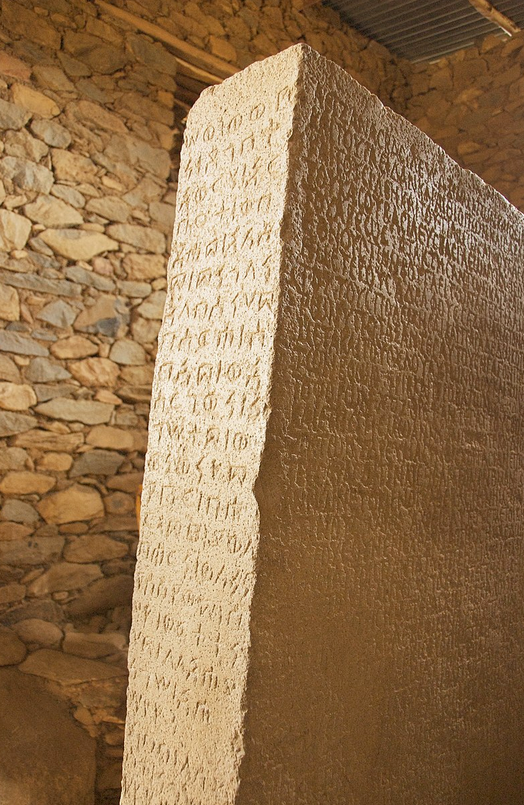
The Ezana Stone records Negus Ezana’s conversion to Christianity and conquests of his neighbours.
Citation: Ancient history. (2024, October 19). In Wikipedia. https://en.wikipedia.org/wiki/Ancient_history
Attribution: A. Davey from Where I Live Now: Pacific Northwest, Public domain, via Wikimedia Commons
On a global scale, recorded history begins with the advent of writing in the ancient world, around the 4th millennium BC. The earliest written records, such as Sumerian cuneiform tablets and Egyptian hieroglyphs, were initially used for practical purposes—such as keeping accounts or legal codes—but they soon expanded to include historical narratives, royal decrees, religious texts, and stories about the deeds of rulers or the gods. The invention of writing marks a significant turning point in human history because it allowed for the systematic recording and preservation of human experiences, political events, and cultural practices across generations, forming the basis for what we now consider the historical record.
During my research for this paper, I asked Co-Pilot (Artificial intelligence): when did recorded history begin? The answer I got informed me that recorded history is the documenting of past events in a written form or through other forms of recorded communication. Historians study these records using specific methods to interpret and understand the past. On a global scale, recorded history began around the 4th millennium BC, when writing was first invented.
Early Examples of Writing
- Tablets inscribed with Linear A script[3] have been discovered at Akrotiri, Santorini, a Greek island located in the southern Aegean Sea.
- A tablet found in Palenque, Mexico, features 92 distinct Mayan glyphs[4].
In some regions, written history only began in more recent times, as written records were not always widely used. Additionally, many important aspects of life, such as the effects of natural disasters or the identities of significant individuals, were not always documented. As a result, recorded history can vary depending on the place and the types of records that were kept.
Historians use a set of techniques known as the historical method to interpret these records, analysing primary sources and other evidence to piece together accounts of the past. The philosophy of history explores questions about what constitutes history and how we can reliably interpret it. Meanwhile, historiography is the study of how historians develop different interpretations of the same events using these methods.
Prehistory and Protohistory
Prehistory refers to the time before written records existed. It ended with the invention of writing systems. For any region where no written records have been found or where the writing is not understood, the past is considered prehistory.
Protohistory is the transitional period between prehistory and recorded history, where writing had begun, but detailed historical records were not yet made. It can also describe cultures that had no writing system of their own but were mentioned in the records of other societies.
Before fully developed writing systems, there were early forms of writing, known as proto-writing, including the following[5]:
- The Jiahu symbols (circa 6600 BC)
- The Vinča signs (circa 5300 BC)
- Early Indus script (circa 3500 BC)
- The Nsibidi script (before 500 AD)
There is some debate about when exactly prehistory ended and when proto-writing evolved into “true” writing. However, the invention of the first full writing systems occurred around the start of the Bronze Age, in the late Neolithic period, around the 4th millennium BC. The earliest recognised systems, Sumerian cuneiform and Egyptian hieroglyphs emerged from earlier symbolic systems between 3400 and 3200 BC, with the earliest coherent texts dating to around 2600 BC.
The Earliest Language and Writing Systems
The Earliest Language Used by Humans
The origin of human language is one of the most debated topics in anthropology and linguistics, and while we don’t have direct evidence of the first spoken language, we can make informed guesses based on the study of ancient human societies, fossil records, and genetic data.
- Proto-Language: Early human ancestors, such as Homo habilis and Homo erectus[6], likely used a proto-language consisting of simple sounds, gestures, and vocalisations. These forms of communication would have been more advanced than those of other primates but still very basic, involving emotional expressions, warnings, and cooperative signals for hunting and gathering.
- Fully Developed Language: It is believed that Homo sapiens[7], who emerged around 300,000 years ago, are the first species to develop complex spoken language. Evidence from brain size and structure, as well as the anatomy of the vocal tract (such as the hyoid bone[8]), suggests that early Homo sapiens could produce a wide range of sounds. Around 70,000–100,000 years ago, during the Great Leap Forward[9], language may have become fully developed, enabling humans to engage in more abstract thinking and social coordination.
- No Direct Evidence: Because language doesn’t leave tangible traces (or didn’t until mechanical recording devices were invented), there is no direct evidence of what the first languages sounded like. However, the earliest languages were likely based on sounds that represented objects, actions, and concepts, evolving into more structured grammar and syntax.
Hypotheses
- Mother Tongue Hypothesis: Some linguists believe all modern languages may have originated from one single “proto-language” spoken by a small population of early Homo sapiens.
- Diverse Origins Hypothesis: Other linguists argue that languages evolved independently in different regions as human populations spread across the world.
The Earliest Writing by Humans
Unlike spoken language, writing leaves behind physical records, allowing us to trace its development more accurately. Writing is a relatively recent human invention, emerging after complex societies began to develop. The earliest forms of writing are:
- Cuneiform (Mesopotamia, ~3400–3000 BC): The Sumerians of ancient Mesopotamia[10] are credited with creating the first true system of writing known as cuneiform. Originally developed for economic purposes—such as keeping track of trade and taxation—cuneiform evolved into a fully developed script for recording laws, literature, and religious texts. It was written by pressing a reed stylus into clay tablets to create wedge-shaped marks, hence the name cuneiform[11].
- Hieroglyphics (Egypt, ~3200 BC): In ancient Egypt, around the same time as the Sumerians, the Egyptians developed hieroglyphics[12]. This system combined logographic and alphabetic elements, using pictures to represent words or sounds. Egyptian hieroglyphs were used on monuments, tombs, and religious texts.
Pre-Writing Systems
- Pictograms[13]: Before true writing systems emerged, early humans used pictograms—symbols that directly represented objects or ideas. These date back as far as 9000 BC and were used by cultures like the early Chinese and Native Americans.
- Ideograms or Ideograph[14] (from Greek idéa ‘idea’ + gráphō ‘to write’): Symbols that represent an idea or concept independent of any particular language.
- Proto-Writing[15]: Around 4000–3000 BC, cultures in the Near East and other parts of the world started using proto-writing—systems of symbols that conveyed specific information but lacked the grammar and syntax of true writing.

[Cropped] Oracle bone from the Bīn 賓 group of diviners from period I, corresponding to the reign of King Wu Ding (late Shang dynasty).
Citation: Oracle bone script. (2024, August 10).
In Wikipedia. https://en.wikipedia.org/wiki/Oracle_bone_script
Attribution: National Museum of China, CC0, via Wikimedia Commons
Other Early Writing Systems
- Indus Script (Indus Valley Civilisation, ~3300–1900 BC): The Indus Valley Civilisation[16] (also known as the Harappan Civilisation), located in modern-day Pakistan and India, developed an undeciphered writing system known as the Indus script. While examples of this writing exist on pottery and seals, its meaning is still unknown.
- Chinese Oracle Bone Script (~1250 BC): One of the earliest known forms of Chinese writing, this script was used for divination and inscribed on bones and turtle shells. It evolved into the complex Chinese writing system still used today.
Early writing was largely used for practical purposes—administrative tasks, religious ceremonies, and trade. Over time, it expanded to record history, literature, laws, and personal communication. Language likely evolved tens of thousands of years ago as an oral tool for survival and social cohesion, while writing systems appeared much later, perhaps around 5,000 years ago, as human societies grew more complex and needed ways to preserve and share information over time.
However, the timeline for recorded history varies significantly depending on the region or culture in question. In some parts of the world, such as Mesopotamia, Egypt, and China, writing systems were developed relatively early, and there is a rich archive of ancient documents to study. In other regions, the use of writing began much later or was introduced by external forces, like colonisation. As a result, the written historical record in some cultures is relatively recent, and earlier periods must be understood through other means, such as archaeology, oral traditions, or art.
Recorded History is Always Incomplete
It’s important to recognise that recorded history is always incomplete. Many ancient societies documented only what they considered important—typically the actions of rulers, religious events, legal matters, and major military campaigns—while leaving out information that modern historians might consider significant. For instance, detailed accounts of the lives of ordinary people, the environmental impact of natural disasters, or the names of non-elite individuals were often omitted. Additionally, written records can be biased, reflecting the perspectives of those in power while ignoring or distorting the experiences of excluded groups. Because of these gaps and biases, historians must critically evaluate written records and supplement them with other forms of evidence, such as oral histories, artefacts, and environmental data, to develop a more complete picture of the past.
The process of interpreting these records relies heavily on the historical method, which involves analysing primary sources (such as documents created at the time of the events being studied) and secondary sources (works produced by later historians that interpret these primary sources). The goal is to build a well-supported, accurate narrative of past events. However, the interpretation of recorded history raises important questions in the philosophy of history, particularly regarding epistemology—how we know what we know about the past. Historians must grapple with issues of reliability, perspective, and the possible biases of both the sources they study and their own interpretations.
Interpretation
The study of how historians interpret and write about history is known as historiography. Historiography examines not only the content of historical records but also how different historians have approached the task of reconstructing the past. Over time, historians from various cultures and intellectual traditions have developed various methods and frameworks for interpreting recorded history, leading to diverse interpretations of the same events.
For example, the same historical event might be interpreted differently depending on whether the historian is using a Marxist framework (focusing on class struggle), a feminist perspective (emphasising gender dynamics), or a cultural history approach (exploring symbolic meanings and cultural practices). This diversity of interpretations reflects the complexity of history itself and highlights the importance of considering multiple perspectives when studying the past.
Personal Testimony and Oral Traditions
Personal testimony has always been an essential part of the historical record. Oral history predates written history, with many African tribes employing griots—trained historian-storytellers who preserved their community’s history through memory. Some cultures used drummers and drum language (such as praise poems[17]) to convey historical events, with chief drummers passing their roles to their sons.
Ancient historians often included oral traditions, legends, and tales in their writings. Early written primary sources may have originated from oral testimony recorded on paper. Christianity, for example, built a collective memory of Jesus’s life by merging European interpretations of the Holy Land with Jewish sacred sites. Over time, historians began to favour written records, viewing them as more ‘objective.’ The invention of the printing press further legitimised the written word, as printed texts were seen as precise and permanent. By the 19th century, scientists relied on published journals to communicate discoveries and establish scientific proofs.

Bust of Herodotus in Palazzo Massimo (Rome)
Extracted Image: https://commons.wikimedia.org/wiki/File:Herodoto_Herodotus_greek_writer_escritor_griego.JPG
Quality_images_by_Livioandronico2013
In summary, recorded history provides a crucial foundation for understanding human civilisation, but it is shaped by the limitations and biases of the records left behind. The task of historians is to critically engage with these records, applying rigorous methods to interpret them in ways that contribute to our collective understanding of the past.
Understanding the Contributions of Persian and Egyptian Historians
While historians from Greece, Rome, and China are often celebrated, the contributions of Persian and Egyptian historians are equally significant, offering valuable insights into the ancient world. Persian and Egyptian records provide rich historical material that has helped in the understanding of both their societies and their interactions with neighbouring cultures.
The Greek historian Herodotus (c. 484-425/413 BC), often called the Father of History, is sometimes criticised for inaccuracies in his Histories[18]. However, his section On the Customs of the Persians[19] is frequently regarded as more reliable. In this passage, Herodotus contrasts the customs and values of the Persians with those of the Greeks, often portraying the Persians in a more favourable light. This contrast is notable, considering how Herodotus elsewhere describes Persian monarchs like Cambyses II (r. 530-522 BC) and Xerxes I (r. 486-465 BC)[20] as irrational or despotic figures.
Even Darius I (r. 522-486 BC), whom Herodotus largely respects, is sometimes depicted as being manipulated by his wife. These contrasting depictions show that Herodotus’ work, despite its flaws, offers a complex and multifaceted view of Persian society. Herodotus likely wrote Histories during the reign of Artaxerxes I (r. 465-424 BC), as the work is believed to have been published around 430-415 BC.
In addition to Herodotus’ accounts, early Persian history is informed by the Persian Royal Inscriptions[21], which were carved on monuments and tablets. These inscriptions, such as the Behistun Inscription[22] from the reign of Darius I and the Persopolis Inscriptions[23], provide a more official and structured view of Persian rule and governance, serving as vital records of the empire’s expansion and political dynamics.
When turning to Egypt, although there is less documentation of early Egyptian historians compared to their Greek counterparts, the Egyptian priest Manetho[24] (3rd century BC) is an important figure. Living during the Ptolemaic period, Manetho compiled the Aegyptiaca[25], a history of Egypt written in Greek, which catalogued the pharaohs and divided Egypt’s history into the thirty dynasties still used by scholars today. His work is invaluable for Egyptian chronology, although much of it survives only in later writings by Jewish and Christian scholars like Josephus and Eusebius. Manetho’s Aegyptiaca remains a key source of our knowledge of ancient Egypt’s pharaonic history, bridging the gap between Egyptian oral traditions and Greek historiographical methods.
Thus, while Persian and Egyptian historians may not always receive the same recognition as their Greek and Roman counterparts, their contributions have been instrumental in shaping our understanding of ancient history. These accounts, whether drawn from monumental inscriptions or written histories, provide crucial perspectives on the empires that dominated the ancient Near East, allowing us to appreciate the complexity and richness of their civilisations.[26]
Persian and Egyptian Historians
As already mentioned, Herodotus relied heavily on Persian accounts in his Histories, which makes Persian oral traditions a key source. Important Persian and Greek historians include:
- Ctesias of Cnidus (early 4th Century BC): A Greek historian who served as a physician to the Persian court and wrote Persica, a history of Persia, which provided a detailed account of Persian kings and customs from a Persian perspective.
- Tabari (839–923 AD): Although from a much later period, Al-Tabari’s History of Prophets and Kings is one of the most important historical accounts in Islamic and Persian historiography.
- Berosus or Berossus (early 3rd Century BC): Berossus was a Babylonian historian who wrote in Greek about the history of Babylon, Assyria, and Persia. His work provides insight into Mesopotamian and Persian cultures.
- Manetho (3rd Century BC): As already mentioned, Manetho was an Egyptian historian and priest under the Ptolemaic rule. His history, Aegyptiaca, chronicled the pharaohs of Egypt and introduced the concept of dynasties, making it one of the earliest examples of native Egyptian historical writing.
- Chaeremon of Alexandria (1st Century AD): Another Egyptian historian who wrote about Egypt’s history, blending mythology and historical events.
- The Egyptian Priests in Herodotus’ Histories: While not named historians, the Egyptian priests in Herodotus’ Histories are major sources for his understanding of Egyptian history. They provided him with oral accounts of the history and culture of Egypt.
Persian Historiography
In ancient Persia, historical writing was closely tied to the political and ideological needs of the ruling class, particularly the Achaemenid kings (c. 550–330 BC). Much of Persian historiography is entwined with royal propaganda, as the Persian kings thought themselves to be divinely appointed rulers. This view was reflected in inscriptions, such as those at Persepolis[27] or the famous Behistun Inscription[28] by Darius the Great. These inscriptions were often carved into rock and proclaimed the achievements of kings, highlighting military conquests, divine favour, and the king’s legitimacy.
Persian historians and scribes, under royal patronage, focused on emphasising the power, success, and righteousness of their rulers. Additionally, Zoroastrian religious ideas—which divided the world into forces of good (Ahura Mazda[29]) and evil (Ahriman[30])—shaped historical narratives, linking the kings’ rule to the cosmic struggle between good and evil.
Over time, Persian historiography evolved, incorporating influences from other cultures, especially after the spread of Islam in the 7th century. Later historians, like Al-Tabari[31], combined Persian and Islamic traditions, providing detailed descriptions that mixed history, legend, and religious interpretation.

This is a photo of a monument in Iran identified by the ID 70.
Citation: Behistun Inscription. (2024, October 21). In Wikipedia.
https://en.wikipedia.org/wiki/Behistun_Inscription
Attribution: Korosh.091, CC BY-SA 4.0 <https://creativecommons.org/licenses/by-sa/4.0>, via Wikimedia Commons
This file is licensed under the Creative Commons Attribution-Share Alike 4.0 International license.
Egyptian Historiography
Egyptian historical writing, on the other hand, was deeply influenced by religious ideology and the concept of divine kingship. Pharaohs were viewed as gods on Earth, and much of Egypt’s early historical records were intertwined with religious beliefs. The primary purpose of Egyptian historiography was to glorify the pharaoh, affirm their divine right to rule, and ensure the continuity of their legacy in the afterlife.
Most historical records were inscribed on temple walls, obelisks, and in tombs. These records focused on royal deeds, monumental constructions, and military victories, often framing the pharaohs as the chosen protectors of Ma’at[32]—the concept of cosmic order and balance. Historical accounts were not objective in the modern sense; they were carefully crafted to support the authority of the pharaoh and maintain religious and political stability.
Manetho, the priest and historian in the Ptolemaic era (3rd century BC), was among the first Egyptians to write a more structured history, introducing the concept of dynasties to chronicle the pharaohs. His work, Aegyptiaca, written in Greek, served as a bridge between Egyptian and Hellenistic historiographical traditions[33], allowing later historians like Herodotus to integrate Egyptian perspectives into their narratives.
Summary
- Persian History: Focused on royal propaganda, divine kingship, and Zoroastrian cosmic battles between good and evil. Histories often highlighted the legitimacy and power of the Achaemenid rulers, with later Islamic influence enriching the historiography.
- Egyptian History: Centred on religious ideology and divine kingship, with historical records glorifying the pharaoh’s rule and maintaining the concept of Ma’at. Religious inscriptions, tomb records, and monumental writings were key sources, with historians like Manetho introducing systematic dynastic history.
The ‘Battle’ Between Good and Evil
Early man sought to make sense of the hardships, conflicts, and suffering he encountered. The idea of a cosmic battle between good (represented by Ahura Mazda) and evil (represented by Ahriman) offered a way to understand why negative events, such as natural disasters, illness, or moral failings, occurred. It helped explain the existence of both order and chaos in the world. The struggle provided a clear moral framework, teaching people that their choices mattered, and it gave individuals a sense of responsibility and moral duty, reinforcing ethical behaviour and social cohesion. Always with an eye to what the future might bring, early man’s belief in the eventual triumph of good over evil provided hope that justice and good would prevail in the end.
In some cases, rulers and priests used the concept of this cosmic struggle to legitimise their authority. Kings and religious leaders could claim to be fighting on the side of good, reinforcing their position as divinely appointed protectors of order. This helped stabilise their rule and gain support from their people.

Image: The Temple Scroll (11Q20) – Google Art Project. Israel Museum, Public domain, via Wikimedia Commons. (Late 1st century BC – early 1st century AD)
Attribution: Israel Museum, Public domain, via Wikimedia Commons
File URL: https://upload.wikimedia.org/wikipedia/commons/8/8a/The_Temple_Scroll_%2811Q20%29_-_Google_Art_Project.jpg
Maps of the Ancient World
The earliest known world maps date back to classical antiquity, with the oldest examples from the 6th to 5th centuries BC still reflecting the belief in a flat Earth.

Image: Imago Mundi Babylonian map, the oldest known world map, 6th century BC Babylonia. Now in the British Museum.
Citation: Early world maps. (2024, October 20).
In Wikipedia. https://en.wikipedia.org/wiki/Early_world_maps
The first maps based on a spherical Earth appeared during the Hellenistic period. Advancements in Greek geography, particularly by figures like Eratosthenes and Posidonius, led to further refinement in the Roman era, culminating in Ptolemy’s world map[34] in the 2nd century AD. Ptolemy’s map remained influential throughout the Middle Ages. Since Ptolemy’s time, understanding the Earth’s approximate size allowed cartographers to estimate the limits of known geography and mark unexplored areas as terra incognita (unknown land).
During the Age of Discovery (15th to 18th centuries), world maps became increasingly precise as explorers charted new territories. However, significant exploration of regions like Antarctica, Australia, and Africa’s interior by Western cartographers continued into the 19th and early 20th centuries.
Importance of Maps as Historical Records:
Maps were vital in ancient history as they served multiple important roles:
- Geographical Knowledge: Maps documented human understanding of the world, showing known and unknown territories. They recorded the discoveries of explorers and the boundaries of civilisations, enabling future generations to build on this knowledge.
- Cultural and Political Influence: Maps were not just practical tools – they reflected the worldview and political ambitions of empires. By mapping territories, rulers could assert control, plan conquests, and expand their trade networks.
- Scientific Progress: Maps also tracked scientific developments. Early maps based on the flat Earth concept gradually gave way to more accurate depictions as knowledge about Earth’s shape and size evolved. This progression mirrored the intellectual growth of societies.
- Exploration and Trade: Maps facilitated navigation and trade routes and were crucial for exploration. They guided explorers and merchants, enabling the exchange of goods, ideas, and cultures across great distances.
In summary, maps were not only practical records of geography but also reflections of the expanding knowledge, power, and culture of ancient civilisations.
Cave Paintings
Cave paintings are some of the earliest examples of human art created during the Palaeolithic era (roughly 40,000 to 10,000 years ago). These paintings have been found in caves across Europe, Asia, Africa, and the Americas, with some of the most famous examples in Lascaux (France), Altamira (Spain), and Chauvet (France).
Why Caves?
Early humans likely created their art in caves rather than elsewhere for several practical and cultural reasons:
- Natural Shelters: Caves provided protection from the elements, such as rain, wind, and sunlight, which could easily erode or destroy artwork if it were created outdoors. The stable environment inside caves helped preserve the paintings for thousands of years.
- Preservation of Materials: The pigments used by early humans were often made from natural substances like charcoal, ochre, and minerals. Caves, with their controlled climate and lack of direct sunlight, helped preserve these fragile materials much better than open environments.
- Acoustic Properties: Some caves have remarkable acoustics, and it’s possible that early humans chose them for creating art as part of rituals involving sound, music, or chanting. The combination of visual art and sound may have had spiritual or symbolic significance.
- Spiritual or Ritual Significance: Caves may have been seen as sacred or otherworldly spaces, separate from everyday life. The darkness and isolation of caves could have made them ideal locations for rituals, ceremonies, or connecting with spiritual forces.
- Longevity and Legacy: Caves, being hidden and protected, were natural galleries where art could be preserved for future generations. Drawing in such locations may have been a way to leave a lasting mark, creating something enduring in an otherwise transient world.
Early humans likely chose caves for their art due to the protection and preservation caves offered, along with potential spiritual or ritual significance.
Purpose
The exact purpose of cave paintings remains debated, but several theories suggest their significance:
- Ritual or Religious Purposes: Some researchers believe they were part of hunting rituals or spiritual ceremonies, possibly meant to invoke success in hunting or connect with the supernatural.
- Storytelling and Communication: Cave paintings might have been a way to convey stories and information or to mark significant events for early communities.
- Symbolism and Expression: The paintings could reflect early humans’ desire to express themselves artistically, depict the animals they depended on, or mark sacred spaces.
What They Depicted
Cave paintings often feature animals such as bison, horses, deer, mammoths, and handprints. Some also include abstract symbols or human figures, although animals dominate.
Where and When
Lascaux Cave (France): Estimated to be around 17,000 years old, featuring detailed paintings of animals.
- Altamira Cave (Spain): Known for its large depictions of bison, around 36,000 years old.
- Chauvet Cave (France): Some of the oldest known paintings, dating back over 30,000 years, with highly detailed depictions of lions, mammoths, and rhinoceroses.
Cave paintings are not limited to well-known sites in Europe, like Lascaux and Altamira; significant cave art has also been discovered in other parts of the world:
- Bulgaria: Cave paintings have been found in sites like the Magura Cave. These paintings date back around 10,000 years and depict scenes of hunting, dancing, and rituals. The art in Magura Cave is notable for its stylised human figures and geometric symbols, which may have had spiritual or ceremonial significance. These images suggest that early humans in the Balkans engaged in similar rituals and symbolic practices as those found in other parts of Europe.

Picture: Cueva de las Manos. Hands at the Cuevas de las Manos upon Río Pinturas, near the town of Perito Moreno in Santa Cruz Province, Argentina.
Citation: Cueva de las Manos. (2024, September 13). In Wikipedia. https://en.wikipedia.org/wiki/Cueva_de_las_Manos
Attribution: Mariano
Public Domain.
This file is licensed under the Creative Commons Attribution-Share Alike 3.0 Unported license.
- Argentina: The Cueva de las Manos (Cave of the Hands) is one of the most famous cave art sites in South America, located in Patagonia. The paintings, dating back as far as 9,000 years, are known for their distinctive stencilled handprints, along with depictions of guanacos (a type of llama) and hunting scenes. The handprints, made by blowing pigment through a tube around the hand, are thought to have had ritual or symbolic significance, possibly related to community identity or rites of passage.
- Australia: Aboriginal rock art, such as at Kakadu National Park, is believed to date back over 40,000 years, with depictions of animals, humans, and spiritual beings.
- Indonesia: Paintings on Sulawesi Island date back at least 44,000 years, making them some of the oldest cave paintings in the world. These paintings include hand stencils and images of wild animals.
- Somalia and the Horn of Africa: There are significant examples of rock art and cave paintings that date back thousands of years, reflecting the long history of human habitation in the region. These artworks provide important insights into the lives, beliefs, and activities of the early people in this part of Africa:
- Laas Geel, Somalia: One of the most famous cave painting sites in Somalia is Laas Geel, located near Hargeisa in the northwestern part of the country. The paintings are believed to be around 5,000 to 7,000 years old and are remarkably well-preserved. The artwork at Laas Geel mainly depicts cattle adorned with decorative robes, along with human figures and wild animals such as giraffes and antelopes. The prominence of livestock in the paintings suggests that the people of this time had a strong connection to pastoral life and animals, possibly as part of early pastoralist or agricultural communities.
- Dhulbahante, Somalia: Other rock art sites in the Somali region, such as Dhulbahante and Karin Hagood, also feature ancient depictions of animals, human figures, and geometric designs, which are common themes in the Horn of Africa’s rock art tradition.
- Ethiopia: In Ethiopia, rock art has been found in sites such as the Harar Plateau and the Dire Dawa region. These paintings, some of which date back more than 5,000 years, often feature animals and symbolic designs, indicating a similar relationship between humans and the environment as seen in Somalia.
Cave paintings in the Horn of Africa[35], like elsewhere, are thought to have served spiritual or ritualistic purposes, possibly related to hunting magic, religious beliefs, or community identity. The emphasis on cattle and wild animals suggests that these animals played a central role in the culture and survival of the people at the time, reflecting their importance in daily life, economic activities, and possibly even in religious or ceremonial practices. Cave paintings and rock art in Somalia and the Horn of Africa provide valuable historical records of the region’s ancient inhabitants, highlighting their deep connection to the environment and their use of art to communicate ideas and beliefs. These artworks, like others around the world, offer a window into the cultural practices and spiritual life of early humans.
The global distribution of cave paintings suggests that early humans, regardless of where they lived, shared a deep need for expression, communication, and connection to their environment. Whether for ritualistic purposes, hunting magic[36], or community identity, these paintings were a way for early humans to engage with the world around them and convey meaning in a lasting form. They provide insight into the lives, beliefs, and environments of early humans and are an important window into prehistoric cultures.

Picture: Fresco of “Sappho” from Pompeii, c. 50 AD.
Citation: Fresco. (2024, September 20). In Wikipedia. https://en.wikipedia.org/wiki/Fresco
Attribution: Naples National Archaeological Museum, CC BY 4.0 <https://creativecommons.org/licenses/by/4.0>, via Wikimedia Commons
This file is licensed under the Creative Commons Attribution 4.0 International license.
Frescoes
Frescoes share similarities with cave paintings, as both are forms of wall art that involve painting directly onto surfaces that are part of the architectural or natural environment. The oldest fresco art is about 5,500 years old, whereas cave paintings are thought to date from the Ice Age (Upper Palaeolithic), roughly between 40,000 and 14,000 years ago[37].
What is a Fresco?
A fresco is a type of mural painting done on freshly applied, wet lime plaster. The pigments, mixed with water, are absorbed by the wet plaster as it dries, making the painting a permanent part of the wall. The term fresco comes from the Italian word for ‘fresh,’[38] which distinguishes it from other techniques like ‘fresco-secco’, where paint is applied to dry plaster. Fresco painting has been used since ancient times and is especially linked to the Italian Renaissance.
In English, the word ‘fresco’ is often incorrectly applied to any wall painting, regardless of the specific plaster or binding method. This has led to a misunderstanding that painting on wet plaster was the most common method worldwide. Even in traditional frescoes, additional organic materials were often used, though this is not widely recognised.
Integration with Architecture/Natural Environment
- Cave paintings were created on the natural walls of caves, using pigments to depict scenes on rock surfaces.
- Frescoes are painted directly onto plastered walls, making the artwork an inherent part of a building’s structure. This creates a direct connection between the artwork and its physical surroundings – in a way, just like cave art.
Durability and Preservation
Both frescoes and cave paintings were designed (intentionally or incidentally) to be long-lasting. Frescoes are created on wet plaster, which allows the pigments to be absorbed and preserved as the plaster dries. Similarly, cave paintings survived due to the stable, protective environment of caves.
Cultural and Spiritual Context
- Cave paintings are often thought to have had religious, spiritual, or ritual purposes, such as hunting magic or depicting sacred events.
- Frescoes, especially in religious or ceremonial spaces (e.g., churches or temples), often served spiritual purposes, depicting deities, religious stories, or scenes of worship, much like the symbolic role cave paintings may have played.
Public and Communal Art
Both forms of art were meant to be viewed by a community, although cave paintings were likely part of rituals performed by a select group, while frescoes, especially in later periods, were created for public viewing in temples, palaces, or public buildings.
Frescoes could be considered a more advanced or evolved form of cave painting, as they both involve painting on natural or constructed surfaces to convey important cultural, religious, or communal ideas. The primary difference is the technological sophistication and social contexts in which they were created.

Image: Depicting early humans gathered around a campfire, engaging in storytelling, rituals, and hands-on learning, reflecting communal and holistic approach to education and knowledge transmission.
Credit: Drawn by Dalle-E, a subset of ChatGPT, 24/10/2024
Early Forms of Education and Storytelling
In early human societies, long before formal schools existed, essential knowledge, survival skills, cultural values, and communal memories were passed down through oral traditions and practical, hands-on methods. These informal yet deeply embedded learning systems ensured that each generation absorbed the necessary skills and values to thrive.
Oral Storytelling
Oral tradition was the primary method for communicating experiences and knowledge. Through myths, legends, folktales, and historical accounts, early humans shared valuable life lessons, cultural heritage, and moral values. These stories often took the form of:
- Mythological or religious stories: explaining the origins of the world, gods, or natural forces.
- Historical narratives: recounting significant events like battles or migrations.
- Moral tales: teaching honesty, bravery, and cooperation, often using animals or legendary figures to illustrate these virtues.
Storytelling was an important part of community life, with children learning about their ancestors, cultural identity, and their role in society through these rich oral traditions.
Hands-On Learning
Children in early human societies learned by observing and imitating older members of their community. This practical, hands-on learning method was crucial for passing down essential skills, such as:
- Hunting and gathering: Children watched adults track animals, identify safe plants, and use tools, learning these vital survival skills over time.
- Toolmaking: Skills like crafting stone tools, weapons, or shelters were passed down through practice, with elders guiding younger members.
- Crafts and art: Pottery, weaving, and artistic endeavours such as creating cave paintings were taught through direct involvement, ensuring these cultural skills survived across generations.
Rituals and Ceremonies
Rituals played an important role in preserving and transmitting cultural values and communal memories. Marking major life events—birth, adulthood, marriage, and death—these ceremonies taught younger members about their social responsibilities, spiritual beliefs, and place in the community. Rituals were often rich with symbolism, music, dance, and storytelling, reinforcing shared experiences and cultural cohesion.
Songs and Music
Music, rhythm, and song were effective tools for memory and learning. Early humans likely used songs to:
- Preserve history and mythology.
- Teach children about their environment, including seasonal changes and animal behaviours.
- Strengthen social bonds and reinforce cultural values through communal singing.
Symbolic Art and Rock Paintings
Visual art, such as cave paintings and carvings, was another way early humans recorded and communicated their experiences. These artworks served multiple purposes:
- Recording significant hunting experiences or events.
- Depicting spiritual beliefs or rituals.
- Teaching younger generations about their environment, including animals and natural phenomena.
Group Participation and Oral Histories
Knowledge in early societies was often shared through group storytelling sessions, where elders recounted significant events, lessons, and cultural practices. These gatherings were a form of oral history that preserved the community’s collective memory. Children participated by listening to the following:
- Historical accounts of wars, migrations, or heroic deeds.
- Ethical lessons, such as the importance of cooperation, sharing, and respect for nature.
Play and Social Interaction
Play was an essential part of childhood learning, as it allowed children to practice social roles and problem-solving skills in a safe environment. Games often mimicked adult responsibilities, reinforcing lessons learned from storytelling and hands-on learning.
Storytelling Traditions and Early Education
Storytelling served as an important tool for teaching abstract concepts – like empathy, trust, and communal responsibility. Early stories likely had a dual purpose—entertaining both adults and children while also educating the next generation about survival, ethics, and their role in the world.
- Oral Traditions: Before the invention of writing, oral storytelling was the primary way knowledge was transmitted. These stories often focused on the origins of the world, human survival, and natural phenomena.
- Mythological Tales and Folktales: Stories about animals or creation myths were common in many early societies. Examples include:
- Animal fables, like those from African and Native American traditions, which conveyed lessons about cooperation and caution.
- Creation myths, explaining the origins of the world or humanity, which helped young members understand their place in the cosmos.
Specific Examples of Early Stories
- African Folktales: Stories like those featuring Anansi the Spider taught lessons about cleverness and morality, engaging both children and adults.
- Native American Stories: Tales about tricksters like Coyote or Raven conveyed moral lessons and respect for nature.
- Australian Aboriginal Dreamtime Stories: These stories explained the creation of the world and passed down rules about human behaviour and respect for the land.

Image: [Cropped] Ancient Assyrian statue currently in the Louvre, possibly representing Gilgamesh
Citation: Epic of Gilgamesh. (2024, October 17). In Wikipedia. https://en.wikipedia.org/wiki/Epic_of_Gilgamesh
Attribution: Louvre Museum, CC BY-SA 3.0 <http://creativecommons.org/licenses/by-sa/3.0/>, via Wikimedia Commons
This file is licensed under the Creative Commons Attribution-Share Alike 3.0 Unported license.
The Epic of Gilgamesh
One of the oldest known literary works, the Epic of Gilgamesh[39] (written around 2100 BC), is a foundational text from ancient Mesopotamia. It blends mythology with historical elements, offering insights into early beliefs and values.
- Historical Significance: Though mythological, the epic references real historical figures, such as Gilgamesh, the king of Uruk.
- Cultural and Religious Beliefs: It reflects the religious views of the time, including beliefs in gods, the afterlife, and the divine’s role in human affairs.
- Moral Lessons: Themes of mortality, friendship, and the quest for immortality speak to universal human concerns while highlighting the importance of kingship and governance.
The Epic of Gilgamesh represents a major step in the development of recorded history, as it was one of the first works written in cuneiform on clay tablets, marking a transition from oral to written storytelling. In early human societies, education was embedded in daily life, with knowledge passed down through storytelling, rituals, and practical learning. Oral traditions, symbolic art, and communal participation ensured that essential survival skills, moral values, and cultural identity were effectively communicated across generations.
Stories, whether through myths, folktales, or early epics like Gilgamesh, served as vital tools for preserving and transmitting the collective memory of early civilisations.
Historians Across Civilisations and Their Contributions to Historiography
Classical Period
- Herodotus (484 – c. 420 BC) wrote The Histories, which established Western historiography. He was Greek. He was born around 484 BC in Halicarnassus, a Greek city in Asia Minor (modern-day Turkey). Herodotus’ tag (the Father of History) was earned because he was one of the first historians to collect his material systematically, verify its accuracy, and organise it into a cohesive narrative. His most famous work, The Histories, covers the Greco-Persian Wars and provides insight into the cultures and events of the ancient world. Despite his Greek heritage, Herodotus travelled widely and included information about many non-Greek peoples, including Egyptians, Persians, and Scythians.
- Thucydides[40] (460 – c. 400 BC) was an ancient Greek historian known for his work History of the Peloponnesian War[41], which details the conflict between Athens and Sparta from 431 to 404 BC. He is often regarded as one of the greatest historians of antiquity, pioneering a critical and analytical approach to writing history. Unlike earlier historians such as Herodotus, who included myths and legends, Thucydides focused on evidence-based accounts, aiming to explain events through political, economic, and social factors rather than divine intervention. Thucydides participated in the war as an Athenian general. After failing to prevent the Spartan capture of Amphipolis, he was exiled, which allowed him to gather firsthand accounts from both sides of the conflict. This exile gave him a unique, relatively impartial perspective. His History of the Peloponnesian War is considered a masterpiece for its detailed and analytical portrayal of the war, providing insights into human nature, power, and politics. One of the most famous sections is the Melian Dialogue[42], which highlights the harsh realities of power and diplomacy. Thucydides’ work, unfinished at his death, remains a cornerstone of historical and political thought. His focus on realism, human behaviour, and the nature of power continues to influence historians and political theorists today.
- Xenophon[43] (431 – c. 360 BC) was an ancient Greek historian, philosopher, and soldier best known for his writings on history, philosophy and his firsthand accounts of military campaigns. A student of Socrates, he is considered a key figure in the intellectual history of Greece. Xenophon’s most famous works include Anabasis[44], which recounts the expedition of Greek mercenaries he led in Persia, and Hellenica, which picks up where Thucydides’ History of the Peloponnesian War left off, covering the final years of the war and its aftermath. In addition to his historical works, Xenophon also wrote philosophical dialogues and essays, many focused on Socratic ideas. His Memorabilia[45] provides a defence of Socrates’ teachings, and his work Cyropaedia[46] is a partly fictional account of the education of the Persian king Cyrus the Great[47], often viewed as an exploration of leadership and governance. Xenophon’s clear, straightforward writing style and diverse subject matter make him a significant figure in both historical and philosophical traditions.
- Ctesias[48] (early 4th century BC), a Greek historian, is best known for his works on Assyrian, Persian, and Indian history. He served as a physician at the Persian court of King Artaxerxes II[49], which gave him access to Persian royal archives and firsthand accounts of the empire’s inner workings. His most notable works include Persica[50], a history of Persia, and Indica[51], a description of India based on secondhand accounts from travellers and traders. Although much of Ctesias’ work has been lost, fragments survive through later writers. His accounts often differ from those of Herodotus, providing a more Persian-centred perspective. However, modern scholars view some of his descriptions, especially of India, as exaggerated or fanciful. Despite this, Ctesias remains an important source for understanding ancient Persia and its interactions with neighbouring regions.
Hellenistic Period
- Ephorus of Cyme[52] (c. 400–330 BC) was a Greek historian known for writing the first universal history. His work, Histories, covered the events of Greece and surrounding regions from the mythical past to his own time. It spanned 30 books and was highly regarded in antiquity for its comprehensive scope. Ephorus is praised for his critical approach to sources and his effort to maintain objectivity. Although much of his work is lost, it survives in fragments through later historians, particularly Diodorus Siculus[53], who used Ephorus as a key source for his own historical writings.
- Theopompus[54] (c. 380 – c. 315 BC), a contemporary of Ephorus, was another significant Greek historian. A student of Isocrates[55], he was known for his Philippica[56], a detailed history of Philip II of Macedon, which spanned 58 books and included not only political and military events but also moral and philosophical commentary. He was highly critical of both individuals and states, often using his history to make pointed judgments. Though much of his work is lost, Theopompus is remembered for his eloquent style and his focus on the moral aspects of history.
- Eudemus of Rhodes[57] (c. 370 – c. 300 BC) was an ancient Greek philosopher and historian of science, particularly noted for his work on the history of mathematics and astronomy. A student of Aristotle, Eudemus contributed significantly to the development of Aristotelian philosophy and is believed to have written histories of geometry, arithmetic, and astronomy, documenting the advancements made by earlier Greek thinkers. Although his original works are lost, they influenced later scholars, and fragments of his writings survive through citations by other ancient authors.
- Ptolemy I Soter[58] (367 – c. 283 BC) was a general under Alexander the Great who, after Alexander’s death, became the ruler and later the king of Egypt, founding the Ptolemaic dynasty. He played a crucial role in consolidating control over Egypt and establishing it as a powerful Hellenistic kingdom. Ptolemy was also a scholar and historian, writing a history of Alexander’s campaigns. His leadership not only shaped the political landscape of Egypt but also fostered a flourishing of culture and learning, most notably through his founding of the Library of Alexandria.
- Duris of Samos[59] (c. 350 – post-281 BC) was a Greek historian and the ruler of Samos. He is best known for his Histories, which covered the events of Greece and Macedonia after the death of Alexander the Great. Duris also wrote biographies and works on various subjects, including art and literature. Although much of his work has been lost, he was known for incorporating sensational details and dramatising historical events, making his accounts more vivid and appealing to readers.
- Berossus[60] (early 3rd century BC) was a Babylonian historian and priest who wrote in Greek about the history and culture of Babylon[61]. His most notable work, Babyloniaca[62], provided a comprehensive account of Babylonian history, starting from creation myths to the reign of Alexander the Great. Although only fragments of Berossus’ writings survive, they were highly valued by later historians for their detailed insight into Mesopotamian civilisation. His work represents one of the few ancient efforts to bridge Greek and Mesopotamian historiographical traditions.
- Timaeus of Tauromenium[63] (c. 345 BC – c. 250 BC) was a Greek historian known for his Histories[64], which focused on the events of Sicily and the Western Mediterranean. He is particularly noted for introducing the system of dating events by Olympiads (four-year cycles between the Olympic Games), a practice that influenced later historians. Timaeus wrote critically about many figures, including other historians, and was known for his attention to detail. Though much of his work is lost, his influence is evident through citations by later historians like Polybius, who criticised Timaeus for what he considered bias and excessive detail.
- Manetho[65] (3rd century BC) was an Egyptian priest and historian who lived during the Ptolemaic period[66]. He is best known for his Aegyptiaca[67], a history of Egypt written in Greek that documented the reigns of the pharaohs and divided Egyptian history into the thirty dynasties still used by historians today. Although Manetho’s work survives only in fragments through later writers like Josephus, it remains a critical source for understanding the chronology of ancient Egypt. His efforts bridged the gap between native Egyptian traditions and Hellenistic historiography.
- Quintus Fabius Pictor[68] (born c. 254 BC) was one of the earliest Roman historians and the first known to write a history of Rome. His Annals[69] were written in Greek and chronicled the history of Rome from its legendary founding through the early Republic, focusing on Rome’s wars and political developments. As a member of the Roman Senate, Fabius Pictor sought to present Rome’s achievements to the Greek-speaking world, emphasising Rome’s divine favour and military prowess. His work, though now lost, was used as a source by later historians like Livy and Plutarch.
- Artapanus of Alexandria[70] (late 3rd – early 2nd centuries BC) was a Jewish historian who lived in Ptolemaic Egypt. He is known for his writings that blended Jewish tradition with Hellenistic culture. Artapanus wrote about the lives of Jewish figures, most notably Moses, portraying him as a great cultural hero and attributing to him the foundation of Egyptian civilisation. His works, now lost except for fragments, sought to elevate Jewish history within the broader Hellenistic context, and his accounts were sometimes seen as exaggerations meant to appeal to a Greek audience.
- Cato the Elder[71] (234–149 BC), also known as Marcus Porcius Cato, was a Roman statesman, soldier, and historian renowned for his staunch defence of Roman tradition and republican values. He is best remembered for his role as a censor, where he promoted moral rigour and austerity, and for his fierce opposition to the growing influence of Greek culture in Rome. Cato wrote the first known history of Rome in Latin, Origines[72], which traced the history of Rome from its foundation to his own time. Though much of it is lost, Origines is significant for its nationalist tone, focusing on Rome’s achievements and the virtue of its early citizens. Cato also authored De Agricultura[73], a manual on farming that reflects his belief in the importance of traditional Roman virtues and self-reliance. He was a key figure in shaping early Roman historiography and left a legacy in Roman political and cultural life.
- Cincius Alimentus[74] (late 2nd century BC) was one of the earliest Roman historians to write a history of Rome, although his work, like many early accounts, has not survived intact. He wrote in Greek, following the tradition of Roman historians aiming to communicate their history to the broader Greek-speaking world. Alimentus is credited with detailing Rome’s early history, including the founding of the city, and was one of the first historians to provide a chronological structure to Roman events. As a participant in Roman politics, he brought firsthand experience to his writing, particularly focusing on the military campaigns of the Second Punic War[75], in which he served. Despite the fragmentary nature of his work, he remains an important figure in the early development of Roman historiography.
- Gaius Acilius[76] (fl. 155 BC) was a Roman historian and senator. He was known for writing a history of Rome in Greek. His work, although largely lost, covered the foundation of Rome and its early history, likely influenced by the growing need to present Rome’s story to the Hellenistic world. Gaius Acilius also played an important role in Roman diplomacy, serving as an interpreter during a famous delegation from Greek philosophers to Rome in 155 BC. His historical writings were valued by later Roman historians like Aulus Gellius[77], who referenced his work. Acilius was part of the early Roman historians who sought to bridge Roman history with Greek intellectual traditions, making Roman achievements accessible to a wider audience.
- Agatharchides[78] (fl. mid–2nd century BC) was a Greek historian and geographer from Cnidus, known for his works on the history and geography of the Red Sea and Arabian regions. His major work, On the Erythraean Sea[79], provided detailed descriptions of the peoples, geography, and trade routes of the Red Sea and is one of the earliest accounts of this region. Although much of his writing survives only in fragments, quoted by later historians like Diodorus Siculus and Strabo, Agatharchides was valued for his keen observations and accurate descriptions. His historical work on Egypt and his accounts of the Ptolemaic dynasty were also influential, though less well-preserved. Agatharchides’ contributions to geography and history made him a significant figure in Hellenistic scholarship.
- Polybius[80] (203 – c. 120 BC) was a Greek historian of immense influence, known primarily for his work The Histories[81], which chronicled the rise of the Roman Republic and the events of the Mediterranean world from 264 to 146 BC. As a member of the Achaean League[82], Polybius was taken as a political hostage to Rome, where he became closely associated with influential Roman families, including the Scipios[83]. This gave him unparalleled access to Roman military and political life, which deeply informed his work. The Histories is particularly notable for its analysis of Roman military tactics and the reasons behind Rome’s success, offering a detailed examination of the Punic Wars and the Roman constitution. Polybius is often praised for his methodical approach to history, his emphasis on eyewitness accounts, and his analysis of the interplay between fate and human action. His work had a lasting influence on both ancient and modern historiography, particularly in shaping ideas about empire and governance.
- Sempronius Asellio[84] (c. 158 – post-91 BC) was a Roman historian and military officer who served under the famous Roman general Scipio Aemilianus during the Siege of Numantia[85]. Asellio is best known for being one of the early Roman historians to break away from the traditional annalistic form of recording events, which merely listed them year by year. Instead, he introduced a more analytical and interpretive approach, focusing on the causes and motivations behind historical events. His work, Histories, covered Roman affairs from 146 BC onwards, aiming to provide insight into the reasons behind Rome’s success and failures. Although only fragments of his writing survive, Asellio is recognised for moving Roman historiography toward a more reflective and critical style.
- Valerius Antias[86] (1st century BC) was a Roman historian known for his Annales[87], which chronicled Roman history from its founding. Valerius Antias’ work was particularly famous for its detailed accounts of Rome’s legendary and early history, often filled with exaggerated numbers and sensational stories. Although later historians like Livy have questioned his historical accuracy, his work remains valuable for understanding how myths and embellished narratives shaped Roman history. His annalistic style, while criticised, influenced how Romans of his time viewed their past, especially regarding their military victories and expansion.
- Quintus Claudius Quadrigarius[88] (1st century BC) was another important Roman historian known for continuing the annalistic tradition of writing Roman history. His major work, also titled Annales[89], spanned at least 23 books and covered Roman history from the city’s foundation through to his own time. Quintus Claudius Quadrigarius is noted for his detailed treatment of military history, particularly in relation to the wars Rome fought in the early Republic. While much of his work has been lost, his influence is evident in the writings of later historians like Livy, who used his accounts to fill in gaps in the Roman historical record.
- Diodorus of Sicily[90] (1st century BC) was a Greek historian best known for his monumental work, Bibliotheca Historica[91], which aimed to provide a universal history of the world from mythological times to his own era. Spanning 40 books, Diodorus covered the histories of various regions, including Egypt, Greece, Persia, and Rome, offering valuable insight into the interconnectedness of ancient civilisations. Although much of his work has been lost, the surviving portions remain an important source for understanding the ancient Mediterranean world. Diodorus’ method of compiling and blending earlier sources provides a broad, if not always original, perspective on ancient history.
- Posidonius[92] (c. 135 – 51 BC) was a Greek philosopher, historian, and polymath who travelled extensively throughout the Mediterranean, studying and writing about the diverse cultures he encountered. He was a Stoic philosopher[93], and his historical work reflected his interest in the relationships between natural forces, human behaviour, and political events. Posidonius wrote a comprehensive history of the world from 146 BC, continuing the work of Polybius. He covered events in both the Greek and Roman worlds, and his accounts, though lost, were widely cited by later writers such as Strabo, Cicero, and Plutarch. Posidonius’ work blended history, geography, and philosophy, and he remains a significant figure for his contributions to multiple fields of knowledge.
- Theophanes of Mytilene[94] (fl. mid-1st century BC) was a Greek historian and close companion of the Roman general Pompey the Great. He accompanied Pompey on his military campaigns and later wrote an account of these expeditions. Theophanes’ works, though lost, were influential in shaping Pompey’s legacy, portraying him as a heroic and virtuous leader. His accounts were highly favourable to Pompey and served as a form of political propaganda, enhancing Pompey’s reputation both during his life and after his death. Theophanes’ close relationship with Pompey allowed him access to firsthand knowledge of the Roman military and political world, making his historical writings an important, though biased, source for later historians.
Roman Empire
- Julius Caesar[95] (100 – c. 44 BC) was a Roman general, statesman, and writer whose accounts of his military campaigns provide invaluable insights into Roman warfare and politics. His most famous works, Commentarii de Bello Gallico[96] (Commentaries on the Gallic War) and Commentarii de Bello Civili[97] (Commentaries on the Civil War) document his campaigns in Gaul and his struggle for power in Rome. Written in a clear and straightforward style, Caesar’s commentaries not only serve as historical records but also as propaganda, justifying his actions and cultivating his image as a leader. His writings remain some of the best-preserved and most accessible primary sources on Roman military history and politics in the late Republic.
- Sallust[98] (86–34 BC) was a Roman historian and politician known for his vivid and morally charged accounts of Rome’s decline. His two main surviving works, Bellum Catilinae[99] (The Conspiracy of Catiline) and Bellum Jugurthinum[100] (The Jugurthine War) explore themes of corruption, ambition, and the moral decay of Roman society. Sallust’s style is concise and pointed, often emphasising the contrast between Rome’s virtuous past and its decadent present. A supporter of Julius Caesar, Sallust was deeply critical of the Roman Senate and aristocracy, and his histories reflect his personal disillusionment with the political instability of the late Republic. His works influenced later historians such as Tacitus and served as essential sources on Rome’s social and political struggles.
- Dionysius of Halicarnassus[101] (c. 60 – post-7 BC) was a Greek historian and rhetorician who moved to Rome and dedicated himself to studying its early history. His major work, Roman Antiquities[102], is a comprehensive account of Rome’s legendary and historical origins, tracing the development of Roman institutions and culture from the city’s foundation to the First Punic War. Writing from a pro-Roman perspective, Dionysius sought to demonstrate the shared cultural heritage of Greeks and Romans, emphasising the virtues of Rome’s founders. His work combines historical narrative with rhetorical flourishes, and though not always accurate by modern standards, it provides valuable insight into Roman self-perception and myth-making. Dionysius’ writings, which survive in large portions, were widely read in antiquity and remain a critical source for early Roman history.
- Livy[103] (64 BC – 12 AD) was a Roman historian whose monumental work, Ab Urbe Condita[104] (From the Founding of the City), covers the history of Rome from its legendary origins through the foundation of the Republic and up to Livy’s own time. Though only about a quarter of his original 142 books survive, Livy’s history remains one of the most comprehensive and influential accounts of Rome’s past. Writing during the early years of the Roman Empire under Augustus, Livy sought to revive Roman values by recounting the deeds of Rome’s legendary heroes and leaders. His work is known for its vivid storytelling, moralistic tone, and patriotic perspective, though he sometimes sacrificed historical accuracy for dramatic effect. Livy’s history shaped Roman identity for centuries and provided later generations with a compelling narrative of Rome’s rise and greatness.
- Memnon of Heraclea[105] (fl. 1st century AD) was a Greek historian from Heraclea Pontica, a city on the Black Sea, whose work primarily focused on the history of his hometown. His History of Heraclea[106] (known only in fragments through later summaries by the Byzantine scholar Photius) details Heraclea’s interactions with the Persian Empire, the rise of Alexander the Great, and the city’s encounters with the Roman Republic. Memnon’s account is particularly valuable for its focus on a lesser-known region and for providing a non-Roman perspective on Roman expansion. Although much of his original work is lost, Memnon’s surviving fragments offer unique insights into the dynamics of Greek and Roman relations, and they preserve valuable information about regional histories that were often overlooked by other historians.
- Strabo[107] (63 BC – 24 AD) was a Greek geographer, historian, and philosopher whose Geographica[108] remains one of the most important works of ancient geography. Spanning seventeen books, Strabo’s Geographica provides a detailed description of the known world, covering regions from Europe and North Africa to the Near East and India. Blending personal observations from his travels with information gathered from earlier sources, Strabo aimed to create a comprehensive geographical and cultural overview that emphasised the interconnections between places and peoples. Though not always accurate by modern standards, his work is invaluable for its descriptions of ancient cities, landscapes, and customs. Strabo’s integration of geography with history and ethnography reflects his belief in the Stoic idea of a unified world, and his work influenced geographical thought for centuries.
- Marcus Velleius Paterculus[109] (c. 19 BC – c. 31 AD) was a Roman historian and former military officer who authored Historiae Romanae[110], a summary of Roman history from the city’s foundation to his own time. Written in a highly rhetorical style and dedicated to Emperor Tiberius, Velleius’ work provides a unique perspective on the Julio-Claudian dynasty[111], particularly praising Tiberius and his predecessor, Augustus. While sometimes criticised for his bias and selective recounting of events, Velleius offers rare firsthand insights into the early Roman Empire and the transition from Republic to autocracy. His work, though brief and incomplete, remains valuable for its personal observations and its depiction of the official narrative promoted by the imperial court.
- Claudius[112] (10 BC – 54 AD), the Roman Emperor from 41 to 54 AD, was also an accomplished historian and scholar with a deep interest in Rome’s past. Before his ascension, Claudius wrote histories of the Etruscans and Carthaginians, as well as an autobiography and other scholarly works. Though his historical writings are lost, ancient sources describe him as a diligent and thorough researcher, particularly interested in antiquarian subjects. Claudius is notable for being one of the few emperors who actively contributed to historical scholarship, and he sought to revive public interest in Rome’s early history, even introducing three new letters to the Latin alphabet. While we no longer have his writings, it’s likely they offered insights into cultures and events not covered by other Roman historians.
- Pamphile of Epidaurus[113] (active under Nero, r. 54–68 AD) was a Greek historian, one of the few known female historians of antiquity. Though much of her work is lost, Pamphile wrote a series of Historical Commentaries that purportedly spanned thirty-three books, covering a wide range of topics from Greek history to everyday anecdotes and cultural observations. Known for her method of gathering various accounts and sources rather than strictly following a chronological narrative, her work was cited by later authors for its eclectic content and attention to detail. Her writings likely offered a unique and diverse perspective on Greek and Roman society, making her an important, though often overlooked, figure in ancient historiography.
- Marcus Cluvius Rufus[114] (fl. 41–69 AD) was a Roman historian, senator, and former consul, known for his account of the turbulent Year of the Four Emperors[115] in 69 AD. Though his work is now lost, later historians like Tacitus and Suetonius drew heavily from Cluvius’ writings, suggesting that he provided a detailed narrative of this chaotic period in Roman history. As an eyewitness and participant in the political upheavals, Cluvius offered firsthand insights into the intrigues and power struggles that defined this era. His close connections to the imperial court and his career under Nero gave him access to high-level information, making his work a valuable source on the events leading up to and following Nero’s death.
- Quintus Curtius Rufus[116] (c. 60–70 AD) was a Roman historian best known for his Histories of Alexander the Great[117], a biographical account of Alexander’s life and conquests. Written in a dramatic and engaging style, Curtius’ work emphasises the moral and psychological dimensions of Alexander’s character, exploring themes of ambition, leadership, and the corrupting influence of power. Although some details in Curtius’ account are considered historically dubious, his work offers a richly detailed portrait of Alexander and has influenced the popular image of the Macedonian conqueror for centuries. Despite questions about its accuracy, Curtius’ history is valued for its narrative flair and remains a major source about Alexander’s life.
- Flavius Josephus[118] (37–100 AD) was a Jewish historian and former military leader who authored several key works on Jewish history and the Jewish-Roman conflict. His most famous works, The Jewish War and Antiquities of the Jews[119], provide a comprehensive account of Jewish history from its origins up to the Jewish revolt against Rome in 66–73 AD, in which Josephus himself participated. Writing in Greek and with a largely Roman audience in mind, Josephus sought to explain Jewish culture and history to non-Jews and to justify the actions of his people. His accounts are invaluable primary sources on first-century Judaism, the political landscape of Judea, and the interactions between Jews and the Roman Empire, though his allegiance to Rome has led some to question his objectivity.
- Dio Chrysostom[120] (c. 40 – c. 115 AD), also known as Dio of Prusa, was a Greek orator, philosopher, and historian who wrote extensively on moral and political issues, as well as on the history of various peoples, including the Getae. Known for his Discourses[121], Dio travelled widely throughout the Roman Empire, delivering speeches on topics from virtue and justice to civic responsibility. His accounts of the Getae—a people living north of the Danube—blend history with ethnography and provide rare insight into their customs and interactions with Rome. Dio’s writings, influenced by Stoic philosophy, reflect his interest in bridging cultural gaps and promoting moral values across different societies.
- Thallus[122] (early 2nd century AD) was an ancient historian whose work is known primarily through later references, as his writings themselves are lost. Thallus wrote a chronicle of Mediterranean history from the Trojan War up to his own time, likely covering events in Greece, Rome, and the Near East. While little of his work survives, later authors such as Julius Africanus cited Thallus as a source, particularly for events related to natural phenomena and historical records. Thallus’ writings are thought to have provided a secular perspective on historical events that were sometimes interpreted religiously by his contemporaries, making him a valuable though fragmentary source.
- Gaius Cornelius Tacitus[123] (c. 56–120 AD) was a Roman historian renowned for his critical and incisive histories of the early Roman Empire. His two major works, The Annals[124] and The Histories[125], cover the reigns of the emperors from Tiberius to Domitian, offering a detailed and often dark portrayal of imperial power and corruption. Tacitus is celebrated for his concise, powerful prose and his sceptical view of the ruling elite. His works not only document the political events of his time but also explore broader themes of moral decline and the dangers of absolute power. Tacitus remains one of the most influential historians of antiquity and a key source about the early Roman Empire.
- Plutarch[126] (c. 45–125 AD) was a Greek historian, biographer, and philosopher best known for his Parallel Lives[127], a series of biographies that compare the lives of notable Greeks and Romans, such as Alexander the Great and Julius Caesar. Plutarch’s purpose was as much moral as historical; he sought to draw character lessons from his subjects, illustrating virtues and vices across cultures. His engaging narrative style and focus on personality traits rather than strict historical chronology have made Parallel Lives an enduring classic. Although not always factually reliable, Plutarch’s work is a valuable source of cultural insight and has had a lasting impact on Western literature and historiography.
- Criton of Heraclea[128] (fl. 100 AD) was a Greek historian and physician who served Emperor Trajan and wrote about the Dacian Wars, in which Trajan led campaigns against the Dacians north of the Danube. Criton’s works, which are now lost, reportedly provided detailed accounts of the customs and military practices of the Dacians, as well as the strategic challenges faced by the Roman army. Later historians, including Dio Cassius, drew upon Criton’s descriptions of the Dacian people and their conflicts with Rome. Though few details remain, Criton’s work likely contributed to the Roman understanding of the Dacian campaigns and the territories Rome sought to control.
- Suetonius[129] (c. 69 – post-122 AD) was a Roman biographer and historian best known for his The Twelve Caesars[130], a series of biographies of the first twelve Roman emperors, from Julius Caesar to Domitian. Suetonius’ accounts are filled with colourful anecdotes, personal details, and sometimes scandalous stories, providing a glimpse into the private lives of the emperors. His work is less analytical than that of Tacitus but offers rich descriptions of imperial personalities and the court intrigues of early Rome. Suetonius’ vivid storytelling and interest in character make him a significant source on the Julio-Claudian and Flavian dynasties, and his work continues to influence perceptions of Rome’s rulers.
- Appian[131] (c. 95 – c. 165 AD) was a Greek historian who wrote a Roman History covering Rome’s expansion from the Republic to the early Empire, with a particular focus on its wars. His work is organised by region rather than chronologically, with separate books on the Spanish, Punic, Syrian, and Mithridatic Wars, among others. Appian aimed to show how Rome gradually brought various peoples under its control, often emphasising the inevitability of Roman supremacy. Although some of his volumes are lost, his surviving works provide valuable details on military conflicts and Rome’s interactions with other cultures. As a Greek writing under Roman rule, Appian’s perspective gives his work a unique and interesting dual viewpoint on Rome’s conquests.
- Arrian[132] (c. 92–175 AD) was a Greek historian, philosopher, and military commander best known for his Anabasis of Alexander[133], a detailed account of Alexander the Great’s campaigns. Modelled on Xenophon’s Anabasis, Arrian’s work is widely considered one of the most reliable sources on Alexander’s life and conquests, drawing on earlier accounts such as those of Ptolemy and Aristobulus. Arrian’s background as a military officer and his admiration for Alexander are evident in his emphasis on strategy and leadership. His other works, including Indica, which describes India and Alexander’s journey through it, showcase Arrian’s interest in both history and geography, making him one of the most respected ancient historians of Greek history and exploration.
- Granius Licinianus[134] (2nd century AD) was a Roman historian known for his fragmentary work on Roman history, which covered events from the early Republic through the late Republican period. Although only portions of his text survive, Granius’ work offers insights into episodes not detailed by other historians, including information on military campaigns and notable figures. His writing style and level of detail suggest he intended to complement existing historical narratives rather than provide a complete account. Despite its gaps, Granius Licinianus’ work remains a valuable source for scholars interested in the less-documented aspects of Roman history.
- Criton of Pieria[135] (2nd century AD) was a Greek historian and physician who served Emperor Hadrian and possibly documented Hadrian’s travels and campaigns. Although his works are lost, ancient sources suggest that Criton wrote about the customs and history of various peoples within the empire, reflecting Hadrian’s interest in provincial cultures and frontier lands. His writings would have provided a valuable record of the diverse regions under Roman rule and their interactions with Roman authorities, but unfortunately, Criton’s contributions are known only through brief mentions by later authors.
- Lucius Ampelius[136] (c. 2nd century AD) was a Roman writer known for his Liber Memorialis[137] (Book of Memorials), a brief compendium of history, geography, and mythology intended as an educational text for young readers. The Liber Memorialis covers topics from the wonders of the world to Roman history and moral lessons, though it is often superficial in detail. Despite its simplicity, Ampelius’ work offers a glimpse into Roman education and the type of knowledge considered essential for the youth of his time. His compilation is one of the few surviving examples of a Roman “handbook” for students, giving modern readers insight into ancient pedagogy138].
- Dio Cassius[139] (c. 160 – after 229 AD) was a Roman historian and senator of Greek origin, known for his Roman History[140], which spanned 80 books and covered Rome’s history from its mythical founding to the reign of Alexander Severus. Although not all of his work survives, Dio’s detailed account of the imperial period is particularly valuable, especially his descriptions of the Julio-Claudian and Severan dynasties[141]. Writing from a privileged position within the imperial government, Dio provides a critical perspective on Rome’s leaders, often emphasising the impact of their personalities on the state’s fortunes. His work is a key source on Roman political and military history, and his insights have shaped our understanding of the Empire’s inner workings.
- Marius Maximus[142] (c. 160 – c. 230 AD) was a Roman biographer and senator known for his Lives of the Emperors[143], a series of biographies covering the emperors from Nerva to Elagabalus. Although his work is lost, Marius Maximus is frequently cited by later historians, including the writers of the Historia Augusta[144], who used him as a source. His biographies are known to have included sensational and often scandalous details about the private lives of the emperors, which contributed to his popularity among readers but also led to questions about his reliability. Marius Maximus’ focus on imperial personalities and court intrigues helped shape the tradition of imperial biography in Roman literature.
- Diogenes Laërtius[145] (fl. c. 230 AD) was a Greek biographer known for his Lives and Opinions of Eminent Philosophers[146], a comprehensive work covering the lives and teachings of Greek philosophers from the pre-Socratics to the Hellenistic period. Organised by philosophical schools, Diogenes’ work includes anecdotes, quotations, and summaries of doctrines, making it an invaluable source for the history of ancient philosophy. Though sometimes criticised for his lack of critical analysis and occasional factual errors, Diogenes preserves many otherwise lost details about philosophers and their ideas. His work is one of the few surviving sources on the lives of ancient philosophers and remains essential for the study of Greek philosophy.
- Sextus Julius Africanus[147] (c. 160 – c. 240 AD) was a Christian historian known for his Chronographiae[148], a five-book chronological work that attempted to synchronise biblical history with Greco-Roman and Near Eastern histories. His chronology was highly influential in early Christian scholarship, laying the foundation for later Christian historians by establishing a timeline that integrated religious and secular history. Although parts of his work survive only in fragments, Africanus’ attempt to create a universal history was groundbreaking for its time and contributed to the development of Christian historiography.
- Herodian[149] (c. 170 – c. 240 AD) was a Roman historian who wrote A History of the Roman Empire[150] after the death of Marcus Aurelius, covering the period from 180 to 238 AD. Herodian’s account focuses on the political and military struggles of the Severan dynasty[151] and the beginning of the Crisis of the Third Century[152]. Writing in Greek, Herodian aimed to provide an accessible narrative for readers unfamiliar with Roman politics, often emphasising dramatic events and character-driven storytelling. While some historians question his accuracy, Herodian’s work is a valuable source on a turbulent period of Roman history and provides insights into the instability of the imperial succession.
- Publius Anteius Antiochus[153] (early 3rd century AD) was a Roman historian and philosopher known for his work on Roman history and possibly on philosophy, though little about him survives. He is primarily mentioned in later sources, and his writings have not been preserved. Antiochus is thought to have written in the style of earlier Roman historians, focusing on key events and figures of his time. Unfortunately, due to the loss of his works, modern scholars have limited information about his contributions.
- Gaius Asinius Quadratus[154] (fl. 248 AD) was a Roman historian known for his Chiliades (or The Thousand-Year History), which covered the history of Rome from its legendary founding to his own time. Written in Greek, Quadratus’ work took a broad view of Roman history, emphasising Rome’s endurance and cultural achievements. Although his work survives only in fragments, Quadratus’ perspective, as a Greek writing about Roman history, offers a unique viewpoint on Rome’s legacy and its significance to the wider Mediterranean world. His work is cited by later historians and remains an important source for understanding how Rome’s past was viewed in the third century.
- Dexippus[155] (c. 210–273 AD) was a Greek historian, orator, and statesman from Athens, best known for documenting the turbulent period of the third century, especially the Gothic invasions of the Roman Empire. His most famous work, Scythica, described the Gothic and Heruli invasions that threatened the stability of Greece and Rome. Dexippus is praised for his detailed accounts of the barbarians’ raids and the desperate attempts of cities like Athens to defend themselves. His writing style mirrored the classical Greek historians, particularly Thucydides, with a focus on oratory, military strategy, and speeches that convey the motivations and struggles of leaders. Although much of his work survives only in fragments, it provides invaluable insight into the crisis of the Roman Empire from a Greek perspective, emphasising the role of local resistance and civic pride in the face of external threats. Dexippus’ accounts were later cited by Byzantine authors like Zosimus, who valued his descriptions of the Gothic Wars as an early example of resilience against barbarian invasions.
- Ephorus the Younger[156] (late 3rd century AD), probably a descendant or namesake of the earlier historian Ephorus of Cyme, wrote a continuation of Roman history that sought to bridge the gap between Greek historiography and Roman events. Although his works are lost, later references suggest that Ephorus the Younger focused on the complex relationship between Greek cities and the Roman Empire, examining how Greek identity was preserved under Roman rule. His historical approach is thought to have been influenced by his predecessor’s emphasis on broad, thematic histories rather than merely chronicling events. Ephorus the Younger’s writings would have provided a Greek perspective on the challenges of the Roman Empire’s third-century crisis, particularly the interactions between Rome and the eastern provinces, reflecting a regional view that often goes unrepresented in surviving Roman historical texts.
- Acholius[157] (late 3rd century AD) was a Roman historian about whom very little is known, and his works have unfortunately been lost. From the limited references available, it appears that Acholius may have focused on documenting political and military events during the chaotic period of the third-century crisis. He likely chronicled the struggles within the Roman Empire as it faced internal power struggles, economic difficulties, and pressure from external invaders. Some sources suggest that Acholius might have been affiliated with the imperial administration, and his works may have served both as a record of recent history and as a commentary on the instability of the Roman state. While we have few details on his writing style or specific contributions, his work would have added to the tradition of historiography focused on Rome’s turbulent third century.
- Callinicus of Petra[158] (died 273 AD) was a Greek historian, sophist, and rhetorician who produced a History of Alexandria, chronicling the city’s origins, its growth into a major centre of learning, and its political and cultural significance within the Hellenistic and Roman worlds. Callinicus’ work celebrated Alexandria’s role as a hub of intellectual exchange, examining its famous institutions like the Library of Alexandria and its role as a melting pot of Greek, Egyptian, and Roman traditions. His writings were likely rhetorical and stylised, aimed at an educated audience that appreciated cultural refinement. Although his History of Alexandria is now lost, Callinicus’ descriptions would have provided insights into the city’s philosophical schools, famous scholars, and the civic pride of Alexandrians. His death in 273, reportedly as a martyr during the reign of Emperor Aurelian, adds a tragic dimension to his legacy, symbolising the intellectual community’s vulnerability amidst Rome’s shifting power dynamics.
- Eusebius of Caesarea[159] (c. 275–c. 339 AD) was an influential Christian historian, theologian, and bishop, often regarded as the “Father of Church History.” His Ecclesiastical History traces the development of Christianity from its beginnings to his own time, covering significant figures, theological debates, and martyrdoms. Eusebius sought to document the church’s struggles under Roman persecution and its triumph during the reign of Constantine, whom he saw as divinely chosen to protect the faith. His Chronicle[160], an ambitious attempt to create a universal timeline, synchronised biblical history with secular events, setting a precedent for later Christian historians. Eusebius was close to Constantine and advocated for the emperor’s vision of a Christian empire, which has led to debates over his objectivity and the apologetic nature of his works. Nonetheless, Eusebius’ contributions are invaluable for understanding early Christianity, as he preserved countless details about figures and events that might otherwise have been lost. His writings shaped the framework for Christian historiography, influencing generations of ecclesiastical writers in both the Eastern and Western traditions.
- Praxagoras of Athens[161] (fl. early 4th century AD) was a Greek historian and rhetorician who wrote about the lives and achievements of Roman emperors, particularly focusing on Constantine the Great. Though his works are now lost, Praxagoras was noted by later historians for his favourable portrayal of Constantine, emphasising his virtues, military successes, and the stability he brought to the empire. Praxagoras’ perspective as a Greek historian aligned with Constantine’s mission to unify the empire, likely reflecting an enthusiasm for the emperor’s support of Christianity and his efforts to consolidate imperial power. His works would have presented Constantine as a model of ideal leadership, blending classical Greek historiographical methods with a new appreciation for the Christianised Roman state. Praxagoras’ writings contributed to the pro-Constantine literature that proliferated during the early fourth century, serving both a historical and propagandistic function.
- Festus[162] (fl. 370 AD) was a Roman historian and official under Emperor Valens, who commissioned him to write the Breviarium Rerum Gestarum Populi Romani[163], a concise history of Rome from its foundation. This Breviarium was intended to serve as a practical reference for officials and military leaders, covering key events, notable figures, and significant conquests. Festus emphasised the achievements of Roman civilisation and sought to provide a clear, patriotic narrative that highlighted the continuity and resilience of the empire. Although his work is a summary rather than a comprehensive history, Festus’ Breviarium is valued for its straightforward style and for its insights into how Rome’s heritage was viewed during the later empire. His account was influential in shaping later medieval summaries of Roman history, as it offered an accessible model for condensing complex histories into manageable formats.
- Aurelius Victor[164] (c. 320–c. 390 AD) was a Roman historian, biographer, and government official who authored De Caesaribus, a series of short biographies of Roman emperors from Augustus to Constantius II. His work is notable for its moralistic tone, as Aurelius Victor sought to highlight the virtues and vices of each emperor, assessing how their personal qualities affected their rule. His style is direct and occasionally critical, contrasting the ideals of Roman leadership with the failings he perceived in certain emperors. Although relatively brief, De Caesaribus offers valuable insights into the ways imperial power was viewed in the fourth century, reflecting the Roman elite’s concerns over moral decay and leadership integrity. Aurelius Victor’s work fits within a tradition of biographical history that aimed to instruct as well as inform, emphasising the connection between character and statecraft.
- Eutropius[165] (died 390 AD) was a Roman historian and high-ranking official, best known for his Breviarium Historiae Romanae, a concise summary of Roman history from its founding to the reign of Valens. His work, written in clear and simple Latin, was intended to be an accessible reference for students and military officers, covering major political and military events in a straightforward, factual style. Eutropius’ Breviarium[166] became popular in the Western Empire for its brevity and clarity, and it was later expanded by other authors. Eutropius’ approach reflects the values of the late fourth-century Roman administration, emphasising the continuity of Roman traditions while acknowledging the empire’s recent struggles. His work served as a bridge between classical Roman historiography and the simplified historical narratives that became more common in the medieval period.
- Ammianus Marcellinus[167] (c. 325–c. 391 AD) was a Roman historian and former soldier, often regarded as one of the last great classical historians. His Res Gestae[168] provides a comprehensive history of Rome from 96 AD to 378 AD, with a particular focus on the author’s own time, including the reigns of Constantius II and Julian. Ammianus’ experience as a soldier informed his detailed accounts of military campaigns, strategies, and the empire’s interactions with barbarian groups such as the Goths, Huns, and Persians. His style is vivid and descriptive, and he is noted for his critical perspective on the moral and political failings of Rome’s leaders. Ammianus was particularly concerned with the dangers of corruption, decadence, and incompetence among the ruling elite, which he believed were contributing to the empire’s decline. His work is a key source for understanding the social, military, and political issues facing the late Roman Empire and provides a balanced view that combines admiration for Rome’s achievements with a sober assessment of its weaknesses.
- Virius Nicomachus Flavianus[169] (334–394 AD) was a prominent Roman historian, politician, and ardent advocate of traditional Roman religion during a time of increasing Christian dominance. Flavianus served as consul and held other high-ranking positions, but he is perhaps best known for his resistance to the Christianising policies of the emperors, particularly Theodosius I. Although his historical writings are lost, he is thought to have composed works that celebrated Rome’s pagan heritage, including accounts of ancient Roman religious practices. Flavianus’ intellectual and political efforts to preserve pagan traditions made him a symbol of resistance within the Roman aristocracy. His tragic end—he committed suicide after the defeat of the last pagan uprising—underscored the final decline of the pagan intellectual elite in the face of Christianity’s ascendance.
- Sulpicius Alexander[170] (fl. late 4th century AD) was a Roman historian and possibly a military officer who wrote about the political and military events of the later Roman Empire. Although none of his works have survived, references in later sources suggest that he chronicled the wars and power struggles during the reigns of emperors such as Valentinian and Valens. Alexander’s writings would have been valuable as an eyewitness account of the Roman military’s organisation, challenges on the frontiers, and the administrative difficulties faced by the empire in the fourth century. His perspective as a soldier likely provided unique insights into the tactical and logistical aspects of Rome’s late-imperial military efforts.
- Rufinus of Aquileia[171] (c. 340–410 AD) was an early Christian historian, theologian, and translator who is best known for his Latin translation and continuation of Eusebius’ Ecclesiastical History. Born in Italy, Rufinus spent much of his life travelling and studying with prominent Christian thinkers in Egypt and Palestine. His translation of Eusebius extended the work to cover events up to 395 AD and provided valuable information on the spread of Christianity in the West and the controversies surrounding Arianism. Rufinus also translated several works of Origen and other Greek theologians into Latin, making Eastern Christian thought more accessible to Western audiences. His addition to Ecclesiastical History gives a Western perspective on the events shaping the Christian church, and his work remains a critical source for early church history and the theological debates of his time.
- Eunapius[172] (346–414 AD) was a Greek historian, biographer, and rhetorician known for his Lives of the Philosophers and Sophists[173], which documented the lives of prominent pagan intellectuals and philosophers from the third and fourth centuries. Eunapius was a fervent supporter of traditional Greek religion and often critical of the growing influence of Christianity. His biographies celebrated the achievements of pagan philosophers and aimed to defend Greek intellectual culture against Christian criticism. His work also included a universal history, Histories, which covered events from the reign of Claudius Gothicus in the third century to the accession of Emperor Arcadius. Although Eunapius’ works are fragmentary, they offer a valuable counterpoint to Christian accounts, providing insight into the pagan resistance to the Christianization of the Roman Empire and preserving details about the lives, beliefs, and practices of late classical philosophers.
- Orosius[174] (c. 375 – post-418 AD) was a Christian historian, theologian, and disciple of St. Augustine who authored the Historiarum Adversum Paganos Libri VII[175] (Seven Books of History Against the Pagans), one of the first attempts at a universal Christian history. Written at Augustine’s suggestion, Orosius’ work aimed to demonstrate that disasters and wars had always existed, countering pagan claims that the conversion of Rome to Christianity had brought about the empire’s troubles. He linked historical events to Christian teachings, using Rome’s history as evidence of divine providence. Orosius’ Histories became a standard medieval textbook and significantly influenced the development of Christian historiography, providing a model for interpreting history within a Christian framework.
- Philostorgius[176] (368–c. 439 AD) was an early Christian historian who wrote a Church History from an Arian perspective, covering the history of Christianity from the apostolic age to his own time. His work is one of the few surviving accounts sympathetic to Arianism, a theological doctrine considered heretical by the orthodox church. Although the original text is lost, excerpts were preserved by the ninth-century Byzantine scholar Photius. Philostorgius provided detailed accounts of the doctrinal disputes, councils, and conflicts that shaped early Christian history, particularly focusing on the Arian controversy and its effects on the church. His work offers an alternative perspective to the dominant orthodox narrative, highlighting the diversity of theological views within early Christianity.
- Socrates of Constantinople[177] (c. 380 – unknown date), was a Christian historian who wrote an Ecclesiastical History covering the period from 305 AD to 439 AD. A lawyer by profession, Socrates aimed to continue Eusebius’ work, documenting the theological debates, church councils, and notable figures of the fourth and early fifth centuries. He is known for his relatively balanced and impartial approach, often presenting multiple viewpoints on controversial issues. Socrates’ Ecclesiastical History is an essential source for understanding the development of Christian doctrine, the political influence of the church, and the conflicts between orthodox and heretical movements. His account is valued for its clarity and detail, and it provides a more Eastern perspective on the church’s growth.
- Agathangelos[178] (5th century AD) was an Armenian historian traditionally credited with writing the History of Armenia[179], a work that chronicles the conversion of Armenia to Christianity under King Tiridates III and the missionary efforts of St. Gregory the Illuminator. Agathangelos’ account blends historical narrative with legend, emphasising the divine intervention in Armenia’s conversion and the miracles attributed to St. Gregory. His work reflects Armenia’s Christian identity and its relationship with neighbouring powers, including the Persian and Roman empires. The History of Armenia is a foundational text for Armenian Christian history and has played a significant role in shaping Armenian national identity and religious heritage.
- Priscus[180] (5th century AD) was a Byzantine historian and diplomat who authored a History covering the reigns of various emperors and including an eyewitness account of Attila the Hun’s court. Priscus accompanied an embassy to the Hunnic court and recorded detailed observations of Attila’s kingdom, its customs, and the interactions between Romans and Huns. His work provides one of the few firsthand descriptions of Attila and the inner workings of his empire, offering a nuanced view of the Huns that contrasts with typical Roman portrayals of “barbarian” peoples. Priscus’ writings are an invaluable source on the diplomacy, society, and culture of the late Roman and early Byzantine periods, particularly in terms of Roman-barbarian relations.
- Sozomen[181] (c. 400–c. 450 AD) was a Christian historian who wrote an Ecclesiastical History that paralleled and expanded upon the work of Socrates of Constantinople. Sozomen’s account, covering the period from the apostolic age[182] to 439 AD, places a strong emphasis on monasticism[183], miracles, and the role of divine providence in historical events. Writing from Constantinople, Sozomen aimed to provide a more comprehensive and inspiring history of the church, documenting the lives of saints and the miracles attributed to them. His work reflects the growing influence of monasticism and highlights the spiritual and moral aspects of church history. Although his account sometimes lacks critical analysis, it is valued for its narrative richness and its focus on the role of the Eastern church.
- Theodoret[184] (c. 393–c. 457 AD) was a Christian bishop, theologian, and historian whose Ecclesiastical History covers the period from the reign of Constantine to the death of Theodore of Mopsuestia. Theodoret is notable for his support of the Antiochene theological tradition, defending the doctrines of Nestorius against the Alexandrian school. His work provides valuable insights into the doctrinal controversies that shaped early Christianity, particularly the Christological debates leading up to the Council of Chalcedon in 451 AD. Theodoret’s history is an important source for understanding the theological and political dynamics of the Eastern church, as well as the development of Christian orthodoxy in the fifth century.
- Movses Khorenatsi[185] (410–488 AD), often regarded as the “Father of Armenian History,” wrote the History of Armenia[186], a monumental work that traces Armenian history from its legendary origins to his own time. Movses’ account blends myth, legend, and historical narrative, drawing on ancient sources as well as oral traditions. He chronicles the lineage of Armenian kings, the conversion of Armenia to Christianity, and the challenges posed by neighbouring empires, especially Persia and Byzantium. Movses’ work is foundational for Armenian national identity and has had a lasting influence on Armenian culture and historiography. His vivid storytelling and nationalistic perspective make the History of Armenia both a literary and historical classic.
- Hydatius[187] (c. 400–c. 469 AD) was a Christian bishop and chronicler in Hispania, known for his Chronicle, which documents events from the creation of the world up to his own time. Hydatius’ focus is on the invasions of the Visigoths, Vandals, and Suebi in Spain, offering a rare perspective on the collapse of Roman authority in the western provinces. His work is particularly valuable for its firsthand account of the disintegration of Roman power and the impact of barbarian invasions on local communities. Hydatius’ chronicle captures the uncertainty and devastation of the fifth century, providing an important provincial viewpoint on the final years of the Western Roman Empire.
- Salvian[188] (c. 400/405–c. 493 AD) was a Christian writer, moralist, and priest who authored De Gubernatione Dei[189] (On the Government of God), a theological interpretation of the Roman Empire’s decline. Salvian argued that Rome’s misfortunes were a result of divine punishment for moral and social decay, particularly the corruption and oppression practised by the ruling elite. His work is a passionate call for repentance and reform, emphasising Christian virtues as the solution to Rome’s problems. Salvian’s writings provide a moral critique of Roman society and reflect the growing influence of Christian ethics in late antiquity, marking him as an important figure in the transition from classical to medieval thought.
- Faustus of Byzantium[190] (5th century AD) was an Armenian historian credited with continuing Agathangelos’ History of Armenia, covering events from the fourth to fifth centuries. Faustus documented Armenia’s struggles against Persian influence, as well as the development of the Armenian Christian church and its role in national identity. His work provides a detailed account of the political, cultural, and religious landscape of Armenia, highlighting the kingdom’s resilience and faith amidst foreign domination. Faustus’ history is a crucial source for understanding the dynamics between Armenia, Persia, and the Byzantine Empire.
- Ghazar Parpetsi[191] (441–after 515 AD) was an Armenian historian and cleric known for his History of Armenia, which covers events of the fifth century, including the Vardanank, the Armenian revolt against Persian rule in 451 AD. Ghazar emphasises the Armenian people’s commitment to Christianity and resistance to Zoroastrian oppression, portraying the Armenian faith as central to their national identity. His narrative, while at times poetic and moralistic, provides important details on Armenia’s political alliances and military campaigns. Ghazar’s work is highly regarded in Armenian historiography for its nationalistic fervour and its dedication to preserving Armenian cultural memory.
- Zosimus[192] (fl. 491–518 AD) was a Byzantine historian and former Roman official who wrote New History[193], a critical account of the Roman Empire’s decline. A pagan, Zosimus argued that the empire’s abandonment of traditional Roman religion contributed to its downfall, criticising Christian emperors for their policies. His work, while biased, provides a rare pagan perspective on the empire’s transition from classical to Christian rule. Zosimus is valued for his detailed accounts of political and military events, particularly in the fourth and fifth centuries, offering insights into the failures of late Roman governance and the challenges posed by external threats and internal corruption.
- Jordanes[194] (6th century AD) was a Gothic historian best known for his Getica, a history of the Goths that traces their origins, migrations, and interactions with the Roman Empire. Jordanes based much of his work on the now-lost History of the Goths by Cassiodorus but added his own interpretations and insights. The Getica is one of the few surviving sources on Gothic history and culture, providing valuable information on Gothic society, their conflicts with Rome, and their role in the transition from the Roman to the medieval world. Jordanes’ account has had a lasting impact on the study of Germanic tribes and the early history of Europe.
- John Malalas[195] (c. 491–578 AD) was a Byzantine chronicler known for his Chronographia[196], a universal history from the creation of the world to his own time. Malalas’ work is notable for its simple, accessible style and focus on popular events, making it widely read in the Byzantine world. He included both secular and religious history, blending Christian perspectives with traditional Greco-Roman elements. Malalas’ Chronographia is one of the earliest examples of Byzantine historiography, reflecting the merging of Christian and classical traditions in early Byzantine thought and providing valuable insights into the Byzantine worldview and historical memory.

Picture: Julius Caesar addressing the Senate in Rome
Credit: Drawn by Dalle-E, a subset of ChatGPT, 19/10/2024
China

Picture: The image captures the essence of Chinese historiography through a traditional ink painting style, bringing to life significant historians who shaped the recording of China’s past. At the centre stands Sima Qian, the father of Chinese historiography, holding a scroll as a symbol of his commitment to documenting history. Surrounding him are other key figures: Zuo Qiuming, actively writing during the Spring and Autumn period; Sima Tan, watching the stars to study the heavens; and Liu Xiang, meticulously organising historical scrolls in a library. The Ban family—Ban Biao, Ban Gu, and Ban Zhao—are shown working collaboratively on the Book of Han, symbolising the generational dedication to preserving history. Other historians, such as Chen Shou with symbols of the Three Kingdoms, Faxian as a Buddhist pilgrim, Fan Ye critiquing officials, and Shen Yue, who balances the roles of historian and poet, add layers of scholarly tradition to the montage. Set against a backdrop of serene ancient Chinese landscapes and temples, each figure evokes their era, unified in purpose yet distinct in contributions to the collective historical legacy.
Credit: Drawn by Dalle-E, a subset of ChatGPT, 26/10/2024
- Zuo Qiuming[197] (左丘明, 556–451 BC) is traditionally credited as the author of the Zuo Zhuan[198], one of the earliest and most influential works of Chinese historiography. The Zuo Zhuan, or Commentary of Zuo, is a detailed chronicle of the Spring and Autumn period (771–476 BC), a time of social upheaval and political fragmentation in ancient China. Organised as a commentary on the Spring and Autumn Annals[199] (attributed to Confucius), the Zuo Zhuan provides insights into the politics, diplomacy, and warfare of the feudal states. It is written in a narrative style, weaving together speeches, dialogues, and anecdotes to illustrate moral lessons and Confucian ideals. Zuo’s work is noted for its depth and complexity, depicting the virtues and failings of historical figures and examining the consequences of their actions. The Zuo Zhuan became a foundational text in Chinese historiography and literature, influencing generations of scholars and writers and serving as a primary source on one of the most formative periods in Chinese history.
- Sima Tan[200] (司馬談, 165–110 BC) was an influential court historian and astrologer during the Western Han dynasty[201]. He is best known for initiating the Records of the Grand Historian (史記, Shiji), a monumental historical project that would later be completed by his son, Sima Qian. Sima Tan’s vision for the Shiji was ambitious; he sought to create a comprehensive history that would not only record events but also provide moral lessons and philosophical reflections on the nature of rulership and governance. Sima Tan was deeply influenced by Daoism, Confucianism, and the Legalist school, and he viewed history as a way to understand the forces that shaped human behaviour. Although Sima Tan died before he could complete the project, his conceptual framework laid the groundwork for the Shiji, establishing categories and themes that his son would expand upon. His work marked the beginning of a systematic approach to Chinese historiography and the development of the biography as a historical form.
- Sima Qian[202] (司馬遷, c. 145 – c. 86 BC), the son of Sima Tan, is often regarded as the father of Chinese historiography due to his monumental work, the Records of the Grand Historian[203] (史記, Shiji). Sima Qian undertook the task of completing the Shiji after his father’s death, producing a comprehensive history of China from the legendary Yellow Emperor[204] to his own time in the Han dynasty. The Shiji spans 130 chapters and includes biographies of emperors, nobles, scholars, and commoners, as well as treatises on topics like economics, astrology, and geography. Sima Qian’s work is notable for its depth and moral perspective; he often used history to critique contemporary politics and emphasise the importance of virtue in leadership. Sima Qian’s life was marked by personal hardship—he suffered castration after defending a disgraced general but chose to complete his historical project rather than accept death. His dedication and literary skill established the Shiji as a masterpiece of Chinese literature and a model for subsequent Chinese historians. The Shiji set the standard for historical writing in China and influenced East Asian historiography for centuries.
- Liu Xiang[205] (劉向, 77–6 BC) was a Han dynasty scholar, historian, and librarian who played a pivotal role in organising the vast Han imperial library. Appointed by Emperor Cheng of Han, Liu Xiang was tasked with cataloguing and editing the numerous texts in the library, many of which had become disorganised or damaged over time. He compiled bibliographies, edited classical texts, and corrected errors, preserving numerous ancient works that might otherwise have been lost. Liu Xiang was also a prolific writer himself, compiling anthologies such as the Shuoyuan[206] (Garden of Stories), a collection of moral anecdotes and historical tales. His work laid the foundation for systematic cataloguing and scholarship in China, and his bibliographical classifications influenced the structure of Chinese libraries for centuries. Liu Xiang’s efforts ensured the preservation of China’s intellectual heritage, safeguarding classical texts that would become foundational to later generations.
- Ban Biao[207] (班彪, AD 3–54) was a Han dynasty historian and scholar who began the Book of Han[208] (漢書, Hanshu), a history of the Western Han dynasty. Ban Biao sought to continue the historical tradition established by Sima Qian’s Shiji, but with a focus on the Han dynasty itself. His goal was to create a detailed, moral account of the Han emperors and their reigns, highlighting both their accomplishments and their failings. Although Ban Biao died before he could complete the work, his vision was carried on by his son, Ban Gu, and his daughter, Ban Zhao. The Book of Han became a foundational text in Chinese historiography, providing an official account of the Western Han period and setting a precedent for the dynastic history genre that would continue throughout Chinese history.
- Ban Gu[209] (班固, AD 32–92), the son of Ban Biao, was a prominent Han dynasty historian, poet, and scholar who completed much of the Book of Han, an official history of the Western Han dynasty. Ban Gu’s work built upon the foundations laid by his father, and he organised the Book of Han into sections on imperial annals, treatises, biographies, and tables. This format would become the standard structure for later Chinese dynastic histories. Ban Gu’s writing is known for its literary elegance and moral reflection, as he sought to provide a balanced account of the Han emperors and their officials. After Ban Gu’s death, his sister Ban Zhao completed the work, adding further biographies and editing existing sections. The Book of Han is one of the most important works in Chinese historiography, providing a detailed and critical record of the Han period that influenced all subsequent dynastic histories.
- Ban Zhao[210] (班昭, AD 45–116), the sister of Ban Gu, was China’s first known female historian and one of the most respected scholars of her time. After the death of her brother, Ban Zhao completed the Book of Han, adding biographies and polishing existing sections to finalise the work. Ban Zhao was not only a historian but also a poet and scholar; she wrote extensively on Confucian ethics, particularly concerning women’s roles, and is known for her influential text Lessons for Women[211] (女誡, Nü Jie), which outlined principles of conduct for women in Confucian society. Ban Zhao’s contributions to the Book of Han solidified her reputation as a pioneering female intellectual in Chinese history, and her work as both a historian and an advocate for women’s education has had a lasting impact on Chinese culture.
- Chen Shou[212] (陈寿, 233–297 AD) was a historian of the Jin dynasty best known for compiling the Records of the Three Kingdoms[213] (三國志, Sanguozhi), a historical account of the turbulent Three Kingdoms period (220–280 AD). The Sanguozhi is divided into three books, each dedicated to one of the Three Kingdoms: Wei, Shu, and Wu. Chen Shou’s work is celebrated for its detailed and balanced portrayal of the period’s key figures, such as Cao Cao, Liu Bei, and Sun Quan. Although primarily a political and military history, the Sanguozhi also contains moral lessons, reflecting Confucian ideals about loyalty, righteousness, and governance. Chen Shou’s work provided a factual basis for the later, more romanticised version of the Three Kingdoms era popularised by the Romance of the Three Kingdoms. His Sanguozhi remains one of the most influential works of Chinese history and literature.
- Faxian[214] (法顯, c. 337 – c. 422 AD) was a Chinese Buddhist monk, pilgrim, and historian who undertook a legendary journey to India to obtain Buddhist scriptures. His travel memoir, Record of Buddhist Kingdoms[215] (佛國記, Foguo Ji), details his experiences in India and Central Asia, providing one of the earliest accounts of Buddhist practices in these regions. Faxian’s account describes not only religious sites and ceremonies but also the geography, culture, and governance of the regions he visited. His journey and writings played a crucial role in the transmission of Buddhist texts to China, and his observations offer invaluable insights into early Buddhist communities. The Record of Buddhist Kingdoms is one of the most important sources for understanding the spread of Buddhism in Asia, and Faxian’s pilgrimage influenced later generations of Buddhist travellers.
- Fan Ye[216] (范曄, 398–445 AD) was a historian of the Liu Song dynasty who compiled the Book of Later Han[217] (後漢書, Hou Hanshu), an official history of the Eastern Han dynasty. Fan Ye’s work is notable for its critical perspective, as he often highlighted the moral failings of emperors and officials, aiming to teach future leaders by example. The Hou Hanshu is organised in the same format as the Book of Han, with sections on imperial annals, biographies, treatises, and tables. Fan Ye’s writing is known for its elegance and depth, blending historical narrative with Confucian moral commentary. His work provides a comprehensive view of the Eastern Han dynasty, covering its political, military, and cultural developments. The Hou Hanshu remains a key source for historians studying this period of Chinese history.
- Shen Yue[218] (沈約, 441–513 AD) was a historian, poet, and official of the Southern Qi and Liang dynasties[219], best known for his compilation of the Book of Song[220] (宋書, Song Shu), a history of the Liu Song dynasty (420–479 AD). Shen Yue’s work documented the political and military events of the period, as well as the biographies of key figures within the Liu Song court. In addition to his historical work, Shen Yue is also celebrated for developing the “four tones” system in Chinese phonology[221], which influenced the structure of classical Chinese poetry. The Book of Song became an essential source on the history of the Southern Dynasties, and Shen Yue’s scholarly achievements extended beyond historiography to contribute to Chinese linguistic and literary traditions.
Conclusion: The Evolution and Enduring Power of Historical Writing
The development of historiography, as traced in this paper, reveals a powerful trajectory of human curiosity, identity, and memory, transforming history from isolated records into an ongoing dialogue across cultures and epochs. Each civilisation—whether it is ancient Sumer, the dynastic courts of China, or the Republic of Rome—contributed unique perspectives and methods, embedding history deeply within cultural values and philosophies. Ancient Egypt’s monumental inscriptions, Greece’s investigative narratives, China’s state-sponsored annals, and the oral traditions later codified into text all underscore the intrinsic human need to understand and preserve the past.
This progression of historical writing reflects more than mere record-keeping; it captures humanity’s shifting attitudes toward truth, legacy, and meaning. Herodotus’ ethnographic curiosity, Thucydides’ realism, Sima Qian’s state chronicles, and Polybius’ political analyses collectively show how historical writing evolved as societies grew more inter-connected and intellectual frameworks more complex. These historians not only documented events but also questioned motives, examined societal roles, and sought to discern patterns in human behaviour. Their works set the groundwork for later historiographical debates on bias, objectivity, and cultural perspective—questions that remain central to historians today.
The transition from oral tradition to written history marked one of the most significant shifts in human civilisation. Writing enabled historians to reach across generations and regions, creating a common thread of knowledge that linked societies to both ancestors and descendants. Through writing, civilisations established laws, documented cultural achievements, and created a collective identity—a phenomenon that arguably surpasses even the computer in significance. The computer has undeniably transformed how we handle information, but it is writing that laid the original foundation for our shared intellectual heritage. The computer builds on this legacy, accelerating our ability to store, access, and analyse information, but writing established the essential structures of communication and memory that computers now serve.
Thus, as we move further into the digital age, it’s worth remembering that each historical account—whether carved in stone, inked on parchment, or digitised on a screen—represents humanity’s ongoing dialogue with itself. Honouring these diverse traditions of historical writing enables us to recognise not only our past achievements but also our enduring commitment to self-understanding, learning, and continuity. Writing remains the bedrock of this endeavour, an unbroken chain connecting each generation to the last, preserving the lessons, legacies, and identities that define us.
In considering history’s relevance to our own era, it becomes clear that the past continues to inform, shape, and challenge us. Each branch of historical study offers frameworks for understanding critical issues today, revealing patterns and consequences that illuminate current social, environmental, and political dynamics. Political history sheds light on governance and civic structures, essential for informed citizenship and diplomacy. Social and economic histories provide insight into inequality and labour relations, while environmental history emphasises our relationship with natural ecosystems—a relationship that is increasingly pertinent as we confront climate change.
Historiography, too, reminds us that history is not static; it evolves with each generation, influenced by new questions, technologies, and values. Just as the computer has transformed the way we record, access, and analyse information, digital advancements continue to reshape how historians gather and interpret data, expanding the field in unprecedented ways.
In these reflections, we see that history is more than a record of what has been; it is a tool for navigating the complexities of modern life, a shared resource for understanding who we are and what we aspire to become. Each historical account, whether inscribed in ancient stone or stored in digital archives, is a testament to humanity’s unending quest for self-knowledge, a dialogue that bridges past, present, and future. Through these branches of study, history remains our greatest resource for insight, continuity, and progress.

Picture: Depicting the evolution of history, representing each significant phase from ancient civilisations through to the digital era.
Credit: Drawn by Dalle-E, a subset of ChatGPT, 25/10/2024
Appendix 1: Glossary of Key Terms Used in Historiography
This glossary can serve as a guide to understand better the terms frequently used in historiography and the analysis of historical texts and evidence.
- Ab Urbe Condita: (From the Founding of the City) is a monumental history of Rome written by the Roman historian Livy. It covers the history of Rome from its legendary foundation in 753 BC up to Livy’s own time in the early first century AD. The work provides detailed accounts of key events, such as the founding of Rome, the Roman Republic’s rise to power, and significant military campaigns. Livy’s history, though not always strictly factual, offers valuable insight into Roman values, culture, and Rome’s development into a dominant empire.
- Administrative History: A subdiscipline of historiography which studies the history of state administrations and bureaucracies, focusing especially on changes in administrative ideology and legal codes over time as well as the role of civil servants and the relationship between government and society.
- Aeons (or Eons): The largest divisions of geological time, spanning hundreds of millions to billions of years. Aeons are the broadest time units in the geological time scale, followed by eras, periods, and epochs. The Earth’s history is divided into four primary aeons: (1) Hadean Aeon: The earliest aeon, beginning with the formation of the Earth around 4.6 billion years ago and lasting until about four billion years ago. It was a time of intense heat, volcanic activity, and the formation of the Earth’s crust and oceans. (2) Archean Aeon: Spanning from about four billion to 2.5 billion years ago, this aeon saw the formation of the first continents and the emergence of life in the form of simple, single-celled organisms like bacteria. (3) Proterozoic Aeon: Lasting from 2.5 billion to 541 million years ago, the Proterozoic is marked by the appearance of more complex life forms, including the first multicellular organisms, and the buildup of oxygen in the Earth’s atmosphere (known as the Great Oxygenation Event), and (4) Phanerozoic Aeon: The current aeon, beginning around 541 million years ago, is marked by the explosion of complex life forms, including plants, animals, and humans. It is subdivided into three major eras: Paleozoic, Mesozoic, and Cenozoic.
- African Oral Historiography: The study of African history through oral traditions, where stories, myths, genealogies, and histories are passed down by word of mouth. This method is crucial for understanding African societies that did not rely on written records. Oral historiography preserves the perspectives of African peoples, offering insights into their social structures, political systems, and cultural values.
- Age of Discovery (also known as the Age of Exploration): The period from the 15th to the 17th centuries when European nations embarked on extensive overseas exploration. Driven by a desire for new trade routes, wealth, and the spread of Christianity, explorers like Christopher Columbus, Vasco da Gama, John Cabot (Giovanni Caboto), Sir Francis Drake, Sir Walter Raleigh and Ferdinand Magellan charted unknown territories, leading to the discovery of the Americas, sea routes to India and Asia, and greater knowledge of the world. This era significantly expanded global interactions, established colonial empires, and reshaped the world’s economic, political, and cultural landscapes.
- Age of Enlightenment (also called the Age of Reason): An intellectual and cultural movement that spanned from the late 17th century through the 18th century, primarily centred in Europe. It emphasised the importance of reason, science, and individualism, challenging the traditional reliance on religious authority and longstanding social norms. Thinkers of the Enlightenment believed that human progress could be achieved through knowledge, education, and rational thought. This movement fostered a strong belief in rationalism, the idea that reason and logic were the primary sources of knowledge, as well as empiricism, which emphasised observation and experimentation in scientific inquiry. Secularism also grew in prominence as the Enlightenment encouraged a move away from religious explanations of the world and towards scientific and rational approaches. This period also gave rise to the notion of inherent human rights, with philosophers like John Locke and Jean-Jacques Rousseau advocating for the idea that all individuals possess fundamental rights. Politically, the Enlightenment was influential in promoting the reform of governance, particularly through the development of more democratic systems, and its ideas played a crucial role in inspiring revolutions in both America and France. The Enlightenment had a transformative impact on science, philosophy, politics, and education, shaping much of the modern Western world. Figures such as Voltaire, Immanuel Kant, David Hume, and Montesquieu are considered central to the intellectual developments of this period.
- Agency: The capacity of individuals or groups to make choices and take actions that influence their lives and the broader world around them, often in opposition to structural or external constraints. In historical analysis, agency refers to the ability of people—whether individuals, communities, or marginalised groups—to assert control over their circumstances, challenge dominant power structures, and shape the course of history. The concept of agency is essential in understanding how historical actors, even those with limited resources or in subordinate positions, can resist, negotiate, and transform their social, political, or economic environments. It is particularly important in fields like social history, feminist history, and postcolonial studies, which seek to recover the voices and actions of people often omitted from traditional historical narratives.
- Alltagsgeschichte (German for ‘history of everyday life’): A type of social history that emerged in West Germany in the 1980s. It was developed by historians Alf Lüdtke and Hans Medick. This approach focuses on the daily lives of ordinary people, rather than just major events or leaders, and is part of a larger movement known as ‘history from below’. It challenged the traditional ‘history of structures’ that focused on institutions and broad trends. Alltagsgeschichte is closely related to microhistory, which also looks at small-scale, personal histories.
- Ancient History: The period from the earliest recorded human events to the early Middle Ages, typically ending around 500 AD with the fall of the Roman Empire. It includes the history of early civilisations such as Mesopotamia, Egypt, Greece, Rome, India, and China, focusing on their cultures, politics, wars, and innovations. This era saw the development of writing systems, early governments, religions, and the rise and fall of powerful empires.
- Annals: A chronological account of events, year by year, typically focusing on significant occurrences or reigns of kings. Ancient historians like Tacitus and medieval chroniclers used annals to record history.
- Antiquarianism: The study and collection of antiquities or ancient objects, texts, and artefacts, particularly with a focus on historical interest rather than broader cultural or social context. Antiquarians laid the groundwork for modern archaeology and historical research, although it was often more focused on the descriptive aspects of ancient objects than on deep historical analysis.
- Antiquary: A person who studies or collects objects and information related to the past, particularly ancient artefacts, manuscripts, and historical records. Antiquaries often focus on the preservation and understanding of historical artefacts, buildings, and traditions. The term was more commonly used in past centuries, particularly from the Renaissance through to the 19th century, to describe scholars who studied ancient objects, texts, and history.
- Antiquity: The period of history before the Middle Ages, typically spanning from the beginning of recorded human history around 3000 BC to the fall of the Western Roman Empire in 476 AD. It encompasses ancient civilisations such as Mesopotamia, Egypt, Greece, and Rome and is known for significant developments in philosophy, art, science, and politics that laid the foundations for modern Western culture. The term often specifically relates to classical civilisations, especially Greece and Rome.
- Architectural History: The study of buildings, structures, and architectural styles across different periods and cultures. It examines how architecture reflects the values, technologies, and aesthetics of its time, as well as how it responds to social, political, and environmental factors. Architectural historians analyse structures ranging from ancient monuments to modern skyscrapers, exploring design, function, and symbolism and how these have evolved through various architectural movements, such as Gothic, Baroque, Neoclassical, and Modernist styles.
- Archive: A collection of historical documents, records, or other types of information that are preserved for future reference or study. Archives may include letters, manuscripts, photographs, films, digital files, and other materials that have enduring value. These collections (made by Archivists) are typically maintained by institutions like libraries, government agencies, universities, or museums, and they play a crucial role in preserving cultural heritage and providing resources for research in fields like history, law, and science. Archives help ensure that important records of the past are safeguarded for future generations.
- Archontology: The study of historical records related to the structure and organisation of government, including the chronology of officeholders and political figures. It focuses on the study and analysis of who held specific positions of authority (such as kings, presidents, or ministers) and the dates they served. Those who do it are called Archontologists, and they make this field essential for understanding political and administrative history.
- Art History: The academic study of visual arts, including painting, sculpture, architecture, and other artistic expressions, across different cultures and time periods. It explores the development, context, techniques, and cultural significance of artworks, examining how art reflects and influences social, political, and cultural conditions. Art historians analyse styles, movements, and individual artists, tracing the evolution of artistic traditions from ancient times to the modern era.
- Autobiography: A narrative written by a historical figure about their own life. Examples include Julius Caesar’s Commentarii de Bello Gallico[222] (Commentaries on the Gallic War).
- Auxiliary Sciences of History: Specialised disciplines that support historical research by providing tools, methods, and expertise to interpret historical sources more accurately. These fields help historians analyse artefacts, documents, and data from the past. Examples include palaeography (the study of ancient writing), numismatics (the study of coins), chronology (the study of time and dating methods), epigraphy (the study of inscriptions), and archaeology. These auxiliary sciences are essential for verifying and contextualising historical evidence.
- Big History: An interdisciplinary approach to history that explores the history of the universe from the Big Bang to the present. Unlike traditional history, which focuses primarily on human events, Big History spans vast time scales, integrating insights from cosmology, geology, biology, anthropology, and history itself. It traces the development of the universe, the formation of stars and planets, the emergence of life on Earth, the evolution of human societies, and how all these processes are interconnected. It also provides a broad, scientific perspective on humanity’s place in the cosmos.
- Biography: A detailed description of a person’s life, focusing on significant events, relationships, and their contributions. Plutarch’s Parallel Lives is one of the most famous examples from antiquity.
- Black Legend: Refers to a style of historical writing that portrays Spain and Spaniards in an overwhelmingly negative light, especially in relation to their colonial activities in the Americas and their treatment of indigenous peoples. The term originated in the 16th century and was propagated primarily by Spain’s political rivals, such as England and the Netherlands. It emphasises the cruelty, greed, and religious intolerance of the Spanish Empire, often exaggerating or misrepresenting events. The Black Legend has been criticised for its one-sidedness, as it downplays or ignores positive aspects of Spanish rule.
- Bottom-Up Approach: A method of historical analysis that prioritises the experiences, actions, and perspectives of ordinary people, such as workers, peasants, and excluded groups, rather than focusing exclusively on elites or leaders. This approach challenges the traditional “top-down” narrative that highlights the decisions and accomplishments of rulers, military leaders, or politicians, offering a more democratic and inclusive view of historical development. Examples include studies of labour movements, social revolutions, or everyday life during historical events.
- Buranji: Refers to historical chronicles written in the Ahom language and Assamese in the northeastern region of India, particularly Assam. These chronicles, dating back to the 16th century, document the history, culture, and events of the Ahom kingdom, which ruled Assam for nearly 600 years. The term “Buranji” comes from the Tai-Ahom word meaning ‘a storehouse of knowledge’ or ‘history.’ Buranjis are valuable historical sources that provide insights into the politics, society, and administration of the Ahom dynasty.
- Cartulary: A cartulary (or chartulary) is a medieval manuscript or collection of charters, deeds, and legal documents, usually created by a monastery, church, or other religious institution. These documents recorded land grants, rights, and privileges and were used to assert legal ownership and protect property. Cartularies were important sources of legal and historical information, preserving the written evidence of property transactions and agreements.
- Cathaysian Terranes: The Cathaysian Terranes refer to a geological region composed of distinct crustal blocks, or terranes, that were part of the Cathaysia landmass during the Paleozoic and Mesozoic eras92F222F224F[223]. Located mainly in what is now southern China, parts of Southeast Asia, and Taiwan, these terranes were once separate landmasses that collided and amalgamated through tectonic processes. The study of Cathaysian Terranes helps geologists understand the geological history and plate tectonics of East Asia.
- Chirograph: A medieval legal document written in duplicate or triplicate on a single sheet of parchment, then divided by cutting a wavy line between the copies. Each party to the agreement received one part, and the wavy cut served to authenticate the document, as the pieces would fit together.
- Chorography: Refers to the description or mapping of a region or district, focusing on geographical features and landscapes. It is related to cartography but typically emphasises smaller areas, like cities or regions.
- Chronicle: A historical account of events arranged in chronological order, often less analytical and more focused on recording facts without interpretation. Medieval works, such as the Anglo-Saxon Chronicle[224], employed this form.
- Classical Antiquity: A long period of cultural history centred around the Mediterranean, spanning roughly from the 8th century BC to the 5th century AD. It includes the civilisations of ancient Greece and Rome, whose art, philosophy, and political institutions profoundly influenced later Western civilisation.
- Classical Era: Refers to a period in history marked by the cultural, intellectual, and political achievements of ancient Greece and Rome. It spans roughly from the 5th century BC to the 5th century AD. This era is known for its development of Western philosophy, democracy, literature, art, architecture, and the foundations of Western civilisation. Prominent figures of the Classical Era include philosophers like Socrates, Plato, and Aristotle, as well as political and military leaders such as Alexander the Great and Julius Caesar. The Classical Era significantly influenced later periods, including the Renaissance and the Enlightenment.
- Classical Studies: An academic field that focuses on the study of the languages (primarily Latin and Ancient Greek), literature, history, art, and cultures of ancient Greece and Rome.
- Classical Tradition: The influence and transmission of the ideas, art, literature, and philosophies of ancient Greece and Rome throughout later periods in Western history. It shaped many aspects of the Renaissance, Enlightenment, and modern thought.
- Cliodynamics: A modern interdisciplinary field that applies mathematical modelling and statistical analysis to the study of historical processes and trends. It aims to find patterns in the rise and fall of civilisations using scientific methods.
- Cliometrics: The application of economic theory, statistics, and mathematical models to the study of history. It often involves the use of quantitative data to analyse economic history.
- Codex: An ancient book form made of pages (typically parchment) bound together. Codices replaced scrolls as the dominant book form in the Roman Empire, and they are the precursors to the modern book.
- Codicology: The study of books as physical objects, particularly manuscripts. It includes examining the structure, materials, and methods used to create ancient and medieval books, helping scholars understand the history of texts and writing practices.
- Comparative History: A method of historical research that compares different societies, regions, or periods to understand similarities and differences in their historical development. By comparing themes such as political systems, revolutions, or economic structures across different contexts, historians can identify patterns and variations that offer new insights into how societies evolve.
- Computational History: The use of computational tools and techniques, such as big data analysis, machine learning, and digital modelling, to explore and analyse historical data, patterns, and trends.
- Conjectural History: A form of historical writing or speculation that tries to reconstruct the past using hypothetical scenarios. Often, it is based on limited evidence or reasoned guesswork to fill in gaps in the historical record.
- Consensus History: A school of thought in American historiography, particularly prominent during the mid-20th century, which emphasises the idea that the United States has been defined more by shared values and broad agreement on core principles than by conflict or class struggle. This perspective downplays divisions like class conflict, race, and gender, focusing instead on the continuity of democratic and capitalist ideals. Critics argue that consensus history often overlooks the experiences and contributions of marginalised groups.
- Contextualisation: The process of interpreting historical events within the broader social, cultural, political, or economic framework of their time, emphasising the relationship between events and their environment.
- Continuity and Change: A key concept in historical analysis, examining how societies or institutions maintain traditions over time (continuity) or undergo transformation (change). Historians use this concept to trace long-term patterns in political systems, social norms, cultural practices, or technological advancements, identifying the forces that sustain or disrupt these elements across periods of history.
- Cryptohistory: A type of speculative history that focuses on hidden or secret aspects of history, often related to conspiracy theories or alternative accounts of historical events not widely accepted by mainstream historians.
- Cultural Approach: A historical methodology that explores the ways in which culture—defined broadly to include art, literature, religion, customs, symbols, and shared beliefs—shapes and is shaped by historical events. This approach looks at how culture both reflects and influences power structures, identity formation, and social change. Historians using this approach might examine the role of propaganda, religious rituals, or popular media in shaping societal norms and political movements. It often intersects with fields like anthropology and sociology.
- Cultural History, or Traditional Cultural History: The study of history that emphasises the cultural practices, artistic expressions, intellectual life, and belief systems of a society. Traditionally, cultural history focused on “high culture,” such as literature, philosophy, and the arts, often concentrating on the elites who created or patronised such works. More recent interpretations of cultural history have broadened to include “everyday” cultural practices, folk traditions, and the material culture of ordinary people, integrating it with social history. Cultural historians explore how people in different societies understood the world around them, focusing on things like art, religion, language, rituals, and popular entertainment. This approach highlights the role of culture in shaping identities, social structures, and historical change, providing insight into everyday life as well as elite practices.
- Dark Ages: Traditionally, the term refers to the early medieval period in Europe, roughly from the 5th to the 10th centuries AD, after the fall of the Western Roman Empire. It is called “dark” due to the perceived cultural and economic decline, lack of written records, and disruptions in intellectual life compared to the Roman era. However, modern historians critique this term, arguing that it oversimplifies a complex period that also saw cultural development, particularly in areas like monasticism, art, and the preservation of classical knowledge.
- Deep History: A concept that extends the study of human history far beyond written records, encompassing the entire span of human existence, including prehistory. It integrates insights from archaeology, anthropology, and evolutionary biology to understand early human life, cultures, and the long-term development of societies before recorded history began, often millions of years ago.
- Demographic History: A field that studies population dynamics in historical contexts, focusing on birth rates, death rates, migration, family structures, and population growth or decline over time. It uses quantitative data (censuses, parish registers, tax records) to understand how demographic factors influenced broader social, economic, and political changes in societies across different eras.
- Digital History: The use of digital tools, databases, and methods to research, analyse, and present historical data. It includes using websites, online archives, and computational techniques to enhance historical scholarship. Digital history also covers the digital preservation of historical documents and artefacts and the creation of digital exhibits or maps that make history more accessible to a broader audience.
- Digital Humanities: An interdisciplinary field that applies computational tools and digital technologies to the study of humanities subjects like history, literature, and philosophy. Digital humanities involve the use of databases, text analysis, data visualisation, and digital mapping to enhance research, preserve archives, and make historical material more accessible. It bridges traditional humanities scholarship with modern technology.
- Diplomatics: The study of historical documents, particularly charters, letters, and official records, with a focus on their form, structure, and authenticity. Diplomatics involves analysing the legal and administrative language used in documents, as well as the procedures for their creation and preservation, to determine their reliability and to understand the political and social context of the time.
- Discourse: In historical and cultural studies, discourse refers to a system of ideas, beliefs, images, and practices that shape how people perceive and talk about the world, often creating a framework for understanding power, identity, and social relations. A discourse operates through language and symbols and is reinforced by institutions, media, and other social structures. In historical analysis, discourse can reflect dominant ideologies but can also reveal contested ideas and alternative viewpoints. Michel Foucault, a key figure in the study of discourse, argued that discourses are not neutral but are intimately tied to power, as they define what is considered “truth” or “knowledge” within a given society. For example, the discourse of “civilisation” has been used historically to justify colonisation by framing colonised peoples as “savage” or “uncivilised.” Discourse is thus a way of organising knowledge and shaping societal norms, often reinforcing power dynamics and social hierarchies.
- Dominant Narrative: Refers to the prevailing or widely accepted version of history that is often promoted by those in power or by dominant cultural, political, or social groups. Dominant narratives shape collective memory and national identity but can sometimes marginalise or silence alternative perspectives, particularly those of minority or subjugated groups. Historians often challenge dominant narratives by examining overlooked sources, exploring alternative viewpoints, and uncovering hidden histories to provide a more nuanced, inclusive understanding of the past. This process helps to question biases and power dynamics that influence how stories are told and remembered.
- Early Modern Period: The period roughly from the late 15th century to the late 18th century, marking the transition from the Middle Ages to modernity. It includes the Renaissance, the Reformation, the Age of Exploration, and the early stages of the Scientific Revolution. Key developments include the rise of nation-states, capitalist economies, and colonial empires.
- Eclogue: A form of short pastoral poem, typically in dialogue form, originating in ancient Greece and Rome. Eclogues often depict rural life, focusing on shepherds and the natural world, idealising simplicity and harmony with nature.
- Economic Determinist: An approach or theory that argues that economic factors are the primary or exclusive drivers of historical change, shaping political, social, and cultural developments. Economic determinists view material conditions—such as modes of production, labour relations, and class conflict—as the foundation upon which all other aspects of society are built. This view is often associated with Marxism, where the economy is seen as the “base” that determines the “superstructure” of society, including politics, law, and ideology.
- Economic History: The study of economies or economic events of the past. It combines historical analysis with economic theory and quantitative methods to understand how economic systems, markets, and industries evolved over time and how economic factors influenced historical events.
- Edwardian: Refers to the period during the reign of King Edward VII of the United Kingdom, from 1901 to 1910, although sometimes it includes the years up to the outbreak of World War I. The Edwardian era is often seen as a period of social change, elegance, and optimism, but also marked by growing tensions that would culminate in the war.
- Effect of Reality: A literary or artistic term introduced by Roland Barthes[225], referring to the use of seemingly trivial details in a narrative to give a heightened sense of realism. It suggests that small, everyday details make the representation more believable and relatable.
- Elizabethan: Pertaining to the reign of Queen Elizabeth I of England, from 1558 to 1603. The Elizabethan era is known for flourishing English literature, especially the works of William Shakespeare and Christopher Marlowe, as well as advances in exploration and the consolidation of the Anglican Church.
- End of History: A concept popularised by political philosopher Francis Fukuyama[226], suggesting that liberal democracy might constitute the endpoint of humanity’s sociocultural evolution and thus represent the “end of history” in terms of ideological progression. It sparked significant debate, especially considering ongoing global conflicts and ideological struggles.
- Enlightenment: A cultural and intellectual movement of the 17th and 18th centuries that emphasised reason, science, and individual rights over tradition and religious authority. Enlightenment thinkers like Voltaire, Rousseau, and Kant advocated for political reform, freedom of speech, and the separation of church and state, laying the groundwork for modern democracies.
- Environmental History: A field of history that examines the relationship between human societies and the natural world over time. Environmental historians study how humans have affected their environment (through agriculture, industry, and urbanisation) and how the environment, in turn, has influenced human history (through climate, natural disasters, and resources). This field often emphasises the impact of human activity on ecosystems, the role of geography and climate in shaping civilisations, and the development of conservation and environmental movements.
- Epigraphy: The study of inscriptions on monuments, statues, or buildings as sources of historical data. Many ancient inscriptions, such as the Behistun Inscription[227], provide key historical evidence.
- Episteme: A term used by French philosopher Michel Foucault[228] to refer to the underlying framework of knowledge that shapes the beliefs and intellectual structures of a particular period or society. An episteme governs what is considered valid knowledge and truth during a given era.
- Epoch: A period in history marked by notable events or developments that distinguish it from other periods. Epochs are often defined by major political, social, or technological changes that have long-lasting impacts, such as the Industrial Revolution or the Information Age.
- Era: A broad span of time in history characterised by particular features, trends, or events. An era can range from a few decades to several centuries, such as the Victorian era, the Classical era, or the Digital era.
- Essentialise: To essentialise is to reduce a group, culture, or individual to a set of core and unchanging characteristics, often oversimplifying complex identities. This can lead to stereotypes or the assumption that all members of a group share the same traits, ignoring diversity and context. For example, saying “all women are naturally nurturing” is an essentialist view that ignores the wide range of experiences, roles, and personalities among women. In history, stereotyping can obscure the dynamic, shifting nature of identities and societies.
- Ethnography: A detailed description of the customs, habits, and social behaviour of a particular people or nation. Herodotus’s Histories[229] includes extensive ethnographic accounts of different peoples.
- Ethnohistory: A multidisciplinary field that combines methods from anthropology, archaeology, and history to study the histories of indigenous peoples or other groups often left out of traditional historical narratives. Ethnohistorians often use oral traditions, material culture, and indigenous perspectives alongside written documents to provide a fuller understanding of historical events and cultures. This approach challenges Eurocentric views of history, highlighting the agency and resilience of marginalised groups.
- Euhemerism: A theory proposed by the ancient Greek writer Euhemerus[230] that posits gods were originally historical figures who were later deified in myths. Euhemerism interprets mythology as distorted or exaggerated history, seeing the gods as once real leaders or kings.
- Euramerica: Refers to a supercontinent that existed in the late Paleozoic era[231], also called Laurussia, formed by the collision of North America (Laurentia), Greenland, and parts of Europe (Baltica). It plays a key role in the history of Earth’s geological formations.
- Eurocentrism: A worldview that prioritises or centres European culture, history, and values at the expense of other cultures, often leading to biased interpretations of global history and marginalisation of non-European perspectives.
- Fakelore: The creation or invention of inauthentic folklore, often passed off as traditional or genuine cultural heritage. Fakelore may be fabricated by modern authors, media, or institutions to appeal to nostalgia or nationalistic sentiments. It contrasts with genuine folklore passed down through generations.
- Farm Book: A record or ledger recording agricultural practices, crop yields, livestock management, and finances on a farm. Landowners and farmers historically used these books to keep track of their operations and are valuable sources of historical agricultural data.
- Feminist: A person or scholar who advocates for the social, political, and economic equality of the sexes. Feminist historians focus on uncovering and analysing the roles, experiences, and contributions of women in history, often challenging patriarchal interpretations of the past. Feminist theory also explores how gender roles have been constructed and maintained, examining how power structures based on gender intersect with other forms of oppression, such as race and class.
- Feudalism: A political and economic system prevalent in medieval Europe, where land was owned by lords and worked by peasants or serfs. In exchange for land and protection, vassals would provide services, often military, to their lords. This system dominated much of Europe from the 9th to 15th centuries.
- Fin De Siècle: A French term meaning “end of the century,” referring specifically to the cultural and artistic movements that characterised the end of the 19th century, particularly in Europe. A sense of decadence, pessimism, and the transition into modernism marked it.
- Floruit: A Latin term meaning “he/she/it flourished,” used in historical records to indicate the period during which a person or entity was most active or prominent, especially when exact birth or death dates are unknown.
- Folklore: The body of traditional beliefs, customs, stories, songs, and practices passed down orally through generations. Folklore reflects the cultural identity of a community and often includes myths, legends, proverbs, fairy tales, and festivals.
- Fonds: A term in archival science referring to the entire body of records created or accumulated by an individual, family, or organisation during its activities. A fonds is typically organised by provenance to maintain the context in which the records were created.
- Foreign Domination: Refers to a period in a nation’s history where it is controlled or ruled by a foreign power. This can involve military conquest, colonisation, or political subjugation. Examples include the British rule over India and the Roman occupation of Britain.
- Gender: A social construct that refers to the roles, behaviours, and identities that a society considers appropriate for men, women, or non-binary individuals. Gender is distinct from biological sex, which refers to physical attributes like chromosomes and reproductive organs. Historians of gender study how these roles and expectations have changed over time, how they intersect with other social categories (such as race and class), and how they influence power dynamics in different historical contexts.
- Genealogy: The study and tracing of family lineages and ancestry. Genealogists research historical records, oral histories, and genetic data to construct family trees and explore family connections, often reaching back many generations.
- Geological Time: The vast timescale used to describe the history of the Earth, from its formation about 4.5 billion years ago to the present. Geological time is divided into aeons, eras, periods, epochs, and ages, allowing scientists to categorise significant events like the rise of life and mass extinctions.
- Golden Age: A term used to describe an idealised, prosperous, or flourishing period in the history of a society, often in terms of culture, economics, or political stability. Examples include the Golden Age of Athens99F229F231F[232] or the Dutch Golden Age100F230F232F[233].
- Gondwana: A supercontinent that existed from the late Precambrian until the Jurassic period, breaking up about 180 million years ago. It included what are now South America, Africa, Antarctica, Australia, and India.
- Great Man Theory: A 19th century historical theory that argues history is shaped primarily by the actions of “great men,” such as influential leaders, military commanders, or visionaries. It suggests that these individuals, through their charisma, intelligence, and decisions, determine the course of history.
- Gregorian Calendar: The calendar system was introduced by Pope Gregory XIII in 1582 to reform the earlier Julian calendar. It corrected discrepancies in the calculation of leap years and is now the most widely used civil calendar in the world.
- Hagiography: A biography that idealises its subject, especially one about a saint or religious figure, often written to inspire veneration rather than to provide an objective account.
- Hegemony: The dominance or leadership of one group, state, or country over others, often through cultural, political, or economic means rather than outright force.
- Heraldic Badge: A distinctive emblem or symbol used in heraldry, typically associated with a noble family or individual, signifying identity or lineage.
- Hermeneutics: The theory and methodology of interpretation, particularly of biblical or literary texts. In history, it refers to the study of how historical texts or events are interpreted and understood.
- Histoire Des Mentalités: A French term meaning “history of mentalities,” referring to the study of long-term shifts in the collective attitudes, values, and worldviews of a society, often focusing on everyday life and beliefs.
- Histoire Totale: A term in historical studies, particularly associated with the Annales School[234], that emphasises a comprehensive, all-encompassing view of history, integrating political, social, economic, and cultural perspectives.
- Historian: A scholar or writer who studies, interprets and records the past using various sources such as documents, artefacts, and oral histories.
- Historian’s Fallacy: The error of judging historical events and figures by contemporary standards or using hindsight to critique decisions made without knowledge of future outcomes.
- Historic Preservation: The practice of safeguarding buildings, objects, landscapes, or other artefacts of historical significance from decay or destruction, typically to retain cultural heritage.
- Historic Recurrence: The theory or belief that historical events tend to repeat themselves in similar patterns due to enduring structures or human behaviour.
- Historical Anthropology: An interdisciplinary approach combining methods of anthropology[235] and history to study past societies, often focusing on cultural practices, social organisation, and human relationships over time.
- Historical Classification: The process of organising historical events, periods, or artefacts into categories based on common characteristics or themes, making it easier to study and understand history.
- Historical Demography: The study of population dynamics in the past, including birth rates, death rates, migration, and population distribution, to understand social and economic changes over time.
- Historical Method: The techniques and guidelines historians use to study and interpret the past, including the critical analysis of sources, verification of facts, and construction of narratives.
- Historical Metrology: The study of historical systems of measurement, including the development and use of different units of measure in various cultures and periods.
- Historical Negationism: The act of denying or distorting established historical facts, often driven by political or ideological motives, particularly regarding significant events like genocides, wars, or atrocities committed by past regimes.
- Historical Record: The body of evidence or documentation that historians use to reconstruct and interpret past events, including written texts, oral traditions, artefacts, and visual materials.
- Historical Reenactment: A form of live interpretation where participants recreate historical events or periods through performance, often as an educational or entertainment activity.
- Historical Revisionism: The process of reinterpreting the established view of historical events based on new evidence or perspectives, which can challenge long-held beliefs or narratives.
- Historical Significance: The importance of a particular event, person, or development in history, typically judged by its lasting impact, influence, or relevance.
- Historical Society: An organisation dedicated to collecting, preserving, and interpreting historical documents, artefacts, and other materials, often with a focus on a specific area, period, or subject.
- Historical Sociology: The application of sociological theories and methods to the study of historical phenomena. Historical sociology looks at long-term social structures, institutions, and patterns of human behaviour to explain major historical changes, such as the rise of industrial societies, revolutions, or the development of state systems. It combines sociological analysis with historical evidence to explain how societies transform over time.
- Historical Source: Any material (document, artefact, oral testimony) that provides evidence or information about the past, forming the basis for historical research.
- Historical Thinking: A set of skills and methods used by historians to critically analyse and interpret historical events, including sourcing, contextualising, and corroborating evidence.
- Historicism: A concept in historical theory that emphasises the importance of understanding ideas, events, and cultures within their specific historical context. It asserts that these elements are shaped by the conditions of their time and that historical developments follow patterns influenced by contexts. Historicism often suggests that history can reveal laws or patterns in human development, but it values understanding each event in its own context. It is related to historism, which is more narrowly focused on avoiding generalisations and recognises the uniqueness of each historical period without drawing universal conclusions across different times.
- Historicity: The quality of being historically accurate or based on actual events, as opposed to myth or legend.
- Historiography: The study of the methods and principles through which history is written. It focuses on the techniques, sources, and biases of historians as they interpret historical events.
- History of Science: The study of the development of scientific ideas, discoveries, and technologies over time, as well as how they have shaped and been shaped by cultural, political, and social contexts.
- History: The study of past events, particularly how societies, cultures, and individuals have changed over time, using evidence to reconstruct and explain what happened and why.
- Human History: The broad narrative of human experience from the earliest known records to the present, encompassing cultural, social, political, and economic developments.
- Humanism: A Renaissance-era intellectual movement that emphasised the value and agency of human beings, focusing on classical literature, learning, and the potential for individual achievement and reason.
- Iapetus Ocean: A prehistoric ocean that existed between the ancient continental landmasses of Laurentia (the ancient core of North America), Baltica (the ancient core of Scandinavia), and Avalonia (a microcontinent that eventually collided with both). It formed during the late Precambrian period and played a crucial role in shaping Earth’s geological history. The Iapetus Ocean began to close during the Paleozoic era due to the tectonic movements of the landmasses, eventually leading to continental collisions and the formation of the supercontinent Pangaea[236]. The closure of the Iapetus Ocean also led to the creation of major mountain ranges, such as the Appalachian and Caledonian mountains, which are remnants of these ancient tectonic events. The ocean’s name is derived from Iapetus, a Titan in Greek mythology, and was chosen because the ocean is considered a “predecessor” to the Atlantic Ocean.
- Illuminated Manuscript: Illuminated manuscripts are handwritten books or documents that feature elaborate decorations, often incorporating gold or silver leaf, vibrant colours, and intricate illustrations. These manuscripts were primarily produced during the Middle Ages, from the 4th to the 16th centuries, and were often religious texts such as Bibles, psalms, or prayer books. Monks in monasteries would painstakingly create these works by hand, and the addition of illumination—typically applied to initial letters, borders, and miniature illustrations—served to enhance the manuscript’s spiritual or symbolic meaning. Illuminated manuscripts not only represent the merging of text and art but are also invaluable historical sources, offering insight into medieval religious life, social customs, and artistic practices.
- Imperialism: Imperialism refers to the policy or practice by which a country extends its power and influence over other nations, often through colonisation, military conquest, or economic dominance. The period of Western imperialism, particularly from the 16th to the early 20th centuries, saw European powers expanding into Africa, Asia, and the Americas, often exploiting local populations and resources for their own economic and political gain. Imperialism was justified through ideologies like the “civilising mission” or the belief in the racial and cultural superiority of Western nations, which led to significant cultural, social, and political impacts on colonised regions. The consequences of imperialism are still felt today in post-colonial societies grappling with issues of identity, governance, and economic inequality.
- Impresa: An impresa is a form of symbolic representation that was popular in the Renaissance and early modern periods, especially in Italy. It usually consists of a visual image (like an emblem or device) accompanied by a motto or phrase that conveys a specific personal or philosophical meaning. An impresa was often used by aristocrats, scholars, and artists to communicate values, virtues, or personal aspirations and could be found on coins, clothing, manuscripts, and works of art. They combined the intellectual with the visual, serving as a reflection of an individual’s identity or ideals. Unlike the heraldic badge, which was tied to family or social rank, an impresa was more focused on personal expression and moral principles.
- Indigenous Histories: The historical accounts and traditions of Indigenous peoples, often preserved through oral narratives, cultural practices, and environmental knowledge. Indigenous histories challenge mainstream historical narratives, offering perspectives that focus on land, community, spirituality, and resistance to colonisation. These histories are essential for understanding the experiences and contributions of indigenous peoples throughout history.
- Industrial Age: The Industrial Age, or the Industrial Revolution, refers to the period from the late 18th century to the mid-19th century when major advancements in technology and industry transformed societies, economies, and daily life. Beginning in Britain, the revolution spread across Europe and North America, introducing new machines like the steam engine, textile machines, and iron-making techniques, which drastically increased production capabilities. The Industrial Age brought about mass production, urbanisation, and the rise of factory work, changing the social landscape with the growth of a working-class population. Although it fostered incredible technological progress and economic growth, it also led to environmental degradation, harsh labour conditions, and significant social challenges, including the emergence of labour unions and worker rights movements.
- Information History: Information history is a relatively new field that examines how societies have created, organised, transmitted, and preserved information throughout history. It looks at the development of writing systems, printing technologies, libraries, archives, and other means of managing and communicating information. By studying information history, scholars can trace how the spread of knowledge and ideas shaped cultures, economies, and political systems. The field also examines the technological revolutions that transformed information, such as the advent of the printing press, the telegraph, and the internet, assessing their impact on literacy, education, and global communication.
- Interdisciplinary: The term interdisciplinary refers to an approach to research, education, or problem-solving that integrates methods, concepts, and theories from multiple academic disciplines to create new knowledge or solutions. Rather than focusing on one field of study, interdisciplinary work crosses traditional boundaries to address complex issues, such as climate change, health, or social inequality, which require insights from fields as diverse as economics, sociology, environmental science, and political theory. Interdisciplinary studies foster collaboration among experts in different areas, enabling them to draw from various perspectives to develop more comprehensive and innovative approaches to research and real-world challenges.
- Interregnum: An interregnum refers to a period when a nation or organisation is without a ruler or leader, typically occurring between the reign of one monarch and the accession of another. The term is often associated with political instability or uncertainty, as power vacuums may lead to unrest or factional conflict. Historically, interregna could last for days, months, or even years, depending on the circumstances surrounding the change in leadership. One of the most famous interregna in history occurred in England between 1649 and 1660, after the execution of King Charles I and before the restoration of the monarchy under Charles II, during which England was governed as a Commonwealth under Oliver Cromwell.
- Intersectionality: A framework for understanding how different social identities (such as race, gender, class, and sexuality) overlap and interact to create unique experiences of privilege and oppression. Coined by Kimberlé Crenshaw, intersectionality is particularly important in feminist and critical race studies. In history, this concept is used to analyse how overlapping systems of oppression, such as sexism and racism, shape historical events, social movements, and individual experiences.
- Interwar Period: The interwar period refers to the years between the end of World War I in 1918 and the beginning of World War II in 1939. This period was marked by significant political, social, and economic changes, as well as tensions that ultimately led to the outbreak of the second global conflict. In Europe, the Treaty of Versailles created harsh reparations for Germany, contributing to economic instability and the rise of Adolf Hitler. The interwar period also saw the spread of totalitarian regimes in Italy and the Soviet Union, as well as a series of global economic crises, most notably the Great Depression of the 1930s. At the same time, cultural and technological advancements flourished, as seen in the rise of modernism, jazz, and innovations in film and radio.
- Iron Age: The Iron Age is a period in human history that followed the Bronze Age and is defined by the widespread use of iron and steel tools and weapons. It began at different times across the world—around 1200 BC in the Near East and about 500 BC in Europe. The development of iron smelting technology allowed societies to produce stronger and more durable tools and weapons, which in turn led to advances in agriculture, warfare, and infrastructure. In many regions, the Iron Age also coincided with significant social and political changes, including the rise of empires and complex civilisations. Key civilisations during this period include the Greeks, Romans, Persians, and Celts, among others.
- Jacobean: The term Jacobean refers to the period of English history during the reign of King James I (1603–1625), which followed the Elizabethan era. The Jacobean era was marked by significant cultural and political developments, as well as religious tensions between Protestants and Catholics, including the infamous Gunpowder Plot of 1605. In terms of culture, the period is best known for its flourishing of literature, particularly in the works of playwrights like William Shakespeare, Ben Jonson, and John Webster. Jacobean drama is often darker and more cynical than the more romantic and idealistic works of the Elizabethan era, reflecting the uncertainty and political intrigue of the time.
- Julian Calendar: The Julian calendar, introduced by Julius Caesar in 45 BC, was a reform of the Roman calendar that aimed to correct the misalignment of the Roman year with the solar year. Based on the Egyptian solar calendar, the Julian calendar had 365 days in a common year, with a leap year of 366 days every four years. This system closely approximated the solar year but was still slightly inaccurate by 11 minutes annually, leading to a gradual drift of dates relative to the seasons. This drift accumulated over centuries, prompting Pope Gregory XIII to introduce the Gregorian calendar in 1582, which corrected the Julian calendar’s error by omitting leap years in certain century years. The Julian calendar, however, is still used by some Eastern Orthodox churches.
- Lacuna: A gap or missing section in a manuscript, text, or historical record, often due to damage, loss, or decay over time. Lacunae can create challenges for historians trying to piece together events or narratives from incomplete sources, requiring interpretation and cross-referencing with other materials to fill in the blanks.
- Landscape History: The study of the ways in which human activity has shaped the natural environment over time. It examines changes in land use, agriculture, architecture, and natural resources, often using maps, documents, and archaeological evidence to understand how landscapes have evolved and how these changes reflect cultural, social, and economic developments.
- Late Modern Period: A historical era typically beginning in the mid-18th century, following the early modern period, and lasting until the present. It encompasses significant events such as the Industrial Revolution, the rise of nation-states, global imperialism, world wars, and the development of modern political ideologies like democracy, socialism, and capitalism.
- Laurasia: A supercontinent that existed during the late Paleozoic and early Mesozoic eras, formed after the breakup of the earlier supercontinent Pangaea. Laurasia consisted of what is now North America, Europe, and Asia, and its separation contributed to the geographic and biological evolution of these regions.
- Laurentia: An ancient continental landmass that forms the geological core of North America. During various periods in Earth’s history, Laurentia was part of supercontinents such as Pangaea and Laurasia. It has played a significant role in the tectonic and biological history of North America.
- Leftist: A person or ideology associated with progressive or radical political beliefs, typically advocating for social justice, economic equality, and workers’ rights. In historical terms, leftist movements have often been associated with socialism, communism, and labour unions and have sought to challenge the status quo of capitalist or imperialist systems. Leftist history focuses on the struggles of oppressed or marginalised groups and critiques systems of power and privilege.
- Legend: A traditional story or narrative passed down through generations, often based on historical events but heavily embellished with fictional or mythical elements. Legends usually explain the origins of a people, place, or custom and reflect the values and beliefs of the culture from which they originate.
- Local History: The study of history on a small scale, focusing on a specific community, town, region, or locality. Local history often involves examining everyday life, family histories, and events that may not be covered in broader historical accounts. It relies heavily on primary sources like parish records, local newspapers, and oral traditions.
- Longue Durée: A historiographical approach associated with the Annales School, emphasising the study of long-term historical structures over centuries or millennia. It focuses on social, economic, and environmental factors that shape societies over long periods rather than short-term events or political developments.
- Macrohistory: The study of broad, sweeping historical trends and large-scale patterns across time, often focusing on civilisations, empires, or entire cultures. Macrohistory seeks to understand the big picture of historical processes, such as the rise and fall of civilisations, long-term economic trends, or the evolution of political systems.
- Manuscript: A handwritten document, book, or text created before the invention of the printing press. Manuscripts were often produced by scribes and monks in the medieval period and are a key source for historians studying ancient and medieval history. They can range from religious texts to personal letters and legal documents.
- Marxist Historiography: The study of history from the perspective of class struggle, focusing on how economic factors and material conditions shape societies over time. Marxist historians analyse how power structures, economic exploitation, and conflicts between social classes drive historical change. Pioneered by Karl Marx, this approach views history as a progression through different economic systems (e.g., feudalism, capitalism, socialism) driven by the tensions between ruling and oppressed classes.
- Marxist: A person or scholar who follows the ideas of Karl Marx, particularly his critique of capitalism and his theory of historical materialism. Marxists argue that history is shaped primarily by material conditions and class struggle between those who own the means of production (bourgeoisie) and those who sell their labour (proletariat). Marxist historians focus on issues of economic exploitation, class conflict, and the development of capitalism, socialism, and communism.
- Memory Studies: An interdisciplinary field focused on how societies, groups, and individuals remember the past, exploring the cultural, political, and social processes that shape collective memory. Memory studies look at monuments, museums, commemorations, and oral histories to understand how historical events are remembered, contested, and used to shape identity and political discourse.
- Microhistory: A method of historical study that focuses on a specific, small-scale event, community, or individual. By examining these detailed case studies, microhistorians aim to uncover broader social, cultural, or economic patterns. It often relies on deep archival research and can provide unique insights into everyday life or marginalised groups.
- Middle Ages (also Called The Medieval Period): The period in European History spanning roughly from the 5th century to the late 15th century, following the fall of the Roman Empire and preceding the Renaissance. The Middle Ages are often divided into the Early, High, and Late Middle Ages and are characterised by feudalism, the rise of the Catholic Church, and the gradual formation of modern European states.
- Military History: The study of warfare, military strategies, and the impact of wars on societies throughout history. It includes the analysis of battles, tactics, leadership, and the development of military technology, as well as the social and political consequences of conflicts on both victors and the defeated.
- Modern history (also called The Modern Period or Modernity): Refers to the historical period that begins after the Middle Ages, typically from the Renaissance or around 1500 AD to the present. It includes the Early Modern Period and the Late Modern Period, with significant events like the Enlightenment, the Industrial Revolution, world wars, and the rise of modern nation-states, ideologies, and globalisation.
- Monograph: A detailed, scholarly work on a single subject, often written by one author. Monographs are typically focused on a specific aspect of history, such as a particular event, person, or theme, and are a key form of publication for academic historians.
- Myth: A traditional story, often involving supernatural beings, gods, or heroes, that explains the origins of a people, natural phenomena, or customs. Myths are integral to the cultural identity of a society and are often passed down orally before being written down. While myths may not be historically accurate, they reveal much about the values, beliefs, and worldview of the societies that created them.
- Mythology: The body of myths belonging to a particular culture or society. Mythology encompasses the stories of gods, heroes, and legendary events and often explains natural occurrences, social structures, and moral codes. Different cultures, such as the Greeks, Romans, and Norse, have rich mythological traditions that continue to influence literature and art.
- Narrative History: A style of historical writing that tells the story of past events in a chronological, often descriptive, format. It is focused more on creating a compelling and readable account of history rather than offering deep analysis or interpretation. While popular with general audiences, narrative history can sometimes lack the critical examination found in more analytical historical studies. It focuses on a sequential recounting of events rather than deep analysis. Thucydides’ History of the Peloponnesian War[237] is an example of narrative history.
- National Memory: The collective memory shared by a nation about its past, including key events, figures, and periods that shape its national identity. National memory is often influenced by education, political agendas, and cultural institutions and can play a significant role in shaping how a nation views itself and its place in history.
- Nationalisation of History: The process by which a nation-state controls or influences the teaching and interpretation of history to foster national identity, unity, and pride. This can involve shaping historical narratives to emphasise certain events, heroes, or values while downplaying or ignoring more controversial or divisive aspects of the past.
- Nationalism: A political ideology and movement that emphasises the interests, culture, and identity of a specific nation or ethnic group. In history, nationalism has often driven the formation of nation-states and played a key role in independence movements, wars, and the development of national histories that highlight the uniqueness and superiority of one nation over others.
- Natural History: The study of organisms, environments, and natural processes, often through observation rather than experimentation. Historically, natural history encompassed a wide range of subjects, including biology, geology, and anthropology, and was a key area of inquiry during the Enlightenment and early scientific exploration. Today, it is a more focused field of study involving the documentation and understanding of species and ecosystems.
- New Left: A political and intellectual movement that emerged in the 1960s, particularly in Western countries, advocating for civil rights, anti-imperialism, environmentalism, and other forms of social justice. The New Left often distanced itself from traditional Marxism and labour politics, focusing instead on broader social issues such as racial equality, gender equality, and opposition to the Vietnam War. In history, the New Left helped to reshape historiography by emphasising cultural and social history over traditional political and military narratives.
- Official History: The version of history that is promoted or endorsed by a government or ruling authority. Official histories are often written or sanctioned by the state and can reflect the values, political objectives, or ideology of the ruling powers. These accounts may sometimes omit or distort events to maintain a particular narrative or justify the actions of the state.
- Old Left: Refers to the more traditional left-wing movements of the early to mid-20th century, particularly those focused on labour rights, socialism, and class struggle. The Old Left was heavily influenced by Marxism and focused on organising the working class and promoting economic redistribution. In contrast to the New Left, the Old Left was more concerned with issues of class and economic justice than with identity politics or cultural issues.
- One-Place Study: A research method focused on the detailed study of the history, culture, and population of a specific geographic location, such as a village, town, or parish. These studies aim to provide a deep understanding of how a single place evolved by using various sources like censuses, maps, and local archives.
- Onomastics: The study of names, particularly the history, origin, and meaning of personal names, place names, and other proper names. Onomastics is an interdisciplinary field that combines linguistics, history, and anthropology to understand the significance of naming practices in different cultures.
- Onomatology: Often used interchangeably with onomastics, onomatology is the branch of linguistics and historical research that specifically studies the origins and history of names, including how they evolve and what they reveal about historical and social conditions.
- Oral History: Oral history involves the systematic collection and study of historical information through recorded interviews and personal testimonies, often with individuals who have firsthand knowledge of past events. This method is particularly valuable for capturing the experiences of groups whose perspectives may not be well-documented in written records, such as Indigenous peoples, marginalised communities, or those who lived through significant social or political changes. Oral history helps to fill gaps in the historical record by preserving memories, stories, and traditions that might otherwise be lost. It is used by historians and anthropologists alike to explore personal, cultural, and societal experiences, offering a more nuanced understanding of historical events.
- Oral Tradition: The transmission of cultural knowledge, history, stories, laws, and customs through spoken word rather than written records. Oral traditions are particularly important in pre-literate societies or cultures where written documentation was rare. These traditions can take the form of songs, stories, proverbs, and genealogies passed down through generations, preserving collective memory and identity.
- Original Order: A principle in archival science that suggests records should be preserved in the order in which they were originally created or received by their creator. This helps maintain the context and relationships between documents, offering insight into how they were used or how events unfolded.
- Origo Gentis: A Latin term meaning “origin of a people.” It refers to the traditional or legendary accounts of how a particular ethnic group or nation came into existence. These stories often mix history with myth and are important for understanding the cultural identity and historical consciousness of a group.
- Palaeography: Palaeography is the study of ancient handwriting and scripts, a critical tool for historians seeking to interpret old manuscripts, inscriptions, and documents. Palaeographers work to decipher and understand the writing styles and formats used in different historical periods and regions, which can be difficult to read due to changes in language, writing conventions, or the deterioration of the material over time. This field is essential for translating historical texts, preserving knowledge from ancient cultures, and interpreting legal, administrative, and literary documents. By understanding the evolution of handwriting, palaeographers also help trace cultural exchanges, administrative systems, and societal developments across history.
- Paleo-Tethys Ocean: An ancient ocean that existed between the continents of Gondwana and Laurasia during the Paleozoic and early Mesozoic eras. The Tethys Ocean gradually replaced it as continental drift reshaped the Earth’s surface.
- Palimpsest: A manuscript or document that has been written on, erased, and then reused, with traces of the original writing still visible. Palimpsests are significant in historical research as they provide layers of historical writing, often revealing older texts that were previously thought lost.
- Pangaea (also spelt Pangea): A supercontinent that existed during the late Paleozoic and early Mesozoic eras. It was formed by the merging of all of Earth’s landmasses and began to break apart about 175 million years ago, leading to the formation of the continents as we know them today.
- Pannotia: An earlier supercontinent that existed about 600 million years ago, before Pangaea. Pannotia’s formation and breakup contributed to the geological and climatic conditions that shaped early life on Earth.
- Panthalassic Ocean (also called the Panthalassa): The vast global ocean that surrounded the supercontinent Pangaea during the late Paleozoic and early Mesozoic eras. It was the largest ocean in Earth’s History and played a key role in the planet’s climatic and environmental systems.
- People’s History (also called History from Below): An approach to history that focuses on the experiences, struggles, and perspectives of ordinary people rather than elites or rulers. It aims to give voice to those who are often marginalised in traditional historical narratives, such as peasants, workers, women, and minority groups.
- Periodisation: The division of history into distinct periods or eras for study and analysis. This helps historians organise the past, but periodisation is often debated as different cultures or regions may experience major changes at other times.
- Phaleristics: The study of orders, decorations, and medals, particularly those awarded for military or civil service. Phaleristics explores the history, design, and cultural significance of these honours and what they reveal about the values of a society.
- Philology: The study of languages in written historical sources. Philology combines literary studies, linguistics, and history to understand how languages develop, evolve, and influence culture. It often involves the critical examination of ancient texts and their transmission through history.
- Political History: A branch of history that focuses on the study of political events, leaders, institutions, ideologies, and movements. Political history typically examines the actions of governments, political parties, and elites and analyses how political power is distributed and exercised. This traditional field often centres on events such as wars, revolutions, elections, and the policies of state leaders, although newer approaches also explore how ordinary people engage with political systems.
- Popular History: History that is written for a general audience rather than for academic purposes. It often prioritises storytelling and accessibility, making historical knowledge available to non-specialists while sometimes sacrificing the depth or critical analysis found in scholarly works.
- Post-Classical History: The period of history following the end of the Classical era, typically marked by the decline of the Roman Empire (5th century AD) and extending to around the start of the Renaissance (15th century AD). This period includes the Middle Ages and saw significant changes in politics, religion, and culture.
- Postcolonial Historiography: An approach that examines history through the lens of colonialism and its aftermath, often challenging Eurocentric views of history. Postcolonial historians focus on the experiences, voices, and perspectives of colonised peoples, exploring how imperialism shaped societies, cultures, and economies. This field also critiques the ways colonial powers portrayed indigenous peoples and their histories.
- Postmodernism, or Poststructuralism: A theoretical approach that emerged in the late 20th century, which challenges the idea that history can be understood through a single, coherent narrative. Postmodernists argue that all knowledge, including history, is subjective and influenced by language, power structures, and cultural contexts. Rather than seeing history as a linear progression toward progress, postmodernism emphasises contingency, fragmentation, and the idea that multiple interpretations of the past are valid.
- Precolonial History: The study of the history of a region before foreign powers colonised it. This field focuses on understanding the societies, cultures, and political structures that existed before colonial rule, often challenging narratives imposed by colonising countries.
- Prehistory (also Pre-Literary History): The period of human history before written records existed. Prehistory is studied through archaeology, anthropology, and other sciences that analyse physical remains like tools, bones, and cave paintings to reconstruct early human life.
- Presentism: The tendency to interpret and judge historical events, figures, and societies through the lens of contemporary values and beliefs. Historians often caution against presentism, as it can lead to misunderstandings of the past by failing to consider historical context.
- Primary Source: A primary source is a direct, original piece of evidence from the time or event being studied, created by people with firsthand experience. Examples include letters, government documents, diaries, photographs, legal contracts, speeches, and artefacts such as tools or clothing. Primary sources are indispensable for historians because they offer an unfiltered glimpse into the past, providing raw data and insights that can be used to reconstruct historical narratives. Researchers use these sources to verify facts, analyse perspectives, and understand the social, political, and cultural contexts of historical events, making them the foundational building blocks of historical inquiry.
- Progressive School: A school of historical thought associated with early 20th century American historians who emphasised social reform and the role of conflict in driving historical change. Progressive historians often focused on the struggle between elites and the common people, viewing history as a process of continual improvement toward greater democracy and justice. They were particularly interested in the effects of industrialisation, class conflict, and government regulation.
- Prosopography: A research method that studies the collective biographies of a group of people to understand broader social patterns. Rather than focusing on individuals, prosopography looks at the characteristics, careers, and relationships of people within a particular time or place.
- Protohistory: The study of cultures or periods that existed at the boundary between prehistory and history. Protohistory refers to societies that were not yet literate but are known through the written records of contemporary literate societies.
- Pseudohistory: Historical accounts that are based on false, exaggerated, or fabricated evidence. Pseudohistory often promotes conspiracy theories or ideologically driven interpretations of the past that lack scholarly rigour or credibility.
- Psychohistory: A field of study that combines psychology and history to analyse the emotional and psychological motivations behind historical events and figures. It seeks to understand how unconscious desires, fears, and traumas influence political decisions and societal changes.
- Public History: The practice of history outside of academia, often aimed at a broader audience. Public historians work in museums, archives, and heritage sites or engage in community projects, making history accessible and relevant to the public.
- Quantitative History: A method of historical research that uses statistical and numerical data to analyse past events, trends, and patterns. This approach often involves the use of demographic data, economic figures, or social statistics to conclude historical developments. Quantitative historians may use techniques from the social sciences, such as regression analysis or sampling, to understand historical processes in more objective, data-driven terms.
- Race: A socially constructed category used to classify humans based on physical traits, such as skin colour, and to create social hierarchies. Although race has no biological basis, it has had profound social, political, and economic effects throughout history. Historians study how the concept of race has been used to justify inequality, colonisation, slavery, and segregation, as well as how racial categories have shifted over time and across different societies.
- Radical History: A historiographical approach that challenges traditional narratives and often focuses on marginalised or oppressed groups. Radical historians aim to bring to light the voices and experiences that have been left out of mainstream history, often advocating for social justice and political change.
- Radiocarbon Dating: A scientific method used to determine the age of organic materials, such as wood or bones, by measuring the decay of the radioactive isotope carbon-14. It is commonly used in archaeology and geology to date artefacts and fossils up to about 50,000 years old, making it an essential tool for studying ancient history and prehistory.
- Recorded History: The period of history that begins with the existence of written records. It marks the transition from prehistory (where information is derived from archaeological findings) to a time where events, cultures, and societies are documented in writing, allowing for more accurate and detailed historical accounts.
- Reenactment / Historical Reenactment: The practice of recreating historical events, battles, or everyday life in a particular historical period, often performed by enthusiasts and historians. It serves to engage the public with history, providing a tangible and immersive experience of the past.
- Reference Work: A comprehensive source of information used for research and education, such as encyclopaedias, dictionaries, or almanacs. These works are designed to be consulted for specific information rather than read from beginning to end.
- Regnal Year: The year of a monarch’s reign, often used in historical documents to date events. For example, “In the third regnal year of King Henry VIII” means “In the third year of Henry VIII’s reign.” It was a common dating method in many historical periods.
- Renaissance: A cultural movement that spanned roughly the 14th to the 17th century, beginning in Italy and spreading throughout Europe. It marked the “rebirth” of classical learning, art, literature, and humanism, leading to significant advancements in science, politics, and intellectual thought.
- Respect Des Fonds: A principle in archival science that requires that records from the same origin or creator be kept together and not mixed with other records. This maintains the integrity and context of archival collections.
- Retronym: A term created to differentiate between an original object or concept and a newer version. For example, “acoustic guitar” became a retronym after the invention of the electric guitar. It’s a way to distinguish between past and present forms of the same item or idea.
- Retrospective: A look back or review of past events or periods, often with the benefit of hindsight. It is commonly used in historical analysis to assess how events unfolded and to understand their long-term significance.
- Revisionism: A critical approach to historiography that involves reinterpreting established historical narratives, often challenging traditional views or uncovering new evidence that offers a different perspective.
- Revisionist History: An approach to history that challenges established or orthodox views of historical events. Revisionist historians often seek to correct biases, incorporate new evidence, or reinterpret existing evidence to present alternative viewpoints. While sometimes controversial, revisionist history is an essential part of historiography, as it encourages the ongoing re-evaluation of the past to account for previously marginalised voices or neglected perspectives.
- Revolution: A fundamental and often violent change in political, social, or economic systems. Examples include the French Revolution, which led to the overthrow of the monarchy, and the Industrial Revolution, which drastically changed economies and societies around the world.
- Rodinia: A supercontinent that existed during the Proterozoic Eon, around 1.1 billion to 750 million years ago. It preceded the better-known supercontinent Pangaea and played a major role in Earth’s geological and tectonic history.
- Romanticism: An artistic, literary, and intellectual movement that emerged in the late 18th century, emphasising individual emotion, nature, and the rejection of the industrial and rationalist values of the Enlightenment. It had a profound influence on literature, art, and politics.
- Saeculum: A term from Roman antiquity meaning “century” or “age.” In historical contexts, it refers to the lifespan of a generation or era, typically about 90 to 100 years, and is used to describe a complete cycle of human history.
- Scientific Revolution: A period of profound scientific change that took place between the 16th and 18th centuries. Key figures such as Galileo, Newton, and Kepler revolutionised our understanding of the natural world through empirical observation and the development of modern scientific methods.
- Second Modernity: A sociological concept developed by thinkers like Ulrich Beck, describing a stage in modern society where traditional structures of industrial modernity are being replaced by a more fluid, globalised, and risk-oriented society.
- Secondary Source: A work that interprets, analyses, or critiques primary sources, such as original documents, artefacts, or eyewitness accounts. Secondary sources are created by scholars or historians who were not directly involved in the events they describe. Examples include academic books, journal articles, and essays that synthesise previous research. Secondary sources help provide context, explanation and interpretation of historical events.
- Sensory History: An approach to studying the past that focuses on understanding historical experiences through the senses—sight, sound, smell, touch, and taste. It seeks to reconstruct how people in the past perceived their environments and interacted with the world around them.
- Siberia (also called Angaraland, Angara or Angarida): A vast region of Russia, historically significant for its role as a frontier during the Russian Empire’s expansion. Geologically, it refers to the Siberian Craton, a large continental plate that was once part of the ancient supercontinent Laurasia.
- Sigillography: The study of seals (often wax or clay) used to authenticate documents, typically in legal and diplomatic contexts. Seals were an important means of ensuring the authenticity and authority of documents in medieval and early modern societies.
- Social History: A branch of history that focuses on the experiences, behaviours, and lives of ordinary people, often studying issues like class, gender, family, and everyday life. Social history seeks to understand how societal structures, such as economic systems or social hierarchies, affect people’s lives and interactions. This approach often incorporates methods from sociology and anthropology, making it interdisciplinary in nature.
- Stone Age: The prehistoric period in human history was characterised by the use of stone tools before the development of metalworking. The Stone Age is typically divided into three phases: the Paleolithic, Mesolithic, and Neolithic periods.
- Stratigraphy: The study of rock layers (strata) and their sequence in geological history. In archaeology, stratigraphy refers to the analysis of the layers of soil and artefacts to determine the chronological order of human activity at a site.
- Structuralism: A theoretical framework that examines the underlying structures—such as language, economic systems, or social hierarchies—that shape human behaviour and cultural practices. Structuralist historians look for patterns and systems that operate beneath the surface of historical events, seeking to understand how these structures influence human actions and societal change. Often associated with thinkers like Claude Lévi-Strauss in anthropology and Ferdinand de Saussure in linguistics, structuralism has influenced history, literature, and other fields.
- Subaltern Studies: An academic movement that seeks to understand history from the perspective of marginalised or colonised groups, challenging dominant narratives that often centre on elites. It emerged as a critical response to traditional colonial and postcolonial historiography.
- Subaltern: A term used in postcolonial studies to refer to marginalised or oppressed groups that are outside the dominant power structures of society. The concept emphasises the perspectives of those who are often excluded from official histories.
- Teleology: The philosophical idea that history, or any process, is driven toward a specific purpose or end goal. In historical studies, teleology suggests that historical events are not random but instead unfold according to a predetermined purpose or design, often leading toward progress or improvement. This concept has been used in various historical narratives, but it has also been critiqued for imposing a predetermined meaning on historical events.
- Terminus Ante Quem (Taq): A Latin term meaning “limit before which.” In archaeology and historical studies, it refers to the latest possible date when an event occurred or an artefact was made based on the evidence available. If a layer of soil contains an object dated to a certain year, for example, everything below that layer must have been deposited before that year.
- Terminus Post Quem (Tpq): A Latin term meaning “limit after which.” It is used to indicate the earliest possible date an event could have occurred or when an object could have been made. If a coin is found in a layer of soil, the events associated with that layer must have happened after the date the coin was minted.
- Tethys Ocean: An ancient ocean that existed between the supercontinents of Gondwana and Laurasia during the Mesozoic era. The Tethys played a crucial role in the geological History of Earth, influencing the formation of mountain ranges such as the Himalayas when the Indian subcontinent collided with Asia.
- Thesis: An argument or central idea that a historian proposes and supports with evidence throughout their work. Historical monographs often revolve around a specific thesis.
- Three-Age System: A system of classifying prehistoric societies based on the technology they used. It divides human prehistory into three distinct periods: the Stone Age, Bronze Age, and Iron Age. This system was developed in the 19th century by Danish archaeologist Christian Jürgensen Thomsen and remains a foundational concept in archaeology.
- Timeline: A visual representation of a chronological sequence of events. Timelines help to organise historical events, showing how they relate to one another in time. They are often used in history books, research, and teaching to provide a clear structure to historical narratives.
- Topography: The detailed study and description of the physical layout of a place – often used in historical research to understand battles, settlement patterns, or urban development.
- Toponymy: The study of place names (toponyms), their origins, meanings, and history. This field provides insight into the linguistic, cultural, and political influences that have shaped regions over time. Toponymy can reveal patterns of settlement, migration, and even conquest.
- Transhistoricity: A concept that refers to elements or ideas that transcend specific historical periods, being relevant or influential across different times. It suggests that certain themes, beliefs, or values continue to be significant over various epochs of history.
- Translatio Imperii: A Latin term meaning “transfer of empire,” used to describe the idea that political power shifts from one civilisation or empire to another. This concept was prominent in medieval thought, often used to justify the succession of empires, such as the transition from the Roman Empire to the Holy Roman Empire.
- Translatio Studii: A concept like Translatio Imperii, referring to the transfer of knowledge or learning from one civilisation to another. This idea has been used to describe the movement of intellectual traditions, such as the transmission of classical knowledge from Greece to Rome and later to the Islamic world and Western Europe.
- Transnational History: A field of historical study that crosses national borders, focusing on connections, exchanges, and interactions between different countries, cultures, and regions. Rather than being confined to the history of one nation, transnational history examines how global or regional forces have shaped events, ideas, and movements.
- Typescript: A manuscript or document prepared on a typewriter or computer, often used in the context of publishing and archiving historical documents. Typescripts are valuable primary sources in the study of recent history, especially from the 19th and 20th centuries.
- Typology: The classification of objects, artefacts, or other elements based on their characteristics or features. In archaeology and history, typology is used to categorise and compare objects from different periods or cultures, helping researchers to understand technological and cultural evolution.
- Universal History: A broad, comprehensive approach to history that seeks to provide an overarching narrative of human development across all periods and regions. Universal histories often attempt to identify patterns or themes that unite different cultures and civilisations, but they can be criticised for oversimplifying complex histories.
- Unwitting Testimony: A term used in historical research to describe information provided by a source unintentionally. While the source may not have meant to offer this information, historians can use it to gain insight into historical events, contexts, or behaviours that the source might not have directly addressed.
- Urban History: A branch of history that focuses on the development and transformation of cities and urban areas. It examines social, cultural, economic, and political aspects of urban life, exploring how cities shape and are shaped by their inhabitants over time.
- Victorian: Relating to the period of British History during the reign of Queen Victoria, from 1837 to 1901. The Victorian era is associated with significant social, economic, and technological changes, as well as the expansion of the British Empire. It was also a time of strict moral codes, especially regarding gender roles and sexuality.
- Whig History: A term used to describe a view of history that presents the past as an inevitable progression toward ever-greater freedom, enlightenment, and democracy. This perspective is often criticised for being overly simplistic and for imposing modern values on historical events rather than understanding them within their own context.
- Women’s History: A field of historical study that focuses on the roles, experiences, and contributions of women throughout history. Women’s history seeks to uncover and highlight the often-overlooked impact of women on politics, society, culture, and economics, challenging traditional male-dominated historical narratives.
- World History: The study of history on a global scale, focusing on broad patterns, connections, and interactions between different regions and cultures. It examines how events in one part of the world have influenced or been influenced by developments elsewhere, providing a more interconnected view of the past.
- Written History: The period of human history that is documented through written records. Written history is often contrasted with prehistory, which relies on archaeological and non-written evidence to understand human activities and societies before the invention of writing.
- Yuga: In Hindu cosmology, a yuga is a cycle or age of time. There are four yugas: Satya Yuga (the age of truth), Treta Yuga, Dvapara Yuga, and Kali Yuga (the age of darkness and moral decline). These cycles are believed to repeat in an endless loop, each lasting millions of years.
Appendix 2: Early Literary Works
Along with The Epic of Gilgamesh, several other early literary works have survived from ancient civilisations. These texts provide valuable insight into the beliefs, laws, and cultural practices of early societies. Below, I have listed some other notable early literary works. These early literary works are key historical sources that reveal the values, religious beliefs, and legal systems of their respective cultures, and they represent the beginnings of written literature in human history.
The Pyramid Texts (Egypt, ~2400–2300 BC)
The Pyramid Texts are among the oldest known religious writings in the world, inscribed on the walls of pyramids in ancient Egypt. These texts consist of spells and prayers intended to protect the pharaohs in the afterlife and ensure their safe journey to the gods.
The Instruction of Ptahhotep (Egypt, ~2400 BC)
This is an ancient Egyptian text containing maxims and moral teachings from the vizier Ptahhotep, offering advice on leadership, humility, and ethical behaviour. It is one of the oldest known examples of wisdom literature.
The Code of Ur-Nammu (Mesopotamia, ~2100–2050 BC)
This is one of the earliest known law codes, predating even the famous Code of Hammurabi. Written by King Ur-Nammu of Sumer, it includes laws regarding justice, trade, and family life, reflecting the early development of legal systems.
The Enuma Elish (Mesopotamia, ~1800–1100 BC)
The Enuma Elish is an ancient Babylonian creation myth that describes the origins of the world and the rise of the god Marduk as the king of the gods. It was recited during the Babylonian New Year festival and is one of the earliest examples of cosmogony.
The Rigveda (India, ~1500–1200 BC)
The Rigveda is the oldest of the four Vedas, ancient Indian sacred texts. It consists of hymns composed in Sanskrit and focuses on the gods, rituals, and cosmology of early Vedic religion. It is one of the foundational texts of Hinduism and among the earliest literary works from India.
The Code of Hammurabi (Mesopotamia, ~1754 BC)
The Code of Hammurabi is a Babylonian legal text composed during 1755–1750 BC. It is the longest, best organised and preserved legal text from the ancient Near East. It is written in the Old Babylonian dialect of Akkadian, supposedly by Hammurabi, the sixth king of the First Dynasty of Babylon. The primary copy of the text is inscribed on a basalt stele 2.25 m (7 ft 4+1⁄2 in) tall.
The Book of the Dead (Egypt, ~1550 BC)
This is a collection of funerary texts consisting of spells, prayers, and instructions to help guide the dead through the afterlife in ancient Egyptian religion. It was commonly inscribed on tomb walls or papyrus and was used to ensure a safe journey to the afterlife.
The Iliad and The Odyssey (Greece, ~8th century BC)
Attributed to the poet Homer, these epic poems are foundational works of ancient Greek literature. The Iliad recounts the events of the Trojan War, while The Odyssey follows the hero Odysseus on his journey home. Though they were written down later, they were part of an older oral tradition and are among the earliest epic narratives in Western culture.
The Avesta (Persia, ~1000–600 BC)
The Avesta is the sacred scripture of Zoroastrianism, the ancient religion of Persia. It contains hymns, liturgical texts, and religious doctrines attributed to the prophet Zoroaster. The oldest part of the Avesta, the Gathas, is believed to have been composed around 1000 BC.
The Epic of Atrahasis (Mesopotamia, ~18th century BC)
The Epic of Atrahasis is an Akkadian epic that tells the story of a great flood, with parallels to the later flood myths in the Bible and Gilgamesh. It provides a narrative of the creation of humanity and the gods’ decision to flood the world due to human overpopulation.
Appendix 3: Timelines
Early History[238]
-
- 5000 BC – Sumerian Civilisation.
- Late 4th millennium BC: First use of Sumerian cuneiform and Egyptian hieroglyphs.
- 3200 BC: Cycladic culture (Greece), Caral–Supe (Peru), Proto-Elamite (Iran), Skara Brae (Scotland).
- 3100 BC: First Dynasty of Egypt.
- 3000 BC: Stonehenge, Cucuteni–Trypillia (Romania/Ukraine), Jiroft (Iran), papyrus (Egypt).
- 3000–2500 BC: Iron production (West Africa).
- 2700 BC: Minoan Knossos (Greece), Elam (Iran), Old Kingdom (Egypt).
- 2600 BC: Mature Harappan (Indus Valley), Mayan culture (Yucatán), Great Pyramid (Egypt).
- 2500 BC: Last mammoths (Wrangel Island, Siberia).
- 2450 BC – Kingdom of Kush.
- Late 24th century BC: The Akkadian Empire was established under the Sargon of Akkad[239].
- 1900 BC – Mycenaean Civilisation.
- 1875 BC – Xia Dynasty.
- 1800 BC: Epic of Gilgamesh.
- 1600 BC: Shang dynasty (China), Minoan eruption (Greece).
- 1550 BC: New Kingdom (Egypt).
- 1500–400 BC: Olmec civilisation (Mexico).
- 1200 BC: Bronze Age collapse.
- 1050 BC: Phoenician alphabet.
- 1000 BC: Bantu expansion (Africa).
- 814 BC: Carthage founded.
- 776 BC: First Ancient Olympic Games.
- 750 BC – Etruscan Civilisation.
Classical Antiquity (Greece/Rome Focus)
-
- 753 BC: Founding of Rome.
- 509 BC: Roman Republic.
- 480 BC: Persian invasion of Greece (Thermopylae, Salamis).
- 323 BC: Death of Alexander the Great.
- 27 BC: Roman Empire established (Augustus).
- 476 AD: Fall of Western Roman Empire.
Early History
- Late 4th millennium BC: Sumerian cuneiform writing system and Egyptian hieroglyphs are first used.
- 3200 BC: Cycladic culture in Greece.
- 3200 BC: The Caral–Supe civilisation begins in Peru.
- 3200 BC: Rise of Proto-Elamite Civilisation in Iran.
- 3200 BC: Skara Brae is built in Scotland.
- 3100 BC: First Dynasty of Egypt.
- c. 3000 BC: Stonehenge construction begins. In its first version, it consisted of a circular ditch and bank with 56 wooden posts.
- c. 3000 BC: Cucuteni–Trypillia culture is established in Romania and Ukraine.
- 3000 BC: The Jiroft culture begins in Iran.
- 3000 BC: First known use of papyrus by Egyptians.
- 3000 BC – 2500 BC: Earliest evidence of autochthonous iron production in West Africa.
- 3000 BC – 2300 BC: The Pastoral Neolithic culture builds East Africa’s earliest and largest monumental cemetery at Lothagam North Pillar Site.
- 3000 BC: Domestication of the horse in the Yamnaya culture.
- 2800 BC: The Kot Diji phase of the Indus Valley Civilisation begins.
- 2800 BC: Longshan culture starts in China.
- 2700 BC: Minoan civilisation’s ancient palace city Knossos reaches 80,000 inhabitants.
- 2700 BC: Rise of Elam in Iran.
- 2700 BC: The Old Kingdom begins in Egypt.
- 2600 BC: Oldest known surviving literature:
Sumerian texts from Abu Salabikh, including the Instructions of Shuruppak and the Kesh temple hymn.
- 2600 BC: The Mature Harappan phase of the Indus Valley civilisation (in present-day Pakistan and India) begins.
- 2600 BC: Emergence of Mayan culture in the Yucatán Peninsula.
- 2560 BC: King Khufu completes the Great Pyramid of Giza. The Land of Punt in the Horn of Africa first appears in Egyptian records around this time.
- 2500 BC – 1500 BC: The Kerma culture begins in Nubia.
- 2500 BC: The last mammoth population (on Wrangel Island in Siberia) goes extinct.
- Late 24th century BC: The Akkadian Empire is founded. The dating depends upon whether the Middle chronology or the Short chronology is used.
- 2291 BC: Pharaoh Teti is thought to be the earliest known victim of assassination.
- 2250 BC: Oldest known depiction of the Staff God, the oldest image of a god to be found in the Americas.
- 2200 BC – 2100 BC: 4.2-kiloyear event: a severe aridification phase, likely connected to a Bond event, which was registered throughout most of North Africa, the Middle East and continental North America. Related droughts very likely caused the collapse of the Old Kingdom in Egypt and the Akkadian Empire in Mesopotamia.
- 2200 BC: Completion of Stonehenge.
- 2115 BC: Traditional date for the legendary foundation of Armenia by Hayk.
- 2055 BC: The Middle Kingdom begins in Egypt.
- 1900 BC: The Erlitou culture starts in China.
- c. 1850 BC: Alphabetic writing emerges.
- 1800 BC: The Babylonian Epic of Gilgamesh constitutes the earliest complete version of that narrative.
- 1780 BC: Oldest Record of Code of Hammurabi.
- c. 1750 BC: Mycenaean civilisation begins in mainland Greece.
- 1700 BC – 1400 BC: The Proto-Sinaitic script is the oldest alphabet created in Egypt.
- 1700 BC: Indus Valley Civilisation comes to an end but is continued by the Cemetery H culture; The beginning of Poverty Point culture in North America.
- 1600 BC: Minoan eruption destroys Akrotiri and causes damage to some Minoan sites in eastern Crete.
- 1600 BC: The beginning of the Shang dynasty in China; evidence of a fully developed writing system, see Oracle bone script.
- c. 1550 BC: The New Kingdom begins in Egypt.
- 1500 BC – 400 BC: Olmec civilisation106F237F239F[240] flourishes in pre-Columbian Mexico during the Formative period of Mesoamerica.
- 1500 BC: Composition of the Rigveda is completed.
- c. 1500 BC: The Nok culture begins in West Africa.
- c. 1400 BC: Oldest known song with notation.
- 200 BC – 1150 BC: Late Bronze Age collapse occurs in Southwestern Asia and in the Eastern Mediterranean region. This period is also the setting of the Iliad and the Odyssey epic poems (which were composed about four centuries later).
- 1200 BC: The Hallstatt culture begins.
- c. 1180 BC: Disintegration of Hittite Empire.[241]
- 1100 BC: The use of Iron spreads.
- c. 1050 BC: The Phoenician alphabet is created.
- c. 1046 BC: The Zhou force, led by King Wu of Zhou, overthrew the last king of the Shang dynasty; the Zhou dynasty was established in China.[242]
- 1000 BC: The second stream of the Bantu expansion reaches the Great Lakes region of Africa, creating a major population centre.
- 890 BC: Approximate date for the composition of the Iliad and the Odyssey.
- 814 BC: Foundation of Carthage by the Phoenicians in Tunisia.
- 800 BC: Rise of Greek city-states.
- 788 BC: Iron Age begins in Sungai Batu (Old Kedah).
- c. 785 BC: Rise of the Kingdom of Kush.
Classical Antiquity[243]
Classical Antiquity is a term for a long period of cultural history centred on the Mediterranean Sea, comprising the interlocking civilisations of Ancient Greece and Ancient Rome. It refers to the timeframe of Ancient Greece and Ancient Rome. Ancient history includes the recorded Greek history beginning in about 776 BC (First Olympiad). This coincides roughly with the traditional date of the founding of Rome in 753 BC and the beginning of the history of Rome.
- 776 BC: First recorded Ancient Olympic Games.
- 771 BC: The Spring and Autumn period began in China; the Zhou dynasty‘s power was diminishing; the era of the Hundred Schools of Thought.
- 753 BC: Founding of Rome (traditional date).
- 745 BC: Tiglath-Pileser III becomes the new king of Assyria. With time he conquers neighbouring countries and turns Assyria into an empire.
- 728 BC: Rise of the Median Empire.
- 700 BC: The construction of the Marib Dam in Arabia Felix, in modern Saudi Arabia and Yemen.
- 653 BC: Rise of the Achaemenid dynasty.
- 650 BC – 550 BC: The Urewe culture dominates the African Great Lakes region. It was one of Africa’s oldest iron smelting centres.
- 621 BC: Draco replaces oral law with written law in Classical Athens, considered one of the earliest developments of the Athenian democracy.
- 612 BC: An alliance between the Babylonians, Medes, and Scythians succeeds in destroying Nineveh and causing the subsequent fall of the Assyrian empire.
- 600 BC: Sixteen Mahajanapadas (“Great Realms” or “Great Kingdoms“) emerge in India.
- 600 BC: Evidence of a writing system appears in Oaxaca used by the Zapotec civilisation.
- c. 600 BC: Rise of the Sao Civilisation near Lake Chad.
- c. 600 BC: Early Cholas mentioned in Sangam literature.
- 594 BC: Solon appointed Archon of Classical Athens and began issuing citizenship and judicial reforms, giving Athenian citizens the right to participate in government.
- 563 BC: Siddhartha Gautama (Buddha), the founder of Buddhism, was born as a prince of the Shakya clan, which ruled parts of Magadha, one of the Mahajanapadas.
- 551 BC: Confucius, the founder of Confucianism, is born.
- 550 BC: Foundation of the Achaemenid Empire by Cyrus the Great.
- 549 BC: Mahavira, the founder of Jainism, is born.
- 546 BC: Cyrus the Great overthrows Croesus, King of Lydia.
- 544 BC: Rise of Magadha as the dominant power under Bimbisara.
- 539 BC: The fall of the Neo-Babylonian Empire and liberation of the Jews by Cyrus the Great.
- 529 BC: Death of Cyrus the Great.
- 525 BC: Cambyses II of Persia conquers Ancient Egypt.
- c. 512 BC: Darius I (Darius the Great) of Persia subjugates eastern Thrace, Macedonia submits voluntarily and annexes the Libyan Kingdom; the Persian Empire was at its largest extent.
- 509 BC: Expulsion of Lucius Tarquinius Superbus, the founding of the Roman Republic (traditional date).
- 508 BC: Athenian democracy was instituted at the Republic of Athens.
- 500 BC: Panini standardises the grammar and morphology of Sanskrit in the text Ashtadhyayi. Panini’s standardised Sanskrit is known as Classical Sanskrit.
- 499 BC: King Aristagoras of Miletus incites all of Hellenic Asia Minor to rebel against the Persian Empire, beginning the Greco-Persian Wars.
- 490 BC: Greek city-states defeated the Persian invasion at the Battle of Marathon.
- 483 BC: Death of Gautama Buddha.
- 480 BC: Persian invasion of Greece by Xerxes I; Battles of Thermopylae and Salamis.
- 479 BC: Death of Confucius.
- 475 BC: The Warring States period began in China as the Zhou king became a mere figurehead; China was annexed by regional warlords.
- 470 BC / 469 BC: Birth of Socrates.
- 465 BC: Murder of Xerxes I.
- 460 BC: Birth of Democritus.
- 458 BC: The Oresteia by Aeschylus, the only surviving trilogy of ancient Greek plays, is performed.
- 449 BC: The Greco-Persian Wars end.
- 447 BC: Building of the Parthenon at Athens started.
- 432 BC: Construction of the Parthenon is completed.
- 431 BC: Beginning of the Peloponnesian War between the Greek city-states.
- 429 BC: Sophocles‘s play Oedipus Rex is first performed.
- 427 BC: Birth of Plato.
- 424 BC: The Nanda dynasty comes to power in Magadha.
- 404 BC: End of the Peloponnesian War.
- 400 BC: Zapotec culture flourishes around the city of Monte Albán.
- 400 BC: The Pandya dynasty is founded in South India.
- c. 400 BC: Rise of the Garamantes as an irrigation-based desert state in the Fezzan region of Libya.
- 399 BC: Trial of Socrates.
- 384 BC: Birth of Aristotle.
- 370 BC: Death of Democritus.
- 331 BC: Alexander the Great defeats Darius III of Persia in the Battle of Gaugamela, completing his conquest of Persia.
- 326 BC: Alexander the Great defeats Indian king Porus in the Battle of the Hydaspes River.
- 323 BC: Death of Alexander the Great at Babylon.
- 322 BC: Death of Aristotle.
- 321 BC: Chandragupta Maurya overthrows the Nanda dynasty of Magadha.
- 321 BC: Seleucus I Nicator establishes the Seleucid Empire. The empire existed until 63 BC.
- 305 BC: Chandragupta Maurya gains control of the satrapies of Paropamisadae (Kabul), Aria (Herat), Arachosia (Kandahar), and Gedrosia (Baluchistan) from Seleucus I Nicator, the Macedonian ruler of the eastern territories, as part of a peace settlement. In return, Chandragupta supplies Seleucus with 500 war elephants.
- c. 300 BC: Completion of Euclid‘s Elements.
- c. 300 BC: Pingala uses zero and the binary numeral system.
- 300 BC: Sangam literature (Tamil: Canka ilakkiyam) period in the history of ancient southern India (known as the Tamilakam).
- 300 BC: Construction of the Great Pyramid of Cholula, the world’s largest pyramid by volume (the Great Pyramid of Giza, built 2560 BC in Egypt, stands 146.5 metres, making it 91.5 metres taller), begins in Cholula, Puebla, Mexico.
- 273 BC: Ashoka becomes the emperor of the Maurya Empire.
- 261 BC: Kalinga War.
- 257 BC: An Dương Vương takes over Việt Nam (then Kingdom of Âu Lạc).
- 255 BC: Ashoka sends a Buddhist missionary who was led by his son who was Mahinda Thero (Buddhist monk), to Sri Lanka (then Lanka) Mahinda (Buddhist monk).
- 250 BC: Rise of Parthia (Ashkâniân), the second native dynasty of ancient Persia.
- 232 BC: Death of Emperor Ashoka; Decline of the Mauryan Empire.
- 230 BC: Emergence of Satavahana in South India.
- 221 BC: Qin Shi Huang unifies China, ending the Warring States period and marking the beginning of Imperial rule in China, which lasted until 1912. Construction of the Great Wall of China by the Qin dynasty begins.
- 216 BC: Battle of Cannae – Rome was defeated in a major battle in the second Punic War.
- 207 BC: The Nanyue Kingdom extends from Guangzhou to North Việt Nam.
- 206 BC: The Han dynasty was established in China, after the death of Qin Shi Huang; China in this period officially became a Confucian state and opened trading connections with the West, i.e. the Silk Road.
- 202 BC: Scipio Africanus defeats Hannibal at the Battle of Zama.
- 200 BC: El Mirador, the largest early Maya city, flourishes.
- 200 BC: Paper is invented in the Han dynasty.
- c. 200 BC: Chera dynasty in South India.
- 185 BC: Shunga Empire founded.
- 167 BC – 160 BC: Maccabean Revolt.
- 149 BC – 146 BC: Third Punic War between Rome and Carthage. War ends with the complete destruction of Carthage, allowing Rome to conquer modern-day Tunisia and Libya.
- 146 BC: Roman conquest of Greece, see https://en.wikipedia.org/wiki/Greece_in_the_Roman_era.
- c. 145 BC: Eucratides I dies; Greco-Bactrian Kingdom collapses. Remnants move southwards to form the Indo-Greek Kingdom.
- 121 BC: Roman armies enter Gaul for the first time.
- 111 BC: First Chinese domination of Vietnam in the form of the Nanyue Kingdom.
- c. 100 BC: The Chola dynasty rises in prominence.
- 100 BC – 100 AD: Bantu-speaking communities in the African Great Lakes regions develop iron forging techniques that enable them to produce carbon steel.
- 100 BC – 300 AD: The earliest Bantu settlements on the Swahili coast appear on the archaeological record in Kwale County in Kenya, Misasa in Tanzania and Ras Hafun in Somalia.
- c. 82 BC: Burebista becomes the king of Dacia.
- 71 BC: Death of Spartacus. End of the Third Servile War, a major slave uprising against the Roman Republic.
- c. 63 BC: The Siege of Jerusalem led to the conquest of Judea by the Romans.
- c. 60 BC – 44 BC: Burebista conquers territories from south Germany to Thrace, reaching the coast of the Aegean Sea.
- 49 BC: Roman Civil War between Julius Caesar and Pompey the Great.
- 44 BC: Julius Caesar was murdered by Marcus Brutus and others; End of Roman Republic; beginning of Roman Empire.
- 44 BC: Burebista is assassinated in the same year as Julius Caesar, and his empire breaks into four (and later five) kingdoms in modern-day Romania.
- 31 BC – 30 BC: Battle of Actium. The Roman conquest of Ptolemaic Egypt.
- 30 BC: Cleopatra ends her reign as the last active ruler of the Ptolemaic Kingdom of Egypt.
- 27 BC: Formation of Roman Empire: Augustus is given titles of Princeps and Augustus by the Roman Senate – beginning of Pax Romana. Formation of the influential Praetorian Guard to provide security to the Emperor.
- 27 BC – 22 BC: Amanirenas, the kandake (Queen) of the Kingdom of Kush, leads Kushite armies against the Romans.
- 18 BC: The Three Kingdoms period begins in Korea. Herod’s Temple is reconstructed.
- 6 BC: Earliest theorised date for the birth of Jesus of Nazareth. Roman succession: Gaius Caesar and Lucius Caesar were groomed for the throne.
- 4 BC: Widely accepted date (Ussher) for the birth of Jesus.
- c. 1 AD – 50 AD: The Periplus of the Erythraean Sea, a Graeco-Roman manuscript is written. It describes an established Indian Ocean Trade route.
- 9 AD: Battle of the Teutoburg Forest, the Imperial Roman army‘s bloodiest defeat.
- 14 AD: Death of Roman Emperor Augustus Caesar (Octavian), the ascension of his adopted son Tiberius to the throne.
- 26 AD – 34 AD: Crucifixion of Jesus, exact date unknown.
- 37 AD: Death of Emperor Tiberius, ascension of his nephew Caligula to the throne.
- 40 AD: Rome conquers Mauretania.
- 41 AD: Emperor Caligula is assassinated by the Roman senate. His uncle Claudius succeeds him.
- 43 AD: The Roman Empire enters Great Britain for the first time.
- 54 AD: Emperor Claudius dies and is succeeded by his grand-nephew Nero.
- 68 AD: Emperor Nero commits suicide, prompting the Year of the Four Emperors in Rome.
- 70 AD: Destruction of Jerusalem by the armies of Titus.
- 79 AD: Destruction of Pompeii by the volcano Vesuvius.
- 98 AD: After a two-year rule, Emperor Nerva dies of natural causes. His adopted son Trajan succeeds him.
- 100 – 940: The Kingdom of Aksum forms in the Horn of Africa.
- 106 – 117: Roman Empire at its largest extent under Trajan after having conquered modern-day Romania, Iraq and Armenia.
- 117: Trajan dies of natural causes. His adopted son Hadrian succeeds him. Hadrian pulls out of Iraq and Armenia.
- 122: Construction of Hadrian’s Wall begins.
- 126: Hadrian completes the Roman Pantheon.
- 138: Hadrian dies of natural causes. His adopted son Antoninus Pius succeeds him.
- 161: Death of Antoninus Pius. His rule was the only one in which Rome did not fight in a war.
- 161: Marcus Aurelius becomes emperor of the Roman Empire.
- 180: The reign of Marcus Aurelius officially ends.
- 180 – 181: Commodus becomes Roman Emperor.
- 192: Kingdom of Champa in Tay Nguyen.
- 200s: The Buddhist Srivijaya Empire was established in Maritime Southeast Asia.
- 220: The Three Kingdoms period begins in China after the fall of the Han dynasty.
- 226: Fall of the Parthian Empire and Rise of the Sasanian Empire.
- 238: Defeat of Gordian III (238–244), Philip the Arab (244–249), and Emperor Valerian (253–260) by Shapur I of Persia (Valerian was captured by the Persians).
- 266: Emperor Wu of Jin established the First Jin Dynasty providing a temporary unity of China after the devastating Three Kingdoms period.
- 284: Diocletian becomes emperor of Rome and splits the Roman Empire into Eastern and Western Roman Empires.
- 285: Diocletian begins a large-scale persecution of Christians.
- 292: The capital of the Roman Empire is officially moved from Rome to Mediolanum (modern-day Milan).
- 300 – 1000: Growth of Azanian and Zanj settlements on the Swahili coast. Local industry and international trade flourish.
- 301: Diocletian’s Edict on Maximum Prices.
- 301: Armenia was the first to adopt Christianity as the state religion.
- 313: The Edict of Milan declared that the Roman Empire would tolerate all forms of religious worship.
- 316: Emperor Min of Jin was executed, with northern China then controlled by various kingdoms founded by non-Han people. The Jin dynasty continues to rule the south.
- 325: Constantine the Great organises the First Council of Nicaea.
- 330: Constantinople is officially named and becomes the capital of the Eastern Roman Empire.
- 335: Samudragupta becomes the emperor of the Gupta Empire.
- 337: Emperor Constantine the Great dies, leaving his sons Constantius II, Constans, and Emperor Constantine II as the emperors of the Roman Empire.
- 350: Constantius II is left sole emperor with the death of his two brothers.
- 354: Birth of Augustine of Hippo.
- 361: Constantius II dies, and his cousin Emperor Julian succeeds him.
- 378: Battle of Adrianople, the Roman army is defeated by the Germanic tribes.
- 380: Roman Emperor Theodosius I declares the Arian faith of Christianity heretical.
- 395: Theodosius I outlaws all religions other than Catholic Christianity.
- 406: Romans are expelled from Britain.
- 407 – 409: Visigoths and other Germanic tribes cross into Roman-Gaul for the first time.
- 410: Visigoths sack Rome in 410 for the first time since 390 BC.
- 415: Germanic tribes enter Spain.
- 420: The general Liu Yu usurps the Jin in southern China, beginning the Liu Song dynasty.
- 429: Vandals enter North Africa from Spain for the first time.
- 439: Vandals have conquered the land stretching from Morocco to Tunisia by this time.
- 439: The Northern Wei dynasty unites northern China, beginning the Northern and Southern dynasties period.
- 455: Vandals sack Rome and capture Sicily and Sardinia.
- c. 455: Skandagupta repels a Huna people attack on India.
- 476: Romulus Augustulus, the last Western Roman Emperor, is forced to abdicate by Odoacer, a chieftain of the Germanic Heruli; Odoacer returns the imperial regalia to Eastern Roman Emperor Zeno in Constantinople in return for the title of dux of Italy; most frequently cited date for the end of ancient history.
End of Ancient History in Europe
The date used as the end of the ancient era is arbitrary. The transition period from Classical Antiquity to the Early Middle Ages is known as Late Antiquity. Late Antiquity is a periodisation used by historians to describe the transitional centuries from Classical Antiquity to the Middle Ages in both mainland Europe and the Mediterranean world: generally from the end of the Roman Empire’s Crisis of the Third Century (c. AD 284) to the Islamic conquests and the re-organisation of the Byzantine Empire under Heraclius. The Early Middle Ages is a period in the history of Europe following the fall of the Western Roman Empire, spanning roughly five centuries from AD 500 to 1000. Not all historians agree on the ending dates of ancient history, which frequently falls somewhere in the 5th, 6th, or 7th century. Western scholars usually date the end of ancient history with the fall of the Western Roman Empire in 476 AD, the death of the emperor Justinian I in 565 AD, or the coming of Islam in 632 AD as the end of classical antiquity.
For later events, see Timeline of Post-Classical History at https://en.wikipedia.org/wiki/Timeline_of_post-classical_history
Appendix 4: Did You Know? Strange Historical Information
History often holds surprises that challenge our assumptions and stretch our imaginations. In every era and civilisation, there have been customs, beliefs, and events that seem curious or even bizarre by today’s standards. From unexpected inventions to odd practices and surprising coincidences, these facts highlight the extraordinary diversity of human experience and the peculiarities of our past. Below is a collection of intriguing historical snippets—snapshots from across the ages that remind us just how strange and fascinating history can be.
- Cleopatra Lived Closer to the time of the Moon landing than to the building of the Pyramids: Cleopatra VII (69–30 BC) lived around 2,500 years after the Great Pyramid was built, yet only about 2,000 years before the moon landing in 1969.
- Oxford University is older than the Aztec Empire: Teaching at Oxford University began around 1096 AD, while the Aztec Empire was founded in 1428 AD, meaning Oxford predates it by over 300 years.
- Sharks are older than trees: Sharks have been around for about 400 million years, whereas trees only appeared around 350 million years ago.
- Albert Einstein was offered the Presidency of Israel: In 1952, after Israel’s first president passed away, Albert Einstein was offered the position but declined.
- The first known author was a woman: Enheduanna, a high priestess in ancient Sumer around 2300 BC, is the earliest known author by name, known for her poems and hymns.[244]
- Ancient Romans used stale urine as mouthwash: Due to its ammonia content, urine was used as a cleaning agent, and even as a mouthwash, in ancient Rome.
- Paper money was invented in China: The Chinese introduced the first known paper currency around the 7th century AD, long before it reached Europe.
- A Roman Senator tried to make his horse a Consul: Emperor Caligula reportedly attempted to make his favourite horse, called Incitatus, a consul—a powerful government position.
- Stonehenge was built before the Pyramids: The main stones of Stonehenge were erected around 2500 BC, roughly a century before the Great Pyramid of Giza.
- Vikings didn’t wear horned helmets: The iconic horned helmet was a myth created by 19th century artists; Viking helmets were simple and practical.
- In the Middle Ages, animals could be put on trial: Medieval European courts sometimes put animals on trial for “crimes” such as murder or theft, and they were sentenced accordingly.
- Ancient Egyptians had prosthetics and surgeries: Archaeologists have found evidence of prosthetic toes, and ancient Egyptian texts detail surgical procedures for injuries.
- Nero’s “Golden House” had a rotating dining room: The Emperor Nero’s palace in Rome featured an elaborate dining room with a ceiling that rotated to mimic the sky.
- Julius Caesar was once kidnapped by pirates: The pirates demanded a ransom; Caesar demanded they raise it, and after he was freed, he captured and executed them.
- The Great Fire of London in 1666 wiped out the Plague: The fire in 1666 destroyed much of London, including the rats and fleas that had spread the bubonic plague.
- In the Victorian era, people took photos with their deceased loved ones: Called ‘post-mortem photography,’ this practice was a way to remember loved ones by posing with them after death.
- King Tutankhamun was buried with a meteorite dagger: A dagger found in King Tut’s tomb was made of meteoritic iron, crafted from space material.
- Ancient Romans had central heating: Wealthy Romans used a hypocaust system to heat floors and walls in their homes, not unlike modern underfloor heating.
- The Leaning Tower of Pisa has been leaning since it was built: The tower began leaning during its construction in 1173 due to soft ground and has leaned ever since.
- Ketchup was once sold as a medicine: In the 1830s, ketchup was sold as a remedy for indigestion and other ailments in the United States.
- Alexander the Great had heterochromia: Ancient texts describe Alexander as having one blue eye and one brown eye, a condition known as heterochromia.
- Russia had a Tsar who reigned for Just 40 minutes: Tsar Michael II of Russia abdicated in favour of his nephew almost immediately, resulting in one of the shortest reigns in history.
- Napoleon wasn’t short: He was around 5’6” or 5’7”—average for his time—but British propaganda portrayed him as smaller to belittle him.
- The Eiffel Tower ‘Grows’ in Summer: The iron in the Eiffel Tower in Paris expands in heat, and can grow up to six inches taller in the summer.

Mozart and his pet bird
Credit: Drawn by Dalle-E, a subset of ChatGPT, 28/10/2024
- Wolfgang Amadeus Mozart had a pet bird that sang one of his compositions: Mozart bought a pet bird after hearing it mimic a piece he had composed, and the bird became his favourite pet.
- In 18th century France, snuffing out a candle was a crime: To prevent fires in crowded cities, it was illegal to blow out a candle; instead, they used candle snuffers.
- During the Renaissance, wealthy Europeans kept dwarfs as ‘pets’: It was fashionable in royal courts to keep dwarfs as entertainers or companions, although this practice was deeply dehumanising.
- George Washington was a whiskey distiller: After his presidency, Washington owned one of the largest whiskey distilleries in the United States, producing thousands of gallons a year.
- Pope Gregory IV declared war on cats: In the 13th century, Pope Gregory IV decreed that cats were associated with witchcraft and encouraged their mass killing, which, ironically, may have led to a spike in the rat population—and possibly the spread of the Black Plague.
- The Shortest war in history lasted 38 minutes: The Anglo-Zanzibar War of 1896 was over in just 38 minutes when British forces bombarded the Sultan’s palace, ending the conflict almost as soon as it started.
- Victorian doctors prescribed ‘Rest Cures’ to curb women’s creativity: During the Victorian era, doctors often prescribed rest cures for women who showed ‘too much’ creativity or ambition, sometimes even prohibiting writing or reading.
- The ‘Dancing Plague’ of 1518: In Strasbourg, France, people inexplicably danced in the streets for days, seemingly unable to stop until they collapsed or even died. Historians still debate the causes of this strange phenomenon.
- Ancient Romans had ‘Take-Out’ food: Fast food isn’t just modern—ancient Romans frequented thermopolia – street vendors selling ready-to-eat meals, often in terracotta containers.
- Benjamin Franklin was inducted into the French Swimming Hall of Fame: Franklin’s swimming skills and inventions for swimming (like his early swim fins) earned him a spot in France’s Swimming Hall of Fame, even centuries later.
- Thomas Edison invented the word “Hello” for phone calls: Edison popularised ‘hello’ as the proper way to start a phone conversation, suggesting it as a friendlier alternative to the original choice: ‘Ahoy!’
- In 18th century England, pineapples were a status symbol: Pineapples were so rare and expensive in England that people would rent them by the day to display at parties, showing off their wealth.
- Genghis Khan exempted teachers and scholars from taxes: The feared conqueror encouraged learning and exempted intellectuals from taxes in the lands he controlled, fostering a surprising level of cultural respect.
- Roman Gladiators followed a vegetarian diet: Despite their brutal image, most gladiators ate a high-carb, largely vegetarian diet, with grains and legumes providing the energy they needed for combat.
- Sumerians invented the first known ‘customer service’ complaint: In ancient Sumer (modern-day Iraq), a clay tablet from 1750 BC records a complaint from a customer named Nanni, who was furious about a poor-quality copper shipment.
- Ancient Egyptians practised early forms of dentistry: Archaeologists have found ancient Egyptian dental tools and evidence of procedures like tooth drilling and filling, dating back thousands of years.
- Ancient Persians made decisions twice—once sober, once drunk: In ancient Persia, it was common to discuss important matters both while sober and again while intoxicated to see if the decision held up under both conditions
- The Ancient Romans had a Goddess of Sewers: The Romans worshipped Cloacina, who was the goddess of the city’s sewage and drainage systems, to ensure their extensive sanitation networks operated smoothly.
- In Ancient Egypt, servants were painted as if they were smaller in art: Egyptian tomb art depicted servants as physically smaller than the noble they served—a visual cue of their social status and not their actual size.
- The Oracle of Delphi inhaled gases to enter trances: Priests at the Oracle of Delphi in ancient Greece are thought to have inhaled gases from volcanic vents, which may have contributed to their trance-like prophetic states.
- The ancient Chinese played a sport like Soccer: The Chinese game of cuju, dating back to around 300 BC, involved kicking a leather ball through a small net—making it one of the earliest forms of soccer.
- Ancient Romans used a type of concrete that became stronger over time: Roman concrete, or opus caementicium, gets stronger with exposure to seawater—a formula modern scientists are still trying to fully replicate.
- Hannibal used vinegar to destroy rocks: While crossing the Alps, Hannibal reportedly used heated vinegar to crack boulders blocking his army’s path, enabling his war elephants to pass through.
- The Maya Civilisation invented the Concept of Zero: Around the 4th century AD, the Maya developed the concept of zero as a placeholder—a mathematical innovation not seen in other cultures until much later.
- Babylonian astronomers tracked Jupiter using calculus-like methods: As early as 350 BC, Babylonian astronomers used geometric methods resembling calculus to track Jupiter’s movements—centuries before calculus was formally invented.
- Roman soldiers were paid in salt: Roman soldiers sometimes received part of their wages in salt, a valuable commodity; this is where the word “salary” originates.
- Ancient Egyptians invented the first known pregnancy test: Women in ancient Egypt urinated on wheat and barley seeds; if the seeds sprouted, it was considered a sign of pregnancy—a test surprisingly accurate by ancient standards.
- The Ancient Greeks had ‘vending machines’ for Holy Water: The Greek engineer, Hero of Alexandria, invented a device where customers would insert a coin, releasing a small amount of holy water, making it the world’s first vending machine.
- Spartans used iron bars as currency to avoid theft: To discourage theft and hoarding, Spartans used cumbersome iron bars instead of coins, making it difficult to amass wealth secretly.
- The Aztecs used cocoa beans as money: In Aztec society, cocoa beans were valuable enough to be used as currency—five cocoa beans could buy you a meal.
- Some ancient Greek statues were designed to ‘bleed’: Greek statues of gods and heroes were sometimes created with channels for liquids, like wine, to flow out, simulating blood in religious ceremonies.
- The Romans had an official ‘Organised Crime’ department: The Romans established a Vigiles force, a mix of fire brigade and police force, to handle fires and protect against gang violence in Rome.
- Ancient Egyptians kept baboon pets to help catch thieves: The ancient Egyptians sometimes trained baboons as guards and thieves-catchers, and they were even trained to pick fruit and perform other tasks.
Sources and Further Reading
- http://www.visual-arts-cork.com/prehistoric/pictographs.htm
- https://en.wikipedia.org/wiki/Achaean_League
- https://en.wikipedia.org/wiki/Agatharchides
- https://en.wikipedia.org/wiki/Anabasis_(Xenophon)
- https://en.wikipedia.org/wiki/Ancient_history
- https://en.wikipedia.org/wiki/Anglo-Saxon_Chronicle
- https://en.wikipedia.org/wiki/Annales_school
- https://en.wikipedia.org/wiki/Artapanus_of_Alexandria
- https://en.wikipedia.org/wiki/Artaxerxes_II
- https://en.wikipedia.org/wiki/Aulus_Gellius
- https://en.wikipedia.org/wiki/Babyloniaca_(Berossus)
- https://en.wikipedia.org/wiki/Bibliotheca_historica
- https://en.wikipedia.org/wiki/Cato_the_Elder
- https://en.wikipedia.org/wiki/Code_of_Hammurabi
- https://en.wikipedia.org/wiki/Cradle_of_civilization
- https://en.wikipedia.org/wiki/Ctesias
- https://en.wikipedia.org/wiki/Cueva_de_las_Manos
- https://en.wikipedia.org/wiki/Cyropaedia
- https://en.wikipedia.org/wiki/De_agri_cultura
- https://en.wikipedia.org/wiki/Diodorus_Siculus
- https://en.wikipedia.org/wiki/Diodorus_Siculus
- https://en.wikipedia.org/wiki/Duris_of_Samos
- https://en.wikipedia.org/wiki/Early_world_maps
- https://en.wikipedia.org/wiki/Ephorus
- https://en.wikipedia.org/wiki/Eudemus_of_Rhodes
- https://en.wikipedia.org/wiki/Glossary_of_history
- https://en.wikipedia.org/wiki/Herodotus
- https://en.wikipedia.org/wiki/Historiography
- https://en.wikipedia.org/wiki/History_of_the_Peloponnesian_War
- https://en.wikipedia.org/wiki/Human_history
- https://en.wikipedia.org/wiki/Ideogram
- https://en.wikipedia.org/wiki/Indica_(Ctesias)
- https://en.wikipedia.org/wiki/Isocrates
- https://en.wikipedia.org/wiki/Manetho
- https://en.wikipedia.org/wiki/Memorabilia_(Xenophon)
- https://en.wikipedia.org/wiki/Origines
- https://en.wikipedia.org/wiki/Persica_(Ctesias)
- https://en.wikipedia.org/wiki/Philippicae
- https://en.wikipedia.org/wiki/Polybius
- https://en.wikipedia.org/wiki/Posidonius
- https://en.wikipedia.org/wiki/Proto-writing
- https://en.wikipedia.org/wiki/Ptolemaic_Kingdom
- https://en.wikipedia.org/wiki/Ptolemy_I_Soter
- https://en.wikipedia.org/wiki/Quintus_Fabius_Pictor
- https://en.wikipedia.org/wiki/Recorded_history
- https://en.wikipedia.org/wiki/Second_Punic_War
- https://en.wikipedia.org/wiki/Siege_of_Melos#Melian_Dialogue
- https://en.wikipedia.org/wiki/Siege_of_Numantia
- https://en.wikipedia.org/wiki/The_Histories_(Polybius)
- https://en.wikipedia.org/wiki/Theophanes_of_Mytilene
- https://en.wikipedia.org/wiki/Theopompus
- https://en.wikipedia.org/wiki/Thucydides
- https://en.wikipedia.org/wiki/Timeline_of_ancient_history
- https://en.wikipedia.org/wiki/Valerius_Antias
- https://en.wikipedia.org/wiki/Xenophon
- https://folklife.si.edu/the-smithsonian-folklife-and-oral-history-interviewing-guide/selected-bibliography/smithsonian
- https://martinpollins.com/2023/02/23/cyrus-the-great-the-founder-of-persia/
- https://martinpollins.com/2023/06/26/sargon-of-akkad-and-the-birth-of-an-empire/
- https://martinpollins.com/2023/10/05/the-cyrus-cylinder/
- https://martinpollins.com/2023/10/12/the-first-books-ever-written/
- https://martinpollins.com/2023/11/08/the-rise-and-fall-of-babylon/
- https://martinpollins.com/2023/11/10/the-story-of-enheduanna-poet-author-and-priestess/
- https://oxfordre.com/classics/classics/view/10.1093/acrefore/9780199381135.001.0001/acrefore-9780199381135-e-37
- https://oxfordre.com/classics/display/10.1093/acrefore/9780199381135.001.0001/acrefore-9780199381135-e-1643
- https://www.britannica.com/art/cave-painting
- https://www.britannica.com/art/fresco-painting
- https://www.britannica.com/art/painting/Fresco
- https://www.britannica.com/biography/Berosus
- https://www.britannica.com/topic/historiography
- https://www.calstatela.edu/sites/default/files/glossary_2019.pdf
- https://www.khanacademy.org/humanities/big-history-project/agriculture-civilization/first-cities-appear/a/recordkeeping-and-history
- https://www.merriam-webster.com/dictionary/pedagogy
- https://www.oldest.org/culture/recorded-history/
- https://www.pbs.org/opb/historydetectives/technique/glossary/index.html
- https://www.sciencedirect.com/topics/social-sciences/recorded-history
- https://www.thoughtco.com/glossary-of-historical-terms-3878418
- https://www.wikiwand.com/en/articles/Lucius_Cincius_Alimentus
- https://www.wikiwand.com/en/articles/Timaeus_(historian)
- https://www.wikiwand.com/en/articles/Timaeus_of_Tauromenium
- https://www.worldhistory.org/article/149/herodotus-on-the-customs-of-the-persians/
Books
- Ancient Historiography and Its Contexts: Studies in Honour of A. J. Woodman, by Christina S. Kraus, John Marincola, and Christopher Pelling, published by Academic, available from https://www.amazon.co.uk/Ancient-Historiography-Its-Contexts-Studies/dp/019955868X/
- Ancient History from Below: Subalterns and Historiography in Ancient Mediterranean Historiography, edited by Angelos Chaniotis, published by Routledge, available from https://www.taylorfrancis.com/books/edit/10.4324/9781003005148/ancient-history-cyril-courrier-julio-cesar-magalh%C3%A3es-de-oliveira
- Archaic Times to the End of the Peloponnesian War: 1 (Translated Documents of Greece and Rome, Series Number 1), by Charles W. Fornara (Editor), published by Cambridge University Press, available from www.amazon.co.uk/Archaic-Peloponnesian-Translated-Documents-Greece/dp/0521299462/
- Arrian: The Campaigns of Alexander, by Aubrey de Sélincourt (translator), published by Penguin Classics, available from https://www.amazon.co.uk/Campaigns-Alexander-Classics-Arrian/dp/0140442537/
- Brill’s New Pauly: Encyclopaedia of the Ancient World, by Hubert Cancik and Helmuth Schneider (editors), published by Brill, available from https://www.amazon.co.uk/Brills-New-Pauly-Antiquity-Equ-Has/dp/9004122680/
- Diodorus Siculus and the World of the Late Roman Republic, by Charles E. Muntz, published by Oxford Academic, available from https://academic.oup.com/book/9013
- Diodorus Siculus: Library of History, by Charles L. Sherman (translator), published by Loeb, available from https://www.amazon.co.uk/Library-History-v-Loeb-Classical/dp/0674994280
- Encyclopedia of Ancient Greece, by Nigel Wilson (editor), published by Routledge, available from https://www.amazon.co.uk/Encyclopedia-Ancient-Greece-Encyclopedias-Middle/dp/0415873967/
- Encyclopedia of Ancient Natural Scientists: The Greek Tradition and Its Many Heirs, by Paul T. Keyser and Georgia L. Irby-Massie (editors), published by Routledge, available from https://www.routledge.com/Encyclopedia-of-Ancient-Natural-Scientists-The-Greek-Tradition-and-its-Many-Heirs/Keyser-Irby-Massie/p/book/9780415692632
- Encyclopedia of Ancient Rome, by Matthew Bunson, published by OUP, available from https://www.amazon.co.uk/Dictionary-Roman-Empire-Matthew-Bunson/dp/0195102339/
- Greek and Roman Historians: Information and Misinformation, by Michael Grant, published by Routledge, available from https://www.amazon.co.uk/Greek-Roman-Historians-Information-Misinformation/dp/0415117704/
- Greek Historians, by John Marincola, published by Cambridge University Press, available from https://www.amazon.co.uk/Greek-Historians-John-Marincola/dp/019922501X/
- Herodotus and the Persian Wars (Greece and Rome: Texts and Contexts), by John Claughton (Author), published by Cambridge University Press, available from https://www.amazon.co.uk/Herodotus-Persian-Wars-Greece-Rome/dp/0521689430/
- Histories (Herodotus), by George Rawlinson (translator), published by Wordsworth Editions, available from https://www.amazon.co.uk/Histories-Classics-World-Literature-Herodotus/dp/1853264660/
- Josephus: The Jewish War, by G. A. Williamson (translator), available from https://www.worldofbooks.com/en-gb/products/josephus-book-g-a-williamson-9780880290340 Livy: The Early History of Rome, by Aubrey de Sélincourt (translator), published by Penguin, available from https://www.amazon.co.uk/Early-History-Rome-Books-Foundation/dp/B002JCQRMM/
- Plutarch’s Lives of the Noble Grecians and Romans, Fourth Volume, by Plutarch, published by Legare Street Press, available from https://www.amazon.co.uk/Plutarchs-Lives-Grecians-Romans-Fourth/dp/1018450335/
- Polybius: The Histories, by Polybius, Brian McGing, et al., published by Oxford University Press, available from https://www.amazon.co.uk/Histories-Oxford-Worlds-Classics/dp/0199534705/
- Sallust’s Jugurthine War and Conspiracy of Catiline, by A. J. Woodman (editor), John Selby Watson, et al., published by Digireads.com Publishing, available from https://www.amazon.co.uk/Catilines-Conspiracy-Jugurthine-War-Histories/dp/1420964690/
- Suetonius: Lives of the Caesars, translated by Catharine Edwards, published by Oxford University Press, available from https://www.amazon.co.uk/Lives-Caesars-Oxford-Worlds-Classics/dp/0199537569/
- Suetonius: The Twelve Caesars, by Robert Graves (translator), published by Penguin Classics, available from https://www.penguin.co.uk/books/35589/the-twelve-caesars-by-suetonius-robert-graves-ed–james-rives/9780140455168
- Tacitus: The Histories, by Cornelius Tacitus and Clifford H. Moore, published by Loeb, available from https://www.amazon.co.uk/Tacitus-Histories-Annals-Classical-Library/dp/0674992741/
- The Annals of Imperial Rome, by Tacitus, translated by Michael Grant, published by Penguin Classics, available from https://www.amazon.co.uk/Annals-Imperial-Rome-Classics/dp/0140440607/
- The Cambridge Ancient History, Vol. 2, Part 2: The Middle East and the Aegean Region, C 1380-1000 BC, by I. E. S. Edwards (Editor), C. J. Gadd (Editor), N. G. L. Hammond (Editor), available (used) from https://www.amazon.co.uk/Cambridge-Ancient-History-Vol-Part/dp/B013RORPSU/
- The Cambridge Ancient History: Volume 7, The Rise of Rome to 220 BC, by F. W. Walbank, published by Cambridge University Press, available (used) from https://www.abebooks.com/servlet/BookDetailsPL?bi=30965034026
- The Cambridge Companion to Herodotus, by Carolyn Dewald and John Marincola (editors), published by Cambridge University Press, available from https://www.amazon.co.uk/Cambridge-Companion-Herodotus-Companions-Literature/dp/0521536839/
- The Cambridge Dictionary of Classical Civilization, by Graham Shipley (editor), John Vanderspoel (Author), et al., published by Cambridge University Press, available from https://www.amazon.co.uk/Cambridge-Dictionary-Classical-Civilization/dp/052173150X/
- The Cambridge History of Classical Literature (Vol 2), by E. J. Kenney, published by Cambridge University Press, available from https://www.amazon.co.uk/Cambridge-History-Classical-Literature/dp/0521273749/
- The Dictionary of Classical Mythology, Religion, Literature, and Art, by Oskar Seyffert, published by Cornell University Library, available from https://www.amazon.co.uk/Dictionary-Classical-Antiquities-Mythology-Literature/dp/111252116X/
- The Encyclopedia of Ancient Egypt, by Helen Strudwick, published by Amber Books, available from https://www.amazon.co.uk/Encyclopedia-Ancient-Egypt-Helen-Strudwick/dp/1782744363/
- The Encyclopedia of Greece and the Hellenic Tradition, by Graham Speake (editor), published by Routledge, available from https://www.amazon.co.uk/Encyclopedia-Greece-Hellenic-Tradition-Graham-ebook/dp/B08ZCPT163/
- The Encyclopedia of the Roman Empire, by Matthew Bunson, published by Facts on File, available from https://www.amazon.co.uk/Encyclopedia-Roman-Empire-Matthew-Bunson/dp/0816031827/
- The First Philosophers: The Presocratics and Sophists, by Robin Waterfield (translator), published by Oxford University Press, available from https://www.amazon.co.uk/Philosophers-Presocratics-Sophists-Oxford-Classics/dp/019953909X/
- The Gallic War Seven Commentaries on The Gallic War with an Eighth Commentary, by Aulus Hirtius (Oxford World’s Classics), published by Oxford University Press, available from https://www.amazon.co.uk/Gallic-Commentaries-Commentary-Hirtius-Classics/dp/0199540268
- The Greek Historians, by T. James Luce, published by Routledge, available from https://www.amazon.co.uk/Greek-Historians-T-J-Luce/dp/0415105935/
- The Historians of Ancient Rome: An Anthology of the Major Writings, by Ronald Mellor, published by Routledge Sourcebooks for the Ancient World, available from https://www.amazon.co.uk/Historians-Ancient-Rome-Anthology-Sourcebooks/dp/0415527163/
- The History of Rome, by Livy, translated by Betty Radice, published by Hackett Publishing Co, Inc., available from https://www.amazon.co.uk/History-Rome-Books-1-5-Bk/dp/0872207234/
- The History of the Peloponnesian War, by Thucydides, translated by M. I. Finley et al., published by Penguin Classics, available from https://www.amazon.co.uk/History-Peloponnesian-War-Classics/dp/0140440399/
- The History Written on the Classical Greek Body, by Robin Osborne, published by Cambridge University Press, available from https://www.amazon.co.uk/History-Written-Classical-Greek-Lectures/dp/0521176700/
- The Invention of Greek Ethnography: From Homer to Herodotus, by Joseph Skinner, published by Oxford University Press, available from https://www.amazon.co.uk/Invention-Greek-Ethnography-Herodotus-Overseas/dp/0190229187/
- The Landmark Herodotus: The Histories, by Robert B. Strassler, published by Vintage, available from https://www.amazon.co.uk/Landmark-Herodotus-Histories-Robert-Strassler/dp/1400031141/
- The Oxford Classical Dictionary, by Simon Hornblower, Antony Spawforth and Esther Eidinow (editors), published by Oxford University Press, available from https://www.amazon.co.uk/Oxford-Classical-Dictionary-Simon-Hornblower/dp/0198606419
- The Oxford Companion to Classical Literature, by M. C. Howatson, published by Oxford University Press, available from https://www.amazon.co.uk/Oxford-Companion-Classical-Literature/dp/0198614187/
- The Oxford Encyclopedia of Ancient Greece and Rome (7 Volumes), by Michael Gagarin (editor), published by Oxford University Press USA, available from https://www.amazon.co.uk/Oxford-Encyclopedia-Ancient-Greece-Seven/dp/0195170725/
- The Roman Antiquities of Dionysius of Halicarnassus, by Dionysius of Halicarnassus (Author), published by Aeterna Press, available from https://www.amazon.co.uk/Roman-Antiquities-Dionysius-Halicarnassus/dp/1785165496/
- The Roman Empire and Its Germanic Peoples, by Herwig Wolfram, translated by Thomas Dunlap, published by the University of California Press, available from https://www.amazon.co.uk/Roman-Empire-Its-Germanic-Peoples/dp/0520085116/
- The Roman Historians, by Ronald Mellor, published by Routledge, available from https://www.amazon.co.uk/Roman-Historians-Ronald-Mellor/dp/0415117747/
- The Roman History: The Reign of Augustus, by Cassius Dio (Author), John Carter (Introduction), Ian Scott-Kilvert (Translator), published by Penguin Classics, available from https://www.amazon.co.uk/Roman-History-Reign-Augustus-Classics/dp/0140444483/
- The Roman History: The Reign of Augustus, by Cassius Dio, translated by Ian Scott-Kilvert, published by Penguin Classics, available from https://www.amazon.co.uk/Roman-History-Reign-Augustus-Classics/dp/0140444483/
- The Routledge Encyclopedia of Ancient Mediterranean Religions, by Eric M. Orlin, published by Routledge, available from https://www.amazon.co.uk/Routledge-Encyclopedia-Ancient-Mediterranean-Religions/dp/0415831970/
- The World of Herodotus, by Aubrey de Sélincourt, published by W&N, available from https://www.amazon.co.uk/World-Herodotus-Aubrey-Selincourt/dp/1842124587/
- Thucydides and the Shaping of History, by Emily Greenwood, published by Bristol Classical Press, available from https://www.amazon.co.uk/Thucydides-Shaping-History-Classical-Literature/dp/0715632833/
- Thucydides: The War of the Peloponnesians and the Athenians, by Jeremy Mynott (translator), published by Cambridge University Press, available from https://www.amazon.co.uk/Thucydides-Peloponnesians-Athenians-Cambridge-Political/dp/0521847745/
- Worlds of Bronze and Bamboo – Sima Qian′s Conquest of History, by Grant Hardy, published by Columbia University Press, available from https://www.amazon.co.uk/Worlds-Bronze-Bamboo-Conquest-History/dp/0231113048/
- Writing Ancient History: An Introduction to Classical Historiography, by Luke Pitcher, published by I. B. Tauris, available from https://www.amazon.co.uk/Writing-Ancient-History-Introduction-Historiography/dp/1845119576/
- Xenophon: History of My Times, by Xenophon (Author), George Cawkwell (Introduction), Rex Warner (Translator), published by Penguin Classics, available from https://www.amazon.co.uk/Xenophon-History-Times-Penguin-Classics/dp/0140441751/
- Xenophon’s Anabasis, or the Expedition of Cyrus, by Michael A. Flower, published by Oxford University Press USA, available from https://www.amazon.co.uk/Xenophons-Expedition-Approaches-Classical-Literature/dp/0195188683/
NOTICE: This paper is compiled from the sources stated but has not been externally reviewed. Some content, including image generation and data synthesis, was assisted by artificial intelligence, but all findings were reviewed and verified by us (the author and publisher). Neither we (the publisher and author) nor any third parties provide any warranty or guarantee regarding the accuracy, timeliness, performance, completeness or suitability of the information and materials covered in this paper for any particular purpose. Such information and materials may contain inaccuracies or errors, and we expressly exclude liability for any such inaccuracies or errors to the fullest extent permitted by law. Your use of any information or materials on this website is entirely at your own risk, for which we shall not be liable. It shall be your own responsibility to ensure that any products, services or information available through this paper meet your specific requirements. You should neither take action nor exercise inaction without taking appropriate professional advice. The hyperlinks were current at the date of publication.
End Notes and Explanations
- Source: Compiled from my research using information available at the sources stated throughout the text, together with information provided by machine-generated artificial intelligence at: bing.com [chat] and https://chat.openai.com. Text used includes that on Wikipedia websites is available under the Creative Commons Attribution-ShareAlike License 4.0; additional terms may apply. By using those websites, I have agreed to the Terms of Use and Privacy Policy. Wikipedia® is a registered trademark of the Wikimedia Foundation, Inc., a non-profit organisation. ↑
- Explanation: The Stonewall Riots in 1969 were a pivotal moment for LGBTQ+ rights in the USA, beginning when patrons at the Stonewall Inn in New York resisted a police raid. This sparked several days of protests and is widely seen as the catalyst for the modern LGBTQ+ rights movement. Following Stonewall, organisations like the Gay Liberation Front (GLF) and the Gay Activists Alliance emerged, leading to the first Pride parades and a push for LGBTQ+ rights. Inspired by Stonewall, the UK’s Gay Liberation Front was established in 1970, organising protests and “kiss-ins” to promote LGBTQ+ visibility. The first London Pride march took place in 1972, marking a historic moment for LGBTQ+ rights in the UK. Across Europe, similar movements arose elsewhere. In France, the Front Homosexuel d’Action Révolutionnaire (FHAR) was founded in 1971, Germany saw the creation of Homosexuelle Aktion Westberlin (HAW), and Italy’s FUORI (Fronte Unitario Omosessuale Rivoluzionario Italiano) formed around the same time, each advocating for LGBTQ+ rights within their respective social and political landscapes.These movements, inspired by Stonewall, helped establish an international LGBTQ+ rights movement that challenged discrimination and promoted equality worldwide. ↑
- Explanation: Linear A scrip was developed by the Minoan civilisation o 1800–1450 BC. It is a syllabic script, meaning each symbol likely represents a combination of consonants and vowels. Linear A is one of the earliest scripts in Europe and is related to Linear B, the script later adapted by Mycenaean Greeks. Linear A remains undeciphered; while we know it likely records the Minoan language, we don’t understand its exact sounds or meanings. Scholars have tried to interpret the script using what we know of Linear B, but with limited success, as the underlying language appears different. Found on clay tablets, pottery, and religious items, it was used mainly for administrative and religious purposes, detailing things like trade goods and offerings. ↑
- Explanation: Mayan glyphs, also known as Maya script, were developed by the ancient Maya civilisation in Mesoamerica, covering regions of modern-day Mexico, Guatemala, Belize, Honduras, and El Salvador. The writing system dates to at least 300 BC and continued in use until the Spanish conquest in the 16th century. The Maya script is a complex system of logograms (symbols representing words) combined with syllabic symbols (representing sounds). It is one of the most sophisticated scripts in the pre-Columbian Americas and contains over 800 individual glyphs. Unlike Linear A, Mayan glyphs have been largely deciphered. Scholars can now read many of the inscriptions found on stelae, codices, and ceramics, which document historical events, religious practices, astronomy, and genealogies. The Maya used their script for recording historical events, astronomy, calendrical information, and religious rituals. It is found in their books (codices), monumental inscriptions, pottery, and everyday objects. ↑
- Explanation: For details of early forms of writing, known as proto-writing, see: https://en.wikipedia.org/wiki/Jiahu_symbols, https://en.wikipedia.org/wiki/Vin%C4%8Da_symbols, https://en.wikipedia.org/wiki/Indus_script and https://en.wikipedia.org/wiki/Nsibidi ↑
- Definitions: Homo habilis: An early human species that lived around 2.4 to 1.4 million years ago in Africa. Known as “handy man,” it was one of the first species to use simple stone tools, marking an important step in human evolution. Homo erectus: A later human species that lived from about 1.9 million to 110,000 years ago. It was the first to use more advanced tools, control fire, and likely the first to migrate out of Africa, spreading across Asia and Europe. ↑
- Definition: Homo sapiens is the species to which all modern humans belong, emerging around 300,000 years ago in Africa. Distinguished by advanced cognitive abilities, complex language, and culture, Homo sapiens developed sophisticated tools, art, and social structures. We are the only surviving species of the genus ‘Homo’. ↑
- Definition: The hyoid bone is a small, U-shaped bone located in the throat, just below the jaw. It is unique because it is not connected to any other bones but is anchored by muscles and ligaments. The hyoid bone plays a crucial role in speech, swallowing, and breathing, as it supports the tongue and helps control movements of the larynx (voice box). In human evolution, the development of the hyoid bone is important because it allowed for the complex vocalisations necessary for spoken language. ↑
- Explanation: The phrase “Great Leap Forward” refers to a period in human evolution, roughly 70,000 to 100,000 years ago, when Homo sapiens experienced a significant and relatively rapid advancement in cognitive abilities, cultural development, and technological innovation. Key aspects of it are:Symbolic Thought: Humans began to think in abstract and symbolic ways, as evidenced by the creation of art (such as cave paintings), jewellery, and personal ornaments. This suggests that they could represent objects, ideas, and emotions symbolically, which was a major cognitive advancement.Advanced Tools: The types of tools used by humans became more sophisticated. Instead of simple stone tools, they developed more specialised tools, such as needles, blades, and composite tools (tools made of multiple materials like stone and bone).Complex Language: It is believed that fully developed language may have emerged during this period, allowing humans to communicate more effectively, share complex ideas, and collaborate in larger groups. This would have helped early humans organise themselves for hunting, gathering, and social bonding.Social and Cultural Complexity: Evidence suggests that humans began forming more complex social structures. They started engaging in rituals and burying their dead with grave goods, which implies a belief in an afterlife or a higher purpose.
Migration and Expansion: During the Great Leap Forward, Homo sapiens spread out of Africa and began colonising other parts of the world, including Europe, Asia, and eventually the Americas.
The Great Leap Forward marked a turning point where humans went beyond basic survival skills to become more creative, socially organised, and technologically capable. It is seen as one of the most critical phases in human evolution, laying the groundwork for the development of modern human culture and civilisation. ↑
- Definition: The Sumerians of Ancient Mesopotamia were one of the earliest known civilisations, thriving in southern Mesopotamia (modern-day Iraq) around 4500–1900 BC. They are credited with many important developments, including the invention of cuneiform, the world’s first system of writing, and the establishment of city-states like Ur and Uruk. The Sumerians also made advances in agriculture, law, architecture, and mathematics. Their civilisation laid the foundation for later Mesopotamian cultures and had a lasting influence on the development of human societies. ↑
- Explanation: Early Sumerian records were created by pressing reeds, cut at an angle, into soft clay to form wedge-shaped marks known as cuneiform. These clay tablets were then baked to harden them, and many have survived to the present day, allowing scholars to continue to read and study them. ↑
- Explanation: Hieroglyphics are the ancient writing system developed by the Egyptians around 3200 BC. This system uses pictorial symbols to represent words, sounds, or ideas. There are three main types of symbols in hieroglyphics:
- Logograms: Symbols that represent entire words or concepts.
- Phonogram: Symbols that represent sounds, like letters in an alphabet.
- Determinatives: Symbols placed at the end of a word to clarify its meaning.
Hieroglyphics were used primarily in religious texts, monumental inscriptions, tombs, and temples. They were often carved into stone or written on papyrus. Though complex, the system was a vital tool for communication in ancient Egyptian culture. ↑
- Further Information: For Pictograms, see http://www.visual-arts-cork.com/prehistoric/pictographs.htm ↑
- Further Information: For Ideograms or Ideograph, see https://en.wikipedia.org/wiki/Ideogram ↑
- Further Information: For Proto-Writing, see https://en.wikipedia.org/wiki/Proto-writing ↑
- Explanation: The Indus Valley Civilisation was one of the world’s earliest urban cultures, flourishing around 3300–1900 BC in what is now modern-day Pakistan and northwest India. It was known for its advanced city planning, including well-organized streets, drainage systems, and standardized brick structures. Key features of the Indus Valley Civilisation include:
- Major cities like Harappa and Mohenjo-Daro, with complex architecture, public baths, and granaries.
- Trade networks that connected the Indus region with Mesopotamia and other distant areas.
- Undeciphered script found on seals and pottery, representing one of the earliest forms of writing.
- Agricultural economy supported by the fertile floodplains of the Indus River.
Despite its sophistication, a great deal about the civilisation remains mysterious, particularly its language and reasons for decline. ↑
- Explanation: Praise Poems are a traditional form of poetry that express admiration and respect for a person, deity, or event. They are often used to celebrate the qualities, achievements, or lineage of individuals, especially leaders, warriors, or ancestors, and are a significant part of oral traditions in many African cultures. In some societies, praise poets, known as griots or imbongi in southern Africa, serve as cultural historians, using these poems to recount heroic deeds, maintain collective memory, and preserve social values. Praise poems can also be composed for gods or spiritual figures, often in the context of religious ceremonies. The poems are typically highly expressive and rhythmic and can include metaphors, vivid imagery, and references to the subject’s accomplishments, family, or important events. ↑
- Explanation: Histories is the most famous work of Herodotus, a Greek historian and was written around 430 BC. It is a nine-book account that chronicles the Greco-Persian Wars (499–449 BC) and explores the cultures, geography, and histories of various regions in the known world at the time, including Egypt, Persia, and Greece. Herodotus aimed to explain the causes of the conflict between Greece and Persia, but his work also provided valuable insights into the customs and beliefs of different ancient civilisations. ↑
- Explanation: On the Customs of the Persians is a famous section of Herodotus’ Histories, where he describes the Persian Empire’s practices, social norms, and government structure. Herodotus highlights aspects of Persian culture that were quite different from the Greek way of life, such as their tolerance of different religions and customs, their hierarchical political system, and their respect for truth and loyalty. This passage is notable for its relatively favourable portrayal of the Persians, contrasting with Herodotus’ often critical depiction of Persian rulers in other parts of Histories. ↑
- Explanation: See https://martinpollins.com/?s=Xerxes ↑
- Explanation: The Persian Royal Inscriptions were monumental texts carved by Achaemenid kings (c. 550–330 BC) to proclaim their achievements, divine right to rule, and devotion to the god Ahura Mazda. These inscriptions, often in multiple languages (Old Persian, Elamite, Akkadian), documented military victories, governance, and religious beliefs. Notable examples include the Behistun Inscription (see below), which recounts Darius I’s rise to power, and the Persepolis Inscriptions (see below), celebrating royal construction projects. They served as tools of propaganda, legitimising the king’s rule and unifying the diverse Persian Empire. ↑
- Explanation: The Behistun Inscription, carved by Darius I around 520 BC on a cliff in western Iran, is a monumental record of his rise to power and suppression of rebellions across the Persian Empire. Written in Old Persian, Elamite, and Akkadian, it affirms Darius’ divine right to rule, granted by the god Ahura Mazda. This inscription is also key to deciphering cuneiform script, like the Rosetta Stone for hieroglyphs, making it crucial for understanding ancient languages and Persian history. ↑
- Explanation: The Persepolis Inscriptions are a collection of texts found at the ceremonial capital of Persepolis, created during the reigns of Persian kings like Darius I and Xerxes I. These inscriptions celebrate royal building projects, especially the construction of palaces, and express the kings’ devotion to Ahura Mazda. Written in multiple languages, they reinforced the power and divine mandate of the Acaemenid rulers. ↑
- Explanation: Manetho (3rd century BC) was an Egyptian priest and historian who lived during the Ptolemaic period. He is best known for writing “Aegyptiaca”, a history of Egypt. Manetho’s work introduced the concept of dividing Egyptian history into dynasties, which is still used today. Although his original writings are lost, later historians preserved parts of his work, making him a key source for understanding ancient Egyptian history. ↑
- Explanation: Aegyptiaca is a work by the ancient Egyptian priest Manetho, written in the 3rd century BC, during the Ptolemaic era. The term “Aegyptiaca” means “History of Egypt,” and the work aimed to provide a chronological account of Egyptian history, including the reigns of pharaohs, from the earliest dynasties up to Manetho’s own time. The work is significant because it was one of the first attempts to organise Egypt’s history into a coherent timeline. Manetho divided the history of Egypt into 30 dynasties, a framework that continues to be used by modern Egyptologists. Although the original text of the Aegyptiaca has been lost, later historians like Josephus, Eusebius, and Africanus preserved fragments of it, making it an essential source for reconstructing ancient Egyptian history. ↑
- Further Information: See https://www.worldhistory.org/article/149/herodotus-on-the-customs-of-the-persians/ ↑
- Explanation: Persepolis was the ceremonial capital of the Achaemenid Empire (c. 550–330 BC) in ancient Persia, founded by Darius the Great around 518 BC. It was a grand complex of palaces, halls, and monumental structures, symbolising the empire’s wealth and power. Persepolis was known for its impressive architecture, including the Apadana Palace and intricate stone reliefs depicting processions of tribute bearers. It was destroyed by Alexander the Great in 330 BC during his conquest of Persia. Today, its ruins are a UNESCO World Heritage Site. ↑
- Explanation: The Behistun Inscription is a monumental relief and multilingual inscription created by Darius the Great around 520 BC on a cliff in modern-day Iran. It is written in three languages: Old Persian, Elamite, and Babylonian. The inscription narrates how Darius rose to power, defeated rivals, and legitimised his rule over the Persian Empire. It also describes his military campaigns and emphasises his divine right to rule, given by the god Ahura Mazda.The Behistun Inscription is often called the “Rosetta Stone of cuneiform” because its trilingual format helped modern scholars decipher ancient cuneiform scripts. ↑
- Explanation: In Zoroastrianism, Ahura Mazda is the supreme god and the embodiment of goodness, wisdom, and light. He is the creator of the universe and all that is good, representing truth, order, and justice. Ahura Mazda is central to Zoroastrian belief, seen as the force behind the cosmic struggle between good and evil. He is often depicted as a benevolent, all-powerful deity guiding humanity toward righteousness and maintaining cosmic order (known as Asha). In Zoroastrian eschatology, Ahura Mazda is destined to ultimately triumph over Ahriman, bringing about the final victory of good and the restoration of order to the universe. Eschatology is the study or belief system concerning the end of the world or the ultimate destiny of humanity. It explores concepts like the afterlife, judgment, the final battle between good and evil, and the fate of the soul after death. In religious contexts, eschatology deals with how the world will end, what happens to individuals after they die, and the events leading to the end times. Many religions have eschatological beliefs, such as the final judgment in Christianity and Islam, or the triumph of Ahura Mazda over Ahriman in Zoroastrianism, which marks the eventual defeat of evil and the renewal of the world. ↑
- Explanation: Ahriman (also known as Angra Mainyu) is the evil spirit in Zoroastrianism, embodying chaos, darkness, and destruction. He is Ahura Mazda’s direct opposite and the source of all evil, lies, and disorder. Ahriman seeks to corrupt the world, sowing chaos and tempting humans away from the path of truth. The conflict between Ahura Mazda and Ahriman symbolises the dualistic nature of the Zoroastrian worldview, where good and evil are in constant struggle. ↑
- Explanation: Al-Tabari (839–923 AD) was a Persian scholar, historian, and theologian, best known for his monumental work, “History of Prophets and Kings” (Tarikh al-Tabari). This chronicle covers world history from creation to his own time, with a focus on Islamic and Persian history. Al-Tabari’s works are key sources for early Islamic history and have had a lasting influence on both Islamic scholarship and historiography. He was also an expert in Quranic commentary and Islamic law. ↑
- Explanation: Ma’at is the ancient Egyptian concept of truth, balance, order, and cosmic harmony. Represented as a goddess, often depicted with an ostrich feather on her head, Ma’at embodied the essential order of the universe, ensuring that nature, society, and the divine realm operated in harmony.Pharaohs were responsible for upholding Ma’at by maintaining justice and stability in their rule. In the afterlife, the hearts of the dead were weighed against Ma’at’s feather to determine their worthiness for entering the eternal realm. Ma’at was central to both Egyptian religion and ethics, symbolising the ideal state of the world. ↑
- Explanation: Egyptian and Hellenistic historiographical traditions differ in some ways:Egyptian historiographical tradition refers to the way ancient Egyptians recorded history, often focusing on the deeds of pharaohs, religious events, and the divine order. Their history was preserved through inscriptions, monuments, and religious texts, blending myth and reality to emphasise the eternal power of the gods and rulers.Hellenistic historiographical tradition refers to the way history was written during the Hellenistic period (after Alexander the Great), characterised by a more analytical and critical approach to historical events. Greek historians like Herodotus and Thucydides emphasised rational explanations, human actions, and cause-and-effect reasoning, often blending history with a broader narrative about politics, culture, and philosophy.In short, Egyptian historiography was more focused on religious and royal narratives, while Hellenistic historiography was more concerned with human actions and rational analysis of events. Hellenistic refers to the period of ancient history and culture that followed the conquests of Alexander the Great (from about 323 BC, after his death, to around 31 BC, when Rome defeated the last Hellenistic kingdom, Egypt). During this time, Greek culture, language, and ideas spread throughout a vast area, including Egypt, the Middle East, and parts of Asia, blending with local cultures to create a rich, diverse cultural and intellectual landscape. The term comes from Hellas, the ancient Greek word for Greece. Hellenistic essentially means “Greek-like” or “pertaining to Greek influence.” It describes both the historical period and the mixture of Greek culture with the local traditions of the regions Alexander had conquered. This era saw advances in art, science, philosophy, and literature, as well as the rise of great cities like Alexandria, which became centres of learning and culture. ↑
- Explanation: Ma’at is the ancient Egyptian concept of truth, balance, order, and cosmic harmony. Represented as a goddess, often depicted with an ostrich feather on her head, Ma’at embodied the essential order of the universe, ensuring that nature, society, and the divine realm operated in harmony.Pharaohs were responsible for upholding Ma’at by maintaining justice and stability in their rule. In the afterlife, hearts of the dead were weighed against Ma’at’s feather to determine their worthiness for entering the eternal realm. Ma’at was central to both Egyptian religion and ethics, symbolising the ideal state of the world. ↑
- Explanation: Ma’at is the ancient Egyptian concept of truth, balance, order, and cosmic harmony. Represented as a goddess, often depicted with an ostrich feather on her head, Ma’at embodied the essential order of the universe, ensuring that nature, society, and the divine realm operated in harmony.Pharaohs were responsible for upholding Ma’at by maintaining justice and stability in their rule. In the afterlife, hearts of the dead were weighed against Ma’at’s feather to determine their worthiness for entering the eternal realm. Ma’at was central to both Egyptian religion and ethics, symbolising the ideal state of the world. ↑
- Explanation: The term ‘hunting magic’ refers to a theory that early cave paintings were part of rituals aimed at ensuring success in hunting. This idea suggests that early humans believed depicting animals on cave walls—such as bison, deer, and horses—could influence real-life events, such as successful hunts or the fertility of the animals. By painting or engraving animals, early humans may have thought they were harnessing supernatural powers to control or capture the essence of these creatures, thus ensuring a good hunt. The practice might have included rituals or ceremonies performed in the caves, where hunters sought spiritual or magical assistance to improve their skills, gain protection, or increase the abundance of game. This concept is sometimes linked to sympathetic magic, the belief that creating an image or symbol of something could affect the actual object or event it represented. In the context of hunting magic, early humans might have believed that by symbolically killing or controlling an animal through art, they could secure its real-life counterpart. ↑
- Sources: https://www.britannica.com/art/cave-painting and https://www.britannica.com/art/fresco-painting ↑
- Comment: Fresco although derived from the Italian word for fresh, has a deeper etymology back to the Latin word friscus. ↑
- Further Information: See: https://martinpollins.com/2023/10/12/the-first-books-ever-written/ ↑
- Explanation: For further information about Thucydides, please visit https://en.wikipedia.org/wiki/Thucydides ↑
- Explanation: For further information about the History of the Peloponnesian War, please visit https://en.wikipedia.org/wiki/History_of_the_Peloponnesian_War ↑
- Explanation: For further information about the Melian Dialogue, please visit https://en.wikipedia.org/wiki/Siege_of_Melos#Melian_Dialogue ↑
- Explanation: For further information about Xenophon, please visit https://en.wikipedia.org/wiki/Xenophon ↑
- Explanation: For further information about Anabasis, please visit https://en.wikipedia.org/wiki/Anabasis_(Xenophon) ↑
- Explanation: For further information about Memorabilia, please visit https://en.wikipedia.org/wiki/Memorabilia_(Xenophon) ↑
- Explanation: For further information about Cyropaedia (sometimes spelt Cyropedia), please visit https://en.wikipedia.org/wiki/Cyropaedia. Interestingly, the Cyropaedia does not fit into any known classical genre, only somewhat resembling an early novel. ↑
- Explanation: For further information about Cyrus the Great, please visit Cyrus the Great – the Founder of Persia, at https://martinpollins.com/2023/02/23/cyrus-the-great-the-founder-of-persia/ and The Cyrus Cylinder at https://martinpollins.com/2023/10/05/the-cyrus-cylinder/↑
- Explanation: For further information about Ctesias, please visit https://en.wikipedia.org/wiki/Ctesias ↑
- Explanation: For further information about King Artaxerxes II, please visit https://en.wikipedia.org/wiki/Artaxerxes_II ↑
- Explanation: For further information about Persica, please visit https://en.wikipedia.org/wiki/Persica_(Ctesias) ↑
- Explanation: For further information about Indica, please visit https://en.wikipedia.org/wiki/Indica_(Ctesias) ↑
- Explanation: For further information about Ephorus of Cyme, please visit https://en.wikipedia.org/wiki/Ephorus ↑
- Explanation: For further information about Diodorus Siculus, please visit https://en.wikipedia.org/wiki/Diodorus_Siculus ↑
- Explanation: For further information about Theopompus, please visit https://en.wikipedia.org/wiki/Theopompus ↑
- Explanation: Isocrates was an ancient Greek rhetorician, one of the ten Attic orators. Among the most influential Greek rhetoricians of his time, Isocrates made many contributions to rhetoric and education through his teaching and written works. His school rivalled Plato’s Academy in fame. For further information about Isocrates, please visit https://en.wikipedia.org/wiki/Isocrates ↑
- Explanation: For further information about Philippica, please visit https://en.wikipedia.org/wiki/Philippicae ↑
- Explanation: For further information about Eudemus of Rhodes, please visit https://en.wikipedia.org/wiki/Eudemus_of_Rhodes ↑
- Explanation: For further information about Ptolemy I Soter, please visit https://en.wikipedia.org/wiki/Ptolemy_I_Soter ↑
- Explanation: For further information about Duris of Samos, please visit https://en.wikipedia.org/wiki/Duris_of_Samos ↑
- Explanation: For further information about Berossus (aka Berosus), please visit https://www.britannica.com/biography/Berosus ↑
- Explanation: For further information about Babylon, please visit The Rise and Fall of Babylon at https://martinpollins.com/2023/11/08/the-rise-and-fall-of-babylon/↑
- Explanation: For further information about Babyloniaca, please visit https://en.wikipedia.org/wiki/Babyloniaca_(Berossus) ↑
- Explanation: For further information about Timaeus of Tauromenium, please visit https://www.wikiwand.com/en/articles/Timaeus_of_Tauromenium ↑
- Explanation: While in Athens, Timaeus completed his great historical work, the Histories, which comprised thirty-eight books. This work was divided into unequal sections containing the history of Greece from its earliest days until the first Punic war. Source: https://www.wikiwand.com/en/articles/Timaeus_(historian) ↑
- Explanation: For further information about Manetho, please visit https://en.wikipedia.org/wiki/Manetho ↑
- Explanation: For further information about the Ptolemaic period (or Empire), please visit https://en.wikipedia.org/wiki/Ptolemaic_Kingdom ↑
- Explanation: For further information about Aegyptiaca, please visit https://en.wikipedia.org/wiki/Manetho ↑
- Explanation: For further information about Quintus Fabius Pictor, please visit https://en.wikipedia.org/wiki/Quintus_Fabius_Pictor ↑
- Explanation: For further information about the Annales School, please visit https://en.wikipedia.org/wiki/Annales_school ↑
- Explanation: For further information about Artapanus of Alexandria, please visit https://en.wikipedia.org/wiki/Artapanus_of_Alexandria ↑
- Explanation: For further information about Cato the Elder (Marcus Porcius Cato, also known as Cato the Censor (Latin: Censorius), the Elder and the Wise), please visit https://en.wikipedia.org/wiki/Cato_the_Elder ↑
- Explanation: For further information about Origines, please visit https://en.wikipedia.org/wiki/Origines ↑
- Explanation: For further information about De Agricultura (actually De Agri Cultura), please visit https://en.wikipedia.org/wiki/De_agri_cultura ↑
- Explanation: For further information about Cincius Alimentus, please visit https://www.wikiwand.com/en/articles/Lucius_Cincius_Alimentus ↑
- Explanation: The First Punic War ended in a Roman victory in 241 BC after 23 years and enormous losses on both sides. The Second Punic War (218 to 201 BC) was fought between Carthage and Rome, the two main powers of the western Mediterranean in the 3rd century BC. For 17 years, the two states struggled for supremacy, primarily in Italy and Iberia, but also on the islands of Sicily and Sardinia and, towards the end of the war, in North Africa. After immense materiel and human losses on both sides, the Carthaginians were once again defeated. See more about the Second Punic War at: https://en.wikipedia.org/wiki/Second_Punic_War ↑
- Explanation: For further information about Gaius Acilius, please visit https://oxfordre.com/classics/classics/view/10.1093/acrefore/9780199381135.001.0001/acrefore-9780199381135-e-37 ↑
- Explanation: For further information about Aulus Gellius, please visit https://en.wikipedia.org/wiki/Aulus_Gellius ↑
- Explanation: For further information about Agatharchides, please visit https://en.wikipedia.org/wiki/Agatharchides ↑
- Explanation: Agatharchides of Cnidus: On the Erythraean Sea, translated and commented on by Stanley M. Burstein (1989), is a comprehensive modern edition that compiles all known fragments and includes scholarly interpretation. This book is often available in academic libraries or can be purchased online. ↑
- Explanation: For further information about Polybius, please visit https://en.wikipedia.org/wiki/Polybius ↑
- Explanation: For further information about The Histories by Polybius, please visit https://en.wikipedia.org/wiki/The_Histories_(Polybius) ↑
- Explanation: For further information about the Achaean League, please visit https://en.wikipedia.org/wiki/Achaean_League ↑
- Explanation: Polybius’ connection with the Scipio family granted him access to the political and military elite of the Republic, particularly Scipio Aemilianus, the adopted grandson of the famed general Scipio Africanus, who defeated Hannibal in the Second Punic War. Polybius developed a close friendship with Scipio Aemilianus, who would later destroy Carthage in the Third Punic War. This relationship not only provided Polybius with firsthand insight into Roman affairs but also influenced his balanced portrayal of Roman virtues, discipline, and governance, which he admired and analysed extensively in his work.Top of FormBottom of Form ↑
- Explanation: For details of Sempronius Asellio, see: https://en.wikipedia.org/wiki/Sempronius_Asellio ↑
- Explanation: For further information about The Siege of Numantia, please visit https://en.wikipedia.org/wiki/Siege_of_Numantia ↑
- Explanation: For further information about Valerius Antias, please visit https://en.wikipedia.org/wiki/Valerius_Antias ↑
- Explanation: For further information about Annales by Valerius Antias, ibid ↑
- Explanation: For further information about Quintus Claudius Quadrigarius, please visit https://oxfordre.com/classics/display/10.1093/acrefore/9780199381135.001.0001/acrefore-9780199381135-e-1643 ↑
- Explanation: For Annales by Quadrigarius, ibid. ↑
- Explanation: For further information about Diodorus of Sicily, please visit https://en.wikipedia.org/wiki/Diodorus_Siculus ↑
- Explanation: For further information about Bibliotheca Historica, please visit https://en.wikipedia.org/wiki/Bibliotheca_historica ↑
- Explanation: For further information about Posidonius, please visit https://en.wikipedia.org/wiki/Posidonius ↑
- Explanation: A Stoic philosopher is a thinker or practitioner of Stoicism, a school of philosophy that originated in ancient Greece around the early 3rd century BC. Founded by Zeno of Citium, Stoicism teaches that the path to happiness and fulfilment is found in accepting the present moment as it is, using reason and virtue to navigate life, and maintaining control over one’s emotions and desires. Some of the most famous Stoic philosophers include Epictetus, Seneca, and Marcus Aurelius. See also: https://en.wikipedia.org/wiki/Stoicism ↑
- Explanation: For further information about Theophanes of Mytilene, please visit https://en.wikipedia.org/wiki/Theophanes_of_Mytilene ↑
- Explanation: For further information about Julius Caesar, please visit https://en.wikipedia.org/wiki/Julius_Caesar ↑
- Explanation: For further information about Bello Gallico, please visit https://en.wikipedia.org/wiki/Commentarii_de_Bello_Gallico ↑
- Explanation: For further information about Bello Civili, please visit https://en.wikipedia.org/wiki/Commentarii_de_Bello_Civili ↑
- Explanation: For further information about Sallust, please visit https://en.wikipedia.org/wiki/Sallust ↑
- Explanation: For further information about Bellum Catilinae, please visit https://en.wikipedia.org/wiki/Bellum_Catilinae ↑
- Explanation: For further information about Bellum Jugurthinum, please visit https://en.wikipedia.org/wiki/Bellum_Jugurthinum ↑
- Explanation: For further information about Dionysius of Halicarnassus, please visit https://en.wikipedia.org/wiki/Dionysius_of_Halicarnassus ↑
- Explanation: For further information about Roman Antiquities, please visit https://archive.org/details/romanantiquities01dionuoft/page/n5/mode/2up ↑
- Explanation: For further information about Livy (Titus Livius), please visit https://en.wikipedia.org/wiki/Livy ↑
- Explanation: For further information about Ab Urbe Condita, please visit https://en.wikipedia.org/wiki/Ab_urbe_condita ↑
- Explanation: For further information about Memnon of Heraclea, please visit https://en.wikipedia.org/wiki/Memnon_of_Heraclea ↑
- Explanation: For further information about Memnon’s History of Heraclea, please visit http://www.attalus.org/translate/memnon1.html ↑
- Explanation: For further information about Strabo, please visit https://en.wikipedia.org/wiki/Strabon ↑
- Explanation: For further information about Strabo’s Geographica, please visit https://en.wikipedia.org/wiki/Geographica ↑
- Explanation: For further information about Marcus Velleius Paterculus, please visit https://en.wikipedia.org/wiki/Velleius_Paterculus ↑
- Explanation: For further information about the Historiae Romanae, please visit https://droitromain.univ-grenoble-alpes.fr/Anglica/VelleiusPaterculus1_Shipley.htm and https://droitromain.univ-grenoble-alpes.fr/Anglica/VelleiusPaterculus2_Shipley.htm ↑
- Explanation: For further information about the Julio-Claudian dynasty, please visit https://en.wikipedia.org/wiki/Julio-Claudian_dynasty ↑
- Explanation: For further information about Claudius (Tiberius Claudius Caesar Augustus Germanicus), please visit https://en.wikipedia.org/wiki/Claudius ↑
- Explanation: For further information about Pamphile of Epidaurus, please visit https://en.wikipedia.org/wiki/Pamphile_of_Epidaurus ↑
- Explanation: For further information about Marcus Cluvius Rufus, please visit https://en.wikipedia.org/wiki/Marcus_Cluvius_Rufus ↑
- Explanation: For further information about the Year of the Four Emperors, please visit https://en.wikipedia.org/wiki/Year_of_the_Four_Emperors ↑
- Explanation: For further information about Quintus Curtius Rufus, please visit https://en.wikipedia.org/wiki/Quintus_Curtius_Rufus ↑
- Explanation: For further information about the Histories of Alexander the Great, please visit https://en.wikipedia.org/wiki/Histories_of_Alexander_the_Great ↑
- Explanation: For further information about Flavius Josephus (Yosef ben Mattityahu), please visit https://en.wikipedia.org/wiki/Josephus ↑
- Explanation: For further information about The Jewish War and the Antiquities of the Jews, please visit https://en.wikipedia.org/wiki/The_Jewish_War and https://en.wikipedia.org/wiki/Antiquities_of_the_Jews ↑
- Explanation: For further information about Dio Chrysostom (Dio of Prusa or Cocceianus Dio), please visit https://en.wikipedia.org/wiki/Dio_Chrysostom ↑
- Explanation: For further information about Dio Chrysostom’s Discourses, please visit https://www.loebclassics.com/view/LCL257/1932/volume.xml ↑
- Explanation: For further information about Thallus, please visit https://en.wikipedia.org/wiki/Thallus_(historian) ↑
- Explanation: For further information about Gaius Cornelius Tacitus, please visit https://www.britannica.com/biography/Tacitus-Roman-historian ↑
- Explanation: For further information about Tacitus’ The Annals, please visit https://en.wikipedia.org/wiki/Annals_(Tacitus) ↑
- Explanation: For further information about Tacitus’ The Histories, please visit https://en.wikipedia.org/wiki/Histories_(Tacitus) ↑
- Explanation: For further information about Plutarch, please visit https://en.wikipedia.org/wiki/Plutarch ↑
- Explanation: For further information about Parallel Lives, please visit https://en.wikipedia.org/wiki/Parallel_Lives ↑
- Explanation: For further information about Criton of Heraclea (aka Titus Statilius Crito), please visit https://en.wikipedia.org/wiki/Criton_of_Heraclea ↑
- Explanation: For further information about Suetonius (full name Gaius Suetonius Tranquillus), please visit https://en.wikipedia.org/wiki/Suetonius ↑
- Explanation: For further information about The Twelve Caesars, please visit https://en.wikipedia.org/wiki/The_Twelve_Caesars ↑
- Explanation: For further information about Appian, please visit https://en.wikipedia.org/wiki/Appian ↑
- Explanation: For further information about Arrian, please visit https://en.wikipedia.org/wiki/Arrian ↑
- Explanation: For further information about the Anabasis of Alexander, please visit https://en.wikipedia.org/wiki/Anabasis_of_Alexander ↑
- Explanation: For further information about Granius Licinianus, please visit https://en.wikipedia.org/wiki/Granius_Licinianus ↑
- Explanation: For further information about Criton of Pieria, please visit https://en.wikipedia.org/wiki/Criton_of_Pieria (very sparse) ↑
- Explanation: For further information about Lucius Ampelius (aka Lucius Apuleius Madaurensis), please visit https://en.wikipedia.org/wiki/Apuleius ↑
- Explanation: For further information about the Liber Memorialis, please visit https://en.wikipedia.org/wiki/Liber_Memorialis ↑
- Explanation: Pedagogy is often described as the act of teaching. It is most understood as the approach to teaching; it is the theory and practice of learning and how this process influences, and is influenced by, the social, political, and psychological development of learners. Pedagogy, taken as an academic discipline, is the study of how knowledge and skills are imparted in an educational context, and it considers the interactions that take place during learning. Both the theory and practice of pedagogy vary greatly as they reflect different social, political, and cultural contexts. Source: Culturally Contested Pedagogy: Battles of Literacy and Schooling between Mainstream Teachers and Asian Immigrant Parents, by G. Li (2012), published by Suny Press. Cited at: https://en.wikipedia.org/wiki/Pedagogy#cite_note-1 and defined at https://www.merriam-webster.com/dictionary/pedagogy ↑
- Explanation: For further information about Dio Cassius (Lucius Cassius Dio), please visit https://en.wikipedia.org/wiki/Cassius_Dio ↑
- Explanation: For further information about Dio Cassius’ Roman History, please visit https://www.loebclassics.com/view/LCL032/1914/volume.xml ↑
- Explanation: For further information about the Julio-Claudian and the Severan dynasties, please visit https://en.wikipedia.org/wiki/Julio-Claudian_dynasty and https://en.wikipedia.org/wiki/Severan_dynasty ↑
- Explanation: For further information about Lucius Marius Maximus Perpetuus Aurelianus (more commonly known as Marius Maximus), please visit https://en.wikipedia.org/wiki/Marius_Maximus ↑
- Explanation: Marius Maximus’ work is lost, but it was still being read in the late 4th century and was used as a source by writers of that era, notably the author of the Historia Augusta (HA). The nature and reliability of Marius’s work and the extent to which the earlier part of the HA draws upon it, are two vexed questions among the many problems that the HA continues to pose for students of Roman history and literature. Cited at: https://en.wikipedia.org/wiki/Marius_Maximus ↑
- Explanation: For further information about the Historia August, please visit https://en.wikipedia.org/wiki/Historia_Augusta ↑
- Explanation: For further information about Diogenes Laërtius, please visit https://en.wikipedia.org/wiki/Diogenes_Laertius ↑
- Explanation: For further information about the Lives and Opinions of Eminent Philosophers, please visit https://www.gutenberg.org/files/57342/57342-h/57342-h.htm ↑
- Explanation: For further information about Sextus Julius Africanus, please visit https://en.wikipedia.org/wiki/Sextus_Julius_Africanus ↑
- Explanation: For further information about Chronographiae, please visit https://bmcr.brynmawr.edu/2008/2008.04.43 ↑
- Explanation: For further information about Herodian (sometimes referred to as Herodian of Antioch), please visit https://en.wikipedia.org/wiki/Herodian ↑
- Explanation: For further information about A History of the Roman Empire, please visit https://www.loebclassics.com/view/LCL454/1969/volume.xml ↑
- Explanation: For further information about the Severan dynasty, please visit https://en.wikipedia.org/wiki/Severan_dynasty ↑
- Explanation: For further information about the Crisis of the Third Century, please visit https://en.wikipedia.org/wiki/Crisis_of_the_Third_Century ↑
- Explanation: For further information about Publius Anteius Antiochus, please visit https://en.wikipedia.org/wiki/Publius_Anteius_Antiochus ↑
- Explanation: For further information about Gaius Asinius Quadratus, please visit https://en.wikipedia.org/wiki/Gaius_Asinius_Quadratus ↑
- Explanation: For further information about Dexippus (full name Publius Herennius Dexippus), please visit https://en.wikipedia.org/wiki/Dexippus ↑
- Explanation: For further information about Ephorus the Younger, please visit https://en.wikipedia.org/wiki/Ephorus_the_Younger ↑
- Explanation: For further information about Acholius, please visit https://en.wikipedia.org/wiki/Acholius ↑
- Explanation: For further information about Callinicus of Petra (surnamed or nicknamed Sutorius or Suetorius, sometimes known as Kallinikos of Petra), please visit https://en.wikipedia.org/wiki/Callinicus_(sophist) ↑
- Explanation: For further information about Eusebius of Caesarea (also known as Eusebius Pamphilius), please visit https://en.wikipedia.org/wiki/Eusebius ↑
- Explanation: For further information about the Chronicle, please visit https://en.wikipedia.org/wiki/Chronicon_(Eusebius) ↑
- Explanation: For further information about Praxagoras of Athens, please visit https://en.wikipedia.org/wiki/Praxagoras ↑
- Explanation: For further information about Festus, please visit https://en.wikipedia.org/wiki/Festus_(historian) ↑
- Explanation: For further information about Breviarium Rerum Gestarum Populi Romani, please visit http://www.attalus.org/translate/festus.html ↑
- Explanation: For further information (although sparse) about Aurelius Victor, please visit https://en.wikipedia.org/wiki/Aurelius_Victor ↑
- Explanation: For further information about Eutropius, please visit https://en.wikipedia.org/wiki/Eutropius_(historian) ↑
- Explanation: For further information about Eutropius’ Breviarium, please visit https://www.tertullian.org/fathers/eutropius_breviarium_0_eintro.htm ↑
- Explanation: For further information about Ammianus Marcellinus, please visit https://en.wikipedia.org/wiki/Ammianus_Marcellinus ↑
- Explanation: The Res Gestae (Rerum Gestarum Libri XXXI) by Ammianus Marcellinus was originally composed of thirty-one books, but the first thirteen have been lost. For further information about Res Gestae, please visit https://www.perseus.tufts.edu/hopper/text?doc=Perseus%3Atext%3A2007.01.0082 ↑
- Explanation: For further information about Virius Nicomachus Flavianus, please visit https://en.wikipedia.org/wiki/Virius_Nicomachus_Flavianus ↑
- Explanation: “Sulpicius Alexander (fl. late fourth century) was a Roman historian of Germanic tribes. His work is lost, but his Historia in at least four books is quoted by Gregory of Tours. It was perhaps a continuation of the Res Gestae by Ammianus Marcellinus (which ended in 378 AD) and dealt with events at least until the death of Valentinian II (392 AD). The work of Sulpicius Alexander as extracts in Gregory’s Decem Libri Historiarum (II 9) is considered an important source in any discussion of the origin of the Frankish tribes,” quoted from: https://romanhistory.org/people/sulpicius-alexander ↑
- Explanation: For further information about Rufinus of Aquileia, please visit https://en.wikipedia.org/wiki/Tyrannius_Rufinus ↑
- Explanation: For further information about Eunapius, please visit https://en.wikipedia.org/wiki/Eunapius ↑
- Explanation: Eunapius was the author of two works, one entitled Lives of Philosophers and Sophists and Universal History consisting of a continuation of the history of Dexippus. The former work is still extant; of the latter only the Constantinian excerpts remain, but the facts are largely incorporated in the work of Zosimus. It embraced the history of events from AD 270–404. Cited at: https://en.wikipedia.org/wiki/Eunapius ↑
- Explanation: For further information about Paulus Orosius, please visit https://en.wikipedia.org/wiki/Orosius ↑
- Explanation: For further information about Historiarum Adversum Paganos Libri VII, please visit https://en.wikipedia.org/wiki/Orosius#Historiae_Adversus_Paganos ↑
- Explanation: For further information about Philostorgius, please visit https://en.wikipedia.org/wiki/Philostorgius ↑
- Explanation: For further information about Socrates of Constantinople (also known as Socrates Scholasticus), please visit https://en.wikipedia.org/wiki/Socrates_of_Constantinople ↑
- Explanation: For further information about Agathangelos, please visit https://en.wikipedia.org/wiki/Agathangelos ↑
- Explanation: For further information about the History of Armenia, please visit https://portal.sds.ox.ac.uk/articles/online_resource/E01131_Agathangelos_History_of_Armenia_also_known_as_the_History_and_Life_of_St_Gregory_written_in_Armenian_in_the_middle_of_the_5th_c_recounts_the_conversion_of_Armenia_by_Gregory_the_Illuminator_converter_of_Armenia_S00251_Overview_entry_/13804814 ↑
- Explanation: For further information about Priscus, please visit https://en.wikipedia.org/wiki/Priscus ↑
- Explanation: For further information about Sozomen, please visit https://en.wikipedia.org/wiki/Sozomen ↑
- Explanation: For further information about the apostolic age, please visit https://en.wikipedia.org/wiki/Christianity_in_the_1st_century#Apostolic_Age ↑
- Explanation: For further information about monasticism, please visit https://en.wikipedia.org/wiki/Monasticism ↑
- Explanation: For further information about Theodoret, please visit https://en.wikipedia.org/wiki/Theodoret ↑
- Explanation: For further information about Movses Khorenatsi, please visit https://en.wikipedia.org/wiki/Movses_Khorenatsi ↑
- Explanation: For further information about the History of Armenia, please visit https://en.wikipedia.org/wiki/History_of_Armenia_(book) ↑
- Explanation: For further information about Hydatius (also spelt Idacius), please visit https://en.wikipedia.org/wiki/Hydatius ↑
- Explanation: For further information about Salvian, please visit https://en.wikipedia.org/wiki/Salvian ↑
- Explanation: For further information about the De Gubernatione Dei, please visit https://mail.earlychurchtexts.com/public/salvian_de_gubernatione_dei_extracts.htm ↑
- Explanation: For further information about Faustus of Byzantium, please visit https://en.wikipedia.org/wiki/Buzandaran_Patmut%CA%BBiwnk%CA%BB ↑
- Explanation: For further information about Ghazar Parpetsi, please visit https://en.wikipedia.org/wiki/Ghazar_Parpetsi ↑
- Explanation: For further information about Zosimus, please visit https://en.wikipedia.org/wiki/Zosimus_(historian) ↑
- Explanation: For further information about the New History, please visit https://www.livius.org/sources/content/zosimus/#The%20New%20History ↑
- Explanation: For further information about Jordanes, please visit https://en.wikipedia.org/wiki/Jordanes ↑
- Explanation: For further information about John Malalas, please visit https://en.wikipedia.org/wiki/John_Malalas ↑
- Explanation: For further information about Chronographia (Ioannis Malalae Chronographia), please visit https://www.degruyter.com/document/doi/10.1515/9783110876017/html↑
- Explanation: For further information about Zuo Qiuming (or Zuoqiu Ming or Qiu Ming), please visit https://en.wikipedia.org/wiki/Zuo_Qiuming ↑
- Explanation: The Zuo Zhuan, often translated as The Zuo Tradition or The Commentary of Zuo, is an ancient Chinese narrative history that is traditionally regarded as a commentary on the ancient Chinese chronicle Spring and Autumn Annals. It comprises 30 chapters covering a period from 722 to 468 BC and focuses mainly on political, diplomatic, and military affairs from that era. For further information about Zuo Zhuan, please visit https://en.wikipedia.org/wiki/Zuo_Zhuan ↑
- Explanation: The Spring and Autumn Annals is an ancient Chinese chronicle that has been one of the core Chinese classics since ancient times. The Annals is the official chronicle of the State of Lu and covers a 242-year period from 722 to 481 BC. It is the earliest surviving Chinese historical text to be arranged in the annals form. For further information about the Spring and Autumn Annals, please visit https://en.wikipedia.org/wiki/Spring_and_Autumn_Annals ↑
- Explanation: For further information about Sima Tan, please visit https://en.wikipedia.org/wiki/Sima_Tan ↑
- Explanation: For further information about the Western Han dynasty, please visit https://en.wikipedia.org/wiki/Han_dynasty ↑
- Explanation: For further information about Sima Qian, please visit https://en.wikipedia.org/wiki/Sima_Qian ↑
- Explanation: The Shiji, often known in English as Records of the Grand Historian or The Grand Scribe’s Records, is a Chinese historical text that is the first of the Twenty-Four Histories of imperial China. For further information about the Records of the Grand Historian, please visit https://en.wikipedia.org/wiki/Shiji ↑
- Explanation: The Yellow Emperor, also known as the Yellow Thearch or by his Chinese name Huangdi, is a mythical Chinese sovereign and cultural hero included among the legendary Three Sovereigns and Five Emperors and an individual deity or part of the Five Regions Highest Deities in Chinese folk religion. For further information about the Yellow Emperor, please visit https://en.wikipedia.org/wiki/Yellow_Emperor. ↑
- Explanation: For further information about Liu Xiang, please visit https://www.wikiwand.com/en/articles/Liu_Xiang_(scholar) ↑
- Explanation: For further information about the Shuoyuan, please visit https://en.wikipedia.org/wiki/Shuo_Yuan ↑
- Explanation: For further information about Ban Biao, please visit https://en.wikipedia.org/wiki/Ban_Biao ↑
- Explanation: For further information about the Book of Han, please visit https://en.wikipedia.org/wiki/Book_of_Han ↑
- Explanation: For further information about Ban Gu, please visit https://en.wikipedia.org/wiki/Ban_Gu ↑
- Explanation: For further information about Ban Zhao, please visit https://en.wikipedia.org/wiki/Ban_Zhao ↑
- Explanation: For further information about the Lessons for Women, please visit https://en.wikipedia.org/wiki/Lessons_for_Women ↑
- Explanation: For further information about Chen Shou, please visit https://en.wikipedia.org/wiki/Chen_Shou. There are two biographies of Chen Shou. The first one is in the Chronicles of Huayang, written by Chang Qu in the fourth century during the Eastern Jin dynasty. The second one is in the Book of Jin, which was written by Fang Xuanling and others in the seventh century during the Tang dynasty. ↑
- Explanation: For further information about the Records of the Three Kingdoms, please visit https://en.wikipedia.org/wiki/Records_of_the_Three_Kingdoms ↑
- Explanation: For further information about Faxian, please visit https://en.wikipedia.org/wiki/Faxian ↑
- Explanation: For further information about the Record of Buddhist Kingdoms, please visit https://www.gutenberg.org/files/64535/64535-h/64535-h.htm ↑
- Explanation: For further information about Fan Ye, please visit https://en.wikipedia.org/wiki/Fan_Ye_(historian) ↑
- Explanation: For further information about the Book of Later Han, please visit https://en.wikipedia.org/wiki/Book_of_the_Later_Han ↑
- Explanation: For further information about Shen Yue, please visit https://en.wikipedia.org/wiki/Shen_Yue ↑
- Explanation: For further information about the Southern Qi and the Liang dynasties, please visit https://en.wikipedia.org/wiki/Southern_Qi and https://en.wikipedia.org/wiki/Liang_dynasty ↑
- Explanation: For further information about the Book of Song, please visit https://en.wikipedia.org/wiki/Book_of_Song ↑
- Explanation: For further information about the “Four tones” system in Chinese phonology, please visit https://en.wikipedia.org/wiki/Standard_Chinese_phonology ↑
- Explanation: Commentarii de Bello Gallico (‘Commentaries on the Gallic War’) is a firsthand account written by Julius Caesar detailing his military campaigns during the Gallic Wars (58–50 BC). The work is notable for its clear, concise Latin style and provides insight into Caesar’s strategies, the Roman military, and the customs of the various Gallic tribes he encountered. It’s also seen as a piece of political propaganda, showcasing Caesar’s leadership and achievements to gain favour in Rome. ↑
- Explanation: The Paleozoic Era (about 541 to 252 million years ago) is one of the major divisions of Earth’s history. It is known for the emergence of complex life forms, especially in the sea. This era saw the development of early fish, arthropods, amphibians, and reptiles, as well as the formation of extensive forests. Key periods within the Paleozoic include the Cambrian (known for the ‘Cambrian Explosion’ of life), Ordovician, Silurian, Devonian, Carboniferous, and Permian. The Paleozoic ended with the largest mass extinction in Earth’s history, the Permian-Triassic extinction event.The Mesozoic Era (about 252 to 66 million years ago) followed the Paleozoic and is often called the ‘Age of Reptiles’ or ‘Age of Dinosaurs.’ It is divided into three periods: Triassic, Jurassic, and Cretaceous. The Mesozoic era saw the rise and dominance of dinosaurs, the first birds, and early mammals, along with the spread of conifer forests. This era ended with the Cretaceous-Paleogene extinction event, which led to the demise of the dinosaurs, paving the way for the rise of mammals in the subsequent Cenozoic Era. ↑
- Explanation: The Anglo-Saxon Chronicle is a collection of annals in Old English, chronicling the history of the Anglo-Saxons. The original manuscript of the Chronicle was created late in the ninth century, probably in Wessex, during the reign of Alfred the Great (r. 871–899). Its content, which incorporated sources now otherwise lost dating from as early as the seventh century, is known as the “Common Stock” of the Chronicle. Multiple copies were made of that one original and then distributed to monasteries across England, where they were updated, partly independently. These manuscripts collectively are known as the Anglo-Saxon Chronicle. Almost all of the material in the Chronicle is in the form of annals, by year; the earliest is dated at 60 BC (the annals’ date for Caesar’s invasions of Britain). In one case, the Chronicle was still being actively updated in 1154. Source and Further information: https://en.wikipedia.org/wiki/Anglo-Saxon_Chronicle ↑
- Explanation: Roland Barthes: A French literary theorist, philosopher, and critic (1915–1980), Barthes is best known for his contributions to semiotics, the study of signs and symbols. His works explore how cultural texts, such as literature, advertisements, and media, create meaning. Some of his influential works include Mythologies and Camera Lucida. Barthes introduced concepts like the “death of the author,” suggesting that the interpretation of a text belongs to the reader, not the author’s intentions. ↑
- Explanation: Francis Fukuyama: An American political scientist, economist, and author (born 1952), Fukuyama is most famous for his book The End of History and the Last Man (1992). In it, he argues that the spread of liberal democracy and free-market capitalism after the Cold War might signal the endpoint of humanity’s ideological evolution. While this “end of history” theory was influential, it has also been heavily debated, especially in light of ongoing global conflicts. ↑
- See End Note 6. ↑
- Explanation: Michel Foucault: A French philosopher, historian, and social theorist (1926–1984), Foucault is known for his critical studies on power, knowledge, and social institutions such as prisons, schools, and hospitals. He examined how power relations shape societal structures and individual behaviour. Foucault’s major works include Discipline and Punish, The History of Sexuality, and Madness and Civilization. His concept of “episteme” refers to the underlying structures of knowledge that govern thought in a particular era. ↑
- See End Note 2. ↑
- Explanation: Euhemerus: A Greek mythographer (c. 330–260 BC) known for his theory of euhemerism, which suggests that gods and deities in myths were originally historical figures who were later deified. Euhemerus proposed that myths were a form of distorted or exaggerated history, and his work influenced later interpretations of mythology, where gods were seen as glorified human leaders or kings. ↑
- Explanation: Paleozoic Era: A major division of Earth’s geological history, lasting from about 541 to 252 million years ago. The Paleozoic is known for significant evolutionary developments, such as the emergence of fish, amphibians, reptiles, and early land plants. It is divided into six periods, including the Cambrian, Ordovician, Silurian, Devonian, Carboniferous, and Permian. The era ended with the largest mass extinction event in Earth’s history, known as the Permian-Triassic extinction. ↑
- Explanation: Golden Age of Athens: A period in the 5th century BC during which Athens experienced a remarkable cultural, artistic, political, and intellectual flourishing. This era, often associated with the leadership of Pericles, saw the construction of the Parthenon, the development of democracy, and the achievements of playwrights, philosophers, and historians like Sophocles, Socrates, and Herodotus. It was a defining moment in Western civilisation. ↑
- Explanation: Dutch Golden Age: A period in the 17th century when the Dutch Republic became a global economic, military, and cultural powerhouse. The Dutch led the world in trade, science, military prowess, and art, with renowned artists such as Rembrandt and Vermeer. This period also saw the establishment of Dutch colonies and the dominance of the Dutch East India Company. ↑
- Explanation: Annales School: A historical movement that emerged in France in the 20th century, founded by historians such as Marc Bloch and Lucien Febvre. The Annales School emphasised a broader approach to history, focusing not only on political events but also on social, economic, and cultural factors. It sought to study long-term historical structures (la longue durée) over short-term events. ↑
- Explanation: Anthropology is the study of human societies, cultures, and their development. Anthropology explores a wide range of topics, including human evolution, cultural practices, languages, and social structures, often seeking to understand how humans live and interact across different times and places. ↑
- Explanation: Supercontinent Pangaea: A vast supercontinent that existed during the late Paleozoic and early Mesozoic eras, around 335 to 175 million years ago. Pangaea was formed by the collision of Earth’s landmasses into a single, enormous continent. Over time, it began to break apart, leading to the formation of the continents as we know them today. ↑
- Explanation: Thucydides’ History of the Peloponnesian War is a detailed account of the conflict between Athens and Sparta, which took place from 431 to 404 BC. Thucydides, an Athenian general and historian, wrote the work based on his firsthand experience and research. Unlike earlier historians, he focused on providing an accurate, objective analysis of events, emphasising cause and effect, human nature, and political dynamics. His work is considered one of the earliest examples of rigorous historical writing, blending factual reporting with deep analysis of war, power and human behaviour. Further information is available at https://en.wikipedia.org/wiki/History_of_the_Peloponnesian_War ↑
- Source and Comment: https://en.wikipedia.org/wiki/Timeline_of_ancient_history. It should be noted that (1) Early History typically covers civilisations that developed in the Mediterranean and Near East before the Classical periods of Greece and Rome. The Etruscans fit into this category because they flourished before Rome rose to dominance and significantly influenced early Roman culture. (2) Classical Antiquity more commonly refers to the period beginning around the 5th century BC, with the height of Greek city-states like Athens and Sparta, extending through the Roman Republic and Empire. ↑
- Further Information: Sargon of Akkad was the first ruler of the Akkadian Empire, known for conquering the Sumerian city-states in the 24th to 23rd centuries BC. He is sometimes identified as the first person in recorded history to rule over an empire. See: https://martinpollins.com/2023/06/26/sargon-of-akkad-and-the-birth-of-an-empire/ ↑
- Further Information: Information about The Olmec and Chavin religions is available at https://martinpollins.com/2023/11/02/the-olmec-and-chavin-religions/ ↑
- Further Information: Information about the Hittites is available at https://martinpollins.com/2023/02/08/the-hittites-who-were-they/ ↑
- Further Information: See Understanding the Shang Dynasty – Society, Culture, and Religion at https://martinpollins.com/2023/11/15/understanding-the-shang-dynasty-society-culture-and-religion/↑
- Source: https://en.wikipedia.org/wiki/Classical_antiquity↑
- Further Information: You can read about Enheduanna at: https://martinpollins.com/2023/11/10/the-story-of-enheduanna-poet-author-and-priestess/ ↑


