
Introduction[1]
In 218 BC, Hannibal Barca led the Carthaginian forces on an audacious campaign against Rome, marked by an unprecedented manoeuvre: the crossing of the formidable Alps with cavalry and African war elephants. This military endeavour is heralded as one of the most remarkable in history, challenging the Roman presumption of the Alps as an insurmountable defence.

Image Credit: DALL-E, a sub-set of ChatGPT, January 2024, illustrating Hannibal astride his war elephant crossing the Alps.
The Romans, who had perceived the mountain range as a formidable natural fortification, were proven wrong when, by December 218 BC, Hannibal’s tactical brilliance led to a series of decisive victories in Northern Italy. Despite the effective use of his war elephants, likened to the tanks of ancient warfare, the harsh winter claimed many of these beasts. Yet, Hannibal’s campaign spanned over 15 years, inflicting substantial casualties and destabilising the Italian peninsula without ever capturing Rome itself. His tactical genius met its match when he faced the Roman general Scipio Africanus[2] at the Battle of Zama in 202 BC, concluding with the Second Punic War, from which Rome emerged victorious.
This paper aims to delve into Carthage’s history, examining its political and economic structures, military prowess, and Mediterranean influence. It will explore Rome’s ascendancy leading up to the Punic Wars, Hannibal’s early life and the influence of his father Hamilcar Barca, his strategic diplomatic efforts, his innovative military tactics, and the profound impacts of his campaigns on both Carthaginian and Roman societies. Finally, it will reflect on Hannibal’s enduring legacy and the persistent Roman fear he instilled, which resonated long after the wars.[3]
I hope you enjoy it.
The Meaning of ‘Punic’

Image Credit: DALL-E, a sub-set of ChatGPT, January 2024, depicting a moment from the Punic Wars. This scene captures the essence of the conflict between Rome and Carthage.
The word “Punic” comes from the Latin word “Punicus” (or “Poenicus”), which itself is derived from the Greek word “Phoinix.” Both terms essentially mean “Phoenician.” The Phoenicians were a Semitic people who originated in the region of modern-day Lebanon. They were renowned for their seafaring skills and established numerous colonies across the Mediterranean, the most prominent of which was Carthage in North Africa.
Carthage, founded by Phoenician settlers in the 9th century BC, became a major power in the Western Mediterranean. The Romans, who fought three major wars against Carthage, referred to these as the “Punic Wars.” Therefore, “Punic” in this context is used to describe anything related to Carthage or the Carthaginians, who were descended from the Phoenicians.
These wars were primarily fought for control over trade routes and influence in the Mediterranean region. The term has thus become synonymous with the struggle for primacy between Rome and Carthage during the 3rd and 2nd centuries BC.
Historical Context of Carthage
Carthage, originally a Phoenician colony founded in the 9th century BC, emerged as a maritime power in the Mediterranean. The city was located on the eastern side of Lake Tunis, across from the centre of modern-day Tunis in North Africa. Carthage’s strategic position allowed it to flourish as a trade hub, connecting the Mediterranean to the Atlantic and the Middle East through its superior navy.
The political system of Carthage was unique, characterised by a blend of oligarchic and democratic elements. The government was led by two suffetes (akin to modern-day consuls), who were elected from among the wealthiest and most influential families. A council of elders known as the “Hundred and Four” exercised considerable power, serving as a check on the suffetes and overseeing foreign policy and military matters. Additionally, a broader assembly of citizens had a role in major decisions, though its power was limited compared to the elite council.
Economically, Carthage was a powerhouse due to its control over trade routes. The city itself was a dynamic centre known for producing textiles, metals, and pottery. Carthaginian trade networks extended throughout the Mediterranean and into parts of the Atlantic, allowing them to import resources like silver from Iberia, which in turn funded their substantial military endeavours.
The Carthaginian military was renowned for its navy, which was the mainstay of its power. The land army, however, was mostly composed of foreign mercenaries from various ethnic backgrounds, including Iberians, Gauls, and Numidians. Carthaginians themselves rarely served in the infantry, though the cavalry and war elephants were often manned by citizens. This mercenary army was a double-edged sword, providing skilled soldiers from diverse backgrounds but also leading to loyalty issues.
In the wider Mediterranean world, Carthage was seen as a dominant sea power and a rival to the emerging power of Rome. The city’s influence extended across the western Mediterranean, including parts of modern-day Spain, Sicily, and North Africa. Its extensive network of colonies and trade relations allowed it to wield significant economic and political clout.
In the centuries leading up to the Punic Wars, Carthage experienced a series of conflicts with Greek city-states and indigenous peoples in Sicily and North Africa, which served as a prelude to its epic struggle with Rome. These conflicts would shape the military and diplomatic strategies that Carthage employed against its adversaries, including the formidable Roman Republic[4].

Image Credit: DALL-E, a sub-set of ChatGPT, January 2024, depicting the ancient city of Carthage during the era of Hannibal. This scene highlights the city’s grandeur and its status as a major Mediterranean power.
The historical context of Carthage provides a backdrop to understand the rise of Hannibal, whose military campaigns were not merely acts of aggression but also a defence of Carthage’s standing and influence in the Mediterranean against the expanding power of Rome.
Rome’s Ascendancy
The rise of Rome from a small city-state to a dominant power in the Mediterranean is a story of strategic ambition, military might, and political acumen. Founded according to tradition in 753 BC, Rome began as a monarchy, transitioned to a republic in 509 BC, and gradually expanded its influence through Italy by a mix of conquest and alliance.
The Roman Republic was characterised by a complex constitution that balanced power between various institutions. At the helm were two consuls, elected annually, who held executive and military authority. Legislative power was vested in the Senate, a body of aristocrats from the patrician class, and the popular assemblies, where the plebeians, or common citizens, had a voice. The interplay between these bodies created a system of checks and balances that was flexible enough to adapt to the demands of governing an expanding territory[5].
Economically, Rome was initially agrarian, but as it expanded, it began to control important trade routes and resources. After subjugating the Latin League[6] and other Italic tribes, Rome gained access to the rich agricultural lands of the Po Valley[7] and the mineral wealth of the central and southern Italian peninsula. This economic growth funded Rome’s military ambitions and led to further territorial expansion.
Rome’s military was composed of citizen soldiers who served in the legions. These legions were known for their discipline, training, and innovation in tactics, like the manipular formation, which allowed them greater flexibility in battle. As Rome expanded, it also began to incorporate allied soldiers from across Italy into its forces, providing a vast pool of manpower for its campaigns.
By the 3rd century BC, Rome had emerged as a significant power, controlling much of the Italian peninsula. Its expansion brought it into conflict with other powers in the Mediterranean, notably the Hellenistic kingdoms in the east and Carthage in the west. The struggle for Sicily sparked the First Punic War, and Rome’s victory firmly established it as a major naval power. The acquisition of Sicily, Sardinia, and Corsica also gave Rome a strategic foothold for further expansion.
Inevitability
Rome’s ascendancy set the stage for its inevitable clash with Carthage. The city’s growing influence, military capabilities, and economic power posed a direct threat to Carthaginian interests in the Mediterranean. The ensuing Punic Wars would not only determine the fate of these two great powers but also shape the political landscape of the Mediterranean for centuries to come.
Regional Powers and Tribal Alliances in the Punic Wars
The Etruscans, Samnites, Carthaginians, and Celts all played significant roles in the conflicts between Carthage and Rome, especially during the Punic Wars. Each of these groups had their own interests and dynamics that influenced their involvement in these conflicts:
Etruscans
The Etruscans, an ancient civilisation in what is now Tuscany, were once a dominant power in Italy before the rise of Rome. During the early period of Roman expansion, the Romans fought several wars against the Etruscans. In the context of the Punic Wars, the Etruscans were largely subdued and under Roman influence. However, their maritime prowess was significant, and there were instances where they supported Rome in naval engagements against Carthage. The Etruscans’ relationship with Rome was complex, marked by a transition from hostility to a form of cooperation or subjugation.
Samnites
The Samnites, an Italic tribe in central and southern Italy, were formidable opponents of Rome in the Samnite Wars. These conflicts were crucial in Rome’s expansion in Italy. During the Punic Wars, the relationship between the Samnites and Rome was strained. Some Samnite groups saw Hannibal’s invasion as an opportunity to resist Roman dominance. Hence, they allied with Hannibal after his early victories in Italy, hoping to regain their independence or at least weaken Rome’s control.
Carthaginians
The Carthaginians were the primary belligerents against Rome in the Punic Wars. As a maritime power based in North Africa (modern-day Tunisia), Carthage had extensive trading networks and colonies across the Mediterranean. The struggle with Rome stemmed from competing interests in Sicily, leading to the First Punic War. The subsequent wars saw Carthage, under leaders like Hannibal, challenging Roman power in Italy and elsewhere. Carthage’s defeat in these wars ultimately led to its downfall and the rise of Rome as the dominant Mediterranean power.
Celts (or Gauls)
The Celts, often referred to as Gauls in the context of Italy and southern France, were a collection of tribal societies with distinct cultures and military capabilities. In the Second Punic War, many Celtic tribes saw Hannibal as a liberator from Roman control. After crossing the Alps, Hannibal garnered significant support from the Celts in Northern Italy. They provided troops and resources, playing a crucial role in his early victories on Italian soil.
The Celtic tribes’ support for Hannibal was driven by their own experiences of Roman expansionism and the desire to counteract Roman dominance in the region.
The Etruscans and Samnites, with their complex histories of conflict and subjugation by Rome, played varying roles in the Punic Wars, often influenced by their changing relationships with Rome. The Carthaginians, as the direct adversaries of Rome, and the Celts, as significant allies of Hannibal, were directly involved in the conflict dynamics of the Punic Wars. Each group’s participation reflected their broader struggles for autonomy, influence, and survival in a region increasingly dominated by Roman power.
The Cause of the First Punic War (264 to 241 BC)
This section provides the background for the tensions between Rome and Carthage.
The First Punic War, which raged from 264 to 241 BC, was primarily a contest for control over the strategic island of Sicily. This war was not an isolated event but rather the culmination of rising tensions between two burgeoning empires: Rome and Carthage:
- Strategic Importance of Sicily: Sicily, rich in agriculture and positioned centrally in the Mediterranean Sea, was a valuable asset for trade and military purposes. Its control would provide a navy with a significant advantage and influence over Mediterranean commerce.
- Carthaginian Presence in Sicily: Before the outbreak of the First Punic War, Carthage had established a strong presence in western Sicily. Through a network of colonies and alliances with local powers, such as the Elymians[8] and the city of Segesta, Carthage had exerted control over the region, using it as a base for trade and military operations.
- Greek Influence and the Mamertines: Eastern Sicily was under the influence of the Greek city-states, notably Syracuse. The Mamertines, mercenaries of Campanian origin who had seized the city of Messana, became a catalyst for the conflict. After facing aggression from Syracuse, they sought assistance from both Carthage and Rome.
- Carthage’s Initial Intervention: Carthage responded to the Mamertines first, garrisoning a force in Messana. This move was seen as a direct threat to the nearby Roman sphere of influence and the balance of power in the region.
- Rome’s Response: Rome, perhaps seeking a pretext to curb Carthaginian power and to secure its own trade routes, took the Mamertines’ appeal as an opportunity. Despite a treaty that acknowledged Carthage’s interests in Sicily, Rome dispatched an army driven by a combination of protective and expansionist motives.
- Diplomatic Breakdown: Negotiations failed to resolve the stand-off, and Rome’s liberation of Messana from the Carthaginians escalated the situation. The engagement of Roman and Carthaginian forces marked the beginning of hostilities.
- Broader Context of Expansionism: Both powers had expansionist policies and a history of aggressive actions to protect and extend their interests. Rome had been consolidating its control over Italy, while Carthage had been doing the same in the Western Mediterranean. The collision was almost inevitable, given their overlapping spheres of influence.
- Initial Engagements: The war began with land battles in Sicily, but it quickly escalated to a naval conflict as Rome built a large fleet to challenge Carthaginian dominance at sea. Despite Rome’s initial inexperience in naval warfare, it managed to innovate with the Corvus boarding device, allowing it to leverage its superior infantry in maritime battles.
The First Punic War was more than a dispute over Sicily; it was a struggle for supremacy in the Western Mediterranean. The war set a precedent for the subsequent conflicts between Rome and Carthage, as neither side would be willing to accept the presence of the other as a dominant Mediterranean power.
The seeds for the legendary campaigns of Hannibal in the Second Punic War were sown during this initial clash of ancient superpowers.
Hamilcar Barca and Hannibal’s Pledge
Hamilcar Barca’s Role in the First Punic War
Hamilcar Barca, father of Hannibal, was a prominent Carthaginian general during the First Punic War. His military career in the war is noted for his command in the latter stages, particularly in Sicily, where he led the Carthaginian forces against the Romans. Despite being handed an army in disarray and a dire strategic situation, Hamilcar demonstrated considerable military acumen, conducting a skilful guerilla campaign in the rugged terrain of Sicily. He managed to hold off the Roman forces for several years, earning a reputation for his leadership and tactical ingenuity.
The Peace of Lutatius
The end of the First Punic War came with the Treaty of Lutatius in 241 BC, under which Carthage evacuated Sicily and paid a significant indemnity to Rome. Although Hamilcar was not directly responsible for the negotiations, he was instrumental in ensuring the survival of the Carthaginian army, which he later led across to North Africa.
Hamilcar’s Influence on Hannibal
After the war, Hamilcar expanded Carthaginian territories in Spain, establishing a power base from which Carthage could rebuild its fortunes. Hannibal, who accompanied his father to Spain as a boy, received military training and was imbued with his father’s ambitions and hostility towards Rome. Hamilcar’s governance of the new territories also exposed Hannibal to the complexities of leadership and diplomacy.
Hannibal’s Pledge
The most famous anecdote of Hamilcar’s influence on his son comes from the historian Livy, who recounts that Hamilcar made Hannibal swear an oath of eternal enmity towards Rome. According to Livy, Hamilcar brought Hannibal to an altar and made him swear “that so soon as age would permit… he would use fire and steel to arrest the destiny of Rome.”
Whether this event occurred as described is debated by historians, but it is symbolic of the deep-seated animosity with which Hannibal was instilled and carried into his campaigns against Rome.

Image Credit: DALL-E, a sub-set of ChatGPT, January 2024, depicting a scene of Hamilcar Barca talking to his young son Hannibal. The setting and their interaction capture the mentorship and the pivotal moment in Hannibal’s early education in military affairs.
Legacy of Hatred
This pledge is often cited as a defining moment in Hannibal’s life, setting the stage for his later campaigns. The psychological impact of his father’s experiences in the war and the loss of Sicily to Rome would have shaped Hannibal’s perception of Rome as Carthage’s ultimate enemy.
Hamilcar’s Lasting Impact
Hamilcar’s actions after the First Punic War, particularly in Spain, not only provided Carthage with valuable resources but also set the stage for Hannibal’s military career. His upbringing under Hamilcar’s tutelage in a military environment, along with the resentment and aspirations instilled in him, was instrumental in forming Hannibal’s character as a leader and his strategic approach towards Rome.
Hamilcar’s legacy through Hannibal has reverberated through history, culminating in one of the most audacious military endeavours of antiquity: Hannibal’s crossing of the Alps and his subsequent campaigns in Italy during the Second Punic War.
Hannibal’s Early Life
Hannibal Barca was born in 247 BC and grew up during a period of significant upheaval and change in Carthage. As the eldest son of Hamilcar Barca, a prominent general and statesman, Hannibal’s early life was deeply influenced by the military and political landscape shaped by the First Punic War:
- Carthage after the First Punic War: Hannibal’s childhood coincided with a time when Carthage was recovering from its defeat in the First Punic War. The loss of Sicily and the heavy war indemnity imposed by Rome placed a substantial burden on the state. This post-war environment likely had a profound impact on the young Hannibal, as he witnessed the struggles of his city and the resentment towards Rome.
- Family Influence: The Barca family was part of the Carthaginian aristocracy and held significant military and political sway. Hamilcar, his father, was not only a war hero but also a key figure in Carthaginian politics. His mother’s identity is less clear in historical sources, but it is believed that she was also from a prominent family. This familial background provided Hannibal with an upbringing steeped in military tradition and a strong sense of patriotism.
- Education and Training: Given his family’s status, Hannibal is likely to have received an education fitting a young Carthaginian noble. This would include training in military tactics, leadership, and diplomacy, as well as a grounding in the Phoenician language and possibly Greek and Latin. His father’s influence was pivotal in shaping his military acumen from a young age.
- Experiences in Spain: When Hamilcar Barca went to Spain to expand Carthaginian influence, Hannibal, then around nine years old, accompanied him. This experience was crucial in his development. In Spain, Hannibal witnessed firsthand the expansion of Carthage’s empire, the richness of its mines, and the training and organisation of a professional army. He also saw the implementation of his father’s strategies and governance, which were instrumental in his own later campaigns.
- Hannibal’s Pledge: The anecdotal pledge Hannibal made to his father to never be a friend to Rome, as recorded by the Roman historian Livy, is symbolic of the deep anti-Roman sentiment he was brought up with. Whether literal or metaphorical, this pledge underscores the environment of hostility towards Rome that Hannibal grew up in.
- Rise to Military Leadership: Hannibal’s early exposure to military campaigns under his father’s mentorship and his subsequent experience under his brother-in-law Hasdrubal the Fair, who succeeded Hamilcar in Spain, paved the way for his eventual rise to command. By the time of Hasdrubal’s assassination in 221 BC, Hannibal was a seasoned military leader, chosen by the army and affirmed by the Carthaginian government to lead Carthage’s forces in Spain.
Thus, Hannibal’s early life laid the foundation for his later achievements. His upbringing in a family of military leaders, his exposure to the realities of Carthaginian politics and warfare, and his deep-rooted animosity towards Rome all contributed to shaping one of history’s greatest military minds.
Hannibal’s Diplomatic Manoeuvres and Alliances Against Rome
This section addresses Hannibal’s attempts to forge alliances with other states and tribes against Rome.
Hannibal Barca’s strategy against Rome extended beyond mere military tactics; it involved intricate diplomatic manoeuvres aimed at forging alliances with various states and tribes, particularly in Italy and beyond. His objective was to weaken Rome’s influence and gather support for his war efforts:
- Alliances in Spain and Gaul: Before crossing the Alps, Hannibal secured alliances with various tribes in Spain and Gaul (modern-day France). In Spain, he worked to consolidate Carthaginian control and win the loyalty of local tribes, which was partly achieved through his marriage to Imilce, a princess from the influential Iberian tribe of Castulo. In Gaul, Hannibal negotiated safe passage and support from local tribes, promising them liberation from Roman influence.
- Seeking Support from the Gauls in Italy: Hannibal’s crossing of the Alps was not only a military feat but also a diplomatic one. He sought to encourage the Celtic tribes in Northern Italy, who had long been antagonistic towards Rome, to join his cause. The promise of liberation from Roman rule was a significant incentive for these tribes.
- Attempts to Ally with Macedon and Syracuse: Recognising the importance of having powerful allies, Hannibal sought the support of King Philip V of Macedon and Hiero II of Syracuse. While these efforts yielded limited immediate success, they reflected Hannibal’s understanding of the broader geopolitical landscape and the need to encircle Rome with hostile forces.
- Encouraging Revolts in Roman Territories: One of Hannibal’s key strategies was to inspire uprisings among Rome’s subject peoples, particularly in Sicily and Sardinia. He hoped that these revolts would force Rome to divert military resources away from the main conflict, thereby weakening its position.
- Proposing Liberation to Italian Allies of Rome: Hannibal portrayed himself as a liberator to the Italian states under Roman rule. He promised autonomy and freedom from Rome’s dominance to those who would join his cause. This approach gained him some support, particularly after the Battle of Cannae, where his victory led several southern Italian cities to defect to his side.
- Diplomatic Communications with Carthage: Throughout his campaign, Hannibal maintained communication with the Carthaginian government, seeking reinforcements and resources. However, political divisions and strategic differences within Carthage itself often hampered these efforts.
- The Capuan Alliance: After the Battle of Cannae, the city of Capua, one of the largest and wealthiest in Italy, allied with Hannibal. This alliance provided a crucial base for Hannibal in Italy, although it also diverted resources towards defending Capuan interests.
- Engaging with Other Mediterranean Powers: Hannibal’s efforts extended to engaging other Mediterranean powers, attempting to form a broader coalition against Rome. His vision was to create a united front that would challenge Rome’s supremacy in the Mediterranean.
Hannibal’s diplomatic efforts were marked by a blend of pragmatic alliances, promises of liberation, and attempts to exploit Rome’s existing conflicts. While not all these efforts were successful or sustained, they reflected his deep understanding of the complex political landscape of the time and his commitment to challenging Rome’s hegemony in every possible arena.
Carthaginian Politics and Hannibal’s Rise
To understand Hannibal’s ascent to power, it’s essential to delve into the intricate political landscape of Carthage. Carthaginian politics were characterised by a balance of oligarchic and democratic elements, and the interplay between various political and economic factions played a significant role in Hannibal’s rise:
- Political Structure of Carthage: Carthage was governed by a system that mixed oligarchic and democratic elements. At the apex were two annually elected chief magistrates called “suffetes,” who can be likened to Roman consuls. The political system also included a powerful Senate, largely composed of aristocratic families, and the ‘Hundred and Four,’ a judicial council that also played a significant role in overseeing military affairs. There was also a People’s Assembly, but its power was somewhat limited compared to the elite bodies.[9]
- The Barca Family’s Influence: The Barca family, to which Hannibal belonged, was one of the most influential in Carthage. They were part of the military aristocracy and had accumulated considerable wealth and political power. Hamilcar Barca, Hannibal’s father, had established a strong reputation through his military successes, particularly in Sicily during the First Punic War.
- Post-First Punic War Tensions: The end of the First Punic War left Carthage in a vulnerable state, both financially and politically. The mercenary war that followed the conflict further weakened the existing power structures. Hamilcar Barca’s successful quelling of the mercenary revolt and his subsequent military campaigns in Spain helped restore some stability and greatly enhanced the prestige of the Barca family.
- Hamilcar’s Spanish Campaigns: Hamilcar Barca’s expansion in Spain was pivotal in Carthaginian politics. It not only provided Carthage with much-needed resources but also established a power base independent of the traditional political structures in Carthage. Hannibal grew up in this environment, gaining military and political experience.
- Hannibal’s Ascension: Following the assassination of Hasdrubal the Fair, Hamilcar’s son-in-law and successor in Spain, Hannibal was elected to command by the army and confirmed by the Carthaginian government. His appointment was a testament to the Barca family’s influence and the recognition of his military strategic capabilities.
- Factional Politics: Carthaginian politics were marked by factionalism, with the Barca family often at odds with other powerful families who were more inclined towards peace with Rome. Hannibal’s aggressive stance against Rome was a direct challenge to these factions.
- Public Support and Military Success: Hannibal’s bold actions, particularly his crossing of the Alps and early victories in Italy, garnered public support and solidified his position. His successes temporarily overshadowed the concerns of the peace faction in Carthage.
- Political manoeuvring and Hannibal’s Campaigns: Throughout his military campaigns, Hannibal had to navigate not only the Roman enemy but also the complex political dynamics of Carthage. His ability to maintain his command and secure resources despite the political challenges at home demonstrated his political acumen.
Hannibal’s rise to power in Carthage was a product of his family’s influence, his military prowess, and his ability to navigate the turbulent waters of Carthaginian politics. His leadership during a period of great external and internal challenges reflects the interplay between military success and political manoeuvring in Carthaginian society.
The First Punic War
The First Punic War (264-241 BC) was the first of three major wars fought between the ancient powers of Rome and Carthage. It was one of the largest conflicts of the ancient world and marked the beginning of the struggle for supremacy in the Mediterranean:
- Origin of the Conflict: The war originated in a dispute over Sicily, which was strategically important for trade and military reasons. The immediate catalyst was the struggle for the control of Messana (modern-day Messina) between the Mamertines, a group of Campanian mercenaries, and Hiero II of Syracuse. Both Rome and Carthage were drawn into the conflict, with the Mamertines appealing to both powers for assistance.
- Carthage’s Initial Advantage: At the start of the war, Carthage had a significant advantage due to its powerful navy, which was the most formidable in the Mediterranean. Carthage was also established in Sicily and had experience in siege warfare.
- Roman Naval Developments: Initially, Rome was at a disadvantage at sea. However, the Romans quickly built a large fleet, reportedly in just 60 days, and introduced the Corvus, a boarding bridge that allowed their superior infantry to engage in hand-to-hand combat at sea. This innovation negated the Carthaginians’ naval experience and tactics.
- Major Battles: The war saw several significant battles both on land and at sea. Key naval battles included the Battle of Mylae (260 BC) and the Battle of Ecnomus (256 BC), both Roman victories. On land, the Romans made several attempts to conquer Sicilian cities held by Carthage, with varying success.
- Roman Invasion of North Africa: In 256 BC, Rome launched a major invasion of North Africa, aiming to strike directly at Carthage. The initial success of the invasion, including the Battle of Adys, was followed by a series of setbacks, culminating in the disastrous defeat at the Battle of Tunis in 255 BC.
- War of Attrition: The war turned into a protracted conflict, draining the resources and manpower of both sides. The situation in Sicily became a stalemate, with neither side able to deliver a decisive blow.
- Carthaginian Leadership: Carthaginian military leadership came from prominent figures like Hamilcar Barca, who conducted a skilled guerilla warfare campaign in Sicily towards the end of the war.
- Conclusion of the War: The war ended with the Battle of the Aegates Islands in 241 BC, a decisive Roman victory. Carthage, unable to continue funding its war efforts and replenishing its fleet, sued for peace.
- Treaty of Lutatius: The peace treaty, known as the Treaty of Lutatius, required Carthage to evacuate Sicily, pay a large indemnity to Rome, and cede control of the islands of Sicily, Sardinia, and later Corsica to Rome.
- Long-term Consequences: The First Punic War marked the beginning of Roman expansion beyond the Italian peninsula and established Rome as a major naval power. The war’s end also set the stage for further conflict, as Carthage sought to compensate for its losses in Sicily by expanding in Spain, which would eventually lead to the outbreak of the Second Punic War and Hannibal’s legendary campaigns against Rome.
This war significantly altered the balance of power in the Mediterranean and was a key factor in shaping the historical trajectories of both Rome and Carthage.
Hasdrubal the Fair’s Leadership and Assassination
Hasdrubal the Fair, brother-in-law to Hannibal Barca, played a crucial role in Carthaginian politics and military campaigns in the aftermath of the First Punic War, particularly in Spain:
- Ascension to Leadership: After the First Punic War, Hamilcar Barca, Hannibal’s father, embarked on an expedition to expand Carthaginian territories in Spain. Upon Hamilcar’s death in battle in 229 BC, command of the Carthaginian forces in Spain passed to Hasdrubal. His relationship with the Barca family, especially his marriage to Hamilcar’s daughter, helped cement his position.
- Hasdrubal’s Approach: Unlike his father-in-law Hamilcar, who was known for his military exploits, Hasdrubal the Fair is credited with adopting a more diplomatic approach. He consolidated Carthaginian control in Spain not just through military means but also by forging alliances with local tribes and establishing new colonies. His most notable foundation was the city of Cartagena (New Carthage) in southeastern Spain, which became an important base for Carthaginian operations.
- The Treaty with Rome: Recognising the growing tension with Rome, Hasdrubal negotiated a treaty that defined the sphere of Carthaginian influence in Spain, setting the River Ebro as the northern boundary. This treaty was aimed at avoiding direct conflict with Rome while consolidating Carthaginian gains in the region.
- Development of Spanish Territories: Under Hasdrubal’s leadership, the Carthaginian presence in Spain became more entrenched. He worked on developing the economic and military potential of the region, harnessing its resources to bolster Carthage’s power. His policies contributed significantly to making Spain a cornerstone of Carthaginian strength in the Western Mediterranean.
- Assassination: Hasdrubal’s leadership came to an abrupt end in 221 BC when a Celtic or Iberian slave assassinated him. The motives behind the assassination are unclear but are thought to be related to the previous subjugation or mistreatment of the assassin’s tribe by the Carthaginians.
- Hannibal’s Rise to Power: Following Hasdrubal’s death, the army elected Hannibal Barca, then only about 26 years old, as their commander. His election was later ratified by the Carthaginian government. This transition marked a significant shift in Carthaginian strategy in Spain and set the stage for the Second Punic War.
Hasdrubal the Fair’s tenure as leader in Spain was marked by a blend of military strength and diplomatic acumen. His efforts in strengthening Carthage’s position in Spain laid the groundwork for Hannibal’s subsequent campaigns and were instrumental in shaping the strategic landscape that led to the Second Punic War.
Hannibal the Barcid Ascension to Leadership
Hannibal Barca’s rise to the leadership of the Carthaginian forces in Spain marked a critical juncture in both his life and the broader history of Carthaginian-Roman relations, setting the stage for the Second Punic War.
- Background and Early Life: Born in 247 BC, Hannibal was the oldest son of Hamilcar Barca, a renowned Carthaginian general. He spent his early years in Carthage but later followed his father to Spain, where he received military training and was exposed to the complexities of command and diplomacy.
- Under Hamilcar and Hasdrubal’s Tutelage: After Hamilcar died in 229 BC and under the subsequent leadership of his brother-in-law Hasdrubal the Fair, Hannibal continued to serve in various military capacities. This period was crucial for him to gain experience and prove his military capabilities.
- Influence of the Barca Family: The Barca family was influential in Carthage, known for its military prowess and opposition to Rome. This background, combined with Hannibal’s personal experiences and skills, positioned him as a prominent figure within Carthaginian society and the military.
- Election as Commander: Upon the assassination of Hasdrubal in 221 BC, Hannibal was elected by the army to be the new commander in Spain. This election was likely influenced by his demonstrated military skill, his lineage, and the loyalty of the troops to the Barca family. His appointment was later ratified by the Carthaginian government despite some opposition from factions in Carthage that were wary of the Barca family’s growing power and their aggressive stance against Rome.
- Hannibal’s Vision: Hannibal took command with a clear vision of confronting Roman influence and expanding Carthage’s territories. He was deeply influenced by his father’s and Hasdrubal’s policies and was driven by a desire to restore Carthage’s power and prestige, which had been diminished following the First Punic War.
- Consolidating Power in Spain: Once in command, Hannibal focused on consolidating and expanding Carthaginian control in Spain. He secured alliances with local tribes and undertook military campaigns to subdue those who opposed Carthaginian dominance.
- Siege of Saguntum: One of Hannibal’s first major military actions was the siege of Saguntum (modern-day Sagunto in Spain), a city allied with Rome, in 219 BC. This siege directly contravened the treaty established with Rome by Hasdrubal, which had set the Ebro River as the northern limit of Carthaginian influence in Spain. The fall of Saguntum was a key factor in sparking the Second Punic War.
- Preparation for War Against Rome: Following the siege of Saguntum, Hannibal prepared for the inevitable conflict with Rome. His strategic insight and boldness were evident in his decision to cross the Alps, a move that took the Romans by surprise and demonstrated his willingness to take extraordinary risks to achieve his goals.
Hannibal’s ascension to leadership in Spain was not simply a product of his birthright but rather a testament to his extraordinary military talent and strategic acumen. His leadership marked a new chapter in Carthaginian history, one that would lead to some of the most famous battles of antiquity and forever etch his name as one of the greatest military commanders in history.
Hannibal’s Military Strategies and Innovations
Hannibal Barca is renowned for his military strategies and innovations, which were not only advanced for his time but also have been studied and admired throughout military history. His tactics were characterised by flexibility, ingenuity, and the ability to adapt to various terrains and situations:
- Use of Varied Troop Types: Hannibal’s army was a melting pot of different cultures and fighting styles, including African, Iberian, and Gallic troops. He skillfully integrated diverse units such as heavy infantry, light skirmishers, cavalry, and war elephants, using each to its best advantage.
- Cavalry Tactics: Hannibal was particularly adept in the use of cavalry. His Numidian cavalry was light and mobile, capable of harassing the enemy, while his heavier Iberian and Gallic cavalry could deliver crushing charges. He used cavalry effectively for reconnaissance, flank attacks, and pursuing retreating foes.
- Battle of Cannae (216 BC): Perhaps his most famous tactical achievement, the Battle of Cannae, showcased Hannibal’s mastery of battlefield tactics. He used a double envelopment manoeuvre, where he deliberately weakened the centre of his line to draw in the Roman legions. Once engaged, he used his infantry to attack from the sides and his cavalry to strike from the rear, effectively encircling and annihilating the Roman army.

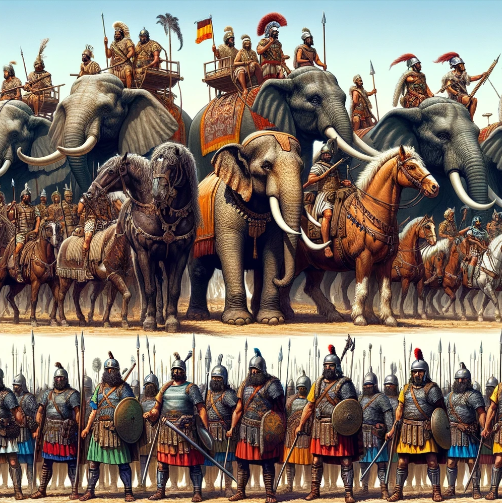
Image Credit: DALL-E, a sub-set of ChatGPT, January 2024, depicting an illustration of Hannibal’s army, this time including both war elephants and cavalry, alongside various infantry units. The composition aims to showcase the diverse and multifaceted nature of his forces.
- Adaptability and Surprise: Hannibal was known for his ability to adapt his tactics to the situation. His crossing of the Alps with war elephants was a feat of military logistics and audacity, demonstrating his willingness to take risks and surprise his enemies. He often used the element of surprise to his advantage, such as in the Battle of Lake Trasimene (217 BC), where he ambushed the Roman army in a narrow pass.
- Psychological Warfare: Hannibal understood the importance of morale and psychology in warfare. He was adept at undermining the confidence of his enemies and inspiring his own troops. His mere presence in Italy for over a decade caused panic and fear among the Romans.
- Logistics and Supply Lines: While he faced challenges in maintaining supply lines, particularly during his campaigns in Italy, Hannibal was innovative in living off the land and utilizing local resources, reducing his reliance on long and vulnerable supply chains.
- Diplomatic Strategy: Hannibal’s strategy extended beyond the battlefield. He attempted to detach Rome’s allies and incite rebellion among the recently subjugated regions in Italy. His aim was to isolate Rome and break its hegemony over the Italian peninsula.
- Limitations: Despite his genius, Hannibal faced limitations. The lack of support from Carthage, both in reinforcements and supplies, significantly hindered his campaigns. His inability to siege well-fortified cities, like Rome itself, was a critical strategic limitation.
Hannibal’s military strategies and innovations demonstrate his deep understanding of the art of war. His campaigns, particularly during the Second Punic War, have been studied for their brilliance in manoeuver, use of diverse forces, and strategic insight. His legacy as a military commander remains influential in the study of military strategy and tactics.
Hannibal’s Crossing of the Alps
Hannibal’s decision to cross the Alps in 218 BC with his army, including war elephants, is one of the most audacious military manoeuvers in history. This feat was driven by strategic necessity, boldness, and an element of surprise:
- Strategic Choice: The traditional route to invade Italy from Carthage would have been by sea. However, Rome’s naval supremacy after the First Punic War made a maritime approach extremely risky. An overland route through the Alps, though perilous, offered an element of surprise and the opportunity to enter Italy from a direction least expected by the Romans.
- Unprecedented Move: Prior to Hannibal, no foreign army of such size had attempted or succeeded in crossing the Alps to invade Italy. While smaller groups and local tribes had traversed these mountains, the logistical challenge of moving a large army with cavalry and elephants was unprecedented.
- The Element of Risk: The decision was fraught with risk. The Alps presented formidable natural obstacles: steep gradients, narrow paths, unpredictable weather, and the potential for hostile encounters with local tribes. Hannibal’s army was not accustomed to the Alpine climate, which added to the difficulty.
- Losses During the Crossing: The journey across the Alps took about 15 days and was indeed costly for Hannibal’s army. They faced harsh conditions, including cold weather, snow, and rockslides. The exact number of losses is debated, but ancient sources suggest that a significant portion of his troops and animals perished during the crossing.
- Impact on Troops: Despite the losses, the successful crossing had a significant psychological impact. It boosted the morale of Hannibal’s troops, who now saw their leader as someone capable of achieving the seemingly impossible. For the Romans, the arrival of Hannibal’s army from the north was a complete shock.
- Military Advantage: The crossing allowed Hannibal to enter Italy with the advantage of surprise and initiative. He quickly engaged in operations against the Romans, winning several significant victories, including at the River Trebia and Lake Trasimene.
- Long-term Consequences: While the crossing was a tactical triumph, it also meant Hannibal’s army was isolated. Cut off from reinforcements and supplies from Carthage, Hannibal had to rely heavily on local resources and alliances, which were not always forthcoming.
- Historical Legacy: The crossing of the Alps remains one of the most celebrated military feats in history. It showcased Hannibal’s boldness, strategic acumen, and ability to inspire and lead his troops through extreme challenges.
Hannibal’s decision to cross the Alps was a calculated risk that stemmed from a strategic necessity to challenge Rome’s power. It demonstrated his innovative approach to warfare and his ability to execute a high-risk plan with precision and courage.
The Second Punic War (218 to 201 BC)
The Second Punic War (218–201 BC), a monumental conflict between the Roman Republic and Carthage, stands out for the remarkable military campaigns led by Carthaginian general Hannibal Barca.
Background
- This war was a central episode in the trio of Punic Wars, which rank among the most extensive in ancient history.
- The aftermath of the First Punic War (264–241 BC) left Carthage debilitated and Rome ascendant in the Western Mediterranean.
- The war’s ignition was fuelled by Carthage’s quest to redress the losses and disgrace endured in the First Punic War, compounded by Hannibal’s aggressive expansion in Spain and the pivotal siege of Saguntum, which breached the Ebro Treaty with Rome.
Hannibal’s Campaign:
- Hannibal’s legendary crossing of the Alps with his diverse army, including war elephants, exemplifies his strategic audacity and the element of surprise, catching Rome off-guard.
- His initial victories in Italy, notably at the Trebia (218 BC), Lake Trasimene (217 BC), and Cannae (216 BC), were marked by innovative tactics. Cannae, in particular, is revered for Hannibal’s ingenious double envelopment, decimating a superior Roman force.
- Beyond his battlefield prowess, Hannibal endeavoured to weaken Rome’s alliances, fostering revolts and promising liberation to Italian states under Roman dominion.
Roman Response
- Rome, undeterred by initial setbacks, refrained from direct engagement under the “Fabian strategy” devised by Fabius Maximus while targeting Carthaginian territories elsewhere.
- The war’s dynamics altered with Scipio Africanus ascending as a pivotal Roman commander who boldly transferred the battle theatre to North Africa.
End of the War
- The decisive Battle of Zama in 202 BC, where Scipio defeated Hannibal, marked a strategic and psychological turning point, culminating in the war.
- The ensuing peace treaty severely curtailed Carthage’s military and naval capacities, stripping it of overseas territories and imposing heavy reparations.
Aftermath
- The war significantly debilitated Carthage, both materially and politically, precipitating internal strife and setting the stage for the Third Punic War.
- Rome emerged as the uncontested power in the Mediterranean, undergoing substantial military and political evolution in response to the war’s challenges.
- Before his eventual exile, Hannibal’s post-war life saw him taking an active role in Carthaginian politics, demonstrating his versatility as a leader.
- Hannibal’s strategic genius, particularly his tactics at Cannae, continues to be a subject of study in military circles worldwide.
The Second Punic War is remembered not just for its grandeur and impact on the Mediterranean world but also for the indelible mark left by Hannibal. His extraordinary military insight, coupled with his ability to challenge a superpower like Rome, cements his legacy as one of history’s greatest military tacticians.

Hannibal’s route from Iberia to Italy.
Hannibal. (2023, December 24). In Wikipedia. https://en.wikipedia.org/wiki/Hannibal
Battle of the Trebia (218 BC)

Image Credit: DALL-E, a sub-set of ChatGPT, January 2024, depicting the Battle of the Trebia, capturing the intensity and strategic complexity of this significant historical battle fought in the winter of 218 BC.
The Battle of the Trebia was the first major battle of the Second Punic War, fought in the winter of 218 BC near the Trebia River in northern Italy. It was a significant victory for Hannibal and set the tone for his initial successes against Rome.
Context
Following his audacious crossing of the Alps, Hannibal entered Italy with an army weakened by the journey but still formidable. He sought to engage the Roman forces quickly, capitalizing on the element of surprise and his enemy’s unpreparedness.
Roman Forces
The Roman army, commanded by Consul Tiberius Sempronius Longus, was fresh and numerically superior. Sempronius was eager to engage Hannibal and confident of victory, despite the advice of his co-consul Publius Cornelius Scipio, who had already faced Hannibal in minor skirmishes and advised caution.
Hannibal’s Strategy
- Hannibal was a master of psychological and deceptive tactics. He understood the Roman consul’s eagerness for battle and planned accordingly.
- On the eve of the battle, he sent Numidian cavalry to harass the Roman camp, disrupting their rest and preparation.
- Hannibal also took advantage of the weather and terrain. He chose the battlefield carefully, knowing the cold river would pose a challenge for the Romans.
The Battle
- The battle commenced with Hannibal’s forces positioned on the western bank of the Trebia River. The Romans crossed the river in the early morning, subjected to the freezing cold water, which sapped their strength.
- Hannibal had hidden a detachment of infantry and cavalry, commanded by his brother Mago, in the tall reeds near the Roman flank.
- As the main forces engaged, Mago’s troops attacked the Romans from behind, creating confusion and panic.
Outcome
The Roman army was encircled and suffered heavy casualties. Many soldiers fled, and only a substantial portion managed to escape due to the onset of a heavy rainstorm that caused the battle to break off. The Battle of the Trebia was a decisive victory for Hannibal and significantly boosted the morale of his army. It also demonstrated his superior tactical skills, particularly his use of the terrain and weather conditions to his advantage.
Aftermath
The victory at Trebia established Hannibal’s reputation as a formidable commander and shook Roman confidence. It encouraged some of the northern Italian tribes to join Hannibal against Rome, bolstering his forces with fresh troops. The battle set the stage for Hannibal’s subsequent victories at Lake Trasimene and Cannae as he continued his campaign in Italy. The Battle of the Trebia is often studied for its brilliant tactical manoeuvring and the way Hannibal managed to outwit and outfight a larger and fresher Roman army.
Battle of Lake Trasimene (217 BC)
The Battle of Lake Trasimene fought in 217 BC, was one of the largest and most dramatic ambushes in military history. It was Hannibal’s second major victory in his campaign against Rome during the Second Punic War.
Context and Lead-up
- After his victory at the Trebia, Hannibal spent the winter in northern Italy and in the spring, he moved his forces towards central Italy, aiming to continue his successful campaign.
- The Roman response was to appoint Gaius Flaminius as consul, who was determined to engage and defeat Hannibal quickly. Flaminius was known for his impulsiveness and lack of caution, traits Hannibal exploited.
Hannibal’s Strategy
- Hannibal carefully chose the battlefield near Lake Trasimene in Etruria (modern-day Tuscany), where he planned a massive ambush. The location was ideal, with a narrow pass between the lake and the hills, limiting the Roman army’s mobility.
- Hannibal positioned his men in the hills surrounding the pass, concealed by the early morning mist. His troops were arrayed in a semicircular formation, ready to encircle the Romans as they entered the trap.
The Battle
- The Romans, under Flaminius, marched along the lake’s shore, unaware of Hannibal’s forces waiting in the hills.
- Once the Roman vanguard and main body were sufficiently deep into the pass, Hannibal gave the signal, and Carthaginian soldiers descended from their hiding places, attacking the Roman columns from the flanks and rear.
- Surprised and unable to form into battle lines, the Roman army was thrown into disarray. The narrow confines of the battlefield prevented them from effectively manoeuvring or escaping.
Outcome
- The battle resulted in a catastrophic defeat for the Romans. Flaminius himself was killed, and Roman casualties were enormous, with estimates ranging from 15,000 to 30,000, including many drowned in the lake while trying to escape.
- Hannibal’s army suffered relatively few casualties and captured a large number of Romans.
Aftermath
- The shock of Lake Trasimene deeply affected Rome. It led to the appointment of Quintus Fabius Maximus as dictator, who adopted the Fabian strategy of avoiding open battles and instead harassing Hannibal’s forces.
- The battle demonstrated Hannibal’s mastery of strategy, particularly his use of terrain and the element of surprise.
- It also further eroded Rome’s alliances in Italy, with some regions and cities beginning to defect to Hannibal’s side.
The Battle of Lake Trasimene stands as a testament to Hannibal’s ingenuity in battle tactics and his ability to outmanoeuvre and outthink his Roman adversaries. It remains one of the most studied military engagements for its strategic brilliance and devastating effectiveness.
Battle of Cannae (216 BC)
The Battle of Cannae, fought on 2nd August 216 BC, is one of the most famous and studied military engagements of all time. It was a pivotal battle of the Second Punic War and is renowned for Hannibal’s use of innovative tactics to achieve a decisive victory over a much larger Roman force.
Background
Following his victories at the Trebia and Lake Trasimene, Hannibal continued his campaign in Italy. The Romans, determined to end Hannibal’s success, raised a massive army, possibly the largest they had ever assembled, led by the consuls Lucius Aemilius Paullus and Gaius Terentius Varro. The Romans intended to use their numerical superiority to overwhelm Hannibal.
The Roman Strategy
The Roman strategy was straightforward: to use their superior numbers to encircle and crush Hannibal’s army. The consuls, however, had differing approaches, with Varro being more aggressive and Paullus more cautious.
Hannibal’s Tactics
Hannibal, aware of the Roman plan, devised a brilliant counter-strategy. He positioned his army with the weaker Gallic and Iberian infantry in the centre and the elite African infantry in the wings. He intended to create a crescent formation, allowing the centre of his line to gradually retreat under the Roman advance, drawing them in further.
The Battle
- As the Romans advanced, they pushed back Hannibal’s centre but became increasingly surrounded on the flanks by the Carthaginian forces.
- Hannibal’s cavalry, having defeated the Roman cavalry, attacked the Roman infantry from behind. This action completed the encirclement.
- The Romans, packed tightly and unable to manoeuvre, were systematically slaughtered.
Outcome
- The Battle of Cannae resulted in one of the most significant defeats in Roman history. Roman casualties were enormous, with estimates ranging from 50,000 to 70,000 killed, including Paullus and many other officers.
- Despite this victory, Hannibal’s army was not in a position to march on Rome, lacking the necessary siege equipment and reinforcements.
Aftermath
- Cannae became a symbol of disaster for Rome, but the Republic’s response was resilient. Instead of seeking a decisive battle, they returned to the Fabian strategy of avoiding direct confrontation and wearing down Hannibal’s forces.
- While Hannibal remained in Italy for several more years, he was unable to secure a decisive victory that would force Rome to capitulate.
The Battle of Cannae is often cited as one of the greatest tactical masterpieces in military history, demonstrating Hannibal’s genius in maximising the effectiveness of his smaller force against a numerically superior enemy. It remains a key subject of study in military strategy for its innovative tactics and the lessons it provides in flexibility, psychological warfare, and the importance of leadership.
Hannibal’s Retreat in Italy (216 BC)
After the Battle of Cannae in 216 BC, Hannibal’s actions in Italy entered a phase often characterised as a retreat or a prolonged strategic stalemate. This period is marked by his inability to capitalise fully on his earlier victories and the gradual shift in momentum towards Rome.
Reasons for Not Marching on Rome
Following Cannae, many expected Hannibal to march directly on Rome. However, he refrained from doing so for several reasons. Firstly, despite his victory at Cannae, his army was not equipped for a siege against a well-fortified city like Rome. Hannibal lacked both the siege engines and the necessary reinforcements.
Secondly, Hannibal’s strategy relied on persuading Rome’s allies in Italy to defect. He hoped that the shock of Cannae would cause a widespread shift in allegiance, but this did not materialise as expected. While some cities did defect, the majority of Rome’s Italian allies remained loyal.
Additionally, Hannibal’s supply lines were stretched and vulnerable, making a prolonged siege risky.
The Prolonged Campaign
- Hannibal continued his campaigns in Italy, but his movements were more strategic, focusing on keeping his army supplied and intact while attempting to encourage defections to his cause.
- He established his base in Southern Italy, where he had more support, particularly from the Bruttii, Lucanians, and some Greek cities.
Roman Strategy – The Fabian Tactic
- The Roman response, primarily driven by the strategy of Quintus Fabius Maximus, known as the “Fabian strategy,” involved avoiding direct engagements with Hannibal. Instead, Rome focused on a war of attrition, cutting off supplies and targeting Carthaginian allies and holdings.
- Rome also strengthened its defences and reorganised its military, gradually recovering from the losses at Cannae and previous battles.
Was it a Blunder?
Historians have debated whether Hannibal’s decision not to march on Rome was a strategic blunder. On the one hand, it can be argued that without directly challenging Rome, Hannibal was unable to force a decisive end to the war. On the other hand, given his logistical and strategic constraints, it is doubtful whether a direct assault on Rome would have succeeded.
Hannibal’s strategy was based on the hope of undermining Rome’s alliance system within Italy, a plan that relied on political as well as military pressure. The resilience of the Roman alliance system and Rome’s strategic adaptations prevented this from being fully realised.
End of Hannibal’s Campaign in Italy
Hannibal maintained his presence in Italy for over a decade after Cannae but was gradually confined to the south of Italy. He was eventually recalled to Africa to defend Carthage against a Roman counter-invasion led by Scipio Africanus in 203 BC, leading to the Battle of Zama in 202 BC.
Hannibal’s retreat and prolonged campaign in Italy were not so much a blunder as a consequence of the strategic, logistical, and political challenges he faced. His inability to decisively defeat Rome in Italy was due to a combination of Roman resilience, strategic adaptations, and Hannibal’s limitations in resources and support from Carthage.
The Battle of Zama (202 BC): when Scipio met Hannibal
The Battle of Zama, fought in 202 BC near Zama (in present-day Tunisia), was the decisive engagement of the Second Punic War. This battle saw the defeat of Hannibal by the Roman general Scipio Africanus, marking the end of Carthage’s challenge to Roman supremacy in the Mediterranean.

Image Credit: DALL-E, a sub-set of ChatGPT, January 2024, depicting the Battle of Zama, capturing the dramatic confrontation between Roman forces led by Scipio Africanus and Hannibal’s Carthaginian army.
Change of Circumstances
A significant change in circumstances led to the Battle of Zama. After years of fighting in Italy, Hannibal was recalled to Africa by the Carthaginian government to counter a Roman invasion led by Scipio Africanus. Rome had taken the war to Africa, forcing Carthage to defend its homeland. Scipio had successfully campaigned in Spain and then in North Africa, gaining allies and weakening Carthaginian influence. This shift of the theatre of war put Carthage on the defensive.
Why Hannibal was Defeated
There were several factors:
- Lack of Veteran Troops: Many of Hannibal’s veteran troops from his Italian campaigns were not present at Zama. Instead, he had to rely on hastily raised local forces and a contingent of mercenaries. These troops lacked the experience and cohesion of his earlier army.
- Effective Roman Tactics: Scipio had studied Hannibal’s tactics and adapted his own accordingly. He organised his legions into maniples[10], allowing for greater flexibility and the ability to adapt to the Carthaginian elephants and infantry.
- Numidian Cavalry: A key factor was the defection of the Numidian King Masinissa and his cavalry to the Romans. Masinissa’s horsemen were crucial in the latter stages of the battle, returning after a chase to attack Hannibal’s forces from behind.
- Carthaginian Elephants Neutralised: The effectiveness of Hannibal’s war elephants was reduced by Scipio’s tactics. The Romans used trumpets to frighten and disorient the elephants and created corridors in their lines to let the charging animals pass through harmlessly.
- Hannibal’s Tactical Adaptations Limited: Unlike in his previous battles, Hannibal’s scope for innovative tactics was limited at Zama. He was facing an enemy well-versed in his strategies and fighting on familiar terrain.
- Strategic and Political Factors: The broader strategic and political situation also played a role. Carthage was politically and militarily weakened by this point in the war, lacking the resources and allies to support Hannibal’s campaign fully.
Aftermath
The defeat at Zama was catastrophic for Carthage. It led to a peace treaty that stripped Carthage of its overseas territories, imposed a large indemnity, and restricted its military capabilities. For Rome, the victory solidified its status as the dominant power in the Western Mediterranean. Scipio’s success earned him the cognomen “Africanus.” Hannibal, though defeated, remained an influential figure in Carthage in the subsequent years before eventually going into exile.
The Battle of Zama was the result of a significant shift in the strategic situation of the Second Punic War. Hannibal’s defeat was due to a combination of factors, including Scipio’s effective tactics, the diminished quality and composition of Hannibal’s army, and the broader political and strategic challenges facing Carthage.
Impact of the Wars on Rome and Carthage
The Punic Wars, particularly the Second Punic War, had profound and lasting impacts on both Rome and Carthage, affecting them politically, economically, and culturally.
Impact on Rome
- Political and Military Reforms: The wars, especially the near-catastrophic defeats early in the Second Punic War, led to significant military reforms in Rome. The Roman legions became more flexible and adaptable, learning from the tactics used by Hannibal. There was also a shift in Roman military leadership, with a greater emphasis on strategic acumen.
- Territorial Expansion: The defeat of Carthage in the Second Punic War and the subsequent Third Punic War led to Rome gaining control of significant territories, including Sicily, Sardinia, Corsica, and later, the entirety of North Africa, Spain, and parts of the Eastern Mediterranean. This expansion laid the groundwork for the Roman Empire.
- Economic Growth: The acquisition of new territories and control of trade routes significantly boosted the Roman economy. Rome also imposed heavy war indemnities on Carthage, further strengthening its economic position.
- Cultural Changes: The wars brought Rome into closer contact with the Hellenistic East and increased cultural exchange. This interaction influenced Roman art, literature, and philosophy, leading to the Roman adaptation of Greek culture.
- Rise of a Naval Power: Before the Punic Wars, Rome was not a significant maritime power. The need to challenge Carthage on the seas led to the development of a strong Roman navy, which played a crucial role in Rome’s future dominance in the Mediterranean.
Impact on Carthage
- Economic Decline: The heavy indemnities imposed by Rome, loss of territories, and restrictions on trade and military capabilities devastated the Carthaginian economy. Carthage’s status as a major trade power in the Mediterranean was effectively ended.
- Political Changes: The outcome of the wars led to significant political upheaval in Carthage. The Barcid family, once prominent, lost its influence. Internal strife and political instability became more common as Carthage struggled to adapt to its reduced status.
- Military Weakening: The terms of the peace treaties, especially after the Third Punic War, stripped Carthage of its military power. This left the city-state unable to defend itself effectively, eventually leading to its complete destruction and annexation by Rome in 146 BC.
- Cultural Impact: The cultural impact of the Punic Wars on Carthage is harder to ascertain due to the eventual destruction of the city. However, Carthaginian culture, language, and influence in North Africa diminished significantly in the years following the wars.
- Legacy and Identity: The defeat and destruction of Carthage led to a loss of its identity as an independent power. The memory and legacy of Carthage, however, lived on, particularly in the figure of Hannibal, who became a symbol of resistance against Rome.
The Punic Wars led to Rome’s ascent as the dominant power in the Mediterranean and marked the beginning of the end for Carthage. The consequences of these conflicts were felt not just in the immediate aftermath but continued to shape the political, economic, and cultural landscapes of the Mediterranean world for centuries.
Peacetime Carthage (200–196 BC)
The period from 200–196 BC in Carthage was a time of relative peace but also of significant adjustment and recovery following the devastating Second Punic War. This era was marked by several key aspects:
Economic Recovery and Tribute Payments
Following the war, Carthage faced enormous economic challenges. The peace treaty with Rome required Carthage to pay a large war indemnity over 50 years. Despite this heavy burden, Carthage managed to start recovering economically due to its inherent commercial strengths and resilient citizenry. The city resumed its trade activities in the Western Mediterranean and beyond, although on a much smaller scale than before.
Political Restructuring and Internal Strife
The defeat led to significant political changes in Carthage. The Barcid faction, which had been dominant, particularly in military affairs, lost much of its influence. This period saw a shift in power towards the merchant aristocracy and a council of elders, leading to internal political restructuring. However, this transition was not smooth. There were internal power struggles and social unrest, partly due to the large number of returning soldiers who could not find employment and the general populace burdened by the heavy tributes to Rome.
Agricultural Development
With its overseas territories lost and its naval power curtailed, Carthage focused more on developing its agriculture, particularly in the fertile regions of North Africa. This shift helped to stabilise its economy and provided a basis for sustaining its population.
Diplomatic Efforts and Relations with Rome
Carthage, during this time, was cautious in its foreign policy, keenly aware of the watchful eyes of Rome. Any significant military or diplomatic move had to be approved by Rome, which significantly limited Carthage’s autonomy in international affairs. The period also saw Carthage actively engaging in diplomacy to ensure that it did not further provoke Rome and to maintain whatever independence it could salvage.
Cultural and Social Changes
The aftermath of the war and the subsequent peace period saw changes in Carthaginian society and culture. There was likely an increased focus on local North African elements as opposed to its previous extensive maritime cultural exchanges.
Hannibal’s Role
Hannibal, after his return from Italy, initially played a significant role in Carthaginian politics, even being elected as a suffete (chief magistrate). He introduced several reforms aimed at reducing corruption and improving the efficiency of the state. However, his political career was short-lived due to Roman pressure and internal opposition, leading to his eventual flight from Carthage.
The Shadow of Rome
Throughout this period, Carthage remained under the shadow of Rome. The Romans were vigilant and did not allow Carthage to regain its former military strength. This overbearing presence was a constant reminder of Carthage’s loss of sovereignty and the consequences of its defeat. In essence, the period of 200–196 BC in Carthage was one of rebuilding and adaptation to a new reality as a diminished power under the watchful supervision of Rome. It was a time of peace but also one of significant challenges and transformations for Carthaginian society and the state.
Hannibal’s Exile (after 195 BC) and Death (around 183–181 BC)
After the Second Punic War, Hannibal Barca found himself in an increasingly precarious position that eventually led to his exile from Carthage.
Political Activities in Carthage
Following his return to Carthage after the war, Hannibal was elected as a suffete (a chief magistrate akin to a modern-day president or prime minister). He embarked on significant political and economic reforms aimed at stabilizing the weakened Carthage. These reforms included reorganizing the government to reduce corruption and improving the efficiency of tax collection.
Growing Roman Distrust
Despite his efforts at home, Hannibal’s fame as Rome’s most formidable enemy continued to foster distrust among the Romans. They were wary of his influence and potential to restore Carthage’s military power. Roman envoys frequently visited Carthage, partly to ensure that the terms of the peace treaty were being followed and partly to keep an eye on Hannibal’s activities.
Accusations and Roman Pressure
Around 195 BC, Rome exerted pressure on Carthage to surrender Hannibal, alleging that he was corresponding with their enemies, particularly King Antiochus III of the Seleucid Empire, and planning a new war against Rome. Whether these allegations were true is still debated by historians.
Hannibal’s Flight
Realising the threat to his life and wishing to avoid causing further trouble for Carthage, Hannibal chose to go into voluntary exile. He fled first to Tyre, the original Phoenician mother city of Carthage, and then sought refuge with Antiochus III in Ephesus. Antiochus was preparing for war against Rome (the Roman-Seleucid War), and Hannibal offered his military expertise.
Later Life and Activities
In the court of Antiochus, Hannibal was given a position of respect but was not fully trusted or given significant command, possibly due to Antiochus’s suspicions or Roman influence. After Antiochus’s defeat at the Battle of Magnesia in 190 BC, Hannibal fled again, this time to the court of King Prusias I of Bithynia.
Final Years, Death and Burial
In Bithynia, Hannibal continued to be involved in minor military activities and intrigues against Rome. His presence in Bithynia led to a Roman demand for his surrender. To avoid falling into Roman hands, Hannibal is said to have taken poison, ending his life around 183–181 BC. His death marked the end of an era and the final extinguishing of Carthage’s hope of challenging Rome’s supremacy.
Hannibal’s exile reflects the intersection of his destiny with the larger geopolitical struggles of the time. His life in exile was marked by a loss of the influence and power he once wielded, but he continued to be shadowed by his reputation as Rome’s greatest adversary.
The exact location of Hannibal’s burial place remains unknown and is one of the many mysteries surrounding the Carthaginian general’s life. After his defeat by the Romans and subsequent flight from Carthage, Hannibal spent his final years in exile. According to ancient sources, including the Roman historian Livy, Hannibal committed suicide around 183–181 BC to avoid capture by the Romans, who were demanding that Prusias hand him over.
As for his final resting place, there are no reliable historical records or archaeological findings that definitively indicate where he was buried. Over the centuries, there have been various theories and legends, but none have been substantiated with concrete evidence. The lack of precise information about his burial site has added to the intrigue and mystique surrounding Hannibal’s life and death.
Revered as a National Hero
The reverence of Hannibal Barca as a national hero in the Arab world is a matter of historical interpretation and cultural legacy. This view is not universally held across all Arab nations, but there are several aspects to consider:
- Historical Legacy in North Africa: Hannibal was a Carthaginian, and Carthage was located in the region of modern-day Tunisia in North Africa. While the Carthaginians were of Phoenician origin and not ethnically Arab, their legacy in North Africa has been embraced to some extent by the modern Arab world, particularly in Tunisia. The story of Hannibal, especially his military genius and his defiance of Rome, resonates as a symbol of resistance against a foreign invader. This aspect of his legacy is sometimes celebrated in the context of historical resistance against colonialism or foreign domination, themes that are significant in many Arab nations’ histories.
- Hannibal in Tunisian Culture and Identity: In Tunisia, Hannibal is often hailed as a national hero and a symbol of the country’s ancient history and cultural heritage. His military campaigns, especially his crossing of the Alps, are seen as emblematic of courage and strategic brilliance. Tunisian textbooks and cultural narratives sometimes depict Hannibal as an early forefather of Tunisian resistance and ingenuity, although it is important to note the historical distinction between the Carthaginian/Phoenician heritage and the later Arab identity.
- Broader Arab World Recognition: Across the broader Arab world, Hannibal’s story is known and respected, particularly among those interested in history and military strategy. However, his elevation as a national hero is more pronounced in North Africa due to the direct geographical and historical connection. The admiration for Hannibal in some parts of the Arab world can also be seen in the context of a general appreciation for historical figures who demonstrated great leadership, strategic insight, and resilience in the face of more powerful adversaries.
- Influence on Military Studies: Hannibal’s military tactics and strategies are studied worldwide, including in military academies in the Arab world. His legacy as one of the greatest military commanders in history transcends regional and cultural boundaries.
While Hannibal is admired in parts of the Arab world and holds a place of historical significance, especially in Tunisia, the perception of him as a national hero varies. His legacy is more related to his role as an ancient military commander and less as a direct contributor to Arab identity or history. The admiration for him is rooted in respect for his military prowess and as a symbol of resistance and strategic brilliance.
Hannibal’s Legacy and Rome’s Fear
Hannibal Barca’s campaigns during the Second Punic War had a profound and lasting impact on Rome, both in terms of military strategy and political psyche. His legacy influenced Roman policy and military tactics for generations.
- Hannibal’s Influence on Roman Military Reforms: Hannibal’s innovative tactics, particularly his use of cavalry and the strategic envelopment at Cannae led the Romans to reassess and reform their military strategies. The Romans began placing a greater emphasis on flexibility in their legions, cavalry improvements, and the use of auxiliary troops from allied or conquered peoples. The disaster at Cannae also led to changes in the Roman command structure and a more cautious approach to choosing military leaders. Competence and experience became more valued over purely political appointments.
- The ‘Hannibalic Fear’: The memory of Hannibal’s near success in defeating Rome left a deep-seated fear and respect for the Carthaginian general within the Roman psyche. This “Hannibalic fear” was not just a fear of Hannibal as an individual but of a potential repeat of a similar threat to Rome. This fear influenced Roman foreign policy for many years, leading to a more aggressive stance towards potential threats. Rome became more pre-emptive in its military campaigns, seeking to neutralise perceived threats before they could materialise into something akin to Hannibal’s invasion.
- Rome’s Expansionist Policies: In the aftermath of the Punic Wars, Rome pursued a more assertive and expansionist foreign policy. The destruction of Carthage in the Third Punic War (149–146 BC) was partly motivated by the lingering fear of a Carthaginian resurgence. The Roman saying: Ceterum censeo Carthaginem esse delendam (meaning: Furthermore, I consider that Carthage must be destroyed), attributed to Cato the Elder, underscores this sentiment. The Roman Empire’s expansion in the subsequent centuries can be seen as part of a strategy to ensure that no single power could again pose a threat like that of Hannibal.
- Cultural and Political Legacy: Hannibal became a legendary figure in Roman culture, often portrayed as the ultimate enemy, but also respected for his military genius. His story was used both as a cautionary tale and a benchmark for military excellence. Roman writers, including Livy and Polybius, extensively documented Hannibal’s campaigns, and these accounts have influenced how military strategy has been studied and taught throughout Western history.
- Impact Beyond Rome: Hannibal’s tactics and strategies have been studied by military leaders and historians for centuries and continue to be taught in military academies around the world. His legacy transcends the Roman context, impacting broader military theory and practice.
Hannibal’s legacy and the fear he instilled in Rome significantly shaped Roman military reforms, political strategies, and foreign policy decisions. The long-term impact of his campaigns went beyond immediate military tactics, influencing the course of Roman history and contributing to the shaping of the Western military tradition.
Comparing Hannibal with other military leaders of the ancient world
Comparing Hannibal with other military leaders of the ancient world highlights the varied tactics, strategies, and contexts within which these commanders operated. Here, I will mention a few notable leaders alongside Hannibal:
Hannibal Barca vs. Alexander the Great
- Tactics and Strategies: Both were brilliant tacticians, but their styles differed. Alexander was known for his use of the phalanx and heavy cavalry (the Companion Cavalry), often leading charges personally. Hannibal, on the other hand, was a master of psychological warfare and used diverse troop types effectively.
- Objectives: Alexander aimed for outright conquest and the spread of Hellenistic culture, while Hannibal’s primary goal was to weaken Rome to ensure Carthage’s survival and supremacy in the Western Mediterranean.
- Legacy: Alexander’s conquests created a vast empire, albeit short-lived, and spread Greek culture across the known world. Hannibal’s legacy is more associated with his tactical genius, particularly at Cannae, and his impact on Roman military reforms.
Hannibal vs. Julius Caesar
- Military Achievements: Caesar is best known for his conquest of Gaul and his pivotal role in the transition of Rome from a republic to an empire. Hannibal is renowned for his audacious crossing of the Alps and victories in Italy during the Second Punic War.
- Leadership Style: Hannibal’s leadership was marked by his ability to maintain a diverse coalition army far from home. Caesar’s leadership was characterised by his ability to inspire loyalty in his troops and his adeptness at both military and political manoeuvring.
- Impact: While Hannibal influenced Roman military tactics and left a legacy as a brilliant tactician, Caesar’s actions had more direct political consequences, leading to the end of the Roman Republic and the rise of the Roman Empire.
Hannibal vs. Scipio Africanus
- Contrasting Careers: Hannibal’s career is marked by early spectacular successes but ultimately ended in defeat and exile. Scipio, starting from defeat (his father and uncle were killed in the war against Hannibal), rose to defeat Hannibal at Zama and enjoyed a successful political career afterwards.
- Military Strategy: Both generals are praised for their strategic foresight and adaptability. Scipio is particularly noted for learning from Hannibal’s tactics and using them effectively, as seen in the Battle of Zama.
Hannibal vs. Cyrus the Great:
- Empire Building: Cyrus the Great was an empire builder, founding the Achaemenid Empire, one of the largest empires of the ancient world. Hannibal, in contrast, fought to protect and enhance the position of his city-state.
- Military Approach: Cyrus was known for his ability to assimilate conquered peoples and use diplomacy effectively alongside military conquest. Hannibal’s approach was more directly military, using innovative tactics to achieve his objectives.
Comparing Hannibal with Genghis Khan and Attila the Hun involves contrasting different eras, cultures, and military strategies. Each of these leaders left a distinct mark on history, but their methods and legacies vary considerably:
Hannibal Barca
- Era and Context: 3rd century BC, during the Punic Wars between Rome and Carthage.
- Strategy and Tactics: Known for his brilliant tactical manoeuvres, like the Battle of Cannae, and his ability to adapt to different environments. His crossing of the Alps is legendary.
- Objective: Aimed to weaken Rome to secure Carthage’s position in the Mediterranean.
- Legacy: He was celebrated for his military genius, particularly his use of diverse army compositions and psychological warfare. His campaigns led to significant Roman military reforms.
Genghis Khan:
- Era and Context: 12th to 13th century AD, founder of the Mongol Empire.
- Strategy and Tactics: He used highly mobile cavalry units and was known for his innovative military tactics, psychological warfare, and a merit-based promotion system.
- Objective: Conquered vast territories to create one of the largest empires in history. Aimed for expansion and consolidation of power.
- Legacy: Known for his role in unifying the Mongol tribes and creating an empire that influenced trade and cultural exchange across Eurasia. His conquests had significant demographic, cultural, and political impacts.
Attila the Hun
- Era and Context: 5th century AD, leader of the Huns during the late Roman Empire.
- Strategy and Tactics: Employed fierce, fast, and effective cavalry tactics. He was known for his ability to instil fear and for his ruthless and direct approach to warfare.
- Objective: Sought to expand the Hunnic Empire and extract wealth from the Romans, often through plunder and tribute.
- Legacy: Often depicted as a symbol of barbarian terror by Western sources. His invasions contributed to the weakening of the Roman Empire.
Comparisons
- Tactics and Warfare: While Hannibal excelled in tactical battles and set-piece engagements, Genghis Khan and Attila were masters of rapid cavalry movements and psychological warfare. Hannibal’s tactics were more about outmanoeuvring the enemy, whereas Genghis Khan and Attila often relied on speed, surprise, and terror.
- Objectives: Hannibal’s primary goal was to defeat a rival power (Rome), while Genghis Khan and Attila were more focused on conquest and expansion of their empires.
- Impact: Hannibal’s legacy is more about his influence on military strategy and the Roman response to his threat. In contrast, Genghis Khan’s and Attila’s legacies are tied to the vast empires they created or expanded and their broader impact on the course of history, particularly in reshaping the political and demographic landscape of Eurasia.
In summary, Hannibal, Genghis Khan, and Attila the Hun were all exceptional military leaders of their time, but their methods, objectives, and legacies reflect the distinct historical and cultural contexts in which they operated.
Hannibal stands out for his tactical brilliance and the audacity of his campaigns. While other leaders like Alexander and Caesar are remembered for building empires and their political impacts, Hannibal is most renowned for his military strategy, his ability to lead a diverse army in hostile territory, and the significant influence he had on the development of Roman military doctrine.
Portrayal by Historians
Hannibal Barca’s portrayal by historians over time has varied, reflecting the perspectives and biases of different eras and cultural backgrounds. From ancient historians like Polybius and Livy to modern scholars, Hannibal has been a subject of fascination and debate.
Ancient Historians
- Polybius (c. 200–118 BC): A Greek historian of the Hellenistic period, Polybius was a contemporary of the events of the Second Punic War. His work is considered more objective and less biased than later Roman accounts. Polybius admired Hannibal’s military genius, providing detailed descriptions of his tactics and strategies. His account is valuable for its firsthand insights and balanced perspective.
- Livy (59 BC–17 AD): A Roman historian who wrote a few centuries after Hannibal’s time, Livy had access to earlier sources that are now lost. His work is more dramatic and less impartial than Polybius’s. Livy portrayed Hannibal as a formidable and cunning enemy of Rome but also as a figure of almost tragic overreach. Livy’s account reflects the Roman view of Hannibal as a relentless adversary, highlighting both his genius and the threat he posed to Rome.
Medieval and Renaissance Perceptions
During these periods, Hannibal was often cited as a great general in various works on military history and strategy. His tactics, especially at Cannae, were studied and admired, though detailed historical analysis was limited.
Modern Historians
- 19th and 20th Century Interpretations: Modern historians have provided more nuanced assessments of Hannibal. They have analysed his campaigns in the broader context of Roman-Carthaginian relations, assessing both his military brilliance and the strategic limitations of his campaigns. Historians like Theodor Mommsen and B.H. Liddell Hart have explored the complexity of his military endeavours and his impact on Roman military reforms.
- Contemporary Views: Recent scholarship often focuses on the broader geopolitical and cultural contexts of Hannibal’s campaigns. Modern historians tend to examine more than just his military tactics, delving into his diplomatic efforts, the logistical aspects of his campaigns, and the internal politics of Carthage and Rome. They also explore the myth versus the reality of Hannibal, considering how his legend has been shaped by historical narratives.
Some contemporary historians also engage in revisionist interpretations, questioning the traditional Roman-centric narrative and exploring what Hannibal’s actions and strategies reveal about Carthaginian society and the Mediterranean geopolitics of the time.
Differing Interpretations
While ancient sources often focus on the dramatic and moralistic aspects of Hannibal’s war against Rome, modern interpretations tend to be more analytical, discussing his tactics and strategy in a broader historical and military context.
Modern scholarship also tends to be more critical of the sources, acknowledging the biases and limitations in the accounts of ancient historians like Livy and Polybius.
Hannibal has been consistently regarded as one of the greatest military commanders in history, though his portrayal has shifted from the ancient image of a formidable enemy of Rome to a more multifaceted figure who challenges modern historians to separate the man from the myth. The evolution in his portrayal reflects changes in historical methodology and a growing understanding of the complex interplay of cultural, political, and military factors in the ancient world.
Conclusion
The saga of Hannibal Barca, set against the tumultuous backdrop of the Punic Wars, encapsulates a critical epoch in the ancient Mediterranean world. His extraordinary military endeavours during the Second Punic War, characterised by the legendary crossing of the Alps and stunning victories at Trebia, Lake Trasimene, and Cannae, stand as a testament to his strategic ingenuity. However, Hannibal’s story transcends his battlefield triumphs, reflecting the complex interplay of power, diplomacy, and the relentless pursuit of supremacy between Carthage and Rome.
Hannibal’s achievements, while remarkable, were ultimately overshadowed by his inability to secure a decisive victory that could alter the balance of power in favour of Carthage. The Second Punic War, with Hannibal at its heart, proved pivotal in reshaping the Mediterranean landscape. It marked not only the rise of Rome as an indomitable superpower but also set the stage for the tragic downfall of Carthage. The war’s end witnessed Rome implementing significant military and political reforms, catalyzing its transformation into an empire that would dominate the ancient world for centuries.
The Third Punic War, although absent Hannibal’s direct involvement, was a conclusive episode in the long-standing rivalry between Carthage and Rome. Fought entirely within Carthaginian territory (now modern-day northern Tunisia), this war culminated in the total destruction of Carthage in 146 BC. The annihilation of this once-great city and the subsequent Roman annexation of its territory underscored the relentless nature of Roman expansionism and the irreversible decline of Carthaginian power.
Hannibal’s later life, characterised by political engagement in Carthage, followed by exile and death, mirrored the trajectory of Carthage’s fortunes. His enduring legacy is not solely in his military prowess but also in the profound impact he had on both Roman policy and military strategy, embodied in the ‘Hannibalic fear’ that influenced Roman decisions long after the Punic Wars.
In summary, Hannibal Barca remains a figure of immense historical significance, a military strategist whose actions directly influenced the course of Mediterranean history. His life and campaigns serve as a powerful reminder of the rise and fall of empires, the relentless pursuit of power, and the enduring legacy of one of history’s most celebrated military leaders.

Engraving of the Battle of Zama by Cornelis Cort, 1567. Note that Asian elephants are illustrated rather than the very small North African elephants used by Carthage. Citation: Hannibal. (2023, December 24). In Wikipedia. https://en.wikipedia.org/wiki/Hannibal
CAUTION: This paper is compiled from the sources stated but has not been externally reviewed. Parts of this paper include information provided via artificial intelligence which, although checked by the author, is not always accurate or reliable. Neither we nor any third parties provide any warranty or guarantee as to the accuracy, timeliness, performance, completeness or suitability of the information and materials covered in this paper for any particular purpose. Such information and materials may contain inaccuracies or errors and we expressly exclude liability for any such inaccuracies or errors to the fullest extent permitted by law. Your use of any information or materials on this website is entirely at your own risk, for which we shall not be liable. It shall be your own responsibility to ensure that any products, services or information available through this paper meet your specific requirements and you should neither take action nor exercise inaction without taking appropriate professional advice. The hyperlinks were current at the date of publication.
Web Resources and Relevant Reading
Web Resources
- https://www.theguardian.com/science/2016/apr/03/where-muck-hannibals-elephants-alps-italy-bill-mahaney-york-university-toronto
- https://en.wikipedia.org/wiki/Hannibal
- https://www.britannica.com/biography/Hannibal-Carthaginian-general-247-183-BCE
- https://www.nationalgeographic.com/culture/article/hannibal
- https://www.livius.org/articles/person/hannibal-3-barca/
- https://www.thecollector.com/hannibal-barca-rome-worst-nightmare/
- https://en.wikipedia.org/wiki/Battle_of_Cannae
- https://www.worldhistory.org/hannibal/
- https://www.thecollector.com/9-facts-hannibal-barca-of-carthage-great-general/
- https://www.history.com/topics/ancient-rome/hannibal
- https://www.blinkist.com/magazine/posts/quotes-hannibal-legendary-carthaginian-general
- https://www.timelessmyths.com/history/carthaginian-generals/
Books
The following book selection covers various aspects of Hannibal’s life, his military strategies, and the broader context of the Punic Wars:
- Cannae: Hannibal’s Greatest Victory by Adrian Goldsworthy (2007), published by Phoenix Press, available from https://www.amazon.co.uk/Cannae-Hannibals-Greatest-Adrian-Goldsworthy/dp/0753822598
- Carthage and the Carthaginians, by R. Bosworth Smith (1894), published by Longmans, Green, and Co, available from https://www.amazon.co.uk/Carthage-Carthaginians-R-Bosworth-Smith/dp/B00089TWZC
- Carthage Must Be Destroyed: The Rise and Fall of an Ancient Civilization, by Richard Miles (2011), published by Penguin, available from https://www.amazon.co.uk/Carthage-Must-Be-Destroyed-Civilization/dp/0141018097/
- Carthage’s Other Wars: Carthaginian Warfare Outside the ‘Punic Wars’ Against Rome, by Dexter Hoyos (2019), published by Pen & Sword Military, available from https://www.amazon.co.uk/Carthages-Other-Wars-Carthaginian-Warfare/dp/1781593574
- Hannibal and Me: What History’s Greatest Military Strategist Can Teach Us About Success and Failure, by Andreas Kluth (2012), published by Riverhead Books, available from https://www.amazon.co.uk/Hannibal-Me-Historys-Greatest-Strategist/dp/1594488126
- Hannibal and the Enemies of Rome, by Peter Connolly (1979), published by Silver Burdett Pr, available from https://www.amazon.co.uk/Hannibal-Enemies-Rome-Peter-Connolly/dp/0382063074/
- Hannibal Barca, The Father of Strategy, by Theodore Dodge (1995), published by BiblioLife, available from https://www.amazon.com/Hannibal-Theodore-Ayrault-Dodge/dp/0306806541
- Hannibal Crosses The Alps: The Invasion Of Italy And The Punic Wars, by John Prevas (2001), published by Da Capo Press, available from https://www.amazon.co.uk/Hannibal-Crosses-Alps-Invasion-Italy/dp/0306810700
- Hannibal, by Serge Lancel (1999), published by Wiley Blackwell, available from https://www.amazon.co.uk/Hannibal-Blackwell-Ancient-Lives-Lancel/dp/0631218483
- Hannibal: A Hellenistic Life, by Eve MacDonald (2015), published by Yale University Press, available from https://www.amazon.co.uk/Hannibal-Hellenistic-Life-Eve-Macdonald/dp/0300152043
- Hannibal: A History of the Art of War Among the Carthaginians and Romans, by Theodore Ayrault Dodge (2001), published by Adamant Media Corporation, available from https://www.amazon.co.uk/Hannibal-Theodore-Ayrault-Dodge/dp/1402194854
- Hannibal: Enemy of Rome, by Leonard Cottrell (1992), published by Da Capo Press, available from https://www.amazon.co.uk/Hannibal-Enemy-Rome-Leonard-Cottrell/dp/0306804980
- Hannibal: One Man Against Rome, by Harold Lamb (1958), published by Doubleday, available from https://www.amazon.co.uk/Hannibal-One-Man-Against-Rome/dp/B0006AVNS2
- Hannibal: Rome’s Worst Nightmare, by Philip Brooks (2009), published by Franklin Watts, available from https://www.amazon.co.uk/Hannibal-Romes-Nightmare-Wicked-History/dp/0531221741
- Hannibal: Soldier, Statesman, Patriot, by William O’Connor Morris (2012), published by Nabu Press, available from https://www.amazon.co.uk/Hannibal-Soldier-Statesman-Patriot-Struggle/dp/127333129X
- Hannibal: The Military Biography of Rome’s Greatest Enemy, by Richard A. Gabriel (2011), published by Potomac Books, available from https://www.amazon.co.uk/Hannibal-Military-Biography-Romes-Greatest/dp/1597976865
- Hannibal: The Struggle for Power in the Mediterranean, by Sir Gavin de Beer (1974), published by BCA, available from https://www.amazon.co.uk/Hannibal-Struggle-Mediterranean-Gavin-Beer/dp/B000Z5TQBO
- Hannibal’s Dynasty: Power and Politics in the Western Mediterranean, 247-183 BC, by Dexter Hoyos (2003), published by Routledge, available from https://www.amazon.co.uk/Hannibals-Dynasty-Politics-Western-Mediterranean/dp/041529911X
- Hannibal’s Last Battle: Zama and the Fall of Carthage, by Brian Todd Carey (2007), published by Pen & Sword Military, available from https://www.amazon.co.uk/Hannibals-Last-Battle-Zama-Carthage/dp/1844156354
- Hannibal’s Oath: The Life and Wars of Rome’s Greatest Enemy by John Prevas (2017), published by Da Capo Press, available from https://www.amazon.co.uk/Hannibals-Oath-Romes-Greatest-Enemy/dp/0306824248
- Hannibal’s Road: The Second Punic War in Italy 213-203 BC, by Mike Roberts (2017), published by Pen & Sword Military, available from https://www.amazon.co.uk/Hannibals-Road-Second-Punic-213-203/dp/1473855950
- Hannibal’s War With Rome: The Armies and Campaigns 216 BC, by Mark Healy (Author), Terence Wise (Author), Angus McBride (Illustrator), Richard Hook (Illustrator) (2004), published by Osprey Publishing, available from https://www.amazon.co.uk/Hannibals-War-Rome-Armies-Campaigns/dp/1855328704/
- Hannibal’s War, by J. F. Lazenby (1978), published by Aris & Phillips, available from https://www.amazon.co.uk/Hannibals-War-Military-Phillips-Classical/dp/085668080X
- Hannibal’s War: A Military History of the Second Punic War, by J. F. Lazenby (1998), published by University of Oklahoma Press, available from https://www.amazon.co.uk/Hannibals-War-Military-History-Second/dp/0806130040
- Hannibal’s War: Books Twenty-One to Thirty, by Titus Livius (Livy) (translated by J. C. Yardley, 2009), published by Oxford University Press, available from https://www.amazon.co.uk/Hannibals-Books-Oxford-Worlds-Classics/dp/0199555974/
- Masters of Command: Alexander, Hannibal, Caesar, and the Genius of Leadership, by Barry Strauss (2013), published by Simon & Schuster, available from https://www.amazon.co.uk/Masters-Command-Alexander-Hannibal-Leadership/dp/1439164495/
- Rome and Carthage: The Punic Wars, by Reginald Bosworth Smith (2013), published by CreateSpace Independent Publishing Platform, available from https://www.amazon.co.uk/Rome-Carthage-R-Bosworth-Smith/dp/1494716879
- Rome and the Mediterranean 290 to 146 BC: The Imperial Republic, by Nathan Rosenstein (2012), published by Edinburgh University Press, available from https://www.amazon.co.uk/Rome-Mediterranean-290-146-Edinburgh/dp/0748623221
- Scipio Africanus: Greater Than Napoleon, by B. H. Liddell Hart (2004), published by Da Capo Press, available from https://www.amazon.co.uk/Scipio-Africanus-Greater-Than-Napoleon/dp/0306813637/
- The Fall of Carthage: The Punic Wars 265-146 BC, by Adrian Goldsworthy (2003), published by W&N, available from https://www.amazon.co.uk/Fall-Carthage-265-146BC-MILITARY-PAPERBACKS/dp/0304366420/
- The Ghosts of Cannae: Hannibal and the Darkest Hour of the Roman Republic, by Robert L. O’Connell (2011), published by Random House Trade, available from https://www.amazon.co.uk/Ghosts-Cannae-Hannibal-Darkest-Republic/dp/0812978676
- The Punic Wars, by Adrian Goldsworthy (2001), published by Orion, available from https://www.amazon.co.uk/Punic-Wars-Adrian-Goldsworthy/dp/030435967X/
- The Punic Wars: Rome, Carthage, and the Struggle for the Mediterranean, by Nigel Bagnall (1999), published by Pimlico, available from https://www.amazon.co.uk/Punic-Wars-Carthage-Struggle-Mediterranean/dp/0712666087/
- The Rise of Rome: The Making of the World’s Greatest Empire, by Anthony Everitt (2013), published by Random House Group, available from https://www.amazon.co.uk/Rise-Rome-Making-Worlds-Greatest/dp/0812978153
End Notes and Explanations
- Source and Credits: Compiled from research using information at the sources stated throughout the text, together with edits of information provided by machine-generated artificial intelligence at: bing.com [chat] and https://chat.openai.com Unless otherwise mentioned, all pictures were drawn by DALL-E, a subset of ChatGPT ↑
- Explanation: Publius Cornelius Scipio Africanus (236/235–c. 183 BC) was a Roman general and statesman, most notable as one of the main architects of Rome’s victory against Carthage in the Second Punic War. Often regarded as one of the greatest military commanders and strategists of all time, his greatest military achievement was the defeat of Hannibal at the Battle of Zama in 202 BC. This victory in Africa earned him the honorific epithet Africanus, literally meaning “the African,” but meant to be understood as a conqueror of Africa. Source: https://en.wikipedia.org/wiki/Scipio_Africanus ↑
- Further Information: This paper covers the life and times of Hannibal Barca, the renowned Carthaginian general, who wss most famously associated with the Second Punic War (218–201 BC) against Rome. However, their were other conflicts involving Carthage and various Greek states in Sicily, North Africa, Sardinia, and Spain. These other conflicts occurred either before Hannibal’s time or in different theatres of war where he did not play a direct role. Here’s a brief overview:– Conflicts with Greek States in Sicily: Carthage’s conflicts with Greek states, particularly Syracuse under leaders like Dionysius the Great (ruling 405–367 BC) and Agathocles (ruling 317–289 BC), predate Hannibal’s era. These wars were part of Carthage’s long-standing struggle for influence in Sicily, a key strategic and economic area in the Mediterranean. These conflicts were characterised by a series of wars and battles for control of the island, but they occurred well before Hannibal’s time.
– Wars in North Africa: Carthage, located in present-day Tunisia, did face internal and regional conflicts in North Africa. However, Hannibal’s military career was primarily focused on the campaigns against Rome, and there is no specific record of him leading battles within North African territories against other foes.
– Conflicts in Sardinia: Sardinia was another arena of conflict between Carthage and external powers, including Rome. However, Hannibal’s direct involvement in the Sardinian conflicts is not documented. Sardinia was a point of contention mainly in the First Punic War and after the Second Punic War, especially leading up to and during the Third Punic War.
– Wars in Spain: Spain was a significant area of operation for Carthage, especially under Hannibal’s father, Hamilcar Barca, and later his brother-in-law, Hasdrubal the Fair. Hannibal himself spent time in Spain, and it was from Spain that he launched his famous campaign crossing the Alps into Italy. His activities in Spain were primarily in the context of securing and expanding Carthaginian influence in the region as a prelude to the Second Punic War.
While Hannibal was a central figure in the Second Punic War, the other conflicts involving Carthage with Greek states in Sicily, in North Africa, Sardinia, and earlier in Spain were either before his time or outside the scope of his direct military campaigns. Hannibal’s legacy is primarily tied to his audacious campaigns against Rome and his tactical genius in those battles. ↑
- Explanation: The Roman Republic (Latin: Res publica Romana) was the era of classical Roman civilisation beginning with the overthrow of the Roman Kingdom (traditionally dated to 509 BC) and ending in 27 BC with the establishment of the Roman Empire. During this period, Rome’s control expanded from the city’s immediate surroundings to hegemony over the entire Mediterranean world. Source: https://en.wikipedia.org/wiki/Roman_Republic ↑
- Further Information: The Roman Republic was known for its complex constitution, which sought to balance power among different political bodies, each with distinct roles and authorities:Consuls: The Republic was led by two consuls, elected annually. These officials held both executive and military authority, acting as the highest-ranking leaders in both civil and military capacities. The annual election of consuls and the sharing of power between two individuals were measures to prevent the concentration of power in the hands of a single ruler.
Senate: The Senate was a significant political body, composed primarily of aristocrats from the patrician class. It wielded substantial influence over legislative and foreign affairs, and its members were often former consuls and other high-ranking officials. The Senate’s role in policy-making and advisory functions made it a cornerstone of the Roman political system.
Popular Assemblies: The assemblies provided a political voice to the plebeians, or common citizens. These bodies were responsible for electing magistrates, passing laws, and other important civic functions. Over time, the assemblies grew in power and became a key mechanism through which the broader citizenry could influence Roman politics.
System of Checks and Balances: The Roman Republic’s constitution was designed to prevent any single individual or group from gaining excessive power. The interplay between consuls, the Senate, and the popular assemblies created a system of checks and balances. This system allowed Rome to adapt effectively to the demands of governing an expansive and diverse territory, as well as to manage internal political dynamics. Source: ChatGPT. ↑
- Explanation: Subjugation of the Latin League: The key events leading to Rome’s dominance over the Latin League occurred primarily during the 4th century BC. The decisive event was the Latin War (340–338 BC), after which the Latin League was effectively dissolved. Rome emerged victorious from this conflict and subsequently integrated the Latin cities into its territory or as allies. This period marked a significant step in Rome’s consolidation of power in central Italy. Hannibal Barca lived much later, from 247 BC to approximately 183–181 BC. His military career, particularly in the context of the Punic Wars against Rome, took place during the 3rd century BC. By Hannibal’s time, the former members of the Latin League had long been under Roman influence or control.It is important to distinguish these earlier events in Roman history from the period of the Punic Wars. The subjugation of the Latin League and other Italic tribes was part of Rome’s earlier expansionist phase, which laid the groundwork for its later conflicts with Carthage, including those involving Hannibal. ↑
- Explanation: The Po Valley (or Po Plain, Plain of the Po, or Padan Plain) is a major geographical feature of Northern Italy. It extends approximately 650 km (400 mi) in an east-west direction, with an area of 46,000 km2 (18,000 square miles) including its Venetic extension not actually related to the Po river basin; it runs from the Western Alps to the Adriatic Sea. Source: https://en.wikipedia.org/wiki/Po_Valley ↑
- Explanation: The Elymians were an ancient tribal people who inhabited the western part of Sicily during the Bronze Age and Classical antiquity. Source: https://en.wikipedia.org/wiki/Elymians ↑
- Further Information: The description of the political structure of ancient Carthage given in this paper aligns with historical sources, but it is important to note that understanding of Carthaginian government is less detailed than that of Roman or Greek governance due to the scarcity of primary Carthaginian sources. Based on the available information, here’s a brief elaboration:Suffetes: The Carthaginian government was indeed led by two chief magistrates known as “suffetes,” who were somewhat analogous to the consuls of Rome. They were elected annually and were responsible for the administration and leadership of the state.
The Senate: Like Rome, Carthage had a Senate, which was a body composed mainly of aristocrats. The Carthaginian Senate played a significant role in foreign policy, finance, and military matters. It was a powerful body, and its members were typically from influential families.
The ‘Hundred and Four’: This was a judicial council responsible for overseeing not only judicial matters but also other areas of governance, including military affairs. It also had the power to oversee the actions of generals and other officials, serving as a check on their power.
People’s Assembly: Whilst the People’s Assembly in Carthage did exist, its exact role and power are less clear compared to the more documented assemblies of Greek city-states or Rome. It is generally believed that while the assembly had the right to make certain decisions, its power was indeed more limited compared to the more aristocratic elements of the government like the Senate and the ‘Hundred and Four’.
The Carthaginian political system was a mix of oligarchic and democratic elements, with power concentrated among the aristocratic elite, yet with some mechanisms for broader citizen involvement. The combination of annually elected suffetes, a powerful Senate, the judicial and oversight role of the ‘Hundred and Four’, and the more limited People’s Assembly created a multifaceted system of governance.
Sources: The following sources collectively contribute to the current understanding of Carthage’s political system:
Writers like Polybius and Livy, who, despite being Roman and potentially biased, have provide some of the only contemporary descriptions of Carthaginian politics and society.
Archaeological findings, though limited, have provided insight into Carthaginian culture and society.
Contemporary historians and scholars of ancient history have pieced together available evidence to form a more coherent picture of Carthaginian governance. This includes analysis of the economic, cultural, and political context inferred from archaeological findings and the writings of ancient historians.
Comparisons with contemporary civilisations, particularly the analysis of similar structures in other Phoenician colonies and in civilisations from which Carthage might have drawn influence, like the Greek city-states. ↑
- Explanation: Maniple was a tactical unit of the Roman Republican armies, adopted during the Samnite Wars. It was also the name of the military insignia carried by such units. Maniple members, called commanipulares were seen as each other’s brothers-in-arms, but without the domestic closeness of the eight-man contubernium. Source: https://en.wikipedia.org/wiki/Maniple_(military_unit) ↑
