
Introduction[1]
The phrase ‘Carthage must be destroyed’ is more commonly translated from Latin as Ceterum censeo Carthaginem esse delendam. It is attributed to the Roman senator Cato the Elder (234–149 BC), who ended his speeches with this phrase, regardless of the subject of his address. The phrase in Latin means Furthermore, I consider that Carthage must be destroyed.
This statement reflected the intense rivalry and the series of conflicts known as the Punic Wars between Rome and Carthage, two dominant powers of the Western Mediterranean. The phrase embodies Rome’s determination to eliminate Carthage as a rival. Cato’s insistence on the destruction of Carthage was due to his belief that Carthage, even weakened, remained a significant threat to Rome’s supremacy in the region.
The historical context for this phrase is tied to the Third Punic War (149–146 BC). After decades of rivalry and two devastating wars, the Roman Senate finally decided to act on Cato’s advice. The Romans besieged Carthage, and after a brutal war, they captured and completely destroyed the city in 146 BC, effectively ending the Carthaginian state. The citizens were killed or sold into slavery, and the city was razed, with Roman legend claiming that salt was sown into the earth to ensure that nothing would grow there again, symbolising the total destruction intended for Carthage.

Image: In 1868 Poynter produced another of his most celebrated Roman spectaculars, The Catapult. This shows Roman soldiers manning a siege engine for an attack on the walls of Carthage, during the siege which ended in the destruction of Carthage in 146 BC. The famous command of Cato the Elder, “Delenda est Carthago” (quoted in Pultarch‘s “Life of Cato”) is carved in the wood of the huge catapult. The picture was a great success.
Citation: Siege of Carthage (Third Punic War). (2023, December 3). In Wikipedia. https://en.wikipedia.org/wiki/Siege_of_Carthage_(Third_Punic_War)
Cato’s relentless repetition of Carthage must be destroyed has since become a symbol of the idea that a threat must be completely and utterly eliminated to ensure one’s security, reflecting the extremities to which enmity and rivalry can lead.
Carthage was destroyed at the end of the Third Punic War in 146 BC by the Roman Republic. After a lengthy siege of the city, Roman forces finally broke through Carthage’s defences. The city was systematically destroyed over several days, with Roman soldiers burning buildings, killing or enslaving thousands of Carthaginians, and demolishing what remained of the city’s infrastructure.
The destruction of Carthage marked the end of the Punic Wars and removed Carthage as a rival to Roman supremacy in the Mediterranean. The site of Carthage was eventually rebuilt by the Romans and later became a major city of the Roman Empire, but the original Carthaginian city was effectively erased from existence as a political and military entity[2].
The story of Carthage’s destruction, including the alleged salting[3] of the earth to ensure that nothing would grow there again, has become a lasting symbol of total warfare and the lengths to which ancient powers would go to eliminate their rivals. However, it’s worth noting that the account of salting the earth is likely apocryphal and not supported by historical evidence.
While much of our understanding of the Punic Wars comes from Roman sources, it’s important to acknowledge Carthage’s significant contributions to Mediterranean culture and history. The Carthaginians were renowned for their maritime prowess, establishing far-reaching trade networks that connected Africa, Europe, and the Near East. Their innovations in navigation and shipbuilding (see below) not only facilitated commerce but also spread cultural and technological advancements across the Mediterranean. Additionally, Carthaginian political and military strategies reflect a complex society capable of mobilising vast resources and maintaining extensive colonies. By exploring Carthaginian perspectives and contributions, we gain a more nuanced view of the conflicts that defined the Punic Wars and the interdependent nature of ancient Mediterranean civilisations.
Carthaginian Innovations in Navigation and Shipbuilding
The Carthaginians, heirs to the maritime tradition of the Phoenicians, were renowned for their innovations in navigation and shipbuilding, which enabled them to establish one of the most powerful navies and extensive trade networks in the ancient Mediterranean. Here are some of their notable contributions:
Navigation Innovations
- Celestial Navigation: Carthaginians were adept at using the stars for navigation, a skill they inherited from their Phoenician ancestors. This allowed them to sail vast distances with remarkable accuracy, even beyond the sight of land.
- Nautical Charts and Coastal Sailing Guides: While direct evidence is scarce due to the perishable nature of such materials, it is believed that Carthaginian sailors used detailed charts and sailing guides. These would have included information on coastlines, harbours, and landmarks, as well as notes on winds and currents.
- The Use of the Gnomon: A type of sundial, the Gnomon was used by Carthaginian navigators to determine latitude by measuring the sun’s shadow at noon. This helped them in their long-distance voyages across the open sea.
Shipbuilding Innovations
- Construction Techniques: Carthaginians advanced the construction of ships by making them faster, more manoeuvrable, and capable of carrying larger cargoes. They employed a system where parts of the ship were prefabricated and then assembled, allowing for quicker construction and repairs. This modular approach was revolutionary for its time.
- Multiple Rows of Oars (Polyremes): Building on the designs of earlier civilisations, Carthaginians developed ships with multiple rows of oars, enhancing their speed and power. Their warships, particularly, benefitted from this design, allowing them to be effective in naval battles.
- Innovative Hull Designs: Carthaginian ships featured rounded hulls that improved stability and speed. The design also included a prominent ram at the prow, used for breaking the hulls of enemy ships in battle.
- Tar and Pitch Waterproofing: They used tar and pitch, obtained from the extensive forests of North Africa, to waterproof their ships. This not only increased the durability of the vessels but also their efficiency in long sea voyages.
These innovations in navigation and shipbuilding not only underscored the Carthaginians’ mastery over the seas but also facilitated their exploration, trade, and military endeavours across the Mediterranean and beyond. Their achievements left a lasting legacy on maritime technology and naval architecture in the ancient world.
The Ships in the Carthaginian Navy
The Carthaginians constructed various types of ships to maintain and expand their vast trade networks and to defend their territories. Their naval fleet included both merchant vessels for trade and warships for military engagements. Here are some of the ships built by the Carthaginians:
- Biremes and Triremes: These were ancient oared warships with two and three rows of oars, respectively. They were agile and fast, designed for ramming enemy ships in naval battles. The Carthaginians likely adopted and adapted these designs from the Greeks, who were also masters of ancient naval architecture.
- Quinqueremes (Penteres): The quinquereme was the primary warship of the Carthaginian navy during the Punic Wars. It had three rows of oars, with two oarsmen per oar in the top row and one oarsman per oar in the middle and lower rows, totalling five oarsmen for the three vertical levels of oars. This design allowed for a larger number of oarsmen, making the ships faster and more powerful. It was equipped with a bronze ram at the prow and carried a complement of marines, archers, and catapults.
- Merchant Ships: Carthaginians built large merchant vessels for trade, designed to carry vast quantities of goods across the Mediterranean Sea. Such ships were broader, with a larger cargo capacity than the warships, and relied on both sails and oars for navigation. They were crucial for transporting goods such as metals, textiles, grain, and the famed Tyrian purple dye across Carthage’s extensive trade networks.
- Galleys: Smaller and more manoeuvrable than the larger quinqueremes, galleys were used for a variety of purposes, including scouting, messenger services, and light combat roles. They were essential for maintaining communication and control across the widespread Carthaginian empire and its sea routes.
The navy of Carthage, tracing its origins to the renowned trading fleet of the Phoenicians, was a marvel of ancient maritime prowess. This Semitic group from what is now Lebanon (notably the cities of Tyre, Sidon, and Byblos) pioneered the establishment of trading posts across the Mediterranean and beyond. They ventured as far as the Cassiterides, or “Tin Islands,” speculated to be regions as distant as Brittany, Great Britain, or Ireland, and navigated to the western coast of Africa and the Red Sea to the east. Their ventures laid the groundwork for the Tartessian culture in Spain, thanks to their enduring presence there.
The Phoenicians were known for the Gaulos, a robust type of ship innovated with the development of the first keel and frames for its hull. These vessels often bore a horse head decoration, a motif that later evolved into a symbol of Carthaginian identity.

Image: Fleet of Triremes made up of photographs of the modern full-sized replica Olympias
Citation: Trireme. (2024, January 8). In Wikipedia.
https://en.wikipedia.org/wiki/Trireme
As their trade networks encountered Greek expansion, the need for military might, and a standing navy became apparent, marking Carthage’s evolution into a formidable naval force. According to legend, Carthage was founded around 600 BC by the goddess Dido in present-day Tunis. The strategic location of Carthage allowed it to control the passage between the western and eastern parts of the Mediterranean. By 400 BC, Carthage’s growth led to conflicts with Syracuse, a significant naval power in Sicily, and saw alliances formed with the Etruscans to counter Greek influence. As Rome ascended, Carthage emerged as the dominant maritime force in the western Mediterranean, asserting control over Corsica and Sardinia and forming alliances with Spain. This expansion set the stage for the Punic Wars, which ultimately spelt the end of this influential culture. Among Carthage’s enduring contributions to the ancient world was its remarkable harbour, the admiralty island, celebrated as one of antiquity’s most impressive maritime infrastructures.
The Carthaginian navy was one of the most formidable in the ancient world, thanks to its innovative ship designs and skilled seafarers. Carthage’s naval power allowed it to dominate Mediterranean trade routes and pose a significant challenge to Roman dominance at sea, particularly during the Punic Wars.
Etymology
The term “Punic” derives from the Latin word “Punicus” (or “Poenicus”), which was used to refer to the Carthaginians. This term itself comes from the Greek word “Phoinix,” reflecting the ethnic and cultural heritage of the Carthaginians, who were of Phoenician descent. The Phoenicians were a Semitic people originating from the region of modern-day Lebanon, and they established Carthage (in present-day Tunisia) as a major city and trading empire around the 9th century BC. Since Rome’s conflicts with Carthage were with the descendants of these Phoenician settlers, the wars came to be known as the “Punic Wars,” essentially meaning the wars with the Phoenicians.

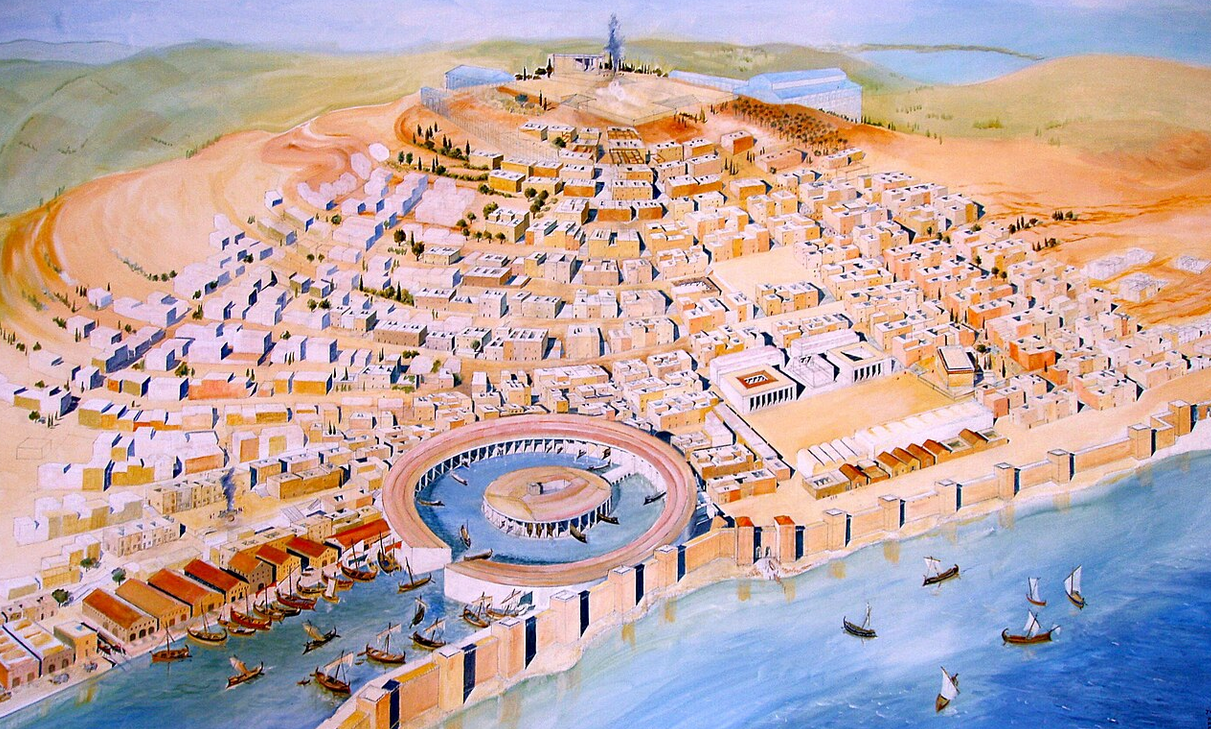
Image: Modern reconstruction of Punic Carthage. The circular harbor at the front is the Cothon, the military port of Carthage, where all of Carthage’s warships (Biremes) were anchored
Citation: damian entwistle, CC BY-SA 2.0 <https://creativecommons.org/licenses/by-sa/2.0>, via Wikimedia Commons
Ethnicity
Romans
The Roman people, known as Romans, originated from a mix of various groups inhabiting the Italian Peninsula. Initially, the core population of Rome included Latins, an Indo-European people from the Latinum region (around modern-day Rome), along with significant influences from neighbouring Etruscans to the north and Sabines to the northeast, among others.
The Latins were primarily an Italic tribe and formed the backbone of early Roman society. The Etruscans, who had a rich and advanced civilisation before Rome’s rise, contributed significantly to Roman culture, religion, and urban planning. The Sabines, another Italic tribe, are famously linked to early Rome through accounts of the abduction of Sabine women by the founding Romans, an event that purportedly led to their integration into Roman society.
As Rome expanded its control over the Italian Peninsula and beyond, it incorporated a vast array of peoples into its society. This expansion included the conquest of the Greek city-states in southern Italy, the subjugation and assimilation of the Celtic tribes in the north (Gauls), and interactions with the Iberian peoples in Spain, among others. Roman citizenship was gradually extended to various peoples across the empire, blending a wide range of ethnic groups under the Roman identity.
In the later periods of the Republic and into the Empire, Romans became a highly cosmopolitan mix that included Italic peoples, Greeks, Egyptians, Berbers, Celts, Iberians, and many others within the empire’s borders. Roman identity was thus not strictly based on ethnicity but was more a matter of political and cultural affiliation, especially after Roman citizenship was extended to all free inhabitants of the empire in 212 AD by the Constitutio Antoniniana (Edict of Caracalla)[4].
Carthaginians
The people of Carthage, known as Carthaginians, were originally Phoenicians.[5] The Phoenicians were a Semitic-speaking people from the region of modern-day Lebanon, particularly from the city-states of Tyre, Sidon, and Byblos. Carthage was founded by Phoenician settlers from the city of Tyre in the 9th century BC, according to traditional accounts.
Over the centuries, through trade, colonisation, and expansion across the Mediterranean, the Carthaginians blended with local populations in North Africa, including Berbers and other peoples they encountered in their extensive maritime network. This led to a somewhat diverse cultural and ethnic composition within Carthage and its territories. Despite this, the elite and ruling classes of Carthage maintained their Phoenician language and cultural practices, including religion, for many centuries.
Thus, while the Carthaginians were primarily of Phoenician descent, their society was multicultural and included influences from across the Mediterranean and North Africa.
Location
Carthage, an ancient and prominent city located on Africa’s northern coastline, now forms part of the residential outskirts of Tunis, Tunisia. Situated on a peninsula along the Tunisian shoreline, its strategic position was crucial for monitoring and controlling maritime traffic between Sicily and the North African coast across the Mediterranean Sea. Quickly evolving into a bustling hub for trade and commerce, it rose to become a significant power in the Mediterranean, contending with Rome for dominance. In recognition of its historical significance, the archaeological remnants of Carthage were designated as a UNESCO World Heritage Site in 1979.
The Growth of Roman Power
The growth of Roman power in Italy from 500 BC to 218 BC involved a sequence of military engagements, including the Latin War, the Pyrrhic War, and both the First and Second Punic Wars. Following these events, the regions of Cisalpine Gaul (between 238 and 146 BC) and the Alpine valleys (from 16 to 7 BC) were also annexed. This narrative below is a component of a broader examination of the history of Italy.
The narrative of Roman expansion within Italy details how Rome evolved from a minor city-state into the dominant force across the Italian peninsula. This progression is credited in Roman lore to the city’s initial conflicts under its kings, such as the war against the Sabines and early territorial acquisitions near the Alban Hills and across the Latium coast. Following the expulsion of Rome’s Etruscan king in 509 BC, marking the establishment of the Roman Republic, Rome entered into significant conflicts with the Etruscans. A notable event in this early period was the sacking of Rome by Gauls from northern Italy in 390 BC. Throughout the latter half of the 4th century BC, Rome engaged in frequent confrontations with the Samnites, a formidable tribal alliance in the Apennines.
By the conclusion of these conflicts, Rome had emerged as the preeminent power in central Italy and began extending its influence both northward and southward. The last major challenge to Roman supremacy in the region came with the Pyrrhic War (280–275 BC), during which Tarentum sought the support of Pyrrhus of Epirus, a Greek king, to oppose Rome in northern Italy. The resistance in Etruria was decisively quashed between 265 and 264 BC, coinciding with the onset of the First Punic War and marking Rome’s initial military ventures beyond the Italian peninsula. The aftermath of the First Punic War (264–241 BC) saw the addition of Sicily (241 BC), Sardinia, and Corsica (238 BC) as Roman provinces.
The growth of Roman power in Italy from 500 BC to 218 BC involved a sequence of military engagements, including the Latin War, the Samnite Wars, the Pyrrhic War, and both the First and Second Punic Wars. Following these events, the regions of Cisalpine Gaul (between 238 and 146 BC) and the Alpine valleys (from 16 to 7 BC) were also annexed.
Roman expansion within Italy details how Rome evolved from a minor city-state into the dominant force across the Italian peninsula. This progression is credited in Roman lore to the city’s initial conflicts under its kings, such as the war against the Sabines and early territorial acquisitions near the Alban Hills and across the Latium coast.
Following the expulsion of Rome’s Etruscan king in 509 BC, marking the establishment of the Roman Republic, Rome entered into significant conflicts with the Etruscans. A notable event in this early period was the sacking of Rome by Gauls from northern Italy in 390 BC. Throughout the latter half of the 4th century BC, Rome engaged in frequent confrontations with the Samnites, a formidable tribal alliance in the Apennines.
By the conclusion of these conflicts, Rome had emerged as the preeminent power in central Italy and began extending its influence both northward and southward. The last major challenge to Roman supremacy in the region came with the Pyrrhic War (280–275 BC), during which Tarentum sought the support of Pyrrhus of Epirus, a Greek king, to oppose Rome in northern Italy. The resistance in Etruria was decisively quashed between 265 and 264 BC, coinciding with the onset of the First Punic War and marking Rome’s initial military ventures beyond the Italian peninsula. The aftermath of the First Punic War (264–241 BC) saw the addition of Sicily (241 BC), Sardinia, and Corsica (238 BC) as Roman provinces.
The expansion continued during the Second Punic War (218–202 BC), with Rome subduing Celtic territories in the north beyond the Apennines in Cisalpine Gaul (from 222 to 200 BC) and extending control over neighbouring Veneti (to the east) and Ligures (to the west) up to the Alpine foothills. Following a period of internal conflict, Augustus embarked on the conquest of the Alpine valleys (from the Aosta Valley to the Arsia River in Istria) from 16 BC to 7 BC, completing the unification of the Italian region under Roman control. In doing so, he divided Italy into 11 regions around 7 AD. The incorporation of these territories into the Roman state was achieved through various means, including land seizures, the founding of colonies, the extension of full or partial Roman citizenship, and the formation of military alliances with states that retained nominal independence. Rome’s successful domination of Italy provided it with unmatched manpower resources compared to its contemporaries, laying the groundwork for its involvement across the entire Mediterranean.
The expansion continued during the Second Punic War (218–202 BC), with Rome subduing Celtic territories in the north beyond the Apennines in Cisalpine Gaul (from 222 to 200 BC) and extending control over neighbouring Veneti (to the east) and Ligures (to the west) up to the Alpine foothills. Following a period of internal conflict, Augustus embarked on the conquest of the Alpine valleys (from the Aosta Valley to the Arsia River in Istria) from 16 BC to 7 BC, completing the unification of the Italian region under Roman control. In doing so, he divided Italy into 11 regions around 7 AD.
The incorporation of these territories into the Roman state was achieved through various means, including land seizures, the founding of colonies, the extension of full or partial Roman citizenship, and the formation of military alliances with states that retained nominal independence. Rome’s successful domination of Italy provided it with unmatched manpower resources compared to its contemporaries, laying the groundwork for its involvement and influence across the entire Mediterranean.
The Three Punic Wars
The Punic Wars were a series of three extensive conflicts that took place between 264 and 146 BC, involving the powerful city-states of Rome and Carthage. These wars were fought to determine the dominant power in the western Mediterranean and involved extensive military campaigns over land and sea, lasting a total of forty-three years. The conflicts are notable not only for their duration and scope but also for the significant human and material losses incurred on both sides.
First Punic War (264-241 BC)
The initial war broke out due to a dispute over Sicily, highlighting Rome’s aggressive expansionist tendencies and Carthage’s desire to protect its interests on the island. At the onset, Carthage was the superior maritime power, controlling significant territories across the Mediterranean, while Rome had a formidable army but lacked a navy. The war predominantly took place around Sicily, North Africa, and the nearby islands of Corsica and Sardinia. After 23 years of gruelling conflict, Rome emerged victorious, forcing Carthage to surrender Sicily and pay a hefty indemnity. The end of the First Punic War also sparked the Mercenary War in Carthage, further destabilising the region.
The First Punic War began in 264 BC over a dispute on the island of Sicily. Initially, the conflict centred around control of Sicily, but it eventually spread to parts of North Africa and Sardinia. The war was characterised by massive naval battles, with Rome building a large navy from scratch to challenge Carthage’s well-established maritime dominance. The Romans invented the “corvus,” a boarding bridge, which allowed their soldiers to engage in hand-to-hand combat on ships, leveraging their superior infantry.
The war ended in 241 BC with the Battle of the Aegates Islands, where the Roman navy won a decisive victory. Carthage was forced to cede Sicily to Rome and pay a large indemnity, marking Rome’s emergence as a major power and beginning its dominance over the western Mediterranean.
Second Punic War (218-201 BC)
The Second Punic War is perhaps the most famous of the three wars, mainly due to Hannibal Barca’s audacious campaign, including his legendary crossing of the Alps into Italy with his army and war elephants. The war began in 218 BC when Hannibal laid siege to Saguntum, a Spanish city allied with Rome. Hannibal’s invasion of Italy included several major victories, including the battles of Trebia, Lake Trasimene, and Cannae, bringing Rome to the brink of defeat.
Despite early successes and maintaining a presence in Italy for over a decade, Hannibal was unable to secure a decisive victory. The war expanded to various fronts, including Iberia (modern Spain and Portugal), Sicily, Sardinia, and even North Africa. Rome’s strategic counter-offensives in these regions ultimately forced Hannibal’s recall to Carthage. The decisive Battle of Zama in 202 BC, where Roman General Scipio Africanus defeated Hannibal, ended Carthage’s ambitions and imposed harsh terms on the defeated power, stripping it of its empire and severely restricting its military capabilities.
However, the Romans adopted a strategy of attrition, avoiding direct engagement with Hannibal’s forces while launching their own offensives in Spain and North Africa. The turning point came when the Roman general Scipio Africanus landed in North Africa and defeated Carthage at the Battle of Zama in 202 BC. The war ended with Carthage losing its empire outside of Africa, ceding Spain to Rome, and being forced into a restrictive peace treaty that severely limited its military capabilities.
Third Punic War (149-146 BC)
The Third Punic War was initiated by Rome under the pretext of Carthage’s breach of the peace treaty, specifically its unauthorised military action against Numidian encroachments. Rome demanded Carthage’s complete disarmament and the relocation of the city inland, terms that Carthage could not accept. The war culminated in a brutal siege of Carthage, ending in 146 BC with the city’s complete destruction. The surviving population was enslaved, and Carthage’s territories were annexed by Rome, marking the end of the Carthaginian state and solidifying Rome’s dominance over the Mediterranean.
The Third Punic War was essentially a siege of Carthage by Rome. By this time, Carthage had recovered economically from the Second Punic War but remained militarily weak. Rome, spurred on by fears of Carthage’s resurgence and encouraged by Cato the Elder’s insistence that “Carthage must be destroyed,” declared war in 149 BC. Carthage was poorly prepared for the conflict, and after a three-year siege, Roman forces breached the city’s defences. Carthage was systematically destroyed over several days, its buildings razed, and its inhabitants killed or enslaved. The territory became the Roman province of Africa.
The Punic Wars significantly shifted the balance of power in the Mediterranean world, marking the rise of Rome as the dominant regional power and the beginning of its transformation into an empire. Rome emerged as the undisputed superpower, laying the groundwork for its transition from a republic to an empire. The wars demonstrated the effectiveness of Roman military strategy and logistics, and the experiences gained from these conflicts would inform Roman military tactics for centuries to come.
While much of our understanding of the Punic Wars comes from Roman sources, it’s crucial to acknowledge Carthage’s significant contributions to Mediterranean culture and history.
The Carthaginians were renowned for their maritime prowess, establishing far-reaching trade networks that connected Africa, Europe, and the Near East. Their innovations in navigation and shipbuilding not only facilitated commerce but also spread cultural and technological advancements across the Mediterranean. Additionally, Carthaginian political and military strategies reflect a complex society capable of mobilizing vast resources and maintaining extensive colonies. By exploring Carthaginian perspectives and contributions, we gain a more nuanced view of the conflicts that defined the Punic Wars and the interdependent nature of ancient Mediterranean civilisations.

Image: So called patrician Torlonia Patrizio Torlonia.
Citation: Cato the Elder. (2024, February 8). In Wikipedia. https://en.wikipedia.org/wiki/Cato_the_Elder
Cato the Elder
Cato the Elder, also known as Marcus Porcius Cato, was born in 234 BC in Tusculum, Latium (now part of modern Italy). A prominent figure in Roman history, Cato was known for his staunch conservatism, strict morals, and dedication to traditional Roman values. He played a significant role in the political and social life of Rome during the 3rd and early 2nd centuries BC.
Cato’s early life was marked by military service during the Second Punic War, after which he embarked on a career in public service. He was elected quaestor in 204 BC, aedile in 199 BC, and praetor in 198 BC. His tenure as consul in 195 BC and later as censor in 184 BC was particularly notable for his efforts to preserve Roman customs and institutions, which he believed were being eroded by foreign influences, especially from Greek culture. See the next section for an explanation of the functions.
As a censor, Cato was responsible for maintaining the census, supervising public morality, and overseeing certain aspects of the government’s finances. He was notoriously strict, advocating for simplicity and frugality both in public and private life. Cato sought to reinforce traditional social norms and was relentless in his fight against what he perceived as moral decay.
One of Cato’s lasting legacies is his contribution to Roman literature. He was a prolific writer, though much of his work has been lost over time. His treatise on agriculture, “De Agri Cultura,” is the oldest surviving work of Latin prose, offering insights into Roman farming practices, estate management, and the moral and economic philosophy of the time.
Cato’s vehement opposition to Carthage is another defining feature of his legacy. He viewed Carthage as a perpetual threat to Rome’s supremacy in the Mediterranean, famously ending his speeches with the declaration that “Carthage must be destroyed.” His insistence on the destruction of Carthage contributed to the outbreak of the Third Punic War (149-146 BC), which ended with Rome’s complete victory and the complete destruction of Carthage.
Cato the Elder’s relentless call for the destruction of Carthage was not born in a vacuum but was the culmination of a long-standing rivalry and personal conviction. Having witnessed the ravages of the Second Punic War firsthand and the threat posed by Hannibal Barca’s near victory over Rome, Cato was deeply influenced by the existential danger Carthage represented to Rome’s survival and dominance in the Mediterranean. His military service in the earlier years of his life, including his participation in the aftermath of the Battle of Thermopylae, where he observed Carthage’s enduring strength and resilience, likely solidified his belief in Carthage as a perpetual menace to Roman security.
Moreover, Cato’s stance was emblematic of a broader Roman experience and memory of the Punic Wars, which left a deep imprint on the Roman psyche. The memory of Hannibal’s invasion of Italy, the devastation of Roman lands, and the palpable fear of Carthaginian supremacy had not faded. For many Romans, Carthage’s mere existence was a constant reminder of those dark times and a potential source of future threats.
Cato, embodying the Roman virtue of ‘virtus’ — courage and excellence in the face of adversity — believed that only through the total elimination of Carthage could Rome ensure its safety and secure its status as the unchallenged power of the Western Mediterranean. His famous concluding remark, ‘Ceterum censeo Carthaginem esse delendam,’ was not merely a rhetorical flourish but a deeply held conviction that Rome could never be truly secure as long as Carthage stood. Through Cato’s eyes, the destruction of Carthage was not an act of vengeance but a necessary measure for the preservation and continuation of Roman civilisation.
Cato the Elder’s life and career reflect the complexities of Roman society during a period of significant expansion and cultural change. His efforts to preserve traditional Roman values amidst this transformation left a lasting mark on Roman history and culture.
Populations
Rome
During the time of the Punic Wars, particularly around the Second Punic War (218–201 BC), Rome’s population is also subject to various estimates due to the lack of precise historical data. Nonetheless, it is widely believed that Rome was among the largest cities in the ancient world by this period.
Estimates for Rome’s population during the late 3rd and early 2nd centuries BC range widely from about 250,000 to over 1 million inhabitants. A figure towards the higher end of this range is often considered plausible for the period following the Second Punic War, reflecting Rome’s expansion and its increasingly central role in the Mediterranean world. The population would have included Roman citizens, non-citizen residents, slaves, and a transient population of merchants and visitors.
As with Carthage, these population figures are based on archaeological evidence, the size and capacity of public buildings and infrastructure (such as aqueducts and forums), and historical accounts. The expansion of Roman territory and the integration of conquered peoples into the Roman economy and military system contributed to the city’s growth, making it the bustling metropolis that was the heart of the Roman Republic.
Carthage
Estimates of the population of Carthage during the time of the Punic Wars vary widely due to the lack of precise contemporary records. However, it is generally believed that at its peak, Carthage was one of the largest cities in the ancient world. For the period of the Punic Wars, particularly around the time of the Second Punic War (218–201 BC), some estimates suggest that Carthage might have had a population ranging from several hundred thousand to possibly over 700,000 people. This estimate takes into account not just the city itself but also its surrounding territories that would have been under Carthaginian control. The high figure reflects Carthage’s status as a major economic and political power in the Mediterranean, with a large urban centre supported by extensive agriculture, trade, and tribute from its empire.
However, these figures should be treated with caution, as ancient population estimates are inherently speculative and often based on indirect evidence, such as the size of the city’s defensive walls, the capacity of its harbours, and the extent of its territories.
Roman Political and Administrative Structure
In ancient Rome, the political and administrative structure included various offices that individuals could hold, each with its own set of responsibilities and powers. The terms quaestor, aedile, and consul refer to different ranks within this structure.
Quaestor
Quaestors were the lowest-ranking officials in the Roman Republic’s political hierarchy and served as financial administrators. Their duties included managing the state treasury (aerarium) in Rome, supervising financial affairs in the provinces, and accompanying generals to oversee the financial aspects of military campaigns.
The office of quaestor was often the first significant step in the cursus honorum, the sequential order of public offices held by aspiring politicians in Rome.
Aedile
Aediles were officials responsible for the maintenance of public buildings and infrastructure, regulation of public festivals, and enforcement of market regulations. They played a key role in the daily life of Roman citizens by ensuring the supply of foodstuffs, overseeing public games and religious festivals, and maintaining public order. There were two types of aediles: plebeian aediles, who were originally assistants to the tribunes of the plebs, and curule aediles, who had broader powers and could come from the patrician class.
Consul
Consuls were the highest elected officials in the Roman Republic and served as the heads of government, with two consuls being elected each year to serve together. Their responsibilities included presiding over the Senate and the assembly, commanding Roman armies, and overseeing the administration of the government. The consulship was the pinnacle of a Roman political career, and its holders wielded significant influence both domestically and in foreign affairs. After their term, consuls often went on to serve as governors of provinces or in other senior roles within the state.
Each of these offices played a crucial role in the functioning of the Roman Republic, contributing to its administrative, financial, and military systems. The progression through these offices was part of the cursus honorum, reflecting an individual’s political career and ascent through the ranks of Roman society.
In addition to quaestor, aedile, and consul, the Roman Republic had a complex political and administrative system that included several other key offices. The cursus honorum, the traditional sequence of public offices through which ambitious Roman citizens would progress, featured additional ranks beyond those mentioned:
Tribune of the Plebs
Tribunes of the Plebs were elected officials who represented the interests of the plebeians (the common people). They had significant powers, including the right to veto actions by other magistrates that they deemed harmful to the plebeians. Tribunes played a crucial role in protecting individuals against the authority of the consular and senatorial classes.
Praetor
Praetors served just below the consuls in rank and were primarily responsible for administering justice. They could preside over courts in Rome, dealing with civil and criminal cases. When outside Rome, praetors often governed provinces or commanded armies. The office was seen as a stepping stone to the consulship.
Censor
Censors were responsible for maintaining the census, a register of Roman citizens and their property. This role was crucial for tax collection and military conscription. Censors could also oversee public morals and conduct, including the power to remove individuals from the Senate or the equestrian order for perceived immorality or other failings.
Dictator
In times of emergency, a dictator might be appointed for a limited term, traditionally six months, with almost absolute power to lead the state. The appointment of a dictator was a rare and extraordinary measure intended to allow for decisive action in crisis situations, such as wars or internal conflicts. The dictator’s authority was supreme, but his term was strictly limited to ensure that this power could not be abused over a long period.
Senator
The Senate was not an elected office but a body of individuals who had held public office and were, after that, members for life. It was the principal governing body, advising magistrates and consuls, controlling finances, and foreign policy, and later endorsing or opposing the actions of the emperors in the Imperial period.
These offices and roles constituted the framework through which Rome was governed, allowing it to manage internal affairs, conduct wars, and administer justice. The progression through these offices was seen as a demonstration of an individual’s capability, popularity, and the favour of the gods.
Key Romans in the Punic Wars
Several key Roman figures emerged as pivotal in these wars:
First Punic War (264–241 BC)
- Marcus Atilius Regulus: A consul who led a significant early Roman invasion of North Africa during the First Punic War. The Carthaginians eventually captured him.
- Gaius Lutatius Catulus: He was the consul who secured Roman victory in the First Punic War with his triumph at the Battle of the Aegates Islands in 241 BC.
Second Punic War (218–201 BC)
- Publius Cornelius Scipio Africanus: Perhaps the most famous Roman of the Punic Wars, Scipio earned his cognomen “Africanus” by defeating Hannibal at the decisive Battle of Zama in 202 BC, effectively ending the Second Punic War.
- Fabius Maximus Cunctator: Known as “The Delayer,” Fabius is credited with adopting the strategy of avoiding open battles with Hannibal, preferring instead to wear down the Carthaginian forces through attrition and guerrilla tactics.
- Marcus Claudius Marcellus: Known as the “Sword of Rome,” Marcellus earned fame for his aggressive tactics against Hannibal and for capturing the city of Syracuse.
- Gaius Terentius Varro and Lucius Aemilius Paullus: The consuls at the Battle of Cannae, one of the most devastating defeats for Rome, led by Varro and Paullus. Paullus died in the battle.
Third Punic War (149–146 BC)
- Publius Cornelius Scipio Aemilianus Africanus Numantinus: Adopted grandson of Scipio Africanus, he led the final siege and destruction of Carthage in 146 BC, effectively ending the Third Punic War and Carthaginian resistance. Often, he is just referred to as Scipio Aemilianus.
These figures played crucial roles in the complex series of conflicts that ultimately led to Rome’s dominance over the western Mediterranean and the destruction of Carthage, marking a pivotal moment in Roman expansion and the ancient world.
Key Carthaginians in the Punic Wars
Several key Carthaginian figures played pivotal roles throughout these wars. Here are some of the most prominent Carthaginians involved:
First Punic War (264-241 BC)
- Hamilcar Barca: A leading Carthaginian general during the later stages of the First Punic War. He is notable for his campaigns in Sicily and for laying the groundwork for Carthaginian expansion in Spain. Hamilcar was also the father of Hannibal, Hasdrubal, and Mago, who would play crucial roles in the subsequent wars.
Second Punic War (218-201 BC)
- Hannibal Barca: Probably the most famous Carthaginian general, Hannibal is best known for his daring crossing of the Alps with his army and war elephants to invade Italy from the north. His victories at Trebia, Lake Trasimene, and Cannae are among the most celebrated in military history. Hannibal’s strategic genius and relentless campaigning kept him in Italy for 15 years before he was recalled to defend Carthage itself.
- Hasdrubal Barca: Hannibal’s brother, Hasdrubal, was responsible for maintaining Carthaginian interests in Spain during the Second Punic War. After attempting to bring reinforcements to Hannibal in Italy, he was defeated and killed at the Battle of the Metaurus in 207 BC.
- Mago Barca: Another of Hannibal’s brothers, Mago also fought in the Second Punic War, notably in Italy and later in Spain. After suffering a defeat, he was sent to Carthage to request support but was unable to return to the battlefield due to injuries and Carthage’s declining fortunes.
Third Punic War (149-146 BC)
- Hasdrubal the Boetharch: Not to be confused with Hannibal’s brother, this Hasdrubal was a Carthaginian military commander during the Third Punic War. He led the defence of Carthage against the Roman siege in the final conflict but was ultimately unsuccessful.
These individuals, particularly from the Barca family, were instrumental in leading Carthage through one of the most challenging periods in its history. Their strategies, battles, and political manoeuvres have been studied by military historians and strategists for centuries, underscoring their impact on the ancient world and beyond.
The Sacking of Carthage
The sacking of Carthage in 146 BC was the culmination of the Third Punic War between the Roman Republic and Carthage. This conflict was fought for several reasons:
- Rivalry for Supremacy: Rome and Carthage were two of the most powerful entities in the Mediterranean region. Their competition for dominance was a driving force behind the Punic Wars. After the first two conflicts, tensions remained high due to unresolved issues and mutual distrust.
- Economic Competition: Carthage was a significant maritime power with a prosperous economy based on trade. Rome, expanding its influence across the Mediterranean, saw Carthage’s economic power as a direct threat to its interests.
- Previous Conflicts: The First and Second Punic Wars had already established a history of bitter rivalry between Rome and Carthage. The memory of Hannibal’s near defeat of Rome in the Second Punic War lingered in the Roman psyche, contributing to the desire for a conclusive victory over Carthage.
- Roman Expansionism: By the time of the Third Punic War, Rome was aggressively expanding its territory. The complete destruction of Carthage was seen as a way to eliminate a rival once and for all and secure Roman dominance in the western Mediterranean.
- Carthaginian Revival: Despite being significantly weakened after the Second Punic War, Carthage began to recover economically. This revival alarmed Rome, which feared a resurgence of Carthaginian military power.
The conflict was essentially triggered by Rome’s demands, which were impossible for Carthage to meet without surrendering its sovereignty. When Carthage resisted, Rome used it as a pretext to declare war, ultimately leading to the siege, sacking, and the complete destruction of Carthage. The city was razed, and its inhabitants were killed or sold into slavery, effectively ending Carthaginian resistance and ensuring Roman supremacy in the Mediterranean.
Resettlement
After the sacking of Carthage in 146 BC, the city was destroyed, and the territory became a Roman province known as Africa Proconsularis. The ancient city of Carthage lay in ruins for about a century. Julius Caesar visited the site in 49 BC and proposed its resettlement. Later, around 44 BC, after Caesar’s assassination, Carthage was refounded by the Romans.
Under Augustus, the first Roman Emperor, Carthage began to flourish again as a Roman colony. It was officially re-established as Colonia Julia Carthago in 29 BC. From this point, Carthage grew to become one of the most important cities of the Roman Empire in Africa, both economically and culturally. It became a centre of Roman life in the region, known for its grand architecture, schools, and as a hub of commerce and trade.
This transformation signifies that, while the original Carthaginian population was decimated or enslaved, the region and its new Roman and subsequently Romanised inhabitants did co-exist peacefully under the Roman Empire. The term “co-exist peacefully” applies more to the integration and absorption of the region into the Roman world rather than a reconciliation with the Carthaginians, who were essentially wiped out or assimilated beyond distinct recognition as a separate entity.
Thus, by the first century AD, a new city with a predominantly Roman character stood on the site of ancient Carthage, marking a peaceful, albeit forcefully integrated, coexistence of what could be considered the successors to the Carthaginians with their Roman conquerors. This period of peace and prosperity for the region under Roman rule lasted for several centuries until the decline of the Roman Empire and the eventual arrival of the Vandals in the 5th century AD. But that’s another story.
Emotions of Rivalry, Animosity, or Competition towards other Nations
The series of Punic Wars themselves created a legacy of hatred and revenge. Roman losses, particularly during the Second Punic War, led to a desire for retribution against Carthage, culminating in the destruction of the city at the end of the Third Punic War in 146 BC.
The Romans often experienced similar emotions of rivalry, animosity, or competition towards other nations and peoples throughout their history, influenced by a mix of strategic, economic, and cultural factors. The nature of these emotions and the reasons behind them varied depending on the period and the specific groups involved. Some notable examples include:
- Greeks: Although the Romans admired Greek culture, philosophy, and arts, incorporating many elements into their own society, there was also rivalry and conflict, especially in the earlier years of Rome’s expansion. The Roman conquest of the Greek states, culminating in the destruction of Corinth in 146 BC (the same year Carthage was destroyed), was driven by a mix of desire for control over the Greek peninsula and fear of Greek influence on Roman culture and politics.
- Gauls: The Romans had a long history of conflict with the various Gallic tribes of northern Italy and what is now France. The sack of Rome by the Gauls in 390 BC left a deep mark on the Roman psyche, fueling centuries of conflict that eventually led to Julius Caesar’s conquest of Gaul in the Gallic Wars (58–50 BC). The Romans viewed the Gauls as barbaric and a constant threat to their security and expansion.
- Parthians (and later the Sassanids): Rome’s eastern borders were often contested with the Parthian Empire and later the Sassanian Empire, leading to a series of wars over territories in the Near East. The Romans saw these eastern empires as significant military and political threats, underscored by major Roman defeats such as the Battle of Carrhae in 53 BC.
- Germans: The Germanic tribes were seen by the Romans as fierce and barbaric, posing a constant threat to the northern borders of the Roman Empire. The Battle of the Teutoburg Forest in 9 AD, where three Roman legions were annihilated by Germanic tribes led by Arminius, deeply affected Roman plans for expansion into Germania and marked the Germanic tribes as formidable enemies in Roman eyes.
- Carpians, Goths, and other “Barbarian” Groups: During the later years of the Roman Empire, increasing pressure from various groups outside the empire’s borders, often referred to collectively as “barbarians” by the Romans, contributed to the empire’s eventual decline. These groups were seen as threats to Roman civilisation and its way of life, leading to numerous conflicts.
These relationships were complex and could evolve over time from hostility to absorption or alliance, reflecting Rome’s pragmatism in dealing with other nations and peoples. The emotions and perceptions the Romans held towards other groups were often influenced by military conflicts, economic competitions, and cultural exchanges, shaping Rome’s interactions with the world around it.
Conclusions and Closing Words
Hannibal’s Hatred of Rome
The story of Hannibal’s father, Hamilcar Barca, making him swear to always hate Rome is a famous anecdote that underscores the deep-seated animosity between Rome and Carthage, which ultimately led to the Punic Wars. According to the accounts of Roman historians, particularly Livy, when Hannibal was a boy, Hamilcar Barca, a leading Carthaginian general during the First Punic War, brought his son to the altar of a Carthaginian god and made him swear an oath of eternal enmity towards Rome.
This event is often depicted as a defining moment in Hannibal’s life, setting the stage for his future as one of Rome’s greatest adversaries. The oath symbolized not only personal revenge but also the broader Carthaginian resolve to resist Roman dominance. Hannibal’s subsequent actions, including his famous crossing of the Alps with elephants to surprise and battle the Romans in their own territory during the Second Punic War (218-201 BC), can be seen as a fulfilment of this oath.
However, it’s important to note that the story of the oath is known to us through Roman sources, and its historical accuracy is difficult to verify. It serves as a powerful narrative device, emphasising the longstanding hostility between Carthage and Rome and framing Hannibal’s campaigns against Rome as a personal vendetta rooted in his childhood. Whether strictly historical or partly legendary, the tale of the oath highlights the intense and enduring rivalry between these two ancient superpowers.
Consequences of the Punic Wars
The long-term consequences of the Punic Wars, particularly the destruction of Carthage, were profound and far-reaching, reshaping the landscape of the Mediterranean world for centuries. The elimination of Carthage as a rival marked the beginning of Roman dominance in the region, allowing Rome to expand its territories unchallenged into Africa, Spain, and beyond. This expansion facilitated the Roman Empire’s access to vast resources, including agricultural lands, mineral wealth, and human labour in the form of slaves, which fuelled Rome’s economy and military machine.
Culturally, the aftermath of the Punic Wars saw Rome absorbing and assimilating a variety of influences from its expanded territories, leading to a cosmopolitan society that was as diverse as it was sophisticated. The incorporation of Hellenistic traditions, particularly in art, literature, and philosophy, was accelerated by Rome’s unchallenged control over the Greek cities in the eastern Mediterranean. This blend of cultures under Roman governance contributed to the unique character of the Roman Empire, which managed to maintain a remarkable degree of unity despite its vast diversity.
Internally, the outcomes of the Punic Wars contributed to significant social and political changes within Rome. The wealth accumulated from conquests exacerbated class divisions, leading to social strife and the eventual shift from a republic to an imperial system. The reliance on slave labour from conquered territories also transformed the Roman economy and society, leading to the decline of small Roman farmers and the rise of vast, slave-worked estates. These changes laid the groundwork for internal conflicts that would challenge Rome in the centuries to come, influencing the development of Roman law, governance, and military strategy.
The narrative of the Punic Wars, immortalised by Roman historians such as Livy and Polybius, has shaped perceptions of the conflict for centuries. The romanticisation of figures like Hannibal and Scipio and the vilification of Carthage reflect the complexities of historical memory and the construction of identity. The phrase “Carthago delenda est” has become a symbol of enmity and destruction, illustrating the deep-seated human tendency to demonize “the other.” This rhetoric has been echoed in various contexts throughout history, serving as a reminder of the dangers of unchecked aggression and the dehumanisation of adversaries.
The Punic Wars have also spurred ongoing archaeological and scholarly inquiry, shedding light on the civilizations of the ancient Mediterranean. Excavations in modern-day Tunisia and Italy continue to reveal insights into Carthaginian and Roman life, offering a more nuanced understanding of these societies beyond the traditional narratives. This research challenges and enriches our understanding of the past, highlighting the importance of interdisciplinary approaches in uncovering the complexities of human history.
Finally, the legacy of the Punic Wars resonates in contemporary discussions about conflict, empire, and cultural interaction. The themes of rivalry, resilience, and the consequences of war remain relevant as societies grapple with the challenges of coexistence and the memory of past conflicts. The Punic Wars serve as a potent reminder of the capacity for human endurance and ingenuity, as well as the tragic costs of war, informing current debates on diplomacy, security, and international relations.
Critical Examination of Sources
Our understanding of the Punic Wars is predominantly shaped by Roman historical narratives, with works by authors such as Livy, Polybius, and Plutarch serving as primary sources for modern historians. While these accounts provide invaluable insights into the events and figures of the time, they are also subject to the biases and limitations inherent in historical writings.
Firstly, it is important to recognise the perspective from which these histories were written; they are predominantly Roman or pro-Roman in their viewpoint. This perspective can influence the portrayal of events, characters, and motivations, often casting Rome in a favourable light while depicting Carthaginians and other adversaries in terms less sympathetic. For instance, the demonisation of Hannibal or the depiction of Carthage as a relentless enemy might reflect more on Roman perceptions and justifications for war than on objective historical realities.
Moreover, the surviving sources were written after the events they describe, sometimes by centuries, which means they could be influenced by later political and cultural contexts. The reliance on secondary accounts and the potential loss of earlier, perhaps more neutral or varied, sources further complicate attempts to gain a balanced understanding of the Punic Wars.
Acknowledging these biases and limitations is crucial for a critical examination of the Punic Wars. It encourages historians and readers alike to question the narratives, compare different sources, and consider the broader context in which these histories were compiled. Such an approach not only enriches our understanding of the Punic Wars but also highlights the complexities of reconstructing ancient histories and the importance of critical historiography in interpreting past events.
Closing Words
Reflecting on the tumultuous period of the Punic Wars, it is crucial to reiterate their profound impact not only on the ancient Mediterranean world but also on the course of history itself. These conflicts between Rome and Carthage reshaped the political landscape, setting the stage for Rome’s emergence as a dominant power. The wars’ outcomes, particularly the destruction of Carthage, marked a pivotal shift towards Roman expansion, cultural assimilation, and socio-political transformation. The rich tapestry of cultures under Roman rule and the internal dynamics of the empire offer us insights into the complexities of governance, cultural integration, and the repercussions of conflict.
Moreover, the study of the Punic Wars underscores the importance of critical historiography. Our reliance on Roman narratives, authored by figures such as Livy, Polybius, and Plutarch, necessitates a cautious approach to interpreting historical events. These sources, while invaluable, reflect inherent biases and the limitations of their times. Recognising these perspectives allows us to question and critically assess our understanding of history, encouraging a more nuanced view of past events and the figures who shaped them.
The relevance of the Punic Wars extends beyond the ancient world into contemporary discussions about war, peace, and the legacy of historical conflicts. In a world still grappling with the aftermath of wars and the challenge of reconciling historical narratives, the lessons from Rome and Carthage remain pertinent. They remind us of the enduring impact of conflict on societies and the importance of critical engagement with historical sources to uncover a more comprehensive and reliable truth.
Future research into the Punic Wars could further illuminate these ancient conflicts, potentially through archaeological discoveries, examination of non-Roman sources, or comparative analyses with other historical periods. Such endeavours would enrich our understanding of the ancient world and its influence on modern societies.
In conclusion, the study of the Punic Wars and their aftermath offers invaluable lessons on the dynamics of power, culture, and conflict. As we navigate the complexities of the modern world, the ancient past serves as both a mirror and a guide, reflecting our shared humanity and offering insights into the challenges and opportunities of our times. The importance of history lies not only in its recounting of events but also in its capacity to inspire reflection, foster understanding, and ignite a curiosity that transcends epochs.

Image: Hannibal’s celebrated feat in crossing the Alps with war elephants passed into European legend: detail of a fresco by Jacopo Ripanda, c. 1510, Capitoline Museums, Rome.
Citation: Hannibal. (2024, March 16). In Wikipedia. https://en.wikipedia.org/wiki/Hannibal
Bibliography
Web Resources:
- https://en.wikipedia.org/wiki/Carthage
- https://en.wikipedia.org/wiki/Punic_Wars
- https://en.wikipedia.org/wiki/Roman_expansion_in_Italy
- https://en.wikipedia.org/wiki/Roman_Republic
- https://en.wikipedia.org/wiki/Siege_of_Carthage_(Third_Punic_War)
- https://martinpollins.com/2024/02/15/hannibal-and-his-african-war-elephants-cross-the-alps/
- https://naval-encyclopedia.com/antique-ships/carthaginian-ships/
- https://sites.psu.edu/hellenisticwarfare/the-punic-wars/
- https://www.britannica.com/event/Punic-Wars
- https://www.history.com/topics/ancient-rome/punic-wars
- https://www.thecollector.com/the-punic-wars-how-did-the-romans-crush-carthage/
Books:
- A Companion to the Punic Wars, edited by Dexter Hoyos, available from https://www.amazon.co.uk/Companion-Punic-Blackwell-Companions-Ancient/dp/1119025508
- Africanus: The Roman Conquest of Carthage, by Santiago Posteguillo, available from https://www.amazon.co.uk/Africanus-hijo-consul-Zeta-Maxi/dp/8498725402
- Cannae: Hannibal’s Greatest Victory, by Adrian Goldsworthy, available from https://www.amazon.co.uk/Cannae-Hannibals-Greatest-Adrian-Goldsworthy/dp/1541699254
- Carthage and the Carthaginians, by R. Bosworth Smith, available from https://www.amazon.co.uk/Carthage-Carthaginians-Classic-Reprint-Bosworth/dp/B008OJYDSO/
- Carthage Must Be Destroyed: The Rise and Fall of an Ancient Civilization, by Richard Miles, available from https://www.amazon.co.uk/Carthage-Must-Be-Destroyed-Civilization/dp/0141018097/
- Carthage: A History, by Serge Lancel, available from https://www.amazon.co.uk/Carthage-History-Serge-Lancel/dp/1577181034/
- Hannibal and Me: What History’s Greatest Military Strategist Can Teach Us About Success and Failure, by Andreas Kluth, available from https://www.amazon.co.uk/Hannibal-Me-Andreas-Kluth/dp/159448659X/
- Hannibal Crosses The Alps: The Invasion of Italy and the Second Punic War, by John Prevas, available from https://www.amazon.co.uk/Hannibal-Crosses-Alps-Invasion-Italy/dp/0306810700
- Hannibal, by Ernle Bradford, available from https://www.amazon.co.uk/Hannibal-Ernle-Bradford/dp/1497637902
- Hannibal: A Hellenistic Life, by Eve MacDonald, available from https://www.amazon.co.uk/Hannibal-Hellenistic-Life-Eve-Macdonald/dp/0300240309/
- Hannibal: A History of the Art of War Among the Carthaginians and Romans Down to the Battle of Pydna, 168 B.C., With a Detailed Account of the Second Punic War, by Theodore Ayrault Dodge, available from https://www.waterstones.com/book/hannibal/theodore-ayrault-dodge/9781015397118
- Hannibal: The Military Biography of Rome’s Greatest Enemy, by Richard A. Gabriel, available from https://www.amazon.co.uk/Hannibal-Military-Biography-Romes-Greatest/dp/1597976865
- Hannibal’s Dynasty: Power and Politics in the Western Mediterranean, 247-183 BC, by Dexter Hoyos, available from https://www.amazon.co.uk/Hannibals-Dynasty-Politics-Western-Mediterranean/dp/0415359589/
- Hannibal’s Last Battle: Zama and the Fall of Carthage, by Brian Todd Carey, available from https://www.amazon.co.uk/Hannibals-Last-Battle-Zama-Carthage/dp/1844156354
- Hannibal’s Oath: The Life and Wars of Rome’s Greatest Enemy, by John Prevas, available from https://www.amazon.co.uk/Hannibals-Oath-Romes-Greatest-Enemy/dp/0306824248
- Hannibal’s Road: The Second Punic War in Italy 213-203 BC, by Mike Roberts, available from https://www.amazon.co.uk/Hannibals-Road-Second-Punic-213-203/dp/1473855950
- Hannibal’s War: A Military History of the Second Punic War, by J.F. Lazenby, available from https://www.amazon.co.uk/Hannibals-War-Military-History-Second/dp/0806130040
- In the Name of Rome: The Men Who Won the Roman Empire, by Adrian Goldsworthy, available from https://www.amazon.co.uk/Name-Rome-Roman-Empire-Phoenix/dp/0753817896/
- Masters of Command: Alexander, Hannibal, Caesar, and the Genius of Leadership, by Barry Strauss, available from https://www.amazon.co.uk/Masters-Command-Alexander-Hannibal-Leadership/dp/1439164495/
- Mercenaries in the Classical World: To the Death of Alexander, by Stephen English, available from https://www.amazon.co.uk/Mercenaries-Classical-World-Death-Alexander/dp/1848843305
- Roman Conquests: North Africa, by Nic Fields, available from https://www.amazon.co.uk/Nic-Fields-Roman-Conquests-Africa/dp/B00I63GLDI
- Roman Warfare, by Adrian Goldsworthy, Cassells, available from https://www.amazon.co.uk/Roman-Warfare-CASSELLS-HISTORY-WARFARE/dp/075382258X
- Rome and Carthage: The Punic Wars, by R. Bosworth Smith, available from https://www.amazon.co.uk/Rome-Carthage-R-Bosworth-Smith/dp/1494716879
- Rome Versus Carthage: The War at Sea, by Christa Steinby, available from https://www.amazon.co.uk/Rome-versus-Carthage-War-Sea/dp/1844159191/
- Rome’s Italian Wars: Books 6-10 of the History of Rome from Its Foundation, by Livy, translated by J.C. Yardley, available from https://www.amazon.co.uk/Romes-Italian-Oxford-Worlds-Classics/dp/019956485X/
- Scipio Africanus: Greater Than Napoleon, by B.H. Liddell Hart, available from https://www.amazon.co.uk/Scipio-Africanus-Greater-Than-Napoleon/dp/0306813637/
- Scipio Africanus: Rome’s Greatest General, by Richard A. Gabriel, available from https://www.amazon.co.uk/Scipio-Africanus-Romes-Greatest-General/dp/1597972053
- Scipio Africanus: Soldier and Politician, by Howard H. Scullard, available from https://www.amazon.co.uk/Scipio-Africanus-Soldier-Politician-Aspects/dp/0500400121
- The Army of the Roman Republic: From the Regal Period to the Army of Julius Caesar, by Michael M. Sage, available from https://www.amazon.co.uk/Army-Roman-Republic-Period-Julius/dp/1399020242/
- The Carthaginians (Peoples of the Ancient World), by Dexter Hoyos, available from https://www.amazon.co.uk/Carthaginians-Peoples-Ancient-World/dp/0415436451
- The Enemies of Rome: From Hannibal to Attila the Hun, by Philip Matyszak, available from https://www.amazon.co.uk/Enemies-Rome-Hannibal-Attila-Hun/dp/0500297290/
- The Fall of Carthage: The Punic Wars 265-146 BC, by Adrian Goldsworthy, available from https://www.amazon.co.uk/Fall-Carthage-265-146BC-MILITARY-PAPERBACKS/dp/0304366420
- The First Punic War: A Military History, by J.F. Lazenby, available from https://www.amazon.co.uk/First-Punic-War-John-Lazenby/dp/0804726744
- The Ghosts of Cannae: Hannibal and the Darkest Hour of the Roman Republic, by Robert L. O’Connell, available from https://www.amazon.co.uk/Ghosts-Cannae-Hannibal-Darkest-Republic/dp/0812978676
- The Punic Wars 264-146 BC (Essential Histories), by Nigel Bagnall, available from https://www.amazon.co.uk/Punic-Wars-264-146-Essential-Histories/dp/1841763551
- The Punic Wars, by Adrian Goldsworthy, available from https://www.amazon.co.uk/Punic-Wars-Adrian-Goldsworthy/dp/030435967X
- The Punic Wars: Rome, Carthage, and the Struggle for the Mediterranean, by Nigel Bagnall, available from https://www.amazon.co.uk/Punic-Wars-Carthage-Struggle-Mediterranean/dp/0712666087
- The Punic Wars: The History of the Conflict that Destroyed Carthage and Made Rome a Global Power, by Charles River Editors, available from https://www.amazon.co.uk/Punic-Wars-Conflict-Destroyed-Carthage/dp/1515075990
- The Roman Army at War 100 BC-AD 200, by Adrian Goldsworthy, available from https://www.amazon.co.uk/Roman-Army-War-100-Monographs/dp/0198150903
- The Second Punic War: A Reappraisal, edited by Tim Cornell, Boris Rankov, and Philip Sabin, available from https://www.amazon.co.uk/Second-Punic-War-Reappraisal-Supplements/dp/0900587784
- The War with Hannibal: Books XXI-XXX of the History of Rome from Its Foundation, by Titus Livius (Livy), translated by Aubrey de Sélincourt, available from https://www.amazon.co.uk/War-Hannibal-History-Foundation-Classics/dp/014044145X/
CAUTION: This paper is compiled from the sources stated but has not been externally reviewed. Parts of this paper include information provided via artificial intelligence which, although checked by the author, is not always accurate or reliable. Neither we nor any third parties provide any warranty or guarantee as to the accuracy, timeliness, performance, completeness or suitability of the information and materials covered in this paper for any particular purpose. Such information and materials may contain inaccuracies or errors and we expressly exclude liability for any such inaccuracies or errors to the fullest extent permitted by law. Your use of any information or materials on this website is entirely at your own risk, for which we shall not be liable. It shall be your own responsibility to ensure that any products, services or information available through this paper meet your specific requirements and you should neither take action nor exercise inaction without taking appropriate professional advice. The hyperlinks were current at the date of publication.
End Notes and Explanations
- Source: Compiled from my research using information available at the sources stated throughout the text, together with information provided by machine-generated artificial intelligence at: bing.com [chat] and https://chat.openai.com. Text used includes that on Wikipedia websites is available under the Creative Commons Attribution-ShareAlike License 4.0; additional terms may apply. By using those websites, I have agreed to the Terms of Use and Privacy Policy. Wikipedia® is a registered trademark of the Wikimedia Foundation, Inc., a non-profit organisation. ↑
- Explanation: The original Carthaginian city was effectively erased from existence as a political and military entity at the conclusion of the Third Punic War in 146 BC. A Roman Carthage was established on the ruins of the first. The walls of the original city were torn down, its water supply cut off, and its harbours made unusable—following its conquest by Arab invaders at the close of the 7th century. It was replaced by Tunis as the major regional centre, which has spread to include the ancient site of Carthage in a modern suburb. Cited at: https://en.wikipedia.org/wiki/History_of_Carthage ↑
- Explanation: The phrase “salting the earth” refers to the ancient practice of spreading salt on conquered land to curse it and render it infertile, thus preventing the enemy from being able to grow crops and sustain themselves. This symbolic act was intended as a form of ultimate revenge, ensuring that a defeated city or territory could not easily recover after being conquered. The most famous example of this practice is associated with the Romans and their destruction of Carthage at the end of the Third Punic War in 146 BC. However, the historical accuracy of the Romans actually salting the earth, particularly in Carthage, is debated among historians. While the destruction of Carthage was thorough, with the city being burned and its inhabitants killed or enslaved, contemporary and near-contemporary accounts do not mention the salting of the earth. The earliest accounts of salting come from much later sources, leading some to suggest that the story may be more symbolic or allegorical, reflecting the complete destruction and intended permanence of Rome’s victory rather than a literal act of salting.
Despite the lack of direct evidence for the Romans salting Carthage, the story has endured as a powerful metaphor for utter devastation and the desire to prevent any possibility of revival. It symbolises not just physical destruction but a deep-seated wish to erase the very memory and potential for future resurgence of one’s enemies. ↑
- Explanation: The Constitutio Antoniniana, also known as the Edict of Caracalla or the Antonine Constitution, was an edict issued in 212 AD by the Roman Emperor Caracalla. This decree extended Roman citizenship to nearly all free inhabitants of the Roman Empire, effectively eliminating the distinction between Romans and provincials in the provinces. Prior to this edict, Roman citizenship was a highly coveted status that offered significant legal and social advantages, including property rights, legal protections, and the ability to hold certain offices, which were not available to non-citizens.
The motives behind the Constitutio Antoniniana are subject to debate among historians. Some suggest that Caracalla’s aim was to increase tax revenue, as Roman citizens were subject to taxes not levied on non-citizens. Others argue that the edict was intended to unify the empire’s diverse populations under a single legal status, thereby strengthening loyalty to the emperor and the sense of Roman identity throughout the empire. The immediate impact of the edict was significant, transforming the legal and social landscape of the empire. It led to a substantial increase in the number of people who could be called upon for military service, and it expanded the tax base. However, it also meant that many of the privileges previously associated with Roman citizenship became less exclusive, leading to changes in the social and political dynamics of the empire.
While the Constitutio Antoniniana marked a pivotal moment in the history of Roman law and citizenship, it also reflected the evolving nature of the empire, from a city-state with a specific citizen body to a cosmopolitan empire with a more universal notion of citizenship. ↑
- Explanation: The transition from identifying as Phoenicians to Carthaginians wasn’t a single event or change that occurred at a specific point in time but rather a gradual evolution of identity over several centuries. The foundation of Carthage by Phoenician settlers from the city of Tyre is traditionally dated to the late 9th century BC, around 814 BC. These settlers, part of the broader Phoenician civilization known for its seafaring and trading prowess, established Carthage in what is now Tunisia, North Africa. As Carthage grew from a Phoenician colony into a powerful and independent city-state, its people began to develop their own distinct identity. This process was influenced by several factors:
Geographical Separation: The physical distance from the Phoenician heartland in the eastern Mediterranean fostered a separate political and cultural identity for the inhabitants of Carthage. Over time, as Carthaginians interacted with different peoples and cultures in the western Mediterranean, their unique identity was further solidified.
Economic Expansion and Military Power: Carthage’s success in establishing a vast trade network across the Mediterranean, its economic prosperity, and its military achievements contributed to a sense of distinctiveness from their Phoenician origins. Carthage became a major power in its own right, with its influence extending throughout the western Mediterranean, including parts of modern-day Spain, Sicily, and North Africa.
Cultural and Social Evolution: While the Carthaginians retained many aspects of their Phoenician heritage, including their language, religion, and customs, they also adapted and evolved these traditions in response to their experiences and interactions in the western Mediterranean. This cultural synthesis further differentiated them from their Phoenician ancestors.
Political Independence and Conflicts: The need to defend its interests and territories against other powers, such as the Greeks and later the Romans, necessitated a strong, independent political and military identity. The conflicts, especially the Punic Wars against Rome, highlighted the distinctions between Carthage and other Phoenician cities, which by then had come under the influence or control of external powers.
The identity shift from Phoenician to Carthaginian was, therefore, a complex process influenced by geography, economics, culture, and politics. By the time of the Punic Wars with Rome (beginning in 264 BC), the Carthaginians were firmly distinct in their identity, despite their Phoenician roots. The term “Punic,” used by the Romans to describe the Carthaginians, is derived from the Latin word for Phoenician (Poenicus), reflecting the ancestral lineage even as Carthage had become a unique entity in the ancient world. ↑
