
Introduction[1]
Herodotus (c. 484–425 BC) was an ancient Greek historian from Halicarnassus (modern-day Bodrum, Turkey) and is often called the ‘Father of History.’ His most famous work, The Histories, is the earliest comprehensive narrative history in Western literature, focusing on the Greco-Persian Wars—a series of conflicts between the Greek city-states and the vast Persian Empire in the 5th century BC. Herodotus aimed to chronicle events and explore the causes of human conflict, cultural differences, and the interplay of fate and human agency.

Map showing events of the first phases of the Greco-Persian Wars
Citation: Greco-Persian Wars. (2024, December 18). In Wikipedia. https://en.wikipedia.org/wiki/Greco-Persian_Wars
Attribution: User: Bibi Saint-Pol, CC BY-SA 3.0 <http://creativecommons.org/licenses/by-sa/3.0/>, via Wikimedia Commons
This file is licensed under the Creative Commons Attribution-Share Alike 3.0 Unported license.
The Persian Wars – An Overview
Each of the Persian Wars is described in detail later on, but it is helpful to have a brief overview:
The Persian Wars were fought in two main phases: the First Persian Invasion (492–490 BC) and the Second Persian Invasion (480–479 BC). These conflicts arose primarily from the Persian Empire’s attempt to expand its influence into mainland Greece, but the Greeks were having none of it and fiercely resisted subjugation.[2]
Causes
The Persian Wars were rooted in several events and growing tensions between the Persian Empire, under leaders like Darius I and his son Xerxes I, and the Greek city-states. The immediate trigger for conflict was the Ionian Revolt (499–494 BC), during which the Ionian Greek cities in Asia Minor rebelled against Persian rule, with some support from Athens and other mainland Greek cities. Although the revolt was eventually suppressed, the Persian king Darius sought revenge on the Athenians for their interference, setting the stage for the first invasion of Greece.
Key Battles and Events in the Persian Wars
The First Persian Invasion and the Battle of Marathon (490 BC):
Darius launched an expedition to punish Athens and bring Greece under Persian control. After a Persian force landed on the plains of Marathon, the Athenians, with a small force from Plataea, confronted them. Despite being heavily outnumbered, the Athenians won a decisive victory due to superior tactics and the tight formation of the hoplite phalanx. The victory at Marathon symbolised Greek resistance and inspired other Greek states to unite against Persian aggression.
The Second Persian Invasion and the Battle of Thermopylae (480 BC):
After Darius’s death, his son Xerxes I prepared a massive invasion force, gathering a large army and navy to conquer Greece. In 480 BC, a small contingent of Greek forces, including the famous 300 Spartans led by King Leonidas[3], made a stand at the narrow pass of Thermopylae. Although the Greeks were eventually outflanked and defeated, their courageous stand delayed the Persian advance and became legendary as a symbol of heroism.
The Battle of Salamis (480 BC):
Following the fall of Thermopylae, the Persians advanced toward Athens, which they sacked and burned. However, under Themistocles’ command, the Athenian navy lured the larger Persian fleet into the narrow straits of Salamis. There, the Greeks’ smaller and more manoeuvrable triremes decisively defeated the Persians, a turning point in the war that severely weakened Persian naval power.
The Battle of Plataea (479 BC):
The final and decisive land battle occurred at Plataea in 479 BC, where a coalition of Greek city-states led by Sparta defeated the remnants of the Persian army. This victory effectively ended the Persian threat to Greece and marked the end of the second invasion. A simultaneous Greek victory at Mycale on the coast of Asia Minor crushed Persian naval power in the Aegean, securing Greek freedom from Persian rule.
Herodotus and the Histories
Herodotus’ The Histories recounts these battles in detail, along with broader observations about the customs, religions, and histories of the Greeks and the various peoples of the Persian Empire. His work combines fact with myth and anecdote, providing insights into Greek and Persian cultures and worldviews. Herodotus’ narrative style was novel. He incorporated direct speech, dialogues, and personal reflections—an approach that made The Histories informative and compelling.
Herodotus sought to explain the causes of the conflict, which he attributed to political ambition and cultural differences. He explored themes of hubris (excessive pride) and nemesis (retribution), often framing the Persians as expansive and overreaching while the Greeks defended freedom and independence. However, he also admired the Persian Empire’s wealth and organisation, making The Histories a nuanced and pioneering exploration of cultural relativism.
Legacy and Critique
Herodotus’ method of investigation, involving travel and the interviewing of eyewitnesses, established principles that would shape the field of history. Some of his accounts are anecdotal or based on hearsay, but his goal was to preserve knowledge of past events and gain insights into human behaviour. Later critics, including Thucydides, accused Herodotus of credulity, and some ancient Greeks nicknamed him the “Father of Lies” for including mythical elements.
Herodotus’ The Histories is a seminal work in Western literature, often regarded as the foundation of historical writing. Written in Ancient Greek in the 5th century BC, it represents an ambitious effort to systematically investigate and narrate the causes and events of significant historical episodes, mainly focusing on the rise of the Persian Empire and the Greco-Persian Wars. Herodotus’ work is notable for its attempt to balance storytelling with inquiry, weaving together the ancient world’s cultural, political, and military aspects.
Whilst not an impartial record, The Histories is distinguished by its breadth and depth, covering diverse subjects such as geography, anthropology, and folklore alongside military history. Its division into nine books, named after the Muses, underscores its cultural significance and the literary quality of the text. Herodotus’ framing of the conflict between Greece and Persia as a struggle between freedom and tyranny reflects his broader philosophical and moral perspectives, adding layers of interpretation to his narrative.
Though the original text of The Histories has not survived, the oldest surviving copies date to the Byzantine era, preserved in manuscripts such as the Codex Laurentianus[4]. This work remains invaluable not only for its historical content but also for its role in shaping the discipline of history in the Western tradition.

Fragment from the Histories VIII on Papyrus Oxyrhynchus 2099, early 2nd century AD
Citation: Histories. (2024, December 5). In Wikipedia. https://en.wikipedia.org/wiki/Histories_(Herodotus)
Attribution: English: Unknown Español: Desconocido Français : inconnu,
Public domain, via Wikimedia Commons
The Battle of Marathon
The Battle of Marathon was a pivotal conflict during the Greco-Persian Wars, fought in 490 BC between the forces of the Persian Empire and the city-state of Athens, supported by Plataea. It took place on the plain of Marathon, about 40 kilometres (25 miles) northeast of Athens, and marked a decisive moment in the struggle between the Greeks and the expanding Persian Empire.
Background
Persian Expansion:
The Persian Empire, under the leadership of Darius I, sought to expand its influence westward into Greece as part of its broader imperial ambitions. This move was partly driven by a desire to punish the Greek city-states of Athens and Eretria for their active support of the Ionian Revolt (499–494 BC), a significant uprising of Greek city-states in Asia Minor against Persian rule. The Ionian Revolt had been a direct challenge to Persian authority, with Athens and Eretria providing ships and men to aid the rebels. Darius viewed their involvement as an affront to his power and a threat to the stability of his empire. By targeting mainland Greece, Darius aimed to assert Persian dominance and deter future rebellions among his subjects by demonstrating the empire’s might. This expansion marked the beginning of a prolonged conflict between Persia and the Greek city-states, laying the foundation for the Greco-Persian Wars.
Persian Invasion:
In 490 BC, Darius I launched a military campaign against Greece, marking the first Persian invasion of the region. His forces aimed to conquer key Greek city-states, notably Athens and Eretria, which he sought to subdue as retribution for their involvement in the Ionian Revolt. The Persian strategy involved a dual approach: a fleet was dispatched across the Aegean Sea to land forces on Greek soil while maintaining naval superiority. The Persian army, estimated at 20,000 to 25,000 soldiers, landed at Marathon, a plain near Athens, which provided a strategic location for staging their assault. This invasion had the dual purpose of expanding Persian influence in Greece and installing pro-Persian regimes to secure future control over the region. The landing at Marathon signified the start of a confrontation between the Persian forces and the nascent unity of the Greek city-states.
Greek Response:
The Persian landing at Marathon prompted a swift but precarious response from the Greek city-states, notably Athens. Realising the overwhelming odds, the Athenians sought reinforcements from their allies. They dispatched a runner, Pheidippides, to Sparta to request military assistance. Despite their famed martial prowess, the Spartans could not respond immediately due to ongoing religious observances tied to the festival of Carneia, which forbade military action at the time. This delay left Athens largely isolated, though they were joined by a small contingent from the neighbouring city-state of Plataea, which pledged its full support to Athens. The combined Greek forces, numbering around 10,000 hoplites, faced the vastly superior Persian army. Despite their numerical disadvantage, the Athenians and Plataeans prepared to make a stand, demonstrating remarkable resolve and setting the stage for the iconic Battle of Marathon. Their response reflected the growing solidarity and resistance that later defined the Greek struggle against Persian domination.
Key Figures
Miltiades:
Miltiades, an experienced Athenian general, played a pivotal role in orchestrating the Greek strategy during the Battle of Marathon. Miltiades advocated for an aggressive and unconventional approach based on his familiarity with Persian military tactics from his time as a commander under Persian rule in the Chersonese. He convinced the Athenian leadership to confront the Persian forces directly rather than adopting a defensive posture. His innovative tactic of strengthening the Greek flanks while thinning the centre proved decisive, allowing the Greeks to encircle and overwhelm the Persians. Miltiades’ leadership secured a critical victory and boosted Athenian morale and confidence in their ability to resist the Persian Empire.
Datis and Artaphernes:
Datis and Artaphernes were the commanders of the Persian expeditionary force tasked with enforcing Persian dominance in Greece. Datis, a seasoned Median admiral, led the fleet with precision, while Artaphernes, the nephew of King Darius, represented the royal authority and served as a key political and military figure. They were entrusted with the dual mission of punishing Athens and Eretria for supporting the Ionian Revolt and subjugating the Greek city-states to Persian control. Their campaign included the successful capture and destruction of Eretria before advancing to Marathon. Despite their initial successes, the defeat at Marathon halted their mission and marked a significant setback for Persian imperial ambitions in Greece.
The Battle:

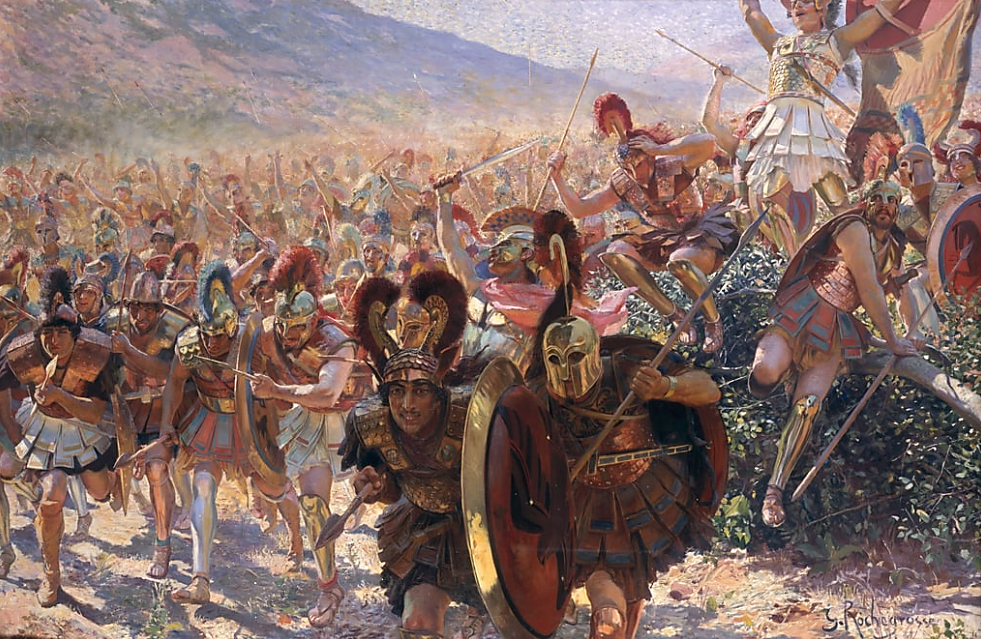
Greek troops rushing forward at the Battle of Marathon, Georges Rochegrosse, 1859.
Citation: Battle of Marathon. (2025, January 3). In Wikipedia. https://en.wikipedia.org/wiki/Battle_of_Marathon
Attribution: Georges Rochegrosse, Public domain, via Wikimedia Commons
- Greek Strategy: The Greeks, numbering about 10,000 hoplites (heavily armed infantry), took up a position near the edge of the Marathon plain. Miltiades strengthened the Greek flanks, leaving the centre relatively weak to envelop the Persian forces during the battle.
- Persian Strategy: The Persian army, relying on its superior numbers and archers, anticipated an easy victory over the Greeks, who lacked cavalry and archery support.
- The Conflict: After days of standoff, the Greeks launched a surprise attack, running the distance to minimise exposure to Persian arrows. The more powerful Greek flanks routed the weaker Persian flanks, then turned inward to surround and crush the Persian centre.
- Outcome: The Greeks decisively defeated the Persians, killing approximately 6,400 Persian soldiers while suffering only about 192 casualties themselves. The remaining Persians fled to their ships and retreated.
The Aftermath
- Athenian Glory: The victory at Marathon boosted Athenian confidence and demonstrated that the Persians could be defeated, inspiring further Greek resistance in subsequent invasions.
- The Persian Wars Continued: Although the battle delayed Persian expansion, it did not end Persian ambitions. Darius’s successor, Xerxes I, launched a massive invasion ten years later, culminating in battles like Thermopylae and Salamis.
The Marathon Legend:
- According to legend, a messenger named Pheidippides ran from Marathon to Athens (about 26 miles) to announce the victory, collapsing and dying from exhaustion. This story inspired the modern marathon race, although historians question its accuracy.
Significance
- Cultural Impact: The Battle of Marathon symbolised Greek unity, determination, and the defence of freedom against tyranny.
- Historical Legacy: It marked the first significant victory for the Greeks over the Persians, proving that disciplined hoplite tactics could triumph over a numerically superior enemy.
- Strategic Lessons: The battle highlighted the importance of tactical innovation and the use of terrain to counter numerical disadvantages.
The Battle of Marathon remains one of history’s most celebrated military engagements, symbolising the triumph of democracy and self-determination against overwhelming odds.
The Battles of Artemisium and Thermopylae

The Battle of Artemisium was a series of naval engagements fought between an alliance of Greek city-states and the Persian Empire of Xerxes I during the Second Persian invasion of Greece in 480 BC[5]. Taking place alongside the famous land battle at Thermopylae, Artemisium played a pivotal role in the Greek strategy to halt the Persian advance, showcasing the resilience and tactical ingenuity of the Greek navy. While both the Artemisium and Thermopylae battles were part of the same campaign and aimed to delay the Persian advance, they differed in their theatres, participants, and objectives.
Background and Strategic Importance
The seeds of the Greco-Persian Wars were sown decades earlier, beginning with the Ionian Revolt in 499 BC, when Greek cities in Ionia rebelled against Persian rule. Though the revolt was crushed, it set the stage for Persia’s attempts to subjugate Greece. In 490 BC, Darius I launched the first invasion, which ended in a surprising Greek victory at the Battle of Marathon. After Darius’s death, his son Xerxes I vowed to avenge the Persian defeat and expand his empire into mainland Greece.
By 480 BC, Xerxes led a massive invasion force, reputed to number hundreds of thousands of soldiers and over a thousand ships. Faced with annihilation, the Greek city-states formed a fragile alliance led by Athens and Sparta. The Greeks devised a two-pronged defence strategy: while the Spartan-led forces under King Leonidas defended the narrow pass at Thermopylae, the Greek navy, led by Themistocles of Athens, would block the Persian fleet at Artemisium, a narrow strait off the northern coast of Euboea. The success of both operations was intertwined—if either failed, the other would collapse.
The Greek fleet at Artemisium consisted of 271 triremes, warships designed for speed and manoeuvrability. In contrast, the Persian navy, drawn from across the vast Persian Empire, boasted around 1,207 ships. However, the narrow waters of Artemisium negated the Persians’ numerical advantage, providing the Greeks with a fighting chance. The Greeks also hoped that their superior naval tactics and knowledge of the terrain would help them hold the line.
The Battle
The confrontation at Artemisium began with a stroke of fortune for the Greeks. As the Persian fleet sailed south, a sudden and violent storm struck near the northern coastline of Euboea, destroying hundreds of Persian ships. This disaster significantly reduced the numerical disparity between the two forces, bolstering Greek morale.
Over three days of fierce fighting, the Greeks engaged the Persians in a series of naval skirmishes. The confined waters of Artemisium made it difficult for the Persian fleet to deploy its superior numbers effectively, forcing them into close-quarters combat where the nimble Greek triremes excelled. The Greek sailors, fighting with desperation and skill, inflicted significant losses on the Persian fleet while holding their line.

Scene of the Battle of the Thermopylae (19th century illustration).
Citation: Battle of Thermopylae. (2025, January 3). In Wikipedia. https://en.wikipedia.org/wiki/Battle_of_Thermopylae
Attribution: John Steeple Davis, Public domain, via Wikimedia Commons
At one point, the Persians attempted a bold manoeuvre, dispatching a contingent of 200 ships to outflank the Greeks by circling Euboea. However, once again, a storm intervened, wrecking much of this force before it could pose a serious threat. The Greeks interpreted this as divine intervention, reinforcing their belief that the gods favoured their cause.
Despite their successes, the Greeks suffered heavy losses themselves. By the third day of fighting, their ships and crews were severely depleted, and their position grew increasingly tenuous. It was at this moment that devastating news arrived: Thermopylae had fallen. Leonidas, his 300 Spartans, and their allies had been overwhelmed after a heroic stand. With the land defence breached, there was no longer any strategic value in holding Artemisium. Themistocles ordered a withdrawal, and the remaining Greek ships retreated to the Straits of Salamis to regroup.
Outcome and Significance
The retreat from Artemisium allowed the Persians to take control of Euboea and advance unimpeded into central Greece. Xerxes’ forces soon captured and evacuated Athens, burning the city in a show of dominance. Yet, while the Battle of Artemisium was technically a Persian victory, its significance lay not in the immediate outcome but in what it revealed about the Greek navy and its potential.
The Greeks had shown that they could hold their own against the might of the Persian fleet, even when outnumbered. Their tactics, such as the defensive kyklos formation—where ships formed a circle to repel attacks—highlighted their ingenuity in battle. Moreover, the storm-induced losses suffered by the Persian navy, combined with the heavy casualties inflicted by the Greeks, diminished Xerxes’ naval superiority. These lessons would prove invaluable at the decisive Battle of Salamis, where the Greek fleet exploited similar narrow conditions to deliver a crushing defeat to the Persians.
Themistocles also employed psychological warfare during and after Artemisium. He ordered messages be carved into rocks near the Persian encampments, urging Ionian Greeks serving in the Persian navy to desert or sabotage the Persian effort. This subversive act reflects the complex loyalties within the Persian Empire and highlights Themistocles’ strategic brilliance.
Broader Context and Legacy
The coordination between Thermopylae and Artemisium demonstrates the Greek alliance’s remarkable, albeit fragile, unity in the face of overwhelming odds. Although many Greek states hesitated to join the fight or even sided with Persia, the joint defence at these two locations demonstrated the potential of collective action. Artemisium also served as a proving ground for the Greek navy, testing the effectiveness of their tactics and the endurance of their sailors.
The battle’s cultural and symbolic significance cannot be overstated. Greek historians, such as Herodotus, framed the storms that struck the Persian fleet as evidence of divine favour, bolstering the narrative of a righteous struggle against tyranny. Furthermore, Artemisium demonstrated the resilience of the Greeks in the face of a vastly superior enemy, a theme that would resonate throughout their history and inspire later generations.
Though the battle ended in a tactical withdrawal, the sacrifices made at Artemisium and Thermopylae delayed the Persian advance long enough for the Greek alliance to regroup. The eventual victory at Salamis, made possible in part by the lessons of Artemisium, marked the war’s turning point and ensured the survival of Greek independence. Ultimately, the Greek resistance proved that unity, strategy, and determination could overcome even the most formidable adversaries.
Facts and Figures
The Battle of Artemisium
- Location: Artemisium was a narrow strait off the northern coast of Euboea (a large island east of mainland Greece). The naval battle occurred there.
- Type of Engagement: Naval battle between the Greek allied fleet and the Persian navy.
- Key Leaders:
- Greek Fleet: Commanded by the Spartan general Eurybiades, with Themistocles of Athens as a key strategist.
- Persian Fleet: Commanded by Persian admirals under the overall authority of King Xerxes I.
- Forces:
- Greek fleet: Approximately 271 triremes (warships).
- Persian fleet: Estimates range between 800 and 1,200 ships (before losses).
- Objective: The Greeks sought to block the Persian fleet from advancing southward toward the Greek heartlands, notably Athens, and to protect the flank of their land forces at Thermopylae.
- Outcome:
- The battle was indecisive. The Greek fleet inflicted damage on the Persian navy but suffered heavy losses and eventually retreated when they learned of the Greek defeat at Thermopylae.
- The Persian fleet sustained significant losses due to combat and a massive storm before the battle.
The Battle of Thermopylae
- Location: Thermopylae was a narrow mountain pass in central Greece, strategically vital for controlling access to southern Greece.
- Type of Engagement: Land battle between the Persian army and a coalition of Greek city-states.
- Key Leaders:
- Greek Land Forces: Led by King Leonidas I of Sparta.
- Persian Army: Commanded by King Xerxes I of Persia.
- Forces:
- Greek forces: Approximately 7,000 men, including 300 Spartans, Thespians, Thebans, and other allied troops.
- Persian forces: Estimates range from 100,000 to 300,000 soldiers (numbers debated).
- Objective: The Greeks aimed to delay the Persian army’s advance into southern Greece, giving the Greek city-states time to prepare for defence and evacuation.
- Outcome:
- After holding the pass for three days, the Greeks were betrayed by a local named Ephialtes, who revealed a mountain path that allowed the Persians to flank their position.
- Leonidas and his 300 Spartans, along with a small contingent of Thespians and Thebans, made a last stand, allowing most of the Greek army to retreat.
- The battle ended in a Persian victory but showed great Greek valour and resistance.
Strategic Connection
The battles were part of a coordinated Greek defence strategy. While Thermopylae aimed to block the Persian army, Artemisium sought to prevent the Persian navy from supporting their land forces. The simultaneous resistance at both locations delayed the Persian advance and demonstrated Greek resilience, setting the stage for later Greek victories at Salamis (naval) and Plataea (land).
The Battle of Salamis
The Battle of Salamis, fought in September 480 BC, was a pivotal naval engagement during the Greco-Persian Wars. The battle was part of the second Persian invasion of Greece, initiated by Xerxes I to avenge the Persian defeat at the Battle of Marathon (490 BC) and to expand his empire. Xerxes amassed a vast army and fleet, which crossed the Hellespont[6] and advanced into Greece in 480 BC.

Battle of Salamis, by Wilhelm von Kaulbach (detail).
Citation: Battle of Salamis. (2024, December 17). In Wikipedia. https://en.wikipedia.org/wiki/Battle_of_Salamis
Attribution: Wilhelm von Kaulbach, Public domain, via Wikimedia Commons
The Battle of Salamis took place in the straits between the mainland and Salamis Island, near Athens, where an alliance of Greek city-states, under leaders like Themistocles, confronted the invading Persian Empire led by King Xerxes I. It marked a turning point in the Persian Wars, showcasing the power of a smaller, strategically adept navy against a numerically superior but less coordinated fleet.
Background
The battle was part of the second Persian invasion of Greece, initiated by Xerxes I for two reasons: to avenge the Persian defeat at the Battle of Marathon (490 BC) and to expand his empire.
The Persian campaign included significant victories, such as the capture and burning of Athens after the Greek defeat at the Battle of Thermopylae. With that victory, Xerxes’ forces advanced into Greece, capturing and burning Athens. The Greek fleet, though outnumbered, retreated to the strategic narrows of the Salamis Strait. Themistocles, the Athenian naval strategist, devised a plan to lure the Persian navy into these confined waters, neutralising their numerical advantage.[7]
After Thermopylae, the remaining Greek forces retreated. Themistocles, an Athenian general and naval strategist, advocated for a decisive naval battle to halt the Persian advance. The Strait of Salamis, a narrow waterway near Athens, was chosen as the battleground, as it nullified the numerical advantage of the Persian navy.
The Battle
Deceived by Themistocles’ ruse, Xerxes ordered his fleet into the straits. The narrow confines hindered the larger Persian ships, causing disarray. Greek triremes, known for their agility, capitalised on this disorder, executing effective ramming and boarding manoeuvres. The Greeks achieved a decisive victory, sinking or capturing a significant portion of the Persian fleet.[8]
Forces Involved
The Persian Fleet
- Estimated at 600–1,200 ships, though ancient sources may exaggerate these numbers.
- The fleet was a diverse coalition of ships from various parts of the Persian Empire, including Phoenicia, Egypt, and Ionia.
- Commanded by Persian admirals under Xerxes, who observed the battle from a throne on Mount Aegaleos.
The Greek Fleet
- Comprised around 300–400 triremes, primarily from Athens but also contributed by other city-states, such as Sparta, Corinth, and Aegina.
- Themistocles commanded the Athenian contingent, while Eurybiades of Sparta was nominally in overall command of the allied navy.
The Course of the Battle
Pre-Battle Manoeuvers
- Themistocles employed deception, sending a message to Xerxes suggesting that the Greek alliance was disintegrating and inviting the Persians to trap them in the strait.
- Xerxes fell for the ruse, believing he could crush the Greeks decisively.
The Battlefield
- The Strait of Salamis was a narrow, confined area, limiting the Persian fleet’s ability to effectively manoeuvre and deploy its more significant numbers.
- Greek ships, designed for speed and manoeuvrability, were well-suited to the conditions.
Engagement
- The Persians entered the strait at dawn, expecting a disorganised Greek retreat.
- The Greeks, organised in a crescent formation, launched a coordinated attack.
- Greek triremes used their rams to disable Persian ships. The confined space caused chaos in the Persian fleet, with larger vessels colliding and becoming easy targets.
- Athenian and Aeginetan ships were critical in targeting Persian flagships and supply vessels.
Decisive Moments
- The Persian fleet’s lack of unified command and diverse composition led to confusion and inefficiency.
- The Greeks’ intimate knowledge of the terrain and superior naval tactics overwhelmed the Persian forces.
Xerxes’ Reaction
- Xerxes, observing from Mount Aegaleos, was forced to retreat after witnessing the destruction of the Persian navy. The remaining Persian fleet retreated to Asia Minor, abandoning plans for further naval operations against the Greek mainland.
Aftermath
Impact on the Persian Campaign
- The Persian navy’s defeat at Salamis forced Xerxes to retreat with the bulk of his army, leaving a smaller force under Mardonius to continue the campaign in Greece. The Persian army suffered a decisive defeat the following year at the Battle of Plataea (479 BC), effectively ending Persian ambitions in Greece.
Greek Victory
- Salamis solidified Greek unity and morale, demonstrating the potential of cooperation among rival city-states.
- Athens emerged as a significant naval power, establishing the Delian League and its dominance in the Aegean.
The Greek triumph was a turning point in the Greco-Persian Wars. It halted the Persian advance, safeguarded the Peloponnesian states, and preserved Greek independence. The victory at Salamis set the stage for future successes, including the Battle of Plataea, and ensured the survival and flourishing of Greek culture and political structures.[9]
Key Figures
Themistocles
- Athenian statesman and naval strategist.
- Persuaded Athens to invest in a fleet of triremes, anticipating the need for a strong navy against Persia.
- His tactics and psychological warfare were instrumental in the Greek victory.
Xerxes I
- Persian king and commander-in-chief of the invasion.
- His overconfidence and reliance on numerical superiority contributed to the Persian defeat.
Eurybiades
- Spartan commander of the Greek fleet, representing Greek unity despite Athens’ dominant role in the battle.
Significance
Strategic and Tactical Lessons
- Salamis highlighted the importance of strategy and local knowledge over sheer numbers.
- It is one of history’s earliest examples of a weaker force defeating a stronger opponent through superior tactics.
Cultural and Historical Legacy
- The battle is celebrated as a defining moment for Western civilisation, symbolising the defence of democracy and freedom against tyranny.
- Greek playwright Aeschylus, who fought at Salamis, immortalised the event in his tragedy The Persians.
Naval Warfare
- Salamis is studied as a landmark in naval warfare, showcasing the effectiveness of triremes and the importance of cohesion and training in a fleet.
Controversies and Debates
Numbers and Sources
- Ancient accounts, particularly Herodotus, are criticised for exaggerating numbers and details.
- Modern historians attempt to reconstruct the battle using archaeological evidence and comparative studies.
Greek Unity
- While the battle demonstrated cooperation, it also exposed tensions among the Greek city-states, leading to conflicts like the Peloponnesian War.
The Battle of Salamis remains a symbol of ingenuity, courage, and the enduring impact of strategic thinking in the face of overwhelming odds. Its legacy resonates in military history and the cultural memory of ancient Greece.
The Battle of Plataea
The Battle of Plataea, fought in 479 BC, was the final major land battle of the Greco-Persian Wars and marked a decisive Greek victory over the Persian Empire. It took place near the city of Plataea in Boeotia, central Greece, and ended Persian attempts to conquer the Greek mainland.

Scene of the Battle of Plataea. 19th century illustration.
Citation: Battle of Plataea. (2025, January 4). In Wikipedia. https://en.wikipedia.org/wiki/Battle_of_Plataea
Attribution: Edmund Ollier Publication date 1882, Public domain, via Wikimedia Commons
Background
- After the Battles of Salamis and Thermopylae: In 480 BC, the Greeks had achieved a critical naval victory at Salamis, forcing the Persian king Xerxes I to withdraw most of his forces back to Asia. However, he left a substantial army under Mardonius to continue the campaign in Greece.
- Mardonius’ Strategy: Mardonius sought to divide and conquer the Greek city-states by exploiting political divisions. He offered favourable terms to Athens to gain their allegiance, but Athens refused.
- Greek Coalition: Athens, Sparta, Corinth, and other city-states formed a coalition and mobilised their forces to confront the Persians. The Greek army was led by the Spartan regent Pausanias.
Forces
Greek Army:
- Approximately 40,000 hoplites, primarily heavy infantry, supported by an equal number of lightly armed auxiliaries. Notable contingents included Spartans, Athenians, and Tegeans.
Persian Army:
- Estimated at 70,000 to 120,000 soldiers, composed of Persian infantry, cavalry, and allied troops from various parts of the empire (e.g., Medes, Egyptians, and Indians).
The Battle
Initial Skirmishes:
- The Greeks initially took a defensive position on high ground near Plataea, avoiding the Persian cavalry’s advantage on the plains.
- Persian cavalry, led by Masistius, harassed the Greek lines but failed to break their formation. Masistius was killed, a morale blow to the Persians.
Main Engagement:
- After several days of manoeuvering and skirmishes, Mardonius attempted to provoke the Greeks into descending from their position.
- The decisive battle began when the Greek forces, stretched thin due to supply issues, moved to a new position closer to Plataea.
Greek Victory:
- The heavily armed Greek hoplites proved superior to the lightly armed Persian infantry in close combat.
- Spartan forces led by Pausanias broke through the Persian centre, killing Mardonius.
- The remaining Persian forces fled, suffering heavy losses as the Greeks pursued them.
Aftermath
- End of the Persian Invasion: The defeat at Plataea marked the effective end of Persian ambitions in mainland Greece. The remaining Persian troops retreated to Asia.
- Naval Victory at Mycale: On the same day (according to tradition), the Greeks achieved another victory at the Battle of Mycale, destroying the Persian fleet in Ionia.
- Greek Confidence and Unity: Plataea solidified Greek independence and boosted the reputation of the Greek city-states, especially Athens and Sparta.
- Formation of the Delian League: Athens led the establishment of the Delian League, a coalition of city-states to continue the fight against Persia and liberate Greek cities in Asia Minor.
Significance:
- Turning Point in History: The Battle of Plataea ensured that Greek culture, politics, and independence would survive and flourish, shaping the course of Western civilisation.
- End of the Greco-Persian Wars: Plataea and Mycale marked the conclusion of significant Persian attempts to subjugate Greece.
- Legacy of Greek Valour: The victory at Plataea symbolised Greek unity and determination, celebrated in ancient literature and historical accounts.
The Battle of Plataea stands as one of the most significant battles of antiquity, illustrating the power of disciplined infantry, strategic leadership, and the determination of a coalition of independent states to defend their homeland.
The Persian Wars in Context: Themes and Reflections
The Role of Smaller Greek States
While Athens and Sparta are often highlighted in accounts of the Persian Wars, several smaller Greek city-states made significant contributions that were crucial to the collective Greek defence:
- Plataea: Plataea, a modest city-state in Boeotia, demonstrated a remarkable commitment to the Greek cause. In 490 BC, during the Battle of Marathon, Plataea dispatched a force of 1,000 soldiers to support Athens against the invading Persian army. This alliance was pivotal in securing a Greek victory and symbolised the unity and shared resolve among the Greek city-states.[10]
- Thespiae: Thespiae, another Boeotian city-state, played a notable role during the Persian Wars. At the Battle of Thermopylae in 480 BC, a contingent of 700 Thespians, led by their commander Demophilus, chose to remain alongside King Leonidas and his Spartan forces in the face of certain death. Their steadfastness exemplified the collective Greek spirit of resistance against overwhelming odds and evidenced the shared sacrifices among Greek states.
Beyond Plataea and Thespiae, other smaller city-states also contributed to the Greek war effort. For instance, during the naval engagements, city-states like Aegina provided ships and crews that bolstered the Greek fleet. Additionally, the island city-state of Naxos, after initially being subdued by the Persians, later supported the Greek alliance, showcasing the widespread resistance against Persian domination.
These contributions from smaller city-states highlight the collective effort and unity that enabled Greece to withstand the Persian threat, despite internal rivalries and the dominance of larger powers like Athens and Sparta.
Economic and Logistical Factors
The outcomes of the Persian Wars were significantly influenced by economic and logistical factors, which played a crucial role alongside military engagements:
- Persian Challenges: The vast expanse of the Persian Empire presented substantial logistical challenges during their campaigns in Greece. Maintaining extended supply lines over such distances was arduous, especially when advancing into territories with limited local support. The necessity to transport provisions, equipment, and reinforcements across the empire strained Persian resources and complicated their military operations.[11] Greek Advantages: In contrast, the Greek city-states capitalised on their intimate knowledge of local terrains and resources. This familiarity enabled them to coordinate effectively and utilise local provisions, reducing their dependence on extended supply lines. The collaborative efforts among the city-states facilitated efficient resource allocation and strategic planning, bolstering their defensive capabilities against the Persians.
- Themistocles and the Athenian Navy: A pivotal example of economic foresight contributing to military success is Themistocles’ naval strategy. In 483 BC, a significant silver deposit was discovered in the mines of Laurium, located in southern Attica. Themistocles persuaded the Athenians to invest this newfound wealth into expanding their naval fleet, advocating for the construction of 200 triremes. This strategic investment was instrumental in the Greek victory at the Battle of Salamis in 480 BC, where the enhanced Athenian navy played a decisive role in defeating the Persian fleet.[12]
These economic and logistical considerations were integral to the Greek resistance, demonstrating that strategic resource management and infrastructure development were as vital as battlefield prowess in determining the outcomes of the Persian Wars.
Diplomacy and Espionage
The Greek victory in the Persian Wars owed much to cunning diplomacy and espionage, both of which complemented their military efforts. Themistocles’ use of misinformation, such as luring Xerxes into the narrow straits of Salamis under the pretence of disunity among Greek forces, was a masterstroke. Similarly, alliances forged among disparate city-states, despite their rivalries, demonstrate the critical role of diplomatic acumen. The use of spies and local informants on both sides highlights the less visible yet equally decisive dimensions of ancient warfare, as explained next.
- Themistocles’ Deception at Salamis: A pivotal example of cunning strategy is Themistocles’ ruse before the Battle of Salamis in 480 BC. Anticipating that the narrow straits would neutralise the Persian fleet’s numerical superiority, Themistocles sought to lure them into this advantageous position. He dispatched his servant, Sicinnus, to deliver a deceptive message to King Xerxes, falsely claiming that the Greek forces were in disarray and planning to flee. This misinformation prompted Xerxes to order his navy into the straits, where the Greek fleet was prepared and ultimately secured a decisive victory.[13]
- Alliances Among Greek City-States: Despite inherent rivalries, Greek city-states united against the common Persian threat. The formation of the Delian League in 477 BC exemplifies this unity. Under Athenian leadership, numerous city-states collaborated to continue resistance against Persia, demonstrating the critical role of diplomatic acumen in forging alliances that transcended traditional enmities.[14]
- Espionage and Intelligence Gathering: Both Greeks and Persians employed espionage to gain strategic advantages. Themistocles’ use of Sicinnus to convey false intelligence is a notable instance. Additionally, the Greeks utilised local informants and scouts to monitor Persian movements, enabling them to make informed strategic decisions. These clandestine operations underscore the importance of intelligence in ancient warfare, where timely and accurate information could decisively influence outcomes.
In summary, the Greeks’ adept use of diplomacy and espionage, exemplified by Themistocles’ strategic deception and the formation of inter-city alliances, played a crucial role in their success during the Persian Wars.
Impact Beyond the Wars
The Persian Wars not only safeguarded Greek independence but also reshaped the trajectory of its civilisation, while for Persia, the wars marked the beginning of a strategic pivot, focusing on consolidating its empire rather than further expansion into Europe. These conflicts thus had far-reaching consequences, influencing the political and cultural landscapes of both nations:
- The Greek victory, particularly the pivotal Battle of Salamis in 480 BC, was instrumental in safeguarding Greek independence and altering the balance of power within Greece. Athens emerged as a dominant force, leveraging its naval prowess to establish the Delian League—a coalition of city-states aimed at deterring further Persian aggression. Over time, this alliance evolved into the Athenian Empire, marking the onset of a golden age characterised by the flourishing of democracy, philosophy, arts, and architecture. This period witnessed the construction of iconic structures such as the Parthenon and the development of democratic principles that would influence political thought for millennia.[15]
- For the Persian Empire, the wars underscored the logistical challenges of sustaining extended military campaigns in distant territories. The defeats, particularly in naval engagements, prompted a strategic reassessment. Subsequently, Persia shifted focus from territorial expansion into Europe to consolidating its vast and diverse empire. This realignment involved strengthening administrative control, fostering economic development, and addressing internal revolts to maintain stability across its extensive domains.[16]
The conflicts also had significant cultural and political ramifications. In Greece, the sense of collective identity and shared purpose was reinforced, despite the eventual rise of inter-city rivalries, notably between Athens and Sparta. The experience of uniting against a common enemy laid the groundwork for future alliances and conflicts, including the Peloponnesian War. In Persia, the wars highlighted the complexities of governing a multicultural empire and the limitations of military power in enforcing compliance among distant subjects.[17]
In summary, the Persian Wars were a catalyst for significant transformations in both Greek and Persian societies, influencing their political structures, cultural developments, and strategic orientations in the ensuing centuries.
Comparison of Herodotus with Later Historians
Herodotus’s work, while groundbreaking, invites comparison with later historians who developed distinct methodologies and approaches to historiography:
- Thucydides: As the author of History of the Peloponnesian War, Thucydides adopted a markedly different methodology from Herodotus. He dismissed myth and anecdote, aiming for a strictly factual account. Emphasising empirical evidence and eyewitness testimony, Thucydides sought to uncover underlying causes and patterns of human behaviour, presenting history as a source of practical lessons. His analytical and fact-based approach set a precedent for more scientific historiography.
- Xenophon: Writing later, Xenophon introduced a more personal and reflective tone to historical writing. A student of Socrates, Xenophon’s works, such as Anabasis and Hellenica, often focused on leadership, ethics, and practical philosophy. His firsthand experiences, particularly in Anabasis, provided unique insights, blending historical events with reflections on human character and decision-making. This focus on individual morality and leadership distinguished his narratives.[18]
Modern Perspectives on Herodotus
Modern historians often critique Herodotus for his reliance on oral accounts and his inclusion of unverifiable anecdotes, which can compromise the perceived accuracy of his work. However, they also credit him with pioneering an inquiry-based approach that laid the foundation for historical writing. His Histories interweaves factual reporting with myths and storytelling, reflecting the oral traditions of his time. While his narrative style sometimes lacks critical rigour, it provides a valuable cultural and historical perspective.[19] & [20]
Despite these critiques, Herodotus’s contributions to historiography remain significant. His efforts to document diverse cultures and events offered an expansive view of the ancient world, and his inquiry-driven methodology marked an essential step in the evolution of historical analysis.[21]
The Evolution of Historiography
The differing methodologies of Herodotus, Thucydides, and Xenophon illustrate the evolution of historiography in classical antiquity. Herodotus’s narrative richness and cultural breadth contrasted with Thucydides’ empirical rigour and Xenophon’s reflective storytelling. Together, their works showcase the balance between narrative depth and factual precision, shaping the foundation of historical writing.
The Ionian Revolt
The Ionian Revolt (499–493 BC) was a significant uprising of Greek city-states in Asia Minor against Persian rule, driven by dissatisfaction with heavy taxation and the imposition of Persian-appointed tyrants. The revolt began in Miletus under the leadership of Aristagoras and quickly spread to other regions, including Aeolis, Doris, Cyprus, and Caria.[22]
The rebels achieved early successes, notably the capture and burning of Sardis in 498 BC, with support from Athens and Eretria. However, the lack of unified leadership among the rebels and the eventual withdrawal of mainland Greek support contributed to the uprising’s failure. The decisive Battle of Lade in 494 BC, where the Ionian fleet was defeated, marked the beginning of the end of the revolt.[23]
In the aftermath, the Persian Empire reasserted control over the rebellious cities but implemented more favourable terms to prevent future insurrections. Democratic governments were permitted, a moderate rate of tribute was imposed, and disputes were to be submitted to arbitration.[24] The revolt had significant repercussions, particularly in motivating Persian King Darius I to launch punitive expeditions against Athens and Eretria, leading to the subsequent Greco-Persian Wars.[25]
The Myth and Reality of Pheidippides [26]
The legend of Pheidippides, the messenger who ran from Marathon to Athens in 490 BC to announce victory, immortalised the event in Western culture. While Herodotus records a runner sent to Sparta for aid before the battle, later sources, such as Plutarch, embellished the story with the famous death upon delivering the message.
The modern marathon race draws inspiration from this tale, blending historical memory with myth. Regardless of its factual basis, the story captures the spirit of Greek endurance and unity in the face of overwhelming odds. The story, as commonly told, depicts Pheidippides sprinting the 26 miles from Marathon to Athens, proclaiming “Nike!” (Victory!) before collapsing and dying from exhaustion. This dramatic narrative inspired the modern marathon race, introduced in the first modern Olympic Games in 1896, with its distance eventually standardised at 26.2 miles during the 1908 London Olympics.
However, the historical basis of this story is less straightforward. Herodotus provides an account of a runner named Philippides (later Romanized as Pheidippides) who was dispatched not to Athens but to Sparta, seeking military assistance ahead of the battle. According to Herodotus, this messenger ran approximately 140 miles to Sparta in just two days, a feat of incredible endurance. While the Spartans commended his effort, their religious observances prevented them from sending immediate aid.
The more familiar version of the Marathon-to-Athens run was embellished by later writers, notably Plutarch and the Roman historian Lucian. These accounts introduced the dramatic death of the runner upon delivering his message, turning the tale into a symbol of sacrifice and patriotism. Modern scholars, however, question the historicity of the Marathon-to-Athens run, as it is absent from Herodotus’s earlier and more contemporaneous account.
Despite its mythological embellishments, the legend of Pheidippides captures the ethos of Greek endurance, unity, and resistance in the face of overwhelming odds. It reflects the cultural significance of the Persian Wars as a defining moment for Greek identity and independence. Whether rooted in fact or myth, the story continues to inspire, serving as a testament to human perseverance and the power of narrative in shaping cultural memory.

Painting of Pheidippides as he gave word of the Greek victory over Persia at the Battle of Marathon to the people of Athens. — Luc-Olivier Merson (1869)
Citation: Pheidippides. (2024, December 24). In Wikipedia. https://en.wikipedia.org/wiki/Pheidippides
Attribution: Luc-Olivier Merson, Public domain, via Wikimedia Commons
Herodotus’s Cultural Relativism
Herodotus’s narratives demonstrate an early attempt at cultural relativism, acknowledging both the virtues and flaws of Greek and Persian customs. While he admired the organisation and grandeur of the Persian Empire, he also highlighted its perceived hubris, contrasting it with the Greek ideals of freedom and self-determination. This duality reflects Herodotus’s broader effort to understand the causes of conflict as rooted in cultural differences, making his work a precursor to modern anthropological and cross-cultural studies.
Admiration for Persian Customs
In his writings, Herodotus notes several Persian practices with a tone of respect and admiration. For instance:
- Truthfulness and Skill Development: He observes that Persian boys are taught three essential skills: to ride a horse, to shoot the bow, and to speak the truth. This emphasis on truth-telling is highlighted as a commendable virtue within Persian society.[27]
- Adaptability and Cultural Assimilation: Herodotus remarks on the Persian openness to adopting foreign customs they find beneficial, such as wearing Median attire or incorporating Egyptian armour, indicating a pragmatic approach to cultural practices.[28]
Critique of Persian Practices
Despite his admiration, Herodotus does not shy away from critiquing certain Persian customs, especially those that starkly contrast with Greek values:
- Religious Practices: He notes that Persians do not erect statues, temples, or altars, which contrasts with Greek religious customs. While he presents this observation without overt criticism, it underscores the differences in religious expressions between the two cultures.[29]
- Monarchical Governance: Herodotus often contrasts the Persian system of absolute monarchy with the Greek ideals of democracy and self-governance, subtly critiquing the concentration of power in a single ruler as opposed to the collective decision-making valued in Greek city-states.[30]
Cultural Relativism and Anthropological Insight
Herodotus’s balanced portrayal of Persian customs reflects an early attempt at cultural relativism. By documenting and analysing foreign customs alongside Greek practices, he acknowledges the diversity of human societies and the subjectivity of cultural norms. This approach positions Herodotus as a precursor to modern anthropological and cross-cultural studies, emphasising the importance of understanding cultures on their own terms rather than through a lens of ethnocentrism.[31]
In summary, Herodotus’s Histories provide a complex and insightful examination of Persian customs, highlighting his efforts to understand and document cultural differences. His work underscores the significance of cultural relativism in historical writing, offering a perspective that values the diversity of human societies.
Review: Impact of the Persian Wars
Broad Context
Cultural and Philosophical Impact
- The Persian Wars profoundly shaped Greek identity, framing the conflict as one of ‘freedom’ versus ‘tyranny.’ Athens emerged as the champion of democracy, celebrating its political system as superior to Persian despotism. Philosophers such as Socrates and Aristotle later reflected on these wars as examples of the power of collective action and unity in achieving greatness.
- Conversely, Persian imperial ideology emphasised harmony among diverse peoples under a centralised monarchy, a contrast to the fragmented Greek city-states. This ideological divide influenced global perceptions of governance.
- The wars inspired art, drama, and literature in Greece that celebrated heroism, resilience, and the triumph of Greek values. Works like Herodotus’ The Histories and Aeschylus’ The Persians became cultural artefacts, reflecting on the psychological toll of war and the unity of the Greek spirit. On the Persian side, the wars left less of a cultural imprint in surviving sources, as Persian art and inscriptions typically celebrated the empire’s grandeur and achievements rather than specific conflicts.”
Economic Factors
- Trade was a critical but often overlooked factor. The Greeks’ access to the Black Sea and the Mediterranean was threatened by Persian expansion. Control of these waterways was vital for grain imports, especially for Athens.
- Persian wealth, gained through its vast empire, played a significant role. King Xerxes’ ability to mobilise resources for war highlighted the empire’s economic might. However, the wars drained both Persian and Greek treasuries, influencing post-war economic policies.
Religious and Mythological Elements
- Religion played a pivotal role in Greek decision-making. The oracle at Delphi, for example, advised the Athenians to rely on their “wooden walls”[32] (interpreted as their navy) during Xerxes’ invasion.
- The wars were mythologised as divine struggles. Greek gods were believed to favour their followers, while the Persians were depicted as impious invaders. This perspective helped rally Greek unity and morale.
- Persian rulers, seen as quasi-divine figures, also invoked religious authority. Xerxes’ bridging of the Hellespont was steeped in symbolic defiance of nature, underscoring his perceived divine mandate.
Geopolitical Considerations
Greek Internal Conflicts
- Despite their unity during the wars, the Greek city-states were deeply divided. Athens and Sparta, the leading powers, had contrasting political systems—democracy versus oligarchy—and frequently clashed.
- After the wars, this disunity resurfaced. The Delian League, led by Athens, turned into an Athenian empire, alienating other city-states and contributing to the Peloponnesian War[33].
Persian Imperial Strategy
- Persian expansion was not merely punitive; it sought to integrate Greece into the empire’s administrative framework. Persian tolerance for local customs made this feasible in other regions.
- Persia’s approach was pragmatic. After military defeats, it shifted to diplomacy, often funding Greek factions (e.g., Sparta) to destabilise its rivals.
Military Innovations and Strategy
Tactics and Technology
- The Greek trireme was a masterpiece of naval engineering. Its speed and manoeuvrability allowed the Greeks to exploit narrow waters like those at Salamis.
- Persian forces relied on archers and cavalry, effective in open terrain but less so in narrow Greek passes. This mismatch often turned battles in the Greeks’ favour.
Logistics of War
- Supplying Xerxes’ enormous army was a logistical marvel. Persian engineers built supply depots and utilised local resources along the campaign route.
- Greek logistics, though smaller in scale, relied on their navy to transport troops and supplies efficiently. This advantage proved decisive in naval battles.
Cultural Exchange and Long-Term Impact
Cultural Exchange
- Persian art and architecture influenced Greek styles, particularly in Ionia, where both cultures coexisted for centuries.
- Greek mercenaries who served Persia brought back knowledge of Persian customs, enriching Greek military and political practices.
Legacy in Later History
- The Persian Wars were reinterpreted throughout history. In Roman times, they symbolised the triumph of republican values over monarchy. During the Renaissance, they inspired art and political thought.
- Modern works, from literature to films like 300, have often romanticised the wars, focusing on themes of liberty and heroism.
Perspectives and Voices
Persian Perspective
- Persian accounts, though less preserved, likely portrayed Xerxes as a divine leader fulfilling his destiny. The wars may have been framed as rebellions rather than invasions.
- The resilience of the Persian Empire after the wars shows that although the defeats were significant, they were not empire-shattering. Persia continued to thrive for more than a century.
Everyday People
- The wars disrupted daily life, particularly for civilians. Greek farmers abandoned their lands during invasions, while Persian campaigns uprooted thousands.
- Women played critical roles, managing households and resources during the conflicts. Some, like Artemisia of Halicarnassus[34], even participated as military leaders.
Other Sources and Literature
Critique of Herodotus
- Herodotus’ The Histories is invaluable but overly biased. He often glorified the Greeks and portrayed the Persians as decadent and tyrannical.
- Modern historians use archaeological evidence to correct and complement Herodotus, providing a more balanced view of events.
Artistic and Literary Depictions
- Aeschylus’ The Persians[35] is unique for its sympathetic portrayal of the defeated Persians, showing the tragedy of war from their perspective.
- Later Roman interpretations of Alexander the Great’s deeds drew on themes from the Persian Wars to emphasise the contrasts between Eastern and Western cultures.
Concluding Words
The Persian Wars were a defining chapter in ancient history, shaping the direction and future of Greek civilisation and leaving a profound legacy on the development of Western culture. These conflicts not only revealed the military ingenuity and resilience of the Greek city-states but also highlighted the cultural, political, and philosophical divides between Greece and the vast Persian Empire. The victories at Marathon, Salamis, and Plataea symbolised the Greek triumph of unity and strategy over overwhelming odds, while the sacrifices at Thermopylae became enduring icons of courage and patriotism.
Herodotus preserves these events through his Histories that is both factual and reflective, offering insights into the causes of conflict, the interplay of human ambition, and the cultural differences that defined the era. While his accounts blend historical detail with myth and anecdote, his pioneering approach to historiography laid the foundation for the study of history as a discipline.
The Persian Wars’ significance extends beyond the battlefield. These wars galvanised the Greek city-states, fostering a shared sense of identity and independence that would later underpin the flourishing of democracy, philosophy, and the arts in the classical era. For Persia, the wars marked a turning point, signalling the limits of imperial expansion and the challenges of maintaining control over a vast and diverse empire.
Modern interpretations of the Persian Wars continue to evolve, as historians revisit the narratives of Herodotus and his successors to uncover deeper truths about ancient warfare, diplomacy, and cultural exchange. These conflicts remind us that history is not merely a record of events and their interpretation but also a reflection of human values, choices, and aspirations.
The enduring relevance of the Persian Wars lies in their universal themes: the struggle for freedom, the power of collective action, and the resilience of human societies in the face of adversity. As both a historical episode and a source of enduring inspiration, the Persian Wars remain a cornerstone of our understanding of the ancient world and its enduring influence on the modern era.
Appendix 1: Fascinating Facts about the Persian Wars
The People and Events
- Herodotus’ Account: Much of what we know about the Persian Wars comes from Herodotus, often called the “Father of History,” but his work also includes myths and exaggerations. In fact, some ancient Greeks nicknamed him the “Father of Lies” for including mythical elements.
- Ionian Roots: The wars began as a result of the Ionian Revolt (499–494 BC), where Greek cities in Asia Minor rebelled against Persian rule.
- Darius’ Revenge: Darius I launched the first Persian invasion to punish Athens and Eretria for their support of the Ionian Revolt.
- Miltiades’ Leadership: The Athenian general Miltiades, who played a crucial role at Marathon, had previously served under Persian rule in the Chersonese.
- Themistocles’ Strategy: Themistocles, the Athenian statesman, was instrumental in building Athens’ navy, which proved decisive in the Battle of Salamis.
Military and Battles
- Spartan Delay at Marathon: The Spartans did not fight at Marathon because they were observing the Carneia, a religious festival.
- The Marathon Run: The modern marathon commemorates the legendary run of Pheidippides from Marathon to Athens, though this is likely a romanticised tale.
- Persian Fleet’s Size: Estimates of the Persian fleet vary widely, with some historians suggesting numbers as high as 1,200 ships, though this is debated.
- Thermopylae’s Narrow Pass: The famed stand of the 300 Spartans at Thermopylae was possible because the pass was so narrow that it nullified the Persian numerical advantage.
- Battle of Salamis Deception: Themistocles sent a false message to Xerxes, tricking him into attacking the Greek fleet in the straits of Salamis.
Cultural and Political Aspects
- Persian Allies: Some Greek city-states, like Thebes, sided with Persia during the wars.
- Freedom vs. Slavery: Herodotus framed the conflict as one of Greek “freedom” versus Persian “slavery,” though this was likely an oversimplification.
- Xerxes’ Divine Claims: Xerxes was believed to be a divine figure by many of his subjects, which reinforced his authority during the invasions.
- Persian Multinational Army: Xerxes’ forces included troops from across the vast Persian Empire, representing numerous cultures and regions.
- Greek Naval Innovation: The Greek trireme, a fast and manoeuvrable warship, was a key factor in their naval victories.
Geography and Logistics
- Bridging the Hellespont: Xerxes ordered a bridge of boats to be built across the Hellespont, a massive engineering feat for the time. The crossing of the Hellespont took seven days and nights, the army using the northeasterly bridge and the huge crowd of attendants and baggage animals the southwesterly bridge. After the crossing, the bridges were left behind. When a part of the Persian army later retreated to the Hellespont, they only found the debris of the bridges destroyed by another storm.
- Supply Challenges: The sheer size of the Persian army made supplying food and water a monumental challenge.
- Burning of Sardis: During the Ionian Revolt, the Greeks burned the Persian city of Sardis, enraging Darius and setting the stage for his revenge.
- Greek Defections: Some Persian forces were composed of Greek mercenaries, showing that allegiances were not strictly divided by nationality.
- Athens’ Abandonment: Before the Battle of Salamis, the Athenians abandoned their city, which was then burned by the Persians.
Aftermath and Legacy
- Spartan Victory at Plataea: The final land battle of the wars, Plataea, was a decisive Spartan victory that ended Persian ambitions in Greece.
- Persian Persistence: Although the Persian Wars ended, Persian influence continued in the Greek world, especially through diplomacy and funding.
- Delian League’s Birth: The wars led to the formation of the Delian League, a coalition of Greek city-states led by Athens.
- Cultural Exchange: Despite the wars, there was significant cultural exchange between Greece and Persia, influencing art, architecture, and governance.[36]
- Herodotus’ Motivation: Herodotus may have written The Histories partly as a warning against Greek disunity, which he viewed as a persistent factor inviting hostile attack.

Olympias, a reconstruction of an ancient Athenian trireme
Citation: Trireme. (2024, November 21). In Wikipedia. https://en.wikipedia.org/wiki/Trireme
Attribution: Ελληνικά: Χρήστης Templar52, Attribution, via Wikimedia Commons
Appendix 2: Xerxes the Great [37]

Statue of XERXES I, National Museum of Iran
Attribution: National Museum of Iran, CC BY 3.0 <https://creativecommons.org/licenses/by/3.0>, via Wikimedia Commons.
Page URL: https://commons.wikimedia.org/wiki/File:National_Museum_of_Iran_Darafsh_(785).JPG
This file is licensed under the Creative Commons Attribution 3.0 Unported license.
Xerxes I (Khashayar Shah – c. 518 – August 465 BC), commonly known as Xerxes the Great, was the fourth King of Kings of the Achaemenid Empire, ruling from 486 to 465 BC. He was the son and successor of Darius the Great (r. 522–486 BC), and his mother was Atossa, a daughter of Cyrus the Great (r. 550–530 BC), the founder of the Achaemenid empire. Like his father, he ruled the empire at its territorial apex. He ruled from 486 BC until he was assassinated in 465 BC at the hands of Artabanus, the commander of the royal bodyguard.
King Xerxes I is notable in Western history for his invasion of Greece in 480 BC. His forces temporarily overran mainland Greece north of the Isthmus of Corinth[38] until losses at Salamis and Plataea, a year later, reversed these gains and decisively ended the second invasion.[39] However, Xerxes successfully crushed revolts in Egypt and Babylon.[40] Xerxes also oversaw the completion of various construction projects at Susa and Persepolis.
Tom Holland’s book (Persian Fire: The First World Empire, Battle for the West) describes how, in 480 BC, Xerxes, the King of Persia, led the invasion of mainland Greece. Its success should have been a formality. For 70 years, victory – rapid, spectacular victory – had seemed the birthright of the Persian Empire as they swept across the Near East, “shattering ancient kingdoms, storming famous cities, putting together an empire which stretched from India to the shores of the Aegean.” As a result of those conquests, Xerxes ruled as the most powerful man on Earth. Yet somehow, astonishingly, against the largest expeditionary force ever assembled, the Greeks of the mainland managed to repel the invading Persians, and Greece remained free.[41]
A Bad Reputation
Much of Xerxes’ bad reputation is due to propaganda by the Macedonian king Alexander the Great (r. 336–323 BC), who had him vilified.[42] The modern historian Richard Stoneman regards the portrayal of Xerxes as more nuanced and tragic in the work of the contemporary Greek historian Herodotus.[43] However, many modern historians agree that Herodotus recorded spurious information.[44] Pierre Briant has accused him of presenting a stereotyped and biased portrayal of the Persians.[45] Many Achaemenid-era clay tablets and other reports written in Elamite, Akkadian, Egyptian, and Aramaic frequently contradict the writings of classical authors, such as Ctesias, Plutarch, and Justin.[46]
Although most famous for his failure to conquer Greece, King Xerxes is perhaps one of the most notorious Achaemenid Persian kings, with a reputation for harsh punishments, womanising, and living extravagantly on the Persian empire’s coffers. He increased taxes considerably and built immense palaces and other projects at Persepolis, leaving his mark on the history of both Europe and Asia.[47]
King Xerxes was around 35 when he came to power and spent over a decade as the satrap[48] of Babylonia. His predecessors had honoured Babylon as a special part of the empire, acknowledging themselves as “King of Babylon” or “King of the Lands“. However, he abandoned the title, instead referring to himself as King of the Persians and the Medes. His division of the Babylonian satrap into smaller provinces and increasing taxes, combined with his spurring of the city’s prestige, appeared to incite a series of revolts.[49] Before these revolts, Babylon had occupied a special position within the Achaemenid Empire, the Achaemenid kings perceiving Babylonia as a somewhat separate entity within their empire, united with their own kingdom in a personal union.[50]
Xerxes I occupies an infamous place in the annals of Greek history due to his massive invasion of Greece in 480 BC. Xerxes sought revenge for his father’s defeat at Marathon a decade earlier. After a naval victory at Artemisium, the Persians annihilated the forces of Spartan king Leonidas at Thermopylae. Xerxes’ army then ran amok in Greece, and Athens was sacked.[51]
His bad reputation comes from the fact that many scholars who wrote about him were Greek. Xerxes had invaded Greece and conquered a large part of the mainland. As would be expected, it made the Greek historians biased against Xerxes I and more likely to view his actions in a bad light. Some modern scholars opine that Xerxes I was no better or worse than other Persian emperors.[52]
Xerxes’ Accession to the Throne [53]
While Darius was preparing for another war against Greece, a revolt was spurred in Egypt in 486 BC due to heavy taxes and the deportation of craftsmen to build the royal palaces at Susa and Persepolis. Under Persian law, the king was required to choose a successor before setting out on dangerous expeditions. When Darius decided to leave (487–486 BC), he (Darius) prepared his tomb at Naqsh-e Rustam (five kilometres from his royal palace at Persepolis) and appointed Xerxes, his eldest son by Atossa, as his successor. However, Darius could not lead the campaign due to his failing health and died in October 486 BC at age 64.[54]

“Xerxes Palace” by gorbulas_sandybanks is licensed under CC BY-NC-SA 2.0.
Xerxes was the son of Darius I and Atossa, the daughter of Cyrus; he was the first son born to Darius after he acceded to the throne. Xerxes was designated heir apparent by his father in preference to his elder brother Artabazanes. When his father died in 486 BC, Xerxes was 32 to 35 years old and had already governed Babylonia for a dozen years. At first, Artobazan had claimed Darius’ crown as the eldest of all the children, while Xerxes, on the other hand, argued that he was sprung from Atossa, the daughter of Cyrus and that it was Cyrus who had won the Persians their freedom. Xerxes was also helped by a Spartan king in exile who was present in Persia at the time (Eurypontid king Demaratus) who also argued that the eldest son does not universally mean they have a claim to the crown, as Spartan law states that the first son born while the father is king is the heir to the kingship.[55] Some modern scholars also view Darius’s unusual decision to give the throne to Xerxes due to his consideration of the unique positions that Cyrus the Great and his daughter Atossa enjoyed.[56] Artobazan was born to “Darius the subject”, while Xerxes was the eldest son born in the purple after Darius’s rise to the throne, and whilst Artobazan’s mother was a commoner, Xerxes’s mother was the daughter of the founder of the empire.[57]
Xerxes was crowned and succeeded his father in October–December 486 BC.[58] The transition of power to Xerxes was smooth – partly due to the great authority of Atossa, Xerxes’ mother.[59] Xerxes’ accession and assumption of royal power was unchallenged by any person at court, the Achaemenian family, or any subject nation[60].
Dealing with Greece

Picture: AXerxes attending the lashing and “chaining” of the Hellespont (Illustration from 1909)
Attribution: Taken from a 1909 print, Public domain, via Wikimedia Commons
Page URL: https://commons.wikimedia.org/wiki/File:Xerxes_lash_sea.JPG
Xerxes had a score to settle with Greece, where he was known as The Warrior; his massive army invaded Greece in 480 BC for a variety of reasons, including:
- Revenge for his father’s humiliating defeat ten years previously in 490 BC (Xerxes’ father had abandoned the Persian invasion of Greece after an embarrassing defeat at Marathon in 490).
- The prompting of his general and cousin, Mardonius, who wanted to be the satrap of Greece.
- The vengeful encouragement of the banished Athenian tyrant, Hipparkhus (Hipparchus).
- The self-serving prophecies of another Athenian expatriate, Onomakritus (Onomacritus).
The only man to tell Xerxes not to invade Greece was his uncle, Artabanus. Xerxes first quelled the rebellious Egyptians and Ionian Greeks along the coast of Asia Minor; he then proceeded with his plans to subjugate Greece; the army he assembled to march on Greece was immense, consisting of perhaps as many as five hundred thousand men, not counting the support personnel; this figure is disputed because the only evidence is the word of the historian Herodotus, but regardless of the actual size of the Persian army, the Greeks were heavily outnumbered by an overwhelming margin.[61]
The Second Persian Invasion of Greece [62]
The second Persian invasion of Greece (480–479 BC) occurred during the Greco-Persian Wars, as King Xerxes I of Persia sought to conquer all of Greece. The invasion was a direct, albeit delayed, response to the defeat of the first Persian invasion of Greece (492–490 BC) at the Battle of Marathon, which ended Darius I‘s attempts to conquer Greece. After Darius’s death, his son Xerxes spent several years planning for the second invasion, mustering an enormous army and navy. The Athenians and Spartans (as Allies) led the Greek resistance. About a tenth of the Greek city-states joined the ‘Allied’ effort; most remained neutral or submitted to Xerxes.
The invasion began in the spring of 480 BC, but there were challenges along the way. The Persian army crossed the Hellespont, marched through Thrace and Macedon to Thessaly, and journeyed to the Dardanelles (Hellespont) Strait, separating Asia from Europe. To get his army quickly into Greece, Xerxes ordered the construction of a pontoon bridge across the 1300-yard strait. But before his army could cross the waters, a storm blew in, and the bridge was destroyed. It was too much for Xerxes to bear: adding to his other bizarre actions and infuriated with what had happened, Xerxes and his men were punished by whipping the sea with chains 300 times as his soldiers watched and shouted curses at the water. Xerxes also ordered the beheading of the bridge engineers.

Picture: Caption: Construction of Xerxes Bridge of boats by Phoenician sailors
Attribution: A. C. Weatherstone (1888–1929), Public domain, via Wikimedia Commons Page URL: https://commons.wikimedia.org/wiki/File:Construction_of_Xerxes_Bridge_of_boats_by_Phoenician_sailors.jpg
The Persian advance was blocked at the pass of Thermopylae by a small Allied force under King Leonidas I of Sparta; simultaneously, the Persian fleet was blocked by an Allied fleet at the straits of Artemisium.
At the famous Battle of Thermopylae, the Allied army held back the Persian army for three days before they were outflanked by a mountain path, and the Allied rearguard was trapped and annihilated. The Allied fleet had also withstood two days of Persian attacks at the Battle of Artemisium, but when news reached them of the disaster at Thermopylae, they withdrew to Salamis. After Thermopylae, all of Euboea, Phocis, Boeotia and Attica fell to the Persian army, which captured and burnt Athens. However, a larger Allied army fortified the narrow Isthmus of Corinth, protecting the Peloponnesus from Persian conquest. Both sides thus sought a naval victory that might decisively alter the war’s course.
The Athenian general Themistocles successfully lured the Persian navy into the narrow Straits of Salamis, where a vast number of Persian ships became disorganised and were soundly beaten by the Allied fleet. The Allied victory at Salamis prevented a quick conclusion to the invasion and fearing becoming trapped in Europe, Xerxes retreated to Asia, leaving his general Mardonius to finish the conquest with the elite of the Persian army.
The following spring, the Allies assembled the largest-ever hoplite[63] army and marched north from the Isthmus to confront Mardonius. At the ensuing Battle of Plataea, the Greek infantry again proved its superiority, inflicting a severe defeat on the Persians and killing Mardonius in the process. On the same day, across the Aegean Sea, an Allied navy destroyed the remnants of the Persian navy at the Battle of Mycale. With this double defeat, the invasion was ended, and Persian power in the Aegean was severely dented. The Greeks moved to the offensive, eventually expelling the Persians from Europe, the Aegean islands and Ionia before the war ended in 479 BC. Although beaten back twice by the Greeks, Xerxes later captured northern Greece for some time, only to lose it again a year later in the battles of Salamis and Plataea. After failing to subjugate Greece, Xerxes I started work on a lavish construction program in Persepolis at great expense to his subjects. He built a new palace and began work on the monumental Hall of a Hundred Columns.
Xerxes’ Murder
Xerxes I was murdered in August 465 BC by Hazarapat (“commander of thousand“) Artabanus, the commander of the royal bodyguard and the most powerful official in the Persian court, with the help of a eunuch, Aspamitres. Greek historians give contradicting accounts of events. According to Ctesias (in Persica 20), Artabanus then accused the Crown Prince Darius, Xerxes’s eldest son, of the murder and persuaded another of Xerxes’ sons, Artaxerxes, to avenge the patricide by killing Darius. However, according to Aristotle (in Politics 5.1311b), Artabanus killed Darius first and then killed Xerxes.
After Artaxerxes discovered the murder, he killed Artabanus and his sons.[64] Participating in these intrigues was the general Megabyzus, whose decision to switch sides probably saved the Achaemenids from losing control of the Persian throne.[65] Although Artabanus bore the same name as the famed uncle of Xerxes, a (Hyrcanian), his rise to prominence was due to his popularity in religious quarters of the court and harem intrigues. He put his seven sons in key positions and planned to dethrone the Achaemenids.[66]
Appendix 3: Themistocles [67]
In the Greek-Persian Wars, particularly during the second invasion led by Xerxes in 480–479 BC, Themistocles is often regarded as the key figure on the Greek side. He was a brilliant Athenian politician and general who played a pivotal role in uniting the Greek city-states and devising strategies that led to their eventual victory.

Profile view of an ancient Greek bust of Themistocles
Citation: Themistocles. (2024, December 5). In Wikipedia. https://en.wikipedia.org/wiki/Themistocles
Attribution: Rijksdienst voor het Cultureel Erfgoed, CC BY-SA 4.0 <https://creativecommons.org/licenses/by-sa/4.0>, via Wikimedia Commons
This file is licensed under the Creative Commons Attribution-Share Alike 4.0 International license.
Key Contributions
- Preparation for War: Themistocles persuaded Athens to invest in a strong navy, which became crucial during the war, especially in the decisive naval battle of Salamis.
- Leadership at Salamis: He masterminded the Greek strategy to lure the larger Persian fleet into the narrow straits of Salamis, where the Persian ships’ numbers became a disadvantage.
- Coalition Building: Themistocles helped convince other Greek city-states, including Sparta, to set aside their rivalries and unite against the Persian threat.
Although Themistocles was not the sole leader of the Greek forces (Sparta’s King Leonidas I famously led the land forces at Thermopylae and the Spartan general Pausanias commanded at Plataea), he was arguably the most influential Greek strategist during Xerxes’ invasion. His vision, naval strategy, and political manoeuvring secured Greece’s survival and eventual triumph – but, strangely, not his own.
Life After the Greek-Persian Wars
Themistocles’ life after the Greek-Persian Wars was a dramatic and complex tale of political intrigue, fall from grace, and an astonishing twist that saw him enter the service of his former enemy.
Post-War Career and Ostracism
- Peak of Influence: After the Greek victory, Themistocles was initially celebrated as a hero. His role in defeating the Persians, especially at the Battle of Salamis, brought him great acclaim.
- Political Rivals: However, his growing influence and perceived arrogance earned him many enemies in Athens. The conservative faction, led by rivals like Aristides and Cimon, grew suspicious of his ambitions.
- Ostracism (circa 472–471 BC): Themistocles was ostracised, a common practice in Athenian democracy to exile individuals deemed too powerful or divisive. Accusations of corruption and claims that he sought tyranny were likely politically motivated.
Exile and Flight
- Accusations of Treason: After being ostracised, Themistocles settled in Argos. However, when Athens discovered a supposed link between him and the treasonous Spartan general Pausanias, they demanded his arrest.
- Escape: Facing trial and possible execution, Themistocles fled. His journey took him through several regions, including Corcyra (modern-day Corfu) and Asia Minor.
Service to Persia
- Arrival in Persia: Themistocles sought refuge with Artaxerxes I, the son of Xerxes. Remarkably, the Persian king welcomed him, likely seeing his strategic genius as an asset.
- Life in the Persian Court: Themistocles was granted governance over the city of Magnesia in Asia Minor, along with control of the surrounding regions, where he lived in considerable comfort. He was also granted a generous annual stipend.
- Persian Service: While there are conflicting accounts, some sources suggest Themistocles offered strategic advice to the Persians. Others claim he refused to fight against Greece, though this may reflect an idealised image of him in later Greek traditions.
Death
- Cause of Death: Themistocles died around 459 BC, under circumstances shrouded in mystery. Some ancient sources, such as Thucydides, suggest he died of natural causes, while others claim he committed suicide to avoid leading Persian forces against his homeland. The latter narrative likely reflects romanticised storytelling rather than fact.
- Legacy: He was buried in Magnesia, but there are legends that his remains were secretly returned to Athens, though this is unlikely.
Legacy
Themistocles’ life is a testament to his adaptability, intelligence, and ambition, as well as the volatile nature of ancient Greek politics. He is remembered as one of the most brilliant and controversial figures of ancient Greece:
- Strategic Genius: His foresight in building the Athenian navy ensured Greek dominance in the Aegean and preserved Greek independence from Persia.
- Political Controversy: His career exemplifies both the heights and risks of Athenian democracy, where public favour could shift dramatically.
- Irony of Fate: His service to Persia after his pivotal role in defeating them illustrates the unpredictability of political fortunes in the ancient world.
Sources and Further Reading
- http://homepages.rpi.edu/~holmes/Hobbies/Genealogy2/ps22/ps22_444.htm
- http://messagenetcommresearch.com/myths/ppt/Xerxes_I_1.html
- http://messagenetcommresearch.com/myths/ppt/Xerxes_I_1.html
- http://www.perseus.tufts.edu/hopper/text/Xerxes
- https://300.fandom.com/wiki/Xerxes_I_of_Persia
- https://brewminate.com/ahasuerus-life-and-death-of-persias-xerxes/
- https://cimsec.org/lessons-history-themistocles/
- https://civilizationchronicles.com/herodotus-and-historical-methodology/
- https://civilizationchronicles.com/persian-military-logistics-2/
- https://courses.lumenlearning.com/atd-herkimer-westerncivilization/chapter/the-persian-wars/
- https://dbpedia.org/page/Xerxes_I
- https://earlyworldhistory.blogspot.com/2012/03/herodotus-thucydides-and-xenophon.html
- https://earlyworldhistory.blogspot.com/2012/03/herodotus-thucydides-and-xenophon.html
- https://ebrary.net/267111/sociology/freedom_culture_herodotus
- https://en.wikipedia.org/wiki/Dardanelles
- https://en.wikipedia.org/wiki/Herodotus
- https://en.wikipedia.org/wiki/Ionian_Revolt
- https://en.wikipedia.org/wiki/Leonidas_I
- https://en.wikipedia.org/wiki/Plataea
- https://en.wikipedia.org/wiki/Second_Persian_invasion_of_Greece
- https://en.wikipedia.org/wiki/Themistocles
- https://en.wikipedia.org/wiki/Xerxes_I
- https://en.wikiquote.org/wiki/Xerxes_I
- https://golden.com/wiki/Xerxes_I-GZN43
- https://martinpollins.com/2022/10/31/xerxes-the-great-king-of-persia/
- https://martinpollins.com/2023/02/23/cyrus-the-great-the-founder-of-persia/
- https://martinpollins.com/2023/11/03/the-persepolis-tablets/
- https://study.com/learn/lesson/king-xerxes-i-biography-facts-death.html
- https://timelessmyths.com/stories/what-were-the-effects-of-the-persian-war
- https://www.academia.edu/12143579/Xenophon_and_Herodotus_A_Comparison
- https://www.ancient-egypt-online.com/xerxes-I.html
- https://www.ancient-origins.net/history-famous-people/xerxes-great-achaemenid-king-who-began-decline-empire-005567
- https://www.bartleby.com/essay/Herodotus-The-Cultural-Values-Of-The-Greek-FJXQMR4XN6
- https://www.britannica.com/biography/Xerxes-I
- https://www.britannica.com/event/Battle-of-Salamis
- https://www.britannica.com/event/Greco-Persian-Wars
- https://www.britannica.com/event/Ionian-revolt
- https://www.britannica.com/summary/Xerxes-I
- https://www.britishmuseum.org/collection/term/BIOG81784
- https://www.factmonster.com/encyclopedia/people/history/ancient-middle-east/xerxes-i
- https://www.greekboston.com/culture/ancient-history/delian-league/
- https://www.iranchamber.com/history/xerxes/xerxes.php
- https://www.jhunewsletter.com/article/2016/02/40565
- https://www.livius.org/articles/person/xerxes-i/
- https://www.perseus.tufts.edu/hopper/text?doc=Hdt.+6.105
- https://www.thecollector.com/king-xerxes-i/
- https://www.thecollector.com/king-xerxes-i/
- https://www.thecollector.com/king-xerxes-i/
- https://www.thefamouspeople.com/profiles/xerxes-i-8449.php
- https://www.worldhistory.org/article/149/herodotus-on-the-customs-of-the-persians/
- https://www.worldhistory.org/Battle_of_Salamis
- https://www.worldhistory.org/Marathon/
- https://www.worldhistory.org/Xerxes_I/
Books
- A Political History of the Achaemenid Empire (Ancient Near East), by M.A. Dandamaev (Author), Willem Vogelsang (Author), published by Brill, available from https://www.amazon.co.uk/Political-History-Achaemenid-Empire-Ancient/dp/9004091726/
- Achaemenid Culture and Local Traditions in Anatolia, Southern Caucasus and Iran: New Discoveries, edited by Askold Ivantchik and Vladimir Licheli, published by Brill, available from https://www.amazon.co.uk/Achaemenid-Traditions-Anatolia-Southern-Caucasus/dp/900416328X/
- Ancient Persia: A Concise History of the Achaemenid Empire, 550–330 BCE, by Matt Waters, published by Cambridge University Press, available from https://www.amazon.co.uk/Ancient-Persia-Matt-Waters/dp/0521253691/
- Ancient Persia: From 550 BC to 650 AD, by Josef Wiesehöfer, published by I.B. Tauris, available from https://www.amazon.co.uk/Ancient-Persia-Josef-Wiesehofer/dp/1860646751
- Darius the Great and Xerxes I: The History of the Achaemenid Persian Emperors Who Invaded Ancient Greece, by Charles River Editors, available from https://www.amazon.co.uk/Darius-Great-Xerxes-Achaemenid-Emperors/dp/1704751756
- From Cyrus to Alexander: A History of the Persian Empire, published by Eisenbrauns, available from https://www.amazon.co.uk/Cyrus-Alexander-History-Persian-Empire/dp/1575061201/
- Gates of Fire, by Steven Pressfield, published by Bantam, available from https://www.amazon.co.uk/Gates-Fire-historys-battles-enthralling/dp/0857504622/
- Herodotus: The Histories (Translated by Aubrey de Sélincourt), published by Penguin Classics, available from https://www.amazon.co.uk/Histories-Herodotus/dp/0140449086/
- History of the Persian Empire, by A. T. Olmstead, published by the University of Chicago Press, available from https://www.amazon.co.uk/Rise-Fall-Persian-Empire-History/dp/0226627772/
- Persia and the Greeks: The Defence of the West, 546–478 BC, by Andrew Robert Burn, published by St. Martin’s Press, available from https://www.amazon.co.uk/Persia-Greeks-defence-West-546-478/dp/B0000CLKGJ/
- Persian Empire: Illustrated Edition: Conquests in Mesopotamia and Egypt, Wars Against Ancient Greece, The Great Emperors: Cyrus the Great, Darius I and Xerxes I, by George Rawlinson, available at: https://www.amazon.co.uk/Persian-Empire-Illustrated-Conquests-Mesopotamia/dp/8027331781/
- Persian Fire: The First World Empire, Battle for the West, by Tom Holland, available at: https://www.amazon.co.uk/Persian-Fire-First-Empire-Battle/dp/0349117179/
- The Achaemenid Persian Empire’s Most Famous Kings: The Lives and Reigns of Cyrus the Great, Darius the Great, and Xerxes I, by Charles River Editors, available at: https://www.amazon.co.uk/Achaemenid-Persian-Empires-Famous-Kings-ebook/dp/B082T4H9Q4/
- The Battle of Salamis: The Naval Encounter That Saved Greece – and Western Civilization, by Barry Strauss, published by Simon & Schuster, available from https://www.amazon.co.uk/Battle-Salamis-Encounter-Western-Civilization/dp/0743244516/
- The Cambridge History of Iran, Volume 2: The Median and Achaemenian Periods, edited by Ilya Gershevitch, published by Cambridge University Press, available from https://www.amazon.co.uk/Cambridge-History-Iran-2/dp/0521200911/
- The Defence of Greece, 490–479 B.C., by J. F. Lazenby, published by Aris & Phillips Limited, available from https://www.amazon.co.uk/Defence-Greece-Phillips-Classical-Texts/dp/0856685917/
- The Greco-Persian Wars, by Peter Green, published by the University of California Press, available from https://www.amazon.co.uk/Greco-Persian-Wars-Peter-Green/dp/0520203135/
- The Greek and Persian Wars, 499–386 BC, by Philip de Souza, published by Osprey Publishing, available from https://www.amazon.co.uk/Greek-Persian-Wars-499-386-BC/dp/1841763586/
- The Greek World 479–323 BC, by Simon Hornblower, published by Routledge, available from https://www.amazon.co.uk/Greek-479-323-Routledge-History-Ancient/dp/0415602920/
- The Oxford Handbook of Ancient Iran, by D. T. Potts, published by Oxford University Press USA, available from https://www.amazon.co.uk/Oxford-Handbook-Ancient-Iran-Handbooks/dp/0190668660/
- The Persian Empire: A Corpus of Sources from the Achaemenid Period, by Amélie Kuhrt, published by Routledge, available from https://www.amazon.co.uk/Persian-Empire-Corpus-Sources-Achaemenid/dp/0415552796/
- The Persian Empire: A History, by Lindsay Allen, published by British Museum Press, available from https://www.amazon.co.uk/Persian-Empire-History-Lindsay-Allen/dp/0714111546/
- The Persian War in Herodotus and Other Ancient Voices, by William Shepherd, published by Osprey Publishing, available from https://www.amazon.co.uk/Persian-War-military-history-Military/dp/1472808630/
- Thermopylae: The Battle for the West, by Ernle Bradford, published by Da Capo Press, available from https://www.amazon.co.uk/Thermopylae-Battle-West-Ernle-Bradford/dp/0306813602/
- Warfare in the Ancient World, by Brian Todd Carey, Joshua Allfree and John Cairns, published by Pen and Sword Military, available from https://www.amazon.co.uk/Warfare-Ancient-World-Brian-Carey-ebook/dp/B00S04MHHC/
- Xerxes (Illustrated), by Jacob Abbott, available from https://www.amazon.co.uk/Xerxes-Illustrated-Jacob-Abbott-ebook/dp/B00H90NUMY/
- Xerxes: A Persian Life, by Richard Stoneman, published by Yale University Press, available from https://www.amazon.co.uk/Xerxes-Persian-Life-Richard-Stoneman/dp/0300180071/
NOTICE: This paper is compiled from the sources stated but has not been externally reviewed. Some content, including image generation and data synthesis, was assisted by artificial intelligence, but all findings were reviewed and verified by us (the author and publisher). Neither we (the publisher and author) nor any third parties provide any warranty or guarantee regarding the accuracy, timeliness, performance, completeness or suitability of the information and materials covered in this paper for any particular purpose. Such information and materials may contain inaccuracies or errors, and we expressly exclude liability for any such inaccuracies or errors to the fullest extent permitted by law. Your use of any information or materials on this website is entirely at your own risk, for which we shall not be liable. It shall be your own responsibility to ensure that any products, services or information available through this paper meet your specific requirements. You should neither take action nor exercise inaction without taking appropriate professional advice. The hyperlinks were current at the date of publication.
End Notes and Explanations
- Source: Compiled from my research using information available at the sources stated throughout the text, together with information provided by machine-generated artificial intelligence at: bing.com [chat] and https://chat.openai.com. Text used includes that on Wikipedia websites is available under the Creative Commons Attribution-ShareAlike License 4.0; additional terms may apply. By using those websites, I have agreed to the Terms of Use and Privacy Policy. Wikipedia® is a registered trademark of the Wikimedia Foundation, Inc., a non-profit organisation. ↑
- Commentary: Herodotus depicted the Persian Wars as ‘a clash of civilisations, the proto-democratic city-states of Greece staving off the autocratic Achaemenids of Persia.’ Source: https://earlyworldhistory.blogspot.com/2012/03/herodotus-thucydides-and-xenophon.html ↑
- Explanation: Leonidas I (born c. 540 BC; died 11th August 480 BC) was king of the Ancient Greek city-state of Sparta. He was the son of King Anaxandridas II and the 17th king of the Agiad dynasty, a Spartan royal house which claimed descent from the mythical demigod Heracles. Leonidas I ascended to the throne in c. 489 BC, succeeding his half-brother, King Cleomenes I. He ruled jointly along with King Leotychidas until his death in 480 BC, when he was succeeded by his son, Pleistarchus. At the Second Greco-Persian War, Leonidas led the allied Greek forces in a last stand at the Battle of Thermopylae (480 BC), attempting to defend the pass from the invading Persian army, and was killed early during the third and last day of the battle. Leonidas entered myth as a hero and the leader of the 300 Spartans who died in battle at Thermopylae. While the Greeks lost this battle, they were able to expel the Persian invaders in the following year. Source: https://en.wikipedia.org/wiki/Leonidas_I ↑
- Explanation: The Codex Laurentianus is a Byzantine-era manuscript, dating to the 9th or 10th century AD, that contains one of the oldest surviving copies of Herodotus’ The Histories. It is named after the Laurentian Library (Biblioteca Medicea Laurenziana) in Florence, Italy, where it is housed. This codex is a key source for the preservation and transmission of Herodotus’ work and is considered a critical artefact in the study of classical literature and history. ↑
- Source: The First Persian Invasion of Greece occurred in 492–490 BC, during the reign of Darius I of Persia. It was part of the broader conflict between the expanding Persian Empire and the independent Greek city-states, which resisted Persian domination. The invasion culminated in the famous Battle of Marathon in 490 BC. ↑
- Explanation: The Hellespont, known today as the Dardanelles, is a narrow and strategically significant strait in northwestern Turkey. It serves as a natural boundary between Asia and Europe, connecting the Sea of Marmara to the Aegean and Mediterranean Seas and, by extension, to the Black Sea via the Bosporus. Historically referred to as the “Sea of Helle” in Classical Antiquity, the strait has been an important international navigation route, critical for trade and military purposes. It separates Asian Turkey from European Turkey and forms part of the Turkish Straits system. See more at https://en.wikipedia.org/wiki/Dardanelles ↑
- Source: Encyclopædia Britannica – https://www.britannica.com/event/Battle-of-Salamis ↑
- Source: Encyclopædia Britannica – https://www.britannica.com/event/Battle-of-Salamis ↑
- Source: World History Encyclopedia – https://www.worldhistory.org/Battle_of_Salamis ↑
- Source: Wikipedia – https://en.wikipedia.org/wiki/Plataea ↑
- Source: Civilization Chronicles – https://civilizationchronicles.com/persian-military-logistics-2/ ↑
- Source: CIMSEC – https://cimsec.org/lessons-history-themistocles/ ↑
- Source: Wikipedia – https://en.wikipedia.org/wiki/Themistocles ↑
- Source: Greek Boston – https://www.greekboston.com/culture/ancient-history/delian-league/ ↑
- Source: Lumen Learning – https://courses.lumenlearning.com/atd-herkimer-westerncivilization/chapter/the-persian-wars/ ↑
- Source: Timeless Myths – https://timelessmyths.com/stories/what-were-the-effects-of-the-persian-war ↑
- Source: Encyclopædia Britannica – https://www.britannica.com/event/Greco-Persian-Wars ↑
- Source: Academia – https://www.academia.edu/12143579/Xenophon_and_Herodotus_A_Comparison ↑
- Source: JHU Newsletter – https://www.jhunewsletter.com/article/2016/02/40565 ↑
- Source: Early World History – https://earlyworldhistory.blogspot.com/2012/03/herodotus-thucydides-and-xenophon.html ↑
- Source: Civilization Chronicles – https://civilizationchronicles.com/herodotus-and-historical-methodology/ ↑
- Source: Wikipedia – https://en.wikipedia.org/wiki/Ionian_Revolt ↑
- Source: Wikipedia – https://en.wikipedia.org/wiki/Ionian_Revolt ↑
- Source: Encyclopædia Britannica – https://www.britannica.com/event/Ionian-revolt ↑
- Source: Encyclopædia Britannica – https://www.britannica.com/event/Ionian-revolt ↑
- Source: The foundational version of this story is primarily derived from Herodotus’s Histories. For more information, you can refer to resources like: Herodotus, Histories, Book 6: The story of Philippides running to Sparta: https://www.perseus.tufts.edu/hopper/text?doc=Hdt.+6.105 and The legend and its modern interpretation: https://www.worldhistory.org/Marathon/ These sources delve into the historical and cultural significance of the Marathon legend and its transformation into myth.↑
- Source: World History Encyclopedia – https://www.worldhistory.org/article/149/herodotus-on-the-customs-of-the-persians/ ↑
- Source: World History Encyclopedia – https://www.worldhistory.org/article/149/herodotus-on-the-customs-of-the-persians/ ↑
- Source: World History Encyclopedia – https://www.worldhistory.org/article/149/herodotus-on-the-customs-of-the-persians/ ↑
- Source: Bartleby Research – https://www.bartleby.com/essay/Herodotus-The-Cultural-Values-Of-The-Greek-FJXQMR4XN6 ↑
- Source: eBrary – https://ebrary.net/267111/sociology/freedom_culture_herodotus ↑
- Explanation: The “wooden walls” prophecy from the Oracle of Delphi referred to the Athenians’ salvation during Xerxes’ invasion. Some interpreted it as the fortifications of the Acropolis, but Themistocles argued it symbolised their navy. Following his advice, the Athenians evacuated the city and relied on their fleet, leading to their decisive victory at the Battle of Salamis. ↑
- Explanation: The Second Peloponnesian War (431–404 BC), often called simply the Peloponnesian War, was an ancient Greek conflict between Athens and Sparta and their respective allies for control of the Greek world. The war remained undecided until the Persian Empire intervened in support of Sparta. Led by Lysander, the Spartan fleet, built with Persian funding, defeated Athens, ushering in a period of Spartan dominance over Greece. Source: https://en.wikipedia.org/wiki/Peloponnesian_War ↑
- Explanation: Artemisia of Halicarnassus was a queen and naval commander who served under King Xerxes during the Persian Wars. She ruled the Greek city of Halicarnassus (in modern-day Turkey) as a vassal of the Persian Empire. Artemisia is best known for her role in the Battle of Salamis (480 BC), where she commanded a squadron in the Persian fleet. Despite being on the losing side, her strategic insight impressed Xerxes, especially when she advised against engaging the Greek fleet in the narrow straits of Salamis—advice he ignored. Her boldness and tactical skill made her one of the most remarkable figures of the conflict, earning her a unique place in both Persian and Greek histories. ↑
- Explanation: The Persians is an ancient Greek tragedy written during the Classical period of Ancient Greece by the Greek tragedian Aeschylus. It is the second and only surviving part of a now otherwise lost trilogy that won the first prize at the dramatic competitions in Athens‘ City Dionysia festival in 472 BC, with Pericles serving as choregos. Source: https://en.wikipedia.org/wiki/The_Persians ↑
- Explanation: The cultural exchange between Greece and Persia occurred both before and after the wars, though its nature and intensity varied over time:Before the Wars:
- Ionian Greek Influence: Greek city-states in Asia Minor, such as Miletus, were under Persian control after Cyrus the Great’s conquest in the mid-6th century BC. These cities acted as intermediaries, blending Greek and Persian elements in art, architecture, and trade.
- Trade and Diplomacy: Even mainland Greece engaged in trade with the Persian Empire, leading to the exchange of ideas and goods. For example, Persian luxury items like textiles and jewellery found their way into Greek markets.
- Cyrus’ Diplomacy: Early Persian rulers like Cyrus the Great often integrated local customs, including Greek influences, into their administration, setting the stage for cross-cultural interactions.
During the Wars:
While direct cultural exchange was limited due to the hostilities, some influences persisted:
- Mercenaries and Diplomats: Persian forces employed Greek mercenaries, and negotiations often exposed both sides to each other’s practices and ideas.
- Multicultural Persian Army: The Persian army, which included troops from conquered Greek cities, introduced Greek soldiers to other cultures within the empire.
After the Wars:
- Persian Influence on Greek Art and Architecture: After the wars, Greek art began to reflect Persian motifs, especially in areas like vase painting and decorative patterns. For example, the Ionic column, popular in Greek architecture, shows influences from Near Eastern styles.
- The Persian Post-War Role: Despite their military defeats, Persia remained a powerful force in the eastern Mediterranean, funding Greek city-states (e.g., supporting Sparta during the Peloponnesian War) and fostering further exchanges.
- Alexander the Great’s Conquests: Though much later, Alexander’s conquests in the 4th century BC significantly deepened Greek-Persian cultural integration, creating the Hellenistic world.
Conclusion:
While most cultural exchange occurred before and after the wars, the conflicts themselves exposed both Greeks and Persians to each other’s ways of life, setting the stage for deeper interactions in the centuries that followed. ↑
- Further Information: The Martin Pollins Blog has several papers which may satisfy the curiosity of readers interested in information about the Persian empire: https://martinpollins.com/2022/10/31/xerxes-the-great-king-of-persia/, https://martinpollins.com/2023/02/23/cyrus-the-great-the-founder-of-persia/ and https://martinpollins.com/2023/11/03/the-persepolis-tablets/ ↑
- Sources: (1) Lazenby, J. F. (1993). The Defence of Greece, 490–479 B.C. Aris & Phillips. ISBN 978-0856685910., and (2) Carey, Brian Todd; Allfree, Joshua; Cairns, John (19th January 2006). Warfare in the Ancient World. Pen and Sword. ISBN 1848846304. ↑
- Source: Stoneman, Richard (2015). Xerxes: A Persian Life. Yale University Press. ISBN 978-0300180077. ↑
- Source: Roman Ghirshman, Iran (Penguin Books, 1954), p. 191, says that: “After this he ceased to use the title of ‘King of Babylon’, calling himself simply ‘King of the Persians and the Medes’.” ↑
- Tom Holland’s book, Persian Fire: The First World Empire, Battle for the West, is available from Amazon at: https://www.amazon.co.uk/Persian-Fire-First-Empire-Battle/dp/0349117179/ ↑
- Source: Stoneman, Richard (2015). Xerxes: A Persian Life. Yale University Press. ISBN 978-0300180077. ↑
- Source: Stoneman, Richard (2015). Xerxes: A Persian Life. Yale University Press. ISBN 978-0300180077. ↑
- Sources: (1) Briant, Pierre (2002). From Cyrus to Alexander: A History of the Persian Empire. Eisenbrauns. p 57. ISBN 9781575061207, and (2) Radner, Karen (2013). “Assyria and the Medes”, P454. In Potts, Daniel T. (ed.). The Oxford Handbook of Ancient Iran. Oxford University Press. ISBN 978-0199733309. Referenced at: https://en.wikipedia.org/wiki/Xerxes_I ↑
- Source: Briant, Pierre, as above, pp. 158, 516. ↑
- Source: Stoneman, Richard (2015). Xerxes: A Persian Life, pp. viii–ix. Yale University Press. ISBN 978-0300180077. ↑
- Source: https://www.thecollector.com/king-xerxes-i/ ↑
- Explanation: A satrap was a provincial governor or local ruler in the ancient Persian empire, serving as viceroy to the king, though with considerable autonomy. ↑
- Source: https://www.thecollector.com/king-xerxes-i/ ↑
- Sources: (1) https://www.thecollector.com/king-xerxes-i/ and (2) Dandamayev, Muhammad A (1989). A Political History of the Achaemenid Empire. BRILL. ISBN 978-9004091726/, pp. 185/6. ↑
- Source: https://www.thecollector.com/king-xerxes-i/ ↑
- Source: https://www.ancient-egypt-online.com/xerxes-I.html ↑
- Source: https://en.wikipedia.org/wiki/Xerxes_I except when stated otherwise. ↑
- Source: Dandamayev, Muhammad A. (1989). A Political History of the Achaemenid Empire. pp. 178/9, BRILL. ISBN 978-9004091726. Referenced at: https://en.wikipedia.org/wiki/Xerxes_I. ↑
- Reference: https://en.wikipedia.org/wiki/Herodotus ↑
- Source: Shabani, Reza (2007). Khshayarsha (Xerxes). What do I know about Iran? No. 75 (in Persian). Cultural Research Bureau. p. 120. ISBN 978-964-379-109-4. Referenced at: https://en.wikipeia.org/wiki/Xerxes_I ↑
- Source: Olmstead: The History of the Persian Empire Referenced at: https://en.wikipedia.org/wiki/Xerxes_I. ↑
- Source: The Cambridge History of Iran vol. 2. p. 509. ↑
- Source: Schmitt, Rüdiger. “Atossa”. Encyclopaedia Iranica, Vol. 3. Routledge & Kegan Paul. Referenced at: https://en.wikipedia.org/wiki/Xerxes_I. ↑
- Source: The Cambridge Ancient History vol. V p. 72. Referenced at: https://en.wikipedia.org/wiki/Xerxes_I. ↑
- Source: http://messagenetcommresearch.com/myths/ppt/Xerxes_I_1.html ↑
- Source: https://en.wikipedia.org/wiki/Second_Persian_invasion_of_Greece ↑
- Explanation: Hoplites were citizen-soldiers of Ancient Greek city-states who were primarily armed with spears and shields. Hoplite soldiers used the phalanx formation to be effective in war with fewer soldiers. The formation discouraged the soldiers from acting alone, for this would compromise the formation and minimize its strengths. The hoplites were primarily represented by free citizens – propertied farmers and artisans – who were able to afford linen armour or a bronze armour suit and weapons (estimated at a third to a half of its able-bodied adult male population). Most hoplites were not professional soldiers and often lacked sufficient military training. Sources: Neer, Richard T. (2012). Art & Archaeology of the Greek World: A New History, C. 2500-c. 150 BC. New York: Thames & Hudson. p. 95. ISBN 9780500288771. OCLC 745332893 and Gat, Azar (2006). War in Human Civilization. New York, NY: Oxford University Press. pp. 295–98. ISBN 978-0199236633. Referenced at: https://en.wikipedia.org/wiki/Hoplite ↑
- Source: Dandamayev, M.A. (1999). “Artabanus”. Encyclopædia Iranica. Routledge & Kegan Pau.. ↑
- Source: History of Persian Empire, Olmstead pp. 289/90 ↑
- Source: Iran-e-Bastan/Pirnia book 1 p. 873 Referenced at: https://en.wikipedia.org/wiki/Xerxes_I ↑
- Sources: The summary of Themistocles’ life I provided is based on well-documented ancient sources and modern historical interpretations, including:Primary Ancient Sources:
- Herodotus, Histories (Book 8-9): Offers detailed accounts of Themistocles’ role in the Greek-Persian Wars, including Salamis and his early political career.
- Thucydides, History of the Peloponnesian War (Book 1): Provides an account of Themistocles’ ostracism, flight, and life in Persia, with a focus on his political and strategic acumen.
- Plutarch, Life of Themistocles: A detailed biography within Plutarch’s Parallel Lives. Though written centuries later, it includes stories about his exile and service to Artaxerxes I, alongside moral commentary.
- Diodorus Siculus, Library of History (Book 11): Offers additional narratives about his later life and death.
Modern Works:
- J.A.S. Evans, Themistocles and the Persian Wars: This book offers an in-depth analysis of his military strategies and political career, contextualised within the broader history of the Greek-Persian Wars. Evans provides an in-depth biography of Themistocles, focusing on his strategic brilliance and his ability to navigate both Greek and Persian political landscapes. The book also discusses his exile and pragmatic adaptation to life in Persia. Citation: Evans, J.A.S., Themistocles and the Persian Wars, Brill, 1963.
- Simon Hornblower, The Greek World 479–323 BC: Discusses the implications of Themistocles’ exile and his life in Persia in a broader context of Greek political dynamics. Hornblower examines Themistocles’ fall from power and subsequent life in Persia as a reflection of the volatile nature of Athenian democracy. He discusses Themistocles’ enduring legacy as a naval strategist and his controversial role as a Persian ally. Citation: Hornblower, Simon, The Greek World 479–323 BC, Routledge, 2002.
- Peter Green, The Greco-Persian Wars: A modern retelling of the conflicts between Greece and Persia, with insights into Themistocles’ contributions and his eventual fate. Green contextualises Themistocles’ contributions within the larger framework of the Greek-Persian conflict. He emphasises Themistocles’ foresight in naval preparations and his tactical genius at Salamis. Green also explores the political dynamics that led to his ostracism and exile, offering a balanced view of his later years in Persia. Citation: Green, Peter, The Greco-Persian Wars, University of California Press, 1996.
- Steven Pressfield, Gates of Fire: This work of historical fiction is a highly regarded and evocative depiction of the Battle of Thermopylae, part of the broader Greek-Persian Wars. It offers readers a vivid and deeply humanised portrayal of the conflict, the culture of Sparta, and the experiences of the soldiers involved. Pressfield combines meticulous research with compelling storytelling, bringing to life the ethos of Spartan society and the ferocity of their stand against Xerxes’ army. The novel delves into the motivations, fears, and camaraderie of the warriors, providing a lens through which readers can understand the human dimension of the wars. Citation: Steven Pressfield, Gates of Fire: An Epic Novel of the Battle of Thermopylae. Bantam, 1998.
Academic Citations:
- Herodotus, Histories 8.124–125 for the events surrounding the Battle of Salamis.
- Thucydides, History of the Peloponnesian War 1.135–138 for Themistocles’ later life and exile.
- Plutarch, Life of Themistocles, 31–32 for his dealings with Artaxerxes and his death.

.JPG)

