
Overview[1]
The ancient world, with its myriad civilisations, has laid the foundational stones upon which our modern society is built. From the architectural marvels of Rome to the philosophical inquiries of Greece, the technological advancements in Mesopotamia, and the intricate social structures of the Indus Valley, these ancient societies have shaped the contours of our contemporary world in innumerable ways.
This paper aims to explore the multifaceted legacy of ancient civilisations and their enduring influence on modern societal structures, technologies, cultural practices, and global interconnectedness. The innovations, philosophies, and systems developed by these civilisations are not relics of the past but living legacies that continue to influence our daily lives, societal norms, and global interactions.

Picture Caption: A perspective of an ancient civilisation scene
Citation: OpenAI. (2024). ChatGPT [Large language model]. /g/g-2fkFE8rbu-dall-e
Drawn by DALL-E, a subset of ChatGPT, March 2024
Introduction
Ancient Civilisations or Ancient World refer to complex societies that emerged in different parts of the world before the advent of the modern era. These civilisations are characterised by several key features, including the development of cities, a structured government, social stratification, economic systems, and often writing systems. They laid the foundational cultural, technological, and political frameworks for subsequent societies. Ancient civilisations typically emerged in fertile river valleys or strategic locations, facilitating agriculture, trade, and communication.
Examples
Examples include the Egyptian civilisation along the Nile River, the Sumerians in the Mesopotamian region (modern-day Iraq), the Indus Valley civilisation in present-day Pakistan and northwest India, the Chinese civilisation along the Yellow and Yangtze Rivers, and the Mesoamerican civilisations, such as the Maya and Aztecs.
These societies made significant contributions to human history in areas such as law, art, architecture, and science, and their innovations and cultural practices have had a lasting impact on subsequent generations.
The timeline for ancient civilisations varies significantly across different regions of the world, but they generally span from the beginning of urban and complex societal development around 3000 BC to the fall of the Western Roman Empire in 476 AD, marking the end of antiquity and the beginning of the Middle Ages in European history. However, the concept of “ancient” can extend to different periods depending on the specific civilisation and geographical area, for example:
- Mesopotamia: Often considered the cradle of civilisation, with the Sumerians establishing one of the first known complex societies around 4000 to 3000 BC.
- Ancient Egypt: Beginning around 3100 BC with the unification of Upper and Lower Egypt and continuing until the Roman conquest in 30 BC.
- Indus Valley Civilisation: Flourishing around 2500 to 1900 BC in what is now Pakistan and northwest India.
- Ancient China: Starting with the Xia dynasty around 2070 BC, although Chinese civilisation became more pronounced with the Shang dynasty around 1600 BC.
- Ancient Greece: Emerging in the 8th century BC and transitioning to the Hellenistic period following the conquests of Alexander the Great in the late 4th century BC, which lasted until the Roman conquest in the 2nd century BC.
- Roman Empire: Traditionally, Rome’s founding is dated to 753 BC, with the Roman Republic established in the 6th century BC, transitioning to the Roman Empire in 27 BC, and finally the fall of the Western Roman Empire in 476 AD.
These timelines are approximate and can vary based on new archaeological discoveries or scholarly interpretations. Additionally, other regions around the world, such as the pre-Columbian civilisations in the Americas, like the Maya (circa 2000 BC to 1500 AD) and the Aztecs (14th to 16th centuries AD), have their own timelines for what constitutes the “ancient” period.
The First Civilisations

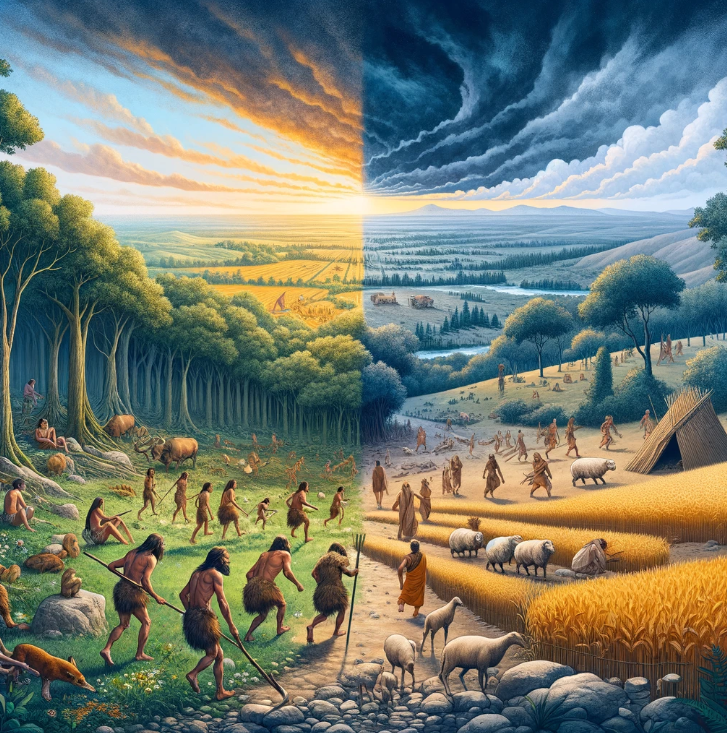
Image: Illustration that depicts the transformative journey of humanity during the Neolithic Revolution, showing the evolution from hunting and gathering to the advent of agriculture.
Drawn by DALL-E, a subset of ChatGPT, March 2024
The development of the first civilisations was a complex process that involved multiple factors and occurred independently in various parts of the world, including Mesopotamia, Egypt, the Indus Valley, and China, among others. These civilisations began to form around 3000 BC, although some areas saw earlier developments. The key factors contributing to the development of the first civilisations include:
- Agricultural Revolution: The transition from nomadic hunter-gatherer societies to settled agricultural communities was crucial. The development of agriculture allowed for the domestication of plants and animals, leading to surplus food production. This surplus supported larger populations and settled communities.
- Geography: Favourable geographical conditions, such as fertile land[2] along river valleys (e.g., the Nile, Tigris, Euphrates, Indus, and Yellow Rivers), provided the resources needed for agriculture, transportation, and trade. These river valleys offered rich soil for crops due to annual floods, making them ideal locations for the emergence of civilisations.
- Social Structure and Division of Labour: As communities grew, a division of labour emerged, with people specialising in different tasks (e.g., farming, pottery, weaving). This specialisation increased efficiency and technological innovation. It also led to the development of social hierarchies and the emergence of ruling classes, religious leaders, and other structured roles within society.
- Centralised Authority: The need for coordinated irrigation, defence, and food distribution led to the development of centralised authority and governance structures. This authority often took the form of a monarchy or theocracy, which could organize large-scale projects and regulate community life.
- Writing and Record Keeping: The invention of writing systems for record-keeping and communication was a defining characteristic of civilisation. Early forms of writing, such as cuneiform[3] (see image below) in Mesopotamia and hieroglyphics in Egypt, allowed for the recording of transactions, laws, and historical events, contributing to the development of complex societies.
- Technological Advances: Technological innovations, including the plough, wheel, writing, and metallurgy, facilitated agricultural production, trade, and the administration of societies. These advances supported the growth of cities and the complexity of social structures.
- Cultural Developments: The concentration of populations in urban centres led to significant cultural developments, including art, architecture, religion, and systems of education and knowledge. These cultural expressions reinforced social cohesion and the identity of civilisations.

Cuneiform Image: Cylinder of Antiochus I Soter with translation (Colour).
Page URL: https://commons.wikimedia.org/wiki/File:Numerical_tablet_Khafaje_OIM_A21310.jpg
Attribution: Original: DaderotDerivative work : Zunkir, CC BY-SA 4.0 <https://creativecommons.org/licenses/by-sa/4.0>, via Wikimedia Commons
These factors interplayed differently across various regions, leading to the unique characteristics of each early civilisation, the development of which laid the foundation for the subsequent history of human societies, influencing patterns of settlement, governance, economic growth, and cultural expression.
Location, Timeline and Key Features of the Main Civilisations
Delving deeper into the timelines and defining characteristics of some key ancient civilisations provides a clearer understanding of their development and contributions to human history.
Mesopotamia
- Location: Region between the Tigris and Euphrates rivers (modern-day Iraq, Kuwait, parts of Syria, and Turkey).
- Timeline: Circa 4000 BC to 539 BC.
- Key Features: Known as the Cradle of Civilisation, Mesopotamia saw the emergence of the world’s first cities, a writing system (cuneiform), and the wheel. It was home to several civilisations, including the Sumerians, Akkadians, Babylonians, and Assyrians. The Code of Hammurabi, one of the oldest deciphered writings of significant length in the world, exemplifies the advanced legal systems of the time.
Norte Chico (Peru)
- Location: The Norte Chico civilisation, also known as the Caral or Caral-Supe civilisation, is recognised as the oldest civilisation in the Americas. Its earliest city, Caral, was established around 3500 BC in present-day Peru. Its first city was created around 3,500 BC in Peru, and up until 1,800 BC, the people of Norte Chico flourished.
- Timeline: Circa 4000 BC – 1800 BC.
- Key Features: Peru is famous for its monumental architecture such as the sunken circular plazas and earthwork platform mounds. In the city of Caral, a total of six pyramids have been discovered. These are the oldest outside of Egypt.
Indus Valley Civilisation
- Location: Along the Indus River in what is now Pakistan and northwest India.
- Timeline: Circa 3300 BC to 1300 BC.
- Key Features: Known for its advanced urban planning, including the world’s first known urban sanitation systems, grid layouts of cities, and an advanced trade system. The civilisation is noted for its mysterious script, which remains undeciphered.
Ancient Egypt
- Location: Along the Nile River in northeastern Africa.
- Timeline: Circa 3100 BC to 30 BC.
- Key Features: Famous for its monumental architecture, including the pyramids and the Sphinx, as well as its hieroglyphic writing. Ancient Egypt was characterised by a strong central government, advancements in mathematics and medicine, and complex religious beliefs centred around the afterlife.
Minoan Civilisation
- Location: Centred on the island of Crete, with influence throughout the Aegean Sea.
- Timeline: Circa 2600 BC to 1100 BC.
- Key Features: Europe’s first advanced civilisation, the Minoans, is known for its sophisticated and vibrant art, extensive trade networks, and the palace of Knossos.
- Their script, Linear A[4], remains undeciphered.
The Olmec Civilisation
- Location: The oldest civilisation in Mexico is the Olmecs. They existed in the tropical lowlands of the Gulf of Mexico. The name ‘Olmec’ is derived from the Aztec language (Nahuatl) and is translated to mean ‘rubber people’. It’s believed that the Olmec may have been the pioneers of converting the latex of the rubber tree into something that could be moulded, hardened, and shaped – what we today know as ‘rubber’.
- Timeline: Circa 1,600 BC – 350 BC.
- Key Features: The Olmecs are often regarded as the Mother Culture of Mesoamerica, emphasising their foundational influence on later civilisations like the Maya and Aztecs. The Olmecs didn’t really have much writing other than a few carved glyphs and symbols which survived, so not too much is known about them or the name they gave themselves. The Olmecs were among the first Mesoamerican complex societies. Their culture inspired later civilisations, such as the Maya. They carved immense stone heads from basalt – a type of volcanic rock – and were known simply as Olmec colossal heads.[5]

Image: San Lorenzo Monumental Head 6. Monumental head from the Olmec civilisation exhibited at the Museo de Antropología de Xalapa
Citation: Olmec colossal heads. (2024, March 8). In Wikipedia. https://en.wikipedia.org/wiki/Olmec_colossal_heads
The Olmec culture inspired later civilisations, such as the Maya. There has also been archaeological evidence of Mesoamerican practices, such as the Mesoamerican ballgame, which was played with balls made of solid rubber. Through trade, the Olmecs were able to build urban centres, such as San Lorenzo and La Venta, which were used mostly for ceremonial purposes and elite activity. Overall. The Olmec people lived in small villages.
Ancient China
- Location: Initially along the Yellow River and expanding to the Yangtze River and beyond.
- Timeline: Xia dynasty around 2070 BC through subsequent dynasties (Shang, Zhou, Qin, Han) to the end of the Han dynasty in 220 AD.
- Key Features: Contributions include the development of writing, complex political systems, significant advances in technology, philosophy (Confucianism and Taoism), and the Great Wall. Chinese civilisation is characterised by continuity through the dynastic cycle.
Ancient Greece
- Location: The Balkan Peninsula and islands in the Aegean Sea.
- Timeline: Circa 800 BC to 146 BC.
- Key Features: It was the birthplace of Western philosophy, democracy, the Olympic Games, significant scientific and mathematical principles, and major literary works. Ancient Greece’s influence is evident in its art, architecture (Doric, Ionic, and Corinthian orders), and the spread of Hellenistic culture following the conquests of Alexander the Great. They, like the Romans, have had a lasting impact on Western culture, law, and political thought, which continues to influence contemporary society.
Roman Empire
- Location: Originating from the city of Rome, it expanded to encompass the Mediterranean Basin and much of Europe.
- Timeline: Foundation in 753 BC, Republic from 509 BC, Empire from 27 BC, until the fall of the Western Roman Empire in 476 AD.
- Key Features: Known for its engineering achievements, including roads, aqueducts, and monumental buildings like the Colosseum and Pantheon. The Roman legal system and Latin language have had a lasting impact on Western civilisation.

Image: [Cropped] The Flavian Amphitheatre, Rome – more commonly known as the Colosseum.
Attribution: Photo by DAVID ILIFF. License: CC BY-SA 3.0
Persian Empire
- Location: Originated in present-day Iran, expanding through parts of the Middle East, Central Asia, and North Africa.
- Timeline: Circa 550 BC to 330 BC.
- Key Features: Known for its significant administrative system and road network, the Persian Empire allowed for efficient communication across vast distances. It was also noted for its tolerance of different cultures and religions within its territory.
Qin Dynasty
- Location: Covered much of modern-day China.
- Timeline: 221 BC to 206 BC.
- Key Features: Marked the first unified, centralised state in Chinese history under Emperor Qin Shi Huang – known for starting the Great Wall of China and the Terracotta Army.
Incan Civilisation
- Location: Centred in present-day Peru, extending through much of western South America.
- Timeline: Circa 1438 AD to 1533 AD.
- Key Features: Notable for its unique architecture, road systems, and agricultural terraces. The Inca Empire was the largest empire in pre-Columbian America, with Quechua as its official language.
Aztec Civilisation
- Location: Based in the Valley of Mexico in central Mexico; The capital city was Tenochtitlán (modern-day Mexico City).
- Timeline: 1345 AD to 1521 AD.
- Key Features: Known for their engineering feats, including the construction of the floating city of Tenochtitlán, and for their complex calendar and writing system. The Aztecs practised human sacrifice as part of their religious rituals.
Ancient India
- Location: Focused on the Indo-Gangetic Plain, covering parts of modern-day India, Pakistan, and Bangladesh.
- Timeline: The Indus Valley Civilisation flourished around 2600 BC to 1900 BC, but the broader timeline of ancient India extends through successive civilisations and empires like the Maurya (circa 322 BC to 185 BC) and Gupta (circa 320 AD to 550 AD) until around 1200 AD.
- Key Features: Ancient India is celebrated for its significant contributions to mathematics, astronomy, and philosophy. It saw the development of two major world religions, Hinduism and Buddhism. The Indus Valley Civilisation is noted for its urban planning, baked brick houses, and elaborate drainage systems.
These civilisations laid the foundations for many aspects of the modern world, from governance and legal systems to art, architecture, and scientific thought. Their achievements and failures offer valuable lessons and insights into the complexity of human societies.
How did Geography affect Ancient Civilisations?
Geography played a crucial role in shaping ancient civilisations, influencing their development, culture, economy, and interactions with other societies, for example:
- Location and Natural Resources: The location of a civilisation often determined the natural resources available to it, such as water, fertile land, minerals, and animals. For instance, the fertile floodplains of the Nile River in Egypt, the Tigris and Euphrates in Mesopotamia, the Indus River in the Indus Valley, and the Yellow River in China supported intensive agriculture, which in turn supported large populations and the development of complex societies.
- Agriculture and Food Supply: Geography influenced the types of crops that could be grown and the animals that could be domesticated, shaping diets, economies, and social structures. The reliable flooding of the Nile, for example, allowed for predictable agricultural cycles, leading to surplus food production and the growth of Egyptian civilisation.
- Trade and Interaction: Geographic features like rivers, seas, and mountain passes facilitated or hindered trade and cultural exchange between civilisations. Civilisations that had access to navigable waterways or were located along trade routes, such as those in the Mediterranean Basin, were able to engage in extensive trade, which brought wealth, cultural exchange, and technological innovations.
- Defence and Security: Natural barriers such as mountains, rivers, and deserts protected from invasions, influencing the stability and development of civilisations. The mountain ranges surrounding the Mesopotamian valley, for instance, offered some degree of protection, while the isolation of the Egyptian civilisation by deserts helped it develop with fewer interruptions from foreign invaders.
- Urbanisation and Settlement Patterns: Geography determined where people settled and how they organised their communities and cities. The dense urban centres of the Indus Valley Civilisation, for example, were made possible by the rich agricultural land in the region, which supported a large population.
- Cultural Development: The geographic environment also influenced the myths, religions, and cultural practices of civilisations. For example, the importance of the Nile to Egyptian civilisation is reflected in its religion, which included gods associated with the river and fertility. Similarly, the Greeks’ interaction with the sea influenced their mythology and the prominence of gods associated with the ocean.
- Climate and Environmental Changes: Climate and environmental changes had significant impacts on civilisations. Shifts in climate could alter agricultural production, leading to surpluses or famines, and could trigger migrations, conflicts, or the collapse of civilisations, as possibly seen in the Late Bronze Age collapse.
In summary, geography was a fundamental factor in determining the success, development, and characteristics of ancient civilisations. It shaped their economies, social structures, interactions with other societies, and cultural identities, leaving a lasting impact on their legacy.
The Origin of Civilisation: The Neolithic Revolution and the Rise of Agriculture[6]
Between 8000 and 5000 BC, humanity underwent one of its most pivotal transformations: the Neolithic Revolution[7], also known as the First Agricultural Revolution. This shift profoundly altered the interaction with the environment by introducing agriculture, the cornerstone of civilisation. This revolution paved the way for the complex societies we know today. Despite modern humans existing for approximately 150,000 years, it’s only in the recent few millennia, with the advances in agriculture, that civilisations have emerged.
The Neolithic Revolution was the wide-scale transition of many human cultures during the Neolithic period in Afro-Eurasia from a lifestyle of hunting and gathering to one of agriculture and settlement, making an increasingly large population possible.[8] These settled communities permitted humans to observe and experiment with plants, learning how they grew and developed.[9] This new knowledge led to the domestication of plants into crops.[10]
The era when this transformation occurred falls into prehistory, characterised by the absence of written records. However, through archaeological endeavours, it has been possible to reconstruct events from this period, although such reconstructions are speculative and based on approximate timelines. These developments, primarily centred in the Middle East for the purposes of this discussion, also occurred across various regions, albeit slightly later.
Transition to Settled Life
Before the advent of agricultural practices, human societies were composed of nomadic hunter-gatherers organised into small, mobile groups. These groups were defined by their constant search for food, which limited their ability to sustain large populations. The shift to a sedentary lifestyle began in the Middle East during the Mesolithic Period[11], marking a significant change in human settlements. Communities like the Natufians in Mesopotamia began to settle, relying on intensive hunting, gathering, and the collection of wild wheat and barley. This period of transition was influenced by climatic changes post the last ice age, which enriched the Fertile Crescent (see below) with an abundance of plant and animal life, encouraging sedentary life due to the increased availability of resources.
The Mesolithic Period was a dynamic phase of human history, with communities adapting to post-glacial environments and developing new technologies and social structures that paved the way for the agricultural lifestyles of the Neolithic.

Image: 1916 map of the Fertile Crescent by James H. Breasted, who popularised usage of the phrase.
Attribution: James Henry Breasted, Public domain, via Wikimedia Commons
The Fertile Crescent[12] is a historically significant region in the Middle East that is known for its rich, fertile land and for being the birthplace of agriculture and early civilisation. Shaped like a crescent moon, it stretches from the Persian Gulf through modern-day Iraq, Syria, Lebanon, Jordan, Israel, and Egypt – including the valleys of the Tigris and Euphrates rivers.
The Fertile Crescent is often referred to as the “Cradle of Civilisation” because it was here that humans first began the domestication of plants and animals, leading to the development of the first settled communities and the emergence of complex societies. This region was home to several ancient civilisations, including the Sumerians, Babylonians, Assyrians, and Phoenicians, among others. These societies made significant advancements in writing, law, architecture, and agriculture, laying the foundational elements for subsequent civilisations.
The Agricultural Revolution Unfolds
The potential shift back to a nomadic lifestyle due to a changing climate around 9000 BC prompted some communities to innovate for survival. This led to the birth of agriculture, a process that evolved through the domestication of wild grasses and the selective breeding of plants for enhanced yield and nutritional value.
This period, known as the Pre-Pottery Neolithic A (PPNA)[13], signified the beginning of the Neolithic Period, characterised by the domestication of crops such as wheat and barley, and later, the domestication of animals during the Pre-Pottery Neolithic B (PPNB)[14].
This era saw the transformation of wolves into dogs and the domestication of sheep, goats, and pigs for food and resources. The development of pottery further revolutionised food storage and transportation, marking a significant advancement in Neolithic societies.
Insights from Neolithic Settlements: Jericho and Çatal Hüyük
The archaeological sites of Jericho and Çatal Hüyük (see below) offer valuable perspectives on the societal changes during the Neolithic Period. Jericho, with its rapid growth due to agriculture and its early large-scale construction projects, illustrates the shift towards more organised and complex communities. Çatal Hüyük, known for its dense population and advanced agriculture, showcases the evolution of early cities supported by intensive farming. These settlements highlight the transition from hunter-gatherer societies to complex urban centres reliant on agriculture.
- Jericho, located in the West Bank near the Jordan River, is one of the oldest continuously inhabited cities in the world, with evidence of settlement dating back to 10,000 BC. Archaeological excavations at Jericho have revealed a succession of settlements, fortifications, and a unique water system, highlighting its role as a significant Neolithic and Bronze Age community. One of its most famous discoveries is the Neolithic tower, believed to be one of the world’s earliest defensive structures, and the surrounding wall indicating sophisticated social organisation and technological capabilities.
- Çatal Hüyük, situated in the Konya Plain in present-day Turkey, is one of the most well-preserved Neolithic settlements, dating back to approximately 7500 BC. Renowned for its dense layout, Çatal Hüyük features houses built directly next to each other, accessible via roofs. The site offers invaluable insights into early urban life, with its detailed wall paintings, sculptures, and burials providing evidence of the social, cultural, and religious practices of its inhabitants. Notably, Çatal Hüyük’s inhabitants engaged in agriculture, hunting, and trade, and the site showcases early examples of domestic architecture and art, highlighting the complexity of Neolithic societies.
Agriculture’s Expansion and Impact
Agriculture initially emerged in the Middle East, likely due to its favourable climate, but eventually spread to other fertile regions. This spread was accompanied by the development of agriculture in independent locations such as China, sub-Saharan Africa, and the Americas, each adopting local crops and domestication practices. Agriculture facilitated the rise of urban societies, specialisation, and the development of art, science, and religion. However, it also introduced challenges such as social stratification, class inequality, and the spread of diseases, fundamentally altering the human condition.
The Neolithic agricultural revolution introduced several societal challenges that have persisted and evolved throughout human history, including:
- Social Stratification and Inequality: The surplus of food produced through agriculture enabled some individuals to accumulate wealth and resources, leading to the emergence of social hierarchies and class divisions. This stratification often resulted in unequal access to resources, power, and opportunities, a challenge that continues to affect societies globally.
- Health and Diet: The transition from a diverse diet of hunter-gatherers to a more monotonous agricultural diet based on a few staple crops led to nutritional deficiencies and the emergence of diet-related diseases. Sedentary lifestyles also contributed to health issues that were less prevalent in nomadic communities.
- Spread of Diseases: The concentration of human populations in settlements and the proximity to domesticated animals facilitated the transmission and evolution of infectious diseases. Many of the infectious diseases that have plagued human societies have origins in this period of increased density and interaction with animals.
- Environmental Degradation: Intensive agricultural practices led to changes in the landscape, deforestation, soil depletion, and water scarcity. These environmental impacts have accelerated with the growth of human populations and technological advancements, leading to ongoing challenges related to sustainability and climate change.
- Conflict and Warfare: The establishment of settled communities with valuable resources and territories led to disputes over land and resources. The development of organised societies also meant that conflicts could be waged on a larger scale, with armies and advanced weapons, a pattern of warfare and competition for resources that continues to shape international relations.
- Gender Inequality: The agricultural revolution is thought to have contributed to the development of gender roles and inequalities, as labour became more divided and societies valued certain types of work over others. The shift from egalitarian hunter-gatherer societies to stratified agricultural societies often saw women relegated to less publicly valued roles, a trend that has long-term implications for gender equality.
- Dependency on Agriculture: As societies became increasingly reliant on a limited variety of crops for sustenance, they became more vulnerable to crop failures due to droughts, pests, and diseases. This dependency has led to famines and economic crises when agricultural systems fail.
These challenges, originating in the Neolithic period, have evolved with human societies and remain central issues that contemporary societies continue to address through technological, social, and policy innovations. In conclusion, the Neolithic agricultural revolution was a cornerstone in human history, enabling the development of civilisation as we know it.
Foundations of Government and Law
Ancient legal codes, political structures, and governance models have significantly influenced modern legal and governmental frameworks, shaping the foundational principles of justice, rights, and governance we recognise today. Here’s how some of these ancient systems have impacted contemporary legal and political landscapes:
- Code of Hammurabi: The Code (or Laws) of Hammurabi, one of the earliest (dated to around 1754 BC) and most complete written legal codes formulated in ancient Mesopotamia, established the principle that the government had a responsibility to enforce justice and that laws were created to maintain order and protect property and individuals. It introduced the concept of punishment proportional to the crime (“an eye for an eye“), which, while no longer taken literally, influenced the development of legal systems where penalties correspond to the severity of offences. The Code also laid the groundwork for the idea of a legal code as a public document accessible to all citizens. See more at: https://martinpollins.com/2024/01/29/the-laws-of-hammurabi/
- Athenian Democracy: Ancient Athens is credited with the development of democracy, a revolutionary idea that governance should be based on the will of the people rather than the rule of monarchs or oligarchs. Athenian democracy introduced concepts such as citizen participation in decision-making, equality before the law, and the right to speak one’s mind in public forums. These principles have profoundly influenced modern democratic systems, including the idea of elected representatives, legislative bodies and the importance of civic participation and free speech in governance.
- Roman Legal Systems: The Roman Republic and Empire established legal principles that have profoundly influenced Western legal thought (see note below), including the concept of natural law (ius naturale), civil law (ius civile), and the rights of persons. The Roman legal tradition introduced the ideas of legal precedent, the codification of laws, and legal professionalism (lawyers and legal scholars). Roman law’s structure and concepts have significantly shaped the civil law systems of many modern countries, providing a basis for understanding property, contractual obligations, and personal rights.
NOTE: It is important to note the influence of English Common Law, which developed in the Middle Ages but has its roots in ancient legal traditions. It introduced the practice of judicial precedent (stare decisis)[15], whereby the decisions of courts have binding authority on future cases. This principle is a cornerstone of legal systems in England, the United States, and other countries influenced by the English legal tradition.
- Islamic Law (Sharia): Islamic law, derived from the Quran and the Hadith, has also significantly influenced legal systems in Muslim-majority countries. It covers not only religious rituals but also aspects of daily life, including marriage, inheritance, and commerce. The integration of religion and law in Islamic legal traditions has influenced concepts of justice and governance in many parts of the world.
These ancient legal codes and governance models have laid the foundation for modern legal systems and democratic governance. They have contributed to the development of key legal concepts such as the rule of law, the separation of powers, individual rights, and the idea that laws should be written, public, and applied equally. Modern legal and political institutions continue to evolve, but they owe much to the ancient frameworks that first articulated the principles underpinning justice and governance.
Personal Skills and Behaviours
The development of social skills, including kindness, decency, honesty, and other moral behaviours, can be understood through a combination of evolutionary biology, psychology, and cultural evolution. These skills and traits have likely evolved due to their benefits in social living and have been further shaped by cultural practices and norms. Here’s a look at how these developments might have occurred:
Evolutionary Basis
- Survival and Reproduction: From an evolutionary standpoint, behaviours that enhance group cohesion and cooperation can lead to increased survival and reproductive success. Groups in which members show kindness, honesty, and other prosocial behaviours can work together more effectively, increasing their chances of survival and the well-being of the group members.
- Reciprocal Altruism: This is the principle that if one individual acts altruistically towards another, that
- Kin Selection: Behaviors such as altruism can also be explained by kin selection, where individuals are more likely to perform acts of kindness towards their relatives, helping to ensure the survival of shared genes.
Psychological Development
- Empathy and Theory of Mind: The ability to understand and share the feelings of another and to attribute mental states to others is crucial for developing social skills. This cognitive capacity enables individuals to predict and understand others’ behaviour, leading to more nuanced social interactions based on kindness, honesty, and decency.
- Social Learning: Children learn social behaviours by observing and imitating others, especially adults and peers. Cultural norms and values are transmitted through families, education, and social interactions, shaping individuals’ understanding of acceptable and desirable behaviours.
Cultural Evolution
- Moral and Ethical Systems: Virtually all cultures develop sets of moral and ethical guidelines that promote prosocial behaviours. Religions, legal systems, and societal norms often emphasise virtues like honesty, kindness, and fairness, embedding these values in the social fabric.
- Social Cohesion and Group Identity: Shared values and norms strengthen group identity and cohesion. Social skills that promote positive interactions and mutual respect are essential for maintaining social order and cohesion.
- Adaptation to Social Environments: As societies evolve, the complexity of social interactions increases. Social skills that facilitate cooperation, conflict resolution, and community building become increasingly important for navigating social networks and institutions.
The development of social skills such as kindness, decency, and honesty is a multifaceted process influenced by biological predispositions, individual psychological development, and the cultural context. While these traits are beneficial for social cohesion and mutual support, the ways in which they are valued and expressed can vary widely across different cultures and societies.
The development of moral and ethical reasoning, including why individuals can have profoundly different moral intuitions and the role of culture versus innate tendencies in shaping morality, is not fully understood.
Other Human Development Skills
While many aspects of human development, including cognitive, emotional, and social skills, have been extensively studied, some areas remain mysterious or less understood. Here are a few examples of human development skills or phenomena that can be considered inexplicable or at least not fully explained:
- Consciousness: The nature of consciousness and self-awareness is a fundamental question in both philosophy and science. How and why consciousness arises from neural processes remains one of the most important and difficult questions in cognitive science and neurobiology.
- Creativity: While we understand some processes behind creativity, such as the ability to think divergently and make novel connections, the origins of creative insight and the variability in creative ability among individuals are not fully understood.
- Intuition: The process behind how people can make seemingly accurate judgments without explicit reasoning or immediate analysis remains partially inexplicable. Intuition suggests a subconscious integration of experience and knowledge, but how this occurs is not fully detailed.
- Language Acquisition: The ease with which young children learn complex languages, often without formal instruction, hints at an innate capability or predisposition for language. The mechanisms behind this skill, especially Dreaming: The purpose and process of dreaming, especially why certain dreams occur and what influences their content, remain partially understood. While there are theories about the role of dreams in processing emotions, consolidating memories, or problem-solving, a definitive explanation is lacking.
- Emotional Intelligence: While it’s recognised as a critical skill for social interaction and personal well-being, the nuances of how emotional intelligence develops and its variance among individuals are not fully explained. Factors influencing emotional intelligence include genetics, upbringing, and personal experiences, but the interplay of these factors is complex.
- Phenomena of Extreme Abilities: Exceptional talents, such as prodigious musical ability, mathematical genius, or photographic memory, present cases of human ability that are difficult to fully comprehend or replicate through training or education.
These aspects of human development exemplify the complexity of the human mind and behaviour. Despite advancements in psychology, neuroscience, and related fields, fully explaining these skills or phenomena remains a challenge, highlighting the continued need for research and exploration into the human condition.
Philosophical and Ethical Contribution
Ancient philosophical schools of thought, both from the Greek tradition and Eastern cultures, have profoundly influenced modern ethical considerations and worldviews. These philosophies continue to shape contemporary thought on morality, governance, personal conduct, and the nature of knowledge.
Greek Philosophy:
- Socrates: Socrates[16] emphasised the importance of self-examination and questioning in the pursuit of truth and virtue. His method of dialectic questioning (the Socratic method) is foundational in the field of ethics and education, encouraging critical thinking and the rigorous examination of beliefs and values.
- Plato: Plato[17], a student of Socrates, founded the Academy in Athens and contributed extensively to metaphysics, ethics, and political philosophy. His notion of the “World of Forms” introduced the idea that abstract concepts (like beauty or justice) have a higher, more perfect existence beyond the physical world. Plato’s Republic discusses justice and the ideal state, influencing contemporary political theory and the concept of ideal forms or absolutes in ethical reasoning.
- Aristotle: Aristotle[18], Plato’s student, made comprehensive contributions to logic, ethics, political theory, metaphysics, and natural sciences. His Nicomachean Ethics introduces the concept of virtue ethics, emphasising the development of good character traits and the importance of moderation. Aristotle’s emphasis on empirical observation and the categorisation of knowledge laid the groundwork for the scientific method and rational inquiry.
Eastern Philosophies:
- Confucianism: Founded by Confucius, Confucianism is a philosophical and ethical system that emphasises familial duty, social harmony, and the importance of moral integrity in governance. Confucian thought, particularly the concept of Ren (benevolence or humaneness) and Li (proper behaviour or ritual propriety), continues to influence modern East Asian societies in their emphasis on community, respect for tradition, and the moral obligations of leaders.
- Buddhism: Founded by Siddhartha Gautama (the Buddha), Buddhism explores suffering, impermanence, and the path to enlightenment through practices like mindfulness, meditation, and ethical living. Buddhist principles such as the Four Noble Truths[19] and the Eightfold Path[20] offer a framework for overcoming suffering through insight, ethical conduct, and mental discipline. Modern interest in mindfulness and meditation has roots in Buddhist practices, influencing contemporary approaches to mental health, spirituality, and ethics.
Enduring Impact:
- Ethical Considerations: Greek virtue ethics, Socratic questioning, and the moral teachings of Confucianism and Buddhism all contribute to modern discussions on ethics, emphasising the importance of character, intention, and the moral dimensions of actions.
- Governance and Society: Plato’s and Aristotle’s political philosophies, along with Confucian principles on leadership and social harmony, continue to influence contemporary political theory and discussions about the ideal society, governance, and the role of citizens.
- Personal Development: The focus on self-examination, personal virtue, and enlightenment across these philosophical traditions encourages ongoing exploration into personal growth, mental discipline, and the pursuit of wisdom in the modern world.
These ancient schools of thought provide a rich intellectual heritage that informs contemporary discussions on morality, governance, the nature of happiness, and the pursuit of knowledge, demonstrating the timeless relevance of ancient wisdom in addressing the complexities of modern life.
Human Development Skills
While many aspects of human development, including cognitive, emotional, and social skills, have been extensively studied, some areas remain mysterious or less understood. Here are a few examples of human development skills or phenomena that can be considered inexplicable or at least not fully explained:
- Consciousness: The nature of consciousness and self-awareness is a fundamental question in both philosophy and science. How and why consciousness arises from neural processes remains one of the most important and difficult questions in cognitive science and neurobiology.
- Creativity: While we understand some processes behind creativity, such as the ability to think divergently and make novel connections, the origins of creative insight and the variability in creative ability among individuals are not fully understood.
- Intuition: The process behind how people can make seemingly accurate judgments without explicit reasoning or immediate analysis remains partially inexplicable. Intuition suggests a subconscious integration of experience and knowledge, but how this occurs is not fully detailed.
- Language Acquisition: The ease with which young children learn complex languages, often without formal instruction, hints at an innate capability or predisposition for language. The mechanisms behind this skill, especially Dreaming: The purpose and process of dreaming, especially why certain dreams occur and what influences their content, remain partially understood. While there are theories about the role of dreams in processing emotions, consolidating memories, or problem-solving, a definitive explanation is lacking.
- Emotional Intelligence: While it’s recognised as a critical skill for social interaction and personal well-being, the nuances of how emotional intelligence develops and its variance among individuals are not fully explained. Factors influencing emotional intelligence include genetics, upbringing, and personal experiences, but the interplay of these factors is complex.
- Moral and Ethical Development: The development of moral and ethical reasoning, including why individuals can have profoundly different moral intuitions and the role of culture versus innate tendencies in shaping morality, is not fully understood.
- Phenomena of Extreme Abilities: Exceptional talents, such as prodigious musical ability, mathematical genius, or photographic memory, present cases of human ability that are difficult to fully comprehend or replicate through training or education.
These aspects of human development exemplify the complexity of the human mind and behaviour. Despite advancements in psychology, neuroscience, and related fields, fully explaining these skills or phenomena remains a challenge, highlighting the continued need for research and exploration into the human condition.
Technological and Scientific Innovations
Ancient civilisations made numerous significant inventions and discoveries across various fields, including engineering, mathematics, astronomy, and medicine. These contributions laid the groundwork for many modern scientific and technological advances.
Engineering
- Egyptian: The ancient Egyptians demonstrated remarkable engineering skills, especially in constructing the pyramids, which remain one of the Seven Wonders of the Ancient World. Their mastery of geometry, understanding of materials, and construction techniques allowed them to create these monumental structures without modern machinery.

Image: A view of the Giza pyramid complex from the plateau to the south of the complex. From left to right, the three largest are: the Pyramid of Menkaure, the Pyramid of Khafre and the Great Pyramid of Giza. The three smaller pyramids in the foreground are subsidiary structures associated with Menkaure’s pyramid. Citation: Egyptian pyramids. (2024, January 19). In Wikipedia. https://en.wikipedia.org/wiki/Egyptian_pyramids
- Roman: The Romans excelled in civil engineering, developing advanced infrastructure systems that included roads, aqueducts for water supply, and the construction of large amphitheatres like the Colosseum. Roman concrete technology and architectural innovations such as the arch and dome have influenced modern construction.
Mathematics
- Greek: Ancient Greek mathematicians like Euclid, Archimedes, and Pythagoras made foundational contributions to geometry, number theory, and mathematical principles that are still taught today. Euclid’s “Elements” is one of the most influential works in the history of mathematics, laying the groundwork for modern geometry.
- Indian: Ancient Indian mathematicians, including Aryabhata and Brahmagupta, made significant advances in algebra, trigonometry, and arithmetic. The concept of zero as a number, decimal system, and the use of negative numbers were important contributions from this tradition.
Astronomy
- Babylonian: The Babylonians developed detailed records of celestial phenomena and were among the first to use mathematical calculations to predict astronomical events. Their understanding of the lunar cycle and the development of the zodiac influenced later astronomical studies.
- Mayan: The Maya civilisation made significant advancements in astronomy, developing a complex calendar system and accurately predicting solar and lunar eclipses. Their observations and calculations regarding celestial bodies were remarkably precise.
Medicine
- Egyptian: The ancient Egyptians practised sophisticated medical treatments and knew about anatomy, evidenced by their mummification process. The Edwin Smith Papyrus and Ebers Papyrus contain early records of medical practices and treatments.
- Greek: Hippocrates, known as the “Father of Medicine,” introduced the Hippocratic Oath and emphasised the importance of observation and clinical practice. He and his followers moved away from supernatural explanations for illness, advocating for natural causes and treatments based on the balance of bodily fluids.
Chinese Inventions
- Gunpowder: Invented during the 9th century by Chinese alchemists, gunpowder was initially used for fireworks and later became the basis for weapons like guns and cannons, transforming warfare in the subsequent centuries.
- The Compass: The invention of the magnetic compass by the Chinese during the Song Dynasty (960–1279) revolutionised navigation, enabling sea exploration and maritime trade across great distances with more accuracy.
- Paper and Printing: The invention of paper and the development of printing technology, including woodblock printing and later movable type, originated in China. These inventions significantly impacted the dissemination of knowledge, education, and literacy worldwide.
These ancient inventions and discoveries are a testament to human ingenuity and curiosity. They not only served the practical needs of their time but also laid the foundational stones for further exploration and innovation in science and technology.
Art and Architecture
Ancient art and architecture have left an indelible mark on modern design, aesthetics, and cultural expressions, influencing everything from the construction of buildings to the creation of art and everyday objects. The impact of ancient civilisations, including Greek and Roman architecture, Indian and East Asian art forms, has been profound, shaping contemporary design principles and cultural aesthetics through the transfer of artistic techniques and styles across cultures.
Greek and Roman Architecture
- Classical Orders: The Greek development of architectural orders (Doric, Ionic, Corinthian) established foundational design principles that emphasised symmetry, proportion, and harmony. These styles have been adapted in various periods of Western architecture, notably in the Renaissance, Neoclassicism, and even modern architectural movements.
- Roman Architectural Innovations: Roman advancements, such as the arch, vault, and concrete construction, contributed to the development of monumental architecture. The use of these elements in public buildings, aqueducts, and bridges influenced the infrastructure and urban planning of modern cities.
Indian Art and Architecture
- Stupa and Temple Architecture: Indian stupa and temple architecture, characterised by intricate carvings, ornate facades, and symbolic geometry, influenced Southeast Asian architecture and Buddhist structures worldwide. The principles of Vastu Shastra, an ancient Indian system of architecture and design, also find resonance in modern sustainable and holistic design practices.
- Miniature Painting and Textile Design: Indian miniature paintings and rich textile traditions have influenced modern fashion, interior design, and visual arts, introducing vibrant colours, intricate patterns, and storytelling through art.
East Asian Art Forms
- Chinese Influence: Chinese art, especially calligraphy, porcelain, and landscape painting, has influenced artistic expressions globally. The emphasis on balance, simplicity, and harmony in Chinese art and design principles can be seen in modern minimalist aesthetics and the fusion of art and nature in landscape design.
- Japanese Aesthetics: The Japanese principles of Wabi-sabi, which celebrates imperfection and transience, and Ma (negative space), have influenced contemporary art, design, and architecture. The integration of indoor and outdoor spaces in traditional Japanese architecture also informs modern architectural practices, emphasising sustainability and harmony with nature.
Transfer of Artistic Techniques and Styles
- Renaissance: The Renaissance in Europe was significantly influenced by the rediscovery of classical Greek and Roman art, leading to a revival of these styles in painting, sculpture, and architecture. This period marked the beginning of a cultural bridge between the ancient and modern worlds, fostering an exchange of artistic and philosophical ideas that continue to influence Western art.
- Silk Road: The Silk Road facilitated the exchange of goods, art, and ideas between East and West. This cross-cultural exchange introduced artistic techniques and motifs, such as Persian miniatures influencing Renaissance artists and Buddhist iconography spreading through Asia.
- Colonialism and Globalisation: The colonial era and subsequent globalisation further facilitated the exchange of artistic traditions, techniques, and styles. This has led to the blending of cultural expressions in contemporary art and architecture, promoting a global aesthetic that draws from multiple traditions.
Ancient art and architecture’s enduring influence on modern design and aesthetics reflects humanity’s continuous dialogue with its past. By revisiting ancient techniques and styles, contemporary creators not only pay homage to the ingenuity of earlier civilisations but also find inspiration to innovate and address the challenges and aesthetic needs of the modern world.
The above captures broad themes on how ancient art, architecture, and their philosophical underpinnings have influenced modern design, aesthetics, and cultural expressions. It highlights the enduring legacy of Greek and Roman architectural principles, Indian and East Asian artistic contributions, and the importance of cross-cultural exchanges, such as those facilitated by the Silk Road and the impacts of colonialism and globalisation.
However, the interpretation and application of ancient influences in modern contexts can vary widely across different fields of design and cultural studies. The connections between ancient and modern practices are often complex and subject to ongoing scholarly debate. While the summary aims to provide an accurate general perspective, the specifics of how these ancient traditions have been interpreted and integrated into modern practices might require deeper exploration within each specialised area of study.
Language and Literature
Ancient languages such as Latin, Greek, and Sanskrit have had a profound impact on modern languages and literature, influencing not only the vocabulary but also the development of literary genres and the preservation and transmission of classical texts. Their legacy is evident in various aspects of modern linguistic and literary expression.
Latin
- Vocabulary and Etymology: Latin has significantly influenced the Romance languages (Italian, French, Spanish, Portuguese, Romanian) and has contributed extensively to the lexicon of English and other European languages. Many English words, especially those related to science, law, and theology, derive from Latin.
- Preservation of Classical Texts: Latin served as the lingua franca of educated Europeans until the 18th century, preserving a wide array of classical texts in philosophy, science, and literature. The Renaissance’s rediscovery and study of Latin texts spurred advances in art, science, and humanist thought.
- Legal and Scientific Terminology: Much of the terminology used in modern legal and scientific discourse is derived from Latin, underscoring its continued relevance in specialised fields.
Greek
- Linguistic Influence: Greek has profoundly influenced the vocabulary of modern languages, especially in areas of philosophy, mathematics, medicine and the sciences. Terms like “democracy,” “philosophy,” and “anthropology” have Greek roots.
- Literary Genres: Ancient Greek literature laid the foundations for Western literary genres, including epic poetry (Homer’s Iliad and Odyssey), tragedy (works by Sophocles and Euripides), and comedy (Aristophanes). These forms and their conventions continue to influence modern literature.
- New Testament and Early Christian Texts: The New Testament and many foundational Christian texts were written in Koine Greek, affecting Christian theology and practice.
Egypt
- Egyptian Hieroglyphs: In ancient Egypt, hieroglyphs were the written language. Scribes meticulously learned and practised these intricate symbols to record religious texts, historical accounts, and administrative matters.
Mesopotamia
- Cuneiform Script: Mesopotamia used cuneiform, an early logographic system. Scribes underwent rigorous training to master this complex script, which was essential for recording legal documents, literature, and other texts.
Sanskrit
- Linguistic Foundation: Sanskrit, the classical language of India, is a foundational language for many modern South Asian languages, including Hindi, Bengali, and Marathi. It has also contributed to the vocabulary of Southeast Asian languages.
- Literary Influence: Sanskrit literature, encompassing a vast body of religious, philosophical, and poetic texts (such as the Vedas, Upanishads, Mahabharata, and Ramayana), has deeply influenced the literary traditions and spiritual practices of South Asia and beyond.
- Philosophical and Religious Concepts: Sanskrit terminology underpins many concepts in Hinduism, Buddhism, and Jainism, affecting spiritual practices and philosophical discourse globally.
Impact on Modern Languages and Literature:
- Adoption of Words and Expressions: Modern languages have adopted numerous words, phrases, and expressions from ancient languages, enriching their vocabulary and allowing for nuanced expression and technical discourse.
- Preservation and Study: The study of ancient languages and texts remains a critical academic discipline, preserving the knowledge and cultural heritage of ancient civilisations. This study has facilitated the transmission of classical knowledge to new generations, influencing modern thought, literature, and art.
- Influence on Literary Forms and Themes: Ancient literary forms and themes, such as the epic journey, tragedy, and the exploration of human nature and the divine, continue to resonate in modern literature, reflecting the enduring relevance of ancient narratives and ideas.
The impact of ancient languages on modern languages and literature is a testament to the interconnectedness of human cultures and the enduring legacy of ancient civilisations in shaping contemporary thought, expression, and understanding.
Religion and Spirituality
Ancient religions and spiritual practices have profoundly influenced contemporary religious beliefs and practices, shaping the spiritual landscape of the modern world in various ways. Here’s how some of these ancient traditions have left their mark:
Ancient Egypt
- Afterlife Concepts: Ancient Egyptian beliefs about the afterlife, including the journey of the soul, judgment, and the concept of eternal life in the Field of Reeds, have influenced contemporary ideas about the afterlife in various religious traditions.
- Ritual Practices: The elaborate rituals and practices surrounding death and burial, as exemplified in mummification and tomb construction, have influenced later religious rituals concerning death and the honouring of ancestors.
- Gods and Mythology: The pantheon of Egyptian gods and their stories contributed to the development of mythological frameworks in later religions, illustrating the interconnectedness of creation, the divine, and humanity.
Hinduism
- Dharma and Karma: The concepts of dharma (duty/righteousness) and karma (action and its consequences) are central to Hinduism and have influenced other religious and spiritual traditions, promoting ideas of moral responsibility and the ethical consequences of actions.
- Reincarnation and Moksha: The belief in reincarnation (samsara) and the pursuit of liberation (moksha) from the cycle of rebirth have impacted religious and philosophical thought worldwide, particularly in Buddhism, Jainism, and various New Age and spiritual movements.
- Yoga and Meditation: Practices such as yoga and meditation, rooted in Hindu traditions, have gained global popularity, influencing physical, mental, and spiritual well-being and becoming integral to various spiritual practices beyond Hinduism.
Zoroastrianism
- Dualistic Cosmology: Zoroastrianism’s emphasis on the cosmic battle between good and evil, represented by Ahura Mazda (the Wise Lord) and Angra Mainyu (the Destructive Spirit), has influenced the dualistic cosmologies of later religions, including Christianity and Islam.
- Eschatology: The Zoroastrian concepts of a saviour figure (Saoshyant), resurrection, final judgment, and the renovation of the world (Frashokereti) have parallels in Christian and Islamic eschatology, reflecting shared themes of redemption and the end of times.
- Fire Worship and Ritual Purity: The use of fire as a symbol of purity and divine presence in Zoroastrian worship has influenced the ritual use of fire in various religious practices across the world. In Zoroastrianism, fire is considered a medium through which spiritual insight and wisdom are gained, and fire temples serve as places of worship where fire is maintained continuously to symbolise eternal divine light.
This reverence for fire has parallels in other traditions, such as in Hinduism, where fire (Agni) is central to the Vedic rituals and the lighting of lamps and bonfires symbolizes the presence of the divine. Similarly, in some Christian rituals, candles are lit to represent the light of Christ or the Holy Spirit. The symbolic use of fire to represent purification, enlightenment, and the divine presence demonstrates the profound influence of Zoroastrian rituals on the spiritual practices of later religions.
Economic and Trade Systems
The development of trade networks, economic systems, and the use of money in ancient civilisations laid the foundations for modern economic practices and global trade relations. These ancient innovations in trade and economy facilitated the exchange of goods, ideas, and cultures, significantly impacting the structure of contemporary global economies.
Development in Ancient Civilisations
Trade Networks:
- Mesopotamia and the Indus Valley: One of the earliest known trade networks connected Mesopotamia with the Indus Valley around 3000 BCE, facilitating the exchange of goods like textiles, grains, and precious stones. This interregional trade laid the groundwork for future trade routes.
- The Silk Road: Established during the Han Dynasty in China (around the 2nd century BC), the Silk Road was a network of trade routes connecting East Asia with the Mediterranean. It facilitated the exchange of silk, spices, tea, and porcelain from the East with gold, glass, wool, and silver from the West.
- Maritime Trade Routes: Civilisations such as the Phoenicians and later the Greeks and Romans developed extensive maritime trade networks across the Mediterranean, expanding to the Indian Ocean and facilitating the exchange of goods across vast distances more efficiently than overland routes.
Economic Systems:
- Barter System to Coinage: Early economic transactions were based on the barter system, which involved the direct exchange of goods and services. The Lydians (in present-day Turkey) are credited with introducing one of the first forms of coinage around 600 BC, revolutionising economic transactions by standardising values and making trade simpler and more flexible.
- Economic Specialisation: With the rise of agricultural surplus in civilisations like Egypt and Mesopotamia, societies could support a range of specialised professions, leading to more complex economic systems and the development of markets and trade centres.
Monetary Use:
- Standardisation of Currency: The adoption of coinage and standardised weights and measures facilitated trade by providing a common medium of exchange and value assessment, laying the groundwork for modern financial systems.
- Banking Practices: Ancient Mesopotamia saw the emergence of basic banking practices, with temples and palaces acting as safekeeping places for grain and valuables. This concept evolved into more sophisticated lending and borrowing systems, influencing modern banking.
Influence on Modern Economic Practices and Global Trade Relations:
- Global Trade Networks: Ancient trade routes like the Silk Road are precursors to today’s complex global trade networks, highlighting the importance of international trade in economic development and cultural exchange.
- Currency and Monetary Policy: The ancient invention of coinage and the standardisation of weights and measures have influenced modern national currencies, central banking systems, and international trade agreements, which rely on standardised currencies and exchange rates.
- Economic Specialisation and Division of Labour: The principle of specialisation and division of labour, fundamental to ancient economic systems, remains a cornerstone of modern economies, promoting efficiency and innovation.
- Commercial Infrastructure: The development of trade centres and marketplaces in ancient civilisations has influenced the modern concept of commercial infrastructure, including trading hubs, stock exchanges, and international trade ports.
The economic practices initiated by ancient civilisations have had a lasting impact, shaping modern economic theories, financial institutions, and the interconnected global economy. These ancient contributions underscore the evolution of trade and economy from localised barter systems to a complex web of global trade relations and financial systems.
Social Structures and Class Systems
Ancient societies displayed diverse forms of organisation, class structures, family dynamics, and social norms, many of which have had lasting effects on modern social organisation and class relations. The organisation of these societies was often closely linked to their economic systems, political structures, and cultural values, shaping individuals’ roles and statuses within their communities.
Class Structures
- Egypt and Mesopotamia: These societies were organised into hierarchical class systems. At the top were the rulers (pharaohs in Egypt, kings in Mesopotamia), followed by priests, officials, and nobles who played roles in administration and religion. Merchants, artisans, and scribes formed the middle class, while peasants and enslaved people made up the majority, working in agriculture or serving the elite. This hierarchical structure influenced later social systems, emphasising the division between ruling elites and working classes.
- Ancient Greece and Rome: Both featured complex class systems. In Athens, citizens (free adult males born in Athens) had political rights, while women, enslaved people, and foreigners had no political power. Rome had patricians (aristocratic families), plebeians (commoner citizens), and slaves. The struggle between patricians and plebeians over political rights in Rome influenced the development of legal systems that aimed to balance power among social classes.
Family Dynamics
- Patriarchal Families: Most ancient societies were organised around patriarchal family structures, with the male head of the household holding authority over family members. This model influenced the development of patrilineal descent systems and inheritance laws, which are still observed in many cultures today.
- Marriage and Kinship: Marriages were often arranged to strengthen familial alliances, and kinship ties played a crucial role in social and economic relations. The emphasis on kinship and family loyalty contributed to the development of clan-based and tribal societies, affecting modern concepts of identity, inheritance, and social obligations.
Social Norms
- Social Stratification and Mobility: Social norms in ancient societies often reinforced class divisions, with limited opportunities for mobility. However, exceptional individuals could sometimes rise in status through acts of valour, religious dedication, or accumulating wealth. These instances laid the groundwork for meritocratic ideals in some modern societies, though class stratification persists.
- Gender Roles: Gender roles were clearly defined in ancient societies, with men dominating public life and women assigned domestic roles. While there have been significant advancements towards gender equality, the impact of these traditional roles is still evident in contemporary gender disparities in various spheres.
Lasting Effects on Modern Social Organisation and Class Relations
- Inequality and Resistance: The hierarchical class structures of ancient societies have influenced modern social organisations, contributing to persistent inequalities. They have also inspired resistance movements and the development of ideologies advocating for social justice and equality.
- Legal Systems and Rights: The legal codes and governance models developed to manage ancient class systems and family dynamics have influenced contemporary legal frameworks, including property rights, marital laws, and individual rights.
- Cultural Norms and Values: The social norms of ancient societies have shaped modern cultural values, attitudes towards family and gender roles, and the social expectations placed on individuals based on their class, gender, and kinship.
Understanding the social organisation of ancient societies provides insights into the origins of many contemporary social practices, norms, and inequalities. It highlights the lasting impact of historical social structures on modern class relations and societal organisation, as well as the ongoing challenges and efforts to overcome the legacies of inequality and social stratification.
Agriculture and Domestication
The revolution in agriculture, commonly referred to as the Neolithic Revolution, marks one of the most significant transformations in human history, occurring around 12,000 years ago. This period saw the domestication of plants and animals, fundamentally changing food production, settlement patterns, and societal development in ways that still impact us today.
Impact on Food Production
- From Foraging to Farming: Prior to the Neolithic Revolution, human societies were predominantly hunter-gatherers, relying on foraging wild plants and hunting animals for sustenance. The domestication of plants and animals allowed for the cultivation of crops and the rearing of livestock, providing more reliable and abundant food sources.
- Surplus Production: Agriculture enabled the production of food surpluses, which were pivotal in supporting growing populations and the development of complex societies. Surpluses also facilitated the storage of food, which could be used in times of scarcity.
Settlement Patterns
- Permanent Settlements: The shift towards agriculture necessitated sedentary lifestyles, leading to the establishment of permanent settlements and, eventually, cities. This was a departure from the nomadic lifestyle of hunter-gatherers, who moved frequently in search of food.
- Population Growth: Reliable food supplies supported larger populations, leading to denser settlements. This population growth fostered the development of urban centres and civilisations, particularly in fertile areas like the Fertile Crescent, the Indus Valley, and along the Nile, Yellow, and Yangtze rivers.
Societal Development
- Social Stratification: The accumulation of food surpluses led to wealth differentiation and the emergence of social hierarchies. Specialised roles beyond food production, such as artisans, traders, and leaders, began to emerge, contributing to the complexity of societal structures.
- Technological and Cultural Innovations: The challenges and opportunities presented by agriculture spurred technological innovations, including irrigation systems, ploughs, and crop rotation techniques. It also influenced cultural practices, religious beliefs centred around agricultural deities, and the calendar systems based on planting and harvesting cycles.
- Trade and Economic Systems: Surplus production enabled trade, both locally and between distant regions. This not only facilitated the exchange of goods but also the spread of ideas, technologies, and cultural practices. Over time, complex economic systems and forms of currency developed to facilitate these exchanges.
Lasting Impact
The agricultural revolution’s impact extends to the present day, shaping fundamental aspects of human life and civilisation:
- Global Food Systems: Modern agriculture, with its reliance on domesticated plants and animals, is a direct descendant of these ancient practices. Advances in technology, genetics, and farming methods continue to evolve from the foundation laid by early agricultural societies.
- Urbanisation and Industrialisation: The settlement patterns and societal structures that emerged due to agriculture paved the way for urbanisation and, much later, the Industrial Revolution. Today, the majority of the world’s population lives in urban areas, a trend made possible by agricultural surplus.
- Environmental Impact: The transformation of natural landscapes for agriculture has had profound effects on the environment, including deforestation, soil depletion, and biodiversity loss. Modern efforts to create sustainable food systems grapple with these challenges, seeking to balance agricultural needs with environmental conservation.
In sum, the Neolithic Revolution represents a pivotal moment in human history, the effects of which are deeply embedded in the fabric of modern society, from our food systems and societal organisation to our environmental challenges and technological advancements.
Cultural Exchange and Influence
Interactions between different ancient civilisations through trade, warfare, and exploration have profoundly influenced the course of human history, leaving cultural, linguistic, and genetic legacies that persist in modern societies. These interactions facilitated the exchange of goods, ideas, technologies, and populations, contributing to the dynamic evolution of cultures and societies around the world.
Trade
- Silk Road: The Silk Road was an ancient network of trade routes that connected the East and West, facilitating not only the exchange of silk, spices, tea, and ceramics but also the spread of religions, philosophies, and scientific knowledge between China, India, the Middle East, Africa, and Europe.
- Maritime Trade: Ancient maritime trade routes, such as those used by the Phoenicians, Greeks, and Romans in the Mediterranean, and later by Arab traders in the Indian Ocean, enabled the exchange of goods, including gold, ivory, and incense, as well as the spread of agricultural practices and technologies.
Warfare
- Conquests and Empires: The expansion of empires, such as the Persian Empire, Alexander the Great’s Macedonian Empire, the Roman Empire, and the Mongol Empire, often resulted from military conquests. These empires facilitated cultural and administrative exchanges among diverse peoples, contributing to the spread of languages, legal systems, and administrative practices.
- Cultural Syncretism: Warfare and the subsequent establishment of empires led to cultural syncretism, where conquering and conquered cultures blended, leading to new religious practices, art forms, and social norms. The Greco-Buddhist art of Central Asia and the Hellenistic influences in Egypt after Alexander’s conquest are prime examples.
Exploration
- Voyages and Discoveries: Ancient explorations, such as those by the Phoenicians who circumnavigated Africa and the Polynesians who navigated vast expanses of the Pacific Ocean, led to encounters between previously isolated communities, facilitating the exchange of genetic material, languages, and cultural practices.
- Colonisation: The establishment of Greek colonies throughout the Mediterranean and Black Sea regions, and later Roman provinces across Europe, the Near East, and North Africa, spread Greek and Roman culture, language, and architecture, leaving lasting impacts on the cultural landscapes of these areas.
Lasting Legacies
- Cultural Legacy: The interactions between ancient civilisations have enriched cultural traditions worldwide, influencing modern art, literature, religion, and social customs. For example, the Renaissance in Europe was heavily inspired by the rediscovery of classical Greek and Roman texts.
- Linguistic Legacy: Modern languages carry traces of ancient interactions. English, for instance, contains words of Latin, Greek, and Norse origin due to the Roman conquest, the spread of Christianity, and Viking invasions. The spread of Indo-European languages is another example, with roots tracing back to migrations and interactions in ancient times.
- Genetic Legacy: Genetic studies have revealed the movements of ancient peoples, showing how migrations, invasions, and trade have shaped the genetic makeup of contemporary populations. For example, the genetic legacy of the Mongol Empire spans across much of Asia and parts of Europe.
The exchanges between ancient civilisations have fundamentally shaped the world, influencing the development of modern societies in ways that are still being understood today. These interactions highlight the interconnectedness of human history and the shared heritage that transcends modern cultural and national boundaries.
Education Systems
The rich tapestry of human history is filled with knowledge, and the origins and methods of education in ancient civilisations are key threads. Education systems and scholarly traditions from the past have deeply influenced modern educational philosophies and systems, shaping how knowledge is transmitted across generations.
Egypt
Egyptian education was primarily controlled by priests, who served as both intellectual elites and political guardians. They taught subjects like science, medicine, mathematics, and geometry in formal schools. Vocational skills related to architecture, engineering, and sculpture were often learned outside formal schooling. Two types of formal schools existed: one for scribes and another for priest trainees. Scribes began their studies at age five and continued until 16 or 17, while priestly training started at the temple college around age 17. Memorisation and drill were common methods of cultural transmission.
Mesopotamia
Similar to Egypt, Mesopotamian education aimed to train scribes and priests. Schools for priests were as numerous as temples, empathising thoroughness and priestly education. Higher learning extended to law, medicine, and astrology. The logographic cuneiform script took years to master, limiting the number of scribes. The advancement of priestly work highlighted the extensive nature of intellectual pursuits.
Greece
- Socratic Method: Developed by Socrates, this form of inquiry and debate aimed at stimulating critical thinking and illuminating ideas. It involves asking and answering questions to encourage critical thinking and to draw out ideas and underlying presumptions. This method has profoundly influenced modern educational strategies, promoting active learning and critical thinking over rote memorisation.
- Platonic Academy and Aristotelian Lyceum: Founded by Plato, the Academy was among the earliest institutions of higher learning in the Western world. Aristotle’s Lyceum furthered this tradition, emphasising empirical observation and categorisation of knowledge. These institutions laid the groundwork for the concept of universities and the value placed on systematic inquiry and categorisation in learning.
Ancient China
- Confucian Education: The education system in ancient China was heavily influenced by Confucianism, emphasising moral integrity, filial piety, and respect for elders and the state. The imperial examination system, initiated during the Han Dynasty, was a significant development, selecting government officials based on merit rather than birthright. This system underscored the value of standardised testing and meritocracy in education, influencing examination systems in modern educational institutions.
- Daoist and Buddhist Contributions: Beyond Confucianism, Daoist and Buddhist schools also contributed to educational thought in China, emphasising harmony with nature and mindfulness. These ideas have found their way into modern educational philosophies that stress holistic education and the well-being of the student.
India
- Gurukul System: The ancient Gurukul system of India was a form of residential schooling where students lived with their guru (teacher) in an ashram. Education was holistic, covering not just academic subjects but also yoga, warfare, philosophy, and ethics. The emphasis on a comprehensive, life-encompassing approach to education echoes in modern boarding schools and holistic education models.
- Nalanda University: Regarded as the first international university, Nalanda University in ancient India offered studies in various fields, including theology, grammar, logic, and medicine, attracting students from across Asia. The concept of a university as a centre for higher learning across various disciplines traces back to such ancient institutions. Unfortunately, Nalanda University suffered multiple invasions and was eventually destroyed by an army of Turkish invaders led by Bakhtiyar Khilji, in the 12th century AD. The destruction of Nalanda led to the decline of Buddhist education in the region. See more at: https://martinpollins.com/2023/06/28/nalanda-the-worlds-first-international-university/
Middle East
- Islamic Golden Age: The Islamic Golden Age saw the establishment of madrasas, institutions of higher learning where subjects such as mathematics, astronomy, medicine, and philosophy were taught. The emphasis on knowledge and learning in Islam, coupled with the preservation and translation of Greek and Roman texts, significantly contributed to the Renaissance in Europe and the development of modern universities.
Influence on Modern Educational Philosophies and Systems
- Holistic Education: Ancient traditions empathising the development of the whole person, including physical, moral, and emotional aspects, have influenced modern holistic education models.
- Critical Thinking and Inquiry: The Socratic method’s emphasis on inquiry and dialogue has permeated modern educational philosophies, promoting critical thinking as a key educational outcome.
- Meritocracy and Standardised Testing: The imperial examination system of ancient China can be seen as a precursor to modern standardised testing, influencing systems that prioritize merit and achievement.
- Interdisciplinary Studies: The ancient university models, with their broad curriculum, inspire today’s liberal arts education and the emphasis on interdisciplinary studies.
Ancient educational systems and scholarly traditions have laid the foundations for modern education, influencing how knowledge is structured, taught, and valued. These ancient roots continue to inform educational debates and innovations today, demonstrating the enduring legacy of the past on contemporary learning.
Leisure Time Activities
Examples of leisure activities include:
Egypt
- Music and Dance: Egyptians enjoyed music, dance, and performances during festivals and celebrations. Instruments like harps, flutes, and drums were common.
- Board Games: Games like Senet (a board game resembling modern-day backgammon) were popular.
- Sports: Activities like wrestling, archery, and swimming provided leisure and physical exercise.
Mesopotamia
- Epic Poetry: Mesopotamians appreciated epic poems like the Epic of Gilgamesh, which explored themes of heroism, friendship, and mortality.
- Ziggurats and Temples: People visited ziggurats (stepped pyramids) and temples for religious rituals and ceremonies.
- Social Gatherings: Socialising, feasting, and storytelling were common during leisure hours.
Adaptation
The question of why some societies or civilizations appear to be more adept at learning, remembering, or demonstrating qualities like decency and caring than others involves a complex interplay of factors. It’s essential to approach this topic with an understanding that terms like clever, able to learn, decent, and caring are subjective and can be influenced by cultural biases and perspectives. That said, several factors can contribute to the observable differences in these traits among societies or civilisations:
Historical Development
- Geographical Advantages: The geographic location of a civilization can significantly influence its development. For instance, access to fertile land, fresh water, and natural resources can affect a society’s ability to grow food, sustain larger populations, and develop trade networks. This, in turn, can impact its technological and social advancements.
- Technological Innovations: The development and dissemination of technology play crucial roles in a society’s ability to learn and adapt. Societies that innovate or adopt technologies effectively can often solve problems more efficiently and improve their living standards more quickly than those that do not.
- Information Systems: The creation of systems for writing, record-keeping, and information dissemination (e.g., printing press, digital media) greatly affects a society’s ability to remember and learn from past experiences, facilitating the accumulation of knowledge over generations.
Sociocultural Factors
- Education Systems: The value placed on education and the establishment of formal systems of learning can greatly influence a society’s collective knowledge and skills. Societies that prioritize education tend to foster environments where learning and intellectual development are highly encouraged.
- Cultural Norms and Values: Societal norms and values that promote curiosity, critical thinking, and innovation can lead to advancements in science, technology, and the arts. Similarly, cultural emphasis on empathy, altruism, and community can enhance social cohesion and mutual care among members.
- Social Structure and Governance: The way a society is organised and governed can impact its collective behavior and values. Systems that promote equity, justice, and participation tend to foster more caring and cooperative communities.
Environmental and External Influences
- Economic Systems: The structure of a society’s economy, including its approach to resource distribution, can affect its overall well-being and the quality of life of its members, which in turn can influence social behaviours and attitudes.
- Inter-societal Interactions: Exchanges between different societies through trade, warfare, and cultural exchange can lead to the transmission of ideas, technologies, and cultural practices, influencing a society’s development and its members’ behaviours and attitudes.
- Adversity and Challenges: Societies that face significant challenges, such as natural disasters or resource scarcities, may develop strong communal bonds and innovative problem-solving approaches out of necessity.
It’s crucial to recognise that the assessment of a society’s intelligence, decency, and caring nature is deeply influenced by the observer’s cultural lens and value system. Additionally, societies and civilisations are dynamic; their characteristics change over time due to internal developments and external interactions. Understanding these complexities requires a multidisciplinary approach that considers historical, sociocultural, economic, and environmental contexts.
Technological and Scientific Achievements: Examples
The Antikythera Mechanism and Modern Computing
The Antikythera Mechanism[21], an ancient Greek device for predicting astronomical positions and eclipses, can be considered an early analogue computer. Its sophisticated use of gears and calculations mirrors the principles behind modern computing and mechanical engineering. This comparison not only highlights the advanced technological understanding of the Greeks but also underscores the long journey of technological evolution leading to today’s digital era.
Art, Architecture, and Cultural Expressions
Example: Roman Concrete and Modern Architectural Techniques
- Ancient Roman concrete, known for its durability and resilience, has influenced modern construction techniques.
- Unlike modern concrete, which can erode within decades, Roman concrete structures have withstood the test of time, inspiring contemporary research into creating more sustainable building materials.
- The Pantheon in Rome, with its still-intact dome, serves as a testament to this ancient innovation, influencing modern architectural design principles focused on durability and sustainability.
Economy, Trade, and Agriculture
Comparison: The Silk Road and Globalisation
- The ancient Silk Road facilitated trade between Asia and Europe, similar to how globalization connects markets today. This network not only traded goods but also ideas, cultures, and technologies, much like the global exchange facilitated by the internet and modern transportation. Understanding the Silk Road’s impact on economic and cultural exchange offers insights into the challenges and opportunities of globalization, including cultural homogenization, economic dependency, and the spread of technology.
Cultural Exchange and Global Influence
Case Study: The Hellenistic Period and Cultural Syncretism
- The Hellenistic period, following Alexander the Great’s conquests, exemplifies cultural syncretism—where Greek, Egyptian, Persian, and Indian cultures blended. This era mirrors today’s globalized world, where cultures merge and influence one another through migration, trade, and digital communication. Exploring Hellenistic cities like Alexandria, which became centres of learning and cultural exchange, can shed light on contemporary debates about cultural identity, appropriation, and globalization’s impact on local traditions.
Governance, Law, and Social Structures
Example: Code of Hammurabi and Modern Legal Systems
- The Code of Hammurabi, one of the oldest deciphered writings of significant length, established laws for ancient Mesopotamia. Comparing these laws with modern legal principles reveals the origins of concepts like justice, retribution, and the rule of law. While the Code’s “eye for an eye” principle may seem harsh by today’s standards, its emphasis on legal accountability continues to resonate in contemporary discussions about justice and equality before the law.
Critical Analysis of Ancient Legacies in Modern Contexts
While the achievements of ancient civilisations have undeniably laid the foundation for numerous aspects of modern society, it is imperative to critically examine the adaptation, transformation, and occasional contention surrounding these legacies. This analysis not only celebrates the ingenuity of ancient societies but also acknowledges the complexities involved in integrating their contributions into the fabric of contemporary life.
The democratic ideals birthed in ancient Athens, for instance, have profoundly influenced modern political thought and governance, inspiring movements for democracy and freedom across the globe. However, the Athenian model of democracy was also marked by its exclusion of women, slaves, and non-citizens, raising significant questions about inclusivity and equity in governance models derived from such ancient precedents. This dichotomy prompts a reevaluation of how inclusive governance models can be more fully realized in today’s diverse societies.
Similarly, the Mesopotamian invention of cuneiform, one of the earliest writing systems, revolutionised human communication and record-keeping, laying the groundwork for the accumulation and transmission of knowledge. Yet, this advancement also introduced challenges related to information control, literacy disparities, and the preservation of cultural heritage. In modern contexts, these challenges resonate with ongoing debates about digital literacy, information access, and cultural preservation in the age of the internet.
Moreover, the architectural and technological marvels of ancient societies, from the aqueducts of Rome to the pyramids of Egypt, underscore the remarkable capabilities of these civilizations. Yet, as modern societies strive for sustainability and innovation, there’s a critical need to reassess and adapt these ancient techniques to address contemporary environmental and technological challenges.
Through a critical perspective, we gain deeper insights into the enduring impact of ancient civilizations on modern life. This reflection not only highlights the transformative potential of ancient innovations but also their limitations, emphasizing the importance of evolving these legacies to meet the needs and values of contemporary society.
Conclusion
I hope his paper demonstrates the profound and lasting impact of ancient civilisations on contemporary society across a wide range of fields:
- Cultural Legacy and Influence: The discussions about the contributions of the Egyptians, Greeks, and other ancient civilisations to art, literature, music, and religious practices have been covered through the exploration of their philosophical, literary, and religious contributions, such as the Greeks’ philosophy and theatre.
- Technological Advancements: The technological innovations of ancient civilisations like Mesopotamia’s cuneiform, China’s papermaking and gunpowder, and the urban planning and sewage systems of the Indus Valley Civilisation have been highlighted, showcasing their impact on modern technology.
- Architectural Marvels: Ancient architectural achievements, such as Roman aqueducts and the engineering feats of the Inca and Khmer Empire, have been discussed, emphasising their influence on modern architecture and engineering practices.
- Political Systems and Governance: The impact of the political structures of ancient civilisations, including the Roman Republic’s influence on democratic principles and the Code of Hammurabi’s contribution to legal systems, has been examined, illustrating their significance for contemporary governance.
- Scientific and Mathematical Contributions: Contributions to scientific thought and mathematics by Greek and Indian mathematicians, including the works of the great polymaths of the past, such as Euclid and Pythagoras, and advancements in algebra and trigonometry, have been highlighted, underscoring their foundational role in modern science and mathematics.
- Trade and Globalisation: The role of ancient trade networks, such as the Silk Road and the maritime routes of the Phoenicians and Carthaginians, in connecting civilisations and laying the groundwork for today’s global economy, has been explored, illustrating the origins of globalisation.
In concluding this exploration of ancient civilisations and their enduring legacy on contemporary society, it becomes imperative to reflect on several key dimensions that not only bridge our past with our present but also offer insights for our future:
- Continuity and Change: The dynamic interplay between continuity and change underscores the resilience and adaptability of human cultures. Modern societies have ingeniously reinterpreted and integrated ancient legacies to reflect contemporary needs and values, demonstrating the fluidity of cultural and technological inheritance. This evolution reminds us of the constant dialogue between the past and present, shaping our world in a continuum of knowledge and innovation.
- Cross-Cultural Exchanges: The fabric of human history is richly woven with threads of cross-cultural exchanges. Ancient civilisations were not isolated entities but vibrant nodes in a network of interactions that facilitated the spread of knowledge, technologies, and cultural practices. These exchanges highlight the fundamental role of diversity and interaction in propelling human progress forward, reminding us of the strength found in the confluence of different cultures.
- Lessons for the Future: Gazing into the annals of history, we discern invaluable lessons from ancient civilisations on the importance of innovation, the value of diverse perspectives, and the critical need for sustainable practices. As we face environmental and social challenges reminiscent of those encountered by our ancestors, these lessons become beacons guiding our path towards a more resilient and harmonious existence.
- Cultural Heritage and Preservation: The preservation of archaeological sites and cultural heritage is not merely an academic endeavour but a duty to future generations. These ancient legacies, which inform our identity and enrich our understanding of human history, call for global cooperation in their safeguarding. In doing so, we honour our ancestors, celebrate our shared heritage, and ensure the transmission of this knowledge to those who will come after us.
- Inspiration and Imagination: The achievements and enigmas of ancient civilisations continue to captivate the imagination, permeating our art, literature, cinema, and games. This timeless appeal underscores the power of historical narratives to inspire creativity, challenge our perceptions, and provoke a sense of wonder about the human journey.
- Global Interconnectedness: Finally, the ancient world, with its complex networks and exchanges, mirrors today’s global interconnectedness. This continuity serves as a potent reminder of our shared human heritage, uniting us across time and space amidst common challenges and aspirations. In recognizing this interconnectedness, we affirm the importance of collaboration, empathy, and mutual respect in forging a future that honours the legacy of our collective past.
Throughout, I have aimed to show how ancient civilisations have not only contributed tangibly through innovations and creations but have also shaped the ideological, philosophical, and cultural foundations of the modern world. This exploration underscores the interconnectedness of human history and the enduring legacy of ancient societies in contemporary global culture, technology, architecture, politics, science, and economic systems.
As we stand on the shoulders of giants, looking back at the civilisations that have shaped the course of human history, let us carry forward their spirit of inquiry, innovation, and interconnection. In doing so, we pay homage to the enduring legacy of ancient societies and ensure that their wisdom, achievements, and lessons continue to enlighten and guide us in the journey ahead.
Reflections
This paper has illuminated the profound impact ancient civilizations have had on every aspect of contemporary society. This exploration across the annals of Egypt, Greece, Mesopotamia, and China has underscored the enduring influence of ancient civilizations on the fabric of modern life. Through art, philosophy, technology, and architecture, these societies have bequeathed us a legacy that continues to inform, shape, and inspire contemporary thought and practice.
In reflecting on the past, one cannot ignore some practices that are controversial – such as, for example… cannibalism, during the the Emergence of Homo Sapiens.
Cannibalism
Based on fossil evidence and genetic data, Homo Sapiens, modern humans, first appeared approximately 300,000 years ago. The earliest known fossils classified as Homo Sapiens have been found at sites in Africa, particularly in Ethiopia, Morocco, and South Africa, highlighting the continent’s central role as the cradle of human evolution and diversity.
Over millennia, Homo Sapiens evolved and spread out of Africa in several waves, gradually populating most of the planet. This expansion and the interactions between different groups of humans led to the incredible diversity of cultures, languages, and physical characteristics observed in the global population today.
There is evidence to suggest that cannibalism has occurred among Homo Sapiens during various periods and in different contexts throughout prehistory and history. Archaeological findings, including human bones with cut marks, breakage patterns indicative of marrow extraction, and signs of cooking, support the occurrence of cannibalism in some ancient human societies. These practices have been interpreted in several ways:
- Nutritional Cannibalism: In times of severe food shortages or famine, some groups may have resorted to cannibalism as a means of survival.
- Ritual Cannibalism: Some instances of cannibalism were ritualistic or symbolic, associated with religious or spiritual beliefs. Consuming parts of a deceased individual was sometimes believed to transfer their powers or qualities to the consumer.
- Funerary Cannibalism: In some cultures, consuming the flesh of deceased community members was part of funeral rites, intended as an act of respect or a way to keep the deceased within the community.
- Warfare Cannibalism: Enemies killed in conflict were sometimes eaten as a form of psychological warfare, to insult or intimidate opposing groups, or as a belief in absorbing their strength or courage.
It’s important to note that cannibalism was not a widespread or common practice among all ancient Homo sapiens groups and should not be considered a universal trait. The motivations behind cannibalism were complex and varied greatly across different societies and time periods.[22] Perhaps, it’s not the best way for a civilisation to develop.
To Finish…
Our journey reveals that the wisdom of yesteryear is not a mere echo of the past but a living force that drives innovation and adaptation today. It highlights a world enriched by cross-cultural exchanges, where the melding of diverse traditions has propelled humanity forward. In the face of today’s global challenges, this historical tapestry offers lessons in unity, diversity, and the power of shared knowledge.
The imperative to preserve our archaeological heritage has never been more critical. It is a commitment to future generations, ensuring they inherit the full spectrum of our shared human story. This legacy, steeped in the achievements and narratives of ancient civilisations, calls us to both remember and reimagine our collective way forward.
As custodians of this rich heritage, we are tasked with bridging the wisdom of the ancients with the possibilities of tomorrow. Let us honour their legacy by fostering a future that draws strength from diversity, champions knowledge, and celebrates our common humanity. In doing so, we pay the highest tribute to those who laid the foundations of our world, ensuring that the light of the past continues to illuminate the future.

Image: Depiction of early Homo Sapiens in a contemporary setting.
Drawn by DALL-E, a subset of ChatGPT, March 2024
Selection of Papers by Martin Pollins on Ancient History
- https://martinpollins.com/2022/10/31/xerxes-the-great-king-of-persia/
- https://martinpollins.com/2023/02/23/cyrus-the-great-the-founder-of-persia/
- https://martinpollins.com/2023/03/08/ancient-egypt-healthcare-and-the-afterlife/
- https://martinpollins.com/2023/04/04/the-library-of-ashurbanipal-the-worlds-oldest-organised-library/
- https://martinpollins.com/2023/04/14/human-evolution/
- https://martinpollins.com/2023/04/27/beauty-from-baked-clay-djenne-djenno-terracotta-art/
- https://martinpollins.com/2023/05/04/ancient-scripts-scrolls-and-texts-stories-and-meanings-from-the-past/
- https://martinpollins.com/2023/05/26/ciudad-perdida-teyuna-colombias-lost-city-in-the-clouds/
- https://martinpollins.com/2023/05/26/ancient-egyptian-literature-the-story-of-sinuhe/
- https://martinpollins.com/2023/06/01/before-the-incas-chan-chan-and-the-chimu-kingdom-of-peru/
- https://martinpollins.com/2023/06/01/incan-architectural-marvels-in-peru/
- https://martinpollins.com/2023/06/14/a-short-introduction-to-land-ownership-in-ancient-times/
- https://martinpollins.com/2023/06/26/sargon-of-akkad-and-the-birth-of-an-empire/
- https://martinpollins.com/2023/06/28/nalanda-the-worlds-first-international-university/
- https://martinpollins.com/2023/09/13/the-ancient-egyptians-mummifying-the-dead/
- https://martinpollins.com/2023/09/18/the-angkor-civilisation-the-abandonment-of-their-capital-city/
- https://martinpollins.com/2023/10/03/the-cradle-of-civilisation/
- https://martinpollins.com/2023/10/06/the-cucuteni-trypillia-culture-did-they-invent-civilisation/
- https://martinpollins.com/2023/10/31/the-mithridatic-empire-that-rivalled-republican-rome/
- https://martinpollins.com/2023/11/08/the-rise-and-fall-of-babylon/
- https://martinpollins.com/2023/11/14/turkeys-neolithic-past-a-journey-into-their-ancient-civilisation/
- https://martinpollins.com/2023/11/22/ancient-nazca-aqueducts-kept-peruvian-deserts-fertile/
- https://martinpollins.com/2023/11/23/archimedes-euclid-aristotle-and-other-greek-polymaths/
- https://martinpollins.com/2024/01/29/the-laws-of-hammurabi/
- https://martinpollins.com/2024/01/29/ancient-egypt-and-the-pharoah-who-discovered-the-great-sphinx/
- https://martinpollins.com/2024/02/14/empires-of-the-past/
- https://martinpollins.com/2024/02/15/from-bones-to-behaviours-learning-from-fossils/
- https://martinpollins.com/2024/03/05/the-assyrians-the-rise-and-fall-of-their-empire/
Web Sources
- http://www.bbc.co.uk/history/ancient/
- http://www.perseus.tufts.edu/hopper/
- https://en.wikibooks.org/wiki/World_History/Ancient_Civilisations
- https://en.wikipedia.org/wiki/Ancient_history
- https://en.wikipedia.org/wiki/Cradle_of_civilisation
- https://historydisclosure.com/what-impact-has-ancient-civilisation-had-on-the-modern-world/
- https://naturalhistory.si.edu/
- https://oi.uchicago.edu/
- https://plato.stanford.edu/
- https://resources.saylor.org/wwwresources/archived/site/wp-content/uploads/2012/10/HIST101-1.2-OriginsofCiv-FINAL1.pdf
- https://sourcebooks.fordham.edu/ancient.asp
- https://whc.unesco.org/
- https://www.ancient.eu/
- https://www.ancient-origins.net/
- https://www.archaeology.org/
- https://www.bbc.com/culture/article/20220601-the-mysterious-ancient-civilisation-that-resonates-now
- https://www.britishmuseum.org/
- https://www.discovermagazine.com/planet-earth/7-groundbreaking-ancient-civilisations-that-influence-us-today
- https://www.gutenberg.org/
- https://www.khanacademy.org/humanities/world-history
- https://www.livius.org/
- https://www.loc.gov/collections/
- https://www.metmuseum.org/toah/
- https://www.nationalgeographic.com/history/
- https://www.penn.museum/
- https://www.readersdigest.co.uk/inspire/life/how-ancient-egyptian-civilisation-influenced-the-modern-world
- https://www.theoi.com/
- https://www.worldhistory.org/
- https://www.nhm.ac.uk/press-office/press-releases/palaeolithic-remains-prove-cannibalistic-habits-of-human-ancesto.html
- https://www.sciencedirect.com/science/article/pii/S0277379123003578
- https://www.ancient-origins.net/premium-preview/cannibalism-0017506
Bibliography
- 1177 B.C.: The Year Civilization Collapsed, by Eric H. Cline, available from https://www.amazon.co.uk/1177-B-C-Civilization-Collapsed-Turning/dp/0691168385
- A Companion to the Roman Empire, edited by David S. Potter, available from https://www.amazon.co.uk/Companion-Roman-Empire-Blackwell-Companions/dp/0631226443/
- A History of Ancient Rome, by Mary Beard, available from https://www.amazon.co.uk/SPQR-History-Professor-Mary-Beard/dp/1846683815/
- A History of the Ancient Near East ca. 3000 – 323 BC, by Marc Van De Mieroop, available from https://www.amazon.co.uk/History-Ancient-3000-323-Blackwell-World/dp/111871816X
- A History of Zoroastrianism: Volume One: The Early Period, by Mary Boyce, available from https://www.amazon.co.uk/History-Zoroastrianism-Handbook-Oriental-Studies/dp/9004088474
- Akkadian Empire: A History From Beginning to End, by Hourly History, available from https://www.amazon.co.uk/Akkadian-Empire-History-Beginning-Mesopotamia/dp/1790416108/
- Ancient Assyria: A Very Short Introduction, by Karen Radner, available from www.amazon.co.uk/Ancient-Assyria-Short-Introduction-Introductions/dp/0198715900
- Ancient Egypt: Anatomy of a Civilization, by Barry J. Kemp, available from https://www.amazon.co.uk/Ancient-Egypt-Civilization-Barry-Kemp/dp/0415827264/
- Ancient Greece: From Prehistoric to Hellenistic Times, by Thomas R. Martin, available from https://www.amazon.co.uk/Ancient-Greece-Prehistoric-Hellenistic-Second/dp/0300160054/
- Ancient Iraq, by Georges Roux, available from https://www.amazon.co.uk/Ancient-Iraq-Penguin-History-Georges/dp/014012523X
- Ancient Kanesh: A Merchant Colony in Bronze Age Anatolia, by Mogens Trolle Larsen, available from https://www.amazon.co.uk/Ancient-Kanesh-Merchant-Colony-Anatolia/dp/1107119561
- Ancient Mesopotamia: Portrait of a Dead Civilization, by A. Leo Oppenheim, available from https://www.amazon.co.uk/Ancient-Mesopotamia-Portrait-Dead-Civilization/dp/0226631877
- Ancient South America, by Karen Olsen Bruhns, available from https://www.amazon.co.uk/Ancient-South-America-Karen-Bruhns/dp/0521682495/
- Babylon: Mesopotamia and the Birth of Civilization, by Paul Kriwaczek, available from https://www.amazon.co.uk/Babylon-Mesopotamia-Civilization-Paul-Kriwaczek/dp/1848871570/
- Before the Pharaohs: Egypt’s Mysterious Prehistory, by Edward F. Malkowski, available from https://www.amazon.co.uk/Before-Pharaohs-Egypts-Mysterious-Prehistory/dp/1591430488
- Carthage Must Be Destroyed: The Rise and Fall of an Ancient Civilization, by Richard Miles, available from https://www.amazon.co.uk/Carthage-Must-Be-Destroyed-Civilization/dp/0141018097/
- Carthage: A Biography, by Dexter Hoyos, available from https://www.amazon.co.uk/Carthage-Biography-Cities-Ancient-World/dp/1138788201
- Civilization of the Ancient Mediterranean: Greece and Rome, edited by Michael Grant and Rachel Kitzinger, available from https://www.amazon.co.uk/Civilizations-Ancient-Mediterranean-Greece-Rome/dp/0684175940
- Civilizations: Culture, Ambition, and the Transformation of Nature, by Felipe Fernández-Armesto, available from https://www.amazon.co.uk/Civilizations-Culture-Ambition-Transformation-Nature/dp/074320249X
- Cleopatra: A Life, by Stacy Schiff, available from https://www.amazon.co.uk/Cleopatra-Stacy-Schiff/dp/075353956X
- Egypt, Greece, and Rome: Civilizations of the Ancient Mediterranean, by Charles Freeman, available from https://www.amazon.co.uk/Egypt-Greece-Rome-Civilizations-Mediterranean/dp/0199263647/
- Empire of the Steppes: A History of Central Asia, by René Grousset, available from https://www.amazon.co.uk/Empire-Steppes-History-Central-Asia/dp/0813513049
- Empires of the Silk Road: A History of Central Eurasia from the Bronze Age to the Present, by Christopher I. Beckwith, available from https://www.amazon.co.uk/Empires-Silk-Road-History-Central/dp/0691150346
- Etruscan Civilization: A Cultural History, by Sybille Haynes, available from https://www.amazon.co.uk/Etruscan-Civilization-Cultural-Sybille-Haynes/dp/0714122289
- Guns, Germs, and Steel: The Fates of Human Societies, by Jared Diamond, available from https://www.amazon.co.uk/Guns-Germs-Steel-Fates-Societies/dp/0393317552
- Lost to the West: The Forgotten Byzantine Empire That Rescued Western Civilization, by Lars Brownworth, available from https://www.amazon.co.uk/Lost-West-Forgotten-Byzantine-Civilization/dp/0307407969
- Minoans: Life in Bronze Age Crete, by Rodney Castleden, available from https://www.amazon.co.uk/Minoan-Life-Bronze-Age-Crete/dp/041508833X
- Mycenaeans, by Rodney Castleden, available from https://www.amazon.co.uk/Mycenaeans-Rodney-Castleden/dp/0415363365
- Persian Fire: The First World Empire and the Battle for the West, by Tom Holland, available from https://www.amazon.co.uk/Persian-Fire-First-Empire-Battle/dp/0349117179/
- Pre-Columbian Architecture of Mesoamerica, by Doris Heyden and Paul Gendrop, available from https://www.amazon.co.uk/Pre-Columbian-Architecture-Mesoamerica-History-World/dp/0571150721
- Religions of the Ancient World: A Guide, edited by Sarah Iles Johnston, available from https://www.amazon.co.uk/Religions-Ancient-World-University-Reference/dp/0674015177/
- Rubicon: The Last Years of the Roman Republic, by Tom Holland, available from https://www.amazon.co.uk/RUBICON-REPUBLIC-Holland-Author-Paperback/dp/B00HTJYEVG/
- Sapiens: A Brief History of Humankind, by Yuval Noah Harari, available from https://www.amazon.co.uk/Sapiens-Humankind-Yuval-Noah-Harari/dp/0099590085
- Sparta and Lakonia: A Regional History 1300–362 BC, by Paul Cartledge, available from https://www.amazon.co.uk/Sparta-Lakonia-Regional-History-1300-362/dp/0415262763
- The Amazons: Lives and Legends of Warrior Women across the Ancient World, by Adrienne Mayor, available from https://www.amazon.co.uk/Amazons-Legends-Warrior-across-Ancient/dp/0691170274/
- The Ancestor’s Tale: A Pilgrimage to the Dawn of Evolution, by Richard Dawkins and Yan Wong, available from https://www.amazon.co.uk/Ancestors-Tale-Pilgrimage-Dawn-Evolution/dp/0544859936/
- The Ancient Celts, by Barry Cunliffe, available from https://www.amazon.co.uk/Ancient-Celts-Barry-Cunliffe/dp/0140254226/
- The Ancient City: Life in Classical Athens and Rome, by Peter Connolly and Hazel Dodge, available from https://www.amazon.co.uk/Ancient-City-Life-Classical-Athens/dp/0195215826
- The Ancient Greeks: Ten Ways They Shaped the Modern World, by Edith Hall, available from https://www.amazon.co.uk/Ancient-Greeks-Shaped-Modern-World/dp/009958364X
- The Ancient Near East: A History, by William W. Hallo and William Kelly Simpson, available from https://www.amazon.co.uk/Ancient-Near-East-History/dp/0155027557
- The Archaeology of Early Egypt: Social Transformations in North-East Africa, 10,000 to 2650 BC, by David Wengrow, available from https://www.amazon.co.uk/Archaeology-Early-Egypt-Transformations-North-East/dp/0521543746
- The Archaeology of Early Rome and Latium, by R. Ross Holloway, available from https://www.amazon.co.uk/Archaeology-Early-Rome-Latium/dp/0415143608
- The Archaeology of Greece: An Introduction, by William R. Biers, available from https://www.amazon.co.uk/Archaeology-Greece-Introduction-William-Biers/dp/0801482801
- The Aztecs,(third edition) by Michael E. Smith, available from https://www.amazon.co.uk/Aztecs-3rd-Peoples-America/dp/1405194979
- The Cambridge Companion to the Aegean Bronze Age, edited by Cynthia W. Shelmerdine, available from https://www.amazon.co.uk/Cambridge-Companion-Aegean-Bronze-Age/dp/0521891272
- The Cambridge History of Ancient China: From the Origins of Civilization to 221 BC, by Michael Loewe and Edward L. Shaughnessy, available from https://www.amazon.co.uk/Cambridge-History-Ancient-China-Civilization/dp/0521470307
- The Celts: A History from Earliest Times to the Present, by Bernhard Maier (Author), Kevin Windle (Translator), available from https://www.amazon.co.uk/Celts-History-Earliest-Times-Present/dp/0748616063
- The Code of Hammurabi, by Hammurabi, translated by L.W. King, available from https://www.amazon.co.uk/Code-Hammurabi/dp/1519649525/
- The Complete Gods and Goddesses of Ancient Egypt, by Richard H. Wilkinson, available from https://www.amazon.co.uk/Complete-Gods-Goddesses-Ancient-Egypt/dp/0500284245/
- The Complete Pyramids: Solving the Ancient Mysteries, by Mark Lehner, available from https://www.amazon.co.uk/Complete-Pyramids-Mark-Lehner/dp/0500285470
- The Early Chinese Empires: Qin and Han, by Mark Edward Lewis, available from https://www.amazon.co.uk/Early-Chinese-Empires-History-Imperial/dp/0674057341
- The Epic of Gilgamesh, translated by Andrew George, available from https://www.amazon.co.uk/Gilgamesh-Translated-Introduction-Sandars-Richard/dp/B00QAT47M2/
- The Eternal Army: The Terracotta Soldiers of the First Emperor, by Roberto Ciarla, available from https://www.amazon.co.uk/Eternal-Army-Terracotta-Soldiers-Emperor/dp/8854406279
- The Etruscans: A Very Short Introduction, by Christopher Smith, available from https://www.amazon.co.uk/Etruscans-Very-Short-Introduction-Introductions/dp/0199547912
- The Fall of Carthage: The Punic Wars 265-146BC, by Adrian Goldsworthy, available from https://www.amazon.co.uk/Fall-Carthage-265-146BC-MILITARY-PAPERBACKS/dp/0304366420/
- The First Emperor of China, by Jonathan Clements, available from https://www.amazon.co.uk/First-Emperor-China-Jonathan-Clements/dp/1909771112
- The Great Empires of the Ancient World, edited by Thomas Harrison, available from https://www.amazon.co.uk/Great-Empires-Ancient-World/dp/0500295883
- The Greeks in Asia, by John Boardman, available from https://www.amazon.co.uk/Greeks-Asia-John-Boardman/dp/0500252130
- The Hellenistic Age: A Short History, by Peter Green, available from https://www.amazon.co.uk/Hellenistic-Library-Classics-Paperback-2008-06-26/dp/B01N5L2O6P/
- The Histories” by Herodotus, translated by Aubrey de Sélincourt, available from https://www.amazon.co.uk/Histories-Penguin-Hardback-Classics-dp-0713999772/dp/0713999772/
- The History of Ancient Israel, by Michael Grant, available from https://www.amazon.co.uk/History-Ancient-Israel-Michael-Grant/dp/0023456205
- The History of the Ancient World: From the Earliest Accounts to the Fall of Rome, by Susan Wise Bauer, available from https://www.amazon.co.uk/History-Ancient-World-Earliest-Accounts/dp/039305974X
- The History of the Peloponnesian War, by Thucydides, available from https://www.amazon.co.uk/History-Peloponnesian-War-Classics/dp/0140440399/
- The Hittites: And Their Contemporaries in Asia Minor, by J.G. Macqueen, available from https://www.amazon.co.uk/Hittites-Contemporaries-Ancient-Peoples-Places/dp/0500278873/
- The Horse, the Wheel, and Language: How Bronze-Age Riders from the Eurasian Steppes Shaped the Modern World, by David W. Anthony, available from https://www.amazon.co.uk/Horse-Wheel-Language-Bronze-Age-Eurasian/dp/069114818X
- The Inca Empire: The Formation and Disintegration of a Pre-Capitalist State, by Thomas C. Patterson, available from https://www.amazon.co.uk/Inca-Empire-Disintegration-Pre-Capitalist-Explorations/dp/0854963480
- The Indus: Lost Civilizations, by Andrew Robinson, available from https://www.amazon.co.uk/Indus-Lost-Civilizations-Andrew-Robinson/dp/1789143853/
- The Inheritance of Rome: Illuminating the Dark Ages 400-1000, by Chris Wickham, available from https://www.amazon.co.uk/Inheritance-Rome-Illuminating-400-1000-Penguin/dp/0143117424
- The Lost World of the Old Ones: Discoveries in the Ancient Southwest, by David Roberts, available from https://www.amazon.co.uk/Lost-World-Old-Ones-Discoveries/dp/0393241629
- The Maya (Ninth edition), by Michael D. Coe and Stephen Houston, available from https://www.amazon.co.uk/Maya-Ancient-Peoples-Places/dp/0500291888
- The Minoan World, by Arthur Cotterell, available from https://www.amazon.co.uk/Minoan-World-Arthur-Cotterell/dp/0718118464
- The Moche of Ancient Peru: Media and Messages, by Jeffrey Quilter, available from https://www.amazon.co.uk/Moche-Ancient-Peabody-Museum-Collections/dp/0873654064
- The Origins of the Mithraic Mysteries: Cosmology and Salvation in the Ancient World, by David Ulansey, available from https://www.amazon.co.uk/Origins-Mithraic-Mysteries-Cosmology-Salvation/dp/0195067886
- The Oxford Handbook of the Phoenician and Punic Mediterranean, edited by Carolina López-Ruiz and Brian R. Doak, available from https://www.amazon.co.uk/Oxford-Handbook-Phoenician-Mediterranean-Handbooks/dp/0190499346
- The Oxford Handbook of the Valley of the Kings, edited by Richard H. Wilkinson and Kent Weeks, available from https://www.amazon.co.uk/Oxford-Handbook-Valley-Kings-Handbooks/dp/0199931631
- The Oxford History of Ancient Egypt, by Ian Shaw, available from https://global.oup.com/academic/product/the-oxford-history-of-ancient-egypt-9780192804587
- The Oxford History of Greece & the Hellenistic World, edited by John Boardman, Jasper Griffin, and Oswyn Murray, available from https://www.amazon.co.uk/Oxford-History-Greece-Hellenistic-World/dp/0192801376/
- The Oxford Illustrated History of Prehistoric Europe, edited by Barry Cunliffe, available from https://www.amazon.co.uk/Oxford-Illustrated-History-Prehistoric-Europe/dp/0192854410/
- The Parthenon, by Mary Beard, available from https://www.amazon.co.uk/Parthenon-Mary-Beard/dp/1846683491/
- The Penguin Historical Atlas of Ancient Civilizations, by John Haywood (author) and Simon Hall (editor), available from https://www.amazon.co.uk/Penguin-Historical-Atlas-Ancient-Civilizations/dp/0141014482
- The Penguin History of the World, by J.M. Roberts and O.A. Westad, available from https://www.amazon.co.uk/gp/product/1846144434
- The Phoenicians: The History and Culture of One of the Ancient World’s Most Influential Civilizations, by Charles River Editors, available from https://www.amazon.co.uk/Phoenicians-History-Culture-Influential-Civilizations/dp/1500462985
- The Rise and Fall of Ancient Egypt, by Toby Wilkinson, available from https://www.amazon.co.uk/Rise-Fall-Ancient-Egypt/dp/1408810026
- The Rise of the Roman Empire, by Polybius (author), F.W. Walbank (author), Ian Scott-Kilvert (author), available from https://www.amazon.co.uk/Rise-Roman-Empire-Penguin-Classics/dp/0140443622
- The Roman Forum, by David Watkin, available from https://www.amazon.co.uk/Roman-Forum-Wonders-World/dp/1861978057
- The Sea Peoples and Their World: A Reassessment, by Eliezer D. Oren, available from https://www.amazon.co.uk/Sea-Peoples-Their-World-Archaeological/dp/0924171804
- The Sea Peoples: The Mysterious Nomads Who Ushered in the Iron Age, by Charles River Editors, available from https://www.amazon.co.uk/Sea-Peoples-Mysterious-Nomads-Ushered/dp/1500870595
- The Spartans: The World of the Warrior-Heroes of Ancient Greece, by Paul Cartledge, available from https://www.amazon.co.uk/Spartans-Epic-History-HB/dp/0752265237
- The Terracotta Army: China’s First Emperor and the Birth of a Nation, by John Man, available from https://www.amazon.co.uk/Terracotta-Army-John-Man/dp/0553819143/
- The Trojan War: A New History, by Barry Strauss, available from https://www.amazon.co.uk/Trojan-War-New-History/dp/0743264428
- The Valley of the Kings: The History of Ancient Egypt’s Most Famous Tombs and Burial Site, by Charles River Editors, available from https://www.amazon.co.uk/Valley-Kings-History-Ancient-Egypts/dp/1515389847
- The Vikings: A History, by Robert Ferguson, available from https://www.amazon.co.uk/Vikings-History-Robert-Ferguson/dp/0143118013
- The World of Late Antiquity: AD 150-750, by Peter Brown, available from https://www.amazon.co.uk/World-Late-Antiquity-European-Civilization/dp/0500330220
- The World of the Scythians, by Renate Rolle, available from https://www.amazon.co.uk/World-Scythians-Renate-Rolle/dp/0713461098
CAUTION: This paper is compiled from the sources stated but has not been externally reviewed. Parts of this paper include information provided via artificial intelligence which, although checked by the author, is not always accurate or reliable. Neither we nor any third parties provide any warranty or guarantee as to the accuracy, timeliness, performance, completeness or suitability of the information and materials covered in this paper for any particular purpose. Such information and materials may contain inaccuracies or errors and we expressly exclude liability for any such inaccuracies or errors to the fullest extent permitted by law. Your use of any information or materials on this website is entirely at your own risk, for which we shall not be liable. It shall be your own responsibility to ensure that any products, services or information available through this paper meet your specific requirements and you should neither take action nor exercise inaction without taking appropriate professional advice. The hyperlinks were current at the date of publication.
End Notes and Explanations
- Source: Compiled from my research using information available at the sources stated throughout the text, together with information provided by machine-generated artificial intelligence at: bing.com [chat] and https://chat.openai.com. Text used includes that on Wikipedia websites is available under the Creative Commons Attribution-ShareAlike License 4.0; additional terms may apply. By using those websites, I have agreed to the Terms of Use and Privacy Policy. Wikipedia® is a registered trademark of the Wikimedia Foundation, Inc., a non-profit organisation. ↑
- Explanation: A river valley is fertile because when the river floods, it deposits sediment and organic material on the normally dry land. This provides fresh nutrients for plants to grow. A river will flood when it absorbs too much precipitation in the form of rain or snow. Some rivers flood frequently while others may not. ↑
- Explanation: Cuneiform is a logo-syllabic writing system that was used to write several languages of the Ancient Near East. The script was in active use from the early Bronze Age until the beginning of the Common Era. Cuneiform scripts are marked by and named for the characteristic wedge-shaped impressions (Latin: cuneus) which form their signs. Cuneiform is the earliest known writing system and was originally developed to write the Sumerian language of southern Mesopotamia (modern Iraq). Source: https://en.wikipedia.org/wiki/Cuneiform ↑
- Explanation: Linear A is an undeciphered writing system used by the Minoans, the civilisation that lived on Crete and other Aegean islands during the Bronze Age, roughly between 1800 and 1450 BC. It is considered one of the earliest forms of writing in the Aegean region. Linear A was primarily used for administrative and religious purposes, appearing on various mediums such as clay tablets, vessels, and seal stones. Despite extensive efforts, scholars have not yet been able to decipher Linear A, and it remains a mystery, offering only limited insight into the Minoan civilisation. Linear A is thought to have influenced the development of Linear B, a script used by the Mycenaeans to write an early form of Greek and which has been deciphered. ↑
- Explanation: The immense stone heads carved by the Olmecs are commonly referred to simply as Olmec colossal heads. These impressive sculptures are known for their distinctive features, including helmet-like headgear and detailed facial characteristics that reflect the Olmec society’s artistic and cultural practices. Made from basalt, a type of volcanic rock, these heads are believed to represent rulers or important individuals within Olmec society, serving as powerful symbols of political authority and religious significance. There are at least 17 known colossal heads, varying in size but some reaching up to 3 metres (nearly 10 feet) in height and weighing several tons. They are among the most recognisable and celebrated artifacts of Mesoamerican ancient art and underscore the Olmecs’ significance as a foundational civilisation in the region. ↑
- Source: Based upon The Origin of Civilisation: https://resources.saylor.org/wwwresources/archived/site/wp-content/uploads/2012/10/HIST101-1.2-OriginsofCiv-FINAL1.pdf ↑
- Explanation: The Neolithic Revolution, also known as the Agricultural Revolution, was a transformative period in human history that marked the transition from nomadic hunter-gatherer societies to settled agricultural communities. This change began around 10,000 BC, coinciding with the end of the last Ice Age. The revolution was characterised by several key developments:
Domestication of Plants and Animals: For the first time, humans began to domesticate and cultivate plants and breed animals for food, clothing, and labor. This shift allowed for more predictable food sources compared to the uncertainties of hunting and gathering. Key domesticated crops included wheat, barley, rice, and maize, while animals such as dogs, sheep, goats, cattle, and pigs were domesticated.
Settlement and Population Growth: As agriculture provided a more stable food supply, people began forming permanent settlements. This led to significant population growth and the development of larger, more complex communities.
Technological Innovation: The Neolithic Revolution was accompanied by technological advancements necessary for farming, including tools for planting, harvesting, and processing grain. Pottery, for storing and cooking food, and textiles were also developed during this period.
Social and Economic Changes: The ability to produce surplus food led to the specialisation of labour. Not everyone needed to be involved in food production, allowing some to focus on other tasks such as tool making, construction, and governance. This diversification of labor contributed to the development of trade, social hierarchies, and more complex societal structures.
Environmental Impact: The transformation of landscapes for agriculture, the clearing of forests, and the beginnings of land ownership marked early human impacts on the environment.
The Neolithic Revolution was not a single event but a process that occurred at different times across the globe. It fundamentally changed the human relationship with the natural world and laid the foundation for the rise of civilisations. ↑
- Source: Jean-Pierre Bocquet-Appel (29 July 2011). “When the World’s Population Took Off: The Springboard of the Neolithic Demographic Transition”. Science. 333 (6042): 560–561. Cited at: https://en.wikipedia.org/wiki/Neolithic_Revolution. ↑
- Source: Pollard, Elizabeth; Rosenberg, Clifford; Tigor, Robert (2015). Worlds together, worlds apart. Vol. 1 (concise ed.). New York: W.W. Norton & Company. p. 23. ISBN 978-0-393-25093-0. Cited at: https://en.wikipedia.org/wiki/Neolithic_Revolution. ↑
- Sources: (1) Pollard, Elizabeth; Rosenberg, Clifford; Tigor, Robert (2015). Worlds together, worlds apart. Vol. 1 (concise ed.). New York: W.W. Norton & Company. p. 23. ISBN 978-0-393-25093-0, and (2) Compare: Lewin, Roger (18 February 2009) [1984]. “35: The origin of agriculture and the first villagers”. Human Evolution: An Illustrated Introduction (5 ed.). Malden, Massachusetts: John Wiley & Sons (published 2009). p. 250. ISBN 978-1-4051-5614-1. Retrieved 20 August 2017. The Neolithic transition involved increasing sedentism and social complexity, which was usually followed by the gradual adoption of plant and animal domestication. In some cases, however, plant domestication preceded sedentism, particularly in the New World. Cited at: https://en.wikipedia.org/wiki/Neolithic_Revolution. ↑
- Explanation: The Mesolithic Period, or Middle Stone Age, is the transitional era between the Paleolithic (Old Stone Age) and the Neolithic (New Stone Age), spanning roughly from 10,000 BC to around 5,000 BC in Europe, but the dates vary regionally due to differences in the end of the last Ice Age. This period is characterised by significant changes in human society and the environment, which laid the groundwork for the Neolithic Revolution. Key features of the Mesolithic Period include:
Technological Advancements: While still utilising stone tools, Mesolithic people made significant improvements in tool technology. They developed smaller, more refined tools, such as microliths, which were often used as composite parts of larger tools or weapons, like arrows and spears. This period also saw the innovation of fishing equipment, bows and arrows, and canoes, reflecting an adaptation to diverse environments.
Changing Environment and Adaptations: The end of the last Ice Age led to warmer climates, rising sea levels, and changing landscapes. As large Ice Age animals went extinct, Mesolithic communities adapted by exploiting a wider variety of smaller game, fish, and shellfish. This period marked a shift towards a more varied diet that included a broad spectrum of plant and animal resources.
Increased Mobility and Social Networks: The Mesolithic period is noted for its small, mobile groups that exploited seasonal food sources across diverse environments. This mobility facilitated the development of wide-ranging social networks, as evidenced by the exchange of goods such as flint, shells, and amber over long distances.
Semi-Sedentary Settlements: In regions with abundant resources, some Mesolithic communities established semi-permanent or seasonal settlements. Sites such as Star Carr in England (see below) and the shell middens in Denmark evidence these more settled ways of life.
Cultural and Artistic Expression: The Mesolithic period witnessed a flourish in artistic expression, including cave paintings, carvings, and personal ornaments such as beads and pendants. These artifacts provide insight into the symbolic and cultural lives of Mesolithic peoples.
Early Evidence of Domestication: While the domestication of plants and animals is primarily associated with the Neolithic period, there is evidence that the Mesolithic period laid the groundwork for these developments. For instance, the domestication of dogs from wolves likely occurred during the Mesolithic, and there were early attempts at manipulating plant and animal resources in a way that foreshadowed full-scale agriculture and animal husbandry.
Note: Star Carr is one of the most significant and well-studied Mesolithic archaeological sites in England, located in North Yorkshire. Dating back to around 9,000 BC, in the early Mesolithic period, Star Carr is renowned for its remarkable preservation of organic materials and for providing a vivid glimpse into the life of hunter-gatherer societies shortly after the end of the last Ice Age. The site has yielded a wide range of artifacts, including barbed antler points believed to be used for fishing, flint tools, and remnants of wooden structures, possibly indicating some form of temporary shelter or platform. Notably, Star Carr is also famous for the discovery of a series of red deer antler frontlets, which may have been used as headdresses or masks, suggesting ritualistic or ceremonial practices. These findings contribute significantly to our understanding of Mesolithic peoples’ daily lives, technology, and social practices. ↑
- Explanation: The Fertile Crescent is a crescent-shaped region in the Middle East, spanning modern-day Iraq, Israel, Jordan, Lebanon, Palestine, and Syria, together with northern Kuwait, south-eastern Turkey, and western Iran. Some authors also include Cyprus and northern Egypt. Source: https://en.wikipedia.org/wiki/Fertile_Crescent ↑
- Explanation: Pre-Pottery Neolithic A denotes the first stage of the Pre-Pottery Neolithic, in early Levantine and Anatolian Neolithic culture, dating to c. 12,000 – c. 10,800 years ago, that is, 10,000–8800 BC. Archaeological remains are located in the Levantine and Upper Mesopotamian region of the Fertile Crescent. Source: https://en.wikipedia.org/wiki/Pre-Pottery_Neolithic_A ↑
- Explanation: Pre-Pottery Neolithic B is part of the Pre-Pottery Neolithic, a Neolithic culture centred in upper Mesopotamia and the Levant, dating to c. 10,800 – c. 8,500 years ago, that is, 8800–6500 BC. It was typed by British archaeologist Kathleen Kenyon during her archaeological excavations at Jericho in the West Bank. Source: https://en.wikipedia.org/wiki/Pre-Pottery_Neolithic_B ↑
- Explanation: “Stare decisis” is a legal principle that means “to stand by things decided” in Latin. It is the doctrine of precedent, which courts follow: a court must follow the decisions of higher courts in the same jurisdiction, and it should not overturn its own precedents unless there is a strong reason to do so. This principle ensures consistency and predictability in the law by requiring that judges apply the same reasoning and decisions to similar cases over time. Stare decisis is a foundational concept in the common law system, influencing how legal decisions are made and how legal principles evolve. ↑
- Explanation: Socrates (c. 470–399 BC) was a Greek philosopher from Athens who is credited as the founder of Western philosophy and among the first moral philosophers of the ethical tradition of thought. An enigmatic figure, Socrates authored no texts and is known mainly through the posthumous accounts of classical writers, particularly his students Plato and Xenophon. These accounts are written as dialogues, in which Socrates and his interlocutors examine a subject in the style of question and answer; they gave rise to the Socratic dialogue literary genre. Contradictory accounts of Socrates make a reconstruction of his philosophy nearly impossible, a situation known as the Socratic problem. Source: https://en.wikipedia.org/wiki/Socrates ↑
- Explanation: Plato (c. 427 – 348 BC) was an ancient Greek philosopher of the Classical period who is considered a top thinker in Philosophy. Plato founded the Academy, a philosophical school in Athens where Plato taught the doctrines that would later become known as Platonism. The philosopher was an innovator of the written dialogue and dialectic forms in philosophy. He was a system-builder. He also raised problems for what became all the major areas of both theoretical philosophy and practical philosophy. Plato’s most famous contribution is the theory of forms (or ideas), which has been interpreted as advancing a solution to what is now known as the problem of universals. He had decisive influence in the pre-Socratic thinkers Pythagoras, Heraclitus, and Parmenides, although much of what is known about them derives from Plato himself. Source: https://en.wikipedia.org/wiki/Plato ↑
- Explanation: Aristotle (384–322 BC) was an Ancient Greek philosopher and polymath. His writings cover a broad range of subjects spanning the natural sciences, philosophy, linguistics, economics, politics, psychology, and the arts. As the founder of the Peripatetic school of philosophy in the Lyceum in Athens, he began the wider Aristotelian tradition that followed, which set the groundwork for the development of modern science. Little is known about Aristotle’s life. He was born in the city of Stagira in northern Greece during the Classical period. His father, Nicomachus, died when Aristotle was a child, and he was brought up by a guardian. At 17 or 18, he joined Plato’s Academy in Athens and remained there until the age of 37 (c. 347 BC). Shortly after Plato died, Aristotle left Athens and, at the request of Philip II of Macedon, tutored his son Alexander the Great beginning in 343 BC. He established a library in the Lyceum, which helped him to produce many of his hundreds of books on papyrus scrolls. Source: https://en.wikipedia.org/wiki/Aristotle ↑
- Explanation: The Four Noble Truths are the core of Buddhist teachings and philosophy, outlining the framework for understanding the nature of suffering and how to overcome it. They were the first teaching given by Siddhartha Gautama, the Buddha, after he attained enlightenment. The Four Noble Truths are:
The Truth of Suffering (Dukkha): This truth acknowledges that suffering, pain, and misery exist in life. It’s not just about overt suffering but also includes the general dissatisfaction and unease that comes from the impermanent nature of things.
The Truth of the Cause of Suffering (Samudaya): Suffering is caused by desire, attachment, and craving. This includes craving for pleasures, existence, and non-existence, driven by ignorance of the true nature of reality.
The Truth of the End of Suffering (Nirodha): It is possible to end suffering by eliminating attachment and craving. This cessation of suffering leads to a state of supreme liberation and peace known as Nirvana.
The Truth of the Path to the End of Suffering (Magga): The Buddha prescribed the Eightfold Path as the means to end suffering. This path is a practical guideline to ethical and mental development with the goal of freeing the individual from attachments and delusions; it leads to understanding, love, and compassion. ↑
- Explanation: The Eightfold Path is the fourth Noble Truth, a practical guide to ethical and mental development to free individuals from suffering. The path consists of eight aspects, often divided into three basic divisions of ethical conduct (sila), mental discipline (samadhi), and wisdom (panna):
Ethical Conduct (Sila)
Right Speech: Speaking truthfully, avoiding slander, gossip, and lies.
Right Action: Acting in ways that do not cause harm, such as not taking life, not stealing, and avoiding sexual misconduct.
Right Livelihood: Earning a living in a way that does not harm others and is ethically positive.
Mental Discipline (Samadhi)
Right Effort: Cultivating positive states of mind; preventing negative states from arising and dispelling them if they arise.
Right Mindfulness: Being fully aware of one’s thoughts, feelings, body, and the environment, leading to a deeper understanding of the truth.
Right Concentration: Developing the mental focus necessary for deep meditation and insight.
Wisdom (Panna)
Right View: Understanding the nature of reality and the path of transformation, encompassing the understanding of the Four Noble Truths.
Right Intention: Committing to ethical and mental self-improvement; the intention of renunciation, freedom, and harmlessness.
The Eightfold Path is not meant to be followed in sequence; rather, it is a guide to be cultivated simultaneously, offering a comprehensive approach for the cessation of suffering and the achievement of enlightenment. ↑
- Explanation: The Antikythera mechanism is an Ancient Greek hand-powered orrery (see below), described as the oldest known example of an analogue computer used to predict astronomical positions and eclipses decades in advance. Source: https://en.wikipedia.org/wiki/Antikythera_mechanism
An orrery is a mechanical model of the solar system that illustrates or predicts the relative positions and motions of the planets and moons, according to the heliocentric model. Typically, it operates through a complex system of gears, with each planet represented by a spherical object, all moving in a way that reflects their actual movements around the Sun. Orreries can be both educational tools and works of art, showcasing craftsmanship and the beauty of celestial mechanics. The device is named after Charles Boyle, 4th Earl of Orrery, for whom the first modern orrery was made in the early 18th century, although similar devices had existed in different forms earlier. ↑
- See more at: https://www.nhm.ac.uk/press-office/press-releases/palaeolithic-remains-prove-cannibalistic-habits-of-human-ancesto.html, https://www.sciencedirect.com/science/article/pii/S0277379123003578, and https://www.ancient-origins.net/premium-preview/cannibalism-0017506 ↑

